



The future of
learning analytics
Rebecca Ferguson, The Open University, UK
The Open University
http://www.laceproject.eu
laepanalytics.wordpress.com
Learning analytics
make use of the
trace data we leave
behind as we teach
and learn
They help us
identify and make
sense of patterns
in the data to improve our
teaching, our learning
and our learning
environments
Visions
of the
future
Learners are
monitored by
their learning
environments
Learners are
monitored by
their learning
environments
Just as in bioethics,
there are
fundamental
human factors at
play here.
Too much Big
Brother vision to
be appealing.
I think it is a promising
line of work for
learning analytics. I
think there will be
many advances in the
use of sensors to
identify aspects that
can be applied to this
vision.
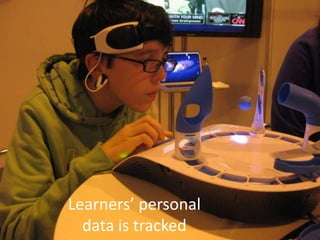
Learners’ personal
data is tracked
Learners’ personal
data is tracked
Wearable sensors are
already present, but in
the next future they
must be improved,
especially for health
purposes, such as
diabetes monitoring or
cardiovascular diseases
prevention.
Quantified self strongly
builds on reflection and
self-organisation. This
is good and feasible.
A reliable evidence base
for the effectiveness of
these measures and some
sort of safety control to
prevent irresponsible
recommendations. .
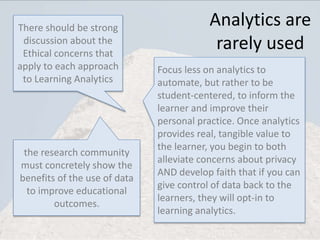
Analytics are
rarely used
Analytics are
rarely used
There should be strong
discussion about the
Ethical concerns that
apply to each approach
to Learning Analytics
Focus less on analytics to
automate, but rather to be
student-centered, to inform the
learner and improve their
personal practice. Once analytics
provides real, tangible value to
the learner, you begin to both
alleviate concerns about privacy
AND develop faith that if you can
give control of data back to the
learners, they will opt-in to
learning analytics.
the research community
must concretely show the
benefits of the use of data
to improve educational
outcomes.
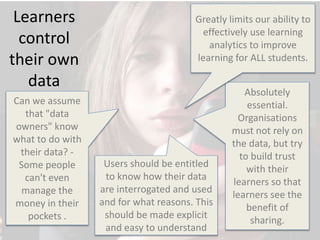
Learners
control
their own
data
Learners
control
their own
data
Absolutely
essential.
Organisations
must not rely on
the data, but try
to build trust
with their
learners so that
learners see the
benefit of
sharing.
Can we assume
that "data
owners" know
what to do with
their data? -
Some people
can't even
manage the
money in their
pockets .
Users should be entitled
to know how their data
are interrogated and used
and for what reasons. This
should be made explicit
and easy to understand
Greatly limits our ability to
effectively use learning
analytics to improve
learning for ALL students.
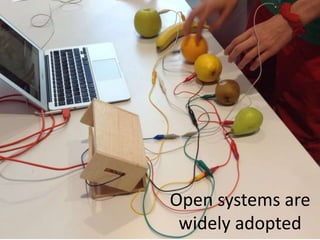
Open systems are
widely adopted
Open systems are
widely adopted
Define standards for the information
exchange - Define standards to
exploit the information stored -
Define guides about what
information is useful - Define and
publish different models to
represent the information
align with corporate
and stop thinking that
academic is leading!
A multi-pronged approach
involving IT services, national
organizations like JISC and
ministry of education and
tertiary institutions would all
need to be involved.
Learning analytics are essential tools
Very little credible research has
demonstrated any real large-scale
benefits to learners or institutions.
Learning is not only about
success is about learning from
failure. So, yes, I think that it
would be desirable that the
prediction rates are very high,
however, I don't think it is the
final goal.
What is needed is support
for reflection, discussion
and debate on the purpose
of it all, especially to curb
the excesses of those that
see learning as something
teachers do to students. We
need to nurture rich,
reflective communities
Analytics help
learners make
the right choices
Analytics help
learners make
the right choices
From bitter
experience, I'm aware
of the very slow pace
of institutional change
companies will sell
politicians on the
budget savings and
lead us here.
With learning there is an
element that learning is a
process - reducing it to
simply outcomes that can be
measured is dangerous
limited as ignores learning
through interactions with
both peers and the wider
social environment.
Analytics have
largely replaced
teachers
Analytics have
largely replaced
teachers
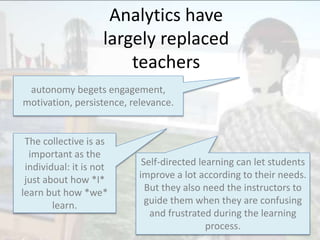
autonomy begets engagement,
motivation, persistence, relevance.
The collective is as
important as the
individual: it is not
just about how *I*
learn but how *we*
learn.
Self-directed learning can let students
improve a lot according to their needs.
But they also need the instructors to
guide them when they are confusing
and frustrated during the learning
process.
R3beccaF on Twitter
www.slideshare.net/R3beccaF

The future of learning analytics

  • 1.
    The future of learninganalytics Rebecca Ferguson, The Open University, UK
  • 2.
  • 3.
    Learning analytics make useof the trace data we leave behind as we teach and learn
  • 4.
    They help us identifyand make sense of patterns in the data to improve our teaching, our learning and our learning environments
  • 5.
  • 6.
    Learners are monitored by theirlearning environments
  • 7.
    Learners are monitored by theirlearning environments Just as in bioethics, there are fundamental human factors at play here. Too much Big Brother vision to be appealing. I think it is a promising line of work for learning analytics. I think there will be many advances in the use of sensors to identify aspects that can be applied to this vision.
  • 8.
  • 9.
    Learners’ personal data istracked Wearable sensors are already present, but in the next future they must be improved, especially for health purposes, such as diabetes monitoring or cardiovascular diseases prevention. Quantified self strongly builds on reflection and self-organisation. This is good and feasible. A reliable evidence base for the effectiveness of these measures and some sort of safety control to prevent irresponsible recommendations. .
  • 10.
  • 11.
    Analytics are rarely used Thereshould be strong discussion about the Ethical concerns that apply to each approach to Learning Analytics Focus less on analytics to automate, but rather to be student-centered, to inform the learner and improve their personal practice. Once analytics provides real, tangible value to the learner, you begin to both alleviate concerns about privacy AND develop faith that if you can give control of data back to the learners, they will opt-in to learning analytics. the research community must concretely show the benefits of the use of data to improve educational outcomes.
  • 12.
  • 13.
    Learners control their own data Absolutely essential. Organisations must notrely on the data, but try to build trust with their learners so that learners see the benefit of sharing. Can we assume that "data owners" know what to do with their data? - Some people can't even manage the money in their pockets . Users should be entitled to know how their data are interrogated and used and for what reasons. This should be made explicit and easy to understand Greatly limits our ability to effectively use learning analytics to improve learning for ALL students.
  • 14.
  • 15.
    Open systems are widelyadopted Define standards for the information exchange - Define standards to exploit the information stored - Define guides about what information is useful - Define and publish different models to represent the information align with corporate and stop thinking that academic is leading! A multi-pronged approach involving IT services, national organizations like JISC and ministry of education and tertiary institutions would all need to be involved.
  • 16.
    Learning analytics areessential tools
  • 17.
    Learning analytics areessential tools Very little credible research has demonstrated any real large-scale benefits to learners or institutions. Learning is not only about success is about learning from failure. So, yes, I think that it would be desirable that the prediction rates are very high, however, I don't think it is the final goal. What is needed is support for reflection, discussion and debate on the purpose of it all, especially to curb the excesses of those that see learning as something teachers do to students. We need to nurture rich, reflective communities
  • 18.
  • 19.
    Analytics help learners make theright choices From bitter experience, I'm aware of the very slow pace of institutional change companies will sell politicians on the budget savings and lead us here. With learning there is an element that learning is a process - reducing it to simply outcomes that can be measured is dangerous limited as ignores learning through interactions with both peers and the wider social environment.
  • 20.
  • 21.
    Analytics have largely replaced teachers autonomybegets engagement, motivation, persistence, relevance. The collective is as important as the individual: it is not just about how *I* learn but how *we* learn. Self-directed learning can let students improve a lot according to their needs. But they also need the instructors to guide them when they are confusing and frustrated during the learning process.
  • 22.