Executive Insights | Spotlight on Media & Entertainment
L.E.K. Consulting / January 2016 LEK.COM
Perennial Millennials: a viral phenomenon
How do Millennials consume traditional and new media? »
L.E.K. has conducted the first analysis
of U.K. Millennials’ media habits
by life stage. The research covers
six life stages, from living at home
with parents all the way through
to starting their own families.
In the first installment of the
Executive Insights Spotlight on
Media and Entertainment: “The
Perennial Millennial” series, L.E.K.
highlights revelatory findings from
the proprietary research:
• Millennials’ preference for new
media is broadly consistent
across all life stages
• Millennial behavior is viral and
spreading to Non-millennials
and older generations
• The change in media usage is
faster and more pervasive than
originally thought
Life Stage Analysis of Millennials’ Media Consumption Habits Raises
Major Challenges in Media Industry
Executive Insights | Spotlight on Media  Entertainment
L.E.K. Consulting / January 2016 LEK.COM
Perennial Millennials: a viral phenomenon
Do Millennial consumption patterns change as they age? »
Millennials Spend Significantly Less Time on Traditional Media Than Older
Generations...
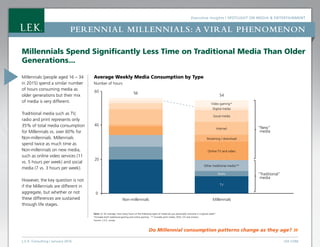
Millennials (people aged 16 – 34
in 2015) spend a similar number
of hours consuming media as
older generations but their mix
of media is very different.
Traditional media such as TV,
radio and print represents only
35% of total media consumption
for Millennials vs. over 60% for
Non-millennials. Millennials
spend twice as much time as
Non-millennials on new media,
such as online video services (11
vs. 5 hours per week) and social
media (7 vs. 3 hours per week).
However, the key question is not
if the Millennials are different in
aggregate, but whether or not
these differences are sustained
through life stages.
Average Weekly Media Consumption by Type
Number of hours
60 -
40 -
20 -
0
56
54
Video gaming*
Digital media
Social media
Internet
Streaming / download
Online TV and video
Other traditional media**
Radio
TV
MillennialsNon-millennials
“New”
media
“Traditional”
media
Note: Q: On average, how many hours of the following types of media do you personally consume in a typical week?
*Includes both traditional gaming and online gaming. ** Includes print media, DVD, CD and cinema
Source: L.E.K. survey
Executive Insights | Spotlight on Media  Entertainment
L.E.K. Consulting / January 2016 LEK.COM
Perennial Millennials: a viral phenomenon
… and This Behavior Continues Through Life Stages
What are the TV and video consumption patterns? »
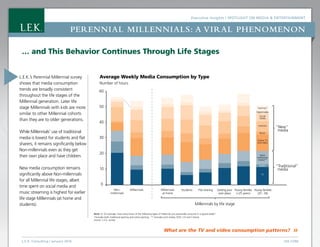
L.E.K.’s Perennial Millennial survey
shows that media consumption
trends are broadly consistent
throughout the life stages of the
Millennial generation. Later life
stage Millennials with kids are more
similar to other Millennial cohorts
than they are to older generations.
While Millennials’ use of traditional
media is lowest for students and flat
sharers, it remains significantly below
Non-millennials even as they get
their own place and have children.
New media consumption remains
significantly above Non-millennials
for all Millennial life stages, albeit
time spent on social media and
music streaming is highest for earlier
life stage Millennials (at home and
students).
Note: Q: On average, how many hours of the following types of media do you personally consume in a typical week?
*Includes both traditional gaming and online gaming. ** Includes print media, DVD, CD and Cinema
Source: L.E.K. survey
Average Weekly Media Consumption by Type
Number of hours
60 -
50 -
40 -
30 -
20 -
10 -
0
Gaming*
Digital media
Social
media
Internet
Music
Online TV
and video
Other
traditional
media**
Radio
TV
“New”
media
“Traditional”
media
Non-
millennials
Millennials
at home
Millennials Students Flat sharing Getting your
own place
Young families
(25 years)
Young families
(25 - 34)
Millennials by life stage
Executive Insights | Spotlight on Media  Entertainment
L.E.K. Consulting / January 2016 LEK.COM
Perennial Millennials: a viral phenomenon
What about other media forms? »
Millennials Across Life Stages Spend Significantly Less Time
Consuming Traditional TV and are Much Higher Users of Online Video
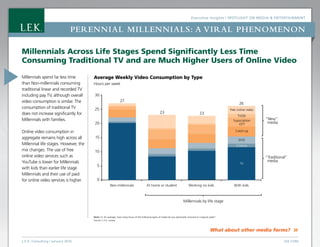
Millennials spend far less time
than Non-millennials consuming
traditional linear and recorded TV
including pay TV, although overall
video consumption is similar. The
consumption of traditional TV
does not increase significantly for
Millennials with families.
Online video consumption in
aggregate remains high across all
Millennial life stages. However, the
mix changes. The use of free
online video services such as
YouTube is lower for Millennials
with kids than earlier life stage
Millennials and their use of paid
for online video services is higher.
Average Weekly Video Consumption by Type
Hours per week
30
25
20
15
10
5
0
Non-millennials At home or student Working no kids With kids
Millennials by life stage
“New”
media
“Traditional”
media
TVOD
Free online video
Supscription
OTT
Catch-up
DVD
Cinema
TV
27
23 23
26
Note: Q: On average, how many hours of the following types of media do you personally consume in a typical week?
Source: L.E.K. survey
Executive Insights | Spotlight on Media  Entertainment
L.E.K. Consulting / January 2016 LEK.COM
Perennial Millennials: a viral phenomenon
What forms of media are “must-haves” for the Millennials, and which are not? »
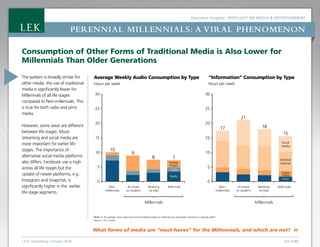
The pattern is broadly similar for
other media: the use of traditional
media is significantly lower for
Millennials of all life stages
compared to Non-millennials. This
is true for both radio and print
media.
However, some areas are different
between life stages. Music
streaming and social media are
more important for earlier life
stages. The importance of
alternative social media platforms
also differs. Facebook use is high
across all life stages but the
uptake of newer platforms, e.g.
Instagram and Snapchat, is
significantly higher in the earlier
life stage segments.
Consumption of Other Forms of Traditional Media is Also Lower for
Millennials Than Older Generations
Average Weekly Audio Consumption by Type
Hours per week
“Information” Consumption by Type
Hours per week
10
9
8 7
30
25
20
15
10
5
0
Non-
millennials
At home
or student
Working
no kids
With kids
Millennials
30
25
20
15
10
5
0
Non-
millennials
At home
or student
Working
no kids
With kids
Millennials
17
21
18
15
Online
music
Social
media
General
internet
Digital
media
Print
CDs
Radio Radio
Note: Q: On average, how many hours of the following types of media do you personally consume in a typical week?
Source: L.E.K. survey
Executive Insights | Spotlight on Media  Entertainment
L.E.K. Consulting / January 2016 LEK.COM
Perennial Millennials: a viral phenomenon
Is migration from traditional to new media continuing? »
Millennials Place Higher Value on Social Media, Music and Subscription
OTT Video Than Traditional Pay and Free-To-Air TV
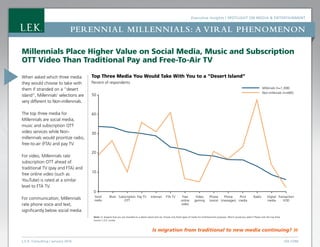
When asked which three media
they would choose to take with
them if stranded on a “desert
island”, Millennials’ selections are
very different to Non-millennials.
The top three media for
Millennials are social media,
music and subscription OTT
video services while Non-
millennials would prioritize radio,
free-to-air (FTA) and pay TV.
For video, Millennials rate
subscription OTT ahead of
traditional TV (pay and FTA) and
free online video (such as
YouTube) is rated at a similar
level to FTA TV.
For communication, Millennials
rate phone voice and text,
significantly below social media.
Note: Q: Imagine that you are stranded on a desert island and can choose only three types of media for entertainment purposes. Which would you select? Please rank the top three.
Source: L.E.K. survey
Top Three Media You Would Take With You to a “Desert Island”
Percent of respondents
20
30
40
50
10
0
Social
media
Music Subscription
OTT
Pay TV Internet FTA TV Free
online
video
Video
gaming
Phone
(voice)
Phone
(messages)
Print
media
Radio Digital
media
Transaction
VOD
Non-millenials (n=685)
Millenials (n=1,308)
Executive Insights | Spotlight on Media  Entertainment
L.E.K. Consulting / January 2016 LEK.COM
Perennial Millennials: a viral phenomenon
What is the rate of adoption of OTT services? »
Both Millennials and Non-millennials are Shifting Consumption to New
Media but the Speed of Change and the Migration Patterns are Different
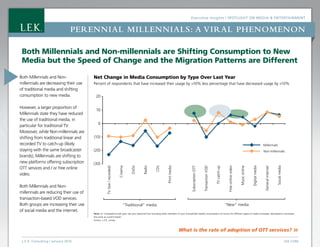
Both Millennials and Non-
millennials are decreasing their use
of traditional media and shifting
consumption to new media.
However, a larger proportion of
Millennials state they have reduced
the use of traditional media, in
particular for traditional TV.
Moreover, while Non-millennials are
shifting from traditional linear and
recorded TV to catch-up (likely
staying with the same broadcaster
brands), Millennials are shifting to
new platforms offering subscription
OTT services and / or free online
video.
Both Millennials and Non-
millennials are reducing their use of
transaction-based VOD services.
Both groups are increasing their use
of social media and the internet.
Net Change in Media Consumption by Type Over Last Year
Percent of respondents that have increased their usage by 10% less percentage that have decreased usage by 10%
SubscriptionOTT
TransactionVOD
TVcatch-up
Freeonlinevideo
Musiconline
Digitalmedia
Generalinternet
Socialmedia
TV(live/recorded)
Cinema
DVDs
Radio
CDs
Printmedia
20
10
0
(10)
(20)
(30)
“Traditional” media “New” media
Millennials
Non-millennials
Note: Q: Compared to last year, has your personal (not including other members of your household) weekly consumption (in hours) for different types of media increased, decreased or remained
the same as current levels?
Source: L.E.K. survey
Executive Insights | Spotlight on Media  Entertainment
L.E.K. Consulting / January 2016 LEK.COM
Perennial Millennials: a viral phenomenon
How fast will Millennial behavior become mass market? »
Millennials are Significantly More Likely to Use Over-The-Top (OTT)
Video Services
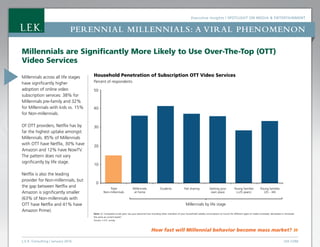
Millennials across all life stages
have significantly higher
adoption of online video
subscription services: 38% for
Millennials pre-family and 32%
for Millennials with kids vs. 15%
for Non-millennials.
Of OTT providers, Netflix has by
far the highest uptake amongst
Millennials. 85% of Millennials
with OTT have Netflix, 30% have
Amazon and 12% have NowTV.
The pattern does not vary
significantly by life stage.
Netflix is also the leading
provider for Non-millennials, but
the gap between Netflix and
Amazon is significantly smaller
(63% of Non-millennials with
OTT have Netflix and 41% have
Amazon Prime).
Household Penetration of Subscription OTT Video Services
Percent of respondents
50
40
30
20
10
0
Total
Non-millennials
Millennials
at home
Students Flat sharing
Millennials by life stage
Getting your
own place
Young families
(25 years)
Young families
(25 - 34)
Note: Q: Compared to last year, has your personal (not including other members of your household) weekly consumption (in hours) for different types of media increased, decreased or remained
the same as current levels?
Source: L.E.K. survey
Executive Insights | Spotlight on Media  Entertainment
L.E.K. Consulting / January 2016 LEK.COM
Perennial Millennials: a viral phenomenon
What is the impact on different forms of media? »
Millennial Media Behavior is Viral and is Spreading Across Generations:
From Millennials to Non-millennials with Kids, to All Generations
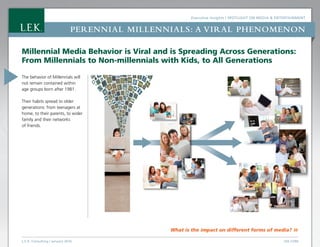
The behavior of Millennials will
not remain contained within
age groups born after 1981.
Their habits spread to older
generations: from teenagers at
home, to their parents, to wider
family and their networks
of friends.
Executive Insights | Spotlight on Media  Entertainment
L.E.K. Consulting / January 2016 LEK.COM
Perennial Millennials: a viral phenomenon
What are the implications? »
Millennial Behavior has Already Been Picked up by Non-millennials for
Mature Digital Media and is Spreading Rapidly in Other Areas
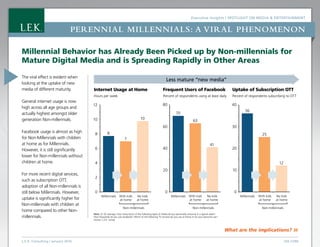
The viral effect is evident when
looking at the uptake of new
media of different maturity.
General internet usage is now
high across all age groups and
actually highest amongst older
generation Non-millennials.
Facebook usage is almost as high
for Non-Millennials with children
at home as for Millennials.
However, it is still significantly
lower for Non-millennials without
children at home.
For more recent digital services,
such as subscription OTT,
adoption of all Non-millennials is
still below Millennials. However,
uptake is significantly higher for
Non-millennials with children at
home compared to other Non-
millennials.
Frequent Users of Facebook
Percent of respondents using at least daily
Internet Usage at Home
Hours per week
Uptake of Subscription OTT
Percent of respondents subscribing to OTT
Note: Q: On average, how many hours of the following types of media do you personally consume in a typical week?
How frequently do you use Facebook? Which of the following TV services do you use at home or for your personal use?
Source: L.E.K. survey
12
10
8
6
4
2
0
Millennials With kids
at home
No kids
at home
8
7
10
36
25
12
40
30
20
10
0
Millennials
80
60
40
20
0
Millennials
70
63
41
With kids
at home
No kids
at home
Non-millennialsNon-millennials
With kids
at home
No kids
at home
Non-millennials
Less mature “new media”
Executive Insights | Spotlight on Media  Entertainment
L.E.K. Consulting / January 2016 LEK.COM
Perennial Millennials: a viral phenomenon
The Change in Consumption Habits is Faster and More Pervasive Than
Previously Thought. Traditional Media Participants Need to Adapt Rapidly
Millennial media consumption behavior is very different to older generations: 	
•	 They consume significantly less traditional media, in particular linear / recorded TV and radio	
•	 Uptake of new digital media platforms is significantly higher	
•	 They are continuing to change away from traditional media and their rate of change is faster and more		
fundamental than for older generations
Their behavior remains different to Non-millennials through all life stages and does not revert to more traditional
media consumption patterns.
Their behavior is viral and is spreading to older generations.
What Does this Mean for the Media Industry? 					
• The change in media consumption is coming faster and is far more pervasive than previously thought
• Traditional media participants will need to adapt rapidly to compete in this fast-emerging new environment
• There needs to be further and faster innovation to develop propositions that capture the interest and behavior
patterns of the Millennial generation
Executive Insights | Spotlight on Media  Entertainment
L.E.K. Consulting / January 2016 LEK.COM
Perennial Millennials: a viral phenomenon
Research Methodology
For The Perennial Millennial, L.E.K. Consulting conducted online research of 1,308 Millennials and 685 Non-
millennials living across the U.K.
The research took place in September 2015.
L.E.K. Consulting is a registered trademark of L.E.K. Consulting LLC. All other products and brands mentioned in this document are properties of their respective owners.
© 2016 L.E.K. Consulting LLC
The Perennial Millennial research and analysis was conducted by Maria Palm and Martin Pilkington,
both Partners in L.E.K.’s European Media, Entertainment and Technology practice. Maria and
Martin are based in London. For more information, please contact mediaentertainment@lek.com.
About the Authors

Perennial Millennials: A Viral Phenomenon

  • 1.
    Executive Insights |Spotlight on Media & Entertainment L.E.K. Consulting / January 2016 LEK.COM Perennial Millennials: a viral phenomenon How do Millennials consume traditional and new media? » L.E.K. has conducted the first analysis of U.K. Millennials’ media habits by life stage. The research covers six life stages, from living at home with parents all the way through to starting their own families. In the first installment of the Executive Insights Spotlight on Media and Entertainment: “The Perennial Millennial” series, L.E.K. highlights revelatory findings from the proprietary research: • Millennials’ preference for new media is broadly consistent across all life stages • Millennial behavior is viral and spreading to Non-millennials and older generations • The change in media usage is faster and more pervasive than originally thought Life Stage Analysis of Millennials’ Media Consumption Habits Raises Major Challenges in Media Industry
  • 2.
    Executive Insights |Spotlight on Media Entertainment L.E.K. Consulting / January 2016 LEK.COM Perennial Millennials: a viral phenomenon Do Millennial consumption patterns change as they age? » Millennials Spend Significantly Less Time on Traditional Media Than Older Generations... Millennials (people aged 16 – 34 in 2015) spend a similar number of hours consuming media as older generations but their mix of media is very different. Traditional media such as TV, radio and print represents only 35% of total media consumption for Millennials vs. over 60% for Non-millennials. Millennials spend twice as much time as Non-millennials on new media, such as online video services (11 vs. 5 hours per week) and social media (7 vs. 3 hours per week). However, the key question is not if the Millennials are different in aggregate, but whether or not these differences are sustained through life stages. Average Weekly Media Consumption by Type Number of hours 60 - 40 - 20 - 0 56 54 Video gaming* Digital media Social media Internet Streaming / download Online TV and video Other traditional media** Radio TV MillennialsNon-millennials “New” media “Traditional” media Note: Q: On average, how many hours of the following types of media do you personally consume in a typical week? *Includes both traditional gaming and online gaming. ** Includes print media, DVD, CD and cinema Source: L.E.K. survey
  • 3.
    Executive Insights |Spotlight on Media Entertainment L.E.K. Consulting / January 2016 LEK.COM Perennial Millennials: a viral phenomenon … and This Behavior Continues Through Life Stages What are the TV and video consumption patterns? » L.E.K.’s Perennial Millennial survey shows that media consumption trends are broadly consistent throughout the life stages of the Millennial generation. Later life stage Millennials with kids are more similar to other Millennial cohorts than they are to older generations. While Millennials’ use of traditional media is lowest for students and flat sharers, it remains significantly below Non-millennials even as they get their own place and have children. New media consumption remains significantly above Non-millennials for all Millennial life stages, albeit time spent on social media and music streaming is highest for earlier life stage Millennials (at home and students). Note: Q: On average, how many hours of the following types of media do you personally consume in a typical week? *Includes both traditional gaming and online gaming. ** Includes print media, DVD, CD and Cinema Source: L.E.K. survey Average Weekly Media Consumption by Type Number of hours 60 - 50 - 40 - 30 - 20 - 10 - 0 Gaming* Digital media Social media Internet Music Online TV and video Other traditional media** Radio TV “New” media “Traditional” media Non- millennials Millennials at home Millennials Students Flat sharing Getting your own place Young families (25 years) Young families (25 - 34) Millennials by life stage
  • 4.
    Executive Insights |Spotlight on Media Entertainment L.E.K. Consulting / January 2016 LEK.COM Perennial Millennials: a viral phenomenon What about other media forms? » Millennials Across Life Stages Spend Significantly Less Time Consuming Traditional TV and are Much Higher Users of Online Video Millennials spend far less time than Non-millennials consuming traditional linear and recorded TV including pay TV, although overall video consumption is similar. The consumption of traditional TV does not increase significantly for Millennials with families. Online video consumption in aggregate remains high across all Millennial life stages. However, the mix changes. The use of free online video services such as YouTube is lower for Millennials with kids than earlier life stage Millennials and their use of paid for online video services is higher. Average Weekly Video Consumption by Type Hours per week 30 25 20 15 10 5 0 Non-millennials At home or student Working no kids With kids Millennials by life stage “New” media “Traditional” media TVOD Free online video Supscription OTT Catch-up DVD Cinema TV 27 23 23 26 Note: Q: On average, how many hours of the following types of media do you personally consume in a typical week? Source: L.E.K. survey
  • 5.
    Executive Insights |Spotlight on Media Entertainment L.E.K. Consulting / January 2016 LEK.COM Perennial Millennials: a viral phenomenon What forms of media are “must-haves” for the Millennials, and which are not? » The pattern is broadly similar for other media: the use of traditional media is significantly lower for Millennials of all life stages compared to Non-millennials. This is true for both radio and print media. However, some areas are different between life stages. Music streaming and social media are more important for earlier life stages. The importance of alternative social media platforms also differs. Facebook use is high across all life stages but the uptake of newer platforms, e.g. Instagram and Snapchat, is significantly higher in the earlier life stage segments. Consumption of Other Forms of Traditional Media is Also Lower for Millennials Than Older Generations Average Weekly Audio Consumption by Type Hours per week “Information” Consumption by Type Hours per week 10 9 8 7 30 25 20 15 10 5 0 Non- millennials At home or student Working no kids With kids Millennials 30 25 20 15 10 5 0 Non- millennials At home or student Working no kids With kids Millennials 17 21 18 15 Online music Social media General internet Digital media Print CDs Radio Radio Note: Q: On average, how many hours of the following types of media do you personally consume in a typical week? Source: L.E.K. survey
  • 6.
    Executive Insights |Spotlight on Media Entertainment L.E.K. Consulting / January 2016 LEK.COM Perennial Millennials: a viral phenomenon Is migration from traditional to new media continuing? » Millennials Place Higher Value on Social Media, Music and Subscription OTT Video Than Traditional Pay and Free-To-Air TV When asked which three media they would choose to take with them if stranded on a “desert island”, Millennials’ selections are very different to Non-millennials. The top three media for Millennials are social media, music and subscription OTT video services while Non- millennials would prioritize radio, free-to-air (FTA) and pay TV. For video, Millennials rate subscription OTT ahead of traditional TV (pay and FTA) and free online video (such as YouTube) is rated at a similar level to FTA TV. For communication, Millennials rate phone voice and text, significantly below social media. Note: Q: Imagine that you are stranded on a desert island and can choose only three types of media for entertainment purposes. Which would you select? Please rank the top three. Source: L.E.K. survey Top Three Media You Would Take With You to a “Desert Island” Percent of respondents 20 30 40 50 10 0 Social media Music Subscription OTT Pay TV Internet FTA TV Free online video Video gaming Phone (voice) Phone (messages) Print media Radio Digital media Transaction VOD Non-millenials (n=685) Millenials (n=1,308)
  • 7.
    Executive Insights |Spotlight on Media Entertainment L.E.K. Consulting / January 2016 LEK.COM Perennial Millennials: a viral phenomenon What is the rate of adoption of OTT services? » Both Millennials and Non-millennials are Shifting Consumption to New Media but the Speed of Change and the Migration Patterns are Different Both Millennials and Non- millennials are decreasing their use of traditional media and shifting consumption to new media. However, a larger proportion of Millennials state they have reduced the use of traditional media, in particular for traditional TV. Moreover, while Non-millennials are shifting from traditional linear and recorded TV to catch-up (likely staying with the same broadcaster brands), Millennials are shifting to new platforms offering subscription OTT services and / or free online video. Both Millennials and Non- millennials are reducing their use of transaction-based VOD services. Both groups are increasing their use of social media and the internet. Net Change in Media Consumption by Type Over Last Year Percent of respondents that have increased their usage by 10% less percentage that have decreased usage by 10% SubscriptionOTT TransactionVOD TVcatch-up Freeonlinevideo Musiconline Digitalmedia Generalinternet Socialmedia TV(live/recorded) Cinema DVDs Radio CDs Printmedia 20 10 0 (10) (20) (30) “Traditional” media “New” media Millennials Non-millennials Note: Q: Compared to last year, has your personal (not including other members of your household) weekly consumption (in hours) for different types of media increased, decreased or remained the same as current levels? Source: L.E.K. survey
  • 8.
    Executive Insights |Spotlight on Media Entertainment L.E.K. Consulting / January 2016 LEK.COM Perennial Millennials: a viral phenomenon How fast will Millennial behavior become mass market? » Millennials are Significantly More Likely to Use Over-The-Top (OTT) Video Services Millennials across all life stages have significantly higher adoption of online video subscription services: 38% for Millennials pre-family and 32% for Millennials with kids vs. 15% for Non-millennials. Of OTT providers, Netflix has by far the highest uptake amongst Millennials. 85% of Millennials with OTT have Netflix, 30% have Amazon and 12% have NowTV. The pattern does not vary significantly by life stage. Netflix is also the leading provider for Non-millennials, but the gap between Netflix and Amazon is significantly smaller (63% of Non-millennials with OTT have Netflix and 41% have Amazon Prime). Household Penetration of Subscription OTT Video Services Percent of respondents 50 40 30 20 10 0 Total Non-millennials Millennials at home Students Flat sharing Millennials by life stage Getting your own place Young families (25 years) Young families (25 - 34) Note: Q: Compared to last year, has your personal (not including other members of your household) weekly consumption (in hours) for different types of media increased, decreased or remained the same as current levels? Source: L.E.K. survey
  • 9.
    Executive Insights |Spotlight on Media Entertainment L.E.K. Consulting / January 2016 LEK.COM Perennial Millennials: a viral phenomenon What is the impact on different forms of media? » Millennial Media Behavior is Viral and is Spreading Across Generations: From Millennials to Non-millennials with Kids, to All Generations The behavior of Millennials will not remain contained within age groups born after 1981. Their habits spread to older generations: from teenagers at home, to their parents, to wider family and their networks of friends.
  • 10.
    Executive Insights |Spotlight on Media Entertainment L.E.K. Consulting / January 2016 LEK.COM Perennial Millennials: a viral phenomenon What are the implications? » Millennial Behavior has Already Been Picked up by Non-millennials for Mature Digital Media and is Spreading Rapidly in Other Areas The viral effect is evident when looking at the uptake of new media of different maturity. General internet usage is now high across all age groups and actually highest amongst older generation Non-millennials. Facebook usage is almost as high for Non-Millennials with children at home as for Millennials. However, it is still significantly lower for Non-millennials without children at home. For more recent digital services, such as subscription OTT, adoption of all Non-millennials is still below Millennials. However, uptake is significantly higher for Non-millennials with children at home compared to other Non- millennials. Frequent Users of Facebook Percent of respondents using at least daily Internet Usage at Home Hours per week Uptake of Subscription OTT Percent of respondents subscribing to OTT Note: Q: On average, how many hours of the following types of media do you personally consume in a typical week? How frequently do you use Facebook? Which of the following TV services do you use at home or for your personal use? Source: L.E.K. survey 12 10 8 6 4 2 0 Millennials With kids at home No kids at home 8 7 10 36 25 12 40 30 20 10 0 Millennials 80 60 40 20 0 Millennials 70 63 41 With kids at home No kids at home Non-millennialsNon-millennials With kids at home No kids at home Non-millennials Less mature “new media”
  • 11.
    Executive Insights |Spotlight on Media Entertainment L.E.K. Consulting / January 2016 LEK.COM Perennial Millennials: a viral phenomenon The Change in Consumption Habits is Faster and More Pervasive Than Previously Thought. Traditional Media Participants Need to Adapt Rapidly Millennial media consumption behavior is very different to older generations: • They consume significantly less traditional media, in particular linear / recorded TV and radio • Uptake of new digital media platforms is significantly higher • They are continuing to change away from traditional media and their rate of change is faster and more fundamental than for older generations Their behavior remains different to Non-millennials through all life stages and does not revert to more traditional media consumption patterns. Their behavior is viral and is spreading to older generations. What Does this Mean for the Media Industry? • The change in media consumption is coming faster and is far more pervasive than previously thought • Traditional media participants will need to adapt rapidly to compete in this fast-emerging new environment • There needs to be further and faster innovation to develop propositions that capture the interest and behavior patterns of the Millennial generation
  • 12.
    Executive Insights |Spotlight on Media Entertainment L.E.K. Consulting / January 2016 LEK.COM Perennial Millennials: a viral phenomenon Research Methodology For The Perennial Millennial, L.E.K. Consulting conducted online research of 1,308 Millennials and 685 Non- millennials living across the U.K. The research took place in September 2015. L.E.K. Consulting is a registered trademark of L.E.K. Consulting LLC. All other products and brands mentioned in this document are properties of their respective owners. © 2016 L.E.K. Consulting LLC The Perennial Millennial research and analysis was conducted by Maria Palm and Martin Pilkington, both Partners in L.E.K.’s European Media, Entertainment and Technology practice. Maria and Martin are based in London. For more information, please contact mediaentertainment@lek.com. About the Authors