Bangkok
Beijing
Boston
Chennai
Chicago
London
Los Angeles
Melbourne
Milan
Mumbai
Munich
New Delhi
New York
Paris
San Francisco
São Paulo
Seoul
Shanghai
Singapore
Sydney
Tokyo
Wroclaw
China: Opportunities and Hot-spots
L.E.K. Consulting Pty Ltd, Level 26, Aurora Place, 88 Phillip Street, Sydney NSW 2000, Australia
T: 61.2.9323.0700 F: 61.2.9323.0600 www.lek.com
19 February 2014
© L.E.K. Consulting Australia 2014
CONFIDENTIAL
1
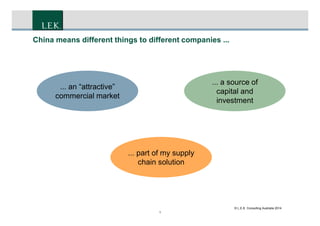
China means different things to different companies ...
... an “attractive”
commercial market
... a source of
capital and
investment
... part of my supply
chain solution
© L.E.K. Consulting Australia 2014
CONFIDENTIAL
2
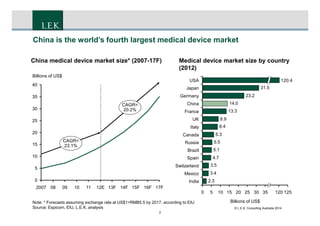
China is the world’s fourth largest medical device market
2.3
3.4
3.5
4.7
5.1
5.5
6.3
8.4
8.9
13.3
14.0
23.2
31.5
155 12525 1203020100 35
France
China
Germany
Japan
USA
Switzerland
Mexico
India
Billions of US$
Brazil
Spain
Russia
Canada
Italy
UK
120.4
Medical device market size by country
(2012)
Note: * Forecasts assuming exchange rate at US$1=RMB5.5 by 2017, according to EIU
Source: Espicom, EIU, L.E.K. analysis
China medical device market size* (2007-17F)
0
5
10
15
20
25
30
35
40
Billions of US$
CAGR=
20.2%
CAGR=
23.1%
17F16F15F14F13F12E111009082007
© L.E.K. Consulting Australia 2014
CONFIDENTIAL
3
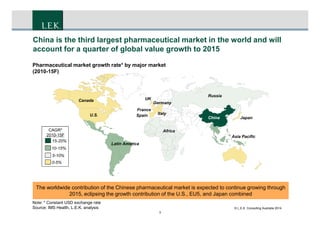
China is the third largest pharmaceutical market in the world and will
account for a quarter of global value growth to 2015
China
Russia
Japan
Canada
U.S.
UK
Asia Pacific
Spain
Germany
Italy
France
15-20%
10-15%
5-10%
0-5%
CAGR*
2010-15F
Pharmaceutical market growth rate* by major market
(2010-15F)
The worldwide contribution of the Chinese pharmaceutical market is expected to continue growing through
2015, eclipsing the growth contribution of the U.S., EU5, and Japan combined
Latin America
Africa
Note: * Constant USD exchange rate
Source: IMS Health, L.E.K. analysis © L.E.K. Consulting Australia 2014
CONFIDENTIAL
4
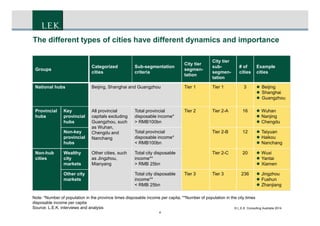
The different types of cities have different dynamics and importance
Note: *Number of population in the province times disposable income per capita; **Number of population in the city times
disposable income per capita
Source: L.E.K. interviews and analysis
Groups
Categorized
cities
Sub-segmentation
criteria
City tier
segmen-
tation
City tier
sub-
segmen-
tation
# of
cities
Example
cities
National hubs Beijing, Shanghai and Guangzhou Tier 1 Tier 1 3 Beijing
Shanghai
Guangzhou
Provincial
hubs
Key
provincial
hubs
All provincial
capitals excluding
Guangzhou, such
as Wuhan,
Chengdu and
Nanchang
Total provincial
disposable income*
> RMB100bn
Tier 2 Tier 2-A 16 Wuhan
Nanjing
Chengdu
Non-key
provincial
hubs
Total provincial
disposable income*
< RMB100bn
Tier 2-B 12 Taiyuan
Haikou
Nanchang
Non-hub
cities
Wealthy
city
markets
Other cities, such
as Jingzhou,
Mianyang
Total city disposable
income**
> RMB 25bn
Tier 2-C 20 Wuxi
Yantai
Xiamen
Other city
markets
Total city disposable
income**
< RMB 25bn
Tier 3 Tier 3 236 Jingzhou
Fushun
Zhanjiang
© L.E.K. Consulting Australia 2014
CONFIDENTIAL
5
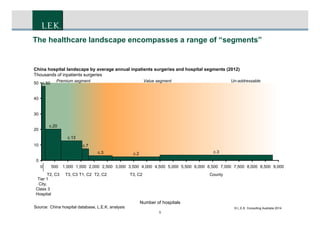
The healthcare landscape encompasses a range of “segments”
T3, C3
c.13
c.20
Tier 1
City,
Class 3
Hospital
c.50
c.2
c.7
T1, C2 T2, C2
c.3
T2, C3
30
20
40
50
China hospital landscape by average annual inpatients surgeries and hospital segments (2012)
Thousands of inpatients surgeries
10
0
Number of hospitals
9,0008,5008,0007,5007,0006,5006,0005,5005,0004,5004,0003,5003,0002,5002,0001,5001,0005000
County
c.3
T3, C2
Premium segment Value segment Un-addressable
Source: China hospital database, L.E.K. analysis © L.E.K. Consulting Australia 2014
CONFIDENTIAL
6
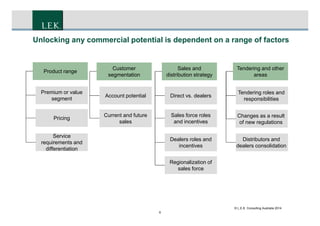
Unlocking any commercial potential is dependent on a range of factors
Product range
Sales and
distribution strategy
Tendering and other
areas
Premium or value
segment
Pricing
Service
requirements and
differentiation
Direct vs. dealers
Sales force roles
and incentives
Dealers roles and
incentives
Distributors and
dealers consolidation
Tendering roles and
responsibilities
Changes as a result
of new regulations
Regionalization of
sales force
Customer
segmentation
Account potential
Current and future
sales
© L.E.K. Consulting Australia 2014
CONFIDENTIAL
7
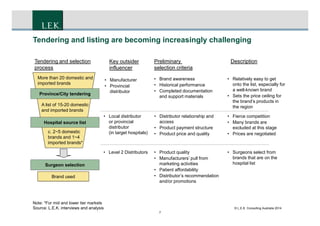
Tendering and listing are becoming increasingly challenging
Province/City tendering
Hospital source list
Surgeon selection
Tendering and selection
process
Key outsider
influencer
• Manufacturer
• Provincial
distributor
More than 20 domestic and
imported brands
A list of 15-20 domestic
and imported brands
c. 2~5 domestic
brands and 1~4
imported brands*
Preliminary
selection criteria
• Brand awareness
• Historical performance
• Completed documentation
and support materials
Brand used
Description
• Relatively easy to get
onto the list, especially for
a well-known brand
• Sets the price ceiling for
the brand’s products in
the region
Note: *For mid and lower tier markets
Source: L.E.K. interviews and analysis
• Local distributor
or provincial
distributor
(in target hospitals)
• Distributor relationship and
access
• Product payment structure
• Product price and quality
• Fierce competition
• Many brands are
excluded at this stage
• Prices are negotiated
• Level 2 Distributors • Product quality
• Manufacturers’ pull from
marketing activities
• Patient affordability
• Distributor’s recommendation
and/or promotions
• Surgeons select from
brands that are on the
hospital list
© L.E.K. Consulting Australia 2014
CONFIDENTIAL
8
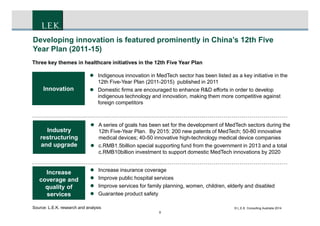
Innovation
Indigenous innovation in MedTech sector has been listed as a key initiative in the
12th Five-Year Plan (2011-2015) published in 2011
Domestic firms are encouraged to enhance R&D efforts in order to develop
indigenous technology and innovation, making them more competitive against
foreign competitors
Source: L.E.K. research and analysis
Industry
restructuring
and upgrade
A series of goals has been set for the development of MedTech sectors during the
12th Five-Year Plan. By 2015: 200 new patents of MedTech; 50-80 innovative
medical devices; 40-50 innovative high-technology medical device companies
c.RMB1.5billion special supporting fund from the government in 2013 and a total
c.RMB10billion investment to support domestic MedTech innovations by 2020
Three key themes in healthcare initiatives in the 12th Five Year Plan
Developing innovation is featured prominently in China’s 12th Five
Year Plan (2011-15)
Increase
coverage and
quality of
services
Increase insurance coverage
Improve public hospital services
Improve services for family planning, women, children, elderly and disabled
Guarantee product safety
© L.E.K. Consulting Australia 2014
CONFIDENTIAL
9
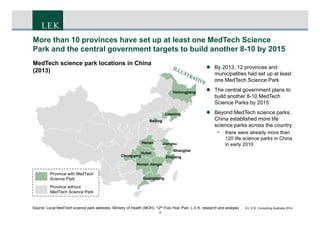
More than 10 provinces have set up at least one MedTech Science
Park and the central government targets to build another 8-10 by 2015
Chongqing
Jiangsu
Beijing
Guangdong
Hunan
Zhejiang
Hubei
Liaoning
Heilongjiang
Jiangxi
Shanghai
Henan
MedTech science park locations in China
(2013)
By 2013, 12 provinces and
municipalities had set up at least
one MedTech Science Park
The central government plans to
build another 8-10 MedTech
Science Parks by 2015
Beyond MedTech science parks,
China established more life
science parks across the country
- there were already more than
120 life science parks in China
in early 2010
Source: Local MedTech science park websites, Ministry of Health (MOH), 12th Five-Year Plan, L.E.K. research and analysis
Province with MedTech
Science Park
Province without
MedTech Science Park
© L.E.K. Consulting Australia 2014
CONFIDENTIAL
10
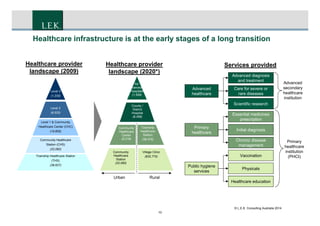
Healthcare infrastructure is at the early stages of a long transition
Healthcare provider
landscape (2009)
Level 3
(1,233)
Level 2
(6,533)
Level 1 & Community
Healthcare Center (CHC)
(10,825)
Community Healthcare
Station (CHS)
(22,092)
Township Healthcare Station
(THS)
(39,627)
Healthcare provider
landscape (2020*)
Urban Rural
Ad-
vanced
Hospitals
(1,559)
Community
Healthcare
Station
(22,092)
Village Clinic
(632,770)
Community
Healthcare
Center
(5,216)
Township
Healthcare
Station
(38,475)
County /
District
Hospital
(6,056)
Primary
healthcare
Initial diagnosis
Essential medicines
prescription
Chronic disease
management
Public hygiene
services
Physicals
Vaccination
Healthcare education
Advanced
healthcare
Care for severe or
rare diseases
Advanced diagnosis
and treatment
Scientific research
Advanced
secondary
healthcare
institution
Primary
healthcare
institution
(PHCI)
Services provided
© L.E.K. Consulting Australia 2014
CONFIDENTIAL
11
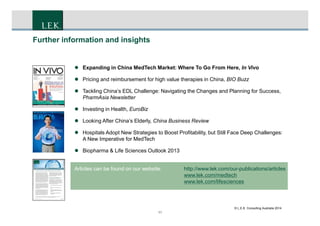
Further information and insights
Expanding in China MedTech Market: Where To Go From Here, In Vivo
Pricing and reimbursement for high value therapies in China, BIO Buzz
Tackling China’s EDL Challenge: Navigating the Changes and Planning for Success,
PharmAsia Newsletter
Investing in Health, EuroBiz
Looking After China’s Elderly, China Business Review
Hospitals Adopt New Strategies to Boost Profitability, but Still Face Deep Challenges:
A New Imperative for MedTech
Biopharma & Life Sciences Outlook 2013
Articles can be found on our website: http://www.lek.com/our-publications/articles
www.lek.com/medtech
www.lek.com/lifesciences
© L.E.K. Consulting Australia 2014
CONFIDENTIAL
12
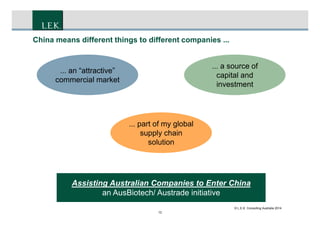
China means different things to different companies ...
... an “attractive”
commercial market
... a source of
capital and
investment
... part of my global
supply chain
solution
Assisting Australian Companies to Enter China
an AusBiotech/ Austrade initiative
© L.E.K. Consulting Australia 2014
CONFIDENTIAL
13
kÉ~äÉ=gçåÉëkÉ~äÉ=gçåÉëkÉ~äÉ=gçåÉëkÉ~äÉ=gçåÉë
iKbKhiKbKhiKbKhiKbKhK=`çåëìäíáåÖK=`çåëìäíáåÖK=`çåëìäíáåÖK=`çåëìäíáåÖ
åKàçåÉë]äÉâKÅçãåKàçåÉë]äÉâKÅçãåKàçåÉë]äÉâKÅçãåKàçåÉë]äÉâKÅçã
HSN=O=VPOP=MTMMHSN=O=VPOP=MTMMHSN=O=VPOP=MTMMHSN=O=VPOP=MTMM
äÉâKÅçãäÉâKÅçãäÉâKÅçãäÉâKÅçã
© L.E.K. Consulting Australia 2014

China: Opportunities and Hot-Spots in the MedTech (Medical Device), Pharmaceutical and Healthcare Markets

  • 1.
    Bangkok Beijing Boston Chennai Chicago London Los Angeles Melbourne Milan Mumbai Munich New Delhi NewYork Paris San Francisco São Paulo Seoul Shanghai Singapore Sydney Tokyo Wroclaw China: Opportunities and Hot-spots L.E.K. Consulting Pty Ltd, Level 26, Aurora Place, 88 Phillip Street, Sydney NSW 2000, Australia T: 61.2.9323.0700 F: 61.2.9323.0600 www.lek.com 19 February 2014 © L.E.K. Consulting Australia 2014
  • 2.
    CONFIDENTIAL 1 China means differentthings to different companies ... ... an “attractive” commercial market ... a source of capital and investment ... part of my supply chain solution © L.E.K. Consulting Australia 2014
  • 3.
    CONFIDENTIAL 2 China is theworld’s fourth largest medical device market 2.3 3.4 3.5 4.7 5.1 5.5 6.3 8.4 8.9 13.3 14.0 23.2 31.5 155 12525 1203020100 35 France China Germany Japan USA Switzerland Mexico India Billions of US$ Brazil Spain Russia Canada Italy UK 120.4 Medical device market size by country (2012) Note: * Forecasts assuming exchange rate at US$1=RMB5.5 by 2017, according to EIU Source: Espicom, EIU, L.E.K. analysis China medical device market size* (2007-17F) 0 5 10 15 20 25 30 35 40 Billions of US$ CAGR= 20.2% CAGR= 23.1% 17F16F15F14F13F12E111009082007 © L.E.K. Consulting Australia 2014
  • 4.
    CONFIDENTIAL 3 China is thethird largest pharmaceutical market in the world and will account for a quarter of global value growth to 2015 China Russia Japan Canada U.S. UK Asia Pacific Spain Germany Italy France 15-20% 10-15% 5-10% 0-5% CAGR* 2010-15F Pharmaceutical market growth rate* by major market (2010-15F) The worldwide contribution of the Chinese pharmaceutical market is expected to continue growing through 2015, eclipsing the growth contribution of the U.S., EU5, and Japan combined Latin America Africa Note: * Constant USD exchange rate Source: IMS Health, L.E.K. analysis © L.E.K. Consulting Australia 2014
  • 5.
    CONFIDENTIAL 4 The different typesof cities have different dynamics and importance Note: *Number of population in the province times disposable income per capita; **Number of population in the city times disposable income per capita Source: L.E.K. interviews and analysis Groups Categorized cities Sub-segmentation criteria City tier segmen- tation City tier sub- segmen- tation # of cities Example cities National hubs Beijing, Shanghai and Guangzhou Tier 1 Tier 1 3 Beijing Shanghai Guangzhou Provincial hubs Key provincial hubs All provincial capitals excluding Guangzhou, such as Wuhan, Chengdu and Nanchang Total provincial disposable income* > RMB100bn Tier 2 Tier 2-A 16 Wuhan Nanjing Chengdu Non-key provincial hubs Total provincial disposable income* < RMB100bn Tier 2-B 12 Taiyuan Haikou Nanchang Non-hub cities Wealthy city markets Other cities, such as Jingzhou, Mianyang Total city disposable income** > RMB 25bn Tier 2-C 20 Wuxi Yantai Xiamen Other city markets Total city disposable income** < RMB 25bn Tier 3 Tier 3 236 Jingzhou Fushun Zhanjiang © L.E.K. Consulting Australia 2014
  • 6.
    CONFIDENTIAL 5 The healthcare landscapeencompasses a range of “segments” T3, C3 c.13 c.20 Tier 1 City, Class 3 Hospital c.50 c.2 c.7 T1, C2 T2, C2 c.3 T2, C3 30 20 40 50 China hospital landscape by average annual inpatients surgeries and hospital segments (2012) Thousands of inpatients surgeries 10 0 Number of hospitals 9,0008,5008,0007,5007,0006,5006,0005,5005,0004,5004,0003,5003,0002,5002,0001,5001,0005000 County c.3 T3, C2 Premium segment Value segment Un-addressable Source: China hospital database, L.E.K. analysis © L.E.K. Consulting Australia 2014
  • 7.
    CONFIDENTIAL 6 Unlocking any commercialpotential is dependent on a range of factors Product range Sales and distribution strategy Tendering and other areas Premium or value segment Pricing Service requirements and differentiation Direct vs. dealers Sales force roles and incentives Dealers roles and incentives Distributors and dealers consolidation Tendering roles and responsibilities Changes as a result of new regulations Regionalization of sales force Customer segmentation Account potential Current and future sales © L.E.K. Consulting Australia 2014
  • 8.
    CONFIDENTIAL 7 Tendering and listingare becoming increasingly challenging Province/City tendering Hospital source list Surgeon selection Tendering and selection process Key outsider influencer • Manufacturer • Provincial distributor More than 20 domestic and imported brands A list of 15-20 domestic and imported brands c. 2~5 domestic brands and 1~4 imported brands* Preliminary selection criteria • Brand awareness • Historical performance • Completed documentation and support materials Brand used Description • Relatively easy to get onto the list, especially for a well-known brand • Sets the price ceiling for the brand’s products in the region Note: *For mid and lower tier markets Source: L.E.K. interviews and analysis • Local distributor or provincial distributor (in target hospitals) • Distributor relationship and access • Product payment structure • Product price and quality • Fierce competition • Many brands are excluded at this stage • Prices are negotiated • Level 2 Distributors • Product quality • Manufacturers’ pull from marketing activities • Patient affordability • Distributor’s recommendation and/or promotions • Surgeons select from brands that are on the hospital list © L.E.K. Consulting Australia 2014
  • 9.
    CONFIDENTIAL 8 Innovation Indigenous innovation inMedTech sector has been listed as a key initiative in the 12th Five-Year Plan (2011-2015) published in 2011 Domestic firms are encouraged to enhance R&D efforts in order to develop indigenous technology and innovation, making them more competitive against foreign competitors Source: L.E.K. research and analysis Industry restructuring and upgrade A series of goals has been set for the development of MedTech sectors during the 12th Five-Year Plan. By 2015: 200 new patents of MedTech; 50-80 innovative medical devices; 40-50 innovative high-technology medical device companies c.RMB1.5billion special supporting fund from the government in 2013 and a total c.RMB10billion investment to support domestic MedTech innovations by 2020 Three key themes in healthcare initiatives in the 12th Five Year Plan Developing innovation is featured prominently in China’s 12th Five Year Plan (2011-15) Increase coverage and quality of services Increase insurance coverage Improve public hospital services Improve services for family planning, women, children, elderly and disabled Guarantee product safety © L.E.K. Consulting Australia 2014
  • 10.
    CONFIDENTIAL 9 More than 10provinces have set up at least one MedTech Science Park and the central government targets to build another 8-10 by 2015 Chongqing Jiangsu Beijing Guangdong Hunan Zhejiang Hubei Liaoning Heilongjiang Jiangxi Shanghai Henan MedTech science park locations in China (2013) By 2013, 12 provinces and municipalities had set up at least one MedTech Science Park The central government plans to build another 8-10 MedTech Science Parks by 2015 Beyond MedTech science parks, China established more life science parks across the country - there were already more than 120 life science parks in China in early 2010 Source: Local MedTech science park websites, Ministry of Health (MOH), 12th Five-Year Plan, L.E.K. research and analysis Province with MedTech Science Park Province without MedTech Science Park © L.E.K. Consulting Australia 2014
  • 11.
    CONFIDENTIAL 10 Healthcare infrastructure isat the early stages of a long transition Healthcare provider landscape (2009) Level 3 (1,233) Level 2 (6,533) Level 1 & Community Healthcare Center (CHC) (10,825) Community Healthcare Station (CHS) (22,092) Township Healthcare Station (THS) (39,627) Healthcare provider landscape (2020*) Urban Rural Ad- vanced Hospitals (1,559) Community Healthcare Station (22,092) Village Clinic (632,770) Community Healthcare Center (5,216) Township Healthcare Station (38,475) County / District Hospital (6,056) Primary healthcare Initial diagnosis Essential medicines prescription Chronic disease management Public hygiene services Physicals Vaccination Healthcare education Advanced healthcare Care for severe or rare diseases Advanced diagnosis and treatment Scientific research Advanced secondary healthcare institution Primary healthcare institution (PHCI) Services provided © L.E.K. Consulting Australia 2014
  • 12.
    CONFIDENTIAL 11 Further information andinsights Expanding in China MedTech Market: Where To Go From Here, In Vivo Pricing and reimbursement for high value therapies in China, BIO Buzz Tackling China’s EDL Challenge: Navigating the Changes and Planning for Success, PharmAsia Newsletter Investing in Health, EuroBiz Looking After China’s Elderly, China Business Review Hospitals Adopt New Strategies to Boost Profitability, but Still Face Deep Challenges: A New Imperative for MedTech Biopharma & Life Sciences Outlook 2013 Articles can be found on our website: http://www.lek.com/our-publications/articles www.lek.com/medtech www.lek.com/lifesciences © L.E.K. Consulting Australia 2014
  • 13.
    CONFIDENTIAL 12 China means differentthings to different companies ... ... an “attractive” commercial market ... a source of capital and investment ... part of my global supply chain solution Assisting Australian Companies to Enter China an AusBiotech/ Austrade initiative © L.E.K. Consulting Australia 2014
  • 14.