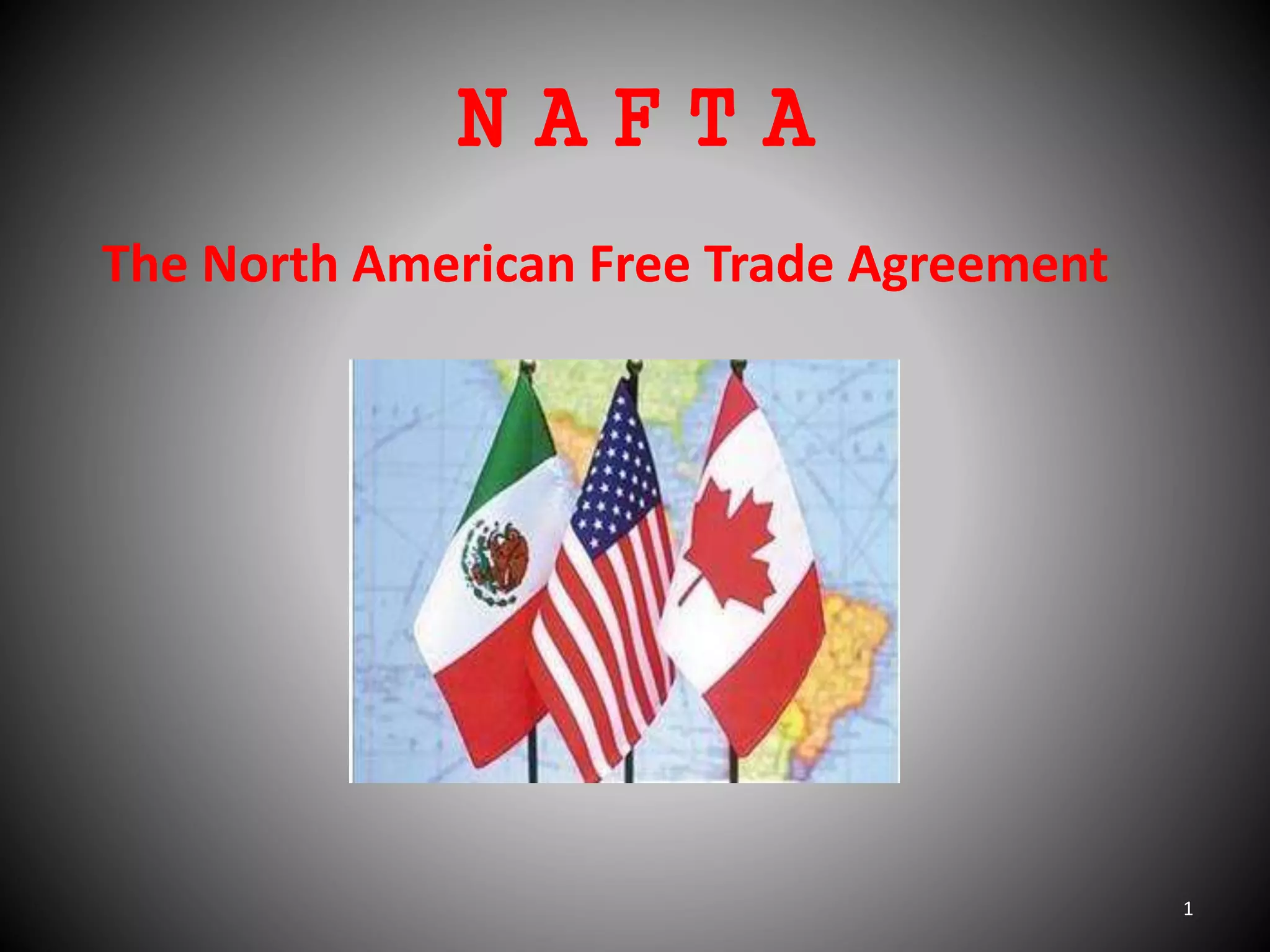
N A F T A
The North American Free Trade Agreement
1
N A F T A
• Free Trade Agreement between America,
Canada, Mexico
• Came into effect on January 1 , 1994
• The world's largest free trade bloc
• laying the foundations for strong economic
growth and rising prosperity for Canada, the
United States, and Mexico.
N A F T A : What ?
• Free Trade Agreement between America,
Canada, Mexico
• “Free Trade” means that countries may freely
trade goods with each other without having
to pay a tariff(tax) on those goods.
N A F T A : Why ?
The purpose of establishing the agreement is to :
• Allow free movement of goods and services
among the countries
• Protect the property rights of people and
business in each country
• Encourage the cooperation among countries
• Be able to resolve dispute
4
N A F T A : Background
• In 1994, the North American Free Trade
Agreement (NAFTA), a state-of-the-art market-
opening agreement, came into force. Since then,
NAFTA has systematically eliminated most tariff
and non-tariff barriers to trade and investment
between Canada, the United States, and Mexico.
By establishing a strong and reliable framework
for investment, NAFTA has also helped create the
environment of confidence and stability required
for long-term investment. NAFTA was preceded
by the Canada-U.S. Free Trade Agreement.
5
N A F T A : Background
6
N A F T A , Contents
• NAFTA has played an important role in the
overall development of the three nations
• Dispute resolution
• Commitment to intellectual property &
environment legislation
• Mutual entry into governmental bidding & the
financial and other service sector
• But on the other hand it is also responsible for
causalities like loss of jobs , migration , rising level
of inequality and many others
7
N A F T A , Contents
• Rules of Origin
• Side Agreements
• Commitment to the Environment
• Commitment to Labor Cooperation
8
N A F T A : Benefits ?
• Since NAFTA came into effect, trade and
investment levels in North America have
increased.
• bringing strong economic growth, job
creation, and better prices and selection in
consumer goods.
• North American businesses, consumers,
families, workers, and farmers have all
benefited.
N A F T A
10
N A F T A , Fast facts
• Did you know?
• Today, NAFTA partners
exchange nearly US$2.6
billion in merchandise each
day—that’s about US$108
million per hour.
• In 1994, NAFTA was a state-
of-the-art market-opening
agreement that paved the
way for the creation of high-
paying export-related jobs
and strong economic
growth throughout North
America.
Good to know
N A F T A : Future
• It is about integration of
the North American
marketplace
• It is about moving up
the value-added chain
• It is about maintaining
and increasing
competitiveness and
productivity
N A F T A : Conclusion
• NAFTA has played an important role in the
overall development of the three nations
• Dispute resolution
• Commitment to intellectual property &
environment legislation
• Mutual entry into governmental bidding & the
financial and other service sector
• But on the other hand it is also responsible for
causalities like loss of jobs , migration , rising level
of inequality and many others

Nafta

  • 1.
    N A FT A The North American Free Trade Agreement 1
  • 2.
    N A FT A • Free Trade Agreement between America, Canada, Mexico • Came into effect on January 1 , 1994 • The world's largest free trade bloc • laying the foundations for strong economic growth and rising prosperity for Canada, the United States, and Mexico.
  • 3.
    N A FT A : What ? • Free Trade Agreement between America, Canada, Mexico • “Free Trade” means that countries may freely trade goods with each other without having to pay a tariff(tax) on those goods.
  • 4.
    N A FT A : Why ? The purpose of establishing the agreement is to : • Allow free movement of goods and services among the countries • Protect the property rights of people and business in each country • Encourage the cooperation among countries • Be able to resolve dispute 4
  • 5.
    N A FT A : Background • In 1994, the North American Free Trade Agreement (NAFTA), a state-of-the-art market- opening agreement, came into force. Since then, NAFTA has systematically eliminated most tariff and non-tariff barriers to trade and investment between Canada, the United States, and Mexico. By establishing a strong and reliable framework for investment, NAFTA has also helped create the environment of confidence and stability required for long-term investment. NAFTA was preceded by the Canada-U.S. Free Trade Agreement. 5
  • 6.
    N A FT A : Background 6
  • 7.
    N A FT A , Contents • NAFTA has played an important role in the overall development of the three nations • Dispute resolution • Commitment to intellectual property & environment legislation • Mutual entry into governmental bidding & the financial and other service sector • But on the other hand it is also responsible for causalities like loss of jobs , migration , rising level of inequality and many others 7
  • 8.
    N A FT A , Contents • Rules of Origin • Side Agreements • Commitment to the Environment • Commitment to Labor Cooperation 8
  • 9.
    N A FT A : Benefits ? • Since NAFTA came into effect, trade and investment levels in North America have increased. • bringing strong economic growth, job creation, and better prices and selection in consumer goods. • North American businesses, consumers, families, workers, and farmers have all benefited.
  • 10.
    N A FT A 10
  • 11.
    N A FT A , Fast facts • Did you know? • Today, NAFTA partners exchange nearly US$2.6 billion in merchandise each day—that’s about US$108 million per hour. • In 1994, NAFTA was a state- of-the-art market-opening agreement that paved the way for the creation of high- paying export-related jobs and strong economic growth throughout North America. Good to know
  • 12.
    N A FT A : Future • It is about integration of the North American marketplace • It is about moving up the value-added chain • It is about maintaining and increasing competitiveness and productivity
  • 13.
    N A FT A : Conclusion • NAFTA has played an important role in the overall development of the three nations • Dispute resolution • Commitment to intellectual property & environment legislation • Mutual entry into governmental bidding & the financial and other service sector • But on the other hand it is also responsible for causalities like loss of jobs , migration , rising level of inequality and many others