The European Higher
Education Area
Prepared by
Kolomiiets Alina
Voitenko Pavlo
Biliienko Ihor
Riazanova Anastasia
Demiyanovskaya Marina
Form 11
School 10
Teacher:
Vita Kokhno
Key elements to complete the European Higher Education Area
The creation of such a European Higher Education Area was subject to the fulfillment
of three key components:
The creation of an evaluation system that would allow the comparison of study
programs and courses. For this purpose, the European Credit Transfer Scheme
(ECTS) was developed
The creation of comparable higher education structures with the introduction of a
system based on cycles (please, see graphic below)
The application of the Lisbon Convention, which ensures that studies are mutually
recognized within the signatory countries.
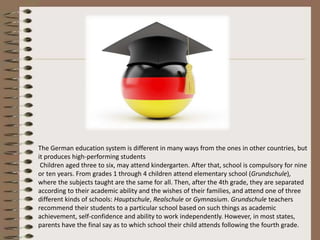
The German education system is different in many ways from the ones in other countries, but
it produces high-performing students
Children aged three to six, may attend kindergarten. After that, school is compulsory for nine
or ten years. From grades 1 through 4 children attend elementary school (Grundschule),
where the subjects taught are the same for all. Then, after the 4th grade, they are separated
according to their academic ability and the wishes of their families, and attend one of three
different kinds of schools: Hauptschule, Realschule or Gymnasium. Grundschule teachers
recommend their students to a particular school based on such things as academic
achievement, self-confidence and ability to work independently. However, in most states,
parents have the final say as to which school their child attends following the fourth grade.
Education in Finland is an education system with no tuition fees and with fully subsidised meals served to
full-time students. The present Finnish education system consists of daycare programs (for babies and
toddlers) and a one-year "pre-school" (or kindergarten for six-year-olds); a nine-year compulsory
basic comprehensive school (starting at age seven and ending at the age of sixteen); post-compulsory
secondary general academic and vocational education; higher education (University and University of
Applied Sciences); and adult (lifelong, continuing) education. The Finnish strategy for achieving equality and
excellence in education has been based on constructing a publicly funded comprehensive school system
without selecting, tracking, or streaming students during their common basic education.[1] Part of the
strategy has been to spread the school network so that pupils have a school near their homes whenever
possible or, if this is not feasible, e.g. in rural areas, to provide free transportation to more widely dispersed
schools. Inclusive special education within the classroom and instructional efforts to minimize low
achievement are also typical of Nordic educational systems.[1]
After their nine-year basic education in a comprehensive school, students at the age of 16 may choose to
continue their secondary education in either an academic track (lukio) or a vocational track (ammattikoulu),
both of which usually take three years and give a qualification to continue to tertiary education. Tertiary
education is divided into university and polytechnic (ammattikorkeakoulu, also known as "university of
applied sciences") systems. Universities award licentiate- and doctoral-level degrees. Formerly, only
university graduates could obtain higher (postgraduate) degrees, however, since the implementation of
the Bologna process, all bachelor's degree holders can now qualify for further academic studies. There are
17 universities and 27 universities of applied sciences in the country.
Higher education in Italy is mainly provided by a large and international network of
public and state affiliated universities. State-run universities of Italy are under the
supervision of Italian's Ministry of Education. There is also a number of private
universities and state-run post-secondary educational centers providing a
vocational instruction.
Italian universities are among the oldest universities in the world. In particular
the University of Bologna (founded in 1088, the oldest university in the world),
the University of Padua, founded in 1222, or the University of Naples, founded in
1224 and are the most ancient state university in Europe.Most universities in Italy
are state-supported. niversities in Italy fits the framework of the Bologna
Process since the adoption, in 1999, of the so-called 3+2 system. The first level
degree is the Laurea triennale that can be achieved after three years of studies.
Selected students can then complete their studies in the following step: two
additional years of specialization which leads to the Laurea Magistrale.
It used to be commonly accepted that the French Education system was one of
the best in the world. Today, though any such a bold overall affirmation must be
open to question, it is still true to say that the French education system is one of
the more successful in the world, and that in certain fields it remains a world
leader. According to the OECD, France's education system is average, compared to
other developed countries.
Education is compulsory in France from the ages of 6 to 16, but a large majority of
children start school well before the minimum age, often as young as two years
old, and over 50% of 18-21 year olds in France are still in full-time education, or
else following a vocational training course. Some 64% of all school pupils in France
complete their secondary education, and take the high-school leaving certificate
examinations, known as the baccalauréat or the baccalauréat professionnel. The
official target - estimated as necessary for the needs of the nation - is 80%.
The european higher_education_area

The european higher_education_area

  • 1.
    The European Higher EducationArea Prepared by Kolomiiets Alina Voitenko Pavlo Biliienko Ihor Riazanova Anastasia Demiyanovskaya Marina Form 11 School 10 Teacher: Vita Kokhno
  • 2.
    Key elements tocomplete the European Higher Education Area The creation of such a European Higher Education Area was subject to the fulfillment of three key components: The creation of an evaluation system that would allow the comparison of study programs and courses. For this purpose, the European Credit Transfer Scheme (ECTS) was developed The creation of comparable higher education structures with the introduction of a system based on cycles (please, see graphic below) The application of the Lisbon Convention, which ensures that studies are mutually recognized within the signatory countries.
  • 3.
    The German educationsystem is different in many ways from the ones in other countries, but it produces high-performing students Children aged three to six, may attend kindergarten. After that, school is compulsory for nine or ten years. From grades 1 through 4 children attend elementary school (Grundschule), where the subjects taught are the same for all. Then, after the 4th grade, they are separated according to their academic ability and the wishes of their families, and attend one of three different kinds of schools: Hauptschule, Realschule or Gymnasium. Grundschule teachers recommend their students to a particular school based on such things as academic achievement, self-confidence and ability to work independently. However, in most states, parents have the final say as to which school their child attends following the fourth grade.
  • 4.
    Education in Finlandis an education system with no tuition fees and with fully subsidised meals served to full-time students. The present Finnish education system consists of daycare programs (for babies and toddlers) and a one-year "pre-school" (or kindergarten for six-year-olds); a nine-year compulsory basic comprehensive school (starting at age seven and ending at the age of sixteen); post-compulsory secondary general academic and vocational education; higher education (University and University of Applied Sciences); and adult (lifelong, continuing) education. The Finnish strategy for achieving equality and excellence in education has been based on constructing a publicly funded comprehensive school system without selecting, tracking, or streaming students during their common basic education.[1] Part of the strategy has been to spread the school network so that pupils have a school near their homes whenever possible or, if this is not feasible, e.g. in rural areas, to provide free transportation to more widely dispersed schools. Inclusive special education within the classroom and instructional efforts to minimize low achievement are also typical of Nordic educational systems.[1] After their nine-year basic education in a comprehensive school, students at the age of 16 may choose to continue their secondary education in either an academic track (lukio) or a vocational track (ammattikoulu), both of which usually take three years and give a qualification to continue to tertiary education. Tertiary education is divided into university and polytechnic (ammattikorkeakoulu, also known as "university of applied sciences") systems. Universities award licentiate- and doctoral-level degrees. Formerly, only university graduates could obtain higher (postgraduate) degrees, however, since the implementation of the Bologna process, all bachelor's degree holders can now qualify for further academic studies. There are 17 universities and 27 universities of applied sciences in the country.
  • 5.
    Higher education inItaly is mainly provided by a large and international network of public and state affiliated universities. State-run universities of Italy are under the supervision of Italian's Ministry of Education. There is also a number of private universities and state-run post-secondary educational centers providing a vocational instruction. Italian universities are among the oldest universities in the world. In particular the University of Bologna (founded in 1088, the oldest university in the world), the University of Padua, founded in 1222, or the University of Naples, founded in 1224 and are the most ancient state university in Europe.Most universities in Italy are state-supported. niversities in Italy fits the framework of the Bologna Process since the adoption, in 1999, of the so-called 3+2 system. The first level degree is the Laurea triennale that can be achieved after three years of studies. Selected students can then complete their studies in the following step: two additional years of specialization which leads to the Laurea Magistrale.
  • 6.
    It used tobe commonly accepted that the French Education system was one of the best in the world. Today, though any such a bold overall affirmation must be open to question, it is still true to say that the French education system is one of the more successful in the world, and that in certain fields it remains a world leader. According to the OECD, France's education system is average, compared to other developed countries. Education is compulsory in France from the ages of 6 to 16, but a large majority of children start school well before the minimum age, often as young as two years old, and over 50% of 18-21 year olds in France are still in full-time education, or else following a vocational training course. Some 64% of all school pupils in France complete their secondary education, and take the high-school leaving certificate examinations, known as the baccalauréat or the baccalauréat professionnel. The official target - estimated as necessary for the needs of the nation - is 80%.