InternationalErasmusPlusProject
2015-2018
NICOSIA 29°MARCH-03°APRIL2017
I.I.S.A. Volta
Nicosia-Italy
Constitution of the Italian Republic
Basic principles on education include:
• the freedom of education and teaching
• the duty of the state to provide a school open to
everyone with no discrimination of any type
• the rights and duties of parents to provide
education for their children
• the education and vocational training of disabled
and handicapped citizens
Ministry of Education, University and Research is responsible for
school education (MIUR).
It is represented at local level by regional and provincial
education offices. Teachers, or professors, are mainly civil
servants, recruited by competitive examination .
Each school prepares a Piano Triennale dell'Offerta Formativa (PTOF), a plan for
three years with the goals of the school. It is devised by the Teacher Council and it is
given to students and their family on enrolment. The National guidelines are
nationally determined and adapted to local needs by each school according to school
autonomy by the PTOF. The Teacher Council is made up of permanent and
temporary teachers and is chaired by the school manager.
The school manager is responsible for the overall
management of the institution, of which he has legal
responsibility; he is responsible for the management of
financial and material resources and for the quality of
the service provided.
The school year comprises at least 200 days between
the beginning of September and the end of June.
Schools open five or six days a week, full day or half
day, depending on the institution. Compulsory annual
teaching hours are 891.
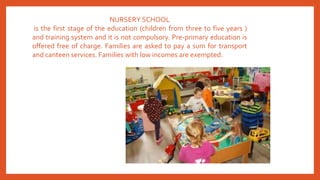
NURSERY SCHOOL
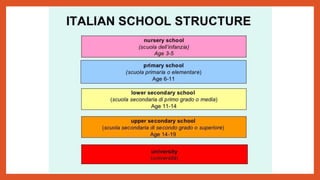
is the first stage of the education (children from three to five years )
and training system and it is not compulsory. Pre-primary education is
offered free of charge. Families are asked to pay a sum for transport
and canteen services. Families with low incomes are exempted.
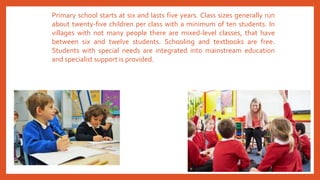
Primary school starts at six and lasts five years. Class sizes generally run
about twenty-five children per class with a minimum of ten students. In
villages with not many people there are mixed-level classes, that have
between six and twelve students. Schooling and textbooks are free.
Students with special needs are integrated into mainstream education
and specialist support is provided.
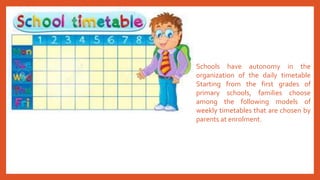
Schools have autonomy in the
organization of the daily timetable
Starting from the first grades of
primary schools, families choose
among the following models of
weekly timetables that are chosen by
parents at enrolment.
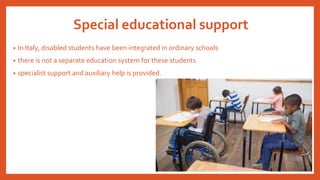
Special educational support
• In Italy, disabled students have been integrated in ordinary schools
• there is not a separate education system for these students
• specialist support and auxiliary help is provided.
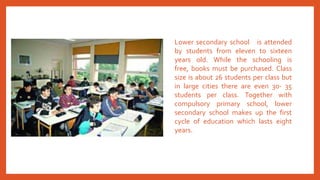
Lower secondary school is attended
by students from eleven to sixteen
years old. While the schooling is
free, books must be purchased. Class
size is about 26 students per class but
in large cities there are even 30- 35
students per class. Together with
compulsory primary school, lower
secondary school makes up the first
cycle of education which lasts eight
years.
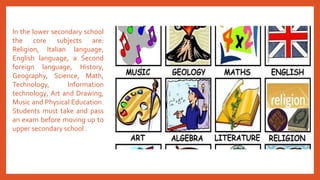
In the lower secondary school
the core subjects are:
Religion, Italian language,
English language, a Second
foreign language, History,
Geography, Science, Math,
Technology, Information
technology, Art and Drawing,
Music and Physical Education.
Students must take and pass
an exam before moving up to
upper secondary school .
Upper secondary school lasts 5 years until
the student is eighteen or nineteen years
old, but it’s compulsory till 16.
Upper schools are currently divided in the
following way: Classical upper secondary
school Liceo Classico ;Scientific upper
secondary school Liceo Scientifico;
Linguistic upper secondary school Liceo
Linguistico ;Upper secondary school with a
sociological and pedagogical orientation;
Liceo Psico-pedagogico ;Art school ; Liceo
Artistico.
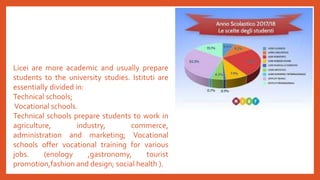
Licei are more academic and usually prepare
students to the university studies. Istituti are
essentially divided in:
Technical schools;
Vocational schools.
Technical schools prepare students to work in
agriculture, industry, commerce,
administration and marketing; Vocational
schools offer vocational training for various
jobs. (enology ,gastronomy, tourist
promotion,fashion and design; social health ).
After completing upper secondary school,
students must pass another exam in order to
receive their Diploma di Maturità. Once they
have their diplomas, they either begin their
careers in their professions or move on to the
University.
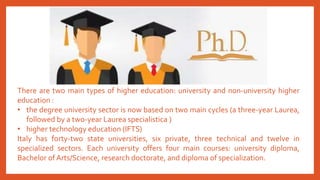
There are two main types of higher education: university and non-university higher
education :
• the degree university sector is now based on two main cycles (a three-year Laurea,
followed by a two-year Laurea specialistica )
• higher technology education (IFTS)
Italy has forty-two state universities, six private, three technical and twelve in
specialized sectors. Each university offers four main courses: university diploma,
Bachelor ofArts/Science, research doctorate, and diploma of specialization.
THANKYOU FORYOUR ATTENTION !!!

School system in italy

  • 1.
  • 2.
    Constitution of theItalian Republic Basic principles on education include: • the freedom of education and teaching • the duty of the state to provide a school open to everyone with no discrimination of any type • the rights and duties of parents to provide education for their children • the education and vocational training of disabled and handicapped citizens
  • 3.
    Ministry of Education,University and Research is responsible for school education (MIUR). It is represented at local level by regional and provincial education offices. Teachers, or professors, are mainly civil servants, recruited by competitive examination .
  • 4.
    Each school preparesa Piano Triennale dell'Offerta Formativa (PTOF), a plan for three years with the goals of the school. It is devised by the Teacher Council and it is given to students and their family on enrolment. The National guidelines are nationally determined and adapted to local needs by each school according to school autonomy by the PTOF. The Teacher Council is made up of permanent and temporary teachers and is chaired by the school manager.
  • 5.
    The school manageris responsible for the overall management of the institution, of which he has legal responsibility; he is responsible for the management of financial and material resources and for the quality of the service provided. The school year comprises at least 200 days between the beginning of September and the end of June. Schools open five or six days a week, full day or half day, depending on the institution. Compulsory annual teaching hours are 891.
  • 7.
    NURSERY SCHOOL is thefirst stage of the education (children from three to five years ) and training system and it is not compulsory. Pre-primary education is offered free of charge. Families are asked to pay a sum for transport and canteen services. Families with low incomes are exempted.
  • 8.
    Primary school startsat six and lasts five years. Class sizes generally run about twenty-five children per class with a minimum of ten students. In villages with not many people there are mixed-level classes, that have between six and twelve students. Schooling and textbooks are free. Students with special needs are integrated into mainstream education and specialist support is provided.
  • 9.
    Schools have autonomyin the organization of the daily timetable Starting from the first grades of primary schools, families choose among the following models of weekly timetables that are chosen by parents at enrolment.
  • 10.
    Special educational support •In Italy, disabled students have been integrated in ordinary schools • there is not a separate education system for these students • specialist support and auxiliary help is provided.
  • 11.
    Lower secondary schoolis attended by students from eleven to sixteen years old. While the schooling is free, books must be purchased. Class size is about 26 students per class but in large cities there are even 30- 35 students per class. Together with compulsory primary school, lower secondary school makes up the first cycle of education which lasts eight years.
  • 12.
    In the lowersecondary school the core subjects are: Religion, Italian language, English language, a Second foreign language, History, Geography, Science, Math, Technology, Information technology, Art and Drawing, Music and Physical Education. Students must take and pass an exam before moving up to upper secondary school .
  • 13.
    Upper secondary schoollasts 5 years until the student is eighteen or nineteen years old, but it’s compulsory till 16. Upper schools are currently divided in the following way: Classical upper secondary school Liceo Classico ;Scientific upper secondary school Liceo Scientifico; Linguistic upper secondary school Liceo Linguistico ;Upper secondary school with a sociological and pedagogical orientation; Liceo Psico-pedagogico ;Art school ; Liceo Artistico.
  • 14.
    Licei are moreacademic and usually prepare students to the university studies. Istituti are essentially divided in: Technical schools; Vocational schools. Technical schools prepare students to work in agriculture, industry, commerce, administration and marketing; Vocational schools offer vocational training for various jobs. (enology ,gastronomy, tourist promotion,fashion and design; social health ).
  • 15.
    After completing uppersecondary school, students must pass another exam in order to receive their Diploma di Maturità. Once they have their diplomas, they either begin their careers in their professions or move on to the University.
  • 16.
    There are twomain types of higher education: university and non-university higher education : • the degree university sector is now based on two main cycles (a three-year Laurea, followed by a two-year Laurea specialistica ) • higher technology education (IFTS) Italy has forty-two state universities, six private, three technical and twelve in specialized sectors. Each university offers four main courses: university diploma, Bachelor ofArts/Science, research doctorate, and diploma of specialization.
  • 17.