THE ESSENTIALS OF
CUSTOMER CENTRICITY
Professor Peter Fader
Co-director, Wharton Customer Analytics Initiative
The Wharton School, University of Pennsylvania
faderp@wharton.upenn.edu
www.petefader.com
Twitter: @faderp
“Customer Centricity: Focus on the Right Customers
for Strategic Advantage”
• The traditional product-centric business model is showing some cracks
• Commoditization, well-informed customers, globalization, etc.
• Customer centricity is a promising alternative but is not clearly understood
• Many firms that are touted to be customer centric really aren’t…
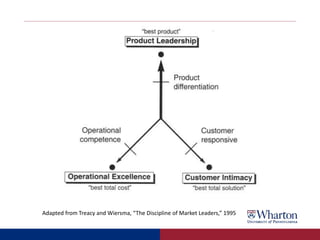
Adapted from Treacy and Wiersma, “The Discipline of Market Leaders,” 1995
What is customer centricity?
Customer centricity is a strategy that aligns a company’s
development/delivery of its products/services around the
current and future needs of a select set of customers in
order to maximize their long-term financial value to the
firm.
“Customer Centricity: Focus on the Right Customers
for Strategic Advantage”
• The traditional product-centric business model is showing some cracks
• Commoditization, well-informed customers, globalization, etc.
• Customer centricity is a promising alternative but is not clearly understood
• Many firms that are touted to be customer centric really aren’t…
• Celebrate customer heterogeneity: distinguish the profitable customers
from the less profitable ones
• It’s all about customer lifetime value (CLV)
• It’s a complex transformation
Galbraith (2005), Designing the Customer-Centric Organization
“Customer Centricity: Focus on the Right Customers
for Strategic Advantage”
• The traditional product-centric business model is showing some cracks
• Commoditization, well-informed customers, globalization, etc.
• Customer centricity is a promising alternative but is not clearly understood
• Many firms that are touted to be customer centric really aren’t…
• Celebrate customer heterogeneity: distinguish the profitable customers
from the less profitable ones
• It’s all about customer lifetime value (CLV)
• It’s a complex transformation
• And can fundamentally change the way we look at many functions in the
organization – not just marketing
Customer centricity as an organization-wide strategy
• Marketing
• Acquisition/retention/development > branding
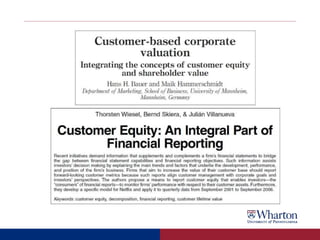
• Finance
• Customer equity as a legitimate component of corporate valuation
Customer centricity as an organization-wide strategy
• Marketing
• Acquisition/retention/development > branding
• Finance
• Customer equity as a legitimate component of corporate valuation
• R&D and production
• Measure/incentivize by incremental CLV, not volume
• Salesforce and front-line staff
• Measure/incentivize by incremental CLV, not satisfaction
Reflections on customer centricity
• Who is the customer? Can your organization come up with a single,
consensus answer to this question, or can you at least reconcile the
roles/relationships of the different potential customers?
• What are the major barriers to account for?
• What resources can you utilize to overcome these barriers?
• Thoughts about what competitors are doing in this area?
• Does it make sense for your organization to become customer centric?
Professor Peter Fader
faderp@wharton.upenn.edu
www.petefader.com
Twitter: @faderp
Customer Centricity: Focus on the
Right Customers for Strategic Advantage”
http://bit.ly/FaderCC
The Essentials of Customer Centricity

The Essentials of Customer Centricity

  • 1.
    THE ESSENTIALS OF CUSTOMERCENTRICITY Professor Peter Fader Co-director, Wharton Customer Analytics Initiative The Wharton School, University of Pennsylvania faderp@wharton.upenn.edu www.petefader.com Twitter: @faderp
  • 2.
    “Customer Centricity: Focuson the Right Customers for Strategic Advantage” • The traditional product-centric business model is showing some cracks • Commoditization, well-informed customers, globalization, etc. • Customer centricity is a promising alternative but is not clearly understood • Many firms that are touted to be customer centric really aren’t…
  • 3.
    Adapted from Treacyand Wiersma, “The Discipline of Market Leaders,” 1995
  • 4.
    What is customercentricity? Customer centricity is a strategy that aligns a company’s development/delivery of its products/services around the current and future needs of a select set of customers in order to maximize their long-term financial value to the firm.
  • 5.
    “Customer Centricity: Focuson the Right Customers for Strategic Advantage” • The traditional product-centric business model is showing some cracks • Commoditization, well-informed customers, globalization, etc. • Customer centricity is a promising alternative but is not clearly understood • Many firms that are touted to be customer centric really aren’t… • Celebrate customer heterogeneity: distinguish the profitable customers from the less profitable ones • It’s all about customer lifetime value (CLV) • It’s a complex transformation
  • 6.
    Galbraith (2005), Designingthe Customer-Centric Organization
  • 7.
    “Customer Centricity: Focuson the Right Customers for Strategic Advantage” • The traditional product-centric business model is showing some cracks • Commoditization, well-informed customers, globalization, etc. • Customer centricity is a promising alternative but is not clearly understood • Many firms that are touted to be customer centric really aren’t… • Celebrate customer heterogeneity: distinguish the profitable customers from the less profitable ones • It’s all about customer lifetime value (CLV) • It’s a complex transformation • And can fundamentally change the way we look at many functions in the organization – not just marketing
  • 8.
    Customer centricity asan organization-wide strategy • Marketing • Acquisition/retention/development > branding • Finance • Customer equity as a legitimate component of corporate valuation
  • 10.
    Customer centricity asan organization-wide strategy • Marketing • Acquisition/retention/development > branding • Finance • Customer equity as a legitimate component of corporate valuation • R&D and production • Measure/incentivize by incremental CLV, not volume • Salesforce and front-line staff • Measure/incentivize by incremental CLV, not satisfaction
  • 11.
    Reflections on customercentricity • Who is the customer? Can your organization come up with a single, consensus answer to this question, or can you at least reconcile the roles/relationships of the different potential customers? • What are the major barriers to account for? • What resources can you utilize to overcome these barriers? • Thoughts about what competitors are doing in this area? • Does it make sense for your organization to become customer centric?
  • 12.
    Professor Peter Fader faderp@wharton.upenn.edu www.petefader.com Twitter:@faderp Customer Centricity: Focus on the Right Customers for Strategic Advantage” http://bit.ly/FaderCC