Customer Lifetime Value The Path To Profitability Kumar V
Customer Lifetime Value The Path To Profitability Kumar V
Customer Lifetime Value The Path To Profitability Kumar V
Customer Lifetime Value The Path To Profitability Kumar V
Customer Lifetime Value The Path To Profitability Kumar V
1.
Customer Lifetime ValueThe Path To
Profitability Kumar V download
https://ebookbell.com/product/customer-lifetime-value-the-path-
to-profitability-kumar-v-10429732
Explore and download more ebooks at ebookbell.com
2.
Here are somerecommended products that we believe you will be
interested in. You can click the link to download.
Customer Lifetime Value Reshaping The Way We Manage To Maximize
Profits David Bejou
https://ebookbell.com/product/customer-lifetime-value-reshaping-the-
way-we-manage-to-maximize-profits-david-bejou-9978440
The Customer Centricity Playbook Implement A Winning Strategy Driven
By Customer Lifetime Value Peter Fader Sarah E Toms
https://ebookbell.com/product/the-customer-centricity-playbook-
implement-a-winning-strategy-driven-by-customer-lifetime-value-peter-
fader-sarah-e-toms-51964270
The Customer Centricity Playbook Implement A Winning Strategy Driven
By Customer Lifetime Value Paperback Peter S Fader
https://ebookbell.com/product/the-customer-centricity-playbook-
implement-a-winning-strategy-driven-by-customer-lifetime-value-
paperback-peter-s-fader-7422414
Customers For Life How To Turn That Onetime Buyer Into A Lifetime
Customer 3rd Edition Carl Sewell
https://ebookbell.com/product/customers-for-life-how-to-turn-that-
onetime-buyer-into-a-lifetime-customer-3rd-edition-carl-
sewell-47124740
3.
Customer Once ClientForever 12 Tools For Building Lifetime Business
Relationships Richard Buckingham
https://ebookbell.com/product/customer-once-client-forever-12-tools-
for-building-lifetime-business-relationships-richard-
buckingham-35976148
Connect How To Use Data And Experience Marketing To Create Lifetime
Customers 1st Edition Lars Birkholm Petersen
https://ebookbell.com/product/connect-how-to-use-data-and-experience-
marketing-to-create-lifetime-customers-1st-edition-lars-birkholm-
petersen-4762960
Customer Service For Hospitality And Tourism 3rd Edition Simon Hudson
https://ebookbell.com/product/customer-service-for-hospitality-and-
tourism-3rd-edition-simon-hudson-44912474
Customercentric Marketing Build Relationships Create Advocates And
Influence Your Customers 1st Edition Aldo Cundari
https://ebookbell.com/product/customercentric-marketing-build-
relationships-create-advocates-and-influence-your-customers-1st-
edition-aldo-cundari-45084554
Customer Service In Tourism And Hospitality 3rd Edition Simon Hudson
https://ebookbell.com/product/customer-service-in-tourism-and-
hospitality-3rd-edition-simon-hudson-45333406
Customer Lifetime
Value —The Path
to Profitability
V. Kumar
Georgia State University
J. Mack Robinson College of Business
Atlanta, GA 30303
USA
vk@gsu.edu
Boston – Delft
8.
Foundations and TrendsR
in
Marketing
Published, sold and distributed by:
now Publishers Inc.
PO Box 1024
Hanover, MA 02339
USA
Tel. +1-781-985-4510
www.nowpublishers.com
sales@nowpublishers.com
Outside North America:
now Publishers Inc.
PO Box 179
2600 AD Delft
The Netherlands
Tel. +31-6-51115274
The preferred citation for this publication is V. Kumar, Customer Lifetime Value —
The Path to Profitability, Foundations and Trends R
in Marketing, vol 2, no 1,
pp 1–96, 2007
ISBN: 978-1-60198-156-1
c 2008 V. Kumar
All rights reserved. No part of this publication may be reproduced, stored in a retrieval
system, or transmitted in any form or by any means, mechanical, photocopying, recording
or otherwise, without prior written permission of the publishers.
Photocopying. In the USA: This journal is registered at the Copyright Clearance Cen-
ter, Inc., 222 Rosewood Drive, Danvers, MA 01923. Authorization to photocopy items for
internal or personal use, or the internal or personal use of specific clients, is granted by
now Publishers Inc for users registered with the Copyright Clearance Center (CCC). The
‘services’ for users can be found on the internet at: www.copyright.com
For those organizations that have been granted a photocopy license, a separate system
of payment has been arranged. Authorization does not extend to other kinds of copy-
ing, such as that for general distribution, for advertising or promotional purposes, for
creating new collective works, or for resale. In the rest of the world: Permission to pho-
tocopy must be obtained from the copyright owner. Please apply to now Publishers Inc.,
PO Box 1024, Hanover, MA 02339, USA; Tel. +1-781-871-0245; www.nowpublishers.com;
sales@nowpublishers.com
now Publishers Inc. has an exclusive license to publish this material worldwide. Permission
to use this content must be obtained from the copyright license holder. Please apply to now
Publishers, PO Box 179, 2600 AD Delft, The Netherlands, www.nowpublishers.com; e-mail:
sales@nowpublishers.com
9.
Foundations and TrendsR
in
Marketing
Volume 2 Issue 1, 2007
Editorial Board
Editor-in-Chief:
Jehoshua Eliashberg
University of Pennsylvania
Co-Editors
Teck H. Ho
University of California Berkeley
Mary Frances Luce
Duke University
Editors
Joseph W. Alba, University of Florida
David Bell, University of Pennsylvania
Gerrit van Bruggen, Erasmus University
Pradeep Chintagunta, University of Chicago
Dawn Iacobucci, University of Pennsylvania
Brian Sternthal, Northwestern University
J. Miguel Villas-Boas, University of California, Berkeley
Marcel Zeelenberg, Tilburg University
10.
Editorial Scope
Foundations andTrends R
in Marketing will publish survey and
tutorial articles in the following topics:
• B2B Marketing
• Bayesian Models
• Behavioral Decision Making
• Branding and Brand Equity
• Channel Management
• Choice Modeling
• Comparative Market Structure
• Competitive Marketing Strategy
• Conjoint Analysis
• Customer Equity
• Customer Relationship
Management
• Game Theoretic Models
• Group Choice and Negotiation
• Discrete Choice Models
• Individual Decision Making
• Marketing Decisions Models
• Market Forecasting
• Marketing Information Systems
• Market Response Models
• Market Segmentation
• Market Share Analysis
• Multi-channel Marketing
• New Product Diffusion
• Pricing Models
• Product Development
• Product Innovation
• Sales Forecasting
• Sales Force Management
• Sales Promotion
• Services Marketing
• Stochastic Model
Information for Librarians
Foundations and Trends R
in Marketing, 2007, Volume 2, 4 issues. ISSN paper
version 1555-0753. ISSN online version 1555-0761. Also available as a com-
bined paper and online subscription.
11.
Foundations and TrendsR
in
Marketing
Vol. 2, No. 1 (2007) 1–96
c 2008 V. Kumar
DOI: 10.1561/1700000004
Customer Lifetime Value — The Path
to Profitability
V. Kumar∗
J. Mack Robinson College of Business, Georgia State University, Atlanta,
GA 30303, USA, vk@gsu.edu
Abstract
This survey talks about Customer Lifetime Value (CLV) as a metric
that would help managers make informed business decisions. While
there have been prior articles that take an extensive and in-depth look
at Customer Equity (CE)(Villanueva and Hanssens, 2007), this survey
reviews the CLV metric in particular. The definition and approaches
to compute CLV and the concept of customer equity are discussed in
detail. Specifically, this survey provides methods for measuring CLV,
the strategies for developing customer-centric strategies, the implemen-
tation of CLV strategies in a B2B and B2C setting, and the challenges
faced by an organization in implementing a CLV-based framework. This
survey details the importance of CLV as a metric in a marketer’s toolkit
and how it is relevant to managing customers.
∗V. Kumar (VK) is the inaugural holder of the Richard and Susan Lenny Distinguished
Chair in Marketing, and the Executive Director of the Center for Excellence in Brand and
Customer Management.
The author thanks Bharath Rajan and Saurabh Bhargava for assistance in the prepa-
ration of this manuscript, and Joseph Pancras and J. Andrew Petersen for their valuable
feedback. The author owes additional thanks to Renu for copyediting this manuscript.
13.
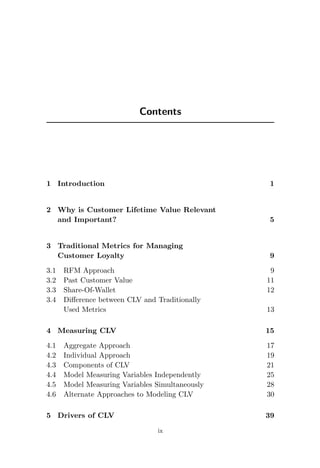
Contents
1 Introduction 1
2Why is Customer Lifetime Value Relevant
and Important? 5
3 Traditional Metrics for Managing
Customer Loyalty 9
3.1 RFM Approach 9
3.2 Past Customer Value 11
3.3 Share-Of-Wallet 12
3.4 Difference between CLV and Traditionally
Used Metrics 13
4 Measuring CLV 15
4.1 Aggregate Approach 17
4.2 Individual Approach 19
4.3 Components of CLV 21
4.4 Model Measuring Variables Independently 25
4.5 Model Measuring Variables Simultaneously 28
4.6 Alternate Approaches to Modeling CLV 30
5 Drivers of CLV 39
ix
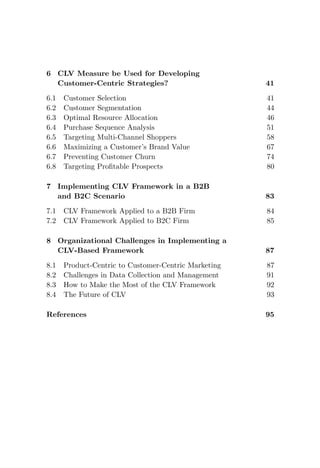
14.
6 CLV Measurebe Used for Developing
Customer-Centric Strategies? 41
6.1 Customer Selection 41
6.2 Customer Segmentation 44
6.3 Optimal Resource Allocation 46
6.4 Purchase Sequence Analysis 51
6.5 Targeting Multi-Channel Shoppers 58
6.6 Maximizing a Customer’s Brand Value 67
6.7 Preventing Customer Churn 74
6.8 Targeting Profitable Prospects 80
7 Implementing CLV Framework in a B2B
and B2C Scenario 83
7.1 CLV Framework Applied to a B2B Firm 84
7.2 CLV Framework Applied to B2C Firm 85
8 Organizational Challenges in Implementing a
CLV-Based Framework 87
8.1 Product-Centric to Customer-Centric Marketing 87
8.2 Challenges in Data Collection and Management 91
8.3 How to Make the Most of the CLV Framework 92
8.4 The Future of CLV 93
References 95
15.
1
Introduction
Hewlett-Packard (HP) wasgoing through a phase where the business
was not too good. The company planned to initiate a customer relation-
ship program to increase revenues. In the process, they had to confront
organizational inconsistencies and inadequate customer information
before starting the customer relationship program. Meanwhile, HP’s
multiple product teams were independently sending emails to their IT
and non-IT customers armed with little knowledge of their customers’
communication or product needs. Each team offered its customers only
product promotions, as against a comprehensive HP solution.
HP wanted to launch a consolidated email marketing program that
would enable them to gather and analyze useful data about new and
current customers. Using this information, they planned to offer per-
sonalized and relevant communications on a consistent schedule. Ini-
tial research showed that customers wanted support information rather
than marketing information. IT customers indicated the types of con-
tent they wished to receive, whereas non-IT customers expected HP
to “figure out” what they wanted. After analyzing the problems, HP
decided to provide customized marketing communications to improve
customer satisfaction from IT and non-IT professionals. The solution
1
supposed to knowabout that. The lover and his friend, who is called
the staro sta, on a Saturday night go to the door of the lady's
cottage and say:
"Good friends, we have lost our way. In the king's behalf we seek
a star." At this the girl hastily leaves the room and the staro sta
exclaims:
"Behold! There is the star for which we seek. May we go and seek
her? We have flowers with us to deck her, flowers fair as those
which Adam bound upon the brow of Eve in the Garden."
"I will call her back," says the bride's father, and the girl returns
to smilingly accept the staro sta's flowers, and his offer of marriage
for his friend. The flowers are distributed, speeches are made, and
everybody drinks the health of the betrothed pair in slivovitza,
binding their hands together with a handkerchief.
The night before the wedding there is a cake dance, when the
czardas is danced, the wedding cake is displayed, and everybody
cries, laughs, and puts a bit of money into a plate to help toward the
wedding expenses, for the wedding feast must last two days, and it
costs a great deal of money.
Irma's feast was very fine, for her father was village magistrate
and could afford to make her marriage quite a social event. Even the
High-Born Baron and Baroness from the great house came, and
Marushka was delighted to see them, for she had heard the little
peasant girls tell how kind the Baron was, and how beautiful his
wife.
The High-Born Baron danced the czardas with the bride and the
High-Born Baroness trod the measures with the bridegroom, and
Marushka could hardly keep her eyes off the Baroness. Her eyes
were soft and brown, her teeth white as little pearls, her complexion
a soft olive with rose-hued cheeks, her hair blue-black, soft and fine,
waving about her face and piled high with roses at each side above
her ears. Her dress was of brocaded silk, the bodice trimmed with
18.
pearls, the largesleeves filmy with laces almost as fine as those she
might have worn to court. Hungarian women love fine clothes and
dress beautifully and the High-Born Baroness wished to pay honor to
Sömögyi Vazul, for he had served the Baron's house and his father's
before him.
The Baron wore his handsomest uniform, top boots, embroidered
coat and magnificent cloak, trimmed in gold braid and buttons, and
it was a proud moment in Irma's life when he put his hand upon her
elbow and led her out to dance the quaint dance of the Hungarians,
with its slow movement gradually growing faster and faster until it
ends in a regular whirl.
Banda Bela played his best and the czardas of Irma's wedding
was long talked of in the village as the most beautiful which had
ever been danced. Then the High-Born Baron spoke to his wife and
she smiled and nodded her head and asked Banda Bela if he could
play the accompaniment to any of the folk-songs.
"Yes, Your Graciousness," he answered, "to any one of them."
"Then I will sing for you," said the Baroness, and a rustle of
expectancy went round the 'szvoba, for it was well known in the
village that the High-Born Graciousness was a famous singer and
had often been asked to sing to the King. She sang the little folk-
song which every Hungarian knows.
"How late the summer stars arise!
My love for thee was late in rising too.
But what of that, or aught, to me?
Why is thy glance so icy cold?
My heart burns hot with love for thee!"
Her voice was tender and sad like that of all the Magyar women,
and Marushka thought she had never heard anything so beautiful as
the song to which Banda Bela's notes added a perfect
accompaniment.
19.
Then the weddingcakes were passed about, and the little girl had
her full share. Banda Bela rejoiced in the present of a silver piece
from the Baron.
"Who is this child?" demanded the Baroness, attracted by
Marushka's fair hair amidst the dark-haired little Magyars and
Slövaks.
"A little one adopted by Aszszony Semeyer," replied the
magistrate, "as is also the Gypsy boy who played for you."
"She does not look like a Gypsy child," said the Baroness, knitting
her brows a little. "She reminds me of some one I have seen—" as
Marushka smiled up at her and made her a quaint little peasant's
courtesy with more than peasant's grace.
20.
"'WHO IS THISCHILD?' DEMANDED THE
BARONESS"
FOOTNOTES:
[10] Room.
[11] Salable daughters.
22.
CHAPTER VII
THE UNEXPECTED
AszszonySemeyer's brother-in-law had a large vineyard and, when it
came time for the vintage, the good woman drove the children over
to her brother's farm. The grapes grew in long lines up and down
the hillside where the sun was strongest. White carts, drawn by
white oxen, were driven by white-frocked peasants. All were decked
with grape leaves, all had eaten golden grapes until they could eat
no more, for the great bunches of rich, yellow grapes are free to all
at vintage time. From these golden grapes is made the amber-hued
"Riesling," and the children enjoyed very much helping to tread the
grapes, for the wine is made in the old-fashioned way, the grapes
being cast into huge vats and trod upon with the feet till the juice is
entirely pressed out. The peasants dance gaily up and down upon
the grapes, tossing their arms above their heads and making great
pleasure of their work.
After the long, happy, sunny day the white cart of Aszszony
Semeyer joined the line of carts which wound along from the
vineyard, filled with gay toilers. At her brother's farm they stayed all
night, for the vintage dance upon the grass under the golden glow
of the harvest moon was too fair a sight to miss.
They stayed, too, for the nut-gathering. Hungarian hazel nuts are
celebrated the world over, and the nutting was as much a fête as
had been the vintage. This was the last frolic of the year, and the
children went back to Harom Szölöhoz to work hard all winter. Banda
Bela still helped the swine-herd, but Marushka was no longer a
goose girl. Aszszony Semeyer had grown very fond of the little girl
and spent long hours teaching her to sew and embroider. Many salt
23.
tears little Marushkashed over her Himmelbelt, or marriage bed-
cover. Every girl in Hungary is supposed to have a fine linen
bedspread embroidered ready to take to her home when she is
married. It takes many months to make one of them, and
Marushka's was to be a very elaborate one.
The linen was coarse, but spun from their own flax by Aszszony
Semeyer herself. In design Marushka's Himmelbelt was wonderful.
The edge was to be heavily embroidered in colours, and in one
corner was Marushka's name, a space being left for the day of the
wedding. In the centre was a wedding hymn which was embroidered
in gay letters, and began:
"Blessed by the Saints and God above I'll be
If I do wed the man who loveth me;
Then may my home be full of peace and rest,
And I with goodly sons and daughters blest!"
Marushka worked over it for hours and grew to fairly hate the
thought of marrying.
"I shall never, never marry," she sobbed. "I shall never finish this
horrid old Himmelbelt and I suppose I can't be married without it."
Banda Bela sympathized with her and often played for her while
she worked. Through the long winter the children learned to read
and write, for all children are compelled to go to school in Hungary,
and the Gypsies are the only ones who escape the school room.
Marushka learned very fast. Her mind worked far more quickly
than did Banda Bela's, though he was so much older. There was
nothing which Marushka did not want to know all about; earth, air,
sky, water, sun, wind, people,—all were interesting to her.
"The wind, Banda Bela, whence comes it?" she would ask.
"It is the breath of God," the boy would answer.
"And the sun?"
24.
"It is God'skindness."
"But the storms, with the flashing lightning and the terrible
thunder?"
"It is the wrath of Isten, the flash of his eye, the sound of his
voice."
"But I like to know what makes the things," said Marushka. "It is
not enough to say that everything is God. I know He is back of
everything. Aszszony Semeyer told me that, but I want to know the
how of what He does."
"I think we cannot always do just what we like," said Banda Bela
calmly. "I have found that out many times, so it is best not to fret
about things but to live each day by itself." At this philosophy
Marushka pouted.
One afternoon in the summer the children asked for permission to
go to the woods, and Aszszony Semeyer answered them:
"Yes, my pigeons, go; the sky is fair and you have both been
good children of late,—go, but return early."
They had a happy afternoon playing together upon the hills which
were so blue with forget-me-nots that one could hardly see where
the hilltops met the sky. Marushka made a wreath of them and
Banda Bela crowned her, twining long festoons of the flowers around
her neck and waist, until she looked like a little flower fairy. They
wandered homeward as the sun was setting, past the great house
on the hill, and Maruskha said:
"I wonder if the High-Born Baron and his gracious lady will soon
be coming home? In the village they say that they always come at
this time of the year. Do you remember how beautiful the High-Born
Baroness looked at Irma's wedding?"
"She was beautiful and kind, and sang like a nightingale," said
Banda Bela. "Come, Marushka, we must hurry, or Aszszony Semeyer
25.
will scold usfor being late!"
As they neared the village they heard a noise and a strange scene
met their gaze! A yoke of white oxen blocked the way; several black
and brown cattle had slipped their halters and were running
aimlessly about tossing their horns; seventeen hairy pigs ran hither
and thither, squealing loudly, and all the geese in town seemed to be
turned loose, flapping their wings and squawking at the top of their
voices. Children were dashing around, shouting and screaming, in
their efforts to catch the different animals, while the grown people,
scarcely less disturbed, tried in vain to silence the din.
"They are frightened by the machine of the High-Born Baron,
Marushka," said Banda Bela. "See, there it is at the end of the
street. I have seen these queer cars in Buda-Pest, but none has ever
been in this little village before, so it is no wonder that everyone is
afraid. There, the men have the cattle quiet, but the geese and the
pigs are as bad as ever."
"Let us run and lead them out, Banda Bela," cried Marushka. "You
can make the pigs follow you and I can quiet the geese. It is too bad
to have the homecoming of their High-Born Graciousnesses spoiled
by these stupids!" Marushka dashed into the throng of geese calling
to them in soft little tones. They recognized her at once and stopped
their fluttering as she called them by the names she had given them
when she was goose girl and they all flocked about her. Then she
sang a queer little crooning song, and they followed her down the
street as she walked toward the goose green, not knowing how else
to get them out of the way.
Banda Bela meantime was having an amusing time with his
friends the pigs. They were all squealing so loudly that they could
scarcely hear his voice, so he bethought himself of his music and
began to play. It was but a few moments before the piggies heard
and stopped to listen. Banda Bela had played much when he was
watching the pigs on the moor, and his violin told them of the fair
green meadow where they found such good things to eat, and of the
26.
river's brink withits great pools of black slime in which to wallow.
They stopped their mad dashing about and gathered around the
boy, and he, too, turned and led them from the village.
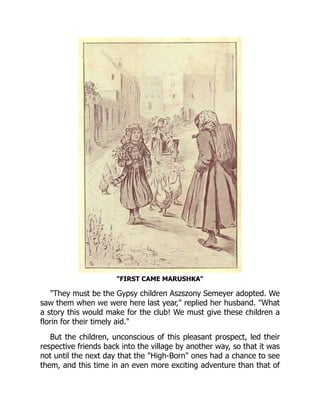
It was a funny sight, this village procession. First came Marushka
in her little peasant's costume, decked with her wreath and garlands
of forget-me-nots, and followed by her snow-white geese. Next,
Banda Bela, playing his violin and escorting his pigs, while last of all
came the motor car of the High-Born Baron, the Baron looking
amused, the Baroness in spasms of laughter.
"Oh, Léon," she cried. "Could our friends who drive on the Os
Budavara[12] see us now! Such a procession! That child who leads is
the most beautiful little creature and so unconscious, and the boy's
playing is wonderful."
27.
"FIRST CAME MARUSHKA"
"Theymust be the Gypsy children Aszszony Semeyer adopted. We
saw them when we were here last year," replied her husband. "What
a story this would make for the club! We must give these children a
florin for their timely aid."
But the children, unconscious of this pleasant prospect, led their
respective friends back into the village by another way, so that it was
not until the next day that the "High-Born" ones had a chance to see
them, and this time in an even more exciting adventure than that of
28.
the village procession.It was the motor car again which caused the
trouble.
Marushka and Banda Bela had been sent on an errand to a farm
not far from the village and were walking homeward in the twilight.
Down the road came a peasant's cart just as from the opposite
direction came the "honk-honk" of the Baron's motor. Such a sight
had never appeared to the horses before in all their lives. They
reared up on their hind legs, pawing the air wildly as the driver tried
to turn them aside to let the motor pass. A woman and a baby sat in
the cart, and, as the horses became unmanageable and overturned
the cart into the ditch, the woman was thrown out and the baby
rolled from her arms right in front of the motor. The mechanician
had tried to stop his car, but there was something wrong with the
brake and he could not stop all at once. Marushka saw the baby. If
there was one thing she loved more than another it was a baby. She
saw its danger and in a second she dashed across the road,
snatched up the little one and ran up the other side of the road just
as the motor passed over the spot where the baby had fallen.
"Marushka," cried Banda Bela as he ran around the motor. "Are
you hurt?"
"Brave child!" cried the Baron, who sprang from his car and
hurried to the group of frightened peasants. "Are you injured?"
"Not at all, Most Noble Baron," said Marushka, not forgetting to
make her courtesy, though it was not easy with the baby in her
arms.
The child's mother had by this time picked herself out of the ditch
and rushed over to where Maruskha stood, the baby still in her arms
and cooing delightedly as he looked into the child's sweet face, his
tiny hand clutching the silver medal which always hung about
Marushka's neck. The mother snatched the baby to her breast and,
seating herself by the roadside, she felt all over its little body to see
if it was hurt.
29.
"You have thisbrave little girl to thank that your baby was not
killed," said the Baron. The woman turned to Marushka.
"I thank you for—" she began, stopped abruptly, and then stared
at the little girl with an expression of amazement. "Child, who are
you?" she demanded.
"Marushka," said the little girl simply. The woman put her hand to
her head.
"It is her image," she muttered. "Her very self!"
The Baroness had alighted from the motor and came up in time
to hear the woman's words.
"Whose image?" she demanded sharply.
The woman changed colour and put her baby down on the grass.
"The little girl looks like a child I saw in America," she stammered,
her face flushing.
"Was she an American child?" demanded the Baroness.
"Oh, yes, Your Graciousness," said the woman hastily. "Of course,
she was an American child."
"Now I know that you are speaking falsely," said the Baroness.
"This little one looks like no American child who was ever born.
Léon," turning to her husband, "is this one of your peasants?" Then
she added in a tone too low to be heard by anyone but her husband,
"I know that she can tell something about this little girl. Question
her."
The Baron turned to the woman and said:
"This little girl saved your baby's life. Should you not do her some
kindness?"
30.
"What could Ido for her, Your High-Born Graciousness?" the
woman asked.
"That I leave to your good heart." The Baron had not dwelt upon
his estates and managed his peasants for years without knowing
peasant character. Threats would not move this woman, that he saw
in a moment.
"She is a Gypsy child," the woman said sullenly.
Banda Bela spoke suddenly, for he had come close and heard
what was said.
"That she is not! She is Magyar. Deserted by the roadside, she
was cared for by Gypsy folk. Does she look like a Gypsy? Would a
Gypsy child wear a Christian medal upon her breast?" The boy's tone
was sharp. Marushka heard nothing. She was playing with the baby.
The woman looked from Marushka to the baby, then at the Baron,
hesitating. "Let me see your pretty medal, child," she said at length,
and Marushka untied the string and put the medal in the woman's
hand.
"I used to think it was my mother, but now I know it is Our Lady,"
said Marushka gently. The woman looked at it for a moment, then
gave it back to the little girl and stood for a moment thinking.
"High-Born Baron," she said at last, "I will speak. Those it might
harm are dead. The little girl who saved my baby I will gladly serve,
but I will speak alone to the ears of the Baron and his gracious lady."
"Very well," said the Baron as he led the woman aside.
"Škultéty Yda is my name, Your Graciousness," she said. "I was
foster-sister to a high-born lady in the Province in which lies Buda-
Pest. I loved my mistress and after her marriage I went with her to
the home of her husband, a country place on the Danube. There I
met Hödza Ludevit, who wished to marry me and take me to
America, for which he had long saved the money. He hated all
31.
nobles and mostof all the High-Born Count, because the Count had
once struck him with his riding whip. Then the Countess' little
daughter came and I loved her so dearly that I said that I would
never part from her. Ludevit waited for me two years, then he grew
angry and said, 'To America I will go with or without you.' Then he
stole the little baby and sent me word that he would return her only
on condition that I go at once to America with him. To save the little
golden-haired baby I followed him beyond the sea to America. He
swore to me that he had returned little Marushka to her parents.
"The Count traced us to America thinking we might have taken
the child with us, and then I learned that the baby had never been
sent home. My wicked husband had left it by the roadside and what
had become of it no one knew. It turned my heart toward my
husband into stone. Now he is dead and I have brought my own
baby home, but my family are all dead and I have no place to go.
These people were kind to me on the ship, so I came to them,
hoping to find work to care for my baby, since all my money was
spent in the coming home. This little girl who saved my baby I know
to be the daughter of my dear mistress." She stopped.
"How do you know it?" demanded the Baroness.
"Your High-Born Graciousness, she is her image. There is the
same corn-coloured hair, the same blue eyes, the same flushed
cheek, the same proud mouth, the same sweet voice."
"What was the name of your lady?" interrupted the baroness,
who had been looking fixedly at Marushka, knitting her brows. "The
child has always reminded me of someone; who it is I cannot think."
"The foster sister whom I loved was the Countess Maria
Andrássy."
"I see it," cried the Baroness. "The child is her image, Léon. I
have her picture at the castle. You will see at once the resemblance.
I have not seen Maria since we left school. Her husband we see
often at Court. I had heard that Maria had lost her child and that
32.
since she hadnever left her country home. I supposed the child was
dead. This little Marushka must be Maria Andrássy."
"We must have proofs," said the Baron.
"Behold the medal upon the child's neck," said Yda. "It is one her
mother placed there. I myself scratched with a needle the child's
initials 'M. A.' the same as her mother's. The letters are still there;
and if that is not enough there is on the child's neck the same red
mark as when she was born. It is up under her hair and her mother
would know it at once."
"The only way is for her mother to see her and she will know.
This Gypsy boy may be able to supply some missing links. We shall
ask him," said the Baron. When Banda Bela was called he told
simply all that he knew about Marushka and all that old Jarnik had
told him.
"There is no harm coming to her, is there?" he asked anxiously,
and the Baroness said kindly:
"No, my boy, no harm at all, and perhaps much good, for we
think that we have found her people." Banda Bela's face clouded.
"That would make you sad?" she asked.
"Yes and no, Your Graciousness," he answered. "It would take my
heart away to lose Marushka for whom I have cared these years as
my sister, but I know so well the sadness of having no mother. If she
can find her mother, I shall rejoice."
"Something good shall be found for you, too, my lad." The
Baroness smiled at him, but he replied simply:
"I thank Your High-Born Graciousness. I shall still have my
music."
The Baroness flashed a quick glance at him. "I understand you,
boy; nothing can take that away from one who loves it. Now take
the little one home, and to-morrow we shall come to see Aszszony
33.
Semeyer about her.In the meantime, say not one word to the little
girl for fear she be disappointed if we have made a mistake."
"Yes, Your High-Born Graciousness," and Banda Bela led
Marushka away, playing as they went down the hill the little song of
his father.
"The hills are so blue,
The sun so warm,
The wind of the moor so soft and so kind!
Oh, the eyes of my mother,
The warmth of her breast,
The breath of her kiss on my cheek, alas!"
FOOTNOTE:
[12] Celebrated drive in Buda-Pest.
34.
CHAPTER VIII
MARUSHKA MAKESA JOURNEY
Marushka was so excited that she scarce knew how to contain
herself. The Baroness had come to see Aszszony Semeyer and had
talked long with her. Then she had called Marushka and the little girl
saw that Aszszony Semeyer had been crying.
"Marushka," the Baroness said. "Will you come with me and make
a journey? I want to take you in the motor to Buda-Pest."
"The High-Born Baroness is very good," said Marushka, her eyes
shining. "I should like to go very much, but not if Aszszony Semeyer
does not wish it."
"Good child," said Aszszony Semeyer, "I do wish it."
"Then why do you cry?"
"There are many things to make old people cry," said the peasant
woman. "I am certainly not crying because the High-Born
Graciousness wishes to honour you with so pleasant a journey—(that
is the truth, for it is the fear that she will not come back that forces
the tears from my eyes," she added to herself).
"Aszszony Semeyer will have Banda Bela," said the Baroness.
Marushka opened her eyes very wide.
"Oh, no, Your Graciousness, because Banda Bela must go
wherever I go. If he stays at home, then I must stay, too."
"Such a child!" exclaimed Aszszony Semeyer. "She has always
been like this about Banda Bela. The two will not be separated."
35.
"In that casewe shall have to take Banda Bela also," said the
Baroness, and Marushka clapped her hands with glee.
"That will be nice," she exclaimed. "I shall love to see the city and
all the beautiful palaces, and I shall bring you a present, Aszszony
Semeyer, but I will not go unless you wish me to."
"I do wish it, dear child, but do not forget your old aunt," for so
she had taught the children to call her.
So it was decided that they should start the next week when the
Baron's business would have been attended to.
Part of Marushka's journey was to be taken in the motor, and, as
she had never ridden in one before, she was very much excited as
they set out on a bright day in August. She wanted to sit beside
Banda Bela with the driver, but the Baroness said, "No, it would not
be proper for a little girl." So she had to be satisfied with sitting
between the Baron and Baroness on the back seat.
Up hill and down dale they rode. The road at times was so poor
that the wheels wedged in the ruts and all had to get out while the
driver pushed from behind.
They ate their luncheon at a ruined castle which had once been a
beautiful country place. It belonged to a friend of the Baron but had
been deserted for many years. Beyond it lay a corn-coloured plain
and blue hills, and on top of one of the hills gleamed the white walls
of a monastery.
"Near here are some famous marble quarries," said the Baroness.
"They are finer even than the ones at Carrara in Italy, which are
celebrated all over the world. There is so much marble around here
that it is cheaper than wood. See there! even the walls of that pig-
pen are of marble. Yonder is a peasant's hut with a marble railing
around the garden. Even the roads are mended with it, and the
quarries in the hillsides have hardly been touched yet. Some day
36.
someone will bemade very rich if they will open up this industry,
and it will keep many of our people from going to America."
"Why do they go to America?" asked Marushka. "And where is
America? It cannot be so nice as Magyarland."
"Well, little one, it is as nice to Americans, but when our
Hungarian people go there they always come back. Sometimes the
Slövaks remain, but never the Magyars. They go there and work and
save. Then they send for their families, and they too work and save,
and at last they all come home. There is a story told of the last war
in Hungary. Two Magyar peasants had gone to America and worked
in the far west. One day in a lonely cabin on the plains they found
an old newspaper and read that there was war in Hungary. They put
together all their money, saved and scrimped, ate little and worked
hard, until they got enough to go home. They reached Hungary
before the fighting was over and begged to be sent at once to the
front, to have a chance to serve their country before the war was
over."
"But how do people know about America?" asked Marushka.
"There are agents of the steamship companies who go from
village to village trying to get the people to emigrate," said the
Baroness. "They tell them that in America one finds gold rolling
about in the streets and that there everyone is free and equal. Our
people believe it and go there. Many of those who go are bad and
discontented or lazy here at home. When they get to America and
find that gold does not roll in the streets and that they must work for
it if they want it, they are more discontented than ever, and the
people of America think that Hungarians are lazy and good for
nothing. When they come home they talk in the villages of the grand
things they did in America and make the people here discontented
and unhappy."
"Why don't the people ask them, if America was so nice, why did
they not stay there?" asked Marushka, and the Baroness smiled.
37.
"Those of uswho have estates to take care of wish they would,"
she said. "The returned emigrant is one of the problems of
Hungary."
"Why are there so many beggars?" asked Marushka. "I never saw
one in Harom Szölöhoz."
"That is a prosperous village with a kind over-lord," said the
Baroness. "But there are so many beggars in Hungary that they have
formed themselves into a kind of union. In some towns there is a
beggar chief who is as much a king in his way as is His Majesty the
Emperor. The chief has the right to say just where each beggar may
beg and on what days they may beg in certain places. The beggars
never go to each other's begging places, and if anyone does, the
other beggars tell the police about him and he is driven out of town.
"In some provinces the very old and sick people are sent to live
with the richest householders. Of course no one would ever refuse
to have them, for alms asked in the name of Christ can never be
refused, and as our gracious Emperor has said, 'Sorrow and
suffering have their privileges as well as rank.'"
"He must be a very good Emperor," said Marushka. "It seems to
me that you are a very wonderful lady and that you know
everything. It is interesting to know all about these things. When I
grow up I am going to know all about Magyarland."
The journey in the train was even more exciting for the children
than that in the motor, and they enjoyed very much hearing about
the various places through which they passed.
When they reached Buda-Pest, Marushka was dumbfounded, for
she had never imagined anything so beautiful. The train rolled into
the huge station, with its immense steel shed and glass roof, upon
which the sun beat like moulten fire. The children followed the
Baroness through the gate and into the carriage, which rattled away
so quickly that it swayed from side to side, for in Hungary people are
proud of their fine horses and always drive as fast as they can.
38.
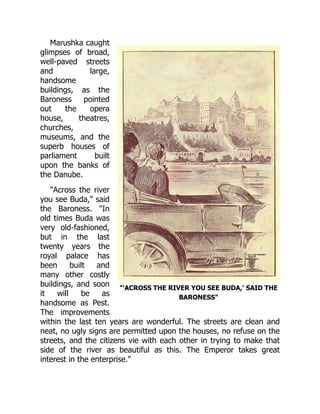
"'ACROSS THE RIVERYOU SEE BUDA,' SAID THE
BARONESS"
Marushka caught
glimpses of broad,
well-paved streets
and large,
handsome
buildings, as the
Baroness pointed
out the opera
house, theatres,
churches,
museums, and the
superb houses of
parliament built
upon the banks of
the Danube.
"Across the river
you see Buda," said
the Baroness. "In
old times Buda was
very old-fashioned,
but in the last
twenty years the
royal palace has
been built and
many other costly
buildings, and soon
it will be as
handsome as Pest.
The improvements
within the last ten years are wonderful. The streets are clean and
neat, no ugly signs are permitted upon the houses, no refuse on the
streets, and the citizens vie with each other in trying to make that
side of the river as beautiful as this. The Emperor takes great
interest in the enterprise."
39.
"You speak aboutthe Emperor sometimes," said Marushka. "And
other times about the King. Who is the King?"
"The same as the Emperor," replied the Baroness. "You see,
Austria and Hungary have been united under one government, and
the King of Hungary is Emperor of Austria. There were many wars
fought before this arrangement was made, and all the different
peoples of the empire agreed to live peaceably together."
"How long has Hungary had a king?" asked Marushka.
"Oh, for years and years," said the Baroness. "It was about the
twelfth century when the Aranybulla[13] was made, which gave to
the nobles the right to rebel if the king did not live up to the
constitution. See! There are the barracks and the soldiers drilling.
The country boys who come up to be trained are sometimes so
stupid that they don't know their right foot from the left. So the
sergeant ties a wisp of hay on the right foot and a wisp of straw on
the left. Instead of saying, right-left, to teach them to march, he
says szelma-szalma. Isn't it droll?"
"What is that building by the river?" asked Marushka. "The one
with the little turrets and the tower before which the geese are
swinging?"
"That, my little goose girl, is the Agricultural Building, and should
you go inside you would find specimens of every kind of food raised
in Hungary. But here we are at the hotel where we shall spend the
night. You must have some supper and then hurry to bed, for to-
morrow is the fête day of St. Stephen, and all must be up early to
see the procession."
Marushka was so sleepy the next day that she could only yawn
and rub her eyes when the maid called her at five o'clock to dress
for the fête.
The twentieth of August, the feast of St. Stephen, is the greatest
fête of the year in Hungary.
40.
Marushka and BandaBela were very much excited over it, for
they had often heard of the fête but had never supposed they would
have the good fortune to see it.
"Come, children," the Baroness said as they hastily ate their
breakfast. "We must hurry away. Hear the bells and the cannon!
Every church in the city is ringing its chimes. We must be in the
Palace Square by seven or we will miss some of the sights."
"I think the High-Born Baron and his Gracious Lady are the finest
sights we shall see," whispered Banda Bela to Marushka, and the
Baroness caught the words and smiled at him. There was a subtle
sympathy between these two, the high and the lowly, the Magyar
noblewoman and the Gypsy boy, a sympathy born, perhaps, of the
love of music which swayed them both.
Marushka felt wonderfully fine as their carriage rolled into the
Palace Square, where the procession in honour of St. Stephen was
forming. It was a gorgeous sight, for all were dressed in their gayest
attire, and officers, soldiers, prelates, and guard of honour from the
palace made a continual line of conflicting hues.
While the procession was passing Marushka almost held her
breath, then, as the golden radiance of colour flashing in the
sunlight streamed past, she clapped her hands in glee, and cried:
"Oh, your Gracious High-Bornness! Isn't it splendid! How glad I
am that St. Stephen is the Magyar saint and that I am a Magyar!"
The child's eyes were shining, her cheeks flushed, her hair a golden
coronet in the sunshine, and she looked like a beautiful little
princess.
At the sound of her voice an officer in uniform, who was passing,
turned and looked into the child's face, then glanced from her to the
Baroness, who waved her hand in greeting. He doffed his cap and
then came to the carriage.
41.
"Good morning, Count.It is long since I have seen you in Buda-
Pest. Are you not marching to-day?" the Baroness said.
"No, Madame." The officer had a kind face, but it seemed very
sad to Marushka. She thought she had seen him before, but did not
remember where until Banda Bela whispered that it was the officer
who had given them money for Marushka's top boots at the fair.
"I was on duty at the palace this morning, but am returning home
at once. My wife is not very well," he said.
"It is long since I have seen her. Will she receive me if I drive out
to your home?" the Baroness asked.
"She will be glad to see you," he said, "though she sees but few
since her ill health."
"I shall drive out to-day with these little folk, to whom I am
showing the sights," said the Baroness.
The count's eyes fell upon Banda Bela, and he gave a quick smile.
"Why, this is the little genius who played the violin so wonderfully
well down at the village fair," he said; and Banda Bela smiled, well
pleased at being remembered.
"The little girl is yours?" he asked. The Baroness hesitated.
"No," she said. "She is not mine. She is the child of a friend of
mine." Marushka wondered what good Aszszony Semeyer would say
to hear herself spoken of as a friend of the Baroness, and, amused,
she looked up at the Count with a beaming smile. He started a little
and then stared at her fixedly, just as the Baroness with a hasty
adieu bade the coachman drive on.
"Madame," he asked quickly, as the horses started. "Who is the
friend whose child this is?" The Baroness looked back at him over
her shoulder.
42.
"That I cannottell you now," she said. "This afternoon at your
castle I will ask you to tell me!"
FOOTNOTE:
[13] Hungarian Magna Charta.
43.
CHAPTER IX
"OH, THEEYES OF MY MOTHER!"
"Oh, High-Born Graciousness, what is that beautiful street we are
driving into?" asked Marushka, as they drove out in the afternoon,
and the coachman turned the horses into a magnificent avenue.
"This is Andrássy-ut, the famous boulevard, which leads to the
park," replied the Baroness. "We are driving toward Os Budavará,
the Park of Buda-Pest, and it is one of the most beautiful sights in
the world."
As she spoke they entered the park, and the children gazed in
wonder at its beauty. Swans floated on the miniature lakes; in the
feathery green woods bloomed exquisite Persian lilacs, children
played on the green grass beneath the willows or ran to and fro over
the rustic bridges. On the Corso the fashionables drove up and down
in the smartest of costumes, their turnouts as well appointed as any
in Paris or London. The men were many of them in uniform, the
women, some of them with slanting dark eyes almost like Japanese,
were graceful and elegant.
"The skating fêtes held in the park in winter are the most
beautiful things you can imagine," said the Baroness. "The whole
country is white with snow. Frost is in the air, the blood tingles with
the cold. Ice kiosks are erected everywhere, and coloured lights are
hung up until the whole place seems like fairyland, and the skaters,
dressed from top to toe in furs, look like fairy people skimming over
the ice."
"It must be beautiful," said Marushka.
44.
"But what isthat man playing?"
"The taragato, the old-fashioned Magyar clarinet," was the
answer, and the old instrument seemed to tell tales of warlike days,
its deep tones rolling out like the wind of the forest. A boy near by
played an impudent little tilinka (flageolet), and Banda Bela said:
"That never sounded like real music to me; only the violin sings.
It is like the wind in the trees, the rustle of the grass on the moor,
the dash of the waves on the shore, the voice of the mother to her
child."
"Banda Bela, you are poet as well as musician," said the
Baroness. "You shall never go back to Harom Szölöhoz to live. You
shall stay with me. I will sing to your music, and you shall study
music till you are the greatest violin player in all Hungary."
"When a Gypsy child comes into the world they say his mother
lays him on the ground and at one side places a purse and at the
other a violin," said Banda Bela. "To one side or other the baby will
turn his head. If he turns to the purse he will be a thief, if he turns
to the violin he will earn his living by music. My mother said she
would give me no chance to choose ill, but an old woman near by
laid forth both the purse and the violin and I turned my head to the
violin and reached for it with my baby hand. When they placed the
bow in my hand I grasped it so tight they could scarce take it from
me."
"Banda Bela," said Marushka, and her tone was pettish. "You like
your violin better than you do me!" The boy laughed.
"My violin has earned you many a supper, Little One; do not
dislike it!"
"Oh, Your Graciousness, what are those strange things?" cried
Marushka. "They are not automobiles, are they?"
"No, my child, they are the new steam thrashing machines which
the government has just bought, and is teaching the peasants to use
45.
instead of theold-fashioned ways of thrashing. Now we are getting
into the country. See how beautifully the road winds along the
Danube! Is it not a wonderful river? There is a famous waltz called
the 'Beautiful Blue Danube' and the river is certainly as blue as the
sky. See that queer little cemetery among the hills. I have often
wondered why some of the gravestones in the village cemeteries
had three feathers and coloured ribbons on them."
"If you please, Your Graciousness," said Banda Bela, "I can tell
you. That is for the grave of a girl who has died after she was of an
age to be married, yet for whom no one had offered the buying
money. Aszszony Semeyer told me that."
"Aszszony Semeyer told me that every peasant kept a wooden
shovel hung upon the wall of his house with which to throw in the
last shovelful of earth upon his loved ones," said Marushka with a
shudder. "Ugh! I didn't like that."
"Very few people like to think about death," said the Baroness.
"See that thicket of prickly pears beside the road? Once when I was
a little girl and very, very naughty, I ran away from my nurse and to
hide from her I jumped over the wall and landed in just such a
thicket as that. I think the pears must be naughty, too, for they liked
that little girl and would not let her go. The thorns pricked her legs
and tore her frock and scratched her hands when she tried to get
her skirts loose, until she cried with pain and called 'Kerem jojoro
ide'[14] to her nurse."
"I did not think the Gracious Baroness was ever naughty," said
Marushka.
"The Gracious Baroness was quite like other little girls, my dear,"
she said, smiling. "Ah, I have a little twinge of toothache!" she
exclaimed.
"That is too bad." Marushka was all sympathy. "Aszszony Semeyer
says that if you will always cut your finger nails on Friday you will
never have toothache."
46.
"Is that so?Then I shall certainly try it," said the Baroness
soberly. "Do you see the gleam of white houses between the trees?
Those are the beautiful villas and castles of the Svabhegy, the hill
overlooking the Danube, and here live many of my very good
friends.
"I am going to visit one of them for a little while and you must be
good, quiet children and sit in the carriage while I go in to make my
call. Then, perhaps, I will take you in for a few moments to see the
house, for it is a very beautiful one. See! here we are at the gate,"
as the carriage turned into a beautifully ornamented gateway, above
which was carved the legend: If you love God and your Country,
enter; with malice in your heart, go your way.
The driveway wound through beautiful grounds, and through the
trees were seen glimpses of the Danube. The house itself was white
and stood at the crest of the hill overlooking the river.
"This place belongs to the Count Ándrassy," said the Baroness.
"He has also another place in the Aföld and is very wealthy. When
my grandfather went to visit his grandfather in the old days, they
once took the wheels from his carriage and tied them to the tops of
the tallest poplar trees on the estate to prevent his leaving. Another
time they greased the shafts with wolf fat, so that the horses would
not allow themselves to be harnessed up, for they are so afraid of
the wolf smell. Still another time they hid his trunks in the attic so
that it was three months before my grandfather finally got away.
"That was old-fashioned hospitality. Here we are at the door. Sit
quietly here and I will return," and the Baroness sprang down. There
was a swish of her silken skirts and the front door closed behind her.
The children chattered gaily to each other of all they had seen
and heard since they had left Harom Szölöhoz, and Marushka said:
"It seems so long since we have left the village, Banda Bela;
somehow it seems as if we would never go back."
47.
"I think younever will." Banda Bela spoke a little sadly. "Were you
happy there, Little One?"
"Oh, yes," she said brightly. "I was happy with you and Aszszony
Semeyer. Only, when I saw other children with their mothers, there
was the ache right here—" she laid her hand on her heart.
"I know," said Banda Bela. "I have that always. Only when I play
my violin do I forget."
"But I cannot play the violin, nor can I do anything, only
embroider that horrible Himmelbelt," and Marushka pouted, while
Banda Bela laughed at her.
"Think how proud you will be some day to show that Himmelbelt
to your husband," he said, but just then the Baroness and the Count
came out of the house together.
"What do you think?" the Baroness asked the Count.
"I think you are right, but Maria shall decide," he answered. "We
will say nothing to her and her heart will speak."
"Come in, children," said the Baroness, who looked strangely
excited. Her eyes shone and her cheeks were flushed, while the
Count's face was pale as death and he looked strangely at Marushka.
"Banda Bela," said the Baroness, "the Countess is not very well.
She loves music as you and I do, and I want you to come in and
play for her. She is very sad. Once she lost her dear little daughter,
and you may play some gentle little songs for her. It may give her
pleasure. It is a beautiful thing, Banda Bela, to give pleasure to
those who are sad."
The Baroness chattered on as they entered the house. Marushka
looked up at the Count's face. Sad as it was she felt drawn toward
him. She saw him watching her closely and smiled up at him with
the pretty, frank smile which always lighted up her face so
charmingly.
48.
"High-Born Count," shesaid shyly, "I have to thank you for the
first present I ever received in all my life."
"What was that, Little One?" he asked.
"The top boots which Banda Bela bought for me at the fair at
Harom Szölöhoz. They were bought with the florin you gave to
Banda Bela for his playing. They were so nice!" She dimpled prettily.
"I am glad they gave you pleasure. Come, we will go in and hear
Banda Bela play," said the Count, holding out his hand. Marushka
slipped her hand into his and he led her into the house, entering by
the large hall, on the walls of which hung deer horns and wolf
heads, while a huge stuffed wolf stood at one end, holding a lamp in
his paws. The Count was a great sportsman and had shot many of
these animals himself in the forests of the Transylvania.
Banda Bela tuned his violin and then began to play. It seemed to
Marushka as if she had never before heard him play so beautifully.
Many things he played, all soft and dreamy, with a gentle, haunting
sadness through them, until at last he struck into a peculiar melody,
a sort of double harmony of joy and sorrow, which he had never
played before.
"What is that, Banda Bela?" demanded the Baroness. "Who wrote
it, what are the words?"
"If you please, Your Graciousness"—the boy flushed, "it is but a
Gypsy song of sorrow. The words are but in my own heart."
"Strange boy," she thought, but at that moment the door opened
and a lady hastily entered the room. She was tall and very beautiful,
with great masses of corn-coloured hair and deep blue eyes, but her
face had a look of terrible sadness.
"Arpád!" she exclaimed. "What is this music? It makes me weep
for my lost one and I am nearly blind with weeping now." Her eyes,
seeking her husband's, fell upon Marushka, who during the music
had been leaning against the Count, his arm around her. The
49.
Countess' eyes travelledup and down the little figure, then sought
her husband's face with a sort of eager, frightened questioning.
"Arpád!" she cried. "Arpád! Who is this child?"
"Maria, my dearest! I have brought her here that you may tell me
who she is," he said, trying to speak calmly.
She drew the little girl toward her and Marushka went willingly
and stood looking into the sweet face of the Countess.
"Such a likeness," whispered the Baroness. "They are as like as
two sisters."
Then, all in a moment, the Countess gathered Marushka into her
arms and covered the child's face with kisses. "You are mine," she
cried, tears streaming down her face. "Mine! Arpád! I know it is our
little daughter come back to us after all these years. My heart tells
me it is she!"
Marushka looked frightened for a moment, then she clung around
her mother's neck, and the Baroness quietly drew Banda Bela from
the room. From the hall the sound of the Gypsy boy's violin came as
he played, with all his soul in his touch, the song of his father:
50.
Welcome to ourwebsite – the perfect destination for book lovers and
knowledge seekers. We believe that every book holds a new world,
offering opportunities for learning, discovery, and personal growth.
That’s why we are dedicated to bringing you a diverse collection of
books, ranging from classic literature and specialized publications to
self-development guides and children's books.
More than just a book-buying platform, we strive to be a bridge
connecting you with timeless cultural and intellectual values. With an
elegant, user-friendly interface and a smart search system, you can
quickly find the books that best suit your interests. Additionally,
our special promotions and home delivery services help you save time
and fully enjoy the joy of reading.
Join us on a journey of knowledge exploration, passion nurturing, and
personal growth every day!
ebookbell.com








!["'WHO IS THIS CHILD?' DEMANDED THE
BARONESS"
FOOTNOTES:
[10] Room.
[11] Salable daughters.](https://image.slidesharecdn.com/5214866-250603052449-f15b9536/85/Customer-Lifetime-Value-The-Path-To-Profitability-Kumar-V-20-320.jpg)

![river's brink with its great pools of black slime in which to wallow.
They stopped their mad dashing about and gathered around the
boy, and he, too, turned and led them from the village.
It was a funny sight, this village procession. First came Marushka
in her little peasant's costume, decked with her wreath and garlands
of forget-me-nots, and followed by her snow-white geese. Next,
Banda Bela, playing his violin and escorting his pigs, while last of all
came the motor car of the High-Born Baron, the Baron looking
amused, the Baroness in spasms of laughter.
"Oh, Léon," she cried. "Could our friends who drive on the Os
Budavara[12] see us now! Such a procession! That child who leads is
the most beautiful little creature and so unconscious, and the boy's
playing is wonderful."](https://image.slidesharecdn.com/5214866-250603052449-f15b9536/85/Customer-Lifetime-Value-The-Path-To-Profitability-Kumar-V-26-320.jpg)
![Semeyer about her. In the meantime, say not one word to the little
girl for fear she be disappointed if we have made a mistake."
"Yes, Your High-Born Graciousness," and Banda Bela led
Marushka away, playing as they went down the hill the little song of
his father.
"The hills are so blue,
The sun so warm,
The wind of the moor so soft and so kind!
Oh, the eyes of my mother,
The warmth of her breast,
The breath of her kiss on my cheek, alas!"
FOOTNOTE:
[12] Celebrated drive in Buda-Pest.](https://image.slidesharecdn.com/5214866-250603052449-f15b9536/85/Customer-Lifetime-Value-The-Path-To-Profitability-Kumar-V-33-320.jpg)
!["You speak about the Emperor sometimes," said Marushka. "And
other times about the King. Who is the King?"
"The same as the Emperor," replied the Baroness. "You see,
Austria and Hungary have been united under one government, and
the King of Hungary is Emperor of Austria. There were many wars
fought before this arrangement was made, and all the different
peoples of the empire agreed to live peaceably together."
"How long has Hungary had a king?" asked Marushka.
"Oh, for years and years," said the Baroness. "It was about the
twelfth century when the Aranybulla[13] was made, which gave to
the nobles the right to rebel if the king did not live up to the
constitution. See! There are the barracks and the soldiers drilling.
The country boys who come up to be trained are sometimes so
stupid that they don't know their right foot from the left. So the
sergeant ties a wisp of hay on the right foot and a wisp of straw on
the left. Instead of saying, right-left, to teach them to march, he
says szelma-szalma. Isn't it droll?"
"What is that building by the river?" asked Marushka. "The one
with the little turrets and the tower before which the geese are
swinging?"
"That, my little goose girl, is the Agricultural Building, and should
you go inside you would find specimens of every kind of food raised
in Hungary. But here we are at the hotel where we shall spend the
night. You must have some supper and then hurry to bed, for to-
morrow is the fête day of St. Stephen, and all must be up early to
see the procession."
Marushka was so sleepy the next day that she could only yawn
and rub her eyes when the maid called her at five o'clock to dress
for the fête.
The twentieth of August, the feast of St. Stephen, is the greatest
fête of the year in Hungary.](https://image.slidesharecdn.com/5214866-250603052449-f15b9536/85/Customer-Lifetime-Value-The-Path-To-Profitability-Kumar-V-39-320.jpg)
!["That I cannot tell you now," she said. "This afternoon at your
castle I will ask you to tell me!"
FOOTNOTE:
[13] Hungarian Magna Charta.](https://image.slidesharecdn.com/5214866-250603052449-f15b9536/85/Customer-Lifetime-Value-The-Path-To-Profitability-Kumar-V-42-320.jpg)
![instead of the old-fashioned ways of thrashing. Now we are getting
into the country. See how beautifully the road winds along the
Danube! Is it not a wonderful river? There is a famous waltz called
the 'Beautiful Blue Danube' and the river is certainly as blue as the
sky. See that queer little cemetery among the hills. I have often
wondered why some of the gravestones in the village cemeteries
had three feathers and coloured ribbons on them."
"If you please, Your Graciousness," said Banda Bela, "I can tell
you. That is for the grave of a girl who has died after she was of an
age to be married, yet for whom no one had offered the buying
money. Aszszony Semeyer told me that."
"Aszszony Semeyer told me that every peasant kept a wooden
shovel hung upon the wall of his house with which to throw in the
last shovelful of earth upon his loved ones," said Marushka with a
shudder. "Ugh! I didn't like that."
"Very few people like to think about death," said the Baroness.
"See that thicket of prickly pears beside the road? Once when I was
a little girl and very, very naughty, I ran away from my nurse and to
hide from her I jumped over the wall and landed in just such a
thicket as that. I think the pears must be naughty, too, for they liked
that little girl and would not let her go. The thorns pricked her legs
and tore her frock and scratched her hands when she tried to get
her skirts loose, until she cried with pain and called 'Kerem jojoro
ide'[14] to her nurse."
"I did not think the Gracious Baroness was ever naughty," said
Marushka.
"The Gracious Baroness was quite like other little girls, my dear,"
she said, smiling. "Ah, I have a little twinge of toothache!" she
exclaimed.
"That is too bad." Marushka was all sympathy. "Aszszony Semeyer
says that if you will always cut your finger nails on Friday you will
never have toothache."](https://image.slidesharecdn.com/5214866-250603052449-f15b9536/85/Customer-Lifetime-Value-The-Path-To-Profitability-Kumar-V-45-320.jpg)