Understanding
Customer Centricity
About Me
Zehra Mehdi
LinkedIn@
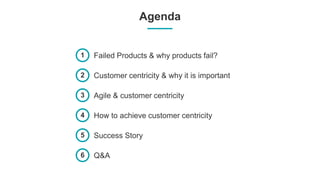
Agenda
1 Failed Products & why products fail?
2 Customer centricity & why it is important
3 Agile & customer centricity
4 How to achieve customer centricity
5 Success Story
6 Q&A
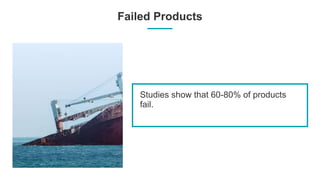
Failed Products
Studies show that 60-80% of products
fail.
Year 2012
A device of the future
Priced at $1500
A hands-free smart phone letting users access
web, camera, maps and other apps through
voice commands
A wearable technology that just didn’t fit well
with the consumer.
Google Glass
Year 2016
Raised $120 million in funding
A juicer with a price tag of $700!
Wifi enabled and equipped with a special camera to
scan QR codes to check expiration dates on the juice
packs
Provided fresh squeezed fruits and vegetables
sourced directly from the farms
Zero cleanup for a usually messy process
After launch, consumers realized that the juice
pouches could be squeezed by hand, so why bother
paying so much for the machine?
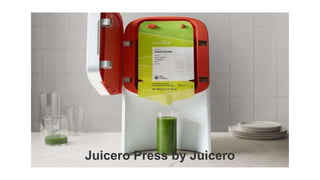
Juicero Press by Juicero
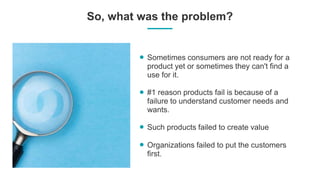
So, what was the problem?
Sometimes consumers are not ready for a
product yet or sometimes they can't find a
use for it.
#1 reason products fail is because of a
failure to understand customer needs and
wants.
Such products failed to create value
Organizations failed to put the customers
first.
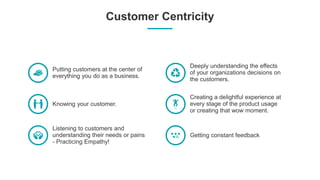
Customer Centricity
Putting customers at the center of
everything you do as a business.
Knowing your customer.
Listening to customers and
understanding their needs or pains
- Practicing Empathy!
Deeply understanding the effects
of your organizations decisions on
the customers.
Creating a delightful experience at
every stage of the product usage
or creating that wow moment.
Getting constant feedback
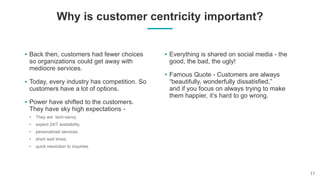
Why is customer centricity important?
Back then, customers had fewer choices
so organizations could get away with
mediocre services.
Today, every industry has competition. So
customers have a lot of options.
Power have shifted to the customers.
They have sky high expectations -
Everything is shared on social media - the
good, the bad, the ugly!
Famous Quote - Customers are always
“beautifully, wonderfully dissatisfied,”
and if you focus on always trying to make
them happier, it’s hard to go wrong.
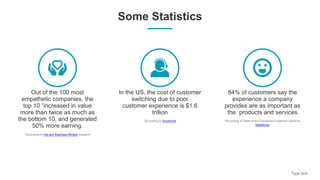
Some Statistics
Out of the 100 most
empathetic companies, the
top 10 “increased in value
more than twice as much as
the bottom 10, and generated
50% more earning.
Harvard Business Review
In the US, the cost of customer
switching due to poor
customer experience is $1.6
trillion
Accenture
84% of customers say the
experience a company
provides are as important as
the products and services
Salesforce
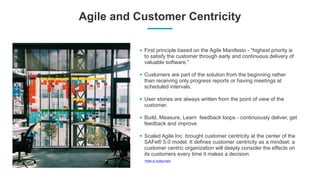
Agile and Customer Centricity
First principle based on the Agile Manifesto - “highest priority is
to satisfy the customer through early and continuous delivery of
valuable software.”
Customers are part of the solution from the beginning rather
than receiving only progress reports or having meetings at
scheduled intervals.
User stories are always written from the point of view of the
customer.
Build, Measure, Learn feedback loops - continuously deliver, get
feedback and improve
Scaled Agile Inc brought customer centricity at the center of the
SAFe® 5.0 model. It defines customer centricity as a mindset: a
customer centric organization will deeply consider the effects on
its customers every time it makes a decision.
*Refer to Scaled Agile
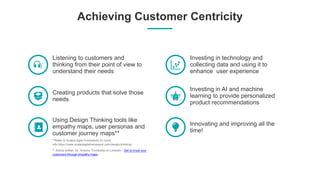
Achieving Customer Centricity
Listening to customers and
thinking from their point of view to
understand their needs
Creating products that solve those
needs
Using Design Thinking tools like
empathy maps, user personas and
customer journey maps**
Get to know your
customers through empathy maps
Investing in technology and
collecting data and using it to
enhance user experience
Investing in AI and machine
learning to provide personalized
product recommendations
Innovating and improving all the
time!
Success Story - Sephora
A beauty lover’s favorite and a powerful beauty chain. Has 1900 stores
worldwide.
Unique and personalized in-store experience providing a wide range of
beauty products and services
First one to start the try-before-you-buy for cosmetics
Invested heavily in technology and innovation - own innovation lab called
Sephora Labs!
A large online community for its “Beauty Insiders” and a loyalty and rewards
program
Educational videos - teach customers how to use different products
Online chat - live chat with other Sephora shoppers
“Quiz” tools - provide answers to get personalized product
recommendations.
Stayed ahead of consumers’ adoption of natural and organic beauty -
introduced Clean Beauty products
Takeaways
Organizations have to be customer centric to survive
and thrive.
Not just the leadership, but each individual should
cultivate a customer centric attitude.
Be passionate about the customer, show empathy,
focus on their needs, and get feedback
To stay relevant, invest in technology and leverage
data to make smart decisions.
Constantly reinvent, innovate and work towards
creating unique experiences so customers keep
coming back!
Questions?

Customer centricity presentation

  • 1.
  • 2.
  • 3.
    Agenda 1 Failed Products& why products fail? 2 Customer centricity & why it is important 3 Agile & customer centricity 4 How to achieve customer centricity 5 Success Story 6 Q&A
  • 4.
    Failed Products Studies showthat 60-80% of products fail.
  • 5.
    Year 2012 A deviceof the future Priced at $1500 A hands-free smart phone letting users access web, camera, maps and other apps through voice commands A wearable technology that just didn’t fit well with the consumer.
  • 6.
  • 7.
    Year 2016 Raised $120million in funding A juicer with a price tag of $700! Wifi enabled and equipped with a special camera to scan QR codes to check expiration dates on the juice packs Provided fresh squeezed fruits and vegetables sourced directly from the farms Zero cleanup for a usually messy process After launch, consumers realized that the juice pouches could be squeezed by hand, so why bother paying so much for the machine?
  • 8.
  • 9.
    So, what wasthe problem? Sometimes consumers are not ready for a product yet or sometimes they can't find a use for it. #1 reason products fail is because of a failure to understand customer needs and wants. Such products failed to create value Organizations failed to put the customers first.
  • 10.
    Customer Centricity Putting customersat the center of everything you do as a business. Knowing your customer. Listening to customers and understanding their needs or pains - Practicing Empathy! Deeply understanding the effects of your organizations decisions on the customers. Creating a delightful experience at every stage of the product usage or creating that wow moment. Getting constant feedback
  • 11.
    Why is customercentricity important? Back then, customers had fewer choices so organizations could get away with mediocre services. Today, every industry has competition. So customers have a lot of options. Power have shifted to the customers. They have sky high expectations - Everything is shared on social media - the good, the bad, the ugly! Famous Quote - Customers are always “beautifully, wonderfully dissatisfied,” and if you focus on always trying to make them happier, it’s hard to go wrong.
  • 12.
    Some Statistics Out ofthe 100 most empathetic companies, the top 10 “increased in value more than twice as much as the bottom 10, and generated 50% more earning. Harvard Business Review In the US, the cost of customer switching due to poor customer experience is $1.6 trillion Accenture 84% of customers say the experience a company provides are as important as the products and services Salesforce
  • 13.
    Agile and CustomerCentricity First principle based on the Agile Manifesto - “highest priority is to satisfy the customer through early and continuous delivery of valuable software.” Customers are part of the solution from the beginning rather than receiving only progress reports or having meetings at scheduled intervals. User stories are always written from the point of view of the customer. Build, Measure, Learn feedback loops - continuously deliver, get feedback and improve Scaled Agile Inc brought customer centricity at the center of the SAFe® 5.0 model. It defines customer centricity as a mindset: a customer centric organization will deeply consider the effects on its customers every time it makes a decision. *Refer to Scaled Agile
  • 14.
    Achieving Customer Centricity Listeningto customers and thinking from their point of view to understand their needs Creating products that solve those needs Using Design Thinking tools like empathy maps, user personas and customer journey maps** Get to know your customers through empathy maps Investing in technology and collecting data and using it to enhance user experience Investing in AI and machine learning to provide personalized product recommendations Innovating and improving all the time!
  • 15.
    Success Story -Sephora A beauty lover’s favorite and a powerful beauty chain. Has 1900 stores worldwide. Unique and personalized in-store experience providing a wide range of beauty products and services First one to start the try-before-you-buy for cosmetics Invested heavily in technology and innovation - own innovation lab called Sephora Labs! A large online community for its “Beauty Insiders” and a loyalty and rewards program Educational videos - teach customers how to use different products Online chat - live chat with other Sephora shoppers “Quiz” tools - provide answers to get personalized product recommendations. Stayed ahead of consumers’ adoption of natural and organic beauty - introduced Clean Beauty products
  • 16.
    Takeaways Organizations have tobe customer centric to survive and thrive. Not just the leadership, but each individual should cultivate a customer centric attitude. Be passionate about the customer, show empathy, focus on their needs, and get feedback To stay relevant, invest in technology and leverage data to make smart decisions. Constantly reinvent, innovate and work towards creating unique experiences so customers keep coming back!
  • 17.