Building Customer Equity in Your Organization   Mark Price, Managing Partner April 4, 2006
Agenda Introductions and why we are here Workshop goals Customer-centricity – what it is, why it is important  MSG Research into Customer-centric Marketing Roundtable Results Participant Discussion Barriers to customer-centric marketing Application to your organization Where you are? Where you can go
To start… Introductions Why are we here? What are  Your  goals for the workshop?
Overall Objectives Establish a knowledgebase around data-driven marketing and customer-centric business practices Provide you with a “real-world” glimpse into how other organizations evaluate themselves and the barriers they face Enable you to go home with the outline of an action plan to grow customer equity
Data-driven Marketing and Customer Centricity Data-driven Marketing  is a critical component to Customer Centricity Involves the leveraging of customer data to drive sustainable revenue across all channels Not just outbound, includes call center, service, delivery, product development, etc. Tends to be segments rather than 1:1 Customer Centricity  is the structuring of the organization around customer segments to facilitate the personalization of the customer experience Not synonymous terms, but critically related.  Both aspects must be in place to drive customer value consistently
Building Value the Customer-Centric Way Background and Approach
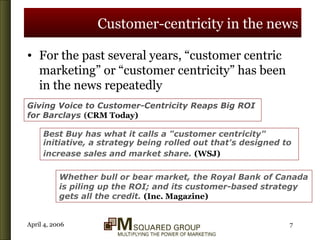
Customer-centricity in the news For the past several years, “customer centric marketing” or “customer centricity” has been in the news repeatedly Giving Voice to Customer-Centricity Reaps Big ROI for Barclays   ( CRM Today) Whether bull or bear market, the Royal Bank of Canada is piling up the ROI; and its customer-based strategy gets all the credit.  (Inc. Magazine) Best Buy has what it calls a "customer centricity" initiative, a strategy being rolled out that's designed to increase sales and market share.   ( WSJ)
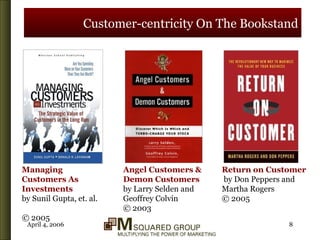
Customer-centricity On The Bookstand Angel Customers & Demon Customers   by Larry Selden and Geoffrey Colvin  © 2003 Return on Customer   by Don Peppers and Martha Rogers  © 2005 Managing Customers As Investments by Sunil Gupta, et. al.  © 2005
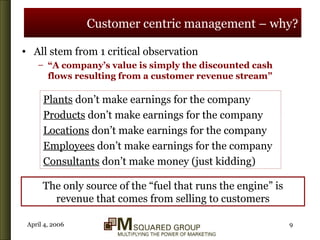
Customer centric management – why? All stem from 1 critical observation “ A company’s value is simply the discounted cash flows resulting from a customer revenue stream” The only source of the “fuel that runs the engine” is revenue that comes from selling to customers Plants  don’t make earnings for the company Products  don’t make earnings for the company Locations  don’t make earnings for the company Employees  don’t make earnings for the company Consultants  don’t make money (just kidding)
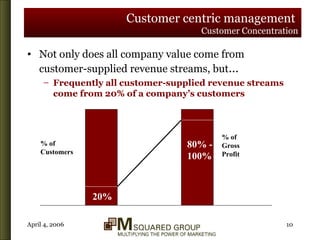
Customer centric management  Customer Concentration Not only does all company value come from customer-supplied revenue streams, but … Frequently all customer-supplied revenue streams come from 20% of a company’s customers % of Customers % of Gross Profit 20% 80% - 100%
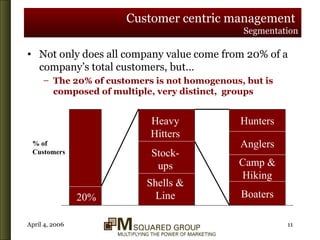
Customer centric management  Segmentation Not only does all company value come from 20% of a company’s total customers, but… The 20% of customers is not homogenous, but is composed of multiple, very distinct,  groups % of Customers 20% Heavy Hitters Stock-ups Shells & Line Hunters Anglers Camp & Hiking Boaters
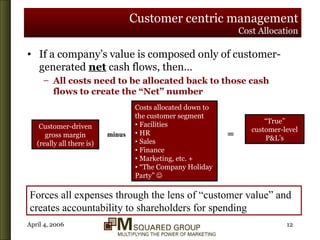
Customer centric management Cost Allocation If a company’s value is composed only of customer-generated  net  cash flows, then… All costs need to be allocated back to those cash flows to create the “Net” number Customer-driven gross margin (really all there is) Costs allocated down to the customer segment Facilities HR Sales Finance Marketing, etc. + “ The Company Holiday Party”   = “ True” customer-level P&L’s minus Forces all expenses through the lens of “customer value” and creates accountability to shareholders for spending
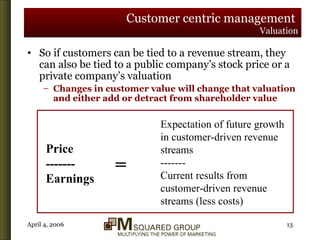
Customer centric management  Valuation So if customers can be tied to a revenue stream, they can also be tied to a public company’s stock price or a private company’s valuation Changes in customer value will change that valuation and either add or detract from shareholder value Price ------- Earnings = Expectation of future growth in customer-driven revenue streams ------- Current results from customer-driven revenue streams (less costs)
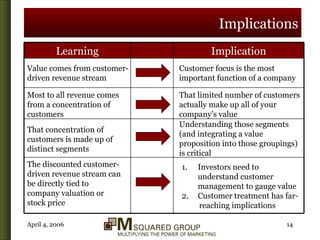
Implications Value comes from customer-driven revenue stream Most to all revenue comes from a concentration of customers That concentration of customers is made up of distinct segments The discounted customer-driven revenue stream can be directly tied to company valuation or stock price Customer focus is the most important function of a company That limited number of customers actually make up all of your company’s value Understanding those segments (and integrating a value proposition into those groupings) is critical Investors need to understand customer management to gauge value Customer treatment has far- reaching implications Implication Learning
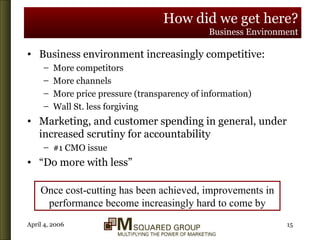
Business environment increasingly competitive: More competitors More channels More price pressure (transparency of information) Wall St. less forgiving Marketing, and customer spending in general, under increased scrutiny for accountability #1 CMO issue “ Do more with less” How did we get here? Business Environment Once cost-cutting has been achieved, improvements in performance become increasingly hard to come by
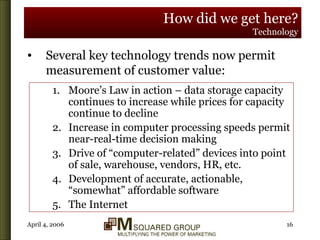
How did we get here? Technology Several key technology trends now permit measurement of customer value: Moore’s Law in action – data storage capacity continues to increase while prices for capacity continue to decline Increase in computer processing speeds permit near-real-time decision making Drive of “computer-related” devices into point of sale, warehouse, vendors, HR, etc.  Development of accurate, actionable, “somewhat” affordable software The Internet
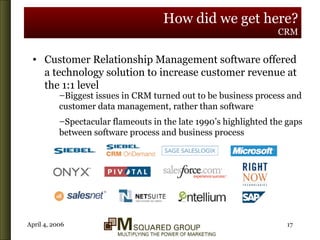
How did we get here? CRM Customer Relationship Management software offered a technology solution to increase customer revenue at the 1:1 level Biggest issues in CRM turned out to be business process and customer data management, rather than software Spectacular flameouts in the late 1990’s highlighted the gaps between software process and business process
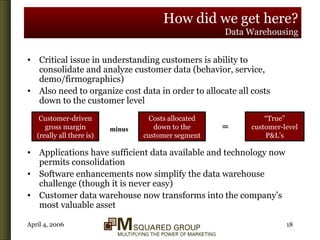
How did we get here? Data Warehousing Critical issue in understanding customers is ability to consolidate and analyze customer data (behavior, service, demo/firmographics) Also need to organize cost data in order to allocate all costs down to the customer level Applications have sufficient data available and technology now permits consolidation Software enhancements now simplify the data warehouse challenge (though it is never easy) Customer data warehouse now transforms into the company’s most valuable asset Customer-driven gross margin (really all there is) Costs allocated down to the customer segment = “ True” customer-level P&L’s minus
How did we get here? Business Process Business process reengineering has been the leading buzz words in the past 3-5 years Focus on streamlining costs, eliminating headcount and reducing time to market Has lacked a primary business value driver Difficult to make efficiency a motivating “vision” of customer value Lack of clear compelling value drivers will result in the passing of yet another fad
So what’s involved? Dramatic changes to all aspects of corporate culture and functionality People Processes Technology The hardest part is  NOT  the technology The hardest part is  change management
Organization Build business teams around different customer segments, with full accountability Force previously siloed functions into alignment around the critical driver of value – customer short-term and lifetime value Team leaders understand customer requirements and drive those requirements across every function that touches that customer Products and services Pricing Marketing Sales, etc.
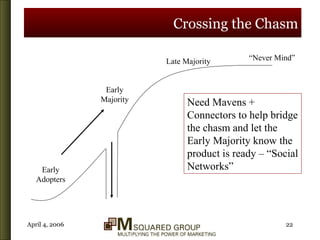
Crossing the Chasm Early Adopters Early Majority Late Majority “ Never Mind” Need Mavens + Connectors to help bridge the chasm and let the Early Majority know the product is ready – “Social Networks”
Segmentation Lifeblood of customer-centricity is an understanding of customer behaviors and attitudes for the most critical segments 80/20 rule Must drive to attitudinal data, not just to purchase behaviors The “why” + the “what” combine to create customer loyalty in a segment Why customers behave as they do What do customers actually do Permits efficient targeting of segment benefit  Change in  customer lifetime value  becomes the most critical metric in the company
What gets measured is what matters… Critical to customer-centricity is a measurement system to provide accountability for segment-level performance all the way from Sales through Marketing to Finance etc. Compensation must be changed to synch with the measurement system Remember – employees will do: What they are compensated for What is measured Exactly what they used to do
Customer-driven Business Processes The critical connection between customer data, marketing analysis and sales execution is the Business Process Handoffs and tracking must be seamless to ensure that: Customer experience is enhanced by leveraging behavioral data Changes can be made to marketing and sales as a result of changes in customer behavior Smooth handoffs between departments or divisions
Is Customer-Centricity Another Fad? Possibly.  Depends on level of commitment by management The equation customer value = the “E” of the P/E ratio cannot be disputed For Customer-centricity to succeed: Must become executive metric Shared by Board Members, shareholders and private investors Be a long-term commitment – will clearly require some upfront investment to succeed
What Your Peers Say… M Squared Group is conducting a research study to determine progress in using customer information to drive business performance Both clients and non-clients Primarily marketing director, VP and CMO Objective is to identify the most critical business issues involving customer centricity and to gain a “real world” sense of progress to date Next steps will be to follow-up to identify the constraints that are preventing organizations from leveraging customer information
Research Review
Summary of Findings Overall, respondents are somewhat dissatisfied with how their companies are using customer information to drive growth B2B companies are much more dissatisfied than B2C companies The biggest gaps tend to be in the use of customer information for improved retention, leveraging RFM and share of wallet In addition, over 38% of respondents lack a customer data repository Issue for both B2B and B2C
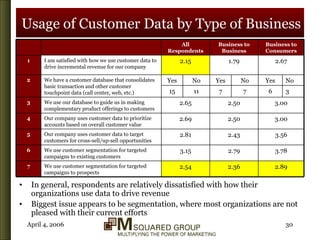
Usage of Customer Data by Type of Business In general, respondents are relatively dissatisfied with how their organizations use data to drive revenue Biggest issue appears to be segmentation, where most organizations are not pleased with their current efforts Business to Consumers Business to Business All Respondents 3 No 7 No 6 7 11 No 15 2.36 2.79 2.43 2.50 2.50 Yes 1.79 We use customer segmentation for targeted campaigns to prospects We use customer segmentation for targeted campaigns to existing customers Our company uses customer data to target customers for cross-sell/up-sell opportunities Our company uses customer data to prioritize accounts based on overall customer value We use our database to guide us in making complementary product offerings to customers We have a customer database that consolidates basic transaction and other customer touchpoint data (call center, web, etc.) I am satisfied with how we use customer data to drive incremental revenue for our company 2.54 3.15 2.81 2.69 2.65 Yes 2.15 2.89 3.78 3.56 3.00 3.00 Yes 2.67 7 6 5 4 3 2 1
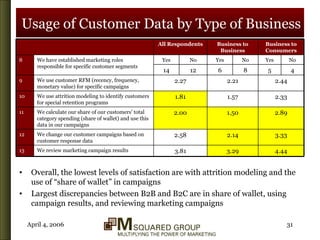
Usage of Customer Data by Type of Business Overall, the lowest levels of satisfaction are with attrition modeling and the use of “share of wallet” in campaigns Largest discrepancies between B2B and B2C are in share of wallet, using campaign results, and reviewing marketing campaigns Business to Consumers Business to Business All Respondents 4 8 No No 5 6 12 14 No 3.29 2.14 1.50 1.57 2.21 Yes We review marketing campaign results We change our customer campaigns based on customer response data We calculate our share of our customers' total category spending (share of wallet) and use this data in our campaigns We use attrition modeling to identify customers for special retention programs We use customer RFM (recency, frequency, monetary value) for specific campaigns We have established marketing roles responsible for specific customer segments 3.81 2.58 2.00 1.81 2.27 Yes 4.44 13 3.33 12 2.89 2.33 2.44 Yes 11 10 9 8
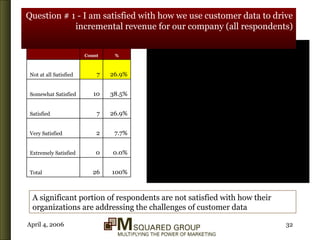
Question # 1 - I am satisfied with how we use customer data to drive incremental revenue for our company (all respondents) A significant portion of respondents are not satisfied with how their organizations are addressing the challenges of customer data 100% 26 Total 0.0% 0 Extremely Satisfied 7.7% 2 Very Satisfied 26.9% 7 Satisfied 38.5% 10 Somewhat Satisfied 26.9% 7 Not at all Satisfied % Count  
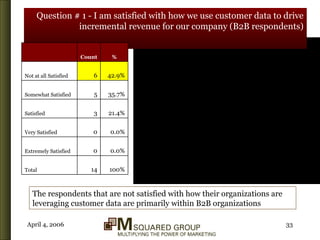
Question # 1 - I am satisfied with how we use customer data to drive incremental revenue for our company (B2B respondents) The respondents that are not satisfied with how their organizations are leveraging customer data are primarily within B2B organizations 100% 14 Total 0.0% 0 Extremely Satisfied 0.0% 0 Very Satisfied 21.4% 3 Satisfied 35.7% 5 Somewhat Satisfied 42.9% 6 Not at all Satisfied % Count  
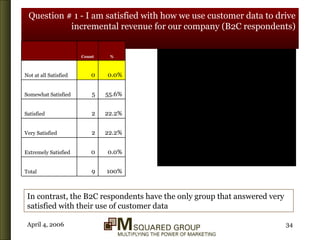
Question # 1 - I am satisfied with how we use customer data to drive incremental revenue for our company (B2C respondents) In contrast, the B2C respondents have the only group that answered very satisfied with their use of customer data 100% 9 Total 0.0% 0 Extremely Satisfied 22.2% 2 Very Satisfied 22.2% 2 Satisfied 55.6% 5 Somewhat Satisfied 0.0% 0 Not at all Satisfied % Count  
Preliminary Conclusions Overall level of satisfaction with leverage of customer data is low Key issues are often not the “fancy moves” but the basic segmentation and campaign analysis Significant barriers to moving to a customer-centric business model B2C companies appear a bit farther along than B2B at this stage
Discussion At your table, please discuss: How your organizations use customer data to drive revenue, profitability and accountability?
Roundtable Results M Squared held an executive roundtable on March 23, to discuss how customer-centricity and data-driven marketing was being executed in both B2C and B2B organizations: Patterson Dental Fargo Electronics Best Buy Lifetouch North American Membership Deluxe PeopleNet General Mills Govdocs.com United Health Group Katun  Cambria
Barriers to Customer-centricity Roundtable Results Executive Support 70% of a change initiative’s success can be attributed to visible executive support Vision No clear need articulated to the organization with consequences for failure outlined in detail Compensation Compensation structure can encourage sales to push unneeded products on customers, reducing retention No clear customer-centric metrics, leads to lack of sales support Fiefdoms Product management organization traditionally held P&L Customer-centricity evolves those teams into more staff than line roles “ Old tried and true” Organization built around processes that encourage repeating past campaigns Data is difficult to obtain and analyze Multiple silos of data, difficult to relate, combine, and analyze IT resources already over-committed
What are the Barriers to Change? Recap Executive Support Vision Development Compensation Fiefdoms “Old tried and true” Data Challenges
Rate your organization Using the sheet that has been distributed, please rate your organization on barriers to building a customer-centric organization
Plan of Attack To succeed at building customer-centricity, you need A compelling vision An executive who stands to gain from leading such a charge Simple, slam-dunk business objectives The ability to skunk-work a project at low cost, fast Tracking strategy “Early adopters” to assist in execution
Build your own company plan Worksheet designed to simply help identify the single initiative that can move your customer-centric marketing effort ahead Critical to identify a compelling vision and an achievable business objective Finding the right sponsor and early adopters accelerate initial initiative and increase chances for success
Questions Additional questions? Thoughts? Challenges in using this base plan?
Thank you! Mark Price Managing Partner, M Squared Group 952-484-0501 [email_address]
Appendix
Key Principles of Data-driven Marketing “ All consumers are not created equal” Marketing spending should be allocated proportional to the consumer value “ Timing is everything” Consumer acquisition exceeds costs of current consumer marketing, by lots! Data-driven marketing has implications for product development, investments and overall business planning
Key Principles of Data-driven Marketing   Benefits More repeat sales Reduced cost of sales Less volume sold on promotion Increased employee retention Better referral opportunities Higher margins Increased sales over time (Fred Reichheld,  The Loyalty Effect )
Key Principles of Data-driven Marketing   Differentiated Marketing Why discriminate in consumer marketing? Consumers have differing relationships with a company 20% of consumers = 60-80% of revenue  Bottom 20-30% of consumers usually cost you money to market Note: mass media is an inherently inefficient way to reach the 20% of relevant consumers who are/can become Best Consumers Many consumers do not have the capacity to significantly improve their spending Your best consumers are likely to be the best consumers of the competition as well Additional upside potential even in best consumers
Key Principles of Data-driven Marketing   Differentiated Marketing (cont’d) Small percentage changes in performance for Best Consumers have significant upside E.g. a 5% improvement for a $2000/yr consumer equals a 100% improvement for a $100/yr consumer Small behavior changes are easier to create than larger ones, if the larger changes are possible at all Some consumers have potential to be Best Consumers Large potential return Pays out marketing investments many times over
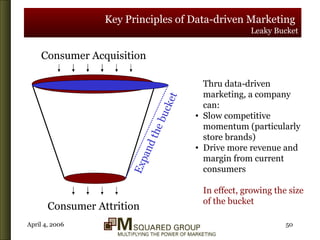
Key Principles of Data-driven Marketing   Leaky Bucket Consumer Acquisition Consumer Attrition Expand the bucket Thru data-driven marketing, a company can: Slow competitive momentum (particularly store brands) Drive more revenue and margin from current consumers In effect, growing the size of the bucket
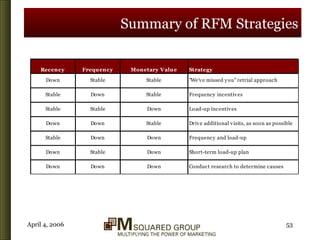
Key Principles of Data-driven Marketing   Harnessing the power of RFM “ The best predictor of future behavior is past behavior” RFM provides a handle on the “velocity” of the business Expanding velocity is the key to business growth Frequency = How often does a consumer make a transaction? Primary indicator of usage, satisfaction, brand and relationship Indicates amount of product usage (use-up) which requires re-orders Monetary Value = Measurement of current/future consumer value Defines profitable and unprofitable consumers Usually aggregates net profit across transactions across a fixed time period Can be combined with product mix to better optimize consumer purchases Recency Time since last purchase or communication Indicates involvement of consumer – when trended identifies changes in consumer buying patterns and/or relationship
Key Principles of Data-driven Marketing   Harnessing the power of RFM How RFM can be used to assess business performance and identify issues? Shift marketing spending toward high spending, frequent consumers and high potential consumers Examine market basket for top decile consumers and cross-sell other consumers towards that basket Examine RFM to identify causes for declines (focus on high revenue consumers) If BC’s recency/freq. constant, then market basket is the issue If BC freq. falls, then need to incent repeat purchase Adjust communication frequency to purchase frequency
Summary of RFM Strategies
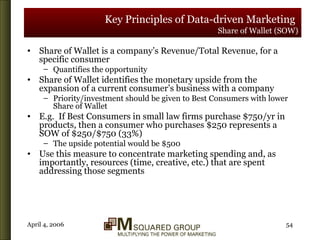
Key Principles of Data-driven Marketing   Share of Wallet (SOW) Share of Wallet is a company’s Revenue/Total Revenue, for a specific consumer Quantifies the opportunity Share of Wallet identifies the monetary upside from the expansion of a current consumer’s business with a company Priority/investment should be given to Best Consumers with lower Share of Wallet E.g.  If Best Consumers in small law firms purchase $750/yr in products, then a consumer who purchases $250 represents a SOW of $250/$750 (33%) The upside potential would be $500 Use this measure to concentrate marketing spending and, as importantly, resources (time, creative, etc.) that are spent addressing those segments
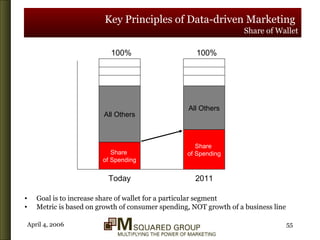
Key Principles of Data-driven Marketing   Share of Wallet Goal is to increase share of wallet for a particular segment Metric is based on growth of consumer spending, NOT growth of a business line 100% 100% Today 2011 Share  of Spending All Others All Others Share  of Spending
Key Principles of Data-driven Marketing   The Importance of Time As RFM would suggest, Time is critical to database marketing: Measurement of consumer involvement requires sustained behavior over time Time is also a critical component of data-driven marketing delivery Consumers tend to purchase based on unconscious patterns (monthly, quarterly, etc.) Marketing is more successful if directed to consumers at the time that they are ready to consider making a purchase
Key Principles of Data-driven Marketing   Event-triggered Marketing Event-triggered Marketing is the delivery of marketing communications/offers based on: Specific consumer behavior(s) A “database trigger” (either a specific behavior or a “tickler” based on consumer-provided information) Five requirements of Event-triggered Marketing: Targeted to specific behavior patterns Based on consumer history Measurable Valuable to the consumer Relationship-based, not just transactional
Key Principles of Data-driven Marketing   Event Triggered Marketing (cont’d) 1. Targeted to specific behavior patterns Communications timing based on a past behavior Consumer-driven behavior (consumer X purchases product Y) Database-driven behavior (6 months since last tracked purchase) 2. Based on consumer history Consumer history in the database is the knowledge base for ETM – differentiation from mass marketing 3. Measurable Measurement permits marketers to evaluate promotional effectiveness against different behaviors and different targets Builds a foundation of knowledge to enhance future efforts 4. Valuable to the consumer The offers and communication content must be truly valuable to the consumer, not just to the company Cannot be seen as merely an excuse for more transactions Does not require offers with every communication
Key Principles of Data-driven Marketing   Branding Implications Improved targeting of Better and Best Consumers actually enhances the Brand Balances price considerations with service delivery More personalized service Fewer “excessive” marketing communications “ Products we want, when we want them” Enhances consumer relationships and provides perceived barrier to exit (stickiness) Creates a differentiating factor vs. competition
Key Principles of Data-driven Marketing   What about Consumer Loyalty? Difference between consumer retention and consumer loyalty Retention is a behavior Loyalty is an belief Retained consumers can be loyal or not Some continue business by inertia, or price preference Some continue due to a genuine sense of differentiation Shift from one type to another critical to long-term success
Consumer evolution and migration Consumers will change the depth of their relationship with a company over time Some businesses grow, diminish or sell off Marketing, products, pricing, service will change depth of relationship Competitive activity “ Entropy” Identifying consumer migration patterns is critical to evaluating database marketing
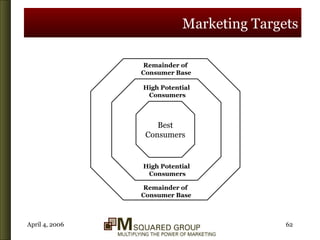
Marketing Targets Best Consumers High Potential  Consumers Remainder of  Consumer Base High Potential  Consumers Remainder of  Consumer Base
Data-driven Marketing Best Practices Review #1 Leveraging RFM to Grow Share -- Patterson Companies Largest dental supply company in the world Supplies office products to doctors, dentists, vets and chiropractors  Tracks RFM changes monthly and delivers segment specific communications and incentives Analyzes database to identify customers who are heavy purchasers and: Created expedited call center experience Direct bulk of communications to this segment Dedicated outbound telesales to that segment, anticipate needs by preemptive contact Created bundles specific for different industries and “lifecycles” Avery Implications Enhanced consumer service for Best Customers Industry-specific and lifecycle bundles RFM-based promotions to maintain consumer on currently established purchase patterns
Data-driven Marketing Best Practices Review #2 Personalizing offerings -- Office Max Consumers are scored based on purchase patterns and product type concentrations Specific segments receive customized mailings and web site personalization Segments and provides appropriate offers through the phone as cross-sell  Campaigns now personalized based on timing and product mix OfficeMax now receives 24% of revenue through web channel Avery Implications Leverage phone channel as revenue source Create communications stream based on purchases of value-added products
Data-driven Marketing Best Practices Review #3 Building Lifetime Value -- Brother International Developed Lifetime Value Calculation for consumers based on call center-obtained information Created business selling accessories direct to consumers – “Return on Relationship” Leveraged call center as primary consumer acquisition tool (2mm calls annually) Limit number of contacts per consumer per month to maintain freshness and relevancy Identify when consumers are likely to need a new printer Avery Implications Possible to develop LTV for consumers based on lifecycle and product mix, even when consumers are purchasing through alternative channels Established consumer relationship with limited channel conflict (focus on products not carried by retailers) Implemented campaign management in a shortened timeframe
Data-driven Marketing Best Practices Review #4 Leveraging Segmentation -- Best Buy Developed detailed segmentation for a limited number of key consumer groups (4 originally) Identified key purchase characteristics Conducted qualitative research to identify product gaps Organized business units to maximize total company revenue from specific segments Product or category independent Managed to an estimated P&L for that segment Complete responsibility for communications, promotions and selling to that segment Redesigned stores to feature sections that match the consumer base in that store’s trading area Currently integrating web store personalization into process Avery Implications Segmentation is both product and needs-based Focus on limited number of opportunities
Implications of Best Practices Success of industry and lifecycle bundles for B2B consumer management Enhanced consumer experience for Best and High Potential Consumers Increase cross-selling campaigns through call center operations Possible to develop LTV measures for marketing prioritization even when indirect

Customer Centric Marketing Seminar 4 04 06v3

  • 1.
    Building Customer Equityin Your Organization Mark Price, Managing Partner April 4, 2006
  • 2.
    Agenda Introductions andwhy we are here Workshop goals Customer-centricity – what it is, why it is important MSG Research into Customer-centric Marketing Roundtable Results Participant Discussion Barriers to customer-centric marketing Application to your organization Where you are? Where you can go
  • 3.
    To start… IntroductionsWhy are we here? What are Your goals for the workshop?
  • 4.
    Overall Objectives Establisha knowledgebase around data-driven marketing and customer-centric business practices Provide you with a “real-world” glimpse into how other organizations evaluate themselves and the barriers they face Enable you to go home with the outline of an action plan to grow customer equity
  • 5.
    Data-driven Marketing andCustomer Centricity Data-driven Marketing is a critical component to Customer Centricity Involves the leveraging of customer data to drive sustainable revenue across all channels Not just outbound, includes call center, service, delivery, product development, etc. Tends to be segments rather than 1:1 Customer Centricity is the structuring of the organization around customer segments to facilitate the personalization of the customer experience Not synonymous terms, but critically related. Both aspects must be in place to drive customer value consistently
  • 6.
    Building Value theCustomer-Centric Way Background and Approach
  • 7.
    Customer-centricity in thenews For the past several years, “customer centric marketing” or “customer centricity” has been in the news repeatedly Giving Voice to Customer-Centricity Reaps Big ROI for Barclays ( CRM Today) Whether bull or bear market, the Royal Bank of Canada is piling up the ROI; and its customer-based strategy gets all the credit. (Inc. Magazine) Best Buy has what it calls a "customer centricity" initiative, a strategy being rolled out that's designed to increase sales and market share. ( WSJ)
  • 8.
    Customer-centricity On TheBookstand Angel Customers & Demon Customers by Larry Selden and Geoffrey Colvin © 2003 Return on Customer by Don Peppers and Martha Rogers © 2005 Managing Customers As Investments by Sunil Gupta, et. al. © 2005
  • 9.
    Customer centric management– why? All stem from 1 critical observation “ A company’s value is simply the discounted cash flows resulting from a customer revenue stream” The only source of the “fuel that runs the engine” is revenue that comes from selling to customers Plants don’t make earnings for the company Products don’t make earnings for the company Locations don’t make earnings for the company Employees don’t make earnings for the company Consultants don’t make money (just kidding)
  • 10.
    Customer centric management Customer Concentration Not only does all company value come from customer-supplied revenue streams, but … Frequently all customer-supplied revenue streams come from 20% of a company’s customers % of Customers % of Gross Profit 20% 80% - 100%
  • 11.
    Customer centric management Segmentation Not only does all company value come from 20% of a company’s total customers, but… The 20% of customers is not homogenous, but is composed of multiple, very distinct, groups % of Customers 20% Heavy Hitters Stock-ups Shells & Line Hunters Anglers Camp & Hiking Boaters
  • 12.
    Customer centric managementCost Allocation If a company’s value is composed only of customer-generated net cash flows, then… All costs need to be allocated back to those cash flows to create the “Net” number Customer-driven gross margin (really all there is) Costs allocated down to the customer segment Facilities HR Sales Finance Marketing, etc. + “ The Company Holiday Party”  = “ True” customer-level P&L’s minus Forces all expenses through the lens of “customer value” and creates accountability to shareholders for spending
  • 13.
    Customer centric management Valuation So if customers can be tied to a revenue stream, they can also be tied to a public company’s stock price or a private company’s valuation Changes in customer value will change that valuation and either add or detract from shareholder value Price ------- Earnings = Expectation of future growth in customer-driven revenue streams ------- Current results from customer-driven revenue streams (less costs)
  • 14.
    Implications Value comesfrom customer-driven revenue stream Most to all revenue comes from a concentration of customers That concentration of customers is made up of distinct segments The discounted customer-driven revenue stream can be directly tied to company valuation or stock price Customer focus is the most important function of a company That limited number of customers actually make up all of your company’s value Understanding those segments (and integrating a value proposition into those groupings) is critical Investors need to understand customer management to gauge value Customer treatment has far- reaching implications Implication Learning
  • 15.
    Business environment increasinglycompetitive: More competitors More channels More price pressure (transparency of information) Wall St. less forgiving Marketing, and customer spending in general, under increased scrutiny for accountability #1 CMO issue “ Do more with less” How did we get here? Business Environment Once cost-cutting has been achieved, improvements in performance become increasingly hard to come by
  • 16.
    How did weget here? Technology Several key technology trends now permit measurement of customer value: Moore’s Law in action – data storage capacity continues to increase while prices for capacity continue to decline Increase in computer processing speeds permit near-real-time decision making Drive of “computer-related” devices into point of sale, warehouse, vendors, HR, etc. Development of accurate, actionable, “somewhat” affordable software The Internet
  • 17.
    How did weget here? CRM Customer Relationship Management software offered a technology solution to increase customer revenue at the 1:1 level Biggest issues in CRM turned out to be business process and customer data management, rather than software Spectacular flameouts in the late 1990’s highlighted the gaps between software process and business process
  • 18.
    How did weget here? Data Warehousing Critical issue in understanding customers is ability to consolidate and analyze customer data (behavior, service, demo/firmographics) Also need to organize cost data in order to allocate all costs down to the customer level Applications have sufficient data available and technology now permits consolidation Software enhancements now simplify the data warehouse challenge (though it is never easy) Customer data warehouse now transforms into the company’s most valuable asset Customer-driven gross margin (really all there is) Costs allocated down to the customer segment = “ True” customer-level P&L’s minus
  • 19.
    How did weget here? Business Process Business process reengineering has been the leading buzz words in the past 3-5 years Focus on streamlining costs, eliminating headcount and reducing time to market Has lacked a primary business value driver Difficult to make efficiency a motivating “vision” of customer value Lack of clear compelling value drivers will result in the passing of yet another fad
  • 20.
    So what’s involved?Dramatic changes to all aspects of corporate culture and functionality People Processes Technology The hardest part is NOT the technology The hardest part is change management
  • 21.
    Organization Build businessteams around different customer segments, with full accountability Force previously siloed functions into alignment around the critical driver of value – customer short-term and lifetime value Team leaders understand customer requirements and drive those requirements across every function that touches that customer Products and services Pricing Marketing Sales, etc.
  • 22.
    Crossing the ChasmEarly Adopters Early Majority Late Majority “ Never Mind” Need Mavens + Connectors to help bridge the chasm and let the Early Majority know the product is ready – “Social Networks”
  • 23.
    Segmentation Lifeblood ofcustomer-centricity is an understanding of customer behaviors and attitudes for the most critical segments 80/20 rule Must drive to attitudinal data, not just to purchase behaviors The “why” + the “what” combine to create customer loyalty in a segment Why customers behave as they do What do customers actually do Permits efficient targeting of segment benefit Change in customer lifetime value becomes the most critical metric in the company
  • 24.
    What gets measuredis what matters… Critical to customer-centricity is a measurement system to provide accountability for segment-level performance all the way from Sales through Marketing to Finance etc. Compensation must be changed to synch with the measurement system Remember – employees will do: What they are compensated for What is measured Exactly what they used to do
  • 25.
    Customer-driven Business ProcessesThe critical connection between customer data, marketing analysis and sales execution is the Business Process Handoffs and tracking must be seamless to ensure that: Customer experience is enhanced by leveraging behavioral data Changes can be made to marketing and sales as a result of changes in customer behavior Smooth handoffs between departments or divisions
  • 26.
    Is Customer-Centricity AnotherFad? Possibly. Depends on level of commitment by management The equation customer value = the “E” of the P/E ratio cannot be disputed For Customer-centricity to succeed: Must become executive metric Shared by Board Members, shareholders and private investors Be a long-term commitment – will clearly require some upfront investment to succeed
  • 27.
    What Your PeersSay… M Squared Group is conducting a research study to determine progress in using customer information to drive business performance Both clients and non-clients Primarily marketing director, VP and CMO Objective is to identify the most critical business issues involving customer centricity and to gain a “real world” sense of progress to date Next steps will be to follow-up to identify the constraints that are preventing organizations from leveraging customer information
  • 28.
  • 29.
    Summary of FindingsOverall, respondents are somewhat dissatisfied with how their companies are using customer information to drive growth B2B companies are much more dissatisfied than B2C companies The biggest gaps tend to be in the use of customer information for improved retention, leveraging RFM and share of wallet In addition, over 38% of respondents lack a customer data repository Issue for both B2B and B2C
  • 30.
    Usage of CustomerData by Type of Business In general, respondents are relatively dissatisfied with how their organizations use data to drive revenue Biggest issue appears to be segmentation, where most organizations are not pleased with their current efforts Business to Consumers Business to Business All Respondents 3 No 7 No 6 7 11 No 15 2.36 2.79 2.43 2.50 2.50 Yes 1.79 We use customer segmentation for targeted campaigns to prospects We use customer segmentation for targeted campaigns to existing customers Our company uses customer data to target customers for cross-sell/up-sell opportunities Our company uses customer data to prioritize accounts based on overall customer value We use our database to guide us in making complementary product offerings to customers We have a customer database that consolidates basic transaction and other customer touchpoint data (call center, web, etc.) I am satisfied with how we use customer data to drive incremental revenue for our company 2.54 3.15 2.81 2.69 2.65 Yes 2.15 2.89 3.78 3.56 3.00 3.00 Yes 2.67 7 6 5 4 3 2 1
  • 31.
    Usage of CustomerData by Type of Business Overall, the lowest levels of satisfaction are with attrition modeling and the use of “share of wallet” in campaigns Largest discrepancies between B2B and B2C are in share of wallet, using campaign results, and reviewing marketing campaigns Business to Consumers Business to Business All Respondents 4 8 No No 5 6 12 14 No 3.29 2.14 1.50 1.57 2.21 Yes We review marketing campaign results We change our customer campaigns based on customer response data We calculate our share of our customers' total category spending (share of wallet) and use this data in our campaigns We use attrition modeling to identify customers for special retention programs We use customer RFM (recency, frequency, monetary value) for specific campaigns We have established marketing roles responsible for specific customer segments 3.81 2.58 2.00 1.81 2.27 Yes 4.44 13 3.33 12 2.89 2.33 2.44 Yes 11 10 9 8
  • 32.
    Question # 1- I am satisfied with how we use customer data to drive incremental revenue for our company (all respondents) A significant portion of respondents are not satisfied with how their organizations are addressing the challenges of customer data 100% 26 Total 0.0% 0 Extremely Satisfied 7.7% 2 Very Satisfied 26.9% 7 Satisfied 38.5% 10 Somewhat Satisfied 26.9% 7 Not at all Satisfied % Count  
  • 33.
    Question # 1- I am satisfied with how we use customer data to drive incremental revenue for our company (B2B respondents) The respondents that are not satisfied with how their organizations are leveraging customer data are primarily within B2B organizations 100% 14 Total 0.0% 0 Extremely Satisfied 0.0% 0 Very Satisfied 21.4% 3 Satisfied 35.7% 5 Somewhat Satisfied 42.9% 6 Not at all Satisfied % Count  
  • 34.
    Question # 1- I am satisfied with how we use customer data to drive incremental revenue for our company (B2C respondents) In contrast, the B2C respondents have the only group that answered very satisfied with their use of customer data 100% 9 Total 0.0% 0 Extremely Satisfied 22.2% 2 Very Satisfied 22.2% 2 Satisfied 55.6% 5 Somewhat Satisfied 0.0% 0 Not at all Satisfied % Count  
  • 35.
    Preliminary Conclusions Overalllevel of satisfaction with leverage of customer data is low Key issues are often not the “fancy moves” but the basic segmentation and campaign analysis Significant barriers to moving to a customer-centric business model B2C companies appear a bit farther along than B2B at this stage
  • 36.
    Discussion At yourtable, please discuss: How your organizations use customer data to drive revenue, profitability and accountability?
  • 37.
    Roundtable Results MSquared held an executive roundtable on March 23, to discuss how customer-centricity and data-driven marketing was being executed in both B2C and B2B organizations: Patterson Dental Fargo Electronics Best Buy Lifetouch North American Membership Deluxe PeopleNet General Mills Govdocs.com United Health Group Katun Cambria
  • 38.
    Barriers to Customer-centricityRoundtable Results Executive Support 70% of a change initiative’s success can be attributed to visible executive support Vision No clear need articulated to the organization with consequences for failure outlined in detail Compensation Compensation structure can encourage sales to push unneeded products on customers, reducing retention No clear customer-centric metrics, leads to lack of sales support Fiefdoms Product management organization traditionally held P&L Customer-centricity evolves those teams into more staff than line roles “ Old tried and true” Organization built around processes that encourage repeating past campaigns Data is difficult to obtain and analyze Multiple silos of data, difficult to relate, combine, and analyze IT resources already over-committed
  • 39.
    What are theBarriers to Change? Recap Executive Support Vision Development Compensation Fiefdoms “Old tried and true” Data Challenges
  • 40.
    Rate your organizationUsing the sheet that has been distributed, please rate your organization on barriers to building a customer-centric organization
  • 41.
    Plan of AttackTo succeed at building customer-centricity, you need A compelling vision An executive who stands to gain from leading such a charge Simple, slam-dunk business objectives The ability to skunk-work a project at low cost, fast Tracking strategy “Early adopters” to assist in execution
  • 42.
    Build your owncompany plan Worksheet designed to simply help identify the single initiative that can move your customer-centric marketing effort ahead Critical to identify a compelling vision and an achievable business objective Finding the right sponsor and early adopters accelerate initial initiative and increase chances for success
  • 43.
    Questions Additional questions?Thoughts? Challenges in using this base plan?
  • 44.
    Thank you! MarkPrice Managing Partner, M Squared Group 952-484-0501 [email_address]
  • 45.
  • 46.
    Key Principles ofData-driven Marketing “ All consumers are not created equal” Marketing spending should be allocated proportional to the consumer value “ Timing is everything” Consumer acquisition exceeds costs of current consumer marketing, by lots! Data-driven marketing has implications for product development, investments and overall business planning
  • 47.
    Key Principles ofData-driven Marketing Benefits More repeat sales Reduced cost of sales Less volume sold on promotion Increased employee retention Better referral opportunities Higher margins Increased sales over time (Fred Reichheld, The Loyalty Effect )
  • 48.
    Key Principles ofData-driven Marketing Differentiated Marketing Why discriminate in consumer marketing? Consumers have differing relationships with a company 20% of consumers = 60-80% of revenue Bottom 20-30% of consumers usually cost you money to market Note: mass media is an inherently inefficient way to reach the 20% of relevant consumers who are/can become Best Consumers Many consumers do not have the capacity to significantly improve their spending Your best consumers are likely to be the best consumers of the competition as well Additional upside potential even in best consumers
  • 49.
    Key Principles ofData-driven Marketing Differentiated Marketing (cont’d) Small percentage changes in performance for Best Consumers have significant upside E.g. a 5% improvement for a $2000/yr consumer equals a 100% improvement for a $100/yr consumer Small behavior changes are easier to create than larger ones, if the larger changes are possible at all Some consumers have potential to be Best Consumers Large potential return Pays out marketing investments many times over
  • 50.
    Key Principles ofData-driven Marketing Leaky Bucket Consumer Acquisition Consumer Attrition Expand the bucket Thru data-driven marketing, a company can: Slow competitive momentum (particularly store brands) Drive more revenue and margin from current consumers In effect, growing the size of the bucket
  • 51.
    Key Principles ofData-driven Marketing Harnessing the power of RFM “ The best predictor of future behavior is past behavior” RFM provides a handle on the “velocity” of the business Expanding velocity is the key to business growth Frequency = How often does a consumer make a transaction? Primary indicator of usage, satisfaction, brand and relationship Indicates amount of product usage (use-up) which requires re-orders Monetary Value = Measurement of current/future consumer value Defines profitable and unprofitable consumers Usually aggregates net profit across transactions across a fixed time period Can be combined with product mix to better optimize consumer purchases Recency Time since last purchase or communication Indicates involvement of consumer – when trended identifies changes in consumer buying patterns and/or relationship
  • 52.
    Key Principles ofData-driven Marketing Harnessing the power of RFM How RFM can be used to assess business performance and identify issues? Shift marketing spending toward high spending, frequent consumers and high potential consumers Examine market basket for top decile consumers and cross-sell other consumers towards that basket Examine RFM to identify causes for declines (focus on high revenue consumers) If BC’s recency/freq. constant, then market basket is the issue If BC freq. falls, then need to incent repeat purchase Adjust communication frequency to purchase frequency
  • 53.
    Summary of RFMStrategies
  • 54.
    Key Principles ofData-driven Marketing Share of Wallet (SOW) Share of Wallet is a company’s Revenue/Total Revenue, for a specific consumer Quantifies the opportunity Share of Wallet identifies the monetary upside from the expansion of a current consumer’s business with a company Priority/investment should be given to Best Consumers with lower Share of Wallet E.g. If Best Consumers in small law firms purchase $750/yr in products, then a consumer who purchases $250 represents a SOW of $250/$750 (33%) The upside potential would be $500 Use this measure to concentrate marketing spending and, as importantly, resources (time, creative, etc.) that are spent addressing those segments
  • 55.
    Key Principles ofData-driven Marketing Share of Wallet Goal is to increase share of wallet for a particular segment Metric is based on growth of consumer spending, NOT growth of a business line 100% 100% Today 2011 Share of Spending All Others All Others Share of Spending
  • 56.
    Key Principles ofData-driven Marketing The Importance of Time As RFM would suggest, Time is critical to database marketing: Measurement of consumer involvement requires sustained behavior over time Time is also a critical component of data-driven marketing delivery Consumers tend to purchase based on unconscious patterns (monthly, quarterly, etc.) Marketing is more successful if directed to consumers at the time that they are ready to consider making a purchase
  • 57.
    Key Principles ofData-driven Marketing Event-triggered Marketing Event-triggered Marketing is the delivery of marketing communications/offers based on: Specific consumer behavior(s) A “database trigger” (either a specific behavior or a “tickler” based on consumer-provided information) Five requirements of Event-triggered Marketing: Targeted to specific behavior patterns Based on consumer history Measurable Valuable to the consumer Relationship-based, not just transactional
  • 58.
    Key Principles ofData-driven Marketing Event Triggered Marketing (cont’d) 1. Targeted to specific behavior patterns Communications timing based on a past behavior Consumer-driven behavior (consumer X purchases product Y) Database-driven behavior (6 months since last tracked purchase) 2. Based on consumer history Consumer history in the database is the knowledge base for ETM – differentiation from mass marketing 3. Measurable Measurement permits marketers to evaluate promotional effectiveness against different behaviors and different targets Builds a foundation of knowledge to enhance future efforts 4. Valuable to the consumer The offers and communication content must be truly valuable to the consumer, not just to the company Cannot be seen as merely an excuse for more transactions Does not require offers with every communication
  • 59.
    Key Principles ofData-driven Marketing Branding Implications Improved targeting of Better and Best Consumers actually enhances the Brand Balances price considerations with service delivery More personalized service Fewer “excessive” marketing communications “ Products we want, when we want them” Enhances consumer relationships and provides perceived barrier to exit (stickiness) Creates a differentiating factor vs. competition
  • 60.
    Key Principles ofData-driven Marketing What about Consumer Loyalty? Difference between consumer retention and consumer loyalty Retention is a behavior Loyalty is an belief Retained consumers can be loyal or not Some continue business by inertia, or price preference Some continue due to a genuine sense of differentiation Shift from one type to another critical to long-term success
  • 61.
    Consumer evolution andmigration Consumers will change the depth of their relationship with a company over time Some businesses grow, diminish or sell off Marketing, products, pricing, service will change depth of relationship Competitive activity “ Entropy” Identifying consumer migration patterns is critical to evaluating database marketing
  • 62.
    Marketing Targets BestConsumers High Potential Consumers Remainder of Consumer Base High Potential Consumers Remainder of Consumer Base
  • 63.
    Data-driven Marketing BestPractices Review #1 Leveraging RFM to Grow Share -- Patterson Companies Largest dental supply company in the world Supplies office products to doctors, dentists, vets and chiropractors Tracks RFM changes monthly and delivers segment specific communications and incentives Analyzes database to identify customers who are heavy purchasers and: Created expedited call center experience Direct bulk of communications to this segment Dedicated outbound telesales to that segment, anticipate needs by preemptive contact Created bundles specific for different industries and “lifecycles” Avery Implications Enhanced consumer service for Best Customers Industry-specific and lifecycle bundles RFM-based promotions to maintain consumer on currently established purchase patterns
  • 64.
    Data-driven Marketing BestPractices Review #2 Personalizing offerings -- Office Max Consumers are scored based on purchase patterns and product type concentrations Specific segments receive customized mailings and web site personalization Segments and provides appropriate offers through the phone as cross-sell Campaigns now personalized based on timing and product mix OfficeMax now receives 24% of revenue through web channel Avery Implications Leverage phone channel as revenue source Create communications stream based on purchases of value-added products
  • 65.
    Data-driven Marketing BestPractices Review #3 Building Lifetime Value -- Brother International Developed Lifetime Value Calculation for consumers based on call center-obtained information Created business selling accessories direct to consumers – “Return on Relationship” Leveraged call center as primary consumer acquisition tool (2mm calls annually) Limit number of contacts per consumer per month to maintain freshness and relevancy Identify when consumers are likely to need a new printer Avery Implications Possible to develop LTV for consumers based on lifecycle and product mix, even when consumers are purchasing through alternative channels Established consumer relationship with limited channel conflict (focus on products not carried by retailers) Implemented campaign management in a shortened timeframe
  • 66.
    Data-driven Marketing BestPractices Review #4 Leveraging Segmentation -- Best Buy Developed detailed segmentation for a limited number of key consumer groups (4 originally) Identified key purchase characteristics Conducted qualitative research to identify product gaps Organized business units to maximize total company revenue from specific segments Product or category independent Managed to an estimated P&L for that segment Complete responsibility for communications, promotions and selling to that segment Redesigned stores to feature sections that match the consumer base in that store’s trading area Currently integrating web store personalization into process Avery Implications Segmentation is both product and needs-based Focus on limited number of opportunities
  • 67.
    Implications of BestPractices Success of industry and lifecycle bundles for B2B consumer management Enhanced consumer experience for Best and High Potential Consumers Increase cross-selling campaigns through call center operations Possible to develop LTV measures for marketing prioritization even when indirect