Slides Master
Ms. Komal Kumari
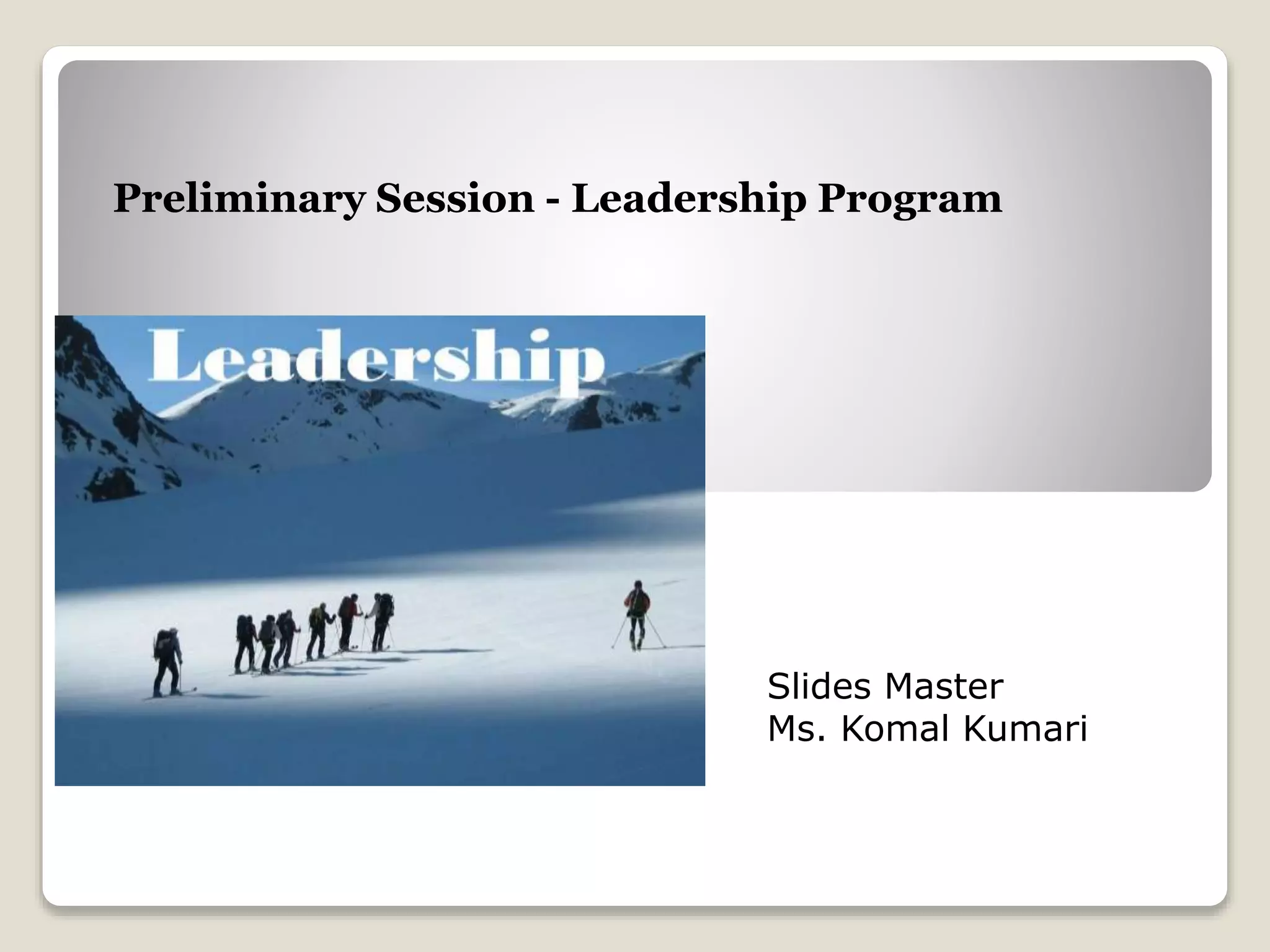
Preliminary Session - Leadership Program
What does leadership mean to
you?
Definition of leadership by Management Gurus
Peter Drucker: “The only definition of a leader is someone who
has followers.”
Warren Bennis: “Leadership is the capacity to translate vision
into reality.”
Bill Gates: “As we look ahead into the next century, leaders
will be those who empower others.”
John Maxwell: “Leadership is influence – nothing more, nothing
less.”
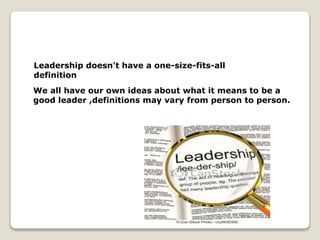
Leadership doesn't have a one-size-fits-all
definition
We all have our own ideas about what it means to be a
good leader ,definitions may vary from person to person.
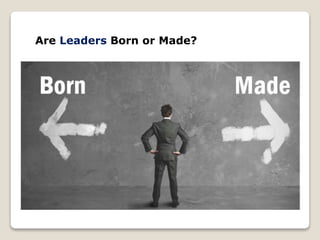
Are Leaders Born or Made?
Which came first the chicken or the egg? To be or not to
be? Nature versus Nurture?
Can we finally put this age old argument to rest and
come to a conclusion???????????
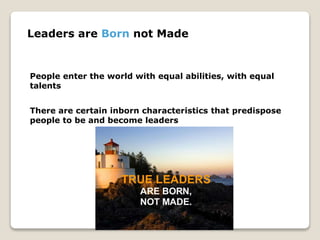
Leaders are Born not Made
People enter the world with equal abilities, with equal
talents
There are certain inborn characteristics that predispose
people to be and become leaders
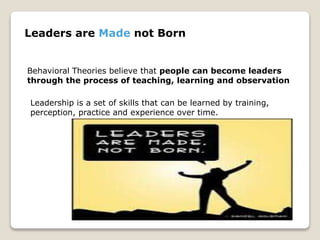
Leaders are Made not Born
Behavioral Theories believe that people can become leaders
through the process of teaching, learning and observation
Leadership is a set of skills that can be learned by training,
perception, practice and experience over time.
Recipe of being Leader
 Take CONTROL of your life
 Assume RESPONSIBILITY for “Who you are”
 Convey a POSITIVE and DYNAMIC attitude in
everything you do
 Accept blame: LEARN from your own mistakes
as well as those of others. Take BLAME for
everything that happens in your unit
 Give CREDIT wherever it is due
 Be COMPASSIONATE when you review your
team members' progress or lack thereof
Continue…
 LISTEN effectively
 ENCOURAGE teamwork and participation
 EMPOWER team members
 COMMUNICATE effectively
 Make sound and timely DECISIONS
 TREAT each person as an individual
 KNOW yourself and your team
 PROTECT your team
 Have VISION, COURAGE and COMMITMENT
Recipe of being Leader Continued…
The Leadership Challenge
• Focus on the individual members and the team
• Provide employees and stakeholders the opportunity to
develop and utilize their talents and strengths
• Listen to employee’s concerns
• Allocate the right resources for the right project, at the
right time
• Specify standards and expectations
• Delegate responsibility through empowerment
• Let employees and stakeholders identify their own interests
and abilities
• Lead by example: set the standard for excellence
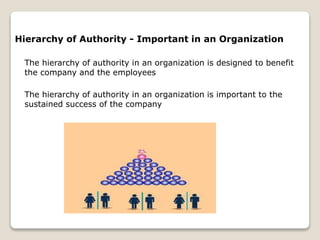
Hierarchy of Authority - Important in an Organization
The hierarchy of authority in an organization is designed to benefit
the company and the employees
The hierarchy of authority in an organization is important to the
sustained success of the company
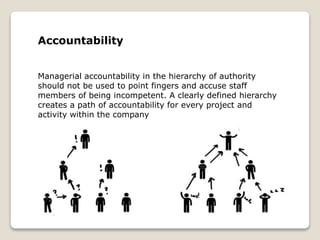
Accountability
Managerial accountability in the hierarchy of authority
should not be used to point fingers and accuse staff
members of being incompetent. A clearly defined hierarchy
creates a path of accountability for every project and
activity within the company
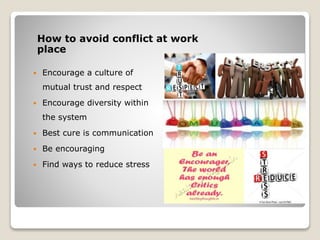
How to avoid conflict at work
place
 Encourage a culture of
mutual trust and respect
 Encourage diversity within
the system
 Best cure is communication
 Be encouraging
 Find ways to reduce stress
Delegation
Delegation is used to describe a variety of
different forms of and degrees of power sharing
with individual subordinates.
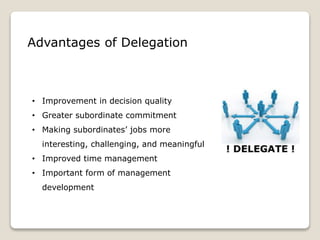
Advantages of Delegation
• Improvement in decision quality
• Greater subordinate commitment
• Making subordinates’ jobs more
interesting, challenging, and meaningful
• Improved time management
• Important form of management
development
Reasons for Lack of Delegation
 Aspects of the leader’s personality
 Fear of subordinate making a mistake
 High need for personal achievement
 Characteristics of the subordinate
 Nature of the work
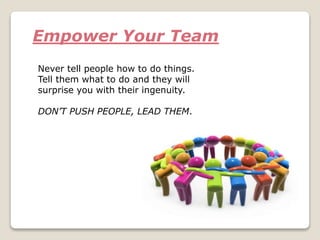
Empower Your Team
Never tell people how to do things.
Tell them what to do and they will
surprise you with their ingenuity.
DON’T PUSH PEOPLE, LEAD THEM.
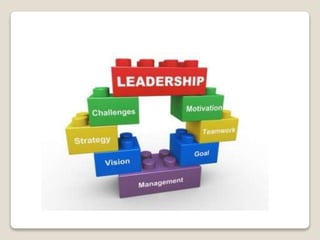
Leadership.
Leadership.
Leadership.

Leadership.

  • 1.
    Slides Master Ms. KomalKumari Preliminary Session - Leadership Program
  • 2.
  • 3.
    Definition of leadershipby Management Gurus Peter Drucker: “The only definition of a leader is someone who has followers.” Warren Bennis: “Leadership is the capacity to translate vision into reality.” Bill Gates: “As we look ahead into the next century, leaders will be those who empower others.” John Maxwell: “Leadership is influence – nothing more, nothing less.”
  • 4.
    Leadership doesn't havea one-size-fits-all definition We all have our own ideas about what it means to be a good leader ,definitions may vary from person to person.
  • 5.
  • 6.
    Which came firstthe chicken or the egg? To be or not to be? Nature versus Nurture? Can we finally put this age old argument to rest and come to a conclusion???????????
  • 7.
    Leaders are Bornnot Made People enter the world with equal abilities, with equal talents There are certain inborn characteristics that predispose people to be and become leaders
  • 8.
    Leaders are Madenot Born Behavioral Theories believe that people can become leaders through the process of teaching, learning and observation Leadership is a set of skills that can be learned by training, perception, practice and experience over time.
  • 9.
    Recipe of beingLeader  Take CONTROL of your life  Assume RESPONSIBILITY for “Who you are”  Convey a POSITIVE and DYNAMIC attitude in everything you do  Accept blame: LEARN from your own mistakes as well as those of others. Take BLAME for everything that happens in your unit  Give CREDIT wherever it is due  Be COMPASSIONATE when you review your team members' progress or lack thereof Continue…
  • 10.
     LISTEN effectively ENCOURAGE teamwork and participation  EMPOWER team members  COMMUNICATE effectively  Make sound and timely DECISIONS  TREAT each person as an individual  KNOW yourself and your team  PROTECT your team  Have VISION, COURAGE and COMMITMENT Recipe of being Leader Continued…
  • 11.
    The Leadership Challenge •Focus on the individual members and the team • Provide employees and stakeholders the opportunity to develop and utilize their talents and strengths • Listen to employee’s concerns • Allocate the right resources for the right project, at the right time • Specify standards and expectations • Delegate responsibility through empowerment • Let employees and stakeholders identify their own interests and abilities • Lead by example: set the standard for excellence
  • 12.
    Hierarchy of Authority- Important in an Organization The hierarchy of authority in an organization is designed to benefit the company and the employees The hierarchy of authority in an organization is important to the sustained success of the company
  • 13.
    Accountability Managerial accountability inthe hierarchy of authority should not be used to point fingers and accuse staff members of being incompetent. A clearly defined hierarchy creates a path of accountability for every project and activity within the company
  • 14.
    How to avoidconflict at work place  Encourage a culture of mutual trust and respect  Encourage diversity within the system  Best cure is communication  Be encouraging  Find ways to reduce stress
  • 15.
    Delegation Delegation is usedto describe a variety of different forms of and degrees of power sharing with individual subordinates.
  • 16.
    Advantages of Delegation •Improvement in decision quality • Greater subordinate commitment • Making subordinates’ jobs more interesting, challenging, and meaningful • Improved time management • Important form of management development
  • 17.
    Reasons for Lackof Delegation  Aspects of the leader’s personality  Fear of subordinate making a mistake  High need for personal achievement  Characteristics of the subordinate  Nature of the work
  • 18.
    Empower Your Team Nevertell people how to do things. Tell them what to do and they will surprise you with their ingenuity. DON’T PUSH PEOPLE, LEAD THEM.