VIRTUAL REALITY
By,
Anand Akshay
Enrollment No- 14BSP0167
INTRODUCTION
 Virtual reality is a form of technology which creates
computer generated worlds or immersive
environments which people can explore and in
many cases, interact with.
 Virtual reality (VR), sometimes referred to
as immersive multimedia, is a computer-
simulated environment that can simulate physical
presence in places in the real world or imagined
worlds. Virtual reality could recreate sensory
experiences, including virtual taste, sight, smell,
sound, touch, etc.
HISTORY
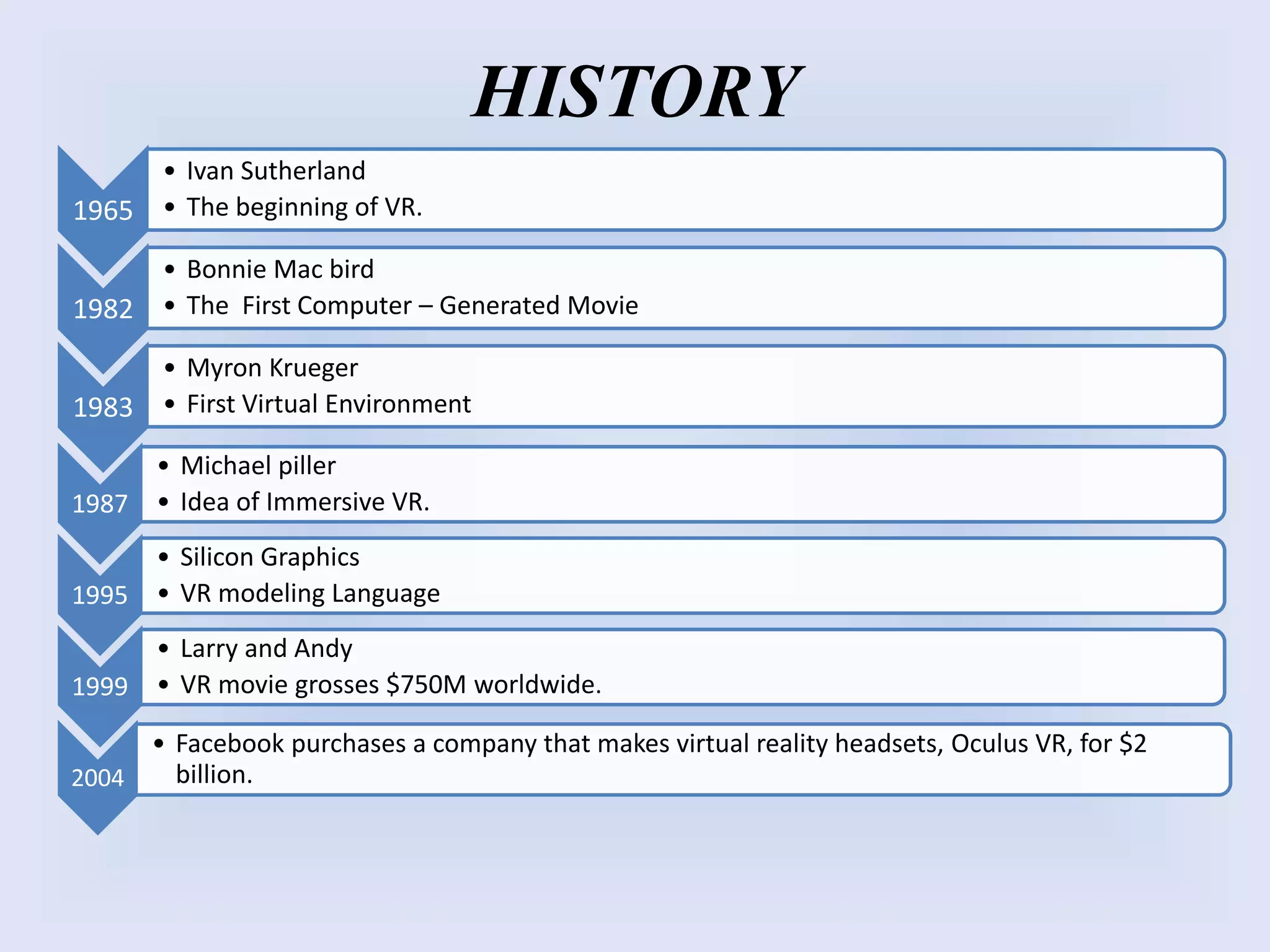
1965
• Ivan Sutherland
• The beginning of VR.
1982
• Bonnie Mac bird
• The First Computer – Generated Movie
1983
• Myron Krueger
• First Virtual Environment
1987
• Michael piller
• Idea of Immersive VR.
1995
• Silicon Graphics
• VR modeling Language
1999
• Larry and Andy
• VR movie grosses $750M worldwide.
2004
• Facebook purchases a company that makes virtual reality headsets, Oculus VR, for $2
billion.
IMPACT
 There has been an increase in interest in the potential social
impact of new technologies, such as virtual reality. Bailenson
review the literature on the psychology and sociology behind
life in virtual reality
 Virtual reality will be integrated into daily life and activity,
and will be used in various human ways. Another such
speculation has been written up on how to reach ultimate
happiness via virtual reality.
 Techniques will be developed to influence human
behaviour, interpersonal communication, and cognition.
 As we spend more and more time in virtual space, there will be
a gradual "migration to virtual space", resulting in important
changes in economics, worldview, and culture.
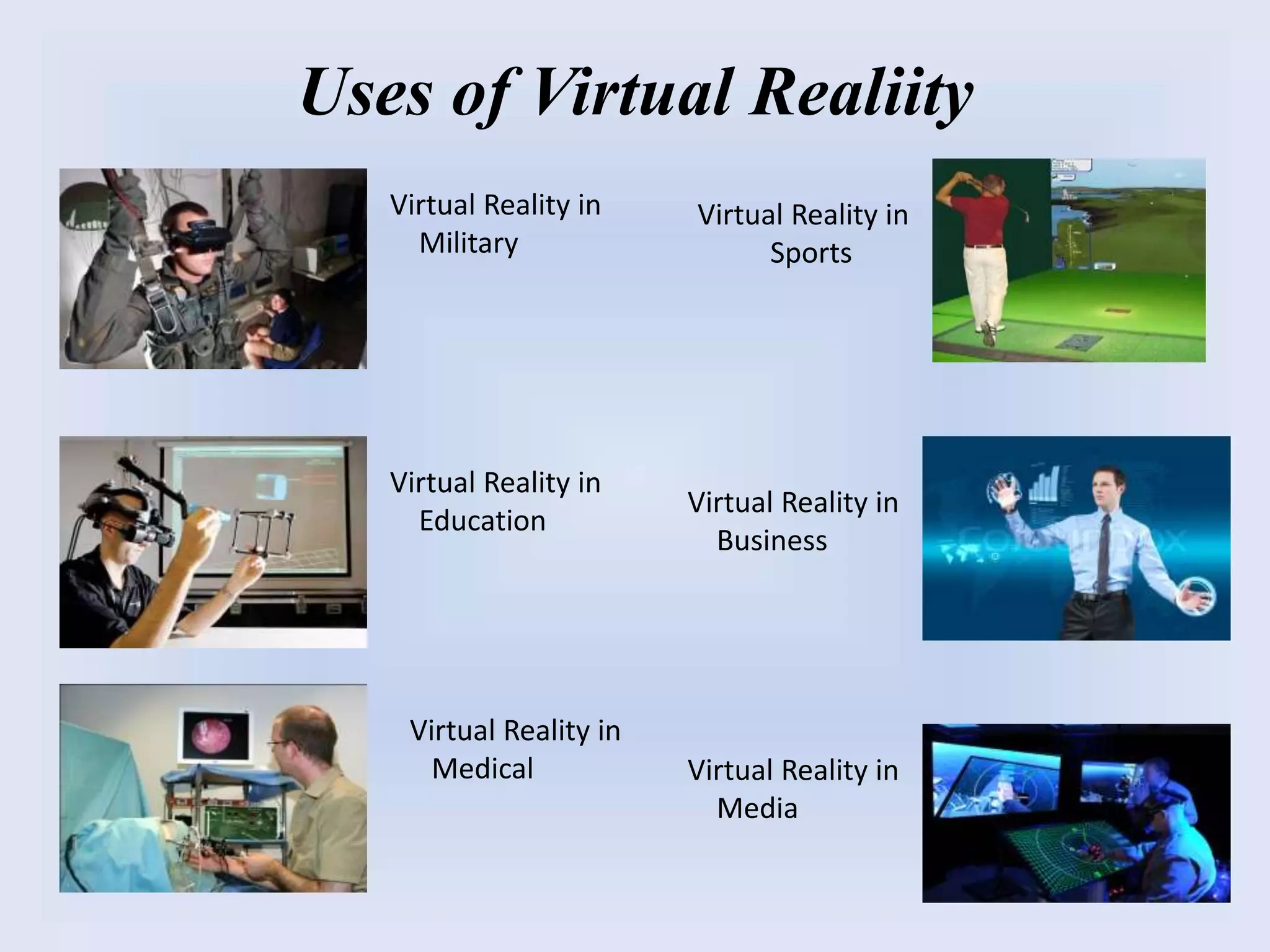
Uses of Virtual Realiity
Virtual Reality in
Military
Virtual Reality in
Sports
Virtual Reality in
Education
Virtual Reality in
Medical
Virtual Reality in
Business
Virtual Reality in
Media
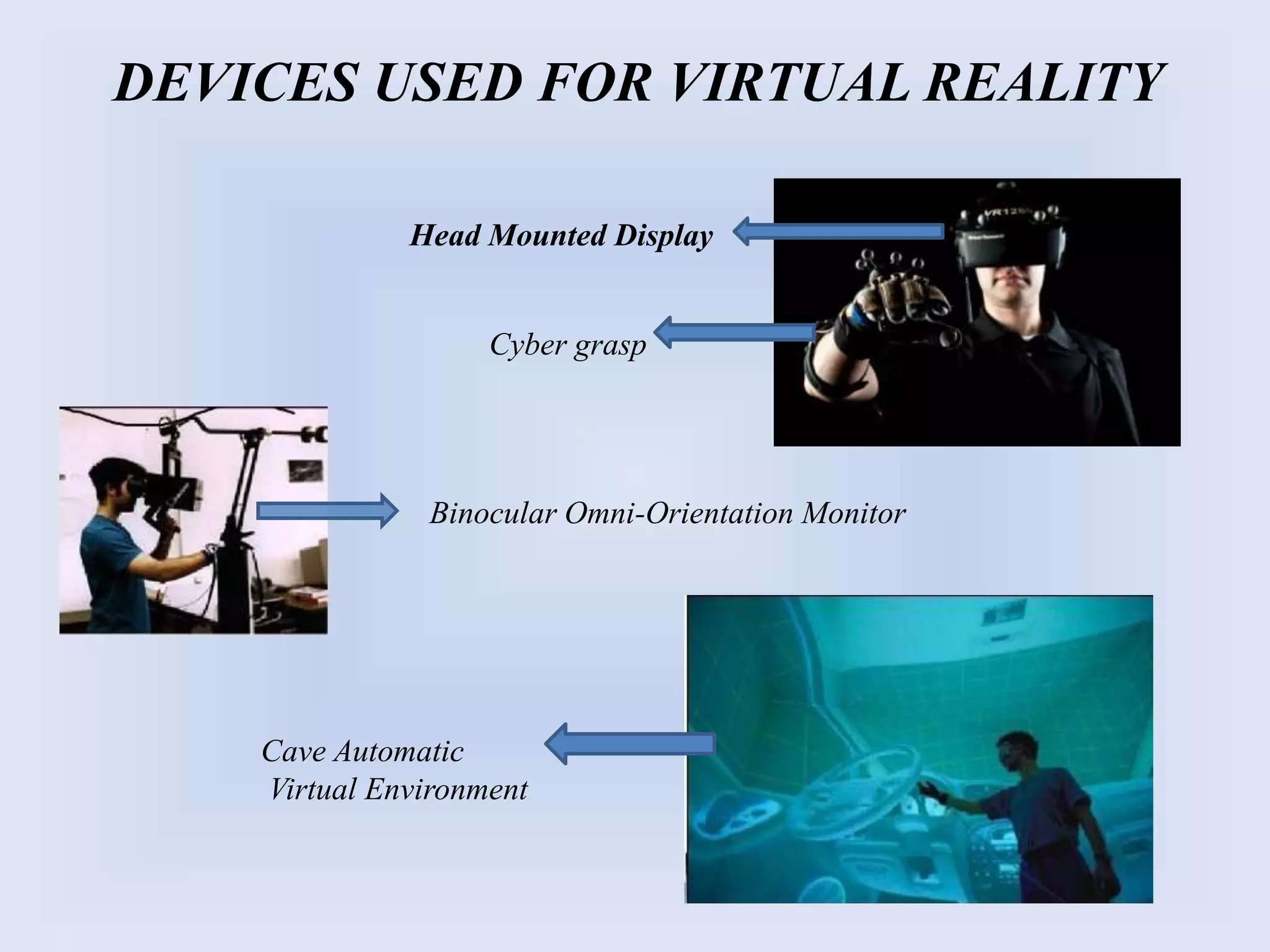
DEVICES USED FOR VIRTUAL REALITY
Head Mounted Display
Cyber grasp
Binocular Omni-Orientation Monitor
Cave Automatic
Virtual Environment
IMPLEMANTATION
To develop a real time virtual environment, a computer graphics library
can be used as embedded resource coupled with a common programming
language, such as C++, Perl,Java, or Python. Some of the most popular
computer graphic libraries are OpenGL, Direct3D, Java 3D, and VRML.
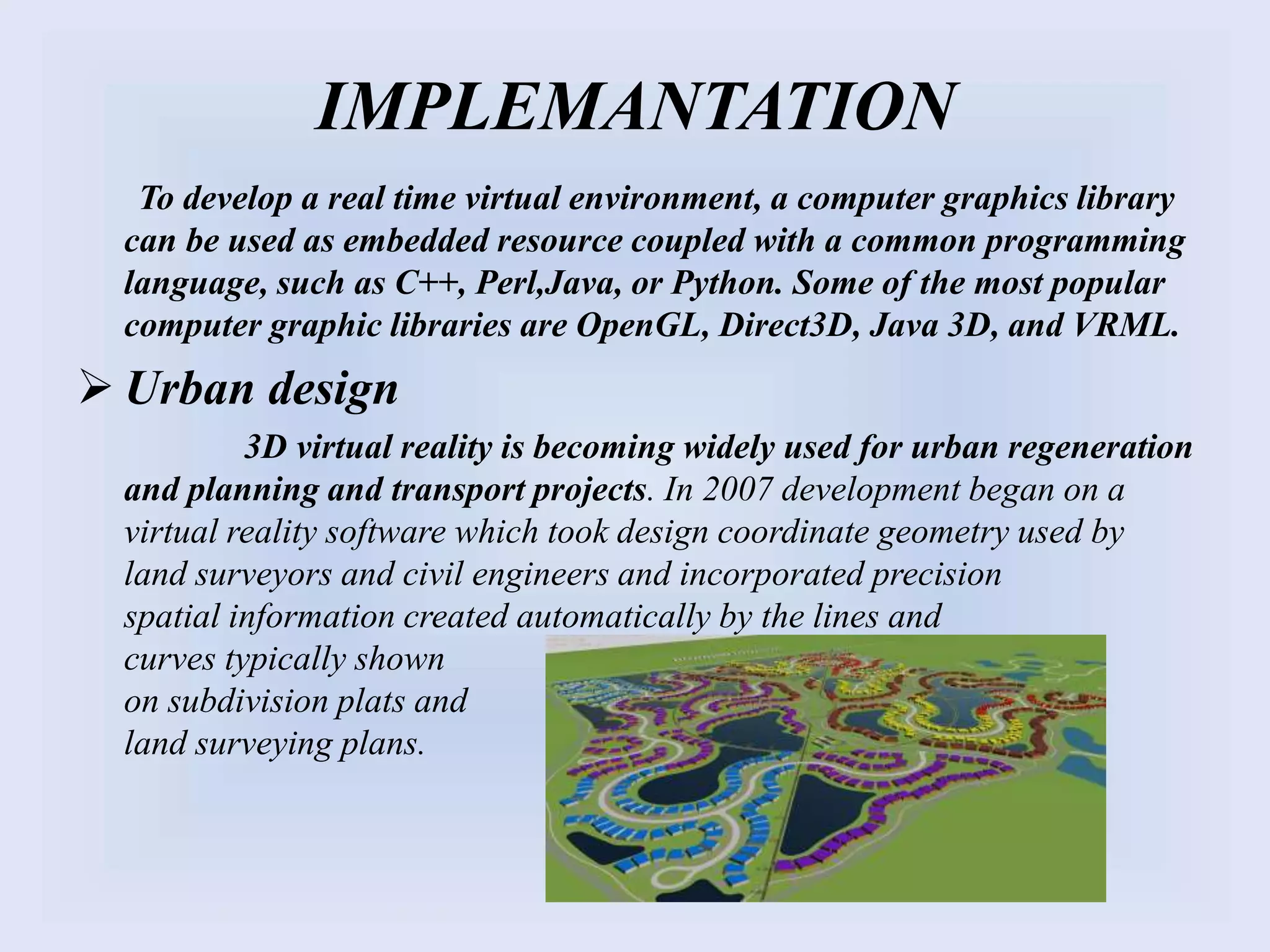
 Urban design
3D virtual reality is becoming widely used for urban regeneration
and planning and transport projects. In 2007 development began on a
virtual reality software which took design coordinate geometry used by
land surveyors and civil engineers and incorporated precision
spatial information created automatically by the lines and
curves typically shown
on subdivision plats and
land surveying plans.
Manufacturing
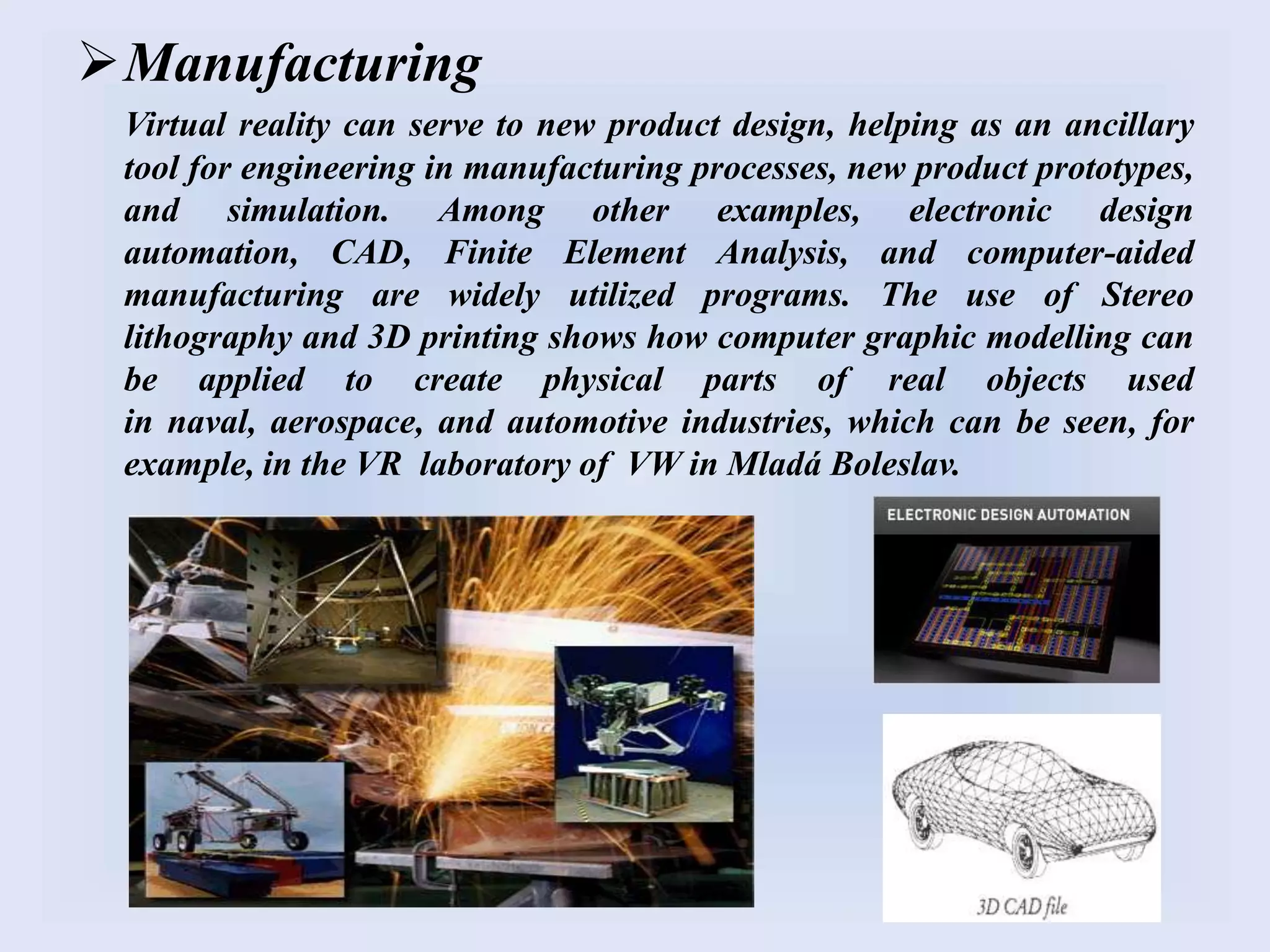
Virtual reality can serve to new product design, helping as an ancillary
tool for engineering in manufacturing processes, new product prototypes,
and simulation. Among other examples, electronic design
automation, CAD, Finite Element Analysis, and computer-aided
manufacturing are widely utilized programs. The use of Stereo
lithography and 3D printing shows how computer graphic modelling can
be applied to create physical parts of real objects used
in naval, aerospace, and automotive industries, which can be seen, for
example, in the VR laboratory of VW in Mladá Boleslav.
CONCERNS & CHALLENGES
Virtual reality technology faces a number of
challenges, most of which involve technical matters
and Simulation sickness due to virtual reality .
Users might become disoriented in a purely 'virtual'
environment, causing balance issues; computer
latency might affect the simulation, providing a less-
than-satisfactory end-user experience; the
complicated nature of head-mounted displays and
input systems such as specialized gloves and boots
may require specialized training to operate, and
navigating the 'real' environment might prove
dangerous without 'external' sensory information.

Virtual reality Presentation

  • 1.
  • 2.
    INTRODUCTION  Virtual realityis a form of technology which creates computer generated worlds or immersive environments which people can explore and in many cases, interact with.  Virtual reality (VR), sometimes referred to as immersive multimedia, is a computer- simulated environment that can simulate physical presence in places in the real world or imagined worlds. Virtual reality could recreate sensory experiences, including virtual taste, sight, smell, sound, touch, etc.
  • 3.
    HISTORY 1965 • Ivan Sutherland •The beginning of VR. 1982 • Bonnie Mac bird • The First Computer – Generated Movie 1983 • Myron Krueger • First Virtual Environment 1987 • Michael piller • Idea of Immersive VR. 1995 • Silicon Graphics • VR modeling Language 1999 • Larry and Andy • VR movie grosses $750M worldwide. 2004 • Facebook purchases a company that makes virtual reality headsets, Oculus VR, for $2 billion.
  • 4.
    IMPACT  There hasbeen an increase in interest in the potential social impact of new technologies, such as virtual reality. Bailenson review the literature on the psychology and sociology behind life in virtual reality  Virtual reality will be integrated into daily life and activity, and will be used in various human ways. Another such speculation has been written up on how to reach ultimate happiness via virtual reality.  Techniques will be developed to influence human behaviour, interpersonal communication, and cognition.  As we spend more and more time in virtual space, there will be a gradual "migration to virtual space", resulting in important changes in economics, worldview, and culture.
  • 6.
    Uses of VirtualRealiity Virtual Reality in Military Virtual Reality in Sports Virtual Reality in Education Virtual Reality in Medical Virtual Reality in Business Virtual Reality in Media
  • 7.
    DEVICES USED FORVIRTUAL REALITY Head Mounted Display Cyber grasp Binocular Omni-Orientation Monitor Cave Automatic Virtual Environment
  • 8.
    IMPLEMANTATION To develop areal time virtual environment, a computer graphics library can be used as embedded resource coupled with a common programming language, such as C++, Perl,Java, or Python. Some of the most popular computer graphic libraries are OpenGL, Direct3D, Java 3D, and VRML.  Urban design 3D virtual reality is becoming widely used for urban regeneration and planning and transport projects. In 2007 development began on a virtual reality software which took design coordinate geometry used by land surveyors and civil engineers and incorporated precision spatial information created automatically by the lines and curves typically shown on subdivision plats and land surveying plans.
  • 9.
    Manufacturing Virtual reality canserve to new product design, helping as an ancillary tool for engineering in manufacturing processes, new product prototypes, and simulation. Among other examples, electronic design automation, CAD, Finite Element Analysis, and computer-aided manufacturing are widely utilized programs. The use of Stereo lithography and 3D printing shows how computer graphic modelling can be applied to create physical parts of real objects used in naval, aerospace, and automotive industries, which can be seen, for example, in the VR laboratory of VW in Mladá Boleslav.
  • 10.
    CONCERNS & CHALLENGES Virtualreality technology faces a number of challenges, most of which involve technical matters and Simulation sickness due to virtual reality . Users might become disoriented in a purely 'virtual' environment, causing balance issues; computer latency might affect the simulation, providing a less- than-satisfactory end-user experience; the complicated nature of head-mounted displays and input systems such as specialized gloves and boots may require specialized training to operate, and navigating the 'real' environment might prove dangerous without 'external' sensory information.