Time Management
Learning Objectives When you have completed this module you will be able to define the key concepts associated with Time Management and you will be able to: Identify the main obstacles to effective Time Management in your daily role  Understand the nature of Time Management
Learning Objectives Understand a range of tools, techniques  and concepts for Time Management  Use these techniques to build an effective Time Management process that will enhance your productivity and lower your stress  Explain the benefits of having an effective Time Management process
Introduction
Time Management & The Organization Looking at time management from the perspective of the organization what are the benefits: Improved productivity through improved use of time by the personnel  Better performance in terms of on time delivery to customers  Increased profitability through better use of the human and non-human resources
Improved planning and control of business systems through time based management  Better alignment of activities by incorporating a time bound system for co-ordination of tasks and projects in the business  Reduction of stress that arises due to crisis management by reducing the incidence of crises by better planning  Time Management & The Organization
Introduction What is Time Management? Time as a  Commodity Essential Habits Types of Time Over & Under Estimation of Time
What is Time Management?  Time management has five main aspects: Planning & Goal Setting Managing Yourself Dealing with Other People Your Time Getting Results The first 4 all interconnect and interact to generate the fifth - results
Time as a Commodity Time is the most precious thing we have  Time is ultimately the most valuable resource  Time and how we spend it within the organization must be managed effectively  Time is totally perishable Time cannot be stored up for use later
Essential Habits Essential habits for good time management are: Know where the hours are going  Keep focused on the end result  Work to defined priorities  Schedule time for important issues  Delegate routine tasks and responsibility for them  Confront your own indecision and delay  Take the stress out of work  Keep applying the essential habits!
Types of Time Time can be categorized into two types: Fast time when absorbed in, or enjoying an activity  Slow time when bored with an activity or having a bad time  when scared
Over- & Under-estimating Time Time for tasks or activities can be over- or under-estimated due to Intensity of activity  Level of brain function  Length of gaps between enjoyments  Fear or ecstasy
Effects of Estimating Time Incorrectly Under-estimation of time  Stress due to committing to too many tasks  Poor quality output Deadlines may be missed Over-estimation of time Stress due to people pressing to have activities completed  Poor quality output Deadlines set may not match requirements
Time Management Principles
Time Management Principles Time Management Principles Spent Time Matrix Quadrant 2 Time-Based  Management
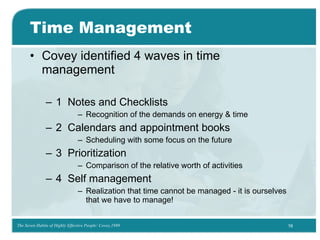
Time Management Covey identified 4 waves in time management 1  Notes and Checklists Recognition of the demands on energy & time  2  Calendars and appointment books Scheduling with some focus on the future 3  Prioritization  Comparison of the relative worth of activities  4  Self management Realization that time cannot be managed - it is ourselves that we have to manage! The Seven Habits of Highly Effective People: Covey,1989
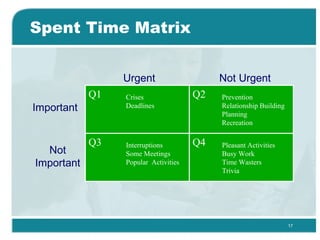
Spent Time Matrix Q1 Q3 Q2 Q4 Crises Deadlines Prevention Relationship Building Planning Recreation Interruptions Some Meetings Popular  Activities Pleasant Activities Busy Work Time Wasters Trivia Urgent Not Urgent Important Not Important
Quadrant 1 Being in Quadrant 1 brings Stress Burnout Crises management Firefighting Focus on the immediate
Quadrant 3 Being in Quadrant 3 brings Short term focus Crises management Low value on goals Feeling of victimization / lack of control Shallow relationships
Quadrants 3 & 4 Cycling between Quadrants 3 & 4 brings: Total irresponsibility High dependency on others for basics Short career path in the organization
Quadrant 2 Being in Quadrant 2 brings: Vision Perspective Balance Discipline Control The Seven Habits of Highly Effective People: Covey,1989
Characteristics of a Quadrant 2 Person There are six basic criteria to allow a person to function in Quadrant 2: Coherence Balance Focus An ability to get on with people  Flexibility  Portability
Quadrant 2 Requirements The basic requirements to reach Quadrant 2 are: Clear definition of organizational roles and specifically your own role  Selection of and focus on SMART goals  Development and utilization of schedules  The practice of daily adapting in work role
Saying No and Quadrant 2 To stay within Quadrant 2, there is a requirement that you must say no: In a professional manner  When items are associated with Quadrant 3 or Quadrant 4 activities  Not important not urgent Not important but urgent  Will not deliver competitive advantage
Time-Based Management  Fundamentals: Focus is on time and resources Pre-analysis of performance  Analysis of goals and objectives Systemization of processes
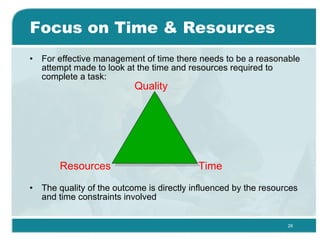
Focus on Time & Resources For effective management of time there needs to be a reasonable attempt made to look at the time and resources required to complete a task: The quality of the outcome is directly influenced by the resources and time constraints involved  Quality Time Resources
Pre-Analysis Of Performance The ability to learn from past experience allows time management to improve performance  The discipline of reviewing past performance allows the organization to: Debug projects before initiation and subsequent waste of resources  Define critical points in processes which need to have particular attention paid to them  Improve the overall utilization of resources  by capturing and implementing best practice
Analysis of Goals & Objectives By setting goals that relate to business performance and conform to SMART criteria the organization will improve productivity: S --  specific and well defined objectives M -- measurable outputs and inputs  A -- achievable in terms of resources available   and expectations R -- relevant to the overall business strategy T -- time bound with an operational schedule
Systemization of Processes The ability to design and implement processes that allow consistency of Input Output Training and skill transfer Consistency allows for time to be gauged accurately for activities which assists in the scheduling aspect of capacity planning in the organization
Time-based Management Need to look at Is the allotted time for completion of plans realistic for the person / team? In the effort to achieve results, is efficient use made of the available time? For teams - how can the time available be used to generate the optimal results? Is task-related time management appropriate and realistic in the situation?
Productive Work
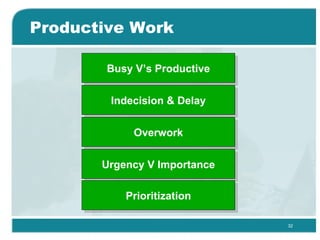
Productive Work Busy V’s Productive Indecision & Delay Overwork Urgency V Importance Prioritization
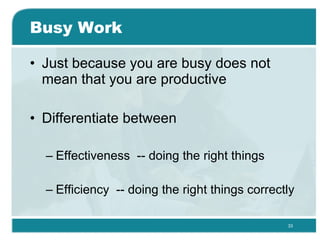
Busy Work Just because you are busy does not mean that you are productive  Differentiate between Effectiveness  -- doing the right things Efficiency  -- doing the right things correctly
Busy v Productive Work Problem No  1:  Procrastination Putting off doing the things that you should be doing at this point! Solution List all tasks that you are currently putting off  Remove two from the list by doing them now! Plan and set a schedule for dealing with the rest  Reward when tasks are completed  Punish when tasks are not completed on schedule
Dealing with Indecision or Delay When faced with a task - decide to deal with it according to one of the following actions: Do it Delegate it Dump it Deadline it Dissect it
Busy v Productive Work Problem No  2: Paralyzing perfectionism  This is a failure to recognize the difference between excellence and perfection  Excellence Achievable Healthy Satisfying Realistic Perfection Unattainable Frustrating Unrealistic
Busy v Productive Work Problem No  3: Setting unchallenging objectives  Objectives need to be set that challenge you in a realistic manner and take heed of resource availability  Otherwise you are busy without any possibility of success  Use SMARTS criteria where the objectives are: Specific Measurable Attainable Realistic Time-bound Supported by the organization
Overwork Overwork can have effects that may be classified as Psychological Physiological People are overloaded for two main reasons The person or team does too much  The person or team have too much to do
Overwork To deal with over-work, try the following  Understand your pressures  Don’t get worked up or panicked  Don’t blame everything on yourself  Walk away  Estimate time as well as possible  Agree priorities and keep them  Remind yourself that there is a limited amount of time available to you
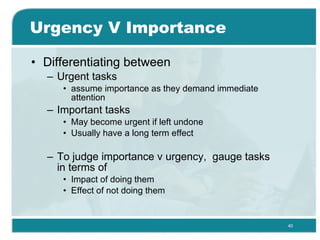
Urgency V Importance Differentiating between  Urgent tasks assume importance as they demand immediate attention  Important tasks May become urgent if left undone  Usually have a long term effect To judge importance v urgency,  gauge tasks in terms of Impact of doing them Effect of not doing them
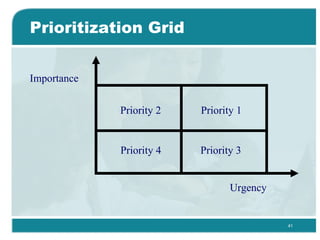
Prioritization Grid Importance Urgency Priority 1 Priority 2 Priority 3 Priority 4
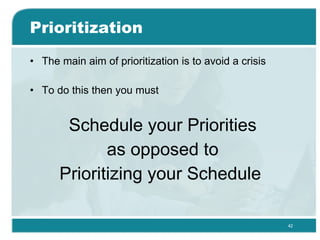
Prioritization The main aim of prioritization is to avoid a crisis  To do this then you must Schedule your Priorities as opposed to Prioritizing your Schedule
Crisis Management
Crisis Management Proactive V Reactive Why Crises Occur Anticipating & Preventing Crises
Proactive  v Reactive Work Reactive work - concentrates on getting things done  Handling daily routines Dealing with urgency Resolving crises Handling interruptions
Proactive v Reactive Work Proactive work - concentrates on making things happen Developing plans and schedules Focusing on key tasks Achieving deadlines & targets Managing projects
Why Crises Occur Checklist of reasons: Failure to recognize the crisis  Underestimation of time required  No contingency plan is ready  No follow-up on delegated tasks
Anticipating & Preventing Crises  The most effective way to anticipate and prevent crises is to: Set deadlines and stick with them  Use interim targets and milestones to break the task or project into manageable chunks  Build the schedule so that it is realistic
Planning
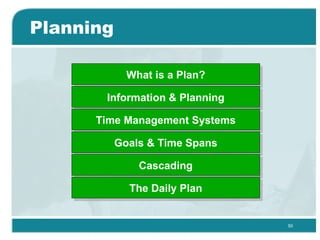
Planning What is a Plan? Information & Planning Time Management Systems Goals & Time Spans Cascading The Daily Plan
Planning in Time Management  Rule No  1 Failing to Plan is Planning to Fail
What is a Plan? A plan is a road map set in real time to reach an objective or set of objectives through the use of defined resources
Information & Planning  Essential information: You need to know what you have to plan  Once this is established  Break the task into manageable chunks  Gauge the time required for each chunk  Schedule each chunk into a logical sequence
Time Management Systems There are certain key criteria that need to be applied to a time management system: Functional Portable Intelligible
Time Management Systems Pitfalls Totally dis-organized ‘system’ Nothing can be located when required  Perfectly maintained system Too much time is spent keeping the system in perfect condition as opposed to actioning the items contained within it
Time Management Systems Key components Appointments Dated deadlines Tasks - to do and work in progress Ideas and notes Key task identification Personal information Financial planning records Crises log Project log Contact list
Goals & Time-spans A time management system is ineffective if defined goals are not available to work towards  Strategic Goals - long term goals, perhaps out to five years  Tactical Goals - medium term goals, from 3 - 12 months ahead  Operational Goals - short term goals defining the exact action to be taken  The schedule may cover hours or days
Checklist for Goals Checklist for Goals Are they realistic and challenging? Have they been agreed with the manager and linked to the performance appraisal system? Do you know what it will look like when you have achieved the goal (visualization)? Are the goals important to you? Is there a time bound aspect to the goals? Are the goals SMART? What will the reward be once the goals have been achieved?
Cascading Planning levels should cascade as follows: Yearly overview plan Monthly Plan Weekly Plan Daily Plan Note that in the cascade, the time span decreases whereas the level of complexity increases
The Daily Plan The Daily Plan should cover three main areas: Scheduled activities for the day showing time allocated to each  Identification of key tasks for the day to allow them to be prioritized  Indication of who you need to contact during the day to allow you to complete tasks
The Daily Plan When setting out the daily plan pay attention to the following points: When do you perform best, suit your bio-rhythm Build in planning time at the start and end of the day  Prioritize actions into ‘musts, shoulds and coulds and focus on the ‘musts’
The Daily Plan Guidelines continued Leave room for unexpecteds Don’t stack meetings back to back  Batch telephone calls Build in quality time
Tips & Techniques
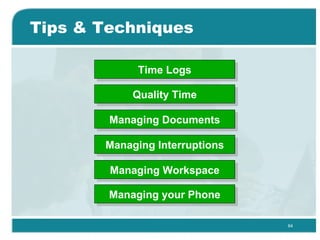
Tips & Techniques Time Logs Quality Time Managing Documents Managing Interruptions Managing Workspace Managing your Phone
Time-logs A time-log is an effective way to see where your time actually goes to during the working day  Record the information for about 2 weeks to get a representative picture of time spent  By logging activities and the time taken to complete them, the time-log provides useful information that can identify Accuracy of estimating time for tasks Time stealing activities Level of interruption Loading during the day  Crises points / tasks
Quality Time Quality time is where you can plan to do the most important high priority tasks  It allows for deep concentration through eliminating interruptions  It imposes a structure on work  It allows you to move away from reactive work to proactive work
Dealing with Documents Document handling can steal a vast quantity of time from our working day  Improve your document handling by: Handling documents only once by : Act on what is required by the document  File the document for reference later  Dump the document
Dealing with Documents Have a good system for handling your documents that allows you to: Define what you need to keep and for how long  Allows you to file materials easily and logically  Facilitates access to materials  Purge the files on a regular basis
Managing Interruptions Try to reduce the number of interruptions by applying the following techniques: Create a visual barrier at your workspace to reduce the incidence of ‘drop-in’ visits  Don’t have extra chairs in your workspace - people do not hang around as long if they must stand  For important work - move to another space so the potential interruptors can’t find you! Tell people that you are busy, explain why and arrange to contact them at a more suitable time
Managing Your Workspace How our workspace is organized has an impact on how efficient we are - try the following to improve efficiency  De-clutter your desk by clearing it at the end of each working day  File documents once they have been used  Purge files regularly Organize a work flow system in your space
Managing Your Phone The telephone can be responsible for eating vast quantities of time - control the phone by using: Batch your outward calls  Delegate calls that you don’t have to make personally to one of your team  Terminate calls once the business has been done  Set up a rota in your team for handling incoming calls
Summary
Summary Have a great planning system and use it  Take on realistic goals an schedule accurately  Do not over-commit  Set and agree priorities to distinguish between urgent and important tasks  Build in some flexibility to cope with anything  unexpected   Control your documents, workspace and phone
Summary Don’t procrastinate – Manage Your Time Today Define and use periods of quality time in your schedule  Learn to say No in a professional manner  Stay away from perfectionism and aim for excellence  Build in time for personal development

Time Management Training Ppt

  • 1.
  • 2.
    Learning Objectives Whenyou have completed this module you will be able to define the key concepts associated with Time Management and you will be able to: Identify the main obstacles to effective Time Management in your daily role Understand the nature of Time Management
  • 3.
    Learning Objectives Understanda range of tools, techniques and concepts for Time Management Use these techniques to build an effective Time Management process that will enhance your productivity and lower your stress Explain the benefits of having an effective Time Management process
  • 4.
  • 5.
    Time Management &The Organization Looking at time management from the perspective of the organization what are the benefits: Improved productivity through improved use of time by the personnel Better performance in terms of on time delivery to customers Increased profitability through better use of the human and non-human resources
  • 6.
    Improved planning andcontrol of business systems through time based management Better alignment of activities by incorporating a time bound system for co-ordination of tasks and projects in the business Reduction of stress that arises due to crisis management by reducing the incidence of crises by better planning Time Management & The Organization
  • 7.
    Introduction What isTime Management? Time as a Commodity Essential Habits Types of Time Over & Under Estimation of Time
  • 8.
    What is TimeManagement? Time management has five main aspects: Planning & Goal Setting Managing Yourself Dealing with Other People Your Time Getting Results The first 4 all interconnect and interact to generate the fifth - results
  • 9.
    Time as aCommodity Time is the most precious thing we have Time is ultimately the most valuable resource Time and how we spend it within the organization must be managed effectively Time is totally perishable Time cannot be stored up for use later
  • 10.
    Essential Habits Essentialhabits for good time management are: Know where the hours are going Keep focused on the end result Work to defined priorities Schedule time for important issues Delegate routine tasks and responsibility for them Confront your own indecision and delay Take the stress out of work Keep applying the essential habits!
  • 11.
    Types of TimeTime can be categorized into two types: Fast time when absorbed in, or enjoying an activity Slow time when bored with an activity or having a bad time when scared
  • 12.
    Over- & Under-estimatingTime Time for tasks or activities can be over- or under-estimated due to Intensity of activity Level of brain function Length of gaps between enjoyments Fear or ecstasy
  • 13.
    Effects of EstimatingTime Incorrectly Under-estimation of time Stress due to committing to too many tasks Poor quality output Deadlines may be missed Over-estimation of time Stress due to people pressing to have activities completed Poor quality output Deadlines set may not match requirements
  • 14.
  • 15.
    Time Management PrinciplesTime Management Principles Spent Time Matrix Quadrant 2 Time-Based Management
  • 16.
    Time Management Coveyidentified 4 waves in time management 1 Notes and Checklists Recognition of the demands on energy & time 2 Calendars and appointment books Scheduling with some focus on the future 3 Prioritization Comparison of the relative worth of activities 4 Self management Realization that time cannot be managed - it is ourselves that we have to manage! The Seven Habits of Highly Effective People: Covey,1989
  • 17.
    Spent Time MatrixQ1 Q3 Q2 Q4 Crises Deadlines Prevention Relationship Building Planning Recreation Interruptions Some Meetings Popular Activities Pleasant Activities Busy Work Time Wasters Trivia Urgent Not Urgent Important Not Important
  • 18.
    Quadrant 1 Beingin Quadrant 1 brings Stress Burnout Crises management Firefighting Focus on the immediate
  • 19.
    Quadrant 3 Beingin Quadrant 3 brings Short term focus Crises management Low value on goals Feeling of victimization / lack of control Shallow relationships
  • 20.
    Quadrants 3 &4 Cycling between Quadrants 3 & 4 brings: Total irresponsibility High dependency on others for basics Short career path in the organization
  • 21.
    Quadrant 2 Beingin Quadrant 2 brings: Vision Perspective Balance Discipline Control The Seven Habits of Highly Effective People: Covey,1989
  • 22.
    Characteristics of aQuadrant 2 Person There are six basic criteria to allow a person to function in Quadrant 2: Coherence Balance Focus An ability to get on with people Flexibility Portability
  • 23.
    Quadrant 2 RequirementsThe basic requirements to reach Quadrant 2 are: Clear definition of organizational roles and specifically your own role Selection of and focus on SMART goals Development and utilization of schedules The practice of daily adapting in work role
  • 24.
    Saying No andQuadrant 2 To stay within Quadrant 2, there is a requirement that you must say no: In a professional manner When items are associated with Quadrant 3 or Quadrant 4 activities Not important not urgent Not important but urgent Will not deliver competitive advantage
  • 25.
    Time-Based Management Fundamentals: Focus is on time and resources Pre-analysis of performance Analysis of goals and objectives Systemization of processes
  • 26.
    Focus on Time& Resources For effective management of time there needs to be a reasonable attempt made to look at the time and resources required to complete a task: The quality of the outcome is directly influenced by the resources and time constraints involved Quality Time Resources
  • 27.
    Pre-Analysis Of PerformanceThe ability to learn from past experience allows time management to improve performance The discipline of reviewing past performance allows the organization to: Debug projects before initiation and subsequent waste of resources Define critical points in processes which need to have particular attention paid to them Improve the overall utilization of resources by capturing and implementing best practice
  • 28.
    Analysis of Goals& Objectives By setting goals that relate to business performance and conform to SMART criteria the organization will improve productivity: S -- specific and well defined objectives M -- measurable outputs and inputs A -- achievable in terms of resources available and expectations R -- relevant to the overall business strategy T -- time bound with an operational schedule
  • 29.
    Systemization of ProcessesThe ability to design and implement processes that allow consistency of Input Output Training and skill transfer Consistency allows for time to be gauged accurately for activities which assists in the scheduling aspect of capacity planning in the organization
  • 30.
    Time-based Management Needto look at Is the allotted time for completion of plans realistic for the person / team? In the effort to achieve results, is efficient use made of the available time? For teams - how can the time available be used to generate the optimal results? Is task-related time management appropriate and realistic in the situation?
  • 31.
  • 32.
    Productive Work BusyV’s Productive Indecision & Delay Overwork Urgency V Importance Prioritization
  • 33.
    Busy Work Justbecause you are busy does not mean that you are productive Differentiate between Effectiveness -- doing the right things Efficiency -- doing the right things correctly
  • 34.
    Busy v ProductiveWork Problem No 1: Procrastination Putting off doing the things that you should be doing at this point! Solution List all tasks that you are currently putting off Remove two from the list by doing them now! Plan and set a schedule for dealing with the rest Reward when tasks are completed Punish when tasks are not completed on schedule
  • 35.
    Dealing with Indecisionor Delay When faced with a task - decide to deal with it according to one of the following actions: Do it Delegate it Dump it Deadline it Dissect it
  • 36.
    Busy v ProductiveWork Problem No 2: Paralyzing perfectionism This is a failure to recognize the difference between excellence and perfection Excellence Achievable Healthy Satisfying Realistic Perfection Unattainable Frustrating Unrealistic
  • 37.
    Busy v ProductiveWork Problem No 3: Setting unchallenging objectives Objectives need to be set that challenge you in a realistic manner and take heed of resource availability Otherwise you are busy without any possibility of success Use SMARTS criteria where the objectives are: Specific Measurable Attainable Realistic Time-bound Supported by the organization
  • 38.
    Overwork Overwork canhave effects that may be classified as Psychological Physiological People are overloaded for two main reasons The person or team does too much The person or team have too much to do
  • 39.
    Overwork To dealwith over-work, try the following Understand your pressures Don’t get worked up or panicked Don’t blame everything on yourself Walk away Estimate time as well as possible Agree priorities and keep them Remind yourself that there is a limited amount of time available to you
  • 40.
    Urgency V ImportanceDifferentiating between Urgent tasks assume importance as they demand immediate attention Important tasks May become urgent if left undone Usually have a long term effect To judge importance v urgency, gauge tasks in terms of Impact of doing them Effect of not doing them
  • 41.
    Prioritization Grid ImportanceUrgency Priority 1 Priority 2 Priority 3 Priority 4
  • 42.
    Prioritization The mainaim of prioritization is to avoid a crisis To do this then you must Schedule your Priorities as opposed to Prioritizing your Schedule
  • 43.
  • 44.
    Crisis Management ProactiveV Reactive Why Crises Occur Anticipating & Preventing Crises
  • 45.
    Proactive vReactive Work Reactive work - concentrates on getting things done Handling daily routines Dealing with urgency Resolving crises Handling interruptions
  • 46.
    Proactive v ReactiveWork Proactive work - concentrates on making things happen Developing plans and schedules Focusing on key tasks Achieving deadlines & targets Managing projects
  • 47.
    Why Crises OccurChecklist of reasons: Failure to recognize the crisis Underestimation of time required No contingency plan is ready No follow-up on delegated tasks
  • 48.
    Anticipating & PreventingCrises The most effective way to anticipate and prevent crises is to: Set deadlines and stick with them Use interim targets and milestones to break the task or project into manageable chunks Build the schedule so that it is realistic
  • 49.
  • 50.
    Planning What isa Plan? Information & Planning Time Management Systems Goals & Time Spans Cascading The Daily Plan
  • 51.
    Planning in TimeManagement Rule No 1 Failing to Plan is Planning to Fail
  • 52.
    What is aPlan? A plan is a road map set in real time to reach an objective or set of objectives through the use of defined resources
  • 53.
    Information & Planning Essential information: You need to know what you have to plan Once this is established Break the task into manageable chunks Gauge the time required for each chunk Schedule each chunk into a logical sequence
  • 54.
    Time Management SystemsThere are certain key criteria that need to be applied to a time management system: Functional Portable Intelligible
  • 55.
    Time Management SystemsPitfalls Totally dis-organized ‘system’ Nothing can be located when required Perfectly maintained system Too much time is spent keeping the system in perfect condition as opposed to actioning the items contained within it
  • 56.
    Time Management SystemsKey components Appointments Dated deadlines Tasks - to do and work in progress Ideas and notes Key task identification Personal information Financial planning records Crises log Project log Contact list
  • 57.
    Goals & Time-spansA time management system is ineffective if defined goals are not available to work towards Strategic Goals - long term goals, perhaps out to five years Tactical Goals - medium term goals, from 3 - 12 months ahead Operational Goals - short term goals defining the exact action to be taken The schedule may cover hours or days
  • 58.
    Checklist for GoalsChecklist for Goals Are they realistic and challenging? Have they been agreed with the manager and linked to the performance appraisal system? Do you know what it will look like when you have achieved the goal (visualization)? Are the goals important to you? Is there a time bound aspect to the goals? Are the goals SMART? What will the reward be once the goals have been achieved?
  • 59.
    Cascading Planning levelsshould cascade as follows: Yearly overview plan Monthly Plan Weekly Plan Daily Plan Note that in the cascade, the time span decreases whereas the level of complexity increases
  • 60.
    The Daily PlanThe Daily Plan should cover three main areas: Scheduled activities for the day showing time allocated to each Identification of key tasks for the day to allow them to be prioritized Indication of who you need to contact during the day to allow you to complete tasks
  • 61.
    The Daily PlanWhen setting out the daily plan pay attention to the following points: When do you perform best, suit your bio-rhythm Build in planning time at the start and end of the day Prioritize actions into ‘musts, shoulds and coulds and focus on the ‘musts’
  • 62.
    The Daily PlanGuidelines continued Leave room for unexpecteds Don’t stack meetings back to back Batch telephone calls Build in quality time
  • 63.
  • 64.
    Tips & TechniquesTime Logs Quality Time Managing Documents Managing Interruptions Managing Workspace Managing your Phone
  • 65.
    Time-logs A time-logis an effective way to see where your time actually goes to during the working day Record the information for about 2 weeks to get a representative picture of time spent By logging activities and the time taken to complete them, the time-log provides useful information that can identify Accuracy of estimating time for tasks Time stealing activities Level of interruption Loading during the day Crises points / tasks
  • 66.
    Quality Time Qualitytime is where you can plan to do the most important high priority tasks It allows for deep concentration through eliminating interruptions It imposes a structure on work It allows you to move away from reactive work to proactive work
  • 67.
    Dealing with DocumentsDocument handling can steal a vast quantity of time from our working day Improve your document handling by: Handling documents only once by : Act on what is required by the document File the document for reference later Dump the document
  • 68.
    Dealing with DocumentsHave a good system for handling your documents that allows you to: Define what you need to keep and for how long Allows you to file materials easily and logically Facilitates access to materials Purge the files on a regular basis
  • 69.
    Managing Interruptions Tryto reduce the number of interruptions by applying the following techniques: Create a visual barrier at your workspace to reduce the incidence of ‘drop-in’ visits Don’t have extra chairs in your workspace - people do not hang around as long if they must stand For important work - move to another space so the potential interruptors can’t find you! Tell people that you are busy, explain why and arrange to contact them at a more suitable time
  • 70.
    Managing Your WorkspaceHow our workspace is organized has an impact on how efficient we are - try the following to improve efficiency De-clutter your desk by clearing it at the end of each working day File documents once they have been used Purge files regularly Organize a work flow system in your space
  • 71.
    Managing Your PhoneThe telephone can be responsible for eating vast quantities of time - control the phone by using: Batch your outward calls Delegate calls that you don’t have to make personally to one of your team Terminate calls once the business has been done Set up a rota in your team for handling incoming calls
  • 72.
  • 73.
    Summary Have agreat planning system and use it Take on realistic goals an schedule accurately Do not over-commit Set and agree priorities to distinguish between urgent and important tasks Build in some flexibility to cope with anything unexpected Control your documents, workspace and phone
  • 74.
    Summary Don’t procrastinate– Manage Your Time Today Define and use periods of quality time in your schedule Learn to say No in a professional manner Stay away from perfectionism and aim for excellence Build in time for personal development