1
|
MTL: The Professional Development Programme
The Effective Time Manager
THE EFFECTIVE TIME
MANAGER
Are Your Current Tasks Urgent or Important?
MTL: The Professional Development Programme
2
|
MTL: The Professional Development Programme
The Effective Time Manager
Attribution: All images are from sources where a Creative Commons license exists for commercial use. All icons are on subscription
from thenounproject. All clipart is from free sources. The MTL Professional Development Programme is copyright of Manage Train
Learn.
The Effective
Time Manager
Introduction: Dwight Eisenhower was one of the most productive people who ever
lived. He masterminded the biggest invasion in history, D-Day, and then went on to
become president of the most powerful country in the world for 8 years. His recipe for
managing his activities is known as "the Eisenhower box" and it is a simple technique
that can be adapted by anyone who wants to manage their time well. In this
presentation, we'll show you 7 key features of the model.
3
|
MTL: The Professional Development Programme
The Effective Time Manager
DO
Do it now
Write and design this
week’s “Eisenhower’s
Box” Slide Topic
DELEGATE
Who can do it for you?
Schedule interviews
Book flights
Approve comments
on website
Answer some emails
DECIDE
Schedule a time to do it
including right now
Exercise
Call Simon back
Research next article
Complete tax return
DELETE
Eliminate it
Watching bad TV
Checking social media
too often
Sorting through junk
emails
NOT
IMPORTANT
IMPORTANT
URGENT NOT URGENT
"Ihavetwokindsofproblems:theurgentandthe
important.Theurgentarenotimportant,andthe
importantareneverurgent."(DwightEisenhower,quoting
DrJ.RoscoeMiller,presidentofNorthwesternUniversity)
1.
EISENHOWER’S
BOX
The concept of "Eisenhower’s “Box" comes from a
speech Dwight Eisenhower gave in 1954 when he
described time management as “a dilemma of
modern man”. The model is quite simple. It shows 4
quadrants into which you can categorize the jobs you
have to do. The vertical axis ranges from Not
Important to Important while the horizontal axis
ranges from Urgent to Not Urgent. The result is that
you can see where your tasks lie, why they are where
they are, and how you can handle them. Since
Eisenhower's speech, others, such as Stephen Covey,
have used the “important-urgent” concept to create a
widely-used model for managing tasks and time.
4
|
MTL: The Professional Development Programme
The Effective Time Manager
2.
FIREFIGHTING
TASKS
If you find yourself doing a lot of important and
urgent jobs at the last moment, (those in the top left
quadrant), then you have a problem. This is because
you should have done them earlier but either forgot
or delayed and now they have taken on the nature of
a crisis. One example is completing your tax return.
According to the UK BBC News, 557,000 people in the
UK left their tax returns until the last minute in 2014.
Stephen Covey calls these activities "firefighting
tasks". To avoid them, know what is important, avoid
procrastination, and set a time to do them.
DO
Do it now
Write and design this
week’s “Eisenhower’s
Box” Slide Topic
DELEGATE
Who can do it for you?
Schedule interviews
Book flights
Approve comments
on website
Answer some emails
DECIDE
Schedule a time to do it
Exercise
Call Simon back
Research next article
Complete tax return
DELETE
Eliminate it
Watching bad TV
Checking social media
too often
Sorting through junk
emails
NOT
IMPORTANT
IMPORTANT
URGENT NOT URGENT
Summary
Doimportantandurgentjobsassoonaspossiblebuttryto
reducethenumberonyourto-dolistbydoingthembeforethey
becomeurgent.
5
|
MTL: The Professional Development Programme
The Effective Time Manager
3.
DISTRACTING
TASKS
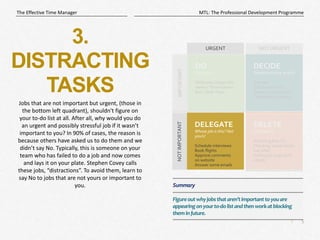
Jobs that are not important but urgent, (those in
the bottom left quadrant), shouldn't figure on
your to-do list at all. After all, why would you do
an urgent and possibly stressful job if it wasn’t
important to you? In 90% of cases, the reason is
because others have asked us to do them and we
didn’t say No. Typically, this is someone on your
team who has failed to do a job and now comes
and lays it on your plate. Stephen Covey calls
these jobs, “distractions”. To avoid them, learn to
say No to jobs that are not yours or important to
you.
DO
Do it now
Write and design this
week’s “Eisenhower’s
Box” Slide Topic
DELEGATE
Whose job is this? Not
yours!
Schedule interviews
Book flights
Approve comments
on website
Answer some emails
DECIDE
Schedule a time to do it
Exercise
Call Simon back
Research next article
Complete tax return
DELETE
Eliminate it
Watching bad TV
Checking social media
too often
Sorting through junk
emails
NOT
IMPORTANT
IMPORTANT
URGENT NOT URGENT
Summary
Figureoutwhyjobsthataren’timportanttoyouare
appearingonyourto-dolistandthen workatblocking
theminfuture.
6
|
MTL: The Professional Development Programme
The Effective Time Manager
4.
TIMEWASTING
TASKS
Tasks that are not important and not urgent, (those
in the bottom right quadrant), often figure on our
to-do list when they shouldn't. These include
watching bad TV, checking social media too often,
and sorting through junk mail. This is OK if you are
putting these on your list as a way of chilling out –
in which case they could be re-classed as
“important”. However, if you are putting lots of
jobs on your to-do list that are not necessary or
helpful to you, these are time-wasters and should
be eliminated from your to-do list ruthlessly and
completely.
DO
Do it now
Write and design this
week’s “Eisenhower’s
Box” Slide Topic
DELEGATE
Whose job is this? Not
yours!
Schedule interviews
Book flights
Approve comments
on website
Answer some emails
DECIDE
Schedule a time to do it
Exercise
Call Simon back
Research next article
Complete tax return
DELETE
Eliminate it
Watching bad TV
Checking social media
too often
Sorting through junk
emails
NOT
IMPORTANT
IMPORTANT
URGENT NOT URGENT
Summary
It’sOKtochilloutwithnon-productivejobsinyourspare
timebutdon’tputthemon yourto-dolist
7
|
MTL: The Professional Development Programme
The Effective Time Manager
5.
PRODUCTIVE
TASKS
Tasks that are important but not urgent, (those in
the top right quadrant), are the activities that
help you achieve your personal and professional
goals. These are your A1 to A5 jobs and at least
60% of your working or non-working day should
be spent on them, even if studies show that very
few people actually do this. That's why those who
know what is important to them in their work and
non-work life, and can plan and implement the
tasks that will achieve them are always more
successful and fulfilled than those who don't.
DO
Do it now
Write and design this
week’s “Eisenhower’s
Box” Slide Topic
DELEGATE
Whose job is this? Not
yours!
Schedule interviews
Book flights
Approve comments
on website
Answer some emails
DECIDE
Schedule a time to do it
including right now
Exercise
Call Simon back
Research next article
Complete tax return
DELETE
Eliminate it
Watching bad TV
Checking social media
too often
Sorting through junk
emails
NOT
IMPORTANT
IMPORTANT
URGENT NOT URGENT
Summary
Putonlyyourimportant“A”jobsonyourto-dolist.
Schedulethemordothemassoonaspossible.
8
|
MTL: The Professional Development Programme
The Effective Time Manager
6. THE ROCKS
IN THE JAR
https://www.flickr.com/photos/30478819@N08/38014445932/
First things first
A philosophy professor one day picked up a large
empty jar and filled it with a few rocks. He then
asked his students if the jar was full. They all
agreed that it was. He then picked up a box of
small pebbles and poured them into the jar. He
asked his students again if the jar was full. They
all agreed. The professor then picked up a box of
sand and poured it into the jar and again asked
his students if it was full. They all agreed. He then
asked his students what was the point of this
illustration. After some inconclusive argument, he
told them: In life, your big jobs should always
come first.
9
|
MTL: The Professional Development Programme
The Effective Time Manager
Eisenhower as General of the Army in 1945
7. TIME
MANAGER OR
TIME FILLER?
https://upload.wikimedia.org/wikipedia/commons/thumb/f/f8/Dwight_
D._Eisenhower_as_General_of_the_Army_crop.jpg/ (Public Domain)
When you manage time according to the
principles of the "Eisenhower's Box" model, you
are no longer just a time-filler but a time
manager. Time managers know what they want to
achieve with their time. They have a sense of
direction and purpose. They not only have a
sense of control over their tasks but are able to
vary and balance them so that they maintain
interest and motivation. Unlike time-fillers who
simply get through the day or week or month,
time managers have a sense of accomplishment
that they have spent their time well.
10
|
MTL: The Professional Development Programme
The Effective Time Manager
This has been a Slide Topic from Manage Train Learn
AFinal
Word
Dwight Eisenhower masterminded the biggest seaborne invasion in history followed by the
greatest military campaign to win World War II. He did this by two means: supreme logistical and
man-management skills and a simple but powerful time management model.

The Effective Time Manager

  • 1.
    1 | MTL: The ProfessionalDevelopment Programme The Effective Time Manager THE EFFECTIVE TIME MANAGER Are Your Current Tasks Urgent or Important? MTL: The Professional Development Programme
  • 2.
    2 | MTL: The ProfessionalDevelopment Programme The Effective Time Manager Attribution: All images are from sources where a Creative Commons license exists for commercial use. All icons are on subscription from thenounproject. All clipart is from free sources. The MTL Professional Development Programme is copyright of Manage Train Learn. The Effective Time Manager Introduction: Dwight Eisenhower was one of the most productive people who ever lived. He masterminded the biggest invasion in history, D-Day, and then went on to become president of the most powerful country in the world for 8 years. His recipe for managing his activities is known as "the Eisenhower box" and it is a simple technique that can be adapted by anyone who wants to manage their time well. In this presentation, we'll show you 7 key features of the model.
  • 3.
    3 | MTL: The ProfessionalDevelopment Programme The Effective Time Manager DO Do it now Write and design this week’s “Eisenhower’s Box” Slide Topic DELEGATE Who can do it for you? Schedule interviews Book flights Approve comments on website Answer some emails DECIDE Schedule a time to do it including right now Exercise Call Simon back Research next article Complete tax return DELETE Eliminate it Watching bad TV Checking social media too often Sorting through junk emails NOT IMPORTANT IMPORTANT URGENT NOT URGENT "Ihavetwokindsofproblems:theurgentandthe important.Theurgentarenotimportant,andthe importantareneverurgent."(DwightEisenhower,quoting DrJ.RoscoeMiller,presidentofNorthwesternUniversity) 1. EISENHOWER’S BOX The concept of "Eisenhower’s “Box" comes from a speech Dwight Eisenhower gave in 1954 when he described time management as “a dilemma of modern man”. The model is quite simple. It shows 4 quadrants into which you can categorize the jobs you have to do. The vertical axis ranges from Not Important to Important while the horizontal axis ranges from Urgent to Not Urgent. The result is that you can see where your tasks lie, why they are where they are, and how you can handle them. Since Eisenhower's speech, others, such as Stephen Covey, have used the “important-urgent” concept to create a widely-used model for managing tasks and time.
  • 4.
    4 | MTL: The ProfessionalDevelopment Programme The Effective Time Manager 2. FIREFIGHTING TASKS If you find yourself doing a lot of important and urgent jobs at the last moment, (those in the top left quadrant), then you have a problem. This is because you should have done them earlier but either forgot or delayed and now they have taken on the nature of a crisis. One example is completing your tax return. According to the UK BBC News, 557,000 people in the UK left their tax returns until the last minute in 2014. Stephen Covey calls these activities "firefighting tasks". To avoid them, know what is important, avoid procrastination, and set a time to do them. DO Do it now Write and design this week’s “Eisenhower’s Box” Slide Topic DELEGATE Who can do it for you? Schedule interviews Book flights Approve comments on website Answer some emails DECIDE Schedule a time to do it Exercise Call Simon back Research next article Complete tax return DELETE Eliminate it Watching bad TV Checking social media too often Sorting through junk emails NOT IMPORTANT IMPORTANT URGENT NOT URGENT Summary Doimportantandurgentjobsassoonaspossiblebuttryto reducethenumberonyourto-dolistbydoingthembeforethey becomeurgent.
  • 5.
    5 | MTL: The ProfessionalDevelopment Programme The Effective Time Manager 3. DISTRACTING TASKS Jobs that are not important but urgent, (those in the bottom left quadrant), shouldn't figure on your to-do list at all. After all, why would you do an urgent and possibly stressful job if it wasn’t important to you? In 90% of cases, the reason is because others have asked us to do them and we didn’t say No. Typically, this is someone on your team who has failed to do a job and now comes and lays it on your plate. Stephen Covey calls these jobs, “distractions”. To avoid them, learn to say No to jobs that are not yours or important to you. DO Do it now Write and design this week’s “Eisenhower’s Box” Slide Topic DELEGATE Whose job is this? Not yours! Schedule interviews Book flights Approve comments on website Answer some emails DECIDE Schedule a time to do it Exercise Call Simon back Research next article Complete tax return DELETE Eliminate it Watching bad TV Checking social media too often Sorting through junk emails NOT IMPORTANT IMPORTANT URGENT NOT URGENT Summary Figureoutwhyjobsthataren’timportanttoyouare appearingonyourto-dolistandthen workatblocking theminfuture.
  • 6.
    6 | MTL: The ProfessionalDevelopment Programme The Effective Time Manager 4. TIMEWASTING TASKS Tasks that are not important and not urgent, (those in the bottom right quadrant), often figure on our to-do list when they shouldn't. These include watching bad TV, checking social media too often, and sorting through junk mail. This is OK if you are putting these on your list as a way of chilling out – in which case they could be re-classed as “important”. However, if you are putting lots of jobs on your to-do list that are not necessary or helpful to you, these are time-wasters and should be eliminated from your to-do list ruthlessly and completely. DO Do it now Write and design this week’s “Eisenhower’s Box” Slide Topic DELEGATE Whose job is this? Not yours! Schedule interviews Book flights Approve comments on website Answer some emails DECIDE Schedule a time to do it Exercise Call Simon back Research next article Complete tax return DELETE Eliminate it Watching bad TV Checking social media too often Sorting through junk emails NOT IMPORTANT IMPORTANT URGENT NOT URGENT Summary It’sOKtochilloutwithnon-productivejobsinyourspare timebutdon’tputthemon yourto-dolist
  • 7.
    7 | MTL: The ProfessionalDevelopment Programme The Effective Time Manager 5. PRODUCTIVE TASKS Tasks that are important but not urgent, (those in the top right quadrant), are the activities that help you achieve your personal and professional goals. These are your A1 to A5 jobs and at least 60% of your working or non-working day should be spent on them, even if studies show that very few people actually do this. That's why those who know what is important to them in their work and non-work life, and can plan and implement the tasks that will achieve them are always more successful and fulfilled than those who don't. DO Do it now Write and design this week’s “Eisenhower’s Box” Slide Topic DELEGATE Whose job is this? Not yours! Schedule interviews Book flights Approve comments on website Answer some emails DECIDE Schedule a time to do it including right now Exercise Call Simon back Research next article Complete tax return DELETE Eliminate it Watching bad TV Checking social media too often Sorting through junk emails NOT IMPORTANT IMPORTANT URGENT NOT URGENT Summary Putonlyyourimportant“A”jobsonyourto-dolist. Schedulethemordothemassoonaspossible.
  • 8.
    8 | MTL: The ProfessionalDevelopment Programme The Effective Time Manager 6. THE ROCKS IN THE JAR https://www.flickr.com/photos/30478819@N08/38014445932/ First things first A philosophy professor one day picked up a large empty jar and filled it with a few rocks. He then asked his students if the jar was full. They all agreed that it was. He then picked up a box of small pebbles and poured them into the jar. He asked his students again if the jar was full. They all agreed. The professor then picked up a box of sand and poured it into the jar and again asked his students if it was full. They all agreed. He then asked his students what was the point of this illustration. After some inconclusive argument, he told them: In life, your big jobs should always come first.
  • 9.
    9 | MTL: The ProfessionalDevelopment Programme The Effective Time Manager Eisenhower as General of the Army in 1945 7. TIME MANAGER OR TIME FILLER? https://upload.wikimedia.org/wikipedia/commons/thumb/f/f8/Dwight_ D._Eisenhower_as_General_of_the_Army_crop.jpg/ (Public Domain) When you manage time according to the principles of the "Eisenhower's Box" model, you are no longer just a time-filler but a time manager. Time managers know what they want to achieve with their time. They have a sense of direction and purpose. They not only have a sense of control over their tasks but are able to vary and balance them so that they maintain interest and motivation. Unlike time-fillers who simply get through the day or week or month, time managers have a sense of accomplishment that they have spent their time well.
  • 10.
    10 | MTL: The ProfessionalDevelopment Programme The Effective Time Manager This has been a Slide Topic from Manage Train Learn AFinal Word Dwight Eisenhower masterminded the biggest seaborne invasion in history followed by the greatest military campaign to win World War II. He did this by two means: supreme logistical and man-management skills and a simple but powerful time management model.