​
EISENHOWER’S
TIME BOX
Manage your tasks and manage your time
2|
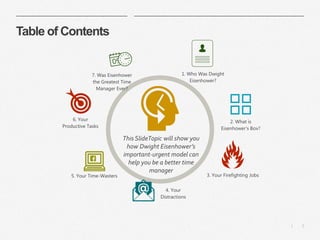
Table of Contents
This SlideTopic will show you
how Dwight Eisenhower’s
important-urgent model can
help you be a better time
manager
​1. Who Was Dwight
Eisenhower?
​2. What is
Eisenhower’s Box?
​3. Your Firefighting Jobs
​4. Your
Distractions
​5. Your Time-Wasters
​7. Was Eisenhower
the Greatest Time
Manager Ever?
​6. Your
Productive Tasks
3|
1. Who Was Dwight Eisenhower?
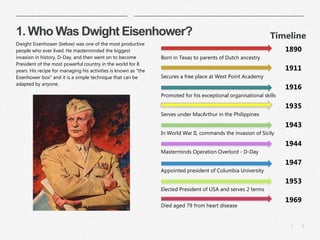
​Dwight Eisenhower (below) was one of the most productive
people who ever lived. He masterminded the biggest
invasion in history, D-Day, and then went on to become
President of the most powerful country in the world for 8
years. His recipe for managing his activities is known as "the
Eisenhower box" and it is a simple technique that can be
adapted by anyone.
​Timeline
Born in Texas to parents of Dutch ancestry
1890
Secures a free place at West Point Academy
1911
Promoted for his exceptional organisational skills
1916
Serves under MacArthur in the Philippines
1935
In World War II, commands the invasion of Sicily
1943
Masterminds Operation Overlord - D-Day
1944
Appointed president of Columbia University
1947
Elected President of USA and serves 2 terms
1953
Died aged 79 from heart disease
1969
4|
2. What is Eisenhower’s Box?
Dwight Eisenhower’s “Box” comes from a speech he gave to the
Assembly of World Council of Churches in Evanston, Illinois in
1954. Eisenhower spoke of what he called “a dilemma of modern
man”, how, in his words, to make the important urgent. Since
then, others such as Stephen Covey, have used the “important-
urgent” concept to create a model for organizing your tasks and
managing your time.
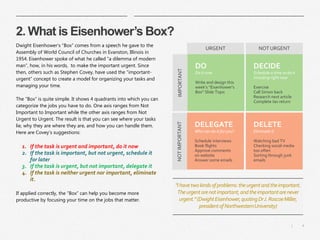
The “Box” is quite simple. It shows 4 quadrants into which you can
categorize the jobs you have to do. One axis ranges from Not
Important to Important while the other axis ranges from Not
Urgent to Urgent. The result is that you can see where your tasks
lie, why they are where they are, and how you can handle them.
Here are Covey’s suggestions:
1. If the task is urgent and important, do it now
2. If the task is important, but not urgent, schedule it
for later
3. If the task is urgent, but not important, delegate it
4. If the task is neither urgent nor important, eliminate
it.
If applied correctly, the “Box” can help you become more
productive by focusing your time on the jobs that matter.
DO
Do it now
Write and design this
week’s “Eisenhower’s
Box” Slide Topic
DELEGATE
Who can do it for you?
Schedule interviews
Book flights
Approve comments
on website
Answer some emails
DECIDE
Schedule a time to do it
including right now
Exercise
Call Simon back
Research next article
Complete tax return
DELETE
Eliminate it
Watching bad TV
Checking social media
too often
Sorting through junk
emails
NOTIMPORTANTIMPORTANT
URGENT NOT URGENT
"Ihavetwokindsofproblems:theurgentandtheimportant.
Theurgentarenotimportant,andtheimportantarenever
urgent."(DwightEisenhower,quotingDrJ.RoscoeMiller,
presidentofNorthwesternUniversity)
5|
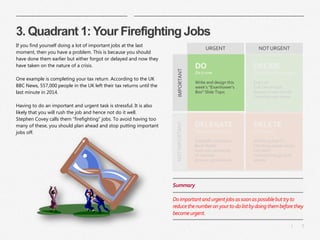
3. Quadrant 1: Your Firefighting Jobs
If you find yourself doing a lot of important jobs at the last
moment, then you have a problem. This is because you should
have done them earlier but either forgot or delayed and now they
have taken on the nature of a crisis.
One example is completing your tax return. According to the UK
BBC News, 557,000 people in the UK left their tax returns until the
last minute in 2014.
Having to do an important and urgent task is stressful. It is also
likely that you will rush the job and hence not do it well.
Stephen Covey calls them “firefighting” jobs. To avoid having too
many of these, you should plan ahead and stop putting important
jobs off.
DO
Do it now
Write and design this
week’s “Eisenhower’s
Box” Slide Topic
DELEGATE
Who can do it for you?
Schedule interviews
Book flights
Approve comments
on website
Answer some emails
DECIDE
Schedule a time to do it
Exercise
Call Simon back
Research next article
Complete tax return
DELETE
Eliminate it
Watching bad TV
Checking social media
too often
Sorting through junk
emails
NOTIMPORTANTIMPORTANT
URGENT NOT URGENT
Summary
Doimportantandurgentjobsassoonaspossiblebuttryto
reducethenumberonyourto-dolistbydoingthembeforethey
becomeurgent.
6|
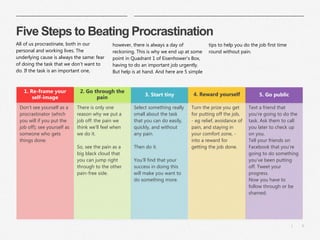
Five Steps to Beating Procrastination
3. Start tiny 5. Go public
Text a friend that
you’re going to do the
task. Ask them to call
you later to check up
on you.
Tell your friends on
Facebook that you’re
going to do something
you’ve been putting
off. Tweet your
progress.
Now you have to
follow through or be
shamed.
4. Reward yourself
Turn the prize you get
for putting off the job,
- eg relief, avoidance of
pain, and staying in
your comfort zone, -
into a reward for
getting the job done.
Select something really
small about the task
that you can do easily,
quickly, and without
any pain.
Then do it.
You’ll find that your
success in doing this
will make you want to
do something more.
2. Go through the
pain
There is only one
reason why we put a
job off: the pain we
think we’ll feel when
we do it.
So, see the pain as a
big black cloud that
you can jump right
through to the other
pain-free side.
1. Re-frame your
self-image
Don’t see yourself as a
procrastinator (which
you will if you put the
job off); see yourself as
someone who gets
things done.
All of us procrastinate, both in our
personal and working lives. The
underlying cause is always the same: fear
of doing the task that we don’t want to
do. If the task is an important one,
however, there is always a day of
reckoning. This is why we end up at some
point in Quadrant 1 of Eisenhower's Box,
having to do an important job urgently.
But help is at hand. And here are 5 simple
tips to help you do the job first time
round without pain.
7|
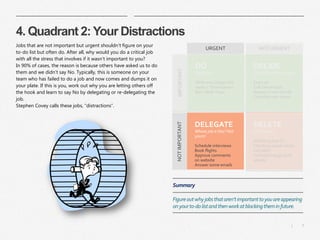
4. Quadrant 2: Your Distractions
Jobs that are not important but urgent shouldn't figure on your
to-do list but often do. After all, why would you do a critical job
with all the stress that involves if it wasn’t important to you?
In 90% of cases, the reason is because others have asked us to do
them and we didn’t say No. Typically, this is someone on your
team who has failed to do a job and now comes and dumps it on
your plate. If this is you, work out why you are letting others off
the hook and learn to say No by delegating or re-delegating the
job.
Stephen Covey calls these jobs, “distractions”.
DO
Do it now
Write and design this
week’s “Eisenhower’s
Box” Slide Topic
DELEGATE
Whose job is this? Not
yours!
Schedule interviews
Book flights
Approve comments
on website
Answer some emails
DECIDE
Schedule a time to do it
Exercise
Call Simon back
Research next article
Complete tax return
DELETE
Eliminate it
Watching bad TV
Checking social media
too often
Sorting through junk
emails
NOTIMPORTANTIMPORTANT
URGENT NOT URGENT
Summary
Figureoutwhyjobsthataren’timportanttoyouareappearing
onyourto-dolistandthenworkatblockingtheminfuture.
8|
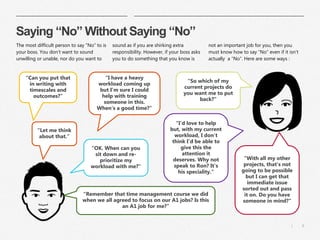
Saying “No” Without Saying “No”
“Can you put that
in writing with
timescales and
outcomes?”
“Let me think
about that.”
“I have a heavy
workload coming up
but I’m sure I could
help with training
someone in this.
When’s a good time?”
“OK. When can you
sit down and re-
prioritize my
workload with me?”
“Remember that time management course we did
when we all agreed to focus on our A1 jobs? Is this
an A1 job for me?”
“So which of my
current projects do
you want me to put
back?“
“I’d love to help
but, with my current
workload, I don’t
think I’d be able to
give this the
attention it
deserves. Why not
speak to Ron? It’s
his speciality.“
“With all my other
projects, that’s not
going to be possible
but I can get that
immediate issue
sorted out and pass
it on. Do you have
someone in mind?“
The most difficult person to say “No” to is
your boss. You don’t want to sound
unwilling or unable, nor do you want to
sound as if you are shirking extra
responsibility. However, if your boss asks
you to do something that you know is
not an important job for you, then you
must know how to say “No” even if it isn’t
actually a “No”. Here are some ways :
9|
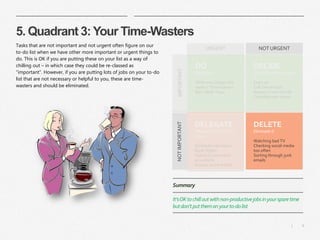
5. Quadrant 3: Your Time-Wasters
Tasks that are not important and not urgent often figure on our
to-do list when we have other more important or urgent things to
do. This is OK if you are putting these on your list as a way of
chilling out – in which case they could be re-classed as
“important”. However, if you are putting lots of jobs on your to-do
list that are not necessary or helpful to you, these are time-
wasters and should be eliminated.
DO
Do it now
Write and design this
week’s “Eisenhower’s
Box” Slide Topic
DELEGATE
Whose job is this? Not
yours!
Schedule interviews
Book flights
Approve comments
on website
Answer some emails
DECIDE
Schedule a time to do it
Exercise
Call Simon back
Research next article
Complete tax return
DELETE
Eliminate it
Watching bad TV
Checking social media
too often
Sorting through junk
emails
NOTIMPORTANTIMPORTANT
URGENT NOT URGENT
Summary
It’sOKtochilloutwithnon-productivejobsinyoursparetime
butdon’tputthemonyourto-dolist
10|
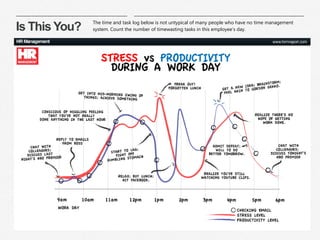
The time and task log below is not untypical of many people who have no time management
system. Count the number of timewasting tasks in this employee’s day.Is This You?
11|
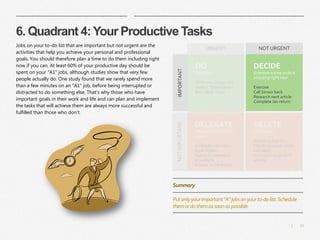
6. Quadrant 4: Your Productive Tasks
Jobs on your to-do list that are important but not urgent are the
activities that help you achieve your personal and professional
goals. You should therefore plan a time to do them including right
now if you can. At least 60% of your productive day should be
spent on your "A1" jobs, although studies show that very few
people actually do. One study found that we rarely spend more
than a few minutes on an "A1" job, before being interrupted or
distracted to do something else. That's why those who have
important goals in their work and life and can plan and implement
the tasks that will achieve them are always more successful and
fulfilled than those who don't.
DO
Do it now
Write and design this
week’s “Eisenhower’s
Box” Slide Topic
DELEGATE
Whose job is this? Not
yours!
Schedule interviews
Book flights
Approve comments
on website
Answer some emails
DECIDE
Schedule a time to do it
including right now
Exercise
Call Simon back
Research next article
Complete tax return
DELETE
Eliminate it
Watching bad TV
Checking social media
too often
Sorting through junk
emails
NOTIMPORTANTIMPORTANT
URGENT NOT URGENT
Summary
Putonlyyourimportant“A”jobsonyourto-dolist.Schedule
themordothemassoonaspossible.
12|
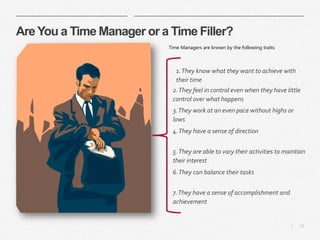
Are You a Time Manager or a Time Filler?
Time Managers are known by the following traits:
​1.They know what they want to achieve with
their time
​2.They feel in control even when they have little
control over what happens
​3.They work at an even pace without highs or
lows
​4.They have a sense of direction
​5.They are able to vary their activities to maintain
their interest
​6.They can balance their tasks
​7.They have a sense of accomplishment and
achievement
13|
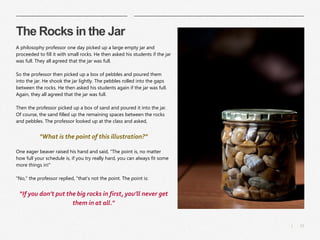
The Rocks in the Jar
A philosophy professor one day picked up a large empty jar and
proceeded to fill it with small rocks. He then asked his students if the jar
was full. They all agreed that the jar was full.
So the professor then picked up a box of pebbles and poured them
into the jar. He shook the jar lightly. The pebbles rolled into the gaps
between the rocks. He then asked his students again if the jar was full.
Again, they all agreed that the jar was full.
Then the professor picked up a box of sand and poured it into the jar.
Of course, the sand filled up the remaining spaces between the rocks
and pebbles. The professor looked up at the class and asked,
"What is the point of this illustration?"
One eager beaver raised his hand and said, "The point is, no matter
how full your schedule is, if you try really hard, you can always fit some
more things in!"
"No," the professor replied, "that’s not the point. The point is:
“If you don’t put the big rocks in first, you’ll never get
them in at all."
14|
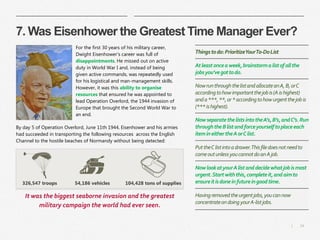
7. Was Eisenhower the Greatest Time Manager Ever?
For the first 30 years of his military career,
Dwight Eisenhower's career was full of
disappointments. He missed out on active
duty in World War I and, instead of being
given active commands, was repeatedly used
for his logistical and man-management skills.
However, it was this ability to organise
resources that ensured he was appointed to
lead Operation Overlord, the 1944 invasion of
Europe that brought the Second World War to
an end.
By day 5 of Operation Overlord, June 11th 1944, Eisenhower and his armies
had succeeded in transporting the following resources across the English
Channel to the hostile beaches of Normandy without being detected:
Thingstodo:PrioritizeYourTo-DoList
Atleastonceaweek,brainstormalistofallthe
jobsyou’vegottodo.
NowrunthroughthelistandallocateanA,B,orC
accordingtohowimportantthejobis(Aishighest)
anda***,**,or*accordingtohowurgentthejobis
(***ishighest).
NowseparatethelistsintotheA’s,B’s,andC’s.Run
throughtheBlistandforceyourselftoplaceeach
itemineithertheAorClist.
PuttheClistintoadrawer.Thisfiledoesnotneedto
comeoutunlessyoucannotdoanAjob.
NowlookatyourAlistanddecidewhatjobismost
urgent.Startwiththis,completeit,andaimto
ensureitisdoneinfutureingoodtime.
Havingremovedtheurgentjobs,youcannow
concentrateondoingyourA-listjobs.
326,547 troops 54,186 vehicles 104,428 tons of supplies
It was the biggest seaborne invasion and the greatest
military campaign the world had ever seen.
15|
​

Eisenhowers Box

  • 1.
    ​ EISENHOWER’S TIME BOX Manage yourtasks and manage your time
  • 2.
    2| Table of Contents ThisSlideTopic will show you how Dwight Eisenhower’s important-urgent model can help you be a better time manager ​1. Who Was Dwight Eisenhower? ​2. What is Eisenhower’s Box? ​3. Your Firefighting Jobs ​4. Your Distractions ​5. Your Time-Wasters ​7. Was Eisenhower the Greatest Time Manager Ever? ​6. Your Productive Tasks
  • 3.
    3| 1. Who WasDwight Eisenhower? ​Dwight Eisenhower (below) was one of the most productive people who ever lived. He masterminded the biggest invasion in history, D-Day, and then went on to become President of the most powerful country in the world for 8 years. His recipe for managing his activities is known as "the Eisenhower box" and it is a simple technique that can be adapted by anyone. ​Timeline Born in Texas to parents of Dutch ancestry 1890 Secures a free place at West Point Academy 1911 Promoted for his exceptional organisational skills 1916 Serves under MacArthur in the Philippines 1935 In World War II, commands the invasion of Sicily 1943 Masterminds Operation Overlord - D-Day 1944 Appointed president of Columbia University 1947 Elected President of USA and serves 2 terms 1953 Died aged 79 from heart disease 1969
  • 4.
    4| 2. What isEisenhower’s Box? Dwight Eisenhower’s “Box” comes from a speech he gave to the Assembly of World Council of Churches in Evanston, Illinois in 1954. Eisenhower spoke of what he called “a dilemma of modern man”, how, in his words, to make the important urgent. Since then, others such as Stephen Covey, have used the “important- urgent” concept to create a model for organizing your tasks and managing your time. The “Box” is quite simple. It shows 4 quadrants into which you can categorize the jobs you have to do. One axis ranges from Not Important to Important while the other axis ranges from Not Urgent to Urgent. The result is that you can see where your tasks lie, why they are where they are, and how you can handle them. Here are Covey’s suggestions: 1. If the task is urgent and important, do it now 2. If the task is important, but not urgent, schedule it for later 3. If the task is urgent, but not important, delegate it 4. If the task is neither urgent nor important, eliminate it. If applied correctly, the “Box” can help you become more productive by focusing your time on the jobs that matter. DO Do it now Write and design this week’s “Eisenhower’s Box” Slide Topic DELEGATE Who can do it for you? Schedule interviews Book flights Approve comments on website Answer some emails DECIDE Schedule a time to do it including right now Exercise Call Simon back Research next article Complete tax return DELETE Eliminate it Watching bad TV Checking social media too often Sorting through junk emails NOTIMPORTANTIMPORTANT URGENT NOT URGENT "Ihavetwokindsofproblems:theurgentandtheimportant. Theurgentarenotimportant,andtheimportantarenever urgent."(DwightEisenhower,quotingDrJ.RoscoeMiller, presidentofNorthwesternUniversity)
  • 5.
    5| 3. Quadrant 1:Your Firefighting Jobs If you find yourself doing a lot of important jobs at the last moment, then you have a problem. This is because you should have done them earlier but either forgot or delayed and now they have taken on the nature of a crisis. One example is completing your tax return. According to the UK BBC News, 557,000 people in the UK left their tax returns until the last minute in 2014. Having to do an important and urgent task is stressful. It is also likely that you will rush the job and hence not do it well. Stephen Covey calls them “firefighting” jobs. To avoid having too many of these, you should plan ahead and stop putting important jobs off. DO Do it now Write and design this week’s “Eisenhower’s Box” Slide Topic DELEGATE Who can do it for you? Schedule interviews Book flights Approve comments on website Answer some emails DECIDE Schedule a time to do it Exercise Call Simon back Research next article Complete tax return DELETE Eliminate it Watching bad TV Checking social media too often Sorting through junk emails NOTIMPORTANTIMPORTANT URGENT NOT URGENT Summary Doimportantandurgentjobsassoonaspossiblebuttryto reducethenumberonyourto-dolistbydoingthembeforethey becomeurgent.
  • 6.
    6| Five Steps toBeating Procrastination 3. Start tiny 5. Go public Text a friend that you’re going to do the task. Ask them to call you later to check up on you. Tell your friends on Facebook that you’re going to do something you’ve been putting off. Tweet your progress. Now you have to follow through or be shamed. 4. Reward yourself Turn the prize you get for putting off the job, - eg relief, avoidance of pain, and staying in your comfort zone, - into a reward for getting the job done. Select something really small about the task that you can do easily, quickly, and without any pain. Then do it. You’ll find that your success in doing this will make you want to do something more. 2. Go through the pain There is only one reason why we put a job off: the pain we think we’ll feel when we do it. So, see the pain as a big black cloud that you can jump right through to the other pain-free side. 1. Re-frame your self-image Don’t see yourself as a procrastinator (which you will if you put the job off); see yourself as someone who gets things done. All of us procrastinate, both in our personal and working lives. The underlying cause is always the same: fear of doing the task that we don’t want to do. If the task is an important one, however, there is always a day of reckoning. This is why we end up at some point in Quadrant 1 of Eisenhower's Box, having to do an important job urgently. But help is at hand. And here are 5 simple tips to help you do the job first time round without pain.
  • 7.
    7| 4. Quadrant 2:Your Distractions Jobs that are not important but urgent shouldn't figure on your to-do list but often do. After all, why would you do a critical job with all the stress that involves if it wasn’t important to you? In 90% of cases, the reason is because others have asked us to do them and we didn’t say No. Typically, this is someone on your team who has failed to do a job and now comes and dumps it on your plate. If this is you, work out why you are letting others off the hook and learn to say No by delegating or re-delegating the job. Stephen Covey calls these jobs, “distractions”. DO Do it now Write and design this week’s “Eisenhower’s Box” Slide Topic DELEGATE Whose job is this? Not yours! Schedule interviews Book flights Approve comments on website Answer some emails DECIDE Schedule a time to do it Exercise Call Simon back Research next article Complete tax return DELETE Eliminate it Watching bad TV Checking social media too often Sorting through junk emails NOTIMPORTANTIMPORTANT URGENT NOT URGENT Summary Figureoutwhyjobsthataren’timportanttoyouareappearing onyourto-dolistandthenworkatblockingtheminfuture.
  • 8.
    8| Saying “No” WithoutSaying “No” “Can you put that in writing with timescales and outcomes?” “Let me think about that.” “I have a heavy workload coming up but I’m sure I could help with training someone in this. When’s a good time?” “OK. When can you sit down and re- prioritize my workload with me?” “Remember that time management course we did when we all agreed to focus on our A1 jobs? Is this an A1 job for me?” “So which of my current projects do you want me to put back?“ “I’d love to help but, with my current workload, I don’t think I’d be able to give this the attention it deserves. Why not speak to Ron? It’s his speciality.“ “With all my other projects, that’s not going to be possible but I can get that immediate issue sorted out and pass it on. Do you have someone in mind?“ The most difficult person to say “No” to is your boss. You don’t want to sound unwilling or unable, nor do you want to sound as if you are shirking extra responsibility. However, if your boss asks you to do something that you know is not an important job for you, then you must know how to say “No” even if it isn’t actually a “No”. Here are some ways :
  • 9.
    9| 5. Quadrant 3:Your Time-Wasters Tasks that are not important and not urgent often figure on our to-do list when we have other more important or urgent things to do. This is OK if you are putting these on your list as a way of chilling out – in which case they could be re-classed as “important”. However, if you are putting lots of jobs on your to-do list that are not necessary or helpful to you, these are time- wasters and should be eliminated. DO Do it now Write and design this week’s “Eisenhower’s Box” Slide Topic DELEGATE Whose job is this? Not yours! Schedule interviews Book flights Approve comments on website Answer some emails DECIDE Schedule a time to do it Exercise Call Simon back Research next article Complete tax return DELETE Eliminate it Watching bad TV Checking social media too often Sorting through junk emails NOTIMPORTANTIMPORTANT URGENT NOT URGENT Summary It’sOKtochilloutwithnon-productivejobsinyoursparetime butdon’tputthemonyourto-dolist
  • 10.
    10| The time andtask log below is not untypical of many people who have no time management system. Count the number of timewasting tasks in this employee’s day.Is This You?
  • 11.
    11| 6. Quadrant 4:Your Productive Tasks Jobs on your to-do list that are important but not urgent are the activities that help you achieve your personal and professional goals. You should therefore plan a time to do them including right now if you can. At least 60% of your productive day should be spent on your "A1" jobs, although studies show that very few people actually do. One study found that we rarely spend more than a few minutes on an "A1" job, before being interrupted or distracted to do something else. That's why those who have important goals in their work and life and can plan and implement the tasks that will achieve them are always more successful and fulfilled than those who don't. DO Do it now Write and design this week’s “Eisenhower’s Box” Slide Topic DELEGATE Whose job is this? Not yours! Schedule interviews Book flights Approve comments on website Answer some emails DECIDE Schedule a time to do it including right now Exercise Call Simon back Research next article Complete tax return DELETE Eliminate it Watching bad TV Checking social media too often Sorting through junk emails NOTIMPORTANTIMPORTANT URGENT NOT URGENT Summary Putonlyyourimportant“A”jobsonyourto-dolist.Schedule themordothemassoonaspossible.
  • 12.
    12| Are You aTime Manager or a Time Filler? Time Managers are known by the following traits: ​1.They know what they want to achieve with their time ​2.They feel in control even when they have little control over what happens ​3.They work at an even pace without highs or lows ​4.They have a sense of direction ​5.They are able to vary their activities to maintain their interest ​6.They can balance their tasks ​7.They have a sense of accomplishment and achievement
  • 13.
    13| The Rocks inthe Jar A philosophy professor one day picked up a large empty jar and proceeded to fill it with small rocks. He then asked his students if the jar was full. They all agreed that the jar was full. So the professor then picked up a box of pebbles and poured them into the jar. He shook the jar lightly. The pebbles rolled into the gaps between the rocks. He then asked his students again if the jar was full. Again, they all agreed that the jar was full. Then the professor picked up a box of sand and poured it into the jar. Of course, the sand filled up the remaining spaces between the rocks and pebbles. The professor looked up at the class and asked, "What is the point of this illustration?" One eager beaver raised his hand and said, "The point is, no matter how full your schedule is, if you try really hard, you can always fit some more things in!" "No," the professor replied, "that’s not the point. The point is: “If you don’t put the big rocks in first, you’ll never get them in at all."
  • 14.
    14| 7. Was Eisenhowerthe Greatest Time Manager Ever? For the first 30 years of his military career, Dwight Eisenhower's career was full of disappointments. He missed out on active duty in World War I and, instead of being given active commands, was repeatedly used for his logistical and man-management skills. However, it was this ability to organise resources that ensured he was appointed to lead Operation Overlord, the 1944 invasion of Europe that brought the Second World War to an end. By day 5 of Operation Overlord, June 11th 1944, Eisenhower and his armies had succeeded in transporting the following resources across the English Channel to the hostile beaches of Normandy without being detected: Thingstodo:PrioritizeYourTo-DoList Atleastonceaweek,brainstormalistofallthe jobsyou’vegottodo. NowrunthroughthelistandallocateanA,B,orC accordingtohowimportantthejobis(Aishighest) anda***,**,or*accordingtohowurgentthejobis (***ishighest). NowseparatethelistsintotheA’s,B’s,andC’s.Run throughtheBlistandforceyourselftoplaceeach itemineithertheAorClist. PuttheClistintoadrawer.Thisfiledoesnotneedto comeoutunlessyoucannotdoanAjob. NowlookatyourAlistanddecidewhatjobismost urgent.Startwiththis,completeit,andaimto ensureitisdoneinfutureingoodtime. Havingremovedtheurgentjobs,youcannow concentrateondoingyourA-listjobs. 326,547 troops 54,186 vehicles 104,428 tons of supplies It was the biggest seaborne invasion and the greatest military campaign the world had ever seen.
  • 15.