
Decision Making
Process & Co-ordination
Group members:
• Yogesh Chaoudhary
• Shivani Trivedi
• Yatin Arora
• Vinod Kumar
1
The Decision making process
 The decision-making process is
defined as a set of different steps
that begins with identifying a
problem and decision criteria and
allocating weights to those criteria;
moves to developing, analyzing, and
selecting an alternative that can
resolve the problem; implements the
alternative; and concludes with
evaluating the decision’s
effectiveness.
2
Models of decision making
 Descriptive decision-making
models attempt to prescribe how
managers actually do make
decisions.
 Normative decision-making models
attempt to prescribe how
managers should process.
3
Steps in an effective
decision-making process:
A. The first step is to identify the
organizational problem.
 The scanning stage.
 The categorization stage.
 The diagnosis stage.
4
B. The generation of alternative
solutions step is facilitated by
using the four principles associated
with brainstorming.
• Don’t criticize ideas while generating
possible solutions.
• Freewheel.
• Offer as many ideas as possible.
• Combine and improve on ideas that have
been offered. 5
C. The choice of an alternative step
comes only after the alternatives
are evaluated systematically
according to six general criteria:
• Feasibility.
• Quality
• Acceptability
• Costs
• Reversibility
• The ethics criterion
6
D. Finally, the implementing
and monitoring.
• Implementation requires careful planning.
• Implementation requires sensitivity to
those involved in or affected by the
implementation.
• Monitoring is necessary
7
Co-ordination
Co-ordination as a function of
management refers to the task of
integrating the activities of separate
units of an organization to accomplish
the goals efficiently. It permeates all
levels and all departments of
management. Hence, it is regarded as
the essence of management.
8
Types of Co-ordinations
 Internal & External Co-ordination
 Vertical & Horizontal Co-ordination
 Pooled, Sequential, Reciprocal Co-
ordination
9
Why Co-ordination is
important?
 Increases efficiency
 Improve human relation
 Interdepartmental harmony
 Key to other management functions
 High moral
 Meeting environmental challenges
 Better results
 Specialization & division of world
 Removes ambiguity
10
Principles of Co-ordination
 Principle of direct contact
 Co-ordination should start at initial
stage
 Principle of continuity
 Principle of self Co-ordination
 There is a reciprocal relationship
between all the factors and situation
11
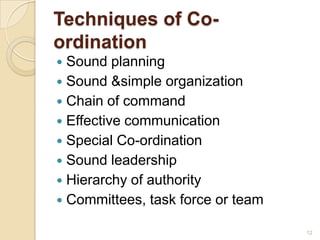
Techniques of Co-
ordination
 Sound planning
 Sound &simple organization
 Chain of command
 Effective communication
 Special Co-ordination
 Sound leadership
 Hierarchy of authority
 Committees, task force or team
12
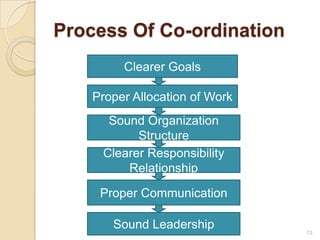
Process Of Co-ordination
13
Clearer Goals
Proper Allocation of Work
Sound Organization
Structure
Clearer Responsibility
Relationship
Proper Communication
Sound Leadership
Thank You
14

The decision making process

  • 1.
    Decision Making Process &Co-ordination Group members: • Yogesh Chaoudhary • Shivani Trivedi • Yatin Arora • Vinod Kumar 1
  • 2.
    The Decision makingprocess  The decision-making process is defined as a set of different steps that begins with identifying a problem and decision criteria and allocating weights to those criteria; moves to developing, analyzing, and selecting an alternative that can resolve the problem; implements the alternative; and concludes with evaluating the decision’s effectiveness. 2
  • 3.
    Models of decisionmaking  Descriptive decision-making models attempt to prescribe how managers actually do make decisions.  Normative decision-making models attempt to prescribe how managers should process. 3
  • 4.
    Steps in aneffective decision-making process: A. The first step is to identify the organizational problem.  The scanning stage.  The categorization stage.  The diagnosis stage. 4
  • 5.
    B. The generationof alternative solutions step is facilitated by using the four principles associated with brainstorming. • Don’t criticize ideas while generating possible solutions. • Freewheel. • Offer as many ideas as possible. • Combine and improve on ideas that have been offered. 5
  • 6.
    C. The choiceof an alternative step comes only after the alternatives are evaluated systematically according to six general criteria: • Feasibility. • Quality • Acceptability • Costs • Reversibility • The ethics criterion 6
  • 7.
    D. Finally, theimplementing and monitoring. • Implementation requires careful planning. • Implementation requires sensitivity to those involved in or affected by the implementation. • Monitoring is necessary 7
  • 8.
    Co-ordination Co-ordination as afunction of management refers to the task of integrating the activities of separate units of an organization to accomplish the goals efficiently. It permeates all levels and all departments of management. Hence, it is regarded as the essence of management. 8
  • 9.
    Types of Co-ordinations Internal & External Co-ordination  Vertical & Horizontal Co-ordination  Pooled, Sequential, Reciprocal Co- ordination 9
  • 10.
    Why Co-ordination is important? Increases efficiency  Improve human relation  Interdepartmental harmony  Key to other management functions  High moral  Meeting environmental challenges  Better results  Specialization & division of world  Removes ambiguity 10
  • 11.
    Principles of Co-ordination Principle of direct contact  Co-ordination should start at initial stage  Principle of continuity  Principle of self Co-ordination  There is a reciprocal relationship between all the factors and situation 11
  • 12.
    Techniques of Co- ordination Sound planning  Sound &simple organization  Chain of command  Effective communication  Special Co-ordination  Sound leadership  Hierarchy of authority  Committees, task force or team 12
  • 13.
    Process Of Co-ordination 13 ClearerGoals Proper Allocation of Work Sound Organization Structure Clearer Responsibility Relationship Proper Communication Sound Leadership
  • 14.