GLOBALIZATION
HOW
STARTED?
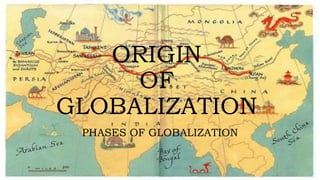
ORIGIN
OF
GLOBALIZATION
PHASES OF GLOBALIZATION
Silk roads (1st century BC-5th century
AD, and 13th-14th centuries AD)
For the first time in history, luxury products from China
started to appear on the other edge of the Eurasian continent
– in Rome.
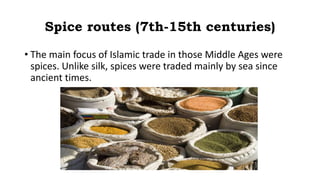
Spice routes (7th-15th centuries)
• The main focus of Islamic trade in those Middle Ages were
spices. Unlike silk, spices were traded mainly by sea since
ancient times.
Age of Discovery (15th-18th centuries)
• Truly global trade kicked off in the Age of Discovery.
• The Age of Discovery rocked the world. The most (in)famous
“discovery” is that of America by Columbus, which all but ended pre-
Colombian civilizations. But the most consequential exploration was
the circumnavigation by Magellan.
First wave of globalization (19th
century-1914)
• By the end of the 18th century, Great Britain had started to dominate
the world both geographically, through the establishment of the
British Empire, and technologically, with innovations like the steam
engine, the industrial weaving machine and more.
• It was the era of the First Industrial Revolution.
• construction of the Suez Canal, connecting the Mediterranean with
the Indian Ocean and opened yet another artery of world trade.
• The invention of the refrigerated cargo ship or “reefer ship”
• By the end of the 19th century, the Khan Academy notes, “most
[globalizing and industrialized] European nations grabbed for a piece
of Africa, and by 1900 the only independent country left on the
continent was Ethiopia”.
The world wars
• In 1914, the outbreak of World War I brought an end to just
about everything the burgeoning high society of the West
had gotten so used to, including globalization.
• In the years between the world wars, the financial markets,
which were still connected in a global web, caused a further
breakdown of the global economy and its links.
• By the end of World War II, trade as a percentage of world
GDP had fallen to 5% – a level not seen in more than a
hundred years.
Second and third wave of globalization
• The story of globalization, however, was not over. The end of the
World War II marked a new beginning for the global economy. Under
the leadership of a new hegemon, the United States of America, and
aided by the technologies of the Second Industrial Revolution, like the
car and the plane, global trade started to rise once again. At first, this
happened in two separate tracks, as the Iron Curtain divided the
world into two spheres of influence. But as of 1989, when the Iron
Curtain fell, globalization became a truly global phenomenon.
Globalization 4.0
• digital-driven era of globalization
• Technological progress, like globalization, is something you
can’t run away from, it seems. But it is ever changing. So
how will Globalization 4.0 evolve? We will have to answer
that question in the coming years.
Thank you

GLOBALIZATION.pptx

  • 1.
  • 2.
  • 3.
    Silk roads (1stcentury BC-5th century AD, and 13th-14th centuries AD) For the first time in history, luxury products from China started to appear on the other edge of the Eurasian continent – in Rome.
  • 4.
    Spice routes (7th-15thcenturies) • The main focus of Islamic trade in those Middle Ages were spices. Unlike silk, spices were traded mainly by sea since ancient times.
  • 5.
    Age of Discovery(15th-18th centuries) • Truly global trade kicked off in the Age of Discovery. • The Age of Discovery rocked the world. The most (in)famous “discovery” is that of America by Columbus, which all but ended pre- Colombian civilizations. But the most consequential exploration was the circumnavigation by Magellan.
  • 7.
    First wave ofglobalization (19th century-1914) • By the end of the 18th century, Great Britain had started to dominate the world both geographically, through the establishment of the British Empire, and technologically, with innovations like the steam engine, the industrial weaving machine and more. • It was the era of the First Industrial Revolution. • construction of the Suez Canal, connecting the Mediterranean with the Indian Ocean and opened yet another artery of world trade. • The invention of the refrigerated cargo ship or “reefer ship” • By the end of the 19th century, the Khan Academy notes, “most [globalizing and industrialized] European nations grabbed for a piece of Africa, and by 1900 the only independent country left on the continent was Ethiopia”.
  • 8.
    The world wars •In 1914, the outbreak of World War I brought an end to just about everything the burgeoning high society of the West had gotten so used to, including globalization. • In the years between the world wars, the financial markets, which were still connected in a global web, caused a further breakdown of the global economy and its links. • By the end of World War II, trade as a percentage of world GDP had fallen to 5% – a level not seen in more than a hundred years.
  • 9.
    Second and thirdwave of globalization • The story of globalization, however, was not over. The end of the World War II marked a new beginning for the global economy. Under the leadership of a new hegemon, the United States of America, and aided by the technologies of the Second Industrial Revolution, like the car and the plane, global trade started to rise once again. At first, this happened in two separate tracks, as the Iron Curtain divided the world into two spheres of influence. But as of 1989, when the Iron Curtain fell, globalization became a truly global phenomenon.
  • 10.
  • 12.
    • Technological progress,like globalization, is something you can’t run away from, it seems. But it is ever changing. So how will Globalization 4.0 evolve? We will have to answer that question in the coming years. Thank you