TOPICS TO DISCUSS
•What is Globalization?
• Brief History of Globalization
• Political globalization
• Economic globalization
• Cultural globalization
• Globaloney
• Advantages and disadvantages of
globalization
3.
GlobalizationaccordingtoAke(1995)
• Cultural differencesare increasing and the world
economy is becoming more interconnected.
• Countries are becoming more dependent on each other
globally.
• Nations are feeling pressure from global influences that
go beyond borders.
• A global mass culture is emerging, driven by widespread
advertising and advancements in communication
technology.
4.
GlobalizationaccordingtoNnoli(2000)
• Globalization interfaceswith various elements of social
life.
• It is filled with ambiguities, variations, uncertainties, and
incompatibilities.
• At its core, it leads to the inevitable expansion of
capitalism worldwide.
• This includes the spread of capitalist values.
5.
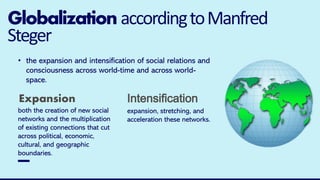
Globalization accordingtoManfred
Steger
• theexpansion and intensification of social relations and
consciousness across world-time and across world-
space.
both the creation of new social
networks and the multiplication
of existing connections that cut
across political, economic,
cultural, and geographic
boundaries.
expansion, stretching, and
acceleration these networks.
Expansion Intensification
6.
BriefHistoryof
Globalization
This Photo byUnknown Author is licensed under CC BY-NC-ND
This Photo by Unknown Author is licensed under CC BY-NC-ND
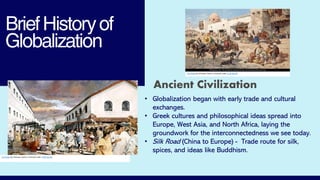
Ancient Civilization
• Globalization began with early trade and cultural
exchanges.
• Greek cultures and philosophical ideas spread into
Europe, West Asia, and North Africa, laying the
groundwork for the interconnectedness we see today.
• Silk Road (China to Europe) - Trade route for silk,
spices, and ideas like Buddhism.
7.
BriefHistoryof
Globalization
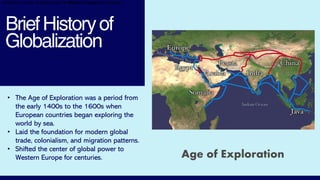
Age of Exploration
•The Age of Exploration was a period from
the early 1400s to the 1600s when
European countries began exploring the
world by sea.
• Laid the foundation for modern global
trade, colonialism, and migration patterns.
• Shifted the center of global power to
Western Europe for centuries.
•Shifted the center of global power to Western Europe for centuries.
8.
BriefHistoryof
Globalization
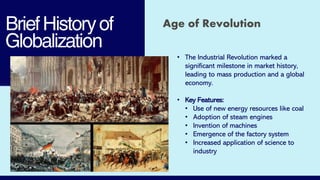
Age of Revolution
•The Industrial Revolution marked a
significant milestone in market history,
leading to mass production and a global
economy.
• Key Features:
• Use of new energy resources like coal
• Adoption of steam engines
• Invention of machines
• Emergence of the factory system
• Increased application of science to
industry
9.
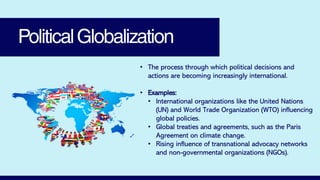
PoliticalGlobalization
• The processthrough which political decisions and
actions are becoming increasingly international.
• Examples:
• International organizations like the United Nations
(UN) and World Trade Organization (WTO) influencing
global policies.
• Global treaties and agreements, such as the Paris
Agreement on climate change.
• Rising influence of transnational advocacy networks
and non-governmental organizations (NGOs).
10.
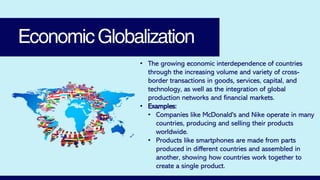
EconomicGlobalization
• The growingeconomic interdependence of countries
through the increasing volume and variety of cross-
border transactions in goods, services, capital, and
technology, as well as the integration of global
production networks and financial markets.
• Examples:
• Companies like McDonald's and Nike operate in many
countries, producing and selling their products
worldwide.
• Products like smartphones are made from parts
produced in different countries and assembled in
another, showing how countries work together to
create a single product.
11.
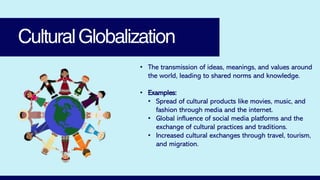
CulturalGlobalization
• The transmissionof ideas, meanings, and values around
the world, leading to shared norms and knowledge.
• Examples:
• Spread of cultural products like movies, music, and
fashion through media and the internet.
• Global influence of social media platforms and the
exchange of cultural practices and traditions.
• Increased cultural exchanges through travel, tourism,
and migration.
12.
Globaloney
• "Globaloney" isa slang term that expresses doubt or criticism towards globalization-related
claims, policies, or ideas. It suggests that these claims might be exaggerated, misleading, or
lacking in real substance.
Example:
• "Globalization will completely eliminate poverty and create equal opportunities for everyone
around the world.“
• "Globalization ensures that all countries will benefit equally from free trade agreements.“
• "Globalization will lead to the preservation of all cultural identities and traditions."
13.
Advantagesof
Globalization
• Increased tradeand investment can lead to higher
economic growth rates, creating job opportunities
and improving living standards.
• Businesses can expand their markets beyond
national borders, reaching a larger customer base
and increasing sales.
• Globalization promotes the exchange of ideas,
values, and traditions, leading to greater cultural
understanding and appreciation.
• The spread of technology and innovation
accelerates, benefiting various industries and
improving quality of life.
• Advancements in communication technology make
it easier for people to connect and collaborate
across the globe.
14.
Disadvantagesof
Globalization
• Globalization canexacerbate economic disparities
between rich and poor countries, as well as within
nations.
• The dominance of certain cultures can lead to the
erosion of local traditions and cultural identities.
• Workers in developing countries may face poor
working conditions and low wages as businesses
seek to minimize costs.
• Increased industrial activity and transportation
contribute to environmental degradation and
climate change.
• Countries can become overly reliant on global
markets, making them vulnerable to international
economic fluctuations and crises.