Lesson 4
Jobs Where You Can Gain
Entrepreneurial Skills
What you need to know:
1. Understand the key concepts of
entrepreneurship.
2. Explore job opportunities as an
entrepreneur.
Advertising, Marketing,
and Public Relations
● provide you with the know-how
to reach an audience for your
own product or service
● You may be able to tap the
valuable connections you’ve
met on the job for your new
venture.
• Use strong business development
skills to identify opportunities for your
own future business
• gain the ability to grow and manage
an enterprise
Business Development
Entrepreneur Entrepreneurship Enterprise
Process Object
Person
THE CONCEPT OF ENTREPRENEURSHIP
Design
● Whether you work in fashion,
home, or product design, these
skills will help you create your
own product or service
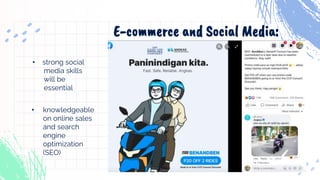
E-commerce and Social Media:
• knowledgeable
on online sales
and search
engine
optimization
(SEO)
• strong social
media skills
will be
essential
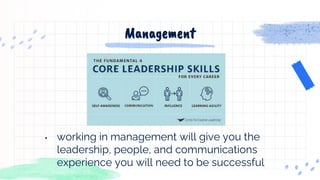
• working in management will give you the
leadership, people, and communications
experience you will need to be successful
Management
• The work you do for your
employer will enhance your
skillset and give you
transferable skills to use to
start and grow your own
business.
Software, Web, or
App Developer
• Working in real estate can
build the sales, marketing,
finance, communications,
self-motivation, and other
skills
Real Estate
• provide experience and
opportunities to excel and
generate income, meet and
achieve goals, and, most
importantly, the ability to sell a
product or service.
Sales
Manager/Account
Executive
Consultant
● working for a major consulting
firm will give you experience in
different industries and types of
companies
● you will have an insider
perspective on many different
types of organizations.
• work on a product through
research, development,
engineering, manufacturing,
going live, and distribution
Product Manager
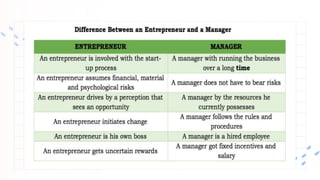
Difference Between an
Entrepreneur and a Manager
SW # 3
Answer Assessment
Modified True or False on pages 10-11
RECOGNIZE A
POTENTIAL
MARKET
Lesson 5
Potential Market
• It is the part of the market you
can capture in the future.
• It includes the demographic
groups that are not currently
your customers but could
become customers in the
future.
DEFINITION OF TERMS AND CONCEPTS
Product
• something (such as a service)
that is marketed or sold as a
commodity
DEFINITION OF TERMS AND CONCEPTS
Demographics
DEFINITION OF TERMS AND CONCEPTS
• the study of a population based
on factors such as age, race, and
sex
Locality
• a particular area or
neighborhood.
DEFINITION OF TERMS AND CONCEPTS
CHARACTERISTICS OF
A POTENTIAL MARKET
Competitive
• being eager to do better than
others
DEFINITION OF TERMS AND CONCEPTS
Competitive Advantage
• If you have relevant
experience and skills within
the targeted industry, you may
have a competitive advantage
when entering the target
market.
• EXAMPLE: if you have
worked in the retail business
for the last 15 years, the
retailers would be a high-
potential target market for you
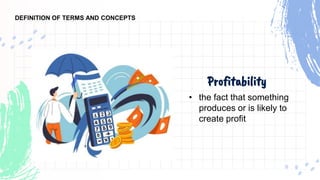
Profitability
• the fact that something
produces or is likely to
create profit
DEFINITION OF TERMS AND CONCEPTS
Size and Profitability • The target market's profitability
must be large enough to be
worth pursuing.
• Research the number of
people in the target market, the
potential revenue and net profit
after expenses.
• Estimate your projected
income from industry research
reports through industry
associations, research
companies, or organizations.
Accessibility
• the fact of being able to be
reached or obtained easily
DEFINITION OF TERMS AND CONCEPTS
Accessibility
• A high-potential target
market must be identifiable
and accessible through
marketing channels
• For example, if the target
market is in a different
country, the political
conditions will be challenging
to reach through
conventional marketing
channels.
Competition
• A lucrative target market
ideally would have limited
or manageable
competition.
• Research the needs of
the target market, the
stakeholders, and how
well the competition
meets the market’s
needs.
SW # 4
Answer Assessment
Modified True or False, Identification on pages
15-16
Answer Worksheet 1
Market Needs
and Goals
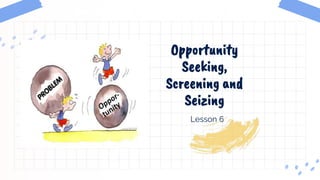
Opportunity
Seeking,
Screening and
Seizing
Lesson 6
1. SEEKING-
• An entrepreneur
should be constantly
seeking new
opportunities that
could improve the
business
• Recognize customers’
needs, wants and
interests.
2. SCREENING-
• New opportunities
should be screened,
tested, and analyze for
its potential to be
viable, feasible, and
sustainable
3. SEIZING-
• The selected opportunities must
be prepared for successful
implementation by
understanding the factors that
need to be prioritized
Analyze
the Market Needs
Lesson 6
• Market Needs is a marketing concept
that means functional, emotional
needs, or desires of a target
market.
• A successful company identifies when
a segment of customers is not
effectively served by existing
providers and develops and
promotes products or services to
match.
Market Needs
Market
Analysis
● is the step to
investigate a
concept for the
product.
Why should you embark on the market
analysis process? The primary reasons are:
 To determine if there is a market
for your products or services
 To establish the need for
developing a marketing plan
 To ascertain market information
that will assist in the sale of your
product or service
The Marketing Analysis process can be broken down into six steps:
1. Defining the problem
2. Analysis of the situation
3. Obtaining data that is specific to the problem
4. Analysis and interpreting the data
5. Fostering ideas and problem solving
6. Designing a plan
Marketing Analysis
1. Defining the Problem
• Defining the problem is crucial in conducting a successful
Marketing Analysis.
• Defining the objectives is a step to a successful marketing
campaign.
• Many individuals waste valuable time performing good
research on the wrong problem.
• It is important not to confuse the symptom with a problem.
1. Defining the Problem
Focused research revealed that the target population for Dr. Pepper differed from Coke
and Pepsi. It was found that Dr. Pepper's target market believes life should be lived
following one's own set of personal values and not based on the expectations of
others. Cola drinkers, on the other hand, try to win the approval of others.
2. Analysis of the Situation
• An analysis of the situation is an informal survey of what
information is available in the problem area.
• It will help define the problem and ascertain the need for
additional information. This process entails informal talks
with informed people.
2. Analysis of the Situation
• Primary Research- research that
proactively creates for a specific
purpose. This is information you
collect yourself.
Examples: focus groups, qualitative surveys
and phone interviews
Examples: libraries, online, through periodicals,
books, etc
• Secondary Research-
research that has been
conducted already for other
purposes.
3. Obtaining Data Specific to the Problem
• The next step requires
gathering primary research
and performing a formal
research project.
• The purpose is to identify what
customers think about some
topic or behavior patterns.
3. Obtaining Data Specific to the Problem
• Qualitative research utilizes open-
ended questions to obtain in-depth
answers.
• Closed-ended questions requiring yes
or no answers are prohibited. The idea
is to have people share their
thoughts on a topic without giving
them extensive directions or
guidelines.
• Depth is a significant factor in this type
of research.
"What do you think about the time you
decide on a place to shop for your kids'
clothes?"
3. Obtaining Data Specific to the Problem
• Quantitative differs from
qualitative through the gathering
of data.
• Quantitative uses parametric
statistical information, i.e.,
information with a number to it.
3. Obtaining Data Specific to the Problem
• A mail questionnaire is
applicable when extensive
questioning is needed. This
type of format allows the
respondents to complete
the questions at their
convenience.
3. Obtaining Data Specific to the Problem
• Telephone surveys are
growing in number, and they
can be fast and effective. In
this format, researchers can
ascertain answers to simple
questions quickly.
3. Obtaining Data Specific to the Problem
• Personal interview
surveys can be effective
for maintaining a
respondent’s attention. In
this format the interviewer
is present to explain
complicated directions
hopefully leading to better
responses.
3. Obtaining Data Specific to the Problem
• Observations use for data
collection. During
observation, researchers try
to learn what the subject
does naturally. It should not
influence the consumer's
behavior. Observation
methods are usually in
advertising research.
4. Data Analysis and Interpretation
• What does this
information mean?
• Can one
constructively use
the data to define the
problem and then
establish a plan?
4. Data Analysis and Interpretation
• In quantitative research,
this step most often
involves statistics. In the
marketplace, one can find
many statistical packages
(computer- based) to
analyze the data.
5. Fostering Ideas and Problem Solving
• The research results is
used to make
marketing decisions
• The findings should be
applied in marketing
planning.
6. Designing a Plan
• This six-step Process
of Market Analysis is
critical in designing a
marketing plan that is
tailored to your
specific product or
service.
INCORPORATING
MARKETABILITY
"Who will buy this product?" and
"How much does the product cost?"
Incorporating marketability evaluations
helps determine the value of a new product.
Evaluating New Products
All new products should be evaluated
early in the development stage. The
evaluating process can start with your
own opinion or that of close
colleagues.
Evaluating New Products
However, it is very important to obtain an
objective opinion, which can often return
intangible results. Always use a
confidentiality agreement when other people
outside the organization are approached for
marketing tests.
Determining
Product Marketability
Jot down safety features, legality/regulatory
notes, the product's impact on society,
aesthetics, performance, market and demand,
profitability model, consumer appeal, product
drawbacks, licensing potential, the potential
for new markets, development status and time
to market, and the inventor's reputation.
Manager Roles
The product manager is in charge of
determining a product's marketability, and is
ultimately responsible for the products and
the product's success in the market.
What are the things
you need to succeed in
E-commerce?
in-demand products to sell
skills to market them
drive to succeed
trending
products
Peel-off face mask
A more sustainable
option is to create
your own Instagram
profile and publish
content around your
face peels and masks.
1. Peel-off face mask
You could partner up
with influencers in the
space and run Instagram
ads to make sales
quickly.
2. Nail Polish
The younger generation
is starting to experiment
with new nail trends,
driving demand for nail
products includes
enamel, varnish, and
lacquer.
3. Exercise Bands
Given mandatory
government shutdowns
of gyms around the
globe due to the
coronavirus, there’s
been a growing trend
in at-home exercise
equipment.
4. Water Bottles
Increasing threats to
the environment from
nonreusable bottles
and the growing
population leaning
toward a healthy
lifestyle drive this trend.
5. Blankets
people are leaning more toward
sustainable blankets that are
also modern, decorative,
stylish, and comfortable—like
wool, retailers are making more
money selling than they are
from cotton or polyester
blankets
5. Yoga and Pilates Mats
Yoga mats have been
selling well for a while
now. Due to the
growing popularity of
yoga and increasing
awareness of its health
benefits.
7. Kitchen and Dining Room Furniture
People are spending
more time at home and
looking to spruce up
their living spaces.
8. Board Games
It is an easy way
to get the family
together to laugh,
relieve stress, and
lower screen time.
7. Laptop Skins
Laptop skins are one of
those random trending
products that become
popular every few
years and can drive
incredible profits while
the trend is hot.
10. Food Delivery
Due to the threat of
being out, food delivery
is a boom. People
often order rather than
cook.
Alternative Resources

Lesson 4-7.pptx

  • 1.
    Lesson 4 Jobs WhereYou Can Gain Entrepreneurial Skills
  • 2.
    What you needto know: 1. Understand the key concepts of entrepreneurship. 2. Explore job opportunities as an entrepreneur.
  • 3.
    Advertising, Marketing, and PublicRelations ● provide you with the know-how to reach an audience for your own product or service ● You may be able to tap the valuable connections you’ve met on the job for your new venture.
  • 4.
    • Use strongbusiness development skills to identify opportunities for your own future business • gain the ability to grow and manage an enterprise Business Development
  • 5.
    Entrepreneur Entrepreneurship Enterprise ProcessObject Person THE CONCEPT OF ENTREPRENEURSHIP
  • 6.
    Design ● Whether youwork in fashion, home, or product design, these skills will help you create your own product or service
  • 7.
    E-commerce and SocialMedia: • knowledgeable on online sales and search engine optimization (SEO) • strong social media skills will be essential
  • 8.
    • working inmanagement will give you the leadership, people, and communications experience you will need to be successful Management
  • 9.
    • The workyou do for your employer will enhance your skillset and give you transferable skills to use to start and grow your own business. Software, Web, or App Developer
  • 10.
    • Working inreal estate can build the sales, marketing, finance, communications, self-motivation, and other skills Real Estate
  • 11.
    • provide experienceand opportunities to excel and generate income, meet and achieve goals, and, most importantly, the ability to sell a product or service. Sales Manager/Account Executive
  • 12.
    Consultant ● working fora major consulting firm will give you experience in different industries and types of companies ● you will have an insider perspective on many different types of organizations.
  • 13.
    • work ona product through research, development, engineering, manufacturing, going live, and distribution Product Manager
  • 14.
  • 18.
    SW # 3 AnswerAssessment Modified True or False on pages 10-11
  • 19.
  • 20.
    Potential Market • Itis the part of the market you can capture in the future. • It includes the demographic groups that are not currently your customers but could become customers in the future. DEFINITION OF TERMS AND CONCEPTS
  • 21.
    Product • something (suchas a service) that is marketed or sold as a commodity DEFINITION OF TERMS AND CONCEPTS
  • 22.
    Demographics DEFINITION OF TERMSAND CONCEPTS • the study of a population based on factors such as age, race, and sex
  • 23.
    Locality • a particulararea or neighborhood. DEFINITION OF TERMS AND CONCEPTS
  • 24.
  • 25.
    Competitive • being eagerto do better than others DEFINITION OF TERMS AND CONCEPTS
  • 26.
    Competitive Advantage • Ifyou have relevant experience and skills within the targeted industry, you may have a competitive advantage when entering the target market. • EXAMPLE: if you have worked in the retail business for the last 15 years, the retailers would be a high- potential target market for you
  • 27.
    Profitability • the factthat something produces or is likely to create profit DEFINITION OF TERMS AND CONCEPTS
  • 28.
    Size and Profitability• The target market's profitability must be large enough to be worth pursuing. • Research the number of people in the target market, the potential revenue and net profit after expenses. • Estimate your projected income from industry research reports through industry associations, research companies, or organizations.
  • 29.
    Accessibility • the factof being able to be reached or obtained easily DEFINITION OF TERMS AND CONCEPTS
  • 30.
    Accessibility • A high-potentialtarget market must be identifiable and accessible through marketing channels • For example, if the target market is in a different country, the political conditions will be challenging to reach through conventional marketing channels.
  • 31.
    Competition • A lucrativetarget market ideally would have limited or manageable competition. • Research the needs of the target market, the stakeholders, and how well the competition meets the market’s needs.
  • 32.
    SW # 4 AnswerAssessment Modified True or False, Identification on pages 15-16
  • 33.
  • 34.
  • 35.
    1. SEEKING- • Anentrepreneur should be constantly seeking new opportunities that could improve the business • Recognize customers’ needs, wants and interests.
  • 36.
    2. SCREENING- • Newopportunities should be screened, tested, and analyze for its potential to be viable, feasible, and sustainable
  • 37.
    3. SEIZING- • Theselected opportunities must be prepared for successful implementation by understanding the factors that need to be prioritized
  • 38.
  • 39.
    • Market Needsis a marketing concept that means functional, emotional needs, or desires of a target market. • A successful company identifies when a segment of customers is not effectively served by existing providers and develops and promotes products or services to match. Market Needs
  • 40.
    Market Analysis ● is thestep to investigate a concept for the product. Why should you embark on the market analysis process? The primary reasons are:  To determine if there is a market for your products or services  To establish the need for developing a marketing plan  To ascertain market information that will assist in the sale of your product or service
  • 41.
    The Marketing Analysisprocess can be broken down into six steps: 1. Defining the problem 2. Analysis of the situation 3. Obtaining data that is specific to the problem 4. Analysis and interpreting the data 5. Fostering ideas and problem solving 6. Designing a plan Marketing Analysis
  • 42.
    1. Defining theProblem • Defining the problem is crucial in conducting a successful Marketing Analysis. • Defining the objectives is a step to a successful marketing campaign. • Many individuals waste valuable time performing good research on the wrong problem. • It is important not to confuse the symptom with a problem.
  • 43.
    1. Defining theProblem Focused research revealed that the target population for Dr. Pepper differed from Coke and Pepsi. It was found that Dr. Pepper's target market believes life should be lived following one's own set of personal values and not based on the expectations of others. Cola drinkers, on the other hand, try to win the approval of others.
  • 44.
    2. Analysis ofthe Situation • An analysis of the situation is an informal survey of what information is available in the problem area. • It will help define the problem and ascertain the need for additional information. This process entails informal talks with informed people.

  • 45.
    2. Analysis ofthe Situation • Primary Research- research that proactively creates for a specific purpose. This is information you collect yourself. Examples: focus groups, qualitative surveys and phone interviews Examples: libraries, online, through periodicals, books, etc • Secondary Research- research that has been conducted already for other purposes.
  • 46.
    3. Obtaining DataSpecific to the Problem • The next step requires gathering primary research and performing a formal research project. • The purpose is to identify what customers think about some topic or behavior patterns.
  • 47.
    3. Obtaining DataSpecific to the Problem • Qualitative research utilizes open- ended questions to obtain in-depth answers. • Closed-ended questions requiring yes or no answers are prohibited. The idea is to have people share their thoughts on a topic without giving them extensive directions or guidelines. • Depth is a significant factor in this type of research. "What do you think about the time you decide on a place to shop for your kids' clothes?"
  • 48.
    3. Obtaining DataSpecific to the Problem • Quantitative differs from qualitative through the gathering of data. • Quantitative uses parametric statistical information, i.e., information with a number to it.
  • 49.
    3. Obtaining DataSpecific to the Problem • A mail questionnaire is applicable when extensive questioning is needed. This type of format allows the respondents to complete the questions at their convenience.
  • 50.
    3. Obtaining DataSpecific to the Problem • Telephone surveys are growing in number, and they can be fast and effective. In this format, researchers can ascertain answers to simple questions quickly.
  • 51.
    3. Obtaining DataSpecific to the Problem • Personal interview surveys can be effective for maintaining a respondent’s attention. In this format the interviewer is present to explain complicated directions hopefully leading to better responses.
  • 52.
    3. Obtaining DataSpecific to the Problem • Observations use for data collection. During observation, researchers try to learn what the subject does naturally. It should not influence the consumer's behavior. Observation methods are usually in advertising research.
  • 53.
    4. Data Analysisand Interpretation • What does this information mean? • Can one constructively use the data to define the problem and then establish a plan?
  • 54.
    4. Data Analysisand Interpretation • In quantitative research, this step most often involves statistics. In the marketplace, one can find many statistical packages (computer- based) to analyze the data.
  • 55.
    5. Fostering Ideasand Problem Solving • The research results is used to make marketing decisions • The findings should be applied in marketing planning.
  • 56.
    6. Designing aPlan • This six-step Process of Market Analysis is critical in designing a marketing plan that is tailored to your specific product or service.
  • 57.
  • 58.
    "Who will buythis product?" and "How much does the product cost?" Incorporating marketability evaluations helps determine the value of a new product.
  • 59.
    Evaluating New Products Allnew products should be evaluated early in the development stage. The evaluating process can start with your own opinion or that of close colleagues.
  • 60.
    Evaluating New Products However,it is very important to obtain an objective opinion, which can often return intangible results. Always use a confidentiality agreement when other people outside the organization are approached for marketing tests.
  • 61.
    Determining Product Marketability Jot downsafety features, legality/regulatory notes, the product's impact on society, aesthetics, performance, market and demand, profitability model, consumer appeal, product drawbacks, licensing potential, the potential for new markets, development status and time to market, and the inventor's reputation.
  • 62.
    Manager Roles The productmanager is in charge of determining a product's marketability, and is ultimately responsible for the products and the product's success in the market.
  • 63.
    What are thethings you need to succeed in E-commerce?
  • 64.
    in-demand products tosell skills to market them drive to succeed
  • 65.
  • 66.
    Peel-off face mask Amore sustainable option is to create your own Instagram profile and publish content around your face peels and masks.
  • 67.
    1. Peel-off facemask You could partner up with influencers in the space and run Instagram ads to make sales quickly.
  • 68.
    2. Nail Polish Theyounger generation is starting to experiment with new nail trends, driving demand for nail products includes enamel, varnish, and lacquer.
  • 69.
    3. Exercise Bands Givenmandatory government shutdowns of gyms around the globe due to the coronavirus, there’s been a growing trend in at-home exercise equipment.
  • 70.
    4. Water Bottles Increasingthreats to the environment from nonreusable bottles and the growing population leaning toward a healthy lifestyle drive this trend.
  • 71.
    5. Blankets people areleaning more toward sustainable blankets that are also modern, decorative, stylish, and comfortable—like wool, retailers are making more money selling than they are from cotton or polyester blankets
  • 72.
    5. Yoga andPilates Mats Yoga mats have been selling well for a while now. Due to the growing popularity of yoga and increasing awareness of its health benefits.
  • 73.
    7. Kitchen andDining Room Furniture People are spending more time at home and looking to spruce up their living spaces.
  • 74.
    8. Board Games Itis an easy way to get the family together to laugh, relieve stress, and lower screen time.
  • 75.
    7. Laptop Skins Laptopskins are one of those random trending products that become popular every few years and can drive incredible profits while the trend is hot.
  • 76.
    10. Food Delivery Dueto the threat of being out, food delivery is a boom. People often order rather than cook.
  • 78.
  • 79.