20 key figures from Civil War Dates Explains why that figure was important before, during or after the Civil War Notes which side of the conflict the figure represents
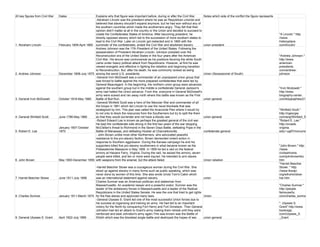
1. Abraham Lincoln February 1809-April 1865
-Abraham Lincoln was the president where he was an Republican unionist and
believed that slavery shouldn't expand anymore, but he had won without any of
the southern countries which made the southerners angry. They felt that their
opinion didn't matter at all in the country or the Union and decided to succeed to
create the Confederates States of America. After becoming president, he
directly opposed slavery which led to the succession of more southern states to
lead to the Civil War. Later on Lincoln got reelected and in 1865 with the
surrender of the confederates, ended the Civil War and abolished slavery. union president
"A Lincoln." http:
//www.
historyplace.
com/lincoln/
2. Andrew Johnson December 1808-July 1875
Andrew Johnson was the 17th President of the United States. Following the
assassination of President Abraham Lincoln, Johnson presided over the
Reconstruction era of the United States in the four years after the American
Civil War. His tenure was controversial as his positions favoring the white South
came under heavy political attack from Republicans. However, at first he was
viewed energetic and effective in fighting the rebellion and beginning transition
to Reconstruction. But, after his death, he was commonly ranked as being
among the worst U.S. presidents. Union (Secessionist of South)
"Andrew Johnson."
http://www.
american-
presidents.
com/andrew-
johnson
3. General Irvin McDowell October 1818-May 1885
-General Irvin McDowell was a commander of an unprepared union group that
was forced to battle against the more prepared confederates that were led by
General Beauregard. In the beginning, the northern union group were advances
against the southern group but in the middle a confederate General Jackson's
army had halted the Union advance. From this, everyone in General McDowell's
army were scared and ran away north where this battle was known as the First
Battle of Bull Run. union general
"Irvin Mcdowell."
http://www.
biography-center.
com/biographies/2157-Mcdowe
4. General Winfield Scott June 1786-May 1866
-General Winfield Scott was a hero of the Mexcian War and commander of all
the troops in 1861 which led Lincoln to use the naval blockade that was
strategized by him. This plan was called the Anaconda Plan where it would try
to not only to block the resources from the Southerners but try to split the them
so that they would surrender and not have a bloody war. union general
"Winfield Scott."
http://ngeorgia.
com/ang/Winfield_Scott
5. Robert E. Lee
January 1807-October
1870
-Robert Edward Lee is known as perhaps the greatest general of the civil war.
He kept the confederate side strong in the first two years of the war stopping
McClellan's threat to Richmond in the Seven Days Battle, defeating Pope in the
Battle of Manassas, and defeating Hooker at Chancellorsville. confederate general
"Robert E. Lee."
http://xroads.
virginia.
edu/~ug97/monument/leebio.ht
6. John Brown May 1800-December 1859
- John Brown unlike most other Northerners, who advocated peaceful
resistance to the pro-slavery faction, Brown demanded violent action in
response to Southern aggression. During the Kansas campaign he and his
supporters killed five pro-slavery southerners in what became known as the
Pottawatomie Massacre in May 1856. In 1859 he led a raid on the federal
armory at Harpers Ferry, Virginia. During the raid, he seized the armory; seven
people were killed, and ten or more were injured. He intended to arm slaves
with weapons from the arsenal, but the attack failed. Union rebelion
"John Brown." http:
//www.
civilwarhome.
com/johnbrownbio.
htm
7. Harriet Beecher Stowe June 1811-July 1896
-Harriet Beecher Stowe was a courageous woman during the Civil War. She
stood up against slavery in many forms such as public speaking, which was
never done by women of this time. She also wrote Uncle Tom's Cabin which
was an international statement against slavery. union
"Harriet Beecher
Stowe ." http:
//www.lkwdpl.
org/wihohio/stow-
har.htm
8. Charles Sumner January 1811-March 1874
Charles Sumner was an American politician and statesman from
Massachusetts. An academic lawyer and a powerful orator, Sumner was the
leader of the antislavery forces in Massachusetts and a leader of the Radical
Republicans in the United States Senate. He was the one that tried to get rights
for the free slaves and approved many laws. Union
"Charles Sumner."
http://people.
famouswhy.
com/charles_sumner/
9. General Ulysses S. Grant April 1822-July 1885
-General Ulysses S. Grant led one of the most successful Union forces due to
his success at organizing and training an army. He had led to an important
victory for the North by conquering Fort Henry and Fort Donelson. Then General
Johnston had led an attack to Grant's army making them retreat until they were
reinforced and beat Johnston's army again.This was known was the Battle of
Shiloh which was the bloodiest single battle and destroyed the hopes of war. union general
". Ulysses S.
Grant" http://www.
bookrags.
com/Ulysses_S.
_Grant
20 key figures from Civil War Dates Explains why that figure was important before, during or after the Civil War Notes which side of the conflict the figure represents
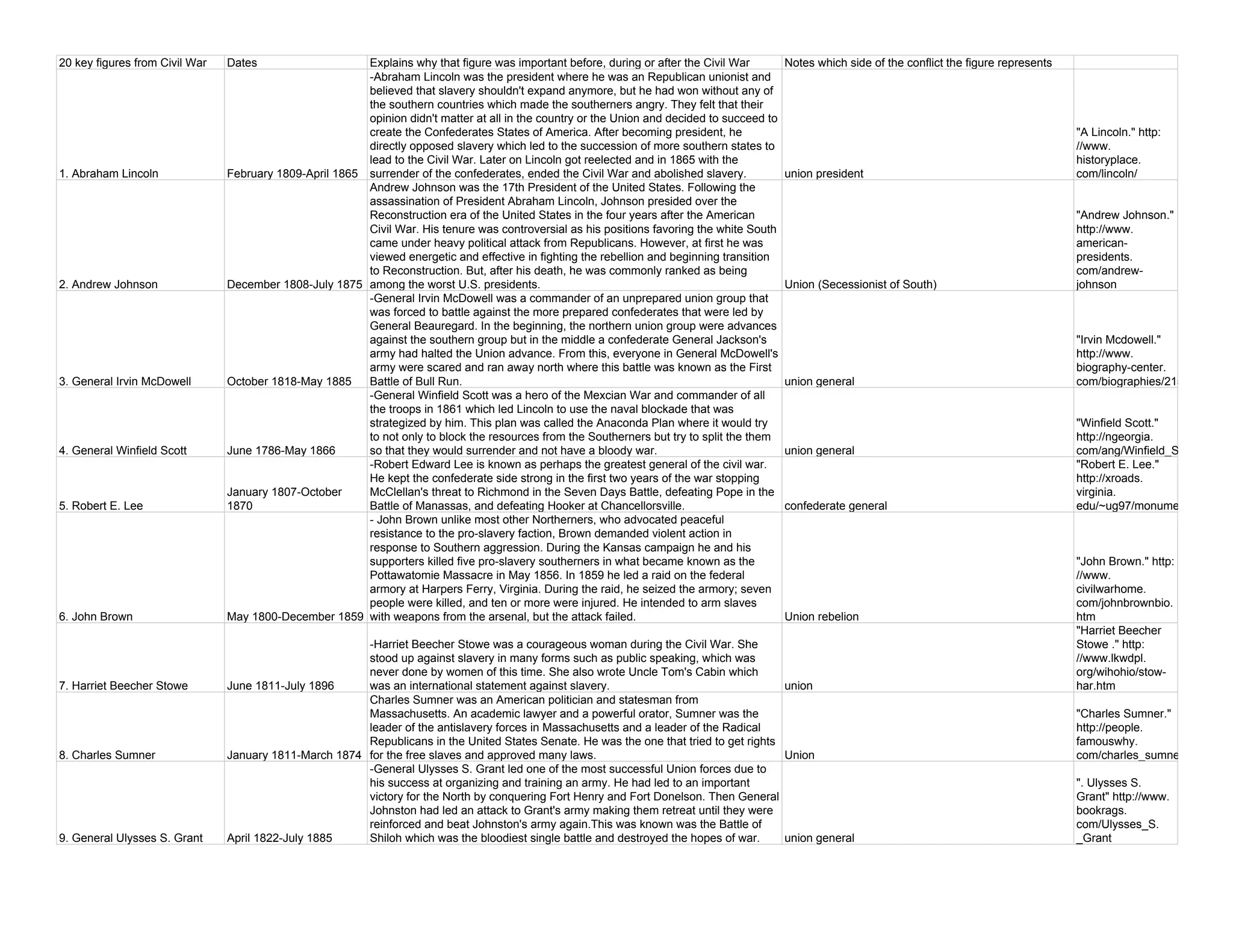
10. General George McClellan
December 1826-October
1885
-General George McClellan was young for commanding but was an outstanding
organizer, excellent strategist, and was well liked by troops where he was first
ordered to build and command a new army. Later on he had the victorious
Battle of Seven Pines while going toward to conquering Richmond the
confederate's capital, but the lost against General Jackson and Lee during the
Seven Days' Battles where he then retreated. Then he had found a copy of
General Lee's plan where they had met in Maryland and fought the Battle of
Antietam which was the bloodiest day in Civil War with the confederates
retreating. union general
"1864 Lincoln v.
McClellan." http:
//elections.
harpweek.
com/1864/bio-
1864-Full.asp?
UniqueID=18&Year=1864
11. General John Pope
March 1822 – September
1892
-General John Pope was known for his bravery in the Mexican War. After a
rocky start in the civil war, General John Pope was promoted to command the
Army of Virginia. However, he faced major defeats as Robert E. Lee, an
opposing Confederate general, trapped his army in the Second Battle of Bull
Run. union general
"General John
Pope." http://www.
history.navy.
mil/danfs/g3/general_john_pop
12. General Stonewall Jackson January 1824-May 1863
General Thomas Jackson had been named "Stonewall" Jackson when he had
successfully blocked the northern union to advance any further. Later on he
things of a brilliant act of deception pretending to prepare for attack on
Washington where he then slips through to join General Lee's army to attack
the northern unionists. Then as a diversion, they go and attack General Pope's
army where Pope's army and Jackson and Lee's army meet to have battle. confederate general
"Stonewall
Jackson." http:
//www.
sonofthesouth.
net/leefoundation/Stonewall_Ja
13. Sergeant William Carney
February 1840-December
1908
-Sergeant William Carney stands out because he was an African-American
fighting in this war. He had been born a slave, but worked hard to buy freedom
for he and his family. During the Battle of Fort Wagner, Carney's bravery and
heroics, got him promoted to sergeant, and provided him with the US Medal of
Honor. union
"William Harvey
Carney." http:
//www.
biographybase.
com/biography/Carney_William
14. George Pickett January 1825-July 1875
-George Pickett is most famous for the Battle of Gettysburg and Pickett's
Charge. Pickett's division marched on to make this charge, and this was one of
the bloodiest days of the War. Over 50% of the Confederates were killed,
leaving Pickett with "no division". confederate
"George Edward
Picket." http:
//www.
civilwarhome.
com/pickettbio.htm
15. William Tecumseh
Sherman
February 1820-February
1891
William Tecumseh Sherman was an American soldier, businessman, educator
and author. He served as a General in the Union Army during the American
Civil War, for which he received recognition for his outstanding command of
military strategy as well as criticism for the harshness. When he thought the war
was almost over he wen to Florida and made all the Confederate armies
surrender against the Union. Union general
"William Tecumseh
Sherman." http:
//ngeorgia.
com/ang/William_Tecumseh_S
16. General Joseph Hooker
November 1814-October
1879
-General Hooker was yet another Union general that served under Abraham
Lincoln. During the Civil War, Hooker observed the weaknesses of the military
leadership and sent a letter to Abraham Lincoln, promoting his own skill. He was
then appointed to serve under McClellan and train the Army of Potomac. union
"Joseph Hooker."
http://www.nndb.
com/people/302/000050152/
17. Stephen Douglas April 1813-June 1861
Before the war he was in the Republican party; however, when he lost to
Abraham Lincoln he came out from the party.Douglas was well-known as a
resourceful party leader, and an adroit, ready, skillful tactician in debate and
passage of legislation. He participated in many of the debates about slavery and
he usually was very democratic rather than being bias. During start of the Civil
war he went to the north with his people, but dies soon. Confederacy
"Stephen Arnold
Douglas." http:
//www.
illinoiscivilwar.
org/douglas-sa.
html
18. Dorothea Dix April 1802-July 1887
Dorothea Lynde Dix was an American activist on behalf of the uneducated who,
through a vigorous program of lobbying state legislatures and the United States
Congress, created the first generation of American mental asylums. During the
Civil War, she served as Superintendent of Army Nurses. Union and Confederate But Confederate later on.
"Dorothea Dix."
http://www25.uua.
org/uuhs/duub/articles/dorothea
19. Clara Barton
December 1821 – April
1912
Clarissa Harlowe "Clara" Barton was a pioneer American teacher, nurse, and
humanitarian. She is best remembered for organizing the American Red Cross. Union but she supported both sides
"Clara Barton."
http://www25.uua.
org/uuhs/duub/articles/clarabar
20 key figures from Civil War Dates Explains why that figure was important before, during or after the Civil War Notes which side of the conflict the figure represents
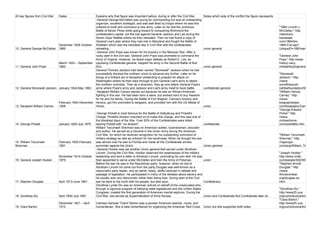
20. Jefferson Davis
June 1808 – December
1889
He was a vice president before the war and when the civil war started he was
appointed by the people as a confederate leader. He tried to make deals with
foreign countries and didn't have great insight in Southern economics. After the
war he was compared with Abraham Lincoln for not being a great leader. Confederacy
"Jefferson Davis
1808-1889
President of the
Confederate
States of America."
http:
//americancivilwar.
com/south/jeffdavi.
html

US History Project

  • 1.
    20 key figuresfrom Civil War Dates Explains why that figure was important before, during or after the Civil War Notes which side of the conflict the figure represents 1. Abraham Lincoln February 1809-April 1865 -Abraham Lincoln was the president where he was an Republican unionist and believed that slavery shouldn't expand anymore, but he had won without any of the southern countries which made the southerners angry. They felt that their opinion didn't matter at all in the country or the Union and decided to succeed to create the Confederates States of America. After becoming president, he directly opposed slavery which led to the succession of more southern states to lead to the Civil War. Later on Lincoln got reelected and in 1865 with the surrender of the confederates, ended the Civil War and abolished slavery. union president "A Lincoln." http: //www. historyplace. com/lincoln/ 2. Andrew Johnson December 1808-July 1875 Andrew Johnson was the 17th President of the United States. Following the assassination of President Abraham Lincoln, Johnson presided over the Reconstruction era of the United States in the four years after the American Civil War. His tenure was controversial as his positions favoring the white South came under heavy political attack from Republicans. However, at first he was viewed energetic and effective in fighting the rebellion and beginning transition to Reconstruction. But, after his death, he was commonly ranked as being among the worst U.S. presidents. Union (Secessionist of South) "Andrew Johnson." http://www. american- presidents. com/andrew- johnson 3. General Irvin McDowell October 1818-May 1885 -General Irvin McDowell was a commander of an unprepared union group that was forced to battle against the more prepared confederates that were led by General Beauregard. In the beginning, the northern union group were advances against the southern group but in the middle a confederate General Jackson's army had halted the Union advance. From this, everyone in General McDowell's army were scared and ran away north where this battle was known as the First Battle of Bull Run. union general "Irvin Mcdowell." http://www. biography-center. com/biographies/2157-Mcdowe 4. General Winfield Scott June 1786-May 1866 -General Winfield Scott was a hero of the Mexcian War and commander of all the troops in 1861 which led Lincoln to use the naval blockade that was strategized by him. This plan was called the Anaconda Plan where it would try to not only to block the resources from the Southerners but try to split the them so that they would surrender and not have a bloody war. union general "Winfield Scott." http://ngeorgia. com/ang/Winfield_Scott 5. Robert E. Lee January 1807-October 1870 -Robert Edward Lee is known as perhaps the greatest general of the civil war. He kept the confederate side strong in the first two years of the war stopping McClellan's threat to Richmond in the Seven Days Battle, defeating Pope in the Battle of Manassas, and defeating Hooker at Chancellorsville. confederate general "Robert E. Lee." http://xroads. virginia. edu/~ug97/monument/leebio.ht 6. John Brown May 1800-December 1859 - John Brown unlike most other Northerners, who advocated peaceful resistance to the pro-slavery faction, Brown demanded violent action in response to Southern aggression. During the Kansas campaign he and his supporters killed five pro-slavery southerners in what became known as the Pottawatomie Massacre in May 1856. In 1859 he led a raid on the federal armory at Harpers Ferry, Virginia. During the raid, he seized the armory; seven people were killed, and ten or more were injured. He intended to arm slaves with weapons from the arsenal, but the attack failed. Union rebelion "John Brown." http: //www. civilwarhome. com/johnbrownbio. htm 7. Harriet Beecher Stowe June 1811-July 1896 -Harriet Beecher Stowe was a courageous woman during the Civil War. She stood up against slavery in many forms such as public speaking, which was never done by women of this time. She also wrote Uncle Tom's Cabin which was an international statement against slavery. union "Harriet Beecher Stowe ." http: //www.lkwdpl. org/wihohio/stow- har.htm 8. Charles Sumner January 1811-March 1874 Charles Sumner was an American politician and statesman from Massachusetts. An academic lawyer and a powerful orator, Sumner was the leader of the antislavery forces in Massachusetts and a leader of the Radical Republicans in the United States Senate. He was the one that tried to get rights for the free slaves and approved many laws. Union "Charles Sumner." http://people. famouswhy. com/charles_sumner/ 9. General Ulysses S. Grant April 1822-July 1885 -General Ulysses S. Grant led one of the most successful Union forces due to his success at organizing and training an army. He had led to an important victory for the North by conquering Fort Henry and Fort Donelson. Then General Johnston had led an attack to Grant's army making them retreat until they were reinforced and beat Johnston's army again.This was known was the Battle of Shiloh which was the bloodiest single battle and destroyed the hopes of war. union general ". Ulysses S. Grant" http://www. bookrags. com/Ulysses_S. _Grant
  • 2.
    20 key figuresfrom Civil War Dates Explains why that figure was important before, during or after the Civil War Notes which side of the conflict the figure represents 10. General George McClellan December 1826-October 1885 -General George McClellan was young for commanding but was an outstanding organizer, excellent strategist, and was well liked by troops where he was first ordered to build and command a new army. Later on he had the victorious Battle of Seven Pines while going toward to conquering Richmond the confederate's capital, but the lost against General Jackson and Lee during the Seven Days' Battles where he then retreated. Then he had found a copy of General Lee's plan where they had met in Maryland and fought the Battle of Antietam which was the bloodiest day in Civil War with the confederates retreating. union general "1864 Lincoln v. McClellan." http: //elections. harpweek. com/1864/bio- 1864-Full.asp? UniqueID=18&Year=1864 11. General John Pope March 1822 – September 1892 -General John Pope was known for his bravery in the Mexican War. After a rocky start in the civil war, General John Pope was promoted to command the Army of Virginia. However, he faced major defeats as Robert E. Lee, an opposing Confederate general, trapped his army in the Second Battle of Bull Run. union general "General John Pope." http://www. history.navy. mil/danfs/g3/general_john_pop 12. General Stonewall Jackson January 1824-May 1863 General Thomas Jackson had been named "Stonewall" Jackson when he had successfully blocked the northern union to advance any further. Later on he things of a brilliant act of deception pretending to prepare for attack on Washington where he then slips through to join General Lee's army to attack the northern unionists. Then as a diversion, they go and attack General Pope's army where Pope's army and Jackson and Lee's army meet to have battle. confederate general "Stonewall Jackson." http: //www. sonofthesouth. net/leefoundation/Stonewall_Ja 13. Sergeant William Carney February 1840-December 1908 -Sergeant William Carney stands out because he was an African-American fighting in this war. He had been born a slave, but worked hard to buy freedom for he and his family. During the Battle of Fort Wagner, Carney's bravery and heroics, got him promoted to sergeant, and provided him with the US Medal of Honor. union "William Harvey Carney." http: //www. biographybase. com/biography/Carney_William 14. George Pickett January 1825-July 1875 -George Pickett is most famous for the Battle of Gettysburg and Pickett's Charge. Pickett's division marched on to make this charge, and this was one of the bloodiest days of the War. Over 50% of the Confederates were killed, leaving Pickett with "no division". confederate "George Edward Picket." http: //www. civilwarhome. com/pickettbio.htm 15. William Tecumseh Sherman February 1820-February 1891 William Tecumseh Sherman was an American soldier, businessman, educator and author. He served as a General in the Union Army during the American Civil War, for which he received recognition for his outstanding command of military strategy as well as criticism for the harshness. When he thought the war was almost over he wen to Florida and made all the Confederate armies surrender against the Union. Union general "William Tecumseh Sherman." http: //ngeorgia. com/ang/William_Tecumseh_S 16. General Joseph Hooker November 1814-October 1879 -General Hooker was yet another Union general that served under Abraham Lincoln. During the Civil War, Hooker observed the weaknesses of the military leadership and sent a letter to Abraham Lincoln, promoting his own skill. He was then appointed to serve under McClellan and train the Army of Potomac. union "Joseph Hooker." http://www.nndb. com/people/302/000050152/ 17. Stephen Douglas April 1813-June 1861 Before the war he was in the Republican party; however, when he lost to Abraham Lincoln he came out from the party.Douglas was well-known as a resourceful party leader, and an adroit, ready, skillful tactician in debate and passage of legislation. He participated in many of the debates about slavery and he usually was very democratic rather than being bias. During start of the Civil war he went to the north with his people, but dies soon. Confederacy "Stephen Arnold Douglas." http: //www. illinoiscivilwar. org/douglas-sa. html 18. Dorothea Dix April 1802-July 1887 Dorothea Lynde Dix was an American activist on behalf of the uneducated who, through a vigorous program of lobbying state legislatures and the United States Congress, created the first generation of American mental asylums. During the Civil War, she served as Superintendent of Army Nurses. Union and Confederate But Confederate later on. "Dorothea Dix." http://www25.uua. org/uuhs/duub/articles/dorothea 19. Clara Barton December 1821 – April 1912 Clarissa Harlowe "Clara" Barton was a pioneer American teacher, nurse, and humanitarian. She is best remembered for organizing the American Red Cross. Union but she supported both sides "Clara Barton." http://www25.uua. org/uuhs/duub/articles/clarabar
  • 3.
    20 key figuresfrom Civil War Dates Explains why that figure was important before, during or after the Civil War Notes which side of the conflict the figure represents 20. Jefferson Davis June 1808 – December 1889 He was a vice president before the war and when the civil war started he was appointed by the people as a confederate leader. He tried to make deals with foreign countries and didn't have great insight in Southern economics. After the war he was compared with Abraham Lincoln for not being a great leader. Confederacy "Jefferson Davis 1808-1889 President of the Confederate States of America." http: //americancivilwar. com/south/jeffdavi. html