Serious Games in a
Regulated Environment:
Games and Apps as
Digital Medicine
Beth Rogozinski,
Chief Content Officer
Serious Play Conference
2017
Confidential - Do Not Distribute 2
Agenda and Objectives
Play and Games for Serious Health Issues
Pear Therapeutics and Digital Medicine
Agile Dev Meets Regulatory: reSET Case Study
Enhancing within the Boundaries
Brining Game Best Practice and Design to Healthcare
PEAR Therapeutics – the leader in digital therapeutics
PEAR is a fully integrated digital therapeutics company, developing regulated,
reimbursed, prescription digital therapeutics
We are a venture-backed company with a 40-person team in Boston and SF with
expertise in software design & engineering, clinical development, regulatory affairs,
and product commercialization and reimbursement
We have developed a modular, cloud-based platform to deliver eFormulationsTM
and our lead product, reSETTM, significantly improved abstinence in 6 randomized
controlled trials in Substance Use Disorder, paving the way for it to be the first FDA-
approved digital therapy in 1H 2017. We also have programs treating Opiate
Dependence, Schizophrenia, and PTSD and other serious disorders.
Confiden'al	
  –	
  Do	
  Not	
  Distribute	
   3	
  
Our mission is to commercially develop and distribute clinically validated,
FDA regulated, digital therapeutics to treat diseases of the brain in order to
improve clinical outcomes and lower overall treatment costs
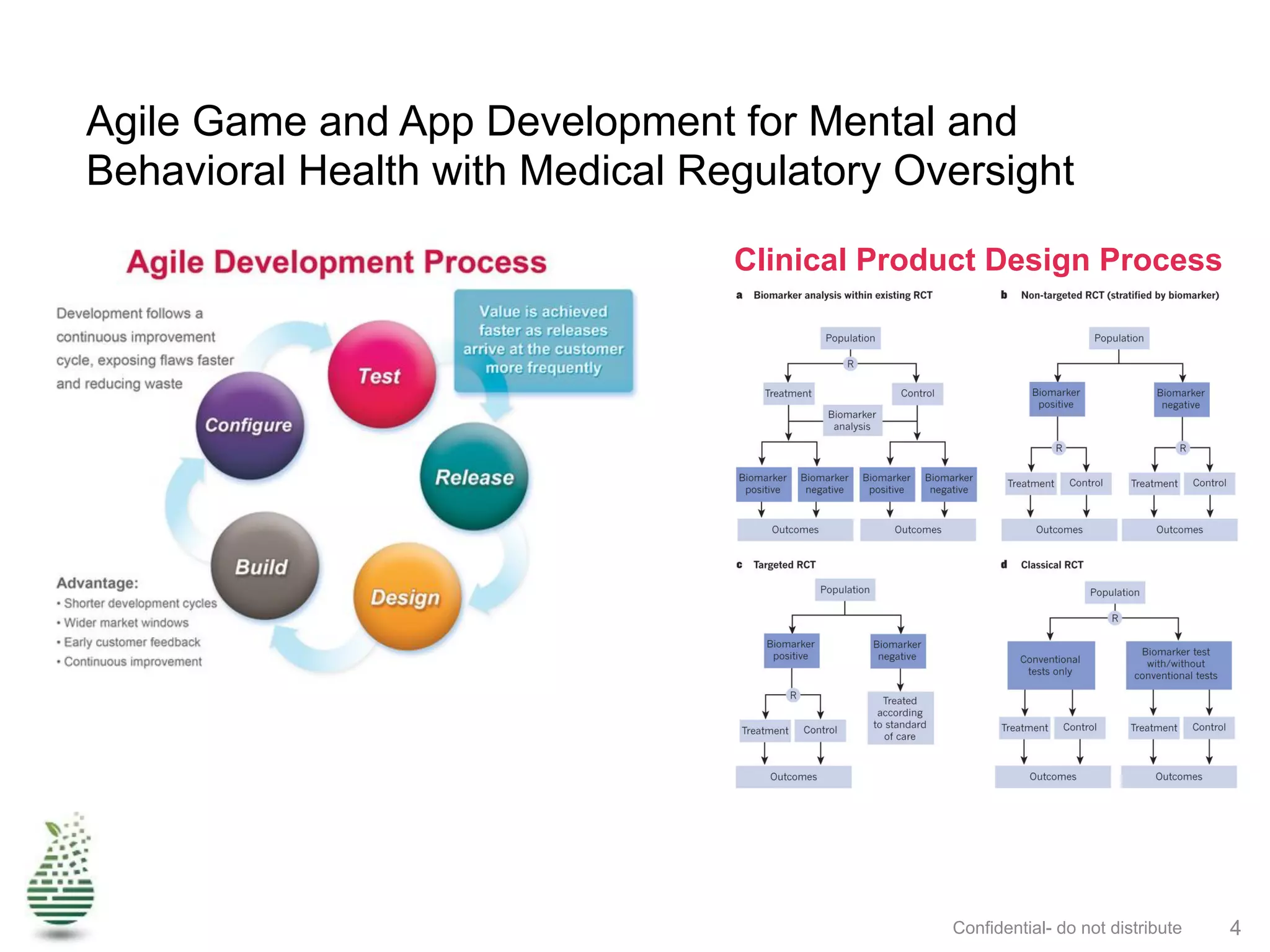
Agile Game and App Development for Mental and
Behavioral Health with Medical Regulatory Oversight
Confidential- do not distribute 4
Clinical Product Design Process
Confidential- do not distribute 5
9
148Alzheimer’s disease
123Obesity
Addiction 366
Multiple sclerosis
Parkinson’s disease 10
Spinal cord injury 15
Epilepsy 16
Schizophrenia 33
Anxiety 47
Hearing loss 50
Vision 52
Traumatic brain injury 56
Stroke 57
Sleep disorders 75
Attention disorders 77
Depressive disorders 83
Chronic pain 95
1. 2012 values; Includes both direct and indirect cost of disease
Source: NeuroInsights, Office of Nat’l Drug Policy, American Psych. Assoc., Cost of Brain Disorders Europe
0.4
2.0
0
1
2
un-
served
under-
served
Total
pts
0.7
served
0.9
U.S. Economic Burden1 for CNS disease,
2012
$ Billion
Global patient pop. for CNS disease
Billion patients
CNS: Huge Unmet Need
Estimated U.S. economic burden of
common brain-related illnesses exceeds
$1.3 trillion per year and worldwide burden
exceeds $2 trillion per year
Approximately 80% of the world market for
brain related treatments is currently either
unserved or underserved
Confidential- do not distribute 6
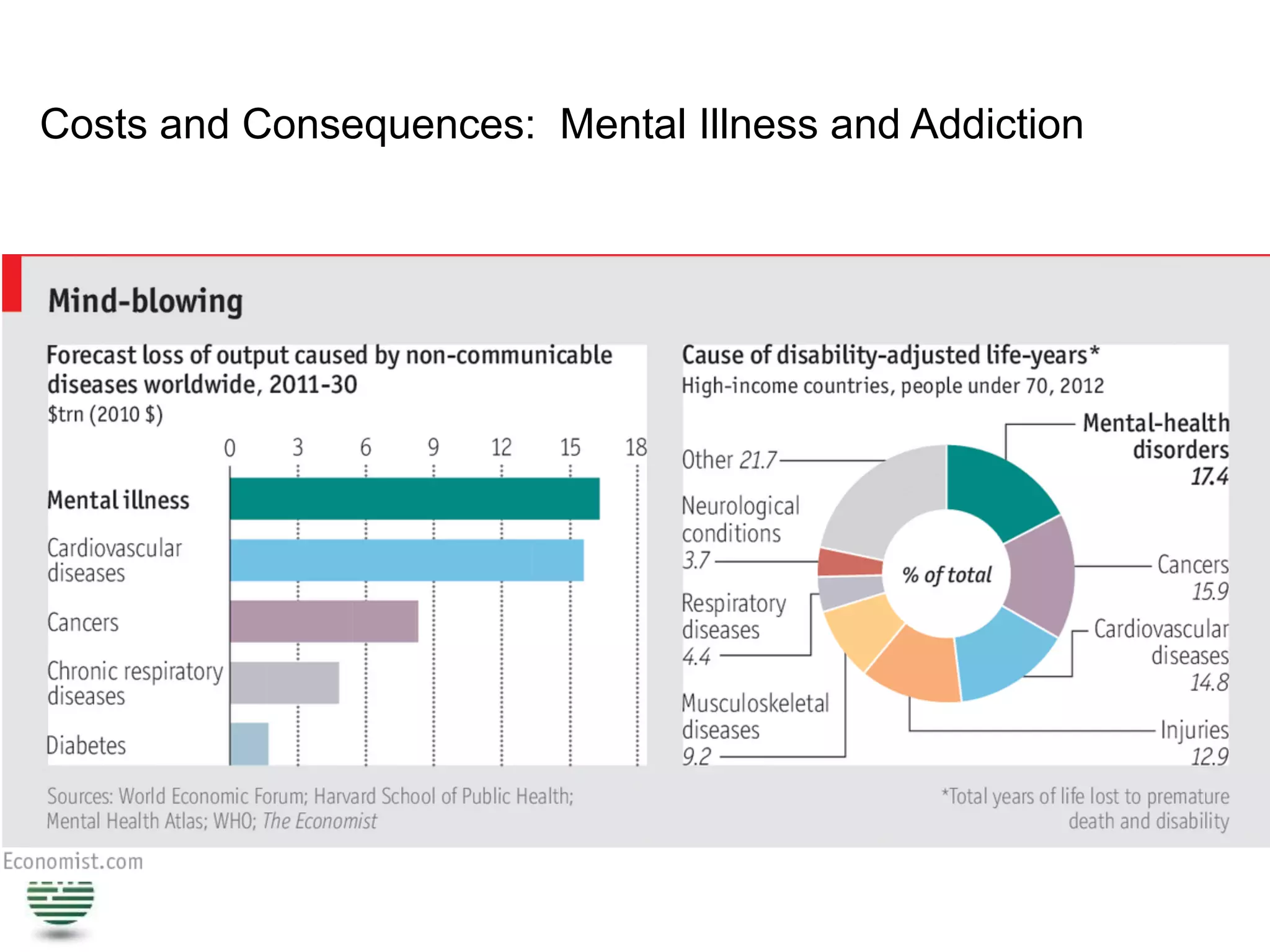
Costs and Consequences: Mental Illness and Addiction
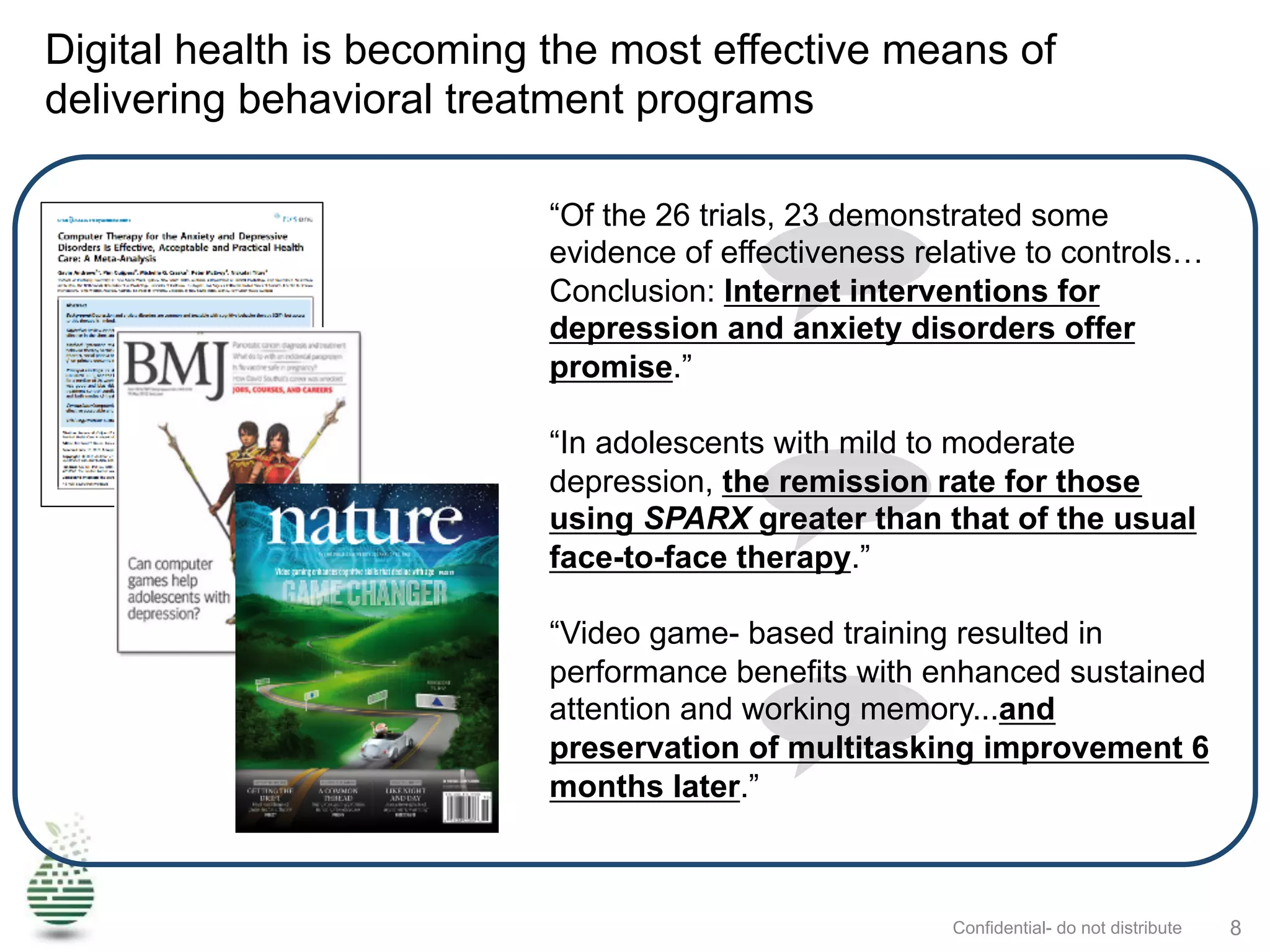
Digital health is becoming the most effective means of
delivering behavioral treatment programs
Confidential- do not distribute 8
“Of the 26 trials, 23 demonstrated some
evidence of effectiveness relative to controls…
Conclusion: Internet interventions for
depression and anxiety disorders offer
promise.”
“In adolescents with mild to moderate
depression, the remission rate for those
using SPARX greater than that of the usual
face-to-face therapy.”
“Video game- based training resulted in
performance benefits with enhanced sustained
attention and working memory...and
preservation of multitasking improvement 6
months later.”
Confidential- do not distribute 9
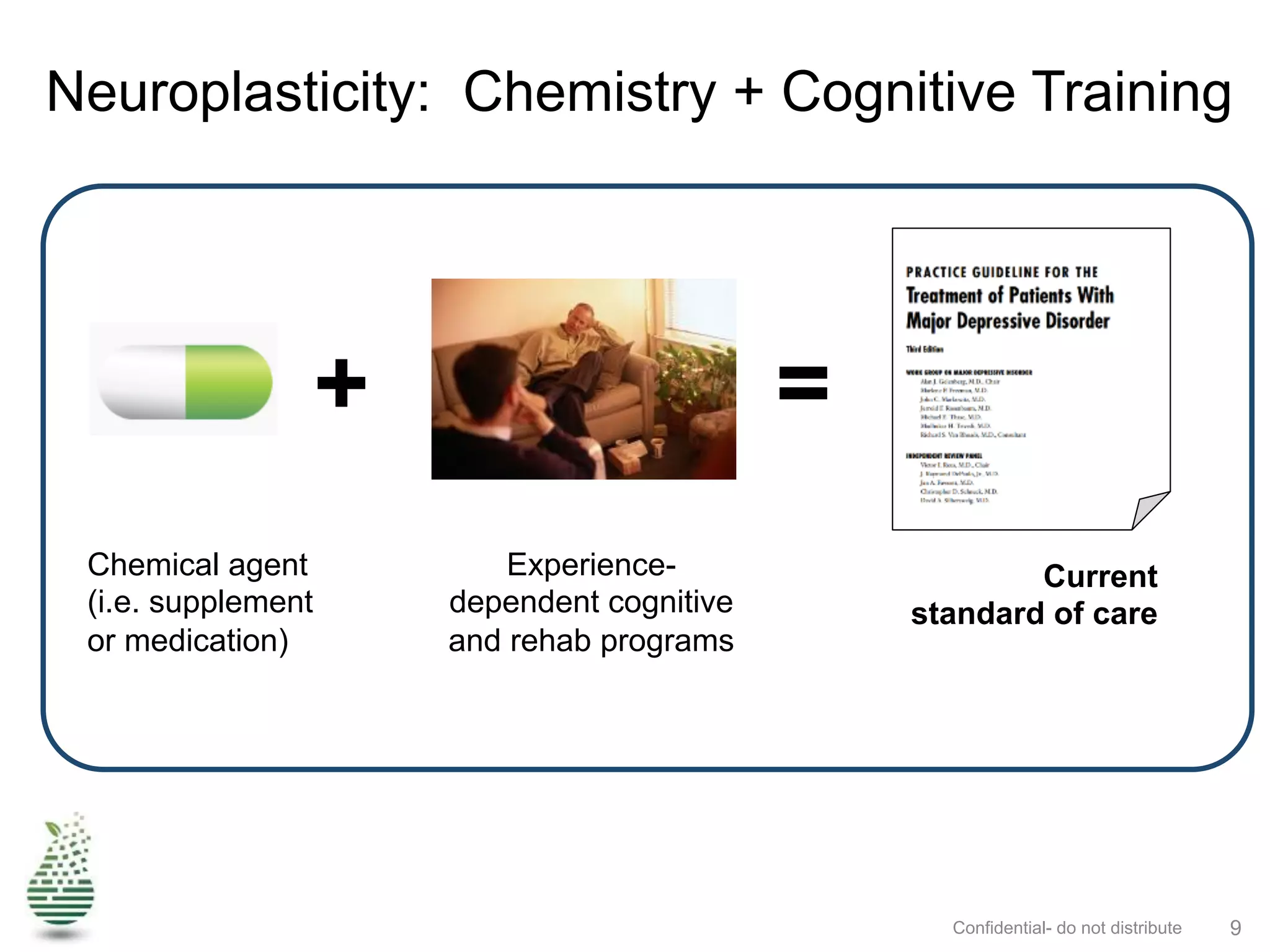
Experience-
dependent cognitive
and rehab programs
Chemical agent
(i.e. supplement
or medication)
=+
Neuroplasticity: Chemistry + Cognitive Training
Current
standard of care
Confidential - Do Not Distribute 10
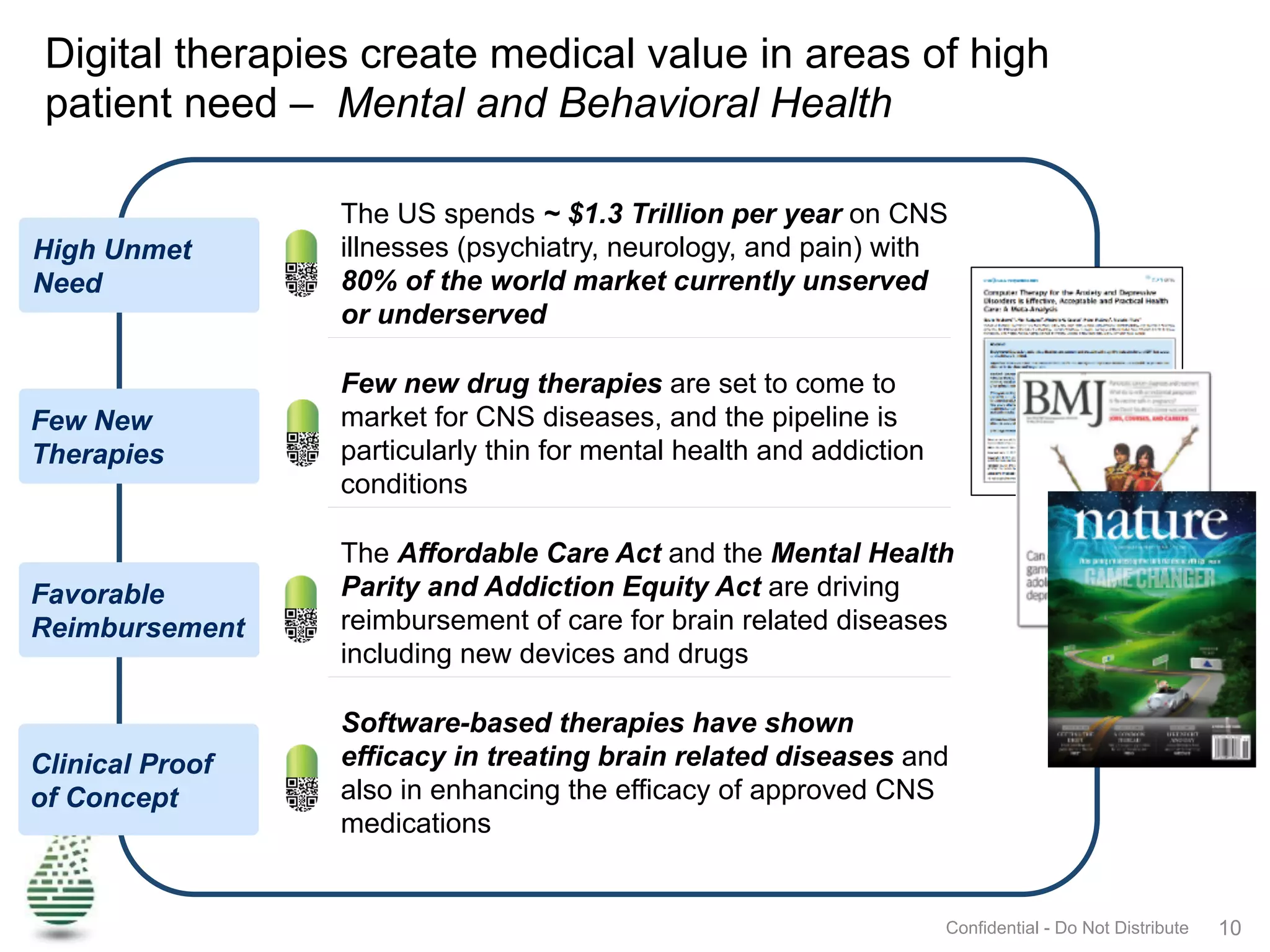
Digital therapies create medical value in areas of high
patient need – Mental and Behavioral Health
The US spends ~ $1.3 Trillion per year on CNS
illnesses (psychiatry, neurology, and pain) with
80% of the world market currently unserved
or underserved
High Unmet
Need
Few new drug therapies are set to come to
market for CNS diseases, and the pipeline is
particularly thin for mental health and addiction
conditions
Few New
Therapies
The Affordable Care Act and the Mental Health
Parity and Addiction Equity Act are driving
reimbursement of care for brain related diseases
including new devices and drugs
Favorable
Reimbursement
Software-based therapies have shown
efficacy in treating brain related diseases and
also in enhancing the efficacy of approved CNS
medications
Clinical Proof
of Concept
Healthcare Psychographic Segments
Balance Seekers (18%)
•  Open to many ideas and options,
as long as they make sense for
me
•  Need context to understand ideas
and recommendations
Strong Survivors (27%)
•  There are more important
things in my life to focus on
than improving my health
•  Live in the “here and now”
Self Achievers (24%)
•  Take ownership of my health and
actively take steps to be healthy
•  Focus on achieving my goals and
objectives
•  Disease is another challenge to
overcome
Active Listeners (13%)
•  Look to physician and other
healthcare professionals for
guidance and direction on
what to do to address my
disease
C2B Solutions
Proactive Reactive
Priority Jugglers (18%)
•  Worry about my family’s health
more than my own
•  Constantly on the go, juggling
many responsibilities so getting
sick is not an option
Proactive Target Audience
Motivators: INTRINSIC efficiencies CONTROL social COMMUNICATIONS	
  
Who	
  are	
  they?	
  
• 	
  	
  60%	
  are	
  female	
  
• 	
  	
  Primarily	
  “Achievers”	
  and	
  “Belongers”	
  goal	
  oriented	
  –	
  successful	
  -­‐	
  Driven	
  
• 	
  	
  Between	
  the	
  age	
  of	
  35-­‐65	
  (Sweet	
  Spot	
  –	
  mid	
  45-­‐54)	
  
• 	
  	
  Married/aKached	
  professionals	
  with	
  families	
  and	
  very	
  busy	
  lives	
  
• 	
  	
  Above	
  average	
  educaMon	
  level	
  –	
  	
  managers,	
  execuMves,	
  professionals	
  
• 	
  	
  Higher	
  than	
  average	
  disposable	
  income	
  levels	
  and	
  spending	
  tendencies	


• 	
  	
  They	
  are	
  connected	
  via	
  tech,	
  socially	
  connected	
  and	
  integrated	
  
What	
  do	
  they	
  look	
  for	
  in	
  health/wellness	
  	
  
• 	
  	
  Professional	
  and	
  friendly	
  communicaMons	
  and	
  style	
  
• 	
  Value,	
  reliability	
  –	
  relaMonship	
  and	
  trust	
  come	
  first	
  
• 	
  Simple,	
  easy	
  to	
  use	
  system	
  that	
  fits	
  their	
  busy	
  schedule	
  	
  
• 	
  One	
  stop	
  place	
  to	
  hold	
  medical	
  records	
  and	
  other	
  data	
  –	
  can	
  be	
  shared	
  with	
  docs	
  
• 	
  Price	
  is	
  not	
  primary	
  –	
  will	
  pay	
  more	
  at	
  first	
  –	
  but	
  demands	
  quality	
  
• Transparent,	
  open	
  easy	
  communicaMons	
  and	
  informaMon	
  
• Technical	
  and	
  mulM-­‐plaWorm	
  access	
  	
  
Business	
  Indicators:	
  
• 	
  Heavy	
  user	
  of	
  technology	
  
• 	
  Connected	
  across	
  social	
  networks,	
  LI,	
  FB,	
  Tw	
  
• 	
  Involved	
  in	
  group	
  events	
  and	
  community	
  –	
  K	
  Factor	
  	
  
• 	
  Fastest	
  growing	
  segments	
  of	
  casual	
  gamers	
  
• 	
  Price	
  not	
  a	
  top	
  issue,	
  but	
  efficiency	
  is	
  
• 	
  Willing	
  to	
  pay	
  for	
  Premium	
  Services/Supplements	
  	
  
Women,	
  middle	
  aged,	
  healthy	
  lifestyles,	
  well	
  educated,	
  higher	
  income,	
  ac6ve	
  and	
  fit	
  
http://www.aafp.org/media-center/releases-statements/all/kits/052908.html
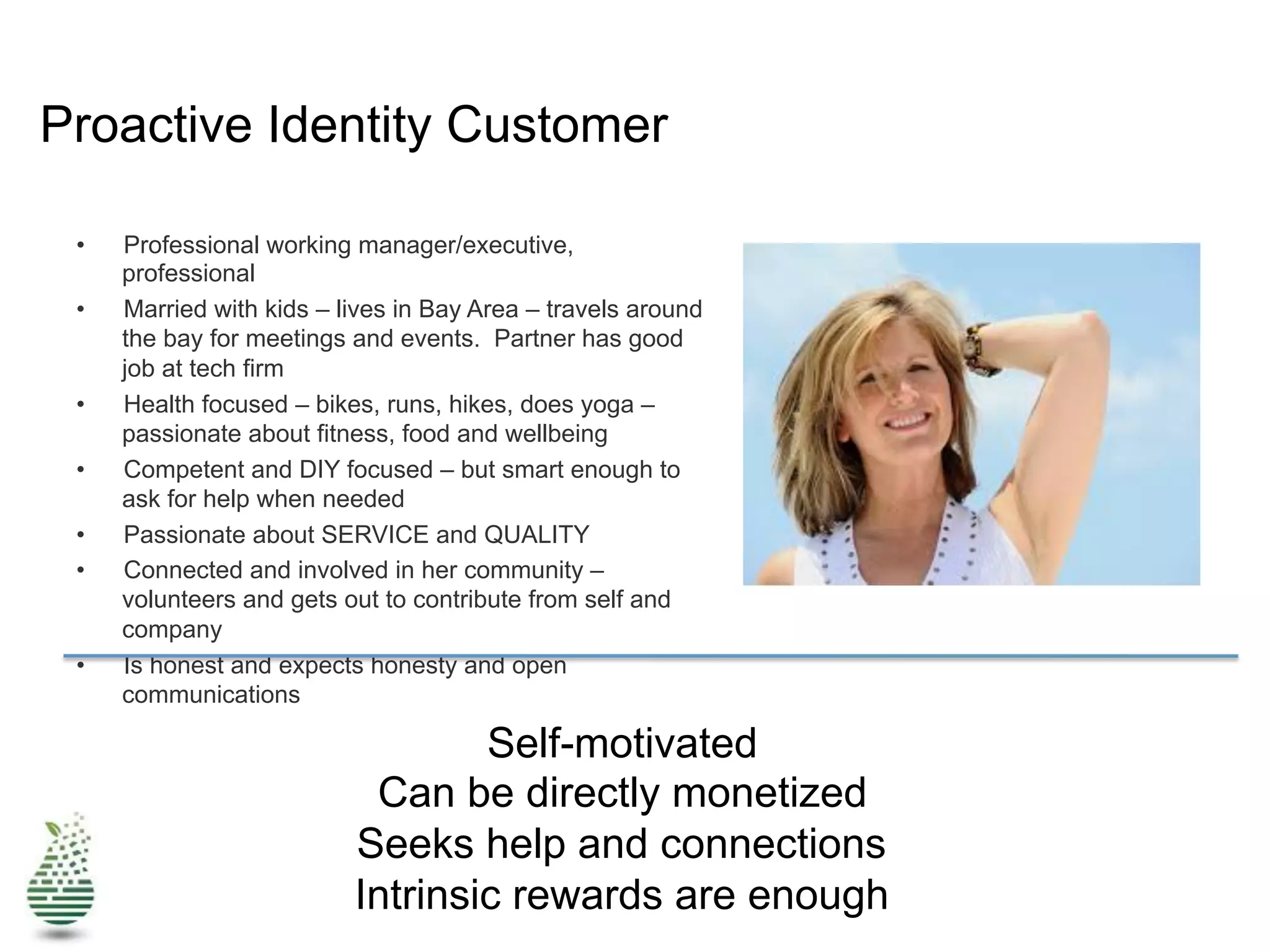
Proactive Identity Customer
•  Professional working manager/executive,
professional
•  Married with kids – lives in Bay Area – travels around
the bay for meetings and events. Partner has good
job at tech firm
•  Health focused – bikes, runs, hikes, does yoga –
passionate about fitness, food and wellbeing
•  Competent and DIY focused – but smart enough to
ask for help when needed
•  Passionate about SERVICE and QUALITY
•  Connected and involved in her community –
volunteers and gets out to contribute from self and
company
•  Is honest and expects honesty and open
communications
Self-motivated
Can be directly monetized
Seeks help and connections
Intrinsic rewards are enough
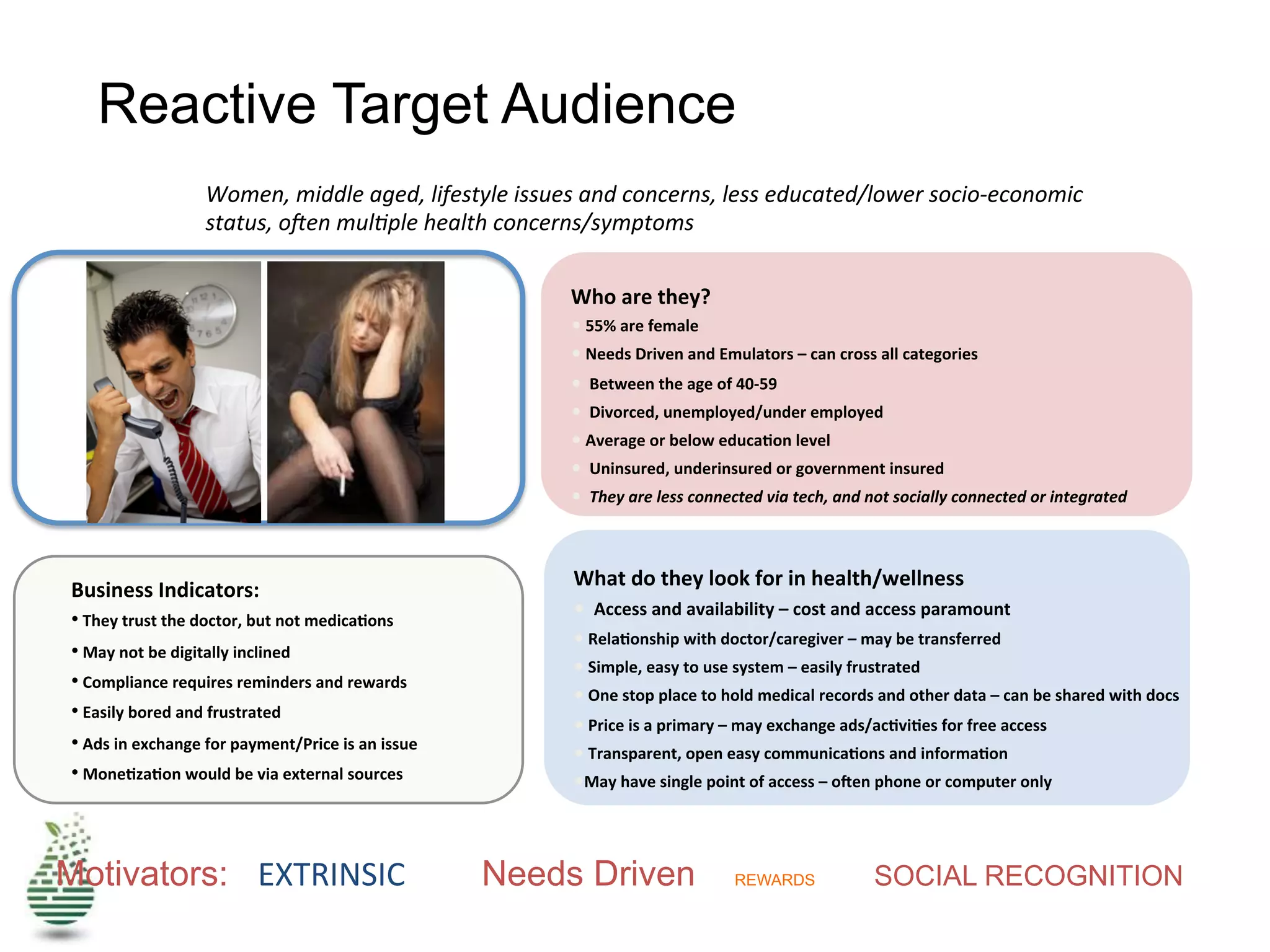
Reactive Target Audience
Motivators: EXTRINSIC	
   Needs Driven REWARDS SOCIAL RECOGNITION	
  
Who	
  are	
  they?	
  
• 	
  55%	
  are	
  female	
  
• 	
  Needs	
  Driven	
  and	
  Emulators	
  –	
  can	
  cross	
  all	
  categories	
  	
  
• 	
  	
  Between	
  the	
  age	
  of	
  40-­‐59	
  
• 	
  	
  Divorced,	
  unemployed/under	
  employed	
  	
  
• 	
  Average	
  or	
  below	
  educaMon	
  level	
  
• 	
  	
  Uninsured,	
  underinsured	
  or	
  government	
  insured	
  	
  
• 	
  	
  They	
  are	
  less	
  connected	
  via	
  tech,	
  and	
  not	
  socially	
  connected	
  or	
  integrated	
  
What	
  do	
  they	
  look	
  for	
  in	
  health/wellness	
  	
  
• 	
  	
  Access	
  and	
  availability	
  –	
  cost	
  and	
  access	
  paramount	
  	
  
• 	
  RelaMonship	
  with	
  doctor/caregiver	
  –	
  may	
  be	
  transferred	
  
• 	
  Simple,	
  easy	
  to	
  use	
  system	
  –	
  easily	
  frustrated	
  	
  
• 	
  One	
  stop	
  place	
  to	
  hold	
  medical	
  records	
  and	
  other	
  data	
  –	
  can	
  be	
  shared	
  with	
  docs	
  
• 	
  Price	
  is	
  a	
  primary	
  –	
  may	
  exchange	
  ads/acMviMes	
  for	
  free	
  access	
  
• 	
  Transparent,	
  open	
  easy	
  communicaMons	
  and	
  informaMon	
  
• May	
  have	
  single	
  point	
  of	
  access	
  –	
  oden	
  phone	
  or	
  computer	
  only	
  
Business	
  Indicators:	
  
• 	
  They	
  trust	
  the	
  doctor,	
  but	
  not	
  medicaMons	
  
• 	
  May	
  not	
  be	
  digitally	
  inclined	
  
• 	
  Compliance	
  requires	
  reminders	
  and	
  rewards	
  
• 	
  Easily	
  bored	
  and	
  frustrated	
  
• 	
  Ads	
  in	
  exchange	
  for	
  payment/Price	
  is	
  an	
  issue	
  
• 	
  MoneMzaMon	
  would	
  be	
  via	
  external	
  sources	
  
Women,	
  middle	
  aged,	
  lifestyle	
  issues	
  and	
  concerns,	
  less	
  educated/lower	
  socio-­‐economic	
  
status,	
  o;en	
  mul6ple	
  health	
  concerns/symptoms	
  
Reactive Identity Customer
•  Working single mom
•  Lives in suburban areas and takes public transit to
work
•  Family and socially focused - not health focused - but
may be focused on looks and beauty products
•  Competent and capable - Seeks outside help as a
last resort for fear of seaming incompetent
•  Demands and requires equal access and treatment
•  Connected and involved in her family, church and
local circles
•  Works hard and desires recognition for work and
achievements
Situational motivations
May be directly monetized – though exchange of ads/actions may be preferred
Will seek help locally – church, family
Extrinsic and recognition rewards may be more compelling
Confidential - Do Not Distribute 16
Games and Apps as Medicine
Traditional Emotional Motivation Game/App Approach
Apprehension,	
  uncertainty,	
  wai6ng,	
  
expecta6on,	
  fear	
  of	
  surprise	
  do	
  a	
  
pa6ent	
  more	
  harm	
  than	
  any	
  exer6on.	


Florence	
  Nightengale	
  
Notes	
  on	
  Nursing	
  1859	


Confidential - Do Not Distribute 17
Games and Apps as Medicine
Confidential - Do Not Distribute 18
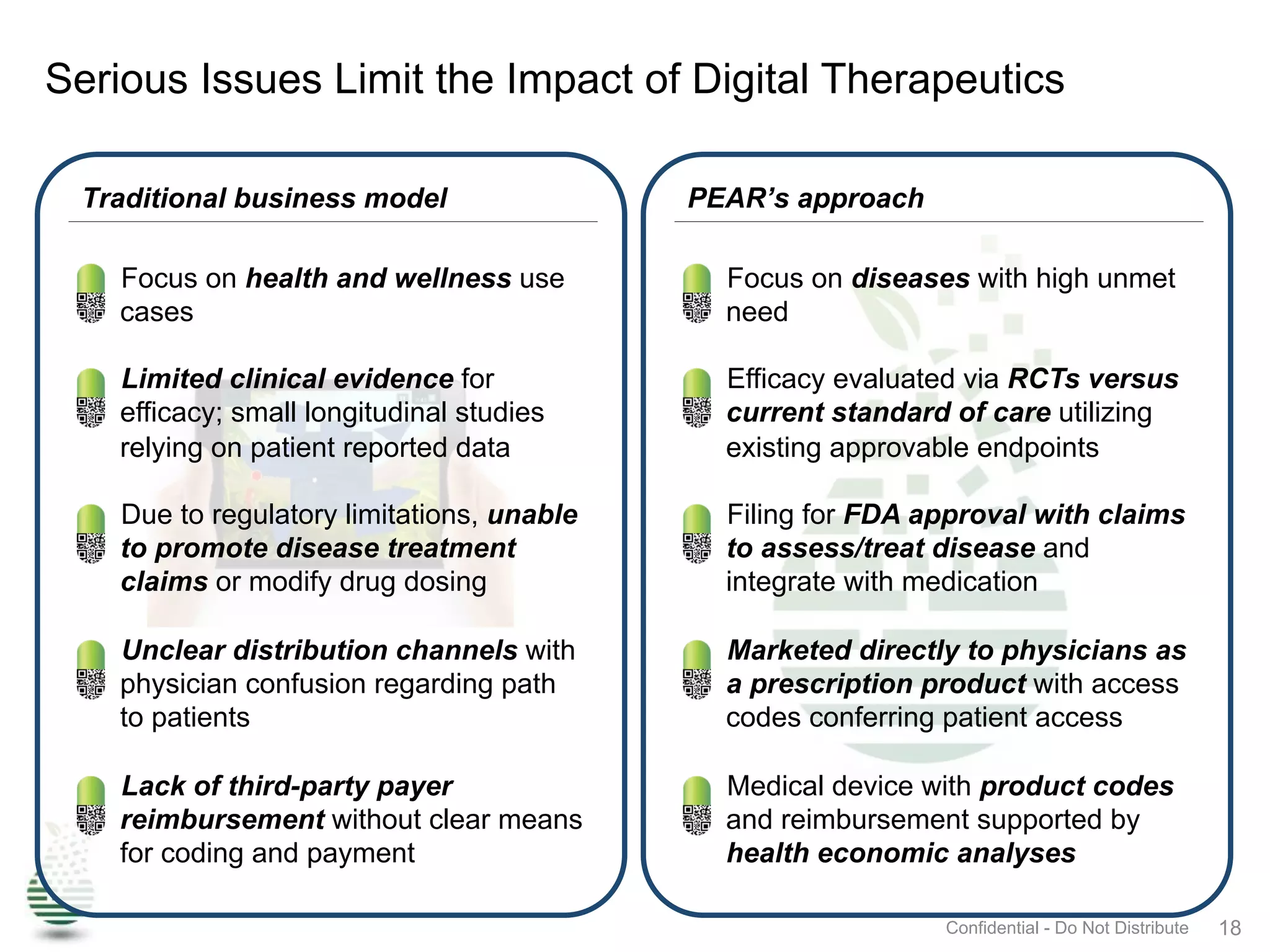
Serious Issues Limit the Impact of Digital Therapeutics
•  Focus on health and wellness use
cases
•  Limited clinical evidence for
efficacy; small longitudinal studies
relying on patient reported data
•  Due to regulatory limitations, unable
to promote disease treatment
claims or modify drug dosing
•  Unclear distribution channels with
physician confusion regarding path
to patients
•  Lack of third-party payer
reimbursement without clear means
for coding and payment
Traditional business model
•  Focus on diseases with high unmet
need
•  Efficacy evaluated via RCTs versus
current standard of care utilizing
existing approvable endpoints
•  Filing for FDA approval with claims
to assess/treat disease and
integrate with medication
•  Marketed directly to physicians as
a prescription product with access
codes conferring patient access
•  Medical device with product codes
and reimbursement supported by
health economic analyses
PEAR’s approach
The FDA and Regulated Healthcare
•  Formed in 1906 by Pres. Roosevelt to protect
citizens against worthless “cures” and adulterated
foods and pharmaceuticals
•  Continuously updated to reflect modern times
•  Focus – safety and efficacy
Confidential- do not distribute 19
FTC fines for: Lumosity, Carrot
Neurotech, AcneApp
Confidential- do not distribute 20
Data Driven
Subclinical Apps and Platform Live in 2015
Confidential- do not distribute 21
Confidential - Do Not Distribute 22
Indication
Content
Partner
Prototype
Pilot
study
Pivotal
studies
FDA
submission
FDA
approval
We have developed a pipeline of eFormulationsTM
treating areas of high unmet medical need
Stage
In-licensed
Internal
Product
FDA
PreSub
Opiate Dependence
Schizophrenia
Substance Use Disorder
reSET-OTM
reSETTM
ThriveTM
Combat-PTSD reCALLTM
Insomnia PEAR-006
General Anxiety Disorder reVIVETM
Traumatic Brain Injury PEAR-007
ADHD PEAR-008
Major Depressive Disorder
Acute & Chronic Pain PEAR-010
PEAR-009
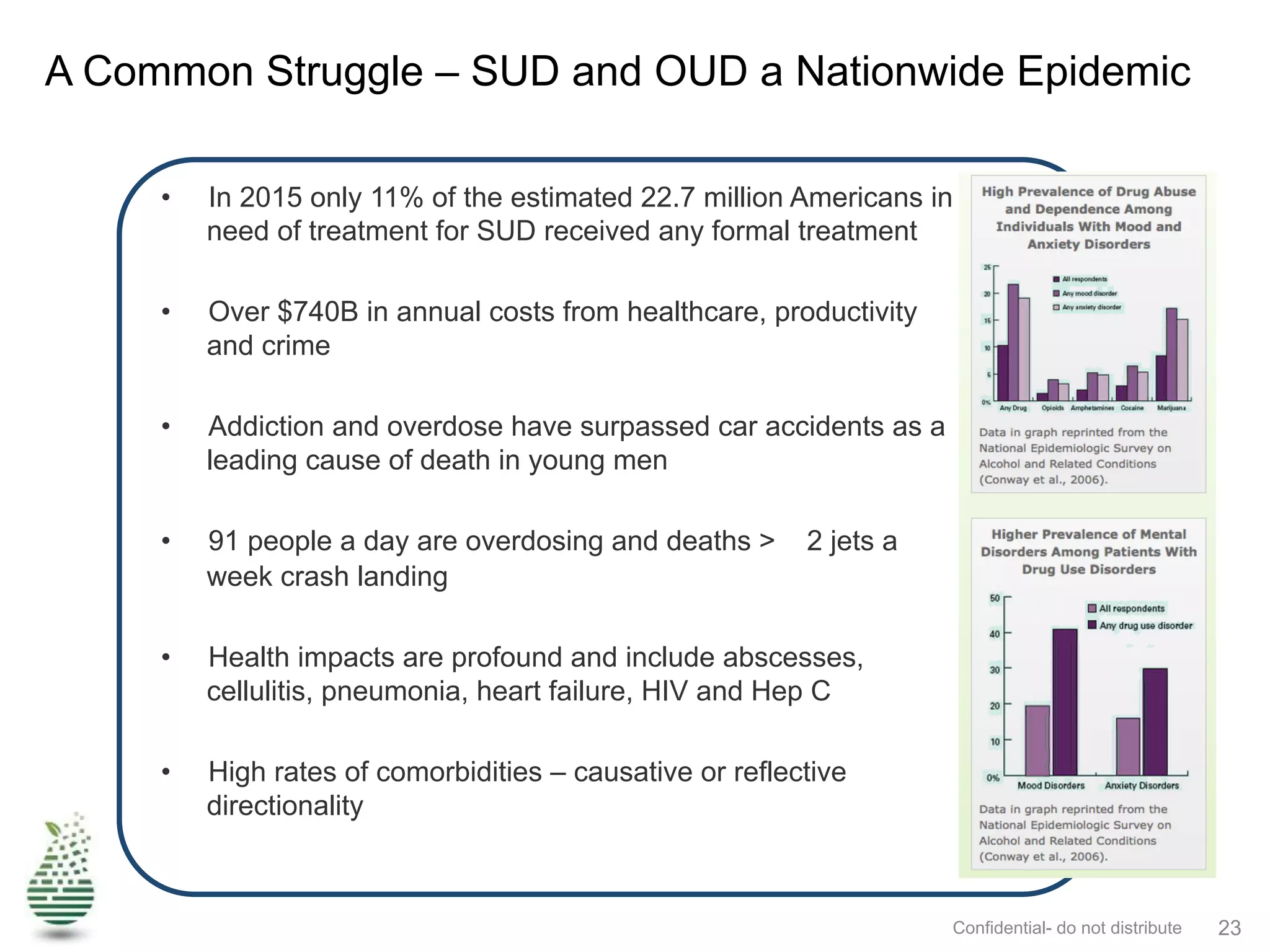
A Common Struggle – SUD and OUD a Nationwide Epidemic
•  In 2015 only 11% of the estimated 22.7 million Americans in
need of treatment for SUD received any formal treatment
•  Over $740B in annual costs from healthcare, productivity
and crime
•  Addiction and overdose have surpassed car accidents as a
leading cause of death in young men
•  91 people a day are overdosing and deaths > 2 jets a
week crash landing
•  Health impacts are profound and include abscesses,
cellulitis, pneumonia, heart failure, HIV and Hep C
•  High rates of comorbidities – causative or reflective
directionality
Confidential- do not distribute 23
Why Digital Therapies are Needed
Current State of Care
•  Diagnosis occur too late
–  Jail, hospital, death
•  Stigma and shame
•  Expensive, not available and not
scalable
–  Desserts of care for all mental
health
•  High friction for patients
–  Removed from home, work,
stressors and triggers
•  Inconsistent treatment
Pear Tx Digital Treatment
•  Digital can allow exploration and
early intervention
•  Private – apps are all HIPAA
secure and CFR-42 compliant
•  Effective, available and scalable
–  BYOD – patients already online
•  Always on and always available
–  168 hours in the week
•  Consistent approach that is
gamified and engaging and can
be personalized
Confidential- do not distribute 24
Addiction: Enslaved
•  Learning disorder – double edge sword of neuroplasticity
•  Often have no positive feedback or affirmations in their lives – or
the drug/substance confused with rewards
•  Success requires overcoming shame and focusing on the
moment (MBSR) and learning new life skills
•  Risk taking patients particularly tied to rewards
Confidential- do not distribute 25
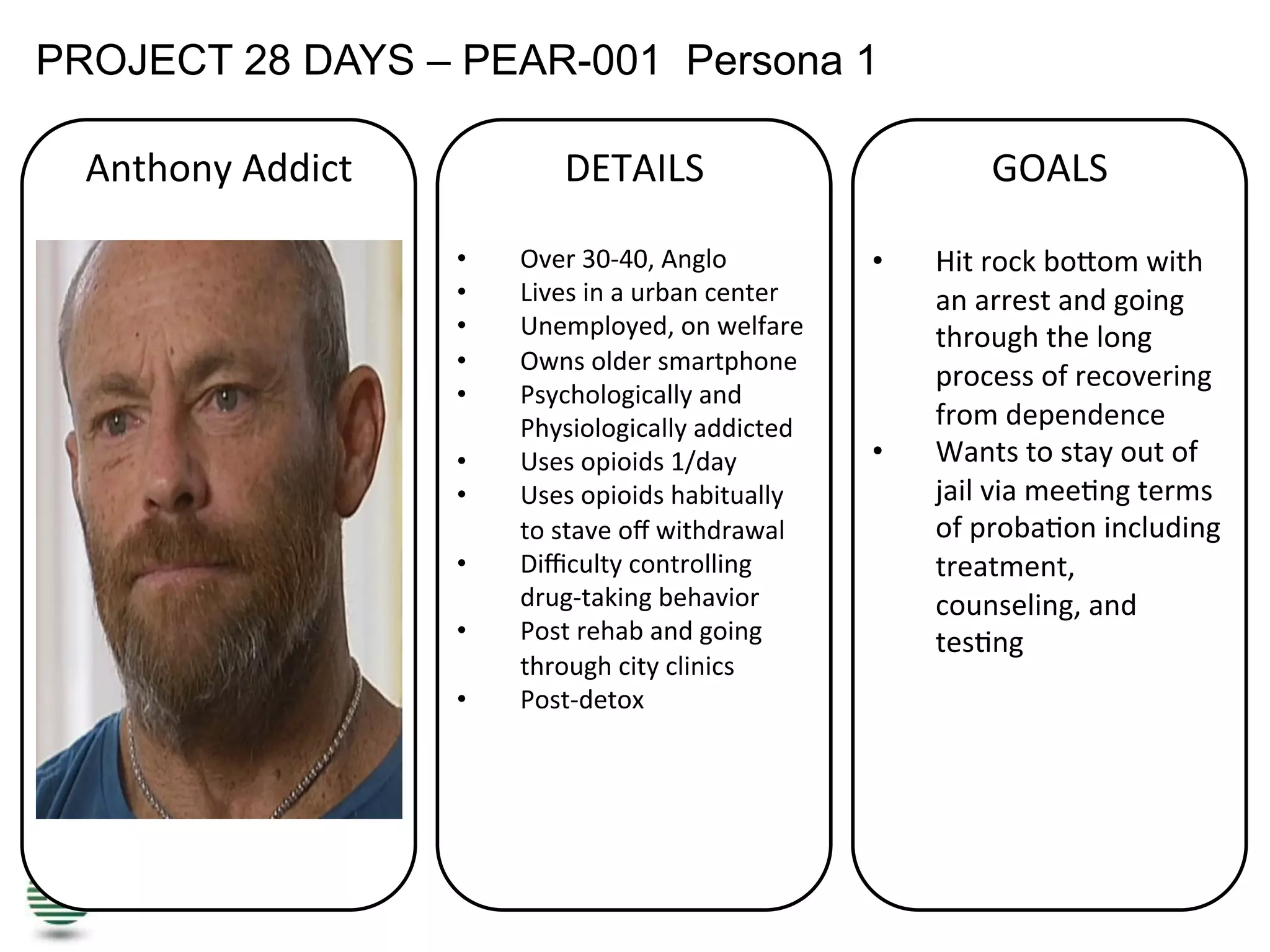
PROJECT 28 DAYS – PEAR-001 Persona 1
Anthony	
  Addict	
   DETAILS	


•  Over	
  30-­‐40,	
  Anglo	
  	
  
•  Lives	
  in	
  a	
  urban	
  center	
  
•  Unemployed,	
  on	
  welfare	
  
•  Owns	
  older	
  smartphone	
  
•  Psychologically	
  and	
  
Physiologically	
  addicted	
  
•  Uses	
  opioids	
  1/day	
  
•  Uses	
  opioids	
  habitually	
  
to	
  stave	
  off	
  withdrawal	
  
•  Difficulty	
  controlling	
  
drug-­‐taking	
  behavior	
  
•  Post	
  rehab	
  and	
  going	
  
through	
  city	
  clinics	
  
•  Post-­‐detox	


GOALS	


•  Hit	
  rock	
  boYom	
  with	
  
an	
  arrest	
  and	
  going	
  
through	
  the	
  long	
  
process	
  of	
  recovering	
  
from	
  dependence	
  
•  Wants	
  to	
  stay	
  out	
  of	
  
jail	
  via	
  mee'ng	
  terms	
  
of	
  proba'on	
  including	
  
treatment,	
  
counseling,	
  and	
  
tes'ng	
  
PROJECT	
  28	
  DAYS	
  /	
  PEAR-­‐001	
  -­‐	
  PEARTX	
  ADDICTION	
  TREATMENT	
  APP	
  V1	
  -­‐	
  AGILE	
  VISION	
  BOARD	
  
A	
  SMARTPHONE	
  APP	
  THAT,	
  PAIRED	
  WITH	
  MEDICAL	
  TREATMENT,	
  	
  
IMPROVES	
  OUTCOMES	
  FOR	
  RECOVERING	
  SUD/OUD	
  PATIENTS	


Needs	


•  Rewards	
  you	
  for	
  
par'cipa'ng	
  in	
  your	
  
own	
  treatment	
  
•  Teaches	
  you	
  the	
  
proven	
  skills	
  and	
  
behaviors	
  to	
  
overcome	
  addic'on	
  
•  Gives	
  you	
  the	
  tools	
  
for	
  a	
  beYer	
  life	
  
•  Enhances	
  the	
  
effec'veness	
  of	
  your	
  
treatments	
  
•  By	
  tracking	
  progress,	
  
gives	
  you	
  and	
  your	
  
doctor	
  beYer	
  info	
  to	
  
help	
  you	


Target	
  Group	


Primary	
  
•  80%	
  Male	
  
•  Anglo	
  
•  28-­‐46,	
  median	
  37	
  
•  English	
  speaking	
  
•  Own	
  a	
  smartphone	
  
Secondary	
  
•  Physicians,	
  Clinicians	
  
&	
  Assistants	
  
•  Medical	
  Researchers	


Business	
  Goals	


•  Creates	
  reoccurring	
  
revenue	
  stream	
  from	
  
city,	
  county	
  &	
  state	
  
clinics	
  
•  Provides	
  strategic	
  
value	
  as	
  our	
  first	
  FDA	
  
approved	
  product	
  
•  Bellweather	
  for	
  
poten'al	
  pharma	
  
partners	
  
•  Validates	
  IP	
  and	
  thus	
  
provides	
  business	
  
proof	
  to	
  addi'onal	
  
investment	
  and	
  /or	
  
poten'al	
  acquirers	


Product	


•  A	
  smartphone	
  app	
  
•  App	
  that	
  presents	
  and	
  
test	
  cogni've	
  
behavioral	
  therapy	
  
•  App	
  presents	
  and	
  
tests	
  fluency	
  training	
  
•  App	
  gives	
  
mo'va'onal	
  
incen'ves	
  
•  Server	
  can	
  push	
  and	
  
app	
  can	
  display	
  self	
  
tracking	
  data	
  to	
  user	
  
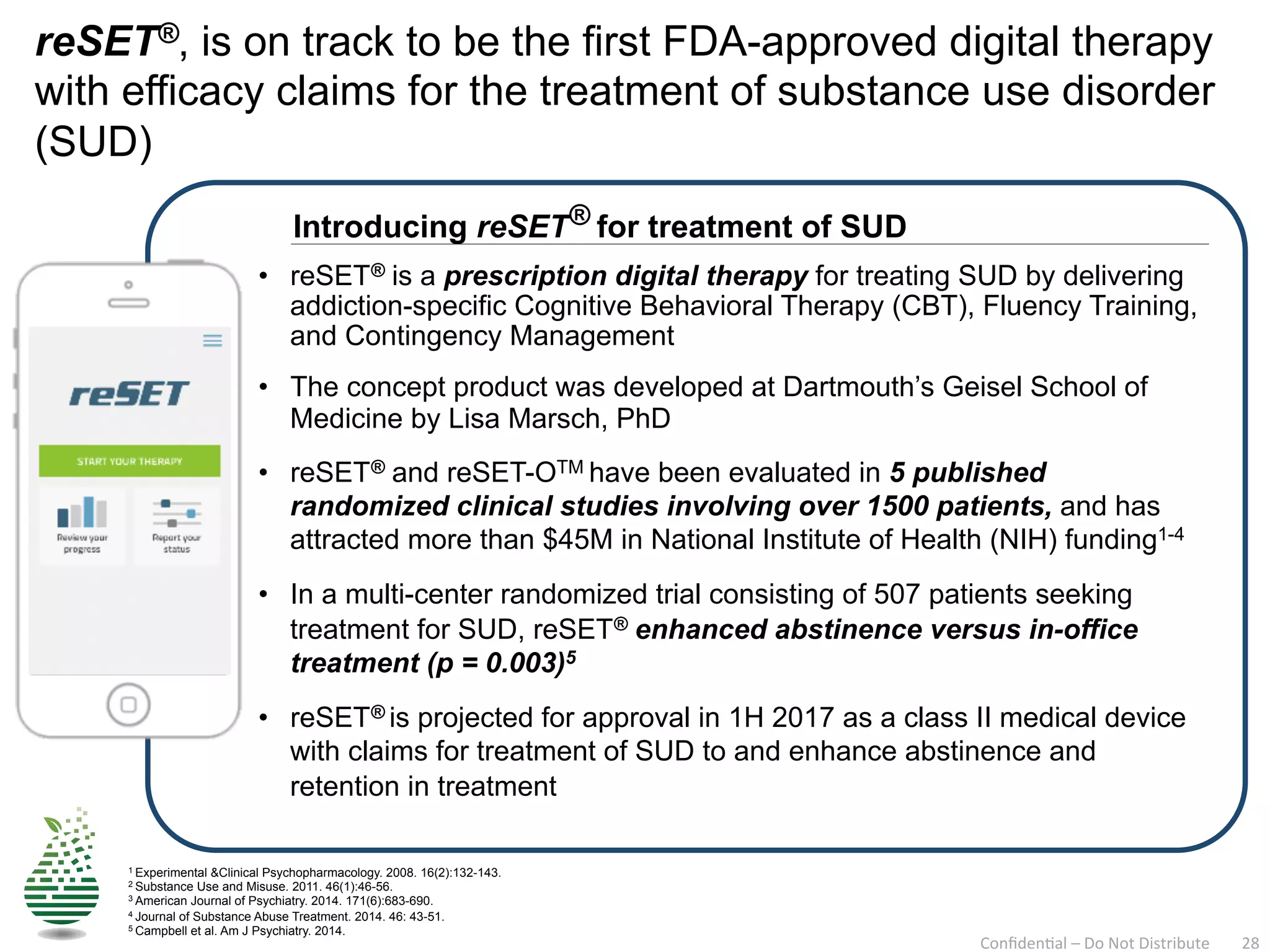
reSET®, is on track to be the first FDA-approved digital therapy
with efficacy claims for the treatment of substance use disorder
(SUD)
Introducing reSET® for treatment of SUD
•  reSET® is a prescription digital therapy for treating SUD by delivering
addiction-specific Cognitive Behavioral Therapy (CBT), Fluency Training,
and Contingency Management
•  The concept product was developed at Dartmouth’s Geisel School of
Medicine by Lisa Marsch, PhD
•  reSET® and reSET-OTM have been evaluated in 5 published
randomized clinical studies involving over 1500 patients, and has
attracted more than $45M in National Institute of Health (NIH) funding1-4
•  In a multi-center randomized trial consisting of 507 patients seeking
treatment for SUD, reSET® enhanced abstinence versus in-office
treatment (p = 0.003)5
•  reSET® is projected for approval in 1H 2017 as a class II medical device
with claims for treatment of SUD to and enhance abstinence and
retention in treatment
1 Experimental &Clinical Psychopharmacology. 2008. 16(2):132-143.
2 Substance Use and Misuse. 2011. 46(1):46-56.
3 American Journal of Psychiatry. 2014. 171(6):683-690.
4 Journal of Substance Abuse Treatment. 2014. 46: 43-51.
5 Campbell et al. Am J Psychiatry. 2014.
Confiden'al	
  –	
  Do	
  Not	
  Distribute	
   28	
  
In the pivotal clinical trial, reSET doubled rates of abstinence
versus treatment as usual (TAU)
507 patients with Substance Use Disorder at 10 nationwide treatment centers were randomized to 12
weeks of typical outpatient treatment (TAU) vs Product X with limited clinician exposure and
abstinence was measured through urine analysis and self reports
TAU
Product X
Week
4 6 7 8 9 10 1153210 12
10
20
30
40
50
0
%Abstinent
Week 9-12 29.7% (n=255) 16.0% (n=252) 2.22 (1.24, 3.99) 0.0076
Time PointPopulation
All comers
Week 9-12 10.1% (n=113 ) 3.0% (n=119) 3.59 (1.36, 9.48) 0.0099
Non-abstinent
at start
Product X TAU Odds Ratio (95% CI) P-value*
reSET enhanced retention in treatment relative to treatment
as usual (TAU)
Treatment Retention
Patients receiving reSET were significantly more likely to be retained in treatment vs those
receiving treatment as usual
TAU Product X P-value
Patients remaining in
treatment
63.5% (n=252) 72.2% (n=255) 0.0316
Time (weeks)
PercentageRemaininginTreatment
2 4 6 8 10 12
60
70
80
90
100
0
0
Treatment Retention Module Completion
Time (weeks)
Average#modules
completedperweek
Module Retention
Averagetimespenton
modules(inminutes)
Time (weeks)
TAU reSET® P =
All-
Comers
36.5%
(n=252)
27.8%
(n=255)
0.0316
Time (weeks)
PercentageRemaininginTreatment
Abstinent
Non-Abstinent
0
1 2 3 4 5 6 7 8 9 10 11 12
20
40
60
Abstinent
Non-Abstinent
1 2 3 4 5 6 7 8 9 10 11 12
Abstinent
Non-Abstinent
0
1
2
3
4
5
0 2 4 6 8 10 12
60
70
80
90
100
reSET® enhanced retention in treatment relative to TAU,
and patients showed strong rates of engagement
reSET™
Treatment as usual (TAU)
Patients receiving reSET® were significantly more
likely to be retained in treatment
Patients remained engaged with reSET® throughout
the duration of the clinical trial
Confiden'al	
  –	
  Do	
  Not	
  Distribute	
   31	
  
Confiden'al-­‐	
  do	
  not	
  distribute	
   32	
  
reSET includes includes both a patient-facing intervention
and clinician-facing dashboards
Health Care Professional
Concept Proficiency Abstinence and
Appointments
Module Use Cravings and Triggers
Patient
Mobile
Dashboard
CBT Modules
Contingency
Management Craving &
Trigger
Assessment
Fluency
Training
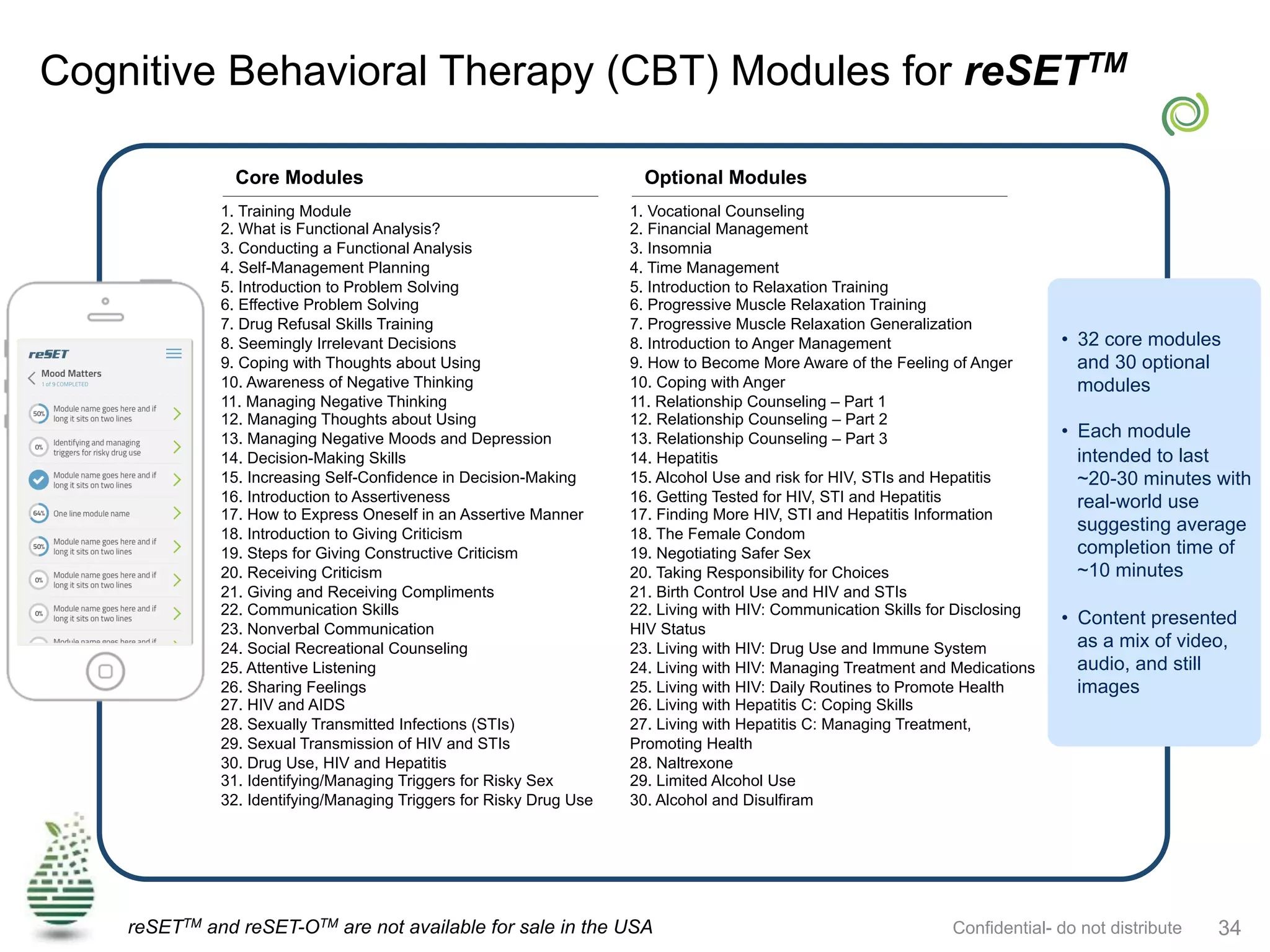
Cognitive Behavioral Therapy (CBT) Modules for reSETTM
Confidential- do not distribute 34
Core Modules Optional Modules
1. Training Module
2. What is Functional Analysis?
3. Conducting a Functional Analysis
4. Self-Management Planning
5. Introduction to Problem Solving
6. Effective Problem Solving
7. Drug Refusal Skills Training
8. Seemingly Irrelevant Decisions
9. Coping with Thoughts about Using
10. Awareness of Negative Thinking
11. Managing Negative Thinking
12. Managing Thoughts about Using
13. Managing Negative Moods and Depression
14. Decision-Making Skills
15. Increasing Self-Confidence in Decision-Making
16. Introduction to Assertiveness
17. How to Express Oneself in an Assertive Manner
18. Introduction to Giving Criticism
19. Steps for Giving Constructive Criticism
20. Receiving Criticism
21. Giving and Receiving Compliments
22. Communication Skills
23. Nonverbal Communication
24. Social Recreational Counseling
25. Attentive Listening
26. Sharing Feelings
27. HIV and AIDS
28. Sexually Transmitted Infections (STIs)
29. Sexual Transmission of HIV and STIs
30. Drug Use, HIV and Hepatitis
31. Identifying/Managing Triggers for Risky Sex
32. Identifying/Managing Triggers for Risky Drug Use
1. Vocational Counseling
2. Financial Management
3. Insomnia
4. Time Management
5. Introduction to Relaxation Training
6. Progressive Muscle Relaxation Training
7. Progressive Muscle Relaxation Generalization
8. Introduction to Anger Management
9. How to Become More Aware of the Feeling of Anger
10. Coping with Anger
11. Relationship Counseling – Part 1
12. Relationship Counseling – Part 2
13. Relationship Counseling – Part 3
14. Hepatitis
15. Alcohol Use and risk for HIV, STIs and Hepatitis
16. Getting Tested for HIV, STI and Hepatitis
17. Finding More HIV, STI and Hepatitis Information
18. The Female Condom
19. Negotiating Safer Sex
20. Taking Responsibility for Choices
21. Birth Control Use and HIV and STIs
22. Living with HIV: Communication Skills for Disclosing
HIV Status
23. Living with HIV: Drug Use and Immune System
24. Living with HIV: Managing Treatment and Medications
25. Living with HIV: Daily Routines to Promote Health
26. Living with Hepatitis C: Coping Skills
27. Living with Hepatitis C: Managing Treatment,
Promoting Health
28. Naltrexone
29. Limited Alcohol Use
30. Alcohol and Disulfiram
•  32 core modules
and 30 optional
modules
•  Each module
intended to last
~20-30 minutes with
real-world use
suggesting average
completion time of
~10 minutes
•  Content presented
as a mix of video,
audio, and still
images
reSETTM and reSET-OTM are not available for sale in the USA
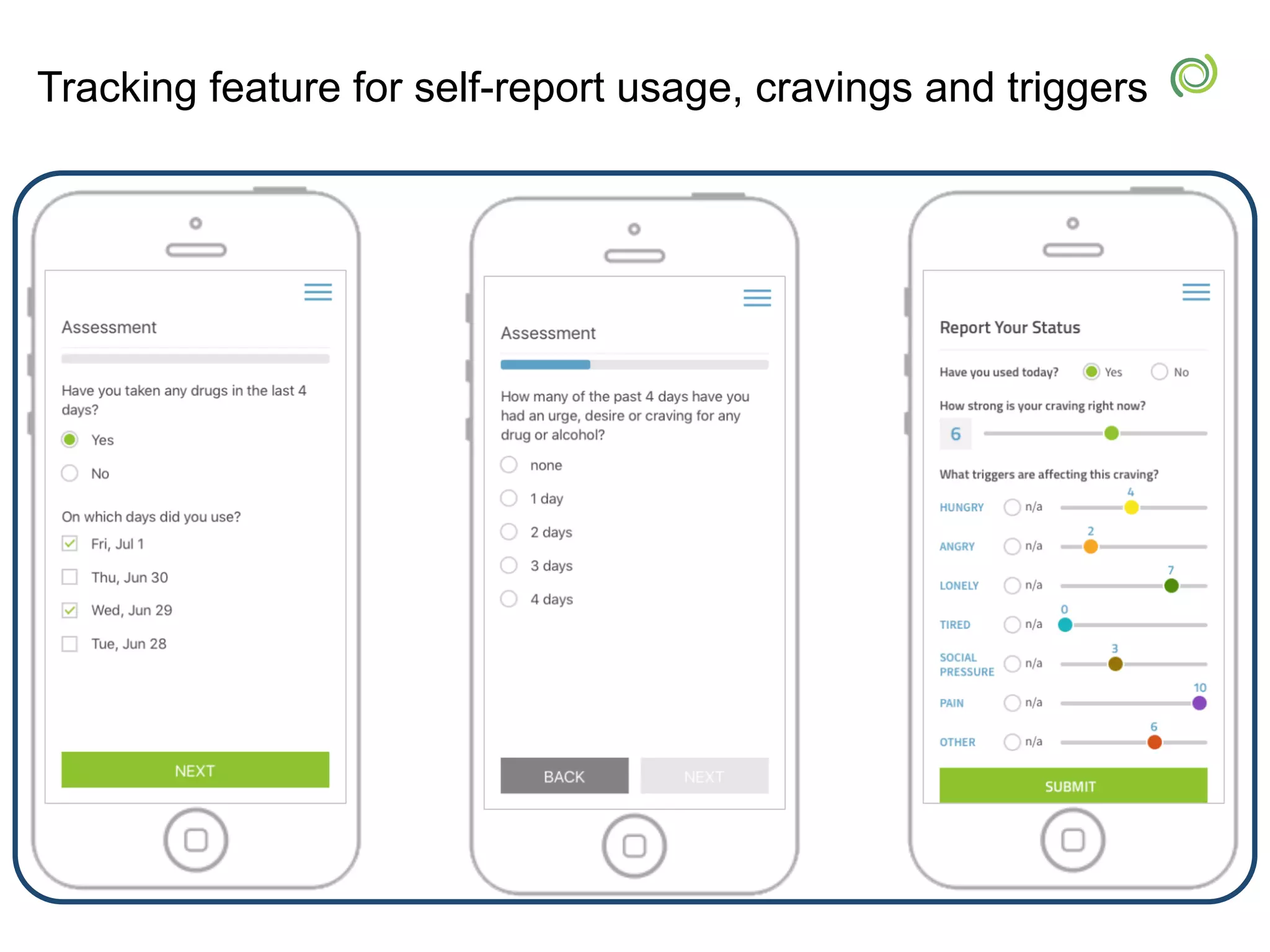
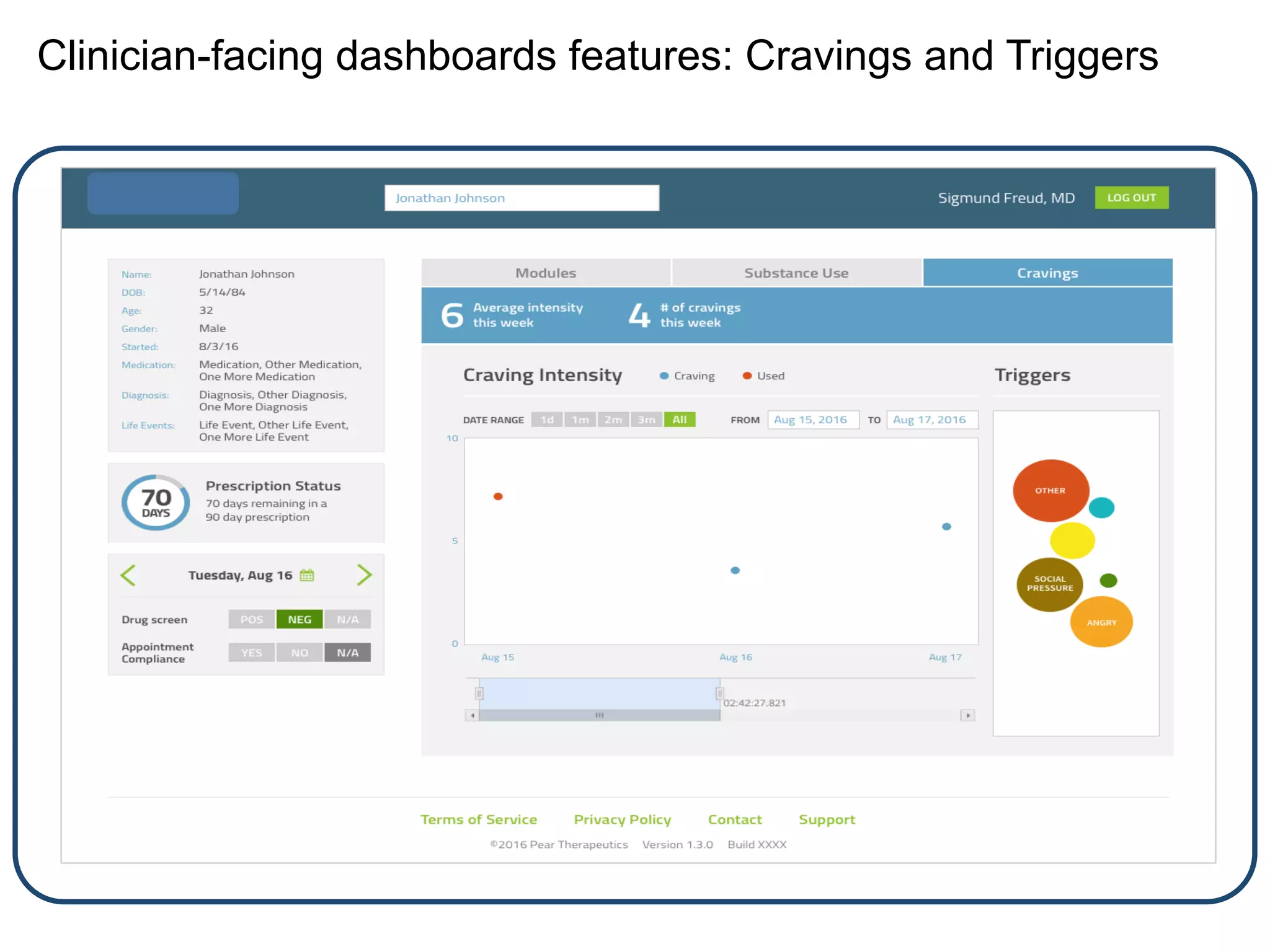
Tracking feature for self-report usage, cravings and triggers
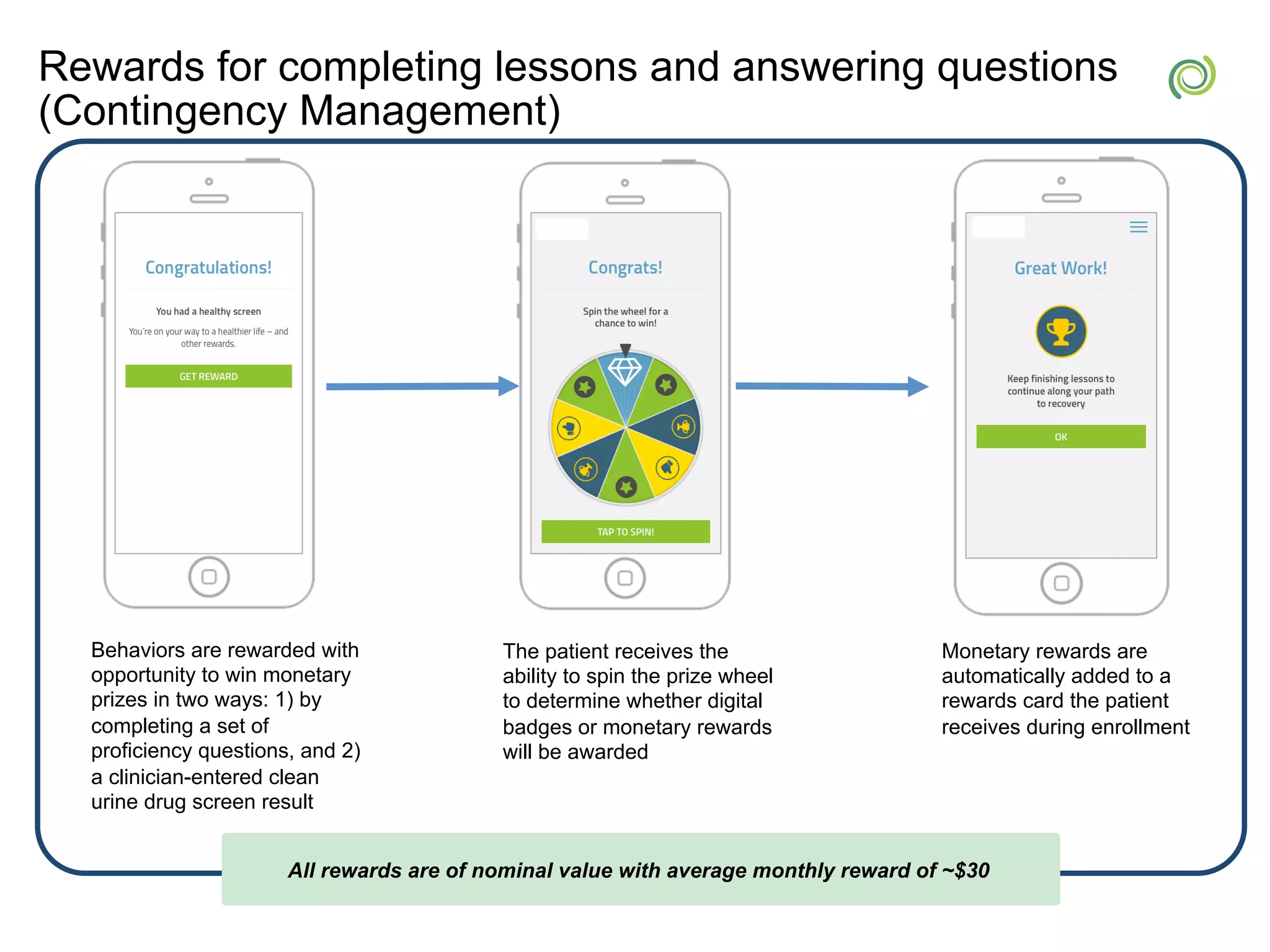
Rewards for completing lessons and answering questions
(Contingency Management)
All rewards are of nominal value with average monthly reward of ~$30
Behaviors are rewarded with
opportunity to win monetary
prizes in two ways: 1) by
completing a set of
proficiency questions, and 2)
a clinician-entered clean
urine drug screen result
The patient receives the
ability to spin the prize wheel
to determine whether digital
badges or monetary rewards
will be awarded
Monetary rewards are
automatically added to a
rewards card the patient
receives during enrollment
Clinician-facing dashboards features: Lesson progress
Clinician-facing dashboards features: Cravings and Triggers
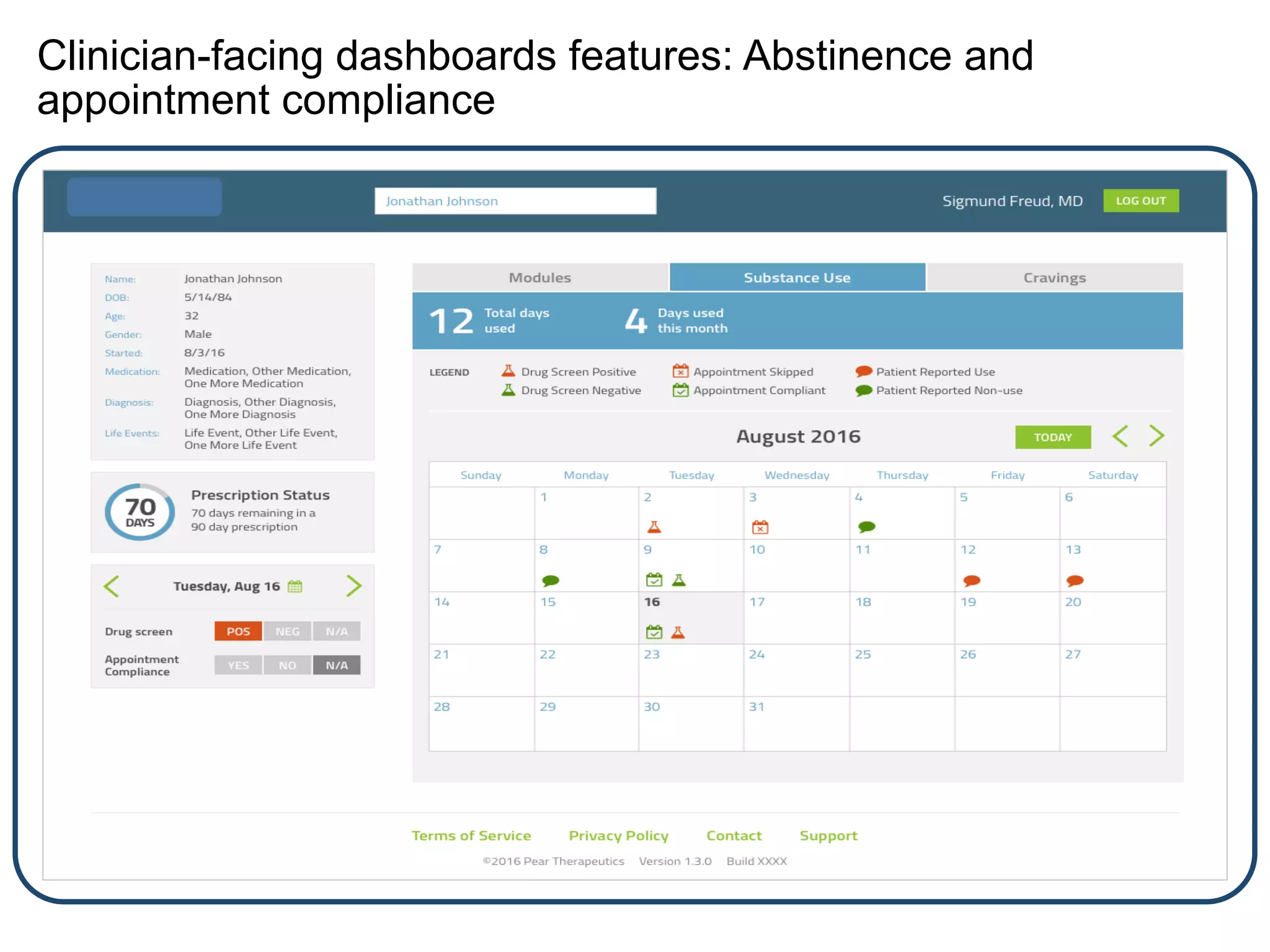
Clinician-facing dashboards features: Abstinence and
appointment compliance
reSETTM: Patient-facing features
Confidential- do not distribute 40
Cravings &
Trigger
Assessments Mobile
Dashboard
Fluency
Training
CBT Modules Contingency
Management
Patient
reSETTM and reSET-OTM are not available for sale in the USA
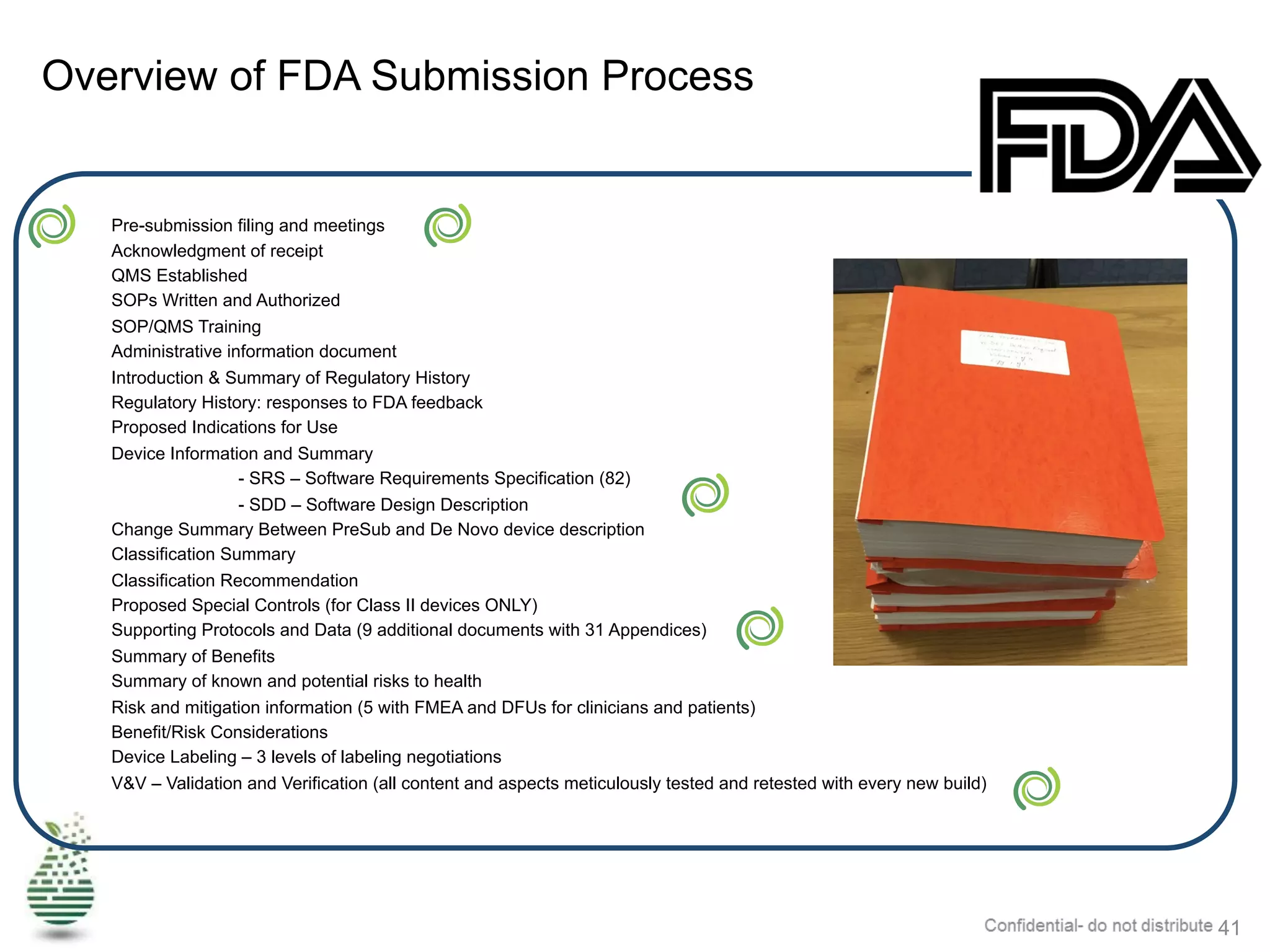
Overview of FDA Submission Process
Pre-submission filing and meetings
Acknowledgment of receipt
QMS Established
SOPs Written and Authorized
SOP/QMS Training
Administrative information document
Introduction & Summary of Regulatory History
Regulatory History: responses to FDA feedback
Proposed Indications for Use
Device Information and Summary
- SRS – Software Requirements Specification (82)
- SDD – Software Design Description
Change Summary Between PreSub and De Novo device description
Classification Summary
Classification Recommendation
Proposed Special Controls (for Class II devices ONLY)
Supporting Protocols and Data (9 additional documents with 31 Appendices)
Summary of Benefits
Summary of known and potential risks to health
Risk and mitigation information (5 with FMEA and DFUs for clinicians and patients)
Benefit/Risk Considerations
Device Labeling – 3 levels of labeling negotiations
V&V – Validation and Verification (all content and aspects meticulously tested and retested with every new build)
41
Confidential- do not distribute 42
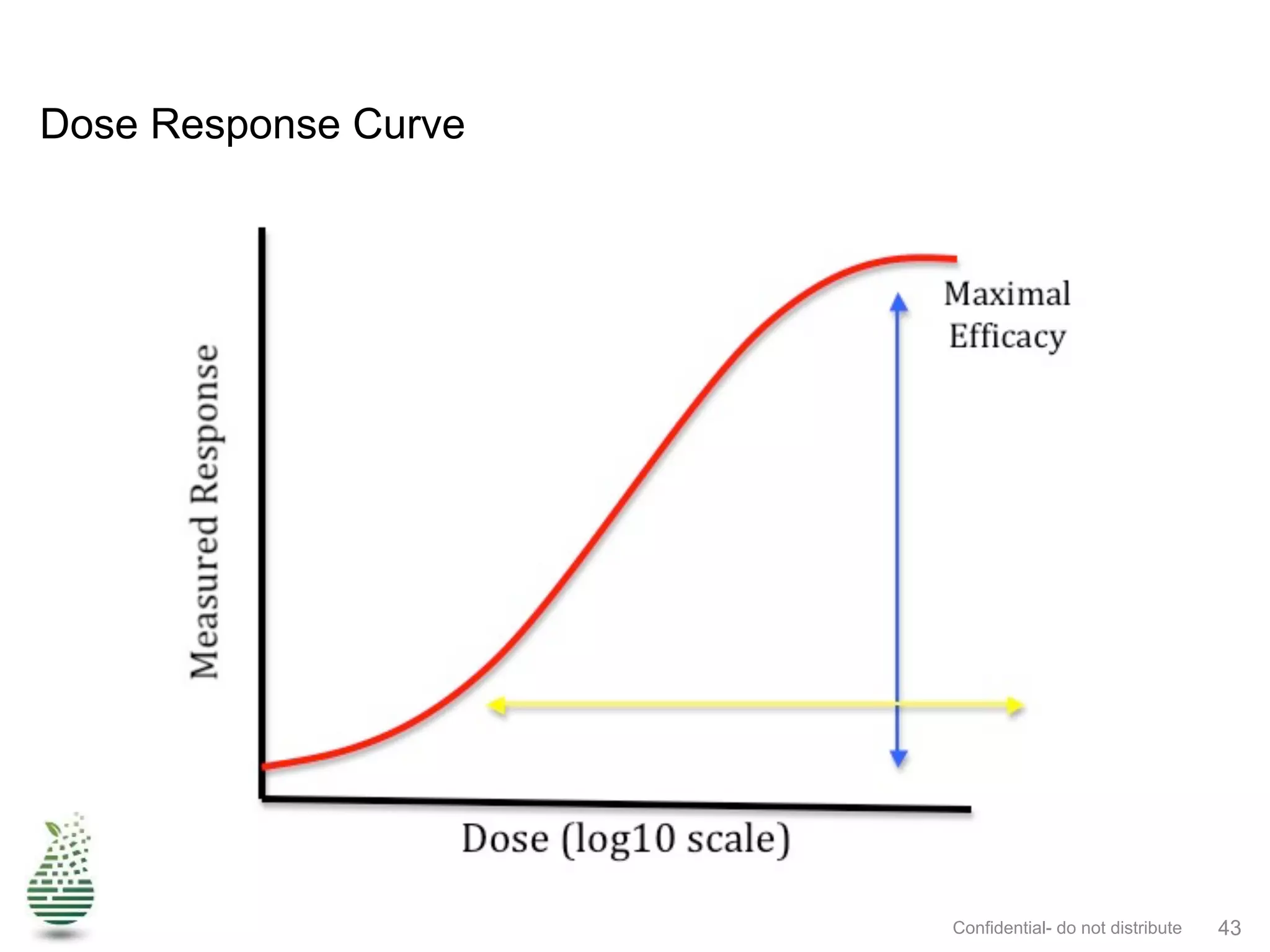
Dose Response Curve
Confidential- do not distribute 43
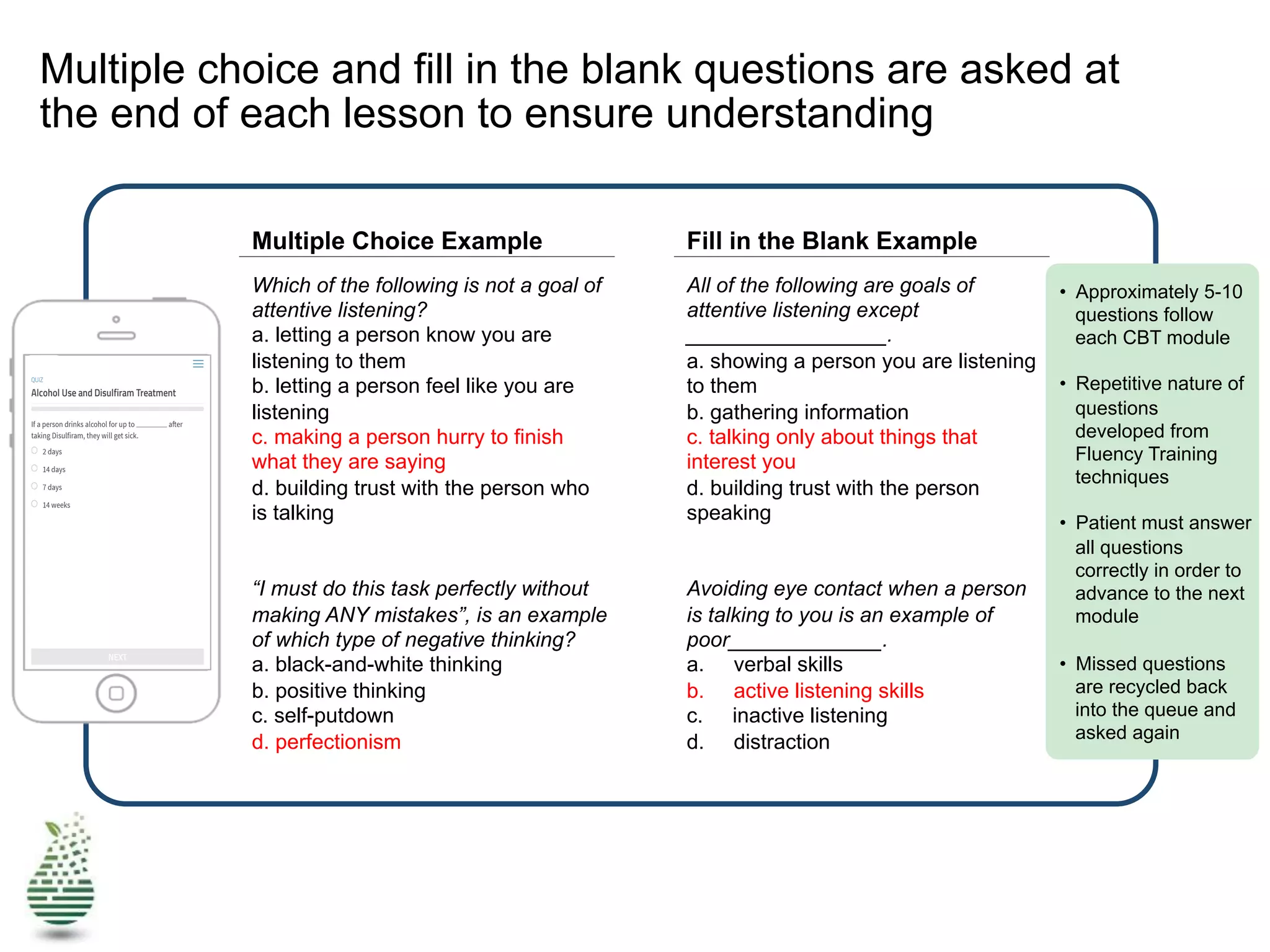
Multiple choice and fill in the blank questions are asked at
the end of each lesson to ensure understanding
Multiple Choice Example Fill in the Blank Example
Which of the following is not a goal of
attentive listening?
a. letting a person know you are
listening to them
b. letting a person feel like you are
listening
c. making a person hurry to finish
what they are saying
d. building trust with the person who
is talking
“I must do this task perfectly without
making ANY mistakes”, is an example
of which type of negative thinking?
a. black-and-white thinking
b. positive thinking
c. self-putdown
d. perfectionism
All of the following are goals of
attentive listening except
_________________.
a. showing a person you are listening
to them
b. gathering information
c. talking only about things that
interest you
d. building trust with the person
speaking
Avoiding eye contact when a person
is talking to you is an example of
poor_____________.
a. verbal skills
b. active listening skills
c. inactive listening
d. distraction
•  Approximately 5-10
questions follow
each CBT module
•  Repetitive nature of
questions
developed from
Fluency Training
techniques
•  Patient must answer
all questions
correctly in order to
advance to the next
module
•  Missed questions
are recycled back
into the queue and
asked again
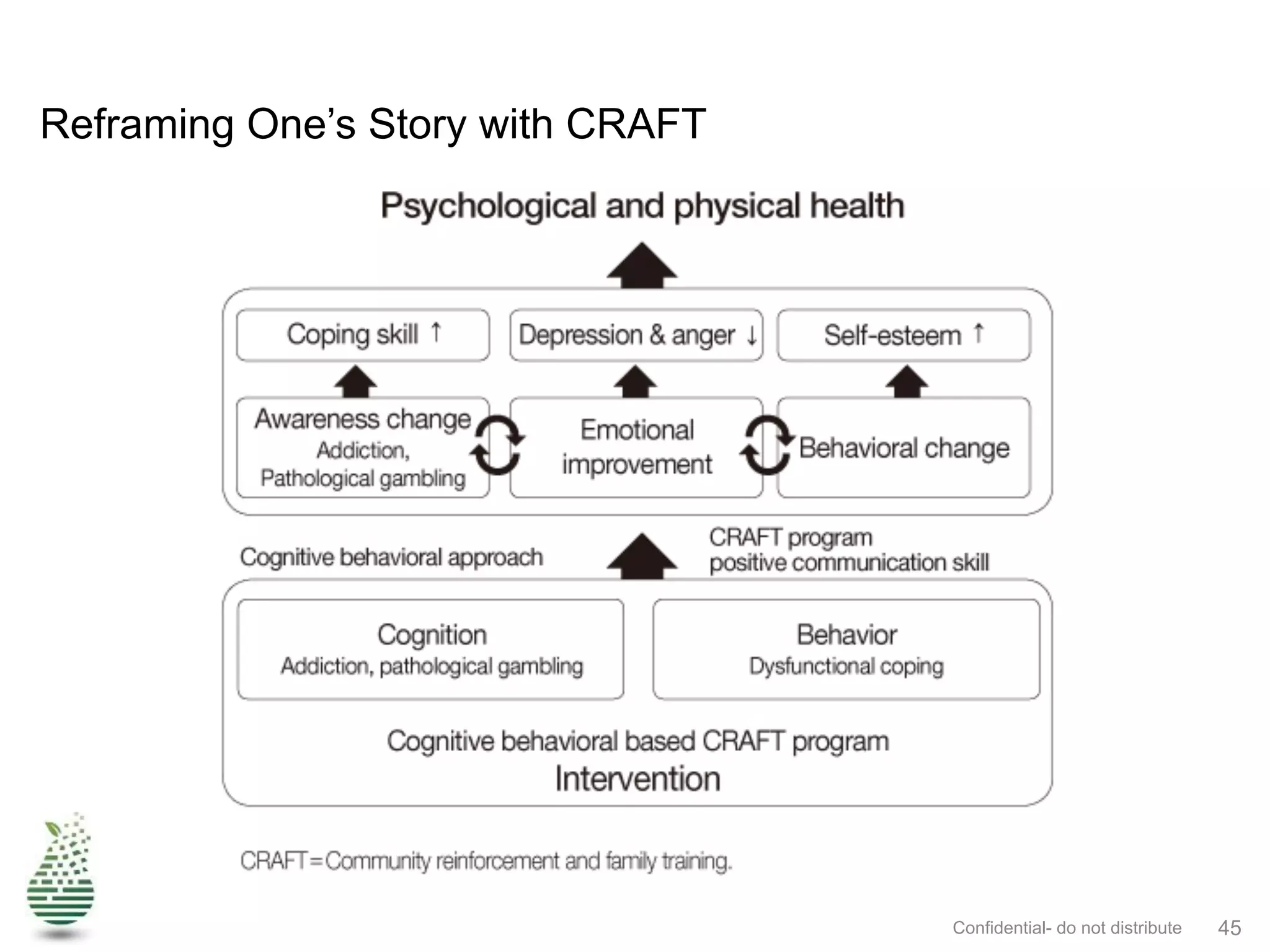
Reframing One’s Story with CRAFT
Confidential- do not distribute 45
Neurologists have Proven that
Humans are Wired for Story
Research shows that STORY:
• Provides superior retention
(memory and recall)
• Provides improved
understanding
• Creates context and relevance
• Creates empathy
• Makes readers/listeners pay
attention
• Enhances the creation of
meaning
Story and Your Brain


   Nemesis, Love Interest, Obstacles, and
Layered Emotions.
DONKEY KONG (1981)
Context IS Storytelling
1. CHARACTER
2. CHARACTER TRAITS
3. GOAL
4. MOTIVE
5. CONFLICTS/PROBLEMS
6. RISK & DANGER
7. STRUGGLES
8. DETAILS
Order	
  
ResoluMon	
  
Chaos	
  
Disruption
Conflict/Struggle
Hero’s Journey
The Eight Essential Elements
PROJECT 28 DAYS
UIUX / Story world Aesthetic
90s action movies / GTA III illustrations
Grand Theft Auto meets the SIMS
Confidential- do not distribute 50
Characters, Goals, Motives, Conflicts, Struggles….
Confidential- do not distribute 51
r the right or wrong answer is selected. When the pl
priate response to enhance in the moment learning.
B C
Details = Engagement
Confidential- do not distribute 52
ed. When the player choses incorrectly, the
oment learning.
C
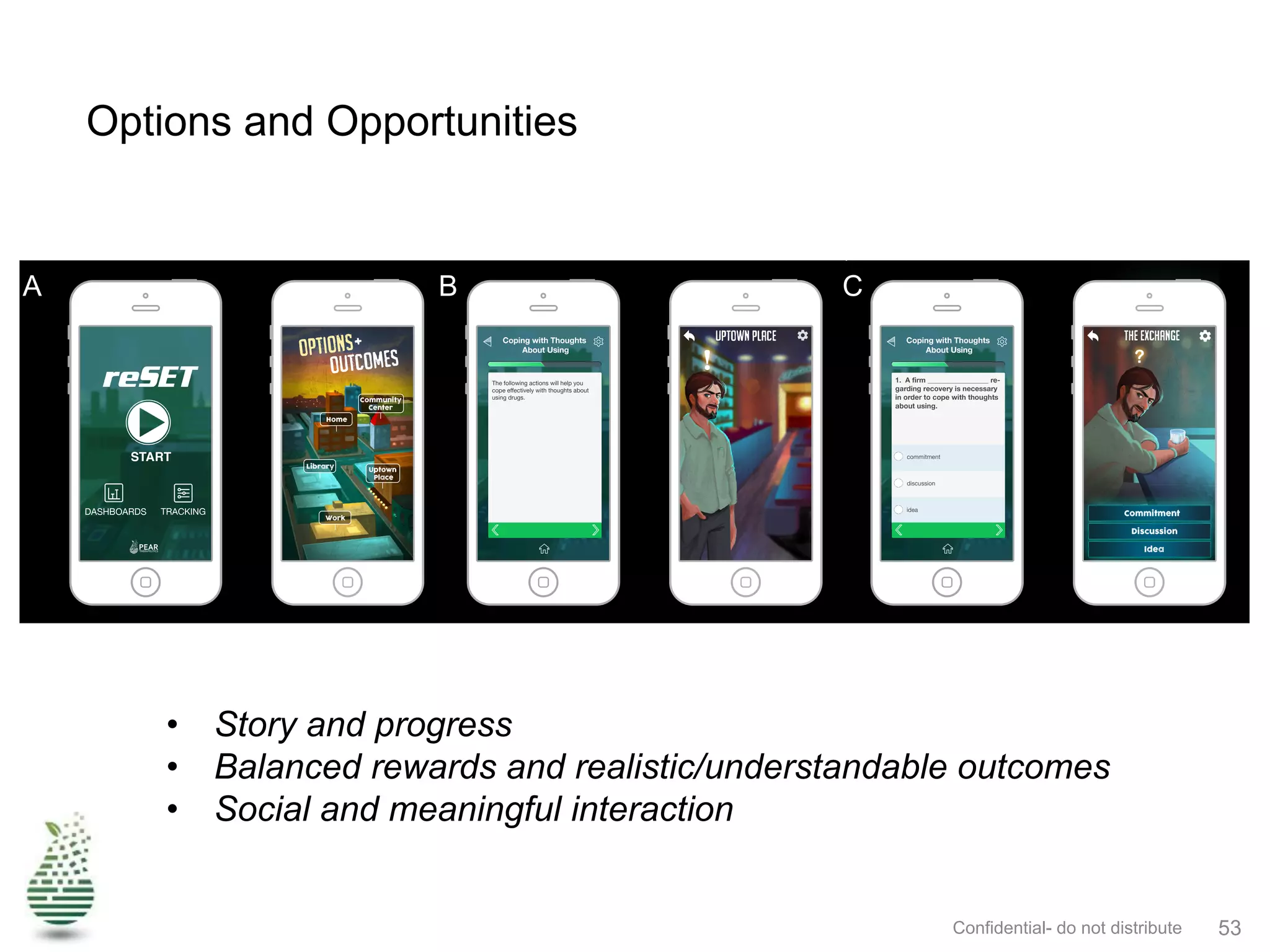
Options and Opportunities
Confidential- do not distribute 53
scrolled from side-to-side to show the 3D city and its locations. Once a location has been selected, a character
will deliver module content with voice and animated movements. The "!" symbol shown in Figure 3B indicates
that the character can be tapped to present the next content sequence in the module. O&O will also utilize fluency
training following most modules with characters presenting questions about the lesson content (Figure 3C).
Tapping the "?" symbol will prompt the character to ask the next question. The list of multiple choice question
answers on the bottom of the screen will be selected by tapping the screen, prompting a specific reaction from
the character based on whether the right or wrong answer is selected. When the player choses incorrectly, the
character will explain the appropriate response to enhance in the moment learning.
Figure 5. A comparison of reSET (left) and O&O(right). A. The home screen. Modules can be accessed in the different “locations” within
O&O. B. Example of module content delivery. The “!” symbol indicates that the character can be tapped to present the next sequence
of module content. C. Fluency training sample question. Tapping the "?" symbol prompts the character to ask the next question while
tapping an answer from the list below prompts a reaction from the character showing a right or wrong answer.
O&O will be played by exploring the city locations, learning the lessons presented at each location by the
characters there and successfully completing the fluency training tied to each location. Gameplay will follow a
linear progression and successful completion of prescribed modules will be required to advance to new locations
and modules. Like reSET, O&O modules will be designed to take 20-30 minutes to complete. Players will earn
virtual reward items such as keys, badges, and prize wheel spins, using the contingency management system
developed for reSET. Rewards will be provided for making good choices, module completion, prefect proficiency
A B C
•  Story and progress
•  Balanced rewards and realistic/understandable outcomes
•  Social and meaningful interaction
Serious Games in a Regulated Environment
•  Bring best practices to new worlds
•  Work with existing structures and mores
•  Enlist the early input of experts – both domain
experts and systems experts
•  Push the envelope
•  Build great Games for Good
Confidential- do not distribute 54
The Challenges of Creating Mobile Games for Regulated Health Situations

The Challenges of Creating Mobile Games for Regulated Health Situations

  • 1.
    Serious Games ina Regulated Environment: Games and Apps as Digital Medicine Beth Rogozinski, Chief Content Officer Serious Play Conference 2017
  • 2.
    Confidential - DoNot Distribute 2 Agenda and Objectives Play and Games for Serious Health Issues Pear Therapeutics and Digital Medicine Agile Dev Meets Regulatory: reSET Case Study Enhancing within the Boundaries Brining Game Best Practice and Design to Healthcare
  • 3.
    PEAR Therapeutics –the leader in digital therapeutics PEAR is a fully integrated digital therapeutics company, developing regulated, reimbursed, prescription digital therapeutics We are a venture-backed company with a 40-person team in Boston and SF with expertise in software design & engineering, clinical development, regulatory affairs, and product commercialization and reimbursement We have developed a modular, cloud-based platform to deliver eFormulationsTM and our lead product, reSETTM, significantly improved abstinence in 6 randomized controlled trials in Substance Use Disorder, paving the way for it to be the first FDA- approved digital therapy in 1H 2017. We also have programs treating Opiate Dependence, Schizophrenia, and PTSD and other serious disorders. Confiden'al  –  Do  Not  Distribute   3   Our mission is to commercially develop and distribute clinically validated, FDA regulated, digital therapeutics to treat diseases of the brain in order to improve clinical outcomes and lower overall treatment costs
  • 4.
    Agile Game andApp Development for Mental and Behavioral Health with Medical Regulatory Oversight Confidential- do not distribute 4 Clinical Product Design Process
  • 5.
  • 6.
    9 148Alzheimer’s disease 123Obesity Addiction 366 Multiplesclerosis Parkinson’s disease 10 Spinal cord injury 15 Epilepsy 16 Schizophrenia 33 Anxiety 47 Hearing loss 50 Vision 52 Traumatic brain injury 56 Stroke 57 Sleep disorders 75 Attention disorders 77 Depressive disorders 83 Chronic pain 95 1. 2012 values; Includes both direct and indirect cost of disease Source: NeuroInsights, Office of Nat’l Drug Policy, American Psych. Assoc., Cost of Brain Disorders Europe 0.4 2.0 0 1 2 un- served under- served Total pts 0.7 served 0.9 U.S. Economic Burden1 for CNS disease, 2012 $ Billion Global patient pop. for CNS disease Billion patients CNS: Huge Unmet Need Estimated U.S. economic burden of common brain-related illnesses exceeds $1.3 trillion per year and worldwide burden exceeds $2 trillion per year Approximately 80% of the world market for brain related treatments is currently either unserved or underserved Confidential- do not distribute 6
  • 7.
    Costs and Consequences:Mental Illness and Addiction
  • 8.
    Digital health isbecoming the most effective means of delivering behavioral treatment programs Confidential- do not distribute 8 “Of the 26 trials, 23 demonstrated some evidence of effectiveness relative to controls… Conclusion: Internet interventions for depression and anxiety disorders offer promise.” “In adolescents with mild to moderate depression, the remission rate for those using SPARX greater than that of the usual face-to-face therapy.” “Video game- based training resulted in performance benefits with enhanced sustained attention and working memory...and preservation of multitasking improvement 6 months later.”
  • 9.
    Confidential- do notdistribute 9 Experience- dependent cognitive and rehab programs Chemical agent (i.e. supplement or medication) =+ Neuroplasticity: Chemistry + Cognitive Training Current standard of care
  • 10.
    Confidential - DoNot Distribute 10 Digital therapies create medical value in areas of high patient need – Mental and Behavioral Health The US spends ~ $1.3 Trillion per year on CNS illnesses (psychiatry, neurology, and pain) with 80% of the world market currently unserved or underserved High Unmet Need Few new drug therapies are set to come to market for CNS diseases, and the pipeline is particularly thin for mental health and addiction conditions Few New Therapies The Affordable Care Act and the Mental Health Parity and Addiction Equity Act are driving reimbursement of care for brain related diseases including new devices and drugs Favorable Reimbursement Software-based therapies have shown efficacy in treating brain related diseases and also in enhancing the efficacy of approved CNS medications Clinical Proof of Concept
  • 11.
    Healthcare Psychographic Segments BalanceSeekers (18%) •  Open to many ideas and options, as long as they make sense for me •  Need context to understand ideas and recommendations Strong Survivors (27%) •  There are more important things in my life to focus on than improving my health •  Live in the “here and now” Self Achievers (24%) •  Take ownership of my health and actively take steps to be healthy •  Focus on achieving my goals and objectives •  Disease is another challenge to overcome Active Listeners (13%) •  Look to physician and other healthcare professionals for guidance and direction on what to do to address my disease C2B Solutions Proactive Reactive Priority Jugglers (18%) •  Worry about my family’s health more than my own •  Constantly on the go, juggling many responsibilities so getting sick is not an option
  • 12.
    Proactive Target Audience Motivators:INTRINSIC efficiencies CONTROL social COMMUNICATIONS   Who  are  they?   •     60%  are  female   •     Primarily  “Achievers”  and  “Belongers”  goal  oriented  –  successful  -­‐  Driven   •     Between  the  age  of  35-­‐65  (Sweet  Spot  –  mid  45-­‐54)   •     Married/aKached  professionals  with  families  and  very  busy  lives   •     Above  average  educaMon  level  –    managers,  execuMves,  professionals   •     Higher  than  average  disposable  income  levels  and  spending  tendencies       •     They  are  connected  via  tech,  socially  connected  and  integrated   What  do  they  look  for  in  health/wellness     •     Professional  and  friendly  communicaMons  and  style   •   Value,  reliability  –  relaMonship  and  trust  come  first   •   Simple,  easy  to  use  system  that  fits  their  busy  schedule     •   One  stop  place  to  hold  medical  records  and  other  data  –  can  be  shared  with  docs   •   Price  is  not  primary  –  will  pay  more  at  first  –  but  demands  quality   • Transparent,  open  easy  communicaMons  and  informaMon   • Technical  and  mulM-­‐plaWorm  access     Business  Indicators:   •   Heavy  user  of  technology   •   Connected  across  social  networks,  LI,  FB,  Tw   •   Involved  in  group  events  and  community  –  K  Factor     •   Fastest  growing  segments  of  casual  gamers   •   Price  not  a  top  issue,  but  efficiency  is   •   Willing  to  pay  for  Premium  Services/Supplements     Women,  middle  aged,  healthy  lifestyles,  well  educated,  higher  income,  ac6ve  and  fit   http://www.aafp.org/media-center/releases-statements/all/kits/052908.html
  • 13.
    Proactive Identity Customer • Professional working manager/executive, professional •  Married with kids – lives in Bay Area – travels around the bay for meetings and events. Partner has good job at tech firm •  Health focused – bikes, runs, hikes, does yoga – passionate about fitness, food and wellbeing •  Competent and DIY focused – but smart enough to ask for help when needed •  Passionate about SERVICE and QUALITY •  Connected and involved in her community – volunteers and gets out to contribute from self and company •  Is honest and expects honesty and open communications Self-motivated Can be directly monetized Seeks help and connections Intrinsic rewards are enough
  • 14.
    Reactive Target Audience Motivators:EXTRINSIC   Needs Driven REWARDS SOCIAL RECOGNITION   Who  are  they?   •   55%  are  female   •   Needs  Driven  and  Emulators  –  can  cross  all  categories     •     Between  the  age  of  40-­‐59   •     Divorced,  unemployed/under  employed     •   Average  or  below  educaMon  level   •     Uninsured,  underinsured  or  government  insured     •     They  are  less  connected  via  tech,  and  not  socially  connected  or  integrated   What  do  they  look  for  in  health/wellness     •     Access  and  availability  –  cost  and  access  paramount     •   RelaMonship  with  doctor/caregiver  –  may  be  transferred   •   Simple,  easy  to  use  system  –  easily  frustrated     •   One  stop  place  to  hold  medical  records  and  other  data  –  can  be  shared  with  docs   •   Price  is  a  primary  –  may  exchange  ads/acMviMes  for  free  access   •   Transparent,  open  easy  communicaMons  and  informaMon   • May  have  single  point  of  access  –  oden  phone  or  computer  only   Business  Indicators:   •   They  trust  the  doctor,  but  not  medicaMons   •   May  not  be  digitally  inclined   •   Compliance  requires  reminders  and  rewards   •   Easily  bored  and  frustrated   •   Ads  in  exchange  for  payment/Price  is  an  issue   •   MoneMzaMon  would  be  via  external  sources   Women,  middle  aged,  lifestyle  issues  and  concerns,  less  educated/lower  socio-­‐economic   status,  o;en  mul6ple  health  concerns/symptoms  
  • 15.
    Reactive Identity Customer • Working single mom •  Lives in suburban areas and takes public transit to work •  Family and socially focused - not health focused - but may be focused on looks and beauty products •  Competent and capable - Seeks outside help as a last resort for fear of seaming incompetent •  Demands and requires equal access and treatment •  Connected and involved in her family, church and local circles •  Works hard and desires recognition for work and achievements Situational motivations May be directly monetized – though exchange of ads/actions may be preferred Will seek help locally – church, family Extrinsic and recognition rewards may be more compelling
  • 16.
    Confidential - DoNot Distribute 16 Games and Apps as Medicine Traditional Emotional Motivation Game/App Approach Apprehension,  uncertainty,  wai6ng,   expecta6on,  fear  of  surprise  do  a   pa6ent  more  harm  than  any  exer6on.       Florence  Nightengale   Notes  on  Nursing  1859    
  • 17.
    Confidential - DoNot Distribute 17 Games and Apps as Medicine
  • 18.
    Confidential - DoNot Distribute 18 Serious Issues Limit the Impact of Digital Therapeutics •  Focus on health and wellness use cases •  Limited clinical evidence for efficacy; small longitudinal studies relying on patient reported data •  Due to regulatory limitations, unable to promote disease treatment claims or modify drug dosing •  Unclear distribution channels with physician confusion regarding path to patients •  Lack of third-party payer reimbursement without clear means for coding and payment Traditional business model •  Focus on diseases with high unmet need •  Efficacy evaluated via RCTs versus current standard of care utilizing existing approvable endpoints •  Filing for FDA approval with claims to assess/treat disease and integrate with medication •  Marketed directly to physicians as a prescription product with access codes conferring patient access •  Medical device with product codes and reimbursement supported by health economic analyses PEAR’s approach
  • 19.
    The FDA andRegulated Healthcare •  Formed in 1906 by Pres. Roosevelt to protect citizens against worthless “cures” and adulterated foods and pharmaceuticals •  Continuously updated to reflect modern times •  Focus – safety and efficacy Confidential- do not distribute 19 FTC fines for: Lumosity, Carrot Neurotech, AcneApp
  • 20.
    Confidential- do notdistribute 20 Data Driven
  • 21.
    Subclinical Apps andPlatform Live in 2015 Confidential- do not distribute 21
  • 22.
    Confidential - DoNot Distribute 22 Indication Content Partner Prototype Pilot study Pivotal studies FDA submission FDA approval We have developed a pipeline of eFormulationsTM treating areas of high unmet medical need Stage In-licensed Internal Product FDA PreSub Opiate Dependence Schizophrenia Substance Use Disorder reSET-OTM reSETTM ThriveTM Combat-PTSD reCALLTM Insomnia PEAR-006 General Anxiety Disorder reVIVETM Traumatic Brain Injury PEAR-007 ADHD PEAR-008 Major Depressive Disorder Acute & Chronic Pain PEAR-010 PEAR-009
  • 23.
    A Common Struggle– SUD and OUD a Nationwide Epidemic •  In 2015 only 11% of the estimated 22.7 million Americans in need of treatment for SUD received any formal treatment •  Over $740B in annual costs from healthcare, productivity and crime •  Addiction and overdose have surpassed car accidents as a leading cause of death in young men •  91 people a day are overdosing and deaths > 2 jets a week crash landing •  Health impacts are profound and include abscesses, cellulitis, pneumonia, heart failure, HIV and Hep C •  High rates of comorbidities – causative or reflective directionality Confidential- do not distribute 23
  • 24.
    Why Digital Therapiesare Needed Current State of Care •  Diagnosis occur too late –  Jail, hospital, death •  Stigma and shame •  Expensive, not available and not scalable –  Desserts of care for all mental health •  High friction for patients –  Removed from home, work, stressors and triggers •  Inconsistent treatment Pear Tx Digital Treatment •  Digital can allow exploration and early intervention •  Private – apps are all HIPAA secure and CFR-42 compliant •  Effective, available and scalable –  BYOD – patients already online •  Always on and always available –  168 hours in the week •  Consistent approach that is gamified and engaging and can be personalized Confidential- do not distribute 24
  • 25.
    Addiction: Enslaved •  Learningdisorder – double edge sword of neuroplasticity •  Often have no positive feedback or affirmations in their lives – or the drug/substance confused with rewards •  Success requires overcoming shame and focusing on the moment (MBSR) and learning new life skills •  Risk taking patients particularly tied to rewards Confidential- do not distribute 25
  • 26.
    PROJECT 28 DAYS– PEAR-001 Persona 1 Anthony  Addict   DETAILS     •  Over  30-­‐40,  Anglo     •  Lives  in  a  urban  center   •  Unemployed,  on  welfare   •  Owns  older  smartphone   •  Psychologically  and   Physiologically  addicted   •  Uses  opioids  1/day   •  Uses  opioids  habitually   to  stave  off  withdrawal   •  Difficulty  controlling   drug-­‐taking  behavior   •  Post  rehab  and  going   through  city  clinics   •  Post-­‐detox     GOALS     •  Hit  rock  boYom  with   an  arrest  and  going   through  the  long   process  of  recovering   from  dependence   •  Wants  to  stay  out  of   jail  via  mee'ng  terms   of  proba'on  including   treatment,   counseling,  and   tes'ng  
  • 27.
    PROJECT  28  DAYS  /  PEAR-­‐001  -­‐  PEARTX  ADDICTION  TREATMENT  APP  V1  -­‐  AGILE  VISION  BOARD   A  SMARTPHONE  APP  THAT,  PAIRED  WITH  MEDICAL  TREATMENT,     IMPROVES  OUTCOMES  FOR  RECOVERING  SUD/OUD  PATIENTS     Needs     •  Rewards  you  for   par'cipa'ng  in  your   own  treatment   •  Teaches  you  the   proven  skills  and   behaviors  to   overcome  addic'on   •  Gives  you  the  tools   for  a  beYer  life   •  Enhances  the   effec'veness  of  your   treatments   •  By  tracking  progress,   gives  you  and  your   doctor  beYer  info  to   help  you     Target  Group       Primary   •  80%  Male   •  Anglo   •  28-­‐46,  median  37   •  English  speaking   •  Own  a  smartphone   Secondary   •  Physicians,  Clinicians   &  Assistants   •  Medical  Researchers     Business  Goals     •  Creates  reoccurring   revenue  stream  from   city,  county  &  state   clinics   •  Provides  strategic   value  as  our  first  FDA   approved  product   •  Bellweather  for   poten'al  pharma   partners   •  Validates  IP  and  thus   provides  business   proof  to  addi'onal   investment  and  /or   poten'al  acquirers     Product     •  A  smartphone  app   •  App  that  presents  and   test  cogni've   behavioral  therapy   •  App  presents  and   tests  fluency  training   •  App  gives   mo'va'onal   incen'ves   •  Server  can  push  and   app  can  display  self   tracking  data  to  user  
  • 28.
    reSET®, is ontrack to be the first FDA-approved digital therapy with efficacy claims for the treatment of substance use disorder (SUD) Introducing reSET® for treatment of SUD •  reSET® is a prescription digital therapy for treating SUD by delivering addiction-specific Cognitive Behavioral Therapy (CBT), Fluency Training, and Contingency Management •  The concept product was developed at Dartmouth’s Geisel School of Medicine by Lisa Marsch, PhD •  reSET® and reSET-OTM have been evaluated in 5 published randomized clinical studies involving over 1500 patients, and has attracted more than $45M in National Institute of Health (NIH) funding1-4 •  In a multi-center randomized trial consisting of 507 patients seeking treatment for SUD, reSET® enhanced abstinence versus in-office treatment (p = 0.003)5 •  reSET® is projected for approval in 1H 2017 as a class II medical device with claims for treatment of SUD to and enhance abstinence and retention in treatment 1 Experimental &Clinical Psychopharmacology. 2008. 16(2):132-143. 2 Substance Use and Misuse. 2011. 46(1):46-56. 3 American Journal of Psychiatry. 2014. 171(6):683-690. 4 Journal of Substance Abuse Treatment. 2014. 46: 43-51. 5 Campbell et al. Am J Psychiatry. 2014. Confiden'al  –  Do  Not  Distribute   28  
  • 29.
    In the pivotalclinical trial, reSET doubled rates of abstinence versus treatment as usual (TAU) 507 patients with Substance Use Disorder at 10 nationwide treatment centers were randomized to 12 weeks of typical outpatient treatment (TAU) vs Product X with limited clinician exposure and abstinence was measured through urine analysis and self reports TAU Product X Week 4 6 7 8 9 10 1153210 12 10 20 30 40 50 0 %Abstinent Week 9-12 29.7% (n=255) 16.0% (n=252) 2.22 (1.24, 3.99) 0.0076 Time PointPopulation All comers Week 9-12 10.1% (n=113 ) 3.0% (n=119) 3.59 (1.36, 9.48) 0.0099 Non-abstinent at start Product X TAU Odds Ratio (95% CI) P-value*
  • 30.
    reSET enhanced retentionin treatment relative to treatment as usual (TAU) Treatment Retention Patients receiving reSET were significantly more likely to be retained in treatment vs those receiving treatment as usual TAU Product X P-value Patients remaining in treatment 63.5% (n=252) 72.2% (n=255) 0.0316 Time (weeks) PercentageRemaininginTreatment 2 4 6 8 10 12 60 70 80 90 100 0 0
  • 31.
    Treatment Retention ModuleCompletion Time (weeks) Average#modules completedperweek Module Retention Averagetimespenton modules(inminutes) Time (weeks) TAU reSET® P = All- Comers 36.5% (n=252) 27.8% (n=255) 0.0316 Time (weeks) PercentageRemaininginTreatment Abstinent Non-Abstinent 0 1 2 3 4 5 6 7 8 9 10 11 12 20 40 60 Abstinent Non-Abstinent 1 2 3 4 5 6 7 8 9 10 11 12 Abstinent Non-Abstinent 0 1 2 3 4 5 0 2 4 6 8 10 12 60 70 80 90 100 reSET® enhanced retention in treatment relative to TAU, and patients showed strong rates of engagement reSET™ Treatment as usual (TAU) Patients receiving reSET® were significantly more likely to be retained in treatment Patients remained engaged with reSET® throughout the duration of the clinical trial Confiden'al  –  Do  Not  Distribute   31  
  • 32.
    Confiden'al-­‐  do  not  distribute   32  
  • 33.
    reSET includes includesboth a patient-facing intervention and clinician-facing dashboards Health Care Professional Concept Proficiency Abstinence and Appointments Module Use Cravings and Triggers Patient Mobile Dashboard CBT Modules Contingency Management Craving & Trigger Assessment Fluency Training
  • 34.
    Cognitive Behavioral Therapy(CBT) Modules for reSETTM Confidential- do not distribute 34 Core Modules Optional Modules 1. Training Module 2. What is Functional Analysis? 3. Conducting a Functional Analysis 4. Self-Management Planning 5. Introduction to Problem Solving 6. Effective Problem Solving 7. Drug Refusal Skills Training 8. Seemingly Irrelevant Decisions 9. Coping with Thoughts about Using 10. Awareness of Negative Thinking 11. Managing Negative Thinking 12. Managing Thoughts about Using 13. Managing Negative Moods and Depression 14. Decision-Making Skills 15. Increasing Self-Confidence in Decision-Making 16. Introduction to Assertiveness 17. How to Express Oneself in an Assertive Manner 18. Introduction to Giving Criticism 19. Steps for Giving Constructive Criticism 20. Receiving Criticism 21. Giving and Receiving Compliments 22. Communication Skills 23. Nonverbal Communication 24. Social Recreational Counseling 25. Attentive Listening 26. Sharing Feelings 27. HIV and AIDS 28. Sexually Transmitted Infections (STIs) 29. Sexual Transmission of HIV and STIs 30. Drug Use, HIV and Hepatitis 31. Identifying/Managing Triggers for Risky Sex 32. Identifying/Managing Triggers for Risky Drug Use 1. Vocational Counseling 2. Financial Management 3. Insomnia 4. Time Management 5. Introduction to Relaxation Training 6. Progressive Muscle Relaxation Training 7. Progressive Muscle Relaxation Generalization 8. Introduction to Anger Management 9. How to Become More Aware of the Feeling of Anger 10. Coping with Anger 11. Relationship Counseling – Part 1 12. Relationship Counseling – Part 2 13. Relationship Counseling – Part 3 14. Hepatitis 15. Alcohol Use and risk for HIV, STIs and Hepatitis 16. Getting Tested for HIV, STI and Hepatitis 17. Finding More HIV, STI and Hepatitis Information 18. The Female Condom 19. Negotiating Safer Sex 20. Taking Responsibility for Choices 21. Birth Control Use and HIV and STIs 22. Living with HIV: Communication Skills for Disclosing HIV Status 23. Living with HIV: Drug Use and Immune System 24. Living with HIV: Managing Treatment and Medications 25. Living with HIV: Daily Routines to Promote Health 26. Living with Hepatitis C: Coping Skills 27. Living with Hepatitis C: Managing Treatment, Promoting Health 28. Naltrexone 29. Limited Alcohol Use 30. Alcohol and Disulfiram •  32 core modules and 30 optional modules •  Each module intended to last ~20-30 minutes with real-world use suggesting average completion time of ~10 minutes •  Content presented as a mix of video, audio, and still images reSETTM and reSET-OTM are not available for sale in the USA
  • 35.
    Tracking feature forself-report usage, cravings and triggers
  • 36.
    Rewards for completinglessons and answering questions (Contingency Management) All rewards are of nominal value with average monthly reward of ~$30 Behaviors are rewarded with opportunity to win monetary prizes in two ways: 1) by completing a set of proficiency questions, and 2) a clinician-entered clean urine drug screen result The patient receives the ability to spin the prize wheel to determine whether digital badges or monetary rewards will be awarded Monetary rewards are automatically added to a rewards card the patient receives during enrollment
  • 37.
  • 38.
  • 39.
    Clinician-facing dashboards features:Abstinence and appointment compliance
  • 40.
    reSETTM: Patient-facing features Confidential-do not distribute 40 Cravings & Trigger Assessments Mobile Dashboard Fluency Training CBT Modules Contingency Management Patient reSETTM and reSET-OTM are not available for sale in the USA
  • 41.
    Overview of FDASubmission Process Pre-submission filing and meetings Acknowledgment of receipt QMS Established SOPs Written and Authorized SOP/QMS Training Administrative information document Introduction & Summary of Regulatory History Regulatory History: responses to FDA feedback Proposed Indications for Use Device Information and Summary - SRS – Software Requirements Specification (82) - SDD – Software Design Description Change Summary Between PreSub and De Novo device description Classification Summary Classification Recommendation Proposed Special Controls (for Class II devices ONLY) Supporting Protocols and Data (9 additional documents with 31 Appendices) Summary of Benefits Summary of known and potential risks to health Risk and mitigation information (5 with FMEA and DFUs for clinicians and patients) Benefit/Risk Considerations Device Labeling – 3 levels of labeling negotiations V&V – Validation and Verification (all content and aspects meticulously tested and retested with every new build) 41
  • 42.
    Confidential- do notdistribute 42
  • 43.
  • 44.
    Multiple choice andfill in the blank questions are asked at the end of each lesson to ensure understanding Multiple Choice Example Fill in the Blank Example Which of the following is not a goal of attentive listening? a. letting a person know you are listening to them b. letting a person feel like you are listening c. making a person hurry to finish what they are saying d. building trust with the person who is talking “I must do this task perfectly without making ANY mistakes”, is an example of which type of negative thinking? a. black-and-white thinking b. positive thinking c. self-putdown d. perfectionism All of the following are goals of attentive listening except _________________. a. showing a person you are listening to them b. gathering information c. talking only about things that interest you d. building trust with the person speaking Avoiding eye contact when a person is talking to you is an example of poor_____________. a. verbal skills b. active listening skills c. inactive listening d. distraction •  Approximately 5-10 questions follow each CBT module •  Repetitive nature of questions developed from Fluency Training techniques •  Patient must answer all questions correctly in order to advance to the next module •  Missed questions are recycled back into the queue and asked again
  • 45.
    Reframing One’s Storywith CRAFT Confidential- do not distribute 45
  • 46.
    Neurologists have Proventhat Humans are Wired for Story Research shows that STORY: • Provides superior retention (memory and recall) • Provides improved understanding • Creates context and relevance • Creates empathy • Makes readers/listeners pay attention • Enhances the creation of meaning Story and Your Brain
  • 47.
                            Nemesis, Love Interest, Obstacles, and Layered Emotions. DONKEY KONG (1981) Context IS Storytelling
  • 48.
    1. CHARACTER 2. CHARACTERTRAITS 3. GOAL 4. MOTIVE 5. CONFLICTS/PROBLEMS 6. RISK & DANGER 7. STRUGGLES 8. DETAILS Order   ResoluMon   Chaos   Disruption Conflict/Struggle Hero’s Journey The Eight Essential Elements
  • 49.
    PROJECT 28 DAYS UIUX/ Story world Aesthetic 90s action movies / GTA III illustrations
  • 50.
    Grand Theft Automeets the SIMS Confidential- do not distribute 50
  • 51.
    Characters, Goals, Motives,Conflicts, Struggles…. Confidential- do not distribute 51 r the right or wrong answer is selected. When the pl priate response to enhance in the moment learning. B C
  • 52.
    Details = Engagement Confidential-do not distribute 52 ed. When the player choses incorrectly, the oment learning. C
  • 53.
    Options and Opportunities Confidential-do not distribute 53 scrolled from side-to-side to show the 3D city and its locations. Once a location has been selected, a character will deliver module content with voice and animated movements. The "!" symbol shown in Figure 3B indicates that the character can be tapped to present the next content sequence in the module. O&O will also utilize fluency training following most modules with characters presenting questions about the lesson content (Figure 3C). Tapping the "?" symbol will prompt the character to ask the next question. The list of multiple choice question answers on the bottom of the screen will be selected by tapping the screen, prompting a specific reaction from the character based on whether the right or wrong answer is selected. When the player choses incorrectly, the character will explain the appropriate response to enhance in the moment learning. Figure 5. A comparison of reSET (left) and O&O(right). A. The home screen. Modules can be accessed in the different “locations” within O&O. B. Example of module content delivery. The “!” symbol indicates that the character can be tapped to present the next sequence of module content. C. Fluency training sample question. Tapping the "?" symbol prompts the character to ask the next question while tapping an answer from the list below prompts a reaction from the character showing a right or wrong answer. O&O will be played by exploring the city locations, learning the lessons presented at each location by the characters there and successfully completing the fluency training tied to each location. Gameplay will follow a linear progression and successful completion of prescribed modules will be required to advance to new locations and modules. Like reSET, O&O modules will be designed to take 20-30 minutes to complete. Players will earn virtual reward items such as keys, badges, and prize wheel spins, using the contingency management system developed for reSET. Rewards will be provided for making good choices, module completion, prefect proficiency A B C •  Story and progress •  Balanced rewards and realistic/understandable outcomes •  Social and meaningful interaction
  • 54.
    Serious Games ina Regulated Environment •  Bring best practices to new worlds •  Work with existing structures and mores •  Enlist the early input of experts – both domain experts and systems experts •  Push the envelope •  Build great Games for Good Confidential- do not distribute 54