
Using Technology for
Mental Health
Treatments
Presented by: Dr. Simon Hatcher
March 24th, 2016
2
Are computerized therapies the way
of the future?
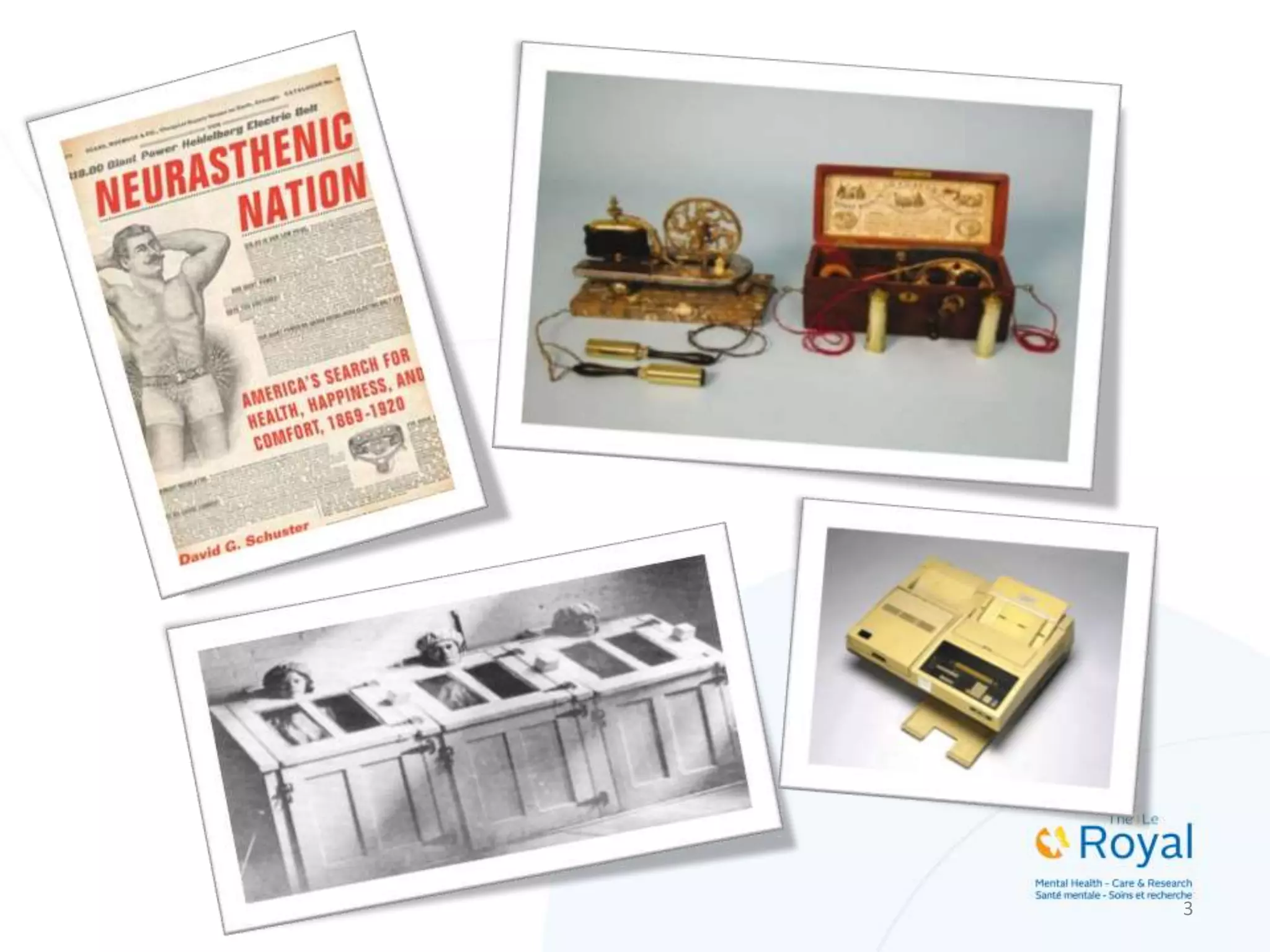
3
 First healthcare revolution
1850 to 1960 – antibiotics,
advances in physiology and
anatomy
 Second healthcare revolution
1960 to 2000 – stents,
transplants, randomized
controlled trials
4
Historical Perspective
□ Driven by:
□ Citizens;
□ Knowledge;
□ Personal computing
focused on patients.
□ Personalised medicine -
usually genes but also
applies to habits.
5
The Third Healthcare Revolution
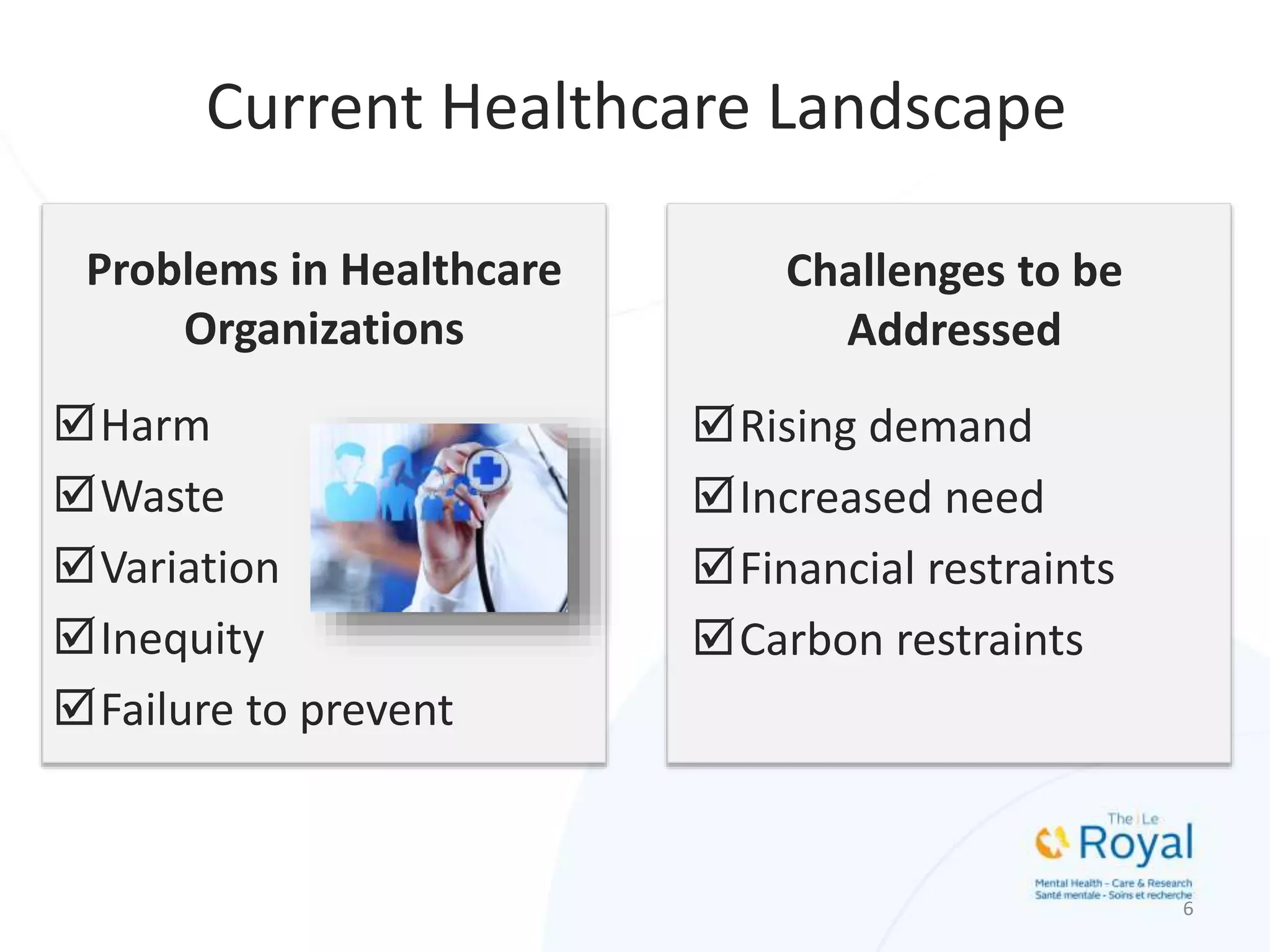
Current Healthcare Landscape
Problems in Healthcare
Organizations
Harm
Waste
Variation
Inequity
Failure to prevent
Challenges to be
Addressed
Rising demand
Increased need
Financial restraints
Carbon restraints
6
1. First generation
□ “Books On-Line”
2. Second generation
□ Some on-line interaction
□ Complete questionnaires
and answer quizzes
□ Learning by gaming
(SPARX)
3. Third generation
□ Integration with
mobile phones, email,
and/or smart devices
4. Fourth generation
□ Smart environments
and “mobile
therapists”
7
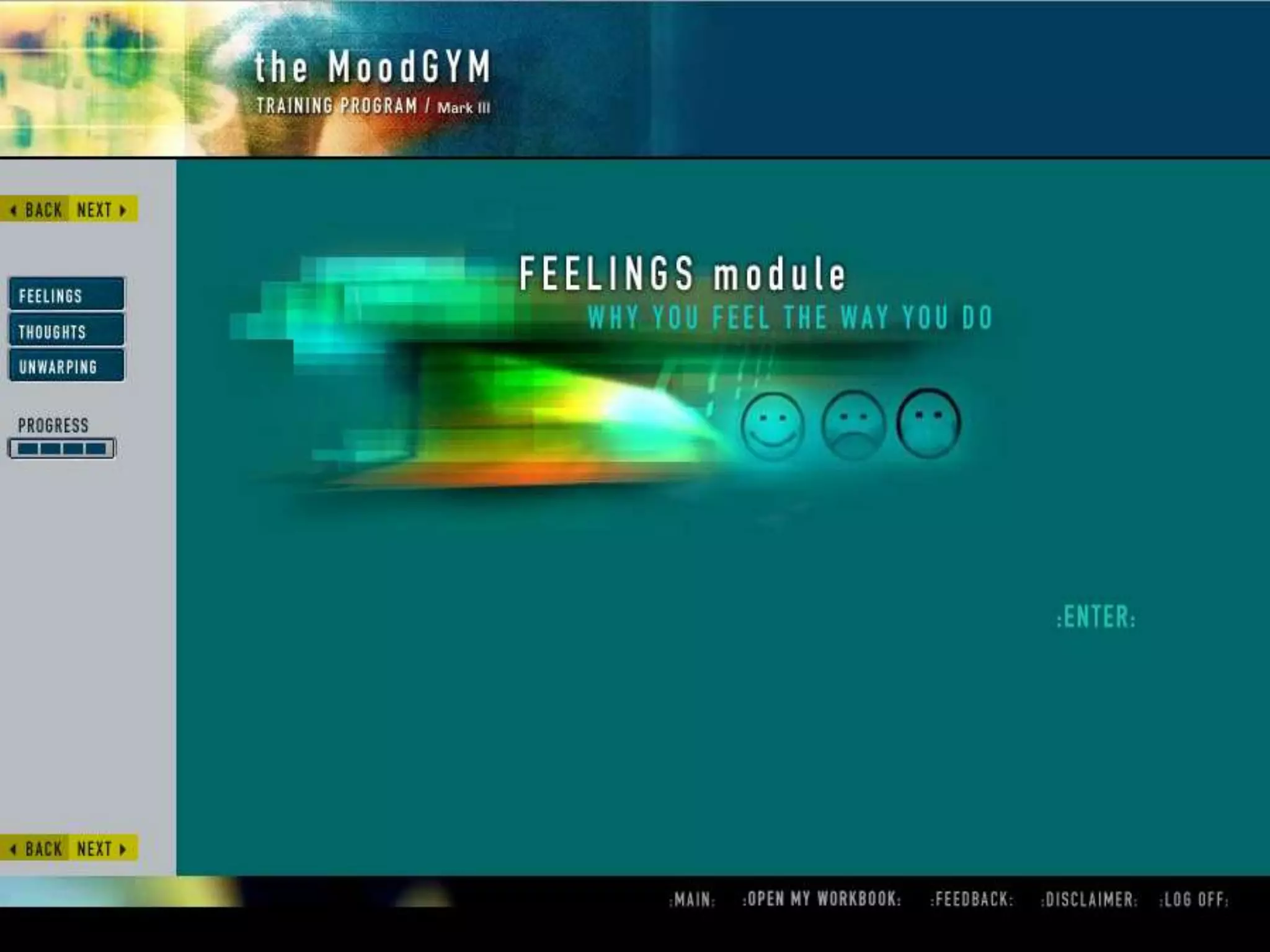
E-Therapies
 No waiting lists.
 No stigma.
 Can be tailored for specific
groups.
 Addresses work force
problems.
 Cost effective?
 Better?
 New treatments?
8
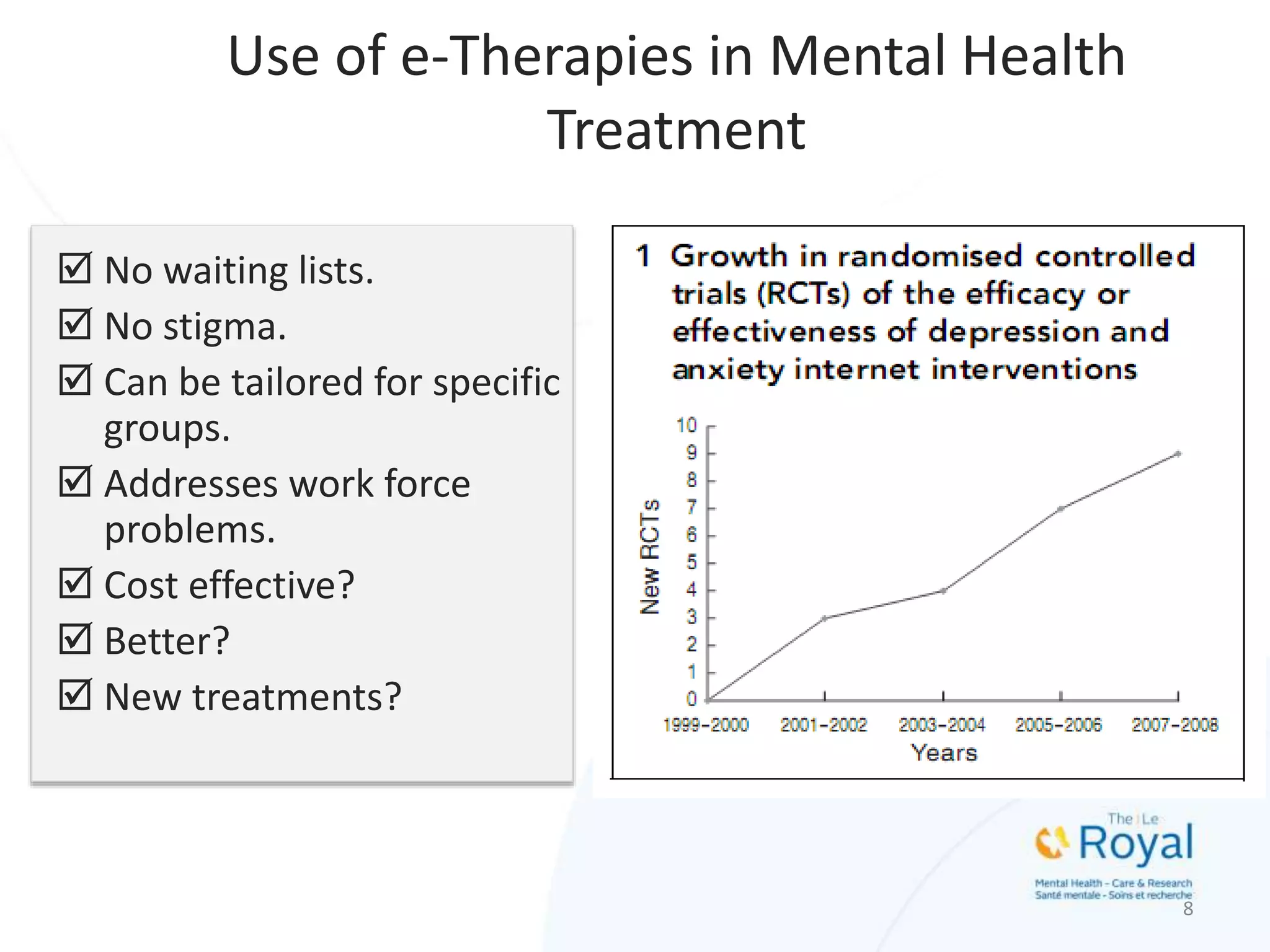
Use of e-Therapies in Mental Health
Treatment
9
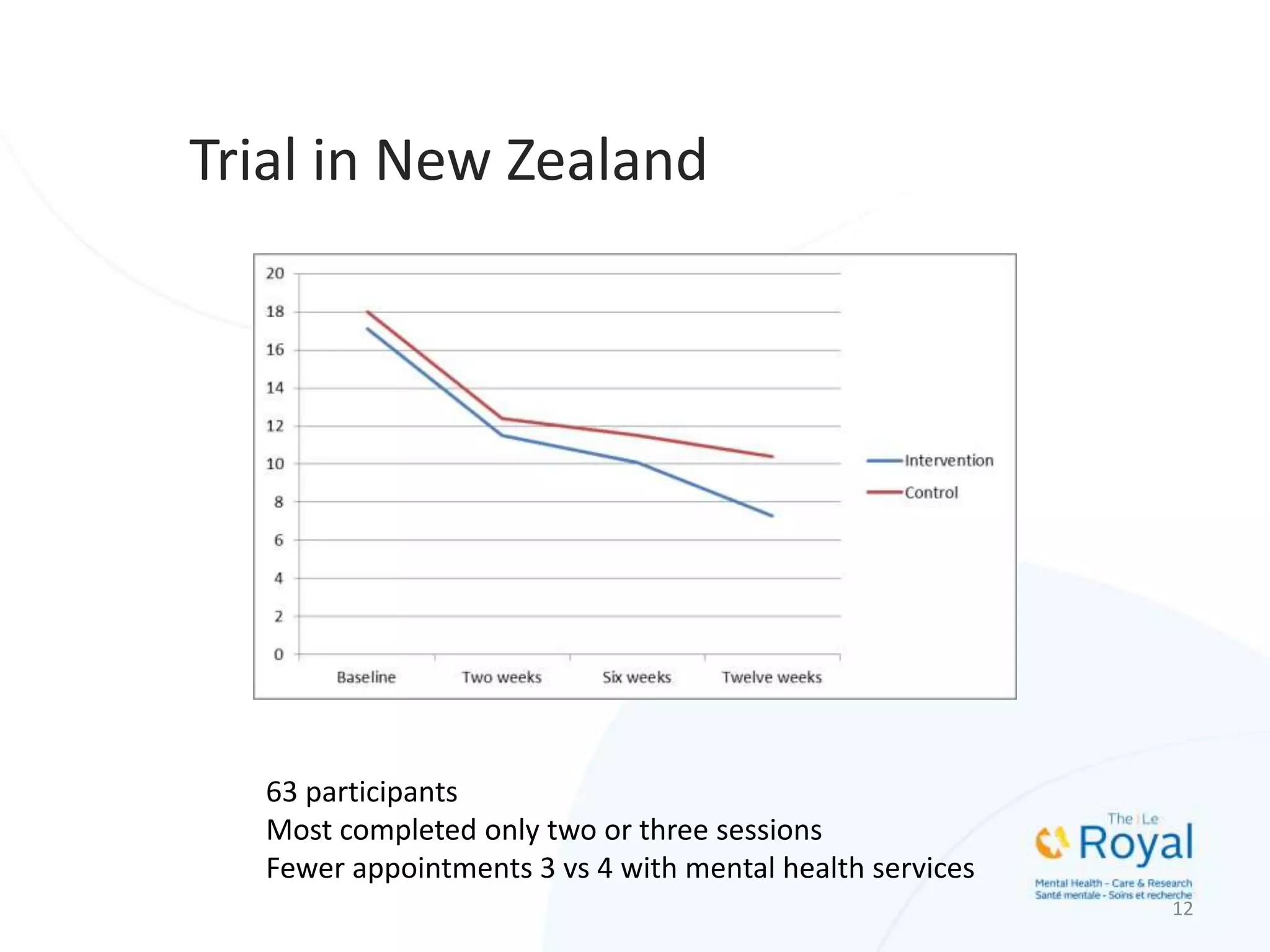
Trial in New Zealand
12
63 participants
Most completed only two or three sessions
Fewer appointments 3 vs 4 with mental health services
Canadian Trial of The Journal
• Recruited 84 people
• Mean baseline PHQ-9 15
• Much better adherence to program 2/3
completing six weeks
• Results due later this year
13
14
Canadian Trial of The Journal
“The Journal is my mirror
- in my 56 years this is
the first time I’m seeing
myself inside and out."
15
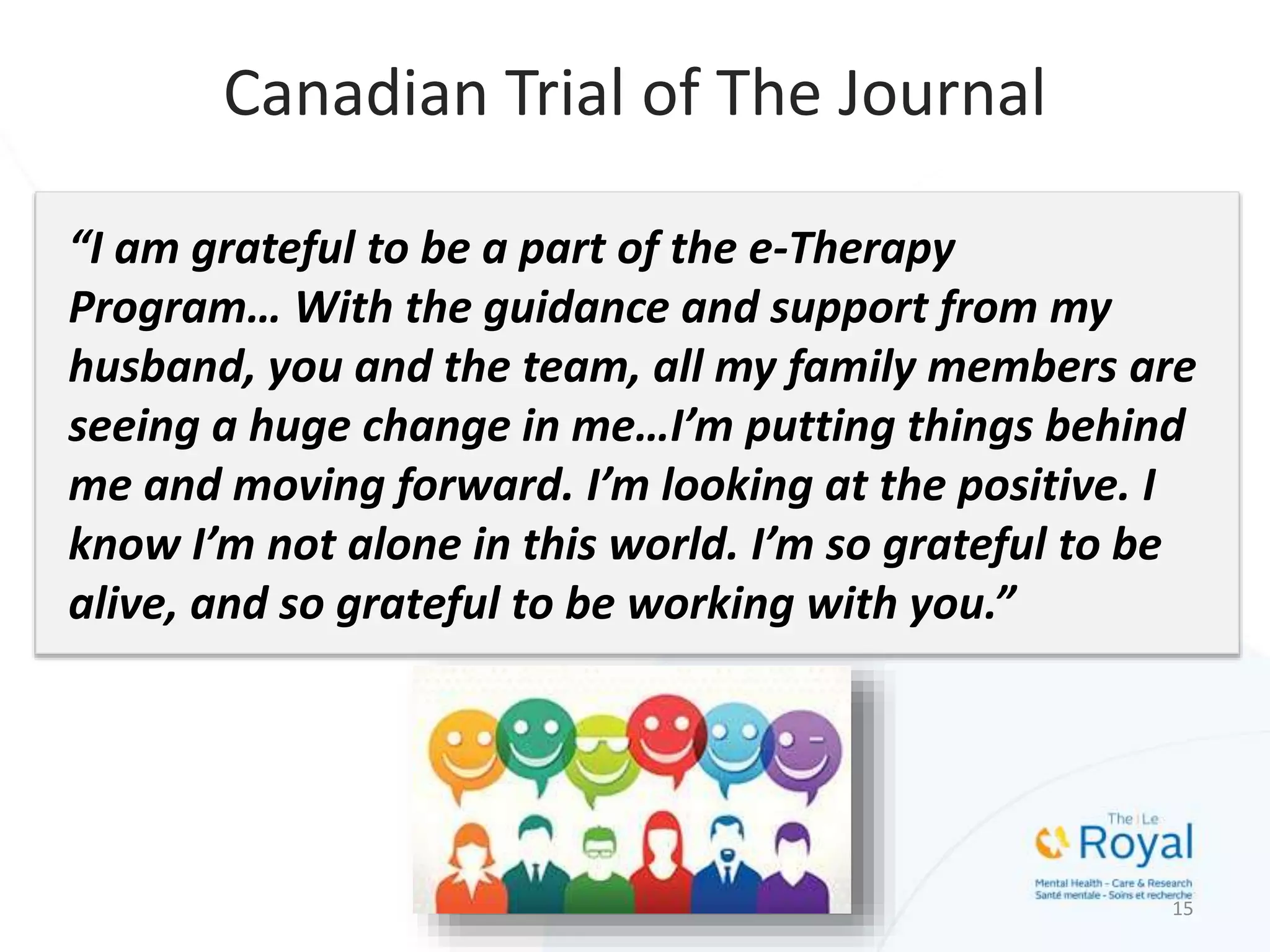
Canadian Trial of The Journal
“I am grateful to be a part of the e-Therapy
Program… With the guidance and support from my
husband, you and the team, all my family members are
seeing a huge change in me…I’m putting things behind
me and moving forward. I’m looking at the positive. I
know I’m not alone in this world. I’m so grateful to be
alive, and so grateful to be working with you.”
16
17
18
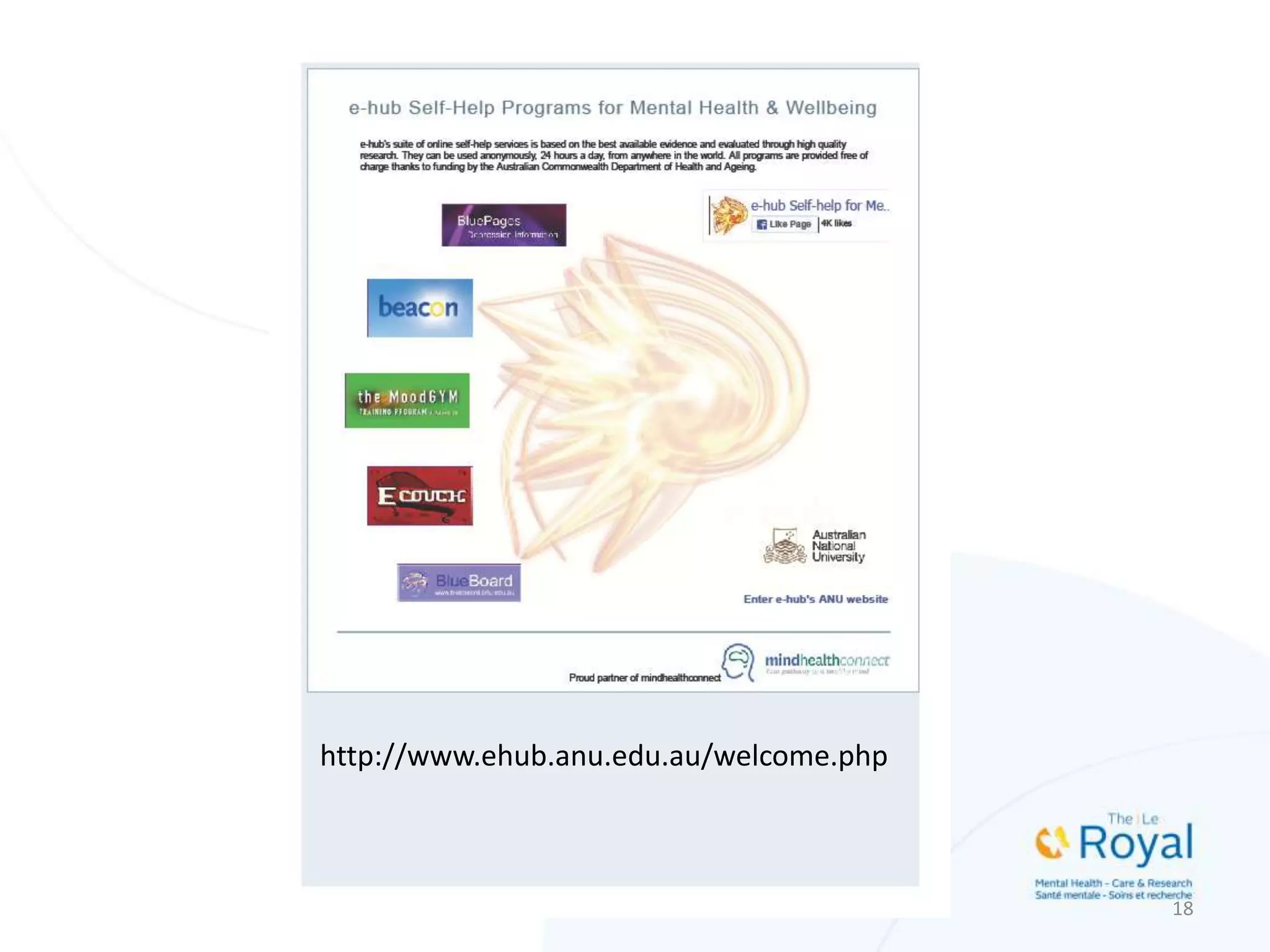
http://www.ehub.anu.edu.au/welcome.php
23
1) Samples Used: “community” versus clinical are often self
selected.
2) Control Group Used: waiting list or treatment as usual.
3) High Drop Out Rates: 60-80% but this is comparable to
other psychotherapies.
4) Little information available about acceptability or
feasibility.
27
Limitations of Previous
Randomized Controlled Trials (RCTs)
For people with persistent subthreshold depressive
symptoms or mild to moderate depression, consider
offering one or more of the following interventions,
guided by the person's preference:
• individual guided self-help based on the principles of
cognitive behavioural therapy (CBT)
• computerised cognitive behavioural therapy (CCBT)
• a structured group physical activity programme.
28
Effectiveness of e-Therapies
• include an explanation of the CBT model,
encourage tasks between sessions, and use
thought-challenging and active monitoring of
behaviour, thought patterns and outcomes
• be supported by a trained practitioner, who
typically provides limited facilitation of the
programme and reviews progress and outcome
• typically take place over 9 to 12 weeks, including
follow-up.
29
Effectiveness of e-Therapies
30
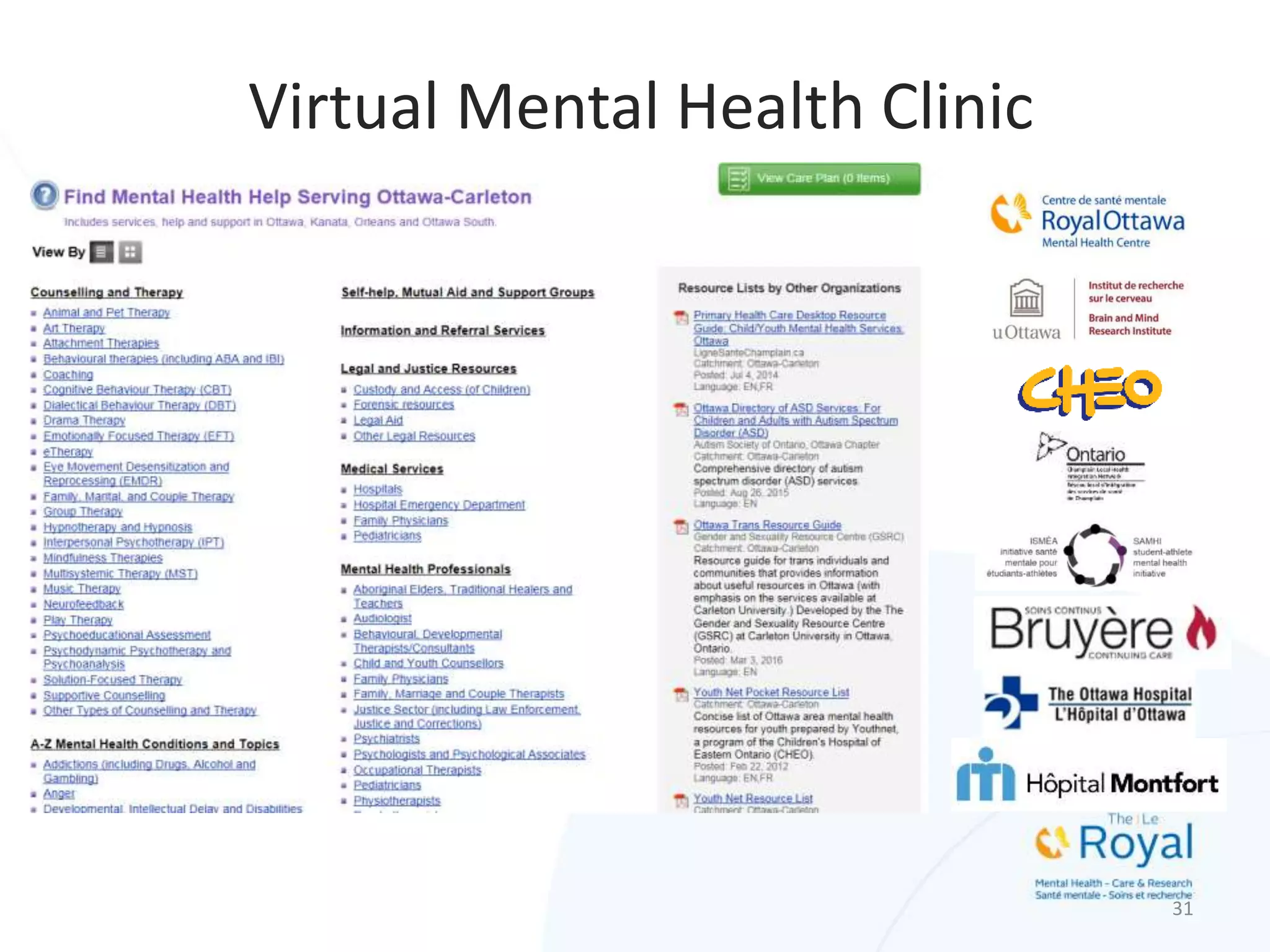
Virtual Mental Health Clinic
31
Virtual Mental Health Clinic
□ Not limited to replicating face to face therapies.
□ Scope for innovation - gaming, use of social marketing.
32
Opportunities for Innovation
□ Issues with evidence,
content and privacy.
□ Use of ACHESS with male
Veterans in the USA to
treat substance abuse.
□ Development of a
smartphone application
to supplement face to
face therapy after self-
harm.
□ RCT to be launched by
end of 2016.
33
The Use of Smartphone Technology
34
□ Useful in treating phobias
and anxiety disorders.
□ In the future, possibility of
reliving the past.
□ Other uses include:
Conversation Skills Training
Assertiveness Skills Training
Emotion Expression Skills
Training
35
Virtual Reality
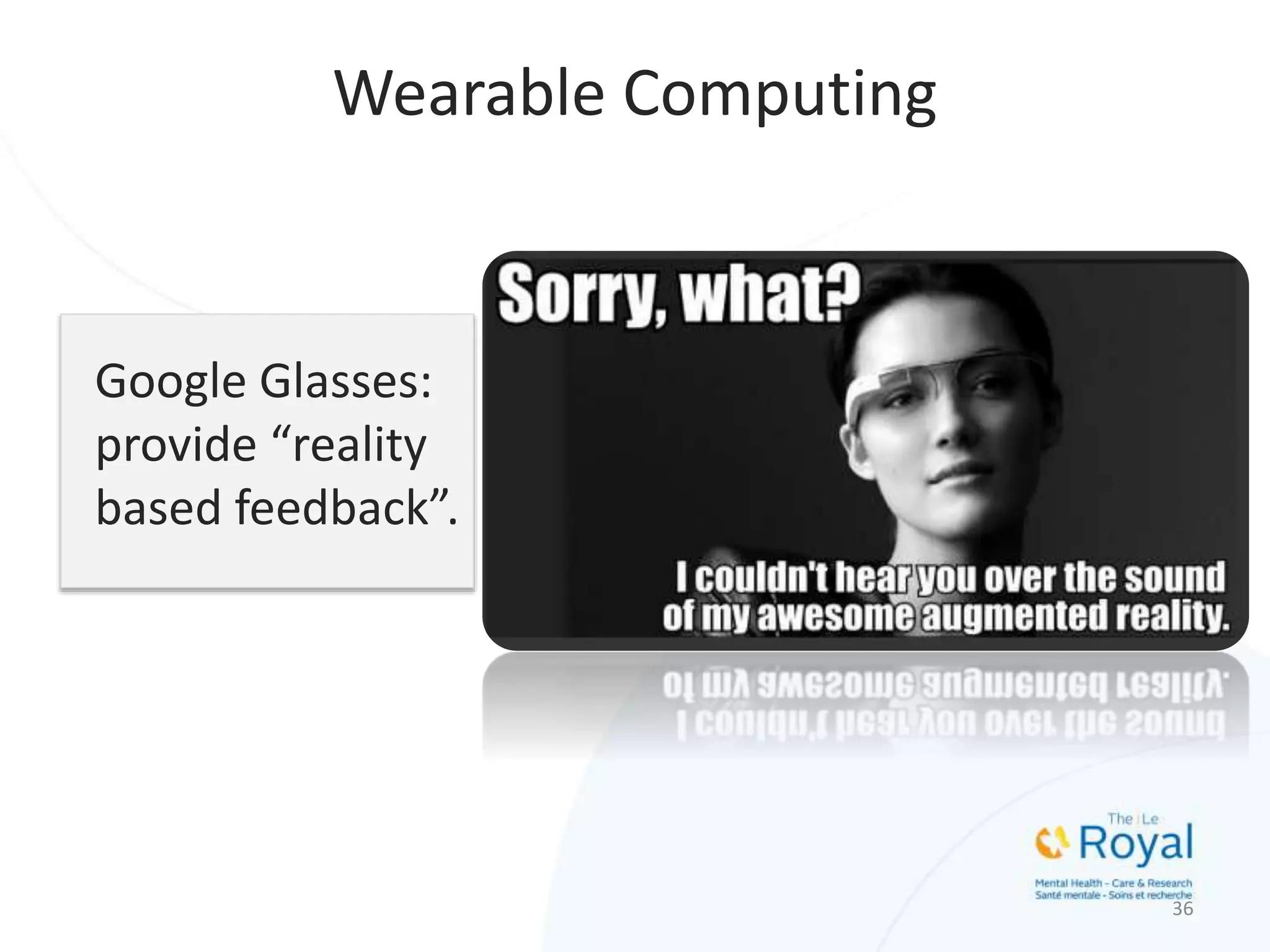
Google Glasses:
provide “reality
based feedback”.
36
Wearable Computing
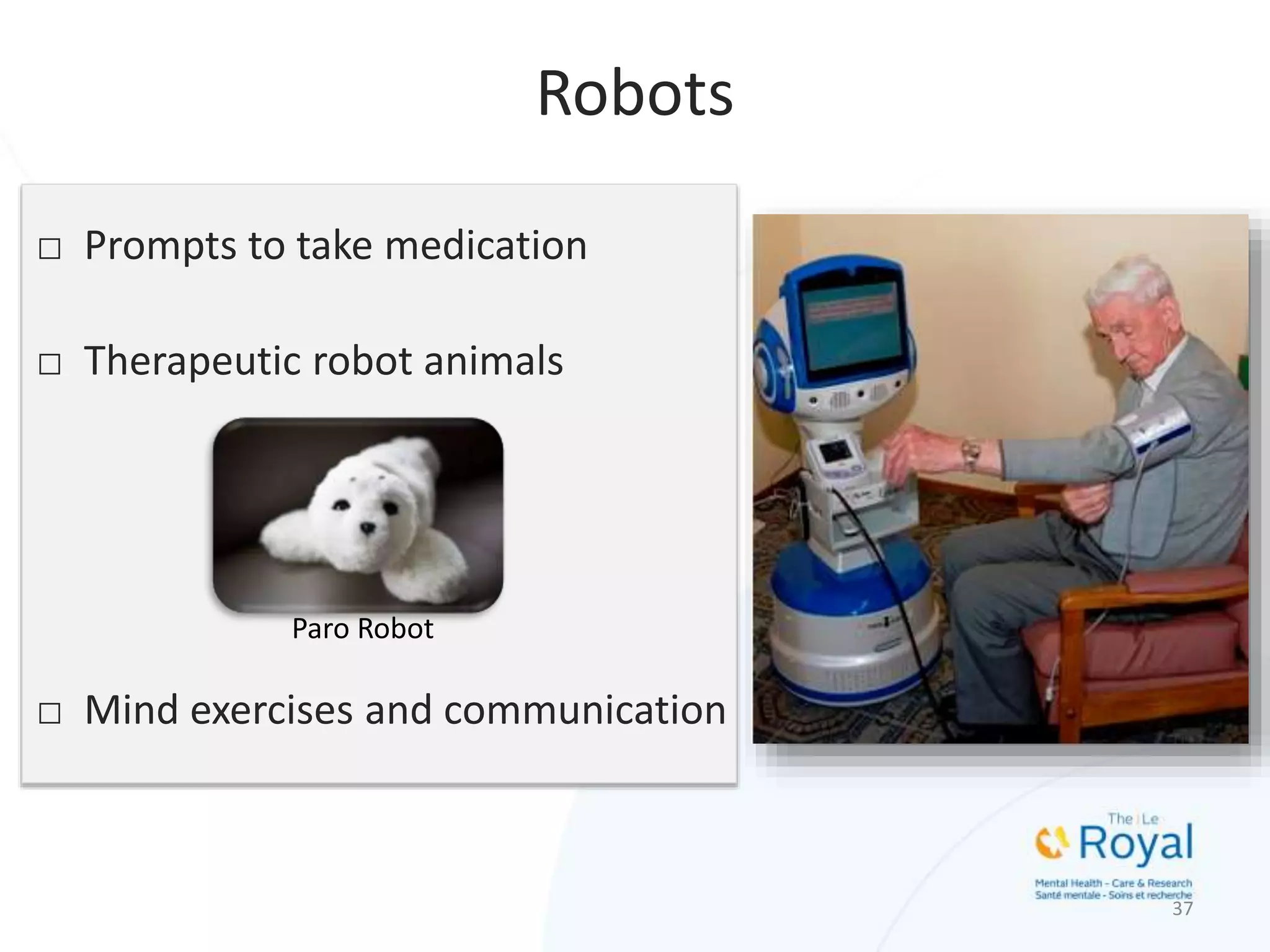
□ Prompts to take medication
□ Therapeutic robot animals
□ Mind exercises and communication
37
Robots
Paro Robot
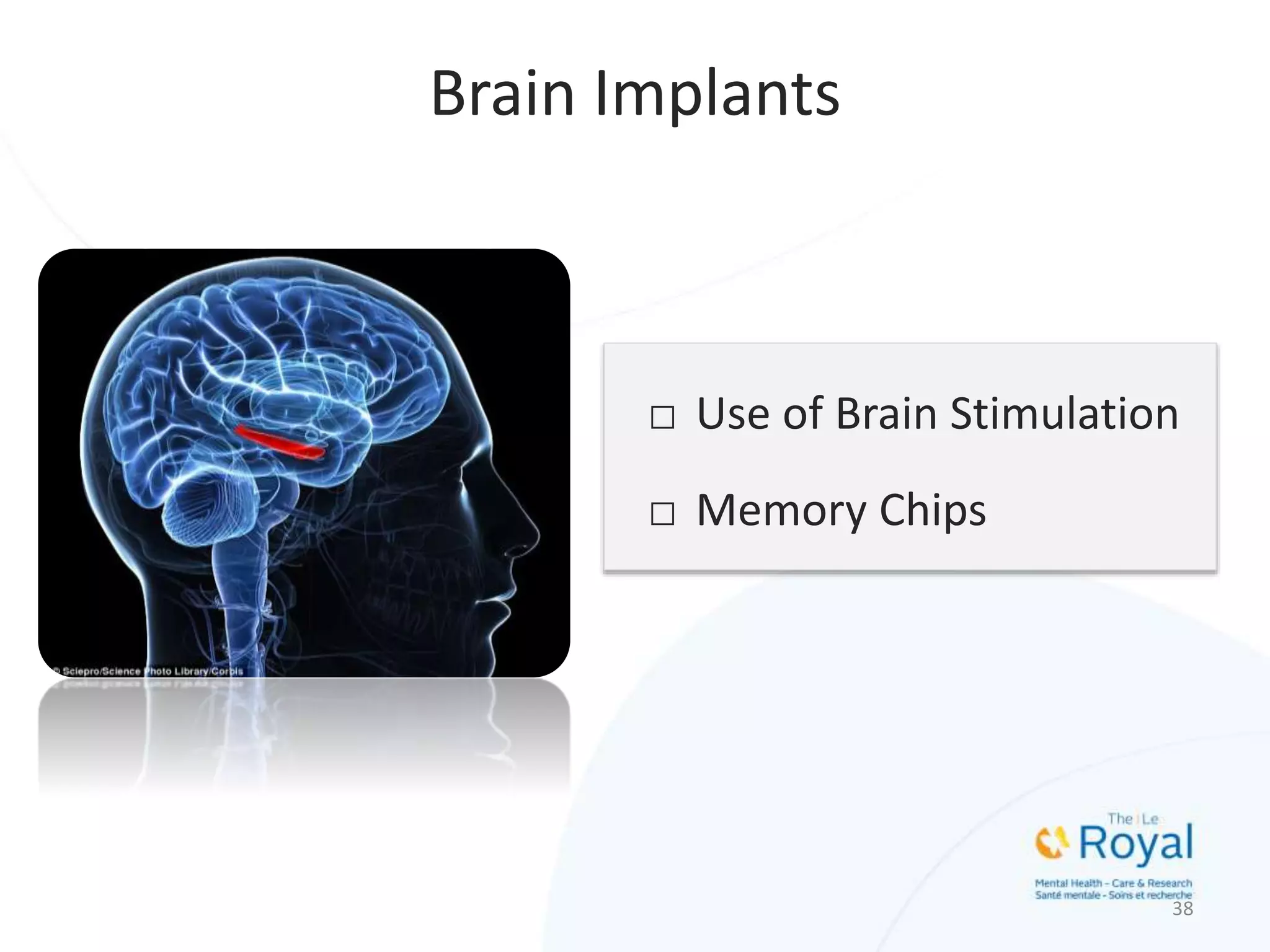
□ Use of Brain Stimulation
□ Memory Chips
38
Brain Implants
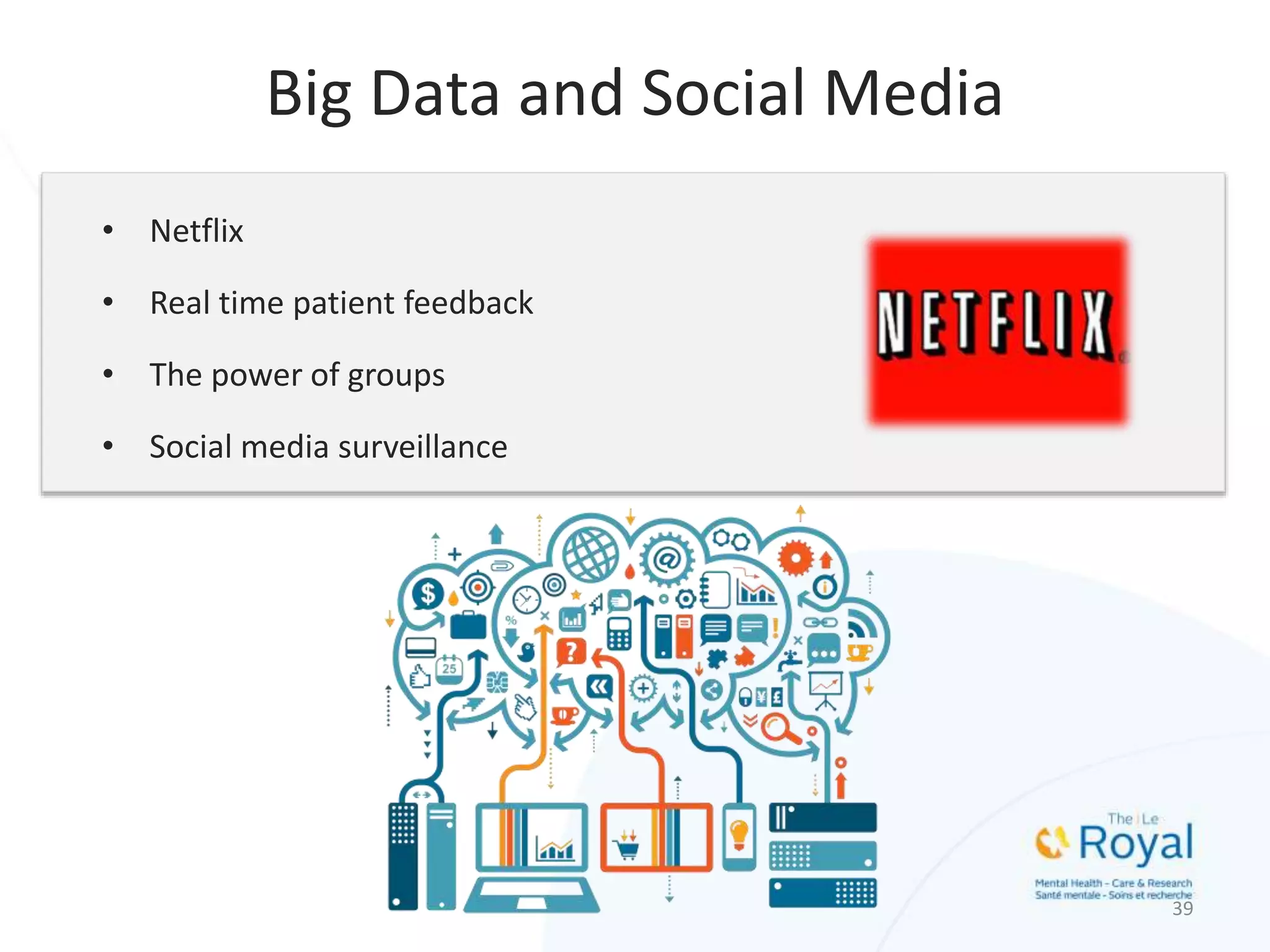
• Netflix
• Real time patient feedback
• The power of groups
• Social media surveillance
39
Big Data and Social Media
40
☐ Reinforce inequalities:
☐ Issues of access
☐ Language
☐ Limited evidence of effectiveness
☐ Ethics of monitoring
☐ Rapidly outdated/costs
☐ Privacy and risk issues
☐ Seductive
☐ Regulation
□ No mechanism for rolling out online
treatments including:
□ Budgetary decisions
□ Integration into existing clinical
pathways
□ Who would “manage” it
41
Problems with New Technologies
42
43
□ Person centred
□ Scalability
□ Quality assurance framework
□ Research
□ Knowledge translation and
exchange
44
Opportunities for Policy Change
IIn
45
□ Integration with existing health and
technology policy
□ Integration with existing health
services
□ Sustainability
□ Privacy and security
Opportunities for Policy Change (2)
46
Questions or Comments?
Dr. Simon Hatcher
Email: simon.hatcher@theroyal.ca
Twitter: @shatchernz
Blog: https://shatchersite.wordpress.com/

Using Technology for Mental Health Treatments

  • 1.
    Using Technology for MentalHealth Treatments Presented by: Dr. Simon Hatcher March 24th, 2016
  • 2.
    2 Are computerized therapiesthe way of the future?
  • 3.
  • 4.
     First healthcarerevolution 1850 to 1960 – antibiotics, advances in physiology and anatomy  Second healthcare revolution 1960 to 2000 – stents, transplants, randomized controlled trials 4 Historical Perspective
  • 5.
    □ Driven by: □Citizens; □ Knowledge; □ Personal computing focused on patients. □ Personalised medicine - usually genes but also applies to habits. 5 The Third Healthcare Revolution
  • 6.
    Current Healthcare Landscape Problemsin Healthcare Organizations Harm Waste Variation Inequity Failure to prevent Challenges to be Addressed Rising demand Increased need Financial restraints Carbon restraints 6
  • 7.
    1. First generation □“Books On-Line” 2. Second generation □ Some on-line interaction □ Complete questionnaires and answer quizzes □ Learning by gaming (SPARX) 3. Third generation □ Integration with mobile phones, email, and/or smart devices 4. Fourth generation □ Smart environments and “mobile therapists” 7 E-Therapies
  • 8.
     No waitinglists.  No stigma.  Can be tailored for specific groups.  Addresses work force problems.  Cost effective?  Better?  New treatments? 8 Use of e-Therapies in Mental Health Treatment
  • 9.
  • 11.
    Trial in NewZealand 12 63 participants Most completed only two or three sessions Fewer appointments 3 vs 4 with mental health services
  • 12.
    Canadian Trial ofThe Journal • Recruited 84 people • Mean baseline PHQ-9 15 • Much better adherence to program 2/3 completing six weeks • Results due later this year 13
  • 13.
    14 Canadian Trial ofThe Journal “The Journal is my mirror - in my 56 years this is the first time I’m seeing myself inside and out."
  • 14.
    15 Canadian Trial ofThe Journal “I am grateful to be a part of the e-Therapy Program… With the guidance and support from my husband, you and the team, all my family members are seeing a huge change in me…I’m putting things behind me and moving forward. I’m looking at the positive. I know I’m not alone in this world. I’m so grateful to be alive, and so grateful to be working with you.”
  • 15.
  • 16.
  • 17.
  • 20.
  • 21.
    1) Samples Used:“community” versus clinical are often self selected. 2) Control Group Used: waiting list or treatment as usual. 3) High Drop Out Rates: 60-80% but this is comparable to other psychotherapies. 4) Little information available about acceptability or feasibility. 27 Limitations of Previous Randomized Controlled Trials (RCTs)
  • 22.
    For people withpersistent subthreshold depressive symptoms or mild to moderate depression, consider offering one or more of the following interventions, guided by the person's preference: • individual guided self-help based on the principles of cognitive behavioural therapy (CBT) • computerised cognitive behavioural therapy (CCBT) • a structured group physical activity programme. 28 Effectiveness of e-Therapies
  • 23.
    • include anexplanation of the CBT model, encourage tasks between sessions, and use thought-challenging and active monitoring of behaviour, thought patterns and outcomes • be supported by a trained practitioner, who typically provides limited facilitation of the programme and reviews progress and outcome • typically take place over 9 to 12 weeks, including follow-up. 29 Effectiveness of e-Therapies
  • 24.
  • 25.
  • 26.
    □ Not limitedto replicating face to face therapies. □ Scope for innovation - gaming, use of social marketing. 32 Opportunities for Innovation
  • 27.
    □ Issues withevidence, content and privacy. □ Use of ACHESS with male Veterans in the USA to treat substance abuse. □ Development of a smartphone application to supplement face to face therapy after self- harm. □ RCT to be launched by end of 2016. 33 The Use of Smartphone Technology
  • 28.
  • 29.
    □ Useful intreating phobias and anxiety disorders. □ In the future, possibility of reliving the past. □ Other uses include: Conversation Skills Training Assertiveness Skills Training Emotion Expression Skills Training 35 Virtual Reality
  • 30.
    Google Glasses: provide “reality basedfeedback”. 36 Wearable Computing
  • 31.
    □ Prompts totake medication □ Therapeutic robot animals □ Mind exercises and communication 37 Robots Paro Robot
  • 32.
    □ Use ofBrain Stimulation □ Memory Chips 38 Brain Implants
  • 33.
    • Netflix • Realtime patient feedback • The power of groups • Social media surveillance 39 Big Data and Social Media
  • 34.
  • 35.
    ☐ Reinforce inequalities: ☐Issues of access ☐ Language ☐ Limited evidence of effectiveness ☐ Ethics of monitoring ☐ Rapidly outdated/costs ☐ Privacy and risk issues ☐ Seductive ☐ Regulation □ No mechanism for rolling out online treatments including: □ Budgetary decisions □ Integration into existing clinical pathways □ Who would “manage” it 41 Problems with New Technologies
  • 36.
  • 37.
  • 38.
    □ Person centred □Scalability □ Quality assurance framework □ Research □ Knowledge translation and exchange 44 Opportunities for Policy Change
  • 39.
    IIn 45 □ Integration withexisting health and technology policy □ Integration with existing health services □ Sustainability □ Privacy and security Opportunities for Policy Change (2)
  • 40.
    46 Questions or Comments? Dr.Simon Hatcher Email: simon.hatcher@theroyal.ca Twitter: @shatchernz Blog: https://shatchersite.wordpress.com/