

THE BFSI
MARKETER'S
GUIDE TO
LEVERAGING
MARKETING
AUTOMATION &
ANALYTICS
Contents
The BFSI Marketer's guide to leveraging marketing automation & analytics
01 Introduction 03
02 A 3-Point Checklist for BFSI Marketers 05
03 Key Challenges Faced by BFSI Marketers Today 07
04 What is Driving the Need to Implement
09
Marketing Automation in the BFSI Industry?
05 Hurdles to Implementation of
12
Marketing Automation
06 Key Benefits of Implementing Marketing
14
Automation in the BFSI Industry
07 Data Integration Services for the BFSI Industry 17
08 Analytics Solutions for Increasing the ROI 19
09 The Integrated Analytics Model 21
10 Use Cases for Analytics 24
11 The Integrated Analytics Model –
27
What Lies Ahead?
Ask any business that has stood the test of time and you
will find that the only thing that stays ‘consistent’ in a
customer’s journey is ‘inconsistency’. Today, amidst
shrinking attention spans, meandering and often parallel
customer journeys across multiple touchpoints in the
digital landscape, a new disruption knocks on our doors
every single day.
As a result, in today’s marketplace, consumer experience
is the only differentiator, and businesses constantly try to
outpace one another in the race for attention and
engagement.
In the Banking, Financial Services and Insurance (BFSI)
sector, it is not uncommon to see a successful BFSI
product or service being replicated by across the
board in a matter of days.
Changes in consumer behaviour and
expectations, regulatory aspects, as well as
the growing volumes of behavioural
data have made the BFSI industry
a fiercely competitive one.
1
Introduction
The BFSI Marketer's guide to leveraging marketing automation & analytics 03
Historically, players in the BFSI sector have been ‘early adopters’ of new technologies,
especially with regard to internet-driven consumer engagement, outreach, marketing,
as well as data security.
Today, when large swathes of the market lay across the digital landscape, the industry
as a whole must turn to innovative and out-of-the-box thinking in an effort to hook,
engage with retain, and grow their customers anew.
With the proliferation of diverse engagement channels, BFSI marketers need to break
from the traditional and adopt modern and measurable Marketing Technology
solutions to face an entirely new set of challenges.
From consumer acquisition to engagement to retention and conversion, this eBook will
be your guide to understanding:
1. Why Marketing Automation is no longer ‘optional’.
2. How Marketing Automation Solutions (MAS) can benefit the BFSI sector.
3. How to leverage the power of data and analytics for results-driven impact.
It’s indisputable: Innovation is redefining banking.
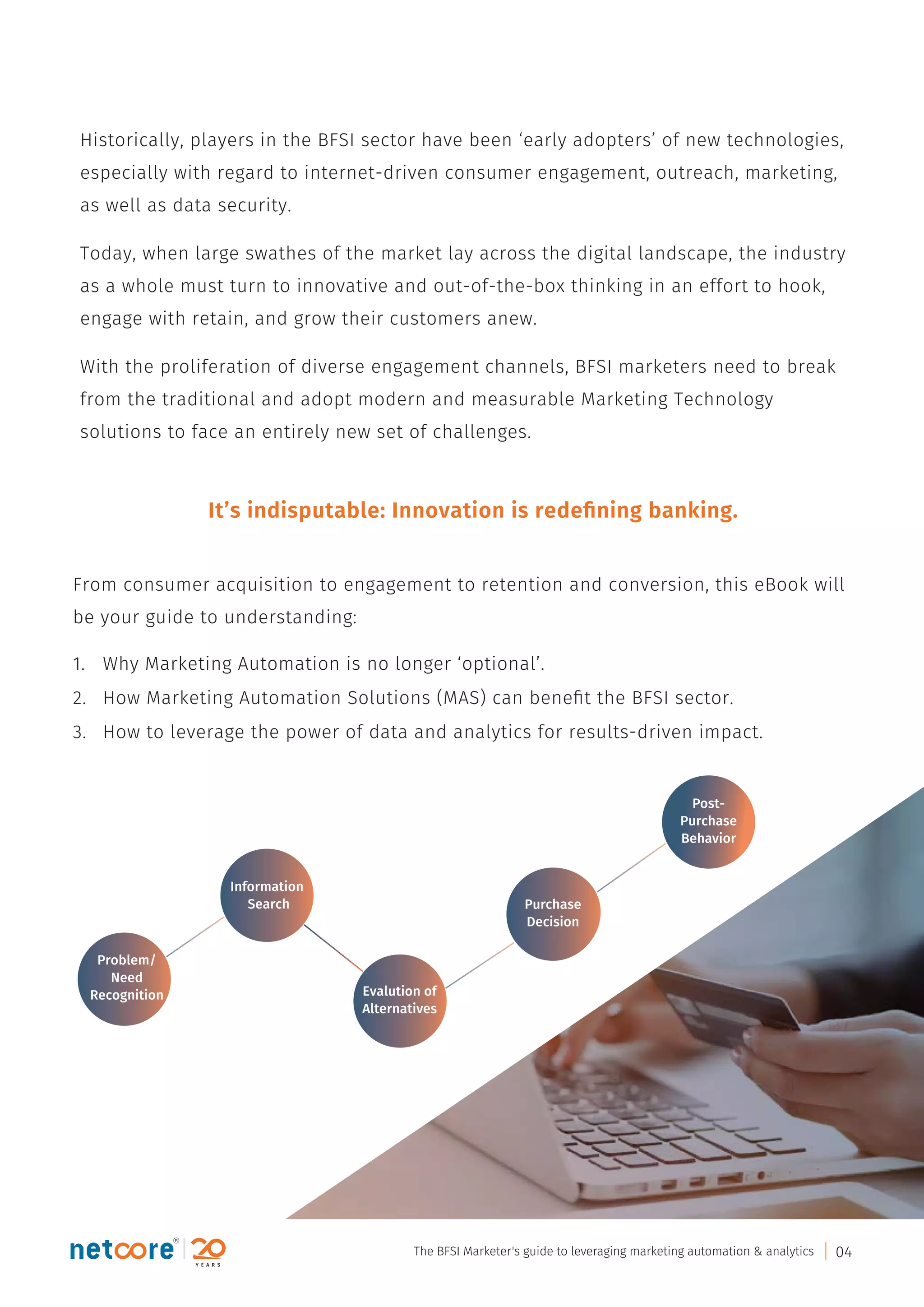
Problem/
Need
Recognition
Information
Search
Evalution of
Alternatives
Purchase
Decision
Post-
Purchase
Behavior
The BFSI Marketer's guide to leveraging marketing automation & analytics 04
A dormant customer is NOT a loyal customer.
Customer loyalty is earned with a positive
disposition and consistent engagement. As a BFSI
player, whichever strategy you deem fit for building
your agile marketing mix in order to up your
marketing game, do ensure it checks the following
three boxes:
A 3-point Checklist
For BFSI Marketers2
The BFSI Marketer's guide to leveraging marketing automation & analytics 05
Stop
thinking of your industry as being inherently
transactional in nature. It is no longer so. Today, BFSI
industry has evolved into become a very
consumer-centric space, which revolves around
building and managing customer journeys.
Understand
Leverage
consumer behaviour and nurture relationships with
personalised targeting in real time through automated
processes. Focus on being a champion of consumer
experience – it can be achieved at optimal costs.
advanced data analytics and other breakthrough
innovations to increase your ROI through marketing
automation.
The BFSI Marketer's guide to leveraging marketing automation & analytics 06
3
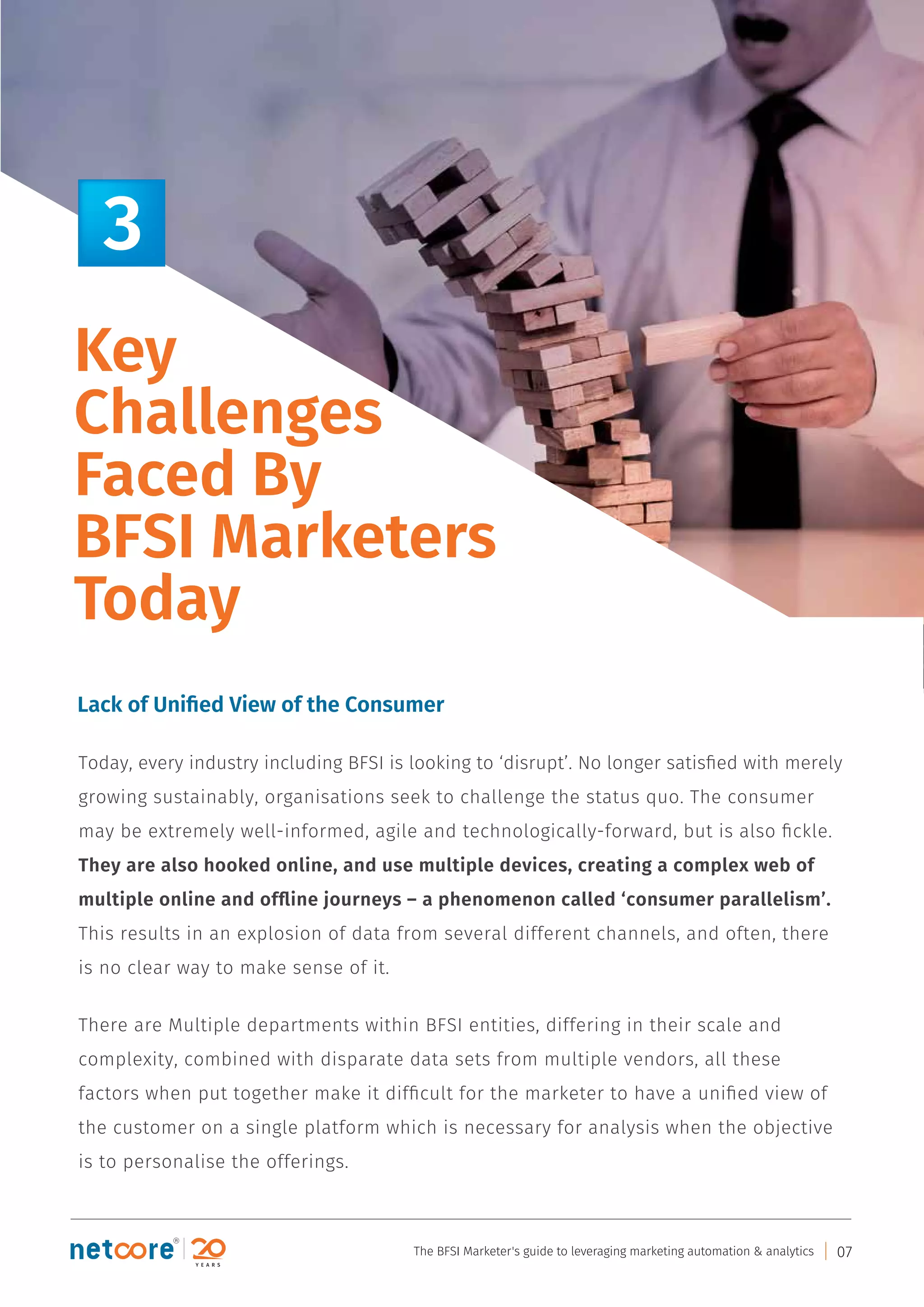
Today, every industry including BFSI is looking to ‘disrupt’. No longer satisfied with merely
growing sustainably, organisations seek to challenge the status quo. The consumer
may be extremely well-informed, agile and technologically-forward, but is also fickle.
They are also hooked online, and use multiple devices, creating a complex web of
multiple online and offline journeys – a phenomenon called ‘consumer parallelism’.
This results in an explosion of data from several different channels, and often, there
is no clear way to make sense of it.
There are Multiple departments within BFSI entities, differing in their scale and
complexity, combined with disparate data sets from multiple vendors, all these
factors when put together make it difficult for the marketer to have a unified view of
the customer on a single platform which is necessary for analysis when the objective
is to personalise the offerings.
Lack of Unified View of the Consumer
Key
Challenges
Faced By
BFSI Marketers
Today
The BFSI Marketer's guide to leveraging marketing automation & analytics 07
Inconsistent User Experience
When using technology, user experience or UX is a very important aspect driving
consumer engagement. Particularly for the BFSI industry, good UX is a hygiene factor.
So, at times when there is a hold-up or a bottleneck due to technical difficulties -
which is inevitable in some situations - this causes the customer to face 'broken
experiences', leading them to feel confused or frustrated even. This can adversely
impact customer satisfaction. Marketers then rely on disjointed, and often futile,
marketing efforts to offset these.
Without data or insight into such instances, marketers are clueless as to the ways to
engage these consumers. Creating useful touchpoints at all such places and using
automation to handle the customer can help you walk the customer through such
situations where they feel cared for and involved. Moreover, these touchpoints help
marketers collect data that can be used to further their learning and understanding of
the customer journey
Lower Customer Lifetime Value (CLTV)
Your customer is in the driver’s seat and demands a seamless experience when
banking with you. As a marketer, this is your opportunity to cross-sell and drive repeat
business, which is possible through engagement and re-engagement.
Lack of a unified view of your customer’s journey poses a huge challenge to
accurately mapping their ‘omni-channel hop’, bringing down your campaign
efficiency with inaccurate targeting and personalisation. This also means you miss
out on the necessary insights to make the most of cross-sell opportunities, thus
leading to a lower Customer LifeTime Value (CLTV).
The BFSI Marketer's guide to leveraging marketing automation & analytics 08
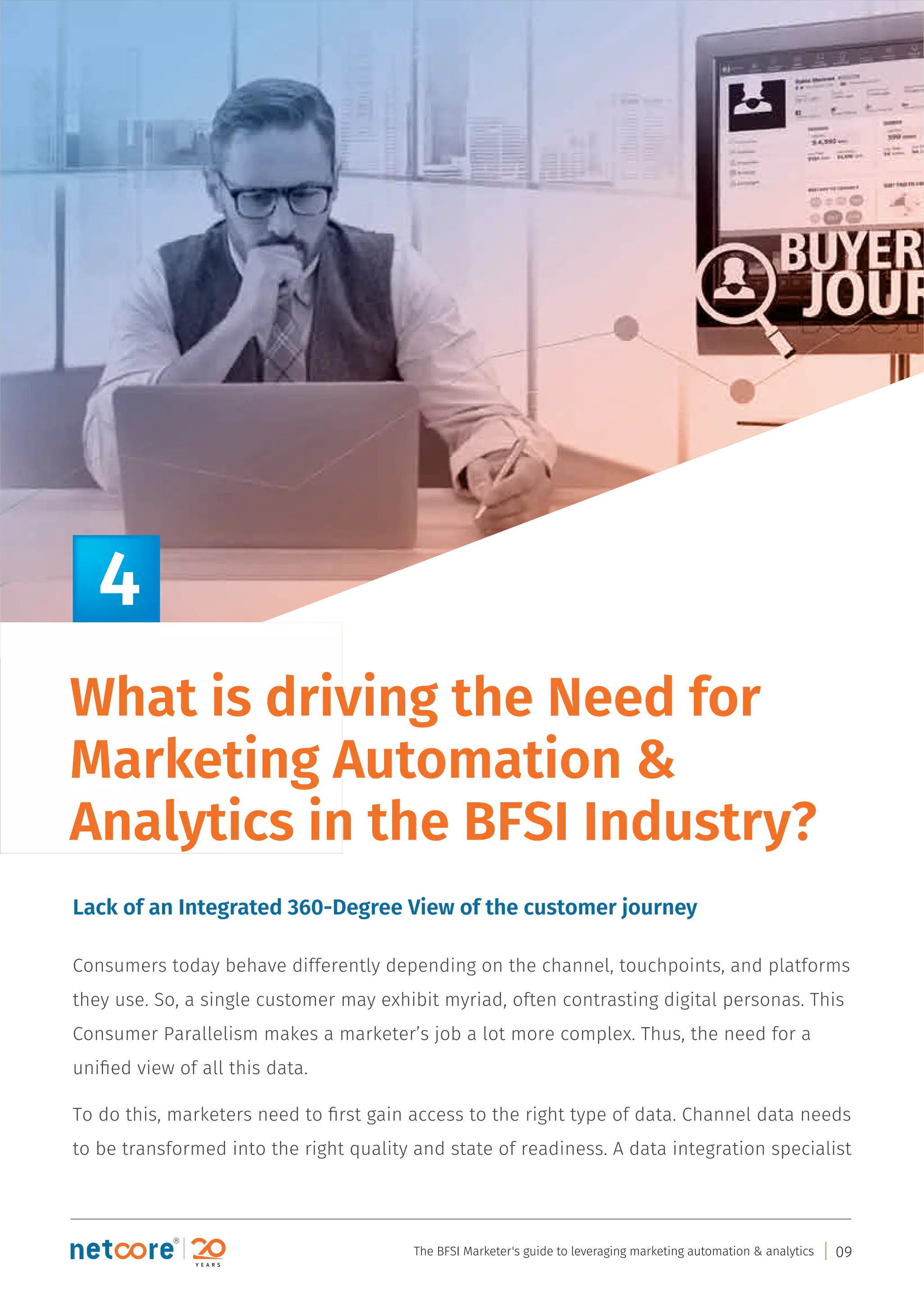
Consumers today behave differently depending on the channel, touchpoints, and platforms
they use. So, a single customer may exhibit myriad, often contrasting digital personas. This
Consumer Parallelism makes a marketer’s job a lot more complex. Thus, the need for a
unified view of all this data.
To do this, marketers need to first gain access to the right type of data. Channel data needs
to be transformed into the right quality and state of readiness. A data integration specialist
Lack of an Integrated 360-Degree View of the customer journey
What is driving the Need for
Marketing Automation &
Analytics in the BFSI Industry?
4
The BFSI Marketer's guide to leveraging marketing automation & analytics 09
needs to convert channel data from the marketing ecosystem into summary-level data
sets. This specialised task is best handled by a quality data integration service provider in
case the in-house team is unable to do it.
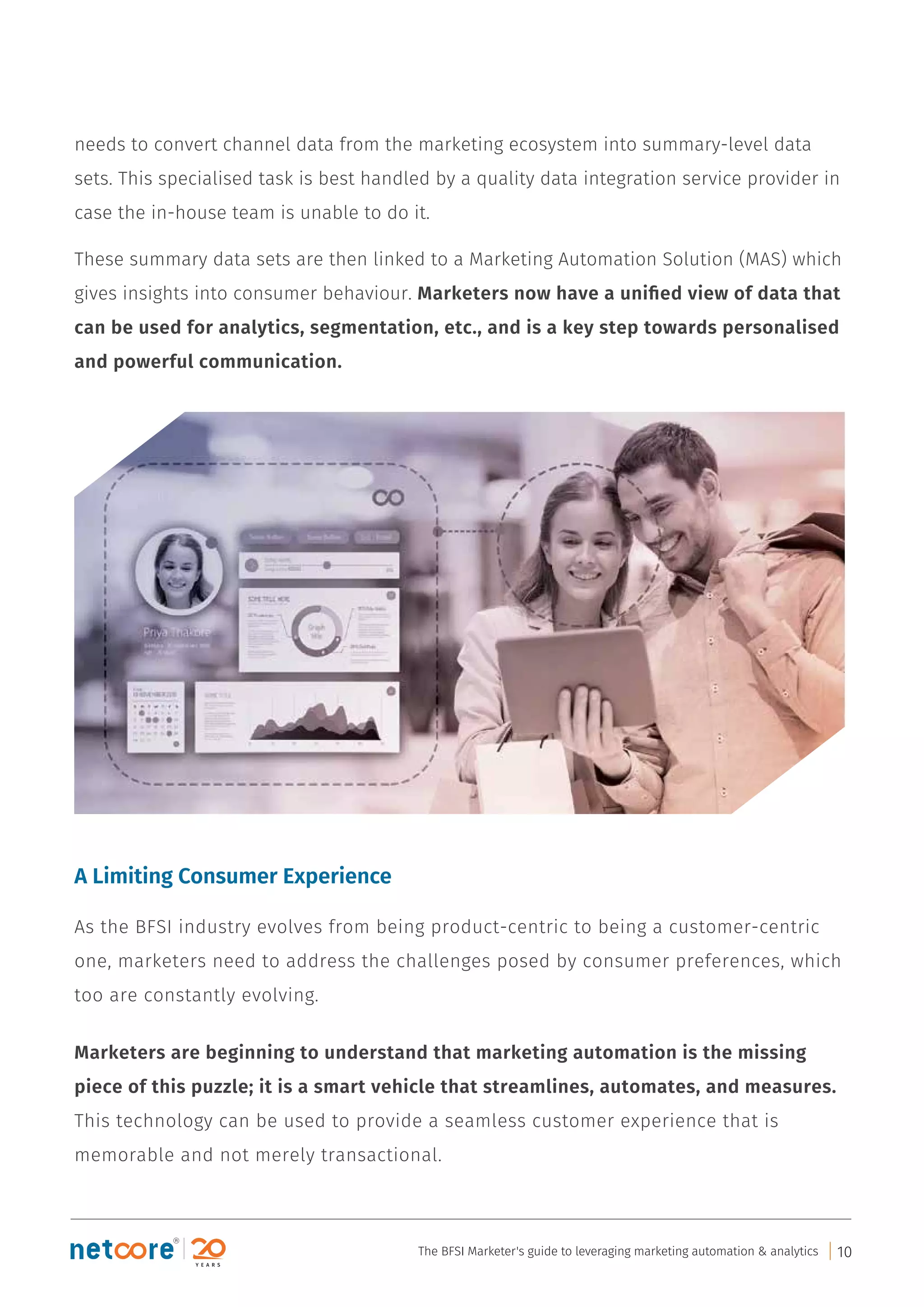
These summary data sets are then linked to a Marketing Automation Solution (MAS) which
gives insights into consumer behaviour. Marketers now have a unified view of data that
can be used for analytics, segmentation, etc., and is a key step towards personalised
and powerful communication.
A Limiting Consumer Experience
As the BFSI industry evolves from being product-centric to being a customer-centric
one, marketers need to address the challenges posed by consumer preferences, which
too are constantly evolving.
Marketers are beginning to understand that marketing automation is the missing
piece of this puzzle; it is a smart vehicle that streamlines, automates, and measures.
This technology can be used to provide a seamless customer experience that is
memorable and not merely transactional.
The BFSI Marketer's guide to leveraging marketing automation & analytics 10
The right Marketing Automation Solution helps to identify and aggregate consumer
behaviour across all inbound and outbound channels and then uses that information to
nurture customer relationships. It helps ensure a seamless customer experience by
delivering the right message to the right customer at the right time through the right
channel.
Effective Campaign Management
For many leading banks, financial institutions, mutual fund firms, etc., manual
repetitive tasks choke up human resources and person-hours.
A powerful, omni-channel, cross-channel journey builder can help increase and
process efficiency as well as the ROI. With BFSI customers readily able to switch
services, the onus is on marketers to reach out with personalised content at various
touch points in the consumer’s journey.
Cross-channel personal triggers – be it a ‘welcome’ email series, dividend declaration,
updates related to personal accounts, etc. all such communication is critical. When
automated, these tasks enhance the Customer Lifecycle Program of any new lead.
The designed, automated workflow triggers the relevant campaigns simultaneously,
improving conversions on various products and services.
The BFSI Marketer's guide to leveraging marketing automation & analytics 11
Going digital, whether in banking or any other industry is not about using snazzy apps
or websites. It is about how you bring these platforms to use and the consumer
experience they provide. BFSI marketers are under constant pressure to deliver results
and to improve operational efficiency while reducing costs. Following issues prevent
the MAS trigger from being pulled:
Data security
The BFSI industry deals in a wealth of confidential data and data security is their
top-most priority – ensuring this is crucial to their reputation.
Data Quality & Readiness
Marketing Automation is all about data. You could be using the best MAS in the market
but if the data is incorrect and unorganised, you will not get the desired results.
Hurdles to
Adoption of Marketing
Automation in BFSI
5
The BFSI Marketer's guide to leveraging marketing automation & analytics 12
Formation of silos of data collected from disparate sources compounds the challenge,
with no way to decipher the customers’ fragmented journeys.
Lack of refined, structured data prevents the marketer from optimising the MAS
platform to its best.
Lack of Skills & Expertise
In this day and age, effective marketing is so data-dependent that all stakeholders,
including marketing and IT teams, have to work together to bring home the results.
But, a lack of skill sets and close collaboration between the two departments
prevents the marketer from being agile enough to execute marketing strategies
effectively.
Difficulty in Measuring Efficiency/ROI
As of 2016, the biggest challenge for BFSI marketers is the ability to measure performance
and prove results#
. Only 8% of financial organisations believed this was not a challenge.
This is also reflected in the view of marketing in the C-Suite and the inability to
provide meaningful ROI metrics required throughout any organisation. For a financial
organisation to succeed in the future, measurability of results will be a basic
requirement.
The Right Implementation Partner
Rise in digital marketing spends notwithstanding, mapping the customers’ fluid
journeys offline and online is an ongoing challenge for the BFSI marketers. Their
marketing goals remain a black box for as long as they see MAS as a magic tool that
can be used randomly without any strategic implementation.
The trajectory of implementing marketing automation solutions can be tricky and the
struggle to identify the right digital delivery channel can limit the efficiency of
customer engagement.
Thus, it is important to identify the right partner to help you implement your MAS
with the right technology, platform, as well as support.
#
https://thefinancialbrand.com/64996/financial-marketing-trends-technology-media-cmo/
The BFSI Marketer's guide to leveraging marketing automation & analytics 13
Capturing Unified View of the Customer Journey
Today’s consumer is always-on and attention spans are spread across channels and
devices. Consumer Parallelism is the context but there is more to the story: The consumer
seeks to be understood as an individual with unique choices and needs. Brands need
to get close to their customers and this is no longer optional. Marketers must indulge
consumers in a way that suits their individual journeys - your storytelling will vary
accordingly. Your leads are not just leads in a transactional sense – these are people
with unique needs that are looking for an outstanding consumer experience.
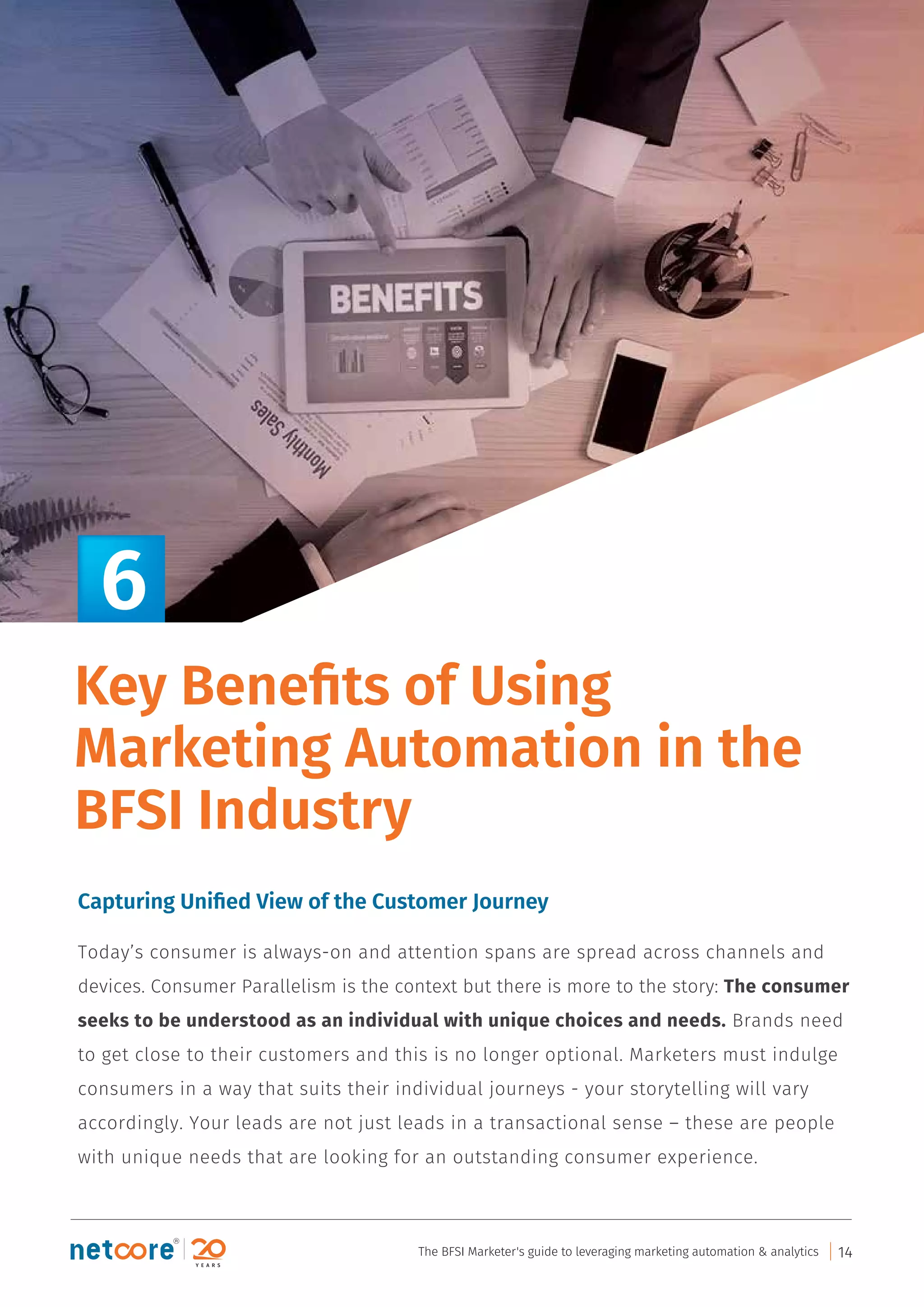
Key Benefits of Using
Marketing Automation in the
BFSI Industry
6
The BFSI Marketer's guide to leveraging marketing automation & analytics 14
Advanced Segmentation
Marketing automation helps marketers to build segments across multiple delivery
channels like email, SMS, push notifications, in-app and web messaging, thus allowing
you to target customers based on past behaviours or channel responsiveness.
It also helps in building payload-based segmentation i.e. based on the actual content
consumed during the web or app activity. This allows you to target customers based
on their purchase history, website visits, or previous landing page interactions for
greater impact.
Maximised CLTV
For customer retention, marketers need to ensure that they use the right digital
channel to engage with customers to nurture leads and increase conversion rate and
CLTV.
Marketing Automation Solution (MAS) is the ultimate power tool to plan multiple,
simultaneous, and integrated campaigns for up-selling and cross-selling. Marketing
Automation has been proven to increase the customer base, drive engagement, and
generate improved conversions.
On-site & Off-site Engagement
Marketers can use tools like personalised web push messages and sticky bars on the
page when users are on site or about to leave the site, thereby enabling
top-of-the-mind recall and real-time engagement.
Browser push notifications (BPNs) have proven to be a handy power tool for off-site
engagement. The moment a customer visits your website, you can encourage them to
opt in for BPNs. After that, whenever they access their browser, you have the
opportunity to interact with them with relevant messages. This helps you improve your
subscriber and leads base as well as receive feedback on the products your customers
have purchased.
The BFSI Marketer's guide to leveraging marketing automation & analytics 15
Marketers can use automation to track in-app activity of the user, which allows them
to understand their customer's behaviour even more precisely. This presents an even
greater opportunity for personalisation of BPN.
Personalisation in Real Time
For any campaign to be effective, it must be driven by the power differentiator of
personalisation. Marketing automation can help marketers to send more relevant and
personalised communication which can increase their transactions nearly five-fold.
The BFSI industry runs on personal investments and there is an immense opportunity
to hyper-personalise communication via all delivery channels. Depending on the
keywords used by the customer, a personalised email template or message along with
the product image can be triggered on a real-time basis. For example, with real-time
personalisation, Financial Securities companies can display the latest stock price at
the time the email is opened.
Based on the email open rate, the next best action can be planned to effectively
engage with the customer keeping the lines of communication open.
Recycling Dropped Leads
BFSI companies generate many leads but not all of them can be converted, for a host
of reasons. Many of these are dropped, and can be recycled. Based on the reason for
the drop, these leads can be bucketed in different segments and be targeted with
relevant communications across channels. A leading private bank was recently able
to convert 20% of dropped leads through an automated cross-channel campaign.
The BFSI Marketer's guide to leveraging marketing automation & analytics 16
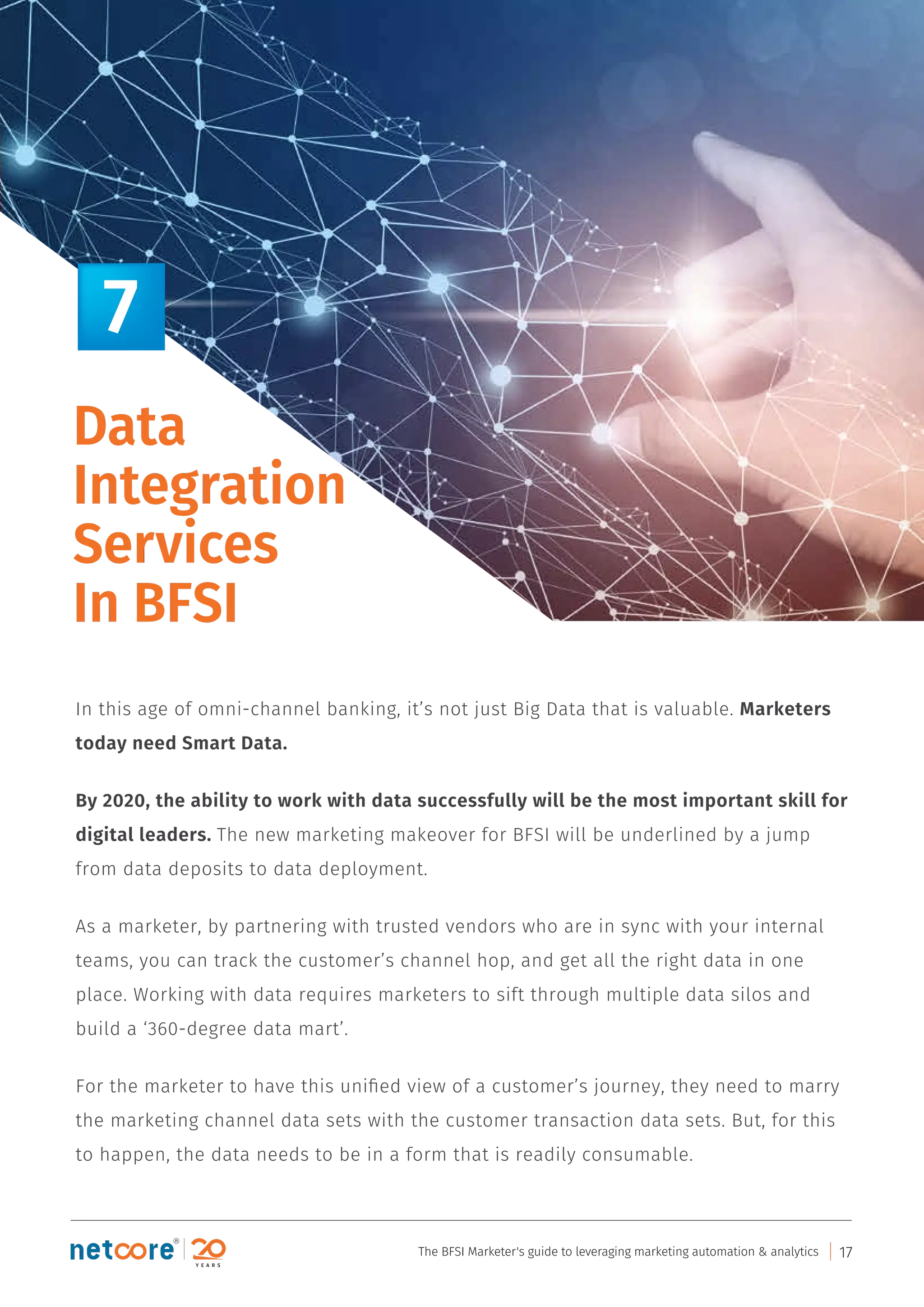
In this age of omni-channel banking, it’s not just Big Data that is valuable. Marketers
today need Smart Data.
By 2020, the ability to work with data successfully will be the most important skill for
digital leaders. The new marketing makeover for BFSI will be underlined by a jump
from data deposits to data deployment.
As a marketer, by partnering with trusted vendors who are in sync with your internal
teams, you can track the customer’s channel hop, and get all the right data in one
place. Working with data requires marketers to sift through multiple data silos and
build a ‘360-degree data mart’.
For the marketer to have this unified view of a customer’s journey, they need to marry
the marketing channel data sets with the customer transaction data sets. But, for this
to happen, the data needs to be in a form that is readily consumable.
Data
Integration
Services
In BFSI
7
The BFSI Marketer's guide to leveraging marketing automation & analytics 17
In the BFSI industry, access to data and ensuring its security remains a concern for
marketers, which may come in the way of seamless integration of data.
Banks can leverage application programming interfaces (APIs)#
- which are gaining
traction in BFSI industry - to share data in a controlled manner between two parties.
While this has a margin of risk because of its decentralised approach, security can be
suitably enhanced with a robust risk-management infrastructure.
Further, marketers can limit the scope of customer data they include in their MAS and
add firewalls for tighter security. This can help minimise the risks to a great extent.
BFSI marketers then need to systematically decipher silo stacks to unlock the next
level, which is data analytics. Data analytics, when used correctly, represents a
paradigm shift in how marketers connect with consumers.
This intelligent integration of the right behavioural, demographic, and transactional
data paired with the relevant marketing automation tool braces the business to
weather any challenges.
It is the opening act for marketers to unleash the power of data analytics in
financial risks, fraud detection, and credit management, among others.
#
https://www.mckinsey.com/industries/financial-services/our-insights/data-sharing-and-open-banking
The BFSI Marketer's guide to leveraging marketing automation & analytics 18
An estimated 68% of banks have already invested in analytics#
.
Analytics Solutions For ROI
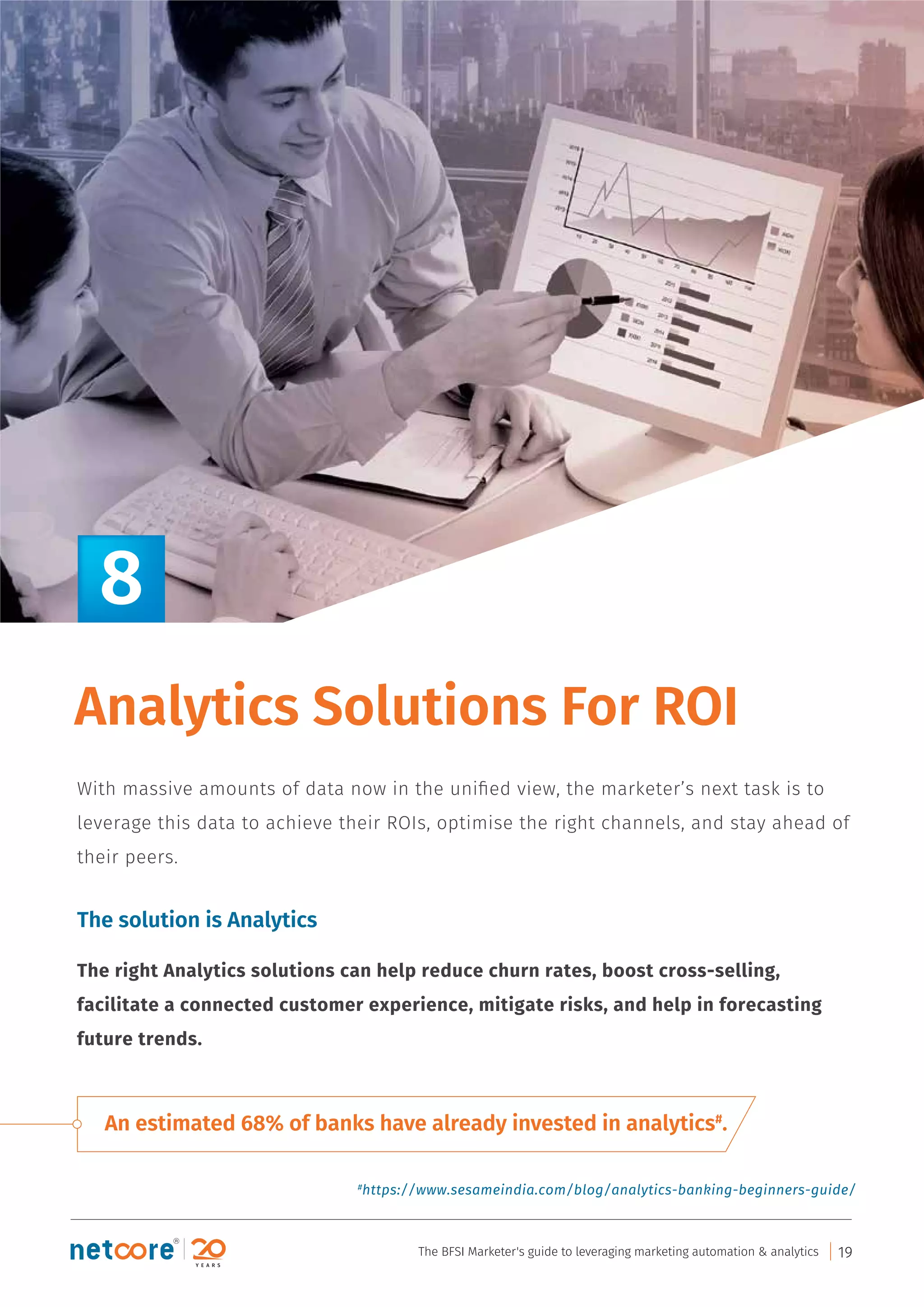
With massive amounts of data now in the unified view, the marketer’s next task is to
leverage this data to achieve their ROIs, optimise the right channels, and stay ahead of
their peers.
The solution is Analytics
The right Analytics solutions can help reduce churn rates, boost cross-selling,
facilitate a connected customer experience, mitigate risks, and help in forecasting
future trends.
8
#
https://www.sesameindia.com/blog/analytics-banking-beginners-guide/
The BFSI Marketer's guide to leveraging marketing automation & analytics 19
The short answer is - by providing an ‘Experiential Banking Experience’.
Analytics is used to track and trace the trails of customer spending, choice of products,
preferred channels, etc., map the metrics that matter to each customer, thereby
yielding insights that marketers can action immediately.
Today, the BFSI industry has to prepare to evolve from merely extracting volumes of
data to the relevant deployment of the same.
The scope of integrated customer and marketing analytics is immense, with the former
delving more into insights rooted in customer behaviour and the latter measuring the
performance of marketing activities as also the spend vis-à-vis the revenue earned.
Merging both will be the stepping stone to empowering marketers to thread all the
touchpoints in their path to data- and analytics-driven marketing.
So how does Analytics achieve this?
The BFSI Marketer's guide to leveraging marketing automation & analytics 20
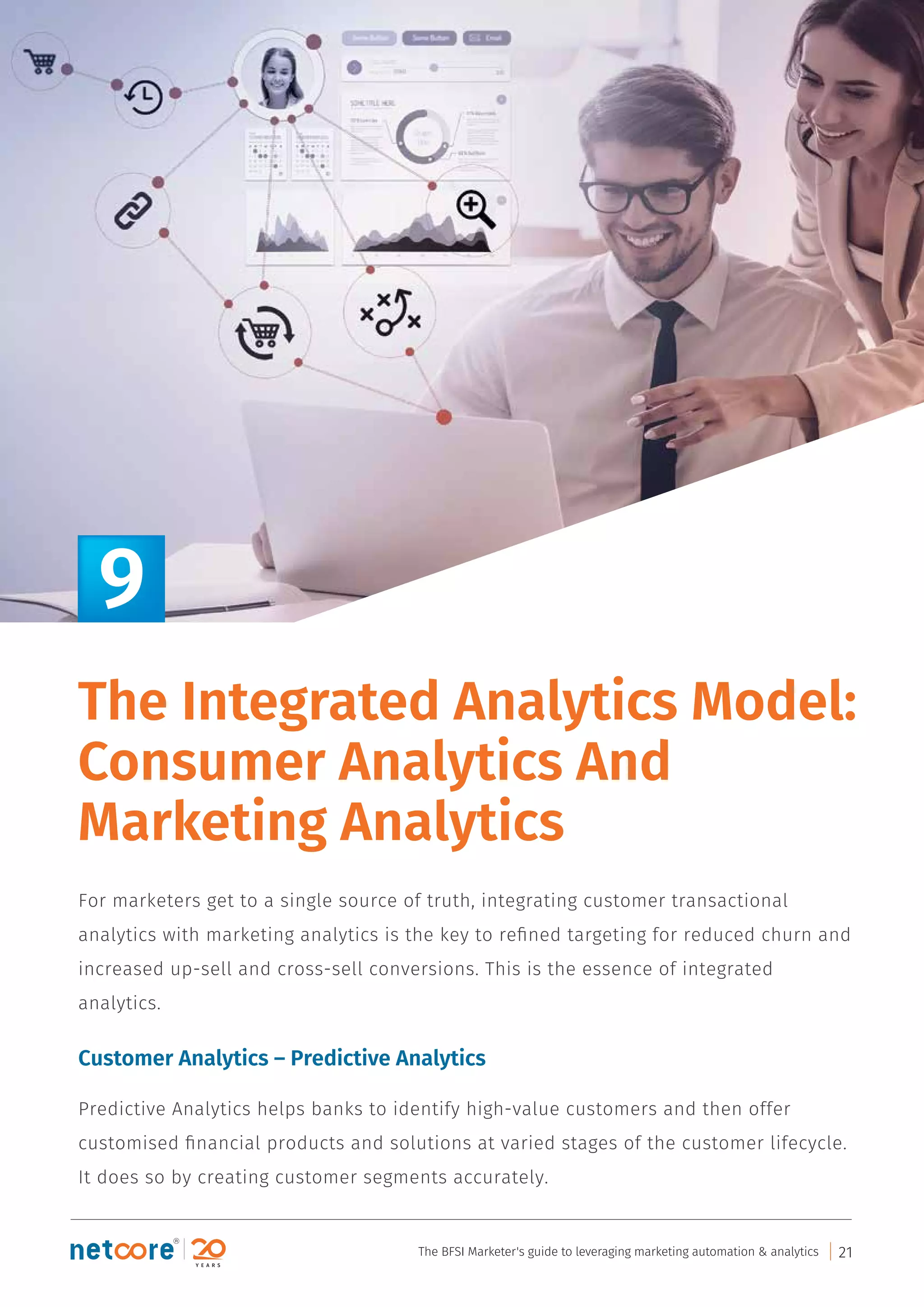
For marketers get to a single source of truth, integrating customer transactional
analytics with marketing analytics is the key to refined targeting for reduced churn and
increased up-sell and cross-sell conversions. This is the essence of integrated
analytics.
Customer Analytics – Predictive Analytics
Predictive Analytics helps banks to identify high-value customers and then offer
customised financial products and solutions at varied stages of the customer lifecycle.
It does so by creating customer segments accurately.
9
The Integrated Analytics Model:
Consumer Analytics And
Marketing Analytics
The BFSI Marketer's guide to leveraging marketing automation & analytics 21
Predictive Models show how existing and potential customers are likely to behave by
identifying their behavioural patterns from historical trends. By identifying key buyers
with targeted engagement and re-engagement tactics, cross-sell models can help
realise cross-sell opportunities.
• Cross-sell and lapsational models crack the two major problems for life insurance
providers – increasing the cross-sell base and identifying the relevant customers that
are most likely not going to renew their policy and are inclined to churn.
• An increasing churn rate is another cause for concern for the BFSI industry.
A predictive churn model can help re-engage and retain acquired customers with a
data-designed approach that specially retargets high-risk customers.
• Recommendation Engines help map consumer behaviour in real time and then
recommend customised financial products, services, and advice. Recommendations are
also made on the basis of historical data and can be integrated with websites and
apps. With recommendation engines, marketers can deploy a virtual sales person to
hand-hold customers and nurture these leads meaningfully towards transactions.
Customer Analytics – Descriptive Analytics
Descriptive analytics provides marketers with a useful summary of past events that
can help determine future activities and outcomes. The summaries within each
rule-set help unlock important cues that can be used to retarget customers more
effectively.
A simple example: With email data, at the marketer level, the open and click rates are
measured at an overall surface level during a campaign.
Banks deploying predictive analytics have
witnessed an annual growth rate of 10% in their
new customer base.
The BFSI Marketer's guide to leveraging marketing automation & analytics 22
However, with descriptive analytics, in-depth cues can be determined at the user level
– which ones are clicking on the links, which ones are genuinely interested in buying
the product, which ones need more information, etc.
Based on these key data points, retargeting becomes simpler and the focus becomes
more granular.
Segmentation is the antidote to the age-old tendency of BFSI: ‘batch-and-blast’
communication. By grouping customers into segments, marketers can target the
segments with customised content and thus bring better outcomes.
• Value-based segmentation - Having identified the most profitable customers and
their preferences, based on the value and frequency of past transactions, marketers
can work to retain and grow high-value customers to increase profitability and CLV.
• Behavioural segmentation groups customers according to the way they behave and
respond to marketing activities. Behavioural segmentation helps enhance marketing
efficacy by helping to refine engagement strategies.
Marketing Analytics
The Marketing Mix Modelling is a statistical approach that analyses the impact of
various marketing tactics and levers across multiple offline and online channels.
Marketers can then refine and fine-tune their marketing mix using data analysis. This
model helps marketers smartly plan their future investments.
• Channel Attribution Analysis measures and tracks the revenue success across all
the customer touchpoints to identify the most effective channel, so that marketers can
intensify their focus on it.
• Funnel Tracking measures dropped off leads, and can pinpoint the stages where
customers stop engaging with your brand so that you can try an alternate and relevant
channel to connect with them.
The BFSI Marketer's guide to leveraging marketing automation & analytics 23
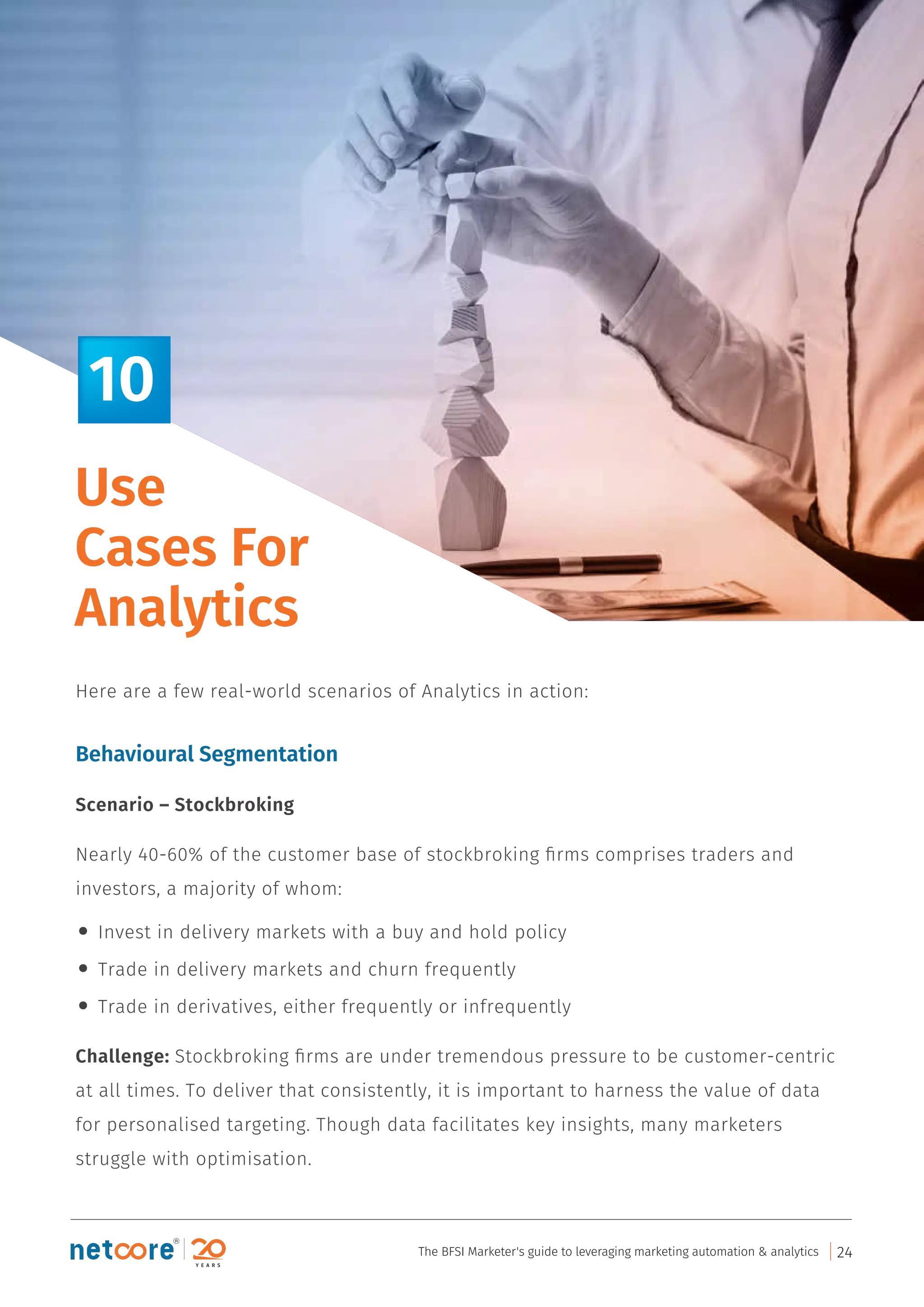
Here are a few real-world scenarios of Analytics in action:
Behavioural Segmentation
Scenario – Stockbroking
Nearly 40-60% of the customer base of stockbroking firms comprises traders and
investors, a majority of whom:
•Invest in delivery markets with a buy and hold policy
•Trade in delivery markets and churn frequently
•Trade in derivatives, either frequently or infrequently
Challenge: Stockbroking firms are under tremendous pressure to be customer-centric
at all times. To deliver that consistently, it is important to harness the value of data
for personalised targeting. Though data facilitates key insights, many marketers
struggle with optimisation.
Use
Cases For
Analytics
10
The BFSI Marketer's guide to leveraging marketing automation & analytics 24
Solution: Behaviour-based segmentation allows marketers to gain key insights about
each segment. This paves the way for tailored targeting with customised pitches to
recommend the relevant product and awaken the sluggish customer to trade again.
Similarly, a combination of multiple segmentations help in deciphering the target
customer base more precisely.
All Segmentation variants help understand what the consumers want, identify the
high-value customers from the vast base and help strategize on how best to cross-sell
and up-sell.
Cross-sell and Lapsational Model
Challenge: Cross-selling/up-selling remain ongoing challenges. Marketers want to
increase their cross-sell base and crunch the existing base to reveal relevant
customers, who can be cross-sold to. They also struggle with lapses in insurance
subscriptions, particularly within the first year, which leads to a high churn rate.
Solution: The cross-selling model assigns each customer with a clear cross-sell score.
This score is based on variables such as demographics and transactional history.
Marketers can conduct individualised targeting of top decile of customers via niche
channels such as outbound calling, email, SMS, etc. Targeting based on varied
customer deciles has resulted in an 8% rise in cross-sell policies.
The lapsational model helps marketers to combat lapses in insurance with a deep
analysis of lapsing trends for customers on a 3-4 year rolling basis. This lapsational
model can be applied on the new policies that are relevant for lapsed customers.
Marketers can use customised targeting of different deciles of customers through
various delivery channels. This has been shown to result in a 7-10% reduction in
lapsation of policies and massive savings in campaign costs.
The BFSI Marketer's guide to leveraging marketing automation & analytics 25
Marketing Mix Model
Challenge: With all the data, technological advancements, and innovative investments
in MAS, marketers struggle to pin-point the precise channel/strategy that has worked.
There are multiple channels disseminating and collecting data, online and offline as
well as within organisations (such as sales, pricing teams, etc.). As a marketer, when
you increase your digital spends and the sales team reduces their pricing at the same
time, it puts you in a fix to determine which initiative impacted the campaign directly.
Solution: Marketing Mix Modelling solves the dilemma by allowing BFSI marketers to
compare the performance and impact of various marketing activities to understand
which yielded the best ROI.
Quantitative insights from this model help understand the baseline and incremental
sales and the efficacy of the different channels through which customers interact with
firms. Marketers can thus improve and refine their strategies for the future.
The BFSI Marketer's guide to leveraging marketing automation & analytics 26
The Integrated Analytics Model –
What Lies Ahead?
What does the future hold for BFSI Marketers looking to stay ahead of the curve?
As customers become more savvy and sophisticated, Martech companies are already
investing large amounts in R&D for smarter, faster, and more intuitive products.
Artificial Intelligence and Machine Learning technologies are currently at the apex of
Martech advancements. These automated processes take the form of digital
assistants, chatbots, Smart Voice Assistants or other conversational interfaces to talk
to customers. They can be programmed to advise customers and adhere to strict
protocols, requiring minimal supervision. AI/ML processes can drive effective
11
The BFSI Marketer's guide to leveraging marketing automation & analytics 27
segmentation by analysing multiple data points about users. The insights drawn
from these can be used to target the user with the most personalised
communication. This boosts engagement and conversion rates.
Regardless of the marketing lever in use, data is the new oil and the full impact of
any strategy is based on an assumption of data at every marketing level of your
organisation.
The BFSI Marketer's guide to leveraging marketing automation & analytics 28
The BFSI Marketer's guide to leveraging marketing automation & analytics

The BFSI Marketer's guide to leveraging marketing automation & analytics

  • 1.
  • 2.
    Contents The BFSI Marketer'sguide to leveraging marketing automation & analytics 01 Introduction 03 02 A 3-Point Checklist for BFSI Marketers 05 03 Key Challenges Faced by BFSI Marketers Today 07 04 What is Driving the Need to Implement 09 Marketing Automation in the BFSI Industry? 05 Hurdles to Implementation of 12 Marketing Automation 06 Key Benefits of Implementing Marketing 14 Automation in the BFSI Industry 07 Data Integration Services for the BFSI Industry 17 08 Analytics Solutions for Increasing the ROI 19 09 The Integrated Analytics Model 21 10 Use Cases for Analytics 24 11 The Integrated Analytics Model – 27 What Lies Ahead?
  • 3.
    Ask any businessthat has stood the test of time and you will find that the only thing that stays ‘consistent’ in a customer’s journey is ‘inconsistency’. Today, amidst shrinking attention spans, meandering and often parallel customer journeys across multiple touchpoints in the digital landscape, a new disruption knocks on our doors every single day. As a result, in today’s marketplace, consumer experience is the only differentiator, and businesses constantly try to outpace one another in the race for attention and engagement. In the Banking, Financial Services and Insurance (BFSI) sector, it is not uncommon to see a successful BFSI product or service being replicated by across the board in a matter of days. Changes in consumer behaviour and expectations, regulatory aspects, as well as the growing volumes of behavioural data have made the BFSI industry a fiercely competitive one. 1 Introduction The BFSI Marketer's guide to leveraging marketing automation & analytics 03
  • 4.
    Historically, players inthe BFSI sector have been ‘early adopters’ of new technologies, especially with regard to internet-driven consumer engagement, outreach, marketing, as well as data security. Today, when large swathes of the market lay across the digital landscape, the industry as a whole must turn to innovative and out-of-the-box thinking in an effort to hook, engage with retain, and grow their customers anew. With the proliferation of diverse engagement channels, BFSI marketers need to break from the traditional and adopt modern and measurable Marketing Technology solutions to face an entirely new set of challenges. From consumer acquisition to engagement to retention and conversion, this eBook will be your guide to understanding: 1. Why Marketing Automation is no longer ‘optional’. 2. How Marketing Automation Solutions (MAS) can benefit the BFSI sector. 3. How to leverage the power of data and analytics for results-driven impact. It’s indisputable: Innovation is redefining banking. Problem/ Need Recognition Information Search Evalution of Alternatives Purchase Decision Post- Purchase Behavior The BFSI Marketer's guide to leveraging marketing automation & analytics 04
  • 5.
    A dormant customeris NOT a loyal customer. Customer loyalty is earned with a positive disposition and consistent engagement. As a BFSI player, whichever strategy you deem fit for building your agile marketing mix in order to up your marketing game, do ensure it checks the following three boxes: A 3-point Checklist For BFSI Marketers2 The BFSI Marketer's guide to leveraging marketing automation & analytics 05
  • 6.
    Stop thinking of yourindustry as being inherently transactional in nature. It is no longer so. Today, BFSI industry has evolved into become a very consumer-centric space, which revolves around building and managing customer journeys. Understand Leverage consumer behaviour and nurture relationships with personalised targeting in real time through automated processes. Focus on being a champion of consumer experience – it can be achieved at optimal costs. advanced data analytics and other breakthrough innovations to increase your ROI through marketing automation. The BFSI Marketer's guide to leveraging marketing automation & analytics 06
  • 7.
    3 Today, every industryincluding BFSI is looking to ‘disrupt’. No longer satisfied with merely growing sustainably, organisations seek to challenge the status quo. The consumer may be extremely well-informed, agile and technologically-forward, but is also fickle. They are also hooked online, and use multiple devices, creating a complex web of multiple online and offline journeys – a phenomenon called ‘consumer parallelism’. This results in an explosion of data from several different channels, and often, there is no clear way to make sense of it. There are Multiple departments within BFSI entities, differing in their scale and complexity, combined with disparate data sets from multiple vendors, all these factors when put together make it difficult for the marketer to have a unified view of the customer on a single platform which is necessary for analysis when the objective is to personalise the offerings. Lack of Unified View of the Consumer Key Challenges Faced By BFSI Marketers Today The BFSI Marketer's guide to leveraging marketing automation & analytics 07
  • 8.
    Inconsistent User Experience Whenusing technology, user experience or UX is a very important aspect driving consumer engagement. Particularly for the BFSI industry, good UX is a hygiene factor. So, at times when there is a hold-up or a bottleneck due to technical difficulties - which is inevitable in some situations - this causes the customer to face 'broken experiences', leading them to feel confused or frustrated even. This can adversely impact customer satisfaction. Marketers then rely on disjointed, and often futile, marketing efforts to offset these. Without data or insight into such instances, marketers are clueless as to the ways to engage these consumers. Creating useful touchpoints at all such places and using automation to handle the customer can help you walk the customer through such situations where they feel cared for and involved. Moreover, these touchpoints help marketers collect data that can be used to further their learning and understanding of the customer journey Lower Customer Lifetime Value (CLTV) Your customer is in the driver’s seat and demands a seamless experience when banking with you. As a marketer, this is your opportunity to cross-sell and drive repeat business, which is possible through engagement and re-engagement. Lack of a unified view of your customer’s journey poses a huge challenge to accurately mapping their ‘omni-channel hop’, bringing down your campaign efficiency with inaccurate targeting and personalisation. This also means you miss out on the necessary insights to make the most of cross-sell opportunities, thus leading to a lower Customer LifeTime Value (CLTV). The BFSI Marketer's guide to leveraging marketing automation & analytics 08
  • 9.
    Consumers today behavedifferently depending on the channel, touchpoints, and platforms they use. So, a single customer may exhibit myriad, often contrasting digital personas. This Consumer Parallelism makes a marketer’s job a lot more complex. Thus, the need for a unified view of all this data. To do this, marketers need to first gain access to the right type of data. Channel data needs to be transformed into the right quality and state of readiness. A data integration specialist Lack of an Integrated 360-Degree View of the customer journey What is driving the Need for Marketing Automation & Analytics in the BFSI Industry? 4 The BFSI Marketer's guide to leveraging marketing automation & analytics 09
  • 10.
    needs to convertchannel data from the marketing ecosystem into summary-level data sets. This specialised task is best handled by a quality data integration service provider in case the in-house team is unable to do it. These summary data sets are then linked to a Marketing Automation Solution (MAS) which gives insights into consumer behaviour. Marketers now have a unified view of data that can be used for analytics, segmentation, etc., and is a key step towards personalised and powerful communication. A Limiting Consumer Experience As the BFSI industry evolves from being product-centric to being a customer-centric one, marketers need to address the challenges posed by consumer preferences, which too are constantly evolving. Marketers are beginning to understand that marketing automation is the missing piece of this puzzle; it is a smart vehicle that streamlines, automates, and measures. This technology can be used to provide a seamless customer experience that is memorable and not merely transactional. The BFSI Marketer's guide to leveraging marketing automation & analytics 10
  • 11.
    The right MarketingAutomation Solution helps to identify and aggregate consumer behaviour across all inbound and outbound channels and then uses that information to nurture customer relationships. It helps ensure a seamless customer experience by delivering the right message to the right customer at the right time through the right channel. Effective Campaign Management For many leading banks, financial institutions, mutual fund firms, etc., manual repetitive tasks choke up human resources and person-hours. A powerful, omni-channel, cross-channel journey builder can help increase and process efficiency as well as the ROI. With BFSI customers readily able to switch services, the onus is on marketers to reach out with personalised content at various touch points in the consumer’s journey. Cross-channel personal triggers – be it a ‘welcome’ email series, dividend declaration, updates related to personal accounts, etc. all such communication is critical. When automated, these tasks enhance the Customer Lifecycle Program of any new lead. The designed, automated workflow triggers the relevant campaigns simultaneously, improving conversions on various products and services. The BFSI Marketer's guide to leveraging marketing automation & analytics 11
  • 12.
    Going digital, whetherin banking or any other industry is not about using snazzy apps or websites. It is about how you bring these platforms to use and the consumer experience they provide. BFSI marketers are under constant pressure to deliver results and to improve operational efficiency while reducing costs. Following issues prevent the MAS trigger from being pulled: Data security The BFSI industry deals in a wealth of confidential data and data security is their top-most priority – ensuring this is crucial to their reputation. Data Quality & Readiness Marketing Automation is all about data. You could be using the best MAS in the market but if the data is incorrect and unorganised, you will not get the desired results. Hurdles to Adoption of Marketing Automation in BFSI 5 The BFSI Marketer's guide to leveraging marketing automation & analytics 12
  • 13.
    Formation of silosof data collected from disparate sources compounds the challenge, with no way to decipher the customers’ fragmented journeys. Lack of refined, structured data prevents the marketer from optimising the MAS platform to its best. Lack of Skills & Expertise In this day and age, effective marketing is so data-dependent that all stakeholders, including marketing and IT teams, have to work together to bring home the results. But, a lack of skill sets and close collaboration between the two departments prevents the marketer from being agile enough to execute marketing strategies effectively. Difficulty in Measuring Efficiency/ROI As of 2016, the biggest challenge for BFSI marketers is the ability to measure performance and prove results# . Only 8% of financial organisations believed this was not a challenge. This is also reflected in the view of marketing in the C-Suite and the inability to provide meaningful ROI metrics required throughout any organisation. For a financial organisation to succeed in the future, measurability of results will be a basic requirement. The Right Implementation Partner Rise in digital marketing spends notwithstanding, mapping the customers’ fluid journeys offline and online is an ongoing challenge for the BFSI marketers. Their marketing goals remain a black box for as long as they see MAS as a magic tool that can be used randomly without any strategic implementation. The trajectory of implementing marketing automation solutions can be tricky and the struggle to identify the right digital delivery channel can limit the efficiency of customer engagement. Thus, it is important to identify the right partner to help you implement your MAS with the right technology, platform, as well as support. # https://thefinancialbrand.com/64996/financial-marketing-trends-technology-media-cmo/ The BFSI Marketer's guide to leveraging marketing automation & analytics 13
  • 14.
    Capturing Unified Viewof the Customer Journey Today’s consumer is always-on and attention spans are spread across channels and devices. Consumer Parallelism is the context but there is more to the story: The consumer seeks to be understood as an individual with unique choices and needs. Brands need to get close to their customers and this is no longer optional. Marketers must indulge consumers in a way that suits their individual journeys - your storytelling will vary accordingly. Your leads are not just leads in a transactional sense – these are people with unique needs that are looking for an outstanding consumer experience. Key Benefits of Using Marketing Automation in the BFSI Industry 6 The BFSI Marketer's guide to leveraging marketing automation & analytics 14
  • 15.
    Advanced Segmentation Marketing automationhelps marketers to build segments across multiple delivery channels like email, SMS, push notifications, in-app and web messaging, thus allowing you to target customers based on past behaviours or channel responsiveness. It also helps in building payload-based segmentation i.e. based on the actual content consumed during the web or app activity. This allows you to target customers based on their purchase history, website visits, or previous landing page interactions for greater impact. Maximised CLTV For customer retention, marketers need to ensure that they use the right digital channel to engage with customers to nurture leads and increase conversion rate and CLTV. Marketing Automation Solution (MAS) is the ultimate power tool to plan multiple, simultaneous, and integrated campaigns for up-selling and cross-selling. Marketing Automation has been proven to increase the customer base, drive engagement, and generate improved conversions. On-site & Off-site Engagement Marketers can use tools like personalised web push messages and sticky bars on the page when users are on site or about to leave the site, thereby enabling top-of-the-mind recall and real-time engagement. Browser push notifications (BPNs) have proven to be a handy power tool for off-site engagement. The moment a customer visits your website, you can encourage them to opt in for BPNs. After that, whenever they access their browser, you have the opportunity to interact with them with relevant messages. This helps you improve your subscriber and leads base as well as receive feedback on the products your customers have purchased. The BFSI Marketer's guide to leveraging marketing automation & analytics 15
  • 16.
    Marketers can useautomation to track in-app activity of the user, which allows them to understand their customer's behaviour even more precisely. This presents an even greater opportunity for personalisation of BPN. Personalisation in Real Time For any campaign to be effective, it must be driven by the power differentiator of personalisation. Marketing automation can help marketers to send more relevant and personalised communication which can increase their transactions nearly five-fold. The BFSI industry runs on personal investments and there is an immense opportunity to hyper-personalise communication via all delivery channels. Depending on the keywords used by the customer, a personalised email template or message along with the product image can be triggered on a real-time basis. For example, with real-time personalisation, Financial Securities companies can display the latest stock price at the time the email is opened. Based on the email open rate, the next best action can be planned to effectively engage with the customer keeping the lines of communication open. Recycling Dropped Leads BFSI companies generate many leads but not all of them can be converted, for a host of reasons. Many of these are dropped, and can be recycled. Based on the reason for the drop, these leads can be bucketed in different segments and be targeted with relevant communications across channels. A leading private bank was recently able to convert 20% of dropped leads through an automated cross-channel campaign. The BFSI Marketer's guide to leveraging marketing automation & analytics 16
  • 17.
    In this ageof omni-channel banking, it’s not just Big Data that is valuable. Marketers today need Smart Data. By 2020, the ability to work with data successfully will be the most important skill for digital leaders. The new marketing makeover for BFSI will be underlined by a jump from data deposits to data deployment. As a marketer, by partnering with trusted vendors who are in sync with your internal teams, you can track the customer’s channel hop, and get all the right data in one place. Working with data requires marketers to sift through multiple data silos and build a ‘360-degree data mart’. For the marketer to have this unified view of a customer’s journey, they need to marry the marketing channel data sets with the customer transaction data sets. But, for this to happen, the data needs to be in a form that is readily consumable. Data Integration Services In BFSI 7 The BFSI Marketer's guide to leveraging marketing automation & analytics 17
  • 18.
    In the BFSIindustry, access to data and ensuring its security remains a concern for marketers, which may come in the way of seamless integration of data. Banks can leverage application programming interfaces (APIs)# - which are gaining traction in BFSI industry - to share data in a controlled manner between two parties. While this has a margin of risk because of its decentralised approach, security can be suitably enhanced with a robust risk-management infrastructure. Further, marketers can limit the scope of customer data they include in their MAS and add firewalls for tighter security. This can help minimise the risks to a great extent. BFSI marketers then need to systematically decipher silo stacks to unlock the next level, which is data analytics. Data analytics, when used correctly, represents a paradigm shift in how marketers connect with consumers. This intelligent integration of the right behavioural, demographic, and transactional data paired with the relevant marketing automation tool braces the business to weather any challenges. It is the opening act for marketers to unleash the power of data analytics in financial risks, fraud detection, and credit management, among others. # https://www.mckinsey.com/industries/financial-services/our-insights/data-sharing-and-open-banking The BFSI Marketer's guide to leveraging marketing automation & analytics 18
  • 19.
    An estimated 68%of banks have already invested in analytics# . Analytics Solutions For ROI With massive amounts of data now in the unified view, the marketer’s next task is to leverage this data to achieve their ROIs, optimise the right channels, and stay ahead of their peers. The solution is Analytics The right Analytics solutions can help reduce churn rates, boost cross-selling, facilitate a connected customer experience, mitigate risks, and help in forecasting future trends. 8 # https://www.sesameindia.com/blog/analytics-banking-beginners-guide/ The BFSI Marketer's guide to leveraging marketing automation & analytics 19
  • 20.
    The short answeris - by providing an ‘Experiential Banking Experience’. Analytics is used to track and trace the trails of customer spending, choice of products, preferred channels, etc., map the metrics that matter to each customer, thereby yielding insights that marketers can action immediately. Today, the BFSI industry has to prepare to evolve from merely extracting volumes of data to the relevant deployment of the same. The scope of integrated customer and marketing analytics is immense, with the former delving more into insights rooted in customer behaviour and the latter measuring the performance of marketing activities as also the spend vis-à-vis the revenue earned. Merging both will be the stepping stone to empowering marketers to thread all the touchpoints in their path to data- and analytics-driven marketing. So how does Analytics achieve this? The BFSI Marketer's guide to leveraging marketing automation & analytics 20
  • 21.
    For marketers getto a single source of truth, integrating customer transactional analytics with marketing analytics is the key to refined targeting for reduced churn and increased up-sell and cross-sell conversions. This is the essence of integrated analytics. Customer Analytics – Predictive Analytics Predictive Analytics helps banks to identify high-value customers and then offer customised financial products and solutions at varied stages of the customer lifecycle. It does so by creating customer segments accurately. 9 The Integrated Analytics Model: Consumer Analytics And Marketing Analytics The BFSI Marketer's guide to leveraging marketing automation & analytics 21
  • 22.
    Predictive Models showhow existing and potential customers are likely to behave by identifying their behavioural patterns from historical trends. By identifying key buyers with targeted engagement and re-engagement tactics, cross-sell models can help realise cross-sell opportunities. • Cross-sell and lapsational models crack the two major problems for life insurance providers – increasing the cross-sell base and identifying the relevant customers that are most likely not going to renew their policy and are inclined to churn. • An increasing churn rate is another cause for concern for the BFSI industry. A predictive churn model can help re-engage and retain acquired customers with a data-designed approach that specially retargets high-risk customers. • Recommendation Engines help map consumer behaviour in real time and then recommend customised financial products, services, and advice. Recommendations are also made on the basis of historical data and can be integrated with websites and apps. With recommendation engines, marketers can deploy a virtual sales person to hand-hold customers and nurture these leads meaningfully towards transactions. Customer Analytics – Descriptive Analytics Descriptive analytics provides marketers with a useful summary of past events that can help determine future activities and outcomes. The summaries within each rule-set help unlock important cues that can be used to retarget customers more effectively. A simple example: With email data, at the marketer level, the open and click rates are measured at an overall surface level during a campaign. Banks deploying predictive analytics have witnessed an annual growth rate of 10% in their new customer base. The BFSI Marketer's guide to leveraging marketing automation & analytics 22
  • 23.
    However, with descriptiveanalytics, in-depth cues can be determined at the user level – which ones are clicking on the links, which ones are genuinely interested in buying the product, which ones need more information, etc. Based on these key data points, retargeting becomes simpler and the focus becomes more granular. Segmentation is the antidote to the age-old tendency of BFSI: ‘batch-and-blast’ communication. By grouping customers into segments, marketers can target the segments with customised content and thus bring better outcomes. • Value-based segmentation - Having identified the most profitable customers and their preferences, based on the value and frequency of past transactions, marketers can work to retain and grow high-value customers to increase profitability and CLV. • Behavioural segmentation groups customers according to the way they behave and respond to marketing activities. Behavioural segmentation helps enhance marketing efficacy by helping to refine engagement strategies. Marketing Analytics The Marketing Mix Modelling is a statistical approach that analyses the impact of various marketing tactics and levers across multiple offline and online channels. Marketers can then refine and fine-tune their marketing mix using data analysis. This model helps marketers smartly plan their future investments. • Channel Attribution Analysis measures and tracks the revenue success across all the customer touchpoints to identify the most effective channel, so that marketers can intensify their focus on it. • Funnel Tracking measures dropped off leads, and can pinpoint the stages where customers stop engaging with your brand so that you can try an alternate and relevant channel to connect with them. The BFSI Marketer's guide to leveraging marketing automation & analytics 23
  • 24.
    Here are afew real-world scenarios of Analytics in action: Behavioural Segmentation Scenario – Stockbroking Nearly 40-60% of the customer base of stockbroking firms comprises traders and investors, a majority of whom: •Invest in delivery markets with a buy and hold policy •Trade in delivery markets and churn frequently •Trade in derivatives, either frequently or infrequently Challenge: Stockbroking firms are under tremendous pressure to be customer-centric at all times. To deliver that consistently, it is important to harness the value of data for personalised targeting. Though data facilitates key insights, many marketers struggle with optimisation. Use Cases For Analytics 10 The BFSI Marketer's guide to leveraging marketing automation & analytics 24
  • 25.
    Solution: Behaviour-based segmentationallows marketers to gain key insights about each segment. This paves the way for tailored targeting with customised pitches to recommend the relevant product and awaken the sluggish customer to trade again. Similarly, a combination of multiple segmentations help in deciphering the target customer base more precisely. All Segmentation variants help understand what the consumers want, identify the high-value customers from the vast base and help strategize on how best to cross-sell and up-sell. Cross-sell and Lapsational Model Challenge: Cross-selling/up-selling remain ongoing challenges. Marketers want to increase their cross-sell base and crunch the existing base to reveal relevant customers, who can be cross-sold to. They also struggle with lapses in insurance subscriptions, particularly within the first year, which leads to a high churn rate. Solution: The cross-selling model assigns each customer with a clear cross-sell score. This score is based on variables such as demographics and transactional history. Marketers can conduct individualised targeting of top decile of customers via niche channels such as outbound calling, email, SMS, etc. Targeting based on varied customer deciles has resulted in an 8% rise in cross-sell policies. The lapsational model helps marketers to combat lapses in insurance with a deep analysis of lapsing trends for customers on a 3-4 year rolling basis. This lapsational model can be applied on the new policies that are relevant for lapsed customers. Marketers can use customised targeting of different deciles of customers through various delivery channels. This has been shown to result in a 7-10% reduction in lapsation of policies and massive savings in campaign costs. The BFSI Marketer's guide to leveraging marketing automation & analytics 25
  • 26.
    Marketing Mix Model Challenge:With all the data, technological advancements, and innovative investments in MAS, marketers struggle to pin-point the precise channel/strategy that has worked. There are multiple channels disseminating and collecting data, online and offline as well as within organisations (such as sales, pricing teams, etc.). As a marketer, when you increase your digital spends and the sales team reduces their pricing at the same time, it puts you in a fix to determine which initiative impacted the campaign directly. Solution: Marketing Mix Modelling solves the dilemma by allowing BFSI marketers to compare the performance and impact of various marketing activities to understand which yielded the best ROI. Quantitative insights from this model help understand the baseline and incremental sales and the efficacy of the different channels through which customers interact with firms. Marketers can thus improve and refine their strategies for the future. The BFSI Marketer's guide to leveraging marketing automation & analytics 26
  • 27.
    The Integrated AnalyticsModel – What Lies Ahead? What does the future hold for BFSI Marketers looking to stay ahead of the curve? As customers become more savvy and sophisticated, Martech companies are already investing large amounts in R&D for smarter, faster, and more intuitive products. Artificial Intelligence and Machine Learning technologies are currently at the apex of Martech advancements. These automated processes take the form of digital assistants, chatbots, Smart Voice Assistants or other conversational interfaces to talk to customers. They can be programmed to advise customers and adhere to strict protocols, requiring minimal supervision. AI/ML processes can drive effective 11 The BFSI Marketer's guide to leveraging marketing automation & analytics 27
  • 28.
    segmentation by analysingmultiple data points about users. The insights drawn from these can be used to target the user with the most personalised communication. This boosts engagement and conversion rates. Regardless of the marketing lever in use, data is the new oil and the full impact of any strategy is based on an assumption of data at every marketing level of your organisation. The BFSI Marketer's guide to leveraging marketing automation & analytics 28