

Al Bessin, Executive Vice President 4 October 2011 Affordable Databases:  Can You Afford  Not  To Be Using a Marketing Database
Agenda Consumer Behavior Marketing Databases Fundamental Needs for All Marketers Examples
Trends: Consumer Behavior, Economics and Marketing
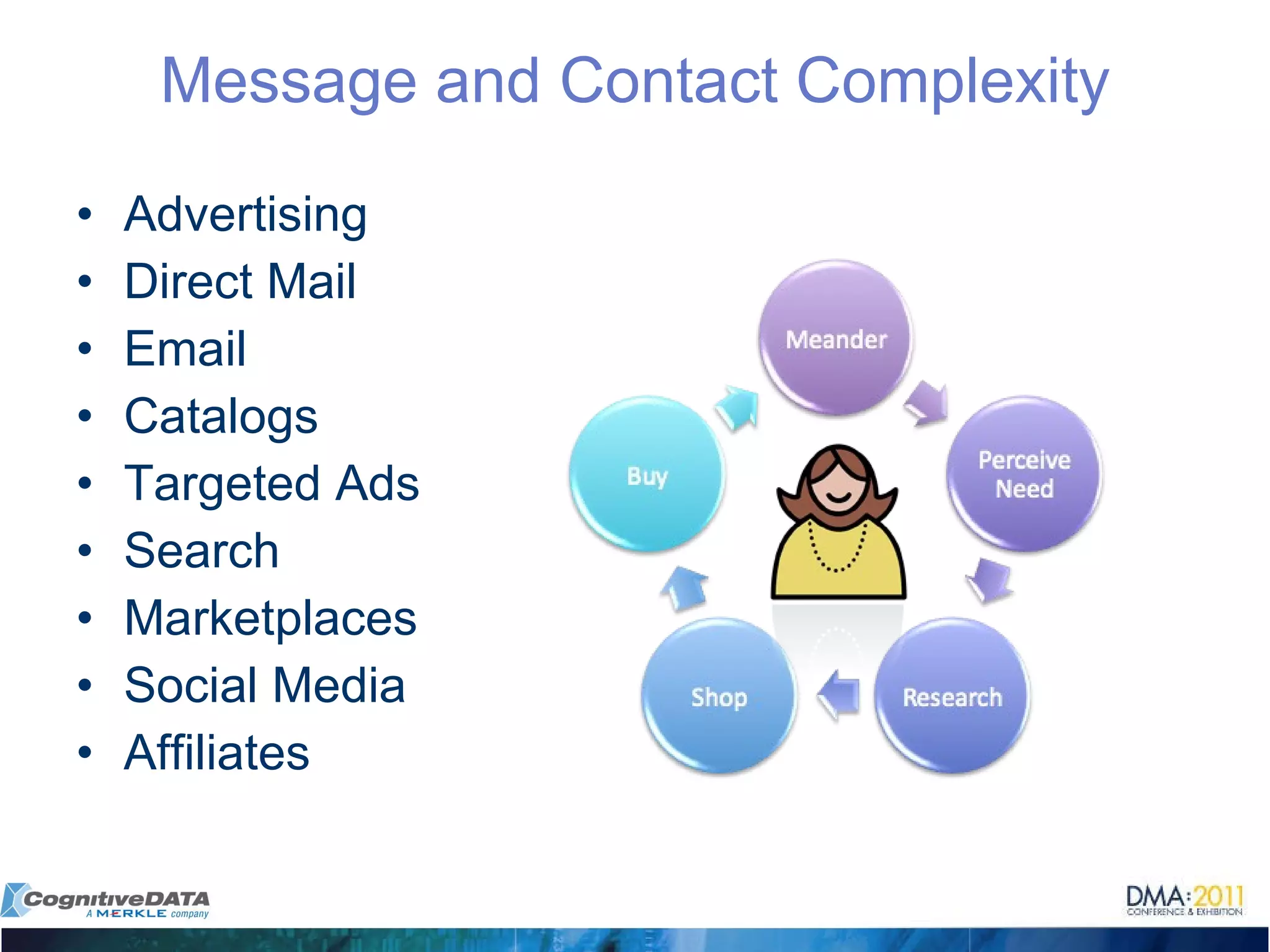
Message and Contact Complexity Advertising Direct Mail Email Catalogs Targeted Ads Search Marketplaces Social Media Affiliates
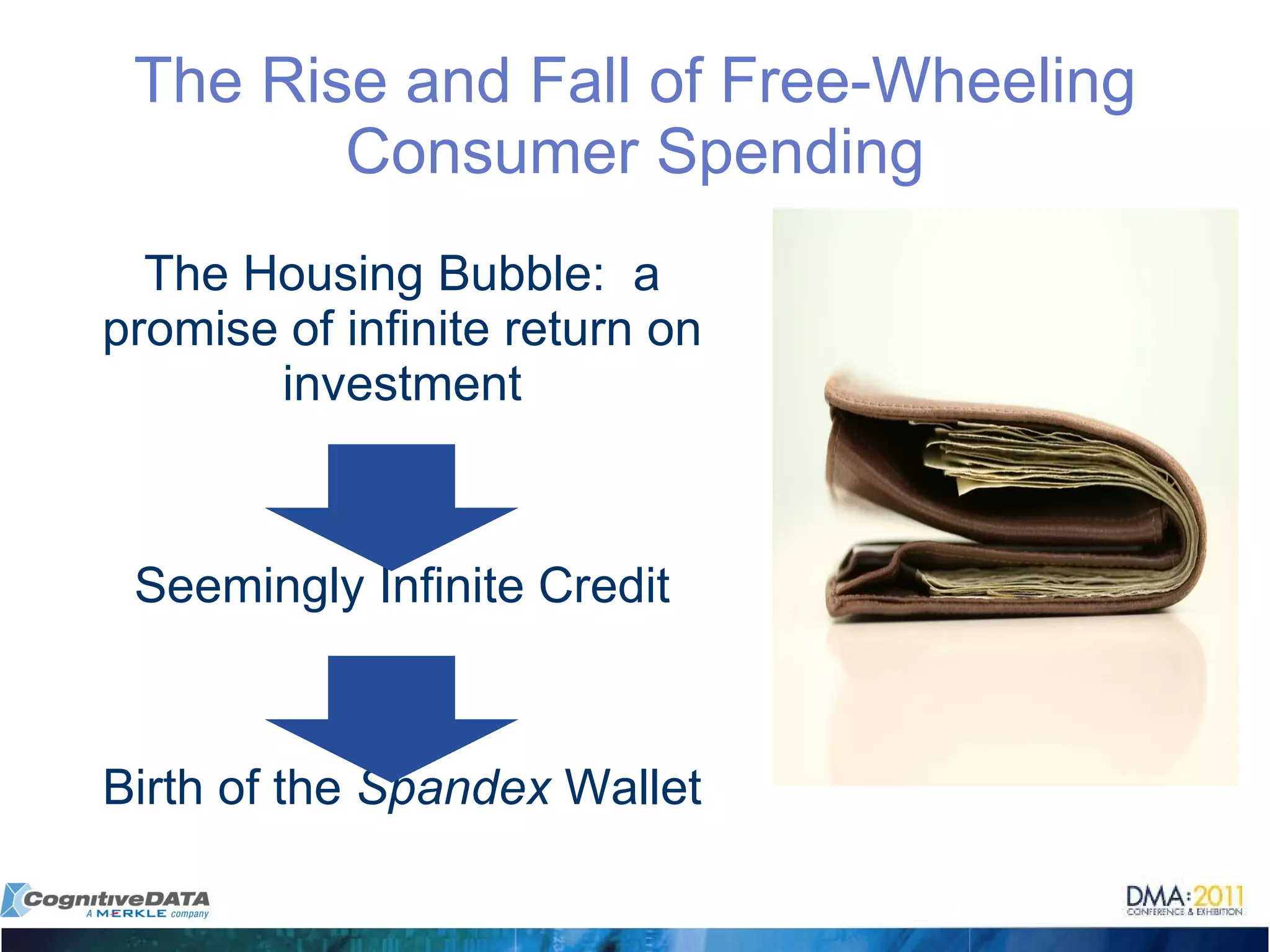
The Rise and Fall of Free-Wheeling Consumer Spending The Housing Bubble:  a promise of infinite return on investment Seemingly Infinite Credit Birth of the  Spandex  Wallet
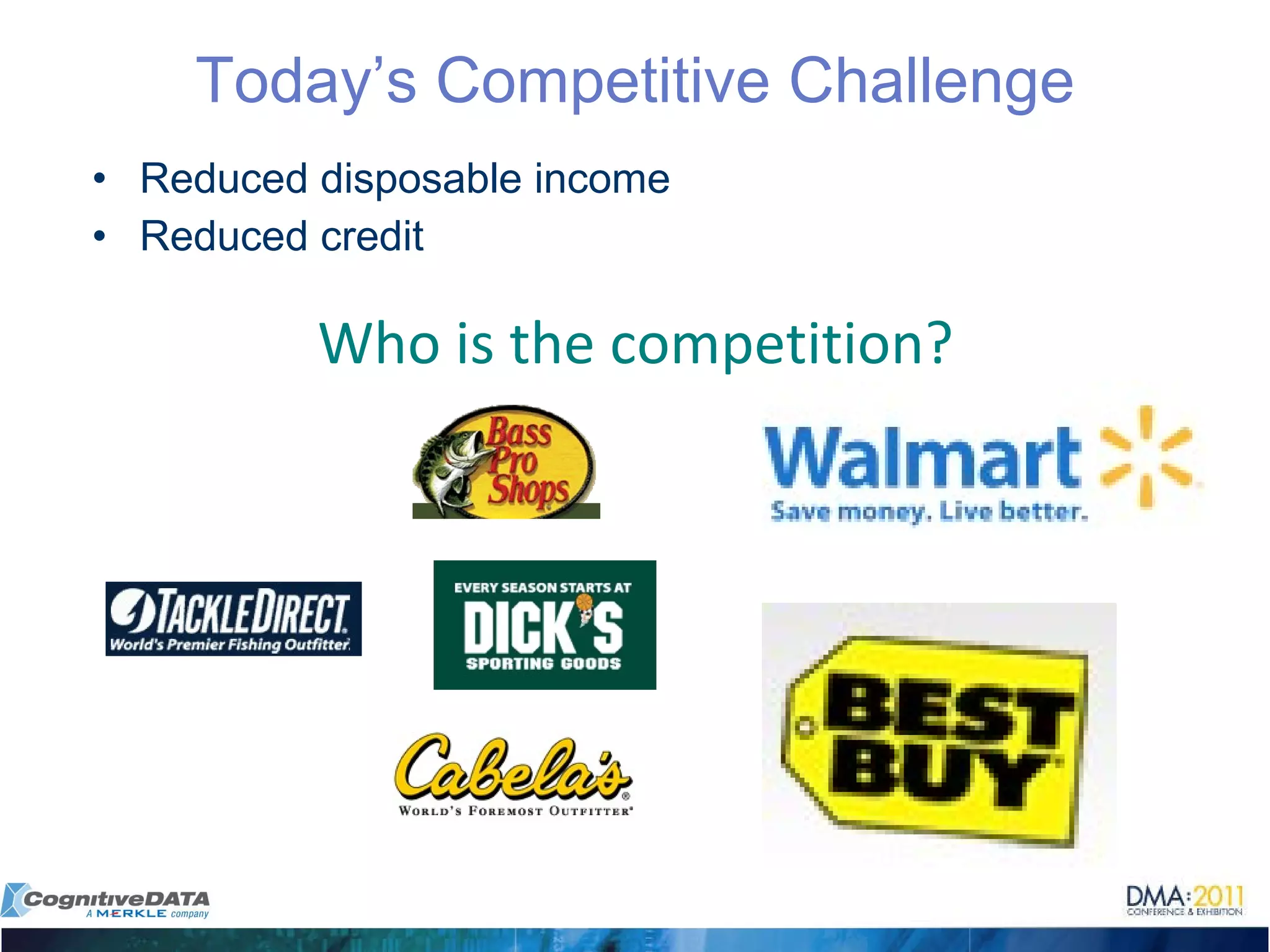
Today’s Competitive Challenge Reduced disposable income Reduced credit Who is the competition?
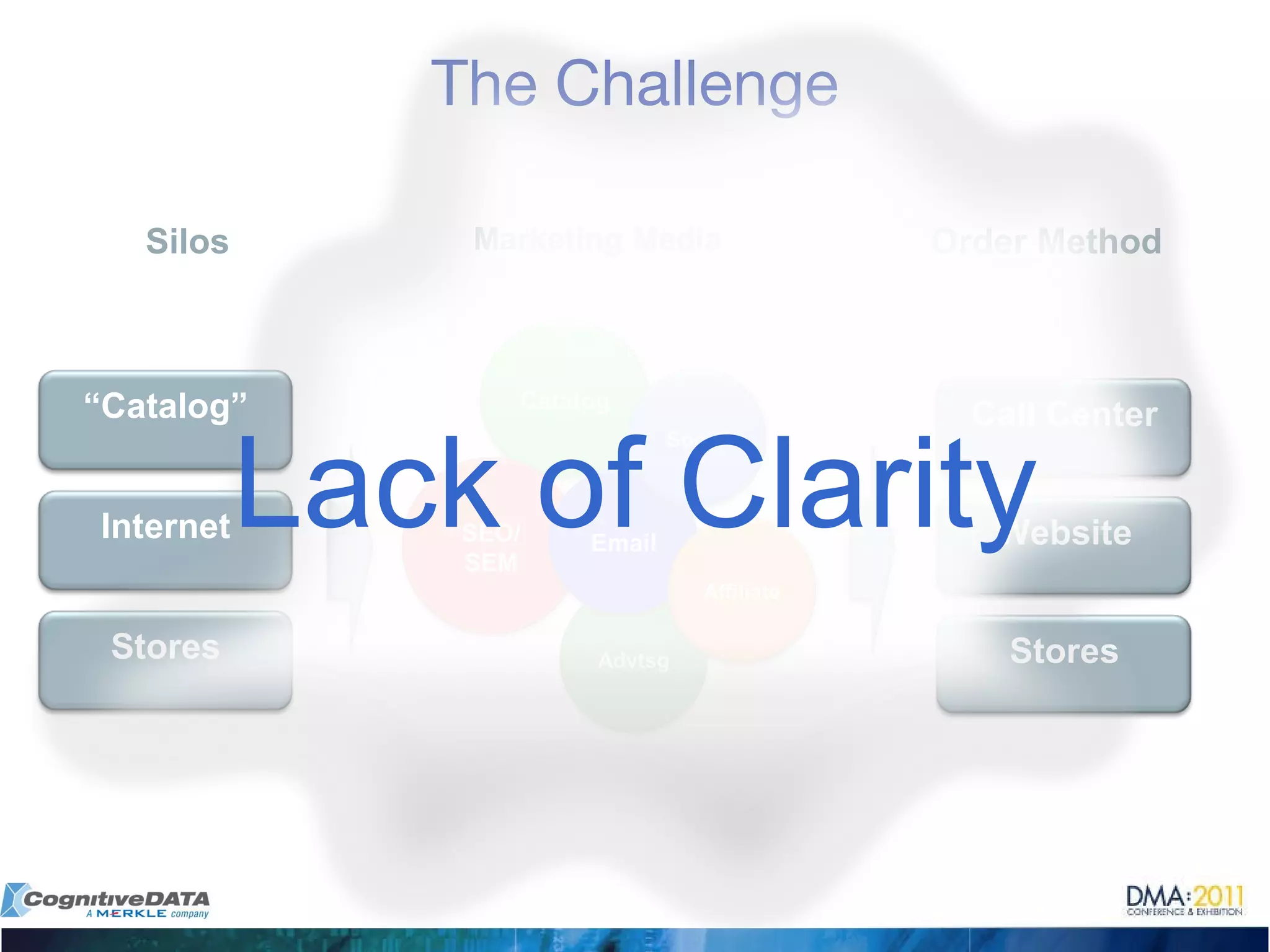
The Challenge “ Catalog” Internet Stores Silos Order Method Call Center Website Stores Marketing Media Catalog SEO/ SEM Advtsg Email Social Affiliate Lack of Clarity
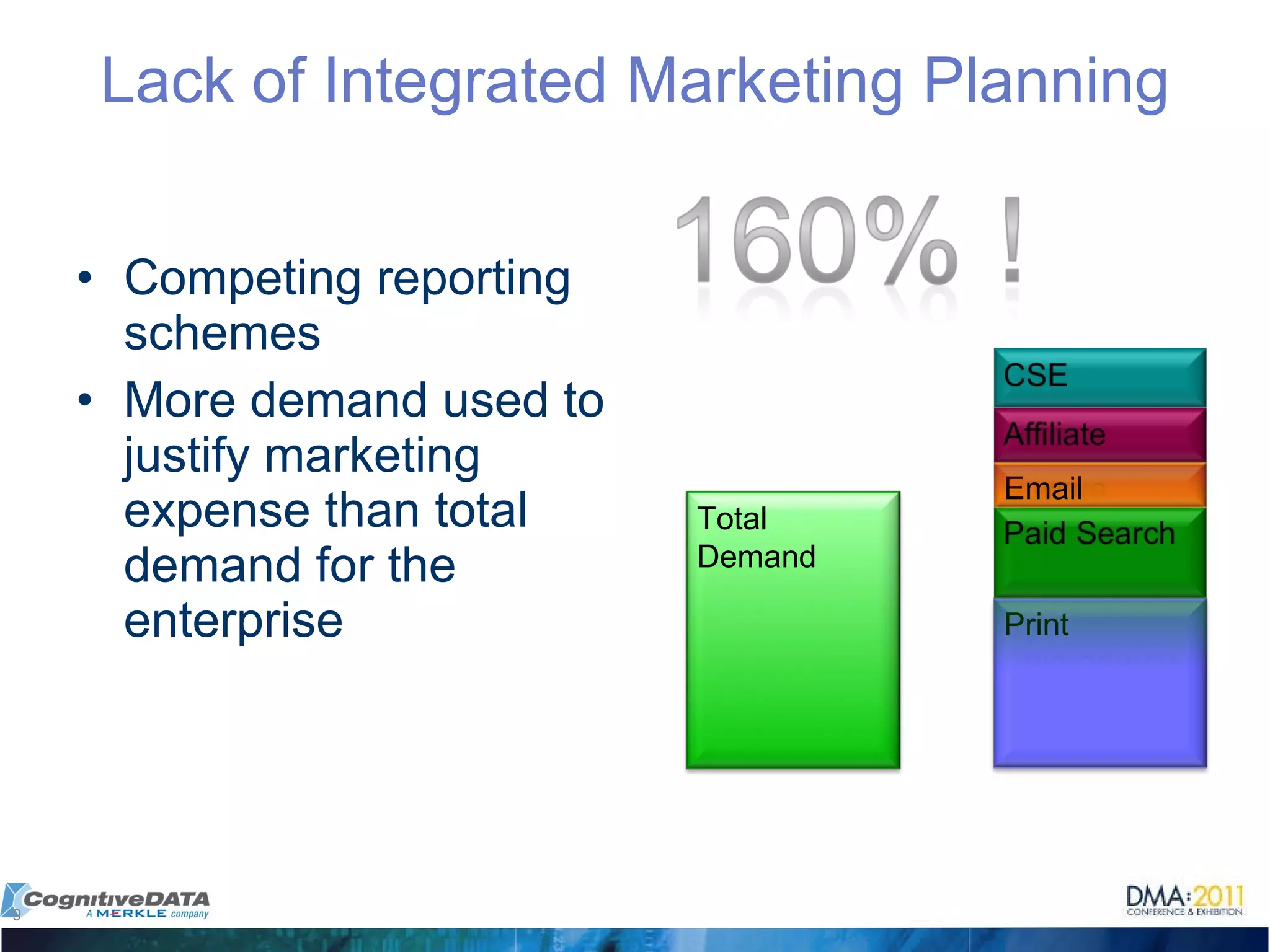
Lack of Integrated Marketing Planning Competing reporting schemes More demand used to justify marketing expense than total demand for the enterprise Total Demand Print Email
Marketing Databases
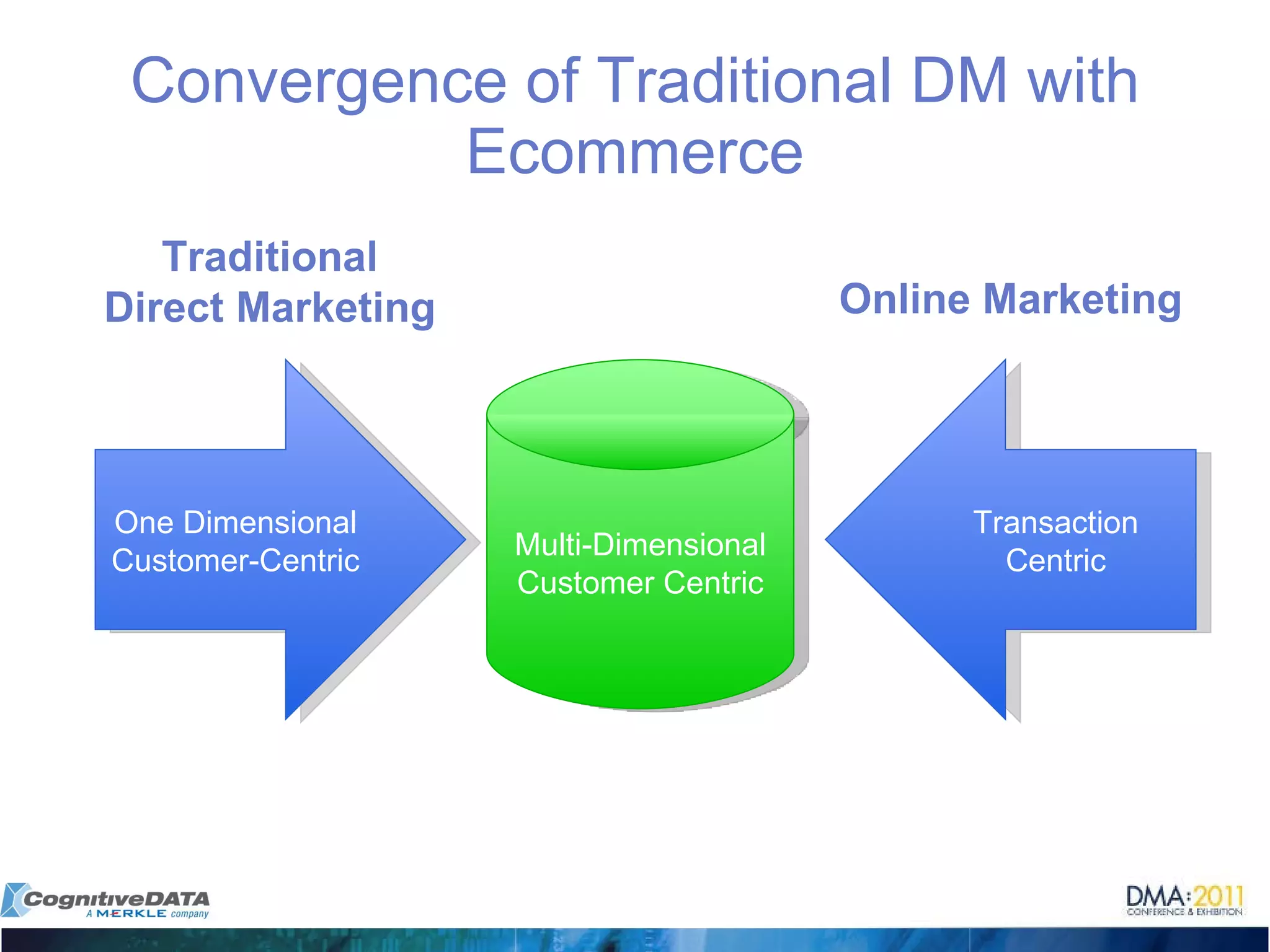
Convergence of Traditional DM with Ecommerce One Dimensional Customer-Centric Transaction Centric Traditional Direct Marketing Online Marketing Multi-Dimensional Customer Centric
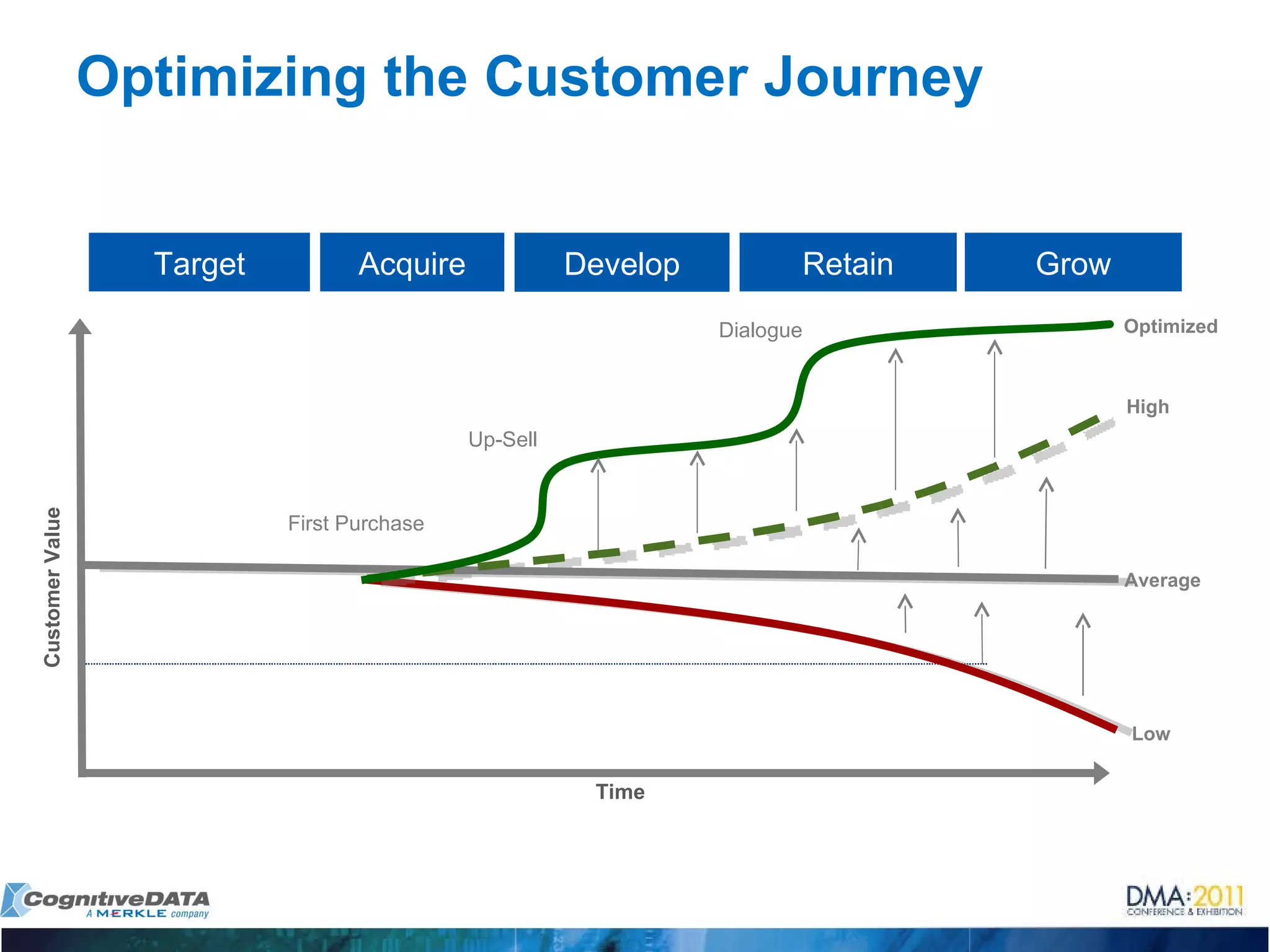
Optimizing the Customer Journey Customer Value Average High Time Low Target Acquire Retain Grow First Purchase Up-Sell Dialogue Optimized Develop
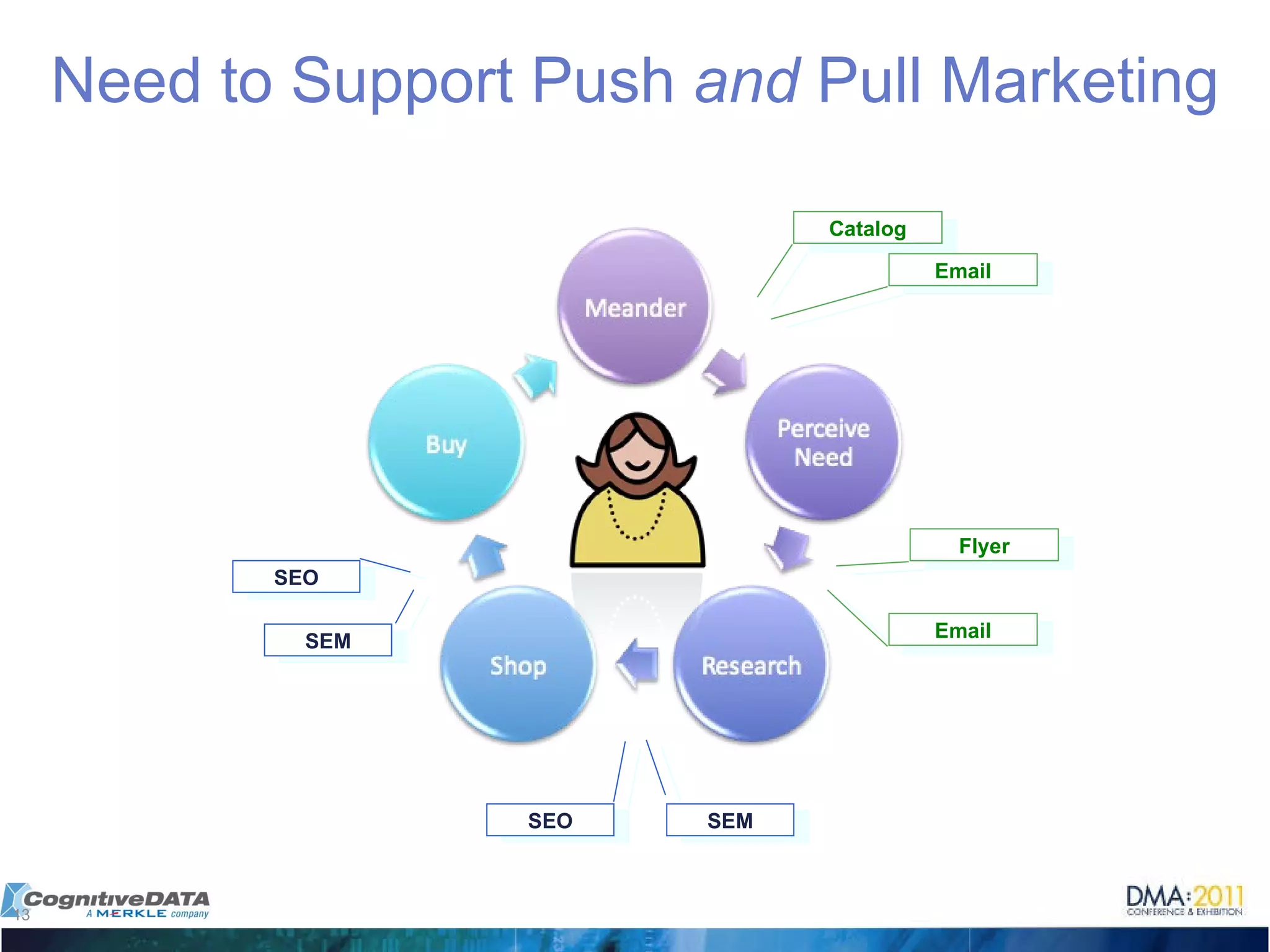
Need to Support Push  and  Pull Marketing Catalog Email Flyer Email SEO SEM SEO SEM
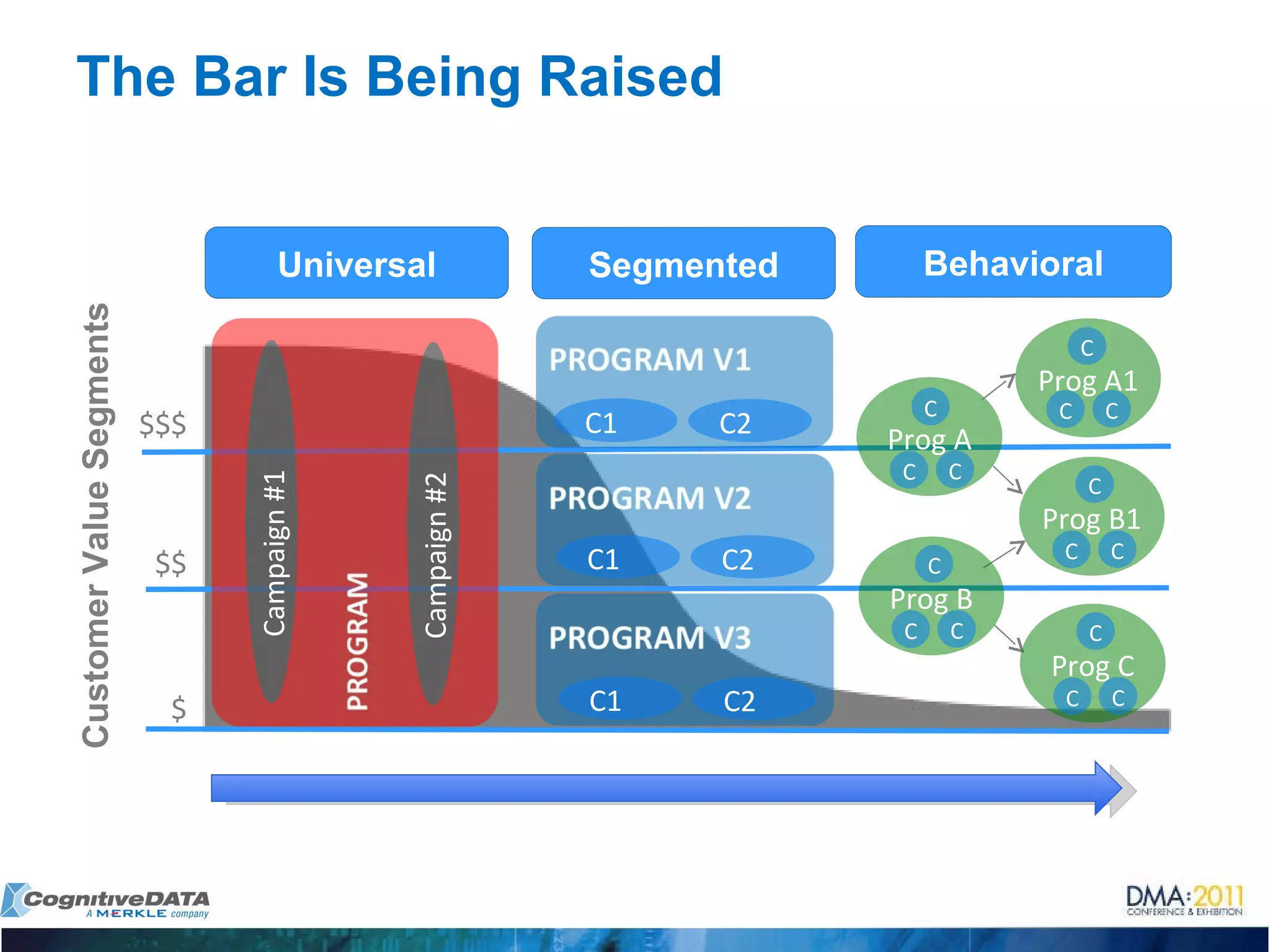
The Bar Is Being Raised Customer Value Segments Prog A C $$$ $$ $ C1 Universal Segmented Behavioral Campaign #1 Campaign #2 C2 C1 C2 C1 C2 C C Prog A1 C C C Prog B1 C C C Prog B C C C Prog C C C C
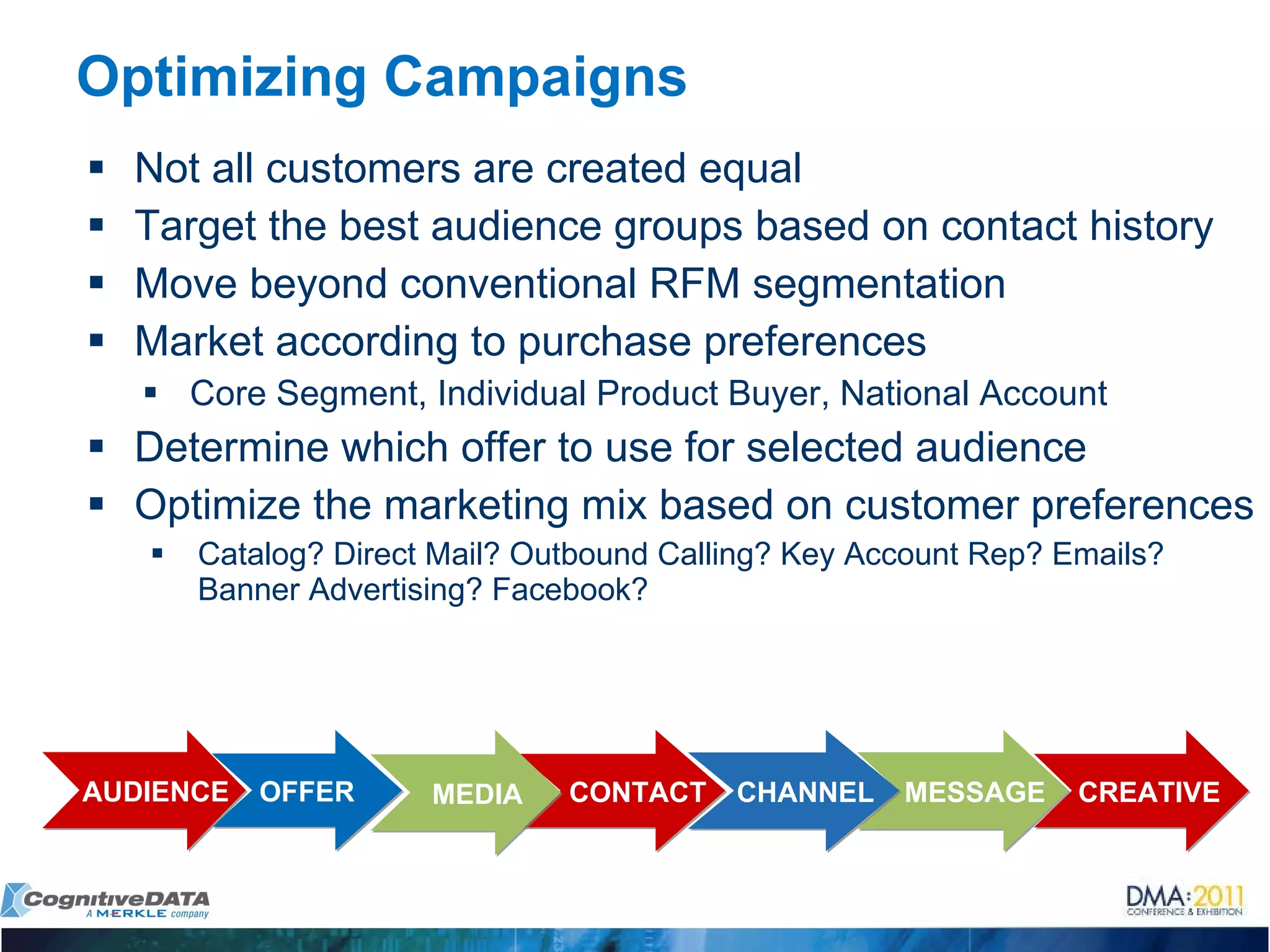
Optimizing Campaigns Not all customers are created equal Target the best audience groups based on contact history Move beyond conventional RFM segmentation Market according to purchase preferences Core Segment, Individual Product Buyer, National Account  Determine which offer to use for selected audience Optimize the marketing mix based on customer preferences Catalog? Direct Mail? Outbound Calling? Key Account Rep? Emails? Banner Advertising? Facebook? CREATIVE MESSAGE CHANNEL CONTACT MEDIA OFFER AUDIENCE
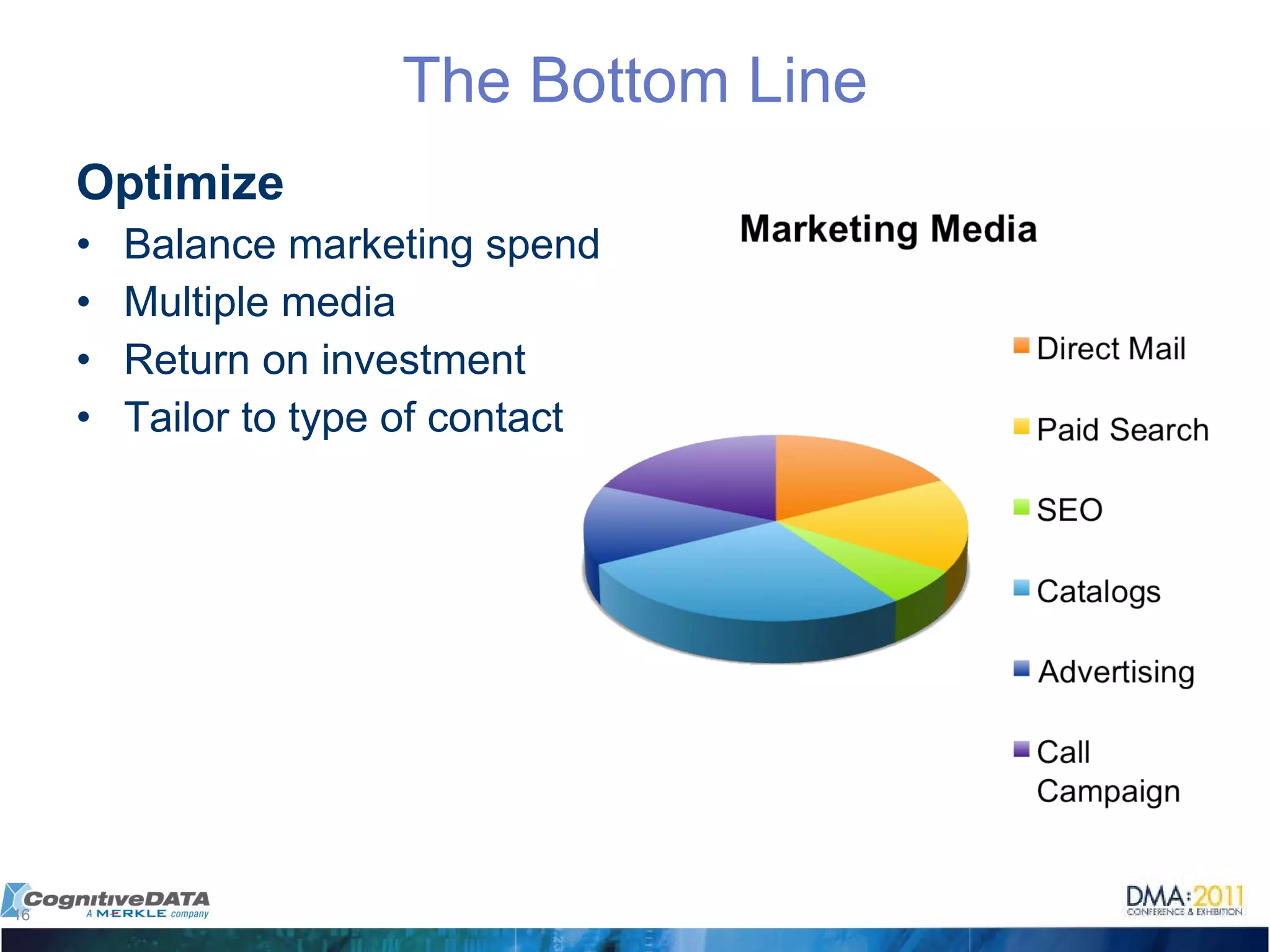
The Bottom Line Optimize  Balance marketing spend Multiple media Return on investment Tailor to type of contact
Steps for Marketing Database
Customer Intelligence Requires Marketing Strategy Examination Strategy defines needs Strategy  today  is not strategy  tomorrow Seasonal business comps annually …  so, start with discovery of  both  technical requirements  and  strategic requirements
Identify Your Data Sources and Elements Contact Information – all channels Resolve email opt-ins to the database Promotional History – all channels Transactional history Website Reporting Third Party Feeds
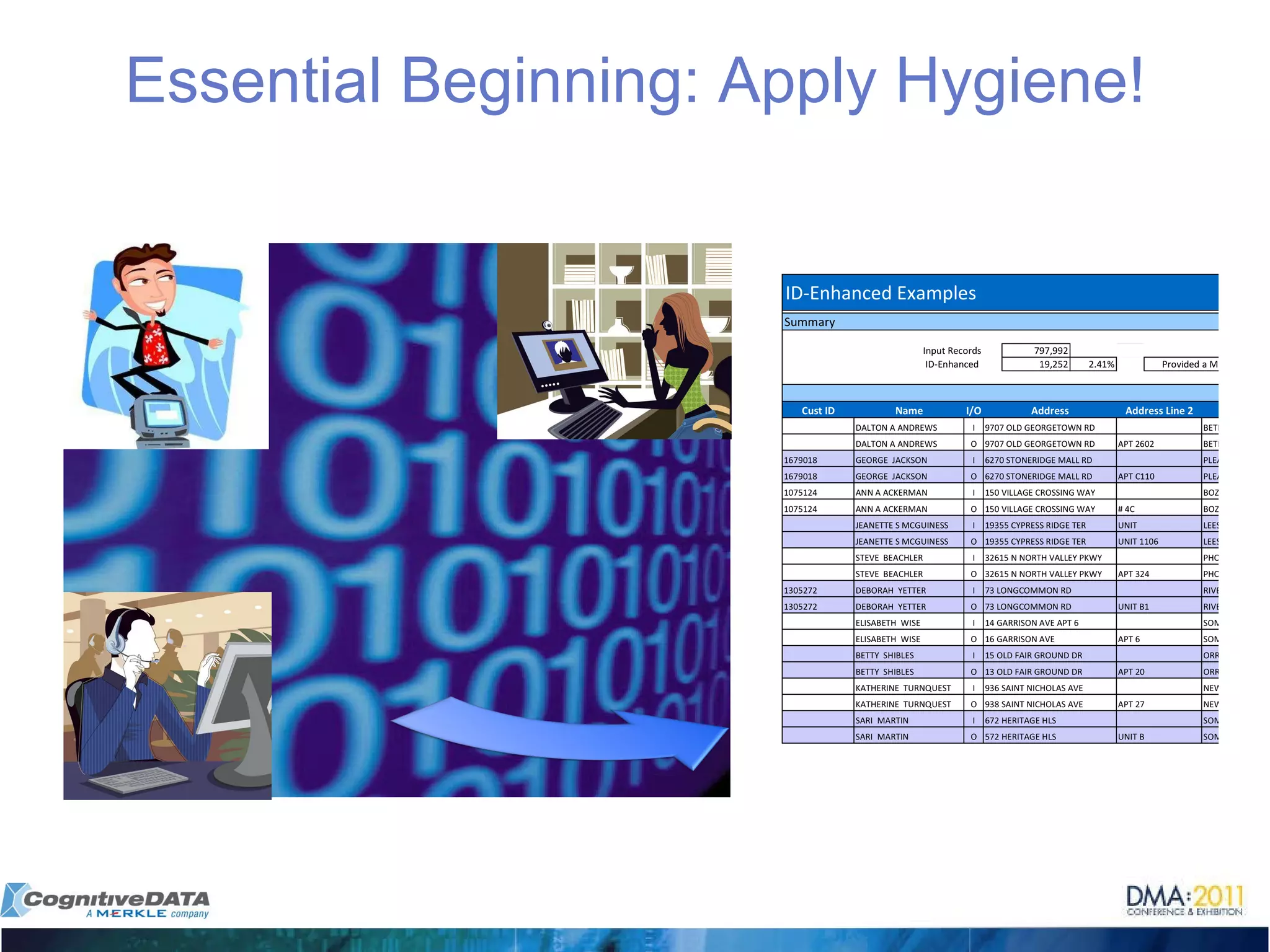
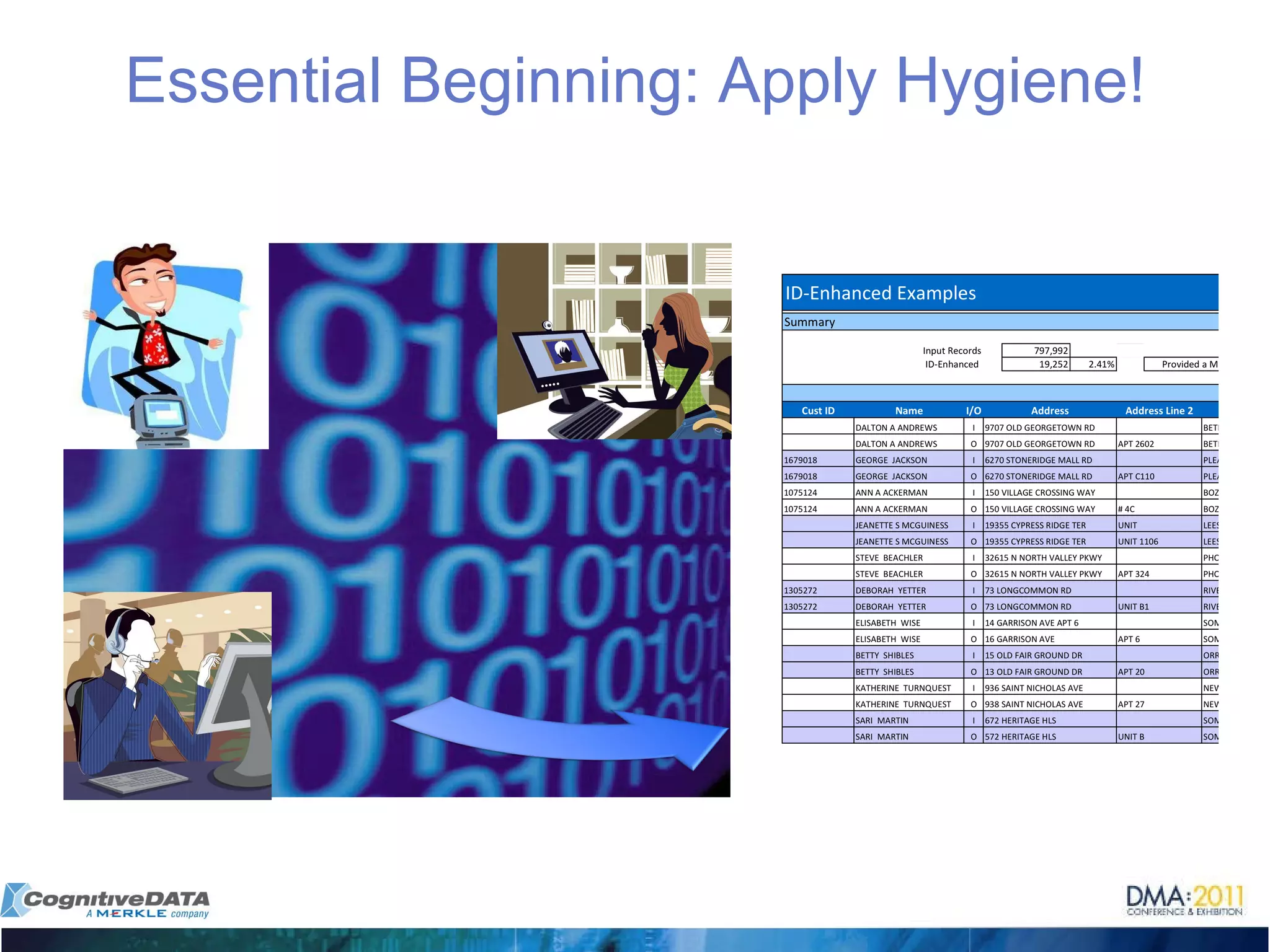
Normalize Data Apply Hygiene to resolve account duplication
Resolve Channel Demand Remember that this is a modeling exercise Retain input elements
Aggregate Data Logically Apply experience and aggregate data to facilitate reporting Don’t rely on information systems staff to do this –  this is a marketing exercise!
Resolving Multiple Channels Allocation/Attribution
History Source Code Collection Matchbacks to Mailings Last Touch Reporting On-line Media Vendor Reporting Last Touch Plus Push Reporting Attribution
Essential Beginning: Apply Hygiene!
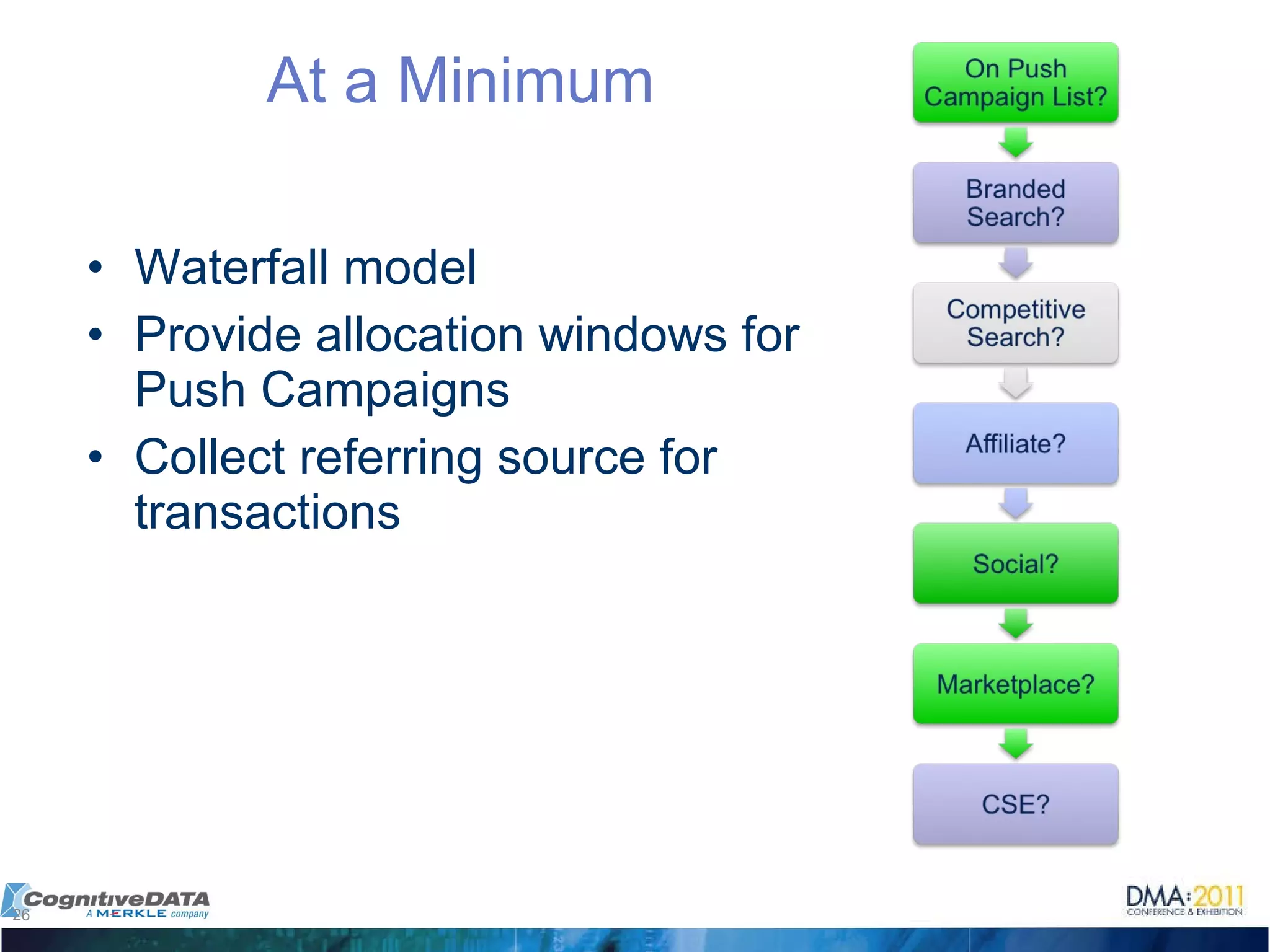
Waterfall model Provide allocation windows for Push Campaigns Collect referring source for transactions At a Minimum
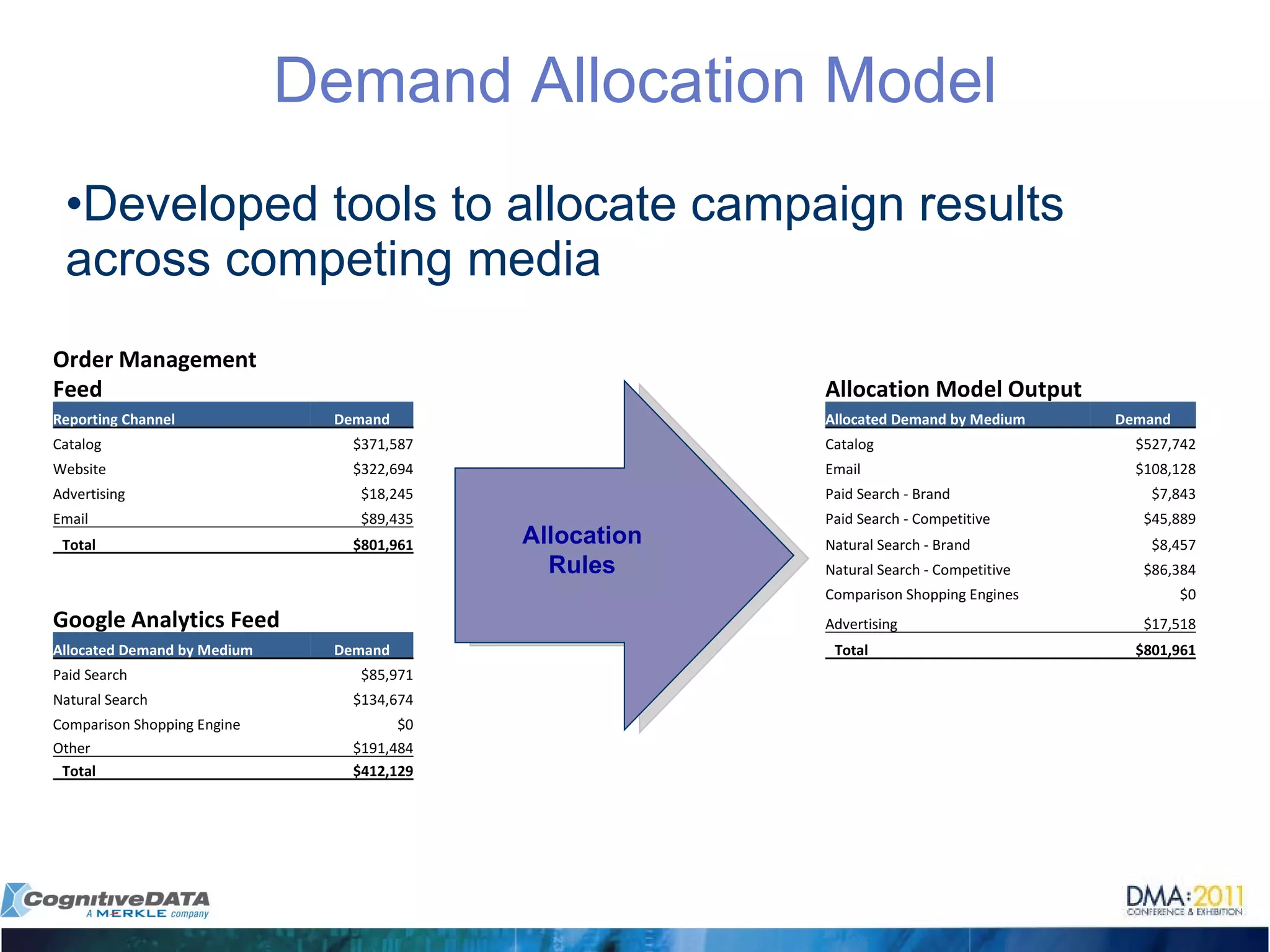
Demand Allocation Model Developed tools to allocate campaign results across competing media Allocation Rules Order Management Feed Allocation Model Output Reporting Channel Demand Allocated Demand by Medium Demand Catalog $371,587 Catalog $527,742 Website $322,694 Email $108,128 Advertising $18,245 Paid Search - Brand $7,843 Email $89,435 Paid Search - Competitive $45,889 Total $801,961 Natural Search - Brand $8,457 Natural Search - Competitive $86,384 Comparison Shopping Engines $0 Google Analytics Feed Advertising $17,518 Allocated Demand by Medium Demand Total $801,961 Paid Search $85,971 Natural Search $134,674 Comparison Shopping Engine $0 Other $191,484 Total $412,129
Tips
Essential Beginning: Apply Hygiene!
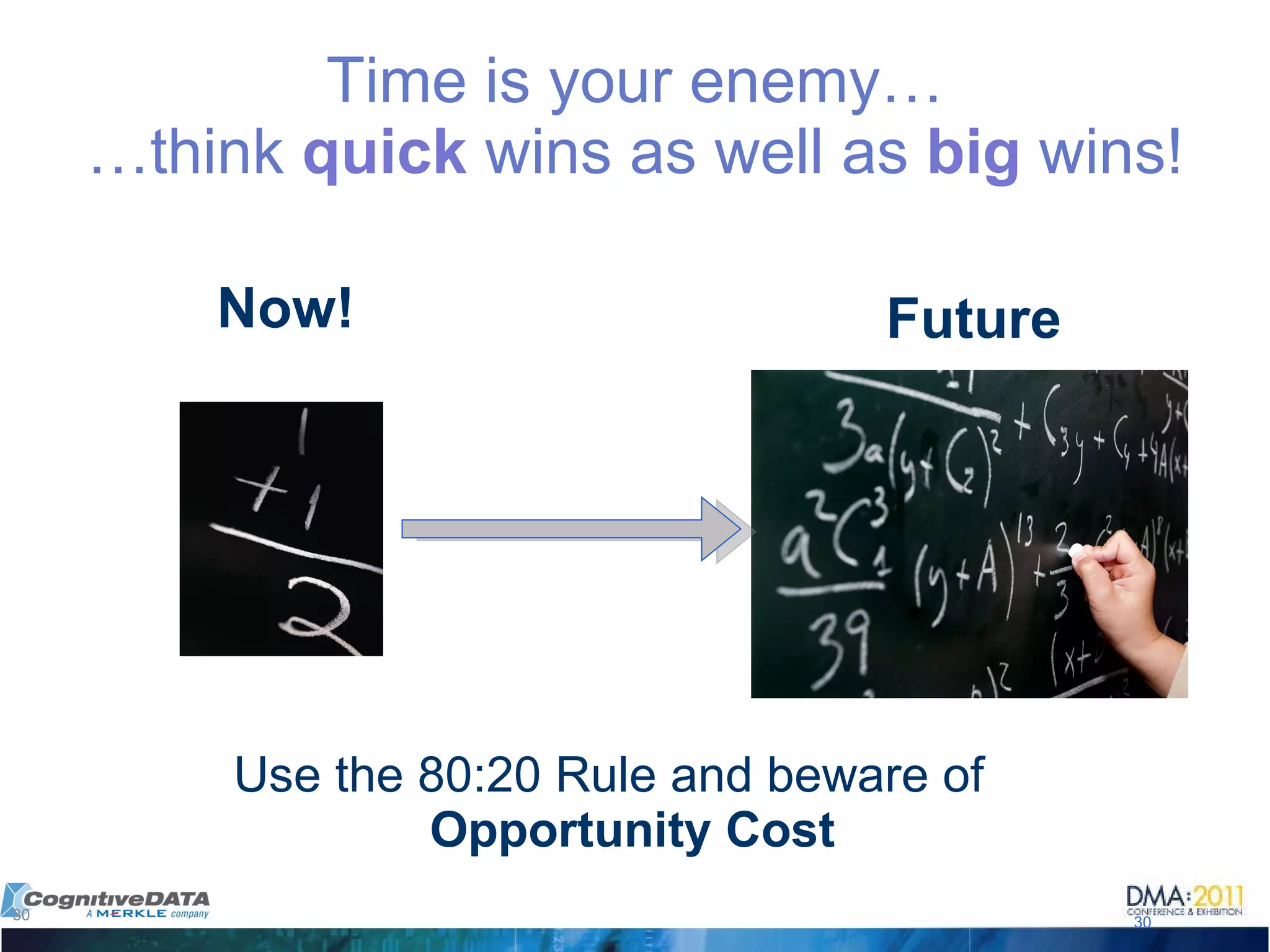
Time is your enemy… …think  quick  wins as well as  big  wins! Use the 80:20 Rule and beware of  Opportunity Cost Now! Future
Any response measurement scheme is a model – there is no perfect system Direction appears  long  before absolute clarity
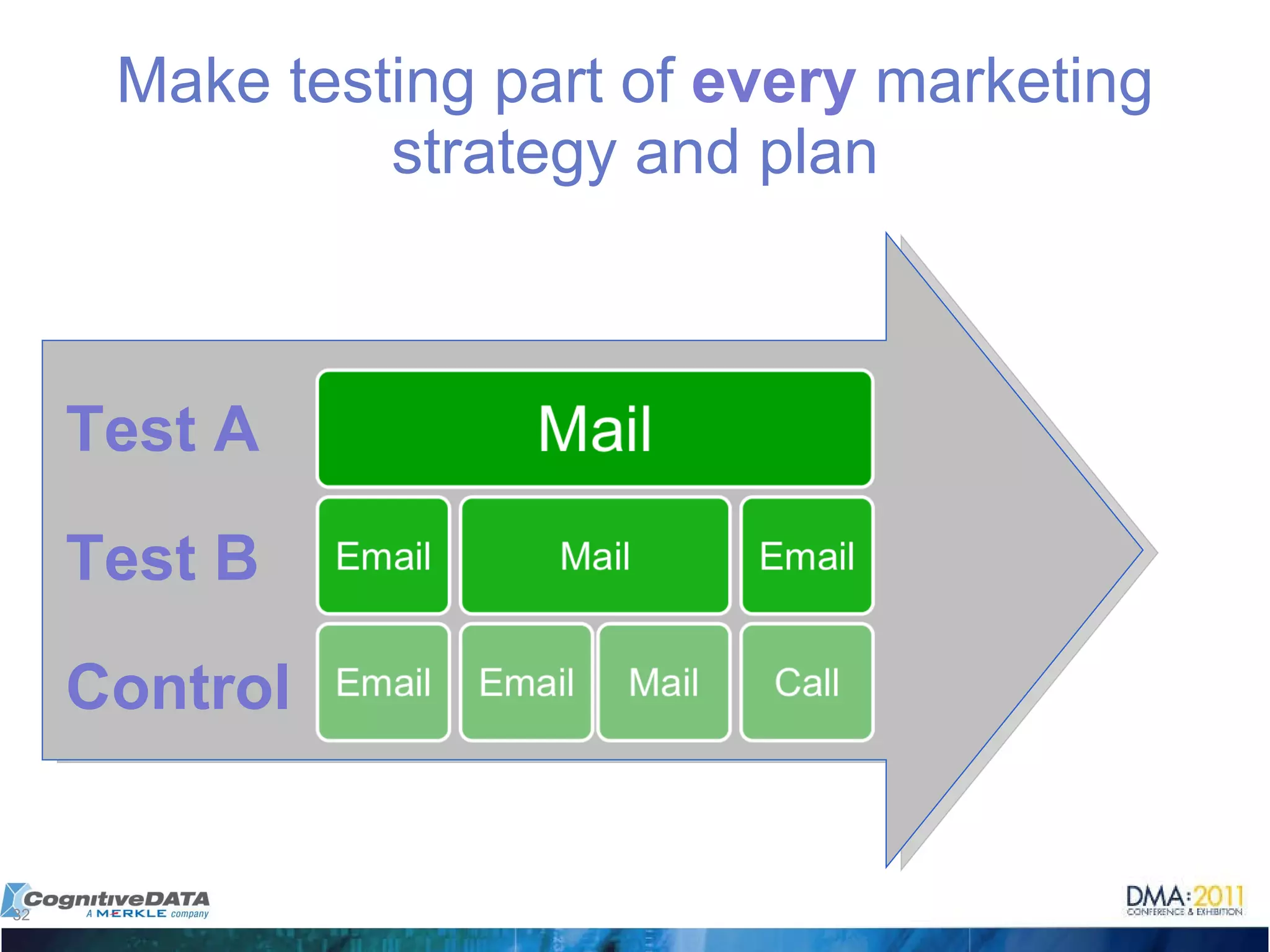
Make testing part of  every   marketing strategy and plan Test Test A Test B Control
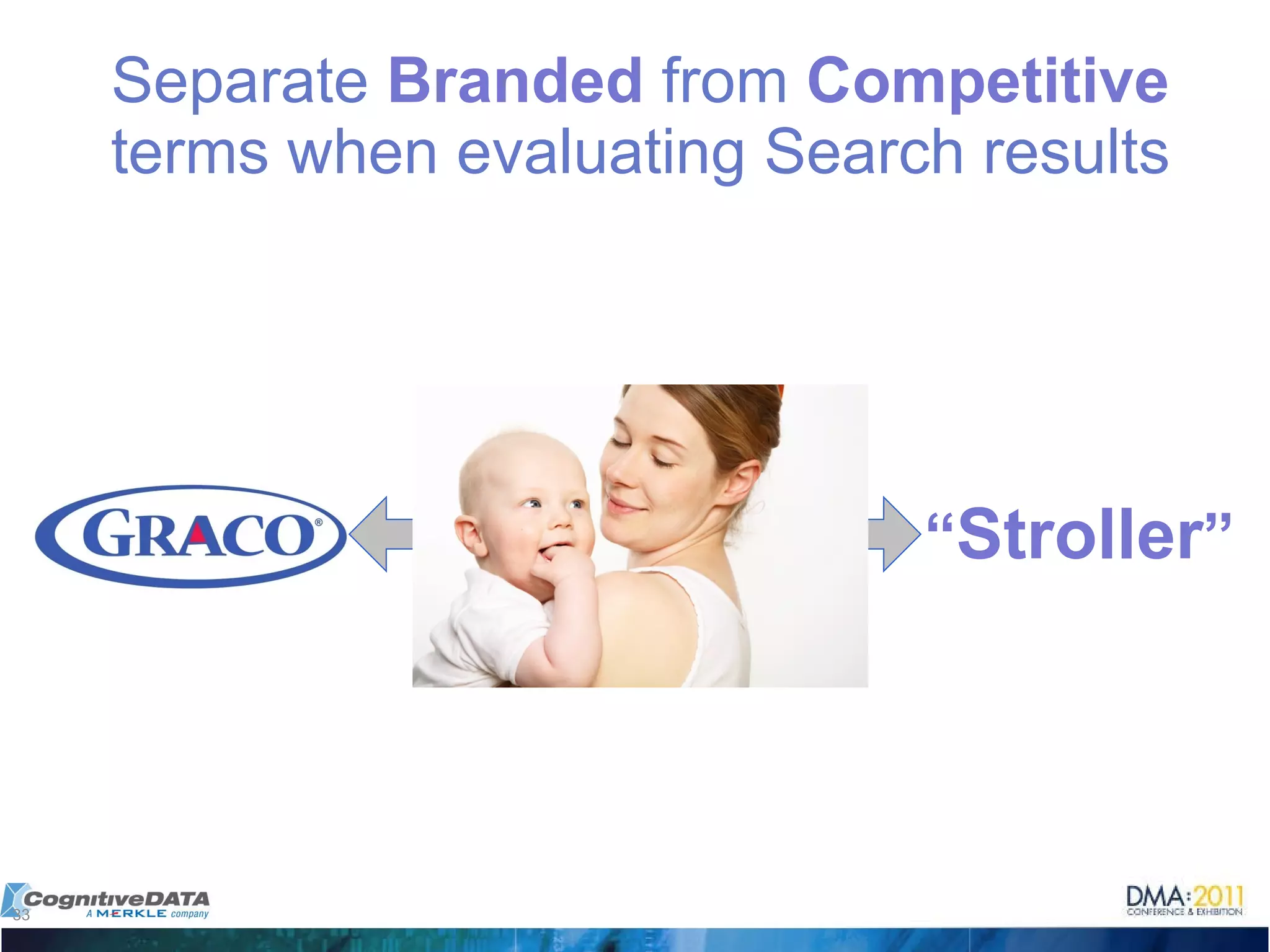
Separate  Branded   from  Competitive   terms when evaluating Search results “ Stroller ”
Examples The Promise of Channel-Agnostic Customer-Centric Data
Key Intelligence Which  media  drive acquisition, retention, and reactivation Your cost to acquire new buyers  by medium The “lifetime” value of buyers and how it differs  by medium Merchandise performance  by medium
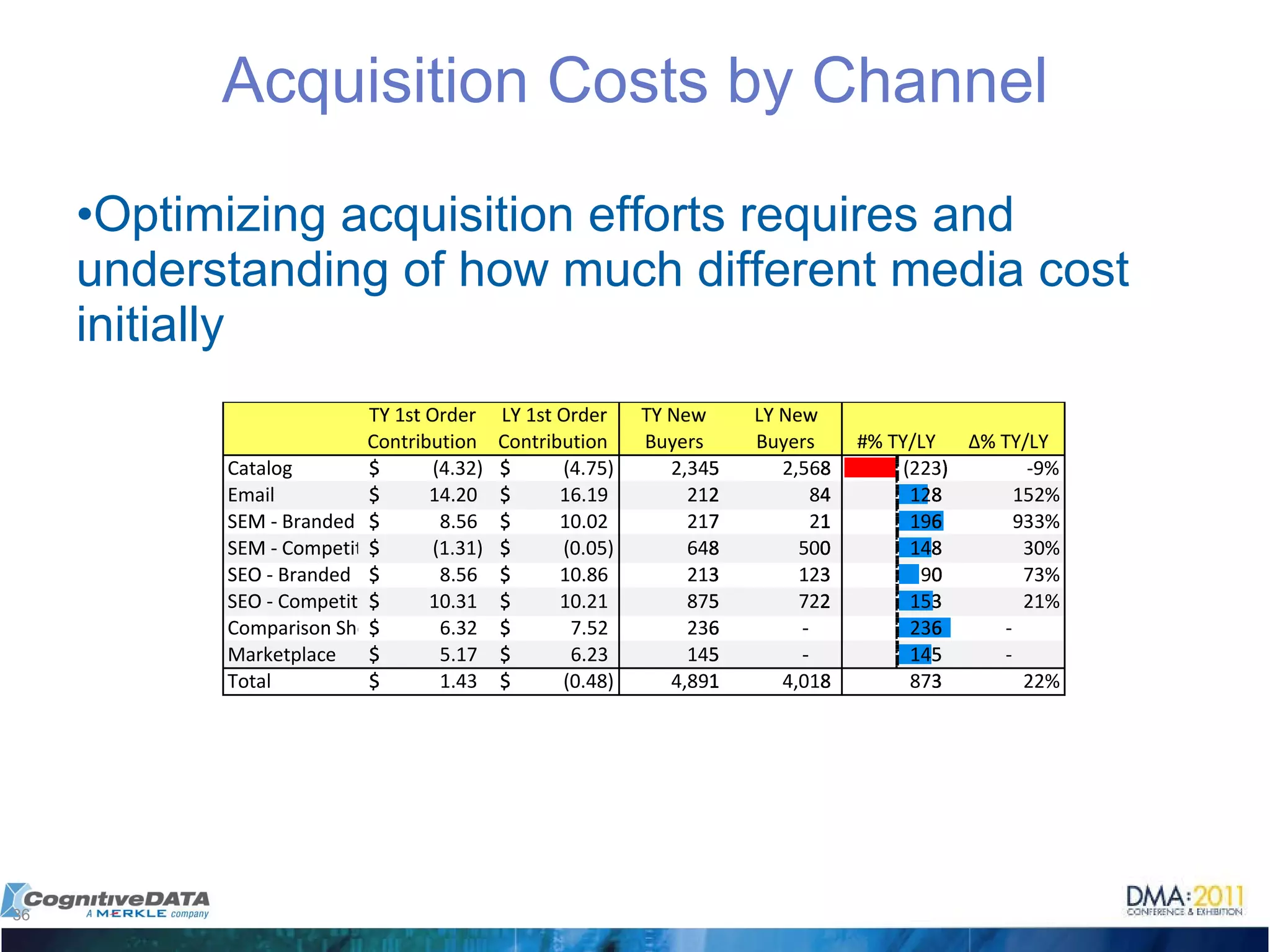
Acquisition Costs by Channel Optimizing acquisition efforts requires and understanding of how much different media cost initially
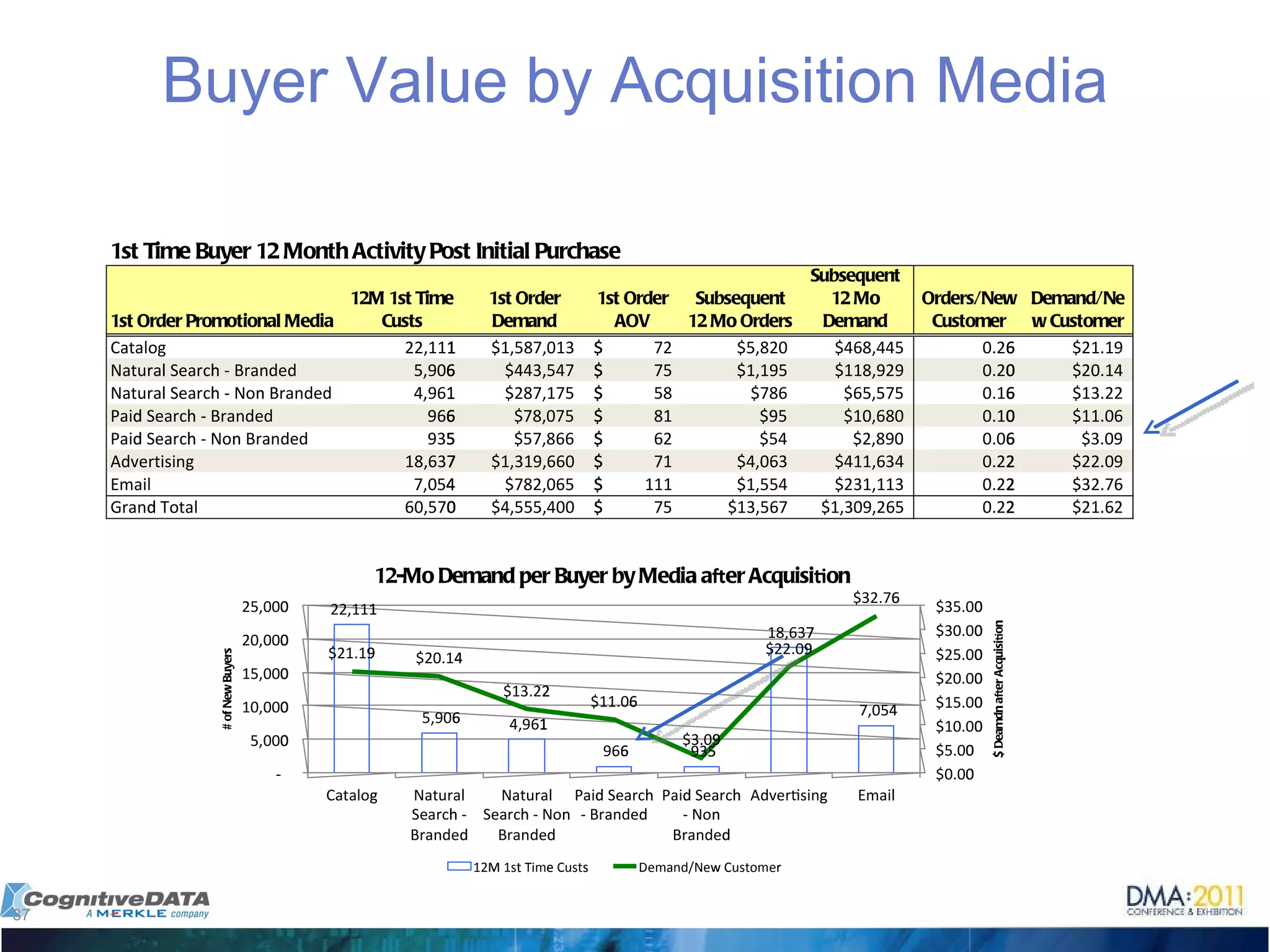
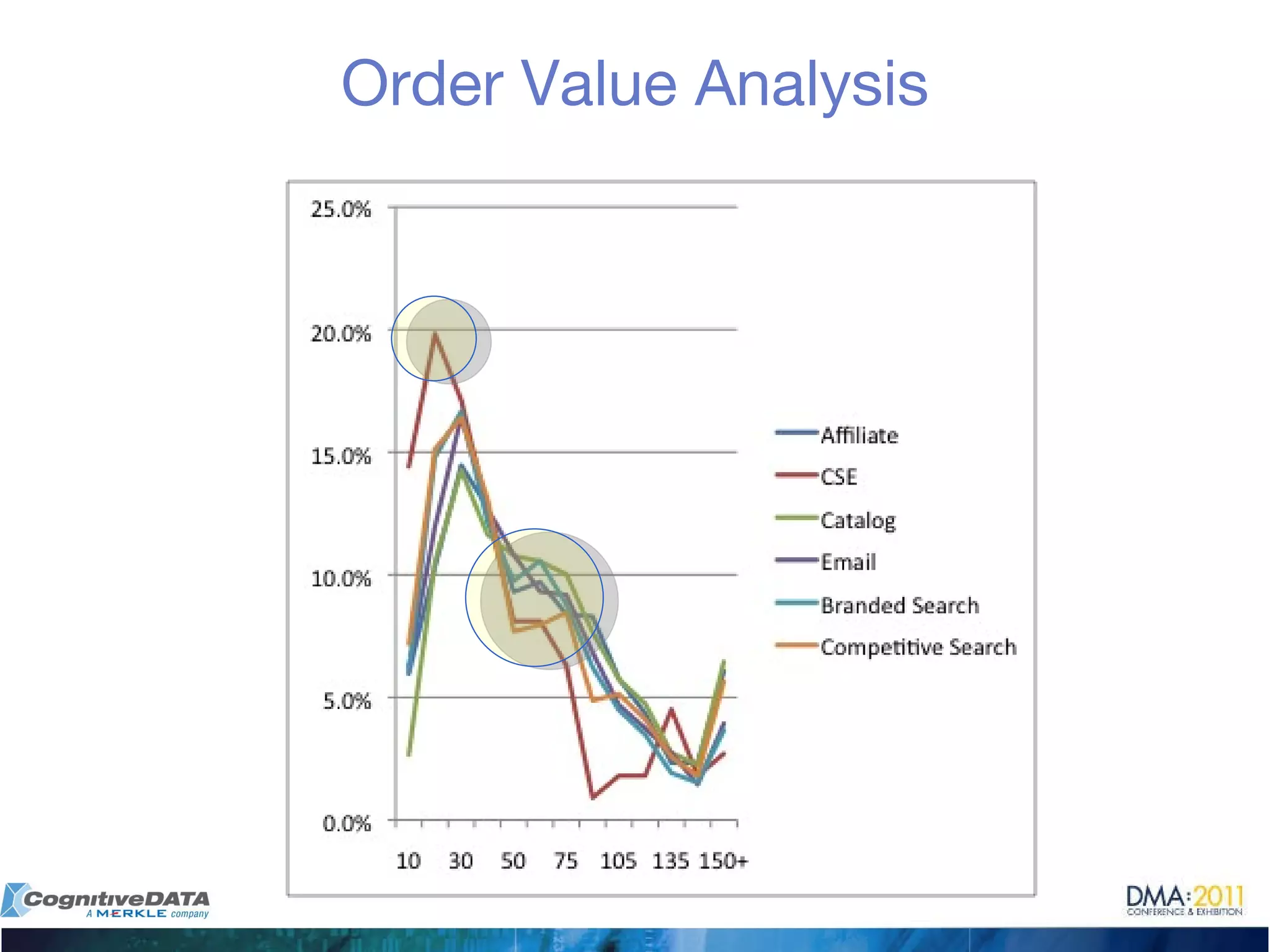
Buyer Value by Acquisition Media
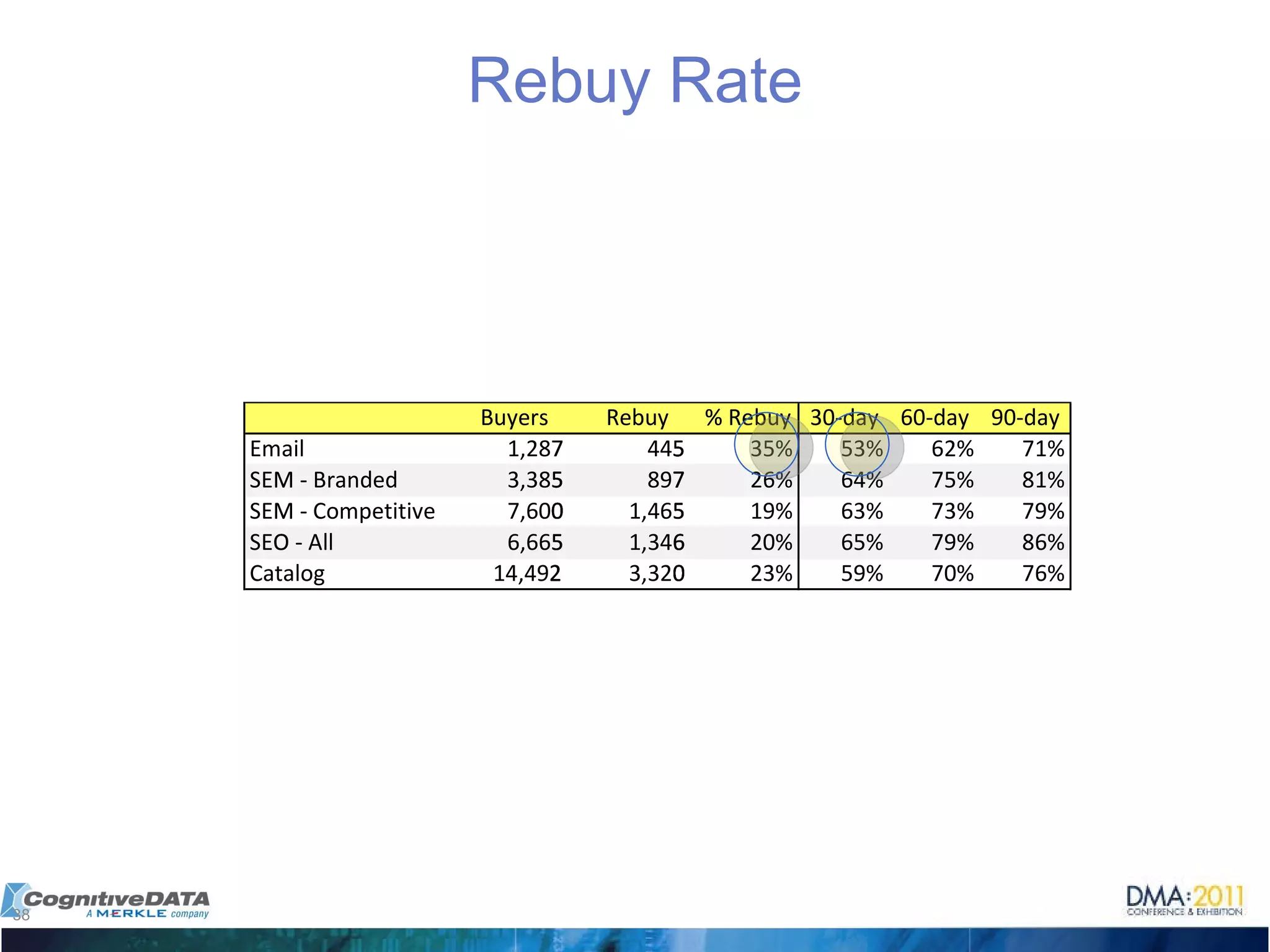
Rebuy Rate
Order Value Analysis
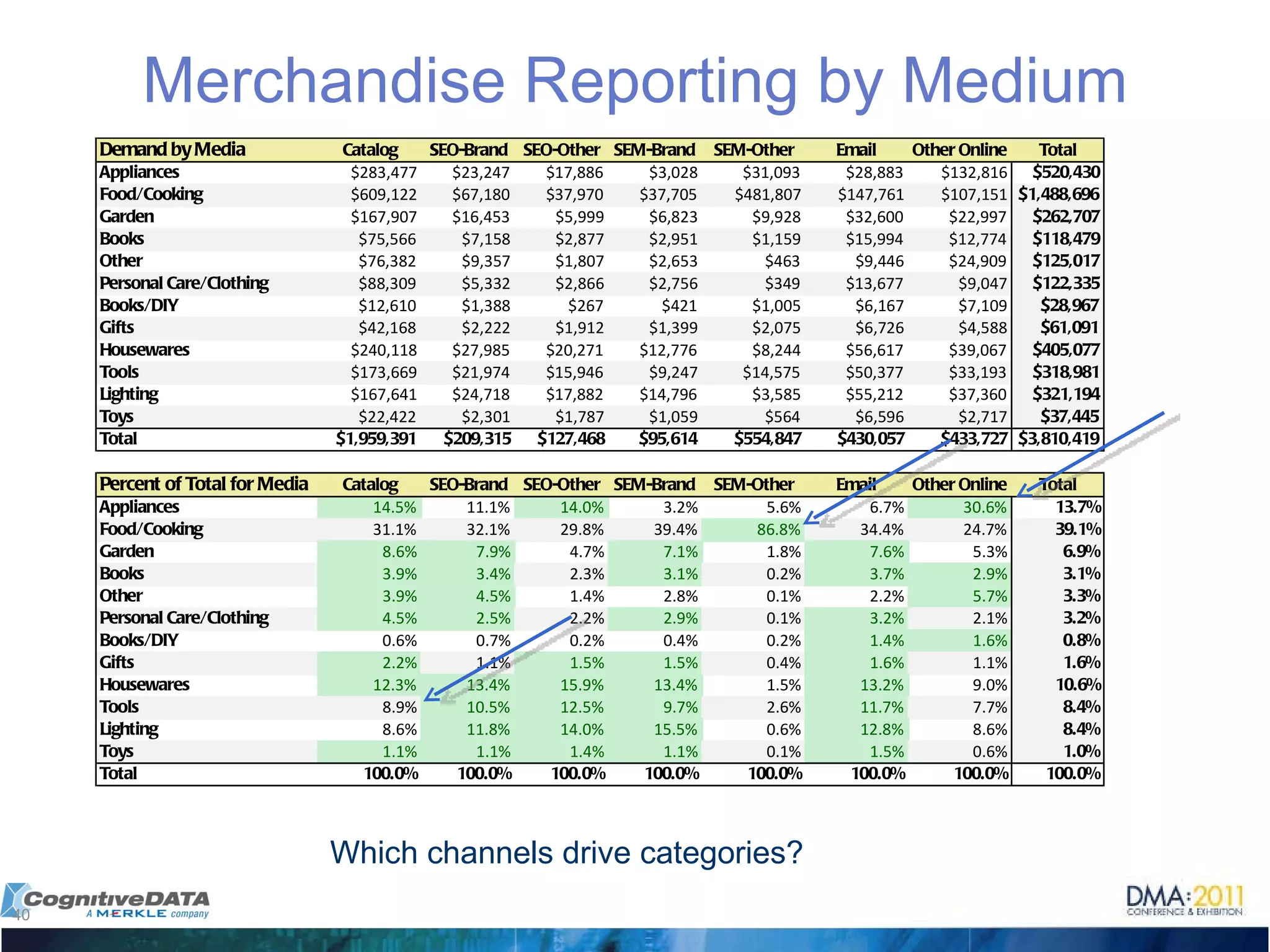
Merchandise Reporting by Medium Which channels drive categories?
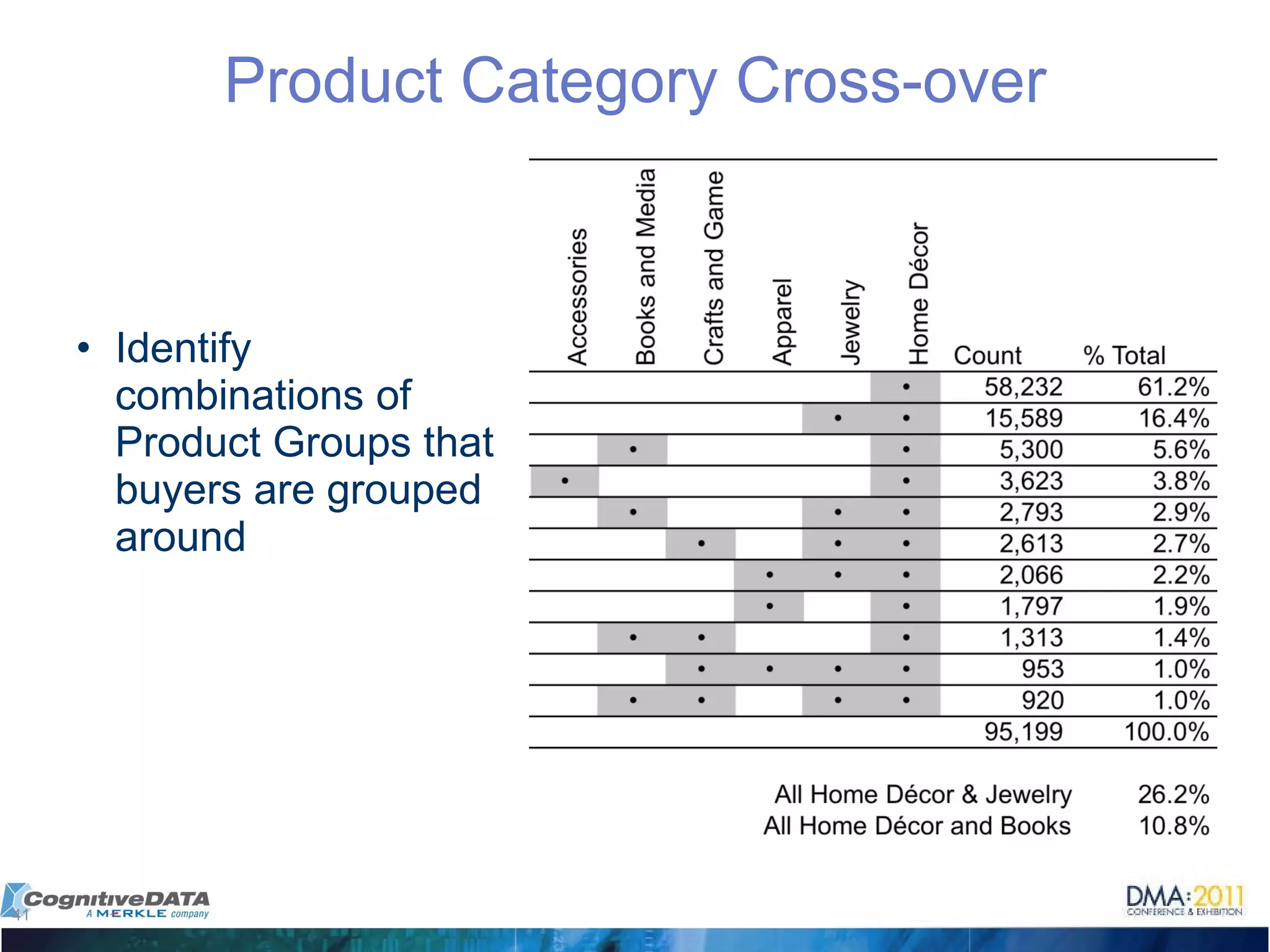
Product Category Cross-over Identify combinations of Product Groups that buyers are grouped around
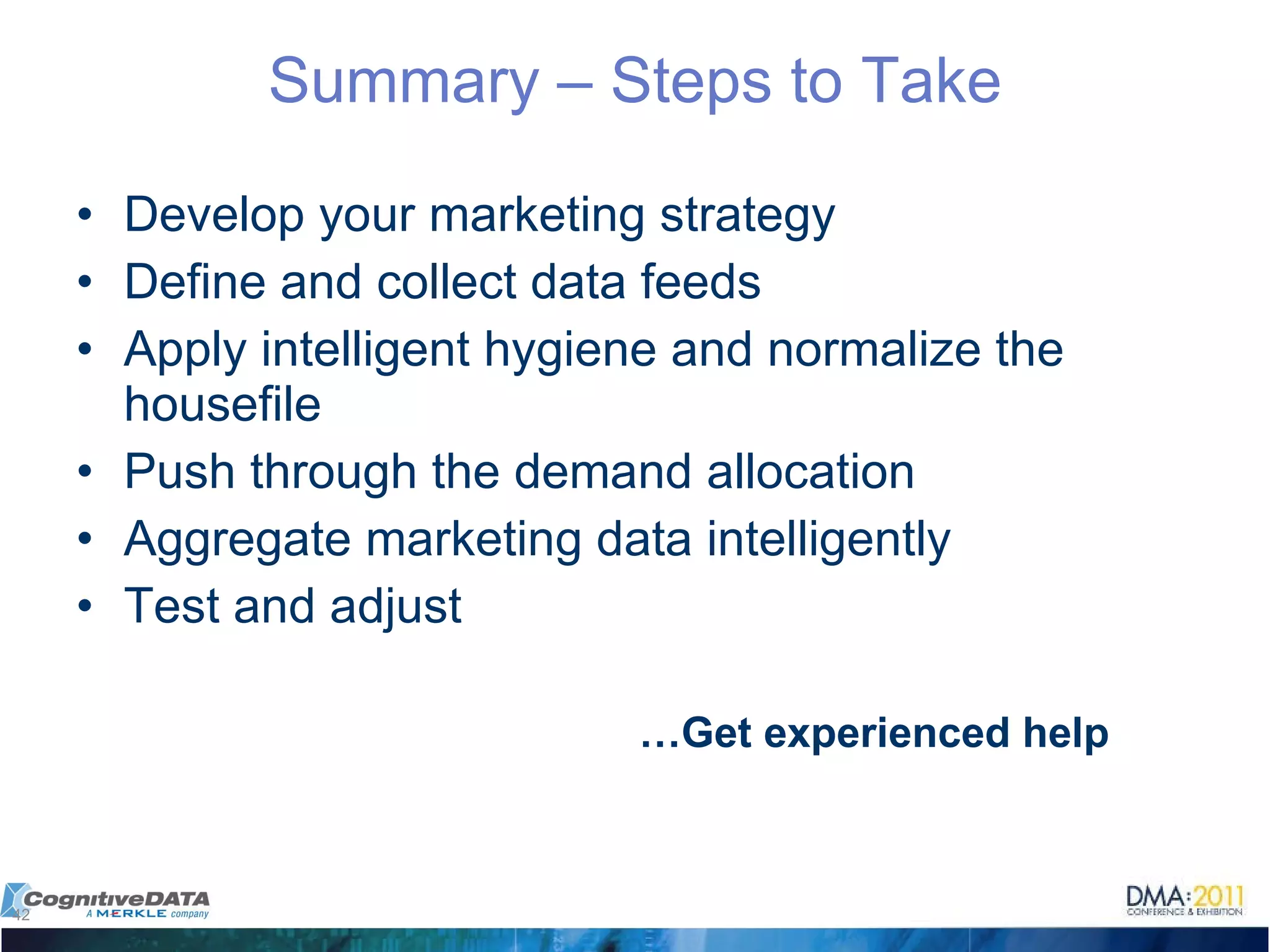
Develop your marketing strategy Define and collect data feeds Apply intelligent hygiene and normalize the housefile Push through the demand allocation Aggregate marketing data intelligently Test and adjust Summary – Steps to Take … Get experienced help
Important! Know your data (or get to know it!) Clean up historical data Source codes and campaigns Organize and Categorize Think how data roll up to give you overview Set time aside to do this right Get strategy input
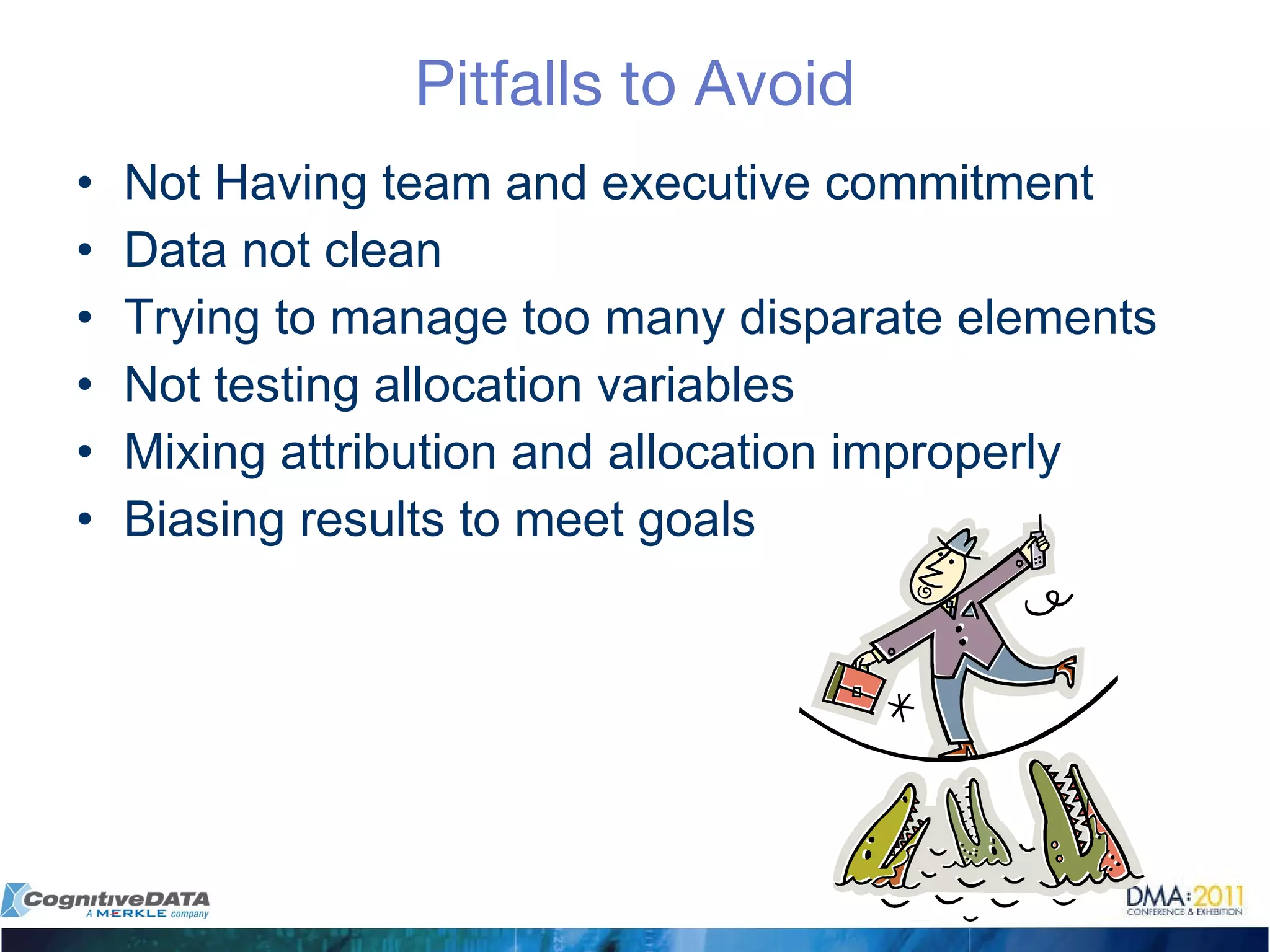
Pitfalls to Avoid Not Having team and executive commitment Data not clean Trying to manage too many disparate elements Not testing allocation variables Mixing attribution and allocation improperly Biasing results to meet goals
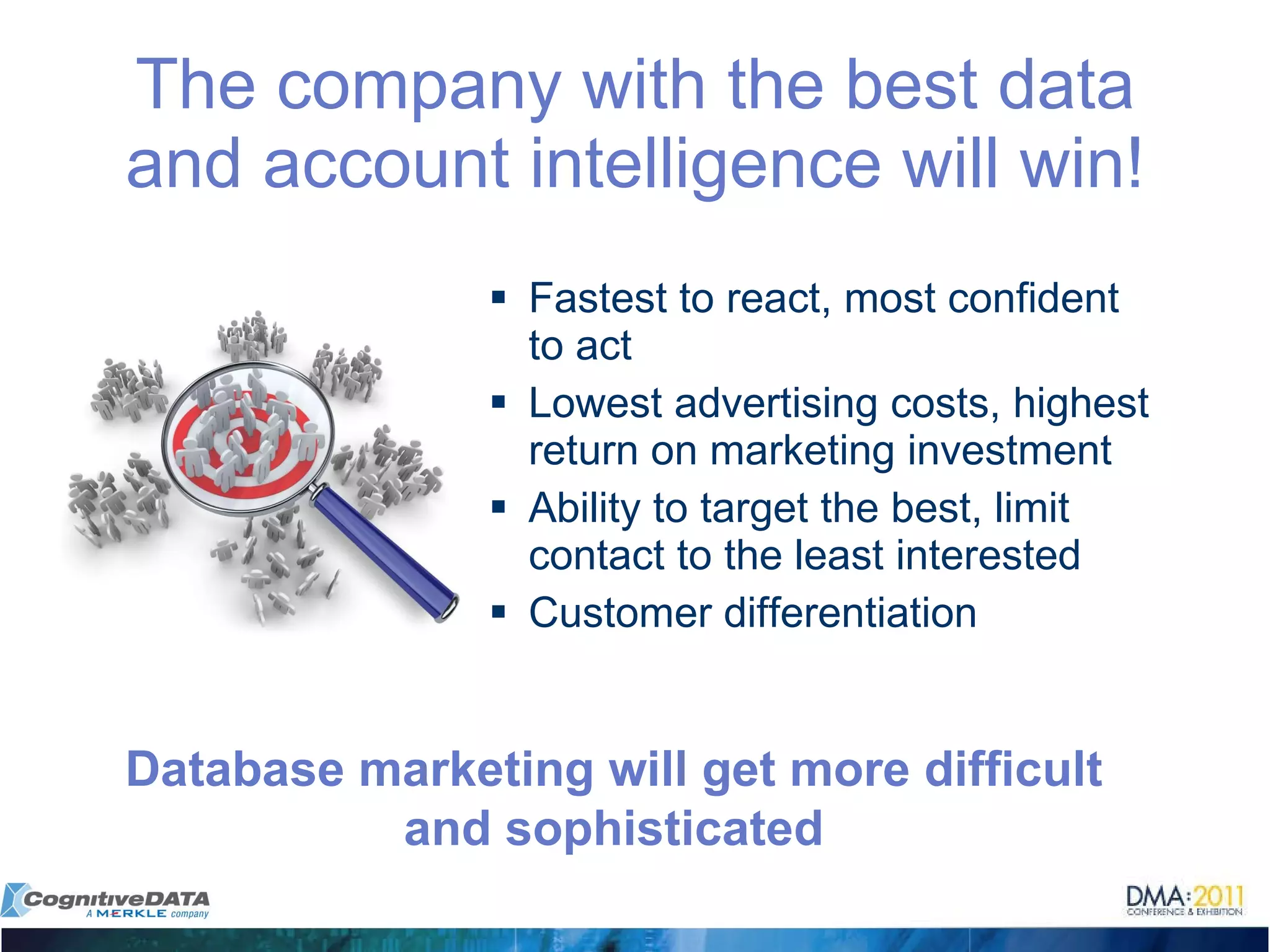
Fastest to react, most confident to act Lowest advertising costs, highest return on marketing investment Ability to target the best, limit contact to the least interested Customer differentiation The company with the best data and account intelligence will win! Database marketing will get more difficult and sophisticated
Al Bessin Executive Vice President CognitiveDATA 512-351-8197 [email_address]

Affordable Databases Can You Afford Not to be using a Marketing Database

  • 1.
  • 2.
    Al Bessin, ExecutiveVice President 4 October 2011 Affordable Databases: Can You Afford Not To Be Using a Marketing Database
  • 3.
    Agenda Consumer BehaviorMarketing Databases Fundamental Needs for All Marketers Examples
  • 4.
    Trends: Consumer Behavior,Economics and Marketing
  • 5.
    Message and ContactComplexity Advertising Direct Mail Email Catalogs Targeted Ads Search Marketplaces Social Media Affiliates
  • 6.
    The Rise andFall of Free-Wheeling Consumer Spending The Housing Bubble: a promise of infinite return on investment Seemingly Infinite Credit Birth of the Spandex Wallet
  • 7.
    Today’s Competitive ChallengeReduced disposable income Reduced credit Who is the competition?
  • 8.
    The Challenge “Catalog” Internet Stores Silos Order Method Call Center Website Stores Marketing Media Catalog SEO/ SEM Advtsg Email Social Affiliate Lack of Clarity
  • 9.
    Lack of IntegratedMarketing Planning Competing reporting schemes More demand used to justify marketing expense than total demand for the enterprise Total Demand Print Email
  • 10.
  • 11.
    Convergence of TraditionalDM with Ecommerce One Dimensional Customer-Centric Transaction Centric Traditional Direct Marketing Online Marketing Multi-Dimensional Customer Centric
  • 12.
    Optimizing the CustomerJourney Customer Value Average High Time Low Target Acquire Retain Grow First Purchase Up-Sell Dialogue Optimized Develop
  • 13.
    Need to SupportPush and Pull Marketing Catalog Email Flyer Email SEO SEM SEO SEM
  • 14.
    The Bar IsBeing Raised Customer Value Segments Prog A C $$$ $$ $ C1 Universal Segmented Behavioral Campaign #1 Campaign #2 C2 C1 C2 C1 C2 C C Prog A1 C C C Prog B1 C C C Prog B C C C Prog C C C C
  • 15.
    Optimizing Campaigns Notall customers are created equal Target the best audience groups based on contact history Move beyond conventional RFM segmentation Market according to purchase preferences Core Segment, Individual Product Buyer, National Account Determine which offer to use for selected audience Optimize the marketing mix based on customer preferences Catalog? Direct Mail? Outbound Calling? Key Account Rep? Emails? Banner Advertising? Facebook? CREATIVE MESSAGE CHANNEL CONTACT MEDIA OFFER AUDIENCE
  • 16.
    The Bottom LineOptimize Balance marketing spend Multiple media Return on investment Tailor to type of contact
  • 17.
  • 18.
    Customer Intelligence RequiresMarketing Strategy Examination Strategy defines needs Strategy today is not strategy tomorrow Seasonal business comps annually … so, start with discovery of both technical requirements and strategic requirements
  • 19.
    Identify Your DataSources and Elements Contact Information – all channels Resolve email opt-ins to the database Promotional History – all channels Transactional history Website Reporting Third Party Feeds
  • 20.
    Normalize Data ApplyHygiene to resolve account duplication
  • 21.
    Resolve Channel DemandRemember that this is a modeling exercise Retain input elements
  • 22.
    Aggregate Data LogicallyApply experience and aggregate data to facilitate reporting Don’t rely on information systems staff to do this – this is a marketing exercise!
  • 23.
    Resolving Multiple ChannelsAllocation/Attribution
  • 24.
    History Source CodeCollection Matchbacks to Mailings Last Touch Reporting On-line Media Vendor Reporting Last Touch Plus Push Reporting Attribution
  • 25.
  • 26.
    Waterfall model Provideallocation windows for Push Campaigns Collect referring source for transactions At a Minimum
  • 27.
    Demand Allocation ModelDeveloped tools to allocate campaign results across competing media Allocation Rules Order Management Feed Allocation Model Output Reporting Channel Demand Allocated Demand by Medium Demand Catalog $371,587 Catalog $527,742 Website $322,694 Email $108,128 Advertising $18,245 Paid Search - Brand $7,843 Email $89,435 Paid Search - Competitive $45,889 Total $801,961 Natural Search - Brand $8,457 Natural Search - Competitive $86,384 Comparison Shopping Engines $0 Google Analytics Feed Advertising $17,518 Allocated Demand by Medium Demand Total $801,961 Paid Search $85,971 Natural Search $134,674 Comparison Shopping Engine $0 Other $191,484 Total $412,129
  • 28.
  • 29.
  • 30.
    Time is yourenemy… …think quick wins as well as big wins! Use the 80:20 Rule and beware of Opportunity Cost Now! Future
  • 31.
    Any response measurementscheme is a model – there is no perfect system Direction appears long before absolute clarity
  • 32.
    Make testing partof every marketing strategy and plan Test Test A Test B Control
  • 33.
    Separate Branded from Competitive terms when evaluating Search results “ Stroller ”
  • 34.
    Examples The Promiseof Channel-Agnostic Customer-Centric Data
  • 35.
    Key Intelligence Which media drive acquisition, retention, and reactivation Your cost to acquire new buyers by medium The “lifetime” value of buyers and how it differs by medium Merchandise performance by medium
  • 36.
    Acquisition Costs byChannel Optimizing acquisition efforts requires and understanding of how much different media cost initially
  • 37.
    Buyer Value byAcquisition Media
  • 38.
  • 39.
  • 40.
    Merchandise Reporting byMedium Which channels drive categories?
  • 41.
    Product Category Cross-overIdentify combinations of Product Groups that buyers are grouped around
  • 42.
    Develop your marketingstrategy Define and collect data feeds Apply intelligent hygiene and normalize the housefile Push through the demand allocation Aggregate marketing data intelligently Test and adjust Summary – Steps to Take … Get experienced help
  • 43.
    Important! Know yourdata (or get to know it!) Clean up historical data Source codes and campaigns Organize and Categorize Think how data roll up to give you overview Set time aside to do this right Get strategy input
  • 44.
    Pitfalls to AvoidNot Having team and executive commitment Data not clean Trying to manage too many disparate elements Not testing allocation variables Mixing attribution and allocation improperly Biasing results to meet goals
  • 45.
    Fastest to react,most confident to act Lowest advertising costs, highest return on marketing investment Ability to target the best, limit contact to the least interested Customer differentiation The company with the best data and account intelligence will win! Database marketing will get more difficult and sophisticated
  • 46.
    Al Bessin ExecutiveVice President CognitiveDATA 512-351-8197 [email_address]

Editor's Notes

  • #36 The guidelines I would recommend are: Establish the frequency by how actionable the data are A data warehouse or some other flexible reporting environment should be used for other metrics Don’t forget to watch metrics for the performance of units outside your department that may impact your department’s performance - Operations, Inventory Planning, Fulfillment When evaluating performance, the greatest value is in comparing internally.
  • #39 The Berkshire Group LP Copyright (c) 2005