
















The ATRON Self-reconfigurable Robot challenges and future directions Kasper Støy AdapTronics Group The Maersk Institute for Production Technology University of Southern Denmark   www.hydra-robot.dk
ATRON Terrestrial Self-Reconfiguration Henrik H. Lund, Esben H. Ostergaard Richard Beck, Lars Dalsgaard, Morten W. Jorgensen Associated: Kristian Kassow, Leonid Paramonov,  Kasper Støy,  David Christensen, David Brandt, Danny Kyrping Maersk Institute, University of Southern Denmark, Denmark
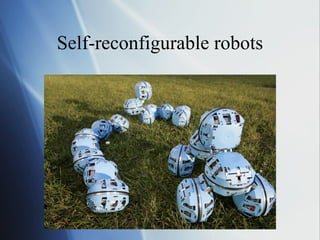
Self-reconfigurable robots
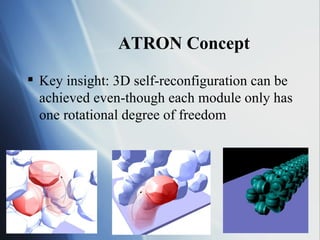
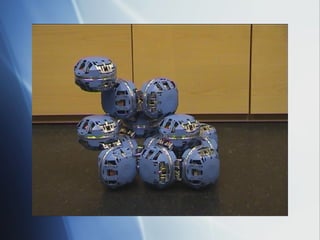
ATRON Concept Key insight: 3D self-reconfiguration can be achieved even-though each module only has one rotational degree of freedom
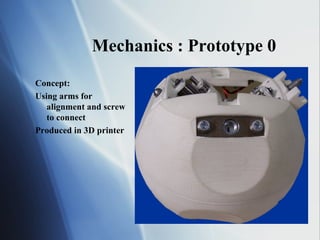
Mechanics : Prototype 0 Concept: Using arms for alignment and screw to connect Produced in 3D printer
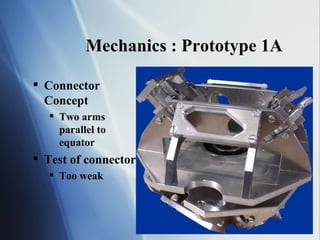
Mechanics : Prototype 1A Connector Concept Two arms parallel to equator  Test of connector Too weak
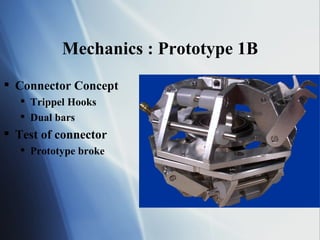
Mechanics : Prototype 1B Connector Concept Trippel Hooks Dual bars Test of connector Prototype broke
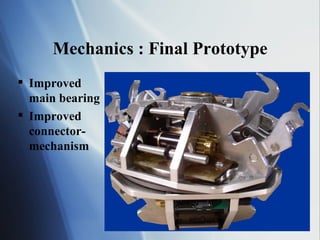
Mechanics : Final Prototype Improved main bearing Improved connector-mechanism
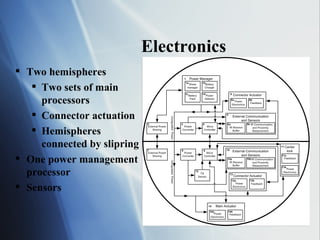
Electronics Two hemispheres Two sets of main processors Connector actuation Hemispheres connected by slipring One power management processor Sensors
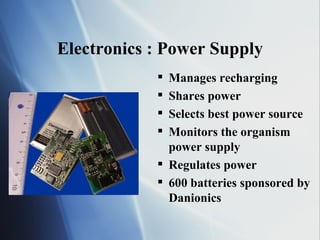
Electronics : Power Supply Manages recharging Shares power Selects best power source Monitors the organism power supply Regulates power 600 batteries sponsored by Danionics
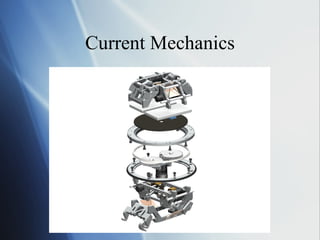
Current Mechanics
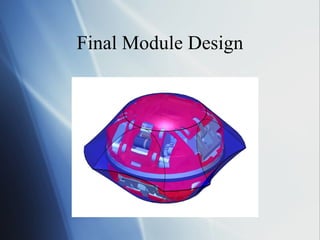
Final Module Design
IROS2004 - Demonstration videos Misalignment correction Double rotation Power sharing
Concept Demonstations David Christensen Meta module demo (ATRON Demo 1) Jakob Stampe Mikkelsen Walker
Explored control concepts Local control Local rules (Esben H. Østergaard) Gradients and scaffolds (Kasper Støy) Meta modules (David Christensen) Centralized control Planning (David Brandt)
Gradients and scaffold
Local Rules Esben Østergaard
Meta modules David Christensen
Conclusion Control achievements Control is difficult, but experience gained ATRON Achievements Innovative connector design Innovative lattice structure resulting in Simplified modules Easier control…
Intermezzo Queen of Denmark admires ATRON module together with the Japanese emperor
Kasper Støy AdapTronics Group The Maersk Institute for Production Technology University of Southern Denmark The Cruel Reality of Self-Reconfigurable Robots
Vision of self-reconfigurable robots Robust Versatile Cheap
The Reality of Self-Reconfigurable Robots Fragile Useless Expensive
Robust  vs Fragile Robustness comes from redundancy If a module fails it can be ejected and other modules can take over Graceful degradation of performance USC’s ISI
Robust vs  Fragile Difficult to detect if a module has failed Due to motion constraints it is difficult to eject the failed module Due to weakness of modules it may not be possible to eject the failed module at all
 
Versatile  vs Useless A self-reconfigurable robot can change into any shape needed for the task
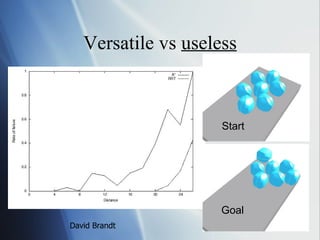
Versatile vs  useless In practice motion constraints make it difficult to change shape
Versatile vs  useless David Brandt Start Goal
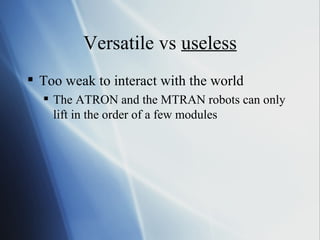
Versatile vs  useless Too weak to interact with the world The ATRON and the MTRAN robots can only lift in the order of a few modules
Cheap vs  Expensive ATRON $2000 MTRAN $3500 ….
The Reality of Self-Reconfigurable Robots Fragile! Useless! Expensive!
Challenges of self-reconfigurable robots How do we Make robot strength greater than O(1)? Reduce motion constraints to facilitate easy self-reconfiguration? Reduce the consequences of module failure? Reduce module complexity (cost)? …while maintaining our successful results
Make robot strength greater than O(1)? Use module weight to gain leverage (seesaw) Crystalline/Telecube parallel chains … .
Reduce module complexity (cost)? ATRON is a step forward, but further - no idea… Reduce the consequences of module failure? No idea
Reduce motion constraints to facilitate easy self-reconfiguration? Metamodules Scaffold Telecube
Hypothesis  The challenges cannot only be addressed at the level of control The challenges have to be addressed by new innovative hardware design
Challenges of self-reconfigurable robots How do we  design the module to Make robot strength greater than O(1)? Reduce motion constraints to facilitate easy self-reconfiguration? Reduce the consequences of module failure? Reduce module complexity (cost)? …while maintaining our successful results
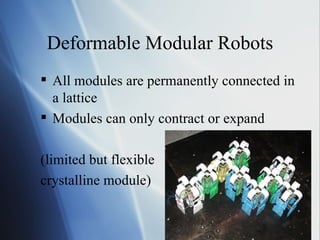
Deformable Modular Robots All modules are permanently connected in a lattice Modules can only contract or expand (limited but flexible  crystalline module)
Concept Demonstration Physical implementation Deformatron Hexatron Simulation
Deformable Modular Robots Make robot strength greater than O(1)? Through parallelisms Reduce motion constraints to facilitate easy self-reconfiguration? Done Reduce the consequences of module failure? Done Reduce module complexity (cost)? No connectors … while maintaining our successful results Shape change within limits No self-replicating robot
Conclusion Self-reconfigurable robots are facing serious challenges Increase strength, reduce motion constraints, increase fault tolerance, reduce complexity (price)  Radical new hardware designs needed Deformable modular robots may be able to sidestep the hardest problems, but at a cost

The ATRON Self-reconfigurable Robot

  • 1.
    The ATRON Self-reconfigurableRobot challenges and future directions Kasper Støy AdapTronics Group The Maersk Institute for Production Technology University of Southern Denmark www.hydra-robot.dk
  • 2.
    ATRON Terrestrial Self-ReconfigurationHenrik H. Lund, Esben H. Ostergaard Richard Beck, Lars Dalsgaard, Morten W. Jorgensen Associated: Kristian Kassow, Leonid Paramonov, Kasper Støy, David Christensen, David Brandt, Danny Kyrping Maersk Institute, University of Southern Denmark, Denmark
  • 3.
  • 4.
    ATRON Concept Keyinsight: 3D self-reconfiguration can be achieved even-though each module only has one rotational degree of freedom
  • 5.
    Mechanics : Prototype0 Concept: Using arms for alignment and screw to connect Produced in 3D printer
  • 6.
    Mechanics : Prototype1A Connector Concept Two arms parallel to equator Test of connector Too weak
  • 7.
    Mechanics : Prototype1B Connector Concept Trippel Hooks Dual bars Test of connector Prototype broke
  • 8.
    Mechanics : FinalPrototype Improved main bearing Improved connector-mechanism
  • 9.
    Electronics Two hemispheresTwo sets of main processors Connector actuation Hemispheres connected by slipring One power management processor Sensors
  • 10.
    Electronics : PowerSupply Manages recharging Shares power Selects best power source Monitors the organism power supply Regulates power 600 batteries sponsored by Danionics
  • 11.
  • 12.
  • 13.
    IROS2004 - Demonstrationvideos Misalignment correction Double rotation Power sharing
  • 14.
    Concept Demonstations DavidChristensen Meta module demo (ATRON Demo 1) Jakob Stampe Mikkelsen Walker
  • 15.
    Explored control conceptsLocal control Local rules (Esben H. Østergaard) Gradients and scaffolds (Kasper Støy) Meta modules (David Christensen) Centralized control Planning (David Brandt)
  • 16.
  • 17.
    Local Rules EsbenØstergaard
  • 18.
    Meta modules DavidChristensen
  • 19.
    Conclusion Control achievementsControl is difficult, but experience gained ATRON Achievements Innovative connector design Innovative lattice structure resulting in Simplified modules Easier control…
  • 20.
    Intermezzo Queen ofDenmark admires ATRON module together with the Japanese emperor
  • 21.
    Kasper Støy AdapTronicsGroup The Maersk Institute for Production Technology University of Southern Denmark The Cruel Reality of Self-Reconfigurable Robots
  • 22.
    Vision of self-reconfigurablerobots Robust Versatile Cheap
  • 23.
    The Reality ofSelf-Reconfigurable Robots Fragile Useless Expensive
  • 24.
    Robust vsFragile Robustness comes from redundancy If a module fails it can be ejected and other modules can take over Graceful degradation of performance USC’s ISI
  • 25.
    Robust vs Fragile Difficult to detect if a module has failed Due to motion constraints it is difficult to eject the failed module Due to weakness of modules it may not be possible to eject the failed module at all
  • 26.
  • 27.
    Versatile vsUseless A self-reconfigurable robot can change into any shape needed for the task
  • 28.
    Versatile vs useless In practice motion constraints make it difficult to change shape
  • 29.
    Versatile vs useless In practice motion constraints make it difficult to change shape
  • 30.
    Versatile vs useless David Brandt Start Goal
  • 31.
    Versatile vs useless Too weak to interact with the world The ATRON and the MTRAN robots can only lift in the order of a few modules
  • 32.
    Cheap vs Expensive ATRON $2000 MTRAN $3500 ….
  • 33.
    The Reality ofSelf-Reconfigurable Robots Fragile! Useless! Expensive!
  • 34.
    Challenges of self-reconfigurablerobots How do we Make robot strength greater than O(1)? Reduce motion constraints to facilitate easy self-reconfiguration? Reduce the consequences of module failure? Reduce module complexity (cost)? …while maintaining our successful results
  • 35.
    Make robot strengthgreater than O(1)? Use module weight to gain leverage (seesaw) Crystalline/Telecube parallel chains … .
  • 36.
    Reduce module complexity(cost)? ATRON is a step forward, but further - no idea… Reduce the consequences of module failure? No idea
  • 37.
    Reduce motion constraintsto facilitate easy self-reconfiguration? Metamodules Scaffold Telecube
  • 38.
    Hypothesis Thechallenges cannot only be addressed at the level of control The challenges have to be addressed by new innovative hardware design
  • 39.
    Challenges of self-reconfigurablerobots How do we design the module to Make robot strength greater than O(1)? Reduce motion constraints to facilitate easy self-reconfiguration? Reduce the consequences of module failure? Reduce module complexity (cost)? …while maintaining our successful results
  • 40.
    Deformable Modular RobotsAll modules are permanently connected in a lattice Modules can only contract or expand (limited but flexible crystalline module)
  • 41.
    Concept Demonstration Physicalimplementation Deformatron Hexatron Simulation
  • 42.
    Deformable Modular RobotsMake robot strength greater than O(1)? Through parallelisms Reduce motion constraints to facilitate easy self-reconfiguration? Done Reduce the consequences of module failure? Done Reduce module complexity (cost)? No connectors … while maintaining our successful results Shape change within limits No self-replicating robot
  • 43.
    Conclusion Self-reconfigurable robotsare facing serious challenges Increase strength, reduce motion constraints, increase fault tolerance, reduce complexity (price) Radical new hardware designs needed Deformable modular robots may be able to sidestep the hardest problems, but at a cost