Ragel & Ruby
Ry Dahl (ry@tinyclouds.org)
Euruko, November 2007
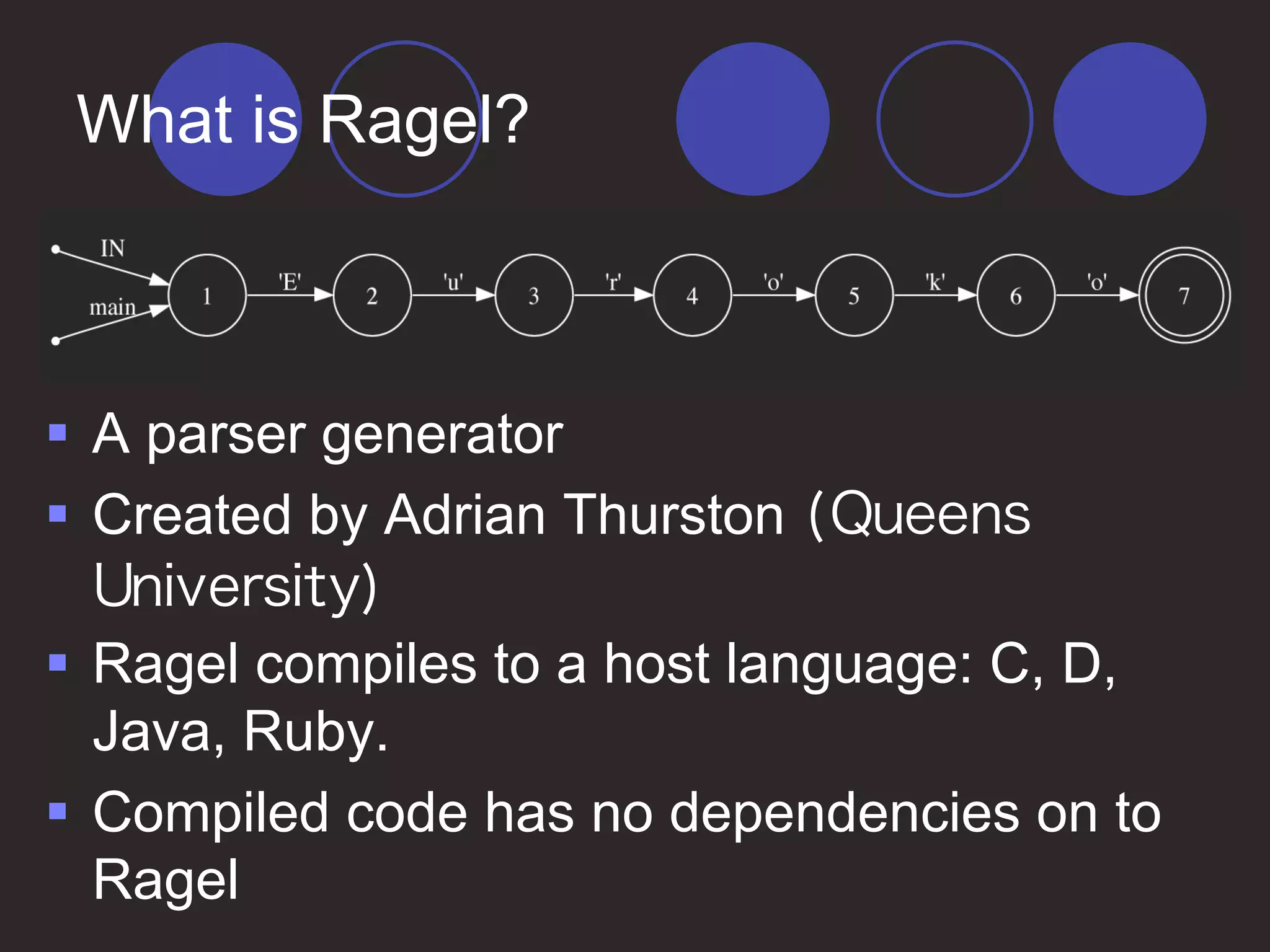
What is Ragel?
 A parser generator
 Created by Adrian Thurston (Queens
University)
 Ragel compiles to a host language: C, D,
Java, Ruby.
 Compiled code has no dependencies on to
Ragel
What is Ragel useful for?
 Parsing protocols and data formats.
 EG: HTTP, XML, JSON, CSS
 More than a single regular expression
 Speed
 Less than a full LALR parser.
You should use it when you need…
Ruby projects using Ragel
 Mongrel (HTTP request parsing)
 Ruby JSON
 SuperRedCloth (Textile markup)
 Hpricot (HTML parser)
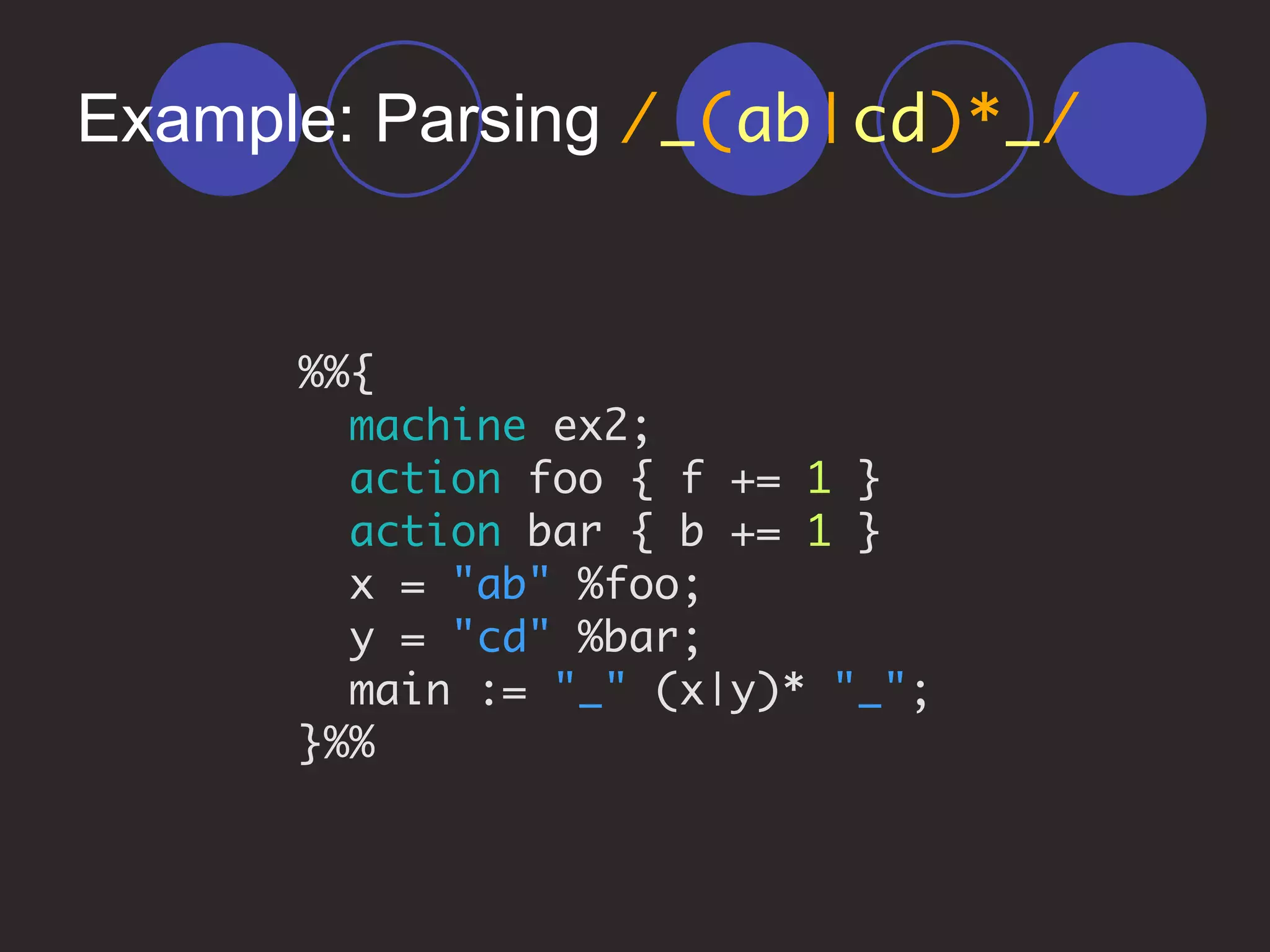
Example: Parsing /_(ab|cd)*_/
%%{
machine ex2;
action foo { f += 1 }
action bar { b += 1 }
x = "ab" %foo;
y = "cd" %bar;
main := "_" (x|y)* "_";
}%%
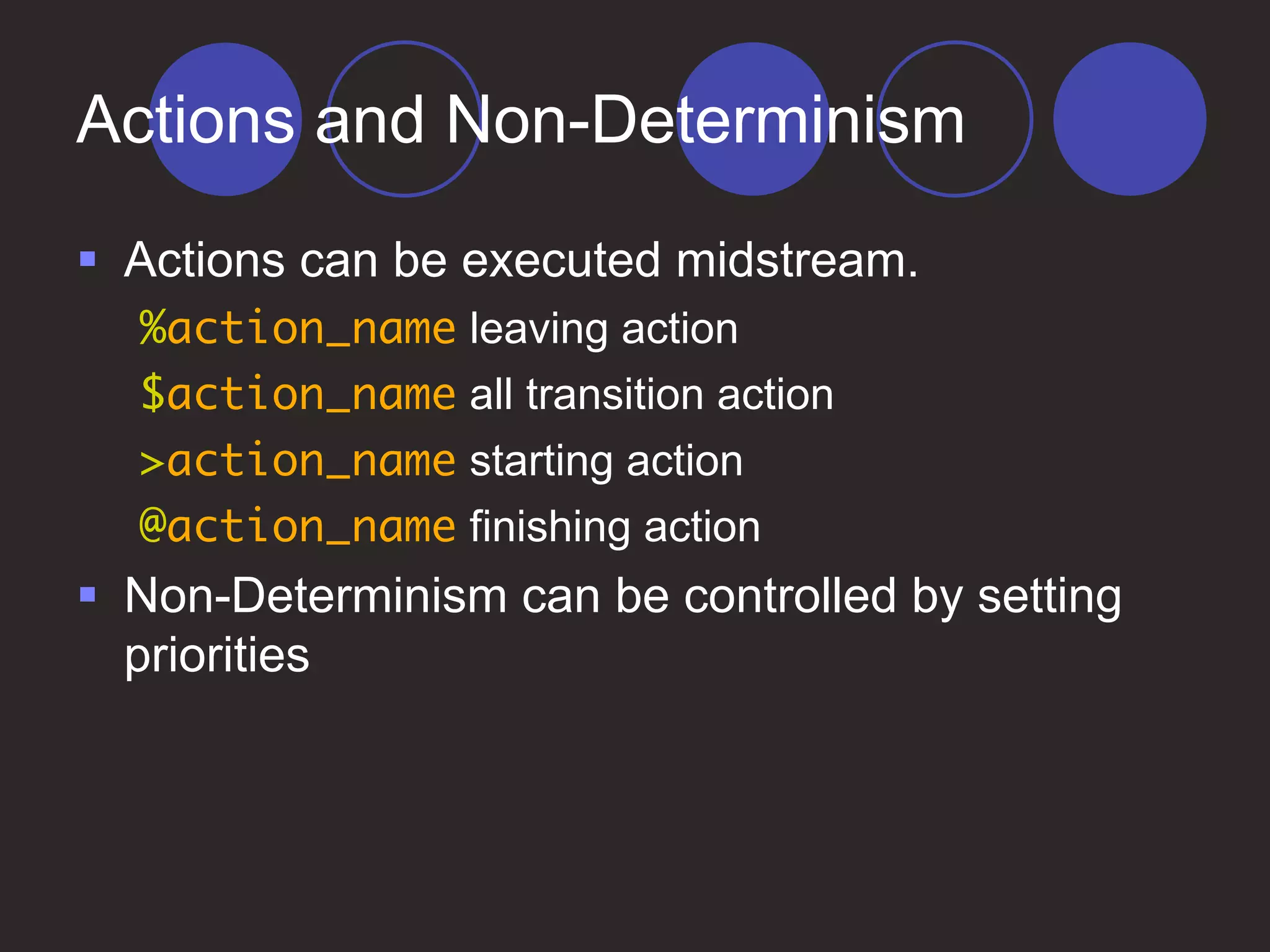
Actions and Non-Determinism
 Actions can be executed midstream.
%action_name leaving action
$action_name all transition action
>action_name starting action
@action_name finishing action
 Non-Determinism can be controlled by setting
priorities
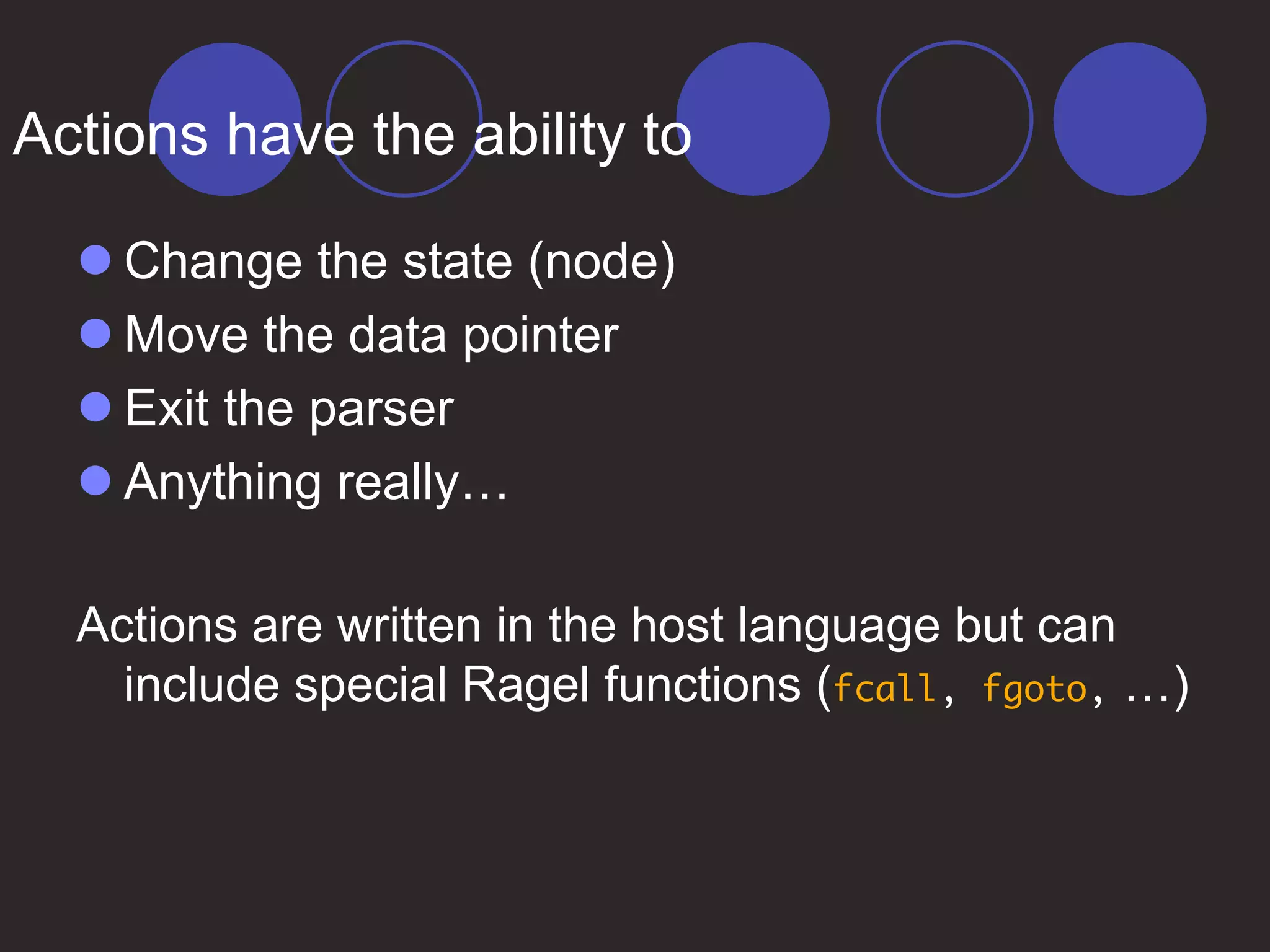
Actions have the ability to
 Change the state (node)
 Move the data pointer
 Exit the parser
 Anything really…
Actions are written in the host language but can
include special Ragel functions (fcall, fgoto, …)
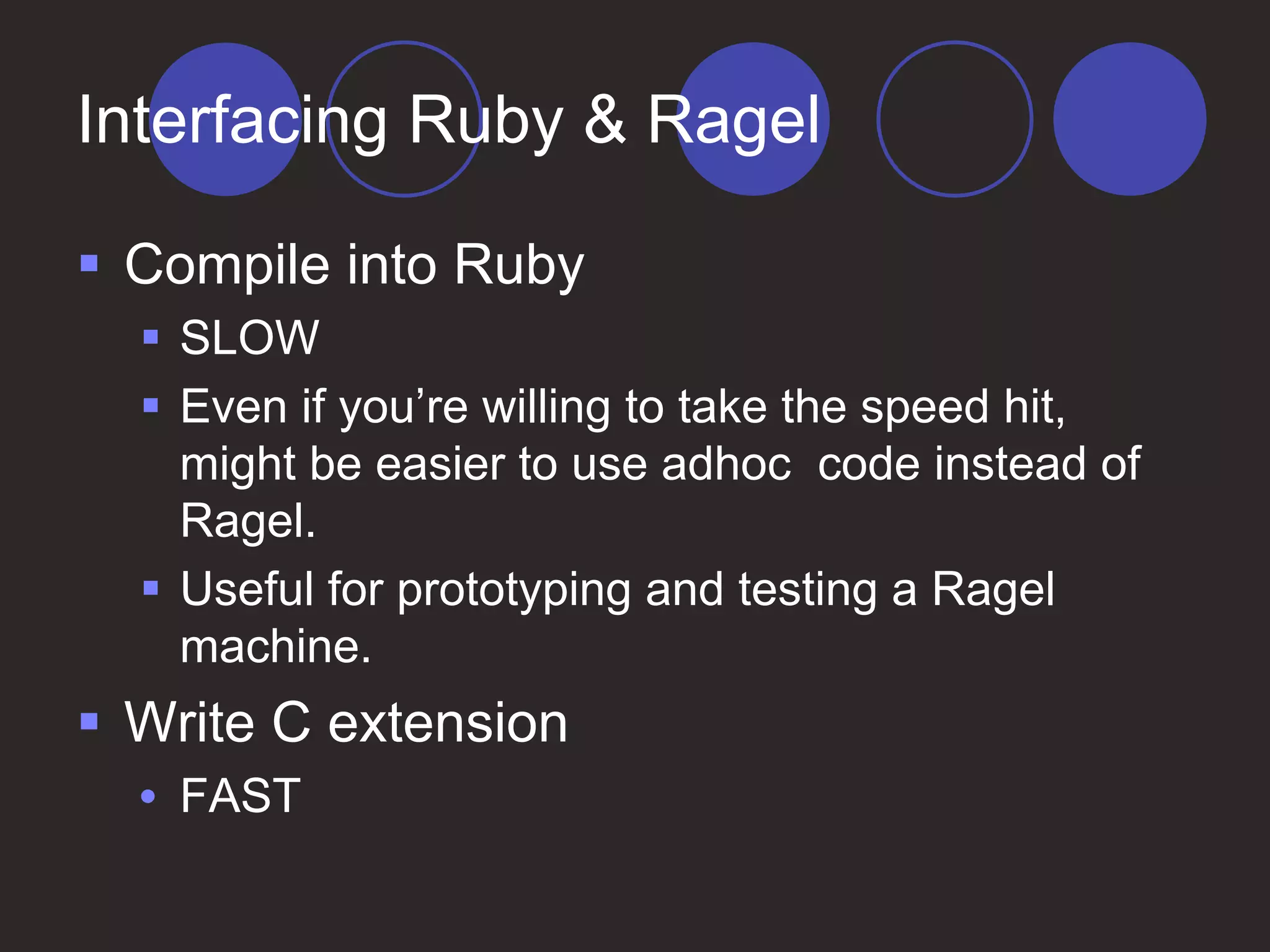
Interfacing Ruby & Ragel
 Compile into Ruby
 SLOW
 Even if you’re willing to take the speed hit,
might be easier to use adhoc code instead of
Ragel.
 Useful for prototyping and testing a Ragel
machine.
 Write C extension
• FAST
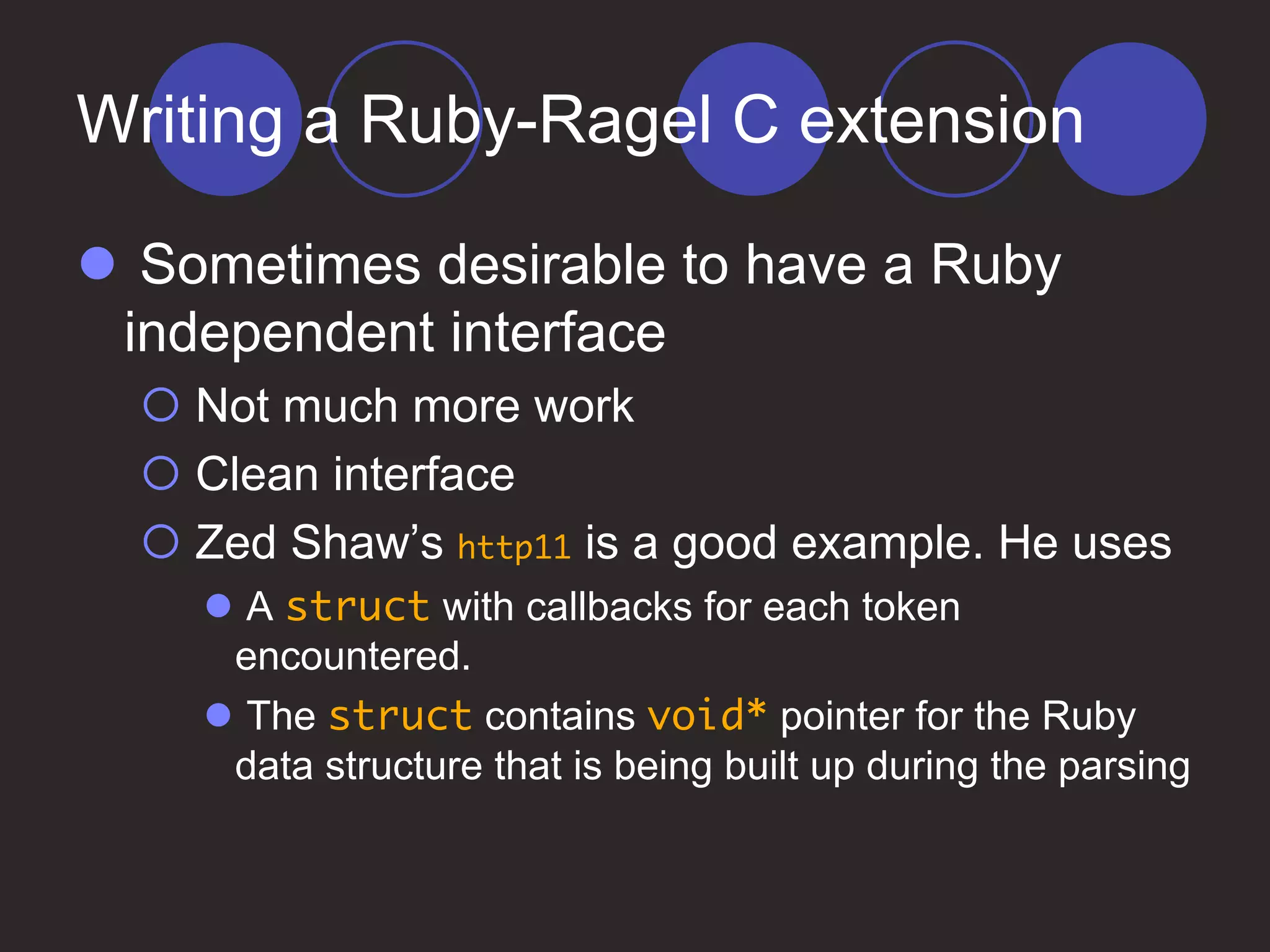
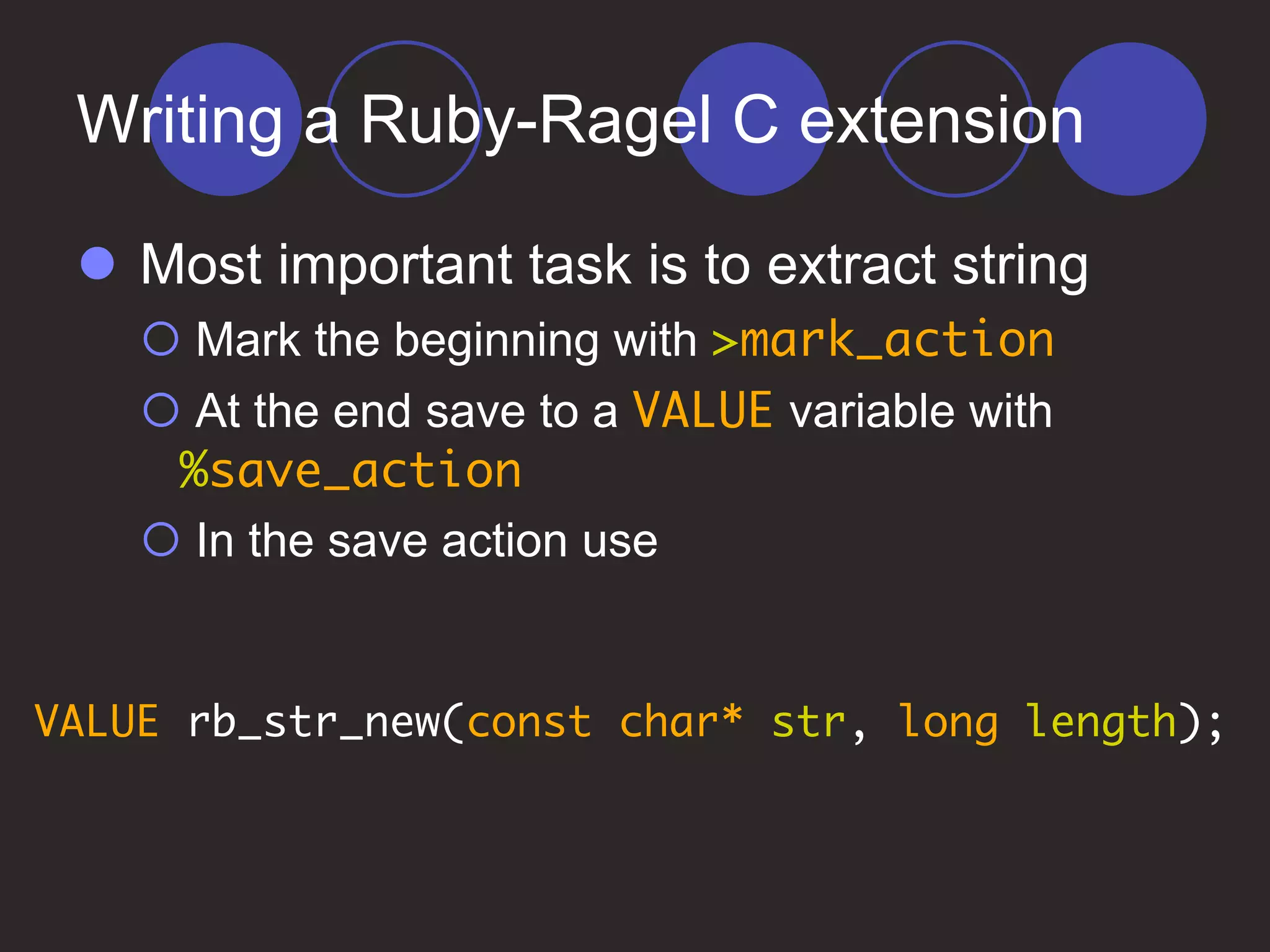
Writing a Ruby-Ragel C extension
 Most important task is to extract string
 Mark the beginning with >mark_action
 At the end save to a VALUE variable with
%save_action
 In the save action use
VALUE rb_str_new(const char* str, long length);
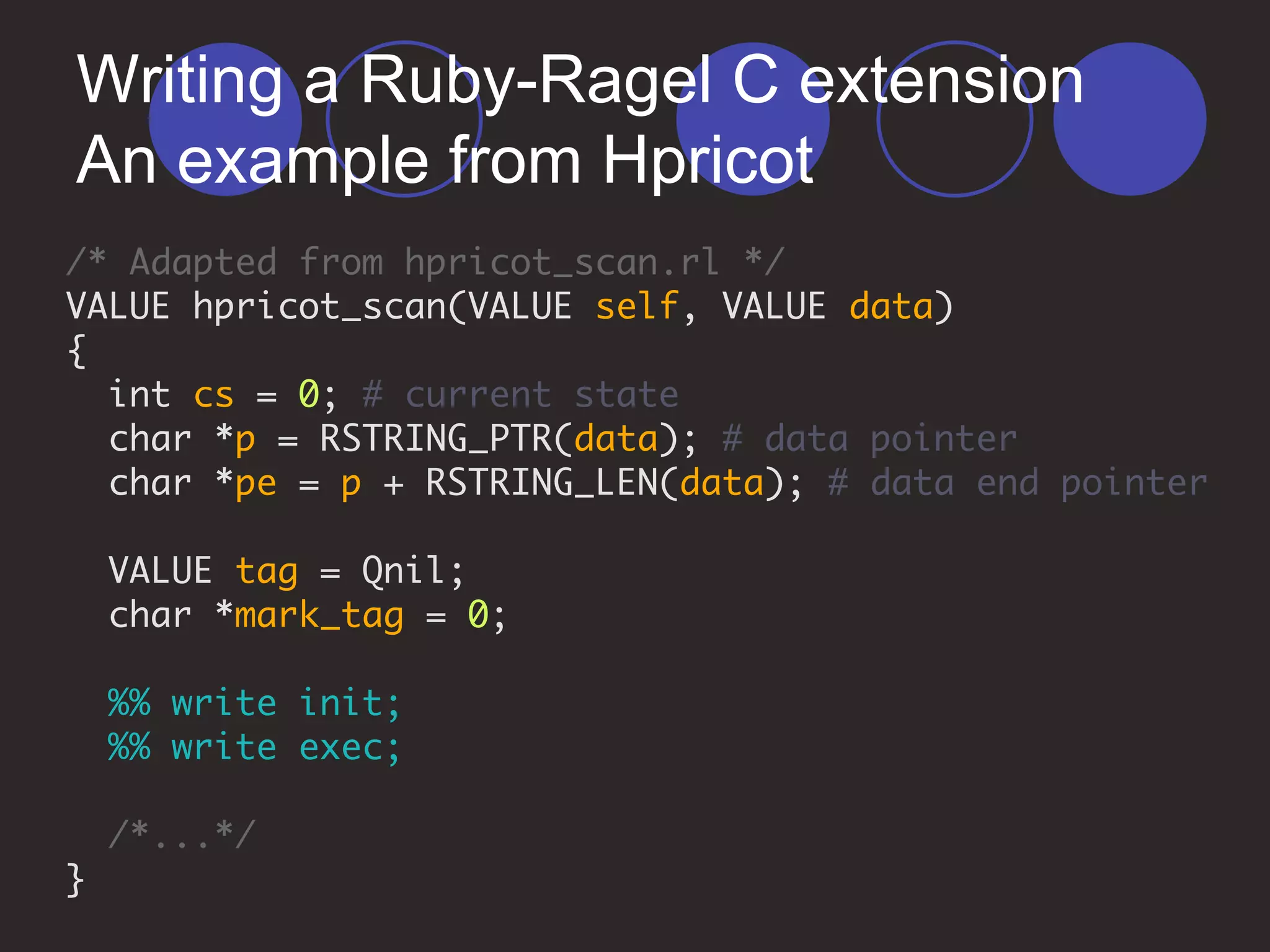
Writing a Ruby-Ragel C extension
An example from Hpricot
/* Adapted from hpricot_scan.rl */
VALUE hpricot_scan(VALUE self, VALUE data)
{
int cs = 0; # current state
char *p = RSTRING_PTR(data); # data pointer
char *pe = p + RSTRING_LEN(data); # data end pointer
VALUE tag = Qnil;
char *mark_tag = 0;
%% write init;
%% write exec;
/*...*/
}
Writing a Ruby-Ragel C extension
An example from Hpricot
%%{
# Adapted from hpricot_scan.rl
machine hpricot_common;
action _tag { mark_tag = p; }
action tag { tag = rb_str_new(mark_tag, p-mark_tag); }
NameChar = [-A-Za-z0-9._:?] ;
Name = [A-Za-z_:] NameChar* ;
NameCap = Name >_tag %tag;
StartTag = "<" NameCap ">";
EndTag = "</" NameCap ">";
# ...
}%%
What if the host language is Ruby?
action _tag { mark_tag = p }
action tag { tag = data[mark_tag..p-1] }
Writing a Ruby-Ragel C extension
 Sometimes desirable to have a Ruby
independent interface
 Not much more work
 Clean interface
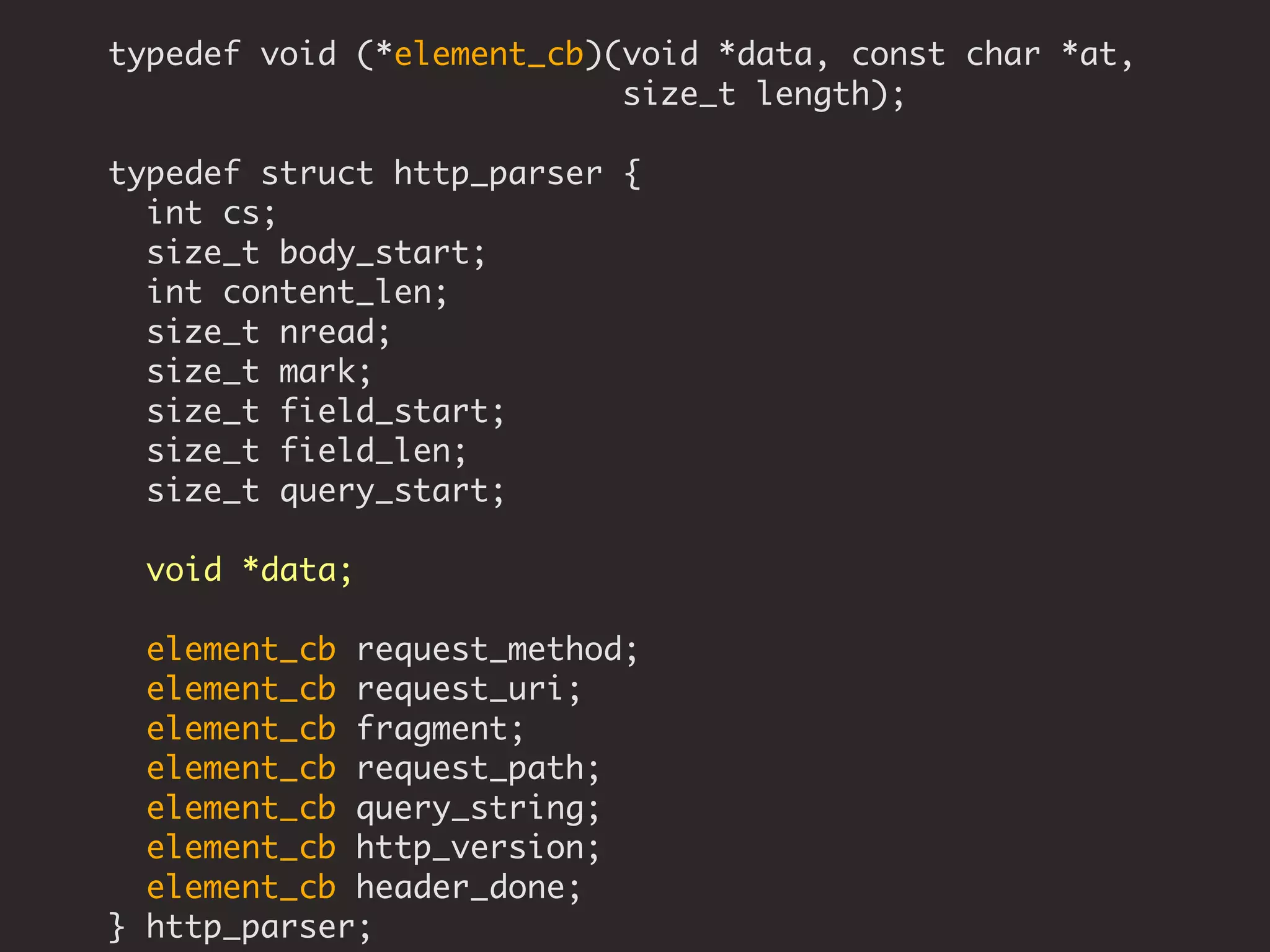
 Zed Shaw’s http11 is a good example. He uses
 A struct with callbacks for each token
encountered.
 The struct contains void* pointer for the Ruby
data structure that is being built up during the parsing
typedef void (*element_cb)(void *data, const char *at,
size_t length);
typedef struct http_parser {
int cs;
size_t body_start;
int content_len;
size_t nread;
size_t mark;
size_t field_start;
size_t field_len;
size_t query_start;
void *data;
element_cb request_method;
element_cb request_uri;
element_cb fragment;
element_cb request_path;
element_cb query_string;
element_cb http_version;
element_cb header_done;
} http_parser;
What to take away from this
Ragel is a parser generator being used in
a few Ruby projects
You should read the code of Zed Shaw
and why the lucky stiff.

Ragel talk

  • 1.
    Ragel & Ruby RyDahl (ry@tinyclouds.org) Euruko, November 2007
  • 2.
    What is Ragel? A parser generator  Created by Adrian Thurston (Queens University)  Ragel compiles to a host language: C, D, Java, Ruby.  Compiled code has no dependencies on to Ragel
  • 3.
    What is Rageluseful for?  Parsing protocols and data formats.  EG: HTTP, XML, JSON, CSS  More than a single regular expression  Speed  Less than a full LALR parser. You should use it when you need…
  • 4.
    Ruby projects usingRagel  Mongrel (HTTP request parsing)  Ruby JSON  SuperRedCloth (Textile markup)  Hpricot (HTML parser)
  • 5.
    Example: Parsing /_(ab|cd)*_/ %%{ machineex2; action foo { f += 1 } action bar { b += 1 } x = "ab" %foo; y = "cd" %bar; main := "_" (x|y)* "_"; }%%
  • 6.
    Actions and Non-Determinism Actions can be executed midstream. %action_name leaving action $action_name all transition action >action_name starting action @action_name finishing action  Non-Determinism can be controlled by setting priorities
  • 7.
    Actions have theability to  Change the state (node)  Move the data pointer  Exit the parser  Anything really… Actions are written in the host language but can include special Ragel functions (fcall, fgoto, …)
  • 8.
    Interfacing Ruby &Ragel  Compile into Ruby  SLOW  Even if you’re willing to take the speed hit, might be easier to use adhoc code instead of Ragel.  Useful for prototyping and testing a Ragel machine.  Write C extension • FAST
  • 9.
    Writing a Ruby-RagelC extension  Most important task is to extract string  Mark the beginning with >mark_action  At the end save to a VALUE variable with %save_action  In the save action use VALUE rb_str_new(const char* str, long length);
  • 10.
    Writing a Ruby-RagelC extension An example from Hpricot /* Adapted from hpricot_scan.rl */ VALUE hpricot_scan(VALUE self, VALUE data) { int cs = 0; # current state char *p = RSTRING_PTR(data); # data pointer char *pe = p + RSTRING_LEN(data); # data end pointer VALUE tag = Qnil; char *mark_tag = 0; %% write init; %% write exec; /*...*/ }
  • 11.
    Writing a Ruby-RagelC extension An example from Hpricot %%{ # Adapted from hpricot_scan.rl machine hpricot_common; action _tag { mark_tag = p; } action tag { tag = rb_str_new(mark_tag, p-mark_tag); } NameChar = [-A-Za-z0-9._:?] ; Name = [A-Za-z_:] NameChar* ; NameCap = Name >_tag %tag; StartTag = "<" NameCap ">"; EndTag = "</" NameCap ">"; # ... }%%
  • 12.
    What if thehost language is Ruby? action _tag { mark_tag = p } action tag { tag = data[mark_tag..p-1] }
  • 13.
    Writing a Ruby-RagelC extension  Sometimes desirable to have a Ruby independent interface  Not much more work  Clean interface  Zed Shaw’s http11 is a good example. He uses  A struct with callbacks for each token encountered.  The struct contains void* pointer for the Ruby data structure that is being built up during the parsing
  • 14.
    typedef void (*element_cb)(void*data, const char *at, size_t length); typedef struct http_parser { int cs; size_t body_start; int content_len; size_t nread; size_t mark; size_t field_start; size_t field_len; size_t query_start; void *data; element_cb request_method; element_cb request_uri; element_cb fragment; element_cb request_path; element_cb query_string; element_cb http_version; element_cb header_done; } http_parser;
  • 15.
    What to takeaway from this Ragel is a parser generator being used in a few Ruby projects You should read the code of Zed Shaw and why the lucky stiff.