Self Reconfiguring Modular Robot
VIJAY N
1St10EC426
Sambhram Institute of Technology
Contents
• Introduction
• Structure
• History
• Application areas
• Advantages and Disadvantages
• Future
• Conclusion
• References
Introduction
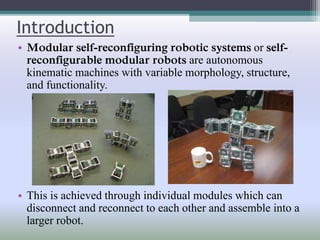
• Modular self-reconfiguring robotic systems or self-
reconfigurable modular robots are autonomous
kinematic machines with variable morphology, structure,
and functionality.
• This is achieved through individual modules which can
disconnect and reconnect to each other and assemble into a
larger robot.
Structure
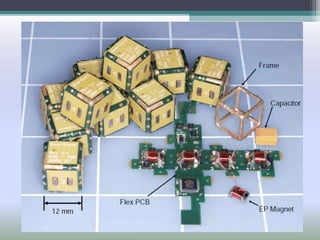
• Modular robots are usually composed of multiple building
blocks of a relatively small repertoire, with uniform docking
interfaces that allow transfer of mechanical forces and
moments, electrical power and communication throughout
the robot.
• The modular building blocks usually consist of some
primary structural actuated unit, and potentially additional
specialized units such as grippers, feet, wheels, cameras,
payload and energy storage and generation.
Structural Architecture
• Modular self-reconfiguring robotic systems can
be generally classified into several architectural
groups by the geometric arrangement of their
unit.
▫ Lattice architecture.
▫ Chain architecture.
Lattice Architecture
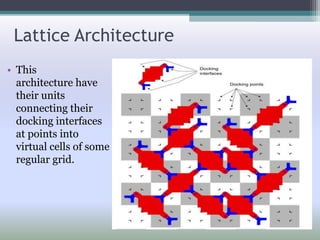
• This
architecture have
their units
connecting their
docking interfaces
at points into
virtual cells of some
regular grid.
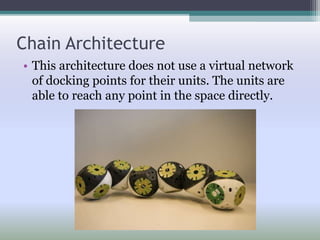
Chain Architecture
• This architecture does not use a virtual network
of docking points for their units. The units are
able to reach any point in the space directly.
History
• The roots of the concept of modular self-
reconfigurable robots came in 1970’s, but the
actual first model was created during
1980’s(CEBOT).
• However, the revolution in this field happened
from past 2, 3 years.
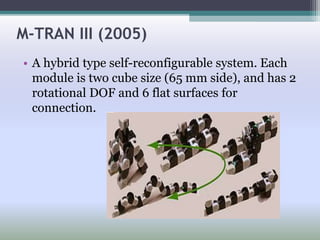
M-TRAN III (2005)
• A hybrid type self-reconfigurable system. Each
module is two cube size (65 mm side), and has 2
rotational DOF and 6 flat surfaces for
connection.
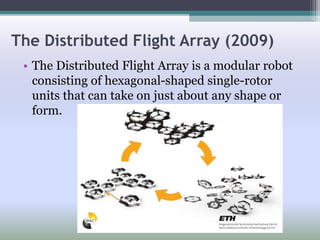
The Distributed Flight Array (2009)
• The Distributed Flight Array is a modular robot
consisting of hexagonal-shaped single-rotor
units that can take on just about any shape or
form.
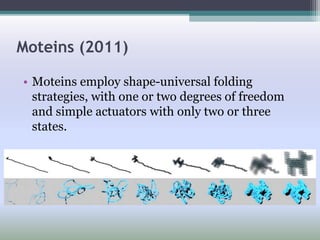
Moteins (2011)
• Moteins employ shape-universal folding
strategies, with one or two degrees of freedom
and simple actuators with only two or three
states.
Application Areas
• Space exploration
• Telepario
• Bucket of stuff
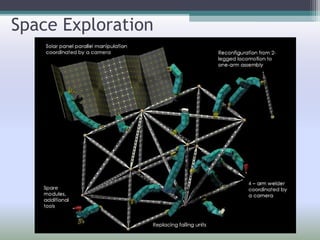
Space Exploration
Telepario
• What the researchers propose to make are
moving, physical, three-dimensional replicas of
people or objects, so lifelike that human senses
would accept them as real.
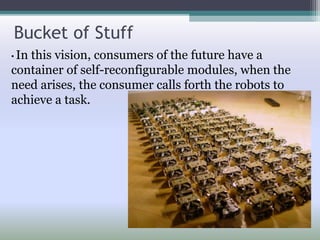
Bucket of Stuff
• In this vision, consumers of the future have a
container of self-reconfigurable modules, when the
need arises, the consumer calls forth the robots to
achieve a task.
Advantages and Disadvantages
• Advantages
 Economic advantage : Self reconfiguring
robotic systems can potentially lower overall
robot cost by making a range of complex
machines out of a single (or relatively few)
types of mass-produced modules.
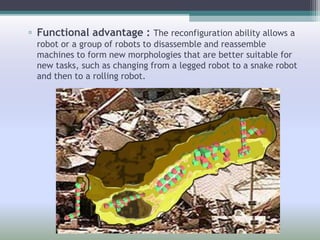
▫ Functional advantage : The reconfiguration ability allows a
robot or a group of robots to disassemble and reassemble
machines to form new morphologies that are better suitable for
new tasks, such as changing from a legged robot to a snake robot
and then to a rolling robot.
Disadvantages
• A modular robot is likely to be inferior in
performance to any single custom robot tailored
for a specific task.
• The added degrees of freedom make modular
robots more versatile in their potential
capabilities, but also incur a performance
tradeoff and increased mechanical and
computational complexities.
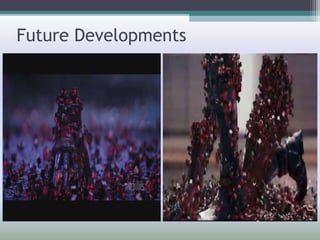
Future Developments
References
• Self-Reconfigurable Robot: Shape-Changing Cellular
Robots Can Exceed Conventional Robot Flexibility, by
Murata & Kurokawa.
• Self Reconfiguring Modular Robotics Essentials, Popular
science Introduction to SRCMR fundamentals
and some of the profound consequences it will have.
• ^ "Modular Reconfigurable Robots in Space Applications”
(http://www2.parc.com/spl/projects/modrobots/publicati
ons/pdf/space.pdf) (PDF).
Conclusion
• Self reconfigurable modular robot are kind of
miniaturized robots which all together can
group-up and form a bigger and better robot for
any desired application.
THANK YOU

Self re-configuring modular ROBOT

  • 1.
    Self Reconfiguring ModularRobot VIJAY N 1St10EC426 Sambhram Institute of Technology
  • 2.
    Contents • Introduction • Structure •History • Application areas • Advantages and Disadvantages • Future • Conclusion • References
  • 3.
    Introduction • Modular self-reconfiguringrobotic systems or self- reconfigurable modular robots are autonomous kinematic machines with variable morphology, structure, and functionality. • This is achieved through individual modules which can disconnect and reconnect to each other and assemble into a larger robot.
  • 4.
    Structure • Modular robotsare usually composed of multiple building blocks of a relatively small repertoire, with uniform docking interfaces that allow transfer of mechanical forces and moments, electrical power and communication throughout the robot. • The modular building blocks usually consist of some primary structural actuated unit, and potentially additional specialized units such as grippers, feet, wheels, cameras, payload and energy storage and generation.
  • 6.
    Structural Architecture • Modularself-reconfiguring robotic systems can be generally classified into several architectural groups by the geometric arrangement of their unit. ▫ Lattice architecture. ▫ Chain architecture.
  • 7.
    Lattice Architecture • This architecturehave their units connecting their docking interfaces at points into virtual cells of some regular grid.
  • 8.
    Chain Architecture • Thisarchitecture does not use a virtual network of docking points for their units. The units are able to reach any point in the space directly.
  • 9.
    History • The rootsof the concept of modular self- reconfigurable robots came in 1970’s, but the actual first model was created during 1980’s(CEBOT). • However, the revolution in this field happened from past 2, 3 years.
  • 10.
    M-TRAN III (2005) •A hybrid type self-reconfigurable system. Each module is two cube size (65 mm side), and has 2 rotational DOF and 6 flat surfaces for connection.
  • 11.
    The Distributed FlightArray (2009) • The Distributed Flight Array is a modular robot consisting of hexagonal-shaped single-rotor units that can take on just about any shape or form.
  • 12.
    Moteins (2011) • Moteinsemploy shape-universal folding strategies, with one or two degrees of freedom and simple actuators with only two or three states.
  • 13.
    Application Areas • Spaceexploration • Telepario • Bucket of stuff
  • 14.
  • 15.
    Telepario • What theresearchers propose to make are moving, physical, three-dimensional replicas of people or objects, so lifelike that human senses would accept them as real.
  • 16.
    Bucket of Stuff •In this vision, consumers of the future have a container of self-reconfigurable modules, when the need arises, the consumer calls forth the robots to achieve a task.
  • 17.
    Advantages and Disadvantages •Advantages  Economic advantage : Self reconfiguring robotic systems can potentially lower overall robot cost by making a range of complex machines out of a single (or relatively few) types of mass-produced modules.
  • 18.
    ▫ Functional advantage: The reconfiguration ability allows a robot or a group of robots to disassemble and reassemble machines to form new morphologies that are better suitable for new tasks, such as changing from a legged robot to a snake robot and then to a rolling robot.
  • 19.
    Disadvantages • A modularrobot is likely to be inferior in performance to any single custom robot tailored for a specific task. • The added degrees of freedom make modular robots more versatile in their potential capabilities, but also incur a performance tradeoff and increased mechanical and computational complexities.
  • 20.
  • 21.
    References • Self-Reconfigurable Robot:Shape-Changing Cellular Robots Can Exceed Conventional Robot Flexibility, by Murata & Kurokawa. • Self Reconfiguring Modular Robotics Essentials, Popular science Introduction to SRCMR fundamentals and some of the profound consequences it will have. • ^ "Modular Reconfigurable Robots in Space Applications” (http://www2.parc.com/spl/projects/modrobots/publicati ons/pdf/space.pdf) (PDF).
  • 22.
    Conclusion • Self reconfigurablemodular robot are kind of miniaturized robots which all together can group-up and form a bigger and better robot for any desired application.
  • 23.