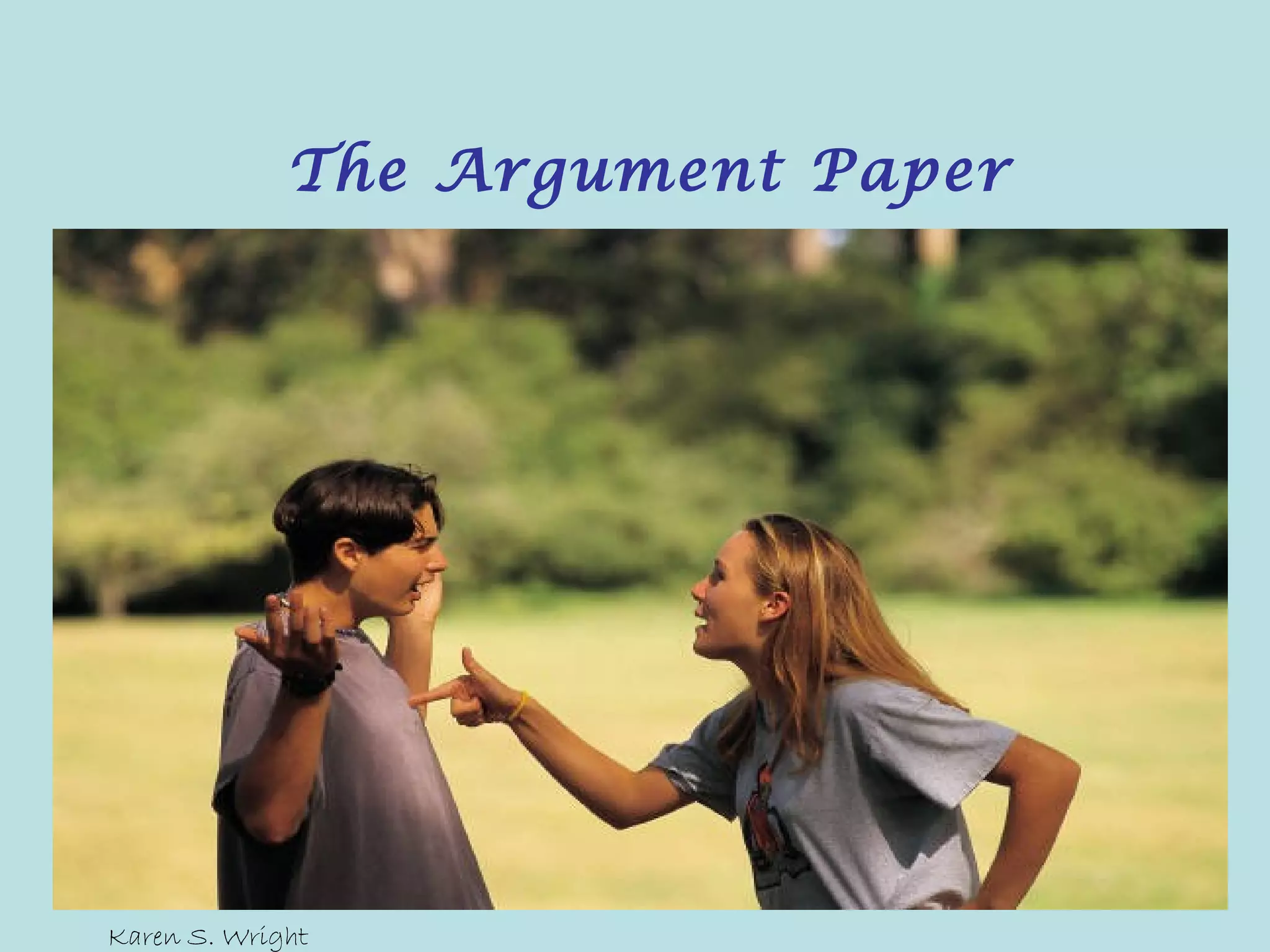




The Argument Paper
Karen S. Wright
The argument paper
must present a
debatable point.
Mere knowledge of
the truth will not
give you the art of
persuasion.
Plato
Think
Hmm
Yep!
When choosing a topic
for written argument, be
sure it is open for debate.
Facts are a matter of
information, not debate.
An essay becomes an
argument when it takes a
position concerning the
facts.
? ?
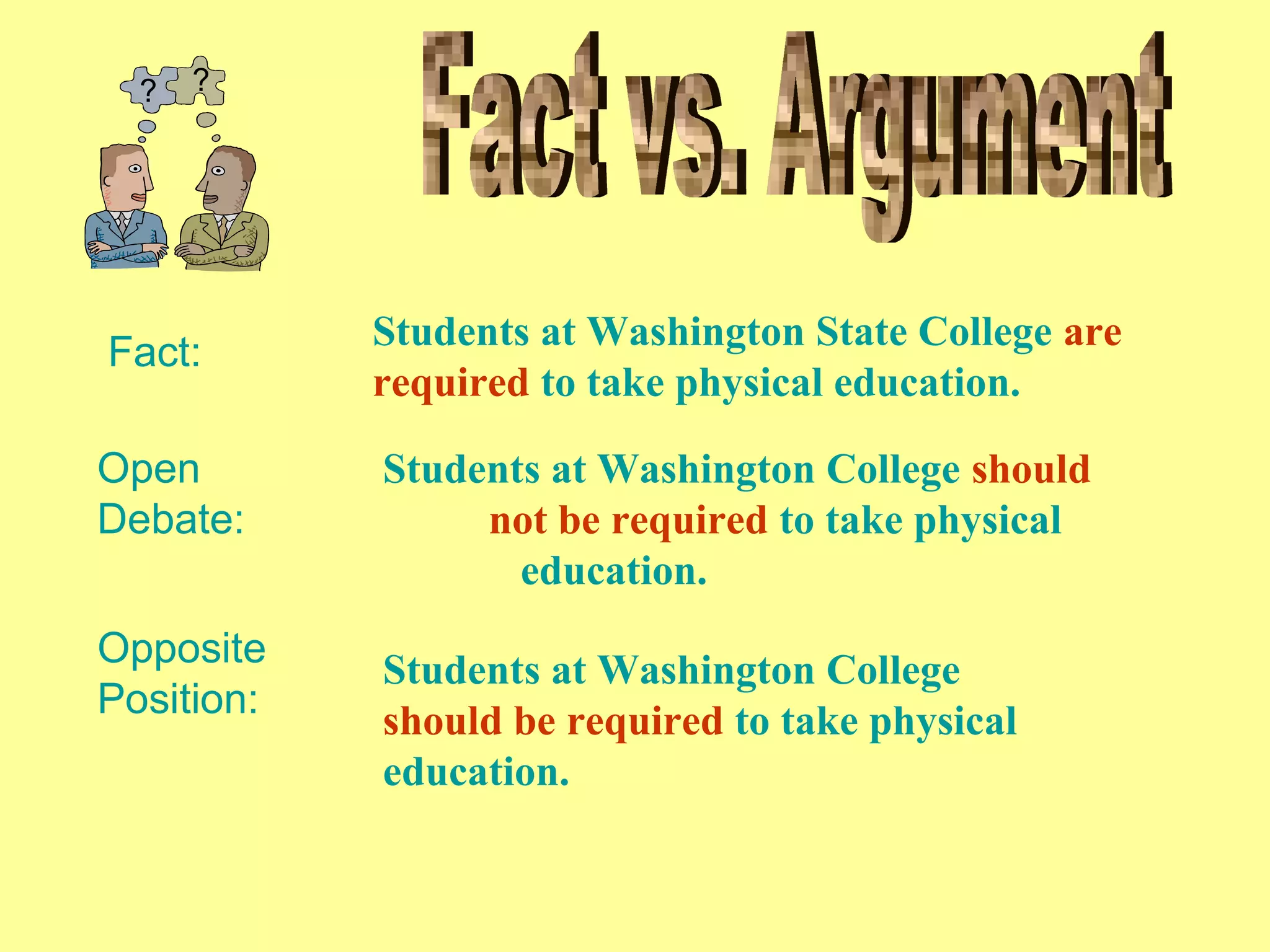
Fact:
Open
Debate:
Opposite
Position:
Students at Washington College
should be required to take physical
education.
Students at Washington College should
not be required to take physical
education.
Students at Washington State College are
required to take physical education.
•A claim is a statement that gives a
position about a topic that can be
supported by evidence, reasons, and
examples.
•The thinking process that moves
you from a topic to a defensible
position calls for you to first make
an claim.
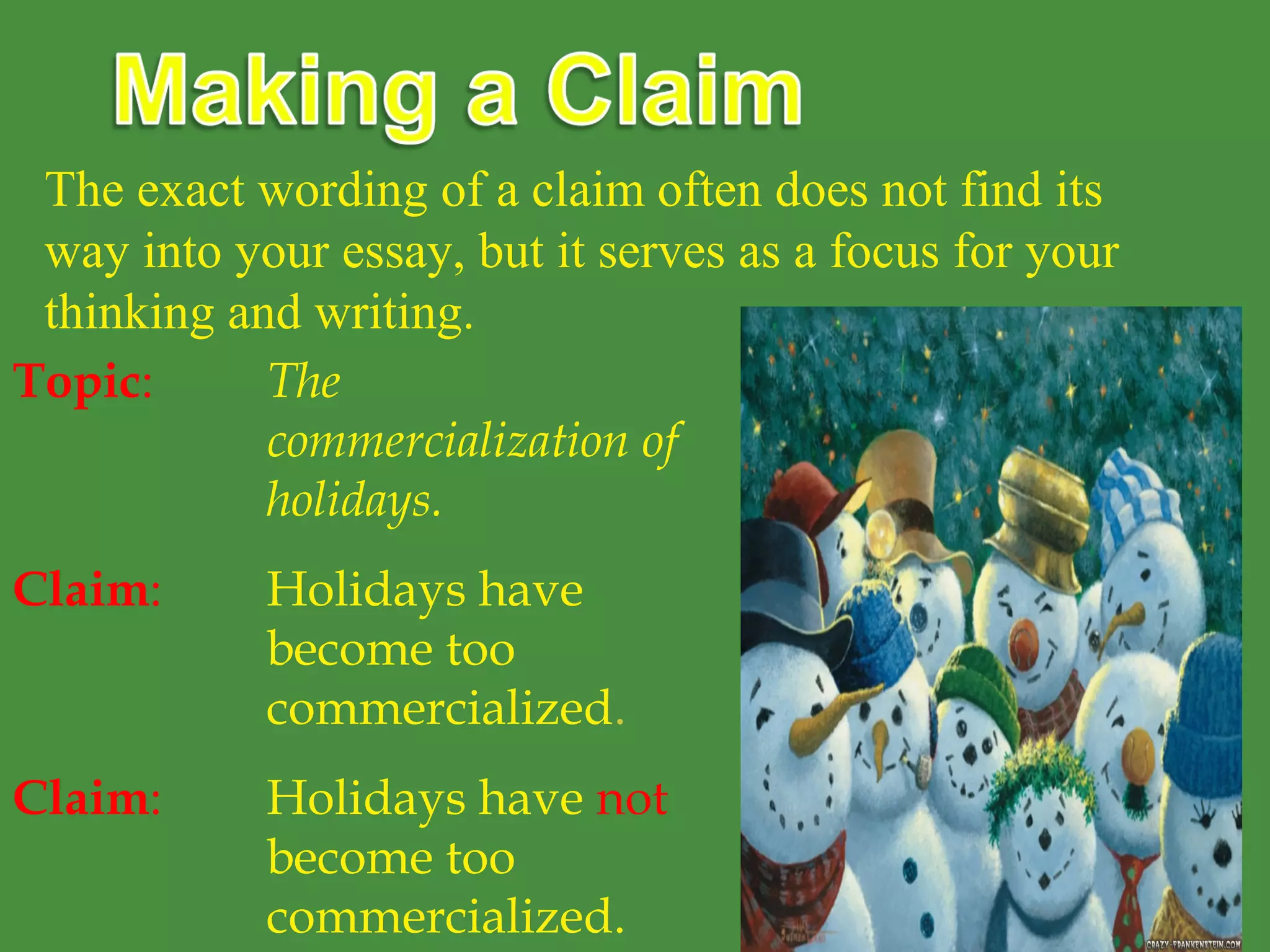
The exact wording of a claim often does not find its
way into your essay, but it serves as a focus for your
thinking and writing.
Topic: The
commercialization of
holidays.
Claim: Holidays have
become too
commercialized.
Claim: Holidays have not
become too
commercialized.
Claim: Holidays
have become too
commercialized.
Thesis: The spirit of
the holidays is being
destroyed by
commercialism.
Claim: Holidays
have not become too
commercialized.
Thesis: Commercial
uses of holidays benefit
the nation’s economy
and lift people’s spirits.
Develop a thesis statement for a written argument
on the following topic:
Topic: Book censorship in libraries.
Thesis (For):
Thesis (Against):
Structuring Written Argument
• No one structure fits all
written arguments.
• Most college writing uses a
structure
based on the classical
pattern of argument
developed by the Greeks
and Romans, which is still
highly respected today.
Elements in Written Argument
• Introductory Paragraph
• Thesis Statement
• Background Information
• Reasons or Evidence
• Solutions—past and
present
• Anticipation to Likely
Objections
• Rebuttal of Objections
• Concluding Paragraph-
Call to Action
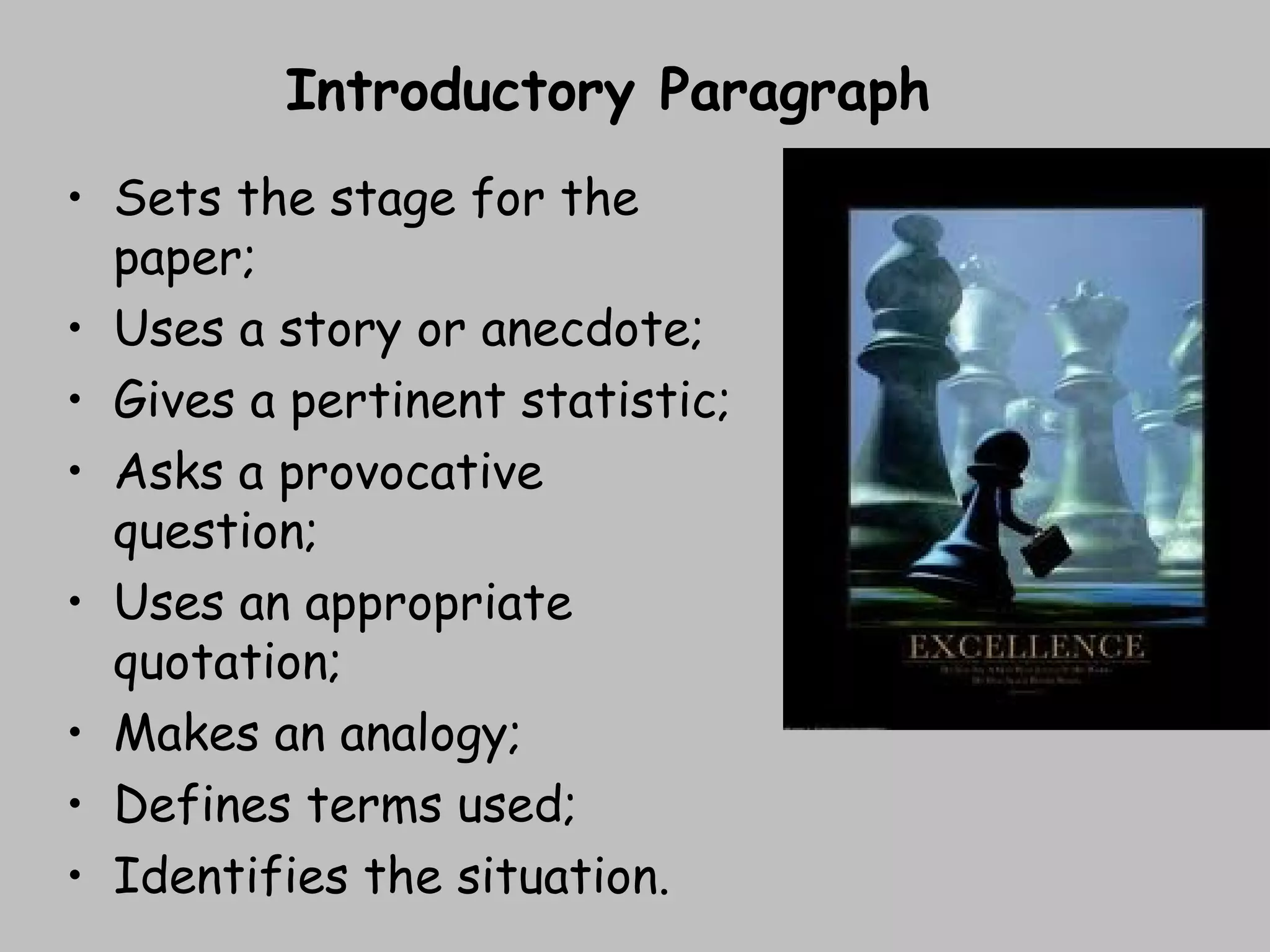
• Sets the stage for the
paper;
• Uses a story or anecdote;
• Gives a pertinent statistic;
• Asks a provocative
question;
• Uses an appropriate
quotation;
• Makes an analogy;
• Defines terms used;
• Identifies the situation.
Introductory Paragraph
Thesis sTaTemenT
• It states the position
being argued.
• It states the essay’s
subject.
• It reflects the essay’s
purpose.
• It includes a focus—a
claim that conveys your
point of view.
• It uses specific language
where vague words are
avoided.
Don’t be upset—
Just think logically
Oh no!!
Background Information
 Gives the reader
basic information
needed for
understanding the
position being
argued.
 This information can
be part of the
introductory
paragraph.
 It can also appear in
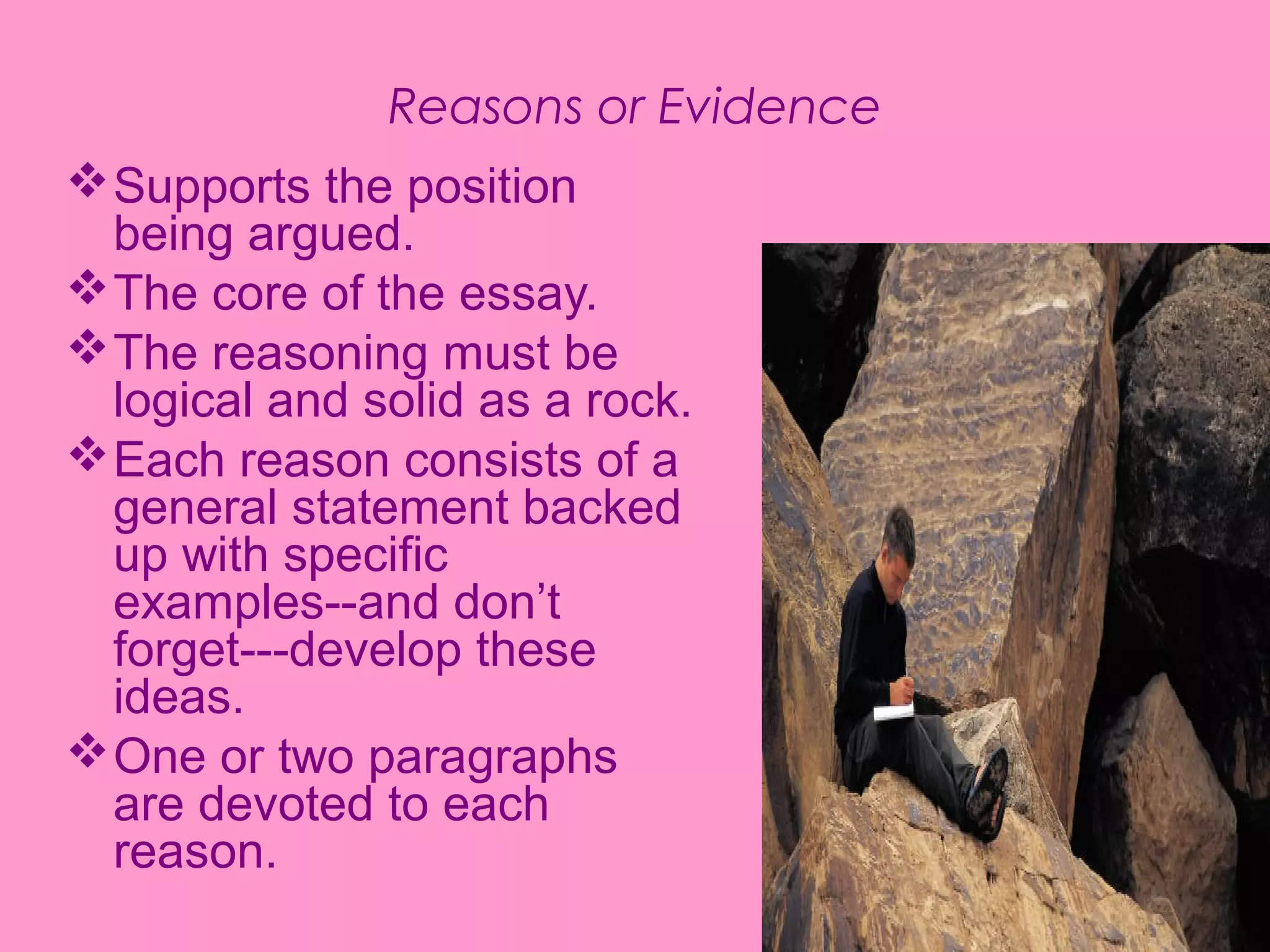
Reasons or Evidence
Supports the position
being argued.
The core of the essay.
The reasoning must be
logical and solid as a rock.
Each reason consists of a
general statement backed
up with specific
examples--and don’t
forget---develop these
ideas.
One or two paragraphs
are devoted to each
reason.
What has
been done?
What can
be done?
•This section mentions
possible oppositions to
the argument and rebuts
it briefly.
•In classical argument,
this “refutation” appears
in its own paragraph,
immediately BEFORE the
concluding paragraph.
Anticipation of Objections and
Responses
• An alternative placement of
the rebuttal is immediately
after the introductory
paragraph, as a “bridge” to
the rest of the essay.
• With the “bridge,” the
essay’s thesis statement
falls either at the end of the
introductory paragraph or
at the end of the
“refutation” paragraph.
An Alternative Placement
Concluding Paragraph
Brings the essay to an
end that flows logically
and gracefully from the
thesis.
Does not cut reader off
abruptly.
Call for awareness,
action, or similar type
of resolution.
Look ahead to the
future—a call to action
Use Effective Reasoning
 Be logical: use sound
reasoning.
 Enlist the emotions of
the reader: enlist the
values and beliefs of
the reader by
arousing “the better
self” of the reader.
 Establish credibility:
show that you, as the
writer, can be relied
upon as a
knowledgeable person
with good sense.
Establish a Reasonable
Tone
• Be fair to opposing
arguments.
• Don’t ignore other
positions.
• This kind of respect
provides a reasonable
tone.
• Choose your words
carefully.
• Don’t exaggerate.
• Use similes and
metaphors cautiously.
• Never insult the other
side.
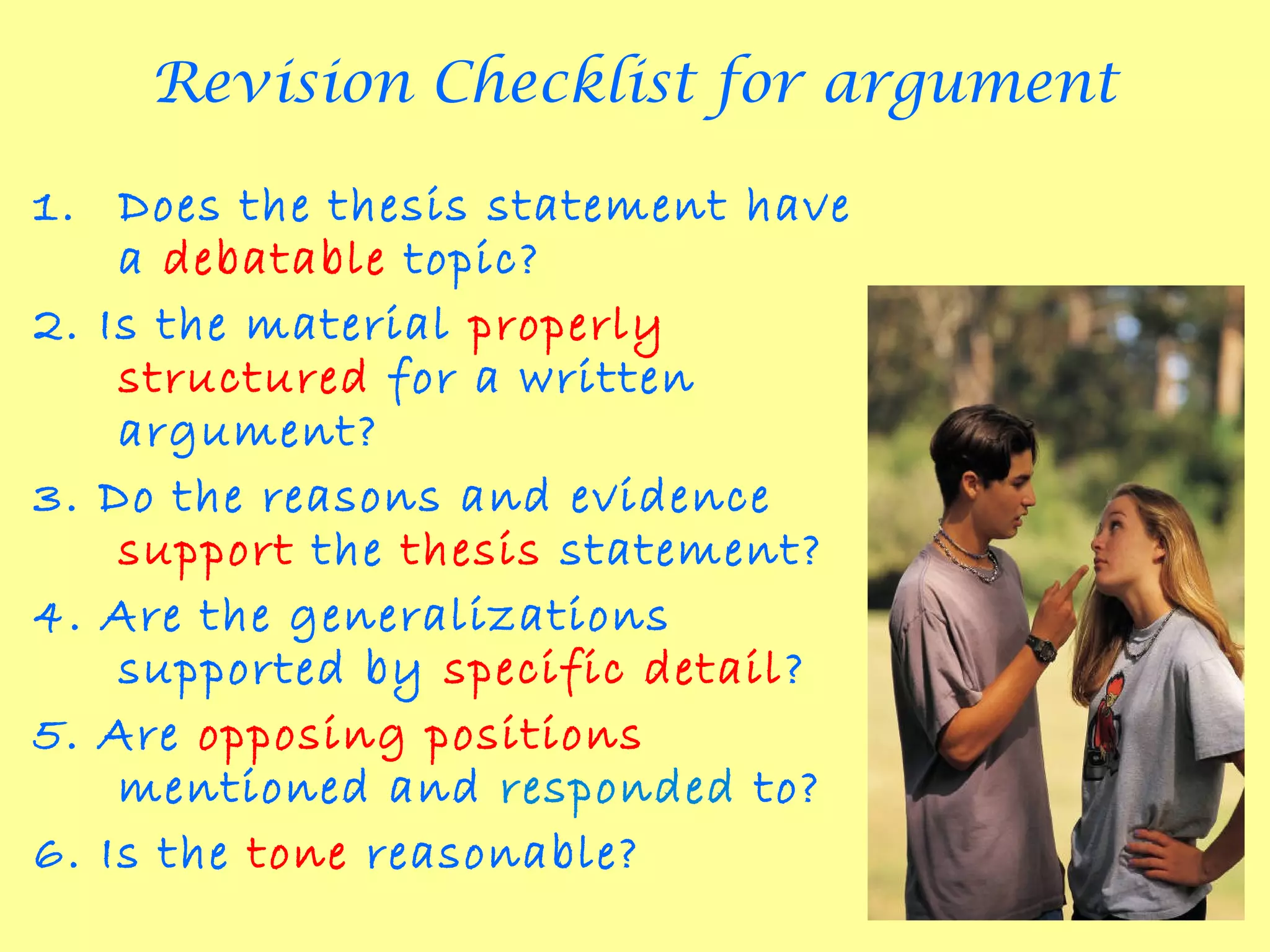
1. Does the thesis statement have
a debatable topic?
2. Is the material properly
structured for a written
argument?
3. Do the reasons and evidence
support the thesis statement?
4. Are the generalizations
supported by specific detail?
5. Are opposing positions
mentioned and responded to?
6. Is the tone reasonable?
Revision Checklist for argument

The argument paper 2013

  • 1.
  • 2.
    The argument paper mustpresent a debatable point. Mere knowledge of the truth will not give you the art of persuasion. Plato
  • 3.
    Think Hmm Yep! When choosing atopic for written argument, be sure it is open for debate. Facts are a matter of information, not debate. An essay becomes an argument when it takes a position concerning the facts.
  • 4.
    ? ? Fact: Open Debate: Opposite Position: Students atWashington College should be required to take physical education. Students at Washington College should not be required to take physical education. Students at Washington State College are required to take physical education.
  • 5.
    •A claim isa statement that gives a position about a topic that can be supported by evidence, reasons, and examples. •The thinking process that moves you from a topic to a defensible position calls for you to first make an claim.
  • 6.
    The exact wordingof a claim often does not find its way into your essay, but it serves as a focus for your thinking and writing. Topic: The commercialization of holidays. Claim: Holidays have become too commercialized. Claim: Holidays have not become too commercialized.
  • 7.
    Claim: Holidays have becometoo commercialized. Thesis: The spirit of the holidays is being destroyed by commercialism. Claim: Holidays have not become too commercialized. Thesis: Commercial uses of holidays benefit the nation’s economy and lift people’s spirits.
  • 8.
    Develop a thesisstatement for a written argument on the following topic: Topic: Book censorship in libraries. Thesis (For): Thesis (Against):
  • 9.
    Structuring Written Argument •No one structure fits all written arguments. • Most college writing uses a structure based on the classical pattern of argument developed by the Greeks and Romans, which is still highly respected today.
  • 10.
    Elements in WrittenArgument • Introductory Paragraph • Thesis Statement • Background Information • Reasons or Evidence • Solutions—past and present • Anticipation to Likely Objections • Rebuttal of Objections • Concluding Paragraph- Call to Action
  • 11.
    • Sets thestage for the paper; • Uses a story or anecdote; • Gives a pertinent statistic; • Asks a provocative question; • Uses an appropriate quotation; • Makes an analogy; • Defines terms used; • Identifies the situation. Introductory Paragraph
  • 12.
    Thesis sTaTemenT • Itstates the position being argued. • It states the essay’s subject. • It reflects the essay’s purpose. • It includes a focus—a claim that conveys your point of view. • It uses specific language where vague words are avoided. Don’t be upset— Just think logically Oh no!!
  • 13.
    Background Information  Givesthe reader basic information needed for understanding the position being argued.  This information can be part of the introductory paragraph.  It can also appear in
  • 14.
    Reasons or Evidence Supportsthe position being argued. The core of the essay. The reasoning must be logical and solid as a rock. Each reason consists of a general statement backed up with specific examples--and don’t forget---develop these ideas. One or two paragraphs are devoted to each reason.
  • 15.
  • 16.
    •This section mentions possibleoppositions to the argument and rebuts it briefly. •In classical argument, this “refutation” appears in its own paragraph, immediately BEFORE the concluding paragraph. Anticipation of Objections and Responses
  • 17.
    • An alternativeplacement of the rebuttal is immediately after the introductory paragraph, as a “bridge” to the rest of the essay. • With the “bridge,” the essay’s thesis statement falls either at the end of the introductory paragraph or at the end of the “refutation” paragraph. An Alternative Placement
  • 18.
    Concluding Paragraph Brings theessay to an end that flows logically and gracefully from the thesis. Does not cut reader off abruptly. Call for awareness, action, or similar type of resolution. Look ahead to the future—a call to action
  • 19.
    Use Effective Reasoning Be logical: use sound reasoning.  Enlist the emotions of the reader: enlist the values and beliefs of the reader by arousing “the better self” of the reader.  Establish credibility: show that you, as the writer, can be relied upon as a knowledgeable person with good sense.
  • 20.
    Establish a Reasonable Tone •Be fair to opposing arguments. • Don’t ignore other positions. • This kind of respect provides a reasonable tone. • Choose your words carefully. • Don’t exaggerate. • Use similes and metaphors cautiously. • Never insult the other side.
  • 21.
    1. Does thethesis statement have a debatable topic? 2. Is the material properly structured for a written argument? 3. Do the reasons and evidence support the thesis statement? 4. Are the generalizations supported by specific detail? 5. Are opposing positions mentioned and responded to? 6. Is the tone reasonable? Revision Checklist for argument