Essay Revision and Editing Checklist for Academic Essays
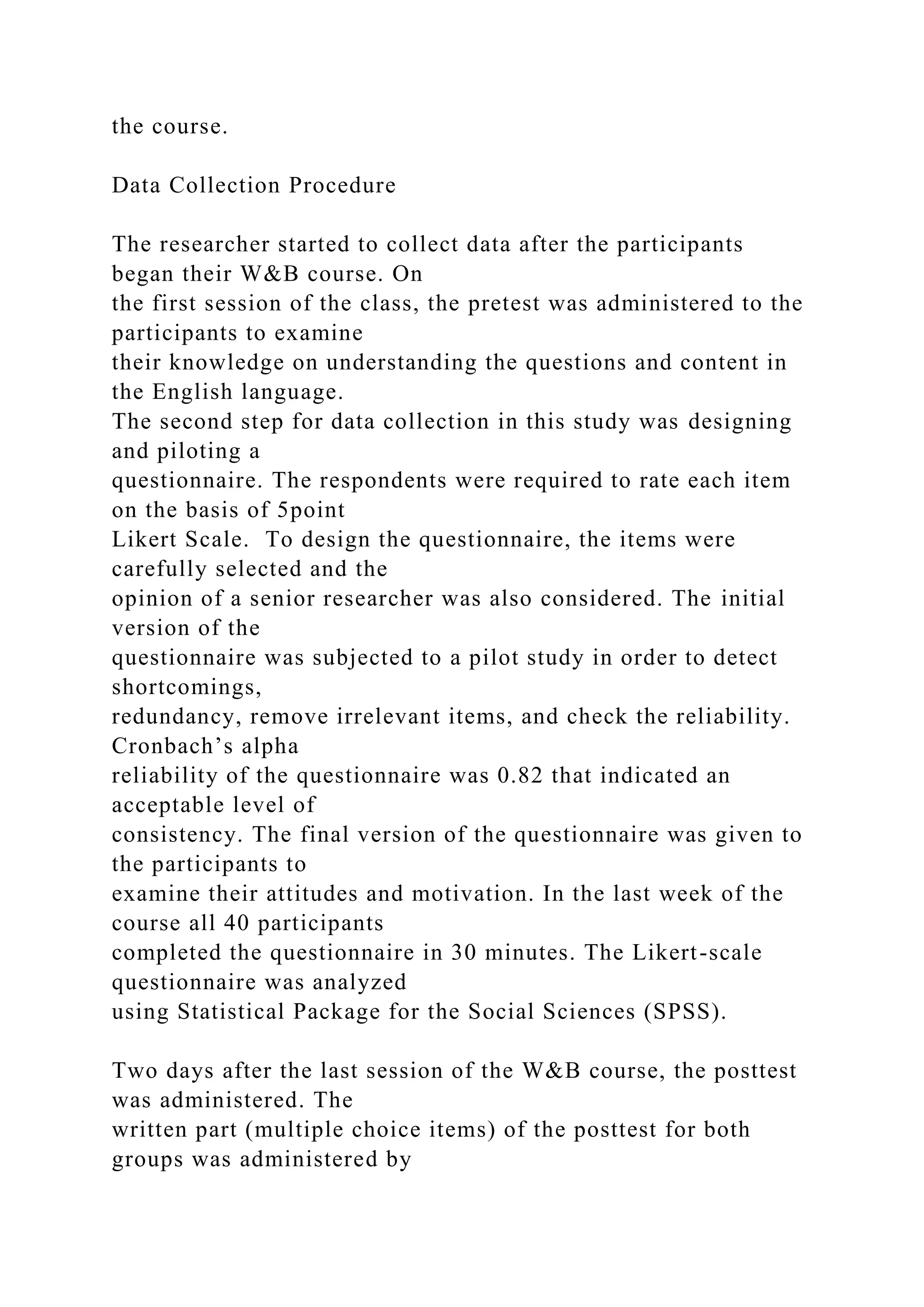
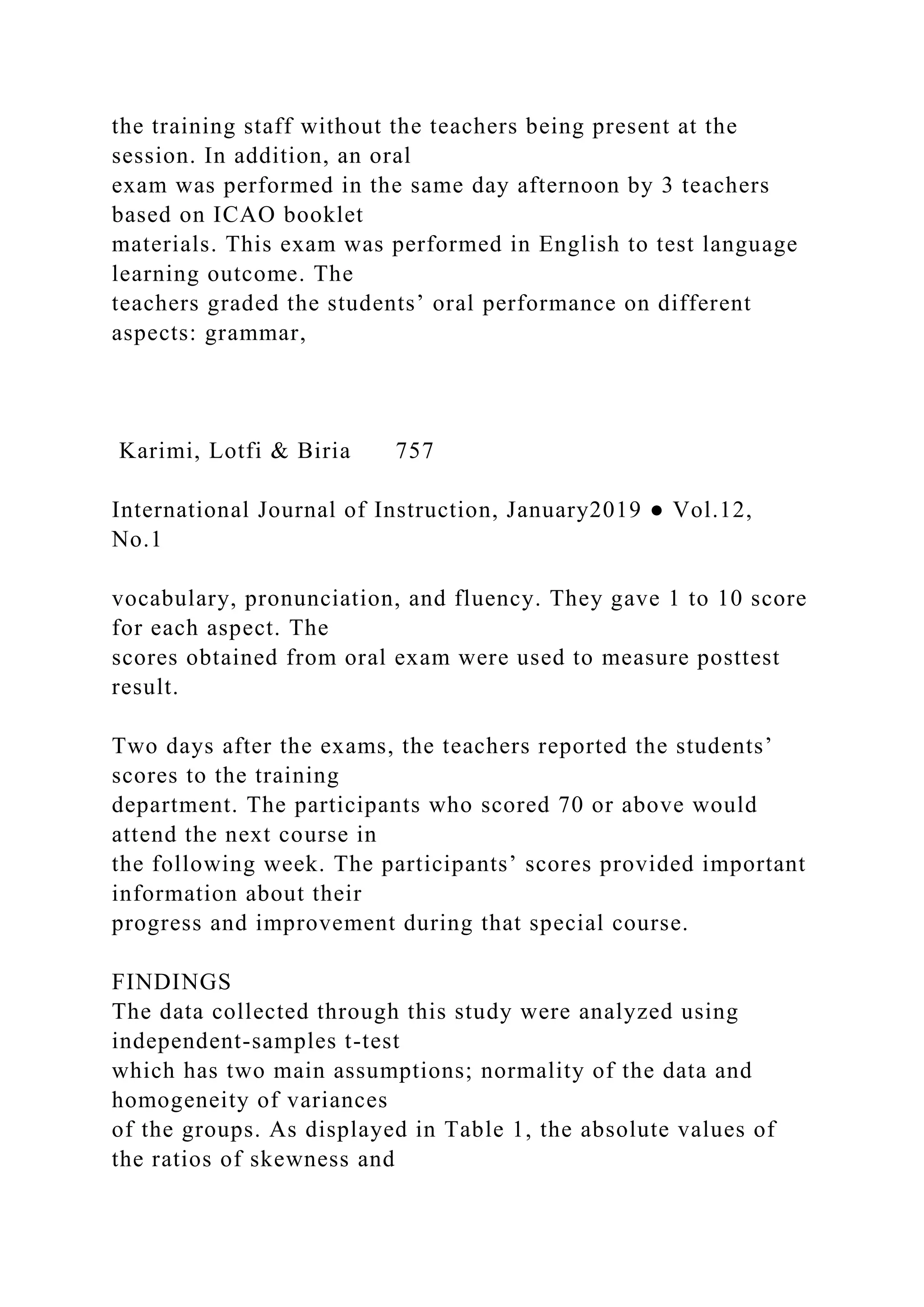
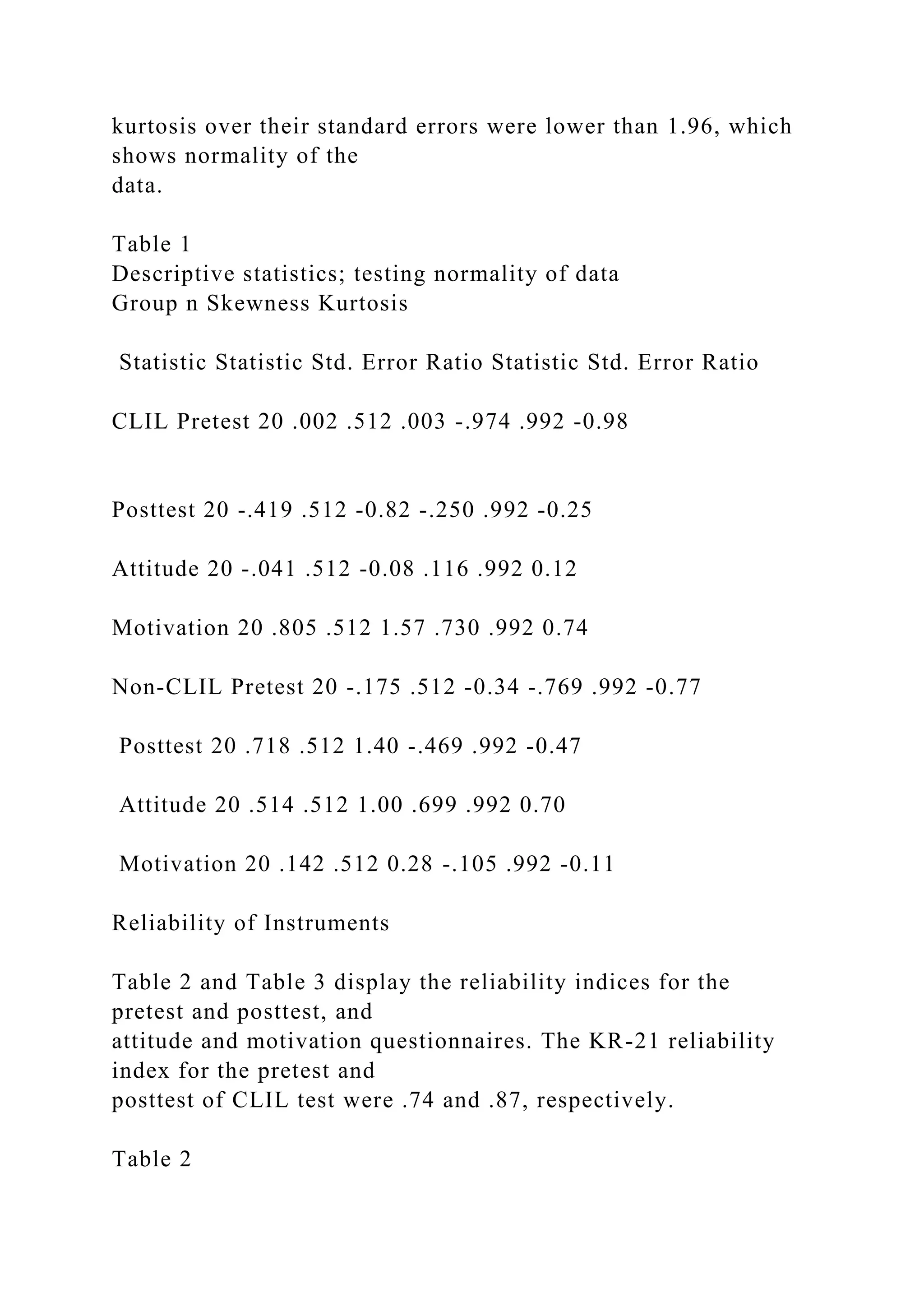
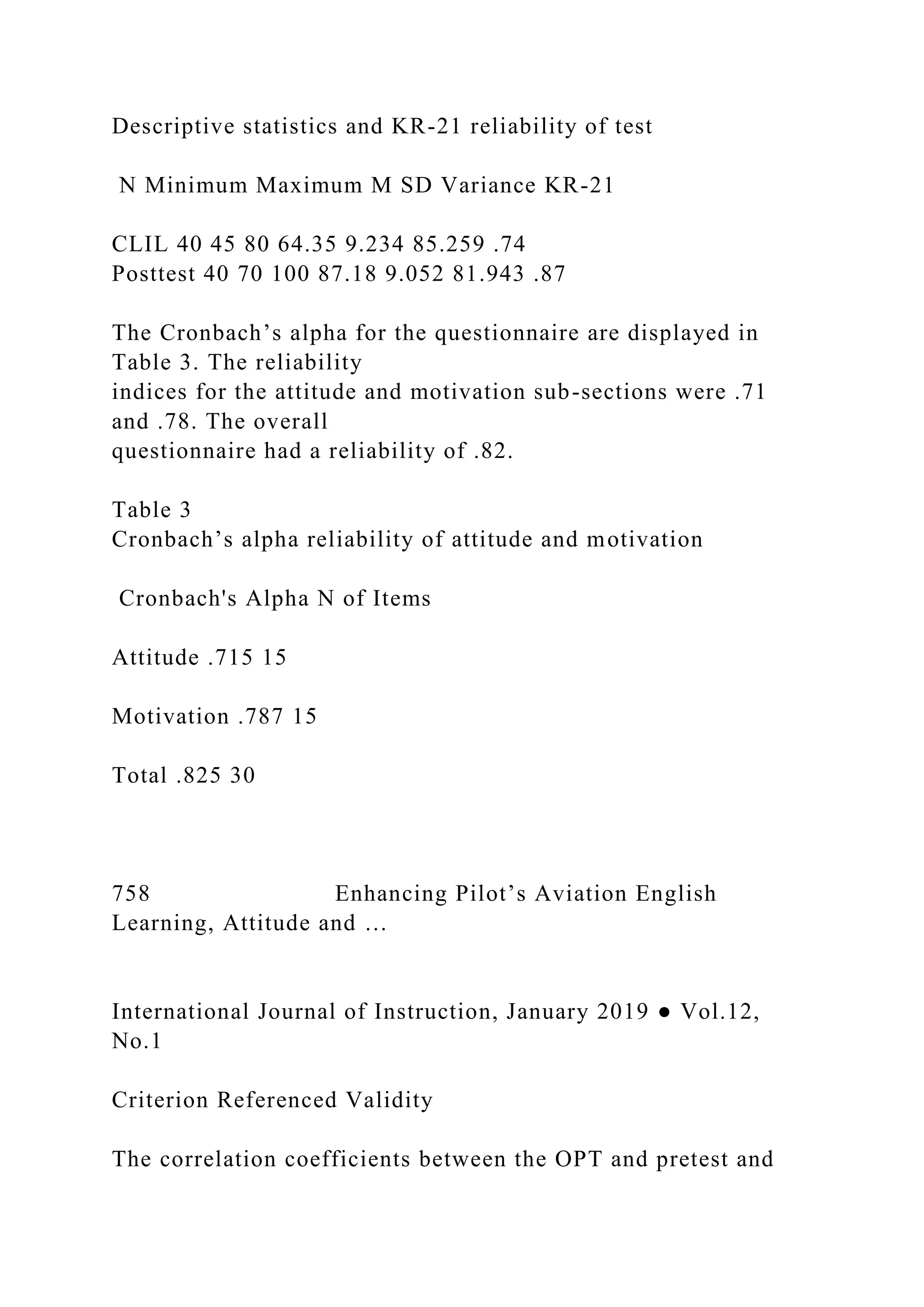
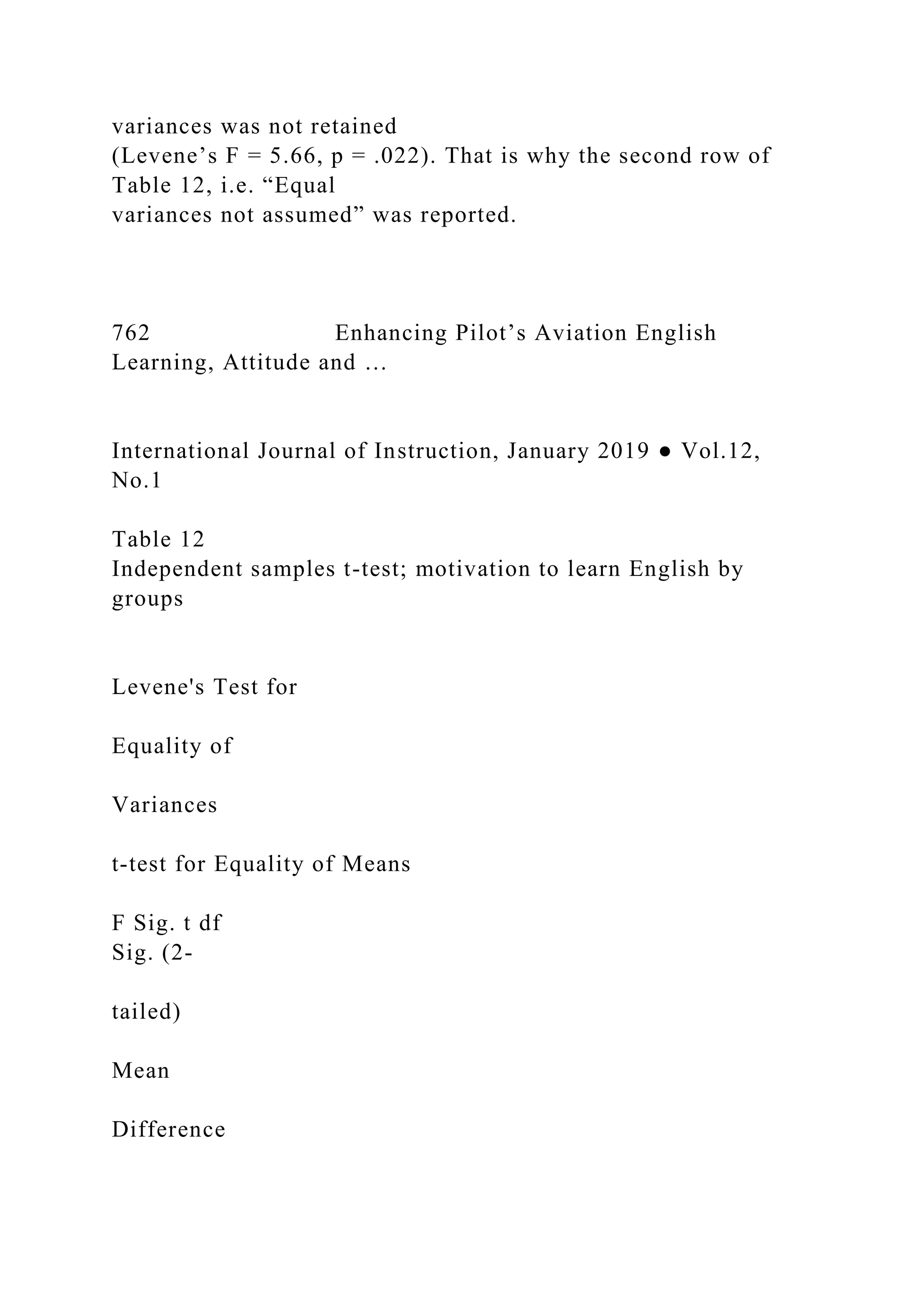
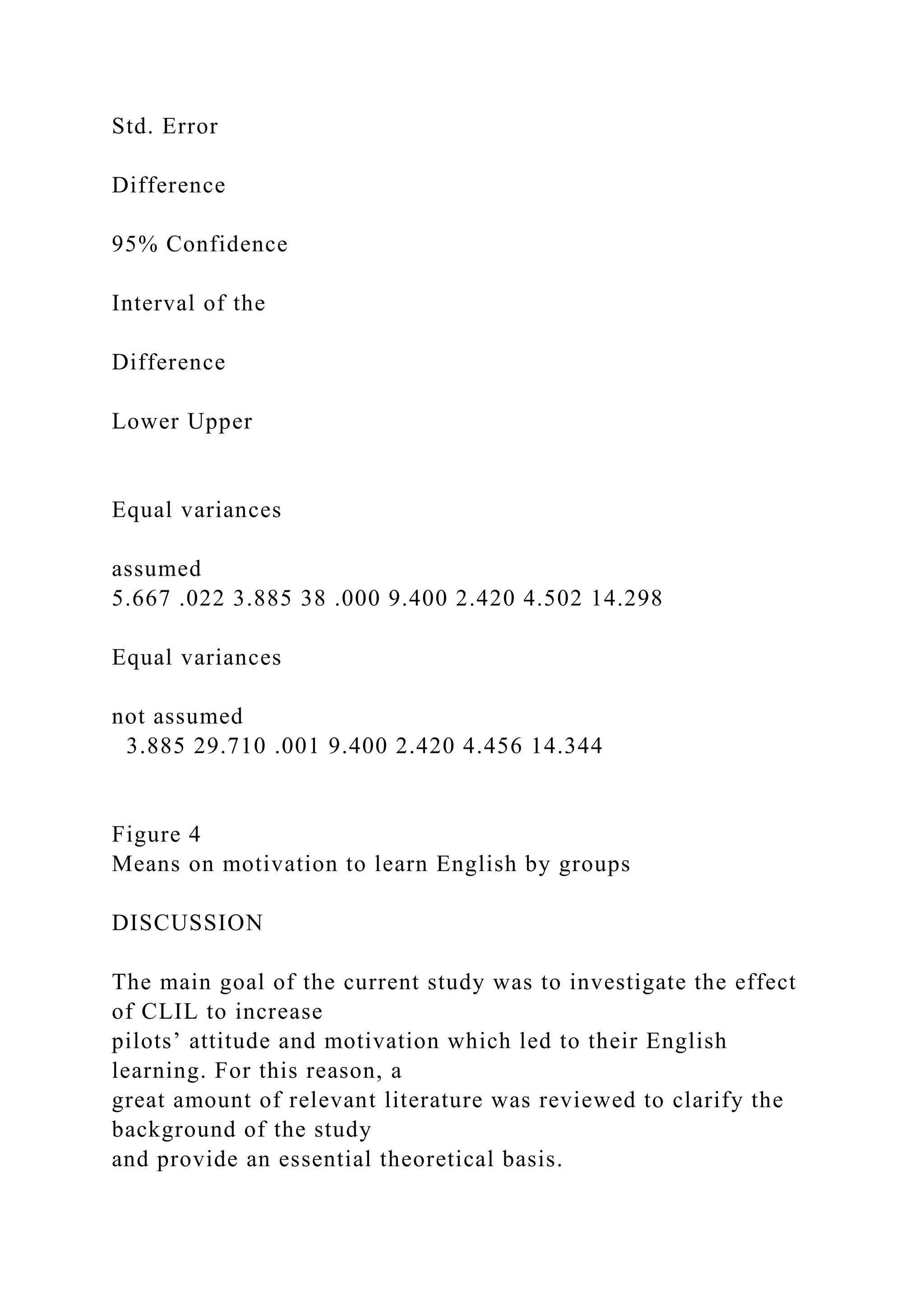
Use this checklist to ensure that the revision and editing work
you have completed in the writing process has helped you
to meet the goals of an assignment.
Keep in mind, each assignment may have ADDITIONAL goals
and conventions appropriate to established discipline and
conventions.
If you look at this list and do not understand how to complete
these tasks or why to complete these tasks, avail yourself
of resources posted for your class or do a web search of your
own. The Purdue OWL (Online Writing Lab) is an excellent
starting place.
________________________________________
Ideas/Content
☐ I used brainstorming and a concept map or outline to create
and organize my ideas.
☐ My thesis is clear, meaningful, and worthwhile.
☐ My essay relates to my thesis, exploring it with depth and
meaning.
☐ My ideas relate to one another.
☐ I have no stray ideas out of place in my writing.
☐ My writing makes complete sense.
________________________________________
Organization
☐ My title is thoughtful.
☐ Ideas are organized in a meaningful way.
☐ The sequence of ideas is logical and intentional.
☐ I have an interesting introduction that effectively leads the
reader to the thesis and creates interest.
☐ My ideas flow from one to another.
☐ Each paragraph has a strong, clear topic sentence. Each topic
sentence is like a mini-thesis for the paragraph.
☐ I used helpful transitions between main points, (e.g., "First of
all," or "Similarly").
☐ The body paragraphs are in logical order, and each paragraph
has its own development and relationship with
the thesis.
☐ I have a satisfying conclusion.
Voice & Style
☐ Point of view is consistent and appropriate for the context of
the assignment.
☐ The pronoun “you” and any form of 2nd person point of view
are avoided (you, your, you’re, yourself). I am not
assuming what the reader thinks, and I am not telling the reader
what to think.
https://owl.english.purdue.edu/owl/
☐ The tone and level or writing are appropriate to college-level
writing. My writing sounds as intelligent and
educated as I am.
☐ The tone, style, and content are appropriate for my audience
of intelligent, educated readers.
__________________________________
Conventions
☐ Each of my paragraphs has one main idea.
☐ I have used correct grammar.
☐ I have used correct punctuation.
☐ I have checked my spelling.
☐ The tone and voice of the essay are appropriate to formal,
academic writing.
☐ My final draft contains no typographical errors.
________________________________________
Fluency & Correctness—needed for clarity
☐ My sentences build logically upon the one(s) before.
☐ My sentences are different lengths.
☐ My sentences start in different ways.
☐ The meaning of each of my sentences is clear.
☐ My sentences flow easily from one to another.
☐ I have scrutinized my paper for comma splices and other run-
on sentences.
☐ There are no incomplete sentences.
☐ I maintain consistent verb tense, especially in summaries.
☐ I express similar ideas using parallel construction.
☐ My pronouns match the nouns to which they refer.
☐ I omitted needless words.
☐ Homonym check: there, they’re, and their.
☐ Homonym check: your and you’re.
☐ Homonym check: to, too, and two.
________________________________________
Organizing Your Argument
Purdue OWL staff
Brought to you in cooperation with the Purdue Online Writing
Lab
Rationale: Welcome to “Organizing Your Argument.” This
presentation is designed to introduce your students to the
elements of an organized essay, including the introduction, the
thesis, body paragraphs, topic sentences, counterarguments, and
the conclusion. The twenty-one slides presented here are
designed to aid the facilitator in an interactive presentation
about constructing a well-organized argument. This
presentation is ideal for the introduction of argument to a
composition course, the beginning of a research unit, or the
assignment of a written argument.
This presentation may be supplemented with OWL handouts,
including “Developing an Outline” and “The Paragraph”.
Directions: Each slide is activated by a single mouse click,
unless otherwise noted in bold at the bottom of each notes page.
Writer and Designer: Jennifer Liethen Kunka
Contributors: Muriel Harris, Karen Bishop, Bryan Kopp,
Matthew Mooney, David Neyhart, and Andrew Kunka
Updated by H. Allen Brizee, 2007.
Design Contributor and Revising Author: Veronika Maliborska,
2014
Developed with resources courtesy of the Purdue University
Writing Lab
Grant funding courtesy of the Multimedia Instructional
Development Center at Purdue University
© Copyright Purdue University, 2000, 2007.
*
An argument involves the process of…
establishing a claim and then
proving it with the use of logical reasoning, examples, and
research.
What is an Argument?
Activity: This slide offers a definition of the term “argument.”
The facilitator may invite the audience to offer answers to the
title question. Students often assume that building an argument
is simply a confrontational activity designed to denigrate the
opposition’s position. The facilitator may choose to explain to
students that the focus of a strong argument should be upon a
cohesive explanation of claims effectively paired with
correlating evidence.
*
Why is organization important in argument?
Guides an audience through your reasoning process.
Offers a clear explanation of each argued point.
Demonstrates the credibility of the writer.
The Importance of Organization
Key Concept: Organization is an important component in any
argument. Not only does a clear sense of organization guide the
reader through the reasoning process, but it also demonstrates
the credibility of the writer--that the writer has a clear
conception of the issues involved and has the ability to offer a
well-crafted response to the topic. An argument that has a
confusing organization--that jumps from point to point without
establishing connections between topics--is less likely to be
convincing to its audience.
*
Title
IntroductionThesis statement
Body ParagraphsConstructing Topic SentencesBuilding Main
PointsCountering the Opposition
Conclusion
Organizing
Your Argument
Rationale: This slide illustrates the topics covered in this
presentation, as well as the ordering of the introduction, body
paragraphs, and conclusion within an argument.
*
Title: (1) introduces the topic of discussion to the audience and
(2) generates reader interest in the argument.
Tip: Use active verbs in titles
For example:
Reducing Rubbish: Recycling on Campus
Why You Need A Title
Key Concept: The title is often an overlooked component in the
development of arguments. Indeed, the title provides the first
words the audience encounters upon reading the paper. The
title should introduce the topic of the argument as well as
generate interest in reading the argument.
*
Imagine you just wrote a paper offering solutions to the
problem of road rage.
Which do you consider to be the best title?
Road Rage
Can’t Drive 55
Road Rage: Curing Our Highway Epidemic
Considering Titles
Activity: The facilitator may have students consider which title
for a paper on road rage is the most effective. “Road Rage”
provides little to entice the reader, though it does introduce the
topic. “Can’t Drive 55,” while offering an interesting image,
would better fit a paper on the speed limit than on road rage,
which is defined by more than speeding. Also, “Can’t Drive
55” is unoriginal (a title from a popular Sammy Hagar song).
The third choice is the best selection here: it both introduces the
topic and provides an interesting analogy to describe the
seriousness of the problem.
*
Introduction: acquaints the reader with the topic and purpose of
the paper.
An introduction offers a plan for the ensuing argument:
Introduction: Tell them what you’re going to tell them.
Body: Tell them.
Conclusion: Tell them what you told them
What is an Introduction?
Key Concept: The introduction continues upon the tasks of the
title--it both introduces the topic and generates audience
interest in reading the entire paper. The introduction also
indicates the purpose of the paper--to inform, persuade, call to
action, etc.--as well as offers a plan for the ensuing argument.
*
Personal anecdote
Example—real or hypothetical
Question
Quotation
Shocking statistics
Striking image
Methods for Constructing an Introduction
Activity: The facilitator may ask students about effective
methods for beginning an introduction.
Key Concepts: A personal anecdote illustrates the writer’s
involvement within the topic, as well as moves the topic from
the abstract to the real. Examples, both real (have happened)
and hypothetical (have the potential to happen) can also help to
illustrate the problem. Posing an interesting question can also
generate reader interest; however, the question should be
answered within the course of the paper. A quotation can
provide a branch for discussion. Quotations, however, should
be made relevant to the topic of the paper. An explanation of
shocking statistics or the presentation of a striking image can
also invite the audience to continue reading the paper.
*
It is the most important sentence in your paper.
It lets the reader know the main idea of the paper.
It answers the question: “What am I trying to prove?”
It is not a factual statement, but a claim that has to be proven
throughout the paper
What is a
Thesis Statement?
Key Concept: A definition of a thesis statement is offered in
this slide. The facilitator may choose to emphasize to students
the difference between a claim that has to be proven and a
statement of fact.
*
The thesis statement should guide your reader through your
argument.
It is generally located in the introduction of the paper.
A thesis statement may also be located within the body of the
paper or in the conclusion, depending upon the purpose or
argument of the paper.
Role of the
Thesis Statement
Key Concept: This slide discusses the role of the thesis
statement in the paper. Thesis statements are often located in
the introduction, thereby setting up for the reader the claims of
the argument. However, theses may also be located in the body
paragraphs or in the conclusion, depending upon the writer’s
purpose, audience, topic, and mode of argument.
Activity: Additionally, the facilitator may also wish at this
point to discuss strategies for constructing a thesis statement for
a current class assignment.
*
Choose a thesis for an argument about the need for
V-chips in television sets?
Parents, often too busy to watch television shows with their
families, can monitor their children’s viewing habits with the
aid of the V-chip.
To help parents monitor their children’s viewing habits, the V-
chip should be a required feature for television sets sold in the
U.S.
This paper will describe a V-chip and examine the uses of the
V-chip in American-made television sets.
Thesis Practice
Activity: The facilitator may ask students to identify the most
effective thesis statement from the three listed examples. The
first example, while a well-phrased informative sentence, offers
a factual statement rather than an argumentative claim that
needs to be proven. The third example also fails to provide an
effective claim about the value of the V-chip. The second
example is the strongest argumentative thesis; it clearly
articulates the writer’s position on the issue and suggests that
the writer will proceed to prove this claim throughout the rest
of the paper.
*
Body paragraphs: (1) build upon the claims made in the
introductory paragraph(s); (2) are organized with the use of
topic sentences that illustrate the main idea of each paragraph.
Tip: Offering a brief explanation of the history or recent
developments of topic within the early body paragraphs can
help the audience become familiarized with your topic and the
complexity of the issue.
Body Paragraphs and
Topic Sentences
Key Concepts: This slide explains the function of body
paragraphs within an argument-to continue proving the claim
posited in the thesis statement. Clearly stated topic sentences
within each paragraph can help writers to focus their arguments
around their thesis statements. The facilitator may also suggest
that students offer a synopsis of the topic, including the history
of the issue and recent changes in current events that affect the
topic.
*
Paragraphs may be ordered in several ways, depending upon the
topic and purpose of your argument:
Body Paragraphs
Key Concepts: Body paragraphs may be ordered in various
patterns, depending upon the purpose, audience, and topic of the
argument. This slide offers participants options for organizing
their work.
Activity: The facilitator may choose to offer suggestions on
organizing patterns for a current argumentative assignment.
*
Addressing the claims of the opposition is an important
component in building a convincing argument.
It demonstrates your credibility as a writer—you have
researched multiple sides of the argument and have come to an
informed decision.
It shows you have considered other points of view - that other
points of view are valid and reasonable.
Offering a Counterargument
Key Concepts: Concerned with asserting the importance of
their own claims, writers sometimes overlook the importance of
considering the views of the opposition within their own
arguments. Countering oppositional claims demonstrates to the
audience that the writer has carefully considered multiple
components of the issue and has reached an educated decision.
If a writer finds that the opposition cannot be countered
effectively, he or she may need to reevaluate his or her own
opinions and claims about the argument.
*
Counterarguments may be located at various locations within
your body paragraphs. You may choose to:
Build each of your main points as a contrast to oppositional
claims.
Offer a counterargument after you have articulated your main
claims.
Locating a Counterargument
Key Concept: Counterarguments may be located at various
points within a paper. It is important, however, that the writer
offer a convincing response to the claims of the opposition.
Activity: The facilitator may choose to offer specific tips to
students about counterarguing in a current argumentative
assignment.
*
Consider your audience when you offer your counterargument:
Conceding to some of your opposition’s concerns can
demonstrate respect for their opinions.
Using rude or deprecating language can cause your audience to
reject your position. Remain tactful yet firm.
Effective Counterarguments
Key Concepts: This slide suggests the importance of
considering the audience in offering a counterargument. If a
writer is trying to argue about the dangers of second-hand
smoke to a group of smokers, the writer needs to offer his or her
opinion in such a way that the opposition can see the rationality
of his or her claims. If the writer instead chooses to rant about
how much he or she dislikes smokers, it is doubtful that the
audience will feel any sympathy with the argued position and
will reject the argument. The facilitator may choose to
emphasize that tact and audience consideration are very
important elements of effective counterarguments.
*
Researched material can aid you in proving the claims of your
argument and disproving oppositional claims.
Be sure to use your research to support the claims made in your
topic sentences—make your research work to prove your
argument.
Research in
Body Paragraphs
Key Concepts: Writers sometimes fall into the trap of letting
research material overwhelm the paper, rather than using
sources to prove their own argumentative claims. It is
important to be selective when using source material; just
because a source may relate to your topic does not mean it will
necessarily be useful or relevant to proving your claims.
Offering clear topic sentences that articulate claims relating to
the thesis can be a useful strategy for offering a frame to
researched material. Sources can then be used to back the claim
provided in the topic sentence.
*
Conclusion: Reemphasizes the main points made in your paper.
You may choose to reiterate a call to action or speculate on the
future of your topic, when appropriate.Avoid raising new claims
in your conclusion.
The Conclusion
Key Concepts: The conclusion is also an important paragraph
in a paper--it provides the last words that a writer will present
to his or her audience. Therefore, it should have a lasting
impact. The conclusion should work to reemphasize the main
claims of the argument, articulating the importance of the
argued position and, when appropriate, the reader’s need to take
action on the issue. Writers should also avoid raising new
claims in concluding paragraphs--there is no more room to
argue points comprehensively or convincingly. Such new points
would be better repositioned within the body paragraphs.
*
Purdue University Writing Lab, Heavilon 226
Check our web site: http://owl.english.purdue.edu
Email brief questions to OWL Mail:
https://owl.english.purdue.edu/contact/owlmailtutors
Where to Go
for More Help
Notes:
The Writing Lab is located on the West Lafayette Campus in
room 226 of Heavilon Hall. The lab is open 9:00am-6:00 pm.
OWL, Online Writing Lab, is a reach resource of information.
Its address is http://owl.english.purdue.edu. And finally, you
can email your questions to OWL Mail at [email protected] and
our tutors will get back to you promptly.
*
The End
ORGANIZING YOUR ARGUMENT
Purdue OWL staff
Brought to you in cooperation with the Purdue Online Writing
Lab
Volume 16, 2017
Accepted by Editor Tian Luo │Received: October 25, 2016│
Revised: March 7, 2017 │ Accepted: March 19,
2017.
Cite as: Reweti, S., Gilbey, A., & Jeffrey, L. (2017). Efficacy of
low-cost pc-based aviation training devices. Jour-
nal of Information Technology Education: Research, 16, 127-
142. Retrieved from
http://www.informingscience.org/Publications/3682
(CC BY-NC 4.0) This article is licensed to you under a Creative
Commons Attribution-NonCommercial 4.0 International
License. When you copy and redistribute this paper in full or in
part, you need to provide proper attribution to it to ensure
that others can later locate this work (and to ensure that others
do not accuse you of plagiarism). You may (and we encour-
age you to) adapt, remix, transform, and build upon the material
for any non-commercial purposes. This license does not
permit you to use this material for commercial purposes.
EFFICACY OF LOW-COST PC-BASED AVIATION
TRAINING DEVICES
Savern Reweti * School Of Aviation, Massey University,
Palmerston North, New Zealand
[email protected]
Andrew Gilbey School Of Aviation, Massey University,
Palmerston North, New Zealand
[email protected]
Lynn Jeffrey School Of Management, Massey University,
Palmerston North, New Zealand
[email protected]
* Corresponding author
ABSTRACT
Aim/Purpose The aim of this study was to explore whether a
full cost flight training device
(FTD) was significantly better for simulator training than a low
cost PC-Based
Aviation Training Device (PCATD).
Background A quasi-transfer study was undertaken to ascertain
whether a Civil Aviation Au-
thority certified Flight Training Device (FTD) was more
effective at improving
pilot proficiency in the performance of a standard VFR traffic
pattern (Over-
head Rejoin Procedure) than a customised low cost PCATD.
Methodology In this quasi-transfer study, a high fidelity FTD
rather than an aircraft was used
to test both training and transfer tasks. Ninety-three pilots were
recruited to
participate in the study.
Contribution The use of PCATDs is now well established for
pilot training, especially for
Instrument Flight Rules (IFR) skills training. However, little
substantive research
has been undertaken to examine their efficacy for VFR training.
Findings There was no evidence of a pre-test/post-test
difference in VFR task perfor-
mance between participants trained on the PCATD and the FTD,
when post
tested on the FTD. The use of both PCATD and FTD
demonstrated signifi-
cant improvements in VFR task performance compared to a
control group that
received no PCATD or FTD training.
Recommendations
for Practitioners
We discuss the possibility that low cost PCATDs may be a
viable alternative for
flight schools wishing to use a flight simulator but not able to
afford a FTD.
http://www.informingscience.org/Publications/3682
https://creativecommons.org/licenses/by-nc/4.0/
mailto:[email protected]
Efficacy of Low-Cost PC-Based Aviation Training Devices
128
Recommendation
for Researchers
We discuss the introduction of improved low cost technologies
that allow
PCATDs to be used more effectively for training in VFR
procedures. The de-
velopment and testing of new technologies requires more
research.
Impact on Society Flight training schools operate in a difficult
economic environment with contin-
ued increases in the cost of aircraft maintenance, compliance
costs, and aviation
fuel. The increased utilisation of low cost PCATD’s especially
for VFR instruc-
tion could significantly reduce the overall cost of pilot training
Future Research A new study is being undertaken to compare
the effectiveness of a PCATD and
a FTD at training transfer of other VFR task procedures such as
forced landing
training, forced landing after take-off, and low-level navigation
exercises.
Keywords PC-based aviation training device, flight training
device, visual flight rules, qua-
si-transfer, simulator, pilot training
INTRODUCTION
Rapid advances in computer technology have enabled flight
simulator manufacturers to develop
efficient and realistic fixed-base Flight Training Devices
(FTDs) (Elite, 2016). The cost of ‘flying’ an
hour in a simulator is significantly less than in a real aircraft
(particularly if it is multi-engine). Several
well established flight training organisations (FTOs) in New
Zealand own and operate FTDs as an
integral part of their flight training programmes (Eagle Flight
Training, 2015; Massey News, 2007),
but, even though the cost of certified FTDs has fallen
considerably in the last decade (Frasca, 2015),
they are still beyond the financial reach of most flight training
schools in NZ. For many years, FTOs
have investigated the possibility of more cost effective ways of
being able to provide flight simu-
lation devices (Dennis & Harris, 1998; Redbird, 2016) for flight
schools that operate in a difficult
economic environment with continued increases in the cost of
aircraft maintenance, compliance
costs, and imported aviation fuel. An alternative strategy to the
use of FTDs is to use PC-Based Avi-
ation Training Devices (PCATDs) for some aspects of ab-initio
training; indeed, such devices could
be critical to a flight school’s continued operation (Koonce &
Bramble, 1998; Wu & Sun, 2014), as
they may offer a low cost but effective training tool for flight
instruction, classroom demonstrations
and procedural training tasks, and instrument training in
particular (EASA, 2016; Massey News,
2008).
The primary goal of this research was to determine whether
PCATDs could be developed with im-
proved visual fidelity to be effective in VFR task skills training
with a particular focus on VFR proce-
dures and navigation. Traditionally, flight instructors tend to be
conservative and favour high fidelity
FTDs which they had mostly trained on (Williams, 2006). They
are, in many cases, reluctant to accept
new technology such as PCATDs because they lack experience
in using these devices and have lim-
ited knowledge of their training potential (Alessandro, 2008).
The hypothesis to be tested was, there-
fore, that FTDs would perform better than PCATDs. If no
evidence is found to support this hy-
pothesis, it will imply that efficacy is no reason to prefer FTDs
to PCATDs.
LITERATURE REVIEW
As their name suggests, some desktop PCATDs can fit on a
large table (or desk); furthermore, they
also have flight controls and instrumentation similar to real
aircraft or FTDs and can emulate many
of the features found in sophisticated FTDs. For these reasons,
the integration of PCATDs into a
flight training school’s syllabus has the potential to result in
significant cost savings, if some aircraft
training is substituted with PCATD training. Indeed, studies
have indicated that even although the
fidelity of PCATDs is relatively low when compared to high-
end FTDs or to real aircraft, especially
in flight control loading and flight dynamics, importantly, there
is evidence of a positive transfer of
training from PCATD to the aircraft (Flight1 Aviation
Technologies, 2016; Koonce & Bramble, 1998;
Taylor et al., 1999; Taylor et al., 2003). However, studies have
also indicated that the introduction of
PCATDs into the training environment should be treated with
some caution. PCATD’s can offer a
Reweti, Gilbey, & Jeffrey
129
better learning environment than the aircraft (e.g., a ‘flight’
may be paused to discuss some aspect of
control), however, they do have some limitations; for example,
they may be detrimental when used
solely to teach psychomotor skills for basic flight manoeuvers
(Dennis & Harris, 1998). If PCATDs
have the potential to create poor flying techniques, then for
some students this may mean extensive
(and expensive) re-training in the air. While they may be
efficient and cost effective training tools for
the rehearsal of procedures, their training effectiveness may
decrease rapidly with overuse
(Alessandro, 2008).
PCATD training sessions are now well established in many pilot
training programs, especially for
Instrument Flight Rules (IFR) skills training (Stewart II,
Dohme, & Nullmeyer, 2002; Yeo, 2016).
Although, the fidelity of PCATD software and hardware has
improved significantly in recent years,
little research has been undertaken to establish whether
PCATDs are equally as effective for VFR
procedures training (Leland, Rogers, Boquet, & Glaser, 2009).
Problems with limited field of view,
lack of visual fidelity, and fixation on instrument displays by
student trainees have caused flight in-
structors to question their effectiveness for VFR procedures
training (Williams, 2006). Despite their
limitations, the potential benefits of using PCATDs for VFR
pilot training has grown steadily due to
the emergence of innovative and cost effective PCATD
technologies, such as super wide-view high
resolution projection (Zahradka, 2017), artificially intelligent
aircraft traffic (Vatsim, 2015), and high
definition terrain with animated ground vehicles (VLC, 2016).
In 2006, a new pilot qualification was established by the
International Civil Aviation Organisation
(ICAO, 1993). The Multi Crew Licence (MPL) was a new
initiative adopted by the Joint Aviation Au-
thority (JAA) and the European Aviation safety Authority
(EASA). The establishment of the MPL
was the result of pressure from the aviation industry for better
ways to train airline co-pilots and
mounting evidence that deficiencies in aircrew teamwork were
major contributors to airline accidents
(Sheck, 2006). The MPL is designed to develop and enhance the
abilities of pilots to fly multi-crew
aircraft. In addition, the main philosophy of MPL is to limit
trainee exposure to actual flight in non-
relevant light aircraft and the bulk of instructional time is
transferred to multi-crew flight simulation
(ECA, 2014). Using PCATDs for multi-crew flight simulation
reduces overall training time and low-
ers costs for pilot trainees, and flight schools. Under MPL rules,
students can also increase the level
of self-guided practice of most flight tasks and manoeuvers in
PCATDs, thereby improving their
skills and proficiency in a cost effective manner (Kozuba &
Bondaruk, 2014).
At the commencement of this study, virtually all FTDs used by
NZ flight training schools were de-
veloped by commercial companies based overseas (Elite, 2016;
Frasca, 2015) Local PCATD develop-
ers commonly use untested hardware technologies combined
with software and hardware interfaces
that were developed in-house as there were no commercially
available equivalents (Zahradka, 2017).
In addition, the production of training documentation for
inclusion into the training curriculum is
also a challenging task for the PCATD developer (KiwiFlyer,
2012). Although the development and
certification of a customised PCATD is a difficult challenge
(CAANZ, 2011), flight training can be
significantly enhanced with the development and adoption of
such cost effective technologies into
the flight-training curriculum.
METHOD
DESIGN
Quasi-transfer studies have been used successfully in a number
of experiments to test augmented
information as an instructional variable for landing (Lintern,
Koonce, Kaiser, Morrison, & Taylor,
1997) and for air-to-ground attack (Lintern, Sheppard, Parker,
Yates, & Nolan, 1989). They have
been used to examine scene detail for out-of-cockpit visual
scenes (Lintern & Koonce, 1992), the
effect of simulator platform motion (Go et al., 2003) and
transfer of training on a vertical motion
simulator (Zaal, Schroeder, & Chung, 2015). The advantage of
quasi transfer design is that when
used with ab-initio pilot trainees it can determine the level of
training transfer with minimal interfer-
Efficacy of Low-Cost PC-Based Aviation Training Devices
130
ence from the effects of prior flight experience (Taylor,
Lintern, & Koonce, 1993). Quasi-transfer of
training studies differ from traditional transfer of training
studies in that a high fidelity flight simula-
tor rather than an aircraft is used to test both training and
transfer tasks. For example, one group
would train on a high fidelity flight simulator and the other
group would train on an experimental
flight simulator. Both groups would then transfer to the high
fidelity flight simulator that is a close
representation of the real aircraft (McDermott, 2005) for final
evaluation. In the current study, par-
ticipants were first randomly assigned to one of three groups
(two experimental groups, and the con-
trol group), at which point a pre-test was administered to each
group. In the pre-test scenario, the
participants completed a standard VFR rejoin procedure on the
Frasca TruFlite Flight & Navigation-
al Procedures Trainer (Frasca FNTP), commonly referred to as
the Frasca FTD, at a specified aero-
drome with a designated aircraft (Figure 1). The accuracy of
their performance across a number of
flight variables was measured using assessment software
installed in the training simulator. Then the
independent variable was implemented; that is, group 1 received
training on a PCATD (Figure 2) and
group 2 received training on the Frasca FTD (the experimental
groups), and group 3 received no
additional training (control group). Finally, each group of
participants was given a post-test, which
was identical to the pre-test procedure using the Frasca FTD.
The primary comparisons of interest for each of the eight
outcome variables were whether pre-
test/post-test difference scores differed by condition, which was
assessed by examining the interac-
tion term of a factorial ANOVA. A lack of evidence that FTDs
performed better than PCATDs
would be taken as evidence that PCATDs provide a useful low
cost alternative to the use of FTDs
for the procedures tested in this study.
Figure 1. Frasca FTD (Single Engine PA-28) Figure 2. PCATD
(Single Engine PA-28)
PART ICIPAN TS
Ninety-three pilots participated in this study. �ey were
recruited from the following organisa-
tions: a university aviation-training organisation (n = 35); a
private sector aviation-training organisa-
tion (n = 35); two small aviation training organisations within
the local geographic area (n = 10); oth-
er aviation organisations (e.g., Air Training Corps) (n = 8); and
local educational institutions (n =
5). Participants’ flight experience ranged from airline and
military trainee pilots (n = 3), pilots who
had just completed CPL or PPL certification, ab-initio pilots
with less than ten hours of single en-
gine flight time, and potential aviators who had only flown a
few trial flights. The mean age of partic-
ipants was 23.1 years (SD = 8.7, range 16–40). Eighty per cent
were aged between 19–25 years old.
Fifteen of the participants in the study were female and
seventy-eight were male. Of those employed
as pilots, participants’ occupations in the study included one
experienced Boeing 737-800 pilot; two
helicopter pilots, two military pilots, and one glider pilot. Sixty
percent of participants were ab-initio
pilot trainees who had completed less than sixty hours of flight
training and had minimal training
hours on either the PCATD and/or the Frasca FTD. Thirty
percent of participants had completed
sixty to two hundred and fifty hours of training up to and
including PPL level but also minimal train-
Reweti, Gilbey, & Jeffrey
131
ing hours on either the PCATD and/or the Frasca FTD. In
addition to undertaking flight training,
the flight trainees had completed a wide variety of aviation
related subjects that included meteorolo-
gy, principles of flight, navigation, human factors, and aviation
law. The overhead rejoin manoeuver
the participants were required to practice and complete on the
PCATD and FTD is a reasonably dif-
ficult flight control task and requires some flight experience to
perform accurately. The pilots pur-
posively chosen for this study had a relatively wide range of
flight experience to establish whether
transfer of training on the PCATD or FTD was unduly
influenced by previous flight experience.
Trainee pilots that belonged to relatively large aviation training
organisations (Group 1 & 2) were
selected for the study because their FTO has operated a similar
model of a Frasca TruFlite FTD. In
addition, their practical flight training programs were very
similar and their student populations had
similar demographics. Candidates from small aviation training
organisations Group 3-5 did not have
ready access to a PCATD or FTD for training purposes.
Therefore, they were invited to travel to a
flight-training centre closest to them, where the appropriate
simulation devices were located, to par-
ticipate in the comparative study.
M ATERIALS
The primary flight-training device (FTD) used in this study was
the Frasca TruFlite Flight & Naviga-
tional Procedures Trainer (Frasca, 2015). This device is
certified for assessing pilot competency in
IFR and VFR flight rules. IFR is defined as flying by reference
to instruments in the flight-deck, and
navigation is accomplished by reference to electronic signals
(FAA, 2008b). VFR procedures is a set
of regulations under which a pilot operates an aircraft in
weather conditions generally clear enough
to allow the pilot to see where the aircraft is going .
The TruFlite FTD was configured as a single-engine PA-28
Piper Warrior, as this was the most
common aircraft used by the participants in the study, and
networked to a PC Based Graphical In-
structor Station (GISt). The Frasca TruFlite also had a FAA
Level 6 Qualification which requires the
simulator to be built to a high level of fidelity (FAA, 2008a).
Requirements include an authentic air-
craft cockpit, electric flight control loading, and high fidelity
visual display system. In this case, Frasca
developed their TruVision visual display system with a field of
view of 170 degrees for this FTD
model (Frasca, 2015).
Virtually all previous transfer of training studies that examined
low-fidelity/PC-based simulation
used subjective flight instructor ratings to measure flight
performance (Talleur, Taylor, Emanuel,
Rantanen, & Bradshaw, 2003; Taylor, et al., 1999). Despite
well-defined rating criteria and standards,
it has been difficult to prevent personal bias or unreliable flight
instructor ratings (Roessingh, 2005).
The Graphical Instructor Station GISt is a computer-based
interface that uses Graphical User Inter-
face (GUI) software to control the Frasca FTD. One of its main
functions is data collection and it
was developed to assist flight instructors in reviewing a flight
student’s performance in the FTD.
GISt can be used to record and analyse over one hundred flight
performance variables. The analysis
of flight data generated by GISt is a more objective and
accurate measure of VFR task performance.
GISt contains a core group of functions and the most important
function for this study was the USA
National Intercollegiate Flying Association (NIFA) Score
Editor. The NIFA Score Editor originated
as a program used to measure and compare the performance of
pilots as they attempted to fly an
established flight pattern. This module records the performance
of different pilots—and that of the
same pilot at different stages training—with more objectivity
than an appraisal by a flight instructor.
The program can record the number of errors committed by
participants across a number of select-
ed flight variables.
For example, the actual NIFA formula to calculate the number
of penalty points for each variable is
NIFA Score = Absolute Value (ABS) - (Actual Value-Pattern
Value) x Weights per second. A high
score (e.g., 20 penalty points per second) represented a high
number of errors and a poor perfor-
mance, and vice versa.
Efficacy of Low-Cost PC-Based Aviation Training Devices
132
A low cost PCATD system ($NZ 20,000) was developed from
off-the-shelf commercial software
and hardware (the Frasca FTD used for this comparative study
cost approximately $NZ 500,000).
The PCATD hardware system included a PC with an Intel Core
I7 2.66 GHZ processor as the flight
simulation engine, an additional PC with a Core I5-750
processor as the instructor station, coupled
with NVIDIA GeForce video cards. Specialised hardware
included Precision Flight Controls (Yoke,
Throttle Quadrant, and Rudder Pedals) and Go-Flight Radio &
Navigation Modules. Software in-
cluded Windows 7 (32 Bit), Microsoft Flight Simulator Version
9.0 and 10.0, a customised PA-28
(Piper Warrior) Flight Model & Digital Instrument Panel, and
customised terrain modules represent-
ing local geographic features in the flight training areas.
Multiple screens were used for the out-of-
cockpit-view. A 35-inch Liquid Crystal Display (LCD) main
view screen was combined with two 19-
inch LCD side-views. A total horizontal base of 61.72 inches
with a 20 inch height (53 pixels per
inch) on the main screen, and 9 inch height on the side screens
(93 pixels per inch). The display reso-
lution of all three screens was set at 1280x1024 pixels. An
additional screen 19-inch LCD was used
for the instrument display. Finally, a 19-inch LCD screen was
connected to the networked instructor
station PC. The utilisation of third party software (Active
Camera) provided scan capabilities and
snap views, which increased the field of view to 220 degrees
(Middleton, 2006). Activation of the
software was initiated by a push button situated on the yoke
controls. The software allows a number
of pre-set views so that moving to different cockpit viewpoints
is automated with the push button.
Another button on the yoke was programmed to provide a zoom
function for the cockpit view. The
display system with one front screen and two smaller side
screens was designed to replicate the large
front view and limited side views of the PA-28 Piper Warrior
training aircraft.
The PCATD instructor station used two flight variable recording
software packages. The first pack-
age, Flight Data Recorder 8.0 (Fltrec) was used to play back
recorded flights in Flight Simulator Ver-
sion 9.0 in real time and rescan flight variables if necessary
(Hernandez-Ros, 2012). The second
software package was Visor 2000. This software was capable of
recording flight variables such as
altitude, track, pitch, approach path, and vertical speed, and
angle of bank. It could also display these
flight variables in a graphical form (Pardo, 2012). The software
was flexible and was capable of dis-
playing a binary file produced by the Fltrec utility (Hernandez-
Ros, 2012).
PROCEDURE
The current study was designed to establish whether a CAANZ
certified FTD was more effective
than a low cost PCATD at improving pilot proficiency in the
performance of a standard VFR traffic
pattern operation (Figure 3). The VFR overhead rejoin
procedure evaluated in this study required the
utilisation of a FTD or PCATD that could provide a minimum
of 120 degrees FOV, (to provide the
participants with adequate peripheral views) so that correct
entry points and correct spacing could be
applied during the procedure. Each participant was then given a
briefing on the experimental proce-
dure. In the first stage of the procedure, the participant entered
the traffic pattern at a height of no
less or no more than 1500 feet AGL (1600 feet AMSL) and a
magnetic heading of 160°-170°. The
learning transfer that took place was measured to ascertain the
effects on task performance by meas-
uring eight dependent flight performance variables while
executing the traffic pattern operation.
These variables were maintaining correct altitude; maintaining
correct attitude; maintaining correct
airspeed; overall performance; maintaining correct magnetic
heading; implementing procedural turns;
intercept and maintain Glide Slope; and implementing an
accurate Overhead Rejoin pattern. For the
purposes of this study the airfield was deemed to be
serviceable, there was no wind, and standard
temperature and atmospheric pressure had been set in
accordance with ICAO standards (ICAO,
1993). The runway in use was 070°, the circuit was left hand,
and there was no traffic on the circuit.
The circuit area was defined as the area within a radius of three
nautical miles from the airfield refer-
ence point.
All participants were pre-tested and post-tested on the Frasca
FTD. Participants were randomly allo-
cated to each of the three groups. The participants randomly
selected for the PCATD group received
training on the PCATD and the remaining participants received
training on the FTD. The study pro-
Reweti, Gilbey, & Jeffrey
133
tocol is shown in Table 1. The VFR Overhead Rejoin Procedure
is used by the pilot to safely join the
circuit of controlled and uncontrolled aerodromes (CAANZ,
2014). All participants were given an
individual 10-15 minute briefing on the VFR overhead rejoin
procedure and a demonstration by a
flight instructor on how it was to be completed. This was
followed by a 10-15 minute familiarisation
period on the TruFlite FTD. The participants were given a
demonstration of the various flight con-
trols on the FTD and were shown how the flight performance
variables would be recorded on the
computer. Then all participants completed the VFR standard
overhead rejoin procedure on the FTD.
This was the designated pre-test procedure.
Figure 3. Diagram of Standard Overhead Rejoin
Table 1. Experimental Procedure
Group Assignments Pre Test Training Post Test
1
n = 31
Familiarisation Lesson /
Flight Test in Frasca Familiarisation Les-
son /Three Practice
Sessions in PCATD
Flight Test
in Frasca
TruFlite
2
n = 31
Familiarisation Lesson
/Flight Test in Frasca Three Practice Ses-
sions in Frasca
TruFlite
Flight Test
in Frasca
TruFlite
3
n = 31
Familiarisation Lesson
/Flight Test in Frasca No Practice Ses-
sions
Flight Test
in Frasca
TruFlite
The flight was recorded on the GISt and scored using the NIFA
module. After the pre-test proce-
dure was completed on the Frasca, Group 1 participants were
given a 10-15 minute briefing on the
operation of the PCATD followed by a 10-15 minute
familiarisation session. Then Group 1 partici-
pants practiced the VFR standard overhead rejoin procedure
with three 10-15 minute training ses-
sions. Group 2 participants, after completing the Frasca pretest
procedure, completed three 10-15
minute training sessions on the Frasca TruFlite FTD. Group 3
(Control Group) participants were
pre-tested on the Frasca but did not have any practice sessions
on either the PCATD or the FTD.
Finally, all the participants were given a short 10-15 minute rest
before completing a post-test
evaluation of the VFR procedure on the Frasca TruFlite FTD.
The experimental procedure was
Standard Overhead Rejoin Procedures Diagram Key
1. Radio call
2. Track to keep aerodrome on your left (no less than
1500 feet)
3. Determine runway in use: Make all turns in the direc-
tion of the circuit
4. Descend on the non-traffic side
5. Cross upwind threshold at circuit altitude
6. Join downwind leg
Efficacy of Low-Cost PC-Based Aviation Training Devices
134
similar to that used in a comparative study of an IFR procedure
conducted by McDermott (2005)
and Beckman (1998).
A priori power analysis, using the software G*Power (Buchner,
Erdfelder, & Lang, 2013), was used to
determine that with α = .05, a total sample size of n = 42 (split
between conditions) would be suffi-
cient for experimental power of at least .80, assuming a
medium effect size of f = .25 for a mixed
model ANOVA for the main analysis (i.e., the 3 x 2 ANOVA).
RESULTS
The flight experience variables Total Flight Time, VFR Flight
Time, FTD Time, PCATD Time, and
Recent Flight Time Mean scores may be inspected in Table 2.
Table 2. Mean Scores (and SDs) for Flight Experience Variables
Experience Mean Hours SD
PCATD Time 3.3 21.5
FTD Time 5.4 18.7
Total Flight Time 165 521
VFR Flight Time 151 498
Recent Flight Time 7 10.7
A series of five one-way between subjects ANOVA were used
to explore if there were any significant
differences in the aviation experience of the participants to
suggest that the three groups were not
homogenous in terms of aviation experience, which implies that
previous aviation flight experience
should not confound VFR task performance between the groups
on the FTD. The test statistics are
shown in Table 3.
Table 3. Tests of Aviation Experience, by Group
Experience Df F Sig.
PCATD Time 2, 90 .173 .84
FTD Time 2, 90 .785 .46
Total Flight Time 2, 90 .568 .57
VFR Flight Time 2, 90 .673 .51
Recent Flight Time 2, 90 .242 .71
The interaction term of a series of eight 3 x 2 mixed model
ANOVAs were used to explore if there
were statistically significant differences between the Pre-test
score and the Post-test score perfor-
mance between the three groups for each of the eight
performance variables.. Analyses were Pitch,
Bank, Altitude, Indicated Air Speed, Heading, Total Variable
Score (the sum of Pitch, Bank, Alt, IAS,
Hdg errors), Glideslope, and Overhead Rejoin Pattern. No
significant differences were found be-
tween the FTD and the PCATD across all the flight performance
variables.
Reweti, Gilbey, & Jeffrey
135
Pitch va riable
There was evidence of a statistically significant interaction
between training group and pitch perfor-
mance, F(2, 90) = 4.191, p = .018, η2 = .09, which indicates
that the groups did have significantly
different changes from Pre-test to Post-test scores. Post hoc
analysis (LSD) (Figure 4) indicated that
there was significantly less improvement (p < .05) in the Pre-
test vs. Post-test change score for pitch
performance in the control group (M = -0.15, SD = 1.96),
compared to the FTD group (M = 1.03,
SD = 1.78) or the PCATD group (M = 1.12, SD = 2.05). There
was no significant difference in
change score for pitch performance between the PCATD group
and the FTD group.
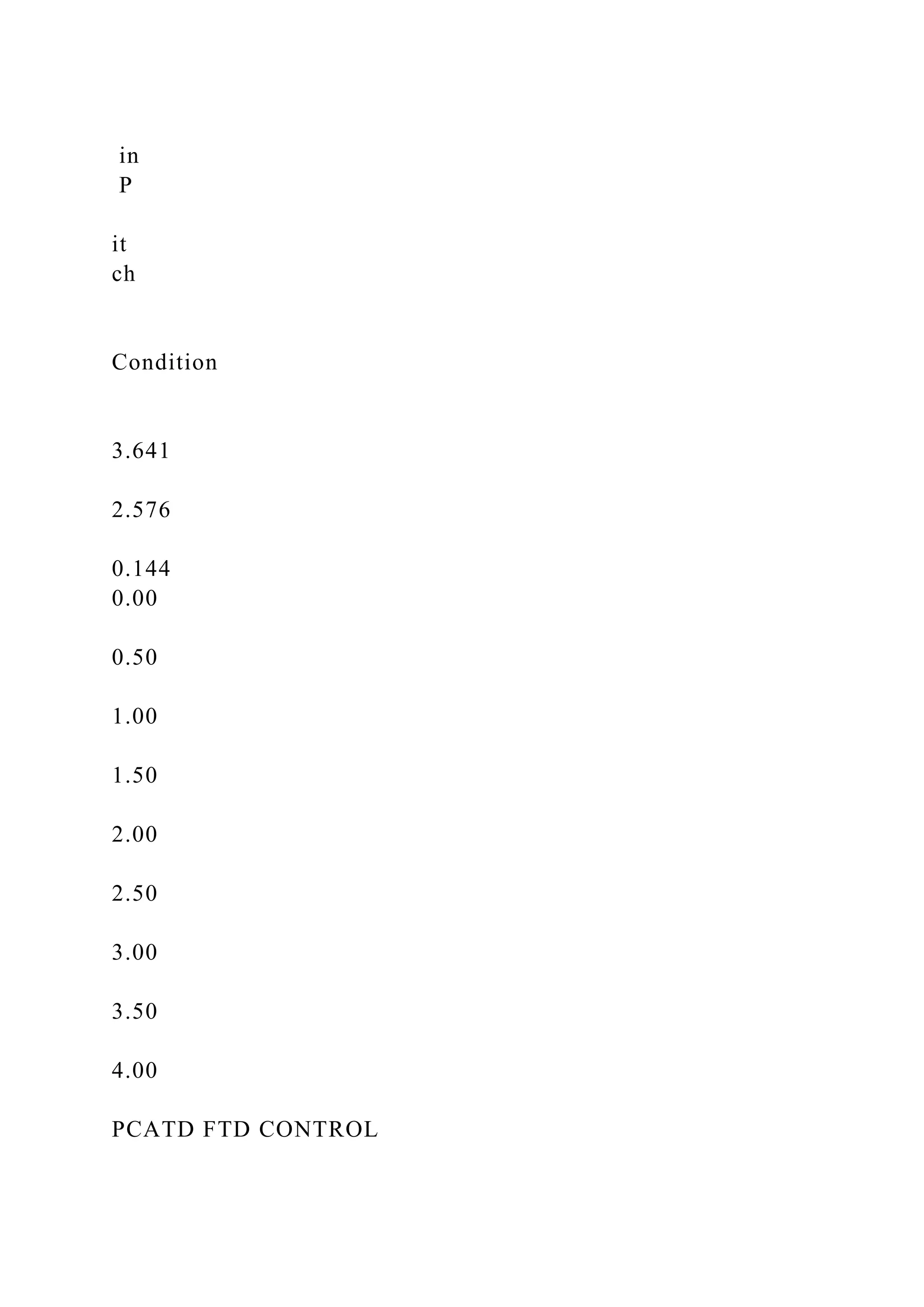
Figure 4. Post Hoc Pitch Change Scores Means Plot
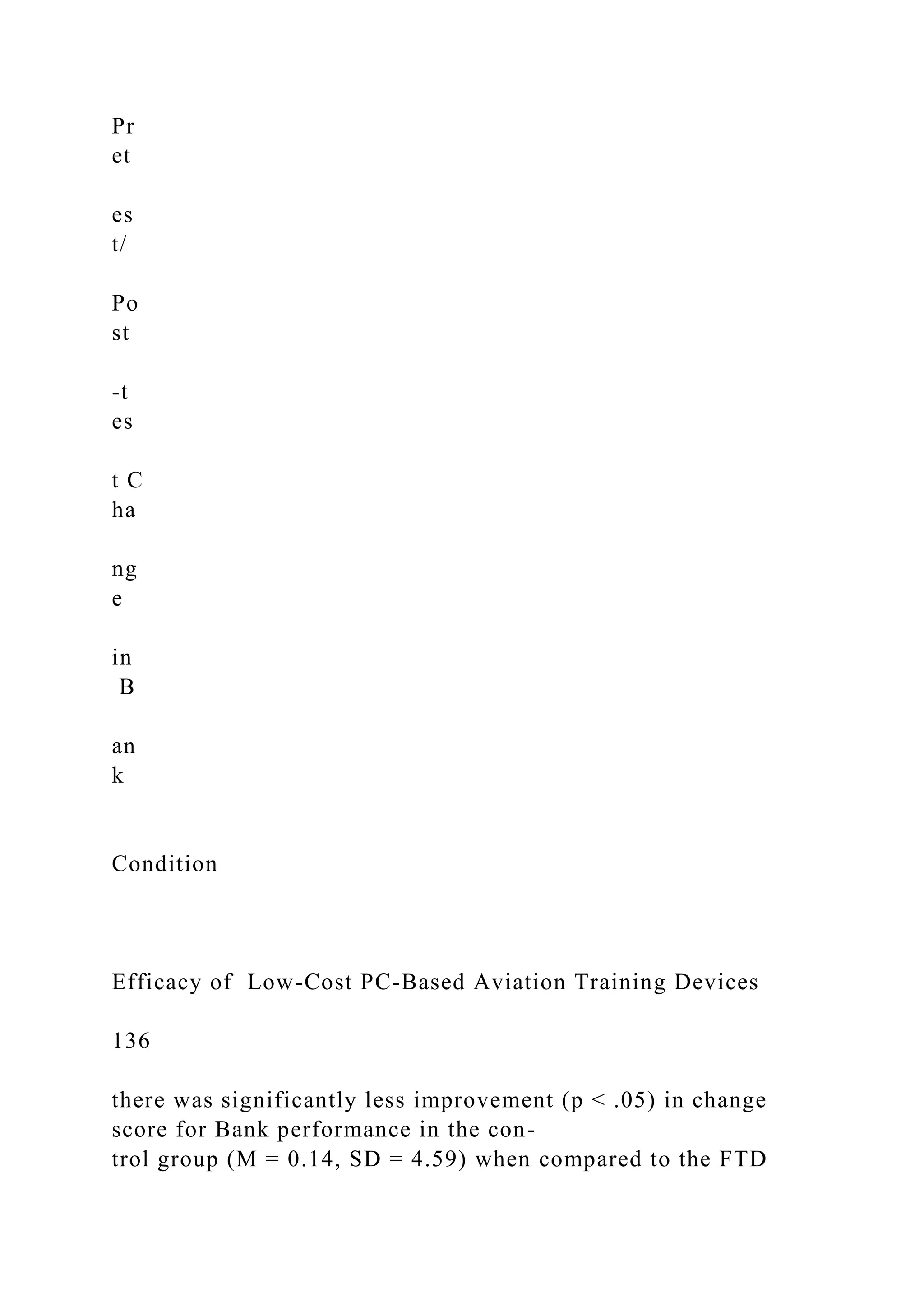
Figure 5. Post Hoc Bank Change Scores Means Plot
Bank variable
There was evidence of a statistically significant interaction
between group training and bank perfor-
mance, F(2, 90) = 4.814, p = .010, η2 = .10, which indicates
that the groups did have significantly
different changes from Pre to Post-test scores. Post hoc analyses
(Figure 5) (LSD) indicated that
1.124 1.029
-0.152 -0.2
0
0.2
0.4
0.6
0.8
1
1.2
PCATD FTD CONTROL
Pr
et
es
t/
Po
st
-t
es
t
Ch
an
ge
in
P
it
ch
Condition
3.641
2.576
0.144
0.00
0.50
1.00
1.50
2.00
2.50
3.00
3.50
4.00
PCATD FTD CONTROL
Pr
et
es
t/
Po
st
-t
es
t C
ha
ng
e
in
B
an
k
Condition
Efficacy of Low-Cost PC-Based Aviation Training Devices
136
there was significantly less improvement (p < .05) in change
score for Bank performance in the con-
trol group (M = 0.14, SD = 4.59) when compared to the FTD
group (M = 2.58, SD = 4.48) and the
PCATD group (M = 3.64, SD = 4.57). There was no significant
difference in change score for Bank
performance between the PCATD group and the FTD group.
Total variable score
A mixed model ANOVA was conducted to compare three groups
of participants on Total Variable
Score (combined score of Pitch, Bank, Altitude, IAS, and
Heading) performance while completing a
VFR Overhead Rejoin Manoeuvre. There was evidence of a
statistically significant interaction be-
tween group training and Total Variable Score, F(2, 90) = 3.36,
p = .039, η2 = .07, which indicates
that the groups did have significantly different changes from
Pre-test to Post-test scores. Post hoc
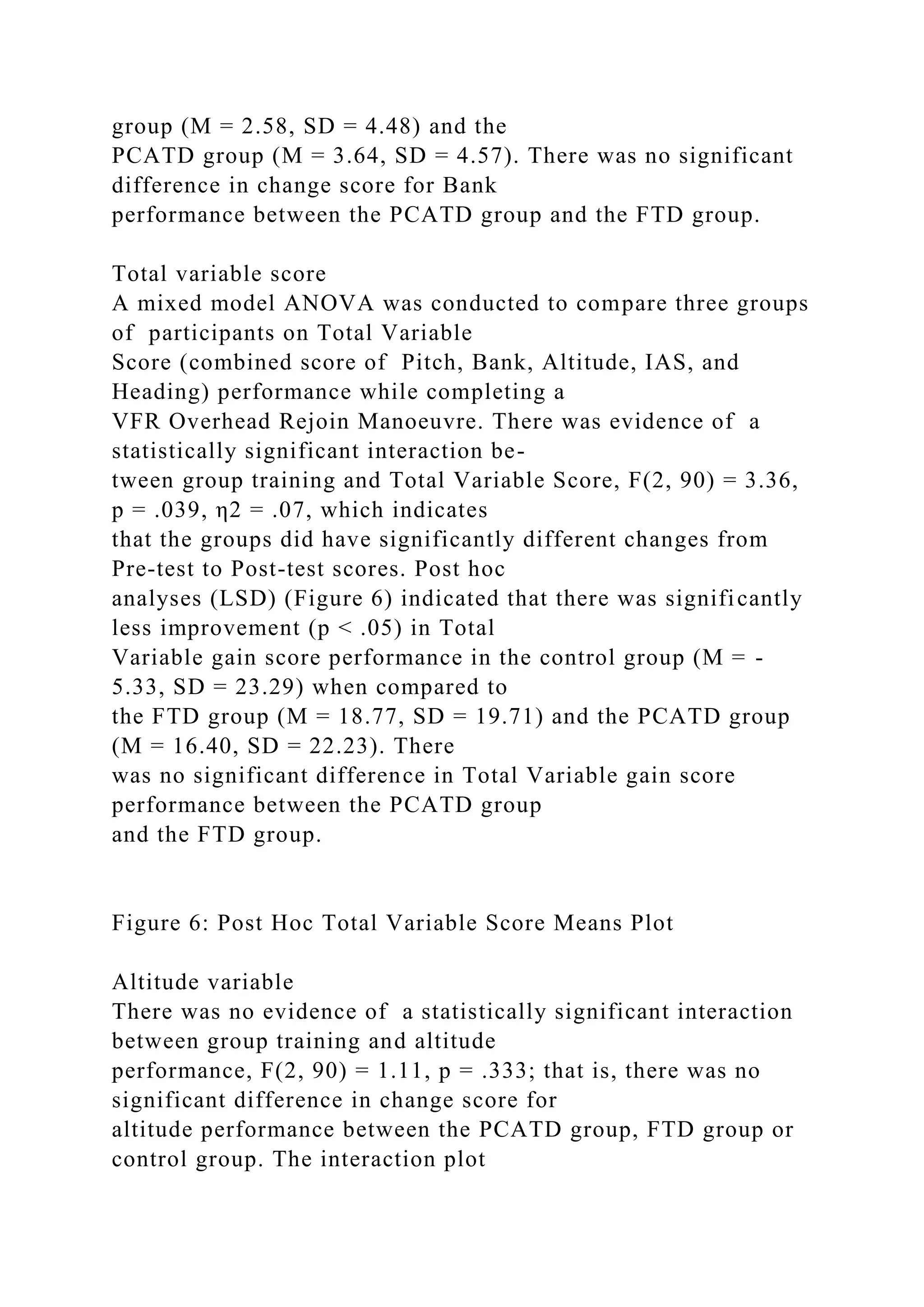
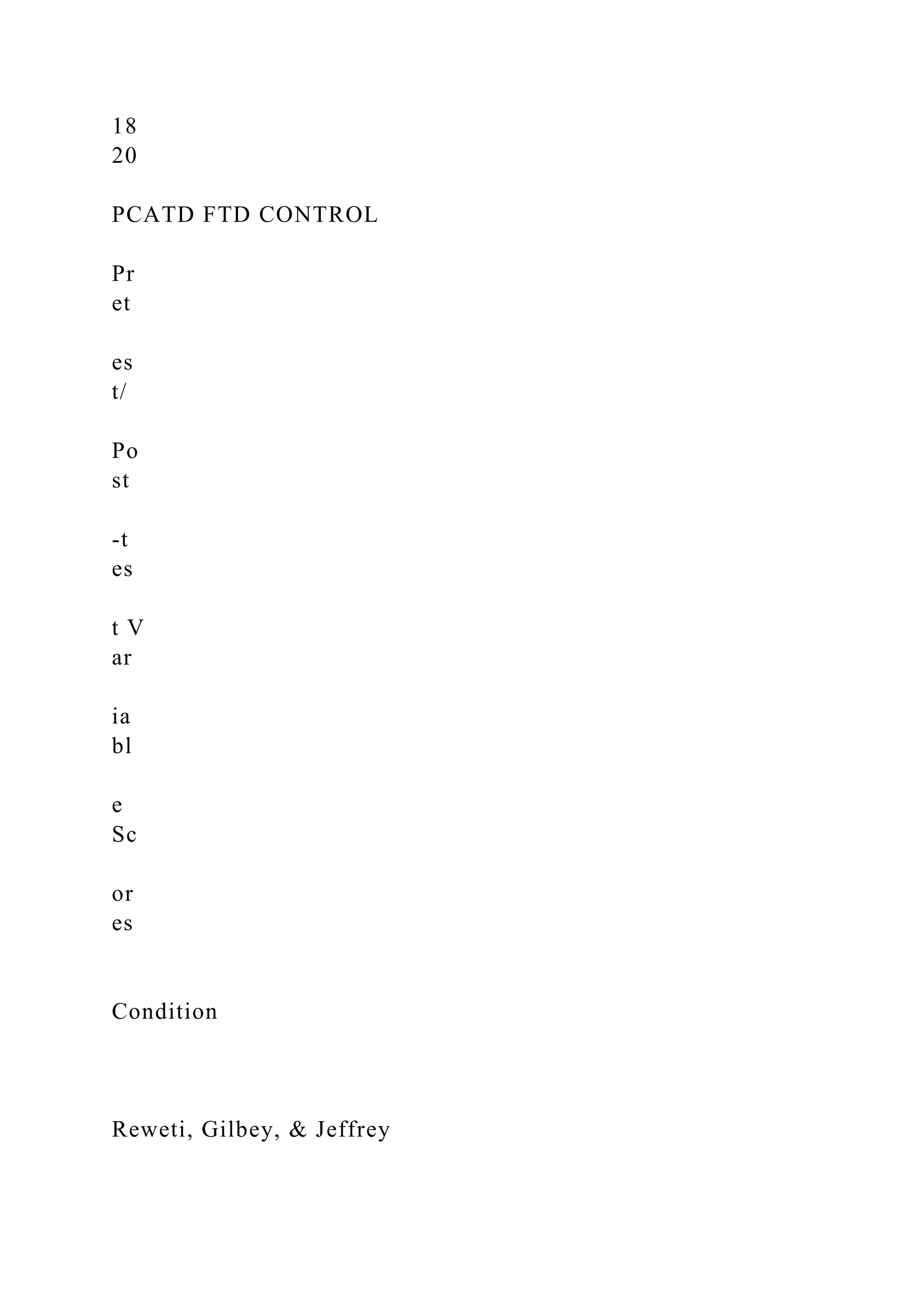
analyses (LSD) (Figure 6) indicated that there was significantly
less improvement (p < .05) in Total
Variable gain score performance in the control group (M = -
5.33, SD = 23.29) when compared to
the FTD group (M = 18.77, SD = 19.71) and the PCATD group
(M = 16.40, SD = 22.23). There
was no significant difference in Total Variable gain score
performance between the PCATD group
and the FTD group.
Figure 6: Post Hoc Total Variable Score Means Plot
Altitude variable
There was no evidence of a statistically significant interaction
between group training and altitude
performance, F(2, 90) = 1.11, p = .333; that is, there was no
significant difference in change score for
altitude performance between the PCATD group, FTD group or
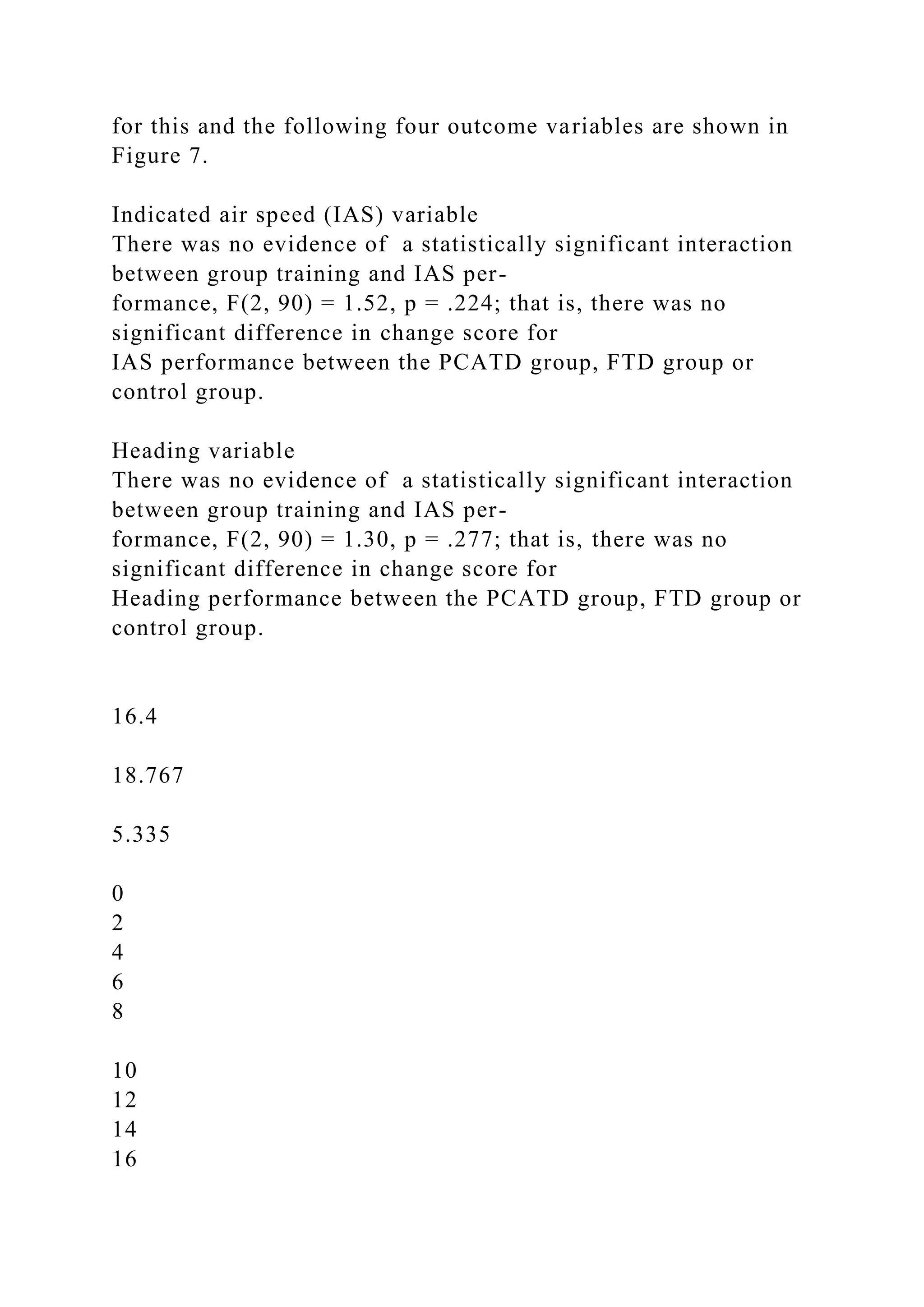
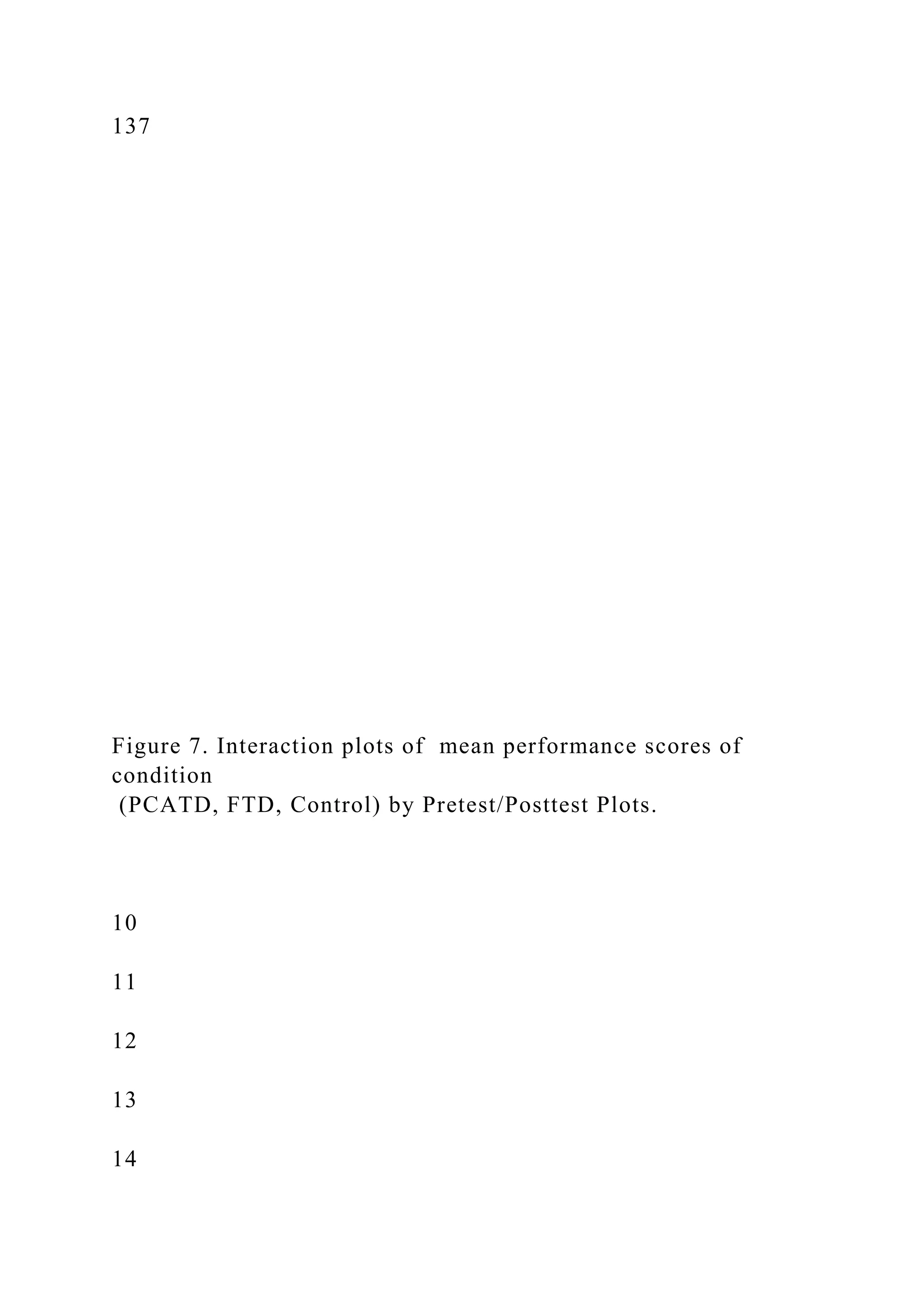
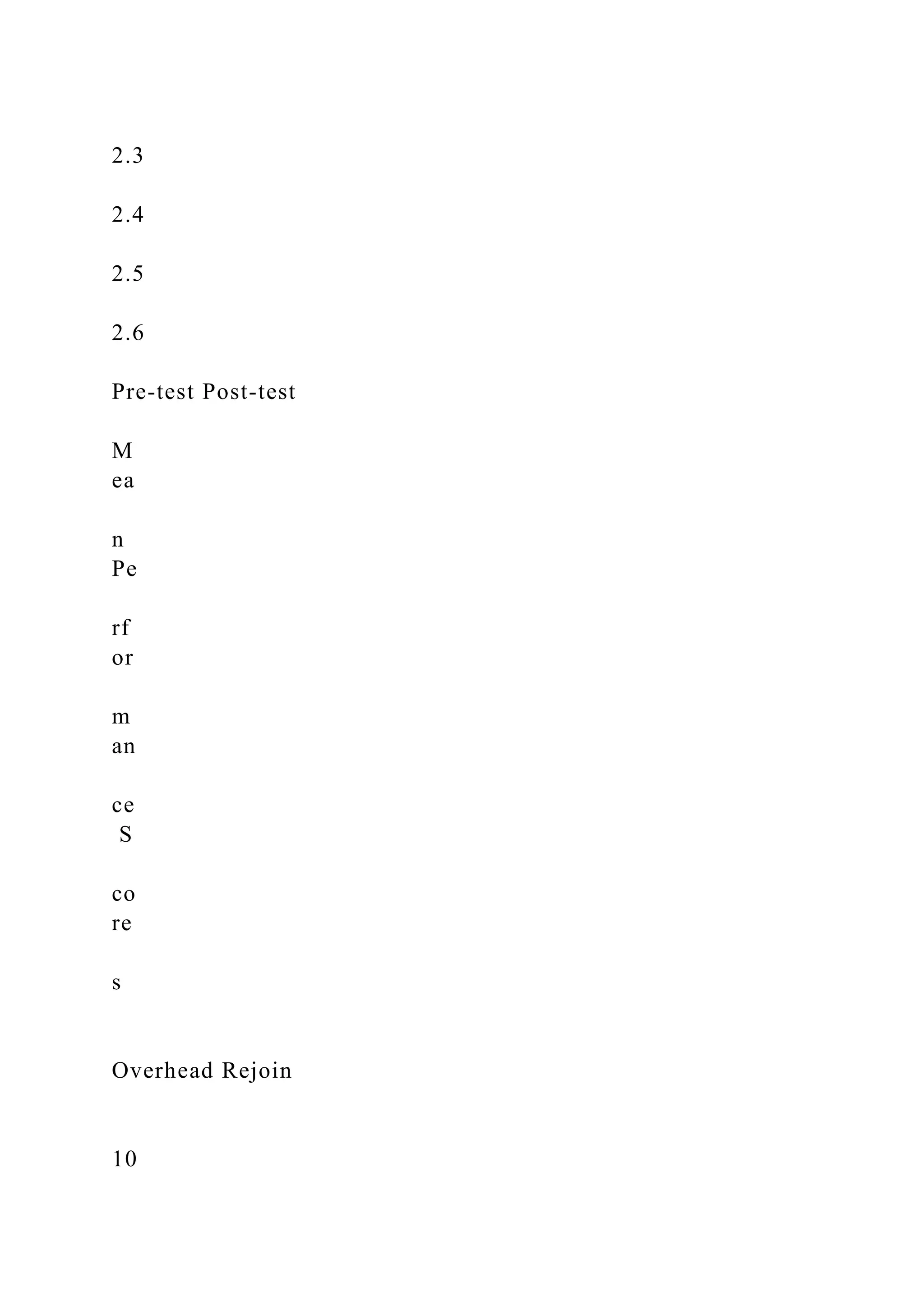
control group. The interaction plot
for this and the following four outcome variables are shown in
Figure 7.
Indicated air speed (IAS) variable
There was no evidence of a statistically significant interaction
between group training and IAS per-
formance, F(2, 90) = 1.52, p = .224; that is, there was no
significant difference in change score for
IAS performance between the PCATD group, FTD group or
control group.
Heading variable
There was no evidence of a statistically significant interaction
between group training and IAS per-
formance, F(2, 90) = 1.30, p = .277; that is, there was no
significant difference in change score for
Heading performance between the PCATD group, FTD group or
control group.
16.4
18.767
5.335
0
2
4
6
8
10
12
14
16
18
20
PCATD FTD CONTROL
Pr
et
es
t/
Po
st
-t
es
t V
ar
ia
bl
e
Sc
or
es
Condition
Reweti, Gilbey, & Jeffrey
137
Figure 7. Interaction plots of mean performance scores of
condition
(PCATD, FTD, Control) by Pretest/Posttest Plots.
10
11
12
13
14
15
16
Pre-test Post-test
M
ea
n
pe
rf
or
m
an
c
Sc
or
es
Altitude
3.7
3.8
3.9
4
4.1
4.2
Pre-test Post-test
M
ea
n
Pe
rf
om
an
ce
S
co
re
s
Glide Slope
11
12
13
14
15
16
17
18
19
20
21
Pre-test Post-test
M
ea
n
Pe
rf
or
m
an
ce
S
co
re
s
Indicated Air Speed
2
2.1
2.2
2.3
2.4
2.5
2.6
Pre-test Post-test
M
ea
n
Pe
rf
or
m
an
ce
S
co
re
s
Overhead Rejoin
10
12
14
16
18
20
22
Pre-test Post-test
M
ea
n
Pe
rf
ro
m
an
ce
S
co
re
s
Heading
Efficacy of Low-Cost PC-Based Aviation Training Devices
138
Glide slope score
There was no evidence of an interaction between group training
and Glide Slope score performance,
F(2, 90) = .297, p = .744; that is there was no significant
difference in Glide Slope score performance
between the PCATD group and the FTD group.
Overhead rejoin pattern score
There was no evidence of a significant interaction between
group training and Glide Slope score per-
formance, F(2, 90) = .585, p = .559; that is, there was no
significant difference in Overhead Rejoin
score performance between the PCATD group and the FTD
group
DISCUSSION
No overall evidence was found that an FTD performed better
than PCATD when used to train pi-
lots to perform a VFR re-join procedure; there was no evidence
of a significant difference in Pre-
test/post-test change scores across all of the eight variables
between the FTD group and the
PCATD group. Specifically, while there was strong evidence of
the effectiveness of training com-
pared to no training on three variables, there was no evidence of
a difference in efficacy of FTD vs.
PCATC training. This implies that VFR task training (e.g.,
Overhead Rejoin Procedure) was just as
effective when completed on the low cost PCATD as it was on
the certified FTD.
Interestingly, there was no evidence of omnibus differences in
performance between the three
groups on the variables Heading, Altitude, IAS, Glide slope
(GS), and Overhead Rejoin Pattern
(ORP). At face value, this suggests that training per se on these
five outcome variables is ineffective.
However, an alternative explanation is that these tasks were
simply easier than the three that did show
improvement after training (on PCATD and FTD) and that a
lack of significant improvement after
training was indicative of a ceiling effect. Furthermore, for the
variable, Overhead Rejoin Pattern, it
is possible that failure to observe an effect may have been due,
at least in part, to a lack of sensitivity
of the measure; that is, ORP was measured on a five point
Likert scale, which may have been insensi-
tive to small differences between groups.
The findings of the current study add to earlier evidence
reported by McDermott (2005), who com-
pleted a similar quasi transfer study that compared the
instrument landing approach performance of
63 pilots randomly assigned to either a PCATD or FTD for
training. The FTD trained group was
designated as the control group and the PCATD group the
treatment group. A pre-test and post-test
was conducted on the FTD before and after the training. The
results of McDermott’s (2005) study
found no significant difference in instrument landing approach
performance between the group
trained on the PCATD and the control group.
A strength of the current study was its use of objective
measurement by analysing flight-recording
data of FTD and PCATD flight variables, rather than the
somewhat more subjective evaluations of
flight examiners or instructors. This method provided an
unbiased precise measurement of VFR task
performance and produced normally distributed data. Only one
measurement, the Overhead Rejoin
Pattern, was too complex for mathematical analysis and
required a categorical assessment by flight
instructors.
Few studies were found that used objective measurement in an
aircraft or flight simulator instead of
subjective evaluation by Subject Matter Experts (SMEs).
Roessingh (2005) used objective measure-
ment in the form of special recording equipment installed on
the aircraft that recorded twelve flight
variables including altitude, IAS, and rates of turn. Only one
study was found that combined objec-
tive measurement with flight task performance in a PCATD.
Smith and Caldwell (2004) used a fixed
base F-117 simulator to record flight performance parameters of
F-117A pilots undergoing training.
Combining flight simulation and objective measurement has
only occurred in the last decade as this
type of recording technology has only become available on the
relatively new models of commercial-
ly produced FTDs and PCATDs. New general aviation aircraft
with glass cockpits also have flight
Reweti, Gilbey, & Jeffrey
139
data recording capability, and flight data for a particular sortie
can be easily downloaded from the
glass cockpit (i.e., Primary Flight Display or Multi-Function
Display). It is hoped that flight data re-
cording, flight data retrieval, and flight data analysis, will
become more popular data retrieval tools
for research purposes. An objective method that uses simulator-
recording technology is cost effec-
tive, accurate and can be operated in a strictly controlled
environment.
One advantage of the PCATD was that some task procedures
were easier to accomplish than in the
real aircraft. For example, most participants believed that
maintaining airspeed in the FTD and
PCATD was easier to do than in the real aircraft. This was due
to a number of environmental factors
that are strictly controlled in PCATDs, such as lack of low-
level turbulence, perfectly performing
engines, and stabilised flight instruments. In the aircraft, low-
level turbulence, slight surges in engine
power, vibration and shake in flight instruments are always
omnipresent and can affect pilot perfor-
mance. In addition, the flight models used in the FTD and
PCATD provided a fast response to
throttle control and flight control inputs. This enabled the
participants to adjust power settings fre-
quently and get rapid feedback as to the effect on flight
performance. The participants agreed that
this responsive feedback provided effective training, and they
thought that the acquired skills would
easily transfer effectively to the aircraft. The Intercept and
Maintain Glide Slope skill was more prob-
lematic. In both the FTD and the PCATD the simulated airport
did not have an Instrument Landing
System and because it was a VFR exercise the glide slope had to
be estimated visually and with refer-
ence only to basic flight instruments. Both the PCATD and FTD
visual display systems have limita-
tions in terms of depth of field (DOF) and field of view
(FOV) compared to aircraft in flight. Both
groups of participants struggled to improve this VFR skill and
fly consistent approaches in the
PCATD and FTD. They indicated that this skill would be the
least likely to transfer effectively to the
aircraft.
CONCLUSIONS
There were at least three potential limitations to the study
reported here. First, although participants
were in principle blinded to the experimental manipulation,
NZ’s aviation industry is small and close-
knit; it is therefore possible that participants became aware of
the experimental manipulation from
meetings outside of the study, and were subsequently affected
by their own expectations of the bene-
fit of training. However, these expectations would be mitigated
by the objective nature of the meas-
urement. Second, it is possible that there were differences
between the two experimental groups on
one or more outcome variables, but they were not detected
(Type II error). Third, the experiment
was implemented over a short period and differences in
performance may emerge at some later
point.
Two further studies are planned. First, to investigate the
effectiveness of a low cost PCATD at im-
proving pilot proficiency in the performance of a standard VFR
traffic pattern operation between
two pilot trainee groups with different aviation experience
levels, training environment, and in differ-
ent geographical locations. Second, is to compare the
effectiveness of a low cost PCATD and a
CAANZ certified FTD at training transfer of other VFR task
procedures such as forced landing
training, forced landing after take-off, and low-level navigation
exercises.
This study involved the development and evaluation of a low
cost PCATD that could be as effective
as a CAANZ certified FTD at training transfer of a VFR task
procedure (Overhead Rejoin Manoeu-
ver). The results have added to the limited body of research
examining the effectiveness of PCATDs
for VFR training. There was no significant difference in
performance of a VFR Overhead Rejoin
Manoeuver between those participants who trained on a PCATD
and those trained on the FTD. In
addition, the use of objective measurement tools has
contributed to the limited research on how
PCATDs with the installation of suitable software can be
utilised for the objective evaluation of pilot
performance.
Efficacy of Low-Cost PC-Based Aviation Training Devices
140
REFERENCES
Alessandro, N. (2008). Transference of PC-based simulation to
aviation training: Issues in learning. Indian Avia-
tion News Retrieved 10 December 2009, from
http://indianaviationnews.net/allimages/AlessandroPaper.pdf
Beckman, W. S. (1998). A comparison of the effectiveness of
PC-based aviation training devices and conventional flight
training
devices for instrument flight training. Saint Louis University, St
Louis, Missouri.
Buchner, A., Erdfelder, E., & Lang, A. (2013). G* Power :
Statistical power analyses for Windows and Mac. Retrieved
20 Dec, 2014, from http://www.gpower.hhu.de/en.html
CAANZ. (2011). Application for accreditation of a new or
modified aeroplane flight simulator for approved uses. (CAA
24119/11), 1-9.
CAANZ. (2014). Vacating and joining at aerodromes. Retrieved
10 Oct, 2014, from
https://www.caa.govt.nz/fig/circuit-training/vacating-and-
joining-at-aerodromes.html
Dennis, K. A., & Harris, D. (1998). Computer-based simulation
as an adjunct to ab initio flight training. Interna-
tional Journal of Aviation Psychology, 8(3), 261-276.
Eagle Flight Training. (2015). DA42 for instrument flight
training. Retrieved 4 Jul, 2016, from
http://www.aviationschool.co.nz/da42-for-instrument-flight-
training/
EASA. (2016). Certification specifications for aeroplane flight
simulation training devices. Retrieved 6 Dec, 2016, from
https://www.easa.europa.eu/certification-specifications/cs-fstda-
aeroplane-flight-simulation-training-
devices
ECA. (2014). 7 years of MPL - 7 things learnt. Retrieved 12
Feb, 2015, from
http://www.eurocockpit.be/stories/20140110/7-years-of-mpl-7-
things-learnt
Elite. (2016). Elite IGate Series Simulator I. Retrieved 6
December, 2016, from http://flyelite.com/igate-series-
simulator/
FAA. (2008a). FAA approval of basic aviation training devices
(BATD) and advanced aviation training devices (AATD
(Vol. Advisory Circular No. AC61-136, 14/07/08). Washington
DC: U.S. Department Of Transportation,
Federal Aviation Administration
FAA. (2008b). Instrument flight rules (defined). Instrument
flying handbook. Oklahoma City, OK: U.S. Department Of
Transportation, Federal Aviation Administration. .
Flight1 Aviation Technologies. (2016). The many benefits of
PC-based flight simulation. Retrieved 20 Nov, 2016 from
http://www.flight1tech.com/whysimulation.aspx
Frasca. (2015). Frasca FTD portfolio. Retrieved 3 May 2012,
from http://www.frasca.com/index.php/fixed-
wing/portfolio
Go, T., Burki-Cohen, J., Chung, W. W., Schroeder, J. A.,
Saillant, G., Jacobs, S., & Longridge, T. (2003). The effects
of enhanced hexapod motion on airline pilot recurrent training
& evaluation. Paper presented at the AIAA Modeling
and Simulation Technologies Conference and Exhibit, Austin,
Texas.
Hernandez-Ros, I. (2012). Announcing FLTREC.DLL Version
7.0.5. Retrieved 10 September, 2012, from
http://www.flightsim.com/vbfs/content.php?2787-Announcing-
FLTRECDLL-Version-705
ICAO. (1993). Manual of the ICAO standard atmosphere
(extended to 80 kilometres (262 500 feet)) (3rd ed.). Montre-
al,Canada: International Civil Aviation Organisation.
KiwiFlyer. (2012). CAA approved helicopter simultation at
HFT. KiwiFlyer Retrieved 8 Dec 2012, from
http://www.kiwiflyer.co.nz/KiwiFlyer-Issue-20-HeliSim-
HFT.pdf
Koonce, J. M., & Bramble, W. J. (1998). Personal computer-
based flight training devices. International Journal of
Aviation Psychology, 8(3), 277-292.
Kozuba, J., & Bondaruk, A. (2014). Flight simulator as an
essential device supporting the process of shaping pilot's
situation-
al awareness. Paper presented at the International Conference of
Scientific Paper AFASES, Brasow, Ruma-
nia.
http://indianaviationnews.net/allimages/AlessandroPaper.pdf
http://www.gpower.hhu.de/en.html
http://www.caa.govt.nz/fig/circuit-training/vacating-and-
joining-at-aerodromes.html
http://www.aviationschool.co.nz/da42-for-instrument-flight-
training/
http://www.easa.europa.eu/certification-specifications/cs-fstda-
aeroplane-flight-simulation-training-devices
http://www.easa.europa.eu/certification-specifications/cs-fstda-
aeroplane-flight-simulation-training-devices
http://www.eurocockpit.be/stories/20140110/7-years-of-mpl-7-
things-learnt
http://flyelite.com/igate-series-simulator/
http://www.flight1tech.com/whysimulation.aspx
http://www.frasca.com/index.php/fixed-wing/portfolio
http://www.flightsim.com/vbfs/content.php?2787-Announcing-
FLTRECDLL-Version-705
http://www.kiwiflyer.co.nz/KiwiFlyer-Issue-20-HeliSim-
HFT.pdf
Reweti, Gilbey, & Jeffrey
141
Leland, R., Rogers, R. O., Boquet, A., & Glaser, S. (2009). An
experiment to evaluate transfer of low-cost simulator-
based airplane upset-recovery training. Washington, DC: Office
of Aerospace Medicine, FAA.
Lintern, G., & Koonce, J. M. (1992). Visual augmentation and
scene detail effects in flight training. International
Journal of Aviation Psychology, 2, 281-301.
Lintern, G., Koonce, J. M., Kaiser, R. H., Morrison, G. A., &
Taylor, H. L. (1997). Transfer and quasi-transfer
effects of scene detail and visual augmentation in landing
training. International Journal of Aviation Psychology,
7(2), 149-169.
Lintern, G., Sheppard, D. J., Parker, D. L., Yates, K. E., &
Nolan, M. D. (1989). Simulator design and instruc-
tional features for air-to-ground attack: A transfer study human
factors. The Journal of the Human Factors and
Ergonomics Society, 31(1), 87-99.
Massey News. (2007). Maharey hails aviation school’s new
flight simulator. Retrieved 20 Mar, 2007 from
http://www.massey.ac.nz/massey/about-
massey/news/article.cfm?mnarticle=maharey-hails-aviation-
schools-new-flight-simulator-16-03-2007
Massey News. (2008). Low cost flight training simulators to aid
pilot training. Massey News Retrieved 30 Sep, 2008,
from http://www.massey.ac.nz/massey/about-
massey/news/article.cfm?mnarticle=low-cost-flight-
training-simulators-to-aid-pilot-training-24-09-2008
McDermott, J. T. (2005). A comparison of the effectiveness of
a personal computer-based aircraft training device and a flight
training device at improving pilot instrument proficiency: A
case study in leading regulatory change in aviation education.
Bowling Green State University. United States -- Ohio.
Middleton, P. (2006). Active Camera 2004. AVSIM commercial
utility review. Retrieved 10 October 2012, from
http://www.avsim.com/pages/1104/acam/ActiveCamera.htm
Pardo, G. (2012). Visor 2000. Retrieved 12 November 2012,
from
http://www.tradewind.org/oldhangar/util.html
Redbird. (2016). Redbird simulators. Retrieved 2 Feb, 2016,
from http://simulators.redbirdflight.com/
Roessingh, J. J. M. (2005). Transfer of manual flying skills
from PC-based simulation to actual flight - Compari-
son of in-flight measured data and instructor ratings.
International Journal of Aviation Psychology, 15(1), 67-90.
Sheck, M. F. (2006). Multi crew licence: How many hours of
flight training does it take to become an airline pilot? Masters
of
Aeronautical Science [Unpublished], Embry-Riddle
Aeronautical University, Spangdahlem, Germany
Smith, J. K., & Caldwell, J. A. (2004). Methodology for
evaluating the simulator flight performance of pilots.
Retrieved 11
November 2014, from
https://ntrl.ntis.gov/NTRL/dashboard/searchResults/titleDetail/
ADA429740.xhtml
Stewart, J. E., II,. Dohme, J. A., & Nullmeyer, R. T. (2002). US
Army initial entry rotary-wing transfer of train-
ing research. International Journal of Aviation Psychology,
12(4), 359-375.
Talleur, D. A., Taylor, H. L., Emanuel, T. W., Rantanen, E., &
Bradshaw, G. L. (2003). Personal computer avia-
tion training devices: Their effectiveness for maintaining
instrument currency. International Journal of Avia-
tion Psychology, 13(4), 387-399.
Taylor, H. L., Lintern, G., Hulin, C. L., Talleur, D. A.,
Emanuel, T. W., & Phillips, S. I. (1999). Transfer of train-
ing effectiveness of a personal computer aviation training
device. The International Journal of Aviation Psychol-
ogy, 9(4), 319-335.
Taylor, H. L., Lintern, G., & Koonce, J. M. (1993). Quasi-
transfer as a predictor of transfer from simulator to
airplane. The Journal of General Psychology, 120(3), 257-276.
Taylor, H. L., Talleur, D. A., Emanuel, T. W. J., Rantanen, E.
M., Bradshaw, G. L., & Phillips, S. I. (2003). Incre-
mental training effectiveness of personal computers used for
instrument training. Paper presented at the 12th Interna-
tional Symposium on Aviation Psychology, Dayton Ohio.
Vatsim. (2015). VATSIM virtual air traffic network. Retrieved
10 Jul, 2015, from http://www.vatsim.net/about-
vatsim/
VLC. (2016). Vector land class. Retrieved 12 Jun, 2016, from
http://www.vectorlandclass.co.nz/
http://www.massey.ac.nz/massey/about-
massey/news/article.cfm?mnarticle=maharey-hails-aviation-
schools-new-flight-simulator-16-03-2007
http://www.massey.ac.nz/massey/about-
massey/news/article.cfm?mnarticle=maharey-hails-aviation-
schools-new-flight-simulator-16-03-2007
http://www.massey.ac.nz/massey/about-
massey/news/article.cfm?mnarticle=low-cost-flight-training-
simulators-to-aid-pilot-training-24-09-2008
http://www.massey.ac.nz/massey/about-
massey/news/article.cfm?mnarticle=low-cost-flight-training-
simulators-to-aid-pilot-training-24-09-2008
http://www.avsim.com/pages/1104/acam/ActiveCamera.htm
http://www.tradewind.org/oldhangar/util.html
http://simulators.redbirdflight.com/
https://ntrl.ntis.gov/NTRL/dashboard/searchResults/titleDetail/
ADA429740.xhtml
http://www.vatsim.net/about-vatsim/
http://www.vectorlandclass.co.nz/
Efficacy of Low-Cost PC-Based Aviation Training Devices
142
Williams, B. (2006). Microsoft flight simulator as a training
aid. Newcastle, WA: Aviation Supplies & Academics Inc.
Wu, L. N., & Sun, Y. P. (2014). Development of a low-cost
flight simulation training device for research and
education. In C. Springer (Series Ed.) C. C. Juang J., Yang CF.
(Ed.), Proceedings of the 2nd International Confer-
ence on Intelligent Technologies and Engineering Systems
Yeo, M. (2016). A new approach to ADF pilot training. Asia-
Pacific Defence Reporter, 42(5), 28-30.
Zaal, P. M. T., Schroeder, J. A., & Chung, W. W. (2015).
Transfer of training on the vertical motion simulator.
Journal of Aircraft, 52(6), 1971-1984.
Zahradka, O. (2017). SimPit Technologies. Retrieved 16 Jan,
2017, from
http://www.simpit.co.nz/index.php/features-2/projection-
display-solutions/simpit-270-centurion
BIOGRAPHIES
Dr. Savern Reweti is a senior lecturer in Aviation Management
at Mas-
sey University’s School of Aviation. During his previous
service in the
Royal New Zealand Air Force he developed a PC based
IFR/VFR proce-
dural simulator and an Air Traffic Control Module for the ab-
initio pilot
training programme. This led to further research into the
development of
low cost PC based Aviation training devices (PCATD’s). This
culminated
in the development of customised PCATD system for the
Massey Uni-
versity School of Aviation and the Auckland Rescue Helicopter
Trust.
His current research focuses on the development of low cost
twin-engine
flight simulation devices and the development of IPAD apps for
automating the calculation of
Takeoff &Landing Charts for pilot training.
Dr. Andrew Gilbey is a senior lecturer at Massey University’s
School of
Aviation. His primary area of interest is in aviation decision
making and
training of pilots.
Associate Professor Lynn M Jeffrey is an Associate Head of
School
(Management) at Massey University. The focus of her research
is im-
proving learning and teaching, and understanding the role that
technolo-
gy might play in achieving that end. Technology that she has
developed
includes a computer-based, examination-on-demand system
(CALES)
which was used by the New Zealand Civil Aviation Authority
for pilot
theory examinations; a learning style website used by tertiary
students to
get advice on improving their learning and by their teachers for
develop-
ing more relevant teaching methods; a learning style evaluation
website
for workplace training; and a web-based simulation game for
teaching
equity in the workplace. Her current research focuses on student
en-
gagement in blended learning environments, mobile learning,
integral learning and teaching interna-
tional students. Lynn has supervised about 20 PhD students and
20 Masters students.
http://www.simpit.co.nz/index.php/features-2/projection-
display-solutions/simpit-270-centurion
Copyright of Journal of Information Technology Education is
the property of Informing
Science and its content may not be copied or emailed to
multiple sites or posted to a listserv
without the copyright holder's express written permission.
However, users may print,
download, or email articles for individual use.
International Journal of Instruction January 2019 ● Vol.12,
No.1
e-ISSN: 1308-1470 ● www.e-iji.net p-
ISSN: 1694-609X
pp. 751-766
Citation: Karimi, P., Lotfi, A. R., & Biria, R. (2019). Enhancing
Pilot’s Aviation English Learning,
Attitude and Motivation through the Application of Content and
Language Integrated Learning.
International Journal of Instruction, 12(1), 751-766.
https://doi.org/10.29333/iji.2019.12148a
Received: 29/07/2018
Revision: 17/11/2018
Accepted: 20/11/2018
OnlineFirst: 23/11/2018
Enhancing Pilot’s Aviation English Learning, Attitude and
Motivation
through the Application of Content and Language Integrated
Learning
Parvin Karimi
Faculty of English Language Department, Islamic Azad
University Isfahan (Khorasgan
Branch). Isfahan, Iran, [email protected]
Ahmad Reza Lotfi
Asst. Prof., Faculty of English Language Department, Islamic
Azad University Isfahan
(Khorasgan Branch). Isfahan, Iran, [email protected]
Reza Biria
Assoc. Prof., Faculty of English Language Department, Islamic
Azad University Isfahan
(Khorasgan Branch). Isfahan, Iran, [email protected]
The present study sought to investigate the effectiveness of
Content and Language
Integrated Learning (CLIL) in enhancing Iranian aviation
students' attitude and
motivation in dealing with the highly specialized features of
aviation English. To
this end, 40 pilots studying at Mahan air in Tehran were
randomly placed in the
experimental (n = 20) and control (n = 20) groups. The study
followed a pretest-
posttest experimental design. The experimental group received
instruction through
CLIL. The control group were taught by a traditional approach.
The analysis
revealed that the experimental group performed better than the
control group on
the posttest. Interestingly the experimental group were highly
motivated and had a
positive perception about the effectiveness of CLIL activities
that led them to be
experienced in higher achievement of the language learning
outcomes. Notably, the
findings of the study suggest some important implications for
course designers, and
teachers who work in the area of teaching English for
Occupational Purposes
(EOP).
Keywords: aviation English, CLIL, EOP, motivation, perception
INTRODUCTION
From the number of languages spoken worldwide, English has
been selected as the
language of technology and science. This thus motivates non-
native scientists and
researchers to learn the language to have access to different
references and documents
http://www.e-iji.net/
https://doi.org/10.29333/iji.2019.12148a
752 Enhancing Pilot’s Aviation English
Learning, Attitude and …
International Journal of Instruction, January 2019 ● Vol.12,
No.1
influencing their careers. Consequently, attempts to design the
most efficient ways of
learning and teaching English to different groups of learners
have gained a considerable
momentum in recent years. In particular, teaching English for
specialized purposes at
higher educational levels plays a pivotal role in tertiary levels
of education. The need for
a wide variety of professional language programs categorized
under the umbrella term
“English for specific purposes” is being felt more than ever
before. ESP relates to a
wide range of areas such as industry, vocational training, and
commercial sectors. It is
goal- oriented and based on English needs and needs analysis in
the profession. ESP
pays attention to the language skills and vocabulary in certain
areas (Gavrilova &
Trostina, 2014).
Notably, the integration of subject- matter content and language
learning (CLIL) has
been regarded as one of the most significant views concerning
the appropriate
methodology required for teaching English for specific
purposes. The evidential bases
offered by various studies reflect that both content and language
receive attention
simultaneously by using CLIL because the learning of the
content is integrated with that
of the language. Such integration can significantly improve
language performance
without resorting to additional teaching efforts. According to
Marsh (2000), the
pedagogical effectiveness of CLIL depends largely on the
exploitation of both content
and language learning at the same time. The main reason is that
CLIL activates different
crucial factors such as learner engagement, motivation, and
active participation which
ultimately result in language learning. As Al-Hoorie (2016)
stated, learners are rational
individuals whose progress depends on the powerful influence
of motivational factors in
modern language teaching contexts.
Globally, the academic aviation programs implemented around
the world choose the
English language as it is the official and standardized language
of aviation
communication because most aircraft and airlines manuals,
pilot’s documentation, flight
plans, and airports traffic controls are written in the English
language. As a result, the
main objective of the present study was to investigate how
implementing CLIL increases
learners’ language proficiency, perception, and motivation in
their learning of the
prespecified outcomes compared to other traditional, non- CLIL
approaches.
LITERATURE REVIEW
Inspired by the Canadian immersion program and the United
States content-based
instruction, CLIL has been used as an educational approach to
foreign language teaching
whereby linguistic forms are learnt indirectly through non-
linguistic content (Eurydice,
2006; Marsh, 2002). In other words, CLIL is an umbrella term
refers to any activity in
learning of non-language subject in which a particular subject
content serves as a
medium for the learning of foreign language items. Nikula
(2017) expressed that CLIL
is used especially in Europe for bilingual education where a
foreign language, in most
cases English, is used as the language of instruction in non-
language school subjects.
CLIL class provides a context for meaningful language use and
leads to language
learning besides content learning, CLIL is an important
instrument to make European
citizens’ bi- and multilingualism, to be offered and create
alongside with subject matter
learning, and regular foreign language teaching for students in
mainstream education.
Karimi, Lotfi & Biria 753
International Journal of Instruction, January2019 ● Vol.12,
No.1
Based on Wolff (2009), CLIL is widely accepted in Europe and
commonly used for
teaching the content subject through a foreign language. CLIL
allows pupils to use
language in a different way, and in complex ways; therefore, the
pupils will have a better
comprehension of the subject matter. Lorenzo, Casal, and
Moore (2009) declared that
CLIL learners have higher linguistic competence, which shows
an obvious benefit of
CLIL due to a higher exposure to a foreign language. CLIL
promotes meaningful
interaction and creativity. It is a more successful way of second
language acquisition as
it is learned for immediate use and for a real purpose. Goris
(2009) stated that CLIL is
different from the communicative approach because learners use
language in content as
an authentic setting, and does not have to simulate real-life
situations, however, this
reality will increase learners’ interaction and motivation during
the class time.
Interaction is a fundamental need for learning to take place.
Through communication
and interaction, students practice their language skills and
discuss the content to which
they are exposed. Thus it makes the students be so active and
motivated to work harder.
Ruiz de Zarob (2008) compared the speaking skills of non-
CLIL and CLIL students in
Spain. After the speech production test, the results showed that
CLIL students’
performance showed higher linguistic level and greater lexical
richness. Dalton-Puffer,
Huttner, Schindelegger, and Smit (2009) conducted a research
in Austrian vocational
colleges and investigated CLIL students’ perception about the
teaching approach. They
found the course useful and the teacher allowed them for more
equally and diversity in
the teacher-student relationship in the classroom. Both teacher
and students were
responsible for the learning process.
Alternatively, motivation is a driving force determining why
someone chooses to do
something. Moreover, Motivation is one of the most important
factors in learning.
Motivation is a basic component of human performance and
learning. Accordingly,
Gardner (2010) stated that motivation is difficult to explain. He
expressed that
motivation is a factor that motivated individuals display. There
are different kinds of
motivation ranging from internal and external factors which
influence learning. As an
illustration, learners’ curiosity and interest are related to the
internal factor while
environmental factors are regarded as an external factor of
motivation. Stansfield and
Winke (2008) noted that high motivation causes a person to
spend much time and to use
more strategies on task which relates to the learner‘s aptitude
and increases his potential.
Moreover, Gardner and Lambert (1972) defined instrumental
and integrative motivation.
There are different factors that influence second language (L2)
learning. However,
learner’s motivation and desire to learn a particular language is
often singled out as the
most significant factor in the overall process for language
acquisition. Being motivated
is one of the most important factors in learning a foreign
language (Abdelrahim &
Humaida, 2012). Furthermore, based on Gardner (2010),
instrumental motivation in
language learning is related to the time when an individual tries
to learn another
language for some practical gain not for the social implications.
It can be stated that
when a person learns a language with non-interpersonal
purposes such as to pass an
exam or just to have a career, it is related to instrumental
motivation. Therefore, students
with an instrumental motivation are going to learn a language
because of a practical
reason such as getting a job or getting into college. On the other
hand, the integrative
754 Enhancing Pilot’s Aviation English
Learning, Attitude and …
International Journal of Instruction, January 2019 ● Vol.12,
No.1
motivation is a key factor in assisting the learners to improve
some level of proficiency
in the language learning, when he becomes a resident in a new
place/society and
environment that uses the target language in its social
interaction. As Finegan (1999,
p.568) posited, students as one of the members of the learning
community are naturally
under the influence of integrative motivation which “typically
provides successful
acquisition of a native-like pronunciation and a wide range of
registers”. Another
classification of motivation consists of intrinsic and extrinsic.
Intrinsic motivation is in
the inner of the learners. A student who is intrinsically
motivated wants to study and
learn because he finds the material interesting, they thus receive
some kind of
satisfaction from their learning. On the other hand, if a person
places the responsibility
on others and on circumstances outside self, he has an external
locus of control
(Dornyei, 2000), which relates to extrinsic motivation. Indeed,
extrinsic motivation
relates to motivation that comes from outside of an individual;
its factors are outsider or
external rewards such as money or grads which provides
pleasure and satisfaction that
the task itself may not provide (Dornyei, 2000). More generally,
if an L2 student
engages with the L2 culture, the intrinsic motivation can turn
out to be an integrative
motivation. If the L2 student wishes to gain aims using L2, the
intrinsic motivation can
also turn out to be the instrumental motivation. These two forms
of motivation, extrinsic
and intrinsic are pertinent to instrumental and integrative
motivation related to L2
learning (Brown, 2000).
In a study, Bernaus and Gardner (2008) investigated the effects
of teacher’s strategies
on the learners’ perceptions in Catalonia, Spain. The result
indicated that positive
students’ attitudes and their integrative motivation toward the
learning situation were
positive factors of English achievement that enhance learning.
Researchers have expressed different views toward different
kinds of motivation.
According to Lucas (2010), learners are intrinsically motivated
to learn speaking and
reading skills and are also intrinsically motivated by knowledge
and achievement. Tuan
(2012) studied the effect of EFL learner's motivation on their
English learning. She used
a questionnaire as an instrument for collecting data. Both
teachers and students were
involved in this survey. The findings of the research showed
that the learners had
positive motivation toward learning of foreign language. In
another study, Mao (2011)
carried out a research on L2 motivation and application in
reading class in senior high
school to examine the effect of motivation on learning. In his
study, the instrument was a
questionnaire to collect the data. The results showed that
combination of integrative
motivation and instrumental motivation can influence reading
improvement.
Furthermore, teachers should take some effective application to
increase student's
motivation during the class and help them develop integrative
motivation towards
English learning.
Due to the significance of affective filter, the optimum learning
occurs in an
environment of high stimulation and low anxiety. Therefore, the
emotional state of the
learner acting as a filter may pass or impede input needed for
L2 acquisition. Many ESL
learners come to class with uncertainty because they often feel
that they are separated
from their native cultures and fight to adapt to certain
disturbances evoked by the new
Karimi, Lotfi & Biria 755
International Journal of Instruction, January2019 ● Vol.12,
No.1
situation. Surprisingly, such disturbances can be monitored and
even overcome with the
help of CLIL. In a study, Doiz, Lasagabaster and Sierra (2014)
expressed in their
analyses that students in CLIL setting were more motivated than
the control group in the
study.
On this basis, the present study investigated how CLIL can
enhance the Iranian aviation
students' attitude and motivation and L2 learning and thus
answer the following research
question:
RQ: Does the implementation of CLIL have an effect on
aviation students’ attitude and
motivation towards English language learning?
METHOD
Design and Context of the Study
This study employed a pretest-posttest experimental design. The
researcher selected two
classes that were subsequently assigned to two groups
randomly: experimental and
control. The research was conducted at Mahan Airlines
headquarters training center in
winter of 2016, in Tehran, Iran.
Pilot students were studying the international book named
Private Pilot Manual (PPM)
as their reference book. The PPM was written in English. The
PPM included different
parts such as aircraft weight and balance (W&B), meteorology
for pilots, interpreting
weather data, and radio navigation systems. All were in English
and contained aviation
special concepts and terminology.
Aircraft W&B course instructs delegates in the principles of
aircraft weight and balance
according to the industry standard IATA design manual and
automated load sheet.
During this class, the learners learn about the maximum landing
weight, aircraft central
gravity, basic empty weight, standard weight of fuel, and
maximum take-off weight. The
course would be implemented in 30 hours, six sessions, and
every session 5 hours.
Population and Sample
Forty male pilots (20 to 30 years old) were randomly placed in
the experimental (n = 20)
and control (n = 20) groups. Regarding their English language
proficiency according to
the ICAO regulations, students attending the private pilot
license (PPL) should pass an
entrance exam before attending the course which was based on
Oxford Placemat Test
(OPT). To select the PPL applicants, the training department
had administered the OPT
test to them before starting the course. Those who score more
than 75 could register for
the class. Therefore, the participants of the study were
homogenous in terms of English
language proficiency. The attending instructors in CLIL served
as the subject matter
teacher for the first 45 minutes of the class and the EFL teacher
for the second 45
minutes whereas in the non-CLIL class, only a subject matter
teacher was presented
during the course.
Instruments
In this study 3 instruments were employed for data collection.
The required data would
be collected through, pretest, questionnaire, and posttest.
756 Enhancing Pilot’s Aviation English
Learning, Attitude and …
International Journal of Instruction, January 2019 ● Vol.12,
No.1
The first instrument, pretest, was related to their language and
content knowledge of the
learners under the study. It should be stated that the researcher
adopted the pretest as the
posttest in order to evaluate language and content knowledge
before and after the
treatment. For the second data collection, researcher utilized
questionnaire to reveal the
findings of participants' attitude and motivation for English
leaning during the course.
The structures of the questionnaires were as follows:
The questionnaire consisted of 30 items which was developed
based on Gardner
Attitude & Motivation Test Battery. Item 1 to 15 were designed
to elicit information and
responses dealing with students’ attitudes toward language
learning and situation, and
item 16 to 30 were related to their motivation in language
learning during the course.
Questionnaire, including five-point Likert scale, ranging from
“strongly disagree = 1” to
“strongly agree = 5”.
The third instrument, posttest, was related to their language and
content learning
outcomes due to motivation in CLIL and non-CLIL classes
under the study. It should be
stated that the researcher adopted the posttest as an instrument
in order to evaluate
language and content learning; in view of the fact that all the
questions were about the
content matter and in English. The pretest and posttest was
based on the ICAO standard
question booklet which contained 30 multiple choice questions
with the total scores of
60 to measure content learning, and also an oral exam with a
score of 40 to evaluate
language knowledge, those who scored 70 and above would pass
the course.
Data Collection Procedure
The researcher started to collect data after the participants
began their W&B course. On
the first session of the class, the pretest was administered to the
participants to examine
their knowledge on understanding the questions and content in
the English language.
The second step for data collection in this study was designing
and piloting a
questionnaire. The respondents were required to rate each item
on the basis of 5point
Likert Scale. To design the questionnaire, the items were
carefully selected and the
opinion of a senior researcher was also considered. The initial
version of the
questionnaire was subjected to a pilot study in order to detect
shortcomings,
redundancy, remove irrelevant items, and check the reliability.
Cronbach’s alpha
reliability of the questionnaire was 0.82 that indicated an
acceptable level of
consistency. The final version of the questionnaire was given to
the participants to
examine their attitudes and motivation. In the last week of the
course all 40 participants
completed the questionnaire in 30 minutes. The Likert-scale
questionnaire was analyzed
using Statistical Package for the Social Sciences (SPSS).
Two days after the last session of the W&B course, the posttest
was administered. The
written part (multiple choice items) of the posttest for both
groups was administered by
the training staff without the teachers being present at the
session. In addition, an oral
exam was performed in the same day afternoon by 3 teachers
based on ICAO booklet
materials. This exam was performed in English to test language
learning outcome. The
teachers graded the students’ oral performance on different
aspects: grammar,
Karimi, Lotfi & Biria 757
International Journal of Instruction, January2019 ● Vol.12,
No.1
vocabulary, pronunciation, and fluency. They gave 1 to 10 score
for each aspect. The
scores obtained from oral exam were used to measure posttest
result.
Two days after the exams, the teachers reported the students’
scores to the training
department. The participants who scored 70 or above would
attend the next course in
the following week. The participants’ scores provided important
information about their
progress and improvement during that special course.
FINDINGS
The data collected through this study were analyzed using
independent-samples t-test
which has two main assumptions; normality of the data and
homogeneity of variances
of the groups. As displayed in Table 1, the absolute values of
the ratios of skewness and
kurtosis over their standard errors were lower than 1.96, which
shows normality of the
data.
Table 1
Descriptive statistics; testing normality of data
Group n Skewness Kurtosis
Statistic Statistic Std. Error Ratio Statistic Std. Error Ratio
CLIL Pretest 20 .002 .512 .003 -.974 .992 -0.98
Posttest 20 -.419 .512 -0.82 -.250 .992 -0.25
Attitude 20 -.041 .512 -0.08 .116 .992 0.12
Motivation 20 .805 .512 1.57 .730 .992 0.74
Non-CLIL Pretest 20 -.175 .512 -0.34 -.769 .992 -0.77
Posttest 20 .718 .512 1.40 -.469 .992 -0.47
Attitude 20 .514 .512 1.00 .699 .992 0.70
Motivation 20 .142 .512 0.28 -.105 .992 -0.11
Reliability of Instruments
Table 2 and Table 3 display the reliability indices for the
pretest and posttest, and
attitude and motivation questionnaires. The KR-21 reliability
index for the pretest and
posttest of CLIL test were .74 and .87, respectively.
Table 2
Descriptive statistics and KR-21 reliability of test
N Minimum Maximum M SD Variance KR-21
CLIL 40 45 80 64.35 9.234 85.259 .74
Posttest 40 70 100 87.18 9.052 81.943 .87
The Cronbach’s alpha for the questionnaire are displayed in
Table 3. The reliability
indices for the attitude and motivation sub-sections were .71
and .78. The overall
questionnaire had a reliability of .82.
Table 3
Cronbach’s alpha reliability of attitude and motivation
Cronbach's Alpha N of Items
Attitude .715 15
Motivation .787 15
Total .825 30
758 Enhancing Pilot’s Aviation English
Learning, Attitude and …
International Journal of Instruction, January 2019 ● Vol.12,
No.1
Criterion Referenced Validity
The correlation coefficients between the OPT and pretest and
posttest were computed as
the criterion referenced validity of the latter two tests. The
results displayed in Table 4
indicated that the pretest (r (38) = .611 representing a large
effect size, p = .000) and
posttest (r (38) = .628 representing a large effect size, p = .000)
enjoyed significant
criterion referenced validity indices.
Table 4
Pearson Correlations; Criterion Referenced Validity
OPT
Pretest
Pearson Correlation .611
**
Sig. (2-tailed) .000
N 40
posttest
Pearson Correlation .628
**
Sig. (2-tailed) .000
N 40
**. Correlation is significant at the 0.01 level (2-
tailed).
Homogenizing Groups on Pretest
An independent t-test was run to compare the CLIL and non-
CLIL groups’ means on the
pretest. Based on the results displayed in Table 5, the CLIL (M
= 64.85, SD = 9.31) and
non-CLIL (M = 63.85, SD = 9.36) groups had fairly close means
on the pretest.
Table 5
Descriptive statistics; pretest
Group n M SD Std. Error Mean
Pret
est
CLIL 20 64.85 9.315 2.083
Non-CLIL 20 63.85 9.366 2.094
The results of the independent t-test (t (29) = .339, 95 % CI [-
4.97, 6.97], p = .737, r =
.055 representing a weak effect size) (Table 6) indicated that
the groups were
homogenous in terms of their language and content knowledge
as measured through the
pretest.
It should be noted that the assumption of homogeneity of
variances was met (Levene’s F
= .001, p = 1.00). That is why the first row of Table 6, i.e.
“Equal variances not
assumed” was reported.
Karimi, Lotfi & Biria 759
International Journal of Instruction, January2019 ● Vol.12,
No.1
Table 6
Independent samples t-test; Pretest by groups
Levene's Test for
Equality of Variances
t-test for Equality of Means
F Sig. t df
Sig. (2-
tailed)
Mean
Difference
Std. Error
Difference
95% Confidence
Interval of the
Difference
Lower Upper
Equal variances
assumed
.001 1.000 .339 38 .737 1.000 2.954 -4.979 6.979
Equal variances
not assumed
.339 37.999 .737 1.000 2.954 -4.979 6.979
Figure 1
Means on pretest by groups
Comparing Groups’ Means on Posttest
An independent t-test was run to compare the CLIL and non-
CLIL groups’ means on the
posttest. Based on the results displayed in Table 7, the CLIL
group (M = 94, SD = 3.97)
had a higher mean than the non-CLIL group (M = 80.35, SD =
7.37) on the posttest.
Table7
Descriptive statistics; posttest by groups
Group n M SD Std. Error Mean
CLIL
CLIL 20 94.00 3.974 .889
Non-CLIL 20 80.35 7.372 1.648
The results of the independent t-test (t (29) = 7.28, 95 % CI
[9.82, 17.47], p = .000, r =
.804 representing a large effect size) (Table 7) indicated that
the CLIL significantly
outperformed the non-CLIL group on the posttest. Thus the
null-hypothesis was
rejected. The CLIL method significantly enhanced the Aviation
English learning of
Iranian pilots through the application of content and language
integrated learning.
It should be noted that the assumption of homogeneity of
variances was not met
(Levene’s F = 5.33, p = .026). That is why the second row of
Table 8, i.e. “Equal
variances not assumed” was reported.
760 Enhancing Pilot’s Aviation English
Learning, Attitude and …
International Journal of Instruction, January 2019 ● Vol.12,
No.1
Table 8
Independent samples t-test; posttest
Levene's Test for
Equality of Variances
t-test for Equality of Means
F Sig. t df
Sig. (2-
tailed)
M
Std. Error
Difference
95% Confidence Interval
of the Difference
Lower Upper
Equal variances
assumed
5.331 .026 7.289 38 .000 13.650 1.873 9.859 17.441
Equal variances
not assumed
7.289 29.181 .000 13.650 1.873 9.821 17.479
Figure 2
Means on posttest by groups
Comparing Groups’ Attitude towards Language Learning
An independent t-test was run to compare the CLIL and non-
CLIL groups’ attitude
towards language learning. Based on the results displayed in
Table 9 it can be claimed
that the CLIL group (M = 40.60, SD = 5.25) showed a more
positive attitude towards
language learning than the non-CLIL group (M = 31.70, SD =
4.95).
Table 9
Descriptive statistics; attitude towards language learning
Group n M SD Std. Error Mean
Attitude
CLIL 20 40.60 5.256 1.175
Non-CLIL 20 31.70 4.953 1.108
The results of the independent t-test (t (38) = 5.51, 95 % CI
[5.63, 12.16], p = .000, r =
.666 representing a large effect size) (Table 10) indicated that
the CLIL significantly
had a more positive attitude towards language learning than the
non-CLIL group. Thus
the null-hypothesis was rejected.
It should be noted that the assumption of homogeneity of
variances was retained
(Levene’s F = .109, p = .743). That is why the first row of Table
10, i.e. “Equal
variances assumed” was reported.
Karimi, Lotfi & Biria 761
International Journal of Instruction, January2019 ● Vol.12,
No.1
Table 10
Independent samples t-test; attitude towards class by groups
Levene's Test for
Equality of Variances
t-test for Equality of Means
F Sig. t df
Sig. (2-
tailed)
M
Std. Error
Difference
95% Confidence Interval
of the Difference
Lower Upper
Equal variances
assumed
.109 .743 5.511 38 .000 8.900 1.615 5.631 12.169
Equal variances
not assumed
5.511 37.868 .000 8.900 1.615 5.630 12.170
Figure 3
Means on attitude towards language learning by groups
Comparing Groups’ Motivation to Learn English
An independent t-test was run to compare the CLIL and non-
CLIL groups’ motivation to
learn English. Based on the results displayed in Table 11 it can
be claimed that the CLIL
group (M = 42, SD = 9.45) were more motivated to learn
English than the non-CLIL
group (M = 32.60, SD = 5.25).
Table 11
Descriptive statistics; motivation to learn English by groups
Group n M SD Std. Error Mean
Motivation
CLIL 20 42.00 9.459 2.115
Non-CLIL 20 32.60 5.256 1.175
The results of the independent t-test (t (29) = 3.88, 95 % CI
[4.50, 14.29], p = .000, r =
.585 representing a large effect size) (Table 12) indicated that
the CLIL significantly
had higher motivation to learn English than the non-CLIL
group. Thus the null-
hypothesis was rejected.
It should be noted that the assumption of homogeneity of
variances was not retained
(Levene’s F = 5.66, p = .022). That is why the second row of
Table 12, i.e. “Equal
variances not assumed” was reported.
762 Enhancing Pilot’s Aviation English
Learning, Attitude and …
International Journal of Instruction, January 2019 ● Vol.12,
No.1
Table 12
Independent samples t-test; motivation to learn English by
groups
Levene's Test for
Equality of
Variances
t-test for Equality of Means
F Sig. t df
Sig. (2-
tailed)
Mean
Difference
Std. Error
Difference
95% Confidence
Interval of the
Difference
Lower Upper
Equal variances
assumed
5.667 .022 3.885 38 .000 9.400 2.420 4.502 14.298
Equal variances
not assumed
3.885 29.710 .001 9.400 2.420 4.456 14.344
Figure 4
Means on motivation to learn English by groups
DISCUSSION
The main goal of the current study was to investigate the effect
of CLIL to increase
pilots’ attitude and motivation which led to their English
learning. For this reason, a
great amount of relevant literature was reviewed to clarify the
background of the study
and provide an essential theoretical basis.
This study showed that since the learners presented in the CLIL
class held significantly
more positive attitudes towards English than those in non-CLIL
class. Data analysis
between these two groups revealed that use foreign language to
teach content had a
substantial impact on learners’ attitudes. Based on this study,
the atmosphere in CLIL
class led to increase learners’ motivation. This result confirmed
a study conducted by
Lasagabaster (2011), the author concluded that the CLIL
approach brought positive
effects to the students, both in terms of motivation and in terms
of language
development. The results also indicated that in CLIL class the
students were more
motivated to be active in comparison to other class. The
students in this class were
active, interested to engage, and eager to work hard in the class
time.
Karimi, Lotfi & Biria 763
International Journal of Instruction, January2019 ● Vol.12,
No.1
In CLIL class, the students were more active and had strong
desire to interact with the
instructor and other classmates during the class instructions, the
active atmosphere in the
class motivated them to be energetic, to use English for their
explanation and discussion.
This result could be related to a CLIL study by Gibbons (2003)
that explained how
science teachers interact in English with learners by providing
and opening discussions
to develop learners’ content and language knowledge. In this
study, by creating
situations where teacher and students were active participants in
the conversation, both
linguistic and curriculum knowledge were developed. The CLIL
environment raised
learners’ positive attitudes and motivation that led to better
understanding and learning
outcomes.
CLIL made a meaningful content for meaningful learning. It
provided richer relation and
communication situation and opportunity that engaged learners.
It fostered the
development of language and content learning. In this class
learners found English
learning easier and more attractive than non-CLIL groups,
therefore, the most obvious
finding to emerge from this study was that CLIL improved
language learning by
providing more favorable, positive attitudes and motivation
towards English. It kept the
learners interested in language learning. The result confirmed in
a study undertaken by
Varkuti (2010), the study compared CLIL students with students
in an intensive
language course with the same exposure times in the foreign
language. Finding of this
study showed that CLIL students’ performance in test was
higher than the other group
who took part in the traditional foreign language class.
Thompson and Sylvén (2015)
did a research in Swedish school among students in CLIL
programs and non-CLIL
programs at three schools. They explored second language
learning motivation as well
as its impact on the language acquisition process within the
context of Content and
Language Integrated Learning (CLIL). The results of this study
indicated that CLIL
students had a greater interest in foreign languages, more
positive attitudes towards
learning English, a stronger ideal L2 self, more English self-
confidence, and a higher
willingness to communicate in English. On the other hand, non-
CLIL students were
more ethnocentric and had higher English anxiety. It revealed
that CLIL students had a
more positive attitude towards the L2 community as well as a
higher intended learning
effort.
These findings suggested that in general CLIL provided higher
positive attitudes,
increased motivation and more intense exposure, meaningful
learning situation and
opportunities for the learners to use foreign language as it is
learned in authentic
situations. The limitation of this study was paucity of the
students. ICAO rule for the
number of the students in aviation class is between 16 and 20,
therefore, if the students
will be more than this number it is better. It would be
interesting to assess the effect of
CLIL on students’ learning in another field of the study in
university or other institutes.
CONCLUSION
Prior to the present study, the method of teaching at Mahan air
aviation training center
was a traditional teacher-centered approach. In this approach,
the instructor presented
the course materials to the learners without activities and class
participations and mostly
in students' native language, whereas all the teaching materials
and textbooks were in
764 Enhancing Pilot’s Aviation English
Learning, Attitude and …
International Journal of Instruction, January 2019 ● Vol.12,
No.1
English. The impetus initiating this study was investigated the
effects of CLIL on
improving aviation students’ attitude and motivation in the
English language learning
content and language in Iranian contexts.
According to the results attained in this study, CLIL class
enhanced the learners'
attitude, motivation, and confidence in the classroom, and also
provided them a deeper
knowledge of language and content related issues. This,
however, can only occur if the
classroom environment is learner-centered which would
complement the students to
think and use their cognitive awareness. The findings of this
study further showed that
CLIL class had significant effects on increasing motivation in
the class and led to the
language and subject matter learning of aviation students.
According to Hall (2011),
motivation could promote L2 learners. However, the present
study may have important
implications for material developers, course designers, and
language teachers who work
in the area of teaching English for Occupational Purposes
(EOP).
REFERENCES
Abdelrahim, I., & Humaida, I. (2012). Motivation to learn
English among college
students in Sudan. English Language Teaching, 5, 49-56.
Al-Hoorie, A. H. (2016). Unconscious motivation. Implicit
attitudes toward L2
speakers. Studies in Second Language Learning and Teaching,
6, 423-454.
Bernaus, M. & Gardner, R. C. (2008). Teacher motivation
strategies, student
perceptions, student motivation, and English achievement. The
Modern Language
Journal, 92, ii.
Brown, H. D. (2000). Principles of language learning and
teaching. (4th ed.). New York:
Addison Wesley Longman.
Dalton-Puffer, C., Huttner, J., Schindelegger, V., & Smit, U.
(2009). Technology-Geeks
Speak Out: What Students Think About Vocational CLIL.
International CLIL Research
Journal, 1(2), 18-25.
Doiz, A. Lasagabaster, D. & Juan Manuel, S. (2014). CLIL and
motivation: the effect of
individual and contextual cariables. The language learning
journal, 42(2), 209-224.
Dornyei, Z. (2000).motivation.in M.byram (ed).Routledge
encycolopedia of language
teaching and learning (pp.425-4320). New York: Routledge.
Eurydice (2006). Content and Language Integrated Learning
(CLIL) at school in
Europe. Brussels: Eurydice European Unit.
Finegan, E. (1999). Language: Its structure and use (3th ed., p.
568). Harcourt Brace.
Gardner, R.C., & Lambert, W.E. (1972). Attitudes and
motivation in second-language
learning. Rowley, Mass; Newbury House.
Gardner, R. C. (2010). Motivation and second language
acquisition. The
socioeducational model. New York: Peter Lang Publishing, Inc.
Karimi, Lotfi & Biria 765
International Journal of Instruction, January2019 ● Vol.12,
No.1
Gavrilova, E., & Trostina, K. (2014). Teaching English for
professional purposes (ESP)
vs. Content and language integrated learning (CLIL): The case
of Plekhanov Russian
University of Economic (PRUE). In: European Scientific
Journal, 2, 7-17.
Gibbons, P. (2003). Mediating language learning: Teacher
interactions with ESL
students in a content based classroom. TESOL Quarterly, 37(2),
247-273.
Goris, J. A. (2009). English in mainstream European secondary
schools: Content and
language integrated learning (CLIL). In D. Marsh & P. Mehisto
(Eds.), CLIL Practice:
Perspectives from the Field (pp. 28-33).
Hall, G. (2011). Exploring English Language Teaching
Language in Action. London:
Routledge.
Lasagabaster, D. (2011). English achievement and student
motivation in CLIL and EFL
settings. Innovation in Language Learning and Teaching, 5(1),
3-18.
Lorenzo, F., Casal, S., & Moore, P. (2009). The Effects of
content and language
integrated learning in European education: key findings from
the Andalusian bilingual
sections evaluation project. Applied Linguistics, 31(3), 418-
442.
Lucas. R. I. (2010). A study on intrinsic motivation factors in
second language learning
among selected freshman students. The Philippine ESL Journal,
4, 6-23.
Mao, Z. (2011). A study on L2 motivation and applications in
reading class in senior
high school. Theory and Practice in Language Studies. 1/1, 731-
1739.
Marsh, D. (2000). Using languages to learn and learning to use
languages. The future
doesn’t just happen, it is shaped and modelled by our actions.
Jyvaskyla: University of
Jyvaskyla.
Marsh, D. (2002): CLIL/EMILE – The European Dimension:
Actions, Trends and
Foresight Potential. Bruxelles: The European Union.
Nikula, T. (2017). CLIL: A European approach to bilingual
education. Learning
evidence from research in Europe, 22-40. Bristol: Multilingual
Matters.
Ruiz de Zarobe, Y. (2008). CLIL and foreign language learning:
A longitudinal study in
the Basque country. International CLIL Research Journal, 1(1),
60-73.
Stansfield, C., & Winke, P. (2008). Testing aptitude for second
language learning. In E.
Shohamy, & N. H. Hornberger (Eds.), Encyclopedia of
Language and Education, 2nd
edition, 7: Language Testing and Assessment (pp. 81-94)
Thompson, A. S. & Sylvén, L. K. (2015). “Does English make
you nervous?” Anxiety
profiles of CLIL and non-CLIL students in Sweden. Apples:
journal of applied language
studies, 9(2), 1–23.
Tuan, L. (2012). An empirical research into EFL learners’
motivation. Theory and
Practice in Language Studies, 2, 430-439.
766 Enhancing Pilot’s Aviation English
Learning, Attitude and …
International Journal of Instruction, January 2019 ● Vol.12,
No.1
Varkuti, A. (2010). Linguistic benefits of the CLIL approach:
Measuring linguistic
competences. International CLIL Research Journal, 1(3), 67-79.
Wolff, D. (2009). Content and language integrated learning. In:
Knapp, Karlfied,
Seidlhofer, Barbara (Eds.): Handbook of Foreign Language
Communication and
Learning. Berlin: Walter de Gruyter, 545-572.
Copyright of International Journal of Instruction is the property
of International Journal of
Instruction and its content may not be copied or emailed to
multiple sites or posted to a
listserv without the copyright holder's express written
permission. However, users may print,
download, or email articles for individual use.
Doi: 10.2501/JAr-2021-013 september 2021 JOURNAL OF
ADVERTISING RESEARCH 245
Editor’s Desk
New Insights on Advertising Execution
And Consumer Engagement
JOHN B. FORD
Editor-in-chief,
Journal of Advertising
Research
Eminent scholar and
Professor of marketing
and international
Business,
strome college of
Business, old Dominion
university
[email protected]
Text variables
Enter text variables here to define ruuning
heads and running feet
Main running head is defined by title (not
here)
NB use forced line break not return to create
line break
NEW iNsiGHts oN ADVErtisiNG ExEcutioN AND coNsumEr
ENGAGEmENt
Enter publication month here
september 2021
Enter DOI here
Doi: 10.2501/JAr-2021-013
Enter special feature theme here
WHAT WE KNOW ABOuT
Since 1960, the Journal of Advertising Research (JAR)
has delivered cutting-edge, impactful research to
advertising scholars and practitioners. That work
has reflected not only the continuing theoretical
evolutionary advancement of knowledge but also
has provided answers to a number of the thorny
problems faced by advertising professionals.
And, indeed, the future of advertising requires
meaningful partnerships between scholars and pro-
fessionals in the field, so that knowledge advance-
ment focuses on the greatest need areas faced
by practitioners.
This issue of the JAR contains another rich array of
studies reflecting a continuing development of these
vital partnerships. Eight articles span a wide variety
of topics that includes the impact of reductions in
media spend on brand performance in the short and
long term; effective strategies for six-second video
advertisements; the use of androgynous imagery in
advertisements; and companies’ explicit-donation
amount and online cause-sponsorship advertising
formats on nonprofit websites, and their effects on
purchase intention. New findings in context congru-
ence and advertising persuasiveness in e-magazines
add to the mix, as well as the effectiveness of non-
celebrity endorsers; consumer engagement and
purchase behavior in brand heritage advertising;
and the effect of guerilla marketing on company
share prices.
The practice of brand advertisers to reduce
advertising spend in the hopes of cutting costs
and increasing profit levels is the focus of “When
Brands Go Dark: Examining Sales Trends when
Brands Stop Broad-Reach Advertising for Long
Periods” (see page 247) by Nicole Hartnett, Vir-
ginia Beal, Rachel Kennedy, and Byron Sharp
(Ehrenberg-Bass Institute for Marketing Science,
University of South Australia), and Adam Gelzinis
(Endeavour Group).
Underpinning such reductions in advert-
ising spend is the assumption that these types of
adjustments do not immediately harm sales or
market share. The authors used 20 years of data
(1996–2015) involving advertising spend and brand
sales volume for a global alcoholic-beverage com-
pany across a variety of different products in the
Australian market. The study identified 57 one-year
cost-cutting incidents for 41 brands; in 34 of these
cases, the reduction lasted at least two years.
In fact, the authors found that sales declines
often marched hand in hand with slashes in advert-
ising expenditures, leading to the conclusion that
“forcing brands to take turns going dark for long
periods could have a net negative effect on the total
portfolio in the long run.”
Balancing that finding was the discovery that
“larger previously growing brands are relatively
unaffected by advertising cessation and so can
withstand an advertising hiatus for one or two
years.” The authors do add, however, that those
survivor brands may not have suffered any serious
loss due to the decline in advertising but poten-
tially compromised greater growth that may have
been driven by continued marketplace exposure.
On a more granular basis, the research support-
ing “When Brands Go Dark” found that small,
growing alcohol brands need continued support to
meet their growth potential and, in such cases, con-
tinuity is important. More specifically, the authors
propose, on-and-off strategies can negatively affect
consumers looking to make a category purchase, as
off periods can open the door for competitor mes-
sages to get through.
Even as marketers investigate with various
levels of advertising investment, so do they exam-
ine different message-delivery modes. “Strategies
for More Effective Six-Second Video Advertise-
ments: Making the Most of 144 Frames” (please
see page 260) demonstrates a growing interest
in short format as younger consumers actually
prefer short-duration communications on their
mobile devices.
246 JOURNAL OF ADVERTISING RESEARCH september
2021
NEW iNsiGHts oN ADVErtisiNG ExEcutioN AND coNsumEr
ENGAGEmENt
Authors Colin Campbell (University of San Diego) and Erin
Pearson (University of East Anglia) accessed a wide array of
English-language video advertisements from Unruly Media,
Facebook, and YouTube. There were some logistical constraints
to
their study: Only about 3 percent of all video advertisements in
the
research appeared in six-second format. To give greater depth to
their work, the authors examined and coded all advertisements
10
seconds or less in the selected media.
After examining the top 50 performing advertisements (as well
the worst 50), the study revealed that ultra-short-form commer-
cials require the use of novel and unique approaches, with chan-
ging focal points at each stage of advertisement creation. In
more
detail, Drs. Campbell and Pearson found best practices leverage
consumer experiences and knowledge to create greater impact.
To
that end, compelling narratives need to be planned in such a
way
that they can be built into a longer format and then condensed
to
keep the clarity of the message involved.
The authors suggest that filmmaking and editing can be used to
speed viewer comprehension and improve meaning. They offer
that “the results highlight the value of precise targeting and the
potential for software solutions that make serialized targeting
easier to operationalize.” One interesting caveat: “Increased use
of open and experimental narratives may present risk for advert-
isers by creating the potential for multiple—and, in some cases,
unanticipated—meanings.”
Because storytelling is an integral part of advertising, the cred-
ibility of the storytellers themselves is a powerful performance
driver. And, even as there is substantial literature affirming the
effectiveness of celebrity endorsements in messaging, there are
many smaller companies that cannot afford to hire well-known
spokespeople to promote their brands. “Evaluating the Advertis-
ing Effectiveness of Noncelebrity Endorsers: Advantages of
Cus-
tomer vs. Employee Endorsers and Mediating Factors of Their
Impact” (please see page 318) examines the use of noncelebrity
endorsers in creating connections to consumers.
Authors Jan-Frederik Gräve and Carolin Haiduk (University
of Hamburg) and Oliver Schnittka (University of Southern Den-
mark) examined two types of noncelebrity endorsers—
customers
of the company delivering the advertising as well as employees
of the product or service being promoted. The strength of such
endorsements was compared to the performance of advertise-
ments that carried no endorsements, with key metrics includ-
ing the effects of advertisement empathy as well as inference
of manipulative intent (IMI). “In a sense,” the authors write,
“IMIs indicate the perceived fairness of an advertisement, as
consumers react suspiciously to and resist very manipulative
persuasion attempts.”
The authors found that noncelebrity endorsers may have a pos-
itive effect on advertising effectiveness, but caution, “Managers
primarily should work to diminish perceived IMIs when select-
ing noncelebrity endorsers for their brands while also
benefitting
from increased advertising empathy.” Moreover, the study pro-
poses, “To mitigate perceptions of ulterior motives, the advert-
ising designs should highlight endorsers in everyday situations,
sharing their experiences in their own words instead of using
scripted testimonials.”
The study also found that advertisements for “high social-risk”
products (e.g., eyeglasses, clothing, and cosmetics) should make
use of customer endorsers rather than using employees. But,
advertisements that promote “high physical risk” goods or ser-
vices (e.g., car repair) should use employee endorsers rather
than
customers to maximize advertising effectiveness.
Brand heritage advertising has been an important mech-
anism to build brand connection and loyalty, examined fur-
ther in “The Importance of Consumer Engagement in Brand
Heritage Advertising: How Feeling Close to the Brand Can
Increase Willingness to Pay More” (see page 334). In this study
by Daniele Scarpi (University of Bologna), 300 adult Americans
were recruited through an online panel provider to assess their
psychological evaluation of the brand involved, the perceived
uniqueness of the brand, and their willingness to pay for the
brand’s product.
Scarpi found that brand heritage advertising does affect the
viewers’ construal level—in other words, their sense of
psycholo-
gical closeness with the brand involved. And that, in turn,
affects
their evaluation of the brand. In this case, heritage messaging
trig-
gers higher construal, reducing the closeness to the brand.
The brand heritage work also found, however, that high con-
strual levels (reduced perceived closeness) may negatively
affect
the perceived uniqueness of the object and the willingness to
pay.
The author cautions: “Although there may be benefits to brand
heritage advertising, brands should not necessarily jump on this
bandwagon. A careless approach may weaken a brand’s
perceived
uniqueness and thereby curb the overall development of brand
equity.” The issue is that lower construal levels (greater
perceived
closeness) promote uniqueness and willingness to pay a
premium
for the product involved, and this can be enhanced as the brand
engages with consumers. “To be leveraged effectively,” the
author
concluded, “brand heritage advertising should be combined with
feelings of engagement, which adds to the complexity of
success-
fully using brand heritage advertising to drive sales.”
* * *
As the Journal of Advertising Research continues to grow and
evolve,
as always, I welcome your feedback.
Copyright of Journal of Advertising Research is the property of
Ascential Events (Europe)
Limited and its content may not be copied or emailed to
multiple sites or posted to a listserv
without the copyright holder's express written permission.
However, users may print,
download, or email articles for individual use.
The thesis
statement
is often
(but not
always) the
last
sentence of
the
introductio-
n.
The thesis
is a clear
position
that you
will support
and
develop
throughout
your paper.
This
sentence
guides or
controls
your paper.
Angeli 1
Elizabeth L. Angeli
Professor Patricia Sullivan
English 624
12 February 2012
Toward a Recovery of Nineteenth Century Farming Handbooks
While researching texts written about nineteenth century
farming, I found a few
authors who published books about the literature of nineteenth
century farming,
particularly agricultural journals, newspapers, pamphlets, and
brochures. These authors
often placed the farming literature they were studying into an
historical context by
discussing the important events in agriculture of the year in
which the literature was
published (see Demaree, for example). However, while these
authors discuss journals,
newspapers, pamphlets, and brochures, I could not find much
discussion about another
important source of farming knowledge: farming handbooks. My
goal in this paper is to
bring this source into the agricultural literature discussion by
connecting three
agricultural handbooks from the nineteenth century with
nineteenth century agricultural
history.
To achieve this goal, I have organized my paper into four main
sections, two of
which have sub-sections. In the first section, I provide an
account of three important
events in nineteenth century agricultural history: population and
technological changes,
the distribution of scientific new knowledge, and farming’s
influence on education. In the
second section, I discuss three nineteenth century farming
handbooks in
connection with the important events described in the first
section. I end my paper
If your
paper is
long, you
may want
to write
about how
your paper
is
organized.
This will
help your
readers
follow
your ideas.
MLA requires
double-spacing
throughout a
document. Do
not single-
space any part
of the
document.
Page numbers
begin on page
1 and end on
the final
page. Type
your name
next to the
page number
in the header
so that it
appears on
every page.
Your name,
the
professor's
name,
the course
number, and
the date of
the paper are
double-
spaced in 12-
point, Times
New Roman
font. Dates in
MLA are
written in this
order: day,
month, and
year.
Titles are
centered
and written
in 12-point,
Times New
Roman
font. The
title is not
bolded,
underlined,
or
italicized.
Blue boxes contain
directions for writing
and citing in MLA
style.
Green text boxes
contain explanations
of MLA style
guidelines.
The
introduc-
tory
paragraph,
or
introduc-
tion, should
set the
context for
the rest of
the paper.
Tell your
readers
why you
are writing
and why
your topic
is
important.
Angeli 2
When using
headings in
MLA, title
the main
sections
(Level 2
headers) in
a different
style font
than the
paper’s
title, e.g., in
small caps.
The headings used here follow a three-
level system to break the text into
smaller sections. The different levels
help organize the paper and maintain
consistency in the paper’s organization.
You may come up with your own
headings as long as they are consistent.
with a third section that offers research questions that could be
answered in future
versions of this paper and conclude with a fourth section that
discusses the importance of
expanding this particular project. I also include an appendix
after the Works Cited that
contains images of the three handbooks I examined. Before I
can begin the examination
of the three handbooks, however, I need to provide an historical
context in which the
books were written, and it is to this that I now turn.
HISTORICAL CONTEXT
The nineteenth century saw many changes to daily American
life with an increase in
population, improved methods of transportation, developments
in technology, and the
rise in the importance of science. These events impacted all
aspects of nineteenth century
American life (most significantly, those involved in slavery and
the Civil War).
However, one part of American life was affected that is quite
often taken for granted: the
life of the American farmer.
Population and Technological Changes. One of the biggest
changes, as seen in
nineteenth century America’s census reports, is the dramatic
increase in population. The
1820 census reported that over 10 million people were living in
America; of those 10
million, over 2 million were engaged in agriculture. Ten years
prior to that, the 1810
census reported over 7 million people were living in the states;
there was no category for
people engaged in agriculture. In this ten-year time span, then,
agriculture experienced
significant improvements and changes that enhanced its
importance in American life.
One of these improvements was the developments of canals and
steamboats,
which allowed farmers to “sell what has previously been
unsalable [sic]” and resulted in a
If there is a
gramma-
tical,
mechanical,
or spelling
error in the
text you are
citing, type
the quote as
it appears.
Follow the
error with
“[sic].”
The
paragraph
after the
Level 2
headers
start flush
left after
the
headings.
Use
another
style, e.g.,
italics, to
differen-
tiate the
Level 3
headers
from the
Level 2
headers.
The
paragraph
continues
directly
after the
header.
Headings,
though not
required by
MLA style,
can help the
overall
structure and
organization
of a paper.
Use them at
your
instructor’s
discretion to
help your
reader follow
your ideas.
Use
personal
pronouns
(I, we, us,
etc.) at
your
instructor’s
discretion.
Angeli 3
“substantial increase in [a farmer’s] ability to earn income”
(Danhof 5). This
improvement allowed the relations between the rural and urban
populations to strengthen,
resulting in an increase in trade. The urban population (defined
as having over 2,500
inhabitants) in the northern states increased rapidly after 1820.1
This increase
accompanied the decrease in rural populations, as farmers who
“preferred trade,
transportation, or ‘tinkering’” to the tasks of tending to crops
and animals found great
opportunities in the city (Danhof 7). Trade and transportation
thus began to influence
farming life significantly. Before 1820, the rural community
accounted for eighty percent
of consumption of farmers’ goods (Hurt 127). With the
improvements in transportation,
twenty-five percent of farmers’ products were sold for
commercial gain, and by 1825,
farming “became a business rather than a way of life” (128).
This business required
farmers to specialize their production and caused most farmers
to give “less attention to
the production of surplus commodities like wheat, tobacco,
pork, or beef” (128). The
increase in specialization encouraged some farmers to turn to
technology to increase their
production and capitalize on commercial markets (172).
The technology farmers used around 1820 was developed from
three main
sources: Europe, coastal Native American tribes in America,
and domestic modifications
made from the first two sources’ technologies. Through time,
technology improved, and
while some farmers clung to their time-tested technologies,
others were eager to find
alternatives to these technologies. These farmers often turned to
current developments in
Great Britain and received word of their technological
improvements through firsthand
knowledge by talking with immigrants and travelers. Farmers
also began planning and
conducting experiments, and although they lacked a truly
scientific approach, these
farmers engaged
In-text
citations
occur
after the
quote but
before the
period.
The
author’s/
authors’
name/s go
before the
page
number
with no
comma in
between.
Insert the
footnote
after the
punctuatio
n mark
that
concludes
the
sentence.
Use
endnotes to
explain a
point in
your paper
that would
otherwise
disrupt the
flow of the
text.
Angeli 4
Titles of
published
works
(books,
journals,
films, etc.)
are now
italicized
instead of
underlined.
in experiments to obtain results and learn from the results.2
Agricultural organizations
were then formed to “encourage . . . experimentation, hear
reports, observe results, and
exchange critical comments” (Danhof 53). Thus, new knowledge
was transmitted orally
from farmer to farmer, immigrant to farmer, and traveler to
farmer, which could result in
the miscommunication of this new scientific knowledge.
Therefore, developments were
made for knowledge to be transmitted and recorded in a more
permanent, credible way:
by print.
The Distribution of New Knowledge. Before 1820 and prior to
the new knowledge
farmers were creating, farmers who wanted print information
about agriculture had their
choice of agricultural almanacs and even local newspapers to
receive information
(Danhof 54). After 1820, however, agricultural writing took
more forms than almanacs
and newspapers. From 1820 to 1870, agricultural periodicals
were responsible for
spreading new knowledge among farmers. In his published
dissertation The American
Agricultural Press 1819-1860, Albert Lowther Demaree presents
a “description of the
general content of [agricultural journals]” (xi). These journals
began in 1819 and were
written for farmers, with topics devoted to “farming, stock
raising, [and] horticulture”
(12). The suggested “birthdate” of American agricultural
journalism is April 2, 1819
when John S. Skinner published his periodical American Farmer
in Baltimore. Demaree
writes that Skinner’s periodical was the “first continuous,
successful agricultural
periodical in the United States” and “served as a model for
hundreds of journals that
succeeded it” (19). In the midst of the development of the
journal, farmers began writing
handbooks. Not much has been written on the handbooks’
history, aside from the fact that
C.M. Saxton & Co. in New York was the major handbook
publisher. Despite the lack of
If you
delete
words
from the
original
quotation,
insert an
ellipsis,
three
periods
with a
space
between
and after
each one.
Notice how
this
paragraph
begins with
a
transition.
The topic
sentence
follows the
transition,
and it tells
readers
what the
paragraph
is about.
Direct
quotes
are used
to support
this topic
sentence.
Notice how
this
paragraph
ends with a
brief
mention of
print
sources
and the
next
paragraph
begins with
a
discussion
of print
informa-
tion.
Transitions
connect
paragraphs
and unify
writing.
Body
paragraphs
often (but
don’t
always)
have these
four
elements: a
transition,
a topic
sentence,
evidence,
and a brief
wrap-up
sentence.
Angeli 5
information about handbooks, and as can be seen in my
discussion below, these
handbooks played a significant role in distributing knowledge
among farmers and in
educating young farmers, as I now discuss.
Farming’s Influence on Education. One result of the newly
circulating print information
was the “need for acquiring scientific information upon which
could be based a rational
technology” that could “be substituted for the current diverse,
empirical practices”
(Danhof 69). In his 1825 book Nature and Reason Harmonized
in the Practice of
Husbandry, John Lorain begins his first chapter by stating that
“[v]ery erroneous theories
have been propagated” resulting in faulty farming methods (1).
His words here create a
framework for the rest of his book, as he offers his readers
narratives of his own trials and
errors and even dismisses foreign, time-tested techniques
farmers had held on to: “The
knowledge we have of that very ancient and numerous nation
the Chinese, as well as the
very located habits and costumes of this very singular people, is
in itself insufficient to
teach us . . .” (75). His book captures the call and need for
scientific experiments to
develop new knowledge meant to be used in/on/with American
soil, which reflects some
farmers’ thinking of the day.
By the 1860s, the need for this knowledge was strong enough to
affect education.
John Nicholson anticipated this effect in 1820 in the
“Experiments” section of his book
The Farmer’s Assistant; Being a Digest of All That Relates to
Agriculture and the
Conducting of Rural Affairs; Alphabetically Arranged and
Adapted for the United States:
Perhaps it would be well, if some institution were devised, and
supported at the
expense of the State, which would be so organized as would
tend most effectually
to produce a due degree of emulation among Farmers, by
rewards and honorary
distinctions conferred by those who, by their successful
experimental efforts and
improvements, should render themselves duly entitled to them.3
(92)
The
paragraph
ends with
a wrap-up
sentence,
“Despite
the
lack . . .”,
while
transi-
tioning to
the next
thought.
Use block
quotations
when
quoted
text runs
longer than
four lines
once typed
in your
paper.
Block
quotes
begin on a
new line,
are double-
spaced,
and are
indented
half an inch
from the
margin. Do
not add
quotation
marks not
present in
the original.
The
citation
information
(author
name and
page
number)
follows the
quote’s end
punctua-
tion.
Angeli 6
Part of Nicholson’s hope was realized in 1837 when Michigan
established their state
university, specifying that “agriculture was to be an integral
part of the curriculum”
(Danhof 71). Not much was accomplished, however, much to
the dissatisfaction of
farmers, and in 1855, the state authorized a new college to be
“devoted to agriculture and
to be independent of the university” (Danhof 71). The
government became more involved
in the creation of agricultural universities in 1862 when
President Lincoln passed the
Morrill Land Grant College Act, which begins with this phrase:
“AN ACT Donating
Public Lands to the several States and Territories which may
provide Colleges for the
Benefit of Agriculture and Mechanic Arts [sic].” The first
agricultural colleges formed
under the act suffered from a lack of trained teachers and “an
insufficient base of
knowledge,” and critics claimed that the new colleges did not
meet the needs of farmers
(Hurt 193).
Congress addressed these problems with the then newly formed
United States
Department of Agriculture (USDA). The USDA and Morrill Act
worked together to form
“. . . State experiment stations and extension services . . . [that]
added [to]
. . . localized research and education . . .” (Baker et al. 415).
The USDA added to the
scientific and educational areas of the agricultural field in other
ways by including
research as one of the organization’s “foundation stone” (367)
and by including these
seven objectives:
(1) [C]ollecting, arranging, and publishing statistical and other
useful
agricultural information; (2) introducing valuable plants and
animals; (3)
answering inquiries of farmers regarding agriculture; (4) testing
agricultural
implements; (5) conducting chemical analyses of soils, grains,
fruits, plants,
vegetables, and manures; (6) establishing a professorship of
botany and
entomology; and (7) establishing an agricultural library and
museum. (Baker et
al. 14)
Periods occur
before the
end
quotation
mark if the
citation
information is
given already
in the
sentence.
If a source
has three or
more
authors, use
the first
author’s last
name
followed by
“et al.”
Angeli 7
These objectives were a response to farmers’ needs at the time,
mainly to the need for
experiments, printed distribution of new farming knowledge,
and education. Isaac
Newton, the first Commissioner of Agriculture, ensured these
objectives would be
realized by stressing research and education with the ultimate
goal of helping farmers
improve their operations (Hurt 190).
Before the USDA assisted in the circulation of knowledge,
however, farmers
wrote about their own farming methods. This brings me to my
next section in which I
examine three handbooks written by farmers and connect my
observations of the texts
with the discussion of agricultural history I have presented
above.
Note: Sections of this paper have been omitted to shorten the
length of the paper
CONCLUSION
From examining Drown’s, Allen’s, and Crozier and Henderson’s
handbooks in light of
nineteenth century agricultural history, I can say that science
and education seem to have
had a strong influence on how and why these handbooks were
written. The authors’ ethos
is created by how they align themselves as farmers with science
and education either by
supporting or by criticizing them. Regardless of their stance,
the authors needed to create
an ethos to gain an audience, and they did this by including
tables of information,
illustrations of animals and buildings, reasons for educational
reform, and pieces of
advice to young farmers in their texts. It would be interesting to
see if other farming
handbooks of the same century also convey a similar ethos
concerning science and
education in agriculture. Recovering more handbooks in this
way could lead to a better,
more complete understanding of farming education, science’s
role in farming and
education, and perhaps even an understanding of the rhetoric of
farming handbooks in the
nineteenth century.
The conclusion
“wraps up”
what you have
been
discussing in
your paper.
Because
this is a
Level 2
header,
the
paragraph
is not
indented.
Angeli 8
Notes
1. Danhof includes “Delaware, Maryland, all states north of the
Potomac and
Ohio rivers, Missouri, and states to its north” when referring to
the northern states (11).
2. For the purposes of this paper, “science” is defined as it was
in nineteenth
century agriculture: conducting experiments and engaging in
research.
3. Please note that any direct quotes from the nineteenth century
texts are written
in their original form, which may contain grammar mistakes
according to twenty-first
century grammar rules.
Endnotes
begin on a
new page
after the
paper but
before the
Works
Cited.
Double-
space all
entries and
indent each
entry 0.5”
from the
margin. Use
size 12
Times New
Roman font.
Center the title “Notes,”
using 12-point Times
New Roman font.
Angeli 9
Works Cited
Allen, R.L. The American Farm Book; or Compend of American
Agriculture; Being a
Practical Treatise on Soils, Manures, Draining, Irrigation,
Grasses, Grain,
Roots, Fruits, Cotton, Tobacco, Sugar Cane, Rice, and Every
Staple Product of
the United States with the Best Methods of Planting,
Cultivating, and Preparation
for Market. Saxton, 1849.
Baker, Gladys L., et al. Century of Service: The First 100 Years
of the United States
Department of Agriculture. [Federal Government], 1996.
Danhof, Clarence H. Change in Agriculture: The Northern
United States, 1820-1870.
Harvard UP, 1969.
Demaree, Albert Lowther. The American Agricultural Press
1819-1860. Columbia UP,
1941.
Drown, William, and Solomon Drown. Compendium of
Agriculture or the Farmer’s
Guide, in the Most Essential Parts of Husbandry and Gardening;
Compiled from
the Best American and European Publications, and the
Unwritten Opinions of
Experienced Cultivators. Field, 1824.
“Historical Census Browser.” University of Virginia Library,
2007,
www.mapserver.lib.virginia.edu/. Accessed 6 Dec. 2008.
Hurt, R. Douglas. American Agriculture: A Brief History. Iowa
State UP, 1994.
Lorain, John. Nature and Reason Harmonized in the Practice of
Husbandry. Carey,1825.
“Morrill Land Grant Act of 1862.” Prairie View A&M, 2003.
www.pvamu.edu/
library/about-the-library/history-of-the-library-at-prairie-
view/1890-land-grant-
history/. Accessed 6 Dec. 2008.
The Works
Cited page
begins on a
new page.
Center the
title “Works
Cited”
without
underlining,
bolding, or
italicizing
it. If there
is only one
entry, title
this page
“Work
Cited.”
If a print
source
does not
list a
publisher
and you
can infer
who the
publisher
is, place
the
publisher’s
name in
brackets.
MLA now
requires
only the
publisher,
and not
the city of
publication.
The 8th
edition also
does not
require
sources to
have a
publication
marker,
(such as
“Print”).
The Works Cited
page is a list of
all the sources
cited in your
paper.
List the
title of the
source in
quotation
marks, and
the title of
the
container in
italics,
followed by
a comma
and the
date of
publication.
Since this
is an online
source,
include the
URL and
date of
access.
If a source
has three
or more
authors,
only the
first one
shown in
the source
is given. It
is followed
by et al.
MLA now
requires
URLs (when
possible)
when citing
online
sources.
Omit
“http://”
from the
address.
The date of
access is
optional,
but be sure
to include
it whenever
possible,
since online
works can
be changed
or removed
at any
time.
Angeli 10
Nicholson, John. The Farmer’s Assistant; Being a Digest of All
That Relates to
Agriculture and the Conducting of Rural Affairs; Alphabetically
Arranged and
Adapted for the United States. Warner, 1820.
Argumentative Research Essay: Requirements and Guidelines
Core 110
General requirements:
· Academic, scholarly topic with a position to argue
· 8-10 page research essay in MLA format
· Final draft includes legitimate use of AT LEAST 6 scholarly
sources
Other than the expository essay, one of the most common types
of writing you will do for your college courses is the
argumentative research essay. Since you have already written
two expository essays (ad analysis and song analysis), will are
moving on to developing research skills and argumentative
writing skills. You will write two different papers related to
your research topic: a précis and an argumentative research
essay. For now, because you must develop a viable topic, let’s
focus on the argumentative essay.
REQUIREMENTS
One of the requirements of the course is that you write a
coherent, focused, meaningful research essay in MLA format.
Class instruction will help you work through the following
process:
· topic formation (through brainstorming)
· initial source discovery: websites and scholarly sources
· evaluation of sources using the “information source evaluation
matrix”
· analysis and summary of a scholarly source in the form of a
précis
· development of a thesis for your research essay
· completion of scholarly research for support of thesis
· organization of research information
· development of “Works Cited” list for research essay,
documenting complete bibliographic information of sources
actually used (cited) in research essay
· drafting, revising, and editing of research essay
TOPIC: Your topic choice must be appropriate to college-level
research using scholarly sources.
A part of the topic brainstorming process is to think about the
research you will have to do in your other courses. If you are
able to find a topic related to another course, the research you
do will fulfill multiple purposes, helping you in your
coursework.
If you do not have research requirements in any other classes,
the objective to find a topic that is meaningful and worthwhile,
perhaps one related to your academic major/career objectives,
that is researchable using scholarly resources.
THESIS:
Your thesis should be a one-sentence articulation of the point
you want to prove and advocate in your research essay. It
should be strong, precise, and, of course, logical. Your entire
essay will be guided by the thesis.
ESSAY LENGTH: While your thesis determines the depth of
your essay, the goal is to be specific and detailed in the support
of your thesis rather than trying to cover every aspect of a given
topic. We will discuss examples of this distinction in class.
Your essay will be 8-10 pages in length (MLA format) and use
at least 6 worthwhile, credible sources of scholarly level.
DOCUMENTATION STYLE: This essay will be written to
conform to MLA (Modern Language Association) Guidelines.
Information on MLA format is available in your course text as
well as in resources provided in Moodle documents and
weblinks. It is YOUR responsibility to format information
correctly, keeping in mind that sometimes there are errors in
how both EBSCO and other databases format your bibliographic
information.
ACADEMIC HONESTY: A student who is guilty of
plagiarizing, whether intentionally or otherwise, will
automatically receive a failing grade on this essay. At the
discretion of the instructor, if the form of plagiarism is a more
serious infraction, the student may fail the course and possibly
be expelled. You have been notified of this on your syllabus, so
consider this a serious reminder.
You can easily avoid the problems mentioned above by writing
carefully and honestly. If you are unsure of something, please
ask. When in doubt, always cite the source.
In class, you will be provided with information about quoting,
paraphrasing, and summarizing. The distinctions between these
forms of source use are important, and you are responsible for
fair and accurate use and documentation of sources.
SOURCES: TYPES AND DATES
The sources utilized in your essay should be varied and current.
Using three articles from the same source is ineffective and
limits the range of perspectives to which you will be exposed.
SCHOLARLY PERIODICALS: These will be the most useful
resources for you. In addition to using EBSCOhost to find
periodical articles, you may also use the other databases
available through the library. EBSCO enables you to limit your
findings to scholarly texts, so please be conscious of these
distinctions as you research.
encyclopedias: While encyclopedias are useful for providing
you with background information, you may not cite an
encyclopedia unless special allowance is given. The only case
where an encyclopedia may be useful is when the text is a
specialized academic text written for college or post-graduate
level study.
What is an Argumentative Essay? From OWL’s website:
https://owl.purdue.edu/owl/general_writing/academic_writing/es
say_writing/argumentative_essays.html
“The argumentative essay is a genre of writing that requires the
student to investigate a topic, collect, generate, and evaluate
evidence, and establish a position on the topic in a concise
manner.
Please note: Some confusion may occur between the
argumentative essay and the expository essay. These two genres
are similar, but the argumentative essay differs from the
expository essay in the amount of pre-writing (invention) and
research involved. The argumentative essay is commonly
assigned as a capstone or final project in first year writing or
advanced composition courses and involves lengthy, detailed
research. Expository essays involve less research and are
shorter in length. Expository essays are often used for in-class
writing exercises or tests, such as the GED or GRE.
Argumentative essay assignments generally call for extensive
research of literature or previously published material.
Argumentative assignments may also require empirical research
where the student collects data through interviews, surveys,
observations, or experiments. Detailed research allows the
student to learn about the topic and to understand different
points of view regarding the topic so that s/he may choose a
position and support it with the evidence collected during
research. Regardless of the amount or type of research involved,
argumentative essays must establish a clear thesis and follow
sound reasoning.
The structure of the argumentative essay is held together by the
following:
A clear, concise, and defined thesis statement that occurs in the
first paragraph of the essay.
In the first paragraph of an argument essay, students should set
the context by reviewing the topic in a general way. Next the
author should explain why the topic is important (exigence) or
why readers should care about the issue. Lastly, students should
present the thesis statement. It is essential that this thesis
statement be appropriately narrowed to follow the guidelines set
forth in the assignment. If the student does not master this
portion of the essay, it will be quite difficult to compose an
effective or persuasive essay.
Clear and logical transitions between the introduction, body,
and conclusion.
Transitions are the mortar that holds the foundation of the essay
together. Without logical progression of thought, the reader is
unable to follow the essay’s argument, and the structure will
collapse. Transitions should wrap up the idea from the previous
section and introduce the idea that is to follow in the next
section.
Body paragraphs that include evidential support.
Each paragraph should be limited to the discussion of one
general idea. This will allow for clarity and direction
throughout the essay. In addition, such conciseness creates an
ease of readability for one’s audience. It is important to note
that each paragraph in the body of the essay must have some
logical connection to the thesis statement in the opening
paragraph. Some paragraphs will directly support the thesis
statement with evidence collected during research. It is also
important to explain how and why the evidence supports the
thesis (warrant).
However, argumentative essays should also consider and
explain differing points of view regarding the topic. Depending
on the length of the assignment, students should dedicate one or
two paragraphs of an argumentative essay to discussing
conflicting opinions on the topic. Rather than explaining how
these differing opinions are wrong outright, students should
note how opinions that do not align with their thesis might not
be well informed or how they might be out of date.
Evidential support (whether factual, logical, statistical, or
anecdotal).
The argumentative essay requires well-researched, accurate,
detailed, and current information to support the thesis statement
and consider other points of view. Some factual, logical,
statistical, or anecdotal evidence should support the thesis.
However, students must consider multiple points of view when
collecting evidence. As noted in the paragraph above, a
successful and well-rounded argumentative essay will also
discuss opinions not aligning with the thesis. It is unethical to
exclude evidence that may not support the thesis. It is not the
student’s job to point out how other positions are wrong
outright, but rather to explain how other positions may not be
well informed or up to date on the topic.
A conclusion that does not simply restate the thesis, but
readdresses it in light of the evidence provided.
It is at this point of the essay that students may begin to
struggle. This is the portion of the essay that will leave the most
immediate impression on the mind of the reader. Therefore, it
must be effective and logical. Do not introduce any new
information into the conclusion; rather, synthesize the
information presented in the body of the essay. Restate why the
topic is important, review the main points, and review your
thesis. You may also want to include a short discussion of more
research that should be completed in light of your work.
A Complete Argument
Perhaps it is helpful to think of an essay in terms of a
conversation or debate with a classmate. If I were to discuss the
cause of World War II and its current effect on those who lived
through the tumultuous time, there would be a beginning,
middle, and end to the conversation. In fact, if I were to end the
argument in the middle of my second point, questions would
arise concerning the current effects on those who lived through
the conflict. Therefore, the argumentative essay must be
complete, and logically so, leaving no doubt as to its intent or
argument.
Longer Argumentative Essays
Complex issues and detailed research call for complex and
detailed essays. Argumentative essays discussing a number of
research sources or empirical research will most certainly be
longer than five paragraphs. Authors may have to discuss the
context surrounding the topic, sources of information and their
credibility, as well as a number of different opinions on the
issue before concluding the essay. Many of these factors will be
determined by the assignment.”
Argumentative Research Essay 6
USE OF INTERNET SOURCES: The INTERNET can provide
you with valuable sources if used properly. In order to use an
INTERNET source, you must save an electronic copy of the
page and document the web site address. Given the variability
of the value and reliability of internet sources, in order to use a
general website, it has to rank highly on the INFORMATION
SOURCE EVALUATION MATRIX (document available on
Moodle site).
BOOKS: Certain topics are more amenable to the use of books
as sources. You may use books as long as they are relevant,
appropriate in academic level, and use valid research.
PRACTICAL ADVICE FOR WRITING: When citing source
information in your research essay, keep the following advice in
mind:
--> Never let a quote stand alone as a sentence or a paragraph.
You should introduce it by contextualizing it. For instance, you
can mention the source of the quote and why the source is
significant.
Joan Collins, a medical researcher at Johns Hopkins University
and author of Dealing with Obsessive-Compulsive Disorders,
explains, “ [fill in quote here]. . .” (37).
The number 37 in parenthesis indicates the page number the
quote was found on. Since the author’s name is mentioned, it is
not necessary to repeat it in parenthesis.
--> Follow-up a quote with commentary on the relevance to
your point. After the example above, I might write the
following:
Collins’ professional research supports my contention that we
must understand this disorder as a curable condition caused by
biological factors. Only then can we treat it medical problem
rather than a mental illness.
--> The first time you mention an author, use the full name.
Thereafter, refer to the author by last name only and a
professional title if relevant. Do not refer to the author by first
name only or by last name with a title such as Mr. or Ms.
--> Document sources right at the time you use them—in the
first draft. Having to look back for sources is a waste of
valuable time. Simply put the author’s last name and the page
number in parenthesis at the end of the sentence.
When we have completed the research writing process, you will
have developed an original, insightful, correctly documented
paper on an interesting, current topic. While the grading
pyramid standards apply to the research essay, additional
requirements regarding form and documentation will affect your
grade.
GRADING/STANDARDS: Your essay will be graded in
accordance with the standards provided in the course syllabus
and in this RESEARCH ESSAY REQUIREMENTS AND
GUIDELINES document.
Essay Revision and Editing Checklist for Academic Essays U.docx

Essay Revision and Editing Checklist for Academic Essays U.docx

  • 1.
    Essay Revision andEditing Checklist for Academic Essays Use this checklist to ensure that the revision and editing work you have completed in the writing process has helped you to meet the goals of an assignment. Keep in mind, each assignment may have ADDITIONAL goals and conventions appropriate to established discipline and conventions. If you look at this list and do not understand how to complete these tasks or why to complete these tasks, avail yourself of resources posted for your class or do a web search of your own. The Purdue OWL (Online Writing Lab) is an excellent starting place. ________________________________________ Ideas/Content ☐ I used brainstorming and a concept map or outline to create and organize my ideas. ☐ My thesis is clear, meaningful, and worthwhile. ☐ My essay relates to my thesis, exploring it with depth and meaning. ☐ My ideas relate to one another.
  • 2.
    ☐ I haveno stray ideas out of place in my writing. ☐ My writing makes complete sense. ________________________________________ Organization ☐ My title is thoughtful. ☐ Ideas are organized in a meaningful way. ☐ The sequence of ideas is logical and intentional. ☐ I have an interesting introduction that effectively leads the reader to the thesis and creates interest. ☐ My ideas flow from one to another. ☐ Each paragraph has a strong, clear topic sentence. Each topic sentence is like a mini-thesis for the paragraph. ☐ I used helpful transitions between main points, (e.g., "First of all," or "Similarly"). ☐ The body paragraphs are in logical order, and each paragraph has its own development and relationship with the thesis. ☐ I have a satisfying conclusion. Voice & Style
  • 3.
    ☐ Point ofview is consistent and appropriate for the context of the assignment. ☐ The pronoun “you” and any form of 2nd person point of view are avoided (you, your, you’re, yourself). I am not assuming what the reader thinks, and I am not telling the reader what to think. https://owl.english.purdue.edu/owl/ ☐ The tone and level or writing are appropriate to college-level writing. My writing sounds as intelligent and educated as I am. ☐ The tone, style, and content are appropriate for my audience of intelligent, educated readers. __________________________________ Conventions ☐ Each of my paragraphs has one main idea. ☐ I have used correct grammar. ☐ I have used correct punctuation. ☐ I have checked my spelling. ☐ The tone and voice of the essay are appropriate to formal, academic writing. ☐ My final draft contains no typographical errors.
  • 4.
    ________________________________________ Fluency & Correctness—neededfor clarity ☐ My sentences build logically upon the one(s) before. ☐ My sentences are different lengths. ☐ My sentences start in different ways. ☐ The meaning of each of my sentences is clear. ☐ My sentences flow easily from one to another. ☐ I have scrutinized my paper for comma splices and other run- on sentences. ☐ There are no incomplete sentences. ☐ I maintain consistent verb tense, especially in summaries. ☐ I express similar ideas using parallel construction. ☐ My pronouns match the nouns to which they refer. ☐ I omitted needless words. ☐ Homonym check: there, they’re, and their. ☐ Homonym check: your and you’re. ☐ Homonym check: to, too, and two. ________________________________________
  • 5.
    Organizing Your Argument PurdueOWL staff Brought to you in cooperation with the Purdue Online Writing Lab Rationale: Welcome to “Organizing Your Argument.” This presentation is designed to introduce your students to the elements of an organized essay, including the introduction, the thesis, body paragraphs, topic sentences, counterarguments, and the conclusion. The twenty-one slides presented here are designed to aid the facilitator in an interactive presentation about constructing a well-organized argument. This presentation is ideal for the introduction of argument to a composition course, the beginning of a research unit, or the assignment of a written argument. This presentation may be supplemented with OWL handouts, including “Developing an Outline” and “The Paragraph”. Directions: Each slide is activated by a single mouse click, unless otherwise noted in bold at the bottom of each notes page. Writer and Designer: Jennifer Liethen Kunka Contributors: Muriel Harris, Karen Bishop, Bryan Kopp, Matthew Mooney, David Neyhart, and Andrew Kunka Updated by H. Allen Brizee, 2007. Design Contributor and Revising Author: Veronika Maliborska, 2014
  • 6.
    Developed with resourcescourtesy of the Purdue University Writing Lab Grant funding courtesy of the Multimedia Instructional Development Center at Purdue University © Copyright Purdue University, 2000, 2007. * An argument involves the process of… establishing a claim and then proving it with the use of logical reasoning, examples, and research. What is an Argument? Activity: This slide offers a definition of the term “argument.” The facilitator may invite the audience to offer answers to the title question. Students often assume that building an argument is simply a confrontational activity designed to denigrate the opposition’s position. The facilitator may choose to explain to students that the focus of a strong argument should be upon a cohesive explanation of claims effectively paired with correlating evidence. * Why is organization important in argument? Guides an audience through your reasoning process. Offers a clear explanation of each argued point. Demonstrates the credibility of the writer. The Importance of Organization
  • 7.
    Key Concept: Organizationis an important component in any argument. Not only does a clear sense of organization guide the reader through the reasoning process, but it also demonstrates the credibility of the writer--that the writer has a clear conception of the issues involved and has the ability to offer a well-crafted response to the topic. An argument that has a confusing organization--that jumps from point to point without establishing connections between topics--is less likely to be convincing to its audience. * Title IntroductionThesis statement Body ParagraphsConstructing Topic SentencesBuilding Main PointsCountering the Opposition Conclusion Organizing Your Argument Rationale: This slide illustrates the topics covered in this presentation, as well as the ordering of the introduction, body paragraphs, and conclusion within an argument. * Title: (1) introduces the topic of discussion to the audience and (2) generates reader interest in the argument. Tip: Use active verbs in titles
  • 8.
    For example: Reducing Rubbish:Recycling on Campus Why You Need A Title Key Concept: The title is often an overlooked component in the development of arguments. Indeed, the title provides the first words the audience encounters upon reading the paper. The title should introduce the topic of the argument as well as generate interest in reading the argument. * Imagine you just wrote a paper offering solutions to the problem of road rage. Which do you consider to be the best title? Road Rage Can’t Drive 55 Road Rage: Curing Our Highway Epidemic Considering Titles Activity: The facilitator may have students consider which title for a paper on road rage is the most effective. “Road Rage” provides little to entice the reader, though it does introduce the topic. “Can’t Drive 55,” while offering an interesting image, would better fit a paper on the speed limit than on road rage, which is defined by more than speeding. Also, “Can’t Drive 55” is unoriginal (a title from a popular Sammy Hagar song). The third choice is the best selection here: it both introduces the
  • 9.
    topic and providesan interesting analogy to describe the seriousness of the problem. * Introduction: acquaints the reader with the topic and purpose of the paper. An introduction offers a plan for the ensuing argument: Introduction: Tell them what you’re going to tell them. Body: Tell them. Conclusion: Tell them what you told them What is an Introduction? Key Concept: The introduction continues upon the tasks of the title--it both introduces the topic and generates audience interest in reading the entire paper. The introduction also indicates the purpose of the paper--to inform, persuade, call to action, etc.--as well as offers a plan for the ensuing argument. * Personal anecdote Example—real or hypothetical Question Quotation Shocking statistics Striking image Methods for Constructing an Introduction
  • 10.
    Activity: The facilitatormay ask students about effective methods for beginning an introduction. Key Concepts: A personal anecdote illustrates the writer’s involvement within the topic, as well as moves the topic from the abstract to the real. Examples, both real (have happened) and hypothetical (have the potential to happen) can also help to illustrate the problem. Posing an interesting question can also generate reader interest; however, the question should be answered within the course of the paper. A quotation can provide a branch for discussion. Quotations, however, should be made relevant to the topic of the paper. An explanation of shocking statistics or the presentation of a striking image can also invite the audience to continue reading the paper. * It is the most important sentence in your paper. It lets the reader know the main idea of the paper. It answers the question: “What am I trying to prove?” It is not a factual statement, but a claim that has to be proven throughout the paper What is a Thesis Statement? Key Concept: A definition of a thesis statement is offered in this slide. The facilitator may choose to emphasize to students the difference between a claim that has to be proven and a statement of fact. *
  • 11.
    The thesis statementshould guide your reader through your argument. It is generally located in the introduction of the paper. A thesis statement may also be located within the body of the paper or in the conclusion, depending upon the purpose or argument of the paper. Role of the Thesis Statement Key Concept: This slide discusses the role of the thesis statement in the paper. Thesis statements are often located in the introduction, thereby setting up for the reader the claims of the argument. However, theses may also be located in the body paragraphs or in the conclusion, depending upon the writer’s purpose, audience, topic, and mode of argument. Activity: Additionally, the facilitator may also wish at this point to discuss strategies for constructing a thesis statement for a current class assignment. * Choose a thesis for an argument about the need for V-chips in television sets? Parents, often too busy to watch television shows with their families, can monitor their children’s viewing habits with the aid of the V-chip. To help parents monitor their children’s viewing habits, the V- chip should be a required feature for television sets sold in the U.S. This paper will describe a V-chip and examine the uses of the V-chip in American-made television sets.
  • 12.
    Thesis Practice Activity: Thefacilitator may ask students to identify the most effective thesis statement from the three listed examples. The first example, while a well-phrased informative sentence, offers a factual statement rather than an argumentative claim that needs to be proven. The third example also fails to provide an effective claim about the value of the V-chip. The second example is the strongest argumentative thesis; it clearly articulates the writer’s position on the issue and suggests that the writer will proceed to prove this claim throughout the rest of the paper. * Body paragraphs: (1) build upon the claims made in the introductory paragraph(s); (2) are organized with the use of topic sentences that illustrate the main idea of each paragraph. Tip: Offering a brief explanation of the history or recent developments of topic within the early body paragraphs can help the audience become familiarized with your topic and the complexity of the issue. Body Paragraphs and Topic Sentences Key Concepts: This slide explains the function of body paragraphs within an argument-to continue proving the claim posited in the thesis statement. Clearly stated topic sentences within each paragraph can help writers to focus their arguments around their thesis statements. The facilitator may also suggest
  • 13.
    that students offera synopsis of the topic, including the history of the issue and recent changes in current events that affect the topic. * Paragraphs may be ordered in several ways, depending upon the topic and purpose of your argument: Body Paragraphs Key Concepts: Body paragraphs may be ordered in various patterns, depending upon the purpose, audience, and topic of the argument. This slide offers participants options for organizing their work. Activity: The facilitator may choose to offer suggestions on organizing patterns for a current argumentative assignment. * Addressing the claims of the opposition is an important component in building a convincing argument. It demonstrates your credibility as a writer—you have researched multiple sides of the argument and have come to an informed decision. It shows you have considered other points of view - that other points of view are valid and reasonable. Offering a Counterargument
  • 14.
    Key Concepts: Concernedwith asserting the importance of their own claims, writers sometimes overlook the importance of considering the views of the opposition within their own arguments. Countering oppositional claims demonstrates to the audience that the writer has carefully considered multiple components of the issue and has reached an educated decision. If a writer finds that the opposition cannot be countered effectively, he or she may need to reevaluate his or her own opinions and claims about the argument. * Counterarguments may be located at various locations within your body paragraphs. You may choose to: Build each of your main points as a contrast to oppositional claims. Offer a counterargument after you have articulated your main claims. Locating a Counterargument Key Concept: Counterarguments may be located at various points within a paper. It is important, however, that the writer offer a convincing response to the claims of the opposition. Activity: The facilitator may choose to offer specific tips to students about counterarguing in a current argumentative assignment. * Consider your audience when you offer your counterargument:
  • 15.
    Conceding to someof your opposition’s concerns can demonstrate respect for their opinions. Using rude or deprecating language can cause your audience to reject your position. Remain tactful yet firm. Effective Counterarguments Key Concepts: This slide suggests the importance of considering the audience in offering a counterargument. If a writer is trying to argue about the dangers of second-hand smoke to a group of smokers, the writer needs to offer his or her opinion in such a way that the opposition can see the rationality of his or her claims. If the writer instead chooses to rant about how much he or she dislikes smokers, it is doubtful that the audience will feel any sympathy with the argued position and will reject the argument. The facilitator may choose to emphasize that tact and audience consideration are very important elements of effective counterarguments. * Researched material can aid you in proving the claims of your argument and disproving oppositional claims. Be sure to use your research to support the claims made in your topic sentences—make your research work to prove your argument. Research in Body Paragraphs Key Concepts: Writers sometimes fall into the trap of letting
  • 16.
    research material overwhelmthe paper, rather than using sources to prove their own argumentative claims. It is important to be selective when using source material; just because a source may relate to your topic does not mean it will necessarily be useful or relevant to proving your claims. Offering clear topic sentences that articulate claims relating to the thesis can be a useful strategy for offering a frame to researched material. Sources can then be used to back the claim provided in the topic sentence. * Conclusion: Reemphasizes the main points made in your paper. You may choose to reiterate a call to action or speculate on the future of your topic, when appropriate.Avoid raising new claims in your conclusion. The Conclusion Key Concepts: The conclusion is also an important paragraph in a paper--it provides the last words that a writer will present to his or her audience. Therefore, it should have a lasting impact. The conclusion should work to reemphasize the main claims of the argument, articulating the importance of the argued position and, when appropriate, the reader’s need to take action on the issue. Writers should also avoid raising new claims in concluding paragraphs--there is no more room to argue points comprehensively or convincingly. Such new points would be better repositioned within the body paragraphs. * Purdue University Writing Lab, Heavilon 226
  • 17.
    Check our website: http://owl.english.purdue.edu Email brief questions to OWL Mail: https://owl.english.purdue.edu/contact/owlmailtutors Where to Go for More Help Notes: The Writing Lab is located on the West Lafayette Campus in room 226 of Heavilon Hall. The lab is open 9:00am-6:00 pm. OWL, Online Writing Lab, is a reach resource of information. Its address is http://owl.english.purdue.edu. And finally, you can email your questions to OWL Mail at [email protected] and our tutors will get back to you promptly. * The End ORGANIZING YOUR ARGUMENT Purdue OWL staff Brought to you in cooperation with the Purdue Online Writing Lab Volume 16, 2017 Accepted by Editor Tian Luo │Received: October 25, 2016│ Revised: March 7, 2017 │ Accepted: March 19, 2017.
  • 18.
    Cite as: Reweti,S., Gilbey, A., & Jeffrey, L. (2017). Efficacy of low-cost pc-based aviation training devices. Jour- nal of Information Technology Education: Research, 16, 127- 142. Retrieved from http://www.informingscience.org/Publications/3682 (CC BY-NC 4.0) This article is licensed to you under a Creative Commons Attribution-NonCommercial 4.0 International License. When you copy and redistribute this paper in full or in part, you need to provide proper attribution to it to ensure that others can later locate this work (and to ensure that others do not accuse you of plagiarism). You may (and we encour- age you to) adapt, remix, transform, and build upon the material for any non-commercial purposes. This license does not permit you to use this material for commercial purposes. EFFICACY OF LOW-COST PC-BASED AVIATION TRAINING DEVICES Savern Reweti * School Of Aviation, Massey University, Palmerston North, New Zealand [email protected] Andrew Gilbey School Of Aviation, Massey University, Palmerston North, New Zealand [email protected] Lynn Jeffrey School Of Management, Massey University, Palmerston North, New Zealand [email protected] * Corresponding author ABSTRACT Aim/Purpose The aim of this study was to explore whether a full cost flight training device
  • 19.
    (FTD) was significantlybetter for simulator training than a low cost PC-Based Aviation Training Device (PCATD). Background A quasi-transfer study was undertaken to ascertain whether a Civil Aviation Au- thority certified Flight Training Device (FTD) was more effective at improving pilot proficiency in the performance of a standard VFR traffic pattern (Over- head Rejoin Procedure) than a customised low cost PCATD. Methodology In this quasi-transfer study, a high fidelity FTD rather than an aircraft was used to test both training and transfer tasks. Ninety-three pilots were recruited to participate in the study. Contribution The use of PCATDs is now well established for pilot training, especially for Instrument Flight Rules (IFR) skills training. However, little substantive research has been undertaken to examine their efficacy for VFR training. Findings There was no evidence of a pre-test/post-test difference in VFR task perfor- mance between participants trained on the PCATD and the FTD, when post tested on the FTD. The use of both PCATD and FTD demonstrated signifi- cant improvements in VFR task performance compared to a control group that received no PCATD or FTD training. Recommendations
  • 20.
    for Practitioners We discussthe possibility that low cost PCATDs may be a viable alternative for flight schools wishing to use a flight simulator but not able to afford a FTD. http://www.informingscience.org/Publications/3682 https://creativecommons.org/licenses/by-nc/4.0/ https://creativecommons.org/licenses/by-nc/4.0/ mailto:[email protected] Efficacy of Low-Cost PC-Based Aviation Training Devices 128 Recommendation for Researchers We discuss the introduction of improved low cost technologies that allow PCATDs to be used more effectively for training in VFR procedures. The de- velopment and testing of new technologies requires more research. Impact on Society Flight training schools operate in a difficult economic environment with contin- ued increases in the cost of aircraft maintenance, compliance costs, and aviation fuel. The increased utilisation of low cost PCATD’s especially for VFR instruc- tion could significantly reduce the overall cost of pilot training Future Research A new study is being undertaken to compare
  • 21.
    the effectiveness ofa PCATD and a FTD at training transfer of other VFR task procedures such as forced landing training, forced landing after take-off, and low-level navigation exercises. Keywords PC-based aviation training device, flight training device, visual flight rules, qua- si-transfer, simulator, pilot training INTRODUCTION Rapid advances in computer technology have enabled flight simulator manufacturers to develop efficient and realistic fixed-base Flight Training Devices (FTDs) (Elite, 2016). The cost of ‘flying’ an hour in a simulator is significantly less than in a real aircraft (particularly if it is multi-engine). Several well established flight training organisations (FTOs) in New Zealand own and operate FTDs as an integral part of their flight training programmes (Eagle Flight Training, 2015; Massey News, 2007), but, even though the cost of certified FTDs has fallen considerably in the last decade (Frasca, 2015), they are still beyond the financial reach of most flight training schools in NZ. For many years, FTOs have investigated the possibility of more cost effective ways of being able to provide flight simu- lation devices (Dennis & Harris, 1998; Redbird, 2016) for flight schools that operate in a difficult economic environment with continued increases in the cost of aircraft maintenance, compliance costs, and imported aviation fuel. An alternative strategy to the use of FTDs is to use PC-Based Avi- ation Training Devices (PCATDs) for some aspects of ab-initio training; indeed, such devices could be critical to a flight school’s continued operation (Koonce &
  • 22.
    Bramble, 1998; Wu& Sun, 2014), as they may offer a low cost but effective training tool for flight instruction, classroom demonstrations and procedural training tasks, and instrument training in particular (EASA, 2016; Massey News, 2008). The primary goal of this research was to determine whether PCATDs could be developed with im- proved visual fidelity to be effective in VFR task skills training with a particular focus on VFR proce- dures and navigation. Traditionally, flight instructors tend to be conservative and favour high fidelity FTDs which they had mostly trained on (Williams, 2006). They are, in many cases, reluctant to accept new technology such as PCATDs because they lack experience in using these devices and have lim- ited knowledge of their training potential (Alessandro, 2008). The hypothesis to be tested was, there- fore, that FTDs would perform better than PCATDs. If no evidence is found to support this hy- pothesis, it will imply that efficacy is no reason to prefer FTDs to PCATDs. LITERATURE REVIEW As their name suggests, some desktop PCATDs can fit on a large table (or desk); furthermore, they also have flight controls and instrumentation similar to real aircraft or FTDs and can emulate many of the features found in sophisticated FTDs. For these reasons, the integration of PCATDs into a flight training school’s syllabus has the potential to result in significant cost savings, if some aircraft training is substituted with PCATD training. Indeed, studies have indicated that even although the fidelity of PCATDs is relatively low when compared to high-
  • 23.
    end FTDs orto real aircraft, especially in flight control loading and flight dynamics, importantly, there is evidence of a positive transfer of training from PCATD to the aircraft (Flight1 Aviation Technologies, 2016; Koonce & Bramble, 1998; Taylor et al., 1999; Taylor et al., 2003). However, studies have also indicated that the introduction of PCATDs into the training environment should be treated with some caution. PCATD’s can offer a Reweti, Gilbey, & Jeffrey 129 better learning environment than the aircraft (e.g., a ‘flight’ may be paused to discuss some aspect of control), however, they do have some limitations; for example, they may be detrimental when used solely to teach psychomotor skills for basic flight manoeuvers (Dennis & Harris, 1998). If PCATDs have the potential to create poor flying techniques, then for some students this may mean extensive (and expensive) re-training in the air. While they may be efficient and cost effective training tools for the rehearsal of procedures, their training effectiveness may decrease rapidly with overuse (Alessandro, 2008). PCATD training sessions are now well established in many pilot training programs, especially for Instrument Flight Rules (IFR) skills training (Stewart II, Dohme, & Nullmeyer, 2002; Yeo, 2016). Although, the fidelity of PCATD software and hardware has improved significantly in recent years,
  • 24.
    little research hasbeen undertaken to establish whether PCATDs are equally as effective for VFR procedures training (Leland, Rogers, Boquet, & Glaser, 2009). Problems with limited field of view, lack of visual fidelity, and fixation on instrument displays by student trainees have caused flight in- structors to question their effectiveness for VFR procedures training (Williams, 2006). Despite their limitations, the potential benefits of using PCATDs for VFR pilot training has grown steadily due to the emergence of innovative and cost effective PCATD technologies, such as super wide-view high resolution projection (Zahradka, 2017), artificially intelligent aircraft traffic (Vatsim, 2015), and high definition terrain with animated ground vehicles (VLC, 2016). In 2006, a new pilot qualification was established by the International Civil Aviation Organisation (ICAO, 1993). The Multi Crew Licence (MPL) was a new initiative adopted by the Joint Aviation Au- thority (JAA) and the European Aviation safety Authority (EASA). The establishment of the MPL was the result of pressure from the aviation industry for better ways to train airline co-pilots and mounting evidence that deficiencies in aircrew teamwork were major contributors to airline accidents (Sheck, 2006). The MPL is designed to develop and enhance the abilities of pilots to fly multi-crew aircraft. In addition, the main philosophy of MPL is to limit trainee exposure to actual flight in non- relevant light aircraft and the bulk of instructional time is transferred to multi-crew flight simulation (ECA, 2014). Using PCATDs for multi-crew flight simulation reduces overall training time and low- ers costs for pilot trainees, and flight schools. Under MPL rules, students can also increase the level
  • 25.
    of self-guided practiceof most flight tasks and manoeuvers in PCATDs, thereby improving their skills and proficiency in a cost effective manner (Kozuba & Bondaruk, 2014). At the commencement of this study, virtually all FTDs used by NZ flight training schools were de- veloped by commercial companies based overseas (Elite, 2016; Frasca, 2015) Local PCATD develop- ers commonly use untested hardware technologies combined with software and hardware interfaces that were developed in-house as there were no commercially available equivalents (Zahradka, 2017). In addition, the production of training documentation for inclusion into the training curriculum is also a challenging task for the PCATD developer (KiwiFlyer, 2012). Although the development and certification of a customised PCATD is a difficult challenge (CAANZ, 2011), flight training can be significantly enhanced with the development and adoption of such cost effective technologies into the flight-training curriculum. METHOD DESIGN Quasi-transfer studies have been used successfully in a number of experiments to test augmented information as an instructional variable for landing (Lintern, Koonce, Kaiser, Morrison, & Taylor, 1997) and for air-to-ground attack (Lintern, Sheppard, Parker, Yates, & Nolan, 1989). They have been used to examine scene detail for out-of-cockpit visual scenes (Lintern & Koonce, 1992), the effect of simulator platform motion (Go et al., 2003) and transfer of training on a vertical motion
  • 26.
    simulator (Zaal, Schroeder,& Chung, 2015). The advantage of quasi transfer design is that when used with ab-initio pilot trainees it can determine the level of training transfer with minimal interfer- Efficacy of Low-Cost PC-Based Aviation Training Devices 130 ence from the effects of prior flight experience (Taylor, Lintern, & Koonce, 1993). Quasi-transfer of training studies differ from traditional transfer of training studies in that a high fidelity flight simula- tor rather than an aircraft is used to test both training and transfer tasks. For example, one group would train on a high fidelity flight simulator and the other group would train on an experimental flight simulator. Both groups would then transfer to the high fidelity flight simulator that is a close representation of the real aircraft (McDermott, 2005) for final evaluation. In the current study, par- ticipants were first randomly assigned to one of three groups (two experimental groups, and the con- trol group), at which point a pre-test was administered to each group. In the pre-test scenario, the participants completed a standard VFR rejoin procedure on the Frasca TruFlite Flight & Navigation- al Procedures Trainer (Frasca FNTP), commonly referred to as the Frasca FTD, at a specified aero- drome with a designated aircraft (Figure 1). The accuracy of their performance across a number of flight variables was measured using assessment software installed in the training simulator. Then the independent variable was implemented; that is, group 1 received
  • 27.
    training on aPCATD (Figure 2) and group 2 received training on the Frasca FTD (the experimental groups), and group 3 received no additional training (control group). Finally, each group of participants was given a post-test, which was identical to the pre-test procedure using the Frasca FTD. The primary comparisons of interest for each of the eight outcome variables were whether pre- test/post-test difference scores differed by condition, which was assessed by examining the interac- tion term of a factorial ANOVA. A lack of evidence that FTDs performed better than PCATDs would be taken as evidence that PCATDs provide a useful low cost alternative to the use of FTDs for the procedures tested in this study. Figure 1. Frasca FTD (Single Engine PA-28) Figure 2. PCATD (Single Engine PA-28) PART ICIPAN TS Ninety-three pilots participated in this study. �ey were recruited from the following organisa- tions: a university aviation-training organisation (n = 35); a private sector aviation-training organisa- tion (n = 35); two small aviation training organisations within the local geographic area (n = 10); oth- er aviation organisations (e.g., Air Training Corps) (n = 8); and local educational institutions (n =
  • 28.
    5). Participants’ flightexperience ranged from airline and military trainee pilots (n = 3), pilots who had just completed CPL or PPL certification, ab-initio pilots with less than ten hours of single en- gine flight time, and potential aviators who had only flown a few trial flights. The mean age of partic- ipants was 23.1 years (SD = 8.7, range 16–40). Eighty per cent were aged between 19–25 years old. Fifteen of the participants in the study were female and seventy-eight were male. Of those employed as pilots, participants’ occupations in the study included one experienced Boeing 737-800 pilot; two helicopter pilots, two military pilots, and one glider pilot. Sixty percent of participants were ab-initio pilot trainees who had completed less than sixty hours of flight training and had minimal training hours on either the PCATD and/or the Frasca FTD. Thirty percent of participants had completed sixty to two hundred and fifty hours of training up to and including PPL level but also minimal train- Reweti, Gilbey, & Jeffrey 131 ing hours on either the PCATD and/or the Frasca FTD. In addition to undertaking flight training, the flight trainees had completed a wide variety of aviation related subjects that included meteorolo- gy, principles of flight, navigation, human factors, and aviation law. The overhead rejoin manoeuver the participants were required to practice and complete on the
  • 29.
    PCATD and FTDis a reasonably dif- ficult flight control task and requires some flight experience to perform accurately. The pilots pur- posively chosen for this study had a relatively wide range of flight experience to establish whether transfer of training on the PCATD or FTD was unduly influenced by previous flight experience. Trainee pilots that belonged to relatively large aviation training organisations (Group 1 & 2) were selected for the study because their FTO has operated a similar model of a Frasca TruFlite FTD. In addition, their practical flight training programs were very similar and their student populations had similar demographics. Candidates from small aviation training organisations Group 3-5 did not have ready access to a PCATD or FTD for training purposes. Therefore, they were invited to travel to a flight-training centre closest to them, where the appropriate simulation devices were located, to par- ticipate in the comparative study. M ATERIALS The primary flight-training device (FTD) used in this study was the Frasca TruFlite Flight & Naviga- tional Procedures Trainer (Frasca, 2015). This device is certified for assessing pilot competency in IFR and VFR flight rules. IFR is defined as flying by reference to instruments in the flight-deck, and navigation is accomplished by reference to electronic signals (FAA, 2008b). VFR procedures is a set of regulations under which a pilot operates an aircraft in weather conditions generally clear enough to allow the pilot to see where the aircraft is going . The TruFlite FTD was configured as a single-engine PA-28
  • 30.
    Piper Warrior, asthis was the most common aircraft used by the participants in the study, and networked to a PC Based Graphical In- structor Station (GISt). The Frasca TruFlite also had a FAA Level 6 Qualification which requires the simulator to be built to a high level of fidelity (FAA, 2008a). Requirements include an authentic air- craft cockpit, electric flight control loading, and high fidelity visual display system. In this case, Frasca developed their TruVision visual display system with a field of view of 170 degrees for this FTD model (Frasca, 2015). Virtually all previous transfer of training studies that examined low-fidelity/PC-based simulation used subjective flight instructor ratings to measure flight performance (Talleur, Taylor, Emanuel, Rantanen, & Bradshaw, 2003; Taylor, et al., 1999). Despite well-defined rating criteria and standards, it has been difficult to prevent personal bias or unreliable flight instructor ratings (Roessingh, 2005). The Graphical Instructor Station GISt is a computer-based interface that uses Graphical User Inter- face (GUI) software to control the Frasca FTD. One of its main functions is data collection and it was developed to assist flight instructors in reviewing a flight student’s performance in the FTD. GISt can be used to record and analyse over one hundred flight performance variables. The analysis of flight data generated by GISt is a more objective and accurate measure of VFR task performance. GISt contains a core group of functions and the most important function for this study was the USA National Intercollegiate Flying Association (NIFA) Score Editor. The NIFA Score Editor originated as a program used to measure and compare the performance of
  • 31.
    pilots as theyattempted to fly an established flight pattern. This module records the performance of different pilots—and that of the same pilot at different stages training—with more objectivity than an appraisal by a flight instructor. The program can record the number of errors committed by participants across a number of select- ed flight variables. For example, the actual NIFA formula to calculate the number of penalty points for each variable is NIFA Score = Absolute Value (ABS) - (Actual Value-Pattern Value) x Weights per second. A high score (e.g., 20 penalty points per second) represented a high number of errors and a poor perfor- mance, and vice versa. Efficacy of Low-Cost PC-Based Aviation Training Devices 132 A low cost PCATD system ($NZ 20,000) was developed from off-the-shelf commercial software and hardware (the Frasca FTD used for this comparative study cost approximately $NZ 500,000). The PCATD hardware system included a PC with an Intel Core I7 2.66 GHZ processor as the flight simulation engine, an additional PC with a Core I5-750 processor as the instructor station, coupled with NVIDIA GeForce video cards. Specialised hardware included Precision Flight Controls (Yoke, Throttle Quadrant, and Rudder Pedals) and Go-Flight Radio & Navigation Modules. Software in- cluded Windows 7 (32 Bit), Microsoft Flight Simulator Version
  • 32.
    9.0 and 10.0,a customised PA-28 (Piper Warrior) Flight Model & Digital Instrument Panel, and customised terrain modules represent- ing local geographic features in the flight training areas. Multiple screens were used for the out-of- cockpit-view. A 35-inch Liquid Crystal Display (LCD) main view screen was combined with two 19- inch LCD side-views. A total horizontal base of 61.72 inches with a 20 inch height (53 pixels per inch) on the main screen, and 9 inch height on the side screens (93 pixels per inch). The display reso- lution of all three screens was set at 1280x1024 pixels. An additional screen 19-inch LCD was used for the instrument display. Finally, a 19-inch LCD screen was connected to the networked instructor station PC. The utilisation of third party software (Active Camera) provided scan capabilities and snap views, which increased the field of view to 220 degrees (Middleton, 2006). Activation of the software was initiated by a push button situated on the yoke controls. The software allows a number of pre-set views so that moving to different cockpit viewpoints is automated with the push button. Another button on the yoke was programmed to provide a zoom function for the cockpit view. The display system with one front screen and two smaller side screens was designed to replicate the large front view and limited side views of the PA-28 Piper Warrior training aircraft. The PCATD instructor station used two flight variable recording software packages. The first pack- age, Flight Data Recorder 8.0 (Fltrec) was used to play back recorded flights in Flight Simulator Ver- sion 9.0 in real time and rescan flight variables if necessary (Hernandez-Ros, 2012). The second
  • 33.
    software package wasVisor 2000. This software was capable of recording flight variables such as altitude, track, pitch, approach path, and vertical speed, and angle of bank. It could also display these flight variables in a graphical form (Pardo, 2012). The software was flexible and was capable of dis- playing a binary file produced by the Fltrec utility (Hernandez- Ros, 2012). PROCEDURE The current study was designed to establish whether a CAANZ certified FTD was more effective than a low cost PCATD at improving pilot proficiency in the performance of a standard VFR traffic pattern operation (Figure 3). The VFR overhead rejoin procedure evaluated in this study required the utilisation of a FTD or PCATD that could provide a minimum of 120 degrees FOV, (to provide the participants with adequate peripheral views) so that correct entry points and correct spacing could be applied during the procedure. Each participant was then given a briefing on the experimental proce- dure. In the first stage of the procedure, the participant entered the traffic pattern at a height of no less or no more than 1500 feet AGL (1600 feet AMSL) and a magnetic heading of 160°-170°. The learning transfer that took place was measured to ascertain the effects on task performance by meas- uring eight dependent flight performance variables while executing the traffic pattern operation. These variables were maintaining correct altitude; maintaining correct attitude; maintaining correct airspeed; overall performance; maintaining correct magnetic heading; implementing procedural turns; intercept and maintain Glide Slope; and implementing an accurate Overhead Rejoin pattern. For the
  • 34.
    purposes of thisstudy the airfield was deemed to be serviceable, there was no wind, and standard temperature and atmospheric pressure had been set in accordance with ICAO standards (ICAO, 1993). The runway in use was 070°, the circuit was left hand, and there was no traffic on the circuit. The circuit area was defined as the area within a radius of three nautical miles from the airfield refer- ence point. All participants were pre-tested and post-tested on the Frasca FTD. Participants were randomly allo- cated to each of the three groups. The participants randomly selected for the PCATD group received training on the PCATD and the remaining participants received training on the FTD. The study pro- Reweti, Gilbey, & Jeffrey 133 tocol is shown in Table 1. The VFR Overhead Rejoin Procedure is used by the pilot to safely join the circuit of controlled and uncontrolled aerodromes (CAANZ, 2014). All participants were given an individual 10-15 minute briefing on the VFR overhead rejoin procedure and a demonstration by a flight instructor on how it was to be completed. This was followed by a 10-15 minute familiarisation period on the TruFlite FTD. The participants were given a demonstration of the various flight con- trols on the FTD and were shown how the flight performance variables would be recorded on the computer. Then all participants completed the VFR standard
  • 35.
    overhead rejoin procedureon the FTD. This was the designated pre-test procedure. Figure 3. Diagram of Standard Overhead Rejoin Table 1. Experimental Procedure Group Assignments Pre Test Training Post Test 1 n = 31 Familiarisation Lesson / Flight Test in Frasca Familiarisation Les- son /Three Practice Sessions in PCATD Flight Test in Frasca TruFlite 2
  • 36.
    n = 31 FamiliarisationLesson /Flight Test in Frasca Three Practice Ses- sions in Frasca TruFlite Flight Test in Frasca TruFlite 3 n = 31 Familiarisation Lesson /Flight Test in Frasca No Practice Ses- sions Flight Test in Frasca TruFlite The flight was recorded on the GISt and scored using the NIFA module. After the pre-test proce- dure was completed on the Frasca, Group 1 participants were given a 10-15 minute briefing on the operation of the PCATD followed by a 10-15 minute
  • 37.
    familiarisation session. ThenGroup 1 partici- pants practiced the VFR standard overhead rejoin procedure with three 10-15 minute training ses- sions. Group 2 participants, after completing the Frasca pretest procedure, completed three 10-15 minute training sessions on the Frasca TruFlite FTD. Group 3 (Control Group) participants were pre-tested on the Frasca but did not have any practice sessions on either the PCATD or the FTD. Finally, all the participants were given a short 10-15 minute rest before completing a post-test evaluation of the VFR procedure on the Frasca TruFlite FTD. The experimental procedure was Standard Overhead Rejoin Procedures Diagram Key 1. Radio call 2. Track to keep aerodrome on your left (no less than 1500 feet) 3. Determine runway in use: Make all turns in the direc- tion of the circuit 4. Descend on the non-traffic side 5. Cross upwind threshold at circuit altitude 6. Join downwind leg Efficacy of Low-Cost PC-Based Aviation Training Devices 134 similar to that used in a comparative study of an IFR procedure
  • 38.
    conducted by McDermott(2005) and Beckman (1998). A priori power analysis, using the software G*Power (Buchner, Erdfelder, & Lang, 2013), was used to determine that with α = .05, a total sample size of n = 42 (split between conditions) would be suffi- cient for experimental power of at least .80, assuming a medium effect size of f = .25 for a mixed model ANOVA for the main analysis (i.e., the 3 x 2 ANOVA). RESULTS The flight experience variables Total Flight Time, VFR Flight Time, FTD Time, PCATD Time, and Recent Flight Time Mean scores may be inspected in Table 2. Table 2. Mean Scores (and SDs) for Flight Experience Variables Experience Mean Hours SD PCATD Time 3.3 21.5 FTD Time 5.4 18.7 Total Flight Time 165 521 VFR Flight Time 151 498 Recent Flight Time 7 10.7 A series of five one-way between subjects ANOVA were used to explore if there were any significant differences in the aviation experience of the participants to suggest that the three groups were not homogenous in terms of aviation experience, which implies that
  • 39.
    previous aviation flightexperience should not confound VFR task performance between the groups on the FTD. The test statistics are shown in Table 3. Table 3. Tests of Aviation Experience, by Group Experience Df F Sig. PCATD Time 2, 90 .173 .84 FTD Time 2, 90 .785 .46 Total Flight Time 2, 90 .568 .57 VFR Flight Time 2, 90 .673 .51 Recent Flight Time 2, 90 .242 .71 The interaction term of a series of eight 3 x 2 mixed model ANOVAs were used to explore if there were statistically significant differences between the Pre-test score and the Post-test score perfor- mance between the three groups for each of the eight performance variables.. Analyses were Pitch, Bank, Altitude, Indicated Air Speed, Heading, Total Variable Score (the sum of Pitch, Bank, Alt, IAS, Hdg errors), Glideslope, and Overhead Rejoin Pattern. No significant differences were found be- tween the FTD and the PCATD across all the flight performance variables. Reweti, Gilbey, & Jeffrey
  • 40.
    135 Pitch va riable Therewas evidence of a statistically significant interaction between training group and pitch perfor- mance, F(2, 90) = 4.191, p = .018, η2 = .09, which indicates that the groups did have significantly different changes from Pre-test to Post-test scores. Post hoc analysis (LSD) (Figure 4) indicated that there was significantly less improvement (p < .05) in the Pre- test vs. Post-test change score for pitch performance in the control group (M = -0.15, SD = 1.96), compared to the FTD group (M = 1.03, SD = 1.78) or the PCATD group (M = 1.12, SD = 2.05). There was no significant difference in change score for pitch performance between the PCATD group and the FTD group. Figure 4. Post Hoc Pitch Change Scores Means Plot Figure 5. Post Hoc Bank Change Scores Means Plot Bank variable There was evidence of a statistically significant interaction between group training and bank perfor- mance, F(2, 90) = 4.814, p = .010, η2 = .10, which indicates that the groups did have significantly different changes from Pre to Post-test scores. Post hoc analyses (Figure 5) (LSD) indicated that 1.124 1.029
  • 41.
    -0.152 -0.2 0 0.2 0.4 0.6 0.8 1 1.2 PCATD FTDCONTROL Pr et es t/ Po st -t es t Ch an ge
  • 42.
  • 43.
    Pr et es t/ Po st -t es t C ha ng e in B an k Condition Efficacy ofLow-Cost PC-Based Aviation Training Devices 136 there was significantly less improvement (p < .05) in change score for Bank performance in the con- trol group (M = 0.14, SD = 4.59) when compared to the FTD
  • 44.
    group (M =2.58, SD = 4.48) and the PCATD group (M = 3.64, SD = 4.57). There was no significant difference in change score for Bank performance between the PCATD group and the FTD group. Total variable score A mixed model ANOVA was conducted to compare three groups of participants on Total Variable Score (combined score of Pitch, Bank, Altitude, IAS, and Heading) performance while completing a VFR Overhead Rejoin Manoeuvre. There was evidence of a statistically significant interaction be- tween group training and Total Variable Score, F(2, 90) = 3.36, p = .039, η2 = .07, which indicates that the groups did have significantly different changes from Pre-test to Post-test scores. Post hoc analyses (LSD) (Figure 6) indicated that there was significantly less improvement (p < .05) in Total Variable gain score performance in the control group (M = - 5.33, SD = 23.29) when compared to the FTD group (M = 18.77, SD = 19.71) and the PCATD group (M = 16.40, SD = 22.23). There was no significant difference in Total Variable gain score performance between the PCATD group and the FTD group. Figure 6: Post Hoc Total Variable Score Means Plot Altitude variable There was no evidence of a statistically significant interaction between group training and altitude performance, F(2, 90) = 1.11, p = .333; that is, there was no significant difference in change score for altitude performance between the PCATD group, FTD group or control group. The interaction plot
  • 45.
    for this andthe following four outcome variables are shown in Figure 7. Indicated air speed (IAS) variable There was no evidence of a statistically significant interaction between group training and IAS per- formance, F(2, 90) = 1.52, p = .224; that is, there was no significant difference in change score for IAS performance between the PCATD group, FTD group or control group. Heading variable There was no evidence of a statistically significant interaction between group training and IAS per- formance, F(2, 90) = 1.30, p = .277; that is, there was no significant difference in change score for Heading performance between the PCATD group, FTD group or control group. 16.4 18.767 5.335 0 2 4 6 8 10 12 14 16
  • 46.
    18 20 PCATD FTD CONTROL Pr et es t/ Po st -t es tV ar ia bl e Sc or es Condition Reweti, Gilbey, & Jeffrey
  • 47.
    137 Figure 7. Interactionplots of mean performance scores of condition (PCATD, FTD, Control) by Pretest/Posttest Plots. 10 11 12 13 14
  • 48.
  • 49.
  • 50.
  • 51.
  • 52.
  • 53.
    Heading Efficacy of Low-CostPC-Based Aviation Training Devices 138 Glide slope score There was no evidence of an interaction between group training and Glide Slope score performance, F(2, 90) = .297, p = .744; that is there was no significant difference in Glide Slope score performance between the PCATD group and the FTD group. Overhead rejoin pattern score There was no evidence of a significant interaction between group training and Glide Slope score per- formance, F(2, 90) = .585, p = .559; that is, there was no significant difference in Overhead Rejoin score performance between the PCATD group and the FTD group DISCUSSION No overall evidence was found that an FTD performed better than PCATD when used to train pi- lots to perform a VFR re-join procedure; there was no evidence of a significant difference in Pre- test/post-test change scores across all of the eight variables between the FTD group and the PCATD group. Specifically, while there was strong evidence of the effectiveness of training com- pared to no training on three variables, there was no evidence of a difference in efficacy of FTD vs.
  • 54.
    PCATC training. Thisimplies that VFR task training (e.g., Overhead Rejoin Procedure) was just as effective when completed on the low cost PCATD as it was on the certified FTD. Interestingly, there was no evidence of omnibus differences in performance between the three groups on the variables Heading, Altitude, IAS, Glide slope (GS), and Overhead Rejoin Pattern (ORP). At face value, this suggests that training per se on these five outcome variables is ineffective. However, an alternative explanation is that these tasks were simply easier than the three that did show improvement after training (on PCATD and FTD) and that a lack of significant improvement after training was indicative of a ceiling effect. Furthermore, for the variable, Overhead Rejoin Pattern, it is possible that failure to observe an effect may have been due, at least in part, to a lack of sensitivity of the measure; that is, ORP was measured on a five point Likert scale, which may have been insensi- tive to small differences between groups. The findings of the current study add to earlier evidence reported by McDermott (2005), who com- pleted a similar quasi transfer study that compared the instrument landing approach performance of 63 pilots randomly assigned to either a PCATD or FTD for training. The FTD trained group was designated as the control group and the PCATD group the treatment group. A pre-test and post-test was conducted on the FTD before and after the training. The results of McDermott’s (2005) study found no significant difference in instrument landing approach performance between the group trained on the PCATD and the control group.
  • 55.
    A strength ofthe current study was its use of objective measurement by analysing flight-recording data of FTD and PCATD flight variables, rather than the somewhat more subjective evaluations of flight examiners or instructors. This method provided an unbiased precise measurement of VFR task performance and produced normally distributed data. Only one measurement, the Overhead Rejoin Pattern, was too complex for mathematical analysis and required a categorical assessment by flight instructors. Few studies were found that used objective measurement in an aircraft or flight simulator instead of subjective evaluation by Subject Matter Experts (SMEs). Roessingh (2005) used objective measure- ment in the form of special recording equipment installed on the aircraft that recorded twelve flight variables including altitude, IAS, and rates of turn. Only one study was found that combined objec- tive measurement with flight task performance in a PCATD. Smith and Caldwell (2004) used a fixed base F-117 simulator to record flight performance parameters of F-117A pilots undergoing training. Combining flight simulation and objective measurement has only occurred in the last decade as this type of recording technology has only become available on the relatively new models of commercial- ly produced FTDs and PCATDs. New general aviation aircraft with glass cockpits also have flight Reweti, Gilbey, & Jeffrey
  • 56.
    139 data recording capability,and flight data for a particular sortie can be easily downloaded from the glass cockpit (i.e., Primary Flight Display or Multi-Function Display). It is hoped that flight data re- cording, flight data retrieval, and flight data analysis, will become more popular data retrieval tools for research purposes. An objective method that uses simulator- recording technology is cost effec- tive, accurate and can be operated in a strictly controlled environment. One advantage of the PCATD was that some task procedures were easier to accomplish than in the real aircraft. For example, most participants believed that maintaining airspeed in the FTD and PCATD was easier to do than in the real aircraft. This was due to a number of environmental factors that are strictly controlled in PCATDs, such as lack of low- level turbulence, perfectly performing engines, and stabilised flight instruments. In the aircraft, low- level turbulence, slight surges in engine power, vibration and shake in flight instruments are always omnipresent and can affect pilot perfor- mance. In addition, the flight models used in the FTD and PCATD provided a fast response to throttle control and flight control inputs. This enabled the participants to adjust power settings fre- quently and get rapid feedback as to the effect on flight performance. The participants agreed that this responsive feedback provided effective training, and they thought that the acquired skills would easily transfer effectively to the aircraft. The Intercept and Maintain Glide Slope skill was more prob- lematic. In both the FTD and the PCATD the simulated airport
  • 57.
    did not havean Instrument Landing System and because it was a VFR exercise the glide slope had to be estimated visually and with refer- ence only to basic flight instruments. Both the PCATD and FTD visual display systems have limita- tions in terms of depth of field (DOF) and field of view (FOV) compared to aircraft in flight. Both groups of participants struggled to improve this VFR skill and fly consistent approaches in the PCATD and FTD. They indicated that this skill would be the least likely to transfer effectively to the aircraft. CONCLUSIONS There were at least three potential limitations to the study reported here. First, although participants were in principle blinded to the experimental manipulation, NZ’s aviation industry is small and close- knit; it is therefore possible that participants became aware of the experimental manipulation from meetings outside of the study, and were subsequently affected by their own expectations of the bene- fit of training. However, these expectations would be mitigated by the objective nature of the meas- urement. Second, it is possible that there were differences between the two experimental groups on one or more outcome variables, but they were not detected (Type II error). Third, the experiment was implemented over a short period and differences in performance may emerge at some later point. Two further studies are planned. First, to investigate the effectiveness of a low cost PCATD at im- proving pilot proficiency in the performance of a standard VFR traffic pattern operation between
  • 58.
    two pilot traineegroups with different aviation experience levels, training environment, and in differ- ent geographical locations. Second, is to compare the effectiveness of a low cost PCATD and a CAANZ certified FTD at training transfer of other VFR task procedures such as forced landing training, forced landing after take-off, and low-level navigation exercises. This study involved the development and evaluation of a low cost PCATD that could be as effective as a CAANZ certified FTD at training transfer of a VFR task procedure (Overhead Rejoin Manoeu- ver). The results have added to the limited body of research examining the effectiveness of PCATDs for VFR training. There was no significant difference in performance of a VFR Overhead Rejoin Manoeuver between those participants who trained on a PCATD and those trained on the FTD. In addition, the use of objective measurement tools has contributed to the limited research on how PCATDs with the installation of suitable software can be utilised for the objective evaluation of pilot performance. Efficacy of Low-Cost PC-Based Aviation Training Devices 140 REFERENCES Alessandro, N. (2008). Transference of PC-based simulation to aviation training: Issues in learning. Indian Avia- tion News Retrieved 10 December 2009, from
  • 59.
    http://indianaviationnews.net/allimages/AlessandroPaper.pdf Beckman, W. S.(1998). A comparison of the effectiveness of PC-based aviation training devices and conventional flight training devices for instrument flight training. Saint Louis University, St Louis, Missouri. Buchner, A., Erdfelder, E., & Lang, A. (2013). G* Power : Statistical power analyses for Windows and Mac. Retrieved 20 Dec, 2014, from http://www.gpower.hhu.de/en.html CAANZ. (2011). Application for accreditation of a new or modified aeroplane flight simulator for approved uses. (CAA 24119/11), 1-9. CAANZ. (2014). Vacating and joining at aerodromes. Retrieved 10 Oct, 2014, from https://www.caa.govt.nz/fig/circuit-training/vacating-and- joining-at-aerodromes.html Dennis, K. A., & Harris, D. (1998). Computer-based simulation as an adjunct to ab initio flight training. Interna- tional Journal of Aviation Psychology, 8(3), 261-276. Eagle Flight Training. (2015). DA42 for instrument flight training. Retrieved 4 Jul, 2016, from http://www.aviationschool.co.nz/da42-for-instrument-flight- training/ EASA. (2016). Certification specifications for aeroplane flight simulation training devices. Retrieved 6 Dec, 2016, from https://www.easa.europa.eu/certification-specifications/cs-fstda- aeroplane-flight-simulation-training- devices
  • 60.
    ECA. (2014). 7years of MPL - 7 things learnt. Retrieved 12 Feb, 2015, from http://www.eurocockpit.be/stories/20140110/7-years-of-mpl-7- things-learnt Elite. (2016). Elite IGate Series Simulator I. Retrieved 6 December, 2016, from http://flyelite.com/igate-series- simulator/ FAA. (2008a). FAA approval of basic aviation training devices (BATD) and advanced aviation training devices (AATD (Vol. Advisory Circular No. AC61-136, 14/07/08). Washington DC: U.S. Department Of Transportation, Federal Aviation Administration FAA. (2008b). Instrument flight rules (defined). Instrument flying handbook. Oklahoma City, OK: U.S. Department Of Transportation, Federal Aviation Administration. . Flight1 Aviation Technologies. (2016). The many benefits of PC-based flight simulation. Retrieved 20 Nov, 2016 from http://www.flight1tech.com/whysimulation.aspx Frasca. (2015). Frasca FTD portfolio. Retrieved 3 May 2012, from http://www.frasca.com/index.php/fixed- wing/portfolio Go, T., Burki-Cohen, J., Chung, W. W., Schroeder, J. A., Saillant, G., Jacobs, S., & Longridge, T. (2003). The effects of enhanced hexapod motion on airline pilot recurrent training & evaluation. Paper presented at the AIAA Modeling and Simulation Technologies Conference and Exhibit, Austin, Texas. Hernandez-Ros, I. (2012). Announcing FLTREC.DLL Version 7.0.5. Retrieved 10 September, 2012, from
  • 61.
    http://www.flightsim.com/vbfs/content.php?2787-Announcing- FLTRECDLL-Version-705 ICAO. (1993). Manualof the ICAO standard atmosphere (extended to 80 kilometres (262 500 feet)) (3rd ed.). Montre- al,Canada: International Civil Aviation Organisation. KiwiFlyer. (2012). CAA approved helicopter simultation at HFT. KiwiFlyer Retrieved 8 Dec 2012, from http://www.kiwiflyer.co.nz/KiwiFlyer-Issue-20-HeliSim- HFT.pdf Koonce, J. M., & Bramble, W. J. (1998). Personal computer- based flight training devices. International Journal of Aviation Psychology, 8(3), 277-292. Kozuba, J., & Bondaruk, A. (2014). Flight simulator as an essential device supporting the process of shaping pilot's situation- al awareness. Paper presented at the International Conference of Scientific Paper AFASES, Brasow, Ruma- nia. http://indianaviationnews.net/allimages/AlessandroPaper.pdf http://www.gpower.hhu.de/en.html http://www.caa.govt.nz/fig/circuit-training/vacating-and- joining-at-aerodromes.html http://www.aviationschool.co.nz/da42-for-instrument-flight- training/ http://www.easa.europa.eu/certification-specifications/cs-fstda- aeroplane-flight-simulation-training-devices http://www.easa.europa.eu/certification-specifications/cs-fstda- aeroplane-flight-simulation-training-devices http://www.eurocockpit.be/stories/20140110/7-years-of-mpl-7- things-learnt http://flyelite.com/igate-series-simulator/
  • 62.
    http://flyelite.com/igate-series-simulator/ http://www.flight1tech.com/whysimulation.aspx http://www.frasca.com/index.php/fixed-wing/portfolio http://www.frasca.com/index.php/fixed-wing/portfolio http://www.flightsim.com/vbfs/content.php?2787-Announcing- FLTRECDLL-Version-705 http://www.kiwiflyer.co.nz/KiwiFlyer-Issue-20-HeliSim- HFT.pdf Reweti, Gilbey, &Jeffrey 141 Leland, R., Rogers, R. O., Boquet, A., & Glaser, S. (2009). An experiment to evaluate transfer of low-cost simulator- based airplane upset-recovery training. Washington, DC: Office of Aerospace Medicine, FAA. Lintern, G., & Koonce, J. M. (1992). Visual augmentation and scene detail effects in flight training. International Journal of Aviation Psychology, 2, 281-301. Lintern, G., Koonce, J. M., Kaiser, R. H., Morrison, G. A., & Taylor, H. L. (1997). Transfer and quasi-transfer effects of scene detail and visual augmentation in landing training. International Journal of Aviation Psychology, 7(2), 149-169. Lintern, G., Sheppard, D. J., Parker, D. L., Yates, K. E., & Nolan, M. D. (1989). Simulator design and instruc- tional features for air-to-ground attack: A transfer study human factors. The Journal of the Human Factors and Ergonomics Society, 31(1), 87-99. Massey News. (2007). Maharey hails aviation school’s new
  • 63.
    flight simulator. Retrieved20 Mar, 2007 from http://www.massey.ac.nz/massey/about- massey/news/article.cfm?mnarticle=maharey-hails-aviation- schools-new-flight-simulator-16-03-2007 Massey News. (2008). Low cost flight training simulators to aid pilot training. Massey News Retrieved 30 Sep, 2008, from http://www.massey.ac.nz/massey/about- massey/news/article.cfm?mnarticle=low-cost-flight- training-simulators-to-aid-pilot-training-24-09-2008 McDermott, J. T. (2005). A comparison of the effectiveness of a personal computer-based aircraft training device and a flight training device at improving pilot instrument proficiency: A case study in leading regulatory change in aviation education. Bowling Green State University. United States -- Ohio. Middleton, P. (2006). Active Camera 2004. AVSIM commercial utility review. Retrieved 10 October 2012, from http://www.avsim.com/pages/1104/acam/ActiveCamera.htm Pardo, G. (2012). Visor 2000. Retrieved 12 November 2012, from http://www.tradewind.org/oldhangar/util.html Redbird. (2016). Redbird simulators. Retrieved 2 Feb, 2016, from http://simulators.redbirdflight.com/ Roessingh, J. J. M. (2005). Transfer of manual flying skills from PC-based simulation to actual flight - Compari- son of in-flight measured data and instructor ratings. International Journal of Aviation Psychology, 15(1), 67-90. Sheck, M. F. (2006). Multi crew licence: How many hours of flight training does it take to become an airline pilot? Masters of
  • 64.
    Aeronautical Science [Unpublished],Embry-Riddle Aeronautical University, Spangdahlem, Germany Smith, J. K., & Caldwell, J. A. (2004). Methodology for evaluating the simulator flight performance of pilots. Retrieved 11 November 2014, from https://ntrl.ntis.gov/NTRL/dashboard/searchResults/titleDetail/ ADA429740.xhtml Stewart, J. E., II,. Dohme, J. A., & Nullmeyer, R. T. (2002). US Army initial entry rotary-wing transfer of train- ing research. International Journal of Aviation Psychology, 12(4), 359-375. Talleur, D. A., Taylor, H. L., Emanuel, T. W., Rantanen, E., & Bradshaw, G. L. (2003). Personal computer avia- tion training devices: Their effectiveness for maintaining instrument currency. International Journal of Avia- tion Psychology, 13(4), 387-399. Taylor, H. L., Lintern, G., Hulin, C. L., Talleur, D. A., Emanuel, T. W., & Phillips, S. I. (1999). Transfer of train- ing effectiveness of a personal computer aviation training device. The International Journal of Aviation Psychol- ogy, 9(4), 319-335. Taylor, H. L., Lintern, G., & Koonce, J. M. (1993). Quasi- transfer as a predictor of transfer from simulator to airplane. The Journal of General Psychology, 120(3), 257-276. Taylor, H. L., Talleur, D. A., Emanuel, T. W. J., Rantanen, E. M., Bradshaw, G. L., & Phillips, S. I. (2003). Incre- mental training effectiveness of personal computers used for instrument training. Paper presented at the 12th Interna- tional Symposium on Aviation Psychology, Dayton Ohio.
  • 65.
    Vatsim. (2015). VATSIMvirtual air traffic network. Retrieved 10 Jul, 2015, from http://www.vatsim.net/about- vatsim/ VLC. (2016). Vector land class. Retrieved 12 Jun, 2016, from http://www.vectorlandclass.co.nz/ http://www.massey.ac.nz/massey/about- massey/news/article.cfm?mnarticle=maharey-hails-aviation- schools-new-flight-simulator-16-03-2007 http://www.massey.ac.nz/massey/about- massey/news/article.cfm?mnarticle=maharey-hails-aviation- schools-new-flight-simulator-16-03-2007 http://www.massey.ac.nz/massey/about- massey/news/article.cfm?mnarticle=low-cost-flight-training- simulators-to-aid-pilot-training-24-09-2008 http://www.massey.ac.nz/massey/about- massey/news/article.cfm?mnarticle=low-cost-flight-training- simulators-to-aid-pilot-training-24-09-2008 http://www.avsim.com/pages/1104/acam/ActiveCamera.htm http://www.tradewind.org/oldhangar/util.html http://simulators.redbirdflight.com/ https://ntrl.ntis.gov/NTRL/dashboard/searchResults/titleDetail/ ADA429740.xhtml http://www.vatsim.net/about-vatsim/ http://www.vatsim.net/about-vatsim/ http://www.vectorlandclass.co.nz/ Efficacy of Low-Cost PC-Based Aviation Training Devices 142 Williams, B. (2006). Microsoft flight simulator as a training aid. Newcastle, WA: Aviation Supplies & Academics Inc.
  • 66.
    Wu, L. N.,& Sun, Y. P. (2014). Development of a low-cost flight simulation training device for research and education. In C. Springer (Series Ed.) C. C. Juang J., Yang CF. (Ed.), Proceedings of the 2nd International Confer- ence on Intelligent Technologies and Engineering Systems Yeo, M. (2016). A new approach to ADF pilot training. Asia- Pacific Defence Reporter, 42(5), 28-30. Zaal, P. M. T., Schroeder, J. A., & Chung, W. W. (2015). Transfer of training on the vertical motion simulator. Journal of Aircraft, 52(6), 1971-1984. Zahradka, O. (2017). SimPit Technologies. Retrieved 16 Jan, 2017, from http://www.simpit.co.nz/index.php/features-2/projection- display-solutions/simpit-270-centurion BIOGRAPHIES Dr. Savern Reweti is a senior lecturer in Aviation Management at Mas- sey University’s School of Aviation. During his previous service in the Royal New Zealand Air Force he developed a PC based IFR/VFR proce- dural simulator and an Air Traffic Control Module for the ab- initio pilot training programme. This led to further research into the development of low cost PC based Aviation training devices (PCATD’s). This culminated in the development of customised PCATD system for the Massey Uni- versity School of Aviation and the Auckland Rescue Helicopter
  • 67.
    Trust. His current researchfocuses on the development of low cost twin-engine flight simulation devices and the development of IPAD apps for automating the calculation of Takeoff &Landing Charts for pilot training. Dr. Andrew Gilbey is a senior lecturer at Massey University’s School of Aviation. His primary area of interest is in aviation decision making and training of pilots. Associate Professor Lynn M Jeffrey is an Associate Head of School (Management) at Massey University. The focus of her research is im- proving learning and teaching, and understanding the role that technolo- gy might play in achieving that end. Technology that she has developed includes a computer-based, examination-on-demand system (CALES) which was used by the New Zealand Civil Aviation Authority for pilot theory examinations; a learning style website used by tertiary students to get advice on improving their learning and by their teachers for develop-
  • 68.
    ing more relevantteaching methods; a learning style evaluation website for workplace training; and a web-based simulation game for teaching equity in the workplace. Her current research focuses on student en- gagement in blended learning environments, mobile learning, integral learning and teaching interna- tional students. Lynn has supervised about 20 PhD students and 20 Masters students. http://www.simpit.co.nz/index.php/features-2/projection- display-solutions/simpit-270-centurion Copyright of Journal of Information Technology Education is the property of Informing Science and its content may not be copied or emailed to multiple sites or posted to a listserv without the copyright holder's express written permission. However, users may print, download, or email articles for individual use. International Journal of Instruction January 2019 ● Vol.12, No.1 e-ISSN: 1308-1470 ● www.e-iji.net p- ISSN: 1694-609X pp. 751-766 Citation: Karimi, P., Lotfi, A. R., & Biria, R. (2019). Enhancing Pilot’s Aviation English Learning,
  • 69.
    Attitude and Motivationthrough the Application of Content and Language Integrated Learning. International Journal of Instruction, 12(1), 751-766. https://doi.org/10.29333/iji.2019.12148a Received: 29/07/2018 Revision: 17/11/2018 Accepted: 20/11/2018 OnlineFirst: 23/11/2018 Enhancing Pilot’s Aviation English Learning, Attitude and Motivation through the Application of Content and Language Integrated Learning Parvin Karimi Faculty of English Language Department, Islamic Azad University Isfahan (Khorasgan Branch). Isfahan, Iran, [email protected] Ahmad Reza Lotfi Asst. Prof., Faculty of English Language Department, Islamic Azad University Isfahan (Khorasgan Branch). Isfahan, Iran, [email protected] Reza Biria Assoc. Prof., Faculty of English Language Department, Islamic Azad University Isfahan (Khorasgan Branch). Isfahan, Iran, [email protected]
  • 70.
    The present studysought to investigate the effectiveness of Content and Language Integrated Learning (CLIL) in enhancing Iranian aviation students' attitude and motivation in dealing with the highly specialized features of aviation English. To this end, 40 pilots studying at Mahan air in Tehran were randomly placed in the experimental (n = 20) and control (n = 20) groups. The study followed a pretest- posttest experimental design. The experimental group received instruction through CLIL. The control group were taught by a traditional approach. The analysis revealed that the experimental group performed better than the control group on the posttest. Interestingly the experimental group were highly motivated and had a positive perception about the effectiveness of CLIL activities that led them to be experienced in higher achievement of the language learning outcomes. Notably, the findings of the study suggest some important implications for course designers, and teachers who work in the area of teaching English for Occupational Purposes (EOP). Keywords: aviation English, CLIL, EOP, motivation, perception INTRODUCTION From the number of languages spoken worldwide, English has been selected as the
  • 71.
    language of technologyand science. This thus motivates non- native scientists and researchers to learn the language to have access to different references and documents http://www.e-iji.net/ https://doi.org/10.29333/iji.2019.12148a 752 Enhancing Pilot’s Aviation English Learning, Attitude and … International Journal of Instruction, January 2019 ● Vol.12, No.1 influencing their careers. Consequently, attempts to design the most efficient ways of learning and teaching English to different groups of learners have gained a considerable momentum in recent years. In particular, teaching English for specialized purposes at higher educational levels plays a pivotal role in tertiary levels of education. The need for a wide variety of professional language programs categorized under the umbrella term “English for specific purposes” is being felt more than ever before. ESP relates to a wide range of areas such as industry, vocational training, and commercial sectors. It is goal- oriented and based on English needs and needs analysis in the profession. ESP pays attention to the language skills and vocabulary in certain areas (Gavrilova & Trostina, 2014).
  • 72.
    Notably, the integrationof subject- matter content and language learning (CLIL) has been regarded as one of the most significant views concerning the appropriate methodology required for teaching English for specific purposes. The evidential bases offered by various studies reflect that both content and language receive attention simultaneously by using CLIL because the learning of the content is integrated with that of the language. Such integration can significantly improve language performance without resorting to additional teaching efforts. According to Marsh (2000), the pedagogical effectiveness of CLIL depends largely on the exploitation of both content and language learning at the same time. The main reason is that CLIL activates different crucial factors such as learner engagement, motivation, and active participation which ultimately result in language learning. As Al-Hoorie (2016) stated, learners are rational individuals whose progress depends on the powerful influence of motivational factors in modern language teaching contexts. Globally, the academic aviation programs implemented around the world choose the English language as it is the official and standardized language of aviation communication because most aircraft and airlines manuals, pilot’s documentation, flight plans, and airports traffic controls are written in the English language. As a result, the main objective of the present study was to investigate how implementing CLIL increases
  • 73.
    learners’ language proficiency,perception, and motivation in their learning of the prespecified outcomes compared to other traditional, non- CLIL approaches. LITERATURE REVIEW Inspired by the Canadian immersion program and the United States content-based instruction, CLIL has been used as an educational approach to foreign language teaching whereby linguistic forms are learnt indirectly through non- linguistic content (Eurydice, 2006; Marsh, 2002). In other words, CLIL is an umbrella term refers to any activity in learning of non-language subject in which a particular subject content serves as a medium for the learning of foreign language items. Nikula (2017) expressed that CLIL is used especially in Europe for bilingual education where a foreign language, in most cases English, is used as the language of instruction in non- language school subjects. CLIL class provides a context for meaningful language use and leads to language learning besides content learning, CLIL is an important instrument to make European citizens’ bi- and multilingualism, to be offered and create alongside with subject matter learning, and regular foreign language teaching for students in mainstream education. Karimi, Lotfi & Biria 753
  • 74.
    International Journal ofInstruction, January2019 ● Vol.12, No.1 Based on Wolff (2009), CLIL is widely accepted in Europe and commonly used for teaching the content subject through a foreign language. CLIL allows pupils to use language in a different way, and in complex ways; therefore, the pupils will have a better comprehension of the subject matter. Lorenzo, Casal, and Moore (2009) declared that CLIL learners have higher linguistic competence, which shows an obvious benefit of CLIL due to a higher exposure to a foreign language. CLIL promotes meaningful interaction and creativity. It is a more successful way of second language acquisition as it is learned for immediate use and for a real purpose. Goris (2009) stated that CLIL is different from the communicative approach because learners use language in content as an authentic setting, and does not have to simulate real-life situations, however, this reality will increase learners’ interaction and motivation during the class time. Interaction is a fundamental need for learning to take place. Through communication and interaction, students practice their language skills and discuss the content to which they are exposed. Thus it makes the students be so active and motivated to work harder. Ruiz de Zarob (2008) compared the speaking skills of non- CLIL and CLIL students in Spain. After the speech production test, the results showed that CLIL students’ performance showed higher linguistic level and greater lexical
  • 75.
    richness. Dalton-Puffer, Huttner, Schindelegger,and Smit (2009) conducted a research in Austrian vocational colleges and investigated CLIL students’ perception about the teaching approach. They found the course useful and the teacher allowed them for more equally and diversity in the teacher-student relationship in the classroom. Both teacher and students were responsible for the learning process. Alternatively, motivation is a driving force determining why someone chooses to do something. Moreover, Motivation is one of the most important factors in learning. Motivation is a basic component of human performance and learning. Accordingly, Gardner (2010) stated that motivation is difficult to explain. He expressed that motivation is a factor that motivated individuals display. There are different kinds of motivation ranging from internal and external factors which influence learning. As an illustration, learners’ curiosity and interest are related to the internal factor while environmental factors are regarded as an external factor of motivation. Stansfield and Winke (2008) noted that high motivation causes a person to spend much time and to use more strategies on task which relates to the learner‘s aptitude and increases his potential. Moreover, Gardner and Lambert (1972) defined instrumental and integrative motivation. There are different factors that influence second language (L2) learning. However, learner’s motivation and desire to learn a particular language is
  • 76.
    often singled outas the most significant factor in the overall process for language acquisition. Being motivated is one of the most important factors in learning a foreign language (Abdelrahim & Humaida, 2012). Furthermore, based on Gardner (2010), instrumental motivation in language learning is related to the time when an individual tries to learn another language for some practical gain not for the social implications. It can be stated that when a person learns a language with non-interpersonal purposes such as to pass an exam or just to have a career, it is related to instrumental motivation. Therefore, students with an instrumental motivation are going to learn a language because of a practical reason such as getting a job or getting into college. On the other hand, the integrative 754 Enhancing Pilot’s Aviation English Learning, Attitude and … International Journal of Instruction, January 2019 ● Vol.12, No.1 motivation is a key factor in assisting the learners to improve some level of proficiency in the language learning, when he becomes a resident in a new place/society and environment that uses the target language in its social interaction. As Finegan (1999, p.568) posited, students as one of the members of the learning
  • 77.
    community are naturally underthe influence of integrative motivation which “typically provides successful acquisition of a native-like pronunciation and a wide range of registers”. Another classification of motivation consists of intrinsic and extrinsic. Intrinsic motivation is in the inner of the learners. A student who is intrinsically motivated wants to study and learn because he finds the material interesting, they thus receive some kind of satisfaction from their learning. On the other hand, if a person places the responsibility on others and on circumstances outside self, he has an external locus of control (Dornyei, 2000), which relates to extrinsic motivation. Indeed, extrinsic motivation relates to motivation that comes from outside of an individual; its factors are outsider or external rewards such as money or grads which provides pleasure and satisfaction that the task itself may not provide (Dornyei, 2000). More generally, if an L2 student engages with the L2 culture, the intrinsic motivation can turn out to be an integrative motivation. If the L2 student wishes to gain aims using L2, the intrinsic motivation can also turn out to be the instrumental motivation. These two forms of motivation, extrinsic and intrinsic are pertinent to instrumental and integrative motivation related to L2 learning (Brown, 2000). In a study, Bernaus and Gardner (2008) investigated the effects of teacher’s strategies on the learners’ perceptions in Catalonia, Spain. The result
  • 78.
    indicated that positive students’attitudes and their integrative motivation toward the learning situation were positive factors of English achievement that enhance learning. Researchers have expressed different views toward different kinds of motivation. According to Lucas (2010), learners are intrinsically motivated to learn speaking and reading skills and are also intrinsically motivated by knowledge and achievement. Tuan (2012) studied the effect of EFL learner's motivation on their English learning. She used a questionnaire as an instrument for collecting data. Both teachers and students were involved in this survey. The findings of the research showed that the learners had positive motivation toward learning of foreign language. In another study, Mao (2011) carried out a research on L2 motivation and application in reading class in senior high school to examine the effect of motivation on learning. In his study, the instrument was a questionnaire to collect the data. The results showed that combination of integrative motivation and instrumental motivation can influence reading improvement. Furthermore, teachers should take some effective application to increase student's motivation during the class and help them develop integrative motivation towards English learning. Due to the significance of affective filter, the optimum learning occurs in an environment of high stimulation and low anxiety. Therefore, the
  • 79.
    emotional state ofthe learner acting as a filter may pass or impede input needed for L2 acquisition. Many ESL learners come to class with uncertainty because they often feel that they are separated from their native cultures and fight to adapt to certain disturbances evoked by the new Karimi, Lotfi & Biria 755 International Journal of Instruction, January2019 ● Vol.12, No.1 situation. Surprisingly, such disturbances can be monitored and even overcome with the help of CLIL. In a study, Doiz, Lasagabaster and Sierra (2014) expressed in their analyses that students in CLIL setting were more motivated than the control group in the study. On this basis, the present study investigated how CLIL can enhance the Iranian aviation students' attitude and motivation and L2 learning and thus answer the following research question: RQ: Does the implementation of CLIL have an effect on aviation students’ attitude and motivation towards English language learning? METHOD Design and Context of the Study
  • 80.
    This study employeda pretest-posttest experimental design. The researcher selected two classes that were subsequently assigned to two groups randomly: experimental and control. The research was conducted at Mahan Airlines headquarters training center in winter of 2016, in Tehran, Iran. Pilot students were studying the international book named Private Pilot Manual (PPM) as their reference book. The PPM was written in English. The PPM included different parts such as aircraft weight and balance (W&B), meteorology for pilots, interpreting weather data, and radio navigation systems. All were in English and contained aviation special concepts and terminology. Aircraft W&B course instructs delegates in the principles of aircraft weight and balance according to the industry standard IATA design manual and automated load sheet. During this class, the learners learn about the maximum landing weight, aircraft central gravity, basic empty weight, standard weight of fuel, and maximum take-off weight. The course would be implemented in 30 hours, six sessions, and every session 5 hours. Population and Sample Forty male pilots (20 to 30 years old) were randomly placed in the experimental (n = 20) and control (n = 20) groups. Regarding their English language proficiency according to
  • 81.
    the ICAO regulations,students attending the private pilot license (PPL) should pass an entrance exam before attending the course which was based on Oxford Placemat Test (OPT). To select the PPL applicants, the training department had administered the OPT test to them before starting the course. Those who score more than 75 could register for the class. Therefore, the participants of the study were homogenous in terms of English language proficiency. The attending instructors in CLIL served as the subject matter teacher for the first 45 minutes of the class and the EFL teacher for the second 45 minutes whereas in the non-CLIL class, only a subject matter teacher was presented during the course. Instruments In this study 3 instruments were employed for data collection. The required data would be collected through, pretest, questionnaire, and posttest. 756 Enhancing Pilot’s Aviation English Learning, Attitude and … International Journal of Instruction, January 2019 ● Vol.12, No.1 The first instrument, pretest, was related to their language and content knowledge of the learners under the study. It should be stated that the researcher
  • 82.
    adopted the pretestas the posttest in order to evaluate language and content knowledge before and after the treatment. For the second data collection, researcher utilized questionnaire to reveal the findings of participants' attitude and motivation for English leaning during the course. The structures of the questionnaires were as follows: The questionnaire consisted of 30 items which was developed based on Gardner Attitude & Motivation Test Battery. Item 1 to 15 were designed to elicit information and responses dealing with students’ attitudes toward language learning and situation, and item 16 to 30 were related to their motivation in language learning during the course. Questionnaire, including five-point Likert scale, ranging from “strongly disagree = 1” to “strongly agree = 5”. The third instrument, posttest, was related to their language and content learning outcomes due to motivation in CLIL and non-CLIL classes under the study. It should be stated that the researcher adopted the posttest as an instrument in order to evaluate language and content learning; in view of the fact that all the questions were about the content matter and in English. The pretest and posttest was based on the ICAO standard question booklet which contained 30 multiple choice questions with the total scores of 60 to measure content learning, and also an oral exam with a score of 40 to evaluate language knowledge, those who scored 70 and above would pass
  • 83.
    the course. Data CollectionProcedure The researcher started to collect data after the participants began their W&B course. On the first session of the class, the pretest was administered to the participants to examine their knowledge on understanding the questions and content in the English language. The second step for data collection in this study was designing and piloting a questionnaire. The respondents were required to rate each item on the basis of 5point Likert Scale. To design the questionnaire, the items were carefully selected and the opinion of a senior researcher was also considered. The initial version of the questionnaire was subjected to a pilot study in order to detect shortcomings, redundancy, remove irrelevant items, and check the reliability. Cronbach’s alpha reliability of the questionnaire was 0.82 that indicated an acceptable level of consistency. The final version of the questionnaire was given to the participants to examine their attitudes and motivation. In the last week of the course all 40 participants completed the questionnaire in 30 minutes. The Likert-scale questionnaire was analyzed using Statistical Package for the Social Sciences (SPSS). Two days after the last session of the W&B course, the posttest was administered. The written part (multiple choice items) of the posttest for both groups was administered by
  • 84.
    the training staffwithout the teachers being present at the session. In addition, an oral exam was performed in the same day afternoon by 3 teachers based on ICAO booklet materials. This exam was performed in English to test language learning outcome. The teachers graded the students’ oral performance on different aspects: grammar, Karimi, Lotfi & Biria 757 International Journal of Instruction, January2019 ● Vol.12, No.1 vocabulary, pronunciation, and fluency. They gave 1 to 10 score for each aspect. The scores obtained from oral exam were used to measure posttest result. Two days after the exams, the teachers reported the students’ scores to the training department. The participants who scored 70 or above would attend the next course in the following week. The participants’ scores provided important information about their progress and improvement during that special course. FINDINGS The data collected through this study were analyzed using independent-samples t-test which has two main assumptions; normality of the data and homogeneity of variances of the groups. As displayed in Table 1, the absolute values of the ratios of skewness and
  • 85.
    kurtosis over theirstandard errors were lower than 1.96, which shows normality of the data. Table 1 Descriptive statistics; testing normality of data Group n Skewness Kurtosis Statistic Statistic Std. Error Ratio Statistic Std. Error Ratio CLIL Pretest 20 .002 .512 .003 -.974 .992 -0.98 Posttest 20 -.419 .512 -0.82 -.250 .992 -0.25 Attitude 20 -.041 .512 -0.08 .116 .992 0.12 Motivation 20 .805 .512 1.57 .730 .992 0.74 Non-CLIL Pretest 20 -.175 .512 -0.34 -.769 .992 -0.77 Posttest 20 .718 .512 1.40 -.469 .992 -0.47 Attitude 20 .514 .512 1.00 .699 .992 0.70 Motivation 20 .142 .512 0.28 -.105 .992 -0.11 Reliability of Instruments Table 2 and Table 3 display the reliability indices for the pretest and posttest, and attitude and motivation questionnaires. The KR-21 reliability index for the pretest and posttest of CLIL test were .74 and .87, respectively. Table 2
  • 86.
    Descriptive statistics andKR-21 reliability of test N Minimum Maximum M SD Variance KR-21 CLIL 40 45 80 64.35 9.234 85.259 .74 Posttest 40 70 100 87.18 9.052 81.943 .87 The Cronbach’s alpha for the questionnaire are displayed in Table 3. The reliability indices for the attitude and motivation sub-sections were .71 and .78. The overall questionnaire had a reliability of .82. Table 3 Cronbach’s alpha reliability of attitude and motivation Cronbach's Alpha N of Items Attitude .715 15 Motivation .787 15 Total .825 30 758 Enhancing Pilot’s Aviation English Learning, Attitude and … International Journal of Instruction, January 2019 ● Vol.12, No.1 Criterion Referenced Validity The correlation coefficients between the OPT and pretest and
  • 87.
    posttest were computedas the criterion referenced validity of the latter two tests. The results displayed in Table 4 indicated that the pretest (r (38) = .611 representing a large effect size, p = .000) and posttest (r (38) = .628 representing a large effect size, p = .000) enjoyed significant criterion referenced validity indices. Table 4 Pearson Correlations; Criterion Referenced Validity OPT Pretest Pearson Correlation .611 ** Sig. (2-tailed) .000 N 40 posttest Pearson Correlation .628 ** Sig. (2-tailed) .000 N 40 **. Correlation is significant at the 0.01 level (2- tailed).
  • 88.
    Homogenizing Groups onPretest An independent t-test was run to compare the CLIL and non- CLIL groups’ means on the pretest. Based on the results displayed in Table 5, the CLIL (M = 64.85, SD = 9.31) and non-CLIL (M = 63.85, SD = 9.36) groups had fairly close means on the pretest. Table 5 Descriptive statistics; pretest Group n M SD Std. Error Mean Pret est CLIL 20 64.85 9.315 2.083 Non-CLIL 20 63.85 9.366 2.094 The results of the independent t-test (t (29) = .339, 95 % CI [- 4.97, 6.97], p = .737, r = .055 representing a weak effect size) (Table 6) indicated that the groups were homogenous in terms of their language and content knowledge as measured through the pretest. It should be noted that the assumption of homogeneity of variances was met (Levene’s F = .001, p = 1.00). That is why the first row of Table 6, i.e. “Equal variances not assumed” was reported.
  • 89.
    Karimi, Lotfi &Biria 759 International Journal of Instruction, January2019 ● Vol.12, No.1 Table 6 Independent samples t-test; Pretest by groups Levene's Test for Equality of Variances t-test for Equality of Means F Sig. t df Sig. (2- tailed) Mean Difference Std. Error Difference 95% Confidence Interval of the Difference Lower Upper
  • 90.
    Equal variances assumed .001 1.000.339 38 .737 1.000 2.954 -4.979 6.979 Equal variances not assumed .339 37.999 .737 1.000 2.954 -4.979 6.979 Figure 1 Means on pretest by groups Comparing Groups’ Means on Posttest An independent t-test was run to compare the CLIL and non- CLIL groups’ means on the posttest. Based on the results displayed in Table 7, the CLIL group (M = 94, SD = 3.97) had a higher mean than the non-CLIL group (M = 80.35, SD = 7.37) on the posttest. Table7 Descriptive statistics; posttest by groups Group n M SD Std. Error Mean CLIL CLIL 20 94.00 3.974 .889 Non-CLIL 20 80.35 7.372 1.648
  • 91.
    The results ofthe independent t-test (t (29) = 7.28, 95 % CI [9.82, 17.47], p = .000, r = .804 representing a large effect size) (Table 7) indicated that the CLIL significantly outperformed the non-CLIL group on the posttest. Thus the null-hypothesis was rejected. The CLIL method significantly enhanced the Aviation English learning of Iranian pilots through the application of content and language integrated learning. It should be noted that the assumption of homogeneity of variances was not met (Levene’s F = 5.33, p = .026). That is why the second row of Table 8, i.e. “Equal variances not assumed” was reported. 760 Enhancing Pilot’s Aviation English Learning, Attitude and … International Journal of Instruction, January 2019 ● Vol.12, No.1 Table 8 Independent samples t-test; posttest Levene's Test for Equality of Variances t-test for Equality of Means F Sig. t df
  • 92.
    Sig. (2- tailed) M Std. Error Difference 95%Confidence Interval of the Difference Lower Upper Equal variances assumed 5.331 .026 7.289 38 .000 13.650 1.873 9.859 17.441 Equal variances not assumed 7.289 29.181 .000 13.650 1.873 9.821 17.479 Figure 2 Means on posttest by groups Comparing Groups’ Attitude towards Language Learning An independent t-test was run to compare the CLIL and non- CLIL groups’ attitude towards language learning. Based on the results displayed in Table 9 it can be claimed
  • 93.
    that the CLILgroup (M = 40.60, SD = 5.25) showed a more positive attitude towards language learning than the non-CLIL group (M = 31.70, SD = 4.95). Table 9 Descriptive statistics; attitude towards language learning Group n M SD Std. Error Mean Attitude CLIL 20 40.60 5.256 1.175 Non-CLIL 20 31.70 4.953 1.108 The results of the independent t-test (t (38) = 5.51, 95 % CI [5.63, 12.16], p = .000, r = .666 representing a large effect size) (Table 10) indicated that the CLIL significantly had a more positive attitude towards language learning than the non-CLIL group. Thus the null-hypothesis was rejected. It should be noted that the assumption of homogeneity of variances was retained (Levene’s F = .109, p = .743). That is why the first row of Table 10, i.e. “Equal variances assumed” was reported. Karimi, Lotfi & Biria 761
  • 94.
    International Journal ofInstruction, January2019 ● Vol.12, No.1 Table 10 Independent samples t-test; attitude towards class by groups Levene's Test for Equality of Variances t-test for Equality of Means F Sig. t df Sig. (2- tailed) M Std. Error Difference 95% Confidence Interval of the Difference Lower Upper Equal variances assumed .109 .743 5.511 38 .000 8.900 1.615 5.631 12.169 Equal variances
  • 95.
    not assumed 5.511 37.868.000 8.900 1.615 5.630 12.170 Figure 3 Means on attitude towards language learning by groups Comparing Groups’ Motivation to Learn English An independent t-test was run to compare the CLIL and non- CLIL groups’ motivation to learn English. Based on the results displayed in Table 11 it can be claimed that the CLIL group (M = 42, SD = 9.45) were more motivated to learn English than the non-CLIL group (M = 32.60, SD = 5.25). Table 11 Descriptive statistics; motivation to learn English by groups Group n M SD Std. Error Mean Motivation CLIL 20 42.00 9.459 2.115 Non-CLIL 20 32.60 5.256 1.175 The results of the independent t-test (t (29) = 3.88, 95 % CI [4.50, 14.29], p = .000, r = .585 representing a large effect size) (Table 12) indicated that the CLIL significantly had higher motivation to learn English than the non-CLIL group. Thus the null- hypothesis was rejected. It should be noted that the assumption of homogeneity of
  • 96.
    variances was notretained (Levene’s F = 5.66, p = .022). That is why the second row of Table 12, i.e. “Equal variances not assumed” was reported. 762 Enhancing Pilot’s Aviation English Learning, Attitude and … International Journal of Instruction, January 2019 ● Vol.12, No.1 Table 12 Independent samples t-test; motivation to learn English by groups Levene's Test for Equality of Variances t-test for Equality of Means F Sig. t df Sig. (2- tailed) Mean Difference
  • 97.
    Std. Error Difference 95% Confidence Intervalof the Difference Lower Upper Equal variances assumed 5.667 .022 3.885 38 .000 9.400 2.420 4.502 14.298 Equal variances not assumed 3.885 29.710 .001 9.400 2.420 4.456 14.344 Figure 4 Means on motivation to learn English by groups DISCUSSION The main goal of the current study was to investigate the effect of CLIL to increase pilots’ attitude and motivation which led to their English learning. For this reason, a great amount of relevant literature was reviewed to clarify the background of the study and provide an essential theoretical basis.
  • 98.
    This study showedthat since the learners presented in the CLIL class held significantly more positive attitudes towards English than those in non-CLIL class. Data analysis between these two groups revealed that use foreign language to teach content had a substantial impact on learners’ attitudes. Based on this study, the atmosphere in CLIL class led to increase learners’ motivation. This result confirmed a study conducted by Lasagabaster (2011), the author concluded that the CLIL approach brought positive effects to the students, both in terms of motivation and in terms of language development. The results also indicated that in CLIL class the students were more motivated to be active in comparison to other class. The students in this class were active, interested to engage, and eager to work hard in the class time. Karimi, Lotfi & Biria 763 International Journal of Instruction, January2019 ● Vol.12, No.1 In CLIL class, the students were more active and had strong desire to interact with the instructor and other classmates during the class instructions, the active atmosphere in the class motivated them to be energetic, to use English for their explanation and discussion. This result could be related to a CLIL study by Gibbons (2003)
  • 99.
    that explained how scienceteachers interact in English with learners by providing and opening discussions to develop learners’ content and language knowledge. In this study, by creating situations where teacher and students were active participants in the conversation, both linguistic and curriculum knowledge were developed. The CLIL environment raised learners’ positive attitudes and motivation that led to better understanding and learning outcomes. CLIL made a meaningful content for meaningful learning. It provided richer relation and communication situation and opportunity that engaged learners. It fostered the development of language and content learning. In this class learners found English learning easier and more attractive than non-CLIL groups, therefore, the most obvious finding to emerge from this study was that CLIL improved language learning by providing more favorable, positive attitudes and motivation towards English. It kept the learners interested in language learning. The result confirmed in a study undertaken by Varkuti (2010), the study compared CLIL students with students in an intensive language course with the same exposure times in the foreign language. Finding of this study showed that CLIL students’ performance in test was higher than the other group who took part in the traditional foreign language class. Thompson and Sylvén (2015) did a research in Swedish school among students in CLIL
  • 100.
    programs and non-CLIL programsat three schools. They explored second language learning motivation as well as its impact on the language acquisition process within the context of Content and Language Integrated Learning (CLIL). The results of this study indicated that CLIL students had a greater interest in foreign languages, more positive attitudes towards learning English, a stronger ideal L2 self, more English self- confidence, and a higher willingness to communicate in English. On the other hand, non- CLIL students were more ethnocentric and had higher English anxiety. It revealed that CLIL students had a more positive attitude towards the L2 community as well as a higher intended learning effort. These findings suggested that in general CLIL provided higher positive attitudes, increased motivation and more intense exposure, meaningful learning situation and opportunities for the learners to use foreign language as it is learned in authentic situations. The limitation of this study was paucity of the students. ICAO rule for the number of the students in aviation class is between 16 and 20, therefore, if the students will be more than this number it is better. It would be interesting to assess the effect of CLIL on students’ learning in another field of the study in university or other institutes. CONCLUSION
  • 101.
    Prior to thepresent study, the method of teaching at Mahan air aviation training center was a traditional teacher-centered approach. In this approach, the instructor presented the course materials to the learners without activities and class participations and mostly in students' native language, whereas all the teaching materials and textbooks were in 764 Enhancing Pilot’s Aviation English Learning, Attitude and … International Journal of Instruction, January 2019 ● Vol.12, No.1 English. The impetus initiating this study was investigated the effects of CLIL on improving aviation students’ attitude and motivation in the English language learning content and language in Iranian contexts. According to the results attained in this study, CLIL class enhanced the learners' attitude, motivation, and confidence in the classroom, and also provided them a deeper knowledge of language and content related issues. This, however, can only occur if the classroom environment is learner-centered which would complement the students to think and use their cognitive awareness. The findings of this study further showed that CLIL class had significant effects on increasing motivation in the class and led to the
  • 102.
    language and subjectmatter learning of aviation students. According to Hall (2011), motivation could promote L2 learners. However, the present study may have important implications for material developers, course designers, and language teachers who work in the area of teaching English for Occupational Purposes (EOP). REFERENCES Abdelrahim, I., & Humaida, I. (2012). Motivation to learn English among college students in Sudan. English Language Teaching, 5, 49-56. Al-Hoorie, A. H. (2016). Unconscious motivation. Implicit attitudes toward L2 speakers. Studies in Second Language Learning and Teaching, 6, 423-454. Bernaus, M. & Gardner, R. C. (2008). Teacher motivation strategies, student perceptions, student motivation, and English achievement. The Modern Language Journal, 92, ii. Brown, H. D. (2000). Principles of language learning and teaching. (4th ed.). New York: Addison Wesley Longman. Dalton-Puffer, C., Huttner, J., Schindelegger, V., & Smit, U. (2009). Technology-Geeks Speak Out: What Students Think About Vocational CLIL. International CLIL Research Journal, 1(2), 18-25.
  • 103.
    Doiz, A. Lasagabaster,D. & Juan Manuel, S. (2014). CLIL and motivation: the effect of individual and contextual cariables. The language learning journal, 42(2), 209-224. Dornyei, Z. (2000).motivation.in M.byram (ed).Routledge encycolopedia of language teaching and learning (pp.425-4320). New York: Routledge. Eurydice (2006). Content and Language Integrated Learning (CLIL) at school in Europe. Brussels: Eurydice European Unit. Finegan, E. (1999). Language: Its structure and use (3th ed., p. 568). Harcourt Brace. Gardner, R.C., & Lambert, W.E. (1972). Attitudes and motivation in second-language learning. Rowley, Mass; Newbury House. Gardner, R. C. (2010). Motivation and second language acquisition. The socioeducational model. New York: Peter Lang Publishing, Inc. Karimi, Lotfi & Biria 765 International Journal of Instruction, January2019 ● Vol.12, No.1 Gavrilova, E., & Trostina, K. (2014). Teaching English for professional purposes (ESP) vs. Content and language integrated learning (CLIL): The case of Plekhanov Russian University of Economic (PRUE). In: European Scientific
  • 104.
    Journal, 2, 7-17. Gibbons,P. (2003). Mediating language learning: Teacher interactions with ESL students in a content based classroom. TESOL Quarterly, 37(2), 247-273. Goris, J. A. (2009). English in mainstream European secondary schools: Content and language integrated learning (CLIL). In D. Marsh & P. Mehisto (Eds.), CLIL Practice: Perspectives from the Field (pp. 28-33). Hall, G. (2011). Exploring English Language Teaching Language in Action. London: Routledge. Lasagabaster, D. (2011). English achievement and student motivation in CLIL and EFL settings. Innovation in Language Learning and Teaching, 5(1), 3-18. Lorenzo, F., Casal, S., & Moore, P. (2009). The Effects of content and language integrated learning in European education: key findings from the Andalusian bilingual sections evaluation project. Applied Linguistics, 31(3), 418- 442. Lucas. R. I. (2010). A study on intrinsic motivation factors in second language learning among selected freshman students. The Philippine ESL Journal, 4, 6-23. Mao, Z. (2011). A study on L2 motivation and applications in reading class in senior
  • 105.
    high school. Theoryand Practice in Language Studies. 1/1, 731- 1739. Marsh, D. (2000). Using languages to learn and learning to use languages. The future doesn’t just happen, it is shaped and modelled by our actions. Jyvaskyla: University of Jyvaskyla. Marsh, D. (2002): CLIL/EMILE – The European Dimension: Actions, Trends and Foresight Potential. Bruxelles: The European Union. Nikula, T. (2017). CLIL: A European approach to bilingual education. Learning evidence from research in Europe, 22-40. Bristol: Multilingual Matters. Ruiz de Zarobe, Y. (2008). CLIL and foreign language learning: A longitudinal study in the Basque country. International CLIL Research Journal, 1(1), 60-73. Stansfield, C., & Winke, P. (2008). Testing aptitude for second language learning. In E. Shohamy, & N. H. Hornberger (Eds.), Encyclopedia of Language and Education, 2nd edition, 7: Language Testing and Assessment (pp. 81-94) Thompson, A. S. & Sylvén, L. K. (2015). “Does English make you nervous?” Anxiety profiles of CLIL and non-CLIL students in Sweden. Apples: journal of applied language studies, 9(2), 1–23.
  • 106.
    Tuan, L. (2012).An empirical research into EFL learners’ motivation. Theory and Practice in Language Studies, 2, 430-439. 766 Enhancing Pilot’s Aviation English Learning, Attitude and … International Journal of Instruction, January 2019 ● Vol.12, No.1 Varkuti, A. (2010). Linguistic benefits of the CLIL approach: Measuring linguistic competences. International CLIL Research Journal, 1(3), 67-79. Wolff, D. (2009). Content and language integrated learning. In: Knapp, Karlfied, Seidlhofer, Barbara (Eds.): Handbook of Foreign Language Communication and Learning. Berlin: Walter de Gruyter, 545-572. Copyright of International Journal of Instruction is the property of International Journal of Instruction and its content may not be copied or emailed to multiple sites or posted to a listserv without the copyright holder's express written permission. However, users may print, download, or email articles for individual use.
  • 107.
    Doi: 10.2501/JAr-2021-013 september2021 JOURNAL OF ADVERTISING RESEARCH 245 Editor’s Desk New Insights on Advertising Execution And Consumer Engagement JOHN B. FORD Editor-in-chief, Journal of Advertising Research Eminent scholar and Professor of marketing and international Business, strome college of Business, old Dominion university [email protected] Text variables Enter text variables here to define ruuning
  • 108.
    heads and runningfeet Main running head is defined by title (not here) NB use forced line break not return to create line break NEW iNsiGHts oN ADVErtisiNG ExEcutioN AND coNsumEr ENGAGEmENt Enter publication month here september 2021 Enter DOI here Doi: 10.2501/JAr-2021-013 Enter special feature theme here WHAT WE KNOW ABOuT Since 1960, the Journal of Advertising Research (JAR) has delivered cutting-edge, impactful research to advertising scholars and practitioners. That work has reflected not only the continuing theoretical evolutionary advancement of knowledge but also has provided answers to a number of the thorny problems faced by advertising professionals. And, indeed, the future of advertising requires meaningful partnerships between scholars and pro- fessionals in the field, so that knowledge advance- ment focuses on the greatest need areas faced by practitioners. This issue of the JAR contains another rich array of studies reflecting a continuing development of these vital partnerships. Eight articles span a wide variety of topics that includes the impact of reductions in media spend on brand performance in the short and
  • 109.
    long term; effectivestrategies for six-second video advertisements; the use of androgynous imagery in advertisements; and companies’ explicit-donation amount and online cause-sponsorship advertising formats on nonprofit websites, and their effects on purchase intention. New findings in context congru- ence and advertising persuasiveness in e-magazines add to the mix, as well as the effectiveness of non- celebrity endorsers; consumer engagement and purchase behavior in brand heritage advertising; and the effect of guerilla marketing on company share prices. The practice of brand advertisers to reduce advertising spend in the hopes of cutting costs and increasing profit levels is the focus of “When Brands Go Dark: Examining Sales Trends when Brands Stop Broad-Reach Advertising for Long Periods” (see page 247) by Nicole Hartnett, Vir- ginia Beal, Rachel Kennedy, and Byron Sharp (Ehrenberg-Bass Institute for Marketing Science, University of South Australia), and Adam Gelzinis (Endeavour Group). Underpinning such reductions in advert- ising spend is the assumption that these types of adjustments do not immediately harm sales or market share. The authors used 20 years of data (1996–2015) involving advertising spend and brand sales volume for a global alcoholic-beverage com- pany across a variety of different products in the Australian market. The study identified 57 one-year cost-cutting incidents for 41 brands; in 34 of these cases, the reduction lasted at least two years.
  • 110.
    In fact, theauthors found that sales declines often marched hand in hand with slashes in advert- ising expenditures, leading to the conclusion that “forcing brands to take turns going dark for long periods could have a net negative effect on the total portfolio in the long run.” Balancing that finding was the discovery that “larger previously growing brands are relatively unaffected by advertising cessation and so can withstand an advertising hiatus for one or two years.” The authors do add, however, that those survivor brands may not have suffered any serious loss due to the decline in advertising but poten- tially compromised greater growth that may have been driven by continued marketplace exposure. On a more granular basis, the research support- ing “When Brands Go Dark” found that small, growing alcohol brands need continued support to meet their growth potential and, in such cases, con- tinuity is important. More specifically, the authors propose, on-and-off strategies can negatively affect consumers looking to make a category purchase, as off periods can open the door for competitor mes- sages to get through. Even as marketers investigate with various levels of advertising investment, so do they exam- ine different message-delivery modes. “Strategies for More Effective Six-Second Video Advertise- ments: Making the Most of 144 Frames” (please see page 260) demonstrates a growing interest in short format as younger consumers actually prefer short-duration communications on their mobile devices.
  • 111.
    246 JOURNAL OFADVERTISING RESEARCH september 2021 NEW iNsiGHts oN ADVErtisiNG ExEcutioN AND coNsumEr ENGAGEmENt Authors Colin Campbell (University of San Diego) and Erin Pearson (University of East Anglia) accessed a wide array of English-language video advertisements from Unruly Media, Facebook, and YouTube. There were some logistical constraints to their study: Only about 3 percent of all video advertisements in the research appeared in six-second format. To give greater depth to their work, the authors examined and coded all advertisements 10 seconds or less in the selected media. After examining the top 50 performing advertisements (as well the worst 50), the study revealed that ultra-short-form commer- cials require the use of novel and unique approaches, with chan- ging focal points at each stage of advertisement creation. In more detail, Drs. Campbell and Pearson found best practices leverage consumer experiences and knowledge to create greater impact. To that end, compelling narratives need to be planned in such a way that they can be built into a longer format and then condensed to keep the clarity of the message involved. The authors suggest that filmmaking and editing can be used to
  • 112.
    speed viewer comprehensionand improve meaning. They offer that “the results highlight the value of precise targeting and the potential for software solutions that make serialized targeting easier to operationalize.” One interesting caveat: “Increased use of open and experimental narratives may present risk for advert- isers by creating the potential for multiple—and, in some cases, unanticipated—meanings.” Because storytelling is an integral part of advertising, the cred- ibility of the storytellers themselves is a powerful performance driver. And, even as there is substantial literature affirming the effectiveness of celebrity endorsements in messaging, there are many smaller companies that cannot afford to hire well-known spokespeople to promote their brands. “Evaluating the Advertis- ing Effectiveness of Noncelebrity Endorsers: Advantages of Cus- tomer vs. Employee Endorsers and Mediating Factors of Their Impact” (please see page 318) examines the use of noncelebrity endorsers in creating connections to consumers. Authors Jan-Frederik Gräve and Carolin Haiduk (University of Hamburg) and Oliver Schnittka (University of Southern Den- mark) examined two types of noncelebrity endorsers— customers of the company delivering the advertising as well as employees of the product or service being promoted. The strength of such endorsements was compared to the performance of advertise- ments that carried no endorsements, with key metrics includ- ing the effects of advertisement empathy as well as inference of manipulative intent (IMI). “In a sense,” the authors write, “IMIs indicate the perceived fairness of an advertisement, as consumers react suspiciously to and resist very manipulative persuasion attempts.” The authors found that noncelebrity endorsers may have a pos- itive effect on advertising effectiveness, but caution, “Managers
  • 113.
    primarily should workto diminish perceived IMIs when select- ing noncelebrity endorsers for their brands while also benefitting from increased advertising empathy.” Moreover, the study pro- poses, “To mitigate perceptions of ulterior motives, the advert- ising designs should highlight endorsers in everyday situations, sharing their experiences in their own words instead of using scripted testimonials.” The study also found that advertisements for “high social-risk” products (e.g., eyeglasses, clothing, and cosmetics) should make use of customer endorsers rather than using employees. But, advertisements that promote “high physical risk” goods or ser- vices (e.g., car repair) should use employee endorsers rather than customers to maximize advertising effectiveness. Brand heritage advertising has been an important mech- anism to build brand connection and loyalty, examined fur- ther in “The Importance of Consumer Engagement in Brand Heritage Advertising: How Feeling Close to the Brand Can Increase Willingness to Pay More” (see page 334). In this study by Daniele Scarpi (University of Bologna), 300 adult Americans were recruited through an online panel provider to assess their psychological evaluation of the brand involved, the perceived uniqueness of the brand, and their willingness to pay for the brand’s product. Scarpi found that brand heritage advertising does affect the viewers’ construal level—in other words, their sense of psycholo- gical closeness with the brand involved. And that, in turn, affects their evaluation of the brand. In this case, heritage messaging trig- gers higher construal, reducing the closeness to the brand.
  • 114.
    The brand heritagework also found, however, that high con- strual levels (reduced perceived closeness) may negatively affect the perceived uniqueness of the object and the willingness to pay. The author cautions: “Although there may be benefits to brand heritage advertising, brands should not necessarily jump on this bandwagon. A careless approach may weaken a brand’s perceived uniqueness and thereby curb the overall development of brand equity.” The issue is that lower construal levels (greater perceived closeness) promote uniqueness and willingness to pay a premium for the product involved, and this can be enhanced as the brand engages with consumers. “To be leveraged effectively,” the author concluded, “brand heritage advertising should be combined with feelings of engagement, which adds to the complexity of success- fully using brand heritage advertising to drive sales.” * * * As the Journal of Advertising Research continues to grow and evolve, as always, I welcome your feedback. Copyright of Journal of Advertising Research is the property of Ascential Events (Europe) Limited and its content may not be copied or emailed to multiple sites or posted to a listserv without the copyright holder's express written permission. However, users may print,
  • 115.
    download, or emailarticles for individual use. The thesis statement is often (but not always) the last sentence of the introductio- n. The thesis is a clear position that you will support and develop throughout your paper. This sentence guides or controls your paper. Angeli 1 Elizabeth L. Angeli
  • 116.
    Professor Patricia Sullivan English624 12 February 2012 Toward a Recovery of Nineteenth Century Farming Handbooks While researching texts written about nineteenth century farming, I found a few authors who published books about the literature of nineteenth century farming, particularly agricultural journals, newspapers, pamphlets, and brochures. These authors often placed the farming literature they were studying into an historical context by discussing the important events in agriculture of the year in which the literature was published (see Demaree, for example). However, while these authors discuss journals, newspapers, pamphlets, and brochures, I could not find much discussion about another important source of farming knowledge: farming handbooks. My goal in this paper is to bring this source into the agricultural literature discussion by
  • 117.
    connecting three agricultural handbooksfrom the nineteenth century with nineteenth century agricultural history. To achieve this goal, I have organized my paper into four main sections, two of which have sub-sections. In the first section, I provide an account of three important events in nineteenth century agricultural history: population and technological changes, the distribution of scientific new knowledge, and farming’s influence on education. In the second section, I discuss three nineteenth century farming handbooks in connection with the important events described in the first section. I end my paper If your paper is long, you may want to write about how your paper is organized. This will help your
  • 118.
    readers follow your ideas. MLA requires double-spacing throughouta document. Do not single- space any part of the document. Page numbers begin on page 1 and end on the final page. Type your name next to the page number in the header so that it appears on every page. Your name, the professor's name, the course number, and the date of the paper are double- spaced in 12-
  • 119.
    point, Times New Roman font.Dates in MLA are written in this order: day, month, and year. Titles are centered and written in 12-point, Times New Roman font. The title is not bolded, underlined, or italicized. Blue boxes contain directions for writing and citing in MLA style. Green text boxes contain explanations of MLA style guidelines. The introduc- tory paragraph,
  • 120.
    or introduc- tion, should set the contextfor the rest of the paper. Tell your readers why you are writing and why your topic is important. Angeli 2 When using headings in MLA, title the main sections (Level 2 headers) in a different style font than the paper’s title, e.g., in small caps. The headings used here follow a three- level system to break the text into
  • 121.
    smaller sections. Thedifferent levels help organize the paper and maintain consistency in the paper’s organization. You may come up with your own headings as long as they are consistent. with a third section that offers research questions that could be answered in future versions of this paper and conclude with a fourth section that discusses the importance of expanding this particular project. I also include an appendix after the Works Cited that contains images of the three handbooks I examined. Before I can begin the examination of the three handbooks, however, I need to provide an historical context in which the books were written, and it is to this that I now turn. HISTORICAL CONTEXT The nineteenth century saw many changes to daily American life with an increase in population, improved methods of transportation, developments in technology, and the rise in the importance of science. These events impacted all aspects of nineteenth century American life (most significantly, those involved in slavery and the Civil War).
  • 122.
    However, one partof American life was affected that is quite often taken for granted: the life of the American farmer. Population and Technological Changes. One of the biggest changes, as seen in nineteenth century America’s census reports, is the dramatic increase in population. The 1820 census reported that over 10 million people were living in America; of those 10 million, over 2 million were engaged in agriculture. Ten years prior to that, the 1810 census reported over 7 million people were living in the states; there was no category for people engaged in agriculture. In this ten-year time span, then, agriculture experienced significant improvements and changes that enhanced its importance in American life. One of these improvements was the developments of canals and steamboats, which allowed farmers to “sell what has previously been unsalable [sic]” and resulted in a If there is a gramma- tical,
  • 123.
    mechanical, or spelling error inthe text you are citing, type the quote as it appears. Follow the error with “[sic].” The paragraph after the Level 2 headers start flush left after the headings. Use another style, e.g., italics, to differen- tiate the Level 3 headers from the Level 2 headers. The paragraph continues directly
  • 124.
    after the header. Headings, though not requiredby MLA style, can help the overall structure and organization of a paper. Use them at your instructor’s discretion to help your reader follow your ideas. Use personal pronouns (I, we, us, etc.) at your instructor’s discretion. Angeli 3 “substantial increase in [a farmer’s] ability to earn income”
  • 125.
    (Danhof 5). This improvementallowed the relations between the rural and urban populations to strengthen, resulting in an increase in trade. The urban population (defined as having over 2,500 inhabitants) in the northern states increased rapidly after 1820.1 This increase accompanied the decrease in rural populations, as farmers who “preferred trade, transportation, or ‘tinkering’” to the tasks of tending to crops and animals found great opportunities in the city (Danhof 7). Trade and transportation thus began to influence farming life significantly. Before 1820, the rural community accounted for eighty percent of consumption of farmers’ goods (Hurt 127). With the improvements in transportation, twenty-five percent of farmers’ products were sold for commercial gain, and by 1825, farming “became a business rather than a way of life” (128). This business required farmers to specialize their production and caused most farmers to give “less attention to the production of surplus commodities like wheat, tobacco,
  • 126.
    pork, or beef”(128). The increase in specialization encouraged some farmers to turn to technology to increase their production and capitalize on commercial markets (172). The technology farmers used around 1820 was developed from three main sources: Europe, coastal Native American tribes in America, and domestic modifications made from the first two sources’ technologies. Through time, technology improved, and while some farmers clung to their time-tested technologies, others were eager to find alternatives to these technologies. These farmers often turned to current developments in Great Britain and received word of their technological improvements through firsthand knowledge by talking with immigrants and travelers. Farmers also began planning and conducting experiments, and although they lacked a truly scientific approach, these farmers engaged In-text citations occur
  • 127.
    after the quote but beforethe period. The author’s/ authors’ name/s go before the page number with no comma in between. Insert the footnote after the punctuatio n mark that concludes the sentence. Use endnotes to explain a point in your paper that would otherwise disrupt the flow of the text.
  • 128.
    Angeli 4 Titles of published works (books, journals, films,etc.) are now italicized instead of underlined. in experiments to obtain results and learn from the results.2 Agricultural organizations were then formed to “encourage . . . experimentation, hear reports, observe results, and exchange critical comments” (Danhof 53). Thus, new knowledge was transmitted orally from farmer to farmer, immigrant to farmer, and traveler to farmer, which could result in the miscommunication of this new scientific knowledge. Therefore, developments were made for knowledge to be transmitted and recorded in a more permanent, credible way: by print.
  • 129.
    The Distribution ofNew Knowledge. Before 1820 and prior to the new knowledge farmers were creating, farmers who wanted print information about agriculture had their choice of agricultural almanacs and even local newspapers to receive information (Danhof 54). After 1820, however, agricultural writing took more forms than almanacs and newspapers. From 1820 to 1870, agricultural periodicals were responsible for spreading new knowledge among farmers. In his published dissertation The American Agricultural Press 1819-1860, Albert Lowther Demaree presents a “description of the general content of [agricultural journals]” (xi). These journals began in 1819 and were written for farmers, with topics devoted to “farming, stock raising, [and] horticulture” (12). The suggested “birthdate” of American agricultural journalism is April 2, 1819 when John S. Skinner published his periodical American Farmer in Baltimore. Demaree writes that Skinner’s periodical was the “first continuous, successful agricultural
  • 130.
    periodical in theUnited States” and “served as a model for hundreds of journals that succeeded it” (19). In the midst of the development of the journal, farmers began writing handbooks. Not much has been written on the handbooks’ history, aside from the fact that C.M. Saxton & Co. in New York was the major handbook publisher. Despite the lack of If you delete words from the original quotation, insert an ellipsis, three periods with a space between and after each one. Notice how this paragraph begins with a transition. The topic
  • 131.
    sentence follows the transition, and ittells readers what the paragraph is about. Direct quotes are used to support this topic sentence. Notice how this paragraph ends with a brief mention of print sources and the next paragraph begins with a discussion of print informa- tion. Transitions connect paragraphs
  • 132.
    and unify writing. Body paragraphs often (but don’t always) havethese four elements: a transition, a topic sentence, evidence, and a brief wrap-up sentence. Angeli 5 information about handbooks, and as can be seen in my discussion below, these handbooks played a significant role in distributing knowledge among farmers and in educating young farmers, as I now discuss. Farming’s Influence on Education. One result of the newly circulating print information
  • 133.
    was the “needfor acquiring scientific information upon which could be based a rational technology” that could “be substituted for the current diverse, empirical practices” (Danhof 69). In his 1825 book Nature and Reason Harmonized in the Practice of Husbandry, John Lorain begins his first chapter by stating that “[v]ery erroneous theories have been propagated” resulting in faulty farming methods (1). His words here create a framework for the rest of his book, as he offers his readers narratives of his own trials and errors and even dismisses foreign, time-tested techniques farmers had held on to: “The knowledge we have of that very ancient and numerous nation the Chinese, as well as the very located habits and costumes of this very singular people, is in itself insufficient to teach us . . .” (75). His book captures the call and need for scientific experiments to develop new knowledge meant to be used in/on/with American soil, which reflects some farmers’ thinking of the day.
  • 134.
    By the 1860s,the need for this knowledge was strong enough to affect education. John Nicholson anticipated this effect in 1820 in the “Experiments” section of his book The Farmer’s Assistant; Being a Digest of All That Relates to Agriculture and the Conducting of Rural Affairs; Alphabetically Arranged and Adapted for the United States: Perhaps it would be well, if some institution were devised, and supported at the expense of the State, which would be so organized as would tend most effectually to produce a due degree of emulation among Farmers, by rewards and honorary distinctions conferred by those who, by their successful experimental efforts and improvements, should render themselves duly entitled to them.3 (92) The paragraph ends with a wrap-up sentence, “Despite the lack . . .”, while
  • 135.
    transi- tioning to the next thought. Useblock quotations when quoted text runs longer than four lines once typed in your paper. Block quotes begin on a new line, are double- spaced, and are indented half an inch from the margin. Do not add quotation marks not present in the original. The citation information (author
  • 136.
    name and page number) follows the quote’send punctua- tion. Angeli 6 Part of Nicholson’s hope was realized in 1837 when Michigan established their state university, specifying that “agriculture was to be an integral part of the curriculum” (Danhof 71). Not much was accomplished, however, much to the dissatisfaction of farmers, and in 1855, the state authorized a new college to be “devoted to agriculture and to be independent of the university” (Danhof 71). The government became more involved in the creation of agricultural universities in 1862 when President Lincoln passed the Morrill Land Grant College Act, which begins with this phrase: “AN ACT Donating Public Lands to the several States and Territories which may provide Colleges for the Benefit of Agriculture and Mechanic Arts [sic].” The first
  • 137.
    agricultural colleges formed underthe act suffered from a lack of trained teachers and “an insufficient base of knowledge,” and critics claimed that the new colleges did not meet the needs of farmers (Hurt 193). Congress addressed these problems with the then newly formed United States Department of Agriculture (USDA). The USDA and Morrill Act worked together to form “. . . State experiment stations and extension services . . . [that] added [to] . . . localized research and education . . .” (Baker et al. 415). The USDA added to the scientific and educational areas of the agricultural field in other ways by including research as one of the organization’s “foundation stone” (367) and by including these seven objectives: (1) [C]ollecting, arranging, and publishing statistical and other useful agricultural information; (2) introducing valuable plants and animals; (3)
  • 138.
    answering inquiries offarmers regarding agriculture; (4) testing agricultural implements; (5) conducting chemical analyses of soils, grains, fruits, plants, vegetables, and manures; (6) establishing a professorship of botany and entomology; and (7) establishing an agricultural library and museum. (Baker et al. 14) Periods occur before the end quotation mark if the citation information is given already in the sentence. If a source has three or more authors, use the first author’s last name followed by “et al.”
  • 139.
    Angeli 7 These objectiveswere a response to farmers’ needs at the time, mainly to the need for experiments, printed distribution of new farming knowledge, and education. Isaac Newton, the first Commissioner of Agriculture, ensured these objectives would be realized by stressing research and education with the ultimate goal of helping farmers improve their operations (Hurt 190). Before the USDA assisted in the circulation of knowledge, however, farmers wrote about their own farming methods. This brings me to my next section in which I examine three handbooks written by farmers and connect my observations of the texts with the discussion of agricultural history I have presented above. Note: Sections of this paper have been omitted to shorten the length of the paper CONCLUSION From examining Drown’s, Allen’s, and Crozier and Henderson’s handbooks in light of
  • 140.
    nineteenth century agriculturalhistory, I can say that science and education seem to have had a strong influence on how and why these handbooks were written. The authors’ ethos is created by how they align themselves as farmers with science and education either by supporting or by criticizing them. Regardless of their stance, the authors needed to create an ethos to gain an audience, and they did this by including tables of information, illustrations of animals and buildings, reasons for educational reform, and pieces of advice to young farmers in their texts. It would be interesting to see if other farming handbooks of the same century also convey a similar ethos concerning science and education in agriculture. Recovering more handbooks in this way could lead to a better, more complete understanding of farming education, science’s role in farming and education, and perhaps even an understanding of the rhetoric of farming handbooks in the nineteenth century. The conclusion
  • 141.
    “wraps up” what youhave been discussing in your paper. Because this is a Level 2 header, the paragraph is not indented. Angeli 8 Notes 1. Danhof includes “Delaware, Maryland, all states north of the Potomac and Ohio rivers, Missouri, and states to its north” when referring to the northern states (11). 2. For the purposes of this paper, “science” is defined as it was in nineteenth century agriculture: conducting experiments and engaging in research. 3. Please note that any direct quotes from the nineteenth century texts are written
  • 142.
    in their originalform, which may contain grammar mistakes according to twenty-first century grammar rules. Endnotes begin on a new page after the paper but before the Works Cited. Double- space all entries and indent each entry 0.5” from the margin. Use size 12 Times New Roman font. Center the title “Notes,” using 12-point Times New Roman font. Angeli 9 Works Cited Allen, R.L. The American Farm Book; or Compend of American Agriculture; Being a
  • 143.
    Practical Treatise onSoils, Manures, Draining, Irrigation, Grasses, Grain, Roots, Fruits, Cotton, Tobacco, Sugar Cane, Rice, and Every Staple Product of the United States with the Best Methods of Planting, Cultivating, and Preparation for Market. Saxton, 1849. Baker, Gladys L., et al. Century of Service: The First 100 Years of the United States Department of Agriculture. [Federal Government], 1996. Danhof, Clarence H. Change in Agriculture: The Northern United States, 1820-1870. Harvard UP, 1969. Demaree, Albert Lowther. The American Agricultural Press 1819-1860. Columbia UP, 1941. Drown, William, and Solomon Drown. Compendium of Agriculture or the Farmer’s Guide, in the Most Essential Parts of Husbandry and Gardening; Compiled from the Best American and European Publications, and the Unwritten Opinions of
  • 144.
    Experienced Cultivators. Field,1824. “Historical Census Browser.” University of Virginia Library, 2007, www.mapserver.lib.virginia.edu/. Accessed 6 Dec. 2008. Hurt, R. Douglas. American Agriculture: A Brief History. Iowa State UP, 1994. Lorain, John. Nature and Reason Harmonized in the Practice of Husbandry. Carey,1825. “Morrill Land Grant Act of 1862.” Prairie View A&M, 2003. www.pvamu.edu/ library/about-the-library/history-of-the-library-at-prairie- view/1890-land-grant- history/. Accessed 6 Dec. 2008. The Works Cited page begins on a new page. Center the title “Works Cited” without underlining, bolding, or italicizing it. If there is only one entry, title this page
  • 145.
    “Work Cited.” If a print source doesnot list a publisher and you can infer who the publisher is, place the publisher’s name in brackets. MLA now requires only the publisher, and not the city of publication. The 8th edition also does not require sources to have a publication marker, (such as “Print”).
  • 146.
    The Works Cited pageis a list of all the sources cited in your paper. List the title of the source in quotation marks, and the title of the container in italics, followed by a comma and the date of publication. Since this is an online source, include the URL and date of access. If a source has three or more authors, only the first one shown in the source
  • 147.
    is given. It isfollowed by et al. MLA now requires URLs (when possible) when citing online sources. Omit “http://” from the address. The date of access is optional, but be sure to include it whenever possible, since online works can be changed or removed at any time. Angeli 10 Nicholson, John. The Farmer’s Assistant; Being a Digest of All That Relates to
  • 148.
    Agriculture and theConducting of Rural Affairs; Alphabetically Arranged and Adapted for the United States. Warner, 1820. Argumentative Research Essay: Requirements and Guidelines Core 110 General requirements: · Academic, scholarly topic with a position to argue · 8-10 page research essay in MLA format · Final draft includes legitimate use of AT LEAST 6 scholarly sources Other than the expository essay, one of the most common types of writing you will do for your college courses is the argumentative research essay. Since you have already written two expository essays (ad analysis and song analysis), will are moving on to developing research skills and argumentative writing skills. You will write two different papers related to your research topic: a précis and an argumentative research essay. For now, because you must develop a viable topic, let’s focus on the argumentative essay. REQUIREMENTS One of the requirements of the course is that you write a coherent, focused, meaningful research essay in MLA format. Class instruction will help you work through the following process: · topic formation (through brainstorming) · initial source discovery: websites and scholarly sources · evaluation of sources using the “information source evaluation matrix” · analysis and summary of a scholarly source in the form of a précis · development of a thesis for your research essay · completion of scholarly research for support of thesis
  • 149.
    · organization ofresearch information · development of “Works Cited” list for research essay, documenting complete bibliographic information of sources actually used (cited) in research essay · drafting, revising, and editing of research essay TOPIC: Your topic choice must be appropriate to college-level research using scholarly sources. A part of the topic brainstorming process is to think about the research you will have to do in your other courses. If you are able to find a topic related to another course, the research you do will fulfill multiple purposes, helping you in your coursework. If you do not have research requirements in any other classes, the objective to find a topic that is meaningful and worthwhile, perhaps one related to your academic major/career objectives, that is researchable using scholarly resources. THESIS: Your thesis should be a one-sentence articulation of the point you want to prove and advocate in your research essay. It should be strong, precise, and, of course, logical. Your entire essay will be guided by the thesis. ESSAY LENGTH: While your thesis determines the depth of your essay, the goal is to be specific and detailed in the support of your thesis rather than trying to cover every aspect of a given topic. We will discuss examples of this distinction in class. Your essay will be 8-10 pages in length (MLA format) and use at least 6 worthwhile, credible sources of scholarly level. DOCUMENTATION STYLE: This essay will be written to conform to MLA (Modern Language Association) Guidelines. Information on MLA format is available in your course text as well as in resources provided in Moodle documents and weblinks. It is YOUR responsibility to format information correctly, keeping in mind that sometimes there are errors in how both EBSCO and other databases format your bibliographic
  • 150.
    information. ACADEMIC HONESTY: Astudent who is guilty of plagiarizing, whether intentionally or otherwise, will automatically receive a failing grade on this essay. At the discretion of the instructor, if the form of plagiarism is a more serious infraction, the student may fail the course and possibly be expelled. You have been notified of this on your syllabus, so consider this a serious reminder. You can easily avoid the problems mentioned above by writing carefully and honestly. If you are unsure of something, please ask. When in doubt, always cite the source. In class, you will be provided with information about quoting, paraphrasing, and summarizing. The distinctions between these forms of source use are important, and you are responsible for fair and accurate use and documentation of sources. SOURCES: TYPES AND DATES The sources utilized in your essay should be varied and current. Using three articles from the same source is ineffective and limits the range of perspectives to which you will be exposed. SCHOLARLY PERIODICALS: These will be the most useful resources for you. In addition to using EBSCOhost to find periodical articles, you may also use the other databases available through the library. EBSCO enables you to limit your findings to scholarly texts, so please be conscious of these distinctions as you research. encyclopedias: While encyclopedias are useful for providing you with background information, you may not cite an encyclopedia unless special allowance is given. The only case where an encyclopedia may be useful is when the text is a specialized academic text written for college or post-graduate level study. What is an Argumentative Essay? From OWL’s website: https://owl.purdue.edu/owl/general_writing/academic_writing/es say_writing/argumentative_essays.html
  • 151.
    “The argumentative essayis a genre of writing that requires the student to investigate a topic, collect, generate, and evaluate evidence, and establish a position on the topic in a concise manner. Please note: Some confusion may occur between the argumentative essay and the expository essay. These two genres are similar, but the argumentative essay differs from the expository essay in the amount of pre-writing (invention) and research involved. The argumentative essay is commonly assigned as a capstone or final project in first year writing or advanced composition courses and involves lengthy, detailed research. Expository essays involve less research and are shorter in length. Expository essays are often used for in-class writing exercises or tests, such as the GED or GRE. Argumentative essay assignments generally call for extensive research of literature or previously published material. Argumentative assignments may also require empirical research where the student collects data through interviews, surveys, observations, or experiments. Detailed research allows the student to learn about the topic and to understand different points of view regarding the topic so that s/he may choose a position and support it with the evidence collected during research. Regardless of the amount or type of research involved, argumentative essays must establish a clear thesis and follow sound reasoning. The structure of the argumentative essay is held together by the following: A clear, concise, and defined thesis statement that occurs in the first paragraph of the essay. In the first paragraph of an argument essay, students should set the context by reviewing the topic in a general way. Next the author should explain why the topic is important (exigence) or why readers should care about the issue. Lastly, students should present the thesis statement. It is essential that this thesis statement be appropriately narrowed to follow the guidelines set forth in the assignment. If the student does not master this
  • 152.
    portion of theessay, it will be quite difficult to compose an effective or persuasive essay. Clear and logical transitions between the introduction, body, and conclusion. Transitions are the mortar that holds the foundation of the essay together. Without logical progression of thought, the reader is unable to follow the essay’s argument, and the structure will collapse. Transitions should wrap up the idea from the previous section and introduce the idea that is to follow in the next section. Body paragraphs that include evidential support. Each paragraph should be limited to the discussion of one general idea. This will allow for clarity and direction throughout the essay. In addition, such conciseness creates an ease of readability for one’s audience. It is important to note that each paragraph in the body of the essay must have some logical connection to the thesis statement in the opening paragraph. Some paragraphs will directly support the thesis statement with evidence collected during research. It is also important to explain how and why the evidence supports the thesis (warrant). However, argumentative essays should also consider and explain differing points of view regarding the topic. Depending on the length of the assignment, students should dedicate one or two paragraphs of an argumentative essay to discussing conflicting opinions on the topic. Rather than explaining how these differing opinions are wrong outright, students should note how opinions that do not align with their thesis might not be well informed or how they might be out of date. Evidential support (whether factual, logical, statistical, or anecdotal). The argumentative essay requires well-researched, accurate, detailed, and current information to support the thesis statement and consider other points of view. Some factual, logical, statistical, or anecdotal evidence should support the thesis. However, students must consider multiple points of view when
  • 153.
    collecting evidence. Asnoted in the paragraph above, a successful and well-rounded argumentative essay will also discuss opinions not aligning with the thesis. It is unethical to exclude evidence that may not support the thesis. It is not the student’s job to point out how other positions are wrong outright, but rather to explain how other positions may not be well informed or up to date on the topic. A conclusion that does not simply restate the thesis, but readdresses it in light of the evidence provided. It is at this point of the essay that students may begin to struggle. This is the portion of the essay that will leave the most immediate impression on the mind of the reader. Therefore, it must be effective and logical. Do not introduce any new information into the conclusion; rather, synthesize the information presented in the body of the essay. Restate why the topic is important, review the main points, and review your thesis. You may also want to include a short discussion of more research that should be completed in light of your work. A Complete Argument Perhaps it is helpful to think of an essay in terms of a conversation or debate with a classmate. If I were to discuss the cause of World War II and its current effect on those who lived through the tumultuous time, there would be a beginning, middle, and end to the conversation. In fact, if I were to end the argument in the middle of my second point, questions would arise concerning the current effects on those who lived through the conflict. Therefore, the argumentative essay must be complete, and logically so, leaving no doubt as to its intent or argument. Longer Argumentative Essays Complex issues and detailed research call for complex and detailed essays. Argumentative essays discussing a number of research sources or empirical research will most certainly be longer than five paragraphs. Authors may have to discuss the context surrounding the topic, sources of information and their credibility, as well as a number of different opinions on the
  • 154.
    issue before concludingthe essay. Many of these factors will be determined by the assignment.” Argumentative Research Essay 6 USE OF INTERNET SOURCES: The INTERNET can provide you with valuable sources if used properly. In order to use an INTERNET source, you must save an electronic copy of the page and document the web site address. Given the variability of the value and reliability of internet sources, in order to use a general website, it has to rank highly on the INFORMATION SOURCE EVALUATION MATRIX (document available on Moodle site). BOOKS: Certain topics are more amenable to the use of books as sources. You may use books as long as they are relevant, appropriate in academic level, and use valid research. PRACTICAL ADVICE FOR WRITING: When citing source information in your research essay, keep the following advice in mind: --> Never let a quote stand alone as a sentence or a paragraph. You should introduce it by contextualizing it. For instance, you can mention the source of the quote and why the source is significant. Joan Collins, a medical researcher at Johns Hopkins University and author of Dealing with Obsessive-Compulsive Disorders, explains, “ [fill in quote here]. . .” (37). The number 37 in parenthesis indicates the page number the quote was found on. Since the author’s name is mentioned, it is not necessary to repeat it in parenthesis. --> Follow-up a quote with commentary on the relevance to
  • 155.
    your point. Afterthe example above, I might write the following: Collins’ professional research supports my contention that we must understand this disorder as a curable condition caused by biological factors. Only then can we treat it medical problem rather than a mental illness. --> The first time you mention an author, use the full name. Thereafter, refer to the author by last name only and a professional title if relevant. Do not refer to the author by first name only or by last name with a title such as Mr. or Ms. --> Document sources right at the time you use them—in the first draft. Having to look back for sources is a waste of valuable time. Simply put the author’s last name and the page number in parenthesis at the end of the sentence. When we have completed the research writing process, you will have developed an original, insightful, correctly documented paper on an interesting, current topic. While the grading pyramid standards apply to the research essay, additional requirements regarding form and documentation will affect your grade. GRADING/STANDARDS: Your essay will be graded in accordance with the standards provided in the course syllabus and in this RESEARCH ESSAY REQUIREMENTS AND GUIDELINES document.