The AppendixElizabeth Lee GregoryBio 1206/13/10
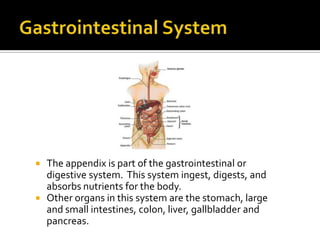
Gastrointestinal SystemThe appendix is part of the gastrointestinal or digestive system.  This system ingest, digests, and absorbs nutrients for the body.Other organs in this system are the stomach, large and small intestines, colon, liver, gallbladder and pancreas.
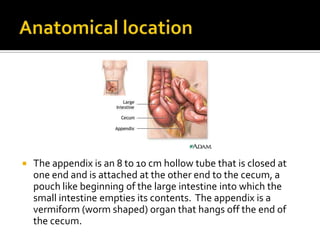
Anatomical locationThe appendix is an 8 to 10 cm hollow tube that is closed at one end and is attached at the other end to the cecum, a pouch like beginning of the large intestine into which the small intestine empties its contents.  The appendix is a vermiform (worm shaped) organ that hangs off the end of the cecum.
FunctionIt is not clear whether the appendix serves any useful purpose in modern humans. It has been hypothesized that the appendix is a vestigial organ; left over from the days of eating large amounts of plant matter.  The medical community is still studying this organ to understand its current function.  Current suspected functions include:
Function cont.General support for the immune system.  The appendix has a rich supply of lymphocytes; better known as B-cells, T-cells and natural killer cells;Housing and cultivating beneficial gut flora that can repopulate the digestive system following an illness; Providing a site for the production of endocrine cells in the fetus that produce molecules important in regulating homeostasis; Serving a possible role in immune function during the first three decades of life by exposing leukocytes (white blood cells) to antigens in the gastrointestinal tract, stimulating immune reactions in the gut.
PathologyThe cavity of the appendix is much narrower where it joins the cecum than it is at its closed end. If anything blocks the opening of the appendix or prevents it from expelling its contents into the cecum, appendicitis may occur, a painful and potentially dangerous inflammation. The most common obstruction in the opening is a fecalith, a hardened piece of fecal matter. When the appendix is prevented from emptying itself, inflammation occurs which if it is not relieved can lead to acute appendicitis.
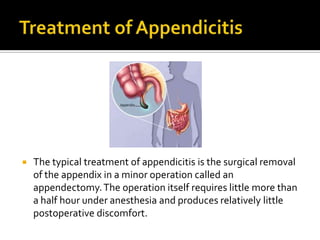
Treatment of AppendicitisThe typical treatment of appendicitis is the surgical removal of the appendix in a minor operation called an appendectomy. The operation itself requires little more than a half hour under anesthesia and produces relatively little postoperative discomfort.
ConclusionWhile the specific functions of the human appendix remain unclear, there is general agreement among scientists that the appendix is gradually disappearing from the human species over evolutionary time.
Sourceswww.britannica.com/www.webmd.com/digestiveFremgen and Frucht.Medical Terminology: A Living Language. 4th ed.  Prentice Hall Publishing, 2009.

The appendix

  • 1.
    The AppendixElizabeth LeeGregoryBio 1206/13/10
  • 2.
    Gastrointestinal SystemThe appendixis part of the gastrointestinal or digestive system. This system ingest, digests, and absorbs nutrients for the body.Other organs in this system are the stomach, large and small intestines, colon, liver, gallbladder and pancreas.
  • 3.
    Anatomical locationThe appendixis an 8 to 10 cm hollow tube that is closed at one end and is attached at the other end to the cecum, a pouch like beginning of the large intestine into which the small intestine empties its contents. The appendix is a vermiform (worm shaped) organ that hangs off the end of the cecum.
  • 4.
    FunctionIt is notclear whether the appendix serves any useful purpose in modern humans. It has been hypothesized that the appendix is a vestigial organ; left over from the days of eating large amounts of plant matter. The medical community is still studying this organ to understand its current function. Current suspected functions include:
  • 5.
    Function cont.General supportfor the immune system. The appendix has a rich supply of lymphocytes; better known as B-cells, T-cells and natural killer cells;Housing and cultivating beneficial gut flora that can repopulate the digestive system following an illness; Providing a site for the production of endocrine cells in the fetus that produce molecules important in regulating homeostasis; Serving a possible role in immune function during the first three decades of life by exposing leukocytes (white blood cells) to antigens in the gastrointestinal tract, stimulating immune reactions in the gut.
  • 6.
    PathologyThe cavity ofthe appendix is much narrower where it joins the cecum than it is at its closed end. If anything blocks the opening of the appendix or prevents it from expelling its contents into the cecum, appendicitis may occur, a painful and potentially dangerous inflammation. The most common obstruction in the opening is a fecalith, a hardened piece of fecal matter. When the appendix is prevented from emptying itself, inflammation occurs which if it is not relieved can lead to acute appendicitis.
  • 7.
    Treatment of AppendicitisThetypical treatment of appendicitis is the surgical removal of the appendix in a minor operation called an appendectomy. The operation itself requires little more than a half hour under anesthesia and produces relatively little postoperative discomfort.
  • 8.
    ConclusionWhile the specificfunctions of the human appendix remain unclear, there is general agreement among scientists that the appendix is gradually disappearing from the human species over evolutionary time.
  • 9.
    Sourceswww.britannica.com/www.webmd.com/digestiveFremgen and Frucht.MedicalTerminology: A Living Language. 4th ed. Prentice Hall Publishing, 2009.