I.INTRODUCTION
PatientT.A.isa 18 year-oldboywhowasadmittedat the ER last April 1, 2022 due to severe pain
at hisright lowerquadrant,the patientwasdiagnosedwithacute appendicitis.The patient
underwentemergencyappendectomyfewhoursafter toadmissionwhenhe hadsuddenonset
of epigastricpain,thatmigratedtothe rightlowerquadrant.
Appendicitisisthe inflammationof the vermiformappendix andwasfirstdescribedasa
pathologicconditionbyReginaldFitzin1886; itis causedbyan obstructionattributedto
infection,stricture,fecal mass,foreignbodyortumor.Appendicitiscanaffecteithergenderat
any age,but ismostcommon infemale ages10-30 yearsold.Appendicitisisthe mostcommon
disease requiringsurgeryandone of the mostcommonlymisdiagnoseddiseases.
Appendectomy,removalof the appendix,isthe standardtreatmentforacute appendicitis,itis
importantto immediatelyremovethe appendix afterthe diagnosistopreventthe occurrence of
the life-threateningcomplicationof appendix.The mostfrequentcomplicationof appendicitisis
perforation.Perforationof the appendixcanleadtoa periappendiceal abscess(acollectionof
infectedpus) ordiffuse peritonitis(infectionof the entireliningof the abdomenandthe pelvis).
The major reasonfor appendicealperforationisdelayindiagnosisandtreatment.Ingeneral,
the longerthe delaybetweendiagnosisandsurgery,the more likelytoperforation.The riskof
perforation36 hoursafterthe onsetof symptomsisat least 15%.Therefore,once appendicitisis
diagnosed,surgeryshouldbe done withoutunnecessarydelay.
II. NURSING OBJECTIVES:
 To obtainnecessaryinformationregardingthe patientandhiscondition.
 To assessthe patient'soverall healthstatus.
 To identify the patienthealthcare needsthroughanalysisof all the datagathered.
 To assistthe patientthroughoutrehabilitation,recoveryanddischarge.
 To performappropriate nursingcare inconjunctionwiththe conditionof the patient.
 To impactnecessaryhealthteachingstothe patient.
IV. DEFINITION OF TERMS
ABDOMEN -the part of the bodyof a vertebrate thatcontainsthe stomach,intestines,andother
organs
APPENDIX -anatomysmall outgrowthfromlarge intestine:ablind-endedtubeleadingfromthe
firstpart of the large intestine(cecum),nearitsjunctionwiththesmall intestine.Inhumansitis
small,occursin the lowerright-handpartof theabdomen,andcontainscellsof the immune
system
APPENDICITIS -Acute inflammationof the vermiform (wormlike) appendix,ablindtube
projectingfromthe cecum
APPENDECTOMY-operationtoremove appendix:asurgical operationtoremove the appendix
ALIMENTARY CANAL-the principal partof the digestivesystem.Itbeginsatthe mouthand
extendstothe anus
ANUS-the openingatthe lowerendof the alimentarycanal throughwhichfecesarereleased
CECUM -the pouchin whichthe large intestinebegins,whichisopenatone end
COLON – the large intestine
EPIGASTRIUM -the uppermiddle partof the abdomen
ILEOCECAL VALVE-amembranousstructure betweenthe cecumandthesmall intestine that
regulatesthe passage of foodmaterial fromthe small intestinetothe large intestine andalso
preventsthe passage of toxicwaste productsfromthe large intestine backintothe small
intestine
IMMUNOGLOBULIN -glycoproteinwithahighmolecularweightthatactslike anantibodyandis
producedbywhite bloodcellsduringanimmune response.
INFECTION -injuriouscontaminationof the bodyor part of the body bypathogenicagents,such
as fungi,bacteria,protozoa,rickettsiae,orviruses,orbythe toxinsthatthese agentsmay
produce
LARGE INTESTINE-lastsectionof the intestinal tract:the endsectionof thealimentarycanal
reachingfromileumtoanus,and consistingof the cecum, colon,andrectum.Itsfunctionisto
extractwaterand formfeces
MCBURNEY'S POINT-andcan be foundat the midpointof astraightlinedrawnfromthe
umbilicustothe rightanterioriliaccrest
OBSTRUCTION - ses or forms a
block or hindrance: somebody or something that cau
blockage or hindrance
PATHOLOGIC-extreme:uncontrolledorunreasonable
PERFORATION -makingholesorhavingthem:the act of makinga hole or holesinsomethingor
the state of beingperforated
PERITONITIS -inflammationof abdomenlining:inflammationof themembrane thatlinesthe
abdomen(peritoneum)
PERIUMBILICAL AREA – withinthe umbilicus
ROVSIGN SIGN -existwhenthe lowerleftabdomenispalpatedbythe doctor,butcausespainin
the right
PSOASSIGN -If the hipis movedandstretched,thiscancause painto be feltatthe spotwhere
the appendix lies
STRICTURE -a severe criticismorstronglycritical remark
TUMOR -an abnormal uncontrolledgrowthormassof bodycells,whichmaybemalignantor
benignandhas nophysiological function.
V. Patient profile
Name
: T .A
Address
: Jedah city
Age: 18 years
Birthdate: September
, 2003
Birthplace
: JedahCity
Gender: Male
Marital Status: Single
Occupation:none
Religion
: Islam
Educational level
: highsecondaryschool student
Nationality
: saudi
Date of admission
: April 2,2022
Attending Physician: Dr
. A.S
Chiefcomplaint: Abdominal Pain
Date of surgery
: April 1, 2022 .
VI. HEALTH HISTORY
1. History of PresentIllness
Patientwasinusual state of goodhealthuntil April 1,2022 ,afterhavinghisdinnerhe
experiencedasevere painathisabdomenwhichstartedatperiumbilical areathenshiftedto
the right lowerquadrantregion.He wasimmediatelyrushedtothe hospital andwasadmitted
at ER at 9:55 PM, He was diagnosedwithacute appendicitis.
He underwentanemergencyappendectomyafew hoursaftertoadmission,April1,2022.Her
operationbegunat12:08 AMand endedat12:40 AM, hissurgeonwas Dr. A.SAccordingto the
patient,He hadbeenexperiencingmildpainathisabdominal regionsince he was14 years old,
He evenconsultedittothe doctorbut theydidnot paymuch attentiontoitthinkingthatit was
justamanifestationof hiskidneyproblemandthatitwas nothingserious.
The patient’svital signsduringthe shiftwere asfollow:
Temperature:36.5 °C
Pulse Rate:87 bpm
RespiratoryRate:30 cpm
BloodPressure:120/80 mmHg
2. Past Health History
a. Childhoodillness>The clienthasonlyexperiencedstomachpainandminorhealthproblems
such as occasional cough,colds,andmildfever.
b. PastHospitalization>Patienthasnoprevioushospitalization,nohistoryof
Hypertension,Diabetes,Cancer,noknownallergies.
c. Serious/chronicillness>The clienthasno experience of anyseriousorchronicillness.Heonly
experiencedstomachpainandminorhealthproblemssuchasoccasional cough,colds,andmild
fever.
d. PreviousSurgery>Noprevioushistoryof surgical operation.
3. Family/Social History
mily history of Hypertension, diabetes, pulmonary tuberculosis,cancer,
No known fa
allergies and other hereditofamilial diseases
.
Assessment
Body Part Normal Findings Patient Findings Significance
Skin Warm to touch Withgood
skinturgor
Head,Eyes,
Ears,Nose
PupilsEquallyRoundand
Reactive toLight
Accommodation>With
pinkishconjunctiva
Respiratory Breathesspontaneouslyto
room airat 30 cpm> With
shallow symmetrical rise
and fall of chestupon
respiration
Cardiovascular - S1+S2 and noadditional
sounds
- Bloodpressure of 120/80
mmHg, - Pulse rate of
87bpm
- goodcapillaryrefill atless
than 2 seconds
Gastrointestinal -OnNPOas ordered
Has not
-
defecated upon
assessment
Able to pass out
-
flatus
upon assessmen With
normoactive bowel
sounds at 13 cpm
Urinary Able tovoidfreelywitha
lightyellow coloredurine
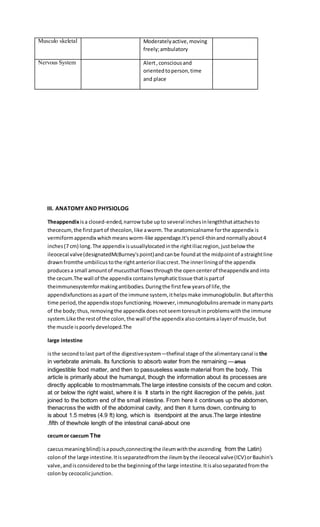
III. ANATOMY AND PHYSIOLOG
Theappendix isa closed-ended,narrow tube upto several inchesinlengththatattachesto
thececum,the firstpartof thecolon,like aworm.The anatomicalname forthe appendix is
vermiformappendix whichmeansworm-like appendage.It'spencil-thinandnormallyabout4
inches(7 cm) long.The appendix isusuallylocatedinthe rightiliacregion,justbelow the
ileocecal valve(designatedMcBurney'spoint)andcanbe foundat the midpointof astraightline
drawnfromthe umbilicustothe rightanterioriliaccrest.The innerliningof the appendix
producesa small amountof mucusthatflowsthroughthe opencenterof theappendix andinto
the cecum.The wall of the appendix containslymphatictissue thatispartof
theimmunesystemformakingantibodies.Duringthe firstfew yearsof life,the
appendixfunctionsasapart of the immune system, ithelpsmake immunoglobulin.Butafterthis
time period,the appendix stopsfunctioning.However,immunoglobulinsaremade inmanyparts
of the body;thus,removingthe appendix doesnotseemtoresultinproblemswiththe immune
system.Like the restof the colon,the wall of the appendix alsocontainsalayerof muscle,but
the muscle ispoorlydeveloped.The
large intestine
isthe secondtolast part of the digestivesystem—thefinal stage of the alimentarycanal is the
anus
—
in vertebrate animals. Its functionis to absorb water from the remaining
indigestible food matter, and then to passuseless waste material from the body. This
article is primarily about the humangut, though the information about its processes are
directly applicable to mostmammals.The large intestine consists of the cecum and colon.
It starts in the right iliacregion of the pelvis, just
at or below the right waist, where it is
joined to the bottom end of the small intestine. From here it continues up the abdomen,
thenacross the width of the abdominal cavity, and then it turns down, continuing to
itsendpoint at the anus.The large intestine
is about 1.5 metres (4.9 ft) long, which is
about one
-
fifth of thewhole length of the intestinal canal
.
The
cecumor caecum
(
from the Latin
caecusmeaningblind) isapouch,connectingthe ileumwiththe ascending
colonof the large intestine.Itisseparatedfromthe ileumbythe ileocecal valve(ICV)orBauhin's
valve,andisconsideredtobe the beginningof the large intestine.Itisalsoseparatedfromthe
colonby cecocolicjunction.
Musculo skeletal Moderatelyactive,moving
freely;ambulatory
Nervous System Alert,consciousand
orientedtoperson,time
and place
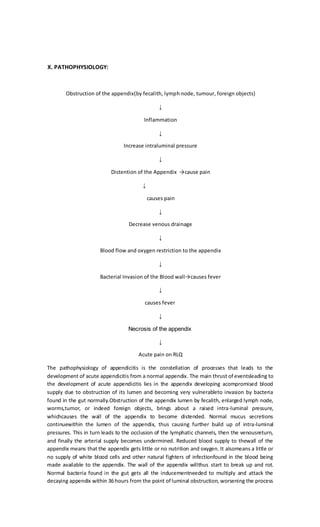
X. PATHOPHYSIOLOGY:
Obstruction of the appendix(by fecalith, lymph node, tumour, foreign objects)
↓
Inflammation
↓
Increase intraluminal pressure
↓
Distention of the Appendix →cause pain
↓
causes pain
↓
Decrease venous drainage
↓
Blood flow and oxygen restriction to the appendix
↓
Bacterial Invasion of the Blood wall→causes fever
↓
causes fever
↓
Necrosis of the appendix
↓
Acute pain on RLQ
The pathophysiology of appendicitis is the constellation of processes that leads to the
development of acute appendicitis from a normal appendix. The main thrust of eventsleading to
the development of acute appendicitis lies in the appendix developing acompromised blood
supply due to obstruction of its lumen and becoming very vulnerableto invasion by bacteria
found in the gut normally.Obstruction of the appendix lumen by fecalith, enlarged lymph node,
worms,tumor, or indeed foreign objects, brings about a raised intra-luminal pressure,
whichcauses the wall of the appendix to become distended. Normal mucus secretions
continuewithin the lumen of the appendix, thus causing further build up of intra-luminal
pressures. This in turn leads to the occlusion of the lymphatic channels, then the venousreturn,
and finally the arterial supply becomes undermined. Reduced blood supply to thewall of the
appendix means that the appendix gets little or no nutrition and oxygen. It alsomeans a little or
no supply of white blood cells and other natural fighters of infectionfound in the blood being
made available to the appendix. The wall of the appendix willthus start to break up and rot.
Normal bacteria found in the gut gets all the inducementneeded to multiply and attack the
decaying appendix within 36 hours from the point of luminal obstruction, worsening the process
of appendicitis. This leads to necrosis and perforation of the appendix. Pus formation occurs
when nearby white blood cells arerecruited to fight the bacterial invasion. A combination of
dead white blood cells, bacteria, and dead tissue makes up pus. The content of the appendix
(fecalith, pus andmucus secretions) are then released into the general abdominal cavity,
bringingcausingperitonitis.
So,in acute appendicitis,bacterial colonizationfollowsonlywhenthe processhave
commenced.These eventsoccursorapidly,thatthe complete pathophysiologyof appendicitis
takesaboutone tothree days.Thisis whydelaycanbe deadly.
Pain inappendicitisisthuscaused,initiallybythe distensionof the wall of theappendix,and
laterwhenthe grosslyinflamedappendix rubsonthe overlyinginnerwallof the abdomen
(parietal peritoneum) andthenwiththe spillage of the contentof theappendix intothe general
abdominal cavity(peritonitis).Feverisbroughtaboutbythereleaseof toxicmaterials
(endogenouspyrogens) followingthe necrosisof appendicaelwall,andlaterbypusformation.
Loss of appetite andnauseafollowsslowingandirritationof the bowelbythe inflammatory
process.Earlysymptomsof appendicitisare those symptomsthatmostpeople with
thisconditionmayrecognize andcomplainof.Theyinclude lowerrightsidedabdominal painof
gradual onset,feelingsick(ornausea),andlossof appetite.Anyone withthese threesymptoms
can be assumedtohave appendicitisuntil provenotherwise.
•
Abdominal pain
Thispaintypicallystartsfromaroundthe bellybutton(peri-umbilicalregion),orthe upper
central abdomen(epigastrium)andthenmove downwardsandtothe lowerrightabdomen
(rightiliacfossa).Whenthe painoccursin thispattern,itisthe mostdependable of all
symptomsof appendicitis,asover8 out 10(80%) casesthat presentthiswayisdefinitelydue to
the appendix.Insome otherindividuals,the painstartsrightwayfrom the rightiliacfossa.
Dependingonwhere the tipof the appendixis,the paincouldevenbe onthe rightflank(retro-
caecal appendix).If the appendix isquite long,andinthe pelviccavity,itcouldaswell cause
lowerleftabdominalpain,withfrequentpassage of urine if theinflamedappendix irritatesthe
bladder.
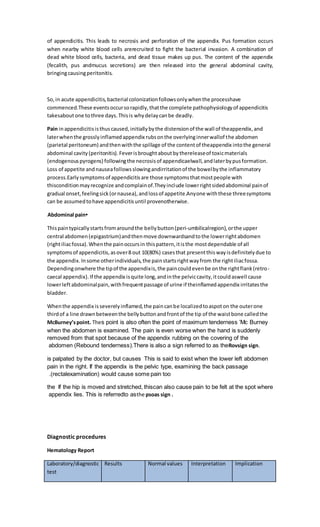
Whenthe appendix isseverelyinflamed,the paincanbe localizedtoaspoton the outerone
thirdof a line drawnbetweenthe bellybuttonandfrontof the tip of the waistbone calledthe
McBurney’spoint. The Mc Burney
’
s point is also often the point of maximum tenderness
ain is even worse when the hand is suddenly
when the abdomen is examined. The p
removed from that spot because of the appendix rubbing on the covering of the
abdomen (Rebound tenderness).There is also a sign referred to as theRovsign sign.
This is said to exist when the lower left abdomen
is palpated by the doctor, but causes
pain in the right. If the appendix is the pelvic type, examining the back passage
(rectalexamination) would cause some pain too
.
If the hip is moved and stretched, thiscan also cause pain to be felt at the spot where
the
appendix lies. This is referredto asthe psoas sign .
Diagnostic procedures
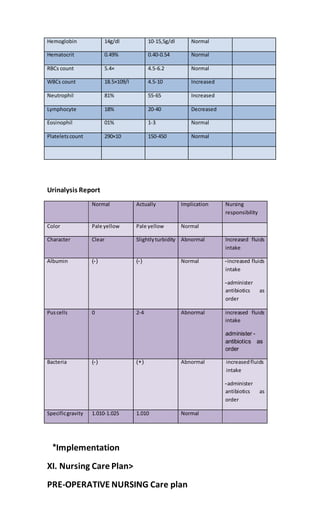
Hematology Report
Laboratory/diagnostic
test
Results Normal values Interpretation Implication
Hemoglobin 14g/dl 10-15,5g/dl Normal
Hematocrit 0.49% 0.40-0.54 Normal
RBCs count 5.4× 4.5-6.2 Normal
WBCs count 18.5×10⁹/l 4.5-10 Increased
Neutrophil 81% 55-65 Increased
Lymphocyte 18% 20-40 Decreased
Eosinophil 01% 1-3 Normal
Plateletscount 290×10 150-450 Normal
Urinalysis Report
Normal Actually Implication Nursing
responsibility
Color Pale yellow Pale yellow Normal
Character Clear Slightlyturbidity Abnormal Increased fluids
intake
Albumin (
-
) (
-
) Normal -increased fluids
intake
-administer
antibiotics as
order
Puscells 0 2-4 Abnormal increased fluids
intake
-
administer
antibiotics as
order
Bacteria (
-
) )+( Abnormal increasedfluids
intake
-administer
antibiotics as
order
Specificgravity 1.010-1.025 1.010 Normal
*Implementation
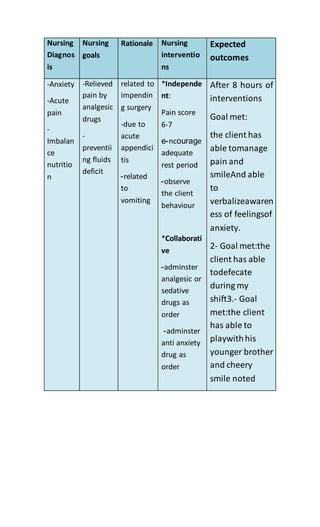
XI. Nursing Care Plan>
PRE-OPERATIVE NURSING Care plan
Nursing
Diagnos
is
Nursing
goals
Rationale Nursing
interventio
ns
Expected
outcomes
-Anxiety
-Acute
pain
-
Imbalan
ce
nutritio
n
-Relieved
pain by
analgesic
drugs
-
preventii
ng fluids
deficit
related to
impendin
g surgery
-due to
acute
appendici
tis
-related
to
vomiting
*Independe
nt:
Pain score
6-7
-
e ncourage
adequate
rest period
-observe
the client
behaviour
*Collaborati
ve
-adminster
analgesic or
sedative
drugs as
order
-adminster
anti anxiety
drug as
order
After 8 hours of
interventions
Goal met:
the client has
able tomanage
pain and
smileAnd able
to
verbalizeawaren
ess of feelingsof
anxiety.
2- Goal met:the
client has able
todefecate
during my
shift3.- Goal
met:the client
has able to
playwithhis
younger brother
and cheery
smile noted

nursing case study.docx

  • 1.
    I.INTRODUCTION PatientT.A.isa 18 year-oldboywhowasadmittedatthe ER last April 1, 2022 due to severe pain at hisright lowerquadrant,the patientwasdiagnosedwithacute appendicitis.The patient underwentemergencyappendectomyfewhoursafter toadmissionwhenhe hadsuddenonset of epigastricpain,thatmigratedtothe rightlowerquadrant. Appendicitisisthe inflammationof the vermiformappendix andwasfirstdescribedasa pathologicconditionbyReginaldFitzin1886; itis causedbyan obstructionattributedto infection,stricture,fecal mass,foreignbodyortumor.Appendicitiscanaffecteithergenderat any age,but ismostcommon infemale ages10-30 yearsold.Appendicitisisthe mostcommon disease requiringsurgeryandone of the mostcommonlymisdiagnoseddiseases. Appendectomy,removalof the appendix,isthe standardtreatmentforacute appendicitis,itis importantto immediatelyremovethe appendix afterthe diagnosistopreventthe occurrence of the life-threateningcomplicationof appendix.The mostfrequentcomplicationof appendicitisis perforation.Perforationof the appendixcanleadtoa periappendiceal abscess(acollectionof infectedpus) ordiffuse peritonitis(infectionof the entireliningof the abdomenandthe pelvis). The major reasonfor appendicealperforationisdelayindiagnosisandtreatment.Ingeneral, the longerthe delaybetweendiagnosisandsurgery,the more likelytoperforation.The riskof perforation36 hoursafterthe onsetof symptomsisat least 15%.Therefore,once appendicitisis diagnosed,surgeryshouldbe done withoutunnecessarydelay. II. NURSING OBJECTIVES:  To obtainnecessaryinformationregardingthe patientandhiscondition.  To assessthe patient'soverall healthstatus.  To identify the patienthealthcare needsthroughanalysisof all the datagathered.  To assistthe patientthroughoutrehabilitation,recoveryanddischarge.  To performappropriate nursingcare inconjunctionwiththe conditionof the patient.  To impactnecessaryhealthteachingstothe patient. IV. DEFINITION OF TERMS ABDOMEN -the part of the bodyof a vertebrate thatcontainsthe stomach,intestines,andother organs APPENDIX -anatomysmall outgrowthfromlarge intestine:ablind-endedtubeleadingfromthe firstpart of the large intestine(cecum),nearitsjunctionwiththesmall intestine.Inhumansitis small,occursin the lowerright-handpartof theabdomen,andcontainscellsof the immune system
  • 2.
    APPENDICITIS -Acute inflammationofthe vermiform (wormlike) appendix,ablindtube projectingfromthe cecum APPENDECTOMY-operationtoremove appendix:asurgical operationtoremove the appendix ALIMENTARY CANAL-the principal partof the digestivesystem.Itbeginsatthe mouthand extendstothe anus ANUS-the openingatthe lowerendof the alimentarycanal throughwhichfecesarereleased CECUM -the pouchin whichthe large intestinebegins,whichisopenatone end COLON – the large intestine EPIGASTRIUM -the uppermiddle partof the abdomen ILEOCECAL VALVE-amembranousstructure betweenthe cecumandthesmall intestine that regulatesthe passage of foodmaterial fromthe small intestinetothe large intestine andalso preventsthe passage of toxicwaste productsfromthe large intestine backintothe small intestine IMMUNOGLOBULIN -glycoproteinwithahighmolecularweightthatactslike anantibodyandis producedbywhite bloodcellsduringanimmune response. INFECTION -injuriouscontaminationof the bodyor part of the body bypathogenicagents,such as fungi,bacteria,protozoa,rickettsiae,orviruses,orbythe toxinsthatthese agentsmay produce LARGE INTESTINE-lastsectionof the intestinal tract:the endsectionof thealimentarycanal reachingfromileumtoanus,and consistingof the cecum, colon,andrectum.Itsfunctionisto extractwaterand formfeces MCBURNEY'S POINT-andcan be foundat the midpointof astraightlinedrawnfromthe umbilicustothe rightanterioriliaccrest OBSTRUCTION - ses or forms a block or hindrance: somebody or something that cau blockage or hindrance PATHOLOGIC-extreme:uncontrolledorunreasonable PERFORATION -makingholesorhavingthem:the act of makinga hole or holesinsomethingor the state of beingperforated PERITONITIS -inflammationof abdomenlining:inflammationof themembrane thatlinesthe abdomen(peritoneum) PERIUMBILICAL AREA – withinthe umbilicus ROVSIGN SIGN -existwhenthe lowerleftabdomenispalpatedbythe doctor,butcausespainin the right PSOASSIGN -If the hipis movedandstretched,thiscancause painto be feltatthe spotwhere the appendix lies STRICTURE -a severe criticismorstronglycritical remark TUMOR -an abnormal uncontrolledgrowthormassof bodycells,whichmaybemalignantor benignandhas nophysiological function. V. Patient profile Name : T .A
  • 3.
    Address : Jedah city Age:18 years Birthdate: September , 2003 Birthplace : JedahCity Gender: Male Marital Status: Single Occupation:none Religion : Islam Educational level : highsecondaryschool student Nationality : saudi Date of admission : April 2,2022 Attending Physician: Dr . A.S Chiefcomplaint: Abdominal Pain Date of surgery : April 1, 2022 . VI. HEALTH HISTORY 1. History of PresentIllness Patientwasinusual state of goodhealthuntil April 1,2022 ,afterhavinghisdinnerhe experiencedasevere painathisabdomenwhichstartedatperiumbilical areathenshiftedto the right lowerquadrantregion.He wasimmediatelyrushedtothe hospital andwasadmitted at ER at 9:55 PM, He was diagnosedwithacute appendicitis. He underwentanemergencyappendectomyafew hoursaftertoadmission,April1,2022.Her operationbegunat12:08 AMand endedat12:40 AM, hissurgeonwas Dr. A.SAccordingto the patient,He hadbeenexperiencingmildpainathisabdominal regionsince he was14 years old, He evenconsultedittothe doctorbut theydidnot paymuch attentiontoitthinkingthatit was justamanifestationof hiskidneyproblemandthatitwas nothingserious. The patient’svital signsduringthe shiftwere asfollow: Temperature:36.5 °C Pulse Rate:87 bpm RespiratoryRate:30 cpm BloodPressure:120/80 mmHg 2. Past Health History a. Childhoodillness>The clienthasonlyexperiencedstomachpainandminorhealthproblems such as occasional cough,colds,andmildfever. b. PastHospitalization>Patienthasnoprevioushospitalization,nohistoryof Hypertension,Diabetes,Cancer,noknownallergies.
  • 4.
    c. Serious/chronicillness>The clienthasnoexperience of anyseriousorchronicillness.Heonly experiencedstomachpainandminorhealthproblemssuchasoccasional cough,colds,andmild fever. d. PreviousSurgery>Noprevioushistoryof surgical operation. 3. Family/Social History mily history of Hypertension, diabetes, pulmonary tuberculosis,cancer, No known fa allergies and other hereditofamilial diseases . Assessment Body Part Normal Findings Patient Findings Significance Skin Warm to touch Withgood skinturgor Head,Eyes, Ears,Nose PupilsEquallyRoundand Reactive toLight Accommodation>With pinkishconjunctiva Respiratory Breathesspontaneouslyto room airat 30 cpm> With shallow symmetrical rise and fall of chestupon respiration Cardiovascular - S1+S2 and noadditional sounds - Bloodpressure of 120/80 mmHg, - Pulse rate of 87bpm - goodcapillaryrefill atless than 2 seconds Gastrointestinal -OnNPOas ordered Has not - defecated upon assessment Able to pass out - flatus upon assessmen With normoactive bowel sounds at 13 cpm Urinary Able tovoidfreelywitha lightyellow coloredurine
  • 5.
    III. ANATOMY ANDPHYSIOLOG Theappendix isa closed-ended,narrow tube upto several inchesinlengththatattachesto thececum,the firstpartof thecolon,like aworm.The anatomicalname forthe appendix is vermiformappendix whichmeansworm-like appendage.It'spencil-thinandnormallyabout4 inches(7 cm) long.The appendix isusuallylocatedinthe rightiliacregion,justbelow the ileocecal valve(designatedMcBurney'spoint)andcanbe foundat the midpointof astraightline drawnfromthe umbilicustothe rightanterioriliaccrest.The innerliningof the appendix producesa small amountof mucusthatflowsthroughthe opencenterof theappendix andinto the cecum.The wall of the appendix containslymphatictissue thatispartof theimmunesystemformakingantibodies.Duringthe firstfew yearsof life,the appendixfunctionsasapart of the immune system, ithelpsmake immunoglobulin.Butafterthis time period,the appendix stopsfunctioning.However,immunoglobulinsaremade inmanyparts of the body;thus,removingthe appendix doesnotseemtoresultinproblemswiththe immune system.Like the restof the colon,the wall of the appendix alsocontainsalayerof muscle,but the muscle ispoorlydeveloped.The large intestine isthe secondtolast part of the digestivesystem—thefinal stage of the alimentarycanal is the anus — in vertebrate animals. Its functionis to absorb water from the remaining indigestible food matter, and then to passuseless waste material from the body. This article is primarily about the humangut, though the information about its processes are directly applicable to mostmammals.The large intestine consists of the cecum and colon. It starts in the right iliacregion of the pelvis, just at or below the right waist, where it is joined to the bottom end of the small intestine. From here it continues up the abdomen, thenacross the width of the abdominal cavity, and then it turns down, continuing to itsendpoint at the anus.The large intestine is about 1.5 metres (4.9 ft) long, which is about one - fifth of thewhole length of the intestinal canal . The cecumor caecum ( from the Latin caecusmeaningblind) isapouch,connectingthe ileumwiththe ascending colonof the large intestine.Itisseparatedfromthe ileumbythe ileocecal valve(ICV)orBauhin's valve,andisconsideredtobe the beginningof the large intestine.Itisalsoseparatedfromthe colonby cecocolicjunction. Musculo skeletal Moderatelyactive,moving freely;ambulatory Nervous System Alert,consciousand orientedtoperson,time and place
  • 6.
    X. PATHOPHYSIOLOGY: Obstruction ofthe appendix(by fecalith, lymph node, tumour, foreign objects) ↓ Inflammation ↓ Increase intraluminal pressure ↓ Distention of the Appendix →cause pain ↓ causes pain ↓ Decrease venous drainage ↓ Blood flow and oxygen restriction to the appendix ↓ Bacterial Invasion of the Blood wall→causes fever ↓ causes fever ↓ Necrosis of the appendix ↓ Acute pain on RLQ The pathophysiology of appendicitis is the constellation of processes that leads to the development of acute appendicitis from a normal appendix. The main thrust of eventsleading to the development of acute appendicitis lies in the appendix developing acompromised blood supply due to obstruction of its lumen and becoming very vulnerableto invasion by bacteria found in the gut normally.Obstruction of the appendix lumen by fecalith, enlarged lymph node, worms,tumor, or indeed foreign objects, brings about a raised intra-luminal pressure, whichcauses the wall of the appendix to become distended. Normal mucus secretions continuewithin the lumen of the appendix, thus causing further build up of intra-luminal pressures. This in turn leads to the occlusion of the lymphatic channels, then the venousreturn, and finally the arterial supply becomes undermined. Reduced blood supply to thewall of the appendix means that the appendix gets little or no nutrition and oxygen. It alsomeans a little or no supply of white blood cells and other natural fighters of infectionfound in the blood being made available to the appendix. The wall of the appendix willthus start to break up and rot. Normal bacteria found in the gut gets all the inducementneeded to multiply and attack the decaying appendix within 36 hours from the point of luminal obstruction, worsening the process
  • 7.
    of appendicitis. Thisleads to necrosis and perforation of the appendix. Pus formation occurs when nearby white blood cells arerecruited to fight the bacterial invasion. A combination of dead white blood cells, bacteria, and dead tissue makes up pus. The content of the appendix (fecalith, pus andmucus secretions) are then released into the general abdominal cavity, bringingcausingperitonitis. So,in acute appendicitis,bacterial colonizationfollowsonlywhenthe processhave commenced.These eventsoccursorapidly,thatthe complete pathophysiologyof appendicitis takesaboutone tothree days.Thisis whydelaycanbe deadly. Pain inappendicitisisthuscaused,initiallybythe distensionof the wall of theappendix,and laterwhenthe grosslyinflamedappendix rubsonthe overlyinginnerwallof the abdomen (parietal peritoneum) andthenwiththe spillage of the contentof theappendix intothe general abdominal cavity(peritonitis).Feverisbroughtaboutbythereleaseof toxicmaterials (endogenouspyrogens) followingthe necrosisof appendicaelwall,andlaterbypusformation. Loss of appetite andnauseafollowsslowingandirritationof the bowelbythe inflammatory process.Earlysymptomsof appendicitisare those symptomsthatmostpeople with thisconditionmayrecognize andcomplainof.Theyinclude lowerrightsidedabdominal painof gradual onset,feelingsick(ornausea),andlossof appetite.Anyone withthese threesymptoms can be assumedtohave appendicitisuntil provenotherwise. • Abdominal pain Thispaintypicallystartsfromaroundthe bellybutton(peri-umbilicalregion),orthe upper central abdomen(epigastrium)andthenmove downwardsandtothe lowerrightabdomen (rightiliacfossa).Whenthe painoccursin thispattern,itisthe mostdependable of all symptomsof appendicitis,asover8 out 10(80%) casesthat presentthiswayisdefinitelydue to the appendix.Insome otherindividuals,the painstartsrightwayfrom the rightiliacfossa. Dependingonwhere the tipof the appendixis,the paincouldevenbe onthe rightflank(retro- caecal appendix).If the appendix isquite long,andinthe pelviccavity,itcouldaswell cause lowerleftabdominalpain,withfrequentpassage of urine if theinflamedappendix irritatesthe bladder. Whenthe appendix isseverelyinflamed,the paincanbe localizedtoaspoton the outerone thirdof a line drawnbetweenthe bellybuttonandfrontof the tip of the waistbone calledthe McBurney’spoint. The Mc Burney ’ s point is also often the point of maximum tenderness ain is even worse when the hand is suddenly when the abdomen is examined. The p removed from that spot because of the appendix rubbing on the covering of the abdomen (Rebound tenderness).There is also a sign referred to as theRovsign sign. This is said to exist when the lower left abdomen is palpated by the doctor, but causes pain in the right. If the appendix is the pelvic type, examining the back passage (rectalexamination) would cause some pain too . If the hip is moved and stretched, thiscan also cause pain to be felt at the spot where the appendix lies. This is referredto asthe psoas sign . Diagnostic procedures Hematology Report Laboratory/diagnostic test Results Normal values Interpretation Implication
  • 8.
    Hemoglobin 14g/dl 10-15,5g/dlNormal Hematocrit 0.49% 0.40-0.54 Normal RBCs count 5.4× 4.5-6.2 Normal WBCs count 18.5×10⁹/l 4.5-10 Increased Neutrophil 81% 55-65 Increased Lymphocyte 18% 20-40 Decreased Eosinophil 01% 1-3 Normal Plateletscount 290×10 150-450 Normal Urinalysis Report Normal Actually Implication Nursing responsibility Color Pale yellow Pale yellow Normal Character Clear Slightlyturbidity Abnormal Increased fluids intake Albumin ( - ) ( - ) Normal -increased fluids intake -administer antibiotics as order Puscells 0 2-4 Abnormal increased fluids intake - administer antibiotics as order Bacteria ( - ) )+( Abnormal increasedfluids intake -administer antibiotics as order Specificgravity 1.010-1.025 1.010 Normal *Implementation XI. Nursing Care Plan> PRE-OPERATIVE NURSING Care plan
  • 9.
    Nursing Diagnos is Nursing goals Rationale Nursing interventio ns Expected outcomes -Anxiety -Acute pain - Imbalan ce nutritio n -Relieved pain by analgesic drugs - preventii ngfluids deficit related to impendin g surgery -due to acute appendici tis -related to vomiting *Independe nt: Pain score 6-7 - e ncourage adequate rest period -observe the client behaviour *Collaborati ve -adminster analgesic or sedative drugs as order -adminster anti anxiety drug as order After 8 hours of interventions Goal met: the client has able tomanage pain and smileAnd able to verbalizeawaren ess of feelingsof anxiety. 2- Goal met:the client has able todefecate during my shift3.- Goal met:the client has able to playwithhis younger brother and cheery smile noted