Do Now: In a paragraph
answer the following
  If you could visit any
  country in the world
  where would it be and
  why?


                Ms. Herrera
At the end of this lesson
  Students will be able to:
     Understand what a Brochure is
     The different types of Brochures
     Set up a Microsoft Word
      Document
A brochure also known as a
pamphlet is most commonly
found around museums, major
shop, amusement parks and
information booths. They are
also found at health clinics and
hospitals or interpersonal
brochures.
They are designed and
used for:
  A marketing tool to
    advertise a service or
    product
  As an information
    providing tool
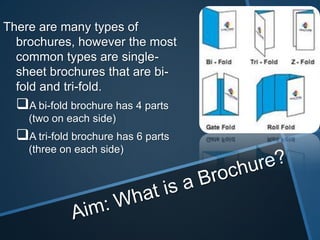
There are many types of
  brochures, however the most
  common types are single-
  sheet brochures that are bi-
  fold and tri-fold.
  A bi-fold brochure has 4 parts
    (two on each side)
  A tri-fold brochure has 6 parts
    (three on each side)
Why is it important to plan your
brochure layout?
First impressions are lasting!
The way you layout your
  information will grab readers’
  attention
Cover page
 Should be attractive and
  should include the name of
  organization/place/company
In addition, a photo or
  graphic should be on the
  cover page
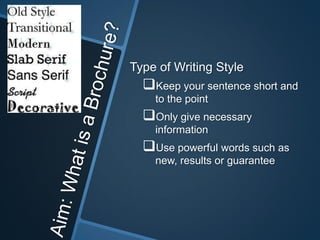
Type of Writing Style
  Keep your sentence short and
    to the point
  Only give necessary
    information
  Use powerful words such as
    new, results or guarantee
Heading
 The use of headings draw
   attention to sections on
   your brochure
 The heading should stand
   out, by having a bigger font
   and color
Grammar and Spelling
  It is very important that you
    proof read your work
  Grammatical and spelling
    mistakes takes the
    attention of the reader’s
    away
Aim: What is a Brochure?
Color combinations
  Make sure you use colors that
    go together
    o   If you have lime green with
        shocking pink reader’s will not
        want to read your brochure


The most important thing is to
grab the reader’s attention
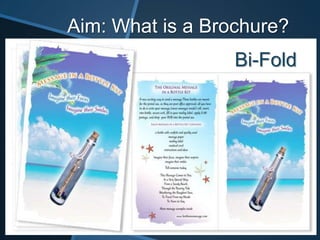
Bi-fold brochures are found among us every day:
    they are one of the most common brochure
    types. These brochures are economical to
    print since they are usually a double print
    folded in half. This folding forms 4 panels: a
    front-cover, a back-cover, and two internal
    panels.
However, there are other configurations: 8-
  page, 12-page, 16-page and so on. The front
  panel works as the front-page, and its main
  purpose is to introduce the piece and to cause
  the necessary intrigue or impact to make the
  viewer want to open it and read the
  content, while the back-cover is used for
  contact information; of course this can
  change.
They are more formal that that tri-fold
   brochures, and are intended for product
   presentations, catalogues, institutional
   introductions, etc. Bi-fold brochures can also
   work as folders in which you can place inserts
   depending on the prospective interests: this is
   ideal for trade shows, for example. Large bi-
   fold brochures have a long lifetime, and are
   usually read in more detail than small tri-folds.
Tri-fold brochures are one of the most
    common brochures. They are thin and
    convenient to carry and tempt viewers to
    open it as they cause intrigue.These
    brochures are economical to print since
    they are basically standard-sized prints
    on light stocks that are folded in three.
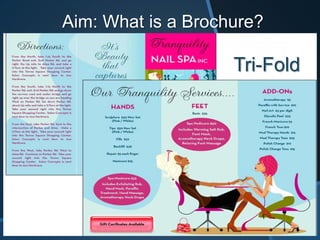
    They have 6 panels to place information
    on, which is an advantage over other
    types of brochures.
However, this is not always true: the tri-fold
  morphology adapts to larger brochures.
  In these cases, they usually have triple
  or double pages, and the stock used is
  of higher quality.Viewers are tempted to
  open these kind of brochures, as they
  cause intrigue. So, they are suitable for
  designs of good impact.They are
  intended to be handed over to people:
  ideal to put in folders, or as a more
  elegant alternative to the flyer in trade
  shows.
Aim: What is a Brochure?
                  Bi-Fold
Aim: What is a Brochure?

                    Tri-Fold
1. What are the different types of
   brochures?
2. Where are brochure most
   commonly found?
3. What should be on the first
   page?
4. Why is it important to plan the
   layout of the brochure?

Brochure Slide Show

  • 1.
    Do Now: Ina paragraph answer the following If you could visit any country in the world where would it be and why? Ms. Herrera
  • 2.
    At the endof this lesson Students will be able to:  Understand what a Brochure is  The different types of Brochures  Set up a Microsoft Word Document
  • 3.
    A brochure alsoknown as a pamphlet is most commonly found around museums, major shop, amusement parks and information booths. They are also found at health clinics and hospitals or interpersonal brochures.
  • 4.
    They are designedand used for: A marketing tool to advertise a service or product As an information providing tool
  • 5.
    There are manytypes of brochures, however the most common types are single- sheet brochures that are bi- fold and tri-fold. A bi-fold brochure has 4 parts (two on each side) A tri-fold brochure has 6 parts (three on each side)
  • 6.
    Why is itimportant to plan your brochure layout? First impressions are lasting! The way you layout your information will grab readers’ attention
  • 7.
    Cover page  Shouldbe attractive and should include the name of organization/place/company In addition, a photo or graphic should be on the cover page
  • 8.
    Type of WritingStyle Keep your sentence short and to the point Only give necessary information Use powerful words such as new, results or guarantee
  • 9.
    Heading The useof headings draw attention to sections on your brochure The heading should stand out, by having a bigger font and color
  • 10.
    Grammar and Spelling It is very important that you proof read your work Grammatical and spelling mistakes takes the attention of the reader’s away
  • 11.
    Aim: What isa Brochure?
  • 12.
    Color combinations Make sure you use colors that go together o If you have lime green with shocking pink reader’s will not want to read your brochure The most important thing is to grab the reader’s attention
  • 13.
    Bi-fold brochures arefound among us every day: they are one of the most common brochure types. These brochures are economical to print since they are usually a double print folded in half. This folding forms 4 panels: a front-cover, a back-cover, and two internal panels. However, there are other configurations: 8- page, 12-page, 16-page and so on. The front panel works as the front-page, and its main purpose is to introduce the piece and to cause the necessary intrigue or impact to make the viewer want to open it and read the content, while the back-cover is used for contact information; of course this can change. They are more formal that that tri-fold brochures, and are intended for product presentations, catalogues, institutional introductions, etc. Bi-fold brochures can also work as folders in which you can place inserts depending on the prospective interests: this is ideal for trade shows, for example. Large bi- fold brochures have a long lifetime, and are usually read in more detail than small tri-folds.
  • 14.
    Tri-fold brochures areone of the most common brochures. They are thin and convenient to carry and tempt viewers to open it as they cause intrigue.These brochures are economical to print since they are basically standard-sized prints on light stocks that are folded in three. They have 6 panels to place information on, which is an advantage over other types of brochures. However, this is not always true: the tri-fold morphology adapts to larger brochures. In these cases, they usually have triple or double pages, and the stock used is of higher quality.Viewers are tempted to open these kind of brochures, as they cause intrigue. So, they are suitable for designs of good impact.They are intended to be handed over to people: ideal to put in folders, or as a more elegant alternative to the flyer in trade shows.
  • 15.
    Aim: What isa Brochure? Bi-Fold
  • 16.
    Aim: What isa Brochure? Tri-Fold
  • 17.
    1. What arethe different types of brochures? 2. Where are brochure most commonly found? 3. What should be on the first page? 4. Why is it important to plan the layout of the brochure?

Editor's Notes

  • #2 Read the answersAfter discussing this what do you think we are going to do today? Talk about the different types of Brochures!
  • #3 These are your objectives that I expect for you to accomplish at the end of this lesson
  • #4 What other places do you think you’ll find a brochure?
  • #8 Why should the cover page be attractive?
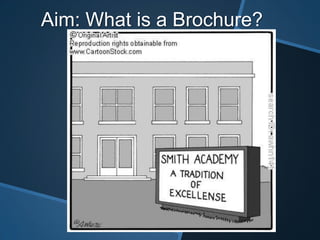
  • #12 What is wrong with this picture?This is why it is important to spell check your work
  • #16 Bi-fold
  • #18 1. Bi-fold Tri-foldZ-foldGate fold Roll fold2. museums, major shop, amusement parks and information booths3. Title and a graphic or picture name of place4 first impressions are lasting and to grab reader’s attention