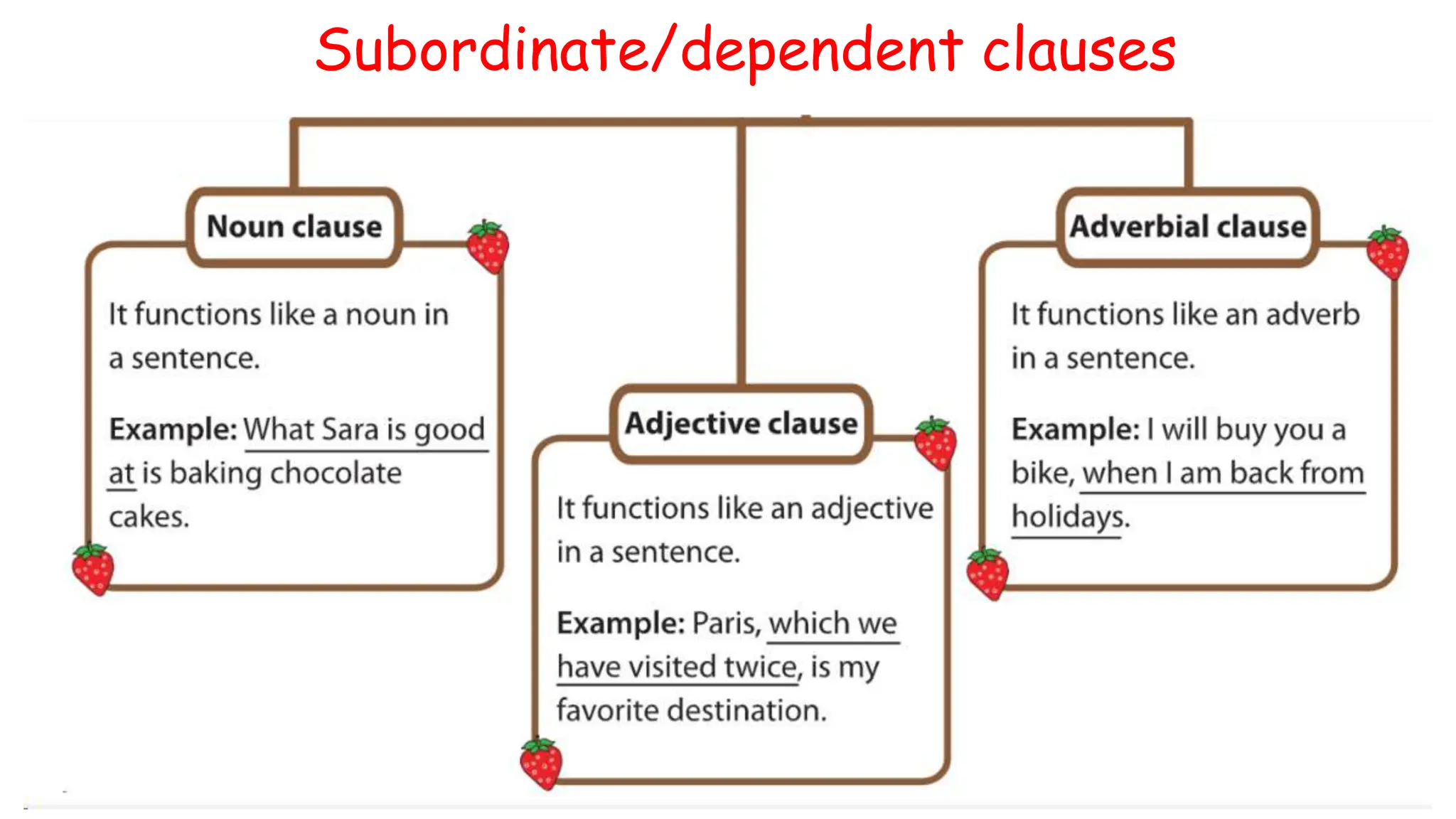
Subordinate/dependent clauses
Subordinate clauses, like phrases, function in sentences as single
parts of speech. A subordinate clause can be used as an
adjective, an adverb, or a noun, thus enabling us to express
ideas that are difficult or impossible to state with single-word
nouns and modifiers alone.
Adjective clauses
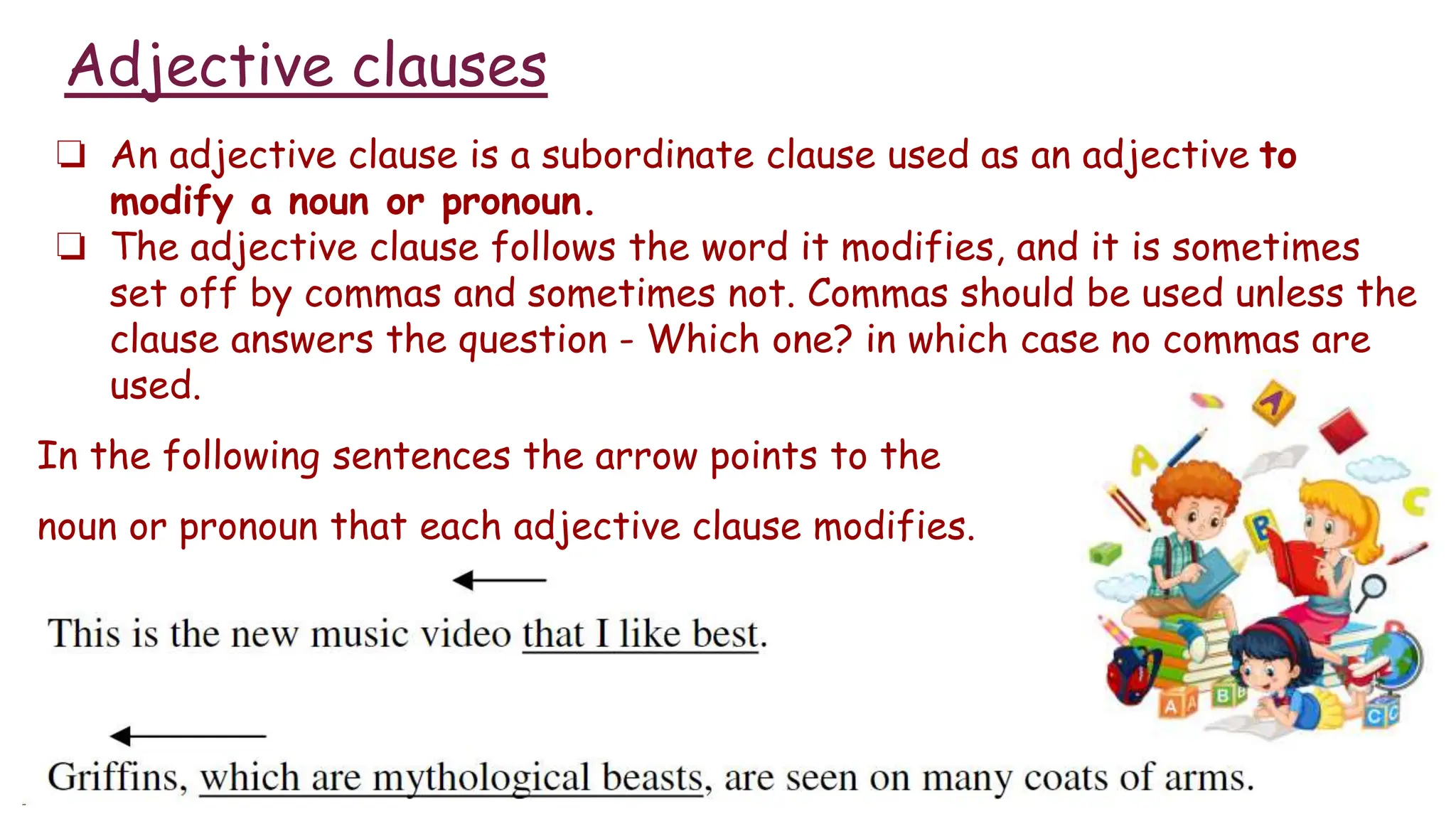
❏ An adjective clause is a subordinate clause used as an adjective to
modify a noun or pronoun.
❏ The adjective clause follows the word it modifies, and it is sometimes
set off by commas and sometimes not. Commas should be used unless the
clause answers the question - Which one? in which case no commas are
used.
In the following sentences the arrow points to the
noun or pronoun that each adjective clause modifies.
Relative Pronouns
Adjective clauses are
generally introduced by
relative pronouns. The
relative pronouns are who,
whom, whose, which, and that.
They are called relative
because they relate the
adjective clause to the word
that the clause modifies.
Relative Pronouns: Examples
● Lois, who enjoys running, has decided to
enter the marathon. [The relative
pronoun who relates the adjective clause
to Lois. Who is used as the subject of
the adjective clause.]
● Donna suggested the science project
that I exhibited at the fair. [Project,
The word that the clause modifies, is the
antecedent of the relative pronoun that.
The pronoun is used as the direct object
in the adjective clause.]
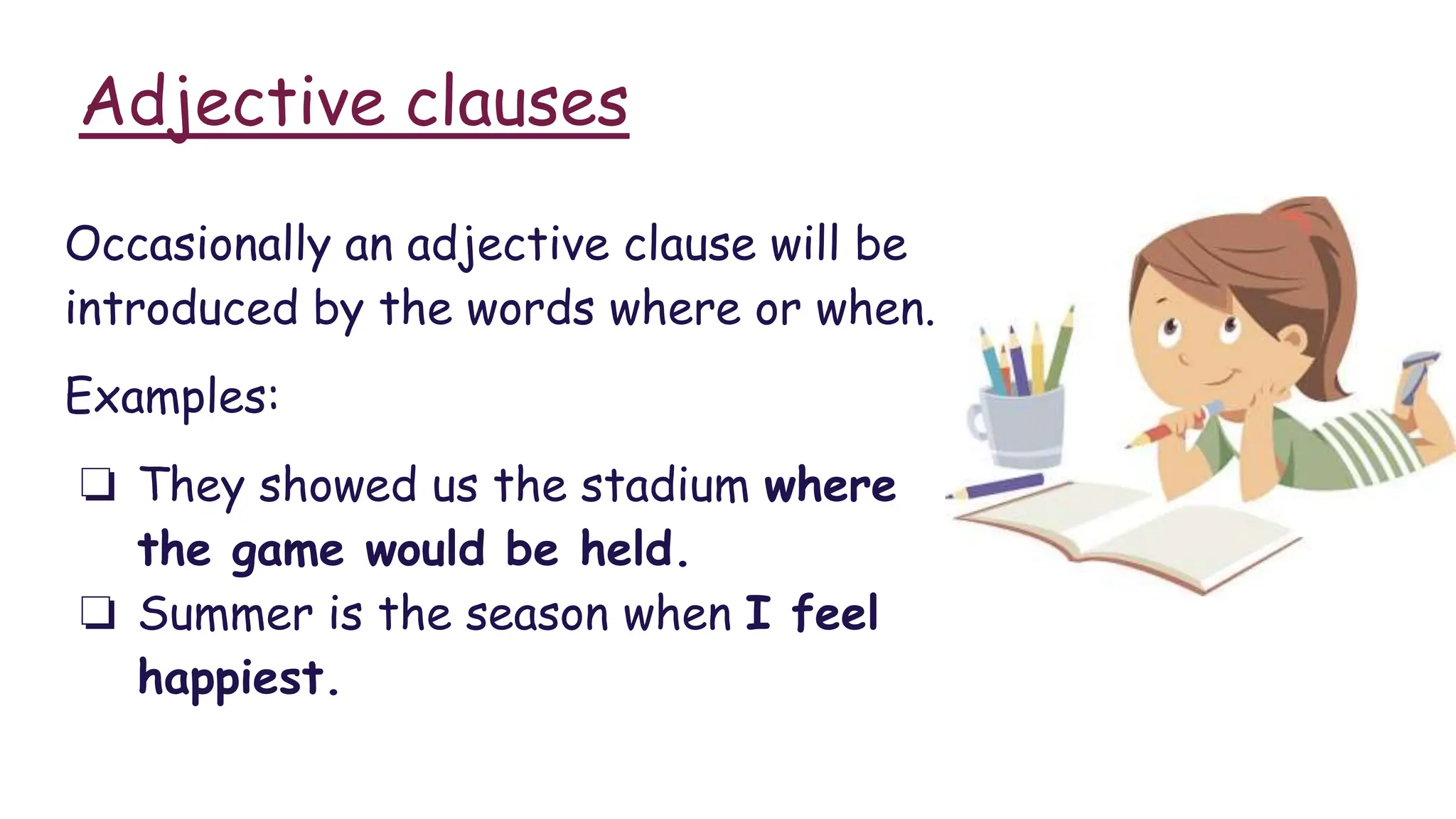
Adjective clauses
Occasionally an adjective clause will be
introduced by the words where or when.
Examples:
❏ They showed us the stadium where
the game would be held.
❏ Summer is the season when I feel
happiest.
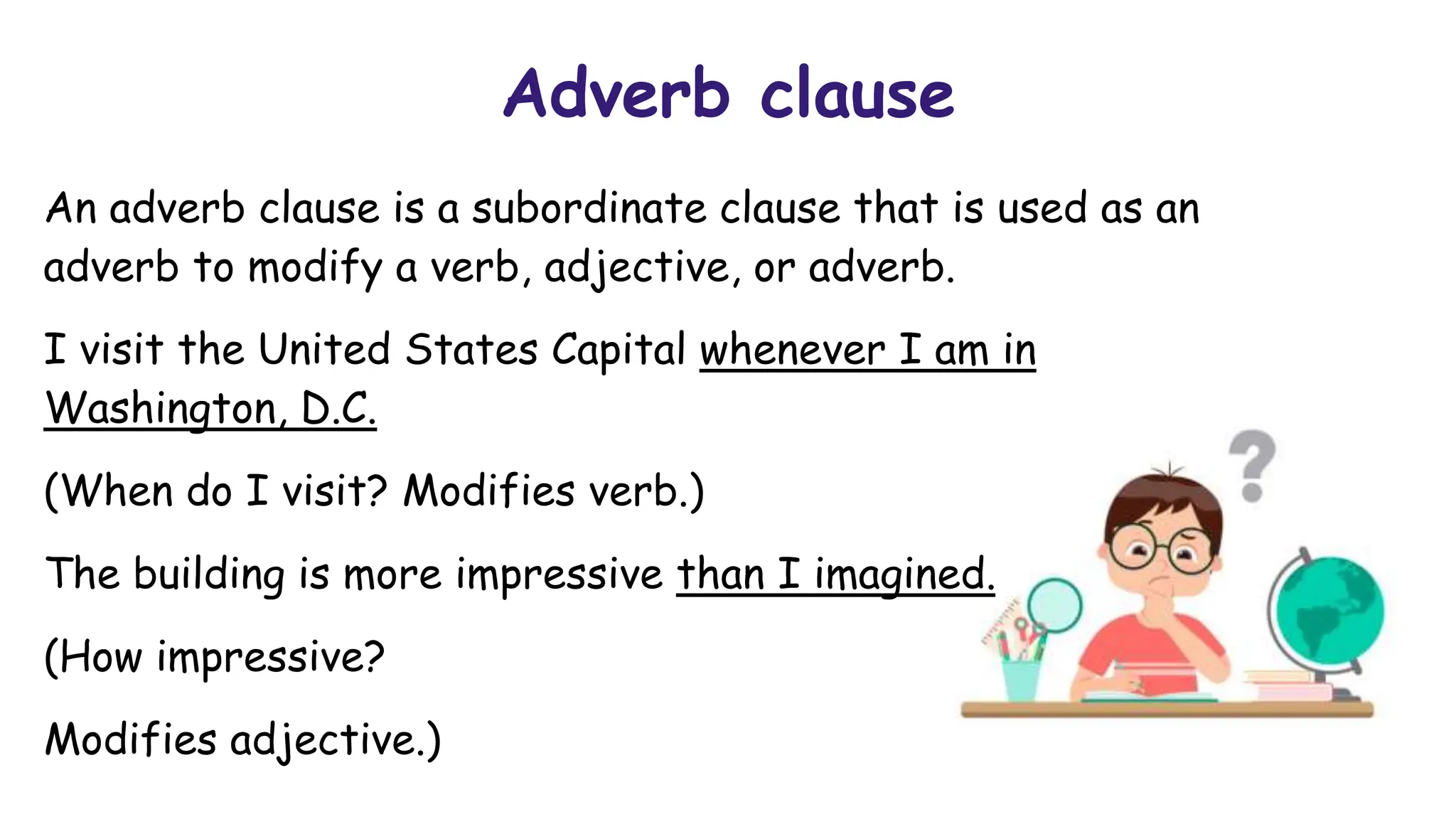
Adverb clause
An adverb clause is a subordinate clause that is used as an
adverb to modify a verb, adjective, or adverb.
I visit the United States Capital whenever I am in
Washington, D.C.
(When do I visit? Modifies verb.)
The building is more impressive than I imagined.
(How impressive?
Modifies adjective.)
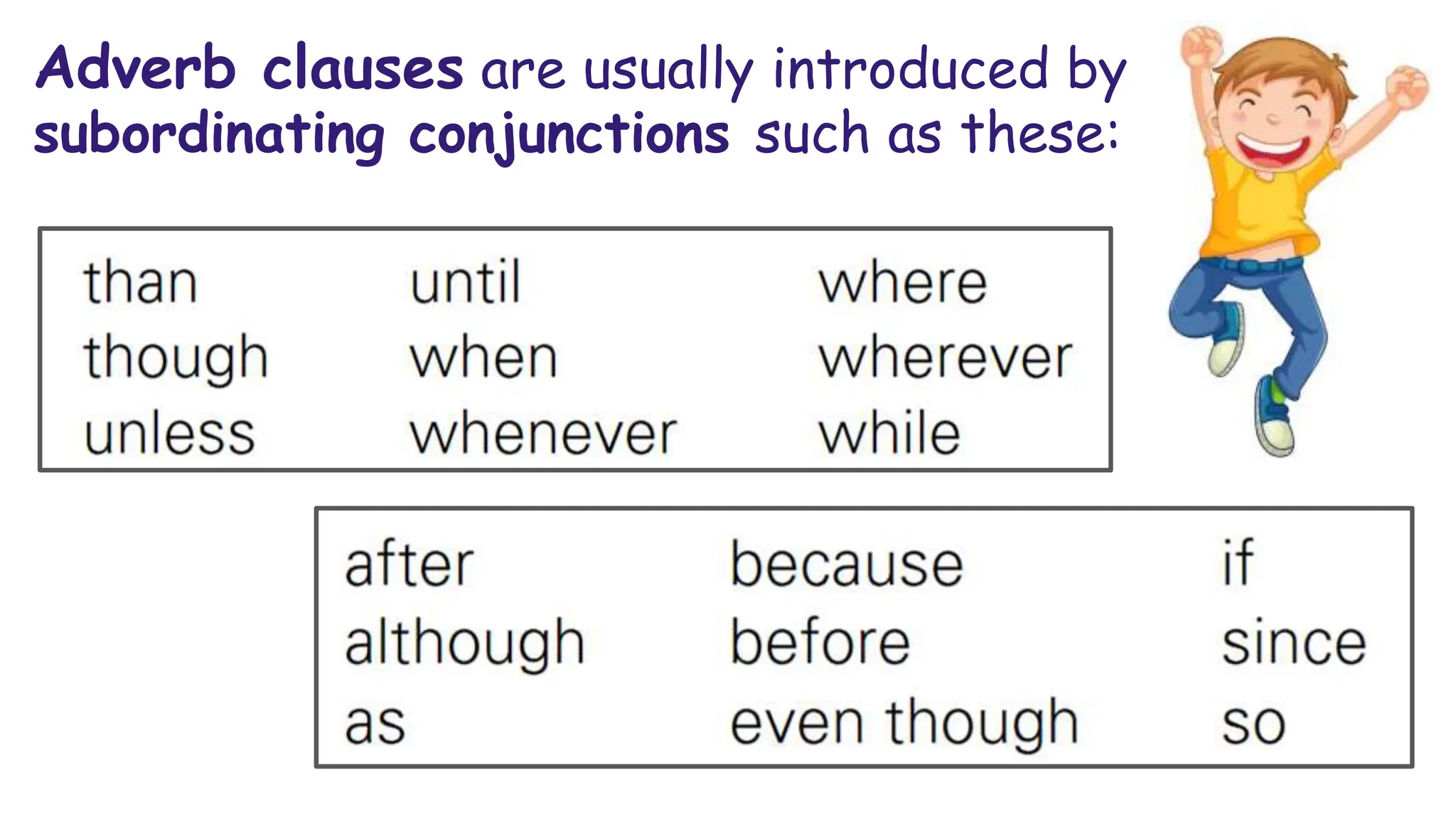
Adverb clauses are usually introduced by
subordinating conjunctions such as these:
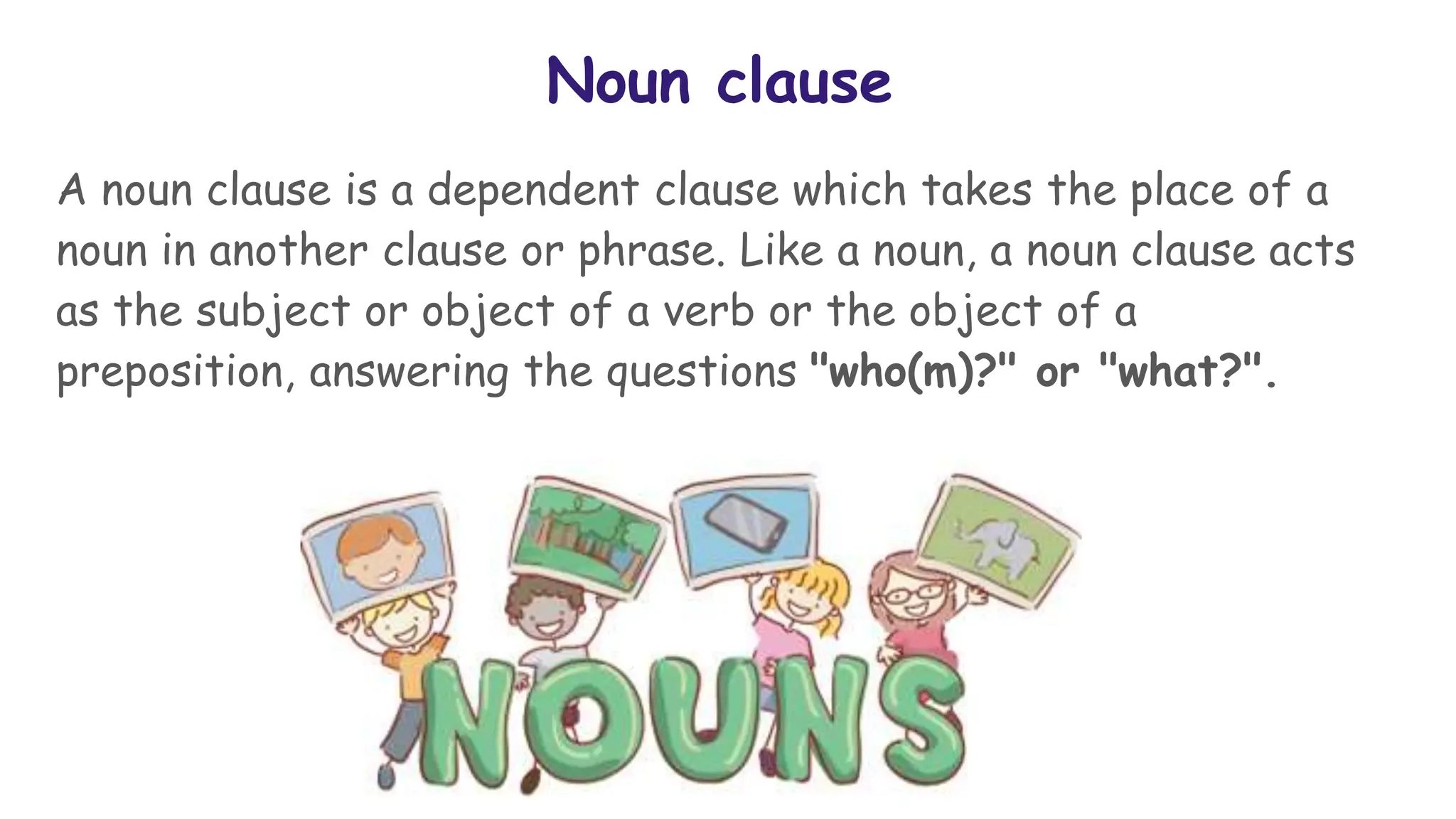
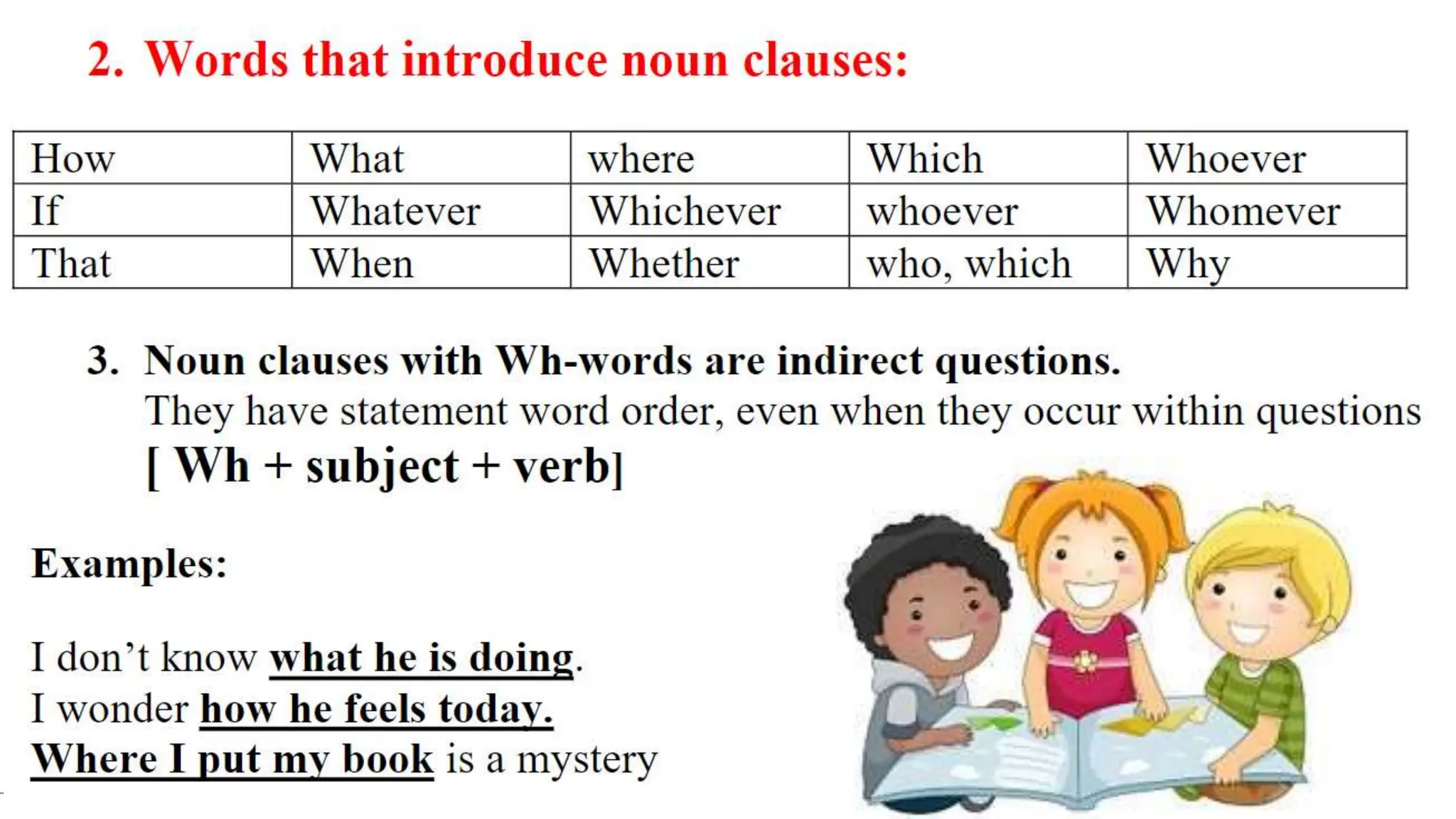
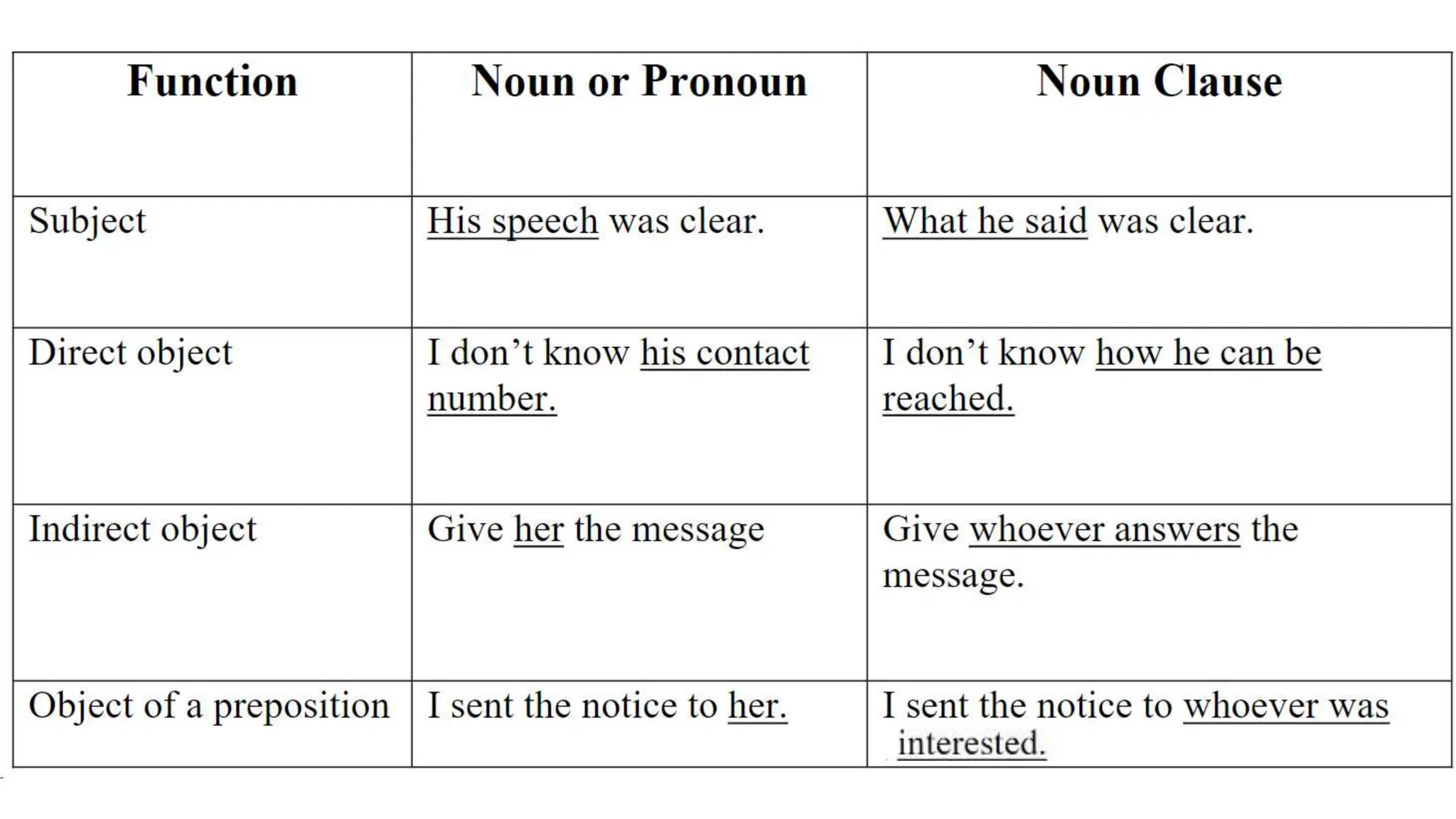
Noun clause
A noun clause is a dependent clause which takes the place of a
noun in another clause or phrase. Like a noun, a noun clause acts
as the subject or object of a verb or the object of a
preposition, answering the questions "who(m)?" or "what?".
Subordinate clauses for grade 5 students

Subordinate clauses for grade 5 students

  • 1.
  • 2.
    Subordinate/dependent clauses Subordinate clauses,like phrases, function in sentences as single parts of speech. A subordinate clause can be used as an adjective, an adverb, or a noun, thus enabling us to express ideas that are difficult or impossible to state with single-word nouns and modifiers alone.
  • 3.
    Adjective clauses ❏ Anadjective clause is a subordinate clause used as an adjective to modify a noun or pronoun. ❏ The adjective clause follows the word it modifies, and it is sometimes set off by commas and sometimes not. Commas should be used unless the clause answers the question - Which one? in which case no commas are used. In the following sentences the arrow points to the noun or pronoun that each adjective clause modifies.
  • 4.
    Relative Pronouns Adjective clausesare generally introduced by relative pronouns. The relative pronouns are who, whom, whose, which, and that. They are called relative because they relate the adjective clause to the word that the clause modifies.
  • 5.
    Relative Pronouns: Examples ●Lois, who enjoys running, has decided to enter the marathon. [The relative pronoun who relates the adjective clause to Lois. Who is used as the subject of the adjective clause.] ● Donna suggested the science project that I exhibited at the fair. [Project, The word that the clause modifies, is the antecedent of the relative pronoun that. The pronoun is used as the direct object in the adjective clause.]
  • 6.
    Adjective clauses Occasionally anadjective clause will be introduced by the words where or when. Examples: ❏ They showed us the stadium where the game would be held. ❏ Summer is the season when I feel happiest.
  • 7.
    Adverb clause An adverbclause is a subordinate clause that is used as an adverb to modify a verb, adjective, or adverb. I visit the United States Capital whenever I am in Washington, D.C. (When do I visit? Modifies verb.) The building is more impressive than I imagined. (How impressive? Modifies adjective.)
  • 8.
    Adverb clauses areusually introduced by subordinating conjunctions such as these:
  • 9.
    Noun clause A nounclause is a dependent clause which takes the place of a noun in another clause or phrase. Like a noun, a noun clause acts as the subject or object of a verb or the object of a preposition, answering the questions "who(m)?" or "what?".