
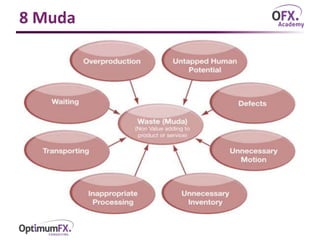
The 8 Wastes (MUDA)
www.optimumfx.com
8 Muda
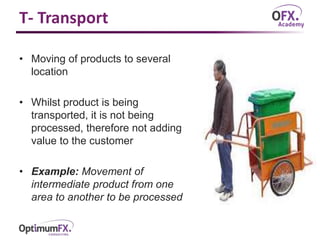
T- Transport
• Moving of products to several
location
• Whilst product is being
transported, it is not being
processed, therefore not adding
value to the customer
• Example: Movement of
intermediate product from one
area to another to be processed
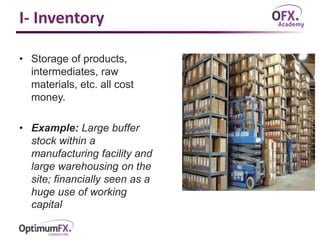
I- Inventory
• Storage of products,
intermediates, raw
materials, etc. all cost
money.
• Example: Large buffer
stock within a
manufacturing facility and
large warehousing on the
site; financially seen as a
huge use of working
capital
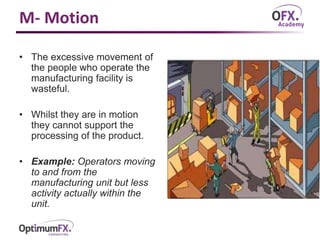
M- Motion
• The excessive movement of
the people who operate the
manufacturing facility is
wasteful.
• Whilst they are in motion
they cannot support the
processing of the product.
• Example: Operators moving
to and from the
manufacturing unit but less
activity actually within the
unit.
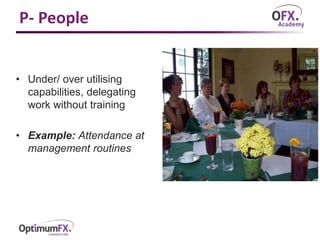
P- People
• Under/ over utilising
capabilities, delegating
work without training
• Example: Attendance at
management routines
W- Waiting
• As people, equipment or
product wait to be
processed, it is not adding
any value to the customer.
• Example: Intermediate
product which can’t leave
site until the QC tests and
paperwork are complete.
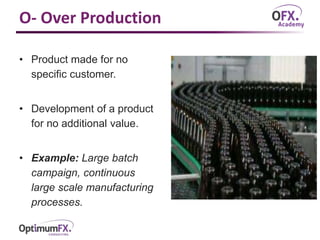
O- Over Production
• Product made for no
specific customer.
• Development of a product
for no additional value.
• Example: Large batch
campaign, continuous
large scale manufacturing
processes.
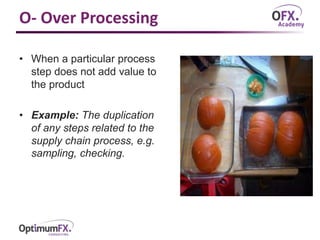
O- Over Processing
• When a particular process
step does not add value to
the product
• Example: The duplication
of any steps related to the
supply chain process, e.g.
sampling, checking.
D- Defect
• Errors during the process-
either requiring re-work or
additional work.
• Examples:
– Material out of specification;
batch documentation
incomplete.
– Data and data entry errors.
– General miscommunication.

The 8 wastes (Muda)

  • 1.
    The 8 Wastes(MUDA) www.optimumfx.com
  • 2.
  • 3.
    T- Transport • Movingof products to several location • Whilst product is being transported, it is not being processed, therefore not adding value to the customer • Example: Movement of intermediate product from one area to another to be processed
  • 4.
    I- Inventory • Storageof products, intermediates, raw materials, etc. all cost money. • Example: Large buffer stock within a manufacturing facility and large warehousing on the site; financially seen as a huge use of working capital
  • 5.
    M- Motion • Theexcessive movement of the people who operate the manufacturing facility is wasteful. • Whilst they are in motion they cannot support the processing of the product. • Example: Operators moving to and from the manufacturing unit but less activity actually within the unit.
  • 6.
    P- People • Under/over utilising capabilities, delegating work without training • Example: Attendance at management routines
  • 7.
    W- Waiting • Aspeople, equipment or product wait to be processed, it is not adding any value to the customer. • Example: Intermediate product which can’t leave site until the QC tests and paperwork are complete.
  • 8.
    O- Over Production •Product made for no specific customer. • Development of a product for no additional value. • Example: Large batch campaign, continuous large scale manufacturing processes.
  • 9.
    O- Over Processing •When a particular process step does not add value to the product • Example: The duplication of any steps related to the supply chain process, e.g. sampling, checking.
  • 10.
    D- Defect • Errorsduring the process- either requiring re-work or additional work. • Examples: – Material out of specification; batch documentation incomplete. – Data and data entry errors. – General miscommunication.

Editor's Notes

  • #5 Economically large batches of raw material are purchased for large campaigns and sit in the warehouse for extended periods.