Instruction Sheet LO2: Identify MUDA and problem
This learning guide is developed to provide you
the necessary information regarding the following
content coverage and topics –
Preparing and implement Plan of MUDA
identification.
Causes and effects of MUDA
Using of Tools and techniques to draw and
analyze current situation of the work place.
Identifying and measure Wastes/MUDA
Reporting Identified and measured wastes.
This guide will also assist you to attain the learning
outcome stated in the cover page. Specifically, upon
completion of this Learning Guide, you will be able to –
Prepare and implement Plan of MUDA identification.
Discus Causes and effects of MUDA.
Use Tools and techniques to draw and analyze current
situation of the work place.
Identify and measure Wastes/MUDA based on relevant
procedures.
Report Identified and measured wastes to relevant
personnel
Information Sheet-1 Preparing and implement Plan of
MUDA identification
2.1. Targets of Customer
Customer is the one who buys products/services from
manufacturers/service providers. So the customer does
not bother how the manufacturer/service provider makes
it. Now a days customers have many alternative
manufacturers/service providers to buy the same type of
product/service from and choose one that fulfills their
targets which are listed below:-
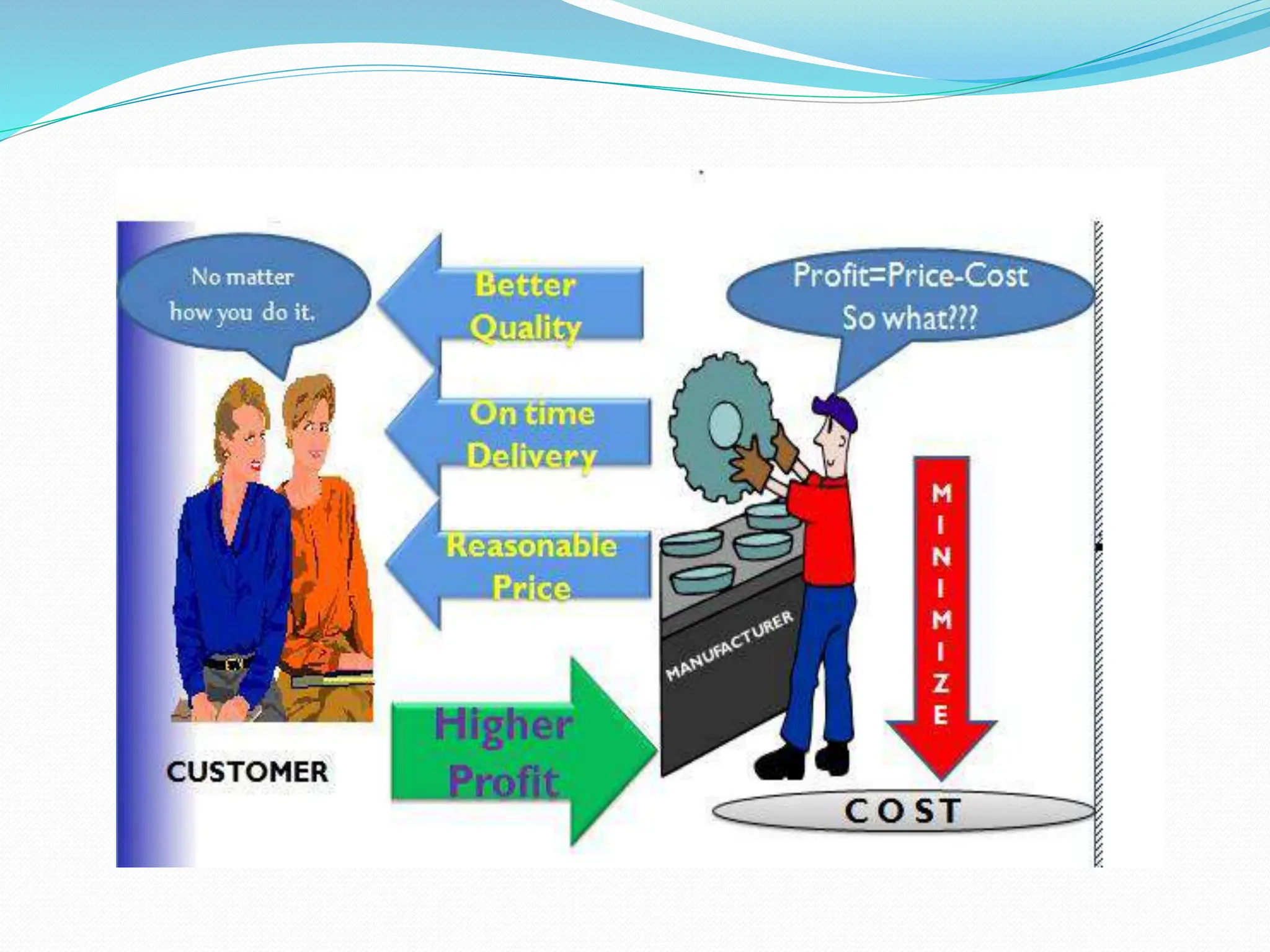
Customer needs better quality
On time delivery
Reasonable price
2.2. Targets of Manufacturer/Service provider
The primary target of Manufacturers/Service
providers is to earn profit. So as to meet his/her
target, he/she needs to satisfy the targets of
customers in such a way by providing better quality
product/service on time and at a reasonable price. If
he/she is able to do so, he can win customers‟
targets. Then to get higher profit the
Manufacturer/Service provider needs to minimize
his/her costs by reducing/eliminating wastes and
following effective working procedures.
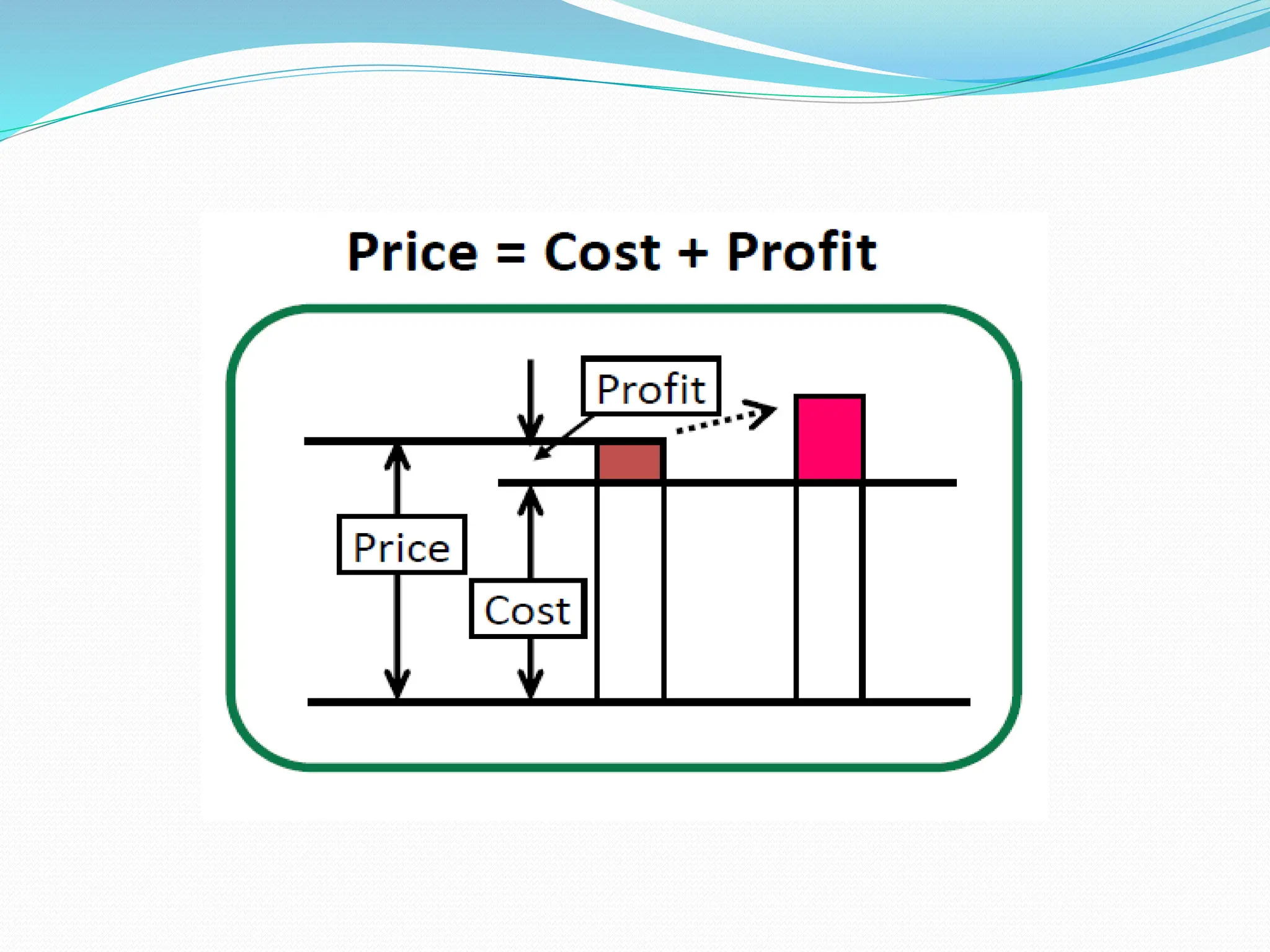
2.3. The concept of Cost
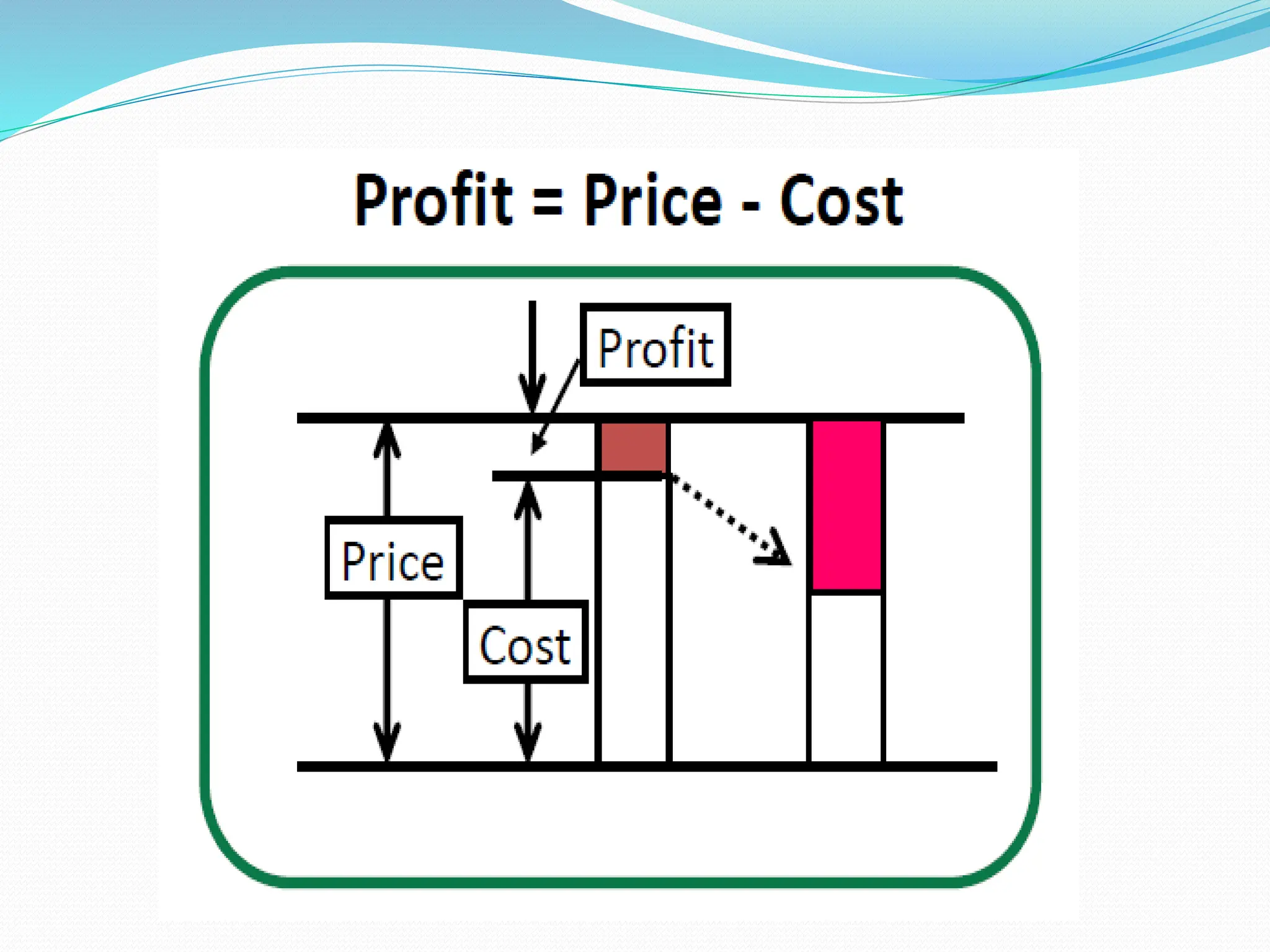
Cost :- is the amount of money that is
expended to accomplish a given
task/operation.
Cost can be of Manufacturing or Service
Delivering cost=(material + labor + facility +
utility + others)cost
Determination of the sales price of the
product/Service Sales price=(manufacturing
or service delivery)cost + profit
2.4. Traditional Thinking of Price Setting
In traditional thinking of price
setting, price is determined by the
manufacturer/service provider rather
than the market itself.
When there is shortage of supply
then the manufacturer raises selling
price.
2.5. Kaizen Thinking of Price Setting
In modern time, there are a large number of
manufacturers/service providers delivering the same type of
product/service offering the customers a great deal of options
to buy products/ services. Price is determined by the
interaction between market demand and supply.
Manufacturers/service providers ,who want to set selling price
above the market price, customers will not be willing to buy
their products/services. Manufacturers/Service providers to be
competent in the market they should provide Quality
product/service on time and at the market price. Since to days
economy is market based, we should focus on minimizing our
costs and not maximizing selling price to maximize our profit.
2.6. Waste/Muda
Waste/Muda is any activity which
consumes resources, such as money, time
,energy, materials, etc, that does not create
value and can be eliminated.
Value
Value is defined by the next customer
(Know your Customers Need).
The next process is your customer. The
activity/effect exactly what the next
customer needs is value adding activity.
There are two types of customers:-
 Internal customer
 External customer
Internal customer:- is the customer
within a production line/service
delivering sequence that is next to the
previous process and makes his/her own
process.
External customer:- is the customer
that buys the final out put
product/service of the enterprise.
2.7. The three Categories of Operation
1. Net Operation/Value Adding Operation
2. Non-Value Adding Operation
3. ”Muda‟‟
1. Net Operation/Value Adding Operation
Part of an operation that adds value to make parts and
products or deliver service. In other words, it is part of the
operation that the customer exactly needs / willing to pay for.
 Examples - Milling, Turning, Grinding, Assembling and
Welding.
- Printing/photocopying a document etc.
2. Non-Value Adding Operation
Part of operation that adds no value
but cannot be avoided rather it can be
reduced.
Example Setting up / adjustments,
Loading paper to a photo copy
machine/printer etc
3)”Muda’’
 Muda is a Japanese word meaning Wasteful Activity
which use resources, time or cost without adding value.
In other words, it is anything unnecessary in operation that
affects the quality of the product/service, productivity,
delivery time and also production cost. Muda can be
eliminated immediately.
Example:- Unnecessary motion/searching for tools,
unnecessary transportation of materials, over production,
Inventory, Waiting /idle time, making defects and over
processing etc.
Information Sheet-2 Causes and effects of MUDA
2.1. Causes of Muda of Overproduction
Large-lot production
Anticipatory production (producing product
in advance of demand)
Inability to achieve short changeover times
with the large equipment used in mass
production systems
Creating enough stock to replace the number
of defective parts produced
Overstaffing or too much equipment
Machines that turn out parts too quickly
2.2. Effects of Muda of Overproduction
Companies often have overproduction as a
result of large-lot manufacturing methods or
mass production. there are several
unfortunate effects of over production:
Anticipatory buying of parts and materials
Blocked flow of goods
Increased inventory
No flexibility in planning
Occurrence of defects
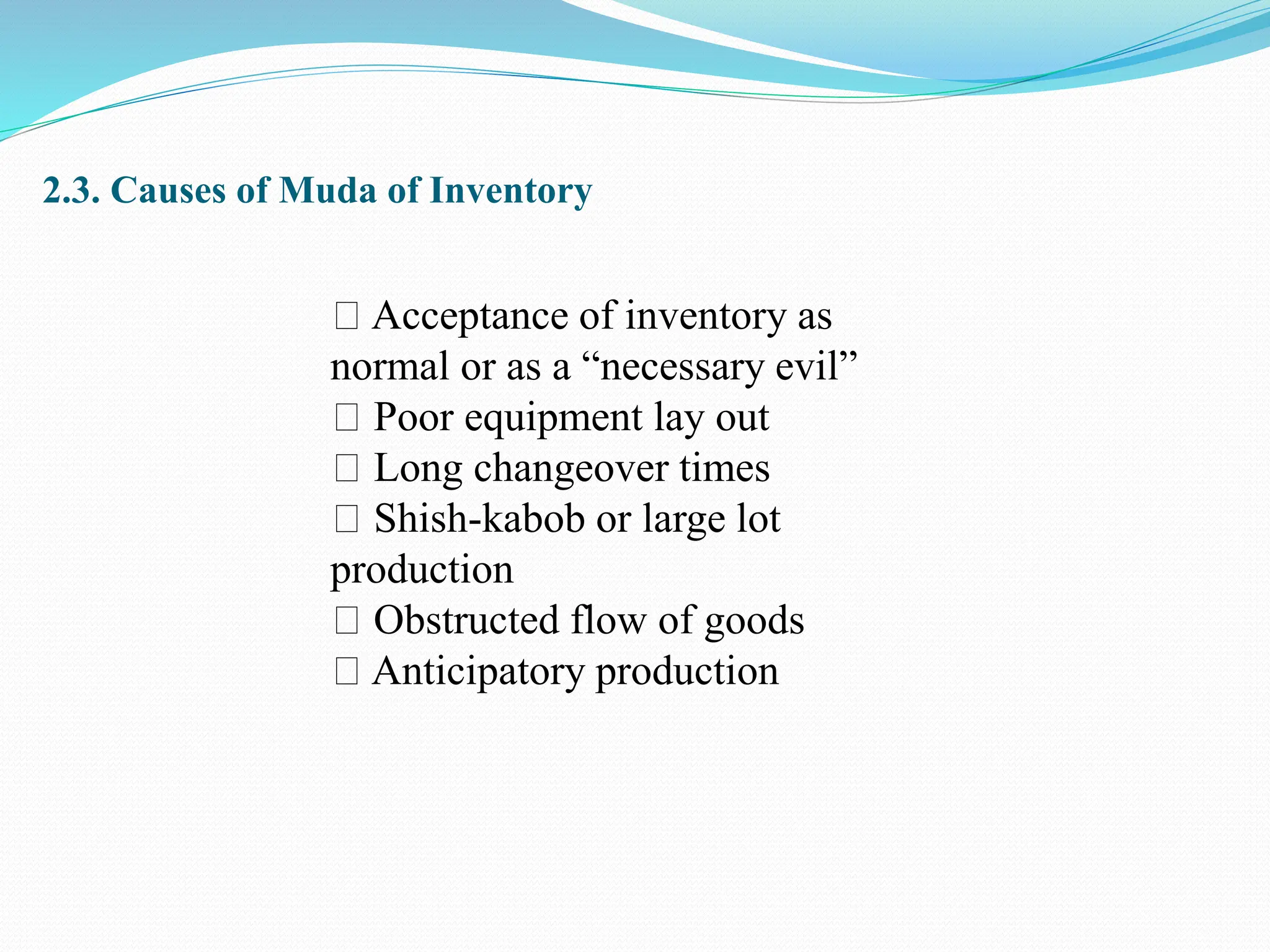
2.3. Causes of Muda of Inventory
Acceptance of inventory as
normal or as a “necessary evil”
Poor equipment lay out
Long changeover times
Shish-kabob or large lot
production
Obstructed flow of goods
Anticipatory production
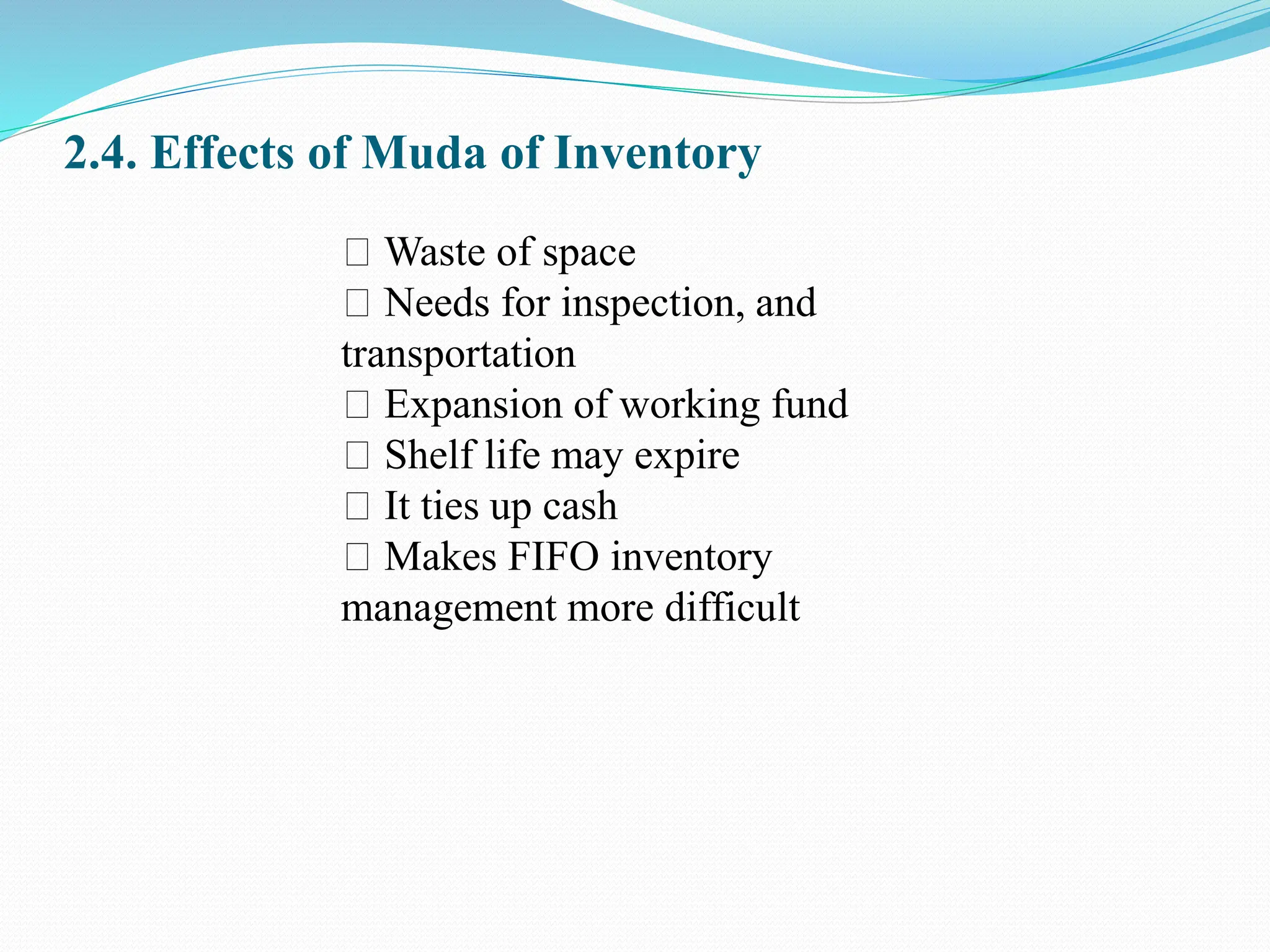
2.4. Effects of Muda of Inventory
Waste of space
Needs for inspection, and
transportation
Expansion of working fund
Shelf life may expire
It ties up cash
Makes FIFO inventory
management more difficult
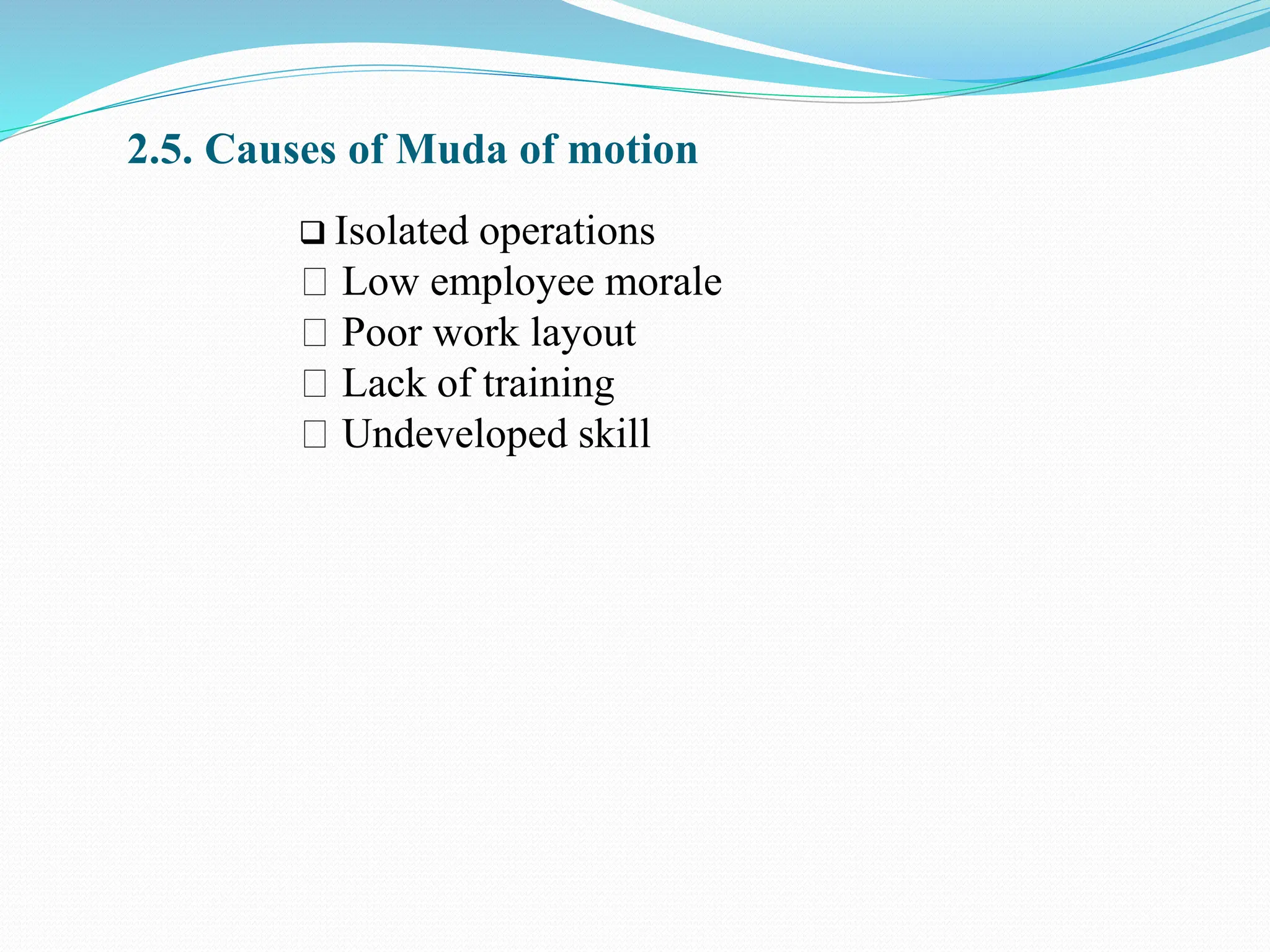
2.5. Causes of Muda of motion
 Isolated operations
Low employee morale
Poor work layout
Lack of training
Undeveloped skill
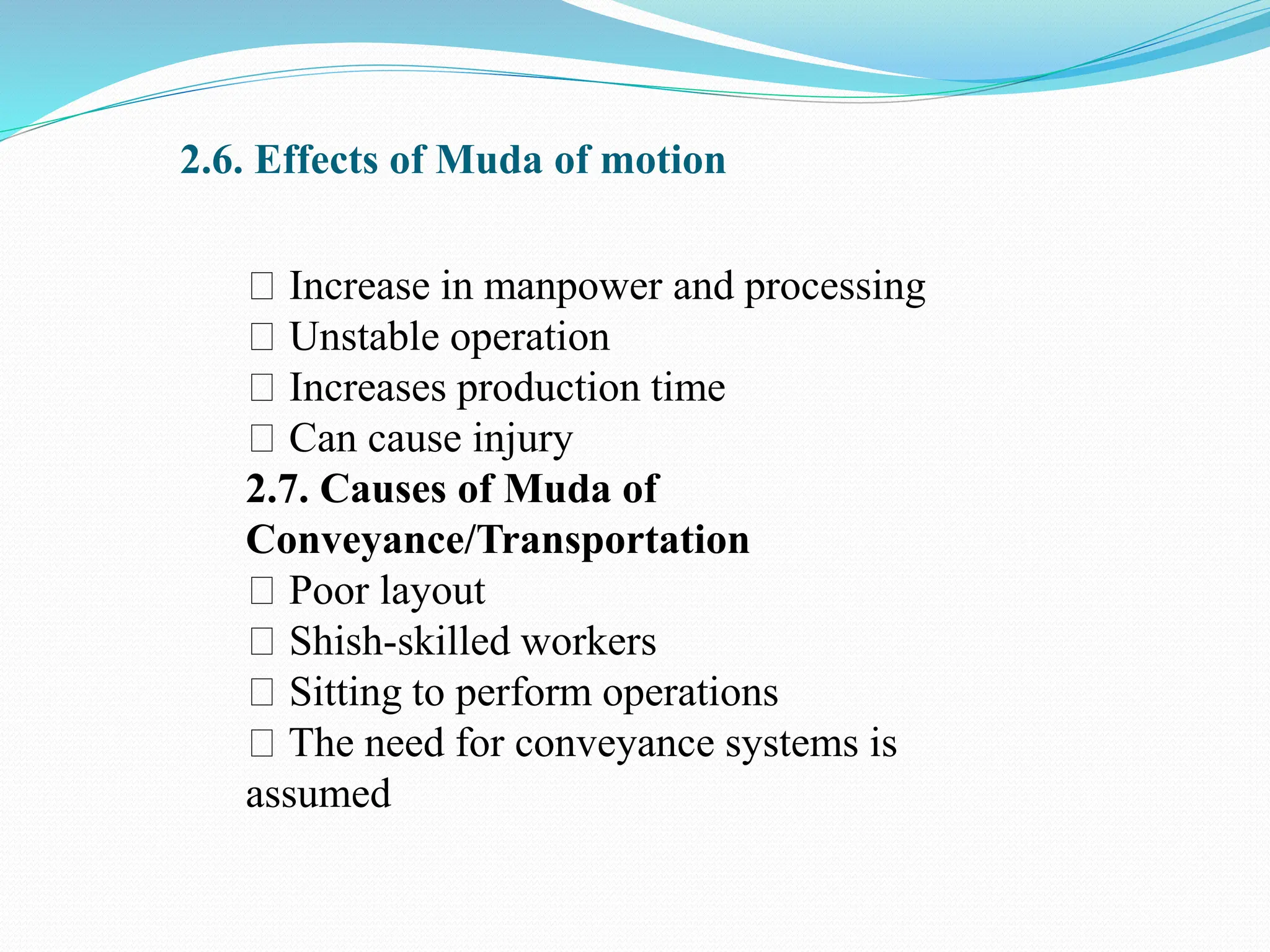
2.6. Effects of Muda of motion
Increase in manpower and processing
Unstable operation
Increases production time
Can cause injury
2.7. Causes of Muda of
Conveyance/Transportation
Poor layout
Shish-skilled workers
Sitting to perform operations
The need for conveyance systems is
assumed
2.8. Effects of Muda of Conveyance/Transportation
Waste of space production deterioration
Expansion of transportation
facilities
Occurrence of scratches
Increase production time and cost
wastes time and energy
2.9. Causes of Muda of Waiting/ Idle time
Obstruction of flow
Poor equipment layout
Trouble at the upstream process
Capacity imbalances
Large Lot-production
2.9. Causes of Muda of Waiting/ Idle time
Obstruction of flow
Poor equipment layout
Trouble at the upstream process
Capacity imbalances
Large Lot-production
2.10. Effects of Muda of Waiting/ Idle time
Waste of manpower, time, & machines
Increase in the in-process inventory
Failed delivery dates
Poor workflow continuity
2.11. Causes of Muda of Defect making
Emphasis on downstream inspection
No standard for inspection work
Omission of standard operations
Material handling and conveyance
2.12. Effects of Muda of Defect making
Increase in material cost
Productivity deterioration
Increase in personnel & processes for inspection
Increase in defects and claims
Invite reworking costs
2.13. Causes of Muda of Processing
Inadequate study of operations
Incomplete standardization
Materials are not studied
2.14. Effects of Muda of Processing
Unnecessary processes or operation
Increase in manpower and man-hour
Lower workability
Increase in defects
Can reduce life of components
Information Sheet-3 Using of Tools and techniques to draw and
analyze current situation of the work place
3.1. Classification of Waste
A number of methods for
categorizing types of waste have
emerged. We will review some of
these models to get a deeper
understanding of what waste is and
how to find it and eliminate it.
The three Mus
The 5M + Q + S
The flow of goods
The seven deadly wastes
The Three MUs
In Japanese this is expressed with
the terms muda,mura and muri.
Muda(waste) = Capacity
exceeds load.
Mura (inconsistency or
variation) = capacity sometimes
exceeds the load and the load
sometimes exceeds capacity.
Muri(irrationality/physical or
mental overburden) = load exceeds
capacity.
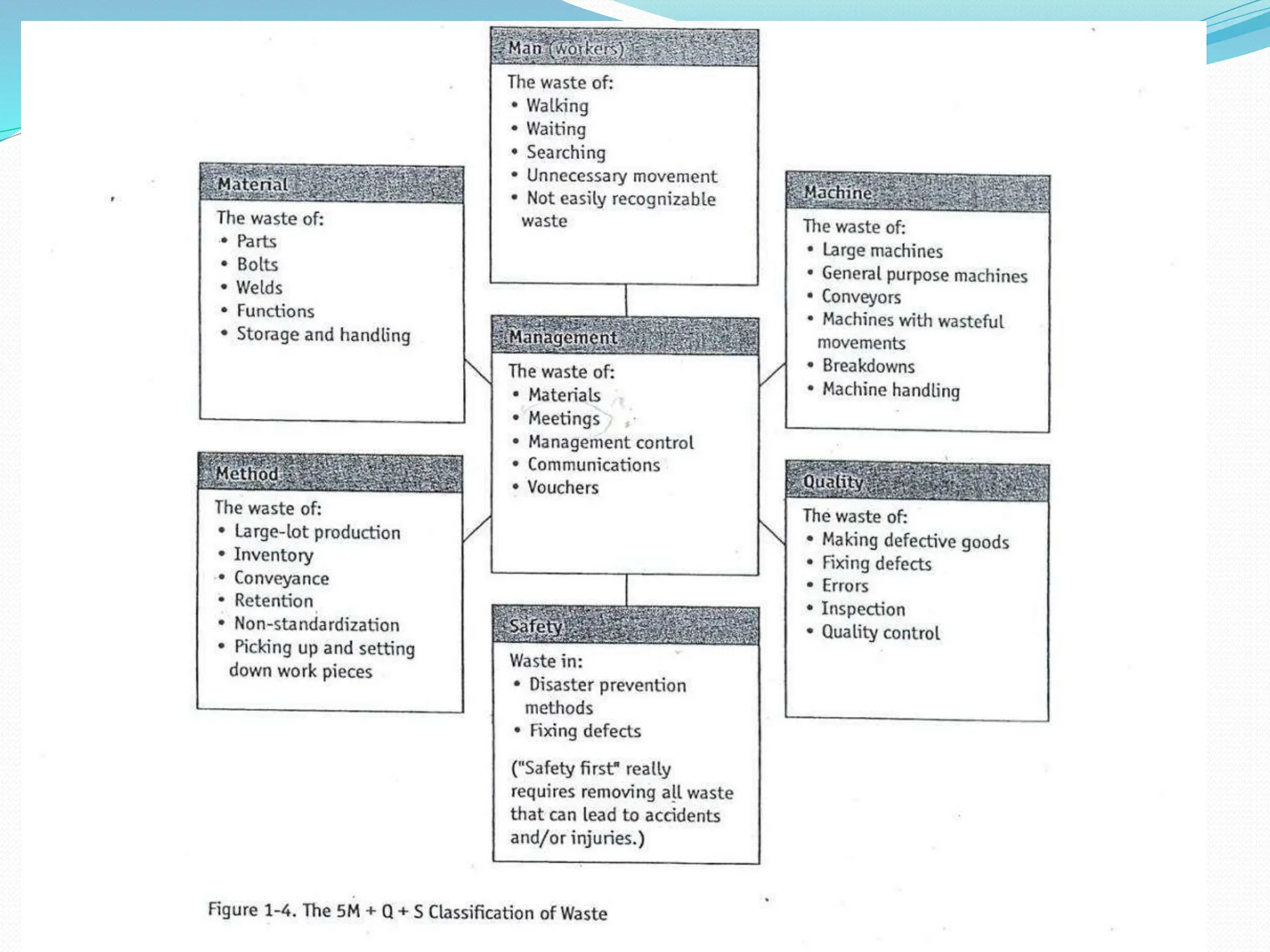
The 5M + Q + S
Another way of thinking about
waste is to focus on the areas where
waste may occur: the 5M (man,
material, machine, method and
management), plus quality and
safety. See the next figure.
The Flow of Goods
Materials are procured:- Materials are retained in
the warehouse Materials are conveyed to processes
on the production line Materials are retained at the
process equipment(WIP) Materials are picked up for
processing Materials are processed:- goods are set
down and retained on the other side of the
processing machine(WIP) Goods are conveyed to an
inspection point
Goods are retained until inspection Goods are
picked up and inspected Goods are set down and
retained on the other side of inspection process
Inspected goods are conveyed to the finished goods
warehouse Finished goods are retained prior to
shipment Finished goods are delivered to the
customer.
The Seven Deadly Wastes
Identifying and eliminating these
seven types of waste will forge the
path to lean production.
Overproduction
Inventory
Motion
Conveyance/Transportation
Waiting/ Idle time
Defect making
Processing
Motion
These are non-value adding
movements or more than
necessary movements of workers,
equipment, and machines, such
as looking for goods, bending,
stretching, walking, lifting,
reaching etc.
Conveyance/Transportation
 It is Unnecessary transportation of
parts between processes caused by
unnecessary transportation distance,
temporary storage, relocations or re-
piling up. Transportation does not create
any value added except for
transportation companies.
Transportation is usually difficult to be
totally eliminated but reducing is
possible.
Waiting/ Idle time
Refers to both human and machine
waiting.
This includes all kinds of waste of
time such as workers or parts waiting:
-for an upstream process to deliver.
-for a machine to finish processing.
-for incoming parts or materials.
-for process that has a long wait
time.
Defect making:- This includes
defects, inspections for defects in-
process, and claims, rescheduling,
and resource loss.
Processing:- This consists of
processing and operations
primarily unnecessary. It is
processing beyond the standard
required by the customer.
Information Sheet-4 Identifying and measure Wastes/MUDA
3.1 Some of the benefits of identifying and
eliminating waste To the company
Benefits to the company include:
1. Cutting the hidden costs of production-
It is estimated that 80 percent of production
activities and associated costs are non-value-
added, or waste. When factories begin to
focus on identifying and eliminating waste,
the impact on the bottom line is
astronomical.
2. Increased customer satisfaction-
Customer satisfaction rises as a direct
result of implementing lean
production. When waste is eliminated
from production, deliveries occur on
time and product quality goes up.
Benefits to individuals include:
1. Increased job satisfaction- No longer
will you spend hours looking for missing
tools, waiting for materials to arrive,
walking around piles of inventory, lifting
and setting
down heavy parts or tools, working in
unsafe conditions and all the other things
you have to do that are not essential to
your job.
Plan and procedure for Waste/Muda Identification
The steps to effective waste
identification are:
1. Make waste visible
2. Be conscious of the waste
3. Be accountable for the
waste.
4. Measure the waste.
1. Make waste visible
Waste can be made visible
in several ways such as:
Shop layout analysis
Process flow analysis
Take photos/video
Etc
Preventing and eliminating muda and waste

Preventing and eliminating muda and waste

  • 1.
    Instruction Sheet LO2:Identify MUDA and problem This learning guide is developed to provide you the necessary information regarding the following content coverage and topics – Preparing and implement Plan of MUDA identification. Causes and effects of MUDA Using of Tools and techniques to draw and analyze current situation of the work place. Identifying and measure Wastes/MUDA Reporting Identified and measured wastes.
  • 2.
    This guide willalso assist you to attain the learning outcome stated in the cover page. Specifically, upon completion of this Learning Guide, you will be able to – Prepare and implement Plan of MUDA identification. Discus Causes and effects of MUDA. Use Tools and techniques to draw and analyze current situation of the work place. Identify and measure Wastes/MUDA based on relevant procedures. Report Identified and measured wastes to relevant personnel
  • 3.
    Information Sheet-1 Preparingand implement Plan of MUDA identification 2.1. Targets of Customer Customer is the one who buys products/services from manufacturers/service providers. So the customer does not bother how the manufacturer/service provider makes it. Now a days customers have many alternative manufacturers/service providers to buy the same type of product/service from and choose one that fulfills their targets which are listed below:- Customer needs better quality On time delivery Reasonable price
  • 4.
    2.2. Targets ofManufacturer/Service provider The primary target of Manufacturers/Service providers is to earn profit. So as to meet his/her target, he/she needs to satisfy the targets of customers in such a way by providing better quality product/service on time and at a reasonable price. If he/she is able to do so, he can win customers‟ targets. Then to get higher profit the Manufacturer/Service provider needs to minimize his/her costs by reducing/eliminating wastes and following effective working procedures.
  • 6.
    2.3. The conceptof Cost Cost :- is the amount of money that is expended to accomplish a given task/operation. Cost can be of Manufacturing or Service Delivering cost=(material + labor + facility + utility + others)cost Determination of the sales price of the product/Service Sales price=(manufacturing or service delivery)cost + profit
  • 7.
    2.4. Traditional Thinkingof Price Setting In traditional thinking of price setting, price is determined by the manufacturer/service provider rather than the market itself. When there is shortage of supply then the manufacturer raises selling price.
  • 9.
    2.5. Kaizen Thinkingof Price Setting In modern time, there are a large number of manufacturers/service providers delivering the same type of product/service offering the customers a great deal of options to buy products/ services. Price is determined by the interaction between market demand and supply. Manufacturers/service providers ,who want to set selling price above the market price, customers will not be willing to buy their products/services. Manufacturers/Service providers to be competent in the market they should provide Quality product/service on time and at the market price. Since to days economy is market based, we should focus on minimizing our costs and not maximizing selling price to maximize our profit.
  • 11.
    2.6. Waste/Muda Waste/Muda isany activity which consumes resources, such as money, time ,energy, materials, etc, that does not create value and can be eliminated. Value Value is defined by the next customer (Know your Customers Need). The next process is your customer. The activity/effect exactly what the next customer needs is value adding activity.
  • 12.
    There are twotypes of customers:-  Internal customer  External customer Internal customer:- is the customer within a production line/service delivering sequence that is next to the previous process and makes his/her own process. External customer:- is the customer that buys the final out put product/service of the enterprise.
  • 13.
    2.7. The threeCategories of Operation 1. Net Operation/Value Adding Operation 2. Non-Value Adding Operation 3. ”Muda‟‟ 1. Net Operation/Value Adding Operation Part of an operation that adds value to make parts and products or deliver service. In other words, it is part of the operation that the customer exactly needs / willing to pay for.  Examples - Milling, Turning, Grinding, Assembling and Welding. - Printing/photocopying a document etc.
  • 14.
    2. Non-Value AddingOperation Part of operation that adds no value but cannot be avoided rather it can be reduced. Example Setting up / adjustments, Loading paper to a photo copy machine/printer etc
  • 15.
    3)”Muda’’  Muda isa Japanese word meaning Wasteful Activity which use resources, time or cost without adding value. In other words, it is anything unnecessary in operation that affects the quality of the product/service, productivity, delivery time and also production cost. Muda can be eliminated immediately. Example:- Unnecessary motion/searching for tools, unnecessary transportation of materials, over production, Inventory, Waiting /idle time, making defects and over processing etc.
  • 16.
    Information Sheet-2 Causesand effects of MUDA 2.1. Causes of Muda of Overproduction Large-lot production Anticipatory production (producing product in advance of demand) Inability to achieve short changeover times with the large equipment used in mass production systems Creating enough stock to replace the number of defective parts produced Overstaffing or too much equipment Machines that turn out parts too quickly
  • 17.
    2.2. Effects ofMuda of Overproduction Companies often have overproduction as a result of large-lot manufacturing methods or mass production. there are several unfortunate effects of over production: Anticipatory buying of parts and materials Blocked flow of goods Increased inventory No flexibility in planning Occurrence of defects
  • 18.
    2.3. Causes ofMuda of Inventory Acceptance of inventory as normal or as a “necessary evil” Poor equipment lay out Long changeover times Shish-kabob or large lot production Obstructed flow of goods Anticipatory production
  • 19.
    2.4. Effects ofMuda of Inventory Waste of space Needs for inspection, and transportation Expansion of working fund Shelf life may expire It ties up cash Makes FIFO inventory management more difficult
  • 20.
    2.5. Causes ofMuda of motion  Isolated operations Low employee morale Poor work layout Lack of training Undeveloped skill
  • 21.
    2.6. Effects ofMuda of motion Increase in manpower and processing Unstable operation Increases production time Can cause injury 2.7. Causes of Muda of Conveyance/Transportation Poor layout Shish-skilled workers Sitting to perform operations The need for conveyance systems is assumed
  • 22.
    2.8. Effects ofMuda of Conveyance/Transportation Waste of space production deterioration Expansion of transportation facilities Occurrence of scratches Increase production time and cost wastes time and energy 2.9. Causes of Muda of Waiting/ Idle time Obstruction of flow Poor equipment layout Trouble at the upstream process Capacity imbalances Large Lot-production
  • 23.
    2.9. Causes ofMuda of Waiting/ Idle time Obstruction of flow Poor equipment layout Trouble at the upstream process Capacity imbalances Large Lot-production 2.10. Effects of Muda of Waiting/ Idle time Waste of manpower, time, & machines Increase in the in-process inventory Failed delivery dates Poor workflow continuity
  • 24.
    2.11. Causes ofMuda of Defect making Emphasis on downstream inspection No standard for inspection work Omission of standard operations Material handling and conveyance 2.12. Effects of Muda of Defect making Increase in material cost Productivity deterioration Increase in personnel & processes for inspection Increase in defects and claims Invite reworking costs
  • 25.
    2.13. Causes ofMuda of Processing Inadequate study of operations Incomplete standardization Materials are not studied 2.14. Effects of Muda of Processing Unnecessary processes or operation Increase in manpower and man-hour Lower workability Increase in defects Can reduce life of components
  • 26.
    Information Sheet-3 Usingof Tools and techniques to draw and analyze current situation of the work place 3.1. Classification of Waste A number of methods for categorizing types of waste have emerged. We will review some of these models to get a deeper understanding of what waste is and how to find it and eliminate it. The three Mus The 5M + Q + S The flow of goods The seven deadly wastes
  • 27.
    The Three MUs InJapanese this is expressed with the terms muda,mura and muri. Muda(waste) = Capacity exceeds load. Mura (inconsistency or variation) = capacity sometimes exceeds the load and the load sometimes exceeds capacity. Muri(irrationality/physical or mental overburden) = load exceeds capacity.
  • 28.
    The 5M +Q + S Another way of thinking about waste is to focus on the areas where waste may occur: the 5M (man, material, machine, method and management), plus quality and safety. See the next figure.
  • 30.
    The Flow ofGoods Materials are procured:- Materials are retained in the warehouse Materials are conveyed to processes on the production line Materials are retained at the process equipment(WIP) Materials are picked up for processing Materials are processed:- goods are set down and retained on the other side of the processing machine(WIP) Goods are conveyed to an inspection point Goods are retained until inspection Goods are picked up and inspected Goods are set down and retained on the other side of inspection process Inspected goods are conveyed to the finished goods warehouse Finished goods are retained prior to shipment Finished goods are delivered to the customer.
  • 31.
    The Seven DeadlyWastes Identifying and eliminating these seven types of waste will forge the path to lean production. Overproduction Inventory Motion Conveyance/Transportation Waiting/ Idle time Defect making Processing
  • 32.
    Motion These are non-valueadding movements or more than necessary movements of workers, equipment, and machines, such as looking for goods, bending, stretching, walking, lifting, reaching etc.
  • 33.
    Conveyance/Transportation  It isUnnecessary transportation of parts between processes caused by unnecessary transportation distance, temporary storage, relocations or re- piling up. Transportation does not create any value added except for transportation companies. Transportation is usually difficult to be totally eliminated but reducing is possible.
  • 34.
    Waiting/ Idle time Refersto both human and machine waiting. This includes all kinds of waste of time such as workers or parts waiting: -for an upstream process to deliver. -for a machine to finish processing. -for incoming parts or materials. -for process that has a long wait time.
  • 35.
    Defect making:- Thisincludes defects, inspections for defects in- process, and claims, rescheduling, and resource loss. Processing:- This consists of processing and operations primarily unnecessary. It is processing beyond the standard required by the customer.
  • 36.
    Information Sheet-4 Identifyingand measure Wastes/MUDA 3.1 Some of the benefits of identifying and eliminating waste To the company Benefits to the company include: 1. Cutting the hidden costs of production- It is estimated that 80 percent of production activities and associated costs are non-value- added, or waste. When factories begin to focus on identifying and eliminating waste, the impact on the bottom line is astronomical.
  • 37.
    2. Increased customersatisfaction- Customer satisfaction rises as a direct result of implementing lean production. When waste is eliminated from production, deliveries occur on time and product quality goes up.
  • 38.
    Benefits to individualsinclude: 1. Increased job satisfaction- No longer will you spend hours looking for missing tools, waiting for materials to arrive, walking around piles of inventory, lifting and setting down heavy parts or tools, working in unsafe conditions and all the other things you have to do that are not essential to your job.
  • 39.
    Plan and procedurefor Waste/Muda Identification The steps to effective waste identification are: 1. Make waste visible 2. Be conscious of the waste 3. Be accountable for the waste. 4. Measure the waste.
  • 40.
    1. Make wastevisible Waste can be made visible in several ways such as: Shop layout analysis Process flow analysis Take photos/video Etc