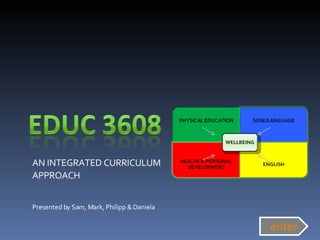
AN INTEGRATED CURRICULUM APPROACH Presented by Sam, Mark, Philipp & Daniela enter
Back J ustifications D ocuments/ Resources  C onclusion R eferences
Metropolitan school in Adelaide Glenunga International High School Located in Glen Osmond, Adelaide, SA Between 20 to 80 different nationalities Around 1200 students Recognised overseas Choice between SACE and IB (International Bachelorette) Reputation as one of the finest public schools in Adelaide Co-educational Long waiting list Focus on sports, academics and languages Back Fwd
Aimed at Year 8 Target Areas include Languages, English, Drama, Health, PE and SOSE Wellbeing over a 10 week period. Focused on a 4 week period to showcase content  and assessment Languages Cultural comparison between nations Incorporating Legal Studies into SOSE Enhance language skills Developing a greater understanding of a foreign nation Linking German with SOSE and Legal Studies Back Fwd
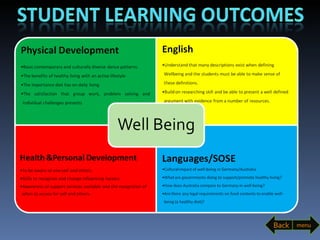
English Discussion-based approach Students to contemplate the meaning of ‘well-being’ from a number of sources What does it take to be well and who decides what well is? Health/PE Inclusion of physical, mental, practical and theoretical aspects Strong point 1: Physical Development Strong point 2: Diet and Nutrition Back menu
Back Fwd
Well-being as a main topic Maximum learning benefit for students Enhanced learning Variety of sub-topics Subjects areas linked via the common topic (well-being) Adaptable in a variety of classrooms and different subjects Variety of teaching techniques and assessment methods Includes oral presentations, tests and assignments Students kept on their toes Students input essential Students given the chance to reflect upon their own learning Back Fwd
Well-being is essential for students to learn, ensuring that the future generations are aware of the choices they make in terms of diet, nutrition and health in general. It seems rational for schools to teach students how to enable a healthier lifestyle, and hence enable students to choose a longer and healthier life. The purpose of the topic is, as stated above, to educate students about the benefits of well-being and a healthy lifestyle in a way that can be useful and adapted to a range of subjects. Back menu
Back
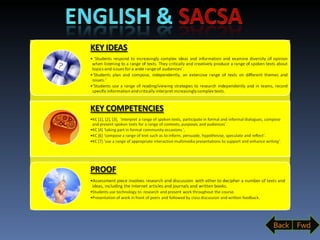
Integrated Curriculum for middle school education must still adhere to and remain aligned with SACSA. The framework provided by SACSA describes the key ideas and outcomes all learners can expect their  education to be built on.  Each subject will provide key ideas, learning outcomes and evidence of this throughout.  Back
Back Fwd
Back Menu
Back Fwd
Back Menu
Back Fwd
Back Menu
Back Fwd
Back menu
1. 2. 3. Back Why SACSA?
SIMPLE! It provides the basis for educators to… ‘ design detailed learning and assessment programs which suits the needs of children and students in their settings…’   (SACSA Framework,2001) Back
Initial proposal to identify needs for integrated curriculum following SACSA framework as basis for new learning platform. Recognise SACSA  key ideas  and develop subject based unit plans that corresponds to each item. Collaborate with co-working year level teachers to cross-analyse ‘Key Competencies’ that are students are intended to achieve. An overlap should become evident. Ensure that the planned integrated curriculum manifests constructivists learning throughout and relates back to the fertile theme ‘well-being’.  Back
The planned curriculum begins.  Consistent predetermined conferences are made to ensure all learning outcomes and key competencies are relating to central theme, and under the guidance of the SACSA framework.  Back
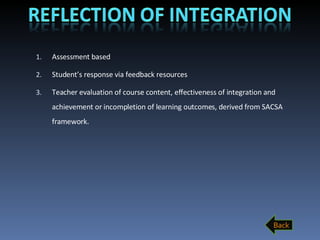
Assessment based Student’s response via feedback resources Teacher evaluation of course content, effectiveness of integration and achievement or incompletion of learning outcomes, derived from SACSA framework. Back
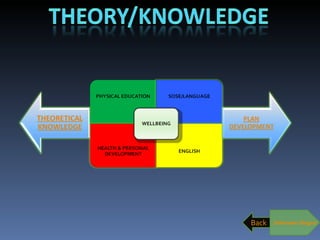
Unknown diagram Back
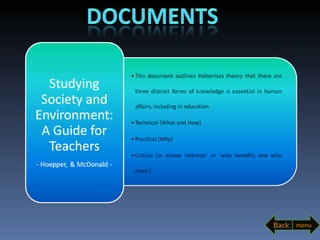
A   critical theorist named  Jurgens Habermas (1971)  associated with the Frankfurt School of philosophers, psychologists and sociologists put forward a theory of ‘Knowledge-constitutive interests.’  (Hoepper & McDonald, 2004, p26)  He proposed three distinct forms of knowledge is essential in human affairs, including in education  (Hoepper & McDonald, 2004, p26).  These distinct forms are: 1. 2. 3. Back
T his form of knowledge comes from the questions ‘what’ and ‘how’. Habermas believed that technical knowledge helps people regulate, predict and control their daily lives  (Hoepper & McDonald, 2004, p26). In the beginning of the unit we will focus on what assumed prior knowledge the students have  on the unit topic ‘wellbeing’ and how it will be  constructed and verified.  Here is an example using Habermas theory of ‘ Knowledge-constitutive interests.’  Using the Technical form of Knowledge: we will ask the students WHAT IS WELLBEING? Back
T his form of knowledge comes from the question ‘why’. Practical knowledge helps us to understand other people’s actions and attitudes and helps in our dealings with people  (Hoepper & McDonald, 2004, p26).  The characteristics of this question aims for the students to describe ‘wellbeing’ in their own words. Keeping in mind every answer will be different.  The purpose of this question is to find their own identity.  Using the Practical form of Knowledge: we will ask the students, WHY IS WELLBEING IMPORTANT? Back
This form comes from the questions ‘in whose interests’ or ‘who benefits and who loses’. This form enables people to critique situations and help others to emancipate themselves from various forms of disadvantages and oppression, and to seek justice for themselves and others.  (Hoepper & McDonald, 2004, p26) “ Students in the classroom will see for themselves how things fit together. Unfortunately, the reality of the situation is that they tend to learn what we teach”  (Lake, 2001, p5) A discussion during the first class will help us find out what they have previously studied or are interested in learning about this topic. The pyramid of what we want the students to learn. Some, Most, All Back Fwd
Finally, using the critical form of knowledge we will ask the students, SHOULD THE GOVERNMENTS IN AUSTRALIA BE DEVOTED TO IMPROVING OUR INDIVIDUAL AND SOCIAL WELLBEING? This question will make the students critically analyse what is important and how our society works.  This question will raise issues about who benefits and who loses.  This question also aims to help with their self awareness and understanding of others.  Back
The Unknown Diagram... Back
Back
B eane (1999- 2008)  states that an “integrated curriculum is a curriculum design that promotes personal and social integration through the organisation of curriculum around significant problems and issues, collaboratively identified by educators and young people, without regard for subject area lines... with an emphasis on real-life themes.” Back
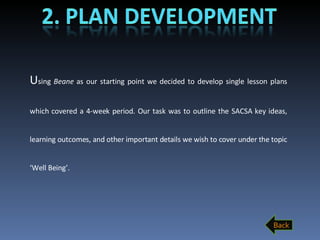
U sing  Beane  as our starting point we decided to develop single lesson plans which covered a 4-week period. Our task was to outline the SACSA key ideas, learning outcomes, and other important details we wish to cover under the topic ‘Well Being’. Back
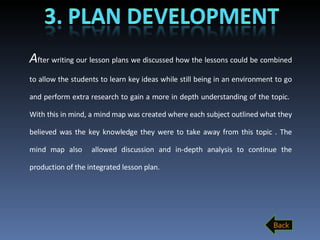
A fter writing our lesson plans we discussed how the lessons could be combined to allow the students to learn key ideas while still being in an environment to go and perform extra research to gain a more in depth understanding of the topic.  With this in mind, a mind map was created where each subject outlined what they believed was the key knowledge they were to take away from this topic . The mind map also  allowed discussion and in-depth analysis to continue the production of the integrated lesson plan.  Back
L astly, we developed a lesson plan, which incorporated all the necessary SACSA requirements, an overall understanding of knowledge from this topic, activities which could be used and the perception on how the subjects can work together to create a learning environment. Back
A fter   going through key ideas and outcomes for each subject, throughout the planning stage we decided that we will come together to see if it has been achieved through our assessments and in class activities for each student.  W e  felt that this method of evaluation would benefit in our favor because we as a group will be able to see what has been covered in our subjects and what hasn’t.  Back
School Dynamic Middle School Focus School with significant numbers Without religious education to allow more flexibility around teaching times. Back Fwd
Wellbeing as a focus Incorporate all the subject areas Still designing an integrated curriculum  Promotes personal and social integration of a significant problem or issue relevant to the students (Beane).  Wellbeing Vs. The Olympics Wellbeing more of an issues for the students Back Fwd
Why we each designed a lesson plan Meet SACSA requirements  To ensure that each of us had an understanding of  the final outcome On completion of the lesson plans we sat down to discuss the students and what they should know at the end.  Led to the construction of the chart ‘What we want students to know’ Back Fwd
Back menu
Back Fwd
Back Fwd
Back Fwd
Back Fwd
Back menu
In conclusion this four week integrated lesson plan, of a larger term piece of work outlines the key elements needed within Integrated Curriculum. As a group we found it hard to remove subject headings and make it completely Integrated however we have produced an excellent piece of work trying to remove these boundaries. Back
Beane, J. A. (1999- 2008).  Organizing the Middle School Curriculum.  Retrieved September 10, 2008, from National Middle School Association:  http://www.nmsa.org/Publications/webexclusive/organizing/tabid/651/default.aspx Bonanno, H. J. (1998). Improving Group Satisfaction: making groups work in a first-year undergraduate course.  Teaching in Higher Education   , 34  (3), 365-382. Department of Education and Children's Services. (2001).  South Australian Curriculum Standards and accountability framework . Retrieved October 10, 2008, from Learning Areas:  http://www.sacsa.sa.edu.au/index_fsrc.asp?t=LA Government of South Australia. (n.d.).  Future SACE For Schools . Retrieved October 10, 2008, from Future SACE: http://www.futuresace.sa.gov.au/schools.htm Hoepper & Mcdonald, H. (2004).  Studying Society and Environment: A Guide for Teachers  (3rd Edition ed.). (R. Gilbert, Ed.) South Bank, Victoria: Thomson Social Press. Back Fwd
Lake, K. (2007). Integrated Curriculum.  School Improvement Research Series  , 1-21. Prensky, M. (2001, October).  Digital Natives and Digital Immigrants.  Retrieved September 10, 2008, from Marc Prensky:  http://www.marcprensky.com/writing/Prensky%20-%20Digital%20Natives,%20Digital%20Immigrants%20-%20Part1.pdf Sweeney, T. (2008, September 16).  Integrated Curriculum and ICT in the Middle School.  Flinders University, South Australia. Back

Wellbeing - a lesson plan

  • 1.
    AN INTEGRATED CURRICULUMAPPROACH Presented by Sam, Mark, Philipp & Daniela enter
  • 2.
    Back J ustificationsD ocuments/ Resources C onclusion R eferences
  • 3.
    Metropolitan school inAdelaide Glenunga International High School Located in Glen Osmond, Adelaide, SA Between 20 to 80 different nationalities Around 1200 students Recognised overseas Choice between SACE and IB (International Bachelorette) Reputation as one of the finest public schools in Adelaide Co-educational Long waiting list Focus on sports, academics and languages Back Fwd
  • 4.
    Aimed at Year8 Target Areas include Languages, English, Drama, Health, PE and SOSE Wellbeing over a 10 week period. Focused on a 4 week period to showcase content and assessment Languages Cultural comparison between nations Incorporating Legal Studies into SOSE Enhance language skills Developing a greater understanding of a foreign nation Linking German with SOSE and Legal Studies Back Fwd
  • 5.
    English Discussion-based approachStudents to contemplate the meaning of ‘well-being’ from a number of sources What does it take to be well and who decides what well is? Health/PE Inclusion of physical, mental, practical and theoretical aspects Strong point 1: Physical Development Strong point 2: Diet and Nutrition Back menu
  • 6.
  • 7.
    Well-being as amain topic Maximum learning benefit for students Enhanced learning Variety of sub-topics Subjects areas linked via the common topic (well-being) Adaptable in a variety of classrooms and different subjects Variety of teaching techniques and assessment methods Includes oral presentations, tests and assignments Students kept on their toes Students input essential Students given the chance to reflect upon their own learning Back Fwd
  • 8.
    Well-being is essentialfor students to learn, ensuring that the future generations are aware of the choices they make in terms of diet, nutrition and health in general. It seems rational for schools to teach students how to enable a healthier lifestyle, and hence enable students to choose a longer and healthier life. The purpose of the topic is, as stated above, to educate students about the benefits of well-being and a healthy lifestyle in a way that can be useful and adapted to a range of subjects. Back menu
  • 9.
  • 10.
    Integrated Curriculum formiddle school education must still adhere to and remain aligned with SACSA. The framework provided by SACSA describes the key ideas and outcomes all learners can expect their education to be built on. Each subject will provide key ideas, learning outcomes and evidence of this throughout. Back
  • 11.
  • 12.
  • 13.
  • 14.
  • 15.
  • 16.
  • 17.
  • 18.
  • 19.
    1. 2. 3.Back Why SACSA?
  • 20.
    SIMPLE! It providesthe basis for educators to… ‘ design detailed learning and assessment programs which suits the needs of children and students in their settings…’ (SACSA Framework,2001) Back
  • 21.
    Initial proposal toidentify needs for integrated curriculum following SACSA framework as basis for new learning platform. Recognise SACSA key ideas and develop subject based unit plans that corresponds to each item. Collaborate with co-working year level teachers to cross-analyse ‘Key Competencies’ that are students are intended to achieve. An overlap should become evident. Ensure that the planned integrated curriculum manifests constructivists learning throughout and relates back to the fertile theme ‘well-being’. Back
  • 22.
    The planned curriculumbegins. Consistent predetermined conferences are made to ensure all learning outcomes and key competencies are relating to central theme, and under the guidance of the SACSA framework. Back
  • 23.
    Assessment based Student’sresponse via feedback resources Teacher evaluation of course content, effectiveness of integration and achievement or incompletion of learning outcomes, derived from SACSA framework. Back
  • 24.
  • 25.
    A critical theorist named Jurgens Habermas (1971) associated with the Frankfurt School of philosophers, psychologists and sociologists put forward a theory of ‘Knowledge-constitutive interests.’ (Hoepper & McDonald, 2004, p26) He proposed three distinct forms of knowledge is essential in human affairs, including in education (Hoepper & McDonald, 2004, p26). These distinct forms are: 1. 2. 3. Back
  • 26.
    T his formof knowledge comes from the questions ‘what’ and ‘how’. Habermas believed that technical knowledge helps people regulate, predict and control their daily lives (Hoepper & McDonald, 2004, p26). In the beginning of the unit we will focus on what assumed prior knowledge the students have on the unit topic ‘wellbeing’ and how it will be constructed and verified. Here is an example using Habermas theory of ‘ Knowledge-constitutive interests.’ Using the Technical form of Knowledge: we will ask the students WHAT IS WELLBEING? Back
  • 27.
    T his formof knowledge comes from the question ‘why’. Practical knowledge helps us to understand other people’s actions and attitudes and helps in our dealings with people (Hoepper & McDonald, 2004, p26). The characteristics of this question aims for the students to describe ‘wellbeing’ in their own words. Keeping in mind every answer will be different. The purpose of this question is to find their own identity. Using the Practical form of Knowledge: we will ask the students, WHY IS WELLBEING IMPORTANT? Back
  • 28.
    This form comesfrom the questions ‘in whose interests’ or ‘who benefits and who loses’. This form enables people to critique situations and help others to emancipate themselves from various forms of disadvantages and oppression, and to seek justice for themselves and others. (Hoepper & McDonald, 2004, p26) “ Students in the classroom will see for themselves how things fit together. Unfortunately, the reality of the situation is that they tend to learn what we teach” (Lake, 2001, p5) A discussion during the first class will help us find out what they have previously studied or are interested in learning about this topic. The pyramid of what we want the students to learn. Some, Most, All Back Fwd
  • 29.
    Finally, using thecritical form of knowledge we will ask the students, SHOULD THE GOVERNMENTS IN AUSTRALIA BE DEVOTED TO IMPROVING OUR INDIVIDUAL AND SOCIAL WELLBEING? This question will make the students critically analyse what is important and how our society works. This question will raise issues about who benefits and who loses. This question also aims to help with their self awareness and understanding of others. Back
  • 30.
  • 31.
  • 32.
    B eane (1999-2008) states that an “integrated curriculum is a curriculum design that promotes personal and social integration through the organisation of curriculum around significant problems and issues, collaboratively identified by educators and young people, without regard for subject area lines... with an emphasis on real-life themes.” Back
  • 33.
    U sing Beane as our starting point we decided to develop single lesson plans which covered a 4-week period. Our task was to outline the SACSA key ideas, learning outcomes, and other important details we wish to cover under the topic ‘Well Being’. Back
  • 34.
    A fter writingour lesson plans we discussed how the lessons could be combined to allow the students to learn key ideas while still being in an environment to go and perform extra research to gain a more in depth understanding of the topic. With this in mind, a mind map was created where each subject outlined what they believed was the key knowledge they were to take away from this topic . The mind map also allowed discussion and in-depth analysis to continue the production of the integrated lesson plan. Back
  • 35.
    L astly, wedeveloped a lesson plan, which incorporated all the necessary SACSA requirements, an overall understanding of knowledge from this topic, activities which could be used and the perception on how the subjects can work together to create a learning environment. Back
  • 36.
    A fter going through key ideas and outcomes for each subject, throughout the planning stage we decided that we will come together to see if it has been achieved through our assessments and in class activities for each student. W e felt that this method of evaluation would benefit in our favor because we as a group will be able to see what has been covered in our subjects and what hasn’t. Back
  • 37.
    School Dynamic MiddleSchool Focus School with significant numbers Without religious education to allow more flexibility around teaching times. Back Fwd
  • 38.
    Wellbeing as afocus Incorporate all the subject areas Still designing an integrated curriculum Promotes personal and social integration of a significant problem or issue relevant to the students (Beane). Wellbeing Vs. The Olympics Wellbeing more of an issues for the students Back Fwd
  • 39.
    Why we eachdesigned a lesson plan Meet SACSA requirements To ensure that each of us had an understanding of the final outcome On completion of the lesson plans we sat down to discuss the students and what they should know at the end. Led to the construction of the chart ‘What we want students to know’ Back Fwd
  • 40.
  • 41.
  • 42.
  • 43.
  • 44.
  • 45.
  • 46.
    In conclusion thisfour week integrated lesson plan, of a larger term piece of work outlines the key elements needed within Integrated Curriculum. As a group we found it hard to remove subject headings and make it completely Integrated however we have produced an excellent piece of work trying to remove these boundaries. Back
  • 47.
    Beane, J. A.(1999- 2008). Organizing the Middle School Curriculum. Retrieved September 10, 2008, from National Middle School Association: http://www.nmsa.org/Publications/webexclusive/organizing/tabid/651/default.aspx Bonanno, H. J. (1998). Improving Group Satisfaction: making groups work in a first-year undergraduate course. Teaching in Higher Education , 34 (3), 365-382. Department of Education and Children's Services. (2001). South Australian Curriculum Standards and accountability framework . Retrieved October 10, 2008, from Learning Areas: http://www.sacsa.sa.edu.au/index_fsrc.asp?t=LA Government of South Australia. (n.d.). Future SACE For Schools . Retrieved October 10, 2008, from Future SACE: http://www.futuresace.sa.gov.au/schools.htm Hoepper & Mcdonald, H. (2004). Studying Society and Environment: A Guide for Teachers (3rd Edition ed.). (R. Gilbert, Ed.) South Bank, Victoria: Thomson Social Press. Back Fwd
  • 48.
    Lake, K. (2007).Integrated Curriculum. School Improvement Research Series , 1-21. Prensky, M. (2001, October). Digital Natives and Digital Immigrants. Retrieved September 10, 2008, from Marc Prensky: http://www.marcprensky.com/writing/Prensky%20-%20Digital%20Natives,%20Digital%20Immigrants%20-%20Part1.pdf Sweeney, T. (2008, September 16). Integrated Curriculum and ICT in the Middle School. Flinders University, South Australia. Back