
The Curriculum 21
Pocket Guide
Guide compiled by Paul, Megan, Nathaniel,
Stephanie, Tiffany and Wendy
Good luck in your 21st
century classrooms!
A New Essential Curriculum for a New Time
We must prepare learners for their world and their time.
What year are we walking into when we walk into today’s schools? Is school
just a simulation of life in the 1980s? An age before smart phones, Internet
communication and collaboration, digital books, cross-curricular disciplines?
How do we prepare learners?
Backward Design: We must begin with the end in mind. Before starting a
valid activity ask: “What is it we want students to know and be able to do?”
Old Habits
We are living a school system designed by the thinking and societal issues of
1893. It is based on a factory model. The model of 1893 was based upon
English, Civics, History, Mathematics, Biology, Chemistry, and Physics.
Sound familiar?We have a century of fascinating innovation, experimentation,
and exciting ideas that aren’t reflected in the current model.
We don’t need reforms – we need new forms.
Check out http://curriculum21.ning.com/video/rsa-animate-changing
for Mr. Dressup-style summary of this concept.
Rigid Standardization is not the best option
This is more of an American issue. Because of the pressure of standardization
and the pressure to perform, many teach to the test, not to the needs
of the students.
Progress:
Schools that are leading the 21c way
New Jersey – A district in NJ has developed 3 overarching educational goals.
Curriculum must develop: global perspectives, 21c digital and networking
tools, and interdisciplinary linkages for real life applications.
Rhode Island – A Digital Portfolio is required in order to graduate.
Students include clips, podcasts, and papers; anything they want to
create a history of their 12 years of education that proves they should
graduate.
Hawaii – Professional Development through video
conferencing.
Upgrade the Curriculum
Growth vs. Change – This isn’t a fad, or change for the sake of
change. It is real growth out of an outdated system into a current one.
New Versions of School:
- The old way can be dated, inhibiting, and negative.
- Some building designs isolate.
- We never combine English and Math class to look at ways to
communicate number concepts. We don’t have higher grades tutor or
teach concepts to lower grades.
- Grade separation is ineffective, while multi-age groups with
thoughtfully grouped personnel seem to work well. What if levels
grouped students?
- Form should support function, not lead it. Our classes shouldn’t
dictate that we can’t turn our eyes to the outside world.
Common Myths
Good old days are still good enough – We are comfortable with the
system we grew up in. So we think applicable to others. Instead we
need keep what is timeless, cut what is dated, and create what is
needed.
We’re better off if we all think alike, and not too much. This is the
simple, home-grown wisdom argument. Thinking too much is for the
“elite”. Instead we need to be fearless about ideas and openly engage
in discussion and debate about what should matter in subject matter.
Too much creativity is dangerous, and the arts are frills – This
goes against brain and human learning research. We are a “High
Concept” “High Touch” society. Whether in business plan problem
solving, technology, advertising communication, conflict management
or in the arts world, creativity and collaboration are considered
commodities.
21st
Century Assessment Types and Skills
C Curriculum Mapping: A way for teachers teaching the
same curriculum to share new assessment and update dated
material.
How to do it right:
• Collaborate with teachers.
• Replace not integrate. Cut what is dated, keep what is timeless, create
what is missing and needed.
Upgrading Assessment: Step away from the test.
• Many assessments stuck in 19th
century.
• Short Story writing is a great skill. Does it need to be on paper? What
about a short story podcast?
How to Implement This in Your School
Step 1: Brainstorm assessment replacements: List assessments used in
classrooms in many subjects. List what today’s scientists, business people,
entertainment industry, tech sector would create in workplace. I.e. podcasts,
screenplay, documentaries, CAD projects, blogs, video conferences, second
life simulations etc.
Step 2: Teachers should work with IT members to identify existing types of
software, hardware, internet capabilities in school, district or regional service
centers. Explore technology such as SmartBoards, Moodle, Webcams, Ipods,
Webquests, Web 2.o sites, Twitter, E-games, Blogs, etc.
Step 3: Make a plan to consistently replace 1 dated assessment with a modern
one. I.e. Replace drawing a chart of Peru with a WebQuest about Peru.
Step 4: Share the assessment upgrades with colleagues. This is Collaborative
Brainstorming. This is where curriculum mapping can come into play.
Talks about the 21c. skills we have been learning in Instruction and Learning
Practices. They are NO good unless paired with 21c. assessments, output, and
curriculum content.
Upgrading Content: Provocation, Invigoration, and Replacement
This is harder than upgrading the curriculum, but is very important.
Not just our methods but the very stuff we teach.
What is essential and timeless? What is not essential or dated? What
should be created that is evident and necessary? An unending
Update/Review Process is the bedrock of learning.
Important factors of Content Upgrade:
Global perspective: Looking locally and globally in our content.
Global means beyond Western Civilization.
• Incorporating the whole child (Academic, Emotional,
Physical, Mental)
• Future career and work options (creative and imaginative)
• Disciplines are dynamic not static. They interconnect and
change to reflect real world practice.
Tech and media: Expand sources of content to include active and
static materials. PowerPoint vs. Prezi (Google it if you are
wondering).
Complexity of content developmentally matched to age and stage of
learner.
Students need to be a part of the team. They provide new
perspectives – they may know technology you do not.
Create a Curriculum 21 Team at your School:
It needs to be intellectual,
rational, and forward thinking.
Formally review specific areas in each discipline
and share openly and bravely with colleagues.
Guiding questions when trying to update content:
• Within the Discipline being reviewed, what content choices are
dated and nonessential?
• What Choices for topics, issues, problems, themes, and case
studies are timely and necessary for our learners within
disciplines?
• Are the interdisciplinary content choices rich, natural, and
rigorous?
Examples of why we need a change in each discipline:
Social studies – we view the world through the eyes of those of 1569. The
map we all know is quite distorted. Google the Gall-Peters Projection.
Science - we neglect important areas of science. For $200 schools could
build a Dobsonian telescope. Students could study astronomy and
appreciate our place in the world. Also base learning around problem-
solving, because content memorization is ineffective and quickly outdated.
Health and Phys. Ed – learning how to play a sport ignores huge parts of
our physical existence. Physical Education needs more. One school uses
“Five for Life,” which consists of cardio-respiratory endurance, muscular
strength, muscular endurance, flexibility, and body composition. Imagine a
gym class with all of those aspects! Yoga day and basketball day.
Contemporary English Language and Literature - some of the
greatest industries that require writing and other literary skills include
the film industry, television industry, advertising industry, and
journalism. Why do we not incorporate the skills needed in these
industries? Editing strategies, creative note-taking, and the ever-
ignored portion of English Literature: Speech. Why do we not
consistently analyze the output of these industries, especially as they
relate to literature? (A Book to Film class, a screenplay and script
analysis class, and “writing for documentary” class).
World Language Instruction – the 4 languages spoken most in the
world are Mandarin, Spanish, English, and Arabic. What languages
were offered at your school?
Mathematics as a Language: Reason, do not memorize! Also
incorporation of basic life math skills should be introduced before
high school. We all may not find the derivative of an equation after
high school but we will definitely find opportunity to use financial
literacy, entrepreneurialism, and budget design.
The Arts: Where are the modern forms of expression in the arts?
Incorporate technical and digital tools to communicate artistically.
Remember School of Rock? Their final performance? The graphic
and light show that accompanied the band performance? (YouTube it
if you don’t know).
Lesson Plan Support Site: http://artsedge.kennedy-center.org
Curricular Destiny: Schedules, Grouping Patterns,
and the Use of Space
The Structure of Time: Schedules - curriculum is nested within long- and
short-term schedules.
Against Graduation as We Know It - Why do we need school to run for 13
years to say that someone has graduated? This structure is the ultimate seat-time
problem. If someone can sit through these 13 years rather than, say, 10 or 14
then they have earned their diploma.
Time as Currency: Periods, Blocks, Modules, Minutes - Consider this time
currency question: what kind of time do I need to help my students edit a first
draft? This is a question that we as teachers want to ask, but far too often we
instead use reversed thinking and wonder, “what can I stuff into the 40 minutes
I have for math?’
Heroic School Schedules - The educators at these schools
offer a tailored curriculum for each learner. There are
no bells and no 45-minute blocks of time.
Thinking and Planning Outside the Scheduling Box - One of the most
promising new forms of learning experiences is the Virtual Learning Magnet,
which matches learning time with engaging and purposeful tasks, offers self-
selection on the part of the learner and the teacher, and connects cyberspace
with physical space.
The Grouping of Students - To the extent possible, we should group students
to best suit their needs so that form follows function. Groupings in school can
be thought of in three fundamental categories: Institutional grouping,
instructional grouping, and independent grouping.
The Need for Multiple Affiliations - Personnel should consider multiple types
of affiliations and groupings as well as the duration of such groups to provide
variety and perspective in their work. The affiliations should not be random but
targeted and strategic.
The Meeting Habit -Instead of meeting by departments, what if we were to
meet around problems?
New Versions of Physical and Virtual Space - Where a school is
located and how it sets up internal structures determine its
possibilities. Most schools were not really built for children, let alone
for learning.
Sketching Program Blueprints for New School Versions - Our
Curriculum 21 teams should always be thinking about new versions of
school by asking whom we are serving, and how can we best meet the
needs of our specific learners.
Five Socio-Technology Trends That Change
Everything in Learning and Teaching
Social Production is radically redistributing the powers of production
and knowledge creation and generating a model for learning to do.
Social Networks. Social networking technologies are powerful tools for
enhancing the process of learning to be, of defining our identities. Digital
social networks are now an essential part of the experience of everyone
under the age of 20. Digital social networks may be the biggest game
changer in learning and what it means to be educated.
A Semantic Web will become the model for learning to know in the next
innovation phase of the Internet. A semantic web will dramatically
transform our relationship to new knowledge, our ability to use new
knowledge for purposes of creativity, and our definition of what it means
to be educated.
Media Grids are three-dimensional representations of space using
computing power and the Internet.
The New Zoo of Nonlinear Learning. The new zoo enabled by biology,
a new mother science for a new era of nonlinear learning, should give all
those concerned with the direction of learning and teaching pause for
thought. Deep thought, and even deeper questions.
From Cathedrals to Bazaars - What we thought we knew about
learning and teaching, and the cathedral-like, elegant, top-down, complex
systems we designed to support formal processes of learning and teaching
just may not be the relevant model.
A Classroom as Wide as the World
The world in which today’s students will graduate is fundamentally different
from the world in which we grew up. The quickening pace of globalization
over the past 20 years – driven by profound technological changes, the rise
of China and India, and the accelerating pace of scientific discovery - has
produced a whole new world. We must prepare students for a world where
the opportunities for success require the ability to compete and cooperate on
a global scale.
Five global trends are transforming the context for the future generation.
These trends are related to economics, science and technology,
demographics, security and citizenship, and education.
What are the implications of these global trends?
Certainly education as usual won’t do. We need to transform our learning
systems to equip students with the knowledge and skills they will need to
succeed in this new global era. Our national goal should be that all students
must graduate from high school university – ready and globally competent,
prepared to compete, connect, and cooperate with their peers around the
world.
We need to…
- Integrate international content into all curriculum areas
- Emphasize the learning of world languages.
- Harness technology to tap global information sources
- Create international collaborations.
Making Learning Irresistible
Music is not about the notes. Language arts is not about the letters and
the words. Math is not about the numbers and the symbols. And school
is not about grades.
The whole is substantially more relevant, more meaningful, and more
significant than the sum of the individual parts. Make no mistake, the
parts are important. They are just not the goal.
How do we move from an emphasis on remembering facts for a test on
Friday to thinking critically about the larger issues that those
disconnected facts can only dimly reflect as stand-alone pieces of
information?
If students were to become more authentically
engaged in the art of learning, the classroom
would have to be more participatory, as
students had to get up out of their mental seats
and produce something at least as important
as a grade.
This product had to demonstrate not just content knowledge, but an
understanding that ultimately makes a contribution.
Students would take more ownership of their learning; their interest in
learning would create inevitable desire to learn more. The students
would want to create something in which they would take pride and
want everyone to see.
The role of the teachers is not really to teach students what buttons to
push to make the software or hardware do this or that.
The most important role of the educator is to keep students focused on
the point, to keep them centered in meaningful curriculum content
and message, to guide and facilitate the creation process.
Media Literacy (ML)
 Many teachers are not proficient teaching ML.
 Few educators have had effective training teaching ML
 A growing “digital disconnect.”
 The English Teacher's Companion (Burke 2003) sees incorporating
media in the classroom as vital for teaching's future.
 Teachers have the opportunity and responsibility to use ML as one of
our key strategies for helping student develop critical thinking skills.
 Educational Org. Partnerships: Urge schools to teach skills in
Collaboration and Teamwork, Making Global Connections, Critical
Thinking, and Media Literacy.
 Teachers in every school in one state were trained to incorporate
standards-based ML lesson plans into the classroom. (hope floats)
Critical Thinking and ML:
“While more young people have access to the internet and other media
than any generation in history, they do not necessarily possess the ethics,
the intellectual skills, or the predisposition to critically analyze and
evaluate their relationship with these technologies or the information
they encounter. Good eye/hand coordination and the ability to multitask
are not substitutes for critical thinking”
David Considine (2002)
Corporations depend on media-illiterate young people to advertise their
clothes to their peers.
Five core concepts of ML;
1) All media messages are constructed.
2) Media messages are constructed using a creative language with
its own rules.
3) Different people experience the same media message
differently.
4) Media have embedded values and points of view.
5) Most media messages are organized to gain profit and or
power.
“At the heart of media literacy is the principle of inquiry”
- Elizabeth Thoman
Corresponding critical thinking questions:
• Who created or paid for the message? (authorship,
producer)
• Why was it created? (purpose)
• Who is the message designed to reach? (target
audience)
• How might different people from me understand
this message differently? (audiences negotiating
meaning)
• How does the message get my attention; in what
ways is the message credible? (techniques,
methods)
• What values, lifestyles, points of view are included
or excluded and why? Where can I get more
information, different perspectives, or verify the
information? (research, critical thinking)
• What can I do with this information (decision
making)
Media Literacy: What does it mean?
The problem with the phrase “media literacy” is that it does mean
different things to different people.
See the definitions for ML on page 141.
Having media literacy incorporated into the classrooms
• Reduces the effects of violence, aggression and anti-
social behaviour.
• ML can help help enhance high school girls’ self-
acceptance.
• ML increased children's understanding of the
persuasive intent of ads for alcohol & tobacco.
•
Benefits of Education in Media Literacy
• It helps teachers meet state/prov teaching standards.
• It allows teachers to bring familiar youth-media culture
into the classroom.
Classroom Applications of Media Literacy
English/Language Arts
• Teachers should be familiar not only with new media, but also
with the popular culture of the students they teach.
• Lesson plans can be found at www.readwritethink.org
• Students love film, and studying how films are created is another
way for teachers to teach media literacy.
• Numerous websites allow students to upload their school-created
productions and share their work with peers.
• Lesson Plans for Creating Media-Rich Classrooms. (Christel &
Sullivan, 2007)
Social Studies
• The invention and use of photography is a prominent example of an
appropriate focus for the rise of mass media in history.
• Like it or not, young people learn a lot about sex from the media.
What they understand is often skewed by Hollywood and other
media producers.
• Advertisers have known for years that “sex sells.”
Mathematics
• Numbers abound in news. Math teachers should be encouraged to
consider incorporating these news reports in their instruction.
• Teachers can engage their students by helping them understand how
these numbers are generated and how they are used.
• Math in the media web site:
www.frankwbaker.com/math_in_the_media.htm
Science
• Every teacher who uses a video, a CD-ROM, or the internet as part
of instruction should ask questions such as this: How does the
selection of images by the producer shape our understanding of
science concepts?
• *look at final thoughts on page 151.
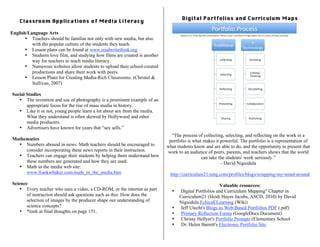
Digital Portfolios and Curriculum Maps
“The process of collecting, selecting, and reflecting on the work in a
portfolio is what makes it powerful. The portfolio is a representation of
what students know and are able to do, and the opportunity to present that
work to an audience of peers, parents, and teachers shows that the world
can take the students' work seriously.”
- David Niguidula
http://curriculum21.ning.com/profiles/blogs/wrapping-my-mind-around
Valuable resources:
• Digital Portfolios and Curriculum Mapping" Chapter in
Curriculum21 (Heidi Hayes Jacobs, ASCD, 2010) by David
Niguidula EchicaELearning (Wiki)
• Jeff Utecht's Blogs as Web-Based Portfolios PDF (.pdf)
• Primary Reflection Forms (GoogleDocs Document)
• Chrissy Hellyer's Portfolio Prompts (Elementary School
• Dr. Helen Barrett's Electronic Portfolio Site
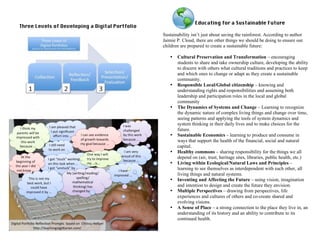
Three Levels of Developing a Digital Portfolio
Educating for a Sustainable Future
Sustainability isn’t just about saving the rainforest. According to author
Jaimie P. Cloud, there are other things we should be doing to ensure our
children are prepared to create a sustainable future:
• Cultural Preservation and Transformation – encouraging
students to share and take ownership culture, developing the ability
to discern with others what cultural traditions and practices to keep
and which ones to change or adapt as they create a sustainable
community.
• Responsible Local/Global citizenship – knowing and
understanding rights and responsibilities and assuming both
leadership and participation roles in the local and global
community
• The Dynamics of Systems and Change – Learning to recognize
the dynamic nature of complex living things and change over time,
seeing patterns and applying the tools of system dynamics and
system thinking in their daily lives and to make choices for the
future.
• Sustainable Economics – learning to produce and consume in
ways that support the health of the financial, social and natural
capital.
• Healthy commons – sharing responsibility for the things we all
depend on (air, trust, heritage sites, libraries, public health, etc.)
• Living within Ecological/Natural Laws and Principles –
learning to see themselves as interdependent with each other, all
living things and natural systems.
• Inventing and Affecting the Future – using vision, imagination
and intention to design and create the future they envision.
• Multiple Perspectives – drawing from perspectives, life
experiences and cultures of others and co-create shared and
evolving visions.
• A Sense of Place – a strong connection to the place they live in, an
understanding of its history and an ability to contribute to its
continued health.
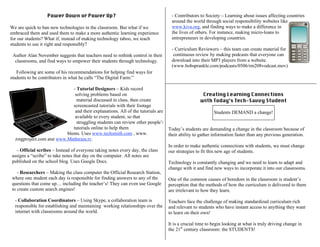
Power Down or Power Up?
We are quick to ban new technologies in the classroom. But what if we
embraced them and used them to make a more authentic learning experience
for our students? What if, instead of making technology taboo, we teach
students to use it right and responsibly?
Author Alan November suggests that teachers need to rethink control in their
classrooms, and find ways to empower their students through technology.
Following are some of his recommendations for helping find ways for
students to be contributors in what he calls “The Digital Farm:”
- Tutorial Designers – Kids record
themselves solving problems based on
material discussed in class, then create
screencasted tutorials with their footage
and their explanations. All of the tutorials are
available to every student, so that
struggling students can review other people’s
tutorials online to help them
understand concepts or problems. Uses www.techsmith.com , www.
Jingproject.com and www.Mathtrain.tv.
- Official scribes – Instead of everyone taking notes every day, the class
assigns a “scribe” to take notes that day on the computer. All notes are
published on the school blog. Uses Google Docs.
- Researchers – Making the class computer the Official Research Station,
where one student each day is responsible for finding answers to any of the
questions that come up… including the teacher’s! They can even use Google
to create custom search engines!
- Collaboration Coordinators – Using Skype, a collaboration team is
responsible for establishing and maintaining working relationships over the
internet with classrooms around the world.
- Contributors to Society – Learning about issues affecting countries
around the world through social responsibility websites like
www.kiva.org, and finding ways to make a difference in
the lives of others. For instance, making micro-loans to
entrepreneurs in developing countries.
- Curriculum Reviewers – this team can create material for
continuous review by making podcasts that everyone can
download into their MP3 players from a website.
(www.bobsprankle.com/podcasts/0506/rm208vodcast.mov)
Creating Learning Connections
with Today’s Tech-Savvy Student
Students DEMAND a change!
Today’s students are demanding a change in the classroom because of
their ability to gather information faster than any previous generation.
In order to make authentic connections with students, we must change
our strategies to fit this new age of students.
Technology is constantly changing and we need to learn to adapt and
change with it and find new ways to incorporate it into our classrooms.
One of the common causes of boredom in the classroom is student’s
perception that the methods of how the curriculum is delivered to them
are irrelevant to how they learn.
Teachers face the challenge of making standardized curriculum rich
and relevant to students who have instant access to anything they want
to learn on their own!
It is a crucial time to begin looking at what is truly driving change in
the 21st
century classroom: the STUDENTS!
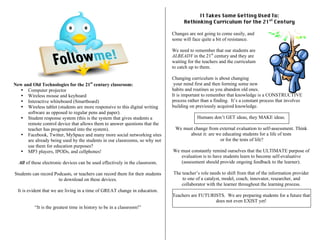
New and Old Technologies for the 21st
century classroom:
• Computer projector
• Wireless mouse and keyboard
• Interactive whiteboard (Smartboard)
• Wireless tablet (students are more responsive to this digital writing
software as opposed to regular pens and paper).
• Student response system (this is the system that gives students a
remote control device that allows them to answer questions that the
teacher has programmed into the system).
• Facebook, Twitter, MySpace and many more social networking sites
are already being used by the students in our classrooms, so why not
use them for education purposes?
• MP3 players, IPODs, and cellphones!
All of these electronic devices can be used effectively in the classroom.
Students can record Podcasts, or teachers can record them for their students
to download on these devices.
It is evident that we are living in a time of GREAT change in education.
“It is the greatest time in history to be in a classroom!”
It Takes Some Getting Used To:
Rethinking Curriculum for the 21st
Century
Changes are not going to come easily, and
some will face quite a bit of resistance.
We need to remember that our students are
ALREADY in the 21st
century and they are
waiting for the teachers and the curriculum
to catch up to them.
Changing curriculum is about changing
your mind first and then forming some new
habits and routines as you abandon old ones.
It is important to remember that knowledge is a CONSTRUCTIVE
process rather than a finding. It’s a constant process that involves
building on previously acquired knowledge.
Humans don’t GET ideas, they MAKE ideas.
We must change from external evaluation to self-assessment. Think
about it: are we educating students for a life of tests
or for the tests of life?
We must constantly remind ourselves that the ULTIMATE purpose of
evaluation is to have students learn to become self-evaluative
(assessment should provide ongoing feedback to the learner).
The teacher’s role needs to shift from that of the information provider
to one of a catalyst, model, coach, innovator, researcher, and
collaborator with the learner throughout the learning process.
Teachers are FUTURISTS. We are preparing students for a future that
does not even EXIST yet!
Turn me over!

Good luck in your 21st

  • 1.
    The Curriculum 21 PocketGuide Guide compiled by Paul, Megan, Nathaniel, Stephanie, Tiffany and Wendy Good luck in your 21st century classrooms!
  • 2.
    A New EssentialCurriculum for a New Time We must prepare learners for their world and their time. What year are we walking into when we walk into today’s schools? Is school just a simulation of life in the 1980s? An age before smart phones, Internet communication and collaboration, digital books, cross-curricular disciplines? How do we prepare learners? Backward Design: We must begin with the end in mind. Before starting a valid activity ask: “What is it we want students to know and be able to do?” Old Habits We are living a school system designed by the thinking and societal issues of 1893. It is based on a factory model. The model of 1893 was based upon English, Civics, History, Mathematics, Biology, Chemistry, and Physics. Sound familiar?We have a century of fascinating innovation, experimentation, and exciting ideas that aren’t reflected in the current model. We don’t need reforms – we need new forms. Check out http://curriculum21.ning.com/video/rsa-animate-changing for Mr. Dressup-style summary of this concept. Rigid Standardization is not the best option This is more of an American issue. Because of the pressure of standardization and the pressure to perform, many teach to the test, not to the needs of the students. Progress: Schools that are leading the 21c way New Jersey – A district in NJ has developed 3 overarching educational goals. Curriculum must develop: global perspectives, 21c digital and networking tools, and interdisciplinary linkages for real life applications. Rhode Island – A Digital Portfolio is required in order to graduate. Students include clips, podcasts, and papers; anything they want to create a history of their 12 years of education that proves they should graduate. Hawaii – Professional Development through video conferencing. Upgrade the Curriculum Growth vs. Change – This isn’t a fad, or change for the sake of change. It is real growth out of an outdated system into a current one. New Versions of School: - The old way can be dated, inhibiting, and negative. - Some building designs isolate. - We never combine English and Math class to look at ways to communicate number concepts. We don’t have higher grades tutor or teach concepts to lower grades. - Grade separation is ineffective, while multi-age groups with thoughtfully grouped personnel seem to work well. What if levels grouped students? - Form should support function, not lead it. Our classes shouldn’t dictate that we can’t turn our eyes to the outside world. Common Myths Good old days are still good enough – We are comfortable with the system we grew up in. So we think applicable to others. Instead we need keep what is timeless, cut what is dated, and create what is needed. We’re better off if we all think alike, and not too much. This is the simple, home-grown wisdom argument. Thinking too much is for the “elite”. Instead we need to be fearless about ideas and openly engage in discussion and debate about what should matter in subject matter. Too much creativity is dangerous, and the arts are frills – This goes against brain and human learning research. We are a “High Concept” “High Touch” society. Whether in business plan problem solving, technology, advertising communication, conflict management or in the arts world, creativity and collaboration are considered commodities.
  • 3.
    21st Century Assessment Typesand Skills C Curriculum Mapping: A way for teachers teaching the same curriculum to share new assessment and update dated material. How to do it right: • Collaborate with teachers. • Replace not integrate. Cut what is dated, keep what is timeless, create what is missing and needed. Upgrading Assessment: Step away from the test. • Many assessments stuck in 19th century. • Short Story writing is a great skill. Does it need to be on paper? What about a short story podcast? How to Implement This in Your School Step 1: Brainstorm assessment replacements: List assessments used in classrooms in many subjects. List what today’s scientists, business people, entertainment industry, tech sector would create in workplace. I.e. podcasts, screenplay, documentaries, CAD projects, blogs, video conferences, second life simulations etc. Step 2: Teachers should work with IT members to identify existing types of software, hardware, internet capabilities in school, district or regional service centers. Explore technology such as SmartBoards, Moodle, Webcams, Ipods, Webquests, Web 2.o sites, Twitter, E-games, Blogs, etc. Step 3: Make a plan to consistently replace 1 dated assessment with a modern one. I.e. Replace drawing a chart of Peru with a WebQuest about Peru. Step 4: Share the assessment upgrades with colleagues. This is Collaborative Brainstorming. This is where curriculum mapping can come into play. Talks about the 21c. skills we have been learning in Instruction and Learning Practices. They are NO good unless paired with 21c. assessments, output, and curriculum content. Upgrading Content: Provocation, Invigoration, and Replacement This is harder than upgrading the curriculum, but is very important. Not just our methods but the very stuff we teach. What is essential and timeless? What is not essential or dated? What should be created that is evident and necessary? An unending Update/Review Process is the bedrock of learning. Important factors of Content Upgrade: Global perspective: Looking locally and globally in our content. Global means beyond Western Civilization. • Incorporating the whole child (Academic, Emotional, Physical, Mental) • Future career and work options (creative and imaginative) • Disciplines are dynamic not static. They interconnect and change to reflect real world practice. Tech and media: Expand sources of content to include active and static materials. PowerPoint vs. Prezi (Google it if you are wondering). Complexity of content developmentally matched to age and stage of learner. Students need to be a part of the team. They provide new perspectives – they may know technology you do not. Create a Curriculum 21 Team at your School: It needs to be intellectual, rational, and forward thinking. Formally review specific areas in each discipline and share openly and bravely with colleagues.
  • 4.
    Guiding questions whentrying to update content: • Within the Discipline being reviewed, what content choices are dated and nonessential? • What Choices for topics, issues, problems, themes, and case studies are timely and necessary for our learners within disciplines? • Are the interdisciplinary content choices rich, natural, and rigorous? Examples of why we need a change in each discipline: Social studies – we view the world through the eyes of those of 1569. The map we all know is quite distorted. Google the Gall-Peters Projection. Science - we neglect important areas of science. For $200 schools could build a Dobsonian telescope. Students could study astronomy and appreciate our place in the world. Also base learning around problem- solving, because content memorization is ineffective and quickly outdated. Health and Phys. Ed – learning how to play a sport ignores huge parts of our physical existence. Physical Education needs more. One school uses “Five for Life,” which consists of cardio-respiratory endurance, muscular strength, muscular endurance, flexibility, and body composition. Imagine a gym class with all of those aspects! Yoga day and basketball day. Contemporary English Language and Literature - some of the greatest industries that require writing and other literary skills include the film industry, television industry, advertising industry, and journalism. Why do we not incorporate the skills needed in these industries? Editing strategies, creative note-taking, and the ever- ignored portion of English Literature: Speech. Why do we not consistently analyze the output of these industries, especially as they relate to literature? (A Book to Film class, a screenplay and script analysis class, and “writing for documentary” class). World Language Instruction – the 4 languages spoken most in the world are Mandarin, Spanish, English, and Arabic. What languages were offered at your school? Mathematics as a Language: Reason, do not memorize! Also incorporation of basic life math skills should be introduced before high school. We all may not find the derivative of an equation after high school but we will definitely find opportunity to use financial literacy, entrepreneurialism, and budget design. The Arts: Where are the modern forms of expression in the arts? Incorporate technical and digital tools to communicate artistically. Remember School of Rock? Their final performance? The graphic and light show that accompanied the band performance? (YouTube it if you don’t know). Lesson Plan Support Site: http://artsedge.kennedy-center.org
  • 5.
    Curricular Destiny: Schedules,Grouping Patterns, and the Use of Space The Structure of Time: Schedules - curriculum is nested within long- and short-term schedules. Against Graduation as We Know It - Why do we need school to run for 13 years to say that someone has graduated? This structure is the ultimate seat-time problem. If someone can sit through these 13 years rather than, say, 10 or 14 then they have earned their diploma. Time as Currency: Periods, Blocks, Modules, Minutes - Consider this time currency question: what kind of time do I need to help my students edit a first draft? This is a question that we as teachers want to ask, but far too often we instead use reversed thinking and wonder, “what can I stuff into the 40 minutes I have for math?’ Heroic School Schedules - The educators at these schools offer a tailored curriculum for each learner. There are no bells and no 45-minute blocks of time. Thinking and Planning Outside the Scheduling Box - One of the most promising new forms of learning experiences is the Virtual Learning Magnet, which matches learning time with engaging and purposeful tasks, offers self- selection on the part of the learner and the teacher, and connects cyberspace with physical space. The Grouping of Students - To the extent possible, we should group students to best suit their needs so that form follows function. Groupings in school can be thought of in three fundamental categories: Institutional grouping, instructional grouping, and independent grouping. The Need for Multiple Affiliations - Personnel should consider multiple types of affiliations and groupings as well as the duration of such groups to provide variety and perspective in their work. The affiliations should not be random but targeted and strategic. The Meeting Habit -Instead of meeting by departments, what if we were to meet around problems? New Versions of Physical and Virtual Space - Where a school is located and how it sets up internal structures determine its possibilities. Most schools were not really built for children, let alone for learning. Sketching Program Blueprints for New School Versions - Our Curriculum 21 teams should always be thinking about new versions of school by asking whom we are serving, and how can we best meet the needs of our specific learners. Five Socio-Technology Trends That Change Everything in Learning and Teaching Social Production is radically redistributing the powers of production and knowledge creation and generating a model for learning to do. Social Networks. Social networking technologies are powerful tools for enhancing the process of learning to be, of defining our identities. Digital social networks are now an essential part of the experience of everyone under the age of 20. Digital social networks may be the biggest game changer in learning and what it means to be educated. A Semantic Web will become the model for learning to know in the next innovation phase of the Internet. A semantic web will dramatically transform our relationship to new knowledge, our ability to use new knowledge for purposes of creativity, and our definition of what it means to be educated. Media Grids are three-dimensional representations of space using computing power and the Internet. The New Zoo of Nonlinear Learning. The new zoo enabled by biology, a new mother science for a new era of nonlinear learning, should give all those concerned with the direction of learning and teaching pause for thought. Deep thought, and even deeper questions. From Cathedrals to Bazaars - What we thought we knew about learning and teaching, and the cathedral-like, elegant, top-down, complex systems we designed to support formal processes of learning and teaching just may not be the relevant model.
  • 6.
    A Classroom asWide as the World The world in which today’s students will graduate is fundamentally different from the world in which we grew up. The quickening pace of globalization over the past 20 years – driven by profound technological changes, the rise of China and India, and the accelerating pace of scientific discovery - has produced a whole new world. We must prepare students for a world where the opportunities for success require the ability to compete and cooperate on a global scale. Five global trends are transforming the context for the future generation. These trends are related to economics, science and technology, demographics, security and citizenship, and education. What are the implications of these global trends? Certainly education as usual won’t do. We need to transform our learning systems to equip students with the knowledge and skills they will need to succeed in this new global era. Our national goal should be that all students must graduate from high school university – ready and globally competent, prepared to compete, connect, and cooperate with their peers around the world. We need to… - Integrate international content into all curriculum areas - Emphasize the learning of world languages. - Harness technology to tap global information sources - Create international collaborations. Making Learning Irresistible Music is not about the notes. Language arts is not about the letters and the words. Math is not about the numbers and the symbols. And school is not about grades. The whole is substantially more relevant, more meaningful, and more significant than the sum of the individual parts. Make no mistake, the parts are important. They are just not the goal. How do we move from an emphasis on remembering facts for a test on Friday to thinking critically about the larger issues that those disconnected facts can only dimly reflect as stand-alone pieces of information? If students were to become more authentically engaged in the art of learning, the classroom would have to be more participatory, as students had to get up out of their mental seats and produce something at least as important as a grade. This product had to demonstrate not just content knowledge, but an understanding that ultimately makes a contribution. Students would take more ownership of their learning; their interest in learning would create inevitable desire to learn more. The students would want to create something in which they would take pride and want everyone to see. The role of the teachers is not really to teach students what buttons to push to make the software or hardware do this or that. The most important role of the educator is to keep students focused on the point, to keep them centered in meaningful curriculum content and message, to guide and facilitate the creation process.
  • 7.
    Media Literacy (ML) Many teachers are not proficient teaching ML.  Few educators have had effective training teaching ML  A growing “digital disconnect.”  The English Teacher's Companion (Burke 2003) sees incorporating media in the classroom as vital for teaching's future.  Teachers have the opportunity and responsibility to use ML as one of our key strategies for helping student develop critical thinking skills.  Educational Org. Partnerships: Urge schools to teach skills in Collaboration and Teamwork, Making Global Connections, Critical Thinking, and Media Literacy.  Teachers in every school in one state were trained to incorporate standards-based ML lesson plans into the classroom. (hope floats) Critical Thinking and ML: “While more young people have access to the internet and other media than any generation in history, they do not necessarily possess the ethics, the intellectual skills, or the predisposition to critically analyze and evaluate their relationship with these technologies or the information they encounter. Good eye/hand coordination and the ability to multitask are not substitutes for critical thinking” David Considine (2002) Corporations depend on media-illiterate young people to advertise their clothes to their peers. Five core concepts of ML; 1) All media messages are constructed. 2) Media messages are constructed using a creative language with its own rules. 3) Different people experience the same media message differently. 4) Media have embedded values and points of view. 5) Most media messages are organized to gain profit and or power. “At the heart of media literacy is the principle of inquiry” - Elizabeth Thoman Corresponding critical thinking questions: • Who created or paid for the message? (authorship, producer) • Why was it created? (purpose) • Who is the message designed to reach? (target audience) • How might different people from me understand this message differently? (audiences negotiating meaning) • How does the message get my attention; in what ways is the message credible? (techniques, methods) • What values, lifestyles, points of view are included or excluded and why? Where can I get more information, different perspectives, or verify the information? (research, critical thinking) • What can I do with this information (decision making) Media Literacy: What does it mean? The problem with the phrase “media literacy” is that it does mean different things to different people. See the definitions for ML on page 141. Having media literacy incorporated into the classrooms • Reduces the effects of violence, aggression and anti- social behaviour. • ML can help help enhance high school girls’ self- acceptance. • ML increased children's understanding of the persuasive intent of ads for alcohol & tobacco. • Benefits of Education in Media Literacy • It helps teachers meet state/prov teaching standards. • It allows teachers to bring familiar youth-media culture into the classroom.
  • 8.
    Classroom Applications ofMedia Literacy English/Language Arts • Teachers should be familiar not only with new media, but also with the popular culture of the students they teach. • Lesson plans can be found at www.readwritethink.org • Students love film, and studying how films are created is another way for teachers to teach media literacy. • Numerous websites allow students to upload their school-created productions and share their work with peers. • Lesson Plans for Creating Media-Rich Classrooms. (Christel & Sullivan, 2007) Social Studies • The invention and use of photography is a prominent example of an appropriate focus for the rise of mass media in history. • Like it or not, young people learn a lot about sex from the media. What they understand is often skewed by Hollywood and other media producers. • Advertisers have known for years that “sex sells.” Mathematics • Numbers abound in news. Math teachers should be encouraged to consider incorporating these news reports in their instruction. • Teachers can engage their students by helping them understand how these numbers are generated and how they are used. • Math in the media web site: www.frankwbaker.com/math_in_the_media.htm Science • Every teacher who uses a video, a CD-ROM, or the internet as part of instruction should ask questions such as this: How does the selection of images by the producer shape our understanding of science concepts? • *look at final thoughts on page 151. Digital Portfolios and Curriculum Maps “The process of collecting, selecting, and reflecting on the work in a portfolio is what makes it powerful. The portfolio is a representation of what students know and are able to do, and the opportunity to present that work to an audience of peers, parents, and teachers shows that the world can take the students' work seriously.” - David Niguidula http://curriculum21.ning.com/profiles/blogs/wrapping-my-mind-around Valuable resources: • Digital Portfolios and Curriculum Mapping" Chapter in Curriculum21 (Heidi Hayes Jacobs, ASCD, 2010) by David Niguidula EchicaELearning (Wiki) • Jeff Utecht's Blogs as Web-Based Portfolios PDF (.pdf) • Primary Reflection Forms (GoogleDocs Document) • Chrissy Hellyer's Portfolio Prompts (Elementary School • Dr. Helen Barrett's Electronic Portfolio Site
  • 9.
    Three Levels ofDeveloping a Digital Portfolio Educating for a Sustainable Future Sustainability isn’t just about saving the rainforest. According to author Jaimie P. Cloud, there are other things we should be doing to ensure our children are prepared to create a sustainable future: • Cultural Preservation and Transformation – encouraging students to share and take ownership culture, developing the ability to discern with others what cultural traditions and practices to keep and which ones to change or adapt as they create a sustainable community. • Responsible Local/Global citizenship – knowing and understanding rights and responsibilities and assuming both leadership and participation roles in the local and global community • The Dynamics of Systems and Change – Learning to recognize the dynamic nature of complex living things and change over time, seeing patterns and applying the tools of system dynamics and system thinking in their daily lives and to make choices for the future. • Sustainable Economics – learning to produce and consume in ways that support the health of the financial, social and natural capital. • Healthy commons – sharing responsibility for the things we all depend on (air, trust, heritage sites, libraries, public health, etc.) • Living within Ecological/Natural Laws and Principles – learning to see themselves as interdependent with each other, all living things and natural systems. • Inventing and Affecting the Future – using vision, imagination and intention to design and create the future they envision. • Multiple Perspectives – drawing from perspectives, life experiences and cultures of others and co-create shared and evolving visions. • A Sense of Place – a strong connection to the place they live in, an understanding of its history and an ability to contribute to its continued health.
  • 10.
    Power Down orPower Up? We are quick to ban new technologies in the classroom. But what if we embraced them and used them to make a more authentic learning experience for our students? What if, instead of making technology taboo, we teach students to use it right and responsibly? Author Alan November suggests that teachers need to rethink control in their classrooms, and find ways to empower their students through technology. Following are some of his recommendations for helping find ways for students to be contributors in what he calls “The Digital Farm:” - Tutorial Designers – Kids record themselves solving problems based on material discussed in class, then create screencasted tutorials with their footage and their explanations. All of the tutorials are available to every student, so that struggling students can review other people’s tutorials online to help them understand concepts or problems. Uses www.techsmith.com , www. Jingproject.com and www.Mathtrain.tv. - Official scribes – Instead of everyone taking notes every day, the class assigns a “scribe” to take notes that day on the computer. All notes are published on the school blog. Uses Google Docs. - Researchers – Making the class computer the Official Research Station, where one student each day is responsible for finding answers to any of the questions that come up… including the teacher’s! They can even use Google to create custom search engines! - Collaboration Coordinators – Using Skype, a collaboration team is responsible for establishing and maintaining working relationships over the internet with classrooms around the world. - Contributors to Society – Learning about issues affecting countries around the world through social responsibility websites like www.kiva.org, and finding ways to make a difference in the lives of others. For instance, making micro-loans to entrepreneurs in developing countries. - Curriculum Reviewers – this team can create material for continuous review by making podcasts that everyone can download into their MP3 players from a website. (www.bobsprankle.com/podcasts/0506/rm208vodcast.mov) Creating Learning Connections with Today’s Tech-Savvy Student Students DEMAND a change! Today’s students are demanding a change in the classroom because of their ability to gather information faster than any previous generation. In order to make authentic connections with students, we must change our strategies to fit this new age of students. Technology is constantly changing and we need to learn to adapt and change with it and find new ways to incorporate it into our classrooms. One of the common causes of boredom in the classroom is student’s perception that the methods of how the curriculum is delivered to them are irrelevant to how they learn. Teachers face the challenge of making standardized curriculum rich and relevant to students who have instant access to anything they want to learn on their own! It is a crucial time to begin looking at what is truly driving change in the 21st century classroom: the STUDENTS!
  • 11.
    New and OldTechnologies for the 21st century classroom: • Computer projector • Wireless mouse and keyboard • Interactive whiteboard (Smartboard) • Wireless tablet (students are more responsive to this digital writing software as opposed to regular pens and paper). • Student response system (this is the system that gives students a remote control device that allows them to answer questions that the teacher has programmed into the system). • Facebook, Twitter, MySpace and many more social networking sites are already being used by the students in our classrooms, so why not use them for education purposes? • MP3 players, IPODs, and cellphones! All of these electronic devices can be used effectively in the classroom. Students can record Podcasts, or teachers can record them for their students to download on these devices. It is evident that we are living in a time of GREAT change in education. “It is the greatest time in history to be in a classroom!” It Takes Some Getting Used To: Rethinking Curriculum for the 21st Century Changes are not going to come easily, and some will face quite a bit of resistance. We need to remember that our students are ALREADY in the 21st century and they are waiting for the teachers and the curriculum to catch up to them. Changing curriculum is about changing your mind first and then forming some new habits and routines as you abandon old ones. It is important to remember that knowledge is a CONSTRUCTIVE process rather than a finding. It’s a constant process that involves building on previously acquired knowledge. Humans don’t GET ideas, they MAKE ideas. We must change from external evaluation to self-assessment. Think about it: are we educating students for a life of tests or for the tests of life? We must constantly remind ourselves that the ULTIMATE purpose of evaluation is to have students learn to become self-evaluative (assessment should provide ongoing feedback to the learner). The teacher’s role needs to shift from that of the information provider to one of a catalyst, model, coach, innovator, researcher, and collaborator with the learner throughout the learning process. Teachers are FUTURISTS. We are preparing students for a future that does not even EXIST yet!
  • 12.