Course Title: General Biomedical Science (TRID631)
Presentation Title: Role of T follicular helper cells
By Aberaw Akalu
February, 2020
Addis Ababa University Graduate Studies
Aklilu Lemma Institute Of Pathobiology
Outline of Presentation
» List of abbreviations
» Introduction of Tfh cells
» Differentiation of Tfh cells
» Function of Tfh cells
» Tfh cells and diseases
LIST OF ABREVATIONS
 TFH T-follicular cells
 GCs germinal centers
 Bcl-6 B-cell lymphoma 6
 CXCR5 chemokine receptor type 5 (protein encoded by the CXCR5 gene)
 CCR7 chemokine receptor type 7 (protein encoded by the CCR7 gene)
 CXCL13 chemokine ligand 13 (protein encoded by the CXCL13 gene)
 ICOS Inducible Costimulator
 ICOS-L Inducible Costimulator Ligand
 PD-1 programmed cell death-1
 IL-2 Interleukin-2 (is a protein coding gene)
 IL-4 Interleukin-4 (is a protein coding gene)
 IL-6 Interleukin-6 (is a protein coding gene)
 IL-6R Interleukin-6 receptor (is a protein coding gene)
 IL-21 Interleukin-21 (is a protein coding gene)
 MHC II Major Histocompatibility Molecules
 APC Antigen presenting cells
Role of T follicular cells
1. Introduction
According to Maogen et al., 2012:Cellular & Molecular Immunology
volume 9;
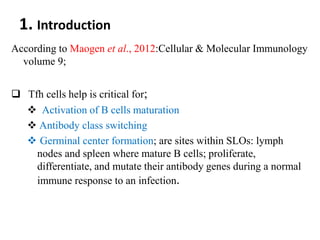
 Tfh cells help is critical for;
 Activation of B cells maturation
 Antibody class switching
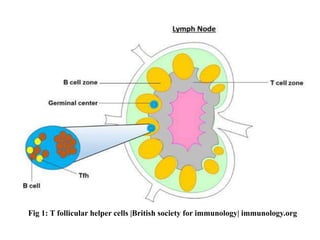
 Germinal center formation; are sites within SLOs: lymph
nodes and spleen where mature B cells; proliferate,
differentiate, and mutate their antibody genes during a normal
immune response to an infection.
 In order to lymph nodes contain lymphocytes, a type of white
blood cell, which includes;
 B cells and
 T cells
 B-cells mature in the bone marrow,
 T-cells travel through the bloodstream to the thymus gland and
mature there.
Fig 1: T follicular helper cells |British society for immunology| immunology.org
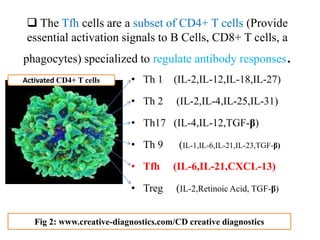
 The Tfh cells are a subset of CD4+ T cells (Provide
essential activation signals to B Cells, CD8+ T cells, a
phagocytes) specialized to regulate antibody responses.
• Th 1 (IL-2,IL-12,IL-18,IL-27)
• Th 2 (IL-2,IL-4,IL-25,IL-31)
• Th17 (IL-4,IL-12,TGF-β)
• Th 9 (IL-1,IL-6,IL-21,IL-23,TGF-β)
• Tfh (IL-6,IL-21,CXCL-13)
• Treg (IL-2,Retinoic Acid, TGF-β)
Activated CD4+ T cells
Fig 2: www.creative-diagnostics.com/CD creative diagnostics
Introduction…………….cont’d
 The production of Tfh cells are associated with the
 Dendritic cells (DCs) and
 B cells.
 Tfh cells help B cells form germinal centers (GC) differentiate
into
 memory cells and
 plasma cells (antibody-secreting cells) as humoral
responses
2. Differentiation of Tfh cells
(Sadegh et al., 2016: Biomedicine & Pharmacotherapy volume 84);
 Tfh cells have the ability to migrate into;
 Secondary lymphoid tissues in B-cell follicles, and
 Expand germinal centers (GC) that have a close interaction
with B cells.
 Molecular factors that participated in differentiation of Tfh cells
such as;
 Transcription factors,
 Surface receptors and
 Cytokine productions
Differentiation of Tfh cells………..cont’d
(Sadegh et al., 2016: Biomedicine & Pharmacotherapy volume 84);
After antigen stimulation,
o Naïve B cells first migrate to T-cell zone, and
o Become activated to form GC with the antigen signal
presented by;
 antigen-presenting cell and
 other costimulatory signals from Tfh cells
Differentiation of Tfh cells………..cont’d
(Sadegh et al., 2016: Biomedicine & Pharmacotherapy volume 84);
 Tfh cells can be identified by unique expression of surface
markers (table 2)
 CXCR5 which is attracted toward CXCL-13 presented in
the B cell zone
 CCR7
 ICOS and PD-1
 Cytokines (IL-6, IL-21) and,
 The development and differentiation of Tfh cells has been
regulated by transcription factors, such as B-cell lymphoma 6
protein (Bcl-6)
Differentiation of Tfh cells………..cont’d
(Sadegh et al., 2016: Biomedicine & Pharmacotherapy volume 84);
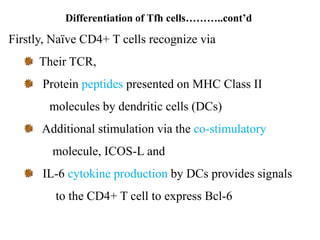
Tfh differentiation is a multi-step process:
 Beginning in the T cell zone of SLOs during an
ongoing immune response
 Differentiation of SLOs are including the tonsil
spleen & lymphoid organs
.
Differentiation of Tfh cells………..cont’d
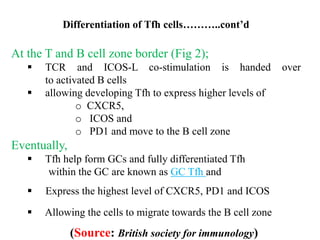
Firstly, Naïve CD4+ T cells recognize via
Their TCR,
Protein peptides presented on MHC Class II
molecules by dendritic cells (DCs)
Additional stimulation via the co-stimulatory
molecule, ICOS-L and
IL-6 cytokine production by DCs provides signals
to the CD4+ T cell to express Bcl-6
Differentiation of Tfh cells………..cont’d
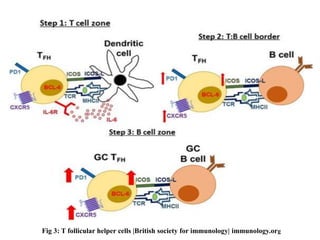
At the T and B cell zone border (Fig 2);
 TCR and ICOS-L co-stimulation is handed over
to activated B cells
 allowing developing Tfh to express higher levels of
o CXCR5,
o ICOS and
o PD1 and move to the B cell zone
Eventually,
 Tfh help form GCs and fully differentiated Tfh
within the GC are known as GC Tfh and
 Express the highest level of CXCR5, PD1 and ICOS
 Allowing the cells to migrate towards the B cell zone
(Source: British society for immunology)
Fig 3: T follicular helper cells |British society for immunology| immunology.org
3. Function of Tfh (Source: British society for immunology)
 Helping B cells produce antibody against foreign pathogens
 Are essential for germinal center (GC) formation
 Selectively stimulate B cells for GC responses,
 Contributing to Ig production and memory B cell and long-
lived plasma cell development.
 Generation of humoral immunity via their expression of
many molecules factors
 B cells within GCs rapid proliferation and allowing the production of
antibody, with greater affinity for their targets
 Cytokine production by Tfh is able to determine the type of antibody
produced. The relationship between Tfh and GC B cells is positively
correlated
 In the absence of Tfh, GCs do not form and antibody defects are
observed under typical situations
4. Tfh cells and diseases
Tfh cells have important roles in ( Source: Kemeny, David., 2012,
Crotty, Shane., 2019 and Jeon, et al., 2016)
Protective immunity against infectious diseases
Regulation of intestinal microbiota
Numerous autoimmune diseases
Probably have important roles for allergies
Cancer immunity
Tfh cells and diseases (Qin, L & Waseem, T. et al., 2018) ……..cont’d
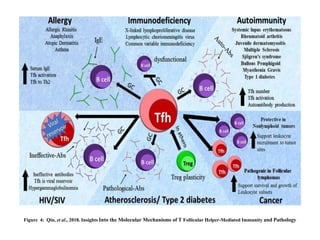
 Elevated Tfh activity leads to an increase in germinal center:
formation, activation, and production of auto-Abs in autoimmune
diseases
 In immunodeficiencies, a decrease in Tfh cells has been detected with
dysfunctional GC formation, whereas
 In acquired immunodeficiencies (Ineffective-Abs) such as HIV an
increase in Tfh cells serves as viral reservoirs (Fig 4)
Tfh cells and diseases (Qin, L & Waseem, T. et al., 2018)……..cont’d
 In Type 2 diabetes regulatory T cells (Tregs) transition to Tfh
cells via GCs leading to the production of pathological Abs
 In allergy, there is an increase in Tfh cell activation and GC
formation causing the production of IgE (Fig 4)
 Tfh cells in cancers is complex and dependent on the types
of tumors (Fig 4) but generally participated in;
 Support & survival growth of leukocyte subsets
 Support leukocyte recruitment to tumor site
Figure 4: Qin, et al., 2018. Insights Into the Molecular Mechanisms of T Follicular Helper-Mediated Immunity and Pathology
Thank you

Tfh role

  • 1.
    Course Title: GeneralBiomedical Science (TRID631) Presentation Title: Role of T follicular helper cells By Aberaw Akalu February, 2020 Addis Ababa University Graduate Studies Aklilu Lemma Institute Of Pathobiology
  • 2.
    Outline of Presentation »List of abbreviations » Introduction of Tfh cells » Differentiation of Tfh cells » Function of Tfh cells » Tfh cells and diseases
  • 3.
    LIST OF ABREVATIONS TFH T-follicular cells  GCs germinal centers  Bcl-6 B-cell lymphoma 6  CXCR5 chemokine receptor type 5 (protein encoded by the CXCR5 gene)  CCR7 chemokine receptor type 7 (protein encoded by the CCR7 gene)  CXCL13 chemokine ligand 13 (protein encoded by the CXCL13 gene)  ICOS Inducible Costimulator  ICOS-L Inducible Costimulator Ligand  PD-1 programmed cell death-1  IL-2 Interleukin-2 (is a protein coding gene)  IL-4 Interleukin-4 (is a protein coding gene)  IL-6 Interleukin-6 (is a protein coding gene)  IL-6R Interleukin-6 receptor (is a protein coding gene)  IL-21 Interleukin-21 (is a protein coding gene)  MHC II Major Histocompatibility Molecules  APC Antigen presenting cells
  • 4.
    Role of Tfollicular cells
  • 5.
    1. Introduction According toMaogen et al., 2012:Cellular & Molecular Immunology volume 9;  Tfh cells help is critical for;  Activation of B cells maturation  Antibody class switching  Germinal center formation; are sites within SLOs: lymph nodes and spleen where mature B cells; proliferate, differentiate, and mutate their antibody genes during a normal immune response to an infection.
  • 6.
     In orderto lymph nodes contain lymphocytes, a type of white blood cell, which includes;  B cells and  T cells  B-cells mature in the bone marrow,  T-cells travel through the bloodstream to the thymus gland and mature there.
  • 7.
    Fig 1: Tfollicular helper cells |British society for immunology| immunology.org
  • 8.
     The Tfhcells are a subset of CD4+ T cells (Provide essential activation signals to B Cells, CD8+ T cells, a phagocytes) specialized to regulate antibody responses. • Th 1 (IL-2,IL-12,IL-18,IL-27) • Th 2 (IL-2,IL-4,IL-25,IL-31) • Th17 (IL-4,IL-12,TGF-β) • Th 9 (IL-1,IL-6,IL-21,IL-23,TGF-β) • Tfh (IL-6,IL-21,CXCL-13) • Treg (IL-2,Retinoic Acid, TGF-β) Activated CD4+ T cells Fig 2: www.creative-diagnostics.com/CD creative diagnostics
  • 9.
    Introduction…………….cont’d  The productionof Tfh cells are associated with the  Dendritic cells (DCs) and  B cells.  Tfh cells help B cells form germinal centers (GC) differentiate into  memory cells and  plasma cells (antibody-secreting cells) as humoral responses
  • 10.
    2. Differentiation ofTfh cells (Sadegh et al., 2016: Biomedicine & Pharmacotherapy volume 84);  Tfh cells have the ability to migrate into;  Secondary lymphoid tissues in B-cell follicles, and  Expand germinal centers (GC) that have a close interaction with B cells.  Molecular factors that participated in differentiation of Tfh cells such as;  Transcription factors,  Surface receptors and  Cytokine productions
  • 11.
    Differentiation of Tfhcells………..cont’d (Sadegh et al., 2016: Biomedicine & Pharmacotherapy volume 84); After antigen stimulation, o Naïve B cells first migrate to T-cell zone, and o Become activated to form GC with the antigen signal presented by;  antigen-presenting cell and  other costimulatory signals from Tfh cells
  • 12.
    Differentiation of Tfhcells………..cont’d (Sadegh et al., 2016: Biomedicine & Pharmacotherapy volume 84);  Tfh cells can be identified by unique expression of surface markers (table 2)  CXCR5 which is attracted toward CXCL-13 presented in the B cell zone  CCR7  ICOS and PD-1  Cytokines (IL-6, IL-21) and,  The development and differentiation of Tfh cells has been regulated by transcription factors, such as B-cell lymphoma 6 protein (Bcl-6)
  • 13.
    Differentiation of Tfhcells………..cont’d (Sadegh et al., 2016: Biomedicine & Pharmacotherapy volume 84); Tfh differentiation is a multi-step process:  Beginning in the T cell zone of SLOs during an ongoing immune response  Differentiation of SLOs are including the tonsil spleen & lymphoid organs .
  • 14.
    Differentiation of Tfhcells………..cont’d Firstly, Naïve CD4+ T cells recognize via Their TCR, Protein peptides presented on MHC Class II molecules by dendritic cells (DCs) Additional stimulation via the co-stimulatory molecule, ICOS-L and IL-6 cytokine production by DCs provides signals to the CD4+ T cell to express Bcl-6
  • 15.
    Differentiation of Tfhcells………..cont’d At the T and B cell zone border (Fig 2);  TCR and ICOS-L co-stimulation is handed over to activated B cells  allowing developing Tfh to express higher levels of o CXCR5, o ICOS and o PD1 and move to the B cell zone Eventually,  Tfh help form GCs and fully differentiated Tfh within the GC are known as GC Tfh and  Express the highest level of CXCR5, PD1 and ICOS  Allowing the cells to migrate towards the B cell zone (Source: British society for immunology)
  • 16.
    Fig 3: Tfollicular helper cells |British society for immunology| immunology.org
  • 17.
    3. Function ofTfh (Source: British society for immunology)  Helping B cells produce antibody against foreign pathogens  Are essential for germinal center (GC) formation  Selectively stimulate B cells for GC responses,  Contributing to Ig production and memory B cell and long- lived plasma cell development.  Generation of humoral immunity via their expression of many molecules factors
  • 18.
     B cellswithin GCs rapid proliferation and allowing the production of antibody, with greater affinity for their targets  Cytokine production by Tfh is able to determine the type of antibody produced. The relationship between Tfh and GC B cells is positively correlated  In the absence of Tfh, GCs do not form and antibody defects are observed under typical situations
  • 19.
    4. Tfh cellsand diseases Tfh cells have important roles in ( Source: Kemeny, David., 2012, Crotty, Shane., 2019 and Jeon, et al., 2016) Protective immunity against infectious diseases Regulation of intestinal microbiota Numerous autoimmune diseases Probably have important roles for allergies Cancer immunity
  • 20.
    Tfh cells anddiseases (Qin, L & Waseem, T. et al., 2018) ……..cont’d  Elevated Tfh activity leads to an increase in germinal center: formation, activation, and production of auto-Abs in autoimmune diseases  In immunodeficiencies, a decrease in Tfh cells has been detected with dysfunctional GC formation, whereas  In acquired immunodeficiencies (Ineffective-Abs) such as HIV an increase in Tfh cells serves as viral reservoirs (Fig 4)
  • 21.
    Tfh cells anddiseases (Qin, L & Waseem, T. et al., 2018)……..cont’d  In Type 2 diabetes regulatory T cells (Tregs) transition to Tfh cells via GCs leading to the production of pathological Abs  In allergy, there is an increase in Tfh cell activation and GC formation causing the production of IgE (Fig 4)  Tfh cells in cancers is complex and dependent on the types of tumors (Fig 4) but generally participated in;  Support & survival growth of leukocyte subsets  Support leukocyte recruitment to tumor site
  • 22.
    Figure 4: Qin,et al., 2018. Insights Into the Molecular Mechanisms of T Follicular Helper-Mediated Immunity and Pathology
  • 23.