APC Ag
presentation
APC
• An (antigen-presenting cell) is a cell that displays antigen in
association with major histocompatibility complex (MHC) at its
surface.
• (effector cells) T-cell has specific receptors (TCR)
• peptide–MHC complexes ……communicate information to one
of the the immune system, T cells,,,,,,,, which recognize these
complexes using their T-cell receptors (TCR)
• dendritic cells (DCs) are not only part of the innate immune
system, but also generals of adaptive immunity and they
orchestrate the de novo induction of tolerogenic and
immunogenic T cell responses.
• APCs includes any cell that retains the capacity to express
antigen on its cell surface in association with only an MHC I
protein complex . This includes all nucleated cell types,
• Two fundamental categories of antigen-presenting cells exist:
professional and nonprofessional.
• Professional APC.. dendritic cells, B cells, monocytes,
macrophages, and neutrophils are bone marrow–derived
leukocytes that comprise the professional antigen-presenting
cells of an individual.
APCS for class II CD4
• 1-dentritic cells---the only initate T cell
responsein the Tcell naiive
• 2- mononucular macrophage--in effector phase
of CD4
• 3-B lymphocyte- during humoral response
• 4- Vascular endothelial cells
• All 3 are professional but dentritic the only
the sole function to capture and presentation
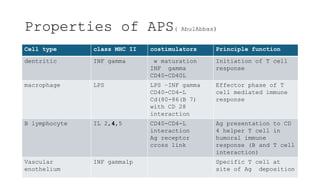
Properties of APS( AbulAbbas)
Cell type class MHC II costimulators Principle function
dentritic INF gamma w maturation
INF gamma
CD40-CD40L
Initiation of T cell
response
macrophage LPS LPS –INF gamma
CD40-CD4-L
Cd(80-86(B 7)
with CD 28
interaction
Effector phase of T
cell mediated immune
response
B lymphocyte IL 2,4,5 CD40-CD4-L
interaction
Ag receptor
cross link
Ag presentation to CD
4 helper T cell in
humoral immune
response (B and T cell
interaction)
Vascular
enothelium
INF gammalp Specific T cell at
site of Ag deposition
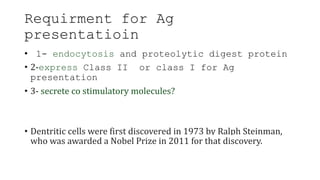
Requirment for Ag
presentatioin
• 1- endocytosis and proteolytic digest protein
• 2-express Class II or class I for Ag
presentation
• 3- secrete co stimulatory molecules?
• Dentritic cells were first discovered in 1973 by Ralph Steinman,
who was awarded a Nobel Prize in 2011 for that discovery.
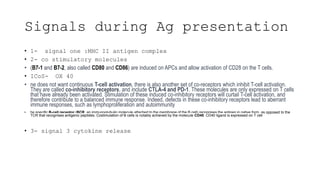
Signals during Ag presentation
• 1- signal one :MHC II antigen complex
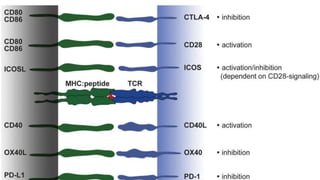
• 2- co stimulatory molecules
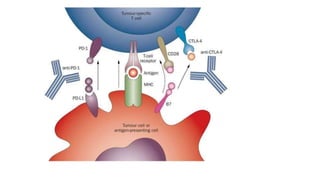
• (B7-1 and B7-2, also called CD80 and CD86) are induced on APCs and allow activation of CD28 on the T cells.
• ICoS- OX 40
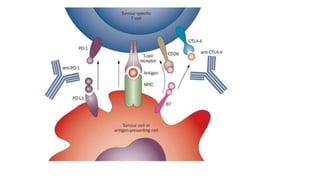
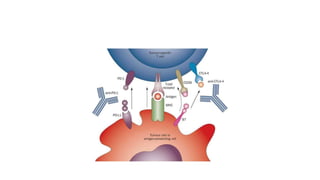
• ne does not want continuous T-cell activation, there is also another set of co-receptors which inhibit T-cell activation.
They are called co-inhibitory receptors, and include CTLA-4 and PD-1. These molecules are only expressed on T cells
that have already been activated. Stimulation of these induced co-inhibitory receptors will curtail T-cell activation, and
therefore contribute to a balanced immune response. Indeed, defects in these co-inhibitory receptors lead to aberrant
immune responses, such as lymphoproliferation and autoimmunity
• he specific B-cell receptor (BCR, an immunoglubulin molecule attached to the membrane of the B cell) recognises the antigen in native form, as opposed to the
TCR that recognises antigenic peptides. Costimulation of B cells is notably achieved by the molecule CD40. CD40 ligand is expressed on T cell
• 3- signal 3 cytokine release
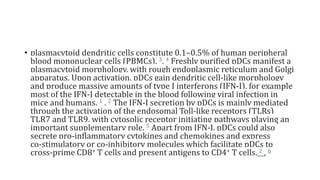
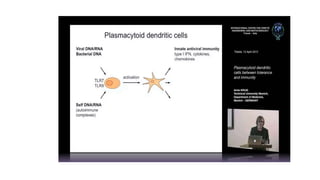
• plasmacytoid dendritic cells constitute 0.1–0.5% of human peripheral
blood mononuclear cells (PBMCs). 3, 4 Freshly purified pDCs manifest a
plasmacytoid morphology, with rough endoplasmic reticulum and Golgi
apparatus. Upon activation, pDCs gain dendritic cell‐like morphology
and produce massive amounts of type I interferons (IFN‐I), for example
most of the IFN‐I detectable in the blood following viral infection in
mice and humans. 1 , 2 The IFN‐I secretion by pDCs is mainly mediated
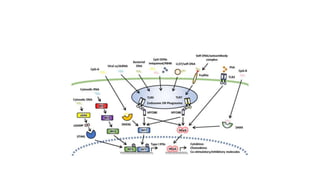
through the activation of the endosomal Toll‐like receptors (TLRs)
TLR7 and TLR9, with cytosolic receptor initiating pathways playing an
important supplementary role. 5 Apart from IFN‐I, pDCs could also
secrete pro‐inflammatory cytokines and chemokines and express
co‐stimulatory or co‐inhibitory molecules which facilitate pDCs to
cross‐prime CD8+ T cells and present antigens to CD4+ T cells. 2 , 6
• lasmacytoid dendritic cells were initially identified as a unique cell subset that respond to
viruses with rapid and massive production of IFN‐I, and play a central role in the antiviral
immune response. 2Moreover, pDCs could also respond to certain non‐viral pathogens such as
bacteria (e.g. Chlamydia pneumoniae) 51 and apicomplexan parasites (e.g.
Plasmodium). 52 , 53 The recent advances in pDCs in anti‐infectious immunity are not within
the scope of this review, but have been very well summarised by Reizis.54 Recognition of
either pathogen‐derived nucleic acids or synthetic TLR ligands such as CpG ODNs initiates
IFN‐I secretion by pDCs, which is mainly (albeit not exclusively) mediated through the
activation of the endosomal TLR7 and TLR9, and the subsequent myeloid differentiation
primary response protein 88 (MYD88)–interferon regulatory factor 7 (IRF7) pathway. 55 In
addition, the MYD88–NF‐κB pathway is also activated, leading to the secretion of
pro‐inflammatory cytokines and chemokines, and the expression of co‐stimulatory
molecules. TLR7 senses RNA viruses and endogenous RNA, whereas TLR9 detects
prokaryotes containing unmethylated CpG‐rich DNA sequences and endogenous DNA. Both
TLR7 and TLR9 sense synthetic CpG ODNs, and different classes of CpG ODNs have been
developed to perform different immune functions. CpG‐A is a strong inducer of type I IFNs,
whereas CpG‐B is a potent stimulator of maturation and the production of cytokines and
chemok
Signal one (Ag
presentation)
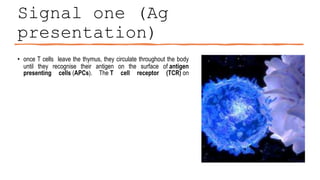
• once T cells leave the thymus, they circulate throughout the body
until they recognise their antigen on the surface of antigen
presenting cells (APCs). The T cell receptor (TCR) on
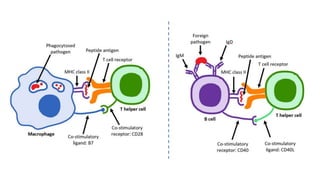
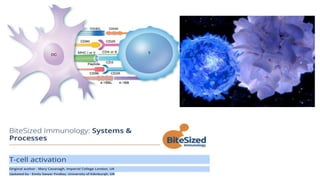
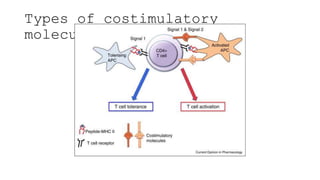
Signal Two(co stimulatory molecules )
• In addition to TCR binding to antigen-loaded MHC,
both helper T cells and cytotoxic T cells require a number of
secondary signals to become activated and respond to the
threat. In the case of helper T cells, the first of these is
provided by CD28. This molecule on the T cell binds to one of
two molecules on the APC – B7.1 (CD80) or B7.2 (CD86) – and
initiates T-cell proliferation.
• This process leads to the production of many millions of T
cells that recognise the antigen. In order to control the
response, stimulation of CD28 by B7 induces the production
of CTLA-4 (CD152). This molecule competes with CD28 for B7
and so reduces activation signals to the T cell and winds down
the immune response. Cytotoxic T cells are less reliant on
CD28 for activation but do require signals from other co-
stimulatory molecules such as CD70 and 4-1BB (CD137).
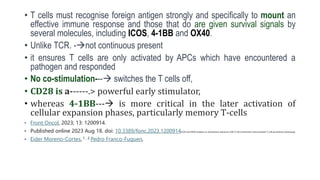
• T cells must recognise foreign antigen strongly and specifically to mount an
effective immune response and those that do are given survival signals by
several molecules, including ICOS, 4-1BB and OX40.
• Unlike TCR. -not continuous present
• it ensures T cells are only activated by APCs which have encountered a
pathogen and responded
• No co-stimulation--- switches the T cells off,
• CD28 is a------.> powerful early stimulator,
• whereas 4-1BB--- is more critical in the later activation of
cellular expansion phases, particularly memory T-cells
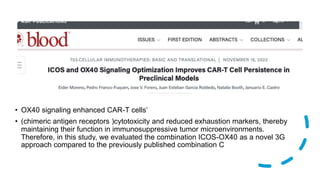
• Front Oncol. 2023; 13: 1200914.
• Published online 2023 Aug 18. doi: 10.3389/fonc.2023.1200914ICOS and OX40 tandem co-stimulation enhances CAR T-cell cytotoxicity and promotes T-cell persistence phenotype
• Eider Moreno-Cortes, 1 , 2 Pedro Franco-Fuquen,
• OX40 signaling enhanced CAR-T cells’
• (chimeric antigen receptors )cytotoxicity and reduced exhaustion markers, thereby
maintaining their function in immunosuppressive tumor microenvironments.
Therefore, in this study, we evaluated the combination ICOS-OX40 as a novel 3G
approach compared to the previously published combination C
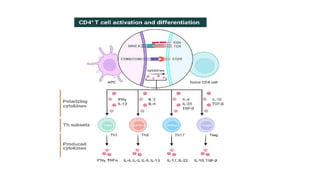
Signal Three (cytokines)
• Once the T cell has received a specific antigen signal and a general
signal two, it receives more instructions in the form of cytokines.
• These determine which type of responder the cell will become – in
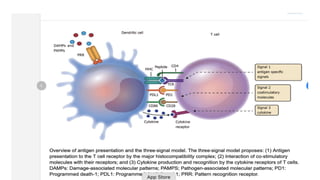
the case of helper T cells, it will push them into Th1 type (cells
exposed to the cytokine IL-12), Th2 (IL-4), or IL-17 (IL-6, IL-23).
Each one of these cells performs a specific task in the tissue and in
developing further immune responses.
• The resulting cell population moves out to the site of the infection
or inflammation in order to deal with the pathogen. Other cells
present at the tissue site of inflammation– such as neutrophils,
mast cells, and epithelial cells – can also release cytokines,
chemokines, and other molecules which induce further activation
and proliferation of the T cells.
•
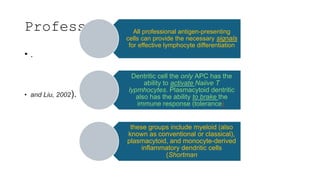
Professional APC
• .
• and Liu, 2002).
All professional antigen-presenting
cells can provide the necessary signals
for effective lymphocyte differentiation
Dentritic cell the only APC has the
ability to activate Naiive T
lypmhocytes. Plasmacytoid dentritic
also has the ability to brake the
immune response (tolerance).
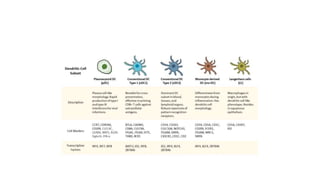
these groups include myeloid (also
known as conventional or classical),
plasmacytoid, and monocyte-derived
inflammatory dendritic cells
(Shortman
Maturation of dentritic cell
Types of conventional
dentritic
Lymphoid resident migratory Tissue-derived dendritic
cell
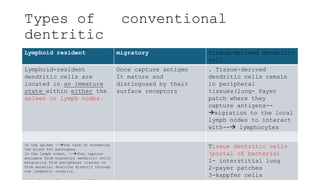
Lymphoid-resident
dendritic cells are
located in an immature
state within either the
spleen or lymph nodes.
Once capture antigen
It mature and
distingused by their
surface receptors
. Tissue-derived
dendritic cells remain
in peripheral
tissues(lung- Payer
patch where they
capture antigens--
migration to the local
lymph nodes to interact
with-- lymphocytes
In the spleen --the task of screening
the blood for pathogens.
In the lymph nodes, --they capture
antigens from migratory dendritic cells
emigrating from peripheral tissues or
from material draining directly through
the lymphatic conduits.
Tissue dentritic cells
(portal of bacteria)
1- interstitial lung
2-payer patches
3-kappfer cells
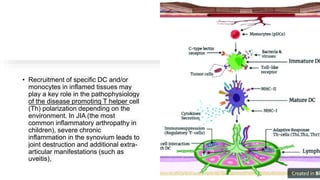
• Recruitment of specific DC and/or
monocytes in inflamed tissues may
play a key role in the pathophysiology
of the disease promoting T helper cell
(Th) polarization depending on the
environment. In JIA (the most
common inflammatory arthropathy in
children), severe chronic
inflammation in the synovium leads to
joint destruction and additional extra-
articular manifestations (such as
uveitis),
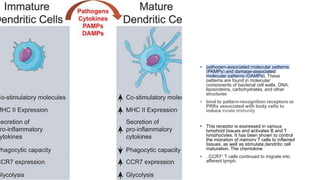
• pathogen-associated molecular patterns
(PAMPs) and damage-associated
molecular patterns (DAMPs). These
patterns are found in molecular
components of bacterial cell walls, DNA,
lipoproteins, carbohydrates, and other
structures
• bind to pattern-recognition receptors or
PRRs associated with body cells to
induce innate immunity
• This receptor is expressed in various
lymphoid tissues and activates B and T
lymphocytes. It has been shown to control
the migration of memory T cells to inflamed
tissues, as well as stimulate dendritic cell
maturation. The chemokine
• , CCR7+ T cells continued to migrate into
afferent lymph.
unique T-cell differentiation by
conventional dentritic cell
• conventional dendritic cell pool preferentially drive unique T-cell differentiation. For
example, distinct subsets are better at evoking either CD4+ or
CD8+ T-cell responses while others only drive clonal expansion
of memory T-cell populations (Heath and Carbone, 2009).
• These recent findings justify further scrutiny of the precise
functions of individual conventional dendritic cell subsets in
order to provide insight into new strategies for vaccine
development that target-tailored immune responses.
Plasmacytoid dendritic cells
• Different from their other family members not only by
morphology , cell surface markers, but also in function (Grouard
et al., 1997).
• To date, the primary function of plasmacytoid dendritic cells
appears to be the secretion of vast amounts of type I
interferon, thus playing a key role in the limitation of viral
replication and dissemination.
• Less effective in lymphocyte activation. However, they present
antigens much less effectively than other dendritic cells due to
reduced antigen uptake and inefficient processing, and loading
of antigens onto MHC molecules. ).
Plasmacytoid dendritic cells between tolerance and
immunity
• Recent studies identified regulatory markers in pDCs such as
programmed death-ligand 1 (PD-L1), Indoleamine 2,3-dioxygenase
(IDO) and granzyme B (GrB) which might mediate a shift from Th2 T
cell response towards regulatory T cells,
• thus promoting tolerance.
• The role of plasmacytoid dendritic cells in inducing tolerance during allergen specific immunotherapy. Schmitt, Anna 2024
2024
• DCs are considered the most efficient APCs capable of efficiently processing and presenting
exogenous antigens on both MHCII and MHC I molecules to naïve CD4+ and CD8+ T cells,
respectively, thus initiating the adaptive immune response.
Types of costimulatory
molecules
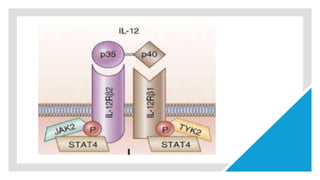
3rd signal cytokine
production(Il12)
he third signal in vivo to show that the presence of signals
1 and 2 but the absence of IL-12 results in peripheral
tolerance in the CD8+ T-cell compartment [5].
CD8+ T cells are able to proliferate and to produce IFN-γ in
vivo in the absence of IL-12, but this cytokine production and
cytotoxic T-lymphocyte (CTL) activity are limited.
the important role of IL-12 in driving IFN-γ effector
function by T cells [6]. Further upstream, 7]. In this
regard, it is of interest that the minimum required
signals for CD154 (CD40L) expression by CD4+ T cells are
CD80/86 and CD54, even in the absence of signal 1 [
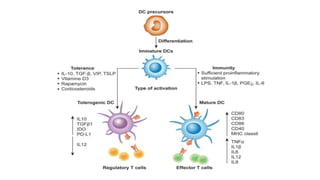
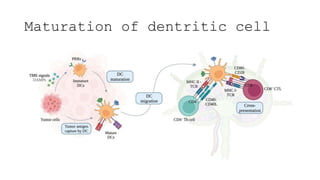
• DCs undergo a series of phenotypic and functional changes upon exposure to
activation signals, leading to their maturation (10). This process is associated with
the following events: (1) downregulated antigen-capture activity, (2) increased
expression of surface MHC class II molecules and enhanced antigen processing and
presentation, (3) increased levels of chemokine receptors, e.g., CCR7, which allows
migration of the DC to lymphoid tissues; (4) increased expression of costimulatory
molecules associated with the capacity to stimulate or suppress T cells through
different signaling axes: CD80/CD86-CD28, CD40-CD40L, OX40L-OX40, ICOSL-ICOS
and galectin (GAL)9-TIM3, CD80-CTLA4, PDL1-PD1, PDL2-PD1, respectively (Figure
2); and (5) enhanced secretion of cytokines and chemokines, leading to the
development of an immune response T cell subtypes, e.g., CD4+ T cells such as TH1,
TH2 and Tregs
• 0. Dudek AM, Martin S, Garg AD, Agostinis P. Immature, semi-mature, and fully mature dendritic cells:
toward a DC-cancer cells interface that augments anticancer immunity. Front Immunol. (2013) 4:438.
10.3389/fimmu.2013.00438 [PMC free article] [PubMed] [CrossRef] [Google Scholar]
Mature DC
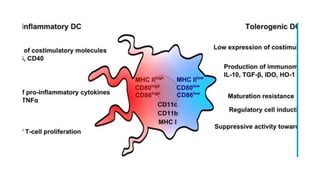
• Mature DC exhibit the characteristics of high expression of the
surface MHC-II and costimulatory molecules (CD80/CD86 and
CD40). On the contrary, Tol-DC are often characterized by low
expression of MHC-II and CD80/CD86 and CD40, termed as a state
of “semi-maturity” (8). Additionally, Tol-DC are also featured with
increased expression of anti-inflammatory molecules, such as
interleukin-10 (IL-10) and transforming growth factor-beta (TGF-
β), and decreased levels of IL-12p70 and other proinflammatory
cytokines (22).
PAD 1 and PAD L
• Vitamin D3 (VitD3) is a fat-soluble hormone that can be acquired from
food or be biosynthesized in the skin upon ultraviolet-B radiation and is
commonly applied as a drug for rickets, which is considered to be one
of the most commonly used strategies for inducing Tol-DC in vitro.
VitD3-Tol-DC show low expression of MHC-II, CD80, CD86, and CD40
and high secretion or expression of IL-10, in
• PD-1 is an important inhibitory molecule expressed on T cells, and PD-
L1 is its ligand expressed on DC. The interaction between PD-1 and PD-
L1 delivers inhibitory signals to T cells and contributes to the anergy of
T cells (90).
• no Y, Perez-Gutierrez A, Nakao T, Dai H, Camirand G, Yoshida O, et al. Graft-infiltrating PD-L1(hi) cross-
dressed dendritic cells regulate antidonor T cell responses in mouse liver transplant tolerance. Hepatol
(Balt Md) (2018) 67(4):1499–515
• Although other cells such as macrophages and B cells are also able to
present antigens via MHC, DCs are the only cell type to activate naïve T
cells and to induce antigen-specific immune responses in all adaptive
immune cells (4). They can for instance directly induce antibody production
by presenting intact antigen to antigen-specific B cells without engaging T
cells (5). DCs take a guiding role in immune responses as they interrogate,
interpret, and transmit the nature of the antigenic stimulus, thereby
shaping even T cell polarization via different intracellular signaling
pathways (6).
• . Merad M, Sathe P, Helft J, Miller J, Mortha A. The dendritic cell lineage:
ontogeny and function of dendritic cells and their subsets in the steady
state and the inflamed setting. Annu Rev Immunol (2013) 31:563–604.
doi:10.1146/annurev-immunol-020711-074950
•
• human tolerogenic DCs are induced by various
immunosuppressive drugs (Figure 3) that are often systemically
used to control excessive immune responses like
corticosteroids, rapamycin, cyclosporine, or by acetylsalicylic
acid (58). For instance, the corticosteroid dexamethasone is
capable of inducing tolerogenic DCs that exhibit low expression
of co-stimulatory molecules combined with highly expressed
inhibitory receptors ILT-2 and ILT-3 and secrete large amounts
of IL-10 and IDO resulting in the induction of T cells with
regulatory capacities (15, 59–61).
• incubation with the immunosuppressive cytokines TGF-β and
IL-10 alone or in combination facilitated the generation of a
tolerogenic DC phenotype (Figures 2–4) (48, 66). For instance,
TGF-β dampens the antigen-presenting capabilities of DCs by
downregulation of MHC and co-stimulatory molecules and
upregulation of PDL-1 resulting in T cell anergy
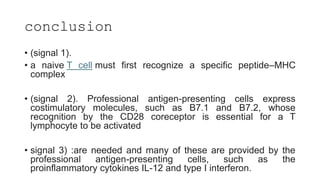
conclusion
• (signal 1).
• a naive T cell must first recognize a specific peptide–MHC
complex
• (signal 2). Professional antigen-presenting cells express
costimulatory molecules, such as B7.1 and B7.2, whose
recognition by the CD28 coreceptor is essential for a T
lymphocyte to be activated
• signal 3) :are needed and many of these are provided by the
professional antigen-presenting cells, such as the
proinflammatory cytokines IL-12 and type I interferon.
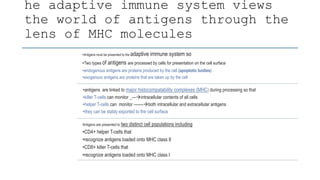
he adaptive immune system views
the world of antigens through the
lens of MHC molecules
•Antigens must be presented to the adaptive immune system so
•Two types of antigens are processed by cells for presentation on the cell surface
•endogenous antigens are proteins produced by the cell (apoptotic bodies)
•exogenous antigens are proteins that are taken up by the cell
•antigens are linked to major histocompatability complexes (MHC) during processing so that
•killer T-cells can monitor _---intracellular contents of all cells
•helper T-cells can monitor -------both intracellular and extracellular antigens
•they can be stably exported to the cell surface
Antigens are presented to two distinct cell populations including
•CD4+ helper T-cells that
•recognize antigens loaded onto MHC class II
•CD8+ killer T-cells that
•recognize antigens loaded onto MHC class I
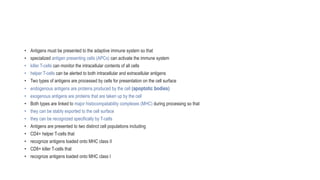
• Antigens must be presented to the adaptive immune system so that
• specialized antigen presenting cells (APCs) can activate the immune system
• killer T-cells can monitor the intracellular contents of all cells
• helper T-cells can be alerted to both intracellular and extracellular antigens
• Two types of antigens are processed by cells for presentation on the cell surface
• endogenous antigens are proteins produced by the cell (apoptotic bodies)
• exogenous antigens are proteins that are taken up by the cell
• Both types are linked to major histocompatability complexes (MHC) during processing so that
• they can be stably exported to the cell surface
• they can be recognized specifically by T-cells
• Antigens are presented to two distinct cell populations including
• CD4+ helper T-cells that
• recognize antigens loaded onto MHC class II
• CD8+ killer T-cells that
• recognize antigens loaded onto MHC class I
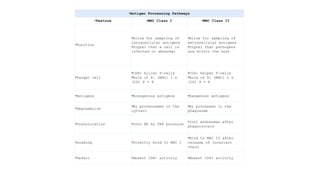
•Antigen Processing Pathways
•Feature •MHC Class I •MHC Class II
•Function
•Allow for sampling of
intracellular antigens
•Signal that a cell is
infected or abnormal
•Allow for sampling of
extracellular antigens
•Signal that pathogens
are within the host
•Target cell
•CD8+ killer T-cells
•Rule of 8: (MHC) 1 x
(CD) 8 = 8
•CD4+ helper T-cells
•Rule of 8: (MHC) 2 x
(CD) 4 = 8
•Antigens •Endogenous antigens •Exogenous antigens
•Degradation
•By proteosomes in the
cytosol
•By proteases in the
phagosome
•Translocation •Into ER by TAP proteins
•Into endosomes after
phagocytosis
•Loading •Directly bind to MHC I
•Bind to MHC II after
release of invariant
chain
•Defect •Absent CD8+ activity •Absent CD4+ activity
• Cytotoxic T lymphocytes (CTLs) often called CD8+ T cells,
are a adaptive immune system and play an important role
in immune defense against intracellular pathogens such as
viruses and bacteria and against tumors
• the function of the class I MHC is to display intracellular
proteins to cytotoxic T cells (CTLs).
• PAD1 PAD L1 binding induce T cell anergy, be
blind, blockits response to MHC1
Step 1: acquisition of antigens
• Receptors with various degrees of specificity participate46,50.
include the B cell receptor (BCR) for an antigen, the mannose
receptor, complement receptors, Fc receptors and probably
scavenger receptors, all of which deliver the captured antigen to
the various compartments of the endocytic pathway5
• Cells engaged in MHC-II-restricted presentation acquire
antigen?s
MHC-I molecules sample
Autophagy targets damaged cytoplasmic organelles such as mitochondria
and cytoplasmic viral replication machineries to a lysosomal compartment
for degradation55. by Macropinocytosis..
• MHC-I molecules sample the proteome of MHC-I-positive cells. Cytosolic
proteins are also continuously turning over,, and this involves proteolysis,
by the–proteasome system61. All nucleated cells express MHC-I . viral
protein synthesis contributes to the proteome of the infected cell and
serves as a source of antigens for MHC-I molecules63
• Proteins in the extracellular space can also contribute to peptides
presented by MHC-I molecules. This is referred to as ‘cross-presentation’
Membrane and secreted proteins that fail to pass quality control in the ER
are expelled into the cytosol in a process referred to as ‘dislocation’ or ‘ER-
associated degradation’65. These discarded proteins likewise contribute to
the pool of antigens sampled by MHC-I molecules.
•Published: 13 April 2022
A guide to antigen processing and presentation
•Novalia Pishesha,
•Thibault J. Harmand &
•Hidde L. Ploegh
Nature Reviews Immunology volume 22, pages 751–764 (2022)Cite t
Step 2: tagging antigens for proteolysis into
peptides
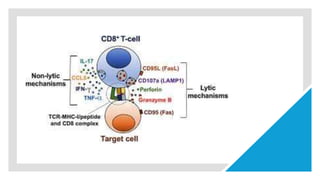
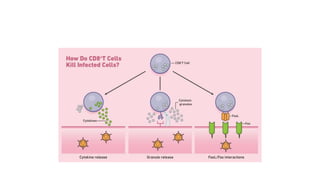
Stages of T cell cytotoxicity
• pro-apoptotic molecules through the release of cytotoxic
granules.
• CD8+ T cells can induce apoptosis by ligation of the
receptor Fas and the Fas ligand (Fas L), which are expressed
on lymphocytes and infected target cells. Activated CD8+ T
cells also produce several cytokines that contribute to host
defense, including IFNγ, TNFα, and lymphotox
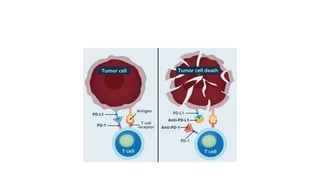
It normally
acts as a
type of “off
switch
Checkpoint
inhibitors don't
kill cancer cells
directly. They work
by helping the
immune system to
better find and
attack the cancer
cells, by T cell
mediated
cytotoxicity.
Ex:.. When PD-1
binds to PD-L1, it
basically tells the
T cell to leave the
other tumor cell.
(Anergy)
Some cancer cells
have large amounts
of PD-L1, which
helps them hide from
an immune attack.
Monoclonal Abs that
target either PD-1
or PD-L1 can block
this and boost the
immune response
against cancer
cells.
PD-1 is a checkpoint protein on T cells.
PDL on cancer cell
• PD-1 inhibitors
• Examples of drugs that target PD-1 include:
• Pembrolizumab (Keytruda)
• Nivolumab (Opdivo)
• Cemiplimab (Libtayo)
• PD-L1 inhibitors
• Examples of drugs that target PD-L1 include:
• Atezolizumab (Tecentriq)
• Avelumab (Bavencio)
• Durvalumab (Imfinzi)
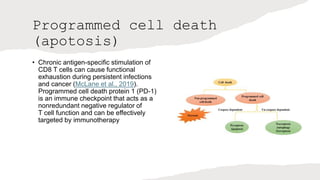
Programmed cell death
(apotosis)
• Chronic antigen-specific stimulation of
CD8 T cells can cause functional
exhaustion during persistent infections
and cancer (McLane et al., 2019).
Programmed cell death protein 1 (PD-1)
is an immune checkpoint that acts as a
nonredundant negative regulator of
T cell function and can be effectively
targeted by immunotherapy
programmed
• programed refers to those physiological kinds of cell death that
occur during the developmental phase of the embryo and tissue
homeostasis (1). Apoptosis is a type of programed cell death
occurring during development and aging and helps to maintain
tissue homeostasis. The term apoptosis was first coined by Kerr
et al. to describe cell death with specific morphological features,
including cell shrinkage (pyknosis), cytoskeleton remodeling,
chromatin condensation, nuclear fragmentation (karyorrhex
• NETosis is a special form of death executed by neutrophils, in
which nuclear chromatin, histones, and granular antimicrobial
proteins are extruded from the cell forming neutrophil
extracellular traps (NETs). NETs are thought to play a role in
trapping pathogens, such as bacteria, fungi, viruses, and
parasites, preventing dissemination and killing microbes by the
inactivation of virulence factors. NETosis is physiological cell
death induced by stimuli, such as pathogens and re

APC abd Ag presentaion APC abd Ag presentaion

  • 1.
  • 2.
    APC • An (antigen-presentingcell) is a cell that displays antigen in association with major histocompatibility complex (MHC) at its surface. • (effector cells) T-cell has specific receptors (TCR) • peptide–MHC complexes ……communicate information to one of the the immune system, T cells,,,,,,,, which recognize these complexes using their T-cell receptors (TCR) • dendritic cells (DCs) are not only part of the innate immune system, but also generals of adaptive immunity and they orchestrate the de novo induction of tolerogenic and immunogenic T cell responses.
  • 4.
    • APCs includesany cell that retains the capacity to express antigen on its cell surface in association with only an MHC I protein complex . This includes all nucleated cell types, • Two fundamental categories of antigen-presenting cells exist: professional and nonprofessional. • Professional APC.. dendritic cells, B cells, monocytes, macrophages, and neutrophils are bone marrow–derived leukocytes that comprise the professional antigen-presenting cells of an individual.
  • 5.
    APCS for classII CD4 • 1-dentritic cells---the only initate T cell responsein the Tcell naiive • 2- mononucular macrophage--in effector phase of CD4 • 3-B lymphocyte- during humoral response • 4- Vascular endothelial cells • All 3 are professional but dentritic the only the sole function to capture and presentation
  • 6.
    Properties of APS(AbulAbbas) Cell type class MHC II costimulators Principle function dentritic INF gamma w maturation INF gamma CD40-CD40L Initiation of T cell response macrophage LPS LPS –INF gamma CD40-CD4-L Cd(80-86(B 7) with CD 28 interaction Effector phase of T cell mediated immune response B lymphocyte IL 2,4,5 CD40-CD4-L interaction Ag receptor cross link Ag presentation to CD 4 helper T cell in humoral immune response (B and T cell interaction) Vascular enothelium INF gammalp Specific T cell at site of Ag deposition
  • 7.
    Requirment for Ag presentatioin •1- endocytosis and proteolytic digest protein • 2-express Class II or class I for Ag presentation • 3- secrete co stimulatory molecules? • Dentritic cells were first discovered in 1973 by Ralph Steinman, who was awarded a Nobel Prize in 2011 for that discovery.
  • 8.
    Signals during Agpresentation • 1- signal one :MHC II antigen complex • 2- co stimulatory molecules • (B7-1 and B7-2, also called CD80 and CD86) are induced on APCs and allow activation of CD28 on the T cells. • ICoS- OX 40 • ne does not want continuous T-cell activation, there is also another set of co-receptors which inhibit T-cell activation. They are called co-inhibitory receptors, and include CTLA-4 and PD-1. These molecules are only expressed on T cells that have already been activated. Stimulation of these induced co-inhibitory receptors will curtail T-cell activation, and therefore contribute to a balanced immune response. Indeed, defects in these co-inhibitory receptors lead to aberrant immune responses, such as lymphoproliferation and autoimmunity • he specific B-cell receptor (BCR, an immunoglubulin molecule attached to the membrane of the B cell) recognises the antigen in native form, as opposed to the TCR that recognises antigenic peptides. Costimulation of B cells is notably achieved by the molecule CD40. CD40 ligand is expressed on T cell • 3- signal 3 cytokine release
  • 9.
    • plasmacytoid dendriticcells constitute 0.1–0.5% of human peripheral blood mononuclear cells (PBMCs). 3, 4 Freshly purified pDCs manifest a plasmacytoid morphology, with rough endoplasmic reticulum and Golgi apparatus. Upon activation, pDCs gain dendritic cell‐like morphology and produce massive amounts of type I interferons (IFN‐I), for example most of the IFN‐I detectable in the blood following viral infection in mice and humans. 1 , 2 The IFN‐I secretion by pDCs is mainly mediated through the activation of the endosomal Toll‐like receptors (TLRs) TLR7 and TLR9, with cytosolic receptor initiating pathways playing an important supplementary role. 5 Apart from IFN‐I, pDCs could also secrete pro‐inflammatory cytokines and chemokines and express co‐stimulatory or co‐inhibitory molecules which facilitate pDCs to cross‐prime CD8+ T cells and present antigens to CD4+ T cells. 2 , 6
  • 10.
    • lasmacytoid dendriticcells were initially identified as a unique cell subset that respond to viruses with rapid and massive production of IFN‐I, and play a central role in the antiviral immune response. 2Moreover, pDCs could also respond to certain non‐viral pathogens such as bacteria (e.g. Chlamydia pneumoniae) 51 and apicomplexan parasites (e.g. Plasmodium). 52 , 53 The recent advances in pDCs in anti‐infectious immunity are not within the scope of this review, but have been very well summarised by Reizis.54 Recognition of either pathogen‐derived nucleic acids or synthetic TLR ligands such as CpG ODNs initiates IFN‐I secretion by pDCs, which is mainly (albeit not exclusively) mediated through the activation of the endosomal TLR7 and TLR9, and the subsequent myeloid differentiation primary response protein 88 (MYD88)–interferon regulatory factor 7 (IRF7) pathway. 55 In addition, the MYD88–NF‐κB pathway is also activated, leading to the secretion of pro‐inflammatory cytokines and chemokines, and the expression of co‐stimulatory molecules. TLR7 senses RNA viruses and endogenous RNA, whereas TLR9 detects prokaryotes containing unmethylated CpG‐rich DNA sequences and endogenous DNA. Both TLR7 and TLR9 sense synthetic CpG ODNs, and different classes of CpG ODNs have been developed to perform different immune functions. CpG‐A is a strong inducer of type I IFNs, whereas CpG‐B is a potent stimulator of maturation and the production of cytokines and chemok
  • 12.
    Signal one (Ag presentation) •once T cells leave the thymus, they circulate throughout the body until they recognise their antigen on the surface of antigen presenting cells (APCs). The T cell receptor (TCR) on
  • 13.
    Signal Two(co stimulatorymolecules ) • In addition to TCR binding to antigen-loaded MHC, both helper T cells and cytotoxic T cells require a number of secondary signals to become activated and respond to the threat. In the case of helper T cells, the first of these is provided by CD28. This molecule on the T cell binds to one of two molecules on the APC – B7.1 (CD80) or B7.2 (CD86) – and initiates T-cell proliferation. • This process leads to the production of many millions of T cells that recognise the antigen. In order to control the response, stimulation of CD28 by B7 induces the production of CTLA-4 (CD152). This molecule competes with CD28 for B7 and so reduces activation signals to the T cell and winds down the immune response. Cytotoxic T cells are less reliant on CD28 for activation but do require signals from other co- stimulatory molecules such as CD70 and 4-1BB (CD137).
  • 14.
    • T cellsmust recognise foreign antigen strongly and specifically to mount an effective immune response and those that do are given survival signals by several molecules, including ICOS, 4-1BB and OX40. • Unlike TCR. -not continuous present • it ensures T cells are only activated by APCs which have encountered a pathogen and responded • No co-stimulation--- switches the T cells off, • CD28 is a------.> powerful early stimulator, • whereas 4-1BB--- is more critical in the later activation of cellular expansion phases, particularly memory T-cells • Front Oncol. 2023; 13: 1200914. • Published online 2023 Aug 18. doi: 10.3389/fonc.2023.1200914ICOS and OX40 tandem co-stimulation enhances CAR T-cell cytotoxicity and promotes T-cell persistence phenotype • Eider Moreno-Cortes, 1 , 2 Pedro Franco-Fuquen,
  • 15.
    • OX40 signalingenhanced CAR-T cells’ • (chimeric antigen receptors )cytotoxicity and reduced exhaustion markers, thereby maintaining their function in immunosuppressive tumor microenvironments. Therefore, in this study, we evaluated the combination ICOS-OX40 as a novel 3G approach compared to the previously published combination C
  • 18.
    Signal Three (cytokines) •Once the T cell has received a specific antigen signal and a general signal two, it receives more instructions in the form of cytokines. • These determine which type of responder the cell will become – in the case of helper T cells, it will push them into Th1 type (cells exposed to the cytokine IL-12), Th2 (IL-4), or IL-17 (IL-6, IL-23). Each one of these cells performs a specific task in the tissue and in developing further immune responses. • The resulting cell population moves out to the site of the infection or inflammation in order to deal with the pathogen. Other cells present at the tissue site of inflammation– such as neutrophils, mast cells, and epithelial cells – can also release cytokines, chemokines, and other molecules which induce further activation and proliferation of the T cells. •
  • 20.
    Professional APC • . •and Liu, 2002). All professional antigen-presenting cells can provide the necessary signals for effective lymphocyte differentiation Dentritic cell the only APC has the ability to activate Naiive T lypmhocytes. Plasmacytoid dentritic also has the ability to brake the immune response (tolerance). these groups include myeloid (also known as conventional or classical), plasmacytoid, and monocyte-derived inflammatory dendritic cells (Shortman
  • 24.
  • 25.
    Types of conventional dentritic Lymphoidresident migratory Tissue-derived dendritic cell Lymphoid-resident dendritic cells are located in an immature state within either the spleen or lymph nodes. Once capture antigen It mature and distingused by their surface receptors . Tissue-derived dendritic cells remain in peripheral tissues(lung- Payer patch where they capture antigens-- migration to the local lymph nodes to interact with-- lymphocytes In the spleen --the task of screening the blood for pathogens. In the lymph nodes, --they capture antigens from migratory dendritic cells emigrating from peripheral tissues or from material draining directly through the lymphatic conduits. Tissue dentritic cells (portal of bacteria) 1- interstitial lung 2-payer patches 3-kappfer cells
  • 26.
    • Recruitment ofspecific DC and/or monocytes in inflamed tissues may play a key role in the pathophysiology of the disease promoting T helper cell (Th) polarization depending on the environment. In JIA (the most common inflammatory arthropathy in children), severe chronic inflammation in the synovium leads to joint destruction and additional extra- articular manifestations (such as uveitis),
  • 28.
    • pathogen-associated molecularpatterns (PAMPs) and damage-associated molecular patterns (DAMPs). These patterns are found in molecular components of bacterial cell walls, DNA, lipoproteins, carbohydrates, and other structures • bind to pattern-recognition receptors or PRRs associated with body cells to induce innate immunity • This receptor is expressed in various lymphoid tissues and activates B and T lymphocytes. It has been shown to control the migration of memory T cells to inflamed tissues, as well as stimulate dendritic cell maturation. The chemokine • , CCR7+ T cells continued to migrate into afferent lymph.
  • 29.
    unique T-cell differentiationby conventional dentritic cell • conventional dendritic cell pool preferentially drive unique T-cell differentiation. For example, distinct subsets are better at evoking either CD4+ or CD8+ T-cell responses while others only drive clonal expansion of memory T-cell populations (Heath and Carbone, 2009). • These recent findings justify further scrutiny of the precise functions of individual conventional dendritic cell subsets in order to provide insight into new strategies for vaccine development that target-tailored immune responses.
  • 30.
    Plasmacytoid dendritic cells •Different from their other family members not only by morphology , cell surface markers, but also in function (Grouard et al., 1997). • To date, the primary function of plasmacytoid dendritic cells appears to be the secretion of vast amounts of type I interferon, thus playing a key role in the limitation of viral replication and dissemination. • Less effective in lymphocyte activation. However, they present antigens much less effectively than other dendritic cells due to reduced antigen uptake and inefficient processing, and loading of antigens onto MHC molecules. ).
  • 31.
    Plasmacytoid dendritic cellsbetween tolerance and immunity • Recent studies identified regulatory markers in pDCs such as programmed death-ligand 1 (PD-L1), Indoleamine 2,3-dioxygenase (IDO) and granzyme B (GrB) which might mediate a shift from Th2 T cell response towards regulatory T cells, • thus promoting tolerance. • The role of plasmacytoid dendritic cells in inducing tolerance during allergen specific immunotherapy. Schmitt, Anna 2024 2024 • DCs are considered the most efficient APCs capable of efficiently processing and presenting exogenous antigens on both MHCII and MHC I molecules to naïve CD4+ and CD8+ T cells, respectively, thus initiating the adaptive immune response.
  • 33.
  • 37.
    3rd signal cytokine production(Il12) hethird signal in vivo to show that the presence of signals 1 and 2 but the absence of IL-12 results in peripheral tolerance in the CD8+ T-cell compartment [5]. CD8+ T cells are able to proliferate and to produce IFN-γ in vivo in the absence of IL-12, but this cytokine production and cytotoxic T-lymphocyte (CTL) activity are limited. the important role of IL-12 in driving IFN-γ effector function by T cells [6]. Further upstream, 7]. In this regard, it is of interest that the minimum required signals for CD154 (CD40L) expression by CD4+ T cells are CD80/86 and CD54, even in the absence of signal 1 [
  • 39.
    • DCs undergoa series of phenotypic and functional changes upon exposure to activation signals, leading to their maturation (10). This process is associated with the following events: (1) downregulated antigen-capture activity, (2) increased expression of surface MHC class II molecules and enhanced antigen processing and presentation, (3) increased levels of chemokine receptors, e.g., CCR7, which allows migration of the DC to lymphoid tissues; (4) increased expression of costimulatory molecules associated with the capacity to stimulate or suppress T cells through different signaling axes: CD80/CD86-CD28, CD40-CD40L, OX40L-OX40, ICOSL-ICOS and galectin (GAL)9-TIM3, CD80-CTLA4, PDL1-PD1, PDL2-PD1, respectively (Figure 2); and (5) enhanced secretion of cytokines and chemokines, leading to the development of an immune response T cell subtypes, e.g., CD4+ T cells such as TH1, TH2 and Tregs • 0. Dudek AM, Martin S, Garg AD, Agostinis P. Immature, semi-mature, and fully mature dendritic cells: toward a DC-cancer cells interface that augments anticancer immunity. Front Immunol. (2013) 4:438. 10.3389/fimmu.2013.00438 [PMC free article] [PubMed] [CrossRef] [Google Scholar]
  • 41.
    Mature DC • MatureDC exhibit the characteristics of high expression of the surface MHC-II and costimulatory molecules (CD80/CD86 and CD40). On the contrary, Tol-DC are often characterized by low expression of MHC-II and CD80/CD86 and CD40, termed as a state of “semi-maturity” (8). Additionally, Tol-DC are also featured with increased expression of anti-inflammatory molecules, such as interleukin-10 (IL-10) and transforming growth factor-beta (TGF- β), and decreased levels of IL-12p70 and other proinflammatory cytokines (22).
  • 42.
    PAD 1 andPAD L • Vitamin D3 (VitD3) is a fat-soluble hormone that can be acquired from food or be biosynthesized in the skin upon ultraviolet-B radiation and is commonly applied as a drug for rickets, which is considered to be one of the most commonly used strategies for inducing Tol-DC in vitro. VitD3-Tol-DC show low expression of MHC-II, CD80, CD86, and CD40 and high secretion or expression of IL-10, in • PD-1 is an important inhibitory molecule expressed on T cells, and PD- L1 is its ligand expressed on DC. The interaction between PD-1 and PD- L1 delivers inhibitory signals to T cells and contributes to the anergy of T cells (90). • no Y, Perez-Gutierrez A, Nakao T, Dai H, Camirand G, Yoshida O, et al. Graft-infiltrating PD-L1(hi) cross- dressed dendritic cells regulate antidonor T cell responses in mouse liver transplant tolerance. Hepatol (Balt Md) (2018) 67(4):1499–515
  • 43.
    • Although othercells such as macrophages and B cells are also able to present antigens via MHC, DCs are the only cell type to activate naïve T cells and to induce antigen-specific immune responses in all adaptive immune cells (4). They can for instance directly induce antibody production by presenting intact antigen to antigen-specific B cells without engaging T cells (5). DCs take a guiding role in immune responses as they interrogate, interpret, and transmit the nature of the antigenic stimulus, thereby shaping even T cell polarization via different intracellular signaling pathways (6). • . Merad M, Sathe P, Helft J, Miller J, Mortha A. The dendritic cell lineage: ontogeny and function of dendritic cells and their subsets in the steady state and the inflamed setting. Annu Rev Immunol (2013) 31:563–604. doi:10.1146/annurev-immunol-020711-074950 •
  • 44.
    • human tolerogenicDCs are induced by various immunosuppressive drugs (Figure 3) that are often systemically used to control excessive immune responses like corticosteroids, rapamycin, cyclosporine, or by acetylsalicylic acid (58). For instance, the corticosteroid dexamethasone is capable of inducing tolerogenic DCs that exhibit low expression of co-stimulatory molecules combined with highly expressed inhibitory receptors ILT-2 and ILT-3 and secrete large amounts of IL-10 and IDO resulting in the induction of T cells with regulatory capacities (15, 59–61).
  • 45.
    • incubation withthe immunosuppressive cytokines TGF-β and IL-10 alone or in combination facilitated the generation of a tolerogenic DC phenotype (Figures 2–4) (48, 66). For instance, TGF-β dampens the antigen-presenting capabilities of DCs by downregulation of MHC and co-stimulatory molecules and upregulation of PDL-1 resulting in T cell anergy
  • 46.
    conclusion • (signal 1). •a naive T cell must first recognize a specific peptide–MHC complex • (signal 2). Professional antigen-presenting cells express costimulatory molecules, such as B7.1 and B7.2, whose recognition by the CD28 coreceptor is essential for a T lymphocyte to be activated • signal 3) :are needed and many of these are provided by the professional antigen-presenting cells, such as the proinflammatory cytokines IL-12 and type I interferon.
  • 47.
    he adaptive immunesystem views the world of antigens through the lens of MHC molecules •Antigens must be presented to the adaptive immune system so •Two types of antigens are processed by cells for presentation on the cell surface •endogenous antigens are proteins produced by the cell (apoptotic bodies) •exogenous antigens are proteins that are taken up by the cell •antigens are linked to major histocompatability complexes (MHC) during processing so that •killer T-cells can monitor _---intracellular contents of all cells •helper T-cells can monitor -------both intracellular and extracellular antigens •they can be stably exported to the cell surface Antigens are presented to two distinct cell populations including •CD4+ helper T-cells that •recognize antigens loaded onto MHC class II •CD8+ killer T-cells that •recognize antigens loaded onto MHC class I
  • 48.
    • Antigens mustbe presented to the adaptive immune system so that • specialized antigen presenting cells (APCs) can activate the immune system • killer T-cells can monitor the intracellular contents of all cells • helper T-cells can be alerted to both intracellular and extracellular antigens • Two types of antigens are processed by cells for presentation on the cell surface • endogenous antigens are proteins produced by the cell (apoptotic bodies) • exogenous antigens are proteins that are taken up by the cell • Both types are linked to major histocompatability complexes (MHC) during processing so that • they can be stably exported to the cell surface • they can be recognized specifically by T-cells • Antigens are presented to two distinct cell populations including • CD4+ helper T-cells that • recognize antigens loaded onto MHC class II • CD8+ killer T-cells that • recognize antigens loaded onto MHC class I
  • 49.
    •Antigen Processing Pathways •Feature•MHC Class I •MHC Class II •Function •Allow for sampling of intracellular antigens •Signal that a cell is infected or abnormal •Allow for sampling of extracellular antigens •Signal that pathogens are within the host •Target cell •CD8+ killer T-cells •Rule of 8: (MHC) 1 x (CD) 8 = 8 •CD4+ helper T-cells •Rule of 8: (MHC) 2 x (CD) 4 = 8 •Antigens •Endogenous antigens •Exogenous antigens •Degradation •By proteosomes in the cytosol •By proteases in the phagosome •Translocation •Into ER by TAP proteins •Into endosomes after phagocytosis •Loading •Directly bind to MHC I •Bind to MHC II after release of invariant chain •Defect •Absent CD8+ activity •Absent CD4+ activity
  • 50.
    • Cytotoxic Tlymphocytes (CTLs) often called CD8+ T cells, are a adaptive immune system and play an important role in immune defense against intracellular pathogens such as viruses and bacteria and against tumors • the function of the class I MHC is to display intracellular proteins to cytotoxic T cells (CTLs). • PAD1 PAD L1 binding induce T cell anergy, be blind, blockits response to MHC1
  • 51.
    Step 1: acquisitionof antigens • Receptors with various degrees of specificity participate46,50. include the B cell receptor (BCR) for an antigen, the mannose receptor, complement receptors, Fc receptors and probably scavenger receptors, all of which deliver the captured antigen to the various compartments of the endocytic pathway5 • Cells engaged in MHC-II-restricted presentation acquire antigen?s
  • 52.
    MHC-I molecules sample Autophagytargets damaged cytoplasmic organelles such as mitochondria and cytoplasmic viral replication machineries to a lysosomal compartment for degradation55. by Macropinocytosis.. • MHC-I molecules sample the proteome of MHC-I-positive cells. Cytosolic proteins are also continuously turning over,, and this involves proteolysis, by the–proteasome system61. All nucleated cells express MHC-I . viral protein synthesis contributes to the proteome of the infected cell and serves as a source of antigens for MHC-I molecules63 • Proteins in the extracellular space can also contribute to peptides presented by MHC-I molecules. This is referred to as ‘cross-presentation’ Membrane and secreted proteins that fail to pass quality control in the ER are expelled into the cytosol in a process referred to as ‘dislocation’ or ‘ER- associated degradation’65. These discarded proteins likewise contribute to the pool of antigens sampled by MHC-I molecules.
  • 53.
    •Published: 13 April2022 A guide to antigen processing and presentation •Novalia Pishesha, •Thibault J. Harmand & •Hidde L. Ploegh Nature Reviews Immunology volume 22, pages 751–764 (2022)Cite t
  • 54.
    Step 2: taggingantigens for proteolysis into peptides
  • 55.
    Stages of Tcell cytotoxicity • pro-apoptotic molecules through the release of cytotoxic granules. • CD8+ T cells can induce apoptosis by ligation of the receptor Fas and the Fas ligand (Fas L), which are expressed on lymphocytes and infected target cells. Activated CD8+ T cells also produce several cytokines that contribute to host defense, including IFNγ, TNFα, and lymphotox
  • 58.
    It normally acts asa type of “off switch Checkpoint inhibitors don't kill cancer cells directly. They work by helping the immune system to better find and attack the cancer cells, by T cell mediated cytotoxicity. Ex:.. When PD-1 binds to PD-L1, it basically tells the T cell to leave the other tumor cell. (Anergy) Some cancer cells have large amounts of PD-L1, which helps them hide from an immune attack. Monoclonal Abs that target either PD-1 or PD-L1 can block this and boost the immune response against cancer cells.
  • 59.
    PD-1 is acheckpoint protein on T cells. PDL on cancer cell • PD-1 inhibitors • Examples of drugs that target PD-1 include: • Pembrolizumab (Keytruda) • Nivolumab (Opdivo) • Cemiplimab (Libtayo) • PD-L1 inhibitors • Examples of drugs that target PD-L1 include: • Atezolizumab (Tecentriq) • Avelumab (Bavencio) • Durvalumab (Imfinzi)
  • 60.
    Programmed cell death (apotosis) •Chronic antigen-specific stimulation of CD8 T cells can cause functional exhaustion during persistent infections and cancer (McLane et al., 2019). Programmed cell death protein 1 (PD-1) is an immune checkpoint that acts as a nonredundant negative regulator of T cell function and can be effectively targeted by immunotherapy
  • 62.
    programmed • programed refersto those physiological kinds of cell death that occur during the developmental phase of the embryo and tissue homeostasis (1). Apoptosis is a type of programed cell death occurring during development and aging and helps to maintain tissue homeostasis. The term apoptosis was first coined by Kerr et al. to describe cell death with specific morphological features, including cell shrinkage (pyknosis), cytoskeleton remodeling, chromatin condensation, nuclear fragmentation (karyorrhex
  • 63.
    • NETosis isa special form of death executed by neutrophils, in which nuclear chromatin, histones, and granular antimicrobial proteins are extruded from the cell forming neutrophil extracellular traps (NETs). NETs are thought to play a role in trapping pathogens, such as bacteria, fungi, viruses, and parasites, preventing dissemination and killing microbes by the inactivation of virulence factors. NETosis is physiological cell death induced by stimuli, such as pathogens and re