THE VALUE CHAIN IN TEXTILES

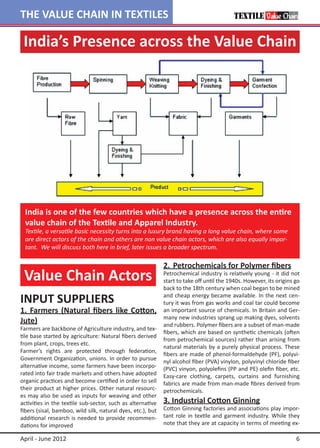
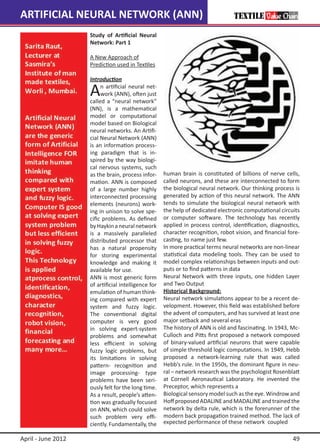
 India’s Presence across the Value Chain


  India is one of the few countries which have a presence across the entire
  value chain of the Textile and Apparel Industry.
  Textile, a versatile basic necessity turns into a luxury brand having a long value chain, where some
  are direct actors of the chain and others are non value chain actors, which are also equally impor-
  tant. We will discuss both here in brief, later issues a broader spectrum.

                                                             2.	 Petrochemicals for Polymer fibers
 Value Chain Actors                                          Petrochemical industry is relatively young - it did not
                                                             start to take off until the 1940s. However, its origins go
                                                             back to the 18th century when coal began to be mined

INPUT SUPPLIERS                                              and cheap energy became available. In the next cen-
                                                             tury it was from gas works and coal tar could become
1.	 Farmers (Natural fibers like Cotton,                     an important source of chemicals. In Britain and Ger-
                                                             many new industries sprang up making dyes, solvents
Jute)                                                        and rubbers. Polymer fibers are a subset of man-made
Farmers are backbone of Agriculture industry, and tex-
                                                             fibers, which are based on synthetic chemicals (often
tile base started by agriculture: Natural fibers derived
                                                             from petrochemical sources) rather than arising from
from plant, crops, trees etc.
                                                             natural materials by a purely physical process. These
Farmer’s rights are protected through federation,
                                                             fibers are made of phenol-formaldehyde (PF), polyvi-
Government Organization, unions. In order to pursue
                                                             nyl alcohol fiber (PVA) vinylon, polyvinyl chloride fiber
alternative income, some farmers have been incorpo-          (PVC) vinyon, polyolefins (PP and PE) olefin fiber, etc.
rated into fair trade markets and others have adopted        Easy-care clothing, carpets, curtains and furnishing
organic practices and become certified in order to sell      fabrics are made from man-made fibres derived from
their product at higher prices. Other natural resourc-       petrochemicals.
es may also be used as inputs for weaving and other
activities in the textile sub-sector, such as alternative    3. Industrial Cotton Ginning
fibers (sisal, bamboo, wild silk, natural dyes, etc.), but   Cotton Ginning factories and associations play impor-
additional research is needed to provide recommen-           tant role in textile and garment industry. While they
dations for improved                                         note that they are at capacity in terms of meeting ex-

April - June 2012                                                                                                    6
THE VALUE CHAIN IN TEXTILES
port demand, they express serious concern regarding         looms are produced locally, and located outdoors to
losses when selling at world commodity prices.              accommodate the length of the traditional warp. Pro-
4.	 Small-Scale Cotton Ginning/                             duction is therefore weather-dependent and limited
                                                            by the season. Informal weavers traditionally provide
Spinning                                                    for the needs of special events and do not extend their
A very limited number of processors are engaged in          efforts to markets outside and do not see a need to
spinning cotton on a traditional cottage-industry basis.    educate customers or invest in marketing activities.
Few businesses have performed small-scale experi-           However this demand is declining as more options
ments in sourcing handspun yarn, developed vertically       become available in modern markets. Several weav-
integrated operations that include the processing of        ing enterprises and associations have formalized their
cotton, through to the finished value-added product         processes, and their workshop sites to provide more
with labor-intensive processes and with relatively          regular working conditions and consistent quality con-
low capital investments. This activity found venue for      trol. Most looms continue to be an evolved version of
increasing income in rural areas and implementing           pit-looms, although floor looms have been adopted by
appropriate technology practices. Many weavers ex-          few workshops, and some workshops have incorpo-
pressed interest in being able to source raw materials      rated fly-shuttle handlooms to increase productivity.
directly from processors, particularly if it allowed them   Many workshops also convert the hand-woven fabric
more choices in terms of dyes or fiber content (organic     into home and fashion accessories, including an abun-
and/ or fair trade, etc.).                                  dance of handbags and tabletop items.
5. 	Industrial Spinning                                     Several weavers expressed interest in developing hori-
Manufacturers of yarn sell their products both to dis-      zontal linkages to increase capacity in order to respond
tributors and weaving workshops in cases where a long-      to larger orders and to buy inputs in bulk to reduce
term purchasing agreement has been established. Due         costs, but it is unclear if there is sufficient demand
to the ever-increasing pricing pressures imposed on         for such arrangements and if workshops can maintain
imported goods, Government has invested in a range          consistent quality standards. Weaving studios sell their
of diversified income-generating activities in order to     fabric to others for incorporation into leather trimmed
support their cash flow. These include: screen-printing     products or finished home accessories or finish prod-
(on imported apparel), weaving mops from waste fi-          uct collections themselves for on-site retail shops or
bers, importing synthetic thread, etc. They have also       retail buyers.
invested in direct marketing to end-users, employing        TEXTILE MANUFACTURE / PRODUCER
their marketing team to promote their products di-
rectly to the weaving community. While serving as a         / 	 CONVERTER
survival technique, these activities are not necessarily    Manufacturer include various Leading Actors and ac-
in the best long-term interest of the company because       tivities, including: formal and informal micro, small and
they do not build on inherent strengths or comparative      medium-size enterprises, Corporate, independent de-
advantage, and are not able to achieve efficiencies due     signers, cooperatives, and nonprofit associations. This
to insufficient domestic market demand.                     part of the value chain encompasses the processes of
                                                            adding value to, or transforming unconverted fabric
6.	 Importers/Vendors                                       (e.g. dyed or woven cloth) finished/converted textile
Importers and local retailers provide an essential sup-     products (apparel, fashion accessories, upholstered
ply of goods to the sub-sector which includes dyes          furniture, etc.) to final end-users. While some actors
(for yarn and imported fabrics), fabric (basin/jacquard     hold distinct positions along the value chain (such as
weaves, commercial cloth for apparel, wax prints,           informal weavers, small dyeing units used as subcon-
etc.), yarn and thread, tools and equipment, and no-        tractors), many operations often driven by design have
tions (manufactured zippers, clasps, etc. for finishing).   incorporated embedded services into their internal op-
There are no protective measures supporting the price       erations, covering multiple functions in the chain ‘un-
of finished goods from local firms.                         der one roof’. Examples include fashion designers who
                                                            integrate weaving, printing, and pattern-making into
WEAVERS                                                     their workshop for prêt-a-porter apparel, and interior
Majority of the weavers are engaged in their work ei-       designer-weavers who have established vertically-inte-
ther informally or with the backing of many more ad-        grated production that includes custom dyeing yarn,
ditional participants. Weaving activities may not be        furniture framing for upholstered goods, all the way to
acknowledged by the statistics due to seasonal em-          direct retail sales, as part of their businesses. Many of
ployment, migration, and informal employment. Many          these businesses are owned and operated by women

April - June 2012                                                                                                  7
THE VALUE CHAIN IN TEXTILES
who have established national and international repu-       developing countries. These direct export operations
tations for their work.                                     may be due to conditions that leave no room for the
TEXTILE TREATMENT ACTORS                                    cost of agents, which typically average an additional
Textile treatment includes chemicals, dyes, batik, print-   5-15%.
ing etc.A number associations, SME companies are in-        AGENTS/SHIPPERS
volved in treating predominantly imported fabrics, in-      They are intermediaries commonly known as “Transi-
cluding such practices as dyeing and hand calendering       taires” who play an essential role in export, processing
basin/jacquard textiles for local formal apparel such as    export forms and clearing shipments through Customs,
resist dyeing (tie-up and batik) or embroidering fabric     Many exporting producers acknowledge indiscernible
for fashion and home accessories, crochet, and screen-      and complicated logistics (e.g. related to Customs),
printing for local consumption and high-fashion. These      and the cost of some of these transactions (formal and
businesses many times sell their material to tailors,       informal), but accept the procedures and the interme-
while fashion studios often maintain internal dyeing        diary as a necessary part of the export.
processes or subcontract for custom orders.                 IMPORTERS
DESIGNER-ENTREPRENEURS                                      Importers of textile products have proactively sought
Indian designers working in high fashion, home décor,       to flatten the distribution chain by bringing items di-
and fashion accessories, play an essential role in tex-     rect to retail due to the FOB costs of finished goods.
tile sub-sector, linking market demands to production       These importers often provide embedded services to
and international design sensibilities. Most designers      designers and producers by guiding new product de-
manage their own boutiques and maintain proprietary         velopment, providing trend and market information,
workshops with in-house production capacity in weav-        and assisting with shipping logistics. Many invest in
ing and other material treatment processes (tailoring,      sourcing visits in order to make product selections and
dyeing, embroidery, etc.) with established agreements       merchandising suggestions directly.
for specific outsourcing needs. They are heavily en-
gaged in the promotion of Indian design and the de-
velopment of their industries, and have established          Non Value Chain Actors
several noteworthy venues such as fashion reviews           Government:
and participated in international exhibitions.              Government plays major role in development in any
MARKET PLAYERS                                              industry. Especially whole textile is more semi govern-
                                                            ment industry. Government policy related to textile
Wholesalers/Retailers                                       and garment is not only earn foreign income abut give
At first glance the market is dispersed and divided.
                                                            employment to large population. But industry is not
Traditional Wholesalers have many clusters across In-
                                                            happy with movement of Govt. policy in textile, as per
dia Eg. M.J. Market in Mumbai. Recently Organized
                                                            industry view: proper education, resources, research
Wholesalers presence in India due to FDI interest in this
                                                            and development is not properly focused in the sector
segment eg. Metro Cash and Carry. , Retailers have 2
                                                            as compare to other sectors.
segments, Traditional retailers and Organized Retailer
which flourished from last decades. eg. Big Bazar. Most     Educational Institution
relationships along the textile value chain, wholesaler     Educational institute’s plays major role in whole chain,
and retailer functions overlap. Many producers retail       as skilled labor is produced in educational factory. So
their own product lines directly and retailers who stock    course content should be matched and updated with
a variety of products (such as hotel shops) commonly        industry requirement. Students to employee journey
buy direct from producers at ex-factory prices.             require soft skills, technical knowledge, industry ex-
                                                            posure, many more. This all needs will be fulfilled by
Exporters                                                   educational industry.
Many producers export value-added products directly
to international clients Few independent exporters          Associations/ Cooperatives/ NGOs
have established their own international clientele and      Institutional interests are several regional and national
others act as an arm of a foreign importer, providing       forums beyond governmental agencies and chambers,
embedded services to the value chain, such as prepar-       including a national membership association Textile
ing orders for shipment, providing quality assurance        activities are often supported through or implemented
on location and prior to shipping, and implementing         in collaboration with NGOs in efforts to improve eco-
new designs requested by the buyer. Individuals also        nomic conditions and employment opportunities in
export on a regular basis to world developed as well as     India.

April - June 2012                                                                                                  8
THE VALUE CHAIN IN TEXTILES
International Institutions                                     Infrastructure and Resources
Aid to textile industry, an international non-profit           Transport, internet technology, and other
organization, could not perform a comprehensive                infrastructural resources impact the growth of the
survey of all international programs operating in India        textile sub-sector. Limited resources, such as packing
with plausible links to the artisan textile sector as part     and packaging materials, apparel labels and a broad
of this assessment. However, there appears to be               selection of quality notions impose high costs and
several initiatives offering services to the textile sector,   compromise the quality of final products delivered to
but with a primary focus on apparel/fashion and                buyers.
industrial production. Other services are provided in          Sector Organization
human resource development, internet and                       The textile sector has formal representation through
technology development, agriculture, natural resource          the national association. However, the lack of
management, cultural preservation and the arts, and            coordination between textile value chain actors and
community development – there are possibilities for            support services severely compromises the
collaboration within each of these focus areas.                effectiveness of the sub-sector. Informal weavers have
                                                               no formal representation even though they make up
Macro Environment factors influencing                          for the majority of producers in the industry.
Textile Industry                                               Producers noted that minimal communication between
                                                               actors, including raw material suppliers, was the cause
The infrastructure and conditions which comprise the           for stagnation and even decline in the sub-sector.
enabling environment in India provide both support
and constraints to economic growth.                            Capacity/Skills/Human Resources
                                                               The textile sector represents a range of substantial
Energy                                                         human resources, including talented technicians,
All actors along the value chain are affected by poor          skilled designers, knowledgeable traders, and
quality energy and weekly power cuts which                     dedicated service providers.
dramatically increase their costs. Energy accounts for         Tertiary Training – There is limited support in our
the equivalent of 20% of total costs in production and         tertiary system to guarantee the supply of trained
decreases their productivity and timely delivery.              individuals in design and applied trades – many of the
Alternative energy sources such as solar and                   leading entrepreneurs in the sector have obtained a
bio-diesel need to be not been developed sufficiently          significant amount of their education in other
for larger scale needs.                                        countries.
Legislation/Policy                                             Language – Due to the innumerous Indian languages,
Labor laws – More concern was voiced in regards to             dealing with uneducated laborers, and little know-how
the difficulty of formal employment, required taxes            of legal language, it is difficult to access broader 		
and payments related to that process, and erratic              markets.
labour laws that forced enterprises to work more               Private Sector Services
informally than they would choose. World Bank data             Value chain actors noted the marked development of
suggests that in relation to other countries, it is            private sector services in recent years that support the
difficult, yet inexpensive, to license workers                 growth of their businesses, including graphic arts and
Export/Import – Most value chain actors seemed                 technology providers. These services are the key to the
ambivalent about export processes and requirements             development of commercially-viable solutions to
and seemed to have found a way to work around some             challenges in the textile sector.
of the constraints related to bureaucratic procedures
and corrupt practices in import and export processes.
Capital/Credit/Financing
Established medium-size businesses, as well as micro
enterprises, find it difficult to find appropriate
financing for their business ventures. Interest rates are
high and banks are resistant to extend credit to value
chain actors, even when they are formal companies
with decades of performance history. Many
stakeholders also noted that if money is easily
obtainable for infrastructure investments, it would
greatly enhance their capacity.

April - June 2012                                                                                                    9
FIBER

  Natural Fiber: The Beginning of Textiles
 COTTON
                                                   Cotton is a soft, fluffy staple fiber that grows in a boll,
 Top 10 Cotton Producers: 2011                     or protective capsule, around the seeds of cotton
                                                   plants .The fiber is almost pure cellulose. The botanical
            (480 pound bale)                       purpose of cotton fiber is to aid in seed dispersal.
                                                   The plant grows to tropical and subtropical regions, in-
1.	      China:	       33.0 million bales          cluding the Americas, Africa, and India. The wild cotton
                                                   species is found in Mexico, Australia and Africa
2.	      India:		      27.0 million bales          The earliest known woven fabrics were those used as
                                                   shrouds for the Egyptian mummies which were made
                                                   around 5500 BC.
3.	      USA:		        18.0 million bales
                                                   In India cotton is said to be used for over 5000 years.
                                                   The fiber most often is spun into yarn or thread and
4.	      Pakistan:	    10.3 million bales          used to make a soft, breathable textile. The use of cot-
                                                   ton for fabric is known to date to prehistoric times;. In-
5.	      Brazil:	      9.3 million bales           vention of the cotton gin lowered the cost of produc-
                                                   tion that led to its widespread use, and it is the most
6.	      Uzbekistan:	 4.6 million bales            widely used natural fibercloth in clothing today.
                                                   Current estimates for world production are about 25
                                                   million tonnes annually, accounting for 2.5% of the
7.	      Australia:	   4.2 million bales           world’s arable land. China is the world’s largest pro-
                                                   ducer of cotton, but most of this is used domestically.
 8.	     Turnkey:	     2.8 million bales           The United States has been the largest exporter for
                                                   many years.
 9.	     Turkmenistan: 1.6 million bales           Our Mahatma Gandhi described the Process:
                                                   1.	English people buy Indian cotton in the field, picked
 10.	    Greecee:	     1.4 million bales           	 by Indian labor at seven cents a day, through an op
                                                   	 tional monopoly.
                                                   2.	This cotton is shipped on British ships, a three-	
The five leading cotton fiber  exporters in 2011   	 week	journey across the Indian Ocean, down the 	
1) 	 U.S.A,                                        	 Red Sea, across the Mediterranean, through Gibral	
2) 	 India,                                        	 tar, across the Bay of Biscay and the Atlantic Ocean 	
3) 	 Brazil,                                       	 to London. One hundred per cent profit on this 	
4) 	 Australia,                                    	 freight is regarded as small.
5) 	 Uzbekistan.                                   3.	The cotton is turned into cloth in Lancashire. You	
                                                   	 pay shilling wages instead of Indian pennies to your 	
Largest Non producing Importer                     	 workers.The English worker not only has the ad	
Korea, Taiwan, Russia, Hong Kong and Japan         	 vantage of better wages, but the steel companies 	
                                                   	 of England get the profit of building the factories 	
                                                   	 and machines. Wages; profits, all these are spent in 	
In India, the states production of cotton is
                                                   	 England.
Maharashtra (26.63%),
                                                   4.	The finished product is sent back to India at Euro	
Gujarat (17.96%) and                               	 pean shipping rates, once again on British ships. 	
Andhra Pradesh (13.75%)                            	 The captains, officers, sailors of these ships, whose 	
                                                   	 wages must be paid, are English. The only Indians 	
                                                   	 who profit are a few lascars who do the dirty work 	
                                                   	 on the boats for a few cents a day.
April - June 2012                                                                                         10
FIBER
5.	The cloth is finally sold back to the kings and         •	 Current Scenario & Journey So Far:
	 landlords of India who got the money to buy this 	       With the increase in cotton availability the demand
	 expensive cloth out of the poor peasants of India 	      for better quality cotton fibres nearer to that of hand
	 who worked at seven cents a day.                         ginned cotton in adequate quantity became the chal-
•	 History of cotton                                       lenge before the cotton ginning & pressing machinery
Animal skins and hides, and barks of some tree spe-        manufacturers in India and the optimization of the
cies were probably the earliest materials used by pre-     process cost with higher outturn was necessitated to
historic human beings to cover their bodies.               face the intense competition.
The earliest known woven fabrics were those used as        The Indian Cotton Mills which use to accept cotton
shrouds for the Egyptian mummies. These shrouds are        with higher trash started demanding best quality
considered to be made around 5500 BC although some         cotton, the smaller labour intensive ginning factories
authorities claim these were older (12000-10000 BC)        started finding it difficult to achieve economy
and made of linen.                                         against composite ginning & pressing factories being
•	 History of cotton in India                              setup under Technology Mission on Cotton and
In the past, ideas and details of events were passed on    Technology Up-gradation Fund. This has thrown a fur-
through generations orally ratherthan in writing. It is    ther challenge before the Cotton Ginning &
therefore difficult to pinpoint when the use of cotton     Pressing Machinery Manufacturers to produce high
began in India.Nevertheless, there is enough scientif-     quality Cotton Ginning, Cleaning & Pressing
ic evidence to trace that cotton has been used in India    Machinery in adequate quantities. M/s. Bajaj Steel In-
 for over 5000 ears. The speculations about the earliest   dustries Limited geared up to meet the
use of fibres from cotton in the Indian subcontinent       challenge and provided best solutions to meet com-
were set at rest with the discovery of cotton materi-      plete demand.
als in the excavations at Mohenjodaroin the Indus Val-     The selection of right machinery to achieve the highest
ley carried out during the 1920’s. In these excavations,   cost efficiency with best fibre parameters and
well-preserved fabrics of cotton were discovered in sil-   to standardize the cotton ginning & pressing technol-
ver vessels Until the middle of the 18th century, only     ogy was another challenge before the Indian
indigenous arboreum and herbaceum varieties                Cotton Ginning & Pressing Sector. Thus it was neces-
of cotton were grown in different regions of the coun-     sary to carefully compare the various options
try. Due to the human skills and dexterity of the local    available. In the selection of cotton ginning & pressing
artisans, very fine yarns were produced by them, from      machinery in India
even theshort staple and coarse cottons grown in In-       •	 The unique way of preservation of history of
dia.                                                       cotton The Cotton Museum,is set up at Memphis,
•	 Introduction of Cotton production in India The In-      Tennessee, U.S.which is an historical and cultural mu-
dian cotton production was about 14 Million bales          seum that opened in March 2006 on the former trad-
around year 2000 and the same was termed                   ing floor of the Memphis Cotton Exchange at 65 Union
as most contaminated cotton in the world due to vari-      Avenue in downtown Memphis. The mission of the
ous deficiencies in production but now                     Cotton Museum is to share the story of the cotton in-
The increase in cotton production has been achieved        dustry and its many influences on the daily life, arts,
mainly due to following factors:                           and the development of the Mid-South region.
1. Increase in area under cultivation of BT                The museum highlights artifacts through interpretive
	 Cotton Seed.                                             exhibits, educational programs, and research archives
2. Commensurate increase in required ginning               that help tell the story of cotton and cotton trading,
	 capacity with addition of cleaning capabilities.         from crop to becoming fabric.
3. Introduction of Technology Mission on Cotton            The Cotton Museum preserves the history of the cot-
	 and efforts by research agencies like CIRCOT.            ton business and its impact on economics,history, soci-
4. Government Policy of minimum support price.             ety and culture, and science and technology.
	 Out of the above four factors the Bajaj Steel            The museum’s exhibits are appropriate for field trips
	 Industries Limited Nagpur as largest and modern          for middle schoolers and older, and provide visitors
	 manufacturer of cotton ginning, pressing, delinting 	    context for other attractions in the city.
	 & decorticating and other cotton processing
	 machinery has played a vital role to achieve
	 the ranking..


April - June 2012                                                                                               11
COTTON GINNING
               JOB WORK UNECONOMICAL FOR MODERN GINNERIES?
    S. Ulaganathan, Director(EPQA) & Dr. K.R.K. Iyer, Consultant Textiles Committee, Mumbai


I
    ntroduction: One of the most spectacular events in       and lint cleaner should be of reasonable quality. A
    the Indian textile scenario in the first decade of the   combination of pneumatic suction, belt conveyor and
    current century has been the modernization of gin-       trolley system for kapas to be fed to each gin as well
ning industry which, for many years had remained in          as fully pneumatic conveyor for lint from ginning ma-
a decadent state. The Technology Mission on Cotton           chines to the on-line bale press are also presumed to
(TMC), a subsidy scheme launched by the Govt. of In-         be set up at the factory used in the analysis. The bale
dia in February, 2000 had a component referred to as         press would be an auto-loading, auto-tramping, 2-box
Mini Mission IV for modernization of ginneries through       machine. There would be on-line moisturizing facility
which as many as 850 Ginning & Pressing (G&P) units          through steam condensation system for lint and nozzle
were upgraded or newly set up till the scheme ended          system for kapas. Seed conveyor and Weigh Bridge are
in December 2010. Although this number fell short of         also parts of essential components of a modern gin-
the target of 1000 ginneries set by the Textile Ministry,    nery. Civil structures will include, gin-press hall, open
the effort made by the Cotton Corporation of India,          platforms for kapas, seed and pressed bales, bale go-
the implementing agency for Mini Mission IV, has been        down, fire fighting system comprising hydrants, wa-
hailed as a veritable success, judging by the quantum        ter tanks and pumps, CC road etc,. which are normally
jump in cotton quality acknowledged by consuming             considered as essential components of a G&P unit. In
spinning mills.	 In the early years of TMC, the setting      addition, a factory will also need office block, labour
up of a new G&P unit was accepted as an economi-             quarters and boundary wall for proper functioning of
cally viable proposition. Machinery costs were low,          the establishment.
civil construction costs were moderate and labour was        b)  Labour and Electricity Expenses:
cheap and easily available. Electricity cost was also        Since the factory considered here is one with auto-
reasonable. A ginnery of average level of technology         matic conveyor systems and on-line automatic baling
with a production capacity of 100 bales per day could        press, the labour involvement is minimal. With just 21
be set up on an available land with an investment of         labourers, including skilled and unskilled ones work-
Rs.150 lakh. With TMC’s capital subsidy of Rs.27 laklh,      ing during each shift for a wage of Rs.150/-, the labour
the nett investment was just Rs.123 lakh which could         cost per bale comes to Rs.50.
fetch a reasonable profit for a factory owner even if he     The total electric power of ginning machines (90 HP),
did only job-work for cotton traders. The profit margin      conveyor systems (140 HP) and baling press (70 HP) in
was predictably much more if the ginner chose to do          the unit is 300 HP. Electricity cost works out to Rs.104
trading in cotton by purchasing kapas, gining it in his      per bale which has 3 components namely cost of gin-
own factory and selling the bales to spinning mills or       ning (Rs.38 per bale), cost of conveyance (Rs.55 per
to other traders. Today, 12 years after the launch of        bale) and cost of pressing (Rs.11 per bale). A power
TMC, many things have changed. Ginning machinery             cost at the rate of Rs.6 per unit (KWH) has been as-
costs have escalated. So have civil construction costs.      sumed for the calculations.
Wages too are far more than what they used to be ten         c)  Total Processing Cost per Bale:
years ago. Electricity bills are also higher. Despite a      Other expenses include bale covering cloth (Rs.35 per
significant increase in processing charges for each bale     bale), plastic straps (Rs.35 per bale), machinery main-
received by the job-working ginner, he is unable to          tenance (Rs.20 per bale), lubricants (Rs.10 per bale)
make a reasonable nett profit. Even with the subsidy         and miscellaneous overheads (Rs.20 per bale). With
of Rs.50 lakh offered under the NABARD Scheme, in-           contribution from all these components, the process-
vestment in a ginning unit solely for job work is not        ing expenses totals up to Rs.274 per bale which also
economically viable. This article is an attempt to work      includes labour and electricity costs against the job-
out the current cost burden the investor has to bear         work rate of Rs.700 per bale received by the ginner
while setting up the G&P unit and the recurring expen-       from traders or spinning mills for whom the ginnery
diture he has to incur. It is shown that high-investment     undertakes ginning and pressing work.
ginneries cannot survive through job work alone.             d)  Annual Cost of Capital Investment:
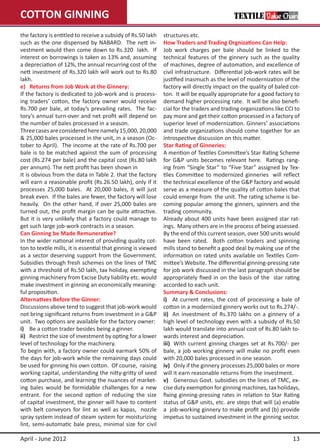
Economics of a Standard Ginnery (100 bales per day)          Capital cost of investment in the ginnery involves ma-
a)  Capital Investment: A ginnery with 18 Jumbo DRs          chinery and civil structural components. For the fac-
which can produce lint equivalent to about 8 bales in        tory considered for discussion, these are Rs.240 lakh
an hour, accepted by TMC as a standard unit, is consid-      and Rs.130 lakh respectively, totaling upto Rs.370 lakh
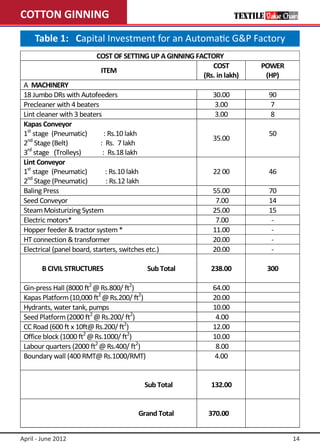
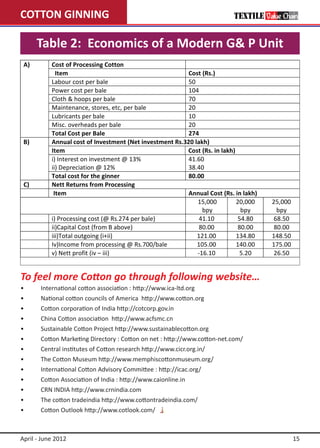
ered here for working out the economics. Pre-cleaner         of gross capital investment (Table 1). Let’s assume that

April - June 2012                                                                                                  12
COTTON GINNING
the factory is entitled to receive a subsidy of Rs.50 lakh     structures etc.
such as the one dispensed by NABARD. The nett in-              How Traders and Trading Orgnizations Can Help:
vestment would then come down to Rs.320 lakh. If               Job work charges per bale should be linked to the
interest on borrowings is taken as 13% and, assuming           technical features of the ginnery such as the quality
a depreciation of 12%, the annual recurring cost of the        of machines, degree of automation, and excellence of
nett investment of Rs.320 lakh will work out to Rs.80          civil infrastructure. Differential job-work rates will be
lakh.                                                          justified inasmuch as the level of modernization of the
e)   Returns from Job Work at the Ginnery:                     factory will directly impact on the quality of baled cot-
If the factory is dedicated to job-work and is process-        ton. It will be equally appropriate for a good factory to
ing traders’ cotton, the factory owner would receive           demand higher processing rate. It will be also benefi-
Rs.700 per bale, at today’s prevailing rates. The fac-         cial for the traders and trading organizations like CCI to
tory’s annual turn-over and net profit will depend on          pay more and get their cotton processed in a factory of
the number of bales processed in a season.                     superior level of modernization. Ginners’ associations
Three cases are considered here namely 15,000, 20,000          and trade organizations should come together for an
& 25,000 bales processed in the unit, in a season (Oc-         introspective discussion on this matter.
tober to April). The income at the rate of Rs.700 per          Star Rating of Ginneries:
bale is to be matched against the sum of processing            A mention of Textiles Committee’s Star Rating Scheme
cost (Rs.274 per bale) and the capital cost (Rs.80 lakh        for G&P units becomes relevant here. Ratings rang-
per annum). The nett profit has been shown in                  ing from “Single Star” to “Five Star” assigned by Tex-
It is obvious from the data in Table 2. that the factory       tiles Committee to modernized ginneries will reflect
will earn a reasonable profit (Rs.26.50 lakh), only if it      the technical excellence of the G&P factory and would
processes 25,000 bales. At 20,000 bales, it will just          serve as a measure of the quality of cotton bales that
break even. If the bales are fewer, the factory will lose      could emerge from the unit. The rating scheme is be-
heavily. On the other hand, if over 25,000 bales are           coming popular among the ginners, spinners and the
turned out, the profit margin can be quite attractive.         trading community.
But it is very unlikely that a factory could manage to         Already about 400 units have been assigned star rat-
get such large job-work contracts in a season.                 ings. Many others are in the process of being assessed.
Can Ginning be Made Remunerative?                              By the end of this current season, over 500 units would
In the wider national interest of providing quality cot-       have been rated. Both cotton traders and spinning
ton to textile mills, it is essential that ginning is viewed   mills stand to benefit a good deal by making use of the
as a sector deserving support from the Government.             information on rated units available on Textiles Com-
Subsidies through fresh schemes on the lines of TMC            mittee’s Website. The differential ginning-pressing rate
with a threshold of Rs.50 lakh, tax holiday, exempting         for job work discussed in the last paragraph should be
ginning machinery from Excise Duty liability etc. would        appropriately fixed in on the basis of the star rating
make investment in ginning an economically meaning-            accorded to each unit.
ful proposition.                                               Summary & Conclusions:
Alternatives Before the Ginner:                                i)	 At current rates, the cost of processing a bale of
Discussions above tend to suggest that job-work would          cotton in a modernized ginnery works out to Rs.274/-.
not bring significant returns from investment in a G&P         ii)	 An investment of Rs.370 lakhs on a ginnery of a
unit. Two options are available for the factory owner:         high level of technology even with a subsidy of Rs.50
i)	 Be a cotton trader besides being a ginner.                 lakh would translate into annual cost of Rs.80 lakh to-
ii)	 Restrict the size of investment by opting for a lower     wards interest and depreciation.
level of technology for the machinery.                         iii)	 With current ginning charges set at Rs.700/- per
To begin with, a factory owner could earmark 50% of            bale, a job working ginnery will make no profit even
the days for job-work while the remaining days could           with 20,000 bales processed in one season.
be used for ginning his own cotton. Of course, raising         iv)	 Only if the ginnery processes 25,000 bales or more
working capital, understanding the nitty-gritty of seed        will it earn reasonable returns from the investment.
cotton purchase, and learning the nuances of market-           v)	 Generous Govt. subsidies on the lines of TMC, ex-
ing bales would be formidable challenges for a new             cise duty exemption for ginning machines, tax holidays,
entrant. For the second option of reducing the size            fixing ginning-pressing rates in relation to Star Rating
of capital investment, the ginner will have to content         status of G&P units, etc. are steps that will (a) enable
with belt conveyors for lint as well as kapas, nozzle          a job-working ginnery to make profit and (b) provide
spray system instead of steam system for moisturizing          impetus to sustained investment in the ginning sector.
lint, semi-automatic bale press, minimal size for civil

April - June 2012                                                                                                     13
COTTON GINNING                                      TEXTILE Value Chain


     Table 1:   Capital Investment for an Automatic G&P Factory


April - June 2012                                                   14
COTTON GINNING

      Table 2:  Economics of a Modern G& P Unit


To feel more Cotton go through following website…
•	     International cotton association : http://www.ica-ltd.org
•	     National cotton councils of America http://www.cotton.org
•	     Cotton corporation of India http://cotcorp.gov.in
•	     China Cotton association http://www.acfsmc.cn
•	     Sustainable Cotton Project http://www.sustainablecotton.org
•	     Cotton Marketing Directory : Cotton on net : http://www.cotton-net.com/
•	     Central institutes of Cotton research http://www.cicr.org.in/
•	     The Cotton Museum http://www.memphiscottonmuseum.org/
•	     International Cotton Advisory Committee : http://icac.org/
•	     Cotton Association of India : http://www.caionline.in
•	     CRN INDIA http://www.crnindia.com
•	     The cotton tradeindia http://www.cottontradeindia.com/
•	     Cotton Outlook http://www.cotlook.com/


April - June 2012                                                                15
INTERVIEW WITH GINNER


E
      xclusive Interview given by Mr. Divyesh M.D of KUTCH GINNING AND
      SPINNING PVT. LTD. We had asked few questions about Textile 		
      industry and Associated with the industry. He explain the process of 	
Ginning Value chain
Seed Cotton     Drying and Cleaning               Ginning	           Cleaning/
Packing     Transport      Admin
Input resources are: Material, Labor, Electricity, Maintenance parts, Equipments.
Mr. Divyesh Expressed his view about growth path and GDP of Indian Textile
industry. “Government Lacks due to nonreserve fund of textile industry. Industry
lacks due to less margin of business.”

Where is your company stand in entire Value chain?        Why is Textile industry so
We are ginner. We purchase raw material, seed cotton      fragmented or Unorganized?
from farmer, process it mechanically.                     India has two major states Maharashtra and Gujarat
What will be the growth of Textile industry according     where farmer grow the maximum cotton in their farms.
to you in terms of Opportunities, Revenues, Exports,      Ginning units is established near seed cotton growing
Foreign investments etc?                                  area. But most of spinning mills located in north and
Industries growth is good. Because now a days due to      south part of India, but some mills only doing Part pro-
awareness and increase the financial capacity of the      cessing like few doing spinning, few doing knitting, few
people, they pay more on cloths and other cotton ac-      doing weaving etc but it is very difficult to find the full
cessories. In our ginning industries foreign investment   process of Textile mills because of heavy investment,
till today is Nil. The Scope of Exports is too good be-   uncertain market, government interference and short-
cause we are the second largest in big raw cotton ex-     age of labors and electricity. That is why the Textile in-
porter country after USA.                                 dustry so unorganized.
                                                          Why there is gap between Organized and unorga-
                                                          nized sector?
                                                          Specially Textile industry have huge investment be-
                                                          cause it is agriculture based industry, crop come once in
                                                          a year, that is why all processor of Textile industries like
                                                          ginning and knitting and have to store raw materials
                                                          as per the season and to process after it. Price fluctua-
                                                          tion during this process has to bear by the processor.
                                                                                     Where in organized industries
                                                                                     all channel are continuous,
                                                                                     they set constant margin, less
                                                                                     blockage money etc.
                                                                                     Do you feel the Gap between
                                                                                     Textile industry and Textile
                                                                                     Education Industry? If yes
                                                                                     why?
                                                                                     Not Really in my industry. But
                                                                                     yes, when we go up in a lad-
                                                                                     der of value chain we have a
                                                                                     Gap.
                                                                                     How we can reduce or mini-
                                                          mize the gap between the two (Industry and Educa-
                                                          tion)?
                                                          To established new textile colleges.
                                                          To start some private training center and institute.
                                                          Aware the student with industries like regular visit,
                                                          some project work, Training, Good compensation from
                                                          industry to attract student to join this industry.


April - June 2012                                                                                                 16
INTERVIEW WITH GINNER
Textile industry is in need of People and its Traditional     Government and Manufacturer are important aspects
industry, but Education colleges   are not focusing and       of value chain. In which area both lacks in growth
developing as an organized way as compare to other            path of industry and education?
courses offered in India?                                     Government lacks due to non- reserve fund of textile
Yes definitely, Government needs to take some steps           industry. Industry lacks due to less margin of business.
for that like,Grant some subsides to students and col-        Textile is old, 2nd rank industry after Agriculture but
leges to join and start the courses. Also give assurance      still in terms of Exports still we are not having leading
and job guarantee. Textile industries also do campus          position in World? What is the Reason?
visit and arrange campus interviews and bind them for         Due to government policies as compared to other
a job.                                                        countries and having less support of Government we
Current market where Management Institutes flour-             are not having leading position in World. Solutions for
ishing in country, but very less Organized Textile Tech-      Textile industries is that government should give some
nical Training institutes is there? Does industry do not      subsidy in export, established plant ,bank facility etc.
require technical people or have less demand /sup-            as compare to other country textile industries, then
ply?                                                          only we stand at a international level, otherwise today
Each and every industry requires skilled and active           we are seeing situation which will be more worse in
people who work smartly. Most of the workers and en-          the future.
gineers come to this industry with different knowledge;       We had seen ginner’s mix reaction about the industry.
they learn and gain work experience. But our industry         We really have to push up our socks for this industry to
didn’t give high salary to people who working due to          grow, make Worlds and India’s best industry to work
uncertain margin in this industry as compare to other         with. Only cursing Government will not help, need to
industry. After experience, most People leave this in-        take involvement actively in the industry.
dustry and switch over to other industry. That is why
less institutes of textile due to less interest as terms of
monetary, Unorganized Culture, many more.


April - June 2012                                                                                                   17
COTTON AT COMMODITY MARKET
Cotton now at Commodity Market                                  3. Daily marking to market of positions minimizes risk 	


C       otton is one of the major Cash Crop of India. Be-       	 of default by trade participants
        ing a fiber crop, it is primarily used as a raw mate-   4. Foremost, presence of a central counterparty for 	
        rial for textile industry(55-60% of requirements).      	 an exchange traded futures contract ensures
Because of its wide scale of usage, it happens to be            	 performance of the contract obligation
one of the most traded commodities in the World.                5. With an average daily trading volume of around`
India invariably ranks 2nd/ 3rd in terms of produc-                 100 Crores (or 5000 contracts), and an open
tion, and is also the 2nd largest exporter in the world.            interest of around 8000 lots, NCDEX Kapas
Hence, Indian prices depend not only on domestic, but           	 happens to be the benchmark and only liquid
also international demand & supply scenario, and are            	 futures contract of Cotton in India today.
interlinked with global prices                                  How Hedging is done? - An example
VOLATILITY IN COTTON PRICES                                     A Ginner needs to procure 50,000 MT of Raw Cotton,
Cotton prices are known to be extremely volatile, with          sometime in the end of Dec, as per his production
16.6% average annualized volatility observed in do-             schedule.He intends to produce lint and further sell it
mestic markets, and 30.6% in international markets.             to the Textile Mills, with whom he has a contract at a
Prices of raw cotton for the season 2010-11, jumped             pre-agreed price. Now, if the prices of Raw Cotton rise
142% to ` 6,900 a quintal from a year ago in early Feb-         in the month of Dec, his profit margins might shrink, or
ruary due to short global                                       he may even run into losses. He can reduce this Price
supply despite record domestic produce of 325 lakh              Risk, by means of hedging his Raw Material require-
bales of 170 kg each. Prices remained at elevated level         ment, at NCDEX platform.
through April, post which it moved to a downward spi-           Let us assume that, on current date, the Ginner
ral bottoming out to 3,300 per quintal by June, due to          finds that:
export restrictions imposed by Govt., and absence of            Spot Price of Shankar Kapas =1100.00/ 20 Kgs Dec
off take from the market                                        Futures Contract on NCDEX = ` 1400.00/ 20 Kgs
NEED FOR PRICE RISK MANAGEMENT HEDGING                          He buys the Dec expiry contract at NCDEX on current
High spot price volatility, both in domestic and interna-       date. On 30th Dec (i.e. on the day of expiry of contract),
tional markets, poses enormous amount of price risk             2 cases may arise:
to all the categories of participant involved in the value      Case 1: 	Spot price increases to 1450.00
chain of this broad commodity, be it Ginners, Spinners,         On final settlement, MTM Profit = 50.00
Textile Mills, Exporters, or Traders. In 2010-11, when          Buying Price = 1450.00 Effective price =
prices moved bylarge multiples bothways, registering            1450.00 - 50.00 = 1400.00
a volatility of 23%, itintensified the risk of losses to all    Case 2: Spot price decreases to 1350.00
the value chain participants. Result, as we all know,           On final settlement, MTM Loss = 50.00
were huge losses suffered by trade, coupled with a re-          Buying Price = 1350.00
cord number of defaults on bilateral contracts in the           Effective price = 1350.00 + 50.00 = 1400.00
physical market. As per press reports, total disputes           Therefore, irrespective of the Spot Price movement,
quintupled to 10% of total cotton contracts globally.           his Effective Purchase Price, and hence his Profit 	
This makes a case for an appropriate instrument to              Margin, remains locked-in. This is called Hedging.
mitigate price risk. Futures contracts in Cotton, as of-        Why Hedging is NOT same as Speculation or 		
fered by NCDEX, are aimed to fulfill this need of the           Gambling? Hedging, Speculation & Gambling are three
trade participants.                                             different things. Gambling is when you yourself create
COTTON FUTURE CONTRACT                                          a risk that didn’t exist in its own, like betting your 	
Commodity exchange which offers trading in 25 odd               money on a game of cards. Speculation on the other
agricultural commodities, with a cumulative average             hand, is taking up an existing risk (not creating one),
daily trading volume of more than 6,000 Crores. It of-          with the intent to benefit from it, like taking on 		
fers futures trading in Kalyan Kapas (V797) and Shan-           market risk in order to benefit from price movements.
kar Kapas varieties of cotton.                                  And Hedging is a transaction to reduce the exposure to
1. Futures trading would help all the value chain               any market risk, so that one can focus on core business
   participants to effectively hedge their price risk by 	      activities.
   allowing the opportunity to take positions in
   advance so as to counter the unexpected adverse              “Hedging is definitely NOT Speculation,
   price movement.                                              but NOT Hedging can be Speculation”
2. Additionally, the futures contracts allow for
   efficient risk management by allowing high leverage          Reference:  www.ncdex.com
   This means that you need to pay only a small
   fraction of the value of contract as ‘margin’ to
   execute a trade.

April - June 2012                                                                                                     18
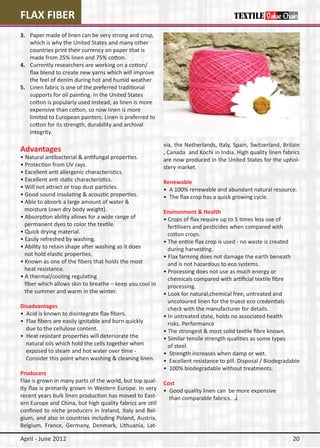
FLAX FIBER
                    Description
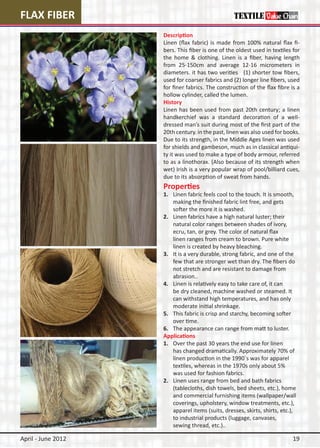
                    Linen (flax fabric) is made from 100% natural flax fi-
                    bers. This fiber is one of the oldest used in textiles for
                    the home & clothing. Linen is a fiber, having length
                    from 25-150cm and average 12-16 micrometers in
                    diameters. it has two verities (1) shorter tow fibers,
                    used for coarser fabrics and (2) longer line fibers, used
                    for finer fabrics. The construction of the flax fibre is a
                    hollow cylinder, called the lumen.
                    History
                    Linen has been used from past 20th century; a linen
                    handkerchief was a standard decoration of a well-
                    dressed man’s suit during most of the first part of the
                    20th century. in the past, linen was also used for books.
                    Due to its strength, in the Middle Ages linen was used
                    for shields and gambeson, much as in classical antiqui-
                    ty it was used to make a type of body armour, referred
                    to as a linothorax. (Also because of its strength when
                    wet) Irish is a very popular wrap of pool/billiard cues,
                    due to its absorption of sweat from hands.
                    Properties
                    1.	 Linen fabric feels cool to the touch. It is smooth, 	
                    	 making the finished fabric lint free, and gets
                    	 softer the more it is washed.
                    2.	 Linen fabrics have a high natural luster; their
                    	 natural color ranges between shades of ivory,
                    	 ecru, tan, or grey. The color of natural flax
                    	 linen ranges from cream to brown. Pure white
                    	 linen is created by heavy bleaching.
                    3.	 It is a very durable, strong fabric, and one of the 	
                    	 few that are stronger wet than dry. The fibers do 	
                    	 not stretch and are resistant to damage from
                    	 abrasion..
                    4.	 Linen is relatively easy to take care of, it can
                    	 be dry cleaned, machine washed or steamed. It
                    	 can withstand high temperatures, and has only
                    	 moderate initial shrinkage.
                    5.	 This fabric is crisp and starchy, becoming softer
                    	 over time.
                    6.	 The appearance can range from matt to luster.
                    Applications
                    1.	 Over the past 30 years the end use for linen
                    	 has changed dramatically. Approximately 70% of 	
                    	 linen production in the 1990`s was for apparel
                    	 textiles, whereas in the 1970s only about 5%
                    	 was used for fashion fabrics.
                    2.	 Linen uses range from bed and bath fabrics
                    	 (tablecloths, dish towels, bed sheets, etc.), home 	
                    	 and commercial furnishing items (wallpaper/wall 	
                    	 coverings, upholstery, window treatments, etc.), 	
                    	 apparel items (suits, dresses, skirts, shirts, etc.),
                    	 to industrial products (luggage, canvases,
                    	 sewing thread, etc.)..

April - June 2012                                                          19
FLAX FIBER
3.	   Paper made of linen can be very strong and crisp,
	     which is why the United States and many other 	
	     countries print their currency on paper that is 	
	     made from 25% linen and 75% cotton.
4.	   Currently researchers are working on a cotton/
	     flax blend to create new yarns which will improve 	
	     the feel of denim during hot and humid weather
5.	   Linen fabric is one of the preferred traditional
	     supports for oil painting. In the United States
	     cotton is popularly used instead, as linen is more 	
	     expensive than cotton, so now linen is more
	     limited to European painters. Linen is preferred to 	
	     cotton for its strength, durability and archival
	     integrity.

                                                              via, the Netherlands, Italy, Spain, Switzerland, Britain
Advantages                                                    , Canada and Kochi in India. High quality linen fabrics
•	Natural antibacterial & antifungal properties.              are now produced in the United States for the uphol-
• Protection from UV rays.                                    stery market.
• Excellent anti allergenic characteristics.
• Excellent anti static characteristics.                      Renewable
• Will not attract or trap dust particles.                    • A 100% renewable and abundant natural resource.
• Good sound insulating & acoustic properties.                • The flax crop has a quick growing cycle.
• Able to absorb a large amount of water &
  moisture (own dry body weight).                             Environment & Health
• Absorption ability allows for a wide range of               • Crops of flax require up to 5 times less use of
  permanent dyes to color the textile.                          fertilisers and pesticides when compared with
• Quick drying material.                                        cotton crops.
• Easily refreshed by washing.                                • The entire flax crop is used - no waste is created
• Ability to retain shape after washing as it does              during harvesting.
  not hold elastic properties.                                • Flax farming does not damage the earth beneath 	
• Known as one of the fibers that holds the most                and is not hazardous to eco systems.
  heat resistance.                                            • Processing does not use as much energy or
• A thermal/cooling regulating                                  chemicals compared with artificial textile fibre
  fiber which allows skin to breathe – keep you cool in         processing.
  the summer and warm in the winter.                          • Look for natural,chemical free, untreated and
                                                                uncoloured linen for the truest eco credentials
Disadvantages                                                   check with the manufacturer for details.
• Acid is known to disintegrate flax fibers.                  • In untreated state, holds no associated health
• Flax fibers are easily ignitable and burn quickly             risks. Performance
  due to the cellulose content.                               • The strongest & most solid textile fibre known.
• Heat resistant properties will deteriorate the              • Similar tensile strength qualities as some types
  natural oils which hold the cells together when 	             of steel.
  exposed to steam and hot water over time -                  • Strength increases when damp or wet.
  Consider this point when washing & cleaning linen.          • Excellent resistance to pill. Disposal / Biodegradable
                                                              • 100% biodegradable without treatments.
Producers
Flax is grown in many parts of the world, but top qual-       Cost
ity flax is primarily grown in Western Europe. In very        • Good quality linen can be more expensive
recent years bulk linen production has moved to East-           than comparable fabrics.
ern Europe and China, but high quality fabrics are still
confined to niche producers in Ireland, Italy and Bel-
gium, and also in countries including Poland, Austria,
Belgium, France, Germany, Denmark, Lithuania, Lat-

April - June 2012                                                                                                  20
YARN                                                                                         TEXTILE Value Chain


Yarn Manufacturing Process
				                              Open End……………………………………………......open end yarn

Cotton Mixing… blow room…Carding…. Drawing….ring frame…. winding …..carded yarn

   				                              Combing… drawing…ring frame…winding…carded yarn


Y
      arn is a long continuous length of interlocked
      fibers, suitable for use in the production of
      textiles,sewing, crocheting, knitting, weaving,
embroidery and ropemaking. Thread is a type of yarn
intended for sewing by hand or machine..Embroidery
threads are yarns specifically designed for hand or 	
machine embroidery.

Manufacturing Method
Yarns are made up of a number of singles, which are
known as plies when grouped together. These singles
of yarn are twisted together (plied) in the opposite di-
rection to make a thicker yarn. Depending on the di


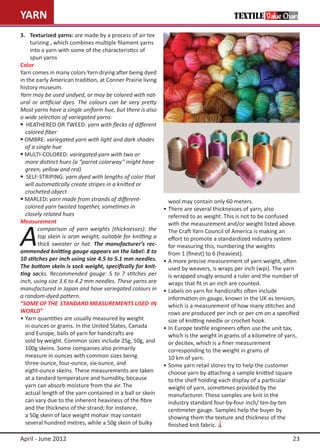
 YARN STRUCTURE


                                                             	  thread, or “single.”Twisting fibres into yarn in the 		
                                                             	  process calledspinning and yarn spinning was one
                                                             	  of the very first processes to be industrialized. Spun 	
                                                             	  yarns may contain a single type of fibre, or be a
                                                             	  blend of various types. Combining synthetic fibres
                                                              	 with natural fibres is very rare. The most widely
                                                             	 used blends arecotton-polyester and wool-acrylic
                                                             	 fibre blends. Blends of different natural fibres are
                                                             	 common too, especially with more expensive fibres
                                                             	 such as alpaca, angora and cashmere.

    S- And Z Twist Yarn                                      Yarns are selected for different textiles based on the
                                                             characteristics of the yarn fibres, such as warmth
                                                             (wool), light weight durability or softness .Acrylic yarn
rection of this final twist, the yarn will be known as s-    is the least expensive.
twist or z-twist. For a single, the direction of the final   2.	 Filament yarn: consists of filament fibres either
twist is the same as its original twist.                     		 twisted together or only grouped together.. Silk is
TYPES OF YARNS                                               		 a natural filament, and synthetic filament
1	Spun yarn is made by twisting or otherwise                 		 yarns are used to produce silk-like effects.
	 bonding staplefibres together to make a cohesive

April - June 2012                                                                                                   22
YARN                                                                                      TEXTILE Value Chain

3.	 Texturized yarns: are made by a process of air tex		
		 turizing , which combines multiple filament yarns 		
		 into a yarn with some of the characteristics of
		 spun yarns
Color
Yarn comes in many colors Yarn drying after being dyed
in the early American tradition, at Conner Prairie living
history museum.
Yarn may be used undyed, or may be colored with nat-
ural or artificial dyes. The colours can be very pretty
Most yarns have a single uniform hue, but there is also
a wide selection of variegated yarns:
 HEATHERED OR TWEED: yarn with flecks of different
	 colored fiber
 OMBRE: variegated yarn with light and dark shades
	 of a single hue
 MULTI-COLORED: variegated yarn with two or
	 more distinct hues (a “parrot colorway” might have 		
	 green, yellow and red)
 SELF-STRIPING: yarn dyed with lengths of color that 	
	 will automatically create stripes in a knitted or
	 crocheted object
 MARLED: yarn made from strands of different-               	 wool may contain only 60 meters.
	 colored yarn twisted together, sometimes in                •	There are several thicknesses of yarn, also
	 closely related hues                                       	 referred to as weight. This is not to be confused


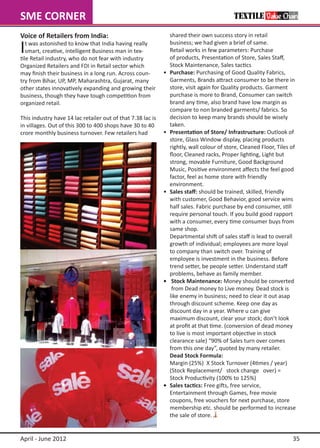
A
Measurement                                                  	 with the measurement and/or weight listed above. 		
        comparison of yarn weights (thicknesses): the        	 The Craft Yarn Council of America is making an
        top skein is aran weight, suitable for knitting a    	 effort to promote a standardized industry system
        thick sweater or hat. The manufacturer’s rec-        	 for measuring this, numbering the weights
ommended knitting gauge appears on the label: 8 to           	 from 1 (finest) to 6 (heaviest).
10 stitches per inch using size 4.5 to 5.1 mm needles.       •	A more precise measurement of yarn weight, often
The bottom skein is sock weight, specifically for knit-      	 used by weavers, is wraps per inch (wpi). The yarn
ting socks. Recommended gauge: 5 to 7 stitches per           	 is wrapped snugly around a ruler and the number of 	
inch, using size 3.6 to 4.2 mm needles. These yarns are      	 wraps that fit in an inch are counted.
manufactured in Japan and have variegated colours in         •	Labels on yarn for handicrafts often include
a random-dyed pattern.	                                      	 information on gauge, known in the UK as tension,
“SOME OF THE STANDARD MEASUREMENTS USED IN                   	 which is a measurement of how many stitches and
WORLD”                                                       	 rows are produced per inch or per cm on a specified
•	Yarn quantities are usually measured by weight             	 size of knitting needle or crochet hook.
	 in ounces or grams. In the United States, Canada           •	In Europe textile engineers often use the unit tax,
	 and Europe, balls of yarn for handcrafts are               	 which is the weight in grams of a kilometre of yarn,
	 sold by weight. Common sizes include 25g, 50g, and 	       	 or decitex, which is a finer measurement
	 100g skeins. Some companies also primarily                 	 corresponding to the weight in grams of
	 measure in ounces with common sizes being                  	 10 km of yarn.
	 three-ounce, four-ounce, six-ounce, and                    •	Some yarn retail stores try to help the customer
	 eight-ounce skeins. These measurements are taken 		        	 choose yarn by attaching a sample knitted square
	 at a tandard temperature and humidity, because             	 to the shelf holding each display of a particular
	 yarn can absorb moisture from the air. The                 	 weight of yarn, sometimes provided by the

	 actual length of the yarn contained in a ball or skein 	   	 manufacturer. These samples are knit in the
	 can vary due to the inherent heaviness of the fibre        	 industry standard four-by-four inch/ ten-by-ten
	 and the thickness of the strand; for instance,             	 centimeter gauge. Samples help the buyer by
	 a 50g skein of lace weight mohair may contain              	 showing them the texture and thickness of the
	 several hundred metres, while a 50g skein of bulky 		      	 finished knit fabric.

April - June 2012                                                                                              23
YARN MANUFACTURERS INTERVIEW
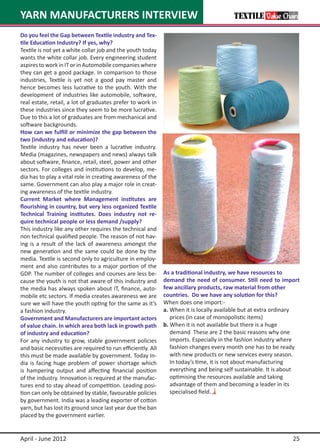
Damodar Group  MD. Mr. Anil Biyani,     
Mr. Abhishek, Mr. Aditya


                                           Where does your company stand  in the entire Value chain?
                                           We are at the second stage of the textile value chain. We convert the
Exclusive Interview with                   fibres into yarn form by way of spinning natural or man made fibres.
DAMODAR GROUP M.D                          Yarns are also produced by conversion of polyester chips to yarn. We
                                           as a company are into value addition of yarns. We are known in the
Mr. Anil Biyani: 25 years of
                                           industry to provide fancy yarns made out of different combination
experience with qualified in               of fibres or different kind of effects giving a unique look to the fabric.
textile from Sasmira college and           We cater to almost all segments of the traditional textiles like suit-
Bachelors in human ecology.                ing, shirting, home furnishing and knitting with our novelty products.
Mr. Aditya Biyani: BMS Graduate
                                           How is the textile industry growth? With reference to opportunity,
with Masters in Family Business 	
                                           revenue, exports, foreign directinvestment (FDI), etc?
Management and four years of 	             Textile industry is a very labour intensive and high capital invest-
Business experience                        ment business. India has ample cheap skilled labour in comparison
Mr. Abhishek Biyani:                       with other developing or developed countries. Consumption is in
BE Graduate with masters in                the developed countries and manufacturing is shifting to countries
                                           like Vietnam, India, China etc. India is the 2nd largest producer of
Family Business Management,                cotton and cotton yarn in the world. Finished garments, Technical
3 years of business experience.            Textiles, Home Textiles, and Yarns - all have a great scope for ex-
                                           ports. Foreign Investment is required in technical know-how. There
They had shared their views 		             is lot of opportunity in joint ventures with international companies
                                           which still remains largely uncapped.
about FDI in textile “FDI required in
 technology and there are lot of 	         Why is the textile industry so fragmented? Or unorganized?
opportunity in Joint Venture with 	        Textile industry has absolutely no barriers for entry and exit. Any
international companies                    player can enter at any scale, at any point in the textile value chain.
which is still remains uncapped.”          Textile industry has developed in many parts of India, starting from
                                           south - Tirupur, Coimbatore, Bengaluru, Ichalkaranji, Bhiwandi, Su-
Also they had expressed that 		
                                           rat, Bhilwara etc. Too many players and multiple locations is the
“Textile industry has no barriers for      main reason for it being unorganised.
entry and exit, any players can enter
at any scale and any point in textile      Why is there a gap between organized and unorganized sector?
value chain.”                              As mentioned earlier, Textile Industry is a high capital intensive in-
                                           dustry having long pay back periods. It is easier for large organised
                                           players to raise capital for expansion in comparison with small play-
                                           ers. This is the main reason for the gap.

April - June 2012                                                                                                 24
YARN MANUFACTURERS INTERVIEW
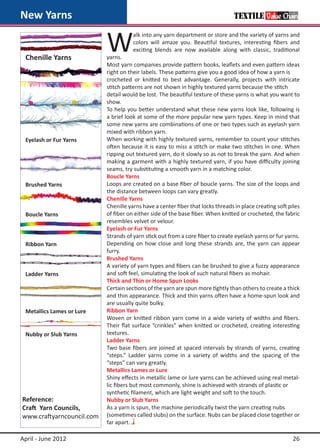
Do you feel the Gap between Textile industry and Tex-
tile Education Industry? If yes, why?
Textile is not yet a white collar job and the youth today
wants the white collar job. Every engineering student
aspires to work in IT or in Automobile companies where
they can get a good package. In comparison to those
industries, Textile is yet not a good pay master and
hence becomes less lucrative to the youth. With the
development of industries like automobile, software,
real estate, retail, a lot of graduates prefer to work in
these industries since they seem to be more lucrative.
Due to this a lot of graduates are from mechanical and
software backgrounds.
How can we fulfill or minimize the gap between the
two (industry and education)?
Textile industry has never been a lucrative industry.
Media (magazines, newspapers and news) always talk
about software, finance, retail, steel, power and other
sectors. For colleges and institutions to develop, me-
dia has to play a vital role in creating awareness of the
same. Government can also play a major role in creat-
ing awareness of the textile industry.
Current Market where Management institutes are
flourishing in country, but very less organized Textile
Technical Training institutes. Does industry not re-
quire technical people or less demand /supply?
This industry like any other requires the technical and
non technical qualified people. The reason of not hav-
ing is a result of the lack of awareness amongst the
new generation and the same could be done by the
media. Textile is second only to agriculture in employ-
ment and also contributes to a major portion of the
GDP. The number of colleges and courses are less be-         As a traditional industry, we have resources to
cause the youth is not that aware of this industry and       demand the need of consumer. Still need to import
the media has always spoken about IT, finance, auto-         few ancillary products, raw material from other
mobile etc sectors. If media creates awareness we are        countries.  Do we have any solution for this?
sure we will have the youth opting for the same as it’s      When does one import:-
a fashion industry.                                          a.	When it is locally available but at extra ordinary
Government and Manufacturers are important actors            		 prices (in case of monopolistic items)
of value chain. In which area both lack in growth path       b. When it is not available but there is a huge
of industry and education?                                   		 demand These are 2 the basic reasons why one
For any industry to grow, stable government policies         		 imports. Especially in the fashion industry where
and basic necessities are required to run efficiently. All   		 fashion changes every month one has to be ready
this must be made available by government. Today In-         		 with new products or new services every season.
dia is facing huge problem of power shortage which           		 In today’s time, it is not about manufacturing
is hampering output and affecting financial position         		 everything and being self sustainable. It is about
of the industry. Innovation is required at the manufac-      		 optimising the resources available and taking
tures end to stay ahead of competition. Leading posi-        		 advantage of them and becoming a leader in its
tion can only be obtained by stable, favourable policies     		 specialised field.
by government. India was a leading exporter of cotton
yarn, but has lost its ground since last year due the ban
placed by the government earlier.


April - June 2012                                                                                              25
New Yarns

                           W
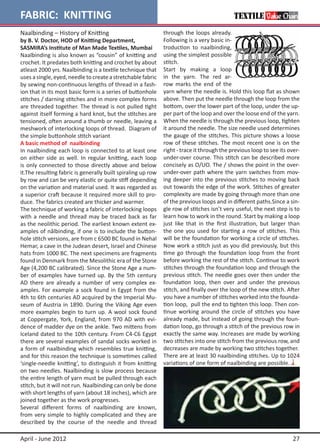
                                      alk into any yarn department or store and the variety of yarns and
                                      colors will amaze you. Beautiful textures, interesting fibers and
                                      exciting blends are now available along with classic, traditional
 Chenille Yarns            yarns.
                           Most yarn companies provide pattern books, leaflets and even pattern ideas
                           right on their labels. These patterns give you a good idea of how a yarn is
                           crocheted or knitted to best advantage. Generally, projects with intricate
                           stitch patterns are not shown in highly textured yarns because the stitch 		
                           detail would be lost. The beautiful texture of these yarns is what you want to
                           show.
                           To help you better understand what these new yarns look like, following is
                           a brief look at some of the more popular new yarn types. Keep in mind that
                           some new yarns are combinations of one or two types such as eyelash yarn
                           mixed with ribbon yarn.
 Eyelash or Fur Yarns      When working with highly textured yarns, remember to count your stitches
                           often because it is easy to miss a stitch or make two stitches in one. When
                           ripping out textured yarn, do it slowly so as not to break the yarn. And when
                           making a garment with a highly textured yarn, if you have difficulty joining
                           seams, try substituting a smooth yarn in a matching color.
                           Boucle Yarns
 Brushed Yarns             Loops are created on a base fiber of boucle yarns. The size of the loops and
                           the distance between loops can vary greatly.
                           Chenille Yarns
                           Chenille yarns have a center fiber that locks threads in place creating soft piles
 Boucle Yarns              of fiber on either side of the base fiber. When knitted or crocheted, the fabric
                           resembles velvet or velour.
                           Eyelash or Fur Yarns
                           Strands of yarn stick out from a core fiber to create eyelash yarns or fur yarns.
 Ribbon Yarn               Depending on how close and long these strands are, the yarn can appear
                           furry.
                           Brushed Yarns
                           A variety of yarn types and fibers can be brushed to give a fuzzy appearance
 Ladder Yarns              and soft feel, simulating the look of such natural fibers as mohair.
                           Thick and Thin or Home Spun Looks
                           Certain sections of the yarn are spun more tightly than others to create a thick
                           and thin appearance. Thick and thin yarns often have a home-spun look and
                           are usually quite bulky.
 Metallics Lames or Lure   Ribbon Yarn
                           Woven or knitted ribbon yarn come in a wide variety of widths and fibers.
                           Their flat surface “crinkles” when knitted or crocheted, creating interesting
 Nubby or Slub Yarns       textures.
                           Ladder Yarns
                           Two base fibers are joined at spaced intervals by strands of yarns, creating
                           “steps.” Ladder yarns come in a variety of widths and the spacing of the
                           “steps” can vary greatly.
                           Metallics Lames or Lure
                           Shiny effects in metallic lame or lure yarns can be achieved using real metal-
                           lic fibers but most commonly, shine is achieved with strands of plastic or 	
                           synthetic filament, which are light weight and soft to the touch.
Reference:                 Nubby or Slub Yarns
Craft  Yarn Councils,      As a yarn is spun, the machine periodically twist the yarn creating nubs 	
www.craftyarncouncil.com   (sometimes called slubs) on the surface. Nubs can be placed close together or
                           far apart.

April - June 2012                                                                                         26
FABRIC:  KNITTING
Naalbinding – History of Knitting                             through the loops already.
by B. V. Doctor, HOD of Knitting Department,                  Following is a very basic in-
SASMIRA’s Institute of Man Made Textiles, Mumbai              troduction to naalbinding,
Naalbinding is also known as “cousin” of knitting and         using the simplest possible
crochet. It predates both knitting and crochet by about       stitch.
atleast 2000 yrs. Naalbinding is a textile technique that     Start by making a loop
uses a single, eyed, needle to create a stretchable fabric    in the yarn. The red ar-
by sewing non-continuous lengths of thread in a fash-         row marks the end of the
ion that in its most basic form is a series of buttonhole     yarn where the needle is. Hold this loop flat as shown
stitches / darning stitches and in more complex forms         above. Then put the needle through the loop from the
are threaded together. The thread is not pulled tight         bottom, over the lower part of the loop, under the up-
against itself forming a hard knot, but the stitches are      per part of the loop and over the loose end of the yarn.
tensioned, often around a thumb or needle, leaving a          When the needle is through the previous loop, tighten
meshwork of interlocking loops of thread. Diagram of          it around the needle. The size needle used determines
the simple buttonhole stitch variant                          the gauge of the stitches. This picture shows a loose
A basic method of  naalbinding                                row of these stitches. The most recent one is on the
In naalbinding each loop is connected to at least one         right - trace it through the previous loop to see its over-
on either side as well. In regular knitting, each loop        under-over course. This stitch can be described more
is only connected to those directly above and below           concisely as O/UO. The / shows the point in the over-
it.The resulting fabric is generally built spiraling up row   under-over path where the yarn switches from mov-
by row and can be very elastic or quite stiff depending       ing deeper into the previous stitches to moving back
on the variation and material used. It was regarded as        out towards the edge of the work. Stitches of greater
a superior craft because it required more skill to pro-       complexity are made by going through more than one
duce. The fabrics created are thicker and warmer.             of the previous loops and in different paths.Since a sin-
The technique of working a fabric of interlocking loops       gle row of stitches isn’t very useful, the next step is to
with a needle and thread may be traced back as far            learn how to work in the round. Start by making a loop
as the neolithic period. The earliest known extent ex-        just like that in the first illustration, but larger than
amples of nålbinding, if one is to include the button-        the one you used for starting a row of stitches. This
hole stitch versions, are from c 6500 BC found in Nehal       will be the foundation for working a circle of stitches.
Hemar, a cave in the Judean desert, Israel and Chinese        Now work a stitch just as you did previously, but this
hats from 1000 BC. The next specimens are fragments           time go through the foundation loop from the front
found in Denmark from the Mesolithic era of the Stone         before working the rest of the stitch. Continue to work
Age (4,200 BC calibrated). Since the Stone Age a num-         stitches through the foundation loop and through the
ber of examples have turned up. By the 5th century            previous stitch. The needle goes over then under the
AD there are already a number of very complex ex-             foundation loop, then over and under the previous
amples. For example a sock found in Egypt from the            stitch, and finally over the loop of the new stitch. After
4th to 6th centuries AD acquired by the Imperial Mu-          you have a number of stitches worked into the founda-
seum of Austria in 1890. During the Viking Age even           tion loop, pull the end to tighten this loop. Then con-
more examples begin to turn up. A wool sock found             tinue working around the circle of stitches you have
at Coppergate, York, England, from 970 AD with evi-           already made, but instead of going through the foun-
dence of madder dye on the ankle. Two mittens from            dation loop, go through a stitch of the previous row in
Iceland dated to the 10th century. From C4-C6 Egypt           exactly the same way. Increases are made by working
there are several examples of sandal socks worked in          two stitches into one stitch from the previous row, and
a form of naalbinding which resembles true knitting,          decreases are made by working two stitches together.
and for this reason the technique is sometimes called         There are at least 30 naalbinding stitches. Up to 1024
‘single-needle knitting’, to distinguish it from knitting     variations of one form of naalbinding are possible.
on two needles. Naalbinding is slow process because
the entire length of yarn must be pulled through each
stitch, but it will not run. Naalbinding can only be done
with short lengths of yarn (about 18 inches), which are
joined together as the work progresses.
Several different forms of naalbinding are known,
from very simple to highly complicated and they are
described by the course of the needle and thread

April - June 2012                                                                                                     27
GARMENT

 A Stitch in Time- Technology to meet Challenges of Apparel
 Merchandising
Instead of relying on people to design, communicate,          •	 Planning
analyze, project and improve, fashion/apparel/acces-          Garment Order Processing
sory brands now have the digital technologies to meet         It is the most important process being carried out at
these needs in a much faster way.                             export companies. The process includes:
                                                              •	 Style Costing
Apparel Industry Processes and System include:                •	 Order Confirmation
•	 Concept Development                                        •	 Fabric Purchase order
•	 Product Design                                             •	 Accessory Purchase Order
•	 Sampling                                                   •	 Final Garment Order
•	 Pre Production
•	 Materials Management                                       Pattern Grading and Marker Making
•	 Sourcing                                                   Pattern grading is the scaling of a pattern to a different
•	 Vendor Management                                          size by incrementing important points of the pattern
•	 Production                                                 using an algorithm in the clothing and footwear indus-
•	 Store                                                      try.

Drawing Software                                              Merchandise and Assortment Planning
These are used by the Fashion Designers or Technical          Merchandise & Assortment Planning helps companies
Designers to create drawings at various stages of a gar-      deliver the right products, in the right quantities and
ment lifecycle.                                               at the right time to meet local demand, maximize sales
•	 Storyboard                                                 opportunities through minimized out of stocks, and
•	 Sketches                                                   thus protect margins.
•	 Measure Images                                             •	 Customer based functions -Sales, Returns,
•	 Construction Images                                        	 Exchanges, Discounts, etc.
•	 Packaging Instructions                                     •	 Inventory Management – Inventory 	Control,
•	 Label and Tag Placements                                   	 Purchasing, Receiving and Transferring of
•	 Seams and Stitches Diagrams                                	 Products
                                                              •	 Sales information - Reporting, Sales Trends,
3D Sampling                                                   	 Cost/Price/Profit Analysis
It simulates true to life draping, fit and design on a vir-
tual human body in a 3D environment. It includes:             Production Planning and Sourcing
•	 Parametric Human Body                                      The need for fast and effective planning demands an
•	 Transform 2D Designs into 3D Garments                      easy to use Planning and Sourcing tool for management
•	 Fabric Simulation                                          of the entire supply chain, planning and monitoring all
•	 Stitch Garments virtually                                  new styles/orders from initial concept to delivery.
•	 Garment Fit Analysis                                       The tool may be used for
•	 3D Range Presentation                                      •	 Supply Chain Management
                                                              •	 Production Planning and Control
Enterprise Resource Planning (ERP)                            •	 Merchandise Planning and Control
Enterprise resource planning (ERP) integrates internal        •	 Critical Path Management
and external management information across an en-
tire organization, embracing finance/accounting, man-         Visual Merchandising
ufacturing, sales and service, etc.                           Visual merchandising is the activity of promoting the
The modules include:                                          sale of goods, especially by their presentation in retail
•	 Customer Order Processing                                  outlets. It helps to
•	 Purchase Order Processing                                  •	 Create virtual stores of any grade/size
•	 Warehouse Management                                       •	 Design fully merchandised shopfloors
•	 Finance/Costing                                            •	 Create Planograms to communicate with 		
•	 Manufacturing                                              	 the shopfloor staff

April - June 2012                                                                                                    29
GARMENT
•	 Store and space planning                                  	 Developing Body (the Silhouettes / Design)
•	 Produce Range Books                                       	 Developing new fabrics (Structures /
Point of Sale                                                	 Designs / Colours)
Point of sale (POS) or checkout is the location where
a transaction occurs. A Retail POS system typically in-
cludes a computer, monitor, cash drawer, receipt print-
er, customer display, barcode scanner, and a debit/
credit card reader.
•	 Customer based functions –
•	 Sales, Returns, Exchanges, Discounts etc.
•	 Inventory Management – Inventory 	Control,
	 Purchasing, Receiving and Transferring of
	 Products
•	 Sales information - Reporting, Sales Trends,
	 Cost/Price/Profit Analysis

Business Intelligence
Business intelligence (BI) refers to computer-based
techniques used in spotting, digging-out, and analyzing
business data, such as sales revenue by products and/        	 Developing Value additions (Prints / Logos / 		
or departments, or by associated costs and incomes.          Embroideries)
Common functions are:                                        	 Manage and co-ordinate this information
•	 Reporting	                                                	 internally and with suppliers
•	 Online analytical processing
•	 Analytics                                                 Storyboard
•	 Business performance management                           Storyboard revolutionizes the offline storyboard 	
• 	 Benchmarking                                             process and strengthens product development
•	 Predictive analytics                                      collaboration
                                                             	 White board area for assets
Product Lifecycle Management (PLM)                           	 Asset clipboard
A Product Lifecycle Management or PLM is a combina-          	 Asset repository
tion of strategies and solutions related to design, prod-    	 Search/organize features
uct development and pre-production processes. PLM            	 High-resolution compression technology for
can help by providing the single central repository of       	 images
all product-related data, managing a single version of       	 Collaboration and sharing
the truth and using it to drive all aspects of the product   	 Used for creation of mode & trend boards
development process.                                         	 Early visual line plans
Typical Product Development Systems
 The product development information is spread              Designer
	 across many disparate systems                              2D and 3D Design applications
 A combination of various manual processes                  	 Precise design Sketches
 Excel Spread sheets                                        	 Mannequin Customization
 Corel Draw / Adobe Illustrator /                           	 Style Book
     Adobe Photoshop etc                                     	 True to Scale 2D sketch
 CAD Tools
 Telephone calls                                            Fabric & Trim
 Fax Sheets                                                 A one-stop checkpoint for material specifications,
 Emails                                                     sample and cost requests, Fabric & Trim facilitates
 What is Product Lifecycle Management?                      collaboration with textile and trim suppliers on raw
                                                             material data.
Collaborative Product Development Process                    	 Centralized one-stop checkpoint for development
	 Concepts – Sketch – Design - Products 		                  	 Sample request centre
	 (Styles) - Range                                           	 Configurable forms

April - June 2012                                                                                                 30
GARMENT
	 Template library                                        a	 Makes company system dependant
	 Multi-level searching
	 “Where-used” functionality                              	   Reductions
	 XML import/export                                       a	   Development costs
Product Manager                                            a	   Better sourcing
Product Manager is the product development control         a	   Time to Market
panel, enabling the creation, review and approval of all   a	   Risk Analysis
elements of a specification.
Product Manager                                            	   Collaboration
	 True Web-based product creator                          a	   Techpacks created by team
	 Specification data                                      a	   Single Version of truth
	 Project management                                      a	   Links supply chain
	 Advanced costing
	 Quotation management                                    	 Library
	 Sample management                                       a	 Data Library
	 Issues centre                                           a	 Design Archives
	 Library
	 History and rollback                                    	 Reports
	 Reporting                                               a	 Management Reports
	 Configurable forms
                                                           Crowd Sourcing
Source                                                     Anyone can submit a design, vote it out, comment it,
Source is a robust, manufacturer data management           and then the top ones get to be made so supply meets
and supply chain collaboration application.                demand.
	 Selection of suppliers
	 Communication of order requirements                     Author: Dr. Ela Manoj Dedhia, Associate Professor,
	 Evaluation of placement options                         College of Home Science Nirmala Niketan,
	 Negotiation of costs and terms                          Affiliated to University of Mumbai.
	 Capacity planning / sourcing plans                      elamanojdedhia@yahoo.com/ 09619492951
	 Vendor management
	 Placement of orders for production                      	 Webliography:
	 Ethical trading management                              a	 www.centricsoftware.com/ -
	 Technical capability management                         a	 www.just-style.com/plm/ -
	 Factory auditing                                        a	 www.gerbertechnology.com/ -
                                                           a	 www.apparelsearch.com/.../software/PLM_Fash-
Workflow                                                   ion.htm
	 Workflow provides simple and effective time and         a	 www.lectra.com/en/.../fashion-plm/software/
	 action calendars to proactively track progress           fashion-together.html
	 throughout the product lifecycle                         a	 www.ngcsoftware.com/redhorse.htm
	 Automatic and proactive issue reporting and             a	 www.wfxondemand.com/PLM-fashion-apparel.
	 monitoring                                               aspx
	 Task scheduling, allocating and tracking                a	 www.lawson.com/Industries/Fashion/
	 Critical path tracking                                  a	 www.apparelsystems.co.uk/
	 Automatic alerts                                        a	 www.micar.com/
	 Self-help knowledge base                                a	 www.winfashion.com/
                                                           a	 www.esuite.com.au/
Management Reports                                         a	 www.forbes.com/sites/elisadoucette/2011/11/22/
Benefits                                                   revolution-apparel-crowdsourcing-sustainable-
	 Smarter working                                         fashion/2/
a	 More efficient processes                                a	 www.crowdsourcing.org/navigate-
a	 Right Products to Market                                search?q=Apparel
a	 Brings Transparency and Responsibility                  a	 www.ratemystartup.com/voteforart-com-crowd-
a	 Spots Bottlenecks                                       sourcing-branded-apparel/

April - June 2012                                                                                               31
BOMBAY RAYON
                                  In conversation with Mr. Chandresh Dedhia, GM. Marketing of
                                  Bombay Rayon.
                                  A Textile Graduate and having ample of industry experience.

                                  He shared his views about the gap of industry and Education” there is huge
                                  gap between two; working in tandam is need of hour. Government official
                                  should pass the information about new expansion plan of companies to
                                  education dept, and should create job awareness in textile industry, put
                                  positive picture of industry for young blood to join industry.”


Where does your company stand in the entire 	 	
Value chain?
Our company Bombay Rayon covers almost the 		
entire value chain from yarn spinning, fabric
weaving, knitting and garment manufacturing for 	        Fabric Processing: Dying, printing, finishing in Tarapur,
export and for our own brands like Guru, Joint           Bengaluru
Venture with Danish company like Jack &                  Garments: Woven: Bengaluru, Tamil Nadu, Kerala,
Jones (JV), Only and Vermoda. We have units in 		        Ichalkaranji, Latur, Bangladesh.
various places as below:                                 Knits: Capacity 5 tons/ day, expansion plan of 100 tons
Yarn: Factory in Indore- 75,000 spindles,spinning of     / day at Kolhapur or Solapur for benefits of common
cotton, slub, spandex yarns.                             effluent plant.
Fabric: Weaving factory in Tarapur, Bhiwandi, Vashi, 	
Islampur, Ichalkaranji, Silvasa, Bengaluru,

April - June 2012                                                                                              32
BOMBAY RAYON
Retail Stores in India:                                  where political environment is strong, women 		
Guru: 13 stores 		        Jack & Jones: 108 stores       working is not taken positively.
Only: 108 stores	         Vermoda: 108 stores            Bombay Rayon has professional training center to
How is the textile industry growth? With refer	 	        train employees which has great response in south
ence to opportunity, revenue, exports, foreign           rather than West.
direct investment (FDI), etc?                            How can we fulfill or minimize the gap between
FDI is very low as currently it is not an attractive     the two: industry and education?
industry in manufacturing due to labour and capital 	    Media can help to reduce this gap by passage and 	
intensives Export can improve a lot as Chinese           transformation of information.
currency is appreciating. China is having banking        People need to be more serious and committed.
and costing problems. Many companies are now             New employees should focus to be in this industry,
beingconsid ered as non performing companies.            improve the industry for long term rather than
So if Chinese 	 export shrinks then India will           switching industry. Textile Industry is in need of
only benefit. Currently we are 2nd only to China         people and its Traditional industry but schools and
in terms of exports.                                     colleges are not focusing and developing as an
Why is the textile industry so fragmented?               organized way as compared to other education
Or unorganized?                                          courses offered in India.
India has a large scale of entrepreneurs but without     Textile and Garment industry is a commodity.
money. So we have more SSI than large scale pro	         Due to commodity approach, the perspective is
duction manufacturers. Ex. India has 20 stitching        that special education is not required.
machines per company as compared to Bangladesh 	         Current Market where Management
having 600 stitching machines. Indian system does 	      institutes are flourishing in country, but very less
not allow this on such a large scale as our payback      organized Textile Technical Training institutes.
period is very long, almost 8 -9 years. Also, ours is    Does industry not require technical people or less
a huge capital and labour intensive industry. We         demand /supply?
need major policy changes, incentives and                No, Industry very much requires technical people. 	
organization.                                            There is scarcity of skilled people in industry. Lots 	
Why is there a gap between organized and                 of technical people are required in textile industry
unorganized sector?                                      but reality is that there are few. Lots of unskilled
The gap is mainly due to different structures,           workers are working in industry and we need to
policies and taxes which differ from state to state. 	   train and reshape that. Also there is lot of drop out
As a result of this, we have very few plants with        from industry, so people really need to be
huge capacities. Bengaluru has very few plants           motivated, have patience and be in the industry.
having production capacity of 1 Lakh / day. Other        Government and Manufacturers are important
places are not even remotely close to that.              actors of value chain. In which area both lack in
Do you feel the Gap between Textile industry and 	       growth path of industry and education?
Textile Education Industry? If yes, why?                 Right now, we are competing with China. We need
There is a huge gap where the education is not           to have huge infrastructure like China, big scale
moving with the times. Yes, working with tandem 	        economy-wise. Government needs to give support
is the need of the hour. Government knows                to entrepreneurs for expansion plan. If this is in
corporate plans of expansion state-wise. So              place, education will have no option but to look at
governments plan how much employment is                  this industry. In future, people will look at this
required for a particular plant/ office and should       industry as more promising than any other.
pass information to education department and             Textile is old in India, 2nd rank industry after Ag	
accordingly plan, add more education programs.           riculture but still in terms of exports, we are not in
Currently there is no correlation and information        a leading position in the World? What is the
passage.                                                 Reason?
There is a huge gap of skills as theoretical degree is   Technology like machinery is being imported from
very dated versus raw skills, machinery                  other countries. There are many new avenues
operation etc.                                           where manufacturers can look up to like technical
Ex. Women working is highest in this industry but 	      textiles, Geo textiles etc. But India is last to look at 	
only in south. In Bengaluru, about 30,000 women 	        this market. We have huge scope in world market
work in stitching and finishing departments. In          as compared to other competing countries, but
Maharashtra, places like Ichalkaranji, Latur, Silvasa,   we need to be in sync.

April - June 2012                                                                                                 33
EXPORTER CORNER
                            “Indian cotton industry should be more open, relaxing; interfer-
                            ence of Supreme body for Export of Cotton affects the growth of
                            Industry.”  
                            Mr. Paresh Valia, MD, Asha Cotton Industries, Bhavnagar, Gujrat.

                            We are masters in        is back bone of cotton industry / root level pro-
                            making world’s best      cess; association and so govt. policy should en-
  Paresh Valia,             quality of cotton:       courage ginner. Cotton association has good plans,
  Managing Director Shankar 6, which has             but plan implementation is the biggest drawback
                            good spinning, wa-       in Indian Govt. System. Lazy attitudes of Govt. as
                            ter absorbency qual-     well as few industry people lead to slow growth
ity attracts world to purchase cotton from India.    of industry. We are not happy with govt. attitude:
Cotton has highest flotation rates, most suffered    as Govt. bans cotton export anytime, there is no
are farmer. Commodity exchange has lead to era       stability of mind of people who sets policy of Ex-
of British ruled. Indian cotton industry should be   port and Import. India is the 2nd World exporter
more open, relaxing; there should be no interfer-    of Cotton fiber country, if all industry channels will
ence of Supreme body. our competitor, China is       work together on one track and if govt. supports,
having more relaxing government attitude, more       then India has no reason to look back and become
subsidy by government is given to manufacturer.      the 1st world exporter as compare with China.
Govt. is more supporting to spinner / spinning
companies, than ginning companies. But ginning


April - June 2012                                                                                       34
SME CORNER
Voice of Retailers from India:                               	    shared their own success story in retail

I  t was astonished to know that India having really
   smart, creative, intelligent Business man in tex-
tile Retail industry, who do not fear with industry


                                                                  business; we had given a brief of same.
                                                                  Retail works in few parameters: Purchase
                                                                  of products, Presentation of Store, Sales Staff,
Organized Retailers and FDI in Retail sector which           	    Stock Maintenance, Sales tactics
may finish their business in a long run. Across coun-        •	   Purchase: Purchasing of Good Quality Fabrics, 	
try from Bihar, UP, MP, Maharashtra, Gujarat, many           	    Garments, Brands attract consumer to be there in 	
other states innovatively expanding and growing their        	    store, visit again for Quality products. Garment 	
business, though they have tough competition from            	    purchase is more to Brand, Consumer can switch 	
organized retail.                                            	    brand any time, also brand have low margin as
                                                             	    compare to non branded garments/ fabrics. So
This industry have 14 lac retailer out of that 7.38 lac is   	    decision to keep many brands should be wisely
in villages. Out of this 300 to 400 shops have 30 to 40      	    taken.
crore monthly business turnover. Few retailers had 	         •	   Presentation of Store/ Infrastructure: Outlook of
                                                             	    store, Glass Window display, placing products
                                                             	    rightly, wall colour of store, Cleaned Floor, Tiles of
                                                             	    floor, Cleaned racks, Proper lighting, Light but
                                                             	    strong, movable Furniture, Good Background
                                                             	    Music, Positive environment affects the feel good
                                                             	    factor, feel as home store with friendly
                                                             	    environment.
                                                             •	   Sales staff: should be trained, skilled, friendly 	
                                                             	    with customer, Good Behavior, good service wins 	
                                                             	    half sales. Fabric purchase by end consumer, still
                                                             	    require personal touch. If you build good rapport
                                                             	    with a consumer, every time consumer buys from
                                                             	    same shop.
                                                             	    Departmental shift of sales staff is lead to overall
                                                             	    growth of individual; employees are more loyal
                                                             	    to company than switch over. Training of
                                                             	    employee is investment in the business. Before
                                                             	    trend setter, be people setter. Understand staff
                                                             	    problems, behave as family member.
                                                             •	    Stock Maintenance: Money should be converted
                                                             	     from Dead money to Live money. Dead stock is
                                                             	    like enemy in business; need to clear it out asap
                                                             	    through discount scheme. Keep one day as
                                                             	    discount day in a year. Where u can give
                                                             	    maximum discount, clear your stock; don’t look
                                                             	    at profit at that time. (conversion of dead money
                                                             	    to live is most important objective in stock
                                                             	    clearance sale) “90% of Sales turn over comes
                                                             	    from this one day”, quoted by many retailer.
                                                             	    Dead Stock Formula:   
                                                             	    Margin (25%) X Stock Turnover (4times / year)
                                                             	    (Stock Replacement/ stock change over) =
                                                             	    Stock Productivity (100% to 125%)
                                                             •	   Sales tactics: Free gifts, free service,
                                                             	    Entertainment through Games, free movie
                                                             	    coupons, free vouchers for next purchase, store
                                                             	    membership etc. should be performed to increase
                                                             	    the sale of store.


April - June 2012                                                                                                    35
SKILL GAP ANALYSIS

  Human Resource and Skill Requirements in Textile sector (2022)
                       Study on mapping of human resource skill gaps in India till 2022
•	 Current Employment Pattern
An estimated 33 million people are employed in the Textile sector in India3. This is expected to increase to 45
million by 2012. The Ready Made Garments (RMG) sector, which accounted for 17% of the employment, is
estimated to contribute 25% to the total employment in the textile sector.


Cotton and man-made textiles account for more than 80% of the employment in the textile sector, as de-
picted in the following figure.
Share in Employment of different sectors		               accounts for a major portion of the employment in the
The employment in fabric manufacturing includes the      textile sector on account the labour intensive nature
handloom, weaving, knitting sectors and garmenting       of operations. The share of employment in different
                                                         activities in
                                                         the value chain is discussed later.
                                                         •	 Share of Women in Employment
                                                         It is estimated that out of the total number of persons
                                                         employed in Handlooms, Handicrafts, and Sericulture,
                                                         about 50% are women. There are more women in the
                                                         household industry than in the registered small scale
                                                         or cottage units. However, in the organised sector the
                                                         percentage of women workers is extremely low, with
                                                         the exception being garmenting.
                                                         • Profile of human resource in different functions
                                                         The textile industry (except the spinning sector) is
                                                         fragmented in nature on account of policy restrictions
                                                         relating to labour laws and the fiscal advantages en-
                                                         joyed by the small-scale units. The textile units mostly
                                                         engage in job work (sub contracting) and hence a
                                                         large portion of the employment is in the production

April - June 2012                                                                                             37
SKILL GAP ANALYSIS


activities. Also, the small units do not have explicit     the T&C industry.
demarcation of functions for sourcing, sales, etc.         Skill Pyramid within the Textile and Clothing Industry
•	 Skill Pyramid for the T&C industry                      Skill Level -1 	 skills which can be acquired with a
Given that the industry would required a varied profile    short/modular and focused intervention and therby
of skill sets, the following figure presents an overview   enhancing employability of those with minimal educa-
of the profile of skill requirements as derived from hu-   tion . It account 85- 86% .
man resource requirements across different sectors of

April - June 2012                                                                                             38
SKILL GAP ANALYSIS
Skill Level:2 Skills which require technical training in-    of skilled man power leads to poaching and acts as
puts, knowledge of complex operations and machin-            a detriment to spending on in house training initia-
ery, skills of supervision. It accounts 10-11 %              tives.
Skill Level:3 Skills which require long drawn prepara-       •	 Emerging trends in skill requirements
tion as demonstrated by acquisition of degree and in-        Emerging trends in human resource requirements
volve highly technical people. It accounts 3-3.5 %           	 Technology
Skill Level: 4 Skills which are highly specialized involv-   	 The changes in technology would significantly af-
ing research and design                                      fect the profile of people involved. The share of shut-
The skill summary, captures where the textile and            tle-less looms in the Indian textiles industry is only
clothing industry stands relatively in terms of skills       2-3% as against a world average of 16.9%, thereby in-
(a function of activity, educational requirements, and       dicating a low degree of modernization in the Indian
amount of ‘preparatory’ time required to inculcate a         weaving industry. Although the Indian spinning sector
specific skill) as compared to all other industries.         is relatively more modernized, around 60% of installed
‘Skill Level 1’, has the highest incremental requirement     spindles are more than 10 years old and open-end (OE)
of human resources. It requires persons who are mini-        rotors account for only 1% of total installed spindles. In
mally educated, yet can handle simple and/or repeti-         the apparel sector, India has much lower investment
tive tasks (persons employed in activities such as basic     in special purpose machines, which perform specific
machine operations, knitting, cutting, and stitching/        functions and add value to the product. Very few ex-
sewing, etc.). Such skills can also be obtained in lesser    port establishments have invested in cutting machines
time duration as compared to engineering or ITI cours-       or finishing machines. The low level of technology and
es. As many as over 15 million persons are required          government incentives like TUFS would drive modern-
across skill levels 1 and 2 outlined above.	                 ization in the industry where as the high power costs
•	 Current Training/Education Infrastructure                 would be a detriment.
The current training infrastructure is inadequate on         	 The technological up gradation would necessitate
both number of people trained and also the quality           the human resource to be trained in modern machin-
of training being imparted. Also, very few of the train-     ery and also greater in house spending on training.
ing initiatives are targeted at the shop floor level. The    The shortage of labor and increasing wage rate would
newly inducted workers learn through informal train-         further induce greater automation which will lead to
ing and learning from the experience of the existing         higher productivity. For instance, the operating hours
work force.                                                  per quintal of yarn have decreased from 77 to 25 on
Training institutes available in India.                      account of modernisation and would continue to fall.
 Textiles Research Associations (TRAs)                      Also, the numbers of people involved in post spinning
 Power loom Service Centers (PSCs)                          operations have come down on account of automatic
 Indian Institutes of Handloom Technology 	                 cone winding machines.
	 (IIHT)                                                     	 The modern machinery would require skilled
	 Weaver’s Service Centers (WSC)                            maintenance people who have the requisite knowl-
	 Industrial Training Institutes (ITI) offering             edge of the same. Proper maintenance would be
	 courses related to Textiles		                              crucial as machine down time and costly spare parts
	 Home Science Colleges offering Textiles &                 would significantly affect the performance of the in-
	 Clothing Courses                                           dustry.
	 Apparel Training & Design Centres (ATDCs)                 	 Quality Processes
	 Institute of Apparel Management                           There would be increasing focus and adoption of qual-
	 National Institute of Fashion Technology                  ity and environment related processes, such as: ISO
	 Sardar Vallabhbai Patel Institute of Textile              9001:2008, ISO 14001
	 Management	                                                	 Research & Development
The availability of trained manpower is a key issue for      The textile industry does not have R&D as a focus area.
the garmenting sector.                                       The industry would have to invest more in both pro-
The ATDC, ITIs and NIFT annually train up to 50,000          cess and product R&D to maintain product and cost
workers. A few private sector players also provide           competitiveness. This requires industry-academia col-
training specific to the garmenting sector. A large por-     laborations as well as individual R&D efforts by the
tion of the requirement of human resource at the op-         companies.
erator level is met by on the job training. Hence train-      Labour laws
ing at the operator level is a key gap. Acute shortage       More flexible labour regulations will positively affect

April - June 2012                                                                                                   39
SKILL GAP ANALYSIS
the industry. Currently, Textile and Clothing industry       signer and high end fashion exports would necessitate
comes under the purview of Contract Labour Act, 1970         “make through” system of operations which would
which prohibits contract labour for the work that is pe-     require the operators to have the ability to stitch the
rennial in nature. The exporters find it difficult to man-   complete garment. The availability of merchandising
age the seasonal and order based volatility in demand        and designing skills would be crucial for increasing
on account of this. Change in the current regulations        share in export markets and tapping the potential in
can lead to opening up of more employment oppor-             new markets.
tunities. Also, the current regulations prohibit women       Regions which will drive human resource
from being employed in night shifts. Relaxation of the       requirements
same with adequate safeguards can lead to more par-          The major centres in India where this employment
ticipation of women and also help in addressing the          generation would take place are Tamil Nadu, West Ben-
skill shortage in the industry.                              gal, Karnataka, Maharashtra, and Gujarat. The state of
	 Human resource related                                    Tamil Nadu will account for around 30% of the employ-
	 Modernisation of technology would necessitate             ment in the textile sector.
more technical skills for operators in the production        Share of various states of employment in the textile
and maintenance functions across the value chain             sector
of the textile industry. The sector also needs multi-        Source: Annual Survey of Industries, IMaCS Analysis
tasking/multi skilling at the operator level. The hu-        The poor performance of the industry in the recent
man resource at the higher levels as well as in other        past has resulted in the sector not attracting new in-
functions like procurement would need to possess the         vestments. The cluster development activities of vari-
knowledge of various types of machines and also keep         ous organizations have not found takers and hence
abreast with the changes in technology.                      new clusters do not appear likely at this point of time.
	 The garmenting sector would be the key driver of          However,Andhra Pradesh is a likely future destination
the employment in the textile sector. Majority large         for new investments, especially in the garmenting sec-
portion of the human resource requirement will be for        tor with the establishment of Apparel Parks. The gov-
operators who have the adequate knowledge of sew-            ernment initiatives of providing power at a cost of 2 Rs
ing machine operations and different types of seams          per unit will be a key factor in attracting investments in
and stitches. Although, the industry will continue to        spinning sector. Also, the state has surplus cotton and
have predominantly line system of operations, de-            would result in lower logistics cost. Availability of raw
                                                                                      materials and low power costs
                                                                                      will also attract investments in
                                                                                      the downstream activities like
                                                                                      fabric manufacturing, process-
                                                                                      ing and garmenting.
                                                                                      The scheme of integrated tex-
                                                                                      tile parks and various SEZs
                                                                                      would also affect the regions
                                                                                      availability of labour. States
                                                                                      like Uttranchal necessitate that
                                                                                      most of the labour force in the
                                                                                      units operating in SEZ should
                                                                                      be local.
                                                                                      The states of UP, Bihar and
                                                                                      Orissa etc would be key catch-
                                                                                      ment areas to meet the labour
                                                                                      requirements. Already the
                                                                                      spinning sector in Tamil Nadu is
                                                                                      seeing more and more influx of
                                                                                      labour from these states as the
                                                                                      current wage rates in the states
                                                                                      are very high.
                                                                                      Environmental concerns would
                                                                                      affect the processing sector.

April - June 2012                                                                                                   40
SKILL GAP ANALYSIS
The effluent treatment requirements might see units           the Mainstream sector to be closely related to market
shifting to coastal areas as marine discharge require-        driven textile and clothing industry growth, the human
ments are less stringent.                                     resource requirement in areas such as handloom and
Projected Human Resource Requirements in the                  handicrafts would have to be supplemented by initia-
Textile & Clothing Sector                                     tives from the Government and Industry. The addition
In this section, we shall review the projected human          of human resource into these other sectors would be
resource requirement in the Textile and Clothing sec-         at a much lower rate as compared to the Mainstream
tor based on the projection of industry size.                 sectors due to need for significant support for earn-
•	 Projected Size of the Textile and Clothing 		              ings, scope for enhanced technology intervention and
Industry                                                      automation as compared to current levels, the need to
It is estimated that the PFCE on clothing will grow at a      add value, and attractiveness of the sector among the
CAGR of 7.5% between 2008 and 2022. Based on pro-             human resource supply.
jected growth of GDP and exports, we expect that the          Keeping in mind the above factors and the growth of
exports of textiles will grow at a rate of 11% to 11.5%.      the industry, we have projected the human resource
Thus, the overall T&C sector will grow at a CAGR of           requirement for the T&C sector. It is expected that the
9.5% to a size of Rs. 6,730 billion. Out of this, the share   overall employment in the sector would increase from
of exports is expected to increase from just under 50%        about 33 to 35 million currently to about 60 to 62 mil-
currently to about 60% in 2022.                               lion by 2022. This would translate to an incremental
                                                              human resource requirement of about 25 million per-
Projected human resource requirement                          sons. Of this the Mainstream textile sector has the po-
While analysing the human resource requirement, we            tential to employ about 17 million persons incremen-
have categorised the overall Textile and Clothing sec-        tally till 2022.
tor as follows:
1. The Mainstream Textile and Clothing sector – com-
prising of Spinning, Fabric Manufacturing, Fabric Pro-        Reference: NSDC (National Skill Development Corpo-
cessing and Garmenting.                                       ration)
2. Other related industries such as:                          Website: http://www.nsdcindia.org
a. Handloom		            b. Woolen	     c. Sericulture	
d. Handicrafts		         e. Jute.
While we expect the human resource requirement in


April - June 2012                                                                                                 41
CAREER OPPORTUNITY

    Merchandising
                                                            timate sales, vendor selection, Visual Merchandising,
                                                            pricing decisions, plan stocks, etc.

 *_Merchants of chic-istan! _*                              Thus, we can see how diverse and crucial the function
                                                            of Merchandiser is in various different organizations.


I
   n the modern fashion constellation, there are mul-       Irrespective of his functions and role, to be success-
   tiple genres of roles which collaborate to create and    ful merchandiser, one must possess traits like excellent
   sustain a successful Brand. Fashion is not only about    Trend forecasting, excellent communication skills, ne-
the glamorous runways, fashion glossies and designing       gotiating art, team building, market understanding, co-
couture; it’s a whole new dimension of creating desir-      ordination skills, Technology know-how, etc.
able wants to satisfy the ever demanding creative soul
of curious customers.                                       At the outset of globalization, the retail sector has
                                                            boomed in magnitude and thus, has resulted in whole
Merchandising is one such dynamic fashion Branch,           new career segment in the field of Retailing. This also
which has multifold into a promising field in fashion       has majorly revived the importance of efficient and
umbrella. Merchandisers have transformed into a cru-        articulate merchandisers, who fiercely catastases the
cial catalyst in the process of finished product reach-     trickle down fashion and make trends accessible for
ing the Ultimate user. One of the principle functions of    masses.
Merchandiser is to ensure delivery of the right quan-
tity finished goods, in right specifications as required    And, as fashion consciousness penetrates and trans-
by the buyer.                                               forms tinsel towns into trend lands, the demand for
                                                            affluent team of merchandisers would be always on
The role of Merchandiser revolves around coordina-          rise.
tion of planning, purchasing, moving and controlling
of materials in optimum manner at minimum cost for          Once, there was a merchant of Venice, today is the
the buyer’s buyer. Unlike Marketing, Merchandising is       time where merchandisers coordinates a vernacular
more specific concerning itself with the development,       vendor to re-create that Venetian Elegance!
execution and delivery of the product line with its close
ties to the market segment.                                 ANIKET SARAN
                                                            Fashion Columnist
Merchandising not only is able to adjust but also they      Student of B.D. Somani Institute of Arts and Fashion
formulate market changes.                                   Technology.
                                                            in associasation with
Depending to the structure and nature of the organi-
zation, the job profile of a merchandiser differs in the    Raju Bhatia
functionality and responsibility. There is vast scope and   HOD, Fashion technology
great demand for merchandisers in Garment Industry          B.D. Somani Institute of Arts and Fashion Technology.
by – Export houses, Buying houses, Retailers / Brand
studios, Importers,etc.

Functions of Merchandiser in export house is has to
deal with buying houses or buyer directly. His main
duties are to correspond with buyer, co-ordinate with
various in-house departments like sampling, stores,
quality control, etc, to generate purchase orders for
accessories, fabrics, etc, to organize inspections, Orga-
nizing seller – buyer meets, etc.

Whereas, in buying house, Merchandiser deals with
numbers of factories, vendor sourcing and training the
appropriate ones as per buyer’s standard, Shipping and
scheduling, prevent delays, etc. On other hand in retail
organization merchandisers does range selection, es-

April - June 2012                                                                                                42
Textile Institutes
 which are offering Merchandising Course and Curriculum
S.no.           College Name                         Course Type                               Website
  1     SVT college of Home science          BhSC of Textile and Clothing            www.svt.ac.in

  2     BMN College, (SNDT - Matunga)        BSC Textile Science & Apparel Design    www.bmncollege.com

  3     Nirmala Niketan                      BSC Textile and Fashion                 www.nirmalaniketan.com

                                             Fashion, Merchandising&
  4     B .D. Somani Fashion Institute                                               www.bdsomani.com
                                             Retail Management

  5     Blitz Institute of Creative Arts     BSC fashion designing                   www.bicarts.org

  6     FDDI                                 Fashion Merchandising and Retail        www.fddiindia.com

  7     IITC                                 Fashion Merchandising                   www.iitcworld.com

  8     Indian Fashion Academy               Fashion and Textile designing           www.indianfashionacademy.net

  9     ISBM                                 Fahion Mangement / Textile Management   www.isbm.org.in

 10     INIFD                                Merchandising                           www.inifdandheri.com

 11     J.D. institute                       BSC Fashion & Apparel Design            www.jdindia.com

 12     Raffels Design Institute             Fashion design/fashion Marketing        www.raffles-design-institute.co.id

 13     Sophia College                       Textile Design                          www.sophiacampus.com

 14     WLCI School of Fashion               Fashion Designing                       www.wlcifashion.in
        Rachsna Sansad school of
 15                                          BSC Fashion Design                      www.rachanasansad.edu.in
        Fashion and Textile Design
                                             B Design Fashion / Textile design /
 16     NIFT                                                                         www.nift.ac.in
                                             Apparel Production/ B design Knitwear

 17     Apparel Training and Design Center   Apparel, Fashion Merchandising          atdcmumbai1@yahoo.com

                                             Apparel Merchandising /
 18     IIFT                                                                         www.iiftindia.net
                                             Clothing Management

 19     Xplora Design Skool                  Textile Design                          www.xdsindia.com
SNDT


                    Dr. Shilpa Charankar from B.M.N. College of Home science
                    Principal, HOD of Textile Science and Apparel Design.


                          T
                                 extile and women are closely associated in the world
                                 in terms of new fashion, new colour, new design, em-
                                 ployment in industry, tailoring, skilled craftsmen ship,
                          fine artist etc. As women are pillars of society. Our whole
                          life revolve around women.. No women.. No Life.. No world
                          Existence…

                          We are having SNDT Women’s university in India which is
                          established in year 1916 (Soon celebrating 100 years of Uni-
                          versity) which are having 230 colleges across India. Offering
                          Commerce, Art, Science course for Women, also offers some
                          professional courses like Home science with Specialization of
                          Textiles, Clothing, Food Science, Child Development, Interior
                          Designing, Communication, Journalism many more… this is
                          not just a “ Home Science” But it’s totally Personality Build-
                          ing, Grooming , Confidence Building, Career Building Courses
                          which make them to live with self esteem and independence
                          in society.

                          We met with a dynamic, head strong, smart lady who is prin-
                          cipal of one of SNDT, Matunga, Mumbai, she is also com-
                          mittee member of SNDT women’s university of India, she is
                          Dr. Shilpa… Exclusively she had discussed with Textile value
                          chain about Textile courses, Students of SNDT in textiles, In-
                          dustrial views of SNDT students, Alumni student. We will dis-
                          cuss each one here:


April - June 2012                                                                       44
SNDT
                                                                          students SNDT University
                                                                          who graduated in specialized
                                                                          subjects. Corporate like Ex-
                                                                          port house, Manufacturing
                                                                          company, Fashion Designer,
                                                                          Buying Houses, Organized
                                                                          Retailers, trading Houses, Re-
                                                                          search Companies and textile
                                                                          Labs visits campus and recruit
                                                                          students for their organiza-
                                                                          tion for the suitable jobs like
                                                                          : Merchandiser, Fashion de-
                                                                          signer, Fashion/ Garment Co-
                                                                          coordinator, Textile designer,
                                                                          Research assistance, Testing
                                                                          lab assistant, many more…
                                                                          As per industrial view, SNDT
•	 Course of Textile Faculty                                              students are more sincere,
Textile and garment courses which we are offering    hard working, committed, positive, and smart
here is as per need of the industry. As this course  than other private Hyped institutes which are of-
have “Holistic Approach” then specific approach.     fering the same course.
Course contents are upgraded every 3 to 5 years      For more personality grooming and to compete
as per current trend, demand of industry, on ad-     with today’s corporate world, College had started
vanced industrial technology. This upgradation is    “Personality development “ Course.
done by constantly interacting with industrial ex-   •	 Alumni Students Profiles:
perienced people, Alumni Feedback and Intern-        As per course content, 2 months internship is de-
ship review.                                         sign , 2 months industry work experience which
Course also have industry visits like weavers ser-   certified by industrial people. Many organization
vice center, Knitting units etc, to give practical   offer good Placements for internship, student con-
know how, experience of education what they          tinue to work there itself and start their career.
have learnt in college syllabus.                     This way we give them stepping stone to industry
Course has few technical college visits with top-    and corporate world.
most textile technical colleges to get knowledge
of other technical courses, interacting with techni- Most of our alumni are working in corporate com-
cal students. Purpose of visit is to get confidence panies as textile designer, merchandisers, Fash-
with industry .                                      ion designer, Garment co- coordinator, few have
                                                     opened their own fashion boutiques/ House. So
•	 Competent students:                               no Women should feel that the textile is just Black
Recently we have competition with other techni- collar work its totally blue collar and gives pure
cal colleges and students. And I am proud to say business sense if you work closely in this indus-
that our students are the winners of this compe- try.
tition We conduct various workshops, industry
seminars, which all give them knowledge and con- I am very much proud to be part of SNDT Univer-
fidence to face world.                           sity, my whole life is dedicated to SNDT which is
                                                 96 years old.. Happy and excited to celebrate its
•	 Industrial views on SNDT course and Stu- 100 years… You all are welcomed for celebration
dents:                                           of 100 years…!!!
Industry is very much positive about courses, for

April - June 2012                                                                                     45
JOB OPPORTUNITY


April - June 2012   46
MEANINGFUL LEARNING
Introduction:                                              Learning takes place within communities of prac-


L
      earning involves the acquisition of knowl-           tice.
      edge. It is well known fact that people acquires     Novices learn to become experts through practice in
      new knowledge using their current or existing        solving a variety of problems in a given domain.
knowledge. Acquiring new knowledge is to a greater         Becoming an expert means applying learning to new
or lesser extent, seeking ways to integrate the new        contexts.
knowledge with related knowledge already known.            Prior knowledge mediates learning
Knowledge acquisition emphasize on cognition. The          Learning is enhanced when thinking is made visible
knowledge known or existing knowledge is known             by collaboration and reflection among learner.
as learner’s cognitive structure. Learning, according      Goal of learning
to cognitive science is not only the process of trans-     The broader vision of learning includes not only
mitting information from a teacher to learner. It is an    acquiring knowledge but also being able to use
active, constructive process, involving collaboration      knowledge in a variety of new situations. Usage of
and reflection among people who learn through the          knowledge in different new situation emphasize
course of their everyday activity. Cognitive structure     on metacognition. Metacognition in simple term is
is essentially non-existance at the time of birth. It is   thinking about thinking. It is conscious development
general agreement that the acquisition of functional       in one’s abilities, such as awareness and control of
level of leanguage knowledge is achieved by age of         one’s learning, move to greater knowledge, select-
three and by age of five to six acquires knowledge         ing proper strategies, monitoring the progress, cor-
for decoding written language by the child. Further        recting the errors, analyzing the effectiveness of
development of cognitive structure advances rapidly        strategies and changing the behaviors and strate-
after acquisition of language.                             gies whenever necessary These abilities are known
Let us accept the fact that our brain is extremely         as metacognitive abilities and development of these
complex organ, and not an empty vessel to be filled        metacognitive abilities is known as meta cognitive
with knowledge / information, which recognizes             developments. Learners who are exposed / aware of
and stores signals from our sensory systems namely         the role of metacognitive abilities seem to have the
sights, sounds, smells, feelings and proprioceptor         following advantages over others who are not ex-
signals from our muscles. The signals / information        posed / aware of the role of metacognitive abilities.
is sent from our sensory system to an area known           Two of the most important goal of learning which
as hippocampus region of brain where information           decide the outcome of learning is:
processing is carried over and plays an important          Promote retention: Retention is the ability to re-
role in creativity and imagination, considered the         member material at some later time in much the
site of Working memory and through an interaction          same way it was presented during the process of ac-
with knowledge stored in our long term memory,             quisition. Retention focuses on past.
new meanings are constructed and become part of            Promote transfer: Transfer is the ability to use what
our long term memory store / cognitive structure.          was learned or acquired to solve new problems,
Cognitive structure develops as the person grows.          answer new questions, or facilitate acquiring new
Person builds cognitive / knowledge structure, skills      knowledge. Transfer emphasizes on future
and motivation through meaningful learnig. Behav-          Outcome of learning
ior or action which learners use to make learning          I started my career as teacher in the field of techni-
more successful, self directed, enjoyable and de-          cal education way back in 1984 after completing my
lightful depends on the learning strategy adopted by       post graduation in the field of textile technology at
the learner.                                               the age of 26. I have completed 25 years in teaching
Based on cognitive science, the understanding of           the students of Post SSC Diploma of three year dura-
how human beings learn, gives rise to the following        tion. It is delightful journey of twenty five years. Dur-
                                                           ing these twenty five years of journey as a teacher I
key assumption which leads to two different envi-
                                                           have come across many students and observed their
ronments in which learning is made possible namely
                                                           learning progress / outcome. Based on my observa-
formal learning environment and informal learning
                                                           tion and experience I can summarize the learning
environment.
                                                           outcome by the following three Scenarios.

April - June 2012                                                                                                47
MEANINGFUL LEARNING
Scenario One                                              key facts are memorized and trying to make sense
In this learning scenario, a student during the pro-      out of it. During the feedback / assessment, when
cess of learning reads a chapter or performs an ex-       asked to recall part of subject learned or identify
periment on given subject. (S)he skims the material       the various elements used to perform practical, is
from the chapter or performs the practical without        able to remember almost all of the key terms and
properly understanding or giving attention to proper      facts and identify the various elements used to per-
and relevant information and instruction provided to      form practical. Further, when asked to use the ac-
perform the practical. During the feedback / assess-      quire knowledge to solve problems, able to apply
ment, when asked to recall part of subject learned        the knowledge to solve problem generating many
or identify the various elements used to perform          possible solutions. It indicates that the person not
practical very few or none of the elements able to        only possesses relevant knowledge but can be able
remember. When asked to use the acquire knowl-            to use the relevant knowledge to solve the problem
edge to solve problems or perform practical, cannot       and understand new concepts. It means can transfer
apply the knowledge to solve problem or perform           the knowledge acquired to new problems and new
the practical. It indicates that the person neither       situations. It happened because the person has suf-
possesses nor is able to use the relevant knowledge       ficiently attended to relevant information but has
because the person has neither sufficiently attended      encoded (understood) the information provided on
to nor encoded the information provided on subject        subject matter during learning / Practical.
matter during learning.                                   Conclusion
Scenario Two                                              It can be conclude that scenario one characterized
In this learning scenario, a student during the pro-      as No Learning Outcome while scenario two as Rot
cess of learning reads a chapter or performs an ex-       Learning Outcome and scenario three as Meaningful
periment on the given subject. (S)he reads the ma-        Learning Outcome.
terial from the chapter carefully, making sure that       Rote learning is simple memorization. No effort is
every word is read and key facts are memorized and        made to integrate new knowledge with relavent
performs the practical with proper understanding or       prior / existing knowledge. This does little to build
giving attention to proper and relevant information       person’s knowledge structure.
and instruction provided to perform the practical.        Meaningful learning where learner seeks ways and
During the feedback / assessment, when asked to           means to connect or integrate new concept or ideas
recall part of subject learned or identify the various    with relevant prior or existing idea or concepts. In
elements used to perform practical, is able to re-        this process existing ideas or concepts gets refined,
member key terms and facts or identify the various        corrected or sharpened and new knowledge is add-
elements used to perform practical. When asked to         ed to cognitive structure. Thus helps in building per-
use the acquire knowledge to solve problems, can-         son’s knowledge structure.
not apply the knowledge to solve problem. It indi-        Meaningful learning is recognized as an important
cates that the person possesses relevant knowledge        educational goal. It occurs only when person build
but is unable to use the relevant knowledge to solve      the knowledge and cognitive processes needed for
the problem as unable to transfer the knowledge to        successful problem solving. The cognitive processes
new situation. It happened because the person has         describe the range of person’s cognitive activities in
sufficiently attended to relevant information but has     meaningful learning. These processes are ways by
not encoded (understood) the information provided         which person can actively engage in the process of
on subject matter during learning.                        constructing meaning..
Scenario Three
In this learning scenario, a student during the process   Author : Mr. B.V. Doctor.
of learning reads a chapter on one subject. Learner       HOD of Kinitting Department,
(Student) reads the material from the chapter care-       Sasmira College, Worli, Mumbai.
fully, and performs the practical with proper under-
standing or giving attention to proper and relevant
information and instruction provided to perform the
practical making sure that every word is read and


April - June 2012                                                                                            48
ARTIFICIAL NEURAL NETWORK (ANN)
                    Study of Artificial Neural
                    Network: Part 1

                    A New Approach of 		
                    Prediction used in Textiles

                    Introduction

                    A    n artificial neural net-
                         work (ANN), often just
                    called a “neural network”
                    (NN), is a mathematical
                    model or computational
                    model based on Biological
                    neural networks. An Artifi-
                    cial Neural Network (ANN)
                    is an information process-
                    ing paradigm that is in-
                    spired by the way biologi-
                    cal nervous systems, such
                    as the brain, process infor-     human brain is constituted of billions of nerve cells,
                    mation. ANN is composed          called neurons, and these are interconnected to form
                    of a large number highly         the biological neural network. Our thinking process is
                    interconnected processing        generated by action of this neural network. The ANN
                    elements (neurons) work-         tends to simulate the biological neural network with
                    ing in unison to solve spe-      the help of dedicated electronic computational circuits
                    cific problems. As defined       or computer software. The technology has recently
                    by Haykin a neural network       applied in process control, identification, diagnostics,
                    is a massively paralleled        character recognition, robot vision, and financial fore-
                    distributed processor that       casting, to name just few.
                    has a natural propensity         In more practical terms neural networks are non-linear
                    for storing experimental         statistical data modeling tools. They can be used to
                    knowledge and making it          model complex relationships between inputs and out-
                    available for use.               puts or to find patterns in data
                    ANN is most generic form         Neural Network with three inputs, one hidden Layer
                    of artificial intelligence for   and Two Output
                    emulation of human think-        Historical Background:
                    ing compared with expert         Neural network simulations appear to be a recent de-
                    system and fuzzy logic.          velopment. However, this field was established before
                    The conventional digital         the advent of computers, and has survived at least one
                    computer is very good            major setback and several eras
                    in solving expert-system         The history of ANN is old and fascinating. In 1943, Mc-
                    problems and somewhat            Culloch and Pitts first proposed a network composed
                    less efficient in solving        of binary-valued artificial neurons that were capable
                    fuzzy logic problems, but        of simple threshold logic computations. In 1949, Hebb
                    its limitations in solving       proposed a network-learning rule that was called
                    pattern- recognition and         Hebb’s rule. In the 1950s, the dominant figure in neu-
                    image processing- type           ral – network research was the psychologist Rosenblatt
                    problems have been seri-         at Cornell Aeronautical Laboratory. He invented the
                    ously felt for the long time.    Preceptor, which represents a
                    As a result, people’s atten-     Biological sensory model such as the eye. Windrow and
                    tion was gradually focused       Hoff proposed ADALINE and MADALINE and trained the
                    on ANN, which could solve        network by delta rule, which is the forerunner of the
                    such problem very effi-          modern back propagation trained method. The lack of
                    ciently. Fundamentally, the      expected performance of these network coupled

April - June 2012                                                                                         49
ARTIFICIAL NEURAL NETWORK (ANN)
                                    with the glamour of     is more suitable for real-world problem solving, it has
                                    van Neumann digital     far less to do with the traditional artificial intelligence
                                    computer in the late    connectionist models.
                                    1960s and 1970s         Why Use Neural Networks?
                                    practically camou-      Either humans or other computer techniques can use
                                    flaged the neural-      neural networks, with their remarkable ability to de-
                                    network evolution.      rive meaning from complicated or imprecise data, to
                                    The modern era of       extract patterns and detect trends that are too com-
                                    the neural network      plex to be noticed. A trained neural network can be
                                    with     rejuvenated    thought of as an “expert” in the category of informa-
                                    research practically    tion it has been given to analyze.
started in 1982, when Hopfield, a professor of chem-        Other Advantages Include:
istry and biology at California Institute of Technology,    •	 Adaptive learning: An ability to learn how to
presented his invention at the National Academy of          	 do tasks based on the data given for training or
Science. Since then, many neural-network models and         	 initial experience.
learning rule have been introduced. Since the begin-        • Self-Organization: An ANN can create its own
ning of the 1990s, the neural network as an artificial-     	 organization or representation of the information
intelligence tool has captivated the attention of a large   	 it receives during learning time.
section of scientific community.                            •	 Real Time Operation: ANN computations may
Many important advances have been boosted by the            	 be carried out in parallel, and special hardware
use of inexpensive computer emulations. Following an        	 devices are being designed and manufactured
initial period of enthusiasm, the field survived a period   	 which take advantage of this capability.
of frustration and disrepute. During this period when       •	 Alternative method for Statistical method:
funding and professional support was minimal, impor-        	 ANN can be used as a alternative method for
tant advances were made by relatively few research-         	 mathematical, statistical and mechanistic model 	
ers. These pioneers were able to develop convincing         	 where ANN gives less error than other models.
technology which surpassed the limitations identified
by Minsky and Papert. Minsky and Papert, published          References:
a book (in 1969) in which they summed up a general          •	   Artificial Neural Network by Wikipedia, the free 	
feeling of frustration (against neural networks) among      	    encyclopedia http://en.wikipedia.org/wiki/Artifi	
researchers, and was thus accepted by most without          	    cial_neural_network.
further analysis. Currently, the neural network field       •	   Neural Network by Christos Stergiou and Dimitrios 	
enjoys a resurgence of interest and a corresponding         	    Siganos http://www.doc.ic.ac.uk/~nd/surprise_96/	
increase in funding.                                        	    journal/vol4/cs11/report.html#Introduction%20	
The first artificial neuron was produced in 1943 by the     	    to%20neural%20networks
neurophysiologist Warren McCulloch and the logician         •	   Chattopadhyay, R., and Guha, A., “Artificial Neural 	
Walter Pits. But the technology available at that time      	    Networks: Applications to Textile”, The Textile
did not allow them to do too much.                          	    Institute, Manchester, Textile Progress 2004.
These networks are also similar to the biological neural    •	   Supervised Learning by Wikipedia, the free
networks in the sense that functions are performed col-     	    encyclopedia http://en.wikipedia.org/wiki/
lectively and in parallel by the units, rather than there   	    Supervised_learning.
being a clear delineation of subtasks to which various      •	   “Application of Neural Networks in Fabric
units are assigned. Currently, the term Artificial Neural   	    Engineering “By D. Gopalakrishnan.
Network (ANN) tends to refer mostly to neural net-          	    http://www.fibre2fashion.com/industry-article/
work models employed in statistics, cognitive psychol-      	    textile-industry-articles/application-of-
ogy and artificial intelligence. Neural network models      	    neural-networks.asp.
designed with emulation of the central nervous system       •	   “Neural model of the spinning process for
(CNS) in mind are a subject of theoretical neuroscience     	    predicting selected properties of flax/cotton yarn 	
(computational neuroscience).                               	    blends” By : Lidia Jackowska-Strumillo, Tadeusz 	
In modern software implementations of artificial neu-       	    Jackowski, Danuta Cyniak & Jerzy Czekalski
ral networks the approach inspired by biology has           	    http://www.fibre2fashion.com/
more or less been abandoned for a more practical ap-        	    industry-article/8/769/neural-model-of-the-
proach based on statistics and signal processing. While     	    spinning1.asp
the more general approach of such adaptive systems

April - June 2012                                                                                                   50
UNION BUDGET 2012-13

    UNION                       Mr. Pranav Mukherjee, Finance Minister, Quote : Economic policy, as in
  UNION                         medical treatment, often requires us to do something, which, in the short
    BUDGET                      run, may be painful, but is good for us in the long run. Quoted
    2012-2013                   Shakespeare’s helmet words: i must be cruel only to be kind…..!!!

•	 Central Excise duty: Standard rate of Central Excise    matches produced by semi mechanized units.
duty has been increased from 10% to 12% . Excise duty      •	 Tax Audit Turnover limit for compulsory tax audit
on Cotton textiles covered under Tariff heading 5204       of account and presumptive taxation of SMEs to be
to 5212 increased from 4% to 6%.                           raised from 60 lakhs to 1 crore.
•	 Service Tax:Service tax rate has been increased         •	 Foreign Direct Investment (FDI) Efforts to arrive
from 10 to 12%. Number of alignment made to harmo-         at a broad based consensus in consultation with the
nies Central Excise and Service Tax. A common simpli-      State Governments in respect of decision to allow FDI
fied registration form and a common return comprising      in multi-brand retail up to 51 %
of one page are steps in this direction. Study team to     •	 Infrastructure and Industrial Development:
examine the possibility of common tax code for Cen-        During Twelfth Plan period, investment in infrastruc-
tral Excise and Service Tax. New scheme announced          ture to go up to 50 lakh crore with half of this, expect-
for simplification of refunds. Rules pertaining to point   ed from private sector. Tax free bonds of `60,000 crore
of taxation are being rationalized.                        to be allowed for financing infrastructure projects in
•	 Textiles:Automatic shuttle less looms fully ex-         2012-13.
empted from basic customs duty of 5%. Automatic silk       •	 National Manufacturing Policy National Manufac-
reeling and processing machinery as well as its parts      turing Policy announced with the objective of raising,
exempted from basic customs duty . Second hand ma-         within a decade, the share of manufacturing in GDP to
chinery to attract basic duty of 7.5%. Basic customs       25 per cent and creating of 10 crore jobs.
duty on wool waste and wool tops reduced from 15%          •	 Micro, Small and Medium Enterprises Rs.5,000
to 5% .Basic customs duty on Titanium dioxide re-          crore India Opportunities Venture Fund to be set up
duced from 10% to 7.5% . Aramid yarn and fabric used       with SIDBI. To enable greater access to finance by Small
for the manufacture of bullet proof helmets exempted       and Medium Enterprises (SME), two SME exchanges
fully from basic customs duty. Financial package of Rs.    launched in Mumbai recently.
3,884 crore announced for waiver of loans of hand-         •	 Skill Development Projects approved by National
loom weavers and their cooperative societies. Two          Skill Development Corporation expected to train 6.2
more mega handloom clusters, one to cover Prakasam         crore persons at the end of 10 years. Rs. 1,000 crore
and Guntur districts in Andhra Pradesh and another         allocated for National Skill Development Fund in 2012-
for Godda and neighboring districts in Jharkhand to        13. To improve the flow of institutional credit for skill
be set up. Three Weaver’s Service Centers one each         development, a separate Credit Guarantee Fund to be
in Mizoram, Nagaland and Jharkhand to be set up for        set up.
providing technical support to poor handloom weav-
ers. Rs.500 crore pilot schemes announced for promo-       Reference:
tion and application of Geotextiles in the North East-     Texprocil ( The cotton Textiles Export Promotion Coun-
ern Region. A power loom mega cluster to be set up in      cil of India)
Ichalkaranji in Maharashtra with a budget allocation of
70 crore. Excise duty of 10% is applicable to branded
readymade garments with abatement of 55% from the
Retail Sales Price. Along with increase in duty to 12%
the abatement enhanced to 70%. As a result, the inci-
dence of duty as a percentage of the Retail Sales price
would come down from 4.5% to 3.6%.
•	 Manufacturing Relief proposed to be extended
to sectors such as steel, textiles, branded Readymade
garments, low-cost medical devices, labour-intensive
sectors. Producing items of mass consumption and

April - June 2012                                                                                                52
CORPORATE FUN


April - June 2012   53
CORPORATE QUIZ


                                       Corporate Quiz
 Quiz: 1

 1-	       Autobiography of Krishna Kumar Manglam?

 •	        Beyond Last blue Mountain
 •	        Brushes with History
 •	        It Happen in India

 2-	       Viscose Rayon is which type of fiber?
 	         Natural	      Synthetic	     Semi Synthetic

 3-	       World’s Highest Exporter of Cotton Fiber?
 	         USA		         INDIA		        CHINA

 Quiz: 2
 Design a Page Textile Magazine Cover. Best design gets a certificate from company and
 Gets opportunity to show their talent in magazine also a Surprise Gift.

 Quiz: 3 Suggest Tagline for Magazine: Textile Value Chain
 Winners will get Surprise Gift + Certification + Recognition in Publication media.

 Quiz: 4	Textile and Garment industry Best College in terms of Education is……………………..

 Winner of College gets Surprise gift +Complementary article in our next issue.

 Quiz: 5	Textile and Garment industry is Best because………………………………..


 Kindly send your Quiz answers / layout before 20th June, 2012, by soft copy or hard copy.
 You can E-mail us: innovativemedia012@gmail.com
 Mail us: Innovative Media and Information Company
 189/5263, Sanmati, Pantnagar, Ghatkopar (East), Mumbai – 400075, Maharashtra, India.


 Upcoming Issue: July 2012 Highlights…
 •	        Cover Story : Siyaram Corporate and Brands
 •	        Skill Gap Analysis: more analysis Sector wise
 •	        New Career Opportunity
 •	        More analysis on textile industry in different Perspective.
 •	        More Corporate Quizzes, fun...


April - June 2012                                                                            54
Textile value chain   Vol 1, Issue 1

Textile value chain Vol 1, Issue 1

  • 6.
    THE VALUE CHAININ TEXTILES India’s Presence across the Value Chain India is one of the few countries which have a presence across the entire value chain of the Textile and Apparel Industry. Textile, a versatile basic necessity turns into a luxury brand having a long value chain, where some are direct actors of the chain and others are non value chain actors, which are also equally impor- tant. We will discuss both here in brief, later issues a broader spectrum. 2. Petrochemicals for Polymer fibers Value Chain Actors Petrochemical industry is relatively young - it did not start to take off until the 1940s. However, its origins go back to the 18th century when coal began to be mined INPUT SUPPLIERS and cheap energy became available. In the next cen- tury it was from gas works and coal tar could become 1. Farmers (Natural fibers like Cotton, an important source of chemicals. In Britain and Ger- many new industries sprang up making dyes, solvents Jute) and rubbers. Polymer fibers are a subset of man-made Farmers are backbone of Agriculture industry, and tex- fibers, which are based on synthetic chemicals (often tile base started by agriculture: Natural fibers derived from petrochemical sources) rather than arising from from plant, crops, trees etc. natural materials by a purely physical process. These Farmer’s rights are protected through federation, fibers are made of phenol-formaldehyde (PF), polyvi- Government Organization, unions. In order to pursue nyl alcohol fiber (PVA) vinylon, polyvinyl chloride fiber alternative income, some farmers have been incorpo- (PVC) vinyon, polyolefins (PP and PE) olefin fiber, etc. rated into fair trade markets and others have adopted Easy-care clothing, carpets, curtains and furnishing organic practices and become certified in order to sell fabrics are made from man-made fibres derived from their product at higher prices. Other natural resourc- petrochemicals. es may also be used as inputs for weaving and other activities in the textile sub-sector, such as alternative 3. Industrial Cotton Ginning fibers (sisal, bamboo, wild silk, natural dyes, etc.), but Cotton Ginning factories and associations play impor- additional research is needed to provide recommen- tant role in textile and garment industry. While they dations for improved note that they are at capacity in terms of meeting ex- April - June 2012 6
  • 7.
    THE VALUE CHAININ TEXTILES port demand, they express serious concern regarding looms are produced locally, and located outdoors to losses when selling at world commodity prices. accommodate the length of the traditional warp. Pro- 4. Small-Scale Cotton Ginning/ duction is therefore weather-dependent and limited by the season. Informal weavers traditionally provide Spinning for the needs of special events and do not extend their A very limited number of processors are engaged in efforts to markets outside and do not see a need to spinning cotton on a traditional cottage-industry basis. educate customers or invest in marketing activities. Few businesses have performed small-scale experi- However this demand is declining as more options ments in sourcing handspun yarn, developed vertically become available in modern markets. Several weav- integrated operations that include the processing of ing enterprises and associations have formalized their cotton, through to the finished value-added product processes, and their workshop sites to provide more with labor-intensive processes and with relatively regular working conditions and consistent quality con- low capital investments. This activity found venue for trol. Most looms continue to be an evolved version of increasing income in rural areas and implementing pit-looms, although floor looms have been adopted by appropriate technology practices. Many weavers ex- few workshops, and some workshops have incorpo- pressed interest in being able to source raw materials rated fly-shuttle handlooms to increase productivity. directly from processors, particularly if it allowed them Many workshops also convert the hand-woven fabric more choices in terms of dyes or fiber content (organic into home and fashion accessories, including an abun- and/ or fair trade, etc.). dance of handbags and tabletop items. 5. Industrial Spinning Several weavers expressed interest in developing hori- Manufacturers of yarn sell their products both to dis- zontal linkages to increase capacity in order to respond tributors and weaving workshops in cases where a long- to larger orders and to buy inputs in bulk to reduce term purchasing agreement has been established. Due costs, but it is unclear if there is sufficient demand to the ever-increasing pricing pressures imposed on for such arrangements and if workshops can maintain imported goods, Government has invested in a range consistent quality standards. Weaving studios sell their of diversified income-generating activities in order to fabric to others for incorporation into leather trimmed support their cash flow. These include: screen-printing products or finished home accessories or finish prod- (on imported apparel), weaving mops from waste fi- uct collections themselves for on-site retail shops or bers, importing synthetic thread, etc. They have also retail buyers. invested in direct marketing to end-users, employing TEXTILE MANUFACTURE / PRODUCER their marketing team to promote their products di- rectly to the weaving community. While serving as a / CONVERTER survival technique, these activities are not necessarily Manufacturer include various Leading Actors and ac- in the best long-term interest of the company because tivities, including: formal and informal micro, small and they do not build on inherent strengths or comparative medium-size enterprises, Corporate, independent de- advantage, and are not able to achieve efficiencies due signers, cooperatives, and nonprofit associations. This to insufficient domestic market demand. part of the value chain encompasses the processes of adding value to, or transforming unconverted fabric 6. Importers/Vendors (e.g. dyed or woven cloth) finished/converted textile Importers and local retailers provide an essential sup- products (apparel, fashion accessories, upholstered ply of goods to the sub-sector which includes dyes furniture, etc.) to final end-users. While some actors (for yarn and imported fabrics), fabric (basin/jacquard hold distinct positions along the value chain (such as weaves, commercial cloth for apparel, wax prints, informal weavers, small dyeing units used as subcon- etc.), yarn and thread, tools and equipment, and no- tractors), many operations often driven by design have tions (manufactured zippers, clasps, etc. for finishing). incorporated embedded services into their internal op- There are no protective measures supporting the price erations, covering multiple functions in the chain ‘un- of finished goods from local firms. der one roof’. Examples include fashion designers who integrate weaving, printing, and pattern-making into WEAVERS their workshop for prêt-a-porter apparel, and interior Majority of the weavers are engaged in their work ei- designer-weavers who have established vertically-inte- ther informally or with the backing of many more ad- grated production that includes custom dyeing yarn, ditional participants. Weaving activities may not be furniture framing for upholstered goods, all the way to acknowledged by the statistics due to seasonal em- direct retail sales, as part of their businesses. Many of ployment, migration, and informal employment. Many these businesses are owned and operated by women April - June 2012 7
  • 8.
    THE VALUE CHAININ TEXTILES who have established national and international repu- developing countries. These direct export operations tations for their work. may be due to conditions that leave no room for the TEXTILE TREATMENT ACTORS cost of agents, which typically average an additional Textile treatment includes chemicals, dyes, batik, print- 5-15%. ing etc.A number associations, SME companies are in- AGENTS/SHIPPERS volved in treating predominantly imported fabrics, in- They are intermediaries commonly known as “Transi- cluding such practices as dyeing and hand calendering taires” who play an essential role in export, processing basin/jacquard textiles for local formal apparel such as export forms and clearing shipments through Customs, resist dyeing (tie-up and batik) or embroidering fabric Many exporting producers acknowledge indiscernible for fashion and home accessories, crochet, and screen- and complicated logistics (e.g. related to Customs), printing for local consumption and high-fashion. These and the cost of some of these transactions (formal and businesses many times sell their material to tailors, informal), but accept the procedures and the interme- while fashion studios often maintain internal dyeing diary as a necessary part of the export. processes or subcontract for custom orders. IMPORTERS DESIGNER-ENTREPRENEURS Importers of textile products have proactively sought Indian designers working in high fashion, home décor, to flatten the distribution chain by bringing items di- and fashion accessories, play an essential role in tex- rect to retail due to the FOB costs of finished goods. tile sub-sector, linking market demands to production These importers often provide embedded services to and international design sensibilities. Most designers designers and producers by guiding new product de- manage their own boutiques and maintain proprietary velopment, providing trend and market information, workshops with in-house production capacity in weav- and assisting with shipping logistics. Many invest in ing and other material treatment processes (tailoring, sourcing visits in order to make product selections and dyeing, embroidery, etc.) with established agreements merchandising suggestions directly. for specific outsourcing needs. They are heavily en- gaged in the promotion of Indian design and the de- velopment of their industries, and have established Non Value Chain Actors several noteworthy venues such as fashion reviews Government: and participated in international exhibitions. Government plays major role in development in any MARKET PLAYERS industry. Especially whole textile is more semi govern- ment industry. Government policy related to textile Wholesalers/Retailers and garment is not only earn foreign income abut give At first glance the market is dispersed and divided. employment to large population. But industry is not Traditional Wholesalers have many clusters across In- happy with movement of Govt. policy in textile, as per dia Eg. M.J. Market in Mumbai. Recently Organized industry view: proper education, resources, research Wholesalers presence in India due to FDI interest in this and development is not properly focused in the sector segment eg. Metro Cash and Carry. , Retailers have 2 as compare to other sectors. segments, Traditional retailers and Organized Retailer which flourished from last decades. eg. Big Bazar. Most Educational Institution relationships along the textile value chain, wholesaler Educational institute’s plays major role in whole chain, and retailer functions overlap. Many producers retail as skilled labor is produced in educational factory. So their own product lines directly and retailers who stock course content should be matched and updated with a variety of products (such as hotel shops) commonly industry requirement. Students to employee journey buy direct from producers at ex-factory prices. require soft skills, technical knowledge, industry ex- posure, many more. This all needs will be fulfilled by Exporters educational industry. Many producers export value-added products directly to international clients Few independent exporters Associations/ Cooperatives/ NGOs have established their own international clientele and Institutional interests are several regional and national others act as an arm of a foreign importer, providing forums beyond governmental agencies and chambers, embedded services to the value chain, such as prepar- including a national membership association Textile ing orders for shipment, providing quality assurance activities are often supported through or implemented on location and prior to shipping, and implementing in collaboration with NGOs in efforts to improve eco- new designs requested by the buyer. Individuals also nomic conditions and employment opportunities in export on a regular basis to world developed as well as India. April - June 2012 8
  • 9.
    THE VALUE CHAININ TEXTILES International Institutions Infrastructure and Resources Aid to textile industry, an international non-profit Transport, internet technology, and other organization, could not perform a comprehensive infrastructural resources impact the growth of the survey of all international programs operating in India textile sub-sector. Limited resources, such as packing with plausible links to the artisan textile sector as part and packaging materials, apparel labels and a broad of this assessment. However, there appears to be selection of quality notions impose high costs and several initiatives offering services to the textile sector, compromise the quality of final products delivered to but with a primary focus on apparel/fashion and buyers. industrial production. Other services are provided in Sector Organization human resource development, internet and The textile sector has formal representation through technology development, agriculture, natural resource the national association. However, the lack of management, cultural preservation and the arts, and coordination between textile value chain actors and community development – there are possibilities for support services severely compromises the collaboration within each of these focus areas. effectiveness of the sub-sector. Informal weavers have no formal representation even though they make up Macro Environment factors influencing for the majority of producers in the industry. Textile Industry Producers noted that minimal communication between actors, including raw material suppliers, was the cause The infrastructure and conditions which comprise the for stagnation and even decline in the sub-sector. enabling environment in India provide both support and constraints to economic growth. Capacity/Skills/Human Resources The textile sector represents a range of substantial Energy human resources, including talented technicians, All actors along the value chain are affected by poor skilled designers, knowledgeable traders, and quality energy and weekly power cuts which dedicated service providers. dramatically increase their costs. Energy accounts for Tertiary Training – There is limited support in our the equivalent of 20% of total costs in production and tertiary system to guarantee the supply of trained decreases their productivity and timely delivery. individuals in design and applied trades – many of the Alternative energy sources such as solar and leading entrepreneurs in the sector have obtained a bio-diesel need to be not been developed sufficiently significant amount of their education in other for larger scale needs. countries. Legislation/Policy Language – Due to the innumerous Indian languages, Labor laws – More concern was voiced in regards to dealing with uneducated laborers, and little know-how the difficulty of formal employment, required taxes of legal language, it is difficult to access broader and payments related to that process, and erratic markets. labour laws that forced enterprises to work more Private Sector Services informally than they would choose. World Bank data Value chain actors noted the marked development of suggests that in relation to other countries, it is private sector services in recent years that support the difficult, yet inexpensive, to license workers growth of their businesses, including graphic arts and Export/Import – Most value chain actors seemed technology providers. These services are the key to the ambivalent about export processes and requirements development of commercially-viable solutions to and seemed to have found a way to work around some challenges in the textile sector. of the constraints related to bureaucratic procedures and corrupt practices in import and export processes. Capital/Credit/Financing Established medium-size businesses, as well as micro enterprises, find it difficult to find appropriate financing for their business ventures. Interest rates are high and banks are resistant to extend credit to value chain actors, even when they are formal companies with decades of performance history. Many stakeholders also noted that if money is easily obtainable for infrastructure investments, it would greatly enhance their capacity. April - June 2012 9
  • 10.
    FIBER NaturalFiber: The Beginning of Textiles COTTON Cotton is a soft, fluffy staple fiber that grows in a boll, Top 10 Cotton Producers: 2011 or protective capsule, around the seeds of cotton plants .The fiber is almost pure cellulose. The botanical (480 pound bale) purpose of cotton fiber is to aid in seed dispersal. The plant grows to tropical and subtropical regions, in- 1. China: 33.0 million bales cluding the Americas, Africa, and India. The wild cotton species is found in Mexico, Australia and Africa 2. India: 27.0 million bales The earliest known woven fabrics were those used as shrouds for the Egyptian mummies which were made around 5500 BC. 3. USA: 18.0 million bales In India cotton is said to be used for over 5000 years. The fiber most often is spun into yarn or thread and 4. Pakistan: 10.3 million bales used to make a soft, breathable textile. The use of cot- ton for fabric is known to date to prehistoric times;. In- 5. Brazil: 9.3 million bales vention of the cotton gin lowered the cost of produc- tion that led to its widespread use, and it is the most 6. Uzbekistan: 4.6 million bales widely used natural fibercloth in clothing today. Current estimates for world production are about 25 million tonnes annually, accounting for 2.5% of the 7. Australia: 4.2 million bales world’s arable land. China is the world’s largest pro- ducer of cotton, but most of this is used domestically. 8. Turnkey: 2.8 million bales The United States has been the largest exporter for many years. 9. Turkmenistan: 1.6 million bales Our Mahatma Gandhi described the Process: 1. English people buy Indian cotton in the field, picked 10. Greecee: 1.4 million bales by Indian labor at seven cents a day, through an op tional monopoly. 2. This cotton is shipped on British ships, a three- The five leading cotton fiber exporters in 2011 week journey across the Indian Ocean, down the 1) U.S.A, Red Sea, across the Mediterranean, through Gibral 2) India, tar, across the Bay of Biscay and the Atlantic Ocean 3) Brazil, to London. One hundred per cent profit on this 4) Australia, freight is regarded as small. 5) Uzbekistan. 3. The cotton is turned into cloth in Lancashire. You pay shilling wages instead of Indian pennies to your Largest Non producing Importer workers.The English worker not only has the ad Korea, Taiwan, Russia, Hong Kong and Japan vantage of better wages, but the steel companies of England get the profit of building the factories and machines. Wages; profits, all these are spent in In India, the states production of cotton is England. Maharashtra (26.63%), 4. The finished product is sent back to India at Euro Gujarat (17.96%) and pean shipping rates, once again on British ships. Andhra Pradesh (13.75%) The captains, officers, sailors of these ships, whose wages must be paid, are English. The only Indians who profit are a few lascars who do the dirty work on the boats for a few cents a day. April - June 2012 10
  • 11.
    FIBER 5. The cloth isfinally sold back to the kings and • Current Scenario & Journey So Far: landlords of India who got the money to buy this With the increase in cotton availability the demand expensive cloth out of the poor peasants of India for better quality cotton fibres nearer to that of hand who worked at seven cents a day. ginned cotton in adequate quantity became the chal- • History of cotton lenge before the cotton ginning & pressing machinery Animal skins and hides, and barks of some tree spe- manufacturers in India and the optimization of the cies were probably the earliest materials used by pre- process cost with higher outturn was necessitated to historic human beings to cover their bodies. face the intense competition. The earliest known woven fabrics were those used as The Indian Cotton Mills which use to accept cotton shrouds for the Egyptian mummies. These shrouds are with higher trash started demanding best quality considered to be made around 5500 BC although some cotton, the smaller labour intensive ginning factories authorities claim these were older (12000-10000 BC) started finding it difficult to achieve economy and made of linen. against composite ginning & pressing factories being • History of cotton in India setup under Technology Mission on Cotton and In the past, ideas and details of events were passed on Technology Up-gradation Fund. This has thrown a fur- through generations orally ratherthan in writing. It is ther challenge before the Cotton Ginning & therefore difficult to pinpoint when the use of cotton Pressing Machinery Manufacturers to produce high began in India.Nevertheless, there is enough scientif- quality Cotton Ginning, Cleaning & Pressing ic evidence to trace that cotton has been used in India Machinery in adequate quantities. M/s. Bajaj Steel In- for over 5000 ears. The speculations about the earliest dustries Limited geared up to meet the use of fibres from cotton in the Indian subcontinent challenge and provided best solutions to meet com- were set at rest with the discovery of cotton materi- plete demand. als in the excavations at Mohenjodaroin the Indus Val- The selection of right machinery to achieve the highest ley carried out during the 1920’s. In these excavations, cost efficiency with best fibre parameters and well-preserved fabrics of cotton were discovered in sil- to standardize the cotton ginning & pressing technol- ver vessels Until the middle of the 18th century, only ogy was another challenge before the Indian indigenous arboreum and herbaceum varieties Cotton Ginning & Pressing Sector. Thus it was neces- of cotton were grown in different regions of the coun- sary to carefully compare the various options try. Due to the human skills and dexterity of the local available. In the selection of cotton ginning & pressing artisans, very fine yarns were produced by them, from machinery in India even theshort staple and coarse cottons grown in In- • The unique way of preservation of history of dia. cotton The Cotton Museum,is set up at Memphis, • Introduction of Cotton production in India The In- Tennessee, U.S.which is an historical and cultural mu- dian cotton production was about 14 Million bales seum that opened in March 2006 on the former trad- around year 2000 and the same was termed ing floor of the Memphis Cotton Exchange at 65 Union as most contaminated cotton in the world due to vari- Avenue in downtown Memphis. The mission of the ous deficiencies in production but now Cotton Museum is to share the story of the cotton in- The increase in cotton production has been achieved dustry and its many influences on the daily life, arts, mainly due to following factors: and the development of the Mid-South region. 1. Increase in area under cultivation of BT The museum highlights artifacts through interpretive Cotton Seed. exhibits, educational programs, and research archives 2. Commensurate increase in required ginning that help tell the story of cotton and cotton trading, capacity with addition of cleaning capabilities. from crop to becoming fabric. 3. Introduction of Technology Mission on Cotton The Cotton Museum preserves the history of the cot- and efforts by research agencies like CIRCOT. ton business and its impact on economics,history, soci- 4. Government Policy of minimum support price. ety and culture, and science and technology. Out of the above four factors the Bajaj Steel The museum’s exhibits are appropriate for field trips Industries Limited Nagpur as largest and modern for middle schoolers and older, and provide visitors manufacturer of cotton ginning, pressing, delinting context for other attractions in the city. & decorticating and other cotton processing machinery has played a vital role to achieve the ranking.. April - June 2012 11
  • 12.
    COTTON GINNING JOB WORK UNECONOMICAL FOR MODERN GINNERIES? S. Ulaganathan, Director(EPQA) & Dr. K.R.K. Iyer, Consultant Textiles Committee, Mumbai I ntroduction: One of the most spectacular events in and lint cleaner should be of reasonable quality. A the Indian textile scenario in the first decade of the combination of pneumatic suction, belt conveyor and current century has been the modernization of gin- trolley system for kapas to be fed to each gin as well ning industry which, for many years had remained in as fully pneumatic conveyor for lint from ginning ma- a decadent state. The Technology Mission on Cotton chines to the on-line bale press are also presumed to (TMC), a subsidy scheme launched by the Govt. of In- be set up at the factory used in the analysis. The bale dia in February, 2000 had a component referred to as press would be an auto-loading, auto-tramping, 2-box Mini Mission IV for modernization of ginneries through machine. There would be on-line moisturizing facility which as many as 850 Ginning & Pressing (G&P) units through steam condensation system for lint and nozzle were upgraded or newly set up till the scheme ended system for kapas. Seed conveyor and Weigh Bridge are in December 2010. Although this number fell short of also parts of essential components of a modern gin- the target of 1000 ginneries set by the Textile Ministry, nery. Civil structures will include, gin-press hall, open the effort made by the Cotton Corporation of India, platforms for kapas, seed and pressed bales, bale go- the implementing agency for Mini Mission IV, has been down, fire fighting system comprising hydrants, wa- hailed as a veritable success, judging by the quantum ter tanks and pumps, CC road etc,. which are normally jump in cotton quality acknowledged by consuming considered as essential components of a G&P unit. In spinning mills. In the early years of TMC, the setting addition, a factory will also need office block, labour up of a new G&P unit was accepted as an economi- quarters and boundary wall for proper functioning of cally viable proposition. Machinery costs were low, the establishment. civil construction costs were moderate and labour was b) Labour and Electricity Expenses: cheap and easily available. Electricity cost was also Since the factory considered here is one with auto- reasonable. A ginnery of average level of technology matic conveyor systems and on-line automatic baling with a production capacity of 100 bales per day could press, the labour involvement is minimal. With just 21 be set up on an available land with an investment of labourers, including skilled and unskilled ones work- Rs.150 lakh. With TMC’s capital subsidy of Rs.27 laklh, ing during each shift for a wage of Rs.150/-, the labour the nett investment was just Rs.123 lakh which could cost per bale comes to Rs.50. fetch a reasonable profit for a factory owner even if he The total electric power of ginning machines (90 HP), did only job-work for cotton traders. The profit margin conveyor systems (140 HP) and baling press (70 HP) in was predictably much more if the ginner chose to do the unit is 300 HP. Electricity cost works out to Rs.104 trading in cotton by purchasing kapas, gining it in his per bale which has 3 components namely cost of gin- own factory and selling the bales to spinning mills or ning (Rs.38 per bale), cost of conveyance (Rs.55 per to other traders. Today, 12 years after the launch of bale) and cost of pressing (Rs.11 per bale). A power TMC, many things have changed. Ginning machinery cost at the rate of Rs.6 per unit (KWH) has been as- costs have escalated. So have civil construction costs. sumed for the calculations. Wages too are far more than what they used to be ten c) Total Processing Cost per Bale: years ago. Electricity bills are also higher. Despite a Other expenses include bale covering cloth (Rs.35 per significant increase in processing charges for each bale bale), plastic straps (Rs.35 per bale), machinery main- received by the job-working ginner, he is unable to tenance (Rs.20 per bale), lubricants (Rs.10 per bale) make a reasonable nett profit. Even with the subsidy and miscellaneous overheads (Rs.20 per bale). With of Rs.50 lakh offered under the NABARD Scheme, in- contribution from all these components, the process- vestment in a ginning unit solely for job work is not ing expenses totals up to Rs.274 per bale which also economically viable. This article is an attempt to work includes labour and electricity costs against the job- out the current cost burden the investor has to bear work rate of Rs.700 per bale received by the ginner while setting up the G&P unit and the recurring expen- from traders or spinning mills for whom the ginnery diture he has to incur. It is shown that high-investment undertakes ginning and pressing work. ginneries cannot survive through job work alone. d) Annual Cost of Capital Investment: Economics of a Standard Ginnery (100 bales per day) Capital cost of investment in the ginnery involves ma- a) Capital Investment: A ginnery with 18 Jumbo DRs chinery and civil structural components. For the fac- which can produce lint equivalent to about 8 bales in tory considered for discussion, these are Rs.240 lakh an hour, accepted by TMC as a standard unit, is consid- and Rs.130 lakh respectively, totaling upto Rs.370 lakh ered here for working out the economics. Pre-cleaner of gross capital investment (Table 1). Let’s assume that April - June 2012 12
  • 13.
    COTTON GINNING the factoryis entitled to receive a subsidy of Rs.50 lakh structures etc. such as the one dispensed by NABARD. The nett in- How Traders and Trading Orgnizations Can Help: vestment would then come down to Rs.320 lakh. If Job work charges per bale should be linked to the interest on borrowings is taken as 13% and, assuming technical features of the ginnery such as the quality a depreciation of 12%, the annual recurring cost of the of machines, degree of automation, and excellence of nett investment of Rs.320 lakh will work out to Rs.80 civil infrastructure. Differential job-work rates will be lakh. justified inasmuch as the level of modernization of the e) Returns from Job Work at the Ginnery: factory will directly impact on the quality of baled cot- If the factory is dedicated to job-work and is process- ton. It will be equally appropriate for a good factory to ing traders’ cotton, the factory owner would receive demand higher processing rate. It will be also benefi- Rs.700 per bale, at today’s prevailing rates. The fac- cial for the traders and trading organizations like CCI to tory’s annual turn-over and net profit will depend on pay more and get their cotton processed in a factory of the number of bales processed in a season. superior level of modernization. Ginners’ associations Three cases are considered here namely 15,000, 20,000 and trade organizations should come together for an & 25,000 bales processed in the unit, in a season (Oc- introspective discussion on this matter. tober to April). The income at the rate of Rs.700 per Star Rating of Ginneries: bale is to be matched against the sum of processing A mention of Textiles Committee’s Star Rating Scheme cost (Rs.274 per bale) and the capital cost (Rs.80 lakh for G&P units becomes relevant here. Ratings rang- per annum). The nett profit has been shown in ing from “Single Star” to “Five Star” assigned by Tex- It is obvious from the data in Table 2. that the factory tiles Committee to modernized ginneries will reflect will earn a reasonable profit (Rs.26.50 lakh), only if it the technical excellence of the G&P factory and would processes 25,000 bales. At 20,000 bales, it will just serve as a measure of the quality of cotton bales that break even. If the bales are fewer, the factory will lose could emerge from the unit. The rating scheme is be- heavily. On the other hand, if over 25,000 bales are coming popular among the ginners, spinners and the turned out, the profit margin can be quite attractive. trading community. But it is very unlikely that a factory could manage to Already about 400 units have been assigned star rat- get such large job-work contracts in a season. ings. Many others are in the process of being assessed. Can Ginning be Made Remunerative? By the end of this current season, over 500 units would In the wider national interest of providing quality cot- have been rated. Both cotton traders and spinning ton to textile mills, it is essential that ginning is viewed mills stand to benefit a good deal by making use of the as a sector deserving support from the Government. information on rated units available on Textiles Com- Subsidies through fresh schemes on the lines of TMC mittee’s Website. The differential ginning-pressing rate with a threshold of Rs.50 lakh, tax holiday, exempting for job work discussed in the last paragraph should be ginning machinery from Excise Duty liability etc. would appropriately fixed in on the basis of the star rating make investment in ginning an economically meaning- accorded to each unit. ful proposition. Summary & Conclusions: Alternatives Before the Ginner: i) At current rates, the cost of processing a bale of Discussions above tend to suggest that job-work would cotton in a modernized ginnery works out to Rs.274/-. not bring significant returns from investment in a G&P ii) An investment of Rs.370 lakhs on a ginnery of a unit. Two options are available for the factory owner: high level of technology even with a subsidy of Rs.50 i) Be a cotton trader besides being a ginner. lakh would translate into annual cost of Rs.80 lakh to- ii) Restrict the size of investment by opting for a lower wards interest and depreciation. level of technology for the machinery. iii) With current ginning charges set at Rs.700/- per To begin with, a factory owner could earmark 50% of bale, a job working ginnery will make no profit even the days for job-work while the remaining days could with 20,000 bales processed in one season. be used for ginning his own cotton. Of course, raising iv) Only if the ginnery processes 25,000 bales or more working capital, understanding the nitty-gritty of seed will it earn reasonable returns from the investment. cotton purchase, and learning the nuances of market- v) Generous Govt. subsidies on the lines of TMC, ex- ing bales would be formidable challenges for a new cise duty exemption for ginning machines, tax holidays, entrant. For the second option of reducing the size fixing ginning-pressing rates in relation to Star Rating of capital investment, the ginner will have to content status of G&P units, etc. are steps that will (a) enable with belt conveyors for lint as well as kapas, nozzle a job-working ginnery to make profit and (b) provide spray system instead of steam system for moisturizing impetus to sustained investment in the ginning sector. lint, semi-automatic bale press, minimal size for civil April - June 2012 13
  • 14.
    COTTON GINNING TEXTILE Value Chain Table 1: Capital Investment for an Automatic G&P Factory April - June 2012 14
  • 15.
    COTTON GINNING Table 2: Economics of a Modern G& P Unit To feel more Cotton go through following website… • International cotton association : http://www.ica-ltd.org • National cotton councils of America http://www.cotton.org • Cotton corporation of India http://cotcorp.gov.in • China Cotton association http://www.acfsmc.cn • Sustainable Cotton Project http://www.sustainablecotton.org • Cotton Marketing Directory : Cotton on net : http://www.cotton-net.com/ • Central institutes of Cotton research http://www.cicr.org.in/ • The Cotton Museum http://www.memphiscottonmuseum.org/ • International Cotton Advisory Committee : http://icac.org/ • Cotton Association of India : http://www.caionline.in • CRN INDIA http://www.crnindia.com • The cotton tradeindia http://www.cottontradeindia.com/ • Cotton Outlook http://www.cotlook.com/ April - June 2012 15
  • 16.
    INTERVIEW WITH GINNER E xclusive Interview given by Mr. Divyesh M.D of KUTCH GINNING AND SPINNING PVT. LTD. We had asked few questions about Textile industry and Associated with the industry. He explain the process of Ginning Value chain Seed Cotton Drying and Cleaning Ginning Cleaning/ Packing Transport Admin Input resources are: Material, Labor, Electricity, Maintenance parts, Equipments. Mr. Divyesh Expressed his view about growth path and GDP of Indian Textile industry. “Government Lacks due to nonreserve fund of textile industry. Industry lacks due to less margin of business.” Where is your company stand in entire Value chain? Why is Textile industry so We are ginner. We purchase raw material, seed cotton fragmented or Unorganized? from farmer, process it mechanically. India has two major states Maharashtra and Gujarat What will be the growth of Textile industry according where farmer grow the maximum cotton in their farms. to you in terms of Opportunities, Revenues, Exports, Ginning units is established near seed cotton growing Foreign investments etc? area. But most of spinning mills located in north and Industries growth is good. Because now a days due to south part of India, but some mills only doing Part pro- awareness and increase the financial capacity of the cessing like few doing spinning, few doing knitting, few people, they pay more on cloths and other cotton ac- doing weaving etc but it is very difficult to find the full cessories. In our ginning industries foreign investment process of Textile mills because of heavy investment, till today is Nil. The Scope of Exports is too good be- uncertain market, government interference and short- cause we are the second largest in big raw cotton ex- age of labors and electricity. That is why the Textile in- porter country after USA. dustry so unorganized. Why there is gap between Organized and unorga- nized sector? Specially Textile industry have huge investment be- cause it is agriculture based industry, crop come once in a year, that is why all processor of Textile industries like ginning and knitting and have to store raw materials as per the season and to process after it. Price fluctua- tion during this process has to bear by the processor. Where in organized industries all channel are continuous, they set constant margin, less blockage money etc. Do you feel the Gap between Textile industry and Textile Education Industry? If yes why? Not Really in my industry. But yes, when we go up in a lad- der of value chain we have a Gap. How we can reduce or mini- mize the gap between the two (Industry and Educa- tion)? To established new textile colleges. To start some private training center and institute. Aware the student with industries like regular visit, some project work, Training, Good compensation from industry to attract student to join this industry. April - June 2012 16
  • 17.
    INTERVIEW WITH GINNER Textileindustry is in need of People and its Traditional Government and Manufacturer are important aspects industry, but Education colleges are not focusing and of value chain. In which area both lacks in growth developing as an organized way as compare to other path of industry and education? courses offered in India? Government lacks due to non- reserve fund of textile Yes definitely, Government needs to take some steps industry. Industry lacks due to less margin of business. for that like,Grant some subsides to students and col- Textile is old, 2nd rank industry after Agriculture but leges to join and start the courses. Also give assurance still in terms of Exports still we are not having leading and job guarantee. Textile industries also do campus position in World? What is the Reason? visit and arrange campus interviews and bind them for Due to government policies as compared to other a job. countries and having less support of Government we Current market where Management Institutes flour- are not having leading position in World. Solutions for ishing in country, but very less Organized Textile Tech- Textile industries is that government should give some nical Training institutes is there? Does industry do not subsidy in export, established plant ,bank facility etc. require technical people or have less demand /sup- as compare to other country textile industries, then ply? only we stand at a international level, otherwise today Each and every industry requires skilled and active we are seeing situation which will be more worse in people who work smartly. Most of the workers and en- the future. gineers come to this industry with different knowledge; We had seen ginner’s mix reaction about the industry. they learn and gain work experience. But our industry We really have to push up our socks for this industry to didn’t give high salary to people who working due to grow, make Worlds and India’s best industry to work uncertain margin in this industry as compare to other with. Only cursing Government will not help, need to industry. After experience, most People leave this in- take involvement actively in the industry. dustry and switch over to other industry. That is why less institutes of textile due to less interest as terms of monetary, Unorganized Culture, many more. April - June 2012 17
  • 18.
    COTTON AT COMMODITYMARKET Cotton now at Commodity Market 3. Daily marking to market of positions minimizes risk C otton is one of the major Cash Crop of India. Be- of default by trade participants ing a fiber crop, it is primarily used as a raw mate- 4. Foremost, presence of a central counterparty for rial for textile industry(55-60% of requirements). an exchange traded futures contract ensures Because of its wide scale of usage, it happens to be performance of the contract obligation one of the most traded commodities in the World. 5. With an average daily trading volume of around` India invariably ranks 2nd/ 3rd in terms of produc- 100 Crores (or 5000 contracts), and an open tion, and is also the 2nd largest exporter in the world. interest of around 8000 lots, NCDEX Kapas Hence, Indian prices depend not only on domestic, but happens to be the benchmark and only liquid also international demand & supply scenario, and are futures contract of Cotton in India today. interlinked with global prices How Hedging is done? - An example VOLATILITY IN COTTON PRICES A Ginner needs to procure 50,000 MT of Raw Cotton, Cotton prices are known to be extremely volatile, with sometime in the end of Dec, as per his production 16.6% average annualized volatility observed in do- schedule.He intends to produce lint and further sell it mestic markets, and 30.6% in international markets. to the Textile Mills, with whom he has a contract at a Prices of raw cotton for the season 2010-11, jumped pre-agreed price. Now, if the prices of Raw Cotton rise 142% to ` 6,900 a quintal from a year ago in early Feb- in the month of Dec, his profit margins might shrink, or ruary due to short global he may even run into losses. He can reduce this Price supply despite record domestic produce of 325 lakh Risk, by means of hedging his Raw Material require- bales of 170 kg each. Prices remained at elevated level ment, at NCDEX platform. through April, post which it moved to a downward spi- Let us assume that, on current date, the Ginner ral bottoming out to 3,300 per quintal by June, due to finds that: export restrictions imposed by Govt., and absence of Spot Price of Shankar Kapas =1100.00/ 20 Kgs Dec off take from the market Futures Contract on NCDEX = ` 1400.00/ 20 Kgs NEED FOR PRICE RISK MANAGEMENT HEDGING He buys the Dec expiry contract at NCDEX on current High spot price volatility, both in domestic and interna- date. On 30th Dec (i.e. on the day of expiry of contract), tional markets, poses enormous amount of price risk 2 cases may arise: to all the categories of participant involved in the value Case 1: Spot price increases to 1450.00 chain of this broad commodity, be it Ginners, Spinners, On final settlement, MTM Profit = 50.00 Textile Mills, Exporters, or Traders. In 2010-11, when Buying Price = 1450.00 Effective price = prices moved bylarge multiples bothways, registering 1450.00 - 50.00 = 1400.00 a volatility of 23%, itintensified the risk of losses to all Case 2: Spot price decreases to 1350.00 the value chain participants. Result, as we all know, On final settlement, MTM Loss = 50.00 were huge losses suffered by trade, coupled with a re- Buying Price = 1350.00 cord number of defaults on bilateral contracts in the Effective price = 1350.00 + 50.00 = 1400.00 physical market. As per press reports, total disputes Therefore, irrespective of the Spot Price movement, quintupled to 10% of total cotton contracts globally. his Effective Purchase Price, and hence his Profit This makes a case for an appropriate instrument to Margin, remains locked-in. This is called Hedging. mitigate price risk. Futures contracts in Cotton, as of- Why Hedging is NOT same as Speculation or fered by NCDEX, are aimed to fulfill this need of the Gambling? Hedging, Speculation & Gambling are three trade participants. different things. Gambling is when you yourself create COTTON FUTURE CONTRACT a risk that didn’t exist in its own, like betting your Commodity exchange which offers trading in 25 odd money on a game of cards. Speculation on the other agricultural commodities, with a cumulative average hand, is taking up an existing risk (not creating one), daily trading volume of more than 6,000 Crores. It of- with the intent to benefit from it, like taking on fers futures trading in Kalyan Kapas (V797) and Shan- market risk in order to benefit from price movements. kar Kapas varieties of cotton. And Hedging is a transaction to reduce the exposure to 1. Futures trading would help all the value chain any market risk, so that one can focus on core business participants to effectively hedge their price risk by activities. allowing the opportunity to take positions in advance so as to counter the unexpected adverse “Hedging is definitely NOT Speculation, price movement. but NOT Hedging can be Speculation” 2. Additionally, the futures contracts allow for efficient risk management by allowing high leverage Reference: www.ncdex.com This means that you need to pay only a small fraction of the value of contract as ‘margin’ to execute a trade. April - June 2012 18
  • 19.
    FLAX FIBER Description Linen (flax fabric) is made from 100% natural flax fi- bers. This fiber is one of the oldest used in textiles for the home & clothing. Linen is a fiber, having length from 25-150cm and average 12-16 micrometers in diameters. it has two verities (1) shorter tow fibers, used for coarser fabrics and (2) longer line fibers, used for finer fabrics. The construction of the flax fibre is a hollow cylinder, called the lumen. History Linen has been used from past 20th century; a linen handkerchief was a standard decoration of a well- dressed man’s suit during most of the first part of the 20th century. in the past, linen was also used for books. Due to its strength, in the Middle Ages linen was used for shields and gambeson, much as in classical antiqui- ty it was used to make a type of body armour, referred to as a linothorax. (Also because of its strength when wet) Irish is a very popular wrap of pool/billiard cues, due to its absorption of sweat from hands. Properties 1. Linen fabric feels cool to the touch. It is smooth, making the finished fabric lint free, and gets softer the more it is washed. 2. Linen fabrics have a high natural luster; their natural color ranges between shades of ivory, ecru, tan, or grey. The color of natural flax linen ranges from cream to brown. Pure white linen is created by heavy bleaching. 3. It is a very durable, strong fabric, and one of the few that are stronger wet than dry. The fibers do not stretch and are resistant to damage from abrasion.. 4. Linen is relatively easy to take care of, it can be dry cleaned, machine washed or steamed. It can withstand high temperatures, and has only moderate initial shrinkage. 5. This fabric is crisp and starchy, becoming softer over time. 6. The appearance can range from matt to luster. Applications 1. Over the past 30 years the end use for linen has changed dramatically. Approximately 70% of linen production in the 1990`s was for apparel textiles, whereas in the 1970s only about 5% was used for fashion fabrics. 2. Linen uses range from bed and bath fabrics (tablecloths, dish towels, bed sheets, etc.), home and commercial furnishing items (wallpaper/wall coverings, upholstery, window treatments, etc.), apparel items (suits, dresses, skirts, shirts, etc.), to industrial products (luggage, canvases, sewing thread, etc.).. April - June 2012 19
  • 20.
    FLAX FIBER 3. Paper made of linen can be very strong and crisp, which is why the United States and many other countries print their currency on paper that is made from 25% linen and 75% cotton. 4. Currently researchers are working on a cotton/ flax blend to create new yarns which will improve the feel of denim during hot and humid weather 5. Linen fabric is one of the preferred traditional supports for oil painting. In the United States cotton is popularly used instead, as linen is more expensive than cotton, so now linen is more limited to European painters. Linen is preferred to cotton for its strength, durability and archival integrity. via, the Netherlands, Italy, Spain, Switzerland, Britain Advantages , Canada and Kochi in India. High quality linen fabrics • Natural antibacterial & antifungal properties. are now produced in the United States for the uphol- • Protection from UV rays. stery market. • Excellent anti allergenic characteristics. • Excellent anti static characteristics. Renewable • Will not attract or trap dust particles. • A 100% renewable and abundant natural resource. • Good sound insulating & acoustic properties. • The flax crop has a quick growing cycle. • Able to absorb a large amount of water & moisture (own dry body weight). Environment & Health • Absorption ability allows for a wide range of • Crops of flax require up to 5 times less use of permanent dyes to color the textile. fertilisers and pesticides when compared with • Quick drying material. cotton crops. • Easily refreshed by washing. • The entire flax crop is used - no waste is created • Ability to retain shape after washing as it does during harvesting. not hold elastic properties. • Flax farming does not damage the earth beneath • Known as one of the fibers that holds the most and is not hazardous to eco systems. heat resistance. • Processing does not use as much energy or • A thermal/cooling regulating chemicals compared with artificial textile fibre fiber which allows skin to breathe – keep you cool in processing. the summer and warm in the winter. • Look for natural,chemical free, untreated and uncoloured linen for the truest eco credentials Disadvantages check with the manufacturer for details. • Acid is known to disintegrate flax fibers. • In untreated state, holds no associated health • Flax fibers are easily ignitable and burn quickly risks. Performance due to the cellulose content. • The strongest & most solid textile fibre known. • Heat resistant properties will deteriorate the • Similar tensile strength qualities as some types natural oils which hold the cells together when of steel. exposed to steam and hot water over time - • Strength increases when damp or wet. Consider this point when washing & cleaning linen. • Excellent resistance to pill. Disposal / Biodegradable • 100% biodegradable without treatments. Producers Flax is grown in many parts of the world, but top qual- Cost ity flax is primarily grown in Western Europe. In very • Good quality linen can be more expensive recent years bulk linen production has moved to East- than comparable fabrics. ern Europe and China, but high quality fabrics are still confined to niche producers in Ireland, Italy and Bel- gium, and also in countries including Poland, Austria, Belgium, France, Germany, Denmark, Lithuania, Lat- April - June 2012 20
  • 22.
    YARN TEXTILE Value Chain Yarn Manufacturing Process Open End……………………………………………......open end yarn Cotton Mixing… blow room…Carding…. Drawing….ring frame…. winding …..carded yarn Combing… drawing…ring frame…winding…carded yarn Y arn is a long continuous length of interlocked fibers, suitable for use in the production of textiles,sewing, crocheting, knitting, weaving, embroidery and ropemaking. Thread is a type of yarn intended for sewing by hand or machine..Embroidery threads are yarns specifically designed for hand or machine embroidery. Manufacturing Method Yarns are made up of a number of singles, which are known as plies when grouped together. These singles of yarn are twisted together (plied) in the opposite di- rection to make a thicker yarn. Depending on the di YARN STRUCTURE thread, or “single.”Twisting fibres into yarn in the process calledspinning and yarn spinning was one of the very first processes to be industrialized. Spun yarns may contain a single type of fibre, or be a blend of various types. Combining synthetic fibres with natural fibres is very rare. The most widely used blends arecotton-polyester and wool-acrylic fibre blends. Blends of different natural fibres are common too, especially with more expensive fibres such as alpaca, angora and cashmere. S- And Z Twist Yarn Yarns are selected for different textiles based on the characteristics of the yarn fibres, such as warmth (wool), light weight durability or softness .Acrylic yarn rection of this final twist, the yarn will be known as s- is the least expensive. twist or z-twist. For a single, the direction of the final 2. Filament yarn: consists of filament fibres either twist is the same as its original twist. twisted together or only grouped together.. Silk is TYPES OF YARNS a natural filament, and synthetic filament 1 Spun yarn is made by twisting or otherwise yarns are used to produce silk-like effects. bonding staplefibres together to make a cohesive April - June 2012 22
  • 23.
    YARN TEXTILE Value Chain 3. Texturized yarns: are made by a process of air tex turizing , which combines multiple filament yarns into a yarn with some of the characteristics of spun yarns Color Yarn comes in many colors Yarn drying after being dyed in the early American tradition, at Conner Prairie living history museum. Yarn may be used undyed, or may be colored with nat- ural or artificial dyes. The colours can be very pretty Most yarns have a single uniform hue, but there is also a wide selection of variegated yarns:  HEATHERED OR TWEED: yarn with flecks of different colored fiber  OMBRE: variegated yarn with light and dark shades of a single hue  MULTI-COLORED: variegated yarn with two or more distinct hues (a “parrot colorway” might have green, yellow and red)  SELF-STRIPING: yarn dyed with lengths of color that will automatically create stripes in a knitted or crocheted object  MARLED: yarn made from strands of different- wool may contain only 60 meters. colored yarn twisted together, sometimes in • There are several thicknesses of yarn, also closely related hues referred to as weight. This is not to be confused A Measurement with the measurement and/or weight listed above. comparison of yarn weights (thicknesses): the The Craft Yarn Council of America is making an top skein is aran weight, suitable for knitting a effort to promote a standardized industry system thick sweater or hat. The manufacturer’s rec- for measuring this, numbering the weights ommended knitting gauge appears on the label: 8 to from 1 (finest) to 6 (heaviest). 10 stitches per inch using size 4.5 to 5.1 mm needles. • A more precise measurement of yarn weight, often The bottom skein is sock weight, specifically for knit- used by weavers, is wraps per inch (wpi). The yarn ting socks. Recommended gauge: 5 to 7 stitches per is wrapped snugly around a ruler and the number of inch, using size 3.6 to 4.2 mm needles. These yarns are wraps that fit in an inch are counted. manufactured in Japan and have variegated colours in • Labels on yarn for handicrafts often include a random-dyed pattern. information on gauge, known in the UK as tension, “SOME OF THE STANDARD MEASUREMENTS USED IN which is a measurement of how many stitches and WORLD” rows are produced per inch or per cm on a specified • Yarn quantities are usually measured by weight size of knitting needle or crochet hook. in ounces or grams. In the United States, Canada • In Europe textile engineers often use the unit tax, and Europe, balls of yarn for handcrafts are which is the weight in grams of a kilometre of yarn, sold by weight. Common sizes include 25g, 50g, and or decitex, which is a finer measurement 100g skeins. Some companies also primarily corresponding to the weight in grams of measure in ounces with common sizes being 10 km of yarn. three-ounce, four-ounce, six-ounce, and • Some yarn retail stores try to help the customer eight-ounce skeins. These measurements are taken choose yarn by attaching a sample knitted square at a tandard temperature and humidity, because to the shelf holding each display of a particular yarn can absorb moisture from the air. The weight of yarn, sometimes provided by the actual length of the yarn contained in a ball or skein manufacturer. These samples are knit in the can vary due to the inherent heaviness of the fibre industry standard four-by-four inch/ ten-by-ten and the thickness of the strand; for instance, centimeter gauge. Samples help the buyer by a 50g skein of lace weight mohair may contain showing them the texture and thickness of the several hundred metres, while a 50g skein of bulky finished knit fabric. April - June 2012 23
  • 24.
    YARN MANUFACTURERS INTERVIEW DamodarGroup MD. Mr. Anil Biyani, Mr. Abhishek, Mr. Aditya Where does your company stand in the entire Value chain? We are at the second stage of the textile value chain. We convert the Exclusive Interview with fibres into yarn form by way of spinning natural or man made fibres. DAMODAR GROUP M.D Yarns are also produced by conversion of polyester chips to yarn. We as a company are into value addition of yarns. We are known in the Mr. Anil Biyani: 25 years of industry to provide fancy yarns made out of different combination experience with qualified in of fibres or different kind of effects giving a unique look to the fabric. textile from Sasmira college and We cater to almost all segments of the traditional textiles like suit- Bachelors in human ecology. ing, shirting, home furnishing and knitting with our novelty products. Mr. Aditya Biyani: BMS Graduate How is the textile industry growth? With reference to opportunity, with Masters in Family Business revenue, exports, foreign directinvestment (FDI), etc? Management and four years of Textile industry is a very labour intensive and high capital invest- Business experience ment business. India has ample cheap skilled labour in comparison Mr. Abhishek Biyani: with other developing or developed countries. Consumption is in BE Graduate with masters in the developed countries and manufacturing is shifting to countries like Vietnam, India, China etc. India is the 2nd largest producer of Family Business Management, cotton and cotton yarn in the world. Finished garments, Technical 3 years of business experience. Textiles, Home Textiles, and Yarns - all have a great scope for ex- ports. Foreign Investment is required in technical know-how. There They had shared their views is lot of opportunity in joint ventures with international companies which still remains largely uncapped. about FDI in textile “FDI required in technology and there are lot of Why is the textile industry so fragmented? Or unorganized? opportunity in Joint Venture with Textile industry has absolutely no barriers for entry and exit. Any international companies player can enter at any scale, at any point in the textile value chain. which is still remains uncapped.” Textile industry has developed in many parts of India, starting from south - Tirupur, Coimbatore, Bengaluru, Ichalkaranji, Bhiwandi, Su- Also they had expressed that rat, Bhilwara etc. Too many players and multiple locations is the “Textile industry has no barriers for main reason for it being unorganised. entry and exit, any players can enter at any scale and any point in textile Why is there a gap between organized and unorganized sector? value chain.” As mentioned earlier, Textile Industry is a high capital intensive in- dustry having long pay back periods. It is easier for large organised players to raise capital for expansion in comparison with small play- ers. This is the main reason for the gap. April - June 2012 24
  • 25.
    YARN MANUFACTURERS INTERVIEW Doyou feel the Gap between Textile industry and Tex- tile Education Industry? If yes, why? Textile is not yet a white collar job and the youth today wants the white collar job. Every engineering student aspires to work in IT or in Automobile companies where they can get a good package. In comparison to those industries, Textile is yet not a good pay master and hence becomes less lucrative to the youth. With the development of industries like automobile, software, real estate, retail, a lot of graduates prefer to work in these industries since they seem to be more lucrative. Due to this a lot of graduates are from mechanical and software backgrounds. How can we fulfill or minimize the gap between the two (industry and education)? Textile industry has never been a lucrative industry. Media (magazines, newspapers and news) always talk about software, finance, retail, steel, power and other sectors. For colleges and institutions to develop, me- dia has to play a vital role in creating awareness of the same. Government can also play a major role in creat- ing awareness of the textile industry. Current Market where Management institutes are flourishing in country, but very less organized Textile Technical Training institutes. Does industry not re- quire technical people or less demand /supply? This industry like any other requires the technical and non technical qualified people. The reason of not hav- ing is a result of the lack of awareness amongst the new generation and the same could be done by the media. Textile is second only to agriculture in employ- ment and also contributes to a major portion of the GDP. The number of colleges and courses are less be- As a traditional industry, we have resources to cause the youth is not that aware of this industry and demand the need of consumer. Still need to import the media has always spoken about IT, finance, auto- few ancillary products, raw material from other mobile etc sectors. If media creates awareness we are countries. Do we have any solution for this? sure we will have the youth opting for the same as it’s When does one import:- a fashion industry. a. When it is locally available but at extra ordinary Government and Manufacturers are important actors prices (in case of monopolistic items) of value chain. In which area both lack in growth path b. When it is not available but there is a huge of industry and education? demand These are 2 the basic reasons why one For any industry to grow, stable government policies imports. Especially in the fashion industry where and basic necessities are required to run efficiently. All fashion changes every month one has to be ready this must be made available by government. Today In- with new products or new services every season. dia is facing huge problem of power shortage which In today’s time, it is not about manufacturing is hampering output and affecting financial position everything and being self sustainable. It is about of the industry. Innovation is required at the manufac- optimising the resources available and taking tures end to stay ahead of competition. Leading posi- advantage of them and becoming a leader in its tion can only be obtained by stable, favourable policies specialised field. by government. India was a leading exporter of cotton yarn, but has lost its ground since last year due the ban placed by the government earlier. April - June 2012 25
  • 26.
    New Yarns W alk into any yarn department or store and the variety of yarns and colors will amaze you. Beautiful textures, interesting fibers and exciting blends are now available along with classic, traditional Chenille Yarns yarns. Most yarn companies provide pattern books, leaflets and even pattern ideas right on their labels. These patterns give you a good idea of how a yarn is crocheted or knitted to best advantage. Generally, projects with intricate stitch patterns are not shown in highly textured yarns because the stitch detail would be lost. The beautiful texture of these yarns is what you want to show. To help you better understand what these new yarns look like, following is a brief look at some of the more popular new yarn types. Keep in mind that some new yarns are combinations of one or two types such as eyelash yarn mixed with ribbon yarn. Eyelash or Fur Yarns When working with highly textured yarns, remember to count your stitches often because it is easy to miss a stitch or make two stitches in one. When ripping out textured yarn, do it slowly so as not to break the yarn. And when making a garment with a highly textured yarn, if you have difficulty joining seams, try substituting a smooth yarn in a matching color. Boucle Yarns Brushed Yarns Loops are created on a base fiber of boucle yarns. The size of the loops and the distance between loops can vary greatly. Chenille Yarns Chenille yarns have a center fiber that locks threads in place creating soft piles Boucle Yarns of fiber on either side of the base fiber. When knitted or crocheted, the fabric resembles velvet or velour. Eyelash or Fur Yarns Strands of yarn stick out from a core fiber to create eyelash yarns or fur yarns. Ribbon Yarn Depending on how close and long these strands are, the yarn can appear furry. Brushed Yarns A variety of yarn types and fibers can be brushed to give a fuzzy appearance Ladder Yarns and soft feel, simulating the look of such natural fibers as mohair. Thick and Thin or Home Spun Looks Certain sections of the yarn are spun more tightly than others to create a thick and thin appearance. Thick and thin yarns often have a home-spun look and are usually quite bulky. Metallics Lames or Lure Ribbon Yarn Woven or knitted ribbon yarn come in a wide variety of widths and fibers. Their flat surface “crinkles” when knitted or crocheted, creating interesting Nubby or Slub Yarns textures. Ladder Yarns Two base fibers are joined at spaced intervals by strands of yarns, creating “steps.” Ladder yarns come in a variety of widths and the spacing of the “steps” can vary greatly. Metallics Lames or Lure Shiny effects in metallic lame or lure yarns can be achieved using real metal- lic fibers but most commonly, shine is achieved with strands of plastic or synthetic filament, which are light weight and soft to the touch. Reference: Nubby or Slub Yarns Craft Yarn Councils, As a yarn is spun, the machine periodically twist the yarn creating nubs www.craftyarncouncil.com (sometimes called slubs) on the surface. Nubs can be placed close together or far apart. April - June 2012 26
  • 27.
    FABRIC: KNITTING Naalbinding– History of Knitting through the loops already. by B. V. Doctor, HOD of Knitting Department, Following is a very basic in- SASMIRA’s Institute of Man Made Textiles, Mumbai troduction to naalbinding, Naalbinding is also known as “cousin” of knitting and using the simplest possible crochet. It predates both knitting and crochet by about stitch. atleast 2000 yrs. Naalbinding is a textile technique that Start by making a loop uses a single, eyed, needle to create a stretchable fabric in the yarn. The red ar- by sewing non-continuous lengths of thread in a fash- row marks the end of the ion that in its most basic form is a series of buttonhole yarn where the needle is. Hold this loop flat as shown stitches / darning stitches and in more complex forms above. Then put the needle through the loop from the are threaded together. The thread is not pulled tight bottom, over the lower part of the loop, under the up- against itself forming a hard knot, but the stitches are per part of the loop and over the loose end of the yarn. tensioned, often around a thumb or needle, leaving a When the needle is through the previous loop, tighten meshwork of interlocking loops of thread. Diagram of it around the needle. The size needle used determines the simple buttonhole stitch variant the gauge of the stitches. This picture shows a loose A basic method of naalbinding row of these stitches. The most recent one is on the In naalbinding each loop is connected to at least one right - trace it through the previous loop to see its over- on either side as well. In regular knitting, each loop under-over course. This stitch can be described more is only connected to those directly above and below concisely as O/UO. The / shows the point in the over- it.The resulting fabric is generally built spiraling up row under-over path where the yarn switches from mov- by row and can be very elastic or quite stiff depending ing deeper into the previous stitches to moving back on the variation and material used. It was regarded as out towards the edge of the work. Stitches of greater a superior craft because it required more skill to pro- complexity are made by going through more than one duce. The fabrics created are thicker and warmer. of the previous loops and in different paths.Since a sin- The technique of working a fabric of interlocking loops gle row of stitches isn’t very useful, the next step is to with a needle and thread may be traced back as far learn how to work in the round. Start by making a loop as the neolithic period. The earliest known extent ex- just like that in the first illustration, but larger than amples of nålbinding, if one is to include the button- the one you used for starting a row of stitches. This hole stitch versions, are from c 6500 BC found in Nehal will be the foundation for working a circle of stitches. Hemar, a cave in the Judean desert, Israel and Chinese Now work a stitch just as you did previously, but this hats from 1000 BC. The next specimens are fragments time go through the foundation loop from the front found in Denmark from the Mesolithic era of the Stone before working the rest of the stitch. Continue to work Age (4,200 BC calibrated). Since the Stone Age a num- stitches through the foundation loop and through the ber of examples have turned up. By the 5th century previous stitch. The needle goes over then under the AD there are already a number of very complex ex- foundation loop, then over and under the previous amples. For example a sock found in Egypt from the stitch, and finally over the loop of the new stitch. After 4th to 6th centuries AD acquired by the Imperial Mu- you have a number of stitches worked into the founda- seum of Austria in 1890. During the Viking Age even tion loop, pull the end to tighten this loop. Then con- more examples begin to turn up. A wool sock found tinue working around the circle of stitches you have at Coppergate, York, England, from 970 AD with evi- already made, but instead of going through the foun- dence of madder dye on the ankle. Two mittens from dation loop, go through a stitch of the previous row in Iceland dated to the 10th century. From C4-C6 Egypt exactly the same way. Increases are made by working there are several examples of sandal socks worked in two stitches into one stitch from the previous row, and a form of naalbinding which resembles true knitting, decreases are made by working two stitches together. and for this reason the technique is sometimes called There are at least 30 naalbinding stitches. Up to 1024 ‘single-needle knitting’, to distinguish it from knitting variations of one form of naalbinding are possible. on two needles. Naalbinding is slow process because the entire length of yarn must be pulled through each stitch, but it will not run. Naalbinding can only be done with short lengths of yarn (about 18 inches), which are joined together as the work progresses. Several different forms of naalbinding are known, from very simple to highly complicated and they are described by the course of the needle and thread April - June 2012 27
  • 29.
    GARMENT A Stitchin Time- Technology to meet Challenges of Apparel Merchandising Instead of relying on people to design, communicate, • Planning analyze, project and improve, fashion/apparel/acces- Garment Order Processing sory brands now have the digital technologies to meet It is the most important process being carried out at these needs in a much faster way. export companies. The process includes: • Style Costing Apparel Industry Processes and System include: • Order Confirmation • Concept Development • Fabric Purchase order • Product Design • Accessory Purchase Order • Sampling • Final Garment Order • Pre Production • Materials Management Pattern Grading and Marker Making • Sourcing Pattern grading is the scaling of a pattern to a different • Vendor Management size by incrementing important points of the pattern • Production using an algorithm in the clothing and footwear indus- • Store try. Drawing Software Merchandise and Assortment Planning These are used by the Fashion Designers or Technical Merchandise & Assortment Planning helps companies Designers to create drawings at various stages of a gar- deliver the right products, in the right quantities and ment lifecycle. at the right time to meet local demand, maximize sales • Storyboard opportunities through minimized out of stocks, and • Sketches thus protect margins. • Measure Images • Customer based functions -Sales, Returns, • Construction Images Exchanges, Discounts, etc. • Packaging Instructions • Inventory Management – Inventory Control, • Label and Tag Placements Purchasing, Receiving and Transferring of • Seams and Stitches Diagrams Products • Sales information - Reporting, Sales Trends, 3D Sampling Cost/Price/Profit Analysis It simulates true to life draping, fit and design on a vir- tual human body in a 3D environment. It includes: Production Planning and Sourcing • Parametric Human Body The need for fast and effective planning demands an • Transform 2D Designs into 3D Garments easy to use Planning and Sourcing tool for management • Fabric Simulation of the entire supply chain, planning and monitoring all • Stitch Garments virtually new styles/orders from initial concept to delivery. • Garment Fit Analysis The tool may be used for • 3D Range Presentation • Supply Chain Management • Production Planning and Control Enterprise Resource Planning (ERP) • Merchandise Planning and Control Enterprise resource planning (ERP) integrates internal • Critical Path Management and external management information across an en- tire organization, embracing finance/accounting, man- Visual Merchandising ufacturing, sales and service, etc. Visual merchandising is the activity of promoting the The modules include: sale of goods, especially by their presentation in retail • Customer Order Processing outlets. It helps to • Purchase Order Processing • Create virtual stores of any grade/size • Warehouse Management • Design fully merchandised shopfloors • Finance/Costing • Create Planograms to communicate with • Manufacturing the shopfloor staff April - June 2012 29
  • 30.
    GARMENT • Store andspace planning  Developing Body (the Silhouettes / Design) • Produce Range Books  Developing new fabrics (Structures / Point of Sale Designs / Colours) Point of sale (POS) or checkout is the location where a transaction occurs. A Retail POS system typically in- cludes a computer, monitor, cash drawer, receipt print- er, customer display, barcode scanner, and a debit/ credit card reader. • Customer based functions – • Sales, Returns, Exchanges, Discounts etc. • Inventory Management – Inventory Control, Purchasing, Receiving and Transferring of Products • Sales information - Reporting, Sales Trends, Cost/Price/Profit Analysis Business Intelligence Business intelligence (BI) refers to computer-based techniques used in spotting, digging-out, and analyzing business data, such as sales revenue by products and/  Developing Value additions (Prints / Logos / or departments, or by associated costs and incomes. Embroideries) Common functions are:  Manage and co-ordinate this information • Reporting internally and with suppliers • Online analytical processing • Analytics Storyboard • Business performance management Storyboard revolutionizes the offline storyboard • Benchmarking process and strengthens product development • Predictive analytics collaboration  White board area for assets Product Lifecycle Management (PLM)  Asset clipboard A Product Lifecycle Management or PLM is a combina-  Asset repository tion of strategies and solutions related to design, prod-  Search/organize features uct development and pre-production processes. PLM  High-resolution compression technology for can help by providing the single central repository of images all product-related data, managing a single version of  Collaboration and sharing the truth and using it to drive all aspects of the product  Used for creation of mode & trend boards development process.  Early visual line plans Typical Product Development Systems  The product development information is spread Designer across many disparate systems 2D and 3D Design applications  A combination of various manual processes  Precise design Sketches  Excel Spread sheets  Mannequin Customization  Corel Draw / Adobe Illustrator /  Style Book Adobe Photoshop etc  True to Scale 2D sketch  CAD Tools  Telephone calls Fabric & Trim  Fax Sheets A one-stop checkpoint for material specifications,  Emails sample and cost requests, Fabric & Trim facilitates  What is Product Lifecycle Management? collaboration with textile and trim suppliers on raw material data. Collaborative Product Development Process  Centralized one-stop checkpoint for development  Concepts – Sketch – Design - Products  Sample request centre (Styles) - Range  Configurable forms April - June 2012 30
  • 31.
    GARMENT  Template library a Makes company system dependant  Multi-level searching  “Where-used” functionality  Reductions  XML import/export a Development costs Product Manager a Better sourcing Product Manager is the product development control a Time to Market panel, enabling the creation, review and approval of all a Risk Analysis elements of a specification. Product Manager  Collaboration  True Web-based product creator a Techpacks created by team  Specification data a Single Version of truth  Project management a Links supply chain  Advanced costing  Quotation management  Library  Sample management a Data Library  Issues centre a Design Archives  Library  History and rollback  Reports  Reporting a Management Reports  Configurable forms Crowd Sourcing Source Anyone can submit a design, vote it out, comment it, Source is a robust, manufacturer data management and then the top ones get to be made so supply meets and supply chain collaboration application. demand.  Selection of suppliers  Communication of order requirements Author: Dr. Ela Manoj Dedhia, Associate Professor,  Evaluation of placement options College of Home Science Nirmala Niketan,  Negotiation of costs and terms Affiliated to University of Mumbai.  Capacity planning / sourcing plans elamanojdedhia@yahoo.com/ 09619492951  Vendor management  Placement of orders for production  Webliography:  Ethical trading management a www.centricsoftware.com/ -  Technical capability management a www.just-style.com/plm/ -  Factory auditing a www.gerbertechnology.com/ - a www.apparelsearch.com/.../software/PLM_Fash- Workflow ion.htm  Workflow provides simple and effective time and a www.lectra.com/en/.../fashion-plm/software/ action calendars to proactively track progress fashion-together.html throughout the product lifecycle a www.ngcsoftware.com/redhorse.htm  Automatic and proactive issue reporting and a www.wfxondemand.com/PLM-fashion-apparel. monitoring aspx  Task scheduling, allocating and tracking a www.lawson.com/Industries/Fashion/  Critical path tracking a www.apparelsystems.co.uk/  Automatic alerts a www.micar.com/  Self-help knowledge base a www.winfashion.com/ a www.esuite.com.au/ Management Reports a www.forbes.com/sites/elisadoucette/2011/11/22/ Benefits revolution-apparel-crowdsourcing-sustainable-  Smarter working fashion/2/ a More efficient processes a www.crowdsourcing.org/navigate- a Right Products to Market search?q=Apparel a Brings Transparency and Responsibility a www.ratemystartup.com/voteforart-com-crowd- a Spots Bottlenecks sourcing-branded-apparel/ April - June 2012 31
  • 32.
    BOMBAY RAYON In conversation with Mr. Chandresh Dedhia, GM. Marketing of Bombay Rayon. A Textile Graduate and having ample of industry experience. He shared his views about the gap of industry and Education” there is huge gap between two; working in tandam is need of hour. Government official should pass the information about new expansion plan of companies to education dept, and should create job awareness in textile industry, put positive picture of industry for young blood to join industry.” Where does your company stand in the entire Value chain? Our company Bombay Rayon covers almost the entire value chain from yarn spinning, fabric weaving, knitting and garment manufacturing for Fabric Processing: Dying, printing, finishing in Tarapur, export and for our own brands like Guru, Joint Bengaluru Venture with Danish company like Jack & Garments: Woven: Bengaluru, Tamil Nadu, Kerala, Jones (JV), Only and Vermoda. We have units in Ichalkaranji, Latur, Bangladesh. various places as below: Knits: Capacity 5 tons/ day, expansion plan of 100 tons Yarn: Factory in Indore- 75,000 spindles,spinning of / day at Kolhapur or Solapur for benefits of common cotton, slub, spandex yarns. effluent plant. Fabric: Weaving factory in Tarapur, Bhiwandi, Vashi, Islampur, Ichalkaranji, Silvasa, Bengaluru, April - June 2012 32
  • 33.
    BOMBAY RAYON Retail Storesin India: where political environment is strong, women Guru: 13 stores Jack & Jones: 108 stores working is not taken positively. Only: 108 stores Vermoda: 108 stores Bombay Rayon has professional training center to How is the textile industry growth? With refer train employees which has great response in south ence to opportunity, revenue, exports, foreign rather than West. direct investment (FDI), etc? How can we fulfill or minimize the gap between FDI is very low as currently it is not an attractive the two: industry and education? industry in manufacturing due to labour and capital Media can help to reduce this gap by passage and intensives Export can improve a lot as Chinese transformation of information. currency is appreciating. China is having banking People need to be more serious and committed. and costing problems. Many companies are now New employees should focus to be in this industry, beingconsid ered as non performing companies. improve the industry for long term rather than So if Chinese export shrinks then India will switching industry. Textile Industry is in need of only benefit. Currently we are 2nd only to China people and its Traditional industry but schools and in terms of exports. colleges are not focusing and developing as an Why is the textile industry so fragmented? organized way as compared to other education Or unorganized? courses offered in India. India has a large scale of entrepreneurs but without Textile and Garment industry is a commodity. money. So we have more SSI than large scale pro Due to commodity approach, the perspective is duction manufacturers. Ex. India has 20 stitching that special education is not required. machines per company as compared to Bangladesh Current Market where Management having 600 stitching machines. Indian system does institutes are flourishing in country, but very less not allow this on such a large scale as our payback organized Textile Technical Training institutes. period is very long, almost 8 -9 years. Also, ours is Does industry not require technical people or less a huge capital and labour intensive industry. We demand /supply? need major policy changes, incentives and No, Industry very much requires technical people. organization. There is scarcity of skilled people in industry. Lots Why is there a gap between organized and of technical people are required in textile industry unorganized sector? but reality is that there are few. Lots of unskilled The gap is mainly due to different structures, workers are working in industry and we need to policies and taxes which differ from state to state. train and reshape that. Also there is lot of drop out As a result of this, we have very few plants with from industry, so people really need to be huge capacities. Bengaluru has very few plants motivated, have patience and be in the industry. having production capacity of 1 Lakh / day. Other Government and Manufacturers are important places are not even remotely close to that. actors of value chain. In which area both lack in Do you feel the Gap between Textile industry and growth path of industry and education? Textile Education Industry? If yes, why? Right now, we are competing with China. We need There is a huge gap where the education is not to have huge infrastructure like China, big scale moving with the times. Yes, working with tandem economy-wise. Government needs to give support is the need of the hour. Government knows to entrepreneurs for expansion plan. If this is in corporate plans of expansion state-wise. So place, education will have no option but to look at governments plan how much employment is this industry. In future, people will look at this required for a particular plant/ office and should industry as more promising than any other. pass information to education department and Textile is old in India, 2nd rank industry after Ag accordingly plan, add more education programs. riculture but still in terms of exports, we are not in Currently there is no correlation and information a leading position in the World? What is the passage. Reason? There is a huge gap of skills as theoretical degree is Technology like machinery is being imported from very dated versus raw skills, machinery other countries. There are many new avenues operation etc. where manufacturers can look up to like technical Ex. Women working is highest in this industry but textiles, Geo textiles etc. But India is last to look at only in south. In Bengaluru, about 30,000 women this market. We have huge scope in world market work in stitching and finishing departments. In as compared to other competing countries, but Maharashtra, places like Ichalkaranji, Latur, Silvasa, we need to be in sync. April - June 2012 33
  • 34.
    EXPORTER CORNER “Indian cotton industry should be more open, relaxing; interfer- ence of Supreme body for Export of Cotton affects the growth of Industry.” Mr. Paresh Valia, MD, Asha Cotton Industries, Bhavnagar, Gujrat. We are masters in is back bone of cotton industry / root level pro- making world’s best cess; association and so govt. policy should en- Paresh Valia, quality of cotton: courage ginner. Cotton association has good plans, Managing Director Shankar 6, which has but plan implementation is the biggest drawback good spinning, wa- in Indian Govt. System. Lazy attitudes of Govt. as ter absorbency qual- well as few industry people lead to slow growth ity attracts world to purchase cotton from India. of industry. We are not happy with govt. attitude: Cotton has highest flotation rates, most suffered as Govt. bans cotton export anytime, there is no are farmer. Commodity exchange has lead to era stability of mind of people who sets policy of Ex- of British ruled. Indian cotton industry should be port and Import. India is the 2nd World exporter more open, relaxing; there should be no interfer- of Cotton fiber country, if all industry channels will ence of Supreme body. our competitor, China is work together on one track and if govt. supports, having more relaxing government attitude, more then India has no reason to look back and become subsidy by government is given to manufacturer. the 1st world exporter as compare with China. Govt. is more supporting to spinner / spinning companies, than ginning companies. But ginning April - June 2012 34
  • 35.
    SME CORNER Voice ofRetailers from India: shared their own success story in retail I t was astonished to know that India having really smart, creative, intelligent Business man in tex- tile Retail industry, who do not fear with industry business; we had given a brief of same. Retail works in few parameters: Purchase of products, Presentation of Store, Sales Staff, Organized Retailers and FDI in Retail sector which Stock Maintenance, Sales tactics may finish their business in a long run. Across coun- • Purchase: Purchasing of Good Quality Fabrics, try from Bihar, UP, MP, Maharashtra, Gujarat, many Garments, Brands attract consumer to be there in other states innovatively expanding and growing their store, visit again for Quality products. Garment business, though they have tough competition from purchase is more to Brand, Consumer can switch organized retail. brand any time, also brand have low margin as compare to non branded garments/ fabrics. So This industry have 14 lac retailer out of that 7.38 lac is decision to keep many brands should be wisely in villages. Out of this 300 to 400 shops have 30 to 40 taken. crore monthly business turnover. Few retailers had • Presentation of Store/ Infrastructure: Outlook of store, Glass Window display, placing products rightly, wall colour of store, Cleaned Floor, Tiles of floor, Cleaned racks, Proper lighting, Light but strong, movable Furniture, Good Background Music, Positive environment affects the feel good factor, feel as home store with friendly environment. • Sales staff: should be trained, skilled, friendly with customer, Good Behavior, good service wins half sales. Fabric purchase by end consumer, still require personal touch. If you build good rapport with a consumer, every time consumer buys from same shop. Departmental shift of sales staff is lead to overall growth of individual; employees are more loyal to company than switch over. Training of employee is investment in the business. Before trend setter, be people setter. Understand staff problems, behave as family member. • Stock Maintenance: Money should be converted from Dead money to Live money. Dead stock is like enemy in business; need to clear it out asap through discount scheme. Keep one day as discount day in a year. Where u can give maximum discount, clear your stock; don’t look at profit at that time. (conversion of dead money to live is most important objective in stock clearance sale) “90% of Sales turn over comes from this one day”, quoted by many retailer. Dead Stock Formula: Margin (25%) X Stock Turnover (4times / year) (Stock Replacement/ stock change over) = Stock Productivity (100% to 125%) • Sales tactics: Free gifts, free service, Entertainment through Games, free movie coupons, free vouchers for next purchase, store membership etc. should be performed to increase the sale of store. April - June 2012 35
  • 37.
    SKILL GAP ANALYSIS Human Resource and Skill Requirements in Textile sector (2022) Study on mapping of human resource skill gaps in India till 2022 • Current Employment Pattern An estimated 33 million people are employed in the Textile sector in India3. This is expected to increase to 45 million by 2012. The Ready Made Garments (RMG) sector, which accounted for 17% of the employment, is estimated to contribute 25% to the total employment in the textile sector. Cotton and man-made textiles account for more than 80% of the employment in the textile sector, as de- picted in the following figure. Share in Employment of different sectors accounts for a major portion of the employment in the The employment in fabric manufacturing includes the textile sector on account the labour intensive nature handloom, weaving, knitting sectors and garmenting of operations. The share of employment in different activities in the value chain is discussed later. • Share of Women in Employment It is estimated that out of the total number of persons employed in Handlooms, Handicrafts, and Sericulture, about 50% are women. There are more women in the household industry than in the registered small scale or cottage units. However, in the organised sector the percentage of women workers is extremely low, with the exception being garmenting. • Profile of human resource in different functions The textile industry (except the spinning sector) is fragmented in nature on account of policy restrictions relating to labour laws and the fiscal advantages en- joyed by the small-scale units. The textile units mostly engage in job work (sub contracting) and hence a large portion of the employment is in the production April - June 2012 37
  • 38.
    SKILL GAP ANALYSIS activities.Also, the small units do not have explicit the T&C industry. demarcation of functions for sourcing, sales, etc. Skill Pyramid within the Textile and Clothing Industry • Skill Pyramid for the T&C industry Skill Level -1 skills which can be acquired with a Given that the industry would required a varied profile short/modular and focused intervention and therby of skill sets, the following figure presents an overview enhancing employability of those with minimal educa- of the profile of skill requirements as derived from hu- tion . It account 85- 86% . man resource requirements across different sectors of April - June 2012 38
  • 39.
    SKILL GAP ANALYSIS SkillLevel:2 Skills which require technical training in- of skilled man power leads to poaching and acts as puts, knowledge of complex operations and machin- a detriment to spending on in house training initia- ery, skills of supervision. It accounts 10-11 % tives. Skill Level:3 Skills which require long drawn prepara- • Emerging trends in skill requirements tion as demonstrated by acquisition of degree and in- Emerging trends in human resource requirements volve highly technical people. It accounts 3-3.5 %  Technology Skill Level: 4 Skills which are highly specialized involv-  The changes in technology would significantly af- ing research and design fect the profile of people involved. The share of shut- The skill summary, captures where the textile and tle-less looms in the Indian textiles industry is only clothing industry stands relatively in terms of skills 2-3% as against a world average of 16.9%, thereby in- (a function of activity, educational requirements, and dicating a low degree of modernization in the Indian amount of ‘preparatory’ time required to inculcate a weaving industry. Although the Indian spinning sector specific skill) as compared to all other industries. is relatively more modernized, around 60% of installed ‘Skill Level 1’, has the highest incremental requirement spindles are more than 10 years old and open-end (OE) of human resources. It requires persons who are mini- rotors account for only 1% of total installed spindles. In mally educated, yet can handle simple and/or repeti- the apparel sector, India has much lower investment tive tasks (persons employed in activities such as basic in special purpose machines, which perform specific machine operations, knitting, cutting, and stitching/ functions and add value to the product. Very few ex- sewing, etc.). Such skills can also be obtained in lesser port establishments have invested in cutting machines time duration as compared to engineering or ITI cours- or finishing machines. The low level of technology and es. As many as over 15 million persons are required government incentives like TUFS would drive modern- across skill levels 1 and 2 outlined above. ization in the industry where as the high power costs • Current Training/Education Infrastructure would be a detriment. The current training infrastructure is inadequate on  The technological up gradation would necessitate both number of people trained and also the quality the human resource to be trained in modern machin- of training being imparted. Also, very few of the train- ery and also greater in house spending on training. ing initiatives are targeted at the shop floor level. The The shortage of labor and increasing wage rate would newly inducted workers learn through informal train- further induce greater automation which will lead to ing and learning from the experience of the existing higher productivity. For instance, the operating hours work force. per quintal of yarn have decreased from 77 to 25 on Training institutes available in India. account of modernisation and would continue to fall.  Textiles Research Associations (TRAs) Also, the numbers of people involved in post spinning  Power loom Service Centers (PSCs) operations have come down on account of automatic  Indian Institutes of Handloom Technology cone winding machines. (IIHT)  The modern machinery would require skilled  Weaver’s Service Centers (WSC) maintenance people who have the requisite knowl-  Industrial Training Institutes (ITI) offering edge of the same. Proper maintenance would be courses related to Textiles crucial as machine down time and costly spare parts  Home Science Colleges offering Textiles & would significantly affect the performance of the in- Clothing Courses dustry.  Apparel Training & Design Centres (ATDCs)  Quality Processes  Institute of Apparel Management There would be increasing focus and adoption of qual-  National Institute of Fashion Technology ity and environment related processes, such as: ISO  Sardar Vallabhbai Patel Institute of Textile 9001:2008, ISO 14001 Management  Research & Development The availability of trained manpower is a key issue for The textile industry does not have R&D as a focus area. the garmenting sector. The industry would have to invest more in both pro- The ATDC, ITIs and NIFT annually train up to 50,000 cess and product R&D to maintain product and cost workers. A few private sector players also provide competitiveness. This requires industry-academia col- training specific to the garmenting sector. A large por- laborations as well as individual R&D efforts by the tion of the requirement of human resource at the op- companies. erator level is met by on the job training. Hence train-  Labour laws ing at the operator level is a key gap. Acute shortage More flexible labour regulations will positively affect April - June 2012 39
  • 40.
    SKILL GAP ANALYSIS theindustry. Currently, Textile and Clothing industry signer and high end fashion exports would necessitate comes under the purview of Contract Labour Act, 1970 “make through” system of operations which would which prohibits contract labour for the work that is pe- require the operators to have the ability to stitch the rennial in nature. The exporters find it difficult to man- complete garment. The availability of merchandising age the seasonal and order based volatility in demand and designing skills would be crucial for increasing on account of this. Change in the current regulations share in export markets and tapping the potential in can lead to opening up of more employment oppor- new markets. tunities. Also, the current regulations prohibit women Regions which will drive human resource from being employed in night shifts. Relaxation of the requirements same with adequate safeguards can lead to more par- The major centres in India where this employment ticipation of women and also help in addressing the generation would take place are Tamil Nadu, West Ben- skill shortage in the industry. gal, Karnataka, Maharashtra, and Gujarat. The state of  Human resource related Tamil Nadu will account for around 30% of the employ-  Modernisation of technology would necessitate ment in the textile sector. more technical skills for operators in the production Share of various states of employment in the textile and maintenance functions across the value chain sector of the textile industry. The sector also needs multi- Source: Annual Survey of Industries, IMaCS Analysis tasking/multi skilling at the operator level. The hu- The poor performance of the industry in the recent man resource at the higher levels as well as in other past has resulted in the sector not attracting new in- functions like procurement would need to possess the vestments. The cluster development activities of vari- knowledge of various types of machines and also keep ous organizations have not found takers and hence abreast with the changes in technology. new clusters do not appear likely at this point of time.  The garmenting sector would be the key driver of However,Andhra Pradesh is a likely future destination the employment in the textile sector. Majority large for new investments, especially in the garmenting sec- portion of the human resource requirement will be for tor with the establishment of Apparel Parks. The gov- operators who have the adequate knowledge of sew- ernment initiatives of providing power at a cost of 2 Rs ing machine operations and different types of seams per unit will be a key factor in attracting investments in and stitches. Although, the industry will continue to spinning sector. Also, the state has surplus cotton and have predominantly line system of operations, de- would result in lower logistics cost. Availability of raw materials and low power costs will also attract investments in the downstream activities like fabric manufacturing, process- ing and garmenting. The scheme of integrated tex- tile parks and various SEZs would also affect the regions availability of labour. States like Uttranchal necessitate that most of the labour force in the units operating in SEZ should be local. The states of UP, Bihar and Orissa etc would be key catch- ment areas to meet the labour requirements. Already the spinning sector in Tamil Nadu is seeing more and more influx of labour from these states as the current wage rates in the states are very high. Environmental concerns would affect the processing sector. April - June 2012 40
  • 41.
    SKILL GAP ANALYSIS Theeffluent treatment requirements might see units the Mainstream sector to be closely related to market shifting to coastal areas as marine discharge require- driven textile and clothing industry growth, the human ments are less stringent. resource requirement in areas such as handloom and Projected Human Resource Requirements in the handicrafts would have to be supplemented by initia- Textile & Clothing Sector tives from the Government and Industry. The addition In this section, we shall review the projected human of human resource into these other sectors would be resource requirement in the Textile and Clothing sec- at a much lower rate as compared to the Mainstream tor based on the projection of industry size. sectors due to need for significant support for earn- • Projected Size of the Textile and Clothing ings, scope for enhanced technology intervention and Industry automation as compared to current levels, the need to It is estimated that the PFCE on clothing will grow at a add value, and attractiveness of the sector among the CAGR of 7.5% between 2008 and 2022. Based on pro- human resource supply. jected growth of GDP and exports, we expect that the Keeping in mind the above factors and the growth of exports of textiles will grow at a rate of 11% to 11.5%. the industry, we have projected the human resource Thus, the overall T&C sector will grow at a CAGR of requirement for the T&C sector. It is expected that the 9.5% to a size of Rs. 6,730 billion. Out of this, the share overall employment in the sector would increase from of exports is expected to increase from just under 50% about 33 to 35 million currently to about 60 to 62 mil- currently to about 60% in 2022. lion by 2022. This would translate to an incremental human resource requirement of about 25 million per- Projected human resource requirement sons. Of this the Mainstream textile sector has the po- While analysing the human resource requirement, we tential to employ about 17 million persons incremen- have categorised the overall Textile and Clothing sec- tally till 2022. tor as follows: 1. The Mainstream Textile and Clothing sector – com- prising of Spinning, Fabric Manufacturing, Fabric Pro- Reference: NSDC (National Skill Development Corpo- cessing and Garmenting. ration) 2. Other related industries such as: Website: http://www.nsdcindia.org a. Handloom b. Woolen c. Sericulture d. Handicrafts e. Jute. While we expect the human resource requirement in April - June 2012 41
  • 42.
    CAREER OPPORTUNITY Merchandising timate sales, vendor selection, Visual Merchandising, pricing decisions, plan stocks, etc. *_Merchants of chic-istan! _* Thus, we can see how diverse and crucial the function of Merchandiser is in various different organizations. I n the modern fashion constellation, there are mul- Irrespective of his functions and role, to be success- tiple genres of roles which collaborate to create and ful merchandiser, one must possess traits like excellent sustain a successful Brand. Fashion is not only about Trend forecasting, excellent communication skills, ne- the glamorous runways, fashion glossies and designing gotiating art, team building, market understanding, co- couture; it’s a whole new dimension of creating desir- ordination skills, Technology know-how, etc. able wants to satisfy the ever demanding creative soul of curious customers. At the outset of globalization, the retail sector has boomed in magnitude and thus, has resulted in whole Merchandising is one such dynamic fashion Branch, new career segment in the field of Retailing. This also which has multifold into a promising field in fashion has majorly revived the importance of efficient and umbrella. Merchandisers have transformed into a cru- articulate merchandisers, who fiercely catastases the cial catalyst in the process of finished product reach- trickle down fashion and make trends accessible for ing the Ultimate user. One of the principle functions of masses. Merchandiser is to ensure delivery of the right quan- tity finished goods, in right specifications as required And, as fashion consciousness penetrates and trans- by the buyer. forms tinsel towns into trend lands, the demand for affluent team of merchandisers would be always on The role of Merchandiser revolves around coordina- rise. tion of planning, purchasing, moving and controlling of materials in optimum manner at minimum cost for Once, there was a merchant of Venice, today is the the buyer’s buyer. Unlike Marketing, Merchandising is time where merchandisers coordinates a vernacular more specific concerning itself with the development, vendor to re-create that Venetian Elegance! execution and delivery of the product line with its close ties to the market segment. ANIKET SARAN Fashion Columnist Merchandising not only is able to adjust but also they Student of B.D. Somani Institute of Arts and Fashion formulate market changes. Technology. in associasation with Depending to the structure and nature of the organi- zation, the job profile of a merchandiser differs in the Raju Bhatia functionality and responsibility. There is vast scope and HOD, Fashion technology great demand for merchandisers in Garment Industry B.D. Somani Institute of Arts and Fashion Technology. by – Export houses, Buying houses, Retailers / Brand studios, Importers,etc. Functions of Merchandiser in export house is has to deal with buying houses or buyer directly. His main duties are to correspond with buyer, co-ordinate with various in-house departments like sampling, stores, quality control, etc, to generate purchase orders for accessories, fabrics, etc, to organize inspections, Orga- nizing seller – buyer meets, etc. Whereas, in buying house, Merchandiser deals with numbers of factories, vendor sourcing and training the appropriate ones as per buyer’s standard, Shipping and scheduling, prevent delays, etc. On other hand in retail organization merchandisers does range selection, es- April - June 2012 42
  • 43.
    Textile Institutes whichare offering Merchandising Course and Curriculum S.no. College Name Course Type Website 1 SVT college of Home science BhSC of Textile and Clothing www.svt.ac.in 2 BMN College, (SNDT - Matunga) BSC Textile Science & Apparel Design www.bmncollege.com 3 Nirmala Niketan BSC Textile and Fashion www.nirmalaniketan.com Fashion, Merchandising& 4 B .D. Somani Fashion Institute www.bdsomani.com Retail Management 5 Blitz Institute of Creative Arts BSC fashion designing www.bicarts.org 6 FDDI Fashion Merchandising and Retail www.fddiindia.com 7 IITC Fashion Merchandising www.iitcworld.com 8 Indian Fashion Academy Fashion and Textile designing www.indianfashionacademy.net 9 ISBM Fahion Mangement / Textile Management www.isbm.org.in 10 INIFD Merchandising www.inifdandheri.com 11 J.D. institute BSC Fashion & Apparel Design www.jdindia.com 12 Raffels Design Institute Fashion design/fashion Marketing www.raffles-design-institute.co.id 13 Sophia College Textile Design www.sophiacampus.com 14 WLCI School of Fashion Fashion Designing www.wlcifashion.in Rachsna Sansad school of 15 BSC Fashion Design www.rachanasansad.edu.in Fashion and Textile Design B Design Fashion / Textile design / 16 NIFT www.nift.ac.in Apparel Production/ B design Knitwear 17 Apparel Training and Design Center Apparel, Fashion Merchandising atdcmumbai1@yahoo.com Apparel Merchandising / 18 IIFT www.iiftindia.net Clothing Management 19 Xplora Design Skool Textile Design www.xdsindia.com
  • 44.
    SNDT Dr. Shilpa Charankar from B.M.N. College of Home science Principal, HOD of Textile Science and Apparel Design. T extile and women are closely associated in the world in terms of new fashion, new colour, new design, em- ployment in industry, tailoring, skilled craftsmen ship, fine artist etc. As women are pillars of society. Our whole life revolve around women.. No women.. No Life.. No world Existence… We are having SNDT Women’s university in India which is established in year 1916 (Soon celebrating 100 years of Uni- versity) which are having 230 colleges across India. Offering Commerce, Art, Science course for Women, also offers some professional courses like Home science with Specialization of Textiles, Clothing, Food Science, Child Development, Interior Designing, Communication, Journalism many more… this is not just a “ Home Science” But it’s totally Personality Build- ing, Grooming , Confidence Building, Career Building Courses which make them to live with self esteem and independence in society. We met with a dynamic, head strong, smart lady who is prin- cipal of one of SNDT, Matunga, Mumbai, she is also com- mittee member of SNDT women’s university of India, she is Dr. Shilpa… Exclusively she had discussed with Textile value chain about Textile courses, Students of SNDT in textiles, In- dustrial views of SNDT students, Alumni student. We will dis- cuss each one here: April - June 2012 44
  • 45.
    SNDT students SNDT University who graduated in specialized subjects. Corporate like Ex- port house, Manufacturing company, Fashion Designer, Buying Houses, Organized Retailers, trading Houses, Re- search Companies and textile Labs visits campus and recruit students for their organiza- tion for the suitable jobs like : Merchandiser, Fashion de- signer, Fashion/ Garment Co- coordinator, Textile designer, Research assistance, Testing lab assistant, many more… As per industrial view, SNDT • Course of Textile Faculty students are more sincere, Textile and garment courses which we are offering hard working, committed, positive, and smart here is as per need of the industry. As this course than other private Hyped institutes which are of- have “Holistic Approach” then specific approach. fering the same course. Course contents are upgraded every 3 to 5 years For more personality grooming and to compete as per current trend, demand of industry, on ad- with today’s corporate world, College had started vanced industrial technology. This upgradation is “Personality development “ Course. done by constantly interacting with industrial ex- • Alumni Students Profiles: perienced people, Alumni Feedback and Intern- As per course content, 2 months internship is de- ship review. sign , 2 months industry work experience which Course also have industry visits like weavers ser- certified by industrial people. Many organization vice center, Knitting units etc, to give practical offer good Placements for internship, student con- know how, experience of education what they tinue to work there itself and start their career. have learnt in college syllabus. This way we give them stepping stone to industry Course has few technical college visits with top- and corporate world. most textile technical colleges to get knowledge of other technical courses, interacting with techni- Most of our alumni are working in corporate com- cal students. Purpose of visit is to get confidence panies as textile designer, merchandisers, Fash- with industry . ion designer, Garment co- coordinator, few have opened their own fashion boutiques/ House. So • Competent students: no Women should feel that the textile is just Black Recently we have competition with other techni- collar work its totally blue collar and gives pure cal colleges and students. And I am proud to say business sense if you work closely in this indus- that our students are the winners of this compe- try. tition We conduct various workshops, industry seminars, which all give them knowledge and con- I am very much proud to be part of SNDT Univer- fidence to face world. sity, my whole life is dedicated to SNDT which is 96 years old.. Happy and excited to celebrate its • Industrial views on SNDT course and Stu- 100 years… You all are welcomed for celebration dents: of 100 years…!!! Industry is very much positive about courses, for April - June 2012 45
  • 46.
  • 47.
    MEANINGFUL LEARNING Introduction: Learning takes place within communities of prac- L earning involves the acquisition of knowl- tice. edge. It is well known fact that people acquires Novices learn to become experts through practice in new knowledge using their current or existing solving a variety of problems in a given domain. knowledge. Acquiring new knowledge is to a greater Becoming an expert means applying learning to new or lesser extent, seeking ways to integrate the new contexts. knowledge with related knowledge already known. Prior knowledge mediates learning Knowledge acquisition emphasize on cognition. The Learning is enhanced when thinking is made visible knowledge known or existing knowledge is known by collaboration and reflection among learner. as learner’s cognitive structure. Learning, according Goal of learning to cognitive science is not only the process of trans- The broader vision of learning includes not only mitting information from a teacher to learner. It is an acquiring knowledge but also being able to use active, constructive process, involving collaboration knowledge in a variety of new situations. Usage of and reflection among people who learn through the knowledge in different new situation emphasize course of their everyday activity. Cognitive structure on metacognition. Metacognition in simple term is is essentially non-existance at the time of birth. It is thinking about thinking. It is conscious development general agreement that the acquisition of functional in one’s abilities, such as awareness and control of level of leanguage knowledge is achieved by age of one’s learning, move to greater knowledge, select- three and by age of five to six acquires knowledge ing proper strategies, monitoring the progress, cor- for decoding written language by the child. Further recting the errors, analyzing the effectiveness of development of cognitive structure advances rapidly strategies and changing the behaviors and strate- after acquisition of language. gies whenever necessary These abilities are known Let us accept the fact that our brain is extremely as metacognitive abilities and development of these complex organ, and not an empty vessel to be filled metacognitive abilities is known as meta cognitive with knowledge / information, which recognizes developments. Learners who are exposed / aware of and stores signals from our sensory systems namely the role of metacognitive abilities seem to have the sights, sounds, smells, feelings and proprioceptor following advantages over others who are not ex- signals from our muscles. The signals / information posed / aware of the role of metacognitive abilities. is sent from our sensory system to an area known Two of the most important goal of learning which as hippocampus region of brain where information decide the outcome of learning is: processing is carried over and plays an important Promote retention: Retention is the ability to re- role in creativity and imagination, considered the member material at some later time in much the site of Working memory and through an interaction same way it was presented during the process of ac- with knowledge stored in our long term memory, quisition. Retention focuses on past. new meanings are constructed and become part of Promote transfer: Transfer is the ability to use what our long term memory store / cognitive structure. was learned or acquired to solve new problems, Cognitive structure develops as the person grows. answer new questions, or facilitate acquiring new Person builds cognitive / knowledge structure, skills knowledge. Transfer emphasizes on future and motivation through meaningful learnig. Behav- Outcome of learning ior or action which learners use to make learning I started my career as teacher in the field of techni- more successful, self directed, enjoyable and de- cal education way back in 1984 after completing my lightful depends on the learning strategy adopted by post graduation in the field of textile technology at the learner. the age of 26. I have completed 25 years in teaching Based on cognitive science, the understanding of the students of Post SSC Diploma of three year dura- how human beings learn, gives rise to the following tion. It is delightful journey of twenty five years. Dur- ing these twenty five years of journey as a teacher I key assumption which leads to two different envi- have come across many students and observed their ronments in which learning is made possible namely learning progress / outcome. Based on my observa- formal learning environment and informal learning tion and experience I can summarize the learning environment. outcome by the following three Scenarios. April - June 2012 47
  • 48.
    MEANINGFUL LEARNING Scenario One key facts are memorized and trying to make sense In this learning scenario, a student during the pro- out of it. During the feedback / assessment, when cess of learning reads a chapter or performs an ex- asked to recall part of subject learned or identify periment on given subject. (S)he skims the material the various elements used to perform practical, is from the chapter or performs the practical without able to remember almost all of the key terms and properly understanding or giving attention to proper facts and identify the various elements used to per- and relevant information and instruction provided to form practical. Further, when asked to use the ac- perform the practical. During the feedback / assess- quire knowledge to solve problems, able to apply ment, when asked to recall part of subject learned the knowledge to solve problem generating many or identify the various elements used to perform possible solutions. It indicates that the person not practical very few or none of the elements able to only possesses relevant knowledge but can be able remember. When asked to use the acquire knowl- to use the relevant knowledge to solve the problem edge to solve problems or perform practical, cannot and understand new concepts. It means can transfer apply the knowledge to solve problem or perform the knowledge acquired to new problems and new the practical. It indicates that the person neither situations. It happened because the person has suf- possesses nor is able to use the relevant knowledge ficiently attended to relevant information but has because the person has neither sufficiently attended encoded (understood) the information provided on to nor encoded the information provided on subject subject matter during learning / Practical. matter during learning. Conclusion Scenario Two It can be conclude that scenario one characterized In this learning scenario, a student during the pro- as No Learning Outcome while scenario two as Rot cess of learning reads a chapter or performs an ex- Learning Outcome and scenario three as Meaningful periment on the given subject. (S)he reads the ma- Learning Outcome. terial from the chapter carefully, making sure that Rote learning is simple memorization. No effort is every word is read and key facts are memorized and made to integrate new knowledge with relavent performs the practical with proper understanding or prior / existing knowledge. This does little to build giving attention to proper and relevant information person’s knowledge structure. and instruction provided to perform the practical. Meaningful learning where learner seeks ways and During the feedback / assessment, when asked to means to connect or integrate new concept or ideas recall part of subject learned or identify the various with relevant prior or existing idea or concepts. In elements used to perform practical, is able to re- this process existing ideas or concepts gets refined, member key terms and facts or identify the various corrected or sharpened and new knowledge is add- elements used to perform practical. When asked to ed to cognitive structure. Thus helps in building per- use the acquire knowledge to solve problems, can- son’s knowledge structure. not apply the knowledge to solve problem. It indi- Meaningful learning is recognized as an important cates that the person possesses relevant knowledge educational goal. It occurs only when person build but is unable to use the relevant knowledge to solve the knowledge and cognitive processes needed for the problem as unable to transfer the knowledge to successful problem solving. The cognitive processes new situation. It happened because the person has describe the range of person’s cognitive activities in sufficiently attended to relevant information but has meaningful learning. These processes are ways by not encoded (understood) the information provided which person can actively engage in the process of on subject matter during learning. constructing meaning.. Scenario Three In this learning scenario, a student during the process Author : Mr. B.V. Doctor. of learning reads a chapter on one subject. Learner HOD of Kinitting Department, (Student) reads the material from the chapter care- Sasmira College, Worli, Mumbai. fully, and performs the practical with proper under- standing or giving attention to proper and relevant information and instruction provided to perform the practical making sure that every word is read and April - June 2012 48
  • 49.
    ARTIFICIAL NEURAL NETWORK(ANN) Study of Artificial Neural Network: Part 1 A New Approach of Prediction used in Textiles Introduction A n artificial neural net- work (ANN), often just called a “neural network” (NN), is a mathematical model or computational model based on Biological neural networks. An Artifi- cial Neural Network (ANN) is an information process- ing paradigm that is in- spired by the way biologi- cal nervous systems, such as the brain, process infor- human brain is constituted of billions of nerve cells, mation. ANN is composed called neurons, and these are interconnected to form of a large number highly the biological neural network. Our thinking process is interconnected processing generated by action of this neural network. The ANN elements (neurons) work- tends to simulate the biological neural network with ing in unison to solve spe- the help of dedicated electronic computational circuits cific problems. As defined or computer software. The technology has recently by Haykin a neural network applied in process control, identification, diagnostics, is a massively paralleled character recognition, robot vision, and financial fore- distributed processor that casting, to name just few. has a natural propensity In more practical terms neural networks are non-linear for storing experimental statistical data modeling tools. They can be used to knowledge and making it model complex relationships between inputs and out- available for use. puts or to find patterns in data ANN is most generic form Neural Network with three inputs, one hidden Layer of artificial intelligence for and Two Output emulation of human think- Historical Background: ing compared with expert Neural network simulations appear to be a recent de- system and fuzzy logic. velopment. However, this field was established before The conventional digital the advent of computers, and has survived at least one computer is very good major setback and several eras in solving expert-system The history of ANN is old and fascinating. In 1943, Mc- problems and somewhat Culloch and Pitts first proposed a network composed less efficient in solving of binary-valued artificial neurons that were capable fuzzy logic problems, but of simple threshold logic computations. In 1949, Hebb its limitations in solving proposed a network-learning rule that was called pattern- recognition and Hebb’s rule. In the 1950s, the dominant figure in neu- image processing- type ral – network research was the psychologist Rosenblatt problems have been seri- at Cornell Aeronautical Laboratory. He invented the ously felt for the long time. Preceptor, which represents a As a result, people’s atten- Biological sensory model such as the eye. Windrow and tion was gradually focused Hoff proposed ADALINE and MADALINE and trained the on ANN, which could solve network by delta rule, which is the forerunner of the such problem very effi- modern back propagation trained method. The lack of ciently. Fundamentally, the expected performance of these network coupled April - June 2012 49
  • 50.
    ARTIFICIAL NEURAL NETWORK(ANN) with the glamour of is more suitable for real-world problem solving, it has van Neumann digital far less to do with the traditional artificial intelligence computer in the late connectionist models. 1960s and 1970s Why Use Neural Networks? practically camou- Either humans or other computer techniques can use flaged the neural- neural networks, with their remarkable ability to de- network evolution. rive meaning from complicated or imprecise data, to The modern era of extract patterns and detect trends that are too com- the neural network plex to be noticed. A trained neural network can be with rejuvenated thought of as an “expert” in the category of informa- research practically tion it has been given to analyze. started in 1982, when Hopfield, a professor of chem- Other Advantages Include: istry and biology at California Institute of Technology, • Adaptive learning: An ability to learn how to presented his invention at the National Academy of do tasks based on the data given for training or Science. Since then, many neural-network models and initial experience. learning rule have been introduced. Since the begin- • Self-Organization: An ANN can create its own ning of the 1990s, the neural network as an artificial- organization or representation of the information intelligence tool has captivated the attention of a large it receives during learning time. section of scientific community. • Real Time Operation: ANN computations may Many important advances have been boosted by the be carried out in parallel, and special hardware use of inexpensive computer emulations. Following an devices are being designed and manufactured initial period of enthusiasm, the field survived a period which take advantage of this capability. of frustration and disrepute. During this period when • Alternative method for Statistical method: funding and professional support was minimal, impor- ANN can be used as a alternative method for tant advances were made by relatively few research- mathematical, statistical and mechanistic model ers. These pioneers were able to develop convincing where ANN gives less error than other models. technology which surpassed the limitations identified by Minsky and Papert. Minsky and Papert, published References: a book (in 1969) in which they summed up a general • Artificial Neural Network by Wikipedia, the free feeling of frustration (against neural networks) among encyclopedia http://en.wikipedia.org/wiki/Artifi researchers, and was thus accepted by most without cial_neural_network. further analysis. Currently, the neural network field • Neural Network by Christos Stergiou and Dimitrios enjoys a resurgence of interest and a corresponding Siganos http://www.doc.ic.ac.uk/~nd/surprise_96/ increase in funding. journal/vol4/cs11/report.html#Introduction%20 The first artificial neuron was produced in 1943 by the to%20neural%20networks neurophysiologist Warren McCulloch and the logician • Chattopadhyay, R., and Guha, A., “Artificial Neural Walter Pits. But the technology available at that time Networks: Applications to Textile”, The Textile did not allow them to do too much. Institute, Manchester, Textile Progress 2004. These networks are also similar to the biological neural • Supervised Learning by Wikipedia, the free networks in the sense that functions are performed col- encyclopedia http://en.wikipedia.org/wiki/ lectively and in parallel by the units, rather than there Supervised_learning. being a clear delineation of subtasks to which various • “Application of Neural Networks in Fabric units are assigned. Currently, the term Artificial Neural Engineering “By D. Gopalakrishnan. Network (ANN) tends to refer mostly to neural net- http://www.fibre2fashion.com/industry-article/ work models employed in statistics, cognitive psychol- textile-industry-articles/application-of- ogy and artificial intelligence. Neural network models neural-networks.asp. designed with emulation of the central nervous system • “Neural model of the spinning process for (CNS) in mind are a subject of theoretical neuroscience predicting selected properties of flax/cotton yarn (computational neuroscience). blends” By : Lidia Jackowska-Strumillo, Tadeusz In modern software implementations of artificial neu- Jackowski, Danuta Cyniak & Jerzy Czekalski ral networks the approach inspired by biology has http://www.fibre2fashion.com/ more or less been abandoned for a more practical ap- industry-article/8/769/neural-model-of-the- proach based on statistics and signal processing. While spinning1.asp the more general approach of such adaptive systems April - June 2012 50
  • 52.
    UNION BUDGET 2012-13 UNION Mr. Pranav Mukherjee, Finance Minister, Quote : Economic policy, as in UNION medical treatment, often requires us to do something, which, in the short BUDGET run, may be painful, but is good for us in the long run. Quoted 2012-2013 Shakespeare’s helmet words: i must be cruel only to be kind…..!!! • Central Excise duty: Standard rate of Central Excise matches produced by semi mechanized units. duty has been increased from 10% to 12% . Excise duty • Tax Audit Turnover limit for compulsory tax audit on Cotton textiles covered under Tariff heading 5204 of account and presumptive taxation of SMEs to be to 5212 increased from 4% to 6%. raised from 60 lakhs to 1 crore. • Service Tax:Service tax rate has been increased • Foreign Direct Investment (FDI) Efforts to arrive from 10 to 12%. Number of alignment made to harmo- at a broad based consensus in consultation with the nies Central Excise and Service Tax. A common simpli- State Governments in respect of decision to allow FDI fied registration form and a common return comprising in multi-brand retail up to 51 % of one page are steps in this direction. Study team to • Infrastructure and Industrial Development: examine the possibility of common tax code for Cen- During Twelfth Plan period, investment in infrastruc- tral Excise and Service Tax. New scheme announced ture to go up to 50 lakh crore with half of this, expect- for simplification of refunds. Rules pertaining to point ed from private sector. Tax free bonds of `60,000 crore of taxation are being rationalized. to be allowed for financing infrastructure projects in • Textiles:Automatic shuttle less looms fully ex- 2012-13. empted from basic customs duty of 5%. Automatic silk • National Manufacturing Policy National Manufac- reeling and processing machinery as well as its parts turing Policy announced with the objective of raising, exempted from basic customs duty . Second hand ma- within a decade, the share of manufacturing in GDP to chinery to attract basic duty of 7.5%. Basic customs 25 per cent and creating of 10 crore jobs. duty on wool waste and wool tops reduced from 15% • Micro, Small and Medium Enterprises Rs.5,000 to 5% .Basic customs duty on Titanium dioxide re- crore India Opportunities Venture Fund to be set up duced from 10% to 7.5% . Aramid yarn and fabric used with SIDBI. To enable greater access to finance by Small for the manufacture of bullet proof helmets exempted and Medium Enterprises (SME), two SME exchanges fully from basic customs duty. Financial package of Rs. launched in Mumbai recently. 3,884 crore announced for waiver of loans of hand- • Skill Development Projects approved by National loom weavers and their cooperative societies. Two Skill Development Corporation expected to train 6.2 more mega handloom clusters, one to cover Prakasam crore persons at the end of 10 years. Rs. 1,000 crore and Guntur districts in Andhra Pradesh and another allocated for National Skill Development Fund in 2012- for Godda and neighboring districts in Jharkhand to 13. To improve the flow of institutional credit for skill be set up. Three Weaver’s Service Centers one each development, a separate Credit Guarantee Fund to be in Mizoram, Nagaland and Jharkhand to be set up for set up. providing technical support to poor handloom weav- ers. Rs.500 crore pilot schemes announced for promo- Reference: tion and application of Geotextiles in the North East- Texprocil ( The cotton Textiles Export Promotion Coun- ern Region. A power loom mega cluster to be set up in cil of India) Ichalkaranji in Maharashtra with a budget allocation of 70 crore. Excise duty of 10% is applicable to branded readymade garments with abatement of 55% from the Retail Sales Price. Along with increase in duty to 12% the abatement enhanced to 70%. As a result, the inci- dence of duty as a percentage of the Retail Sales price would come down from 4.5% to 3.6%. • Manufacturing Relief proposed to be extended to sectors such as steel, textiles, branded Readymade garments, low-cost medical devices, labour-intensive sectors. Producing items of mass consumption and April - June 2012 52
  • 53.
  • 54.
    CORPORATE QUIZ Corporate Quiz Quiz: 1 1- Autobiography of Krishna Kumar Manglam? • Beyond Last blue Mountain • Brushes with History • It Happen in India 2- Viscose Rayon is which type of fiber? Natural Synthetic Semi Synthetic 3- World’s Highest Exporter of Cotton Fiber? USA INDIA CHINA Quiz: 2 Design a Page Textile Magazine Cover. Best design gets a certificate from company and Gets opportunity to show their talent in magazine also a Surprise Gift. Quiz: 3 Suggest Tagline for Magazine: Textile Value Chain Winners will get Surprise Gift + Certification + Recognition in Publication media. Quiz: 4 Textile and Garment industry Best College in terms of Education is…………………….. Winner of College gets Surprise gift +Complementary article in our next issue. Quiz: 5 Textile and Garment industry is Best because……………………………….. Kindly send your Quiz answers / layout before 20th June, 2012, by soft copy or hard copy. You can E-mail us: innovativemedia012@gmail.com Mail us: Innovative Media and Information Company 189/5263, Sanmati, Pantnagar, Ghatkopar (East), Mumbai – 400075, Maharashtra, India. Upcoming Issue: July 2012 Highlights… • Cover Story : Siyaram Corporate and Brands • Skill Gap Analysis: more analysis Sector wise • New Career Opportunity • More analysis on textile industry in different Perspective. • More Corporate Quizzes, fun... April - June 2012 54