www.textilevaluechain.in
NOVEMBER 2022 1
INDIA ITME 2022 PREVIEW
NOVEMBER 2022
VOLUME 10 l ISSUE NO. 11 l RS 100 l PAGES 102
ISSN NO : 2278-8972 l RNI NO : MAHENG/2012/43707
www.textilevaluechain.in
NOVEMBER 2022
www.textilevaluechain.in
2
For further information visit us at
www.oerlikon.com/polymer-processing
Innovation starts with Creativity
“
We have been consistently
inspiring the global manmade
fiber industry with disruptive,
sustainable innovations for over
100 years.”
Georg Stausberg
CEO, Oerlikon Polymer Processing Solutions
R@OHNMDDQNESGDL@ML@CDjADQHMCTRSQXENTMCDCHM @KV@XR
NQHDMSDCNMSGDFTHCHMFRS@QRNEHMMNU@SHNM@MCSDBGMNKNFXKD@CDQRGHOVHSGHM
a global market environment – this is us, the Oerlikon Barmag of today.
A strong entrepreneurial spirit and boundless creativity have shaped us.
6D@QDOQNTCNENTQDMSHQDFKNA@KVNQJENQBD 3GDBQD@SHUDTSHKHY@SHNMNE
HSRDWODQHDMBD@MCJMNVKDCFDONSDMSH@KHMBKNRDBNKK@ANQ@SHNMVHSGGHFG
performance partners, suppliers and services providers is the key to our
RTRS@HMDCRTBBDRR 6DENBTRNMBKNRDBNNODQ@SHNMVHSGNTQBTRSNLDQR 
NEEDQHMFSGDLL@QJDS NQHDMSDCHMMNU@SHNMR@MCRDQUHBDR 3GDRD@QDA@RDC
NMHMSDQCHRBHOKHM@QX SD@L NQHDMSDCCDUDKNOLDMSVNQJ@MCGHFG PT@KHSX
production procedures.
(MSGDETSTQD VDVHKKBNMSHMTDSNBNMRS@MSKXPTDRSHNMDRS@AKHRGDCOQNBDRRDR
@MCAQD@JCNVMBNMUDMSHNM@KOQNBDCTQDR@MCV@XRNESGHMJHMF !DB@TRD
HMMNU@SHNMRS@QSRVHSGBQD@SHUHSX  MCVD@BSHUDKXOQNLNSDSGDRDVHSGNTQ
multicultural and open corporate culture.
www.textilevaluechain.in
NOVEMBER 2022 3
NOVEMBER 2022
www.textilevaluechain.in
4
CONTENT
COVER STORY :
TEXTILE ENGINEERING INDUSTRY
ACHIEVES 130% JUMP IN PRODUCTION
PRE ITME 2022 STATUS: CHECK ON INDIA’S
‘MARGINALISED’ TEXTILE MACHINERY
INDUSTRY
WATCH OUT… STRATEGIZE… IMPLEMENT!!!
KEY FOR TEXTILE VALUE CHAIN
ENHANCEMENT
GLOBAL MACHINE TOOLS MARKET TO
SURPASS US$107.75 BILLION BY 2032
THE HYBRID SHEER: A MAJOR
BREAKTHROUGH IN CARPET
MANUFACTURING
ITALIAN TEXTILE MACHINERY EXPORT TO
INDIA UP 73%
PREVIEW: ITME 2022
DILO GROUP
BTEX
RIETER
RABATEX
STÄUBLI
MOHLER
EDUCATIONIST : MR. RAMESH BABU,
KUMARAGURU COLLEGE
ASSOCIATION : MR. RAJKUMAR, CITI
BRAND TIRUPUR: SDC
DIGITALIZATION- A STEP TOWARDS
TEXTILE 4.0, TAI
COVER PAGE : RABATEX
BACK PAGE: RAYMOND
FRONT INSIDE : OERLIKON
BACK INSIDE : RAYSIL
BTEX MACHINERY
LUWA
LMW
INDIA ITME
SOURCE INDIA - SRTEPC
RIMTEX
YASH MACHINES
GSCS
DATA COLOR
ATE - PROCESSING
ASTRA TECH
VATSAL EXPORT
TEX FAB ENGINEERS
COLORJET
SSPL
WELLKNOWN
UNITECH TEXMACH
STAUBLI
BRAND FOCUS
INTERVIEW
EVENT REPORT
MARKET REPORT
EVENT CALENDAR
ADVERTISER INDEX
SUSTAINABILITY AND SOLAR
TEXTILE REINFORCED CONCRETE
COMPOSITE MATERIAL
HEMP CLOTHING
KEY TRENDS IN INDIAN RETAIL AND
FASHION INDUSTRY
ARTICLES
MONFORTS
THESARA
USTER
13
18
22
27
30
33
36
37
39
42
45
48
50
75
80
83
55
58
63
66
70
87
92
16
98
9
1
102
2
101
3
5
7
8
10
11
12
17
21
26
28
29
32
34
35
38
41
44
MMF
CAI
SAURER
YARN EXPO TURKEY
SWISSMEM
ADVT MESSE
TANGO - RIMTEX
SHAHLON SYNTHETICS
COSMOS
USTER
ZYDEX
BATLIBOI
LRT
SITEX SURAT
THE AXIS - RIMTEX
CHINTAMANI EXPORT
KEN INDIA
ALLIANCE FIBER
OMAX
BADAMI FASHION
RAMKRISHA SPINTEX
ART YARN
TRUTZSCHLER
46
47
49
51
53
54
57
62
65
69
73
74
78
79
82
85
86
91
97
99
100
Luwa India Pvt. Ltd. — # 3P-5P, Gangadharanapalya — Kasaba Hobli, Off Tumkur Road — Nelamangala, Bangalore North — 562 123, India
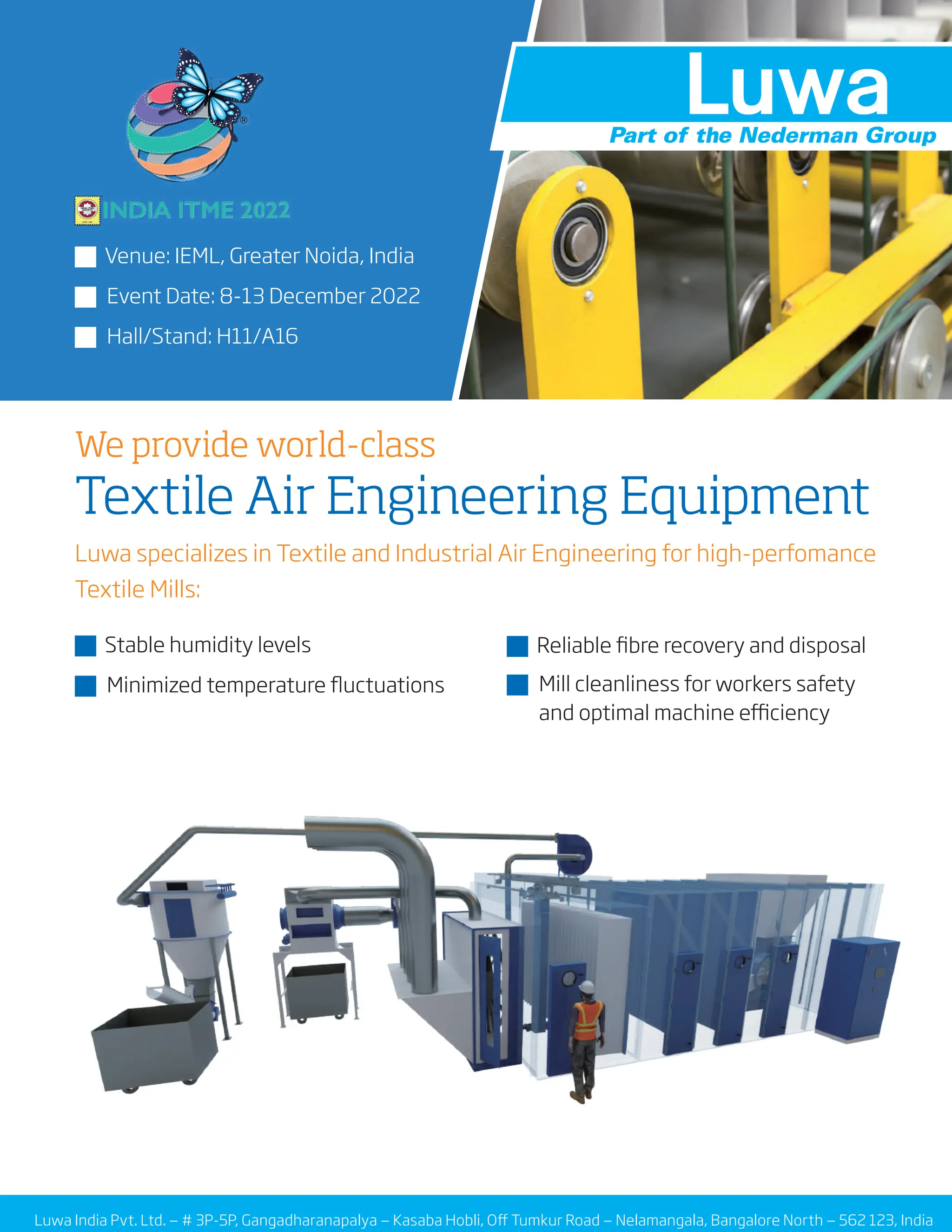
Luwa specializes in Textile and Industrial Air Engineering for high-perfomance
Textile Mills:
J Stable humidity levels
J Minimized temperature fluctuations
We provide world-class
Textile Air Engineering Equipment
J Venue: IEML, Greater Noida, India
J Event Date: 8-13 December 2022
J Hall/Stand: H11/A16
J Reliable fibre recovery and disposal
J Mill cleanliness for workers safety
and optimal machine efficiency
NOVEMBER 2022
www.textilevaluechain.in
6
Textile Engineering On Fast
Growth Track
Textile machinery industry in India has grown
tremendously in the last year, achieving a growth of
130% viz. Rs.11700 crore in 2021-22 as against Rs.5,095
crore achieved during 2020-21. Most encouragingly,
the export of textile machinery rose during the year as
compared to preceding year with the export of
Indian TEI standing at Rs. 4291 crore in 2021-22 from
Rs. 2721 crore in 2020-21. The US$2.5 bn textile
machine industry in India reflects on the growing
strength of this sub-segment in the textiles value chain
in India. A strong textile engineering industry that can
grow, compete, and export would be able to provide
support to the rising Indian textile industry, adding
vibrancy and competitiveness. There are about 3,250
companies involved in the manufacturing of textile
machineries, accessories, and trading of equipment in
India. The industry not only caters to rising domestic
demand but also has the potential to establish India
as an export hub for textile machinery with spinning
machines representing the largest export opportunity.
Much of this segment’s growth can be attributed to the
expansion of the country’s spinning machinery. High
demand for cotton exports and the expansion of
spinning machinery capacities will help India to
maintain an increasingly high demand for spinning
machinery over the next few years. However, the
import of the Indian TEI stood at Rs. 12635 crore in
2021-22 as compared to Rs. 6778 crore in 2020-21.
What is needed is more absorption of foreign
technologies and combined with the use of domestic
knowhow to enrich the technology arena in India, so
that not only production inside the country but also the
export front can be strengthened in the future. TEI has
also the potential of becoming a major hub for textile
machinery parts covering all the important segments
in this section.This will complement the production of
textiles and apparels, which have already made good
progress on the Indian soil.
Samuel Joseph
EDITORIAL TEAM
EDITOR AND PUBLISHER
Ms. Jigna Shah
ADVISOR - EDITORIAL  MARKETING
Mr. Samuel Joseph
EDITORIAL ASSISTANT
Ms. Gargi
CREATIVE DESIGNER
Mr. Adarsh
MARKETING AND ADVERTISING ENQUIRY
Mohammad Tanweer
+91-9167986305
sales@textilevaluechain.com
REGISTERED OFFICE:
TVC MEDIA AND PROMOTION PVT LTD.
504, Suchita Business Park, Patel Chowk,
Pantnagar, Ghatkopar (East),
Mumbai- 400075, Maharashtra, INDIA.
Cell: +91-9769442239
Email: info@textilevaluechain.com
Web: www.textilevaluechain.com
Owner, Publisher, Printer and Editor - Ms. Jigna Shah
Printed and Processed by her at, Impression Graphics,
Gala no.13, Shivai Industrial Estate,
Andheri Kurla Road, Sakinaka, Andheri(East),
Mumbai 400072, Maharashtra, India.
All rights reserved Worldwide; Reproduction of any of
the content from this issue is prohibited without
explicit written permission of the publisher. Every
effort has been made to ensure and present factual and
accurate information. The views expressed in the
articles published in this magazine are that of the
respective authors and not necessarily that of the
publisher. Textile Value chain is not responsible for
any unlikely errors that might occur or any steps taken
based in the information provided herewith.
Textile Value Chain
EDITORIAL
Ms. Vaibhavi Kokane
+91-9869634305
textilevaluechain123@gmail.com
SUBSCRIPTION
www.textilevaluechain.in
NOVEMBER 2022 7
NOVEMBER 2022
www.textilevaluechain.in
8
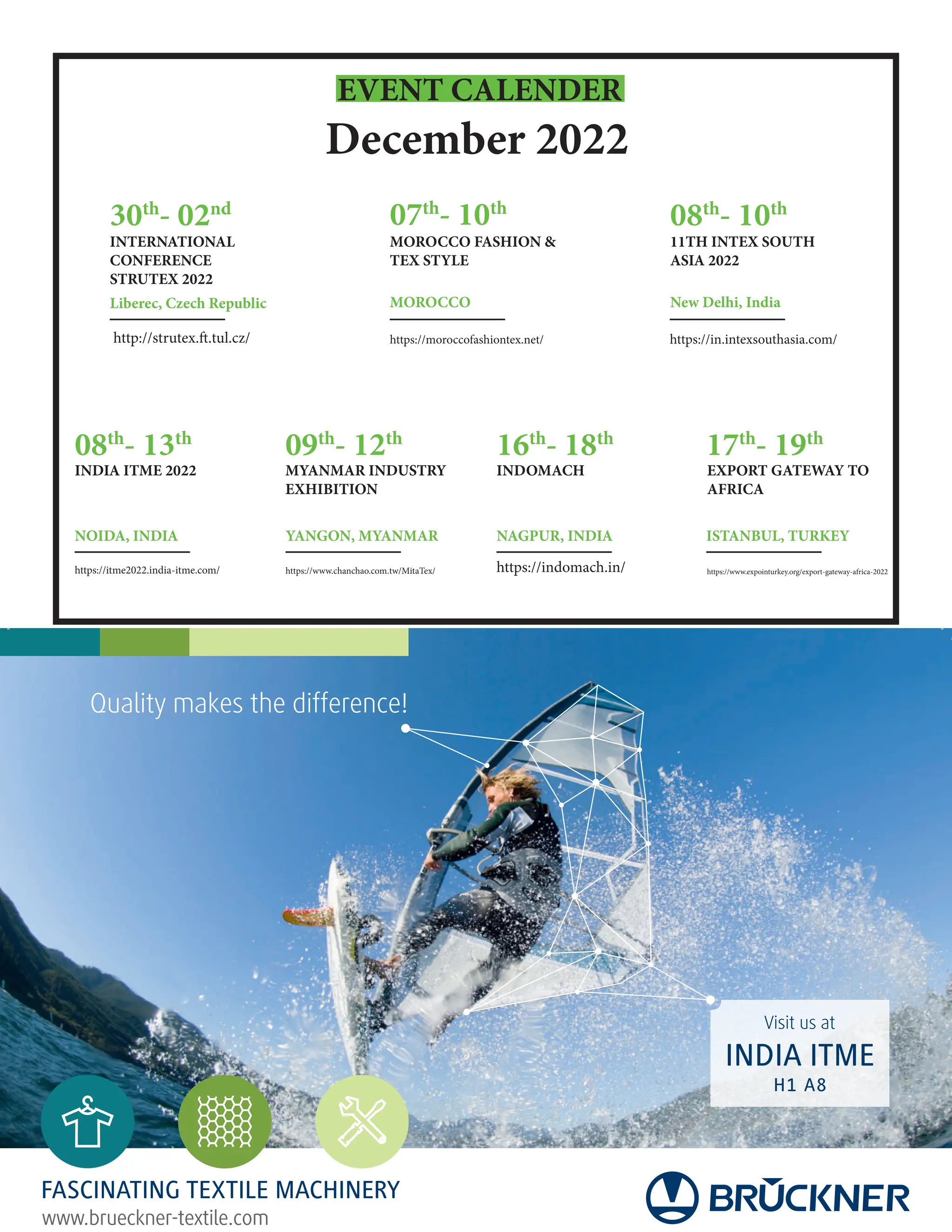
EVENT CALENDER
December 2022
http://strutex.ft.tul.cz/
30th
- 02nd
INTERNATIONAL
CONFERENCE
STRUTEX 2022
Liberec, Czech Republic
08th
- 10th
07th
- 10th
MOROCCO FASHION 
TEX STYLE
11TH INTEX SOUTH
ASIA 2022
MOROCCO New Delhi, India
08th
- 13th
09th
- 12th
16th
- 18th
17th
- 19th
INDIA ITME 2022 MYANMAR INDUSTRY
EXHIBITION
INDOMACH EXPORT GATEWAY TO
AFRICA
NAGPUR, INDIA ISTANBUL, TURKEY
YANGON, MYANMAR
NOIDA, INDIA
https://moroccofashiontex.net/ https://in.intexsouthasia.com/
https://www.expointurkey.org/export-gateway-africa-2022
https://indomach.in/
https://www.chanchao.com.tw/MitaTex/
https://itme2022.india-itme.com/
www.brueckner-textile.com
FASCINATING TEXTILE MACHINERY
Visit us at
INDIA ITME
H1 A8
Quality makes the difference!
NOVEMBER 2022
www.textilevaluechain.in
10
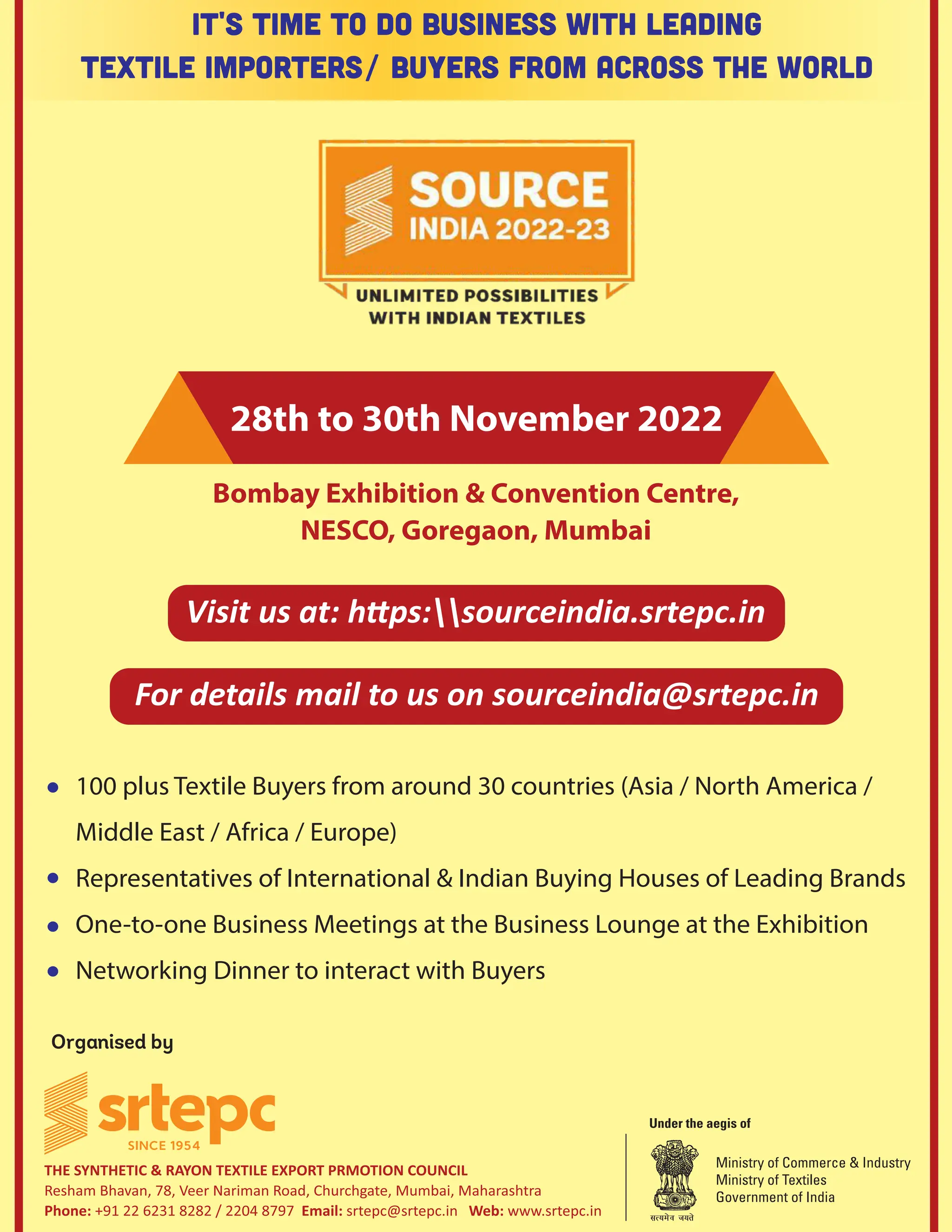
Z}Y”(DL”ZO” O”[YDMYY”/DZC”3;DMB
(bZDK”$( '”[cXY”XOL”:XOYY”(C”/OXK;
d,^zEd,d/ΘZzKEdyd/yWKZdWZDKd/KEKhE/
ZĞƐŚĂŵŚĂǀĂŶ͕ϳϴ͕sĞĞƌEĂƌŝŵĂŶZŽĂĚ͕ŚƵƌĐŚŐĂƚĞ͕DƵŵďĂŝ͕DĂŚĂƌĂƐŚƚƌĂ
WŚŽŶĞ͗нϵϭϮϮϲϮϯϭϴϮϴϮͬϮϮϬϰϴϳϵϳŵĂŝů͗ƐƌƚĞƉĐΛƐƌƚĞƉĐ͘ŝŶtĞď͗ǁǁǁ͘ƐƌƚĞƉĐ͘ŝŶ
QMVT5FYUJMF#VZFSTGSPNBSPVOEDPVOUSJFT TJB/PSUINFSJDB
.JEEMFBTUGSJDBVSPQF
3FQSFTFOUBUJWFTPG*OUFSOBUJPOBM*OEJBO#VZJOH)PVTFTPG-FBEJOH#SBOET
0OFUPPOF#VTJOFTT.FFUJOHTBUUIF#VTJOFTT-PVOHFBUUIFYIJCJUJPO
/FUXPSLJOH%JOOFSUPJOUFSBDUXJUI#VZFST
UIUPUI/PWFNCFS
#PNCBZYIJCJUJPO$POWFOUJPO$FOUSF
/4$0 (PSFHBPO .VNCBJ
sŝƐŝƚƵƐĂƚ͗ŚƩƉƐ͗ͰͰƐŽƵƌĐĞŝŶĚŝĂ͘ƐƌƚĞƉĐ͘ŝŶ
ŽƌĚĞƚĂŝůƐŵĂŝůƚŽƵƐŽŶƐŽƵƌĐĞŝŶĚŝĂΛƐƌƚĞƉĐ͘ŝŶ
www.textilevaluechain.in
NOVEMBER 2022 11
NOVEMBER 2022
www.textilevaluechain.in
12
www.textilevaluechain.in
NOVEMBER 2022 13
Textile Engineering Industry
Achieves 130% Jump In
Production
The production of the Textile Engineering Industry
(TEI) recorded a marked jump of 130% to Rs.11700
crore in 2021-22 as against Rs.5,095 crore achieved
during 2020 - 21 and its capacity utilisation
was 94%, according to the Textile Machinery
Manufacturers Association’s (TMMA).
The fiscal year 2021-22 would be regarded in the years
to come as one of the best performance years of the
entire textile and the textile machinery industry in the
last several decades. A 130% rise in production, 94%
capacity utilisation, 58% jump in exports and a 14%
rise in the installed capacity that was stagnant for
almost a decade are the highlights of the year 2021-22.
Though the year started on a gloomy note when the
second wave of the deadly Covid-19 pandemic broke
out cross the globe causing fresh disruption. It
appeared that the renewed lockdown measures to
contain mass population, industry and the institution
from contracting the pandemic didn’t yield much result
as there were mixed reactions from different quarters
of the polity, community and decision makers globally
on the issues of sustaining lives versus economies.
While the developed countries including India were
successful in developing the Covid-19 vaccine and
initiating the mass vaccination programs, the rate of
inoculating the populace proved insufficient. The
coming quarters in the new fiscal year looked gloomy,
but the industry proved all that wrong, as the entire
value chain across the markets globally performed
exceptionally well barring a few segments. The
Government of India continued on the previous year’s
strategies and action plans for business continuity,
sectoral revival and further improving ‘Ease of Doing
Business’ in the country.
The Office of the Textile Commissioner coordinated
and processed the ATUF Scheme efficiently, barring a
few months of complete lockdown. Majority of the
cases related to the enlistment of textile machine
manufacturers, induction of new machine types in the
ATUF scheme and the release of ATUF subsidy were
cleared on time. A total of 19 Internal Technical
Committee (ITC) meetings chaired by the Joint
Textile Commissioner, 4 Technical Advisory
Committee Meetings (TAMC) meetings chaired by the
Textile Commissioner, and 1 Inter Ministerial Standing
Committee (IMSC) meeting chaired by the Honorable
Minister of Textile; were held during the year. However,
the uncertainty prevailed in the industry about the lack
of information on continuation of ATUF Scheme after
31st March 2022, when the scheme concludes.
The Textile Machinery Manufacturers Association
worked closely with Kalam Institute of Health
Technology (AMTZ Vishakhapattanam) and Invest
India both of whom conducted separate studies on the
Indian Textile Engineering Industry (TEI) under the
aegis of ‘Ministry of Textiles’ during the year.
The KIHT conducted a ‘Technology Gap Analysis in
the Indian TEI’, and Invest India published an
Opportunity Paper covering the Textile Machinery
Industry in India. Written in association with TMMA,
it showcased India’s strengths in Textile Machinery to
both global and domestic players and highlight the
opportunities and advantages of investing in the Indian
TEI.
While the KIHT’s report didn’t draw much attention
of the industry, the Invest India’s Opportunity Paper
encouraged the industry to present their capabilities,
challenges and future aspirations. Inspired by the
report’s mass appeal the industry requested the
association to work with Invest India again to bring
out segment specific papers that would enable both the
MHI and MoT to bring out suitable policies/ schemes
for the industry.
As the ATUF Scheme would end on 31st March 2022;
the time would be ripe to map the prospects of the
textile and textile engineering industry. Earlier, the
Report by TMMA
COVER STORY
NOVEMBER 2022
www.textilevaluechain.in
14
Government had launched the ambitious schemes
such as Technical Textiles, PM MITRA, and PLI for the
textile industry. However, it was felt that the MSMEs
and the Textile Machinery Industry should also be
brought under similar schemes for the technology
development and import substitution to promote
“Make in India”
The association worked closely in this regard with the
MoT to prepare a draft for ‘Textile Technology
Development Scheme (TTDS)’ that would benefit both
the textile and the textile machinery industry. The
scheme would consist two sections; section 1 for textile
machinery industry that would incentivize
‘Technology RD, Acquisition, Capital Investment,
and Commercialization’ and section 2 for textile
industry that would incentivize incremental
‘Production’. A budget outlay of approximately INR
16500 crores for 5 years was proposed in the draft
scheme which is still under deliberation. There may be
lot of iterations and additions before it could be
announced after cabinet’s approval during 2022-23.
PRODUCTION, EXPORTS, AND IMPORTS
The production of the Textile Engineering
Industry (TEI) recorded a substantial increase of 130%
viz. Rs.11700 crore in 2021-22 as against Rs.5,095
crore achieved during 2020-21. Except the complete
lockdown during Q1 of 2021-22 due to the disastrous
second wave of Covid Pandemic, the majority of the
industry segments continued on the momentum of the
market gains picked up during 2nd, 3rd and 4th
quarters of 2020-21quite well. Both greenfield and
brown field projects were explored with clients during
the Q2, Q3  Q4 of the fiscal. Throughout the year, the
capacity utilization was close to 100% and the industry
was able to achieve up to 130% of their annual turnover
as compared to 2020-21. Perhaps it was the best year
the industry witnessed in the last several decades.
Most encouragingly, the export of textile machinery
jumped during the year as compared to preceding year.
On the basis of the data furnished by the Directorate
General of Commercial Intelligence  Statistics
(DGCIS), Kolkata, the export of Indian TEI stood
at Rs. 4291 crores in 2021-22 from Rs. 2721 crores in
2020-21. TMMA assessed export performance of the
Indian TEI from the private source as well and found
that TEI exports for the 2021-22 was Rs.5572 crores as
against Rs.3307 crore achieved during 2020-21.
On the other hand, the import also spiralled up due to
enhanced domestic demand of the user industry. Based
on the data procured from the DGCIS, Kolkata, the
import of the Indian TEI stood at Rs. 12635 crores in
2021-22 as compared to Rs. 6778 crores in 2020-21.
It was assessed from the private source as well that
showed the TEI imports for the 2021-22 to be Rs.15115
crores as against Rs. 8096 crores achieved during
2020-21 period.
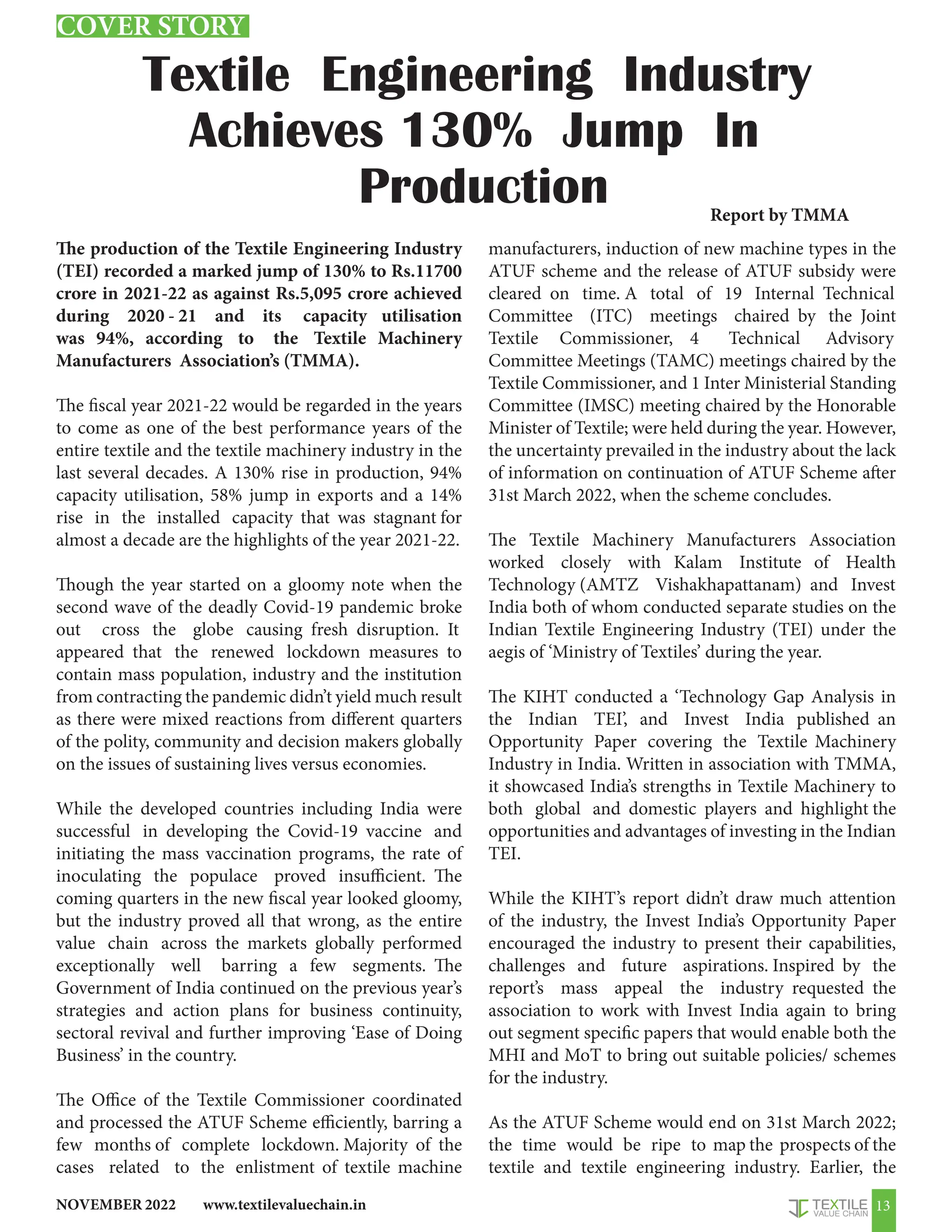
The chart below shows the trend of production,
import, and export for the last 5 years.
During the year, TMMA started procuring EXIM data
of two additional HS Codes i. e. 8443 and 9024 from
the private source as per the request from the industry.
The accuracy of the data procured from private source
was validated again and found out to be quite good.
Besides, the data was procured from DGCIS also.
The association also shared this EXIM data on monthly
as well on yearly basis (after compilation  analysis) to
all the members concerned. They appreciated the
valuable assessment on the EXIM data shared with
them that would enhance their business opportunities.
The data also helped analysing the import of different
makes and models of textile machinery
particularly machinery which may be second hand or
reconditioned in nature to the office of the textile
commissioner, Mumbai.
Based on a survey report done by the Textiles
Committee with support of TMMA in 2007, and the
import and export data analysed in subsequent years,
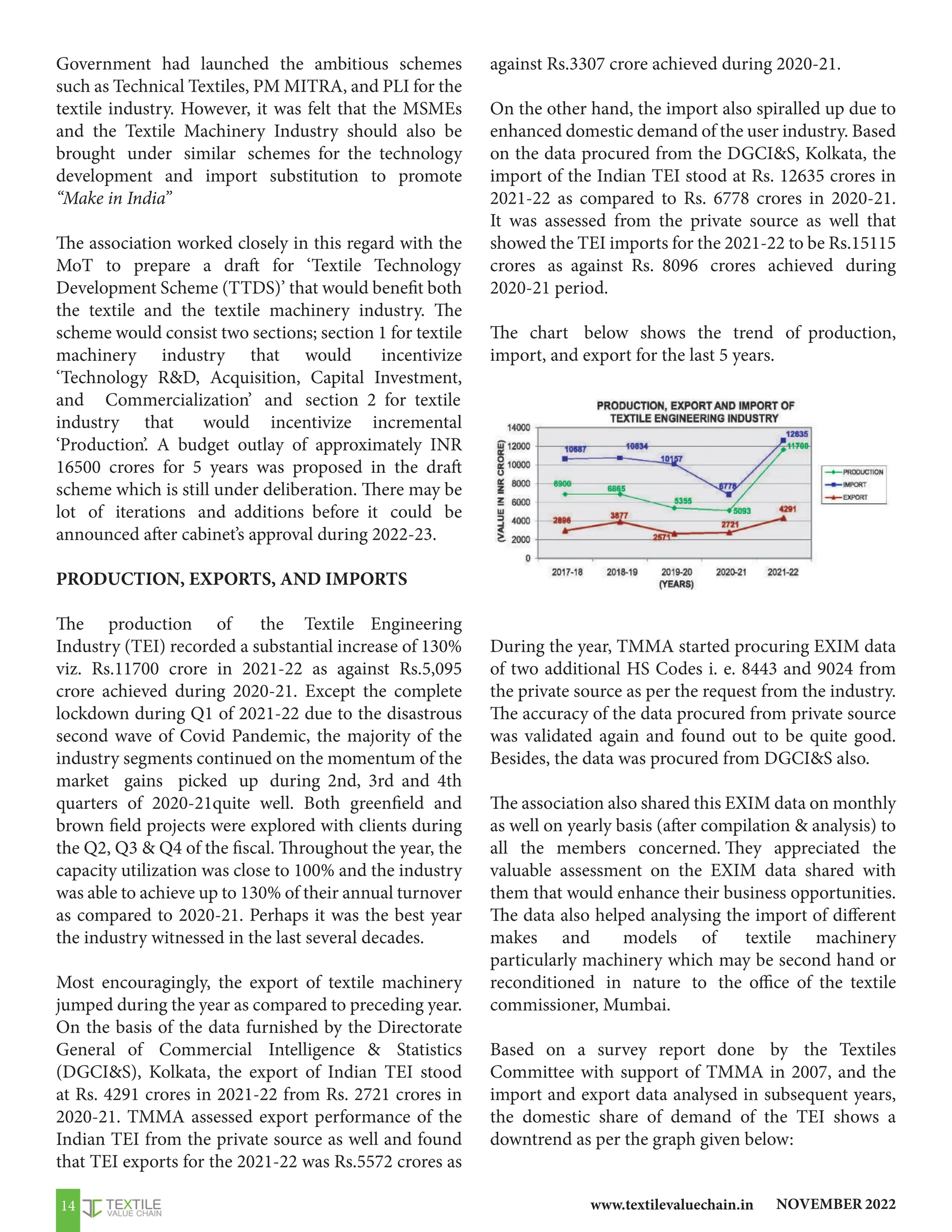
the domestic share of demand of the TEI shows a
downtrend as per the graph given below:
www.textilevaluechain.in
NOVEMBER 2022 15
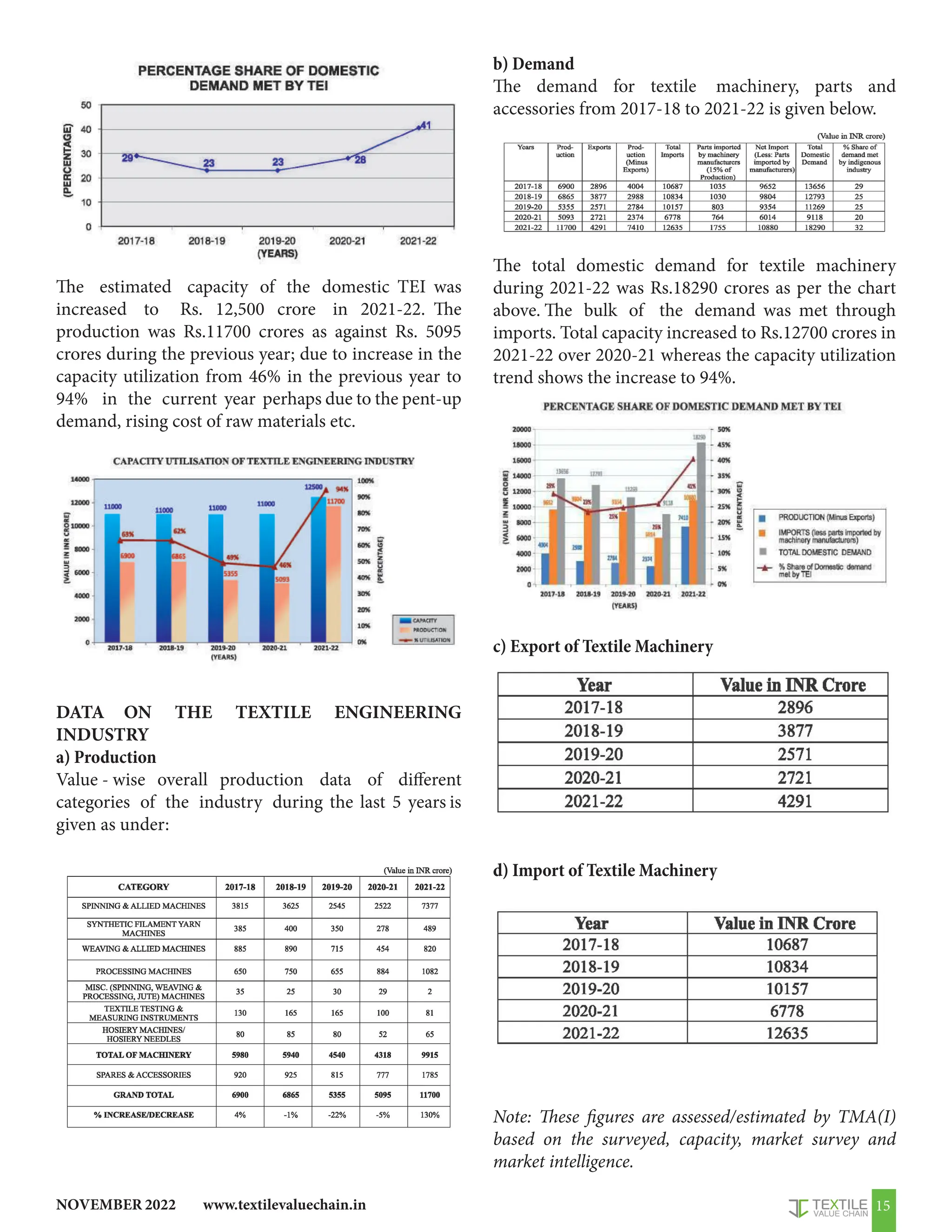
The estimated capacity of the domestic TEI was
increased to Rs. 12,500 crore in 2021-22. The
production was Rs.11700 crores as against Rs. 5095
crores during the previous year; due to increase in the
capacity utilization from 46% in the previous year to
94% in the current year perhaps due to the pent-up
demand, rising cost of raw materials etc.
DATA ON THE TEXTILE ENGINEERING
INDUSTRY
a) Production
Value - wise overall production data of different
categories of the industry during the last 5 years is
given as under:
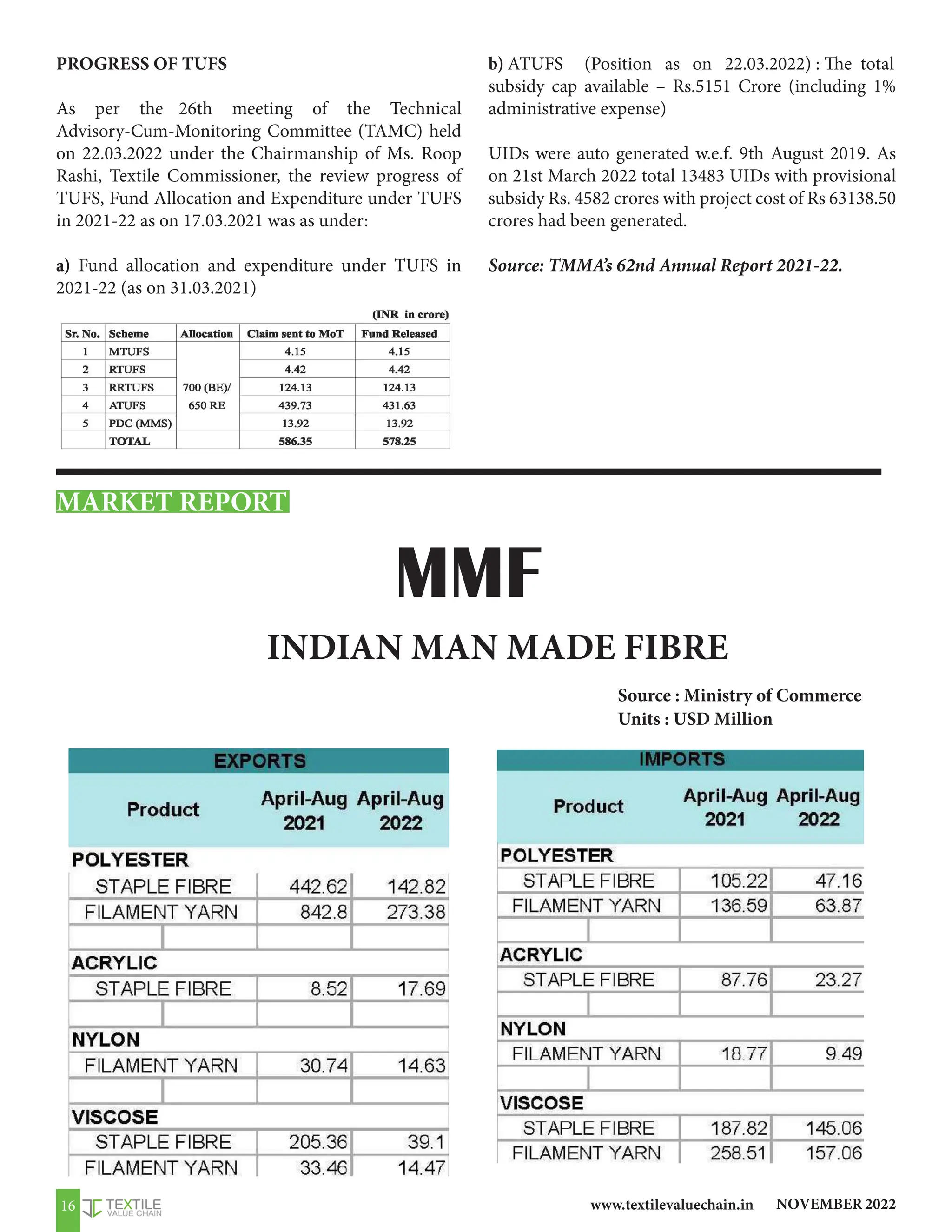
b) Demand
The demand for textile machinery, parts and
accessories from 2017-18 to 2021-22 is given below.
The total domestic demand for textile machinery
during 2021-22 was Rs.18290 crores as per the chart
above. The bulk of the demand was met through
imports. Total capacity increased to Rs.12700 crores in
2021-22 over 2020-21 whereas the capacity utilization
trend shows the increase to 94%.
c) Export of Textile Machinery
d) Import of Textile Machinery
Note: These figures are assessed/estimated by TMA(I)
based on the surveyed, capacity, market survey and
market intelligence.
NOVEMBER 2022
www.textilevaluechain.in
16
PROGRESS OF TUFS
As per the 26th meeting of the Technical
Advisory-Cum-Monitoring Committee (TAMC) held
on 22.03.2022 under the Chairmanship of Ms. Roop
Rashi, Textile Commissioner, the review progress of
TUFS, Fund Allocation and Expenditure under TUFS
in 2021-22 as on 17.03.2021 was as under:
a) Fund allocation and expenditure under TUFS in
2021-22 (as on 31.03.2021)
b) ATUFS (Position as on 22.03.2022) : The total
subsidy cap available – Rs.5151 Crore (including 1%
administrative expense)
UIDs were auto generated w.e.f. 9th August 2019. As
on 21st March 2022 total 13483 UIDs with provisional
subsidy Rs. 4582 crores with project cost of Rs 63138.50
crores had been generated.
Source: TMMA’s 62nd Annual Report 2021-22.
MMF
Source : Ministry of Commerce
Units : USD Million
INDIAN MAN MADE FIBRE
MARKET REPORT
www.textilevaluechain.in
NOVEMBER 2022 17
NOVEMBER 2022
www.textilevaluechain.in
18
Status and Background of India’s Textile
Machinery sector as of today
While India took the lead in evolving as no. 1 Cotton
producer, and a major MMF fiber producer in the
world, it continued to depend heavily on ‘Import’
of key Textile Machinery, especially for yarn spinning,
high-speed weaving, knitting and technical textiles.
Also, the availability of high-quality indigenous
machinery for textile dyeing/finishing, particularly
for wide-width processing and grey fabric preparation
etc. is still a weak link in textile machinery
manufacturing.
This is indeed a paradox for a major textile exporting
and cotton producing country which has to redeploy
and invest its ‘textiles export incomes’ towards
‘import’ of such textile machinery. Also, the industry
has to take the onus and blame for continuing to
be a converter and manufacturer of raw materials
and/or interim grey textiles like yarns and raw fabrics;
with nil or marginal focus on the RD efforts for the
machinery and technology development except by the
global and flag bearer LMW Co. based in South India.
LMW have now evolved today, to be amongst the top
5 Spinning Machinery makers in the world.
Even a dozen of Textile Industry focused research
bodies, and including premier institutions like the
government supported TRA’s and the IIT’s, did not
contribute to machinery development and initiatives,
despite availability of government funding to support
the required research and studies etc. In fact, some of
the earlier pioneering companies like Texmaco, NSE
and MFI failed to upgrade and saw their demise
25 years ago and at the time when the need for textile
machinery development with new technology was
perhaps the most needed.
Key factors to be understood for Future Course
Corrections, vis-a-vis Few Past Initiatives
especially by M/s LMW for high technology
yarn spinning machinery
To understand the ‘success’ model of homegrown
Indian LMW Co. which initiated the ‘technology
collaboration’ route with global leader Reiter as the
technology partner. This however got over focused on
the growing yarn spinning machinery sector which
seems to be the viable and volume business to
sustain development costs. This did marginalize
any true efforts to bring in state of art technology
through the much-required collaborations in the field
of Weaving/Knitting/Processing and Technical Textiles
machinery sectors.
The other good example for such leadership has been
showcased by the Himsons Co. for manufacturing and
exporting of the synthetic filament ‘Texturizing’
machinery in competition to those from China,
Taiwan and South Korea.
Pre ITME 2022 Status
Check On India’s ‘Marginalized’
Textile Machinery Industry
Munish Tyagi
Textile Industry Consultant
COVER STORY
www.textilevaluechain.in
NOVEMBER 2022 19
What was really needed almost 3 decades back was
equal focus on development of fabric forming
machinery and technologies like high speed/
wide-width ‘Shuttleless’ weaving, dyeing and finishing
especially for the ever-growing knit fabric segment
and embroidery and, also for new evolving
Technical Textiles and Digital Printing areas. During
these decades the machinery and process for
sustainable technology also took a back seat. Also, an
opportunity to serve the exports to textile producing
countries in the south-east was lost by India.
While global and India’s Apparel manufacturing
capacity and exports been rising over last 3-4 decades,
it is indeed a matter of shame that not even a basic
garment sewing machinery of international standard
and acceptance quality could not be developed. This
did open the Indian markets vis-a-vis high capital and
interest cost and space for the higher quality machines
from South-Eastern competitors like Japan, China,
Taiwan.
It is clear that this lapse by our Textile Engineering
related Co`s over the decades of 1990 to 2010 led to
the high cost of import of textile machinery for India’s
MSME producers which impacted their higher capital
cost and unit manufacturing cost for export
manufacturing of textiles  apparels, vis-a-vis other
South-East Asian rivals like China, Vietnam.
Understanding India’s Current Technology
‘Gap’ Areas in Textile Machinery
While India’s premier textile machinery company
LMW, has been the flag bearer in the vital yarn
spinning machinery sector, with its exports to other
textile producing countries, there are very few India
Cos. worth mentioning in post spinning arena
eg. Yamuna for stenters and finishing machinery and
possibly Dalal Engg. for the yarn and fabric dyeing
machinery.
There are clear and discernible Gap areas requiring
immediate redressal, mainly as per below.
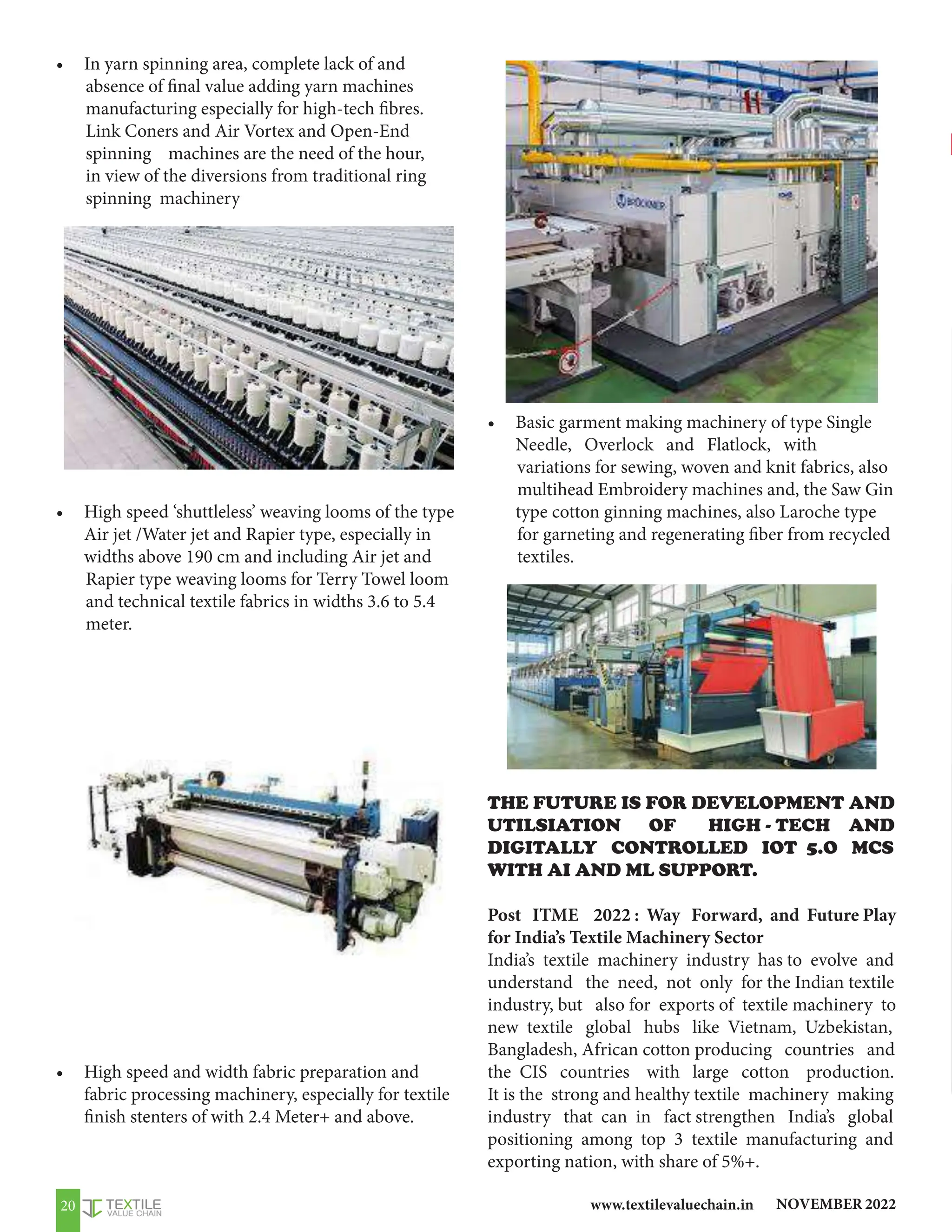
• Circular Knitting especially for high speed and
large diameter machines with large number of
feeders, especially for Lycra feeding…and onward
evolution to knitting machines of type Santoni for
seamless knit garments for use in inner wear and
athleisure etc.
NOVEMBER 2022
www.textilevaluechain.in
20
• In yarn spinning area, complete lack of and
absence of final value adding yarn machines
manufacturing especially for high-tech fibres.
Link Coners and Air Vortex and Open-End
spinning machines are the need of the hour,
in view of the diversions from traditional ring
spinning machinery
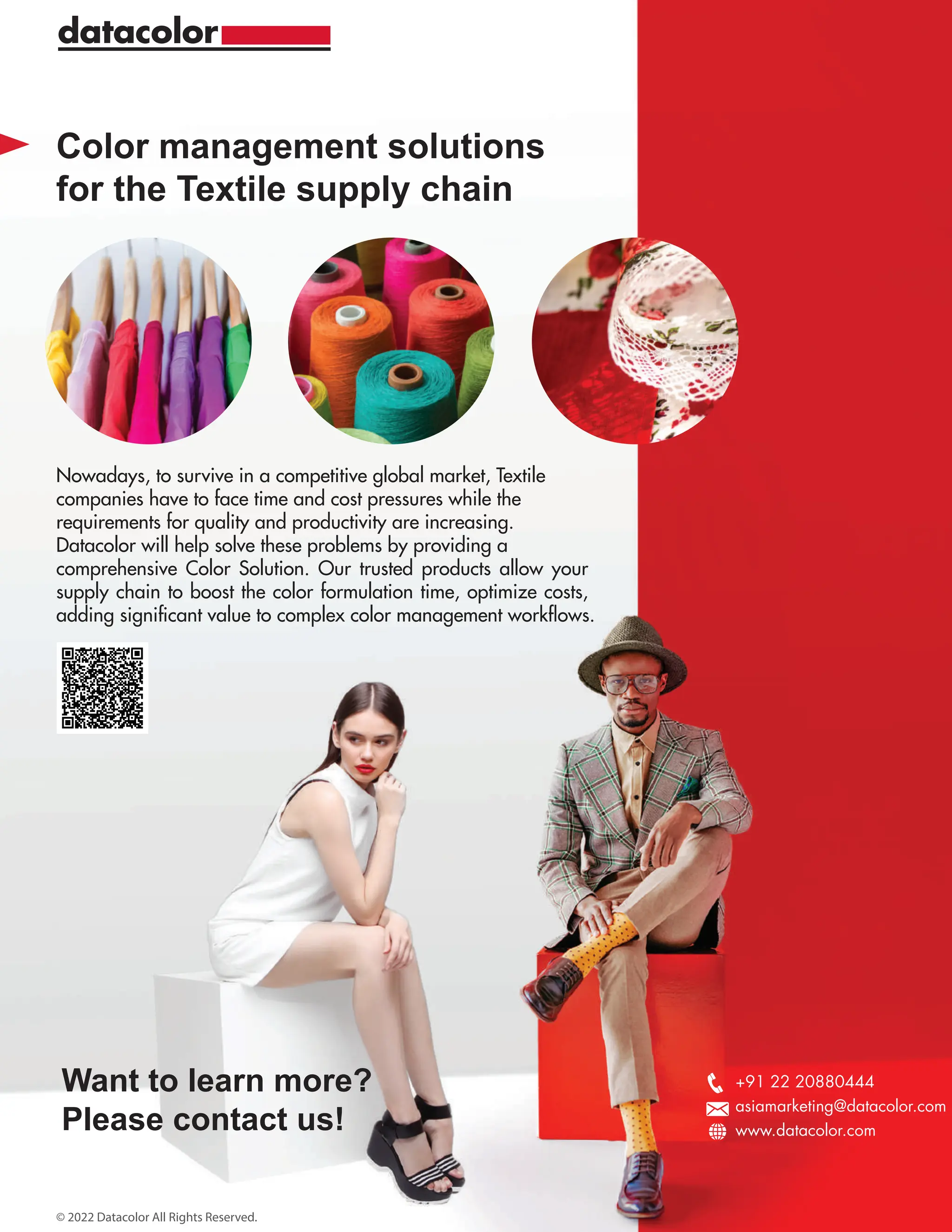
• High speed ‘shuttleless’ weaving looms of the type
Air jet /Water jet and Rapier type, especially in
widths above 190 cm and including Air jet and
Rapier type weaving looms for Terry Towel loom
and technical textile fabrics in widths 3.6 to 5.4
meter.
• High speed and width fabric preparation and
fabric processing machinery, especially for textile
finish stenters of with 2.4 Meter+ and above.
• Basic garment making machinery of type Single
Needle, Overlock and Flatlock, with
variations for sewing, woven and knit fabrics, also
multihead Embroidery machines and, the Saw Gin
type cotton ginning machines, also Laroche type
for garneting and regenerating fiber from recycled
textiles.
THE FUTURE IS FOR DEVELOPMENT AND
UTILSIATION OF HIGH - TECH AND
DIGITALLY CONTROLLED IOT 5.O MCS
WITH AI AND ML SUPPORT.
Post ITME 2022 : Way Forward, and Future Play
for India’s Textile Machinery Sector
India’s textile machinery industry has to evolve and
understand the need, not only for the Indian textile
industry, but also for exports of textile machinery to
new textile global hubs like Vietnam, Uzbekistan,
Bangladesh, African cotton producing countries and
the CIS countries with large cotton production.
It is the strong and healthy textile machinery making
industry that can in fact strengthen India’s global
positioning among top 3 textile manufacturing and
exporting nation, with share of 5%+.
www.textilevaluechain.in
NOVEMBER 2022 21
NOVEMBER 2022
www.textilevaluechain.in
22
Get set… Go !!! Needs to be converted for the textile
industry to Watch out… Strategize… Implement!!!
It is the final alert call for the Indian textile  apparel
industry in order to get a bigger pie from the global
market. We need to analyze our existing situation,
understand our key areas to focus on, plan country
strategy for domestic as well as international markets
and have our strategy for each and every country
understanding their imports, product baskets to
be targeted, key deliverables, etc. New India which
is destined to be a Superpower in coming years, is an
achievable vision that has driven the industrialists on
a mission to achieve the best of best targets. Textile
Industry should respond to this positively. The
industrialists are all pumped up to achieve the
targets and contribute to the larger vision. The
targets of the industry can only be achieved, when the
industry works as one united front. Our 5 F’s – Farm,
Fibre, Factory, Fashion, and Foreign Trade working in
unison will exponentially achieve the target. All that
is needed is unison so the focus of the textile industry
must be on building a strong chain linking the 5F. Let
us introspect the immediate needs of each Fs.
Farm: Creating a Strong Farm Base
At the onset, we need to observe  exercise new
techniques for Cultivation like drip irrigation. The
contamination level at the ginning stage should
be thoroughly checked so that it is the bare
minimum. We need to introduce ways to prevent
malpractices of introducing contamination in natural
fibers. The Minimum selling price concept introduced
for the benefit of farmers must be more aggressively
implemented and the mediators that are not keeping
the deals fair for the industrialists and the farmers
must be eliminated. Direct links between farmers
and industrialists are the call of the hour. Completing
chalking out the existing problems like bonded
labor. More and more emphasis should be given
to educating farmers through artificial intelligence
about the weather conditions, an ideal time for sowing
and nutritive information on the soil and crop seeds.
Benchmarking standards for the utilization of right
fertilizers both in terms of Quantitative parameters 
Quality Parameters. The most essential step is
registration  regulation of the farmers wherein by
using the latest user-friendly technology the farmers
can get all updates like climate, soil fertility, fertilizers,
irrigation practices, market knowledge, etc. on their
cellphones.
Apart from the above, natural fiber farming must
be incorporated under MOT (ministry of textiles)
for better control. The ministry can further extend
its hand to introduce contractual farming with Brand
Tie-ups by linking the industry with the farmers. To
keep a close watch, an active Government cell must
be brought into practice that will monitor- control 
implement the government schemes specifically
related to textiles  fair farming techniques. The
farmers need to be awarded based on quality, yield
and best farming techniques.
Fiber: Introducing Contamination Free Fiber
Contamination is the major hurdle as far as natural
fibers are concerned. At the value end, this
Watch Out…Strategize… Implement!!!
Key For Textile Value Chain Enhancement
Mr. Avinash Mayekar
MD, SUVIN
COVER STORY
www.textilevaluechain.in
NOVEMBER 2022 23
contamination leads to produce low-quality products.
Hence efficient methods are to be brought into
practice right for cleaning, sorting, grading up to
baling. The clear way of eliminating malpractices is by
strongly building the first “F-Farm” very strong. So the
interest of ginners, fiber producers along with
farmers, and the industry must be brought on the
same page with fair trade implementation. The right
value to farmers will provide the right quality raw
material to the ginners who will then be able to
produce and sell quality material at the right price
to the industry. Close watch  monitoring by
independent professional cells must be introduced to
ensure no false contamination practices are observed
at any stage. There is a need for standardization of
ginning techniques which will provide the best quality
to the value chain developing industry. We may have
to boost ginning machine manufacturers to adopt
the best technology for contamination elimination at
the raw cotton stage itself.
Factory – State of the-art-infrastructure  High
Productivity
COVID however dark the phase had been, the
emergence of hygiene products would be the
only silver lining. The importance of hygiene has been
reflected in all walks of society. A hygienic factory not
only ensures the best quality of the products but also
brings a clean  positive atmosphere which leads
to an increase in efficiency of people. Also, the
proper practices ensure less utilization of energy
 water and minimum waste generation. Properly
disposing of scraps will lead to revenue generation.
Routine Machine Maintenance will lead to energy
efficiency and also reduce losses due to unplanned
breakdowns. It will also signal the up-gradation
of machinery. Green Practices are today’s necessity.
Globe is eyeing environment friendliness in each and
every activity. Lowering operating costs in terms of
power, steam  water consumption with sustainable
practices will be a cherry on the pie.
There is a need to establish proper skill
enhancement and efficiency utilization among
the labor force. Efficient labor management can
be achieved by workers’ periodic training  welfare
through better work practices. The industrial internet
of things (IIOT) and digitalization are the reckonings
that are needed today. Most important is to ensure
regular  mandatory. Audits of the factory to get the
certifications that will bring in top global brand orders
on circular routines.
Fashion – Brand Building
Today’s fashion is being executed across the globe
from Europe to Africa - Down south to Asia – USA.
Youth-inspired fashion is trending day in  day
out. Green, Organic  Recycled are the trendsetters
 USPs used to create Brand loyalty. Naturally
derived fashion from jute to cactus leather is
creating their patents  labels. The Internet is
speeding the Fashion trends worldwide and hence
making garments with labels is the best way to grab
the open worldwide markets. The world dynamics
have shifted in the COVID outbreak. It has led to a
comfortable knit revolution. Comfort is the motto in
today’s fashion, it is an era of brains instead of
appearance. So what one wears is not more important
than what one delivers. Naturally, with the only
virtual meet period during the pandemic, the trend
was well accepted. Casuals are today’s Formals.
The virtual meet has changed the game for wovens.
Though the IT sector had seen a shift in the pre covid
era, especially in developed countries. The
acceptance of it in Developing countries has started
now. So Knit wear by tie-ups with global brands or our
Indian brand is the way forward for achieving
success. Moreover, sustainability, recyclability,
circularity, and green are the fashion icons amongst
the new generation.
Foreign Trade
Free Trade enjoyed by some of the other countries has
created a lot of concerns for our country’s textile trade
for which the government is working on creating trade
agreements with top developed markets to ease our
way in. China + 1 has created an open market to
compete globally and make our mark to capture
a larger market share. Today buying houses  brands
are exploring alternate options. We just need to
develop our strong garmenting chain with state of
the art technology and a skilled labor force to grab this
opportunity  progress exponentially to fill the open
market with our capability.
Government policy during COVID provided good
support to exporters making sure India reaches the
NOVEMBER 2022
www.textilevaluechain.in
24
double-digit market share from the current 4 to 5% in
textiles  apparel trade. They are already working on
Trade agreements with developed countries 
globally assisting in the representation of Indian
players through pavilions and enhancing the brand
India. Establishing the more effective state of the art
infrastructure to support the timely dispatch of orders
and reduce the logistics  supply chain management
costs incurred due to poor logistic support is the need
of the hour.
The next focus for making India a superpower in textiles
is by developing a strong Indian Textile Machinery
industry.
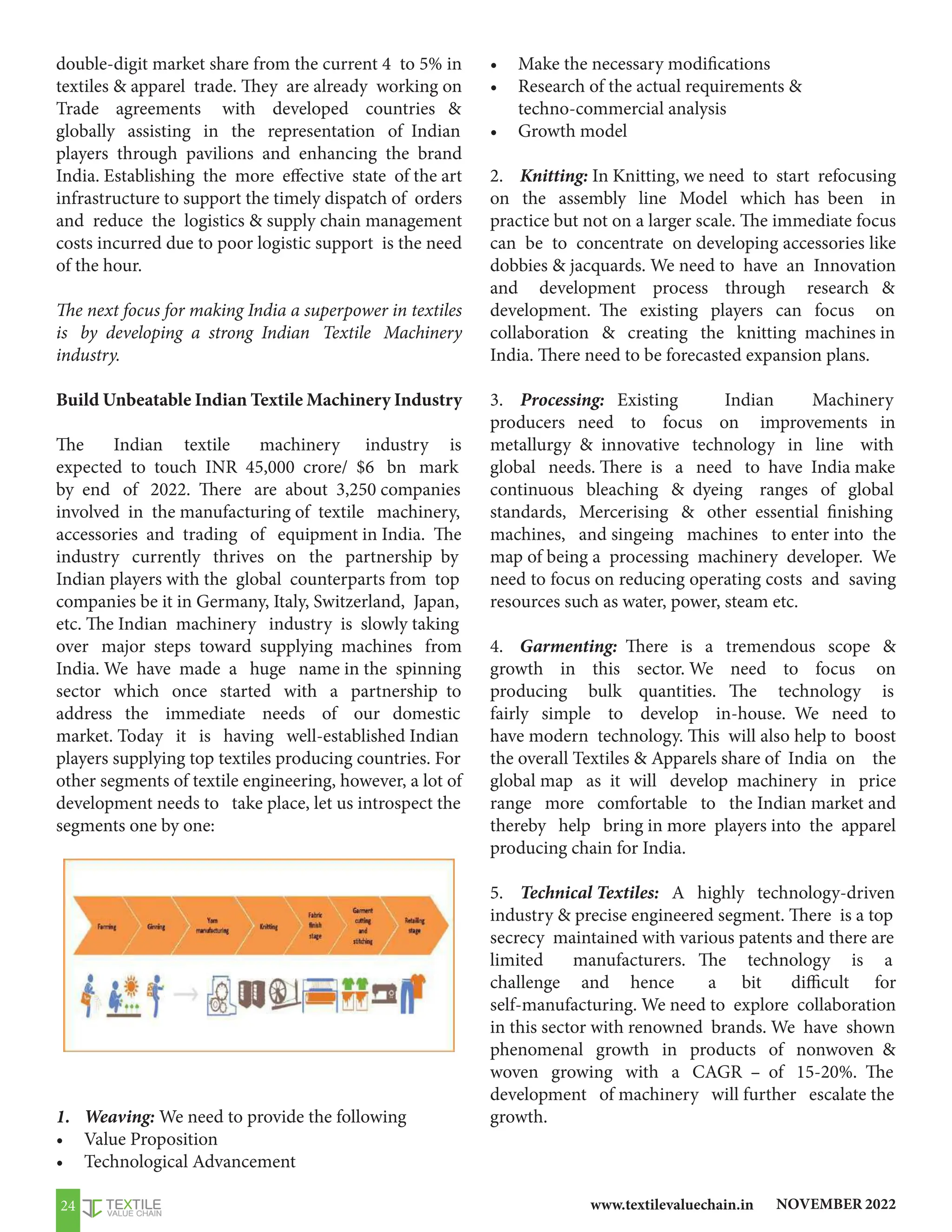
Build Unbeatable Indian Textile Machinery Industry
The Indian textile machinery industry is
expected to touch INR 45,000 crore/ $6 bn mark
by end of 2022. There are about 3,250 companies
involved in the manufacturing of textile machinery,
accessories and trading of equipment in India. The
industry currently thrives on the partnership by
Indian players with the global counterparts from top
companies be it in Germany, Italy, Switzerland, Japan,
etc. The Indian machinery industry is slowly taking
over major steps toward supplying machines from
India. We have made a huge name in the spinning
sector which once started with a partnership to
address the immediate needs of our domestic
market. Today it is having well-established Indian
players supplying top textiles producing countries. For
other segments of textile engineering, however, a lot of
development needs to take place, let us introspect the
segments one by one:
1. Weaving: We need to provide the following
• Value Proposition
• Technological Advancement
• Make the necessary modifications
• Research of the actual requirements 
techno-commercial analysis
• Growth model
2. Knitting: In Knitting, we need to start refocusing
on the assembly line Model which has been in
practice but not on a larger scale. The immediate focus
can be to concentrate on developing accessories like
dobbies  jacquards. We need to have an Innovation
and development process through research 
development. The existing players can focus on
collaboration  creating the knitting machines in
India. There need to be forecasted expansion plans.
3. Processing: Existing Indian Machinery
producers need to focus on improvements in
metallurgy  innovative technology in line with
global needs. There is a need to have India make
continuous bleaching  dyeing ranges of global
standards, Mercerising  other essential finishing
machines, and singeing machines to enter into the
map of being a processing machinery developer. We
need to focus on reducing operating costs and saving
resources such as water, power, steam etc.
4. Garmenting: There is a tremendous scope 
growth in this sector. We need to focus on
producing bulk quantities. The technology is
fairly simple to develop in-house. We need to
have modern technology. This will also help to boost
the overall Textiles  Apparels share of India on the
global map as it will develop machinery in price
range more comfortable to the Indian market and
thereby help bring in more players into the apparel
producing chain for India.
5. Technical Textiles: A highly technology-driven
industry  precise engineered segment. There is a top
secrecy maintained with various patents and there are
limited manufacturers. The technology is a
challenge and hence a bit difficult for
self-manufacturing. We need to explore collaboration
in this sector with renowned brands. We have shown
phenomenal growth in products of nonwoven 
woven growing with a CAGR – of 15-20%. The
development of machinery will further escalate the
growth.
www.textilevaluechain.in
NOVEMBER 2022 25
Strategy to Boost Technical Textiles Product Market
Focus on our requirements of technical textile
products such as:
• Road  Highway – Geotextiles.
• Sea, river beds  dam area – Geo-bags.
• Landfills  mining zones.
• Workwear standardization with technical
parameters for government institutes, medical
hospitals.
• Funding for space-oriented functional textiles
productions.
• Mobitech – Safety mandates in Passenger 
luxury vehicles.
• Mandating products – government-aided certified
geotextiles, packtech standardization for graded
packaging materials for storage.
• Sportech –standardized technical parameters for
Indian sports personalities.
• Mandates on construction safety nets 
other construction materials for use in buildings -
Acoustic proofing, fire proof safety suits, work
wear garments.
• Active promotion from Government.
• Largely untapped domestic institutional buyers
for technical textiles: Institutional buyers such
as railways, defense forces, hospitals, etc., are still
heavily dependent on imports for high-value
technical textile products. However, in the recent
past, some Indian technical textile manufactur-
ers have started working with such institutional
buyers, but most of the market is yet to be tapped.
Conclusion:
The major focus is to boost the value chain for
which we need to focus majorly on three things one
is global scale, standardization  competitiveness.
Global Scale: We are not able to compete with
China because of below the average scale of
production. There is a limited production scale
maintained due to a lack of mileage internationally.
However recent progressive action by the Ministry
of textiles has changed the dynamic introduction
of schemes and policies like the PLI Scheme to
boost the economy for value-added product
development, Textile Parks  Mega Clusters are
channeling our growth. So the spotlight must be
on resolving the key concerns in the following issues
to increase our scale of production
• Supply Chain Management
• Quality  Consistency in Raw Material
• Logistic support
• Skill sets of people
• Marketing
Standardization: Ministry has started mandatory
production recording. HS code harmonization 
creation of new 8-digit product - specific HS codes
especially for technical textile products. The prima
facie standardization needs to be achieved for
following
• Organizing the unorganized sector
• Recording outputs  transactions
• Traceability of raw materials across the value chain
• Global Audits compulsions  Certifications
mandate
• Environment clearance audits
Let us introspect ourselves to incorporate new norms
• Scan our existing facilities
• Remove weak areas
• Adopt appropriate technology
• Spin profits
Competitiveness:
• We need to have skilled labor force  training
institutes as the technology upgrades.
• We must have efficient process adoptions to create
more productivity. Ensure reduction to minimize
operating costs
• Seamless adoption of renewable sources like Solar
Power etc.
• Our products must be world class  have
consistency in quality from raw material to finished
products.
• We must develop state of art factory setup
• Our concentration should be on value-added
products instead of the low-value chain products sale
• We need garmenting units with higher capacities
Strategize  work on Brand development initiatives
• We need to take a bigger pie from the global market
for which Industry 4.0 is pre-requisite
• New technology advancements are the need of the
hour
• Environmental concerns need to be our priority-
Recycle  Reuse would be the mantra for future
Let us all come together to build new India !!!
NOVEMBER 2022
www.textilevaluechain.in
26 TEXTILE VALUE CHAIN
76 SEPTEMBER 2022
www.textilevaluechain.in
NOVEMBER 2022 27
Global Machine Tools Market to
Surpass US$107.75 Billion
By 2032
The global machine tools market was valued at US$ 63
Billion at the end of 2021 and is anticipated to surpass
US$ 107.75 Billion by registering a CAGR of 5% by the
end of the forecast period 2022-2032. The automotive
 transportation segment is estimated to be the most
lucrative end use capturing 36% of the overall demand
pie in the global machine tools market.
Furthermore, manufacturers are adopting green
manufacturing to reduce the overall operating cost by
using energy efficient processes that can
drastically reduce energy and utility bills, thus fuelling
the demand for machine tools with lesser power
consumption.
In addition, the penetration of Industry 4.0 along with
Internet of Things is changing the dynamics of
machine tools market. Moreover, technological
advancements in the field of manufacturing sectors is
rapidly changing the development for machine tools.
Key Takeaways of the Machine Tools Market
• Metal cutting machine tools are projected to surpass
market valuation of US$ 94 Billion by the end of 2032.
• By end user, Electrical  Electronics anticipated
to grow, gaining 171 BPS over the course of forecast
duration.
• South Asia is projected to grow 1.2X faster than East
Asia. However, East Asia is estimated to account for
major chunk of demand pie by the end of the forecast
period.
• Automotive and transportation segment is projected
to create an absolute $ opportunity of ~US$ 7.5 Billion
between 2022 and 2032.
“The ongoing spread of the COVID-19 pandemic
across the globe will delay the economic restart.
Furthermore, companies with heavy production and
sales footprint in Europe and China are witnessing a
direct impact on machine tools sales, imports and
exports. However, slow but quick recovery is expected
from china which will result in a positive uptake of
machine tools” says the Fact.MR analyst
Product Launches to Remain a Prime Growth Lever
Key players in the machine tools market are Komatsu
Limited, DMG Mori, Okuma Corporation, TRUMPF
Group, Hyundai WIA Corporation and Doosan
Machine Tools among others. Prominent machine
tools manufacturers are launching new products and
capitalizing significantly in their RD endeavors to
bring constant change in their line of products as per
the todays dynamic industry trends. For instance,
• In 2020, United Grinding and Ewag developed a new
product, Laser Line Ultra to simplify micro cutting
tool production. This newly developed product uses an
8-axis configuration and picosecond lasers to
incorporate complex micro geometries in cutting tools
• In 2020, Doosan Machine Tools expanded its
product portfolio with the introduction of DNM 4500L
and DNM 5700L. The new DNM series products are
designed for faster and precise machining of diverse
workpieces.
More Valuable Insights on the Machine Tools
Market: Fact.MR, in its new offering, presents an
unbiased analysis of the global machine tools market,
presenting historical demand data (2017-2021) and
forecast statistics for the period of 2022-2032.
The study divulges essential insights on the machine
tools market on the basis of product type (Metal
Cutting Machine Tools (Machining Centers, Laser,
EDM,  Related, Lathes and Other Metal Cutting),
Metal forming Machine Tools (Presses, Punching 
Shearing Machines, Bending  Forming Machine,
Other Metal Forming) and end use (Automotive 
Transportation, Electrical  Electronics, Machinery,
General Manufacturing and Others) across seven
major regions.
COVER STORY
BY FACT.MR
For QUALITY Products from Europe and EFFICIENT Services in India
------------------------------------------------------------------------------------------------------------------------------------------------------
We represent in India the following Textile Machinery  Accessories manufacturers for
Technical Textiles :
LACOM GmbH, Germany : Hotmelt Laminating and Coating Systems – Multi
Purpose, Multi Roller, Gravure Roller and Slot Die for complete range of
Technical Textiles (Website: www.lacom-online.de)
MORCHEM S.A.U., Spain : PUR Hotmelt Adhesives for Technical Textiles, Solvent
Based, Water Based adhesives, cleaners and primers. (Website:
https://www.morchem.com/markets-and-solutions/textile-lamination/ )
Fibres, Waste Recycling  Nonwovens :
Margasa, Spain: Textile Hard Waste Recycling Lines -complete with preparation,
cutting, Storage, feeding, tearing, filtration and fiber packing. Peripheral
equipment, for nonwovens waste. Complete lines for “Airlay Nonwovens” with
thermo or resin bonding. Cotton Waste Cleaning Lines.
(Website: http://www.margasa.com)
FARE' S.p.A., Italy : Complete Lines for Spunbond / Meltblown nonwoven
products /complete line to produce all type of fibers including mono and
bicomponent including PET and PET fibers. Machines for producing Tapes and
Rafia (website : www.farespa.com)
Conventional :
Mariplast Spa, Italy : All type of Yarn Carriers for spun and filament yarns -
Cylindrical Tubes, Roving Bobbins, Ring Frame Bobbins, Cones and one time use
and Reusable Dye Tubes (Website: www.mariplast.com)
C + L Textilmaschinen GmbH, Germany : Reeling (Yarn Hank Forming) Machines,
steaming, Bulking and Banding Machines for yarns ( Rep.for Western and
Southern India) (Website: www.croon-lucke.com)
Contact : ASTRA TECH INDIA E-mail : info@astratech.co.in Website: www.astratechindia.co.in
Contact Person : Mr. Hemant Dantkale
Mobile : 98201 06018 Phone No.: 022-28516018 E-mail : hdantkale@astratech.co.in
HEAD OFFICE:
406, “Kaveri” Jagannath Mandir Marg, Opp. Holiday Inn, Near Sakinaka Metro Station,
Mumbai–400 072
Regd.Office:
B-404, Monarch Manor, 90 Feet Road, Dsouza Nagar, Kurla (West), MUMBAI – 400 072
Branch Office : Coimbatore : email: Coimbatore@astratech.co.in
www.textilevaluechain.in
NOVEMBER 2022 29
NOVEMBER 2022
www.textilevaluechain.in
30
The Hybrid Shear : A
Major Breakthrough In
Carpet Manufacturing
BTMA member Sellers Textile Engineers is marking
its 110th anniversary this year with the introduction
of an entirely new concept in carpet shearing, as the
essential final step in ensuring tuft uniformity and
‘just new’ freshness in finished carpet rolls.
The company has for many years offered two options
in the construction of its shearing cylinders – the
first, namely the ‘strap-on’, incorporates spiral blades
bolted to the cylinder body and the second, known as
the ‘caulked-in’, includes spirals which are fixed very
securely in a machined groove within the machine.
The new Sellers’ Hybrid Shearing Cylinder combines
the benefits of both, resulting in an improved cut and
finer finish, in addition to longer repeatable finishing
and increased rigidity.
“The Hybrid Shearing Cylinder has all the advantages
of the ‘strap-on’ spiral blade to provide a sharper and
cleaner cut, along with enhanced rigidity which
significantly lengthens the intervals between the
necessary regrinding of the blade,” explains Sellers
Director Neil Miller. “We currently have six Hybrid
Shearing Cylinders operating in the field and the
earliest, which has been installed in both No1 Head
position, where the majority of the shearing
operation and heaviest cut is performed, and also in
No3 Head, where the sharper cutting angle has
resulted in a much-improved surface quality.”
Sellers shearing machines have led the field in carpet
finishing for many decades, enabling the leading
manufacturers to stay competitive by enabling the
highest quality of finish to be achieved economically
and efficiently. The latest advanced features of these
machines include a load cell tension control drive
system, an automated touchscreen for easy operator
control and fault diagnosis, an enhanced cleaning
system including cylinder and blade separation and
fully controllable pivoting beds. Further options
include thickness monitoring, seam detection and
metal detection systems.
“The Hybrid Shearing Cylinder will become standard
on our latest machines and also be made available
for retrofitting, to provide significant benefits to our
existing users,” says Miller. “All of our equipment is
designed, manufactured, assembled and tested at our
plant in the UK, and as one of the few remaining
European engineering companies to make all of our
components in-house – with now over a century of
accumulated know-how – flexibility in design allows
our finishing solutions to be targeted to specific
customers and their product requirements. Aligned to
this is a lead in process control systems which ensure
the accurate control, reliability and repeatability of the
processing parameters on all of our machines.”
Sellers remains committed to providing complete
finishing solutions for all carpet, tile and artificial
grass products. Its range includes machines for tufted
secondary backing, both conventional, powder and
extrusion lamination, Wilton and Axminster proucts,
artificial grass and foam lines, coating lines for
bitumen, PVC, PU and other polymers, as well
as shearing for all carpet products.
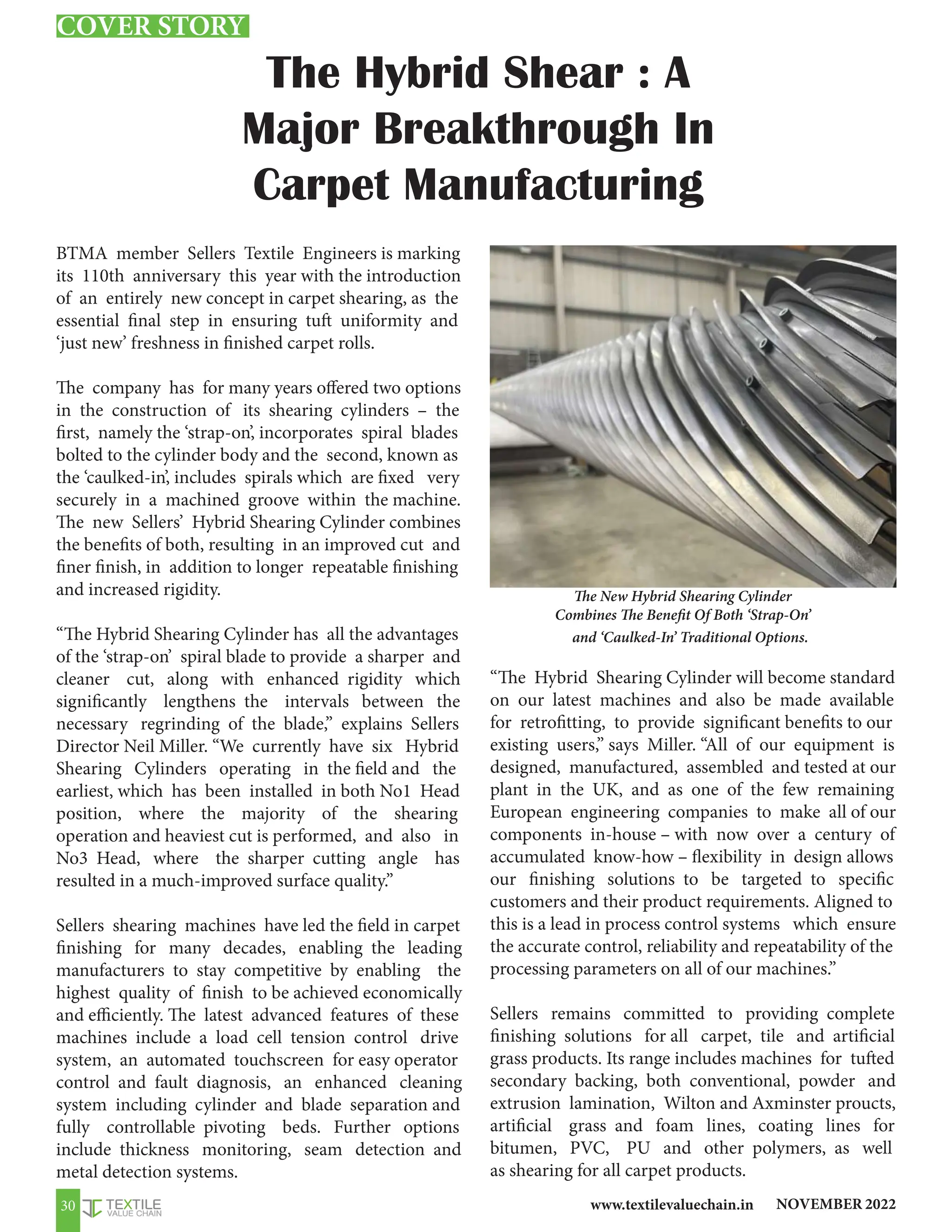
The New Hybrid Shearing Cylinder
Combines The Benefit Of Both ‘Strap-On’
and ‘Caulked-In’ Traditional Options.
COVER STORY
www.textilevaluechain.in
NOVEMBER 2022 31
Ongoing developments on the company’s coating and
drying lines have resulted in improved guiding and
product tension control as well as dryer efficiency,
reducing heat loss and optimising energy use.
These include a re-design of the fan pressure boxes
and impingement nozzles to increase airflow
efficiency, modulating gas burners and introducing
easy clean, accessible filters.
In addition, the proven dual zone system has been
enhanced, giving a temperature differential of up
to 80°C between top and bottom zones. Dryers can
be heated by either gas or steam and operation and
access have been simplified with controls via
touchscreen and PLC.
An extensive range of ancillary equipment is
available to provide maximum flexibility to cover
product requirements, for both new processing lines
and as upgrades to existing equipment. “Carpet
manufacturing is now based on well-established, tried
and trusted processes and it’s rare for new innovations
to be introduced into this sector,” says Jason Kent,
CEO of the British Textile Machinery Association.
“The new Sellers Hybrid Shearing Cylinder can
provide a competitive edge for manufacturers which is
currently being proven in the field. It’s one of a
number of new innovations the company is planning
to showcase at next year’s ITMA exhibition in Milan.”
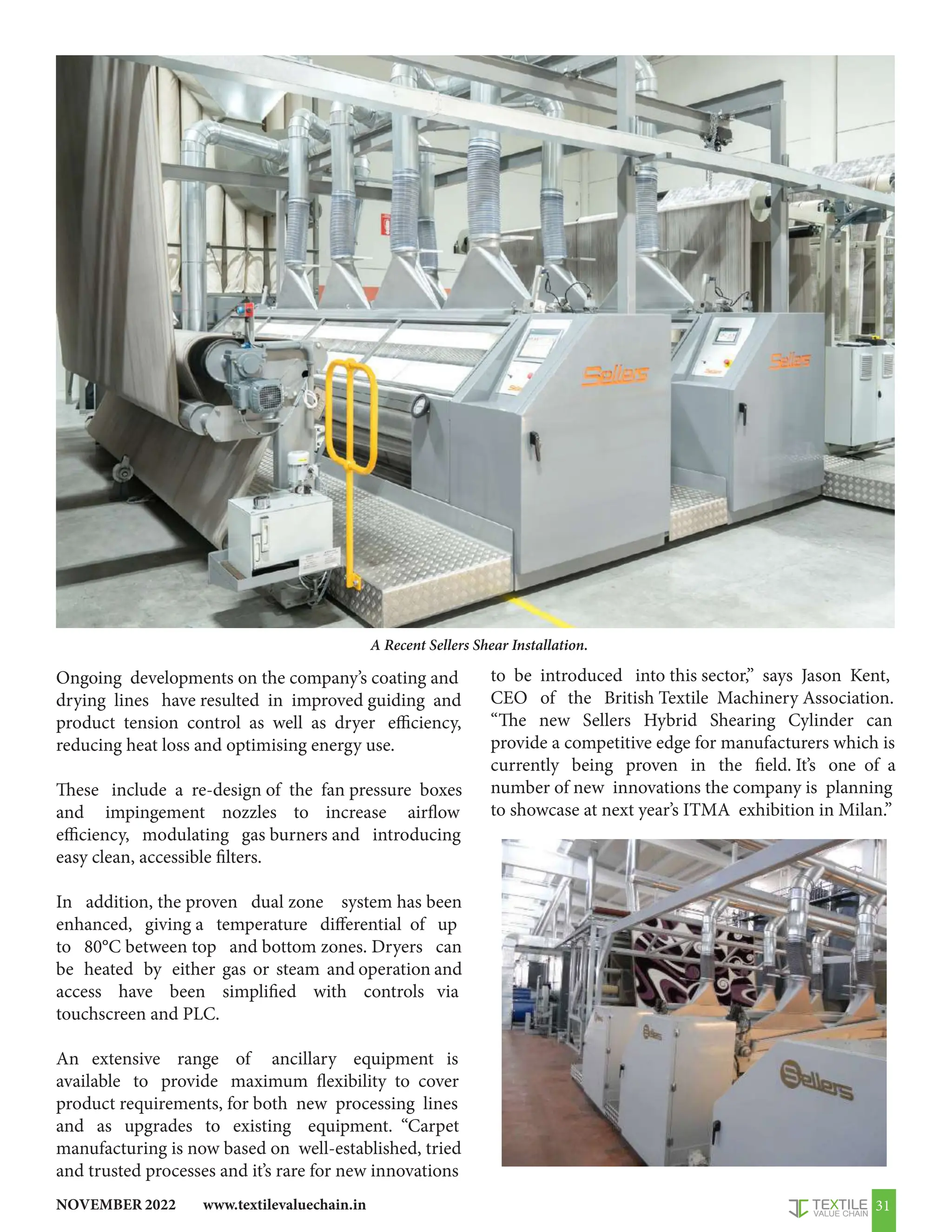
A Recent Sellers Shear Installation.
NOVEMBER 2022
www.textilevaluechain.in
32
www.textilevaluechain.in
NOVEMBER 2022 33
Italian Textile Machinery
Export To India Up 73%
Can you describe the past two years in regard to
Italy’s textile machinery industry, what with Covid 
other issues?
As for many others sectors, the textile machinery
industry came to a near halt in 2020, due to the Covid19
pandemic. However, as of 2021 our sector has
greatly recovered, engendering production levels that
have been even higher than those prior to the
pandemic.
How has performance been so far, considering that
2022 has shown signs of a global economic revival?
2022 has not yet ended, but we can already say that
the critical issues regarding the pandemic, as well as
the subsequent Ukraine/Russia conflict (higher energy
costs, scarcity of raw materials, etc.) will have negative
effects on production for the textile machinery sector
as a whole, and not just here in Italy.
Which segments have been most affected by these
critical issues?
The textile machinery sector is a high energy
consuming industry, therefore all areas have been
negatively affected by increased energy costs.
Specifically, how has trade fared with India?
India is a primary trading partner for Italian textile
machinery producers, with sales for the year 2021
amounting to 104 million euros - a sharp rise compared
to the previous year. For 2022 as well, our exports to
India were up significantly (+73%), amounting to 80
million euros, and confirming India’s position among
the top five foreign markets for Italy’s textile machinery
sector.
Can you let us in your various plans for this year
 next - considering that India-ITME is now just
around the corner?
ACIMIT’s promotional initiatives for 2022 and 2023
are highly focused on promoting Italy’s strong
contingent taking part in ITMA 2023. From now
until June 2023, we’re planning a series of delegations
for foreign textile business partners visiting Italy to
meet with Italian machinery and technology
manufacturers. Among them recently a delegation
included twenty or so textile manufacturing
entrepreneurs from India came to Italy. As for
previous editions of ITME, numerous Italian
companies will be in attendance at the exhibit.
Which countries are expected to contribute most to
Italian technology  machinery on a global scale?
For the coming two-year period, we expect demand
to grow both on global textile machinery markets, i.e.
China, Turkey, the United States and India, as well as in
other emerging markets. Among the latter, Uzbekistan
and Vietnam appear as potentially the most interesting.
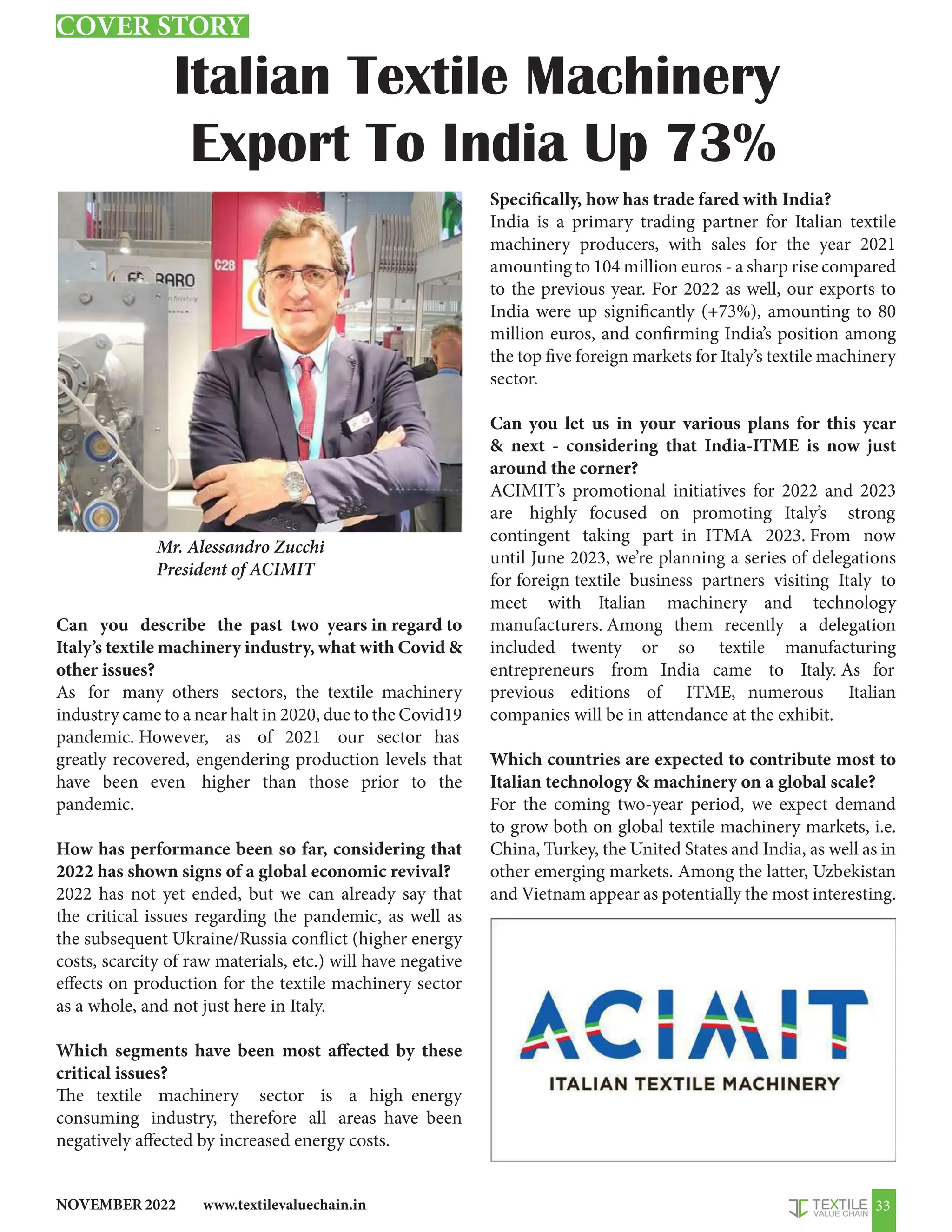
Mr. Alessandro Zucchi
President of ACIMIT
COVER STORY
www.textilevaluechain.in
NOVEMBER 2022 35
NOVEMBER 2022
www.textilevaluechain.in
36
Dilo Group To Focus On Needlefelts
In India-ITME 2022
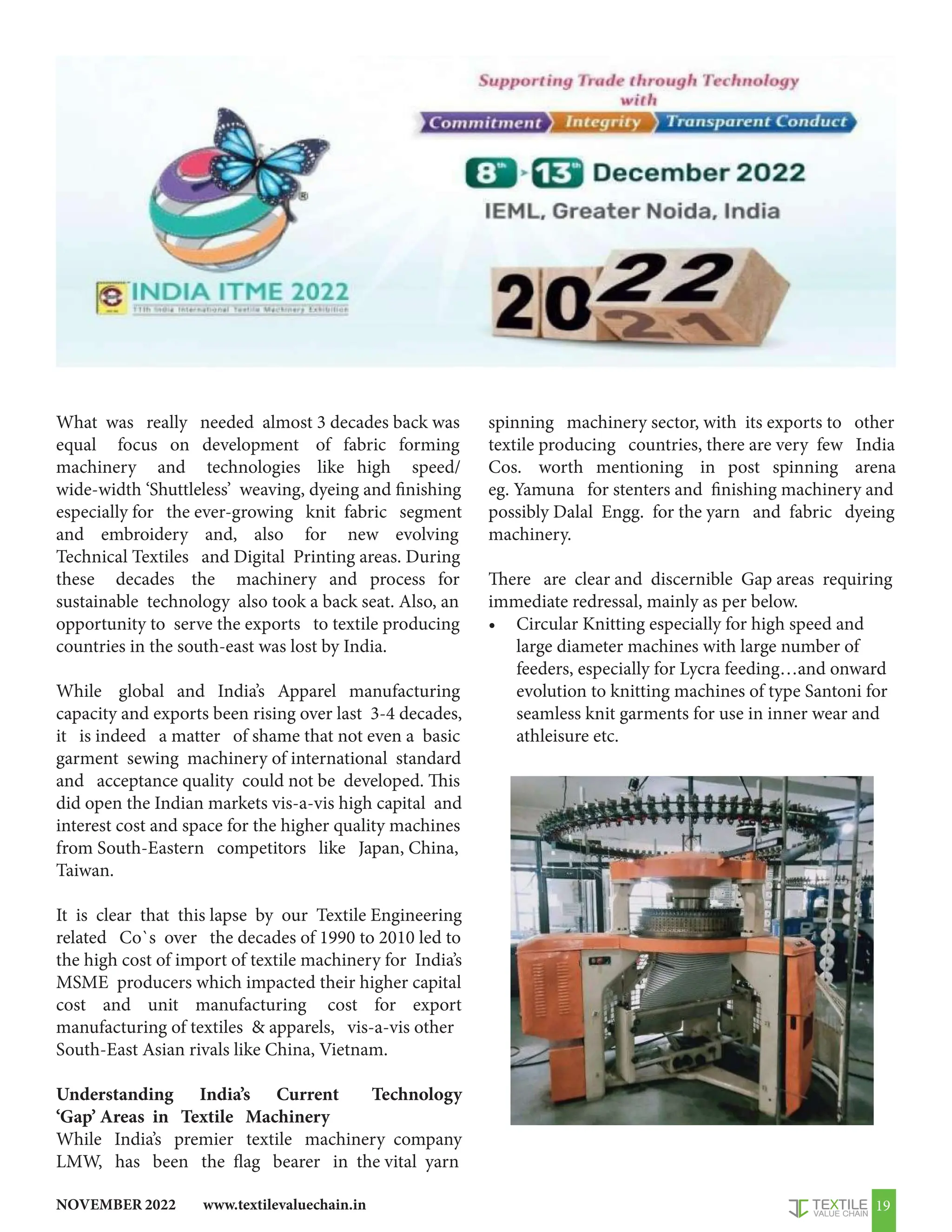
India ITME 2022 is an important exhibition for the
textile industry and thus offers a central forum for
dialogue within the textile production sector with
the relevant supply chain comprising textile machine
building, fibre production, ancillaries and accessories.
For DiloGroup this event is a good opportunity to
inform customers and interested parties about new
developments aimed at improving production
technologies with a focus on needlefelts. DiloGroup
will be participating in Hall 12 at Booth H12B23 at
India-ITME.
It becomes more evident that the textile industry comes
into the focus of regulatory authorities who push
respecting sustainability principles and who initiate a
new body of laws. Hence all industrial sectors are
requested to achieve savings in material and energy.
The textile machine building, of course, plays an
important role by seizing this initiative and offering
solutions for fibre pulp recycling and reduction of
energy, water and ancillaries. DiloGroup has made big
efforts to meet these challenges together with a circle
of partner companies. In this regard focal points of the
development work are:
1. Intense Needling
Needling per se is a mechanical production method
with a high energy efficiency. For this reason, the
development efforts of DiloGroup aim at producing
nonwovens by “intense needling” instead of water
entangling, even for light nonwovens made of fine
fibres for the medical and hygiene sector with an area
weight of 30 – 100 g/m². This would result in a
reduction of the environmentally relevant production
costs; per annum to about 1/3 to 1/5 of current.
Despite the prospective advantages of the mechanical
intense needling method over the hydrodynamical,
water entanglement is at the moment the most
important production method for low area weights and
highest production capacity and is also offered by the
DiloGroup as general contractor in cooperation with
partner companies.
2. “Fibre Pulp Recycling”
Fibrous material in nonwovens and particularly used
clothes can be successfully recycled, if staple length
can be conserved in the tearing process. In the classical
tearing process, staple lengths are dramatically reduced
and therefore these fibres can only be used as base
material for inferior uses in thermal or acoustic
insulation or in protective textiles, transportation or
protective covers etc.
When recycling textile waste in the context of the
collection of used clothes, the so called “filament-
saving” tearing using special tearing machines and
methods must be used to produce fibres with longer
staple lengths which can be fed to a nonwoven
installation. Hence product characteristics can be
better specified and controlled.
3. Additive nonwoven production
The additive production method of the “3D-Lofter” is
especially suited for automotive parts with differently
distributed masses; but there may also be potential for
increasing uses in the sector of apparel and shoe
production.
PREVIEW : ITME 2022
www.textilevaluechain.in
NOVEMBER 2022 37
4. “IsoFeed”-card feeding
In the field of card feeding, the “IsoFeed” method offers
great potential for a more homogeneous card feeding at
the same time reducing the variation in cross-machine
fibre mass distribution and thus the fibre consumption
while conserving the end product quality.
DiloGroup would like to discuss the above mentioned
developments of needling technology as well as
modules of Industry 4.0 applications for further
digitalization during the Techtextil exhibition. We will,
of course, also inform about the numerous universal
and special applications of the complete nonwovens
technology.
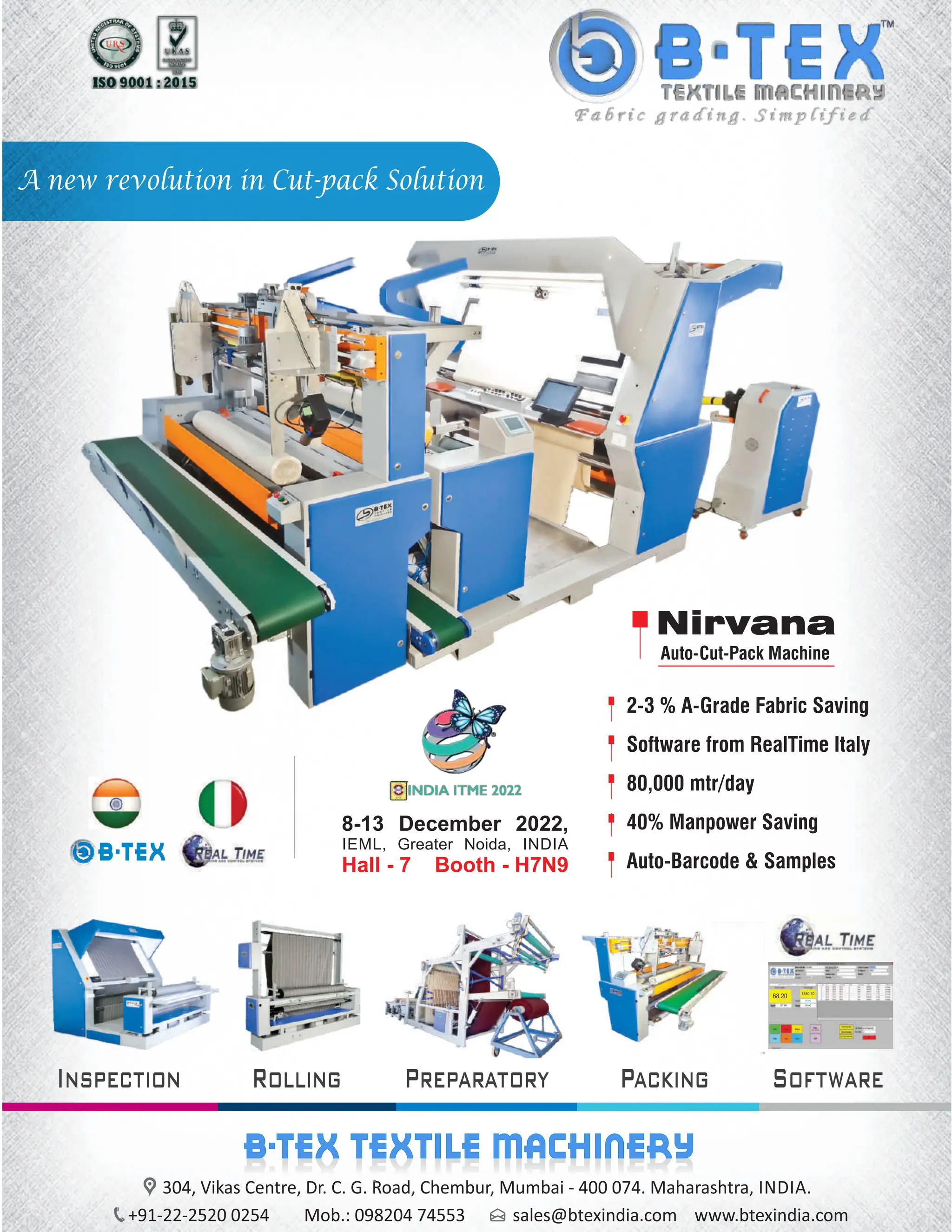
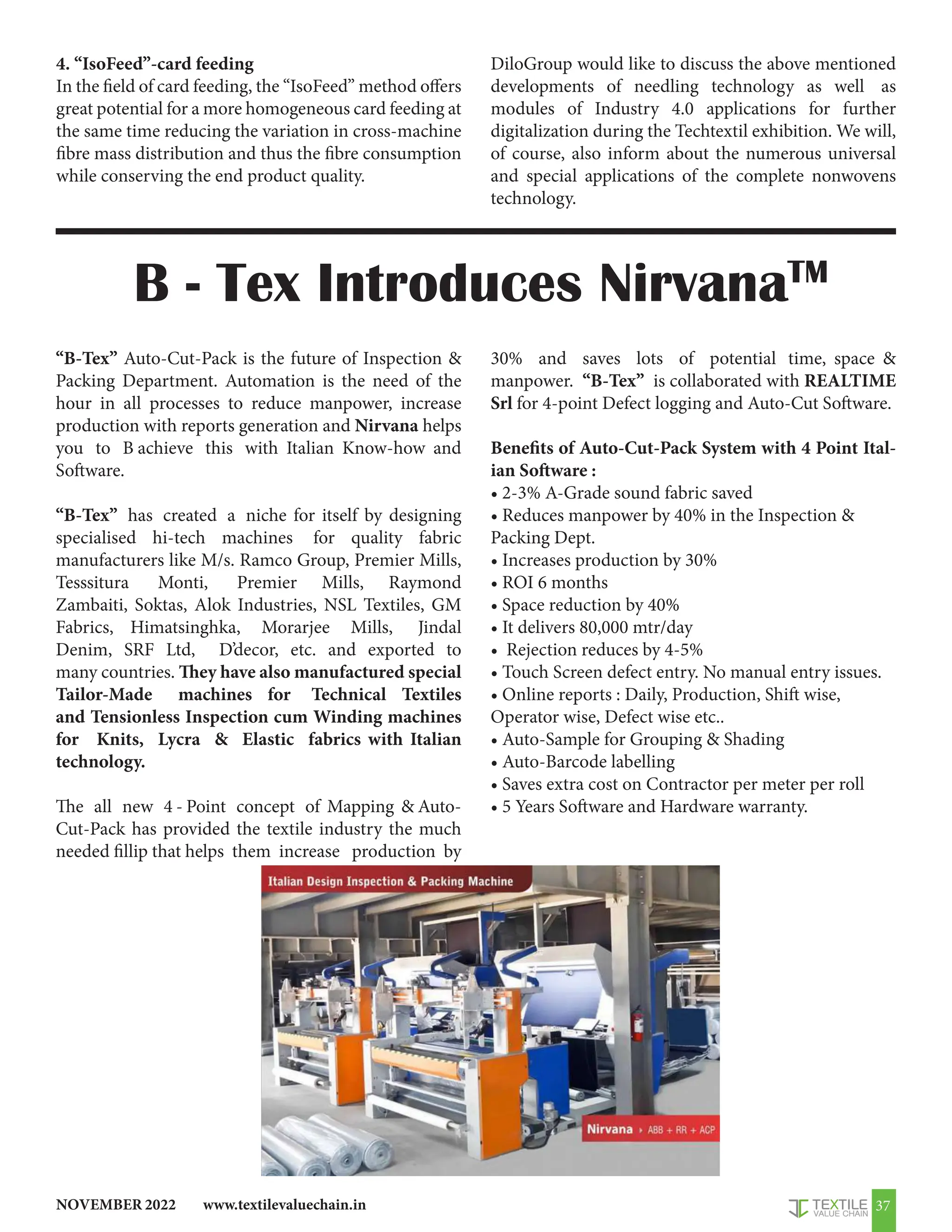
“B-Tex” Auto-Cut-Pack is the future of Inspection 
Packing Department. Automation is the need of the
hour in all processes to reduce manpower, increase
production with reports generation and Nirvana helps
you to B achieve this with Italian Know-how and
Software.
“B-Tex” has created a niche for itself by designing
specialised hi-tech machines for quality fabric
manufacturers like M/s. Ramco Group, Premier Mills,
Tesssitura Monti, Premier Mills, Raymond
Zambaiti, Soktas, Alok Industries, NSL Textiles, GM
Fabrics, Himatsinghka, Morarjee Mills, Jindal
Denim, SRF Ltd, D’decor, etc. and exported to
many countries. They have also manufactured special
Tailor-Made machines for Technical Textiles
and Tensionless Inspection cum Winding machines
for Knits, Lycra  Elastic fabrics with Italian
technology.
The all new 4 - Point concept of Mapping  Auto-
Cut-Pack has provided the textile industry the much
needed fillip that helps them increase production by
30% and saves lots of potential time, space 
manpower. “B-Tex” is collaborated with REALTIME
Srl for 4-point Defect logging and Auto-Cut Software.
Benefits of Auto-Cut-Pack System with 4 Point Ital-
ian Software :
• 2-3% A-Grade sound fabric saved
• Reduces manpower by 40% in the Inspection 
Packing Dept.
• Increases production by 30%
• ROI 6 months
• Space reduction by 40%
• It delivers 80,000 mtr/day
• Rejection reduces by 4-5%
• Touch Screen defect entry. No manual entry issues.
• Online reports : Daily, Production, Shift wise,
Operator wise, Defect wise etc..
• Auto-Sample for Grouping  Shading
• Auto-Barcode labelling
• Saves extra cost on Contractor per meter per roll
• 5 Years Software and Hardware warranty.
B - Tex Introduces NirvanaTM
NOVEMBER 2022
www.textilevaluechain.in
38
www.textilevaluechain.in
NOVEMBER 2022 39
India ITME 2022: Rieter
Strengthens Success
of Spinning Mills
Rieter is presenting the latest innovations in its
systems, components and services at the upcoming
India ITME 2022 in Uttar Pradesh (India), taking
place from December 8 – 13, 2022. The company’s
technology portfolio is designed to help customers
succeed in markets shaped by rising energy and raw
material costs. Visit Rieter at INDIA ITME 2022 : Hall
10 at booth H10C11.
Autoconer X6 – Key Machine for Highest Efficiency
The automatic winding machine Autoconer X6
perfectly completes the Rieter ring and compact-
spinning systems. The machine serves as the final
quality assurance in the ring and compact-spinning
process and is key to the performance of the
subsequent process stages. The Multilink system with
Multilot offers maximum flexibility to handle a
different type of yarn.
The latest splicer generation OZ1 and OZ2 provides an
optimum splice quality based on an open prism. With
only two prisms spinning mills can splice the entire
spectrum of cotton yarns as well as blends. They are
also used for the splicing of cotton-based elastic core
yarns in combination with the Elastosplicer. The splice
zone exhibits an impressive elasticity in the fabric.
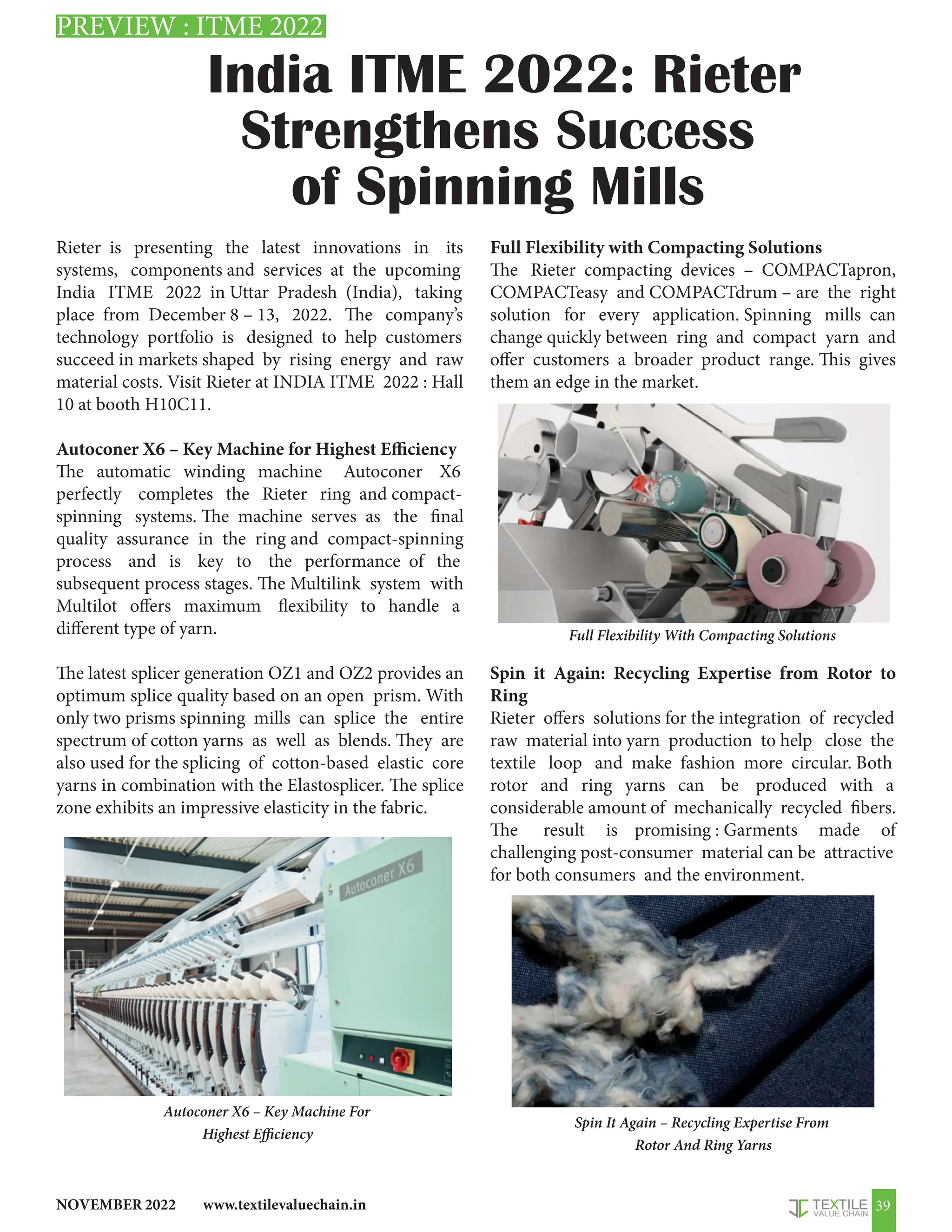
Autoconer X6 – Key Machine For
Highest Efficiency
Full Flexibility with Compacting Solutions
The Rieter compacting devices – COMPACTapron,
COMPACTeasy and COMPACTdrum – are the right
solution for every application. Spinning mills can
change quickly between ring and compact yarn and
offer customers a broader product range. This gives
them an edge in the market.
Spin it Again: Recycling Expertise from Rotor to
Ring
Rieter offers solutions for the integration of recycled
raw material into yarn production to help close the
textile loop and make fashion more circular. Both
rotor and ring yarns can be produced with a
considerable amount of mechanically recycled fibers.
The result is promising : Garments made of
challenging post-consumer material can be attractive
for both consumers and the environment.
Full Flexibility With Compacting Solutions
Spin It Again – Recycling Expertise From
Rotor And Ring Yarns
PREVIEW : ITME 2022
NOVEMBER 2022
www.textilevaluechain.in
40
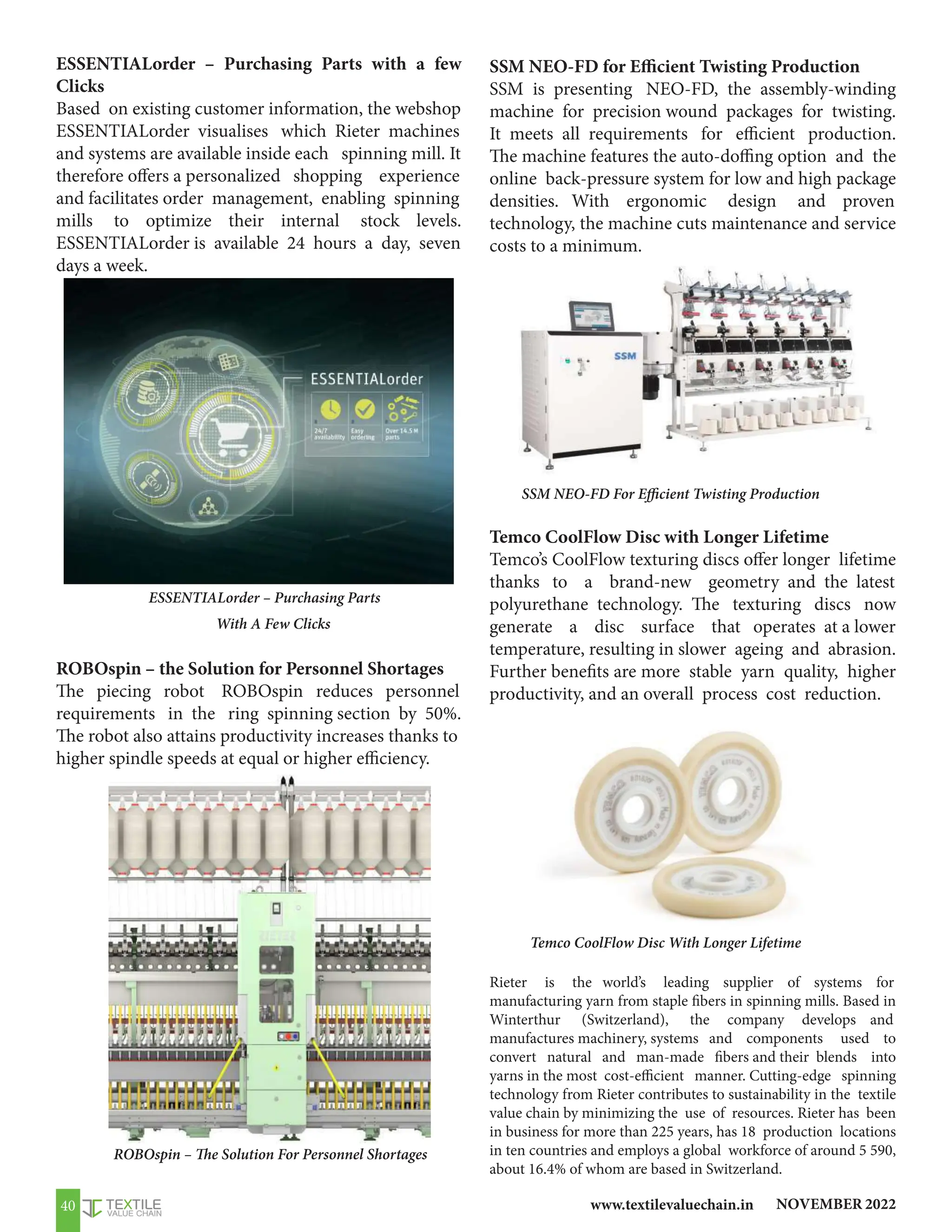
ESSENTIALorder – Purchasing Parts with a few
Clicks
Based on existing customer information, the webshop
ESSENTIALorder visualises which Rieter machines
and systems are available inside each spinning mill. It
therefore offers a personalized shopping experience
and facilitates order management, enabling spinning
mills to optimize their internal stock levels.
ESSENTIALorder is available 24 hours a day, seven
days a week.
ROBOspin – the Solution for Personnel Shortages
The piecing robot ROBOspin reduces personnel
requirements in the ring spinning section by 50%.
The robot also attains productivity increases thanks to
higher spindle speeds at equal or higher efficiency.
ESSENTIALorder – Purchasing Parts
With A Few Clicks
SSM NEO-FD for Efficient Twisting Production
SSM is presenting NEO-FD, the assembly-winding
machine for precision wound packages for twisting.
It meets all requirements for efficient production.
The machine features the auto-doffing option and the
online back-pressure system for low and high package
densities. With ergonomic design and proven
technology, the machine cuts maintenance and service
costs to a minimum.
Temco CoolFlow Disc with Longer Lifetime
Temco’s CoolFlow texturing discs offer longer lifetime
thanks to a brand-new geometry and the latest
polyurethane technology. The texturing discs now
generate a disc surface that operates at a lower
temperature, resulting in slower ageing and abrasion.
Further benefits are more stable yarn quality, higher
productivity, and an overall process cost reduction.
Rieter is the world’s leading supplier of systems for
manufacturing yarn from staple fibers in spinning mills. Based in
Winterthur (Switzerland), the company develops and
manufactures machinery, systems and components used to
convert natural and man-made fibers and their blends into
yarns in the most cost-efficient manner. Cutting-edge spinning
technology from Rieter contributes to sustainability in the textile
value chain by minimizing the use of resources. Rieter has been
in business for more than 225 years, has 18 production locations
in ten countries and employs a global workforce of around 5 590,
about 16.4% of whom are based in Switzerland.
SSM NEO-FD For Efficient Twisting Production
Temco CoolFlow Disc With Longer Lifetime
ROBOspin – The Solution For Personnel Shortages
NOVEMBER 2022
www.textilevaluechain.in
42
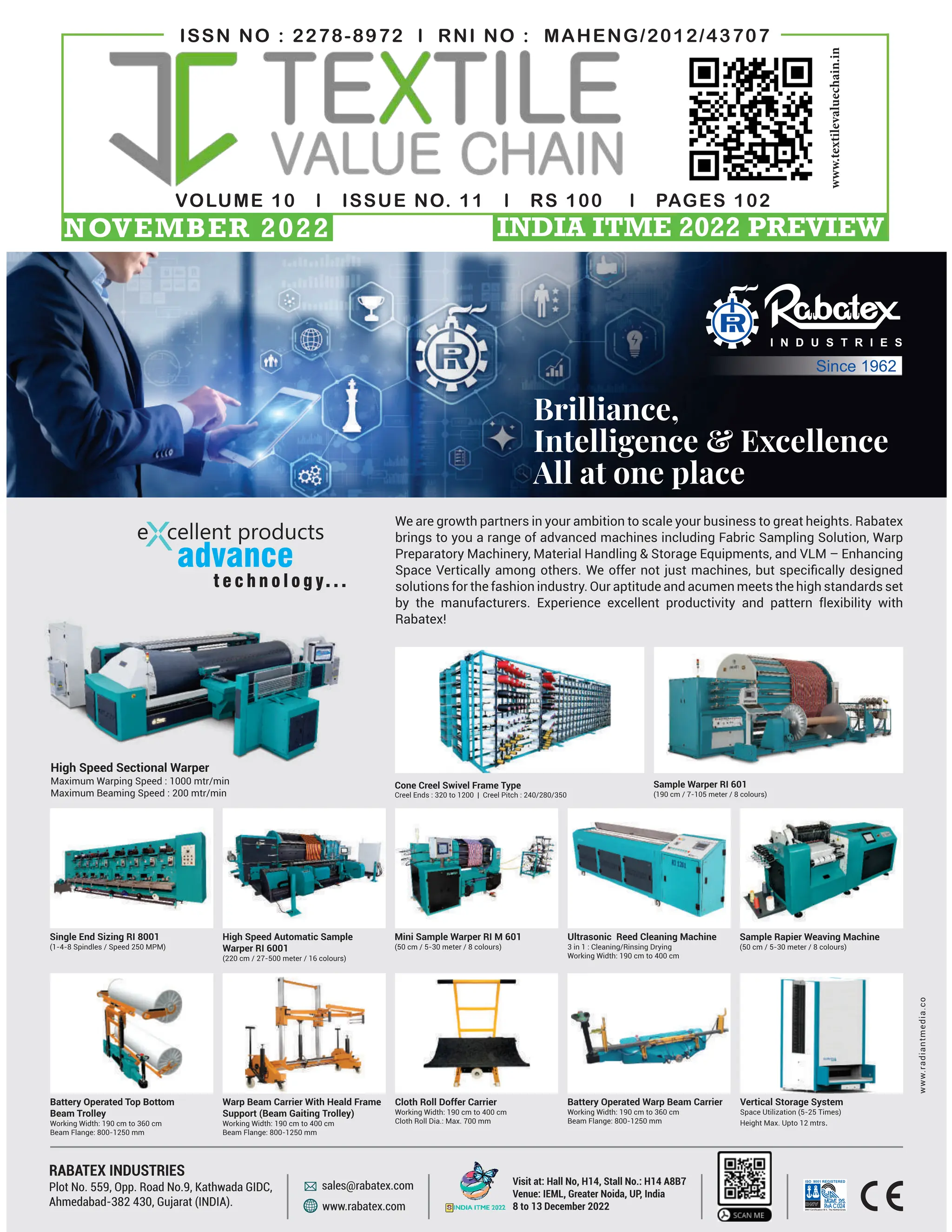
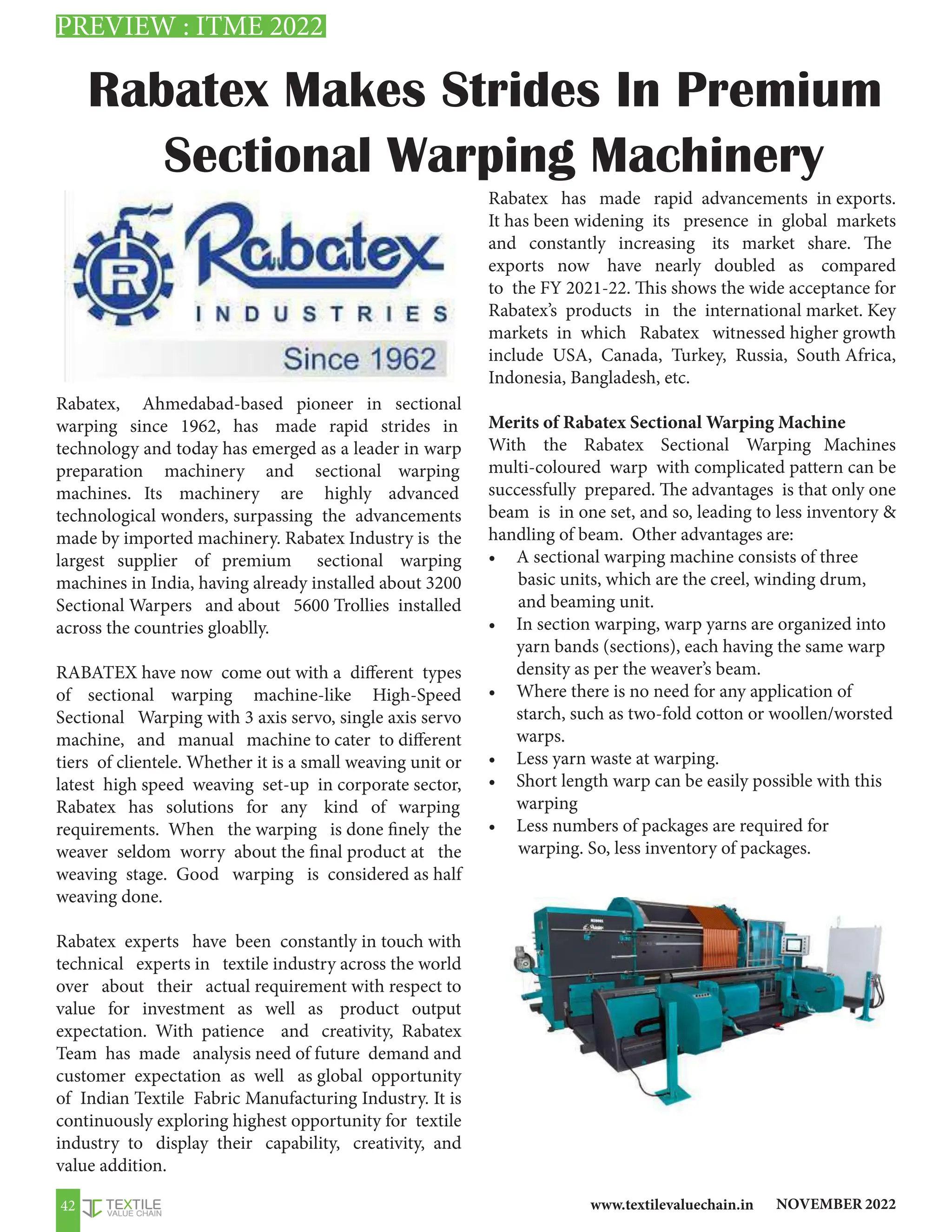
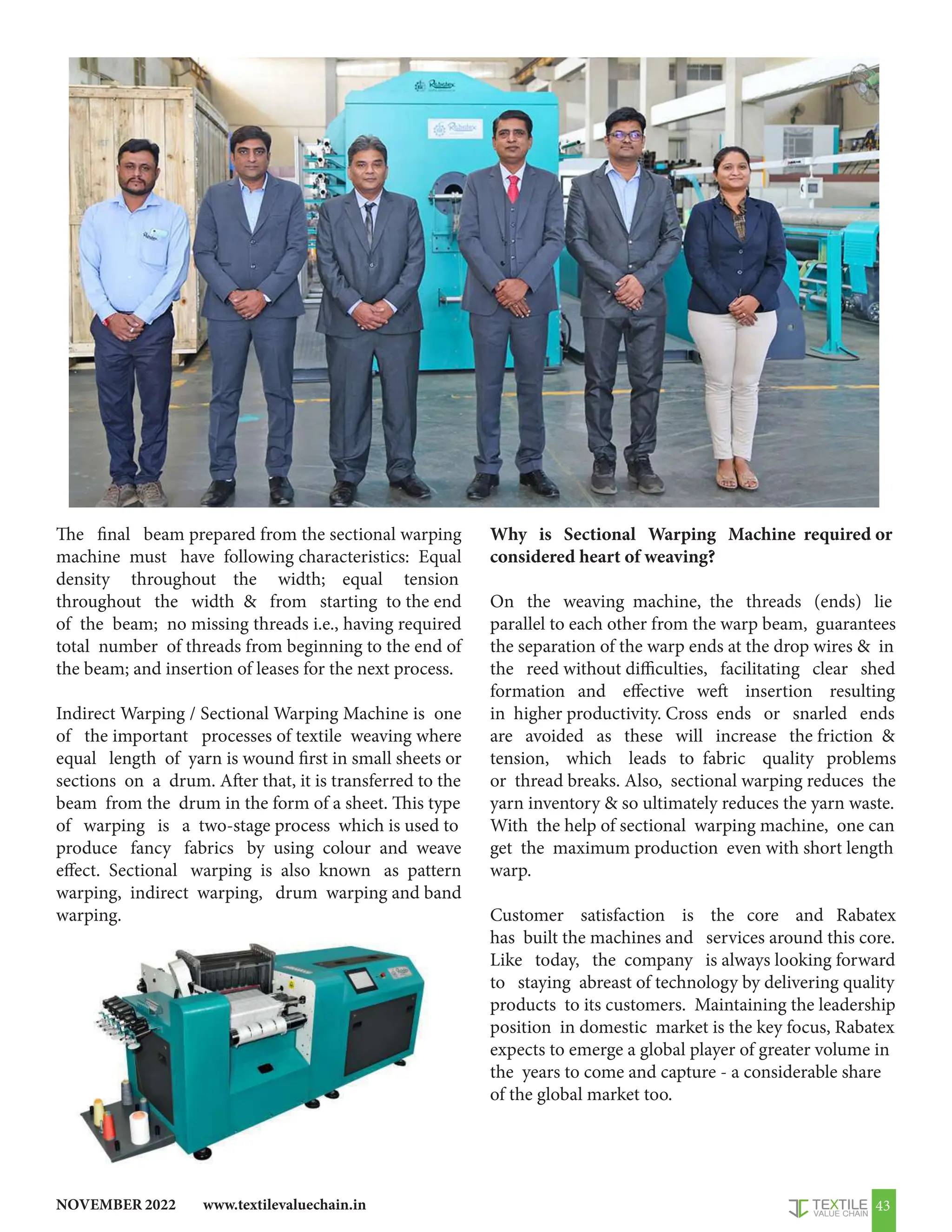
Rabatex, Ahmedabad-based pioneer in sectional
warping since 1962, has made rapid strides in
technology and today has emerged as a leader in warp
preparation machinery and sectional warping
machines. Its machinery are highly advanced
technological wonders, surpassing the advancements
made by imported machinery. Rabatex Industry is the
largest supplier of premium sectional warping
machines in India, having already installed about 3200
Sectional Warpers and about 5600 Trollies installed
across the countries gloablly.
RABATEX have now come out with a different types
of sectional warping machine-like High-Speed
Sectional Warping with 3 axis servo, single axis servo
machine, and manual machine to cater to different
tiers of clientele. Whether it is a small weaving unit or
latest high speed weaving set-up in corporate sector,
Rabatex has solutions for any kind of warping
requirements. When the warping is done finely the
weaver seldom worry about the final product at the
weaving stage. Good warping is considered as half
weaving done.
Rabatex experts have been constantly in touch with
technical experts in textile industry across the world
over about their actual requirement with respect to
value for investment as well as product output
expectation. With patience and creativity, Rabatex
Team has made analysis need of future demand and
customer expectation as well as global opportunity
of Indian Textile Fabric Manufacturing Industry. It is
continuously exploring highest opportunity for textile
industry to display their capability, creativity, and
value addition.
Rabatex has made rapid advancements in exports.
It has been widening its presence in global markets
and constantly increasing its market share. The
exports now have nearly doubled as compared
to the FY 2021-22. This shows the wide acceptance for
Rabatex’s products in the international market. Key
markets in which Rabatex witnessed higher growth
include USA, Canada, Turkey, Russia, South Africa,
Indonesia, Bangladesh, etc.
Merits of Rabatex Sectional Warping Machine
With the Rabatex Sectional Warping Machines
multi-coloured warp with complicated pattern can be
successfully prepared. The advantages is that only one
beam is in one set, and so, leading to less inventory 
handling of beam. Other advantages are:
• A sectional warping machine consists of three
basic units, which are the creel, winding drum,
and beaming unit.
• In section warping, warp yarns are organized into
yarn bands (sections), each having the same warp
density as per the weaver’s beam.
• Where there is no need for any application of
starch, such as two-fold cotton or woollen/worsted
warps.
• Less yarn waste at warping.
• Short length warp can be easily possible with this
warping
• Less numbers of packages are required for
warping. So, less inventory of packages.
Rabatex Makes Strides In Premium
Sectional Warping Machinery
PREVIEW : ITME 2022
www.textilevaluechain.in
NOVEMBER 2022 43
The final beam prepared from the sectional warping
machine must have following characteristics: Equal
density throughout the width; equal tension
throughout the width  from starting to the end
of the beam; no missing threads i.e., having required
total number of threads from beginning to the end of
the beam; and insertion of leases for the next process.
Indirect Warping / Sectional Warping Machine is one
of the important processes of textile weaving where
equal length of yarn is wound first in small sheets or
sections on a drum. After that, it is transferred to the
beam from the drum in the form of a sheet. This type
of warping is a two-stage process which is used to
produce fancy fabrics by using colour and weave
effect. Sectional warping is also known as pattern
warping, indirect warping, drum warping and band
warping.
Why is Sectional Warping Machine required or
considered heart of weaving?
On the weaving machine, the threads (ends) lie
parallel to each other from the warp beam, guarantees
the separation of the warp ends at the drop wires  in
the reed without difficulties, facilitating clear shed
formation and effective weft insertion resulting
in higher productivity. Cross ends or snarled ends
are avoided as these will increase the friction 
tension, which leads to fabric quality problems
or thread breaks. Also, sectional warping reduces the
yarn inventory  so ultimately reduces the yarn waste.
With the help of sectional warping machine, one can
get the maximum production even with short length
warp.
Customer satisfaction is the core and Rabatex
has built the machines and services around this core.
Like today, the company is always looking forward
to staying abreast of technology by delivering quality
products to its customers. Maintaining the leadership
position in domestic market is the key focus, Rabatex
expects to emerge a global player of greater volume in
the years to come and capture - a considerable share
of the global market too.
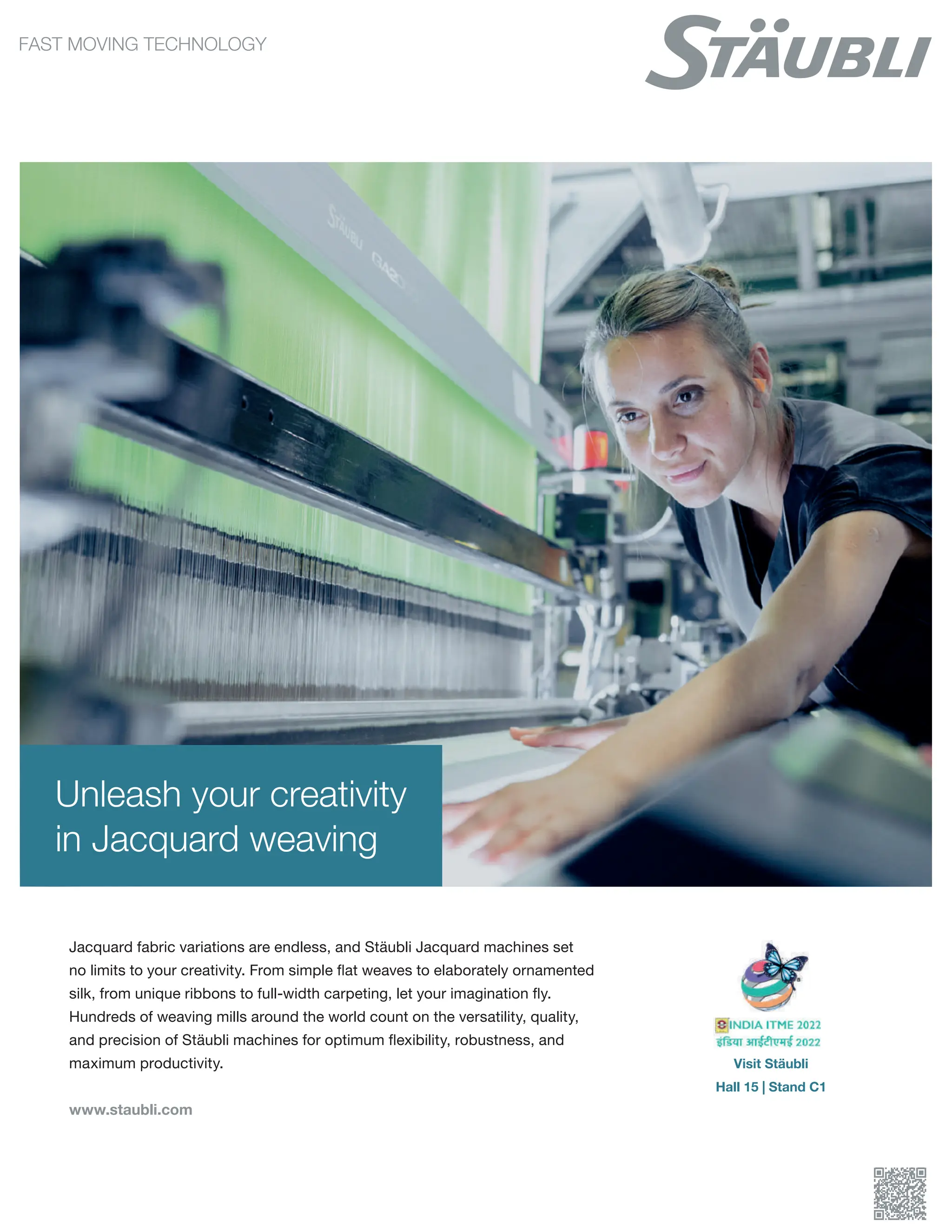
Unleash your creativity
in Jacquard weaving
Jacquard fabric variations are endless, and Stäubli Jacquard machines set
no limits to your creativity. From simple flat weaves to elaborately ornamented
silk, from unique ribbons to full-width carpeting, let your imagination fly.
Hundreds of weaving mills around the world count on the versatility, quality,
and precision of Stäubli machines for optimum flexibility, robustness, and
maximum productivity.
www.staubli.com
Visit Stäubli
Hall 15 | Stand C1
www.textilevaluechain.in
NOVEMBER 2022 45
Stäubli At India ITME 2022 With
Latest Jacquard Technology
PREVIEW : ITME 2022
Taking place in its 11 th edition from December
8-13, 2022, the India ITME trade fair has over the
decades become an institutional place to be for any
technology provider to the Indian textile producing
industry.India is among the world leading sourcing
countries for textiles and has a great hub of versatile
actors covering the whole textile processing chain.
India ITME 2022 gives the Indian actors an occasion
to come together, discover latest solutions for
processing textiles and meet with their machinery
suppliers. Stäubli will be presenting its latest
high-end technologies, machinery, and solutions
that offer greater benefits to the weaving mills at
booth n° C1/ H15, including novelties in Jacquard
weaving.
When it comes to weaving Jacquard fabrics, from
narrow to large format and for applications reaching
from technical fabrics to apparel fabic, such as Saari, or
home textiles, Stäubli is a renowned leading supplier to
the weaving mills worldwide, and as well in India.
Fairly difficult to imagine a Jacquard weaving mill
without a solution from Stäubli. higher power
efficiency, Highest production speeds, minimum
vibration thanks to optimum balanced kinematics, the
NOEMI electronic architecture that stands for utmost
reliable data transmission, and the lately launched MX
PRO modules providing energy savings and
reliable hook selection for all kinds of woven fabric,
make Stäubli Jacquard machines a vital element in
weaving mills searching for productivity and quality.
Visitors to the Stäubli booth may look forward to
discovering latest Jacquard technology and learn
detailed information on solutions that will make them
step further towards increasingly sustainable
production.
High - speed frame weaving solutions with low
maintenance transmissions
The transmission is a vital link in the frame-weaving
installation, more precisely between the shed forming
solution and the weaving machine. These
transmissions handle a great many loads and forces.
Dedicated to continuous improvement, Stäubli has
further developed its range of transmissions and now
offers the e32/33 for low-mounted dobbies and cam
motions, and the de82/83 for top-mounted dobbies.
With sealed and patterned bearings, these new
transmissions reduce the need for maintenance and
enhance the performance of the overall installation,
was it weaving machines operating with electronic
rotary dobbies, such as the S3000 / S3200 electronic
rotary dobby series or with cam motions such as the
S1792 model. At the booth visitors can see latest frame
weaving solutions and make themselves a picture of the
operational behaviour and running speeds.
Stäubli warp tying solutions for any kind of yarn,
from silk to wool and pp tapes
A crucial process in many weaving mills is warp tying.
Stäubli is presenting the TOPMATIC model for very
fine yarns, and its latest warp tying solution, the
TIEPRO model. This machine has, since its
introduction in 2019, convinced many knotting
specialists with its ease in use and the fact that it does
not require any oilbath, maintenance nor spare parts.
Thus the machine ensures continued availability in
the mill and continued production thanks to perfectly
knotted warps without deflected yarns. In addition to
an easy start up and processing of the warp to be tied,
wew staff can easily learn how to run the machine as
the screen guides the operator. A standalone advantage
of the TIEPRO tying machine is that if a double end
is detected, the machine with its exclusive auto-reverse
function automatically reverses and redoes that yarn
separation step. This process takes place before the yarn
is cut, a unique outstanding feature that supports
quality fabric weaving.
NOVEMBER 2022
www.textilevaluechain.in
46
BD rotor-spinning
technology
Spinning recycled yarns
Saurer is in an excellent position to process recycled
fibres with the market leader Autocoro in the fully
automated market segment and the BD product series
in the semi-automated market segment.
With a large number of customers worldwide already
spinning recycled fibres with Autocoro and BD, Saurer
is your competent partner for extending your portfolio
into recycled yarns.
saurer.com
NOVEMBER 2022
www.textilevaluechain.in
48
MOHLER’S MANTRA
CUSTOMER FIRST
MOHLER MACHINE WORKS PVT. LTD (MMW).,
Coimbatore is one of the leading manufacturers and
the largest exporter of Overhead Travelling
Cleaners, Yarn Conditioning Plant and Bobbin
Transport System in INDIA. Launched in the year
2008, BRAND MOHLER, is very popular in
countries Turkey and Bangladesh, Thalland, Indonesia
and many more. Mohler is also day by day increasing
their market share in India. Slowly it is turning to
be the preferred choice of machinery by most of the
textile mills in India.
The technical knowledge of founding member Mr.V.
Balasubramanian, Textile Technologist, along with the
experience of Mr. V.Benny Jerald, Mechanical
Engineer, for more than 20 years, is the main cause for
the development of “MOHLER” products which are
best in its class.
“MOHLER” products are at par with any European
make since they are produced from quality inputs
like Tata Steel, Lapp Cable, FAG Bearings, Siemens /
Beckhoff PLC Control Systems, Siemens / Schneider
make Switch Gears, WHICH SPEAK THE QUALITY
and processed / fabricated by using the Laser cutting
machine, CNC Turret Punch, NC Bending Machine,
State of Art Nine Tank Powder Coating process, MIG
Welding.
Mohler has been strongly growing their presence in
the Indian market as the products are installed in
all the leading names in spinning and weaving units
in India and abroad. Mohler products are not only
preferred choice of most textile customers but also of
leading OEMs.
Over the years the Mohler has been growing steadily
due to the quality product and the unmatched services
extended by them. More than 50% of the total
turnover is from exports which speaks about the
quality and performance of the product line. Today
Mohler
The present infrastructure, with its 15,000 square feet
sprawling and most modern facilitiy, is located in
Coimbatore. With a systematic approach to research
and development, the team of highly experienced staff
members thrive to bring new and innovative features
with unmatched dedication.
MOHLER MANAGEMENT has one MANTRA – Be
Customer Centric by delivering quality products,
on time delivery and with prompt after sales and
service.
With the immense success in overseas market, Mohler
now will give a focused attention to cater to the
needs of the domestic market in India.
MMW will be proudly launching new products at Hall
no 11 Stall no 22 in the forthcoming INDIA ITME
2022 exhibition which is to be held from 8 to 13
December 2022 at IEML, Greater Noida.
PREVIEW : ITME 2022
www.textilevaluechain.in
NOVEMBER 2022 49
INNOVATION:
IT’S IN
OUR DNA
www.swisstextilemachinery.ch
Invented in Switzerland.
Where the same innovative spirit drives textile progress today.
Vevey, Switzerland, 1819:
François-Louis Cailler invents the
now-familiar tablet format for
chocolate. His simple idea makes
chocolate available and affordable
worldwide. Today, one billion Swiss-
made chocolate bars are produced
each year.
NOVEMBER 2022
www.textilevaluechain.in
50
Traditionally, India is known for its rich legacy in textiles.
Cotton textiles is one of the key traded commodities.
Also, the silk industry propelled India into the international
trade market. It was one of the driving forces that has etched
the country’s name in the global clothing and apparel map.
According to IBEF, the Indian textile and apparel industry
is expected to grow at 10% CAGR from
2019-20 to reach $ 190 billion by 2025-26. India has a 4%
share of the global trade in textiles and apparel. A sizable
segment of the textile industry concentrates on exports. The
numbers back their claim. In FY22, India’s textile
and apparel exports (including handicrafts) stood at
$ 44.4 billion—an impressive 41% YoY increase.
This energy-intensive
industry has deep
roots and is spread
across the length and
breadth of the coun-
try. It is estimated
that the textile seg-
ment employs over
4.5 crore people, the
second largest em-
ployment provider in
the country. It con-
tributes about 2% to
India’s GDP.
A clean energy powered industry
The textile industry has been one of the early adopters of
renewable energy in India. It has contributed significantly
to the growth of renewable energy (mostly wind
installations). However, with the growth of the solar
ecosystem, the segment is seeing increased adoption of solar
power as well.
Many factors propel the adoption of solar energy in textile
manufacturing, majorly the policies and initiatives
announced by the Ministry of Power and Ministry of New
and Renewable Energy.
For one, the Ministry of Textiles has proposed a solar
energy scheme for the development and up-gradation of the
power-loom sector in the country. Under this scheme, the
Government will assist in installing solar power plants to
address power shortage issues.
Secondly, decentralized power looms and knitting segments
are the key pillars of the industry. The top textile producing
states of the country include Maharashtra, Gujarat, Tamil
Nadu, Uttar Pradesh, Karnataka, Madhya Pradesh, Rajasthan,
and West Bengal. These states have abundant access to natural
sunlight. Little doubt then that these states are pioneering
the use of solar energy in the textile segment.
A labor - intensive industry driven by volumes, textile
consumes a large quantity of natural resources
including power. That makes it all the more important for
the industry to shift towards renewable energy.
Key Challenges
Being dominated by
unorganized players,
a lack of awareness is
the major challenge.
Also, lack of rooftops
where solar panels can
be mounted is anoth-
er major roadblock. It
is critical to create the
right kind of awareness
among stakeholders and
explain the cost effec-
tiveness of going solar as
most of the investments
are covered under various subsidy schemes offered by both
central and state governments.
Like any other manufacturing segment, textile should also
adopt sustainable routes. As they say, energy saved is equal
to power generated. Efficiency improvement is also
imperative. This translates to effective use of technology
for optimal energy consumption and increased usage
of renewable energy.
This where the platforms like The smarter E India /
Intersolar India 2022 show comes into the picture.
Scheduled from 7 - 9 December 2022 at Gandhinagar,
Gujarat, this is one of the best opportunities for all the
textile stakeholders to visit and discuss various avenues
to adopt solar power.
Sustainability and Solar…
50 Percent Renewable Energy Across Own Operations
SUSTANABILITY
www.textilevaluechain.in
NOVEMBER 2022 51
NOVEMBER 2022
www.textilevaluechain.in
52
ABFRL adopts sustainability 2.0 through solar
Aditya Birla Fashion and Retail Ltd (ABFRL), a part of the
global conglomerate Aditya Birla Group, in the league of
Fortune 500 corporates, has instituted a Sustainability
2.0 agenda.
One of the pioneers in the apparel retail segment to draw and
augment a material circularity roadmap, ABFRL has placed
equal focus on renewable energy—largely solar power.
Mr Naresh Tyagi, Chief Sustainability Officer, AFBRL,
elucidates, “Over the years, we have adopted a
pragmatic approach to increase our share of renewable
energy through solar rooftops and biomass-based
briquettes. Along with the SRT PV system, we have
leveraged biomass and wood as fuel across our boilers.”
What started as a task for resource efficiency, has
culminated into a full-scale project to optimize natural
resources. As the company pursues the pathway toward
Sustainability 2.0, the focus will increase on recycling,
circularity, and the agenda to meet Net Zero targets.
For instance, for energy efficiency, ABFRL has
implemented initiatives like optimum internal and
external lighting, installation of LED lights, VFDs and
efficient equipment. “We have designed new facilities and
stores embracing green concepts. These initiatives yielded
a year-on-year reduction of 4% in energy intensity at a
garment manufacturing level,” Mr Tyagi informs.
In addition to the ongoing efforts, in FY22, ABFRL signed a
Power Purchase Agreement (PPA) of around 1 MW of
additional solar rooftop systems across 4 more facilities
which are currently heading towards the installation
and commissioning phase. With this increase of solar
energy, the company’s portfolio of SRT PV systems will
reach 3 MW, enhancing its renewable energy share.
Besides, ABFRL conducted a third-party assessment to
identify hotspots and potential areas of intervention to
reduce energy consumption and enhance the share of clean
energy in the fiscal year.
The company’s IGBC certified facilities (LBRD
Warehouse, Attibele) participated in a performance
challenge under ‘Warehouse Building’ category.
“Presently, the warehouse contributes to more than 2.3 lakh
kWh of electricity generated from the Solar PV system in
our annual energy consumption, thus avoiding more
than 185 tonnes of CO2 every year.”
“Going forward, we envisage progress in this area by
striving towards Net Zero Building rating systems i.e., both
Net Zero Water Building (NZWB) and Net Zero Energy
Building (NZEB) across the built environment. What is
unique is that the NZEB and NZWB concepts align with
IGBC and USGBC rating systems to achieve the goal of
Net-Zero operations,” states Mr Tyagi.
Salient features of Net Zero Energy Buildings:
1. Improvement in energy efficiency and reduction in
annual energy consumption by about 25-30% with respect
to the baseline.
2. Overall reduction in energy cost of at least about 30%.
3. Reliable source of power supply if combined with energy
storage devices.
4. Compliance to national codes and standards on energy
efficiency, increased daylighting, and enhanced thermal
comfort for the workforce
· 2 MW solar rooftop PV system across six facilities has generated 8,197 MWh of power since FY19.
· Generated ~2,179 MWh of solar electricity in FY22.
Impact of Sustainability 2.0:
1. 6.6% reduction in Scope 1  2 emissions across ABFRL
operations due to renewable energy and energy efficiency
measures.
2. Our initiatives across energy efficiency and renewable
energy aspects led to an emission reduction of 1,810
t CO2 e which included 1,721 t CO2 e from solar PV
systems, 35 t CO2 e by switching boiler fuel from diesel to
biomass boilers, and 54 t CO2 e from energy-efficient
lights and solar street lights.
3. More than 80 solar street lights across warehousing
facilities will reduce energy consumption by 20,000 units,
eliminating at least 17 tonnes of carbon emissions.
“Over the years, we have
adopted a pragmatic approach to
increase our share of renewable
energy through solar rooftops and
biomass- based briquettes,”
Case Study Of ABFRL
Naresh Tyagi,
Chief Sustainability Officer, ABFRL
www.textilevaluechain.in
NOVEMBER 2022 53
NOVEMBER 2022
www.textilevaluechain.in
54
3rd Floor, Dawer Chambers, Ring Road, Surat- 395 002. Gujarat, India
Phone: +91 261 4190200 / 2635541-42 | e-Mail : info@shahlon.com | Web. : www.shahlon.com
Maintaining world-class quality standards and delivering innovative products have been the foundation of
Shahlon group’s manufacturing philosophy. A system of acute quality control involving multiple tests
throughout each stage of operation is adopted, ensuring quality, efficiency and dependability of every
product.
Our wide range of yarn offerings include
Applications
Textured
We produce all types of NIM,
SIM, HIM textured and crimp
yarn, in all lustres - SD, FD as
well as BRT, using interna-
tional standard manufactur-
ing techniques.
Intermingle
Our carpet yarn offerings are
further expanded through
intermingled yarn.
Carpet
We have been exporting
various types of yarns such
as micro and high bulk to
the carpet manufacturing
industry, for products
ranging from rugs to wall to
wall carpets.
Dyed
With a capacity of producing
750 tons per month, 
world-class infrastructure,
we are well-known to meet
the dyeing needs of
international and local
markets.
Space Dyed
Adding further value to
dyed yarn, we also
manufacture and supply
polyester/ viscose
space-dyed yarn.
Weaving Furnishing Laces Tapes
Carpets
Labels
Velvet
Knitting
Government Recognized
Star Export House
www.textilevaluechain.in
NOVEMBER 2022 55
Monforts Montex 8500 Stenter For
French Technical Textile Company
Dickson-Constant has recently opened its second
brand new plant in northern France in response to
growing demand for its range of well-known technical
fabrics.
New technology installed at the plant includes a
highly-customised Monforts Montex 8500 stenter,
with the specific lay-out of the line the result of a long
collaboration between the German machine builder
and the French sun protection and outdoor upholstery
fabrics specialist.
Know-how
The oldest weaving operation in France, with roots
dating back to 1836, Dickson-Constant specialises in
woven acrylic fabrics and has been part of Glen Raven
since 1998. Its Dickson-branded solar protection and
flooring materials and Sunbrella home upholstery and
market-leading marine industry fabrics are renowned
for their quality and durability.
Representing a €40 million investment, the new
Dickson-Constant plant, located in Hordain,
Hauts-de-France, builds on many of the proprietary
practices and the processing know-how established
over many decades at the company’s existing plant less
than an hour’s drive away in Wasquehal, France.
Located along the A2 motorway that links Paris and
Brussels, Hordain has instant connections to Belgium,
Luxembourg, the Netherlands, the UK and Germany,
ensuring very quick deliveries throughout Europe.
Various locations were considered for the plant prior
to Hordain being chosen, and its selection has
provided a significant boost to the region’s textile
industry. In the absence of suitable technical textile
training in the immediate vicinity of Hauts-de-France,
Dickson-Constant has further created a training
centre to fully train up its 75 new employees at the
plant, in addition to other new textile technologists
entering the industry.
With many new weaving machines, the new Hordain
plant increases the company’s overall
manufacturing capacity by 50% while providing the
flexibility to accommodate more medium-sized orders
and meet requests from certain customers for full
exclusivity in respect of specific performance fabric
ranges.
Non-stop
The seven-chamber Montex stenter for drying,
heat-setting and polymerizing applied resins has
a maximum working width of 2.2 metres. It is
installed in line with the washing compartments and
is equipped with special entrance and exit fabric
accumulators to enable non-stop processing during
batch changes, in addition to an integrated vertical
infrared dryer and exhaust air cleaning. Two Mahlo
weft straighteners also ensure maximum regularity of
fabric batches at strategic points in the line.
“The line is very specific to our requirements,
building on the experience of running our highly-
efficient warping and weaving operations and the
Montex stenter for many years in Wasquehal,”
Pictured at the new Hordain plant (left to right)
are : Volker Gingter and Manfred Havenith of
Monforts, and Herculano Pacheco Romuald
Bellengier, Bertrand Clorennec and Louis
Masquelier of the Dickson-Constant team.
BRAND FOCUS
NOVEMBER 2022
www.textilevaluechain.in
56
explained Dickson-Constant process manager Louis
Masquelier. “The new plant in Hordain has a similar
lay-out, but is adapted to new market requirements,
since the Wasquehal plant is no t set up to enable
single runs of under 500 metres of fabric.
“The service from Monforts engineers and its local
partner Monel Industrie Services – with many
technical discussions over the years – has been
invaluable, and it has been a pleasure to work with
them on this latest project, which involved many
exploratory talks prior to the design of the line being
decided on, and then throughout installation and
commissioning.”
The stenters at both plants, he added, have the
potential to cause a major bottleneck in operations,
should anything go wrong.
“We have also made considerable upgrades to the
existing Montex stenter in Wasquehal, including
upgrading the electrical components and inverters, as
well as ensuring we have all spare parts in-house to
ensure all our operations continue to run smoothly.
Monforts and Monel have always provided us with
prompt service when needed.”
Coatings
Dickson-Constant develops all of its specialised
coatings and finishes in-house, and a good example of
its prowess in this field is in the latest development for
advanced dirt-resistant woven flooring fabrics – the
result of over three years of research.
CleanGuard technology adds an invisible varnished
overlay to the woven wear surface, delaying its soiling
while enhancing its stain resistance and ease of
maintenance. The layer of varnish is integrated
directly into the finished product, providing
additional protection.
The woven flooring system is made up of five distinct
layers, each of which provides unique technical
features such as a minimum sound absorption of 18
dB, a dimensional stability of less than 0.1% and an
almost zero risk of fraying thanks to its monofilament
construction, that also ensures a clean cut for quick
and efficient fitting and a neat finish.
“Sustainability is now paramount to our company and
in addition to working towards ISO 50001 standards
at both plants, our RD team is currently focused
on developing an oil repellency coating formulation
that does not rely on flurocarbons, yet is as effective,”
Masquelier said. “We have had a record year in 2022
but the energy situation in Europe is now causing
some turbulence. The latest advanced technology,
including the Montex stenter, have equipped us to
maximise our resource savings and face the current
market challenges with confidence. In addition, we
have also invested in a water treatment plant allowing
the plant to reuse 50% of its exhaust water.
The specially-configured Montex line at the
Hordain plant is equipped with special entrance
and exit fabric accumulators to enable non-stop
processing during batch changes.
www.textilevaluechain.in
NOVEMBER 2022 57
NOVEMBER 2022
www.textilevaluechain.in
58
New Indigo Dyeing Technology
That Saves Water  Energy
Thesara specialises in using components of
mechanical and technology products to create the
ultimate ‘Sustainable Functional Coating and Indigo
Dyeing on Fabric’ machine for environmentally
conscious people, says Mr. Prabhakaran Chetti,
Managing Director of Thesara Industrial Technology
Private Limited.
Discussing exclusively with Samuel Joseph, Advisor
(Editorial  Marketing), Mr. Chetti conveyed a lot of
information through email about his company  the
scope of its technology...
Excerpts:
Overview
Our flagship technology, the ergonomic and user
friendly Sustainable Functional Coating and Indigo
Dyeing on Fabric machine enables users to do
functional coating and dye indigo on fabrics which will
be aesthetically pleasing, more marketable, colouration
and functionally correct and environmentally friendly.
The majority of the textile processing industry now
spends on pollution control. With the ability to
drastically reduce environmental pollutants, water
consumption and effluents, our machine helps the
textile processing industry to be free from pollutants,
chemicals, hazardous wastes and be environmentally
friendly.
Our team has already completed the research, and the
working model is ready. We are now ready to
technology transfer the new product development
(machine).
A promising technology that helps mills and
conventional dye houses make dramatic savings
without the need of extensive investment in new plants.
The innovation uses technology that assists dyes
getting absorbed by textile fibers more rapidly, using
less water and less chemicals during dyeing with zero
effluent generation.
This unique set of features is also a very clean process
that makes sure high quality results at much lower costs
along with improved environmental acceptability and
substantially reduces water and energy consumption.
Achievement  Scope
1. Grant from Department of Science and Industrial
Research (DSIR) Government of INDIA.
2. Nominated for Start-up India 500 Award 2022
3. Won Innovative Product on Denim Award by
Indian Textile Fair 2021.
Many of the world’s largest textile-producing nations
such as China, India, Bangladesh and Brazil who face
three-pronged challenges.
One is facing acute water shortage and this salinated
wastewater cannot be safely consumed or used for
irrigation, and is harmful to aquatic life. Two, the
public in all the textile-producing countries is
becoming vocal about deteriorating water quality and
the lack of sufficient clean water for homes and
agriculture. Three, the people in the developed
countries demand that the garments and textile
products are eco-friendly.
This attitude change is putting pressure on brands and
retailers to show that their supply chains are clean and
transparent. Governments too have reacted by
mandating more stringent environment legislation and
by more strictly enforcing their pollution laws.
The prospect will be launching the world’s first ever
industrial dyeing machine that uses reducing
atmosphere (REDOX) to indigo dye fabrics with Wisik
technology. The reducing atmosphere used in this
process is used for the first time in industry and is safe
and does notemit any harmful gases.
On top of that, the technology uses less chemicals and
about half the energy of conventional dyeing
techniques.
The benefits are huge:
• There is no water consumption, no use of chemicals.
• The investment costs are low, the machine produced
lower operational costs and faster processing than
traditional dyeing.
BRAND FOCUS
www.textilevaluechain.in
NOVEMBER 2022 59
Deliverables
Innovative sustainable machine by using Wisik
technology as the application medium to infuse colour
into fabric with 99.9% less water. This completely
eliminates waste in the textile dyeing process and will
dramatically benefit the industry in future. We will
keep on upgrading the process and improvements in
efficiency to reduce the industry’s reliance on water.
The machine has low production cost, uses the existing
workforce and uses generic parts available in the
market. Even more promising is that this new and
existing technology could potentially save more than
820 billion litres of water per year, which equates to 1.3
litres of fresh water per person per day in the major
Asian textile processing countries.
Normally conventional functional coating and indigo
dyeing involves large amounts of water, energy,
chemicals, manpower and time. So, the process is
neither cost effective nor environmentally friendly.
Solution
Wisik technology – functional coating and indigo
dyeing on fabric (Patented)
• Highly sustainable
• Zero effluent generation
• Reduced health hazards with zero discharge rate
• Wastewater treatment and potential energy savings
• Environmentally friendly and economical
• Greater colour consistency and performance over
time
• Highly efficient and easy to handle
This clean technology will speak for itself and it is time
to make a difference. We believe in LESS! Is great with
respect to Less water, Less Energy, Less Effluent, Less
Chemical as we commit to ZDHC (The Zero Discharge
Hazardous Chemicals). This preservation method will
make a path for the future generations and shower us
with three folded benefits: Planet. People. Profit.
Behind this technology, are experienced innovators
in the textile processing industry. Located in Tirupur,
with world wide appeal, Thesara wishes to transfer
technology so this machine can have a global reach in
replacing the conventional machines.
Innovation Insight
The innovation relates to textile fabric processing
machines, more particularly dyeing and functional
coating machines. According to our invention, the
dyeing and functional coating processes aid in the
production of fabrics and garments.
Generally, most of the textile fabrics are produced
either by weaving or knitting processes. The dyeing of
textile fabrics is carried out in various forms such as
yarn (in the form of hank cheese, cone, warp), cloth
(woven and knitted) and garments. Most of the
woven or knitted fabrics are coloured or printed during
the fabric stage or during garment production stage.
We know there are a few unique processes available in
this world admiring fashion. In that, one such unique
processed fabric is denim fabrics. As per known denim
manufacturing process, the yarn is dyed as rope dyeing
or sheet dyeing.
We know that in the present-day denim fabrics
dominate the modern fashion world. Irrespective of
the gender or age differences, denim fabrics have been
accepted by the whole world because of its uniqueness,
comfort, etc.
Usually, denim fabrics are manufactured as woven twill
structures; in that warp yarns are indigo dyed and weft
or filling yarns are un-dyed cotton yarns. Denim is
made from indigo dye referred to as vat dye. In the
existing method of indigo yarn dyeing, normally the
indigo dye stuff is loosely held as a layer form over the
outer circumference of the cotton yarn. Due to the
loosely binding nature of indigo dyestuff over yarn,
during every washing, the indigo yarn fades
differentially and provides a characteristic washed
down appearance. This characteristic is pre-
determinately expected by an end user in denim
fabrics.
Though this package dyeing process is effective in most
dyeing processes, the indigo yarn dyeing process is
mostly carried out by surface coating method due to its
inherent nature of best results. According to the known
method of surface coating dye process, the multiple
number of raw yarns made as rope or sheet form when
passed through the series of indigo dye liquor baths,
indigo dyeing is being done. And once the indigo dyed
yarns come out from the baths, the dye molecules are
oxidized by exposure to air between each bath.
As per this known art, the un-dyed spun yarn is
commonly available in the form of rope consisting of a
NOVEMBER 2022
www.textilevaluechain.in
60
large number, for example 350 numbers of yarn threads
(known in the art as “ends”) each of 8000
meters in length, wound onto a reel. The “rope” is fed
into the series of dye baths as a continuous strip,
traveling for example on pressed rollers, so that the
rope becomes flattened to expose all the yarn surfaces
to both the dye liquor and to the oxidizing air.
After the final bath, the rope is dried on heating means
such as a hot roller. Further to impart strength to the
dyed yarns, sizing process is being done which helps to
avoid breaks during further processes. It is then usually
folded and wound onto a reel-like structure known in
the art as a “back-beam”. A number of such back-beams
are then wound side by side onto a very large reel
referred to as warp beam, perhaps six feet long,
having a large number of continuous yarn threads
wound thereon in a generally parallel fashion. This is
an ideal form and such a reel can then be loaded into a
loom ready for weaving.
Whereas during manufacturing denim fabric through
knitting, the knitting process will have only single weft
yarn only, so, in the knitted fabric both side of the
fabric will be dyed and due to the poor fastness of the
indigo dye, when wearing a T-shirt our body will
exposed to the dye and get tanned by the indigo. As
mentioned, the indigo dyed yarn produced in this
manner have many drawbacks such as: 1) for knitting
process, yarn should be on a cone-type package, 2)
more wear  tear between needles that leads to failures
due to indigo dyestuff that flies in the shopfloor and,
3) lower productivity 4) limited shade possibility and
shade variation 5) manufacturing feasibility in
handling small quantity lots.
Hence considering these drawbacks, the innovation
will provide a new method of denim manufacturing
through the knitting fabrics and as a main benefit of
the innovation, the process of indigo dyeing at the yarn
stage is eliminated and redefined to apply the indigo
dye over the knitted or woven fabric.
As per the innovation the indigo dyeing is being
carried out in the fabric stage instead of the yarn form
of existing known art. Then it would be greatly
beneficial in various aspects such as yarn dye process
elimination, sizing elimination, zero discharge, less
water usage, less chemicals. lower production cost,
shorter processing time, energy saving, small batch
possibility, lesser space, etc,
Objectives of the Innovation
The principal objective of the innovation is to provide
the indigo dyeing process by eliminating the existing
indigo yarn dyeing process into an improved indigo
fabric dyeing process on single side of the fabric, and
possibility of dyeing with sulfur, pigment, reactive and
vat dye too…
Another objective of the innovation is to provide an
improved indigo fabric dyeing process that is suitable
for effective indigo dyeing of both woven and knitted
fabrics. Functional coatings like Flame retardant,
Water repellent, Antiviral and Antibacterial etc., are
also on the list. A further objective of the innovation
is to provide an improved dyeing and coating
arrangement that is simple in construction, ease of
operation, better performance, less fatigue, user
friendliness and can accommodate any of the
predetermined positions in the process line to fulfill
the requirement.
Uniqueness and Novelty
The novelty lies in the designing, fabrication and
production of a sophisticated system that is ergonomic
and user friendly which is able to functional coat and
dye indigo onto the fabric surface which will be
aesthetically pleasing, more marketable, and correct
colouration at the same time being environmentally
friendly.
1. Direct fabric dyeing. Elimination of Yarn dyeing
and sizing process.
2. Versatility to apply any kind of dyes such as Indigo,
Sulfur, Reactive, Pigment, etc.,
3. Versatility to coat any kind of coating applications
such as fire retardant, water repellent,
antiviral, antibacterial, etc.
4. Water consumption is very less. Around 1% is
enough.
5. Zero extracts discharge.
6. Energy saving and Cost of production is significant-
ly less.
7. Shorter processing time.
8. Small lots can also be done.
9. Lesser machine space.
www.textilevaluechain.in
NOVEMBER 2022 61
Innovator: Mr V. Prabhakaran Chetti
A brilliant innovator belonging to the engineering
discipline, he is practically a celebrity in the world of
garment production, dyeing and textile processing
with a reputation of 30 years to uphold. He is kind and
honest, and of impeccable ethics and very much
interested in research and developing new concepts in
textile processing.
He started a garment washing factory in 1992 which is
the first in the city and it ran for 8 years. Along the way,
he started silk screen printing and introduced dry
discharge over dyed fabric in 1996. Also, in 1999 he
started a garment dyeing factory where he introduced
first of its kind of pigment dyeing on garments.
Moral integrity is of paramount importance to him. It
is for this reason that he found himself keeping up with
new and exciting sustainable technologies across textile
industries and he also started a dry processing factory
where he introduced ‘Peach Finishing’ which is first in
the city and at a later stage he also launched Zero
Finishing for woven fabric in the year 2002. A
promising approach caught his eyes in 2014 and he
started RD on application of indigo dye over knitted
fabric and innovated new methodology and the rest is
history.
He innovated reducing atmosphere – indigo dyeing
on knitted fabric as a platform to bring together new
insights and business efforts to address constructive
pollution issues in the textile processing landscape
by assessing the impact of sustainable technologies,
cheaper import substitution machines. He exploited
this unique window of opportunity and as the result
of his innovation strategies, Reducing Atmosphere -
Functional Coating and Indigo Dyeing on Knitted
Fabric was born. Simultaneously, he also developed a
new technique on garment dyeing with pigment and
reactive dye on cold process.
His unshakable allegiance to his principles and
his ideals are a guiding light for a sustainable
dyeing machine – a machine of interaction
between environment and human and he used his
expertise, training, and instinct to develop it from
scratch.
Co-Innovator: Mr S. Senthil Kumar
Mr S. Senthil Kumar is from the background of
a textile family who handles textile technology
engineering. His experience in garment export
helped improve sales leads, productivity and
branding.
He built his company to scale by riding on the trend
of fabric processing. Back when not many knew
what textile processing was, he capitalized on it by
establishing a big facility in Tirupur. He made his
business to be more structured and simplified,
marketed his facility, and developed a niche for
proprietary technology when he joined hands with
Mr V. Prabhakaran in the year 2002.
Since then, they have been traveling the road for
innovation in textile processing. His knowledge and
skills are essentially in technical areas which are
vital to dry finishing. Not only that he also pursued
his Laser Engraving on denim garments with single
minded intensity. A gem of a man, he easily
embraces the latest trends in technology and
diversifies accordingly and is paramount for the
innovation of Reduced Atmosphere – Functional
Coating and Indigo Dyeing on Knitted Fabric
machines.
PRABAKAR CHETTI, MD
Senthil, and Ganesan
www.uster.com/qbar2
Inspecting fabrics after weaving is old school. With USTER®
Q-BAR 2, smart weavers can pinpoint
defects during fabric formation. It’s the right way to reduce material losses and minimize manual
checks. When it comes to fabric quality issues, prevention is better than cure.
The whole fabric is automatically monitored – warp, weft, selvage and leno – and faults are
identified immediately. LEDs signal defect locations to the weaver, with information shown on
the control unit touchscreen. It’s automatic inspection, in-process and instant, so weavers can
react to prevent long-running or repeating faults.
USTER®
Q-BAR 2 sets the future standard, controlling the weaving process instead of the output.
USTER
®
Q-BAR 2
Weave it right: spot defects on the loom
www.textilevaluechain.in
NOVEMBER 2022 63
Cotton:The Unique
Natural Fibre
World Cotton Day – on October 7 every year – is
a celebration of the world’s most important natural
fibre. It’s a good time to take a closer look at cotton
from all the different angles – the growers and
traders, spinners, fashion addicts and even museum
visitors.
This article is dedicated to cotton, a unique fibre. It
is a true multi-talent: from jeans to banknotes (US
paper money is made with 75% cotton and 25% linen),
it is almost unthinkable to imagine our everyday life
without cotton. The fluffy fibre is found in many
different products as an ideal and much-appreciated
raw material.
Measured for value: Cotton can be precisely
described with 14 quality characteristics – focusing
on length, strength, fineness, color, maturity, trash and
moisture content of the fibre. The value of
cotton as a raw material depends on its quality. Key
factors are long and uniform fibre length,
optimal fineness for each application and high
strength for precious fibres.
Some cotton growers and traders rely on their years of
experience to set the right price for a batch of cotton,
but over half of world cotton production is classed
objectively by High Volume Instruments (HVI) from
Uster Technologies. The HVI provides the most
accurate and repeatable test results for the efficient
classification of cotton quality – and more than 3,300
units are installed in 70 countries.
Measured for bale mix and efficiency: For
spinning mills, cotton purchasing accounts for more
than 50% of costs, so it’s critical to get it right.
Sorting bales according to quality and end-use is
best done on the basis of good data. Consistent data
from HVI is the first step in successful production
in spinning operations – in terms of both quality and
cost.
Some of the costliest mistakes in yarn manufacturing
arise from poor control of the raw material
at bale mix before spinning preparation. But fibre
testing is also essential during the spinning
preparation stages, to minimize any negative financial
impact of excess waste, unnecessary cuts,
reworking, and customer claims. Another fibre
measurement instrument is responsible for
profitable production: Uster AFIS Pro 2 provides the
essential data necessary for modern process
optimization techniques in the spinning mill, and best
practice in process control.
100% cotton: A look into the cultural history of
cotton is also illuminating. The cotton story goes
back over 5,000 years. Did you know that cotton was a
driver for industrialization? Today, cotton fibre is
found in clothing and cosmetics items. Applications
span the invention of toilet paper to the recycling
of denim pants into vehicle construction components.
BRAND FOCUS
NOVEMBER 2022
www.textilevaluechain.in
64
100% cotton is printed on tags of countless items of
clothing and on signposts leading to a special
exhibition at the Übersee-Museum (overseas
museum) in Bremen, Germany. The exhibition offers
a fascinating look at cotton’s cultural history and
shares surprising, new, but also controversial stories
about the soft fibre (www.uebersee-museum.de/
en/100-cotton).
Uster is proud that the curators of the
Übersee-Museum considered the HVI as part of
cotton’s essential history. The Uster cotton
classing instrument was selected as an exhibit and
visitors have the opportunity to try their hand
as a cotton tester to determine color, length and price.
This year’s jubilee of Bremen Cotton Exchange played
an important role initiating the special exhibition. The
Bremen Cotton Exchange has been shaping the global
cotton trade through its competence, neutrality and
authority for 150 years.
Everlasting: The first evidence of cotton use was
found in India and Pakistan, and dates back to around
6,000 B.C. That means cotton’s been keeping people
dressed for over 8,000 years.
Cotton’s place in the world was even demonstrated
during the recent pandemic times, when home
working became a necessity for many. In that
situation, the need for smart office wear was replaced
by an icreased emphasis on comfort in everyday
clothing. This sparked a trend for ‘sofa to street’
apparel which is still here today. People clearly love
the gentler touch of their cotton gear, and that has
translated into a real fashion choice.
One apt description, first applied to Indian cotton
was ‘Woven Wind’ – expressing the touch and feel of
these fabrics. India was the foremost cotton processing
country for hundreds of years, and it’s fitting that its
traditions with the world’s favorite fibre still hold good
today.
About Uster Technologies: Uster Technologies is
the world’s leading provider of quality
management solutions from fibre to fabric.
High-technology instruments, systems and services
cover quality control, prediction, certification
and optimisation. The portfolio comprises quality
management, laboratory testing and in-line
process control instruments for fibres, staple fibre, and
filament yarns, fabrics and nonwovens.
Uster Statistics, the unique global benchmarks for
textile trading, complement a portfolio of value-added
services that includes training, consultancy and
worldwide after-sales.
The Uster philosophy aims to drive innovation
forward by meeting market needs – always with
‘quality in mind’.
Uster Technologies is headquartered in Uster,
Switzerland and operates worldwide. It has sales
and service subsidiaries in major markets and
Technology Centers in Uster (Switzerland),
Knoxville (USA), Suzhou (China) and Caesarea
(Israel).
www.textilevaluechain.in
NOVEMBER 2022 65
NOVEMBER 2022
www.textilevaluechain.in
66
Hands-On Training And Interactive
Sessions Make Industry
Ready Graduates
Dr. Ramesh Babu V
Head  Associate Professor
Kumaraguru College of Technology
Tell us about your educational qualifications. What
motivated you to complete your studies till master’s
degree? And why did you choose this stream?
I am Head and Associate Professor in Department of
Textile Technology, Kumaraguru College of
Technology, Coimbatore, India. I did my Diploma in
Man Made Fibre Technology at Thiyagarajar
Polytechnic, Salem then completed by B.Tech Textile
technology in PSG College of Technology. After
graduation, I worked in the Industry for 10 years in
the Garment Field in various sectors such as Industrial
Engineer, Merchandising, Apparel Production, Quality
Control etc. Educational Highlights: Trained by KSA
Technopak, USA, in Reengineering concepts.
Industrial Engineering and Operator Training, etc.
Later, I thought of shifting my career to teaching which
was my passion, wherein after joining the teaching
profession I completed my PG and Doctorate at Anna
University. The learning process drives me for
continuous learning and my family business is related
to textiles, so obviously I was motivated to study
Textiles. Now it has been more than 18 years of
teaching experience for me and it gives satisfaction to
me in bringing out Industry Ready graduates for our
Textile Industry.
As a part of being an academician, research is an
integral part. How do you develop a research
temperament or what motivates you to carry out
research in your labs?
Nowadays teaching and research goes hand in hand;
without research a teacher can’t bring innovation in
teaching. Research makes a teacher more
knowledgeable and which in turn helps in
developing relevant curriculum and syllabus as per in-
dustry needs. The research increases our visibility to
the textile community, which leads to generate lots of
funding opportunities and consultancy works.
Subsequently the research makes a faculty to learn new
things and disseminate same to students, researchers
and industry, which results in quality publications/
Patents and commercialization of new products.
Because of all the above credits, research becomes a
teacher’s passion.
Would you like to share some interesting incidents/
instances that happened with you while working as a
INTERVIEW - EDUCATIONIST
Dr V. Ramesh Babu is the Head of Department and
Associate Professor in the Dept of Textile Technology,
Kumaraguru College of Technology, Coimbatore, India.
He has 10 years of Industrial Experience in the Garment
sector, in various domains such as Industrial
Engineering, Merchandising, Apparel Production,
Quality Control etc. He has 17 years of experience in
engineering education, specializing in Textile and
Apparel. He has published more than 47 research papers
in WoS/Scopus journals and conferences. Moreover, he
fetched a grant of around 39 lakhs and has published 3
patents so far. He has also authored 6 books covering
topics like Industrial Engineering in Apparel
Production, Home Furnishing and Fashion
Marketing Management and Apparel Quality
Management in Woodhead publishing and SMART
Sewing Techniques and Garment Engineering in Notion
Press.
www.textilevaluechain.in
NOVEMBER 2022 67
consultant to different industries or while teaching a
batch of students...
My way of teaching includes an interactive learning
experience where there are lots of opportunities for
students to float their thoughts in the classroom, where
my industrial experiences help me to take the
classes with live practical examples which makes
students learning an enjoyable one. Junior students will
get feedback from senior students about the
faculty and based on that they choose the subjects. In
my case, feedback was given by seniors to juniors was
that there is no need for preparing at the time of exams,
once students completely pay attention in my class and
that itself enough for writing the exams and for scoring
good marks. My teaching includes collaborative
learning, Problem based learning, flipped classroom,
activity based learning etc. based on the topics.
What are the major differences in the industries
earlier and now? Tell us about the work ethics as well
apart from the technological advancements.
The textile and garment industries earlier were
working in conventional ways without any long-term
visions and strategies. Earlier industries were not
focused on quality and systems. Now the textile and
apparel industries focus on reengineering their process
to achieve maximum productivity and quality.
Implementation of TQM,5S, KAIZEN, Six Sigma and
Lean Manufacturing systems etc to utilize resources
effectively and focus on waste reductions and cost
cutting are the key factors nowadays for industry
survival and sustainability.
Nowadays Industry 4.0 innovations and technological
advancements has no doubt in improving productivity
but at the same time the following work ethics may be
overlooked due to technological advancements:
• Abuse of Personal Information.
• Deception and Deep Fakes.
• Autonomous Technology.
• Respect for Employees and Customers.
• Ethical Use of Data and Resources.
• Reliable Implementation of Disruptive Tech.
How do you teach/ inform your students about the
latest developments in the industry and make them
ready for working in the industry?
Outcome based education is our focus and
imparting knowledge, skills and attitude through
innovative teaching and learning is the way to engage
the students in an effective manner. Fundamental
knowledge taught in regular classroom learning and
the latest developments in the industry and making
industry ready graduate’s through Industry based one
credit courses, Value added courses offered by
industry, Collaborative learnings while doing
internships, projects, joint research and in plant
trainings etc. Field study, assignments, Industrial guest
lectures, seminars, workshops, and conference throw
light on recent advancements in textile and clothing
field.
How do you think the pandemic has affected the
education system? Tell us both the pros and cons.
Undoubtedly the pandemic affected the entire
education eco system in terms of poor quality of
education, lack of teaching and learning, biased
assessment, and evaluation and almost no hands-on
training in laboratory courses. On the other hand, this
pandemic shown us how to use technology for online
teaching and given a new way to engage the classes. 100
percent online education has its own drawback as
mentioned above, at the same time proper off/on mix in
the blended mode of learning both physical and as well
as online will give best results in the future education
eco system. Online education has its own advantages
in flexibility in attending the classes, recorded videos
to learn in student pace of learning, live interactions,
instant feedbacks and if students have self-learning
attitude this online system works well.
How are management studies important for Textile
students? How does it help in increasing
productivity?
Management studies focus on marketing,
merchandising, finance, human relations etc which
are needed skills for a textile student in creating and
meeting the demands of customers. The studies impart
knowledge on management skills to tackle the
people, to improve the processes and implementation
of industrial engineering concepts in textile and
apparel industry undoubtedly increases the
productivity. Effective utilization of resources,
minimization of 7 types of wastages (TIMWOOD) are
the key management skills to improve productivity and
quality.
What are some measures that need to be taken as
a part of the Quality Management in Apparel and
Clothing?
NOVEMBER 2022
www.textilevaluechain.in
68
Quality should not look into it…Quality should be
made into it. This should be clearly understood from
top management to workers, and they should be made
responsible and committed for quality by educating
them and making them quality conscious. Performing
Quality drill, Quality Specification sheet for every
operation and implementation of TQM,5S, KAIZEN,
Six Sigma quality systems vigorously on the shop floor
will tremendously improve the quality by ensuring
quality in every process itself rather than controlling
the quality.
What are the new advancements in the clothing
sector that have been developed by RnD teams of
different industries?
Artificial Intelligence, Augmented Reality and
Virtual Reality, Robotics in manufacturing, Data
analytics, RFID tracking systems, Blockchain
Technology, Tech Automated Design solutions by
Adobe, CLO, Amazon, Google, Stitch Fix, IBM, True
FIT, VirtuSize, Tommy Hilfiger - IBM - FIT -
“REIMAGINE RETAIL”, Project Muze, a machine
learning-based Google’s Tensor Flow system -
virtual fashion designer, e-Fit simulator, Sewing
Robot, Connected apparels, Embedded Clothing’s, App
controlled heated parkas, sports wears, yoga dresses
medical wears, 3-D Printed jackets and Navigation
assisted shoes etc are the recent R and D in clothing
sector.
What would be your suggestions for start-ups in the
textile manufacturing sector? How can these
ventures grow, considering the immense
competition that lies in this sector?
Research, Innovations, and creativity which leads to
manufacture new products at minimum cost and
possible to make a wide and mass reach to customers
are called as start-ups. In Textile industry lots of
start-up’s opportunity arises if one shift its
conventional mindset and requires out of box thinking
to identify start-ups opportunities from fibre to fashion
to technical textiles. Continuous learning by seminars,
fashion shows, magazines, journals etc leads to new
innovations which help to develop new products and
start-ups and that will overcome the competitions and
allow us to grow monopoly in the market.
What are the different parameters that a textile
technologist must consider before launching a
product? How can he/she tap the market and cater to
the different variety of customers?
New product launch has to be started with thorough
market research to know the customer needs in terms
of design, style, silhouette, colour, texture, trims,
accessories, sizes, quantity, quality, price, and
assortments etc. Product, Price, Promotion and Place
are the four parameters of marketing mix which are
the key parameters should be blended rightly based on
fashion life cycle and launching of new product should
be in the peak of existing product sales. Tapping and
catering the wide variety of customers again a
challenging task where marketer have to offer different
product lines with wide depth and breadth to offer all
the items in one roof in proper product mix to cater the
needs of variety of customers.
What is included in the concept of sustainable
textiles? What are some measures taken by leading
brands towards sustainable textiles?
Three R’s Reduce-Reuse-Recycle are the mantra for
sustainable Textiles. The product, process, material,
and economic aspects are the four pillars sustainability
which should be taken care of, by leading brands
towards achieving the sustainability goals. Reducing
carbon footprint by green technologies, Reusing the
old clothes by altering into new design and products
and recycling the PET bottles into polyester filaments
are the some of the ideas for brands to investigate it.
Would you like to add/ tell us something else apart
from the questions asked above?
Human Relation practices – Following practices are
effective while working professionally:
• Friendly and Firm approach.
• Freedom to work and make them as responsible.
• Right job to Right Person.
• Equal workload distribution.
• Ten Fingers approach.
• Transparency in Appraisals, Discussions, Decision making,
work allotment etc.,
• Credentials to the doers and make them visible to the
management.
• Anonymous Faculty feedback box in the department to
question the Head for improvements.
• Guidance, Motivation, support, and encouragement to team
members.
• Being part of the teams by sharing a work among them in
the team it’s not just allot and make them to do.
• Clarity given in the targets such as what is expected, how
to achieve (frame work), who are the team, when to meet
the target and fixing the realistic targets based on the skill
and expertise of the team.
• Fearless working eco system in the department by treating
everyone is the part of my team.
www.textilevaluechain.in
NOVEMBER 2022 69
Hall 7 | Booth # H7N7P6
Hall 11 | Booth # H11B17  H11B19
NOVEMBER 2022
www.textilevaluechain.in
70
Industry Shows Resilience Against
Tough Challenges: CITI Chief
CITI being apex body of Associations, what is the
current demand from industry and how CITI is
fulfilling it?
CITI is one of the leading industry chambers of the
Textile and Clothing sector of India and is one of the
few associations which represent the entire textile
value chain ranging from farm to fashion and textile
machinery.
The textile industry, being deeply integrated to the
global value chain, has witnessed several challenges in
the last few years – mostly due to international events
that have impacted the various segments of the
industry. However, I am happy to share that the
industry has demonstrated remarkable resilience
against such external constraints and tried to make the
most of the global challenges. Through our various
regional member associations, regular stakeholder
consultations have helped in identification of issues
and timely resolution of the same, to the extent
possible.
CITI is also working closely with various international
industry forums such as the International Textile
Manufacturers Federation (ITMF) and International
Cotton Advisory Committee (ICAC) towards
identifying and resolving many of the global issues
concerning the TA industry.
Some of the current expectations of the industry are
fibre security, stability in the price and availability of the
inputs, easing of logistic costs, strengthening of the
value chain through removal of inversion of duties and
anti-dumping cost on raw material, incentivising,
scaling up and integration and helping in meeting the
increasing expectations of sustainable products and
circularity in the product process.
Industry facing its ups and downs due to cotton price
 fuel price, logistic issues and many more; what will
be effective solution for this
During the last few months, various international
developments like political instability, higher logistics
Mr. T. Rajkumar, Chairman of the Confederation of
Indian Textile Industry (CITI), is a Business Post
Graduate from PSG College of Technology and is also
the Chairman of Textile Sector Skill Council (TSC). He
is a Director in National Skill Development
Corporation (NSDC). He is a Director in the 90 years
old diversified Sakthi Group of Companies. He is the
Former Chairman of The Southern India Mills’
Association (SIMA) and The SIMA Cotton
Development Research Association (SIMA CDRA),
besides holding eminent positions in many other
organisations.
Mr. T. Rajkumar,
Chairman
The Confederation of Indian Textile Industry (CITI)
INTERVIEW - ASSOCIATION
www.textilevaluechain.in
NOVEMBER 2022 71
costs, higher crude prices, currency fluctuations, etc.,
have impacted the demand and supply side challenges
for the Indian Textile Sector. Out of all the issues the
major issue which impacted the smooth production
planning of the entire textile value chain, especially
cotton based, was high volatility in price and
availability of cotton fibre.
CITI held various rounds of discussions with the
industry stalwarts to discuss the way forward for these
issues. The industry is of the viewpoint that challenges
like fuel prices, and logistics issues are mainly due to
various international development and will settle on
their own after some time. However, the rise in cotton
prices in India is due to several factors like imposition
of import duty, increased speculative trading in cotton
in future markets like ICE and MCX, increasing gap
between the growing world demand and supply of
cotton, etc. The decline in cotton production by an
estimated 11% during the current season also added
fuel to the fire.
CITI apprised the Government of all these challenges
and requested necessary actions for the same.
Listening to industry pleas, on the import front,
Government temporarily exempted 10% import duty
on cotton till September 30, 2022, which further got
extended till October 31, 2022. However the big step
was the formation of Textile Advisory Group (TAG)
under the Chairmanship of Shri Suresh Kotak, for
addressing all the short and term challenges and
develop a road map for sustainable and wholistic
development of the cotton textile value chain. TAG is
having representation from the Ministry of Textiles,
Ministry of Agriculture  Farmers’ Welfare, Ministry
of Commerce  Industry, Office of the Textile
Commissioner, The Cotton Corporation of India Ltd.,
ICAR, CIRCOT, and industry stakeholders. TAG is
working at its full capacity in identifying and
resolving the various underlying issues of the cotton
value chain. I am happy to inform you that under the
directions of TAG, in a joint meeting of SEBI with the
MCX and cotton value-chain participants, it was
decided that the cotton contract specifications shall be
revisited and modified in consultation with the
Product Advisory Committee of the exchange and
other stakeholders. It is a great step towards controlling
cotton price speculation through these future contracts.
I would also like to share with you that CITI also has
a subsidiary body called CITI – Cotton Development
and Research Association (CITI–CDRA), through
which CITI has been supporting the cotton extension
and seed development activities. At present,
CITI-CDRA is operational in the states of Rajasthan,
Maharashtra, and Madhya Pradesh. CITI-CDRA has
been successful in making a significant change in its
project areas as compared to non-project areas. To
expand its activities in other cotton-producing states
and also to make a considerable improvement in India’s
cotton production scenario, recently, CITI-CDRA has
submitted a master plan to the Government for the
development of the Indian Cotton Economy
highlighting the need for efforts towards productivity
enhancement, improving farming practices, improving
availability of better seeds to farmers, irrigation
facilities and branding for better value realization of
Indian cotton in the global markets. I am
extremely sure that Government will consider our plan
and will extend its full-fledged support to activities
CITI-CDRA.
Our industry is most fragmented , clusterised ; how
this benefits or how it find challenges to industry,
what is the best solution provided by industry
stakeholders or government.
The Indian textile industry is highly fragmented and
is mainly dominated by small and medium industries.
Due to its fragmented nature, it becomes extremely
difficult for the industry to achieve economies of scale
which is one of the key factors towards achieving cost
competitiveness. Any fragmented industry has a lower
adoption of technology and best practises and it also
poses a challenge for the Government to monitor and
assess the performance of these smaller units.
However, Government is now working actively to
resolve this issue by means of bringing various
favourable policy measures. For example, recently,
Government announced the Production Linked
Incentive (PLI) Scheme which is aimed at building
world-class manufacturers of MMF-based fabric and
apparel manufacturers. Already, 64 applicants have
been shortlisted by the Government to take advantage
of the scheme and now to include more companies
under the scheme, particularly, from the small and
medium industries, the Government is now
considering bringing PLI 2.0 which will have a lower
investment threshold and also a wider product
portfolio and is likely to benefit a greater number of
NOVEMBER 2022
www.textilevaluechain.in
72
applicants as compared to PLI 1.0.
Similarly, in order to create an Integrated Textile
Value Chain at a single location, the Government has
announced setting up 7 PM Mega Integrated Textile
Region and Apparel (PM MITRA) parks. PM MITRA
is aimed at building resilient infrastructure, promote
sustainable industrialization and foster innovation. It
is heartening to see that a number of states like Andhra
Pradesh, Bihar, Chhattisgarh, Gujarat, Karnataka,
Madhya Pradesh, Maharashtra, Odisha, Punjab,
Rajasthan, Tamil Nadu, Telangana, Uttar Pradesh, have
already submitted 18 proposals for setting up of PM
MITRA parks.
India has the most textile associations which
are unnecessary and the industry divided due to this,
how as an apex association, CITI takes care of this
and take a lead and give effective solutions.
Textile industry has been one of the oldest industries of
independent India and the numerous sectoral and sub
sectoral associations had originated from the various
sectoral nuances and need to address them in different
ways. The diversity is a demonstration of the
economic, political and social relevance of tis industry
and its various segments for India.
Different associations representing different segments
of the textile value chain might have different interests
and opinions but, in the end, we are all connected and
represent the Indian Textile Sector. In Textile
Industry performance of all sectors is interlinked and
any of the sectors cannot grow at the cost of any
other sector. Entire industry understands this theory
very well and whenever any serious issue arises, the
Industry represents it in a single voice for its faster
resolution.
An example of such a platform is the ‘National
Committee on Textiles  Clothing (NCTC)’ which has
representations from all major National Textile
Associations, Export Promotion Councils (EPCs) as
well as regional level Textile and Clothing Industry
Associations representing the entire textile value chain.
NCTC has been successful in resolving many of the
industry issues in the past by representing them
through a single voice.
Getting the Skilled manpower is the biggest
challenge today. What is the effective solution given
by your association?
India has one of the largest young populations in the
world, however, we are still unable to reap this benefit
mainly because of one reason, “Lack of Skilling” which
is posing a big challenge for our country’s growth and
its cost competitiveness.
Looking at the industry demand of having a pool of
skilled workforce CITI formed Textile Sector Skill
Council (TSC) on 22nd August 2014 under the aegis
of National Skill Development Corporation (NSDC).
The primary objective of TSC is to develop world class
skilled manpower for all segments of textile
manufacturing, starting from spinning to fabric
finishing which includes organized mill sector, power
loom industry, and handlooms.
Not only this, in partnership with the Ministry of
Textiles, CITI is implementing skill development
training under the Samarth Scheme which is aimed to
provide a demand-driven, placement-oriented skilling
programme to incentivize the efforts of the industry in
creating jobs in the organized textile and related
sectors.
With both, central and state governments
recognising this as an important aspect of ensuring
inclusive and strong growth of this sector, we are
optimistic of a further expansion of skilling
programmes – across the value chain.
CANDIDATES?
Free Register At
TEXTILE APPAREL JOBS
And Find
Suitable Candidates
ARE YOU LOOKING FOR
Email : texappjobs@gmail.com
Mobile/ WA : +91 9987256702
Website : www.textileappareljobs.com
8 - 13, December, 2022
INDIA ITME 2022
Stall No. H10B9, Hall No. H10
Greater Noida, India
www.textilevaluechain.in
NOVEMBER 2022 75
Textile Reinforced Concrete Composite
Material  Pultrusion Products for
Modular Houses
Abstract
The paper presents the combination of aforesaid latest
technologies that are being implemented for making
road, pedestrian - Bridges for surface transportation
as well as low cost and High strength low weight
modular Housing on commercial scales under
Technical Textiles and Composites application.
Keywords : Textile Reinforced Composites, Pultursion,
Light weight Modular Houses
1. Introduction
A composite material is a combination of a
reinforcement material and a matrix. Reinforcement
forms include fibers, particles, and flakes  it is
the main load-bearing component and contribute for
the strength and stiffness of the composite material.
Woven, Knitted or Braided structure are the
reinforcement material in the textile reinforced
composites are [1,2]. Textile reinforcement for
concrete is mesh like structures with fibers made
of alkali resistant glass or carbon. Its casting is easy
as it needs little machinery and manpower. TRC is a
composite material consisting of rich cement enriched
with chemicals, uniformly reinforced with one or
more layers of textiles. The cement absorbs the
compressive load and the textile reinforcement asorbs
the tensile and shear stresses. It differs from
conventional reinforced concrete or pre –stressed
concrete. It has low self weight, non-corrosive
reinforcement and formwork is avoided. Pultrusion
is a cost effective way of making high stiffness hollow
sections of composites. The advantages of pultrued
composite material in applications include their
lightweight, high strength, resistance to corrosion, and
fast, easy installation. These properties make them
competitive with standard bridge materials in
situations where access and construction present
difficulties. Pultruted materials can be designed
to provide a wide range of flexural, impact, tensile and
compressive strengths. They can be formed into any
shape and color can be added to allow the structures
to blend with most landscapes. Composites cost less
than stainless or high carbon alloy steel components
that might be used in highly corrosive environments
[3,4] .
2. Material  Methods
2.1 Fabric Construction
Glass Leno Fabric was developed on Rapier looms
having auxiliary attachment by Glass Roving. The
parameters are as illustrated in the table appended
below:
REVIEW PAPER
Pradeep Kulshrestha
Plant Head
United Fiber Composites Pvt Ltd
Mayur Basuk Shishir Tyagi
Deputy Director
Wool Research Association
K K Misra
Director (O)  C.O.O
Wool Research Association
NOVEMBER 2022
www.textilevaluechain.in
76
For cost effective Housing Wall can be made from
Glass Leno fabric by joining number of layers with
resin and doors by jute hybrid composites. Installation
of Textile Reinforced Concrete based modular toilet
takes just one day.
Basic Components of Toilets are given below:
• Toilet Pan
• Water Seal
• Superstructure
• Interconnecting pipe work
• Leach pits
• Light points
2.2 Size of the Toilet[5]
• Width : 914 mm
• Breadth: 1219 mm
• Height : Front 2215 mm / Back 1963 mm
Fabric Weaving Of Glass Leno Fabric
Process Flow of TRC For Modular Houses
This will be a U V resistant, Fire resistant,
Maintenance free lifelong Toilet.
For Construction of Modular Houses following
components required:
1. TRC Sheet 10 mm thick
2. Pultruded Square Profile
3. Pultruded L profile
4. Vent assembly
5. JRC Door 2.67 x 6.40 feet
6. Toilet Pan Standard Ceramic
7. Water Seal Standard Ceramic
8. Sock pit Circular Concrete
9. CLC Blocks
10. PCC  RCC works
11. PVC albow
12. Cabling and Light point
Misc. Hardware
While Flooring Tiles
Installation
2.3 Work in Progress
TRC and Pultusion are being used for Godowns,
Building etc. There is lot of scope to bring these
composites for Sports like to make Modular Stadium,
Cricket Pitch with anti skid coatings on pitch and tiles
etc.
3. Features of Pultruded Products:
• Lightweight: Pultrusion products are 20 – 25% the
weight of steel and 70% the weight of aluminum.
• High Strength: Stronger than structural steel on
a Kg –for-basis.
• Corrosion Resistant: Pultruded products will
not rot and are impervious to a broad range of
corrosive elements.
• Dimensional Stability: The coefficient of thermal
expansion of pultruded products is slightly less than
steel even less than aluminum.
• Non – Conductive: Glass reinforced pultrusions
have low thermal conductivity so these are electrically
non-conductive.
• Electro-Magnetic Transparency: Pultruded proucts
www.textilevaluechain.in
NOVEMBER 2022 77
are transparent to radio waves, microwaves, and other
electromagnetic frequencies.
• Parts Consolidation: Custom-designed pultrusions
allow multiple parts to be designed and fabricated
into a single part thus reducing the need to join many
fabricated parts together.
• Low - Temperature Capabilities: Glass - fiber
reinforced pultrusions show significant mechanical
properties at very low temperatures (- 70F). Tensile
strength is greater at -21C while Impact Strength is
greater at +26C.
4. Other Advantages of Pultruded Composites
Pultrusion manufacturing allows for the production
of nearly any constant cross-sectional shape in almost
any size, enabling market penetration in a wide range
of markets. Pultruded products provide benefits to
some sectors that go beyond price competitiveness,
thanks to corollary advantages that typical competitor
materials can’t match.
1. Corrosion resistance: Fiberglass pultruded goods
that resist both acidic and alkaline corrosives
are appropriate for use in outdoor or harsh
settings, making them perfect for use in construction
verticals.
2. Telecoms and wireless industries can benefit from
the capacity of fiberglass pultrusion to be easily
pierced by radio waves for support of two-way radios,
cell phones, WiFi, or Bluetooth connections.
3. Electrical shock is reduced in charged surroundings
because of nonconductive pultruded fiberglass-
handled equipment and fiberglass pultrusion ladders
that provide insulation.
4. Thermal insulation: Fiberglass pultrusion’s reduced
thermal transmittance reduces condensation and
supports feature installations that require thermal
characteristics to be retained through a wall cavity
or on a surface.
Pultruded composite materials are ideal for projects
that require high dimensional stability, ease of
transportation and installation, near tolerance to
specified criteria, and little maintenance over a long
period of time. It’s a long-term, cost-effective solution.
5. Conclusion
Textiles reinforced concrete and Pultrusion product
enables the production of robust, durable, long-lasing,
and lightweight structural profiles and components in
a high-volume, cost-effective manner. Pultruded items
are simple to transport and assemble, and they align
perfectly with global sustainability goals.
Aside from the cost-effectiveness of manufacturing,
transportation, and asset management, one of the
most appealing features of pultruded items is their
long - term viability. Pultruded composites are
exceptionally durable, have a long service life and
low maintenance requirements, and use less energy
throughout a product’s life cycle, after which many can
be recycled. In the face of tariffs and rising shipping
costs, the ability of pultrusion composites to
substitute steel and aluminum is more important than
ever. Composite pultrusion goods account for only 5%
of all reinforced plastics manufactured, while
aluminum extrusion items account for roughly 15% of
all aluminum consumed. This opens the door to
tremendous market growth for pultruded items,
which can help to promote global sustainability.
Acknowledgement
The authors of this article are thankful to the
Management of Wool Research Association  United
Fiber Composites Private Limited for their continuous
support, valuable guidance  inputs.
Conflict of Interest
Author declares no conflict of interest.
References:
1. B. Kumar, S. Thakur (Eds.) Textiles for Advanced
Applications. London, United Kingdom, IntechOpen, 2017
[Online]. Available from : https://www.intechopen.com/
books/5921 DOI: 10.5772/66015
2. Stepan V. Lomov and Ignaas Verpoest, Encyclopedia of
Aerospace Engineeing in 2010 by John Wiley  Sons,
Ltd. DOI:10.1002/9780470686652.eae203
3. Fairuz, A.M., Sapuan, S.M., Zainudin, E.S., Jaafar,
C.N.A. (2015). Pultrusion Process of Natural Fibre-
Reinforced Polymer Composites . In: Salit, M., Jawaid,
M., Yusoff, N., Hoque, M. (eds) Manufacturing of
Natural Fibre Reinforced Polymer Composites. Springer,
Cham. https://doi.org/10.1007/978-3-319-07944-8_11
4. Fairuz, A. M., Sapuan, S. M., Zainudin, E. S.  Jaafar, C.
N. (2014). POLYMER COMPOSITE MANUFACTURING
USING A PULTRUSION PROCESS : A REVIEW.
American Journal of Applied Sciences, 11(10), 1798-1810.
https://doi.org/10.3844/ajassp.2014.1798.1810
5. K K Misra  Pradeep Kulshrestha, ATIRA TRC Modular
Toilets prepared under Prime Minister Scheme in 2015
www.textilevaluechain.in
NOVEMBER 2022 79
NOVEMBER 2022
www.textilevaluechain.in
80
Hemp has been a practical and useful fabric/textile
for centuries. Hence, there is no wonder that hemp
clothing would be one of the important products to hit
today’s sustainable-conscious fashion industry. One of
the most eco-friendly fabrics known today, hemp
fabrics constitute cannabis sativa fiber or industrial
hemp and boasts of several benefits over other textile
materials such as acrylic, polyester, nylon, and
spandex for making fabrics as it is a natural, renewable
and biodegradable substance. The material can be
produced in less than 100 days and does not need
much water unlike cotton, which is water-intesive
and takes longer to grow and mature. Hemp also
boasts higher tensile strength than cotton fiber
and scores high in terms of durability compared
to cotton. Being hypo-allergenic, UV resistant, soft,
porous, resistant to mildew, a good moisture
absorbent, and a color retainer, hemp fabric is an
excellent choice for summer. As hemp is a very
absorbent material, it is a great choice for towels,
diapers, and baby clothing. Further, casual wear and
high-quality linen clothing are all ideal markets for
hemp. For such reasons, making the switch to hemp is
a win-win for the players in the industry.
Hemp clothing is fast becoming popular in the fashion
industry. Owing to the growing awareness regarding
the environment and climate change, consumers now
want to ensure that the brands they buy from are using
eco-friendly and sustainable materials. This is a major
trend that drives the hemp clothing market. Moreover,
most clothing companies have their online channels
where consumers get valuable information regarding
the latest products, reviews provided by other
consumers, and more. The online platforms also
offer a wide range of clothing products and allow
consumers to compare prices and products by various
sellers. For all these reasons, the number of consumers
shopping online is only increasing, which catalyzes the
growth of the market. Hemp clothing is also
becoming more fashionable, and new styles are
continuously being introduced, which is attracting
more fashion-conscious consumers. Furthermore,
technological advancements in the hemp clothing
sector that make it easier for farmers to produce,
process, and distribute hemp for commercial use
further propel the market growth. According
to a recent report by the research firm Allied Market
Research, the global hemp clothing market is set
to touch a CAGR of 27.1% during the forecast period,
2022 to 2031. The Covid-19 pandemic created several
challenges for the importers and exporters in the
developing and developed markets. However, the
market is gaining traction post the pandemic.
Hemp Clothing Gaining Momentum
With Textile Industries Gradually
Turning To Sustainability
Koyel Ghosh
SUSTAINABLE FIBER
www.textilevaluechain.in
NOVEMBER 2022 81
The hemp clothing market consists of manufacturing
companies of all sizes. More companies are turning
to hemp as they see it as a potential market for the
future. For instance, in September 2022,
London-based clothing brand Vollebak unveiled
its new hoodies and sweatpants featuring hemp and
black algae. Carbon black pigment, being a harmful
substance, the company replaced it with a color made
from black algae.
With the availability of hemp growing owing to
legislation changes across the world, more businesses
are realizing the benefits of the material concerning
finance and the environment. In June 2022,
Dennison, a luxury menswear brand from India
unveiled a hemp collection – the company’s very first
initiative toward sustainability. The collection features
organically grown fabric with 33% less water use. The
buttons used in the fabric are made of coconut instead
of plastic and the stitching comprises recycled threads.
The hemp collection also comes with recycled labels
and paper fusing with green packing.
Then in April 2022, Reins Clothing, the brand for
sustainable kids clothing introduced their ‘Ollie The
Octopus’ range, which features hemp and recycled
materials. The clothing line includes kids’ T-shirts,
skate jeans, and more. In February 2022, Vicunha,
a Brazilian jeanswear firm introduced its first denim
made with hemp. Four products have been used for
the new product. The denim includes hemp and hemp
light and the twill includes Itacaré and Maragogi. The
launch is in line with the company’s strategy to
develop sustainable solutions that save resources
and reduce the carbon footprint on the earth.
In November 2021, the sustainable fashion brand
Pangaia launched a line of eco-friendly jeans and
jackets made with a new plant-based fabric called
Panhemp. The clothing range constitutes rain-fed
hemp and organic cotton and a natural indigo dye
from an Indigofera plant.
Levi Strauss  Co., the U.S-based clothing
company recently collaborated with the
textile-to-textile recycling Swedish company
Re:NewCell to produce WellThread colletions
featuring cottoned hemp to embrace sustainabilty.
The Wellthread collection is a paradigm of the
transition the company has made and a snapshot of
its goals for the coming years. Levis is one of the first
businesses to include hemp fiber in its denim
manufacturing. In 2019, the company unveiled a
collection of denim featuring 30% hemp. However,
it later increased the use of hemp and in 2021 the
company introduced a Wellthread clothing collection
made with 55% hemp. Many other brands such
as Patagonia and ToadCo helped the hemp clothing
market achieve more popularity.
So why hemp has taken so long to become
mainstream? There are many reasons for this. One of
the main reasons is that it was difficult to make hemp
as soft as cotton. Thanks to modern technological
advancements which have helped develop hemp
clothing that is soft and subtle on the skin and without
which the market growth would have been distantly
possible.
NOVEMBER 2022
www.textilevaluechain.in
82
www.textilevaluechain.in
NOVEMBER 2022 83
Key Trends In Indian Retail
And Fashion Industry
Revenue Growth Reported by Retailers in
RAI Survey
As per the RAI Business Survey in Jul-Feb FY 22, the
overall Retail Segment was on a recovery trajectory in
FY 22, while the differential recovery noticed across
segments. The Apparel segment was still in the
recovery path. The segments already recovered above
the pre-covid levels include food  grocery, restaurant
 QSR and consumer durables. The segments on track
towards full recovery include jewellery, accessories,
footwear apparel segments. The beauty and personal
care segment showed a longer path to recovery.
Spending Tendencies!
Indian consumers continue to be optimistic on
spending. According to RBI’s Consumer Confidence
Index (CCI) on Spending, the post-covid recovery
period of September 2021 to July 2022 has been the
highest ever since pandemic.
Apparel Segment (FY 22) has recovered up to
~90 – 95% of FY 20 revenue. The last 3 quarters of
FY 22 has seen great recovery with continued
momentum and FY 23 is anticipated to register a
minimum growth of 25% vs. FY 20.
7 Key Trends to Watch
1 ) The Digital disruption is likely to stay in India!
What does it mean for brands?
Technology will shape the future of “experience” in
India – Growing demand for Personalization, Social
media Influencers, Online Reviews, Online Solutions
and more are an integral part of the e-commerce
segment. It is noteworthy that ~8% apparel sale was
online in FY 22 600+ D2C brands operate in India.
2 ) Indians want a good life, while easing out the fast
life!
What does it mean for brands?
• Importance of convenience, ease of access and
engagement is increasing
• Shift from store to experience
• Merging of digital and store experience
• Technology enhanced instore experience E.g.,
Video Commerce.
Deepak H
Partner  Country Head
Strategy3, Ipsos India
RETAIL FOCUS
NOVEMBER 2022
www.textilevaluechain.in
84
3 ) Meta-Fashion AR VR Experience
What does it mean for brands? Quickly adopting to
the new change to continue to be relevant and provide
new marketing  experience channel E.g., Tanishq,
Lenskart, TataClix, Manish Malhotra.
4 ) India on path to mindful consumerism!
What does it mean for brands? Indians appreciate
values like transparency, reliable source/process,
locally owned, natural/organic, kindness to mother
earth etc. in brands E.g., desire of clean eating, healthy
living, absence of undesirable ingredients extend
beyond categories of food/personal care to
automobiles (EV) and fashion.
5 ) Sustainability is the new black
Today’s ‘conscious consumer’ needs to know what
their product is made from, where it is made, and
what they can do when they have finished with it.
What does it mean for brands?
Appeal to the conscious consumer through the
production of products incorporating values of
sustainability, resale, and environmental, as well
as human ethics E.g., Levis, Nike, Ritu Kumar-
Mismatched, ABFRL.
6 ) Indians want to westernize while flaunting their
“Indianness”
What does it mean for brands? Fusion wear: Desi with
a twist OR western with a Desi angle is gaining
importance.
7 ) Indian men are looking for affordable
indulgences
What does it mean for brands? Little happiness goes
long way; brands to offer touchpoints to “experience
premiumness / pampering” E.g., Male grooming
brands like The Man Company, Beardo, shoe brands
like Mochi have gained popularity.
www.textilevaluechain.in
NOVEMBER 2022 85
NOVEMBER 2022
www.textilevaluechain.in
86
F  ¨ u‫ژژ‬ ¾ ‚‫ژژ‬ F  ° O U ‚ w
)
$
5
0
Ζ
1
*
*
Ζ
1
1
Ζ
1
*
.
1
Ζ
7
7
Ζ
1
*
'

(
Ζ
1
*

$
1
'

3
5
Ζ
1
7
Ζ
1
*
*
$
5
0
(
1
7
Ζ
1
*
6
3
Ζ
1
1
Ζ
1
*

LQIR#RPD[FRWVSLQFRP
ZZZRPD[FRWVSLQFRP
www.textilevaluechain.in
NOVEMBER 2022 87
BRAND TIRUPUR: BROADENING THE
VALUE HORIZONS IN APPAREL
Society of Dyers and Colourists Education Charity,
India organized a conference on 30th September
2022 at Hotel Gokulam Park, Coimbatore, T.N.
Detailed conference report is as follows.
INAUGURAL SESSION “BROADENING THE
VALUE HORIZONS IN TIRUPUR TEXTILE 
APPAREL SECTORS”
The Conference began with a warm welcome to the
audience and all present for the conference by Dr.
Vishaka Karnad, Hon. Secretary, SDC EC and with the
auspicious gesture of lighting the lamp.
Tirupur is a dominant player in the knitting garment
sector. The apparel exporters in Tirupur mostly
produce and export knitted garments and the share of
woven garment is insignificant when compared with
knitted garment production and exports. Tirupur is
known for its cluster activity and mostly each function
of garment making is being carried out in the outside
units viz., knitting units, dyeing  bleaching units,
fabric printing, garmenting, embroidery, compacting
and calendaring and other ancillary units. The textile
industry in Tirupur is facing many challenges, in spite
of these it is time to encourage apparel exporters to
increase the export marketing activity for which the
Indian government needs to focus on product
development, cluster development and innovation.
Tirupur textile and apparel industries are
resourceful and very strong in integrating
technologies. Their strength lies in compliance with
global standards and brand needs. Tirupur textile
cluster probably has its eco-processing systems in place
with global standards in terms of ZLD, presence of
windmills and many adopted sustainable processes.
Mr. Rohit Rajendran Managing Director Premier
Spg.  Wvg. Mills Pvt. Ltd. Chief Guest for the
Conference set the tone for the conference with his
inaugural address indicating the aptness of the topic in
today’s times for the textile and apparel sector of
Tirupur.
Mr. Ullhas Nimkar President, SDC UK  Chairman
NimkarTek Guest of Honour at the conference
highlighted certain key points while describing the role
of SDC in promoting education in the world of science
in coloration. The points included colour network,
colour education qualifications, SDC publications
(coloration technology), SDC testing standards (colour
fastness, colour development by SDC), Colour Index
(published in 1942), SDC publications. He elaborated
on the phenomenon of fast fashion, the importance on
chemicals in textile production, effects of
population explosion and its impact on fashion
consumption, trends in global growth in textile and
apparel, the importance of eco-labels, the various NGO
initiatives referring to the Sustainable Development
Goals (17 SDGs). He proclaimed further the vision of
India as the leader – as the shining star.
TECHNICAL SESSIONS
Branding Tirupur Textile and Apparel Sector as the
Sustainable Business Model
IMPACT AND VALUE ADDITION TO SUPPLY
CHAIN WITH SUSTAINABLY COMMITED
PARTNERS
Ms. Monisha Boopathi, Brand Manager Jay
Chemical Industries Pvt. Ltd. presented her
viewpoints with an attractive presentation during
which the following points were covered Tirupur is the
knitwear cluster of India and the centre plans to
create 75 textile hubs like Tamil Nadu’s Tirupur
EVENT REPORT
NOVEMBER 2022
www.textilevaluechain.in
88
according to the Honorable Union Minister Shri.
Piyush Goyal. She shared the success story of Tirupur
and about the top market segments  brands
working in Tirupur, the challenges in Tirupur market
with the fluctuating prices in the cotton yarn,
availability of good quality water, pollution, and spoke
about the other macro-environmental factors. She
highlighted the future expectation of global brands
with a shift in fiber scenario.
There is a felt-need to adopt to quick lead time, cost
pressures within the supply chain, more investments
are required in digitalization, traceability amongst the
other key enablers for sustainability road maps,
reducing emission in their supply chain; these are some
of the pertinent concerns of the textile industry and
apparel sector in Tirupur. Working with committed
partners like JCIPL, water reduction, reducing carbon
footprints, low steam washing process, accessing
sustainable solutions - ecological pretreatment system,
low-temperature washing-off process, 360o solutions
and switching to eco dyeing systems – for saving
process time, increasing production whilst saving
energy and costs are the need of the hour.
CLEAN TECHNOLOGY SCENARIO- A WAY
FORWARD FOR TEXTILE CHEMICAL
MANUFACTURERS
Mr. Karun Tyagi, Business Head- Textile/Head EHS
Proklean Technologies Pvt. Ltd. elaborated on the
following topics GHG and Global Temperature,
Consequences of climate change (water scarcity, severe
fires, rising sea levels), Climate risks: 1.5oC – 2oC
global warming, chemical industry is the largest
contributor to CO2, sustainable pathway (CTS - any
process that reduces the negative environmental
impact and green chemistry.
SPORTECH
Dr. Mrinal Choudhari, Joint Director Wool Research
Association (WRA), COE - Sportech explained the
Classification of sportech (sportswear, sports goods
and sports accessories), World and India Market of
sportech, Sportswear - sportswear design  production
of sports apparel, Sports Goods and Sports Accessories,
ideal properties from sportswear, global sports and
active wear facts and figures and market dominance
with a detail coverage of the Indian sportswear
scenario. She further explained different fiber
properties, evaluation on performance characteristics
of sport textiles, ECWCS, testing facility for garments,
evaporative cooling jacket, active heating system-based
sleeping bag, national linkages of WRA, gaps and
requirements and product development facilities
available to strengthen the Tirupur textile and apparel
sector.
www.textilevaluechain.in
NOVEMBER 2022 89
SUSTAINABLE CHEMICAL FREE COTTON
Dr. Shailendra Singh, COO-Agro-Zydex Industries
Pvt Ltd. discussed the challenges in cotton farming
of rising input costs, increasing pest challenges and
high pesticide use, the significance of deteriorating soil
health the reasons and impact with the increased use of
chemical fertilizers and the increased use of pesticides.
He elaborated on possibility of successful transition of
chemical farming to organic farming with yield positive
results through Zytonic technology. He also mentioned
that successful organic farming with new technological
intervention can make organic cotton affordable for all.
PPE AND MEDITECH
Mr. S. Sivakumar, Head - Textile Chemistry  COE
Medical Textiles South India Textile Research
Association (SITRA) acquainted the audience about
SITRA (Activities and services of SITRA) and its
technological facilities. He spoke about sustainable
product development (alternate fibers, fancy yarns,
fabrics, sustainable processing), pilot mills and raw
materials evaluation, sustainable processing solutions
by SITRA. The different projects undertaken included
Salt free dyeing of cotton materials using a newly
synthesized cationizing agent - Go Green SFD,
Development of eco - baby wear using natural
mordant and natural dyes, Development of
eco-clothing by greener reduction process of natural
indigo dye, Development of breathable, reusable
and oxo-biodegradable coverall using biocidal
polyester, Durable non-fluorinated functional textiles
using fumed silica sols, Antioxidant cosmetotextiles:
durable nano-encapsulated Vitamin E finishes on
textile fabrics. Further, a glimpse of the products
developed by SITRA CoE Medical Textiles was
presented. Some of the products developed by SITRA
include nano-finish for surgical apparel, collagen
coated hernia mesh, mopping pads, chitosan dressing,
straight and bifurcated vascular grafts, 3D
compression bandage, rotator cuff repair device,
barbed bi-directional surgical sutures, breathable viral
barrier film (BVB), transdermal patches. SITRA has
planned to establish a Centre of Excellence for Green
Processing of Textiles at Tirupur with the fund support
from Government of India. With the range of services,
Centre of Excellence for Medical Textiles, sustainable
processes and products in its arm, SITRA is all poised
to move with the industry and is keen to show the way
forward to build a sustainable niche market to establish
“Brand Tirupur”.
The technical session was very informative which was
followed by the felicitation of the speakers and a short
tea break to get connected and network.
PANEL DISCUSSION : STRATEGIES FOR
SUSTAINABLE DEVELOPMENT OF TIRUPUR AS
ONE CLUSTER
The Panel discussion was power-packed with industry
experts who shared their expertise and experience in
a very engaging discussion. The panel members
included Mr. Anjani Prasad (Moderator), Managing
Director, ACHROMA INDIA Pvt. Ltd.; Mr. Periasamy
S., CEO AIC-NIFTEA Incubation Center Textiles and
Apparel; Ms. Monisha Boopathi, Brand Manager, JAY
Chemicals Pvt. Ltd.; Mr. Karun Tyagi, Business Head,
- Textiles / Head EHS PROKLEAN Technologies Pvt.
Ltd.; Mr. V. R. Sai Ganesh, COO - Textile - ZYDEX
Industries Pvt. Ltd.; Ms. Monika Choudhary, Lead -
Aryabhata Innovation  Research Center, TRIDENT
Group; Ms. Pooja Kanekar, Manager PWC India.
NOVEMBER 2022
www.textilevaluechain.in
90
Key Points that were discussed by the panel are as
follows:
• Tirupur needs to be portrayed as an incubation
center for idea execution, design and product
development which should facilitate brand building.
• Providing for finance for start-up through venture
capital like shark tanks.
• The need for integrating with new technology for
brand Tirupur.
• There can be a common Portal for all innovations
which can be used in trading. There is a need for
Industry and Academi a to collaborate and make
innovation tradable. It will be important to connect
the Colleges and Institutions of Higher studies to fulfil
the Industry needs. There are several patents awarded
to IIT which have yet to be commercialized.
• Common trading platform for sourcing fabrics from
Tirupur.
• The scale of operation and processes have to be
optimized.
• There is a need for a single platform, one
certification body and not so many which are difficult
to manage and expensive.
• For promoting the Textile cluster and branding
there are many aspects that have to be considered like
carbon foot print, ZLD, energy conservation, resource
utilization, finding renewable energy etc.
• Salt disposal project and get chemical companies to
and manage and refine.
• Managing sludge burning can be set up for energy
recovery.
• The Tirupur must become one integrated cluster
offering farm to retail.
Thus, the following are the objectives towards Brand
Tirupur that need further endeavors:
• To create a single association to discuss and deliberate
on this theme and the surrounding issues by getting the
stakeholders on one parent platform and one authority
board.
• To devise one single certification system instead of
having multiple certification processes and systems.
• To promote branding Tirupur with respect to forming
an integral cluster (including carbon footprint, ZLD,
having a farm to retail approach in one cluster,
strategizing use of renewable energy sources).
• To empower scale of operation and optimize resource
utilization and mobilization.
• To connect different research and innovation-oriented
colleges / institutes to come together with industry and
task head-on for setting up projects with thorough
industry need-based assessment and not be limited to
academic pursuits. Research that can have commercial
viability should reach towards product development with
enhanced features and mass production capacity.
• Innovators and their innovation to be accessible on
special innovation hub portals which can be tradable.
• Innovation incubation centers in academic, research
and industry organizations for idea execution, design and
brand building.
• One exclusive trading platform for fabrics, textile and
apparel resources for trading from Tirupur.
• Finance arrangements and schemes for start-up like
shark tank.
• Salt disposal projects involving chemical companies
who can reform the effluent management system.
• Burning issues with sludge treatment, energy
management and acquiring much needed approvals from
various authorizing bodies to be addressed on priority
basis.
The above points can help Tirupur to stand out as a
global sourcing manufacturing and innovation hub.
The Conference ended with the felicitation of the
panelists and sponsors. The program concluded with
a Vote of Thanks by Mr. Sandip Singh, Hon.
Trustee Board Member. The event was successful due
to the active participation of companies, association
members, delegates and institutes. It was a great
platform for textile and apparel industry
professionals, researchers and academia to network
and share their experience and ideas. We express
deep gratitude to the Speakers, Panelists and all the
participants of the conference. We are indebted to
the Sponsors of the conference and media coverage
parties.
www.textilevaluechain.in
NOVEMBER 2022 91
LOOKING FOR MEN’S DIGITAL PRINTED FABRIC?
Address: 39B, Kewal Industrial Estate, Lower Parel, Mumbai | Ph: 9021755990
dbadami.com | Follow @dbadamiofficial
A UNIT OF DHINGAR GROUP
LOOK
HERE
NOVEMBER 2022
www.textilevaluechain.in
92
Digitalization – A Step
Towards Textile 4.0
Chief Guest, Ms. Roop Rashi, Textile Commissioner, Ministry of
Textiles, Govt. of India lighting the lamp.
Standing (L to R): Mr. R. R. Patil, Vice Chairman, TAI, Mumbai
Unit, Mr. Rajiv Ranjan, President, TAI, Mumbai Unit, Mr.
Vikas Sharan, Vice President, TAI, Mumbai Unit, Mr. V. C. Gupte,
Convener  Chairman, TAI, Mumbai Unit, Ms. Roop Rashi, Mr.
Prashant Agarwal, Jt. Managing Director, Wazir Advisors Pvt.
Ltd., Mr. G. V. Aras, Conference Chairman, Mr. A. V. Mantri,
Hon. Secretary, TAI, Mumbai Unit.
The Textile Association (India), Mumbai Unit
organized Annual Conference on “Digitalization – A
Step Towards Textile 4.0” on Friday, 14th October 2022
at Hotel The Lalit, Mumbai. The Conference received
overwhelming response as over 300 delegates attended
the Conference. The theme of Conference, topics,
presentations and speakers were highly appreciated.
This was the first Conference on Digitalization in the
Textile industry in India.
Mr. Rajiv Ranjan, President, TAI, Mumbai Unit
welcomed the Chief Guest, Ms. Roop Rashi, Textile
Commissioner, Ministry of Textiles, Government of
India, Guest of Honour Mr. Rajesh Kumar Pathak,
Secretary, Technology  development, Government of
India (present virtually), Mr. Prashant Agarwal, Wazir
Advisors, Awardees, Speakers, Press, Media and
delegates. Mr. Ranjan welcomed and congratulated two
awardees Mr. Yogesh K. Kusumgar for The Lifetime
Achievement Award and Mr. Anil Kumar Jain for The
Industrial Excellence Award. Mr. Ranjan said that all
the conferences organized by TAI, Mumbai Unit have
always selected contemporary  innovative topics
presented by high profile speakers. This conference is
also no exception to this.
Mr. V. C. Gupte, Chairman, TAI, Mumbai Unit and
Convener of the Conference briefed about two
previous conferences on Textile 4.0 held in 2018 and
2019. The main objective of those Conferences was to
familiarize the textile fraternity on what is Textile 4.0
and what impact it would have on the textile industry.
Textile 4.0 is basically an extension of Industry 4.0 as
applicable to textiles  apparel industries. He also
described what a Smart Factory is. The aim of
extending the textile industry to Textile 4.0 is to
increase productivity, flexibility and efficiency through
use of automation, robotics, artificial intelligence,
Internet of Things etc. Textile 4.0 is already used in
spinning, weaving and in garment or apparel
industries. There are new norms and Digitization,
Digitalization and Digital Transformation became the
new buzz words. These three words also became part
of advancement in the textile industry, particularly in
the apparel  garment sectors. It became obvious that
the change is certain, but in what form and shape will
it take for the textile industry. How should the textile
 garment industry engage with the new trend, what
future might hold for business and investment decision
makers, what impact would it have throughout the
textile value chain? And how digitization would help
and benefit the textile industry in supply chain,
timely deliveries and competitiveness. In this pursuit,
The Textile Association (India), Mumbai Unit
decided to hold this Conference with a view that the
Textile fraternity gets closer to these new buzz words-
Digitization, Digitalization and Digital
Transformation. As a Convener of the Conference, he
thanked all the speakers, sponsors, advertisers and
delegates for their kind support to make this
conference a great success.
Mr. G. V. Aras, The Conference Chairman, briefed
about the details of the Conference, including topics
and speakers. He said Digitalization and Industry 4.0
are the keys to process excellence - and thus the
opportunity to save costs and resources. Through the
possibilities of digitalization, manufacturers can
EVENT REPORT
www.textilevaluechain.in
NOVEMBER 2022 93
Release of Book of Papers
strengthen their production, improve their
competitiveness and react more quickly to changes.
He further emphasized that for this to be successful,
the textile value chain manufacturers and retailers will
have to invest in digitization. The garment and retail
supply chain has to a large extent adapted
Digitalization which is helping them in becoming more
efficient, cost competitive and respond fast to market
needs. It is high time that the Indian textile companies
also adopt Digitalization on priority and participate
in the making of Digital India, a dream project of our
prime minister. He further said that now digitalization
is not a choice anymore but a necessity.
Mr. Prashant Agarwal, Jt. Managing Director, WAZIR
Advisors Pvt. Ltd. in his Theme Presentation said that
Industry 4.0 refers to the Fourth Industrial Revolution
and describes the growing trends towards automation
and data exchange in technology and processes with-
in the manufacturing industry. He further said that a
smart factory is a highly digitized and connected
production facility that relies on machinery and
equipment that are able to improve processes through
automation and self-optimization. He said that
manufacturing processes need to be digitalised to
create an ecosystem of data which further can be used
to fully implement the Industry 4.0 technologies. He
showed the actual working of the smart factory in his
presentation.
Mr. Rajesh Kumar Pathak, Secretary, Science 
Technology Development Board, Govt. of India who
was the Guest of Honour made his presentation
online from New Delhi and said that Digitalization has
very significant role in today’s industrial revolution and
the industry should accept the challenge and
diversify their activities towards the smart factories. He
discussed various initiatives taken by the Govt. of India
in this direction.
Honoring the best in class:
a) The Lifetime Achievement Award
The Textile Association (India), Mumbai Unit has set
a precedent by felicitating the textile professionals for
their outstanding contribution to the textile industry.
In this Conference, the TAI, Mumbai Unit felicitated
Mr. Yogesh K. Kusumgar, Chairman, Kusumgar
Corporates Pvt. Ltd. for his pioneering work in the field
of technical textiles with “The LifeTime Achievement
Award ‘’.
NOVEMBER 2022
www.textilevaluechain.in
94
Inaugural Address by Chief Guest Ms. Roop Rashi, Textile
Commissioner, Ministry of Textiles, Govt. of India.
Mr. Yogesh K. Kusumgar, Chairman, Kusumgar Corporates Pvt.
Ltd. receiving The Lifetime Achievement Award by the hands of
Chief Guest Ms. Roop Rash
Mr. Anil Kumar Jain, Executive Chairman, Indo Count
Industries Ltd. awarded The Industrial Excellence Award.
This was received by Mr. K. K. Lalpuria on behalf of Mr. Jain by
the hands of Chief Guest Ms. Roop Rashi.
b) The Industrial Excellence Award
TAI, Mumbai Unit also felicitated Mr. Anil Kumar Jain,
Executive Chairman, Indo Count Industries Ltd. with
“The Industrial Excellence Award” for his contribution
in the field of man-made fibers. As Mr. Jain was unable
to attend the conference Mr. K. K. Lalpuria, Executive
Director, Indo Count Industries received the award on
behalf of Mr. Jain.
Ms. Roop Rashi, Textile Commissioner, Govt. of India
who was the Chief Guest addressed the delegates with
her thoughts on Textile 4.0. She wondered why the
Textile 4.0 is not extended beyond spinning and
garment industries. She emphasized the Government
of India has initiated many projects  plans and is
pushing for digitization in all industries. She appealed
to the textile heads to adopt digitalization very fast to
keep up with the pace of the international industry.
Knowledge and Informative technical sessions:
Mr. Ram Sareen, Chairman  Founder, Tukatech, USA
presented a paper on “Welcome to the Future. It
Arrived Yesterday”. He said that in the world of digital
design and development, everyone in the supply chain
needs to collaborate with real data. Designers can use
these true-to-life digital resources to see how a garment
will look and fit in virtual design software, then
purchase the physical material from the mill knowing
it is exactly what they need.
Mr. Sudhir Mehani, Chief Digitization Officer,
Marzoli India presented a paper on “Digital
Transformation – Step towards Smart Factory
Operations”. He said to maximize overall equipment
effectiveness (OEE) and minimize the total cost of
ownership (TCO), there is a need to take steps
towards maintenance of the machines and taking
optimized production.
Mr. Ashish Sharma, Sr. Vice President (Sales 
Marketing), Truetzschler India Pvt. Ltd. presented a
paper on “My Intelligent Mill – by Truetschler”. He
discussed the concept of My Mill. The cloud-based mill
monitoring system, which can be accessed over the
web frontend. Data is sent from the machines to the
My Mill cloud via a secure gateway. My Mill frontend
can only be accessed by authenticated  authorized
mill personnel.
Mr. Ricardo Vega Ayora, Project Engineer, ITA
Academy GmbH, Digital Capability Center, Germany
presented his paper virtually on “Process Mining for a
Sustainable and Efficient Textile Industry”. He said in a
world with always greater concerns regarding climate
www.textilevaluechain.in
NOVEMBER 2022 95
change and increasing energy prices, every
industrial company needs to increase resource
efficiency, in particular reducing their respective
carbon (product) footprint and energy consumption.
The textile industry is no exception. This comes as no
surprise given the amount of resources required to
finish textiles by washing, coating and thermo-fixing
processes.
Mr. Ronnie Hagin, Group CEO, Datatex AG,
Switzerland presented a paper on “Systems on the
path to profitable sustainable textile manufacturing –
Achieve business  sustainability objectives by
applying available opportunities of systems, AI and
Blockchain”. He said that systems have been available
for the industry since the early 1980’s, the difference
today is the availability of affordable technology to
support big data and fast processing, allowing for fully
seamless integrated business solutions. The availability
of new technology also has increased the opportunities
using AI and ML and also the newly introduced
blockchain technology. AI will be used to optimize
business results while improving customer service.
Mr. Surinder Pal Singh, Head of Customer Support
and Asset Management, Forbes Marshall presented a
paper on “Digital as a Tool for Utilities Sustenance –
Beyond Connectivity”. He said that Digitizing
the most important and relevant parameters enables
continuous monitoring, advanced analysis and
predictions. This helps plants improve and on their
own with their internal teams. He further said Digital
connectivity of devices enables monitoring on a
continuous basis by subject matter experts who can use
statistical tools, their experience and knowledge to
come up with optimum performance points.
Digital, plays multiple roles of providing visibility
( and triggering basic corrections), information on
uptime of equipment (and possibly prediction of
failure) and possibilities of improvement and
sustenance.
Mr. Atul Vaidya, Managing Director, Oerlikon Textile
India Pvt. Ltd. presented a paper on “Smart Factory
– Digitizing the Polyester Value Chain”. He said that
current industry pain points and needs for digitizing
production information and processes. He discussed
The Distinguished Audience
NOVEMBER 2022
www.textilevaluechain.in
96
Panel Discussion Session: (Sitting L to R): Mr. Raja Harbinder Singh, Head of Global Sourcing – Westside, Trent Ltd., Mr. Kapil
Pathare, Director, VIP Clothing Ltd., Mr. Prashant Agarwal, Jt. Managing Director, WAZIR Advisors Pvt. Ltd., Mr. Yashasvi
Sahajpal, Leadership Team – Digital Initiative, Forbes Marshall , Mr. Bhavin Seth, President and CTO, A.T.E. Enterprises Pvt. Ltd.
Mr. Arvind Mathur, CEO, Raymond Uco Denim Pvt. Ltd., Mr. Sanjiv S. Lathia, Technical Director, Lathia Rubber Mfg. Co. Pvt. Ltd.,
Mr. Prashant Agarwal, Co. Founder  Jt. Managing Director, WAZIR Advisors Pvt. Ltd., Mr. Rajendar K. Rewari, MD, Morarjee
Textiles Ltd., Mr. Updeep Singh, Deputy CEO, Sutlej Textiles and Industries Ltd.
the Key challenges in digitization of factory viz. Huge
upfront investment from both money and people
resources, Redesign production processes to unleash
the potential, Mindset change, digital talents, and
training and lack of industry standardization.
All Papers received very high responses as well as
interactions from the participants.
The Panel Discussion was moderated by Mr. Prashant
Agarwal, Jt. Managing Director, Wazir Advisors Pvt.
Ltd. The theme of the discussion was “Digitization:
The New Era in Textile and Apparel Industry”. The
Panel Members were Mr. Kapil Pathare, Director, VIP
Clothing Ltd., Mr. Yashasvi Sahajpal, Leadership Team
– Digital Initiative, Forbes Marshall, Mr. Raja
Harbinder Singh, Head Global Sourcing-Westside,
Trent Ltd and Mr. Bhavin Seth, President and CTO,
ATE Enterprises Ltd.
Following Key points were discussed in the Panel
Discussion.
• Digitalization as an opportunity for the Textile
and Apparel Industry is must and not an option
• Digitization as a pre-requisite of Industry 4.0. it’s
being implemented by players like VIP, Westside
• Impact of Digitization on Textile and Garment
Manufacturing operations is huge , some examples
• Smart Factory Solutions were discussed
• Issues and challenges while adopting potential
Digitalization technologies
• Training of team, data analysis, clear awareness
of digital solutions
• Implementation Roadmap for a Smart Factory
with examples of digital data Centre (DCC) at
ITA, Germany was also presented and Wazir’s Tie
up with them to implement in India was
announced.
The Panel Discussion was very lively and good
interaction was received from the delegates.
Mr. A. V. Mantri, Hon. Secretary, TAI, Mumbai Unit
proposed a vote of thanks. The Conference was a
grand success with over 300 participants.
www.textilevaluechain.in
NOVEMBER 2022 97
NOVEMBER 2022
www.textilevaluechain.in
98
CAI ESTIMATES COTTON CROP FOR
2022-23 SEASON AT 344 LAKH BALES
The Crop Committee of the Cotton Association of
India (CAI) held its meeting on 15th October 2022
to estimate cotton crop for the cotton season 2022-23
which began on 1st October 2022. The 30 members
across the cotton growing regions of the country, who
attended this meeting, dwelt on the crop condition and
considering the prevailing weather condition and other
criteria, arrived at its first estimate.
While delivering his crop report at the Inaugural function
of the CAI Centenary Celebrations which took place in Jio
World Convention Centre on Tuesday, the 18th October
2022, the CAI President, Mr. Atul S. Ganatra informed,
“our crop for the new season 2022-23 is estimated at 344
lakhbalesof170kgs.each,whichwouldworkouttoabout
365 lakh running bales of 160 kgs. each. This year so far,
sowing is complete in 128.35 lakh hectares which is more
by about 10 lakh hectares than last year”.
The yearly balance sheet projected by the CAI Crop
Committee has estimated total cotton supply for
2022-23 season i.e. upto 30th September 2023 at 387.89
lakh bales of 170 kgs. each (equivalent to 412.13 lakh
bales of 160 kgs. each). The last year’s total cotton
supply was estimated at 392.89 lakh bales of 170 kgs.
each (equivalent to 417.45 lakh bales of 160 kgs. each).
The total cotton supply of 387.89 lakh bales for the
current crop year consists of the opening stock of 31.89
lakh bales of 170 kgs. each (equivalent to 33.88 lakh
bales of 160 kgs. each), crop for the season estimated
at 344 lakh bales of 170 kgs. each (equivalent to 365
lakh bales of 160 kgs. each) and imports for the season
estimated at 12 lakh bales of 170 kgs. each (equivalent
to 12.75 lakh bales of 160 kgs. each).
The state-wise break-up of the Cotton Production and
Balance Sheet for the season with the corresponding
data for the previous crop year are enclosed.
HIGHLIGHTS OF DELIBERATIONS HELD BY
THE CAI CROP COMMITTEE ON 15TH
OCTOBER 2022
The following are the highlights of the crop estimate: -
1) CONSUMPTION
The cotton consumption for 2022-23 season is
estimated at 320.00 lakh bales (equivalent to 340.00
lakh running bales of 160 kgs. each) as against 318 lakh
bales of 170 kgs. each (equivalent to 337.88 lakh
running bales of 160 kgs. each) estimated for the crop
year 2021-22.
2) PRODUCTION
The crop of 344 lakh bales of 170 kgs. each (equivalent
to 365 lakh running bales of 160 kgs. each) estimated
by the CAI is more by 36.95 lakh ales of 170 kgs. each
than last year.
3) IMPORTS
The import of 12 lakh bales of 170 kgs. each (equivalent
to 12.75 lakh running bales of 160 kgs. each) estimated
by the CAI for the crop year 2022-23 is less by 2 lakh
bales than the import estimate of 14 lakh bales of 170
kgs. each (equivalent to 14.88 akh running bales of 160
kgs. each) for the crop year 2021-22.
4) EXPORTS
The exports for the season 2022-23 are estimated at 35
lakh bales of 170 kgs. each (equivalent to 37.19 lakh
running bales of 160 kgs. each) and are less by 8 lakh
bales than the exports estimate of 43.00 lakh bales of
170 kgs. each (equivalent to 45.69 lakh running bales
of 160 kgs. each) for the crop year 2021-22.
5) CLOSING STOCK AS ON 30TH SEPTEMBER
2023
Closing stock as on 30th September 2023 is
estimated by the Committee at 32.89 lakh bales of 170
kgs. each (equivalent to 34.96 lakh running bales of 160
kgs. each).
MARKET REPORT
NOVEMBER 2022
www.textilevaluechain.in
100
Textile Value Chain- Nov 2022

Textile Value Chain- Nov 2022

  • 1.
    www.textilevaluechain.in NOVEMBER 2022 1 INDIAITME 2022 PREVIEW NOVEMBER 2022 VOLUME 10 l ISSUE NO. 11 l RS 100 l PAGES 102 ISSN NO : 2278-8972 l RNI NO : MAHENG/2012/43707 www.textilevaluechain.in
  • 2.
    NOVEMBER 2022 www.textilevaluechain.in 2 For furtherinformation visit us at www.oerlikon.com/polymer-processing Innovation starts with Creativity “ We have been consistently inspiring the global manmade fiber industry with disruptive, sustainable innovations for over 100 years.” Georg Stausberg CEO, Oerlikon Polymer Processing Solutions R@OHNMDDQNESGDL@ML@CDjADQHMCTRSQXENTMCDCHM @KV@XR NQHDMSDCNMSGDFTHCHMFRS@QRNEHMMNU@SHNM@MCSDBGMNKNFXKD@CDQRGHOVHSGHM a global market environment – this is us, the Oerlikon Barmag of today. A strong entrepreneurial spirit and boundless creativity have shaped us. 6D@QDOQNTCNENTQDMSHQDFKNA@KVNQJENQBD 3GDBQD@SHUDTSHKHY@SHNMNE HSRDWODQHDMBD@MCJMNVKDCFDONSDMSH@KHMBKNRDBNKK@ANQ@SHNMVHSGGHFG performance partners, suppliers and services providers is the key to our RTRS@HMDCRTBBDRR 6DENBTRNMBKNRDBNNODQ@SHNMVHSGNTQBTRSNLDQR NEEDQHMFSGDLL@QJDS NQHDMSDCHMMNU@SHNMR@MCRDQUHBDR 3GDRD@QDA@RDC NMHMSDQCHRBHOKHM@QX SD@L NQHDMSDCCDUDKNOLDMSVNQJ@MCGHFG PT@KHSX production procedures. (MSGDETSTQD VDVHKKBNMSHMTDSNBNMRS@MSKXPTDRSHNMDRS@AKHRGDCOQNBDRRDR @MCAQD@JCNVMBNMUDMSHNM@KOQNBDCTQDR@MCV@XRNESGHMJHMF !DB@TRD HMMNU@SHNMRS@QSRVHSGBQD@SHUHSX MCVD@BSHUDKXOQNLNSDSGDRDVHSGNTQ multicultural and open corporate culture.
  • 3.
  • 4.
    NOVEMBER 2022 www.textilevaluechain.in 4 CONTENT COVER STORY: TEXTILE ENGINEERING INDUSTRY ACHIEVES 130% JUMP IN PRODUCTION PRE ITME 2022 STATUS: CHECK ON INDIA’S ‘MARGINALISED’ TEXTILE MACHINERY INDUSTRY WATCH OUT… STRATEGIZE… IMPLEMENT!!! KEY FOR TEXTILE VALUE CHAIN ENHANCEMENT GLOBAL MACHINE TOOLS MARKET TO SURPASS US$107.75 BILLION BY 2032 THE HYBRID SHEER: A MAJOR BREAKTHROUGH IN CARPET MANUFACTURING ITALIAN TEXTILE MACHINERY EXPORT TO INDIA UP 73% PREVIEW: ITME 2022 DILO GROUP BTEX RIETER RABATEX STÄUBLI MOHLER EDUCATIONIST : MR. RAMESH BABU, KUMARAGURU COLLEGE ASSOCIATION : MR. RAJKUMAR, CITI BRAND TIRUPUR: SDC DIGITALIZATION- A STEP TOWARDS TEXTILE 4.0, TAI COVER PAGE : RABATEX BACK PAGE: RAYMOND FRONT INSIDE : OERLIKON BACK INSIDE : RAYSIL BTEX MACHINERY LUWA LMW INDIA ITME SOURCE INDIA - SRTEPC RIMTEX YASH MACHINES GSCS DATA COLOR ATE - PROCESSING ASTRA TECH VATSAL EXPORT TEX FAB ENGINEERS COLORJET SSPL WELLKNOWN UNITECH TEXMACH STAUBLI BRAND FOCUS INTERVIEW EVENT REPORT MARKET REPORT EVENT CALENDAR ADVERTISER INDEX SUSTAINABILITY AND SOLAR TEXTILE REINFORCED CONCRETE COMPOSITE MATERIAL HEMP CLOTHING KEY TRENDS IN INDIAN RETAIL AND FASHION INDUSTRY ARTICLES MONFORTS THESARA USTER 13 18 22 27 30 33 36 37 39 42 45 48 50 75 80 83 55 58 63 66 70 87 92 16 98 9 1 102 2 101 3 5 7 8 10 11 12 17 21 26 28 29 32 34 35 38 41 44 MMF CAI SAURER YARN EXPO TURKEY SWISSMEM ADVT MESSE TANGO - RIMTEX SHAHLON SYNTHETICS COSMOS USTER ZYDEX BATLIBOI LRT SITEX SURAT THE AXIS - RIMTEX CHINTAMANI EXPORT KEN INDIA ALLIANCE FIBER OMAX BADAMI FASHION RAMKRISHA SPINTEX ART YARN TRUTZSCHLER 46 47 49 51 53 54 57 62 65 69 73 74 78 79 82 85 86 91 97 99 100
  • 5.
    Luwa India Pvt.Ltd. — # 3P-5P, Gangadharanapalya — Kasaba Hobli, Off Tumkur Road — Nelamangala, Bangalore North — 562 123, India Luwa specializes in Textile and Industrial Air Engineering for high-perfomance Textile Mills: J Stable humidity levels J Minimized temperature fluctuations We provide world-class Textile Air Engineering Equipment J Venue: IEML, Greater Noida, India J Event Date: 8-13 December 2022 J Hall/Stand: H11/A16 J Reliable fibre recovery and disposal J Mill cleanliness for workers safety and optimal machine efficiency
  • 6.
    NOVEMBER 2022 www.textilevaluechain.in 6 Textile EngineeringOn Fast Growth Track Textile machinery industry in India has grown tremendously in the last year, achieving a growth of 130% viz. Rs.11700 crore in 2021-22 as against Rs.5,095 crore achieved during 2020-21. Most encouragingly, the export of textile machinery rose during the year as compared to preceding year with the export of Indian TEI standing at Rs. 4291 crore in 2021-22 from Rs. 2721 crore in 2020-21. The US$2.5 bn textile machine industry in India reflects on the growing strength of this sub-segment in the textiles value chain in India. A strong textile engineering industry that can grow, compete, and export would be able to provide support to the rising Indian textile industry, adding vibrancy and competitiveness. There are about 3,250 companies involved in the manufacturing of textile machineries, accessories, and trading of equipment in India. The industry not only caters to rising domestic demand but also has the potential to establish India as an export hub for textile machinery with spinning machines representing the largest export opportunity. Much of this segment’s growth can be attributed to the expansion of the country’s spinning machinery. High demand for cotton exports and the expansion of spinning machinery capacities will help India to maintain an increasingly high demand for spinning machinery over the next few years. However, the import of the Indian TEI stood at Rs. 12635 crore in 2021-22 as compared to Rs. 6778 crore in 2020-21. What is needed is more absorption of foreign technologies and combined with the use of domestic knowhow to enrich the technology arena in India, so that not only production inside the country but also the export front can be strengthened in the future. TEI has also the potential of becoming a major hub for textile machinery parts covering all the important segments in this section.This will complement the production of textiles and apparels, which have already made good progress on the Indian soil. Samuel Joseph EDITORIAL TEAM EDITOR AND PUBLISHER Ms. Jigna Shah ADVISOR - EDITORIAL MARKETING Mr. Samuel Joseph EDITORIAL ASSISTANT Ms. Gargi CREATIVE DESIGNER Mr. Adarsh MARKETING AND ADVERTISING ENQUIRY Mohammad Tanweer +91-9167986305 sales@textilevaluechain.com REGISTERED OFFICE: TVC MEDIA AND PROMOTION PVT LTD. 504, Suchita Business Park, Patel Chowk, Pantnagar, Ghatkopar (East), Mumbai- 400075, Maharashtra, INDIA. Cell: +91-9769442239 Email: info@textilevaluechain.com Web: www.textilevaluechain.com Owner, Publisher, Printer and Editor - Ms. Jigna Shah Printed and Processed by her at, Impression Graphics, Gala no.13, Shivai Industrial Estate, Andheri Kurla Road, Sakinaka, Andheri(East), Mumbai 400072, Maharashtra, India. All rights reserved Worldwide; Reproduction of any of the content from this issue is prohibited without explicit written permission of the publisher. Every effort has been made to ensure and present factual and accurate information. The views expressed in the articles published in this magazine are that of the respective authors and not necessarily that of the publisher. Textile Value chain is not responsible for any unlikely errors that might occur or any steps taken based in the information provided herewith. Textile Value Chain EDITORIAL Ms. Vaibhavi Kokane +91-9869634305 textilevaluechain123@gmail.com SUBSCRIPTION
  • 7.
  • 8.
  • 9.
    EVENT CALENDER December 2022 http://strutex.ft.tul.cz/ 30th -02nd INTERNATIONAL CONFERENCE STRUTEX 2022 Liberec, Czech Republic 08th - 10th 07th - 10th MOROCCO FASHION TEX STYLE 11TH INTEX SOUTH ASIA 2022 MOROCCO New Delhi, India 08th - 13th 09th - 12th 16th - 18th 17th - 19th INDIA ITME 2022 MYANMAR INDUSTRY EXHIBITION INDOMACH EXPORT GATEWAY TO AFRICA NAGPUR, INDIA ISTANBUL, TURKEY YANGON, MYANMAR NOIDA, INDIA https://moroccofashiontex.net/ https://in.intexsouthasia.com/ https://www.expointurkey.org/export-gateway-africa-2022 https://indomach.in/ https://www.chanchao.com.tw/MitaTex/ https://itme2022.india-itme.com/ www.brueckner-textile.com FASCINATING TEXTILE MACHINERY Visit us at INDIA ITME H1 A8 Quality makes the difference!
  • 10.
    NOVEMBER 2022 www.textilevaluechain.in 10 Z}Y”(DL”ZO” O”[YDMYY”/DZC”3;DMB (bZDK”$('”[cXY”XOL”:XOYY”(C”/OXK; d,^zEd,d/ΘZzKEdyd/yWKZdWZDKd/KEKhE/ ZĞƐŚĂŵŚĂǀĂŶ͕ϳϴ͕sĞĞƌEĂƌŝŵĂŶZŽĂĚ͕ŚƵƌĐŚŐĂƚĞ͕DƵŵďĂŝ͕DĂŚĂƌĂƐŚƚƌĂ WŚŽŶĞ͗нϵϭϮϮϲϮϯϭϴϮϴϮͬϮϮϬϰϴϳϵϳŵĂŝů͗ƐƌƚĞƉĐΛƐƌƚĞƉĐ͘ŝŶtĞď͗ǁǁǁ͘ƐƌƚĞƉĐ͘ŝŶ QMVT5FYUJMF#VZFSTGSPNBSPVOEDPVOUSJFT TJB/PSUINFSJDB .JEEMFBTUGSJDBVSPQF 3FQSFTFOUBUJWFTPG*OUFSOBUJPOBM*OEJBO#VZJOH)PVTFTPG-FBEJOH#SBOET 0OFUPPOF#VTJOFTT.FFUJOHTBUUIF#VTJOFTT-PVOHFBUUIFYIJCJUJPO /FUXPSLJOH%JOOFSUPJOUFSBDUXJUI#VZFST UIUPUI/PWFNCFS #PNCBZYIJCJUJPO$POWFOUJPO$FOUSF /4$0 (PSFHBPO .VNCBJ sŝƐŝƚƵƐĂƚ͗ŚƩƉƐ͗ͰͰƐŽƵƌĐĞŝŶĚŝĂ͘ƐƌƚĞƉĐ͘ŝŶ ŽƌĚĞƚĂŝůƐŵĂŝůƚŽƵƐŽŶƐŽƵƌĐĞŝŶĚŝĂΛƐƌƚĞƉĐ͘ŝŶ
  • 11.
  • 12.
  • 13.
    www.textilevaluechain.in NOVEMBER 2022 13 TextileEngineering Industry Achieves 130% Jump In Production The production of the Textile Engineering Industry (TEI) recorded a marked jump of 130% to Rs.11700 crore in 2021-22 as against Rs.5,095 crore achieved during 2020 - 21 and its capacity utilisation was 94%, according to the Textile Machinery Manufacturers Association’s (TMMA). The fiscal year 2021-22 would be regarded in the years to come as one of the best performance years of the entire textile and the textile machinery industry in the last several decades. A 130% rise in production, 94% capacity utilisation, 58% jump in exports and a 14% rise in the installed capacity that was stagnant for almost a decade are the highlights of the year 2021-22. Though the year started on a gloomy note when the second wave of the deadly Covid-19 pandemic broke out cross the globe causing fresh disruption. It appeared that the renewed lockdown measures to contain mass population, industry and the institution from contracting the pandemic didn’t yield much result as there were mixed reactions from different quarters of the polity, community and decision makers globally on the issues of sustaining lives versus economies. While the developed countries including India were successful in developing the Covid-19 vaccine and initiating the mass vaccination programs, the rate of inoculating the populace proved insufficient. The coming quarters in the new fiscal year looked gloomy, but the industry proved all that wrong, as the entire value chain across the markets globally performed exceptionally well barring a few segments. The Government of India continued on the previous year’s strategies and action plans for business continuity, sectoral revival and further improving ‘Ease of Doing Business’ in the country. The Office of the Textile Commissioner coordinated and processed the ATUF Scheme efficiently, barring a few months of complete lockdown. Majority of the cases related to the enlistment of textile machine manufacturers, induction of new machine types in the ATUF scheme and the release of ATUF subsidy were cleared on time. A total of 19 Internal Technical Committee (ITC) meetings chaired by the Joint Textile Commissioner, 4 Technical Advisory Committee Meetings (TAMC) meetings chaired by the Textile Commissioner, and 1 Inter Ministerial Standing Committee (IMSC) meeting chaired by the Honorable Minister of Textile; were held during the year. However, the uncertainty prevailed in the industry about the lack of information on continuation of ATUF Scheme after 31st March 2022, when the scheme concludes. The Textile Machinery Manufacturers Association worked closely with Kalam Institute of Health Technology (AMTZ Vishakhapattanam) and Invest India both of whom conducted separate studies on the Indian Textile Engineering Industry (TEI) under the aegis of ‘Ministry of Textiles’ during the year. The KIHT conducted a ‘Technology Gap Analysis in the Indian TEI’, and Invest India published an Opportunity Paper covering the Textile Machinery Industry in India. Written in association with TMMA, it showcased India’s strengths in Textile Machinery to both global and domestic players and highlight the opportunities and advantages of investing in the Indian TEI. While the KIHT’s report didn’t draw much attention of the industry, the Invest India’s Opportunity Paper encouraged the industry to present their capabilities, challenges and future aspirations. Inspired by the report’s mass appeal the industry requested the association to work with Invest India again to bring out segment specific papers that would enable both the MHI and MoT to bring out suitable policies/ schemes for the industry. As the ATUF Scheme would end on 31st March 2022; the time would be ripe to map the prospects of the textile and textile engineering industry. Earlier, the Report by TMMA COVER STORY
  • 14.
    NOVEMBER 2022 www.textilevaluechain.in 14 Government hadlaunched the ambitious schemes such as Technical Textiles, PM MITRA, and PLI for the textile industry. However, it was felt that the MSMEs and the Textile Machinery Industry should also be brought under similar schemes for the technology development and import substitution to promote “Make in India” The association worked closely in this regard with the MoT to prepare a draft for ‘Textile Technology Development Scheme (TTDS)’ that would benefit both the textile and the textile machinery industry. The scheme would consist two sections; section 1 for textile machinery industry that would incentivize ‘Technology RD, Acquisition, Capital Investment, and Commercialization’ and section 2 for textile industry that would incentivize incremental ‘Production’. A budget outlay of approximately INR 16500 crores for 5 years was proposed in the draft scheme which is still under deliberation. There may be lot of iterations and additions before it could be announced after cabinet’s approval during 2022-23. PRODUCTION, EXPORTS, AND IMPORTS The production of the Textile Engineering Industry (TEI) recorded a substantial increase of 130% viz. Rs.11700 crore in 2021-22 as against Rs.5,095 crore achieved during 2020-21. Except the complete lockdown during Q1 of 2021-22 due to the disastrous second wave of Covid Pandemic, the majority of the industry segments continued on the momentum of the market gains picked up during 2nd, 3rd and 4th quarters of 2020-21quite well. Both greenfield and brown field projects were explored with clients during the Q2, Q3 Q4 of the fiscal. Throughout the year, the capacity utilization was close to 100% and the industry was able to achieve up to 130% of their annual turnover as compared to 2020-21. Perhaps it was the best year the industry witnessed in the last several decades. Most encouragingly, the export of textile machinery jumped during the year as compared to preceding year. On the basis of the data furnished by the Directorate General of Commercial Intelligence Statistics (DGCIS), Kolkata, the export of Indian TEI stood at Rs. 4291 crores in 2021-22 from Rs. 2721 crores in 2020-21. TMMA assessed export performance of the Indian TEI from the private source as well and found that TEI exports for the 2021-22 was Rs.5572 crores as against Rs.3307 crore achieved during 2020-21. On the other hand, the import also spiralled up due to enhanced domestic demand of the user industry. Based on the data procured from the DGCIS, Kolkata, the import of the Indian TEI stood at Rs. 12635 crores in 2021-22 as compared to Rs. 6778 crores in 2020-21. It was assessed from the private source as well that showed the TEI imports for the 2021-22 to be Rs.15115 crores as against Rs. 8096 crores achieved during 2020-21 period. The chart below shows the trend of production, import, and export for the last 5 years. During the year, TMMA started procuring EXIM data of two additional HS Codes i. e. 8443 and 9024 from the private source as per the request from the industry. The accuracy of the data procured from private source was validated again and found out to be quite good. Besides, the data was procured from DGCIS also. The association also shared this EXIM data on monthly as well on yearly basis (after compilation analysis) to all the members concerned. They appreciated the valuable assessment on the EXIM data shared with them that would enhance their business opportunities. The data also helped analysing the import of different makes and models of textile machinery particularly machinery which may be second hand or reconditioned in nature to the office of the textile commissioner, Mumbai. Based on a survey report done by the Textiles Committee with support of TMMA in 2007, and the import and export data analysed in subsequent years, the domestic share of demand of the TEI shows a downtrend as per the graph given below:
  • 15.
    www.textilevaluechain.in NOVEMBER 2022 15 Theestimated capacity of the domestic TEI was increased to Rs. 12,500 crore in 2021-22. The production was Rs.11700 crores as against Rs. 5095 crores during the previous year; due to increase in the capacity utilization from 46% in the previous year to 94% in the current year perhaps due to the pent-up demand, rising cost of raw materials etc. DATA ON THE TEXTILE ENGINEERING INDUSTRY a) Production Value - wise overall production data of different categories of the industry during the last 5 years is given as under: b) Demand The demand for textile machinery, parts and accessories from 2017-18 to 2021-22 is given below. The total domestic demand for textile machinery during 2021-22 was Rs.18290 crores as per the chart above. The bulk of the demand was met through imports. Total capacity increased to Rs.12700 crores in 2021-22 over 2020-21 whereas the capacity utilization trend shows the increase to 94%. c) Export of Textile Machinery d) Import of Textile Machinery Note: These figures are assessed/estimated by TMA(I) based on the surveyed, capacity, market survey and market intelligence.
  • 16.
    NOVEMBER 2022 www.textilevaluechain.in 16 PROGRESS OFTUFS As per the 26th meeting of the Technical Advisory-Cum-Monitoring Committee (TAMC) held on 22.03.2022 under the Chairmanship of Ms. Roop Rashi, Textile Commissioner, the review progress of TUFS, Fund Allocation and Expenditure under TUFS in 2021-22 as on 17.03.2021 was as under: a) Fund allocation and expenditure under TUFS in 2021-22 (as on 31.03.2021) b) ATUFS (Position as on 22.03.2022) : The total subsidy cap available – Rs.5151 Crore (including 1% administrative expense) UIDs were auto generated w.e.f. 9th August 2019. As on 21st March 2022 total 13483 UIDs with provisional subsidy Rs. 4582 crores with project cost of Rs 63138.50 crores had been generated. Source: TMMA’s 62nd Annual Report 2021-22. MMF Source : Ministry of Commerce Units : USD Million INDIAN MAN MADE FIBRE MARKET REPORT
  • 17.
  • 18.
    NOVEMBER 2022 www.textilevaluechain.in 18 Status andBackground of India’s Textile Machinery sector as of today While India took the lead in evolving as no. 1 Cotton producer, and a major MMF fiber producer in the world, it continued to depend heavily on ‘Import’ of key Textile Machinery, especially for yarn spinning, high-speed weaving, knitting and technical textiles. Also, the availability of high-quality indigenous machinery for textile dyeing/finishing, particularly for wide-width processing and grey fabric preparation etc. is still a weak link in textile machinery manufacturing. This is indeed a paradox for a major textile exporting and cotton producing country which has to redeploy and invest its ‘textiles export incomes’ towards ‘import’ of such textile machinery. Also, the industry has to take the onus and blame for continuing to be a converter and manufacturer of raw materials and/or interim grey textiles like yarns and raw fabrics; with nil or marginal focus on the RD efforts for the machinery and technology development except by the global and flag bearer LMW Co. based in South India. LMW have now evolved today, to be amongst the top 5 Spinning Machinery makers in the world. Even a dozen of Textile Industry focused research bodies, and including premier institutions like the government supported TRA’s and the IIT’s, did not contribute to machinery development and initiatives, despite availability of government funding to support the required research and studies etc. In fact, some of the earlier pioneering companies like Texmaco, NSE and MFI failed to upgrade and saw their demise 25 years ago and at the time when the need for textile machinery development with new technology was perhaps the most needed. Key factors to be understood for Future Course Corrections, vis-a-vis Few Past Initiatives especially by M/s LMW for high technology yarn spinning machinery To understand the ‘success’ model of homegrown Indian LMW Co. which initiated the ‘technology collaboration’ route with global leader Reiter as the technology partner. This however got over focused on the growing yarn spinning machinery sector which seems to be the viable and volume business to sustain development costs. This did marginalize any true efforts to bring in state of art technology through the much-required collaborations in the field of Weaving/Knitting/Processing and Technical Textiles machinery sectors. The other good example for such leadership has been showcased by the Himsons Co. for manufacturing and exporting of the synthetic filament ‘Texturizing’ machinery in competition to those from China, Taiwan and South Korea. Pre ITME 2022 Status Check On India’s ‘Marginalized’ Textile Machinery Industry Munish Tyagi Textile Industry Consultant COVER STORY
  • 19.
    www.textilevaluechain.in NOVEMBER 2022 19 Whatwas really needed almost 3 decades back was equal focus on development of fabric forming machinery and technologies like high speed/ wide-width ‘Shuttleless’ weaving, dyeing and finishing especially for the ever-growing knit fabric segment and embroidery and, also for new evolving Technical Textiles and Digital Printing areas. During these decades the machinery and process for sustainable technology also took a back seat. Also, an opportunity to serve the exports to textile producing countries in the south-east was lost by India. While global and India’s Apparel manufacturing capacity and exports been rising over last 3-4 decades, it is indeed a matter of shame that not even a basic garment sewing machinery of international standard and acceptance quality could not be developed. This did open the Indian markets vis-a-vis high capital and interest cost and space for the higher quality machines from South-Eastern competitors like Japan, China, Taiwan. It is clear that this lapse by our Textile Engineering related Co`s over the decades of 1990 to 2010 led to the high cost of import of textile machinery for India’s MSME producers which impacted their higher capital cost and unit manufacturing cost for export manufacturing of textiles apparels, vis-a-vis other South-East Asian rivals like China, Vietnam. Understanding India’s Current Technology ‘Gap’ Areas in Textile Machinery While India’s premier textile machinery company LMW, has been the flag bearer in the vital yarn spinning machinery sector, with its exports to other textile producing countries, there are very few India Cos. worth mentioning in post spinning arena eg. Yamuna for stenters and finishing machinery and possibly Dalal Engg. for the yarn and fabric dyeing machinery. There are clear and discernible Gap areas requiring immediate redressal, mainly as per below. • Circular Knitting especially for high speed and large diameter machines with large number of feeders, especially for Lycra feeding…and onward evolution to knitting machines of type Santoni for seamless knit garments for use in inner wear and athleisure etc.
  • 20.
    NOVEMBER 2022 www.textilevaluechain.in 20 • Inyarn spinning area, complete lack of and absence of final value adding yarn machines manufacturing especially for high-tech fibres. Link Coners and Air Vortex and Open-End spinning machines are the need of the hour, in view of the diversions from traditional ring spinning machinery • High speed ‘shuttleless’ weaving looms of the type Air jet /Water jet and Rapier type, especially in widths above 190 cm and including Air jet and Rapier type weaving looms for Terry Towel loom and technical textile fabrics in widths 3.6 to 5.4 meter. • High speed and width fabric preparation and fabric processing machinery, especially for textile finish stenters of with 2.4 Meter+ and above. • Basic garment making machinery of type Single Needle, Overlock and Flatlock, with variations for sewing, woven and knit fabrics, also multihead Embroidery machines and, the Saw Gin type cotton ginning machines, also Laroche type for garneting and regenerating fiber from recycled textiles. THE FUTURE IS FOR DEVELOPMENT AND UTILSIATION OF HIGH - TECH AND DIGITALLY CONTROLLED IOT 5.O MCS WITH AI AND ML SUPPORT. Post ITME 2022 : Way Forward, and Future Play for India’s Textile Machinery Sector India’s textile machinery industry has to evolve and understand the need, not only for the Indian textile industry, but also for exports of textile machinery to new textile global hubs like Vietnam, Uzbekistan, Bangladesh, African cotton producing countries and the CIS countries with large cotton production. It is the strong and healthy textile machinery making industry that can in fact strengthen India’s global positioning among top 3 textile manufacturing and exporting nation, with share of 5%+.
  • 21.
  • 22.
    NOVEMBER 2022 www.textilevaluechain.in 22 Get set…Go !!! Needs to be converted for the textile industry to Watch out… Strategize… Implement!!! It is the final alert call for the Indian textile apparel industry in order to get a bigger pie from the global market. We need to analyze our existing situation, understand our key areas to focus on, plan country strategy for domestic as well as international markets and have our strategy for each and every country understanding their imports, product baskets to be targeted, key deliverables, etc. New India which is destined to be a Superpower in coming years, is an achievable vision that has driven the industrialists on a mission to achieve the best of best targets. Textile Industry should respond to this positively. The industrialists are all pumped up to achieve the targets and contribute to the larger vision. The targets of the industry can only be achieved, when the industry works as one united front. Our 5 F’s – Farm, Fibre, Factory, Fashion, and Foreign Trade working in unison will exponentially achieve the target. All that is needed is unison so the focus of the textile industry must be on building a strong chain linking the 5F. Let us introspect the immediate needs of each Fs. Farm: Creating a Strong Farm Base At the onset, we need to observe exercise new techniques for Cultivation like drip irrigation. The contamination level at the ginning stage should be thoroughly checked so that it is the bare minimum. We need to introduce ways to prevent malpractices of introducing contamination in natural fibers. The Minimum selling price concept introduced for the benefit of farmers must be more aggressively implemented and the mediators that are not keeping the deals fair for the industrialists and the farmers must be eliminated. Direct links between farmers and industrialists are the call of the hour. Completing chalking out the existing problems like bonded labor. More and more emphasis should be given to educating farmers through artificial intelligence about the weather conditions, an ideal time for sowing and nutritive information on the soil and crop seeds. Benchmarking standards for the utilization of right fertilizers both in terms of Quantitative parameters Quality Parameters. The most essential step is registration regulation of the farmers wherein by using the latest user-friendly technology the farmers can get all updates like climate, soil fertility, fertilizers, irrigation practices, market knowledge, etc. on their cellphones. Apart from the above, natural fiber farming must be incorporated under MOT (ministry of textiles) for better control. The ministry can further extend its hand to introduce contractual farming with Brand Tie-ups by linking the industry with the farmers. To keep a close watch, an active Government cell must be brought into practice that will monitor- control implement the government schemes specifically related to textiles fair farming techniques. The farmers need to be awarded based on quality, yield and best farming techniques. Fiber: Introducing Contamination Free Fiber Contamination is the major hurdle as far as natural fibers are concerned. At the value end, this Watch Out…Strategize… Implement!!! Key For Textile Value Chain Enhancement Mr. Avinash Mayekar MD, SUVIN COVER STORY
  • 23.
    www.textilevaluechain.in NOVEMBER 2022 23 contaminationleads to produce low-quality products. Hence efficient methods are to be brought into practice right for cleaning, sorting, grading up to baling. The clear way of eliminating malpractices is by strongly building the first “F-Farm” very strong. So the interest of ginners, fiber producers along with farmers, and the industry must be brought on the same page with fair trade implementation. The right value to farmers will provide the right quality raw material to the ginners who will then be able to produce and sell quality material at the right price to the industry. Close watch monitoring by independent professional cells must be introduced to ensure no false contamination practices are observed at any stage. There is a need for standardization of ginning techniques which will provide the best quality to the value chain developing industry. We may have to boost ginning machine manufacturers to adopt the best technology for contamination elimination at the raw cotton stage itself. Factory – State of the-art-infrastructure High Productivity COVID however dark the phase had been, the emergence of hygiene products would be the only silver lining. The importance of hygiene has been reflected in all walks of society. A hygienic factory not only ensures the best quality of the products but also brings a clean positive atmosphere which leads to an increase in efficiency of people. Also, the proper practices ensure less utilization of energy water and minimum waste generation. Properly disposing of scraps will lead to revenue generation. Routine Machine Maintenance will lead to energy efficiency and also reduce losses due to unplanned breakdowns. It will also signal the up-gradation of machinery. Green Practices are today’s necessity. Globe is eyeing environment friendliness in each and every activity. Lowering operating costs in terms of power, steam water consumption with sustainable practices will be a cherry on the pie. There is a need to establish proper skill enhancement and efficiency utilization among the labor force. Efficient labor management can be achieved by workers’ periodic training welfare through better work practices. The industrial internet of things (IIOT) and digitalization are the reckonings that are needed today. Most important is to ensure regular mandatory. Audits of the factory to get the certifications that will bring in top global brand orders on circular routines. Fashion – Brand Building Today’s fashion is being executed across the globe from Europe to Africa - Down south to Asia – USA. Youth-inspired fashion is trending day in day out. Green, Organic Recycled are the trendsetters USPs used to create Brand loyalty. Naturally derived fashion from jute to cactus leather is creating their patents labels. The Internet is speeding the Fashion trends worldwide and hence making garments with labels is the best way to grab the open worldwide markets. The world dynamics have shifted in the COVID outbreak. It has led to a comfortable knit revolution. Comfort is the motto in today’s fashion, it is an era of brains instead of appearance. So what one wears is not more important than what one delivers. Naturally, with the only virtual meet period during the pandemic, the trend was well accepted. Casuals are today’s Formals. The virtual meet has changed the game for wovens. Though the IT sector had seen a shift in the pre covid era, especially in developed countries. The acceptance of it in Developing countries has started now. So Knit wear by tie-ups with global brands or our Indian brand is the way forward for achieving success. Moreover, sustainability, recyclability, circularity, and green are the fashion icons amongst the new generation. Foreign Trade Free Trade enjoyed by some of the other countries has created a lot of concerns for our country’s textile trade for which the government is working on creating trade agreements with top developed markets to ease our way in. China + 1 has created an open market to compete globally and make our mark to capture a larger market share. Today buying houses brands are exploring alternate options. We just need to develop our strong garmenting chain with state of the art technology and a skilled labor force to grab this opportunity progress exponentially to fill the open market with our capability. Government policy during COVID provided good support to exporters making sure India reaches the
  • 24.
    NOVEMBER 2022 www.textilevaluechain.in 24 double-digit marketshare from the current 4 to 5% in textiles apparel trade. They are already working on Trade agreements with developed countries globally assisting in the representation of Indian players through pavilions and enhancing the brand India. Establishing the more effective state of the art infrastructure to support the timely dispatch of orders and reduce the logistics supply chain management costs incurred due to poor logistic support is the need of the hour. The next focus for making India a superpower in textiles is by developing a strong Indian Textile Machinery industry. Build Unbeatable Indian Textile Machinery Industry The Indian textile machinery industry is expected to touch INR 45,000 crore/ $6 bn mark by end of 2022. There are about 3,250 companies involved in the manufacturing of textile machinery, accessories and trading of equipment in India. The industry currently thrives on the partnership by Indian players with the global counterparts from top companies be it in Germany, Italy, Switzerland, Japan, etc. The Indian machinery industry is slowly taking over major steps toward supplying machines from India. We have made a huge name in the spinning sector which once started with a partnership to address the immediate needs of our domestic market. Today it is having well-established Indian players supplying top textiles producing countries. For other segments of textile engineering, however, a lot of development needs to take place, let us introspect the segments one by one: 1. Weaving: We need to provide the following • Value Proposition • Technological Advancement • Make the necessary modifications • Research of the actual requirements techno-commercial analysis • Growth model 2. Knitting: In Knitting, we need to start refocusing on the assembly line Model which has been in practice but not on a larger scale. The immediate focus can be to concentrate on developing accessories like dobbies jacquards. We need to have an Innovation and development process through research development. The existing players can focus on collaboration creating the knitting machines in India. There need to be forecasted expansion plans. 3. Processing: Existing Indian Machinery producers need to focus on improvements in metallurgy innovative technology in line with global needs. There is a need to have India make continuous bleaching dyeing ranges of global standards, Mercerising other essential finishing machines, and singeing machines to enter into the map of being a processing machinery developer. We need to focus on reducing operating costs and saving resources such as water, power, steam etc. 4. Garmenting: There is a tremendous scope growth in this sector. We need to focus on producing bulk quantities. The technology is fairly simple to develop in-house. We need to have modern technology. This will also help to boost the overall Textiles Apparels share of India on the global map as it will develop machinery in price range more comfortable to the Indian market and thereby help bring in more players into the apparel producing chain for India. 5. Technical Textiles: A highly technology-driven industry precise engineered segment. There is a top secrecy maintained with various patents and there are limited manufacturers. The technology is a challenge and hence a bit difficult for self-manufacturing. We need to explore collaboration in this sector with renowned brands. We have shown phenomenal growth in products of nonwoven woven growing with a CAGR – of 15-20%. The development of machinery will further escalate the growth.
  • 25.
    www.textilevaluechain.in NOVEMBER 2022 25 Strategyto Boost Technical Textiles Product Market Focus on our requirements of technical textile products such as: • Road Highway – Geotextiles. • Sea, river beds dam area – Geo-bags. • Landfills mining zones. • Workwear standardization with technical parameters for government institutes, medical hospitals. • Funding for space-oriented functional textiles productions. • Mobitech – Safety mandates in Passenger luxury vehicles. • Mandating products – government-aided certified geotextiles, packtech standardization for graded packaging materials for storage. • Sportech –standardized technical parameters for Indian sports personalities. • Mandates on construction safety nets other construction materials for use in buildings - Acoustic proofing, fire proof safety suits, work wear garments. • Active promotion from Government. • Largely untapped domestic institutional buyers for technical textiles: Institutional buyers such as railways, defense forces, hospitals, etc., are still heavily dependent on imports for high-value technical textile products. However, in the recent past, some Indian technical textile manufactur- ers have started working with such institutional buyers, but most of the market is yet to be tapped. Conclusion: The major focus is to boost the value chain for which we need to focus majorly on three things one is global scale, standardization competitiveness. Global Scale: We are not able to compete with China because of below the average scale of production. There is a limited production scale maintained due to a lack of mileage internationally. However recent progressive action by the Ministry of textiles has changed the dynamic introduction of schemes and policies like the PLI Scheme to boost the economy for value-added product development, Textile Parks Mega Clusters are channeling our growth. So the spotlight must be on resolving the key concerns in the following issues to increase our scale of production • Supply Chain Management • Quality Consistency in Raw Material • Logistic support • Skill sets of people • Marketing Standardization: Ministry has started mandatory production recording. HS code harmonization creation of new 8-digit product - specific HS codes especially for technical textile products. The prima facie standardization needs to be achieved for following • Organizing the unorganized sector • Recording outputs transactions • Traceability of raw materials across the value chain • Global Audits compulsions Certifications mandate • Environment clearance audits Let us introspect ourselves to incorporate new norms • Scan our existing facilities • Remove weak areas • Adopt appropriate technology • Spin profits Competitiveness: • We need to have skilled labor force training institutes as the technology upgrades. • We must have efficient process adoptions to create more productivity. Ensure reduction to minimize operating costs • Seamless adoption of renewable sources like Solar Power etc. • Our products must be world class have consistency in quality from raw material to finished products. • We must develop state of art factory setup • Our concentration should be on value-added products instead of the low-value chain products sale • We need garmenting units with higher capacities Strategize work on Brand development initiatives • We need to take a bigger pie from the global market for which Industry 4.0 is pre-requisite • New technology advancements are the need of the hour • Environmental concerns need to be our priority- Recycle Reuse would be the mantra for future Let us all come together to build new India !!!
  • 26.
  • 27.
    www.textilevaluechain.in NOVEMBER 2022 27 GlobalMachine Tools Market to Surpass US$107.75 Billion By 2032 The global machine tools market was valued at US$ 63 Billion at the end of 2021 and is anticipated to surpass US$ 107.75 Billion by registering a CAGR of 5% by the end of the forecast period 2022-2032. The automotive transportation segment is estimated to be the most lucrative end use capturing 36% of the overall demand pie in the global machine tools market. Furthermore, manufacturers are adopting green manufacturing to reduce the overall operating cost by using energy efficient processes that can drastically reduce energy and utility bills, thus fuelling the demand for machine tools with lesser power consumption. In addition, the penetration of Industry 4.0 along with Internet of Things is changing the dynamics of machine tools market. Moreover, technological advancements in the field of manufacturing sectors is rapidly changing the development for machine tools. Key Takeaways of the Machine Tools Market • Metal cutting machine tools are projected to surpass market valuation of US$ 94 Billion by the end of 2032. • By end user, Electrical Electronics anticipated to grow, gaining 171 BPS over the course of forecast duration. • South Asia is projected to grow 1.2X faster than East Asia. However, East Asia is estimated to account for major chunk of demand pie by the end of the forecast period. • Automotive and transportation segment is projected to create an absolute $ opportunity of ~US$ 7.5 Billion between 2022 and 2032. “The ongoing spread of the COVID-19 pandemic across the globe will delay the economic restart. Furthermore, companies with heavy production and sales footprint in Europe and China are witnessing a direct impact on machine tools sales, imports and exports. However, slow but quick recovery is expected from china which will result in a positive uptake of machine tools” says the Fact.MR analyst Product Launches to Remain a Prime Growth Lever Key players in the machine tools market are Komatsu Limited, DMG Mori, Okuma Corporation, TRUMPF Group, Hyundai WIA Corporation and Doosan Machine Tools among others. Prominent machine tools manufacturers are launching new products and capitalizing significantly in their RD endeavors to bring constant change in their line of products as per the todays dynamic industry trends. For instance, • In 2020, United Grinding and Ewag developed a new product, Laser Line Ultra to simplify micro cutting tool production. This newly developed product uses an 8-axis configuration and picosecond lasers to incorporate complex micro geometries in cutting tools • In 2020, Doosan Machine Tools expanded its product portfolio with the introduction of DNM 4500L and DNM 5700L. The new DNM series products are designed for faster and precise machining of diverse workpieces. More Valuable Insights on the Machine Tools Market: Fact.MR, in its new offering, presents an unbiased analysis of the global machine tools market, presenting historical demand data (2017-2021) and forecast statistics for the period of 2022-2032. The study divulges essential insights on the machine tools market on the basis of product type (Metal Cutting Machine Tools (Machining Centers, Laser, EDM, Related, Lathes and Other Metal Cutting), Metal forming Machine Tools (Presses, Punching Shearing Machines, Bending Forming Machine, Other Metal Forming) and end use (Automotive Transportation, Electrical Electronics, Machinery, General Manufacturing and Others) across seven major regions. COVER STORY BY FACT.MR
  • 28.
    For QUALITY Productsfrom Europe and EFFICIENT Services in India ------------------------------------------------------------------------------------------------------------------------------------------------------ We represent in India the following Textile Machinery Accessories manufacturers for Technical Textiles : LACOM GmbH, Germany : Hotmelt Laminating and Coating Systems – Multi Purpose, Multi Roller, Gravure Roller and Slot Die for complete range of Technical Textiles (Website: www.lacom-online.de) MORCHEM S.A.U., Spain : PUR Hotmelt Adhesives for Technical Textiles, Solvent Based, Water Based adhesives, cleaners and primers. (Website: https://www.morchem.com/markets-and-solutions/textile-lamination/ ) Fibres, Waste Recycling Nonwovens : Margasa, Spain: Textile Hard Waste Recycling Lines -complete with preparation, cutting, Storage, feeding, tearing, filtration and fiber packing. Peripheral equipment, for nonwovens waste. Complete lines for “Airlay Nonwovens” with thermo or resin bonding. Cotton Waste Cleaning Lines. (Website: http://www.margasa.com) FARE' S.p.A., Italy : Complete Lines for Spunbond / Meltblown nonwoven products /complete line to produce all type of fibers including mono and bicomponent including PET and PET fibers. Machines for producing Tapes and Rafia (website : www.farespa.com) Conventional : Mariplast Spa, Italy : All type of Yarn Carriers for spun and filament yarns - Cylindrical Tubes, Roving Bobbins, Ring Frame Bobbins, Cones and one time use and Reusable Dye Tubes (Website: www.mariplast.com) C + L Textilmaschinen GmbH, Germany : Reeling (Yarn Hank Forming) Machines, steaming, Bulking and Banding Machines for yarns ( Rep.for Western and Southern India) (Website: www.croon-lucke.com) Contact : ASTRA TECH INDIA E-mail : info@astratech.co.in Website: www.astratechindia.co.in Contact Person : Mr. Hemant Dantkale Mobile : 98201 06018 Phone No.: 022-28516018 E-mail : hdantkale@astratech.co.in HEAD OFFICE: 406, “Kaveri” Jagannath Mandir Marg, Opp. Holiday Inn, Near Sakinaka Metro Station, Mumbai–400 072 Regd.Office: B-404, Monarch Manor, 90 Feet Road, Dsouza Nagar, Kurla (West), MUMBAI – 400 072 Branch Office : Coimbatore : email: Coimbatore@astratech.co.in
  • 29.
  • 30.
    NOVEMBER 2022 www.textilevaluechain.in 30 The HybridShear : A Major Breakthrough In Carpet Manufacturing BTMA member Sellers Textile Engineers is marking its 110th anniversary this year with the introduction of an entirely new concept in carpet shearing, as the essential final step in ensuring tuft uniformity and ‘just new’ freshness in finished carpet rolls. The company has for many years offered two options in the construction of its shearing cylinders – the first, namely the ‘strap-on’, incorporates spiral blades bolted to the cylinder body and the second, known as the ‘caulked-in’, includes spirals which are fixed very securely in a machined groove within the machine. The new Sellers’ Hybrid Shearing Cylinder combines the benefits of both, resulting in an improved cut and finer finish, in addition to longer repeatable finishing and increased rigidity. “The Hybrid Shearing Cylinder has all the advantages of the ‘strap-on’ spiral blade to provide a sharper and cleaner cut, along with enhanced rigidity which significantly lengthens the intervals between the necessary regrinding of the blade,” explains Sellers Director Neil Miller. “We currently have six Hybrid Shearing Cylinders operating in the field and the earliest, which has been installed in both No1 Head position, where the majority of the shearing operation and heaviest cut is performed, and also in No3 Head, where the sharper cutting angle has resulted in a much-improved surface quality.” Sellers shearing machines have led the field in carpet finishing for many decades, enabling the leading manufacturers to stay competitive by enabling the highest quality of finish to be achieved economically and efficiently. The latest advanced features of these machines include a load cell tension control drive system, an automated touchscreen for easy operator control and fault diagnosis, an enhanced cleaning system including cylinder and blade separation and fully controllable pivoting beds. Further options include thickness monitoring, seam detection and metal detection systems. “The Hybrid Shearing Cylinder will become standard on our latest machines and also be made available for retrofitting, to provide significant benefits to our existing users,” says Miller. “All of our equipment is designed, manufactured, assembled and tested at our plant in the UK, and as one of the few remaining European engineering companies to make all of our components in-house – with now over a century of accumulated know-how – flexibility in design allows our finishing solutions to be targeted to specific customers and their product requirements. Aligned to this is a lead in process control systems which ensure the accurate control, reliability and repeatability of the processing parameters on all of our machines.” Sellers remains committed to providing complete finishing solutions for all carpet, tile and artificial grass products. Its range includes machines for tufted secondary backing, both conventional, powder and extrusion lamination, Wilton and Axminster proucts, artificial grass and foam lines, coating lines for bitumen, PVC, PU and other polymers, as well as shearing for all carpet products. The New Hybrid Shearing Cylinder Combines The Benefit Of Both ‘Strap-On’ and ‘Caulked-In’ Traditional Options. COVER STORY
  • 31.
    www.textilevaluechain.in NOVEMBER 2022 31 Ongoingdevelopments on the company’s coating and drying lines have resulted in improved guiding and product tension control as well as dryer efficiency, reducing heat loss and optimising energy use. These include a re-design of the fan pressure boxes and impingement nozzles to increase airflow efficiency, modulating gas burners and introducing easy clean, accessible filters. In addition, the proven dual zone system has been enhanced, giving a temperature differential of up to 80°C between top and bottom zones. Dryers can be heated by either gas or steam and operation and access have been simplified with controls via touchscreen and PLC. An extensive range of ancillary equipment is available to provide maximum flexibility to cover product requirements, for both new processing lines and as upgrades to existing equipment. “Carpet manufacturing is now based on well-established, tried and trusted processes and it’s rare for new innovations to be introduced into this sector,” says Jason Kent, CEO of the British Textile Machinery Association. “The new Sellers Hybrid Shearing Cylinder can provide a competitive edge for manufacturers which is currently being proven in the field. It’s one of a number of new innovations the company is planning to showcase at next year’s ITMA exhibition in Milan.” A Recent Sellers Shear Installation.
  • 32.
  • 33.
    www.textilevaluechain.in NOVEMBER 2022 33 ItalianTextile Machinery Export To India Up 73% Can you describe the past two years in regard to Italy’s textile machinery industry, what with Covid other issues? As for many others sectors, the textile machinery industry came to a near halt in 2020, due to the Covid19 pandemic. However, as of 2021 our sector has greatly recovered, engendering production levels that have been even higher than those prior to the pandemic. How has performance been so far, considering that 2022 has shown signs of a global economic revival? 2022 has not yet ended, but we can already say that the critical issues regarding the pandemic, as well as the subsequent Ukraine/Russia conflict (higher energy costs, scarcity of raw materials, etc.) will have negative effects on production for the textile machinery sector as a whole, and not just here in Italy. Which segments have been most affected by these critical issues? The textile machinery sector is a high energy consuming industry, therefore all areas have been negatively affected by increased energy costs. Specifically, how has trade fared with India? India is a primary trading partner for Italian textile machinery producers, with sales for the year 2021 amounting to 104 million euros - a sharp rise compared to the previous year. For 2022 as well, our exports to India were up significantly (+73%), amounting to 80 million euros, and confirming India’s position among the top five foreign markets for Italy’s textile machinery sector. Can you let us in your various plans for this year next - considering that India-ITME is now just around the corner? ACIMIT’s promotional initiatives for 2022 and 2023 are highly focused on promoting Italy’s strong contingent taking part in ITMA 2023. From now until June 2023, we’re planning a series of delegations for foreign textile business partners visiting Italy to meet with Italian machinery and technology manufacturers. Among them recently a delegation included twenty or so textile manufacturing entrepreneurs from India came to Italy. As for previous editions of ITME, numerous Italian companies will be in attendance at the exhibit. Which countries are expected to contribute most to Italian technology machinery on a global scale? For the coming two-year period, we expect demand to grow both on global textile machinery markets, i.e. China, Turkey, the United States and India, as well as in other emerging markets. Among the latter, Uzbekistan and Vietnam appear as potentially the most interesting. Mr. Alessandro Zucchi President of ACIMIT COVER STORY
  • 35.
  • 36.
    NOVEMBER 2022 www.textilevaluechain.in 36 Dilo GroupTo Focus On Needlefelts In India-ITME 2022 India ITME 2022 is an important exhibition for the textile industry and thus offers a central forum for dialogue within the textile production sector with the relevant supply chain comprising textile machine building, fibre production, ancillaries and accessories. For DiloGroup this event is a good opportunity to inform customers and interested parties about new developments aimed at improving production technologies with a focus on needlefelts. DiloGroup will be participating in Hall 12 at Booth H12B23 at India-ITME. It becomes more evident that the textile industry comes into the focus of regulatory authorities who push respecting sustainability principles and who initiate a new body of laws. Hence all industrial sectors are requested to achieve savings in material and energy. The textile machine building, of course, plays an important role by seizing this initiative and offering solutions for fibre pulp recycling and reduction of energy, water and ancillaries. DiloGroup has made big efforts to meet these challenges together with a circle of partner companies. In this regard focal points of the development work are: 1. Intense Needling Needling per se is a mechanical production method with a high energy efficiency. For this reason, the development efforts of DiloGroup aim at producing nonwovens by “intense needling” instead of water entangling, even for light nonwovens made of fine fibres for the medical and hygiene sector with an area weight of 30 – 100 g/m². This would result in a reduction of the environmentally relevant production costs; per annum to about 1/3 to 1/5 of current. Despite the prospective advantages of the mechanical intense needling method over the hydrodynamical, water entanglement is at the moment the most important production method for low area weights and highest production capacity and is also offered by the DiloGroup as general contractor in cooperation with partner companies. 2. “Fibre Pulp Recycling” Fibrous material in nonwovens and particularly used clothes can be successfully recycled, if staple length can be conserved in the tearing process. In the classical tearing process, staple lengths are dramatically reduced and therefore these fibres can only be used as base material for inferior uses in thermal or acoustic insulation or in protective textiles, transportation or protective covers etc. When recycling textile waste in the context of the collection of used clothes, the so called “filament- saving” tearing using special tearing machines and methods must be used to produce fibres with longer staple lengths which can be fed to a nonwoven installation. Hence product characteristics can be better specified and controlled. 3. Additive nonwoven production The additive production method of the “3D-Lofter” is especially suited for automotive parts with differently distributed masses; but there may also be potential for increasing uses in the sector of apparel and shoe production. PREVIEW : ITME 2022
  • 37.
    www.textilevaluechain.in NOVEMBER 2022 37 4.“IsoFeed”-card feeding In the field of card feeding, the “IsoFeed” method offers great potential for a more homogeneous card feeding at the same time reducing the variation in cross-machine fibre mass distribution and thus the fibre consumption while conserving the end product quality. DiloGroup would like to discuss the above mentioned developments of needling technology as well as modules of Industry 4.0 applications for further digitalization during the Techtextil exhibition. We will, of course, also inform about the numerous universal and special applications of the complete nonwovens technology. “B-Tex” Auto-Cut-Pack is the future of Inspection Packing Department. Automation is the need of the hour in all processes to reduce manpower, increase production with reports generation and Nirvana helps you to B achieve this with Italian Know-how and Software. “B-Tex” has created a niche for itself by designing specialised hi-tech machines for quality fabric manufacturers like M/s. Ramco Group, Premier Mills, Tesssitura Monti, Premier Mills, Raymond Zambaiti, Soktas, Alok Industries, NSL Textiles, GM Fabrics, Himatsinghka, Morarjee Mills, Jindal Denim, SRF Ltd, D’decor, etc. and exported to many countries. They have also manufactured special Tailor-Made machines for Technical Textiles and Tensionless Inspection cum Winding machines for Knits, Lycra Elastic fabrics with Italian technology. The all new 4 - Point concept of Mapping Auto- Cut-Pack has provided the textile industry the much needed fillip that helps them increase production by 30% and saves lots of potential time, space manpower. “B-Tex” is collaborated with REALTIME Srl for 4-point Defect logging and Auto-Cut Software. Benefits of Auto-Cut-Pack System with 4 Point Ital- ian Software : • 2-3% A-Grade sound fabric saved • Reduces manpower by 40% in the Inspection Packing Dept. • Increases production by 30% • ROI 6 months • Space reduction by 40% • It delivers 80,000 mtr/day • Rejection reduces by 4-5% • Touch Screen defect entry. No manual entry issues. • Online reports : Daily, Production, Shift wise, Operator wise, Defect wise etc.. • Auto-Sample for Grouping Shading • Auto-Barcode labelling • Saves extra cost on Contractor per meter per roll • 5 Years Software and Hardware warranty. B - Tex Introduces NirvanaTM
  • 38.
  • 39.
    www.textilevaluechain.in NOVEMBER 2022 39 IndiaITME 2022: Rieter Strengthens Success of Spinning Mills Rieter is presenting the latest innovations in its systems, components and services at the upcoming India ITME 2022 in Uttar Pradesh (India), taking place from December 8 – 13, 2022. The company’s technology portfolio is designed to help customers succeed in markets shaped by rising energy and raw material costs. Visit Rieter at INDIA ITME 2022 : Hall 10 at booth H10C11. Autoconer X6 – Key Machine for Highest Efficiency The automatic winding machine Autoconer X6 perfectly completes the Rieter ring and compact- spinning systems. The machine serves as the final quality assurance in the ring and compact-spinning process and is key to the performance of the subsequent process stages. The Multilink system with Multilot offers maximum flexibility to handle a different type of yarn. The latest splicer generation OZ1 and OZ2 provides an optimum splice quality based on an open prism. With only two prisms spinning mills can splice the entire spectrum of cotton yarns as well as blends. They are also used for the splicing of cotton-based elastic core yarns in combination with the Elastosplicer. The splice zone exhibits an impressive elasticity in the fabric. Autoconer X6 – Key Machine For Highest Efficiency Full Flexibility with Compacting Solutions The Rieter compacting devices – COMPACTapron, COMPACTeasy and COMPACTdrum – are the right solution for every application. Spinning mills can change quickly between ring and compact yarn and offer customers a broader product range. This gives them an edge in the market. Spin it Again: Recycling Expertise from Rotor to Ring Rieter offers solutions for the integration of recycled raw material into yarn production to help close the textile loop and make fashion more circular. Both rotor and ring yarns can be produced with a considerable amount of mechanically recycled fibers. The result is promising : Garments made of challenging post-consumer material can be attractive for both consumers and the environment. Full Flexibility With Compacting Solutions Spin It Again – Recycling Expertise From Rotor And Ring Yarns PREVIEW : ITME 2022
  • 40.
    NOVEMBER 2022 www.textilevaluechain.in 40 ESSENTIALorder –Purchasing Parts with a few Clicks Based on existing customer information, the webshop ESSENTIALorder visualises which Rieter machines and systems are available inside each spinning mill. It therefore offers a personalized shopping experience and facilitates order management, enabling spinning mills to optimize their internal stock levels. ESSENTIALorder is available 24 hours a day, seven days a week. ROBOspin – the Solution for Personnel Shortages The piecing robot ROBOspin reduces personnel requirements in the ring spinning section by 50%. The robot also attains productivity increases thanks to higher spindle speeds at equal or higher efficiency. ESSENTIALorder – Purchasing Parts With A Few Clicks SSM NEO-FD for Efficient Twisting Production SSM is presenting NEO-FD, the assembly-winding machine for precision wound packages for twisting. It meets all requirements for efficient production. The machine features the auto-doffing option and the online back-pressure system for low and high package densities. With ergonomic design and proven technology, the machine cuts maintenance and service costs to a minimum. Temco CoolFlow Disc with Longer Lifetime Temco’s CoolFlow texturing discs offer longer lifetime thanks to a brand-new geometry and the latest polyurethane technology. The texturing discs now generate a disc surface that operates at a lower temperature, resulting in slower ageing and abrasion. Further benefits are more stable yarn quality, higher productivity, and an overall process cost reduction. Rieter is the world’s leading supplier of systems for manufacturing yarn from staple fibers in spinning mills. Based in Winterthur (Switzerland), the company develops and manufactures machinery, systems and components used to convert natural and man-made fibers and their blends into yarns in the most cost-efficient manner. Cutting-edge spinning technology from Rieter contributes to sustainability in the textile value chain by minimizing the use of resources. Rieter has been in business for more than 225 years, has 18 production locations in ten countries and employs a global workforce of around 5 590, about 16.4% of whom are based in Switzerland. SSM NEO-FD For Efficient Twisting Production Temco CoolFlow Disc With Longer Lifetime ROBOspin – The Solution For Personnel Shortages
  • 42.
    NOVEMBER 2022 www.textilevaluechain.in 42 Rabatex, Ahmedabad-basedpioneer in sectional warping since 1962, has made rapid strides in technology and today has emerged as a leader in warp preparation machinery and sectional warping machines. Its machinery are highly advanced technological wonders, surpassing the advancements made by imported machinery. Rabatex Industry is the largest supplier of premium sectional warping machines in India, having already installed about 3200 Sectional Warpers and about 5600 Trollies installed across the countries gloablly. RABATEX have now come out with a different types of sectional warping machine-like High-Speed Sectional Warping with 3 axis servo, single axis servo machine, and manual machine to cater to different tiers of clientele. Whether it is a small weaving unit or latest high speed weaving set-up in corporate sector, Rabatex has solutions for any kind of warping requirements. When the warping is done finely the weaver seldom worry about the final product at the weaving stage. Good warping is considered as half weaving done. Rabatex experts have been constantly in touch with technical experts in textile industry across the world over about their actual requirement with respect to value for investment as well as product output expectation. With patience and creativity, Rabatex Team has made analysis need of future demand and customer expectation as well as global opportunity of Indian Textile Fabric Manufacturing Industry. It is continuously exploring highest opportunity for textile industry to display their capability, creativity, and value addition. Rabatex has made rapid advancements in exports. It has been widening its presence in global markets and constantly increasing its market share. The exports now have nearly doubled as compared to the FY 2021-22. This shows the wide acceptance for Rabatex’s products in the international market. Key markets in which Rabatex witnessed higher growth include USA, Canada, Turkey, Russia, South Africa, Indonesia, Bangladesh, etc. Merits of Rabatex Sectional Warping Machine With the Rabatex Sectional Warping Machines multi-coloured warp with complicated pattern can be successfully prepared. The advantages is that only one beam is in one set, and so, leading to less inventory handling of beam. Other advantages are: • A sectional warping machine consists of three basic units, which are the creel, winding drum, and beaming unit. • In section warping, warp yarns are organized into yarn bands (sections), each having the same warp density as per the weaver’s beam. • Where there is no need for any application of starch, such as two-fold cotton or woollen/worsted warps. • Less yarn waste at warping. • Short length warp can be easily possible with this warping • Less numbers of packages are required for warping. So, less inventory of packages. Rabatex Makes Strides In Premium Sectional Warping Machinery PREVIEW : ITME 2022
  • 43.
    www.textilevaluechain.in NOVEMBER 2022 43 Thefinal beam prepared from the sectional warping machine must have following characteristics: Equal density throughout the width; equal tension throughout the width from starting to the end of the beam; no missing threads i.e., having required total number of threads from beginning to the end of the beam; and insertion of leases for the next process. Indirect Warping / Sectional Warping Machine is one of the important processes of textile weaving where equal length of yarn is wound first in small sheets or sections on a drum. After that, it is transferred to the beam from the drum in the form of a sheet. This type of warping is a two-stage process which is used to produce fancy fabrics by using colour and weave effect. Sectional warping is also known as pattern warping, indirect warping, drum warping and band warping. Why is Sectional Warping Machine required or considered heart of weaving? On the weaving machine, the threads (ends) lie parallel to each other from the warp beam, guarantees the separation of the warp ends at the drop wires in the reed without difficulties, facilitating clear shed formation and effective weft insertion resulting in higher productivity. Cross ends or snarled ends are avoided as these will increase the friction tension, which leads to fabric quality problems or thread breaks. Also, sectional warping reduces the yarn inventory so ultimately reduces the yarn waste. With the help of sectional warping machine, one can get the maximum production even with short length warp. Customer satisfaction is the core and Rabatex has built the machines and services around this core. Like today, the company is always looking forward to staying abreast of technology by delivering quality products to its customers. Maintaining the leadership position in domestic market is the key focus, Rabatex expects to emerge a global player of greater volume in the years to come and capture - a considerable share of the global market too.
  • 44.
    Unleash your creativity inJacquard weaving Jacquard fabric variations are endless, and Stäubli Jacquard machines set no limits to your creativity. From simple flat weaves to elaborately ornamented silk, from unique ribbons to full-width carpeting, let your imagination fly. Hundreds of weaving mills around the world count on the versatility, quality, and precision of Stäubli machines for optimum flexibility, robustness, and maximum productivity. www.staubli.com Visit Stäubli Hall 15 | Stand C1
  • 45.
    www.textilevaluechain.in NOVEMBER 2022 45 StäubliAt India ITME 2022 With Latest Jacquard Technology PREVIEW : ITME 2022 Taking place in its 11 th edition from December 8-13, 2022, the India ITME trade fair has over the decades become an institutional place to be for any technology provider to the Indian textile producing industry.India is among the world leading sourcing countries for textiles and has a great hub of versatile actors covering the whole textile processing chain. India ITME 2022 gives the Indian actors an occasion to come together, discover latest solutions for processing textiles and meet with their machinery suppliers. Stäubli will be presenting its latest high-end technologies, machinery, and solutions that offer greater benefits to the weaving mills at booth n° C1/ H15, including novelties in Jacquard weaving. When it comes to weaving Jacquard fabrics, from narrow to large format and for applications reaching from technical fabrics to apparel fabic, such as Saari, or home textiles, Stäubli is a renowned leading supplier to the weaving mills worldwide, and as well in India. Fairly difficult to imagine a Jacquard weaving mill without a solution from Stäubli. higher power efficiency, Highest production speeds, minimum vibration thanks to optimum balanced kinematics, the NOEMI electronic architecture that stands for utmost reliable data transmission, and the lately launched MX PRO modules providing energy savings and reliable hook selection for all kinds of woven fabric, make Stäubli Jacquard machines a vital element in weaving mills searching for productivity and quality. Visitors to the Stäubli booth may look forward to discovering latest Jacquard technology and learn detailed information on solutions that will make them step further towards increasingly sustainable production. High - speed frame weaving solutions with low maintenance transmissions The transmission is a vital link in the frame-weaving installation, more precisely between the shed forming solution and the weaving machine. These transmissions handle a great many loads and forces. Dedicated to continuous improvement, Stäubli has further developed its range of transmissions and now offers the e32/33 for low-mounted dobbies and cam motions, and the de82/83 for top-mounted dobbies. With sealed and patterned bearings, these new transmissions reduce the need for maintenance and enhance the performance of the overall installation, was it weaving machines operating with electronic rotary dobbies, such as the S3000 / S3200 electronic rotary dobby series or with cam motions such as the S1792 model. At the booth visitors can see latest frame weaving solutions and make themselves a picture of the operational behaviour and running speeds. Stäubli warp tying solutions for any kind of yarn, from silk to wool and pp tapes A crucial process in many weaving mills is warp tying. Stäubli is presenting the TOPMATIC model for very fine yarns, and its latest warp tying solution, the TIEPRO model. This machine has, since its introduction in 2019, convinced many knotting specialists with its ease in use and the fact that it does not require any oilbath, maintenance nor spare parts. Thus the machine ensures continued availability in the mill and continued production thanks to perfectly knotted warps without deflected yarns. In addition to an easy start up and processing of the warp to be tied, wew staff can easily learn how to run the machine as the screen guides the operator. A standalone advantage of the TIEPRO tying machine is that if a double end is detected, the machine with its exclusive auto-reverse function automatically reverses and redoes that yarn separation step. This process takes place before the yarn is cut, a unique outstanding feature that supports quality fabric weaving.
  • 46.
    NOVEMBER 2022 www.textilevaluechain.in 46 BD rotor-spinning technology Spinningrecycled yarns Saurer is in an excellent position to process recycled fibres with the market leader Autocoro in the fully automated market segment and the BD product series in the semi-automated market segment. With a large number of customers worldwide already spinning recycled fibres with Autocoro and BD, Saurer is your competent partner for extending your portfolio into recycled yarns. saurer.com
  • 48.
    NOVEMBER 2022 www.textilevaluechain.in 48 MOHLER’S MANTRA CUSTOMERFIRST MOHLER MACHINE WORKS PVT. LTD (MMW)., Coimbatore is one of the leading manufacturers and the largest exporter of Overhead Travelling Cleaners, Yarn Conditioning Plant and Bobbin Transport System in INDIA. Launched in the year 2008, BRAND MOHLER, is very popular in countries Turkey and Bangladesh, Thalland, Indonesia and many more. Mohler is also day by day increasing their market share in India. Slowly it is turning to be the preferred choice of machinery by most of the textile mills in India. The technical knowledge of founding member Mr.V. Balasubramanian, Textile Technologist, along with the experience of Mr. V.Benny Jerald, Mechanical Engineer, for more than 20 years, is the main cause for the development of “MOHLER” products which are best in its class. “MOHLER” products are at par with any European make since they are produced from quality inputs like Tata Steel, Lapp Cable, FAG Bearings, Siemens / Beckhoff PLC Control Systems, Siemens / Schneider make Switch Gears, WHICH SPEAK THE QUALITY and processed / fabricated by using the Laser cutting machine, CNC Turret Punch, NC Bending Machine, State of Art Nine Tank Powder Coating process, MIG Welding. Mohler has been strongly growing their presence in the Indian market as the products are installed in all the leading names in spinning and weaving units in India and abroad. Mohler products are not only preferred choice of most textile customers but also of leading OEMs. Over the years the Mohler has been growing steadily due to the quality product and the unmatched services extended by them. More than 50% of the total turnover is from exports which speaks about the quality and performance of the product line. Today Mohler The present infrastructure, with its 15,000 square feet sprawling and most modern facilitiy, is located in Coimbatore. With a systematic approach to research and development, the team of highly experienced staff members thrive to bring new and innovative features with unmatched dedication. MOHLER MANAGEMENT has one MANTRA – Be Customer Centric by delivering quality products, on time delivery and with prompt after sales and service. With the immense success in overseas market, Mohler now will give a focused attention to cater to the needs of the domestic market in India. MMW will be proudly launching new products at Hall no 11 Stall no 22 in the forthcoming INDIA ITME 2022 exhibition which is to be held from 8 to 13 December 2022 at IEML, Greater Noida. PREVIEW : ITME 2022
  • 49.
    www.textilevaluechain.in NOVEMBER 2022 49 INNOVATION: IT’SIN OUR DNA www.swisstextilemachinery.ch Invented in Switzerland. Where the same innovative spirit drives textile progress today. Vevey, Switzerland, 1819: François-Louis Cailler invents the now-familiar tablet format for chocolate. His simple idea makes chocolate available and affordable worldwide. Today, one billion Swiss- made chocolate bars are produced each year.
  • 50.
    NOVEMBER 2022 www.textilevaluechain.in 50 Traditionally, Indiais known for its rich legacy in textiles. Cotton textiles is one of the key traded commodities. Also, the silk industry propelled India into the international trade market. It was one of the driving forces that has etched the country’s name in the global clothing and apparel map. According to IBEF, the Indian textile and apparel industry is expected to grow at 10% CAGR from 2019-20 to reach $ 190 billion by 2025-26. India has a 4% share of the global trade in textiles and apparel. A sizable segment of the textile industry concentrates on exports. The numbers back their claim. In FY22, India’s textile and apparel exports (including handicrafts) stood at $ 44.4 billion—an impressive 41% YoY increase. This energy-intensive industry has deep roots and is spread across the length and breadth of the coun- try. It is estimated that the textile seg- ment employs over 4.5 crore people, the second largest em- ployment provider in the country. It con- tributes about 2% to India’s GDP. A clean energy powered industry The textile industry has been one of the early adopters of renewable energy in India. It has contributed significantly to the growth of renewable energy (mostly wind installations). However, with the growth of the solar ecosystem, the segment is seeing increased adoption of solar power as well. Many factors propel the adoption of solar energy in textile manufacturing, majorly the policies and initiatives announced by the Ministry of Power and Ministry of New and Renewable Energy. For one, the Ministry of Textiles has proposed a solar energy scheme for the development and up-gradation of the power-loom sector in the country. Under this scheme, the Government will assist in installing solar power plants to address power shortage issues. Secondly, decentralized power looms and knitting segments are the key pillars of the industry. The top textile producing states of the country include Maharashtra, Gujarat, Tamil Nadu, Uttar Pradesh, Karnataka, Madhya Pradesh, Rajasthan, and West Bengal. These states have abundant access to natural sunlight. Little doubt then that these states are pioneering the use of solar energy in the textile segment. A labor - intensive industry driven by volumes, textile consumes a large quantity of natural resources including power. That makes it all the more important for the industry to shift towards renewable energy. Key Challenges Being dominated by unorganized players, a lack of awareness is the major challenge. Also, lack of rooftops where solar panels can be mounted is anoth- er major roadblock. It is critical to create the right kind of awareness among stakeholders and explain the cost effec- tiveness of going solar as most of the investments are covered under various subsidy schemes offered by both central and state governments. Like any other manufacturing segment, textile should also adopt sustainable routes. As they say, energy saved is equal to power generated. Efficiency improvement is also imperative. This translates to effective use of technology for optimal energy consumption and increased usage of renewable energy. This where the platforms like The smarter E India / Intersolar India 2022 show comes into the picture. Scheduled from 7 - 9 December 2022 at Gandhinagar, Gujarat, this is one of the best opportunities for all the textile stakeholders to visit and discuss various avenues to adopt solar power. Sustainability and Solar… 50 Percent Renewable Energy Across Own Operations SUSTANABILITY
  • 51.
  • 52.
    NOVEMBER 2022 www.textilevaluechain.in 52 ABFRL adoptssustainability 2.0 through solar Aditya Birla Fashion and Retail Ltd (ABFRL), a part of the global conglomerate Aditya Birla Group, in the league of Fortune 500 corporates, has instituted a Sustainability 2.0 agenda. One of the pioneers in the apparel retail segment to draw and augment a material circularity roadmap, ABFRL has placed equal focus on renewable energy—largely solar power. Mr Naresh Tyagi, Chief Sustainability Officer, AFBRL, elucidates, “Over the years, we have adopted a pragmatic approach to increase our share of renewable energy through solar rooftops and biomass-based briquettes. Along with the SRT PV system, we have leveraged biomass and wood as fuel across our boilers.” What started as a task for resource efficiency, has culminated into a full-scale project to optimize natural resources. As the company pursues the pathway toward Sustainability 2.0, the focus will increase on recycling, circularity, and the agenda to meet Net Zero targets. For instance, for energy efficiency, ABFRL has implemented initiatives like optimum internal and external lighting, installation of LED lights, VFDs and efficient equipment. “We have designed new facilities and stores embracing green concepts. These initiatives yielded a year-on-year reduction of 4% in energy intensity at a garment manufacturing level,” Mr Tyagi informs. In addition to the ongoing efforts, in FY22, ABFRL signed a Power Purchase Agreement (PPA) of around 1 MW of additional solar rooftop systems across 4 more facilities which are currently heading towards the installation and commissioning phase. With this increase of solar energy, the company’s portfolio of SRT PV systems will reach 3 MW, enhancing its renewable energy share. Besides, ABFRL conducted a third-party assessment to identify hotspots and potential areas of intervention to reduce energy consumption and enhance the share of clean energy in the fiscal year. The company’s IGBC certified facilities (LBRD Warehouse, Attibele) participated in a performance challenge under ‘Warehouse Building’ category. “Presently, the warehouse contributes to more than 2.3 lakh kWh of electricity generated from the Solar PV system in our annual energy consumption, thus avoiding more than 185 tonnes of CO2 every year.” “Going forward, we envisage progress in this area by striving towards Net Zero Building rating systems i.e., both Net Zero Water Building (NZWB) and Net Zero Energy Building (NZEB) across the built environment. What is unique is that the NZEB and NZWB concepts align with IGBC and USGBC rating systems to achieve the goal of Net-Zero operations,” states Mr Tyagi. Salient features of Net Zero Energy Buildings: 1. Improvement in energy efficiency and reduction in annual energy consumption by about 25-30% with respect to the baseline. 2. Overall reduction in energy cost of at least about 30%. 3. Reliable source of power supply if combined with energy storage devices. 4. Compliance to national codes and standards on energy efficiency, increased daylighting, and enhanced thermal comfort for the workforce · 2 MW solar rooftop PV system across six facilities has generated 8,197 MWh of power since FY19. · Generated ~2,179 MWh of solar electricity in FY22. Impact of Sustainability 2.0: 1. 6.6% reduction in Scope 1 2 emissions across ABFRL operations due to renewable energy and energy efficiency measures. 2. Our initiatives across energy efficiency and renewable energy aspects led to an emission reduction of 1,810 t CO2 e which included 1,721 t CO2 e from solar PV systems, 35 t CO2 e by switching boiler fuel from diesel to biomass boilers, and 54 t CO2 e from energy-efficient lights and solar street lights. 3. More than 80 solar street lights across warehousing facilities will reduce energy consumption by 20,000 units, eliminating at least 17 tonnes of carbon emissions. “Over the years, we have adopted a pragmatic approach to increase our share of renewable energy through solar rooftops and biomass- based briquettes,” Case Study Of ABFRL Naresh Tyagi, Chief Sustainability Officer, ABFRL
  • 53.
  • 54.
    NOVEMBER 2022 www.textilevaluechain.in 54 3rd Floor,Dawer Chambers, Ring Road, Surat- 395 002. Gujarat, India Phone: +91 261 4190200 / 2635541-42 | e-Mail : info@shahlon.com | Web. : www.shahlon.com Maintaining world-class quality standards and delivering innovative products have been the foundation of Shahlon group’s manufacturing philosophy. A system of acute quality control involving multiple tests throughout each stage of operation is adopted, ensuring quality, efficiency and dependability of every product. Our wide range of yarn offerings include Applications Textured We produce all types of NIM, SIM, HIM textured and crimp yarn, in all lustres - SD, FD as well as BRT, using interna- tional standard manufactur- ing techniques. Intermingle Our carpet yarn offerings are further expanded through intermingled yarn. Carpet We have been exporting various types of yarns such as micro and high bulk to the carpet manufacturing industry, for products ranging from rugs to wall to wall carpets. Dyed With a capacity of producing 750 tons per month, world-class infrastructure, we are well-known to meet the dyeing needs of international and local markets. Space Dyed Adding further value to dyed yarn, we also manufacture and supply polyester/ viscose space-dyed yarn. Weaving Furnishing Laces Tapes Carpets Labels Velvet Knitting Government Recognized Star Export House
  • 55.
    www.textilevaluechain.in NOVEMBER 2022 55 MonfortsMontex 8500 Stenter For French Technical Textile Company Dickson-Constant has recently opened its second brand new plant in northern France in response to growing demand for its range of well-known technical fabrics. New technology installed at the plant includes a highly-customised Monforts Montex 8500 stenter, with the specific lay-out of the line the result of a long collaboration between the German machine builder and the French sun protection and outdoor upholstery fabrics specialist. Know-how The oldest weaving operation in France, with roots dating back to 1836, Dickson-Constant specialises in woven acrylic fabrics and has been part of Glen Raven since 1998. Its Dickson-branded solar protection and flooring materials and Sunbrella home upholstery and market-leading marine industry fabrics are renowned for their quality and durability. Representing a €40 million investment, the new Dickson-Constant plant, located in Hordain, Hauts-de-France, builds on many of the proprietary practices and the processing know-how established over many decades at the company’s existing plant less than an hour’s drive away in Wasquehal, France. Located along the A2 motorway that links Paris and Brussels, Hordain has instant connections to Belgium, Luxembourg, the Netherlands, the UK and Germany, ensuring very quick deliveries throughout Europe. Various locations were considered for the plant prior to Hordain being chosen, and its selection has provided a significant boost to the region’s textile industry. In the absence of suitable technical textile training in the immediate vicinity of Hauts-de-France, Dickson-Constant has further created a training centre to fully train up its 75 new employees at the plant, in addition to other new textile technologists entering the industry. With many new weaving machines, the new Hordain plant increases the company’s overall manufacturing capacity by 50% while providing the flexibility to accommodate more medium-sized orders and meet requests from certain customers for full exclusivity in respect of specific performance fabric ranges. Non-stop The seven-chamber Montex stenter for drying, heat-setting and polymerizing applied resins has a maximum working width of 2.2 metres. It is installed in line with the washing compartments and is equipped with special entrance and exit fabric accumulators to enable non-stop processing during batch changes, in addition to an integrated vertical infrared dryer and exhaust air cleaning. Two Mahlo weft straighteners also ensure maximum regularity of fabric batches at strategic points in the line. “The line is very specific to our requirements, building on the experience of running our highly- efficient warping and weaving operations and the Montex stenter for many years in Wasquehal,” Pictured at the new Hordain plant (left to right) are : Volker Gingter and Manfred Havenith of Monforts, and Herculano Pacheco Romuald Bellengier, Bertrand Clorennec and Louis Masquelier of the Dickson-Constant team. BRAND FOCUS
  • 56.
    NOVEMBER 2022 www.textilevaluechain.in 56 explained Dickson-Constantprocess manager Louis Masquelier. “The new plant in Hordain has a similar lay-out, but is adapted to new market requirements, since the Wasquehal plant is no t set up to enable single runs of under 500 metres of fabric. “The service from Monforts engineers and its local partner Monel Industrie Services – with many technical discussions over the years – has been invaluable, and it has been a pleasure to work with them on this latest project, which involved many exploratory talks prior to the design of the line being decided on, and then throughout installation and commissioning.” The stenters at both plants, he added, have the potential to cause a major bottleneck in operations, should anything go wrong. “We have also made considerable upgrades to the existing Montex stenter in Wasquehal, including upgrading the electrical components and inverters, as well as ensuring we have all spare parts in-house to ensure all our operations continue to run smoothly. Monforts and Monel have always provided us with prompt service when needed.” Coatings Dickson-Constant develops all of its specialised coatings and finishes in-house, and a good example of its prowess in this field is in the latest development for advanced dirt-resistant woven flooring fabrics – the result of over three years of research. CleanGuard technology adds an invisible varnished overlay to the woven wear surface, delaying its soiling while enhancing its stain resistance and ease of maintenance. The layer of varnish is integrated directly into the finished product, providing additional protection. The woven flooring system is made up of five distinct layers, each of which provides unique technical features such as a minimum sound absorption of 18 dB, a dimensional stability of less than 0.1% and an almost zero risk of fraying thanks to its monofilament construction, that also ensures a clean cut for quick and efficient fitting and a neat finish. “Sustainability is now paramount to our company and in addition to working towards ISO 50001 standards at both plants, our RD team is currently focused on developing an oil repellency coating formulation that does not rely on flurocarbons, yet is as effective,” Masquelier said. “We have had a record year in 2022 but the energy situation in Europe is now causing some turbulence. The latest advanced technology, including the Montex stenter, have equipped us to maximise our resource savings and face the current market challenges with confidence. In addition, we have also invested in a water treatment plant allowing the plant to reuse 50% of its exhaust water. The specially-configured Montex line at the Hordain plant is equipped with special entrance and exit fabric accumulators to enable non-stop processing during batch changes.
  • 57.
  • 58.
    NOVEMBER 2022 www.textilevaluechain.in 58 New IndigoDyeing Technology That Saves Water Energy Thesara specialises in using components of mechanical and technology products to create the ultimate ‘Sustainable Functional Coating and Indigo Dyeing on Fabric’ machine for environmentally conscious people, says Mr. Prabhakaran Chetti, Managing Director of Thesara Industrial Technology Private Limited. Discussing exclusively with Samuel Joseph, Advisor (Editorial Marketing), Mr. Chetti conveyed a lot of information through email about his company the scope of its technology... Excerpts: Overview Our flagship technology, the ergonomic and user friendly Sustainable Functional Coating and Indigo Dyeing on Fabric machine enables users to do functional coating and dye indigo on fabrics which will be aesthetically pleasing, more marketable, colouration and functionally correct and environmentally friendly. The majority of the textile processing industry now spends on pollution control. With the ability to drastically reduce environmental pollutants, water consumption and effluents, our machine helps the textile processing industry to be free from pollutants, chemicals, hazardous wastes and be environmentally friendly. Our team has already completed the research, and the working model is ready. We are now ready to technology transfer the new product development (machine). A promising technology that helps mills and conventional dye houses make dramatic savings without the need of extensive investment in new plants. The innovation uses technology that assists dyes getting absorbed by textile fibers more rapidly, using less water and less chemicals during dyeing with zero effluent generation. This unique set of features is also a very clean process that makes sure high quality results at much lower costs along with improved environmental acceptability and substantially reduces water and energy consumption. Achievement Scope 1. Grant from Department of Science and Industrial Research (DSIR) Government of INDIA. 2. Nominated for Start-up India 500 Award 2022 3. Won Innovative Product on Denim Award by Indian Textile Fair 2021. Many of the world’s largest textile-producing nations such as China, India, Bangladesh and Brazil who face three-pronged challenges. One is facing acute water shortage and this salinated wastewater cannot be safely consumed or used for irrigation, and is harmful to aquatic life. Two, the public in all the textile-producing countries is becoming vocal about deteriorating water quality and the lack of sufficient clean water for homes and agriculture. Three, the people in the developed countries demand that the garments and textile products are eco-friendly. This attitude change is putting pressure on brands and retailers to show that their supply chains are clean and transparent. Governments too have reacted by mandating more stringent environment legislation and by more strictly enforcing their pollution laws. The prospect will be launching the world’s first ever industrial dyeing machine that uses reducing atmosphere (REDOX) to indigo dye fabrics with Wisik technology. The reducing atmosphere used in this process is used for the first time in industry and is safe and does notemit any harmful gases. On top of that, the technology uses less chemicals and about half the energy of conventional dyeing techniques. The benefits are huge: • There is no water consumption, no use of chemicals. • The investment costs are low, the machine produced lower operational costs and faster processing than traditional dyeing. BRAND FOCUS
  • 59.
    www.textilevaluechain.in NOVEMBER 2022 59 Deliverables Innovativesustainable machine by using Wisik technology as the application medium to infuse colour into fabric with 99.9% less water. This completely eliminates waste in the textile dyeing process and will dramatically benefit the industry in future. We will keep on upgrading the process and improvements in efficiency to reduce the industry’s reliance on water. The machine has low production cost, uses the existing workforce and uses generic parts available in the market. Even more promising is that this new and existing technology could potentially save more than 820 billion litres of water per year, which equates to 1.3 litres of fresh water per person per day in the major Asian textile processing countries. Normally conventional functional coating and indigo dyeing involves large amounts of water, energy, chemicals, manpower and time. So, the process is neither cost effective nor environmentally friendly. Solution Wisik technology – functional coating and indigo dyeing on fabric (Patented) • Highly sustainable • Zero effluent generation • Reduced health hazards with zero discharge rate • Wastewater treatment and potential energy savings • Environmentally friendly and economical • Greater colour consistency and performance over time • Highly efficient and easy to handle This clean technology will speak for itself and it is time to make a difference. We believe in LESS! Is great with respect to Less water, Less Energy, Less Effluent, Less Chemical as we commit to ZDHC (The Zero Discharge Hazardous Chemicals). This preservation method will make a path for the future generations and shower us with three folded benefits: Planet. People. Profit. Behind this technology, are experienced innovators in the textile processing industry. Located in Tirupur, with world wide appeal, Thesara wishes to transfer technology so this machine can have a global reach in replacing the conventional machines. Innovation Insight The innovation relates to textile fabric processing machines, more particularly dyeing and functional coating machines. According to our invention, the dyeing and functional coating processes aid in the production of fabrics and garments. Generally, most of the textile fabrics are produced either by weaving or knitting processes. The dyeing of textile fabrics is carried out in various forms such as yarn (in the form of hank cheese, cone, warp), cloth (woven and knitted) and garments. Most of the woven or knitted fabrics are coloured or printed during the fabric stage or during garment production stage. We know there are a few unique processes available in this world admiring fashion. In that, one such unique processed fabric is denim fabrics. As per known denim manufacturing process, the yarn is dyed as rope dyeing or sheet dyeing. We know that in the present-day denim fabrics dominate the modern fashion world. Irrespective of the gender or age differences, denim fabrics have been accepted by the whole world because of its uniqueness, comfort, etc. Usually, denim fabrics are manufactured as woven twill structures; in that warp yarns are indigo dyed and weft or filling yarns are un-dyed cotton yarns. Denim is made from indigo dye referred to as vat dye. In the existing method of indigo yarn dyeing, normally the indigo dye stuff is loosely held as a layer form over the outer circumference of the cotton yarn. Due to the loosely binding nature of indigo dyestuff over yarn, during every washing, the indigo yarn fades differentially and provides a characteristic washed down appearance. This characteristic is pre- determinately expected by an end user in denim fabrics. Though this package dyeing process is effective in most dyeing processes, the indigo yarn dyeing process is mostly carried out by surface coating method due to its inherent nature of best results. According to the known method of surface coating dye process, the multiple number of raw yarns made as rope or sheet form when passed through the series of indigo dye liquor baths, indigo dyeing is being done. And once the indigo dyed yarns come out from the baths, the dye molecules are oxidized by exposure to air between each bath. As per this known art, the un-dyed spun yarn is commonly available in the form of rope consisting of a
  • 60.
    NOVEMBER 2022 www.textilevaluechain.in 60 large number,for example 350 numbers of yarn threads (known in the art as “ends”) each of 8000 meters in length, wound onto a reel. The “rope” is fed into the series of dye baths as a continuous strip, traveling for example on pressed rollers, so that the rope becomes flattened to expose all the yarn surfaces to both the dye liquor and to the oxidizing air. After the final bath, the rope is dried on heating means such as a hot roller. Further to impart strength to the dyed yarns, sizing process is being done which helps to avoid breaks during further processes. It is then usually folded and wound onto a reel-like structure known in the art as a “back-beam”. A number of such back-beams are then wound side by side onto a very large reel referred to as warp beam, perhaps six feet long, having a large number of continuous yarn threads wound thereon in a generally parallel fashion. This is an ideal form and such a reel can then be loaded into a loom ready for weaving. Whereas during manufacturing denim fabric through knitting, the knitting process will have only single weft yarn only, so, in the knitted fabric both side of the fabric will be dyed and due to the poor fastness of the indigo dye, when wearing a T-shirt our body will exposed to the dye and get tanned by the indigo. As mentioned, the indigo dyed yarn produced in this manner have many drawbacks such as: 1) for knitting process, yarn should be on a cone-type package, 2) more wear tear between needles that leads to failures due to indigo dyestuff that flies in the shopfloor and, 3) lower productivity 4) limited shade possibility and shade variation 5) manufacturing feasibility in handling small quantity lots. Hence considering these drawbacks, the innovation will provide a new method of denim manufacturing through the knitting fabrics and as a main benefit of the innovation, the process of indigo dyeing at the yarn stage is eliminated and redefined to apply the indigo dye over the knitted or woven fabric. As per the innovation the indigo dyeing is being carried out in the fabric stage instead of the yarn form of existing known art. Then it would be greatly beneficial in various aspects such as yarn dye process elimination, sizing elimination, zero discharge, less water usage, less chemicals. lower production cost, shorter processing time, energy saving, small batch possibility, lesser space, etc, Objectives of the Innovation The principal objective of the innovation is to provide the indigo dyeing process by eliminating the existing indigo yarn dyeing process into an improved indigo fabric dyeing process on single side of the fabric, and possibility of dyeing with sulfur, pigment, reactive and vat dye too… Another objective of the innovation is to provide an improved indigo fabric dyeing process that is suitable for effective indigo dyeing of both woven and knitted fabrics. Functional coatings like Flame retardant, Water repellent, Antiviral and Antibacterial etc., are also on the list. A further objective of the innovation is to provide an improved dyeing and coating arrangement that is simple in construction, ease of operation, better performance, less fatigue, user friendliness and can accommodate any of the predetermined positions in the process line to fulfill the requirement. Uniqueness and Novelty The novelty lies in the designing, fabrication and production of a sophisticated system that is ergonomic and user friendly which is able to functional coat and dye indigo onto the fabric surface which will be aesthetically pleasing, more marketable, and correct colouration at the same time being environmentally friendly. 1. Direct fabric dyeing. Elimination of Yarn dyeing and sizing process. 2. Versatility to apply any kind of dyes such as Indigo, Sulfur, Reactive, Pigment, etc., 3. Versatility to coat any kind of coating applications such as fire retardant, water repellent, antiviral, antibacterial, etc. 4. Water consumption is very less. Around 1% is enough. 5. Zero extracts discharge. 6. Energy saving and Cost of production is significant- ly less. 7. Shorter processing time. 8. Small lots can also be done. 9. Lesser machine space.
  • 61.
    www.textilevaluechain.in NOVEMBER 2022 61 Innovator:Mr V. Prabhakaran Chetti A brilliant innovator belonging to the engineering discipline, he is practically a celebrity in the world of garment production, dyeing and textile processing with a reputation of 30 years to uphold. He is kind and honest, and of impeccable ethics and very much interested in research and developing new concepts in textile processing. He started a garment washing factory in 1992 which is the first in the city and it ran for 8 years. Along the way, he started silk screen printing and introduced dry discharge over dyed fabric in 1996. Also, in 1999 he started a garment dyeing factory where he introduced first of its kind of pigment dyeing on garments. Moral integrity is of paramount importance to him. It is for this reason that he found himself keeping up with new and exciting sustainable technologies across textile industries and he also started a dry processing factory where he introduced ‘Peach Finishing’ which is first in the city and at a later stage he also launched Zero Finishing for woven fabric in the year 2002. A promising approach caught his eyes in 2014 and he started RD on application of indigo dye over knitted fabric and innovated new methodology and the rest is history. He innovated reducing atmosphere – indigo dyeing on knitted fabric as a platform to bring together new insights and business efforts to address constructive pollution issues in the textile processing landscape by assessing the impact of sustainable technologies, cheaper import substitution machines. He exploited this unique window of opportunity and as the result of his innovation strategies, Reducing Atmosphere - Functional Coating and Indigo Dyeing on Knitted Fabric was born. Simultaneously, he also developed a new technique on garment dyeing with pigment and reactive dye on cold process. His unshakable allegiance to his principles and his ideals are a guiding light for a sustainable dyeing machine – a machine of interaction between environment and human and he used his expertise, training, and instinct to develop it from scratch. Co-Innovator: Mr S. Senthil Kumar Mr S. Senthil Kumar is from the background of a textile family who handles textile technology engineering. His experience in garment export helped improve sales leads, productivity and branding. He built his company to scale by riding on the trend of fabric processing. Back when not many knew what textile processing was, he capitalized on it by establishing a big facility in Tirupur. He made his business to be more structured and simplified, marketed his facility, and developed a niche for proprietary technology when he joined hands with Mr V. Prabhakaran in the year 2002. Since then, they have been traveling the road for innovation in textile processing. His knowledge and skills are essentially in technical areas which are vital to dry finishing. Not only that he also pursued his Laser Engraving on denim garments with single minded intensity. A gem of a man, he easily embraces the latest trends in technology and diversifies accordingly and is paramount for the innovation of Reduced Atmosphere – Functional Coating and Indigo Dyeing on Knitted Fabric machines. PRABAKAR CHETTI, MD Senthil, and Ganesan
  • 62.
    www.uster.com/qbar2 Inspecting fabrics afterweaving is old school. With USTER® Q-BAR 2, smart weavers can pinpoint defects during fabric formation. It’s the right way to reduce material losses and minimize manual checks. When it comes to fabric quality issues, prevention is better than cure. The whole fabric is automatically monitored – warp, weft, selvage and leno – and faults are identified immediately. LEDs signal defect locations to the weaver, with information shown on the control unit touchscreen. It’s automatic inspection, in-process and instant, so weavers can react to prevent long-running or repeating faults. USTER® Q-BAR 2 sets the future standard, controlling the weaving process instead of the output. USTER ® Q-BAR 2 Weave it right: spot defects on the loom
  • 63.
    www.textilevaluechain.in NOVEMBER 2022 63 Cotton:TheUnique Natural Fibre World Cotton Day – on October 7 every year – is a celebration of the world’s most important natural fibre. It’s a good time to take a closer look at cotton from all the different angles – the growers and traders, spinners, fashion addicts and even museum visitors. This article is dedicated to cotton, a unique fibre. It is a true multi-talent: from jeans to banknotes (US paper money is made with 75% cotton and 25% linen), it is almost unthinkable to imagine our everyday life without cotton. The fluffy fibre is found in many different products as an ideal and much-appreciated raw material. Measured for value: Cotton can be precisely described with 14 quality characteristics – focusing on length, strength, fineness, color, maturity, trash and moisture content of the fibre. The value of cotton as a raw material depends on its quality. Key factors are long and uniform fibre length, optimal fineness for each application and high strength for precious fibres. Some cotton growers and traders rely on their years of experience to set the right price for a batch of cotton, but over half of world cotton production is classed objectively by High Volume Instruments (HVI) from Uster Technologies. The HVI provides the most accurate and repeatable test results for the efficient classification of cotton quality – and more than 3,300 units are installed in 70 countries. Measured for bale mix and efficiency: For spinning mills, cotton purchasing accounts for more than 50% of costs, so it’s critical to get it right. Sorting bales according to quality and end-use is best done on the basis of good data. Consistent data from HVI is the first step in successful production in spinning operations – in terms of both quality and cost. Some of the costliest mistakes in yarn manufacturing arise from poor control of the raw material at bale mix before spinning preparation. But fibre testing is also essential during the spinning preparation stages, to minimize any negative financial impact of excess waste, unnecessary cuts, reworking, and customer claims. Another fibre measurement instrument is responsible for profitable production: Uster AFIS Pro 2 provides the essential data necessary for modern process optimization techniques in the spinning mill, and best practice in process control. 100% cotton: A look into the cultural history of cotton is also illuminating. The cotton story goes back over 5,000 years. Did you know that cotton was a driver for industrialization? Today, cotton fibre is found in clothing and cosmetics items. Applications span the invention of toilet paper to the recycling of denim pants into vehicle construction components. BRAND FOCUS
  • 64.
    NOVEMBER 2022 www.textilevaluechain.in 64 100% cottonis printed on tags of countless items of clothing and on signposts leading to a special exhibition at the Übersee-Museum (overseas museum) in Bremen, Germany. The exhibition offers a fascinating look at cotton’s cultural history and shares surprising, new, but also controversial stories about the soft fibre (www.uebersee-museum.de/ en/100-cotton). Uster is proud that the curators of the Übersee-Museum considered the HVI as part of cotton’s essential history. The Uster cotton classing instrument was selected as an exhibit and visitors have the opportunity to try their hand as a cotton tester to determine color, length and price. This year’s jubilee of Bremen Cotton Exchange played an important role initiating the special exhibition. The Bremen Cotton Exchange has been shaping the global cotton trade through its competence, neutrality and authority for 150 years. Everlasting: The first evidence of cotton use was found in India and Pakistan, and dates back to around 6,000 B.C. That means cotton’s been keeping people dressed for over 8,000 years. Cotton’s place in the world was even demonstrated during the recent pandemic times, when home working became a necessity for many. In that situation, the need for smart office wear was replaced by an icreased emphasis on comfort in everyday clothing. This sparked a trend for ‘sofa to street’ apparel which is still here today. People clearly love the gentler touch of their cotton gear, and that has translated into a real fashion choice. One apt description, first applied to Indian cotton was ‘Woven Wind’ – expressing the touch and feel of these fabrics. India was the foremost cotton processing country for hundreds of years, and it’s fitting that its traditions with the world’s favorite fibre still hold good today. About Uster Technologies: Uster Technologies is the world’s leading provider of quality management solutions from fibre to fabric. High-technology instruments, systems and services cover quality control, prediction, certification and optimisation. The portfolio comprises quality management, laboratory testing and in-line process control instruments for fibres, staple fibre, and filament yarns, fabrics and nonwovens. Uster Statistics, the unique global benchmarks for textile trading, complement a portfolio of value-added services that includes training, consultancy and worldwide after-sales. The Uster philosophy aims to drive innovation forward by meeting market needs – always with ‘quality in mind’. Uster Technologies is headquartered in Uster, Switzerland and operates worldwide. It has sales and service subsidiaries in major markets and Technology Centers in Uster (Switzerland), Knoxville (USA), Suzhou (China) and Caesarea (Israel).
  • 65.
  • 66.
    NOVEMBER 2022 www.textilevaluechain.in 66 Hands-On TrainingAnd Interactive Sessions Make Industry Ready Graduates Dr. Ramesh Babu V Head Associate Professor Kumaraguru College of Technology Tell us about your educational qualifications. What motivated you to complete your studies till master’s degree? And why did you choose this stream? I am Head and Associate Professor in Department of Textile Technology, Kumaraguru College of Technology, Coimbatore, India. I did my Diploma in Man Made Fibre Technology at Thiyagarajar Polytechnic, Salem then completed by B.Tech Textile technology in PSG College of Technology. After graduation, I worked in the Industry for 10 years in the Garment Field in various sectors such as Industrial Engineer, Merchandising, Apparel Production, Quality Control etc. Educational Highlights: Trained by KSA Technopak, USA, in Reengineering concepts. Industrial Engineering and Operator Training, etc. Later, I thought of shifting my career to teaching which was my passion, wherein after joining the teaching profession I completed my PG and Doctorate at Anna University. The learning process drives me for continuous learning and my family business is related to textiles, so obviously I was motivated to study Textiles. Now it has been more than 18 years of teaching experience for me and it gives satisfaction to me in bringing out Industry Ready graduates for our Textile Industry. As a part of being an academician, research is an integral part. How do you develop a research temperament or what motivates you to carry out research in your labs? Nowadays teaching and research goes hand in hand; without research a teacher can’t bring innovation in teaching. Research makes a teacher more knowledgeable and which in turn helps in developing relevant curriculum and syllabus as per in- dustry needs. The research increases our visibility to the textile community, which leads to generate lots of funding opportunities and consultancy works. Subsequently the research makes a faculty to learn new things and disseminate same to students, researchers and industry, which results in quality publications/ Patents and commercialization of new products. Because of all the above credits, research becomes a teacher’s passion. Would you like to share some interesting incidents/ instances that happened with you while working as a INTERVIEW - EDUCATIONIST Dr V. Ramesh Babu is the Head of Department and Associate Professor in the Dept of Textile Technology, Kumaraguru College of Technology, Coimbatore, India. He has 10 years of Industrial Experience in the Garment sector, in various domains such as Industrial Engineering, Merchandising, Apparel Production, Quality Control etc. He has 17 years of experience in engineering education, specializing in Textile and Apparel. He has published more than 47 research papers in WoS/Scopus journals and conferences. Moreover, he fetched a grant of around 39 lakhs and has published 3 patents so far. He has also authored 6 books covering topics like Industrial Engineering in Apparel Production, Home Furnishing and Fashion Marketing Management and Apparel Quality Management in Woodhead publishing and SMART Sewing Techniques and Garment Engineering in Notion Press.
  • 67.
    www.textilevaluechain.in NOVEMBER 2022 67 consultantto different industries or while teaching a batch of students... My way of teaching includes an interactive learning experience where there are lots of opportunities for students to float their thoughts in the classroom, where my industrial experiences help me to take the classes with live practical examples which makes students learning an enjoyable one. Junior students will get feedback from senior students about the faculty and based on that they choose the subjects. In my case, feedback was given by seniors to juniors was that there is no need for preparing at the time of exams, once students completely pay attention in my class and that itself enough for writing the exams and for scoring good marks. My teaching includes collaborative learning, Problem based learning, flipped classroom, activity based learning etc. based on the topics. What are the major differences in the industries earlier and now? Tell us about the work ethics as well apart from the technological advancements. The textile and garment industries earlier were working in conventional ways without any long-term visions and strategies. Earlier industries were not focused on quality and systems. Now the textile and apparel industries focus on reengineering their process to achieve maximum productivity and quality. Implementation of TQM,5S, KAIZEN, Six Sigma and Lean Manufacturing systems etc to utilize resources effectively and focus on waste reductions and cost cutting are the key factors nowadays for industry survival and sustainability. Nowadays Industry 4.0 innovations and technological advancements has no doubt in improving productivity but at the same time the following work ethics may be overlooked due to technological advancements: • Abuse of Personal Information. • Deception and Deep Fakes. • Autonomous Technology. • Respect for Employees and Customers. • Ethical Use of Data and Resources. • Reliable Implementation of Disruptive Tech. How do you teach/ inform your students about the latest developments in the industry and make them ready for working in the industry? Outcome based education is our focus and imparting knowledge, skills and attitude through innovative teaching and learning is the way to engage the students in an effective manner. Fundamental knowledge taught in regular classroom learning and the latest developments in the industry and making industry ready graduate’s through Industry based one credit courses, Value added courses offered by industry, Collaborative learnings while doing internships, projects, joint research and in plant trainings etc. Field study, assignments, Industrial guest lectures, seminars, workshops, and conference throw light on recent advancements in textile and clothing field. How do you think the pandemic has affected the education system? Tell us both the pros and cons. Undoubtedly the pandemic affected the entire education eco system in terms of poor quality of education, lack of teaching and learning, biased assessment, and evaluation and almost no hands-on training in laboratory courses. On the other hand, this pandemic shown us how to use technology for online teaching and given a new way to engage the classes. 100 percent online education has its own drawback as mentioned above, at the same time proper off/on mix in the blended mode of learning both physical and as well as online will give best results in the future education eco system. Online education has its own advantages in flexibility in attending the classes, recorded videos to learn in student pace of learning, live interactions, instant feedbacks and if students have self-learning attitude this online system works well. How are management studies important for Textile students? How does it help in increasing productivity? Management studies focus on marketing, merchandising, finance, human relations etc which are needed skills for a textile student in creating and meeting the demands of customers. The studies impart knowledge on management skills to tackle the people, to improve the processes and implementation of industrial engineering concepts in textile and apparel industry undoubtedly increases the productivity. Effective utilization of resources, minimization of 7 types of wastages (TIMWOOD) are the key management skills to improve productivity and quality. What are some measures that need to be taken as a part of the Quality Management in Apparel and Clothing?
  • 68.
    NOVEMBER 2022 www.textilevaluechain.in 68 Quality shouldnot look into it…Quality should be made into it. This should be clearly understood from top management to workers, and they should be made responsible and committed for quality by educating them and making them quality conscious. Performing Quality drill, Quality Specification sheet for every operation and implementation of TQM,5S, KAIZEN, Six Sigma quality systems vigorously on the shop floor will tremendously improve the quality by ensuring quality in every process itself rather than controlling the quality. What are the new advancements in the clothing sector that have been developed by RnD teams of different industries? Artificial Intelligence, Augmented Reality and Virtual Reality, Robotics in manufacturing, Data analytics, RFID tracking systems, Blockchain Technology, Tech Automated Design solutions by Adobe, CLO, Amazon, Google, Stitch Fix, IBM, True FIT, VirtuSize, Tommy Hilfiger - IBM - FIT - “REIMAGINE RETAIL”, Project Muze, a machine learning-based Google’s Tensor Flow system - virtual fashion designer, e-Fit simulator, Sewing Robot, Connected apparels, Embedded Clothing’s, App controlled heated parkas, sports wears, yoga dresses medical wears, 3-D Printed jackets and Navigation assisted shoes etc are the recent R and D in clothing sector. What would be your suggestions for start-ups in the textile manufacturing sector? How can these ventures grow, considering the immense competition that lies in this sector? Research, Innovations, and creativity which leads to manufacture new products at minimum cost and possible to make a wide and mass reach to customers are called as start-ups. In Textile industry lots of start-up’s opportunity arises if one shift its conventional mindset and requires out of box thinking to identify start-ups opportunities from fibre to fashion to technical textiles. Continuous learning by seminars, fashion shows, magazines, journals etc leads to new innovations which help to develop new products and start-ups and that will overcome the competitions and allow us to grow monopoly in the market. What are the different parameters that a textile technologist must consider before launching a product? How can he/she tap the market and cater to the different variety of customers? New product launch has to be started with thorough market research to know the customer needs in terms of design, style, silhouette, colour, texture, trims, accessories, sizes, quantity, quality, price, and assortments etc. Product, Price, Promotion and Place are the four parameters of marketing mix which are the key parameters should be blended rightly based on fashion life cycle and launching of new product should be in the peak of existing product sales. Tapping and catering the wide variety of customers again a challenging task where marketer have to offer different product lines with wide depth and breadth to offer all the items in one roof in proper product mix to cater the needs of variety of customers. What is included in the concept of sustainable textiles? What are some measures taken by leading brands towards sustainable textiles? Three R’s Reduce-Reuse-Recycle are the mantra for sustainable Textiles. The product, process, material, and economic aspects are the four pillars sustainability which should be taken care of, by leading brands towards achieving the sustainability goals. Reducing carbon footprint by green technologies, Reusing the old clothes by altering into new design and products and recycling the PET bottles into polyester filaments are the some of the ideas for brands to investigate it. Would you like to add/ tell us something else apart from the questions asked above? Human Relation practices – Following practices are effective while working professionally: • Friendly and Firm approach. • Freedom to work and make them as responsible. • Right job to Right Person. • Equal workload distribution. • Ten Fingers approach. • Transparency in Appraisals, Discussions, Decision making, work allotment etc., • Credentials to the doers and make them visible to the management. • Anonymous Faculty feedback box in the department to question the Head for improvements. • Guidance, Motivation, support, and encouragement to team members. • Being part of the teams by sharing a work among them in the team it’s not just allot and make them to do. • Clarity given in the targets such as what is expected, how to achieve (frame work), who are the team, when to meet the target and fixing the realistic targets based on the skill and expertise of the team. • Fearless working eco system in the department by treating everyone is the part of my team.
  • 69.
    www.textilevaluechain.in NOVEMBER 2022 69 Hall7 | Booth # H7N7P6 Hall 11 | Booth # H11B17 H11B19
  • 70.
    NOVEMBER 2022 www.textilevaluechain.in 70 Industry ShowsResilience Against Tough Challenges: CITI Chief CITI being apex body of Associations, what is the current demand from industry and how CITI is fulfilling it? CITI is one of the leading industry chambers of the Textile and Clothing sector of India and is one of the few associations which represent the entire textile value chain ranging from farm to fashion and textile machinery. The textile industry, being deeply integrated to the global value chain, has witnessed several challenges in the last few years – mostly due to international events that have impacted the various segments of the industry. However, I am happy to share that the industry has demonstrated remarkable resilience against such external constraints and tried to make the most of the global challenges. Through our various regional member associations, regular stakeholder consultations have helped in identification of issues and timely resolution of the same, to the extent possible. CITI is also working closely with various international industry forums such as the International Textile Manufacturers Federation (ITMF) and International Cotton Advisory Committee (ICAC) towards identifying and resolving many of the global issues concerning the TA industry. Some of the current expectations of the industry are fibre security, stability in the price and availability of the inputs, easing of logistic costs, strengthening of the value chain through removal of inversion of duties and anti-dumping cost on raw material, incentivising, scaling up and integration and helping in meeting the increasing expectations of sustainable products and circularity in the product process. Industry facing its ups and downs due to cotton price fuel price, logistic issues and many more; what will be effective solution for this During the last few months, various international developments like political instability, higher logistics Mr. T. Rajkumar, Chairman of the Confederation of Indian Textile Industry (CITI), is a Business Post Graduate from PSG College of Technology and is also the Chairman of Textile Sector Skill Council (TSC). He is a Director in National Skill Development Corporation (NSDC). He is a Director in the 90 years old diversified Sakthi Group of Companies. He is the Former Chairman of The Southern India Mills’ Association (SIMA) and The SIMA Cotton Development Research Association (SIMA CDRA), besides holding eminent positions in many other organisations. Mr. T. Rajkumar, Chairman The Confederation of Indian Textile Industry (CITI) INTERVIEW - ASSOCIATION
  • 71.
    www.textilevaluechain.in NOVEMBER 2022 71 costs,higher crude prices, currency fluctuations, etc., have impacted the demand and supply side challenges for the Indian Textile Sector. Out of all the issues the major issue which impacted the smooth production planning of the entire textile value chain, especially cotton based, was high volatility in price and availability of cotton fibre. CITI held various rounds of discussions with the industry stalwarts to discuss the way forward for these issues. The industry is of the viewpoint that challenges like fuel prices, and logistics issues are mainly due to various international development and will settle on their own after some time. However, the rise in cotton prices in India is due to several factors like imposition of import duty, increased speculative trading in cotton in future markets like ICE and MCX, increasing gap between the growing world demand and supply of cotton, etc. The decline in cotton production by an estimated 11% during the current season also added fuel to the fire. CITI apprised the Government of all these challenges and requested necessary actions for the same. Listening to industry pleas, on the import front, Government temporarily exempted 10% import duty on cotton till September 30, 2022, which further got extended till October 31, 2022. However the big step was the formation of Textile Advisory Group (TAG) under the Chairmanship of Shri Suresh Kotak, for addressing all the short and term challenges and develop a road map for sustainable and wholistic development of the cotton textile value chain. TAG is having representation from the Ministry of Textiles, Ministry of Agriculture Farmers’ Welfare, Ministry of Commerce Industry, Office of the Textile Commissioner, The Cotton Corporation of India Ltd., ICAR, CIRCOT, and industry stakeholders. TAG is working at its full capacity in identifying and resolving the various underlying issues of the cotton value chain. I am happy to inform you that under the directions of TAG, in a joint meeting of SEBI with the MCX and cotton value-chain participants, it was decided that the cotton contract specifications shall be revisited and modified in consultation with the Product Advisory Committee of the exchange and other stakeholders. It is a great step towards controlling cotton price speculation through these future contracts. I would also like to share with you that CITI also has a subsidiary body called CITI – Cotton Development and Research Association (CITI–CDRA), through which CITI has been supporting the cotton extension and seed development activities. At present, CITI-CDRA is operational in the states of Rajasthan, Maharashtra, and Madhya Pradesh. CITI-CDRA has been successful in making a significant change in its project areas as compared to non-project areas. To expand its activities in other cotton-producing states and also to make a considerable improvement in India’s cotton production scenario, recently, CITI-CDRA has submitted a master plan to the Government for the development of the Indian Cotton Economy highlighting the need for efforts towards productivity enhancement, improving farming practices, improving availability of better seeds to farmers, irrigation facilities and branding for better value realization of Indian cotton in the global markets. I am extremely sure that Government will consider our plan and will extend its full-fledged support to activities CITI-CDRA. Our industry is most fragmented , clusterised ; how this benefits or how it find challenges to industry, what is the best solution provided by industry stakeholders or government. The Indian textile industry is highly fragmented and is mainly dominated by small and medium industries. Due to its fragmented nature, it becomes extremely difficult for the industry to achieve economies of scale which is one of the key factors towards achieving cost competitiveness. Any fragmented industry has a lower adoption of technology and best practises and it also poses a challenge for the Government to monitor and assess the performance of these smaller units. However, Government is now working actively to resolve this issue by means of bringing various favourable policy measures. For example, recently, Government announced the Production Linked Incentive (PLI) Scheme which is aimed at building world-class manufacturers of MMF-based fabric and apparel manufacturers. Already, 64 applicants have been shortlisted by the Government to take advantage of the scheme and now to include more companies under the scheme, particularly, from the small and medium industries, the Government is now considering bringing PLI 2.0 which will have a lower investment threshold and also a wider product portfolio and is likely to benefit a greater number of
  • 72.
    NOVEMBER 2022 www.textilevaluechain.in 72 applicants ascompared to PLI 1.0. Similarly, in order to create an Integrated Textile Value Chain at a single location, the Government has announced setting up 7 PM Mega Integrated Textile Region and Apparel (PM MITRA) parks. PM MITRA is aimed at building resilient infrastructure, promote sustainable industrialization and foster innovation. It is heartening to see that a number of states like Andhra Pradesh, Bihar, Chhattisgarh, Gujarat, Karnataka, Madhya Pradesh, Maharashtra, Odisha, Punjab, Rajasthan, Tamil Nadu, Telangana, Uttar Pradesh, have already submitted 18 proposals for setting up of PM MITRA parks. India has the most textile associations which are unnecessary and the industry divided due to this, how as an apex association, CITI takes care of this and take a lead and give effective solutions. Textile industry has been one of the oldest industries of independent India and the numerous sectoral and sub sectoral associations had originated from the various sectoral nuances and need to address them in different ways. The diversity is a demonstration of the economic, political and social relevance of tis industry and its various segments for India. Different associations representing different segments of the textile value chain might have different interests and opinions but, in the end, we are all connected and represent the Indian Textile Sector. In Textile Industry performance of all sectors is interlinked and any of the sectors cannot grow at the cost of any other sector. Entire industry understands this theory very well and whenever any serious issue arises, the Industry represents it in a single voice for its faster resolution. An example of such a platform is the ‘National Committee on Textiles Clothing (NCTC)’ which has representations from all major National Textile Associations, Export Promotion Councils (EPCs) as well as regional level Textile and Clothing Industry Associations representing the entire textile value chain. NCTC has been successful in resolving many of the industry issues in the past by representing them through a single voice. Getting the Skilled manpower is the biggest challenge today. What is the effective solution given by your association? India has one of the largest young populations in the world, however, we are still unable to reap this benefit mainly because of one reason, “Lack of Skilling” which is posing a big challenge for our country’s growth and its cost competitiveness. Looking at the industry demand of having a pool of skilled workforce CITI formed Textile Sector Skill Council (TSC) on 22nd August 2014 under the aegis of National Skill Development Corporation (NSDC). The primary objective of TSC is to develop world class skilled manpower for all segments of textile manufacturing, starting from spinning to fabric finishing which includes organized mill sector, power loom industry, and handlooms. Not only this, in partnership with the Ministry of Textiles, CITI is implementing skill development training under the Samarth Scheme which is aimed to provide a demand-driven, placement-oriented skilling programme to incentivize the efforts of the industry in creating jobs in the organized textile and related sectors. With both, central and state governments recognising this as an important aspect of ensuring inclusive and strong growth of this sector, we are optimistic of a further expansion of skilling programmes – across the value chain. CANDIDATES? Free Register At TEXTILE APPAREL JOBS And Find Suitable Candidates ARE YOU LOOKING FOR Email : texappjobs@gmail.com Mobile/ WA : +91 9987256702 Website : www.textileappareljobs.com
  • 73.
    8 - 13,December, 2022 INDIA ITME 2022 Stall No. H10B9, Hall No. H10 Greater Noida, India
  • 75.
    www.textilevaluechain.in NOVEMBER 2022 75 TextileReinforced Concrete Composite Material Pultrusion Products for Modular Houses Abstract The paper presents the combination of aforesaid latest technologies that are being implemented for making road, pedestrian - Bridges for surface transportation as well as low cost and High strength low weight modular Housing on commercial scales under Technical Textiles and Composites application. Keywords : Textile Reinforced Composites, Pultursion, Light weight Modular Houses 1. Introduction A composite material is a combination of a reinforcement material and a matrix. Reinforcement forms include fibers, particles, and flakes it is the main load-bearing component and contribute for the strength and stiffness of the composite material. Woven, Knitted or Braided structure are the reinforcement material in the textile reinforced composites are [1,2]. Textile reinforcement for concrete is mesh like structures with fibers made of alkali resistant glass or carbon. Its casting is easy as it needs little machinery and manpower. TRC is a composite material consisting of rich cement enriched with chemicals, uniformly reinforced with one or more layers of textiles. The cement absorbs the compressive load and the textile reinforcement asorbs the tensile and shear stresses. It differs from conventional reinforced concrete or pre –stressed concrete. It has low self weight, non-corrosive reinforcement and formwork is avoided. Pultrusion is a cost effective way of making high stiffness hollow sections of composites. The advantages of pultrued composite material in applications include their lightweight, high strength, resistance to corrosion, and fast, easy installation. These properties make them competitive with standard bridge materials in situations where access and construction present difficulties. Pultruted materials can be designed to provide a wide range of flexural, impact, tensile and compressive strengths. They can be formed into any shape and color can be added to allow the structures to blend with most landscapes. Composites cost less than stainless or high carbon alloy steel components that might be used in highly corrosive environments [3,4] . 2. Material Methods 2.1 Fabric Construction Glass Leno Fabric was developed on Rapier looms having auxiliary attachment by Glass Roving. The parameters are as illustrated in the table appended below: REVIEW PAPER Pradeep Kulshrestha Plant Head United Fiber Composites Pvt Ltd Mayur Basuk Shishir Tyagi Deputy Director Wool Research Association K K Misra Director (O) C.O.O Wool Research Association
  • 76.
    NOVEMBER 2022 www.textilevaluechain.in 76 For costeffective Housing Wall can be made from Glass Leno fabric by joining number of layers with resin and doors by jute hybrid composites. Installation of Textile Reinforced Concrete based modular toilet takes just one day. Basic Components of Toilets are given below: • Toilet Pan • Water Seal • Superstructure • Interconnecting pipe work • Leach pits • Light points 2.2 Size of the Toilet[5] • Width : 914 mm • Breadth: 1219 mm • Height : Front 2215 mm / Back 1963 mm Fabric Weaving Of Glass Leno Fabric Process Flow of TRC For Modular Houses This will be a U V resistant, Fire resistant, Maintenance free lifelong Toilet. For Construction of Modular Houses following components required: 1. TRC Sheet 10 mm thick 2. Pultruded Square Profile 3. Pultruded L profile 4. Vent assembly 5. JRC Door 2.67 x 6.40 feet 6. Toilet Pan Standard Ceramic 7. Water Seal Standard Ceramic 8. Sock pit Circular Concrete 9. CLC Blocks 10. PCC RCC works 11. PVC albow 12. Cabling and Light point Misc. Hardware While Flooring Tiles Installation 2.3 Work in Progress TRC and Pultusion are being used for Godowns, Building etc. There is lot of scope to bring these composites for Sports like to make Modular Stadium, Cricket Pitch with anti skid coatings on pitch and tiles etc. 3. Features of Pultruded Products: • Lightweight: Pultrusion products are 20 – 25% the weight of steel and 70% the weight of aluminum. • High Strength: Stronger than structural steel on a Kg –for-basis. • Corrosion Resistant: Pultruded products will not rot and are impervious to a broad range of corrosive elements. • Dimensional Stability: The coefficient of thermal expansion of pultruded products is slightly less than steel even less than aluminum. • Non – Conductive: Glass reinforced pultrusions have low thermal conductivity so these are electrically non-conductive. • Electro-Magnetic Transparency: Pultruded proucts
  • 77.
    www.textilevaluechain.in NOVEMBER 2022 77 aretransparent to radio waves, microwaves, and other electromagnetic frequencies. • Parts Consolidation: Custom-designed pultrusions allow multiple parts to be designed and fabricated into a single part thus reducing the need to join many fabricated parts together. • Low - Temperature Capabilities: Glass - fiber reinforced pultrusions show significant mechanical properties at very low temperatures (- 70F). Tensile strength is greater at -21C while Impact Strength is greater at +26C. 4. Other Advantages of Pultruded Composites Pultrusion manufacturing allows for the production of nearly any constant cross-sectional shape in almost any size, enabling market penetration in a wide range of markets. Pultruded products provide benefits to some sectors that go beyond price competitiveness, thanks to corollary advantages that typical competitor materials can’t match. 1. Corrosion resistance: Fiberglass pultruded goods that resist both acidic and alkaline corrosives are appropriate for use in outdoor or harsh settings, making them perfect for use in construction verticals. 2. Telecoms and wireless industries can benefit from the capacity of fiberglass pultrusion to be easily pierced by radio waves for support of two-way radios, cell phones, WiFi, or Bluetooth connections. 3. Electrical shock is reduced in charged surroundings because of nonconductive pultruded fiberglass- handled equipment and fiberglass pultrusion ladders that provide insulation. 4. Thermal insulation: Fiberglass pultrusion’s reduced thermal transmittance reduces condensation and supports feature installations that require thermal characteristics to be retained through a wall cavity or on a surface. Pultruded composite materials are ideal for projects that require high dimensional stability, ease of transportation and installation, near tolerance to specified criteria, and little maintenance over a long period of time. It’s a long-term, cost-effective solution. 5. Conclusion Textiles reinforced concrete and Pultrusion product enables the production of robust, durable, long-lasing, and lightweight structural profiles and components in a high-volume, cost-effective manner. Pultruded items are simple to transport and assemble, and they align perfectly with global sustainability goals. Aside from the cost-effectiveness of manufacturing, transportation, and asset management, one of the most appealing features of pultruded items is their long - term viability. Pultruded composites are exceptionally durable, have a long service life and low maintenance requirements, and use less energy throughout a product’s life cycle, after which many can be recycled. In the face of tariffs and rising shipping costs, the ability of pultrusion composites to substitute steel and aluminum is more important than ever. Composite pultrusion goods account for only 5% of all reinforced plastics manufactured, while aluminum extrusion items account for roughly 15% of all aluminum consumed. This opens the door to tremendous market growth for pultruded items, which can help to promote global sustainability. Acknowledgement The authors of this article are thankful to the Management of Wool Research Association United Fiber Composites Private Limited for their continuous support, valuable guidance inputs. Conflict of Interest Author declares no conflict of interest. References: 1. B. Kumar, S. Thakur (Eds.) Textiles for Advanced Applications. London, United Kingdom, IntechOpen, 2017 [Online]. Available from : https://www.intechopen.com/ books/5921 DOI: 10.5772/66015 2. Stepan V. Lomov and Ignaas Verpoest, Encyclopedia of Aerospace Engineeing in 2010 by John Wiley Sons, Ltd. DOI:10.1002/9780470686652.eae203 3. Fairuz, A.M., Sapuan, S.M., Zainudin, E.S., Jaafar, C.N.A. (2015). Pultrusion Process of Natural Fibre- Reinforced Polymer Composites . In: Salit, M., Jawaid, M., Yusoff, N., Hoque, M. (eds) Manufacturing of Natural Fibre Reinforced Polymer Composites. Springer, Cham. https://doi.org/10.1007/978-3-319-07944-8_11 4. Fairuz, A. M., Sapuan, S. M., Zainudin, E. S. Jaafar, C. N. (2014). POLYMER COMPOSITE MANUFACTURING USING A PULTRUSION PROCESS : A REVIEW. American Journal of Applied Sciences, 11(10), 1798-1810. https://doi.org/10.3844/ajassp.2014.1798.1810 5. K K Misra Pradeep Kulshrestha, ATIRA TRC Modular Toilets prepared under Prime Minister Scheme in 2015
  • 79.
  • 80.
    NOVEMBER 2022 www.textilevaluechain.in 80 Hemp hasbeen a practical and useful fabric/textile for centuries. Hence, there is no wonder that hemp clothing would be one of the important products to hit today’s sustainable-conscious fashion industry. One of the most eco-friendly fabrics known today, hemp fabrics constitute cannabis sativa fiber or industrial hemp and boasts of several benefits over other textile materials such as acrylic, polyester, nylon, and spandex for making fabrics as it is a natural, renewable and biodegradable substance. The material can be produced in less than 100 days and does not need much water unlike cotton, which is water-intesive and takes longer to grow and mature. Hemp also boasts higher tensile strength than cotton fiber and scores high in terms of durability compared to cotton. Being hypo-allergenic, UV resistant, soft, porous, resistant to mildew, a good moisture absorbent, and a color retainer, hemp fabric is an excellent choice for summer. As hemp is a very absorbent material, it is a great choice for towels, diapers, and baby clothing. Further, casual wear and high-quality linen clothing are all ideal markets for hemp. For such reasons, making the switch to hemp is a win-win for the players in the industry. Hemp clothing is fast becoming popular in the fashion industry. Owing to the growing awareness regarding the environment and climate change, consumers now want to ensure that the brands they buy from are using eco-friendly and sustainable materials. This is a major trend that drives the hemp clothing market. Moreover, most clothing companies have their online channels where consumers get valuable information regarding the latest products, reviews provided by other consumers, and more. The online platforms also offer a wide range of clothing products and allow consumers to compare prices and products by various sellers. For all these reasons, the number of consumers shopping online is only increasing, which catalyzes the growth of the market. Hemp clothing is also becoming more fashionable, and new styles are continuously being introduced, which is attracting more fashion-conscious consumers. Furthermore, technological advancements in the hemp clothing sector that make it easier for farmers to produce, process, and distribute hemp for commercial use further propel the market growth. According to a recent report by the research firm Allied Market Research, the global hemp clothing market is set to touch a CAGR of 27.1% during the forecast period, 2022 to 2031. The Covid-19 pandemic created several challenges for the importers and exporters in the developing and developed markets. However, the market is gaining traction post the pandemic. Hemp Clothing Gaining Momentum With Textile Industries Gradually Turning To Sustainability Koyel Ghosh SUSTAINABLE FIBER
  • 81.
    www.textilevaluechain.in NOVEMBER 2022 81 Thehemp clothing market consists of manufacturing companies of all sizes. More companies are turning to hemp as they see it as a potential market for the future. For instance, in September 2022, London-based clothing brand Vollebak unveiled its new hoodies and sweatpants featuring hemp and black algae. Carbon black pigment, being a harmful substance, the company replaced it with a color made from black algae. With the availability of hemp growing owing to legislation changes across the world, more businesses are realizing the benefits of the material concerning finance and the environment. In June 2022, Dennison, a luxury menswear brand from India unveiled a hemp collection – the company’s very first initiative toward sustainability. The collection features organically grown fabric with 33% less water use. The buttons used in the fabric are made of coconut instead of plastic and the stitching comprises recycled threads. The hemp collection also comes with recycled labels and paper fusing with green packing. Then in April 2022, Reins Clothing, the brand for sustainable kids clothing introduced their ‘Ollie The Octopus’ range, which features hemp and recycled materials. The clothing line includes kids’ T-shirts, skate jeans, and more. In February 2022, Vicunha, a Brazilian jeanswear firm introduced its first denim made with hemp. Four products have been used for the new product. The denim includes hemp and hemp light and the twill includes Itacaré and Maragogi. The launch is in line with the company’s strategy to develop sustainable solutions that save resources and reduce the carbon footprint on the earth. In November 2021, the sustainable fashion brand Pangaia launched a line of eco-friendly jeans and jackets made with a new plant-based fabric called Panhemp. The clothing range constitutes rain-fed hemp and organic cotton and a natural indigo dye from an Indigofera plant. Levi Strauss Co., the U.S-based clothing company recently collaborated with the textile-to-textile recycling Swedish company Re:NewCell to produce WellThread colletions featuring cottoned hemp to embrace sustainabilty. The Wellthread collection is a paradigm of the transition the company has made and a snapshot of its goals for the coming years. Levis is one of the first businesses to include hemp fiber in its denim manufacturing. In 2019, the company unveiled a collection of denim featuring 30% hemp. However, it later increased the use of hemp and in 2021 the company introduced a Wellthread clothing collection made with 55% hemp. Many other brands such as Patagonia and ToadCo helped the hemp clothing market achieve more popularity. So why hemp has taken so long to become mainstream? There are many reasons for this. One of the main reasons is that it was difficult to make hemp as soft as cotton. Thanks to modern technological advancements which have helped develop hemp clothing that is soft and subtle on the skin and without which the market growth would have been distantly possible.
  • 82.
  • 83.
    www.textilevaluechain.in NOVEMBER 2022 83 KeyTrends In Indian Retail And Fashion Industry Revenue Growth Reported by Retailers in RAI Survey As per the RAI Business Survey in Jul-Feb FY 22, the overall Retail Segment was on a recovery trajectory in FY 22, while the differential recovery noticed across segments. The Apparel segment was still in the recovery path. The segments already recovered above the pre-covid levels include food grocery, restaurant QSR and consumer durables. The segments on track towards full recovery include jewellery, accessories, footwear apparel segments. The beauty and personal care segment showed a longer path to recovery. Spending Tendencies! Indian consumers continue to be optimistic on spending. According to RBI’s Consumer Confidence Index (CCI) on Spending, the post-covid recovery period of September 2021 to July 2022 has been the highest ever since pandemic. Apparel Segment (FY 22) has recovered up to ~90 – 95% of FY 20 revenue. The last 3 quarters of FY 22 has seen great recovery with continued momentum and FY 23 is anticipated to register a minimum growth of 25% vs. FY 20. 7 Key Trends to Watch 1 ) The Digital disruption is likely to stay in India! What does it mean for brands? Technology will shape the future of “experience” in India – Growing demand for Personalization, Social media Influencers, Online Reviews, Online Solutions and more are an integral part of the e-commerce segment. It is noteworthy that ~8% apparel sale was online in FY 22 600+ D2C brands operate in India. 2 ) Indians want a good life, while easing out the fast life! What does it mean for brands? • Importance of convenience, ease of access and engagement is increasing • Shift from store to experience • Merging of digital and store experience • Technology enhanced instore experience E.g., Video Commerce. Deepak H Partner Country Head Strategy3, Ipsos India RETAIL FOCUS
  • 84.
    NOVEMBER 2022 www.textilevaluechain.in 84 3 )Meta-Fashion AR VR Experience What does it mean for brands? Quickly adopting to the new change to continue to be relevant and provide new marketing experience channel E.g., Tanishq, Lenskart, TataClix, Manish Malhotra. 4 ) India on path to mindful consumerism! What does it mean for brands? Indians appreciate values like transparency, reliable source/process, locally owned, natural/organic, kindness to mother earth etc. in brands E.g., desire of clean eating, healthy living, absence of undesirable ingredients extend beyond categories of food/personal care to automobiles (EV) and fashion. 5 ) Sustainability is the new black Today’s ‘conscious consumer’ needs to know what their product is made from, where it is made, and what they can do when they have finished with it. What does it mean for brands? Appeal to the conscious consumer through the production of products incorporating values of sustainability, resale, and environmental, as well as human ethics E.g., Levis, Nike, Ritu Kumar- Mismatched, ABFRL. 6 ) Indians want to westernize while flaunting their “Indianness” What does it mean for brands? Fusion wear: Desi with a twist OR western with a Desi angle is gaining importance. 7 ) Indian men are looking for affordable indulgences What does it mean for brands? Little happiness goes long way; brands to offer touchpoints to “experience premiumness / pampering” E.g., Male grooming brands like The Man Company, Beardo, shoe brands like Mochi have gained popularity.
  • 85.
  • 86.
    NOVEMBER 2022 www.textilevaluechain.in 86 F ¨ u‫ژژ‬ ¾ ‚‫ژژ‬ F ° O U ‚ w ) $ 5 0 Ζ 1 * * Ζ 1 1 Ζ 1 * . 1 Ζ 7 7 Ζ 1 * ' ( Ζ 1 * $ 1 ' 3 5 Ζ 1 7 Ζ 1 * * $ 5 0 ( 1 7 Ζ 1 * 6 3 Ζ 1 1 Ζ 1 * LQIR#RPD[FRWVSLQFRP ZZZRPD[FRWVSLQFRP
  • 87.
    www.textilevaluechain.in NOVEMBER 2022 87 BRANDTIRUPUR: BROADENING THE VALUE HORIZONS IN APPAREL Society of Dyers and Colourists Education Charity, India organized a conference on 30th September 2022 at Hotel Gokulam Park, Coimbatore, T.N. Detailed conference report is as follows. INAUGURAL SESSION “BROADENING THE VALUE HORIZONS IN TIRUPUR TEXTILE APPAREL SECTORS” The Conference began with a warm welcome to the audience and all present for the conference by Dr. Vishaka Karnad, Hon. Secretary, SDC EC and with the auspicious gesture of lighting the lamp. Tirupur is a dominant player in the knitting garment sector. The apparel exporters in Tirupur mostly produce and export knitted garments and the share of woven garment is insignificant when compared with knitted garment production and exports. Tirupur is known for its cluster activity and mostly each function of garment making is being carried out in the outside units viz., knitting units, dyeing bleaching units, fabric printing, garmenting, embroidery, compacting and calendaring and other ancillary units. The textile industry in Tirupur is facing many challenges, in spite of these it is time to encourage apparel exporters to increase the export marketing activity for which the Indian government needs to focus on product development, cluster development and innovation. Tirupur textile and apparel industries are resourceful and very strong in integrating technologies. Their strength lies in compliance with global standards and brand needs. Tirupur textile cluster probably has its eco-processing systems in place with global standards in terms of ZLD, presence of windmills and many adopted sustainable processes. Mr. Rohit Rajendran Managing Director Premier Spg. Wvg. Mills Pvt. Ltd. Chief Guest for the Conference set the tone for the conference with his inaugural address indicating the aptness of the topic in today’s times for the textile and apparel sector of Tirupur. Mr. Ullhas Nimkar President, SDC UK Chairman NimkarTek Guest of Honour at the conference highlighted certain key points while describing the role of SDC in promoting education in the world of science in coloration. The points included colour network, colour education qualifications, SDC publications (coloration technology), SDC testing standards (colour fastness, colour development by SDC), Colour Index (published in 1942), SDC publications. He elaborated on the phenomenon of fast fashion, the importance on chemicals in textile production, effects of population explosion and its impact on fashion consumption, trends in global growth in textile and apparel, the importance of eco-labels, the various NGO initiatives referring to the Sustainable Development Goals (17 SDGs). He proclaimed further the vision of India as the leader – as the shining star. TECHNICAL SESSIONS Branding Tirupur Textile and Apparel Sector as the Sustainable Business Model IMPACT AND VALUE ADDITION TO SUPPLY CHAIN WITH SUSTAINABLY COMMITED PARTNERS Ms. Monisha Boopathi, Brand Manager Jay Chemical Industries Pvt. Ltd. presented her viewpoints with an attractive presentation during which the following points were covered Tirupur is the knitwear cluster of India and the centre plans to create 75 textile hubs like Tamil Nadu’s Tirupur EVENT REPORT
  • 88.
    NOVEMBER 2022 www.textilevaluechain.in 88 according tothe Honorable Union Minister Shri. Piyush Goyal. She shared the success story of Tirupur and about the top market segments brands working in Tirupur, the challenges in Tirupur market with the fluctuating prices in the cotton yarn, availability of good quality water, pollution, and spoke about the other macro-environmental factors. She highlighted the future expectation of global brands with a shift in fiber scenario. There is a felt-need to adopt to quick lead time, cost pressures within the supply chain, more investments are required in digitalization, traceability amongst the other key enablers for sustainability road maps, reducing emission in their supply chain; these are some of the pertinent concerns of the textile industry and apparel sector in Tirupur. Working with committed partners like JCIPL, water reduction, reducing carbon footprints, low steam washing process, accessing sustainable solutions - ecological pretreatment system, low-temperature washing-off process, 360o solutions and switching to eco dyeing systems – for saving process time, increasing production whilst saving energy and costs are the need of the hour. CLEAN TECHNOLOGY SCENARIO- A WAY FORWARD FOR TEXTILE CHEMICAL MANUFACTURERS Mr. Karun Tyagi, Business Head- Textile/Head EHS Proklean Technologies Pvt. Ltd. elaborated on the following topics GHG and Global Temperature, Consequences of climate change (water scarcity, severe fires, rising sea levels), Climate risks: 1.5oC – 2oC global warming, chemical industry is the largest contributor to CO2, sustainable pathway (CTS - any process that reduces the negative environmental impact and green chemistry. SPORTECH Dr. Mrinal Choudhari, Joint Director Wool Research Association (WRA), COE - Sportech explained the Classification of sportech (sportswear, sports goods and sports accessories), World and India Market of sportech, Sportswear - sportswear design production of sports apparel, Sports Goods and Sports Accessories, ideal properties from sportswear, global sports and active wear facts and figures and market dominance with a detail coverage of the Indian sportswear scenario. She further explained different fiber properties, evaluation on performance characteristics of sport textiles, ECWCS, testing facility for garments, evaporative cooling jacket, active heating system-based sleeping bag, national linkages of WRA, gaps and requirements and product development facilities available to strengthen the Tirupur textile and apparel sector.
  • 89.
    www.textilevaluechain.in NOVEMBER 2022 89 SUSTAINABLECHEMICAL FREE COTTON Dr. Shailendra Singh, COO-Agro-Zydex Industries Pvt Ltd. discussed the challenges in cotton farming of rising input costs, increasing pest challenges and high pesticide use, the significance of deteriorating soil health the reasons and impact with the increased use of chemical fertilizers and the increased use of pesticides. He elaborated on possibility of successful transition of chemical farming to organic farming with yield positive results through Zytonic technology. He also mentioned that successful organic farming with new technological intervention can make organic cotton affordable for all. PPE AND MEDITECH Mr. S. Sivakumar, Head - Textile Chemistry COE Medical Textiles South India Textile Research Association (SITRA) acquainted the audience about SITRA (Activities and services of SITRA) and its technological facilities. He spoke about sustainable product development (alternate fibers, fancy yarns, fabrics, sustainable processing), pilot mills and raw materials evaluation, sustainable processing solutions by SITRA. The different projects undertaken included Salt free dyeing of cotton materials using a newly synthesized cationizing agent - Go Green SFD, Development of eco - baby wear using natural mordant and natural dyes, Development of eco-clothing by greener reduction process of natural indigo dye, Development of breathable, reusable and oxo-biodegradable coverall using biocidal polyester, Durable non-fluorinated functional textiles using fumed silica sols, Antioxidant cosmetotextiles: durable nano-encapsulated Vitamin E finishes on textile fabrics. Further, a glimpse of the products developed by SITRA CoE Medical Textiles was presented. Some of the products developed by SITRA include nano-finish for surgical apparel, collagen coated hernia mesh, mopping pads, chitosan dressing, straight and bifurcated vascular grafts, 3D compression bandage, rotator cuff repair device, barbed bi-directional surgical sutures, breathable viral barrier film (BVB), transdermal patches. SITRA has planned to establish a Centre of Excellence for Green Processing of Textiles at Tirupur with the fund support from Government of India. With the range of services, Centre of Excellence for Medical Textiles, sustainable processes and products in its arm, SITRA is all poised to move with the industry and is keen to show the way forward to build a sustainable niche market to establish “Brand Tirupur”. The technical session was very informative which was followed by the felicitation of the speakers and a short tea break to get connected and network. PANEL DISCUSSION : STRATEGIES FOR SUSTAINABLE DEVELOPMENT OF TIRUPUR AS ONE CLUSTER The Panel discussion was power-packed with industry experts who shared their expertise and experience in a very engaging discussion. The panel members included Mr. Anjani Prasad (Moderator), Managing Director, ACHROMA INDIA Pvt. Ltd.; Mr. Periasamy S., CEO AIC-NIFTEA Incubation Center Textiles and Apparel; Ms. Monisha Boopathi, Brand Manager, JAY Chemicals Pvt. Ltd.; Mr. Karun Tyagi, Business Head, - Textiles / Head EHS PROKLEAN Technologies Pvt. Ltd.; Mr. V. R. Sai Ganesh, COO - Textile - ZYDEX Industries Pvt. Ltd.; Ms. Monika Choudhary, Lead - Aryabhata Innovation Research Center, TRIDENT Group; Ms. Pooja Kanekar, Manager PWC India.
  • 90.
    NOVEMBER 2022 www.textilevaluechain.in 90 Key Pointsthat were discussed by the panel are as follows: • Tirupur needs to be portrayed as an incubation center for idea execution, design and product development which should facilitate brand building. • Providing for finance for start-up through venture capital like shark tanks. • The need for integrating with new technology for brand Tirupur. • There can be a common Portal for all innovations which can be used in trading. There is a need for Industry and Academi a to collaborate and make innovation tradable. It will be important to connect the Colleges and Institutions of Higher studies to fulfil the Industry needs. There are several patents awarded to IIT which have yet to be commercialized. • Common trading platform for sourcing fabrics from Tirupur. • The scale of operation and processes have to be optimized. • There is a need for a single platform, one certification body and not so many which are difficult to manage and expensive. • For promoting the Textile cluster and branding there are many aspects that have to be considered like carbon foot print, ZLD, energy conservation, resource utilization, finding renewable energy etc. • Salt disposal project and get chemical companies to and manage and refine. • Managing sludge burning can be set up for energy recovery. • The Tirupur must become one integrated cluster offering farm to retail. Thus, the following are the objectives towards Brand Tirupur that need further endeavors: • To create a single association to discuss and deliberate on this theme and the surrounding issues by getting the stakeholders on one parent platform and one authority board. • To devise one single certification system instead of having multiple certification processes and systems. • To promote branding Tirupur with respect to forming an integral cluster (including carbon footprint, ZLD, having a farm to retail approach in one cluster, strategizing use of renewable energy sources). • To empower scale of operation and optimize resource utilization and mobilization. • To connect different research and innovation-oriented colleges / institutes to come together with industry and task head-on for setting up projects with thorough industry need-based assessment and not be limited to academic pursuits. Research that can have commercial viability should reach towards product development with enhanced features and mass production capacity. • Innovators and their innovation to be accessible on special innovation hub portals which can be tradable. • Innovation incubation centers in academic, research and industry organizations for idea execution, design and brand building. • One exclusive trading platform for fabrics, textile and apparel resources for trading from Tirupur. • Finance arrangements and schemes for start-up like shark tank. • Salt disposal projects involving chemical companies who can reform the effluent management system. • Burning issues with sludge treatment, energy management and acquiring much needed approvals from various authorizing bodies to be addressed on priority basis. The above points can help Tirupur to stand out as a global sourcing manufacturing and innovation hub. The Conference ended with the felicitation of the panelists and sponsors. The program concluded with a Vote of Thanks by Mr. Sandip Singh, Hon. Trustee Board Member. The event was successful due to the active participation of companies, association members, delegates and institutes. It was a great platform for textile and apparel industry professionals, researchers and academia to network and share their experience and ideas. We express deep gratitude to the Speakers, Panelists and all the participants of the conference. We are indebted to the Sponsors of the conference and media coverage parties.
  • 91.
    www.textilevaluechain.in NOVEMBER 2022 91 LOOKINGFOR MEN’S DIGITAL PRINTED FABRIC? Address: 39B, Kewal Industrial Estate, Lower Parel, Mumbai | Ph: 9021755990 dbadami.com | Follow @dbadamiofficial A UNIT OF DHINGAR GROUP LOOK HERE
  • 92.
    NOVEMBER 2022 www.textilevaluechain.in 92 Digitalization –A Step Towards Textile 4.0 Chief Guest, Ms. Roop Rashi, Textile Commissioner, Ministry of Textiles, Govt. of India lighting the lamp. Standing (L to R): Mr. R. R. Patil, Vice Chairman, TAI, Mumbai Unit, Mr. Rajiv Ranjan, President, TAI, Mumbai Unit, Mr. Vikas Sharan, Vice President, TAI, Mumbai Unit, Mr. V. C. Gupte, Convener Chairman, TAI, Mumbai Unit, Ms. Roop Rashi, Mr. Prashant Agarwal, Jt. Managing Director, Wazir Advisors Pvt. Ltd., Mr. G. V. Aras, Conference Chairman, Mr. A. V. Mantri, Hon. Secretary, TAI, Mumbai Unit. The Textile Association (India), Mumbai Unit organized Annual Conference on “Digitalization – A Step Towards Textile 4.0” on Friday, 14th October 2022 at Hotel The Lalit, Mumbai. The Conference received overwhelming response as over 300 delegates attended the Conference. The theme of Conference, topics, presentations and speakers were highly appreciated. This was the first Conference on Digitalization in the Textile industry in India. Mr. Rajiv Ranjan, President, TAI, Mumbai Unit welcomed the Chief Guest, Ms. Roop Rashi, Textile Commissioner, Ministry of Textiles, Government of India, Guest of Honour Mr. Rajesh Kumar Pathak, Secretary, Technology development, Government of India (present virtually), Mr. Prashant Agarwal, Wazir Advisors, Awardees, Speakers, Press, Media and delegates. Mr. Ranjan welcomed and congratulated two awardees Mr. Yogesh K. Kusumgar for The Lifetime Achievement Award and Mr. Anil Kumar Jain for The Industrial Excellence Award. Mr. Ranjan said that all the conferences organized by TAI, Mumbai Unit have always selected contemporary innovative topics presented by high profile speakers. This conference is also no exception to this. Mr. V. C. Gupte, Chairman, TAI, Mumbai Unit and Convener of the Conference briefed about two previous conferences on Textile 4.0 held in 2018 and 2019. The main objective of those Conferences was to familiarize the textile fraternity on what is Textile 4.0 and what impact it would have on the textile industry. Textile 4.0 is basically an extension of Industry 4.0 as applicable to textiles apparel industries. He also described what a Smart Factory is. The aim of extending the textile industry to Textile 4.0 is to increase productivity, flexibility and efficiency through use of automation, robotics, artificial intelligence, Internet of Things etc. Textile 4.0 is already used in spinning, weaving and in garment or apparel industries. There are new norms and Digitization, Digitalization and Digital Transformation became the new buzz words. These three words also became part of advancement in the textile industry, particularly in the apparel garment sectors. It became obvious that the change is certain, but in what form and shape will it take for the textile industry. How should the textile garment industry engage with the new trend, what future might hold for business and investment decision makers, what impact would it have throughout the textile value chain? And how digitization would help and benefit the textile industry in supply chain, timely deliveries and competitiveness. In this pursuit, The Textile Association (India), Mumbai Unit decided to hold this Conference with a view that the Textile fraternity gets closer to these new buzz words- Digitization, Digitalization and Digital Transformation. As a Convener of the Conference, he thanked all the speakers, sponsors, advertisers and delegates for their kind support to make this conference a great success. Mr. G. V. Aras, The Conference Chairman, briefed about the details of the Conference, including topics and speakers. He said Digitalization and Industry 4.0 are the keys to process excellence - and thus the opportunity to save costs and resources. Through the possibilities of digitalization, manufacturers can EVENT REPORT
  • 93.
    www.textilevaluechain.in NOVEMBER 2022 93 Releaseof Book of Papers strengthen their production, improve their competitiveness and react more quickly to changes. He further emphasized that for this to be successful, the textile value chain manufacturers and retailers will have to invest in digitization. The garment and retail supply chain has to a large extent adapted Digitalization which is helping them in becoming more efficient, cost competitive and respond fast to market needs. It is high time that the Indian textile companies also adopt Digitalization on priority and participate in the making of Digital India, a dream project of our prime minister. He further said that now digitalization is not a choice anymore but a necessity. Mr. Prashant Agarwal, Jt. Managing Director, WAZIR Advisors Pvt. Ltd. in his Theme Presentation said that Industry 4.0 refers to the Fourth Industrial Revolution and describes the growing trends towards automation and data exchange in technology and processes with- in the manufacturing industry. He further said that a smart factory is a highly digitized and connected production facility that relies on machinery and equipment that are able to improve processes through automation and self-optimization. He said that manufacturing processes need to be digitalised to create an ecosystem of data which further can be used to fully implement the Industry 4.0 technologies. He showed the actual working of the smart factory in his presentation. Mr. Rajesh Kumar Pathak, Secretary, Science Technology Development Board, Govt. of India who was the Guest of Honour made his presentation online from New Delhi and said that Digitalization has very significant role in today’s industrial revolution and the industry should accept the challenge and diversify their activities towards the smart factories. He discussed various initiatives taken by the Govt. of India in this direction. Honoring the best in class: a) The Lifetime Achievement Award The Textile Association (India), Mumbai Unit has set a precedent by felicitating the textile professionals for their outstanding contribution to the textile industry. In this Conference, the TAI, Mumbai Unit felicitated Mr. Yogesh K. Kusumgar, Chairman, Kusumgar Corporates Pvt. Ltd. for his pioneering work in the field of technical textiles with “The LifeTime Achievement Award ‘’.
  • 94.
    NOVEMBER 2022 www.textilevaluechain.in 94 Inaugural Addressby Chief Guest Ms. Roop Rashi, Textile Commissioner, Ministry of Textiles, Govt. of India. Mr. Yogesh K. Kusumgar, Chairman, Kusumgar Corporates Pvt. Ltd. receiving The Lifetime Achievement Award by the hands of Chief Guest Ms. Roop Rash Mr. Anil Kumar Jain, Executive Chairman, Indo Count Industries Ltd. awarded The Industrial Excellence Award. This was received by Mr. K. K. Lalpuria on behalf of Mr. Jain by the hands of Chief Guest Ms. Roop Rashi. b) The Industrial Excellence Award TAI, Mumbai Unit also felicitated Mr. Anil Kumar Jain, Executive Chairman, Indo Count Industries Ltd. with “The Industrial Excellence Award” for his contribution in the field of man-made fibers. As Mr. Jain was unable to attend the conference Mr. K. K. Lalpuria, Executive Director, Indo Count Industries received the award on behalf of Mr. Jain. Ms. Roop Rashi, Textile Commissioner, Govt. of India who was the Chief Guest addressed the delegates with her thoughts on Textile 4.0. She wondered why the Textile 4.0 is not extended beyond spinning and garment industries. She emphasized the Government of India has initiated many projects plans and is pushing for digitization in all industries. She appealed to the textile heads to adopt digitalization very fast to keep up with the pace of the international industry. Knowledge and Informative technical sessions: Mr. Ram Sareen, Chairman Founder, Tukatech, USA presented a paper on “Welcome to the Future. It Arrived Yesterday”. He said that in the world of digital design and development, everyone in the supply chain needs to collaborate with real data. Designers can use these true-to-life digital resources to see how a garment will look and fit in virtual design software, then purchase the physical material from the mill knowing it is exactly what they need. Mr. Sudhir Mehani, Chief Digitization Officer, Marzoli India presented a paper on “Digital Transformation – Step towards Smart Factory Operations”. He said to maximize overall equipment effectiveness (OEE) and minimize the total cost of ownership (TCO), there is a need to take steps towards maintenance of the machines and taking optimized production. Mr. Ashish Sharma, Sr. Vice President (Sales Marketing), Truetzschler India Pvt. Ltd. presented a paper on “My Intelligent Mill – by Truetschler”. He discussed the concept of My Mill. The cloud-based mill monitoring system, which can be accessed over the web frontend. Data is sent from the machines to the My Mill cloud via a secure gateway. My Mill frontend can only be accessed by authenticated authorized mill personnel. Mr. Ricardo Vega Ayora, Project Engineer, ITA Academy GmbH, Digital Capability Center, Germany presented his paper virtually on “Process Mining for a Sustainable and Efficient Textile Industry”. He said in a world with always greater concerns regarding climate
  • 95.
    www.textilevaluechain.in NOVEMBER 2022 95 changeand increasing energy prices, every industrial company needs to increase resource efficiency, in particular reducing their respective carbon (product) footprint and energy consumption. The textile industry is no exception. This comes as no surprise given the amount of resources required to finish textiles by washing, coating and thermo-fixing processes. Mr. Ronnie Hagin, Group CEO, Datatex AG, Switzerland presented a paper on “Systems on the path to profitable sustainable textile manufacturing – Achieve business sustainability objectives by applying available opportunities of systems, AI and Blockchain”. He said that systems have been available for the industry since the early 1980’s, the difference today is the availability of affordable technology to support big data and fast processing, allowing for fully seamless integrated business solutions. The availability of new technology also has increased the opportunities using AI and ML and also the newly introduced blockchain technology. AI will be used to optimize business results while improving customer service. Mr. Surinder Pal Singh, Head of Customer Support and Asset Management, Forbes Marshall presented a paper on “Digital as a Tool for Utilities Sustenance – Beyond Connectivity”. He said that Digitizing the most important and relevant parameters enables continuous monitoring, advanced analysis and predictions. This helps plants improve and on their own with their internal teams. He further said Digital connectivity of devices enables monitoring on a continuous basis by subject matter experts who can use statistical tools, their experience and knowledge to come up with optimum performance points. Digital, plays multiple roles of providing visibility ( and triggering basic corrections), information on uptime of equipment (and possibly prediction of failure) and possibilities of improvement and sustenance. Mr. Atul Vaidya, Managing Director, Oerlikon Textile India Pvt. Ltd. presented a paper on “Smart Factory – Digitizing the Polyester Value Chain”. He said that current industry pain points and needs for digitizing production information and processes. He discussed The Distinguished Audience
  • 96.
    NOVEMBER 2022 www.textilevaluechain.in 96 Panel DiscussionSession: (Sitting L to R): Mr. Raja Harbinder Singh, Head of Global Sourcing – Westside, Trent Ltd., Mr. Kapil Pathare, Director, VIP Clothing Ltd., Mr. Prashant Agarwal, Jt. Managing Director, WAZIR Advisors Pvt. Ltd., Mr. Yashasvi Sahajpal, Leadership Team – Digital Initiative, Forbes Marshall , Mr. Bhavin Seth, President and CTO, A.T.E. Enterprises Pvt. Ltd. Mr. Arvind Mathur, CEO, Raymond Uco Denim Pvt. Ltd., Mr. Sanjiv S. Lathia, Technical Director, Lathia Rubber Mfg. Co. Pvt. Ltd., Mr. Prashant Agarwal, Co. Founder Jt. Managing Director, WAZIR Advisors Pvt. Ltd., Mr. Rajendar K. Rewari, MD, Morarjee Textiles Ltd., Mr. Updeep Singh, Deputy CEO, Sutlej Textiles and Industries Ltd. the Key challenges in digitization of factory viz. Huge upfront investment from both money and people resources, Redesign production processes to unleash the potential, Mindset change, digital talents, and training and lack of industry standardization. All Papers received very high responses as well as interactions from the participants. The Panel Discussion was moderated by Mr. Prashant Agarwal, Jt. Managing Director, Wazir Advisors Pvt. Ltd. The theme of the discussion was “Digitization: The New Era in Textile and Apparel Industry”. The Panel Members were Mr. Kapil Pathare, Director, VIP Clothing Ltd., Mr. Yashasvi Sahajpal, Leadership Team – Digital Initiative, Forbes Marshall, Mr. Raja Harbinder Singh, Head Global Sourcing-Westside, Trent Ltd and Mr. Bhavin Seth, President and CTO, ATE Enterprises Ltd. Following Key points were discussed in the Panel Discussion. • Digitalization as an opportunity for the Textile and Apparel Industry is must and not an option • Digitization as a pre-requisite of Industry 4.0. it’s being implemented by players like VIP, Westside • Impact of Digitization on Textile and Garment Manufacturing operations is huge , some examples • Smart Factory Solutions were discussed • Issues and challenges while adopting potential Digitalization technologies • Training of team, data analysis, clear awareness of digital solutions • Implementation Roadmap for a Smart Factory with examples of digital data Centre (DCC) at ITA, Germany was also presented and Wazir’s Tie up with them to implement in India was announced. The Panel Discussion was very lively and good interaction was received from the delegates. Mr. A. V. Mantri, Hon. Secretary, TAI, Mumbai Unit proposed a vote of thanks. The Conference was a grand success with over 300 participants.
  • 97.
  • 98.
    NOVEMBER 2022 www.textilevaluechain.in 98 CAI ESTIMATESCOTTON CROP FOR 2022-23 SEASON AT 344 LAKH BALES The Crop Committee of the Cotton Association of India (CAI) held its meeting on 15th October 2022 to estimate cotton crop for the cotton season 2022-23 which began on 1st October 2022. The 30 members across the cotton growing regions of the country, who attended this meeting, dwelt on the crop condition and considering the prevailing weather condition and other criteria, arrived at its first estimate. While delivering his crop report at the Inaugural function of the CAI Centenary Celebrations which took place in Jio World Convention Centre on Tuesday, the 18th October 2022, the CAI President, Mr. Atul S. Ganatra informed, “our crop for the new season 2022-23 is estimated at 344 lakhbalesof170kgs.each,whichwouldworkouttoabout 365 lakh running bales of 160 kgs. each. This year so far, sowing is complete in 128.35 lakh hectares which is more by about 10 lakh hectares than last year”. The yearly balance sheet projected by the CAI Crop Committee has estimated total cotton supply for 2022-23 season i.e. upto 30th September 2023 at 387.89 lakh bales of 170 kgs. each (equivalent to 412.13 lakh bales of 160 kgs. each). The last year’s total cotton supply was estimated at 392.89 lakh bales of 170 kgs. each (equivalent to 417.45 lakh bales of 160 kgs. each). The total cotton supply of 387.89 lakh bales for the current crop year consists of the opening stock of 31.89 lakh bales of 170 kgs. each (equivalent to 33.88 lakh bales of 160 kgs. each), crop for the season estimated at 344 lakh bales of 170 kgs. each (equivalent to 365 lakh bales of 160 kgs. each) and imports for the season estimated at 12 lakh bales of 170 kgs. each (equivalent to 12.75 lakh bales of 160 kgs. each). The state-wise break-up of the Cotton Production and Balance Sheet for the season with the corresponding data for the previous crop year are enclosed. HIGHLIGHTS OF DELIBERATIONS HELD BY THE CAI CROP COMMITTEE ON 15TH OCTOBER 2022 The following are the highlights of the crop estimate: - 1) CONSUMPTION The cotton consumption for 2022-23 season is estimated at 320.00 lakh bales (equivalent to 340.00 lakh running bales of 160 kgs. each) as against 318 lakh bales of 170 kgs. each (equivalent to 337.88 lakh running bales of 160 kgs. each) estimated for the crop year 2021-22. 2) PRODUCTION The crop of 344 lakh bales of 170 kgs. each (equivalent to 365 lakh running bales of 160 kgs. each) estimated by the CAI is more by 36.95 lakh ales of 170 kgs. each than last year. 3) IMPORTS The import of 12 lakh bales of 170 kgs. each (equivalent to 12.75 lakh running bales of 160 kgs. each) estimated by the CAI for the crop year 2022-23 is less by 2 lakh bales than the import estimate of 14 lakh bales of 170 kgs. each (equivalent to 14.88 akh running bales of 160 kgs. each) for the crop year 2021-22. 4) EXPORTS The exports for the season 2022-23 are estimated at 35 lakh bales of 170 kgs. each (equivalent to 37.19 lakh running bales of 160 kgs. each) and are less by 8 lakh bales than the exports estimate of 43.00 lakh bales of 170 kgs. each (equivalent to 45.69 lakh running bales of 160 kgs. each) for the crop year 2021-22. 5) CLOSING STOCK AS ON 30TH SEPTEMBER 2023 Closing stock as on 30th September 2023 is estimated by the Committee at 32.89 lakh bales of 170 kgs. each (equivalent to 34.96 lakh running bales of 160 kgs. each). MARKET REPORT
  • 100.