1
TVC | JULY 2022
www.tex�levaluechain.in
V O L U M E 1 0 | I S S U E N O . 0 7 | R S 1 0 0 | P a g e s 1 0 3
I S S N N O : 2 2 7 8 - 8 9 7 2 | R N I N O : M A H E N G / 2 0 1 2 / 4 3 7 0 7
Brand Focus :
- BSmart and Lycra
- Pra�bha Syntex
- Karl Mayer
- Rieter
- NanoTex�le
Event Review :
- Gartex Mumbai
- ITM 2022
- Texfair 2022
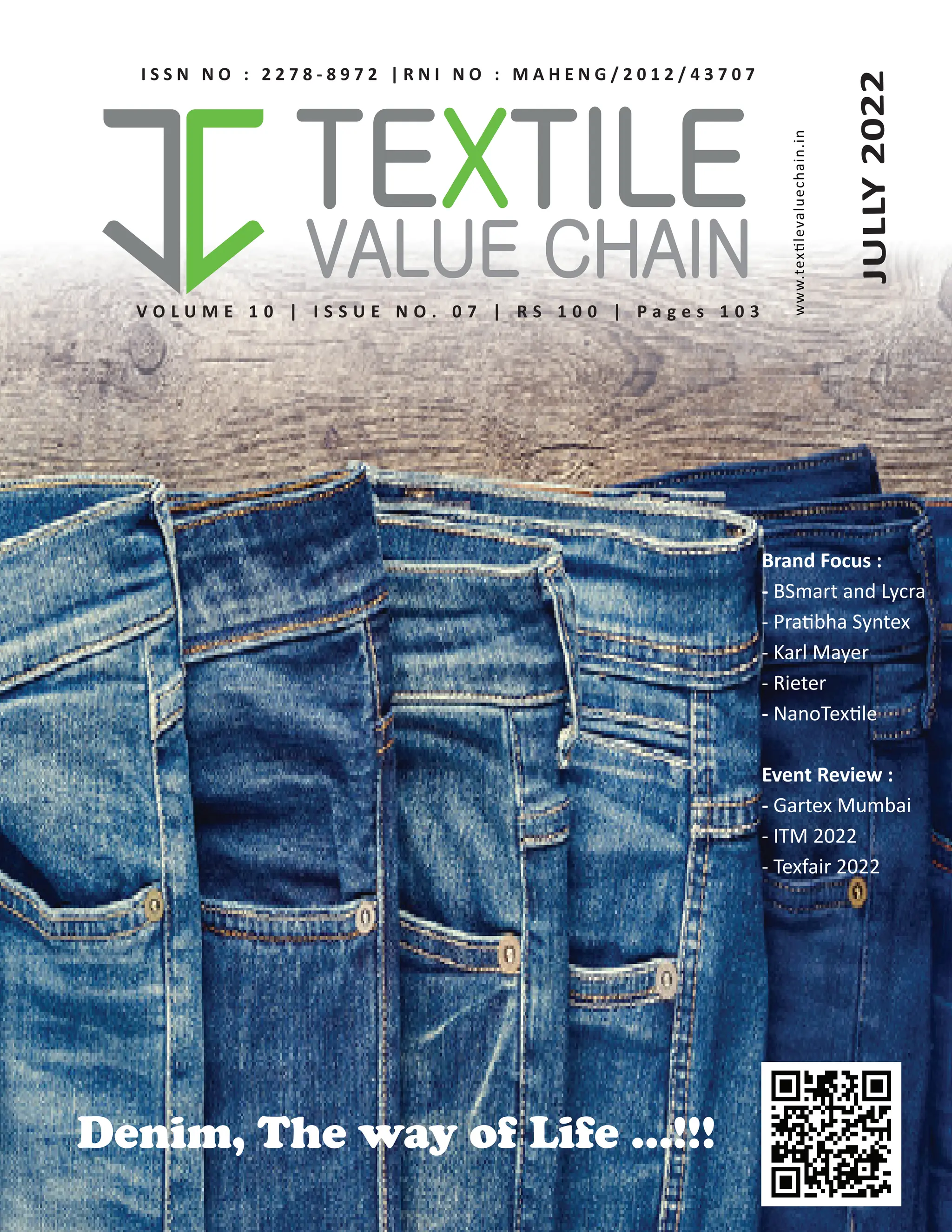
Denim, The way of Life ...!!!
JUL
LY
202
2
2 TVC | JULY 2022
3
TVC | JULY 2022
1ST GLOBAL
DENIM SOURCING APP
RAW & RIGHT
4 TVC | JULY 2022
11th India International Textile Machinery Exhibition
INDIA ITME
SOCIETY
ESTD. 1980
Supported by
Chairman S. Hari Shankar and Steering Committee of India ITME Society
Invites you to
INVITATION
Soul of Textiles
Tradition to trend under one roof
RSVP : itme@india-itme.com
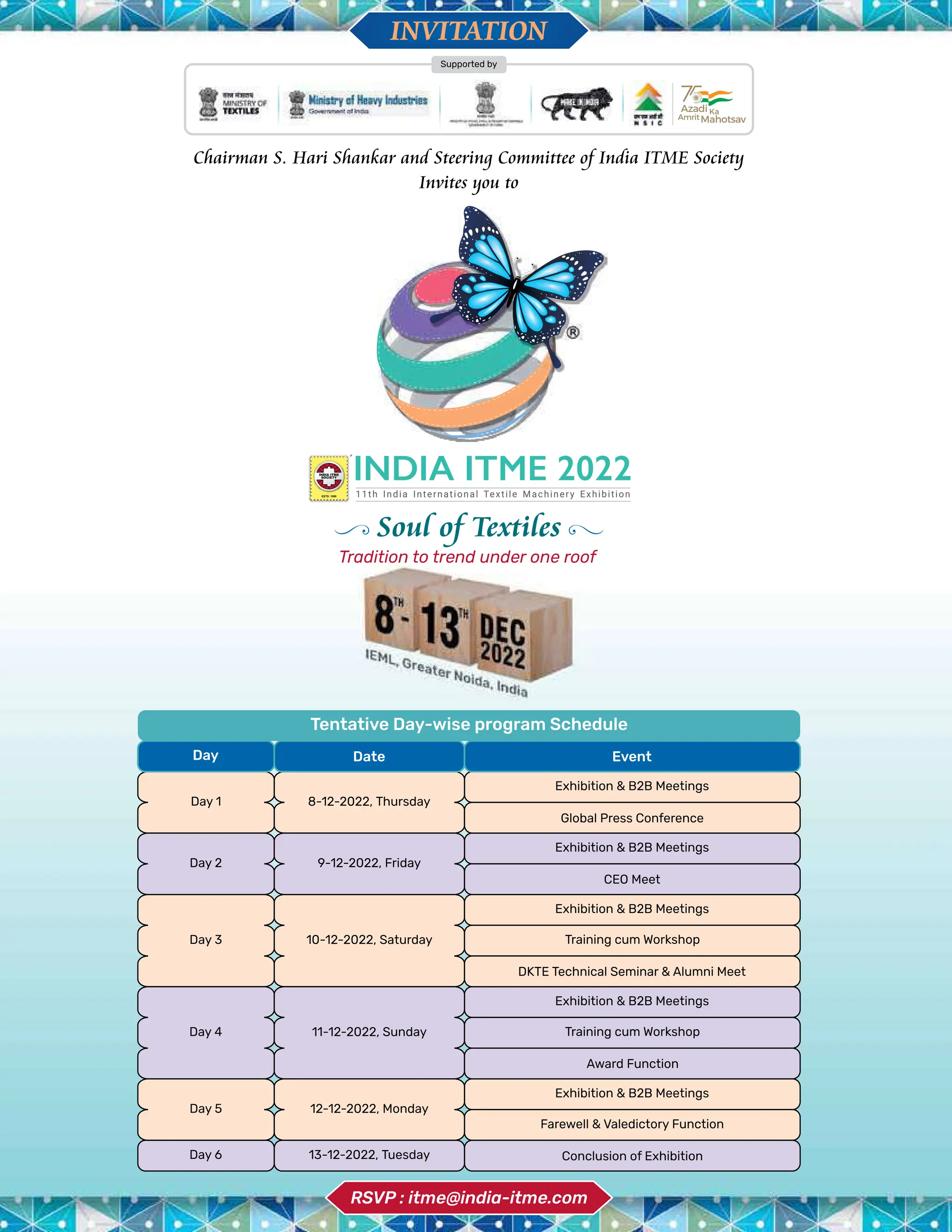
Tentative Day-wise program Schedule
Day 1 8-12-2022, Thursday
10-12-2022, Saturday
Day 3
11-12-2022, Sunday
Day 4
12-12-2022, Monday
Day 5
13-12-2022, Tuesday
Day 6
Day 2 9-12-2022, Friday
Exhibition & B2B Meetings
Training cum Workshop
DKTE Technical Seminar & Alumni Meet
Training cum Workshop
Award Function
Farewell & Valedictory Function
Exhibition & B2B Meetings
Conclusion of Exhibition
CEO Meet
Exhibition & B2B Meetings
Global Press Conference
Day Date Event
5
TVC | JULY 2022
Take control of your
Textile Air Engineering System.
� Continuously monitor your Textile Air Engineering
� system, using Nederman Insight cloud-based
� visualization
� Optimize control parameters for best plant efficiency
� Reduce unplanned service events
Luwa India Pvt. Ltd. — # 3P-5P, Gangadharanapalya — Kasaba Hobli, Off Tumkur Road — Nelamangala, Bangalore North — 562 123, India
Regulate. Control. Monitor.
DigiControl 7 Ringframe Department
DigiControl
Post Spinning Department
Pressure Drops
Alarms
Room Temperature
Temperature
0 30 60
36.0 °C
34.9 °C
Relative Humidity
Humidity
0 30
20 70
60
30
20 70
60
100
55%
Relative Humidity
Humidity
0 100
60%
Room Temperature
Temperature
0 30 60
7
%
%
www.luwa.com/digicontrol7
6 TVC | JULY 2022
7
TVC | JULY 2022
8 TVC | JULY 2022
9
TVC | JULY 2022
Table
of
CONTENT 15
ADVERTISER INDEX
10: Editorial
COVER STORY
12: The Resurgence of Denim
15: Fibre& Yarn Innova�on Trends in Denim
Industry
20: Driving Factors, Compe��ve Scenario &
Trends in Fabric of Denim Jeans
22: Ultra Rapid Indigo Dyeing – A Path to
Sustainability (Zld)
28: Sangam, A Leader In Single Denim Line:
Modani
30: Our Finishing Knowhow Is Sustainable, Cost-
Efficient: Carmen Silla
32: Anubha Industries Plans More Denim
Garment Produc�on/ Jindal’s Denim Business
Cons�tutes 70%
33: Ultra Denim Exports 70-75% of Denim Output
34: Vinod Denim Raises Capacity to Meet
Demand/ Tencel Blending Goes Well With Denim
CHEMICAL UPDATE
36: The Rise of Biochemical Industry in Tex�le
Coloura�on
37: MMF REPORT
ORGANIC COTTON
39: Weaving Organic Co�on into Our Future
REVIEW PAPER
42:Further Improvements in Rotor Spinning and
Denim Out Of Hemp
47: Compara�ve Performance of Autoconer
IN-PLANT TRAINING
51: Planning For the In-Plant Training
SEWING
56: The Birth of the Sewing Machine!
DIGITALISATION: TRAINING
58: Digital Capability Center Aachen – A Success
Story
61: Technical Tex�les Export
SILK OUTLOOK
63: Indian Silk Is A Not So Happy Story!
64: Natural Fiber Report
RETAIL FOCUS
66: 5 Ways to Build a Successful Omni Channel
Retail Strategy in Fy 23
BRAND FOCUS
69: Smartext Launches Bsmart, an Innova�ve Smart
Labels Powered By Lycra® Fiber
72: Pra�bha, Only Supplier of Biodegradable Garments
75: Karl Mayer’s Focus Is on Green Dyeing: Stefano Agazzi
78: High Intake Order & Sales Mark Rieter’s
1st half in 2022
80: Nanotex�le+ For Exclusive Benefits
81: Event Calendar
EVENT UPDATE
83: Tai Conference
85: GartexTexprocess India Makes a Notable Debut in
Mumbai
89: SimaTexfair 2022 – Successful Expo Conducted At the
Right Time
91: Basant Par�cipa�on at Texfair 2022
ITM REVIEW
93: Over Euro 1.5-Bn Business at ITM 2022
95: Spg Prints Unveils New Technology at ITM 2022
GARTEX REPORT
96: Sabar’ SdualheadServocot with Unique Features
Back Page: Raymond
Back Inside: Raysil
Front Inside: Rimtex
Page 3: Denim & Jeans
Page 4: India Itme 2022
Page 5: Luwa
Page 6: Yarn Expo
Page 7: Basant Wire
Page 8: Colorjet
Page 11: Yash Tex�le
Page 19: Amritlakshmi
Page 27: Uster
Page 35: Cosmo Chemicals
Page 38: Ramkrishna
Page 41: Shree Chintamani
Page 46: Saurer
Page 50: Unitech
Page 55: Staubli
Page 62: Vatsal Exports
Page 65: Alliance
Page 68: Omax
Page 71: Ken India
Page 74: Meera Industries
Page 77: ATE
Page 82: Sakthi
Page 84: Shahlon
Page 88: Wellknown
Page 92: BishnuTexport
Page 97: IGM
Page 98: Yarn Fair
Page 99: Nonwoven Tech
Page 100: Intertex Tunisia
Page 101: Trutzschler
10 TVC | JULY 2022
All rights reserved Worldwide; Reproduction of any of the content from this issue is
prohibitedwithoutexplicitwrittenpermissionofthepublisher.Everyefforthasbeen
made to ensure and present factual and accurate information. The views expressed
in the articles published in this magazine are that of the respective authors and not
necessarilythatofthepublisher.TextileValuechainisnotresponsibleforanyunlikely
errorsthatmightoccuroranystepstakenbasedintheinformationprovidedherewith.
REGISTERED OFFICE:
TVC MEDIA AND PROMOTION PVT. LTD.
504, Suchita Business Park, Patel Chowk,
Pantnagar, Ghatkopar (East),
Mumbai- 400075, Maharashtra, INDIA.
Cell: +91-9769442239
Email: info@textilevaluechain.com
Web: www.textilevaluechain.com
Owner, Publisher, Printer and
Editor - Ms. Jigna Shah
Printed and Processed by her at,
Impression Graphics,
Gala no.13, Shivai Industrial Estate,
Andheri Kurla Road, Sakinaka,
Andheri (East), Mumbai 400072,
Maharashtra, India.
SUBSCRIPTION
EDITOR AND PUBLISHER
Ms. Jigna Shah
EDITORIAL TEAM
Marketing and Advertising Enquiry
Denim & denim jeans are humanity’s dreams,
always. In late 1870s, denim cloth worn by workers, was
created as a workwear. Denim, with roots in the French
town called Nimes, was popularly used in stitching
trousers for Italian sailors in the 19th
century. Since
then, the magic fabric has been transformed beyond
imagination. Today, it is a huge fashion statement
that has matured with myriad applications. There are
exclusive denim weavers and big companies. which have
invested a major part in this wonder cloth to increase
their profits. Blue Denims are the most beautiful things
since the gondola, says someone, who knows all about
denim fashion.“In the right denim, a girl can conquer
the world”, “think, Denim is something everyone feels
comfortable in”,“It’s kind of my uniform, really…. Food.
Water. Denim. Let’s get back to essentials,” chime in a
community of fashionist, makers, leaders, specialists in,
or followers of fashions.
The global market value for denim fabric was US$
21.8 billion in 2020 and was expected to increase to over
US$26 billion by 2026. The retail sales value is projected
to reach at about US$ 71.8 billion 2027. The global denim
jeans market was forecast to be worth around US$ 87.4
billionin2027.Onecaneasilyseethepotentialfromthese
data. China tops in export of denim fabric worldwide,
leading particularly denim made from at least 85 percent
cotton. The higher the amount of cotton in a blend, the
more the denim will stretch and remains stretched over
time, opine denim experts. China and Hong Kong import
the most denim fabric, especially denim made from less
than 85 percent cotton. Levi Strauss, is the largest in
denim jeans market with sales hitting overUS$4.45 billion
in 2020. Usually, garment makers source from reputable
mills such as Raymond, Arvind Mills, Vardhman, Ashima,
and others to ensure the highest standard.
India’s denim wear market is expected to grow
at a CAGR of 14.5% and touch Rs 39,651 crore by 2022,
and Rs 77,999 crore by 2026. The men’s denim segment
comprises 84% and the women’s and kids’ denim
segments embrace 10% and 6% respectively.
The numbers are a testimony. Should we say
more? Please read our Exclusive Cover Story in this
issue.
					 - Samuel Joseph
The Denim Dream
CREATIVE DESIGNER
Mr. Anant A Jogale
Advisor - editorial & marketing
Mr. Samuel Joseph
Editorial Assistant
Ms. Neha Bisht
Online Registration
https://textilevaluechain.in/subscription/
Subscription Enquiry
Ms. Vaibhavi Kokane
+91-9869634305 ;
textilevaluechain123@gmail.com
Scan and Open
Mohammad Tanweer
+91-9167986305
sales@textilevaluechain.com
11
TVC | JULY 2022
www.yashtex.com sales@yashtex.com
Open Width Knits
Inspection Machine
Model: IOK
I
Inspection, Measuring
& Rewinding Solutions
+91 9167772065
I
Knits
Lycra
Elastic
By-stretch
KEY FEATURES
Designed for tensionless handling,
inspection, measuring and
rewinding of delicate fabrics
PLC controlled synchronizing
systems
Variable roll compactness
Roll Handling, Packing & Sorting
Option to set machine parameters
based on the fabric qualities
For Stretch
Sensitive Fabrics
MACHINES FOR DELICATE FABRICS
Elastic, Knits, Lycra
Inspection Machine
Model: IRE
12 TVC | JULY 2022
Cover Story
It was a roller-coaster ride for the global denim
industry in the last two-and-a-half years. Covid
came & is still lingering as a messy rubble. In
Ukraine, crisis is turning into a worse wreckage.
West&someoftheEastarestruggling in anincipient
catastrophe of blaming each other. World economy
is showing signs of a, however small, emergency.
Cotton, the larger raw material base of denim
industry, floundered in the recent unprecedented
muddle of pricing issue. But Industry world over is
holding tight to high hopes & new dreams, anxiously
awaiting a resurgence. So, is the global and Indian
denim industry.
The denim market is expected to witness
market growth at a rate of 6.7% in the forecast
period of 2022 to 2029. The global jeans market
is expected to register a CAGR of 6.7% during the
forecast period (2020-2025).
The rise in the consumer disposable income
levels is escalating the growth of denim market.
The global denim jeans market size was valued at
$56.2 billion in 2020, and is projected to reach $88.1
billion by 2030, growing at a CAGR of 4.2% from
2021 to 2030. Rise in spending capacity, per capita
consumption of the denim jeans, consciousness
regarding the cloths suitable for the body types
and acceptance for casual wears for office work
is likely to garner the growth of the denim jeans
market. In addition, increase in disposable income
in the developing countries of Asia-Pacific, such
as India and China, has increased the expenditure
on personal grooming and clothing, which further
drives the growth of the global denim jeans market
share, according to Allied Market Research.
A‘sturdyfabric’possiblydrivingitsoriginsfrom
France with a close predecessor named dungaree
from India, denim is most commonly an indigo dyed
cotton textile. With around half of the population
on earth wearing it at any given point of time, this
classic indigo blue fabric is considered to be unique
and has evolved to be a fabric of the masses and a
quintessential American garment. With the demand
of denim continuing to grow, the annual global
production of denim is 15 billion metres with half
of the production coming from Asian countries
The Resurgence of Denim
By Samuel Joseph
13
TVC | JULY 2022
like China, India, Turkey, Pakistan and Bangladesh.
China is the largest exporter of denim accounting
for around 64% of the world’s total, followed by
Pakistan, says Mr. Jitender Kumar, Vice President -
Raw Materials (Fibres), Sutlej Textiles & Industries
Limited, Mumbai (Full interview in TVC July Issue).
He adds: “The use of hemp fibres as an ecological
and cheap alternative … The rotor spinning process
is adopted for the production of hemp yarns….
Recycling and embedding circularity in denim is
adding a unique sustainability punch to this most
popular attire. In addition to fresh sustainable fibres,
recycled fibres (both cotton and polyester from pre-
consumer and/or post-consumer wastes) are getting
extensively used in denim manufacturing.”
Currently, all denim is made out of cotton
fibres or blends with high cotton content using a twill
weave. However, denim has a poor environmental
balance sheet, which starts with the planting of the
cotton needed for it and continues with the high-
water consumption and use of chemicals. Therefore,
in order to reduce the emissions caused by these,
possible alternatives are being sought. A possible
alternative, which is considered is the use of hemp
fibres to substitute cotton, reveals a paper from
the Institut für Textiltechnik of RWTH Aachen
University. “….Therotorspinningprocessisadopted
for the production of hemp yarns…. In a cross-border
project of Germany and the Netherlands named
regional hemp chain for textile production, a jeans
fabric could be produced with hemp fibres broken
down by steam pressure. The yarn was spun on
slightly modified rotor spinning machines. However,
50% cotton was added for better processability”
adds the paper. (Full Paper in July 2022 issue),
Denim exports were at $316 million in the year
2016-17, recording a fall of 11% from the previous
year. The fall in exports was despite the industry
witnessing the massive installation of denim plants
from 2014 - 2019. However, the Indian denim mills
have shown strong growth when it comes to denim
exports which have led to a certain level of stability
in the domestic markets as well. The domestic denim
fabric consumption in 2021 was 750-800 million
meters growing at an annual rate of 12% per annum.
Currently, the situation is normal with no notable
supply-demand imbalance on either the domestic
or global levels, says Dr. S N Modani, Founder
& Managing Director, Sangam India Ltd, whose
journey in denim started in 1984. “We already have
Backward Integration. The majority of our yarns are
already produced in-house courtesy of our open-
end rotors, ring spinning, and texturizing machine,”
adds Modani. (Full interview in TVC July Issue).
The essence of reports TVC reviewed recently
is captured below. (Subscribe to TVC July issue to
read the Cover Story on Denim).
With the demand of denim continuing to rise,
the annual global production of denim is 15 billion
metres with half of the production coming from
Asian countries like China, India, Turkey, Pakistan and
Bangladesh. China is the largest exporter of denim
accounting for around 64% of the world’s total,
followed by Pakistan. The market share of denim in
cotton fabric imports by volume has ranged from
21% to 24% in the last 5 years and its market share
in cotton fabric exports by volume ranged from 14%
to 26% in the last 10 years. With a current market
size of around US$ 57.3 billion in 2020, the market
value is projected to reach US$ 76.1 billion in 2026
growing at a CAGR of over 4.8%.
Conventionally, produced from 100% cotton
and dyed from natural indigo, today’s denim is a
highly transformed new generation fabric. Since
today’s discerning customers of denim clothing
desire lot of aesthetic appeal, fit, wearing comfort,
performance, and sustainability in all aspects of
its production, numerous advances in fibre and
textile technology are presenting newer concepts
14 TVC | JULY 2022
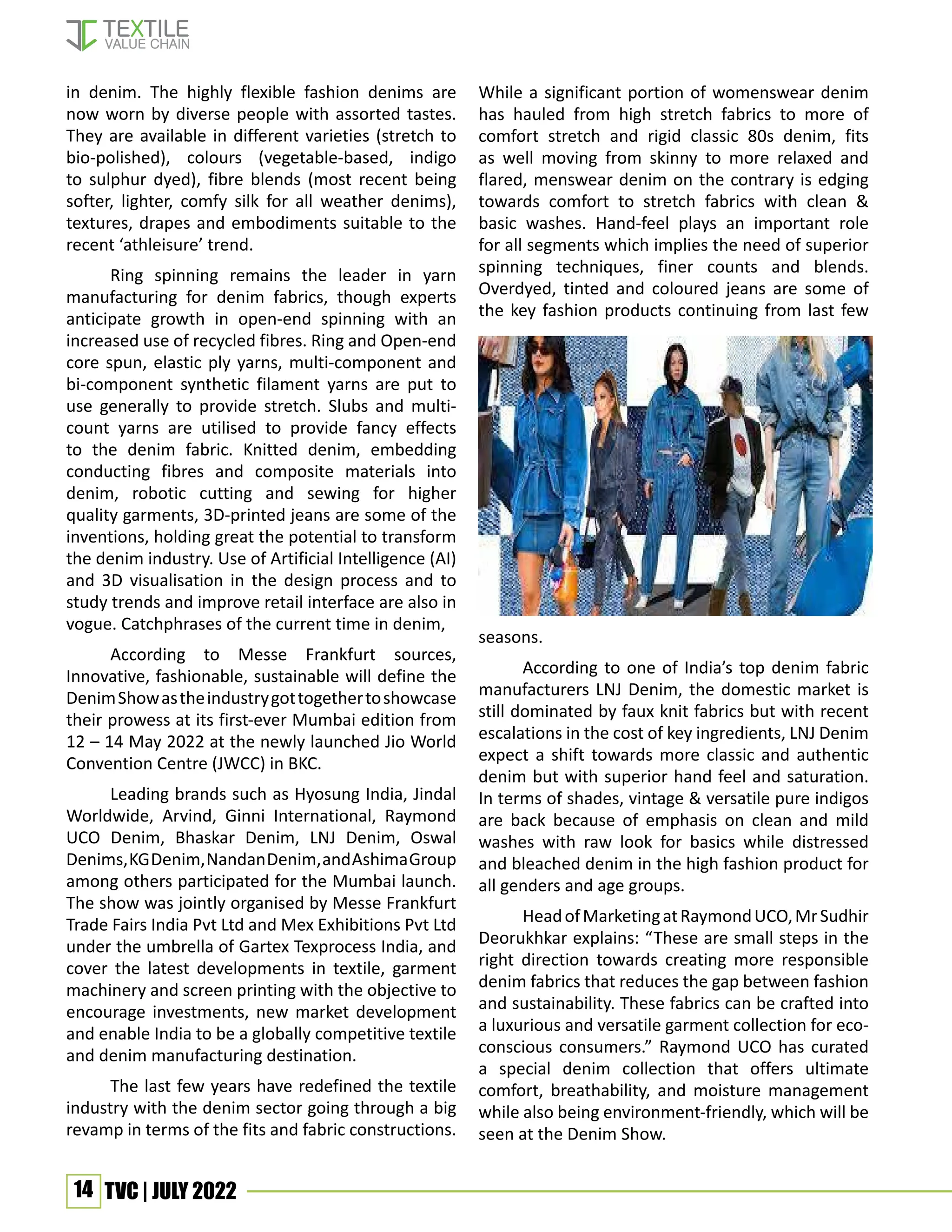
in denim. The highly flexible fashion denims are
now worn by diverse people with assorted tastes.
They are available in different varieties (stretch to
bio-polished), colours (vegetable-based, indigo
to sulphur dyed), fibre blends (most recent being
softer, lighter, comfy silk for all weather denims),
textures, drapes and embodiments suitable to the
recent ‘athleisure’ trend.
Ring spinning remains the leader in yarn
manufacturing for denim fabrics, though experts
anticipate growth in open-end spinning with an
increased use of recycled fibres. Ring and Open-end
core spun, elastic ply yarns, multi-component and
bi-component synthetic filament yarns are put to
use generally to provide stretch. Slubs and multi-
count yarns are utilised to provide fancy effects
to the denim fabric. Knitted denim, embedding
conducting fibres and composite materials into
denim, robotic cutting and sewing for higher
quality garments, 3D-printed jeans are some of the
inventions, holding great the potential to transform
the denim industry. Use of Artificial Intelligence (AI)
and 3D visualisation in the design process and to
study trends and improve retail interface are also in
vogue. Catchphrases of the current time in denim,
According to Messe Frankfurt sources,
Innovative, fashionable, sustainable will define the
DenimShowastheindustrygottogethertoshowcase
their prowess at its first-ever Mumbai edition from
12 – 14 May 2022 at the newly launched Jio World
Convention Centre (JWCC) in BKC.
Leading brands such as Hyosung India, Jindal
Worldwide, Arvind, Ginni International, Raymond
UCO Denim, Bhaskar Denim, LNJ Denim, Oswal
Denims,KGDenim,NandanDenim,andAshimaGroup
among others participated for the Mumbai launch.
The show was jointly organised by Messe Frankfurt
Trade Fairs India Pvt Ltd and Mex Exhibitions Pvt Ltd
under the umbrella of Gartex Texprocess India, and
cover the latest developments in textile, garment
machinery and screen printing with the objective to
encourage investments, new market development
and enable India to be a globally competitive textile
and denim manufacturing destination.
The last few years have redefined the textile
industry with the denim sector going through a big
revamp in terms of the fits and fabric constructions.
While a significant portion of womenswear denim
has hauled from high stretch fabrics to more of
comfort stretch and rigid classic 80s denim, fits
as well moving from skinny to more relaxed and
flared, menswear denim on the contrary is edging
towards comfort to stretch fabrics with clean &
basic washes. Hand-feel plays an important role
for all segments which implies the need of superior
spinning techniques, finer counts and blends.
Overdyed, tinted and coloured jeans are some of
the key fashion products continuing from last few
seasons.
According to one of India’s top denim fabric
manufacturers LNJ Denim, the domestic market is
still dominated by faux knit fabrics but with recent
escalations in the cost of key ingredients, LNJ Denim
expect a shift towards more classic and authentic
denim but with superior hand feel and saturation.
In terms of shades, vintage & versatile pure indigos
are back because of emphasis on clean and mild
washes with raw look for basics while distressed
and bleached denim in the high fashion product for
all genders and age groups.
HeadofMarketingatRaymondUCO,MrSudhir
Deorukhkar explains: “These are small steps in the
right direction towards creating more responsible
denim fabrics that reduces the gap between fashion
and sustainability. These fabrics can be crafted into
a luxurious and versatile garment collection for eco-
conscious consumers.” Raymond UCO has curated
a special denim collection that offers ultimate
comfort, breathability, and moisture management
while also being environment-friendly, which will be
seen at the Denim Show.
15
TVC | JULY 2022
The plethora of innovations at the level of
fibres and their blends, yarn types, stretch
fibre content, weaving techniques and fabric
constructions are all contributing to making denim
an even more desirable fabric ranking high on
fashion and performance.
A ‘sturdy fabric’ possibly driving its origins from
France with a close predecessor named dungaree
from India, denim is most commonly an indigo dyed
cotton textile. With around half of the population
on earth wearing it at any given point oftime, this
classic indigo blue fabric is considered to be unique
and has evolved to be a fabric of the masses and a
quintessential American garment.
With the demand of denim continuing to grow,
the annual global production of denim is 15 billion
metres with half of the production coming from
Asian countries like China, India, Turkey, Pakistan and
Bangladesh. China is the largest exporter of denim
accounting for around 64% of the world’s total,
followed by Pakistan. The market share of denim in
cotton fabric imports by volume has ranged from
Cover Story
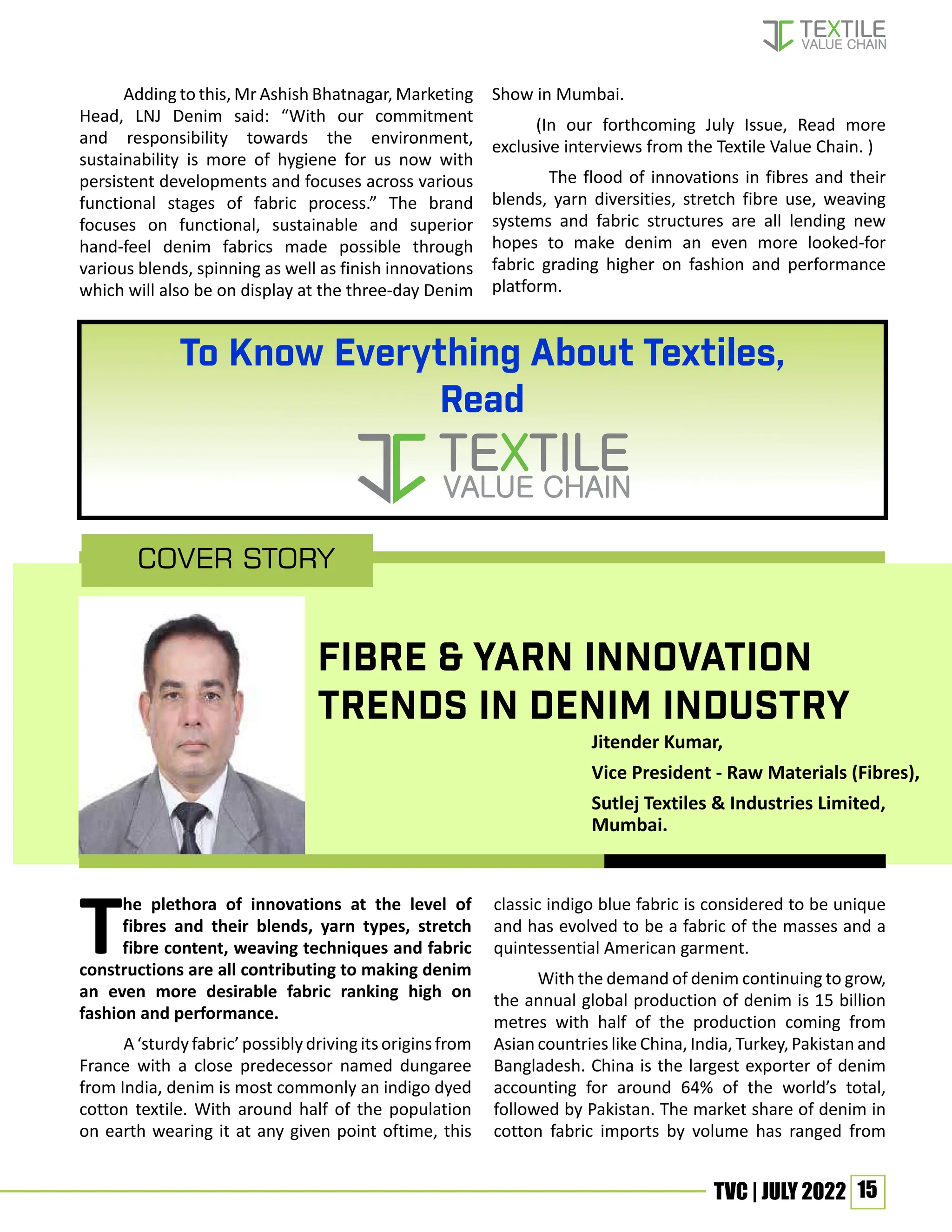
Jitender Kumar,
Vice President - Raw Materials (Fibres),
Sutlej Textiles & Industries Limited,
Mumbai.
FIBRE & YARN INNOVATION
TRENDS IN DENIM INDUSTRY
Adding to this, Mr Ashish Bhatnagar, Marketing
Head, LNJ Denim said: “With our commitment
and responsibility towards the environment,
sustainability is more of hygiene for us now with
persistent developments and focuses across various
functional stages of fabric process.” The brand
focuses on functional, sustainable and superior
hand-feel denim fabrics made possible through
various blends, spinning as well as finish innovations
which will also be on display at the three-day Denim
Show in Mumbai.
(In our forthcoming July Issue, Read more
exclusive interviews from the Textile Value Chain. )
The flood of innovations in fibres and their
blends, yarn diversities, stretch fibre use, weaving
systems and fabric structures are all lending new
hopes to make denim an even more looked-for
fabric grading higher on fashion and performance
platform.
To Know Everything About Textiles,
Read
16 TVC | JULY 2022
21% to 24% in the last 5 years and its market share
in cotton fabric exports by volume ranged from 14%
to 26% in the last 10 years. With a current market
size of around US$ 57.3 billion in 2020, the market
value is projected to reach US$ 76.1 billion in 2026
growing at a CAGR of over 4.8%.
Since today’s discerning customers of denim
clothing desire lot of aesthetic appeal, fit, wearing
comfort, performance, and sustainability in all
aspects of its production, numerous developments
in fibre and textile technology are offering newer
concepts in denim. Conventionally produced from
100% cotton and dyed from natural indigo, today’s
denim is a highly transformed new generation
fabric. The highly supple fashion denims are now
draping diverse body shapes.They areavailable in
different variants (stretch to bio-polished), colours
(vegetable-based, indigo to sulphur dyed), fibre
blends (most recent being softer, lighter, comfy silk
for all weather denims),textures, drapes and avatars
fittingthe recent ‘athleisure’ trend.
The more recentand an almost universal
escalation in cost of raw materials and logistics to
decadal highshas necessitated the denim industry
to innovate at all levels tomaintain margins and
contain the rising prices of the products. The denim
manufacturersacrosstheworldhavebeenemploying
various methodsand reverse engineering techniques
to stay afloat and make their products more cost
effective. These measures include reducing the
weight of the fabric, reducing fabric lines to improve
plant efficiency, skewing the product mix towards
more profitable technical fabrics,exploring different
dye combinations and a shiftto less expensive lighter
shades, working with various blends of cotton and
man-made fibres like polyester, modacrylic, aramid
and stretch,increased use of recycled cotton,
recycled polyester and use of newer methods,digital
age machines and automation to save on energy
and water to offset the higher prices of fibres and
other inputs.
The most important innovations in denim have
been the use of new fibres and new fibre blends.
Stretch (synthetic elastic fibres known as
spandex in the US and elastane elsewhere) fibres
blended with cotton have been revolutionising
the entire denim landscape.Lycra as the branded
stretch fibre offers lasting stretch for fit, shape and
comfort and delivers clothes that move with the
body. Lycra T400 fibre provides spandex-free stretch
and bounce-back recovery for exceptional shape
retention. The patented Lycra dualFX technology
goes further by providing two stretch fibres –
spandex (elastane) and a polyester bi-component
fibre (Lycra T400) for unparallel denim performance
which includes high stretch and high recovery and
exceptional dimensional stability. A bi-stretch denim
with spandex spun into both warp and weft is
another important innovation.
Besides synthetic fibres like Polyester and
polypropylene normally used in denim fabric, a
lot of different performance denim concepts are
being realized by blends of cotton and synthetic
fibres like high strength Invista nylon 6,6 resulting
in an engineered Cordura denimfabric known for its
durability, comfort, hard-wearing and an additional
resistance to abrasion keeping the jeans looking
new longer.A combination of Cordura staple nylon
6.6 Black SDN fibre and spun dyed Lenzing Tencel
Modal fibres with Eco Color technology is rendering
black color to denim fabrics at the fibre level
resulting in very effective color consistency, fastness
and retention.
Kevlar as a synthetic aramid fibre provides
exceptional strength and heat resistance and
forms an important mix with cotton to impart
added strength to the denim fabric and increased
durability. Dyneemafibre when blended with cotton
delivers light weight yet exceptionally strong,
durable, abrasion and cut resistant yarns which may
be knitted or woven into denim fabric for outdoor,
sports and fashion industry.
Cotton, generally coarser in fineness
(micronnaire) and shorter in staple length (ranging
from 22mm to 27mm) remains the major cotton
type for spinning yarns suitable for denim fabric.As
an important innovation, finer (lower micronnaire)
cotton types traded generally at a discount to the
normal/premium micronnaire range cotton are
also being used for the purpose of spinning counts
suitable for denim applications. Pre-consumer
waste fibres like combernoil, flat stripping(generally
to the extent of 10-20%) are also used in mixing with
fresh cotton for spinning medium to coarser yarns
17
TVC | JULY 2022
for denim.
The important and well-known cotton
varieties suitable for spinning coarse count yarns
are primarily desi or indigenous cotton strains like
Bengal Deshi grown in the Northern Zone states
of Punjab, Haryana, Rajasthan, V-797 (Kalyaan)in
Gujarat, AK/Y-1 in MP and Maharashtra,Jayadhar
in Karnataka and some other now lesser-known
types in Tamil Nadu.With the advent of high yielding
varieties, hybrids and Bt cotton, the production of
indigenous short staple cotton types has been on the
decline. The increasing denim capacities and smaller
crop production sometimes necessitatesimports of
these cotton types.
The denim industry is also seeing lot of
innovations as far as sustainability of fibres is
concerned. Whereas, Organic and Better Cotton
(BCI) are other sustainable alternatives to
conventional cotton, other natural fibres like hemp,
linen and silk are being looked upon as important
alternatives to scarce and highly resource intensive
cotton fibre. Various combinations of silk (mulberry
and eri silk) are being tried with cotton and linen to
produce versatile new range of fabrics. Whereas eri
silk’s warmth like wool makes the denim garments
suitable for cold weather, other blends of silk with
cotton and linen have been found to be providing
light weight and comfortable denim fabrics for all
weather conditions. Biodegradable synthetics and
bio elastomers are other important sustainable
innovations at the fibre level.
Since denim is a warp-faced textile with weft
passing under two or more warp threads, studies on
clothing comfort in denim fabric from regenerated
cellulosic fibres suggest that Indigo dyed cotton
warp and viscose filament/Tencel weft offered
greater degree of wearing comfort. Regenerated
cellulosic fibres like viscose, Modal, ProModal,
Tencel, blends of cupro, rayon and bamboo have
evolved as important manmade sustainable fibre
alternatives in denim manufacturing. Besides being
eco-friendly, these regenerated cellulosic fibres
and yarns provide much sought-after soft handle,
lightness, subtlety, suppleness, fit, comfort, strength
and durability to denim.
Recycling and embedding circularity in denim
is adding a unique sustainability punch to this most
popular attire.In addition to fresh sustainable fibres,
recycled fibres (both cotton and polyester from
pre-consumer and/or post-consumer wastes)are
getting extensively used in denim manufacturing.
Millsare setting up dedicated recycling unit (s) to
recycle spinning, fabric and garment waste materials
otherwise destined for the landfills.The post-
consumer recycled cotton being slightly coarse and
rough imparts an additional texture and dimension
and richer color hues.
Fibres like Tencel Refibra lyocell as an
important recycled fibre innovation is being seen as
a step towards contributing to the circular economy
in textiles. It involves upcycling cotton waste from
garment production to make new lyocell fibre.
Similarly, Re-Gen fabric is being made from half of
recycled cotton and half of Refibra and not a single
kilo of fresh cotton fibre is used.This is leading to
conserving lot of resources like water, fertilizers
and avoidspolluting agro-chemicals in the form of
pesticides and insecticides used to grow cotton.
Ring spinning remaining the main stay of yarn
manufacturing for denim fabrics, experts foresee
growthinopen-endspinningwithanincreaseduseof
recycled fibres. Ring and Open-end core spun, elastic
ply yarns, multi-component and bi-component
synthetic filament yarns are used to provide stretch.
Slubsandmulti-countyarnsarebeingusedtoprovide
fancy effects to the denim fabric. Knitted denim,
SolucellAir cotton yarns (combining Solucell and
cotton to engineer 3D hollow channel system inside
the cotton fabric), embedding conducting fibres
and composite materials into denim, robotic cutting
and sewing for higher quality garments, 3D-printed
jeans are few other innovations which hold the
potential to revolutionize the denim industry. Use
of Artificial Intelligence (AI)and 3D visualization in
the design process and to study trends and improve
retail interfaceare also in vogue.
Nanotechnologyisprovidingnewerapplication
techniques and imparting more durable and
innovative functional finisheslike UV, antimicrobial
protection, stain-resistance, nano encapsulation
amongst othersthereby offering higher realms of
textile performance, comfort, and environmental
friendlinessthan the conventional.
Graphene as the wonder material isolated
18 TVC | JULY 2022
from Graphite is being used as safe, chemical free
and non-toxic functional finishto enhance the denim
fabricthrough thermal distribution(when coated
on the surface of the fabric), preventformation
of bacteria, an anti-odour effect and a very high
abrasion resistance. Various value-added effects
like vintage, streaks, fading, stone wash, peach skin,
oily feel, permanent 3D creasesand others are now
achieved by the use of enzymes, special finishes
and chemicals. Foam coatings, ozone and ammonia
finishing, bonding, tinting, natural and totally
biodegradable sizing and others are leading smart
innovations which are helping the denim industry
go green and conserve water and energy, reduce
consumption of chemicals, manufacturing costs,
lesserreleaseofGHGsandenhancebiodegradability.
There is a new awakening and a quest to achieve
product stewardship by meetingthe cradle-to-
cradle (C2C) design standards and certification and
sustainability criteria of various eco-labels like Oeko-
tex, green label, bluesignamongst others.
The denim industry is also striving hard to
innovate in dyeing and processing technologies to
remain sustainable. Various other dyeing techniques
like the Crystal-Clear dyeing, Nitrogen dyeing,
foaming, spray dyeing, Indigo Juice dyeing, patented
Kitotex, pre-washing and creating of motifs through
lasers are some of the innovations in dyeing and
processing of denim which conserve precious
resources like water, energy and chemicals unlike
Indigo dyeing which is most water and chemical
intensive with a high environmental impact.
Theplethoraofinnovationsattheleveloffibres
and their blends, yarn types, stretch fibre content,
weaving techniques and fabric constructions are all
contributingtomakingdenimanevenmoredesirable
fabric ranking high on fashion and performance.
References
https://www.monforts.de/wp-content/uploads/
World-of-Denim-7.pdf
https://www.pbs.org/wgbh/americanexperience/
films/riveted-history-of-jeans/
https://en.wikipedia.org/wiki/Denim
Gokarneshan,Narayanan.(2018).AdvancesinDenim
Research. Research & Development in Material
Science. 3. 10.31031/RDMS.2018.03.000551.
https://sourcingjournal.com/denim/denim-mills/
denim-mills-raw-materials-cotton-indigo-cone-
bossa-royo-lycra-342389/
https://www.sciencedirect.com/topics/
engineering/denim-fabric
https://denimhunters.com/27-denim-innovations/
https://www.admdenim.com/dualfx.php
https://cordura.com/denim-fabric
https://www.dsm.com/dyneema/en_GB/home.
html
https://oureverydaylife.com/cordura-vs-
kevlar-12206062.html
https://www.tencel.com/refibra
https://www.fibre2fashion.com/news/textile-
news/newsdetails.aspx?news_id=65232
http://www.aarveedenims.com/divisons/cotton-
fiber/
https://www.business-standard.com/article/
markets/short-staple-cotton-imports-may-rise-to-
meet-denim-requirements-112020800145_1.html
https://en.gaonconnection.com/tamil-nadu-
organic-short-staple-cotton-farming-tamil-new-
year-farmer/
https://www.nfsm.gov.in/StatusPaper/Cotton2016.
pdf
https://www.intechopen.com/chapters/66213
https://www.deccanherald.com/content/327728/
why-jayadhar-cotton-needs-saved.html
https://www.thehindu.com/news/cities/bangalore/
dont-tamper-with-jayadhar-cotton/article6250244.
ece
World Textile Fibre Demand, ICAC, December 2021
http://www.solucell.org/solucell-air
19
TVC | JULY 2022
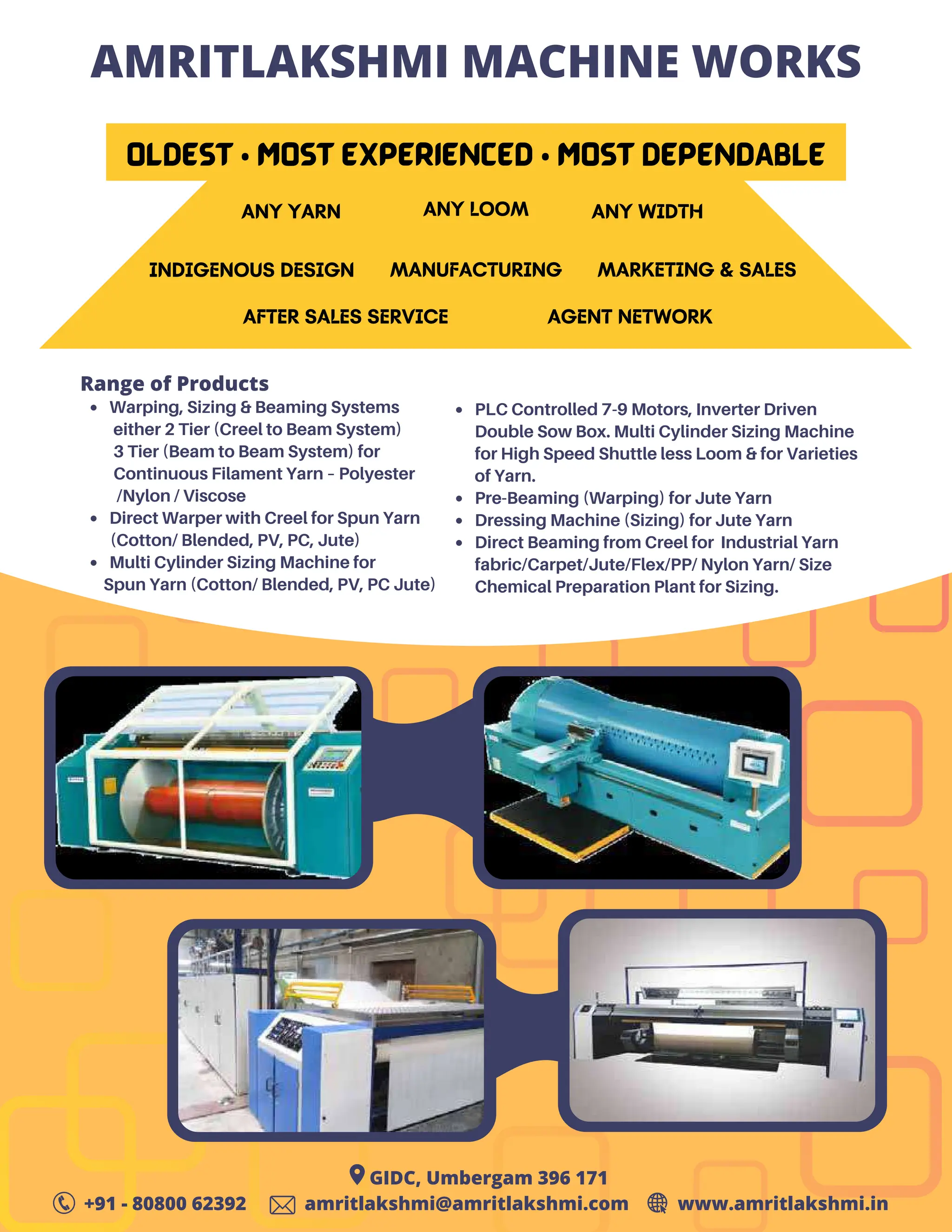
AMRITLAKSHMI MACHINE WORKS
OLDEST • Most EXPERIENCED • Most DEPENDABLE
ANY YARN
INDIGENOUS DESIGN
AFTER SALES SERVICE
ANY LOOM
MANUFACTURING
AGENT NETWORK
ANY WIDTH
MARKETING & SALES
Warping, Sizing & Beaming Systems
Direct Warper with Creel for Spun Yarn
Multi Cylinder Sizing Machine for
Range of Products
either 2 Tier (Creel to Beam System)
3 Tier (Beam to Beam System) for
Continuous Filament Yarn – Polyester
/Nylon / Viscose
(Cotton/ Blended, PV, PC, Jute)
Spun Yarn (Cotton/ Blended, PV, PC Jute)
PLC Controlled 7-9 Motors, Inverter Driven
Double Sow Box. Multi Cylinder Sizing Machine
for High Speed Shuttle less Loom & for Varieties
of Yarn.
Pre-Beaming (Warping) for Jute Yarn
Dressing Machine (Sizing) for Jute Yarn
Direct Beaming from Creel for Industrial Yarn
fabric/Carpet/Jute/Flex/PP/ Nylon Yarn/ Size
Chemical Preparation Plant for Sizing.
GIDC, Umbergam 396 171
+91 - 80800 62392 amritlakshmi@amritlakshmi.com www.amritlakshmi.in
20 TVC | JULY 2022
DRIVING FACTORS,
COMPETITIVE SCENARIO &
TRENDS IN FABRIC OF DENIM
JEANS
Rise in sense of fashion among the global
population is influencing the key market
players to focus on product innovations with
various designs, patterns, colors, and fitting, says
content writer, Suchita Gupta.
Denim is one of the world’s most iconic fabrics
indeed. No other variety of fabric has gathered such
huge acknowledgement across the globe. Today, this
durable fabric has become so aesthetically appealing
that one can even find home decor products made
with the denim fabric. Hence, denim business has
been considered as a profitable choice in the mass
market.
India is currently the biggest producer of
denim fabrics. Traditionally, only cotton was used
to manufacture denim fabric, but, now-a-days it
is blended with polyester, to control shrinkage &
wrinkles, as well as, with Lycra to make it stretchable.
The first step of denim production process includes
the cultivation of the cotton plants. Cotton fibres
are then combed and made into long, thin strings
so that a range of dyes, washes, or treatments can
be applied. The dyeing temperature usually varies
between 60°C to 80°C, while for some dyes, it can
be as high as 95°C.
Additionally, tops, dresses, corsets, pants,
and so many other pieces of clothing are being
made with denim to offer people the opportunity
to flaunt a complete denim on denim look. Natural
washed denims with blue or indigo tones are the
most preferred ones in denim fit and style trends. A
vintage trend of baggy jeans,encouraged by the 90s
fashion, is gaining a lot of interest with fashionistas
across the globe recently.Ripped and distressed
jeans are on demand since the last couple of years.
Flared jeans, boot cut jeans, and super wide legged
jeans, meanwhile, are grabbing a lot of attention
over the denim trend. Printed jeans, on the other
hand, are the most innovative twist to classic denim
and the incorporation of street style.
According to a report published by Allied
Market Research, the global denim jeans market
size is expected to reach US$88.1 billion with a
considerable CAGR from 2021 to 2030. North
America is currently holding the highest market
share and is expected to maintain its dominance
during the forecast period.
Moreover, the Asia-Pacific region is providing
lucrative opportunities for the growth of the market.
This is owing to rise in disposable income in the
emerging economies such as China & India, which
has significantly increased the spending capacity
Cover Story
Suchita Gupta
Content Writer
21
TVC | JULY 2022
of people on clothing for personal grooming,
thereby boosting the growth of the global denim
jeans market. Factors such as growing standard of
living,introduction of denim jeans with antimicrobial
properties, launch of eco-friendly denim jeans,
surge in trend of wearing denim jeans in work
stations, offices,& special occasions, and per capita
consumption of the denim jeans, at the same time,
are contributing to the growth of the market in more
than one way.
However, the outbreak of the COVID-19
pandemicledtohaveanegativeimpactonthegrowth
of the global denim jeans market. This is attributed
to the implementation of the global lockdown, which
resulted in halting the denim production hubs across
the world temporarily. Due to strict regulations
and ban on import & export activities, a severe
disruption caused in the global supply chain. This in
turn, created several difficulties in supplying the raw
materials. Shortage of skilled labor force, temporary
closure of retail stores & malls, dynamic changes in
expenditure pattern, and decline in sales of denim
jeans were a few more factors that restrained the
growth of the market, especially in the initial period.
Nevertheless, the market has already started to
recover and is expected to get back on track soon.
Furthermore, rise in sense of fashion among
the global population is influencing the key market
players to focus on product innovations with various
designs, patterns, colours, and fitting. On top of
that,several fashion influencers on social media
and e-commerce platform are helping the fashion
industry to grow with a wide array of denim jeans
types such as skinny, tapered, athletic, and regular
fit jeans, which is sequentially boosting the demand
for denim jeans.
In addition, technological advancements
have allowed Levi Strauss to design a new jean
that is compatible with iPod music player. Also, this
company has come up with a bullet proof denim
jacket that has the looks of a perfect casual wear.
Here, it is worth mentioning that the global denim
jeans market has a huge scope to assemble immense
growth in the years to come.
Author’s Bio: Suchita Gupta is an explorer,
musician and content writer. While pursuing MBA,
she found that nothing satisfies her more than
writing on miscellaneous domains. She is a writer
by day, and a reader by night. Besides, she can be
found entertaining her audience on social media
platforms. Find her on LinkedIn & Instagram.
When in Doubt , Wear Denim !!!
22 TVC | JULY 2022
A
bstract: Denim is the worldwide most
popular form used by all generations. Due to
very high volumes consumed daily, Brands
are deliberated to look for sustainability to save
the environment. Water, air and soil are the basic
elements in life. Conventional Indigo dyeing is a
lengthy process requiring pretreatment, washing,
battery of (dip, nip & air) indigo dyeing followed by
washing, drying and sizing beaming or batching. This
process uses huge amounts of resources like water,
chemicals, and energy. To achieve sustainability
over the conventional process, thorough study and
continual research has led to the evolution of ultra-
rapid dyeing technology.
This technology primarily focuses on the
concept of ultra-rapid indigo dyeing. Here the
substantivity of the indigo solution is tremendously
increasedbyachievingtherequiredphysico-chemical
parameters in an inert atmosphere. This enables the
super substantive leuco indigo to instantaneously
penetrate with a decreasing gradient in the core
of the fibre. Thus, giving darker shades at minimal
contact time. This evolved technology has been
successfully tested on cotton, bast and regenerated
yarns with certain preconditions. This technology
is being developed for achieving sustainability in
indigo dyeing. Here near zero water denim dyeing
has been made possible using the ultra-rapid indigo
dyeing technology.
1 Introduction
1.1 Sustainability is a social and ecological
process characterized by the pursuit of common
ideals [1] denoting the ability to continue to exist.
As ecologists believe that sustainability is achieved
through the balance of species and resources in
the environment, the consumption of available
resourcesmustnotbefasterthannaturallygenerated
resources in order to maintain this balance [2,3].
Sustainable development means striving to
balance local and global environments without
damaging the natural environment, so as to meet
the basic needs of mankind [4]. The result of rapid
industrialization has led to several toxic chemical
substances such as dye affecting the environment,
causing serious environmental pollution [5].
1.2 Denim is a unisex fashionable woven wear
for all generations. The global jeans business is
increasing in a drastic way because of its comfort-
ability, trend, and performance. Till today majority
of the denim production is done in the conventional
way using slasher, rope dyeing machines. There
have been advancements in these conventional
technologies for achieving specific goals like super
dark shades, multiple colour dyeing, precise e
controls for better workability, adaptability for
running various processes, also modifications to
achieve sustainability etc. A Sustainable future can
beachievediftheusageoflessenergy,lesschemicals
and less water is emphasised.
1.3 Denim Manufacturing in Brief:
Denim is a cotton warp-prominent twill fabric where
ULTRA RAPID INDIGO DYEING
[PA]
- A
PATH TO SUSTAINABILITY (ZLD)
COVER STORY
Director
Atharvaved Impex , Maharashtra India.
Head Operation
Director & COO
WFB Baird & Co India Pvt. Ltd.
Kochi, Kerala, India.
Bhushan Chaudhari
Jaydeep Umalkar
Pradeep Pillai
23
TVC | JULY 2022
the weft passes below two or more warp threads[6]
.Ideal processes involving denim fabric production
are warping, dyeing, sizing, weaving, finishing, and
inspection. Denim is always warp dyed which takes
place after warping, unlike other woven fabrics.
Previously, all denim utilized ring-spun yarns, but
later on, ring yarns were replaced by OE yarns due
lesser price and rapid manufacturing of open-end
(OE) yarn, known as rotor spinning [7]. Yarns used
for warp of denim fabrics are typically 100% Cotton
in composition and comparatively coarser than
other woven fabrics.
Warping can be two types depending on the
dyeingmachine--BallwarpingorBeamwarping.This
warp loaded on creel passes through pretreatment
(wetting + scouring), 2 to 3 washings, 8 to 12 indigo
dyeing (dip + nip + air), 3 to 4 post washing, drying,
for sheet form sizing and beaming and for rope
batching in cans followed by rebeaming and sizing.
These sized beams are woven and finished as per
requirement.
1.4 Principle in Indigo dyeing:
Indigo, C I 1 the first colour discovered and
documented was dyed on textile materials in
wooden pots or vats in the early days and are water-
insoluble coloured compounds [8]. To make this dye
soluble, two steps of reaction are required. First,
reduction of vat dye into leuco vat dye by sodium
hydrosulphite. Second, neutralization of leuco vat
dye with caustic soda to give soluble sodium salt of
leuco vat dye. After dyeing, oxidation is needed to
reconvert the water-soluble sodium salt of leuco vat
dye into the water-insoluble original vat dye. Rinsing
at ambient temperatures in 2-3 rinsing baths after
oxidation is normally adequate to remove alkali and
unoxidized leuco compounds [6] .
1.5 Environmental challenges in Traditional Dyeing:
Traditional Indigo dyeing is a water-consuming
process. High amounts of water flow in wash boxes.
In Pre-wash boxes to rinse out caustic soda and other
auxiliariescompletelyfromthesubstrate.Continuous
rinsing also reduces the yarn temperature thereby
preparing the substrate for indigo dyeing at room
temperature. In Post-wash boxes to rinse out unfix
dyes and chemicals from dyed yarn surface. Huge
amounts of other resources like steam, compressed
air and power are also consumed in running the
traditional indigo dyeing machines which also adds
to the costs and various environmental factors. As
per the Greenpeace report, for producing two billion
jeans pants every year, it takes a total of 1.7 million
tons of chemicals and water consumption can reach
as much as 7,000 litres per one pair [9].
Consumption of large quantities of chemicals
and freshwater ends up in increased product cost
and larger volume of chemically loaded effluents;
particularly high pH and high quantity of sulfate salts
due to sodium dithionite followed by unfixed indigo
dye and their by products [10] .
1.6 Taking in consideration all the associated
drawbacks in traditional indigo dyeing, Ultra Rapid
Indigo dyeing technology is developed, achieving
the most required sustainability. In this evolved
dyeing method, the substantivity of the leuco
indigo is exponentially increased by maintaining the
required physico-chemical parameters in an inert
atmosphere. This enables the super substantive
leuco indigo to instantaneously penetrate with a
decreasing gradient in the core of the fibre. Thus,
giving darker shades at minimal contact time (Fig1.).
This evolved technology has been successfully tested
on cotton, bast and regenerated yarns with certain
preconditions. Here near zero water indigo dyeing
has been made possible using the ultra-rapid (Flash)
indigo dyeing technology ultimately achieving
sustainable indigo dyeing.
Linen is very difficult to run on conventional
indigo dyeing machines due to many known
reasons. Hence in this dyeing experiment we have
chosen linen as the most sustainable textile fibre
to understand the benefits of this technology. Here
the basic properties of linen yarn before and after
dyeing have been compared. Using this technology
linen in cone form as well as sheet form can be dyed,
thus fulfilling the requirements of warp and weft.
2 Materials and Ultra Rapid dyeing Method :
2.1 Linen yarn.
2.2 Chemicals -Liquid indigo solution, water,
dispersing aid, alkali, reducing aid.
24 TVC | JULY 2022
2.3 Ultra rapid Indigo dyeing[PA] method.
2.3.1 Preparation of Indigo Dyeing solution:
Measured quantity of pre-reduced indigo dye
solution is taken in a air sealed chamber having
99.9% pure nitrogen at a predetermined pressure, to
make up the volume blank vat (specially developed
chemical system, consisting of dispersing aid, alkali
and environmentally friendly reducing aid) is added
in measured quantity to get the desired Indigo
concentration.
2.3.2 The prepared dyeing solution is dosed
in the indigenously designed dyeing apparatus at
specified time, temperature and pressure making
the leuco dye highly substantive. The material to be
dyed is passed through the specially designed dyeing
apparatus where simultaneous application of this
highly substantive leuco dye is done in milliseconds.
Thus, enabling the super substantive leuco indigo
to instantaneously penetrate with a decreasing
gradient in the core of the fibre (Fig 1). Followed by
superficial extraction, drying and batching (Fig 2.).
In this CLP (i.e. Closed Loop Porcess) Total 2 litres of
dye liquor is used out of which colour pick up is 1.5
litres per kg of yarn which is eventually evaporated
in the process. Rest is dechannelized for reuse in the
continuous dyeing process. Thus, there is as such no
generation of any trade effluent during the ultra-
rapid indigo dyeing process. Here for drying the dyed
material both electric heating chambers and gas
fired chambers have been used ensuring near zero
emissions. This can be further extended to carbon
neutral system such as solar and wind energy.
2.3.3 This indigo dyed yarn is used in weaving
of the respective qualities either in warp and weft
for solids and only in weft for chambray.
2.3.4 After weaving the indigo dyed yarn fabric is
dye-fixed on the stenter and finished according to
the final product requirements.
2.4 Evaluation of Dyed Material
2.4.1 Determination of count of yarn using
Standard testing method of ASTM D1059
2.4.2 Determination of elongation in % and tensile
strength in RKM of linen yarn using standard testing
method of ASTM D2256
2.4.3 Determination of core pH using Standard
testing method AATCC 81, ISO 105 3071.
2.4.4 Determination of washing fastness using
Standard testing method AATCC 61 2A, ISO 105 CO6
A2S,B2S,C2S.
2.4.5 Determination of rubbing fastness using
Standard testing method AATCC 08, ISO 105 X 12.
3. Results and Discussion
From the data comparison [11] the following
Penetration of Indigo (Fig 1.)
Lower the
application
time Darker
the depth of
shade , better
wash down
effects
Application time (Milli Sec)
Shade Depth
Lower Higher
Darker Lighter
Higher the
application
time Lighter
the depth of
shade, flat
wash down
effects
25
TVC | JULY 2022
Yarn Ultra Rapid Indigo -Finish Fabric
Sr
No
Count
(NM)
Dyed
Yarn
Count
STD RKM
(gm/tex)
RKM (gm/tex)
STD Elongation
(% )
Elongation
(%) Ultra -
Rapid
Indigo
Yarn
Core pH
Surface
pH
Dry Rub
Fastness
Wet Rub
Fastness
Colour
Fastness to
Washing
RFD
Yarn
Dyed
Yarn
Ultra- Rapid
Indigo Dyed
Yarn
RFD
Yarn
Dyed
Yarn
Ultra -
Rapid
Indigo
Dyed Yarn
1 24 23.7 28 24 27.09 2.1 1.5 2.04 10.44 7 4 3 3
2 33 32.5 28 24 25.45 2.1 1.5 1.74 9.85 7 4 3-4 4
3 33 32.3 28 24 25.19 2.1 1.5 1.728 10.28 6.8 4 3 4
4 33 32.4 28 24 24.28 2.1 1.5 1.26 9.9 7 4 3 4
5 33 33.1 28 24 25.32 2.1 1.5 1.401 10.13 6.9 4 2 3-4
6 26 25.5 28 24 26.62 2 1.5 1.15 9.84 7 4 3 4
7 26 25.8 28 24 25.6 2 1.5 1.51 9.94 7 4 3-4 4-5
8 26 26.4 28 24 23.83 2 1.5 1.542 10.06 6.8 4 3 4-5
9 26 25.2 28 24 24.83 2 1.5 1.452 10.35 7.5 4 4 4
10 26 25.4 28 24 25.03 2 1.5 1.432 10.22 6.5 4 3-4 4
11 20 19.5 30 24 28.1 2.1 1.5 1.6 9.61 6.7 4 3 4
12 20 21 30 24 24.83 2.1 1.5 1.424 9.98 7 4 4 4-5
13 18 17.8 30 24 25.3 2.1 1.5 1.62 9.63 7.5 4 3-4 4
14 18 17.6 30 24 23.82 2.1 1.5 1.601 10.2 7 4 3 4
inference can be drawn:
y
y There is no considerable change in count of the
dyed yarn.
y
y Tensile strength of the indigo dyed linen yarn
is well above the set standard for regular dyed
linen yarns.
y
y Elongation % of the Indigo dyed yarn is nearly
up to the standard.
y
y Conventional process involves pre and post
washings whereas in ultra-rapid indigo dyeing
no such treatment is done. Considering no
wash done, Core pH of the ultra-rapid Indigo
dyed yarn is comparable with the conventional
indigo dyed yarn which is always in the range of
9.5 to 10.
Washing fastness and rubbing fastness of the indigo
dyed yarn fabric is average, which can be further
improved by optimizing the process parameters
and the sequence of fabric processing based on
the requirements of the final attributes required in
garments.
Drying of the dyed material is done using a
Ultra Rapid Indigo Dyeing Process (Fig 2.)
Creel
• Yarn In Cone or Sheet form
Flash
Indigo
Reactor
• Indigenously developed Unit consisting of activator which increases the
kinetic energy of Leuco indigo molecules.
Applicator
• Application of highly substantive Leuco Indigo on yarn.
• Very short volume for precise control
Drying
• Quick drying to lock the Indigo in the Yarn
Winding
• Winding in beam form or cone form for warp and weft use.
26 TVC | JULY 2022
combination of electric heated chambers and Lpg
fired chambers there by reducing the burden of
CO2 generated. In this case based on actual running
average consumption of electricity and LPG, the total
direct GHG emissions and indirect GHG emissions
are 1.438 KgCO2/Kg of ultra-rapid indigo dyed yarn.
4. Conclusion
The main aim of using the ultra-rapid indigo
dyeing technology is to achieve sustainability by
reducing water usage, using less energy and less
harmful chemicals in getting the regular Indigo dyed
yarn as per the conventional process.
From the above results in comparison with the
standards derived from conventional process we can
conclude that the properties of Ultra rapid Indigo
dyed yarn under study are up to the mark and have
no hurdles in being readily absorbed in the regular
production.
Water trajectory – Approximately 150 litres of
waterperkgfabricisutilisedinatypicalindigodyeing
process [9]. By using the Ultra Rapid Indigo Dyeing
technology this utilisation can be brought to 2 litres
of water per kg of yarn i.e. in corresponding fabric
this will translate to 1 litre per kg of denim fabric
where warp is indigo dyed and weft is plain white.
This technology enables to use only approx. 1% of
water compared with conventional indigo dyeing
process. Since all the dye liquor being consumed
and reused there is no effluent generated at source.
Hence, saving in treatment of wastewater, saving in
energy, and savings in raw material and chemicals in
indigo dyeing and subsequent process.
New generation customers are very much
aware of environmental hazards, sustainability,
sustainable supply chain, and corporate social
responsibility. That is why retailers are now turning
towards sustainable apparel production. So, an eco-
friendly ultra-rapid indigo dyeing process can be a
good concept for the sustainable denim business.
References
[1] Wandemberg, J.C. Sustainable by Design;
CreateSpace Independent Publishing Platform:
Seattle, WA, USA, 2015; ISBN 978-1516901784.
[2] Chaudhary, S.; Mehra, R.; Head, E.E. Role of
Globalized Approach for Sustainability Development
In Human Life. People Int. J. Soc. Sci. 2018, 4, 1497–
1507. [CrossRef]
[3] Davies, N. Using Bact eria to Decolourize Textile
Wastewater. AATCC Rev. 2017, 17, 32–37. [CrossRef]
[4] Robert, K.W.; Parris, T.M.; Leiserowitz, A.A. What
is Sustainable Development? Goals, Indicators,
Values, and Practice. Environ. Sci. Policy Sustain.
Dev. 2005, 47, 8–21. [CrossRef]
[5] Dhanjal, N.I.K.; Mittu, B.; Chauhan, A.; Gupta, S.
Biodegradation of Textile Dyes Using Fungal Isolates.
J. Environ. Sci. Technol.2013, 6, 99–105. [CrossRef]
[6] E. Csanák, “Denim Fitting & Finishing : Challenges
on High-Quality,” in International Joint Conference
on Environmental and Light Industry Technologies,
2015, no. November, p. 10.
[7] M. G. Uddin, “Indigo Ring Dyeing of Cotton Warp
Yarns for Denim Fabric,” Chem. Mater. Eng., vol. 2,
no. 7, pp. 149–154, 2014.
[8] V. A. Shenai, Chemistry of Dyes and Principles of
Dyeing, Third. Mumbai: Sevak Publications, 1997.
[9] B. Jiby., “The Indian Denim Industry In a Market
Driven Environment,” Int. J. Adv. Res., vol. 5, no. 6,
pp. 2088–2095, Jun. 2017.
[10] S. Meraj, A. Qayoom, and A. S. N., “Effective
Process Optimization of Indigo Rope Dyeing : A
Case Study,” J. New Technol. Mater., vol. 6, no. 2, pp.
33–37, 2016.
[11] Actual testing DATA as received from WFB Baird
& Company Pvt. Ltd. Kochi, Kerala, India.
[12] PA - Patent Applied.
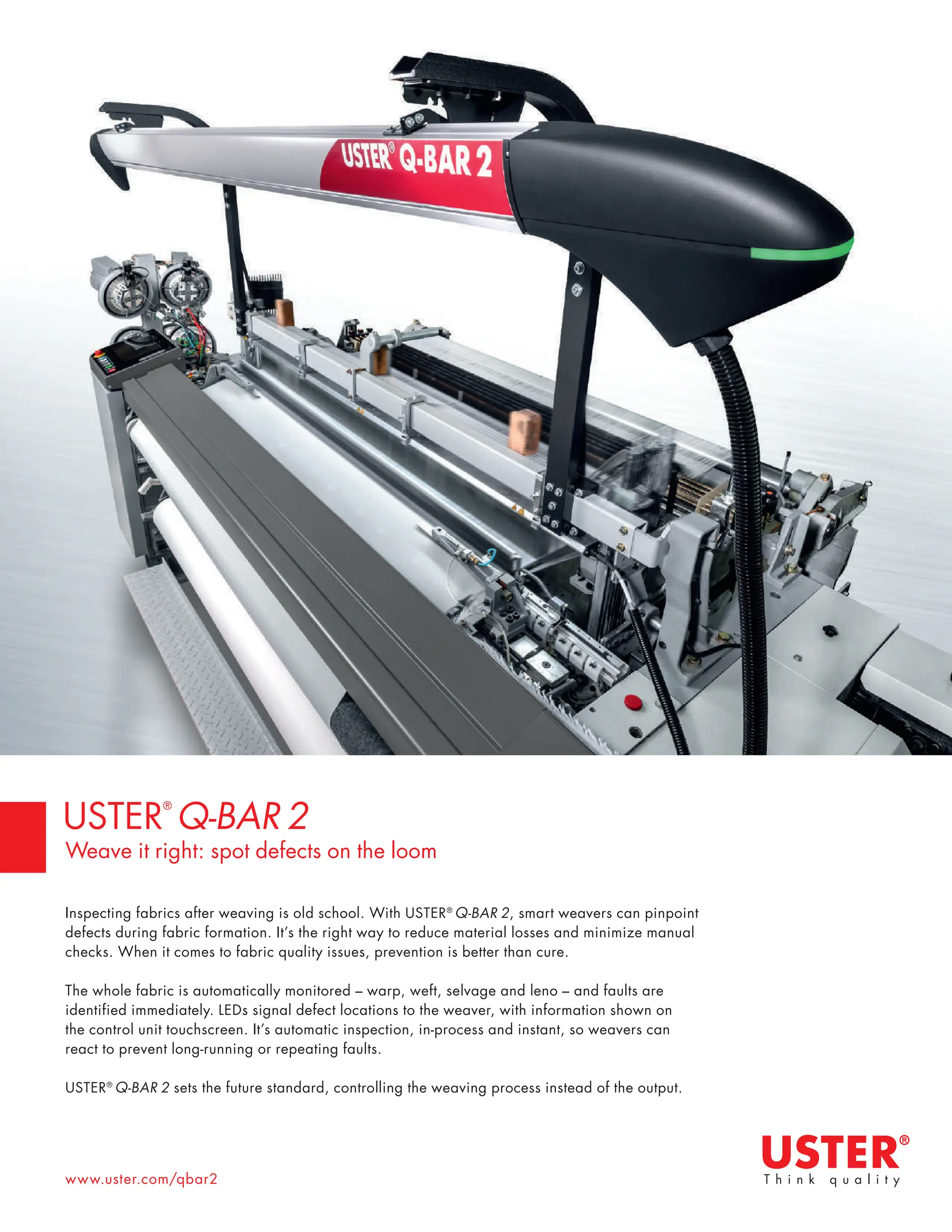
www.uster.com/qbar2
Inspecting fabrics after weaving is old school. With USTER®
Q-BAR 2, smart weavers can pinpoint
defects during fabric formation. It’s the right way to reduce material losses and minimize manual
checks. When it comes to fabric quality issues, prevention is better than cure.
The whole fabric is automatically monitored – warp, weft, selvage and leno – and faults are
identified immediately. LEDs signal defect locations to the weaver, with information shown on
the control unit touchscreen. It’s automatic inspection, in-process and instant, so weavers can
react to prevent long-running or repeating faults.
USTER®
Q-BAR 2 sets the future standard, controlling the weaving process instead of the output.
USTER
®
Q-BAR 2
Weave it right: spot defects on the loom
28 TVC | JULY 2022
Cover Story
SANGAM, A LEADER IN
SINGLE DENIM LINE:
MODANI
Sangam India, today is one of the top 5 exporters
of Denim from India, and more than that it
effectively adopted a zero-water discharge
process from effluent treatment plants which is
crucial in reducing industrial pollution, says Dr. S
N Modani, Founder & Managing Director, Sangam
India Ltd.
Dr. Modani holds a PhD in strategic management
practices for a sustainable future, along with a
Masters Science (M.Sc), with honours in Chemistry,
as well as an MBA qualification along with a Post-
Graduate Diploma in Cement Technology from
NCBM, Faridabad.He has a rich experience in the
textile industry, having previously held positions in
key or ganisations such as Chairman at The Rajasthan
Textile Mills Association, Director at Indian Cotton
Mills Federation, President, Mewar Chamber of
Commerce & amp; Industry and Vice President,
Rajasthan Chamber ofCommerce &I ndustry. Dr.
Modani’s stints include association with some of
India’s leading industry bodies like FICCI.
TVC: Tell us about the denim journey of your
company – from its inception to its current status.
Modani: Our humble beginnings date back to 1984,
when we started with 8 weaving machines and
today have become one of the foremost producers
in PV dyed yarn, cotton and OE yarn also ready-to-
stitch fabric. Looking at India’s fast-growing denim
sector, both internationally and nationally, we took
a strategic business decision to launch the vertical
in 2007 with a single denim line, becoming the
first company to do so in Bhilwara. We currently
have a capacity of producing 4 million meters per
month and export 50% of our capacity to more than
20 nations such as Colombia, Mexico, Argentina,
Bangladesh and Chile to name a few.
TVC: A few years ago, denim was hit by overcapacity
& dull demand. What do you think is the situation
now – domestically as well as internationally.
Modani: As per the Ministry of Commerce, Denim
exports were at $316 million in the year 2016-17,
recording a fall of 11% from the previous year. The
fall in exports was despite the industry witnessing
the massive installation of denim plants from 2014 -
2019. However, the Indian denim mills have shown
strong growth when it comes to denim exports
which have led to a certain level of stability in the
domestic markets as well. The domestic denim
fabric consumption in 2021 was 750-800 million
meters growing at an annual rate of 12% per annum.
Currently, the situation is normal with no notable
supply-demand imbalance on either the domestic
or global levels.
TVC: Any backward or/and forward integration
plans? Give us details.
Modani: We already have Backward Integration. The
majority of our yarns are already produced in-house
courtesy of our open-end rotors, ring spinning, and
texturizing machine.
TVC: How does your company contribute to green
technology and sustainability?
The textile industry had a significant negative
influence on the environment due to the additional
consumption of natural resources.Taking cognizance
ofourenvironment,weatSangamIndiaLimited,have
effectively adopted a zero-water discharge process
Dr. S N Modani,
Founder & Managing Director
Sangam India Ltd.
Interviewer: Samuel Joseph
29
TVC | JULY 2022
Chain during recent visit ITM Turkey.
Excerpts from an exclusive interview:
Different Technology used in Denim
During years Jeanologia has been transforming
the way jeans are manufactured and we do it
throughdisruptivetechnologies,innovatessoftware,
operational model and the best in service.
Denim and other fabric dyeing are different
things. These days we are working on the garment
finishing. We have different technologies for
garment finishing, We provide E-Flow solutions, G2
ozone technology and Laser technology.
We believe and want jeans to continue to be an
icon of rebels and freedom, despite its dark era when
it became one of the most polluting garments in the
sector, with our technologies and re-engineering of
jeans, it can become one of the most sustainable
garments. there is simply no excuse to perpetuate
manufacturing practices that can be harmful to
people and to the environment; or to keep using 70
liters of water to finish a jean when you can use 1.
All of this possible while maintaining or improving
manufacturing costs and significantly reducing the
time to market of new products.
We have been working in that direction and
with the technological advances that are available
today for the finishing of denim fabric and jeans.
Laser technology has transformed the Denim
and jeans industry,
Laser technology today allows for the creation
of extraordinary abrasion patterns in jeans that can
aid in the close replication of vintage garments that
were previously impossible to achieve. It also is able
to introduce creative design elements to denim
that rival digital printing in other type of products,
expanding the opportunities to differentiate product
through creativity. All of this while eliminating
difficult hand labor and the use of toxic chemistry
in the detailing of jeans , eliminating the harmful
processes In laser technology we are the leaders
which was launched in 1999. By this process we can
replace manual labour, such as, Manual Scraping
eliminating potassium permanganate spray. In
finishing with laser technology, we have attained
sustainability, efficiency, and endless creative
possibilities. In garment, traditional finishing, we
need 70 litres of water and 150 gm of chemicals.
With our technology, we need only 1 litre of water.
G2 Ozone technology
Ozone application in jeans finishing enable
production centerstogreatlyreducetheuseofwater
and chemicals to remove indigo in the product and
achieve the right shade of blue faster, sustainably
and at lower costs. Treatment with ozone has other
great benefits, like cleaning any residual indigo
redeposition and controlling the cast of the fabric,
eliminating forever the stones on the process.
E-Flow, nanobubbles Technology that uses
micronization to substitute traditional abrasion
process and deliver performance chemistry (color,
softeners, antimicrobial, etc.) using nano-bubbles
instead of water, is reducing the cost of application,
saving the amount of water used and ensuring that
the correct amount of chemistry stays in the garment
and not in the water.
Thetechnologywithnanobubbles,thesolution
giving your garments the desired properties while
saving on water and chemicals. E-Flow technology
withitsdoubletanksystemcreatesprocessversatility
and production flexibility. E-Flow Lab technology
based on nanobubbles enables sampling with all
the finishing effects that can be accomplished in
industrial conditions. We can reduce quantity of
water and chemicals by as much as 89%. We work
always on simplifying the process.
30 TVC | JULY 2022
from effluent treatment plants which is crucial in
reducing industrial pollution. Additionally, we use
the Effluent treatment plants (ETPs) for wastewater
management that help recycle more than 90% of the
water used during the manufacturing process. The
waste is sent to fuel the furnace where it is turned
into a cake and delivered to a cement manufacturing
facility. We are also generating solar power to reduce
our dependence on non-renewable energy.
TVC: What is your company’s exporting status in
denim? Can you briefly trace its growth over the
years?
Modani: Sangam India, today is one of the top 5
exporters of Denim from India. As mentioned earlier,
we supply to over 20 countries globally and had
exported denim fabric worth approximately USD 45
million in the previous financial year.
TVC: What is your company’s denim dream in terms
of production, turnover and future plans?
Modani: If I talk about our vision for the future, we
want to consistently grow our production capacity
of denim fabric responsibly and sustainably. We plan
to manufacture over 480 million meters of denim
fabric this year with a key focus to improve this
number year on year. We would also be constantly
investing in the latest state-of-the-art machinery
which helps us in increasing our manufacturing
pace, thereby enabling us to expand and supply to
more international countries in the coming 5 years.
TVC: What is your view on the future of denim in
India?
Modani: According to a recent study published by
Research & Markets, the global denim market today
stands at close to USD 65 billion which would grow
to about USD 87 billion by 2027. I believe India
would be at the forefront of this growth mainly due
to the easy availability of cotton and yarn at a local
level. Add to that, consistent growth in the domestic
market, favorable government policies and a robust
ecosystem of manufacturing know-how will make
sure that India is one of the largest manufacturers of
denim fabric globally.
Our Finishing
Knowhow is
Sustainable,
Cost-Efficient:
Carmen Silla
Jeanología, based in Spain, is a world leader in
sustainable and efficient finishing technologies
for the textile industry, with presence in over
60 countries. Jeanologia’s “objective is to become
the technological partner to our customers,
accompanying them through their process of
change, and adding value at each step. With our
disruptive technologies we break the norm, to give
our customers innovative and transformative ways
of doing things. We are not here to improve the
textile industry by 10 or 20% but to make it 20 times
better,” proclaims its website.
Ms. Carmen Silla, Jeanologia’s Marketing &
Communication Manager, spoke to Textile Value
31
TVC | JULY 2022
H2Zero, Another process is water treatment
system in wash; finishing processes with zero
discharge . This is a water treatment technology
that leaves water in optimal conditions for its reuse
in washing finishing processes without the need of
chemicals. H2Zero means ZERØ discharge and ZERØ
waste.
Each of these technologies; considered
independently of each other, would mean great
steps towards a more sustainable denim industry.
Using them together delivers a transformational
effect that should become the norm in our industry.
Now coming to Garment Dyeing, adding
colour to the process, we offer the ColorBox a full
line of state-of-the-art garment dyeing equipment
to revolutionise the dyeing, which is one of the most
polluting practices in any country. We don’t just give
technologies, we provide end-to-end solutions, till
final process and to automate the process.
ColorBox is our solution, It ensures the best
product outcome at the lowest production cost
with the minimum impact for the planet
Differentiation / USP of Jeanologia
Jeanologia technologies complement one
another. Our systems focus on capacity, speed
and ultimately it is the quality. We are very cost-
conscious and we don’t launch anything if it is not
workable.
All the technologies are good for denim
to reduce water, toxic substances and also cost
effective in denim garment processing. The goal of
sustainability needs to start at the beginning with
fabric.
G2 Dynamic Ozone technology in denim
fabric finishing is dramatically reducing the amount
of water and chemicals used, while at the same
time saving costs at the mill and eventually at the
garment finishing facilities. This technology makes
fabric more stable and consistent and prepares the
fabric better for the use of other technologies like
laser.
EIM a software to measure the environmental
impact of a finishing formula is being used to allow
brands and manufacturers to make sustainable
decisions starting in the design and product
development phase. This software empowers the
value chain to work together to achieve specific
goals. In some exemplary cases, brands are deciding
to share the results of these metrics with the final
customer, delivering on the promise of transparency
and sustainable production.
Then the most important thing is EIM,
Environmental Impact Measurement, which is a
unique and powerful platform developed to monitor
environmentalimpactofgarmentfinishingprocesses
in an efficient and economically viable way. By this
we know what is the impact on the quantity of water
we use, chemicals we apply. We categorise as low,
medium and high impact and today there are more
than 100 brands which are using this platform. Big
brands like Mango, H&M, etc are using our software.
The software can be used by Jeanologia machines or
any other systems of other technologies.
Market Share In India and World
Jeanologia has 70% share in garment finishing.
We are focusing more on laser technology. In colour,
it is not only denim, but for cotton also, or for
whatever we have the technology.
India has great potential for denim. And also
at Bangladesh, Pakistan, Turkey, China, Mexico, etc.
We are present in India for the last more than 15
years, it’s big market for us. We have local presence
in India with sales teams.
Interviewer: Samuel Joseph
32 TVC | JULY 2022
Cover Story
Jindal’s denim business
constitutes 70%
Anubha Industries
was established
in 2012. Says Mr.
Hemendra Rawat, Head,
Domestic Marketing,
Anubha Industries: “
Pratibha Syntex is the
parent company. The same
promoters have put this
unit in Surat. It is a unique
setup where we do indigo
and dope dyed products
apart from sulphur-dyed
goods. Our gamut is totally
on the value-added side. We are catering to the mid
to premium categories of the market. Our major
markets are brands, importers and exporters. We
are more export-oriented with about 50% of the
products being exported. Hardly 20% goes to dealers
and others in the domestic market. This is a new mill
with production starting only in 2014.”
Our major share in the production goes to big
brands including Pepe, Spykar, Liva, Flying Machine,
US Polo, all the brands of Aditya Birla Group, which
covers many domestic and international brands.
Anubha Industries’ capacity is 20 lakh metres
permonth.“Wefocusondope-dyeingsincethisadds
value to the premium markets. Flasher dyeing is used
for the economical, local market,” says Mr. Rawat.
He adds: “We have plans for forward integration and
have started already a small garmenting unit. We
are making 25,000 to 30,000 pieces per month. In
garments, we may go up further. In fabrics, we have
a unique setup that can go up to 25 lakh metres. By
clicking on the right product mix, the capacity can
be raised. We are fine-tuning the marketing so that
we can be flexible by reducing the capacity during
dull demand and raising the capacity during hectic
demand. Flexibility is the hallmark of this setup.”
Talking about rising cotton price, he said that
cotton situation was very bad with price touching Rs.
1 lakh per candy. “It is on par with US cotton prices,
but earlier it was lower. Inflation is also higher now.
Cost adjustment is becoming difficult with yarn
prices also rising rapidly.”
Blends are becoming popular not only because
of cotton price rise but also because of preferences
of end-consumers. Lyocel, Modal and Tencel are
becoming popular because of soft feel. The share of
blends will certainly go up and we are also thinking
of such moves.
One of the core businesses of Jindal Worldwide, which has a denim
capacity 140 million metres per annum. “We are expanding this to
160 million metres by the end of 2022. It is a vertical segment for us
from cotton to denim, with denim forming 70% of our business,” says Mr.
Nishant Giri, Senior General Manager, Jindal Worldwide Ltd, Ahmedabad.
Export constitutes 30% in denim products of Jindal. Says Mr. Giri:
“Post-Covid the demand for denim has gone up, making industries expand
their capacities. In denim China is giving tough competition to India. A new
Anubha Industries plans more denim
garment production
Interviewer: Samuel Joseph
33
TVC | JULY 2022
Ultra Denim exports 70-75% of
denim output
Ultra Denim Pvt Ltd is a fabric company and
Ultra Denim Lifestyle Pvt Ltd is the garment
unit. The capacity is 75,000 metres per day
of fabrics and 4,500 pieces per day of garments.
“Our clientele includes Aditya Birla Group, Shoppers
Stop, Reliance, Future Group and also some export
buyers. The commercial production began in 2015,”
says Ultra Denim, Parth Patidar, Director
Mr. Parth Says: “A total of 4 units are producing
denim. Despite raw material price rise, the market is
quite good. We use not only organic materials but
also recycled threads, and therefore sustainability is
taken care of. Since we have our unit in a Textile Park,
we have a community setup for recycling water and
we do some rain harvesting too.”
Ultra Denim’s export constitutes 70% to 75% of
its production. “Out of the 25% for local distribution,
50% is bought by brands. Overcapacity of denim is
history now but raw materials including chemicals
cost have risen rapidly.”
Our total capacity of denim is 2.2 million
meters. In the coming years, we are planning a
spinning mill. Besides, our solar power is taking
1/3rd of the needs in the day, and this capacity will
be raised to full capacity in solar power generation.
These are tapped through rooftops, and now we
plan to buy a separate space for more solar panels.
Adds Mr. Parth: “Our fabric is Oekotex-
certified. We use non-toxic auxiliaries and dyes
from well-known companies like Archroma and Atul.
There was a time when only big corporates were in
denim, now units with small capacities are coming
up. Like units with 1 million capacities are also set
up. May be there are 55 to 60 mills now producing
denim in India.”
plant has been started 32 km from Ahmedabad,
where our existing unit is located. We are adding
weaving and finishing capacity in the new unit.”
Mr. Giri adds: “Like in all textile industries, the
cotton price rise has hurt us too. The raw material
cost is very important in denim production since it
constitutes 60% of the cost. Cotton, wool and power
costs have gone up. We are having tough time but
since the demand is good, we are able to sustain in
the market.”
Talking about the company, Mr. Giri says:” We
promise good commitment and finest quality to
customers. It was not just overcapacity that denim
suffered some years ago. The industry was moving
to bottom weight category. Denim is an all-season
fabric. We are moving towards sustainability by
switching to less cotton, more harmless dyeing,
processes, etc.”
Interviewer: Samuel Joseph
34 TVC | JULY 2022
Tencel blending goes well with denim
Tencel fibres started with top weights category
in denim initially, but now used with bottom
weights also, says Lenzing Fibres India Pvt Ltd’s,
Mr. Ganesh Kumar M (right), Business Development
Manager and Mr. Arpit Srivastava, Marketing and
Branding Manager.
“Tencel is also used more in men’s category.
The mixing of Tencel is up to 30% in men’s category.
Tencel fibres, which are mixed with any other fibres,
are being sold all over the world. In India, there are
buyers like Birlas for Liva which. is mixed with Tencel
also.”
Mr. Ganesh Kumar Says we have developed
our own Modal fibres which are dyed with dyes from
DyStar. The Indigo dope-dyed fibres are directly sold
to the denim manufacturers and the advantage
is water is not used in this dyeing. In ladies wear
also Tencel is widely used with viscose, and denim
manufacturers are quite happy with the use of
Tencel fibres in a wide range of fibres.
Vinod Denim Ltd is one of the oldest companies
in denim. Mr. Harish Arora, Marketing
Manager comes straight to the point: “Ours
is a 30-year-old company. The denim market is
booming now. Like so many others, we have also
increased the capacity to meet the rising demand.
Our current production is already booked for 2
months. Post-Covid buyers are in plenty filling the
gap created during the pandemic. Our capacity is 30
lakh meters per month. Out of this, 90% is knitted
fabrics. Since knitted fabrics have elasticity, they fit
snugly to the wearer and today’s fabrics for men and
ladies need such characteristics. Our plants are in
Ahmedabad and we plan to increase the capacity to
45 lakh metres.”
Mr. Arora Says “We are making from the basic
stage of yarn to finished fabrics in denim. About
50% of our production is exported. Many countries
including some Latin American companies are
buying our fabrics. Our plants have latest equipment
imported from Germany. This has given us an
advantage – that we have absolutely no complaints
from buyers.”
Vinod Denim raises capacity to
meet demand
Interviewer: Samuel Joseph
35
TVC | JULY 2022
Cosmo Specialty Chemicals is India's leading texxle auxiliary manufacturer, offering a
comprehensive range of texxle auxiliaries and chemicals for texxle processing to
clients worldwide.
36 TVC | JULY 2022
THE RISE OF BIOCHEMICAL
INDUSTRY IN TEXTILE
COLOURATION
Companies providing solution to textile
colouration are looking to play an active role
in reducing their carbon footprint of not only
their but also help brands and retailers to do so
by providing innovative product ranges via the bio
based and sustainable chemistry, Yogesh Gaikwad,
Director, SDC International.
As on May of 2022, the world of textile
manufacturing is going through huge challenges.
Rising cotton prices, rising coal prices, rising fuel
prices, rising inflationincluding others, for some
reasons these seem to be common across the globe.
Our dependency on fossil fuel is getting closer to
itspeak. The Ukrainian war and Covid has made
matters worst. One of the solutions emerging to help
the textile colouration world is the manufacturing
of products based on bio sources or provide newer
bio based colouration processes. The dyers and
colourists have had solution from bio sources before
but in recent times these are gathering mass.
In this article I would to talk briefly about such
solutions.
Bio based chemical are not new to textile
colourists, we have been using enzymes, printing
gums (based on tamarind and guar alsoalginates
from algae). With the uncertainty around fossil fuels
and fluctuations in prices, chemical manufacturers
are looking at nature and its waste as source of
making useful speciality chemicals. Making use of
the agents in nature to manufacture these chemicals
is a simple solution to make these speciality
chemicals, and some of the chemical manufacturers
have already done this in the past. The change is
now taking it to a new level where it can replace
traditional way of chemical manufacturing.
To start with we have now have air planes
running on fuel from non fossil fuels. The Airbus
A380 takes off with 100% sustainable aviation fuel.
“This is another great example of the aviation
industry coming together to work towards achieving
certification of 100% SAF(sustainable aviation fuel)
by 2030. Together, we’ve clearly demonstrated that
an aircraft as large as the A380 can successfully
operate on unblended SAF.”
François P findel, Airbus Head of A380 MAP
Theaboveeventmarksabigchangeinmindset
of how various industries are looking at bio-based
innovations.
The textile dyes and speciality chemicals
manufacturers are not be left behind and they did
start the journey long before. Indigo cultivation,
harvesting and extraction was very much common
in India during the colonial period and some
other parts of the world. In recent times natural
Indigo (extracted Indigo) is making a come back
and demand for them has seen a steady rise. The
change is also towards pre-dyed Indigo yarn (mainly
cellulosic).
One of the recent innovations was to make
dyesfromleavesornutshellswhichwereagricultural
waste. This did encourage many brands and
Yogesh Gaikwad
Director,
SDC International.
CHEMICAL UPDATE
37
TVC | JULY 2022
retailers to come up with separate collections using
these dyes. It worked and has a decent presence in
market. The fastness of these dyes was assumed to
be equivalent of existing sulphurdyes. The dyeing
process did not need much changes and this helped
the colourists to implement the innovation readily
There has been an outburst of bio-based
innovations. From enzymes to functional chemicals.
Bio degradable, bio-basedsolutions are finding
interest among processes.
Some innovations that may be of interest to
colourists are:
1) Wash-down effects on reactive with special
process providing similar to Indigo and Sulphur:
This process eliminates need fornot so eco-friendly
reducing agents and strong oxidizing agents for
the wash-down effects. Manufacturers claim the
process is based on biodegradable polymeric ready
to use liquor solution. The application is possible in
rope form, coating or printing.
2)Bio-based flame retardants (> 85%) for textile
applications: They are made of renewable, natural
sources and are biodegradable. These are 100%
halogen and heavy metal free. Here the challenge
is to obtain flame retardant properties in the most
natural way, to find the right balance between safety
for people and planet.
3) Softeners based on vegetable oils: Bio content of
thistechnologyismorethan85%.Themanufacturers
claim to have better durability and versatility in
application of fibres, Hemp, cotton PES and PA.
4)Moisture management:Technologies critical for
active wear are now also available in bio-based
products.Manufacturers claim “This bio-based finish
enables high wicking and evaporation capability
which helps to evaporate water/sweat easier
and faster. The technology is also > 60% (28 days)
biodegradable, according to OECD 301B.”
The list goes on& on …..
Companies providing solution to textile
colouration are looking to play an active role in
reducing their carbon footprint of not only theirs but
also help brands and retailers to do so by providing
innovative product ranges via the bio-based and
sustainable chemistry.
We are moving closer to a situation where
most speciality chemicals needed would be available
by the bio-basedroute of manufacturing. I sincerely
hope this happens soon.
May-21 May 2022
Jan - May
2021
Jan - May
2022
% Change
Staple Fibre 6.73 6.41 46.68 43.6 -6.60
Filament Yarn 12.4 11.19 56.05 61.46 9.65
Staple Fibre 7.99 4.58 36.88 28.9 -21.64
Filament Yarn 1.73 2.05 10.09 8.49 -15.86
Staple Fibre 15.78 22.86 72.86 87.97 20.74
Filament Yarn 10.41 32.83 90.02 135.65 50.69
Source: Ministry of CommerceandIndustry
IMPORTS
Commodity
POLYESTER
VISCOSE
ACRYLIC
NYLON
May-21 May-22
Jan- May
2021
Jan - May
2022
%Change
Staple Fibre 38.32 29.72 155.3 164.59 5.98
Filament Yarn 65.98 54.16 295.21 314.14 6.41
Staple Fibre 0.26 3.75 3.34 12.92 286.83
Filament Yarn 2.01 2.48 9.01 14.05 55.94
Staple Fibre 18.38 7.88 61.27 72.68 18.62
Filament Yarn 2.83 2.37 14.99 13.72 -8.47
EXPORTS
Product
POLYESTER
ACRYLIC
NYLON
VISCOSE
MMF May 2022
Unit : USD Millions
38 TVC | JULY 2022
39
TVC | JULY 2022
As Managing Director, Niroj leads a global
team that is responsible for all aspects of Core
CarbonX business in the field of climate change
and sustainability advisory and asset management.
Core CarbonX also works very closely with Farmer
community to help them adopt sustainable crop
production and earn carbon revenue. Niroj has
over seventeen years of experience in developing
and financing projects in the field of climate change
mitigation/adaptation, biodiversity challenges,
natural resource management, and renewable
energy field.
Beforehiscurrentposition,NirojwasAssociate
Vice President at CantorCO2e (BGC Environmental
Brokerage Services, L.P.) managing the carbon
business for Southern India. Niroj has also held a
variety of roles during the early stage of the carbon
market at running sales, account management, and
delivery functions at PricewaterhouseCoopers and
NetPEM to name a few.
Weaving Organic
Cotton into Our
Future
All over the world, apparel brands are
incorporating organic cotton into their
creations. Demand for sustainability is being
heard everywhere - from the fashion houses of
Milan and Paris to India.The trend is growing every
year. A news report in www.globenewswire.comsays
that the market size of organic cotton will reach US$
6,730 million by 2028, with a compound annual
growth rate of 40%. This is good news for India
considering India as one of the major cotton markets
and the importance of cotton in the textile industry.
The country produces over half of the supply of
the world’s organic cotton, according to the Textile
Exchange, a global non-profit for the fibre industry.
Let’s take a closer look at the benefits,
challenges, certification and future of organic cotton.
The Advantages of Organic Cotton Production
Cotton isn’t always good for the environment.
It has sometimes been called “the world’s dirtiest
crop”. It requires plenty of water, and the use of
harmful pesticides is common.Fortunately, organic
cotton is different. Organic cotton farmers replace
harmful pesticides with those that are organically
approved. They use natural fertilisers, such as
manure. Organic cotton also does not make use
of genetically modified seeds.In organic cotton,
the entire cultivation chain is carefully monitored.
Organic farming does not deplete the soil of
nutrients and sustainability is the aim from start to
finish.Artificial substances such as formaldehyde and
chlorine are not used to process and manufacture
organic cotton. There are natural oils, starches,
bleaches and low-impact dyes at every step. This
reduces the toxic effects of conventional cotton
manufacturing.
Thus, clothing made from organic cotton is
more comfortable and durable. It is hypoallergenic,
making it especially suitable for those with sensitive
skin.According to estimates, organic cotton
production emits half the amount of carbon dioxide
compared to conventional cotton production.
For these reasons, organic cotton causes much
less damage to the planet. It is the perfect choice
for those who care about sustainable growth and
development.
The Challenges of Organic Cotton Cultivation
Niroj Mohanty,
Managing Director and CEO,
Core CarbonX Sols Pvt Ltd.
Organic Cotton
40 TVC | JULY 2022
Organic cotton cultivation and manufacturing
have many advantages. However, they also come
with challenges. For a start, farmers do not always
have access to good quality seeds suitable for
organic farming. At times, the seeds available do not
have the required approvals. Similarly, cultivators
can sometimes find it difficult to get their hands on
organic fertilisers and bio-pesticides.
Since organic cotton requires a different
mindset and process, farmers need to be re-skilled
and trained in its cultivation. These skills include
using natural fertiliser options and creating a healthy
soil balance. Another aspect is the art of keeping
pests under control instead of destroying them with
the use of chemicals.
These challenges are not insurmountable.
Farmers’ associations can collaborate with
environmental bodies. Terms of microcredit can
be arranged. There can be market interventions
to make organic cotton yields more attractive.
In short, inputs and facilities can be made more
readily available, and the benefits of soil health
can be properly communicated.The government’s
National Programme for Organic Production aims to
provide an accreditation framework for consumers,
producers, processors and traders all over the
country. The sector can soon realise its full potential
with these and other constructive steps.
The Importance of Genuine Certification
Proper labelling and certification are essential
for organic cotton to be sold with credibility. This
is the aim of the Global Organic Textiles Standard
(GOTS).GOTSistheglobalstandardfororganicfibres.
Some examples of certified products are fibre, yarns,
fabrics, clothes and mattresses.Before products can
be GOTS certified, all processes and activities in the
chain need to undergo a periodic on-site inspection.
Processors and manufacturers can export fabrics
and garments accepted in major markets with a
common standard. Consumers can select organic
cotton products with confidence.Another accepted
standard is Organic Content Standards (OCS). In this
case, the organic fibre percentage in a product is
tracked throughout the supply chain. However, OCS
does not cover processing.
In India, state governments are responsible
for all types of cotton production. This includes
organic cotton. In 2020, to overcome challenges
and concerns, the Agricultural and Processed Food
Products Export Development Authority (APEDA)
directed the Ministry of Textiles to develop and
launch a Standard for Chain of Custody for Indian
Organic Fibres and Products. At present, this is
voluntary under the National Programme for Organic
Production (NPOP). It certifies fibres from farm to
made-ups.
India has over 5,000 GOTS-certified facilities.
This is the highest number in the world. After recent
reports of faulty certification leading to fake organic
cotton products, a thorough audit was conducted
by GOTS. It cancelled all wrongly issued transaction
certificates. A revised system for raw material
checks and reviews of certification bodies is being
developed.
The Future of Organic Cotton in India
Rising production and increasing growth mark
the outlook for organic cotton in India. Stricter
norms for organic cotton cultivation and processing
have instilled renewed confidence in quality.Many
organisations and industry experts are helping
to streamline the supply chain. These activities
will create favourable conditions for buyers and
suppliers to promote the industry. A body called
the Organic Cotton Accelerator (OCA) is boosting
farmer prosperity and creating a transparent and
responsible supply chain.
The current production of organic cotton
in India is 1.23 million tonnes. Madhya Pradesh
and Odisha are among the States with Others that
showed growth are Maharashtra, Gujarat and
Rajasthan. In the last five years, these states have
produced 99% of the total cotton production in
India.Another indication of bright prospects is that
the Indian Council of Agricultural Research with
associated bodies have released 64 non-GM cotton
varieties and hybrids from 2017 to 2021. Organic
cotton growers can adopt these varieties. More than
6.5 million cotton farmers are directly cultivating the
crop. There are approximately 10.5 million workers
in allied sectors.
Environmentally-friendly production systems
drive best practices across the entire textile industry.
Organic cotton has the potential to transform
farming communities, improve livelihoods and
reduce climate change. It minimises pollution and
poverty, and it is better for people and the planet.
41
TVC | JULY 2022
42 TVC | JULY 2022
Abstract
Currently, all denim is made out of cotton
fibres or blends with high cotton content using a twill
weave. However, denim has a poor environmental
balance sheet, which starts with the planting of the
cotton needed for it and continues with the high
water consumption and use of chemicals.Therefore,
in order to reduce the emissions caused by these,
possible alternatives are being sought. A possible
alternative, which is considered in this paper, is the
use of hemp fibres to substitute cotton. Various
aspects such as the cultivability, producibility and
processability of hemp yarns are considered here.
The results show that hemp can be grown and
processed locally very well.Unfortunately,some
further research and development is required for
pure hemp fibres processing on a rotor spinning
machine in a process-stable manner. Based on
this, recommendations are given on how rotor
spinning machines can be adapted constructively to
overcome this deficit.
Introduction
The role of climate change and thus a
sustainable world is becoming increasingly
important. In 2012, the members of the United
Nations set 17 goals to create a more socially and
ecologically sustainable world. One of these goals
is “Responsible Consumption and Production”.
Relevant here are not only environmentally friendly
end products, but transparent and sustainable
processes throughout the entire product creation
process. [UN15] Natural fibres are thus becoming
increasinglyimportantbothintheclothingsectorand
for technical textiles. Up to now, cotton has made up
by far the largest share of natural yarns produced. In
jeans production in particular, it becomes clear how
much need there is for improvement with regard to
sustainability aspects. Not only the very high water
consumption, the use of chemicals for cultivation
and dyeing but also the long supply chains with their
ecological impacts [Opp14].
Therefore, this paper focuses on the
consideration of more sustainable alternatives in
jeans production. For this purpose, the usability
of hemp is looked at on different levels. First, the
properties of the fibres themselves are discussed
and later the technical feasibility of producing yarns.
For this purpose, the production with the help of
the rotor spinning process is examined more closely.
Rotor spinning was chosen in a project for producing
technical textiles because of its fabric resistance and
yarn propertiesas well as the productivity compared
to ring spinning. It turned out, that with minor
developments and changes in the rotor spinning
machine, a fine Ne 20 yarn was producible which
is suitable for denim use as well. Rotor spinning
without any additional changes however is currently
not yet possible with 100% hemp but only with the
addition of cotton. Mostly, between 50 to 70 %of
cotton are added. Based on this, target values are
defined that should enable the production of hemp
yarns. Finally, statements are made about the extent
to which production is possible with the help of
changes to construction-specific aspects.
review paper
Further improvements in rotor
spinning and denim out of Hemp
Justin Kuehn Lukas Lechthaler Thomas Gries
Maria Shirov_
Michna
Seyit Halac
( Institut für Textiltechnik of RWTH Aachen University)
Kira Hirschberger
43
TVC | JULY 2022
State of the art
Fibres
As mentioned, jeans production is mainly
based on cotton. In terms of sustainability, however,
cotton has disadvantages compared to other
natural fibres. The plant is demanding, it needs
warm temperatures without sudden temperature
transitions. At the same time, cotton plants have a
high water requirement of 1214 l per kg in average
[BCE19]. Cultivation mainly takes place in tropical
and subtropical areas [Hor20]. Hemp, on the other
hand, can be grown locally everywhere, which is
particularly attractive for the European market. This
means that long, CO2-intensive routes, for example,
can be avoided.Additionally, cotonised hemp fibres
have fineness, softness and spinning properties that
are close to those of cotton. Here, important factors
in fibre preparation are retting and subsequent
mechanical preparation.
As a domestic alternative, hemp is accordingly
gaining increasing attention in Europe. The needs of
the hemp plant are predestined for the European
region. Moreover, hemp is much less demanding to
grow than cotton. The plant is very robust against
pests, which is why neither pesticides nor herbicides
are needed. Furthermore, hemp in general requires
no artificial irrigation. With sufficiently good
processing,hempfibresofferapplicationpossibilities
in various textile sectors. High absorbency and good
thermal conductivity make hemp interesting for the
clothing sector and thus also for jeans production.
This shall lead to a cooling effect while wearing.
The high fineness-related strength namely offers
opportunities for home textiles as well as technical
textiles. Due to their weather resistance, the fibres
can also be used in areas where synthetic fibres
currently dominate. [CGP+08, KRM20]
Since jeans are not only made of cotton but
also of synthetic fibres, this is another argument
for the use of hemp in the production of textiles. In
addition, hemp has other advantages, such as the
fact that it is very prolific and covers all weeds, and
that it absorbs a lot of CO2 as an C3 crop. Thus, the
sustainability aspect is once again emphasised, as
the plant does not only save CO2 due to logistical
circumstances, but because of characteristics such
as water consumption and CO2 absorption. [Nov01]
Production
The use of hemp fibres as an ecological and
cheap alternative in the textile industry is currently
facing two primary challenges. On the one hand, the
processing methods used in the industry for hemp
fibres involve ecologically questionable processes
and are too expensive in the given quantities for
successful marketing of the material, and on the
other hand, the spinning processes used for hemp
fibres are not competitive due to low product
diversity and number of buyers.
The rotor spinning (cf. Figure 1) process is
adopted for the production of hemp yarns. However,
the processing of hemp is made more difficult by
the physical properties of the fibres, as on the one
hand they have a high bending stiffness compared to
cotton, which makes the initiation of the twist more
difficult, and on the other hand dust is produced
during processing, which is deposited in the rotor
groove and strongly influences the spinning stability
in the long run.
Figure 1: SpinBox SE10 of Suessen GmbH;
open cover (left) and closed cover (right)
44 TVC | JULY 2022
Therearemodernapproachesforacompetitive
use of hemp fibres. In principle, various alternative
processes can be used for fibre digestion. The fibres
can be digested mechanically, physically, chemically-
physically or microbially. In the European industry,
ultrasonic digestion and steam pressure digestion
are currently used. The number of short fibre lines
for the digestion of hemp fibres is low due to the
lack of further processing options.
In a cross-border project of Germany and
the Netherlands “Regional hemp chain for textile
production”, a jeans fabric could be produced with
hemp fibres broken down by steam pressure. The
yarn was spun on slightly modified rotor spinning
machines. However, 50 % cotton was added for
better processability. The aim here, however, is to
completely dispense with the addition of cotton and
to enable production with hemp fibres only.
Implementation
In order to enable production using the rotor
spinning process, requirements have been identified
which must be fulfilled. On the one hand, this is the
removal of dirt (cf. Figure 2) while keeping as many
fibres as possible in the opening rollerof the system.
Two possibilities have been identified for this:
1. The existing dirt separation can be improved
2. The system can be supplemented with an
alternative dirt separation mechanism
Figure 2: Sketch of dust removal in a rotor
spinning box, based on [Tro95]
Another possibility is not to remove the dirt,
but to directly combat the cause of the dirt and to
contain the formation of it.
The following principle solutions were
identified for these two possibilities:
a) Radial suction of the opening roller
b) Axial suction of the opening roller
c) Rotor equipped with dirt separation openings
d) Cross-flow in the combing-out area (direction of
action 1)
e) Cross-flow in the combing-out area (direction of
action 2)
For the technical and economic comparison,
the following criteria are used for evaluation:
a) Acquisition costs
b) Operating costs
c) Conversion costs
d) Expenditure for change of material
e) Restrictions on the choice of spinning media
Results
When looking at the potential of hemp fibres
themselves, it becomes clear that they are a very
good alternative to cotton in terms of sustainability
aspects. Hemp yarn production, on the other hand,
has shown that there are still some problems to
overcome.
Results show, that that for the considered
principle solutions for rotor spinning, due to
the additional costs for production changes and
possibly more often lot changes, if the market does
not rise significantly by higher offers.Also, the high
conversion effort for automated systems, extraction
is the worse alternative compared to the rotor
concept for industry. If the rotor concept becomes
established in industry, the acquisition costs will also
decrease and the number of available rotor designs
will increase. In this case, the rotor concept would
also score better in terms of flexibility and would
also be a good option for contract spinning mills.
During the production of hemp yarn on
commercially available rotor spinning machines,
however, high fibre damage and dust formation
occur. This is due to the high brittleness of the hemp
fibres compared to cotton in connection with the
45
TVC | JULY 2022
mechanical stress during the opening process, which
is usual for the rotor spinning process. The resulting
dirt deposits in the rotor groove impair spinning
stability in the long run. Based on this, possibilities
were worked out to reduce these dust deposits
constructively. In doing so, the improvement of the
current dirt separation as well as a potential addition
to it were examined. It was also investigated whether
the formation of dirt can be reduced by constructive
measures. The aim here is a stable spinning process
for pure hemp yarn.
Results show, that at the present time, it is
not possible to evaluate the principles in a way that
adequately reflects reality. Above all, the fulfilment
of the function and the strength of the undesirable
influences on the spinning process cannot be
determined with certainty. The respective influences
have not yet been sufficiently investigated for the
processing of hemp in order to find a systematic
solution for the constructive containment of fibre
damage.
Conclusion
The results show that hemp in general has a
high potential to enable a more sustainable denim
production. Hemp fibres have many advantages
over cotton in terms of sustainability.The advantages
of hemp over cotton are manifold. On the one
hand, the fact that hemp can be grown locally
everywhere speaks for its use. This would eliminate
long transport routes and save a significant amount
of CO2. In addition, hemp requires significantly less
water for cultivation than cotton and significantly
smaller amounts of pesticides are used. Last but not
least, hemp absorbs significantly more CO2, which is
another important aspect of sustainability.
In order to be able to use this advantages
of hemp over cotton as much as possible in the
future and to validate the assumptions made in
this paper regarding the production of hemp yarns,
more empirical trials with hemp fibres should be
carried out. In doing so, the effects of the spinning
settings on the fibre damage must be checked. This
would realise large savings of CO2 in the production
of denim in the future and thus enable a more
sustainable textile production all over the globe.
Acknowledgement:
The research project ZF4558957CJ9
(SustainPol) of AiFProjekt GmbH, Berlin, is funded
within the framework of the Central Innovation
Programme for SMEs (ZIM) by the Federal Ministry
for Economic Affairs and Climate Action (BMWK)
based on a resolution of the German parliament.
References
[BCE19] Bremen Cotton Exchange
		 Cotton: No thirsty plant
		 Press release March 22nd 2019
[CGP+08] Carus, M.; Gahle, C.; Pendarovski, C.;
Vogt, D.; Ortmann, S.;
		 Grotenhermen, F.; Breuer, T.;
		Schmidt, C.:
		Gülzower Fachgespräche,
		 Volume 26
		 Hürth: nova-Institut GmbH, 2008
[Hor20] Hortmeyer, E.:
		 Top 10 Cotton Producing Countries 		
		 in the World, Discover Natural Fibres
		Initiative, 2020
URL: 		 https://dnfi.org/cotton/top-10-
		cotton-producing-countries-in-the-		
		 world_4785/, access on 17.05.2021
[KRM20] Kozłowski, R. M.; Mackiewicz-
		 Talarczyk, M.:Handbook of Natural
		 Fibres, Band 2, 2. Edition,
		 Duxford, United Kingdom:
		 Woodhead Publishing, 2020
[Nov01] Nova-Institut (Ed.)
		Das kleineHanf-Lexikon
		 Die Werkstatt (Göttingen), 2001
[Opp14] Oppel A.:
		 Der Anbau der Baumwolle in
		 Abhängigkeit von Klima und
`		 Boden geographische Zeitschrift
		 20 (1914), H. 5, S. 241-257
		
[Tro95]		 Trommer, G.: Rotorspinnen,
		 Frankfurt am Main: Deutscher
		Fachverlag, 1995
[UN15]		 United Nations: Transforming
		 our World: The 2030 Agenda
		 für Sustainable Development,
		UN, 2015
8 TVC | JULY 2022
Life-cycle
partnership.
Sun – Service
Unlimited
Saurer takes pride in after sales
support throughout the machine
lifetime. We provide you with
technological consulting, training and
preventive maintenance to optimise
your daily operations. Boost your
machines with our updates and
upgrades, original parts and spinning
components for continuous
outstanding performance and
sustainability.
Start upgrading your machines:
service.spinning.in.karjan@saurer.com
saurer.com
47
TVC | JULY 2022
Abstract
In this project, the samples are taken from
ring frame to the winding machine at three
different winding speeds keeping the yarn tension
constant. Here the half bobbin is wound into the
cone and then both of the samples are tested using
Uster evenness tester. The sample which shows
best result will be selected as the best winding
speed.
Simultaneously, the samples are taken from
ring fame to the winding machine at three different
yarn tension with constant winding speed, then the
following steps are done same as mentioned in the
previous paragraph. All the steps performed with
proper result and conclusion is mentioned in this
work.
1.0 Introduction
In our different units, auto winding is
performed at different types of Autoconer machines.
They have certain differences in technical features
and qualitative control systems during high-speed
winding.
2.0 Objective
To check the wholesome affect of these
different technologies on yarn quality changes at
cone stage, a study was conducted under control
condition.
review paper
COMPARATIVE PERFORMANCE
OF AUTOCONER Yogita Agrawal, Asst. Professor;
Asin M. S., Student, B.tech,
Manish Singh, Student, B.tech,
Textile Engineering,
Shri Vaishnav Institute of Textile
Technology
3.0 Methodology
3.1 At differen speeds and same yarn tension
1) Study was conducted in 30 Ne P/C 48/52 of
unit-I, R/F 16. Spinning positions kept same for
all the samples.
2) Full R/F bobbin tested at UT-4 to get the IPI at
bobbin stage.
3) Each set of bobbins (10 bobbins) are converted
into cones in A/C No. 1 at different speeds 1400
mpm,1500 mpm& 1600 mpm at same yarn
tension.
4) All cones tested at UT-4 to get the IPI at bobbin
stage.
3.1.1 Results & discussion
1400 mpm
COP CONE Change%
U% 9.13 9.23 1%
-30% 618 681.3 10%
-40% 22 25.8 17%
-50% 0 0 0%
50% 24.3 22.3 -8%
200% 45 59 31%
IPI 69.3 81.3 17%
H 4.78 5.64 18%
48 TVC | JULY 2022
Table no. 1.1 : Yarn properties at 1400 mpm
1500 mpm
COP CONE Change%
U% 8.98 9.18 2%
-30% 578.5 654 13%
-40% 18.8 26.5 41%
-50% 1 0 -100%
50% 18.5 26 41%
200% 37.8 53.5 42%
IPI 57.3 79.5 39%
H 4.77 6.03 26%
Table no. 1.2 : Yarn properties at 1500 mpm
1600 mpm
COP CONE Change%
U% 9.07 9.18 1%
-30% 580.8 666.8 15%
-40% 21.3 20.5 -4%
-50% 0.3 0.3 0%
50% 22.8 22.8 0%
200% 44 49.5 13%
IPI 67.1 72.6 8%
H 4.78 6.04 26%
1) By the observing the above tables, we will
choose 1400 mpm because it shows more better
results than 1500 mpm & 1600 mpm.
3.2 At Different Yarn Tension and same Speed
1) Study was conducted in 30 30 Ne P/C 48/52 of
unit-I, R/F 16. Spinning positions kept same for all
the samples.
2) Full R/F bobbin tested at UT-4 to get the IPI at
bobbin stage.
3) Each set of bobbins (10 bobbins) are converted
into cones in A/C no 1 at different tension 250 cN,
260 cN & 270 cN at same speed 1450 mpm.
4) All cones tested at UT-4 to get the IPI at bobbin
stage.
3.2.1 Results & discussion
250 cN
COP CONE Change%
U% 9.1 9.26 2%
-30% 619 668 8%
-40% 24 23.5 -2%
-50% 0.3 0.3 0%
50% 26.3 22 -16%
200% 55 53 -4%
IPI 81.6 75.3 -8%
H 4.78 5.98 25%
Table no. 1.4 : Yarn properties at 250 cN
260 cN
COP CONE Change%
U% 9.03 9.15 1%
-30% 583.3 620.3 6%
-40% 13.5 22.5 67%
-50% 0 0.3 0%
50% 23.3 23.3 0%
200% 44 56.3 28%
IPI 67.3 79.9 19%
H 4.98 6.05 21%
Table no. 1.5 : Yarn properties at 260 cN
270 cN
COP CONE Change%
U% 9.12 9.14 0%
-30% 590.3 650 10%
-40% 21.8 26 19%
-50% 0 0.3 0%
50% 20.8 22.5 8%
200% 49 53.8 10%
IPI 69.8 76.6 10%
H 4.99 6.09 22%
1) By the observing the above tables, we will
choose 250 cN& 260 cN tension as it shows better
results than 270 cN tension.
2) Now we need to decide which is the best among
these two tensions.
49
TVC | JULY 2022
4.0 Determine the best result by finding out
cone density
1) In autoconer, select 10 drums and set the yarn
tension at 260 cN by keeping the speed constant.
2) Feed the empty cones in the respective drums
and mark them according to the order.
3) Wait until the doff gets completed.
4) Observe and record the following measurements
like weight, top and diameter & height. Also note
the top and bottom diameter & weight of empty
cone.
5) Do the same as described above for yarn tension
250 cN.
1 Result & Calculation
260 cN
CONE WT
(gm)
TOP DIA
(mm)
BOTTOM
DIA (mm)
HEIGHT
(mm)
1 2720 207 226 152
2 2710 208 228 154
3 2730 210 229 150
4 2720 210 228 153
5 2740 207 226 152
6 2720 206 226 155
7 2720 207 226 152
8 2700 205 226 151
9 2730 204 226 154
10 2810 209 225 152
AVG. 2730 207.3 226.6 152.5
Table no. 1.7 : Cone dimensions at 260 cN
250 cN
CONE WT
(gm)
TOP DIA
(mm)
BOTTOM
DIA (mm)
HEIGHT
(mm)
1 2650 206 228 153
2 2700 208 228 153
3 2680 210 229 152
4 2680 207 229 152
5 2620 205 225 153
6 2680 205 228 152
7 2670 211 232 151
8 2680 210 227 154
AVG. 2670 207.75 228.25 152.5
A) FOR 260 cN
empty cone top diameter = 4 cm (d1)
empty cone bottom diameter = 6.2 cm (d2)
empty cone weight		 = 39 g
full cone top diameter = 20.73 cm (D1)
full cone bottom diameter = 22.66 cm (D2)
height 				 = 15.25 cm (h)
yarn weight			 = 2730-39 = 2691 gm
volume = π x h x ((D12+ D22+D1xD2)
		 - (d12+ d22+d1xd2))/12
= π x 15.25 x ((20.732+ 2.662+20.73x22.66)-
			(42+ 6.22+4x6.2))/12
= 5324.75 cm3
density = 2691/5324.75 = 0.505 gm/cm3
A) FOR 250 cN
empty cone top diameter = 4 cm (d1)
empty cone bottom diameter = 6.2 cm (d2)
empty cone weight 		 = 39 g
full cone top diameter = 20.77 cm (D1)
full cone bottom diameter = 22.82 cm (D2)
height 				 = 15.25 cm (h)
yarn weight		 = 2670-39 = 2631 gm
volume = π x h x ((D12+D22+D1xD2)-
			(d12+d22+d1xd2))/12
= π x 15.25 x ((20.772+22.822+20.77x22.82)-
`			(42+6.22+4x6.2))/12
= 5377.29 cm3
density = 2631/5377.29= 0.489 gm/cm3
5.0 Conclusion
1) The above results show that the cone formed
with tension 250 cN has a good conedensity and
can easily fitted in carton box of dimensions 25.5 x
17.5 x 20.25 inches.
2) So, we will choose 250 cN tension as it shows
better results in U%, IPI and hairiness and ood cone
density.
51 TVC | JULY 2022
Today, it is a world of competition and
competency. Those who can survive are those
who has got sufficient knowledge of the plant
where he/she will perform. Up to date technology,
good working systems of the production plant,
material handling, automations,and proper process
controlling should be grasped by the students
before joining the industries. A newcomer always
feels nervous when he/she gets ill-treated from
the bosses of the industries where they join. It is
because of the poor technical knowledge, lack in
common sense,not aware of the subject to deal with
that they often blame the managements. Hence in-
plant training is always helpful to build the career.
All the industries do not welcome training
students, thinking it as a burden. Most of the
studentsarereluctanttogototheindustriesspecially
in summer season. Most of the students leave the
training in the middle citing health problems but
are only interested in getting the certificate. On
the other hand, a good percentage of the college
faculties do not take any interest in arranging the
training for the students. Some faculties mainly
send the students to the industries as per their
wish and not as per the wish of the students,saying
that “there is a better scope”. That demoralises the
students also. The overall pictures are not in a very
favourable condition. Cooperation, self-interest and
egoism must be eliminated for the greater interest
for all.This paper is related to the textile industries.
Purpose of the In Plant Training
In-plant training will provide an industrial
exposure to the students as well as to develop their
career in the high-tech industrial requirements.
They will learn about the working systems in
the industries with new machinery which are not
available in the colleges.
They will also learn how to handle the
situations, problem solving, shop floor technics
and relationships. Bookish knowledge is not just
sufficient and to come up in the larger world of the
working place.
It is the essential part of the academic as
it provides a hands-on real time exposure to the
engineering graduates. It transforms students from
the theoretical to practical solutions.
Today`s industries require dynamic and result-
oriented engineers with high capacity to work and
the students can fulfil the requirements only when
they have got the industrial exposures.
Objectives
1. To improve the employability of students pursuing
undergraduate level general degree Programme.
2. To focus on outcome-based learning in degree
programmes.
3. To promote active linkage between the higher
education system and industry, non-commercial and
commercial enterprises/organisations. At least 20%
of the total credits for the degree programme should
be assigned to apprenticeship/internship. The marks
secured by the student in apprenticeship/internship
course will be reflected in the semester and final
grade sheet. It is going to be a value basededucation.
In-plant Training
PLANNING FOR THE
IN- PLANT TRAINING
B.Basu
Retired GM – RIL,
Ex Scientist BTRA, CUTTING TEXT
52 TVC | JULY 2022
New Education Policy
With fast growing needs of the industries
for manpower with specialisation in specific areas
it became necessary to have proper interaction
with the industry. Therefore 28 special Industry
Institute Interaction Cells have been established
in Institutions. The main function of the cell is to
promote interrelationship between industry &
institution through training programmes, visiting
faculty from industry, industrial visits & practical
training etc.
These cells are establishing liaison with
industries around for the benefit of students,
teachers & support staff. A Memorandum of
Understanding (M.O.U.) has been signed between
the Confederation of Indian Industry and Directorate
of Technical Education, Bombay for this purpose.
Advisory committees are formed in all technical
institutes for participation from industries &
business houses.
There are the suggestions for the students to
opt for In Plant Trainings in each year i.e., 2nd, 3rd,
and 4th year.
The new education policy is emphasising the
In-plant /Practical Training from even 6th Standard
to make the education more practical oriented.
Difference between Internship and In-plant
Training?
The major contrast between In Plant Training
and that of Internship is that the Internship is a
type of training where the students are needed to
apply all the hypothetical information that are learnt
during studies and in general of a 2-month duration.
Both the in-plant and Internship will polish the
students to gain the basic knowledge and confidence
to face the interviews. The Organisations will always
welcome the candidates who are familiar with much
Industrial Exposures.
What is Vocational Training?
It is similar to the In Plant Training. The
college education is restricted to homework, exams,
assignments etc, but the vocational training is
focussed on providing skills and knowledges to make
the students more Practical Oriented. The aim of a
student is to get high marks in the theoretical papers
but with the evolution of new and newer technology
it is important for the students to become proactive
and fine-tune their skills to meet the demands of the
industry. It is a bridge that reduces the gap between
the educational and the working environments.
The vocational courses are structured to meet
the ever-evolving need of the industry, so it can
make an individual’s life secure. It makes them well-
prepared to face the obstacles in their career and
get high rewards. The vocational courses can help an
aspiring student to become economically liberated
at a young age.
While the major difference between technical
and vocational training may seem somewhat
semantic in nature, it is mostly related to the
subjects that each focuses on. Vocational training
often refers to education and training that focuses
more on practical skills and being able to perform
tasks related to working in a particular industry.
Technical training is similar in nature, but the focus
is on technology and developments information.
There is a need to bridge the disconnect
between ‘what is taught in the class’s and ‘what
is required by the society’. The competencies
demanded by the industry need to be embedded in
our university curriculum so that the Employment-
Employability gap is overcome.
Through apprenticeship/internship, students
may actively engage with the practical side of their
learning like problem-solving, creative thinking,
digital skills, teamwork etc. This apprenticeship/
internshipexperiencewillaugmenttheemployability
of the students
How to get the permission from the industries?
The permissions obtained from the branded
name organisationswho care for the students and
for their developments. The Educational Institutions
approach the concerned Industries through
the mails, direct interactions, through known
persons,alumni or through personal approach.
Manyof the industries deny the entry of any student
from outside fearing leaking of their secret and
don’t want to take any extra burden on their existing
employees. Sometimes it becomes too tough to
obtain permission because of some lethargic officers
in the industries having too much negative thought.
53
TVC | JULY 2022
Some professionally managed organisations
have the regular program for In- plant training
who absorb limited number of good students from
various leading colleges like IIT, NIT, NIFT, VJTI etc.,
pay stipend, offer some short-termprojects that
benefit them. In such cases the duration of the
training is kept for 45 – 60 days. Otherwise, this
In-plant Training varies from industry to industry,
college to college, students to students which
prolong for 15 days to 45 days.
Attitude towards In-Plant Training
The student`s attitude is described here as I
faced with them during my career.
• Most of the students feel that by undergoing
the In-Plant Training in the Industries, they are
obliging the College and T&P Officers. Most of them
take it as “Not Important” although they know it is a
part & parcel into their syllabus and course.
• The mere 10-15% of the students of the
“B” and that of “C” gradecollege students take it
seriously as a part of their career, then 50-60%
students need counselling and convincing that
they must undergo In-Plant Trainings and agrees
thereafter! The remaining 20% try to avoid showing
some excuses like “health is not ok” or “the parent`s
health is not ok”, or “there is marriage in their
family” or “there is some celebrations etc.”
The students from the “A Grade colleges” are
found to be more serious in building their career
and almost all of them opt for the trainings.
• The In-Plant Trainings in general last from
15 days to even 45 days. It depends on the interest
of the students and the permission granted by the
industries. In most of the cases, the students leave
the industries before the stipulated dates showing
the causes “Shortage of money”,“ill health”etc.
When questioning about the knowledge gain within
that short span, the answer is “yes, I have learnt all”.
When interviewed about the training, it shows a big
blunder.
• It is experienced that the sincere students
complete the full course of the trainings, add their
values to the industries, prepare a comprehending
report that helps all.
• Why such lethargy in going for the In-Plant
Training? (i) Most of the students are scared to go for
hard work. They feel that in the industries, they may
undergo huge pressure with workloads. (ii) Do not
know what they should observe, where to give more
importance, what are their interesting areas, what
studies are to be done machine area wise. (iii) Some
Industries have their own training officers where
they feel comfort. (iv) The colleges do not guide
them properly before proceeding for the training. (v)
Most of the students are very much choosy about
the name of the industries, location, etc. They are
interested only to branded name and renowned
locations. (vi) Some students have the real problem
of money! (vii) The female students face difficulties
in finding the accommodations because of the
safety. Their parents do not like to keep them away
for such a long time.(vii) Not always encouraged by
the concerned faculties, students’ lose morale.
Preparation for the In-Plant Trainings:
It is always better to get prepared for the
Internship in a planned manner;otherwise, the
training becomes haphazard and fruitless. The
following are a few suggestions.
• Know the Organisation: At first the student
should prepare a report about the organisation,
its location, year of establishments, number of
employees, products, and product range, whether
producingexportablevarietiesandtheirdescriptions,
about their corporate, marketing & sales office and
locations.
• The Hierarchy of the Organisation, CMD, MD,
Board of Directors, the key posts, and the persons of
the Organisation. Their mission, vision and strategic
plannings.
• Technical studies: In textile industries,
there are spinning (blow room to carding, draw
frame to ring frame), weaving (weaving preparatory,
loom shed, drawing, knotting, grey folding), wet
processing (scouring, bleaching, dyeing, printing,
finishing, package dyeing and preparations, finish
folding), POY Industries (POY spinning, take-up area,
FDY, IDY, DTY, Process Control, PPC), knitting (circular,
warp knitting, weft knitting, processing) and so on.
Study and check list preparation
• Soon you enter in any department please
study (i) Role of the Department (ii) What it
54 TVC | JULY 2022
manufactures (iii) Incoming raw material to
outgoing products,their testing procedures. (iv)
Conversion parameters and cost involved (v) Types
of the machines, model, detail of the machine.
Speed of the machines (vi) Production / machine
(vii) Quality Norms (viii) Testing procedures as per
the ISO Norms if they have ISO, otherwise what are
their standard Norms. (ix) Corrective Steps taken in
case of any abnormalities (x) Machine Maintenance
Schedule (xi) Manpower involved in production, QC,
PC etc. (xii) Power consumption overall/ Per mc.
(xiii) Humidification Plants, Make, Automatic/ Semi-
Automatic/ fully - Automatic (xiv) Housekeeping
system (xv) process Control System. (xvi) In Textile
Industries, Tension control of the yarn is necessary
i.e.in Winding, Warping, Sizing, Loom, Knitting,
POY Plant and should learn the norms. (xvii)Stop
motions and its control system should be learnt.
(xviii)ETP for the Dyeing unit.(xix) Material handling,
storing system (XX) Safety norms followed by the
Company. (xxi) Whether the Organisation is having
the Recycling system to minimise the wastage, if
yes, what are those? (xxii) wherever required do
they have knotting or Splicing System, ie.in winding,
warping, texturization (DTY) etc.? (xxiii) In which
areas they follow auto doffing system? (xiv) Any skill
development programme by the Organisation? If
yes, what are those?
Group Discussions, Brain-storming among the
student’s during training is necessary. If the student
is a lone person, question him/herself that what
the new things they have learnt? Note down in
computer or in Notebook.
Try to contribute /value addition to the
Organisation with their fresh mind /observations.
(The details of the Check list for each section/
Departments are under preparation by the Author)
Conclusion
Students must opt for In -Plant Training /
Vocational /Internships as much as possible during
Summer and Winter vacations. It is agreed that
many the industries are highly reluctant to offer the
trainings, but the colleges must approach them time
to time. The Industrial Experts are to be invited time
to time to interact with the students and faculties.
The faculties should be very much liberal to see
about the progress of the trainings rather than to
play ego.
The students must not be so choosy about
the name of the organization, location, brand name
and must complete the full course thinking about
their future. The education department should find
the possibilities of sanctioning some stipend as a
motivational measure to the students, especially for
the low-income group.
9
TVC | JULY 2022
Unleash your creativity
in Jacquard weaving
Jacquard fabric variations are endless, and Stäubli Jacquard machines set
no limits to your creativity. From simple flat weaves to elaborately ornamented
silk, from unique ribbons to full-width carpeting, let your imagination fly.
Hundreds of weaving mills around the world count on the versatility, quality,
and precision of Stäubli machines for optimum flexibility, robustness, and
maximum productivity.
www.staubli.com
56 TVC | JULY 2022
This article is an adapted version of the feature
that appears in Issue No. 12, June 2022 of the
Needle’s Eye under the heading Out of the Past
(1845-1945), 100 Years of Machine Sewing.
The year 1845 ushered in an era of great
scientific development in America, for it was the
mechanical inventions of that period that set the
paceforthetremendousindustrialprogresstofollow.
Cyrus McCormick, Samuel F. B. Morse, and Charles
Goodyear had invented and were developing new
processesinthefieldsofagriculture,communication,
and industry, destined to revolutionize old methods
of production and distribution. The textile trade
was ripe for the introduction of a mechanical device
to replace tedious hand sewing with needles and
thread.
At that time, it was customary to give
needlework to seamstresses residing in the vicinity
ofthecentreofemployment.Askillfulneedlewoman
could,forseveralminutes,makefortytofiftystitches
a minute. Her wages were wretchedly low, and by
working twelve hours a day, and often most of the
night, she was barely able to earn a meagre living.
It is little wonder that an ambitious young
machinist like Elias Howe, Jr., watching his wife
tediously perform one simple sewing operation over
and over by hand, should consider the possibilities
of a practical sewing machine and the fortune which
awaited its inventor.
It was in the year 1843, when Howe was
trying to support a family on US$9.00 a week, that
the pressure of extreme poverty forced him to
concentrate on his idea for a stitching machine. He
took it for granted that all sewing must be performed
in the same manner as hand stitching, and his first
months of inventive effort were wasted on a device
that duplicated the hand stitch.
This first invention consisted of a needle
pointed at both ends with the eye in the middle,
which was drawn up and down through the cloth
and carried the thread with it at each thrust.
Realizing the impracticability of this machine, Howe
brooded over his failure until the question occurred
to him, “Is it really necessary that a machine should
imitate the performance of the human hand?”
This idea gave birth to the” shuttle stitch”
machine, which used two threads and formed the
stitch with the aid of a shuttle and reciprocating
needle, with the eye near that point. By making a
rough model of wood and wire, Howe was convinced
that such a machine would sew.
By May of 1845, he had completed a working
model — the first practical shuttle stitch machine
— whose fundamental principles endure to this day
and had obtained a patent in 1846. His invention was
sold in England to William F. Thomas of Cheapside,
London, a corset manufacturer, for £250.
In December of 1846, Thomas secured the
English patent in his own name and engaged
Howe to adapt the machine to his manufacturing
purposes. The career of the inventor in London
was unsuccessful and having pawned his American
patent rights in England to pay various debts and his
expenses to get home, Howe returned to America in
1849, in poverty.
The American public, in the meantime, had
become interested in the sewing machine, and a few
mechanics had completed machines that infringed
on Howe’s patent rights.
Howe was able to secure the financial support
of a wealthy capitalist and took court action against
the infringers. As an outcome of the lawsuits, Howe
was publicly acknowledged as the inventor of the
shuttle sewing machine. He established himself in
New York as a manufacturer, and after a few years
was in a position to buy back the patents he had
been forced to sell in England.
technology update
The Birth Of The Sewing Machine!
57
TVC | JULY 2022
Royalties on machines made up until the
expiration of his patent (September 1867) brought
Howe an estimated sum of two million dollars. He
was decorated with the Cross of the Legion of Honor
by France but did not live long enough to enjoy the
honour and awards due him. Elias Howe, Jr. died on
October 3, 1867, in Brooklyn, New York.
The feasibility of sewing by the machine
having been demonstrated, improvements and new
inventions followed rapidly.
In 1849, Allan B. Wilson, working entirely
without knowledge of previous efforts, devised
the rotary hook and bobbin combination. Wilson’s
invention included the important four-motion feed
for moving the work after every stitch.
The first practical single chain stitch machine
was devised by James E. Gibbs of Virginia. His
invention, patented in 1856, featured a rotary
hook or looper, and a needle with a vertical motion
only. Gibbs went into partnership with James
Willcox of Philadelphia forming the Willcox & Gibbs
Sewing Machine Company which made important
advancements in the art of machine sewing.
A glove factory in 1870, showing the sewing
machines in one of the first industrial
applications.
To Isaac Singer, father of the Singer
Manufacturing Company, should go the credit for
developing the sewing machine for home use. Singer
built various features into his first machine such as
the yielding vertical presser foot to hold the work
on the table and the wheel feed. This forced other
competitive manufacturers to adapt their rather
cumbersome machines to more practical public use.
Allofthesemanufacturers
– the Wheeler & Wilson
Manufacturing Company,
Willcox & Gibbs Sewing
Machine Company, and the
Singer Manufacturing Company
– depended on a shuttle and
bobbin for forming the stitch
made by their machines. This
meant that when the thread on
the bobbin ran out, the machine had to be stopped
so that a filled bobbin could be inserted.
In 1851, William O. Grover, a Boston tailor,
patented his double chain stitch machine, designed
to draw the thread directly from spools or cones,
eliminating the necessity for re-threading the
bobbin. This double-chain stitch was known as the
“Grover & Baker” Stitch.
1881 witnessed the formation of another
company which was to greatly influence the course
of machine sewing. In that year, William S. North,
Jasper W. Cory, and LorenzeMuther formed the
Union Bag Machine Company (later Union Special
Machine Company) for the production of a bag
seaming machine. Recognizing the desirability of
machines designed especially for given operations,
they began introducing equipment into other
fields, using a refinement of the Grover and Baker
stitch, known as the “double-locked” stitch. This
found ready acceptance in many places because it
eliminated the use of bobbins necessary in producing
the lock stitch.
Union Special developed a number of the types
of stitches now in common use and many variations
of the seams that were produced with these stitches.
They gave to the industry machine attachments and
accessories which reduced the length of specific
sewing operations from a day’s work to a matter of
minutes.
By 1900, special machines for specific
operations were universally used. For the next thirty
years, there was little improvement in the types of
machines already in use, most of the effort being
devoted to the creation of new types. By 1930, a
machine had been produced for nearly every sewing
operation. The beginning of the U.S. depression
brought a demand for improved machines that
could produce better merchandise at a lower cost.
In answer to this, the sewing machinery industry
developed refined and improved high-speed
58 TVC | JULY 2022
Digital transformation and Industry 4.0 will
impact more and more the competitiveness
and economic success of enterprises in
the future. Companies all over the world have
been facing serious challenges for the last two
years. This becomes visible by current travel
restrictions, economic crisis in global supply chains
and the changing work environment. Besides, the
implementation of software and digital solutions,
further competences of employees as well as their
motivation and confidence towards the digitized
processes need to be ensured. To overcome this
barrier, the Digital Capability Center (DCC) Aachen,
Germany provides a wide variety of digitalization
trainings, consultancy offerings and supports
companies along their path towards digital value
chains.
DCC Aachen: Grand Opening in 2017
The digital transformation is decisive for many
processes in society and industry. Technological
and digital development is the driver for a whole
transformation of industry and based on the
current needs of the production industry, the Digital
Capability Center Aachen was founded in March
2017 as cooperation project between ITA Academy
GmbH, Aachen Germany and McKinsey & Company
Inc., USA.
The ITA Group, a group of multiple companies
including the ITA Academy GmbHformed in 2016
by the Institutfür Textiltechnik (ITA)of RWTH
Aachen University, took over an impressive
building, formerly known as “European Center for
Mechatronics”, led by aps GmbH, Aachen Germany.
Figure 1: Before and after - DCC Grand Opening in
2017
Within four months, in March 2017,DCC
Aachen celebrated the grand opening with more
than500 international guests from industry,
university, and politics. A unique selling proposition
is the real textile production site at DCC shopfloor.
This learning factory is a central location for
developing capabilities in a demonstration - and
learning environment, as well as a testing ground for
piloting and scaling new digital solutions.
The textile goodproduced atthe DCC shopfloor
is a smart wristband. Thereby all stages of the
supply chain from incoming orders towards product
development, wristband production and services
are covered. Along all these stages of the production
chain, several digital solutions were implemented.
The wristbandconsists of a narrow fabric with a
customized design and can be produced in individual
lot sizes. The wristband includes various functions
regarding the human-to-machine-communication.
Digitalisation : TRAINING
Digital Capability
Center Aachen – A
Success Story
Gesine Koeppe
Project engineer, Authorized Officer
ITA Academy GmbH | Digital Capability Center Aachen
59
TVC | JULY 2022
Based on the employee identification, stored on the
wristbands RFID chip, machines or working stations
can be set up individually, for example table heights,
working instructions as well as machine control
access can be adjusted.
The production of the wristband includes six
stages which are presented at the DCC. These are:
weaving preparation (warping), fabric production
(weaving), finishing (coating, heat setting and digital
printing), assembly (cutting, sewing, packaging)
and quality control. At each stage, several digital
solutions are demonstrated.
2018 enhancing digital training portfolio
At DCC Aachen, most clients ask „How can
I benefit from industry 4.0? What is the value of
digitization? Where do I get data from and how do
I generate benefit from data?“. To answer these
and many more questions, ITA Academy GmbH was
founded.
During the last five years ITA Academy has
developed itsportfolio constantly, always in close
interaction with textile clients. Starting with
three workshops on lean management, sensor
technologies and digital transformation, todayITA
Academyisaconsultingcompanywhichoffersahuge
variety of trainings and workshops for managers
and technicians, qualification seminars,research
and development projects as well as innovation
management for textile industry.
Clients in the textile value chain can benefit
from one-day trainings or week-trainings and create
their individual workshop content, based on nine
different workshop modules (see Figure 2).
Remote online class trainings per stream to
overcome travel restrictions in 2020
The Digital Capability Center in Aachen works
together with globally renown partners like for
example the Tech company Intel Corporation, USA
or the Internet of Things (IoT)/ Augmented Reality
(AR) developer PTC Inc., USA. Together with these
Figure 3: Membership network at Digital
Capability Center Aachen
Figure 2: ITA Academy GmbH offers a wide
range of training modules
60 TVC | JULY 2022
partners and other on-site software and logistics
companies,theDCCAachencreatesahighlydynamic,
realistic and creative environment and network.
This network helps the big companies to enhance
their cooperation, but also offers the opportunity
foryoung start-ups to develop and practically test
their business model.
During the last five years the DCC had over
6000 visitors, ran over 95 digitization workshops, has
published in more than 65 magazines, papers and
books and successfully implemented digital solutions
in more than 20 research and development projects.
Furthermore, the ability to offer workshops remotely
was developed at the DCC Aachen. A skill, which
was proofed very important during the Covid-19
pandemic and allows to perform workshops with
clients across the globe and trough different time
zones.
2022 Development of AI Use Cases for Carbon
Footprint reduction
Over 40 digital solutions for future
manufacturing across all stages on the shopfloor are
implemented at the DCC. These use cases behind
the digital solutions cover all current needs of the
production in global value chains, including one of
the biggest challenges manufacturers face right now:
the global climate crisis and the CO2 footprint. The
industry must adapt quickly to comply with new laws
like the German federal government’s goal to reduce
the global temperature increase to a maximum of +
1.5°C to the preindustrial time.
AI-based parameter optimization
The DCC has addresses the climate issues with
the implementation of a solution for yield, energy,
and throughput (YET) optimization through artificial
intelligence (AI).
The finishing processes of the textile factory
consume large amounts of energy to reach the
expected throughput and quality standards. But
by using the autonomous asset YET optimization
solution to automatically regulate machine
parameters through artificial intelligence and
machine learning methods, the energy consumed by
the finishing assets was reduced by 13%. This shows
once again how the model factory at the DCC is even
ahead of its time for some use cases.
The direct and autonomous optimization of
industrial processes can significantly reduce the CO2
footprint, but other solutions also help in different
ways:
Condition monitoring
A condition monitoring application offers
comprehensive information about the production
processes. Sensor data is collected in real time by
a machine’s computer to then flow through IoT
platforms such as edge devices, middlewares, data
historians, and ultimately visualization systems to be
displayed on end devices like tablets, computers or
smartphones, where the production is monitored by
employees. The applications can also trigger alarms
as soon as the process diverges from the preset
parameters.
At the DCC Aachen, the warping process is
monitored by employees via condition monitoring
dashboard, that receives all information for quality
control when logging in to the machine. Different
sensors collect data of yarn tension, knots, vibration,
temperature, humidity and light. The collected data
enables a faster reaction on problems during the
warping process and offers data-based decision
making. Consequently, the machine downtimes
were reduced by 50 % and the scrap by around 80 %
Figure4: Processparameteroptimizationwith
Artificial Intelligence can be visualized in dashboards
Digital assistant systems
Using digital assistant systems has reduced
the model factory’s downtimes related to machine
setup by 75 % and the time required to train people
by 40 %. This is due to the fact thatunexperienced or
untrained employees can get the required help for
machine usage from this system.
61
TVC | JULY 2022
For example, after warping, the elastic woven
fabric isprocessed on a needle loom. But even such
a complex process has been setup with working
instructions to provide employees with weaving
parameters and machine setupinstructions based
on theirtraining level. Moreover, otherpossible
problems, for example a broken thread, can be
supported by augmented reality and step by step
instructions.
Digital performance management
Digital performance management allows a
visualized overview of the entire production line
and therefore eases the decision-making process. It
helps management positions to receive all necessary
data and information, so that a smooth and efficient
workflow can be achieved. Digital performance
management can be linked to several Business
Intelligence (BI) tools.
Augmented and virtual reality
The DCC also demonstrates digital solutions
regarding the logistics, in this case the material
supply ofall the process stages. This is done with the
help of augmented reality using the Google Glass®.
Consequently, the productivity of the logistical
process is increased by 25 % as well as the quality
of the process. The items in stock are equipped with
RFID tags and employees wear a wrist band equipped
with an RFID reader to read items’ tags during the
picking process and indicate the logistician if the
picked item was correct or not. Incorrect picking
gives the employee acoustic and visual feedback.
The error rate in the logistical stage can be decreased
by 60 %.
Adaptive workstation for ergonomics
For the stage of assembling, the DCC demonstrates
multiple combined digital solutions: adaptive/
individualized workplace design, cycle time
measurement and digital assistant systems. Through
these digital solutions divergence in cycle times can
be reduced by up to 80 % while productivity can be
increased by 25 %. At the assembling stage of the
DCC, employees are guided step by step through the
process by a video assistant system. The station’s
ergonomics is also adaptive. By logging in to the
working station, settings like the height of a table
and the language of the instructions arecustomized
for the worker.
2025? Outlook on future technology for supply
chain management
ITA Academy plan to include a more detailed
and sophisticated workshop program about the
textile supply chainin the near future. This program
will include management procedures, like supply
chain management, as well as exercises on the topic
of implementing our digital solutions on bigger scale.
TECHNICALTEXTILEEXPORT
Unit:USDMillions
Commodity
Jan-May
2021 (F)
Jan-May
2022 (F)
%Growth
TEXTILEWALLCOVERINGS 0.07 0.11 51.84
Transmission or conveyor belts or belting of textile 4.11 3.2 -22.21
Textile wicks and gas mantles 1.59 1.5 -5.5
Textile fabric coated with gum or stiffened nes 4.53 4.03 -11.17
Tyre cord fabric of high tenacity manmade yarn 21.47 31.26 45.6
Linoleum, floor covering with coating on textile back 0 0 -52.38
Special textile products for technical purposes 19.25 26.75 38.93
Fabric impregnated, coated or covered with plastic 126.05 108.24 -14.13
Textile hosepiping and similar textile tubing 0.89 1.14 27.41
Rubberised textile fabric, except tyre cord 5.13 6.65 29.61
Textile fabric treated for theatrical backdrops, etc 7.1 8.1 14.09
Source:Ministryof Commerce andIndustry
0.07
4.11
1.59
4.53
21.47
0
19.25
126.05
0.89
5.13
7.1
0.11
3.2
1.5
4.03
31.26
0
26.75
108.24
1.14
6.65
8.1
51.84
-22.21
-5.5
-11.17
45.6
-52.38
38.93
-14.13
27.41
29.61
14.09
TECHNICAL TEXTILE EXPORT
Jan-May 2021(F) Jan-May 2022(F) %Growth
market report
technical textiles
62 TVC | JULY 2022
63
TVC | JULY 2022
Indian silk is a not so happy story, and corrections
are thereon, says Munish Tyagi, a global textile
leader & international textile consultant,
Nuovatex Global Textile Outlook, under the heading
Ground Diagnostics &Way Out On silk Industry’s
`Degrowth `In India.
QN: What are the possible reasons for sharp
decline (-53%) of RMG silk exports from a high of
US$ 244 million in 2015-16 to a low US$114 million
in 2021-22?
Ans:The key factors to be understood, are mainly:
A] decreasing use of silk in high value Furnishing &
bedcover materials in importing countries.
B] Decline of India’s silk carpet exporting industry
based in Kashmir and eastern UP,
C]increased use of cheaper and same feel and `light
in feel ` materials like Viscose, micro-Polyesters
D] overall lower quality and much higher yardage
cost of silks vis a vis above MMF fibre textiles.
QN:Did any competitor country/ countries eat up
India’s share in the referred period? If yes, in which
markets and what were the reasons that enabled
those countries to eat India’s share in silk exports?
Ans:Yes, there been an emergence of competition
from countries like China, the global market leader;
and also, from newly emerging silk producers like
Thailand, Laos, Vietnam. Korea and Uzbekistan and,
Iran in case of silk carpet exports. Their Mulberry
silks are of higher quality too.
QN: Were there any specific domestic reasons that
led to India’s decline in RMG silk exports (e.g.,
compliance rejections, price uncompetitiveness,
etc.)?
Ans:There have been mainly the following negative
drivers to impact growth of domestic silk:
A] much reduced consumption of silk in the declining
demand for traditional silkwear like Sarees,dupattas
as and their replacement by more comfortable and
cheaper MMF fabrics,
B] increasing preference by the younger population
for ` easy to use and maintain` MMF fabrics
likepolyesters and viscose filament esp. with
ever increasing support of Digital Printing in the
Suratpolyester sarees sector. Young Customers do
not find silk to be glorified or comfortable.
QN: Is there any possibility of apparels and home
textiles made from cheap silk fibre substitutes
disrupting the market positioning of India?
Ans: Already there has been disruption to silk
based markets by the cheaper fibre substitutes like
the Viscose, polyesters and bamboo fabrics;and
also, more comfortable to wear fabrics of cotton
dominated blends like cotton khadi, cotton-viscose,
cotton-polyester, cotton-linen and cotton-bamboo
etc. whereby the % ratio of the any component can
be varied in the blend yarn spinning;for example
linen and viscose in blend with cottons; and
definitely polyester fabrics. A new challenge from
cotton hemp blends coming in too as also advent of
new soft fibres like that from milk protein etc.
QN: Is better manufacturing technology in silk
sector giving the competitors enabling them to
edge past India?
Ans: India’s silk industry has been limited in its
growth, productivity and quality of its output owing
toboth the nature of Indian silks, the continued
use of outdated/ high cost/low output technology
esp, in the key activity areas like silk Reeling and its
twisting and weaving for fabrics with low level of
productivity, yield and quality control right from the
cocoon stage to the eventual fabric stage.What India
requires is large scale and higher quality silk reeling
silk outlook
Indian silk is a Not so Happy
Story!
64 TVC | JULY 2022
units which can produce quality of silk acceptable
to newer shuttleless Rapier weaving looms. Also, its
much late but much desirable that Knitting industry
takes up production of high value knit fabrics with
Italy as role model
QN: The growth rate of silk exports from India
between 2015-16 to 2021-22 to countries like UK
(-55%), France (-32%), Germany (-19%), Italy (-42%)
and Canada (-40%) have shrunk significantly. What
are the possible reasons for the same?
Ans:The principal reasons for this serious decline in
exports to the UK/France Europe/other countries in
the EUregion are mainly on account of:
A] better quality of silk products and competitive
prices from countries like Uzbek, China, others and
B] increasing use of polyester and viscose MMF
fabrics, which has been replacing silk, and also
C] tariff and non-tariff concessions available to
competitors like Vietnam, Cambodia, Myanmar,
others
QN:Tassar silk production during the year 2021-22
was less by 46% as compared to previous year.
Ans: India produces local coarser variety of silks like
Tassar, Eri and Muga, mostly in the eastern States of
Bihar, Jharkhand and Assam etc. These are mostly
for end uses in non-apparel or non-wearable end
useslike mainly for use in furnishings and upholstery
for their roughage. The apparel demand for these
is minimal and has not been developed due to No
serious work done on blending these with MMF
fibres.This segment has got impacted vis a vis better
design capability and cheaper price from polyester
and finerviscose fabrics which are more amenable to
accept faster Digital Print design in the `fast fashion`
market, as also dobby and jacquard based designs
in every emerging home textiles and furnishing
segments. The only price disruption been in lower
quality products using the waste or spun silk,
andthere is a clear and need to setup yarn spinning
mills for spun yarns, and adj.to such silk clusters.
Unit: USD Millions
Source: Ministry of Commerce and Industry
5.42
22.84
49.34
95.56
93.68
23.74
22.23
89.93
133.75
48.73
66.46
116.43
286.2
388.22
35.65
22.61
33.98
121.09
196.48
62.26
MA Y 2021 (F ) MA Y 2022 (F ) JA N-
MA Y 2021 (F )
JA N-
MA Y 2022 (F )
% GROW T H
NATURAL FIBRE IMPORT
SILK
WOOL, FINE OR COARSE ANIMAL HAIR, HORSEHAIR YARN AND WOVEN FABRIC.
COTTON.
OTHER VEGETABLE TEXTILE FIBRES; PAPER YARN AND WOVEN FABRICS OF PAPER
YARN.
May 2021 (F)
May
2022 (F)
Jan-May
2021 (F)
Jan-May
2022 (F)
%Growth
5.42 22.84 49.34 95.56 93.68
23.74 22.23 89.93 133.75 48.73
66.46 116.43 286.2 388.22 35.65
22.61 33.98 121.09 196.48 62.26
IMPORT
May 2021 (F)
May
2022 (F)
Jan-May
2021 (F)
Jan-May
2022 (F)
%Growth
6.84 7.06 32.31 34.61 7.14
8.71 12.92 43.33 66.54 53.57
805.06 574.52 3841.98 4341.77 13.01
54.65 45.48 346.37 289.88 -16.31
EXPORT
Source: Ministry of Commerce and Industry
Unit: USD Millions
6.84
7.06
32.31
34.61
7.14
8.71
12.92
43.33
66.54
53.57
805.06
574.52
3841.98
4341.77
13.01
54.65
45.48
346.37
289.88
-16.31
MA Y 2021 (F ) MA Y 2022 (F ) JA N-
MA Y 2021 (F )
JA N-
MA Y 2022 (F )
% GROW T H
NATURAL FIBRE EXPORT
SILK
WOOL, FINE OR COARSE ANIMAL HAIR, HORSEHAIR YARN AND WOVEN FABRIC.
COTTON.
OTHER VEGETABLE TEXTILE FIBRES; PAPER YARN AND WOVEN FABRICS OF PAPER
YARN.
market report
65
TVC | JULY 2022
66 TVC | JULY 2022
An integrated analytics solution is the
cornerstone to running a successful
omnichannel strategy, which helps in
optimising the marketing budget, making
concentrated efforts, improving campaigns, and
enhance supply chain and inventory management,
opines Ridhima Kansal, Director, Rosemoore.
It would be an understatement to say that
Indian consumers have not changed significantly
over the years. Today’s average consumers are
empowered, aware, and tech-savvy. Gone are the
days when a high-octane mass media advertisement
will sway customer opinion. These days there are a
multitude of options and platforms available such as
web, social, mobile, e-commerce, print media, pop-
up stores, malls, and high streets to research & learn
about products, make purchases, share feedback,
etc.
To explain it better, I will give an example
from our own brand Rosemoore. Today if someone
purchases a reed diffuser, it is possible that initially
they would have seen the advertisement in a
lifestyle magazine. Then they would have visited
the website and learned more about the product.
During the customer journey, they would have
visited our Instagram page and watched a product
demo video too. Finally, they would have visited
one of our stores. Before the last-minute purchase,
the customer might have checked online to see if
there is any discount offer/coupon available. After
using the product, they would have written a review
on Google and shared their experience with us on
Facebook.
Thus, even a single purchase is no more a
linear transaction which involves going and buying
a product. Rather, it is an integration of multiple
channels, made of both brick and click (and some
print and outdoor as well.).
Accordingly, retailers also need to finetune
their strategy and be Omni Channel-inclusive to
offer a seamless customer experience.
An Integrated Approach
A systematic and integrated approach needs
to be on top of the game for retailers. Not doing so
won’t just push them back but can even be crippling
in the longer run. To adjust and win in these
transforming times would need cohesive integration
of multiple channels -- physical, print, digital, etc. As
brands, a retailer might not need to be everywhere
but has to be firmly rooted in all those places, where
the customers (and potential leads) are. They have
RETAIL FOCUS
5 WAYS TO BUILD A
SUCCESSFUL OMNI CHANNEL
RETAIL STRATEGY IN FY 23
Ridhima Kansal,
Director, Rosemoore
67
TVC | JULY 2022
to go the extra mile to give their customers an
enhanced and seamless experience across in-store
as well virtually.
Enhanced Physical Experience
Physical stores will persist in India, despite
many pundits predicting their demise when the
coronavirus wave hit us. Though evolution is
inevitable, a dissolution is near impossible and
brands should understand the same. In the brick-
and-click battleground, the latter won’t completely
outflank the former. E-commerce is soaring high
but it can’t give a personalised touch and hands-on
experience like its digital counterparts. This is one of
the reasons the bigger digital retailer Amazon is also
racking up investments in physical stores.
Meanwhile, the footfall will decline. There will
be a sizable percentage of customers who are not
returning to stores. This however also means giving
a more personalised experience and meaningful
interaction to the remaining lot that still prefers to
shop offline.
Webrooming and Showrooming
Hybrid models of retail are evolving and we will
continue to see the confluence of digital channels
and physical stores. Recently, a Shopify survey
showed 59% of respondents prefer webrooming,
which means they will learn about a product on the
web and prefer to buy them in-store. Likewise, 54%
prefer showrooming, which means they will check
out a product in-store and buy it over the web.
This means going forward, marketing is not
about brick vs mortar but how to synchronise the
two to give larger value to the customers. Brands
need to work on seamless integration of channels --
in store, e-commerce, mobile, social, etc -- to offer
an engaging and personalised experience to the
customers.
The Rise of Video Marketing
Videos are no more just a buzzword in
marketing. It is a highly essential component of the
new-age marketing mix and gets a lot of attention
from marketers these days. It is estimated that on
average a customer watches ~ 100 mins of video
content every day, underlining its importance in
initiating brand communication, disseminating
product information, and nurturing customer
engagement. Increasingly, marketers are now
earmarking a sizable part of their budget for video
communication.
Videos can also be used in-store to drive
engagement. It can be used for in-store navigation,
safety protocol (fireplaces, exits, etc), store
information (testing places, check out, etc.). This can
also help in cutdown overhead costs.
Importance of Data Analytics
An integrated analytics solution is the
cornerstone to running a successful omnichannel
strategy. It helps in optimising the marketing
budget, making concentrated efforts, improving
campaigns, and enhance supply chain and inventory
management.
However,Omnichanneldataanalyticsistedious
and exhaustive. It is not a skin-deep approach rather
it needs to churn out a large chunk of data. It requires
scrutinising multiple channels across numerous
key data points. For instance, at Rosemoore, we
analyse all the relevant platforms/campaigns, which
include search ads, website marketing, horizontal
e-commerce spending (Amazon, etc.), institutional
marketing, social media advertisements, influencer
marketing, etc. Likewise, we scan multiple data
points including customer interactions, inquiries,
and sales across all the relevant channels. The overall
step is far from being simplistic but renders accurate,
actionable, and incisive inputs.
68 TVC | JULY 2022
F A R M T O F A S H I O N
F
A
R
M
I
N
G
G
I
N
N
I
N
G
K
N
I
T
T
I
N
G
D
Y
E
I
N
G
A
N
D
P
R
I
N
T
I
N
G
G
A
R
M
E
N
T
I
N
G
S
P
I
N
N
I
N
G
1800 - 889 - 6020
info@omaxcotspin.com
www.omaxcotspin.com
Sr. No. 842,843,845/1, Near. Petrol Pump, Village Rajsitapur , Ta. Dhrangadhra Dist. Surendranagar. Gujarat. (INDIA).
69
TVC | JULY 2022
Smartext launches BSmarTTM
,
an innovative smart labels
powered by LYCRA® fiber
It’s an exciting initiative by Smartext , authorized
distributor of The LYCRA Company for India
region to launch their private garment label
BSmarT™. As the name suggests it’s a range of
innovative garments made with LY-CRA® fiber and
other innovations of The LYCRA Company. BSmarT™
range will be sold online as well as from Smartext’s
unique consumer experience store recently opened
in North of Bangalore where customers can touch,
feel and buy these garments from the wide range.
This is a 1000 sq, ft. store with European styled
infrastructure. The store also has many interactive
tools to share the knowledge of science behind the
clothing with a common consumer. Some of the
unique features are smartly designed textile lab,
enabling consumer to have hands-on expe-rience
on product performance like flexibility, stretch,
toughness & sweat absorption. Store also has video
displays, posters with relevant information and has
a well-trained sales staffs for educating customers
on various textile aspects
BSmarT™ promoters took this initiative to
educate&shareknowledgeoftheirlongprofessional
career in textiles. Their mission of – ‘Empowering
their customers with knowledge of basic science
behind the fabric & gar-ments to get the best
possible benefit of their spends & to make them re-
ally feel Smart and delighted. Hence creating brand
loyalty & lifelong val-ue for them.
With an aim of reaching PAN INDIA , promoters
launched a dedicated E-store www.bsmartestore.
com on 7th June at Bangalore with a colorful event
attended by many industry leaders and The LYCRA
Company repre-sentatives. Similar to consumer
experience store, BSmarT™ E-store also has various
sections for buying, gaining knowledge and sharing
feedback.
brand Focus
70 TVC | JULY 2022
On the occasion of launch of e-commerce
portal and experience store, Fabrizio Maggi, The
LYCRA Company’s Apparel Commercial Director for
South Asia and EMEA Distribution, shared his views
on this unique initia-tive by SmarText solutions.
“Smartext is a part of our extended team here
in India & one of the key contacts for our customers.
On the questions of focus and growth in Indian
market he said “The vision of The LYCRA Company
for Indian market is increasingly more focus on
domestic market and continue to invest here to
increase our visibility & enhance brand equity.
- LYCRA® brand is well recognized by the textile
industry, they connect it with better stretch , comfort
, durability and high performance.
He further added, “We work with entire value
chain from fiber to fashion which helps us take
feedback from all and come out with compelling
technologies which address the need gap.
On communication strategy , he said “ We
focus on both B2B and B2B2C depending upon type
of our customer and objective of the activity and
has increased our presence on social media while
continuing to work with trade magazines to amplify
our communication .
“Effective communication to the end
consumers is key whether online or offline because
the consumers should be aware of what they are
going to buy. We are working together with retailers
and brands to train their sales force on consumer
benefits of garments made with our technologies
On the sidelines of this gala event , an award
ceremony was organized to recognize the efforts
of some of the industry veterans in the field of
textiles and support they have extended to promote
the LYCRA® fiber and other innovations to their
customers .
LYCRA® is a trademark of the Lycra Company
VIS ION
Di ve rse pr o du ct k n owle dge
Tech ni c all y q ualified &
c ompe te nt t ea m to s ervice the
c usto me r ne ed s
Organi z ati on a l s tre n gth & b ack -
up to e xec u t e la rge in s t itu tional
orde rs
Produ ct d eve lopme n t & Sam pl in g
a re u nde rt ak en comm ercia lly
+91 230 243 8538 office@kenindia.in
QUALITY POLICY
Unde r stan ding of Customer needs
& abil ity to ser vice in stit uti onal
cu stome r s to appar e l s
Fabr ic De sign & De vel opment
capabil ity
Diver se man ufactu r in g capabi li ty
Abil ity to de l ive r & com mi tment
to e xce ll e n ce
To be the supplier of first choice for our customers working in close
association with them offering complete Fabric & Apparels related
solutions from design to delivery.
KEN endeavors to create value for its customers by setting
benchmarks in cost competitiveness, quality parameters and
turnaround time. This is to be achieved by a continuous process of
product innovation, enhancement of personnel skills and optimum
utilization of technology.
W HY KEN...
Or gan iz ation with 8 00 Members
Te am
9/621, Industrial Estate,
Ichalkaranji- 416115,
Maharashtra, INDIA.
CORPORATE OFFICE
72 TVC | JULY 2022
brand Focus
PRATIBHA IS
PIONEER OF
BIODEGRADABLE
PRODUCTS
A
sustainability-oriented, vertically-integrated
manufacturer of knitted textile products
since 1997, Pratibha Syntex aims at creating
organic relationships across the value chain. Pratibha
connects 25,000 farmers, 6500 employees and
apparel brands from over 20 countries.
Mr Nitin Seth, COO, Pratibha Swaraj Pvt Ltd (A
new subsidiary of Pratibha Syntex Ltd, incorporated
on Mar 3, 2021), conveyed to the Textile Value Chain,
through an email interaction, explained about the
company’s sustainability goals and related issues.
Excerpts:
TVC: How did Pratibha Syntex manage the business
in the last two years of Covid-19? What are the
steps taken to cushion the pandemic effects?
Nitin Seth:Pandemic has played havoc worldwide.
We too had our share of challenges. However, we
decided to fight back. We tweaked our business
strategy to address the market demand.
We first focused on the manufacturing of safety
equipment like masks and PPE kits. We innovated
and swiftly adapted new technologies to rise to the
need of the hour. To make maximum utilization of
production capacities we balanced out the domestic
and export orders and finally aligned the design and
development of fabrics and products towards work
leisure range or work from home clothing.
TVC: Sustainability is the watchword for Pratibha.
How far has it moved up in this vision?
Sustainability is at the core of Pratibha’s business
strategy. With the world facing COVID 19 and Climate
Change, we along with our associated brands
believe that it is time now or never. We work on
four-pronged approaches, planet, process, product,
and people.
a. Planet: Committed to the planet, Pratibha
converted ETP to a 100% biological process. With
this conversion, sludge has been reduced by 86%,
and landfills reduced by 1100 MT.
Abiding by the SDG goals, we have reduced GHG
emissions from 2016 to 2021 by 11%. The emission
offset is equivalent to the plantation of 3,75,000
trees. To further reduce the GHG emissions, a 2.4
MW rooftop solar plant has been set up, which has
Mr Nitin Seth,COO,
Pratibha Swaraj Pvt Ltd,
(A Subsidiary of Pratibha Syntex Ltd,)
73
TVC | JULY 2022
come into operation. Presently, 36% of our energy
consumption comes from renewable sources and
we aspire to convert 100% to renewable energy by
2030.
b. Process: Seed to garment traceability capability
gives us an edge. Recently we collaborated with
the Good Fashion Fund for the modernisation
of our processes, which consumes less energy in
operations.
c. Product: Working on the product, 68% of the total
consumption of material comes from sustainable
sources.Pratibhaiscommittedtoconvertingto100%
sustainable material by 2025. The brands are also
looking for circularity. Pratibha is the only supplier
in the country producing 100% biodegradable C2C
garments. Pratibha has developed baby wear with
C2C Materials.
d. People: Fulfilling a commitment to employees,
the management presented dream homes to
28 employees. Caring about employees’ heath,
vaccination camps were organized and 100% of
employees are vaccinated against COVID.
With respect to community development, Pratibha
established dress design and tailoring and a
computer lab in a school in Sagore and facilitated
1700 cataract operations.
TVC: Please give us more information on the
Fairtrade partnership and its achievements?
Pratibha Syntex has been organizing Fairtrade
Premium Programme since 2014. The initiative
supported by elite brands like Patagonia, Prana,
and Pact, aims to bring visible change in the overall
livelihood of grassroots employees, creating a
more enriching work environment. Over the years,
raincoats, water purifiers, mixer grinders, cookware,
refrigerators, washing machines, and other home
appliances were gifted to associates. In 2022, sewing
machines and fixed deposits were distributed to
Pratibha’s 3024 employees
In line with sustainable development goals five
(gender equality) and eight (decent work and
economic growth), we aspire to have 50% women in
our workforce by 2025.
By 2025, we aim to become water neutral and shift
50%oftheconsumptionofenergytorenewablesand
reduce GHG emissions by 50%. With sustainability at
the core of our business strategy, we target to shift
to 100% sustainable material by 2025.
TVC: What is the wishlist for the industry from your
company and also for the Government in policies
and programs?
The government has been supporting the textile
industry by coming up with new schemes. The
Production Linked Incentive Scheme is about to
transform the business dynamics. However, in line
with sustainable development goals government
should promote the use of renewable energy in the
sector. There should be a common solar/ renewable
energy policy applicable to the whole country.
Pratibhaconnects35,000farmers,10,000employees,
and apparel brands from over 20 countries. Explain
this vision with goals for the future.
Wehavethevisiontobeagloballeaderinsustainable
textile products and practices. In line with the vision,
we are venturing into a green garment factory to
come up in Ujjain (MP) this year. This sewing factory
will be producing a sustainable garment range
primarily focusing on brands or sustainable labels
like Patagonia, Pact, Prana, Columbia Sports, VF &
many more.
74 TVC | JULY 2022
Futuristic Twisting
Futuristic Twisting
Twisting Solutions
Twisting Solutions
Textiles
Textiles
75
TVC | JULY 2022
BRAND FOCUS
KARL MAYER’s focus
is on green dyeing:
Stefano Agazzi
In June 2022, Egyptian denim manufacturer
Lotustex Textile has ordered the first Karl
Mayer LINK-MATIC® system for automatic batch
changes on the Prodye-S slasher indigo dye range.
The automation solution considerably simplifies
the batch changes on indigo and sizing machines
increasing productivity – an output increase of up
to 30% is possible, depending on the number of
batch changes per day. A couple of years ago, Karl
Mayer developed a new concept of indigo yarn
dyeing technology called GREENDYE, which can
achieve immense savings in water, chemicals and
yarn waste. The company has a pilot machine at its
showroom in Mezzolombardo in northern Italy and
is now producing samples of what the technology
can do.
Speaking at the latest Textile Machinery show
in Turkey, ITM 2022, Mr. Stefano Agazzi, Head of
Technology and Products, Weaving Preparation
Commercial Division, KARL MAYER ROTAL, while
speaking to the Textile Value Chain, explained that
the GREENDYE process is based on dyeing with
the nitrogen technology. The nitrogen atmosphere
temporarily prevents the necessary oxidation and
thus gains time. In the NOX reactor, the dye can
diffuse calmly into the fiber composite, adhere there
and be fixed. In addition, the indigo concentration
increases. These effects enable the yarn to absorb
three times more dye than in case of conventional
processes.
Excerpts:
Denim Manufacturing and Innovation :
So, as you know denim is an iconic fabric and
everybody wants to look denim as a fashion style in
the past early in Europe. But today everywhere in
the world especially with frank young generation.
So, how can you make a difference in the world?
When I joined 12 years ago, we decided to follow
only a dream -- sustainability because this is the
key to the future. So, we try to develop the best
technology to help everybody to save everything.
For this reason, thought process is very important
to understand what we mean about sustainability.
Everybody is talking about sustainability. In our
opinion sustainability is saving everything as much
as possible – energy, of course water and of course
saving water means a reduced space for wastewater
depuration plant, short length machine means less
space for building,steam, etc.
This is our focus for the future. For this reason,
we have in our porfolio three different technologies
in dyeing. We focused on business and then we
worked on improving rope and slasher. Rope and
slasher, compared to a conventional machine can
save chemicals from 20 to 25%. We can also save
yarn and also reduce the machine space with less
indigo dye bath.
The last one is green dyeing – GREENDYE
machine. New technology in dyeing that look to the
future; We want to continue in this field for which
we spent a lot of money in R&D and devolopment to
save as much as possible in everything. So, we have
now short length with a maximum 70m instead of
a spread of minimum 100. We can now dye with
only three boxes instead of 9 to 12 using nitrogen
technology with only 5500 l indigo dye bath.
Thankstothenitrogentechnology,notnewbut
upgraded and using the right dyeing processes we
76 TVC | JULY 2022
reached best, means we can save 60% of chemicals
and use only 1000 litres of waterper hour in the final
washing boxes. With a standard speed the dyeing
efficiency increases up to 98% and wastage in water
is just peanuts. According to these it should be really
a sustainable innovation because it’s impossible to
make iconic denim with zero water, zero chemicals
and zero pollution. If you want to get the iconic jeans
need to accept a responsible compromise.
This makes a difference and we are focused
on this compromise. This is our goal and thanks to
the R&D center built in Italy we have a sampling
machine which is exactly 1/10th of the industrial
machine. Now, the customer can come to Italy with
his yarn, understand the technology getting fabric.
Later he can come back to us again with the fabrics
made and after adjusting our processing, we can
reach the quality level he wants.
Finally, we have another innovation, LINK-
MATIC®, in which we can save tons of yarn per years
in the indigo slasher dyeing. Innovation in green
technology. This is sustainability.
The first LINK-MATIC had be sold in Egypt and
the first GREEDYE in Taiwan. These machines will be
ready for production in March next year. Brands and
customers have to produce with sustainability .
We will collect data from our green machines
and we will be ready to discuss them in mid-2023.
Sustainability in Real Sense
We are also working in the knit department.
Brands are trying to change the ideas for the future,
but they can’t produce. So, our knit developments
will also focus on new technology to come out with
innovations. Everybody has to discuss new ideas
and come together to make it happen but we need
to speak in the same language. Sustainability is
the future. Brands should think about the future
and we can’t solve this problem of sustainability
only by talking. We need brans support. What is
sustainability? I want to give something to think
about : we use polyester and through home washes
the microfibers go into the wastewater and then
into the ocean. The microfibers are eaten by the fish
and then we eat the fish. Each generation must think
differently. Especially the younger generations who
are the future. It is necessary from school to create
a culture of sustainability. Sustainability should start
there.
Many years ago, technology was different,
unlike today. We can’t have sustainability using
old technologies. We have to change and adopt
technology to adapt to sustainability.
You see jeans. When we buy jeans, we have
to know how it contributes to sustainability. New
generation must change the mentality because we
don’t know what will happen in next 50 years but
for sure not in a better way. Everything depends on
sustainability. We produce for the masses, cheaper
things. We should produce in the right way.
All brands should produce garments with
sustainability in mind. Think differently and change
for the new generation and the future. The brands
that follow this path no need marketing because
they are on the path of sustainability and quality.
Sustainable technology certainly costs more than
simple technology but this is the only way to
safeguard ourselves for the future.
India and Karl Mayer
Everybody who wants to sell should have
a story, true story. Karl Mayer has a story. India is
growing up everywhere. In mass production, India
and China have average quality. There are good
quality denim fabric also, but only in few companies.
I have seen many small companies using low quality
processes. We need to work on these. Work a lot,
together. More quality and less pollution. Think
about this. In denim, India has a big potential for
sure in the future. India is presently more in the
domestic market. Think differently, don’t be in the
cheaper and medium market.
Indiaisexcellentinspinning,andevenfinishing.
Turkey has another story. They are one of the firsts
in producing quality fashion denim. They want to
invest in a big way. Amid Russia-Ukraine war and
macro-economic factors, the world is undergoing a
sea change. Costs are going up. Karl Mayer’s focus is
sustainability.
Start Ups Focus
Our focus today is trying to work with brands.
Can we make jeans that can go for 5 years, looking
good and sustainable?. Not easy, but we are trying.
New companies should go for the best technologies
especially in dyeing and focus on sustainability
77
TVC | JULY 2022
78 TVC | JULY 2022
R
ieter, the world’s leading supplier of systems
for short-staple fibre spinning, based in
Winterthur (Switzerland) continued to be
successfulinthemarketinthefirsthalfof2022.Based
on the company’s technology leadership, innovative
product portfolio and the completion of the ring-
and compact-spinning system, a high order intake
and a significant increase in sales were generated.
The increase in sales was achieved even though
pre-produced deliveries in the three-digit million
range had to be postponed until the second half of
2022. The order backlog is at a record level. Despite
higher sales, the significant increase in material and
logistics costs, additional costs for compensation of
the material shortages and the expenditure incurred
for the acquisition in the years 2021/2022 resulted
in a loss. Rieter is implementing an action plan to
increase sales and profitability. The sales process for
the remaining land owned by Rieter was initiated.
Order Intake and Order Backlog: Rieter posted
an order intake of CHF 869.4 million, which included
CHF 176.6 million from the businesses acquired in
the years 2021/2022. As expected, demand has thus
returned to normal compared with the exceptionally
high figure for the prior-year period, but remains
well above the average figure for the last five years
of around CHF 570 million (first half 2021: CHF 975.3
million, first half 2022 excluding acquisition effect
CHF 692.8 million).
The regional shift in demand with investments
in additional spinning capacity outside China along
with investments in the competitiveness of Chinese
spinning mills continues. Rieter benefits from its
technology leadership, the innovative product
portfolio and the completion of the ring- and
compact-spinning system through the acquisition
of the automatic winding machine business. The
brand Focus
High intake order & sales mark
Rieter’s 1st Half in 2022
79
TVC | JULY 2022
largest order intakes came from India, Turkey, China,
Uzbekistan, and Pakistan.
On June 30, 2022, the company had an order
backlog of more than CHF 2 100 million (June 30,
2021: CHF 1 135 million). Cancellations in the
reporting period amounted to around 5% of the
order backlog.
Sales
The Rieter Group posted sales of CHF 620.6
million, which included CHF 68.9 million from the
businesses acquired in the years 2021/2022 (first
half 2021: CHF 400.5 million). As a result, sales were
significantly higher than in the prior-year period,
although preproduced deliveries, which mainly
affected the Business Group Machines & Systems,
in the three-digit million range had to be postponed
until the second half of 2022. The reasons for the
postponements were the COVID lockdown in China
and supply chain bottlenecks.
EBIT, Net Result and Free Cash Flow: Rieter
posted a loss of CHF -10.2 million at the EBIT level
in the first half of 2022. Earnings were impacted
by significantly higher material and logistics costs.
The price increases already implemented are
having a delayed effect, mainly in the Business
Group Machines & Systems, and were therefore
unable to compensate for the high increase in
costs. In addition, costs in connection with material
shortages negatively impacted profitability. The
result also includes acquisition-related expenses of
CHF -11.2 million. The loss at the net result level was
CHF -25.2 million, of which CHF -17.6 million was
due to the acquisition. Free cash flow was CHF -57.1
million, attributable to the build-up of inventories
in connection with the high order backlog and
postponed deliveries.
Action Plan
Rieter is implementing a comprehensive
package of measures with the aim of increasing
sales and profitability in the second half of 2022.
The package focuses on two main priorities: Firstly,
Rieter is continuing to systematically implement
price increases while working to improve the
quality of margins of the order backlog, so as to
compensate for cost increases in materials and
logistics. Secondly, Rieter is working closely with key
suppliers and is developing alternative solutions to
eliminate material bottlenecks, as far as possible, in
order to safeguard deliveries.
The Board of Directors has decided to begin
the process for the sale of the remaining land
at the Rieter site in Winterthur (Switzerland). In
total, around 75 000 m2 of land will be sold. The
Rieter CAMPUS is not part of this transaction; the
construction project is progressing according to
plan.
Outlook
As already reported, Rieter expects demand
for new systems to normalize further in the coming
months. Due to the capacity utilisation at spinning
mills, the company anticipates that demand for
consumables, wear & tear and spare parts will
remain at a good level.
For the full year 2022, due to the high order
backlog and the consolidation of the businesses
acquired from Saurer, Rieter expects sales of around
CHF 1 400 million (2021: CHF 969.2 million). The
reduced sales forecast compared to early 2022
(March 2022: CHF 1 500 million) reflects the impact
of global supply bottlenecks. The realisation of sales
revenue from the order backlog continues to be
associated with risks in relation to the well-known
challenges.
Despite significantly higher sales, Rieter
expects EBIT and net result for 2022 to be below the
previous year’s level. This is due to the considerable
increases in the cost of materials and logistics,
additional costs for compensation of material
shortages as well expenses in connection with the
acquisition in the years 2021/2022. Despite the
price increases already implemented; global cost
increases continue to pose a risk to the growth
of profitability. As market and technology leader,
Rieter will benefit from the exceptionally high order
backlog and the continuation of the regional shift of
demand.
80 TVC | JULY 2022
NanoTextile Sdn Bhd (NanoTextile), a textile
technology service provider company
has launched nanotextile+; a programme
developed to help current and new stakeholders
in having access to extended benefits and insights,
on the NanoTextile official website. One of the
benefits included in nanotextile+ is the modified to
suit programme that offers curated rebates to each
stakeholders and business partners. nanotextile+
is an integrator and brand-building avenue. Some
call it a feature but NanoTextile calls it a vertical;
developed using data and market research, solely to
help their business partners with extended access
to insights and benefits. With their in-house team
comprised of product innovators, technology and
business strategists, they are focused on building
and crafting the best solutions you can trust.
“Gone are the days where you sign on
memberships or loyalty programmes, nanotextile+
is focused on providing long term business-
enhancement solely for our business partners”,
stated Dr. Thomas Ong, the chief executive officer
of NanoTextile.
Nanotextile+ comprises three elements and
this is how it works:
1. Experiential – Receive experiential rewards that
are specially formulated for each stakeholder from
their data
2. Partnership – obtain complete control of
insightful rewards and enjoy low-risk strategic
investment with a flexible activation.
3. Innovation – complementary insight into current
developments and technology consultations into
what is next in the market and R&D sectors.
The elements in nanotextile+; personalisation,
tech for your growth and success-driven are created
directly in line with NanoTextile’s vision. Considering
high-risk losses in business investment, especially in
today’s fashion and textile industries, NanoTextile
sees the potential of nanotextile+ as an integrator
that will help stakeholders conduct business at
low risk and full potential. Therefore, the solutions
and consultancy provided are different for each
stakeholder based on statistics and modelling
techniques in its formulated data analysis.
Over the years, technology in clothing has
increased in demand, not only in sportswear but also
ineverydayclothingbrands.Thisgrowingacceptance
has led NanoTextile to be able to collaborate
with many local brands such as PONEY, Volvo Car
Malaysia and many more. The collaborations have
been a great success for NanoTextile and its mission
of providing extra value and performance in clothing
and they are ever excited to bring more onto the
table hence, the nanotextile+ initiative. NanoTextile
also aims to make fashion and its process making
more sustainable and environmentally friendly by
using non-toxic materials in their nanotechnology
embedment process. If you are in the fashion or
brand Focus
Nanotextile+ for Exclusive
Benefits
81
TVC | JULY 2022
textile industry, manufacturers or brand owners
in retail, and trying to figure out how nanotextile+
can be beneficial to you, please head over to
the NanoTextile official website (https://www.
nanotextileinnovation.com/our-passion/) or drop an
official inquiry message about nanotextile+ through
“Contact us” form on the website.
NanoTextile Sdn Bhd (NanoTextile) was
incorporated in 2015, as an investee company of
NanoMalaysia Bhd and the first company in Malaysia
to offer a wide span of nanotechnology in textile
industry. NanoTextile aspires to be an acclaimed
textile technology provider to deliver customer-
based products that are value-added to keep its
clients competitive through better quality and latest
technology. NanoTextile has built its business around
innovation and specialism with professional services
that include end-to-end fabric supply solutions,
facilitation of direct to market commercialization of
value-added textile, up to functional garments and
development of textile technologies with market
entry assurance.
Email: info@nanotextileinnovation.com. Website:
www.nanotextileinnovation.com
Event calendar August 2022
INTERMEDIATE NONWOVENS TRAINING
COURSE CARY
https://imisw.inda.org/store/events/registration.
aspx?event=INWTC222
RE-COMMERCE COIMBATORE, INDIA
https://imisw.inda.org/store/events/registration.
aspx?event=INWTC222
2nd -5th 10th
4th -6th 10th -13th
12th -14th
23th -24th
5th -6th
9th -11th
GARTEX /DENIM / SCREEN PRINT
INDIA NEW DELHI, INDIA
https://www.denimshow.com/
ALL INDIA COTTON CONFERENCE
COIMBATORE, INDIA
www.cfccrf.in
INDO INTERTEX 2022 JAKARTA, INDONESIA
https://indointertex.com
NIT SHOW TIRUPUR , INDIA
https://www.knitshow.in
ELEMENTARY NONWOVENS TRAINING
COURSE
https://www.inda.org/training/elementary-training.php
GUANGDONG GANDEUR INTERNATIONAL
EXHIBITION GROUP VIRTUAL EVENT
http://www.gzhw.com/
82 TVC | JULY 2022
83
TVC | JULY 2022
The Textile Association (India), Mumbai Unit
is organizing an international conference
“Digitalization: A Step Towards Textile 4.0”
on Friday, 14th October 2022 at Hotel The Lalit,
Mumbai.
This Conference aims to educate how
Digitization,DigitalizationandDigitalTransformation
are shaping up and transforming the global textile
business. This Conference will discuss the major
challenges faced by the textile industry in today’s
digital marketplace & identify practical steps to be
taken to digitalize their value chain. This will be the
First Textile Conference in Asia on this topic and
just the second in the World. We will have galaxy
of speakers who would make the topic very simple
and illustrative on this very challenging subject.
This high profile conference will be attended
by 500 participants where they will get the rare
opportunity to listen to such high quality experts.
We are sure that the participating delegates will
be benefitted immensely from this conference and
help them in conveying that digitalization is not a
choice anymore but a necessity.
Many global textile machinery manufacturers
have already adapted digitization & subsequently
digitalization. Textile 4.0 is an interpretation and
application of Industry 4.0 in the textile technology
and textile manufacturing sectors across the
value chain in spinning, weaving, processing &
garmenting.
The Textile Association (India), Mumbai unit is
the largest unit of the Association with around 4,000
members. The unit has a reputation of organizing
events of topical interest both at national and global
level.
Topics to be covered
y
y How Digitalization Affects the Textile Industry
y
y The Impact of Digitization on Textile
Manufacturing Operations
y
y Digitalization in the Garment Industry
y
y Robotics in the Garment Industry
y
y Artificial Intelligence in Textile & Garment
Industry
y
y Textile Industry – A digital Step Ahead
y
y Modern Textile process automation
y
y Software applications for textile process
automation
y
y Artificial intelligence and supportive
techniques in textile & garment manufacturing.
Speakers & Panelists
All the conferences organized by The Textile
Association (India), Mumbai Unit has always
selected contemporary & innovative topics
presented by high profile speakers. This Conference
is also no exception to this. This conference will
be addressed by policy makers, reputed textile
professionals and renowned experts from different
parts of the world and India who are experts in the
technologies. This high profile conference will be
attended by 500 quality participants who will get
the rare opportunity to listen to such high quality
experts.
A Step Towards Textile 4.0
event update
84 TVC | JULY 2022
3rd Floor, Dawer Chambers, Ring Road, Surat- 395 002. Gujarat, India
Phone: +91 261 4190200 / 2635541-42 | e-Mail : info@shahlon.com | Web. : www.shahlon.com
Maintaining world-class quality standards and delivering innovative products have been the foundation of
Shahlon group’s manufacturing philosophy. A system of acute quality control involving multiple tests
throughout each stage of operation is adopted, ensuring quality, efficiency and dependability of every
product.
Our wide range of yarn offerings include
Applications
Textured
We produce all types of NIM,
SIM, HIM textured and crimp
yarn, in all lustres - SD, FD as
well as BRT, using interna-
tional standard manufactur-
ing techniques.
Intermingle
Our carpet yarn offerings are
further expanded through
intermingled yarn.
Carpet
We have been exporting
various types of yarns such
as micro and high bulk to
the carpet manufacturing
industry, for products
ranging from rugs to wall to
wall carpets.
Dyed
With a capacity of producing
750 tons per month, &
world-class infrastructure,
we are well-known to meet
the dyeing needs of
international and local
markets.
Space Dyed
Adding further value to
dyed yarn, we also
manufacture and supply
polyester/ viscose
space-dyed yarn.
Weaving Furnishing Laces Tapes
Carpets
Labels
Velvet
Knitting
Government Recognized
Star Export House
85
TVC | JULY 2022
EVENT UPDATE
Inaugurated by Ms. Darshana Jardosh, Hon’ble
Union Minister of State for Textiles and Railways,
Gartex Texprocess India’s first-ever Mumbai
edition succeeded in drawing 9,328 visitors under its
roof. Along with the showcasing of manufacturing
machineries and innovative textile products by 120
exhibitors, the trade fair hosted insightful knowledge
sessions on the most unique and intriguing topics in
the denim industry.
With Denim Show, Screen Print India, Fabrics
and Trims Show held under its umbrella, the Mumbai
launch of Gartex Texprocess India 2022 registered a
strong footfall of 9,328 visitors from 27 countries
and 253 Indian cities during its business proceedings
at Jio World Convention Centre in BKC, Mumbai.
After witnessing an incredible response during
all three days of the fair, Mr Raj Manek, Executive
Director and Board Member, Messe Frankfurt Asia
Holdings Ltd, commented: “The feedback from the
industry has been excellent. Gartex Texprocess India
through its many editions has built a reputation as
one of the leading and comprehensive exhibitions
and by making its presence in Mumbai for the very
first time, it has further enhanced its high reputation.
We really appreciate the response and trust from
the industry, the supporting associations and the
collective efforts of all those who have made this
debut a resounding success.”
Organised by Messe Frankfurt India and MEX
ExhibitionsPvtLtd,thetradefairdisplayedmorethan
500 innovative, efficient and competitively-priced
technologies in textile and garment manufacturing,
denim production, trimmings and screen-printing
value-added solutions for the industry from over
250 brands.
Mr Gaurav Juneja, Director, MEX Exhibitions
Pvt Ltd, also shared his sentiments: “It was wonderful
to see businesses converge here at the financial
capital of India. The Mumbai edition did not only
serve as a brand-new business platform, but most
importantly it gave easy access for businesses in the
south where there is a good chunk of textile and
garmentmarkettobeexplored.Thesignatureedition
witnessed massive success in terms of reviving and
re-establishing the industry post challenging times.
We are really proud to have a successful conclusion
to this edition of Gartex Texprocess India.”
Addressing the industry during a press meet
after inauguration, Ms Darshana Jardosh stated: “I
congratulate MEX Exhibitions and Messe Frankfurt
India for expanding this exhibition concept from
Delhi to Mumbai and creating an international level
showinIndia,whichendeavourstobringthefabricto
fashion solutions onto a single platform. Shows such
as Gartex Texprocess India are excellent initiatives
and are much-needed to fill the technology gap and
promote ‘Make in India’ and ‘Aatmanirbhar Bharat’
missions.”
Exhibitors at Gartex Texprocess India included
industry’s leading textile and garment machine
manufacturers, such as: Baba Textile Machinery
GARTEX TEXPROCESS INDIA MAKES
A NOTABLE DEBUT IN MUMBAI
86 TVC | JULY 2022
(India) Pvt Ltd, Balaji Sewing Machine Pvt Ltd,
EH Turel& Company, Felix Schoeller, Gayatritex
Engineers Pvt Ltd, Mehala Machines India Limited,
Orange O Tec Pvt Ltd, Ramsons Garment Finishing
Equipment Pvt Ltd, Sera Machines and Zoje among
others.
Mr S Bharath, Director, of one of the top
companies on the showfloor, Mehala Machines India
Ltd, conveyed his sentiments about the brand new
edition: “We are very happy to have participated
in the Mumbai version of Gartex Texprocess India.
This year, we showcased many innovative products
including Retrofit IoT systems that can be combined
with existing machines along with automated
manufacturing systems and several other products.
Our overall experience has been excellent. We
received good footfalls and met prospective
customers and we are very happy about it.”
Also making its debut in Mumbai –the
Denim Show drew visitors to witness innovative,
fashionable and sustainable denim products from
several leading brands, such as Hyosung India, Jindal
Worldwide, Arvind, Ginni International, Raymond
UCO Denim, Bhaskar Denim, LNJ Denim, Oswal
Denims, KG Denim, Nandan Denim, and Ashima
Group.
Impressed by the visitor footfalls, one of the
chief exhibitors, Dr Yamuna Dutt Agarwal, CMD,
Jindal Worldwide Ltd, commented: “The response
and quality of buyers were both amazing. This
exhibition seems to be taking the denim industry
and the garment and textile manufacturing industry
in a new direction. We were glad to see the fabulous
response in the fashion capital, it will certainly help
in achieving greater heights in terms of innovation
and upgrading our buyers’ profile.”
The trade fair also played a major part in
spreading awareness about natural denim dyeing
techniques. A workshop by Neelpath allowed visitors
to get a first-hand experience of soaking fabric in
natural indigo.
After exploring products on the showfloor,
Mr Narendra Goenka, Chairman, Apparel Export
Promotion Council, (AEPC), elaborated on the
importance of Gartex Texprocess India and his
experience as a business visitor: “There are lots
of successes and growth to come in the garment
and textile industry. India needs automation
and efficiency to meet international standards.
GartexTexprocess India will help us to identify right
technology and give us the opportunity to expand
our business and capacity.”
Moreover, a series of panel discussions were
organised which gave industry experts a platform to
discuss creative, efficient and sustainable and denim
production methods:
CXO panel discussion on ‘Denim Dreams:
Roadmap To Building A Sustainable, Profitable
Future’
Bringing the ‘who‘s who‘ of the denim industry
together,theCXOpaneldiscussionhighlightedIndia’s
need to develop sustainable fabric by rebalancing
and minimising the use of chemicals and water.
The speakers hinted on use of recycled materials
such as yarn, fabrics and polyester for sustainable
manufacturing as well as reducing production costs
by a huge margin.
Denim Talks discussed unique and ingenious
techniques for sustainable denim production. Held
87
TVC | JULY 2022
on 13th May, the Denim Talks united denim industry
stakeholders to discuss a series of topics on efficient
and sustainable denim processing techniques.
Leading one of the sessions, Mr Jaydeep
Umalkar Head, Operations – Takshvi Vogue Pvt Ltd
introducedanewdyeingtechnologythatcanexecute
flash dyeing of indigo in milliseconds. Notably, the
process does not only consume a minimum volume
of water, but also executes denim dyeing with zero
effluent discharge. Apart from being exceptionally
eco-friendly, this process is also way more efficient
as it avoids shrinkage of fabric material and provides
output equal to the input. Such a technology is
unique and is being introduced for the very first time
in India.
Furthermore, discussing digital and bio-dyeing
techniques – Mr Andrew Filarowski, Technical
Director, Society of Dyers and Colourists, talked
about use of local agricultural waste to create clean
dyes, and micro-organisms to synthesise colours of
nature and using advanced technologies to optimise
automation across processes and machinery as well
as the need to reduce volumes of water, energy and
dyestuffs required in processes.
The maiden Mumbai edition of Fabric &
Trims Show also attracted a significant crowd of
visitors with its trendy displays. The section curated
fashionable and apparel enhancing elements like
fabrics, trimmings, embellishments and accessories
from top companies, such as Royal Threads, Future
Textiles, Cotton Council USA, MM Fabrics, Grasim
Industries, Maharaja Shree Umaid Mills and KK
Hangers.
Screen Print India delivers with back-to-back
successful editions
Continuing the success of its previous edition,
Screen Print India once again drew businesses back
to its show in Mumbai through new technological
showcases in digital textile and screen-printing,
digital sublimation, heat transfer and textile printing,
from brands like Dhaval Color Chem Pvt Ltd, Konica
Minolta, Skyscreen International Pvt Ltd, Stovec
Industries, Epson India Pvt Ltd and many more.
Regular exhibitor at Screen Print India, Mr
Sunil Singh, Manager, Skyscreen International Pvt
Ltd, shared his experience at the show: “The crowd
has been really good and the response towards our
products has also been great. Most importantly, we
were able to reconnect with those customers whom
we could not meet earlier due to COVID. It feels
good to meet both old and new faces and we hope
that these meetings will convert into leads.”
The trade fair succeeded in drawing businesses
from all parts of India including major states like
Andhra Pradesh, Assam, Delhi, Goa, Gujarat,
Karnataka, Kerala, Madhya Pradesh, Punjab,
Rajasthan, Tamil Nadu, Telangana, Uttar Pradesh
and West Bengal.
Taking the positive momentum forward,
Gartex Texprocess India together with Denim
Show, Fabrics and Trims Show and Screen Print
India will once again welcome businesses back at
its base in New Delhi from 4 – 6 August 2022 at
Pragati Maidan.
88 TVC | JULY 2022
89
TVC | JULY 2022
SIMA Texfair 2022 –
successful expo conducted
at the right time
T
he Southern India Mills’ Association (SIMA),
the single largest employers’ organization
representing the entire textile value chain in
the country, located at Coimbatore organized the
13th edition of SIMA Texfair 2022 – largest expo
of textile machinery, spares, accessories and other
supporting services during June 24-27, 2022 at
CODISSIA Trade Fair Complex, Coimbatore.
The Expo was formally inaugurated by the
Hon’ble Union Minister of Commerce & Industry,
Consumer Affairs, Food and Public Distribution
and Textiles, Shri Piyush Goyal on 25th June 2022.
Dr.L.Murugan, Hon’ble Union Minister of State for
Information&Broadcasting,Thiru.R.Gandhi,Hon’ble
Minister of Handlooms & Textiles, Government of
Tamil Nadu, Thiru.R.Sakkarapani, Hon’ble Minister
of Food & Civil Supplies, Government of Tamil Nadu
were also graced the inaugural function as Guests of
Honour.
SIMA Chairman Shri Ravi Sam welcomed the
Chief Guest, Shri Piyush Goyal, Hon’ble Minister
of Commerce & Industry, Consumer Affairs, Food
& Public Distribution and Textiles, Government
of India, Dr L Murugan, Hon’ble Minister of State
for Information and Broadcasting and Fisheries,
Animal Husbandry & Dairying, Government of India,
Thiru R Gandhi, Hon’ble Minister for Handlooms
and Textiles, Government of Tamil Nadu, Thiru
R Sakkarapani, Hon’ble Minister for Food and
Civil Supplies, Government of Tamil Nadu, Shri K
Annamalai, President, Bharatiya Janata Party, Tamil
Nadu and the Exhibitors to the inaugural function.
During his Welcome Address, SIMA Chairman
briefed about Texfair 2022.
In his Chief Guest address, Shri Piyush Goyal
has highly appreciated the innovative capabilities
and entrepreneurial skills of the people of Tamil
Nadu especially the twin cities viz., Coimbatore and
Tiruppur. He stated that Tamil Nadu would become
the largest hub for textiles, pumps, wet grinders,
critical components manufacturing, etc., in the
world and boost the economic growth of the Nation.
Also highlighted the various policy initiatives taken
by the Government and the hard work put in by the
industry to achieve USD 440 bn exports especially
the textile industry which has increased exports last
year by 40% from 35 billion to 44 billion.
ShriPiyushGoyalhighlyappreciatedtheefforts
taken by SIMA in organizing the Texfair event with
world-class standards and providing opportunities
for several hundreds of MSME manufacturers
to develop import substitution and enhance the
competitiveness of the Indian textile industry.
He advised the textile machinery and spares
manufacturers to achieve 100% self-sufficiency by
EVENT UPDATE
90 TVC | JULY 2022
manufacturing all the machinery from ginning to
garmenting indigenously.
Dr L Murugan, Hon’ble Minister of State
for Information & Broadcasting, highlighted the
numerous policy initiatives taken by the NDA
Government led by Hon’ble Prime Minister, Shri
Narendra Modi. He stated that when the entire
world was reeling under grave recession due to the
ill-effects of COVID pandemic, the unique policy
measures taken by the Union Government not only
enabled the country to fight the war against Corona,
but also to achieve a record export of 440 billion
USD.
Shri R Gandhi, Hon’ble Minister for Handlooms
& Textiles, Government of Tamil Nadu in his Guest of
Honour address appreciated the support extended
by the Union Government, especially Hon’ble
Minister of Textiles for the growth of the handlooms
and textile industry in Tamil Nadu, particularly the
removal of 11% import duty on cotton. He requested
to allocate more funds for the growth of the industry
in Tamil Nadu. He highlighted the various policy
initiatives taken by the Hon’ble Chief Minister of
Tamil Nadu, Shri.M.K.Stalin for the growth of textile
industry in Tamil Nadu.
ShriRSakkarapani,Hon’bleMinisterforFood&
Civil Supplies, Government of Tamil Nadu highlighted
the contributions made by Tamil Nadu in terms of
GDP, industrial production, exports especially by
MSME clusters in Coimbatore, Tiruppur, Erode and
Dindigul.
Shri K Annamalai, President, BJP, Tamil Nadu
reiterated the proactive initiatives taken by the
Government to mitigate the ill-effects of COVID-19
and also the unprecedented price increase of cotton
and cotton yarn faced by the cotton textile value
chain.
Shri T Rajkumar, Chairman, Confederation of
Indian Textile Industry, briefed about the continuous
efforts made by the Hon’ble Union Textile Minister
for making Indian textiles & clothing industry to
achieve 44.2 billion dollars exports during the year
2021-22, despite unprecedented challenges, a
record growth in the history of textile industry.
Dr S K Sundararaman, Deputy Chairman, SIMA
while proposing the vote of thanks, highlighted
unique policy measures and time-bound actions
taken by Shri Piyush Goyal for the development of
the textile industry.
At the Texfair expo, machinery, spares
manufacturers / suppliers and other supporting
service providers from China, Japan, Switzerland,
Italy and USA apart from domestic players across the
country catering to various segments of the textile
industry showcased their products and services.
The expos provided an opportunity for
various clusters of the industry to know the latest
improvements in technology and availability of
domestic as well as import substitution spares. 235
exhibitors showcased their products and services in
310 stalls. Out of 235 exhibitors, 145 exhibitors have
participated in more than five Texfair Expos. The
Expo attracted about one lakh visitors and created
business worth around Rs.1000 crores. Business
visitors from countries like China, Indonesia,
Thailand, Bangladesh and Sri Lanka visited the Expo
and derived the benefit, besides the visitors from all
over the country.
We thank all the exhibitors for showcasing
their products and services, the CEOs of mills for
visiting and deputing their technical personnel and
also visitors from various textile clusters across the
country for making the Expo yet another successful
event by the Association.
91
TVC | JULY 2022
texfair Review
BASANT participation at
TEXFAIR 2022
BASANT FIBERTEK participated in TEXFAIR 2022,
Coimbatore taking up a prominent location
to welcome clients after a long hiatus due to
the pandemic. The purpose was to brief them of the
latest developments and offerings by the company,
understand the customers’ process-related issues
and challenges and offer suitable solutions. The
company was pleased to introduce its latest product
developments for Open-End Spinning, Fibre Opening
in Beaters and Cards, and for Waste Recycling. It has
always been the endeavour of Basant to constantly
innovate better solutions for achieving more opening
with rupturing fibres.
In Open-End Spinning, BASANT’s Opening
Rollers and Rotors have proven to achieve superior
performance at a much lower cost, primarily due
to several innovations in product design and hard
coatings. In five years since start of commercial
production at the new highly automated
manufacturing facility, the company has been able
to make a significant presence in this market, both
in India and overseas. There was a tremendous
response for these products at the exhibition and
many valuable enquiries were received that will
provide a quantum jump to our business in this
segment.
In Pin Rollers for Beaters and Cards, BASANT
introduced several innovative pinned patterns to
suit different fibre mixings and shared results of past
installations with senior technical personnel who
visited from several spinning mills. BASANT takes the
responsibility end-to-end -- starting from audit of the
process to design of the custom solution to supply,
erection and optimisation of machine settings and
finally achieving the desired improvement in waste
reduction, production increase and quality. In a
recent case, the mills could increase daily production
by 10 tons only by installing Basant Pin Rollers!
In waste recycling, the company introduced
new designs of Pinned Lags and Cylinders that
provided the twin benefits of long life and better
opening without rupture which keeping costs low.
The combination of superior quality and economy
has made the company an international market
leader in this segment, with 90% of production
exported annually.
The company took the opportunity to also
meet clients from the worsted spinning and linen
spinning segments and offer products suited to
their requirements. The hallmark of BASANT over
the decades of market leadership has been that
of offering superior value to clients through high
performance, fail-safe products, innovative upgrades
and economical pricing backed up with reliable
service.
Corporate Office : SF-34, Vasant Square, Vasant Kunj, New Delhi – 110070, India
Mobile : +91 98100 09264, 96506 54343 Email : mani@bishnutexport.com
Air Covered Yarns in Nylon-6, Nylon-66 and Polyester
Single Covered Yarns
20 Denier to 250 Denier
for High end Seamless
Knitting and
Medical Bandages
20 Denier to 300 Denier
in S & Z twists
Double Covered Yarns
350 Denier to 1400 Denier
Single And Double Covered Yarns in Nylon-6, Nylon-66
and Polyester
93
TVC | JULY 2022
ITM 2022, the first major international textile
machinery exhibition held in the world after a
3-yearhiatus,hostedtextiletechnologyleadersin
Istanbulfor5days.Recordsaleswereachievedatthe
ITM 2022 Exhibition, where the latest innovations
in every field of textile from weaving, knitting, yarn,
digital printing, finishing to denim were exhibited
and world launches were performed. The ITM 2022
Exhibition, where a business volume of over 1.5
billion Euros was created in 5 days, accelerated the
Turkish and world economy.
Organised by the partnership of Teknik Fairs
Inc. and TüyapTüm Fuarcılık Yapım Inc., ITM 2022-
International Textile Machinery Exhibition was held
at Tüyap Fair and Congress Center between 14-18
June. The ITM 2022 Exhibition, which was organised
in 12 halls on an area of 120,000 square meters,
broke records with both exhibitors, visitors and
machinery sales. ITM 2022 Exhibition, attended
by 1280 companies and company representatives
from 65 countries, was visited by 64,500 people
from 102 countries, consisting of 44% international
and 56% domestic visitors. At the exhibition, where
companies sold machinery worth million Euros,
a business volume of over 1.5 billion Euros was
created.
The successful sales graph achieved at the
ITM 2022 Exhibition proved that the difficulties
experienced due to the pandemic for the last 3
years have been left behind. Turkey has become
a supply centre for European, Middle Eastern and
African countries, especially with the disruption
of the supply chain in Far East countries, including
China. The profile of the professional visitors visiting
the ITM 2022 Exhibition revealed that in the new
world order that has shifted after the pandemic,
the trade network has also changed hands and
new players have appeared on the scene. The fact
that manufacturers from all over the world such as
Andorra, Angola, Honduras, Peru, Seychelles, Sierra
Leone, Brazil, Sri Lanka, Tanzania, Egypt, Iran, and
Oman purchased a large number of machinery
and signed strong collaborations at the ITM 2022
Exhibition has proven this.
The ITM Exhibition, which was eagerly awaited
by the textile technology leaders, also pleased
the participating companies with the number of
visitors and performed machinery sales amounting
ITM Review
Over Euro 1.5-bn Business
at ITM 2022
94 TVC | JULY 2022
to millions of Euros. Many company officials, who
stated that they have achieved a sales graphic far
above their expectations starting from the very first
day of the ITM 2022 Exhibition and that they have
hosted visitors from all over the world, decided to
enlarge their stands at the ITM 2024 Exhibition.
During the exhibition, companies visited the
registration application points and applied for ITM
2024 participation.
Pursuing the usual as to keep the pulse of
the sector this year similar to the previous years,
ITM 2022 has turned into a textile feast with the
participation of hundreds of manufacturers who
developedtechnologiesintheirfield,andthevisitsof
global investors and commercial delegations. Many
companies, which focus on product development
and new productions under pandemic conditions,
had the opportunity to introduce their products to
their customers for the first time in 3 years at the
ITM 2022 Exhibition. Company owners, managers,
employees and sector representatives visiting the
exhibition had the opportunity to see the latest
technological innovations for the first time and
witnessed their world launches.
64,500 Visitors from 102 Countries
Due to Istanbul’s ease of transportation
and the absence of visa requirements, ITM 2022
Exhibition hosted thousands of visitors from all over
the world. Over 64,500 people from 102 countries,
including Turkey, visited the ITM 2022 Exhibition to
see the latest innovations in textile technologies.
The countries where the visitors come to the ITM
2022 Exhibition are as follows: Afghanistan, Albania,
Algeria, Andorra, Angola, Argentina, Armenia,
Austria, Azerbaijan, Bahrain, Bangladesh, Belarus,
Belgium, Benin, Bosnia and Herzegovina, Brazil,
Bulgaria, Canada, China, Colombia, Democratic
Republic of Congo, Croatia, Czech Republic,
Denmark, Dominican Republic, Egypt, Estonia,
Ethiopia, Finland, France, Georgia, Germany,
Greece, Honduras, Hungary, India, Indonesia, Iran,
Iraq, Israel, Italy, Japan, Jordan, Kazakhstan, Kenya,
Korea, Kosovo, Kuwait, Kyrgyzstan, Lebanon, Libya,
Lithuania, Macedonia, Malaysia, Mauritius, Mexico,
Moldova, Mongolia, Morocco, Nepal, Netherlands,
Nigeria, Oman, Pakistan, Palestine, Peru, Poland,
Portugal, Qatar, Romania, Russia, Saudi Arabia,
Serbia, Seychelles, Sierra Leone, Singapore, Slovakia,
Slovenia, Somalia, South Africa, South Korea, Spain,
Sri Lanka, Sudan, Sweden, Switzerland, Syria,
Tajikistan,Tanzania,Thailand,Tunisia,Turkmenistan,
Northern Cyprus s Turkish Republic, Turkey, Uganda,
Ukraine, United Arab Emirates, United Kingdom,
America, Uzbekistan, Vietnam and Yemen.
Next Meeting is from 4-8 June 2024
The next meeting of the ITM and HIGHTEX
Exhibitions, which bring together the world’s textile
technology leaders, will be held in Istanbul between
4-8 June 2024.
95
TVC | JULY 2022
ITM Review
SPG Prints unveils new
technology at ITM 2022
SPGPrints exhibited at ITM 2022, which was
held in Istanbul, Turkey from June 14 to 18.
SPGPrints showcased their solutions for both
conventional as digital textile printing with their
new slogan: Printing Tomorrow.
Charles Lissenburg, Chief Commercial Officer,
explains, ‘The new SPGPrints slogan illustrates
our philosophy to co-create a sustainable future
together with our customers and gives direction
to SPGPrints’ upcoming products. After 75 years,
our company continues to develop into the digital
technology, and we have quite some news to share
with the world.’
Three new performance level inks for digital
printing: SPGPrints has made huge advancements in
its ink technology to show three new performance
levels of digital textile inks. The inks will improve
the overall user experience while still focusing
on the economics. ‘Our new inks provide an
environmentally friendly solution for digital textile
print. The performance levels allow you to choose
exactly the right combination for your applications.
In-house development and production allow us to
offer inks with unrivalled quality and runnability
that add value to your business. Our inks guarantee
unattended printing without nozzle blockages or
print head failures while adhering to the highest
quality standards and sustainability legislation.’,
states Jos Notermans, Product Manager -- Digital.
New digital printers: Based on their expertise
and over 30 years of experience in digital textile
printing, SPGPrints will unveil their plans for their
new digital product line. ‘With our brand’s ambition
and the association towards our environment and
planet, digital textile printing is the way forward. In
addition to the renowned Pike, Javelin, and Arrow,
SPGPrints will announce 3 new digital printing
systems on ITM 2022.’ clarifies Charles Lissenburg
96 TVC | JULY 2022
Sabar’s DUALHEAD SERVOCOT
with unique features
Sabar Machine Tools Mfg Cohas launched its
new DUALHEAD SERVOCOT, its Dual Head Fully
Automated Servo Controlled Cot Grinding
Machine with Diameter set software. It is equipped
with two Grinding zones. Its salient features include
Servo controlled with Touch screen PLC / MMI;
Diameter set software; Automatic sorting; Auto
feeding system of Top Rollers. The production
capacity is 600-650 Top Rollers / hr.
Sabar Machine Tools Pvt Ltd is the one stop
solution for all cot grinding machine needs. Sabar is
a leading dual head fully automated servo controlled
cot grinding machine manufacturer in India. It
offers premium quality dual head fully automated
servo controlled cot grinding machine in India and
many other countries. Claimed to be the best dual
head fully automated servo controlled cot grinding
machine, it is available with diameter set software is
suitable for small cots like ring frames, speed frames,
elite etc., and long cots like draw frames, combers,
etc.
The grinding range for ring and speed frames,
elite rollers come with diameter of 25 mm to
40 mm and length of maximum of 190 mm. The
grinding range of draw frame / comber roller comes
with diameter of 20 mm to 100 mm and length of
maximum of 500 mm.
The Net / Gross weight Machine: 1400 /
1600 Kg • Dust Collecting unit: 80 / 150 Kg. Packing
Dimension Machine: 2540 L x 1525 W x 1930 H •
Dust Collecting unit: 915 L x 585 W x 1295 H (in
mm)200 mm width,
Diameter set software is provided. Which
means as per the user’s input, the Machine will take
Grinding cut. If Cot isout of Diameter range, then
machine will reject it automatically. Other features
are:
1. Auto feeding box: For feeding Top Rollers;
2. Collection box: For collecting Ground Rollers
3. Rejection box: For collecting Rejected Rollers
ITM Review
97
TVC | JULY 2022
99
TVC | JULY 2022
EXCLUSIVE EXHIBITION ON NONWOVEN & HYGIENE TECHNOLOGY
NONWOVEN TECH ASIA
th
8 EDITION
23 24 25 SEPTEMBER 2022
Pragati Maidan, Delhi, India
Supported By
Exclusive Stall
Designing Partner
Industry
Support
Sponsored By
Supported By
Organized By Hygiene Pavilion Sponsor
Exclusive Exhibition on
Nonwoven Hygiene Technology
&
HALL NO:
12 & 12A
MSME & NSIC
Subsidy Benefits
Available only
For Indian Exhibitors
+91 91734 40725 sales@nonwoventechasia.com www.nonwoventechasia.com
For More Details Contact : Radeecal Communications
BOOK
YOUR
STALL NOW
HALL NO:
12 & 12A
99
TVC | JULY 2022
ɬɬɬِǠȄɋƷȵɋƷɱɋɓȄǠȽǠƌِƩȏȂ
‫ה‬‫ٮ‬‫ז‬
‚Ʃ ɋȏƨƷȵ‫ژ‬‫א‬‫׎‬‫א‬‫א‬
°‚۰-
¾ÅwU°U
¾O-‫ژ‬G¾-‫¾ژ‚¾ژ‬O-
¾-ã¾Uk-‫ژ‬Uw%Ű¾¨ä‫‚ژ‬F‫ژ‬w‚¨¾O‫ژ‬F¨U
ʧ˧˛ʼˁˇʸ˅ˁʴˇʼ˂ˁʴʿ
ʸˋʻʼʵʼˇʼ˂ˁ˂ʹˇʸˋˇʼʿʸʼˁʷˈˆˇ˅ˌ
103
TVC | JULY 2022

Textile Value Chain- July 2022

  • 1.
    1 TVC | JULY2022 www.tex�levaluechain.in V O L U M E 1 0 | I S S U E N O . 0 7 | R S 1 0 0 | P a g e s 1 0 3 I S S N N O : 2 2 7 8 - 8 9 7 2 | R N I N O : M A H E N G / 2 0 1 2 / 4 3 7 0 7 Brand Focus : - BSmart and Lycra - Pra�bha Syntex - Karl Mayer - Rieter - NanoTex�le Event Review : - Gartex Mumbai - ITM 2022 - Texfair 2022 Denim, The way of Life ...!!! JUL LY 202 2
  • 2.
    2 TVC |JULY 2022
  • 3.
    3 TVC | JULY2022 1ST GLOBAL DENIM SOURCING APP RAW & RIGHT
  • 4.
    4 TVC |JULY 2022 11th India International Textile Machinery Exhibition INDIA ITME SOCIETY ESTD. 1980 Supported by Chairman S. Hari Shankar and Steering Committee of India ITME Society Invites you to INVITATION Soul of Textiles Tradition to trend under one roof RSVP : itme@india-itme.com Tentative Day-wise program Schedule Day 1 8-12-2022, Thursday 10-12-2022, Saturday Day 3 11-12-2022, Sunday Day 4 12-12-2022, Monday Day 5 13-12-2022, Tuesday Day 6 Day 2 9-12-2022, Friday Exhibition & B2B Meetings Exhibition & B2B Meetings Training cum Workshop DKTE Technical Seminar & Alumni Meet Training cum Workshop Award Function Farewell & Valedictory Function Exhibition & B2B Meetings Exhibition & B2B Meetings Conclusion of Exhibition CEO Meet Exhibition & B2B Meetings Global Press Conference Day Date Event
  • 5.
    5 TVC | JULY2022 Take control of your Textile Air Engineering System. � Continuously monitor your Textile Air Engineering � system, using Nederman Insight cloud-based � visualization � Optimize control parameters for best plant efficiency � Reduce unplanned service events Luwa India Pvt. Ltd. — # 3P-5P, Gangadharanapalya — Kasaba Hobli, Off Tumkur Road — Nelamangala, Bangalore North — 562 123, India Regulate. Control. Monitor. DigiControl 7 Ringframe Department DigiControl Post Spinning Department Pressure Drops Alarms Room Temperature Temperature 0 30 60 36.0 °C 34.9 °C Relative Humidity Humidity 0 30 20 70 60 30 20 70 60 100 55% Relative Humidity Humidity 0 100 60% Room Temperature Temperature 0 30 60 7 % % www.luwa.com/digicontrol7
  • 6.
    6 TVC |JULY 2022
  • 7.
  • 8.
    8 TVC |JULY 2022
  • 9.
    9 TVC | JULY2022 Table of CONTENT 15 ADVERTISER INDEX 10: Editorial COVER STORY 12: The Resurgence of Denim 15: Fibre& Yarn Innova�on Trends in Denim Industry 20: Driving Factors, Compe��ve Scenario & Trends in Fabric of Denim Jeans 22: Ultra Rapid Indigo Dyeing – A Path to Sustainability (Zld) 28: Sangam, A Leader In Single Denim Line: Modani 30: Our Finishing Knowhow Is Sustainable, Cost- Efficient: Carmen Silla 32: Anubha Industries Plans More Denim Garment Produc�on/ Jindal’s Denim Business Cons�tutes 70% 33: Ultra Denim Exports 70-75% of Denim Output 34: Vinod Denim Raises Capacity to Meet Demand/ Tencel Blending Goes Well With Denim CHEMICAL UPDATE 36: The Rise of Biochemical Industry in Tex�le Coloura�on 37: MMF REPORT ORGANIC COTTON 39: Weaving Organic Co�on into Our Future REVIEW PAPER 42:Further Improvements in Rotor Spinning and Denim Out Of Hemp 47: Compara�ve Performance of Autoconer IN-PLANT TRAINING 51: Planning For the In-Plant Training SEWING 56: The Birth of the Sewing Machine! DIGITALISATION: TRAINING 58: Digital Capability Center Aachen – A Success Story 61: Technical Tex�les Export SILK OUTLOOK 63: Indian Silk Is A Not So Happy Story! 64: Natural Fiber Report RETAIL FOCUS 66: 5 Ways to Build a Successful Omni Channel Retail Strategy in Fy 23 BRAND FOCUS 69: Smartext Launches Bsmart, an Innova�ve Smart Labels Powered By Lycra® Fiber 72: Pra�bha, Only Supplier of Biodegradable Garments 75: Karl Mayer’s Focus Is on Green Dyeing: Stefano Agazzi 78: High Intake Order & Sales Mark Rieter’s 1st half in 2022 80: Nanotex�le+ For Exclusive Benefits 81: Event Calendar EVENT UPDATE 83: Tai Conference 85: GartexTexprocess India Makes a Notable Debut in Mumbai 89: SimaTexfair 2022 – Successful Expo Conducted At the Right Time 91: Basant Par�cipa�on at Texfair 2022 ITM REVIEW 93: Over Euro 1.5-Bn Business at ITM 2022 95: Spg Prints Unveils New Technology at ITM 2022 GARTEX REPORT 96: Sabar’ SdualheadServocot with Unique Features Back Page: Raymond Back Inside: Raysil Front Inside: Rimtex Page 3: Denim & Jeans Page 4: India Itme 2022 Page 5: Luwa Page 6: Yarn Expo Page 7: Basant Wire Page 8: Colorjet Page 11: Yash Tex�le Page 19: Amritlakshmi Page 27: Uster Page 35: Cosmo Chemicals Page 38: Ramkrishna Page 41: Shree Chintamani Page 46: Saurer Page 50: Unitech Page 55: Staubli Page 62: Vatsal Exports Page 65: Alliance Page 68: Omax Page 71: Ken India Page 74: Meera Industries Page 77: ATE Page 82: Sakthi Page 84: Shahlon Page 88: Wellknown Page 92: BishnuTexport Page 97: IGM Page 98: Yarn Fair Page 99: Nonwoven Tech Page 100: Intertex Tunisia Page 101: Trutzschler
  • 10.
    10 TVC |JULY 2022 All rights reserved Worldwide; Reproduction of any of the content from this issue is prohibitedwithoutexplicitwrittenpermissionofthepublisher.Everyefforthasbeen made to ensure and present factual and accurate information. The views expressed in the articles published in this magazine are that of the respective authors and not necessarilythatofthepublisher.TextileValuechainisnotresponsibleforanyunlikely errorsthatmightoccuroranystepstakenbasedintheinformationprovidedherewith. REGISTERED OFFICE: TVC MEDIA AND PROMOTION PVT. LTD. 504, Suchita Business Park, Patel Chowk, Pantnagar, Ghatkopar (East), Mumbai- 400075, Maharashtra, INDIA. Cell: +91-9769442239 Email: info@textilevaluechain.com Web: www.textilevaluechain.com Owner, Publisher, Printer and Editor - Ms. Jigna Shah Printed and Processed by her at, Impression Graphics, Gala no.13, Shivai Industrial Estate, Andheri Kurla Road, Sakinaka, Andheri (East), Mumbai 400072, Maharashtra, India. SUBSCRIPTION EDITOR AND PUBLISHER Ms. Jigna Shah EDITORIAL TEAM Marketing and Advertising Enquiry Denim & denim jeans are humanity’s dreams, always. In late 1870s, denim cloth worn by workers, was created as a workwear. Denim, with roots in the French town called Nimes, was popularly used in stitching trousers for Italian sailors in the 19th century. Since then, the magic fabric has been transformed beyond imagination. Today, it is a huge fashion statement that has matured with myriad applications. There are exclusive denim weavers and big companies. which have invested a major part in this wonder cloth to increase their profits. Blue Denims are the most beautiful things since the gondola, says someone, who knows all about denim fashion.“In the right denim, a girl can conquer the world”, “think, Denim is something everyone feels comfortable in”,“It’s kind of my uniform, really…. Food. Water. Denim. Let’s get back to essentials,” chime in a community of fashionist, makers, leaders, specialists in, or followers of fashions. The global market value for denim fabric was US$ 21.8 billion in 2020 and was expected to increase to over US$26 billion by 2026. The retail sales value is projected to reach at about US$ 71.8 billion 2027. The global denim jeans market was forecast to be worth around US$ 87.4 billionin2027.Onecaneasilyseethepotentialfromthese data. China tops in export of denim fabric worldwide, leading particularly denim made from at least 85 percent cotton. The higher the amount of cotton in a blend, the more the denim will stretch and remains stretched over time, opine denim experts. China and Hong Kong import the most denim fabric, especially denim made from less than 85 percent cotton. Levi Strauss, is the largest in denim jeans market with sales hitting overUS$4.45 billion in 2020. Usually, garment makers source from reputable mills such as Raymond, Arvind Mills, Vardhman, Ashima, and others to ensure the highest standard. India’s denim wear market is expected to grow at a CAGR of 14.5% and touch Rs 39,651 crore by 2022, and Rs 77,999 crore by 2026. The men’s denim segment comprises 84% and the women’s and kids’ denim segments embrace 10% and 6% respectively. The numbers are a testimony. Should we say more? Please read our Exclusive Cover Story in this issue. - Samuel Joseph The Denim Dream CREATIVE DESIGNER Mr. Anant A Jogale Advisor - editorial & marketing Mr. Samuel Joseph Editorial Assistant Ms. Neha Bisht Online Registration https://textilevaluechain.in/subscription/ Subscription Enquiry Ms. Vaibhavi Kokane +91-9869634305 ; textilevaluechain123@gmail.com Scan and Open Mohammad Tanweer +91-9167986305 sales@textilevaluechain.com
  • 11.
    11 TVC | JULY2022 www.yashtex.com sales@yashtex.com Open Width Knits Inspection Machine Model: IOK I Inspection, Measuring & Rewinding Solutions +91 9167772065 I Knits Lycra Elastic By-stretch KEY FEATURES Designed for tensionless handling, inspection, measuring and rewinding of delicate fabrics PLC controlled synchronizing systems Variable roll compactness Roll Handling, Packing & Sorting Option to set machine parameters based on the fabric qualities For Stretch Sensitive Fabrics MACHINES FOR DELICATE FABRICS Elastic, Knits, Lycra Inspection Machine Model: IRE
  • 12.
    12 TVC |JULY 2022 Cover Story It was a roller-coaster ride for the global denim industry in the last two-and-a-half years. Covid came & is still lingering as a messy rubble. In Ukraine, crisis is turning into a worse wreckage. West&someoftheEastarestruggling in anincipient catastrophe of blaming each other. World economy is showing signs of a, however small, emergency. Cotton, the larger raw material base of denim industry, floundered in the recent unprecedented muddle of pricing issue. But Industry world over is holding tight to high hopes & new dreams, anxiously awaiting a resurgence. So, is the global and Indian denim industry. The denim market is expected to witness market growth at a rate of 6.7% in the forecast period of 2022 to 2029. The global jeans market is expected to register a CAGR of 6.7% during the forecast period (2020-2025). The rise in the consumer disposable income levels is escalating the growth of denim market. The global denim jeans market size was valued at $56.2 billion in 2020, and is projected to reach $88.1 billion by 2030, growing at a CAGR of 4.2% from 2021 to 2030. Rise in spending capacity, per capita consumption of the denim jeans, consciousness regarding the cloths suitable for the body types and acceptance for casual wears for office work is likely to garner the growth of the denim jeans market. In addition, increase in disposable income in the developing countries of Asia-Pacific, such as India and China, has increased the expenditure on personal grooming and clothing, which further drives the growth of the global denim jeans market share, according to Allied Market Research. A‘sturdyfabric’possiblydrivingitsoriginsfrom France with a close predecessor named dungaree from India, denim is most commonly an indigo dyed cotton textile. With around half of the population on earth wearing it at any given point of time, this classic indigo blue fabric is considered to be unique and has evolved to be a fabric of the masses and a quintessential American garment. With the demand of denim continuing to grow, the annual global production of denim is 15 billion metres with half of the production coming from Asian countries The Resurgence of Denim By Samuel Joseph
  • 13.
    13 TVC | JULY2022 like China, India, Turkey, Pakistan and Bangladesh. China is the largest exporter of denim accounting for around 64% of the world’s total, followed by Pakistan, says Mr. Jitender Kumar, Vice President - Raw Materials (Fibres), Sutlej Textiles & Industries Limited, Mumbai (Full interview in TVC July Issue). He adds: “The use of hemp fibres as an ecological and cheap alternative … The rotor spinning process is adopted for the production of hemp yarns…. Recycling and embedding circularity in denim is adding a unique sustainability punch to this most popular attire. In addition to fresh sustainable fibres, recycled fibres (both cotton and polyester from pre- consumer and/or post-consumer wastes) are getting extensively used in denim manufacturing.” Currently, all denim is made out of cotton fibres or blends with high cotton content using a twill weave. However, denim has a poor environmental balance sheet, which starts with the planting of the cotton needed for it and continues with the high- water consumption and use of chemicals. Therefore, in order to reduce the emissions caused by these, possible alternatives are being sought. A possible alternative, which is considered is the use of hemp fibres to substitute cotton, reveals a paper from the Institut für Textiltechnik of RWTH Aachen University. “….Therotorspinningprocessisadopted for the production of hemp yarns…. In a cross-border project of Germany and the Netherlands named regional hemp chain for textile production, a jeans fabric could be produced with hemp fibres broken down by steam pressure. The yarn was spun on slightly modified rotor spinning machines. However, 50% cotton was added for better processability” adds the paper. (Full Paper in July 2022 issue), Denim exports were at $316 million in the year 2016-17, recording a fall of 11% from the previous year. The fall in exports was despite the industry witnessing the massive installation of denim plants from 2014 - 2019. However, the Indian denim mills have shown strong growth when it comes to denim exports which have led to a certain level of stability in the domestic markets as well. The domestic denim fabric consumption in 2021 was 750-800 million meters growing at an annual rate of 12% per annum. Currently, the situation is normal with no notable supply-demand imbalance on either the domestic or global levels, says Dr. S N Modani, Founder & Managing Director, Sangam India Ltd, whose journey in denim started in 1984. “We already have Backward Integration. The majority of our yarns are already produced in-house courtesy of our open- end rotors, ring spinning, and texturizing machine,” adds Modani. (Full interview in TVC July Issue). The essence of reports TVC reviewed recently is captured below. (Subscribe to TVC July issue to read the Cover Story on Denim). With the demand of denim continuing to rise, the annual global production of denim is 15 billion metres with half of the production coming from Asian countries like China, India, Turkey, Pakistan and Bangladesh. China is the largest exporter of denim accounting for around 64% of the world’s total, followed by Pakistan. The market share of denim in cotton fabric imports by volume has ranged from 21% to 24% in the last 5 years and its market share in cotton fabric exports by volume ranged from 14% to 26% in the last 10 years. With a current market size of around US$ 57.3 billion in 2020, the market value is projected to reach US$ 76.1 billion in 2026 growing at a CAGR of over 4.8%. Conventionally, produced from 100% cotton and dyed from natural indigo, today’s denim is a highly transformed new generation fabric. Since today’s discerning customers of denim clothing desire lot of aesthetic appeal, fit, wearing comfort, performance, and sustainability in all aspects of its production, numerous advances in fibre and textile technology are presenting newer concepts
  • 14.
    14 TVC |JULY 2022 in denim. The highly flexible fashion denims are now worn by diverse people with assorted tastes. They are available in different varieties (stretch to bio-polished), colours (vegetable-based, indigo to sulphur dyed), fibre blends (most recent being softer, lighter, comfy silk for all weather denims), textures, drapes and embodiments suitable to the recent ‘athleisure’ trend. Ring spinning remains the leader in yarn manufacturing for denim fabrics, though experts anticipate growth in open-end spinning with an increased use of recycled fibres. Ring and Open-end core spun, elastic ply yarns, multi-component and bi-component synthetic filament yarns are put to use generally to provide stretch. Slubs and multi- count yarns are utilised to provide fancy effects to the denim fabric. Knitted denim, embedding conducting fibres and composite materials into denim, robotic cutting and sewing for higher quality garments, 3D-printed jeans are some of the inventions, holding great the potential to transform the denim industry. Use of Artificial Intelligence (AI) and 3D visualisation in the design process and to study trends and improve retail interface are also in vogue. Catchphrases of the current time in denim, According to Messe Frankfurt sources, Innovative, fashionable, sustainable will define the DenimShowastheindustrygottogethertoshowcase their prowess at its first-ever Mumbai edition from 12 – 14 May 2022 at the newly launched Jio World Convention Centre (JWCC) in BKC. Leading brands such as Hyosung India, Jindal Worldwide, Arvind, Ginni International, Raymond UCO Denim, Bhaskar Denim, LNJ Denim, Oswal Denims,KGDenim,NandanDenim,andAshimaGroup among others participated for the Mumbai launch. The show was jointly organised by Messe Frankfurt Trade Fairs India Pvt Ltd and Mex Exhibitions Pvt Ltd under the umbrella of Gartex Texprocess India, and cover the latest developments in textile, garment machinery and screen printing with the objective to encourage investments, new market development and enable India to be a globally competitive textile and denim manufacturing destination. The last few years have redefined the textile industry with the denim sector going through a big revamp in terms of the fits and fabric constructions. While a significant portion of womenswear denim has hauled from high stretch fabrics to more of comfort stretch and rigid classic 80s denim, fits as well moving from skinny to more relaxed and flared, menswear denim on the contrary is edging towards comfort to stretch fabrics with clean & basic washes. Hand-feel plays an important role for all segments which implies the need of superior spinning techniques, finer counts and blends. Overdyed, tinted and coloured jeans are some of the key fashion products continuing from last few seasons. According to one of India’s top denim fabric manufacturers LNJ Denim, the domestic market is still dominated by faux knit fabrics but with recent escalations in the cost of key ingredients, LNJ Denim expect a shift towards more classic and authentic denim but with superior hand feel and saturation. In terms of shades, vintage & versatile pure indigos are back because of emphasis on clean and mild washes with raw look for basics while distressed and bleached denim in the high fashion product for all genders and age groups. HeadofMarketingatRaymondUCO,MrSudhir Deorukhkar explains: “These are small steps in the right direction towards creating more responsible denim fabrics that reduces the gap between fashion and sustainability. These fabrics can be crafted into a luxurious and versatile garment collection for eco- conscious consumers.” Raymond UCO has curated a special denim collection that offers ultimate comfort, breathability, and moisture management while also being environment-friendly, which will be seen at the Denim Show.
  • 15.
    15 TVC | JULY2022 The plethora of innovations at the level of fibres and their blends, yarn types, stretch fibre content, weaving techniques and fabric constructions are all contributing to making denim an even more desirable fabric ranking high on fashion and performance. A ‘sturdy fabric’ possibly driving its origins from France with a close predecessor named dungaree from India, denim is most commonly an indigo dyed cotton textile. With around half of the population on earth wearing it at any given point oftime, this classic indigo blue fabric is considered to be unique and has evolved to be a fabric of the masses and a quintessential American garment. With the demand of denim continuing to grow, the annual global production of denim is 15 billion metres with half of the production coming from Asian countries like China, India, Turkey, Pakistan and Bangladesh. China is the largest exporter of denim accounting for around 64% of the world’s total, followed by Pakistan. The market share of denim in cotton fabric imports by volume has ranged from Cover Story Jitender Kumar, Vice President - Raw Materials (Fibres), Sutlej Textiles & Industries Limited, Mumbai. FIBRE & YARN INNOVATION TRENDS IN DENIM INDUSTRY Adding to this, Mr Ashish Bhatnagar, Marketing Head, LNJ Denim said: “With our commitment and responsibility towards the environment, sustainability is more of hygiene for us now with persistent developments and focuses across various functional stages of fabric process.” The brand focuses on functional, sustainable and superior hand-feel denim fabrics made possible through various blends, spinning as well as finish innovations which will also be on display at the three-day Denim Show in Mumbai. (In our forthcoming July Issue, Read more exclusive interviews from the Textile Value Chain. ) The flood of innovations in fibres and their blends, yarn diversities, stretch fibre use, weaving systems and fabric structures are all lending new hopes to make denim an even more looked-for fabric grading higher on fashion and performance platform. To Know Everything About Textiles, Read
  • 16.
    16 TVC |JULY 2022 21% to 24% in the last 5 years and its market share in cotton fabric exports by volume ranged from 14% to 26% in the last 10 years. With a current market size of around US$ 57.3 billion in 2020, the market value is projected to reach US$ 76.1 billion in 2026 growing at a CAGR of over 4.8%. Since today’s discerning customers of denim clothing desire lot of aesthetic appeal, fit, wearing comfort, performance, and sustainability in all aspects of its production, numerous developments in fibre and textile technology are offering newer concepts in denim. Conventionally produced from 100% cotton and dyed from natural indigo, today’s denim is a highly transformed new generation fabric. The highly supple fashion denims are now draping diverse body shapes.They areavailable in different variants (stretch to bio-polished), colours (vegetable-based, indigo to sulphur dyed), fibre blends (most recent being softer, lighter, comfy silk for all weather denims),textures, drapes and avatars fittingthe recent ‘athleisure’ trend. The more recentand an almost universal escalation in cost of raw materials and logistics to decadal highshas necessitated the denim industry to innovate at all levels tomaintain margins and contain the rising prices of the products. The denim manufacturersacrosstheworldhavebeenemploying various methodsand reverse engineering techniques to stay afloat and make their products more cost effective. These measures include reducing the weight of the fabric, reducing fabric lines to improve plant efficiency, skewing the product mix towards more profitable technical fabrics,exploring different dye combinations and a shiftto less expensive lighter shades, working with various blends of cotton and man-made fibres like polyester, modacrylic, aramid and stretch,increased use of recycled cotton, recycled polyester and use of newer methods,digital age machines and automation to save on energy and water to offset the higher prices of fibres and other inputs. The most important innovations in denim have been the use of new fibres and new fibre blends. Stretch (synthetic elastic fibres known as spandex in the US and elastane elsewhere) fibres blended with cotton have been revolutionising the entire denim landscape.Lycra as the branded stretch fibre offers lasting stretch for fit, shape and comfort and delivers clothes that move with the body. Lycra T400 fibre provides spandex-free stretch and bounce-back recovery for exceptional shape retention. The patented Lycra dualFX technology goes further by providing two stretch fibres – spandex (elastane) and a polyester bi-component fibre (Lycra T400) for unparallel denim performance which includes high stretch and high recovery and exceptional dimensional stability. A bi-stretch denim with spandex spun into both warp and weft is another important innovation. Besides synthetic fibres like Polyester and polypropylene normally used in denim fabric, a lot of different performance denim concepts are being realized by blends of cotton and synthetic fibres like high strength Invista nylon 6,6 resulting in an engineered Cordura denimfabric known for its durability, comfort, hard-wearing and an additional resistance to abrasion keeping the jeans looking new longer.A combination of Cordura staple nylon 6.6 Black SDN fibre and spun dyed Lenzing Tencel Modal fibres with Eco Color technology is rendering black color to denim fabrics at the fibre level resulting in very effective color consistency, fastness and retention. Kevlar as a synthetic aramid fibre provides exceptional strength and heat resistance and forms an important mix with cotton to impart added strength to the denim fabric and increased durability. Dyneemafibre when blended with cotton delivers light weight yet exceptionally strong, durable, abrasion and cut resistant yarns which may be knitted or woven into denim fabric for outdoor, sports and fashion industry. Cotton, generally coarser in fineness (micronnaire) and shorter in staple length (ranging from 22mm to 27mm) remains the major cotton type for spinning yarns suitable for denim fabric.As an important innovation, finer (lower micronnaire) cotton types traded generally at a discount to the normal/premium micronnaire range cotton are also being used for the purpose of spinning counts suitable for denim applications. Pre-consumer waste fibres like combernoil, flat stripping(generally to the extent of 10-20%) are also used in mixing with fresh cotton for spinning medium to coarser yarns
  • 17.
    17 TVC | JULY2022 for denim. The important and well-known cotton varieties suitable for spinning coarse count yarns are primarily desi or indigenous cotton strains like Bengal Deshi grown in the Northern Zone states of Punjab, Haryana, Rajasthan, V-797 (Kalyaan)in Gujarat, AK/Y-1 in MP and Maharashtra,Jayadhar in Karnataka and some other now lesser-known types in Tamil Nadu.With the advent of high yielding varieties, hybrids and Bt cotton, the production of indigenous short staple cotton types has been on the decline. The increasing denim capacities and smaller crop production sometimes necessitatesimports of these cotton types. The denim industry is also seeing lot of innovations as far as sustainability of fibres is concerned. Whereas, Organic and Better Cotton (BCI) are other sustainable alternatives to conventional cotton, other natural fibres like hemp, linen and silk are being looked upon as important alternatives to scarce and highly resource intensive cotton fibre. Various combinations of silk (mulberry and eri silk) are being tried with cotton and linen to produce versatile new range of fabrics. Whereas eri silk’s warmth like wool makes the denim garments suitable for cold weather, other blends of silk with cotton and linen have been found to be providing light weight and comfortable denim fabrics for all weather conditions. Biodegradable synthetics and bio elastomers are other important sustainable innovations at the fibre level. Since denim is a warp-faced textile with weft passing under two or more warp threads, studies on clothing comfort in denim fabric from regenerated cellulosic fibres suggest that Indigo dyed cotton warp and viscose filament/Tencel weft offered greater degree of wearing comfort. Regenerated cellulosic fibres like viscose, Modal, ProModal, Tencel, blends of cupro, rayon and bamboo have evolved as important manmade sustainable fibre alternatives in denim manufacturing. Besides being eco-friendly, these regenerated cellulosic fibres and yarns provide much sought-after soft handle, lightness, subtlety, suppleness, fit, comfort, strength and durability to denim. Recycling and embedding circularity in denim is adding a unique sustainability punch to this most popular attire.In addition to fresh sustainable fibres, recycled fibres (both cotton and polyester from pre-consumer and/or post-consumer wastes)are getting extensively used in denim manufacturing. Millsare setting up dedicated recycling unit (s) to recycle spinning, fabric and garment waste materials otherwise destined for the landfills.The post- consumer recycled cotton being slightly coarse and rough imparts an additional texture and dimension and richer color hues. Fibres like Tencel Refibra lyocell as an important recycled fibre innovation is being seen as a step towards contributing to the circular economy in textiles. It involves upcycling cotton waste from garment production to make new lyocell fibre. Similarly, Re-Gen fabric is being made from half of recycled cotton and half of Refibra and not a single kilo of fresh cotton fibre is used.This is leading to conserving lot of resources like water, fertilizers and avoidspolluting agro-chemicals in the form of pesticides and insecticides used to grow cotton. Ring spinning remaining the main stay of yarn manufacturing for denim fabrics, experts foresee growthinopen-endspinningwithanincreaseduseof recycled fibres. Ring and Open-end core spun, elastic ply yarns, multi-component and bi-component synthetic filament yarns are used to provide stretch. Slubsandmulti-countyarnsarebeingusedtoprovide fancy effects to the denim fabric. Knitted denim, SolucellAir cotton yarns (combining Solucell and cotton to engineer 3D hollow channel system inside the cotton fabric), embedding conducting fibres and composite materials into denim, robotic cutting and sewing for higher quality garments, 3D-printed jeans are few other innovations which hold the potential to revolutionize the denim industry. Use of Artificial Intelligence (AI)and 3D visualization in the design process and to study trends and improve retail interfaceare also in vogue. Nanotechnologyisprovidingnewerapplication techniques and imparting more durable and innovative functional finisheslike UV, antimicrobial protection, stain-resistance, nano encapsulation amongst othersthereby offering higher realms of textile performance, comfort, and environmental friendlinessthan the conventional. Graphene as the wonder material isolated
  • 18.
    18 TVC |JULY 2022 from Graphite is being used as safe, chemical free and non-toxic functional finishto enhance the denim fabricthrough thermal distribution(when coated on the surface of the fabric), preventformation of bacteria, an anti-odour effect and a very high abrasion resistance. Various value-added effects like vintage, streaks, fading, stone wash, peach skin, oily feel, permanent 3D creasesand others are now achieved by the use of enzymes, special finishes and chemicals. Foam coatings, ozone and ammonia finishing, bonding, tinting, natural and totally biodegradable sizing and others are leading smart innovations which are helping the denim industry go green and conserve water and energy, reduce consumption of chemicals, manufacturing costs, lesserreleaseofGHGsandenhancebiodegradability. There is a new awakening and a quest to achieve product stewardship by meetingthe cradle-to- cradle (C2C) design standards and certification and sustainability criteria of various eco-labels like Oeko- tex, green label, bluesignamongst others. The denim industry is also striving hard to innovate in dyeing and processing technologies to remain sustainable. Various other dyeing techniques like the Crystal-Clear dyeing, Nitrogen dyeing, foaming, spray dyeing, Indigo Juice dyeing, patented Kitotex, pre-washing and creating of motifs through lasers are some of the innovations in dyeing and processing of denim which conserve precious resources like water, energy and chemicals unlike Indigo dyeing which is most water and chemical intensive with a high environmental impact. Theplethoraofinnovationsattheleveloffibres and their blends, yarn types, stretch fibre content, weaving techniques and fabric constructions are all contributingtomakingdenimanevenmoredesirable fabric ranking high on fashion and performance. References https://www.monforts.de/wp-content/uploads/ World-of-Denim-7.pdf https://www.pbs.org/wgbh/americanexperience/ films/riveted-history-of-jeans/ https://en.wikipedia.org/wiki/Denim Gokarneshan,Narayanan.(2018).AdvancesinDenim Research. Research & Development in Material Science. 3. 10.31031/RDMS.2018.03.000551. https://sourcingjournal.com/denim/denim-mills/ denim-mills-raw-materials-cotton-indigo-cone- bossa-royo-lycra-342389/ https://www.sciencedirect.com/topics/ engineering/denim-fabric https://denimhunters.com/27-denim-innovations/ https://www.admdenim.com/dualfx.php https://cordura.com/denim-fabric https://www.dsm.com/dyneema/en_GB/home. html https://oureverydaylife.com/cordura-vs- kevlar-12206062.html https://www.tencel.com/refibra https://www.fibre2fashion.com/news/textile- news/newsdetails.aspx?news_id=65232 http://www.aarveedenims.com/divisons/cotton- fiber/ https://www.business-standard.com/article/ markets/short-staple-cotton-imports-may-rise-to- meet-denim-requirements-112020800145_1.html https://en.gaonconnection.com/tamil-nadu- organic-short-staple-cotton-farming-tamil-new- year-farmer/ https://www.nfsm.gov.in/StatusPaper/Cotton2016. pdf https://www.intechopen.com/chapters/66213 https://www.deccanherald.com/content/327728/ why-jayadhar-cotton-needs-saved.html https://www.thehindu.com/news/cities/bangalore/ dont-tamper-with-jayadhar-cotton/article6250244. ece World Textile Fibre Demand, ICAC, December 2021 http://www.solucell.org/solucell-air
  • 19.
    19 TVC | JULY2022 AMRITLAKSHMI MACHINE WORKS OLDEST • Most EXPERIENCED • Most DEPENDABLE ANY YARN INDIGENOUS DESIGN AFTER SALES SERVICE ANY LOOM MANUFACTURING AGENT NETWORK ANY WIDTH MARKETING & SALES Warping, Sizing & Beaming Systems Direct Warper with Creel for Spun Yarn Multi Cylinder Sizing Machine for Range of Products either 2 Tier (Creel to Beam System) 3 Tier (Beam to Beam System) for Continuous Filament Yarn – Polyester /Nylon / Viscose (Cotton/ Blended, PV, PC, Jute) Spun Yarn (Cotton/ Blended, PV, PC Jute) PLC Controlled 7-9 Motors, Inverter Driven Double Sow Box. Multi Cylinder Sizing Machine for High Speed Shuttle less Loom & for Varieties of Yarn. Pre-Beaming (Warping) for Jute Yarn Dressing Machine (Sizing) for Jute Yarn Direct Beaming from Creel for Industrial Yarn fabric/Carpet/Jute/Flex/PP/ Nylon Yarn/ Size Chemical Preparation Plant for Sizing. GIDC, Umbergam 396 171 +91 - 80800 62392 amritlakshmi@amritlakshmi.com www.amritlakshmi.in
  • 20.
    20 TVC |JULY 2022 DRIVING FACTORS, COMPETITIVE SCENARIO & TRENDS IN FABRIC OF DENIM JEANS Rise in sense of fashion among the global population is influencing the key market players to focus on product innovations with various designs, patterns, colors, and fitting, says content writer, Suchita Gupta. Denim is one of the world’s most iconic fabrics indeed. No other variety of fabric has gathered such huge acknowledgement across the globe. Today, this durable fabric has become so aesthetically appealing that one can even find home decor products made with the denim fabric. Hence, denim business has been considered as a profitable choice in the mass market. India is currently the biggest producer of denim fabrics. Traditionally, only cotton was used to manufacture denim fabric, but, now-a-days it is blended with polyester, to control shrinkage & wrinkles, as well as, with Lycra to make it stretchable. The first step of denim production process includes the cultivation of the cotton plants. Cotton fibres are then combed and made into long, thin strings so that a range of dyes, washes, or treatments can be applied. The dyeing temperature usually varies between 60°C to 80°C, while for some dyes, it can be as high as 95°C. Additionally, tops, dresses, corsets, pants, and so many other pieces of clothing are being made with denim to offer people the opportunity to flaunt a complete denim on denim look. Natural washed denims with blue or indigo tones are the most preferred ones in denim fit and style trends. A vintage trend of baggy jeans,encouraged by the 90s fashion, is gaining a lot of interest with fashionistas across the globe recently.Ripped and distressed jeans are on demand since the last couple of years. Flared jeans, boot cut jeans, and super wide legged jeans, meanwhile, are grabbing a lot of attention over the denim trend. Printed jeans, on the other hand, are the most innovative twist to classic denim and the incorporation of street style. According to a report published by Allied Market Research, the global denim jeans market size is expected to reach US$88.1 billion with a considerable CAGR from 2021 to 2030. North America is currently holding the highest market share and is expected to maintain its dominance during the forecast period. Moreover, the Asia-Pacific region is providing lucrative opportunities for the growth of the market. This is owing to rise in disposable income in the emerging economies such as China & India, which has significantly increased the spending capacity Cover Story Suchita Gupta Content Writer
  • 21.
    21 TVC | JULY2022 of people on clothing for personal grooming, thereby boosting the growth of the global denim jeans market. Factors such as growing standard of living,introduction of denim jeans with antimicrobial properties, launch of eco-friendly denim jeans, surge in trend of wearing denim jeans in work stations, offices,& special occasions, and per capita consumption of the denim jeans, at the same time, are contributing to the growth of the market in more than one way. However, the outbreak of the COVID-19 pandemicledtohaveanegativeimpactonthegrowth of the global denim jeans market. This is attributed to the implementation of the global lockdown, which resulted in halting the denim production hubs across the world temporarily. Due to strict regulations and ban on import & export activities, a severe disruption caused in the global supply chain. This in turn, created several difficulties in supplying the raw materials. Shortage of skilled labor force, temporary closure of retail stores & malls, dynamic changes in expenditure pattern, and decline in sales of denim jeans were a few more factors that restrained the growth of the market, especially in the initial period. Nevertheless, the market has already started to recover and is expected to get back on track soon. Furthermore, rise in sense of fashion among the global population is influencing the key market players to focus on product innovations with various designs, patterns, colours, and fitting. On top of that,several fashion influencers on social media and e-commerce platform are helping the fashion industry to grow with a wide array of denim jeans types such as skinny, tapered, athletic, and regular fit jeans, which is sequentially boosting the demand for denim jeans. In addition, technological advancements have allowed Levi Strauss to design a new jean that is compatible with iPod music player. Also, this company has come up with a bullet proof denim jacket that has the looks of a perfect casual wear. Here, it is worth mentioning that the global denim jeans market has a huge scope to assemble immense growth in the years to come. Author’s Bio: Suchita Gupta is an explorer, musician and content writer. While pursuing MBA, she found that nothing satisfies her more than writing on miscellaneous domains. She is a writer by day, and a reader by night. Besides, she can be found entertaining her audience on social media platforms. Find her on LinkedIn & Instagram. When in Doubt , Wear Denim !!!
  • 22.
    22 TVC |JULY 2022 A bstract: Denim is the worldwide most popular form used by all generations. Due to very high volumes consumed daily, Brands are deliberated to look for sustainability to save the environment. Water, air and soil are the basic elements in life. Conventional Indigo dyeing is a lengthy process requiring pretreatment, washing, battery of (dip, nip & air) indigo dyeing followed by washing, drying and sizing beaming or batching. This process uses huge amounts of resources like water, chemicals, and energy. To achieve sustainability over the conventional process, thorough study and continual research has led to the evolution of ultra- rapid dyeing technology. This technology primarily focuses on the concept of ultra-rapid indigo dyeing. Here the substantivity of the indigo solution is tremendously increasedbyachievingtherequiredphysico-chemical parameters in an inert atmosphere. This enables the super substantive leuco indigo to instantaneously penetrate with a decreasing gradient in the core of the fibre. Thus, giving darker shades at minimal contact time. This evolved technology has been successfully tested on cotton, bast and regenerated yarns with certain preconditions. This technology is being developed for achieving sustainability in indigo dyeing. Here near zero water denim dyeing has been made possible using the ultra-rapid indigo dyeing technology. 1 Introduction 1.1 Sustainability is a social and ecological process characterized by the pursuit of common ideals [1] denoting the ability to continue to exist. As ecologists believe that sustainability is achieved through the balance of species and resources in the environment, the consumption of available resourcesmustnotbefasterthannaturallygenerated resources in order to maintain this balance [2,3]. Sustainable development means striving to balance local and global environments without damaging the natural environment, so as to meet the basic needs of mankind [4]. The result of rapid industrialization has led to several toxic chemical substances such as dye affecting the environment, causing serious environmental pollution [5]. 1.2 Denim is a unisex fashionable woven wear for all generations. The global jeans business is increasing in a drastic way because of its comfort- ability, trend, and performance. Till today majority of the denim production is done in the conventional way using slasher, rope dyeing machines. There have been advancements in these conventional technologies for achieving specific goals like super dark shades, multiple colour dyeing, precise e controls for better workability, adaptability for running various processes, also modifications to achieve sustainability etc. A Sustainable future can beachievediftheusageoflessenergy,lesschemicals and less water is emphasised. 1.3 Denim Manufacturing in Brief: Denim is a cotton warp-prominent twill fabric where ULTRA RAPID INDIGO DYEING [PA] - A PATH TO SUSTAINABILITY (ZLD) COVER STORY Director Atharvaved Impex , Maharashtra India. Head Operation Director & COO WFB Baird & Co India Pvt. Ltd. Kochi, Kerala, India. Bhushan Chaudhari Jaydeep Umalkar Pradeep Pillai
  • 23.
    23 TVC | JULY2022 the weft passes below two or more warp threads[6] .Ideal processes involving denim fabric production are warping, dyeing, sizing, weaving, finishing, and inspection. Denim is always warp dyed which takes place after warping, unlike other woven fabrics. Previously, all denim utilized ring-spun yarns, but later on, ring yarns were replaced by OE yarns due lesser price and rapid manufacturing of open-end (OE) yarn, known as rotor spinning [7]. Yarns used for warp of denim fabrics are typically 100% Cotton in composition and comparatively coarser than other woven fabrics. Warping can be two types depending on the dyeingmachine--BallwarpingorBeamwarping.This warp loaded on creel passes through pretreatment (wetting + scouring), 2 to 3 washings, 8 to 12 indigo dyeing (dip + nip + air), 3 to 4 post washing, drying, for sheet form sizing and beaming and for rope batching in cans followed by rebeaming and sizing. These sized beams are woven and finished as per requirement. 1.4 Principle in Indigo dyeing: Indigo, C I 1 the first colour discovered and documented was dyed on textile materials in wooden pots or vats in the early days and are water- insoluble coloured compounds [8]. To make this dye soluble, two steps of reaction are required. First, reduction of vat dye into leuco vat dye by sodium hydrosulphite. Second, neutralization of leuco vat dye with caustic soda to give soluble sodium salt of leuco vat dye. After dyeing, oxidation is needed to reconvert the water-soluble sodium salt of leuco vat dye into the water-insoluble original vat dye. Rinsing at ambient temperatures in 2-3 rinsing baths after oxidation is normally adequate to remove alkali and unoxidized leuco compounds [6] . 1.5 Environmental challenges in Traditional Dyeing: Traditional Indigo dyeing is a water-consuming process. High amounts of water flow in wash boxes. In Pre-wash boxes to rinse out caustic soda and other auxiliariescompletelyfromthesubstrate.Continuous rinsing also reduces the yarn temperature thereby preparing the substrate for indigo dyeing at room temperature. In Post-wash boxes to rinse out unfix dyes and chemicals from dyed yarn surface. Huge amounts of other resources like steam, compressed air and power are also consumed in running the traditional indigo dyeing machines which also adds to the costs and various environmental factors. As per the Greenpeace report, for producing two billion jeans pants every year, it takes a total of 1.7 million tons of chemicals and water consumption can reach as much as 7,000 litres per one pair [9]. Consumption of large quantities of chemicals and freshwater ends up in increased product cost and larger volume of chemically loaded effluents; particularly high pH and high quantity of sulfate salts due to sodium dithionite followed by unfixed indigo dye and their by products [10] . 1.6 Taking in consideration all the associated drawbacks in traditional indigo dyeing, Ultra Rapid Indigo dyeing technology is developed, achieving the most required sustainability. In this evolved dyeing method, the substantivity of the leuco indigo is exponentially increased by maintaining the required physico-chemical parameters in an inert atmosphere. This enables the super substantive leuco indigo to instantaneously penetrate with a decreasing gradient in the core of the fibre. Thus, giving darker shades at minimal contact time (Fig1.). This evolved technology has been successfully tested on cotton, bast and regenerated yarns with certain preconditions. Here near zero water indigo dyeing has been made possible using the ultra-rapid (Flash) indigo dyeing technology ultimately achieving sustainable indigo dyeing. Linen is very difficult to run on conventional indigo dyeing machines due to many known reasons. Hence in this dyeing experiment we have chosen linen as the most sustainable textile fibre to understand the benefits of this technology. Here the basic properties of linen yarn before and after dyeing have been compared. Using this technology linen in cone form as well as sheet form can be dyed, thus fulfilling the requirements of warp and weft. 2 Materials and Ultra Rapid dyeing Method : 2.1 Linen yarn. 2.2 Chemicals -Liquid indigo solution, water, dispersing aid, alkali, reducing aid.
  • 24.
    24 TVC |JULY 2022 2.3 Ultra rapid Indigo dyeing[PA] method. 2.3.1 Preparation of Indigo Dyeing solution: Measured quantity of pre-reduced indigo dye solution is taken in a air sealed chamber having 99.9% pure nitrogen at a predetermined pressure, to make up the volume blank vat (specially developed chemical system, consisting of dispersing aid, alkali and environmentally friendly reducing aid) is added in measured quantity to get the desired Indigo concentration. 2.3.2 The prepared dyeing solution is dosed in the indigenously designed dyeing apparatus at specified time, temperature and pressure making the leuco dye highly substantive. The material to be dyed is passed through the specially designed dyeing apparatus where simultaneous application of this highly substantive leuco dye is done in milliseconds. Thus, enabling the super substantive leuco indigo to instantaneously penetrate with a decreasing gradient in the core of the fibre (Fig 1). Followed by superficial extraction, drying and batching (Fig 2.). In this CLP (i.e. Closed Loop Porcess) Total 2 litres of dye liquor is used out of which colour pick up is 1.5 litres per kg of yarn which is eventually evaporated in the process. Rest is dechannelized for reuse in the continuous dyeing process. Thus, there is as such no generation of any trade effluent during the ultra- rapid indigo dyeing process. Here for drying the dyed material both electric heating chambers and gas fired chambers have been used ensuring near zero emissions. This can be further extended to carbon neutral system such as solar and wind energy. 2.3.3 This indigo dyed yarn is used in weaving of the respective qualities either in warp and weft for solids and only in weft for chambray. 2.3.4 After weaving the indigo dyed yarn fabric is dye-fixed on the stenter and finished according to the final product requirements. 2.4 Evaluation of Dyed Material 2.4.1 Determination of count of yarn using Standard testing method of ASTM D1059 2.4.2 Determination of elongation in % and tensile strength in RKM of linen yarn using standard testing method of ASTM D2256 2.4.3 Determination of core pH using Standard testing method AATCC 81, ISO 105 3071. 2.4.4 Determination of washing fastness using Standard testing method AATCC 61 2A, ISO 105 CO6 A2S,B2S,C2S. 2.4.5 Determination of rubbing fastness using Standard testing method AATCC 08, ISO 105 X 12. 3. Results and Discussion From the data comparison [11] the following Penetration of Indigo (Fig 1.) Lower the application time Darker the depth of shade , better wash down effects Application time (Milli Sec) Shade Depth Lower Higher Darker Lighter Higher the application time Lighter the depth of shade, flat wash down effects
  • 25.
    25 TVC | JULY2022 Yarn Ultra Rapid Indigo -Finish Fabric Sr No Count (NM) Dyed Yarn Count STD RKM (gm/tex) RKM (gm/tex) STD Elongation (% ) Elongation (%) Ultra - Rapid Indigo Yarn Core pH Surface pH Dry Rub Fastness Wet Rub Fastness Colour Fastness to Washing RFD Yarn Dyed Yarn Ultra- Rapid Indigo Dyed Yarn RFD Yarn Dyed Yarn Ultra - Rapid Indigo Dyed Yarn 1 24 23.7 28 24 27.09 2.1 1.5 2.04 10.44 7 4 3 3 2 33 32.5 28 24 25.45 2.1 1.5 1.74 9.85 7 4 3-4 4 3 33 32.3 28 24 25.19 2.1 1.5 1.728 10.28 6.8 4 3 4 4 33 32.4 28 24 24.28 2.1 1.5 1.26 9.9 7 4 3 4 5 33 33.1 28 24 25.32 2.1 1.5 1.401 10.13 6.9 4 2 3-4 6 26 25.5 28 24 26.62 2 1.5 1.15 9.84 7 4 3 4 7 26 25.8 28 24 25.6 2 1.5 1.51 9.94 7 4 3-4 4-5 8 26 26.4 28 24 23.83 2 1.5 1.542 10.06 6.8 4 3 4-5 9 26 25.2 28 24 24.83 2 1.5 1.452 10.35 7.5 4 4 4 10 26 25.4 28 24 25.03 2 1.5 1.432 10.22 6.5 4 3-4 4 11 20 19.5 30 24 28.1 2.1 1.5 1.6 9.61 6.7 4 3 4 12 20 21 30 24 24.83 2.1 1.5 1.424 9.98 7 4 4 4-5 13 18 17.8 30 24 25.3 2.1 1.5 1.62 9.63 7.5 4 3-4 4 14 18 17.6 30 24 23.82 2.1 1.5 1.601 10.2 7 4 3 4 inference can be drawn: y y There is no considerable change in count of the dyed yarn. y y Tensile strength of the indigo dyed linen yarn is well above the set standard for regular dyed linen yarns. y y Elongation % of the Indigo dyed yarn is nearly up to the standard. y y Conventional process involves pre and post washings whereas in ultra-rapid indigo dyeing no such treatment is done. Considering no wash done, Core pH of the ultra-rapid Indigo dyed yarn is comparable with the conventional indigo dyed yarn which is always in the range of 9.5 to 10. Washing fastness and rubbing fastness of the indigo dyed yarn fabric is average, which can be further improved by optimizing the process parameters and the sequence of fabric processing based on the requirements of the final attributes required in garments. Drying of the dyed material is done using a Ultra Rapid Indigo Dyeing Process (Fig 2.) Creel • Yarn In Cone or Sheet form Flash Indigo Reactor • Indigenously developed Unit consisting of activator which increases the kinetic energy of Leuco indigo molecules. Applicator • Application of highly substantive Leuco Indigo on yarn. • Very short volume for precise control Drying • Quick drying to lock the Indigo in the Yarn Winding • Winding in beam form or cone form for warp and weft use.
  • 26.
    26 TVC |JULY 2022 combination of electric heated chambers and Lpg fired chambers there by reducing the burden of CO2 generated. In this case based on actual running average consumption of electricity and LPG, the total direct GHG emissions and indirect GHG emissions are 1.438 KgCO2/Kg of ultra-rapid indigo dyed yarn. 4. Conclusion The main aim of using the ultra-rapid indigo dyeing technology is to achieve sustainability by reducing water usage, using less energy and less harmful chemicals in getting the regular Indigo dyed yarn as per the conventional process. From the above results in comparison with the standards derived from conventional process we can conclude that the properties of Ultra rapid Indigo dyed yarn under study are up to the mark and have no hurdles in being readily absorbed in the regular production. Water trajectory – Approximately 150 litres of waterperkgfabricisutilisedinatypicalindigodyeing process [9]. By using the Ultra Rapid Indigo Dyeing technology this utilisation can be brought to 2 litres of water per kg of yarn i.e. in corresponding fabric this will translate to 1 litre per kg of denim fabric where warp is indigo dyed and weft is plain white. This technology enables to use only approx. 1% of water compared with conventional indigo dyeing process. Since all the dye liquor being consumed and reused there is no effluent generated at source. Hence, saving in treatment of wastewater, saving in energy, and savings in raw material and chemicals in indigo dyeing and subsequent process. New generation customers are very much aware of environmental hazards, sustainability, sustainable supply chain, and corporate social responsibility. That is why retailers are now turning towards sustainable apparel production. So, an eco- friendly ultra-rapid indigo dyeing process can be a good concept for the sustainable denim business. References [1] Wandemberg, J.C. Sustainable by Design; CreateSpace Independent Publishing Platform: Seattle, WA, USA, 2015; ISBN 978-1516901784. [2] Chaudhary, S.; Mehra, R.; Head, E.E. Role of Globalized Approach for Sustainability Development In Human Life. People Int. J. Soc. Sci. 2018, 4, 1497– 1507. [CrossRef] [3] Davies, N. Using Bact eria to Decolourize Textile Wastewater. AATCC Rev. 2017, 17, 32–37. [CrossRef] [4] Robert, K.W.; Parris, T.M.; Leiserowitz, A.A. What is Sustainable Development? Goals, Indicators, Values, and Practice. Environ. Sci. Policy Sustain. Dev. 2005, 47, 8–21. [CrossRef] [5] Dhanjal, N.I.K.; Mittu, B.; Chauhan, A.; Gupta, S. Biodegradation of Textile Dyes Using Fungal Isolates. J. Environ. Sci. Technol.2013, 6, 99–105. [CrossRef] [6] E. Csanák, “Denim Fitting & Finishing : Challenges on High-Quality,” in International Joint Conference on Environmental and Light Industry Technologies, 2015, no. November, p. 10. [7] M. G. Uddin, “Indigo Ring Dyeing of Cotton Warp Yarns for Denim Fabric,” Chem. Mater. Eng., vol. 2, no. 7, pp. 149–154, 2014. [8] V. A. Shenai, Chemistry of Dyes and Principles of Dyeing, Third. Mumbai: Sevak Publications, 1997. [9] B. Jiby., “The Indian Denim Industry In a Market Driven Environment,” Int. J. Adv. Res., vol. 5, no. 6, pp. 2088–2095, Jun. 2017. [10] S. Meraj, A. Qayoom, and A. S. N., “Effective Process Optimization of Indigo Rope Dyeing : A Case Study,” J. New Technol. Mater., vol. 6, no. 2, pp. 33–37, 2016. [11] Actual testing DATA as received from WFB Baird & Company Pvt. Ltd. Kochi, Kerala, India. [12] PA - Patent Applied.
  • 27.
    www.uster.com/qbar2 Inspecting fabrics afterweaving is old school. With USTER® Q-BAR 2, smart weavers can pinpoint defects during fabric formation. It’s the right way to reduce material losses and minimize manual checks. When it comes to fabric quality issues, prevention is better than cure. The whole fabric is automatically monitored – warp, weft, selvage and leno – and faults are identified immediately. LEDs signal defect locations to the weaver, with information shown on the control unit touchscreen. It’s automatic inspection, in-process and instant, so weavers can react to prevent long-running or repeating faults. USTER® Q-BAR 2 sets the future standard, controlling the weaving process instead of the output. USTER ® Q-BAR 2 Weave it right: spot defects on the loom
  • 28.
    28 TVC |JULY 2022 Cover Story SANGAM, A LEADER IN SINGLE DENIM LINE: MODANI Sangam India, today is one of the top 5 exporters of Denim from India, and more than that it effectively adopted a zero-water discharge process from effluent treatment plants which is crucial in reducing industrial pollution, says Dr. S N Modani, Founder & Managing Director, Sangam India Ltd. Dr. Modani holds a PhD in strategic management practices for a sustainable future, along with a Masters Science (M.Sc), with honours in Chemistry, as well as an MBA qualification along with a Post- Graduate Diploma in Cement Technology from NCBM, Faridabad.He has a rich experience in the textile industry, having previously held positions in key or ganisations such as Chairman at The Rajasthan Textile Mills Association, Director at Indian Cotton Mills Federation, President, Mewar Chamber of Commerce & amp; Industry and Vice President, Rajasthan Chamber ofCommerce &I ndustry. Dr. Modani’s stints include association with some of India’s leading industry bodies like FICCI. TVC: Tell us about the denim journey of your company – from its inception to its current status. Modani: Our humble beginnings date back to 1984, when we started with 8 weaving machines and today have become one of the foremost producers in PV dyed yarn, cotton and OE yarn also ready-to- stitch fabric. Looking at India’s fast-growing denim sector, both internationally and nationally, we took a strategic business decision to launch the vertical in 2007 with a single denim line, becoming the first company to do so in Bhilwara. We currently have a capacity of producing 4 million meters per month and export 50% of our capacity to more than 20 nations such as Colombia, Mexico, Argentina, Bangladesh and Chile to name a few. TVC: A few years ago, denim was hit by overcapacity & dull demand. What do you think is the situation now – domestically as well as internationally. Modani: As per the Ministry of Commerce, Denim exports were at $316 million in the year 2016-17, recording a fall of 11% from the previous year. The fall in exports was despite the industry witnessing the massive installation of denim plants from 2014 - 2019. However, the Indian denim mills have shown strong growth when it comes to denim exports which have led to a certain level of stability in the domestic markets as well. The domestic denim fabric consumption in 2021 was 750-800 million meters growing at an annual rate of 12% per annum. Currently, the situation is normal with no notable supply-demand imbalance on either the domestic or global levels. TVC: Any backward or/and forward integration plans? Give us details. Modani: We already have Backward Integration. The majority of our yarns are already produced in-house courtesy of our open-end rotors, ring spinning, and texturizing machine. TVC: How does your company contribute to green technology and sustainability? The textile industry had a significant negative influence on the environment due to the additional consumption of natural resources.Taking cognizance ofourenvironment,weatSangamIndiaLimited,have effectively adopted a zero-water discharge process Dr. S N Modani, Founder & Managing Director Sangam India Ltd. Interviewer: Samuel Joseph
  • 29.
    29 TVC | JULY2022 Chain during recent visit ITM Turkey. Excerpts from an exclusive interview: Different Technology used in Denim During years Jeanologia has been transforming the way jeans are manufactured and we do it throughdisruptivetechnologies,innovatessoftware, operational model and the best in service. Denim and other fabric dyeing are different things. These days we are working on the garment finishing. We have different technologies for garment finishing, We provide E-Flow solutions, G2 ozone technology and Laser technology. We believe and want jeans to continue to be an icon of rebels and freedom, despite its dark era when it became one of the most polluting garments in the sector, with our technologies and re-engineering of jeans, it can become one of the most sustainable garments. there is simply no excuse to perpetuate manufacturing practices that can be harmful to people and to the environment; or to keep using 70 liters of water to finish a jean when you can use 1. All of this possible while maintaining or improving manufacturing costs and significantly reducing the time to market of new products. We have been working in that direction and with the technological advances that are available today for the finishing of denim fabric and jeans. Laser technology has transformed the Denim and jeans industry, Laser technology today allows for the creation of extraordinary abrasion patterns in jeans that can aid in the close replication of vintage garments that were previously impossible to achieve. It also is able to introduce creative design elements to denim that rival digital printing in other type of products, expanding the opportunities to differentiate product through creativity. All of this while eliminating difficult hand labor and the use of toxic chemistry in the detailing of jeans , eliminating the harmful processes In laser technology we are the leaders which was launched in 1999. By this process we can replace manual labour, such as, Manual Scraping eliminating potassium permanganate spray. In finishing with laser technology, we have attained sustainability, efficiency, and endless creative possibilities. In garment, traditional finishing, we need 70 litres of water and 150 gm of chemicals. With our technology, we need only 1 litre of water. G2 Ozone technology Ozone application in jeans finishing enable production centerstogreatlyreducetheuseofwater and chemicals to remove indigo in the product and achieve the right shade of blue faster, sustainably and at lower costs. Treatment with ozone has other great benefits, like cleaning any residual indigo redeposition and controlling the cast of the fabric, eliminating forever the stones on the process. E-Flow, nanobubbles Technology that uses micronization to substitute traditional abrasion process and deliver performance chemistry (color, softeners, antimicrobial, etc.) using nano-bubbles instead of water, is reducing the cost of application, saving the amount of water used and ensuring that the correct amount of chemistry stays in the garment and not in the water. Thetechnologywithnanobubbles,thesolution giving your garments the desired properties while saving on water and chemicals. E-Flow technology withitsdoubletanksystemcreatesprocessversatility and production flexibility. E-Flow Lab technology based on nanobubbles enables sampling with all the finishing effects that can be accomplished in industrial conditions. We can reduce quantity of water and chemicals by as much as 89%. We work always on simplifying the process.
  • 30.
    30 TVC |JULY 2022 from effluent treatment plants which is crucial in reducing industrial pollution. Additionally, we use the Effluent treatment plants (ETPs) for wastewater management that help recycle more than 90% of the water used during the manufacturing process. The waste is sent to fuel the furnace where it is turned into a cake and delivered to a cement manufacturing facility. We are also generating solar power to reduce our dependence on non-renewable energy. TVC: What is your company’s exporting status in denim? Can you briefly trace its growth over the years? Modani: Sangam India, today is one of the top 5 exporters of Denim from India. As mentioned earlier, we supply to over 20 countries globally and had exported denim fabric worth approximately USD 45 million in the previous financial year. TVC: What is your company’s denim dream in terms of production, turnover and future plans? Modani: If I talk about our vision for the future, we want to consistently grow our production capacity of denim fabric responsibly and sustainably. We plan to manufacture over 480 million meters of denim fabric this year with a key focus to improve this number year on year. We would also be constantly investing in the latest state-of-the-art machinery which helps us in increasing our manufacturing pace, thereby enabling us to expand and supply to more international countries in the coming 5 years. TVC: What is your view on the future of denim in India? Modani: According to a recent study published by Research & Markets, the global denim market today stands at close to USD 65 billion which would grow to about USD 87 billion by 2027. I believe India would be at the forefront of this growth mainly due to the easy availability of cotton and yarn at a local level. Add to that, consistent growth in the domestic market, favorable government policies and a robust ecosystem of manufacturing know-how will make sure that India is one of the largest manufacturers of denim fabric globally. Our Finishing Knowhow is Sustainable, Cost-Efficient: Carmen Silla Jeanología, based in Spain, is a world leader in sustainable and efficient finishing technologies for the textile industry, with presence in over 60 countries. Jeanologia’s “objective is to become the technological partner to our customers, accompanying them through their process of change, and adding value at each step. With our disruptive technologies we break the norm, to give our customers innovative and transformative ways of doing things. We are not here to improve the textile industry by 10 or 20% but to make it 20 times better,” proclaims its website. Ms. Carmen Silla, Jeanologia’s Marketing & Communication Manager, spoke to Textile Value
  • 31.
    31 TVC | JULY2022 H2Zero, Another process is water treatment system in wash; finishing processes with zero discharge . This is a water treatment technology that leaves water in optimal conditions for its reuse in washing finishing processes without the need of chemicals. H2Zero means ZERØ discharge and ZERØ waste. Each of these technologies; considered independently of each other, would mean great steps towards a more sustainable denim industry. Using them together delivers a transformational effect that should become the norm in our industry. Now coming to Garment Dyeing, adding colour to the process, we offer the ColorBox a full line of state-of-the-art garment dyeing equipment to revolutionise the dyeing, which is one of the most polluting practices in any country. We don’t just give technologies, we provide end-to-end solutions, till final process and to automate the process. ColorBox is our solution, It ensures the best product outcome at the lowest production cost with the minimum impact for the planet Differentiation / USP of Jeanologia Jeanologia technologies complement one another. Our systems focus on capacity, speed and ultimately it is the quality. We are very cost- conscious and we don’t launch anything if it is not workable. All the technologies are good for denim to reduce water, toxic substances and also cost effective in denim garment processing. The goal of sustainability needs to start at the beginning with fabric. G2 Dynamic Ozone technology in denim fabric finishing is dramatically reducing the amount of water and chemicals used, while at the same time saving costs at the mill and eventually at the garment finishing facilities. This technology makes fabric more stable and consistent and prepares the fabric better for the use of other technologies like laser. EIM a software to measure the environmental impact of a finishing formula is being used to allow brands and manufacturers to make sustainable decisions starting in the design and product development phase. This software empowers the value chain to work together to achieve specific goals. In some exemplary cases, brands are deciding to share the results of these metrics with the final customer, delivering on the promise of transparency and sustainable production. Then the most important thing is EIM, Environmental Impact Measurement, which is a unique and powerful platform developed to monitor environmentalimpactofgarmentfinishingprocesses in an efficient and economically viable way. By this we know what is the impact on the quantity of water we use, chemicals we apply. We categorise as low, medium and high impact and today there are more than 100 brands which are using this platform. Big brands like Mango, H&M, etc are using our software. The software can be used by Jeanologia machines or any other systems of other technologies. Market Share In India and World Jeanologia has 70% share in garment finishing. We are focusing more on laser technology. In colour, it is not only denim, but for cotton also, or for whatever we have the technology. India has great potential for denim. And also at Bangladesh, Pakistan, Turkey, China, Mexico, etc. We are present in India for the last more than 15 years, it’s big market for us. We have local presence in India with sales teams. Interviewer: Samuel Joseph
  • 32.
    32 TVC |JULY 2022 Cover Story Jindal’s denim business constitutes 70% Anubha Industries was established in 2012. Says Mr. Hemendra Rawat, Head, Domestic Marketing, Anubha Industries: “ Pratibha Syntex is the parent company. The same promoters have put this unit in Surat. It is a unique setup where we do indigo and dope dyed products apart from sulphur-dyed goods. Our gamut is totally on the value-added side. We are catering to the mid to premium categories of the market. Our major markets are brands, importers and exporters. We are more export-oriented with about 50% of the products being exported. Hardly 20% goes to dealers and others in the domestic market. This is a new mill with production starting only in 2014.” Our major share in the production goes to big brands including Pepe, Spykar, Liva, Flying Machine, US Polo, all the brands of Aditya Birla Group, which covers many domestic and international brands. Anubha Industries’ capacity is 20 lakh metres permonth.“Wefocusondope-dyeingsincethisadds value to the premium markets. Flasher dyeing is used for the economical, local market,” says Mr. Rawat. He adds: “We have plans for forward integration and have started already a small garmenting unit. We are making 25,000 to 30,000 pieces per month. In garments, we may go up further. In fabrics, we have a unique setup that can go up to 25 lakh metres. By clicking on the right product mix, the capacity can be raised. We are fine-tuning the marketing so that we can be flexible by reducing the capacity during dull demand and raising the capacity during hectic demand. Flexibility is the hallmark of this setup.” Talking about rising cotton price, he said that cotton situation was very bad with price touching Rs. 1 lakh per candy. “It is on par with US cotton prices, but earlier it was lower. Inflation is also higher now. Cost adjustment is becoming difficult with yarn prices also rising rapidly.” Blends are becoming popular not only because of cotton price rise but also because of preferences of end-consumers. Lyocel, Modal and Tencel are becoming popular because of soft feel. The share of blends will certainly go up and we are also thinking of such moves. One of the core businesses of Jindal Worldwide, which has a denim capacity 140 million metres per annum. “We are expanding this to 160 million metres by the end of 2022. It is a vertical segment for us from cotton to denim, with denim forming 70% of our business,” says Mr. Nishant Giri, Senior General Manager, Jindal Worldwide Ltd, Ahmedabad. Export constitutes 30% in denim products of Jindal. Says Mr. Giri: “Post-Covid the demand for denim has gone up, making industries expand their capacities. In denim China is giving tough competition to India. A new Anubha Industries plans more denim garment production Interviewer: Samuel Joseph
  • 33.
    33 TVC | JULY2022 Ultra Denim exports 70-75% of denim output Ultra Denim Pvt Ltd is a fabric company and Ultra Denim Lifestyle Pvt Ltd is the garment unit. The capacity is 75,000 metres per day of fabrics and 4,500 pieces per day of garments. “Our clientele includes Aditya Birla Group, Shoppers Stop, Reliance, Future Group and also some export buyers. The commercial production began in 2015,” says Ultra Denim, Parth Patidar, Director Mr. Parth Says: “A total of 4 units are producing denim. Despite raw material price rise, the market is quite good. We use not only organic materials but also recycled threads, and therefore sustainability is taken care of. Since we have our unit in a Textile Park, we have a community setup for recycling water and we do some rain harvesting too.” Ultra Denim’s export constitutes 70% to 75% of its production. “Out of the 25% for local distribution, 50% is bought by brands. Overcapacity of denim is history now but raw materials including chemicals cost have risen rapidly.” Our total capacity of denim is 2.2 million meters. In the coming years, we are planning a spinning mill. Besides, our solar power is taking 1/3rd of the needs in the day, and this capacity will be raised to full capacity in solar power generation. These are tapped through rooftops, and now we plan to buy a separate space for more solar panels. Adds Mr. Parth: “Our fabric is Oekotex- certified. We use non-toxic auxiliaries and dyes from well-known companies like Archroma and Atul. There was a time when only big corporates were in denim, now units with small capacities are coming up. Like units with 1 million capacities are also set up. May be there are 55 to 60 mills now producing denim in India.” plant has been started 32 km from Ahmedabad, where our existing unit is located. We are adding weaving and finishing capacity in the new unit.” Mr. Giri adds: “Like in all textile industries, the cotton price rise has hurt us too. The raw material cost is very important in denim production since it constitutes 60% of the cost. Cotton, wool and power costs have gone up. We are having tough time but since the demand is good, we are able to sustain in the market.” Talking about the company, Mr. Giri says:” We promise good commitment and finest quality to customers. It was not just overcapacity that denim suffered some years ago. The industry was moving to bottom weight category. Denim is an all-season fabric. We are moving towards sustainability by switching to less cotton, more harmless dyeing, processes, etc.” Interviewer: Samuel Joseph Interviewer: Samuel Joseph
  • 34.
    34 TVC |JULY 2022 Tencel blending goes well with denim Tencel fibres started with top weights category in denim initially, but now used with bottom weights also, says Lenzing Fibres India Pvt Ltd’s, Mr. Ganesh Kumar M (right), Business Development Manager and Mr. Arpit Srivastava, Marketing and Branding Manager. “Tencel is also used more in men’s category. The mixing of Tencel is up to 30% in men’s category. Tencel fibres, which are mixed with any other fibres, are being sold all over the world. In India, there are buyers like Birlas for Liva which. is mixed with Tencel also.” Mr. Ganesh Kumar Says we have developed our own Modal fibres which are dyed with dyes from DyStar. The Indigo dope-dyed fibres are directly sold to the denim manufacturers and the advantage is water is not used in this dyeing. In ladies wear also Tencel is widely used with viscose, and denim manufacturers are quite happy with the use of Tencel fibres in a wide range of fibres. Vinod Denim Ltd is one of the oldest companies in denim. Mr. Harish Arora, Marketing Manager comes straight to the point: “Ours is a 30-year-old company. The denim market is booming now. Like so many others, we have also increased the capacity to meet the rising demand. Our current production is already booked for 2 months. Post-Covid buyers are in plenty filling the gap created during the pandemic. Our capacity is 30 lakh meters per month. Out of this, 90% is knitted fabrics. Since knitted fabrics have elasticity, they fit snugly to the wearer and today’s fabrics for men and ladies need such characteristics. Our plants are in Ahmedabad and we plan to increase the capacity to 45 lakh metres.” Mr. Arora Says “We are making from the basic stage of yarn to finished fabrics in denim. About 50% of our production is exported. Many countries including some Latin American companies are buying our fabrics. Our plants have latest equipment imported from Germany. This has given us an advantage – that we have absolutely no complaints from buyers.” Vinod Denim raises capacity to meet demand Interviewer: Samuel Joseph Interviewer: Samuel Joseph
  • 35.
    35 TVC | JULY2022 Cosmo Specialty Chemicals is India's leading texxle auxiliary manufacturer, offering a comprehensive range of texxle auxiliaries and chemicals for texxle processing to clients worldwide.
  • 36.
    36 TVC |JULY 2022 THE RISE OF BIOCHEMICAL INDUSTRY IN TEXTILE COLOURATION Companies providing solution to textile colouration are looking to play an active role in reducing their carbon footprint of not only their but also help brands and retailers to do so by providing innovative product ranges via the bio based and sustainable chemistry, Yogesh Gaikwad, Director, SDC International. As on May of 2022, the world of textile manufacturing is going through huge challenges. Rising cotton prices, rising coal prices, rising fuel prices, rising inflationincluding others, for some reasons these seem to be common across the globe. Our dependency on fossil fuel is getting closer to itspeak. The Ukrainian war and Covid has made matters worst. One of the solutions emerging to help the textile colouration world is the manufacturing of products based on bio sources or provide newer bio based colouration processes. The dyers and colourists have had solution from bio sources before but in recent times these are gathering mass. In this article I would to talk briefly about such solutions. Bio based chemical are not new to textile colourists, we have been using enzymes, printing gums (based on tamarind and guar alsoalginates from algae). With the uncertainty around fossil fuels and fluctuations in prices, chemical manufacturers are looking at nature and its waste as source of making useful speciality chemicals. Making use of the agents in nature to manufacture these chemicals is a simple solution to make these speciality chemicals, and some of the chemical manufacturers have already done this in the past. The change is now taking it to a new level where it can replace traditional way of chemical manufacturing. To start with we have now have air planes running on fuel from non fossil fuels. The Airbus A380 takes off with 100% sustainable aviation fuel. “This is another great example of the aviation industry coming together to work towards achieving certification of 100% SAF(sustainable aviation fuel) by 2030. Together, we’ve clearly demonstrated that an aircraft as large as the A380 can successfully operate on unblended SAF.” François P findel, Airbus Head of A380 MAP Theaboveeventmarksabigchangeinmindset of how various industries are looking at bio-based innovations. The textile dyes and speciality chemicals manufacturers are not be left behind and they did start the journey long before. Indigo cultivation, harvesting and extraction was very much common in India during the colonial period and some other parts of the world. In recent times natural Indigo (extracted Indigo) is making a come back and demand for them has seen a steady rise. The change is also towards pre-dyed Indigo yarn (mainly cellulosic). One of the recent innovations was to make dyesfromleavesornutshellswhichwereagricultural waste. This did encourage many brands and Yogesh Gaikwad Director, SDC International. CHEMICAL UPDATE
  • 37.
    37 TVC | JULY2022 retailers to come up with separate collections using these dyes. It worked and has a decent presence in market. The fastness of these dyes was assumed to be equivalent of existing sulphurdyes. The dyeing process did not need much changes and this helped the colourists to implement the innovation readily There has been an outburst of bio-based innovations. From enzymes to functional chemicals. Bio degradable, bio-basedsolutions are finding interest among processes. Some innovations that may be of interest to colourists are: 1) Wash-down effects on reactive with special process providing similar to Indigo and Sulphur: This process eliminates need fornot so eco-friendly reducing agents and strong oxidizing agents for the wash-down effects. Manufacturers claim the process is based on biodegradable polymeric ready to use liquor solution. The application is possible in rope form, coating or printing. 2)Bio-based flame retardants (> 85%) for textile applications: They are made of renewable, natural sources and are biodegradable. These are 100% halogen and heavy metal free. Here the challenge is to obtain flame retardant properties in the most natural way, to find the right balance between safety for people and planet. 3) Softeners based on vegetable oils: Bio content of thistechnologyismorethan85%.Themanufacturers claim to have better durability and versatility in application of fibres, Hemp, cotton PES and PA. 4)Moisture management:Technologies critical for active wear are now also available in bio-based products.Manufacturers claim “This bio-based finish enables high wicking and evaporation capability which helps to evaporate water/sweat easier and faster. The technology is also > 60% (28 days) biodegradable, according to OECD 301B.” The list goes on& on ….. Companies providing solution to textile colouration are looking to play an active role in reducing their carbon footprint of not only theirs but also help brands and retailers to do so by providing innovative product ranges via the bio-based and sustainable chemistry. We are moving closer to a situation where most speciality chemicals needed would be available by the bio-basedroute of manufacturing. I sincerely hope this happens soon. May-21 May 2022 Jan - May 2021 Jan - May 2022 % Change Staple Fibre 6.73 6.41 46.68 43.6 -6.60 Filament Yarn 12.4 11.19 56.05 61.46 9.65 Staple Fibre 7.99 4.58 36.88 28.9 -21.64 Filament Yarn 1.73 2.05 10.09 8.49 -15.86 Staple Fibre 15.78 22.86 72.86 87.97 20.74 Filament Yarn 10.41 32.83 90.02 135.65 50.69 Source: Ministry of CommerceandIndustry IMPORTS Commodity POLYESTER VISCOSE ACRYLIC NYLON May-21 May-22 Jan- May 2021 Jan - May 2022 %Change Staple Fibre 38.32 29.72 155.3 164.59 5.98 Filament Yarn 65.98 54.16 295.21 314.14 6.41 Staple Fibre 0.26 3.75 3.34 12.92 286.83 Filament Yarn 2.01 2.48 9.01 14.05 55.94 Staple Fibre 18.38 7.88 61.27 72.68 18.62 Filament Yarn 2.83 2.37 14.99 13.72 -8.47 EXPORTS Product POLYESTER ACRYLIC NYLON VISCOSE MMF May 2022 Unit : USD Millions
  • 38.
    38 TVC |JULY 2022
  • 39.
    39 TVC | JULY2022 As Managing Director, Niroj leads a global team that is responsible for all aspects of Core CarbonX business in the field of climate change and sustainability advisory and asset management. Core CarbonX also works very closely with Farmer community to help them adopt sustainable crop production and earn carbon revenue. Niroj has over seventeen years of experience in developing and financing projects in the field of climate change mitigation/adaptation, biodiversity challenges, natural resource management, and renewable energy field. Beforehiscurrentposition,NirojwasAssociate Vice President at CantorCO2e (BGC Environmental Brokerage Services, L.P.) managing the carbon business for Southern India. Niroj has also held a variety of roles during the early stage of the carbon market at running sales, account management, and delivery functions at PricewaterhouseCoopers and NetPEM to name a few. Weaving Organic Cotton into Our Future All over the world, apparel brands are incorporating organic cotton into their creations. Demand for sustainability is being heard everywhere - from the fashion houses of Milan and Paris to India.The trend is growing every year. A news report in www.globenewswire.comsays that the market size of organic cotton will reach US$ 6,730 million by 2028, with a compound annual growth rate of 40%. This is good news for India considering India as one of the major cotton markets and the importance of cotton in the textile industry. The country produces over half of the supply of the world’s organic cotton, according to the Textile Exchange, a global non-profit for the fibre industry. Let’s take a closer look at the benefits, challenges, certification and future of organic cotton. The Advantages of Organic Cotton Production Cotton isn’t always good for the environment. It has sometimes been called “the world’s dirtiest crop”. It requires plenty of water, and the use of harmful pesticides is common.Fortunately, organic cotton is different. Organic cotton farmers replace harmful pesticides with those that are organically approved. They use natural fertilisers, such as manure. Organic cotton also does not make use of genetically modified seeds.In organic cotton, the entire cultivation chain is carefully monitored. Organic farming does not deplete the soil of nutrients and sustainability is the aim from start to finish.Artificial substances such as formaldehyde and chlorine are not used to process and manufacture organic cotton. There are natural oils, starches, bleaches and low-impact dyes at every step. This reduces the toxic effects of conventional cotton manufacturing. Thus, clothing made from organic cotton is more comfortable and durable. It is hypoallergenic, making it especially suitable for those with sensitive skin.According to estimates, organic cotton production emits half the amount of carbon dioxide compared to conventional cotton production. For these reasons, organic cotton causes much less damage to the planet. It is the perfect choice for those who care about sustainable growth and development. The Challenges of Organic Cotton Cultivation Niroj Mohanty, Managing Director and CEO, Core CarbonX Sols Pvt Ltd. Organic Cotton
  • 40.
    40 TVC |JULY 2022 Organic cotton cultivation and manufacturing have many advantages. However, they also come with challenges. For a start, farmers do not always have access to good quality seeds suitable for organic farming. At times, the seeds available do not have the required approvals. Similarly, cultivators can sometimes find it difficult to get their hands on organic fertilisers and bio-pesticides. Since organic cotton requires a different mindset and process, farmers need to be re-skilled and trained in its cultivation. These skills include using natural fertiliser options and creating a healthy soil balance. Another aspect is the art of keeping pests under control instead of destroying them with the use of chemicals. These challenges are not insurmountable. Farmers’ associations can collaborate with environmental bodies. Terms of microcredit can be arranged. There can be market interventions to make organic cotton yields more attractive. In short, inputs and facilities can be made more readily available, and the benefits of soil health can be properly communicated.The government’s National Programme for Organic Production aims to provide an accreditation framework for consumers, producers, processors and traders all over the country. The sector can soon realise its full potential with these and other constructive steps. The Importance of Genuine Certification Proper labelling and certification are essential for organic cotton to be sold with credibility. This is the aim of the Global Organic Textiles Standard (GOTS).GOTSistheglobalstandardfororganicfibres. Some examples of certified products are fibre, yarns, fabrics, clothes and mattresses.Before products can be GOTS certified, all processes and activities in the chain need to undergo a periodic on-site inspection. Processors and manufacturers can export fabrics and garments accepted in major markets with a common standard. Consumers can select organic cotton products with confidence.Another accepted standard is Organic Content Standards (OCS). In this case, the organic fibre percentage in a product is tracked throughout the supply chain. However, OCS does not cover processing. In India, state governments are responsible for all types of cotton production. This includes organic cotton. In 2020, to overcome challenges and concerns, the Agricultural and Processed Food Products Export Development Authority (APEDA) directed the Ministry of Textiles to develop and launch a Standard for Chain of Custody for Indian Organic Fibres and Products. At present, this is voluntary under the National Programme for Organic Production (NPOP). It certifies fibres from farm to made-ups. India has over 5,000 GOTS-certified facilities. This is the highest number in the world. After recent reports of faulty certification leading to fake organic cotton products, a thorough audit was conducted by GOTS. It cancelled all wrongly issued transaction certificates. A revised system for raw material checks and reviews of certification bodies is being developed. The Future of Organic Cotton in India Rising production and increasing growth mark the outlook for organic cotton in India. Stricter norms for organic cotton cultivation and processing have instilled renewed confidence in quality.Many organisations and industry experts are helping to streamline the supply chain. These activities will create favourable conditions for buyers and suppliers to promote the industry. A body called the Organic Cotton Accelerator (OCA) is boosting farmer prosperity and creating a transparent and responsible supply chain. The current production of organic cotton in India is 1.23 million tonnes. Madhya Pradesh and Odisha are among the States with Others that showed growth are Maharashtra, Gujarat and Rajasthan. In the last five years, these states have produced 99% of the total cotton production in India.Another indication of bright prospects is that the Indian Council of Agricultural Research with associated bodies have released 64 non-GM cotton varieties and hybrids from 2017 to 2021. Organic cotton growers can adopt these varieties. More than 6.5 million cotton farmers are directly cultivating the crop. There are approximately 10.5 million workers in allied sectors. Environmentally-friendly production systems drive best practices across the entire textile industry. Organic cotton has the potential to transform farming communities, improve livelihoods and reduce climate change. It minimises pollution and poverty, and it is better for people and the planet.
  • 41.
  • 42.
    42 TVC |JULY 2022 Abstract Currently, all denim is made out of cotton fibres or blends with high cotton content using a twill weave. However, denim has a poor environmental balance sheet, which starts with the planting of the cotton needed for it and continues with the high water consumption and use of chemicals.Therefore, in order to reduce the emissions caused by these, possible alternatives are being sought. A possible alternative, which is considered in this paper, is the use of hemp fibres to substitute cotton. Various aspects such as the cultivability, producibility and processability of hemp yarns are considered here. The results show that hemp can be grown and processed locally very well.Unfortunately,some further research and development is required for pure hemp fibres processing on a rotor spinning machine in a process-stable manner. Based on this, recommendations are given on how rotor spinning machines can be adapted constructively to overcome this deficit. Introduction The role of climate change and thus a sustainable world is becoming increasingly important. In 2012, the members of the United Nations set 17 goals to create a more socially and ecologically sustainable world. One of these goals is “Responsible Consumption and Production”. Relevant here are not only environmentally friendly end products, but transparent and sustainable processes throughout the entire product creation process. [UN15] Natural fibres are thus becoming increasinglyimportantbothintheclothingsectorand for technical textiles. Up to now, cotton has made up by far the largest share of natural yarns produced. In jeans production in particular, it becomes clear how much need there is for improvement with regard to sustainability aspects. Not only the very high water consumption, the use of chemicals for cultivation and dyeing but also the long supply chains with their ecological impacts [Opp14]. Therefore, this paper focuses on the consideration of more sustainable alternatives in jeans production. For this purpose, the usability of hemp is looked at on different levels. First, the properties of the fibres themselves are discussed and later the technical feasibility of producing yarns. For this purpose, the production with the help of the rotor spinning process is examined more closely. Rotor spinning was chosen in a project for producing technical textiles because of its fabric resistance and yarn propertiesas well as the productivity compared to ring spinning. It turned out, that with minor developments and changes in the rotor spinning machine, a fine Ne 20 yarn was producible which is suitable for denim use as well. Rotor spinning without any additional changes however is currently not yet possible with 100% hemp but only with the addition of cotton. Mostly, between 50 to 70 %of cotton are added. Based on this, target values are defined that should enable the production of hemp yarns. Finally, statements are made about the extent to which production is possible with the help of changes to construction-specific aspects. review paper Further improvements in rotor spinning and denim out of Hemp Justin Kuehn Lukas Lechthaler Thomas Gries Maria Shirov_ Michna Seyit Halac ( Institut für Textiltechnik of RWTH Aachen University) Kira Hirschberger
  • 43.
    43 TVC | JULY2022 State of the art Fibres As mentioned, jeans production is mainly based on cotton. In terms of sustainability, however, cotton has disadvantages compared to other natural fibres. The plant is demanding, it needs warm temperatures without sudden temperature transitions. At the same time, cotton plants have a high water requirement of 1214 l per kg in average [BCE19]. Cultivation mainly takes place in tropical and subtropical areas [Hor20]. Hemp, on the other hand, can be grown locally everywhere, which is particularly attractive for the European market. This means that long, CO2-intensive routes, for example, can be avoided.Additionally, cotonised hemp fibres have fineness, softness and spinning properties that are close to those of cotton. Here, important factors in fibre preparation are retting and subsequent mechanical preparation. As a domestic alternative, hemp is accordingly gaining increasing attention in Europe. The needs of the hemp plant are predestined for the European region. Moreover, hemp is much less demanding to grow than cotton. The plant is very robust against pests, which is why neither pesticides nor herbicides are needed. Furthermore, hemp in general requires no artificial irrigation. With sufficiently good processing,hempfibresofferapplicationpossibilities in various textile sectors. High absorbency and good thermal conductivity make hemp interesting for the clothing sector and thus also for jeans production. This shall lead to a cooling effect while wearing. The high fineness-related strength namely offers opportunities for home textiles as well as technical textiles. Due to their weather resistance, the fibres can also be used in areas where synthetic fibres currently dominate. [CGP+08, KRM20] Since jeans are not only made of cotton but also of synthetic fibres, this is another argument for the use of hemp in the production of textiles. In addition, hemp has other advantages, such as the fact that it is very prolific and covers all weeds, and that it absorbs a lot of CO2 as an C3 crop. Thus, the sustainability aspect is once again emphasised, as the plant does not only save CO2 due to logistical circumstances, but because of characteristics such as water consumption and CO2 absorption. [Nov01] Production The use of hemp fibres as an ecological and cheap alternative in the textile industry is currently facing two primary challenges. On the one hand, the processing methods used in the industry for hemp fibres involve ecologically questionable processes and are too expensive in the given quantities for successful marketing of the material, and on the other hand, the spinning processes used for hemp fibres are not competitive due to low product diversity and number of buyers. The rotor spinning (cf. Figure 1) process is adopted for the production of hemp yarns. However, the processing of hemp is made more difficult by the physical properties of the fibres, as on the one hand they have a high bending stiffness compared to cotton, which makes the initiation of the twist more difficult, and on the other hand dust is produced during processing, which is deposited in the rotor groove and strongly influences the spinning stability in the long run. Figure 1: SpinBox SE10 of Suessen GmbH; open cover (left) and closed cover (right)
  • 44.
    44 TVC |JULY 2022 Therearemodernapproachesforacompetitive use of hemp fibres. In principle, various alternative processes can be used for fibre digestion. The fibres can be digested mechanically, physically, chemically- physically or microbially. In the European industry, ultrasonic digestion and steam pressure digestion are currently used. The number of short fibre lines for the digestion of hemp fibres is low due to the lack of further processing options. In a cross-border project of Germany and the Netherlands “Regional hemp chain for textile production”, a jeans fabric could be produced with hemp fibres broken down by steam pressure. The yarn was spun on slightly modified rotor spinning machines. However, 50 % cotton was added for better processability. The aim here, however, is to completely dispense with the addition of cotton and to enable production with hemp fibres only. Implementation In order to enable production using the rotor spinning process, requirements have been identified which must be fulfilled. On the one hand, this is the removal of dirt (cf. Figure 2) while keeping as many fibres as possible in the opening rollerof the system. Two possibilities have been identified for this: 1. The existing dirt separation can be improved 2. The system can be supplemented with an alternative dirt separation mechanism Figure 2: Sketch of dust removal in a rotor spinning box, based on [Tro95] Another possibility is not to remove the dirt, but to directly combat the cause of the dirt and to contain the formation of it. The following principle solutions were identified for these two possibilities: a) Radial suction of the opening roller b) Axial suction of the opening roller c) Rotor equipped with dirt separation openings d) Cross-flow in the combing-out area (direction of action 1) e) Cross-flow in the combing-out area (direction of action 2) For the technical and economic comparison, the following criteria are used for evaluation: a) Acquisition costs b) Operating costs c) Conversion costs d) Expenditure for change of material e) Restrictions on the choice of spinning media Results When looking at the potential of hemp fibres themselves, it becomes clear that they are a very good alternative to cotton in terms of sustainability aspects. Hemp yarn production, on the other hand, has shown that there are still some problems to overcome. Results show, that that for the considered principle solutions for rotor spinning, due to the additional costs for production changes and possibly more often lot changes, if the market does not rise significantly by higher offers.Also, the high conversion effort for automated systems, extraction is the worse alternative compared to the rotor concept for industry. If the rotor concept becomes established in industry, the acquisition costs will also decrease and the number of available rotor designs will increase. In this case, the rotor concept would also score better in terms of flexibility and would also be a good option for contract spinning mills. During the production of hemp yarn on commercially available rotor spinning machines, however, high fibre damage and dust formation occur. This is due to the high brittleness of the hemp fibres compared to cotton in connection with the
  • 45.
    45 TVC | JULY2022 mechanical stress during the opening process, which is usual for the rotor spinning process. The resulting dirt deposits in the rotor groove impair spinning stability in the long run. Based on this, possibilities were worked out to reduce these dust deposits constructively. In doing so, the improvement of the current dirt separation as well as a potential addition to it were examined. It was also investigated whether the formation of dirt can be reduced by constructive measures. The aim here is a stable spinning process for pure hemp yarn. Results show, that at the present time, it is not possible to evaluate the principles in a way that adequately reflects reality. Above all, the fulfilment of the function and the strength of the undesirable influences on the spinning process cannot be determined with certainty. The respective influences have not yet been sufficiently investigated for the processing of hemp in order to find a systematic solution for the constructive containment of fibre damage. Conclusion The results show that hemp in general has a high potential to enable a more sustainable denim production. Hemp fibres have many advantages over cotton in terms of sustainability.The advantages of hemp over cotton are manifold. On the one hand, the fact that hemp can be grown locally everywhere speaks for its use. This would eliminate long transport routes and save a significant amount of CO2. In addition, hemp requires significantly less water for cultivation than cotton and significantly smaller amounts of pesticides are used. Last but not least, hemp absorbs significantly more CO2, which is another important aspect of sustainability. In order to be able to use this advantages of hemp over cotton as much as possible in the future and to validate the assumptions made in this paper regarding the production of hemp yarns, more empirical trials with hemp fibres should be carried out. In doing so, the effects of the spinning settings on the fibre damage must be checked. This would realise large savings of CO2 in the production of denim in the future and thus enable a more sustainable textile production all over the globe. Acknowledgement: The research project ZF4558957CJ9 (SustainPol) of AiFProjekt GmbH, Berlin, is funded within the framework of the Central Innovation Programme for SMEs (ZIM) by the Federal Ministry for Economic Affairs and Climate Action (BMWK) based on a resolution of the German parliament. References [BCE19] Bremen Cotton Exchange Cotton: No thirsty plant Press release March 22nd 2019 [CGP+08] Carus, M.; Gahle, C.; Pendarovski, C.; Vogt, D.; Ortmann, S.; Grotenhermen, F.; Breuer, T.; Schmidt, C.: Gülzower Fachgespräche, Volume 26 Hürth: nova-Institut GmbH, 2008 [Hor20] Hortmeyer, E.: Top 10 Cotton Producing Countries in the World, Discover Natural Fibres Initiative, 2020 URL: https://dnfi.org/cotton/top-10- cotton-producing-countries-in-the- world_4785/, access on 17.05.2021 [KRM20] Kozłowski, R. M.; Mackiewicz- Talarczyk, M.:Handbook of Natural Fibres, Band 2, 2. Edition, Duxford, United Kingdom: Woodhead Publishing, 2020 [Nov01] Nova-Institut (Ed.) Das kleineHanf-Lexikon Die Werkstatt (Göttingen), 2001 [Opp14] Oppel A.: Der Anbau der Baumwolle in Abhängigkeit von Klima und ` Boden geographische Zeitschrift 20 (1914), H. 5, S. 241-257 [Tro95] Trommer, G.: Rotorspinnen, Frankfurt am Main: Deutscher Fachverlag, 1995 [UN15] United Nations: Transforming our World: The 2030 Agenda für Sustainable Development, UN, 2015
  • 46.
    8 TVC |JULY 2022 Life-cycle partnership. Sun – Service Unlimited Saurer takes pride in after sales support throughout the machine lifetime. We provide you with technological consulting, training and preventive maintenance to optimise your daily operations. Boost your machines with our updates and upgrades, original parts and spinning components for continuous outstanding performance and sustainability. Start upgrading your machines: service.spinning.in.karjan@saurer.com saurer.com
  • 47.
    47 TVC | JULY2022 Abstract In this project, the samples are taken from ring frame to the winding machine at three different winding speeds keeping the yarn tension constant. Here the half bobbin is wound into the cone and then both of the samples are tested using Uster evenness tester. The sample which shows best result will be selected as the best winding speed. Simultaneously, the samples are taken from ring fame to the winding machine at three different yarn tension with constant winding speed, then the following steps are done same as mentioned in the previous paragraph. All the steps performed with proper result and conclusion is mentioned in this work. 1.0 Introduction In our different units, auto winding is performed at different types of Autoconer machines. They have certain differences in technical features and qualitative control systems during high-speed winding. 2.0 Objective To check the wholesome affect of these different technologies on yarn quality changes at cone stage, a study was conducted under control condition. review paper COMPARATIVE PERFORMANCE OF AUTOCONER Yogita Agrawal, Asst. Professor; Asin M. S., Student, B.tech, Manish Singh, Student, B.tech, Textile Engineering, Shri Vaishnav Institute of Textile Technology 3.0 Methodology 3.1 At differen speeds and same yarn tension 1) Study was conducted in 30 Ne P/C 48/52 of unit-I, R/F 16. Spinning positions kept same for all the samples. 2) Full R/F bobbin tested at UT-4 to get the IPI at bobbin stage. 3) Each set of bobbins (10 bobbins) are converted into cones in A/C No. 1 at different speeds 1400 mpm,1500 mpm& 1600 mpm at same yarn tension. 4) All cones tested at UT-4 to get the IPI at bobbin stage. 3.1.1 Results & discussion 1400 mpm COP CONE Change% U% 9.13 9.23 1% -30% 618 681.3 10% -40% 22 25.8 17% -50% 0 0 0% 50% 24.3 22.3 -8% 200% 45 59 31% IPI 69.3 81.3 17% H 4.78 5.64 18%
  • 48.
    48 TVC |JULY 2022 Table no. 1.1 : Yarn properties at 1400 mpm 1500 mpm COP CONE Change% U% 8.98 9.18 2% -30% 578.5 654 13% -40% 18.8 26.5 41% -50% 1 0 -100% 50% 18.5 26 41% 200% 37.8 53.5 42% IPI 57.3 79.5 39% H 4.77 6.03 26% Table no. 1.2 : Yarn properties at 1500 mpm 1600 mpm COP CONE Change% U% 9.07 9.18 1% -30% 580.8 666.8 15% -40% 21.3 20.5 -4% -50% 0.3 0.3 0% 50% 22.8 22.8 0% 200% 44 49.5 13% IPI 67.1 72.6 8% H 4.78 6.04 26% 1) By the observing the above tables, we will choose 1400 mpm because it shows more better results than 1500 mpm & 1600 mpm. 3.2 At Different Yarn Tension and same Speed 1) Study was conducted in 30 30 Ne P/C 48/52 of unit-I, R/F 16. Spinning positions kept same for all the samples. 2) Full R/F bobbin tested at UT-4 to get the IPI at bobbin stage. 3) Each set of bobbins (10 bobbins) are converted into cones in A/C no 1 at different tension 250 cN, 260 cN & 270 cN at same speed 1450 mpm. 4) All cones tested at UT-4 to get the IPI at bobbin stage. 3.2.1 Results & discussion 250 cN COP CONE Change% U% 9.1 9.26 2% -30% 619 668 8% -40% 24 23.5 -2% -50% 0.3 0.3 0% 50% 26.3 22 -16% 200% 55 53 -4% IPI 81.6 75.3 -8% H 4.78 5.98 25% Table no. 1.4 : Yarn properties at 250 cN 260 cN COP CONE Change% U% 9.03 9.15 1% -30% 583.3 620.3 6% -40% 13.5 22.5 67% -50% 0 0.3 0% 50% 23.3 23.3 0% 200% 44 56.3 28% IPI 67.3 79.9 19% H 4.98 6.05 21% Table no. 1.5 : Yarn properties at 260 cN 270 cN COP CONE Change% U% 9.12 9.14 0% -30% 590.3 650 10% -40% 21.8 26 19% -50% 0 0.3 0% 50% 20.8 22.5 8% 200% 49 53.8 10% IPI 69.8 76.6 10% H 4.99 6.09 22% 1) By the observing the above tables, we will choose 250 cN& 260 cN tension as it shows better results than 270 cN tension. 2) Now we need to decide which is the best among these two tensions.
  • 49.
    49 TVC | JULY2022 4.0 Determine the best result by finding out cone density 1) In autoconer, select 10 drums and set the yarn tension at 260 cN by keeping the speed constant. 2) Feed the empty cones in the respective drums and mark them according to the order. 3) Wait until the doff gets completed. 4) Observe and record the following measurements like weight, top and diameter & height. Also note the top and bottom diameter & weight of empty cone. 5) Do the same as described above for yarn tension 250 cN. 1 Result & Calculation 260 cN CONE WT (gm) TOP DIA (mm) BOTTOM DIA (mm) HEIGHT (mm) 1 2720 207 226 152 2 2710 208 228 154 3 2730 210 229 150 4 2720 210 228 153 5 2740 207 226 152 6 2720 206 226 155 7 2720 207 226 152 8 2700 205 226 151 9 2730 204 226 154 10 2810 209 225 152 AVG. 2730 207.3 226.6 152.5 Table no. 1.7 : Cone dimensions at 260 cN 250 cN CONE WT (gm) TOP DIA (mm) BOTTOM DIA (mm) HEIGHT (mm) 1 2650 206 228 153 2 2700 208 228 153 3 2680 210 229 152 4 2680 207 229 152 5 2620 205 225 153 6 2680 205 228 152 7 2670 211 232 151 8 2680 210 227 154 AVG. 2670 207.75 228.25 152.5 A) FOR 260 cN empty cone top diameter = 4 cm (d1) empty cone bottom diameter = 6.2 cm (d2) empty cone weight = 39 g full cone top diameter = 20.73 cm (D1) full cone bottom diameter = 22.66 cm (D2) height = 15.25 cm (h) yarn weight = 2730-39 = 2691 gm volume = π x h x ((D12+ D22+D1xD2) - (d12+ d22+d1xd2))/12 = π x 15.25 x ((20.732+ 2.662+20.73x22.66)- (42+ 6.22+4x6.2))/12 = 5324.75 cm3 density = 2691/5324.75 = 0.505 gm/cm3 A) FOR 250 cN empty cone top diameter = 4 cm (d1) empty cone bottom diameter = 6.2 cm (d2) empty cone weight = 39 g full cone top diameter = 20.77 cm (D1) full cone bottom diameter = 22.82 cm (D2) height = 15.25 cm (h) yarn weight = 2670-39 = 2631 gm volume = π x h x ((D12+D22+D1xD2)- (d12+d22+d1xd2))/12 = π x 15.25 x ((20.772+22.822+20.77x22.82)- ` (42+6.22+4x6.2))/12 = 5377.29 cm3 density = 2631/5377.29= 0.489 gm/cm3 5.0 Conclusion 1) The above results show that the cone formed with tension 250 cN has a good conedensity and can easily fitted in carton box of dimensions 25.5 x 17.5 x 20.25 inches. 2) So, we will choose 250 cN tension as it shows better results in U%, IPI and hairiness and ood cone density.
  • 51.
    51 TVC |JULY 2022 Today, it is a world of competition and competency. Those who can survive are those who has got sufficient knowledge of the plant where he/she will perform. Up to date technology, good working systems of the production plant, material handling, automations,and proper process controlling should be grasped by the students before joining the industries. A newcomer always feels nervous when he/she gets ill-treated from the bosses of the industries where they join. It is because of the poor technical knowledge, lack in common sense,not aware of the subject to deal with that they often blame the managements. Hence in- plant training is always helpful to build the career. All the industries do not welcome training students, thinking it as a burden. Most of the studentsarereluctanttogototheindustriesspecially in summer season. Most of the students leave the training in the middle citing health problems but are only interested in getting the certificate. On the other hand, a good percentage of the college faculties do not take any interest in arranging the training for the students. Some faculties mainly send the students to the industries as per their wish and not as per the wish of the students,saying that “there is a better scope”. That demoralises the students also. The overall pictures are not in a very favourable condition. Cooperation, self-interest and egoism must be eliminated for the greater interest for all.This paper is related to the textile industries. Purpose of the In Plant Training In-plant training will provide an industrial exposure to the students as well as to develop their career in the high-tech industrial requirements. They will learn about the working systems in the industries with new machinery which are not available in the colleges. They will also learn how to handle the situations, problem solving, shop floor technics and relationships. Bookish knowledge is not just sufficient and to come up in the larger world of the working place. It is the essential part of the academic as it provides a hands-on real time exposure to the engineering graduates. It transforms students from the theoretical to practical solutions. Today`s industries require dynamic and result- oriented engineers with high capacity to work and the students can fulfil the requirements only when they have got the industrial exposures. Objectives 1. To improve the employability of students pursuing undergraduate level general degree Programme. 2. To focus on outcome-based learning in degree programmes. 3. To promote active linkage between the higher education system and industry, non-commercial and commercial enterprises/organisations. At least 20% of the total credits for the degree programme should be assigned to apprenticeship/internship. The marks secured by the student in apprenticeship/internship course will be reflected in the semester and final grade sheet. It is going to be a value basededucation. In-plant Training PLANNING FOR THE IN- PLANT TRAINING B.Basu Retired GM – RIL, Ex Scientist BTRA, CUTTING TEXT
  • 52.
    52 TVC |JULY 2022 New Education Policy With fast growing needs of the industries for manpower with specialisation in specific areas it became necessary to have proper interaction with the industry. Therefore 28 special Industry Institute Interaction Cells have been established in Institutions. The main function of the cell is to promote interrelationship between industry & institution through training programmes, visiting faculty from industry, industrial visits & practical training etc. These cells are establishing liaison with industries around for the benefit of students, teachers & support staff. A Memorandum of Understanding (M.O.U.) has been signed between the Confederation of Indian Industry and Directorate of Technical Education, Bombay for this purpose. Advisory committees are formed in all technical institutes for participation from industries & business houses. There are the suggestions for the students to opt for In Plant Trainings in each year i.e., 2nd, 3rd, and 4th year. The new education policy is emphasising the In-plant /Practical Training from even 6th Standard to make the education more practical oriented. Difference between Internship and In-plant Training? The major contrast between In Plant Training and that of Internship is that the Internship is a type of training where the students are needed to apply all the hypothetical information that are learnt during studies and in general of a 2-month duration. Both the in-plant and Internship will polish the students to gain the basic knowledge and confidence to face the interviews. The Organisations will always welcome the candidates who are familiar with much Industrial Exposures. What is Vocational Training? It is similar to the In Plant Training. The college education is restricted to homework, exams, assignments etc, but the vocational training is focussed on providing skills and knowledges to make the students more Practical Oriented. The aim of a student is to get high marks in the theoretical papers but with the evolution of new and newer technology it is important for the students to become proactive and fine-tune their skills to meet the demands of the industry. It is a bridge that reduces the gap between the educational and the working environments. The vocational courses are structured to meet the ever-evolving need of the industry, so it can make an individual’s life secure. It makes them well- prepared to face the obstacles in their career and get high rewards. The vocational courses can help an aspiring student to become economically liberated at a young age. While the major difference between technical and vocational training may seem somewhat semantic in nature, it is mostly related to the subjects that each focuses on. Vocational training often refers to education and training that focuses more on practical skills and being able to perform tasks related to working in a particular industry. Technical training is similar in nature, but the focus is on technology and developments information. There is a need to bridge the disconnect between ‘what is taught in the class’s and ‘what is required by the society’. The competencies demanded by the industry need to be embedded in our university curriculum so that the Employment- Employability gap is overcome. Through apprenticeship/internship, students may actively engage with the practical side of their learning like problem-solving, creative thinking, digital skills, teamwork etc. This apprenticeship/ internshipexperiencewillaugmenttheemployability of the students How to get the permission from the industries? The permissions obtained from the branded name organisationswho care for the students and for their developments. The Educational Institutions approach the concerned Industries through the mails, direct interactions, through known persons,alumni or through personal approach. Manyof the industries deny the entry of any student from outside fearing leaking of their secret and don’t want to take any extra burden on their existing employees. Sometimes it becomes too tough to obtain permission because of some lethargic officers in the industries having too much negative thought.
  • 53.
    53 TVC | JULY2022 Some professionally managed organisations have the regular program for In- plant training who absorb limited number of good students from various leading colleges like IIT, NIT, NIFT, VJTI etc., pay stipend, offer some short-termprojects that benefit them. In such cases the duration of the training is kept for 45 – 60 days. Otherwise, this In-plant Training varies from industry to industry, college to college, students to students which prolong for 15 days to 45 days. Attitude towards In-Plant Training The student`s attitude is described here as I faced with them during my career. • Most of the students feel that by undergoing the In-Plant Training in the Industries, they are obliging the College and T&P Officers. Most of them take it as “Not Important” although they know it is a part & parcel into their syllabus and course. • The mere 10-15% of the students of the “B” and that of “C” gradecollege students take it seriously as a part of their career, then 50-60% students need counselling and convincing that they must undergo In-Plant Trainings and agrees thereafter! The remaining 20% try to avoid showing some excuses like “health is not ok” or “the parent`s health is not ok”, or “there is marriage in their family” or “there is some celebrations etc.” The students from the “A Grade colleges” are found to be more serious in building their career and almost all of them opt for the trainings. • The In-Plant Trainings in general last from 15 days to even 45 days. It depends on the interest of the students and the permission granted by the industries. In most of the cases, the students leave the industries before the stipulated dates showing the causes “Shortage of money”,“ill health”etc. When questioning about the knowledge gain within that short span, the answer is “yes, I have learnt all”. When interviewed about the training, it shows a big blunder. • It is experienced that the sincere students complete the full course of the trainings, add their values to the industries, prepare a comprehending report that helps all. • Why such lethargy in going for the In-Plant Training? (i) Most of the students are scared to go for hard work. They feel that in the industries, they may undergo huge pressure with workloads. (ii) Do not know what they should observe, where to give more importance, what are their interesting areas, what studies are to be done machine area wise. (iii) Some Industries have their own training officers where they feel comfort. (iv) The colleges do not guide them properly before proceeding for the training. (v) Most of the students are very much choosy about the name of the industries, location, etc. They are interested only to branded name and renowned locations. (vi) Some students have the real problem of money! (vii) The female students face difficulties in finding the accommodations because of the safety. Their parents do not like to keep them away for such a long time.(vii) Not always encouraged by the concerned faculties, students’ lose morale. Preparation for the In-Plant Trainings: It is always better to get prepared for the Internship in a planned manner;otherwise, the training becomes haphazard and fruitless. The following are a few suggestions. • Know the Organisation: At first the student should prepare a report about the organisation, its location, year of establishments, number of employees, products, and product range, whether producingexportablevarietiesandtheirdescriptions, about their corporate, marketing & sales office and locations. • The Hierarchy of the Organisation, CMD, MD, Board of Directors, the key posts, and the persons of the Organisation. Their mission, vision and strategic plannings. • Technical studies: In textile industries, there are spinning (blow room to carding, draw frame to ring frame), weaving (weaving preparatory, loom shed, drawing, knotting, grey folding), wet processing (scouring, bleaching, dyeing, printing, finishing, package dyeing and preparations, finish folding), POY Industries (POY spinning, take-up area, FDY, IDY, DTY, Process Control, PPC), knitting (circular, warp knitting, weft knitting, processing) and so on. Study and check list preparation • Soon you enter in any department please study (i) Role of the Department (ii) What it
  • 54.
    54 TVC |JULY 2022 manufactures (iii) Incoming raw material to outgoing products,their testing procedures. (iv) Conversion parameters and cost involved (v) Types of the machines, model, detail of the machine. Speed of the machines (vi) Production / machine (vii) Quality Norms (viii) Testing procedures as per the ISO Norms if they have ISO, otherwise what are their standard Norms. (ix) Corrective Steps taken in case of any abnormalities (x) Machine Maintenance Schedule (xi) Manpower involved in production, QC, PC etc. (xii) Power consumption overall/ Per mc. (xiii) Humidification Plants, Make, Automatic/ Semi- Automatic/ fully - Automatic (xiv) Housekeeping system (xv) process Control System. (xvi) In Textile Industries, Tension control of the yarn is necessary i.e.in Winding, Warping, Sizing, Loom, Knitting, POY Plant and should learn the norms. (xvii)Stop motions and its control system should be learnt. (xviii)ETP for the Dyeing unit.(xix) Material handling, storing system (XX) Safety norms followed by the Company. (xxi) Whether the Organisation is having the Recycling system to minimise the wastage, if yes, what are those? (xxii) wherever required do they have knotting or Splicing System, ie.in winding, warping, texturization (DTY) etc.? (xxiii) In which areas they follow auto doffing system? (xiv) Any skill development programme by the Organisation? If yes, what are those? Group Discussions, Brain-storming among the student’s during training is necessary. If the student is a lone person, question him/herself that what the new things they have learnt? Note down in computer or in Notebook. Try to contribute /value addition to the Organisation with their fresh mind /observations. (The details of the Check list for each section/ Departments are under preparation by the Author) Conclusion Students must opt for In -Plant Training / Vocational /Internships as much as possible during Summer and Winter vacations. It is agreed that many the industries are highly reluctant to offer the trainings, but the colleges must approach them time to time. The Industrial Experts are to be invited time to time to interact with the students and faculties. The faculties should be very much liberal to see about the progress of the trainings rather than to play ego. The students must not be so choosy about the name of the organization, location, brand name and must complete the full course thinking about their future. The education department should find the possibilities of sanctioning some stipend as a motivational measure to the students, especially for the low-income group.
  • 55.
    9 TVC | JULY2022 Unleash your creativity in Jacquard weaving Jacquard fabric variations are endless, and Stäubli Jacquard machines set no limits to your creativity. From simple flat weaves to elaborately ornamented silk, from unique ribbons to full-width carpeting, let your imagination fly. Hundreds of weaving mills around the world count on the versatility, quality, and precision of Stäubli machines for optimum flexibility, robustness, and maximum productivity. www.staubli.com
  • 56.
    56 TVC |JULY 2022 This article is an adapted version of the feature that appears in Issue No. 12, June 2022 of the Needle’s Eye under the heading Out of the Past (1845-1945), 100 Years of Machine Sewing. The year 1845 ushered in an era of great scientific development in America, for it was the mechanical inventions of that period that set the paceforthetremendousindustrialprogresstofollow. Cyrus McCormick, Samuel F. B. Morse, and Charles Goodyear had invented and were developing new processesinthefieldsofagriculture,communication, and industry, destined to revolutionize old methods of production and distribution. The textile trade was ripe for the introduction of a mechanical device to replace tedious hand sewing with needles and thread. At that time, it was customary to give needlework to seamstresses residing in the vicinity ofthecentreofemployment.Askillfulneedlewoman could,forseveralminutes,makefortytofiftystitches a minute. Her wages were wretchedly low, and by working twelve hours a day, and often most of the night, she was barely able to earn a meagre living. It is little wonder that an ambitious young machinist like Elias Howe, Jr., watching his wife tediously perform one simple sewing operation over and over by hand, should consider the possibilities of a practical sewing machine and the fortune which awaited its inventor. It was in the year 1843, when Howe was trying to support a family on US$9.00 a week, that the pressure of extreme poverty forced him to concentrate on his idea for a stitching machine. He took it for granted that all sewing must be performed in the same manner as hand stitching, and his first months of inventive effort were wasted on a device that duplicated the hand stitch. This first invention consisted of a needle pointed at both ends with the eye in the middle, which was drawn up and down through the cloth and carried the thread with it at each thrust. Realizing the impracticability of this machine, Howe brooded over his failure until the question occurred to him, “Is it really necessary that a machine should imitate the performance of the human hand?” This idea gave birth to the” shuttle stitch” machine, which used two threads and formed the stitch with the aid of a shuttle and reciprocating needle, with the eye near that point. By making a rough model of wood and wire, Howe was convinced that such a machine would sew. By May of 1845, he had completed a working model — the first practical shuttle stitch machine — whose fundamental principles endure to this day and had obtained a patent in 1846. His invention was sold in England to William F. Thomas of Cheapside, London, a corset manufacturer, for £250. In December of 1846, Thomas secured the English patent in his own name and engaged Howe to adapt the machine to his manufacturing purposes. The career of the inventor in London was unsuccessful and having pawned his American patent rights in England to pay various debts and his expenses to get home, Howe returned to America in 1849, in poverty. The American public, in the meantime, had become interested in the sewing machine, and a few mechanics had completed machines that infringed on Howe’s patent rights. Howe was able to secure the financial support of a wealthy capitalist and took court action against the infringers. As an outcome of the lawsuits, Howe was publicly acknowledged as the inventor of the shuttle sewing machine. He established himself in New York as a manufacturer, and after a few years was in a position to buy back the patents he had been forced to sell in England. technology update The Birth Of The Sewing Machine!
  • 57.
    57 TVC | JULY2022 Royalties on machines made up until the expiration of his patent (September 1867) brought Howe an estimated sum of two million dollars. He was decorated with the Cross of the Legion of Honor by France but did not live long enough to enjoy the honour and awards due him. Elias Howe, Jr. died on October 3, 1867, in Brooklyn, New York. The feasibility of sewing by the machine having been demonstrated, improvements and new inventions followed rapidly. In 1849, Allan B. Wilson, working entirely without knowledge of previous efforts, devised the rotary hook and bobbin combination. Wilson’s invention included the important four-motion feed for moving the work after every stitch. The first practical single chain stitch machine was devised by James E. Gibbs of Virginia. His invention, patented in 1856, featured a rotary hook or looper, and a needle with a vertical motion only. Gibbs went into partnership with James Willcox of Philadelphia forming the Willcox & Gibbs Sewing Machine Company which made important advancements in the art of machine sewing. A glove factory in 1870, showing the sewing machines in one of the first industrial applications. To Isaac Singer, father of the Singer Manufacturing Company, should go the credit for developing the sewing machine for home use. Singer built various features into his first machine such as the yielding vertical presser foot to hold the work on the table and the wheel feed. This forced other competitive manufacturers to adapt their rather cumbersome machines to more practical public use. Allofthesemanufacturers – the Wheeler & Wilson Manufacturing Company, Willcox & Gibbs Sewing Machine Company, and the Singer Manufacturing Company – depended on a shuttle and bobbin for forming the stitch made by their machines. This meant that when the thread on the bobbin ran out, the machine had to be stopped so that a filled bobbin could be inserted. In 1851, William O. Grover, a Boston tailor, patented his double chain stitch machine, designed to draw the thread directly from spools or cones, eliminating the necessity for re-threading the bobbin. This double-chain stitch was known as the “Grover & Baker” Stitch. 1881 witnessed the formation of another company which was to greatly influence the course of machine sewing. In that year, William S. North, Jasper W. Cory, and LorenzeMuther formed the Union Bag Machine Company (later Union Special Machine Company) for the production of a bag seaming machine. Recognizing the desirability of machines designed especially for given operations, they began introducing equipment into other fields, using a refinement of the Grover and Baker stitch, known as the “double-locked” stitch. This found ready acceptance in many places because it eliminated the use of bobbins necessary in producing the lock stitch. Union Special developed a number of the types of stitches now in common use and many variations of the seams that were produced with these stitches. They gave to the industry machine attachments and accessories which reduced the length of specific sewing operations from a day’s work to a matter of minutes. By 1900, special machines for specific operations were universally used. For the next thirty years, there was little improvement in the types of machines already in use, most of the effort being devoted to the creation of new types. By 1930, a machine had been produced for nearly every sewing operation. The beginning of the U.S. depression brought a demand for improved machines that could produce better merchandise at a lower cost. In answer to this, the sewing machinery industry developed refined and improved high-speed
  • 58.
    58 TVC |JULY 2022 Digital transformation and Industry 4.0 will impact more and more the competitiveness and economic success of enterprises in the future. Companies all over the world have been facing serious challenges for the last two years. This becomes visible by current travel restrictions, economic crisis in global supply chains and the changing work environment. Besides, the implementation of software and digital solutions, further competences of employees as well as their motivation and confidence towards the digitized processes need to be ensured. To overcome this barrier, the Digital Capability Center (DCC) Aachen, Germany provides a wide variety of digitalization trainings, consultancy offerings and supports companies along their path towards digital value chains. DCC Aachen: Grand Opening in 2017 The digital transformation is decisive for many processes in society and industry. Technological and digital development is the driver for a whole transformation of industry and based on the current needs of the production industry, the Digital Capability Center Aachen was founded in March 2017 as cooperation project between ITA Academy GmbH, Aachen Germany and McKinsey & Company Inc., USA. The ITA Group, a group of multiple companies including the ITA Academy GmbHformed in 2016 by the Institutfür Textiltechnik (ITA)of RWTH Aachen University, took over an impressive building, formerly known as “European Center for Mechatronics”, led by aps GmbH, Aachen Germany. Figure 1: Before and after - DCC Grand Opening in 2017 Within four months, in March 2017,DCC Aachen celebrated the grand opening with more than500 international guests from industry, university, and politics. A unique selling proposition is the real textile production site at DCC shopfloor. This learning factory is a central location for developing capabilities in a demonstration - and learning environment, as well as a testing ground for piloting and scaling new digital solutions. The textile goodproduced atthe DCC shopfloor is a smart wristband. Thereby all stages of the supply chain from incoming orders towards product development, wristband production and services are covered. Along all these stages of the production chain, several digital solutions were implemented. The wristbandconsists of a narrow fabric with a customized design and can be produced in individual lot sizes. The wristband includes various functions regarding the human-to-machine-communication. Digitalisation : TRAINING Digital Capability Center Aachen – A Success Story Gesine Koeppe Project engineer, Authorized Officer ITA Academy GmbH | Digital Capability Center Aachen
  • 59.
    59 TVC | JULY2022 Based on the employee identification, stored on the wristbands RFID chip, machines or working stations can be set up individually, for example table heights, working instructions as well as machine control access can be adjusted. The production of the wristband includes six stages which are presented at the DCC. These are: weaving preparation (warping), fabric production (weaving), finishing (coating, heat setting and digital printing), assembly (cutting, sewing, packaging) and quality control. At each stage, several digital solutions are demonstrated. 2018 enhancing digital training portfolio At DCC Aachen, most clients ask „How can I benefit from industry 4.0? What is the value of digitization? Where do I get data from and how do I generate benefit from data?“. To answer these and many more questions, ITA Academy GmbH was founded. During the last five years ITA Academy has developed itsportfolio constantly, always in close interaction with textile clients. Starting with three workshops on lean management, sensor technologies and digital transformation, todayITA Academyisaconsultingcompanywhichoffersahuge variety of trainings and workshops for managers and technicians, qualification seminars,research and development projects as well as innovation management for textile industry. Clients in the textile value chain can benefit from one-day trainings or week-trainings and create their individual workshop content, based on nine different workshop modules (see Figure 2). Remote online class trainings per stream to overcome travel restrictions in 2020 The Digital Capability Center in Aachen works together with globally renown partners like for example the Tech company Intel Corporation, USA or the Internet of Things (IoT)/ Augmented Reality (AR) developer PTC Inc., USA. Together with these Figure 3: Membership network at Digital Capability Center Aachen Figure 2: ITA Academy GmbH offers a wide range of training modules
  • 60.
    60 TVC |JULY 2022 partners and other on-site software and logistics companies,theDCCAachencreatesahighlydynamic, realistic and creative environment and network. This network helps the big companies to enhance their cooperation, but also offers the opportunity foryoung start-ups to develop and practically test their business model. During the last five years the DCC had over 6000 visitors, ran over 95 digitization workshops, has published in more than 65 magazines, papers and books and successfully implemented digital solutions in more than 20 research and development projects. Furthermore, the ability to offer workshops remotely was developed at the DCC Aachen. A skill, which was proofed very important during the Covid-19 pandemic and allows to perform workshops with clients across the globe and trough different time zones. 2022 Development of AI Use Cases for Carbon Footprint reduction Over 40 digital solutions for future manufacturing across all stages on the shopfloor are implemented at the DCC. These use cases behind the digital solutions cover all current needs of the production in global value chains, including one of the biggest challenges manufacturers face right now: the global climate crisis and the CO2 footprint. The industry must adapt quickly to comply with new laws like the German federal government’s goal to reduce the global temperature increase to a maximum of + 1.5°C to the preindustrial time. AI-based parameter optimization The DCC has addresses the climate issues with the implementation of a solution for yield, energy, and throughput (YET) optimization through artificial intelligence (AI). The finishing processes of the textile factory consume large amounts of energy to reach the expected throughput and quality standards. But by using the autonomous asset YET optimization solution to automatically regulate machine parameters through artificial intelligence and machine learning methods, the energy consumed by the finishing assets was reduced by 13%. This shows once again how the model factory at the DCC is even ahead of its time for some use cases. The direct and autonomous optimization of industrial processes can significantly reduce the CO2 footprint, but other solutions also help in different ways: Condition monitoring A condition monitoring application offers comprehensive information about the production processes. Sensor data is collected in real time by a machine’s computer to then flow through IoT platforms such as edge devices, middlewares, data historians, and ultimately visualization systems to be displayed on end devices like tablets, computers or smartphones, where the production is monitored by employees. The applications can also trigger alarms as soon as the process diverges from the preset parameters. At the DCC Aachen, the warping process is monitored by employees via condition monitoring dashboard, that receives all information for quality control when logging in to the machine. Different sensors collect data of yarn tension, knots, vibration, temperature, humidity and light. The collected data enables a faster reaction on problems during the warping process and offers data-based decision making. Consequently, the machine downtimes were reduced by 50 % and the scrap by around 80 % Figure4: Processparameteroptimizationwith Artificial Intelligence can be visualized in dashboards Digital assistant systems Using digital assistant systems has reduced the model factory’s downtimes related to machine setup by 75 % and the time required to train people by 40 %. This is due to the fact thatunexperienced or untrained employees can get the required help for machine usage from this system.
  • 61.
    61 TVC | JULY2022 For example, after warping, the elastic woven fabric isprocessed on a needle loom. But even such a complex process has been setup with working instructions to provide employees with weaving parameters and machine setupinstructions based on theirtraining level. Moreover, otherpossible problems, for example a broken thread, can be supported by augmented reality and step by step instructions. Digital performance management Digital performance management allows a visualized overview of the entire production line and therefore eases the decision-making process. It helps management positions to receive all necessary data and information, so that a smooth and efficient workflow can be achieved. Digital performance management can be linked to several Business Intelligence (BI) tools. Augmented and virtual reality The DCC also demonstrates digital solutions regarding the logistics, in this case the material supply ofall the process stages. This is done with the help of augmented reality using the Google Glass®. Consequently, the productivity of the logistical process is increased by 25 % as well as the quality of the process. The items in stock are equipped with RFID tags and employees wear a wrist band equipped with an RFID reader to read items’ tags during the picking process and indicate the logistician if the picked item was correct or not. Incorrect picking gives the employee acoustic and visual feedback. The error rate in the logistical stage can be decreased by 60 %. Adaptive workstation for ergonomics For the stage of assembling, the DCC demonstrates multiple combined digital solutions: adaptive/ individualized workplace design, cycle time measurement and digital assistant systems. Through these digital solutions divergence in cycle times can be reduced by up to 80 % while productivity can be increased by 25 %. At the assembling stage of the DCC, employees are guided step by step through the process by a video assistant system. The station’s ergonomics is also adaptive. By logging in to the working station, settings like the height of a table and the language of the instructions arecustomized for the worker. 2025? Outlook on future technology for supply chain management ITA Academy plan to include a more detailed and sophisticated workshop program about the textile supply chainin the near future. This program will include management procedures, like supply chain management, as well as exercises on the topic of implementing our digital solutions on bigger scale. TECHNICALTEXTILEEXPORT Unit:USDMillions Commodity Jan-May 2021 (F) Jan-May 2022 (F) %Growth TEXTILEWALLCOVERINGS 0.07 0.11 51.84 Transmission or conveyor belts or belting of textile 4.11 3.2 -22.21 Textile wicks and gas mantles 1.59 1.5 -5.5 Textile fabric coated with gum or stiffened nes 4.53 4.03 -11.17 Tyre cord fabric of high tenacity manmade yarn 21.47 31.26 45.6 Linoleum, floor covering with coating on textile back 0 0 -52.38 Special textile products for technical purposes 19.25 26.75 38.93 Fabric impregnated, coated or covered with plastic 126.05 108.24 -14.13 Textile hosepiping and similar textile tubing 0.89 1.14 27.41 Rubberised textile fabric, except tyre cord 5.13 6.65 29.61 Textile fabric treated for theatrical backdrops, etc 7.1 8.1 14.09 Source:Ministryof Commerce andIndustry 0.07 4.11 1.59 4.53 21.47 0 19.25 126.05 0.89 5.13 7.1 0.11 3.2 1.5 4.03 31.26 0 26.75 108.24 1.14 6.65 8.1 51.84 -22.21 -5.5 -11.17 45.6 -52.38 38.93 -14.13 27.41 29.61 14.09 TECHNICAL TEXTILE EXPORT Jan-May 2021(F) Jan-May 2022(F) %Growth market report technical textiles
  • 62.
    62 TVC |JULY 2022
  • 63.
    63 TVC | JULY2022 Indian silk is a not so happy story, and corrections are thereon, says Munish Tyagi, a global textile leader & international textile consultant, Nuovatex Global Textile Outlook, under the heading Ground Diagnostics &Way Out On silk Industry’s `Degrowth `In India. QN: What are the possible reasons for sharp decline (-53%) of RMG silk exports from a high of US$ 244 million in 2015-16 to a low US$114 million in 2021-22? Ans:The key factors to be understood, are mainly: A] decreasing use of silk in high value Furnishing & bedcover materials in importing countries. B] Decline of India’s silk carpet exporting industry based in Kashmir and eastern UP, C]increased use of cheaper and same feel and `light in feel ` materials like Viscose, micro-Polyesters D] overall lower quality and much higher yardage cost of silks vis a vis above MMF fibre textiles. QN:Did any competitor country/ countries eat up India’s share in the referred period? If yes, in which markets and what were the reasons that enabled those countries to eat India’s share in silk exports? Ans:Yes, there been an emergence of competition from countries like China, the global market leader; and also, from newly emerging silk producers like Thailand, Laos, Vietnam. Korea and Uzbekistan and, Iran in case of silk carpet exports. Their Mulberry silks are of higher quality too. QN: Were there any specific domestic reasons that led to India’s decline in RMG silk exports (e.g., compliance rejections, price uncompetitiveness, etc.)? Ans:There have been mainly the following negative drivers to impact growth of domestic silk: A] much reduced consumption of silk in the declining demand for traditional silkwear like Sarees,dupattas as and their replacement by more comfortable and cheaper MMF fabrics, B] increasing preference by the younger population for ` easy to use and maintain` MMF fabrics likepolyesters and viscose filament esp. with ever increasing support of Digital Printing in the Suratpolyester sarees sector. Young Customers do not find silk to be glorified or comfortable. QN: Is there any possibility of apparels and home textiles made from cheap silk fibre substitutes disrupting the market positioning of India? Ans: Already there has been disruption to silk based markets by the cheaper fibre substitutes like the Viscose, polyesters and bamboo fabrics;and also, more comfortable to wear fabrics of cotton dominated blends like cotton khadi, cotton-viscose, cotton-polyester, cotton-linen and cotton-bamboo etc. whereby the % ratio of the any component can be varied in the blend yarn spinning;for example linen and viscose in blend with cottons; and definitely polyester fabrics. A new challenge from cotton hemp blends coming in too as also advent of new soft fibres like that from milk protein etc. QN: Is better manufacturing technology in silk sector giving the competitors enabling them to edge past India? Ans: India’s silk industry has been limited in its growth, productivity and quality of its output owing toboth the nature of Indian silks, the continued use of outdated/ high cost/low output technology esp, in the key activity areas like silk Reeling and its twisting and weaving for fabrics with low level of productivity, yield and quality control right from the cocoon stage to the eventual fabric stage.What India requires is large scale and higher quality silk reeling silk outlook Indian silk is a Not so Happy Story!
  • 64.
    64 TVC |JULY 2022 units which can produce quality of silk acceptable to newer shuttleless Rapier weaving looms. Also, its much late but much desirable that Knitting industry takes up production of high value knit fabrics with Italy as role model QN: The growth rate of silk exports from India between 2015-16 to 2021-22 to countries like UK (-55%), France (-32%), Germany (-19%), Italy (-42%) and Canada (-40%) have shrunk significantly. What are the possible reasons for the same? Ans:The principal reasons for this serious decline in exports to the UK/France Europe/other countries in the EUregion are mainly on account of: A] better quality of silk products and competitive prices from countries like Uzbek, China, others and B] increasing use of polyester and viscose MMF fabrics, which has been replacing silk, and also C] tariff and non-tariff concessions available to competitors like Vietnam, Cambodia, Myanmar, others QN:Tassar silk production during the year 2021-22 was less by 46% as compared to previous year. Ans: India produces local coarser variety of silks like Tassar, Eri and Muga, mostly in the eastern States of Bihar, Jharkhand and Assam etc. These are mostly for end uses in non-apparel or non-wearable end useslike mainly for use in furnishings and upholstery for their roughage. The apparel demand for these is minimal and has not been developed due to No serious work done on blending these with MMF fibres.This segment has got impacted vis a vis better design capability and cheaper price from polyester and finerviscose fabrics which are more amenable to accept faster Digital Print design in the `fast fashion` market, as also dobby and jacquard based designs in every emerging home textiles and furnishing segments. The only price disruption been in lower quality products using the waste or spun silk, andthere is a clear and need to setup yarn spinning mills for spun yarns, and adj.to such silk clusters. Unit: USD Millions Source: Ministry of Commerce and Industry 5.42 22.84 49.34 95.56 93.68 23.74 22.23 89.93 133.75 48.73 66.46 116.43 286.2 388.22 35.65 22.61 33.98 121.09 196.48 62.26 MA Y 2021 (F ) MA Y 2022 (F ) JA N- MA Y 2021 (F ) JA N- MA Y 2022 (F ) % GROW T H NATURAL FIBRE IMPORT SILK WOOL, FINE OR COARSE ANIMAL HAIR, HORSEHAIR YARN AND WOVEN FABRIC. COTTON. OTHER VEGETABLE TEXTILE FIBRES; PAPER YARN AND WOVEN FABRICS OF PAPER YARN. May 2021 (F) May 2022 (F) Jan-May 2021 (F) Jan-May 2022 (F) %Growth 5.42 22.84 49.34 95.56 93.68 23.74 22.23 89.93 133.75 48.73 66.46 116.43 286.2 388.22 35.65 22.61 33.98 121.09 196.48 62.26 IMPORT May 2021 (F) May 2022 (F) Jan-May 2021 (F) Jan-May 2022 (F) %Growth 6.84 7.06 32.31 34.61 7.14 8.71 12.92 43.33 66.54 53.57 805.06 574.52 3841.98 4341.77 13.01 54.65 45.48 346.37 289.88 -16.31 EXPORT Source: Ministry of Commerce and Industry Unit: USD Millions 6.84 7.06 32.31 34.61 7.14 8.71 12.92 43.33 66.54 53.57 805.06 574.52 3841.98 4341.77 13.01 54.65 45.48 346.37 289.88 -16.31 MA Y 2021 (F ) MA Y 2022 (F ) JA N- MA Y 2021 (F ) JA N- MA Y 2022 (F ) % GROW T H NATURAL FIBRE EXPORT SILK WOOL, FINE OR COARSE ANIMAL HAIR, HORSEHAIR YARN AND WOVEN FABRIC. COTTON. OTHER VEGETABLE TEXTILE FIBRES; PAPER YARN AND WOVEN FABRICS OF PAPER YARN. market report
  • 65.
  • 66.
    66 TVC |JULY 2022 An integrated analytics solution is the cornerstone to running a successful omnichannel strategy, which helps in optimising the marketing budget, making concentrated efforts, improving campaigns, and enhance supply chain and inventory management, opines Ridhima Kansal, Director, Rosemoore. It would be an understatement to say that Indian consumers have not changed significantly over the years. Today’s average consumers are empowered, aware, and tech-savvy. Gone are the days when a high-octane mass media advertisement will sway customer opinion. These days there are a multitude of options and platforms available such as web, social, mobile, e-commerce, print media, pop- up stores, malls, and high streets to research & learn about products, make purchases, share feedback, etc. To explain it better, I will give an example from our own brand Rosemoore. Today if someone purchases a reed diffuser, it is possible that initially they would have seen the advertisement in a lifestyle magazine. Then they would have visited the website and learned more about the product. During the customer journey, they would have visited our Instagram page and watched a product demo video too. Finally, they would have visited one of our stores. Before the last-minute purchase, the customer might have checked online to see if there is any discount offer/coupon available. After using the product, they would have written a review on Google and shared their experience with us on Facebook. Thus, even a single purchase is no more a linear transaction which involves going and buying a product. Rather, it is an integration of multiple channels, made of both brick and click (and some print and outdoor as well.). Accordingly, retailers also need to finetune their strategy and be Omni Channel-inclusive to offer a seamless customer experience. An Integrated Approach A systematic and integrated approach needs to be on top of the game for retailers. Not doing so won’t just push them back but can even be crippling in the longer run. To adjust and win in these transforming times would need cohesive integration of multiple channels -- physical, print, digital, etc. As brands, a retailer might not need to be everywhere but has to be firmly rooted in all those places, where the customers (and potential leads) are. They have RETAIL FOCUS 5 WAYS TO BUILD A SUCCESSFUL OMNI CHANNEL RETAIL STRATEGY IN FY 23 Ridhima Kansal, Director, Rosemoore
  • 67.
    67 TVC | JULY2022 to go the extra mile to give their customers an enhanced and seamless experience across in-store as well virtually. Enhanced Physical Experience Physical stores will persist in India, despite many pundits predicting their demise when the coronavirus wave hit us. Though evolution is inevitable, a dissolution is near impossible and brands should understand the same. In the brick- and-click battleground, the latter won’t completely outflank the former. E-commerce is soaring high but it can’t give a personalised touch and hands-on experience like its digital counterparts. This is one of the reasons the bigger digital retailer Amazon is also racking up investments in physical stores. Meanwhile, the footfall will decline. There will be a sizable percentage of customers who are not returning to stores. This however also means giving a more personalised experience and meaningful interaction to the remaining lot that still prefers to shop offline. Webrooming and Showrooming Hybrid models of retail are evolving and we will continue to see the confluence of digital channels and physical stores. Recently, a Shopify survey showed 59% of respondents prefer webrooming, which means they will learn about a product on the web and prefer to buy them in-store. Likewise, 54% prefer showrooming, which means they will check out a product in-store and buy it over the web. This means going forward, marketing is not about brick vs mortar but how to synchronise the two to give larger value to the customers. Brands need to work on seamless integration of channels -- in store, e-commerce, mobile, social, etc -- to offer an engaging and personalised experience to the customers. The Rise of Video Marketing Videos are no more just a buzzword in marketing. It is a highly essential component of the new-age marketing mix and gets a lot of attention from marketers these days. It is estimated that on average a customer watches ~ 100 mins of video content every day, underlining its importance in initiating brand communication, disseminating product information, and nurturing customer engagement. Increasingly, marketers are now earmarking a sizable part of their budget for video communication. Videos can also be used in-store to drive engagement. It can be used for in-store navigation, safety protocol (fireplaces, exits, etc), store information (testing places, check out, etc.). This can also help in cutdown overhead costs. Importance of Data Analytics An integrated analytics solution is the cornerstone to running a successful omnichannel strategy. It helps in optimising the marketing budget, making concentrated efforts, improving campaigns, and enhance supply chain and inventory management. However,Omnichanneldataanalyticsistedious and exhaustive. It is not a skin-deep approach rather it needs to churn out a large chunk of data. It requires scrutinising multiple channels across numerous key data points. For instance, at Rosemoore, we analyse all the relevant platforms/campaigns, which include search ads, website marketing, horizontal e-commerce spending (Amazon, etc.), institutional marketing, social media advertisements, influencer marketing, etc. Likewise, we scan multiple data points including customer interactions, inquiries, and sales across all the relevant channels. The overall step is far from being simplistic but renders accurate, actionable, and incisive inputs.
  • 68.
    68 TVC |JULY 2022 F A R M T O F A S H I O N F A R M I N G G I N N I N G K N I T T I N G D Y E I N G A N D P R I N T I N G G A R M E N T I N G S P I N N I N G 1800 - 889 - 6020 info@omaxcotspin.com www.omaxcotspin.com Sr. No. 842,843,845/1, Near. Petrol Pump, Village Rajsitapur , Ta. Dhrangadhra Dist. Surendranagar. Gujarat. (INDIA).
  • 69.
    69 TVC | JULY2022 Smartext launches BSmarTTM , an innovative smart labels powered by LYCRA® fiber It’s an exciting initiative by Smartext , authorized distributor of The LYCRA Company for India region to launch their private garment label BSmarT™. As the name suggests it’s a range of innovative garments made with LY-CRA® fiber and other innovations of The LYCRA Company. BSmarT™ range will be sold online as well as from Smartext’s unique consumer experience store recently opened in North of Bangalore where customers can touch, feel and buy these garments from the wide range. This is a 1000 sq, ft. store with European styled infrastructure. The store also has many interactive tools to share the knowledge of science behind the clothing with a common consumer. Some of the unique features are smartly designed textile lab, enabling consumer to have hands-on expe-rience on product performance like flexibility, stretch, toughness & sweat absorption. Store also has video displays, posters with relevant information and has a well-trained sales staffs for educating customers on various textile aspects BSmarT™ promoters took this initiative to educate&shareknowledgeoftheirlongprofessional career in textiles. Their mission of – ‘Empowering their customers with knowledge of basic science behind the fabric & gar-ments to get the best possible benefit of their spends & to make them re- ally feel Smart and delighted. Hence creating brand loyalty & lifelong val-ue for them. With an aim of reaching PAN INDIA , promoters launched a dedicated E-store www.bsmartestore. com on 7th June at Bangalore with a colorful event attended by many industry leaders and The LYCRA Company repre-sentatives. Similar to consumer experience store, BSmarT™ E-store also has various sections for buying, gaining knowledge and sharing feedback. brand Focus
  • 70.
    70 TVC |JULY 2022 On the occasion of launch of e-commerce portal and experience store, Fabrizio Maggi, The LYCRA Company’s Apparel Commercial Director for South Asia and EMEA Distribution, shared his views on this unique initia-tive by SmarText solutions. “Smartext is a part of our extended team here in India & one of the key contacts for our customers. On the questions of focus and growth in Indian market he said “The vision of The LYCRA Company for Indian market is increasingly more focus on domestic market and continue to invest here to increase our visibility & enhance brand equity. - LYCRA® brand is well recognized by the textile industry, they connect it with better stretch , comfort , durability and high performance. He further added, “We work with entire value chain from fiber to fashion which helps us take feedback from all and come out with compelling technologies which address the need gap. On communication strategy , he said “ We focus on both B2B and B2B2C depending upon type of our customer and objective of the activity and has increased our presence on social media while continuing to work with trade magazines to amplify our communication . “Effective communication to the end consumers is key whether online or offline because the consumers should be aware of what they are going to buy. We are working together with retailers and brands to train their sales force on consumer benefits of garments made with our technologies On the sidelines of this gala event , an award ceremony was organized to recognize the efforts of some of the industry veterans in the field of textiles and support they have extended to promote the LYCRA® fiber and other innovations to their customers . LYCRA® is a trademark of the Lycra Company
  • 71.
    VIS ION Di verse pr o du ct k n owle dge Tech ni c all y q ualified & c ompe te nt t ea m to s ervice the c usto me r ne ed s Organi z ati on a l s tre n gth & b ack - up to e xec u t e la rge in s t itu tional orde rs Produ ct d eve lopme n t & Sam pl in g a re u nde rt ak en comm ercia lly +91 230 243 8538 office@kenindia.in QUALITY POLICY Unde r stan ding of Customer needs & abil ity to ser vice in stit uti onal cu stome r s to appar e l s Fabr ic De sign & De vel opment capabil ity Diver se man ufactu r in g capabi li ty Abil ity to de l ive r & com mi tment to e xce ll e n ce To be the supplier of first choice for our customers working in close association with them offering complete Fabric & Apparels related solutions from design to delivery. KEN endeavors to create value for its customers by setting benchmarks in cost competitiveness, quality parameters and turnaround time. This is to be achieved by a continuous process of product innovation, enhancement of personnel skills and optimum utilization of technology. W HY KEN... Or gan iz ation with 8 00 Members Te am 9/621, Industrial Estate, Ichalkaranji- 416115, Maharashtra, INDIA. CORPORATE OFFICE
  • 72.
    72 TVC |JULY 2022 brand Focus PRATIBHA IS PIONEER OF BIODEGRADABLE PRODUCTS A sustainability-oriented, vertically-integrated manufacturer of knitted textile products since 1997, Pratibha Syntex aims at creating organic relationships across the value chain. Pratibha connects 25,000 farmers, 6500 employees and apparel brands from over 20 countries. Mr Nitin Seth, COO, Pratibha Swaraj Pvt Ltd (A new subsidiary of Pratibha Syntex Ltd, incorporated on Mar 3, 2021), conveyed to the Textile Value Chain, through an email interaction, explained about the company’s sustainability goals and related issues. Excerpts: TVC: How did Pratibha Syntex manage the business in the last two years of Covid-19? What are the steps taken to cushion the pandemic effects? Nitin Seth:Pandemic has played havoc worldwide. We too had our share of challenges. However, we decided to fight back. We tweaked our business strategy to address the market demand. We first focused on the manufacturing of safety equipment like masks and PPE kits. We innovated and swiftly adapted new technologies to rise to the need of the hour. To make maximum utilization of production capacities we balanced out the domestic and export orders and finally aligned the design and development of fabrics and products towards work leisure range or work from home clothing. TVC: Sustainability is the watchword for Pratibha. How far has it moved up in this vision? Sustainability is at the core of Pratibha’s business strategy. With the world facing COVID 19 and Climate Change, we along with our associated brands believe that it is time now or never. We work on four-pronged approaches, planet, process, product, and people. a. Planet: Committed to the planet, Pratibha converted ETP to a 100% biological process. With this conversion, sludge has been reduced by 86%, and landfills reduced by 1100 MT. Abiding by the SDG goals, we have reduced GHG emissions from 2016 to 2021 by 11%. The emission offset is equivalent to the plantation of 3,75,000 trees. To further reduce the GHG emissions, a 2.4 MW rooftop solar plant has been set up, which has Mr Nitin Seth,COO, Pratibha Swaraj Pvt Ltd, (A Subsidiary of Pratibha Syntex Ltd,)
  • 73.
    73 TVC | JULY2022 come into operation. Presently, 36% of our energy consumption comes from renewable sources and we aspire to convert 100% to renewable energy by 2030. b. Process: Seed to garment traceability capability gives us an edge. Recently we collaborated with the Good Fashion Fund for the modernisation of our processes, which consumes less energy in operations. c. Product: Working on the product, 68% of the total consumption of material comes from sustainable sources.Pratibhaiscommittedtoconvertingto100% sustainable material by 2025. The brands are also looking for circularity. Pratibha is the only supplier in the country producing 100% biodegradable C2C garments. Pratibha has developed baby wear with C2C Materials. d. People: Fulfilling a commitment to employees, the management presented dream homes to 28 employees. Caring about employees’ heath, vaccination camps were organized and 100% of employees are vaccinated against COVID. With respect to community development, Pratibha established dress design and tailoring and a computer lab in a school in Sagore and facilitated 1700 cataract operations. TVC: Please give us more information on the Fairtrade partnership and its achievements? Pratibha Syntex has been organizing Fairtrade Premium Programme since 2014. The initiative supported by elite brands like Patagonia, Prana, and Pact, aims to bring visible change in the overall livelihood of grassroots employees, creating a more enriching work environment. Over the years, raincoats, water purifiers, mixer grinders, cookware, refrigerators, washing machines, and other home appliances were gifted to associates. In 2022, sewing machines and fixed deposits were distributed to Pratibha’s 3024 employees In line with sustainable development goals five (gender equality) and eight (decent work and economic growth), we aspire to have 50% women in our workforce by 2025. By 2025, we aim to become water neutral and shift 50%oftheconsumptionofenergytorenewablesand reduce GHG emissions by 50%. With sustainability at the core of our business strategy, we target to shift to 100% sustainable material by 2025. TVC: What is the wishlist for the industry from your company and also for the Government in policies and programs? The government has been supporting the textile industry by coming up with new schemes. The Production Linked Incentive Scheme is about to transform the business dynamics. However, in line with sustainable development goals government should promote the use of renewable energy in the sector. There should be a common solar/ renewable energy policy applicable to the whole country. Pratibhaconnects35,000farmers,10,000employees, and apparel brands from over 20 countries. Explain this vision with goals for the future. Wehavethevisiontobeagloballeaderinsustainable textile products and practices. In line with the vision, we are venturing into a green garment factory to come up in Ujjain (MP) this year. This sewing factory will be producing a sustainable garment range primarily focusing on brands or sustainable labels like Patagonia, Pact, Prana, Columbia Sports, VF & many more.
  • 74.
    74 TVC |JULY 2022 Futuristic Twisting Futuristic Twisting Twisting Solutions Twisting Solutions Textiles Textiles
  • 75.
    75 TVC | JULY2022 BRAND FOCUS KARL MAYER’s focus is on green dyeing: Stefano Agazzi In June 2022, Egyptian denim manufacturer Lotustex Textile has ordered the first Karl Mayer LINK-MATIC® system for automatic batch changes on the Prodye-S slasher indigo dye range. The automation solution considerably simplifies the batch changes on indigo and sizing machines increasing productivity – an output increase of up to 30% is possible, depending on the number of batch changes per day. A couple of years ago, Karl Mayer developed a new concept of indigo yarn dyeing technology called GREENDYE, which can achieve immense savings in water, chemicals and yarn waste. The company has a pilot machine at its showroom in Mezzolombardo in northern Italy and is now producing samples of what the technology can do. Speaking at the latest Textile Machinery show in Turkey, ITM 2022, Mr. Stefano Agazzi, Head of Technology and Products, Weaving Preparation Commercial Division, KARL MAYER ROTAL, while speaking to the Textile Value Chain, explained that the GREENDYE process is based on dyeing with the nitrogen technology. The nitrogen atmosphere temporarily prevents the necessary oxidation and thus gains time. In the NOX reactor, the dye can diffuse calmly into the fiber composite, adhere there and be fixed. In addition, the indigo concentration increases. These effects enable the yarn to absorb three times more dye than in case of conventional processes. Excerpts: Denim Manufacturing and Innovation : So, as you know denim is an iconic fabric and everybody wants to look denim as a fashion style in the past early in Europe. But today everywhere in the world especially with frank young generation. So, how can you make a difference in the world? When I joined 12 years ago, we decided to follow only a dream -- sustainability because this is the key to the future. So, we try to develop the best technology to help everybody to save everything. For this reason, thought process is very important to understand what we mean about sustainability. Everybody is talking about sustainability. In our opinion sustainability is saving everything as much as possible – energy, of course water and of course saving water means a reduced space for wastewater depuration plant, short length machine means less space for building,steam, etc. This is our focus for the future. For this reason, we have in our porfolio three different technologies in dyeing. We focused on business and then we worked on improving rope and slasher. Rope and slasher, compared to a conventional machine can save chemicals from 20 to 25%. We can also save yarn and also reduce the machine space with less indigo dye bath. The last one is green dyeing – GREENDYE machine. New technology in dyeing that look to the future; We want to continue in this field for which we spent a lot of money in R&D and devolopment to save as much as possible in everything. So, we have now short length with a maximum 70m instead of a spread of minimum 100. We can now dye with only three boxes instead of 9 to 12 using nitrogen technology with only 5500 l indigo dye bath. Thankstothenitrogentechnology,notnewbut upgraded and using the right dyeing processes we
  • 76.
    76 TVC |JULY 2022 reached best, means we can save 60% of chemicals and use only 1000 litres of waterper hour in the final washing boxes. With a standard speed the dyeing efficiency increases up to 98% and wastage in water is just peanuts. According to these it should be really a sustainable innovation because it’s impossible to make iconic denim with zero water, zero chemicals and zero pollution. If you want to get the iconic jeans need to accept a responsible compromise. This makes a difference and we are focused on this compromise. This is our goal and thanks to the R&D center built in Italy we have a sampling machine which is exactly 1/10th of the industrial machine. Now, the customer can come to Italy with his yarn, understand the technology getting fabric. Later he can come back to us again with the fabrics made and after adjusting our processing, we can reach the quality level he wants. Finally, we have another innovation, LINK- MATIC®, in which we can save tons of yarn per years in the indigo slasher dyeing. Innovation in green technology. This is sustainability. The first LINK-MATIC had be sold in Egypt and the first GREEDYE in Taiwan. These machines will be ready for production in March next year. Brands and customers have to produce with sustainability . We will collect data from our green machines and we will be ready to discuss them in mid-2023. Sustainability in Real Sense We are also working in the knit department. Brands are trying to change the ideas for the future, but they can’t produce. So, our knit developments will also focus on new technology to come out with innovations. Everybody has to discuss new ideas and come together to make it happen but we need to speak in the same language. Sustainability is the future. Brands should think about the future and we can’t solve this problem of sustainability only by talking. We need brans support. What is sustainability? I want to give something to think about : we use polyester and through home washes the microfibers go into the wastewater and then into the ocean. The microfibers are eaten by the fish and then we eat the fish. Each generation must think differently. Especially the younger generations who are the future. It is necessary from school to create a culture of sustainability. Sustainability should start there. Many years ago, technology was different, unlike today. We can’t have sustainability using old technologies. We have to change and adopt technology to adapt to sustainability. You see jeans. When we buy jeans, we have to know how it contributes to sustainability. New generation must change the mentality because we don’t know what will happen in next 50 years but for sure not in a better way. Everything depends on sustainability. We produce for the masses, cheaper things. We should produce in the right way. All brands should produce garments with sustainability in mind. Think differently and change for the new generation and the future. The brands that follow this path no need marketing because they are on the path of sustainability and quality. Sustainable technology certainly costs more than simple technology but this is the only way to safeguard ourselves for the future. India and Karl Mayer Everybody who wants to sell should have a story, true story. Karl Mayer has a story. India is growing up everywhere. In mass production, India and China have average quality. There are good quality denim fabric also, but only in few companies. I have seen many small companies using low quality processes. We need to work on these. Work a lot, together. More quality and less pollution. Think about this. In denim, India has a big potential for sure in the future. India is presently more in the domestic market. Think differently, don’t be in the cheaper and medium market. Indiaisexcellentinspinning,andevenfinishing. Turkey has another story. They are one of the firsts in producing quality fashion denim. They want to invest in a big way. Amid Russia-Ukraine war and macro-economic factors, the world is undergoing a sea change. Costs are going up. Karl Mayer’s focus is sustainability. Start Ups Focus Our focus today is trying to work with brands. Can we make jeans that can go for 5 years, looking good and sustainable?. Not easy, but we are trying. New companies should go for the best technologies especially in dyeing and focus on sustainability
  • 77.
  • 78.
    78 TVC |JULY 2022 R ieter, the world’s leading supplier of systems for short-staple fibre spinning, based in Winterthur (Switzerland) continued to be successfulinthemarketinthefirsthalfof2022.Based on the company’s technology leadership, innovative product portfolio and the completion of the ring- and compact-spinning system, a high order intake and a significant increase in sales were generated. The increase in sales was achieved even though pre-produced deliveries in the three-digit million range had to be postponed until the second half of 2022. The order backlog is at a record level. Despite higher sales, the significant increase in material and logistics costs, additional costs for compensation of the material shortages and the expenditure incurred for the acquisition in the years 2021/2022 resulted in a loss. Rieter is implementing an action plan to increase sales and profitability. The sales process for the remaining land owned by Rieter was initiated. Order Intake and Order Backlog: Rieter posted an order intake of CHF 869.4 million, which included CHF 176.6 million from the businesses acquired in the years 2021/2022. As expected, demand has thus returned to normal compared with the exceptionally high figure for the prior-year period, but remains well above the average figure for the last five years of around CHF 570 million (first half 2021: CHF 975.3 million, first half 2022 excluding acquisition effect CHF 692.8 million). The regional shift in demand with investments in additional spinning capacity outside China along with investments in the competitiveness of Chinese spinning mills continues. Rieter benefits from its technology leadership, the innovative product portfolio and the completion of the ring- and compact-spinning system through the acquisition of the automatic winding machine business. The brand Focus High intake order & sales mark Rieter’s 1st Half in 2022
  • 79.
    79 TVC | JULY2022 largest order intakes came from India, Turkey, China, Uzbekistan, and Pakistan. On June 30, 2022, the company had an order backlog of more than CHF 2 100 million (June 30, 2021: CHF 1 135 million). Cancellations in the reporting period amounted to around 5% of the order backlog. Sales The Rieter Group posted sales of CHF 620.6 million, which included CHF 68.9 million from the businesses acquired in the years 2021/2022 (first half 2021: CHF 400.5 million). As a result, sales were significantly higher than in the prior-year period, although preproduced deliveries, which mainly affected the Business Group Machines & Systems, in the three-digit million range had to be postponed until the second half of 2022. The reasons for the postponements were the COVID lockdown in China and supply chain bottlenecks. EBIT, Net Result and Free Cash Flow: Rieter posted a loss of CHF -10.2 million at the EBIT level in the first half of 2022. Earnings were impacted by significantly higher material and logistics costs. The price increases already implemented are having a delayed effect, mainly in the Business Group Machines & Systems, and were therefore unable to compensate for the high increase in costs. In addition, costs in connection with material shortages negatively impacted profitability. The result also includes acquisition-related expenses of CHF -11.2 million. The loss at the net result level was CHF -25.2 million, of which CHF -17.6 million was due to the acquisition. Free cash flow was CHF -57.1 million, attributable to the build-up of inventories in connection with the high order backlog and postponed deliveries. Action Plan Rieter is implementing a comprehensive package of measures with the aim of increasing sales and profitability in the second half of 2022. The package focuses on two main priorities: Firstly, Rieter is continuing to systematically implement price increases while working to improve the quality of margins of the order backlog, so as to compensate for cost increases in materials and logistics. Secondly, Rieter is working closely with key suppliers and is developing alternative solutions to eliminate material bottlenecks, as far as possible, in order to safeguard deliveries. The Board of Directors has decided to begin the process for the sale of the remaining land at the Rieter site in Winterthur (Switzerland). In total, around 75 000 m2 of land will be sold. The Rieter CAMPUS is not part of this transaction; the construction project is progressing according to plan. Outlook As already reported, Rieter expects demand for new systems to normalize further in the coming months. Due to the capacity utilisation at spinning mills, the company anticipates that demand for consumables, wear & tear and spare parts will remain at a good level. For the full year 2022, due to the high order backlog and the consolidation of the businesses acquired from Saurer, Rieter expects sales of around CHF 1 400 million (2021: CHF 969.2 million). The reduced sales forecast compared to early 2022 (March 2022: CHF 1 500 million) reflects the impact of global supply bottlenecks. The realisation of sales revenue from the order backlog continues to be associated with risks in relation to the well-known challenges. Despite significantly higher sales, Rieter expects EBIT and net result for 2022 to be below the previous year’s level. This is due to the considerable increases in the cost of materials and logistics, additional costs for compensation of material shortages as well expenses in connection with the acquisition in the years 2021/2022. Despite the price increases already implemented; global cost increases continue to pose a risk to the growth of profitability. As market and technology leader, Rieter will benefit from the exceptionally high order backlog and the continuation of the regional shift of demand.
  • 80.
    80 TVC |JULY 2022 NanoTextile Sdn Bhd (NanoTextile), a textile technology service provider company has launched nanotextile+; a programme developed to help current and new stakeholders in having access to extended benefits and insights, on the NanoTextile official website. One of the benefits included in nanotextile+ is the modified to suit programme that offers curated rebates to each stakeholders and business partners. nanotextile+ is an integrator and brand-building avenue. Some call it a feature but NanoTextile calls it a vertical; developed using data and market research, solely to help their business partners with extended access to insights and benefits. With their in-house team comprised of product innovators, technology and business strategists, they are focused on building and crafting the best solutions you can trust. “Gone are the days where you sign on memberships or loyalty programmes, nanotextile+ is focused on providing long term business- enhancement solely for our business partners”, stated Dr. Thomas Ong, the chief executive officer of NanoTextile. Nanotextile+ comprises three elements and this is how it works: 1. Experiential – Receive experiential rewards that are specially formulated for each stakeholder from their data 2. Partnership – obtain complete control of insightful rewards and enjoy low-risk strategic investment with a flexible activation. 3. Innovation – complementary insight into current developments and technology consultations into what is next in the market and R&D sectors. The elements in nanotextile+; personalisation, tech for your growth and success-driven are created directly in line with NanoTextile’s vision. Considering high-risk losses in business investment, especially in today’s fashion and textile industries, NanoTextile sees the potential of nanotextile+ as an integrator that will help stakeholders conduct business at low risk and full potential. Therefore, the solutions and consultancy provided are different for each stakeholder based on statistics and modelling techniques in its formulated data analysis. Over the years, technology in clothing has increased in demand, not only in sportswear but also ineverydayclothingbrands.Thisgrowingacceptance has led NanoTextile to be able to collaborate with many local brands such as PONEY, Volvo Car Malaysia and many more. The collaborations have been a great success for NanoTextile and its mission of providing extra value and performance in clothing and they are ever excited to bring more onto the table hence, the nanotextile+ initiative. NanoTextile also aims to make fashion and its process making more sustainable and environmentally friendly by using non-toxic materials in their nanotechnology embedment process. If you are in the fashion or brand Focus Nanotextile+ for Exclusive Benefits
  • 81.
    81 TVC | JULY2022 textile industry, manufacturers or brand owners in retail, and trying to figure out how nanotextile+ can be beneficial to you, please head over to the NanoTextile official website (https://www. nanotextileinnovation.com/our-passion/) or drop an official inquiry message about nanotextile+ through “Contact us” form on the website. NanoTextile Sdn Bhd (NanoTextile) was incorporated in 2015, as an investee company of NanoMalaysia Bhd and the first company in Malaysia to offer a wide span of nanotechnology in textile industry. NanoTextile aspires to be an acclaimed textile technology provider to deliver customer- based products that are value-added to keep its clients competitive through better quality and latest technology. NanoTextile has built its business around innovation and specialism with professional services that include end-to-end fabric supply solutions, facilitation of direct to market commercialization of value-added textile, up to functional garments and development of textile technologies with market entry assurance. Email: info@nanotextileinnovation.com. Website: www.nanotextileinnovation.com Event calendar August 2022 INTERMEDIATE NONWOVENS TRAINING COURSE CARY https://imisw.inda.org/store/events/registration. aspx?event=INWTC222 RE-COMMERCE COIMBATORE, INDIA https://imisw.inda.org/store/events/registration. aspx?event=INWTC222 2nd -5th 10th 4th -6th 10th -13th 12th -14th 23th -24th 5th -6th 9th -11th GARTEX /DENIM / SCREEN PRINT INDIA NEW DELHI, INDIA https://www.denimshow.com/ ALL INDIA COTTON CONFERENCE COIMBATORE, INDIA www.cfccrf.in INDO INTERTEX 2022 JAKARTA, INDONESIA https://indointertex.com NIT SHOW TIRUPUR , INDIA https://www.knitshow.in ELEMENTARY NONWOVENS TRAINING COURSE https://www.inda.org/training/elementary-training.php GUANGDONG GANDEUR INTERNATIONAL EXHIBITION GROUP VIRTUAL EVENT http://www.gzhw.com/
  • 82.
    82 TVC |JULY 2022
  • 83.
    83 TVC | JULY2022 The Textile Association (India), Mumbai Unit is organizing an international conference “Digitalization: A Step Towards Textile 4.0” on Friday, 14th October 2022 at Hotel The Lalit, Mumbai. This Conference aims to educate how Digitization,DigitalizationandDigitalTransformation are shaping up and transforming the global textile business. This Conference will discuss the major challenges faced by the textile industry in today’s digital marketplace & identify practical steps to be taken to digitalize their value chain. This will be the First Textile Conference in Asia on this topic and just the second in the World. We will have galaxy of speakers who would make the topic very simple and illustrative on this very challenging subject. This high profile conference will be attended by 500 participants where they will get the rare opportunity to listen to such high quality experts. We are sure that the participating delegates will be benefitted immensely from this conference and help them in conveying that digitalization is not a choice anymore but a necessity. Many global textile machinery manufacturers have already adapted digitization & subsequently digitalization. Textile 4.0 is an interpretation and application of Industry 4.0 in the textile technology and textile manufacturing sectors across the value chain in spinning, weaving, processing & garmenting. The Textile Association (India), Mumbai unit is the largest unit of the Association with around 4,000 members. The unit has a reputation of organizing events of topical interest both at national and global level. Topics to be covered y y How Digitalization Affects the Textile Industry y y The Impact of Digitization on Textile Manufacturing Operations y y Digitalization in the Garment Industry y y Robotics in the Garment Industry y y Artificial Intelligence in Textile & Garment Industry y y Textile Industry – A digital Step Ahead y y Modern Textile process automation y y Software applications for textile process automation y y Artificial intelligence and supportive techniques in textile & garment manufacturing. Speakers & Panelists All the conferences organized by The Textile Association (India), Mumbai Unit has always selected contemporary & innovative topics presented by high profile speakers. This Conference is also no exception to this. This conference will be addressed by policy makers, reputed textile professionals and renowned experts from different parts of the world and India who are experts in the technologies. This high profile conference will be attended by 500 quality participants who will get the rare opportunity to listen to such high quality experts. A Step Towards Textile 4.0 event update
  • 84.
    84 TVC |JULY 2022 3rd Floor, Dawer Chambers, Ring Road, Surat- 395 002. Gujarat, India Phone: +91 261 4190200 / 2635541-42 | e-Mail : info@shahlon.com | Web. : www.shahlon.com Maintaining world-class quality standards and delivering innovative products have been the foundation of Shahlon group’s manufacturing philosophy. A system of acute quality control involving multiple tests throughout each stage of operation is adopted, ensuring quality, efficiency and dependability of every product. Our wide range of yarn offerings include Applications Textured We produce all types of NIM, SIM, HIM textured and crimp yarn, in all lustres - SD, FD as well as BRT, using interna- tional standard manufactur- ing techniques. Intermingle Our carpet yarn offerings are further expanded through intermingled yarn. Carpet We have been exporting various types of yarns such as micro and high bulk to the carpet manufacturing industry, for products ranging from rugs to wall to wall carpets. Dyed With a capacity of producing 750 tons per month, & world-class infrastructure, we are well-known to meet the dyeing needs of international and local markets. Space Dyed Adding further value to dyed yarn, we also manufacture and supply polyester/ viscose space-dyed yarn. Weaving Furnishing Laces Tapes Carpets Labels Velvet Knitting Government Recognized Star Export House
  • 85.
    85 TVC | JULY2022 EVENT UPDATE Inaugurated by Ms. Darshana Jardosh, Hon’ble Union Minister of State for Textiles and Railways, Gartex Texprocess India’s first-ever Mumbai edition succeeded in drawing 9,328 visitors under its roof. Along with the showcasing of manufacturing machineries and innovative textile products by 120 exhibitors, the trade fair hosted insightful knowledge sessions on the most unique and intriguing topics in the denim industry. With Denim Show, Screen Print India, Fabrics and Trims Show held under its umbrella, the Mumbai launch of Gartex Texprocess India 2022 registered a strong footfall of 9,328 visitors from 27 countries and 253 Indian cities during its business proceedings at Jio World Convention Centre in BKC, Mumbai. After witnessing an incredible response during all three days of the fair, Mr Raj Manek, Executive Director and Board Member, Messe Frankfurt Asia Holdings Ltd, commented: “The feedback from the industry has been excellent. Gartex Texprocess India through its many editions has built a reputation as one of the leading and comprehensive exhibitions and by making its presence in Mumbai for the very first time, it has further enhanced its high reputation. We really appreciate the response and trust from the industry, the supporting associations and the collective efforts of all those who have made this debut a resounding success.” Organised by Messe Frankfurt India and MEX ExhibitionsPvtLtd,thetradefairdisplayedmorethan 500 innovative, efficient and competitively-priced technologies in textile and garment manufacturing, denim production, trimmings and screen-printing value-added solutions for the industry from over 250 brands. Mr Gaurav Juneja, Director, MEX Exhibitions Pvt Ltd, also shared his sentiments: “It was wonderful to see businesses converge here at the financial capital of India. The Mumbai edition did not only serve as a brand-new business platform, but most importantly it gave easy access for businesses in the south where there is a good chunk of textile and garmentmarkettobeexplored.Thesignatureedition witnessed massive success in terms of reviving and re-establishing the industry post challenging times. We are really proud to have a successful conclusion to this edition of Gartex Texprocess India.” Addressing the industry during a press meet after inauguration, Ms Darshana Jardosh stated: “I congratulate MEX Exhibitions and Messe Frankfurt India for expanding this exhibition concept from Delhi to Mumbai and creating an international level showinIndia,whichendeavourstobringthefabricto fashion solutions onto a single platform. Shows such as Gartex Texprocess India are excellent initiatives and are much-needed to fill the technology gap and promote ‘Make in India’ and ‘Aatmanirbhar Bharat’ missions.” Exhibitors at Gartex Texprocess India included industry’s leading textile and garment machine manufacturers, such as: Baba Textile Machinery GARTEX TEXPROCESS INDIA MAKES A NOTABLE DEBUT IN MUMBAI
  • 86.
    86 TVC |JULY 2022 (India) Pvt Ltd, Balaji Sewing Machine Pvt Ltd, EH Turel& Company, Felix Schoeller, Gayatritex Engineers Pvt Ltd, Mehala Machines India Limited, Orange O Tec Pvt Ltd, Ramsons Garment Finishing Equipment Pvt Ltd, Sera Machines and Zoje among others. Mr S Bharath, Director, of one of the top companies on the showfloor, Mehala Machines India Ltd, conveyed his sentiments about the brand new edition: “We are very happy to have participated in the Mumbai version of Gartex Texprocess India. This year, we showcased many innovative products including Retrofit IoT systems that can be combined with existing machines along with automated manufacturing systems and several other products. Our overall experience has been excellent. We received good footfalls and met prospective customers and we are very happy about it.” Also making its debut in Mumbai –the Denim Show drew visitors to witness innovative, fashionable and sustainable denim products from several leading brands, such as Hyosung India, Jindal Worldwide, Arvind, Ginni International, Raymond UCO Denim, Bhaskar Denim, LNJ Denim, Oswal Denims, KG Denim, Nandan Denim, and Ashima Group. Impressed by the visitor footfalls, one of the chief exhibitors, Dr Yamuna Dutt Agarwal, CMD, Jindal Worldwide Ltd, commented: “The response and quality of buyers were both amazing. This exhibition seems to be taking the denim industry and the garment and textile manufacturing industry in a new direction. We were glad to see the fabulous response in the fashion capital, it will certainly help in achieving greater heights in terms of innovation and upgrading our buyers’ profile.” The trade fair also played a major part in spreading awareness about natural denim dyeing techniques. A workshop by Neelpath allowed visitors to get a first-hand experience of soaking fabric in natural indigo. After exploring products on the showfloor, Mr Narendra Goenka, Chairman, Apparel Export Promotion Council, (AEPC), elaborated on the importance of Gartex Texprocess India and his experience as a business visitor: “There are lots of successes and growth to come in the garment and textile industry. India needs automation and efficiency to meet international standards. GartexTexprocess India will help us to identify right technology and give us the opportunity to expand our business and capacity.” Moreover, a series of panel discussions were organised which gave industry experts a platform to discuss creative, efficient and sustainable and denim production methods: CXO panel discussion on ‘Denim Dreams: Roadmap To Building A Sustainable, Profitable Future’ Bringing the ‘who‘s who‘ of the denim industry together,theCXOpaneldiscussionhighlightedIndia’s need to develop sustainable fabric by rebalancing and minimising the use of chemicals and water. The speakers hinted on use of recycled materials such as yarn, fabrics and polyester for sustainable manufacturing as well as reducing production costs by a huge margin. Denim Talks discussed unique and ingenious techniques for sustainable denim production. Held
  • 87.
    87 TVC | JULY2022 on 13th May, the Denim Talks united denim industry stakeholders to discuss a series of topics on efficient and sustainable denim processing techniques. Leading one of the sessions, Mr Jaydeep Umalkar Head, Operations – Takshvi Vogue Pvt Ltd introducedanewdyeingtechnologythatcanexecute flash dyeing of indigo in milliseconds. Notably, the process does not only consume a minimum volume of water, but also executes denim dyeing with zero effluent discharge. Apart from being exceptionally eco-friendly, this process is also way more efficient as it avoids shrinkage of fabric material and provides output equal to the input. Such a technology is unique and is being introduced for the very first time in India. Furthermore, discussing digital and bio-dyeing techniques – Mr Andrew Filarowski, Technical Director, Society of Dyers and Colourists, talked about use of local agricultural waste to create clean dyes, and micro-organisms to synthesise colours of nature and using advanced technologies to optimise automation across processes and machinery as well as the need to reduce volumes of water, energy and dyestuffs required in processes. The maiden Mumbai edition of Fabric & Trims Show also attracted a significant crowd of visitors with its trendy displays. The section curated fashionable and apparel enhancing elements like fabrics, trimmings, embellishments and accessories from top companies, such as Royal Threads, Future Textiles, Cotton Council USA, MM Fabrics, Grasim Industries, Maharaja Shree Umaid Mills and KK Hangers. Screen Print India delivers with back-to-back successful editions Continuing the success of its previous edition, Screen Print India once again drew businesses back to its show in Mumbai through new technological showcases in digital textile and screen-printing, digital sublimation, heat transfer and textile printing, from brands like Dhaval Color Chem Pvt Ltd, Konica Minolta, Skyscreen International Pvt Ltd, Stovec Industries, Epson India Pvt Ltd and many more. Regular exhibitor at Screen Print India, Mr Sunil Singh, Manager, Skyscreen International Pvt Ltd, shared his experience at the show: “The crowd has been really good and the response towards our products has also been great. Most importantly, we were able to reconnect with those customers whom we could not meet earlier due to COVID. It feels good to meet both old and new faces and we hope that these meetings will convert into leads.” The trade fair succeeded in drawing businesses from all parts of India including major states like Andhra Pradesh, Assam, Delhi, Goa, Gujarat, Karnataka, Kerala, Madhya Pradesh, Punjab, Rajasthan, Tamil Nadu, Telangana, Uttar Pradesh and West Bengal. Taking the positive momentum forward, Gartex Texprocess India together with Denim Show, Fabrics and Trims Show and Screen Print India will once again welcome businesses back at its base in New Delhi from 4 – 6 August 2022 at Pragati Maidan.
  • 88.
    88 TVC |JULY 2022
  • 89.
    89 TVC | JULY2022 SIMA Texfair 2022 – successful expo conducted at the right time T he Southern India Mills’ Association (SIMA), the single largest employers’ organization representing the entire textile value chain in the country, located at Coimbatore organized the 13th edition of SIMA Texfair 2022 – largest expo of textile machinery, spares, accessories and other supporting services during June 24-27, 2022 at CODISSIA Trade Fair Complex, Coimbatore. The Expo was formally inaugurated by the Hon’ble Union Minister of Commerce & Industry, Consumer Affairs, Food and Public Distribution and Textiles, Shri Piyush Goyal on 25th June 2022. Dr.L.Murugan, Hon’ble Union Minister of State for Information&Broadcasting,Thiru.R.Gandhi,Hon’ble Minister of Handlooms & Textiles, Government of Tamil Nadu, Thiru.R.Sakkarapani, Hon’ble Minister of Food & Civil Supplies, Government of Tamil Nadu were also graced the inaugural function as Guests of Honour. SIMA Chairman Shri Ravi Sam welcomed the Chief Guest, Shri Piyush Goyal, Hon’ble Minister of Commerce & Industry, Consumer Affairs, Food & Public Distribution and Textiles, Government of India, Dr L Murugan, Hon’ble Minister of State for Information and Broadcasting and Fisheries, Animal Husbandry & Dairying, Government of India, Thiru R Gandhi, Hon’ble Minister for Handlooms and Textiles, Government of Tamil Nadu, Thiru R Sakkarapani, Hon’ble Minister for Food and Civil Supplies, Government of Tamil Nadu, Shri K Annamalai, President, Bharatiya Janata Party, Tamil Nadu and the Exhibitors to the inaugural function. During his Welcome Address, SIMA Chairman briefed about Texfair 2022. In his Chief Guest address, Shri Piyush Goyal has highly appreciated the innovative capabilities and entrepreneurial skills of the people of Tamil Nadu especially the twin cities viz., Coimbatore and Tiruppur. He stated that Tamil Nadu would become the largest hub for textiles, pumps, wet grinders, critical components manufacturing, etc., in the world and boost the economic growth of the Nation. Also highlighted the various policy initiatives taken by the Government and the hard work put in by the industry to achieve USD 440 bn exports especially the textile industry which has increased exports last year by 40% from 35 billion to 44 billion. ShriPiyushGoyalhighlyappreciatedtheefforts taken by SIMA in organizing the Texfair event with world-class standards and providing opportunities for several hundreds of MSME manufacturers to develop import substitution and enhance the competitiveness of the Indian textile industry. He advised the textile machinery and spares manufacturers to achieve 100% self-sufficiency by EVENT UPDATE
  • 90.
    90 TVC |JULY 2022 manufacturing all the machinery from ginning to garmenting indigenously. Dr L Murugan, Hon’ble Minister of State for Information & Broadcasting, highlighted the numerous policy initiatives taken by the NDA Government led by Hon’ble Prime Minister, Shri Narendra Modi. He stated that when the entire world was reeling under grave recession due to the ill-effects of COVID pandemic, the unique policy measures taken by the Union Government not only enabled the country to fight the war against Corona, but also to achieve a record export of 440 billion USD. Shri R Gandhi, Hon’ble Minister for Handlooms & Textiles, Government of Tamil Nadu in his Guest of Honour address appreciated the support extended by the Union Government, especially Hon’ble Minister of Textiles for the growth of the handlooms and textile industry in Tamil Nadu, particularly the removal of 11% import duty on cotton. He requested to allocate more funds for the growth of the industry in Tamil Nadu. He highlighted the various policy initiatives taken by the Hon’ble Chief Minister of Tamil Nadu, Shri.M.K.Stalin for the growth of textile industry in Tamil Nadu. ShriRSakkarapani,Hon’bleMinisterforFood& Civil Supplies, Government of Tamil Nadu highlighted the contributions made by Tamil Nadu in terms of GDP, industrial production, exports especially by MSME clusters in Coimbatore, Tiruppur, Erode and Dindigul. Shri K Annamalai, President, BJP, Tamil Nadu reiterated the proactive initiatives taken by the Government to mitigate the ill-effects of COVID-19 and also the unprecedented price increase of cotton and cotton yarn faced by the cotton textile value chain. Shri T Rajkumar, Chairman, Confederation of Indian Textile Industry, briefed about the continuous efforts made by the Hon’ble Union Textile Minister for making Indian textiles & clothing industry to achieve 44.2 billion dollars exports during the year 2021-22, despite unprecedented challenges, a record growth in the history of textile industry. Dr S K Sundararaman, Deputy Chairman, SIMA while proposing the vote of thanks, highlighted unique policy measures and time-bound actions taken by Shri Piyush Goyal for the development of the textile industry. At the Texfair expo, machinery, spares manufacturers / suppliers and other supporting service providers from China, Japan, Switzerland, Italy and USA apart from domestic players across the country catering to various segments of the textile industry showcased their products and services. The expos provided an opportunity for various clusters of the industry to know the latest improvements in technology and availability of domestic as well as import substitution spares. 235 exhibitors showcased their products and services in 310 stalls. Out of 235 exhibitors, 145 exhibitors have participated in more than five Texfair Expos. The Expo attracted about one lakh visitors and created business worth around Rs.1000 crores. Business visitors from countries like China, Indonesia, Thailand, Bangladesh and Sri Lanka visited the Expo and derived the benefit, besides the visitors from all over the country. We thank all the exhibitors for showcasing their products and services, the CEOs of mills for visiting and deputing their technical personnel and also visitors from various textile clusters across the country for making the Expo yet another successful event by the Association.
  • 91.
    91 TVC | JULY2022 texfair Review BASANT participation at TEXFAIR 2022 BASANT FIBERTEK participated in TEXFAIR 2022, Coimbatore taking up a prominent location to welcome clients after a long hiatus due to the pandemic. The purpose was to brief them of the latest developments and offerings by the company, understand the customers’ process-related issues and challenges and offer suitable solutions. The company was pleased to introduce its latest product developments for Open-End Spinning, Fibre Opening in Beaters and Cards, and for Waste Recycling. It has always been the endeavour of Basant to constantly innovate better solutions for achieving more opening with rupturing fibres. In Open-End Spinning, BASANT’s Opening Rollers and Rotors have proven to achieve superior performance at a much lower cost, primarily due to several innovations in product design and hard coatings. In five years since start of commercial production at the new highly automated manufacturing facility, the company has been able to make a significant presence in this market, both in India and overseas. There was a tremendous response for these products at the exhibition and many valuable enquiries were received that will provide a quantum jump to our business in this segment. In Pin Rollers for Beaters and Cards, BASANT introduced several innovative pinned patterns to suit different fibre mixings and shared results of past installations with senior technical personnel who visited from several spinning mills. BASANT takes the responsibility end-to-end -- starting from audit of the process to design of the custom solution to supply, erection and optimisation of machine settings and finally achieving the desired improvement in waste reduction, production increase and quality. In a recent case, the mills could increase daily production by 10 tons only by installing Basant Pin Rollers! In waste recycling, the company introduced new designs of Pinned Lags and Cylinders that provided the twin benefits of long life and better opening without rupture which keeping costs low. The combination of superior quality and economy has made the company an international market leader in this segment, with 90% of production exported annually. The company took the opportunity to also meet clients from the worsted spinning and linen spinning segments and offer products suited to their requirements. The hallmark of BASANT over the decades of market leadership has been that of offering superior value to clients through high performance, fail-safe products, innovative upgrades and economical pricing backed up with reliable service.
  • 92.
    Corporate Office :SF-34, Vasant Square, Vasant Kunj, New Delhi – 110070, India Mobile : +91 98100 09264, 96506 54343 Email : mani@bishnutexport.com Air Covered Yarns in Nylon-6, Nylon-66 and Polyester Single Covered Yarns 20 Denier to 250 Denier for High end Seamless Knitting and Medical Bandages 20 Denier to 300 Denier in S & Z twists Double Covered Yarns 350 Denier to 1400 Denier Single And Double Covered Yarns in Nylon-6, Nylon-66 and Polyester
  • 93.
    93 TVC | JULY2022 ITM 2022, the first major international textile machinery exhibition held in the world after a 3-yearhiatus,hostedtextiletechnologyleadersin Istanbulfor5days.Recordsaleswereachievedatthe ITM 2022 Exhibition, where the latest innovations in every field of textile from weaving, knitting, yarn, digital printing, finishing to denim were exhibited and world launches were performed. The ITM 2022 Exhibition, where a business volume of over 1.5 billion Euros was created in 5 days, accelerated the Turkish and world economy. Organised by the partnership of Teknik Fairs Inc. and TüyapTüm Fuarcılık Yapım Inc., ITM 2022- International Textile Machinery Exhibition was held at Tüyap Fair and Congress Center between 14-18 June. The ITM 2022 Exhibition, which was organised in 12 halls on an area of 120,000 square meters, broke records with both exhibitors, visitors and machinery sales. ITM 2022 Exhibition, attended by 1280 companies and company representatives from 65 countries, was visited by 64,500 people from 102 countries, consisting of 44% international and 56% domestic visitors. At the exhibition, where companies sold machinery worth million Euros, a business volume of over 1.5 billion Euros was created. The successful sales graph achieved at the ITM 2022 Exhibition proved that the difficulties experienced due to the pandemic for the last 3 years have been left behind. Turkey has become a supply centre for European, Middle Eastern and African countries, especially with the disruption of the supply chain in Far East countries, including China. The profile of the professional visitors visiting the ITM 2022 Exhibition revealed that in the new world order that has shifted after the pandemic, the trade network has also changed hands and new players have appeared on the scene. The fact that manufacturers from all over the world such as Andorra, Angola, Honduras, Peru, Seychelles, Sierra Leone, Brazil, Sri Lanka, Tanzania, Egypt, Iran, and Oman purchased a large number of machinery and signed strong collaborations at the ITM 2022 Exhibition has proven this. The ITM Exhibition, which was eagerly awaited by the textile technology leaders, also pleased the participating companies with the number of visitors and performed machinery sales amounting ITM Review Over Euro 1.5-bn Business at ITM 2022
  • 94.
    94 TVC |JULY 2022 to millions of Euros. Many company officials, who stated that they have achieved a sales graphic far above their expectations starting from the very first day of the ITM 2022 Exhibition and that they have hosted visitors from all over the world, decided to enlarge their stands at the ITM 2024 Exhibition. During the exhibition, companies visited the registration application points and applied for ITM 2024 participation. Pursuing the usual as to keep the pulse of the sector this year similar to the previous years, ITM 2022 has turned into a textile feast with the participation of hundreds of manufacturers who developedtechnologiesintheirfield,andthevisitsof global investors and commercial delegations. Many companies, which focus on product development and new productions under pandemic conditions, had the opportunity to introduce their products to their customers for the first time in 3 years at the ITM 2022 Exhibition. Company owners, managers, employees and sector representatives visiting the exhibition had the opportunity to see the latest technological innovations for the first time and witnessed their world launches. 64,500 Visitors from 102 Countries Due to Istanbul’s ease of transportation and the absence of visa requirements, ITM 2022 Exhibition hosted thousands of visitors from all over the world. Over 64,500 people from 102 countries, including Turkey, visited the ITM 2022 Exhibition to see the latest innovations in textile technologies. The countries where the visitors come to the ITM 2022 Exhibition are as follows: Afghanistan, Albania, Algeria, Andorra, Angola, Argentina, Armenia, Austria, Azerbaijan, Bahrain, Bangladesh, Belarus, Belgium, Benin, Bosnia and Herzegovina, Brazil, Bulgaria, Canada, China, Colombia, Democratic Republic of Congo, Croatia, Czech Republic, Denmark, Dominican Republic, Egypt, Estonia, Ethiopia, Finland, France, Georgia, Germany, Greece, Honduras, Hungary, India, Indonesia, Iran, Iraq, Israel, Italy, Japan, Jordan, Kazakhstan, Kenya, Korea, Kosovo, Kuwait, Kyrgyzstan, Lebanon, Libya, Lithuania, Macedonia, Malaysia, Mauritius, Mexico, Moldova, Mongolia, Morocco, Nepal, Netherlands, Nigeria, Oman, Pakistan, Palestine, Peru, Poland, Portugal, Qatar, Romania, Russia, Saudi Arabia, Serbia, Seychelles, Sierra Leone, Singapore, Slovakia, Slovenia, Somalia, South Africa, South Korea, Spain, Sri Lanka, Sudan, Sweden, Switzerland, Syria, Tajikistan,Tanzania,Thailand,Tunisia,Turkmenistan, Northern Cyprus s Turkish Republic, Turkey, Uganda, Ukraine, United Arab Emirates, United Kingdom, America, Uzbekistan, Vietnam and Yemen. Next Meeting is from 4-8 June 2024 The next meeting of the ITM and HIGHTEX Exhibitions, which bring together the world’s textile technology leaders, will be held in Istanbul between 4-8 June 2024.
  • 95.
    95 TVC | JULY2022 ITM Review SPG Prints unveils new technology at ITM 2022 SPGPrints exhibited at ITM 2022, which was held in Istanbul, Turkey from June 14 to 18. SPGPrints showcased their solutions for both conventional as digital textile printing with their new slogan: Printing Tomorrow. Charles Lissenburg, Chief Commercial Officer, explains, ‘The new SPGPrints slogan illustrates our philosophy to co-create a sustainable future together with our customers and gives direction to SPGPrints’ upcoming products. After 75 years, our company continues to develop into the digital technology, and we have quite some news to share with the world.’ Three new performance level inks for digital printing: SPGPrints has made huge advancements in its ink technology to show three new performance levels of digital textile inks. The inks will improve the overall user experience while still focusing on the economics. ‘Our new inks provide an environmentally friendly solution for digital textile print. The performance levels allow you to choose exactly the right combination for your applications. In-house development and production allow us to offer inks with unrivalled quality and runnability that add value to your business. Our inks guarantee unattended printing without nozzle blockages or print head failures while adhering to the highest quality standards and sustainability legislation.’, states Jos Notermans, Product Manager -- Digital. New digital printers: Based on their expertise and over 30 years of experience in digital textile printing, SPGPrints will unveil their plans for their new digital product line. ‘With our brand’s ambition and the association towards our environment and planet, digital textile printing is the way forward. In addition to the renowned Pike, Javelin, and Arrow, SPGPrints will announce 3 new digital printing systems on ITM 2022.’ clarifies Charles Lissenburg
  • 96.
    96 TVC |JULY 2022 Sabar’s DUALHEAD SERVOCOT with unique features Sabar Machine Tools Mfg Cohas launched its new DUALHEAD SERVOCOT, its Dual Head Fully Automated Servo Controlled Cot Grinding Machine with Diameter set software. It is equipped with two Grinding zones. Its salient features include Servo controlled with Touch screen PLC / MMI; Diameter set software; Automatic sorting; Auto feeding system of Top Rollers. The production capacity is 600-650 Top Rollers / hr. Sabar Machine Tools Pvt Ltd is the one stop solution for all cot grinding machine needs. Sabar is a leading dual head fully automated servo controlled cot grinding machine manufacturer in India. It offers premium quality dual head fully automated servo controlled cot grinding machine in India and many other countries. Claimed to be the best dual head fully automated servo controlled cot grinding machine, it is available with diameter set software is suitable for small cots like ring frames, speed frames, elite etc., and long cots like draw frames, combers, etc. The grinding range for ring and speed frames, elite rollers come with diameter of 25 mm to 40 mm and length of maximum of 190 mm. The grinding range of draw frame / comber roller comes with diameter of 20 mm to 100 mm and length of maximum of 500 mm. The Net / Gross weight Machine: 1400 / 1600 Kg • Dust Collecting unit: 80 / 150 Kg. Packing Dimension Machine: 2540 L x 1525 W x 1930 H • Dust Collecting unit: 915 L x 585 W x 1295 H (in mm)200 mm width, Diameter set software is provided. Which means as per the user’s input, the Machine will take Grinding cut. If Cot isout of Diameter range, then machine will reject it automatically. Other features are: 1. Auto feeding box: For feeding Top Rollers; 2. Collection box: For collecting Ground Rollers 3. Rejection box: For collecting Rejected Rollers ITM Review
  • 98.
  • 99.
    99 TVC | JULY2022 EXCLUSIVE EXHIBITION ON NONWOVEN & HYGIENE TECHNOLOGY NONWOVEN TECH ASIA th 8 EDITION 23 24 25 SEPTEMBER 2022 Pragati Maidan, Delhi, India Supported By Exclusive Stall Designing Partner Industry Support Sponsored By Supported By Organized By Hygiene Pavilion Sponsor Exclusive Exhibition on Nonwoven Hygiene Technology & HALL NO: 12 & 12A MSME & NSIC Subsidy Benefits Available only For Indian Exhibitors +91 91734 40725 sales@nonwoventechasia.com www.nonwoventechasia.com For More Details Contact : Radeecal Communications BOOK YOUR STALL NOW HALL NO: 12 & 12A
  • 100.
    99 TVC | JULY2022 ɬɬɬِǠȄɋƷȵɋƷɱɋɓȄǠȽǠƌِƩȏȂ ‫ה‬‫ٮ‬‫ז‬ ‚Ʃ ɋȏƨƷȵ‫ژ‬‫א‬‫׎‬‫א‬‫א‬ °‚۰- ¾ÅwU°U ¾O-‫ژ‬G¾-‫¾ژ‚¾ژ‬O- ¾-ã¾Uk-‫ژ‬Uw%Ű¾¨ä‫‚ژ‬F‫ژ‬w‚¨¾O‫ژ‬F¨U ʧ˧˛ʼˁˇʸ˅ˁʴˇʼ˂ˁʴʿ ʸˋʻʼʵʼˇʼ˂ˁ˂ʹˇʸˋˇʼʿʸʼˁʷˈˆˇ˅ˌ
  • 103.