V O L U M E 1 0 | I S S U E N O . 0 3 | R S 1 0 0 | P a g e s 8 7
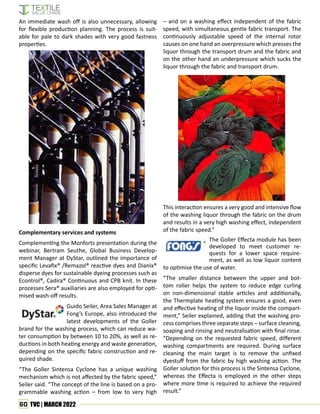
I S S N N O : 2 2 7 8 - 8 9 7 2 | R N I N O : M A H E N G / 2 0 1 2 / 4 3 7 0 7
www.textilevaluechain.in
Postal registration No. MNE/346/2021-23, posted at Mumbai Patrika
Channel sorting office, Pantnagar, Ghatkopar (East), Mumbai - 400075
Posting date is end of month ( 29th/ 30th / 31st )
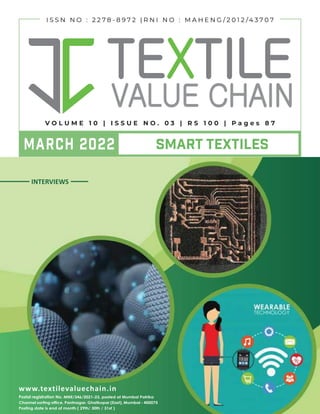
MARCH 2022 Smart Textiles
INTERVIEWS
Smart Textiles – Next Gen Fashion State-
ment or Technology Integration
Each Fabric is Assembled with utmost precision:
Anupam Arya
Itema Weaves Huge Hopes in India:
Sameer Kulkarni
We are creating our own brands:
Ronak B. Chiripal
Recycled Filament
Yarns
Shirting & Suitings
Yarns
Yarns for room
darkening fabrics
Yarns for
upholstery
Knitting Yarns
Yarns for floor
coverings
Space-Dyed
Yarns
Carpets/Rugs
Yarns
One of the Largest Manufacturers and Exporters of
Polyester Filaments Speciality Yarns
Our eBrochure
We have successfully carved out a niche through our product wide product range of dyed, space-dyed, melange,
photochrom, fire & UV resistant, crimped, high bulked, twisted, Airtex, multifold/plied yarns & recycled Petopoly™ etc.
https://www.dodhiagroup.com/
®
Website: www.lemeriteexports.com
Email id: yarn@lemeriteexports.com
F A
R
M
I
N
G
G
I
N
N I N G
S P I N N I N
G
Y
A
R
N
W
E
A
V I N G
9 TVC | MARCH 2022
Back Page: RAYMOND
Back Inside: RAYSIL
Front Inside: RIMTEX
Page 3: DODHIA
Page 4: LE MERIT
Page 5: ALLIANCE
Page 6: SOURCE INDIA
Page 7: TREUTZSCLER
Page 8: INTERTEX POR-
TUGAL
Page 10: YASH MACHI-
NES
Page 16: SAURER
Page 19: USTER
Page 23: MEERA INDUS-
TRIES
Page 27: UNITECH TEX-
MACH
Page 32: TEX FAB ENGI-
NEERS
Page 40: VATSAL EX-
PORT
Page 43: OMAX
Page 50: KEN INDIA
Page 56: AMRITLAKS-
HMI
Page 58: COSMOS
Page 71: SAKTHI IN-
DUSTRIES
Page 75: BISHNU EX-
PORT
Page 79: RAMKRISHNA
COTSPIN
Page 80: GARTEX
Page 81: ITM 2022
Page 82: IGM 2022
Page 83: LIVA
Page 84: TEXFAIR
Page 85: ASTRATECH
Table
of
CONTENT
COVER STORY
REVIEW PAPER : ECO FRIENDLY DYEING
INTERVIEW
EVENTS
TEXTILE MACHINERY
CORPORATE NEWS
SPECIAL FEATURES
SWISS TECHNOLOGY
INDUSTRY UPDATE
ADVERTISER INDEX
37
59
54 BSE Hosts Special Meet By Cotton Guru
28 Technology for Textile Dyeing Using
Supercritical Fluid
24 How to Boost Exports of Textile Spare
Parts & Accessories
66 Oerlikon Barmag celebrates its 100th
anniversary
65 BRÜCKNER presents many products for
nonwovens at IDEA 2022
62 Saurer:
Strides in Digitalisation
61 Fascination of Narrow Fabrics: Jakob
Muller’s Digital World
51 Face Mask in the New Normal:
Material, Manufacturing & Testing
72 SPGPrints/Stovec launches “DART” to
start-ups in digital textile printing
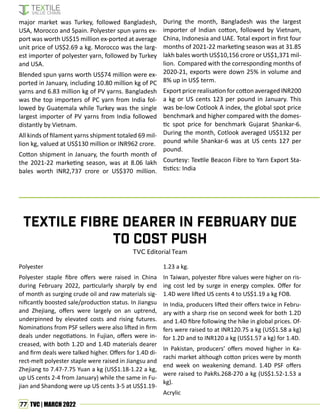
77 Textile fibre dearer in February due to
cost push
76 Textile export volume still down in
January
73 Full Automation from Roll to Finished
Product
70 Basant Fibertek Doubles Capacity
68
Uster’s Quality Management Platform
Makes a Huge Difference to Shopfloor
Personnel
17 Smart Textiles – Next Gen Fashion State-
ment or Technology Integration
20 Textile Machinery, Parts & Accessories
Rise of the Phoenix!
59 Resource-saving in Textile Processing: A
Successful Webinar
57 Shujaul Rehman, CEO of GTFL,
appointed VC of CII Pune
44 We are creating our own brands: Ronak
B. Chiripal
41 Itema Weaves Huge Hopes in India
37 Each Fabric is Assembled with utmost
precision
33 Second-Hand Clothing as a
Sustainable & Fashionable Lifestyle
12 Smart Textiles – an Overview
74 SHOW CALENDAR
10 TVC | MARCH 2022
All rights reserved Worldwide; Reproduction of any of the content from
this issue is prohibited without explicit written permission of the publisher.
Every effort has been made to ensure and present factual and accurate
information. The views expressed in the articles published in this magazine
are that of the respective authors and not necessarily that of the publisher.
Textile Value chain is not responsible for any unlikely errors that might
occur or any steps taken based in the information provided herewith.
REGISTERED OFFICE:
Innovative Media and Information
Company
189/5263, Sanmati, Pantnagar,
Ghatkopar (East), Mumbai 400075.
Maharashtra, INDIA.
Cell: +91-9769442239
Email: info@textilevaluechain.com
Web: www.textilevaluechain.com
Owner, Publisher, Printer and
Editor - Ms. Jigna Shah
Printed and Processed by her at,
Impression Graphics,
Gala no.13, Shivai Industrial Estate,
Andheri Kurla Road, Sakinaka,
Andheri (East), Mumbai 400072,
Maharashtra, India.
SUBSCRIPTION
EDITOR AND PUBLISHER
Ms. Jigna Shah
EDITORIAL TEAM
marketing and advertising enquiry
A few years back, an entrepreneur from the textile in-
dustry watched with fascination at an exhibition shelf
containing PET bottles and yarns and clothes kept be-
side them. He was impressed by the transformation of
PET into clothing, and he vowed to bring the technology
tohisplantinIndia.Today,hehasaprofitableproduction
unit that turns PET into yarns. Some years ago, I listened
to a presentation by a German industrialist about pollu-
tion by textile industries. From his cabin he saw billow-
ing smoke from his factory chimney, and he visualised
his own future generation getting choked by it. Within
a couple of years, he changed the process to the least
harmfulonetohumansdespiteoppositionfromotherdi-
rectors. He also demonstrated the profitability of benev-
olent processes in the production. Today, most of the in-
dustries are shouting hoarse about sustainability. Textile
is one of the most polluting industries, and sustainability
is not just using sustainable materials and efficient pro-
cesses alone. The textile industry must follow diligently
the track of sustainability at every step of its production.
The textile chain gobbles up a huge amount of water
and energy, along with the use of various chemicals and
harmful substances. Most of the textile industries dis-
charge a huge amount of harmful waste, posing a threat
to the very survival of living organisms. Sustainability
has to embrace many factors and a holistic view is vital.
The textile industry is the second largest sector of
global trade market with the figure estimated to reach
US$1,230 billion by 2024, from US$920 billion in 2018.
“Green consumer” is a reality now. We see a lot of sec-
ond-hand clothing in the market, even from well-known
brands. Consumers must be educated well about envi-
ronmental degradation and also the need to buy such
clothing to alleviate the burden of landfills and waste
pile-up. In 2015, United Nations members adopted the
2030 agenda for Sustainable Development, which con-
sisted of 17 Sustainable Development Goals (SDG) for
various industries. The textile industry adapted 5 out of
these 17, which we’re related to – Climate Action, Gen-
der Equality, Responsible production & consumption,
Clean Water & Sanitation, and decent work & econom-
ic growth. Textile companies worldwide are actively
contributing to pollution-reduction practices and set-
ting up emission targets for controlling climate change.
Companies should implement manufacturing practices
which cuts carbon footprint, invest in R&D to use sus-
tainable raw materials and turn out environ-friendly fin-
ished products. The fast fashion must give way to a ‘slow
fashion’ challenging growth fashion’s obsession with
mass-production and paving the way to diversity. Sus-
tainability should become an important tenet of corpo-
rate mission of each & every textile company, the aim of
whichistoturntoday’swaveintoabigtideoftomorrow!
Path to Sustainability
CREATIVE DESIGNER
Ms. Poiyamozhi P S
ADVISOR - EDITORIAL & MARKETING
Mr. Samuel Joseph
Online Registration
https://textilevaluechain.in/subscription/
Subscription Enquiry
Ms. Vaibhavi Kokane
+91-9869634305 ;
textilevaluechain123@gmail.com
Scan and Open
Mohammad Tanweer
+91-9167986305
sales@textilevaluechain.com
11 TVC | MARCH 2022
www.yashtex.com sales@yashtex.com
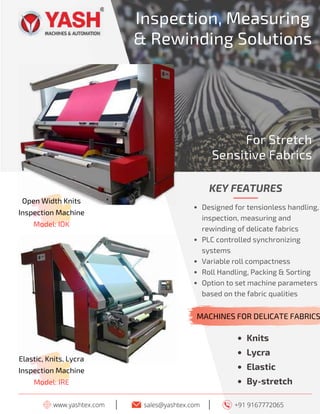
Open Width Knits
Inspection Machine
Model: IOK
I
Inspection, Measuring
& Rewinding Solutions
+91 9167772065
I
Knits
Lycra
Elastic
By-stretch
KEY FEATURES
Designed for tensionless handling,
inspection, measuring and
rewinding of delicate fabrics
PLC controlled synchronizing
systems
Variable roll compactness
Roll Handling, Packing & Sorting
Option to set machine parameters
based on the fabric qualities
For Stretch
Sensitive Fabrics
MACHINES FOR DELICATE FABRICS
Elastic, Knits, Lycra
Inspection Machine
Model: IRE
12 TVC | MARCH 2022
Cover story
Dr. G. Nagarajan, Sr. Technologist
Texcoms Textile Solutions, Singapore
Ms. Anusuya A, Associate Consultant
Texcoms Textile Solutions, Singapore
Smart Textiles – an Overview
1.0. Introduction
The concept of Smart textiles was proposed from Uni-
versity of Virginia United States to Japanese scholar in
the year 1989. He integrated information science into
the material and developed smart materials. The term
smart textiles mean intelligent materials. Smart textiles
mean the textiles that are able to sense stimuli from
the environment, to react to them and adapt to them
by integration of functionalities in the textile structure.
The stimulus as well as the response can have an elec-
trical, thermal, chemical, magnetic or other origin. The
first applications of smart textiles can be found in cloth-
ing. Smart clothing is defined as a new garment feature
which can provide interactive reactions by sensing sig-
nals, processing information, and actuating the respons-
es. They are capable of showing significant change in
Abstract
In the twenty first century, product and machinery developments have taken place in all the fields of engineering
and technology. Similarly, textile is also not lagging behind the pace of development when compared to other en-
gineering discipline. Many researches both in domestic and at international level has been done on the advanced
textile applications like smart fibres and smart textiles in the recent years. This article disseminates the informa-
tions related to smart fibres and textiles, their application areas like medical care, protective clothing, shape mem-
ory textiles, sports textiles etc. No doubt that smart textiles have wide application and prospects in the near future
similar to the smart phones.
Keywords: Smart fibres, smart textiles, shape memory textiles
their mechanical properties such as shape, colour and
stiffness, or their thermal or electromagnetic proper-
ties,
Typical examples of smart textiles are fabric and dyes
that will change their colour where the clothes are
made out of conductive polymers which give light when
they get electromagnetic signals. They also regulate fab-
rics the surface temperature of the garments in order
to achieve physiological comfort. The first smart textile
material was silk thread which has a shape memory.
2.0. Smart fibres
a. Shape memory fibre
Shape memory fibres are referred to a fibre which pos-
sesses shape memory effect. It means that when a de-
formed fibre is given some external stimulus by means
13 TVC | MARCH 2022
of pressure and temperature, the deformed fibre would
return to its original shape. Shape memory fibres in-
clude shape memory alloys, shape memory hydrogels
and shape memory polymers. However, shape memory
polymers have more advantages than shape memory
alloys in terms of their characteristics like high recovery
from strain, easy processing, low cost and low density.
b. Photo- chromic fibre
They are photo sensitive colour changing substances
which has organic compounds containing isomers. Such
photo- chromic fibres undergo reversible configuration
under the action of light. The discolouration is under
the action of irradiating ultra violet light or visible light
spectrum which causes certain compounds to undergo
changes in their molecular structure or electronic ener-
gy levels to form new compounds with different absorp-
tion spectra.
c. Optical fibre
A kind of composite fibre which can enclose light energy
and transmit it in a wavelength mode. It is also called as
smart fibre and provide excellent transmission perfor-
mance. Optical fibre consists of two parts, a code and
a cladding. The core is 1 to 10 micrometre in diameter
for single mode silica glass fibre surrounded by 1.25
micrometre cladding whose refractive index is slightly
smaller than that of the core. The optical fibre is coat-
ed with a protective layer of an outside diameter of ap-
proximately 250 micrometre. When light rays incident
on the core-cladding boundary is at angles greater than
the critical angle, the light rays undergo total internal re-
flection and are guided through the core without any
refraction.
d. Temperature sensitive fibre
Temperature sensitive fibres are the fibres whose prop-
erties will change reversibly with temperature. The “
Ventcool” fibre developed by Mitsubishi Rayon Corpo-
ration stretches instantly when the humidity is high and
quickly crimp when the humidity is low according to
the environment conditions. It means that the fibre has
dynamic response to changes and is called as dynamic
fibre.
e. Conductive fibres
Conductive fibres possess excellent specific resistance
and electrical conductivity, absorb electromagnetic
waves, detect and transmit electrical signals. Conduc-
tive fibres can be rougly divided into electron conduc-
tive fibres, ion conductive fibres and inductive fibres.
f. Health smart fibre
Health smart fibres are developed for the enhancement
of people’s awareness against anti-bacterial, safety and
impact resistant fibre. Among them selective anti-bac-
terial fibre (smart fibre) will inhibit or kill the surface
bacteria by the addition of anti-bacterial agent. “Nyl-
star” a smart polyamide fibre developed by the US have
long anti-bacterial effect and safer too by incorporating
anti-bacterial agent into the fibre.
3.0. Applications
3.1. Shape memory textiles
Shape memory textile is a kind of material with shape
memory function introduced into textile through weav-
ing or finishing. The Italian company Corpo Nove de-
signed a “lazy shirt”. When the outside temperature is
high, the sleeves of the shirt will automatically roll from
the wrist to the elbow within a few seconds; converse-
ly, when the temperature drops, the sleeves can auto-
matically recover and can also be automatically ironed.
Shape memory fabrics can be developed into fashions,
protective clothing and accessories with different func-
tions. With the in-depth research on shape memory
materials and the further improvement of textile pro-
cessing technology, shape memory functional textiles
will be further developed.
3.2. Colour-changing textiles
Color-changing textiles refer to textiles that can display
different colors with changes in external environmen-
tal conditions, such as light, temperature, pressure,
etc. With its unique properties, color- changing textiles
are widely used in various fields. Civilian can be used
to make fashionable color- changing clothing and ev-
er-changing decorative fabrics, military camouflage can
be used in military, anti-counterfeiting field can be used
as anti-counterfeiting materials, widely used in bills, cer-
tificates and trademarks. Color-changing textiles can be
obtained by the following three methods: adding color-
changing fibers to the fabric; dyeing with color-chang-
ing dyes; printing with color-changing paint. The fabric
made out of color changing materials has good hand
feel, good washing resistance and long-lasting discolor-
ation effect.
3.3. Smart temperature control textiles
Smart temperature control textiles mainly include
three types of thermal insulation textiles, cool textiles
and automatic temperature control textiles. For ther-
mal insulation textiles, the thermal insulation materials
14 TVC | MARCH 2022
developed are mainly solar thermal storage fibers and
far- infrared fibers. The solar thermal storage thermal
insulation fibers are used to achieve thermal insulation.
The principle is that the fibers absorb visible light and
infrared rays from sunlight, and then heat radiation to
the human body, and finally achieve the effect of heat
preservation. Compared with sunlight thermal storage
fiber, far infrared fiber has better thermal insulation per-
formance. The reason is that it absorbs the heat emitted
by the human body and radiates a certain wavelength of
far infrared rays to the human body to reduce the loss of
heat by promoting blood circulation, thereby achieving
the purpose of heat preservation. Cool fabrics generally
add metal oxides to polyester fabrics, and use metal ox-
ides to reduce the possibility of clothing fading due to ul-
traviolet rays and light, and to ensure that the interior of
the clothing is cool. Cool fabrics are especially useful for
people who work in extremely cold environments (such
as traffic police in winter) need clothes to warm them
and display safety signals at the same time, which is very
meaningful to them. Based on such requirements, there
is a great need to develop smart textiles that integrate
thermal regulation and light-emitting functions, and use
advanced coaxial electro spinning to realize light-emit-
ting temperature- regulated smart textiles.
3.4. Self-cleaning textiles
The trend of manufacturing self-cleaning coatings is
nowadays a growing need which can remove both in-
organic and organic pollutants through two different
mechanisms: rolling water droplets and by photo catal-
ysis. Rolling water droplets refer to the lotus-shaped or
cauliflower-shaped surface, coupled with low surface
energy, will form dirty particles on the surface of the
fabric, causing the water droplets to roll off and absorb
dust, soil, inorganic and organic pollutants. A contact
angle of greater than 150 degree is required in this
mechanism. Photo catalysis is the decomposition of or-
ganic dirt by light, which can be easily removed during
washing.
3.5. Wearable Technology and Health
Wearable technology wearable devices, smart electron-
ic devices that can be worn on the body as implants
or accessories. Such devices are activity trackers that
enable objects to exchange data through the internet
with humans or any other connected devices without
requiring human intervention. A typical example is the
smart watch. Apart from the consumer electronics, it is
being incorporated in to navigation systems and health
care also. Wearables can be used to collect data on a
user’s health such as
• Heart rate
• Blood pressure
• Walking steps
• Time spent on exercising
A recent development made on the smart fabrics is
more beneficial for the persons who do exercise in gym-
nasium. The smart T- shirt has hidden letters like Time to
stop” which will not be visible in the normal condition.
After exercising in the gym, the sweat produced on the
body is absorbed by the T-shirt and the hidden letters
begin to appear informing the wearer to stop. Currently,
other applications in health care are measuring blood
alcohol content, measuring the sickness, athlete’s per-
formance etc. Although smart textiles are in use, they
can only collect data from the user about his well-being
but for not making decisions about one’s health.
3.6. Sutures in medical applications
A suture is a length of fibre used to tie the blood vessels
or to sew tissues together. A typical example is polypro-
pylene fibre generally used as a suture material in eye
surgeries for patients when corneal grafting is needed.
Many types of sutures are intelligent and absorbable
materials as they hold the edges of the wounds to-
gether until the wound sufficiently heals. As the wound
progressively heals, the tensile properties of the suture
diminish and get absorbed into the body system. A few
types of sutures are made from collagen of sheep or cat-
tle intestine and are gradually degraded by enzymes in
the body. Polymers of polylactic acid, poly glycolic acid,
copolymers of polydiaxanone are synthetic polymers
used as absorbable sutures in medical applications.
3.7. Optical sensors in military applications
Fibre optic sensors are ideal components to be em-
bedded in textiles structural composites. Such sensors
can be used to sense various battlefield hazards like
chemical, biological and other toxic substances used in
warfare times thereof in real time. The polyurethane –
diacetylene copolymer can be used as a photochemical
polymer for chemical sensor applications. The passive
cladding of the optic fibre is replaced with these poly-
meric sensitive materials and the sensory system is inte-
grated into textile fabrics. Another development is the
pH sensitive sensor is also developed and woven into
fabric for soldiers clothing.
15 TVC | MARCH 2022
Smart shirt developed by the Georgia Tech University is
quite useful for detecting bullet wounds during the war.
It functions like a computer with optical and conductive
fibres integrated into the garment. Plastic optical fibres
are woven in the seamless shirt is mainly responsible
for detecting the bullet wounds. These optical wires are
connected to a diode at one end and a laser at the other
end. Pulses of light received by the diode are analyzed
by a circuitry and if there is any interruption of light to
the diode helps to identify the exact location of the bul-
let in the body.
3.8. Smart fibres in fire fighting
High performance fibres generally lose strength after
exposed to high temperatures which undetected and in
the worst case, can tear more precisely when the lives
depend on them. Few examples are ropes used by fire-
fighting brigades, suspension ropes used in construction
sites. Researchers in Swiss have developed a special
coating which changes its colour when exposed to high
temperatures by friction or fire.
Coatings on the rope is made up of 3 layers that the fi-
bre actually changes colour when subjected to heat. The
first layer (base) is silver coated on polyester (PET) and
high tech Vectran fibres. This serves as a reflector. The
second layer is the intermediate layer, titanium-nitrogen
oxide which ensures that the silver layer is stable. There-
after follows the amorphous layer, a coating of Germani-
um antimony tellenium (GST) which is 20nm thick. This
layer initiates the colour change when is subjected to
elevated temperatures. At high temperatures, it crys-
tallizes and change the colour from blue to white. The
colour change is due to the physical phenomenon inter-
ference. Depending upon the chemical composition of
the temperature sensitive layer, this colour change can
be adjusted to a temperature range between 100 deg to
400 deg.
3.9. Market Overview and major players
The global market was worth more than $2.5 billion
in revenue in 2012 and is expected to cross $8 billion in
2018, growing at a healthy CAGR of 17.7% from 2013
to 2018. In terms of products, wrist-wear accounted for
the largest market revenue in 2012, with total revenue
of the most established wearable electronic products -
wrist-watches and wrist-bands combined, crossing $850
million. Smart textiles is now limited in the developed
countries. It will be the next generation’s textile. So,
there will be possibility of developing countries to earn
huge profit. But they need more research and funding
as well as technologies to implement this innovation.
Some of the major players dominating this industry
are E. I. Du Pont De Nemours and Company, Intelligent
Clothing Ltd., Interactive Wear AG, International Fashion
Machines Inc., Kimberly-Clark Health Care, Milliken &
Company, Noble Biomaterials Inc., Outlast Technologies
Inc, QinetiQ North America, Royal Philips.
4.0. Conclusion
Smart fibers /smart textiles and their applications are
research hotspots in today’s textile field, as well as fu-
ture development trends. Smart textile materials are
the backbone of high- tech functional textiles. The ap-
plication of smart fibers and smart textiles is becoming
more open and consumer acceptance is increasing.
The global market was worth more
than $2.5 billion in revenue in 2012
and is expected to cross $8 billion in
2018, growing at a healthy CAGR of
17.7% from 2013 to 2018.
At present, the main application fields of smart fibers
and smart textiles are: medical health care, military
protection, firefighting, entertainment and sports, and
clothing consumption. Moreover, it appears that this is
only possible by intense co-operation between people
from various backgrounds and disciplines such as micro-
electronics, computer science, material science, poly-
mer science, biotechnology, etc. More research work is
also emphasized on certain areas like high performance
fibres and their utility.
References
1. Huang M and Chu J 2018 J.Tianjin Textile Tech-
nology 6 43-6
2. Yang L 2017 J.China High-tech Zone 5 60-1
3. Melliand International, May 2021.
4. X. Zhang and X. Tao, Smart textiles: Passive
smart, Textile Asia, pp. 45-49, June 2001, Smart textiles:
Very Smart, Textile Asia, pp. 35-37, August 2001.
5. Textile institute, Smart Fibers, Fabrics and Cloth-
ing (Tao, X. Ed.), Florida: CRC Press, 2001.
16 TVC | MARCH 2022
Autospeed – your
partner in automation
Boost efficiency in your mill with a powerful
roving frame. Profit from an automatic doffer,
individual automation units and flexible roving
bobbin transport systems. We offer you a range
of automation levels with customised planning
tailored to your needs.
saurer.com
The spinning mill
in focus.
17 TVC | MARCH 2022
Cover story
By Avinash Mayekar,
Managing Director, Suvin
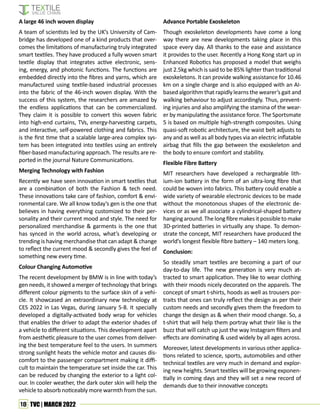
Smart textiles are steadily becoming a part of our
day-to-day life, which will be growing exponentially
in coming days and they will set a new record of
demands due to their innovative concepts
Smart Textiles –
Next Gen Fashion Statement
or Technology Integration
S
martness is the key of success… One may coin this
phrase looking at the way things are happening
around us. We, human beings, are considered to be
one of the smartest species, and with the same smart-
ness we invented the technology that made human life
smarter and provided benefits larger than life. Today
this technology has become a part and parcel of our life
from Laptops/ Macbooks, smartphones to smartwatch-
es we are surrounded by all smart gadgets.
We are reaching new heights of merging devices as
lightweight wearables in the form of smart garments.
The merger of technology to the garments might be a
concept yet to completely sync in, but we have come
far ahead with small applications already accepted and
being used to a large extent, especially in healthcare
monitoring devices. Smart textiles have come a long
way from medical assist robotics systems to medicine/
chemical infusing systems, nano monitors & embedded
sensors, illuminating advanced functional textiles to
embedded electronic systems in automobiles & wear-
able electronics. The smart textiles market is expected
to grow exponentially at a CAGR of 23.2% from US$2.3
billion in 2021 to US$6.5 billion by 2026. (As reported in
Markets & Markets International Paper)
Figure 1: Source Markets & Markets International Pa-
per & Suvin Analysis
These smart textiles being such an innovative concept
have however found their usefulness primarily limited
either to high-performance and technical military gear
or in the glamorous side of the globe the high-end fash-
ion industry. Where dazzling & sparkling concepts have
reached new heights with the use of illuminating & re-
flective smart textiles. And as it happens, the followers
just copy such fashion and if it clicks, quantity just mul-
tiplies.
Smart textiles are however not that well-integrated and
considered to be one individual piece in actual practice.
It is a combination of electronic circuits being an exter-
nal component to the textiles in use. Need of the hour is
to have a single integrated feature coined as smart tex-
tiles. However, there are some ground-breaking inven-
tions in this sector, some of which are as follows:
Translating stitch commands with Topo Knit
One such recent development is embedded smart tex-
tiles that help in translating the stitch commands. A
team of researchers from Drexel University is translating
the loops and twists of knitting into a digital architec-
ture, for merging new technologies such as electronic
circuits into textiles. One of the greatest barriers to hav-
ing complete integration is the current software being
used for the industrial design and production of textiles
says Dr. David Breen, a professor at Drexel’s College of
Computing and Informatics. This software is lacking the
thread-level detailing essential in the digital sampling
and precision manufacturing of fabric devices.
18 TVC | MARCH 2022
A large 46 inch woven display
A team of scientists led by the UK’s University of Cam-
bridge has developed one of a kind products that over-
comes the limitations of manufacturing truly integrated
smart textiles. They have produced a fully woven smart
textile display that integrates active electronic, sens-
ing, energy, and photonic functions. The functions are
embedded directly into the fibres and yarns, which are
manufactured using textile-based industrial processes
into the fabric of the 46-inch woven display. With the
success of this system, the researchers are amazed by
the endless applications that can be commercialized.
They claim it is possible to convert this woven fabric
into high-end curtains, TVs, energy-harvesting carpets,
and interactive, self-powered clothing and fabrics. This
is the first time that a scalable large-area complex sys-
tem has been integrated into textiles using an entirely
fiber-based manufacturing approach. The results are re-
ported in the journal Nature Communications.
Merging Technology with Fashion
Recently we have seen innovation in smart textiles that
are a combination of both the Fashion & tech need.
These innovations take care of fashion, comfort & envi-
ronmental care. We all know today’s gen is the one that
believes in having everything customized to their per-
sonality and their current mood and style. The need for
personalized merchandise & garments is the one that
has synced in the world across, what’s developing or
trending is having merchandise that can adapt & change
to reflect the current mood & secondly gives the feel of
something new every time.
Colour Changing Automotive
The recent development by BMW is in line with today’s
gen needs, it showed a merger of technology that brings
different colour pigments to the surface skin of a vehi-
cle. It showcased an extraordinary new technology at
CES 2022 in Las Vegas, during January 5-8. It specially
developed a digitally-activated body wrap for vehicles
that enables the driver to adapt the exterior shades of
a vehicle to different situations. This development apart
from aesthetic pleasure to the user comes from deliver-
ing the best temperature feel to the users. In summers
strong sunlight heats the vehicle motor and causes dis-
comfort to the passenger compartment making it diffi-
cult to maintain the temperature set inside the car. This
can be reduced by changing the exterior to a light col-
our. In cooler weather, the dark outer skin will help the
vehicle to absorb noticeably more warmth from the sun.
Advance Portable Exoskeleton
Though exoskeleton developments have come a long
way there are new developments taking place in this
space every day. All thanks to the ease and assistance
it provides to the user. Recently a Hong Kong start up in
Enhanced Robotics has proposed a model that weighs
just 2.5kg which is said to be 85% lighter than traditional
exoskeletons. It can provide walking assistance for 10.46
km on a single charge and is also equipped with an AI-
based algorithm that rapidly learns the wearer’s gait and
walking behaviour to adjust accordingly. Thus, prevent-
ing injuries and also amplifying the stamina of the wear-
er by manipulating the assistance force. The Sportsmate
5 is based on multiple high-strength composites. Using
quasi-soft robotic architecture, the waist belt adjusts to
any and as well as all body types via an electric inflatable
airbag that fills the gap between the exoskeleton and
the body to ensure comfort and stability.
Flexible Fibre Battery
MIT researchers have developed a rechargeable lith-
ium-ion battery in the form of an ultra-long fibre that
could be woven into fabrics. This battery could enable a
wide variety of wearable electronic devices to be made
without the monotonous shapes of the electronic de-
vices or as we all associate a cylindrical-shaped battery
hangingaround.Thelongfibremakesitpossibletomake
3D-printed batteries in virtually any shape. To demon-
strate the concept, MIT researchers have produced the
world’s longest flexible fibre battery – 140 meters long.
Conclusion:
So steadily smart textiles are becoming a part of our
day-to-day life. The new generation is very much at-
tracted to smart application. They like to wear clothing
with their moods nicely decorated on the apparels. The
concept of smart t-shirts, hoods as well as trousers por-
traits that ones can truly reflect the design as per their
custom needs and secondly gives them the freedom to
change the design as & when their mood change. So, a
t-shirt that will help them portray what their like is the
buzz that will catch up just the way Instagram filters and
effects are dominating & used widely by all ages across.
Moreover, latest developments in various other applica-
tions related to science, sports, automobiles and other
technical textiles are very much in demand and explor-
ing new heights. Smart textiles will be growing exponen-
tially in coming days and they will set a new record of
demands due to their innovative concepts
19 TVC | MARCH 2022
www.uster.com/qbar2
Inspecting fabrics after weaving is old school. With USTER®
Q-BAR 2, smart weavers can pinpoint
defects during fabric formation. It’s the right way to reduce material losses and minimize manual
checks. When it comes to fabric quality issues, prevention is better than cure.
The whole fabric is automatically monitored – warp, weft, selvage and leno – and faults are
identified immediately. LEDs signal defect locations to the weaver, with information shown on
the control unit touchscreen. It’s automatic inspection, in-process and instant, so weavers can
react to prevent long-running or repeating faults.
USTER®
Q-BAR 2 sets the future standard, controlling the weaving process instead of the output.
USTER
®
Q-BAR 2
Weave it right: spot defects on the loom
20 TVC | MARCH 2022
Textile Machinery
By Sachin Kumar
Executive Director
Textile Machinery Manufacturers’
Association (I)
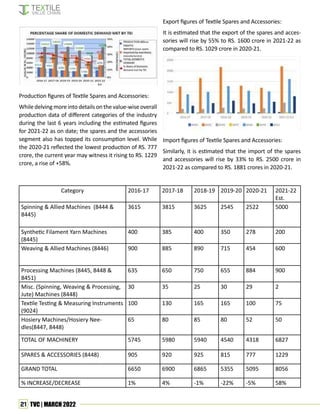
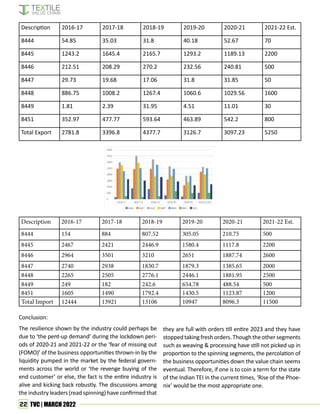
The estimated production, export and import figures above
signals a sharp rise in production by +52% (RS. 8056 crore),
in exports by +70% (RS. 5250 crore) by scaling up its peak
figures in 2017-18 of RS. 6900 crore and in 2018-19 of RS. 3665
crore respectively.
crore respectively.
Textile Machinery, Parts & Accessories
Rise of the Phoenix!
T
he global Covid-19 pandemic struck a complete
structural disruption around the world through-
out 2020-21. The current fiscal year too started
on a gloomy note when the second wave of the deadly
disease broke out across the globe causing fresh hav-
oc. It appeared that the renewed lockdown measures
to contain mass population, industry and the institution
from contracting the pandemic didn’t yield much result
as there were mixed reactions from different quarters of
the polity, community and decision makers globally on
the issues of sustaining lives versus economies. While
the developed countries including India were success-
ful in developing the Covid-19 vaccine and initiating the
mass vaccination programmes, the rate of inoculating
the populace proved insufficient.
However, just like the bouncing back of the Indian Tex-
tile Engineering Industry (TEI) in Q3, Q4 of the 2020-21,
the Indian TEI rose to the occasion again right after the
wash-out of business in Q1 2021-22. As reported earlier
by TMMA(I), the Indian TEI managed to reduce its annu-
al production losses in the year 2020-21 by -5% only to
Rs. 5093 crore from Rs. 5355 crore in 2019-20. Whereas,
the reported figures as on date have already surpassed
an estimated production figure of about Rs. 8000 crores.
The chart below substantiates the claim here.
The estimated production, export and import figures
above signals a sharp rise in production by +52% (RS.
8056 crore), in exports by +70% (RS. 5250 crore) by scal-
ing up its peak figures in 2017-18 of RS. 6900 crore and
in 2018-19 of RS. 3665 crore respectively. Whereas the
imports may also scale up its peak to RS. 11500 crore in
the current fiscal as against RS. 10834 crore in 2018-19.
Most interestingly, the exports by the Indian TEI have
risen from 37% of the domestic production in 2016-17
to 65% in 2021-22 (Est.), whereas the imports by the
Indian TEI have marginally come down from 152% of
the domestic production during the same time period
to 143%. The domestic demand met by the indigenous
production could be seen rising to 22% in 2021-22 (est.)
from 20% in 2020-21.
21 TVC | MARCH 2022
Production figures of Textile Spares and Accessories:
While delving more into details on the value-wise overall
production data of different categories of the industry
during the last 6 years including the estimated figures
for 2021-22 as on date; the spares and the accessories
segment also has topped its consumption level. While
the 2020-21 reflected the lowest production of RS. 777
crore, the current year may witness it rising to RS. 1229
crore, a rise of +58%.
Category 2016-17 2017-18 2018-19 2019-20 2020-21 2021-22
Est.
Spinning & Allied Machines (8444 &
8445)
3615 3815 3625 2545 2522 5000
Synthetic Filament Yarn Machines
(8445)
400 385 400 350 278 200
Weaving & Allied Machines (8446) 900 885 890 715 454 600
Processing Machines (8445, 8448 &
8451)
635 650 750 655 884 900
Misc. (Spinning, Weaving & Processing,
Jute) Machines (8448)
30 35 25 30 29 2
Textile Testing & Measuring Instruments
(9024)
100 130 165 165 100 75
Hosiery Machines/Hosiery Nee-
dles(8447, 8448)
65 80 85 80 52 50
TOTAL OF MACHINERY 5745 5980 5940 4540 4318 6827
SPARES & ACCESSORIES (8448) 905 920 925 815 777 1229
GRAND TOTAL 6650 6900 6865 5355 5095 8056
% INCREASE/DECREASE 1% 4% -1% -22% -5% 58%
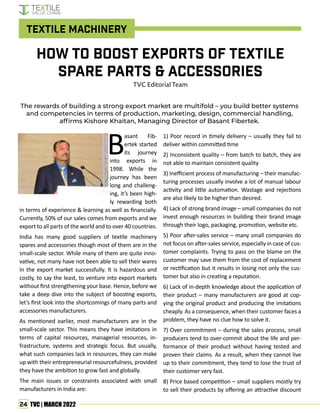
Export figures of Textile Spares and Accessories:
It is estimated that the export of the spares and acces-
sories will rise by 55% to RS. 1600 crore in 2021-22 as
compared to RS. 1029 crore in 2020-21.
Import figures of Textile Spares and Accessories:
Similarly, it is estimated that the import of the spares
and accessories will rise by 33% to RS. 2500 crore in
2021-22 as compared to RS. 1881 crores in 2020-21.
22 TVC | MARCH 2022
Conclusion:
The resilience shown by the industry could perhaps be
due to ‘the pent-up demand’ during the lockdown peri-
ods of 2020-21 and 2021-22 or the ‘fear of missing out
(FOMO)’ of the business opportunities thrown-in by the
liquidity pumped in the market by the federal govern-
ments across the world or ‘the revenge buying of the
end customer’ or else, the fact is the entire industry is
alive and kicking back robustly. The discussions among
the industry leaders (read spinning) have confirmed that
Description 2016-17 2017-18 2018-19 2019-20 2020-21 2021-22 Est.
8444 54.85 35.03 31.8 40.18 52.67 70
8445 1243.2 1645.4 2165.7 1293.2 1189.13 2200
8446 212.51 208.29 270.2 232.56 240.81 500
8447 29.73 19.68 17.06 31.8 31.85 50
8448 886.75 1008.2 1267.4 1060.6 1029.56 1600
8449 1.81 2.39 31.95 4.51 11.01 30
8451 352.97 477.77 593.64 463.89 542.2 800
Total Export 2781.8 3396.8 4377.7 3126.7 3097.23 5250
they are full with orders till entire 2023 and they have
stoppedtakingfreshorders.Thoughtheothersegments
such as weaving & processing have still not picked up in
proportion to the spinning segments, the percolation of
the business opportunities down the value chain seems
eventual. Therefore, if one is to coin a term for the state
of the Indian TEI in the current times, ‘Rise of the Phoe-
nix’ would be the most appropriate one.
Description 2016-17 2017-18 2018-19 2019-20 2020-21 2021-22 Est.
8444 154 884 807.52 305.05 210.75 500
8445 2467 2421 2446.9 1580.4 1117.8 2200
8446 2964 3501 3210 2651 1887.74 2600
8447 2740 2938 1830.7 1879.3 1385.65 2000
8448 2265 2505 2776.1 2446.1 1881.95 2500
8449 249 182 242.6 654.78 488.54 500
8451 1605 1490 1792.4 1430.5 1123.87 1200
Total Import 12444 13921 13106 10947 8096.3 11500
23 TVC | MARCH 2022
Futuristic Twisting
Futuristic Twisting
Twisting Solutions
Twisting Solutions
Textiles
Textiles
FIBC Threads
Belting Fabrics
Dipped Cords
Geo Textiles
Bullet Proof Jackets
direct twisting +
precision winding
Tapes / Twines / Multifilament
Meera Industries USA, LLC
209, Swathmore Ave, High Point
NC, USA 27263
Meera Industries Limited
2126, Road No.2, GIDC, Sachin, Surat
394230 Gujarat, INDIA
+91 98795 97041 | sales@meeraind.com | www.meeraind.com
24 TVC | MARCH 2022
B
asant Fib-
ertek started
its journey
into exports in
1998. While the
journey has been
long and challeng-
ing, it’s been high-
ly rewarding both
in terms of experience & learning as well as financially.
Currently, 50% of our sales comes from exports and we
export to all parts of the world and to over 40 countries.
India has many good suppliers of textile machinery
spares and accessories though most of them are in the
small-scale sector. While many of them are quite inno-
vative, not many have not been able to sell their wares
in the export market successfully. It is hazardous and
costly, to say the least, to venture into export markets
without first strengthening your base. Hence, before we
take a deep dive into the subject of boosting exports,
let’s first look into the shortcomings of many parts and
accessories manufacturers.
As mentioned earlier, most manufacturers are in the
small-scale sector. This means they have imitations in
terms of capital resources, managerial resources, in-
frastructure, systems and strategic focus. But usually,
what such companies lack in resources, they can make
up with their entrepreneurial resourcefulness, provided
they have the ambition to grow fast and globally.
The main issues or constraints associated with small
manufacturers in India are:
The rewards of building a strong export market are multifold – you build better systems
and competencies in terms of production, marketing, design, commercial handling,
affirms Kishore Khaitan, Managing Director of Basant Fibertek.
How to Boost Exports of Textile
Spare Parts & Accessories
TVC Editorial Team
1) Poor record in timely delivery – usually they fail to
deliver within committed time
2) Inconsistent quality – from batch to batch, they are
not able to maintain consistent quality
3) Inefficient process of manufacturing – their manufac-
turing processes usually involve a lot of manual labour
activity and little automation. Wastage and rejections
are also likely to be higher than desired.
4) Lack of strong brand image – small companies do not
invest enough resources in building their brand image
through their logo, packaging, promotion, website etc.
5) Poor after-sales service – many small companies do
not focus on after-sales service, especially in case of cus-
tomer complaints. Trying to pass on the blame on the
customer may save them from the cost of replacement
or rectification but it results in losing not only the cus-
tomer but also in creating a reputation.
6) Lack of in-depth knowledge about the application of
their product – many manufacturers are good at cop-
ying the original product and producing the imitations
cheaply. As a consequence, when their customer faces a
problem, they have no clue how to solve it.
7) Over commitment – during the sales process, small
producers tend to over-commit about the life and per-
formance of their product without having tested and
proven their claims. As a result, when they cannot live
up to their commitment, they tend to lose the trust of
their customer very fast.
8) Price based competition – small suppliers mostly try
to sell their products by offering an attractive discount
Textile Machinery
25 TVC | MARCH 2022
on the established manufacturer’s prices. This forces to
always face cut-throat competition resulting in always
struggling to manage their finances and cannot afford
to spend on R&D or upgradation of their manufacturing
facilities.
There may be several other factors worth mentioning
regarding the constraints of small manufacturers but
the above-mentioned are the main reasons affecting
the growth of most of them. To become successful in
exports, the first step a local manufacturer needs to take
is to establish a good reputation in the home market. It
would be foolhardy to dream of exporting if one cannot
develop a set of regular and loyal clients in India who are
happy using their products and services and are willing
to refer other clients to them as well.
All factors influencing a company’s ability to export can
be divided into two broad categories: external and in-
ternal. In the internal category, the above-mentioned 8
constraints need to be overcome in order to enhance
the company’s capacity to serve export markets suc-
cessfully. Until and unless a company has the ability to
meet consistently the demanding requirements of the
export markets, it cannot achieve any meaningful suc-
cess in exports. In order to overcome the above-men-
tioned constraints, the company should embark on an
internal transformational program that focuses on the
following:
1) Build reliable systems – a systems driven approach
is necessary to define standards, standard operating
procedures, process control and final inspection pro-
cedure to ensure that nothing but the best quality is
consistently build and supplied. It is important to main-
tain proper records of all production activity and quality
control documentation to enable tracing backwards any
product under complaint to when it was produced, who
produced it, what materials and machines were used
and which batch of raw material was used. If you don’t
know what created the problem, you can never solve it.
2) Focus of continuous improvement – Whenever a
problem or mistake is identified, efforts of manage-
ment should be to institute a system or practice that
can ensure that the mistake will never be repeated. One
should always attempt to eliminate the root cause rath-
er than fixing only the current problem somehow. If the
management is committed, results will start coming and
steady improvement can be seen in both productivity
and business growth.
3) Reduction in cycle time and rejects – There are always
bottelenecks and constraints in any production system,
many of which may be non-production related eg. plan-
ning, sales coordination, logistics, inventory manage-
ment, etc. By setting goals for improvement in cycle
time and reduction of rejection levels, the management
can ensure that system constraints are constantly iden-
tified and removed, thus improving both cycle time as
well as reducing rejection. This helps in increasing pro-
duction capacity, reducing costs and improving quality
consistency.
4) Understanding user needs and process requirements
deeply – It is quite common to have a customer not able
to exactly define what improvement he would prefer
simply because he cannot visualise what is possible.
Famous examples are mobile phones, internet, robots,
courier service. Each of these have been massively dis-
ruptive and rooted out legacy businesses, yet people
couldn’t visualize their impact when the technologies
were first introduced. Hence, a supplier should endeav-
or to understand the user’s needs enough to identify
how he can add value by either solving their problem or
saving time & cost or improving quality and productivity
for their customers.
5) Under-commit and over-deliver – The best way to
build trust and reliability is to always deliver more than
what you have committed. Once you win over the trust
and confidence of the customer, you don’t need to un-
dercut the price to get orders. Try and meet the require-
ments of the most demanding customers as this serves
as a barometer of your competitiveness.
Once a company has built strong internal systems and
culture, it is ready to explore overseas markets. Let’s
now look at the external factors influencing exports:
1) Nature of the market – each country differs in terms
of character and scale of the market. Hence an aspir-
ing exporter must choose his entry market carefully. It
is best to choose a market in close geographical and cul-
tural proximity where the level of technology and ma-
chinery in common use is quite similar to the company’s
domestic customers. If some Indian expatriates work
there, it’s even better!
26 TVC | MARCH 2022
T
he Neumünster-based systems builder Oerlikon
NonwovenpremiereditsnewhycuTEChydro-charg-
ing solution at this year’s FILTECH in Cologne. This
new technology for charging von nonwovens enables the
filter efficiency to be increased to more than 99.99%. As
a result, it offers meltblown producers considerable ma-
terial savings with simultaneously improved filtration.
The hycuTEC is the market’s first industrially-manufac-
tured hydro-charging solution that can also be seam-
lessly integrated into the production process. And the
innovative technology is also easily retrofitted to existing
systems as a plug & produce component – a first within
the market.
hycuTEC sets new standards in terms of
quality & efficiency
2) Nature of competition – it must be studied who are
the major competitors and their relative strengths and
weaknesses vis-à-vis your company. For instance, if an-
other Indian company is already active in the market or
there are several other non-OEM suppliers competing
against each other, changes of entry improve. If the pric-
es prevailing in the market are much higher than what
you offer, barrier to entry is lower. If your product per-
formance is superior to other suppliers, your chances of
success are brighter to that extent.
3) Market segment – one needs to choose which mar-
ket segment you wish to cater to. Would you be able to
make a strong pitch to big clients, small ones or middle
sized? Would you like to serve those with old machines
or latest models? Would you like to serve those who
need service support or those who only want to buy
parts?
4) Trust building – no customer abroad feels comfort-
able dealing with a new vendor from overseas. Hence,
it is crucial to maintain a regular presence in the initial
months. When the customer sees you are visiting reg-
ularly even without getting any business, he feels you
are committed to serve the market. If you get hold of
a reputed agent, it helps speed up this process of trust
building. However, export marketing is a long-term
game and one should have patience for 2-3 years before
seeing significant fruits from the efforts.
In conclusion, one must see exports development as a
new venture. Your domestic credentials don’t count as
much as your performance in that country. You have to
build your reputation there brick by brick with patience
and perseverance. The rewards of building a strong ex-
port market are multifold – you build better systems
and competencies in terms of production, marketing,
design, commercial handling.
You also build a growth oriented, progressive company
culture and a broader vision and strategy for the busi-
ness. Success in exports can be financially rewarding
and also builds resilience by reducing dependence in
the local market. Finally, the satisfaction of succeeding
in tough markets and seeing your reputation and stature
in the industry soar has its own personal and financial
rewards!
Filter media with a whole new level of quality
hycuTEC hydro-charging can reduce the pressure loss in
typical FFP2 filter media to less than a quarter. Even filtra-
tion efficiencies of more than 99.99% are easily achieved
in typical filter media of 35 g/m² at 35 Pa. Tests at pilot
customers manufacturing FFP2 face masks have con-
firmed quality increases due to the improved filtration
with a simultaneous reduction in material usage of 30%.
For end users, the consequence is noticeably improved
comfort resulting from significantly reduced breathing
resistance.
In addition to this, the hydro-charging unit also stands
out in terms of sustainability: “The hycuTEC process ex-
cels as a future-proof technology due to its considerably
lower water and energy consumption compared to other
hydro-charging concepts. This unit allows an additional
drying process to be dispensed with in many applications,
which has a huge impact on energy consumption”, com-
ments Dr. Ingo Mählmann, Head of Sales & Marketing at
Oerlikon Nonwoven. Incidentally, the hycuTEC unit can
be easily and quickly installed and is simple to operate,
set and service, while also being extremely user-friendly.
27 TVC | MARCH 2022
28 TVC | MARCH 2022
T
raditionally, water has been a popular medium
used in dyeing, finishing, cleaning of textile ma-
terials. It makes the textile industry as one of the
largest consumers of water resources. On the other
hand, the cost of input water and waste water treat-
ment are ever increasing along with the pollution con-
trol norms becoming more stringent each year. Also
globally, usable water resources are becoming alarm-
ingly scarce. Recently in December 2020, water has
even started trading on Wall Street as a ‘Futures com-
modity’ to join the likes of Gold and Oil.
In these regards it has become very critical that textile
processes that use minimum or no water are developed
and adapted on commercial scale. In recent years, use
of supercritical fluids as a replacement for water as sol-
vent, in Dyeing process has attracted attention of the
Textile industry. Carbon Dioxide (CO2) has emerged as
the most preferred supercritical solvent. Major advan-
tages of Supercritical CO2 (SC CO2) based Textile Dyeing
process which also improve its ‘Economic Viability’ and
‘Consumer preference’ are as follows:
1. Zero discharge: Elimination of waste water streams,
Pollution.
2. Shorter process and dyeing times because:
i. SC CO2 penetrates in the polymer matrix and swells
it to help in faster diffusion of dye
ii. molecules within the polymer matrix.
iii. SC CO2 has negligible surface tension resulting in ef-
ficient wetting of polymer surface and faster pene-
Swapneshu Baser
Vikhroli (W), Mumbai - 400 079.
tration in voids of textile material.
iv. SC CO2 has low viscosity which helps in efficient and
easy circulation of the solution of SC CO2 and dye,
through the textile material.
v. SC CO2 has higher diffusivity which helps in faster
mass transfer.
3. Efficient process because of Lower dye consump-
tion, no wastage and dye can be reused.
4. Energy saving process due to minimum requirement
of expensive ‘heat energy’ and resource required for
post dyeing repeated water washing and drying of
dyed fibre or fabric.
5. SC CO2 is recyclable. inert, nonexplosive, Generally
Regarded as Safe (GRAS) solvent.
6. There is no damage of the fibre or fabric.
7. Many pre- and post-treatments of textile material
are simplified or eliminated.
8. 7) Many pre- and post-treatments of textile material
are simplified or eliminated.
Limitations of Prior Art Technology / Motivation for
Inovation:
The conventional / prior art supercritical dyeing pro-
cesses that were available in the world, had following
major limitations which have also resulted in limited
adoption of the said prior art supercritical fluid based
sustainable processes:
Technology for Textile Dyeing
Using Supercritical Fluid
Abstract: Deven Supercriticals, India (DSPL) has developed innovative Supercritical (SC) Carbon Dioxide (CO2)
based dyeing and finishing technology that is uniquely suitable for not only polyester but also for cotton and
blended textiles. Further, it uses conventional dyes (No special dyes required) and recipe as used in the conven-
tional process, to get the desired shade BUT without use of water in dyeing process. This innovative process
shows improved dye utilisation, makes scale-up easy and has less than half dyeing time vis-a-vis prior-art SC CO2
based dyeing processes. There is no need for reduction clearing for polyester, cotton with no salt added, dyes
blend in a single step, reduces overall auxiliary chemicals. Thus, substantially reducing the pollution, water and
energy load. This has truly made the SC CO2 technology viable, versatile and simple.
REVIEW PAPER : ECO FRIENDLY DYEING
29 TVC | MARCH 2022
i. Dye needs to be first dissolved in SC CO2 and then
transported to the textile in placed in dyeing vessel.
ii. Dyes have Low solubility in SC CO2 resulting in low
dye concentration in dye solution.
iii. Low residence time of dissolved dye flowing through
the dyeing vessel, limits the contact, interaction of
textile material with dye molecules.
iv. Some part of dissolved dye which is flowing through
the ‘Dyeing vessel’ may not come in contact with
the textile surface. Also, Non-uniform flow / Chan-
nelling of SC CO2 solution through textile roll in dye-
ing vessel can lead to non-uniform contact and thus
non-uniform dyeing in large scale operation. Thus, it
may require special, complicated additional devices
to impart say rotational motion to the textile roll in
dyeing vessel, to improve the uniformity in dyeing.
v. Thus, only part of the available dissolved dye may
actually take part in SC CO2 dyeing to achieve de-
sired colour Intensity on textile material.
vi. The final shade of dyed cloth depends on the extent
of exposure as the shade keeps getting darker with
passage of contact time with fresh dye solution en-
tering the dyeing vessel, making it difficult to control
Batch to Batch variation.
vii.Mainly useful for applying dark shades with a single
colour at a time.
viii. All above limitations makes prior art SC CO2
dyeing process less versatile, slow and less efficient.
Hence, the objective of innovative work at DSPL was to
develop an improved dyeing process:
• To get uniform, reproducible interaction between
dye molecules and entire surface of textile material.
• To Improve rate of solubilisation of dye molecules in
Supercritical CO2 solvent to increase the rate and ef-
ficiency of SC CO2 dyeing process.
• To achieve easy scale-up to large scale dyeing while
maintaining desired uniform & reproducible colour
intensity on textile material.
• To get dyeing of the textile materials with a single
or multi-colours in various shades, patterns etc. in a
single step of dyeing operation.
Methods & Materials:
Details of Innovative SCF Dyeing Process from DSPL:
Our innovative process having Indian Patent no.
298213 [1] and United States of America Patent No. US
11015289 B2 [2], includes the following steps:
a. Making a dye solution: By mixing the dye material
and auxiliary chemicals with suitable solvent. We
preferably use water as a solvent for the convention-
al dyes along with the dispersing, levelling agents.
b. Pre-treatment: Pre-coating the surface of textile ma-
terial to be dyed with an optimum quantity of above
dye solution to obtain a dye coated textile material.
Any standard method of coating can be used such as
Roller coating, ink jet printing etc.
c. Supercritical CO2 process: Placing dye coated textile
material inside the supercritical ‘Dyeing vessel’ on a
supercritical fluid processing plant.
d. Adding the supercritical CO2 into the ‘Dyeing ves-
sel’. Exact operating conditions are optimized as per
the type of dye, auxiliary chemicals and textile used,
wherein the supercritical CO2 solubilizes the dye
molecules that were earlier coated on the surface
of the textile material and further diffuses the solu-
bilized dye molecules inside the surface, pores and
capillaries of the textile material;
e. Depressurizing the supercritical fluid dyeing vessel
to precipitate and entrap the dye material inside the
textile material.
f. Post-Treatment: Mild soap washing of the dyed &
finished textile with and stentering.
Innovative Elements of Patented Process from DSPL:
1. Novel / Inventive step: Pre-coating of textiles to
be dyed, with optimum quantity of dye & auxiliary
chemical molecules, per unit area of textiles to in-
crease surface area of solute and improve rate of sol-
ubilisation of dye & other molecules in supercritical
CO2. This also improves uniformity, reproducibility
of dyed shade, washing fastness and finishing effect.
2. Non-Obviousness: Use any pre-coating method such
as inkjet printing, Roller coating or similar process for
having a controlled pre-coating of optimum quantity
of dye molecules, auxiliary chemicals on the textile
material to achieve a single or multi-color / light or
dark shade dyeing of textiles with post processing
with SC CO2.
3. Industrial applicability: Patented improved technol-
ogy from DSPL eliminates major limitations of prior
art Supercritical dyeing processes available in the
market. Its innovative features make it very simple,
30 TVC | MARCH 2022
easily scalable, most efficient and economically via-
ble, to truly achieve the sustainability goals of user
industry.
Results and Discussion:
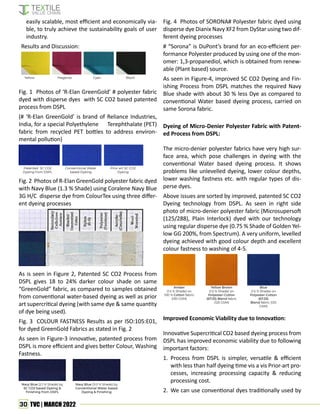
Yellow Magenta Cyan Black
Fig. 1 Photos of ‘R-Elan GreenGold’ # polyester fabric
dyed with disperse dyes with SC CO2 based patented
process from DSPL
(# ‘R-Elan GreenGold’ is brand of Reliance Industries,
India, for a special Polyethylene Terephthalate (PET)
fabric from recycled PET bottles to address environ-
mental pollution)
Patented SC CO2
Dyeing from DSPL
Conventional Water
based Dyeing
Prior art SC CO2
Dyeing
Fig. 2 Photos of R-Elan GreenGold polyester fabric dyed
with Navy Blue (1.3 % Shade) using Coralene Navy Blue
3G H/C disperse dye from ColourTex using three differ-
ent dyeing processes
As is seen in Figure 2, Patented SC CO2 Process from
DSPL gives 18 to 24% darker colour shade on same
“GreenGold” fabric, as compared to samples obtained
from conventional water-based dyeing as well as prior
art supercritical dyeing (with same dye & same quantity
of dye being used).
Fig. 3 COLOUR FASTNESS Results as per ISO:105:E01,
for dyed GreenGold Fabrics as stated in Fig. 2
As seen in Figure-3 innovative, patented process from
DSPL is more efficient and gives better Colour, Washing
Fastness.
Navy Blue (2.1 % Shade) by
SC CO2 based Dyeing &
Finishing from DSPL
Navy Blue (3.0 % Shade) by
Conventional Water based
Dyeing & Finishing
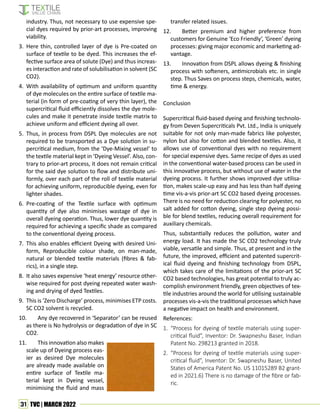
Fig. 4 Photos of SORONA# Polyester fabric dyed using
disperse dye Dianix Navy XF2 from DyStar using two dif-
ferent dyeing processes
# “Sorona” is DuPont’s brand for an eco-efficient per-
formance Polyester produced by using one of the mon-
omer: 1,3-propanediol, which is obtained from renew-
able (Plant based) source.
As seen in Figure-4, improved SC CO2 Dyeing and Fin-
ishing Process from DSPL matches the required Navy
Blue shade with about 30 % less Dye as compared to
conventional Water based dyeing process, carried on
same Sorona fabric.
Dyeing of Micro-Denier Polyester Fabric with Patent-
ed Process from DSPL:
The micro-denier polyester fabrics have very high sur-
face area, which pose challenges in dyeing with the
conventional Water based dyeing process. It shows
problems like unlevelled dyeing, lower colour depths,
lower washing fastness etc. with regular types of dis-
perse dyes.
Above issues are sorted by improved, patented SC CO2
Dyeing technology from DSPL. As seen in right side
photo of micro-denier polyester fabric (Microsupersoft
(125/288), Plain Interlock) dyed with our technology
using regular disperse dye (0.75 % Shade of Golden Yel-
low GG 200%, from Spectrum). A very uniform, levelled
dyeing achieved with good colour depth and excellent
colour fastness to washing of 4-5.
Amber
(1.5 % Shade) on
100 % Cotton fabric
(130 GSM)
Yellow Brown
(1.5 % Shade) on
Polyester-Cotton
(67:33) Blend fabric
(125 GSM)
Blue
(1.5 % Shade) on
Polyester-Cotton
(67:33)
Blend fabric (125
GSM)
Improved Economic Viability due to Innovation:
Innovative Supercritical CO2 based dyeing process from
DSPL has improved economic viability due to following
important factors:
1. Process from DSPL is simpler, versatile & efficient
with less than half dyeing time vis a vis Prior-art pro-
cesses, increasing processing capacity & reducing
processing cost.
2. We can use conventional dyes traditionally used by
31 TVC | MARCH 2022
industry. Thus, not necessary to use expensive spe-
cial dyes required by prior-art processes, improving
viability.
3. Here thin, controlled layer of dye is Pre-coated on
surface of textile to be dyed. This increases the ef-
fective surface area of solute (Dye) and thus increas-
es interaction and rate of solubilisation in solvent (SC
CO2).
4. With availability of optimum and uniform quantity
of dye molecules on the entire surface of textile ma-
terial (in form of pre-coating of very thin layer), the
supercritical fluid efficiently dissolves the dye mole-
cules and make it penetrate inside textile matrix to
achieve uniform and efficient dyeing all over.
5. Thus, in process from DSPL Dye molecules are not
required to be transported as a Dye solution in su-
percritical medium, from the ‘Dye-Mixing vessel’ to
the textile material kept in ‘Dyeing Vessel’. Also, con-
trary to prior-art process, it does not remain critical
for the said dye solution to flow and distribute uni-
formly, over each part of the roll of textile material
for achieving uniform, reproducible dyeing, even for
lighter shades.
6. Pre-coating of the Textile surface with optimum
quantity of dye also minimises wastage of dye in
overall dyeing operation. Thus, lower dye quantity is
required for achieving a specific shade as compared
to the conventional dyeing process.
7. This also enables efficient Dyeing with desired Uni-
form, Reproducible colour shade, on man-made,
natural or blended textile materials (fibres & fab-
rics), in a single step.
8. It also saves expensive ‘heat energy’ resource other-
wise required for post dyeing repeated water wash-
ing and drying of dyed Textiles.
9. This is ‘Zero Discharge’ process, minimises ETP costs.
SC CO2 solvent is recycled.
10. Any dye recovered in ‘Separator’ can be reused
as there is No hydrolysis or degradation of dye in SC
CO2.
11. This innovation also makes
scale up of Dyeing process eas-
ier as desired Dye molecules
are already made available on
entire surface of Textile ma-
terial kept in Dyeing vessel,
minimising the fluid and mass
transfer related issues.
12. Better premium and higher preference from
customers for Genuine ‘Eco Friendly’, ‘Green’ dyeing
processes: giving major economic and marketing ad-
vantage.
13. Innovation from DSPL allows dyeing & finishing
process with softeners, antimicrobials etc. in single
step. Thus Saves on process steps, chemicals, water,
time & energy.
Conclusion
Supercritical fluid-based dyeing and finishing technolo-
gy from Deven Supercriticals Pvt. Ltd., India is uniquely
suitable for not only man-made fabrics like polyester,
nylon but also for cotton and blended textiles. Also, it
allows use of conventional dyes with no requirement
for special expensive dyes. Same recipe of dyes as used
in the conventional water-based process can be used in
this innovative process, but without use of water in the
dyeing process. It further shows improved dye utilisa-
tion, makes scale-up easy and has less than half dyeing
time vis-a-vis prior-art SC CO2 based dyeing processes.
There is no need for reduction clearing for polyester, no
salt added for cotton dyeing, single step dyeing possi-
ble for blend textiles, reducing overall requirement for
auxiliary chemicals.
Thus, substantially reduces the pollution, water and
energy load. It has made the SC CO2 technology truly
viable, versatile and simple. Thus, at present and in the
future, the improved, efficient and patented supercrit-
ical fluid dyeing and finishing technology from DSPL,
which takes care of the limitations of the prior-art SC
CO2 based technologies, has great potential to truly ac-
complish environment friendly, green objectives of tex-
tile industries around the world for utilising sustainable
processes vis-a-vis the traditional processes which have
a negative impact on health and environment.
References:
1. “Process for dyeing of textile materials using super-
critical fluid”, Inventor: Dr. Swapneshu Baser, Indian
Patent No. 298213 granted in 2018.
2. “Process for dyeing of textile materials using super-
critical fluid”, Inventor: Dr. Swapneshu Baser, United
States of America Patent No. US 11015289 B2 grant-
ed in 2021.6) There is no damage of the fibre or fab-
ric.
32 TVC | MARCH 2022
47 TVC | Jan 2022
47 TVC | Jan 2022
33 TVC | MARCH 2022
REVIEW PAPER : RECYCLING
Second-Hand Clothing as a
Sustainable & Fashionable Lifestyle
Abstract:
To quote a very relevant saying, “Do I get a coffee? A
snack? Or something to wear?’ from the book Over-
dressed authored by Elizabeth L. Cline, one does get
an idea of the dangerous level of fast-fashion in the
retail segment has reached. This behaviour of consum-
ers has seen an intriguing connection and turn the en-
vironment has taken to date. Shopping for clothes is
awesome, but how does one slow down the process or
even in some cases reverse the process?
T
he retail sector in the fashion industry has thrived
on the notion of fast fashion, however, the trend
today is building on the concept of “saving natural
resources and lessening land-fills”. History has shown us
that the textile and fashion industries boost the econ-
omy of the nation, but in due course of time we have
set ourselves on the path of destruction because we
have not understood the concept of ‘giving (resources)’
against ‘receiving’. Time is now running out in terms of
the validity of living life recklessly and sustainable caus-
es have brain-washed consumers in general.
This constant dependency on fast fashion has led some
of us to let the notion of sustainable and slow fashion
creep into our system. When we read statistics which
tell us that a simple T-shirt which could be worn around
7-9 times, costs the Earth 2700 litres of water, it does
make the fashion fraternity stop to think about how and
where we are going wrong in our fashionable lifestyle.
Building a vibe of second-hand clothing is one of the
many constants we can adapt to work around the idea
of living sustainably. We do understand that human be-
haviour or urge to delve into fashion, is fuelled by the
desire for emotions and peer pressure. Observing the
fact that humans are closely connected to emotion,
there could be a possibility for fashion to regenerate it-
self through second-hand clothing, refurbished and re-
Prof. Dr. Patricia Sumod
Dr. Kundlata Mishra, Associate professor
Ms. Shweta Rangnekar, Assistant professor
styled. Thus, giving birth to hand-me-downs and sibling
love, this concept tugs on the human nature/emotion
and at the same time attempts to re-build nature or at
least sustain nature in a non-despicable manner. This
concept will conceptualise into advocating for ethical
issues and subjugate the hedonistic subconscious man-
ner of consumers to go on a buying-spree anytime they
choose to fancy. Now, that is the time. Second-hand
shopping is one of the most sustainable things you can
do as a consumer to lessen your negative impact, and
savvy buyers have caught on.
The conversation reiterates that second-hand shopping
is on the rise due to the coronavirus pandemic, which
seems to have been driven by the affordability of sec-
ond-hand goods. Thus, in the spirit of second-hand
goods, we liked to share how second-hand clothing can
be a sustainable and fashionable lifestyle.
Keywords: Positive-impact, Redefined-style, Purpose,
Nostalgia, Millennials
What Does Second-Hand Mean?
One of the basic principles of the recycling philosophy
is the second-hand economy. This practice makes the
consumers more aware and responsible for the textile
industry’s environmental effects. Certainly, this subject
raises the desire of consumers to purchase clothing from
eco-friendly brands that invite us to reflect on the reality
that the clothes you wear must never be disposable.
The increase in second-hand purchases is an inescapa-
ble consequence of the impact of the major trends in
the global fashion market, such as recycling and envi-
ronmental sustainability with zero impact. Further, con-
sumers of used garments increased by sixty-four per-
cent compared to 2016, and that percentage continues
to rise every day.
Because of the current economic crises, a little due to
34 TVC | MARCH 2022
the pressure exerted by environmental associations,
and the media railing against hyper-consuming and
waste, second-hand clothing has become the answer to
the many evils afflicting the textile sector.
The Nostalgia in Buying Second-Hand Clothes
Part of the appeal of second-hand clothing has been the
opportunity to find one-of-a-kind pieces that stand out
from mainstream fashion. Today’s individuality-focused
Gen Z and Millennials is a major key factor in their buy-
ing behaviour.
The interest of millennials in nostalgia is a key driver,
with most young people searching paparazzi shots and
old fashion magazines for style inspiration. Even fashion
brands are trading off the interest in nostalgia, such as
the recent collections of Versace that have reworked ar-
chive silhouettes and prints. Fendi has also reissued the
90s era Baguette bag to excellent fanfare.
For the past few years, celebrities and style-leaders have
been bragging about their fashion experience by wear-
ing iconic classic pieces from Versace, Jean-Paul Gaulti-
er, Azzedine Alaia, and Thierry Mugler collections.
Fast Fashion No Longer Hold the Reigns of Style
Fast fashion has been the wrath for everybody to wear
the newest styles. However, the overproduction of such
garments is polluting the planet. Did you know it takes
2,700 litres of water to create a cotton shirt? That is
enough water for one individual to drink for 2.5 years.
You see, the fast-fashion business model is great for
clothing designers but not for the environment. After
a clothing factory in Bangladesh failed and killed more
than 1,000 factory employees, consumers—particularly
professional women—started wondering about the real
cost of the fast fashion industry. That caused a massive
shift towards sustainable fashion.
Further, fast fashion has contributed to the rise in what
experts refer to as a throwaway culture. It refers to
when consumers throw out foods, goods, and other
products—instead of donating or recycling—after they
are seen as useless or no longer need it.
International Labels Moving Towards Sustainability
The fashion industry is seeking to make trends, and now
it is working on its most crucial trend yet: sustainability.
Compared to a few questionable fashion decisions, it’s a
trend all consumers could get behind.
You may be already aware that Nordstrom is selling used
clothing. Everybody is beginning to wake up to the re-
ality that consumer preference has evolved and wants
more eco-friendly products.
Some of the top fashion brands leading the way in sus-
tainability are the following:
• Everlane
The brand combines sustainability with transparency by
sharing with its customers the breakdown of the cost of
every item and displaying the factories where garments
are produced. The company creates strong relationships
with factory owners to guarantee the employees and
production meet the brand’s high ethical standards.
• Levi’s
Denim is infamous for requiring big amounts of water
to make a single pair of jeans. However, the recent col-
lection of Levi’s Water<Less uses up to ninety-six per-
cent less water. For that and all its products, the brand
is dedicated to sustainability through the whole design
and manufacturing process. That also includes working
towards sustainability-sourced cotton and recycling old
jeans into home insulation.
• People Tree
Established in 1991, People Tree was one of the first sus-
tainable fashion brands in the world. It’s the only brand
acknowledged by the World Fair Trade Organization and
invests massively in eco-friendly and sustainable practic-
es, which involve organic farming.
The brand also supports good working conditions fair
wages and employs sustainable materials such as chem-
ical-free dyes, natural fibers, and organic cotton.
• H&M Conscious
H&M is shifting away from its fast-fashion roots along
with its Conscious collection. The clothes are made from
materials such as recycled polyester and organic cotton.
The brand hopes to lessen its environmental footprint
by using environmentally-friendly fabrics and more sus-
tainable production methods. On top of that, consum-
ers can recycle unnecessary garments at H&M stores
and receive a discount for their next purchase. Remem-
ber that H&M strives to only use sustainably sourced
materials by 2030.
Designers Re-Using Their Earlier Collections
In 2019, as the climate crisis weighed more on consum-
ers globally, designers thought more critically about
their impact on the environment and came up with cre-
ative answers for excess fabrics. It is not a new solution
35 TVC | MARCH 2022
to the problem of excess fabrics post-production runs.
Alexander McQueen has been repurposing extra mate-
rial and scraps into runway collections for years. Many
indie brands have also been established on this concept.
There are many organisations committed to collecting
and recycling waste.
In the same year, Tanya Taylor dropped a limited edition
remixed and restitched sleep collection, which features
a pajama set and accessories made from fabrics leftover
from different 2019 collections, including pre-fall and
resort.
Hand-Me-Down Clothing
Bear in mind that sustainability in fashion is not all about
using earth-friendly materials. It goes far beyond that
and challenges the fashion sector that flourishes on
different looks at different times of the day, let alone
months, years, seasons.
Sharing clothes enables you to connect with other peo-
ple. It is a simple and practical way that we can provide
to support one another—something we need to do
more often. Whether you are sharing hand-me-downs
with a neighbour, friend, co-worker, or even a stranger,
you have the opportunity to visit for a few minutes and
experience some camaraderie.
Why You Should Participate in the Second-Hand Cloth-
ing Trend
To safeguard the environment and ensure there is
enough resources leftover for the next generation (your
kids), wearing sustainable second-hand clothing is a vi-
tal step you can make towards a better future.
• Lessen textile waste
Clothing and textile waste are a major concern at the
moment. Every year in the UK, 350,000 tons of used
clothing that are still wearable is delivered to the land-
fill. The quantity of wearable clothing that’s discarded
every year weighs nearly as much as the Empire State
Building. That figure is only an estimate from one na-
tion. Just visualize how much the global number is? Each
time you participate in sustainable clothing, you extend
the time until a piece of clothing becomes waste. Many
high-quality garments purchased second-hand still have
another decade or two of life left in them.
• Old trends return on fashion
It has been known that fashion works in cycles. Things
trend for a little while, then they vanish. Sometimes,
they will appear again in a new generation.
You have seen this numerous times. Remember when
bell-bottom jeans returned in the early 2000s, it was
a 70s motif. A more modern trend is high-waisted,
straight-leg jeans. That look has nearly been transposed
from the mid-90s.
Where is the ideal place to get these on-trend items of
garments? You guess it right, sustainable second-hand
clothing.
The Future of Second-Hand Fashion
Driven by nostalgic millennials, sustainable consump-
tion, and celebrity style, second-hand clothing looks
to substantially impact retail in the following years. It’s
worth mentioning that circular fashion is one of the
solutions to remove the impact of the fashion industry
on the environment. This problem is now at the fore-
front of Gen Zers and Millennials. The future will now
seek complementary and alternative solutions to the
first-hand fashion market.
Conclusion
For a long time, fast fashion has reigned the clothing
market, and with it, the environment and many work-
ers have paid a high price. Fortunately, with things such
as the sustainable fashion movement and the launch of
slow fashion, people are beginning to realise that we
need to become more proactive if we want this planet
of ours to stay beautiful. Young India is moving rapidly
towards taking climate change and responsible lifestyle
very seriously. Youngsters are creating their own mul-
ti-dimensional spaces to work on areas that hold sus-
tainability at the core. Namrata Iyer founder of The Lo-
cal Thrift concept speaks about the growing increase in
second-hand clothing and also stresses on emotive the
tag ‘pre-loved’ given to second-hand clothes.
There are many platforms like Instagram, Facebook, on-
line Garage sales which in increasingly popular among
the youth while creating a feeling of responsibility. The
growing social and environmental issues in India have
nudged the audience to take steps towards searching
for long-lasting and better solutions. The emotion which
connects to second-hand clothing is the various stories
each clothing item has. The persons who put up for sale,
their pre-loved clothing and accessories attach them
with love and a series of stories and events connects the
buyers to those emotions. These unique stories build at-
tachments and attractiveness which further paves the
path towards the popularity of second-hand clothing.
According to another young entrepreneur Asenla Jamir,
36 TVC | MARCH 2022
founder and creative director of Otsü Clothing Co, the
pandemic has led to many a downfall of popular online
shopping brands, which has built the novelty and the ac-
ceptance of second-hand clothing among online shop-
pers today.
You will find many ways to be proactive and partaking
in the second-hand clothing market is beneficial to the
environment and extremely fun at the same time. So,
we encourage you to have a look for some second-hand
bargains, and you will not certainly regret it! History has
shown and taught us that culture and commodity are in-
tertwined which build our consumers and their values.
This is the century for revisiting that concept and evolv-
ing into a conscious segment of consumers, creating
platforms for forward-thinking practices and demand
that consumers must learn to be credible for their pur-
chases.
REFERENCES:
Cline, E. L. (n.d.). Overdressed: The shockingly High
Cost of Cheap Fashion.
Franscesco Morace, P. F. (n.d.). End of Old Luxury and
Rise of the New Paradigms of Fashion.
Linden, A. R. (n.d.). An Analyst of the Fast Fashion In-
dustry.
Nusrat Zahan. (n.d.). Sustainable fashion: A paradigm
shift or a pipedream.
Prasad, A. (n.d.). How hand-me-down fashion became
haute during the pandemic.
Twenty years after its inception, the world’s lead-
ing textile processing standard for organic fibres
records new all-time high figures: 18 GOTS Ap-
proved Certification Bodies report a total of 12,338
certified facilities (+19%) in 79 countries (+11%).
Among the countries with the largest increase in GOTS
certified facilities in 2021 are Turkey (+61% to 1,799),
Italy (+53% to 894), Germany (+19% to 817), Portugal
(+35% to 608), France (+22% to 122), Denmark (+14%
to 115), Switzerland (+15% to 61), Belgium (+55% to
59), Sweden (+34% to 51) and Vietnam (+264% to 51).
“What seemed utopian to many in 2002 has become a
reality in the past 20 years. We have created an organ-
ic textile standard, certified by approved certification
bodies, which is accepted in all major markets. GOTS is
a standard that gives consumers the power to choose
truly organic products sourced from sustainable sup-
ply chains.” says Claudia Kersten, Managing Director
at GOTS. “Despite ongoing difficulties and uncertain-
ty caused by the Covid-19 pandemic, decision-makers
continue to pursue their sustainability goals and value
GOTS as a tool to accomplish them”.
The results of the annual GOTS Survey among certi-
fied entities underline this. Out of 1,114 respondents
(+39%), 63% indicated a permanent shift in their sus-
tainability strategy with a focus on the environment
and health of their workers and staff.
Growing interest from industry, the public, and the
media drove website visits up an impressive 48%. Me-
dia exposure grew by 64% and GOTS social media fol-
lowers across several platforms jumped by 57%.
“As much as we are pleased with the development so
far, we don’t intend to rest on our laurels” adds Ra-
hul Bhajekar, Managing Director at GOTS. “In March
2022 we begin revision for GOTS version 7 involving
all stakeholders including associations, organisations,
companies, and individuals to further advance the pro-
gressive, innovative, stringent yet practical standard of
GOTS”.
As informed by Mr.Ganesh Kasekar – Representative
of GOTS in South Asia region, GOTS continues to be
the preferred sustainability standard in the region.
The unique positioning of the region remains unfazed
since it covers all stakeholders and partners involves
in the textile supply chain. This includes the fibre to
final product manufacturing along with the supporting
industries of dyes-chemicals and accessories.
The industry in the South Asia region also welcomed
the concept of “Organic In Conversion” which will be
a boost and encouragement for more organic cotton
projects from Farm to Fashion. Positive signs were re-
ceived for the inclusion and use of other sustainable fi-
bres (Hemp, Silk, Pashmina and others) on a large scale
under GOTS. India and Pakistan will be the key focus
areas for the Organic In Conversion concept.
The changing consumer behaviour and urge to have a
complete sustainable product in their hands, not just
abroad but also in the domestic markets, is motivating
companies to revamp their product from conventional
to sustainable. This remains an area of significant im-
portance in the future.
12,338 (+19%) GOTS certified facilities in 79 countries in 2021
37 TVC | MARCH 2022
Each Fabric is Assembled
with utmost precision
A N U P A M A R Y A
Founded in 2016 by Mr. Vijay Sharma, Mr. Anupam Deo Arya and Mr. Sandeep Sharma, Fabriclore, which literally
means ‘stories of fabrics’, is an online brand that aims to revive India’s use of both traditional and modern fabrics
by delivering premium curated fabrics.
India is among the world’s largest producers of textiles, and yet the textile industry is a largely unorganised sector
in the country. Other than the suiting and shirting segment, a large segment of the industry is still fragmented.
There is no easy accessibility or standardisation of what is being produced across India, in both native Indian
crafts and modern digital or embellished fabrics.
However, things are changing now, in this new era of digitisation, post the pandemic world. Joining the wagon is
Jaipur-based Fabriclore, an online brand that aims to revive India’s use of both traditional and modern fabrics by
delivering curated fabrics. Fabriclore is a blend of traditional and modern design materials, where each piece of
fabric is assembled with utmost mindfulness and precision. The fabrics are sourced from masters of traditional
craft and even traditional keepers, making them an ideal value for money for connoisseurs of design and fabrics.
The brand works in close collaboration with designers to co-create spectacular classical and fusion designs, in
both clothing and home furnishing.
A
nupam Deo Arya, VP Marketing and Communi-
cation, Fabriclore conveyed in an exclusive inter-
view to the Textile Value Chain about the birth
and growth of Fabriclore. Excerpts:
You have created a novel niche in fabric business. How
did this happen?
I never had an agenda to start a business in fabrics or
textiles as I was inexperienced, though somewhere in-
side, I always yearned to be a part of a consumer de-
sign-oriented project. So, it was a mere stroke of luck.
My partners and I realized the demand for fabrics in
the market was not being fulfilled. Hence, after plung-
ing into the segment deeper, we were surprised to be
acquainted with the variety of fabrics available! This is
how we hatched the idea of starting a business in the
same field.
What are the various segments covered under Fabri-
clore & marketing tactics?
INTERVIEW-FABRICLORE
38 TVC | MARCH 2022
1. Boutique Circle- An all-integrated digital platform to
connect consumers with regional designers & bou-
tiques.
2. END-TO-END Fabric & Design Ecosystem
3. Project roots: An exclusive initiative to bring togeth-
er authentic crafts, sustainable processes, modern
design thought & academia.
4. Wholesale and Made to order
How’s the production and raw material requirements
taken care of?
Our production is managed by the network of artisans
and manufacturers spread across India in 14 states
which is further managed by our inhouse team of tex-
tile designers and merchandisers. Moreover, we use
our internal software to track and maintain the pro-
gress across India.
Moving on to raw materials, we do have a stock of
raw materials and our inhouse team experiments on
them with a lots of art. We make sure to do sampling
first and then distribute them to the artisans. We do
not engage on leaving the choice on the manufactur-
er rather we have grey fabric to experiment. Our great
deal of investment is in sampling part.
If in export, what are the various achievements in the
markets?
Our achievement in the international market is that we
have been able to work with lot of individual design-
ers and developed some really niche products with the
combination of printing, weaving and fabric. We have
been able to create the largest catalogue of fabrics ac-
cessible globally even in small yardages.
How far have your moved up in digitalisation?
We are a digital first platform and emphasise on ex-
ceptional visual experience, that is highly detailed,
transparent, diverse and design centric. Add to that is
our content marketing ecosystem. Anyone visiting us
digitally get access to a full spectrum of content, fab-
ric knowledge wiki, workshops, styling inspiration, and
FAQ videos across all major social media channels. We
also organise interactive sessions and quizzes, as a re-
sult of which, our company has a great following on
social media.
Our next step of digitisation is to bring designers and
boutiques under single platform covering the entire
loop of fabric to garment making.
What are the plans for the future? Any diversification?
One of the plans is to focus on the entire spectrum of
fabric buyer categories from consumer to the enter-
prise level apparel manufacturers.
Another plan is the vertical integration of boutiques/
designers within our system.
How does your competition fare?
Fabriclore’s competition is mainly from standalone
suppliers at the regional level and some modern retail-
ers focused on fabrics. Online horizontal marketplaces
like Amazon and vertical players like iTokri and Jaypore
also sell fabrics but are not fully into making a com-
prehensive ecosystem. International players like Joann
39 TVC | MARCH 2022
Fabric and Mood Fabric are something we constantly
keep an eye on.
What is your wish-list for the Government & the tex-
tile industry to tackle future challenges?
Tax rationalisation across the value chain of garment
industry is the biggest need of the hour. The legacy
tax regimes have accumulated pile of GST input credit
which is absolutely useless for us. There must be mech-
anisms for us to use this input credit in any financial
instrument. As the industry is moving more towards
digital economy, use of digital products or software or
advertising platforms have been quintessential. How-
ever, they are heavily taxed. Government shall encour-
age use of such services/products by reducing tax.
40 TVC | MARCH 2022
41 TVC | MARCH 2022
Itema Weaves Huge Hopes
in India
S A M E E R K U L K A R N I
I
tema is a leading global provider of advanced weav-
ing solutions, including best-in-class weaving ma-
chines, spare parts and integrated services. The
Company is the only manufacturer in the world to pro-
vide the top three weft insertion technologies: rapier,
airjet and projectile, with an ample product portfolio
and a commitment to continuous innovation and tech-
nological advancement of its weaving machines. Itema
is a trusted partner of many Indian weaving mills, from
large textile conglomerates to smaller textile manufac-
turers, providing the most advanced and user-friendly
weaving technology and real-time assistance, from the
initial negotiation stage and throughout the whole ma-
chine life cycle.
Itema showcased at SITEX a rapier R9500-2 weaving
machine, in weaving width 3800 mm and equipped
with a Stäubli LXM 5376 hooks Jacquard shedding ma-
chine. The machine on display in Stäubli booth wove a
fabric traditionally produced in the mills of the Region
and was configured to meet the local weavers produc-
tion needs.
SITEX was also the official launch of the partnership
between Itema and the leading Italian circular knitting
machines manufacturer Cesare Colosio for the market-
ing and distribution of the company highly innovative
machines in India. With this partnership Itema expands
its portfolio of textile products, thus creating a signif-
icant benefit for all the Indian textile companies that
need both the Itema and the Colosio machinery, that
share the same attention to innovation and excellence
INTERVIEW-Itema Weaving
that Itema guarantees to its customers.
Itema is present in India with a fully-operational branch
since 2002, counting more than 50 employees, with
sales and after-sales teams, technical support and ad-
vanced repair centres to ensure the highest possible
standard of weaving solutions, with a complete offer-
ing and range of services to its valuable Customers in
the Indian market.
Sameer Kulkarni - General Manager Sales, Itema Weav-
ing India Pvt Ltd spoke with the Textile Value Chain. Ex-
cerpts:
How was Sitex 2022 exhibition for your company?
Sitex turned out to be a great opportunity to meet our
customers and an impressive number of potential new
investors. The textile industry of the Surat region is ex-
periencing a real momentum, with weaving mills work-
ing at full capacity. We received many inquiries from
weavers that are planning to modernise their weaving
equipment, and Itema is the right partner to rely on
since we provide the latest weaving technology cou-
pled with real-time assistance and maximum customer
care.
Tell us about new innovations displayed at Sitex 2022
At Sitex we exhibited our absolute best-seller in the
region, the Itema rapier R9500-2. Displayed in Stäubli
booth, the weaving machine was configured to weave
saree fabric and to perfectly meet the local mills’ weav-
ing needs. In addition to the R9500-2, the Itema airjet
A9500-2 and the Itema rapier R9500-2denim aroused
42 TVC | MARCH 2022
a lot of interest, also due to the main innovations
they are featuring such as the waste selvedge eraser
iSAVER® and the Itema proprietary technology heald-
frames SKYFRAME®. iSAVER® represents the first sus-
tainable innovation in the weaving process, enabling
the weaver to save money whilst reducing cotton and
water wastage. SKYFRAME®, on the airjet side, ensures
maximum performances even at the highest speed.
Another important news introduced by Itema at Sitex
is the commercial partnership with the leading Italian
circular knitting machines manufacturer Cesare Colos-
io for the marketing and distribution of the company’s
highly innovative machines in India.
At Sitex we exhibited our absolute best-seller in
the region, the Itema rapier R9500-2. Displayed in
Stäubli booth, the weaving machine was configured
to weave saree fabric and to perfectly meet the
local mills’ weaving needs. In addition to the R9500-
2, the Itema airjet A9500-2 and the Itema rapier
R9500-2denim aroused a lot of interest, also due to
the main innovations they are featuring such as the
waste selvedge eraser iSAVER® and the Itema propri-
etary technology heald-frames SKYFRAME®.
With this partnership we expand our portfolio of tex-
tile products, thus creating a significant benefit for all
the Indian textile companies that need both the Itema
and the Colosio machineries.
How was covid phase ie year 2020 and 2021 for you in
terms of managing employees, profits, operations etc
We had two clear priorities in our crisis response. Our
number one priority has been to ensure the health and
safety of our people and their families. The second pri-
ority has been to ensure business continuity: to deliver
our products and to provide service to our customers.
In all our health and safety measures, we follow the
guidelines of the World Health Organization and Indian
health authorities, and we followed the Itema Group
specific policy, named Stronger Together Against Cov-
id-19, to ensure our employees the maximum safety
when working in our premises and even when going
back home. Thanks to this, we have been capable to
safeguard our employee’s health and we have been
able to assist our customers in the usual effective way.
What is the future you see in your industry in terms of
growth in jacquard market and overall textile industry?
The textile industry in India is growing year on year.
Beside the fabric production for exports, we are expe-
riencing a significant growth of the internal demand.
Looking at the Jacquard market, it has grown signifi-
cantly in recent years due to continuous expansion of
domestic market, especially for Saree production, and
constant rise of both domestic and export demand of
home furnishing fabrics. As Itema we are leading the
Jacquard market due to the renowned textile mastery
of our rapier looms and the demand for our technolo-
gy is steadily increasing due to our looms capability to
weave even the most difficult styles and yarns, guar-
anteeing superior fabric’s quality. Particularly, what
weavers appreciate the most in our weaving technol-
ogy when producing Saree and furnishing fabrics is the
possibility to weave designs with weft densities varia-
tions and the ability to successfully handle fancy yarns,
from coarsest to finest.
We see a flourishing future for textiles in India over-
all, and we are proud to see Indian textile companies
evolving by choosing the latest textile technologies
and improving their supply chain.
What advise do you give to new entrepreneur, start up,
new generation who are joining textile industry?
The textile industry is fascinating and there is still much
room for growth. Particularly, investigating the market
to detect trends is of crucial importance. Investing in
the right market segment represents a key factor for
succeeding.
43 TVC | MARCH 2022
F A R M T O F A S H I O N
F
A
R
M
I
N
G
G
I
N
N
I
N
G
K
N
I
T
T
I
N
G
D
Y
E
I
N
G
A
N
D
P
R
I
N
T
I
N
G
G
A
R
M
E
N
T
I
N
G
S
P
I
N
N
I
N
G
1800 - 889 - 6020
info@omaxcotspin.com
www.omaxcotspin.com
Sr. No. 842,843,845/1, Near. Petrol Pump, Village Rajsitapur , Ta. Dhrangadhra Dist. Surendranagar. Gujarat. (INDIA).
44 TVC | MARCH 2022
‘We are creating our own
brands: Ronak B. Chiripal’
INTERVIEW-NANDAN TERRY
N
andan Terry Pvt. Ltd incorporated in 2015, start-
ed operation from 2016. It is a vertically inte-
grated unit right from cotton to towel. Have
spinning, weaving, dyeing and stitching process, it
Manufactures towels, selling in export markets as well
as domestic brands and markets. Nandan Terry deals
with international names like Walmart, Kohls, Biglots,
TJX, Ross Stores to United Colors of Benetton, and
Trent, Westside, Walmart India, Reliance Retail in do-
mestic markets. It is exporting to countries like US, UK,
European countries, South America, Australia, Middle
East, and also selling to domestic customers like V Dé-
cor, D-mart, Bombay Dyeing. Besides, It is also selling
to unorganised retail sectors in India. The entire busi-
ness has been going on well from the last 5 years, and
it Nandan Terry plans to continue growing with back-
ward and forward integration plan in the next couple
of years.
Apart from manufacturing terry towels and toweling
products, the company also sells the cotton yarn manu-
factured at its units to achieve better sales realisations.
The company has five manufacturing units and facili-
ties are situated in the state of Gujarat, India and cater
to manufacturing of terry towels & toweling products
in business – to – business (B2B) segment.
Nandan Terry’s revenues from operations for fiscal
2021 stood at Rs 538.52 crore, a 25.42% year-on-year
increase compared to Rs 429.39 crore in fiscal 2020,
primarily due to increase in sale of towel and toweling
products and sale of cotton yarn. Its annual profit for
fiscal 2021 stood at Rs 23.38 crore, which increased
from Rs 1.22 crore. For the six months ended Septem-
ber, its revenue was Rs 501.81 crore and profit was Rs
30.62 crore. As of October 31, 2021, it had 2037 full-
time employees.
Ronak Brijmohan Chiripal, CEO, Nandan Terry Limited
replied to the Textile Value Chain’s queries about the
company and the plans for the future.
Excerpts:
How was your last two years of pandemic? How the
company has sustained?
Seeing from the business prospects the company has
actually grown recently because when the lockdown
struck the country our factory was running and the de-
mand was there from the US as well as other countries.
Because the retailers probably were selling more, as
soon as you know that was not much of a problem in
the US. So only for one and a half months, there was a
big problem. But then I think most of the retailers, most
of the e-commerce people were selling a lot of towels
plus covers being an essential product. You know, rath-
er people probably started focusing on more hygiene
and, changing their towel more often. And ceaning and
washing the towels more often, so that’s why the de-
mand actually grows if you see the entire home textile
industry the industry grew basically in the last 2 years.
And as our figures show that we grew since the pan-
demic, and we continue to grow, so we had a decent
demand, and the capacity utilisation increased. We
had some problem of labour for probably a couple of
months when the government opened up everything,
you know when they went back home. So that was the
only time when we faced certain issues, but other than
that, from the market perspective, we always had a lot
of demand for our products, since last two years. So
that is why, you can see the top line has grown and also
45 TVC | MARCH 2022
the capacity.
How do you see the next five years?
I honestly think the next five years should be good. If
you see, as I said last couple of years is kind of a reflec-
tion to what is going to happen in the next five years,
the world is actually adopting a China plus policy, and
actually trying to do their business in another coun-
tries, and India I think as the most advantageous po-
sition here because India was always kind of second
or third biggest exporter in this industry. So as a China
plus customer strategy in India gets a very good ad-
vantage. You can see other countries like Pakistan and
Bangladesh where problem is there of raw material
like good quality cotton. India has a good quality of
cotton so the entire value chain and if we talk about
the country the value chain is really well supported for
such a business, and when I talk to customers people
want to go out of China or the stores of China. They
prefer working in India, so I see a lot of growth coming
from 2 to 5 businesses. Most of the retailers do not
have a home segment like H&M has a home segment;
Zara has a home segment so a lot of fashion brands
getting to the home textile. So, clearly the business is
moving from China to India and this will bring also a lot
of growth.
What is your product innovation and R and D strategy
for your company?
We have come up with a lot of products like an an-
tiviral towel, which is doing good due to the current
pandemic situation, and so we called it Viroshield. We
work with designers in UK as well as in Portugal, and
then we have a designer in USA. So these designers
basically are freelancers. We work with them on a pro-
ject-to-project basis, so wherever we have this pres-
entation. It will be taken ahead to build a design based
on the trends, the current trends and everything. This
is one creative side of our R and D. On the other side,
we are using our own spinning, we kind of make dif-
ferent types of yarn. We made a yarn called Osmose,
which basically is oxygenated, and a special technique
makes this unique yarn. This was launched probably
three years ago, but we keep doing a lot of R and D
and so we have a knowledge sharing platform where
everyone comes up with their developments. We have
created a model where we kind of grow our top line
and bottom line without including a lot of fixed cost.
We are kind of doing contract manufacturing.
What is the branding strategy for the Indian and in-
ternational marketers?
So we are basically making towels for different re-
tailers, at the same time, we have already registered
three brands. The names are Casalino , Humahome,
Swadeshi . So we registered this three Brands and
we already started manufacturing of Casalino towels.
Probably in the next two months’ time, they should be
in the market, and probably by next year we will re-
alise the results of branding exercises. And at least 5
per cent of our manufacturers will be our own brands,
so that is what the target is. We also have registered
this brand in US So right now we are focusing on Indian
market in all the channels, so basically there are four
channels. We are focusing on -- one is for protecting,
then is retailer, another is the e-commerce, the fourth
is hospitality, so these four segments we want to focus
in India and in the US. Probably we start with e-com-
merce, and then gradually you know we might get into
other three segments. But as of now in the US only
the e commerce and in India probably all the four seg-
ments.
Now people are using more sustainable products. So
what is your take on this, and what is the future of
the sustainable fibre & sustainable products?
The World is focusing a lot on sustainability. And that
is a good thing. We have also, kind of taken initiative,
made the cotton-hemp towel, we have also made tow-
els using a recycled yarn, which is basically recycled
plastic bottles. A lot of cotton post-consumer waste
are being recycled, and we use this recycled yarn. I can
tell you definitely, I feel that sustainability is going to
be the next big thing. The quality or strength of that
end might not be as good as probably fresh cotton,
which is the best cotton. and I think with advancement
of the technology it is possible to make good products
because you know a lot of new technologies being
launched for making good quality recycled yarn and
recycling products. We have already started focusing
a lot on sustainable measures and I keep traveling and
I see that the world is actually moving towards that.
They have a section for sustainable products. And that
is why we also taken an initiative and tried launching
a few products on sustainable blends of hemps, a lot
of recycled cotton and so on. Of course, the demand
is not as much as it could be, but still seeing from the
retailer’s perspective it will probably be a reasonable
amount.
Government has the launched PLI scheme of the ben-
46 TVC | MARCH 2022
efit of the textile industry and recycling industry, so
what is your take on this?
The government focus is to promote synthetic textile
industry as well as technical textile industry. The fo-
cus on the PLI scheme is probably mostly industries
like technical textiles, defence manufacturing, diaper,
sanitary napkins and all those productions. Towels do
not qualify for any of these industries which qualify for
PLI scheme, so we don’t have any benefit from the PLI
scheme, but this is a very good initiative and I think
that will definitely help the industry. But for towels, I
don’t really see any advantage.
As the industry leader what advice & message will
you give to new entrepreneurs entering this textile
field?
I think message would be that you know, stick to the
basics, sticking to the basics helps us a lot, and per-
sonally, such focus has helped me a lot. And second-
ly, keep innovating and keep up with the new trends,
because I have seen in the last five years, like earlier
days when things used to stay for 3 to 4 years. Now
trends probably stays only for a few months, so I think
it’s very important for everyone to keep up with the
trend and keep up with the demands of the customer,
Be as flexible as possible for the customer. We have
always given customers flexibility because they are the
ultimate choosers.
T
here are adequate signs for the Indian textile in-
dustry to seize the opportunities available today to
boost the fortunes lying ahead, says Basesh Gala.
India is the 6th largest exporter of textiles and apparel in
the world contributing 5% to the country GDP and 12%
of country export earnings. Besides around 4.5 crore
people are employed in this industry. As we know textile
industry is one of the largest industries in India. So, be-
fore we go further let us first understand what is textile.
How did the textile industry start?
Through Wikipedia we got to know that the archaeo-
logical studies indicate that around 4000 years ago the
people of Harappa civilization knew the weaving and the
spinning of cotton. References of weaving and spinning
materials are found in the Vedic Literature. There was
textile trade in India during the early centuries. Cotton
fragments from Gujarat have been found in Egypt which
indicate the existence of export of Indian textiles during
the medieval era.
Huge quantities of north Indian silks were traded
through China to the western countries. During the in-
dustrial revolution there were large exports of Indian
cotton to the western countries to meet the needs of
A SWOT Analysis of India’s Textile
Industry
Europe, besides from domestic requirements at the In-
dian Ordnance Factories. Till 18th century, Mughal Em-
pire was the most important centre of manufacturing in
international trade. Until 1750, about 25% of the world’s
industrial output were produced in India. Textile man-
ufacturing, specifically cotton textile manufacturing,
which included the production of piece goods, calicos,
and muslins, available unbleached and in different col-
ours was the largest manufacturing industry in Mughal
Empire during 16th to 18th centuries.
The cotton textile industry was a large part of the em-
pire’s international trade. Bengal owns 25% share of
the global textile trade in the early 18th century. Bengal
cotton textiles were the most significant manufactured
goods in world trade in the 18th century, consumed
across the Globe from the Americas to Japan. Bengal
Subah province, particularly around its capital city of
Dhaka was the most important centre of cotton pro-
duction. As Karl Marx noted in 1853, the textile industry
was a major component of income in the pre-colonial
Indian economy, writing that “The handloom and the
spinning-wheel, producing their regular myriads of spin-
ners and weavers, were the pivots of the structure of
that society”.
Basesh Gala.
Basesh Gala.
47 TVC | MARCH 2022
Bengal is accounted for 50% of textiles and around 80%
of silks imported by the Dutch from Asia and sell it to the
world, Bengali silk and cotton textiles were exported to
Europe, Asia, and Japan, in large quantities and Benga-
li muslin textiles from Dhaka were sold in Central Asia,
where it was known as “daka” textiles. Indian Ocean
trade was dominated by Indian textiles for centuries,
and had a 38% share of the West African trade in the
early 18th century, while Bengal calicos were a major
force in Europe, and Bengal textiles accounted for 30%
of total British trade with Southern Europe in the early
18th century.
In early modern Europe, there was a huge demand for
textiles from the Mughal Empire, including cotton tex-
tiles and silk products. European fashion was heavily de-
pendent on textiles and silks imported from The Mughal
Empire. In the late seventeenth and early eighteenth
centuries, the Mughal Empire accounted for 95% of Brit-
ish imports from Asia, conducted through the auspices
of the East India Company (EIC). Once the abolishment
of slavery within the geographic region, manufacturers
in the kingdom began to search for different sources
of low-cost cotton, eventually selecting the East India
Company’s possession in India. The EIC convinced sev-
eral farmers to modify from agriculture to manufactur-
ing and exporting huge amounts of cotton, after a long
period of presidency economic policy obligatory over
British textile business. Eventually, through the technical
and marketing advances made possible by colonisation,
the traditional method of artisan textile production de-
clined significantly and was replaced with large scale
factory production.
Current trends in the textile industry
According to a Live Mint article, India is home to some
of the leading textile companies such as SVP Global Ven-
tures, Welspun India, Grasim Industries, Vardhman Tex-
tiles, etc. The growing industry figures indicate that our
country is set to touch the USD185 billion by 2024-2025.
But the Bizencyclopedia says that the textile technolo-
gy industry in India is in its early stage where it is look-
ing past to the outlook of Game-changing & new-tech-
nology ideas. But the industry’s real potential is being
utilised on the advancement of what consumer wears,
how apparel is designed, manufactured, and marketed
to customers.
Technology in Textile Manufacturing
JUST IN TIME
It is said that t he textile industry is the second largest
polluter in the world. As a solution for this, an expect-
ed technological advancement is the inclusion of Just in
Time (JIT) technology where garments will be created
after screening a sample to the customer by Augmented
Reality and placing an order. This will save resources and
allow customers to choose various prints, colours, and
designs without garments being manufactured
ADOPTING A NEW MARKETING STRATEGY
Big data is another trend in this sector to market and
sell the product. Customer data like purchasing habits,
tracking customer location will be processed and an in-
timation SMS will be dropped to the customer’s smart-
phone if they pass by near sites of retail stores. New
technologies like visual trial rooms will be adopted in
the retail industry as well.
ADVANCE GARMENT
Toronto-based pioneer of smart garment manufactur-
ing or textile computing Mayant. They create garments
that can monitor every move of the advanced garment
user. Tony Chahine, the CEO of Mayant, says these in-
teractive materials will sense information from the user.
Sensible textiles are touted as the next frontier of wear-
able technology. Yarns are paired with electronic sen-
sors so essential information may be captured from the
body. Mayant has created a monitoring men’s boxers,
commercialised under the brand Skin to capture medi-
cal-grade biometric data across numerous form factors
for both adults and elderly populations.
The garments will monitor and show the status of ECG,
body temperature, movement, and respiration. Ma-
yant has created a team of developers having numer-
ous backgrounds like scientists, AI engineers, software
developers, garment technologists, fashion designers,
pattern manufacturers, etc. for collaboration and in-
teraction to develop an undefeated “smart garment”.
Health observation clothes area unit being created and
sold-out within the USA, Canada, and Japan majorly and
these countries also are a hub of analysis and develop-
ment of recent idea fashion.
FUNCTIONAL CLOTHING
Functional fabric materials and products are manu-
factured primarily using specialised technical textiles.
These fabrics are highly technological and cater to the
particular requirements of the top user. They’re made
for programmed performance properties instead of
their aesthetic or decorative characteristics. Technical
textiles are getting used in diverse sectors categorized
48 TVC | MARCH 2022
into 12 major fields of application. For functional cloth-
ing, technical textiles are getting used within the follow-
ing sectors, as defined by Techtextil -
1. Protective clothing - Garments providing protection
against cuts, abrasion, and other sorts of severe impact,
including stab wounds and explosions, ire and extreme
heat, hazardous dust and particles, nuclear, biological
and chemical hazards, high voltages, electricity, and
extreme cold. High-visibility wear also comes into this
category.
2. Sports-functional clothing- Garments providing
high-level of breathability and moisture/vapour transfer
combined with heat insulation and/or wind-proofing,
waterproofing, and UV protection
3. Medical-functional clothing - Healthcare/hygiene
clothing, surgical clothing, Therapeutic clothing, intelli-
gent functional clothing
4. Clothing for special needs- This category of clothing is
worried about improving the standard of life for people
with special needs or disabilities
One of the significant contributors to the textile indus-
try’s growth in India is SVP Global Ventures. Bouncing
back from lockdown impact company show growth in
last two quarters. Their product mix of high margin com-
pact cotton yarn, rise in yarn prices, infusion of AI-based
technology in manufacturing, and strategic location of
the Jhalawar plant at Rajasthan have provided tremen-
dous operational efficiencies. The company worked effi-
ciently during the pandemic.
Impact of Covid on Indian T&A Industry
• Manufacturing shutdown for around 2-3 months,
while a few manufacturers who committed their
production systems for PPE manufacturing were
permitted to function. However, most of the units
operated at sub-optimal utilization levels for the
next several months.
• Disrupted logistics and rigid external trade caused
due to the pandemic affected the entire supply
chain. India’s April and May 2020 net trade were
around 50% lower month-on-month compared to
that of the previous year.
• Due to the uncertainty across the market, interna-
tional and domestic buyers cancelled or suspended
their orders, adding to the woes of the industry.
• Lockdown restrictions across the country resulted in
a decline in the retail sales of apparel for at least 4
to 5 months, the festive and wedding season sales
were also deeply impacted.
• India’s e-commerce sale of goods and apparel saw
a steep rise in 2020, thanks to an increased mar-
ket. Work-From-Home drove the demand for casual
wear apparel over formals
Government Scheme
According to a “THE HINDU” article, the Central gov-
ernment on September 8, 2021 approved a produc-
tion-linked incentive (PLI) for the textile sector with a
monetary fund outlay of ₹10,683 crore. The scheme is
for man-made fibre (MMF) attire, MMF materials, and
10 segments/products of technical textiles. According
to a politician statement, the motivation structure for
the textile sector is meant to encourage investment in
recent capacities in MMF attire, MMF materials, and ten
segments or merchandise of technical textiles.
The theme envisages 2 forms of investment with a dis-
tinct set of incentive structures. In sort one, any person,
(which includes a firm/company) willing to invest a min-
imum of ₹300 crores within the plant, machinery, and
civil works (excluding land and administrative building
cost) to supply the notified merchandise are going to be
ready to participate in the scheme. Type second sort,
anyone willing to take a position a minimum of ₹100
crore are going to be eligible to participate.
The Ministry of Textiles has launched several beneficial
schemes to boost the textile industry and support the
new and established entrepreneurs within the country.
A number of the main Central Government schemes
that were implemented to push the expansion and de-
velopment of the Technical Textile industry are as fol-
lows:
• Scheme for Growth and Development of Technical
Textiles (SGDTT).
• Central Government offers concessional customs
duty list of 5% for the coverage of major machinery
for technical textile manufacturing.
• Focus Product Scheme provides duty credit scrip for
the export products up to 2% of FOB value.
• Technology Mission on Technical Textiles (TMTT).
• Focus Incubation Centres (FIC).
• Scheme for promoting usage of agro-textiles in India
(excluding the North-East Region).
• Scheme for promoting usage of agro-textiles in the
49 TVC | MARCH 2022
North-East Region.
• Scheme for promoting the usage of Geotechnical
textiles in the North-East Region.
• Scheme for Integrated Textile Parks (SITP)
Opportunities
• According to an Economic Times article, small coun-
tries like Vietnam and Bangladesh are overtaking In-
dia in this industry. Confederation of Indian Industry
(CII) and global management consulting firm Kear-
ney’s report suggest that India should set a target
of $65 billion in the export of textile. China’s market
share is 30%-36% and even a 1% market share shift
to India will imply a $10-billion market, because the
global textiles trade is $1 trillion.
• Textile manufacturers globally and in India import
buttons from China and Hong Kong, where the more
fashionable wooden or engraved ones are made. In-
dia mainly makes plastic and nylon buttons.
• India’s exports have fallen 20% to $29 billion in
2020-21, as per the Ministry of Commerce. The
domestic market has shrunk 30% to $75 billion
in 2020-21 in the past year, as per Wazir Advi-
sors, which estimates that the market will grow to
US$190 billion by 2025-26.
• Achieving the US$65 billion export target up from
$36 billion in 2019—will require India to double
down in the five key areas - apparel, fabrics, home
textiles, man-made fibre, and yarn and technical
textiles.
• Around 65 percent of Indians are under the age of
35 and as this population joins the workforce, they
will have increased the spending power that will
ultimately lead to increased domestic demand for
textile and apparel items.
T
his report is a comprehensive research study of
the global Passive and Active Smart Fabrics and
Textiles Consumption markets, taking into ac-
count growth factors, recent trends, developments,
opportunities, and competitive environment. Market
analysts and researchers have performed an extensive
analysis of the global Passive and Active Smart Fab-
rics and Textiles Consumption market with the help
of research methodologies such as Pestle and Porter’s
Five Forces Analysis. They are providing accurate and
reliable market data and useful recommendations
aimed at helping players gain insight into the overall
current and future market scenarios. The Passive and
Active Smart Fabrics and Textiles Consumption report
comprises full studies of potential segments including
product types, applications, and end-users and their
contributions to the overall market size.
The report includes a detailed segmentation study of
the global Passive and Active Smart Fabrics and Tex-
tiles Consumption market, in which all segments are
analyzed in terms of market growth, share, growth
rate and other important factors. It also provides the
attractiveness index of the segment, allowing play-
ers to inform about the profitable revenue pockets of
the global Passive and Active Smart Fabrics and Tex-
tiles Consumption market. A broad evaluation of the
segments provided in the report allows investment,
strategy, and teams to focus on the right areas of the
global Passive and Active Smart Fabrics and Textiles
Consumption market.
The major players covered in Passive and Active Smart
Fabrics and Textiles Consumption Markets: Textronics
(USA), Milliken (USA), Toray Industries (Japan), Perat-
ech (UK), DuPont (USA), Clothing+ (Finland), Outlast
(USA), d3o lab (UK), Schoeller Textiles AG (Switzer-
land), Texas Instruments (USA), Exo2 (UK), Vista Med-
ical Ltd. (Canada), Ohmatex ApS (Demark), Interactive
Wear AG (Germany)
The Passive and Active Smart Fabrics and Textiles Con-
sumption market report has been separated according
to separate categories, such as product type, applica-
tion, end-user, and region. Each segment is evaluated
on the basis of CAGR, share, and growth potential. In
the regional analysis, the report highlights the pro-
spective region, which is expected to generate oppor-
tunities in the global Passive and Active Smart Fabrics
and Textiles Consumptions market in the coming years.
This segmental analysis will surely prove to be a useful
tool for readers, stakeholders and market participants
in order to get a complete picture of the global Passive
and Active Smart Fabrics and Textiles Consumptions
market and its growth potential in the coming years.
Passive And Active Smart Fabrics &
Textiles Consumption Market Size 2022
50 TVC | MARCH 2022
VISION
D iv erse pr o du ct kno wl e dg e
Techn ic all y qu ali f ie d &
com petent t e am t o s e r v i ce the
cus tomer ne e ds
Orga n iz ati o nal s tr e n gth & back-
up to execu t e l ar ge i n st i tu t ional
orders
Produc t d ev e l opm en t & S am plin g
are underta ke n co mm e r ci ally
+91 230 243 8538 office@kenindia.in
QUAL IT Y POLICY
Understan ding of C ustomer nee ds
& ability to servi ce institutional
customers to apparels
Fabri c Desi gn & Devel opment
capabil ity
Diverse man ufacturin g capability
Ability to del iver & commitment
to excellence
To be the supplier of first choice for our customers working in close
association with them offering complete Fabric & Apparels related
solutions from design to delivery.
KEN endeavors to create value for its customers by setting
benchmarks in cost competitiveness, quality parameters and
turnaround time. This is to be achieved by a continuous process of
product innovation, enhancement of personnel skills and optimum
utilization of technology.
WH Y KE N. ..
Organization wi th 800 Members
Team
9/621, Industrial Estate,
Ichalkaranji- 416115,
Maharashtra, INDIA.
CORPORATE OFFICE
51 TVC | MARCH 2022
T
here used to be days when one among very few
people around us wore a face/surgical mask in
day-to-day life, but now it’s a part of our life. As
per Wikipedia, the surgical mask is, “a face mask, in-
tended to be used by the health professionals during
the healthcare procedures. It is designed to stop infec-
tions in patient and treating personnel by catching the
bacteria sheds within the liquid droplets and aerosols
from wearer’s mouth and nose”. COVID-19 pandemic
has raised the urge to use the mask in day-to-day life.
So, let us know some basic knowledge about the most
used accessory the mask in this pandemic via this paper
[1][2].
Inthefinancialyear2019,theglobalmarketforthemask
was US$0.79 billion, and in the financial year 2020, it is
expected to have a global market of US$166.44 billion
which means within the year the business has grown
approximately 210 times (i.e., 21000%).
Careful veils are dispensable gadgets that cover the
mouth and nose during operations. They forestall the
spread of contamination among the unhealthy and sol-
id populace. Careful covers are commonly utilised in a
Aaditya Sushilkumar Patel(Textile Chemistry)*,
Akash Sambhaji Deshmukh( Fashion Technology)
D.K.T.E. Society’s Textile and Engineering Institute, Ichalkaranji, (MS) India.
Email*: aadityapatel174@gmail.com
wellbeing office (clinics, crisis offices, out-patient offic-
es, private consideration offices, crisis clinical benefits)
and home medical care conveyance. The Indian surgical
mask market could cost US$71.73 million by 2019 and
is expected to reach US$157.13 million by 2027, with
a CAGR of 10.3% registered need of mask in COVID-19
from 2020 to 2027. [3]
Generally, the mask is used to prevent the spread of the
diseases, face mask helps in preventing the spread of
infection, also an individual from contracting airborne
infectious germs. During coughing and sneezing an in-
fected person releases germ into the air that may in-
fect nearby healthy people. Masks are used as a part
of an infection control strategy that helps in eliminating
cross-contamination. This mask can also be used for the
prevention of air pollution-caused diseases.[6]
Protection of surgical mask (3 layers)
We need to know that how does mask help in being the
barrier between the infected person and the healthy
person. We all know that Corona virus is a super macro
(i.e., 100nm or 0.1um). Usually, the virus cannot exist
independently. Transmission of virus takes place from
Face Mask in the New Normal:
Material, Manufacturing & Testing
Abstract: The mask is the accessory which has become a part of con-
temporary life. It is the part of PPE (personal protection equipment) kit,
which is currently used against COVID-19. There are different types of
masks. Each mask has different application. This paper will be acknowl-
edging about masks and their functions. Different genre of mask is cloth
face mask, surgical mask, N95 respirator, P100 respirator/ gas mask, full
face respirator and KN95 respirator. The present study also elucidates the
certified test methods for various masks on the basis of evaluation char-
acteristic suggested by ASTM. Tests carried out on the mask are, Bacterial
filtration efficiency (BFE), Particular filtration efficiency (PFE), Fluid resist-
ance, Delta P and Flame speed tests.
Keywords: Mask, PPE Kit, COVID-19, N95, ASTM, etc.
Special Features
52 TVC | MARCH 2022
close contact, secretion, and droplets while sneezing.
Droplet size is nearly 5 microns, i.e., a melt-blown layer
is sufficient to infiltrate the droplet viruses. This is be-
cause the droplets having the virus will be absorbed on
the surface of the melt-blown layer electro statically.
Thus, mask creates a basic barrier between the mouth
and nose and the virus. [3]
Figure 1. Distinct types of surgical mask. [7]
Usually, an authentic surgical mask is made up of 3-lay-
ers (Inner, Middle, and Outer). 2-layers masks are also
used, which are for hygiene and dust purposes but not
for viruses & bacteria.
Figure 2. Multiple layers of mask [4]
Outer layer – is a hydrophobic non-woven layer for wa-
ter repellent and blood repellent properties.
Middle layer – is a melt-blown layer. It is the highlight of
a surgical mask; it works as a filter to prevent entry or
exit of germ from the mask.
Inner layer – is a soft absorbent non-woven layer to ab-
sorb water, sweat and spit.
The 3-ply masks are effective as N-95 in protecting the
respiratory diseases like COVID-19.
Certified test methods for various masks
Certain test methods are described below which are
carried out to certify a mask as a surgical mask. These
test methods are used by the ASTM (American Society
for Testing and Materials) for the certification process.
The certification required is ASTM F2100.[5]
Bacterial filtration efficiency (BFE)
BFE measures the filtration capacity of the mask when
challenged with the bacteria-containing aerosol. Ac-
cording to ASTM F2101 guidelines, testing is carried out
with a droplet size of 3.0 microns containing Staphylo-
coccus aureus (avg. size 0.6 – 0.8 microns). The mask
with the 95% filtration is termed as the medical/surgical
masks. For moderate or high protection, the criteria are
98% filtration. [5]
Particular filtration efficiency (PFE)
It measures the filtration capacity of the mask for the
sub-micron particles, with the expectation that the vi-
ruses will be filtered in the same manner. Higher the fil-
tration %, better the mask. It is recommended to test
with a particle size of 0.1 microns. While comparing
make sure that the size of particles for testing must be
recommended. As per ASTM standards F2299 is accept-
ed for medical mask. [5]
Fluid resistance
This method is used for the mask used in the surgery. It
tests the ability of the outer layer to resist the transfer of
the fluid from the outer-layer to the inner-layer. This is
done because during surgery due to high blood pressure
blood of the human body, blood may get splashed over
the face. During this test synthetic blood is used with
pressure equivalent to human blood pressure. ASTM
1862 is assigned for fluid resistance test. [5]
Delta P (Pressure differential)
It measures the breathability of the mask and simulta-
neously the airflow resistance of the mask. Delta P is
53 TVC | MARCH 2022
measured in mm H2O/cm2. Lower the value of Delta P
more is the breathability. ASTM value for the moderate
and the high barrier mask must be less than 5.0 and the
value must be less than 4.0 for low barrier mask. More-
over MIL-M369534C is the essential standard for testing
Delta-P. [5]
Flame speed
This test is done to measure the flame resistance of the
mask, as hospitals are occupied with oxygen, fuel, heat,
etc. The standard mask should resist flame for at least 3
seconds with a specific distance, and it is recognised as
16CFR part 1610.[5]
ISO certification
For skin sensitivity and cyto-toxic tests, to make sure
that harmful materials are not used in the mask, ISO
10993-5, 10 is denoted as standard for manufacturing
medical mask. [5]
Conclusion
The above article has an acknowledging view of masks
and their use in a recent situation. We get to know how
the construction of a mask is designed to protect from
viruses transferring airborne. The testing and certifica-
tion for a generic product of mask have brief in this arti-
cle. Secondly, the product ergonomics is also taken into
consideration. Finally, the market scenario where lately
there was not more market value as compared to a re-
cent market where the mask production is considered
as an essential required good. The mask manufacturers’
business today is 210 times more than in the previous
years.
References
1. https://en.m.wikipedia.org/wiki/Surgical_mask, cited
on 18th June 2021.
2. Jennifer L.W. Fink, RN, BSN, “Types of Masks and How
Effective They Are”, Review, Healthgrades, 2020.
3. Jiri Militky, Ondrej Novak, Dana Kremenakova, “A Re-
view of Impact of Textile Research on Protective Face
Masks”, Materials, 13 April 2021.
4. Medically reviewed by Deborah Weatherspoo, R.N.,
Written by Alex Bell, “Different types of face mask to use
during the COVID-19 pandemic”, Medical News Today,
2020.
5. Ming hui chua, weiren cheng, shermin simin goh,
“Face masks in the new covid-19 normal: material, test-
ing and perspectives”, Research a Science Partner Jour-
nal, 2020.
6. Medically reviewed by Deborah Weatherspoon, R.N.,
Written by Jill Seladi-Schulman, “Can Face Masks Pro-
tect You from the 2019 Coronavirus? What Types, When
and How to Use”, Healthline, 2020.
7. Explainer: N95? KF95? Which mask is the best at pro-
tecting against COVID-19, Written by Manijan maddi-
patla and Leroy Leo, on REUTERS, 19 January 2021.
The next edition of Techtextil North America will take
place in Atlanta from May 17nd to 19th. At Atlanta ACIM-
IT, the Association of Italian Textile Machinery Manufac-
turers, and Italian Trade Agency organize an Italian Pavil-
ion, where 17 Italian machinery manufacturers involved
in the production of machines for technical textiles will
show their innovative solutions.
ACIMIT members exhibiting in the Italian Pavilion are:
4M Plants, Aeris, Arioli, Computer House, Fadis, Flainox,
Guarneri Technology, Ima, Kairos Engineering, Mcs, Ram-
ina, Siltex, Stalam, Testa, Willy.
The US textile industry is one of the top in US manufac-
turing sector, with a sales volume of exceeding US$ 64
billion in 2020, with approximately 300,000 workers and
about 15,000 companies. The industry’s strength lies in
cotton, man-made fibers, and a wide variety of yarns and
fabrics, including those for apparel and industrial uses.
In 2021, the USA represented the third market for Italian
textile machinery exports, behind China and Turkey. In
2021 January-September period the value of Italian sales
to US market was 93 million Euros, an increase of 74%
compared to the same period of the previous year.
Visit us at ACIMIT/ITA Booth (2133, 2233 and 2333).
Italian Textile Machinery at Techtextil
North America 2022
54 TVC | MARCH 2022
A
special meet of India’s leading farmers & farmer
companies with Industry, policy makers and BSE
Management on February 22, 2022 in the BSE In-
ternational Convention Hall celebrated a mission of “At-
manirbhar Krushi” on the occasion of “Azadi ka Amrut
Mahotsav.” The programme was organised with 3 im-
portant agendas: 1. Inauguration of special book by Cot-
tonguru® on “BSE Journey with Cotton Farmers/ Farmer
Producer Organisatiions (FPOs). 2. Signing of an MoU
between BSE and Cottonguru MahaFPO, a Federation
of over 50 other FPOs comprising over 35,000 farmers.
3. Policy advocacy to increase the yield and income of
Indian cotton farmers.
The major event was the inauguration of the book on
“BSE Journey” with Cotton Farmers/Farmer Producer
Organisations (FPOs). This book will take you all through
the extensive Journey of about 200 webinars with same
numberofFPOsconductedbyCottonguru®withsupport
from BSE. The webinars covered everything from sow-
ing to marketing, micro finance options, Govt. schemes
& business planning. The subjects were chosen as per
the need of the participating FPO. Market updates were
shared in every webinars so that the farmers are able to
make profits out of their agri produce, especially cotton.
Indian farmers are the backbone of our nation’s econo-
my. Agriculture sector accounts for 18% of India’s GDP
and provides employment to nearly 60% workers. India
is the largest producer of cotton in the world but cotton
farmers are prone to all sorts of risks such as price risk,
disease risk, climate risk, etc.
BSE has started this series of webinars to link farmers to
futures trade for price risk management. Cotton bales
trading encompasses a long chain of activities which
must be integrated in seamless value addition from pro-
duction to marketing. This is extremely difficult.
Cottonguru Maha Farmer Producer Co. Ltd (Commonly
known as Cottonguru Maha FPO Federation), is a glori-
ous example of FPOs trading in cotton futures platform.
It is a market-oriented company which provides integ-
rity, sustainability & profitability for shareholders and
customers. Cottonguru Maha FPO established farmer
centric aggregation and marketing model in cotton and
has signed an MoU with the BSE for assisting other FPOs
in price discovery & risk management.
The event was attended by Mr Ashishkumar Chouhan
(BSE MD & CEO), Mr Sameer Patil (Chief Business Of-
ficer), Mr Pinakin Dave (Deputy General Manager) &
other BSE and BSE- IPF team members. Cottonguru®
team was represented by Mr Manish Daga (MD), Ms
Chhaya Daga (Director) and other members from agri-
culture and marketing dept.
Directors of India’s 15 most progressive Farmer Produc-
er Organisations (FPO’s) working in cotton had come
from all parts of Maharashtra, M.P. and North India. One
of the Directors Mr Pralhad Borgad (Surya FPO,Hingoli)
has had direct conversation with Hon. Prime Minister
Mr Narendra Modi for extraordinary trade on e-Naam
online trading platform. Other Director Dr. Vijay Ladole
(Vaipulya FPO, Vidarbha) has recently visited Uzbekistan
to study on increasing yield. Both these personalities are
founder members of Cottonguru MahaFPO Federation.
Advisors of Cottonguru MahaFPO Federation who
graced the occasion with their presence were Dr. Sud-
hir Goel (Former Additional Chief Secretary, Agriculture
& Marketing, Govt. of Maharashtra) and Mr G. Chan-
drasekhar (Economic Advisor IMC Chamber and Direc-
tor IMC-ERTF). Other dignitaries & thought leaders who
attended the event were Mr. Sanjay Panigrahi (Market-
ing – Cotton Corporation of India), Mr. Deepak Tavare
(CMD – Maharashtra State Warehouse Corporation),
Mr. Hareshwar Magare (Maharashtra State Rural Live-
lihoods Mission), Mr. Vijay Koleker (Project on Climate
Resilient Agriculture in Maharashtra), Mr Amit Naphade
(Krushi Vikas NGO) and Mr. Ashutosh Deshpande (Reli-
ance Foundation).
Events
BSE Hosts Special Meet
by
TVC Editorial Team
55 TVC | MARCH 2022
During his presentation, Cottonguru® shared the follow-
ing suggestions for policy makers. 1) Tax benefit for in-
vestors of Farmer Producer Organisation (FPO). 2) Mar-
ket-facing companies will require significant infusion of
capital, which can be facilitated by modifying the Pro-
ducer Companies Act 2002 to allow PCs to raise external
capital through a different class of shares with no voting
rights, and with restrictions on the maximum amount of
equity per external investor. 3) Encourage CSR spending
on projects by FPO Federations and it’s member FPOs.
4) The market-facing companies can be registered as so-
cial enterprises
Everyone in the gathering agreed that agriculture has a
great role and potential in India’s economy. The current
target of US$50 billion export is sustainable only if we
focus on exports of processed agro produce, building
strong supply chains & increasing direct participation
of FPOs & farmers in processing & exports. Strong rural
economy will lead to increase in consumption, demand,
employment, expenditure & ultimately result in increas-
ing India’s GDP.
“Kisaan Hasega toh desh basega”. The event was organ-
ised by Cottonguru® and Hosted by BSE.
The theme of the conference is “Moving togeth-
er to create a better planet”. Chemicals impact
our planet in terms of clean water, clean air and
clean soil, hazardous waste, worker safety, circularity,
biodiversity preservation and climate change (through
GHG emissions). Sound chemical management is at the
heart of reducing these impacts on the environment.
The conference will showcase how the ZDHC Roadmap
to Zero Programme is ensuring that textile & leather
production activities and a safer planet can co-exist.
Representatives from all stakeholders in the textile and
leather value chain – Brands, manufacturers, chemical
formulators, solution providers, industry associations
and academia – are expected to attend this confer-
ence, where industry experts and peers will speak and
debate on how we can collaborate and join forces to
create a better planet through best practices and in-
novations in sustainable chemical management. Ms
Dipali Goenka, CEO & Jt MD at Welspun India, will be
our keynote speaker.
The event will be held in- person but will also be
streamed live through the ZDHC Virtual Platform for a
global audience. The topics that will be covered are:
• Building ZDHC Programme Excellence
• Scaling ZDHC adoption and accelerating impact
• Apparel Alliance collaboration – the key to the fu-
ture
• ZDHC engagement model
• Brand journeys with ZDHC
• Role of stakeholders in accelerating ZDHC
• Innovations in sustainable chemistry, machinery
(waterless dyeing technology), process optimization
& resource efficiency and wastewater treatment
technologies
• Tools for implementing sound chemical manage-
ment at a factory
The conference will end with a visual experience on
the theme through a dance ballet.
Registrations to the Conference are now open through
the Events page on the ZDHC website www.road-
maptozero.com. Go to “Resources” tab and click on
“Events”. If not registered on the tool, you can ‘create
account’ and then log-in with your credentials to ‘book
an event’.
The Conference can be attended in -person OR virtu-
al. The delegate fee for in-person attendance is Euro
60/- (Early bird fee till 15th April 2022), while for the
‘Virtual’ option through our Virtual Platform, it is Euro
40/- per delegate. The Conference will be conducted
in English.
ZDHC South Asia Region
Conference on April 29
ZDHC South Asia Region is presenting its third Regional
Conference on 29th April 2022 at The Lalit Hotel, Sahar
Road, Andheri East, Mumbai, India!
56 TVC | MARCH 2022
DIRECT WARPING-
COTTON
DIRECT WARPER
WITH
EVENISER
HIGH SPEED
FILAMENT SIZING
MACHINE
+91 80800 62392
amritlakshmi@amritlakshmi.com
amritlakshmi.com
"PioneersInWeavingPreparatorySince1978”
HIGH SPEED SIZING
MACHINE
JUTE SIZING
FILAMENT
BEAMING MACHINE
Contact Us
V
a
r
i
e
t
i
e
s
o
f
P
r
o
d
u
c
t
s
O
ffered
57 TVC | MARCH 2022
M
r. Shujaul Rehman, Chief Executive Officer of
Garware Technical Fibres Ltd., has been nom-
inated as the Vice Chairman of Confederation
of Indian Industry (CII) Pune Zonal Council for the year
2022-23. CII Pune held its 22nd annual meeting on Feb-
ruary 24 and formed a new zonal council for the year
2022-23. The meeting was organised at Hotel Conrad
in Pune and was attended by esteemed members of
the organisation.
Mr. Shujaul Rehman holds an MBA from Aligarh Muslim
University’s Faculty of Management and Research. He
is a graduate of Harvard Business School’s Advanced
Management Program and a Harvard Business School
alumnus. He has worked at Cadbury, Marico Industries,
and CEAT in various roles.
He has maintained a sharp focus on client centricity,
smooth execution, and an instinctive ability to antici-
pate future trends and consumer requirements as the
CEO of GTFL, ensuring that the company continues its
path of profitable growth driven by innovative solu-
tions.
“I am honoured to have been appointed as the Vice
Chairman of a prestigious body like CII Pune. CII ac-
tively contributes to the development of the nation by
maintaining a strong partnership between the indus-
try and the government. As the VC, my goal will be to
make use of all my experience and learnings into tak-
ing forward CII Pune in a positive direction,” Mr. Shu-
jaul Rehman stated.
The Confederation of Indian Industry (CII) collaborates
with industry, government, and civil society to estab-
lish and maintain an environment that is favourable to
India’s development through advising and consultative
processes. CII is a non-profit, industry-led and man-
aged organisation with over 9000 members from the
commercial and governmental sectors, including SMEs
and multinational corporations, and an indirect mem-
bership of over 300,000 businesses from 294 national
and regional industry associations.
“For more than 125 years, CII has been engaged in
shaping India’s development journey and works pro-
actively on transforming Indian Industry’s engagement
in national development. CII charts change by working
closely with Government on policy issues, interfacing
with thought leaders, and enhancing efficiency, com-
petitiveness and business opportunities for industry
through a range of specialized services and strategic
global linkages. It also provides a platform for consen-
sus-building and networking on key issues,” the CII of-
ficial website states.
Shujaul Rehman,
CEO of GTFL,
appointed VC of CII Pune
Events
“I am honoured to have been appointed as
the Vice Chairman of a prestigious body like
CII Pune. CII actively contributes to the de-
velopment of the nation by maintaining a
strong partnership between the industry and
the government. As the VC, my goal will be to
make use of all my experience and learnings
into taking forward CII Pune in a positive di-
rection,”
58 TVC | MARCH 2022
Suitable for pre-treatment, dyeing and printing processes
ABOUT COSMO SPECIALITY CHEMICALS
Introducing Sequest DM & Sequest SA
Organic Complexing Agents that remove
iron from textiles and enhance whiteness
index of the fabric
Texxle
Auxiliaries
Eco-Friendly
Products
Robust
Infrastructure
Skilled
Team
Strong Research and
Development Capabiliies
Cosmo Speciality Chemicals, India’s fastest growing textile auxiliary
manufacturer adds innovation to the textile industry.
REMOVE IMPURITIES
FROM TEXTILES THROUGH
SUSTAINABLE CHEMICALS
Certified
59 TVC | MARCH 2022
O
ver 600 delegates from 58 countries sub-
scribed to the latest VDMA textile machinery
webinar on sustainable dyeing held on Feb-
ruary 3rd, 2022 – a record since the monthly online
series started in June 2020. The webinar, entitled
‘Resource-saving in Textile Processing – Continuous
Dyeing and Washing’, involved the three companies
Monforts, DyStar® and Goller.
In outlining the capabilities of Monforts Thermex
hotflue lines for the Econtrol® continuous dyeing pro-
cess, the company’s Textile Technologies Engineer
Jonas Beisel observed that the current industry focus
is very much on cleaner processes and products in
accordance with the Corporate Social
Responsibility (CSR) commitments of
the major fashion brands, and with fur-
ther regulations to be expected.
“It is clear the textile industry has to
adjust to this situation through new investments
that enable a significant reduction in resource con-
sumption to be achieved, but are easy to integrate
into existing production systems, and Econtrol® lines
fit the bill,” he said.
Cellulosics
Econtrol® is a continuous process for the dyeing
of woven cellulosic fabrics that has already been
well proven on the market, with over 150 Monforts
Thermex lines already in operation at mills worldwide.
Reactive dyestuffs are fixed into the fabric in a one-
step dyeing and drying process with a controlled com-
bination of steam and air. The entire pad-dry process
takes just two-to-three minutes at a temperature of
between 120-130°C and a relative humidity volume of
25-30%.
“The parameters for fixing reactive dyes are the tem-
perature, the duration and the alkali content, but re-
active dyes need a certain temperature in order to be
fixed quickly,” Beisel said. “The Monforts solution is to
raise the so-called “wet bulb temperature” inside the
dyeing chamber with steam. This ensures the surface
of the fabric is heated up to a stable temperature of
around 68 degrees before being increased as the resid-
ual moisture of the fabric is drawn away.”
Benefits
The Econtrol® pad-dry process has a number of im-
mediate benefits. Compared to the common pad-dry-
pad-steam process, no salt is used and no steamer is
required for a separate fixation step.
Compared to the pad-dry-thermofix process, no urea
is used and no smoke or deposits are generated, and
unlike with the cold pad batch process, direct feedback
of the dyeing results ensures no batching time is nec-
essary and guarantees good reproducibility from the
lab to bulk production.
Resource-saving in TextilE
Processing: A Successful Webinar
Events
60 TVC | MARCH 2022
An immediate wash off is also unnecessary, allowing
for flexible production planning. The process is suit-
able for pale to dark shades with very good fastness
properties.
Complementary services and systems
Complementing the Monforts presentation during the
webinar, Bertram Seuthe, Global Business Develop-
ment Manager at DyStar, outlined the importance of
specific Levafix® /Remazol® reactive dyes and Dianix®
disperse dyes for sustainable dyeing processes such as
Econtrol®, Cadira® Continuous and CPB knit. In these
processes Sera® auxiliaries are also employed for opti-
mised wash-off results.
Guido Seiler, Area Sales Manager at
Fong’s Europe, also introduced the
latest developments of the Goller
brand for the washing process, which can reduce wa-
ter consumption by between 10 to 20%, as well as re-
ductions in both heating energy and waste generation,
depending on the specific fabric construction and re-
quired shade.
“The Goller Sintensa Cyclone has a unique washing
mechanism which is not affected by the fabric speed,”
Seiler said. “The concept of the line is based on a pro-
grammable washing action – from low to very high
– and on a washing effect independent of the fabric
speed, with simultaneous gentle fabric transport. The
continuously adjustable speed of the internal rotor
causes on one hand an overpressure which presses the
liquor through the transport drum and the fabric and
on the other hand an underpressure which sucks the
liquor through the fabric and transport drum.
This interaction ensures a very good and intensive flow
of the washing liquor through the fabric on the drum
and results in a very high washing effect, independent
of the fabric speed.”
The Goller Effecta module has been
developed to meet customer re-
quests for a lower space require-
ment, as well as low liquor content
to optimise the use of water.
“The smaller distance between the upper and bot-
tom roller helps the system to reduce edge curling
on non-dimensional stable articles and additionally,
the Thermplate heating system ensures a good, even
and effective heating of the liquor inside the compart-
ment,” Seiler explained, adding that the washing pro-
cess comprises three separate steps – surface cleaning,
soaping and rinsing and neutralisation with final rinse.
“Depending on the requested fabric speed, different
washing compartments are required. During surface
cleaning the main target is to remove the unfixed
dyestuff from the fabric by high washing action. The
Goller solution for this process is the Sintensa Cyclone,
whereas the Effecta is employed in the other steps
where more time is required to achieve the required
result.”
61 TVC | MARCH 2022
D
igitisation runs through the entire value-added
process, from logistics to the end consumer. The
Jakob Müller Group covers a large part of “Smart
Production” and makes a major contribution to making
the process chain even more efficient and sustainable.
Any solution in Jakob Müller Group’s digital portfolio
is clearly focusing on customer benefit. In this context
mymueller® - the Jakob Müller Group’s customer por-
tal plays an important role. The mymueller® customer
portal provides access to company-specific informa-
tion, know-how, services and license products - online
– around the clock - worldwide. mymueller® displays
the customer’s machine park on desktop computers,
smartphones or tablets. In addition, operating instruc-
tions and spare parts catalogues can be called up and
spare parts orders can be triggered. All in all, a “care-
free package”, which is constantly extended with ad-
ditional services and products for the worldwide cus-
tomer base.
One of the latest products out of Jakob Müller Group’s
license product portfolio is the browser-based data
acquisition and management software mymuenet®.
Today’s market environment requires flexible, fast and
secure exchange and access to data at all company
levels - worldwide. The production data management
plays an important role here. In this context Jakob
Müller Group is providing a browser-based solution.
The mymuenet® production data acquisition and man-
agement system with direct access to the machine con-
trols offers a unique data monitoring, communication
and exchange in a global framework. Furthermore de-
signs, which are being created by Jakob Müller Group’s
design software MÜCAD can be transferred through
mymuenet® to machines in any location worldwide.
Digitalisation however does not only refer to software
solutions, but also applies on end products in the field
of Smart Textiles.
One of the latest products out of
Jakob Müller Group’s license product
portfolio is the browser-based data
acquisition and management soft-
ware mymuenet®.
For this constantly growing market Jakob Müller Group
is providing specific machine technology for process-
ing i.e., conductive yarns for various applications with
digital features like humidity measurement, integrated
solar cells and many others.
Fascination of Narrow Fabrics:
Jakob Muller’s Digital World
TVC Editorial Team
Swiss Technology
We Cover
everything in TEXTILEs!
62 TVC | MARCH 2022
B
y harnessing the power of the internet, Saurer
empowers its customers through a range of dig-
italised innovations, including the Senses mill
management system, Secos – Saurer Customer Portal,
Saurer Academy and remote service.
As Saurer has transformed itself from a machine pro-
vider to a solution provider for customers along the
entire textile value chain, interconnectivity and digital-
isation have become vital. Since digital solutions are
accessible remotely, Saurer customers are no longer
limited by distance and also save time. Whether they
need to order an original part, optimise the process-
es within their machines or have a machine serviced,
customers can access the most relevant information
pertaining to Saurer products as the information up-
dates and without waiting for an external party to visit
their mills.
An early start into digitalisation
Saurer started early into digitalisation of its spinning
machinery. 10 years ago, Saurer launched the revolu-
tionary Autocoro 8 that already offered the digitalised
option DigiPiecing and DigiWinding. Today, Saurer is
looking back at over 1 million supplied spinning posi-
tions of Autocoro 8/9/10. The customers benefit from
Saurer:
Strides in Digitalisation
TVC Editorial Team
the single-spindle technology, unprecedented produc-
tivity due to intelligent automation and digitalization.
The latest version, Autocoro 10, is a secure platform
for Industry 4.0 in the rotor spinning mill.
On the ring spinning side Saurer offers digitalised fea-
tures like Optispeed. Together with the ISM (individual
spindle monitoring) Optispeed is a function for selfop-
timisation of the spindle speed depending on the yarn
break rate. The operator can set the limits for yarn
breaks per 1000 spindle hours. Optispeed automat-
ically raises or lowers the spindle speed, optimising
productivity.
Digitalisation and Automation
The Saurer Robot AGV is designed for the ergonomic
handling and transportation of cylindrical or conical
cross-wound packages. It picks up the packages from
a pallet,
buggy, trolley or from the conveyor belt of the ma-
chine and stores them in its internal buffer system.
Due to the modern laser navigation system, the Saurer
Robot
AGV moves fully automatically and autonomously
through your mill. It detects obstacles in its path in-
dependently and drives around them or stops if the
Swiss Technology
The digital mill management system Senses bundles and analyses production, quality
and performance data across all divisions. Even machines from thirdparty manufac-
turers can be managed. In real time. Secure. From everywhere.
63 TVC | MARCH 2022
minimum
safety distance is not maintained.
Senses mill management system integrates all ma-
chines into one system Saurer consolidates all digital
information in Senses and has ensured that this mill
management system can be integrated seamlessly
into spinning plants. Senses enables customers to con-
nect all their Saurer machines and allows third-party
machines - all in one system. With Senses, customers
can carry out various analyses to control the produc-
tivity and quality within their mills remotely using any
mobile
device. With the customisable Senses cockpit, custom-
ers can focus on the key data that is relevant to them.
The system also provides the user with relevant key
information, helping them to solve problems quickly
and efficiently e.g., that a spinning position is not per-
forming optimally due to the number of yarn breaks.
The efficiency of an entire machine is based on the cu-
mulated efficiency of each spinning position. In order
to increase machine efficiency, Senses’ off-standard
function pinpoints single positions with low efficiency
by monitoring all machines after every shift change. It
then visualises all outliner positions, allowing the cus-
tomer
to implement countermeasures. With this function,
the customer is able to increase the overall efficiency
by 2−3%.
The mill management system’s basic functionality
can be extended with Senses Elements, which can be
seamlessly integrated into all processes. These are
additional features to increase functionality for key
areas. Each Element focuses on a specific area: for ex-
ample, the Senses Element Maintenance digitalises,
structures
and simplifies all maintenance processes to increase
productivity. Senses Workforce digitalises personnel
management and improves the efficiency of staff.
With Senses
Element Shop Floor, customers can optimise their in-
creases productivity by optimising operator guidance,
shortening the distances they need to walk in the
plant. Senses Recipe enables customers to monitor
and adjust the settings of their machines.
Secos assistance functions – saving time in day-to-
day business
The Secos – Saurer Customer Portal is more than just
an e-shop for Saurer original parts. With the updated
version of the portal, it is easier for customers to find
original parts – with photo uploads, customers can
quickly identify the required original part they need.
In the user’s Secos account, all machine-related man-
uals and technical documentation for their machines
are saved for quick reference in case of questions on
operation and maintenance. Like Senses, Secos can be
accessed
anytime, from any mobile device.
Saurer Academy – turning employees into experts
This platform offers a wide range of training and fur-
ther education courses for machine operators. Cus-
tomers can book classroom and live web-based train-
ing courses. In addition, the Saurer Academy offers
e-learning courses with multimedia, audio-visual train-
ing material that explain complex issues and process-
es in a clear and easy-to-understand manner. Course
contents include training on the function, operation
and maintenance of Saurer machines and their assem-
blies. Web-based trainings (WBTs), recorded webinars
and learning cards give employees the flexibility to
decide for themselves when, where and at what pace
they want to learn. Knowledge tests with certificates
allow workers to keep track of their progress and re-
view the work.
In 2021, during training sessions with a South African
customer, the Saurer Academy team also arranged for
specialists from various Saurer departments to join
the class during the live virtual training sessions, to
answer specific questions the customer’s employees
had. After each training session, Q&A rounds were
held to address
specific issues that the attendees may encounter,
along with solutions. This virtual offering has also
proved particularly useful during the pandemic, when
it was not
possible for trainers to travel on-site.
Remote service – have our Twisting experts inside
your machine in minutes
Saurer experts can access a fully digital read-out of the
error log, which allows them to identify any issues im-
64 TVC | MARCH 2022
mediately. They can also adjust machine control set-
tings,
update software and do diagnostics checks of any
hardware defects as well as check CPU usage, energy
consumption and machine temperature. This means
getting the customer’s machine running at optimal
capacity faster with less downtime. Using the Saurer
remote service is also more affordable than calling
out a technician. This service is particularly beneficial
to customers that are located in more remote areas.
Again, such services have been invaluable during the
past lockdown-prone years.
Illustrating how this works in practice, Saurer techni-
cians were able to remotely detect two defective piec-
es of hardware and restore a customer’s recipe list in
just two hours. On another occasion, our technical
staff quickly and successfully solved a major machine
breakdown in 30 minutes, avoiding an unnecessary
and costly onsite intervention.
Digitalisation has revolutionised traditional servic-
es such as site visits, in-person training and machine
troubleshooting. Even Secos goes beyond being an
e-shop but is instead a knowledge base tailored to
each user. Increasing digitalisation, combined with
functions that enhance machine intelligence – such
as Optispeed, DigiWinding and DigiPieicing in the case
of Saurer – will boost interconnectivity, allowing ma-
chines within Saurer systems to communicate, further
providing customers with added benefits in the mill.
The Saurer Group, founded in 1853, is a leading,
globally active technology company with a focus on
machines and components for yarn production. As a
company with a long heritage, textile machinery, auto-
mobiles and engines have all been important parts of
the company’s portfolio during the historical develop-
ment of Saurer. Saurer has always been an innovation
leader. Today, Saurer consists of two segments: Spin-
ning Solutions, which offers high-quality, technologi-
cally advanced and customer-specific automated solu-
tions for staple fibre processing from bale to yarn, and
Saurer Technologies, which specialises in twisting and
embroidery solutions. With around 4 000 employees,
the Saurer Group, with locations in Switzerland, Ger-
many, Turkey, Brazil, Mexico, the USA, China, India, Uz-
bekistan, and Singapore, is well equipped to serve the
world’s textile centres. Saurer is listed on the Shanghai
Stock Exchange.
T
he Australian cotton industry’s top performers
for 2021 have been announced in front of indus-
try peers at one of the best attended field days
in northern New South Wales.
The Bayer Cotton Grower of the Year for 2021 is
Quigley Farms at Trangie in the Macquarie Valley. The
winner of the AgriRisk High Achiever of the year is
Ashley Geldard from Columboola Cotton near Miles in
the Western Downs of Queensland.
Cotton Australia CEO Adam Kay joined sponsors Bayer
and AgriRisk in congratulating both winners for their
achievements. “Tony Quigley and Ashley Geldard are
both outstanding cotton farmers at different stages of
their cotton journey, yet they are united in their com-
mitment to sustainability, in particular efficient water
use and soil health. They are exceptionally worthy
award winners.”
Tony Quigley is a 4th generation farmer, and with the
help of wife Sally, sons Tom, George and Richie and
staff they run Quigley Farms, a diversified and inte-
grated family farming operation in the Trangie/Never-
tire districts of the Macquarie Valley.
During the judging process Tony said: “The 20/21 crop
will produce spectacular WUE results, with the furrow
fields yielding 15.25 bales/ha for 5.7 ML applied (2.67
bales/ML), and the linear move around 14.4 bales/ha
for 4.43 ML applied (3.25 bales/ML). The result has
been achieved with the guidance of Chris McCormack
of Agronomic Business Solutions who has been with
us for 28 years.”
Sally and Tony’s sons have centred their tertiary stud-
ies around agriculture with Tom qualified in agribusi-
ness while George and Richie have completed agricul-
tural science degrees. Both Tom and Richie have been
Nuffield Scholars and all three have a financial stake
in the farms with associated debt. Sally and Tony have
stepped back from operational duties to transition to
retirement with management transferring to the boys,
who are taking the farm to the next level.
Ministry plans for export
incentives in textile
sector
65 TVC | MARCH 2022
F
or more than 70 years BRÜCKNER has been the world
leader in the construction of drying and finishing lines
for the textile and nonwovens industry. In the non-
wovens sector, the German family-owned company sup-
plies worldwide thermofusion ovens, dryers, coating and
heat-setting lines.
On the IDEA 2022 trade fair in Miami, USA, BRÜCKNER
presents together with its American representation FI-
TECH new machine concepts and solutions for different
applications in the mentioned fields. Convince yourself in
apersonalconversationwithourexpertsoftheinnovative
technologiesofBRÜCKNER.VisitBrucknerBoothNo.4101
directly at the entrance of the exhibition hall.
The production of nonwovens always requires a bonding
process after the nonwovens formation, where the loose-
ly laid fibres are bonded to a resilient fibre composite. For
this purpose, depending on the process, different ovens
and dryers are used. BRÜCKNER offers the specific know-
how and supplies the necessary lines for all applications.
The production programme is completed by different im-
pregnationandcoatingunitsaswellasslittingandwinding
equipment. BRÜCKNER’s customers produce geo nonwo-
vens, filter media, hygiene and medical textiles or differ-
ent fabrics for the automotive and transport industry. For
each customer an individual solution and a corresponding
line layout is designed.
Recently BRÜCKNER realized several extraordinary instal-
lations in the field of high loft nonwovens and geotextiles.
Fortheproductionofhighloftnonwovensthedouble-belt
thermofusionovenSUPRA-FLOWBXisused.Thisovensys-
tem operates according to the air-through principle and
can be perfectly adapted to the product requirements in
terms of flow speed, flow direction and temperature on a
field-by-field basis. Typical end products include mattress-
es, bedspreads, upholstery, wiping cloths, automotive
components or insulating materials. The SUPRA-FLOW
BX can produce nonwovens up to a thickness of 280 mm
and a basis weight of max 8 kg/m². The available working
widths vary between 2400 and 5200 mm at production
speeds of up to 100 m/min.
Forgeotextileprojects,theprovenPOWER-FRAMEstenter
is usually used, which impresses with its high uniformity
in terms of temperature distribution as well as maximum
productivity. In addition, the fabric can be stretched in a
targeted manner by transporting it in the stenter chain.
This has a controlled influence on fabric width, fibre ori-
entation and fabric shrinkage. Working widths of up to
over 7 meters are not uncommon with geotextile finish-
ing systems. Depending on the required width, maximum
temperature, stretching forces and other process require-
ments, the optimum solution is found for each customer.
Fabric trials are also possible at any time in BRÜCKNER’s
Technology Center in Leonberg, Germany. The expert
team of BRÜCKNER and FI-TECH will be pleased to advise
you on your very special application.
BRÜCKNER presents many products
for nonwovens at IDEA 2022
TVC Editorial Team
Corporate News
We Cover
A to Z in TEXTILEs!
66 TVC | MARCH 2022
Oerlikon Barmag celebrates its
100th anniversary
TVC Editorial Team
Corporate News
When the manmade fibre age began a century
ago, a German company was responsible for
the pio-neering work involved. Barmag, estab-
lished in 1922, was
one of the world’s first companies to construct machines
for the large-scale production of syn thetic staple fibres.
To this day, the leading manufacturer of manmade fibre
spinning systems and texturing machines in Remscheid
– a brand under the aegis of the Swiss Oerlikon Group
since 2007 – has sha-ped technological progress in this
sector; in future, with ever more inno vations focusing
on sustaina-bility and digitalisation.
Barmer Maschinenfabrik Aktiengesellschaft (Barmag) is
founded in Barmen, located in the Bergische Land re-
gion, on March 27, 1922. The German and Dutch found-
ers enter unchartered technological ter-ritory, one creat-
ed as the result of a groundbreaking invention: in 1884,
French chemist Count Hilaire Bernigaud de Chardonnet
used nitrocellulose to produce the first so-called artifi-
cial silk, later known as rayon. The following decades see
rapid development focusing on the search for synthetic
textile fibres and their manufacturing technologies.
As one of the first machine factories, Barmag battles its
way through the eventful early years of the manmade
fibre industry, the ‘Roaring Twenties’ and the Great De-
pression – and suffers the extensive destruction of its
factories at the end of World War Two. Rebuilding is suc-
cessful. With the un-stoppa ble success story of purely
synthetic plastic fibres such as polyamide, the company
flourishes from the 1950s through to the 1970s, estab-
lishing sites in all international, for the textile industry
at the time important, industrial regions and garnering
prestige across the globe in the process. In the ups and
downs of expansion, global competition and crises, Bar-
mag reaches the very pinnacle of the market and be-
comes the preferred technological development partner
for the manmade fibre indust-ries in China, India and
Turkey. The company has been a high-impact brand un-
der the umbrella of the Oer likon Group since 2007.
On the wings of innovation
Today, Oerlikon Barmag is a leading supplier of man-
made fibre filament spinning systems and part of the
Manmade Fibers Solutions business unit of the Oerlikon
Polymer Processing Solutions Division. And our aspira-
tions have not diminished: “The striving towards inno-
vation and technological lea-der ship has been, is and
will always be part of our DNA”, emphasises Georg Staus-
berg, CEO of Oerli-kon Polymer Processing Solutions.
In the past, this has been observable in such trailblazing
innovations as the revolutionary WINGS gene-ration of
winders for POY in 2007 and WINGS for FDY in 2012. Cur-
rently, the focus of new and further developments is very
much on digitalisation and sustainability. Here, Oerlikon
Barmag has – as one of the world’s first systems man-
ufacturers – been implementing fully-networked smart
factories for glo-bally-leading polyester manufacturers
since the end of the last decade. Within this context, dig-
ital solutions and automation are also helping to provide
greater climate and environmental compatibility.
67 TVC | MARCH 2022
This sustainability commitment is not only evidenced by
the e-save label introduced for all products back in 2004:
Oerlikon is endeavoring to also make all its sites car-
bon-neutral by 2030 and to acquire its energy exclusive-
ly from renewable sources. An ambitious target, whose
achievement could be hel-ped by the Oerlikon Barmag
anniversary, states Georg Stausberg: “Innovation begins
with creativi ty. And remembering the past provides
plenty of motivation and inspiration for the future.”
Oerlikon (SIX: OERL) develops modern materials, systems
and surface technologies and provides spe-cialized ser-
vices aimed at securing high-performance products and
systems with long lifespans for customers. Supported by
its technological core competencies and its strong finan-
cial footing, the cor-poration continues its medium-term
growth plan by implementing three strategic factors: fo-
cusing on attractive growth markets, ensuring structural
growth and expanding through targeted M&A activities.
Oerlikon is a globally-leading technology and engineer-
ing corporation, operating its business in two segments
(Surface Solutions and Manmade Fibers) and employing
around 11,000 members of staff at 182 sites in 37 coun-
tries worldwide. In 2019, Oerlikon generated sales of
CHF 2.6 billion and invested more than CHF 120 million
in research & development.
With its Oerlikon Barmag, Oerlikon Neumag, Oerlikon
Nonwoven and Oerlikon HRSflow brands, the Oerlikon
Polymer Processing division focuses on manmade fibres
plant engineering and flow control equipment solutions.
Oerlikon is one of the leading providers of manmade fi-
bre filament spinning sys-tems, texturing machines, BCF
systems, staple fibre systems and solutions for the pro-
duction of non-wovens and – as a service provider – of-
fers engineering solutions for the
entire textile value added chain.
Furthermore, Oerlikon offers a
range of a high-precision flow con-
trol solutions. This currently in-
cludes a large selection of gear
metering pumps for the textile and
other sectors such as automobile
construction, the chemical industry
and the dyes and lacquers industry.
With Oerlikon HRSflow, the division
develops innovative hot runner systems for the polymer
processing industry. In collaboration with Oerlikon Bal-
zers, it offers highly-efficient, effective coating solutions
from a single source.
As a future-oriented company, the research and devel-
opment at this division of the Oerlikon Group is driven by
energy efficiency and sustainable technologies (e-save).
With its range of polycondensation and extrusion sys-
tems and their key components, the company caters to
the entire manufacturing pro-cess – from the monomer
all the way through to the textured yarn and other inno-
vative polymer ma-terials and applications. The product
portfolio is rounded off with automation and Industrie
4.0 soluti-ons.
The primary markets for the product portfolio of Oerlikon
Barmag are in Asia, especially in China, India and Turkey,
and – for those of Oerlikon Neumag and Oerlikon Non-
woven – in the USA, Asia, Turkey and Europe. Oerlikon
HRSflow is, above all, active in the key automotive mar-
kets. These include Ger-many, China, Korea and Brazil.
Worldwide, the division – with more than 4,500 employ-
ees – has a presence in 120 countries with production,
sales and distribution and service organizations. At the
research and development centers in Remscheid, Neu-
münster (both Germany), San Polo di Piave / Treviso
(Italy) and Suzhou (China), highly-qualified engineers,
technologists and technicians develop innovative and
technologically-leading products for tomorrow’s world.
68 TVC | MARCH 2022
Uster’s Quality Management
Platform Makes a Huge Difference
to Shopfloor Personnel
TVC Editorial Team
Corporate News
L
ooking for vital information in a busy textile mill can
be quick and easy – or a tedious job, turning mi-nutes
into hours. Heavy e-mail traffic can just add to the bur-
den. That’s why leading Vietnamese pro-ducer Hoa Tho
Textile chose Uster Quality Expert, to give fast access to
centralized key data and drive major efficiency benefits.
Founded in 1962, Hoa Tho is part of one of Vietnam’s
largest and longest-established textile and garment enter-
prises. Operating a number of mills, the company wanted
to ensure that quality stan-dards were equal across all of
them–andequallyhigh,toservecustomersindemanding
markets such as the USA, Europe, Japan and South Korea.
So quality management must be comprehensive, includ-
ing data from different locations as well as various instru-
ments and systems, for quick reports and smart analysis.
One-stop quality data
Uster Quality Expert is the Quality Management Platform
for advanced process optimisation across yarn manufac-
turing processes. A single system provides full transpar-
ency and complete control, securing fibre, yarn and fabric
quality. All information is in one place – definitely a val-
uable benefit of Quality Expert. Hoa Tho connected its
UsterAFISPro2,UsterTester6,UsterTensojet5andUster
Quantum 3 yarn clearers to this one system.
With Quality Expert in place, the mill managers now have
a common reference to compare quality levels in each
mill. They can now access quality information very easi-
ly. Previously more time was needed to create quality re-
ports, which were then distributed by email. “The infor-
mation took too long to reach the right people and was
not always up to date. Now, the latest quality results are
available in real time and any required action can be tak-
enimmediately,”saysNguyenHuuKhanh,Managerofthe
Yarns Technology Department at Hoa Tho Textile.
The all-round view
ConnectingtoUsterQualityExpertistheroutetoeffective
69 TVC | MARCH 2022
all-round process optimization in textile mills. The system
expands its insightful analytics with valuable intelligence,
as each additional in-strument is connected. It is the ul-
timate Quality Management Platform to drive consistent
quality in every part of the spinning process. That’s what
decided the Vietnamese spinning mill to invest. “It is very
important for us to control the quality in yarn clearing
in combination with the quality results from blowroom,
carding and roving,” says Nguyen. With Quality Expert, a
combination of 100% in-line monitoring, precise laborato-
rytestingandintegratedintelligencedeliversthepowerto
predict poten-tial faults and prevent claims.
Data-based preventive measures are a tremendous asset
inyarnproduction,butUsterobservesthatcustomersalso
greatly appreciate the single Value Modules of Quality Ex-
pert. Each of these five mo-dules is based on Application
Intelligence, offering advantages in specific fields.
The Alarm Center creates awareness and triggers action
– with problem-solving suggestions – in case of issues.
Mill Analysis offers insightful analytics for data-based de-
cisions, and Yarn Prognosis raises the spinner’s reputation
to a new level with customers. The ‘star’ elements among
the Value Modules are Total Contamination Control and
Ring Spinning Optimization. TCC balances ejections in the
blowroom with clearer cuts in winding in the most ad-
vanced way. RSO brings improved spinning per-formance
with quality transparency from top to bottom of the cop.
Feelgood: efficiency and control
Nguyen has a secret favorite among Uster Quality Expert
benefits: “The Uster Mobile Alert App is a great tool to
access information while on the road, or away from the
spinning mill. The personnel and I can be notified, and so
solve most issues faster on the shopfloor. Our mill man-
agement has better control and this results in fewer prob-
lems needing to be escalated to me,” he says.
The Quality Management Platform was developed for
decision-makers – but the biggest fans are ac-tually the
operators and managers working with the system on a
daily basis. “Personally, I have a bet-ter view of the quality
produced in our mills, while spending less time to get the
information I need. I would not want to go back to the era
before Quality Expert at any price,” says Nguyen.
Uster Quality Expert comes in two distinct versions – both
with no compromises in ultimate analysis. It’s integrated
within Uster Tester 6 and also available as a standalone
solution.
I
TMA 2023, the 19th showcase of the world’s largest
textile and garment technology exhibition is on track
to occupy 12 halls of the Fiera Milano Rho exhibition
complex.
The exhibition has drawn enthusiastic response from
leading textile and garment technology manufactur-
ers, according to CEMATEX (European Committee of
Textile Machinery Manufacturers), the show owner of
ITMA. More than 93 per cent of the exhibition space
has been sold by the application deadline of 15 March
2022. A total of 1,364 applicants from 42 countries
have booked over 111,000 square metres of net exhi-
bition space.
Mr Ernesto Maurer, President of CEMATEX, said: “The
response to ITMA 2023 has exceeded our expectations
despite the economic and geopolitical uncertainties
confronting the global business community. We appre-
ciate the strong endorsement from the industry. The
space booking status shows the industry’s confidence
in ITMA as the best global launch pad of the latest
technologies and innovations.”
Mr Charles Beauduin, Chairman of ITMA Services, the
organiser of ITMA 2023, added: “After weathering over
two years of the pandemic, the global business com-
munity is eager to get down to real business. Business-
es are looking at long-term investments in key tech-
nologies to remain competitive. As the world’s most
established showcase of its kind, ITMA is the quintes-
sential platform for the industry to buy and sell, and to
collaborate face-to-face.”
ITMA 2023 Space Application Response
Exceeded Expectations
70 TVC | MARCH 2022
Basant Fibertek Doubles Capacity
TVC Editorial Team
Corporate News
Basant Fibertek, market leaders in Pins and Pinned
Rollers and Lags for fibre preparation in textile spin-
ning and recycling, are doubling their production ca-
pacity in both their plants in order to meet the fast-rising
demand for their products. The enhanced capacity went
on stream in November 2021.
The 57-year-old company has an
impressive history of being the pio-
neerinbringingintoIndiathela-test
technology to manufacture world
class critical textile machinery com-
ponents with the aim of im-port
substitution and innovating high
value solutions. Its Porcupine Brand
is synonymous with world class pins
and textile machinery components.
Mr. Kishore Khaitan, Managing Director of the company
says “ Our commitment for not compromising on quality
and on ethics has resulted in developing trust and con-
fidence in our customers and this has resulted in strong
relationships spanning a decade or more with our major
clients. Due to our fast-expanding global reach, exports
have become more than 50% of turnover. We export to all
5 conti-nents and to over 40 countries.
Short delivery times, a has-
sle-free user experience,
customised solutions and
economical prices provi-de
the clients the best value for
money. This commitment has
enabled us be miles ahead of
competi-tion, whether do-
mestic or foreign. In view of
the rising demand of our products as a preferred supp-lier,
thecapacityexpansionwasplannedtoensureitlivesupto
its record in meeting these objectives in future.
Over the past few years, the com-
pany has focused more on offer-
ing solutions to its clients. The
com-panyhashelpedmanyclients
improve yarn quality, reduce pro-
cess waste, increase production
and productivity as also reduce
maintenance costs through their
customised solutions that are de-
signed based on plant audits. Bas-
ant is well known in industry for its world class, innovative
products andgentle fibrehandling solutions and is serving
OEMs as well as leading mills
in India and abroad. Its range
covers solutions for short sta-
plecottonandsyntheticspin-
ning, worsted spinning, sisal/
linen spinning, rotor spinning
as well as other applications
in textile and non-textile sec-
tors.
Mr. Khaitan adds “We
consciously shifted from
being a products suppli-
er to a solutions provider,
based on the needs of the
market. Our expertise and
experienceinofferingsolu-
tions based on the ‘Gentle
Fiber Opening Principle’ is
highly valued by our cus-
tomers, helping them become more competitive in their
own markets.”
In 2016, the company commissioned its new plant for
manufacturing Opening Rollers and Rotors for Open-End
Spinning, thus becoming the only manufacturer produc-
ing these in India. Basant offers lo-wer prices than Eu-
ropean and OEM offerings while achieving comparable
performance. Its products for rotor spinning also beat
Chinese ones in terms of cost effectiveness and reliability
of performance. The company offers full range of rotors
and opening rollers for all leading makes of rotor spinning
ma-chines. The company is doubling its capacity for spin-
box spares also in order to catch up with demand and to
ensure fast supply.
71 TVC | MARCH 2022
72 TVC | MARCH 2022
Corporate News
T
he textile industry has taken a big leap with the
latest innovations in the digital printing. Digital
textile printing has enabled companies to keep
up with the ever-changing requirements of the tex-
tile market. It has a positive benefit on the sustaina-
bility of the textile production process, as well as the
typical benefits of fast design introduction, shorter
print runs and new design possibilities. Many textile
entrepreneurs in India too have started investing in
digital printing technology, as it is now being consid-
ered the most budding method of printing.
Mr Shailesh Wani, Managing Director, Stovec Indus-
tries Limited clarifies some important points.
Is your company also ready to make a strategic tran-
sition to digital textile printing?
SPGPrints/Stovec launches “DART” to
start-ups in digital textile printing
TVC Editorial Team
Now, Stovec (subsidiary of SPGPrints Group) brings
to you the optimal future-proof digital textile print-
er ‘SPGPrints DART’. Stovec takes great pride in in-
troducing our customers to our robust entry level
digital printer -- ‘DART’, a perfect solution for start-
ups to fulfil their need for a medium speed printer.
With fast turnarounds and full application support
DART is the optimal solution for your entry into dig-
ital printing.
DART provides industrial performance and more
sustainable, high quality digital printing at a profit-
able cost level. It offers immense creative opportu-
nities for printed designs as it can print on even the
most difficult fabrics and help the brand owners or
customers to meet the ever-changing demands of
fashion industry.
It offers unsurpassed quality and value to textile
printers who are taking the first step into digital
printing. Apart from ease, accuracy and productiv-
ity, it offers flexibility with different inks and drying
methods.
Stovec is a total solutions provider, offering produc-
tive hardware, best in class software and compati-
ble inks in different chemistries in the field of textile
printing, for both Rotary & Digital textile printing.
73 TVC | MARCH 2022
A
utomatex, a member of TMAS, the Swedish tex-
tile machinery association, has recently supplied
a number of its latest Industry 4.0-enabled auto-
matic fitted sheet systems to customers in Europe.
“Everybody is looking to automate right now, and not in
the huge factories of the past, but with more compact
and precisely targeted operations,” said Chuck de Sou-
sa, the company’s head of business development. “It’s
happeninginEuropeandbeginningtosnowballforusin
the USA too. Our system provides companies with high-
ly streamlined, just-in-time and sustainable production
close to their customers.”
The Automatex model FDC-77735-B90D-EC system en-
ables the full production and folding of six fully-fitted
sheets per minute – approaching 3,000 an average shift
– overseen by a single operator and eliminating many
of the repetitive cut and sew operations of the past.
Elastics insertion – usually a highly complex labour-in-
tensive task – can be on all four sides of the sheet, two,
or simply within the corners, depending on customer
specifications.
Fabric is fed directly from the roll, with precise edge
guiding and tension control, into a length-wise hem-
ming and elastics insertion section with adjustable ten-
sion devices, before being measured and cross cut in
an accumulator. It is then transferred to the cross-hem-
ming section, again with elastics insertion.
A side drop forming unit pre-forms the sheet before it
is transported by a multi-axis clamp conveyor system to
the corner sewing section, consisting of left and right
overlocksewingheads.Here,thecornersarerobotically
sewn at 90 degrees and labels are also attached when
specified.
Further customised systems for folding are also sup-
plied as required.
Full Automation from Roll to
Finished Product
TVC Editorial Team
Corporate News
The Automatex model FDC-77735-
B90D-EC automatic fitted sheet system.
The Automatex model FDC-77735-B90D-EC
system enables the full production and fold-
ing of six fully-fitted sheets per minute – ap-
proaching 3,000 an average shift – overseen
by a single operator and eliminating many of
the repetitive cut and sew operations of the
past.
“The system is very simple to programme and operate,
with remote access for troubleshooting capability,” de
Sousa said. “It can be fully customised to the individual
needs of the specific customer.”
“The automation enabled by the latest Industry 4.0
developments is currently top of the agenda for TMAS
member companies,” added TMAS Secretary Gener-
al Therese Premler-Andersson. “Automatex is among
companies leading the field in new technologies which
enable significant resource savings to be achieved,
while making production in high-cost countries once
more profitable. Cost effective production closer to
74 TVC | MARCH 2022
The ‘SPGPrints DART’ enables you to print on de-
mand at a top quality of 720 x 1080 dpi, using 8
colours. The print engine works with Konica Minol-
ta print heads for extended service life, while the
unique SPGPrints technology ensures consistent
print quality, regardless varying climatic conditions.
The variable drop size enables you to produce sharp
images, vibrant colours and smooth gradations. The
printer is very easy to operate with plug and play
installation and the latest colour management en-
gines and colour processing tools are included in the
preloaded RIP software.
Visit our Experience Centre to witness the true pow-
er of digital printing
Stovec has strengthened its commitment to the
adoption, development and support to textile print-
ing technology, with the setting up of the ‘Experi-
ence Center’ – a demonstration and training facility
located at company’s premises in Ahmedabad, In-
dia.
Print your own fabrics and learn how to reap the
revolutionary benefits of digital textile printing. The
innovation hub gives textile printers the ability to try
new designs and fabrics under test conditions and
get expert guidance. The opening of the Experience
Centre marks our commitment towards both brand
owners and customers in providing the first-hand,
real-time insight into this technology’s tremendous
potential. Our focus is to enable textile printers to
use digital printing technology to achieve higher
standards of quality on the wide range of fabrics,
and giving customers the flexibility to bring designs
faster to the market.
For printing companies who are ready to embark on
a digital textile printing journey, a visit to our Experi-
ence Center will be worthwhile.
Come see for yourself the astonishing output DART
can help you deliver.
SHOW CALENDAR
APRIL 2022
06-08 FASHION WORLD TOKYO
Tokyo, JAPAN
https://www.fashion-tokyo.jp/spring/
07-09 Fibers and Yarns
Mumbai, India
http://www.fibersnyarns.com/
08-11 Udyog 2022
Surat, India
https://udyog.sgcci.in
11-13 CMAI FAB Show
Mumbai, India
https://cmai.in
14 -16 Inter textile Shanghai Home Textiles –
Spring Edition
Shanghai, China
https://intertextile-shanghai-hometex-
tiles-spring.hk.messefrankfurt.com/shang-
hai/en.html
14- 16 Yarn Expo
Shanghai, China
https://yarn-expo-spring.hk.messefrank-
furt.com/shanghai/en.html#navigation
19 -21 Global Yarn & Fabric Sourcing Show 2022
Virtual exhibition
https://globalsourcingshow.com/
26-28 PromoTex Expo 2022
Dusseldorf, Germany
https://www.psi-messe.com
27-30 CISMA 2022
Shanghai, China
https://www.cisma.com.cn/
the customer also leads to more sustainable production
while enabling companies to change their cost struc-
tures but also increase their capacities and flexibility
while creating a cleaner working environment and few-
er heavy lifts. Ultimately this is good for the plant, the
production, the people and the planet.”
75 TVC | MARCH 2022
Corporate Office : SF-34, Vasant Square, Vasant Kunj, New Delhi – 110070, India
Mobile : +91 98100 09264, 96506 54343 Email : mani@bishnutexport.com
Air Covered Yarns in Nylon-6, Nylon-66 and Polyester
Single Covered Yarns
20 Denier to 250 Denier
for High end Seamless
Knitting and
Medical Bandages
20 Denier to 300 Denier
in S & Z twists
Double Covered Yarns
350 Denier to 1400 Denier
Single And Double Covered Yarns in Nylon-6, Nylon-66
and Polyester
76 TVC | MARCH 2022
I
n January 2022, overall merchandised exports
were at US$34.50 billion, as against US$27.54
billion in January 2022, up 27% year on year but
9% month on month. In INR terms, exports were
at INR2,551 billion in January, as against INR1,992
billion a year ago.
Among textiles, exports of cotton yarn/ fabrics/
made-ups, handloom Products etc. were up 42%,
man-made yarn/ fabrics /made-ups etc. were up
24% and RMG of all textiles were up 19%. They to-
gether were valued at US$3,437 million account-
ing for 10% of total merchandised export during
the month.
In January 2022, basic textiles comprising fibres,
spun and filament yarns shipment were worth
US$1,170 million or INR8,650 crore, accounting for
about 3.4% of total merchandise exported from
India during the month. Compared to a year ago,
they were up 25% both in INR and US$ terms. In
same comparison, the INR was 2% down against
Textile export volume still down in
January
TVC Editorial Team
the US$.
Spun yarns shipment totaled 142 million kg worth
US$602 million or INR4,453 crore. The unit val-
ue realization of all types of spun yarn averaged
US$4.25 per kg, about US$1.28 up year on year.
Bangladesh was the largest market for spun yarns
during the month, followed by Turkey and Egypt.
Cotton yarn export was at 108 million kg worth
US$492 million (INR3,633 crore). While volume
shipment was up 3% year on year, revenue earn-
ing jumped 49% is US$ term. These were shipped
to 68 countries at an average price of US$4.48 a
kg, up US cents 13 from previous month and up
US$1.38 from January 2021. Bangladesh was the
top importer of cotton yarn, followed by Turkey,
Egypt, Portugal and China.
100% man-made fibre yarns exports were at 11.41
million kg, comprising over 5.47 million kg of pol-
yester yarn, 3.36 million kg of viscose yarn and
2.24 million kg of acrylic yarn. Viscose yarn worth
US$13 million or INR95 crore were exported at an
average price of US$3.81 per kg in January. The
industry update
77 TVC | MARCH 2022
Polyester
Polyester staple fibre offers were raised in China
during February 2022, particularly sharply by end
of month as surging crude oil and raw materials sig-
nificantly boosted sale/production status. In Jiangsu
and Zhejiang, offers were largely on an uptrend,
underpinned by elevated costs and rising futures.
Nominations from PSF sellers were also lifted in firm
deals under negotiations. In Fujian, offers were in-
creased, with both 1.2D and 1.4D materials dearer
and firm deals were talked higher. Offers for 1.4D di-
rect-melt polyester staple were raised in Jiangsu and
Zhejiang to 7.47-7.75 Yuan a kg (US$1.18-1.22 a kg,
up US cents 2-4 from January) while the same in Fu-
jian and Shandong were up US cents 3-5 at US$1.19-
Textile fibre dearer in February due
to cost push
TVC Editorial Team
major market was Turkey, followed Bangladesh,
USA, Morocco and Spain. Polyester spun yarns ex-
port was worth US$15 million ex-ported at average
unit price of US$2.69 a kg. Morocco was the larg-
est importer of polyester yarn, followed by Turkey
and USA.
Blended spun yarns worth US$74 million were ex-
ported in January, including 10.80 million kg of PC
yarns and 6.83 million kg of PV yarns. Bangladesh
was the top importers of PC yarn from India fol-
lowed by Guatemala while Turkey was the single
largest importer of PV yarns from India followed
distantly by Vietnam.
All kinds of filament yarns shipment totaled 69 mil-
lion kg, valued at US$130 million or INR962 crore.
Cotton shipment in January, the fourth month of
the 2021-22 marketing season, was at 8.06 lakh
bales worth INR2,737 crore or US$370 million.
During the month, Bangladesh was the largest
importer of Indian cotton, followed by Vietnam,
China, Indonesia and UAE. Total export in first four
months of 2021-22 marketing season was at 31.85
lakh bales worth US$10,156 crore or US$1,371 mil-
lion. Compared with the corresponding months of
2020-21, exports were down 25% in volume and
8% up in US$ term.
Export price realisation for cotton averaged INR200
a kg or US cents 123 per pound in January. This
was be-low Cotlook A index, the global spot price
benchmark and higher compared with the domes-
tic spot price for benchmark Gujarat Shankar-6.
During the month, Cotlook averaged US$132 per
pound while Shankar-6 was at US cents 127 per
pound.
Courtesy: Textile Beacon Fibre to Yarn Export Sta-
tistics: India
1.23 a kg.
In Taiwan, polyester fibre values were higher on ris-
ing cost led by surge in energy complex. Offer for
1.4D were lifted US cents 4 to US$1.19 a kg FOB.
In India, producers lifted their offers twice in Febru-
ary with a sharp rise on second week for both 1.2D
and 1.4D fibre following the hike in global prices. Of-
fers were raised to at INR120.75 a kg (US$1.58 a kg)
for 1.2D and to INR120 a kg (US$1.57 a kg) for 1.4D.
In Pakistan, producers’ offers moved higher in Ka-
rachi market although cotton prices were by month
end week on weakening demand. 1.4D PSF offers
were raised to PakRs.268-270 a kg (US$1.52-1.53 a
kg).
Acrylic
78 TVC | MARCH 2022
Acrylic staple fibre prices moved flat to down across
Asian markets during February, although there were
some upward movement in cost of acrylonitrile. Of-
fers for Taiwan origin 1.5D acrylic fibre were down
month on month at US$2.70-2.75 a kg FOB, US cents
10 down from January.
In China, reference prices were rolled through the
month over amid quiet market sentiment and bal-
anced supply and demand fundamentals. They were
last raised in the second week of January. Acrylic fi-
bre producers did not feel the pressure of any goods
as downstream spun yarn mills released limited fresh
orders. They were mainly focused on digesting ear-
lier inventories. Overall demand was limited, while
the volume of orders signed in earlier days were
sufficient to ramp up operating rate. Prices for me-
dium-length and cotton-type acrylic fibre 1.5D and
3D tow were rolled over at 18.20-18.50 Yuan a kg
(US$2.86-2.91 a kg).
In Pakistan, overseas supplier kept their offers steady
amid weak demand and poor outlook. Offers were
stable at PakRs.510-515 a kg (US$2.91-2.94 a kg) in
Karachi market.
In India, producers had fixed their offers for Febru-
ary on low cost and demand. Offers for February at
INR207-209 a kg (US$2.76-2.79 a kg).
As feedstock cost edged up, and fibre producers hav-
ing ample orders, fiber prices are expected to rise
further as there was room for adjustment in a short
run.
Viscose
Viscose staple fibre producers in China raised offers
successively during February with a sharper lift in the
last week of the month, impacted by hikes in feed-
stock and auxiliary materials cost. Some producers
intended to restrain offtake volumes as the markets
remained weak due to lack of demand from down-
ward processors. Following the price hike, producers
anticipate that downstream buying interest will be
boosted then. Spot prices for 1.5D were lifted to av-
erage 13.06 Yuan a kg (US$2.06 a kg, up US cents 6)
while 1.2D were up at 13.12 Yuan a kg (US$2.07 a kg,
up US cents 8).
Lyocell fibre market was quiet while industrial run
rate was at a low level of around 20%, since produc-
tion recovery was slower than expected. Producers
generally stuck to their indications, and actual trans-
actions were moderate. G100 offers were stable at
15.50-16.00 Yuan a kg (US$2.45-2.53 a kg).
In Taiwan, offers for 1.5D were raised US cents 5 in
the second week to US$2.20 a kg FOB.
In Pakistan, offers in Karachi remained frozen during
the month at PakRs390-400 a kg (US$2.18-2.23 a kg).
79 TVC | MARCH 2022
80 TVC | MARCH 2022
81 TVC | MARCH 2022
82 TVC | MARCH 2022
83 TVC | MARCH 2022
84 TVC | MARCH 2022
85 TVC | MARCH 2022
86 TVC | MARCH 2022
87 TVC | MARCH 2022

Textile Value Chain- March 2022

  • 1.
    V O LU M E 1 0 | I S S U E N O . 0 3 | R S 1 0 0 | P a g e s 8 7 I S S N N O : 2 2 7 8 - 8 9 7 2 | R N I N O : M A H E N G / 2 0 1 2 / 4 3 7 0 7 www.textilevaluechain.in Postal registration No. MNE/346/2021-23, posted at Mumbai Patrika Channel sorting office, Pantnagar, Ghatkopar (East), Mumbai - 400075 Posting date is end of month ( 29th/ 30th / 31st ) MARCH 2022 Smart Textiles INTERVIEWS Smart Textiles – Next Gen Fashion State- ment or Technology Integration Each Fabric is Assembled with utmost precision: Anupam Arya Itema Weaves Huge Hopes in India: Sameer Kulkarni We are creating our own brands: Ronak B. Chiripal
  • 3.
    Recycled Filament Yarns Shirting &Suitings Yarns Yarns for room darkening fabrics Yarns for upholstery Knitting Yarns Yarns for floor coverings Space-Dyed Yarns Carpets/Rugs Yarns One of the Largest Manufacturers and Exporters of Polyester Filaments Speciality Yarns Our eBrochure We have successfully carved out a niche through our product wide product range of dyed, space-dyed, melange, photochrom, fire & UV resistant, crimped, high bulked, twisted, Airtex, multifold/plied yarns & recycled Petopoly™ etc. https://www.dodhiagroup.com/ ®
  • 4.
    Website: www.lemeriteexports.com Email id:yarn@lemeriteexports.com F A R M I N G G I N N I N G S P I N N I N G Y A R N W E A V I N G
  • 9.
    9 TVC |MARCH 2022 Back Page: RAYMOND Back Inside: RAYSIL Front Inside: RIMTEX Page 3: DODHIA Page 4: LE MERIT Page 5: ALLIANCE Page 6: SOURCE INDIA Page 7: TREUTZSCLER Page 8: INTERTEX POR- TUGAL Page 10: YASH MACHI- NES Page 16: SAURER Page 19: USTER Page 23: MEERA INDUS- TRIES Page 27: UNITECH TEX- MACH Page 32: TEX FAB ENGI- NEERS Page 40: VATSAL EX- PORT Page 43: OMAX Page 50: KEN INDIA Page 56: AMRITLAKS- HMI Page 58: COSMOS Page 71: SAKTHI IN- DUSTRIES Page 75: BISHNU EX- PORT Page 79: RAMKRISHNA COTSPIN Page 80: GARTEX Page 81: ITM 2022 Page 82: IGM 2022 Page 83: LIVA Page 84: TEXFAIR Page 85: ASTRATECH Table of CONTENT COVER STORY REVIEW PAPER : ECO FRIENDLY DYEING INTERVIEW EVENTS TEXTILE MACHINERY CORPORATE NEWS SPECIAL FEATURES SWISS TECHNOLOGY INDUSTRY UPDATE ADVERTISER INDEX 37 59 54 BSE Hosts Special Meet By Cotton Guru 28 Technology for Textile Dyeing Using Supercritical Fluid 24 How to Boost Exports of Textile Spare Parts & Accessories 66 Oerlikon Barmag celebrates its 100th anniversary 65 BRÜCKNER presents many products for nonwovens at IDEA 2022 62 Saurer: Strides in Digitalisation 61 Fascination of Narrow Fabrics: Jakob Muller’s Digital World 51 Face Mask in the New Normal: Material, Manufacturing & Testing 72 SPGPrints/Stovec launches “DART” to start-ups in digital textile printing 77 Textile fibre dearer in February due to cost push 76 Textile export volume still down in January 73 Full Automation from Roll to Finished Product 70 Basant Fibertek Doubles Capacity 68 Uster’s Quality Management Platform Makes a Huge Difference to Shopfloor Personnel 17 Smart Textiles – Next Gen Fashion State- ment or Technology Integration 20 Textile Machinery, Parts & Accessories Rise of the Phoenix! 59 Resource-saving in Textile Processing: A Successful Webinar 57 Shujaul Rehman, CEO of GTFL, appointed VC of CII Pune 44 We are creating our own brands: Ronak B. Chiripal 41 Itema Weaves Huge Hopes in India 37 Each Fabric is Assembled with utmost precision 33 Second-Hand Clothing as a Sustainable & Fashionable Lifestyle 12 Smart Textiles – an Overview 74 SHOW CALENDAR
  • 10.
    10 TVC |MARCH 2022 All rights reserved Worldwide; Reproduction of any of the content from this issue is prohibited without explicit written permission of the publisher. Every effort has been made to ensure and present factual and accurate information. The views expressed in the articles published in this magazine are that of the respective authors and not necessarily that of the publisher. Textile Value chain is not responsible for any unlikely errors that might occur or any steps taken based in the information provided herewith. REGISTERED OFFICE: Innovative Media and Information Company 189/5263, Sanmati, Pantnagar, Ghatkopar (East), Mumbai 400075. Maharashtra, INDIA. Cell: +91-9769442239 Email: info@textilevaluechain.com Web: www.textilevaluechain.com Owner, Publisher, Printer and Editor - Ms. Jigna Shah Printed and Processed by her at, Impression Graphics, Gala no.13, Shivai Industrial Estate, Andheri Kurla Road, Sakinaka, Andheri (East), Mumbai 400072, Maharashtra, India. SUBSCRIPTION EDITOR AND PUBLISHER Ms. Jigna Shah EDITORIAL TEAM marketing and advertising enquiry A few years back, an entrepreneur from the textile in- dustry watched with fascination at an exhibition shelf containing PET bottles and yarns and clothes kept be- side them. He was impressed by the transformation of PET into clothing, and he vowed to bring the technology tohisplantinIndia.Today,hehasaprofitableproduction unit that turns PET into yarns. Some years ago, I listened to a presentation by a German industrialist about pollu- tion by textile industries. From his cabin he saw billow- ing smoke from his factory chimney, and he visualised his own future generation getting choked by it. Within a couple of years, he changed the process to the least harmfulonetohumansdespiteoppositionfromotherdi- rectors. He also demonstrated the profitability of benev- olent processes in the production. Today, most of the in- dustries are shouting hoarse about sustainability. Textile is one of the most polluting industries, and sustainability is not just using sustainable materials and efficient pro- cesses alone. The textile industry must follow diligently the track of sustainability at every step of its production. The textile chain gobbles up a huge amount of water and energy, along with the use of various chemicals and harmful substances. Most of the textile industries dis- charge a huge amount of harmful waste, posing a threat to the very survival of living organisms. Sustainability has to embrace many factors and a holistic view is vital. The textile industry is the second largest sector of global trade market with the figure estimated to reach US$1,230 billion by 2024, from US$920 billion in 2018. “Green consumer” is a reality now. We see a lot of sec- ond-hand clothing in the market, even from well-known brands. Consumers must be educated well about envi- ronmental degradation and also the need to buy such clothing to alleviate the burden of landfills and waste pile-up. In 2015, United Nations members adopted the 2030 agenda for Sustainable Development, which con- sisted of 17 Sustainable Development Goals (SDG) for various industries. The textile industry adapted 5 out of these 17, which we’re related to – Climate Action, Gen- der Equality, Responsible production & consumption, Clean Water & Sanitation, and decent work & econom- ic growth. Textile companies worldwide are actively contributing to pollution-reduction practices and set- ting up emission targets for controlling climate change. Companies should implement manufacturing practices which cuts carbon footprint, invest in R&D to use sus- tainable raw materials and turn out environ-friendly fin- ished products. The fast fashion must give way to a ‘slow fashion’ challenging growth fashion’s obsession with mass-production and paving the way to diversity. Sus- tainability should become an important tenet of corpo- rate mission of each & every textile company, the aim of whichistoturntoday’swaveintoabigtideoftomorrow! Path to Sustainability CREATIVE DESIGNER Ms. Poiyamozhi P S ADVISOR - EDITORIAL & MARKETING Mr. Samuel Joseph Online Registration https://textilevaluechain.in/subscription/ Subscription Enquiry Ms. Vaibhavi Kokane +91-9869634305 ; textilevaluechain123@gmail.com Scan and Open Mohammad Tanweer +91-9167986305 sales@textilevaluechain.com
  • 11.
    11 TVC |MARCH 2022 www.yashtex.com sales@yashtex.com Open Width Knits Inspection Machine Model: IOK I Inspection, Measuring & Rewinding Solutions +91 9167772065 I Knits Lycra Elastic By-stretch KEY FEATURES Designed for tensionless handling, inspection, measuring and rewinding of delicate fabrics PLC controlled synchronizing systems Variable roll compactness Roll Handling, Packing & Sorting Option to set machine parameters based on the fabric qualities For Stretch Sensitive Fabrics MACHINES FOR DELICATE FABRICS Elastic, Knits, Lycra Inspection Machine Model: IRE
  • 12.
    12 TVC |MARCH 2022 Cover story Dr. G. Nagarajan, Sr. Technologist Texcoms Textile Solutions, Singapore Ms. Anusuya A, Associate Consultant Texcoms Textile Solutions, Singapore Smart Textiles – an Overview 1.0. Introduction The concept of Smart textiles was proposed from Uni- versity of Virginia United States to Japanese scholar in the year 1989. He integrated information science into the material and developed smart materials. The term smart textiles mean intelligent materials. Smart textiles mean the textiles that are able to sense stimuli from the environment, to react to them and adapt to them by integration of functionalities in the textile structure. The stimulus as well as the response can have an elec- trical, thermal, chemical, magnetic or other origin. The first applications of smart textiles can be found in cloth- ing. Smart clothing is defined as a new garment feature which can provide interactive reactions by sensing sig- nals, processing information, and actuating the respons- es. They are capable of showing significant change in Abstract In the twenty first century, product and machinery developments have taken place in all the fields of engineering and technology. Similarly, textile is also not lagging behind the pace of development when compared to other en- gineering discipline. Many researches both in domestic and at international level has been done on the advanced textile applications like smart fibres and smart textiles in the recent years. This article disseminates the informa- tions related to smart fibres and textiles, their application areas like medical care, protective clothing, shape mem- ory textiles, sports textiles etc. No doubt that smart textiles have wide application and prospects in the near future similar to the smart phones. Keywords: Smart fibres, smart textiles, shape memory textiles their mechanical properties such as shape, colour and stiffness, or their thermal or electromagnetic proper- ties, Typical examples of smart textiles are fabric and dyes that will change their colour where the clothes are made out of conductive polymers which give light when they get electromagnetic signals. They also regulate fab- rics the surface temperature of the garments in order to achieve physiological comfort. The first smart textile material was silk thread which has a shape memory. 2.0. Smart fibres a. Shape memory fibre Shape memory fibres are referred to a fibre which pos- sesses shape memory effect. It means that when a de- formed fibre is given some external stimulus by means
  • 13.
    13 TVC |MARCH 2022 of pressure and temperature, the deformed fibre would return to its original shape. Shape memory fibres in- clude shape memory alloys, shape memory hydrogels and shape memory polymers. However, shape memory polymers have more advantages than shape memory alloys in terms of their characteristics like high recovery from strain, easy processing, low cost and low density. b. Photo- chromic fibre They are photo sensitive colour changing substances which has organic compounds containing isomers. Such photo- chromic fibres undergo reversible configuration under the action of light. The discolouration is under the action of irradiating ultra violet light or visible light spectrum which causes certain compounds to undergo changes in their molecular structure or electronic ener- gy levels to form new compounds with different absorp- tion spectra. c. Optical fibre A kind of composite fibre which can enclose light energy and transmit it in a wavelength mode. It is also called as smart fibre and provide excellent transmission perfor- mance. Optical fibre consists of two parts, a code and a cladding. The core is 1 to 10 micrometre in diameter for single mode silica glass fibre surrounded by 1.25 micrometre cladding whose refractive index is slightly smaller than that of the core. The optical fibre is coat- ed with a protective layer of an outside diameter of ap- proximately 250 micrometre. When light rays incident on the core-cladding boundary is at angles greater than the critical angle, the light rays undergo total internal re- flection and are guided through the core without any refraction. d. Temperature sensitive fibre Temperature sensitive fibres are the fibres whose prop- erties will change reversibly with temperature. The “ Ventcool” fibre developed by Mitsubishi Rayon Corpo- ration stretches instantly when the humidity is high and quickly crimp when the humidity is low according to the environment conditions. It means that the fibre has dynamic response to changes and is called as dynamic fibre. e. Conductive fibres Conductive fibres possess excellent specific resistance and electrical conductivity, absorb electromagnetic waves, detect and transmit electrical signals. Conduc- tive fibres can be rougly divided into electron conduc- tive fibres, ion conductive fibres and inductive fibres. f. Health smart fibre Health smart fibres are developed for the enhancement of people’s awareness against anti-bacterial, safety and impact resistant fibre. Among them selective anti-bac- terial fibre (smart fibre) will inhibit or kill the surface bacteria by the addition of anti-bacterial agent. “Nyl- star” a smart polyamide fibre developed by the US have long anti-bacterial effect and safer too by incorporating anti-bacterial agent into the fibre. 3.0. Applications 3.1. Shape memory textiles Shape memory textile is a kind of material with shape memory function introduced into textile through weav- ing or finishing. The Italian company Corpo Nove de- signed a “lazy shirt”. When the outside temperature is high, the sleeves of the shirt will automatically roll from the wrist to the elbow within a few seconds; converse- ly, when the temperature drops, the sleeves can auto- matically recover and can also be automatically ironed. Shape memory fabrics can be developed into fashions, protective clothing and accessories with different func- tions. With the in-depth research on shape memory materials and the further improvement of textile pro- cessing technology, shape memory functional textiles will be further developed. 3.2. Colour-changing textiles Color-changing textiles refer to textiles that can display different colors with changes in external environmen- tal conditions, such as light, temperature, pressure, etc. With its unique properties, color- changing textiles are widely used in various fields. Civilian can be used to make fashionable color- changing clothing and ev- er-changing decorative fabrics, military camouflage can be used in military, anti-counterfeiting field can be used as anti-counterfeiting materials, widely used in bills, cer- tificates and trademarks. Color-changing textiles can be obtained by the following three methods: adding color- changing fibers to the fabric; dyeing with color-chang- ing dyes; printing with color-changing paint. The fabric made out of color changing materials has good hand feel, good washing resistance and long-lasting discolor- ation effect. 3.3. Smart temperature control textiles Smart temperature control textiles mainly include three types of thermal insulation textiles, cool textiles and automatic temperature control textiles. For ther- mal insulation textiles, the thermal insulation materials
  • 14.
    14 TVC |MARCH 2022 developed are mainly solar thermal storage fibers and far- infrared fibers. The solar thermal storage thermal insulation fibers are used to achieve thermal insulation. The principle is that the fibers absorb visible light and infrared rays from sunlight, and then heat radiation to the human body, and finally achieve the effect of heat preservation. Compared with sunlight thermal storage fiber, far infrared fiber has better thermal insulation per- formance. The reason is that it absorbs the heat emitted by the human body and radiates a certain wavelength of far infrared rays to the human body to reduce the loss of heat by promoting blood circulation, thereby achieving the purpose of heat preservation. Cool fabrics generally add metal oxides to polyester fabrics, and use metal ox- ides to reduce the possibility of clothing fading due to ul- traviolet rays and light, and to ensure that the interior of the clothing is cool. Cool fabrics are especially useful for people who work in extremely cold environments (such as traffic police in winter) need clothes to warm them and display safety signals at the same time, which is very meaningful to them. Based on such requirements, there is a great need to develop smart textiles that integrate thermal regulation and light-emitting functions, and use advanced coaxial electro spinning to realize light-emit- ting temperature- regulated smart textiles. 3.4. Self-cleaning textiles The trend of manufacturing self-cleaning coatings is nowadays a growing need which can remove both in- organic and organic pollutants through two different mechanisms: rolling water droplets and by photo catal- ysis. Rolling water droplets refer to the lotus-shaped or cauliflower-shaped surface, coupled with low surface energy, will form dirty particles on the surface of the fabric, causing the water droplets to roll off and absorb dust, soil, inorganic and organic pollutants. A contact angle of greater than 150 degree is required in this mechanism. Photo catalysis is the decomposition of or- ganic dirt by light, which can be easily removed during washing. 3.5. Wearable Technology and Health Wearable technology wearable devices, smart electron- ic devices that can be worn on the body as implants or accessories. Such devices are activity trackers that enable objects to exchange data through the internet with humans or any other connected devices without requiring human intervention. A typical example is the smart watch. Apart from the consumer electronics, it is being incorporated in to navigation systems and health care also. Wearables can be used to collect data on a user’s health such as • Heart rate • Blood pressure • Walking steps • Time spent on exercising A recent development made on the smart fabrics is more beneficial for the persons who do exercise in gym- nasium. The smart T- shirt has hidden letters like Time to stop” which will not be visible in the normal condition. After exercising in the gym, the sweat produced on the body is absorbed by the T-shirt and the hidden letters begin to appear informing the wearer to stop. Currently, other applications in health care are measuring blood alcohol content, measuring the sickness, athlete’s per- formance etc. Although smart textiles are in use, they can only collect data from the user about his well-being but for not making decisions about one’s health. 3.6. Sutures in medical applications A suture is a length of fibre used to tie the blood vessels or to sew tissues together. A typical example is polypro- pylene fibre generally used as a suture material in eye surgeries for patients when corneal grafting is needed. Many types of sutures are intelligent and absorbable materials as they hold the edges of the wounds to- gether until the wound sufficiently heals. As the wound progressively heals, the tensile properties of the suture diminish and get absorbed into the body system. A few types of sutures are made from collagen of sheep or cat- tle intestine and are gradually degraded by enzymes in the body. Polymers of polylactic acid, poly glycolic acid, copolymers of polydiaxanone are synthetic polymers used as absorbable sutures in medical applications. 3.7. Optical sensors in military applications Fibre optic sensors are ideal components to be em- bedded in textiles structural composites. Such sensors can be used to sense various battlefield hazards like chemical, biological and other toxic substances used in warfare times thereof in real time. The polyurethane – diacetylene copolymer can be used as a photochemical polymer for chemical sensor applications. The passive cladding of the optic fibre is replaced with these poly- meric sensitive materials and the sensory system is inte- grated into textile fabrics. Another development is the pH sensitive sensor is also developed and woven into fabric for soldiers clothing.
  • 15.
    15 TVC |MARCH 2022 Smart shirt developed by the Georgia Tech University is quite useful for detecting bullet wounds during the war. It functions like a computer with optical and conductive fibres integrated into the garment. Plastic optical fibres are woven in the seamless shirt is mainly responsible for detecting the bullet wounds. These optical wires are connected to a diode at one end and a laser at the other end. Pulses of light received by the diode are analyzed by a circuitry and if there is any interruption of light to the diode helps to identify the exact location of the bul- let in the body. 3.8. Smart fibres in fire fighting High performance fibres generally lose strength after exposed to high temperatures which undetected and in the worst case, can tear more precisely when the lives depend on them. Few examples are ropes used by fire- fighting brigades, suspension ropes used in construction sites. Researchers in Swiss have developed a special coating which changes its colour when exposed to high temperatures by friction or fire. Coatings on the rope is made up of 3 layers that the fi- bre actually changes colour when subjected to heat. The first layer (base) is silver coated on polyester (PET) and high tech Vectran fibres. This serves as a reflector. The second layer is the intermediate layer, titanium-nitrogen oxide which ensures that the silver layer is stable. There- after follows the amorphous layer, a coating of Germani- um antimony tellenium (GST) which is 20nm thick. This layer initiates the colour change when is subjected to elevated temperatures. At high temperatures, it crys- tallizes and change the colour from blue to white. The colour change is due to the physical phenomenon inter- ference. Depending upon the chemical composition of the temperature sensitive layer, this colour change can be adjusted to a temperature range between 100 deg to 400 deg. 3.9. Market Overview and major players The global market was worth more than $2.5 billion in revenue in 2012 and is expected to cross $8 billion in 2018, growing at a healthy CAGR of 17.7% from 2013 to 2018. In terms of products, wrist-wear accounted for the largest market revenue in 2012, with total revenue of the most established wearable electronic products - wrist-watches and wrist-bands combined, crossing $850 million. Smart textiles is now limited in the developed countries. It will be the next generation’s textile. So, there will be possibility of developing countries to earn huge profit. But they need more research and funding as well as technologies to implement this innovation. Some of the major players dominating this industry are E. I. Du Pont De Nemours and Company, Intelligent Clothing Ltd., Interactive Wear AG, International Fashion Machines Inc., Kimberly-Clark Health Care, Milliken & Company, Noble Biomaterials Inc., Outlast Technologies Inc, QinetiQ North America, Royal Philips. 4.0. Conclusion Smart fibers /smart textiles and their applications are research hotspots in today’s textile field, as well as fu- ture development trends. Smart textile materials are the backbone of high- tech functional textiles. The ap- plication of smart fibers and smart textiles is becoming more open and consumer acceptance is increasing. The global market was worth more than $2.5 billion in revenue in 2012 and is expected to cross $8 billion in 2018, growing at a healthy CAGR of 17.7% from 2013 to 2018. At present, the main application fields of smart fibers and smart textiles are: medical health care, military protection, firefighting, entertainment and sports, and clothing consumption. Moreover, it appears that this is only possible by intense co-operation between people from various backgrounds and disciplines such as micro- electronics, computer science, material science, poly- mer science, biotechnology, etc. More research work is also emphasized on certain areas like high performance fibres and their utility. References 1. Huang M and Chu J 2018 J.Tianjin Textile Tech- nology 6 43-6 2. Yang L 2017 J.China High-tech Zone 5 60-1 3. Melliand International, May 2021. 4. X. Zhang and X. Tao, Smart textiles: Passive smart, Textile Asia, pp. 45-49, June 2001, Smart textiles: Very Smart, Textile Asia, pp. 35-37, August 2001. 5. Textile institute, Smart Fibers, Fabrics and Cloth- ing (Tao, X. Ed.), Florida: CRC Press, 2001.
  • 16.
    16 TVC |MARCH 2022 Autospeed – your partner in automation Boost efficiency in your mill with a powerful roving frame. Profit from an automatic doffer, individual automation units and flexible roving bobbin transport systems. We offer you a range of automation levels with customised planning tailored to your needs. saurer.com The spinning mill in focus.
  • 17.
    17 TVC |MARCH 2022 Cover story By Avinash Mayekar, Managing Director, Suvin Smart textiles are steadily becoming a part of our day-to-day life, which will be growing exponentially in coming days and they will set a new record of demands due to their innovative concepts Smart Textiles – Next Gen Fashion Statement or Technology Integration S martness is the key of success… One may coin this phrase looking at the way things are happening around us. We, human beings, are considered to be one of the smartest species, and with the same smart- ness we invented the technology that made human life smarter and provided benefits larger than life. Today this technology has become a part and parcel of our life from Laptops/ Macbooks, smartphones to smartwatch- es we are surrounded by all smart gadgets. We are reaching new heights of merging devices as lightweight wearables in the form of smart garments. The merger of technology to the garments might be a concept yet to completely sync in, but we have come far ahead with small applications already accepted and being used to a large extent, especially in healthcare monitoring devices. Smart textiles have come a long way from medical assist robotics systems to medicine/ chemical infusing systems, nano monitors & embedded sensors, illuminating advanced functional textiles to embedded electronic systems in automobiles & wear- able electronics. The smart textiles market is expected to grow exponentially at a CAGR of 23.2% from US$2.3 billion in 2021 to US$6.5 billion by 2026. (As reported in Markets & Markets International Paper) Figure 1: Source Markets & Markets International Pa- per & Suvin Analysis These smart textiles being such an innovative concept have however found their usefulness primarily limited either to high-performance and technical military gear or in the glamorous side of the globe the high-end fash- ion industry. Where dazzling & sparkling concepts have reached new heights with the use of illuminating & re- flective smart textiles. And as it happens, the followers just copy such fashion and if it clicks, quantity just mul- tiplies. Smart textiles are however not that well-integrated and considered to be one individual piece in actual practice. It is a combination of electronic circuits being an exter- nal component to the textiles in use. Need of the hour is to have a single integrated feature coined as smart tex- tiles. However, there are some ground-breaking inven- tions in this sector, some of which are as follows: Translating stitch commands with Topo Knit One such recent development is embedded smart tex- tiles that help in translating the stitch commands. A team of researchers from Drexel University is translating the loops and twists of knitting into a digital architec- ture, for merging new technologies such as electronic circuits into textiles. One of the greatest barriers to hav- ing complete integration is the current software being used for the industrial design and production of textiles says Dr. David Breen, a professor at Drexel’s College of Computing and Informatics. This software is lacking the thread-level detailing essential in the digital sampling and precision manufacturing of fabric devices.
  • 18.
    18 TVC |MARCH 2022 A large 46 inch woven display A team of scientists led by the UK’s University of Cam- bridge has developed one of a kind products that over- comes the limitations of manufacturing truly integrated smart textiles. They have produced a fully woven smart textile display that integrates active electronic, sens- ing, energy, and photonic functions. The functions are embedded directly into the fibres and yarns, which are manufactured using textile-based industrial processes into the fabric of the 46-inch woven display. With the success of this system, the researchers are amazed by the endless applications that can be commercialized. They claim it is possible to convert this woven fabric into high-end curtains, TVs, energy-harvesting carpets, and interactive, self-powered clothing and fabrics. This is the first time that a scalable large-area complex sys- tem has been integrated into textiles using an entirely fiber-based manufacturing approach. The results are re- ported in the journal Nature Communications. Merging Technology with Fashion Recently we have seen innovation in smart textiles that are a combination of both the Fashion & tech need. These innovations take care of fashion, comfort & envi- ronmental care. We all know today’s gen is the one that believes in having everything customized to their per- sonality and their current mood and style. The need for personalized merchandise & garments is the one that has synced in the world across, what’s developing or trending is having merchandise that can adapt & change to reflect the current mood & secondly gives the feel of something new every time. Colour Changing Automotive The recent development by BMW is in line with today’s gen needs, it showed a merger of technology that brings different colour pigments to the surface skin of a vehi- cle. It showcased an extraordinary new technology at CES 2022 in Las Vegas, during January 5-8. It specially developed a digitally-activated body wrap for vehicles that enables the driver to adapt the exterior shades of a vehicle to different situations. This development apart from aesthetic pleasure to the user comes from deliver- ing the best temperature feel to the users. In summers strong sunlight heats the vehicle motor and causes dis- comfort to the passenger compartment making it diffi- cult to maintain the temperature set inside the car. This can be reduced by changing the exterior to a light col- our. In cooler weather, the dark outer skin will help the vehicle to absorb noticeably more warmth from the sun. Advance Portable Exoskeleton Though exoskeleton developments have come a long way there are new developments taking place in this space every day. All thanks to the ease and assistance it provides to the user. Recently a Hong Kong start up in Enhanced Robotics has proposed a model that weighs just 2.5kg which is said to be 85% lighter than traditional exoskeletons. It can provide walking assistance for 10.46 km on a single charge and is also equipped with an AI- based algorithm that rapidly learns the wearer’s gait and walking behaviour to adjust accordingly. Thus, prevent- ing injuries and also amplifying the stamina of the wear- er by manipulating the assistance force. The Sportsmate 5 is based on multiple high-strength composites. Using quasi-soft robotic architecture, the waist belt adjusts to any and as well as all body types via an electric inflatable airbag that fills the gap between the exoskeleton and the body to ensure comfort and stability. Flexible Fibre Battery MIT researchers have developed a rechargeable lith- ium-ion battery in the form of an ultra-long fibre that could be woven into fabrics. This battery could enable a wide variety of wearable electronic devices to be made without the monotonous shapes of the electronic de- vices or as we all associate a cylindrical-shaped battery hangingaround.Thelongfibremakesitpossibletomake 3D-printed batteries in virtually any shape. To demon- strate the concept, MIT researchers have produced the world’s longest flexible fibre battery – 140 meters long. Conclusion: So steadily smart textiles are becoming a part of our day-to-day life. The new generation is very much at- tracted to smart application. They like to wear clothing with their moods nicely decorated on the apparels. The concept of smart t-shirts, hoods as well as trousers por- traits that ones can truly reflect the design as per their custom needs and secondly gives them the freedom to change the design as & when their mood change. So, a t-shirt that will help them portray what their like is the buzz that will catch up just the way Instagram filters and effects are dominating & used widely by all ages across. Moreover, latest developments in various other applica- tions related to science, sports, automobiles and other technical textiles are very much in demand and explor- ing new heights. Smart textiles will be growing exponen- tially in coming days and they will set a new record of demands due to their innovative concepts
  • 19.
    19 TVC |MARCH 2022 www.uster.com/qbar2 Inspecting fabrics after weaving is old school. With USTER® Q-BAR 2, smart weavers can pinpoint defects during fabric formation. It’s the right way to reduce material losses and minimize manual checks. When it comes to fabric quality issues, prevention is better than cure. The whole fabric is automatically monitored – warp, weft, selvage and leno – and faults are identified immediately. LEDs signal defect locations to the weaver, with information shown on the control unit touchscreen. It’s automatic inspection, in-process and instant, so weavers can react to prevent long-running or repeating faults. USTER® Q-BAR 2 sets the future standard, controlling the weaving process instead of the output. USTER ® Q-BAR 2 Weave it right: spot defects on the loom
  • 20.
    20 TVC |MARCH 2022 Textile Machinery By Sachin Kumar Executive Director Textile Machinery Manufacturers’ Association (I) The estimated production, export and import figures above The estimated production, export and import figures above signals a sharp rise in production by +52% (RS. 8056 crore), signals a sharp rise in production by +52% (RS. 8056 crore), in exports by +70% (RS. 5250 crore) by scaling up its peak in exports by +70% (RS. 5250 crore) by scaling up its peak figures in 2017-18 of RS. 6900 crore and in 2018-19 of RS. 3665 figures in 2017-18 of RS. 6900 crore and in 2018-19 of RS. 3665 crore respectively. crore respectively. Textile Machinery, Parts & Accessories Rise of the Phoenix! T he global Covid-19 pandemic struck a complete structural disruption around the world through- out 2020-21. The current fiscal year too started on a gloomy note when the second wave of the deadly disease broke out across the globe causing fresh hav- oc. It appeared that the renewed lockdown measures to contain mass population, industry and the institution from contracting the pandemic didn’t yield much result as there were mixed reactions from different quarters of the polity, community and decision makers globally on the issues of sustaining lives versus economies. While the developed countries including India were success- ful in developing the Covid-19 vaccine and initiating the mass vaccination programmes, the rate of inoculating the populace proved insufficient. However, just like the bouncing back of the Indian Tex- tile Engineering Industry (TEI) in Q3, Q4 of the 2020-21, the Indian TEI rose to the occasion again right after the wash-out of business in Q1 2021-22. As reported earlier by TMMA(I), the Indian TEI managed to reduce its annu- al production losses in the year 2020-21 by -5% only to Rs. 5093 crore from Rs. 5355 crore in 2019-20. Whereas, the reported figures as on date have already surpassed an estimated production figure of about Rs. 8000 crores. The chart below substantiates the claim here. The estimated production, export and import figures above signals a sharp rise in production by +52% (RS. 8056 crore), in exports by +70% (RS. 5250 crore) by scal- ing up its peak figures in 2017-18 of RS. 6900 crore and in 2018-19 of RS. 3665 crore respectively. Whereas the imports may also scale up its peak to RS. 11500 crore in the current fiscal as against RS. 10834 crore in 2018-19. Most interestingly, the exports by the Indian TEI have risen from 37% of the domestic production in 2016-17 to 65% in 2021-22 (Est.), whereas the imports by the Indian TEI have marginally come down from 152% of the domestic production during the same time period to 143%. The domestic demand met by the indigenous production could be seen rising to 22% in 2021-22 (est.) from 20% in 2020-21.
  • 21.
    21 TVC |MARCH 2022 Production figures of Textile Spares and Accessories: While delving more into details on the value-wise overall production data of different categories of the industry during the last 6 years including the estimated figures for 2021-22 as on date; the spares and the accessories segment also has topped its consumption level. While the 2020-21 reflected the lowest production of RS. 777 crore, the current year may witness it rising to RS. 1229 crore, a rise of +58%. Category 2016-17 2017-18 2018-19 2019-20 2020-21 2021-22 Est. Spinning & Allied Machines (8444 & 8445) 3615 3815 3625 2545 2522 5000 Synthetic Filament Yarn Machines (8445) 400 385 400 350 278 200 Weaving & Allied Machines (8446) 900 885 890 715 454 600 Processing Machines (8445, 8448 & 8451) 635 650 750 655 884 900 Misc. (Spinning, Weaving & Processing, Jute) Machines (8448) 30 35 25 30 29 2 Textile Testing & Measuring Instruments (9024) 100 130 165 165 100 75 Hosiery Machines/Hosiery Nee- dles(8447, 8448) 65 80 85 80 52 50 TOTAL OF MACHINERY 5745 5980 5940 4540 4318 6827 SPARES & ACCESSORIES (8448) 905 920 925 815 777 1229 GRAND TOTAL 6650 6900 6865 5355 5095 8056 % INCREASE/DECREASE 1% 4% -1% -22% -5% 58% Export figures of Textile Spares and Accessories: It is estimated that the export of the spares and acces- sories will rise by 55% to RS. 1600 crore in 2021-22 as compared to RS. 1029 crore in 2020-21. Import figures of Textile Spares and Accessories: Similarly, it is estimated that the import of the spares and accessories will rise by 33% to RS. 2500 crore in 2021-22 as compared to RS. 1881 crores in 2020-21.
  • 22.
    22 TVC |MARCH 2022 Conclusion: The resilience shown by the industry could perhaps be due to ‘the pent-up demand’ during the lockdown peri- ods of 2020-21 and 2021-22 or the ‘fear of missing out (FOMO)’ of the business opportunities thrown-in by the liquidity pumped in the market by the federal govern- ments across the world or ‘the revenge buying of the end customer’ or else, the fact is the entire industry is alive and kicking back robustly. The discussions among the industry leaders (read spinning) have confirmed that Description 2016-17 2017-18 2018-19 2019-20 2020-21 2021-22 Est. 8444 54.85 35.03 31.8 40.18 52.67 70 8445 1243.2 1645.4 2165.7 1293.2 1189.13 2200 8446 212.51 208.29 270.2 232.56 240.81 500 8447 29.73 19.68 17.06 31.8 31.85 50 8448 886.75 1008.2 1267.4 1060.6 1029.56 1600 8449 1.81 2.39 31.95 4.51 11.01 30 8451 352.97 477.77 593.64 463.89 542.2 800 Total Export 2781.8 3396.8 4377.7 3126.7 3097.23 5250 they are full with orders till entire 2023 and they have stoppedtakingfreshorders.Thoughtheothersegments such as weaving & processing have still not picked up in proportion to the spinning segments, the percolation of the business opportunities down the value chain seems eventual. Therefore, if one is to coin a term for the state of the Indian TEI in the current times, ‘Rise of the Phoe- nix’ would be the most appropriate one. Description 2016-17 2017-18 2018-19 2019-20 2020-21 2021-22 Est. 8444 154 884 807.52 305.05 210.75 500 8445 2467 2421 2446.9 1580.4 1117.8 2200 8446 2964 3501 3210 2651 1887.74 2600 8447 2740 2938 1830.7 1879.3 1385.65 2000 8448 2265 2505 2776.1 2446.1 1881.95 2500 8449 249 182 242.6 654.78 488.54 500 8451 1605 1490 1792.4 1430.5 1123.87 1200 Total Import 12444 13921 13106 10947 8096.3 11500
  • 23.
    23 TVC |MARCH 2022 Futuristic Twisting Futuristic Twisting Twisting Solutions Twisting Solutions Textiles Textiles FIBC Threads Belting Fabrics Dipped Cords Geo Textiles Bullet Proof Jackets direct twisting + precision winding Tapes / Twines / Multifilament Meera Industries USA, LLC 209, Swathmore Ave, High Point NC, USA 27263 Meera Industries Limited 2126, Road No.2, GIDC, Sachin, Surat 394230 Gujarat, INDIA +91 98795 97041 | sales@meeraind.com | www.meeraind.com
  • 24.
    24 TVC |MARCH 2022 B asant Fib- ertek started its journey into exports in 1998. While the journey has been long and challeng- ing, it’s been high- ly rewarding both in terms of experience & learning as well as financially. Currently, 50% of our sales comes from exports and we export to all parts of the world and to over 40 countries. India has many good suppliers of textile machinery spares and accessories though most of them are in the small-scale sector. While many of them are quite inno- vative, not many have not been able to sell their wares in the export market successfully. It is hazardous and costly, to say the least, to venture into export markets without first strengthening your base. Hence, before we take a deep dive into the subject of boosting exports, let’s first look into the shortcomings of many parts and accessories manufacturers. As mentioned earlier, most manufacturers are in the small-scale sector. This means they have imitations in terms of capital resources, managerial resources, in- frastructure, systems and strategic focus. But usually, what such companies lack in resources, they can make up with their entrepreneurial resourcefulness, provided they have the ambition to grow fast and globally. The main issues or constraints associated with small manufacturers in India are: The rewards of building a strong export market are multifold – you build better systems and competencies in terms of production, marketing, design, commercial handling, affirms Kishore Khaitan, Managing Director of Basant Fibertek. How to Boost Exports of Textile Spare Parts & Accessories TVC Editorial Team 1) Poor record in timely delivery – usually they fail to deliver within committed time 2) Inconsistent quality – from batch to batch, they are not able to maintain consistent quality 3) Inefficient process of manufacturing – their manufac- turing processes usually involve a lot of manual labour activity and little automation. Wastage and rejections are also likely to be higher than desired. 4) Lack of strong brand image – small companies do not invest enough resources in building their brand image through their logo, packaging, promotion, website etc. 5) Poor after-sales service – many small companies do not focus on after-sales service, especially in case of cus- tomer complaints. Trying to pass on the blame on the customer may save them from the cost of replacement or rectification but it results in losing not only the cus- tomer but also in creating a reputation. 6) Lack of in-depth knowledge about the application of their product – many manufacturers are good at cop- ying the original product and producing the imitations cheaply. As a consequence, when their customer faces a problem, they have no clue how to solve it. 7) Over commitment – during the sales process, small producers tend to over-commit about the life and per- formance of their product without having tested and proven their claims. As a result, when they cannot live up to their commitment, they tend to lose the trust of their customer very fast. 8) Price based competition – small suppliers mostly try to sell their products by offering an attractive discount Textile Machinery
  • 25.
    25 TVC |MARCH 2022 on the established manufacturer’s prices. This forces to always face cut-throat competition resulting in always struggling to manage their finances and cannot afford to spend on R&D or upgradation of their manufacturing facilities. There may be several other factors worth mentioning regarding the constraints of small manufacturers but the above-mentioned are the main reasons affecting the growth of most of them. To become successful in exports, the first step a local manufacturer needs to take is to establish a good reputation in the home market. It would be foolhardy to dream of exporting if one cannot develop a set of regular and loyal clients in India who are happy using their products and services and are willing to refer other clients to them as well. All factors influencing a company’s ability to export can be divided into two broad categories: external and in- ternal. In the internal category, the above-mentioned 8 constraints need to be overcome in order to enhance the company’s capacity to serve export markets suc- cessfully. Until and unless a company has the ability to meet consistently the demanding requirements of the export markets, it cannot achieve any meaningful suc- cess in exports. In order to overcome the above-men- tioned constraints, the company should embark on an internal transformational program that focuses on the following: 1) Build reliable systems – a systems driven approach is necessary to define standards, standard operating procedures, process control and final inspection pro- cedure to ensure that nothing but the best quality is consistently build and supplied. It is important to main- tain proper records of all production activity and quality control documentation to enable tracing backwards any product under complaint to when it was produced, who produced it, what materials and machines were used and which batch of raw material was used. If you don’t know what created the problem, you can never solve it. 2) Focus of continuous improvement – Whenever a problem or mistake is identified, efforts of manage- ment should be to institute a system or practice that can ensure that the mistake will never be repeated. One should always attempt to eliminate the root cause rath- er than fixing only the current problem somehow. If the management is committed, results will start coming and steady improvement can be seen in both productivity and business growth. 3) Reduction in cycle time and rejects – There are always bottelenecks and constraints in any production system, many of which may be non-production related eg. plan- ning, sales coordination, logistics, inventory manage- ment, etc. By setting goals for improvement in cycle time and reduction of rejection levels, the management can ensure that system constraints are constantly iden- tified and removed, thus improving both cycle time as well as reducing rejection. This helps in increasing pro- duction capacity, reducing costs and improving quality consistency. 4) Understanding user needs and process requirements deeply – It is quite common to have a customer not able to exactly define what improvement he would prefer simply because he cannot visualise what is possible. Famous examples are mobile phones, internet, robots, courier service. Each of these have been massively dis- ruptive and rooted out legacy businesses, yet people couldn’t visualize their impact when the technologies were first introduced. Hence, a supplier should endeav- or to understand the user’s needs enough to identify how he can add value by either solving their problem or saving time & cost or improving quality and productivity for their customers. 5) Under-commit and over-deliver – The best way to build trust and reliability is to always deliver more than what you have committed. Once you win over the trust and confidence of the customer, you don’t need to un- dercut the price to get orders. Try and meet the require- ments of the most demanding customers as this serves as a barometer of your competitiveness. Once a company has built strong internal systems and culture, it is ready to explore overseas markets. Let’s now look at the external factors influencing exports: 1) Nature of the market – each country differs in terms of character and scale of the market. Hence an aspir- ing exporter must choose his entry market carefully. It is best to choose a market in close geographical and cul- tural proximity where the level of technology and ma- chinery in common use is quite similar to the company’s domestic customers. If some Indian expatriates work there, it’s even better!
  • 26.
    26 TVC |MARCH 2022 T he Neumünster-based systems builder Oerlikon NonwovenpremiereditsnewhycuTEChydro-charg- ing solution at this year’s FILTECH in Cologne. This new technology for charging von nonwovens enables the filter efficiency to be increased to more than 99.99%. As a result, it offers meltblown producers considerable ma- terial savings with simultaneously improved filtration. The hycuTEC is the market’s first industrially-manufac- tured hydro-charging solution that can also be seam- lessly integrated into the production process. And the innovative technology is also easily retrofitted to existing systems as a plug & produce component – a first within the market. hycuTEC sets new standards in terms of quality & efficiency 2) Nature of competition – it must be studied who are the major competitors and their relative strengths and weaknesses vis-à-vis your company. For instance, if an- other Indian company is already active in the market or there are several other non-OEM suppliers competing against each other, changes of entry improve. If the pric- es prevailing in the market are much higher than what you offer, barrier to entry is lower. If your product per- formance is superior to other suppliers, your chances of success are brighter to that extent. 3) Market segment – one needs to choose which mar- ket segment you wish to cater to. Would you be able to make a strong pitch to big clients, small ones or middle sized? Would you like to serve those with old machines or latest models? Would you like to serve those who need service support or those who only want to buy parts? 4) Trust building – no customer abroad feels comfort- able dealing with a new vendor from overseas. Hence, it is crucial to maintain a regular presence in the initial months. When the customer sees you are visiting reg- ularly even without getting any business, he feels you are committed to serve the market. If you get hold of a reputed agent, it helps speed up this process of trust building. However, export marketing is a long-term game and one should have patience for 2-3 years before seeing significant fruits from the efforts. In conclusion, one must see exports development as a new venture. Your domestic credentials don’t count as much as your performance in that country. You have to build your reputation there brick by brick with patience and perseverance. The rewards of building a strong ex- port market are multifold – you build better systems and competencies in terms of production, marketing, design, commercial handling. You also build a growth oriented, progressive company culture and a broader vision and strategy for the busi- ness. Success in exports can be financially rewarding and also builds resilience by reducing dependence in the local market. Finally, the satisfaction of succeeding in tough markets and seeing your reputation and stature in the industry soar has its own personal and financial rewards! Filter media with a whole new level of quality hycuTEC hydro-charging can reduce the pressure loss in typical FFP2 filter media to less than a quarter. Even filtra- tion efficiencies of more than 99.99% are easily achieved in typical filter media of 35 g/m² at 35 Pa. Tests at pilot customers manufacturing FFP2 face masks have con- firmed quality increases due to the improved filtration with a simultaneous reduction in material usage of 30%. For end users, the consequence is noticeably improved comfort resulting from significantly reduced breathing resistance. In addition to this, the hydro-charging unit also stands out in terms of sustainability: “The hycuTEC process ex- cels as a future-proof technology due to its considerably lower water and energy consumption compared to other hydro-charging concepts. This unit allows an additional drying process to be dispensed with in many applications, which has a huge impact on energy consumption”, com- ments Dr. Ingo Mählmann, Head of Sales & Marketing at Oerlikon Nonwoven. Incidentally, the hycuTEC unit can be easily and quickly installed and is simple to operate, set and service, while also being extremely user-friendly.
  • 27.
    27 TVC |MARCH 2022
  • 28.
    28 TVC |MARCH 2022 T raditionally, water has been a popular medium used in dyeing, finishing, cleaning of textile ma- terials. It makes the textile industry as one of the largest consumers of water resources. On the other hand, the cost of input water and waste water treat- ment are ever increasing along with the pollution con- trol norms becoming more stringent each year. Also globally, usable water resources are becoming alarm- ingly scarce. Recently in December 2020, water has even started trading on Wall Street as a ‘Futures com- modity’ to join the likes of Gold and Oil. In these regards it has become very critical that textile processes that use minimum or no water are developed and adapted on commercial scale. In recent years, use of supercritical fluids as a replacement for water as sol- vent, in Dyeing process has attracted attention of the Textile industry. Carbon Dioxide (CO2) has emerged as the most preferred supercritical solvent. Major advan- tages of Supercritical CO2 (SC CO2) based Textile Dyeing process which also improve its ‘Economic Viability’ and ‘Consumer preference’ are as follows: 1. Zero discharge: Elimination of waste water streams, Pollution. 2. Shorter process and dyeing times because: i. SC CO2 penetrates in the polymer matrix and swells it to help in faster diffusion of dye ii. molecules within the polymer matrix. iii. SC CO2 has negligible surface tension resulting in ef- ficient wetting of polymer surface and faster pene- Swapneshu Baser Vikhroli (W), Mumbai - 400 079. tration in voids of textile material. iv. SC CO2 has low viscosity which helps in efficient and easy circulation of the solution of SC CO2 and dye, through the textile material. v. SC CO2 has higher diffusivity which helps in faster mass transfer. 3. Efficient process because of Lower dye consump- tion, no wastage and dye can be reused. 4. Energy saving process due to minimum requirement of expensive ‘heat energy’ and resource required for post dyeing repeated water washing and drying of dyed fibre or fabric. 5. SC CO2 is recyclable. inert, nonexplosive, Generally Regarded as Safe (GRAS) solvent. 6. There is no damage of the fibre or fabric. 7. Many pre- and post-treatments of textile material are simplified or eliminated. 8. 7) Many pre- and post-treatments of textile material are simplified or eliminated. Limitations of Prior Art Technology / Motivation for Inovation: The conventional / prior art supercritical dyeing pro- cesses that were available in the world, had following major limitations which have also resulted in limited adoption of the said prior art supercritical fluid based sustainable processes: Technology for Textile Dyeing Using Supercritical Fluid Abstract: Deven Supercriticals, India (DSPL) has developed innovative Supercritical (SC) Carbon Dioxide (CO2) based dyeing and finishing technology that is uniquely suitable for not only polyester but also for cotton and blended textiles. Further, it uses conventional dyes (No special dyes required) and recipe as used in the conven- tional process, to get the desired shade BUT without use of water in dyeing process. This innovative process shows improved dye utilisation, makes scale-up easy and has less than half dyeing time vis-a-vis prior-art SC CO2 based dyeing processes. There is no need for reduction clearing for polyester, cotton with no salt added, dyes blend in a single step, reduces overall auxiliary chemicals. Thus, substantially reducing the pollution, water and energy load. This has truly made the SC CO2 technology viable, versatile and simple. REVIEW PAPER : ECO FRIENDLY DYEING
  • 29.
    29 TVC |MARCH 2022 i. Dye needs to be first dissolved in SC CO2 and then transported to the textile in placed in dyeing vessel. ii. Dyes have Low solubility in SC CO2 resulting in low dye concentration in dye solution. iii. Low residence time of dissolved dye flowing through the dyeing vessel, limits the contact, interaction of textile material with dye molecules. iv. Some part of dissolved dye which is flowing through the ‘Dyeing vessel’ may not come in contact with the textile surface. Also, Non-uniform flow / Chan- nelling of SC CO2 solution through textile roll in dye- ing vessel can lead to non-uniform contact and thus non-uniform dyeing in large scale operation. Thus, it may require special, complicated additional devices to impart say rotational motion to the textile roll in dyeing vessel, to improve the uniformity in dyeing. v. Thus, only part of the available dissolved dye may actually take part in SC CO2 dyeing to achieve de- sired colour Intensity on textile material. vi. The final shade of dyed cloth depends on the extent of exposure as the shade keeps getting darker with passage of contact time with fresh dye solution en- tering the dyeing vessel, making it difficult to control Batch to Batch variation. vii.Mainly useful for applying dark shades with a single colour at a time. viii. All above limitations makes prior art SC CO2 dyeing process less versatile, slow and less efficient. Hence, the objective of innovative work at DSPL was to develop an improved dyeing process: • To get uniform, reproducible interaction between dye molecules and entire surface of textile material. • To Improve rate of solubilisation of dye molecules in Supercritical CO2 solvent to increase the rate and ef- ficiency of SC CO2 dyeing process. • To achieve easy scale-up to large scale dyeing while maintaining desired uniform & reproducible colour intensity on textile material. • To get dyeing of the textile materials with a single or multi-colours in various shades, patterns etc. in a single step of dyeing operation. Methods & Materials: Details of Innovative SCF Dyeing Process from DSPL: Our innovative process having Indian Patent no. 298213 [1] and United States of America Patent No. US 11015289 B2 [2], includes the following steps: a. Making a dye solution: By mixing the dye material and auxiliary chemicals with suitable solvent. We preferably use water as a solvent for the convention- al dyes along with the dispersing, levelling agents. b. Pre-treatment: Pre-coating the surface of textile ma- terial to be dyed with an optimum quantity of above dye solution to obtain a dye coated textile material. Any standard method of coating can be used such as Roller coating, ink jet printing etc. c. Supercritical CO2 process: Placing dye coated textile material inside the supercritical ‘Dyeing vessel’ on a supercritical fluid processing plant. d. Adding the supercritical CO2 into the ‘Dyeing ves- sel’. Exact operating conditions are optimized as per the type of dye, auxiliary chemicals and textile used, wherein the supercritical CO2 solubilizes the dye molecules that were earlier coated on the surface of the textile material and further diffuses the solu- bilized dye molecules inside the surface, pores and capillaries of the textile material; e. Depressurizing the supercritical fluid dyeing vessel to precipitate and entrap the dye material inside the textile material. f. Post-Treatment: Mild soap washing of the dyed & finished textile with and stentering. Innovative Elements of Patented Process from DSPL: 1. Novel / Inventive step: Pre-coating of textiles to be dyed, with optimum quantity of dye & auxiliary chemical molecules, per unit area of textiles to in- crease surface area of solute and improve rate of sol- ubilisation of dye & other molecules in supercritical CO2. This also improves uniformity, reproducibility of dyed shade, washing fastness and finishing effect. 2. Non-Obviousness: Use any pre-coating method such as inkjet printing, Roller coating or similar process for having a controlled pre-coating of optimum quantity of dye molecules, auxiliary chemicals on the textile material to achieve a single or multi-color / light or dark shade dyeing of textiles with post processing with SC CO2. 3. Industrial applicability: Patented improved technol- ogy from DSPL eliminates major limitations of prior art Supercritical dyeing processes available in the market. Its innovative features make it very simple,
  • 30.
    30 TVC |MARCH 2022 easily scalable, most efficient and economically via- ble, to truly achieve the sustainability goals of user industry. Results and Discussion: Yellow Magenta Cyan Black Fig. 1 Photos of ‘R-Elan GreenGold’ # polyester fabric dyed with disperse dyes with SC CO2 based patented process from DSPL (# ‘R-Elan GreenGold’ is brand of Reliance Industries, India, for a special Polyethylene Terephthalate (PET) fabric from recycled PET bottles to address environ- mental pollution) Patented SC CO2 Dyeing from DSPL Conventional Water based Dyeing Prior art SC CO2 Dyeing Fig. 2 Photos of R-Elan GreenGold polyester fabric dyed with Navy Blue (1.3 % Shade) using Coralene Navy Blue 3G H/C disperse dye from ColourTex using three differ- ent dyeing processes As is seen in Figure 2, Patented SC CO2 Process from DSPL gives 18 to 24% darker colour shade on same “GreenGold” fabric, as compared to samples obtained from conventional water-based dyeing as well as prior art supercritical dyeing (with same dye & same quantity of dye being used). Fig. 3 COLOUR FASTNESS Results as per ISO:105:E01, for dyed GreenGold Fabrics as stated in Fig. 2 As seen in Figure-3 innovative, patented process from DSPL is more efficient and gives better Colour, Washing Fastness. Navy Blue (2.1 % Shade) by SC CO2 based Dyeing & Finishing from DSPL Navy Blue (3.0 % Shade) by Conventional Water based Dyeing & Finishing Fig. 4 Photos of SORONA# Polyester fabric dyed using disperse dye Dianix Navy XF2 from DyStar using two dif- ferent dyeing processes # “Sorona” is DuPont’s brand for an eco-efficient per- formance Polyester produced by using one of the mon- omer: 1,3-propanediol, which is obtained from renew- able (Plant based) source. As seen in Figure-4, improved SC CO2 Dyeing and Fin- ishing Process from DSPL matches the required Navy Blue shade with about 30 % less Dye as compared to conventional Water based dyeing process, carried on same Sorona fabric. Dyeing of Micro-Denier Polyester Fabric with Patent- ed Process from DSPL: The micro-denier polyester fabrics have very high sur- face area, which pose challenges in dyeing with the conventional Water based dyeing process. It shows problems like unlevelled dyeing, lower colour depths, lower washing fastness etc. with regular types of dis- perse dyes. Above issues are sorted by improved, patented SC CO2 Dyeing technology from DSPL. As seen in right side photo of micro-denier polyester fabric (Microsupersoft (125/288), Plain Interlock) dyed with our technology using regular disperse dye (0.75 % Shade of Golden Yel- low GG 200%, from Spectrum). A very uniform, levelled dyeing achieved with good colour depth and excellent colour fastness to washing of 4-5. Amber (1.5 % Shade) on 100 % Cotton fabric (130 GSM) Yellow Brown (1.5 % Shade) on Polyester-Cotton (67:33) Blend fabric (125 GSM) Blue (1.5 % Shade) on Polyester-Cotton (67:33) Blend fabric (125 GSM) Improved Economic Viability due to Innovation: Innovative Supercritical CO2 based dyeing process from DSPL has improved economic viability due to following important factors: 1. Process from DSPL is simpler, versatile & efficient with less than half dyeing time vis a vis Prior-art pro- cesses, increasing processing capacity & reducing processing cost. 2. We can use conventional dyes traditionally used by
  • 31.
    31 TVC |MARCH 2022 industry. Thus, not necessary to use expensive spe- cial dyes required by prior-art processes, improving viability. 3. Here thin, controlled layer of dye is Pre-coated on surface of textile to be dyed. This increases the ef- fective surface area of solute (Dye) and thus increas- es interaction and rate of solubilisation in solvent (SC CO2). 4. With availability of optimum and uniform quantity of dye molecules on the entire surface of textile ma- terial (in form of pre-coating of very thin layer), the supercritical fluid efficiently dissolves the dye mole- cules and make it penetrate inside textile matrix to achieve uniform and efficient dyeing all over. 5. Thus, in process from DSPL Dye molecules are not required to be transported as a Dye solution in su- percritical medium, from the ‘Dye-Mixing vessel’ to the textile material kept in ‘Dyeing Vessel’. Also, con- trary to prior-art process, it does not remain critical for the said dye solution to flow and distribute uni- formly, over each part of the roll of textile material for achieving uniform, reproducible dyeing, even for lighter shades. 6. Pre-coating of the Textile surface with optimum quantity of dye also minimises wastage of dye in overall dyeing operation. Thus, lower dye quantity is required for achieving a specific shade as compared to the conventional dyeing process. 7. This also enables efficient Dyeing with desired Uni- form, Reproducible colour shade, on man-made, natural or blended textile materials (fibres & fab- rics), in a single step. 8. It also saves expensive ‘heat energy’ resource other- wise required for post dyeing repeated water wash- ing and drying of dyed Textiles. 9. This is ‘Zero Discharge’ process, minimises ETP costs. SC CO2 solvent is recycled. 10. Any dye recovered in ‘Separator’ can be reused as there is No hydrolysis or degradation of dye in SC CO2. 11. This innovation also makes scale up of Dyeing process eas- ier as desired Dye molecules are already made available on entire surface of Textile ma- terial kept in Dyeing vessel, minimising the fluid and mass transfer related issues. 12. Better premium and higher preference from customers for Genuine ‘Eco Friendly’, ‘Green’ dyeing processes: giving major economic and marketing ad- vantage. 13. Innovation from DSPL allows dyeing & finishing process with softeners, antimicrobials etc. in single step. Thus Saves on process steps, chemicals, water, time & energy. Conclusion Supercritical fluid-based dyeing and finishing technolo- gy from Deven Supercriticals Pvt. Ltd., India is uniquely suitable for not only man-made fabrics like polyester, nylon but also for cotton and blended textiles. Also, it allows use of conventional dyes with no requirement for special expensive dyes. Same recipe of dyes as used in the conventional water-based process can be used in this innovative process, but without use of water in the dyeing process. It further shows improved dye utilisa- tion, makes scale-up easy and has less than half dyeing time vis-a-vis prior-art SC CO2 based dyeing processes. There is no need for reduction clearing for polyester, no salt added for cotton dyeing, single step dyeing possi- ble for blend textiles, reducing overall requirement for auxiliary chemicals. Thus, substantially reduces the pollution, water and energy load. It has made the SC CO2 technology truly viable, versatile and simple. Thus, at present and in the future, the improved, efficient and patented supercrit- ical fluid dyeing and finishing technology from DSPL, which takes care of the limitations of the prior-art SC CO2 based technologies, has great potential to truly ac- complish environment friendly, green objectives of tex- tile industries around the world for utilising sustainable processes vis-a-vis the traditional processes which have a negative impact on health and environment. References: 1. “Process for dyeing of textile materials using super- critical fluid”, Inventor: Dr. Swapneshu Baser, Indian Patent No. 298213 granted in 2018. 2. “Process for dyeing of textile materials using super- critical fluid”, Inventor: Dr. Swapneshu Baser, United States of America Patent No. US 11015289 B2 grant- ed in 2021.6) There is no damage of the fibre or fab- ric.
  • 32.
    32 TVC |MARCH 2022 47 TVC | Jan 2022 47 TVC | Jan 2022
  • 33.
    33 TVC |MARCH 2022 REVIEW PAPER : RECYCLING Second-Hand Clothing as a Sustainable & Fashionable Lifestyle Abstract: To quote a very relevant saying, “Do I get a coffee? A snack? Or something to wear?’ from the book Over- dressed authored by Elizabeth L. Cline, one does get an idea of the dangerous level of fast-fashion in the retail segment has reached. This behaviour of consum- ers has seen an intriguing connection and turn the en- vironment has taken to date. Shopping for clothes is awesome, but how does one slow down the process or even in some cases reverse the process? T he retail sector in the fashion industry has thrived on the notion of fast fashion, however, the trend today is building on the concept of “saving natural resources and lessening land-fills”. History has shown us that the textile and fashion industries boost the econ- omy of the nation, but in due course of time we have set ourselves on the path of destruction because we have not understood the concept of ‘giving (resources)’ against ‘receiving’. Time is now running out in terms of the validity of living life recklessly and sustainable caus- es have brain-washed consumers in general. This constant dependency on fast fashion has led some of us to let the notion of sustainable and slow fashion creep into our system. When we read statistics which tell us that a simple T-shirt which could be worn around 7-9 times, costs the Earth 2700 litres of water, it does make the fashion fraternity stop to think about how and where we are going wrong in our fashionable lifestyle. Building a vibe of second-hand clothing is one of the many constants we can adapt to work around the idea of living sustainably. We do understand that human be- haviour or urge to delve into fashion, is fuelled by the desire for emotions and peer pressure. Observing the fact that humans are closely connected to emotion, there could be a possibility for fashion to regenerate it- self through second-hand clothing, refurbished and re- Prof. Dr. Patricia Sumod Dr. Kundlata Mishra, Associate professor Ms. Shweta Rangnekar, Assistant professor styled. Thus, giving birth to hand-me-downs and sibling love, this concept tugs on the human nature/emotion and at the same time attempts to re-build nature or at least sustain nature in a non-despicable manner. This concept will conceptualise into advocating for ethical issues and subjugate the hedonistic subconscious man- ner of consumers to go on a buying-spree anytime they choose to fancy. Now, that is the time. Second-hand shopping is one of the most sustainable things you can do as a consumer to lessen your negative impact, and savvy buyers have caught on. The conversation reiterates that second-hand shopping is on the rise due to the coronavirus pandemic, which seems to have been driven by the affordability of sec- ond-hand goods. Thus, in the spirit of second-hand goods, we liked to share how second-hand clothing can be a sustainable and fashionable lifestyle. Keywords: Positive-impact, Redefined-style, Purpose, Nostalgia, Millennials What Does Second-Hand Mean? One of the basic principles of the recycling philosophy is the second-hand economy. This practice makes the consumers more aware and responsible for the textile industry’s environmental effects. Certainly, this subject raises the desire of consumers to purchase clothing from eco-friendly brands that invite us to reflect on the reality that the clothes you wear must never be disposable. The increase in second-hand purchases is an inescapa- ble consequence of the impact of the major trends in the global fashion market, such as recycling and envi- ronmental sustainability with zero impact. Further, con- sumers of used garments increased by sixty-four per- cent compared to 2016, and that percentage continues to rise every day. Because of the current economic crises, a little due to
  • 34.
    34 TVC |MARCH 2022 the pressure exerted by environmental associations, and the media railing against hyper-consuming and waste, second-hand clothing has become the answer to the many evils afflicting the textile sector. The Nostalgia in Buying Second-Hand Clothes Part of the appeal of second-hand clothing has been the opportunity to find one-of-a-kind pieces that stand out from mainstream fashion. Today’s individuality-focused Gen Z and Millennials is a major key factor in their buy- ing behaviour. The interest of millennials in nostalgia is a key driver, with most young people searching paparazzi shots and old fashion magazines for style inspiration. Even fashion brands are trading off the interest in nostalgia, such as the recent collections of Versace that have reworked ar- chive silhouettes and prints. Fendi has also reissued the 90s era Baguette bag to excellent fanfare. For the past few years, celebrities and style-leaders have been bragging about their fashion experience by wear- ing iconic classic pieces from Versace, Jean-Paul Gaulti- er, Azzedine Alaia, and Thierry Mugler collections. Fast Fashion No Longer Hold the Reigns of Style Fast fashion has been the wrath for everybody to wear the newest styles. However, the overproduction of such garments is polluting the planet. Did you know it takes 2,700 litres of water to create a cotton shirt? That is enough water for one individual to drink for 2.5 years. You see, the fast-fashion business model is great for clothing designers but not for the environment. After a clothing factory in Bangladesh failed and killed more than 1,000 factory employees, consumers—particularly professional women—started wondering about the real cost of the fast fashion industry. That caused a massive shift towards sustainable fashion. Further, fast fashion has contributed to the rise in what experts refer to as a throwaway culture. It refers to when consumers throw out foods, goods, and other products—instead of donating or recycling—after they are seen as useless or no longer need it. International Labels Moving Towards Sustainability The fashion industry is seeking to make trends, and now it is working on its most crucial trend yet: sustainability. Compared to a few questionable fashion decisions, it’s a trend all consumers could get behind. You may be already aware that Nordstrom is selling used clothing. Everybody is beginning to wake up to the re- ality that consumer preference has evolved and wants more eco-friendly products. Some of the top fashion brands leading the way in sus- tainability are the following: • Everlane The brand combines sustainability with transparency by sharing with its customers the breakdown of the cost of every item and displaying the factories where garments are produced. The company creates strong relationships with factory owners to guarantee the employees and production meet the brand’s high ethical standards. • Levi’s Denim is infamous for requiring big amounts of water to make a single pair of jeans. However, the recent col- lection of Levi’s Water<Less uses up to ninety-six per- cent less water. For that and all its products, the brand is dedicated to sustainability through the whole design and manufacturing process. That also includes working towards sustainability-sourced cotton and recycling old jeans into home insulation. • People Tree Established in 1991, People Tree was one of the first sus- tainable fashion brands in the world. It’s the only brand acknowledged by the World Fair Trade Organization and invests massively in eco-friendly and sustainable practic- es, which involve organic farming. The brand also supports good working conditions fair wages and employs sustainable materials such as chem- ical-free dyes, natural fibers, and organic cotton. • H&M Conscious H&M is shifting away from its fast-fashion roots along with its Conscious collection. The clothes are made from materials such as recycled polyester and organic cotton. The brand hopes to lessen its environmental footprint by using environmentally-friendly fabrics and more sus- tainable production methods. On top of that, consum- ers can recycle unnecessary garments at H&M stores and receive a discount for their next purchase. Remem- ber that H&M strives to only use sustainably sourced materials by 2030. Designers Re-Using Their Earlier Collections In 2019, as the climate crisis weighed more on consum- ers globally, designers thought more critically about their impact on the environment and came up with cre- ative answers for excess fabrics. It is not a new solution
  • 35.
    35 TVC |MARCH 2022 to the problem of excess fabrics post-production runs. Alexander McQueen has been repurposing extra mate- rial and scraps into runway collections for years. Many indie brands have also been established on this concept. There are many organisations committed to collecting and recycling waste. In the same year, Tanya Taylor dropped a limited edition remixed and restitched sleep collection, which features a pajama set and accessories made from fabrics leftover from different 2019 collections, including pre-fall and resort. Hand-Me-Down Clothing Bear in mind that sustainability in fashion is not all about using earth-friendly materials. It goes far beyond that and challenges the fashion sector that flourishes on different looks at different times of the day, let alone months, years, seasons. Sharing clothes enables you to connect with other peo- ple. It is a simple and practical way that we can provide to support one another—something we need to do more often. Whether you are sharing hand-me-downs with a neighbour, friend, co-worker, or even a stranger, you have the opportunity to visit for a few minutes and experience some camaraderie. Why You Should Participate in the Second-Hand Cloth- ing Trend To safeguard the environment and ensure there is enough resources leftover for the next generation (your kids), wearing sustainable second-hand clothing is a vi- tal step you can make towards a better future. • Lessen textile waste Clothing and textile waste are a major concern at the moment. Every year in the UK, 350,000 tons of used clothing that are still wearable is delivered to the land- fill. The quantity of wearable clothing that’s discarded every year weighs nearly as much as the Empire State Building. That figure is only an estimate from one na- tion. Just visualize how much the global number is? Each time you participate in sustainable clothing, you extend the time until a piece of clothing becomes waste. Many high-quality garments purchased second-hand still have another decade or two of life left in them. • Old trends return on fashion It has been known that fashion works in cycles. Things trend for a little while, then they vanish. Sometimes, they will appear again in a new generation. You have seen this numerous times. Remember when bell-bottom jeans returned in the early 2000s, it was a 70s motif. A more modern trend is high-waisted, straight-leg jeans. That look has nearly been transposed from the mid-90s. Where is the ideal place to get these on-trend items of garments? You guess it right, sustainable second-hand clothing. The Future of Second-Hand Fashion Driven by nostalgic millennials, sustainable consump- tion, and celebrity style, second-hand clothing looks to substantially impact retail in the following years. It’s worth mentioning that circular fashion is one of the solutions to remove the impact of the fashion industry on the environment. This problem is now at the fore- front of Gen Zers and Millennials. The future will now seek complementary and alternative solutions to the first-hand fashion market. Conclusion For a long time, fast fashion has reigned the clothing market, and with it, the environment and many work- ers have paid a high price. Fortunately, with things such as the sustainable fashion movement and the launch of slow fashion, people are beginning to realise that we need to become more proactive if we want this planet of ours to stay beautiful. Young India is moving rapidly towards taking climate change and responsible lifestyle very seriously. Youngsters are creating their own mul- ti-dimensional spaces to work on areas that hold sus- tainability at the core. Namrata Iyer founder of The Lo- cal Thrift concept speaks about the growing increase in second-hand clothing and also stresses on emotive the tag ‘pre-loved’ given to second-hand clothes. There are many platforms like Instagram, Facebook, on- line Garage sales which in increasingly popular among the youth while creating a feeling of responsibility. The growing social and environmental issues in India have nudged the audience to take steps towards searching for long-lasting and better solutions. The emotion which connects to second-hand clothing is the various stories each clothing item has. The persons who put up for sale, their pre-loved clothing and accessories attach them with love and a series of stories and events connects the buyers to those emotions. These unique stories build at- tachments and attractiveness which further paves the path towards the popularity of second-hand clothing. According to another young entrepreneur Asenla Jamir,
  • 36.
    36 TVC |MARCH 2022 founder and creative director of Otsü Clothing Co, the pandemic has led to many a downfall of popular online shopping brands, which has built the novelty and the ac- ceptance of second-hand clothing among online shop- pers today. You will find many ways to be proactive and partaking in the second-hand clothing market is beneficial to the environment and extremely fun at the same time. So, we encourage you to have a look for some second-hand bargains, and you will not certainly regret it! History has shown and taught us that culture and commodity are in- tertwined which build our consumers and their values. This is the century for revisiting that concept and evolv- ing into a conscious segment of consumers, creating platforms for forward-thinking practices and demand that consumers must learn to be credible for their pur- chases. REFERENCES: Cline, E. L. (n.d.). Overdressed: The shockingly High Cost of Cheap Fashion. Franscesco Morace, P. F. (n.d.). End of Old Luxury and Rise of the New Paradigms of Fashion. Linden, A. R. (n.d.). An Analyst of the Fast Fashion In- dustry. Nusrat Zahan. (n.d.). Sustainable fashion: A paradigm shift or a pipedream. Prasad, A. (n.d.). How hand-me-down fashion became haute during the pandemic. Twenty years after its inception, the world’s lead- ing textile processing standard for organic fibres records new all-time high figures: 18 GOTS Ap- proved Certification Bodies report a total of 12,338 certified facilities (+19%) in 79 countries (+11%). Among the countries with the largest increase in GOTS certified facilities in 2021 are Turkey (+61% to 1,799), Italy (+53% to 894), Germany (+19% to 817), Portugal (+35% to 608), France (+22% to 122), Denmark (+14% to 115), Switzerland (+15% to 61), Belgium (+55% to 59), Sweden (+34% to 51) and Vietnam (+264% to 51). “What seemed utopian to many in 2002 has become a reality in the past 20 years. We have created an organ- ic textile standard, certified by approved certification bodies, which is accepted in all major markets. GOTS is a standard that gives consumers the power to choose truly organic products sourced from sustainable sup- ply chains.” says Claudia Kersten, Managing Director at GOTS. “Despite ongoing difficulties and uncertain- ty caused by the Covid-19 pandemic, decision-makers continue to pursue their sustainability goals and value GOTS as a tool to accomplish them”. The results of the annual GOTS Survey among certi- fied entities underline this. Out of 1,114 respondents (+39%), 63% indicated a permanent shift in their sus- tainability strategy with a focus on the environment and health of their workers and staff. Growing interest from industry, the public, and the media drove website visits up an impressive 48%. Me- dia exposure grew by 64% and GOTS social media fol- lowers across several platforms jumped by 57%. “As much as we are pleased with the development so far, we don’t intend to rest on our laurels” adds Ra- hul Bhajekar, Managing Director at GOTS. “In March 2022 we begin revision for GOTS version 7 involving all stakeholders including associations, organisations, companies, and individuals to further advance the pro- gressive, innovative, stringent yet practical standard of GOTS”. As informed by Mr.Ganesh Kasekar – Representative of GOTS in South Asia region, GOTS continues to be the preferred sustainability standard in the region. The unique positioning of the region remains unfazed since it covers all stakeholders and partners involves in the textile supply chain. This includes the fibre to final product manufacturing along with the supporting industries of dyes-chemicals and accessories. The industry in the South Asia region also welcomed the concept of “Organic In Conversion” which will be a boost and encouragement for more organic cotton projects from Farm to Fashion. Positive signs were re- ceived for the inclusion and use of other sustainable fi- bres (Hemp, Silk, Pashmina and others) on a large scale under GOTS. India and Pakistan will be the key focus areas for the Organic In Conversion concept. The changing consumer behaviour and urge to have a complete sustainable product in their hands, not just abroad but also in the domestic markets, is motivating companies to revamp their product from conventional to sustainable. This remains an area of significant im- portance in the future. 12,338 (+19%) GOTS certified facilities in 79 countries in 2021
  • 37.
    37 TVC |MARCH 2022 Each Fabric is Assembled with utmost precision A N U P A M A R Y A Founded in 2016 by Mr. Vijay Sharma, Mr. Anupam Deo Arya and Mr. Sandeep Sharma, Fabriclore, which literally means ‘stories of fabrics’, is an online brand that aims to revive India’s use of both traditional and modern fabrics by delivering premium curated fabrics. India is among the world’s largest producers of textiles, and yet the textile industry is a largely unorganised sector in the country. Other than the suiting and shirting segment, a large segment of the industry is still fragmented. There is no easy accessibility or standardisation of what is being produced across India, in both native Indian crafts and modern digital or embellished fabrics. However, things are changing now, in this new era of digitisation, post the pandemic world. Joining the wagon is Jaipur-based Fabriclore, an online brand that aims to revive India’s use of both traditional and modern fabrics by delivering curated fabrics. Fabriclore is a blend of traditional and modern design materials, where each piece of fabric is assembled with utmost mindfulness and precision. The fabrics are sourced from masters of traditional craft and even traditional keepers, making them an ideal value for money for connoisseurs of design and fabrics. The brand works in close collaboration with designers to co-create spectacular classical and fusion designs, in both clothing and home furnishing. A nupam Deo Arya, VP Marketing and Communi- cation, Fabriclore conveyed in an exclusive inter- view to the Textile Value Chain about the birth and growth of Fabriclore. Excerpts: You have created a novel niche in fabric business. How did this happen? I never had an agenda to start a business in fabrics or textiles as I was inexperienced, though somewhere in- side, I always yearned to be a part of a consumer de- sign-oriented project. So, it was a mere stroke of luck. My partners and I realized the demand for fabrics in the market was not being fulfilled. Hence, after plung- ing into the segment deeper, we were surprised to be acquainted with the variety of fabrics available! This is how we hatched the idea of starting a business in the same field. What are the various segments covered under Fabri- clore & marketing tactics? INTERVIEW-FABRICLORE
  • 38.
    38 TVC |MARCH 2022 1. Boutique Circle- An all-integrated digital platform to connect consumers with regional designers & bou- tiques. 2. END-TO-END Fabric & Design Ecosystem 3. Project roots: An exclusive initiative to bring togeth- er authentic crafts, sustainable processes, modern design thought & academia. 4. Wholesale and Made to order How’s the production and raw material requirements taken care of? Our production is managed by the network of artisans and manufacturers spread across India in 14 states which is further managed by our inhouse team of tex- tile designers and merchandisers. Moreover, we use our internal software to track and maintain the pro- gress across India. Moving on to raw materials, we do have a stock of raw materials and our inhouse team experiments on them with a lots of art. We make sure to do sampling first and then distribute them to the artisans. We do not engage on leaving the choice on the manufactur- er rather we have grey fabric to experiment. Our great deal of investment is in sampling part. If in export, what are the various achievements in the markets? Our achievement in the international market is that we have been able to work with lot of individual design- ers and developed some really niche products with the combination of printing, weaving and fabric. We have been able to create the largest catalogue of fabrics ac- cessible globally even in small yardages. How far have your moved up in digitalisation? We are a digital first platform and emphasise on ex- ceptional visual experience, that is highly detailed, transparent, diverse and design centric. Add to that is our content marketing ecosystem. Anyone visiting us digitally get access to a full spectrum of content, fab- ric knowledge wiki, workshops, styling inspiration, and FAQ videos across all major social media channels. We also organise interactive sessions and quizzes, as a re- sult of which, our company has a great following on social media. Our next step of digitisation is to bring designers and boutiques under single platform covering the entire loop of fabric to garment making. What are the plans for the future? Any diversification? One of the plans is to focus on the entire spectrum of fabric buyer categories from consumer to the enter- prise level apparel manufacturers. Another plan is the vertical integration of boutiques/ designers within our system. How does your competition fare? Fabriclore’s competition is mainly from standalone suppliers at the regional level and some modern retail- ers focused on fabrics. Online horizontal marketplaces like Amazon and vertical players like iTokri and Jaypore also sell fabrics but are not fully into making a com- prehensive ecosystem. International players like Joann
  • 39.
    39 TVC |MARCH 2022 Fabric and Mood Fabric are something we constantly keep an eye on. What is your wish-list for the Government & the tex- tile industry to tackle future challenges? Tax rationalisation across the value chain of garment industry is the biggest need of the hour. The legacy tax regimes have accumulated pile of GST input credit which is absolutely useless for us. There must be mech- anisms for us to use this input credit in any financial instrument. As the industry is moving more towards digital economy, use of digital products or software or advertising platforms have been quintessential. How- ever, they are heavily taxed. Government shall encour- age use of such services/products by reducing tax.
  • 40.
    40 TVC |MARCH 2022
  • 41.
    41 TVC |MARCH 2022 Itema Weaves Huge Hopes in India S A M E E R K U L K A R N I I tema is a leading global provider of advanced weav- ing solutions, including best-in-class weaving ma- chines, spare parts and integrated services. The Company is the only manufacturer in the world to pro- vide the top three weft insertion technologies: rapier, airjet and projectile, with an ample product portfolio and a commitment to continuous innovation and tech- nological advancement of its weaving machines. Itema is a trusted partner of many Indian weaving mills, from large textile conglomerates to smaller textile manufac- turers, providing the most advanced and user-friendly weaving technology and real-time assistance, from the initial negotiation stage and throughout the whole ma- chine life cycle. Itema showcased at SITEX a rapier R9500-2 weaving machine, in weaving width 3800 mm and equipped with a Stäubli LXM 5376 hooks Jacquard shedding ma- chine. The machine on display in Stäubli booth wove a fabric traditionally produced in the mills of the Region and was configured to meet the local weavers produc- tion needs. SITEX was also the official launch of the partnership between Itema and the leading Italian circular knitting machines manufacturer Cesare Colosio for the market- ing and distribution of the company highly innovative machines in India. With this partnership Itema expands its portfolio of textile products, thus creating a signif- icant benefit for all the Indian textile companies that need both the Itema and the Colosio machinery, that share the same attention to innovation and excellence INTERVIEW-Itema Weaving that Itema guarantees to its customers. Itema is present in India with a fully-operational branch since 2002, counting more than 50 employees, with sales and after-sales teams, technical support and ad- vanced repair centres to ensure the highest possible standard of weaving solutions, with a complete offer- ing and range of services to its valuable Customers in the Indian market. Sameer Kulkarni - General Manager Sales, Itema Weav- ing India Pvt Ltd spoke with the Textile Value Chain. Ex- cerpts: How was Sitex 2022 exhibition for your company? Sitex turned out to be a great opportunity to meet our customers and an impressive number of potential new investors. The textile industry of the Surat region is ex- periencing a real momentum, with weaving mills work- ing at full capacity. We received many inquiries from weavers that are planning to modernise their weaving equipment, and Itema is the right partner to rely on since we provide the latest weaving technology cou- pled with real-time assistance and maximum customer care. Tell us about new innovations displayed at Sitex 2022 At Sitex we exhibited our absolute best-seller in the region, the Itema rapier R9500-2. Displayed in Stäubli booth, the weaving machine was configured to weave saree fabric and to perfectly meet the local mills’ weav- ing needs. In addition to the R9500-2, the Itema airjet A9500-2 and the Itema rapier R9500-2denim aroused
  • 42.
    42 TVC |MARCH 2022 a lot of interest, also due to the main innovations they are featuring such as the waste selvedge eraser iSAVER® and the Itema proprietary technology heald- frames SKYFRAME®. iSAVER® represents the first sus- tainable innovation in the weaving process, enabling the weaver to save money whilst reducing cotton and water wastage. SKYFRAME®, on the airjet side, ensures maximum performances even at the highest speed. Another important news introduced by Itema at Sitex is the commercial partnership with the leading Italian circular knitting machines manufacturer Cesare Colos- io for the marketing and distribution of the company’s highly innovative machines in India. At Sitex we exhibited our absolute best-seller in the region, the Itema rapier R9500-2. Displayed in Stäubli booth, the weaving machine was configured to weave saree fabric and to perfectly meet the local mills’ weaving needs. In addition to the R9500- 2, the Itema airjet A9500-2 and the Itema rapier R9500-2denim aroused a lot of interest, also due to the main innovations they are featuring such as the waste selvedge eraser iSAVER® and the Itema propri- etary technology heald-frames SKYFRAME®. With this partnership we expand our portfolio of tex- tile products, thus creating a significant benefit for all the Indian textile companies that need both the Itema and the Colosio machineries. How was covid phase ie year 2020 and 2021 for you in terms of managing employees, profits, operations etc We had two clear priorities in our crisis response. Our number one priority has been to ensure the health and safety of our people and their families. The second pri- ority has been to ensure business continuity: to deliver our products and to provide service to our customers. In all our health and safety measures, we follow the guidelines of the World Health Organization and Indian health authorities, and we followed the Itema Group specific policy, named Stronger Together Against Cov- id-19, to ensure our employees the maximum safety when working in our premises and even when going back home. Thanks to this, we have been capable to safeguard our employee’s health and we have been able to assist our customers in the usual effective way. What is the future you see in your industry in terms of growth in jacquard market and overall textile industry? The textile industry in India is growing year on year. Beside the fabric production for exports, we are expe- riencing a significant growth of the internal demand. Looking at the Jacquard market, it has grown signifi- cantly in recent years due to continuous expansion of domestic market, especially for Saree production, and constant rise of both domestic and export demand of home furnishing fabrics. As Itema we are leading the Jacquard market due to the renowned textile mastery of our rapier looms and the demand for our technolo- gy is steadily increasing due to our looms capability to weave even the most difficult styles and yarns, guar- anteeing superior fabric’s quality. Particularly, what weavers appreciate the most in our weaving technol- ogy when producing Saree and furnishing fabrics is the possibility to weave designs with weft densities varia- tions and the ability to successfully handle fancy yarns, from coarsest to finest. We see a flourishing future for textiles in India over- all, and we are proud to see Indian textile companies evolving by choosing the latest textile technologies and improving their supply chain. What advise do you give to new entrepreneur, start up, new generation who are joining textile industry? The textile industry is fascinating and there is still much room for growth. Particularly, investigating the market to detect trends is of crucial importance. Investing in the right market segment represents a key factor for succeeding.
  • 43.
    43 TVC |MARCH 2022 F A R M T O F A S H I O N F A R M I N G G I N N I N G K N I T T I N G D Y E I N G A N D P R I N T I N G G A R M E N T I N G S P I N N I N G 1800 - 889 - 6020 info@omaxcotspin.com www.omaxcotspin.com Sr. No. 842,843,845/1, Near. Petrol Pump, Village Rajsitapur , Ta. Dhrangadhra Dist. Surendranagar. Gujarat. (INDIA).
  • 44.
    44 TVC |MARCH 2022 ‘We are creating our own brands: Ronak B. Chiripal’ INTERVIEW-NANDAN TERRY N andan Terry Pvt. Ltd incorporated in 2015, start- ed operation from 2016. It is a vertically inte- grated unit right from cotton to towel. Have spinning, weaving, dyeing and stitching process, it Manufactures towels, selling in export markets as well as domestic brands and markets. Nandan Terry deals with international names like Walmart, Kohls, Biglots, TJX, Ross Stores to United Colors of Benetton, and Trent, Westside, Walmart India, Reliance Retail in do- mestic markets. It is exporting to countries like US, UK, European countries, South America, Australia, Middle East, and also selling to domestic customers like V Dé- cor, D-mart, Bombay Dyeing. Besides, It is also selling to unorganised retail sectors in India. The entire busi- ness has been going on well from the last 5 years, and it Nandan Terry plans to continue growing with back- ward and forward integration plan in the next couple of years. Apart from manufacturing terry towels and toweling products, the company also sells the cotton yarn manu- factured at its units to achieve better sales realisations. The company has five manufacturing units and facili- ties are situated in the state of Gujarat, India and cater to manufacturing of terry towels & toweling products in business – to – business (B2B) segment. Nandan Terry’s revenues from operations for fiscal 2021 stood at Rs 538.52 crore, a 25.42% year-on-year increase compared to Rs 429.39 crore in fiscal 2020, primarily due to increase in sale of towel and toweling products and sale of cotton yarn. Its annual profit for fiscal 2021 stood at Rs 23.38 crore, which increased from Rs 1.22 crore. For the six months ended Septem- ber, its revenue was Rs 501.81 crore and profit was Rs 30.62 crore. As of October 31, 2021, it had 2037 full- time employees. Ronak Brijmohan Chiripal, CEO, Nandan Terry Limited replied to the Textile Value Chain’s queries about the company and the plans for the future. Excerpts: How was your last two years of pandemic? How the company has sustained? Seeing from the business prospects the company has actually grown recently because when the lockdown struck the country our factory was running and the de- mand was there from the US as well as other countries. Because the retailers probably were selling more, as soon as you know that was not much of a problem in the US. So only for one and a half months, there was a big problem. But then I think most of the retailers, most of the e-commerce people were selling a lot of towels plus covers being an essential product. You know, rath- er people probably started focusing on more hygiene and, changing their towel more often. And ceaning and washing the towels more often, so that’s why the de- mand actually grows if you see the entire home textile industry the industry grew basically in the last 2 years. And as our figures show that we grew since the pan- demic, and we continue to grow, so we had a decent demand, and the capacity utilisation increased. We had some problem of labour for probably a couple of months when the government opened up everything, you know when they went back home. So that was the only time when we faced certain issues, but other than that, from the market perspective, we always had a lot of demand for our products, since last two years. So that is why, you can see the top line has grown and also
  • 45.
    45 TVC |MARCH 2022 the capacity. How do you see the next five years? I honestly think the next five years should be good. If you see, as I said last couple of years is kind of a reflec- tion to what is going to happen in the next five years, the world is actually adopting a China plus policy, and actually trying to do their business in another coun- tries, and India I think as the most advantageous po- sition here because India was always kind of second or third biggest exporter in this industry. So as a China plus customer strategy in India gets a very good ad- vantage. You can see other countries like Pakistan and Bangladesh where problem is there of raw material like good quality cotton. India has a good quality of cotton so the entire value chain and if we talk about the country the value chain is really well supported for such a business, and when I talk to customers people want to go out of China or the stores of China. They prefer working in India, so I see a lot of growth coming from 2 to 5 businesses. Most of the retailers do not have a home segment like H&M has a home segment; Zara has a home segment so a lot of fashion brands getting to the home textile. So, clearly the business is moving from China to India and this will bring also a lot of growth. What is your product innovation and R and D strategy for your company? We have come up with a lot of products like an an- tiviral towel, which is doing good due to the current pandemic situation, and so we called it Viroshield. We work with designers in UK as well as in Portugal, and then we have a designer in USA. So these designers basically are freelancers. We work with them on a pro- ject-to-project basis, so wherever we have this pres- entation. It will be taken ahead to build a design based on the trends, the current trends and everything. This is one creative side of our R and D. On the other side, we are using our own spinning, we kind of make dif- ferent types of yarn. We made a yarn called Osmose, which basically is oxygenated, and a special technique makes this unique yarn. This was launched probably three years ago, but we keep doing a lot of R and D and so we have a knowledge sharing platform where everyone comes up with their developments. We have created a model where we kind of grow our top line and bottom line without including a lot of fixed cost. We are kind of doing contract manufacturing. What is the branding strategy for the Indian and in- ternational marketers? So we are basically making towels for different re- tailers, at the same time, we have already registered three brands. The names are Casalino , Humahome, Swadeshi . So we registered this three Brands and we already started manufacturing of Casalino towels. Probably in the next two months’ time, they should be in the market, and probably by next year we will re- alise the results of branding exercises. And at least 5 per cent of our manufacturers will be our own brands, so that is what the target is. We also have registered this brand in US So right now we are focusing on Indian market in all the channels, so basically there are four channels. We are focusing on -- one is for protecting, then is retailer, another is the e-commerce, the fourth is hospitality, so these four segments we want to focus in India and in the US. Probably we start with e-com- merce, and then gradually you know we might get into other three segments. But as of now in the US only the e commerce and in India probably all the four seg- ments. Now people are using more sustainable products. So what is your take on this, and what is the future of the sustainable fibre & sustainable products? The World is focusing a lot on sustainability. And that is a good thing. We have also, kind of taken initiative, made the cotton-hemp towel, we have also made tow- els using a recycled yarn, which is basically recycled plastic bottles. A lot of cotton post-consumer waste are being recycled, and we use this recycled yarn. I can tell you definitely, I feel that sustainability is going to be the next big thing. The quality or strength of that end might not be as good as probably fresh cotton, which is the best cotton. and I think with advancement of the technology it is possible to make good products because you know a lot of new technologies being launched for making good quality recycled yarn and recycling products. We have already started focusing a lot on sustainable measures and I keep traveling and I see that the world is actually moving towards that. They have a section for sustainable products. And that is why we also taken an initiative and tried launching a few products on sustainable blends of hemps, a lot of recycled cotton and so on. Of course, the demand is not as much as it could be, but still seeing from the retailer’s perspective it will probably be a reasonable amount. Government has the launched PLI scheme of the ben-
  • 46.
    46 TVC |MARCH 2022 efit of the textile industry and recycling industry, so what is your take on this? The government focus is to promote synthetic textile industry as well as technical textile industry. The fo- cus on the PLI scheme is probably mostly industries like technical textiles, defence manufacturing, diaper, sanitary napkins and all those productions. Towels do not qualify for any of these industries which qualify for PLI scheme, so we don’t have any benefit from the PLI scheme, but this is a very good initiative and I think that will definitely help the industry. But for towels, I don’t really see any advantage. As the industry leader what advice & message will you give to new entrepreneurs entering this textile field? I think message would be that you know, stick to the basics, sticking to the basics helps us a lot, and per- sonally, such focus has helped me a lot. And second- ly, keep innovating and keep up with the new trends, because I have seen in the last five years, like earlier days when things used to stay for 3 to 4 years. Now trends probably stays only for a few months, so I think it’s very important for everyone to keep up with the trend and keep up with the demands of the customer, Be as flexible as possible for the customer. We have always given customers flexibility because they are the ultimate choosers. T here are adequate signs for the Indian textile in- dustry to seize the opportunities available today to boost the fortunes lying ahead, says Basesh Gala. India is the 6th largest exporter of textiles and apparel in the world contributing 5% to the country GDP and 12% of country export earnings. Besides around 4.5 crore people are employed in this industry. As we know textile industry is one of the largest industries in India. So, be- fore we go further let us first understand what is textile. How did the textile industry start? Through Wikipedia we got to know that the archaeo- logical studies indicate that around 4000 years ago the people of Harappa civilization knew the weaving and the spinning of cotton. References of weaving and spinning materials are found in the Vedic Literature. There was textile trade in India during the early centuries. Cotton fragments from Gujarat have been found in Egypt which indicate the existence of export of Indian textiles during the medieval era. Huge quantities of north Indian silks were traded through China to the western countries. During the in- dustrial revolution there were large exports of Indian cotton to the western countries to meet the needs of A SWOT Analysis of India’s Textile Industry Europe, besides from domestic requirements at the In- dian Ordnance Factories. Till 18th century, Mughal Em- pire was the most important centre of manufacturing in international trade. Until 1750, about 25% of the world’s industrial output were produced in India. Textile man- ufacturing, specifically cotton textile manufacturing, which included the production of piece goods, calicos, and muslins, available unbleached and in different col- ours was the largest manufacturing industry in Mughal Empire during 16th to 18th centuries. The cotton textile industry was a large part of the em- pire’s international trade. Bengal owns 25% share of the global textile trade in the early 18th century. Bengal cotton textiles were the most significant manufactured goods in world trade in the 18th century, consumed across the Globe from the Americas to Japan. Bengal Subah province, particularly around its capital city of Dhaka was the most important centre of cotton pro- duction. As Karl Marx noted in 1853, the textile industry was a major component of income in the pre-colonial Indian economy, writing that “The handloom and the spinning-wheel, producing their regular myriads of spin- ners and weavers, were the pivots of the structure of that society”. Basesh Gala. Basesh Gala.
  • 47.
    47 TVC |MARCH 2022 Bengal is accounted for 50% of textiles and around 80% of silks imported by the Dutch from Asia and sell it to the world, Bengali silk and cotton textiles were exported to Europe, Asia, and Japan, in large quantities and Benga- li muslin textiles from Dhaka were sold in Central Asia, where it was known as “daka” textiles. Indian Ocean trade was dominated by Indian textiles for centuries, and had a 38% share of the West African trade in the early 18th century, while Bengal calicos were a major force in Europe, and Bengal textiles accounted for 30% of total British trade with Southern Europe in the early 18th century. In early modern Europe, there was a huge demand for textiles from the Mughal Empire, including cotton tex- tiles and silk products. European fashion was heavily de- pendent on textiles and silks imported from The Mughal Empire. In the late seventeenth and early eighteenth centuries, the Mughal Empire accounted for 95% of Brit- ish imports from Asia, conducted through the auspices of the East India Company (EIC). Once the abolishment of slavery within the geographic region, manufacturers in the kingdom began to search for different sources of low-cost cotton, eventually selecting the East India Company’s possession in India. The EIC convinced sev- eral farmers to modify from agriculture to manufactur- ing and exporting huge amounts of cotton, after a long period of presidency economic policy obligatory over British textile business. Eventually, through the technical and marketing advances made possible by colonisation, the traditional method of artisan textile production de- clined significantly and was replaced with large scale factory production. Current trends in the textile industry According to a Live Mint article, India is home to some of the leading textile companies such as SVP Global Ven- tures, Welspun India, Grasim Industries, Vardhman Tex- tiles, etc. The growing industry figures indicate that our country is set to touch the USD185 billion by 2024-2025. But the Bizencyclopedia says that the textile technolo- gy industry in India is in its early stage where it is look- ing past to the outlook of Game-changing & new-tech- nology ideas. But the industry’s real potential is being utilised on the advancement of what consumer wears, how apparel is designed, manufactured, and marketed to customers. Technology in Textile Manufacturing JUST IN TIME It is said that t he textile industry is the second largest polluter in the world. As a solution for this, an expect- ed technological advancement is the inclusion of Just in Time (JIT) technology where garments will be created after screening a sample to the customer by Augmented Reality and placing an order. This will save resources and allow customers to choose various prints, colours, and designs without garments being manufactured ADOPTING A NEW MARKETING STRATEGY Big data is another trend in this sector to market and sell the product. Customer data like purchasing habits, tracking customer location will be processed and an in- timation SMS will be dropped to the customer’s smart- phone if they pass by near sites of retail stores. New technologies like visual trial rooms will be adopted in the retail industry as well. ADVANCE GARMENT Toronto-based pioneer of smart garment manufactur- ing or textile computing Mayant. They create garments that can monitor every move of the advanced garment user. Tony Chahine, the CEO of Mayant, says these in- teractive materials will sense information from the user. Sensible textiles are touted as the next frontier of wear- able technology. Yarns are paired with electronic sen- sors so essential information may be captured from the body. Mayant has created a monitoring men’s boxers, commercialised under the brand Skin to capture medi- cal-grade biometric data across numerous form factors for both adults and elderly populations. The garments will monitor and show the status of ECG, body temperature, movement, and respiration. Ma- yant has created a team of developers having numer- ous backgrounds like scientists, AI engineers, software developers, garment technologists, fashion designers, pattern manufacturers, etc. for collaboration and in- teraction to develop an undefeated “smart garment”. Health observation clothes area unit being created and sold-out within the USA, Canada, and Japan majorly and these countries also are a hub of analysis and develop- ment of recent idea fashion. FUNCTIONAL CLOTHING Functional fabric materials and products are manu- factured primarily using specialised technical textiles. These fabrics are highly technological and cater to the particular requirements of the top user. They’re made for programmed performance properties instead of their aesthetic or decorative characteristics. Technical textiles are getting used in diverse sectors categorized
  • 48.
    48 TVC |MARCH 2022 into 12 major fields of application. For functional cloth- ing, technical textiles are getting used within the follow- ing sectors, as defined by Techtextil - 1. Protective clothing - Garments providing protection against cuts, abrasion, and other sorts of severe impact, including stab wounds and explosions, ire and extreme heat, hazardous dust and particles, nuclear, biological and chemical hazards, high voltages, electricity, and extreme cold. High-visibility wear also comes into this category. 2. Sports-functional clothing- Garments providing high-level of breathability and moisture/vapour transfer combined with heat insulation and/or wind-proofing, waterproofing, and UV protection 3. Medical-functional clothing - Healthcare/hygiene clothing, surgical clothing, Therapeutic clothing, intelli- gent functional clothing 4. Clothing for special needs- This category of clothing is worried about improving the standard of life for people with special needs or disabilities One of the significant contributors to the textile indus- try’s growth in India is SVP Global Ventures. Bouncing back from lockdown impact company show growth in last two quarters. Their product mix of high margin com- pact cotton yarn, rise in yarn prices, infusion of AI-based technology in manufacturing, and strategic location of the Jhalawar plant at Rajasthan have provided tremen- dous operational efficiencies. The company worked effi- ciently during the pandemic. Impact of Covid on Indian T&A Industry • Manufacturing shutdown for around 2-3 months, while a few manufacturers who committed their production systems for PPE manufacturing were permitted to function. However, most of the units operated at sub-optimal utilization levels for the next several months. • Disrupted logistics and rigid external trade caused due to the pandemic affected the entire supply chain. India’s April and May 2020 net trade were around 50% lower month-on-month compared to that of the previous year. • Due to the uncertainty across the market, interna- tional and domestic buyers cancelled or suspended their orders, adding to the woes of the industry. • Lockdown restrictions across the country resulted in a decline in the retail sales of apparel for at least 4 to 5 months, the festive and wedding season sales were also deeply impacted. • India’s e-commerce sale of goods and apparel saw a steep rise in 2020, thanks to an increased mar- ket. Work-From-Home drove the demand for casual wear apparel over formals Government Scheme According to a “THE HINDU” article, the Central gov- ernment on September 8, 2021 approved a produc- tion-linked incentive (PLI) for the textile sector with a monetary fund outlay of ₹10,683 crore. The scheme is for man-made fibre (MMF) attire, MMF materials, and 10 segments/products of technical textiles. According to a politician statement, the motivation structure for the textile sector is meant to encourage investment in recent capacities in MMF attire, MMF materials, and ten segments or merchandise of technical textiles. The theme envisages 2 forms of investment with a dis- tinct set of incentive structures. In sort one, any person, (which includes a firm/company) willing to invest a min- imum of ₹300 crores within the plant, machinery, and civil works (excluding land and administrative building cost) to supply the notified merchandise are going to be ready to participate in the scheme. Type second sort, anyone willing to take a position a minimum of ₹100 crore are going to be eligible to participate. The Ministry of Textiles has launched several beneficial schemes to boost the textile industry and support the new and established entrepreneurs within the country. A number of the main Central Government schemes that were implemented to push the expansion and de- velopment of the Technical Textile industry are as fol- lows: • Scheme for Growth and Development of Technical Textiles (SGDTT). • Central Government offers concessional customs duty list of 5% for the coverage of major machinery for technical textile manufacturing. • Focus Product Scheme provides duty credit scrip for the export products up to 2% of FOB value. • Technology Mission on Technical Textiles (TMTT). • Focus Incubation Centres (FIC). • Scheme for promoting usage of agro-textiles in India (excluding the North-East Region). • Scheme for promoting usage of agro-textiles in the
  • 49.
    49 TVC |MARCH 2022 North-East Region. • Scheme for promoting the usage of Geotechnical textiles in the North-East Region. • Scheme for Integrated Textile Parks (SITP) Opportunities • According to an Economic Times article, small coun- tries like Vietnam and Bangladesh are overtaking In- dia in this industry. Confederation of Indian Industry (CII) and global management consulting firm Kear- ney’s report suggest that India should set a target of $65 billion in the export of textile. China’s market share is 30%-36% and even a 1% market share shift to India will imply a $10-billion market, because the global textiles trade is $1 trillion. • Textile manufacturers globally and in India import buttons from China and Hong Kong, where the more fashionable wooden or engraved ones are made. In- dia mainly makes plastic and nylon buttons. • India’s exports have fallen 20% to $29 billion in 2020-21, as per the Ministry of Commerce. The domestic market has shrunk 30% to $75 billion in 2020-21 in the past year, as per Wazir Advi- sors, which estimates that the market will grow to US$190 billion by 2025-26. • Achieving the US$65 billion export target up from $36 billion in 2019—will require India to double down in the five key areas - apparel, fabrics, home textiles, man-made fibre, and yarn and technical textiles. • Around 65 percent of Indians are under the age of 35 and as this population joins the workforce, they will have increased the spending power that will ultimately lead to increased domestic demand for textile and apparel items. T his report is a comprehensive research study of the global Passive and Active Smart Fabrics and Textiles Consumption markets, taking into ac- count growth factors, recent trends, developments, opportunities, and competitive environment. Market analysts and researchers have performed an extensive analysis of the global Passive and Active Smart Fab- rics and Textiles Consumption market with the help of research methodologies such as Pestle and Porter’s Five Forces Analysis. They are providing accurate and reliable market data and useful recommendations aimed at helping players gain insight into the overall current and future market scenarios. The Passive and Active Smart Fabrics and Textiles Consumption report comprises full studies of potential segments including product types, applications, and end-users and their contributions to the overall market size. The report includes a detailed segmentation study of the global Passive and Active Smart Fabrics and Tex- tiles Consumption market, in which all segments are analyzed in terms of market growth, share, growth rate and other important factors. It also provides the attractiveness index of the segment, allowing play- ers to inform about the profitable revenue pockets of the global Passive and Active Smart Fabrics and Tex- tiles Consumption market. A broad evaluation of the segments provided in the report allows investment, strategy, and teams to focus on the right areas of the global Passive and Active Smart Fabrics and Textiles Consumption market. The major players covered in Passive and Active Smart Fabrics and Textiles Consumption Markets: Textronics (USA), Milliken (USA), Toray Industries (Japan), Perat- ech (UK), DuPont (USA), Clothing+ (Finland), Outlast (USA), d3o lab (UK), Schoeller Textiles AG (Switzer- land), Texas Instruments (USA), Exo2 (UK), Vista Med- ical Ltd. (Canada), Ohmatex ApS (Demark), Interactive Wear AG (Germany) The Passive and Active Smart Fabrics and Textiles Con- sumption market report has been separated according to separate categories, such as product type, applica- tion, end-user, and region. Each segment is evaluated on the basis of CAGR, share, and growth potential. In the regional analysis, the report highlights the pro- spective region, which is expected to generate oppor- tunities in the global Passive and Active Smart Fabrics and Textiles Consumptions market in the coming years. This segmental analysis will surely prove to be a useful tool for readers, stakeholders and market participants in order to get a complete picture of the global Passive and Active Smart Fabrics and Textiles Consumptions market and its growth potential in the coming years. Passive And Active Smart Fabrics & Textiles Consumption Market Size 2022
  • 50.
    50 TVC |MARCH 2022 VISION D iv erse pr o du ct kno wl e dg e Techn ic all y qu ali f ie d & com petent t e am t o s e r v i ce the cus tomer ne e ds Orga n iz ati o nal s tr e n gth & back- up to execu t e l ar ge i n st i tu t ional orders Produc t d ev e l opm en t & S am plin g are underta ke n co mm e r ci ally +91 230 243 8538 office@kenindia.in QUAL IT Y POLICY Understan ding of C ustomer nee ds & ability to servi ce institutional customers to apparels Fabri c Desi gn & Devel opment capabil ity Diverse man ufacturin g capability Ability to del iver & commitment to excellence To be the supplier of first choice for our customers working in close association with them offering complete Fabric & Apparels related solutions from design to delivery. KEN endeavors to create value for its customers by setting benchmarks in cost competitiveness, quality parameters and turnaround time. This is to be achieved by a continuous process of product innovation, enhancement of personnel skills and optimum utilization of technology. WH Y KE N. .. Organization wi th 800 Members Team 9/621, Industrial Estate, Ichalkaranji- 416115, Maharashtra, INDIA. CORPORATE OFFICE
  • 51.
    51 TVC |MARCH 2022 T here used to be days when one among very few people around us wore a face/surgical mask in day-to-day life, but now it’s a part of our life. As per Wikipedia, the surgical mask is, “a face mask, in- tended to be used by the health professionals during the healthcare procedures. It is designed to stop infec- tions in patient and treating personnel by catching the bacteria sheds within the liquid droplets and aerosols from wearer’s mouth and nose”. COVID-19 pandemic has raised the urge to use the mask in day-to-day life. So, let us know some basic knowledge about the most used accessory the mask in this pandemic via this paper [1][2]. Inthefinancialyear2019,theglobalmarketforthemask was US$0.79 billion, and in the financial year 2020, it is expected to have a global market of US$166.44 billion which means within the year the business has grown approximately 210 times (i.e., 21000%). Careful veils are dispensable gadgets that cover the mouth and nose during operations. They forestall the spread of contamination among the unhealthy and sol- id populace. Careful covers are commonly utilised in a Aaditya Sushilkumar Patel(Textile Chemistry)*, Akash Sambhaji Deshmukh( Fashion Technology) D.K.T.E. Society’s Textile and Engineering Institute, Ichalkaranji, (MS) India. Email*: aadityapatel174@gmail.com wellbeing office (clinics, crisis offices, out-patient offic- es, private consideration offices, crisis clinical benefits) and home medical care conveyance. The Indian surgical mask market could cost US$71.73 million by 2019 and is expected to reach US$157.13 million by 2027, with a CAGR of 10.3% registered need of mask in COVID-19 from 2020 to 2027. [3] Generally, the mask is used to prevent the spread of the diseases, face mask helps in preventing the spread of infection, also an individual from contracting airborne infectious germs. During coughing and sneezing an in- fected person releases germ into the air that may in- fect nearby healthy people. Masks are used as a part of an infection control strategy that helps in eliminating cross-contamination. This mask can also be used for the prevention of air pollution-caused diseases.[6] Protection of surgical mask (3 layers) We need to know that how does mask help in being the barrier between the infected person and the healthy person. We all know that Corona virus is a super macro (i.e., 100nm or 0.1um). Usually, the virus cannot exist independently. Transmission of virus takes place from Face Mask in the New Normal: Material, Manufacturing & Testing Abstract: The mask is the accessory which has become a part of con- temporary life. It is the part of PPE (personal protection equipment) kit, which is currently used against COVID-19. There are different types of masks. Each mask has different application. This paper will be acknowl- edging about masks and their functions. Different genre of mask is cloth face mask, surgical mask, N95 respirator, P100 respirator/ gas mask, full face respirator and KN95 respirator. The present study also elucidates the certified test methods for various masks on the basis of evaluation char- acteristic suggested by ASTM. Tests carried out on the mask are, Bacterial filtration efficiency (BFE), Particular filtration efficiency (PFE), Fluid resist- ance, Delta P and Flame speed tests. Keywords: Mask, PPE Kit, COVID-19, N95, ASTM, etc. Special Features
  • 52.
    52 TVC |MARCH 2022 close contact, secretion, and droplets while sneezing. Droplet size is nearly 5 microns, i.e., a melt-blown layer is sufficient to infiltrate the droplet viruses. This is be- cause the droplets having the virus will be absorbed on the surface of the melt-blown layer electro statically. Thus, mask creates a basic barrier between the mouth and nose and the virus. [3] Figure 1. Distinct types of surgical mask. [7] Usually, an authentic surgical mask is made up of 3-lay- ers (Inner, Middle, and Outer). 2-layers masks are also used, which are for hygiene and dust purposes but not for viruses & bacteria. Figure 2. Multiple layers of mask [4] Outer layer – is a hydrophobic non-woven layer for wa- ter repellent and blood repellent properties. Middle layer – is a melt-blown layer. It is the highlight of a surgical mask; it works as a filter to prevent entry or exit of germ from the mask. Inner layer – is a soft absorbent non-woven layer to ab- sorb water, sweat and spit. The 3-ply masks are effective as N-95 in protecting the respiratory diseases like COVID-19. Certified test methods for various masks Certain test methods are described below which are carried out to certify a mask as a surgical mask. These test methods are used by the ASTM (American Society for Testing and Materials) for the certification process. The certification required is ASTM F2100.[5] Bacterial filtration efficiency (BFE) BFE measures the filtration capacity of the mask when challenged with the bacteria-containing aerosol. Ac- cording to ASTM F2101 guidelines, testing is carried out with a droplet size of 3.0 microns containing Staphylo- coccus aureus (avg. size 0.6 – 0.8 microns). The mask with the 95% filtration is termed as the medical/surgical masks. For moderate or high protection, the criteria are 98% filtration. [5] Particular filtration efficiency (PFE) It measures the filtration capacity of the mask for the sub-micron particles, with the expectation that the vi- ruses will be filtered in the same manner. Higher the fil- tration %, better the mask. It is recommended to test with a particle size of 0.1 microns. While comparing make sure that the size of particles for testing must be recommended. As per ASTM standards F2299 is accept- ed for medical mask. [5] Fluid resistance This method is used for the mask used in the surgery. It tests the ability of the outer layer to resist the transfer of the fluid from the outer-layer to the inner-layer. This is done because during surgery due to high blood pressure blood of the human body, blood may get splashed over the face. During this test synthetic blood is used with pressure equivalent to human blood pressure. ASTM 1862 is assigned for fluid resistance test. [5] Delta P (Pressure differential) It measures the breathability of the mask and simulta- neously the airflow resistance of the mask. Delta P is
  • 53.
    53 TVC |MARCH 2022 measured in mm H2O/cm2. Lower the value of Delta P more is the breathability. ASTM value for the moderate and the high barrier mask must be less than 5.0 and the value must be less than 4.0 for low barrier mask. More- over MIL-M369534C is the essential standard for testing Delta-P. [5] Flame speed This test is done to measure the flame resistance of the mask, as hospitals are occupied with oxygen, fuel, heat, etc. The standard mask should resist flame for at least 3 seconds with a specific distance, and it is recognised as 16CFR part 1610.[5] ISO certification For skin sensitivity and cyto-toxic tests, to make sure that harmful materials are not used in the mask, ISO 10993-5, 10 is denoted as standard for manufacturing medical mask. [5] Conclusion The above article has an acknowledging view of masks and their use in a recent situation. We get to know how the construction of a mask is designed to protect from viruses transferring airborne. The testing and certifica- tion for a generic product of mask have brief in this arti- cle. Secondly, the product ergonomics is also taken into consideration. Finally, the market scenario where lately there was not more market value as compared to a re- cent market where the mask production is considered as an essential required good. The mask manufacturers’ business today is 210 times more than in the previous years. References 1. https://en.m.wikipedia.org/wiki/Surgical_mask, cited on 18th June 2021. 2. Jennifer L.W. Fink, RN, BSN, “Types of Masks and How Effective They Are”, Review, Healthgrades, 2020. 3. Jiri Militky, Ondrej Novak, Dana Kremenakova, “A Re- view of Impact of Textile Research on Protective Face Masks”, Materials, 13 April 2021. 4. Medically reviewed by Deborah Weatherspoo, R.N., Written by Alex Bell, “Different types of face mask to use during the COVID-19 pandemic”, Medical News Today, 2020. 5. Ming hui chua, weiren cheng, shermin simin goh, “Face masks in the new covid-19 normal: material, test- ing and perspectives”, Research a Science Partner Jour- nal, 2020. 6. Medically reviewed by Deborah Weatherspoon, R.N., Written by Jill Seladi-Schulman, “Can Face Masks Pro- tect You from the 2019 Coronavirus? What Types, When and How to Use”, Healthline, 2020. 7. Explainer: N95? KF95? Which mask is the best at pro- tecting against COVID-19, Written by Manijan maddi- patla and Leroy Leo, on REUTERS, 19 January 2021. The next edition of Techtextil North America will take place in Atlanta from May 17nd to 19th. At Atlanta ACIM- IT, the Association of Italian Textile Machinery Manufac- turers, and Italian Trade Agency organize an Italian Pavil- ion, where 17 Italian machinery manufacturers involved in the production of machines for technical textiles will show their innovative solutions. ACIMIT members exhibiting in the Italian Pavilion are: 4M Plants, Aeris, Arioli, Computer House, Fadis, Flainox, Guarneri Technology, Ima, Kairos Engineering, Mcs, Ram- ina, Siltex, Stalam, Testa, Willy. The US textile industry is one of the top in US manufac- turing sector, with a sales volume of exceeding US$ 64 billion in 2020, with approximately 300,000 workers and about 15,000 companies. The industry’s strength lies in cotton, man-made fibers, and a wide variety of yarns and fabrics, including those for apparel and industrial uses. In 2021, the USA represented the third market for Italian textile machinery exports, behind China and Turkey. In 2021 January-September period the value of Italian sales to US market was 93 million Euros, an increase of 74% compared to the same period of the previous year. Visit us at ACIMIT/ITA Booth (2133, 2233 and 2333). Italian Textile Machinery at Techtextil North America 2022
  • 54.
    54 TVC |MARCH 2022 A special meet of India’s leading farmers & farmer companies with Industry, policy makers and BSE Management on February 22, 2022 in the BSE In- ternational Convention Hall celebrated a mission of “At- manirbhar Krushi” on the occasion of “Azadi ka Amrut Mahotsav.” The programme was organised with 3 im- portant agendas: 1. Inauguration of special book by Cot- tonguru® on “BSE Journey with Cotton Farmers/ Farmer Producer Organisatiions (FPOs). 2. Signing of an MoU between BSE and Cottonguru MahaFPO, a Federation of over 50 other FPOs comprising over 35,000 farmers. 3. Policy advocacy to increase the yield and income of Indian cotton farmers. The major event was the inauguration of the book on “BSE Journey” with Cotton Farmers/Farmer Producer Organisations (FPOs). This book will take you all through the extensive Journey of about 200 webinars with same numberofFPOsconductedbyCottonguru®withsupport from BSE. The webinars covered everything from sow- ing to marketing, micro finance options, Govt. schemes & business planning. The subjects were chosen as per the need of the participating FPO. Market updates were shared in every webinars so that the farmers are able to make profits out of their agri produce, especially cotton. Indian farmers are the backbone of our nation’s econo- my. Agriculture sector accounts for 18% of India’s GDP and provides employment to nearly 60% workers. India is the largest producer of cotton in the world but cotton farmers are prone to all sorts of risks such as price risk, disease risk, climate risk, etc. BSE has started this series of webinars to link farmers to futures trade for price risk management. Cotton bales trading encompasses a long chain of activities which must be integrated in seamless value addition from pro- duction to marketing. This is extremely difficult. Cottonguru Maha Farmer Producer Co. Ltd (Commonly known as Cottonguru Maha FPO Federation), is a glori- ous example of FPOs trading in cotton futures platform. It is a market-oriented company which provides integ- rity, sustainability & profitability for shareholders and customers. Cottonguru Maha FPO established farmer centric aggregation and marketing model in cotton and has signed an MoU with the BSE for assisting other FPOs in price discovery & risk management. The event was attended by Mr Ashishkumar Chouhan (BSE MD & CEO), Mr Sameer Patil (Chief Business Of- ficer), Mr Pinakin Dave (Deputy General Manager) & other BSE and BSE- IPF team members. Cottonguru® team was represented by Mr Manish Daga (MD), Ms Chhaya Daga (Director) and other members from agri- culture and marketing dept. Directors of India’s 15 most progressive Farmer Produc- er Organisations (FPO’s) working in cotton had come from all parts of Maharashtra, M.P. and North India. One of the Directors Mr Pralhad Borgad (Surya FPO,Hingoli) has had direct conversation with Hon. Prime Minister Mr Narendra Modi for extraordinary trade on e-Naam online trading platform. Other Director Dr. Vijay Ladole (Vaipulya FPO, Vidarbha) has recently visited Uzbekistan to study on increasing yield. Both these personalities are founder members of Cottonguru MahaFPO Federation. Advisors of Cottonguru MahaFPO Federation who graced the occasion with their presence were Dr. Sud- hir Goel (Former Additional Chief Secretary, Agriculture & Marketing, Govt. of Maharashtra) and Mr G. Chan- drasekhar (Economic Advisor IMC Chamber and Direc- tor IMC-ERTF). Other dignitaries & thought leaders who attended the event were Mr. Sanjay Panigrahi (Market- ing – Cotton Corporation of India), Mr. Deepak Tavare (CMD – Maharashtra State Warehouse Corporation), Mr. Hareshwar Magare (Maharashtra State Rural Live- lihoods Mission), Mr. Vijay Koleker (Project on Climate Resilient Agriculture in Maharashtra), Mr Amit Naphade (Krushi Vikas NGO) and Mr. Ashutosh Deshpande (Reli- ance Foundation). Events BSE Hosts Special Meet by TVC Editorial Team
  • 55.
    55 TVC |MARCH 2022 During his presentation, Cottonguru® shared the follow- ing suggestions for policy makers. 1) Tax benefit for in- vestors of Farmer Producer Organisation (FPO). 2) Mar- ket-facing companies will require significant infusion of capital, which can be facilitated by modifying the Pro- ducer Companies Act 2002 to allow PCs to raise external capital through a different class of shares with no voting rights, and with restrictions on the maximum amount of equity per external investor. 3) Encourage CSR spending on projects by FPO Federations and it’s member FPOs. 4) The market-facing companies can be registered as so- cial enterprises Everyone in the gathering agreed that agriculture has a great role and potential in India’s economy. The current target of US$50 billion export is sustainable only if we focus on exports of processed agro produce, building strong supply chains & increasing direct participation of FPOs & farmers in processing & exports. Strong rural economy will lead to increase in consumption, demand, employment, expenditure & ultimately result in increas- ing India’s GDP. “Kisaan Hasega toh desh basega”. The event was organ- ised by Cottonguru® and Hosted by BSE. The theme of the conference is “Moving togeth- er to create a better planet”. Chemicals impact our planet in terms of clean water, clean air and clean soil, hazardous waste, worker safety, circularity, biodiversity preservation and climate change (through GHG emissions). Sound chemical management is at the heart of reducing these impacts on the environment. The conference will showcase how the ZDHC Roadmap to Zero Programme is ensuring that textile & leather production activities and a safer planet can co-exist. Representatives from all stakeholders in the textile and leather value chain – Brands, manufacturers, chemical formulators, solution providers, industry associations and academia – are expected to attend this confer- ence, where industry experts and peers will speak and debate on how we can collaborate and join forces to create a better planet through best practices and in- novations in sustainable chemical management. Ms Dipali Goenka, CEO & Jt MD at Welspun India, will be our keynote speaker. The event will be held in- person but will also be streamed live through the ZDHC Virtual Platform for a global audience. The topics that will be covered are: • Building ZDHC Programme Excellence • Scaling ZDHC adoption and accelerating impact • Apparel Alliance collaboration – the key to the fu- ture • ZDHC engagement model • Brand journeys with ZDHC • Role of stakeholders in accelerating ZDHC • Innovations in sustainable chemistry, machinery (waterless dyeing technology), process optimization & resource efficiency and wastewater treatment technologies • Tools for implementing sound chemical manage- ment at a factory The conference will end with a visual experience on the theme through a dance ballet. Registrations to the Conference are now open through the Events page on the ZDHC website www.road- maptozero.com. Go to “Resources” tab and click on “Events”. If not registered on the tool, you can ‘create account’ and then log-in with your credentials to ‘book an event’. The Conference can be attended in -person OR virtu- al. The delegate fee for in-person attendance is Euro 60/- (Early bird fee till 15th April 2022), while for the ‘Virtual’ option through our Virtual Platform, it is Euro 40/- per delegate. The Conference will be conducted in English. ZDHC South Asia Region Conference on April 29 ZDHC South Asia Region is presenting its third Regional Conference on 29th April 2022 at The Lalit Hotel, Sahar Road, Andheri East, Mumbai, India!
  • 56.
    56 TVC |MARCH 2022 DIRECT WARPING- COTTON DIRECT WARPER WITH EVENISER HIGH SPEED FILAMENT SIZING MACHINE +91 80800 62392 amritlakshmi@amritlakshmi.com amritlakshmi.com "PioneersInWeavingPreparatorySince1978” HIGH SPEED SIZING MACHINE JUTE SIZING FILAMENT BEAMING MACHINE Contact Us V a r i e t i e s o f P r o d u c t s O ffered
  • 57.
    57 TVC |MARCH 2022 M r. Shujaul Rehman, Chief Executive Officer of Garware Technical Fibres Ltd., has been nom- inated as the Vice Chairman of Confederation of Indian Industry (CII) Pune Zonal Council for the year 2022-23. CII Pune held its 22nd annual meeting on Feb- ruary 24 and formed a new zonal council for the year 2022-23. The meeting was organised at Hotel Conrad in Pune and was attended by esteemed members of the organisation. Mr. Shujaul Rehman holds an MBA from Aligarh Muslim University’s Faculty of Management and Research. He is a graduate of Harvard Business School’s Advanced Management Program and a Harvard Business School alumnus. He has worked at Cadbury, Marico Industries, and CEAT in various roles. He has maintained a sharp focus on client centricity, smooth execution, and an instinctive ability to antici- pate future trends and consumer requirements as the CEO of GTFL, ensuring that the company continues its path of profitable growth driven by innovative solu- tions. “I am honoured to have been appointed as the Vice Chairman of a prestigious body like CII Pune. CII ac- tively contributes to the development of the nation by maintaining a strong partnership between the indus- try and the government. As the VC, my goal will be to make use of all my experience and learnings into tak- ing forward CII Pune in a positive direction,” Mr. Shu- jaul Rehman stated. The Confederation of Indian Industry (CII) collaborates with industry, government, and civil society to estab- lish and maintain an environment that is favourable to India’s development through advising and consultative processes. CII is a non-profit, industry-led and man- aged organisation with over 9000 members from the commercial and governmental sectors, including SMEs and multinational corporations, and an indirect mem- bership of over 300,000 businesses from 294 national and regional industry associations. “For more than 125 years, CII has been engaged in shaping India’s development journey and works pro- actively on transforming Indian Industry’s engagement in national development. CII charts change by working closely with Government on policy issues, interfacing with thought leaders, and enhancing efficiency, com- petitiveness and business opportunities for industry through a range of specialized services and strategic global linkages. It also provides a platform for consen- sus-building and networking on key issues,” the CII of- ficial website states. Shujaul Rehman, CEO of GTFL, appointed VC of CII Pune Events “I am honoured to have been appointed as the Vice Chairman of a prestigious body like CII Pune. CII actively contributes to the de- velopment of the nation by maintaining a strong partnership between the industry and the government. As the VC, my goal will be to make use of all my experience and learnings into taking forward CII Pune in a positive di- rection,”
  • 58.
    58 TVC |MARCH 2022 Suitable for pre-treatment, dyeing and printing processes ABOUT COSMO SPECIALITY CHEMICALS Introducing Sequest DM & Sequest SA Organic Complexing Agents that remove iron from textiles and enhance whiteness index of the fabric Texxle Auxiliaries Eco-Friendly Products Robust Infrastructure Skilled Team Strong Research and Development Capabiliies Cosmo Speciality Chemicals, India’s fastest growing textile auxiliary manufacturer adds innovation to the textile industry. REMOVE IMPURITIES FROM TEXTILES THROUGH SUSTAINABLE CHEMICALS Certified
  • 59.
    59 TVC |MARCH 2022 O ver 600 delegates from 58 countries sub- scribed to the latest VDMA textile machinery webinar on sustainable dyeing held on Feb- ruary 3rd, 2022 – a record since the monthly online series started in June 2020. The webinar, entitled ‘Resource-saving in Textile Processing – Continuous Dyeing and Washing’, involved the three companies Monforts, DyStar® and Goller. In outlining the capabilities of Monforts Thermex hotflue lines for the Econtrol® continuous dyeing pro- cess, the company’s Textile Technologies Engineer Jonas Beisel observed that the current industry focus is very much on cleaner processes and products in accordance with the Corporate Social Responsibility (CSR) commitments of the major fashion brands, and with fur- ther regulations to be expected. “It is clear the textile industry has to adjust to this situation through new investments that enable a significant reduction in resource con- sumption to be achieved, but are easy to integrate into existing production systems, and Econtrol® lines fit the bill,” he said. Cellulosics Econtrol® is a continuous process for the dyeing of woven cellulosic fabrics that has already been well proven on the market, with over 150 Monforts Thermex lines already in operation at mills worldwide. Reactive dyestuffs are fixed into the fabric in a one- step dyeing and drying process with a controlled com- bination of steam and air. The entire pad-dry process takes just two-to-three minutes at a temperature of between 120-130°C and a relative humidity volume of 25-30%. “The parameters for fixing reactive dyes are the tem- perature, the duration and the alkali content, but re- active dyes need a certain temperature in order to be fixed quickly,” Beisel said. “The Monforts solution is to raise the so-called “wet bulb temperature” inside the dyeing chamber with steam. This ensures the surface of the fabric is heated up to a stable temperature of around 68 degrees before being increased as the resid- ual moisture of the fabric is drawn away.” Benefits The Econtrol® pad-dry process has a number of im- mediate benefits. Compared to the common pad-dry- pad-steam process, no salt is used and no steamer is required for a separate fixation step. Compared to the pad-dry-thermofix process, no urea is used and no smoke or deposits are generated, and unlike with the cold pad batch process, direct feedback of the dyeing results ensures no batching time is nec- essary and guarantees good reproducibility from the lab to bulk production. Resource-saving in TextilE Processing: A Successful Webinar Events
  • 60.
    60 TVC |MARCH 2022 An immediate wash off is also unnecessary, allowing for flexible production planning. The process is suit- able for pale to dark shades with very good fastness properties. Complementary services and systems Complementing the Monforts presentation during the webinar, Bertram Seuthe, Global Business Develop- ment Manager at DyStar, outlined the importance of specific Levafix® /Remazol® reactive dyes and Dianix® disperse dyes for sustainable dyeing processes such as Econtrol®, Cadira® Continuous and CPB knit. In these processes Sera® auxiliaries are also employed for opti- mised wash-off results. Guido Seiler, Area Sales Manager at Fong’s Europe, also introduced the latest developments of the Goller brand for the washing process, which can reduce wa- ter consumption by between 10 to 20%, as well as re- ductions in both heating energy and waste generation, depending on the specific fabric construction and re- quired shade. “The Goller Sintensa Cyclone has a unique washing mechanism which is not affected by the fabric speed,” Seiler said. “The concept of the line is based on a pro- grammable washing action – from low to very high – and on a washing effect independent of the fabric speed, with simultaneous gentle fabric transport. The continuously adjustable speed of the internal rotor causes on one hand an overpressure which presses the liquor through the transport drum and the fabric and on the other hand an underpressure which sucks the liquor through the fabric and transport drum. This interaction ensures a very good and intensive flow of the washing liquor through the fabric on the drum and results in a very high washing effect, independent of the fabric speed.” The Goller Effecta module has been developed to meet customer re- quests for a lower space require- ment, as well as low liquor content to optimise the use of water. “The smaller distance between the upper and bot- tom roller helps the system to reduce edge curling on non-dimensional stable articles and additionally, the Thermplate heating system ensures a good, even and effective heating of the liquor inside the compart- ment,” Seiler explained, adding that the washing pro- cess comprises three separate steps – surface cleaning, soaping and rinsing and neutralisation with final rinse. “Depending on the requested fabric speed, different washing compartments are required. During surface cleaning the main target is to remove the unfixed dyestuff from the fabric by high washing action. The Goller solution for this process is the Sintensa Cyclone, whereas the Effecta is employed in the other steps where more time is required to achieve the required result.”
  • 61.
    61 TVC |MARCH 2022 D igitisation runs through the entire value-added process, from logistics to the end consumer. The Jakob Müller Group covers a large part of “Smart Production” and makes a major contribution to making the process chain even more efficient and sustainable. Any solution in Jakob Müller Group’s digital portfolio is clearly focusing on customer benefit. In this context mymueller® - the Jakob Müller Group’s customer por- tal plays an important role. The mymueller® customer portal provides access to company-specific informa- tion, know-how, services and license products - online – around the clock - worldwide. mymueller® displays the customer’s machine park on desktop computers, smartphones or tablets. In addition, operating instruc- tions and spare parts catalogues can be called up and spare parts orders can be triggered. All in all, a “care- free package”, which is constantly extended with ad- ditional services and products for the worldwide cus- tomer base. One of the latest products out of Jakob Müller Group’s license product portfolio is the browser-based data acquisition and management software mymuenet®. Today’s market environment requires flexible, fast and secure exchange and access to data at all company levels - worldwide. The production data management plays an important role here. In this context Jakob Müller Group is providing a browser-based solution. The mymuenet® production data acquisition and man- agement system with direct access to the machine con- trols offers a unique data monitoring, communication and exchange in a global framework. Furthermore de- signs, which are being created by Jakob Müller Group’s design software MÜCAD can be transferred through mymuenet® to machines in any location worldwide. Digitalisation however does not only refer to software solutions, but also applies on end products in the field of Smart Textiles. One of the latest products out of Jakob Müller Group’s license product portfolio is the browser-based data acquisition and management soft- ware mymuenet®. For this constantly growing market Jakob Müller Group is providing specific machine technology for process- ing i.e., conductive yarns for various applications with digital features like humidity measurement, integrated solar cells and many others. Fascination of Narrow Fabrics: Jakob Muller’s Digital World TVC Editorial Team Swiss Technology We Cover everything in TEXTILEs!
  • 62.
    62 TVC |MARCH 2022 B y harnessing the power of the internet, Saurer empowers its customers through a range of dig- italised innovations, including the Senses mill management system, Secos – Saurer Customer Portal, Saurer Academy and remote service. As Saurer has transformed itself from a machine pro- vider to a solution provider for customers along the entire textile value chain, interconnectivity and digital- isation have become vital. Since digital solutions are accessible remotely, Saurer customers are no longer limited by distance and also save time. Whether they need to order an original part, optimise the process- es within their machines or have a machine serviced, customers can access the most relevant information pertaining to Saurer products as the information up- dates and without waiting for an external party to visit their mills. An early start into digitalisation Saurer started early into digitalisation of its spinning machinery. 10 years ago, Saurer launched the revolu- tionary Autocoro 8 that already offered the digitalised option DigiPiecing and DigiWinding. Today, Saurer is looking back at over 1 million supplied spinning posi- tions of Autocoro 8/9/10. The customers benefit from Saurer: Strides in Digitalisation TVC Editorial Team the single-spindle technology, unprecedented produc- tivity due to intelligent automation and digitalization. The latest version, Autocoro 10, is a secure platform for Industry 4.0 in the rotor spinning mill. On the ring spinning side Saurer offers digitalised fea- tures like Optispeed. Together with the ISM (individual spindle monitoring) Optispeed is a function for selfop- timisation of the spindle speed depending on the yarn break rate. The operator can set the limits for yarn breaks per 1000 spindle hours. Optispeed automat- ically raises or lowers the spindle speed, optimising productivity. Digitalisation and Automation The Saurer Robot AGV is designed for the ergonomic handling and transportation of cylindrical or conical cross-wound packages. It picks up the packages from a pallet, buggy, trolley or from the conveyor belt of the ma- chine and stores them in its internal buffer system. Due to the modern laser navigation system, the Saurer Robot AGV moves fully automatically and autonomously through your mill. It detects obstacles in its path in- dependently and drives around them or stops if the Swiss Technology The digital mill management system Senses bundles and analyses production, quality and performance data across all divisions. Even machines from thirdparty manufac- turers can be managed. In real time. Secure. From everywhere.
  • 63.
    63 TVC |MARCH 2022 minimum safety distance is not maintained. Senses mill management system integrates all ma- chines into one system Saurer consolidates all digital information in Senses and has ensured that this mill management system can be integrated seamlessly into spinning plants. Senses enables customers to con- nect all their Saurer machines and allows third-party machines - all in one system. With Senses, customers can carry out various analyses to control the produc- tivity and quality within their mills remotely using any mobile device. With the customisable Senses cockpit, custom- ers can focus on the key data that is relevant to them. The system also provides the user with relevant key information, helping them to solve problems quickly and efficiently e.g., that a spinning position is not per- forming optimally due to the number of yarn breaks. The efficiency of an entire machine is based on the cu- mulated efficiency of each spinning position. In order to increase machine efficiency, Senses’ off-standard function pinpoints single positions with low efficiency by monitoring all machines after every shift change. It then visualises all outliner positions, allowing the cus- tomer to implement countermeasures. With this function, the customer is able to increase the overall efficiency by 2−3%. The mill management system’s basic functionality can be extended with Senses Elements, which can be seamlessly integrated into all processes. These are additional features to increase functionality for key areas. Each Element focuses on a specific area: for ex- ample, the Senses Element Maintenance digitalises, structures and simplifies all maintenance processes to increase productivity. Senses Workforce digitalises personnel management and improves the efficiency of staff. With Senses Element Shop Floor, customers can optimise their in- creases productivity by optimising operator guidance, shortening the distances they need to walk in the plant. Senses Recipe enables customers to monitor and adjust the settings of their machines. Secos assistance functions – saving time in day-to- day business The Secos – Saurer Customer Portal is more than just an e-shop for Saurer original parts. With the updated version of the portal, it is easier for customers to find original parts – with photo uploads, customers can quickly identify the required original part they need. In the user’s Secos account, all machine-related man- uals and technical documentation for their machines are saved for quick reference in case of questions on operation and maintenance. Like Senses, Secos can be accessed anytime, from any mobile device. Saurer Academy – turning employees into experts This platform offers a wide range of training and fur- ther education courses for machine operators. Cus- tomers can book classroom and live web-based train- ing courses. In addition, the Saurer Academy offers e-learning courses with multimedia, audio-visual train- ing material that explain complex issues and process- es in a clear and easy-to-understand manner. Course contents include training on the function, operation and maintenance of Saurer machines and their assem- blies. Web-based trainings (WBTs), recorded webinars and learning cards give employees the flexibility to decide for themselves when, where and at what pace they want to learn. Knowledge tests with certificates allow workers to keep track of their progress and re- view the work. In 2021, during training sessions with a South African customer, the Saurer Academy team also arranged for specialists from various Saurer departments to join the class during the live virtual training sessions, to answer specific questions the customer’s employees had. After each training session, Q&A rounds were held to address specific issues that the attendees may encounter, along with solutions. This virtual offering has also proved particularly useful during the pandemic, when it was not possible for trainers to travel on-site. Remote service – have our Twisting experts inside your machine in minutes Saurer experts can access a fully digital read-out of the error log, which allows them to identify any issues im-
  • 64.
    64 TVC |MARCH 2022 mediately. They can also adjust machine control set- tings, update software and do diagnostics checks of any hardware defects as well as check CPU usage, energy consumption and machine temperature. This means getting the customer’s machine running at optimal capacity faster with less downtime. Using the Saurer remote service is also more affordable than calling out a technician. This service is particularly beneficial to customers that are located in more remote areas. Again, such services have been invaluable during the past lockdown-prone years. Illustrating how this works in practice, Saurer techni- cians were able to remotely detect two defective piec- es of hardware and restore a customer’s recipe list in just two hours. On another occasion, our technical staff quickly and successfully solved a major machine breakdown in 30 minutes, avoiding an unnecessary and costly onsite intervention. Digitalisation has revolutionised traditional servic- es such as site visits, in-person training and machine troubleshooting. Even Secos goes beyond being an e-shop but is instead a knowledge base tailored to each user. Increasing digitalisation, combined with functions that enhance machine intelligence – such as Optispeed, DigiWinding and DigiPieicing in the case of Saurer – will boost interconnectivity, allowing ma- chines within Saurer systems to communicate, further providing customers with added benefits in the mill. The Saurer Group, founded in 1853, is a leading, globally active technology company with a focus on machines and components for yarn production. As a company with a long heritage, textile machinery, auto- mobiles and engines have all been important parts of the company’s portfolio during the historical develop- ment of Saurer. Saurer has always been an innovation leader. Today, Saurer consists of two segments: Spin- ning Solutions, which offers high-quality, technologi- cally advanced and customer-specific automated solu- tions for staple fibre processing from bale to yarn, and Saurer Technologies, which specialises in twisting and embroidery solutions. With around 4 000 employees, the Saurer Group, with locations in Switzerland, Ger- many, Turkey, Brazil, Mexico, the USA, China, India, Uz- bekistan, and Singapore, is well equipped to serve the world’s textile centres. Saurer is listed on the Shanghai Stock Exchange. T he Australian cotton industry’s top performers for 2021 have been announced in front of indus- try peers at one of the best attended field days in northern New South Wales. The Bayer Cotton Grower of the Year for 2021 is Quigley Farms at Trangie in the Macquarie Valley. The winner of the AgriRisk High Achiever of the year is Ashley Geldard from Columboola Cotton near Miles in the Western Downs of Queensland. Cotton Australia CEO Adam Kay joined sponsors Bayer and AgriRisk in congratulating both winners for their achievements. “Tony Quigley and Ashley Geldard are both outstanding cotton farmers at different stages of their cotton journey, yet they are united in their com- mitment to sustainability, in particular efficient water use and soil health. They are exceptionally worthy award winners.” Tony Quigley is a 4th generation farmer, and with the help of wife Sally, sons Tom, George and Richie and staff they run Quigley Farms, a diversified and inte- grated family farming operation in the Trangie/Never- tire districts of the Macquarie Valley. During the judging process Tony said: “The 20/21 crop will produce spectacular WUE results, with the furrow fields yielding 15.25 bales/ha for 5.7 ML applied (2.67 bales/ML), and the linear move around 14.4 bales/ha for 4.43 ML applied (3.25 bales/ML). The result has been achieved with the guidance of Chris McCormack of Agronomic Business Solutions who has been with us for 28 years.” Sally and Tony’s sons have centred their tertiary stud- ies around agriculture with Tom qualified in agribusi- ness while George and Richie have completed agricul- tural science degrees. Both Tom and Richie have been Nuffield Scholars and all three have a financial stake in the farms with associated debt. Sally and Tony have stepped back from operational duties to transition to retirement with management transferring to the boys, who are taking the farm to the next level. Ministry plans for export incentives in textile sector
  • 65.
    65 TVC |MARCH 2022 F or more than 70 years BRÜCKNER has been the world leader in the construction of drying and finishing lines for the textile and nonwovens industry. In the non- wovens sector, the German family-owned company sup- plies worldwide thermofusion ovens, dryers, coating and heat-setting lines. On the IDEA 2022 trade fair in Miami, USA, BRÜCKNER presents together with its American representation FI- TECH new machine concepts and solutions for different applications in the mentioned fields. Convince yourself in apersonalconversationwithourexpertsoftheinnovative technologiesofBRÜCKNER.VisitBrucknerBoothNo.4101 directly at the entrance of the exhibition hall. The production of nonwovens always requires a bonding process after the nonwovens formation, where the loose- ly laid fibres are bonded to a resilient fibre composite. For this purpose, depending on the process, different ovens and dryers are used. BRÜCKNER offers the specific know- how and supplies the necessary lines for all applications. The production programme is completed by different im- pregnationandcoatingunitsaswellasslittingandwinding equipment. BRÜCKNER’s customers produce geo nonwo- vens, filter media, hygiene and medical textiles or differ- ent fabrics for the automotive and transport industry. For each customer an individual solution and a corresponding line layout is designed. Recently BRÜCKNER realized several extraordinary instal- lations in the field of high loft nonwovens and geotextiles. Fortheproductionofhighloftnonwovensthedouble-belt thermofusionovenSUPRA-FLOWBXisused.Thisovensys- tem operates according to the air-through principle and can be perfectly adapted to the product requirements in terms of flow speed, flow direction and temperature on a field-by-field basis. Typical end products include mattress- es, bedspreads, upholstery, wiping cloths, automotive components or insulating materials. The SUPRA-FLOW BX can produce nonwovens up to a thickness of 280 mm and a basis weight of max 8 kg/m². The available working widths vary between 2400 and 5200 mm at production speeds of up to 100 m/min. Forgeotextileprojects,theprovenPOWER-FRAMEstenter is usually used, which impresses with its high uniformity in terms of temperature distribution as well as maximum productivity. In addition, the fabric can be stretched in a targeted manner by transporting it in the stenter chain. This has a controlled influence on fabric width, fibre ori- entation and fabric shrinkage. Working widths of up to over 7 meters are not uncommon with geotextile finish- ing systems. Depending on the required width, maximum temperature, stretching forces and other process require- ments, the optimum solution is found for each customer. Fabric trials are also possible at any time in BRÜCKNER’s Technology Center in Leonberg, Germany. The expert team of BRÜCKNER and FI-TECH will be pleased to advise you on your very special application. BRÜCKNER presents many products for nonwovens at IDEA 2022 TVC Editorial Team Corporate News We Cover A to Z in TEXTILEs!
  • 66.
    66 TVC |MARCH 2022 Oerlikon Barmag celebrates its 100th anniversary TVC Editorial Team Corporate News When the manmade fibre age began a century ago, a German company was responsible for the pio-neering work involved. Barmag, estab- lished in 1922, was one of the world’s first companies to construct machines for the large-scale production of syn thetic staple fibres. To this day, the leading manufacturer of manmade fibre spinning systems and texturing machines in Remscheid – a brand under the aegis of the Swiss Oerlikon Group since 2007 – has sha-ped technological progress in this sector; in future, with ever more inno vations focusing on sustaina-bility and digitalisation. Barmer Maschinenfabrik Aktiengesellschaft (Barmag) is founded in Barmen, located in the Bergische Land re- gion, on March 27, 1922. The German and Dutch found- ers enter unchartered technological ter-ritory, one creat- ed as the result of a groundbreaking invention: in 1884, French chemist Count Hilaire Bernigaud de Chardonnet used nitrocellulose to produce the first so-called artifi- cial silk, later known as rayon. The following decades see rapid development focusing on the search for synthetic textile fibres and their manufacturing technologies. As one of the first machine factories, Barmag battles its way through the eventful early years of the manmade fibre industry, the ‘Roaring Twenties’ and the Great De- pression – and suffers the extensive destruction of its factories at the end of World War Two. Rebuilding is suc- cessful. With the un-stoppa ble success story of purely synthetic plastic fibres such as polyamide, the company flourishes from the 1950s through to the 1970s, estab- lishing sites in all international, for the textile industry at the time important, industrial regions and garnering prestige across the globe in the process. In the ups and downs of expansion, global competition and crises, Bar- mag reaches the very pinnacle of the market and be- comes the preferred technological development partner for the manmade fibre indust-ries in China, India and Turkey. The company has been a high-impact brand un- der the umbrella of the Oer likon Group since 2007. On the wings of innovation Today, Oerlikon Barmag is a leading supplier of man- made fibre filament spinning systems and part of the Manmade Fibers Solutions business unit of the Oerlikon Polymer Processing Solutions Division. And our aspira- tions have not diminished: “The striving towards inno- vation and technological lea-der ship has been, is and will always be part of our DNA”, emphasises Georg Staus- berg, CEO of Oerli-kon Polymer Processing Solutions. In the past, this has been observable in such trailblazing innovations as the revolutionary WINGS gene-ration of winders for POY in 2007 and WINGS for FDY in 2012. Cur- rently, the focus of new and further developments is very much on digitalisation and sustainability. Here, Oerlikon Barmag has – as one of the world’s first systems man- ufacturers – been implementing fully-networked smart factories for glo-bally-leading polyester manufacturers since the end of the last decade. Within this context, dig- ital solutions and automation are also helping to provide greater climate and environmental compatibility.
  • 67.
    67 TVC |MARCH 2022 This sustainability commitment is not only evidenced by the e-save label introduced for all products back in 2004: Oerlikon is endeavoring to also make all its sites car- bon-neutral by 2030 and to acquire its energy exclusive- ly from renewable sources. An ambitious target, whose achievement could be hel-ped by the Oerlikon Barmag anniversary, states Georg Stausberg: “Innovation begins with creativi ty. And remembering the past provides plenty of motivation and inspiration for the future.” Oerlikon (SIX: OERL) develops modern materials, systems and surface technologies and provides spe-cialized ser- vices aimed at securing high-performance products and systems with long lifespans for customers. Supported by its technological core competencies and its strong finan- cial footing, the cor-poration continues its medium-term growth plan by implementing three strategic factors: fo- cusing on attractive growth markets, ensuring structural growth and expanding through targeted M&A activities. Oerlikon is a globally-leading technology and engineer- ing corporation, operating its business in two segments (Surface Solutions and Manmade Fibers) and employing around 11,000 members of staff at 182 sites in 37 coun- tries worldwide. In 2019, Oerlikon generated sales of CHF 2.6 billion and invested more than CHF 120 million in research & development. With its Oerlikon Barmag, Oerlikon Neumag, Oerlikon Nonwoven and Oerlikon HRSflow brands, the Oerlikon Polymer Processing division focuses on manmade fibres plant engineering and flow control equipment solutions. Oerlikon is one of the leading providers of manmade fi- bre filament spinning sys-tems, texturing machines, BCF systems, staple fibre systems and solutions for the pro- duction of non-wovens and – as a service provider – of- fers engineering solutions for the entire textile value added chain. Furthermore, Oerlikon offers a range of a high-precision flow con- trol solutions. This currently in- cludes a large selection of gear metering pumps for the textile and other sectors such as automobile construction, the chemical industry and the dyes and lacquers industry. With Oerlikon HRSflow, the division develops innovative hot runner systems for the polymer processing industry. In collaboration with Oerlikon Bal- zers, it offers highly-efficient, effective coating solutions from a single source. As a future-oriented company, the research and devel- opment at this division of the Oerlikon Group is driven by energy efficiency and sustainable technologies (e-save). With its range of polycondensation and extrusion sys- tems and their key components, the company caters to the entire manufacturing pro-cess – from the monomer all the way through to the textured yarn and other inno- vative polymer ma-terials and applications. The product portfolio is rounded off with automation and Industrie 4.0 soluti-ons. The primary markets for the product portfolio of Oerlikon Barmag are in Asia, especially in China, India and Turkey, and – for those of Oerlikon Neumag and Oerlikon Non- woven – in the USA, Asia, Turkey and Europe. Oerlikon HRSflow is, above all, active in the key automotive mar- kets. These include Ger-many, China, Korea and Brazil. Worldwide, the division – with more than 4,500 employ- ees – has a presence in 120 countries with production, sales and distribution and service organizations. At the research and development centers in Remscheid, Neu- münster (both Germany), San Polo di Piave / Treviso (Italy) and Suzhou (China), highly-qualified engineers, technologists and technicians develop innovative and technologically-leading products for tomorrow’s world.
  • 68.
    68 TVC |MARCH 2022 Uster’s Quality Management Platform Makes a Huge Difference to Shopfloor Personnel TVC Editorial Team Corporate News L ooking for vital information in a busy textile mill can be quick and easy – or a tedious job, turning mi-nutes into hours. Heavy e-mail traffic can just add to the bur- den. That’s why leading Vietnamese pro-ducer Hoa Tho Textile chose Uster Quality Expert, to give fast access to centralized key data and drive major efficiency benefits. Founded in 1962, Hoa Tho is part of one of Vietnam’s largest and longest-established textile and garment enter- prises. Operating a number of mills, the company wanted to ensure that quality stan-dards were equal across all of them–andequallyhigh,toservecustomersindemanding markets such as the USA, Europe, Japan and South Korea. So quality management must be comprehensive, includ- ing data from different locations as well as various instru- ments and systems, for quick reports and smart analysis. One-stop quality data Uster Quality Expert is the Quality Management Platform for advanced process optimisation across yarn manufac- turing processes. A single system provides full transpar- ency and complete control, securing fibre, yarn and fabric quality. All information is in one place – definitely a val- uable benefit of Quality Expert. Hoa Tho connected its UsterAFISPro2,UsterTester6,UsterTensojet5andUster Quantum 3 yarn clearers to this one system. With Quality Expert in place, the mill managers now have a common reference to compare quality levels in each mill. They can now access quality information very easi- ly. Previously more time was needed to create quality re- ports, which were then distributed by email. “The infor- mation took too long to reach the right people and was not always up to date. Now, the latest quality results are available in real time and any required action can be tak- enimmediately,”saysNguyenHuuKhanh,Managerofthe Yarns Technology Department at Hoa Tho Textile. The all-round view ConnectingtoUsterQualityExpertistheroutetoeffective
  • 69.
    69 TVC |MARCH 2022 all-round process optimization in textile mills. The system expands its insightful analytics with valuable intelligence, as each additional in-strument is connected. It is the ul- timate Quality Management Platform to drive consistent quality in every part of the spinning process. That’s what decided the Vietnamese spinning mill to invest. “It is very important for us to control the quality in yarn clearing in combination with the quality results from blowroom, carding and roving,” says Nguyen. With Quality Expert, a combination of 100% in-line monitoring, precise laborato- rytestingandintegratedintelligencedeliversthepowerto predict poten-tial faults and prevent claims. Data-based preventive measures are a tremendous asset inyarnproduction,butUsterobservesthatcustomersalso greatly appreciate the single Value Modules of Quality Ex- pert. Each of these five mo-dules is based on Application Intelligence, offering advantages in specific fields. The Alarm Center creates awareness and triggers action – with problem-solving suggestions – in case of issues. Mill Analysis offers insightful analytics for data-based de- cisions, and Yarn Prognosis raises the spinner’s reputation to a new level with customers. The ‘star’ elements among the Value Modules are Total Contamination Control and Ring Spinning Optimization. TCC balances ejections in the blowroom with clearer cuts in winding in the most ad- vanced way. RSO brings improved spinning per-formance with quality transparency from top to bottom of the cop. Feelgood: efficiency and control Nguyen has a secret favorite among Uster Quality Expert benefits: “The Uster Mobile Alert App is a great tool to access information while on the road, or away from the spinning mill. The personnel and I can be notified, and so solve most issues faster on the shopfloor. Our mill man- agement has better control and this results in fewer prob- lems needing to be escalated to me,” he says. The Quality Management Platform was developed for decision-makers – but the biggest fans are ac-tually the operators and managers working with the system on a daily basis. “Personally, I have a bet-ter view of the quality produced in our mills, while spending less time to get the information I need. I would not want to go back to the era before Quality Expert at any price,” says Nguyen. Uster Quality Expert comes in two distinct versions – both with no compromises in ultimate analysis. It’s integrated within Uster Tester 6 and also available as a standalone solution. I TMA 2023, the 19th showcase of the world’s largest textile and garment technology exhibition is on track to occupy 12 halls of the Fiera Milano Rho exhibition complex. The exhibition has drawn enthusiastic response from leading textile and garment technology manufactur- ers, according to CEMATEX (European Committee of Textile Machinery Manufacturers), the show owner of ITMA. More than 93 per cent of the exhibition space has been sold by the application deadline of 15 March 2022. A total of 1,364 applicants from 42 countries have booked over 111,000 square metres of net exhi- bition space. Mr Ernesto Maurer, President of CEMATEX, said: “The response to ITMA 2023 has exceeded our expectations despite the economic and geopolitical uncertainties confronting the global business community. We appre- ciate the strong endorsement from the industry. The space booking status shows the industry’s confidence in ITMA as the best global launch pad of the latest technologies and innovations.” Mr Charles Beauduin, Chairman of ITMA Services, the organiser of ITMA 2023, added: “After weathering over two years of the pandemic, the global business com- munity is eager to get down to real business. Business- es are looking at long-term investments in key tech- nologies to remain competitive. As the world’s most established showcase of its kind, ITMA is the quintes- sential platform for the industry to buy and sell, and to collaborate face-to-face.” ITMA 2023 Space Application Response Exceeded Expectations
  • 70.
    70 TVC |MARCH 2022 Basant Fibertek Doubles Capacity TVC Editorial Team Corporate News Basant Fibertek, market leaders in Pins and Pinned Rollers and Lags for fibre preparation in textile spin- ning and recycling, are doubling their production ca- pacity in both their plants in order to meet the fast-rising demand for their products. The enhanced capacity went on stream in November 2021. The 57-year-old company has an impressive history of being the pio- neerinbringingintoIndiathela-test technology to manufacture world class critical textile machinery com- ponents with the aim of im-port substitution and innovating high value solutions. Its Porcupine Brand is synonymous with world class pins and textile machinery components. Mr. Kishore Khaitan, Managing Director of the company says “ Our commitment for not compromising on quality and on ethics has resulted in developing trust and con- fidence in our customers and this has resulted in strong relationships spanning a decade or more with our major clients. Due to our fast-expanding global reach, exports have become more than 50% of turnover. We export to all 5 conti-nents and to over 40 countries. Short delivery times, a has- sle-free user experience, customised solutions and economical prices provi-de the clients the best value for money. This commitment has enabled us be miles ahead of competi-tion, whether do- mestic or foreign. In view of the rising demand of our products as a preferred supp-lier, thecapacityexpansionwasplannedtoensureitlivesupto its record in meeting these objectives in future. Over the past few years, the com- pany has focused more on offer- ing solutions to its clients. The com-panyhashelpedmanyclients improve yarn quality, reduce pro- cess waste, increase production and productivity as also reduce maintenance costs through their customised solutions that are de- signed based on plant audits. Bas- ant is well known in industry for its world class, innovative products andgentle fibrehandling solutions and is serving OEMs as well as leading mills in India and abroad. Its range covers solutions for short sta- plecottonandsyntheticspin- ning, worsted spinning, sisal/ linen spinning, rotor spinning as well as other applications in textile and non-textile sec- tors. Mr. Khaitan adds “We consciously shifted from being a products suppli- er to a solutions provider, based on the needs of the market. Our expertise and experienceinofferingsolu- tions based on the ‘Gentle Fiber Opening Principle’ is highly valued by our cus- tomers, helping them become more competitive in their own markets.” In 2016, the company commissioned its new plant for manufacturing Opening Rollers and Rotors for Open-End Spinning, thus becoming the only manufacturer produc- ing these in India. Basant offers lo-wer prices than Eu- ropean and OEM offerings while achieving comparable performance. Its products for rotor spinning also beat Chinese ones in terms of cost effectiveness and reliability of performance. The company offers full range of rotors and opening rollers for all leading makes of rotor spinning ma-chines. The company is doubling its capacity for spin- box spares also in order to catch up with demand and to ensure fast supply.
  • 71.
    71 TVC |MARCH 2022
  • 72.
    72 TVC |MARCH 2022 Corporate News T he textile industry has taken a big leap with the latest innovations in the digital printing. Digital textile printing has enabled companies to keep up with the ever-changing requirements of the tex- tile market. It has a positive benefit on the sustaina- bility of the textile production process, as well as the typical benefits of fast design introduction, shorter print runs and new design possibilities. Many textile entrepreneurs in India too have started investing in digital printing technology, as it is now being consid- ered the most budding method of printing. Mr Shailesh Wani, Managing Director, Stovec Indus- tries Limited clarifies some important points. Is your company also ready to make a strategic tran- sition to digital textile printing? SPGPrints/Stovec launches “DART” to start-ups in digital textile printing TVC Editorial Team Now, Stovec (subsidiary of SPGPrints Group) brings to you the optimal future-proof digital textile print- er ‘SPGPrints DART’. Stovec takes great pride in in- troducing our customers to our robust entry level digital printer -- ‘DART’, a perfect solution for start- ups to fulfil their need for a medium speed printer. With fast turnarounds and full application support DART is the optimal solution for your entry into dig- ital printing. DART provides industrial performance and more sustainable, high quality digital printing at a profit- able cost level. It offers immense creative opportu- nities for printed designs as it can print on even the most difficult fabrics and help the brand owners or customers to meet the ever-changing demands of fashion industry. It offers unsurpassed quality and value to textile printers who are taking the first step into digital printing. Apart from ease, accuracy and productiv- ity, it offers flexibility with different inks and drying methods. Stovec is a total solutions provider, offering produc- tive hardware, best in class software and compati- ble inks in different chemistries in the field of textile printing, for both Rotary & Digital textile printing.
  • 73.
    73 TVC |MARCH 2022 A utomatex, a member of TMAS, the Swedish tex- tile machinery association, has recently supplied a number of its latest Industry 4.0-enabled auto- matic fitted sheet systems to customers in Europe. “Everybody is looking to automate right now, and not in the huge factories of the past, but with more compact and precisely targeted operations,” said Chuck de Sou- sa, the company’s head of business development. “It’s happeninginEuropeandbeginningtosnowballforusin the USA too. Our system provides companies with high- ly streamlined, just-in-time and sustainable production close to their customers.” The Automatex model FDC-77735-B90D-EC system en- ables the full production and folding of six fully-fitted sheets per minute – approaching 3,000 an average shift – overseen by a single operator and eliminating many of the repetitive cut and sew operations of the past. Elastics insertion – usually a highly complex labour-in- tensive task – can be on all four sides of the sheet, two, or simply within the corners, depending on customer specifications. Fabric is fed directly from the roll, with precise edge guiding and tension control, into a length-wise hem- ming and elastics insertion section with adjustable ten- sion devices, before being measured and cross cut in an accumulator. It is then transferred to the cross-hem- ming section, again with elastics insertion. A side drop forming unit pre-forms the sheet before it is transported by a multi-axis clamp conveyor system to the corner sewing section, consisting of left and right overlocksewingheads.Here,thecornersarerobotically sewn at 90 degrees and labels are also attached when specified. Further customised systems for folding are also sup- plied as required. Full Automation from Roll to Finished Product TVC Editorial Team Corporate News The Automatex model FDC-77735- B90D-EC automatic fitted sheet system. The Automatex model FDC-77735-B90D-EC system enables the full production and fold- ing of six fully-fitted sheets per minute – ap- proaching 3,000 an average shift – overseen by a single operator and eliminating many of the repetitive cut and sew operations of the past. “The system is very simple to programme and operate, with remote access for troubleshooting capability,” de Sousa said. “It can be fully customised to the individual needs of the specific customer.” “The automation enabled by the latest Industry 4.0 developments is currently top of the agenda for TMAS member companies,” added TMAS Secretary Gener- al Therese Premler-Andersson. “Automatex is among companies leading the field in new technologies which enable significant resource savings to be achieved, while making production in high-cost countries once more profitable. Cost effective production closer to
  • 74.
    74 TVC |MARCH 2022 The ‘SPGPrints DART’ enables you to print on de- mand at a top quality of 720 x 1080 dpi, using 8 colours. The print engine works with Konica Minol- ta print heads for extended service life, while the unique SPGPrints technology ensures consistent print quality, regardless varying climatic conditions. The variable drop size enables you to produce sharp images, vibrant colours and smooth gradations. The printer is very easy to operate with plug and play installation and the latest colour management en- gines and colour processing tools are included in the preloaded RIP software. Visit our Experience Centre to witness the true pow- er of digital printing Stovec has strengthened its commitment to the adoption, development and support to textile print- ing technology, with the setting up of the ‘Experi- ence Center’ – a demonstration and training facility located at company’s premises in Ahmedabad, In- dia. Print your own fabrics and learn how to reap the revolutionary benefits of digital textile printing. The innovation hub gives textile printers the ability to try new designs and fabrics under test conditions and get expert guidance. The opening of the Experience Centre marks our commitment towards both brand owners and customers in providing the first-hand, real-time insight into this technology’s tremendous potential. Our focus is to enable textile printers to use digital printing technology to achieve higher standards of quality on the wide range of fabrics, and giving customers the flexibility to bring designs faster to the market. For printing companies who are ready to embark on a digital textile printing journey, a visit to our Experi- ence Center will be worthwhile. Come see for yourself the astonishing output DART can help you deliver. SHOW CALENDAR APRIL 2022 06-08 FASHION WORLD TOKYO Tokyo, JAPAN https://www.fashion-tokyo.jp/spring/ 07-09 Fibers and Yarns Mumbai, India http://www.fibersnyarns.com/ 08-11 Udyog 2022 Surat, India https://udyog.sgcci.in 11-13 CMAI FAB Show Mumbai, India https://cmai.in 14 -16 Inter textile Shanghai Home Textiles – Spring Edition Shanghai, China https://intertextile-shanghai-hometex- tiles-spring.hk.messefrankfurt.com/shang- hai/en.html 14- 16 Yarn Expo Shanghai, China https://yarn-expo-spring.hk.messefrank- furt.com/shanghai/en.html#navigation 19 -21 Global Yarn & Fabric Sourcing Show 2022 Virtual exhibition https://globalsourcingshow.com/ 26-28 PromoTex Expo 2022 Dusseldorf, Germany https://www.psi-messe.com 27-30 CISMA 2022 Shanghai, China https://www.cisma.com.cn/ the customer also leads to more sustainable production while enabling companies to change their cost struc- tures but also increase their capacities and flexibility while creating a cleaner working environment and few- er heavy lifts. Ultimately this is good for the plant, the production, the people and the planet.”
  • 75.
    75 TVC |MARCH 2022 Corporate Office : SF-34, Vasant Square, Vasant Kunj, New Delhi – 110070, India Mobile : +91 98100 09264, 96506 54343 Email : mani@bishnutexport.com Air Covered Yarns in Nylon-6, Nylon-66 and Polyester Single Covered Yarns 20 Denier to 250 Denier for High end Seamless Knitting and Medical Bandages 20 Denier to 300 Denier in S & Z twists Double Covered Yarns 350 Denier to 1400 Denier Single And Double Covered Yarns in Nylon-6, Nylon-66 and Polyester
  • 76.
    76 TVC |MARCH 2022 I n January 2022, overall merchandised exports were at US$34.50 billion, as against US$27.54 billion in January 2022, up 27% year on year but 9% month on month. In INR terms, exports were at INR2,551 billion in January, as against INR1,992 billion a year ago. Among textiles, exports of cotton yarn/ fabrics/ made-ups, handloom Products etc. were up 42%, man-made yarn/ fabrics /made-ups etc. were up 24% and RMG of all textiles were up 19%. They to- gether were valued at US$3,437 million account- ing for 10% of total merchandised export during the month. In January 2022, basic textiles comprising fibres, spun and filament yarns shipment were worth US$1,170 million or INR8,650 crore, accounting for about 3.4% of total merchandise exported from India during the month. Compared to a year ago, they were up 25% both in INR and US$ terms. In same comparison, the INR was 2% down against Textile export volume still down in January TVC Editorial Team the US$. Spun yarns shipment totaled 142 million kg worth US$602 million or INR4,453 crore. The unit val- ue realization of all types of spun yarn averaged US$4.25 per kg, about US$1.28 up year on year. Bangladesh was the largest market for spun yarns during the month, followed by Turkey and Egypt. Cotton yarn export was at 108 million kg worth US$492 million (INR3,633 crore). While volume shipment was up 3% year on year, revenue earn- ing jumped 49% is US$ term. These were shipped to 68 countries at an average price of US$4.48 a kg, up US cents 13 from previous month and up US$1.38 from January 2021. Bangladesh was the top importer of cotton yarn, followed by Turkey, Egypt, Portugal and China. 100% man-made fibre yarns exports were at 11.41 million kg, comprising over 5.47 million kg of pol- yester yarn, 3.36 million kg of viscose yarn and 2.24 million kg of acrylic yarn. Viscose yarn worth US$13 million or INR95 crore were exported at an average price of US$3.81 per kg in January. The industry update
  • 77.
    77 TVC |MARCH 2022 Polyester Polyester staple fibre offers were raised in China during February 2022, particularly sharply by end of month as surging crude oil and raw materials sig- nificantly boosted sale/production status. In Jiangsu and Zhejiang, offers were largely on an uptrend, underpinned by elevated costs and rising futures. Nominations from PSF sellers were also lifted in firm deals under negotiations. In Fujian, offers were in- creased, with both 1.2D and 1.4D materials dearer and firm deals were talked higher. Offers for 1.4D di- rect-melt polyester staple were raised in Jiangsu and Zhejiang to 7.47-7.75 Yuan a kg (US$1.18-1.22 a kg, up US cents 2-4 from January) while the same in Fu- jian and Shandong were up US cents 3-5 at US$1.19- Textile fibre dearer in February due to cost push TVC Editorial Team major market was Turkey, followed Bangladesh, USA, Morocco and Spain. Polyester spun yarns ex- port was worth US$15 million ex-ported at average unit price of US$2.69 a kg. Morocco was the larg- est importer of polyester yarn, followed by Turkey and USA. Blended spun yarns worth US$74 million were ex- ported in January, including 10.80 million kg of PC yarns and 6.83 million kg of PV yarns. Bangladesh was the top importers of PC yarn from India fol- lowed by Guatemala while Turkey was the single largest importer of PV yarns from India followed distantly by Vietnam. All kinds of filament yarns shipment totaled 69 mil- lion kg, valued at US$130 million or INR962 crore. Cotton shipment in January, the fourth month of the 2021-22 marketing season, was at 8.06 lakh bales worth INR2,737 crore or US$370 million. During the month, Bangladesh was the largest importer of Indian cotton, followed by Vietnam, China, Indonesia and UAE. Total export in first four months of 2021-22 marketing season was at 31.85 lakh bales worth US$10,156 crore or US$1,371 mil- lion. Compared with the corresponding months of 2020-21, exports were down 25% in volume and 8% up in US$ term. Export price realisation for cotton averaged INR200 a kg or US cents 123 per pound in January. This was be-low Cotlook A index, the global spot price benchmark and higher compared with the domes- tic spot price for benchmark Gujarat Shankar-6. During the month, Cotlook averaged US$132 per pound while Shankar-6 was at US cents 127 per pound. Courtesy: Textile Beacon Fibre to Yarn Export Sta- tistics: India 1.23 a kg. In Taiwan, polyester fibre values were higher on ris- ing cost led by surge in energy complex. Offer for 1.4D were lifted US cents 4 to US$1.19 a kg FOB. In India, producers lifted their offers twice in Febru- ary with a sharp rise on second week for both 1.2D and 1.4D fibre following the hike in global prices. Of- fers were raised to at INR120.75 a kg (US$1.58 a kg) for 1.2D and to INR120 a kg (US$1.57 a kg) for 1.4D. In Pakistan, producers’ offers moved higher in Ka- rachi market although cotton prices were by month end week on weakening demand. 1.4D PSF offers were raised to PakRs.268-270 a kg (US$1.52-1.53 a kg). Acrylic
  • 78.
    78 TVC |MARCH 2022 Acrylic staple fibre prices moved flat to down across Asian markets during February, although there were some upward movement in cost of acrylonitrile. Of- fers for Taiwan origin 1.5D acrylic fibre were down month on month at US$2.70-2.75 a kg FOB, US cents 10 down from January. In China, reference prices were rolled through the month over amid quiet market sentiment and bal- anced supply and demand fundamentals. They were last raised in the second week of January. Acrylic fi- bre producers did not feel the pressure of any goods as downstream spun yarn mills released limited fresh orders. They were mainly focused on digesting ear- lier inventories. Overall demand was limited, while the volume of orders signed in earlier days were sufficient to ramp up operating rate. Prices for me- dium-length and cotton-type acrylic fibre 1.5D and 3D tow were rolled over at 18.20-18.50 Yuan a kg (US$2.86-2.91 a kg). In Pakistan, overseas supplier kept their offers steady amid weak demand and poor outlook. Offers were stable at PakRs.510-515 a kg (US$2.91-2.94 a kg) in Karachi market. In India, producers had fixed their offers for Febru- ary on low cost and demand. Offers for February at INR207-209 a kg (US$2.76-2.79 a kg). As feedstock cost edged up, and fibre producers hav- ing ample orders, fiber prices are expected to rise further as there was room for adjustment in a short run. Viscose Viscose staple fibre producers in China raised offers successively during February with a sharper lift in the last week of the month, impacted by hikes in feed- stock and auxiliary materials cost. Some producers intended to restrain offtake volumes as the markets remained weak due to lack of demand from down- ward processors. Following the price hike, producers anticipate that downstream buying interest will be boosted then. Spot prices for 1.5D were lifted to av- erage 13.06 Yuan a kg (US$2.06 a kg, up US cents 6) while 1.2D were up at 13.12 Yuan a kg (US$2.07 a kg, up US cents 8). Lyocell fibre market was quiet while industrial run rate was at a low level of around 20%, since produc- tion recovery was slower than expected. Producers generally stuck to their indications, and actual trans- actions were moderate. G100 offers were stable at 15.50-16.00 Yuan a kg (US$2.45-2.53 a kg). In Taiwan, offers for 1.5D were raised US cents 5 in the second week to US$2.20 a kg FOB. In Pakistan, offers in Karachi remained frozen during the month at PakRs390-400 a kg (US$2.18-2.23 a kg).
  • 79.
    79 TVC |MARCH 2022
  • 80.
    80 TVC |MARCH 2022
  • 81.
    81 TVC |MARCH 2022
  • 82.
    82 TVC |MARCH 2022
  • 83.
    83 TVC |MARCH 2022
  • 84.
    84 TVC |MARCH 2022
  • 85.
    85 TVC |MARCH 2022
  • 86.
    86 TVC |MARCH 2022
  • 87.
    87 TVC |MARCH 2022