1 AUG 2022
textilevaluechain.in
1
SPORTS
TEXTILE
V O L U M E 1 0 | I S S U E N O . 0 8 | R S 1 0 0 | P a g e s
I S S N N O : 2 2 7 8 - 8 9 7 2 | R N I N O : M A H E N G / 2 0 1 2 / 4 3 7 0 7
Brand Focus :
- BSmart and Lycra
- Pra bha Syntex
- Karl Mayer
- Rieter
- NanoTex le
Event Review :
- Gartex Mumbai
- ITM 2022
- Texfair 2022
Denim, The way of Life ...!!!
AUGUST 2022
www.tex
l
evaluechain.in
101
2 AUG 2022
textilevaluechain.in
3 AUG 2022
textilevaluechain.in
4 AUG 2022
textilevaluechain.in
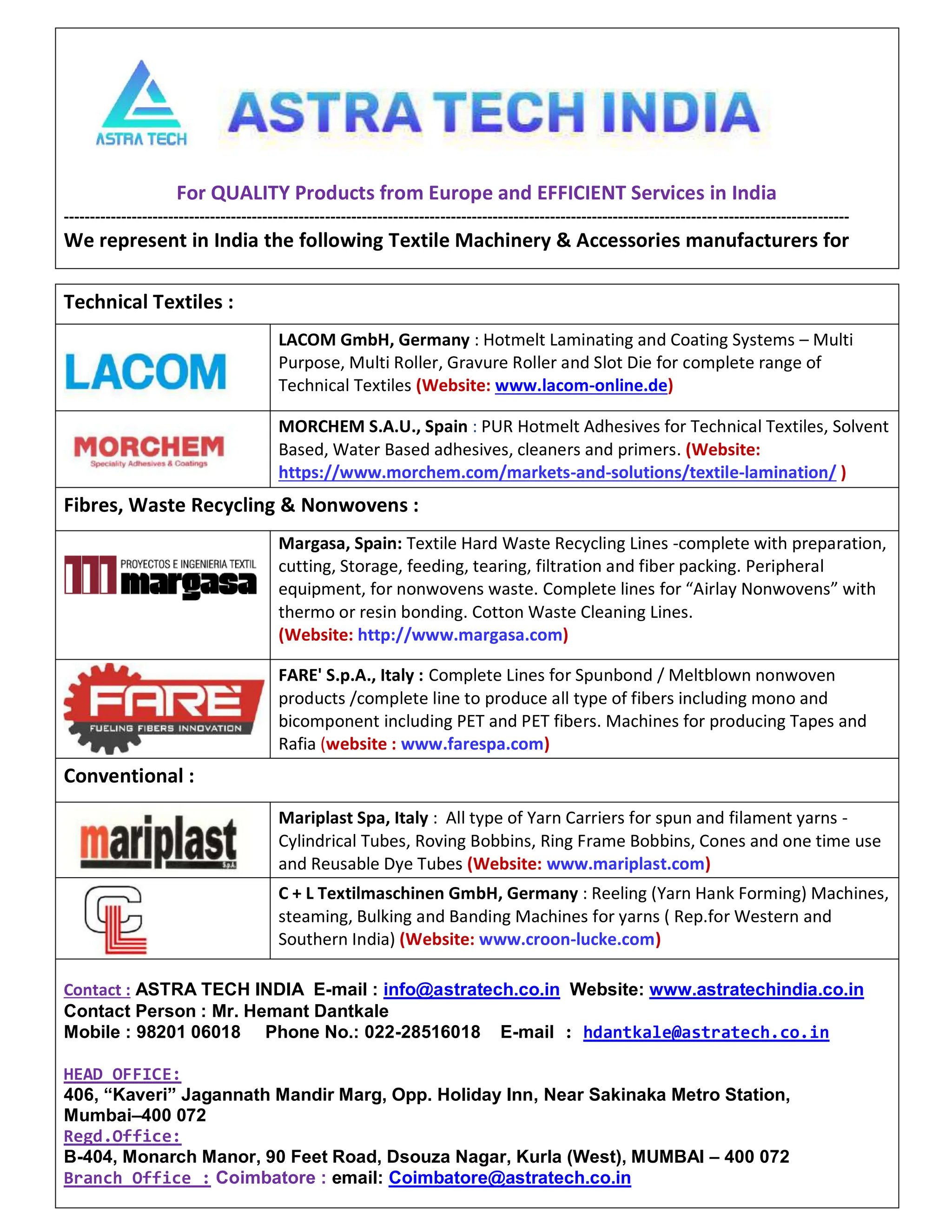
For QUALITY Products from Europe and EFFICIENT Services in India
------------------------------------------------------------------------------------------------------------------------------------------------------
We represent in India the following Textile Machinery & Accessories manufacturers for
Technical Textiles :
LACOM GmbH, Germany : Hotmelt Laminating and Coating Systems – Multi
Purpose, Multi Roller, Gravure Roller and Slot Die for complete range of
Technical Textiles (Website: www.lacom-online.de)
MORCHEM S.A.U., Spain : PUR Hotmelt Adhesives for Technical Textiles, Solvent
Based, Water Based adhesives, cleaners and primers. (Website:
https://www.morchem.com/markets-and-solutions/textile-lamination/ )
Fibres, Waste Recycling & Nonwovens :
Margasa, Spain: Textile Hard Waste Recycling Lines -complete with preparation,
cutting, Storage, feeding, tearing, filtration and fiber packing. Peripheral
equipment, for nonwovens waste. Complete lines for “Airlay Nonwovens” with
thermo or resin bonding. Cotton Waste Cleaning Lines.
(Website: http://www.margasa.com)
FARE' S.p.A., Italy : Complete Lines for Spunbond / Meltblown nonwoven
products /complete line to produce all type of fibers including mono and
bicomponent including PET and PET fibers. Machines for producing Tapes and
Rafia (website : www.farespa.com)
Conventional :
Mariplast Spa, Italy : All type of Yarn Carriers for spun and filament yarns -
Cylindrical Tubes, Roving Bobbins, Ring Frame Bobbins, Cones and one time use
and Reusable Dye Tubes (Website: www.mariplast.com)
C + L Textilmaschinen GmbH, Germany : Reeling (Yarn Hank Forming) Machines,
steaming, Bulking and Banding Machines for yarns ( Rep.for Western and
Southern India) (Website: www.croon-lucke.com)
Contact : ASTRA TECH INDIA E-mail : info@astratech.co.in Website: www.astratechindia.co.in
Contact Person : Mr. Hemant Dantkale
Mobile : 98201 06018 Phone No.: 022-28516018 E-mail : hdantkale@astratech.co.in
HEAD OFFICE:
406, “Kaveri” Jagannath Mandir Marg, Opp. Holiday Inn, Near Sakinaka Metro Station,
Mumbai–400 072
Regd.Office:
B-404, Monarch Manor, 90 Feet Road, Dsouza Nagar, Kurla (West), MUMBAI – 400 072
Branch Office : Coimbatore : email: Coimbatore@astratech.co.in
5 AUG 2022
textilevaluechain.in
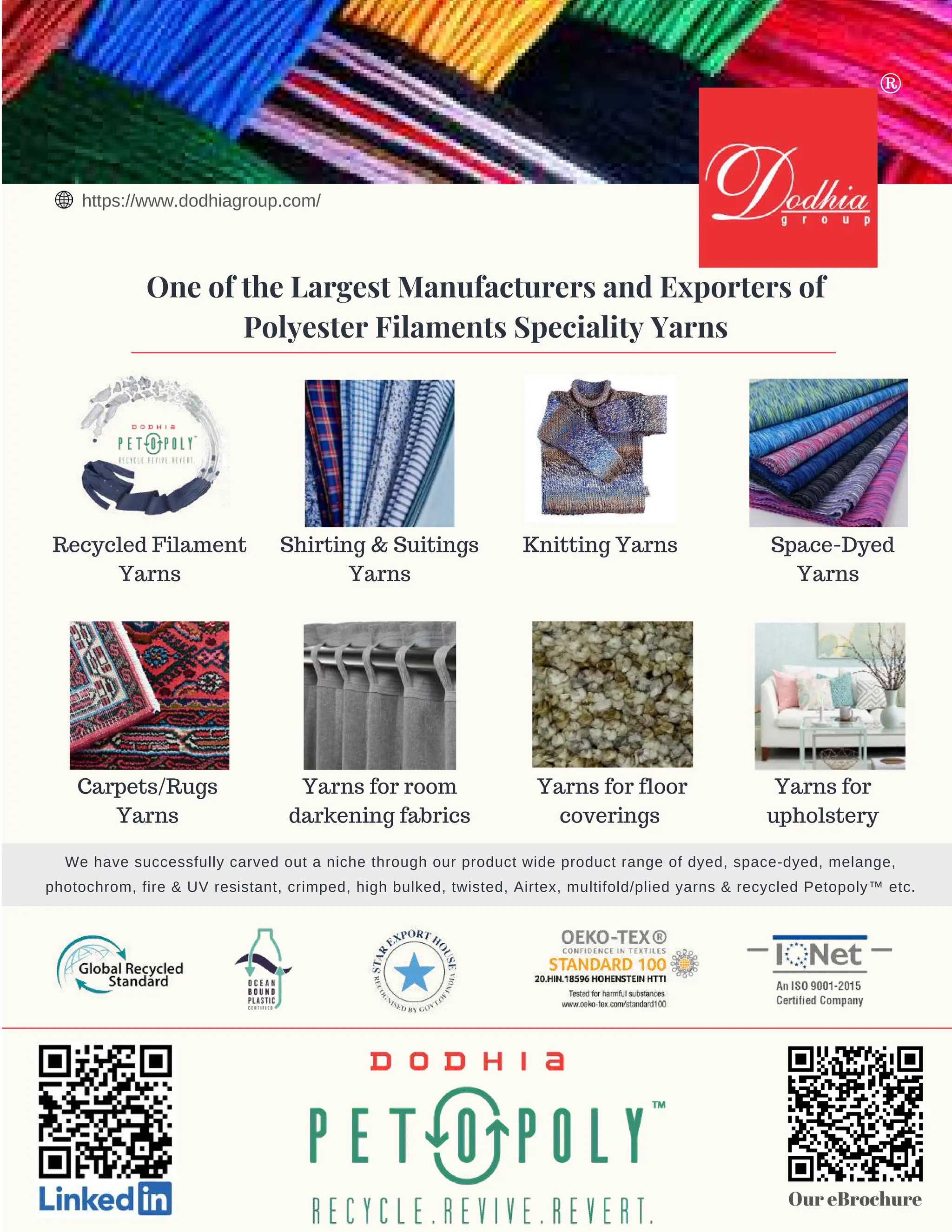
Recycled Filament
Yarns
Shirting & Suitings
Yarns
Yarns for room
darkening fabrics
Yarns for
upholstery
Knitting Yarns
Yarns for floor
coverings
Space-Dyed
Yarns
Carpets/Rugs
Yarns
One of the Largest Manufacturers and Exporters of
Polyester Filaments Speciality Yarns
Our eBrochure
We have successfully carved out a niche through our product wide product range of dyed, space-dyed, melange,
photochrom, fire & UV resistant, crimped, high bulked, twisted, Airtex, multifold/plied yarns & recycled Petopoly™ etc.
https://www.dodhiagroup.com/
®
6 AUG 2022
textilevaluechain.in
7 AUG 2022
textilevaluechain.in
www.brueckner-textile.com
FASCINATING TEXTILE MACHINERY
Quality makes the difference!
BRUECKNER Textile Value Chain 216x140mm EN.indd 1 25.07.2022 12:14:21
Full
Page
Advertisement
in
E-Magazine
Banner
on
www.textilevaluechain.in
Home
Page
Social
Media
Promotion
in
TEXTILE
VALUE
CHAIN
Customised
Email
Marketing
Banner
in
Weekly
E-
Newsletter
Online
Directory
Listing
in
www.textilevaluechain.in
Recruitment
Solution
through
Job
Portal
www.textileappareljobs.com
(365
days)
G
O
D
I
G
I
T
A
L
W
I
T
H
U
S
MD.
TANWEER
+91
9167986305,
SALES@TEXTILEVALUECHAIN.COM
LET
YOUR
BUSINESS
WORKS
DIGITALLY
INVEST
TIME
PRODUCTIVELY
Full Page Advertisement in E-Magazine
Banner on www.textilevaluechain.in Home Page
Social Media Promotion in TEXTILE VALUE CHAIN
Customised Email Marketing
Banner in Weekly E- Newsletter
Online Directory Listing in www.textilevaluechain.in
Recruitment Solution through Job Portal
www.textileappareljobs.com (365 days)
G O D I G I T A L W I T H U S
8 AUG 2022
textilevaluechain.in
Improve
Profitability
Electronic Industries
Association Of India
Federation Of
Telangana
Chamber Of
Commerce
The Textile
Association
Of India
Mahratta Chamber Of
Commerce Industries
& Agriculture
Federation Of
Indian Export
Organisations
The Deccan
Chamber Of
Commerce &
Industries
Bombay
Industries
Association
Indian Drug
Manufacturers'
Association
The Clothing
Manufacturers
Association Of India
Bombay Industries
Association
Andhra Pradesh Chamber
of Commerce and
Industry Federation
Chamber of Indian
Micro Small and
Medium Enterprises
(CIMSME)
Telangana
Chambers
of Commerce and
Industry
Bulk Drug
Manufacturers
Association (India)
The Southern India
Chamber
of Commerce and Industry
Indian
Chemical Council
Domestic Memberships :
International Memberships :
INDO-GERMAN CHAMBER
OF COMMERCE
INDO-FRENCH CHAMBER
OF COMMERCE INDUSTRY
THE COUNCIL OF EU CHAMBER
OF COMMERCE IN INDIA
INDO- DUTCH CHAMBER OF
INDUSTRY AND SCIENCES
ACCELERATING
THE GROWTH
OPPORTUNITY
FOR THE
TEXTILE
MANUFACTURING
SECTOR
OF INDIA
Fibre
Processing
Garment
Spinning
Knitting
Weaving
Website : www.capximize.com
Registration Link : https://app.capximize.com/register
Registered Office: Capximize India Pvt. Ltd.
1102 (1A), Fortune Terrace,
New Link Road, Andheri West,
Mumbai, Maharashtra Pin Code : 400 053
Contact us : Office : +91 22 2630 1256
Sanjeev Pandey :
+91 8850 815 861 / +91 8850 812174
Email : contactus@capximize.com
Our Branch Offices : Ahmedabad - Bengaluru - Bhopal - Bikaner - Chennai - Delhi - Hyderabad - Mumbai - Pune
COLLABORATE - COEXIST - COELEVATE
Benefits :
Get
Additional
Business
Use Your
Available
Machineries for
Local and
International
Companies
Improve Cost
of Production
Global
Visibility
Global digital platform for
surplus manufacturing capacities
in India to be used by
domestic and global companies
Special Offer :
Free Registration
9 AUG 2022
textilevaluechain.in
Table
of
CONTENT
12
15
50
57
60
6ϱ
69
10
COVER STORY
WASTE MANAGEMENT
PEER REVIEW PAPER
TECHNICAL TEXTILE
RETAIL UPDATE
MARKET REPORT
INTERVIEWS
BRAND UPDATE
EVENT UPDATE
COMPANY’S QUARTERL
Y RESULTS
EVENT CALENDAR
EDITORIAL
Corporate : IndoCount
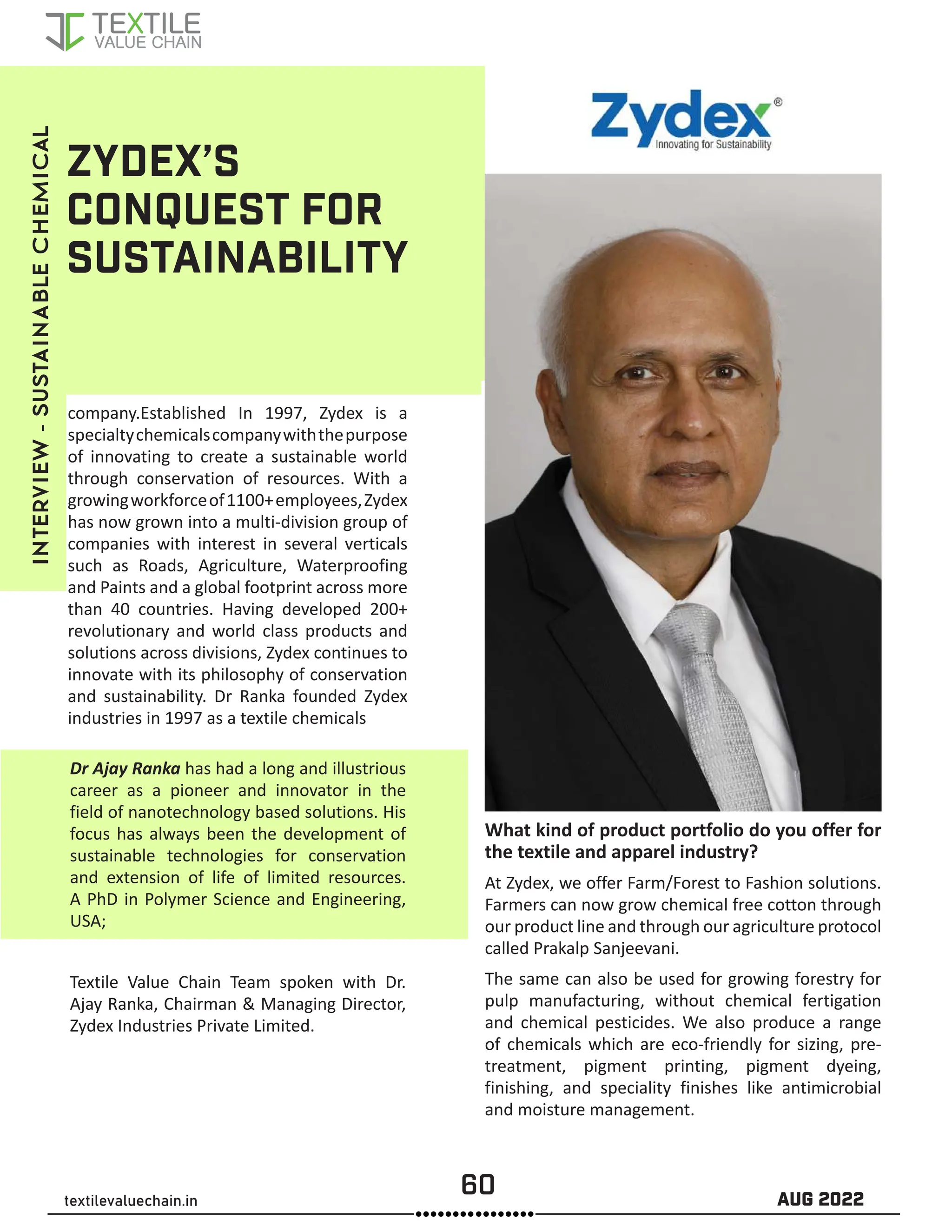
Chemicals : Zydex
Skill Council : AMHSSC
IT TECH : DMIx
NTU Singapore & RGE Launch Research
Center
Biotech Pvt. Ltd.
Banarasi Brocade by SVVVP college
Professors and Students
India’s E-Commerce Industry Future by
Munish Tyagi
Export and Import : July 2022
Export Sarees
Yarn Exports
NanoFibers , watchword
15
ADVERTISER INDEX
Cover Page: Vatsal Export
Back page: Raymond
Front Inside : Rimtex
Back inside : Raysil
Page 3 : Le Merite
Page 4 : Astratech
Page 5 : Dodhia Group
Page 6 : Wellknown
Page 7 : Bruckner
Page 8 : Capximize
page 11 : Yash Machines
page 20 : GSCS
page 23 : Cosmo Chemicals
page 28 : A.T.E
page 36 : Meera Industries
page 42 : Uster
page 45 : IGM
page 49 : Bishnu Texport
Page 56 : Shahlon Silk
Page 59 : Texfab Industries
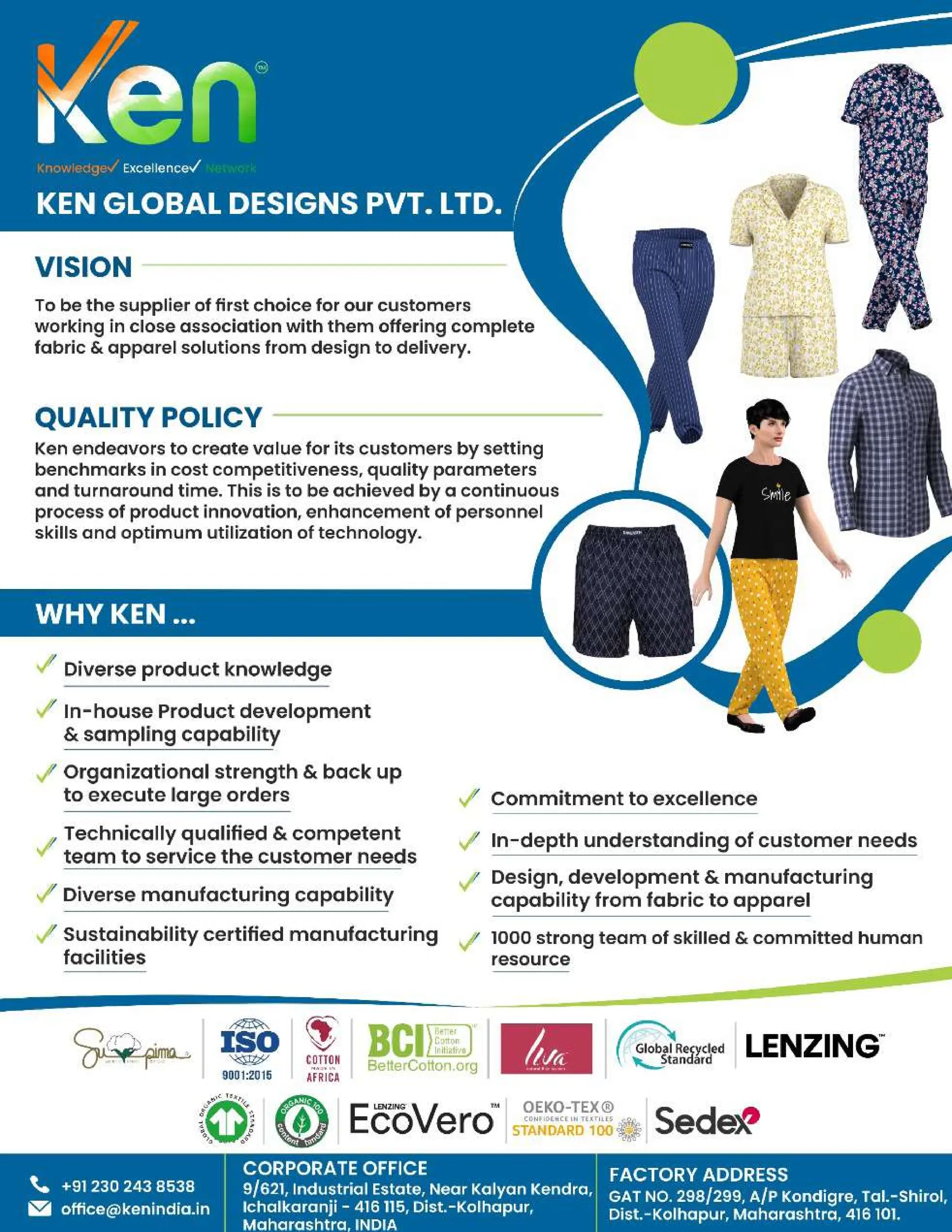
Page 64 : Ken India
Page 68 : Omax
Page 72 : Staubli
Page 75 : Saurer
page 77 : Ramkrishna Cotspin
page 80 : Chintamani
page 82 : Unitech Texmech
page 85 : Amritlakshmi
page 89 : Alliance Fibre
page 92 : Sakthi Textile
page 93 : Nonwoven Tech
Page 94 : Yarn Expo : Surat
Page 95 : SITEX 2023
Page 96 : Intertex Tunisia
Page 97 : DTG
Page 98 : India ITME 2022
Page 99 : VTG
21
73
76
78
81
86
87
90
90
91
88
79
24
29
37
43
44
46
48
58
83
84
STAUBLI
BLUE SIGN
CMAI NGF
NIFT Orienta�on
Cosmo First
Vipul Organics
Garsim
Page Industries
Bata
V2 Retail
10 AUG 2022
textilevaluechain.in
All rights reserved Worldwide; Reproduction of any of the content from this issue is
prohibited without explicit written permission of the publisher. Every effort has been
made to ensure and present factual and accurate information. The views expressed
in the articles published in this magazine are that of the respective authors and not
necessarily that of the publisher. Textile Value chain is not responsible for any unlikely
errorsthatmightoccuroranystepstakenbasedintheinformationprovidedherewith.
REGISTERED OFFICE:
TVC MEDIA AND PROMOTION PVT.LTD.
504, Suchita Business Park,
Patel Chowk, Pantnagar,
Ghatkopar (East), Mumbai- 400075,
Maharashtra, INDIA.
Cell: +91-9769442239
Email: info@textilevaluechain.com
Web: www.textilevaluechain.com
Owner, Publisher, Printer and
Editor - Ms. Jigna Shah
Printed and Processed by her at,
Impression Graphics,
Gala no.13, Shivai Industrial
Estate, Andheri Kurla Road,
Sakinaka, Andheri (East),
Mumbai 400072,
Maharashtra, India.
SUBSCRIPTION
EDITOR AND PUBLISHER
Ms. Jigna Shah
EDITORIAL TEAM
marketing and advertising enquiry
Athleisure, a type of hybrid clothing, is a fabricated
style of clothing typically worn during athletic
activities and in other settings. This leisure wear is
also worn at the workplace, at school, or at other
casual or social occasions, says Wikipedia.
Now, let me give a slice of the cake all want to eat.
What I’m going to say is only a slice, and not the
whole cake. The word ‘athleisure’ is a recently
coined word by the industry and may be by some
interested parties who have a liking for blending
words to make this word. In today’s world everyone
knows the meaning of this word, for it expresses
the meanings of what is leisure and athletes, and
also what the wearers of both these groups wear….
Let’s get to the point.
Athleisure is a blend of sportswear and leisurewear.
The global sportswear market size was estimated
at US$ 262.51 billion in 2019 and is expected to
reach US$ 288.42 billion in 2020. After 2020, Covid
came and industry’s as well as the consumers’
interest sagged a bit. I read another report that
says Sportswear’s global market has already hit
US$ 533.5 billion in 2020. Latest news says that
inflation is under control and that industrial growth
is returning to normal, though little slowly. Another
information source says that the US inflation will be
tackled by the Administration. Hopes are returning
as the consumers are starting to crowd malls &
super markets, and the industry and retailers piling
up the stock waiting for the festival melas to start.
When I was writing, Raksha Bhandan and the
Independence day celebrations are over.
The Sportech is one of the fast-paced sectors of
technical textile the shares of which is around 7%
of Indian technical textiles market. The Sportech
segment has grown at a CAGR of 19.58% between
2017-18 and 2019-20. The Indian Government’s
statistics falls a little short of expectations, but
Covid can be defended by anyone for little activities
in the industry and elsewhere. It’s true too.
Sports textiles may get some connection with
Hometech also. There are enough hints. This is a
time for amalgamation and mergers of ingredients
to make a good cake (pun intended). Caution:
The writer is only giving a bird’s eye view of the
sportswear & athleisure.
Read our Cover Story for a bigger slice!
A Slice All Want to
Enjoy!
CREATIVE DESIGNER
Mr. Ganesh Shinde
ADVISOR - EDITORIAL & MARKETING
Mr. Samuel Joseph
EDITORIAL ASSISTANT
Ms. Gargi Dandegaonkar
Online Registration
https://textilevaluechain.in/subscription/
Subscription Enquiry
Ms. Vaibhavi Kokane
+91-9869634305 ;
textilevaluechain123@gmail.com
Scan and Open
Mohammad Tanweer
+91-9167986305
sales@textilevaluechain.com
- Samuel Joseph
www.yashtex.com sales@yashtex.com
I +91 9167772065
I
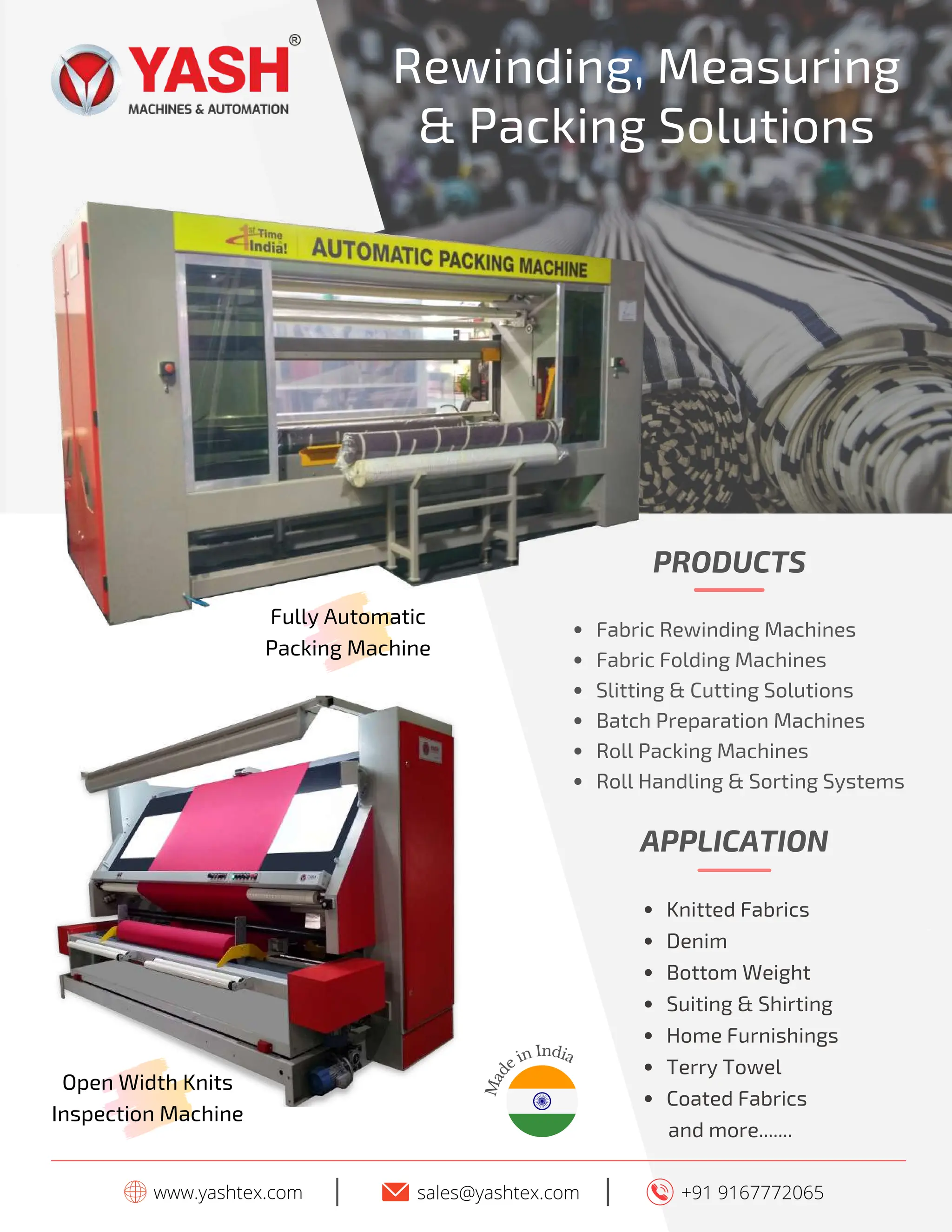
PRODUCTS
Fabric Rewinding Machines
Fabric Folding Machines
Slitting & Cutting Solutions
Batch Preparation Machines
Roll Packing Machines
Roll Handling & Sorting Systems
Fully Automatic
Packing Machine
Open Width Knits
Inspection Machine
APPLICATION
Knitted Fabrics
Denim
Bottom Weight
Suiting & Shirting
Home Furnishings
Terry Towel
Coated Fabrics
and more.......
M
a
d
e in India
Rewinding, Measuring
& Packing Solutions
12 AUG 2022
textilevaluechain.in
SPORTS
TEXTILE
BLENDS WITH
LEISUREWEAR!
In today’s world, sportswear is almost
synonymous with athleisure because after
the ravaging of Covid, which is still lingering
around, both these genres & their brands are fighting
for space in the retailers shops. Both the fitness and
sports brands are vying for more space in shops they
sell. The retailers will surely benefit till the festival
season is over. The hypermarket and supermarket
are looking out for a larger market share of functional
apparel because most of the products/ services are
conveniently available at a low rate in such stores.
These stores promote the availability of practical
fashion items, both branded and private label, says
a report that appeared recently. Leading companies
comprising Nike Inc., Adidas AG, Asics Corporation,
Hanes Brand Inc., Reebok, Jockey International Inc.,
Russell Brands LLC, PUMA S.E., Hugo Boss AG, and
Columbia Sportwear Company, among others are
verykeentoknowwhatishappeninginthefunctional
garment market.
The global sportswear market size was estimated at
US$ 262.51 billion in 2019 and was expected to reach
US$ 288.42 billion in 2020. Sportswear, identical to
the word activewear, is used for sporting events
and exercise, which comprises all the paraphernalia
like jogger pants, yoga pants, and even sports bras.
Sportswear’s global market hit US$ 533.5 billion in
2020. The sportswear industry is one of the fastest
runners in the clothing industries, spurred by current
global clothing trends. It is interesting to note here
current reports indicate the market revenue doubled
over the years. The sudden upsurge is due to the fact
that sportswear as casual wear demand from the
public is going up & up.
Other trends noticeable is that the variety of goods
dealing with this industry is also expanding. Not only
customers are interested in this market. Producers,
sportswear companies, designers, fashionista’s
involved with all these segments, etc and so on & on.
The word ‘athleisure’ is a recently coined word by the
industry and may be by some interested parties who
have a liking for blending words to make this word.
In today’s world everyone knows the meaning of this
word, for it expresses the meanings of what is leisure
and athletes. Both are sought by the industry that
is making athleisure as well as the consumers, who
are seeking comfort, ease, fashion, etc. In short who
wants to buy athleisure? Young consumers from the
age of 16 to 30 are behind its growth, who are keen
to dress younger and feel younger. Some old people
cannot be ruled out because one sees many senior
citizensaretodaygoingforwalks,evenlightjogging&
even ‘gymming’ because fitness and comfort are two
of their focus on their minds doing these activities.
Causal wearers and yoga enthusiasts are also looking
for athleisure. Fitness and health-consciousness is
the driving forces behind this mounting demand.
India’s domestic Sportech market is ruled by the
Sports Footwear Components category which
covers more than three-fourths of the segment’s
share of market. Technical textiles elements in
Sports Composites come the next bigger share of
the market. Though artificial turf is a man-made
fibre (synthetic fibre) surface that is often used as
an alternative to natural grass, the technology has
gone through a paradigm shift in the last some years
and the latest team of artificial grass includes three
different players of plastic: polypropylene (PP),
polyethylene (most widely used) and nylon (durable
polyamide). Turf as many know, is a technical textile
COVER
STORY
- Samuel Joseph
13 AUG 2022
textilevaluechain.in
end-product which is often used in place of a lawn
in any setting, sports like football and lawn tennis or
otherwise on can even see on wedding receptions
halls. The usage may expand in application if it is
biodegradable, feel many. And already research is
ongoing with many claiming that man-made fibres
can be made biodegradable.
(Read the Dr. Mahapatra’s article under the COVER
STORY section in this issue)
The Sportech is one of the fast-paced sectors of
technical textile the shares of which is around 7% of
Indiantechnicaltextilesmarket.Sportstextilesectoris
categorised into three major categories: Sportswear,
sport goods and sport accessories. Further, Sportech
comprises of technical textile products used in sports
and leisure such as sport shoes, sports composites,
flying and sailing sports, parachute fabrics, artificial
turf, ballooning fabrics etc. The use high functional
and smart textiles have proven their high level of
performance and succeeded in their functional
properties. According to the functional requirements
of sports, special apparels for specific sports are
manufactured. Many fibres, yarns, fabrics and
finishes have been developed to meet the needs of
the sports sector. Sports textiles have some special
features, which have been made possible by the use
of high-tech and smart textile technology. Sports
textiles must have the features of adaptability, easy
to wear, easy handling etc. and also the ability to
transport heat and moisture i.e., fast drying and
cooling function. Moreover, sports textiles have
very high electrical conductivity, so they must have
anti-static performance and also be resistant to anti-
microbial apart from its ability to provide protection
from ultraviolet rays, air and water permeability,
low water absorption of the layer of clothing facing
the skin. Moisture absorption, strength, durability,
lightness, thermal conductivity, etc.
The Sportech segment has grown at a CAGR of 19.58
per cent between 2017-18 and 2019-20. Moreover,
more than 10 per cent of revenue of the segment
has come from exports during this period. Sports
shoes and sportswear accounts for majority of sales
revenue of the segment, with their share hovering
from 60-80 per cent. The average utilisation of the
production capacity in the Sportech segment has
increased from 60 per cent in 2017-18 to 87 per cent
in 2019-20. The actual production has consistently
risen from 2017-18 to 2019-20. According to the
Government sources, Textile Research Associations
(most of them), Centres of Excellence (Wool Research
Association), Bureau of Indian Standards (BIS),
Academic Institutions, Apex Industry Associations,
other Manufacturers Associations, Focus Incubation
Centres and Technology Parks are the focus areas
in India. Artificial turf includes areas covering high
performance sportswear and swimwear, parachute
fabrics, sleeping bags, sports composites, sports
footwear components, tents, ballooning fabrics,
sports nets, sports strings & so on. The Government
has put Sportech as almost the last category for
obvious reasons and also due to the fact that
Sportech is yet to develop in a big way in India.
Sportech includes innovation, and the Government
opines that technical textile is revealing new
applications and opportunities driven by technology-
led innovations. Countries and enterprises that are
investing in developing new technologies, fostering
innovation, encouraging entrepreneurship and
upgrading their system of teaching and training
human resources have taken a lead over others in
establishing themselves as major sources of supply
of technical textiles machines and products. The
experience so far suggests that such countries and
enterprises also form collaborations and leverage
networks to share knowledge and introduce
innovations. Technical textile-interested parties are
also significant sources of supply, and also the main
consumers of technical textiles.
The Indian Government indicates in a study that
China, USA and Germany, are not only leading
countries for production and exports of technical
textile but also are its three leading consumers. These
three countries put together account for more than
60% of the value of global annual output of technical
textiles. China is the largest producer, accounting for
nearly one-third of global production; USA accounts
for one-fourth of the global production. These
two countries also happen to be the two largest
consumers of technical textiles. Exports from Chinese
technical textile industry comprise a significant part
of international trade in all segments of technical
textiles.
However, the Government sees certain reasons
behind the reasons for the low volume of Sportech
awareness in the industry. One such reason is a lack
of good converters to finished products in Indian
textile supply as well as lack of collaboration between
industry and technical institutions for research &
development. The Government adds more to cover
14 AUG 2022
textilevaluechain.in
this gap:
y
y There is a huge gap between R&D
laboratories where product development for
technical textiles takes place and the fabric
producers; The lack of facilities to promote
manufacturing of raw materials and inputs has
created a disadvantage for Indian Clothtech
manufacturers especially in export markets;
y
y In Clothtech segment, lack of local machine
manufacturing has resulted in high dependence
of Indian Clothtech producers on machines
imported from China; Because of insufficient
consumer demand which discourages local
investors and entrepreneurs, many products of
the Sportech segment are not manufactured
in India and have to be imported from outside;
There is lack of raw material manufacturing
capacity in the country for Sportech industry;
y
y The Hometech industry, which also uses man-
made fibres, is characterised by low levels of
commercialisation of new products and lack
of access to advancement in new technology;
It was highlighted that India is the largest
producer of cotton. Farm level traceability (that
is required by markets in developed countries)
of Indian grown cotton is not practiced in India’s
textile supply chain; One more important fact
is the lack of branding of cotton fibre (we only
have Kasturi Cotton). These two deficiencies
have a huge negative impact on acceptability
of Indian Hometech products by international
buyers; India fulfils its requirement of speciality
fibres through import from China, Japan, USA or
EU countries;
y
y Even though India has ample natural
fibre resources, it has lagged behind in
commercialisation of these fibres due to
processing and manufacturing difficulties; There
is very little collaboration among industry,
academia and researchers towards better
utilisation of advanced technology.
The global sports goods industry has been expanding
rapidly on account of factors such as growing focus
of governments towards promoting sports activities
and events, rising disposable incomes, changing
lifestyle, increasing fitness awareness, as well as
increasing sports participation, particularly in the
developing economies. According to the Global
Wellness Institute, globally, the per capita consumer
spending on sports and recreation activities stands
at nearly US$ 90 per year, which is indicative of the
significant potential demand for sports goods. On
the back of the growing demand, the revenues of
the global sports goods sector recorded a Compound
Annual Growth Rate (CAGR)
of nearly 5.2 per cent during
2012 to 2019, to reach an
estimated US$ 126.2 billion
in 2019.
The Under Union Budget
2020-21,aNationalTechnical
Textiles Mission was
proposed for a period from
2020-21 to 2023-24 at an
estimated outlay of Rs. 1,480
crore. In the same budget,
the Government of India allocated
around Rs. 3,515 crores to the Ministry of Textiles
and Rs. 80 crore for the Integrated Textile Parks
Scheme. The Government has launched production-
linked incentive scheme to provide incentives for
manufacture and exports of specific textile products
made from man-made fibre. Under this scheme,
the government has approved Rs. 10,683 Crores
for manufacture of manmade fibres and technical
textiles
The Governmental information board does not
give much details on Sportech because sports
textiles is only a fast-growing child in India, showing
greater appetite for big growth. It holds out
much information on technical textiles in general,
according to the understanding of this writer. Neither
can we get much information from all sources,
but some good information on only sports goods
thanks to rise in sports awareness as a result of India
getting recognition in this country and abroad with
newspapers giving greater coverage by increasing
the number of pages. Advertisers are keen to battle
it out with bigger personalities like Sunil Gavaskar,
Sachin Tendulkar & also Virat Kohli (still the much-
watched ads on TV & elsewhere) and all who get
their money’s worth. This crowd is also running
faster because they are ready to get medals’ (Read,
‘money’) worth.
Afterall, the writer has to end with the most-seen
sports on many places in India, particularly ‘amchi’
Mumbai.
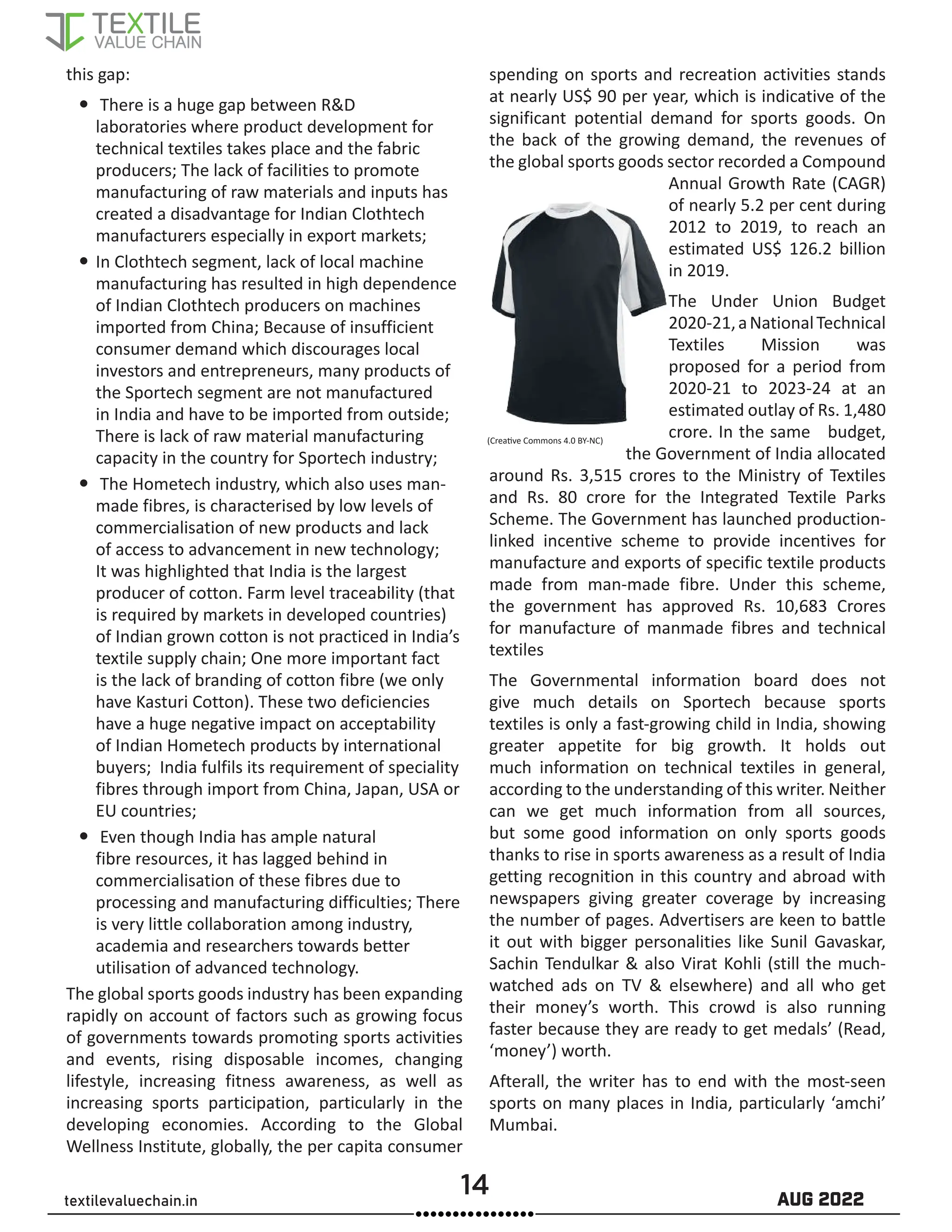
(Creative Commons 4.0 BY-NC)
15 AUG 2022
textilevaluechain.in
ARTIFICIAL TURF: FIBRES & FUTURE
Dr. N. N. Mahapatra
The author talks about fibres, manufacturing, installation, quality control
and a few other issues as a part of technological developments related to
sports textiles.
The high cost of growing and maintaining natural
grass was one of the main driving forces behind
the formation of artificial turf, which is a material
made with synthetic fibres and resembles natural
grass. Today, artificial turf or synthetic turf is gaining
in popularity and is not only found in some of the
world’s most important sports arenas, but also in
residential lawns and commercial buildings. David
Chany – who moved to Raleigh, North Carolina, in
1960 and later served as Dean of the North Carolina
StateUniversityCollegeofTextiles–headedtheteam
of Research Triangle Park researchers who created
the first notable artificial turf. That accomplishment
led Sports Illustrated to declare Chaney as the man
“responsible for indoor major league baseball and
millions of welcome mats.”
Artificial turf was first installed in 1964 on a prep
school recreation area in Rhode Island. The material
came to public prominence in 1966, when AstroTurf
was installed in the Astrodome in Houston, Texas.
The state-of-the-art indoor stadium had attempted
to use natural grass during its initial season in 1965,
but this failed miserably and the field conditions
were grossly inadequate during the second half
of the season, with the dead grass painted green.
Due to a limited supply of the new artificial grass,
only the infield was installed before the Houston
Astros’ home opener in April 1966, the outfield was
installed in early summer during an extended Astros
Road trip and first used after the All-Star Break in
July.
The use of AstroTurf and similar surfaces became
widespreadintheU.S.andCanadaintheearly1970s,
installed in both indoor and outdoor stadiums used
for baseball and football. More than 11,000 artificial
turf playing fields have been installed nationally.
More than 1,200 were installed in the U.S. in 2013
alone, according to the industry group the Synthetic
Turf Council.
Maintaining a grass playing surface indoors, while
technically possible, is prohibitively expensive. Teams
whochosetoplayonartificialsurfacesoutdoorsdidso
because of the reduced maintenance cost, especially
in colder climates with urban multi-purpose “cookie
cutter” stadiums such as Cincinnati’s Riverfront
Stadium, Pittsburgh’s Three Rivers Stadium and
Philadelphia’s Veterans Stadium.
With the number of indoor, domed or partially
covered sports arenas increasing, the need for
artificial turf has increased exponentially in recent
years, as natural grass would require sunlight to grow.
The first-generation of artificial turf, known as Astro
turf, was primarily short-pile fibres without infill.
The second-generation turf system used sand infills.
Today, however, third-generation turf systems are the
most popular, and this use infills that are mixtures of
sand and recycled rubber.
Astro Turf is an American brand name. Itwas invented
by Donald Elbert, James Faria, and Robert Wright for
sports use. It was given its name when in 1966 when
it was installed in the Houston Astrodome stadium.
... Since Astro Turf was invented, artificial grass
products have changed beyond recognition. COVER
STORY
Business Head (Dyes)
Shree Pushkhar Chemicals and Fertilisers Ltd.
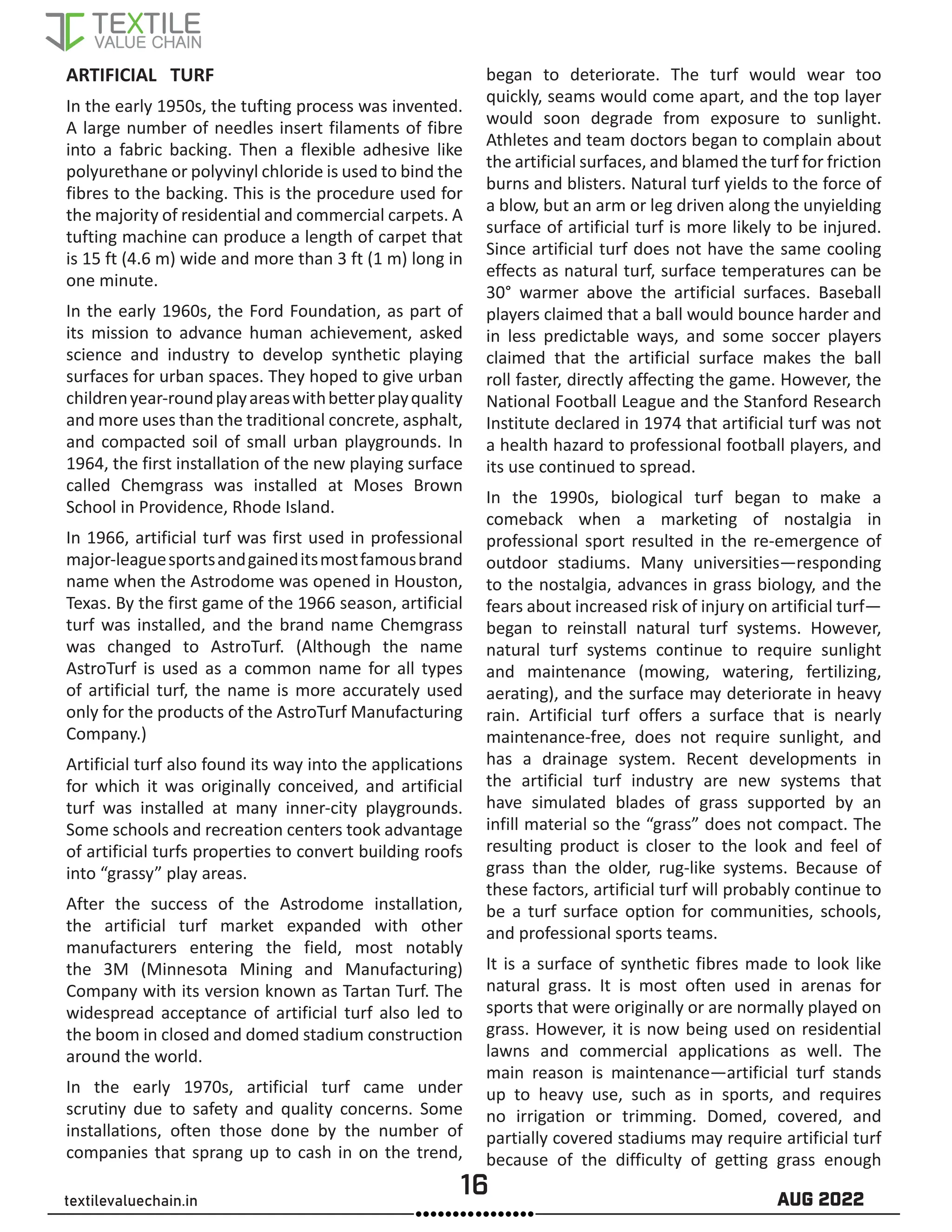
cc- signatureturf.com.au
16 AUG 2022
textilevaluechain.in
ARTIFICIAL TURF
In the early 1950s, the tufting process was invented.
A large number of needles insert filaments of fibre
into a fabric backing. Then a flexible adhesive like
polyurethane or polyvinyl chloride is used to bind the
fibres to the backing. This is the procedure used for
the majority of residential and commercial carpets. A
tufting machine can produce a length of carpet that
is 15 ft (4.6 m) wide and more than 3 ft (1 m) long in
one minute.
In the early 1960s, the Ford Foundation, as part of
its mission to advance human achievement, asked
science and industry to develop synthetic playing
surfaces for urban spaces. They hoped to give urban
childrenyear-roundplayareaswithbetterplayquality
and more uses than the traditional concrete, asphalt,
and compacted soil of small urban playgrounds. In
1964, the first installation of the new playing surface
called Chemgrass was installed at Moses Brown
School in Providence, Rhode Island.
In 1966, artificial turf was first used in professional
major-leaguesportsandgaineditsmostfamousbrand
name when the Astrodome was opened in Houston,
Texas. By the first game of the 1966 season, artificial
turf was installed, and the brand name Chemgrass
was changed to AstroTurf. (Although the name
AstroTurf is used as a common name for all types
of artificial turf, the name is more accurately used
only for the products of the AstroTurf Manufacturing
Company.)
Artificial turf also found its way into the applications
for which it was originally conceived, and artificial
turf was installed at many inner-city playgrounds.
Some schools and recreation centers took advantage
of artificial turfs properties to convert building roofs
into “grassy” play areas.
After the success of the Astrodome installation,
the artificial turf market expanded with other
manufacturers entering the field, most notably
the 3M (Minnesota Mining and Manufacturing)
Company with its version known as Tartan Turf. The
widespread acceptance of artificial turf also led to
the boom in closed and domed stadium construction
around the world.
In the early 1970s, artificial turf came under
scrutiny due to safety and quality concerns. Some
installations, often those done by the number of
companies that sprang up to cash in on the trend,
began to deteriorate. The turf would wear too
quickly, seams would come apart, and the top layer
would soon degrade from exposure to sunlight.
Athletes and team doctors began to complain about
the artificial surfaces, and blamed the turf for friction
burns and blisters. Natural turf yields to the force of
a blow, but an arm or leg driven along the unyielding
surface of artificial turf is more likely to be injured.
Since artificial turf does not have the same cooling
effects as natural turf, surface temperatures can be
30° warmer above the artificial surfaces. Baseball
players claimed that a ball would bounce harder and
in less predictable ways, and some soccer players
claimed that the artificial surface makes the ball
roll faster, directly affecting the game. However, the
National Football League and the Stanford Research
Institute declared in 1974 that artificial turf was not
a health hazard to professional football players, and
its use continued to spread.
In the 1990s, biological turf began to make a
comeback when a marketing of nostalgia in
professional sport resulted in the re-emergence of
outdoor stadiums. Many universities—responding
to the nostalgia, advances in grass biology, and the
fears about increased risk of injury on artificial turf—
began to reinstall natural turf systems. However,
natural turf systems continue to require sunlight
and maintenance (mowing, watering, fertilizing,
aerating), and the surface may deteriorate in heavy
rain. Artificial turf offers a surface that is nearly
maintenance-free, does not require sunlight, and
has a drainage system. Recent developments in
the artificial turf industry are new systems that
have simulated blades of grass supported by an
infill material so the “grass” does not compact. The
resulting product is closer to the look and feel of
grass than the older, rug-like systems. Because of
these factors, artificial turf will probably continue to
be a turf surface option for communities, schools,
and professional sports teams.
It is a surface of synthetic fibres made to look like
natural grass. It is most often used in arenas for
sports that were originally or are normally played on
grass. However, it is now being used on residential
lawns and commercial applications as well. The
main reason is maintenance—artificial turf stands
up to heavy use, such as in sports, and requires
no irrigation or trimming. Domed, covered, and
partially covered stadiums may require artificial turf
because of the difficulty of getting grass enough
17 AUG 2022
textilevaluechain.in
sunlight to stay healthy. Artificial turf does have its
downside, however: limited life, periodic cleaning
requirements, petroleum use, toxic chemicals from
infill, and heightened health and safety concerns.
Artificial turf first gained substantial attention in the
1960s, when it was used in the newly constructed
Astrodome.Thespecificproductusedwasdeveloped
by Monsanto and called AstroTurf; this term since
thenbecameagenerictrademarkforanyartificialturf
throughout the late 20th century. AstroTurf remains
a registered trademark, but is no longer owned by
Monsanto. The first-generation turf systems (i.e.,
short-pile fibres without infill) of the 1960s have
been largely replaced by the second generation and
third generation turf systems. Second generation
synthetic turf systems feature longer fibres and sand
infills, and third generation systems, which are most
widely used today, offer infills that are mixtures of
sand and granules of recycled rubber.
The quality of the raw materials is crucial to the
performance of turf systems. Almost anything used
as a carpet backing has been used for the backing
material, from jute to plastic to polyester. High
quality artificial turf uses polyester tire cord for the
backing.
Thefibresthatmakeupthebladesof“grass”aremade
of nylon or polypropylene and can be manufactured
in different ways. The nylon blades can be produced
in thin sheets that are cut into strips or extruded
through moulds to produce fibres with a round or
oval cross-section. The extruded product results in
blades that feel and act more like biological grass.
Cushioning systems are made from rubber
compounds or from polyester foam. Rubber tires are
sometimes used in the composition of the rubber
base, and some of the materials used in backing
can come from plastic or rubber recycling programs.
The thread used to sew the pads together and also
the top fabric panels has to meet the same criteria
of strength, colour retention, and durability as the
rest of the system. Care and experience must also
be applied to the selection of the adhesives used to
bond all the components together.
The Manufacturing Process
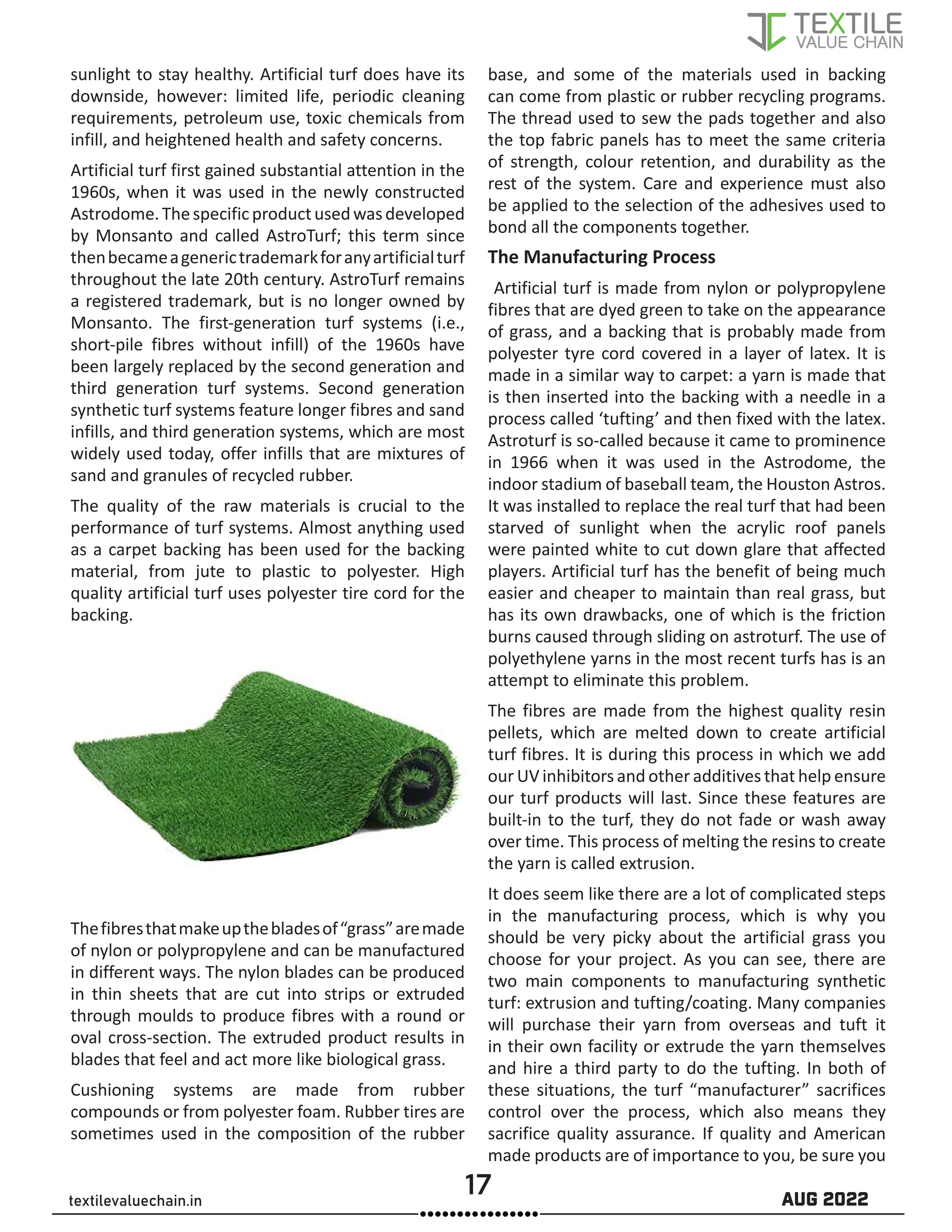
Artificial turf is made from nylon or polypropylene
fibres that are dyed green to take on the appearance
of grass, and a backing that is probably made from
polyester tyre cord covered in a layer of latex. It is
made in a similar way to carpet: a yarn is made that
is then inserted into the backing with a needle in a
process called ‘tufting’ and then fixed with the latex.
Astroturf is so-called because it came to prominence
in 1966 when it was used in the Astrodome, the
indoor stadium of baseball team, the Houston Astros.
It was installed to replace the real turf that had been
starved of sunlight when the acrylic roof panels
were painted white to cut down glare that affected
players. Artificial turf has the benefit of being much
easier and cheaper to maintain than real grass, but
has its own drawbacks, one of which is the friction
burns caused through sliding on astroturf. The use of
polyethylene yarns in the most recent turfs has is an
attempt to eliminate this problem.
The fibres are made from the highest quality resin
pellets, which are melted down to create artificial
turf fibres. It is during this process in which we add
our UV inhibitors and other additives that help ensure
our turf products will last. Since these features are
built-in to the turf, they do not fade or wash away
over time. This process of melting the resins to create
the yarn is called extrusion.
It does seem like there are a lot of complicated steps
in the manufacturing process, which is why you
should be very picky about the artificial grass you
choose for your project. As you can see, there are
two main components to manufacturing synthetic
turf: extrusion and tufting/coating. Many companies
will purchase their yarn from overseas and tuft it
in their own facility or extrude the yarn themselves
and hire a third party to do the tufting. In both of
these situations, the turf “manufacturer” sacrifices
control over the process, which also means they
sacrifice quality assurance. If quality and American
made products are of importance to you, be sure you
18 AUG 2022
textilevaluechain.in
do your homework and know exactly what you are
getting. At ProGreen, we have complete control from
start to finish, and we can proudly stand behind our
products as we know every single thing that went
into making them.
The “grass” part of a turf system is made with the
same tufting techniques used in the manufacture of
carpets.
y
y The first step is to blend the proprietary
ingredients together in a hopper. Dyes and
chemicals are added to give the turf its
traditional green color and to protect it from the
ultraviolet rays from the sun.
y
y After the batch has been thoroughly blended,
it is fed into a large steel mixer. The batch is
automatically mixed until it has a thick, taffy-like
consistency.
y
y The thickened liquid is then fed into an extruder,
and exits in a long, thin strand of material.
y
y The strands are placed on a carding machine
and spun into a loose rope. The loose ropes are
pulled, straightened, and woven into yarn. The
nylon yarn is then wound onto large spools.
y
y The yarn is then heated to set the twisted
shaped.
y
y Next, the yarn is taken to a tufting machine. The
yarn is put on a bar with skewers (a reel) behind
the tufting machine. It is then fed through a
tube leading to the tufting needle. The needle
pierces the primary backing of the turf and
pushes the yarn into the loop. A looper, or flat
hook, seizes and release the loop of nylon while
the needle pulls back up; the backing is shifted
forward and the needle once more pierces the
……..?
How the ingredients of artificial turf are blended
Backing further on. This process is carried out by
several hundred needles, and several hundred rows
of stitches are carried out per minute. The nylon yarn
is now a carpet of artificial turf.
y
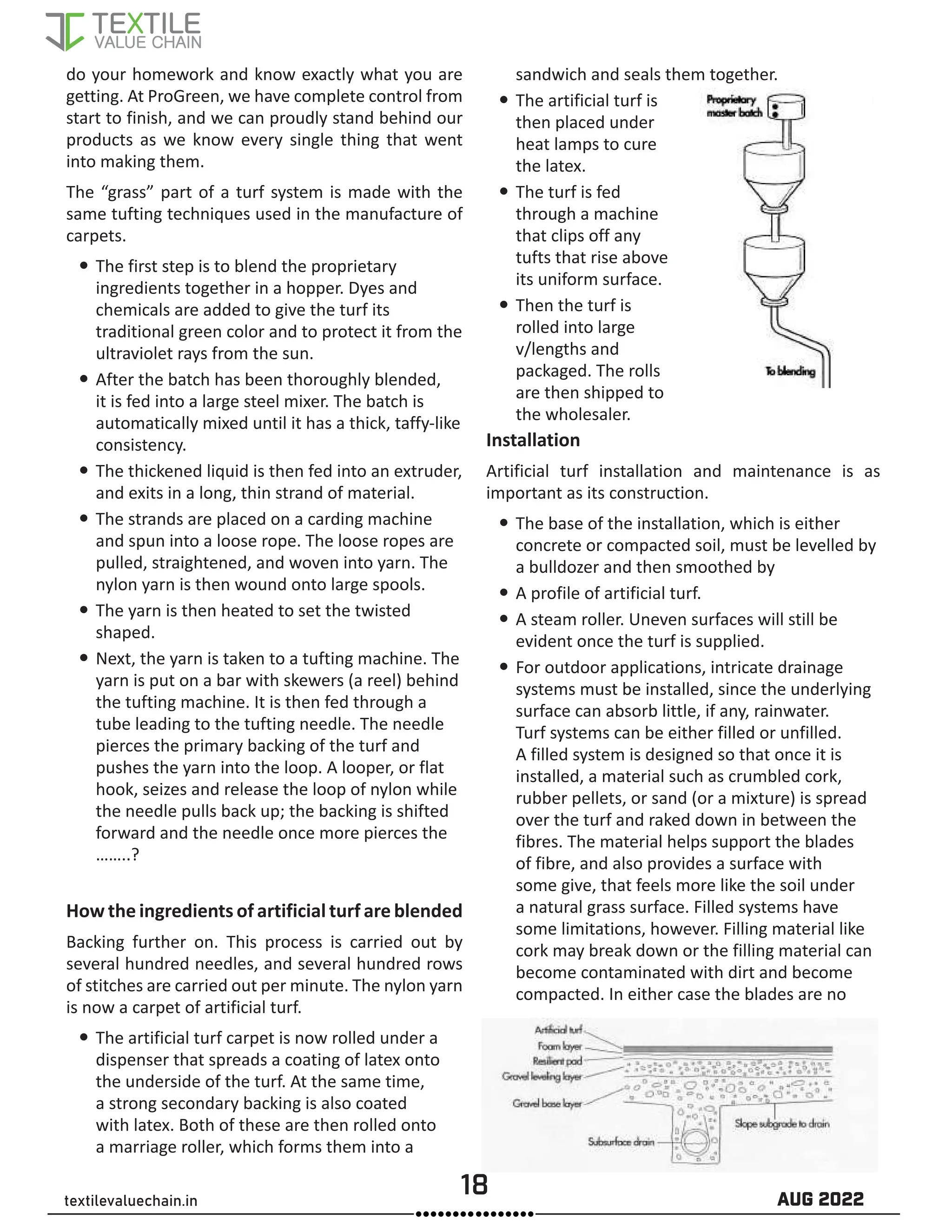
y The artificial turf carpet is now rolled under a
dispenser that spreads a coating of latex onto
the underside of the turf. At the same time,
a strong secondary backing is also coated
with latex. Both of these are then rolled onto
a marriage roller, which forms them into a
sandwich and seals them together.
y
y The artificial turf is
then placed under
heat lamps to cure
the latex.
y
y The turf is fed
through a machine
that clips off any
tufts that rise above
its uniform surface.
y
y Then the turf is
rolled into large
v/lengths and
packaged. The rolls
are then shipped to
the wholesaler.
Installation
Artificial turf installation and maintenance is as
important as its construction.
y
y The base of the installation, which is either
concrete or compacted soil, must be levelled by
a bulldozer and then smoothed by
y
y A profile of artificial turf.
y
y A steam roller. Uneven surfaces will still be
evident once the turf is supplied.
y
y For outdoor applications, intricate drainage
systems must be installed, since the underlying
surface can absorb little, if any, rainwater.
Turf systems can be either filled or unfilled.
A filled system is designed so that once it is
installed, a material such as crumbled cork,
rubber pellets, or sand (or a mixture) is spread
over the turf and raked down in between the
fibres. The material helps support the blades
of fibre, and also provides a surface with
some give, that feels more like the soil under
a natural grass surface. Filled systems have
some limitations, however. Filling material like
cork may break down or the filling material can
become contaminated with dirt and become
compacted. In either case the blades are no
19 AUG 2022
textilevaluechain.in
longer supported. Maintenance may require
removing and replacing all of the fill.
Quality Control
Because of the high use of artificial turf and the
constant scrutiny by professional athletes, new
products must undergo a number of tests as they
are being developed. In 1994, the American Society
for Testing and Materials (ASTM) published a list of
standard methods for the testing of synthetic turf
systems. It contains over two dozen tests for the
properties of turf systems.
As part of ASTM’s testing, the backing fabric is
tested for strength. The force it takes to separate the
individual tufts or blades is also measured. In tufted
turf, this test usually measures the strength of the
adhesive involved. To test how resistant the turf is
to abrasion, the ASTM recommends testing the
fabric by running it under an abrasive head made of
spring steel, while another ASTM test measures how
abrasive the turf will be to the players. The ASTM
also has tests that measure the shock absorbency of
the turf system, and there are also tests to see how
well the turf stands up during the course of a game
or even prolonged tournament play.
Several quality checks are performed during the
manufacturing process, as well. For example,
according to AstroTurf Incorporated, the following
quality checks are performed: 19 checks for the raw
materials, eight checks for extrusion, six checks for
unfinished fabric, and 14 checks for finished fabric.
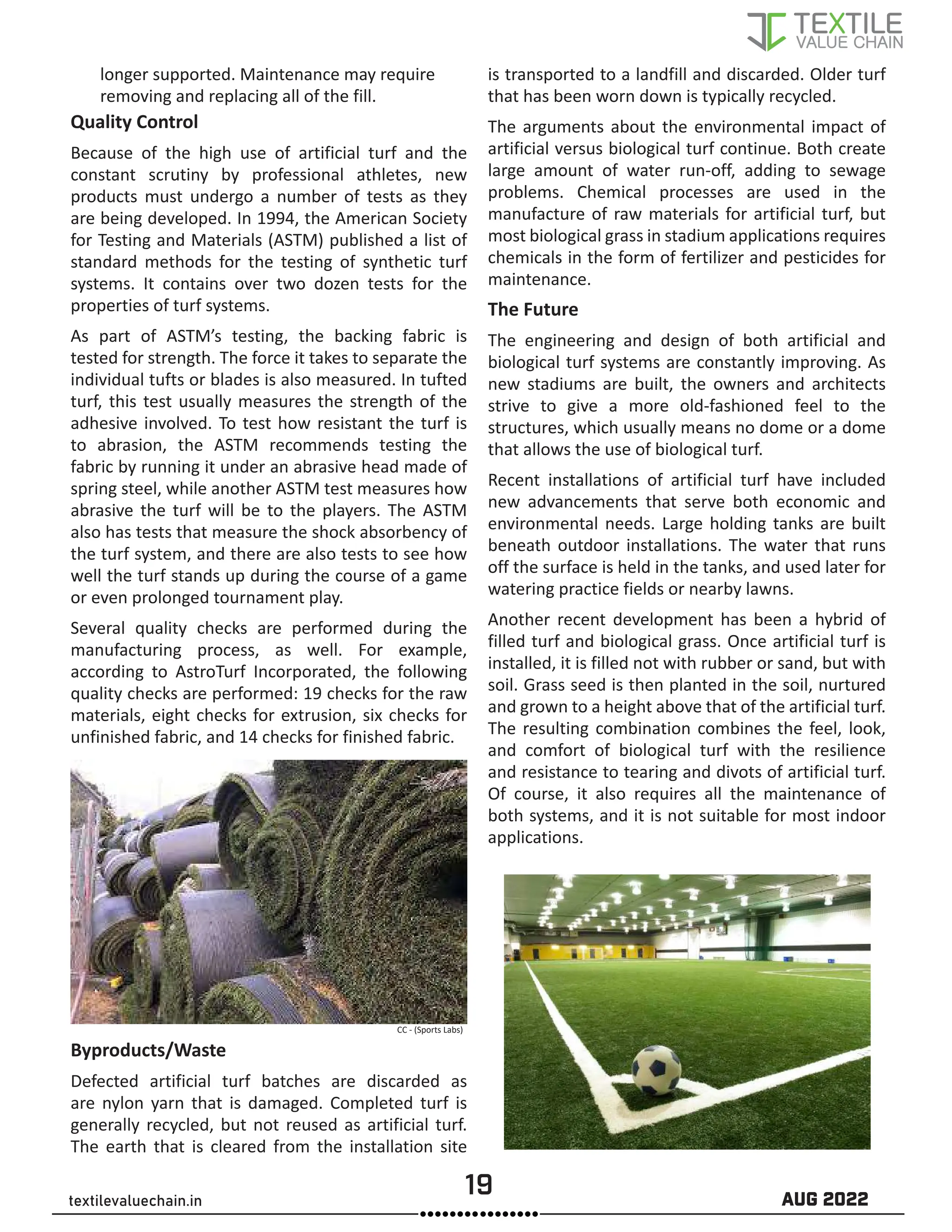
Byproducts/Waste
Defected artificial turf batches are discarded as
are nylon yarn that is damaged. Completed turf is
generally recycled, but not reused as artificial turf.
The earth that is cleared from the installation site
is transported to a landfill and discarded. Older turf
that has been worn down is typically recycled.
The arguments about the environmental impact of
artificial versus biological turf continue. Both create
large amount of water run-off, adding to sewage
problems. Chemical processes are used in the
manufacture of raw materials for artificial turf, but
most biological grass in stadium applications requires
chemicals in the form of fertilizer and pesticides for
maintenance.
The Future
The engineering and design of both artificial and
biological turf systems are constantly improving. As
new stadiums are built, the owners and architects
strive to give a more old-fashioned feel to the
structures, which usually means no dome or a dome
that allows the use of biological turf.
Recent installations of artificial turf have included
new advancements that serve both economic and
environmental needs. Large holding tanks are built
beneath outdoor installations. The water that runs
off the surface is held in the tanks, and used later for
watering practice fields or nearby lawns.
Another recent development has been a hybrid of
filled turf and biological grass. Once artificial turf is
installed, it is filled not with rubber or sand, but with
soil. Grass seed is then planted in the soil, nurtured
and grown to a height above that of the artificial turf.
The resulting combination combines the feel, look,
and comfort of biological turf with the resilience
and resistance to tearing and divots of artificial turf.
Of course, it also requires all the maintenance of
both systems, and it is not suitable for most indoor
applications.
CC - (Sports Labs)
20 AUG 2022
textilevaluechain.in
21 AUG 2022
textilevaluechain.in
NTU SINGAPORE & RGE LAUNCH
S$6 MILLION RESEARCH CENTRE TO
TACKLE TEXTILE WASTE
Nanyang Technological University, Singapore
(NTUSingapore)andRoyalGoldenEagle(RGE),
a global resources-based manufacturing
group, has launched the RGE-NTU Sustainable Textile
Research Centre (RGE-NTU SusTex) to accelerate
innovation in textile recycling and translate research
outcomesintopracticalsolutionsthatcanbedeployed
in urban settings like Singapore. Researchers in the
S$6 million joint research centre will look into areas
such as next-generation eco-friendly and sustainable
textiles, and refabricating textile waste into fibre.
The aim is to study the chemistry of various textile
materials and determine the optimal processes and
techniques required to bring us closer to a circular
textile economy. This is in line with Singapore’s Zero
Waste vision, as well as the Singapore Green Plan
2030.
The research centre, located at NTU’s School of
Materials Science and Engineering, was officially
launched on August 5, 2022 by Ms Grace Fu,
Singapore’s Minister for Sustainability and the
Environment.
It comes at a time when an estimated 92 million
tonnes of textile waste [1] is created globally each
year.Only12percentofthematerialusedforclothing
ends up being recycled. The textile industry itself is
responsible for 10 per cent of global greenhouse gas
emissions [2] – more than international flights and
maritime shipping combined.
NTU President Professor Subra Suresh said: “The
goal of the RGE-NTU Sustainable Textile Research
Centre (RGE-NTU SusTex) is very much aligned with
Singapore’s zero waste vision to build a sustainable,
resource-efficient and climate-resilient nation.
This partnership between NTU and RGE draws on
RGE’s industry experience as a global resources-
based manufacturing group and leverages NTU’s
intellectual assets in materials and environmental
chemistry.”
RGE Executive Director, Perry Lim, said: “We want to
contribute where we can achieve the most impact.
More countries are banning the import of waste
including textile waste. However, current textile
recycling technologies, which rely on a bleaching and
separation process using heavy chemicals, cannot be
implemented in urban settings such as Singapore.
This is where RGE can help, drawing on our 20 years
of experience in viscose fibre making, to provide
S$6 million in funding to establish the research
centre and fund its work; share our global R&D
expertise as the world’s largest viscose producer;
and to potentially scale up the viable innovations
and solutions across our global operations. Backed
by Singapore’s strong research ecosystem and
leveraging NTU’s engineering capabilities, we aim
to catalyse innovation and develop a first-of-its-kind
urban-fit textile recycling solution.”
NTU Senior Vice President (Research) Professor Lam
Khin Yong said: “Collaboration between universities
waste
manangement
Source: Nanyang Technological University,
Singapore ; RGE
22 AUG 2022
textilevaluechain.in
and the industry has never been more important to
tackle today’s complex social, environmental and
economic challenges. The RGE-NTU SusTex is yet
another example of how the culture of collaboration
with industry is embedded in NTU’s innovation
ecosystem. Such collaborations allow for a healthy
exchange of ideas and know-how between industry
and academia, and help pave the way for the
translation of research ideas, maximising the reach
and impact of NTU’s research for society’s benefit.”
Singapore Economic Development Board’s (EDB)
Senior Vice President, Dino Tan said: “The successful
launch of RGE-NTU SusTex is a testament to EDB’s
efforts in connecting our corporates with Singapore’s
research institutes. We are confident that by
combining RGE’s manufacturing expertise with
NTU’s research capabilities, the new research centre
will represent a significant step towards meeting
Singapore’s sustainable manufacturing goals. We
look forward to forging more such partnerships,
to support the development of innovative green
technologies and solutions that can be scaled in
Singapore and the region.”
The joint research centre is part of NTU’s ambition
andeffortstomitigateourimpactontheenvironment
under its NTU 2025 strategic plan, and builds on
RGE’s sustainability commitment, part of which is to
explore how waste can also be used as a resource to
generate new materials.
Drivinghigh-impactresearchthroughinterdisciplinary
collaboration
The RGE-NTU SusTex leverages the University’s
emphasis on interdisciplinary collaboration to
catalyse high-impact research and take innovative
ideas from the lab to the real world. It also builds
on RGE’s wealth of industry experience and strong
manufacturing capabilities. EDB seeded the
relationship between NTU and RGE
when the idea of an urban-fit textile recycling centre
was first germinated last year.
Thejointresearchcentrewilldrawupontheexpertise
of NTU scientists in the School of Materials Science
and Engineering and the School of Chemical and
Biomedical Engineering.
It will look into four research areas:
•Cleaner and more energy efficient methods
of recycling: looking at greener ways of textile
recycling, with a focus on cellulose-based fabrics
including rayon, viscose and cotton, minimising the
degradation of fabric properties, and refabricating
textile waste into fibre;
•Automated sorting of textile waste: using a
combination of advanced spectroscopic techniques
and machine learning capabilities for identifying and
sorting textile waste based on fibre composition,
and developing an automated system to remove
accessories such as zips and buttons;
•Eco-friendly dye removal: developing eco-
friendly methods of removing dye from textile
waste using little to zero chlorinated chemicals,
and formulating greener and biodegradable dye
substitutes;
•New textiles: finding alternative uses for
textile by-products and developing a new generation
of eco-friendly and smart textiles with attributes
such as moisture insensitivity, electrical conductivity,
and infrared/ ultraviolet radiation reflectivity.
Leading the joint research centre in these research
projects is Professor Hu Xiao from the NTU School of
Materials Science and Engineering, who is also the
director of the Environmental Chemistry & Materials
Centre at NTU’s Nanyang Environment & Water
Research Institute.
In conjunction with the establishment of the RGE-
NTU SusTex, RGE plans to build a textile recycling pilot
plant that is low carbon, low chemical emissions, and
energy efficient in Singapore. The new sustainable
textile recycling solutions developed under the RGE-
NTU SusTex are expected to be test bedded in this
pilot plant.
[1] Why clothes are so hard to recycle, BBC, 13
Jul 2020
[2] The impact of textile production and waste
on the environment, European Parliament
News, 26 Apr 2022
C
o
s
moS
p
e
c
i
a
l
t
y
C
h
e
mi
c
a
l
s
i
s
I
n
d
i
a
'
s
l
e
a
d
i
n
g
t
e
xl
e
a
u
x
i
l
i
a
r
y
ma
n
u
f
a
c
t
u
r
e
r
,
o
ff
e
r
i
n
g
a
c
o
mp
r
e
h
e
n
s
i
v
e
r
a
n
g
e
o
f
t
e
xl
e
a
u
x
i
l
i
a
r
i
e
s
a
n
dc
h
e
mi
c
a
l
s
f
o
r
t
e
xl
e
p
r
o
c
e
s
s
i
n
g
t
o
c
l
i
e
n
t
s
w
o
r
l
d
w
i
d
e
.
24 AUG 2022
textilevaluechain.in
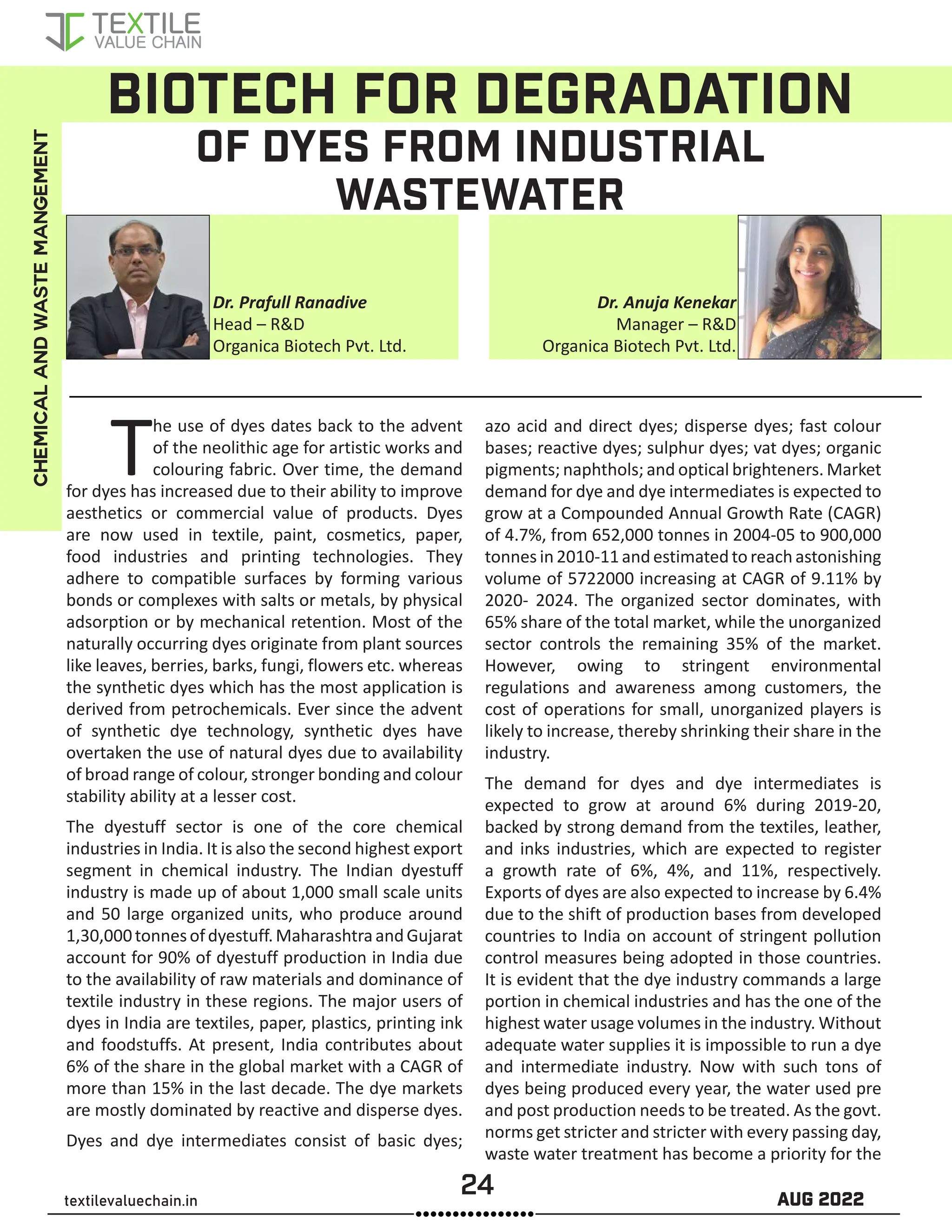
BIOTECH FOR DEGRADATION
OF DYES FROM INDUSTRIAL
WASTEWATER
The use of dyes dates back to the advent
of the neolithic age for artistic works and
colouring fabric. Over time, the demand
for dyes has increased due to their ability to improve
aesthetics or commercial value of products. Dyes
are now used in textile, paint, cosmetics, paper,
food industries and printing technologies. They
adhere to compatible surfaces by forming various
bonds or complexes with salts or metals, by physical
adsorption or by mechanical retention. Most of the
naturally occurring dyes originate from plant sources
like leaves, berries, barks, fungi, flowers etc. whereas
the synthetic dyes which has the most application is
derived from petrochemicals. Ever since the advent
of synthetic dye technology, synthetic dyes have
overtaken the use of natural dyes due to availability
of broad range of colour, stronger bonding and colour
stability ability at a lesser cost.
The dyestuff sector is one of the core chemical
industries in India. It is also the second highest export
segment in chemical industry. The Indian dyestuff
industry is made up of about 1,000 small scale units
and 50 large organized units, who produce around
1,30,000tonnesofdyestuff.MaharashtraandGujarat
account for 90% of dyestuff production in India due
to the availability of raw materials and dominance of
textile industry in these regions. The major users of
dyes in India are textiles, paper, plastics, printing ink
and foodstuffs. At present, India contributes about
6% of the share in the global market with a CAGR of
more than 15% in the last decade. The dye markets
are mostly dominated by reactive and disperse dyes.
Dyes and dye intermediates consist of basic dyes;
azo acid and direct dyes; disperse dyes; fast colour
bases; reactive dyes; sulphur dyes; vat dyes; organic
pigments; naphthols; and optical brighteners. Market
demand for dye and dye intermediates is expected to
grow at a Compounded Annual Growth Rate (CAGR)
of 4.7%, from 652,000 tonnes in 2004-05 to 900,000
tonnesin2010-11andestimatedtoreachastonishing
volume of 5722000 increasing at CAGR of 9.11% by
2020- 2024. The organized sector dominates, with
65% share of the total market, while the unorganized
sector controls the remaining 35% of the market.
However, owing to stringent environmental
regulations and awareness among customers, the
cost of operations for small, unorganized players is
likely to increase, thereby shrinking their share in the
industry.
The demand for dyes and dye intermediates is
expected to grow at around 6% during 2019-20,
backed by strong demand from the textiles, leather,
and inks industries, which are expected to register
a growth rate of 6%, 4%, and 11%, respectively.
Exports of dyes are also expected to increase by 6.4%
due to the shift of production bases from developed
countries to India on account of stringent pollution
control measures being adopted in those countries.
It is evident that the dye industry commands a large
portion in chemical industries and has the one of the
highest water usage volumes in the industry. Without
adequate water supplies it is impossible to run a dye
and intermediate industry. Now with such tons of
dyes being produced every year, the water used pre
and post production needs to be treated. As the govt.
norms get stricter and stricter with every passing day,
waste water treatment has become a priority for the
Dr. Prafull Ranadive
Head – R&D
Organica Biotech Pvt. Ltd.
Dr. Anuja Kenekar
Manager – R&D
Organica Biotech Pvt. Ltd.
CHEMICAL
AND
WASTE
MANGEMENT
25 AUG 2022
textilevaluechain.in
dye industry today. Let us first explore some major
contributors to the pollution load in dyes.
Basedontheirchemicalproperties,colourproperties,
and applications dyes can be characterized into acidic
dyes, basic dyes, azoic dyes, nitrodyes, direct dyes,
reactivedyesandSulphurdyes.Thefunctionalgroups
in dye that impart colour are known as auxochromes
and the groups that intensify this imparted colour
are known as chromophores. A point to be noted
is that more often than not, the chemical structure
of these dyes decides their tenacity and their
biodegradability as well. More tenacious dyes have
low biodegradability rates and are therefore harder
to treat when released in wastewaters.
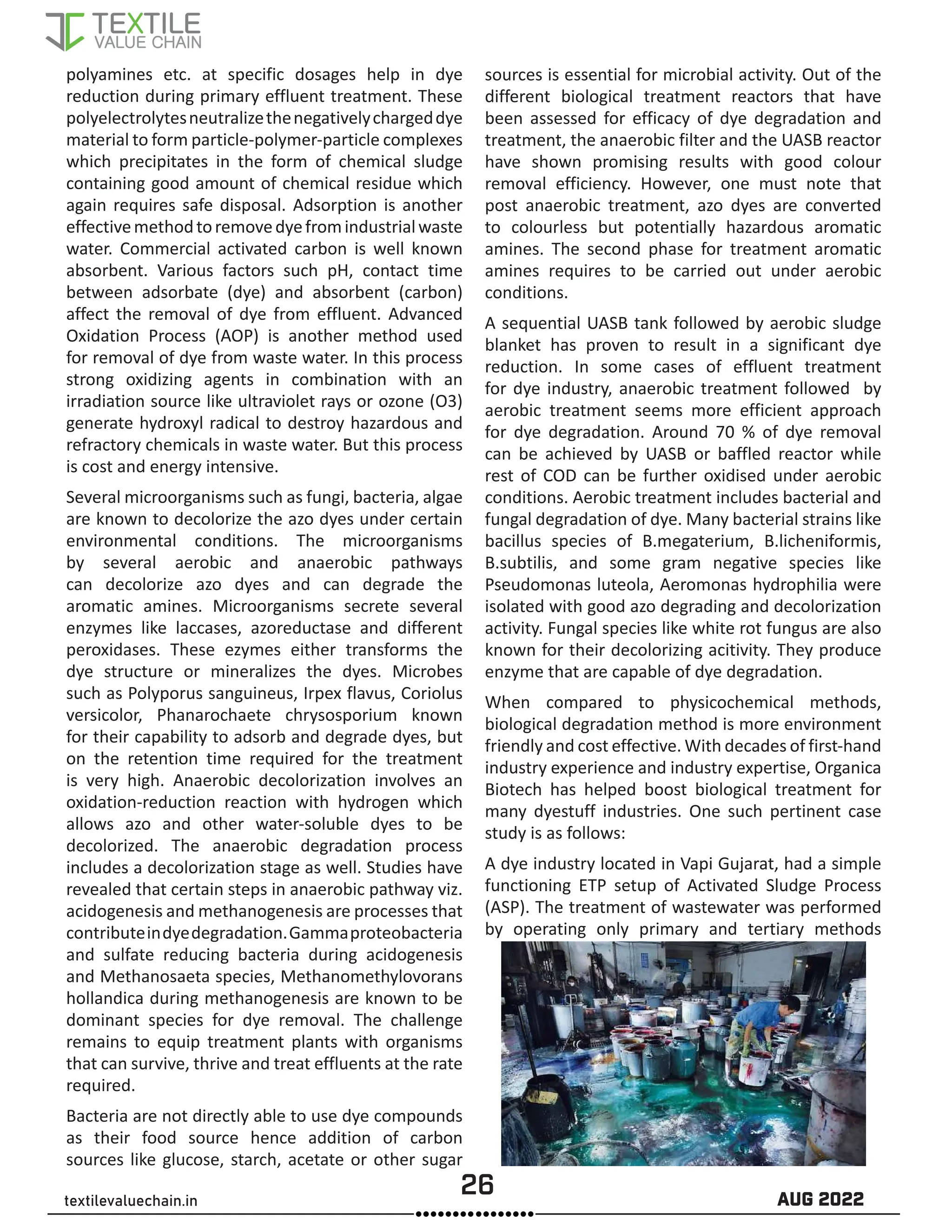
The dye imparts colour to anything it mixes with,
including the surface or ground water that comes in
contact with the wastewater effluents. This disturbs
the potability and aesthetic value of water and blocks
the penetration of light through the water affecting
photosynthesis in water bodies. Apart from this
visible damage the dye effluents also have several
compounds that are toxic, mutagenic, carcinogenic
and enzyme inactivators. Oral ingestion or inhalation
can lead to acute toxicity triggering irritation of
skin and eyes. Workers having excessive exposure
to the dyes can experience dermatitis, allergic
conjunctivitis, occupational asthma or other allergic
reactions. The genotoxic effect of dyes can lead to
chromosomal disturbance.
Dyes like azure can affect human behaviour due
to its impact on the central nervous system. Since
mutagenesis is trigger for cancer, the azo and nitro
dyes can cause cancer over period of time. A plethora
of dyes have similarly been found to have severe
mutagenic and carcinogenic effects in human and
animal models. One can imagine the level of damage
such compounds could induce once they enter our
ecosystem. Hence it becomes necessary to get rid
of such compounds before they are discharged into
water bodies. The textile industry should comply to
various standards set for the discharge of effluent
such as COD <250 ppm, BOD<30 ppm, colour <150
PCU, phenolic compounds<1 ppm NH3-N < 50 ppm
and TDS <2100 ppm and in order to meet these
standards industry has to deploy various treatment
methods of outgoing effluent.
Synthetic dyes used in industries are recalcitrant
in nature. The reason for such recalcitrant nature
of compounds is due to the chemical structures of
these compounds. In the process of dye production,
raw materials like are benzene, naphthalene,
anthraquinone are most commonly used in addition
to other compounds which chelates with minerals
or salts to generate waste water containing salts,
acids, alkali, halogen, hydrocarbons, nitro, amines,
dyes and other substances. Most of the dye contains
aromatic rings with one or more -N=N- groups which
makes it resistant to degradation via ozone, light,
and biological activity.
Out of all the dyes produced and utilized globally, the
dye with azo compounds accounts for more than 60%
of annual dye production due to its wide variety of
application. These dye compounds are used in textile,
cosmetics, food, and printing industry, and amongst
them textile industry is the largest consumer. The
major issue with the dye is not the quantum of its
production but rather the process of its application.
During the dyeing process, not all the dye bind to the
fabric and the unbounded dye is lost in waste water.
Almost 2% of basic dye to 50% of the reactive dye is
lost in waste water leading to high level of surface
and ground water contamination. The presence of
very small amount of azo dyes in water (<1ppm) are
highly visible affecting transparency and water- gas
solubility of water.
A lot of methods have been devised to
treat dye containing waste water which includes
physicochemical process and biological processes
followed in effluent treatment plants (ETPs) as well as
other sophisticated process including RO, distillation,
filtration. A highly optimized of specific Primary,
Secondary, Tertiary treatment strategies can ensure
maximum removal of water from wastewaters. A
variety of physicochemical processes have been
deployed to treat the colour of dyes from effluent
water. Flocculation and coagulation techniques have
been extensively used. Coagulants and flocculants
like alum, ferrous sulphate, polyaluminium chloride,
26 AUG 2022
textilevaluechain.in
polyamines etc. at specific dosages help in dye
reduction during primary effluent treatment. These
polyelectrolytesneutralizethenegativelychargeddye
material to form particle-polymer-particle complexes
which precipitates in the form of chemical sludge
containing good amount of chemical residue which
again requires safe disposal. Adsorption is another
effectivemethodtoremovedyefromindustrialwaste
water. Commercial activated carbon is well known
absorbent. Various factors such pH, contact time
between adsorbate (dye) and absorbent (carbon)
affect the removal of dye from effluent. Advanced
Oxidation Process (AOP) is another method used
for removal of dye from waste water. In this process
strong oxidizing agents in combination with an
irradiation source like ultraviolet rays or ozone (O3)
generate hydroxyl radical to destroy hazardous and
refractory chemicals in waste water. But this process
is cost and energy intensive.
Several microorganisms such as fungi, bacteria, algae
are known to decolorize the azo dyes under certain
environmental conditions. The microorganisms
by several aerobic and anaerobic pathways
can decolorize azo dyes and can degrade the
aromatic amines. Microorganisms secrete several
enzymes like laccases, azoreductase and different
peroxidases. These ezymes either transforms the
dye structure or mineralizes the dyes. Microbes
such as Polyporus sanguineus, Irpex flavus, Coriolus
versicolor, Phanarochaete chrysosporium known
for their capability to adsorb and degrade dyes, but
on the retention time required for the treatment
is very high. Anaerobic decolorization involves an
oxidation-reduction reaction with hydrogen which
allows azo and other water-soluble dyes to be
decolorized. The anaerobic degradation process
includes a decolorization stage as well. Studies have
revealed that certain steps in anaerobic pathway viz.
acidogenesis and methanogenesis are processes that
contributeindyedegradation.Gammaproteobacteria
and sulfate reducing bacteria during acidogenesis
and Methanosaeta species, Methanomethylovorans
hollandica during methanogenesis are known to be
dominant species for dye removal. The challenge
remains to equip treatment plants with organisms
that can survive, thrive and treat effluents at the rate
required.
Bacteria are not directly able to use dye compounds
as their food source hence addition of carbon
sources like glucose, starch, acetate or other sugar
sources is essential for microbial activity. Out of the
different biological treatment reactors that have
been assessed for efficacy of dye degradation and
treatment, the anaerobic filter and the UASB reactor
have shown promising results with good colour
removal efficiency. However, one must note that
post anaerobic treatment, azo dyes are converted
to colourless but potentially hazardous aromatic
amines. The second phase for treatment aromatic
amines requires to be carried out under aerobic
conditions.
A sequential UASB tank followed by aerobic sludge
blanket has proven to result in a significant dye
reduction. In some cases of effluent treatment
for dye industry, anaerobic treatment followed by
aerobic treatment seems more efficient approach
for dye degradation. Around 70 % of dye removal
can be achieved by UASB or baffled reactor while
rest of COD can be further oxidised under aerobic
conditions. Aerobic treatment includes bacterial and
fungal degradation of dye. Many bacterial strains like
bacillus species of B.megaterium, B.licheniformis,
B.subtilis, and some gram negative species like
Pseudomonas luteola, Aeromonas hydrophilia were
isolated with good azo degrading and decolorization
activity. Fungal species like white rot fungus are also
known for their decolorizing acitivity. They produce
enzyme that are capable of dye degradation.
When compared to physicochemical methods,
biological degradation method is more environment
friendly and cost effective. With decades of first-hand
industry experience and industry expertise, Organica
Biotech has helped boost biological treatment for
many dyestuff industries. One such pertinent case
study is as follows:
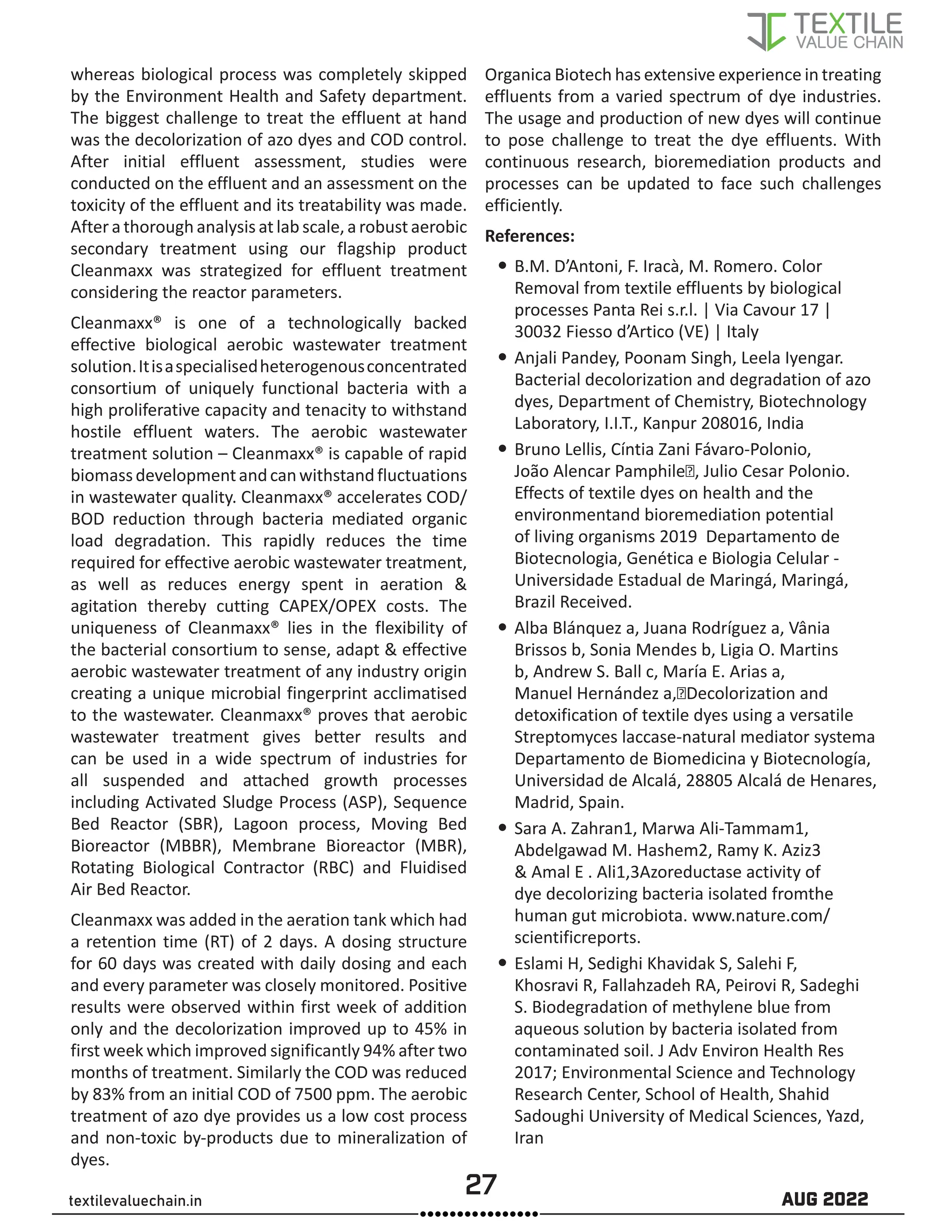
A dye industry located in Vapi Gujarat, had a simple
functioning ETP setup of Activated Sludge Process
(ASP). The treatment of wastewater was performed
by operating only primary and tertiary methods
27 AUG 2022
textilevaluechain.in
whereas biological process was completely skipped
by the Environment Health and Safety department.
The biggest challenge to treat the effluent at hand
was the decolorization of azo dyes and COD control.
After initial effluent assessment, studies were
conducted on the effluent and an assessment on the
toxicity of the effluent and its treatability was made.
Aftera thorough analysis at lab scale, a robust aerobic
secondary treatment using our flagship product
Cleanmaxx was strategized for effluent treatment
considering the reactor parameters.
Cleanmaxx® is one of a technologically backed
effective biological aerobic wastewater treatment
solution.Itisaspecialisedheterogenousconcentrated
consortium of uniquely functional bacteria with a
high proliferative capacity and tenacity to withstand
hostile effluent waters. The aerobic wastewater
treatment solution – Cleanmaxx® is capable of rapid
biomassdevelopmentandcanwithstandfluctuations
in wastewater quality. Cleanmaxx® accelerates COD/
BOD reduction through bacteria mediated organic
load degradation. This rapidly reduces the time
required for effective aerobic wastewater treatment,
as well as reduces energy spent in aeration &
agitation thereby cutting CAPEX/OPEX costs. The
uniqueness of Cleanmaxx® lies in the flexibility of
the bacterial consortium to sense, adapt & effective
aerobic wastewater treatment of any industry origin
creating a unique microbial fingerprint acclimatised
to the wastewater. Cleanmaxx® proves that aerobic
wastewater treatment gives better results and
can be used in a wide spectrum of industries for
all suspended and attached growth processes
including Activated Sludge Process (ASP), Sequence
Bed Reactor (SBR), Lagoon process, Moving Bed
Bioreactor (MBBR), Membrane Bioreactor (MBR),
Rotating Biological Contractor (RBC) and Fluidised
Air Bed Reactor.
Cleanmaxx was added in the aeration tank which had
a retention time (RT) of 2 days. A dosing structure
for 60 days was created with daily dosing and each
and every parameter was closely monitored. Positive
results were observed within first week of addition
only and the decolorization improved up to 45% in
first week which improved significantly 94% after two
months of treatment. Similarly the COD was reduced
by 83% from an initial COD of 7500 ppm. The aerobic
treatment of azo dye provides us a low cost process
and non-toxic by-products due to mineralization of
dyes.
Organica Biotech has extensive experience in treating
effluents from a varied spectrum of dye industries.
The usage and production of new dyes will continue
to pose challenge to treat the dye effluents. With
continuous research, bioremediation products and
processes can be updated to face such challenges
efficiently.
References:
y
y B.M. D’Antoni, F. Iracà, M. Romero. Color
Removal from textile effluents by biological
processes Panta Rei s.r.l. | Via Cavour 17 |
30032 Fiesso d’Artico (VE) | Italy
y
y Anjali Pandey, Poonam Singh, Leela Iyengar.
Bacterial decolorization and degradation of azo
dyes, Department of Chemistry, Biotechnology
Laboratory, I.I.T., Kanpur 208016, India
y
y Bruno Lellis, Cíntia Zani Fávaro-Polonio,
João Alencar Pamphile∗, Julio Cesar Polonio.
Effects of textile dyes on health and the
environmentand bioremediation potential
of living organisms 2019 Departamento de
Biotecnologia, Genética e Biologia Celular -
Universidade Estadual de Maringá, Maringá,
Brazil Received.
y
y Alba Blánquez a, Juana Rodríguez a, Vânia
Brissos b, Sonia Mendes b, Ligia O. Martins
b, Andrew S. Ball c, María E. Arias a,
Manuel Hernández a,⇑Decolorization and
detoxification of textile dyes using a versatile
Streptomyces laccase-natural mediator systema
Departamento de Biomedicina y Biotecnología,
Universidad de Alcalá, 28805 Alcalá de Henares,
Madrid, Spain.
y
y Sara A. Zahran1, Marwa Ali-Tammam1,
Abdelgawad M. Hashem2, Ramy K. Aziz3
& Amal E . Ali1,3Azoreductase activity of
dye decolorizing bacteria isolated fromthe
human gut microbiota. www.nature.com/
scientificreports.
y
y Eslami H, Sedighi Khavidak S, Salehi F,
Khosravi R, Fallahzadeh RA, Peirovi R, Sadeghi
S. Biodegradation of methylene blue from
aqueous solution by bacteria isolated from
contaminated soil. J Adv Environ Health Res
2017; Environmental Science and Technology
Research Center, School of Health, Shahid
Sadoughi University of Medical Sciences, Yazd,
Iran
28 AUG 2022
textilevaluechain.in
29 AUG 2022
textilevaluechain.in
BANARASI BROCADE
– AN EXCLUSIVE ART OF INDIA
1 . Introduction
Banaras(Varanasi),aholycityofUttarPradesh,isacentreforbrocadeandhand-madetextilesand
saris since ancient times. In Banarasi Saree weaving many types of exclusive weaves are woven
on handlooms. These handlooms are mounted with different kinds of hand operated dobbies
and Jacquards. In this famous weaving the word brocade is derived from the Latin word “brochus“denoting
to transfix. The exquisite fabrics, so much appreciated all over the world, are produced by weaving with
warps and weft threads of different colours and often of different materials. It appears from ancient texts
that in early days gold and silver wires were drawn out to such fineness that they could be woven into
fabrics of pure gold and silver. Silk was added later to give colour and body to the textile. Now gold or
silver wires are used as a special weft twisted along with the silk. Generally, Banarasi work are carried out
in whole Banaras and nearby villages of this city. Whereas out of whole city the main areas are focused
for Banarasi weaving are like Peeli Kothi, Madanpura, Saraiya, Bajhadhiya, and Lohta. Currently, there are
approximately forty thousand people engaged in Banarasi weaving including weavers, dealers and dyers.
The main product of Banarasi handloom weaving is the saree.
2. Historical Background
The brocade weaving centres of India developed in
and around the capitals of kingdoms or holy cities
because of the demand for expensive fabrics by
the royal families or temples. The ancient centres
were situated mainly in Banaras, Gujarat, Delhi,
Agra and Murshidabad. Northern weavers were
greatly influenced, so far as design and technique
were concerned, by the brocade weaving regions
of eastern and southern Persia, Turkey, Central Asia
and Afghanistan. According to Buddhist literature,
Varanasi fabrics were pleasant to handle, beauti-
ful to look at and were greatly popular with rich
and tasteful people all over the world. As per the
legends, when Buddha attained Mahaparinirvana
(Figure 1) his mortal remains were wrapped in a
Banaras fabric radiating with rays of yellow, red and
blue colours.
(Figure 1: Buddha’s Fabric Design)
Varied patterns displayed in the Ajanta murals of the
Gupta period are believed by some art historians
to represent some brocade specimens also, and
the floral designs, animals and birds motifs and
geometrical patterns have close affinity with the
early brocade motifs. In Kashmir the brocade art
was developed by Sultan Zin-ul-Abidin (A.D. 1459
-1470) in the fifteenth century. He encouraged
the interchange of weavers with Iran.		
S. Barhanpurkar
Assistant Professor,
SVITT, SVVV, Indore
B. Tanvi,
Tirthbai Kalachand,
School Indore,
Y. Agrawal
Assistant Professor,
SVITT, SVVV, Indore
P. Panday
SVITT, SVVV, Indore
PEER
REVIEW
PAPER
30 AUG 2022
textilevaluechain.in
A large number of foreign weavers/artisans
assembled in the royal workshop of Kashmir. There is
a remarkable resemblance between Banaras brocade
and the Jamawar shawls of Kashmir as they drew
pattern motifs from a common source. Jahangir was
also a great expert of brocades.
(figure 3): Jamawar shawls
(figure 2): Banaras brocade
Every social or religious group had its own norms
regarding the colour, design, and material of their
garment. Hindus liked bright coloured silk in colours
patterns like red, yellow & orange (Figure 4 &5).
Mashrub or mixed fabric was used mostly by peoples
in colours like lavender, sky blue (Figure 6), white and
magenta-blanket.
(figure 4): red pattern
(figure 5): yellow pattern
(figure 6): Blue pattern
3. Raw material : There are two broad classes of
Brocades: .Brocades of pure silk and cotton blends,
and Zari brocades with gold and silver threads. The
most important material used in brocade weaving is
silk. It facilitates lovely waves, is durable, strong, fine
and smooth. There are several varieties of raw silk of
which the main ones used for brocades are Tanduri,
Banaka and Mukta. Tanduri is imported from Malda
and other places. Benga Banaka is a thinner and finer
variety and is mostly used to weave soft fabrics such
as turbans and handkerchiefs. Mukta is a coarse and
durable silk used for kimkhabs, as fine silk does not
withstand heavy gold patterns. Brocade of pure silk
and cotton blend (Figure 7)
(figure 7): Brocade of silk & cotton Blend
31 AUG 2022
textilevaluechain.in
y
y Silk: The basic raw material of many types of
brocade is mainly mulberry silk thread. Apart
from the inherent beauty of silk brocades, the
fact that they were made from non-indigenous
materials added to their value. Japanese and
Chinese silk threads were renowned for their
superior qualities of evenness and shine.
y
y Zari: Zari is the gold and silver thread used in
Indian brocades. Zari is of two types – Badla
is made of flattened gold and silver wire.
Kalabattu is a thin silver or gold wire that is
wound around silk or cotton and now even
rayon thread.
4. Fabric types
Brocade types fabric can be classified into two
types. (1) Loom finish - Loom finished fabrics are
saris, odhini, patkas, pankhas, curtains etc. (2)
Yardage- Yardage is usually used for dress material,
upholstery and curtains
• The best known brocade fabrics were kamkhwab
(Figure.8) or kinkhab (Figure 9). Their main centres
were Varanasi, Ahmedabad and Surat. Their splen-
dour, elegance and cost gave them their name,
which means, ‘something a person cannot dream of
if he has not seen it’ (Kam: little, khwab: dream; kin:
golden in Chinese). Its specialty is the profuse use of
gold and silver thread, such that the silk background
is barely visible. It is mainly used for ceremonial
robes, hangings and furnishings.
(figure 8): Kinkhab
(figure 9): Kamkhwab
5. Weaving process
The weaving of these Banarasi sarees is observed at
Banaras and currently, approximate forty thousand
active weavers are found along with them are active
dealers, dyers, designers and supplementary sup-
port providers. Before the weaving, the silk yarn
undergoes few steps and then the weaving begins.
The Jacquard card, spools and beam is set up with
suitable color yarns and weaving is done.
• Jacquard cards – Saree designs
The desired design that is to be worked on the
saree is drawn on a sheet of graph paper (Fig.10).
This graph sheet becomes the reference to punch
the cards (Fig 11). They are made to a set of cards
(Fig 12) that will be tied together and loaded to the
jacquard machine.
(figure 10): Design on Graph Paper
(figure 11): Punching of Card
(figure 12): Lacing of Pattern Card
32 AUG 2022
textilevaluechain.in
5. The yarns
• The raw silk yarns (Fig 13) are processed they are
dyed with suitable colours. It follows something that
of a tie and dye process (Fig 14). Series like chiffon
undergo this tie and dye process. The yarn after
the initial stages of processing and dyeing (Fig 15)
process with tub-dip method (Fig 16). It is segregated
to undergo warping and weft processes.
(fig.13): Raw Silk (fig.14): Tie &Dye Process
(fig.15): Dyed Yarn (fig.16): Tub – Dip Method
• The threads are spun to spools with the help of
spinning wheel to prepare the spools to load to the
fly shuttle, the threads that fill up through fly shuttle
is called weft (Fig. 17,18 &19).The weft threads
are wound on weft pirn with the help of charkha.
The warp threads are got ready by spreading them
lengthwise creating pulls and is rolled to beam ( Fig
20), which is later fixed to the loom (Fig 21)
Fig. 17, 18 & 19: Thread is loaded on Pirns by the
help of Charakha and Pirn inserted in Shuttle
(fig.20): Beam Get-up on Loom
(fig.21): Warp on Warp Beam
6. The Weaving
The loom is set up with the threads and the process
of weaving is began before which the jacquard cards
are fixed to the jacquard machine and following the
cards the threads are pulled and the desired design
and the saree is weaved. In weaving warp, craftsmen
build the base that runs of the required length. Once
the punched cards are prepared those are spun with
altered threads and colours on the loom allowing to
design and are paddled in an orderly manner that
the main weaving picks up right colour and pattern
to produce the design and weave as well. The Figure
22 and 23 reveals the photographs of Jacquard and
Banarasi weaving.
33 AUG 2022
textilevaluechain.in
(fig.22): Jacquard Machine
(fig.23): Jacquard Machine
7. Motifs and Pattern
• When this form of fabric was introduced to India,
local artisans adapted it to the predominant Hindu
culture that was prevalent by creating popular motifs
of the paisley floral pattern (like marigold, jasmine
etc.) Fruits design (like mango etc.), animal pattern
(like elephant, horse, dears etc.),bird depiction
(peacock, parrot etc.) and sun, moon, stars. Most
Banarasi saris reflect ancient Mughal influence
which is seen in the motifs used like floral and foliate
motifs.
• Other motifs used are village Scenes, fairs, designs
inspired from architecture of temple and mosque,
etc. The edge of the sari border is a characteristic of
Banarasi Saris.
• Another celebrated pattern of Banaras brocade is
Jaal or net design, also known as Jangala. It is a rich
pattern covering the ground of the fabric and owes
its origin to Turkish brocades. The Banaras Jaal was
very delicate. In the Jaal, flower, bird or animal forms
were enclosed within a net-worked form evolved
from arch, square or other geometrical forms.
• Flowers and creepers were interlocked, filling up
the ground. The Hyderabadi Jangala was introduced
to the weavers of Varanasi on demand of the court of
Nizam of Hyderabad. Another adaptation
from the Persian prototype which became the
specialty of Varanasi is Latifa buti, probably named
after its designer Latif Mian.
• Religion too provided a variety of decorative motifs.
Varanasi being a religious centre had a large demand
for cloth woven specially for temples and devotees.
Along with floral patterns, auspicious symbols and
figures of deities were also used as motifs.
8. In present days
• More contemporary designs draw inspiration from
the past and fuse it with modern influences such as
animal, birds, and geometric and floweral design
patterns (Fig 24, 25 and 26).
(fig.24): Peacock Pattern (fig.25): Fruit Design
(fig.26): Geometrical Design
34 AUG 2022
textilevaluechain.in
9. Banarasi brocade sarees can be divided into five categories:
1. Jangala saree
y
y Jangala saree make use of silk thread. Pattern and motifs of
vegetation are spread throughout the fabric with gold and
silver flowers (Fig 27)
2. Tanchoi saree
y
y Tanchoi saree make use of the gold or silver thread, Zari are
commonly worn for wedding ceremonies.The motifs are
created by using extra weft (Fig. 28)
3. Tissue sarees
y
y Tissue saree make use of gold or silver Zari in weft. Tissue
sarees are preferred as wedding saree by the affluent.
4. Butidar sarees
y
y Butidar Saree make use of gold, silver and silk thread. It is
common to find the end panel consisting of a row of arches
with a burst of silver.
5. Cut work sarees
y
y Cut work saree are made using warp threads with cotton and
regular weft to create design. Patterns are created by cutting
extra loose hanging weft threads
35 AUG 2022
textilevaluechain.in
10. Colour
Colour plays a vital part in weaving brocade.• The
charm and subtle beauty of the brocade depends
upon colour synchronisation.• Earlier, vegetable
dyes were used during weaving. These produced fast
colours, lasted for almost a generation.• Nowadays,
chemical dyes have gained popularity as they are
cheaper, less time-consuming.
11. Market
Brocade has always been a special fabric catering
to the needs of the wealthy. Banarasi Brocade and
sareesareimmenselypopularacrosstheglobe.Today
Banarasi brocade is once again in great demand. The
pattern and motifs used to create brocade work
are also being incorporated into western garments
today. This has been seen on international as well
as Indian runways. The fusion of two worlds create
a garment that is both, lavish and contemporary.
Brands like Sabyasachi and Raw mango incorporate
these textile in their designs. The market of Brocade
has also grown for the fashion wear, traditional look
and multy use of like a celebrity brand fabric with
many special features. Fashion word market also
copying this designs after mixing with other modern
pattern and creating the fusion of new innovations.
12. References.
1. Watson, J. Forbes. 1873. Collection of the Textile
Manufactures of India’ (Second Series). London:
India Museum.
2. Singh, Martand et al. 1982. The Master Weavers.
Bombay: Subrata Bhomick.
3. Mohanty, Bijoy C. 1984. Brocaded Fabrics of India,
Vols I and II. Ahmedabad: Calico Museum of Textiles.
4. Kumar, Nita. 1988. The Artisans of Banaras: Popular
Culture and Identity, 1880–1986. Delhi: Oxford
University Press.
5. Dhamija, Jasleen and Jyotindra Jain (Eds.). 1989.
Handwoven Fabrics of India. Ahmedabad: Mapin
Books.
6. Ali, Yusuf. 1900. A Monograph on Silk Fabrics
Produced in the North-Western Provinces and Oudh.
Allahabad: N.W.P and Oudh Government Press.
36 AUG 2022
textilevaluechain.in
Futuristic Twisting
Futuristic Twisting
Twisting Solutions
Twisting Solutions
Textiles
Textiles
37 AUG 2022
textilevaluechain.in
AIR PERMEABILITY ;
TEAR RESISTANCE OF FABRICS FOR
PPE PROTECTION
1.Introduction
During demonstrations and riots, more and more
fire bombings are carried out with Molotov cocktails.
Apart from damage to property such as house or car
fires, personal injuries are also caused. Increasingly,
police and fire brigade personnel suffer damage from
Molotov cocktail explosions. These explosions result
in serious injuries, some with fatal consequences.
[1–11]
Molotov cocktail attacks (MCA) are counted as
“politically motivated crime, especially bodily harm
and homicide” [12]. In 2020, the MCA increased by
18.82 % compared to the previous year [13].
Figure 1 shows the development of the number
of violent offences per year in comparison to the
number of injured police officers (PVB). It can be
seen that the number of injured persons increases
more than the number of violent acts carried out
[14].
(Figure 1): Development of violent attacks on
German police officers [14]
The personal protective equipment (PPE) of a
police member is mostly made of aramid blend
fabric. The melting temperature of aramid is 600 °C
[15]. A Molotov cocktail explosion reaches higher
temperatures between 800 °C and 1700 °C [16,
17]. When PPE made of aramid is exposed to these
temperatures, the material contracts, it shrinks and
it begins to decompose. The melting material itself
causes severe injuries to the skin [18]. The parts of
the body exposed by the shrinkage are defenceless
against direct fire.
To improve the protective effect of PPE against MCA,
research is being conducted on a new fibre material,
new fabric patterns and a new coating [19]. However,
this article focuses on the development of new fabric
patterns.
The new fabric should offer the police officers at least
the same protection as the old fabric and additionally
reduce the shrinkage. The current tasks of the PPE
include [20]:
y
y Protection against cold
y
y Stab resistance
y
y Wearing comfort
y
y Impact resistance
y
y Fire protection
y
y Freedom of movement
y
y Wind and rain protection
y
y Easy care
y
y Abrasion resistance
Rahel Krause Justin Kühn Thomas Gries
Institut für Textiltechnik of
RWTH Aachen University,
Aachen, Germany.
TECHNICAL
TEXTILE
38 AUG 2022
textilevaluechain.in
Air permeability and tear resistance are determined
in order to better assess cold protection, stitch
resistance and wearing comfort. The air permeabil-
ity and tear resistance are determined to compare
the new weaves and to find a possible correlation
between air permeability and tear resistance. High
air permeability increases comfort. The tear strength
is needed to assess the tear resistance.
2.Experimentation
In the following, the execution of the tests
(Determination of tear force of trouser-shaped test
specimensaccordingtoDINEN13937,airpermeability
according to DIN EN ISO 9237) is explained. First, the
new bindings with which the tests are carried out are
presented. For each experiment, the experimental
design, execution and results are explained.
2.1 New fabric patterns
When PPE is exposed to the high temperatures of a Molotov cocktail explosion, the material shrinks. The
shrinkage of the textile causes the material to contract and the garment to fit tightly around the skin. The
insulating effect of the air cushion is lost. Areas of the body such as the ankles or wrists are exposed. Direct
contact with the fire causes severe injuries to these parts of the body. Textiles used to make fire-retardant
clothing are currently made of aramid fabrics with a 3/1 twill weave [15]. Independent of a new material
for PPE, three new fabric weaves have been developed. These weaves should have a maximum shrinkage of
1.5 %. The wearing comfort should still be given or improved with the new material [19]. In order to assess
the influence of the weave on the properties of the fabric independently of the material, the three new
weaves were developed and woven from m-aramid yarn. The weaves were developed by the project partner
Sächsisches Textilforschungsinstitut e.V., Chemnitz, Germany (STFI).
Table 1: New types of fabric weaves (black: warp lift, white: warp lowering).
39 AUG 2022
textilevaluechain.in
Weave no. 1 consists of a combination of rep elements. The resulting ribs lead to a high thread density. The
weave points of the first weave are close together.
Weave no. 2 is a combination of the plain weave and its simplest variants, the rep and the panama weave.
The plain and rep elements give the fabric structure and stability. The larger Panama weave elements create
a float as the weave points are further apart.
Weave no. 3 combines two twill weaves. A twill with a Z degree is interrupted by a twill with an S degree.
Untypical for the twill weave is that there are the same number of warp and weft threads on each side. The
side of the fabric does not influence the property profile.
2.2 Determination of the tear strength
For the initial assessment of the new weaves, only
small amounts of fabric are woven (an area of
600x1000 mm per weave). The leg tear test is carried
out in accordance to the DIN EN ISO 13937 standard.
Samples with dimensions of 50 mm x 200 mm are
taken from the fabrics. Two sets of five samples per
fabric are taken. One set of samples in warp direction
and one in weft direction. According to the standard,
in one set of samples no two samples should contain
the same warp or weft threads. Due to the small
size of the woven fabrics, the arrangement of the
samples cannot be done according to the standard.
To determine the tear strength across the warp, only
four instead of five samples can be taken from weave
no. 3. The tests are carried out in a standard climate
at 20.7 °C and a relative humidity of 66 %. [21]
Weave no. 1 achieves the highest tear strength
crosswise to the warp (131 N). The thread density
is very high due to the interlocked rep weaves. The
characteristic ribs form a tight weave with many,
closely spaced weave points. The visible difference
in tear strength across the warp and across the weft
is due to the different orientation of the ribs in the
fabric.
Weave no. 2 (120-122 N) and weave no. 3 (78 N) have
almost the same tear strength in both directions. The
reason for this is the symmetrical construction of the
weave cartridges. Weave no. 2 consists partly of the
plain weave and the Panama weave, which have the
same properties in both warp and weft directions. In
weave no. 3, the symmetry of the fabric results from
the combination of the Z and S degrees, as well as
the even distribution of the warp and weft threads.
In Figure 2 the tear strength of the different fabric is
shown.
(Figure 2): Tear strength per weave and direction
2.3 Determination of air permeability
The testing device offers sufficient space to test the
fabrics non-destructively. After each test, the fabric
is moved alternately by 20 cm in the warp and weft
directions. This means that the test preparation and
thedeterminationoftheairpermeabilityarecarried
out as per the standard. The tests take place in a
standard climate at 20.7 °C and a relative humidity
of 66 %. The fabric is clamped into the 20 cm2 test
area for each test. Care is taken to ensure that there
are no folds and that the edge seals the test surface
from the environment. A differential pressure of
200 Pa is applied to the sealed sample and the
air permeability is determined. For each fabric, a
reference measurement is taken with a rubber plate
to determine the leakage rate. The leakage rate is a
measure of how much air escapes through the seal.
This value is subtracted from the measured values
to determine the actual air permeability. [22]
Figure 3 below shows the results of the tests to
determine the air permeability for each of the new
fabric weaves.
40 AUG 2022
textilevaluechain.in
(Figure 3): Results of the air permeability tests
Weave No. 1 achieves the lowest air permeability
(518-631 mm/s). The combination of the rep
elements results in a high thread density with closely
spaced weave points. This makes the fabric strong
and has a higher air resistance.
Weave No. 2 is a mixture of a plain weave and rep
weave, with a high thread density and a Panama
weave with slight floatation. The result is a fabric
with medium air permeability (660-785 mm/s).
The highest air permeability is achieved by weave no.
3 (760-873 mm/s). The third weave has the lowest
number of weaving points as a combination of two
twill weaves with Z and S degrees. The unbound
thread length is not very long compared to the atlas
weave. The uniform geometry of the Z- and S-grades
creates large areas of unbound warp and weft
threads, which increase air permeability.
3.Summary
PPE for riot police in Germany consists of an aramid
blend fabric. The melting temperature of aramid
is about 200 °C to 600 °C below the temperature
reached by a Molotov cocktail explosion. The
protective effect of PPE against Molotov cocktail
attacks(MCA)istobeimprovedthrough researchand
development of new materials and fabric weaves.
The basic properties of PPE are to be retained. The
basic properties include comfort, protection against
cold and stab resistance. In order to assess these
properties, the air permeability and tear resistance
are determined for three newly developed fabric
weaves. The fabric weaves are combinations of the
three basic weaves. The tear strength is determined
across the warp and across the weft. The highest
tear strength across the warp is achieved by weave
no. 1, the lowest by weave no. 3. Across the weft,
weave no. 2 achieves the highest tear strength, the
lowest strength achieves weave no. 3. In order to
fulfil the requirement for PPE for tear resistance,
the tear strength across the weft must be at least
45 N and across the warp 45 N. Overall, the lowest
tear resistance in both directions is 78 N. Thus, the
requirement is fulfilled for all three weaves.
The highest air permeability is achieved in weave no.
3 and the lowest in weave no. 1. A direct correlation
between air permeability and tear strength cannot
be determined. Weave no. 3 has the highest air
permeability and the lowest tear strength transverse
to the warp and weft direction. The high air
permeability of the three weaves of over 550 mm
⁄s increases the wearing comfort. The air cushions
created during wear have an insulating effect. The
air cushions store body heat and thus protect against
cold. In case of contact with fire, they transmit heat
more slowly than without air cushions.
4.Outlook
To redesign a PPE that protects against MCA, the
influence of the weaves on the shrinkage of the tissue
must be determined. Due to shrinkage, the fabric
of the current PPE contracts sufficiently to expose
body parts. These unprotected parts of the body,
such as the wrists or ankles, are then burnt by the
fire of the explosion. In addition, a material must be
developed that can withstand the heat of a Molotov
cocktail explosion. Resistance to the heat can be
achieved either by a higher melting temperature or
by lower shrinkage and good insulation through air
cushioning. Lower shrinkage means that no parts
of the body come into direct contact with fire. The
air cushions conduct the heat more slowly. A higher
melting temperature means that the material does
not decompose as quickly. This means that the other
protective measures against fire remain intact.
y
y Acknowledgement
The Institut für Textiltechnik of RWTH Aachen
University would like to thank the AiF Projekt GmbH,
Berlin for having the Project “Schutzmaterial für
Einsatzkräfte - Molotowcocktailschutz” (No. 20599
BG) on behalf of the Forschungskuratorium Textil
e. V., funded by the Federal Ministry of Economic
Affairs and Climate Action (BMWK) of Germany on
the basis of a decision by the German Bundestag
41 AUG 2022
textilevaluechain.in
[1] Jager J.; Klatt T.; Bliesener T. NRW-Studie zur „Ge-
walt gegen Polizeibeamtinnen und Polizeibeamte.
Die subjektive Sichtweise zur Be-treuung und Für-
sorge, Aus- und Fortbildung, Einsatznachbereitung,
Belastung und Ausstattung: Kiel, 2013.
[2] Schwetje, S. Ausschreitungen im nordirischen
Londonderry. https://www.n-tv.de/ticker/Auss-
chreitungen-im-nordiri-schen-Londonderry-arti-
cle21263687.html (Accessed April 19, 2022).
[3] Otruba, F. POL-Pforzheim: (FDS) Horb - Glück-
licherweise nur geringer Schaden nach Wurf
mit Molotow-Cocktail in Richtung Polizeige-
bäude. https://www.presseportal.de/blau-licht/
pm/137462/4585984 (Accessed April 19, 2022).
[4] Mladek, J. Brandanschlag auf Polizeirevier in
Greifswald. https://www.nordkurier.de/mecklen-
burg-vorpommern/brandanschlag-auf-polizeirevier-
in-greifswald-0839626006.html (Accessed April 19,
2022).
[5] Kramper, G. Unruhen nach dem Tod von George
Floyd. https://www.stern.de/panorama/stern-
crime/new-york--junge-frau-schleudert-molotow-
cocktail-auf-polizeiwagen-9283384.html (Accessed
April 19, 2022).
[6] Spilker, I. Freund oder Feind? https://www.torial.
com/isabell.spilker/portfolio/376848.
[7] N.N. Verfassungsschutzbericht Bayern 2016:
München, April 2017.
[8] N.N. Politisch motivierte Konfrontationsgewalt
- Auseinandersetzungen zwischen links- und recht-
sorientierten Akteuren in den Jahren 2011 – 2012 /
Auszüge aus dem Abschlussbericht, 2016.
[9] N.N. Straftaten gegen Polizeibeamte - Lageber-
icht 2012: Dresden, April 2013.
[10] N.N. Straftaten gegen Polizeibeamte - Lageber-
icht 2011: Dresden, Mai 2011.
[11] N.N. Straftaten gegen Polizeibeamte - Lageber-
icht 2010: Dresden, Februar 2011.
[12] Waffengesetz (WaffG) Anlage 2 (zu § 2 Abs. 2
bis 4) Waffenliste, 2002.
[13] N.N. 1 Politisch motivierte Kriminalität im Jahr
2020: Bundesweite Fallzahlen, May 04, 2021.
[14] Gewalt gegen Polizeivollzugsbeamtinnen und
Polizeivollzugsbeamte: Bundeslagebild 2020, 2020.
[15] N.N. Technische Lieferbedingungen Polizei des
Landes Nordrhein-Westfalen: TLP Nr. 9004, 03.2019.
[16] Schröter, T. Bilddatengestützte Erkennung von
Deflagrationen: Hamburg, 2016.
[17] Grabski, R.; Brein, D.; Pasch, U.; Neske, M.;
Kunkelmann, J. Brandschutzforschung der Bun-
desländer,: Karlsruhe, 2010.
[18] Lier, A. Bei der Berliner Polizei brennt die
Uniform durch. https://www.bz-berlin.de/berlin/
bei-der-berliner-polizei-brennt-die-uniform-durch.
[19] Krause, R.; Bell, E. Schutzkleidungsmaterial
für Einsatzkräfte - Molotowcocktailschutz. https://
www.ita.rwth-aachen.de/global/show_document.
asp?id=aaaaaaaaaxtkqff (Accessed July 6, 2022).
[20] Technische Richtlinie (TR) Körperschu, 2009.
[21] DIN EN ISO 13937-2:2000-06, Textilien_-
Weiterreißeigenschaften von textilen Flächenge-
bilden_- Teil_2: Bestimmung der Weiterreißkraft mit
dem Schenkel-Weiterreißversuch (einfacher Weiter-
reißversuch) (ISO_13937-2:2000); Deutsche Fassung
EN_ISO_13937-2:2000; Beuth Verlag GmbH: Berlin.
[22] DIN EN ISO 9237:1995-12, Textilien_-
Bestimmung der Luftdurchlässigkeit von textilen
Flächengebilden (ISO_9237:1995); Deutsche Fas-
sung EN_ISO_9237:1995; Beuth Verlag GmbH:
Berlin.
References
explore fashion industry on
fashionvaluechain.com
for collaboration write us on fashionvaluechain@gmail.com
www.uster.com/qbar2
Inspecting fabrics after weaving is old school. With USTER®
Q-BAR 2, smart weavers can pinpoint
defects during fabric formation. It’s the right way to reduce material losses and minimize manual
checks. When it comes to fabric quality issues, prevention is better than cure.
The whole fabric is automatically monitored – warp, weft, selvage and leno – and faults are
identified immediately. LEDs signal defect locations to the weaver, with information shown on
the control unit touchscreen. It’s automatic inspection, in-process and instant, so weavers can
react to prevent long-running or repeating faults.
USTER®
Q-BAR 2 sets the future standard, controlling the weaving process instead of the output.
USTER
®
Q-BAR 2
Weave it right: spot defects on the loom
43 AUG 2022
textilevaluechain.in
NANOFIBERS,
A WATCHWORD
IN TEXTILE
INDUSTRY
Nanofibers are categorised in a new class of
fibrous materials having diameters equal or
less than 100nm. Synthetically made, these
tiny fibers can be easily modified to fit desired
characteristics and are useful for various industries
suchasthetextileindustry.Mostcommonlyproduced
by the electrospinning process, the polymer fluid is
first charged with a high electrical voltage and when
the electrical force reaches high enough to overcome
the surface tension of the polymer fluid, a metal
spinneret with a 0.1-1mm diameter will eject a fluid
jet towards a grounded metal collector all while the
fluid undergoes whipping-like bending instability and
elongation resulting in a small, solidified fiber.
Although electrospinning uses hazardous solvents
that damage the environment, new studies on
nanotechnology such as ‘Green electrospinning’ are
being developed. According to a National Science
Foundation report, “green electrospinning is an eco-
conscious and scalable biofabrication process that
replaces traditional solvent with biologically benign
solutions. Using this method, adverse impacts of the
manufacturing process could be decreased three to
six times”.
Moreover, the study was also mentioned by Helen
H. Lu from Department of Biomedical Engineering,
Columbia University that “Green electrospinning
not only preserves the composition, chemistry,
architecture, and biocompatibility of traditionally
electrospun fibers, but it also improves their
mechanical properties by doubling the ductility of
traditional fibers without compromising yield or
ultimate tensile strength. Our work provides both
a more biocompatible and sustainable solution for
scalable nanomaterial fabrication”.
Advantages of nanofibers
Most of the benefits of nanofibers come from the
fact that the structure of the fiber is able to be tailor-
made to achieve specific properties, but the most
notable properties of nanofibers would be their
large ratio of surface area to volume and superior
mechanical performance (stiffness and tensile
strength) compared to other fiber material forms.
Other than that, nanofibers are also inexpensive to
produce.
TECHNICAL
TEXTILE
AUTHOR(S) : NURHANNA SAFWA BINTI -
MOHAMMAD BACHTIAR
CORRESPONDING AUTHOR : Nur Adilah Masri,
Nur Hani Aqilah
44 AUG 2022
textilevaluechain.in
Hence there are many applications for nanofibers
such as in protective materials, medical, energy,
automotive, agriculture, filtration, and technical
textiles.
Disadvantages of nanofibers
Alongwithanyotherfibers,nanofibersalsohavetheir
own drawbacks. Producing nanofibers at a large scale
isstillachallengingtaskaselectrospinningtechniques
have some disadvantages such as low yield, high
operating voltage, and difficulty in attaining in situ
deposition of nanofibers on different substrates.
What’s more is that a study on fabric characterization
and optimization of MnxOy nanofibers for improved
super capacitive properties shows that electrospun
nanofibers exhibit poor mechanical strength due to
poor crystallinity. However, all of these drawbacks
can be overcome by altering the synthesis method.
What is the future for nanofibers and
nanotechnology in the textile industry?
Withthegrowingacceptanceoftechnologyespecially
inthetextileandfashionindustry,thedemandfornew
technologies has companies like NanoTextile, a textile
technology service provider company, continuously
developing and innovating new technologies. Also
focusing on green technology, NanoTextile uses non-
toxic materials in their nanotechnology embedment
process.
Offering consultancy services regarding
nanotechnology and technology series consists
of Hygienic, Protection, Comfort, Care, Premium
and Advanced series. Each series contains several
technologies for example the Hygienic series
comprise anti-bacterial, self-cleaning and odour-
control technologies. The company sees the potential
of combining nanotechnology and fashion producing
a new range of technical textiles.
In short, the applications of nanofibers and
nanotechnology are growing in demand, especially
with the recent acceptance of technical clothing in
everyday wear. Consumers are now more open to
spending more on the added value of clothing and
focusing on sustainability rather than fast fashion.
For contact: Email: info@nanotextileinnovation.
com.
0.25
4.98
0.56
2.07
110.02
0.06
32.89
138.41
1.77
17.83
6.92
0.36
4.78
0.2
2.27
118.59
0.24
33.66
171.07
2.5
18.6
6.99
41.72
-3.87
-64.79
9.6
7.79
297.4
2.34
23.6
41.7
4.33
0.98
TECHNICAL TEXTILE IMPORT
Jan-May 2021 (F) Jan-May 2022 (F) %Growth
Source: Ministry of Commerce and Industry
Unit: USD Millions
45 AUG 2022
textilevaluechain.in
46 AUG 2022
textilevaluechain.in
INDIA’S E- COMMERCE INDUSTRY’S
FUTURE VIS A VIS EMERGENCE OF
OPEN PLATFORM ONDC AND RELIANCE
RETAIL’S THREAT TO MEGA CORPORATE
AMAZON, FLIPKART.
1:STATUS AND SIZE OF INDIA’S E COMMERCE ONLINE RETAIL
INDUSTRY,TODAY
For India’s total population of 140 Billion, the overall size
of Retail markets today stands at approx. $ 900 Billion in its
turnover. It is projected to grow to the market size of $1.3-1.4
Trillion by year 2025-26, of which 75-80% share to be for the
Food,Grocery, Apparel/fashion and lifestyle products. Yet this
will equal only 15% share for online E- commerce, which is
presently controlled by a Dozen mega players like Amazon,
Flipkart.
Key factors to be understood for future E commerce trajectory are mainly,
A] growth driven by ‘demographic’ dividend of India’s young well employed and earning population,
B] growth of millions of ‘mom and pop’ small residential area shops now evolving to Online selling,
C] growth coming in from faster spread of 4G ,WIFI and internet in semi urban and rural areas and
D] future growth in high speed data services from new emerging 5 G networks by end 2022-mid 23.
The battle for E- commerce Giants ,namely
Amazon, Flipkart and the new online players esp.
the Reliance retail and , the Tata groups.
In the hot bed of India’s e-commerce industry, there
are `battles and wars ` going in for grabbing the
increasing share of the Online e-commerce from the
ever growing retail market at 15% CARG with special
targeting of `middle class consumers, The `youth`
and fast emerging Tier 2.Tier 3 cities.
With its control on 4G and future 5G networks, and
its physical control on a million small to medium
`brick and mortar` physical retail stores [ in only 3-5
km of populated residential areas].
Reliance Retail is fast emerging as the biggest player
to be and hiving off big chunk of share of like of
existing giant and mega E-commerce players like
Amazon, Flipkart, DMart and Snap deal and others
and, over whom It has the best advantage of up-
cycling the 30% returns of E-commerce sales.
The ongoing battle of above giants is now on full
roll for the lucrative E-commerce Market share The
2 other major Indian conglomerates like TATA and
Birla groups are also spearheading their tentacles
fast to carve out their own share in India’s mega
e-commerce jungle. In this battle for market share,
it seems that Amazon would be further losing its big
pie under the new ONCD platform being launched
with he Govt support for the small size online
e-commerce business.
MUNISH TYAGI
retail
update
Textile Consultant
47 AUG 2022
textilevaluechain.in
The concept behind the govt supported ONDC
E-commerce platform to be understood as below:
A] the core objective and aim of new ONDC
e-commerce platform is mainly to enable Online sale
penetration of small sellers vis-a-vis the existing
large players like Amazon, Flipkart, others.
B] to facilitate the above, the ONDC online platform
will also provide embedded payment gateway.
Understanding the ONDC, open E-commerce
platform to support small sellers.
At its core, ONDC is an open network for E-commerce
underpinned by a set of open e commerce standards
similar to India’s very successful UPI - Universal
Payments Interface. In fact, the underlying open
standards of ONDC are an adapted version of the
Beckn Protocol, a global open source standard that
can be used even beyond retail commerce for sectors
such as mobility and health. Hospitality , and even
education.
If it works with its best operational efficiency as
expected, ONDC could fundamentally change the
game for e-commerce, herald a future of open
competition with less dominance by vertically
integrated existing Mega platforms, and show U.S.
regulators ways to take on their own monopolies.
An open E-commerce market for the future
ONDC is not an application, an intermediary, or a
specific piece of software. Rather, ONDC is a set of
specifications designed to foster open interchange
and connections between shoppers, technology
platforms, and retailers.
ONDC may provide a smooth entry for `mon and
pop stores` called kiranas, but ultimately all players
will benefit. Homegrown e-commerce competitors
to giants Flipkart and Amazon, such as SnapDeal,
who wish to compete on user experience and price
on a level playing field, are signing up for ONDC.
Google too has indicated interest. Indian technology
companies that provide e-commerce services and
capabilities to medium-sized businesses see ONDC
as a potential boon to their biz.
RELIANCE RETAIL GAME PLAY TO CHALLENGE THE
EXISTING DOMINANT PLAYERS
Reliance Group’s declared war and mega play
into India’s $900 billion retail market has taken an
aggressive mode as India’s Retail sector has now
emerged as one of the most dynamic industries and
is expected to reach anywhere between $1.3-$1.5
trillion by 2025-26. The organised retail along with
its Online or e-commerce rider seen gaining 15%
market share in the overall retail space, while food
& grocery and apparel and lifestyle may account for
80% of India’s retail market by 2025.
Large market offers big opportunities. And it looks
like Reliance Retail has seized it, with its massive
omni-channel retail play of physical stores, B2B with
kirana’s and e-commerce. With new Govt policy,
for open access E-commerce channels,The overseas
players like Amazon remain at handicap considering
that they cant expand physical Stores to only 20%
of their turnover and which would be far Yet far
lagging behind Reliance Retail’s.
The company already went on an acquisition spree
and partnerships in the last three years, adding to its
portfolio some of biggest names, including Hamleys,
Dunzo, Zivame.
It has also partnered with famous global retail chain
7-Eleven. Catering to India’s affluent consumers,
Reliance, meanwhile, houses some of the most
iconic brands such as Hamleys for toys and likes of
Versace, Armani Exchange, GAP, GAS, Jimmy Choo,
Michael Kors among others. The premium segment
has become one of the fastest growing categories.
Also firming up its inorganic play, the company is
planning to acquire dozens of niche local consumer
brands to build a formidable consumer goods
business to support its E-commerce.
Reliance Retails stays highly focused on growth via
the physical retail expansion. Reliance is looking to
48 AUG 2022
textilevaluechain.in
cater to both price conscious and brand conscious
customers, while trying to capture as much of the
private consumption market as possible, it seems so.
Reliance Retail’s competitors are nowhere close to
even match its physical store numbers. The company
has over 15,000 offline stores across categories,
compared with DMart’s 294 stores or Aditya Birla
Fashion’s 3,468 outlets. Tata and others are yet far
lagging behind.
As per the Bernstein study, the Reliance Retail’s
revenue has grown five times in the last five years
and the core retail revenue of $18 billion is greater
than competitors combined.
As per Business Standard, Reliance wants the highest
and not only a decent share of Indian consumers’
wallet. From that perspective, Reliance still has a
long way to go... As consumer preferences evolve,
Reliance too should adapt.
An undisputed leader in the domestic market, the
aim of Reliance retail groups, is to become one of the
top 10 retailers globally. Part of this bet is based on
the premise that incomes and consumption power of
Indians will increase across the board in coming years
on back of its growing economy, one of the highest
GDP and active employed population. However,
could the uneven recovery that different segments of
the population have seen stop the pie from growing
larger and prove to be a dampener for all retail and
e-commerce players….is yet to be seen.The Online
retail pie is also being watched and aggressively
chased by legacy competitors like the Tata Gr, Birla
Gr .the ITC and existing D Mart and Snap-deal, and
host of other regional and within State players.
The great retail-cum-E-commerce war for India’s
consumption pie is surely on with Reliance in
lead as of yet.The E-commerce war is going to be
uncontrollable especially With Reliance Gr control
on 5G networks from next year and, penetration
of its small physical stores into Rural India which is
under major infrastructure change.
12.99
28.74
79.17
135.06
70.6
1.16
2.82
15.72
13.65
-13.2
0.39
0.38
3.37
1.33
-60.49
12.71
21.26
66.5
95.07
42.96
0.05
0.05
0.37
0.34
-6.41
MAY 2021 MAY 2022 JAN- MAY 2021 JAN- MAY 2022 %GROW T H
TEXTILE MACHINERY EXPORT
Machines for processing textile fibres
Weaving Machines (Looms)
Knitting machines, stitch-bonding machines
Auxiliary machinery and parts for textile machinery
Machinery for making felt, nonwovens, including hats
28.61
43.24
125.14
200.62
60.32
25.49
37.68
145.57
211.95
45.6
22.64
22.36
125.99
147.48
17.06
28.22
43.62
145.44
218.29
50.09
6.83
3.95
27.48
53.56
94.92
MA Y 2021 MA Y 2022 JA N- MA Y 2021 JA N- MA Y 2022 % GROW T H
TEXTILE MACHINERY IMPORT
Machines for processing textile fibres
Weaving Machines (Looms)
Knitting machines, stitch-bonding machines
Auxiliary machinery and parts for textile machinery
Machinery for making felt, nonwovens, including hats
MARKET
-
REPORT
49 AUG 2022
textilevaluechain.in
Corporate Office : SF-34, Vasant Square, Vasant Kunj, New Delhi – 110070, India
Mobile : +91 98100 09264, 96506 54343 Email : mani@bishnutexport.com
Air Covered Yarns in Nylon-6, Nylon-66 and Polyester
Single Covered Yarns
20 Denier to 250 Denier
for High end Seamless
Knitting and
Medical Bandages
20 Denier to 300 Denier
in S & Z twists
Double Covered Yarns
350 Denier to 1400 Denier
Single And Double Covered Yarns in Nylon-6, Nylon-66
and Polyester
50 AUG 2022
textilevaluechain.in
SUTAINABILITY
TOPS OUR
AGENDA: KAILASH
LALPURIA
Indo Count, which says on its website that
it gives ‘Complete Comfort & Sustainable
Momentum’, is a specialised end-to-end
bedding manufacturer known in India and all
over the world for its quality products. It has
captured the markets in 49 countries. Known
worldwide for its special services and quality,
Indo Count has built its fame in the fields of
retail, hospitality and fashion brands. In India,
Indo Count has its corporate and marketing
offices in Mumbai.
Kailash Lalpuria, Executive Director & CEO, Indo
Count Industries Ltd, spoke to Textile Value Chain,
in an exclusive interview.
Excerpts:
The home Textile industry is more unorganised
(95%) SME Exporter/Producer , how do
corporates compete with these SMEs?
The first factor within this is the production capacity
of the small business exporter. This business is not
static, and it won’t be consistent throughout. There
will always be ups and downs. For example, we get an
order of 50,000 bedsheets one day and it sold around
and so we get an order for 1 lakh bedsheets. However,
a small merchandiser cannot fulfill this order as he
has no capacity or bandwidth for production on such
a large scale.
The bigger customers like brands from the UK and
the US, like Walmart and Nike, do not go to small
manufacturers because if the manufacturers have
a capacity of 1 lakh meter processing and their
minimum order is for 1 lakh meter processing, then
their whole machinery will be used to 100% capacity,
which is a risk because if the customer cancels the
order, the unit will shut down and go into loss. So,
they try to use a maximum of 25% sourcing from
small manufacturers as it is feasible for both, the
brand as well as manufacturer.
The second factor is the Financing capability of the
business. If it shows that we can source material for
12 months of processing, they inspect if we have at
leastthreemonthsofmaterialsoastoensureasupply
chain for at least three months. Product innovation
requires research, sampling and new types of yarns,
INTERVIEW
-CORPORATE
51 AUG 2022
textilevaluechain.in
chemicals and dyes. We need to send the team of
R&D to the right sources to explore and because of
how big of an investment it is, it is not always possible
to conduct. We need to give a ‘Licensed Royalty’ in
the case of big brands like Calvin Klein and Tommy
Hilfiger. Small manufacturers are unable to obtain
these licenses because they don’t have the financial
capability to promote these brands. Hence, there is a
promotional requirement gap between small and big
manufacturers.
You can get a plethora of product options at our
company, i.e. Indo Count, as we have the integration
of spinning, weaving, dyeing, finishing, cutting and
sewing. Hence, we have a better capacity. We also
controlallthepoints.Thereareplaceswhereonlyone
operation is carried out like only weaving or stitching
and then these are exported, giving a limitation to
the type of products. Hence, such companies cannot
competewithacompanylikeourswhereallprocesses
are integrated. For example, in Ahmedabad, there
are some exporters but they are not vendors for big
brands like Costco, Target and Walmart as they are
not able to fulfill such large capacities.
SMEs participate in international exhibitions
and can be seen there, so they must be having
enough reach to have a stake there.
Absolutely, the SMEs conduct a lot of export trades
to smaller countries, where the norms are not so
stringent for the supply chain. And they (smaller
industries) are essential in order to service the
smaller countries and their export. This will result in
the growth of both, the company and the country.
Because of this, the smaller merchandiser becomes
stronger. Larger merchandisers will prefer orders
from larger companies. For example, if there is an
order of 10 containers from a giant like Walmart
and there is an order of half a container from a
smaller company, it is important that the manager
first process the 10-container order. There are a lot
of factors that go into making these decisions. There
will be more focus on the larger order because of the
visibility and potential it carries with itself for the
growth of the company. With SMEs taking control of
the smaller orders, we are able to efficiently fulfill the
larger orders. This ends up being a profitable decision
for all.
ButwehaveanewunitofGMCL,whichismorefocused
on carrying out the smaller orders from fragmented
businesses and thus, we have a competitive edge.
Here, we have a capacity of 45 million and cater to
larger customers like E-commerce businesses or
Licence Brand businesses. It is not huge, but small
pockets of a large business bring help us build trust
and credibility.
When you have to sell to larger international
brands like Walmart do you sell by their brand
name or by make-to-order concept?
When it comes to B2B orders, we usually supply
within the house brand that they have. So it is a make-
to-order concept. But, in the last 3-4 years, we have
become a major supplier in B2C and D2C, licensed
brands and own developed brands. Given our
incredible innovation integration, they are compelled
to use our brand name in their product. Our products
also connect better with customers and hence, they
are more accepting of our brand name. For example,
we have launched a brand called ‘Purer’, which has
been very successful. It is an organic product where
all dyes are organic and extracted from the waste
products. Archroma, a chemical auxiliary company,
has given us exclusive rights for this. Earlier, we used
to use natural dyes in organic cotton and then the
use of vegetable dyes become prominent. But it was
objected to on the grounds that vegetables are meant
for human consumption and shouldn’t be used for
dyeing purposes. Then, we switched to the waste
that is generated from edibles like almond coveralls/
shells, palmetto leaves, waste from beetroot, and
coffeewaste.Thesecanbeusedtoextractdyes.These
extracted dyes are completed natural as they do not
use petroleum-based products/ pigments in them.
When we use this in cotton, it becomes completely
organic and hence, the name, ‘Purer’. This was very
successful and we have an export business of around
Rs. 250 crores. This product goes by the name of
Purer but also has the name ‘Indo Count’ on its label.
We are slowly getting success in this way. Around 10%
52 AUG 2022
textilevaluechain.in
of our profits come from our brand name. We have
many patents of our own, our product ‘Infinity’ is
also a patent. Through our patents, our brand name
is getting promoted. We have noticed that the bigger
brands are comfortable with selling under our brand
names because of the quality of our innovation and
that is a huge achievement for us.
What are your plans for the domestic market?
India has a very large market for home textile, which
is around Rs 20,000 crores, out of which, Rs 15,000
crore is the unorganised market. The remaining Rs
5,000 crore market is organised. In India, there are
cultural and regional influences on the textiles which
are still very prevalent. These products are value-
driven and hence, people buy
these products, but this is
an unorganised market. For
example, if one goes to Jaipur,
Thiruvananthapuram or Assam,
they will find different types
of bed sheets (chaddar) there.
These products differ region-
wise. Another example is the
Solapuri Chaddar which is very
famous. However, with the use
of GPay, Credit cards, etc becoming more common,
these markets are slowly becoming organised. For
example, 20-25 years ago, we used to go to Kalbadevi
market to buy bedsheets. But now, we go to malls to
buytheseproducts.Thisshowsthetransitiontowards
an organised market and has contributed about 9% of
the market share. Our revenue is about 8% currently
and we want to scale it up till next year. But we are
facing certain obstacles because of the market share
of a single product causing limitations and significant
competition within the sector. However, our team is
stronger now and our brands like ‘Boutique Cleaning’
and ‘Layers’ are being promoted very strongly in the
domestic market, strengthening our position.
Are you in talks with any brands or retailers for
sales?
We are currently selling in Shoppers Sto and Home
Centre. We are in talks with Reliance Home Centre
and other retailers as well. Our main objective with
setting to retailers is that we do not want to enter the
retail market at the moment owing to its bandwidth
requirements. Although we are able to expand, it
is not where we are strategically headed currently.
We have a strong presence in Tier 2 and Tier 3 cities
owing to our 1,200 points of distribution in 20 states.
We also have a plan when it comes to branding.
Once we have a strong foothold in the country,
reach around 2,500 points of sales, generate enough
recognition for our brand and receive good visibility,
we will move into branding. For example, if I were
to strike up a conversation with someone regarding
Boutique Cleaning, they might not know about it
very well. We want to expand pan India first. We
would like our presence to be in all tier 2, tier 3, and
tier 4 cities and the hinterlands of India. We want our
distribution base to be strong along with our product
reach. I think that opening a shop/franchise is easy
but selling your product is the real task. A brand’s
biggestwiniswhentheproduct
is available within a reasonable
time for the customer. For
example, Amazon became
very successful because it was
available to its customers and
delivered in 24 hrs. A brand’s
recognition and swiftness of
supplying the product is what
decides its positioning in the
market. Our brands are new
and are slowly being accepted in the market but we
want to reach that space of easy access within the
market.
One of our Unique Selling Points (USP) is the lack of
standardization in our country. Mattresses are made
in India based on the choice of the customers. We
only provide king-size bedsheets. Now, normally
the problem with bedsheets is that they don’t fit
properly across the bed because of their size. But our
king-sized bedsheets solve this problem regardless of
the size and dimensions of the mattress.
Which fibres do you use mainly, is it 100%
cotton?
Our products are mostly cotton. In some cases, there
are blends like Tencel made from viscose rayon. It
is made from wood pulp and not petroleum-based
products. In other cases, we use a blend of linen or
hemp.
Are you focusing on home textiles only? Or are
you planning to venture into other domains as
well?
Currently, we are focussing on home textiles. We are
getting a very large revenue from bedsheets solely.
53 AUG 2022
textilevaluechain.in
Bed linen, overall, comes in soft furnishing. Within
home textiles, 50% value is of bed linens and the
other 50% is of towels, rugs, carpets, curtains, and
upholstery. Bed linen is a very large market and hence
we are currently focusing on growing this sector.
What is your USP for bed linen in Indo Count?
First of all, we are a focused company. We specialise
in making one good quality product as opposed to
generalizing our products. Secondly, we are a debt-
free company. Thirdly, we have an asset life model.
We focus on branding, distribution and product
development on the front end. We don’t do value
addition at the end like in yarn making. It is done for
the final product. Lastly, our product development
is very strong. We have a strong team and great
facilities and we are customer-centric. We bring
about many innovations and provide solutions to the
customers. We connect and communicate rigorously
with our customers, making it a joint partnership.
We understand the problems and the needs of the
customers and retailers
and provide necessary
solutions on a timely
basis. We recognize
the customers’ needs,
develop the product
accordingly, and then
give it to the retailer
for selling, promoting it
through the retailers. This
is our capacity and USP.
Product innovation is
your focus, and how
much part of your revenue goes into this R&D?
Is there any special team to do this?
We invest around 2% of our revenue in R&D and have
a special team in India and the US dedicated to this.
We see the potential and passion while hiring people
for marketing. We evaluate their passion for textiles
or to gain knowledge of textiles and work in this
sector. I think that how one promotes their products
forms the foundation of a lot of factors in a business.
Our marketing people go and sell our products but
they are also curious to know what other products
are there. They conduct thorough market research
and analyze the demands of the customers and
provide personalized market solutions accordingly.
Do you have plans for expansion in production?
Our production facility started with a capacity of
36 million meters in 2007. Today, after 15 years we
have reached a capacity of 108 million meters. With
a recent acquisition, we were able to add 45 million
tonnes to our capacity, making it a total of 153 million
meters. There are periods of inflation, recession, and
stagflation. There are so many variables that are to
be handled and considering all this, our compounded
Growth (CAGR) is 14% and 20% ROCE avg, which is a
good growth rate.
How much is your company’s dividend? And
how is your stock price?
Despite the unfavorable conditions caused by Covid,
our dividend was 100% this year. The prices of cotton
have increased, and there is a decrease in demand.
Inflation has also spiked owing to Covid. Considering
all this, we have given a 100% dividend. We have
earnedanddistributedourmoneytothestakeholders
as well. We have also acquired GHCL this year, which
is too soon to be called an
investment currently.
We don’t always focus on
stock prices. We put in
our hard work. Our whole
team works assiduously
andeventually,webelieve
that we will get to see the
results.
There is a trend of fitted
sheets now and IKEA uses
these. Your opinions on
fitted sheets, please.
The trend of fitted sheets will definitely grow in
India. But the challenge in India is that there is no
standardization of mattresses and sheets. Customers
in India usually get a customized mattress according
to their needs and choices. Some may opt for a 6-inch
or 8-inch mattress, some might get a soft mattress,
and some may get a spring one or a memory foam
one. There are many variations in mattresses and
people in India like to customize their mattresses
basedontheirpreferences.Inmanyforeigncountries,
the bedside and the mattress sizes are usually fixed.
Hence, we have developed ‘Truegrip, a patent for
fitted sheets which fits a mattress from 8-inch to 20-
inch owing to the elastics on its sides.
What is your growth rate?
The fitted sheets are growing slowly and will get
54 AUG 2022
textilevaluechain.in
acceptance in the market eventually. One of the
things that will help is if the mattress company will
sell it directly along with their mattress. This will
solve the issue of the fitting. But the sales of this
product will rise in the future.
How much is your turnover and export percentage?
Do you target major retailers?
Our export is currently at 95% and our last turnover
was Rs. 2970 crores. We export to more than 50
countries.
Generally, people use synthetic blends for home
textiles. But you said that you use cotton mainly
and your tagline is based on comfort. When it
comes to comfort, we immediately think about
natural products. What is your take on this?
The comfort doesn’t depend on the fibres alone. If
one has sofas or curtains
made of cotton, it isn’t
likely that one seeks
comfort in that. We
want comfort where
we sleep. And we want
good adsorbent fibres
in our towels. Synthetics
are not manufactured
cheaply these days.
The process of recycling
these petroleum
products is tedious and
expensive. Moreover, these products are against the
environment and thus, go against our values. Hence
we do not use these products.
The market needs have shifted in the past few
decades. Earlier, synthetics were prevalent to a
large extent. But nowadays, everyone prefers
natural or cotton-based clothing. One of the factors
contributing to this shift in consumerism is climate
change and increasing temperatures. Clothes are
intimates and come in direct contact with the skin.
Polyester is not breathable and causes rashes. But on
the other hand, cotton gives comfort. It allows easy
absorption of perspiration and dries up quickly after
washing. All these factors have led to the acceptance
of cotton and comfort definitely has played a large
role in it.
However, in the case of curtains and upholstery,
synthetics are preferred owing to their durable
nature.
What about other natural fibres like hemp etc?
All these other natural fibres are sustainable. There
is a trend in foreign countries as well as among the
youngsters to buy organic foods like organic atta
(dough), and barley. This trend is mainly because of
awareness. These sustainable fibres can be reused,
recycled and it dissolves easily and it is not harmful to
the environment. Hence, it has a growing popularity.
What’s your stand on sustainability & recycling,
particularly in the home textiles segment?
We, at Indo Count, are committed to sustainability.
We have already put out our first ESG report as a
company and it is within our internal circulation.
We are registered on UNGC. We follow ten of the
World’s 17 SDGs. We are also involved in the Paris
Agreement which aims to reduce the temperature
by 2%. We have made an agenda of reducing
freshwater intake, making
zero discharge of chemicals,
restricting the use of plastic
by 50% and reducing the
use of coal by 50%. We have
generated reports for this
and it is quantified by SBTI.
They conduct an audit to
authenticate the claims that
we make and will be checking
our progress.
Recycling is prevalent. We
alsouserecycledproducts.Currently,weareplanning
on recycling polyester and making yarns and other
products from it. We believe in circularity as well. If a
customer returns a bedsheet after use to the retailer,
we would use it for making some form of garment
or cotton or a thread and then make a sheet again.
This cycle goes on. Our strong belief in it is reflected
in our brand for it, which is called ‘E coup’ and has a
vast product portfolio.
We, as a company, focus strongly on Reuse, Recycle,
Regenerate. We have reduced our freshwater intake
by 55% and we reuse 92% of the water from the
effluent. We have an investment of around Rs. 8
million in our ETP plant. The discharge is based on
centralized ETP. We also use the hard, solidified
sludgeasafuelinourboilerssoastoreducepollution.
We have four certifications for organic cotton. We
are connected with over 6,000 BCI cotton farmers
under the cotton initiative. We are connected to
55 AUG 2022
textilevaluechain.in
over 15,000 farmers under the various initiatives to
increase the yield of cotton using methods like drip
irrigation and the use of pesticides and insecticides.
We are also making a centre of excellence in Akola.
In Ekarjuna, situated in the Vadodara district, there
is no such centre for cotton. We aim to be the first
centre of excellence. PPPA along with the State
Government and PDKV (Punjab Rao Deshmukh Krishi
Vidyalaya) has launched a centre with an auditorium
and organic and BCI farming, wherein any farmer
can go in and learn about cultivating cotton in a
proper and efficient manner. It will be equipped
with scientists and soil specialists. It is spread over
40 acres. We are inspired by the centre of excellence
made for Orange.
Piyush Goyal has made a cotton advisory.
Yes,itismadebecauseofthegrowingpricesofcotton.
It scaled to Rs 1,10,000
from Rs 40,000. This has
caused a setback for India
in the global market. We
had requested the export
of cotton be stopped
because of how expensive
it is. Exporting cotton to
countries like Bangladesh
and Vietnam would only
strengthen their economy
while causing prices to
hike for us. If this cotton
stays in India, the rates will be comparatively lower
and we will get cotton. But these actions were
not taken due to various factors. We believe that
strategically, we must do a value addition here and
then export at a higher price. All their plans are long-
term like improving the yield or the quality of seed
but there are no short-term plans, which is part of
the issue.
In September, they are saying that we will get
more crops.
While there might be an increase in the crops, there
is an increase in consumption as well. If one brings
3,50,000 spindles, the consumption will increase
as well owing to the availability. Thus, the mill
consumption will also be increased. And out of this,
if we keep exporting at the same rate, we will witness
a decrease in availability while the demand would
continue to rise or remain the same. This deficit will
cause the prices to continue rising.
What are the current cotton rate trends?
Cotton had reached Rs 80,000. While other cash
crops are going at half the price, we were able to
get a good rate for the cotton crops. Earlier in 2004-
2006, cotton was under essential commodities. I
think it should once again be termed as an essential
commodity. We also think that the export of raw
cotton should be closed. While we do not oppose
the export of yarn, the export of cotton is proving
to be not a profitable decision for the consumers in
the country. We need all the cotton being produced
within India to sustain our industries. Additionally,
there is no export value policy.
At one time, cotton harvesting was maximum in
Vidarbha and Marathwada regions. But, now they
are harvesting Soyabean
The maximum harvesting of
cotton continues to come
from the Maharashtra
region. This accounts for
54% of the harvest.
However, the cotton crops
were damaged last year and
caused an immense loss.
They are a fragile crop and
their damage has a lot of
repercussions.
Thereisalotofdiscussion
going about growing coloured cotton?
We are working on growing coloured cotton. In our
Centre of Excellence, there is one special farm for
coloured cotton, one for organic cotton and one for
BCI. We can show the farmer how to grow it. The
coloured cotton is developed from the seeds.
In our study of the past 4-5 years, we have observed
that the farmers do not have adequate knowledge
about the seed that has to be grown. Because of this,
they get easily influenced by the seed sellers and end
up buying the seeds that the seed-seller is pushing
them to buy. Educating the farmers on choosing the
seeds correctly is important.
There are many organisations and associations now
that are working for the cotton industry but we
don’t know the quality of their work. There should
be less number of associations to get the work done
effectively and efficiently.
56 AUG 2022
textilevaluechain.in
3rd Floor, Dawer Chambers, Ring Road, Surat- 395 002. Gujarat, India
Phone: +91 261 4190200 / 2635541-42 | e-Mail : info@shahlon.com | Web. : www.shahlon.com
Maintaining world-class quality standards and delivering innovative products have been the foundation of
Shahlon group’s manufacturing philosophy. A system of acute quality control involving multiple tests
throughout each stage of operation is adopted, ensuring quality, efficiency and dependability of every
product.
Our wide range of yarn offerings include
Applications
Textured
We produce all types of NIM,
SIM, HIM textured and crimp
yarn, in all lustres - SD, FD as
well as BRT, using interna-
tional standard manufactur-
ing techniques.
Intermingle
Our carpet yarn offerings are
further expanded through
intermingled yarn.
Carpet
We have been exporting
various types of yarns such
as micro and high bulk to
the carpet manufacturing
industry, for products
ranging from rugs to wall to
wall carpets.
Dyed
With a capacity of producing
750 tons per month, &
world-class infrastructure,
we are well-known to meet
the dyeing needs of
international and local
markets.
Space Dyed
Adding further value to
dyed yarn, we also
manufacture and supply
polyester/ viscose
space-dyed yarn.
Weaving Furnishing Laces Tapes
Carpets
Labels
Velvet
Knitting
Government Recognized
Star Export House
57 AUG 2022
textilevaluechain.in
DATA
MANAGEMENT
VITAL FOR
EDUCATION:
DR. ALLI RANI
Dr. P. Alli Rani, Director, Sardar Vallabhbhai
Patel International School of Textiles &
Management (), Coimbatore which is
an international institution providing
comprehensive Education, Training,
Consultancy and Research in Textile
Management. SVPISTM is a unique institute
under the Ministry of Textiles offering
courses approved by AICTE. The Institute was
set up by the Government of India, Ministry
of Textiles in 2002. SVPISTM is located in
Coimbatore.
Dr. Alli Rani replied to an email from TVC
with the following answers, given below:
Tell us about your educational qualifications. What
motivated you to complete your studies till PhD?
M.A (Economics)., M. Phil (Economics)., Ph.D
(Economics (Mergers & Acquisitions)). My
grandmother and my fondness for the subject, was
my sole motivator.
As a part of being an academician, research is an
integral part. How do you develop a research
temperament or what motivates you to carry out
research in your labs?
When you have a curious and scientific mind you
seek answers through research, since there is no
other way of establishing your hunch. This is not true
only for academicians, but for all.
Would you like to share some interesting incidents/
instances that happened with you while working as
a consultant to different industries.
I was part of the Boards and Management of
several industries in the telecom, logistics and
cotton sectors. The list of the industries is enclosed.
As you can see I was lucky to have been in senior
INTERVIEW
-
EDUCATIONIST
58 AUG 2022
textilevaluechain.in
What are the major differences in the industries
earlier and now? Tell us about the work ethics as
well apart from the technological advancements
The technological environment has totally changed.
While work has become faster, it is true that the
machines are slowly taking over. Work ethics have
still a lot of scope to improve but it has to permeate
the society first before it permeates the work
environment.
How do you teach/ inform your students about the
latest developments in the industry and make them
ready for working in the industry?
Internships, seminars, webinars, industrial visits,
expert lectures are some methods through which we
make them industry ready.
How do you think the pandemic has affected the
education system? Tell us both the pros and cons
The pandemic has catalysed the process of
digitalisation in education. Children have become
both dependent on and adept in using digital tools.
Whether it is a good or bad thing for humanity,
time will tell. As of now we can only say that while
students use digital tools and applications to a large
extent, a large section of them is staying away from
writing and reading books due to lack of time.
How is a sound knowledge of finance necessary in
the textile industry?
A sound knowledge of finance is equally necessary in
all industries.
How do management studies help students who
have studied textile and apparel?
Whatever your area of specialisation, an
entrepreneur requires managers to manage his
business. Management studies equips students with
management tools and teaches ways to use them
efficiently to increase productivity.
Is there any new innovation in the sector that you
felt is something different or very important to the
growth of the industry?
Data management is evolving as an important skill
to increase productivity. The power that analysis of
data gives to management, has become massive with
digitalisation when I say power, I mean the power to
take timely & accurate decisions.
positions in different types of industries ranging from
communication, logistics, agricultural trading and
cotton. May be someday I shall write a book as my
experiences are numerous.
Source: Ministry of Commerce and Industry
Unit: USD Millions
0.05
0.29
1.26
1.79
42.52
0.44
0.71
3.14
5.74
82.72
MA Y 2021 (F ) MA Y 2022 (F ) JA N-
MA Y 2021 (F )
JA N-
MA Y 2022 (F )
% GROW T H
EXPORT
POLYESTER SAREES SILK SAREES
EXPORT - SAREES
59 AUG 2022
textilevaluechain.in
60 AUG 2022
textilevaluechain.in
company.Established In 1997, Zydex is a
specialtychemicalscompanywiththepurpose
of innovating to create a sustainable world
through conservation of resources. With a
growingworkforceof1100+employees,Zydex
has now grown into a multi-division group of
companies with interest in several verticals
such as Roads, Agriculture, Waterproofing
and Paints and a global footprint across more
than 40 countries. Having developed 200+
revolutionary and world class products and
solutions across divisions, Zydex continues to
innovate with its philosophy of conservation
and sustainability. Dr Ranka founded Zydex
industries in 1997 as a textile chemicals
ZYDEX’S
CONQUEST FOR
SUSTAINABILITY
Dr Ajay Ranka has had a long and illustrious
career as a pioneer and innovator in the
field of nanotechnology based solutions. His
focus has always been the development of
sustainable technologies for conservation
and extension of life of limited resources.
A PhD in Polymer Science and Engineering,
USA;
Textile Value Chain Team spoken with Dr.
Ajay Ranka, Chairman & Managing Director,
Zydex Industries Private Limited.
What kind of product portfolio do you offer for
the textile and apparel industry?
At Zydex, we offer Farm/Forest to Fashion solutions.
Farmers can now grow chemical free cotton through
our product line and through our agriculture protocol
called Prakalp Sanjeevani.
The same can also be used for growing forestry for
pulp manufacturing, without chemical fertigation
and chemical pesticides. We also produce a range
of chemicals which are eco-friendly for sizing, pre-
treatment, pigment printing, pigment dyeing,
finishing, and speciality finishes like antimicrobial
and moisture management.
INTERVIEW
-
SUSTAINABLE
CHEMICAL
61 AUG 2022
textilevaluechain.in
How is your company contributing to
sustainability in terms of your textile solutions.
kindlysharewithusyourcompanysustainability
vision?
Growing cotton or cellulose without chemical
fertigationwouldeliminateallthechemicalfertilizers,
a huge relief in making agriculture sustainable for
one of the key raw materials for textile. We have
technologies to eliminate crop care chemicals by
natural repellents. We can cut 40% water in cotton
growing amounting to almost 8000 litre/kg of cotton
grown. We also manufacture
all the products which are
RSL compliant. We are ZDHC
level 3 certified company
and we also make sure that
all our processes are using
the least amount of water
per KG of fabric processed.
We also have special focus
on durability of the garments
- longer the service life of
the garment better is the
sustainability index which
one can assign to that particular textile product.
Company’s sustainability vision is very simple, first
focus on extending the life thereby reducing the
need of constant new raw materials, next would be
to replace the limiting raw materials with renewable
raw materials and step number 3 will be a complete
recyclability of all the inputs which we are using for
the textile production.
As a company we are committed to do innovation
in all these three areas but our typical methodology
and vision is step 1, step 2 and step 3 is how we will
be able to proceed in future.
How does your company address the consumers
growingdemandforsustainableethicalfashion?
A typical contribution of the company is to reduce
the carbon footprint, water footprint and pollution
footprint which we are creating for the textile
production. The biggest water footprint we will be
able to reduce is while growing the forest and cotton.
Almost 8000 to 10000 litres of water can be saved
per kg of cotton produced. We also can contribute to
reduction in water by now creating reactive printing
equivalent effect, feel, crock and washing fastness
performance through Epricon process which is a
simple dry & curve print that eliminates the need of
water for washing. It also leads to substantial energy
saving by eliminating the steaming step. So, I feel that
Zydex is continuously making an effort towards the
ethical action, reducing the footprint, the humans
are creating on the earth while they are visiting it.
What are some initiatives taken by your
R&D department to ensure environmental
protection?
Weareconstantlynotonlylookingin-housetoproduce
everything where we are completely environmentally
compliant in terms of our waste disposal, but are
also concerned with our
chemicals and their impact
in our customer’s facility.
So, we ensure that the
bio eliminability of our
chemicals is at the highest
level and we also reduce the
water pollution by focusing
on pigment printing. As a
primary effects generating
technology, we also develop
very unique finishing
processes & finishers which will extend the life of
the garments ensuring that those are almost non-
leachable. So, we do all these sort of developments
to ensure that we are maintaining the green and
environmental norms as they are developing in the
present and in the future.
What kind of innovations has your company
brought in the recent times?
I would say one of the key innovation is the ability to
get cotton fields to move from chemical farming to
bio-farming with substantially reduced water, along
with improved quality and better yields. This is one
of the big break through followed with the Epricon
technology which is in a true sense equivalent to
reactive printing in terms of feel, crock fastness,
solidity and washing fastness, and at the same time it
eliminates the steaming and washing step, reducing
energy needs as well as washing needs during the
printing process.
What is the plan of your company to expand the
business in domestic and export market?
We are hiring professionals and good quality
marketing people both for Indian market and export
market and we are also spending time and energy to
appoint new distributors, associates across the world
62 AUG 2022
textilevaluechain.in
and trying to reach more customers on a global basis.
There is a strong effort to also to influence the brand
owners, the merchandising companies to make them
understand the value proposition Zydex brings to the
textile and apparel industry and how we are helping
them to achieve sustainability as a goal.
The textile and apparel industry is still facing
the challenges due to the Covid 19 pandic, even
today. How has your company tackled this and
overcome this situation in the lockdown?
In the lockdown period, we were actually almost
shutdownwithrespecttotheproductionofchemicals
for textile and apparel because nothing was working.
We focused inwards - improved our product line,
innovated and trained our manpower to solve day to
day problems of our customers. We supported our
workers and staff members during this tough phase
and made sure that they were available when the
bounce back happened, with full vigour and full force.
We also took care of them with respect to all their
sanitisation needs, all the safety during the travel
and also imparted training to deal with covid-19 and
ensured that the help was given to people when they
needed it during the hospitalization or any sickness.
We see the cost of colour chemicals have
increased a lot in recent times due to raw
material prices and higher cost of supply chain
distribution, how is your company dealing with
issues?
Last 6 to 9 months were tough, we had to absorb
the rising cost of raw materials and the volatility was
such in the beginning that we could not pass it on
very efficiently. However, finally we have passed on
the cost but without increasing our margins per/kg
and the customers have appreciated that we have
been fair with them. So the prices keep going up
and down as the raw materials are moving up and
down, supply disruptions are tackled by building up
inventory, particularly the imported raw materials.
We have good cash flow management and so we are
able to store and we have large godowns and the
foresight of having larger space at the factory and at
the distribution centres and the ability to bring more
supplies at the right time has helped our customers
to get consistent supply from us even though the
supplychainshavebeendisruptedquiteabitbecause
of the shipping crisis as well as the disruptions due to
covid lockdowns.
In building a more sustainable and socially
responsible textile apparel supply chain is
also need of the hour, how is your company is
managing this situation?
As a company we are ISO 9001:14001 certified, which
is environmental certification and we are also SA
8000 certified company, ensuring social compliance.
We made these efforts in the last 4-5 years to get
the certifications and did lot of correction, lot
of improvement internally to become socially
responsible as well as sustainable organisation. So,
as a supply chain partner to the textile and apparel
industry we are basically proactive in this area.
How do you see the textile and apparel business
prospects in coming 5 years for domestic and
export market?
I think until the baby is born naked, textile and
apparelindustrywillcontinuetobeindemand.Asthe
wealth will increase in the world which is expected
in the next 25-30 years, more money will be spent
on looking smart, beautiful and attractive and the
Textile in Apparel is the only way that can happen. So
to a great extent this business will continue to grow
and will continue to increase in terms of value, as we
see in future, so in the next five years I think 4-6%
growth rate would be seen for domestic and maybe
export market based on our understanding and we
definitely would be very keen to participate in this
growth.
63 AUG 2022
textilevaluechain.in
Free register at
Textile Apparel job
And find suitable candidates
What is the future of textile printing industry
within the country how your company is geared
up to face these challenges?
The future of textile is in creating value through
printing and finishing - these are the two major
value creators for the textile fabric, both for garment
printing and for flat good printing what we call as
AOP (all over print). The company is geared with
the best product line on a global basis. The garment
industry gets inks from us which are softest with
the best washing fastness, stretch, and excellent
crock numbers. We also have a range of colours,
fluorescence, metallic, foils etc. and so many other
effects for which we supply to the industry. For all
over print particularly, we have Epricon- the new
technology which is going to be a revolution in
terms of ability to create performance equivalent to
reactive printing.
What is a company’s blueprint for wet
processing?
Wehavenewtechnologiesemerginginwetprocessing
with micro cleaning of the fabric i.e. ability to remove
sizing starches, polymers and lubricants. This is where
Zydex has innovated and ensured that we have the
processed pre-treated fabric which are completely
clean, with improved whiteness, wettability, solidity
of dyeing, solidity of printing and allowing the
binders and thickners to fix with the pigments on
to the soft and open structure of the fabric. This is
made possible through our new technology called
Epricon DS and Epricon SC, as additives to the wet
processing steps. Spending 50-60 paisa / meter extra
in the wet processing gives a substantially better
quality of dyeing and printing with reduction in the
cost in finishing, so this is our general way forward
of how wet processing can actually help in improving
the quality of textile fabric.
ARE YOU LOOKING FOR
CANDIDATES?
contact us
www.textileappareljobs.com
texappjobs@gmail.com
9987256702
64 AUG 2022
textilevaluechain.in
65 AUG 2022
textilevaluechain.in
BIGGEST
CHALLENGE IN
GARMENT SECTOR
IS UPSKILLING
The Apparel Made Ups and Home Furnishing
Sector Skill Council (AMH SSC) was launched
in December 2013 to train, assess and cer�fy
personnel in the Apparel, Made-ups  Home
Furnishing sector. The main objec�ve of
AMH SSC is to develop a skill repository for
the AMH value chain. The sector skill council
is responsible for the designing of training
programs and prepara�on of Qualifica�on
Pack  NOS for the various job role in apparel
sector.
Dr. Roopak Vasishtha, CEO, speaks
here on the upskilling the youth, Apparel
Sector, industry, public vs private sectors,
CSR and post-Covid challenges.
Based on your experience, could you please talk about some of the challenges faced by your
organiza�on in upskilling the youth and budding professionals.
In our country 90% of the
workforce works in unorganised
sector. Most of them and even
those in organised sector, have
learnt skills through tradi�onal
means. They know the job but
many lack the knowledge as to
why they are performing those
func�ons and the details of their
job roles, thereof. As such, they
need to be informed of the details
of their respec�ve job roles. In
many cases there are many skill
gaps which need to be plugged in.
The Government of India has
started a programme, known
as Recogni�on of Prior Learning
(RPL) scheme under Pradhan
Mantri Kaushal Vikas Yojana
(PMKVY). Under this programme,
the Sector Skill Councils approach
the factories in their respec�ve
sectors and give 12 hours of
orienta�on to the workers. In
this orienta�on all the details
related to the concerned Job
role, are made known to the
workers, even in their na�ve
language, wherever necessary.
Therea�er, these workers are
assessed through a third-party
assessment mechanism. Those
who succeed are cer�fied as per
the Na�onal Skill Qualifica�on
Framework (NSQF). They are not
only paid a sum of Rs 500/- each
by the Government but are also
given Accident Insurance cover
for a period of 3 years. All these
benefits come to the industry
free of cost.
INTERVIEW
-
skill
council
66 AUG 2022
textilevaluechain.in
The biggest challenge in this up-
skilling process remains absence
of adequate knowledge of this
scheme with the Manufacturers
or workers. However, the Sector
Skill Councils, through their
affiliated Training Partners, took
up this challenge and have up
skilled lacs of workers across
various sectors. In Apparel sector
alone, we have certified more
than 4 lac workers across India.
This process is also repeated in
unorganised sector, whereby,
camps are organised, and Tailor
Masters of that area are invited
to undergo the same process of
Orientationandthencertification.
These Tailor Masters are also
given the benefits, as mentioned
above. Post certification, they
become eligible for different
kind of loans, like Pradhan
Mantri Mudra Yojana (PMMY) or
loans being granted by different
corporations, like National
Backward Classes Financial
Development Corporation
(NBCFDC) or National Scheduled
Classes Financial Development
Corporation (NSCFDC). They can
get the loan and expand their
tailoring business.
How do you evaluate the situation of the
Apparel Sector post Covid-19? What are the
challenges being faced by the Corporates?
The apparel sector has got doubly affected, as on the
onesidetheInternationalBuyershavereducedintake
and are even asking for heavy discounts on prices
and on the other hand the migrant workers working
in Apparel sector factories have left for their natives.
This has brought in an extreme hardship to the
Apparel manufacturers. The domestic consumption
has also shrunk as most of the people are working
from home and that there has been a steady decline
in the requirement of formal clothing in domestic
market, as well.
However, there is good news for the Apparel
manufacturers who are in export business. Many
western countries, including USA and Canada, have
minimized imports of garments from China. While
exportsfromIndiaaretoatuneofappxUS$20billion,
China exports garments worth US$ 177 Billion USD.
Due to the above shift, many buyers have started
sourcing garments from India and in coming days
prospects of Indian Garment Industry for exports are
extremely bright.
Do you agree that there is a huge gap between the
industry needs and what Educational Institutions
are delivering? Could you please suggest some
practical solutions to bridge this yawning Gap?
This may be true for some educational institutions,
as due to mushrooming ‘Pop and Mom shops’ in the
name of MBA or Engineering colleges, the level of
education has suffered. However, as far as skilling is
concerned, this was true till the start of ‘Skill India’
mission of the Govt of India. Ever since the ‘Skill India’
mission has started and (NCQF) has been introduced
in the country, the gap between expectation of
industry and what is taught in institutions, has
considerably reduced. Sector Skill Councils, which
represent industry, have developed standards for
each Job role in the most scientific way and as per
the expectation of the industry in today’s scenario.
The trainings are imparted to the trainees on the
most modern machinery and environment, using all
modern gadgets. Gone are the days when the skill
trainees, after getting certified by the concerned
institutions, were not considered ready for jobs.
Today, the trainees, coming out of the institutions
with NSQF certification just need brief induction in
any factory, across the various sectors and can start
production quite early.
There is, however, a need to align the recruitment
policies of various public sector undertakings (PSUs)
and other Govt and private entities with the NSQF
certification. Post such alignment the youth in the
country would get attracted towards the courses be-
ing run by the Govt of India and State governments
under ‘Skill India’ mission and while unemployed
youth would get employed, the industry would get
enough skilled manpower.
67 AUG 2022
textilevaluechain.in
Today, not many companies are serious about their
social responsibilities under CSR. Why are corporate
values dwindling and how to restore them?
Earlier, it used to be sweet wish of individual
companies to do some charitable activities under
their own CSR schemes. Ever since the new Indian
Companies Act 2013 came into being, CSR spent
has become compulsory for certain companies with
some conditions. However, these conditions are such
that most of the companies come under its ambit.
The National Skills Policy 2015 also gives a special
mention to the proposed CSR spent by Corporates. As
per one of its clauses, Companies are encouraged to
spend at least 25% of the stipulated 2% of their profit,
on Skilling activities, either through National Skill
Development Fund (NSDF), being maintained by the
Ministry of Skill Development and Entrepreneurship,
Govt of India or through respective Sector Skill
Councils.
Sector Skill Councils, along with NSDC regularly
conduct skill trainings in various sectors from the
CSR funds of the Corporates and Public Sector
Undertakings. The liability of Corporates or PSUs for
CSR spent finishes if they make contribution to the
Sector Skill Councils. In fact, I would say that spending
CSR money through SSCs would be the most trusted
and transparent way and this way the spenders
would also be doing a true noble work, as skilling and
providing livelihood to unemployed persons seems
to be most satisfying.
What would be your advice to the youth aspiring to
be future Corporate Leaders.
All of us want to reach the top but very few of us
make it to those leadership positions. All of us are,
otherwise same with two hands, two legs and an
excellent mind, still very few reach the top position/s.
The first and foremost prerequisite of a true leader
is to have adequate knowledge of the subject and
that too should be up to date. People with little or no
knowledge or without latest updates cannot be great
leaders. Next trait for being a good leader is being
humble and must have a big heart. Short tempered
and narrow-minded seniors cannot be a good leader
or rather a leader. The biggest trait in a good leader
is the honesty. One cannot be a leader, if his heart
is not clean. Those with transparent working often
reach the top.
It is pleased to compliment you for your sustained
efforts to add value to both public and private
Sectors. Please share story of your struggle and
success with our esteemed readers.
I started my career with Escorts Ltd with their
Yamaha Motorcycle Division as a Management
Trainee. Thereafter, at Apparel Export Promotion
Council, which works under Ministry of Textiles, Govt
of India. At AEPC I had the privilege of starting and
heading its education and skilling verticals, Apparel
Training and Design Centre and spreading the skilling
infrastructure in 25 cities across the country. ATDC
is considered a premier institution in Apparel sector
skilling ecosystem today.
For about 8 years I also worked with the leading
Diagnostic Chain of India Dr Lal Path Labs and
headed their HR and education vertical. In 2014,
I joined Apparel, Made-Ups and Home Furnishing
Sector Skill Council as CEO and DG and since then,
I am engrossed in spreading the ‘Skill India mission’
of the Hon’ble Prime Minister Shri Narendra Modi ji.
Till 2014 I served individual organisations and then
I thought of joining an organization in which I could
touch masses and do something different in life.
Post joining this SSC, I am extremely satisfied as till
now, I was instrumental in touching 12 lac lives in the
process of training and certifying them. This gives
immense satisfaction to me. The sector Skill Councils,
under different sectors, are spearheading the ‘Skill
India Mission’ under the able guidance of MSDE.
Working in AMH SSC, I really could plan, execute and
implement different schemes and projects, which,
working in any other organization, I really couldn’t
have done. As mentioned above, there’s a satisfying
feeling I get performing these functions.
68 AUG 2022
textilevaluechain.in
F A R M T O F A S H I O N
F
A
R
M
I
N
G
G
I
N
N
I
N
G
K
N
I
T
T
I
N
G
D
Y
E
I
N
G
A
N
D
P
R
I
N
T
I
N
G
G
A
R
M
E
N
T
I
N
G
S
P
I
N
N
I
N
G
1800 - 889 - 6020
info@omaxcotspin.com
www.omaxcotspin.com
Sr. No. 842,843,845/1, Near. Petrol Pump, Village Rajsitapur , Ta. Dhrangadhra Dist. Surendranagar. Gujarat. (INDIA).
69 AUG 2022
textilevaluechain.in
NEW DIGITAL
DIMENSION FOR
FASHION BRANDS
 SUPPLIERS
Transforming common processes - for greater
sustainability and strong collaboration,
says DMIx website. DMIx looks at new
digital dimensions of global interaction and
exchange between brands and suppliers in
the fashion and lifestyle industry. The unique
DMIx Software-as-Service (SaaS) solution
covers all relevant areas - from digital product
developmenttoproductioninauniquecolour
and appearance-controlled environment.
DMIx enables all stakeholders to interact
based on standardised digital colours, raw
materials, products, human avatars and
real-time master data, including design and
PLM solutions. DMIx supports the integrated
supply chain from inspiration to mass
production of raw materials and fully covers
all 3D design development requirements
including digital twins.
GERD WILLSCHÜTZ,
COO OF DMIX BY
COLOR DIGITAL AND
TAL SHOGOL, CEO OF
MADE2FLOW REPLY
TO SOME QUESTIONS
FROM THE TEXTILE
VALUE CHAIN ABOUT
DMIX. EXCERPTS:
What is the concept of DMIx?
It is our mission to digitally transform the supply chain to create a better
industry: better for brands, suppliers, and the planet.DMIx is a unique
ecosystem offering seamless digital interaction between brands and
suppliers in the fashion and lifestyle supply chain. The DMIx platform
enables all stakeholders to transform from physical to virtual collection
development with real-time digital exchange of designs, using technology
that reproduces colours and textures as close to reality as possible. DMIx
is based on standardized digital colours, raw materials, products, human
avatars, and real-time master data, communicating with design and PLM
solutions. Not only does this reduce costs and time for our customers, it
also minimises environmental footprint by controlling lab dipping and bulk
production, thus reducing the vast number of samples and prototypes
traditionally used. Our solutions encourage full transparency, openness,
and collaboration within our unique ecosystem, enabling our customers
to forge new relationships between all stakeholders along their extended
value chains.
INTERVIEW
-
IT
TECH
Tal Shogol - CEO of Made2flow
Gerd Willschütz - COO of DMIx by Color Digital
70 AUG 2022
textilevaluechain.in
The unique DMIx Software-as-Service (SaaS)
offers solutions in which areas?
The innovative Software-as-a-Service solution create
new digitized levels of interaction and collaboration
between brands and suppliers. Based on the DMIx
Digital Twin Technology used within DMIx, we offer:
y
y Colour measurement, colour archiving and
cross referencing.
y
y Colour development between brands, T1 and
T2 suppliers including tools for lab dipping,
bulk control, and digital swatch exchange (cross
referencing)
y
y Print design and quality control tools.
y
y 3D library with all tools needed to digitize,
analyse, and adjust PRB
texture for virtualization.
y
y Full working ecosystem for
exchange of master data
Rendering workflow including
high end human avatars for
photorealistic renderings in
exchange with all relevant 3D CAD
solutions (CLO, BRowzwear, etc.)
How does the DMIx support
the integrated supply chain
and contribute towards
sustainability?
y
y Based on high quality digital assets, and
with our Digital Twin Technology, we enable
brands to validate models without the vast
number of samples, prototypes and shipments
traditionally used, thus reducing their
environmental footprint.
y
y Our aim is to eliminate physical sampling to the
highest degree possible.
y
y Our open API architecture allows the flow of
standardized data for different processes and
systems like PLM or ERP.
y
y How do 3D materials and 3D objects help the
customers?
y
y By standardizing the 3D workflow on material
and object level, we enable our clients to build
up libraries full of assets, including relevant
master data that can be exchanged with their
various clients so they can develop a fully
working digital pipeline.
How does the human avatar help the customers
in getting a real-time experience?
The DMIx human avatar is the peak of 3D
development: it’s human representation. When
working in virtualization where human characters
are involved, which is highly relevant to the fashion
and lifestyle related industries, the avatar needs to
be as realistic as possible.
DMIx offers, for the first time, a standardised high-
end rendering solution. Customers can improve their
workflow with avatars representing a collection in a
fully digital environment.
In test situations with customers, they were not able
to tell which images were real photos and which
were a full rendering.
Which are some of your partner
companies or your clientele?
DMIx works with fashion brands
including HUGO BOSS, PVH,
Marzotto, Amann and Mammut.
We also interact with soft- or
hardware solutions that are used
by our clients. In the 3D area
there are CLO, Vidya, Browzwear
to name a few. DMIx can also
directly connect to hardware from
Datacolor or Xrite and is a fully licensed reseller for
the digital Pantone Color libraries. We also support
various scanning devices for materials including
Vizoo.
What is the concept behind ‘ Made2Flow’?
Made2Flow is a data company specializing in data
gathering  data validation across supply chains in
thefashionindustryforthepurposeofenvironmental
impact measurement. Its goal is to enable fashion
brands to bridge the gap between supply chain
expertise  environmental science to accelerate
impact reduction.
Made2flow was formed by an experienced team
of fashion supply chain experts, environmental
71 AUG 2022
textilevaluechain.in
specialists  tech wizards with
the understanding that impact
measurement solutions need to
be seamless, scalable, and most
importantly transparent.
How is Made2Flow different from
most of the other brands and how
is it a leading name in the industry?
Made2flow has developed proprietary
technology  different automations
ranging from data gathering across
tiers 1-4 through data validation and
impact measurement at scale to be
able to personalize calculations and
ensure credible measurement results.
Results can be aggregated for internal
reporting and ensuring targets are met
in time or as a variety of consumer
facing solutions. Furthermore,
Made2flow offers complete data
transparency allowing brands to
overcome public scrutiny and share
results with confidence.
Over the last 3 years, Made2Flow has
measured thousands of supply chains
globally (tiers 1-4), serving leading
fashion corporates and brands and
developed multiple partnerships with
data providers across the supply chain,
exactly like this exciting collaboration
with DMIx to streamline granular, environmental data flow
regarding fabrics, trims and more that brands are so eager to
have.
We are the only digital ecosystem that offers seamless digital
interaction in all relevant areas in the fashion and lifestyle
industry. By connecting and interacting with all stakeholders
within the supply chain, we generate savings in cost, time and
the environmental.
What are your plans for expansion? Or going global?
We are already working on a global scale with more than 500
connectedsuppliersandbrands. Wearebuildingservicecentres
or partner with existing player to cover all needs in terms of
training and service. In general, the solution is easy to use.
Furthermore, we take great care that DMIx is well connected to
the local internet infrastructure across the globe, by setting up
strategic access points in various regions.
Do you have any specific strategy for expansion in
countries like Bangladesh or Vietnam?
We see a lot of potential and huge willingness to use digital
tools in these countries. I think there we can find close contact
between people who not only design and simulate with digital
tools but also connect to the needs of industrial production –
which is exactly what we have to offer. There are some major
things in the development pipeline, but it is too early to speak
about this. Especially in material scanning we believe there
is still room for improvement for the never-ending desire for
perfection.
72 AUG 2022
textilevaluechain.in
Unleash your creativity
in Jacquard weaving
Jacquard fabric variations are endless, and Stäubli Jacquard machines set
no limits to your creativity. From simple flat weaves to elaborately ornamented
silk, from unique ribbons to full-width carpeting, let your imagination fly.
Hundreds of weaving mills around the world count on the versatility, quality,
and precision of Stäubli machines for optimum flexibility, robustness, and
maximum productivity.
www.staubli.com
73 AUG 2022
textilevaluechain.in
STÄUBLI AT AGENT SIMAG’S
BOOTH IN IGATEX, PAKISTAN
At its agent’s Booth #111
in Hall 2 at IGATEX in
Lahore in Pakistan (1-4
September 2022), Stäubli is presenting its latest
developments in machinery and system solutions
for future-oriented weaving mills. Stäubli’s broad
product range includes solutions for automated
weaving preparation, frame and Jacquard weaving,
and carpet and technical textile weaving.
Stäubli machines
feature state-of-the
art technologies
developed through
130 years of
experience and a
passion forcontinued
research to bring
even more advantages to every weaving mill. Visitors
to IGATEX will learn about Stäubli’s latest highlight for
Jacquard weaving: the brand new SX PRO Jacquard
machine. This energy-efficient machine was recently
launched at ITM 2022 in Istanbul and has already
been installed in several weaving mills, performing
reliably and efficiently.
By listening carefully to customers’ needs and
applying its extensive market knowledge, Stäubli
has long been a leading manufacturer of high-end
weaving machinery. Market demands for air-jet
and rapier weaving have been vigorous, and Stäubli
has responded with a number of high-performance
solutions, including the exceptional S1792 cam
motion, boasting state-of-the-art technology and
delivering high performance, reliability, and speed.
Since it was launched at
ITMA 2019, over 5,500 units
have been sold worldwide.
The S1792 model stands out not only for the
number of units sold in this short period but also for
being the first model that performs at speeds up to
1400 rpm (Actual top speed depends on the fabric
specifications and the weaving-machine settings.)
It masters both of the main challenges of air-jet
weaving: quality and performance. Both frame
and Jacquard weaving require optimum weaving
preparation in order to produce a maximum of
first-class fabric and deliver on time. Raw material
costs are rising, which is another reason yarn
consumption should be optimized. Stäubli’s wide
range of weaving preparation solutions includes
machines and systems for quality warp and style
changes like the TIEPRO tying machine and the SAFIR
S40 automatic drawing-in system. The SAFIR S40 is
ideally suited for denim and cotton applications.
Its functional concept (one mobile machine ideally
serving two or more stationary drawing-in stations)
BRAND UPDATE
74 AUG 2022
textilevaluechain.in
Highly flexible and responsive partner
responding to the mill’s specific needs
No matter how good a machine
is, its full potential can be realised
only through perfect operation.
That’s why customer support
is a top priority at Stäubli. As a
consultancy partner, the company
analyses the mill’s needs with
the customer to choose the best
machines and solutions to cost-
effectively meet the stated goals.
Stäubli’s experts are there to
assist, from initial planning all the
way through to final handover
of the equipment. And after
overseeing installation, testing,
and fine tuning of the machinery,
Stäubli trains the operators and
production planning staff so
that the mill is sure to derive the
fullest benefit from the high-
performance equipment. Highly
competent service technicians
completeStäubli’scomprehensive
service offer. Stäubli provides
innovativetechnological solutions
in four dedicated divisions:
Electrical Connectors, Fluid
Connectors, Robotics, and Textile.
With a workforce of over 5,500,
the company generates an annual
turnover exceeding 1.3 billion
Swiss francs. Founded in 1892,
Stäubli is today an international
Group with its head office in
Pfäffikon, Switzerland. Stäubli
is active on all major continents
and manages 12 production sites.
The Stäubli Group is present in 29
countries through its sales and
customer service subsidiaries.
The Group’s global network
is completed by agents in 50
additional countries.
Stäubli Textile has been develop-
ing and producing high-quality
systems for the weaving industry
for over a century. The company
holds a strong market position
in textile machinery, a position
earned through the continual
pursuit of customer satisfaction.
allows custom configuration of the layout to precisely meet any mill’s
specific requirements and easily integrate into the organisation. The
machine draws directly from one warp beam into the drop wires,
healds, and reed. State-of-the-art technologies like optical yarn
recognition assure top quality of the finished drawn-in harness, in
particular, precise colour repeats and no double yarns. The system
can recognise and manage not only colours but also the repeat of S-/
Z-twisted yarns. For the highest performance in drawing in double-
warp-beam staple-fibre applications like fancy denim warps, Stäubli
offers the new AWC option Layer  Offset Management. This feature
allows easy adjustment and perfect alignment of the two yarn layers
during the drawing-in process and thus prevents any loss of drawing-
in speed.
75 AUG 2022
textilevaluechain.in
Giving old textiles
new life.
From recycled fibres to sustainable yarn
Our machinery for preparation and spinning gives you the flexibility to
process regenerated fibres effectively into yarns or even into twisted yarn.
You can also test recycled fibres and the resulting yarns with our laboratory
instruments.
saurer.com
76 AUG 2022
textilevaluechain.in
BLUESIGN DEFINES “SUSTAINABLE
ATTRIBUTES” FOR APPROVED
CHEMICALS WITHIN ITS BLUESIGN®
FINDER
By defining “sustainable attributes” for bluesign®
APPROVED chemicals
registered in the bluesign®
FINDER, Bluesign is furthering
its ability to provide more
sustainable solutions by
providing specified search
functions to help chemical
suppliers and the textile
industrymakebetterinformed
decisions. The bluesign®
FINDER is a web-based, advanced search engine for
manufacturers. It contains a positive list of preferred
chemicalproducts.Todaymorethan20,000bluesign®
APPROVED chemical products are registered in the
bluesign® FINDER. Bluesign® APPROVED chemical
products already meet the stringent bluesign®
CRITERIA for chemical assessment. That means that
the approved chemicals are produced following best
occupational health and safety (OHS) practices with
less environmental impact and excellent Product
Stewardship following the principles of Input Stream
Management and sustainable chemistry. Textiles
processed with bluesign® APPROVED chemicals meet
the highest level of consumer safety.
Sustainable chemistry is a holistic concept that
strives to remediate or minimize negative impacts
and enhance positive impacts on the environment,
economy and society (including the protection
of human rights), throughout the life-cycle of a
chemical product. Sustainable chemicals should be
designed for the circular economy, should accelerate
the use of sustainable feedstocks, increase resource
efficiency in downstream applications and contribute
tothelongevityofconsumerproducts,whileavoiding
inherent properties that are harmful to human health
and the environment.
Now, in addition to the existing functions within the
bluesign® FINDER, bluesign®
SYSTEM PARTNER chemical
suppliers can claim selected
sustainability attributes for
their bluesign® APPROVED
chemical products that
will be displayed within
the bluesign® FINDER.
Sustainability claims will
be verified by Bluesign
during on-site assessments and through chemical
assessments. Requirements and data provisions will
be laid out in the criteria: bluesign® CRITERIA for
chemicalassessmentANNEX:Sustainabilityattributes
for bluesign® APPROVED chemical products. (see
webpage)
The bluesign® FINDER will be amended with search
functions starting this year with the below first
priority attributes:
Renewable feedstock (biomass* or bio-based)
The sustainability attribute ‘Renewable feedstock
(biomass or bio-based)’ is intended for use with any
chemical product that contains at least 20% biomass
content by weight in the form of biomass-derived
carbon.
Sustainably sourced renewable feedstock (biomass*
or bio-based)
The sustainability attribute ‘sustainably sourced
renewable feedstock (biomass or bio-based)’ is
intended for use with any chemical product that
contains at least 20% biomass content by weight in
the form of biomass-derived carbon. The biomass
content shall originate from land that is certified
sustainable.
77 AUG 2022
textilevaluechain.in
78 AUG 2022
textilevaluechain.in
CMAI SIGNS TWO MOU’S
WITH DUBAI GLOBAL CONNECT
( DGC ) AND ONE WITH THE SOUTHERN
GUJARAT CHAMBER OF COMMERCE
AND INDUSTRY
The Clothing Manufacturers Association
of India organised its DIAMOND JUBILEE
EDITION of the National Garment Fair, 75
straight Fairs in its lifetime and what a co-incidence
–it is in the 75th Year of India’s Independence.
This historic Event was Inaugurated by the 5
Past Chairmen of the Fair Sub Committee of the
Association since 2002 who Contributed, Sacrificed
and made efforts to bring the National Garment
Fair to this Level and the Executive Director of the
Association. Over 40,000 Trade Visitors have so far
Visited during the first Two Days of the Fair. This is
one of the most Successful Event ever organised by
CMAI.
On the side lines of this historic event, CMAI
has signed Two Important MoUs - with Dubai Global
Connect, Dubai and with The Southern Gujarat
Chamber of Commerce and Industry ( SGCCI )
The MOU with Dubai Global Connect will enable the
Association’s Members to avail of Special Member
Benefits, including Discounts and other Incentives,
and ultimately benefit from DGC’s unique Showroom
Ecosystem. It also allows DGC to engage with CMAI’s
20,000 + Membership base for knowledge sharing,
information exchange, and host and attend special
events.
Paul Boots, head of Business Development at
Dubai Global Connect, said: “ We are thrilled to
be in Mumbai to sign this MOU with CMAI and are
pleased The Dubai Chamber International Office-
India is present for this occasion. We see great value
in partnerships with global entities that recognize
Dubai’s unique trade environment and the role that
DGC can play to further business growth. We look
forward to working with and adding value to CMAI
and its Members.”
Rajesh Masand, President, CMAI, added “ This is one
more Initiative taken by CMAI to further the interests
of its Members. Many of our Domestic Brands are
already supplying to UAE and other GCC countries -
and the proposed hub at Dubai can be of immense
benefit to these Members.” “We are hoping to
provide a very useful platform and opening to the
Middle East Market through this initiative” he added.
The MOU with SGCCI is intend to further strengthen
theboomingTextileMarketinSuratandinitsactivities
to the Garment Sector. CMAI which is shortly opening
EVENT
UPDATE
79 AUG 2022
textilevaluechain.in
a Regional Office in Surat will be undertaking Various
activities towards the development of garmenting
activities in Surat. SGCCI will be extending its full
support to CMAI towards these activities. CMAI will
also be undertaking to promote all the activities
of SGCCI across its various Regional Offices and
Members.
Mr Himanshu Bodawala, President, SGCCI stated that
“ we at SGCCI are thrilled with the MOU and looking
forward to continue the activities for the benefit of
our respective Members.”
Underlining this sentiment, Mr Rajesh Masand,
President, CMAI said “ SGCCI  CMAI have already
worked together for nearly a year in the interest of
our Members and I am delighted we have formalised
the working with this Signing of MOU “
SEPTEMBER 2022
MEDIA EXPO 2022
NEW DELHI, INDIA
https://media-expo-newdelhi.
in.messefrankfurt.com/newd-
elhi/en.html
ABSORBENT HYGIENE TRAINING
COURSE
Cary, NC
https://www.inda.org/training/
absorbent-hygiene.php
YARNEX / TEXINDIA
Tirupur, India.
https://textilefairsindia.com/
yarnex/tirupur/
CINTE TECHTEXTIL CHINA 2022
SHANGHAI, CHINA
https://cinte-techtextil-china.
hk.messefrankfurt.com/shang-
hai/en.html
IGATEX PAKISTAN
LAHORE, PAKISTAN
www.igatex.pk
DORNBIRN GFC 2022
Austria
https://www.dornbirn-gfc.
com/
CMAI FAB : VENDOR
SOURCING FAIR
Mumbai, India
https://cmai.in/vendor-sourc-
ing-fair/
INNOVATE - ZERO CARBON
Virtual conference
https://innovate.wtin.com/
THE LONDON PRINT
DESIGN FAIR 2022
LONDON, UK
https://www.thelondon-
printdesignfair.co.uk/
INTERGIFT 2022
Madrid, SPAIN
https://www.ifema.es/
en/intergift
Texcare Asia
Ningbo, China
https://texcare-asia.
hk.messefrankfurt.com/
shanghai/en.html
VTG 2022
Saigon Exhibition  Convention
Center (SECC), VIETNEM
https://www.chanchao.com.tw/
VTG/
6-8
1-4
1-3
13-14
15-17 19-21 20-22
14-16 14-18
9-11
5-6
21-24
80 AUG 2022
textilevaluechain.in
81 AUG 2022
textilevaluechain.in
NIFT MUMBAI ORIENTATION 2022
EVENT
UPDATE
NIFT Mumbai organized a three days Orientation
Program event to welcome its 333 new entrants who
took admission in UG (Design/Tech) and PG (Design
Research/ Fashion Management) courses. This event
was scheduled from 3rd August to 5th August 2022
at NIFT Campus Kharghar. Orientation Program has
introduced Foundation Programme students with
the life at NIFT and have facilitate a smooth transition
to their new life in the fashion world. The event also
aims to help students adjust to the campus through
a series of activities and sessions organized as part
of the program.
Life Skills Counsellor and Clinical psychologist Ms.
Sashi Rekha Tallapragada had talked on the topic
‘Gender Sensitization.’ Advocate  Legal Counsellor
Ms.Janaki Karan Mahar have made students aware
Anti-Ragging policies.
An alumni interaction has been planned for day 2, to
motivate students in their career pathway.
In Alumni interaction Mr. Shikhar Vaidya- Founder 
Head of Product Development of Redesyn,
Ms.Deepit Chugh-Founder, Owner, and Creative
head of Menswear Designer Label,
Mr. Uday Soni -Graphic Designer and Animator,
Ms.Sumi Giriraj Borge- Textile Designer and
Academician,
Mr. Samoneh Dashti -Senior Manager Buying 
Merchandising, French Connection Brand Marketing,
India,
Ms. Rashmi Shankar - Communication Designer, and
Ms.Mrunal Deshmukh Information Designer and
Accessory Designer will share their thoughts and
experience with the students.
Varioushands-onworkshopsonMithilapainting,stain
glass painting, upcycling and recycling, storytelling,
creative calligraphy, wire jewelry, robotics, graffiti,
paper folding, sculpture and photography had been
conducted for new students on 5th August 2022.
The Robotics workshop had been conducted by Mr.
Saurabh Srivastav Director of Duratech Projects,
India.
The storytelling workshop was conducted by
Ms. Deepmala Khera who conducts one-to-one
expressive arts therapy sessions.
Industrial Designer Laxmiprajakta J Rohekar had
conducted a stain glass painting workshop. Ms.
Avantika Mathur, a Fine Artist and Academician,
has conducted a Graffity workshop. Mr. Jayesh D.
Sarmalkar, an Interior Designer and Academician,
had conducted a workshop on paper folding and
sculpture.
Mr. Nilesh Acharekar, who does editorial shoots for
fashion magazines, has conducted a workshop on
Photography. Ms. Pooja Sinha, a Fashion Designer
and NIFT Alumna, had conducted the Mithila Painting
workshop. Ms. Pooja has expertise in contemporizing
traditional art. Mr. Shirsekar Siddhesh Sushil Sheetal,
an Applied Artist and Academician, has conducted a
creative calligraphy workshop.
The Orientation Programme has been conclude
with a competition on the theme “Azadi ka Amrut
Mahotsav” where students had dress up inspired by
their favourite freedom fighter.
Glimpses of the student’s work done in the different
subjects learned in the Foundation Program:
82 AUG 2022
textilevaluechain.in
83 AUG 2022
textilevaluechain.in
YARN EXPORTS PLUNGE 74% IN JUNE
MARKET
REPORT
In June 2022, total merchandised exports
were at US$40.13 billion, as against
US$32.49 billion in June 2021, registering
an increase of 24% year on year. In INR terms,
exports were at INR3,133 billion in June, as against
INR2,390 billion a year ago. Among textiles, exports
in June 2022 of man-made yarn/ fabrics /made-ups
etc. were up just 0.2% and RMG of all textiles were
up 50%. Overall imports were at US$66.31 billion in
June 2022, up 58% over imports a year ago.
In June 2022, basic textiles comprising fibres, spun
and filament yarns shipment were worth US$573
million or INR4,448 crore, accounting for just over
1.5% of total merchandise exported from India during
the month. Compared to a year ago, they were down
25% both in INR and US$ terms. In same comparison,
the INR depreciated over 6% against the US$.
Spun yarns shipment totaled just 47 million kg worth
US$182 million or INR1,400 crore, sharply down
by 74% year on year. The unit value realization of
all types of spun yarn averaged US$3.87 per kg.
Bangladesh was the largest importer of spun yarns
during the month, followed by Turkey and Egypt.
Cotton yarn export was at 24 million kg worth US$108
million (INR831 crore). Volume shipment was down
85% year on year, while revenue earning fell 82% in
US$ term. These were shipped to only 49 countries at
an average price of US$4.49 a kg, down US cents 58
from previous month and up US cents 85 from June
2021. Bangladesh was the top importer of cotton
yarn, followed by Egypt, Colombia, Argentina and
South Korea. China reduced its import from India by
99.5% in June 2022. Imports into Bangladesh were
also cur-tailed by 79% while that to Egypt was down
38%.
100% man-made fibre yarns exports were at 9.44
million kg, comprising over 6.24 million kg of
polyester yarn, 1.70 million kg of acrylic yarn and 1.44
million kg of viscose yarn. Viscose yarn worth US$5
million or INR40 crore were exported at an average
price of US$3.58 per kg in June. The major market
was Bangla-desh, followed by Turkey, UAE and Egypt.
Polyester spun yarns export was worth US$17 million
exported at average unit price of US$2.67 a kg. Turkey
was the largest importer of polyester yarn, followed
by Brazil and Morocco.
Blended spun yarns worth US$48 million were
exported in June, including 7.87 million kg of PC
yarns and 5.05 million kg of PV yarns. Egypt was
the top importers of PC yarn from India followed
by Bangladesh and Honduras while Turkey was
the single largest importer of PV yarns from India
followed distantly by South Africa and UAE.
All kinds of filament yarns shipment totaled 51
million kg, worth US$95 million or INR730 crore.
84 AUG 2022
textilevaluechain.in
CottonshipmentinJune,theninthmonthofthe2021-
22 marketing season, tumbled to just 149 thousand
bales worth INR664 crore or US$86 million. During
the month, Bangladesh was the largest importer of
Indi-an cotton, followed by Oman, Vietnam, UAE and
China. Total export in first nine months of 2021-22
market-ing season was at 51.75 lakh bales worth
US$16,558 crore or US$2,221 million. Compared
with the corre-sponding months of 2020-21 season,
exports were down 46% in volume and 28% in US$
term.
Export price realisation for cotton averaged INR262
a kg or US cents 156 per pound in June. This was
much higher than Cotlook A index, the global spot
price benchmark and slightly below compared with
the domes-tic spot price for benchmark Gujarat
Shankar-6. During the month, Cotlook averaged
US$150 per pound while Shankar-6 also averaged US
cents 156 per pound.
CITI Analysis of Exports and Imports of TA for July 2022
A. Exports
• During July’ 22, Indian Textiles Exports have registered a degrowth of 24.15% over the previous year
while Apparel Exports registered degrowth of 0.6% during the same time period.
• Cumulative Exports of Textiles and Apparel during July’ 22 have declined by 15.01%
• During Apr -July’ 22, Indian Textiles Exports have registered degrowth of 10.30% over the previous year
while Apparel Exports have registered a growth of 22.46% during the same time period.
• Cumulative Exports of Textiles and Apparel during Apr- July’ 22 have registered a growth of 2.15%
• Share of TA has declined to 8.38% in July 2022 from 10.08% during July 2021
Values in US$ Million
Particulars
July
2021
July
2022
%
Change
Apr-July
2021
Apr-July
2022
%
Change
Cotton Yarn/Fabs./made-ups,
Handloom Products etc.
1,315.42 944.92 -28.17% 4,681.56 4,109.08 -12.23%
Man-made Yarn/Fabs./made-ups
etc.
486.91 437.59 -10.13% 1,771.59 1,765.7 -0.33%
Jute Mfg. including Floor Covering 39.86 39.17 -1.73% 146.58 169.88 15.90%
Carpet 158.23 117.75 -25.58% 570.11 499.81 -12.33%
Handicrafts excl. handmade carpet 189.04 121.23 -35.87% 656.27 475.94 -27.48%
Textiles 2,189.46 1,660.66 -24.15% 7,826.11 7,020.41 -10.30%
Apparel 1,389.22 1,380.91 -0.60% 4,794.93 5,871.80 22.46%
Textile and Apparel 3,578.68 3,041.57 -15.01% 12,621.04 12,892.21 2.15%
All Commodities 35,512.82 36,274.11 2.14% 1,31,055.38 1,57,441.51 20.13%
% of TA in Total Exports 10.08% 8.38% 9.63% 8.19%
Source: Press Information Bureau
B. Imports
Values in US$ Million
Particulars
July
2021
July
2022
%
Change
Apr-July
2021
Apr-July
2022
%
Change
Cotton Raw  Waste 57.68 193.87 236.11 213.31 468.47 119.62
Textile yarn fabric, made-ups 142.36 268.82 88.83 585.13 936.40 60.03
Source: Press Information Bureau
MARKET REPORT
CITI Analysis of Exports and Imports of TA for July 2022
A. Exports
• During July’ 22, Indian Textiles Exports have registered a degrowth of 24.15% over the previous year
while Apparel Exports registered degrowth of 0.6% during the same time period.
• Cumulative Exports of Textiles and Apparel during July’ 22 have declined by 15.01%
• During Apr -July’ 22, Indian Textiles Exports have registered degrowth of 10.30% over the previous year
while Apparel Exports have registered a growth of 22.46% during the same time period.
• Cumulative Exports of Textiles and Apparel during Apr- July’ 22 have registered a growth of 2.15%
• Share of TA has declined to 8.38% in July 2022 from 10.08% during July 2021
Values in US$ Million
Particulars
July
2021
July
2022
%
Change
Apr-July
2021
Apr-July
2022
%
Change
Cotton Yarn/Fabs./made-ups,
Handloom Products etc.
1,315.42 944.92 -28.17% 4,681.56 4,109.08 -12.23%
Man-made Yarn/Fabs./made-ups
etc.
486.91 437.59 -10.13% 1,771.59 1,765.7 -0.33%
Jute Mfg. including Floor Covering 39.86 39.17 -1.73% 146.58 169.88 15.90%
Carpet 158.23 117.75 -25.58% 570.11 499.81 -12.33%
Handicrafts excl. handmade carpet 189.04 121.23 -35.87% 656.27 475.94 -27.48%
Textiles 2,189.46 1,660.66 -24.15% 7,826.11 7,020.41 -10.30%
Apparel 1,389.22 1,380.91 -0.60% 4,794.93 5,871.80 22.46%
Textile and Apparel 3,578.68 3,041.57 -15.01% 12,621.04 12,892.21 2.15%
All Commodities 35,512.82 36,274.11 2.14% 1,31,055.38 1,57,441.51 20.13%
% of TA in Total Exports 10.08% 8.38% 9.63% 8.19%
Source: Press Information Bureau
B. Imports
Values in US$ Million
86 AUG 2022
textilevaluechain.in
COSMO FIRST
LIMITED
(Formerly Cosmo Films Ltd)
Consolidated Results
Strong Q1, FY23 results from Cosmo
amidst tougher external environment
Cosmo First Limited declared its financial results
for the quarter ended June 2022.
During the quarter, the flexible packaging
industry experienced pressure on margins due to
commissioning of several new production lines
within a short span of 4-5 months. The bunching of
capacity expansions caused temporary imbalance
in the demand supply scenario. Margins were also
under pressure in the overseas subsidiaries due
to increased raw material costs and weakening of
foreign currencies against US dollar. Our sustained
focus on speciality films in the last 2-3 years and
ongoing improvement of internal efficiencies helped
achieving higher EBITDA despite the margin pressure.
Our annualized ROCE and ROE stands at 27% and
36% respectively with TTM EPS increasing to Rs. 150.
The demand supply balance should get restored over
the next few quarters with strong organic growth
in domestic demand and geo-political normalcy
returning in Europe. In the meantime, our speciality
films portfolio which accounts for more than 65% of
our sales and is growing quarter on quarter would
enable us to hold strong.
Bonus shares issue announced in May 2022 was
completed ahead of time and the trading in bonus
shares commenced on June 29, 2022. The bonus
issue reflects management’s continued commitment
to share the prosperity with the shareholders.
Commenting on Company’s performance Mr.
Pankaj Poddar, Group CEO, Cosmo First Ltd. said “In
packaging business, we expect growth journey to
continue with speciality films. Our continued thrust
on innovating films with lower carbon footprints
would further strengthen our leadership position
in specialty films. During the quarter, our Specialty
Chemicals business has posted threefold increase in
revenue over last year. Our Petcare vertical, Zigly has
now four experience centres. We target to have 15
experience centres by FY23.
In coming years, the Company’s growth will be
driven by expanded portfolio of speciality films,
commissioning of Specialized Polyester line and
capacity expansion of CPP and BOPP films as well
as innovative multi products offering in specialty
chemicals and growth in omni channel ecosystem for
Pets Care.”
QUARTERLY RESULT UPDATE
87 AUG 2022
textilevaluechain.in
Vipul Organics announces Q1 results for FY 2022-2023
Revenues: YoY up by 12.19%
VIPUL
ORGANICS
Vipul Organics Limited, the BSE listed (VIPULORG / 530627) leading Specialty Chemicals company
in the pigments and dyes segment, announced their Quarter 1 results for FY 2022-23.
Some of the key highlights are:
y
y Total Revenues in Q1 of 2022-23 stood at Rs. 3,793.21 Lakh, up 12.19% from Q1 of 2021-22
y
y PAT stood at Rs. 106.08 Lakh on a standalone basis and Rs. 105.78 Lakh on a consolidated basis
y
y EPS stood at 0.82 per share; EPS has been adjusted due to the bonus equity shares issued and
allotted on 11th April 2022
Quarterly Results: (QoQ) (Rupees in Lakhs except EPS)
(Rupees in Lakhs except EPS)
Quarterly Results: (YoY)
Financials at a glance:
88 AUG 2022
textilevaluechain.in
Commentingontheresults,Mr.VipulShah,Managing
Director, Vipul Organics Limited, said: “More than
three fourth of our turnover is from exports and the
geo political fall-out of the War between Russia and
Ukraine has had its impact on our results, as it has
on the industry. While our top line grew, the bottom
line took a hit, primarily because of increase in input
costs including prices of raw materials and the cost
of exports”.
Speaking on the future outlook for Vipul Organics,
Mr. Vipul Shah added: “We expect the international
marketstosettletopre-warlevelsbythenextquarter,
so that should help in exports. In addition, we have
been increasing our focus on the Indian market and
from being a one hundred percent exporter, we
have nearly one fourth of our topline coming from
domestic sales now. We have also been focusing
on diversifying our product portfolio and adding
more value accretive products. This and our recent
capacity expansion gives us the confidence that
going forward, barring unforeseen circumstances,
we will be able to not only protect our margins but
see an incremental increase in the bottom line.”
Vipul Organics is celebrating its 50th year of
operations. To commemorate this and recognize the
support of all stakeholders, the company has issued
bonus shares in the ratio of 1:4. 25,62,375 Bonus
Equity Shares were issued and allotted on the 11th of
April 2022 and Earning Per Share has been adjusted
accordingly. After the issue, the issued, subscribed
and paid capital stands at Rs. 12,81,18,750/- divided
into 1,28,11,875 Equity Shares of Rs. 10/- each.
V2 RETAIL
Q1 FY23 results for V2 retail
V2 Retail’s net profit declined by 70.22 % to Rs -2.8328
crore, in Q1FY2023 as compared with Rs -9.5113
crore in Q4FY2022. V2 Retail is owned by Ram
Chandra Agarwal.
V2 Retail’s total income reportedly increased by
31.09% to Rs. 212.2546 crores during the period
ended
June 30, 2022, as compared to Rs. 161.9099 crores
during the period ended March 31, 2022.
V2 Retail brand‘s EPS reduced by 70.20% to Rs -0.82
for the period ended June 30, 2022, as compared
to Rs. -2.76 for the period ended March 31, 2022.
V2 Retail’s profit declined by 74,96% to Rs -2.8328
crore in Q1FY2023 from Rs -11.3116 crore in
Q1FY2022, when seen on a Y-o-Y basis.
The company’s total income marked an increase by
131.48% to Rs. 212.2546 crores during the period
ended June 30, 2022, as compared to Rs.91.6943
crore during the period ended June 30, 2021.
The company’s EPS reduced by 75.23% to Rs.-0.82
for the period ended June 30, 2022, as compared to
Rs.-3.31 for the period ended June 30, 2021.
89 AUG 2022
textilevaluechain.in
90 AUG 2022
textilevaluechain.in
GRASIM
INDUSTRIES
Grasim industries get 16% profit in Q1
Page Industries see a 52 week high stock price
Grasim Industries Ltd. reported consolidated profit when tax for the primary quarter rose 16 PF to
₹1,933 crore. Consolidated revenue at ₹28,042 crore raised by forty first. . the corporate reported
its highest-ever consolidated income at ₹5,233 crore up 100 percent YoY.
Standalone quarterly revenue grew ninety three to ₹7,253 crore whereas standalone profit climbed
sixty eight to ₹809 crore.
The company aforesaid its VSF business reported a sales volume of one,97,000 tonnes in Q1FY23,
up 76% YoY. The chlor-alkali and textiles businesses reported the highest-ever quarterly income
and also the advanced material business reported volume growth of thirty fifth YoY. the corporate
on a standalone basis continues at zero web debt and through FY23 it might have a capex of ₹6,720
crore, together with together with,Rs 3,542 crore for the paints business.
PAGE
INDUSTRIES
Page Industries Shares of Page Industries hit a 52-
week high in morning trade on Fri once the attire
manufacturer according a multi-fold jump within the
half-moon net.
Shares of Page Industries opened on a powerful note
on BSE at Rs 49,799.95, then gained momentum to
thetouchits52-weekhighofRs50,338.05,registering
a jump of 2.47 per cent over its previous shut.
The stock witnessed the same movement on the
NSE, wherever it started at Rs 49,750, so touched its
52-week high of Rs 50,350, an increase of 2.73 per
cent over its last shut.
Page Industries Ltd on weekday according a multi-
fold increase in its net to Rs 207.03 crore for the
quarter finished Gregorian calendar month 2022.
the corporate had denote a net of Rs 1094 crore
throughout the April-June amount a year alone.
Its revenue from operations throughout the quarter
below review was Rs one,341.26 crore, up over two-
fold compared to a lower base of the pandemic-
impacted Q1 FY22.
“We stay optimistic of the thriving marketplace
for our product and by banking on our pillars of
quality, cost, product style and client reaching, we’ll
still deliver a good vary of premium product to our
customers.
“Our strategy of introducing kid’s wear across
exclusive women’s wear stores has shown smart
results and that we area unit assured of creating
inroads into this emergent and aggressive section,”
PIL’s manager V S Ganesa aforesaid.
Page Industries is that the exclusive licencee of
Jockey International Iraqi National Congress (USA)
for manufacture, distribution, and selling in Asian
nation, Sri Lanka, Bangladesh, Nepal, Oman, Qatar,
Maldives, Bhutan, and also the UAE. it’s additionally
the exclusive licencee of Speedo International for
the Indian market.
91 AUG 2022
textilevaluechain.in
BATA
High Quarterly Sales for Bata
Bata India on Thursday registered a 71.82% rise
in consolidated net profit at Rs 119.37 crore for
the first quarter of FY23 as the leading shoe
brand achieved the “highest ever quarterly
sales”. The company had posted a net profit of
Rs 69.47 crore in the April-June quarter in the
last year, Bata India Ltd. reported in a BSE filing.
Its revenue from operations during the quarter
under review was at Rs 943.01 crore, up over three-
fold from Rs 267.04 crore in the pandemic-hit
corresponding quarter of FY22.
“Adirectoutcomeofthecontinuedfocusonimportant
sections like franchise  MBO expansion, consumer
relevant communication, portfolio casualisation
and digital footprint expansion was reflected in the
quarterly sales reaching a lifetime high,” Bata India
recorded in its earnings statement.
All this received support by a continuous increase
in portfolio and marketing investments. Moreover,
footfalls across retail outlets saw a substantial growth
besides sales through digital channels, it added.
Bata India’s total expenses were at Rs 792.58 crore,
up two-fold in Q1FY23 as against Rs 371.61 crore
a year ago. During the quarter, the company took
measures like optimising cost structures and driving
efficiencies over its value chain.
“All the cost-focused initiatives, which have been put
in place across multiple work streams, are showing
increasing impact quarter on quarter,” said Bata
India.
MD and CEO Gunjan Shah said that Bata is witnessing
a significant uptick in sales with rising demand for
fashionable, trendy and comfortable footwear, over
the last three quarters
“We continue to expand our reach through new
franchise stores and multi-brand outlets. We opened
20-plus new franchise stores taking the total number
over 320 with a strong future pipeline, expanded
availability via distribution channel that continued to
scale up close to 1,100 towns,” said Shah.
Simultaneously, Bata also continued to focus on
driving the volumes in these inflationary times, which
should show an impact in the ensuing period.
He further said, “In the face of volatile inflation and
geopolitical unrest, we are aware about our cost
efficiencies and have taken various cost-savings
measures across our network accordingly, which is
evident in the profitability metrics. We continue to
flesh out new opportunities across our value chain,
which will help us capture the emerging consumer
demand efficiently,”.
On outlook, Shah said: “We continue being optimistic
on momentum going ahead driven by innovation via
agile product creation, scaling up digital channels,
expansion in Tier 3-5 towns, and productivity
enhancement along with investments in our brands
and stores.”
Shares of Bata India Ltd on Thursday settled at Rs
1,915.35 on BSE, up 1.69 per cent from the previous
close.
92 AUG 2022
textilevaluechain.in
93 AUG 2022
textilevaluechain.in
EXCLUSIVE EXHIBITION ON NONWOVEN  HYGIENE TECHNOLOGY
NONWOVEN TECH ASIA
th
8 EDITION
23 24 25 SEPTEMBER 2022
Pragati Maidan, Delhi, India
Supported By
Exclusive Stall
Designing Partner
Industry
Support
Sponsored By
Supported By
Organized By Hygiene Pavilion Sponsor
Exclusive Exhibition on
Nonwoven Hygiene Technology

HALL NO:
12  12A
MSME  NSIC
Subsidy Benefits
Available only
For Indian Exhibitors
+91 91734 40725 sales@nonwoventechasia.com www.nonwoventechasia.com
For More Details Contact : Radeecal Communications
BOOK
YOUR
STALL NOW
HALL NO:
12  12A
94 AUG 2022
textilevaluechain.in
95 AUG 2022
textilevaluechain.in
96 AUG 2022
textilevaluechain.in
97 AUG 2022
textilevaluechain.in
99 AUG 2022
textilevaluechain.in
100 AUG 2022
textilevaluechain.in
101 AUG 2022
textilevaluechain.in

Textile Value Chain- Aug 2022

  • 1.
    1 AUG 2022 textilevaluechain.in 1 SPORTS TEXTILE VO L U M E 1 0 | I S S U E N O . 0 8 | R S 1 0 0 | P a g e s I S S N N O : 2 2 7 8 - 8 9 7 2 | R N I N O : M A H E N G / 2 0 1 2 / 4 3 7 0 7 Brand Focus : - BSmart and Lycra - Pra bha Syntex - Karl Mayer - Rieter - NanoTex le Event Review : - Gartex Mumbai - ITM 2022 - Texfair 2022 Denim, The way of Life ...!!! AUGUST 2022 www.tex l evaluechain.in 101
  • 2.
  • 3.
  • 4.
    4 AUG 2022 textilevaluechain.in ForQUALITY Products from Europe and EFFICIENT Services in India ------------------------------------------------------------------------------------------------------------------------------------------------------ We represent in India the following Textile Machinery & Accessories manufacturers for Technical Textiles : LACOM GmbH, Germany : Hotmelt Laminating and Coating Systems – Multi Purpose, Multi Roller, Gravure Roller and Slot Die for complete range of Technical Textiles (Website: www.lacom-online.de) MORCHEM S.A.U., Spain : PUR Hotmelt Adhesives for Technical Textiles, Solvent Based, Water Based adhesives, cleaners and primers. (Website: https://www.morchem.com/markets-and-solutions/textile-lamination/ ) Fibres, Waste Recycling & Nonwovens : Margasa, Spain: Textile Hard Waste Recycling Lines -complete with preparation, cutting, Storage, feeding, tearing, filtration and fiber packing. Peripheral equipment, for nonwovens waste. Complete lines for “Airlay Nonwovens” with thermo or resin bonding. Cotton Waste Cleaning Lines. (Website: http://www.margasa.com) FARE' S.p.A., Italy : Complete Lines for Spunbond / Meltblown nonwoven products /complete line to produce all type of fibers including mono and bicomponent including PET and PET fibers. Machines for producing Tapes and Rafia (website : www.farespa.com) Conventional : Mariplast Spa, Italy : All type of Yarn Carriers for spun and filament yarns - Cylindrical Tubes, Roving Bobbins, Ring Frame Bobbins, Cones and one time use and Reusable Dye Tubes (Website: www.mariplast.com) C + L Textilmaschinen GmbH, Germany : Reeling (Yarn Hank Forming) Machines, steaming, Bulking and Banding Machines for yarns ( Rep.for Western and Southern India) (Website: www.croon-lucke.com) Contact : ASTRA TECH INDIA E-mail : info@astratech.co.in Website: www.astratechindia.co.in Contact Person : Mr. Hemant Dantkale Mobile : 98201 06018 Phone No.: 022-28516018 E-mail : hdantkale@astratech.co.in HEAD OFFICE: 406, “Kaveri” Jagannath Mandir Marg, Opp. Holiday Inn, Near Sakinaka Metro Station, Mumbai–400 072 Regd.Office: B-404, Monarch Manor, 90 Feet Road, Dsouza Nagar, Kurla (West), MUMBAI – 400 072 Branch Office : Coimbatore : email: Coimbatore@astratech.co.in
  • 5.
    5 AUG 2022 textilevaluechain.in RecycledFilament Yarns Shirting & Suitings Yarns Yarns for room darkening fabrics Yarns for upholstery Knitting Yarns Yarns for floor coverings Space-Dyed Yarns Carpets/Rugs Yarns One of the Largest Manufacturers and Exporters of Polyester Filaments Speciality Yarns Our eBrochure We have successfully carved out a niche through our product wide product range of dyed, space-dyed, melange, photochrom, fire & UV resistant, crimped, high bulked, twisted, Airtex, multifold/plied yarns & recycled Petopoly™ etc. https://www.dodhiagroup.com/ ®
  • 6.
  • 7.
    7 AUG 2022 textilevaluechain.in www.brueckner-textile.com FASCINATINGTEXTILE MACHINERY Quality makes the difference! BRUECKNER Textile Value Chain 216x140mm EN.indd 1 25.07.2022 12:14:21 Full Page Advertisement in E-Magazine Banner on www.textilevaluechain.in Home Page Social Media Promotion in TEXTILE VALUE CHAIN Customised Email Marketing Banner in Weekly E- Newsletter Online Directory Listing in www.textilevaluechain.in Recruitment Solution through Job Portal www.textileappareljobs.com (365 days) G O D I G I T A L W I T H U S MD. TANWEER +91 9167986305, SALES@TEXTILEVALUECHAIN.COM LET YOUR BUSINESS WORKS DIGITALLY INVEST TIME PRODUCTIVELY Full Page Advertisement in E-Magazine Banner on www.textilevaluechain.in Home Page Social Media Promotion in TEXTILE VALUE CHAIN Customised Email Marketing Banner in Weekly E- Newsletter Online Directory Listing in www.textilevaluechain.in Recruitment Solution through Job Portal www.textileappareljobs.com (365 days) G O D I G I T A L W I T H U S
  • 8.
    8 AUG 2022 textilevaluechain.in Improve Profitability ElectronicIndustries Association Of India Federation Of Telangana Chamber Of Commerce The Textile Association Of India Mahratta Chamber Of Commerce Industries & Agriculture Federation Of Indian Export Organisations The Deccan Chamber Of Commerce & Industries Bombay Industries Association Indian Drug Manufacturers' Association The Clothing Manufacturers Association Of India Bombay Industries Association Andhra Pradesh Chamber of Commerce and Industry Federation Chamber of Indian Micro Small and Medium Enterprises (CIMSME) Telangana Chambers of Commerce and Industry Bulk Drug Manufacturers Association (India) The Southern India Chamber of Commerce and Industry Indian Chemical Council Domestic Memberships : International Memberships : INDO-GERMAN CHAMBER OF COMMERCE INDO-FRENCH CHAMBER OF COMMERCE INDUSTRY THE COUNCIL OF EU CHAMBER OF COMMERCE IN INDIA INDO- DUTCH CHAMBER OF INDUSTRY AND SCIENCES ACCELERATING THE GROWTH OPPORTUNITY FOR THE TEXTILE MANUFACTURING SECTOR OF INDIA Fibre Processing Garment Spinning Knitting Weaving Website : www.capximize.com Registration Link : https://app.capximize.com/register Registered Office: Capximize India Pvt. Ltd. 1102 (1A), Fortune Terrace, New Link Road, Andheri West, Mumbai, Maharashtra Pin Code : 400 053 Contact us : Office : +91 22 2630 1256 Sanjeev Pandey : +91 8850 815 861 / +91 8850 812174 Email : contactus@capximize.com Our Branch Offices : Ahmedabad - Bengaluru - Bhopal - Bikaner - Chennai - Delhi - Hyderabad - Mumbai - Pune COLLABORATE - COEXIST - COELEVATE Benefits : Get Additional Business Use Your Available Machineries for Local and International Companies Improve Cost of Production Global Visibility Global digital platform for surplus manufacturing capacities in India to be used by domestic and global companies Special Offer : Free Registration
  • 9.
    9 AUG 2022 textilevaluechain.in Table of CONTENT 12 15 50 57 60 6ϱ 69 10 COVERSTORY WASTE MANAGEMENT PEER REVIEW PAPER TECHNICAL TEXTILE RETAIL UPDATE MARKET REPORT INTERVIEWS BRAND UPDATE EVENT UPDATE COMPANY’S QUARTERL Y RESULTS EVENT CALENDAR EDITORIAL Corporate : IndoCount Chemicals : Zydex Skill Council : AMHSSC IT TECH : DMIx NTU Singapore & RGE Launch Research Center Biotech Pvt. Ltd. Banarasi Brocade by SVVVP college Professors and Students India’s E-Commerce Industry Future by Munish Tyagi Export and Import : July 2022 Export Sarees Yarn Exports NanoFibers , watchword 15 ADVERTISER INDEX Cover Page: Vatsal Export Back page: Raymond Front Inside : Rimtex Back inside : Raysil Page 3 : Le Merite Page 4 : Astratech Page 5 : Dodhia Group Page 6 : Wellknown Page 7 : Bruckner Page 8 : Capximize page 11 : Yash Machines page 20 : GSCS page 23 : Cosmo Chemicals page 28 : A.T.E page 36 : Meera Industries page 42 : Uster page 45 : IGM page 49 : Bishnu Texport Page 56 : Shahlon Silk Page 59 : Texfab Industries Page 64 : Ken India Page 68 : Omax Page 72 : Staubli Page 75 : Saurer page 77 : Ramkrishna Cotspin page 80 : Chintamani page 82 : Unitech Texmech page 85 : Amritlakshmi page 89 : Alliance Fibre page 92 : Sakthi Textile page 93 : Nonwoven Tech Page 94 : Yarn Expo : Surat Page 95 : SITEX 2023 Page 96 : Intertex Tunisia Page 97 : DTG Page 98 : India ITME 2022 Page 99 : VTG 21 73 76 78 81 86 87 90 90 91 88 79 24 29 37 43 44 46 48 58 83 84 STAUBLI BLUE SIGN CMAI NGF NIFT Orienta�on Cosmo First Vipul Organics Garsim Page Industries Bata V2 Retail
  • 10.
    10 AUG 2022 textilevaluechain.in Allrights reserved Worldwide; Reproduction of any of the content from this issue is prohibited without explicit written permission of the publisher. Every effort has been made to ensure and present factual and accurate information. The views expressed in the articles published in this magazine are that of the respective authors and not necessarily that of the publisher. Textile Value chain is not responsible for any unlikely errorsthatmightoccuroranystepstakenbasedintheinformationprovidedherewith. REGISTERED OFFICE: TVC MEDIA AND PROMOTION PVT.LTD. 504, Suchita Business Park, Patel Chowk, Pantnagar, Ghatkopar (East), Mumbai- 400075, Maharashtra, INDIA. Cell: +91-9769442239 Email: info@textilevaluechain.com Web: www.textilevaluechain.com Owner, Publisher, Printer and Editor - Ms. Jigna Shah Printed and Processed by her at, Impression Graphics, Gala no.13, Shivai Industrial Estate, Andheri Kurla Road, Sakinaka, Andheri (East), Mumbai 400072, Maharashtra, India. SUBSCRIPTION EDITOR AND PUBLISHER Ms. Jigna Shah EDITORIAL TEAM marketing and advertising enquiry Athleisure, a type of hybrid clothing, is a fabricated style of clothing typically worn during athletic activities and in other settings. This leisure wear is also worn at the workplace, at school, or at other casual or social occasions, says Wikipedia. Now, let me give a slice of the cake all want to eat. What I’m going to say is only a slice, and not the whole cake. The word ‘athleisure’ is a recently coined word by the industry and may be by some interested parties who have a liking for blending words to make this word. In today’s world everyone knows the meaning of this word, for it expresses the meanings of what is leisure and athletes, and also what the wearers of both these groups wear…. Let’s get to the point. Athleisure is a blend of sportswear and leisurewear. The global sportswear market size was estimated at US$ 262.51 billion in 2019 and is expected to reach US$ 288.42 billion in 2020. After 2020, Covid came and industry’s as well as the consumers’ interest sagged a bit. I read another report that says Sportswear’s global market has already hit US$ 533.5 billion in 2020. Latest news says that inflation is under control and that industrial growth is returning to normal, though little slowly. Another information source says that the US inflation will be tackled by the Administration. Hopes are returning as the consumers are starting to crowd malls & super markets, and the industry and retailers piling up the stock waiting for the festival melas to start. When I was writing, Raksha Bhandan and the Independence day celebrations are over. The Sportech is one of the fast-paced sectors of technical textile the shares of which is around 7% of Indian technical textiles market. The Sportech segment has grown at a CAGR of 19.58% between 2017-18 and 2019-20. The Indian Government’s statistics falls a little short of expectations, but Covid can be defended by anyone for little activities in the industry and elsewhere. It’s true too. Sports textiles may get some connection with Hometech also. There are enough hints. This is a time for amalgamation and mergers of ingredients to make a good cake (pun intended). Caution: The writer is only giving a bird’s eye view of the sportswear & athleisure. Read our Cover Story for a bigger slice! A Slice All Want to Enjoy! CREATIVE DESIGNER Mr. Ganesh Shinde ADVISOR - EDITORIAL & MARKETING Mr. Samuel Joseph EDITORIAL ASSISTANT Ms. Gargi Dandegaonkar Online Registration https://textilevaluechain.in/subscription/ Subscription Enquiry Ms. Vaibhavi Kokane +91-9869634305 ; textilevaluechain123@gmail.com Scan and Open Mohammad Tanweer +91-9167986305 sales@textilevaluechain.com - Samuel Joseph
  • 11.
    www.yashtex.com sales@yashtex.com I +919167772065 I PRODUCTS Fabric Rewinding Machines Fabric Folding Machines Slitting & Cutting Solutions Batch Preparation Machines Roll Packing Machines Roll Handling & Sorting Systems Fully Automatic Packing Machine Open Width Knits Inspection Machine APPLICATION Knitted Fabrics Denim Bottom Weight Suiting & Shirting Home Furnishings Terry Towel Coated Fabrics and more....... M a d e in India Rewinding, Measuring & Packing Solutions
  • 12.
    12 AUG 2022 textilevaluechain.in SPORTS TEXTILE BLENDSWITH LEISUREWEAR! In today’s world, sportswear is almost synonymous with athleisure because after the ravaging of Covid, which is still lingering around, both these genres & their brands are fighting for space in the retailers shops. Both the fitness and sports brands are vying for more space in shops they sell. The retailers will surely benefit till the festival season is over. The hypermarket and supermarket are looking out for a larger market share of functional apparel because most of the products/ services are conveniently available at a low rate in such stores. These stores promote the availability of practical fashion items, both branded and private label, says a report that appeared recently. Leading companies comprising Nike Inc., Adidas AG, Asics Corporation, Hanes Brand Inc., Reebok, Jockey International Inc., Russell Brands LLC, PUMA S.E., Hugo Boss AG, and Columbia Sportwear Company, among others are verykeentoknowwhatishappeninginthefunctional garment market. The global sportswear market size was estimated at US$ 262.51 billion in 2019 and was expected to reach US$ 288.42 billion in 2020. Sportswear, identical to the word activewear, is used for sporting events and exercise, which comprises all the paraphernalia like jogger pants, yoga pants, and even sports bras. Sportswear’s global market hit US$ 533.5 billion in 2020. The sportswear industry is one of the fastest runners in the clothing industries, spurred by current global clothing trends. It is interesting to note here current reports indicate the market revenue doubled over the years. The sudden upsurge is due to the fact that sportswear as casual wear demand from the public is going up & up. Other trends noticeable is that the variety of goods dealing with this industry is also expanding. Not only customers are interested in this market. Producers, sportswear companies, designers, fashionista’s involved with all these segments, etc and so on & on. The word ‘athleisure’ is a recently coined word by the industry and may be by some interested parties who have a liking for blending words to make this word. In today’s world everyone knows the meaning of this word, for it expresses the meanings of what is leisure and athletes. Both are sought by the industry that is making athleisure as well as the consumers, who are seeking comfort, ease, fashion, etc. In short who wants to buy athleisure? Young consumers from the age of 16 to 30 are behind its growth, who are keen to dress younger and feel younger. Some old people cannot be ruled out because one sees many senior citizensaretodaygoingforwalks,evenlightjogging& even ‘gymming’ because fitness and comfort are two of their focus on their minds doing these activities. Causal wearers and yoga enthusiasts are also looking for athleisure. Fitness and health-consciousness is the driving forces behind this mounting demand. India’s domestic Sportech market is ruled by the Sports Footwear Components category which covers more than three-fourths of the segment’s share of market. Technical textiles elements in Sports Composites come the next bigger share of the market. Though artificial turf is a man-made fibre (synthetic fibre) surface that is often used as an alternative to natural grass, the technology has gone through a paradigm shift in the last some years and the latest team of artificial grass includes three different players of plastic: polypropylene (PP), polyethylene (most widely used) and nylon (durable polyamide). Turf as many know, is a technical textile COVER STORY - Samuel Joseph
  • 13.
    13 AUG 2022 textilevaluechain.in end-productwhich is often used in place of a lawn in any setting, sports like football and lawn tennis or otherwise on can even see on wedding receptions halls. The usage may expand in application if it is biodegradable, feel many. And already research is ongoing with many claiming that man-made fibres can be made biodegradable. (Read the Dr. Mahapatra’s article under the COVER STORY section in this issue) The Sportech is one of the fast-paced sectors of technical textile the shares of which is around 7% of Indiantechnicaltextilesmarket.Sportstextilesectoris categorised into three major categories: Sportswear, sport goods and sport accessories. Further, Sportech comprises of technical textile products used in sports and leisure such as sport shoes, sports composites, flying and sailing sports, parachute fabrics, artificial turf, ballooning fabrics etc. The use high functional and smart textiles have proven their high level of performance and succeeded in their functional properties. According to the functional requirements of sports, special apparels for specific sports are manufactured. Many fibres, yarns, fabrics and finishes have been developed to meet the needs of the sports sector. Sports textiles have some special features, which have been made possible by the use of high-tech and smart textile technology. Sports textiles must have the features of adaptability, easy to wear, easy handling etc. and also the ability to transport heat and moisture i.e., fast drying and cooling function. Moreover, sports textiles have very high electrical conductivity, so they must have anti-static performance and also be resistant to anti- microbial apart from its ability to provide protection from ultraviolet rays, air and water permeability, low water absorption of the layer of clothing facing the skin. Moisture absorption, strength, durability, lightness, thermal conductivity, etc. The Sportech segment has grown at a CAGR of 19.58 per cent between 2017-18 and 2019-20. Moreover, more than 10 per cent of revenue of the segment has come from exports during this period. Sports shoes and sportswear accounts for majority of sales revenue of the segment, with their share hovering from 60-80 per cent. The average utilisation of the production capacity in the Sportech segment has increased from 60 per cent in 2017-18 to 87 per cent in 2019-20. The actual production has consistently risen from 2017-18 to 2019-20. According to the Government sources, Textile Research Associations (most of them), Centres of Excellence (Wool Research Association), Bureau of Indian Standards (BIS), Academic Institutions, Apex Industry Associations, other Manufacturers Associations, Focus Incubation Centres and Technology Parks are the focus areas in India. Artificial turf includes areas covering high performance sportswear and swimwear, parachute fabrics, sleeping bags, sports composites, sports footwear components, tents, ballooning fabrics, sports nets, sports strings & so on. The Government has put Sportech as almost the last category for obvious reasons and also due to the fact that Sportech is yet to develop in a big way in India. Sportech includes innovation, and the Government opines that technical textile is revealing new applications and opportunities driven by technology- led innovations. Countries and enterprises that are investing in developing new technologies, fostering innovation, encouraging entrepreneurship and upgrading their system of teaching and training human resources have taken a lead over others in establishing themselves as major sources of supply of technical textiles machines and products. The experience so far suggests that such countries and enterprises also form collaborations and leverage networks to share knowledge and introduce innovations. Technical textile-interested parties are also significant sources of supply, and also the main consumers of technical textiles. The Indian Government indicates in a study that China, USA and Germany, are not only leading countries for production and exports of technical textile but also are its three leading consumers. These three countries put together account for more than 60% of the value of global annual output of technical textiles. China is the largest producer, accounting for nearly one-third of global production; USA accounts for one-fourth of the global production. These two countries also happen to be the two largest consumers of technical textiles. Exports from Chinese technical textile industry comprise a significant part of international trade in all segments of technical textiles. However, the Government sees certain reasons behind the reasons for the low volume of Sportech awareness in the industry. One such reason is a lack of good converters to finished products in Indian textile supply as well as lack of collaboration between industry and technical institutions for research & development. The Government adds more to cover
  • 14.
    14 AUG 2022 textilevaluechain.in thisgap: y y There is a huge gap between R&D laboratories where product development for technical textiles takes place and the fabric producers; The lack of facilities to promote manufacturing of raw materials and inputs has created a disadvantage for Indian Clothtech manufacturers especially in export markets; y y In Clothtech segment, lack of local machine manufacturing has resulted in high dependence of Indian Clothtech producers on machines imported from China; Because of insufficient consumer demand which discourages local investors and entrepreneurs, many products of the Sportech segment are not manufactured in India and have to be imported from outside; There is lack of raw material manufacturing capacity in the country for Sportech industry; y y The Hometech industry, which also uses man- made fibres, is characterised by low levels of commercialisation of new products and lack of access to advancement in new technology; It was highlighted that India is the largest producer of cotton. Farm level traceability (that is required by markets in developed countries) of Indian grown cotton is not practiced in India’s textile supply chain; One more important fact is the lack of branding of cotton fibre (we only have Kasturi Cotton). These two deficiencies have a huge negative impact on acceptability of Indian Hometech products by international buyers; India fulfils its requirement of speciality fibres through import from China, Japan, USA or EU countries; y y Even though India has ample natural fibre resources, it has lagged behind in commercialisation of these fibres due to processing and manufacturing difficulties; There is very little collaboration among industry, academia and researchers towards better utilisation of advanced technology. The global sports goods industry has been expanding rapidly on account of factors such as growing focus of governments towards promoting sports activities and events, rising disposable incomes, changing lifestyle, increasing fitness awareness, as well as increasing sports participation, particularly in the developing economies. According to the Global Wellness Institute, globally, the per capita consumer spending on sports and recreation activities stands at nearly US$ 90 per year, which is indicative of the significant potential demand for sports goods. On the back of the growing demand, the revenues of the global sports goods sector recorded a Compound Annual Growth Rate (CAGR) of nearly 5.2 per cent during 2012 to 2019, to reach an estimated US$ 126.2 billion in 2019. The Under Union Budget 2020-21,aNationalTechnical Textiles Mission was proposed for a period from 2020-21 to 2023-24 at an estimated outlay of Rs. 1,480 crore. In the same budget, the Government of India allocated around Rs. 3,515 crores to the Ministry of Textiles and Rs. 80 crore for the Integrated Textile Parks Scheme. The Government has launched production- linked incentive scheme to provide incentives for manufacture and exports of specific textile products made from man-made fibre. Under this scheme, the government has approved Rs. 10,683 Crores for manufacture of manmade fibres and technical textiles The Governmental information board does not give much details on Sportech because sports textiles is only a fast-growing child in India, showing greater appetite for big growth. It holds out much information on technical textiles in general, according to the understanding of this writer. Neither can we get much information from all sources, but some good information on only sports goods thanks to rise in sports awareness as a result of India getting recognition in this country and abroad with newspapers giving greater coverage by increasing the number of pages. Advertisers are keen to battle it out with bigger personalities like Sunil Gavaskar, Sachin Tendulkar & also Virat Kohli (still the much- watched ads on TV & elsewhere) and all who get their money’s worth. This crowd is also running faster because they are ready to get medals’ (Read, ‘money’) worth. Afterall, the writer has to end with the most-seen sports on many places in India, particularly ‘amchi’ Mumbai. (Creative Commons 4.0 BY-NC)
  • 15.
    15 AUG 2022 textilevaluechain.in ARTIFICIALTURF: FIBRES & FUTURE Dr. N. N. Mahapatra The author talks about fibres, manufacturing, installation, quality control and a few other issues as a part of technological developments related to sports textiles. The high cost of growing and maintaining natural grass was one of the main driving forces behind the formation of artificial turf, which is a material made with synthetic fibres and resembles natural grass. Today, artificial turf or synthetic turf is gaining in popularity and is not only found in some of the world’s most important sports arenas, but also in residential lawns and commercial buildings. David Chany – who moved to Raleigh, North Carolina, in 1960 and later served as Dean of the North Carolina StateUniversityCollegeofTextiles–headedtheteam of Research Triangle Park researchers who created the first notable artificial turf. That accomplishment led Sports Illustrated to declare Chaney as the man “responsible for indoor major league baseball and millions of welcome mats.” Artificial turf was first installed in 1964 on a prep school recreation area in Rhode Island. The material came to public prominence in 1966, when AstroTurf was installed in the Astrodome in Houston, Texas. The state-of-the-art indoor stadium had attempted to use natural grass during its initial season in 1965, but this failed miserably and the field conditions were grossly inadequate during the second half of the season, with the dead grass painted green. Due to a limited supply of the new artificial grass, only the infield was installed before the Houston Astros’ home opener in April 1966, the outfield was installed in early summer during an extended Astros Road trip and first used after the All-Star Break in July. The use of AstroTurf and similar surfaces became widespreadintheU.S.andCanadaintheearly1970s, installed in both indoor and outdoor stadiums used for baseball and football. More than 11,000 artificial turf playing fields have been installed nationally. More than 1,200 were installed in the U.S. in 2013 alone, according to the industry group the Synthetic Turf Council. Maintaining a grass playing surface indoors, while technically possible, is prohibitively expensive. Teams whochosetoplayonartificialsurfacesoutdoorsdidso because of the reduced maintenance cost, especially in colder climates with urban multi-purpose “cookie cutter” stadiums such as Cincinnati’s Riverfront Stadium, Pittsburgh’s Three Rivers Stadium and Philadelphia’s Veterans Stadium. With the number of indoor, domed or partially covered sports arenas increasing, the need for artificial turf has increased exponentially in recent years, as natural grass would require sunlight to grow. The first-generation of artificial turf, known as Astro turf, was primarily short-pile fibres without infill. The second-generation turf system used sand infills. Today, however, third-generation turf systems are the most popular, and this use infills that are mixtures of sand and recycled rubber. Astro Turf is an American brand name. Itwas invented by Donald Elbert, James Faria, and Robert Wright for sports use. It was given its name when in 1966 when it was installed in the Houston Astrodome stadium. ... Since Astro Turf was invented, artificial grass products have changed beyond recognition. COVER STORY Business Head (Dyes) Shree Pushkhar Chemicals and Fertilisers Ltd. cc- signatureturf.com.au
  • 16.
    16 AUG 2022 textilevaluechain.in ARTIFICIALTURF In the early 1950s, the tufting process was invented. A large number of needles insert filaments of fibre into a fabric backing. Then a flexible adhesive like polyurethane or polyvinyl chloride is used to bind the fibres to the backing. This is the procedure used for the majority of residential and commercial carpets. A tufting machine can produce a length of carpet that is 15 ft (4.6 m) wide and more than 3 ft (1 m) long in one minute. In the early 1960s, the Ford Foundation, as part of its mission to advance human achievement, asked science and industry to develop synthetic playing surfaces for urban spaces. They hoped to give urban childrenyear-roundplayareaswithbetterplayquality and more uses than the traditional concrete, asphalt, and compacted soil of small urban playgrounds. In 1964, the first installation of the new playing surface called Chemgrass was installed at Moses Brown School in Providence, Rhode Island. In 1966, artificial turf was first used in professional major-leaguesportsandgaineditsmostfamousbrand name when the Astrodome was opened in Houston, Texas. By the first game of the 1966 season, artificial turf was installed, and the brand name Chemgrass was changed to AstroTurf. (Although the name AstroTurf is used as a common name for all types of artificial turf, the name is more accurately used only for the products of the AstroTurf Manufacturing Company.) Artificial turf also found its way into the applications for which it was originally conceived, and artificial turf was installed at many inner-city playgrounds. Some schools and recreation centers took advantage of artificial turfs properties to convert building roofs into “grassy” play areas. After the success of the Astrodome installation, the artificial turf market expanded with other manufacturers entering the field, most notably the 3M (Minnesota Mining and Manufacturing) Company with its version known as Tartan Turf. The widespread acceptance of artificial turf also led to the boom in closed and domed stadium construction around the world. In the early 1970s, artificial turf came under scrutiny due to safety and quality concerns. Some installations, often those done by the number of companies that sprang up to cash in on the trend, began to deteriorate. The turf would wear too quickly, seams would come apart, and the top layer would soon degrade from exposure to sunlight. Athletes and team doctors began to complain about the artificial surfaces, and blamed the turf for friction burns and blisters. Natural turf yields to the force of a blow, but an arm or leg driven along the unyielding surface of artificial turf is more likely to be injured. Since artificial turf does not have the same cooling effects as natural turf, surface temperatures can be 30° warmer above the artificial surfaces. Baseball players claimed that a ball would bounce harder and in less predictable ways, and some soccer players claimed that the artificial surface makes the ball roll faster, directly affecting the game. However, the National Football League and the Stanford Research Institute declared in 1974 that artificial turf was not a health hazard to professional football players, and its use continued to spread. In the 1990s, biological turf began to make a comeback when a marketing of nostalgia in professional sport resulted in the re-emergence of outdoor stadiums. Many universities—responding to the nostalgia, advances in grass biology, and the fears about increased risk of injury on artificial turf— began to reinstall natural turf systems. However, natural turf systems continue to require sunlight and maintenance (mowing, watering, fertilizing, aerating), and the surface may deteriorate in heavy rain. Artificial turf offers a surface that is nearly maintenance-free, does not require sunlight, and has a drainage system. Recent developments in the artificial turf industry are new systems that have simulated blades of grass supported by an infill material so the “grass” does not compact. The resulting product is closer to the look and feel of grass than the older, rug-like systems. Because of these factors, artificial turf will probably continue to be a turf surface option for communities, schools, and professional sports teams. It is a surface of synthetic fibres made to look like natural grass. It is most often used in arenas for sports that were originally or are normally played on grass. However, it is now being used on residential lawns and commercial applications as well. The main reason is maintenance—artificial turf stands up to heavy use, such as in sports, and requires no irrigation or trimming. Domed, covered, and partially covered stadiums may require artificial turf because of the difficulty of getting grass enough
  • 17.
    17 AUG 2022 textilevaluechain.in sunlightto stay healthy. Artificial turf does have its downside, however: limited life, periodic cleaning requirements, petroleum use, toxic chemicals from infill, and heightened health and safety concerns. Artificial turf first gained substantial attention in the 1960s, when it was used in the newly constructed Astrodome.Thespecificproductusedwasdeveloped by Monsanto and called AstroTurf; this term since thenbecameagenerictrademarkforanyartificialturf throughout the late 20th century. AstroTurf remains a registered trademark, but is no longer owned by Monsanto. The first-generation turf systems (i.e., short-pile fibres without infill) of the 1960s have been largely replaced by the second generation and third generation turf systems. Second generation synthetic turf systems feature longer fibres and sand infills, and third generation systems, which are most widely used today, offer infills that are mixtures of sand and granules of recycled rubber. The quality of the raw materials is crucial to the performance of turf systems. Almost anything used as a carpet backing has been used for the backing material, from jute to plastic to polyester. High quality artificial turf uses polyester tire cord for the backing. Thefibresthatmakeupthebladesof“grass”aremade of nylon or polypropylene and can be manufactured in different ways. The nylon blades can be produced in thin sheets that are cut into strips or extruded through moulds to produce fibres with a round or oval cross-section. The extruded product results in blades that feel and act more like biological grass. Cushioning systems are made from rubber compounds or from polyester foam. Rubber tires are sometimes used in the composition of the rubber base, and some of the materials used in backing can come from plastic or rubber recycling programs. The thread used to sew the pads together and also the top fabric panels has to meet the same criteria of strength, colour retention, and durability as the rest of the system. Care and experience must also be applied to the selection of the adhesives used to bond all the components together. The Manufacturing Process Artificial turf is made from nylon or polypropylene fibres that are dyed green to take on the appearance of grass, and a backing that is probably made from polyester tyre cord covered in a layer of latex. It is made in a similar way to carpet: a yarn is made that is then inserted into the backing with a needle in a process called ‘tufting’ and then fixed with the latex. Astroturf is so-called because it came to prominence in 1966 when it was used in the Astrodome, the indoor stadium of baseball team, the Houston Astros. It was installed to replace the real turf that had been starved of sunlight when the acrylic roof panels were painted white to cut down glare that affected players. Artificial turf has the benefit of being much easier and cheaper to maintain than real grass, but has its own drawbacks, one of which is the friction burns caused through sliding on astroturf. The use of polyethylene yarns in the most recent turfs has is an attempt to eliminate this problem. The fibres are made from the highest quality resin pellets, which are melted down to create artificial turf fibres. It is during this process in which we add our UV inhibitors and other additives that help ensure our turf products will last. Since these features are built-in to the turf, they do not fade or wash away over time. This process of melting the resins to create the yarn is called extrusion. It does seem like there are a lot of complicated steps in the manufacturing process, which is why you should be very picky about the artificial grass you choose for your project. As you can see, there are two main components to manufacturing synthetic turf: extrusion and tufting/coating. Many companies will purchase their yarn from overseas and tuft it in their own facility or extrude the yarn themselves and hire a third party to do the tufting. In both of these situations, the turf “manufacturer” sacrifices control over the process, which also means they sacrifice quality assurance. If quality and American made products are of importance to you, be sure you
  • 18.
    18 AUG 2022 textilevaluechain.in doyour homework and know exactly what you are getting. At ProGreen, we have complete control from start to finish, and we can proudly stand behind our products as we know every single thing that went into making them. The “grass” part of a turf system is made with the same tufting techniques used in the manufacture of carpets. y y The first step is to blend the proprietary ingredients together in a hopper. Dyes and chemicals are added to give the turf its traditional green color and to protect it from the ultraviolet rays from the sun. y y After the batch has been thoroughly blended, it is fed into a large steel mixer. The batch is automatically mixed until it has a thick, taffy-like consistency. y y The thickened liquid is then fed into an extruder, and exits in a long, thin strand of material. y y The strands are placed on a carding machine and spun into a loose rope. The loose ropes are pulled, straightened, and woven into yarn. The nylon yarn is then wound onto large spools. y y The yarn is then heated to set the twisted shaped. y y Next, the yarn is taken to a tufting machine. The yarn is put on a bar with skewers (a reel) behind the tufting machine. It is then fed through a tube leading to the tufting needle. The needle pierces the primary backing of the turf and pushes the yarn into the loop. A looper, or flat hook, seizes and release the loop of nylon while the needle pulls back up; the backing is shifted forward and the needle once more pierces the ……..? How the ingredients of artificial turf are blended Backing further on. This process is carried out by several hundred needles, and several hundred rows of stitches are carried out per minute. The nylon yarn is now a carpet of artificial turf. y y The artificial turf carpet is now rolled under a dispenser that spreads a coating of latex onto the underside of the turf. At the same time, a strong secondary backing is also coated with latex. Both of these are then rolled onto a marriage roller, which forms them into a sandwich and seals them together. y y The artificial turf is then placed under heat lamps to cure the latex. y y The turf is fed through a machine that clips off any tufts that rise above its uniform surface. y y Then the turf is rolled into large v/lengths and packaged. The rolls are then shipped to the wholesaler. Installation Artificial turf installation and maintenance is as important as its construction. y y The base of the installation, which is either concrete or compacted soil, must be levelled by a bulldozer and then smoothed by y y A profile of artificial turf. y y A steam roller. Uneven surfaces will still be evident once the turf is supplied. y y For outdoor applications, intricate drainage systems must be installed, since the underlying surface can absorb little, if any, rainwater. Turf systems can be either filled or unfilled. A filled system is designed so that once it is installed, a material such as crumbled cork, rubber pellets, or sand (or a mixture) is spread over the turf and raked down in between the fibres. The material helps support the blades of fibre, and also provides a surface with some give, that feels more like the soil under a natural grass surface. Filled systems have some limitations, however. Filling material like cork may break down or the filling material can become contaminated with dirt and become compacted. In either case the blades are no
  • 19.
    19 AUG 2022 textilevaluechain.in longersupported. Maintenance may require removing and replacing all of the fill. Quality Control Because of the high use of artificial turf and the constant scrutiny by professional athletes, new products must undergo a number of tests as they are being developed. In 1994, the American Society for Testing and Materials (ASTM) published a list of standard methods for the testing of synthetic turf systems. It contains over two dozen tests for the properties of turf systems. As part of ASTM’s testing, the backing fabric is tested for strength. The force it takes to separate the individual tufts or blades is also measured. In tufted turf, this test usually measures the strength of the adhesive involved. To test how resistant the turf is to abrasion, the ASTM recommends testing the fabric by running it under an abrasive head made of spring steel, while another ASTM test measures how abrasive the turf will be to the players. The ASTM also has tests that measure the shock absorbency of the turf system, and there are also tests to see how well the turf stands up during the course of a game or even prolonged tournament play. Several quality checks are performed during the manufacturing process, as well. For example, according to AstroTurf Incorporated, the following quality checks are performed: 19 checks for the raw materials, eight checks for extrusion, six checks for unfinished fabric, and 14 checks for finished fabric. Byproducts/Waste Defected artificial turf batches are discarded as are nylon yarn that is damaged. Completed turf is generally recycled, but not reused as artificial turf. The earth that is cleared from the installation site is transported to a landfill and discarded. Older turf that has been worn down is typically recycled. The arguments about the environmental impact of artificial versus biological turf continue. Both create large amount of water run-off, adding to sewage problems. Chemical processes are used in the manufacture of raw materials for artificial turf, but most biological grass in stadium applications requires chemicals in the form of fertilizer and pesticides for maintenance. The Future The engineering and design of both artificial and biological turf systems are constantly improving. As new stadiums are built, the owners and architects strive to give a more old-fashioned feel to the structures, which usually means no dome or a dome that allows the use of biological turf. Recent installations of artificial turf have included new advancements that serve both economic and environmental needs. Large holding tanks are built beneath outdoor installations. The water that runs off the surface is held in the tanks, and used later for watering practice fields or nearby lawns. Another recent development has been a hybrid of filled turf and biological grass. Once artificial turf is installed, it is filled not with rubber or sand, but with soil. Grass seed is then planted in the soil, nurtured and grown to a height above that of the artificial turf. The resulting combination combines the feel, look, and comfort of biological turf with the resilience and resistance to tearing and divots of artificial turf. Of course, it also requires all the maintenance of both systems, and it is not suitable for most indoor applications. CC - (Sports Labs)
  • 20.
  • 21.
    21 AUG 2022 textilevaluechain.in NTUSINGAPORE & RGE LAUNCH S$6 MILLION RESEARCH CENTRE TO TACKLE TEXTILE WASTE Nanyang Technological University, Singapore (NTUSingapore)andRoyalGoldenEagle(RGE), a global resources-based manufacturing group, has launched the RGE-NTU Sustainable Textile Research Centre (RGE-NTU SusTex) to accelerate innovation in textile recycling and translate research outcomesintopracticalsolutionsthatcanbedeployed in urban settings like Singapore. Researchers in the S$6 million joint research centre will look into areas such as next-generation eco-friendly and sustainable textiles, and refabricating textile waste into fibre. The aim is to study the chemistry of various textile materials and determine the optimal processes and techniques required to bring us closer to a circular textile economy. This is in line with Singapore’s Zero Waste vision, as well as the Singapore Green Plan 2030. The research centre, located at NTU’s School of Materials Science and Engineering, was officially launched on August 5, 2022 by Ms Grace Fu, Singapore’s Minister for Sustainability and the Environment. It comes at a time when an estimated 92 million tonnes of textile waste [1] is created globally each year.Only12percentofthematerialusedforclothing ends up being recycled. The textile industry itself is responsible for 10 per cent of global greenhouse gas emissions [2] – more than international flights and maritime shipping combined. NTU President Professor Subra Suresh said: “The goal of the RGE-NTU Sustainable Textile Research Centre (RGE-NTU SusTex) is very much aligned with Singapore’s zero waste vision to build a sustainable, resource-efficient and climate-resilient nation. This partnership between NTU and RGE draws on RGE’s industry experience as a global resources- based manufacturing group and leverages NTU’s intellectual assets in materials and environmental chemistry.” RGE Executive Director, Perry Lim, said: “We want to contribute where we can achieve the most impact. More countries are banning the import of waste including textile waste. However, current textile recycling technologies, which rely on a bleaching and separation process using heavy chemicals, cannot be implemented in urban settings such as Singapore. This is where RGE can help, drawing on our 20 years of experience in viscose fibre making, to provide S$6 million in funding to establish the research centre and fund its work; share our global R&D expertise as the world’s largest viscose producer; and to potentially scale up the viable innovations and solutions across our global operations. Backed by Singapore’s strong research ecosystem and leveraging NTU’s engineering capabilities, we aim to catalyse innovation and develop a first-of-its-kind urban-fit textile recycling solution.” NTU Senior Vice President (Research) Professor Lam Khin Yong said: “Collaboration between universities waste manangement Source: Nanyang Technological University, Singapore ; RGE
  • 22.
    22 AUG 2022 textilevaluechain.in andthe industry has never been more important to tackle today’s complex social, environmental and economic challenges. The RGE-NTU SusTex is yet another example of how the culture of collaboration with industry is embedded in NTU’s innovation ecosystem. Such collaborations allow for a healthy exchange of ideas and know-how between industry and academia, and help pave the way for the translation of research ideas, maximising the reach and impact of NTU’s research for society’s benefit.” Singapore Economic Development Board’s (EDB) Senior Vice President, Dino Tan said: “The successful launch of RGE-NTU SusTex is a testament to EDB’s efforts in connecting our corporates with Singapore’s research institutes. We are confident that by combining RGE’s manufacturing expertise with NTU’s research capabilities, the new research centre will represent a significant step towards meeting Singapore’s sustainable manufacturing goals. We look forward to forging more such partnerships, to support the development of innovative green technologies and solutions that can be scaled in Singapore and the region.” The joint research centre is part of NTU’s ambition andeffortstomitigateourimpactontheenvironment under its NTU 2025 strategic plan, and builds on RGE’s sustainability commitment, part of which is to explore how waste can also be used as a resource to generate new materials. Drivinghigh-impactresearchthroughinterdisciplinary collaboration The RGE-NTU SusTex leverages the University’s emphasis on interdisciplinary collaboration to catalyse high-impact research and take innovative ideas from the lab to the real world. It also builds on RGE’s wealth of industry experience and strong manufacturing capabilities. EDB seeded the relationship between NTU and RGE when the idea of an urban-fit textile recycling centre was first germinated last year. Thejointresearchcentrewilldrawupontheexpertise of NTU scientists in the School of Materials Science and Engineering and the School of Chemical and Biomedical Engineering. It will look into four research areas: •Cleaner and more energy efficient methods of recycling: looking at greener ways of textile recycling, with a focus on cellulose-based fabrics including rayon, viscose and cotton, minimising the degradation of fabric properties, and refabricating textile waste into fibre; •Automated sorting of textile waste: using a combination of advanced spectroscopic techniques and machine learning capabilities for identifying and sorting textile waste based on fibre composition, and developing an automated system to remove accessories such as zips and buttons; •Eco-friendly dye removal: developing eco- friendly methods of removing dye from textile waste using little to zero chlorinated chemicals, and formulating greener and biodegradable dye substitutes; •New textiles: finding alternative uses for textile by-products and developing a new generation of eco-friendly and smart textiles with attributes such as moisture insensitivity, electrical conductivity, and infrared/ ultraviolet radiation reflectivity. Leading the joint research centre in these research projects is Professor Hu Xiao from the NTU School of Materials Science and Engineering, who is also the director of the Environmental Chemistry & Materials Centre at NTU’s Nanyang Environment & Water Research Institute. In conjunction with the establishment of the RGE- NTU SusTex, RGE plans to build a textile recycling pilot plant that is low carbon, low chemical emissions, and energy efficient in Singapore. The new sustainable textile recycling solutions developed under the RGE- NTU SusTex are expected to be test bedded in this pilot plant. [1] Why clothes are so hard to recycle, BBC, 13 Jul 2020 [2] The impact of textile production and waste on the environment, European Parliament News, 26 Apr 2022
  • 23.
  • 24.
    24 AUG 2022 textilevaluechain.in BIOTECHFOR DEGRADATION OF DYES FROM INDUSTRIAL WASTEWATER The use of dyes dates back to the advent of the neolithic age for artistic works and colouring fabric. Over time, the demand for dyes has increased due to their ability to improve aesthetics or commercial value of products. Dyes are now used in textile, paint, cosmetics, paper, food industries and printing technologies. They adhere to compatible surfaces by forming various bonds or complexes with salts or metals, by physical adsorption or by mechanical retention. Most of the naturally occurring dyes originate from plant sources like leaves, berries, barks, fungi, flowers etc. whereas the synthetic dyes which has the most application is derived from petrochemicals. Ever since the advent of synthetic dye technology, synthetic dyes have overtaken the use of natural dyes due to availability of broad range of colour, stronger bonding and colour stability ability at a lesser cost. The dyestuff sector is one of the core chemical industries in India. It is also the second highest export segment in chemical industry. The Indian dyestuff industry is made up of about 1,000 small scale units and 50 large organized units, who produce around 1,30,000tonnesofdyestuff.MaharashtraandGujarat account for 90% of dyestuff production in India due to the availability of raw materials and dominance of textile industry in these regions. The major users of dyes in India are textiles, paper, plastics, printing ink and foodstuffs. At present, India contributes about 6% of the share in the global market with a CAGR of more than 15% in the last decade. The dye markets are mostly dominated by reactive and disperse dyes. Dyes and dye intermediates consist of basic dyes; azo acid and direct dyes; disperse dyes; fast colour bases; reactive dyes; sulphur dyes; vat dyes; organic pigments; naphthols; and optical brighteners. Market demand for dye and dye intermediates is expected to grow at a Compounded Annual Growth Rate (CAGR) of 4.7%, from 652,000 tonnes in 2004-05 to 900,000 tonnesin2010-11andestimatedtoreachastonishing volume of 5722000 increasing at CAGR of 9.11% by 2020- 2024. The organized sector dominates, with 65% share of the total market, while the unorganized sector controls the remaining 35% of the market. However, owing to stringent environmental regulations and awareness among customers, the cost of operations for small, unorganized players is likely to increase, thereby shrinking their share in the industry. The demand for dyes and dye intermediates is expected to grow at around 6% during 2019-20, backed by strong demand from the textiles, leather, and inks industries, which are expected to register a growth rate of 6%, 4%, and 11%, respectively. Exports of dyes are also expected to increase by 6.4% due to the shift of production bases from developed countries to India on account of stringent pollution control measures being adopted in those countries. It is evident that the dye industry commands a large portion in chemical industries and has the one of the highest water usage volumes in the industry. Without adequate water supplies it is impossible to run a dye and intermediate industry. Now with such tons of dyes being produced every year, the water used pre and post production needs to be treated. As the govt. norms get stricter and stricter with every passing day, waste water treatment has become a priority for the Dr. Prafull Ranadive Head – R&D Organica Biotech Pvt. Ltd. Dr. Anuja Kenekar Manager – R&D Organica Biotech Pvt. Ltd. CHEMICAL AND WASTE MANGEMENT
  • 25.
    25 AUG 2022 textilevaluechain.in dyeindustry today. Let us first explore some major contributors to the pollution load in dyes. Basedontheirchemicalproperties,colourproperties, and applications dyes can be characterized into acidic dyes, basic dyes, azoic dyes, nitrodyes, direct dyes, reactivedyesandSulphurdyes.Thefunctionalgroups in dye that impart colour are known as auxochromes and the groups that intensify this imparted colour are known as chromophores. A point to be noted is that more often than not, the chemical structure of these dyes decides their tenacity and their biodegradability as well. More tenacious dyes have low biodegradability rates and are therefore harder to treat when released in wastewaters. The dye imparts colour to anything it mixes with, including the surface or ground water that comes in contact with the wastewater effluents. This disturbs the potability and aesthetic value of water and blocks the penetration of light through the water affecting photosynthesis in water bodies. Apart from this visible damage the dye effluents also have several compounds that are toxic, mutagenic, carcinogenic and enzyme inactivators. Oral ingestion or inhalation can lead to acute toxicity triggering irritation of skin and eyes. Workers having excessive exposure to the dyes can experience dermatitis, allergic conjunctivitis, occupational asthma or other allergic reactions. The genotoxic effect of dyes can lead to chromosomal disturbance. Dyes like azure can affect human behaviour due to its impact on the central nervous system. Since mutagenesis is trigger for cancer, the azo and nitro dyes can cause cancer over period of time. A plethora of dyes have similarly been found to have severe mutagenic and carcinogenic effects in human and animal models. One can imagine the level of damage such compounds could induce once they enter our ecosystem. Hence it becomes necessary to get rid of such compounds before they are discharged into water bodies. The textile industry should comply to various standards set for the discharge of effluent such as COD <250 ppm, BOD<30 ppm, colour <150 PCU, phenolic compounds<1 ppm NH3-N < 50 ppm and TDS <2100 ppm and in order to meet these standards industry has to deploy various treatment methods of outgoing effluent. Synthetic dyes used in industries are recalcitrant in nature. The reason for such recalcitrant nature of compounds is due to the chemical structures of these compounds. In the process of dye production, raw materials like are benzene, naphthalene, anthraquinone are most commonly used in addition to other compounds which chelates with minerals or salts to generate waste water containing salts, acids, alkali, halogen, hydrocarbons, nitro, amines, dyes and other substances. Most of the dye contains aromatic rings with one or more -N=N- groups which makes it resistant to degradation via ozone, light, and biological activity. Out of all the dyes produced and utilized globally, the dye with azo compounds accounts for more than 60% of annual dye production due to its wide variety of application. These dye compounds are used in textile, cosmetics, food, and printing industry, and amongst them textile industry is the largest consumer. The major issue with the dye is not the quantum of its production but rather the process of its application. During the dyeing process, not all the dye bind to the fabric and the unbounded dye is lost in waste water. Almost 2% of basic dye to 50% of the reactive dye is lost in waste water leading to high level of surface and ground water contamination. The presence of very small amount of azo dyes in water (<1ppm) are highly visible affecting transparency and water- gas solubility of water. A lot of methods have been devised to treat dye containing waste water which includes physicochemical process and biological processes followed in effluent treatment plants (ETPs) as well as other sophisticated process including RO, distillation, filtration. A highly optimized of specific Primary, Secondary, Tertiary treatment strategies can ensure maximum removal of water from wastewaters. A variety of physicochemical processes have been deployed to treat the colour of dyes from effluent water. Flocculation and coagulation techniques have been extensively used. Coagulants and flocculants like alum, ferrous sulphate, polyaluminium chloride,
  • 26.
    26 AUG 2022 textilevaluechain.in polyaminesetc. at specific dosages help in dye reduction during primary effluent treatment. These polyelectrolytesneutralizethenegativelychargeddye material to form particle-polymer-particle complexes which precipitates in the form of chemical sludge containing good amount of chemical residue which again requires safe disposal. Adsorption is another effectivemethodtoremovedyefromindustrialwaste water. Commercial activated carbon is well known absorbent. Various factors such pH, contact time between adsorbate (dye) and absorbent (carbon) affect the removal of dye from effluent. Advanced Oxidation Process (AOP) is another method used for removal of dye from waste water. In this process strong oxidizing agents in combination with an irradiation source like ultraviolet rays or ozone (O3) generate hydroxyl radical to destroy hazardous and refractory chemicals in waste water. But this process is cost and energy intensive. Several microorganisms such as fungi, bacteria, algae are known to decolorize the azo dyes under certain environmental conditions. The microorganisms by several aerobic and anaerobic pathways can decolorize azo dyes and can degrade the aromatic amines. Microorganisms secrete several enzymes like laccases, azoreductase and different peroxidases. These ezymes either transforms the dye structure or mineralizes the dyes. Microbes such as Polyporus sanguineus, Irpex flavus, Coriolus versicolor, Phanarochaete chrysosporium known for their capability to adsorb and degrade dyes, but on the retention time required for the treatment is very high. Anaerobic decolorization involves an oxidation-reduction reaction with hydrogen which allows azo and other water-soluble dyes to be decolorized. The anaerobic degradation process includes a decolorization stage as well. Studies have revealed that certain steps in anaerobic pathway viz. acidogenesis and methanogenesis are processes that contributeindyedegradation.Gammaproteobacteria and sulfate reducing bacteria during acidogenesis and Methanosaeta species, Methanomethylovorans hollandica during methanogenesis are known to be dominant species for dye removal. The challenge remains to equip treatment plants with organisms that can survive, thrive and treat effluents at the rate required. Bacteria are not directly able to use dye compounds as their food source hence addition of carbon sources like glucose, starch, acetate or other sugar sources is essential for microbial activity. Out of the different biological treatment reactors that have been assessed for efficacy of dye degradation and treatment, the anaerobic filter and the UASB reactor have shown promising results with good colour removal efficiency. However, one must note that post anaerobic treatment, azo dyes are converted to colourless but potentially hazardous aromatic amines. The second phase for treatment aromatic amines requires to be carried out under aerobic conditions. A sequential UASB tank followed by aerobic sludge blanket has proven to result in a significant dye reduction. In some cases of effluent treatment for dye industry, anaerobic treatment followed by aerobic treatment seems more efficient approach for dye degradation. Around 70 % of dye removal can be achieved by UASB or baffled reactor while rest of COD can be further oxidised under aerobic conditions. Aerobic treatment includes bacterial and fungal degradation of dye. Many bacterial strains like bacillus species of B.megaterium, B.licheniformis, B.subtilis, and some gram negative species like Pseudomonas luteola, Aeromonas hydrophilia were isolated with good azo degrading and decolorization activity. Fungal species like white rot fungus are also known for their decolorizing acitivity. They produce enzyme that are capable of dye degradation. When compared to physicochemical methods, biological degradation method is more environment friendly and cost effective. With decades of first-hand industry experience and industry expertise, Organica Biotech has helped boost biological treatment for many dyestuff industries. One such pertinent case study is as follows: A dye industry located in Vapi Gujarat, had a simple functioning ETP setup of Activated Sludge Process (ASP). The treatment of wastewater was performed by operating only primary and tertiary methods
  • 27.
    27 AUG 2022 textilevaluechain.in whereasbiological process was completely skipped by the Environment Health and Safety department. The biggest challenge to treat the effluent at hand was the decolorization of azo dyes and COD control. After initial effluent assessment, studies were conducted on the effluent and an assessment on the toxicity of the effluent and its treatability was made. Aftera thorough analysis at lab scale, a robust aerobic secondary treatment using our flagship product Cleanmaxx was strategized for effluent treatment considering the reactor parameters. Cleanmaxx® is one of a technologically backed effective biological aerobic wastewater treatment solution.Itisaspecialisedheterogenousconcentrated consortium of uniquely functional bacteria with a high proliferative capacity and tenacity to withstand hostile effluent waters. The aerobic wastewater treatment solution – Cleanmaxx® is capable of rapid biomassdevelopmentandcanwithstandfluctuations in wastewater quality. Cleanmaxx® accelerates COD/ BOD reduction through bacteria mediated organic load degradation. This rapidly reduces the time required for effective aerobic wastewater treatment, as well as reduces energy spent in aeration & agitation thereby cutting CAPEX/OPEX costs. The uniqueness of Cleanmaxx® lies in the flexibility of the bacterial consortium to sense, adapt & effective aerobic wastewater treatment of any industry origin creating a unique microbial fingerprint acclimatised to the wastewater. Cleanmaxx® proves that aerobic wastewater treatment gives better results and can be used in a wide spectrum of industries for all suspended and attached growth processes including Activated Sludge Process (ASP), Sequence Bed Reactor (SBR), Lagoon process, Moving Bed Bioreactor (MBBR), Membrane Bioreactor (MBR), Rotating Biological Contractor (RBC) and Fluidised Air Bed Reactor. Cleanmaxx was added in the aeration tank which had a retention time (RT) of 2 days. A dosing structure for 60 days was created with daily dosing and each and every parameter was closely monitored. Positive results were observed within first week of addition only and the decolorization improved up to 45% in first week which improved significantly 94% after two months of treatment. Similarly the COD was reduced by 83% from an initial COD of 7500 ppm. The aerobic treatment of azo dye provides us a low cost process and non-toxic by-products due to mineralization of dyes. Organica Biotech has extensive experience in treating effluents from a varied spectrum of dye industries. The usage and production of new dyes will continue to pose challenge to treat the dye effluents. With continuous research, bioremediation products and processes can be updated to face such challenges efficiently. References: y y B.M. D’Antoni, F. Iracà, M. Romero. Color Removal from textile effluents by biological processes Panta Rei s.r.l. | Via Cavour 17 | 30032 Fiesso d’Artico (VE) | Italy y y Anjali Pandey, Poonam Singh, Leela Iyengar. Bacterial decolorization and degradation of azo dyes, Department of Chemistry, Biotechnology Laboratory, I.I.T., Kanpur 208016, India y y Bruno Lellis, Cíntia Zani Fávaro-Polonio, João Alencar Pamphile∗, Julio Cesar Polonio. Effects of textile dyes on health and the environmentand bioremediation potential of living organisms 2019 Departamento de Biotecnologia, Genética e Biologia Celular - Universidade Estadual de Maringá, Maringá, Brazil Received. y y Alba Blánquez a, Juana Rodríguez a, Vânia Brissos b, Sonia Mendes b, Ligia O. Martins b, Andrew S. Ball c, María E. Arias a, Manuel Hernández a,⇑Decolorization and detoxification of textile dyes using a versatile Streptomyces laccase-natural mediator systema Departamento de Biomedicina y Biotecnología, Universidad de Alcalá, 28805 Alcalá de Henares, Madrid, Spain. y y Sara A. Zahran1, Marwa Ali-Tammam1, Abdelgawad M. Hashem2, Ramy K. Aziz3 & Amal E . Ali1,3Azoreductase activity of dye decolorizing bacteria isolated fromthe human gut microbiota. www.nature.com/ scientificreports. y y Eslami H, Sedighi Khavidak S, Salehi F, Khosravi R, Fallahzadeh RA, Peirovi R, Sadeghi S. Biodegradation of methylene blue from aqueous solution by bacteria isolated from contaminated soil. J Adv Environ Health Res 2017; Environmental Science and Technology Research Center, School of Health, Shahid Sadoughi University of Medical Sciences, Yazd, Iran
  • 28.
  • 29.
    29 AUG 2022 textilevaluechain.in BANARASIBROCADE – AN EXCLUSIVE ART OF INDIA 1 . Introduction Banaras(Varanasi),aholycityofUttarPradesh,isacentreforbrocadeandhand-madetextilesand saris since ancient times. In Banarasi Saree weaving many types of exclusive weaves are woven on handlooms. These handlooms are mounted with different kinds of hand operated dobbies and Jacquards. In this famous weaving the word brocade is derived from the Latin word “brochus“denoting to transfix. The exquisite fabrics, so much appreciated all over the world, are produced by weaving with warps and weft threads of different colours and often of different materials. It appears from ancient texts that in early days gold and silver wires were drawn out to such fineness that they could be woven into fabrics of pure gold and silver. Silk was added later to give colour and body to the textile. Now gold or silver wires are used as a special weft twisted along with the silk. Generally, Banarasi work are carried out in whole Banaras and nearby villages of this city. Whereas out of whole city the main areas are focused for Banarasi weaving are like Peeli Kothi, Madanpura, Saraiya, Bajhadhiya, and Lohta. Currently, there are approximately forty thousand people engaged in Banarasi weaving including weavers, dealers and dyers. The main product of Banarasi handloom weaving is the saree. 2. Historical Background The brocade weaving centres of India developed in and around the capitals of kingdoms or holy cities because of the demand for expensive fabrics by the royal families or temples. The ancient centres were situated mainly in Banaras, Gujarat, Delhi, Agra and Murshidabad. Northern weavers were greatly influenced, so far as design and technique were concerned, by the brocade weaving regions of eastern and southern Persia, Turkey, Central Asia and Afghanistan. According to Buddhist literature, Varanasi fabrics were pleasant to handle, beauti- ful to look at and were greatly popular with rich and tasteful people all over the world. As per the legends, when Buddha attained Mahaparinirvana (Figure 1) his mortal remains were wrapped in a Banaras fabric radiating with rays of yellow, red and blue colours. (Figure 1: Buddha’s Fabric Design) Varied patterns displayed in the Ajanta murals of the Gupta period are believed by some art historians to represent some brocade specimens also, and the floral designs, animals and birds motifs and geometrical patterns have close affinity with the early brocade motifs. In Kashmir the brocade art was developed by Sultan Zin-ul-Abidin (A.D. 1459 -1470) in the fifteenth century. He encouraged the interchange of weavers with Iran. S. Barhanpurkar Assistant Professor, SVITT, SVVV, Indore B. Tanvi, Tirthbai Kalachand, School Indore, Y. Agrawal Assistant Professor, SVITT, SVVV, Indore P. Panday SVITT, SVVV, Indore PEER REVIEW PAPER
  • 30.
    30 AUG 2022 textilevaluechain.in Alarge number of foreign weavers/artisans assembled in the royal workshop of Kashmir. There is a remarkable resemblance between Banaras brocade and the Jamawar shawls of Kashmir as they drew pattern motifs from a common source. Jahangir was also a great expert of brocades. (figure 3): Jamawar shawls (figure 2): Banaras brocade Every social or religious group had its own norms regarding the colour, design, and material of their garment. Hindus liked bright coloured silk in colours patterns like red, yellow & orange (Figure 4 &5). Mashrub or mixed fabric was used mostly by peoples in colours like lavender, sky blue (Figure 6), white and magenta-blanket. (figure 4): red pattern (figure 5): yellow pattern (figure 6): Blue pattern 3. Raw material : There are two broad classes of Brocades: .Brocades of pure silk and cotton blends, and Zari brocades with gold and silver threads. The most important material used in brocade weaving is silk. It facilitates lovely waves, is durable, strong, fine and smooth. There are several varieties of raw silk of which the main ones used for brocades are Tanduri, Banaka and Mukta. Tanduri is imported from Malda and other places. Benga Banaka is a thinner and finer variety and is mostly used to weave soft fabrics such as turbans and handkerchiefs. Mukta is a coarse and durable silk used for kimkhabs, as fine silk does not withstand heavy gold patterns. Brocade of pure silk and cotton blend (Figure 7) (figure 7): Brocade of silk & cotton Blend
  • 31.
    31 AUG 2022 textilevaluechain.in y ySilk: The basic raw material of many types of brocade is mainly mulberry silk thread. Apart from the inherent beauty of silk brocades, the fact that they were made from non-indigenous materials added to their value. Japanese and Chinese silk threads were renowned for their superior qualities of evenness and shine. y y Zari: Zari is the gold and silver thread used in Indian brocades. Zari is of two types – Badla is made of flattened gold and silver wire. Kalabattu is a thin silver or gold wire that is wound around silk or cotton and now even rayon thread. 4. Fabric types Brocade types fabric can be classified into two types. (1) Loom finish - Loom finished fabrics are saris, odhini, patkas, pankhas, curtains etc. (2) Yardage- Yardage is usually used for dress material, upholstery and curtains • The best known brocade fabrics were kamkhwab (Figure.8) or kinkhab (Figure 9). Their main centres were Varanasi, Ahmedabad and Surat. Their splen- dour, elegance and cost gave them their name, which means, ‘something a person cannot dream of if he has not seen it’ (Kam: little, khwab: dream; kin: golden in Chinese). Its specialty is the profuse use of gold and silver thread, such that the silk background is barely visible. It is mainly used for ceremonial robes, hangings and furnishings. (figure 8): Kinkhab (figure 9): Kamkhwab 5. Weaving process The weaving of these Banarasi sarees is observed at Banaras and currently, approximate forty thousand active weavers are found along with them are active dealers, dyers, designers and supplementary sup- port providers. Before the weaving, the silk yarn undergoes few steps and then the weaving begins. The Jacquard card, spools and beam is set up with suitable color yarns and weaving is done. • Jacquard cards – Saree designs The desired design that is to be worked on the saree is drawn on a sheet of graph paper (Fig.10). This graph sheet becomes the reference to punch the cards (Fig 11). They are made to a set of cards (Fig 12) that will be tied together and loaded to the jacquard machine. (figure 10): Design on Graph Paper (figure 11): Punching of Card (figure 12): Lacing of Pattern Card
  • 32.
    32 AUG 2022 textilevaluechain.in 5.The yarns • The raw silk yarns (Fig 13) are processed they are dyed with suitable colours. It follows something that of a tie and dye process (Fig 14). Series like chiffon undergo this tie and dye process. The yarn after the initial stages of processing and dyeing (Fig 15) process with tub-dip method (Fig 16). It is segregated to undergo warping and weft processes. (fig.13): Raw Silk (fig.14): Tie &Dye Process (fig.15): Dyed Yarn (fig.16): Tub – Dip Method • The threads are spun to spools with the help of spinning wheel to prepare the spools to load to the fly shuttle, the threads that fill up through fly shuttle is called weft (Fig. 17,18 &19).The weft threads are wound on weft pirn with the help of charkha. The warp threads are got ready by spreading them lengthwise creating pulls and is rolled to beam ( Fig 20), which is later fixed to the loom (Fig 21) Fig. 17, 18 & 19: Thread is loaded on Pirns by the help of Charakha and Pirn inserted in Shuttle (fig.20): Beam Get-up on Loom (fig.21): Warp on Warp Beam 6. The Weaving The loom is set up with the threads and the process of weaving is began before which the jacquard cards are fixed to the jacquard machine and following the cards the threads are pulled and the desired design and the saree is weaved. In weaving warp, craftsmen build the base that runs of the required length. Once the punched cards are prepared those are spun with altered threads and colours on the loom allowing to design and are paddled in an orderly manner that the main weaving picks up right colour and pattern to produce the design and weave as well. The Figure 22 and 23 reveals the photographs of Jacquard and Banarasi weaving.
  • 33.
    33 AUG 2022 textilevaluechain.in (fig.22):Jacquard Machine (fig.23): Jacquard Machine 7. Motifs and Pattern • When this form of fabric was introduced to India, local artisans adapted it to the predominant Hindu culture that was prevalent by creating popular motifs of the paisley floral pattern (like marigold, jasmine etc.) Fruits design (like mango etc.), animal pattern (like elephant, horse, dears etc.),bird depiction (peacock, parrot etc.) and sun, moon, stars. Most Banarasi saris reflect ancient Mughal influence which is seen in the motifs used like floral and foliate motifs. • Other motifs used are village Scenes, fairs, designs inspired from architecture of temple and mosque, etc. The edge of the sari border is a characteristic of Banarasi Saris. • Another celebrated pattern of Banaras brocade is Jaal or net design, also known as Jangala. It is a rich pattern covering the ground of the fabric and owes its origin to Turkish brocades. The Banaras Jaal was very delicate. In the Jaal, flower, bird or animal forms were enclosed within a net-worked form evolved from arch, square or other geometrical forms. • Flowers and creepers were interlocked, filling up the ground. The Hyderabadi Jangala was introduced to the weavers of Varanasi on demand of the court of Nizam of Hyderabad. Another adaptation from the Persian prototype which became the specialty of Varanasi is Latifa buti, probably named after its designer Latif Mian. • Religion too provided a variety of decorative motifs. Varanasi being a religious centre had a large demand for cloth woven specially for temples and devotees. Along with floral patterns, auspicious symbols and figures of deities were also used as motifs. 8. In present days • More contemporary designs draw inspiration from the past and fuse it with modern influences such as animal, birds, and geometric and floweral design patterns (Fig 24, 25 and 26). (fig.24): Peacock Pattern (fig.25): Fruit Design (fig.26): Geometrical Design
  • 34.
    34 AUG 2022 textilevaluechain.in 9.Banarasi brocade sarees can be divided into five categories: 1. Jangala saree y y Jangala saree make use of silk thread. Pattern and motifs of vegetation are spread throughout the fabric with gold and silver flowers (Fig 27) 2. Tanchoi saree y y Tanchoi saree make use of the gold or silver thread, Zari are commonly worn for wedding ceremonies.The motifs are created by using extra weft (Fig. 28) 3. Tissue sarees y y Tissue saree make use of gold or silver Zari in weft. Tissue sarees are preferred as wedding saree by the affluent. 4. Butidar sarees y y Butidar Saree make use of gold, silver and silk thread. It is common to find the end panel consisting of a row of arches with a burst of silver. 5. Cut work sarees y y Cut work saree are made using warp threads with cotton and regular weft to create design. Patterns are created by cutting extra loose hanging weft threads
  • 35.
    35 AUG 2022 textilevaluechain.in 10.Colour Colour plays a vital part in weaving brocade.• The charm and subtle beauty of the brocade depends upon colour synchronisation.• Earlier, vegetable dyes were used during weaving. These produced fast colours, lasted for almost a generation.• Nowadays, chemical dyes have gained popularity as they are cheaper, less time-consuming. 11. Market Brocade has always been a special fabric catering to the needs of the wealthy. Banarasi Brocade and sareesareimmenselypopularacrosstheglobe.Today Banarasi brocade is once again in great demand. The pattern and motifs used to create brocade work are also being incorporated into western garments today. This has been seen on international as well as Indian runways. The fusion of two worlds create a garment that is both, lavish and contemporary. Brands like Sabyasachi and Raw mango incorporate these textile in their designs. The market of Brocade has also grown for the fashion wear, traditional look and multy use of like a celebrity brand fabric with many special features. Fashion word market also copying this designs after mixing with other modern pattern and creating the fusion of new innovations. 12. References. 1. Watson, J. Forbes. 1873. Collection of the Textile Manufactures of India’ (Second Series). London: India Museum. 2. Singh, Martand et al. 1982. The Master Weavers. Bombay: Subrata Bhomick. 3. Mohanty, Bijoy C. 1984. Brocaded Fabrics of India, Vols I and II. Ahmedabad: Calico Museum of Textiles. 4. Kumar, Nita. 1988. The Artisans of Banaras: Popular Culture and Identity, 1880–1986. Delhi: Oxford University Press. 5. Dhamija, Jasleen and Jyotindra Jain (Eds.). 1989. Handwoven Fabrics of India. Ahmedabad: Mapin Books. 6. Ali, Yusuf. 1900. A Monograph on Silk Fabrics Produced in the North-Western Provinces and Oudh. Allahabad: N.W.P and Oudh Government Press.
  • 36.
    36 AUG 2022 textilevaluechain.in FuturisticTwisting Futuristic Twisting Twisting Solutions Twisting Solutions Textiles Textiles
  • 37.
    37 AUG 2022 textilevaluechain.in AIRPERMEABILITY ; TEAR RESISTANCE OF FABRICS FOR PPE PROTECTION 1.Introduction During demonstrations and riots, more and more fire bombings are carried out with Molotov cocktails. Apart from damage to property such as house or car fires, personal injuries are also caused. Increasingly, police and fire brigade personnel suffer damage from Molotov cocktail explosions. These explosions result in serious injuries, some with fatal consequences. [1–11] Molotov cocktail attacks (MCA) are counted as “politically motivated crime, especially bodily harm and homicide” [12]. In 2020, the MCA increased by 18.82 % compared to the previous year [13]. Figure 1 shows the development of the number of violent offences per year in comparison to the number of injured police officers (PVB). It can be seen that the number of injured persons increases more than the number of violent acts carried out [14]. (Figure 1): Development of violent attacks on German police officers [14] The personal protective equipment (PPE) of a police member is mostly made of aramid blend fabric. The melting temperature of aramid is 600 °C [15]. A Molotov cocktail explosion reaches higher temperatures between 800 °C and 1700 °C [16, 17]. When PPE made of aramid is exposed to these temperatures, the material contracts, it shrinks and it begins to decompose. The melting material itself causes severe injuries to the skin [18]. The parts of the body exposed by the shrinkage are defenceless against direct fire. To improve the protective effect of PPE against MCA, research is being conducted on a new fibre material, new fabric patterns and a new coating [19]. However, this article focuses on the development of new fabric patterns. The new fabric should offer the police officers at least the same protection as the old fabric and additionally reduce the shrinkage. The current tasks of the PPE include [20]: y y Protection against cold y y Stab resistance y y Wearing comfort y y Impact resistance y y Fire protection y y Freedom of movement y y Wind and rain protection y y Easy care y y Abrasion resistance Rahel Krause Justin Kühn Thomas Gries Institut für Textiltechnik of RWTH Aachen University, Aachen, Germany. TECHNICAL TEXTILE
  • 38.
    38 AUG 2022 textilevaluechain.in Airpermeability and tear resistance are determined in order to better assess cold protection, stitch resistance and wearing comfort. The air permeabil- ity and tear resistance are determined to compare the new weaves and to find a possible correlation between air permeability and tear resistance. High air permeability increases comfort. The tear strength is needed to assess the tear resistance. 2.Experimentation In the following, the execution of the tests (Determination of tear force of trouser-shaped test specimensaccordingtoDINEN13937,airpermeability according to DIN EN ISO 9237) is explained. First, the new bindings with which the tests are carried out are presented. For each experiment, the experimental design, execution and results are explained. 2.1 New fabric patterns When PPE is exposed to the high temperatures of a Molotov cocktail explosion, the material shrinks. The shrinkage of the textile causes the material to contract and the garment to fit tightly around the skin. The insulating effect of the air cushion is lost. Areas of the body such as the ankles or wrists are exposed. Direct contact with the fire causes severe injuries to these parts of the body. Textiles used to make fire-retardant clothing are currently made of aramid fabrics with a 3/1 twill weave [15]. Independent of a new material for PPE, three new fabric weaves have been developed. These weaves should have a maximum shrinkage of 1.5 %. The wearing comfort should still be given or improved with the new material [19]. In order to assess the influence of the weave on the properties of the fabric independently of the material, the three new weaves were developed and woven from m-aramid yarn. The weaves were developed by the project partner Sächsisches Textilforschungsinstitut e.V., Chemnitz, Germany (STFI). Table 1: New types of fabric weaves (black: warp lift, white: warp lowering).
  • 39.
    39 AUG 2022 textilevaluechain.in Weaveno. 1 consists of a combination of rep elements. The resulting ribs lead to a high thread density. The weave points of the first weave are close together. Weave no. 2 is a combination of the plain weave and its simplest variants, the rep and the panama weave. The plain and rep elements give the fabric structure and stability. The larger Panama weave elements create a float as the weave points are further apart. Weave no. 3 combines two twill weaves. A twill with a Z degree is interrupted by a twill with an S degree. Untypical for the twill weave is that there are the same number of warp and weft threads on each side. The side of the fabric does not influence the property profile. 2.2 Determination of the tear strength For the initial assessment of the new weaves, only small amounts of fabric are woven (an area of 600x1000 mm per weave). The leg tear test is carried out in accordance to the DIN EN ISO 13937 standard. Samples with dimensions of 50 mm x 200 mm are taken from the fabrics. Two sets of five samples per fabric are taken. One set of samples in warp direction and one in weft direction. According to the standard, in one set of samples no two samples should contain the same warp or weft threads. Due to the small size of the woven fabrics, the arrangement of the samples cannot be done according to the standard. To determine the tear strength across the warp, only four instead of five samples can be taken from weave no. 3. The tests are carried out in a standard climate at 20.7 °C and a relative humidity of 66 %. [21] Weave no. 1 achieves the highest tear strength crosswise to the warp (131 N). The thread density is very high due to the interlocked rep weaves. The characteristic ribs form a tight weave with many, closely spaced weave points. The visible difference in tear strength across the warp and across the weft is due to the different orientation of the ribs in the fabric. Weave no. 2 (120-122 N) and weave no. 3 (78 N) have almost the same tear strength in both directions. The reason for this is the symmetrical construction of the weave cartridges. Weave no. 2 consists partly of the plain weave and the Panama weave, which have the same properties in both warp and weft directions. In weave no. 3, the symmetry of the fabric results from the combination of the Z and S degrees, as well as the even distribution of the warp and weft threads. In Figure 2 the tear strength of the different fabric is shown. (Figure 2): Tear strength per weave and direction 2.3 Determination of air permeability The testing device offers sufficient space to test the fabrics non-destructively. After each test, the fabric is moved alternately by 20 cm in the warp and weft directions. This means that the test preparation and thedeterminationoftheairpermeabilityarecarried out as per the standard. The tests take place in a standard climate at 20.7 °C and a relative humidity of 66 %. The fabric is clamped into the 20 cm2 test area for each test. Care is taken to ensure that there are no folds and that the edge seals the test surface from the environment. A differential pressure of 200 Pa is applied to the sealed sample and the air permeability is determined. For each fabric, a reference measurement is taken with a rubber plate to determine the leakage rate. The leakage rate is a measure of how much air escapes through the seal. This value is subtracted from the measured values to determine the actual air permeability. [22] Figure 3 below shows the results of the tests to determine the air permeability for each of the new fabric weaves.
  • 40.
    40 AUG 2022 textilevaluechain.in (Figure3): Results of the air permeability tests Weave No. 1 achieves the lowest air permeability (518-631 mm/s). The combination of the rep elements results in a high thread density with closely spaced weave points. This makes the fabric strong and has a higher air resistance. Weave No. 2 is a mixture of a plain weave and rep weave, with a high thread density and a Panama weave with slight floatation. The result is a fabric with medium air permeability (660-785 mm/s). The highest air permeability is achieved by weave no. 3 (760-873 mm/s). The third weave has the lowest number of weaving points as a combination of two twill weaves with Z and S degrees. The unbound thread length is not very long compared to the atlas weave. The uniform geometry of the Z- and S-grades creates large areas of unbound warp and weft threads, which increase air permeability. 3.Summary PPE for riot police in Germany consists of an aramid blend fabric. The melting temperature of aramid is about 200 °C to 600 °C below the temperature reached by a Molotov cocktail explosion. The protective effect of PPE against Molotov cocktail attacks(MCA)istobeimprovedthrough researchand development of new materials and fabric weaves. The basic properties of PPE are to be retained. The basic properties include comfort, protection against cold and stab resistance. In order to assess these properties, the air permeability and tear resistance are determined for three newly developed fabric weaves. The fabric weaves are combinations of the three basic weaves. The tear strength is determined across the warp and across the weft. The highest tear strength across the warp is achieved by weave no. 1, the lowest by weave no. 3. Across the weft, weave no. 2 achieves the highest tear strength, the lowest strength achieves weave no. 3. In order to fulfil the requirement for PPE for tear resistance, the tear strength across the weft must be at least 45 N and across the warp 45 N. Overall, the lowest tear resistance in both directions is 78 N. Thus, the requirement is fulfilled for all three weaves. The highest air permeability is achieved in weave no. 3 and the lowest in weave no. 1. A direct correlation between air permeability and tear strength cannot be determined. Weave no. 3 has the highest air permeability and the lowest tear strength transverse to the warp and weft direction. The high air permeability of the three weaves of over 550 mm ⁄s increases the wearing comfort. The air cushions created during wear have an insulating effect. The air cushions store body heat and thus protect against cold. In case of contact with fire, they transmit heat more slowly than without air cushions. 4.Outlook To redesign a PPE that protects against MCA, the influence of the weaves on the shrinkage of the tissue must be determined. Due to shrinkage, the fabric of the current PPE contracts sufficiently to expose body parts. These unprotected parts of the body, such as the wrists or ankles, are then burnt by the fire of the explosion. In addition, a material must be developed that can withstand the heat of a Molotov cocktail explosion. Resistance to the heat can be achieved either by a higher melting temperature or by lower shrinkage and good insulation through air cushioning. Lower shrinkage means that no parts of the body come into direct contact with fire. The air cushions conduct the heat more slowly. A higher melting temperature means that the material does not decompose as quickly. This means that the other protective measures against fire remain intact. y y Acknowledgement The Institut für Textiltechnik of RWTH Aachen University would like to thank the AiF Projekt GmbH, Berlin for having the Project “Schutzmaterial für Einsatzkräfte - Molotowcocktailschutz” (No. 20599 BG) on behalf of the Forschungskuratorium Textil e. V., funded by the Federal Ministry of Economic Affairs and Climate Action (BMWK) of Germany on the basis of a decision by the German Bundestag
  • 41.
    41 AUG 2022 textilevaluechain.in [1]Jager J.; Klatt T.; Bliesener T. NRW-Studie zur „Ge- walt gegen Polizeibeamtinnen und Polizeibeamte. Die subjektive Sichtweise zur Be-treuung und Für- sorge, Aus- und Fortbildung, Einsatznachbereitung, Belastung und Ausstattung: Kiel, 2013. [2] Schwetje, S. Ausschreitungen im nordirischen Londonderry. https://www.n-tv.de/ticker/Auss- chreitungen-im-nordiri-schen-Londonderry-arti- cle21263687.html (Accessed April 19, 2022). [3] Otruba, F. POL-Pforzheim: (FDS) Horb - Glück- licherweise nur geringer Schaden nach Wurf mit Molotow-Cocktail in Richtung Polizeige- bäude. https://www.presseportal.de/blau-licht/ pm/137462/4585984 (Accessed April 19, 2022). [4] Mladek, J. Brandanschlag auf Polizeirevier in Greifswald. https://www.nordkurier.de/mecklen- burg-vorpommern/brandanschlag-auf-polizeirevier- in-greifswald-0839626006.html (Accessed April 19, 2022). [5] Kramper, G. Unruhen nach dem Tod von George Floyd. https://www.stern.de/panorama/stern- crime/new-york--junge-frau-schleudert-molotow- cocktail-auf-polizeiwagen-9283384.html (Accessed April 19, 2022). [6] Spilker, I. Freund oder Feind? https://www.torial. com/isabell.spilker/portfolio/376848. [7] N.N. Verfassungsschutzbericht Bayern 2016: München, April 2017. [8] N.N. Politisch motivierte Konfrontationsgewalt - Auseinandersetzungen zwischen links- und recht- sorientierten Akteuren in den Jahren 2011 – 2012 / Auszüge aus dem Abschlussbericht, 2016. [9] N.N. Straftaten gegen Polizeibeamte - Lageber- icht 2012: Dresden, April 2013. [10] N.N. Straftaten gegen Polizeibeamte - Lageber- icht 2011: Dresden, Mai 2011. [11] N.N. Straftaten gegen Polizeibeamte - Lageber- icht 2010: Dresden, Februar 2011. [12] Waffengesetz (WaffG) Anlage 2 (zu § 2 Abs. 2 bis 4) Waffenliste, 2002. [13] N.N. 1 Politisch motivierte Kriminalität im Jahr 2020: Bundesweite Fallzahlen, May 04, 2021. [14] Gewalt gegen Polizeivollzugsbeamtinnen und Polizeivollzugsbeamte: Bundeslagebild 2020, 2020. [15] N.N. Technische Lieferbedingungen Polizei des Landes Nordrhein-Westfalen: TLP Nr. 9004, 03.2019. [16] Schröter, T. Bilddatengestützte Erkennung von Deflagrationen: Hamburg, 2016. [17] Grabski, R.; Brein, D.; Pasch, U.; Neske, M.; Kunkelmann, J. Brandschutzforschung der Bun- desländer,: Karlsruhe, 2010. [18] Lier, A. Bei der Berliner Polizei brennt die Uniform durch. https://www.bz-berlin.de/berlin/ bei-der-berliner-polizei-brennt-die-uniform-durch. [19] Krause, R.; Bell, E. Schutzkleidungsmaterial für Einsatzkräfte - Molotowcocktailschutz. https:// www.ita.rwth-aachen.de/global/show_document. asp?id=aaaaaaaaaxtkqff (Accessed July 6, 2022). [20] Technische Richtlinie (TR) Körperschu, 2009. [21] DIN EN ISO 13937-2:2000-06, Textilien_- Weiterreißeigenschaften von textilen Flächenge- bilden_- Teil_2: Bestimmung der Weiterreißkraft mit dem Schenkel-Weiterreißversuch (einfacher Weiter- reißversuch) (ISO_13937-2:2000); Deutsche Fassung EN_ISO_13937-2:2000; Beuth Verlag GmbH: Berlin. [22] DIN EN ISO 9237:1995-12, Textilien_- Bestimmung der Luftdurchlässigkeit von textilen Flächengebilden (ISO_9237:1995); Deutsche Fas- sung EN_ISO_9237:1995; Beuth Verlag GmbH: Berlin. References explore fashion industry on fashionvaluechain.com for collaboration write us on fashionvaluechain@gmail.com
  • 42.
    www.uster.com/qbar2 Inspecting fabrics afterweaving is old school. With USTER® Q-BAR 2, smart weavers can pinpoint defects during fabric formation. It’s the right way to reduce material losses and minimize manual checks. When it comes to fabric quality issues, prevention is better than cure. The whole fabric is automatically monitored – warp, weft, selvage and leno – and faults are identified immediately. LEDs signal defect locations to the weaver, with information shown on the control unit touchscreen. It’s automatic inspection, in-process and instant, so weavers can react to prevent long-running or repeating faults. USTER® Q-BAR 2 sets the future standard, controlling the weaving process instead of the output. USTER ® Q-BAR 2 Weave it right: spot defects on the loom
  • 43.
    43 AUG 2022 textilevaluechain.in NANOFIBERS, AWATCHWORD IN TEXTILE INDUSTRY Nanofibers are categorised in a new class of fibrous materials having diameters equal or less than 100nm. Synthetically made, these tiny fibers can be easily modified to fit desired characteristics and are useful for various industries suchasthetextileindustry.Mostcommonlyproduced by the electrospinning process, the polymer fluid is first charged with a high electrical voltage and when the electrical force reaches high enough to overcome the surface tension of the polymer fluid, a metal spinneret with a 0.1-1mm diameter will eject a fluid jet towards a grounded metal collector all while the fluid undergoes whipping-like bending instability and elongation resulting in a small, solidified fiber. Although electrospinning uses hazardous solvents that damage the environment, new studies on nanotechnology such as ‘Green electrospinning’ are being developed. According to a National Science Foundation report, “green electrospinning is an eco- conscious and scalable biofabrication process that replaces traditional solvent with biologically benign solutions. Using this method, adverse impacts of the manufacturing process could be decreased three to six times”. Moreover, the study was also mentioned by Helen H. Lu from Department of Biomedical Engineering, Columbia University that “Green electrospinning not only preserves the composition, chemistry, architecture, and biocompatibility of traditionally electrospun fibers, but it also improves their mechanical properties by doubling the ductility of traditional fibers without compromising yield or ultimate tensile strength. Our work provides both a more biocompatible and sustainable solution for scalable nanomaterial fabrication”. Advantages of nanofibers Most of the benefits of nanofibers come from the fact that the structure of the fiber is able to be tailor- made to achieve specific properties, but the most notable properties of nanofibers would be their large ratio of surface area to volume and superior mechanical performance (stiffness and tensile strength) compared to other fiber material forms. Other than that, nanofibers are also inexpensive to produce. TECHNICAL TEXTILE AUTHOR(S) : NURHANNA SAFWA BINTI - MOHAMMAD BACHTIAR CORRESPONDING AUTHOR : Nur Adilah Masri, Nur Hani Aqilah
  • 44.
    44 AUG 2022 textilevaluechain.in Hencethere are many applications for nanofibers such as in protective materials, medical, energy, automotive, agriculture, filtration, and technical textiles. Disadvantages of nanofibers Alongwithanyotherfibers,nanofibersalsohavetheir own drawbacks. Producing nanofibers at a large scale isstillachallengingtaskaselectrospinningtechniques have some disadvantages such as low yield, high operating voltage, and difficulty in attaining in situ deposition of nanofibers on different substrates. What’s more is that a study on fabric characterization and optimization of MnxOy nanofibers for improved super capacitive properties shows that electrospun nanofibers exhibit poor mechanical strength due to poor crystallinity. However, all of these drawbacks can be overcome by altering the synthesis method. What is the future for nanofibers and nanotechnology in the textile industry? Withthegrowingacceptanceoftechnologyespecially inthetextileandfashionindustry,thedemandfornew technologies has companies like NanoTextile, a textile technology service provider company, continuously developing and innovating new technologies. Also focusing on green technology, NanoTextile uses non- toxic materials in their nanotechnology embedment process. Offering consultancy services regarding nanotechnology and technology series consists of Hygienic, Protection, Comfort, Care, Premium and Advanced series. Each series contains several technologies for example the Hygienic series comprise anti-bacterial, self-cleaning and odour- control technologies. The company sees the potential of combining nanotechnology and fashion producing a new range of technical textiles. In short, the applications of nanofibers and nanotechnology are growing in demand, especially with the recent acceptance of technical clothing in everyday wear. Consumers are now more open to spending more on the added value of clothing and focusing on sustainability rather than fast fashion. For contact: Email: info@nanotextileinnovation. com. 0.25 4.98 0.56 2.07 110.02 0.06 32.89 138.41 1.77 17.83 6.92 0.36 4.78 0.2 2.27 118.59 0.24 33.66 171.07 2.5 18.6 6.99 41.72 -3.87 -64.79 9.6 7.79 297.4 2.34 23.6 41.7 4.33 0.98 TECHNICAL TEXTILE IMPORT Jan-May 2021 (F) Jan-May 2022 (F) %Growth Source: Ministry of Commerce and Industry Unit: USD Millions
  • 45.
  • 46.
    46 AUG 2022 textilevaluechain.in INDIA’SE- COMMERCE INDUSTRY’S FUTURE VIS A VIS EMERGENCE OF OPEN PLATFORM ONDC AND RELIANCE RETAIL’S THREAT TO MEGA CORPORATE AMAZON, FLIPKART. 1:STATUS AND SIZE OF INDIA’S E COMMERCE ONLINE RETAIL INDUSTRY,TODAY For India’s total population of 140 Billion, the overall size of Retail markets today stands at approx. $ 900 Billion in its turnover. It is projected to grow to the market size of $1.3-1.4 Trillion by year 2025-26, of which 75-80% share to be for the Food,Grocery, Apparel/fashion and lifestyle products. Yet this will equal only 15% share for online E- commerce, which is presently controlled by a Dozen mega players like Amazon, Flipkart. Key factors to be understood for future E commerce trajectory are mainly, A] growth driven by ‘demographic’ dividend of India’s young well employed and earning population, B] growth of millions of ‘mom and pop’ small residential area shops now evolving to Online selling, C] growth coming in from faster spread of 4G ,WIFI and internet in semi urban and rural areas and D] future growth in high speed data services from new emerging 5 G networks by end 2022-mid 23. The battle for E- commerce Giants ,namely Amazon, Flipkart and the new online players esp. the Reliance retail and , the Tata groups. In the hot bed of India’s e-commerce industry, there are `battles and wars ` going in for grabbing the increasing share of the Online e-commerce from the ever growing retail market at 15% CARG with special targeting of `middle class consumers, The `youth` and fast emerging Tier 2.Tier 3 cities. With its control on 4G and future 5G networks, and its physical control on a million small to medium `brick and mortar` physical retail stores [ in only 3-5 km of populated residential areas]. Reliance Retail is fast emerging as the biggest player to be and hiving off big chunk of share of like of existing giant and mega E-commerce players like Amazon, Flipkart, DMart and Snap deal and others and, over whom It has the best advantage of up- cycling the 30% returns of E-commerce sales. The ongoing battle of above giants is now on full roll for the lucrative E-commerce Market share The 2 other major Indian conglomerates like TATA and Birla groups are also spearheading their tentacles fast to carve out their own share in India’s mega e-commerce jungle. In this battle for market share, it seems that Amazon would be further losing its big pie under the new ONCD platform being launched with he Govt support for the small size online e-commerce business. MUNISH TYAGI retail update Textile Consultant
  • 47.
    47 AUG 2022 textilevaluechain.in Theconcept behind the govt supported ONDC E-commerce platform to be understood as below: A] the core objective and aim of new ONDC e-commerce platform is mainly to enable Online sale penetration of small sellers vis-a-vis the existing large players like Amazon, Flipkart, others. B] to facilitate the above, the ONDC online platform will also provide embedded payment gateway. Understanding the ONDC, open E-commerce platform to support small sellers. At its core, ONDC is an open network for E-commerce underpinned by a set of open e commerce standards similar to India’s very successful UPI - Universal Payments Interface. In fact, the underlying open standards of ONDC are an adapted version of the Beckn Protocol, a global open source standard that can be used even beyond retail commerce for sectors such as mobility and health. Hospitality , and even education. If it works with its best operational efficiency as expected, ONDC could fundamentally change the game for e-commerce, herald a future of open competition with less dominance by vertically integrated existing Mega platforms, and show U.S. regulators ways to take on their own monopolies. An open E-commerce market for the future ONDC is not an application, an intermediary, or a specific piece of software. Rather, ONDC is a set of specifications designed to foster open interchange and connections between shoppers, technology platforms, and retailers. ONDC may provide a smooth entry for `mon and pop stores` called kiranas, but ultimately all players will benefit. Homegrown e-commerce competitors to giants Flipkart and Amazon, such as SnapDeal, who wish to compete on user experience and price on a level playing field, are signing up for ONDC. Google too has indicated interest. Indian technology companies that provide e-commerce services and capabilities to medium-sized businesses see ONDC as a potential boon to their biz. RELIANCE RETAIL GAME PLAY TO CHALLENGE THE EXISTING DOMINANT PLAYERS Reliance Group’s declared war and mega play into India’s $900 billion retail market has taken an aggressive mode as India’s Retail sector has now emerged as one of the most dynamic industries and is expected to reach anywhere between $1.3-$1.5 trillion by 2025-26. The organised retail along with its Online or e-commerce rider seen gaining 15% market share in the overall retail space, while food & grocery and apparel and lifestyle may account for 80% of India’s retail market by 2025. Large market offers big opportunities. And it looks like Reliance Retail has seized it, with its massive omni-channel retail play of physical stores, B2B with kirana’s and e-commerce. With new Govt policy, for open access E-commerce channels,The overseas players like Amazon remain at handicap considering that they cant expand physical Stores to only 20% of their turnover and which would be far Yet far lagging behind Reliance Retail’s. The company already went on an acquisition spree and partnerships in the last three years, adding to its portfolio some of biggest names, including Hamleys, Dunzo, Zivame. It has also partnered with famous global retail chain 7-Eleven. Catering to India’s affluent consumers, Reliance, meanwhile, houses some of the most iconic brands such as Hamleys for toys and likes of Versace, Armani Exchange, GAP, GAS, Jimmy Choo, Michael Kors among others. The premium segment has become one of the fastest growing categories. Also firming up its inorganic play, the company is planning to acquire dozens of niche local consumer brands to build a formidable consumer goods business to support its E-commerce. Reliance Retails stays highly focused on growth via the physical retail expansion. Reliance is looking to
  • 48.
    48 AUG 2022 textilevaluechain.in caterto both price conscious and brand conscious customers, while trying to capture as much of the private consumption market as possible, it seems so. Reliance Retail’s competitors are nowhere close to even match its physical store numbers. The company has over 15,000 offline stores across categories, compared with DMart’s 294 stores or Aditya Birla Fashion’s 3,468 outlets. Tata and others are yet far lagging behind. As per the Bernstein study, the Reliance Retail’s revenue has grown five times in the last five years and the core retail revenue of $18 billion is greater than competitors combined. As per Business Standard, Reliance wants the highest and not only a decent share of Indian consumers’ wallet. From that perspective, Reliance still has a long way to go... As consumer preferences evolve, Reliance too should adapt. An undisputed leader in the domestic market, the aim of Reliance retail groups, is to become one of the top 10 retailers globally. Part of this bet is based on the premise that incomes and consumption power of Indians will increase across the board in coming years on back of its growing economy, one of the highest GDP and active employed population. However, could the uneven recovery that different segments of the population have seen stop the pie from growing larger and prove to be a dampener for all retail and e-commerce players….is yet to be seen.The Online retail pie is also being watched and aggressively chased by legacy competitors like the Tata Gr, Birla Gr .the ITC and existing D Mart and Snap-deal, and host of other regional and within State players. The great retail-cum-E-commerce war for India’s consumption pie is surely on with Reliance in lead as of yet.The E-commerce war is going to be uncontrollable especially With Reliance Gr control on 5G networks from next year and, penetration of its small physical stores into Rural India which is under major infrastructure change. 12.99 28.74 79.17 135.06 70.6 1.16 2.82 15.72 13.65 -13.2 0.39 0.38 3.37 1.33 -60.49 12.71 21.26 66.5 95.07 42.96 0.05 0.05 0.37 0.34 -6.41 MAY 2021 MAY 2022 JAN- MAY 2021 JAN- MAY 2022 %GROW T H TEXTILE MACHINERY EXPORT Machines for processing textile fibres Weaving Machines (Looms) Knitting machines, stitch-bonding machines Auxiliary machinery and parts for textile machinery Machinery for making felt, nonwovens, including hats 28.61 43.24 125.14 200.62 60.32 25.49 37.68 145.57 211.95 45.6 22.64 22.36 125.99 147.48 17.06 28.22 43.62 145.44 218.29 50.09 6.83 3.95 27.48 53.56 94.92 MA Y 2021 MA Y 2022 JA N- MA Y 2021 JA N- MA Y 2022 % GROW T H TEXTILE MACHINERY IMPORT Machines for processing textile fibres Weaving Machines (Looms) Knitting machines, stitch-bonding machines Auxiliary machinery and parts for textile machinery Machinery for making felt, nonwovens, including hats MARKET - REPORT
  • 49.
    49 AUG 2022 textilevaluechain.in CorporateOffice : SF-34, Vasant Square, Vasant Kunj, New Delhi – 110070, India Mobile : +91 98100 09264, 96506 54343 Email : mani@bishnutexport.com Air Covered Yarns in Nylon-6, Nylon-66 and Polyester Single Covered Yarns 20 Denier to 250 Denier for High end Seamless Knitting and Medical Bandages 20 Denier to 300 Denier in S & Z twists Double Covered Yarns 350 Denier to 1400 Denier Single And Double Covered Yarns in Nylon-6, Nylon-66 and Polyester
  • 50.
    50 AUG 2022 textilevaluechain.in SUTAINABILITY TOPSOUR AGENDA: KAILASH LALPURIA Indo Count, which says on its website that it gives ‘Complete Comfort & Sustainable Momentum’, is a specialised end-to-end bedding manufacturer known in India and all over the world for its quality products. It has captured the markets in 49 countries. Known worldwide for its special services and quality, Indo Count has built its fame in the fields of retail, hospitality and fashion brands. In India, Indo Count has its corporate and marketing offices in Mumbai. Kailash Lalpuria, Executive Director & CEO, Indo Count Industries Ltd, spoke to Textile Value Chain, in an exclusive interview. Excerpts: The home Textile industry is more unorganised (95%) SME Exporter/Producer , how do corporates compete with these SMEs? The first factor within this is the production capacity of the small business exporter. This business is not static, and it won’t be consistent throughout. There will always be ups and downs. For example, we get an order of 50,000 bedsheets one day and it sold around and so we get an order for 1 lakh bedsheets. However, a small merchandiser cannot fulfill this order as he has no capacity or bandwidth for production on such a large scale. The bigger customers like brands from the UK and the US, like Walmart and Nike, do not go to small manufacturers because if the manufacturers have a capacity of 1 lakh meter processing and their minimum order is for 1 lakh meter processing, then their whole machinery will be used to 100% capacity, which is a risk because if the customer cancels the order, the unit will shut down and go into loss. So, they try to use a maximum of 25% sourcing from small manufacturers as it is feasible for both, the brand as well as manufacturer. The second factor is the Financing capability of the business. If it shows that we can source material for 12 months of processing, they inspect if we have at leastthreemonthsofmaterialsoastoensureasupply chain for at least three months. Product innovation requires research, sampling and new types of yarns, INTERVIEW -CORPORATE
  • 51.
    51 AUG 2022 textilevaluechain.in chemicalsand dyes. We need to send the team of R&D to the right sources to explore and because of how big of an investment it is, it is not always possible to conduct. We need to give a ‘Licensed Royalty’ in the case of big brands like Calvin Klein and Tommy Hilfiger. Small manufacturers are unable to obtain these licenses because they don’t have the financial capability to promote these brands. Hence, there is a promotional requirement gap between small and big manufacturers. You can get a plethora of product options at our company, i.e. Indo Count, as we have the integration of spinning, weaving, dyeing, finishing, cutting and sewing. Hence, we have a better capacity. We also controlallthepoints.Thereareplaceswhereonlyone operation is carried out like only weaving or stitching and then these are exported, giving a limitation to the type of products. Hence, such companies cannot competewithacompanylikeourswhereallprocesses are integrated. For example, in Ahmedabad, there are some exporters but they are not vendors for big brands like Costco, Target and Walmart as they are not able to fulfill such large capacities. SMEs participate in international exhibitions and can be seen there, so they must be having enough reach to have a stake there. Absolutely, the SMEs conduct a lot of export trades to smaller countries, where the norms are not so stringent for the supply chain. And they (smaller industries) are essential in order to service the smaller countries and their export. This will result in the growth of both, the company and the country. Because of this, the smaller merchandiser becomes stronger. Larger merchandisers will prefer orders from larger companies. For example, if there is an order of 10 containers from a giant like Walmart and there is an order of half a container from a smaller company, it is important that the manager first process the 10-container order. There are a lot of factors that go into making these decisions. There will be more focus on the larger order because of the visibility and potential it carries with itself for the growth of the company. With SMEs taking control of the smaller orders, we are able to efficiently fulfill the larger orders. This ends up being a profitable decision for all. ButwehaveanewunitofGMCL,whichismorefocused on carrying out the smaller orders from fragmented businesses and thus, we have a competitive edge. Here, we have a capacity of 45 million and cater to larger customers like E-commerce businesses or Licence Brand businesses. It is not huge, but small pockets of a large business bring help us build trust and credibility. When you have to sell to larger international brands like Walmart do you sell by their brand name or by make-to-order concept? When it comes to B2B orders, we usually supply within the house brand that they have. So it is a make- to-order concept. But, in the last 3-4 years, we have become a major supplier in B2C and D2C, licensed brands and own developed brands. Given our incredible innovation integration, they are compelled to use our brand name in their product. Our products also connect better with customers and hence, they are more accepting of our brand name. For example, we have launched a brand called ‘Purer’, which has been very successful. It is an organic product where all dyes are organic and extracted from the waste products. Archroma, a chemical auxiliary company, has given us exclusive rights for this. Earlier, we used to use natural dyes in organic cotton and then the use of vegetable dyes become prominent. But it was objected to on the grounds that vegetables are meant for human consumption and shouldn’t be used for dyeing purposes. Then, we switched to the waste that is generated from edibles like almond coveralls/ shells, palmetto leaves, waste from beetroot, and coffeewaste.Thesecanbeusedtoextractdyes.These extracted dyes are completed natural as they do not use petroleum-based products/ pigments in them. When we use this in cotton, it becomes completely organic and hence, the name, ‘Purer’. This was very successful and we have an export business of around Rs. 250 crores. This product goes by the name of Purer but also has the name ‘Indo Count’ on its label. We are slowly getting success in this way. Around 10%
  • 52.
    52 AUG 2022 textilevaluechain.in ofour profits come from our brand name. We have many patents of our own, our product ‘Infinity’ is also a patent. Through our patents, our brand name is getting promoted. We have noticed that the bigger brands are comfortable with selling under our brand names because of the quality of our innovation and that is a huge achievement for us. What are your plans for the domestic market? India has a very large market for home textile, which is around Rs 20,000 crores, out of which, Rs 15,000 crore is the unorganised market. The remaining Rs 5,000 crore market is organised. In India, there are cultural and regional influences on the textiles which are still very prevalent. These products are value- driven and hence, people buy these products, but this is an unorganised market. For example, if one goes to Jaipur, Thiruvananthapuram or Assam, they will find different types of bed sheets (chaddar) there. These products differ region- wise. Another example is the Solapuri Chaddar which is very famous. However, with the use of GPay, Credit cards, etc becoming more common, these markets are slowly becoming organised. For example, 20-25 years ago, we used to go to Kalbadevi market to buy bedsheets. But now, we go to malls to buytheseproducts.Thisshowsthetransitiontowards an organised market and has contributed about 9% of the market share. Our revenue is about 8% currently and we want to scale it up till next year. But we are facing certain obstacles because of the market share of a single product causing limitations and significant competition within the sector. However, our team is stronger now and our brands like ‘Boutique Cleaning’ and ‘Layers’ are being promoted very strongly in the domestic market, strengthening our position. Are you in talks with any brands or retailers for sales? We are currently selling in Shoppers Sto and Home Centre. We are in talks with Reliance Home Centre and other retailers as well. Our main objective with setting to retailers is that we do not want to enter the retail market at the moment owing to its bandwidth requirements. Although we are able to expand, it is not where we are strategically headed currently. We have a strong presence in Tier 2 and Tier 3 cities owing to our 1,200 points of distribution in 20 states. We also have a plan when it comes to branding. Once we have a strong foothold in the country, reach around 2,500 points of sales, generate enough recognition for our brand and receive good visibility, we will move into branding. For example, if I were to strike up a conversation with someone regarding Boutique Cleaning, they might not know about it very well. We want to expand pan India first. We would like our presence to be in all tier 2, tier 3, and tier 4 cities and the hinterlands of India. We want our distribution base to be strong along with our product reach. I think that opening a shop/franchise is easy but selling your product is the real task. A brand’s biggestwiniswhentheproduct is available within a reasonable time for the customer. For example, Amazon became very successful because it was available to its customers and delivered in 24 hrs. A brand’s recognition and swiftness of supplying the product is what decides its positioning in the market. Our brands are new and are slowly being accepted in the market but we want to reach that space of easy access within the market. One of our Unique Selling Points (USP) is the lack of standardization in our country. Mattresses are made in India based on the choice of the customers. We only provide king-size bedsheets. Now, normally the problem with bedsheets is that they don’t fit properly across the bed because of their size. But our king-sized bedsheets solve this problem regardless of the size and dimensions of the mattress. Which fibres do you use mainly, is it 100% cotton? Our products are mostly cotton. In some cases, there are blends like Tencel made from viscose rayon. It is made from wood pulp and not petroleum-based products. In other cases, we use a blend of linen or hemp. Are you focusing on home textiles only? Or are you planning to venture into other domains as well? Currently, we are focussing on home textiles. We are getting a very large revenue from bedsheets solely.
  • 53.
    53 AUG 2022 textilevaluechain.in Bedlinen, overall, comes in soft furnishing. Within home textiles, 50% value is of bed linens and the other 50% is of towels, rugs, carpets, curtains, and upholstery. Bed linen is a very large market and hence we are currently focusing on growing this sector. What is your USP for bed linen in Indo Count? First of all, we are a focused company. We specialise in making one good quality product as opposed to generalizing our products. Secondly, we are a debt- free company. Thirdly, we have an asset life model. We focus on branding, distribution and product development on the front end. We don’t do value addition at the end like in yarn making. It is done for the final product. Lastly, our product development is very strong. We have a strong team and great facilities and we are customer-centric. We bring about many innovations and provide solutions to the customers. We connect and communicate rigorously with our customers, making it a joint partnership. We understand the problems and the needs of the customers and retailers and provide necessary solutions on a timely basis. We recognize the customers’ needs, develop the product accordingly, and then give it to the retailer for selling, promoting it through the retailers. This is our capacity and USP. Product innovation is your focus, and how much part of your revenue goes into this R&D? Is there any special team to do this? We invest around 2% of our revenue in R&D and have a special team in India and the US dedicated to this. We see the potential and passion while hiring people for marketing. We evaluate their passion for textiles or to gain knowledge of textiles and work in this sector. I think that how one promotes their products forms the foundation of a lot of factors in a business. Our marketing people go and sell our products but they are also curious to know what other products are there. They conduct thorough market research and analyze the demands of the customers and provide personalized market solutions accordingly. Do you have plans for expansion in production? Our production facility started with a capacity of 36 million meters in 2007. Today, after 15 years we have reached a capacity of 108 million meters. With a recent acquisition, we were able to add 45 million tonnes to our capacity, making it a total of 153 million meters. There are periods of inflation, recession, and stagflation. There are so many variables that are to be handled and considering all this, our compounded Growth (CAGR) is 14% and 20% ROCE avg, which is a good growth rate. How much is your company’s dividend? And how is your stock price? Despite the unfavorable conditions caused by Covid, our dividend was 100% this year. The prices of cotton have increased, and there is a decrease in demand. Inflation has also spiked owing to Covid. Considering all this, we have given a 100% dividend. We have earnedanddistributedourmoneytothestakeholders as well. We have also acquired GHCL this year, which is too soon to be called an investment currently. We don’t always focus on stock prices. We put in our hard work. Our whole team works assiduously andeventually,webelieve that we will get to see the results. There is a trend of fitted sheets now and IKEA uses these. Your opinions on fitted sheets, please. The trend of fitted sheets will definitely grow in India. But the challenge in India is that there is no standardization of mattresses and sheets. Customers in India usually get a customized mattress according to their needs and choices. Some may opt for a 6-inch or 8-inch mattress, some might get a soft mattress, and some may get a spring one or a memory foam one. There are many variations in mattresses and people in India like to customize their mattresses basedontheirpreferences.Inmanyforeigncountries, the bedside and the mattress sizes are usually fixed. Hence, we have developed ‘Truegrip, a patent for fitted sheets which fits a mattress from 8-inch to 20- inch owing to the elastics on its sides. What is your growth rate? The fitted sheets are growing slowly and will get
  • 54.
    54 AUG 2022 textilevaluechain.in acceptancein the market eventually. One of the things that will help is if the mattress company will sell it directly along with their mattress. This will solve the issue of the fitting. But the sales of this product will rise in the future. How much is your turnover and export percentage? Do you target major retailers? Our export is currently at 95% and our last turnover was Rs. 2970 crores. We export to more than 50 countries. Generally, people use synthetic blends for home textiles. But you said that you use cotton mainly and your tagline is based on comfort. When it comes to comfort, we immediately think about natural products. What is your take on this? The comfort doesn’t depend on the fibres alone. If one has sofas or curtains made of cotton, it isn’t likely that one seeks comfort in that. We want comfort where we sleep. And we want good adsorbent fibres in our towels. Synthetics are not manufactured cheaply these days. The process of recycling these petroleum products is tedious and expensive. Moreover, these products are against the environment and thus, go against our values. Hence we do not use these products. The market needs have shifted in the past few decades. Earlier, synthetics were prevalent to a large extent. But nowadays, everyone prefers natural or cotton-based clothing. One of the factors contributing to this shift in consumerism is climate change and increasing temperatures. Clothes are intimates and come in direct contact with the skin. Polyester is not breathable and causes rashes. But on the other hand, cotton gives comfort. It allows easy absorption of perspiration and dries up quickly after washing. All these factors have led to the acceptance of cotton and comfort definitely has played a large role in it. However, in the case of curtains and upholstery, synthetics are preferred owing to their durable nature. What about other natural fibres like hemp etc? All these other natural fibres are sustainable. There is a trend in foreign countries as well as among the youngsters to buy organic foods like organic atta (dough), and barley. This trend is mainly because of awareness. These sustainable fibres can be reused, recycled and it dissolves easily and it is not harmful to the environment. Hence, it has a growing popularity. What’s your stand on sustainability & recycling, particularly in the home textiles segment? We, at Indo Count, are committed to sustainability. We have already put out our first ESG report as a company and it is within our internal circulation. We are registered on UNGC. We follow ten of the World’s 17 SDGs. We are also involved in the Paris Agreement which aims to reduce the temperature by 2%. We have made an agenda of reducing freshwater intake, making zero discharge of chemicals, restricting the use of plastic by 50% and reducing the use of coal by 50%. We have generated reports for this and it is quantified by SBTI. They conduct an audit to authenticate the claims that we make and will be checking our progress. Recycling is prevalent. We alsouserecycledproducts.Currently,weareplanning on recycling polyester and making yarns and other products from it. We believe in circularity as well. If a customer returns a bedsheet after use to the retailer, we would use it for making some form of garment or cotton or a thread and then make a sheet again. This cycle goes on. Our strong belief in it is reflected in our brand for it, which is called ‘E coup’ and has a vast product portfolio. We, as a company, focus strongly on Reuse, Recycle, Regenerate. We have reduced our freshwater intake by 55% and we reuse 92% of the water from the effluent. We have an investment of around Rs. 8 million in our ETP plant. The discharge is based on centralized ETP. We also use the hard, solidified sludgeasafuelinourboilerssoastoreducepollution. We have four certifications for organic cotton. We are connected with over 6,000 BCI cotton farmers under the cotton initiative. We are connected to
  • 55.
    55 AUG 2022 textilevaluechain.in over15,000 farmers under the various initiatives to increase the yield of cotton using methods like drip irrigation and the use of pesticides and insecticides. We are also making a centre of excellence in Akola. In Ekarjuna, situated in the Vadodara district, there is no such centre for cotton. We aim to be the first centre of excellence. PPPA along with the State Government and PDKV (Punjab Rao Deshmukh Krishi Vidyalaya) has launched a centre with an auditorium and organic and BCI farming, wherein any farmer can go in and learn about cultivating cotton in a proper and efficient manner. It will be equipped with scientists and soil specialists. It is spread over 40 acres. We are inspired by the centre of excellence made for Orange. Piyush Goyal has made a cotton advisory. Yes,itismadebecauseofthegrowingpricesofcotton. It scaled to Rs 1,10,000 from Rs 40,000. This has caused a setback for India in the global market. We had requested the export of cotton be stopped because of how expensive it is. Exporting cotton to countries like Bangladesh and Vietnam would only strengthen their economy while causing prices to hike for us. If this cotton stays in India, the rates will be comparatively lower and we will get cotton. But these actions were not taken due to various factors. We believe that strategically, we must do a value addition here and then export at a higher price. All their plans are long- term like improving the yield or the quality of seed but there are no short-term plans, which is part of the issue. In September, they are saying that we will get more crops. While there might be an increase in the crops, there is an increase in consumption as well. If one brings 3,50,000 spindles, the consumption will increase as well owing to the availability. Thus, the mill consumption will also be increased. And out of this, if we keep exporting at the same rate, we will witness a decrease in availability while the demand would continue to rise or remain the same. This deficit will cause the prices to continue rising. What are the current cotton rate trends? Cotton had reached Rs 80,000. While other cash crops are going at half the price, we were able to get a good rate for the cotton crops. Earlier in 2004- 2006, cotton was under essential commodities. I think it should once again be termed as an essential commodity. We also think that the export of raw cotton should be closed. While we do not oppose the export of yarn, the export of cotton is proving to be not a profitable decision for the consumers in the country. We need all the cotton being produced within India to sustain our industries. Additionally, there is no export value policy. At one time, cotton harvesting was maximum in Vidarbha and Marathwada regions. But, now they are harvesting Soyabean The maximum harvesting of cotton continues to come from the Maharashtra region. This accounts for 54% of the harvest. However, the cotton crops were damaged last year and caused an immense loss. They are a fragile crop and their damage has a lot of repercussions. Thereisalotofdiscussion going about growing coloured cotton? We are working on growing coloured cotton. In our Centre of Excellence, there is one special farm for coloured cotton, one for organic cotton and one for BCI. We can show the farmer how to grow it. The coloured cotton is developed from the seeds. In our study of the past 4-5 years, we have observed that the farmers do not have adequate knowledge about the seed that has to be grown. Because of this, they get easily influenced by the seed sellers and end up buying the seeds that the seed-seller is pushing them to buy. Educating the farmers on choosing the seeds correctly is important. There are many organisations and associations now that are working for the cotton industry but we don’t know the quality of their work. There should be less number of associations to get the work done effectively and efficiently.
  • 56.
    56 AUG 2022 textilevaluechain.in 3rdFloor, Dawer Chambers, Ring Road, Surat- 395 002. Gujarat, India Phone: +91 261 4190200 / 2635541-42 | e-Mail : info@shahlon.com | Web. : www.shahlon.com Maintaining world-class quality standards and delivering innovative products have been the foundation of Shahlon group’s manufacturing philosophy. A system of acute quality control involving multiple tests throughout each stage of operation is adopted, ensuring quality, efficiency and dependability of every product. Our wide range of yarn offerings include Applications Textured We produce all types of NIM, SIM, HIM textured and crimp yarn, in all lustres - SD, FD as well as BRT, using interna- tional standard manufactur- ing techniques. Intermingle Our carpet yarn offerings are further expanded through intermingled yarn. Carpet We have been exporting various types of yarns such as micro and high bulk to the carpet manufacturing industry, for products ranging from rugs to wall to wall carpets. Dyed With a capacity of producing 750 tons per month, & world-class infrastructure, we are well-known to meet the dyeing needs of international and local markets. Space Dyed Adding further value to dyed yarn, we also manufacture and supply polyester/ viscose space-dyed yarn. Weaving Furnishing Laces Tapes Carpets Labels Velvet Knitting Government Recognized Star Export House
  • 57.
    57 AUG 2022 textilevaluechain.in DATA MANAGEMENT VITALFOR EDUCATION: DR. ALLI RANI Dr. P. Alli Rani, Director, Sardar Vallabhbhai Patel International School of Textiles & Management (), Coimbatore which is an international institution providing comprehensive Education, Training, Consultancy and Research in Textile Management. SVPISTM is a unique institute under the Ministry of Textiles offering courses approved by AICTE. The Institute was set up by the Government of India, Ministry of Textiles in 2002. SVPISTM is located in Coimbatore. Dr. Alli Rani replied to an email from TVC with the following answers, given below: Tell us about your educational qualifications. What motivated you to complete your studies till PhD? M.A (Economics)., M. Phil (Economics)., Ph.D (Economics (Mergers & Acquisitions)). My grandmother and my fondness for the subject, was my sole motivator. As a part of being an academician, research is an integral part. How do you develop a research temperament or what motivates you to carry out research in your labs? When you have a curious and scientific mind you seek answers through research, since there is no other way of establishing your hunch. This is not true only for academicians, but for all. Would you like to share some interesting incidents/ instances that happened with you while working as a consultant to different industries. I was part of the Boards and Management of several industries in the telecom, logistics and cotton sectors. The list of the industries is enclosed. As you can see I was lucky to have been in senior INTERVIEW - EDUCATIONIST
  • 58.
    58 AUG 2022 textilevaluechain.in Whatare the major differences in the industries earlier and now? Tell us about the work ethics as well apart from the technological advancements The technological environment has totally changed. While work has become faster, it is true that the machines are slowly taking over. Work ethics have still a lot of scope to improve but it has to permeate the society first before it permeates the work environment. How do you teach/ inform your students about the latest developments in the industry and make them ready for working in the industry? Internships, seminars, webinars, industrial visits, expert lectures are some methods through which we make them industry ready. How do you think the pandemic has affected the education system? Tell us both the pros and cons The pandemic has catalysed the process of digitalisation in education. Children have become both dependent on and adept in using digital tools. Whether it is a good or bad thing for humanity, time will tell. As of now we can only say that while students use digital tools and applications to a large extent, a large section of them is staying away from writing and reading books due to lack of time. How is a sound knowledge of finance necessary in the textile industry? A sound knowledge of finance is equally necessary in all industries. How do management studies help students who have studied textile and apparel? Whatever your area of specialisation, an entrepreneur requires managers to manage his business. Management studies equips students with management tools and teaches ways to use them efficiently to increase productivity. Is there any new innovation in the sector that you felt is something different or very important to the growth of the industry? Data management is evolving as an important skill to increase productivity. The power that analysis of data gives to management, has become massive with digitalisation when I say power, I mean the power to take timely & accurate decisions. positions in different types of industries ranging from communication, logistics, agricultural trading and cotton. May be someday I shall write a book as my experiences are numerous. Source: Ministry of Commerce and Industry Unit: USD Millions 0.05 0.29 1.26 1.79 42.52 0.44 0.71 3.14 5.74 82.72 MA Y 2021 (F ) MA Y 2022 (F ) JA N- MA Y 2021 (F ) JA N- MA Y 2022 (F ) % GROW T H EXPORT POLYESTER SAREES SILK SAREES EXPORT - SAREES
  • 59.
  • 60.
    60 AUG 2022 textilevaluechain.in company.EstablishedIn 1997, Zydex is a specialtychemicalscompanywiththepurpose of innovating to create a sustainable world through conservation of resources. With a growingworkforceof1100+employees,Zydex has now grown into a multi-division group of companies with interest in several verticals such as Roads, Agriculture, Waterproofing and Paints and a global footprint across more than 40 countries. Having developed 200+ revolutionary and world class products and solutions across divisions, Zydex continues to innovate with its philosophy of conservation and sustainability. Dr Ranka founded Zydex industries in 1997 as a textile chemicals ZYDEX’S CONQUEST FOR SUSTAINABILITY Dr Ajay Ranka has had a long and illustrious career as a pioneer and innovator in the field of nanotechnology based solutions. His focus has always been the development of sustainable technologies for conservation and extension of life of limited resources. A PhD in Polymer Science and Engineering, USA; Textile Value Chain Team spoken with Dr. Ajay Ranka, Chairman & Managing Director, Zydex Industries Private Limited. What kind of product portfolio do you offer for the textile and apparel industry? At Zydex, we offer Farm/Forest to Fashion solutions. Farmers can now grow chemical free cotton through our product line and through our agriculture protocol called Prakalp Sanjeevani. The same can also be used for growing forestry for pulp manufacturing, without chemical fertigation and chemical pesticides. We also produce a range of chemicals which are eco-friendly for sizing, pre- treatment, pigment printing, pigment dyeing, finishing, and speciality finishes like antimicrobial and moisture management. INTERVIEW - SUSTAINABLE CHEMICAL
  • 61.
    61 AUG 2022 textilevaluechain.in Howis your company contributing to sustainability in terms of your textile solutions. kindlysharewithusyourcompanysustainability vision? Growing cotton or cellulose without chemical fertigationwouldeliminateallthechemicalfertilizers, a huge relief in making agriculture sustainable for one of the key raw materials for textile. We have technologies to eliminate crop care chemicals by natural repellents. We can cut 40% water in cotton growing amounting to almost 8000 litre/kg of cotton grown. We also manufacture all the products which are RSL compliant. We are ZDHC level 3 certified company and we also make sure that all our processes are using the least amount of water per KG of fabric processed. We also have special focus on durability of the garments - longer the service life of the garment better is the sustainability index which one can assign to that particular textile product. Company’s sustainability vision is very simple, first focus on extending the life thereby reducing the need of constant new raw materials, next would be to replace the limiting raw materials with renewable raw materials and step number 3 will be a complete recyclability of all the inputs which we are using for the textile production. As a company we are committed to do innovation in all these three areas but our typical methodology and vision is step 1, step 2 and step 3 is how we will be able to proceed in future. How does your company address the consumers growingdemandforsustainableethicalfashion? A typical contribution of the company is to reduce the carbon footprint, water footprint and pollution footprint which we are creating for the textile production. The biggest water footprint we will be able to reduce is while growing the forest and cotton. Almost 8000 to 10000 litres of water can be saved per kg of cotton produced. We also can contribute to reduction in water by now creating reactive printing equivalent effect, feel, crock and washing fastness performance through Epricon process which is a simple dry & curve print that eliminates the need of water for washing. It also leads to substantial energy saving by eliminating the steaming step. So, I feel that Zydex is continuously making an effort towards the ethical action, reducing the footprint, the humans are creating on the earth while they are visiting it. What are some initiatives taken by your R&D department to ensure environmental protection? Weareconstantlynotonlylookingin-housetoproduce everything where we are completely environmentally compliant in terms of our waste disposal, but are also concerned with our chemicals and their impact in our customer’s facility. So, we ensure that the bio eliminability of our chemicals is at the highest level and we also reduce the water pollution by focusing on pigment printing. As a primary effects generating technology, we also develop very unique finishing processes & finishers which will extend the life of the garments ensuring that those are almost non- leachable. So, we do all these sort of developments to ensure that we are maintaining the green and environmental norms as they are developing in the present and in the future. What kind of innovations has your company brought in the recent times? I would say one of the key innovation is the ability to get cotton fields to move from chemical farming to bio-farming with substantially reduced water, along with improved quality and better yields. This is one of the big break through followed with the Epricon technology which is in a true sense equivalent to reactive printing in terms of feel, crock fastness, solidity and washing fastness, and at the same time it eliminates the steaming and washing step, reducing energy needs as well as washing needs during the printing process. What is the plan of your company to expand the business in domestic and export market? We are hiring professionals and good quality marketing people both for Indian market and export market and we are also spending time and energy to appoint new distributors, associates across the world
  • 62.
    62 AUG 2022 textilevaluechain.in andtrying to reach more customers on a global basis. There is a strong effort to also to influence the brand owners, the merchandising companies to make them understand the value proposition Zydex brings to the textile and apparel industry and how we are helping them to achieve sustainability as a goal. The textile and apparel industry is still facing the challenges due to the Covid 19 pandic, even today. How has your company tackled this and overcome this situation in the lockdown? In the lockdown period, we were actually almost shutdownwithrespecttotheproductionofchemicals for textile and apparel because nothing was working. We focused inwards - improved our product line, innovated and trained our manpower to solve day to day problems of our customers. We supported our workers and staff members during this tough phase and made sure that they were available when the bounce back happened, with full vigour and full force. We also took care of them with respect to all their sanitisation needs, all the safety during the travel and also imparted training to deal with covid-19 and ensured that the help was given to people when they needed it during the hospitalization or any sickness. We see the cost of colour chemicals have increased a lot in recent times due to raw material prices and higher cost of supply chain distribution, how is your company dealing with issues? Last 6 to 9 months were tough, we had to absorb the rising cost of raw materials and the volatility was such in the beginning that we could not pass it on very efficiently. However, finally we have passed on the cost but without increasing our margins per/kg and the customers have appreciated that we have been fair with them. So the prices keep going up and down as the raw materials are moving up and down, supply disruptions are tackled by building up inventory, particularly the imported raw materials. We have good cash flow management and so we are able to store and we have large godowns and the foresight of having larger space at the factory and at the distribution centres and the ability to bring more supplies at the right time has helped our customers to get consistent supply from us even though the supplychainshavebeendisruptedquiteabitbecause of the shipping crisis as well as the disruptions due to covid lockdowns. In building a more sustainable and socially responsible textile apparel supply chain is also need of the hour, how is your company is managing this situation? As a company we are ISO 9001:14001 certified, which is environmental certification and we are also SA 8000 certified company, ensuring social compliance. We made these efforts in the last 4-5 years to get the certifications and did lot of correction, lot of improvement internally to become socially responsible as well as sustainable organisation. So, as a supply chain partner to the textile and apparel industry we are basically proactive in this area. How do you see the textile and apparel business prospects in coming 5 years for domestic and export market? I think until the baby is born naked, textile and apparelindustrywillcontinuetobeindemand.Asthe wealth will increase in the world which is expected in the next 25-30 years, more money will be spent on looking smart, beautiful and attractive and the Textile in Apparel is the only way that can happen. So to a great extent this business will continue to grow and will continue to increase in terms of value, as we see in future, so in the next five years I think 4-6% growth rate would be seen for domestic and maybe export market based on our understanding and we definitely would be very keen to participate in this growth.
  • 63.
    63 AUG 2022 textilevaluechain.in Freeregister at Textile Apparel job And find suitable candidates What is the future of textile printing industry within the country how your company is geared up to face these challenges? The future of textile is in creating value through printing and finishing - these are the two major value creators for the textile fabric, both for garment printing and for flat good printing what we call as AOP (all over print). The company is geared with the best product line on a global basis. The garment industry gets inks from us which are softest with the best washing fastness, stretch, and excellent crock numbers. We also have a range of colours, fluorescence, metallic, foils etc. and so many other effects for which we supply to the industry. For all over print particularly, we have Epricon- the new technology which is going to be a revolution in terms of ability to create performance equivalent to reactive printing. What is a company’s blueprint for wet processing? Wehavenewtechnologiesemerginginwetprocessing with micro cleaning of the fabric i.e. ability to remove sizing starches, polymers and lubricants. This is where Zydex has innovated and ensured that we have the processed pre-treated fabric which are completely clean, with improved whiteness, wettability, solidity of dyeing, solidity of printing and allowing the binders and thickners to fix with the pigments on to the soft and open structure of the fabric. This is made possible through our new technology called Epricon DS and Epricon SC, as additives to the wet processing steps. Spending 50-60 paisa / meter extra in the wet processing gives a substantially better quality of dyeing and printing with reduction in the cost in finishing, so this is our general way forward of how wet processing can actually help in improving the quality of textile fabric. ARE YOU LOOKING FOR CANDIDATES? contact us www.textileappareljobs.com texappjobs@gmail.com 9987256702
  • 64.
  • 65.
    65 AUG 2022 textilevaluechain.in BIGGEST CHALLENGEIN GARMENT SECTOR IS UPSKILLING The Apparel Made Ups and Home Furnishing Sector Skill Council (AMH SSC) was launched in December 2013 to train, assess and cer�fy personnel in the Apparel, Made-ups Home Furnishing sector. The main objec�ve of AMH SSC is to develop a skill repository for the AMH value chain. The sector skill council is responsible for the designing of training programs and prepara�on of Qualifica�on Pack NOS for the various job role in apparel sector. Dr. Roopak Vasishtha, CEO, speaks here on the upskilling the youth, Apparel Sector, industry, public vs private sectors, CSR and post-Covid challenges. Based on your experience, could you please talk about some of the challenges faced by your organiza�on in upskilling the youth and budding professionals. In our country 90% of the workforce works in unorganised sector. Most of them and even those in organised sector, have learnt skills through tradi�onal means. They know the job but many lack the knowledge as to why they are performing those func�ons and the details of their job roles, thereof. As such, they need to be informed of the details of their respec�ve job roles. In many cases there are many skill gaps which need to be plugged in. The Government of India has started a programme, known as Recogni�on of Prior Learning (RPL) scheme under Pradhan Mantri Kaushal Vikas Yojana (PMKVY). Under this programme, the Sector Skill Councils approach the factories in their respec�ve sectors and give 12 hours of orienta�on to the workers. In this orienta�on all the details related to the concerned Job role, are made known to the workers, even in their na�ve language, wherever necessary. Therea�er, these workers are assessed through a third-party assessment mechanism. Those who succeed are cer�fied as per the Na�onal Skill Qualifica�on Framework (NSQF). They are not only paid a sum of Rs 500/- each by the Government but are also given Accident Insurance cover for a period of 3 years. All these benefits come to the industry free of cost. INTERVIEW - skill council
  • 66.
    66 AUG 2022 textilevaluechain.in Thebiggest challenge in this up- skilling process remains absence of adequate knowledge of this scheme with the Manufacturers or workers. However, the Sector Skill Councils, through their affiliated Training Partners, took up this challenge and have up skilled lacs of workers across various sectors. In Apparel sector alone, we have certified more than 4 lac workers across India. This process is also repeated in unorganised sector, whereby, camps are organised, and Tailor Masters of that area are invited to undergo the same process of Orientationandthencertification. These Tailor Masters are also given the benefits, as mentioned above. Post certification, they become eligible for different kind of loans, like Pradhan Mantri Mudra Yojana (PMMY) or loans being granted by different corporations, like National Backward Classes Financial Development Corporation (NBCFDC) or National Scheduled Classes Financial Development Corporation (NSCFDC). They can get the loan and expand their tailoring business. How do you evaluate the situation of the Apparel Sector post Covid-19? What are the challenges being faced by the Corporates? The apparel sector has got doubly affected, as on the onesidetheInternationalBuyershavereducedintake and are even asking for heavy discounts on prices and on the other hand the migrant workers working in Apparel sector factories have left for their natives. This has brought in an extreme hardship to the Apparel manufacturers. The domestic consumption has also shrunk as most of the people are working from home and that there has been a steady decline in the requirement of formal clothing in domestic market, as well. However, there is good news for the Apparel manufacturers who are in export business. Many western countries, including USA and Canada, have minimized imports of garments from China. While exportsfromIndiaaretoatuneofappxUS$20billion, China exports garments worth US$ 177 Billion USD. Due to the above shift, many buyers have started sourcing garments from India and in coming days prospects of Indian Garment Industry for exports are extremely bright. Do you agree that there is a huge gap between the industry needs and what Educational Institutions are delivering? Could you please suggest some practical solutions to bridge this yawning Gap? This may be true for some educational institutions, as due to mushrooming ‘Pop and Mom shops’ in the name of MBA or Engineering colleges, the level of education has suffered. However, as far as skilling is concerned, this was true till the start of ‘Skill India’ mission of the Govt of India. Ever since the ‘Skill India’ mission has started and (NCQF) has been introduced in the country, the gap between expectation of industry and what is taught in institutions, has considerably reduced. Sector Skill Councils, which represent industry, have developed standards for each Job role in the most scientific way and as per the expectation of the industry in today’s scenario. The trainings are imparted to the trainees on the most modern machinery and environment, using all modern gadgets. Gone are the days when the skill trainees, after getting certified by the concerned institutions, were not considered ready for jobs. Today, the trainees, coming out of the institutions with NSQF certification just need brief induction in any factory, across the various sectors and can start production quite early. There is, however, a need to align the recruitment policies of various public sector undertakings (PSUs) and other Govt and private entities with the NSQF certification. Post such alignment the youth in the country would get attracted towards the courses be- ing run by the Govt of India and State governments under ‘Skill India’ mission and while unemployed youth would get employed, the industry would get enough skilled manpower.
  • 67.
    67 AUG 2022 textilevaluechain.in Today,not many companies are serious about their social responsibilities under CSR. Why are corporate values dwindling and how to restore them? Earlier, it used to be sweet wish of individual companies to do some charitable activities under their own CSR schemes. Ever since the new Indian Companies Act 2013 came into being, CSR spent has become compulsory for certain companies with some conditions. However, these conditions are such that most of the companies come under its ambit. The National Skills Policy 2015 also gives a special mention to the proposed CSR spent by Corporates. As per one of its clauses, Companies are encouraged to spend at least 25% of the stipulated 2% of their profit, on Skilling activities, either through National Skill Development Fund (NSDF), being maintained by the Ministry of Skill Development and Entrepreneurship, Govt of India or through respective Sector Skill Councils. Sector Skill Councils, along with NSDC regularly conduct skill trainings in various sectors from the CSR funds of the Corporates and Public Sector Undertakings. The liability of Corporates or PSUs for CSR spent finishes if they make contribution to the Sector Skill Councils. In fact, I would say that spending CSR money through SSCs would be the most trusted and transparent way and this way the spenders would also be doing a true noble work, as skilling and providing livelihood to unemployed persons seems to be most satisfying. What would be your advice to the youth aspiring to be future Corporate Leaders. All of us want to reach the top but very few of us make it to those leadership positions. All of us are, otherwise same with two hands, two legs and an excellent mind, still very few reach the top position/s. The first and foremost prerequisite of a true leader is to have adequate knowledge of the subject and that too should be up to date. People with little or no knowledge or without latest updates cannot be great leaders. Next trait for being a good leader is being humble and must have a big heart. Short tempered and narrow-minded seniors cannot be a good leader or rather a leader. The biggest trait in a good leader is the honesty. One cannot be a leader, if his heart is not clean. Those with transparent working often reach the top. It is pleased to compliment you for your sustained efforts to add value to both public and private Sectors. Please share story of your struggle and success with our esteemed readers. I started my career with Escorts Ltd with their Yamaha Motorcycle Division as a Management Trainee. Thereafter, at Apparel Export Promotion Council, which works under Ministry of Textiles, Govt of India. At AEPC I had the privilege of starting and heading its education and skilling verticals, Apparel Training and Design Centre and spreading the skilling infrastructure in 25 cities across the country. ATDC is considered a premier institution in Apparel sector skilling ecosystem today. For about 8 years I also worked with the leading Diagnostic Chain of India Dr Lal Path Labs and headed their HR and education vertical. In 2014, I joined Apparel, Made-Ups and Home Furnishing Sector Skill Council as CEO and DG and since then, I am engrossed in spreading the ‘Skill India mission’ of the Hon’ble Prime Minister Shri Narendra Modi ji. Till 2014 I served individual organisations and then I thought of joining an organization in which I could touch masses and do something different in life. Post joining this SSC, I am extremely satisfied as till now, I was instrumental in touching 12 lac lives in the process of training and certifying them. This gives immense satisfaction to me. The sector Skill Councils, under different sectors, are spearheading the ‘Skill India Mission’ under the able guidance of MSDE. Working in AMH SSC, I really could plan, execute and implement different schemes and projects, which, working in any other organization, I really couldn’t have done. As mentioned above, there’s a satisfying feeling I get performing these functions.
  • 68.
    68 AUG 2022 textilevaluechain.in FA R M T O F A S H I O N F A R M I N G G I N N I N G K N I T T I N G D Y E I N G A N D P R I N T I N G G A R M E N T I N G S P I N N I N G 1800 - 889 - 6020 info@omaxcotspin.com www.omaxcotspin.com Sr. No. 842,843,845/1, Near. Petrol Pump, Village Rajsitapur , Ta. Dhrangadhra Dist. Surendranagar. Gujarat. (INDIA).
  • 69.
    69 AUG 2022 textilevaluechain.in NEWDIGITAL DIMENSION FOR FASHION BRANDS SUPPLIERS Transforming common processes - for greater sustainability and strong collaboration, says DMIx website. DMIx looks at new digital dimensions of global interaction and exchange between brands and suppliers in the fashion and lifestyle industry. The unique DMIx Software-as-Service (SaaS) solution covers all relevant areas - from digital product developmenttoproductioninauniquecolour and appearance-controlled environment. DMIx enables all stakeholders to interact based on standardised digital colours, raw materials, products, human avatars and real-time master data, including design and PLM solutions. DMIx supports the integrated supply chain from inspiration to mass production of raw materials and fully covers all 3D design development requirements including digital twins. GERD WILLSCHÜTZ, COO OF DMIX BY COLOR DIGITAL AND TAL SHOGOL, CEO OF MADE2FLOW REPLY TO SOME QUESTIONS FROM THE TEXTILE VALUE CHAIN ABOUT DMIX. EXCERPTS: What is the concept of DMIx? It is our mission to digitally transform the supply chain to create a better industry: better for brands, suppliers, and the planet.DMIx is a unique ecosystem offering seamless digital interaction between brands and suppliers in the fashion and lifestyle supply chain. The DMIx platform enables all stakeholders to transform from physical to virtual collection development with real-time digital exchange of designs, using technology that reproduces colours and textures as close to reality as possible. DMIx is based on standardized digital colours, raw materials, products, human avatars, and real-time master data, communicating with design and PLM solutions. Not only does this reduce costs and time for our customers, it also minimises environmental footprint by controlling lab dipping and bulk production, thus reducing the vast number of samples and prototypes traditionally used. Our solutions encourage full transparency, openness, and collaboration within our unique ecosystem, enabling our customers to forge new relationships between all stakeholders along their extended value chains. INTERVIEW - IT TECH Tal Shogol - CEO of Made2flow Gerd Willschütz - COO of DMIx by Color Digital
  • 70.
    70 AUG 2022 textilevaluechain.in Theunique DMIx Software-as-Service (SaaS) offers solutions in which areas? The innovative Software-as-a-Service solution create new digitized levels of interaction and collaboration between brands and suppliers. Based on the DMIx Digital Twin Technology used within DMIx, we offer: y y Colour measurement, colour archiving and cross referencing. y y Colour development between brands, T1 and T2 suppliers including tools for lab dipping, bulk control, and digital swatch exchange (cross referencing) y y Print design and quality control tools. y y 3D library with all tools needed to digitize, analyse, and adjust PRB texture for virtualization. y y Full working ecosystem for exchange of master data Rendering workflow including high end human avatars for photorealistic renderings in exchange with all relevant 3D CAD solutions (CLO, BRowzwear, etc.) How does the DMIx support the integrated supply chain and contribute towards sustainability? y y Based on high quality digital assets, and with our Digital Twin Technology, we enable brands to validate models without the vast number of samples, prototypes and shipments traditionally used, thus reducing their environmental footprint. y y Our aim is to eliminate physical sampling to the highest degree possible. y y Our open API architecture allows the flow of standardized data for different processes and systems like PLM or ERP. y y How do 3D materials and 3D objects help the customers? y y By standardizing the 3D workflow on material and object level, we enable our clients to build up libraries full of assets, including relevant master data that can be exchanged with their various clients so they can develop a fully working digital pipeline. How does the human avatar help the customers in getting a real-time experience? The DMIx human avatar is the peak of 3D development: it’s human representation. When working in virtualization where human characters are involved, which is highly relevant to the fashion and lifestyle related industries, the avatar needs to be as realistic as possible. DMIx offers, for the first time, a standardised high- end rendering solution. Customers can improve their workflow with avatars representing a collection in a fully digital environment. In test situations with customers, they were not able to tell which images were real photos and which were a full rendering. Which are some of your partner companies or your clientele? DMIx works with fashion brands including HUGO BOSS, PVH, Marzotto, Amann and Mammut. We also interact with soft- or hardware solutions that are used by our clients. In the 3D area there are CLO, Vidya, Browzwear to name a few. DMIx can also directly connect to hardware from Datacolor or Xrite and is a fully licensed reseller for the digital Pantone Color libraries. We also support various scanning devices for materials including Vizoo. What is the concept behind ‘ Made2Flow’? Made2Flow is a data company specializing in data gathering data validation across supply chains in thefashionindustryforthepurposeofenvironmental impact measurement. Its goal is to enable fashion brands to bridge the gap between supply chain expertise environmental science to accelerate impact reduction. Made2flow was formed by an experienced team of fashion supply chain experts, environmental
  • 71.
    71 AUG 2022 textilevaluechain.in specialists tech wizards with the understanding that impact measurement solutions need to be seamless, scalable, and most importantly transparent. How is Made2Flow different from most of the other brands and how is it a leading name in the industry? Made2flow has developed proprietary technology different automations ranging from data gathering across tiers 1-4 through data validation and impact measurement at scale to be able to personalize calculations and ensure credible measurement results. Results can be aggregated for internal reporting and ensuring targets are met in time or as a variety of consumer facing solutions. Furthermore, Made2flow offers complete data transparency allowing brands to overcome public scrutiny and share results with confidence. Over the last 3 years, Made2Flow has measured thousands of supply chains globally (tiers 1-4), serving leading fashion corporates and brands and developed multiple partnerships with data providers across the supply chain, exactly like this exciting collaboration with DMIx to streamline granular, environmental data flow regarding fabrics, trims and more that brands are so eager to have. We are the only digital ecosystem that offers seamless digital interaction in all relevant areas in the fashion and lifestyle industry. By connecting and interacting with all stakeholders within the supply chain, we generate savings in cost, time and the environmental. What are your plans for expansion? Or going global? We are already working on a global scale with more than 500 connectedsuppliersandbrands. Wearebuildingservicecentres or partner with existing player to cover all needs in terms of training and service. In general, the solution is easy to use. Furthermore, we take great care that DMIx is well connected to the local internet infrastructure across the globe, by setting up strategic access points in various regions. Do you have any specific strategy for expansion in countries like Bangladesh or Vietnam? We see a lot of potential and huge willingness to use digital tools in these countries. I think there we can find close contact between people who not only design and simulate with digital tools but also connect to the needs of industrial production – which is exactly what we have to offer. There are some major things in the development pipeline, but it is too early to speak about this. Especially in material scanning we believe there is still room for improvement for the never-ending desire for perfection.
  • 72.
    72 AUG 2022 textilevaluechain.in Unleashyour creativity in Jacquard weaving Jacquard fabric variations are endless, and Stäubli Jacquard machines set no limits to your creativity. From simple flat weaves to elaborately ornamented silk, from unique ribbons to full-width carpeting, let your imagination fly. Hundreds of weaving mills around the world count on the versatility, quality, and precision of Stäubli machines for optimum flexibility, robustness, and maximum productivity. www.staubli.com
  • 73.
    73 AUG 2022 textilevaluechain.in STÄUBLIAT AGENT SIMAG’S BOOTH IN IGATEX, PAKISTAN At its agent’s Booth #111 in Hall 2 at IGATEX in Lahore in Pakistan (1-4 September 2022), Stäubli is presenting its latest developments in machinery and system solutions for future-oriented weaving mills. Stäubli’s broad product range includes solutions for automated weaving preparation, frame and Jacquard weaving, and carpet and technical textile weaving. Stäubli machines feature state-of-the art technologies developed through 130 years of experience and a passion forcontinued research to bring even more advantages to every weaving mill. Visitors to IGATEX will learn about Stäubli’s latest highlight for Jacquard weaving: the brand new SX PRO Jacquard machine. This energy-efficient machine was recently launched at ITM 2022 in Istanbul and has already been installed in several weaving mills, performing reliably and efficiently. By listening carefully to customers’ needs and applying its extensive market knowledge, Stäubli has long been a leading manufacturer of high-end weaving machinery. Market demands for air-jet and rapier weaving have been vigorous, and Stäubli has responded with a number of high-performance solutions, including the exceptional S1792 cam motion, boasting state-of-the-art technology and delivering high performance, reliability, and speed. Since it was launched at ITMA 2019, over 5,500 units have been sold worldwide. The S1792 model stands out not only for the number of units sold in this short period but also for being the first model that performs at speeds up to 1400 rpm (Actual top speed depends on the fabric specifications and the weaving-machine settings.) It masters both of the main challenges of air-jet weaving: quality and performance. Both frame and Jacquard weaving require optimum weaving preparation in order to produce a maximum of first-class fabric and deliver on time. Raw material costs are rising, which is another reason yarn consumption should be optimized. Stäubli’s wide range of weaving preparation solutions includes machines and systems for quality warp and style changes like the TIEPRO tying machine and the SAFIR S40 automatic drawing-in system. The SAFIR S40 is ideally suited for denim and cotton applications. Its functional concept (one mobile machine ideally serving two or more stationary drawing-in stations) BRAND UPDATE
  • 74.
    74 AUG 2022 textilevaluechain.in Highlyflexible and responsive partner responding to the mill’s specific needs No matter how good a machine is, its full potential can be realised only through perfect operation. That’s why customer support is a top priority at Stäubli. As a consultancy partner, the company analyses the mill’s needs with the customer to choose the best machines and solutions to cost- effectively meet the stated goals. Stäubli’s experts are there to assist, from initial planning all the way through to final handover of the equipment. And after overseeing installation, testing, and fine tuning of the machinery, Stäubli trains the operators and production planning staff so that the mill is sure to derive the fullest benefit from the high- performance equipment. Highly competent service technicians completeStäubli’scomprehensive service offer. Stäubli provides innovativetechnological solutions in four dedicated divisions: Electrical Connectors, Fluid Connectors, Robotics, and Textile. With a workforce of over 5,500, the company generates an annual turnover exceeding 1.3 billion Swiss francs. Founded in 1892, Stäubli is today an international Group with its head office in Pfäffikon, Switzerland. Stäubli is active on all major continents and manages 12 production sites. The Stäubli Group is present in 29 countries through its sales and customer service subsidiaries. The Group’s global network is completed by agents in 50 additional countries. Stäubli Textile has been develop- ing and producing high-quality systems for the weaving industry for over a century. The company holds a strong market position in textile machinery, a position earned through the continual pursuit of customer satisfaction. allows custom configuration of the layout to precisely meet any mill’s specific requirements and easily integrate into the organisation. The machine draws directly from one warp beam into the drop wires, healds, and reed. State-of-the-art technologies like optical yarn recognition assure top quality of the finished drawn-in harness, in particular, precise colour repeats and no double yarns. The system can recognise and manage not only colours but also the repeat of S-/ Z-twisted yarns. For the highest performance in drawing in double- warp-beam staple-fibre applications like fancy denim warps, Stäubli offers the new AWC option Layer Offset Management. This feature allows easy adjustment and perfect alignment of the two yarn layers during the drawing-in process and thus prevents any loss of drawing- in speed.
  • 75.
    75 AUG 2022 textilevaluechain.in Givingold textiles new life. From recycled fibres to sustainable yarn Our machinery for preparation and spinning gives you the flexibility to process regenerated fibres effectively into yarns or even into twisted yarn. You can also test recycled fibres and the resulting yarns with our laboratory instruments. saurer.com
  • 76.
    76 AUG 2022 textilevaluechain.in BLUESIGNDEFINES “SUSTAINABLE ATTRIBUTES” FOR APPROVED CHEMICALS WITHIN ITS BLUESIGN® FINDER By defining “sustainable attributes” for bluesign® APPROVED chemicals registered in the bluesign® FINDER, Bluesign is furthering its ability to provide more sustainable solutions by providing specified search functions to help chemical suppliers and the textile industrymakebetterinformed decisions. The bluesign® FINDER is a web-based, advanced search engine for manufacturers. It contains a positive list of preferred chemicalproducts.Todaymorethan20,000bluesign® APPROVED chemical products are registered in the bluesign® FINDER. Bluesign® APPROVED chemical products already meet the stringent bluesign® CRITERIA for chemical assessment. That means that the approved chemicals are produced following best occupational health and safety (OHS) practices with less environmental impact and excellent Product Stewardship following the principles of Input Stream Management and sustainable chemistry. Textiles processed with bluesign® APPROVED chemicals meet the highest level of consumer safety. Sustainable chemistry is a holistic concept that strives to remediate or minimize negative impacts and enhance positive impacts on the environment, economy and society (including the protection of human rights), throughout the life-cycle of a chemical product. Sustainable chemicals should be designed for the circular economy, should accelerate the use of sustainable feedstocks, increase resource efficiency in downstream applications and contribute tothelongevityofconsumerproducts,whileavoiding inherent properties that are harmful to human health and the environment. Now, in addition to the existing functions within the bluesign® FINDER, bluesign® SYSTEM PARTNER chemical suppliers can claim selected sustainability attributes for their bluesign® APPROVED chemical products that will be displayed within the bluesign® FINDER. Sustainability claims will be verified by Bluesign during on-site assessments and through chemical assessments. Requirements and data provisions will be laid out in the criteria: bluesign® CRITERIA for chemicalassessmentANNEX:Sustainabilityattributes for bluesign® APPROVED chemical products. (see webpage) The bluesign® FINDER will be amended with search functions starting this year with the below first priority attributes: Renewable feedstock (biomass* or bio-based) The sustainability attribute ‘Renewable feedstock (biomass or bio-based)’ is intended for use with any chemical product that contains at least 20% biomass content by weight in the form of biomass-derived carbon. Sustainably sourced renewable feedstock (biomass* or bio-based) The sustainability attribute ‘sustainably sourced renewable feedstock (biomass or bio-based)’ is intended for use with any chemical product that contains at least 20% biomass content by weight in the form of biomass-derived carbon. The biomass content shall originate from land that is certified sustainable.
  • 77.
  • 78.
    78 AUG 2022 textilevaluechain.in CMAISIGNS TWO MOU’S WITH DUBAI GLOBAL CONNECT ( DGC ) AND ONE WITH THE SOUTHERN GUJARAT CHAMBER OF COMMERCE AND INDUSTRY The Clothing Manufacturers Association of India organised its DIAMOND JUBILEE EDITION of the National Garment Fair, 75 straight Fairs in its lifetime and what a co-incidence –it is in the 75th Year of India’s Independence. This historic Event was Inaugurated by the 5 Past Chairmen of the Fair Sub Committee of the Association since 2002 who Contributed, Sacrificed and made efforts to bring the National Garment Fair to this Level and the Executive Director of the Association. Over 40,000 Trade Visitors have so far Visited during the first Two Days of the Fair. This is one of the most Successful Event ever organised by CMAI. On the side lines of this historic event, CMAI has signed Two Important MoUs - with Dubai Global Connect, Dubai and with The Southern Gujarat Chamber of Commerce and Industry ( SGCCI ) The MOU with Dubai Global Connect will enable the Association’s Members to avail of Special Member Benefits, including Discounts and other Incentives, and ultimately benefit from DGC’s unique Showroom Ecosystem. It also allows DGC to engage with CMAI’s 20,000 + Membership base for knowledge sharing, information exchange, and host and attend special events. Paul Boots, head of Business Development at Dubai Global Connect, said: “ We are thrilled to be in Mumbai to sign this MOU with CMAI and are pleased The Dubai Chamber International Office- India is present for this occasion. We see great value in partnerships with global entities that recognize Dubai’s unique trade environment and the role that DGC can play to further business growth. We look forward to working with and adding value to CMAI and its Members.” Rajesh Masand, President, CMAI, added “ This is one more Initiative taken by CMAI to further the interests of its Members. Many of our Domestic Brands are already supplying to UAE and other GCC countries - and the proposed hub at Dubai can be of immense benefit to these Members.” “We are hoping to provide a very useful platform and opening to the Middle East Market through this initiative” he added. The MOU with SGCCI is intend to further strengthen theboomingTextileMarketinSuratandinitsactivities to the Garment Sector. CMAI which is shortly opening EVENT UPDATE
  • 79.
    79 AUG 2022 textilevaluechain.in aRegional Office in Surat will be undertaking Various activities towards the development of garmenting activities in Surat. SGCCI will be extending its full support to CMAI towards these activities. CMAI will also be undertaking to promote all the activities of SGCCI across its various Regional Offices and Members. Mr Himanshu Bodawala, President, SGCCI stated that “ we at SGCCI are thrilled with the MOU and looking forward to continue the activities for the benefit of our respective Members.” Underlining this sentiment, Mr Rajesh Masand, President, CMAI said “ SGCCI CMAI have already worked together for nearly a year in the interest of our Members and I am delighted we have formalised the working with this Signing of MOU “ SEPTEMBER 2022 MEDIA EXPO 2022 NEW DELHI, INDIA https://media-expo-newdelhi. in.messefrankfurt.com/newd- elhi/en.html ABSORBENT HYGIENE TRAINING COURSE Cary, NC https://www.inda.org/training/ absorbent-hygiene.php YARNEX / TEXINDIA Tirupur, India. https://textilefairsindia.com/ yarnex/tirupur/ CINTE TECHTEXTIL CHINA 2022 SHANGHAI, CHINA https://cinte-techtextil-china. hk.messefrankfurt.com/shang- hai/en.html IGATEX PAKISTAN LAHORE, PAKISTAN www.igatex.pk DORNBIRN GFC 2022 Austria https://www.dornbirn-gfc. com/ CMAI FAB : VENDOR SOURCING FAIR Mumbai, India https://cmai.in/vendor-sourc- ing-fair/ INNOVATE - ZERO CARBON Virtual conference https://innovate.wtin.com/ THE LONDON PRINT DESIGN FAIR 2022 LONDON, UK https://www.thelondon- printdesignfair.co.uk/ INTERGIFT 2022 Madrid, SPAIN https://www.ifema.es/ en/intergift Texcare Asia Ningbo, China https://texcare-asia. hk.messefrankfurt.com/ shanghai/en.html VTG 2022 Saigon Exhibition Convention Center (SECC), VIETNEM https://www.chanchao.com.tw/ VTG/ 6-8 1-4 1-3 13-14 15-17 19-21 20-22 14-16 14-18 9-11 5-6 21-24
  • 80.
  • 81.
    81 AUG 2022 textilevaluechain.in NIFTMUMBAI ORIENTATION 2022 EVENT UPDATE NIFT Mumbai organized a three days Orientation Program event to welcome its 333 new entrants who took admission in UG (Design/Tech) and PG (Design Research/ Fashion Management) courses. This event was scheduled from 3rd August to 5th August 2022 at NIFT Campus Kharghar. Orientation Program has introduced Foundation Programme students with the life at NIFT and have facilitate a smooth transition to their new life in the fashion world. The event also aims to help students adjust to the campus through a series of activities and sessions organized as part of the program. Life Skills Counsellor and Clinical psychologist Ms. Sashi Rekha Tallapragada had talked on the topic ‘Gender Sensitization.’ Advocate Legal Counsellor Ms.Janaki Karan Mahar have made students aware Anti-Ragging policies. An alumni interaction has been planned for day 2, to motivate students in their career pathway. In Alumni interaction Mr. Shikhar Vaidya- Founder Head of Product Development of Redesyn, Ms.Deepit Chugh-Founder, Owner, and Creative head of Menswear Designer Label, Mr. Uday Soni -Graphic Designer and Animator, Ms.Sumi Giriraj Borge- Textile Designer and Academician, Mr. Samoneh Dashti -Senior Manager Buying Merchandising, French Connection Brand Marketing, India, Ms. Rashmi Shankar - Communication Designer, and Ms.Mrunal Deshmukh Information Designer and Accessory Designer will share their thoughts and experience with the students. Varioushands-onworkshopsonMithilapainting,stain glass painting, upcycling and recycling, storytelling, creative calligraphy, wire jewelry, robotics, graffiti, paper folding, sculpture and photography had been conducted for new students on 5th August 2022. The Robotics workshop had been conducted by Mr. Saurabh Srivastav Director of Duratech Projects, India. The storytelling workshop was conducted by Ms. Deepmala Khera who conducts one-to-one expressive arts therapy sessions. Industrial Designer Laxmiprajakta J Rohekar had conducted a stain glass painting workshop. Ms. Avantika Mathur, a Fine Artist and Academician, has conducted a Graffity workshop. Mr. Jayesh D. Sarmalkar, an Interior Designer and Academician, had conducted a workshop on paper folding and sculpture. Mr. Nilesh Acharekar, who does editorial shoots for fashion magazines, has conducted a workshop on Photography. Ms. Pooja Sinha, a Fashion Designer and NIFT Alumna, had conducted the Mithila Painting workshop. Ms. Pooja has expertise in contemporizing traditional art. Mr. Shirsekar Siddhesh Sushil Sheetal, an Applied Artist and Academician, has conducted a creative calligraphy workshop. The Orientation Programme has been conclude with a competition on the theme “Azadi ka Amrut Mahotsav” where students had dress up inspired by their favourite freedom fighter. Glimpses of the student’s work done in the different subjects learned in the Foundation Program:
  • 82.
  • 83.
    83 AUG 2022 textilevaluechain.in YARNEXPORTS PLUNGE 74% IN JUNE MARKET REPORT In June 2022, total merchandised exports were at US$40.13 billion, as against US$32.49 billion in June 2021, registering an increase of 24% year on year. In INR terms, exports were at INR3,133 billion in June, as against INR2,390 billion a year ago. Among textiles, exports in June 2022 of man-made yarn/ fabrics /made-ups etc. were up just 0.2% and RMG of all textiles were up 50%. Overall imports were at US$66.31 billion in June 2022, up 58% over imports a year ago. In June 2022, basic textiles comprising fibres, spun and filament yarns shipment were worth US$573 million or INR4,448 crore, accounting for just over 1.5% of total merchandise exported from India during the month. Compared to a year ago, they were down 25% both in INR and US$ terms. In same comparison, the INR depreciated over 6% against the US$. Spun yarns shipment totaled just 47 million kg worth US$182 million or INR1,400 crore, sharply down by 74% year on year. The unit value realization of all types of spun yarn averaged US$3.87 per kg. Bangladesh was the largest importer of spun yarns during the month, followed by Turkey and Egypt. Cotton yarn export was at 24 million kg worth US$108 million (INR831 crore). Volume shipment was down 85% year on year, while revenue earning fell 82% in US$ term. These were shipped to only 49 countries at an average price of US$4.49 a kg, down US cents 58 from previous month and up US cents 85 from June 2021. Bangladesh was the top importer of cotton yarn, followed by Egypt, Colombia, Argentina and South Korea. China reduced its import from India by 99.5% in June 2022. Imports into Bangladesh were also cur-tailed by 79% while that to Egypt was down 38%. 100% man-made fibre yarns exports were at 9.44 million kg, comprising over 6.24 million kg of polyester yarn, 1.70 million kg of acrylic yarn and 1.44 million kg of viscose yarn. Viscose yarn worth US$5 million or INR40 crore were exported at an average price of US$3.58 per kg in June. The major market was Bangla-desh, followed by Turkey, UAE and Egypt. Polyester spun yarns export was worth US$17 million exported at average unit price of US$2.67 a kg. Turkey was the largest importer of polyester yarn, followed by Brazil and Morocco. Blended spun yarns worth US$48 million were exported in June, including 7.87 million kg of PC yarns and 5.05 million kg of PV yarns. Egypt was the top importers of PC yarn from India followed by Bangladesh and Honduras while Turkey was the single largest importer of PV yarns from India followed distantly by South Africa and UAE. All kinds of filament yarns shipment totaled 51 million kg, worth US$95 million or INR730 crore.
  • 84.
    84 AUG 2022 textilevaluechain.in CottonshipmentinJune,theninthmonthofthe2021- 22marketing season, tumbled to just 149 thousand bales worth INR664 crore or US$86 million. During the month, Bangladesh was the largest importer of Indi-an cotton, followed by Oman, Vietnam, UAE and China. Total export in first nine months of 2021-22 market-ing season was at 51.75 lakh bales worth US$16,558 crore or US$2,221 million. Compared with the corre-sponding months of 2020-21 season, exports were down 46% in volume and 28% in US$ term. Export price realisation for cotton averaged INR262 a kg or US cents 156 per pound in June. This was much higher than Cotlook A index, the global spot price benchmark and slightly below compared with the domes-tic spot price for benchmark Gujarat Shankar-6. During the month, Cotlook averaged US$150 per pound while Shankar-6 also averaged US cents 156 per pound. CITI Analysis of Exports and Imports of TA for July 2022 A. Exports • During July’ 22, Indian Textiles Exports have registered a degrowth of 24.15% over the previous year while Apparel Exports registered degrowth of 0.6% during the same time period. • Cumulative Exports of Textiles and Apparel during July’ 22 have declined by 15.01% • During Apr -July’ 22, Indian Textiles Exports have registered degrowth of 10.30% over the previous year while Apparel Exports have registered a growth of 22.46% during the same time period. • Cumulative Exports of Textiles and Apparel during Apr- July’ 22 have registered a growth of 2.15% • Share of TA has declined to 8.38% in July 2022 from 10.08% during July 2021 Values in US$ Million Particulars July 2021 July 2022 % Change Apr-July 2021 Apr-July 2022 % Change Cotton Yarn/Fabs./made-ups, Handloom Products etc. 1,315.42 944.92 -28.17% 4,681.56 4,109.08 -12.23% Man-made Yarn/Fabs./made-ups etc. 486.91 437.59 -10.13% 1,771.59 1,765.7 -0.33% Jute Mfg. including Floor Covering 39.86 39.17 -1.73% 146.58 169.88 15.90% Carpet 158.23 117.75 -25.58% 570.11 499.81 -12.33% Handicrafts excl. handmade carpet 189.04 121.23 -35.87% 656.27 475.94 -27.48% Textiles 2,189.46 1,660.66 -24.15% 7,826.11 7,020.41 -10.30% Apparel 1,389.22 1,380.91 -0.60% 4,794.93 5,871.80 22.46% Textile and Apparel 3,578.68 3,041.57 -15.01% 12,621.04 12,892.21 2.15% All Commodities 35,512.82 36,274.11 2.14% 1,31,055.38 1,57,441.51 20.13% % of TA in Total Exports 10.08% 8.38% 9.63% 8.19% Source: Press Information Bureau B. Imports Values in US$ Million Particulars July 2021 July 2022 % Change Apr-July 2021 Apr-July 2022 % Change Cotton Raw Waste 57.68 193.87 236.11 213.31 468.47 119.62 Textile yarn fabric, made-ups 142.36 268.82 88.83 585.13 936.40 60.03 Source: Press Information Bureau MARKET REPORT CITI Analysis of Exports and Imports of TA for July 2022 A. Exports • During July’ 22, Indian Textiles Exports have registered a degrowth of 24.15% over the previous year while Apparel Exports registered degrowth of 0.6% during the same time period. • Cumulative Exports of Textiles and Apparel during July’ 22 have declined by 15.01% • During Apr -July’ 22, Indian Textiles Exports have registered degrowth of 10.30% over the previous year while Apparel Exports have registered a growth of 22.46% during the same time period. • Cumulative Exports of Textiles and Apparel during Apr- July’ 22 have registered a growth of 2.15% • Share of TA has declined to 8.38% in July 2022 from 10.08% during July 2021 Values in US$ Million Particulars July 2021 July 2022 % Change Apr-July 2021 Apr-July 2022 % Change Cotton Yarn/Fabs./made-ups, Handloom Products etc. 1,315.42 944.92 -28.17% 4,681.56 4,109.08 -12.23% Man-made Yarn/Fabs./made-ups etc. 486.91 437.59 -10.13% 1,771.59 1,765.7 -0.33% Jute Mfg. including Floor Covering 39.86 39.17 -1.73% 146.58 169.88 15.90% Carpet 158.23 117.75 -25.58% 570.11 499.81 -12.33% Handicrafts excl. handmade carpet 189.04 121.23 -35.87% 656.27 475.94 -27.48% Textiles 2,189.46 1,660.66 -24.15% 7,826.11 7,020.41 -10.30% Apparel 1,389.22 1,380.91 -0.60% 4,794.93 5,871.80 22.46% Textile and Apparel 3,578.68 3,041.57 -15.01% 12,621.04 12,892.21 2.15% All Commodities 35,512.82 36,274.11 2.14% 1,31,055.38 1,57,441.51 20.13% % of TA in Total Exports 10.08% 8.38% 9.63% 8.19% Source: Press Information Bureau B. Imports Values in US$ Million
  • 86.
    86 AUG 2022 textilevaluechain.in COSMOFIRST LIMITED (Formerly Cosmo Films Ltd) Consolidated Results Strong Q1, FY23 results from Cosmo amidst tougher external environment Cosmo First Limited declared its financial results for the quarter ended June 2022. During the quarter, the flexible packaging industry experienced pressure on margins due to commissioning of several new production lines within a short span of 4-5 months. The bunching of capacity expansions caused temporary imbalance in the demand supply scenario. Margins were also under pressure in the overseas subsidiaries due to increased raw material costs and weakening of foreign currencies against US dollar. Our sustained focus on speciality films in the last 2-3 years and ongoing improvement of internal efficiencies helped achieving higher EBITDA despite the margin pressure. Our annualized ROCE and ROE stands at 27% and 36% respectively with TTM EPS increasing to Rs. 150. The demand supply balance should get restored over the next few quarters with strong organic growth in domestic demand and geo-political normalcy returning in Europe. In the meantime, our speciality films portfolio which accounts for more than 65% of our sales and is growing quarter on quarter would enable us to hold strong. Bonus shares issue announced in May 2022 was completed ahead of time and the trading in bonus shares commenced on June 29, 2022. The bonus issue reflects management’s continued commitment to share the prosperity with the shareholders. Commenting on Company’s performance Mr. Pankaj Poddar, Group CEO, Cosmo First Ltd. said “In packaging business, we expect growth journey to continue with speciality films. Our continued thrust on innovating films with lower carbon footprints would further strengthen our leadership position in specialty films. During the quarter, our Specialty Chemicals business has posted threefold increase in revenue over last year. Our Petcare vertical, Zigly has now four experience centres. We target to have 15 experience centres by FY23. In coming years, the Company’s growth will be driven by expanded portfolio of speciality films, commissioning of Specialized Polyester line and capacity expansion of CPP and BOPP films as well as innovative multi products offering in specialty chemicals and growth in omni channel ecosystem for Pets Care.” QUARTERLY RESULT UPDATE
  • 87.
    87 AUG 2022 textilevaluechain.in VipulOrganics announces Q1 results for FY 2022-2023 Revenues: YoY up by 12.19% VIPUL ORGANICS Vipul Organics Limited, the BSE listed (VIPULORG / 530627) leading Specialty Chemicals company in the pigments and dyes segment, announced their Quarter 1 results for FY 2022-23. Some of the key highlights are: y y Total Revenues in Q1 of 2022-23 stood at Rs. 3,793.21 Lakh, up 12.19% from Q1 of 2021-22 y y PAT stood at Rs. 106.08 Lakh on a standalone basis and Rs. 105.78 Lakh on a consolidated basis y y EPS stood at 0.82 per share; EPS has been adjusted due to the bonus equity shares issued and allotted on 11th April 2022 Quarterly Results: (QoQ) (Rupees in Lakhs except EPS) (Rupees in Lakhs except EPS) Quarterly Results: (YoY) Financials at a glance:
  • 88.
    88 AUG 2022 textilevaluechain.in Commentingontheresults,Mr.VipulShah,Managing Director,Vipul Organics Limited, said: “More than three fourth of our turnover is from exports and the geo political fall-out of the War between Russia and Ukraine has had its impact on our results, as it has on the industry. While our top line grew, the bottom line took a hit, primarily because of increase in input costs including prices of raw materials and the cost of exports”. Speaking on the future outlook for Vipul Organics, Mr. Vipul Shah added: “We expect the international marketstosettletopre-warlevelsbythenextquarter, so that should help in exports. In addition, we have been increasing our focus on the Indian market and from being a one hundred percent exporter, we have nearly one fourth of our topline coming from domestic sales now. We have also been focusing on diversifying our product portfolio and adding more value accretive products. This and our recent capacity expansion gives us the confidence that going forward, barring unforeseen circumstances, we will be able to not only protect our margins but see an incremental increase in the bottom line.” Vipul Organics is celebrating its 50th year of operations. To commemorate this and recognize the support of all stakeholders, the company has issued bonus shares in the ratio of 1:4. 25,62,375 Bonus Equity Shares were issued and allotted on the 11th of April 2022 and Earning Per Share has been adjusted accordingly. After the issue, the issued, subscribed and paid capital stands at Rs. 12,81,18,750/- divided into 1,28,11,875 Equity Shares of Rs. 10/- each. V2 RETAIL Q1 FY23 results for V2 retail V2 Retail’s net profit declined by 70.22 % to Rs -2.8328 crore, in Q1FY2023 as compared with Rs -9.5113 crore in Q4FY2022. V2 Retail is owned by Ram Chandra Agarwal. V2 Retail’s total income reportedly increased by 31.09% to Rs. 212.2546 crores during the period ended June 30, 2022, as compared to Rs. 161.9099 crores during the period ended March 31, 2022. V2 Retail brand‘s EPS reduced by 70.20% to Rs -0.82 for the period ended June 30, 2022, as compared to Rs. -2.76 for the period ended March 31, 2022. V2 Retail’s profit declined by 74,96% to Rs -2.8328 crore in Q1FY2023 from Rs -11.3116 crore in Q1FY2022, when seen on a Y-o-Y basis. The company’s total income marked an increase by 131.48% to Rs. 212.2546 crores during the period ended June 30, 2022, as compared to Rs.91.6943 crore during the period ended June 30, 2021. The company’s EPS reduced by 75.23% to Rs.-0.82 for the period ended June 30, 2022, as compared to Rs.-3.31 for the period ended June 30, 2021.
  • 89.
  • 90.
    90 AUG 2022 textilevaluechain.in GRASIM INDUSTRIES Grasimindustries get 16% profit in Q1 Page Industries see a 52 week high stock price Grasim Industries Ltd. reported consolidated profit when tax for the primary quarter rose 16 PF to ₹1,933 crore. Consolidated revenue at ₹28,042 crore raised by forty first. . the corporate reported its highest-ever consolidated income at ₹5,233 crore up 100 percent YoY. Standalone quarterly revenue grew ninety three to ₹7,253 crore whereas standalone profit climbed sixty eight to ₹809 crore. The company aforesaid its VSF business reported a sales volume of one,97,000 tonnes in Q1FY23, up 76% YoY. The chlor-alkali and textiles businesses reported the highest-ever quarterly income and also the advanced material business reported volume growth of thirty fifth YoY. the corporate on a standalone basis continues at zero web debt and through FY23 it might have a capex of ₹6,720 crore, together with together with,Rs 3,542 crore for the paints business. PAGE INDUSTRIES Page Industries Shares of Page Industries hit a 52- week high in morning trade on Fri once the attire manufacturer according a multi-fold jump within the half-moon net. Shares of Page Industries opened on a powerful note on BSE at Rs 49,799.95, then gained momentum to thetouchits52-weekhighofRs50,338.05,registering a jump of 2.47 per cent over its previous shut. The stock witnessed the same movement on the NSE, wherever it started at Rs 49,750, so touched its 52-week high of Rs 50,350, an increase of 2.73 per cent over its last shut. Page Industries Ltd on weekday according a multi- fold increase in its net to Rs 207.03 crore for the quarter finished Gregorian calendar month 2022. the corporate had denote a net of Rs 1094 crore throughout the April-June amount a year alone. Its revenue from operations throughout the quarter below review was Rs one,341.26 crore, up over two- fold compared to a lower base of the pandemic- impacted Q1 FY22. “We stay optimistic of the thriving marketplace for our product and by banking on our pillars of quality, cost, product style and client reaching, we’ll still deliver a good vary of premium product to our customers. “Our strategy of introducing kid’s wear across exclusive women’s wear stores has shown smart results and that we area unit assured of creating inroads into this emergent and aggressive section,” PIL’s manager V S Ganesa aforesaid. Page Industries is that the exclusive licencee of Jockey International Iraqi National Congress (USA) for manufacture, distribution, and selling in Asian nation, Sri Lanka, Bangladesh, Nepal, Oman, Qatar, Maldives, Bhutan, and also the UAE. it’s additionally the exclusive licencee of Speedo International for the Indian market.
  • 91.
    91 AUG 2022 textilevaluechain.in BATA HighQuarterly Sales for Bata Bata India on Thursday registered a 71.82% rise in consolidated net profit at Rs 119.37 crore for the first quarter of FY23 as the leading shoe brand achieved the “highest ever quarterly sales”. The company had posted a net profit of Rs 69.47 crore in the April-June quarter in the last year, Bata India Ltd. reported in a BSE filing. Its revenue from operations during the quarter under review was at Rs 943.01 crore, up over three- fold from Rs 267.04 crore in the pandemic-hit corresponding quarter of FY22. “Adirectoutcomeofthecontinuedfocusonimportant sections like franchise MBO expansion, consumer relevant communication, portfolio casualisation and digital footprint expansion was reflected in the quarterly sales reaching a lifetime high,” Bata India recorded in its earnings statement. All this received support by a continuous increase in portfolio and marketing investments. Moreover, footfalls across retail outlets saw a substantial growth besides sales through digital channels, it added. Bata India’s total expenses were at Rs 792.58 crore, up two-fold in Q1FY23 as against Rs 371.61 crore a year ago. During the quarter, the company took measures like optimising cost structures and driving efficiencies over its value chain. “All the cost-focused initiatives, which have been put in place across multiple work streams, are showing increasing impact quarter on quarter,” said Bata India. MD and CEO Gunjan Shah said that Bata is witnessing a significant uptick in sales with rising demand for fashionable, trendy and comfortable footwear, over the last three quarters “We continue to expand our reach through new franchise stores and multi-brand outlets. We opened 20-plus new franchise stores taking the total number over 320 with a strong future pipeline, expanded availability via distribution channel that continued to scale up close to 1,100 towns,” said Shah. Simultaneously, Bata also continued to focus on driving the volumes in these inflationary times, which should show an impact in the ensuing period. He further said, “In the face of volatile inflation and geopolitical unrest, we are aware about our cost efficiencies and have taken various cost-savings measures across our network accordingly, which is evident in the profitability metrics. We continue to flesh out new opportunities across our value chain, which will help us capture the emerging consumer demand efficiently,”. On outlook, Shah said: “We continue being optimistic on momentum going ahead driven by innovation via agile product creation, scaling up digital channels, expansion in Tier 3-5 towns, and productivity enhancement along with investments in our brands and stores.” Shares of Bata India Ltd on Thursday settled at Rs 1,915.35 on BSE, up 1.69 per cent from the previous close.
  • 92.
  • 93.
    93 AUG 2022 textilevaluechain.in EXCLUSIVEEXHIBITION ON NONWOVEN HYGIENE TECHNOLOGY NONWOVEN TECH ASIA th 8 EDITION 23 24 25 SEPTEMBER 2022 Pragati Maidan, Delhi, India Supported By Exclusive Stall Designing Partner Industry Support Sponsored By Supported By Organized By Hygiene Pavilion Sponsor Exclusive Exhibition on Nonwoven Hygiene Technology HALL NO: 12 12A MSME NSIC Subsidy Benefits Available only For Indian Exhibitors +91 91734 40725 sales@nonwoventechasia.com www.nonwoventechasia.com For More Details Contact : Radeecal Communications BOOK YOUR STALL NOW HALL NO: 12 12A
  • 94.
  • 95.
  • 96.
  • 97.
  • 99.
  • 100.
  • 101.