


Textbook Assessment  Presented By The Scientific Six
 
Presentations Organization Introduction to the text Standards Pros &Cons Assessment Methods Before Modifications (The Matrix, Examples, & Similarities within the text) Assessment Methods After Modifications (Technology, Parental Involvement, Supports of ESL & Disabled, Multicultural, & Hands-on) Activity  Conclusion
Introduction to Text Title:  Environmental Science  Year: 2003 Authors: Scott Foresmen &  Addison Wesley Subject: Science  Grade: 11th grade (NDHS) Chapter: “Resources in the Biosphere”
Text’s Teacher Resources Planning and Pacing guide  Laboratory safety & suppliers of equipment and materials Portfolios in science & concept mapping Cooperative learning Science skills matrix Students with individual needs Program overview, program components, & the lesson cycle
Unit Chapters “ Minerals & Social” “ Land Pollution” “ Water”  “ Water Pollution” “ Air & Noise Pollution”
Standards CONTENT STANDARD 9: Ecology Students will: Know that changes in ecosystems can be caused by natural and human activities which may affect all members of the system Describe the responsibilities human beings have as the stewards of the environment
Performance Indicators 9.HS.1 Demonstrate how biodiversity is the sum total of different kinds of organisms, and how it is affected by alterations of habitats 9.HS.2 Analyze changes in an ecosystem resulting in changes in climate, human activity, or introduction of non-native species
Pros Connections to other areas of study Sections objectives assessed by section review Engaged different learners Cooperative learning  End of the chapter review offered variety of assessments Chapter resources  ESL & learning disabled accommodations
Cons Technological assessments & support Parental involvement  Organization  Multicultural perspectives Questionable questions Answers and grading  Musically inclined?  Main assessment method
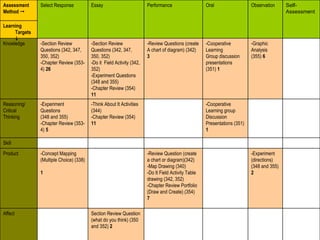
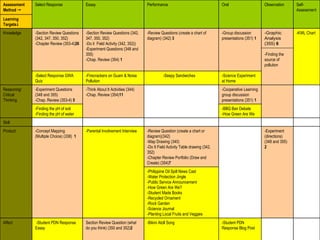
Section Review Question  (what do you think) (350  and 352)   2 Affect -Experiment  (directions)  (348 and 355) 2 -Review Question (create  a chart or diagram)(342) -Map Drawing (340) -Do It Field Activity Table  drawing (342, 352) -Chapter Review Portfolio  (Draw and Create) (354) 7 -Concept Mapping  (Multiple Choice) (338)  1 Product Skill -Cooperative  Learning group  Discussion Presentations (351) 1 -Think About It Activities  (344) -Chapter Review (354) 11 -Experiment  Questions  (348 and 355) -Chapter Review (353- 4)   5 Reasoning/  Critical  Thinking -Graphic  Analysis  (355)   6 -Cooperative  Learning Group discussion presentations  (351)  1 -Review Questions (create  A chart of diagram) (342) 3 -Section Review  Questions (342, 347,  350, 352) -Do it  Field Activity (342,  352) -Experiment Questions  (348 and 355) -Chapter Review (354)   11 -Section Review  Questions (342, 347,  350, 352) -Chapter Review (353- 4)   26 Knowledge Learning Targets  Self- Assessment Observation Oral Performance Essay Select Response Assessment  Method  
Parental   Involvement
Parental Involvement Ideas Science at Home Activity  Chaperone/Volunteer for Landfill fieldtrip  Interview   Parent Letter
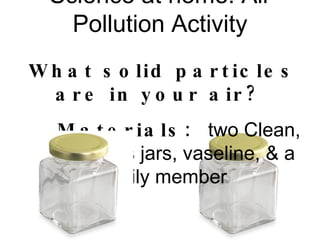
Science at home: Air Pollution Activity What solid particles are in your air?  Materials:  two Clean, empty glass jars, vaseline, & a family member
Set up two particle collectors.  Smear vaseline on the inside of two clean, empty glass jars.  Place one inside your home (suggest that students place the inside jar in a busy room, such as the kitchen or living room) and the other outside (yard or close to the driveway or street). Make sure both jars are in the locations where they will not be disturbed.  Predict what you will find if you leave the jars in place for a few days & then Compare the solid particles in each jar.  Finally, Share and report your findings with the class . Directions
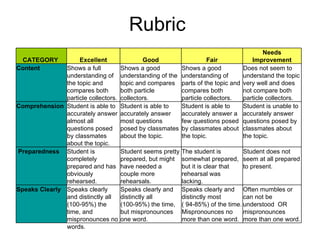
Rubric   CATEGORY  Excellent Good Fair Needs Improvement Content  Shows a full understanding of the topic and compares both particle collectors. Shows a good understanding of the topic and compares both particle collectors. Shows a good understanding of parts of the topic and compares both particle collectors.  Does not seem to understand the topic very well and does not compare both particle collectors. Comprehension  Student is able to accurately answer almost all questions posed by classmates about the topic.  Student is able to accurately answer most questions posed by classmates about the topic.  Student is able to accurately answer a few questions posed by classmates about the topic.  Student is unable to accurately answer questions posed by classmates about the topic.  Preparedness Student is completely prepared and has obviously rehearsed. Student seems pretty prepared, but might have needed a couple more rehearsals. The student is somewhat prepared, but it is clear that rehearsal was lacking. Student does not seem at all prepared to present. Speaks Clearly Speaks clearly and distinctly all (100-95%) the time, and mispronounces no words. Speaks clearly and distinctly all (100-95%) the time, but mispronounces one word. Speaks clearly and distinctly most ( 94-85%) of the time. Mispronounces no more than one word. Often mumbles or can not be understood  OR mispronounces more than one word.
Technological Modifications
Technology Assessment Ideas “ Go With the Flow”  PSA Jingle Philippine Oil Spill
Philippine Oil Spill News Cast
News Cast Rubric The newscast went over/under the 2-4 minute time period by one minute or more.  The newscast went thirty seconds over/under the 2-4 minute time period and seemed hurried or slowed.  The newscast went 15 seconds over/ under the 2-4 minute time period and was decently paced.  The newscast fell between the 2-4 minute time period and was well-paced.  Duration of presentation  It was difficult to figure out the purpose of the newscast.  The purpose is somewhat clear, but many aspects of the newscast seem only slightly related.  Establishes a purpose at the beginning, but occasionally wanders from that focus.  Newscast establishes a purpose at the beginning and maintains focus throughout.  Point of View – Purpose  Sloppy appearance which detracts from credibility of presentation.  Clean and attractive student look. Attire does not detract from credibility of presentation.  Business casual look.  Very professional clothing and accessories.  Attire  Slouches or appears too casual and establishes little eye contact with audience during newscast.  Slouches or appears too casual, but establishes good eye contact with audience during most of newscast.  Stands or sits up straight. Establishes eye contact with audience during most of newscast.  Stands or sits up straight and looks confident & relaxed. Establishes eye contact with camera during most of newscast.  Posture and Eye Contact  Does not speak clearly and distinctly most of the time and/or mispronounces more than 1 word.  Speaks clearly and distinctly most of the time and mispronounces no words.  Speaks clearly and distinctly all of the time, but mispronounces 1 word.  Speaks clearly and distinctly all of the time and mispronounces no words.  Speaks clearly  No facts were reported accurately OR no facts were reported.  Few facts were reported accurately.  Almost all facts were reported accurately.  All supportive facts were reported accurately.  Accuracy of Facts  Needs Improvement1  Fair 2  Good 3  Excellent 4  CATEGORY
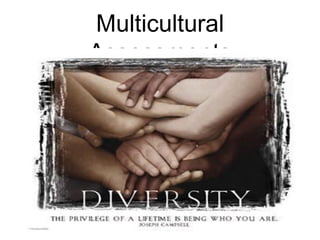
Multicultural Assessments
Cultural Relevance  The BBQ Ban Debate Measuring the pH of Guam’s waters Measuring soil pH  How  Green  Are We?
How Green Are We? Home & Community Audits Students will devise a plan with their family on ways they can lower energy consumption  Oral Presentation
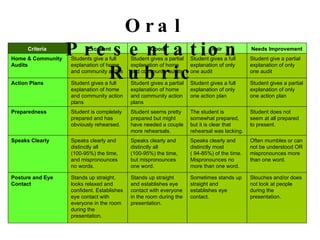
Oral Presentation Rubric Slouches and/or does not look at people during the presentation.  Sometimes stands up straight and establishes eye contact.  Stands up straight and establishes eye contact with everyone in the room during the presentation.  Stands up straight, looks relaxed and confident. Establishes eye contact with everyone in the room during the presentation.  Posture and Eye Contact  Often mumbles or can not be understood OR mispronounces more than one word.  Speaks clearly and distinctly most ( 94-85%) of the time. Mispronounces no more than one word.  Speaks clearly and distinctly all (100-95%) the time, but mispronounces one word.  Speaks clearly and distinctly all (100-95%) the time, and mispronounces no words.  Speaks Clearly  Student does not seem at all prepared to present.  The student is somewhat prepared, but it is clear that rehearsal was lacking.  Student seems pretty prepared but might have needed a couple more rehearsals.  Student is completely prepared and has obviously rehearsed.  Preparedness  Student gives a partial explanation of only one action plan  Student gives a full explanation of only one action plan  Student gives a partial explanation of home and community action plans  Student gives a full explanation of home and community action plans  Action Plans  Student give a partial explanation of only one audit  Student gives a full explanation of only one audit  Student gives a partial explanation of home and community audits  Students give a full explanation of home and community audits  Home & Community Audits  Needs Improvement Fair Good    Excellent Criteria
ESL & Disabled Student Modifications
ESL & Disabled Ideas KWL Charts Firecrackers on Guam  Student Made Books: Sound Pressure Levels
Student Made Books Activity  Individual  Students will look at the sound pressure levels and cut out pictures and explain the environmental harms associated with the noise pollution Home language  Disabled variation Don’t overwhelm
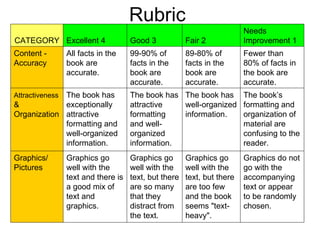
Rubric Graphics do not go with the accompanying text or appear to be randomly chosen. Graphics go well with the text, but there are too few and the book seems "text-heavy".  Graphics go well with the text, but there are so many that they distract from the text.  Graphics go well with the text and there is a good mix of text and graphics.  Graphics/ Pictures  The book’s formatting and organization of material are confusing to the reader.  The book has well-organized information.  The book has attractive formatting and well-organized information.  The book has exceptionally attractive formatting and well-organized information.  Attractiveness  & Organization  Fewer than 80% of facts in the book are accurate.  89-80% of facts in the book are accurate.  99-90% of facts in the book are accurate.  All facts in the book are accurate.  Content - Accuracy  Needs Improvement 1  Fair 2  Good 3  Excellent 4  CATEGORY
Hands-On Modifications
Hands-On Ideas  Have students plant local fruits and vegetables Have students create a scientific journal about growing plants with different soils. Have students design a “rock garden.”
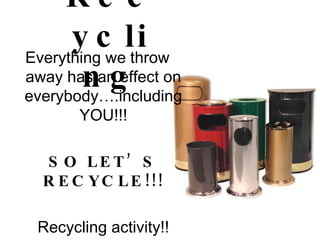
Recycling Everything we throw away has an effect on everybody….including YOU!!! SO LET’S RECYCLE!!! Recycling activity!! (Creating a rubric and writing instruction steps to it)
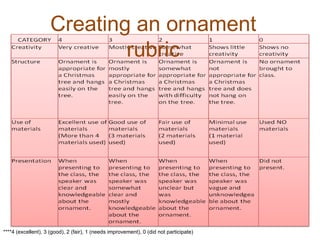
Creating an ornament rubric ****4 (excellent), 3 (good), 2 (fair), 1 (needs improvement), 0 (did not participate)
After Modification  Matrix
-Student PDN Response Blog Post -Bikini Atoll Song Section Review Question (what do you think) (350 and 352) 2 -Student PDN Response Essay Affect -Philippine Oil Spill News Cast -Water Protection Jingle  -Public Service Announcement -How Green Are We? -Student Made Books -Recycled Ornament  -Rock Garden  -Science Journal -Planting Local Fruits and Veggies -Experiment (directions) (348 and 355) 2 -Review Question (create a chart or diagram)(342) -Map Drawing (340) -Do It Field Activity Table drawing (342, 352) -Chapter Review Portfolio (Draw and Create) (354) 7 -Parental Involvement Interview -Concept Mapping (Multiple Choice) (338)  1 Product Skill -BBQ Ban Debate -How Green Are We -Finding the pH of soil -Finding the pH of water -Cooperative Learning group discussion presentations (351)   1 -Think About It Activities (344) -Chap. Review (354) 11 -Experiment Questions (348 and 355) -Chap. Review (353-4)  5 Reasoning/ Critical Thinking -Science Experiment at Home -Seepy Sandwiches -Firecrackers on Guam & Noise Pollution  -Select Response GWA Quiz -KWL Chart -Graphic Analysis (355)  6 -Finding the source of pollution  -Group discussion presentations (351)  1 -Review Questions (create a chart of diagram) (342)  3 -Section Review Questions (342, 347, 350, 352) -Do it  Field Activity (342, 352)) -Experiment Questions (348 and 355) -Chap. Review (354)  1 -Section Review Questions (342, 347, 350, 352) -Chapter Review (353-4) 26 Knowledge Learning Targets  Self-Assessment  Observation Oral Performance Essay Select Response Assessment Method  
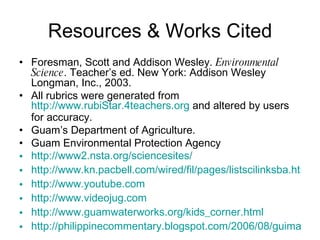
Resources & Works Cited Foresman, Scott and Addison Wesley.  Environmental Science . Teacher’s ed. New York: Addison Wesley Longman, Inc., 2003.  All rubrics were generated from  http://www.rubiStar.4teachers.org  and altered by users for accuracy.  Guam’s Department of Agriculture.  Guam Environmental Protection Agency http://www2.nsta.org/sciencesites/   http://www.kn.pacbell.com/wired/fil/pages/listscilinksba.html http://www.youtube.com   http://www.videojug.com http:// www.guamwaterworks.org/kids_corner.html   http://philippinecommentary.blogspot.com/2006/08/guimaras-island-oil-spill.html   http://www.thedeepradioshow.com/Column/2006/06-08-23.htm
Any Other Questions, Comments, or Concerns?

Textbook Assessment

  • 1.
    Textbook Assessment Presented By The Scientific Six
  • 2.
  • 3.
    Presentations Organization Introductionto the text Standards Pros &Cons Assessment Methods Before Modifications (The Matrix, Examples, & Similarities within the text) Assessment Methods After Modifications (Technology, Parental Involvement, Supports of ESL & Disabled, Multicultural, & Hands-on) Activity Conclusion
  • 4.
    Introduction to TextTitle: Environmental Science Year: 2003 Authors: Scott Foresmen & Addison Wesley Subject: Science Grade: 11th grade (NDHS) Chapter: “Resources in the Biosphere”
  • 5.
    Text’s Teacher ResourcesPlanning and Pacing guide Laboratory safety & suppliers of equipment and materials Portfolios in science & concept mapping Cooperative learning Science skills matrix Students with individual needs Program overview, program components, & the lesson cycle
  • 6.
    Unit Chapters “Minerals & Social” “ Land Pollution” “ Water” “ Water Pollution” “ Air & Noise Pollution”
  • 7.
    Standards CONTENT STANDARD9: Ecology Students will: Know that changes in ecosystems can be caused by natural and human activities which may affect all members of the system Describe the responsibilities human beings have as the stewards of the environment
  • 8.
    Performance Indicators 9.HS.1Demonstrate how biodiversity is the sum total of different kinds of organisms, and how it is affected by alterations of habitats 9.HS.2 Analyze changes in an ecosystem resulting in changes in climate, human activity, or introduction of non-native species
  • 9.
    Pros Connections toother areas of study Sections objectives assessed by section review Engaged different learners Cooperative learning End of the chapter review offered variety of assessments Chapter resources ESL & learning disabled accommodations
  • 10.
    Cons Technological assessments& support Parental involvement Organization Multicultural perspectives Questionable questions Answers and grading Musically inclined? Main assessment method
  • 11.
    Section Review Question (what do you think) (350 and 352) 2 Affect -Experiment (directions) (348 and 355) 2 -Review Question (create a chart or diagram)(342) -Map Drawing (340) -Do It Field Activity Table drawing (342, 352) -Chapter Review Portfolio (Draw and Create) (354) 7 -Concept Mapping (Multiple Choice) (338) 1 Product Skill -Cooperative Learning group Discussion Presentations (351) 1 -Think About It Activities (344) -Chapter Review (354) 11 -Experiment Questions (348 and 355) -Chapter Review (353- 4) 5 Reasoning/ Critical Thinking -Graphic Analysis (355) 6 -Cooperative Learning Group discussion presentations (351) 1 -Review Questions (create A chart of diagram) (342) 3 -Section Review Questions (342, 347, 350, 352) -Do it Field Activity (342, 352) -Experiment Questions (348 and 355) -Chapter Review (354) 11 -Section Review Questions (342, 347, 350, 352) -Chapter Review (353- 4) 26 Knowledge Learning Targets  Self- Assessment Observation Oral Performance Essay Select Response Assessment Method 
  • 12.
    Parental Involvement
  • 13.
    Parental Involvement IdeasScience at Home Activity Chaperone/Volunteer for Landfill fieldtrip Interview Parent Letter
  • 14.
    Science at home:Air Pollution Activity What solid particles are in your air? Materials: two Clean, empty glass jars, vaseline, & a family member
  • 15.
    Set up twoparticle collectors. Smear vaseline on the inside of two clean, empty glass jars. Place one inside your home (suggest that students place the inside jar in a busy room, such as the kitchen or living room) and the other outside (yard or close to the driveway or street). Make sure both jars are in the locations where they will not be disturbed. Predict what you will find if you leave the jars in place for a few days & then Compare the solid particles in each jar. Finally, Share and report your findings with the class . Directions
  • 16.
    Rubric CATEGORY Excellent Good Fair Needs Improvement Content Shows a full understanding of the topic and compares both particle collectors. Shows a good understanding of the topic and compares both particle collectors. Shows a good understanding of parts of the topic and compares both particle collectors. Does not seem to understand the topic very well and does not compare both particle collectors. Comprehension Student is able to accurately answer almost all questions posed by classmates about the topic. Student is able to accurately answer most questions posed by classmates about the topic. Student is able to accurately answer a few questions posed by classmates about the topic. Student is unable to accurately answer questions posed by classmates about the topic. Preparedness Student is completely prepared and has obviously rehearsed. Student seems pretty prepared, but might have needed a couple more rehearsals. The student is somewhat prepared, but it is clear that rehearsal was lacking. Student does not seem at all prepared to present. Speaks Clearly Speaks clearly and distinctly all (100-95%) the time, and mispronounces no words. Speaks clearly and distinctly all (100-95%) the time, but mispronounces one word. Speaks clearly and distinctly most ( 94-85%) of the time. Mispronounces no more than one word. Often mumbles or can not be understood OR mispronounces more than one word.
  • 17.
  • 18.
    Technology Assessment Ideas“ Go With the Flow” PSA Jingle Philippine Oil Spill
  • 19.
  • 20.
    News Cast RubricThe newscast went over/under the 2-4 minute time period by one minute or more. The newscast went thirty seconds over/under the 2-4 minute time period and seemed hurried or slowed. The newscast went 15 seconds over/ under the 2-4 minute time period and was decently paced. The newscast fell between the 2-4 minute time period and was well-paced. Duration of presentation It was difficult to figure out the purpose of the newscast. The purpose is somewhat clear, but many aspects of the newscast seem only slightly related. Establishes a purpose at the beginning, but occasionally wanders from that focus. Newscast establishes a purpose at the beginning and maintains focus throughout. Point of View – Purpose Sloppy appearance which detracts from credibility of presentation. Clean and attractive student look. Attire does not detract from credibility of presentation. Business casual look. Very professional clothing and accessories. Attire Slouches or appears too casual and establishes little eye contact with audience during newscast. Slouches or appears too casual, but establishes good eye contact with audience during most of newscast. Stands or sits up straight. Establishes eye contact with audience during most of newscast. Stands or sits up straight and looks confident & relaxed. Establishes eye contact with camera during most of newscast. Posture and Eye Contact Does not speak clearly and distinctly most of the time and/or mispronounces more than 1 word. Speaks clearly and distinctly most of the time and mispronounces no words. Speaks clearly and distinctly all of the time, but mispronounces 1 word. Speaks clearly and distinctly all of the time and mispronounces no words. Speaks clearly No facts were reported accurately OR no facts were reported. Few facts were reported accurately. Almost all facts were reported accurately. All supportive facts were reported accurately. Accuracy of Facts Needs Improvement1 Fair 2 Good 3 Excellent 4 CATEGORY
  • 21.
  • 22.
    Cultural Relevance The BBQ Ban Debate Measuring the pH of Guam’s waters Measuring soil pH How Green Are We?
  • 23.
    How Green AreWe? Home & Community Audits Students will devise a plan with their family on ways they can lower energy consumption Oral Presentation
  • 24.
    Oral Presentation RubricSlouches and/or does not look at people during the presentation. Sometimes stands up straight and establishes eye contact. Stands up straight and establishes eye contact with everyone in the room during the presentation. Stands up straight, looks relaxed and confident. Establishes eye contact with everyone in the room during the presentation. Posture and Eye Contact Often mumbles or can not be understood OR mispronounces more than one word. Speaks clearly and distinctly most ( 94-85%) of the time. Mispronounces no more than one word. Speaks clearly and distinctly all (100-95%) the time, but mispronounces one word. Speaks clearly and distinctly all (100-95%) the time, and mispronounces no words. Speaks Clearly Student does not seem at all prepared to present. The student is somewhat prepared, but it is clear that rehearsal was lacking. Student seems pretty prepared but might have needed a couple more rehearsals. Student is completely prepared and has obviously rehearsed. Preparedness Student gives a partial explanation of only one action plan Student gives a full explanation of only one action plan Student gives a partial explanation of home and community action plans Student gives a full explanation of home and community action plans Action Plans Student give a partial explanation of only one audit Student gives a full explanation of only one audit Student gives a partial explanation of home and community audits Students give a full explanation of home and community audits Home & Community Audits Needs Improvement Fair Good   Excellent Criteria
  • 25.
    ESL & DisabledStudent Modifications
  • 26.
    ESL & DisabledIdeas KWL Charts Firecrackers on Guam Student Made Books: Sound Pressure Levels
  • 27.
    Student Made BooksActivity Individual Students will look at the sound pressure levels and cut out pictures and explain the environmental harms associated with the noise pollution Home language Disabled variation Don’t overwhelm
  • 28.
    Rubric Graphics donot go with the accompanying text or appear to be randomly chosen. Graphics go well with the text, but there are too few and the book seems "text-heavy". Graphics go well with the text, but there are so many that they distract from the text. Graphics go well with the text and there is a good mix of text and graphics. Graphics/ Pictures The book’s formatting and organization of material are confusing to the reader. The book has well-organized information. The book has attractive formatting and well-organized information. The book has exceptionally attractive formatting and well-organized information. Attractiveness & Organization Fewer than 80% of facts in the book are accurate. 89-80% of facts in the book are accurate. 99-90% of facts in the book are accurate. All facts in the book are accurate. Content - Accuracy Needs Improvement 1 Fair 2 Good 3 Excellent 4 CATEGORY
  • 29.
  • 30.
    Hands-On Ideas Have students plant local fruits and vegetables Have students create a scientific journal about growing plants with different soils. Have students design a “rock garden.”
  • 31.
    Recycling Everything wethrow away has an effect on everybody….including YOU!!! SO LET’S RECYCLE!!! Recycling activity!! (Creating a rubric and writing instruction steps to it)
  • 32.
    Creating an ornamentrubric ****4 (excellent), 3 (good), 2 (fair), 1 (needs improvement), 0 (did not participate)
  • 33.
  • 34.
    -Student PDN ResponseBlog Post -Bikini Atoll Song Section Review Question (what do you think) (350 and 352) 2 -Student PDN Response Essay Affect -Philippine Oil Spill News Cast -Water Protection Jingle -Public Service Announcement -How Green Are We? -Student Made Books -Recycled Ornament -Rock Garden -Science Journal -Planting Local Fruits and Veggies -Experiment (directions) (348 and 355) 2 -Review Question (create a chart or diagram)(342) -Map Drawing (340) -Do It Field Activity Table drawing (342, 352) -Chapter Review Portfolio (Draw and Create) (354) 7 -Parental Involvement Interview -Concept Mapping (Multiple Choice) (338) 1 Product Skill -BBQ Ban Debate -How Green Are We -Finding the pH of soil -Finding the pH of water -Cooperative Learning group discussion presentations (351) 1 -Think About It Activities (344) -Chap. Review (354) 11 -Experiment Questions (348 and 355) -Chap. Review (353-4) 5 Reasoning/ Critical Thinking -Science Experiment at Home -Seepy Sandwiches -Firecrackers on Guam & Noise Pollution -Select Response GWA Quiz -KWL Chart -Graphic Analysis (355) 6 -Finding the source of pollution -Group discussion presentations (351) 1 -Review Questions (create a chart of diagram) (342) 3 -Section Review Questions (342, 347, 350, 352) -Do it Field Activity (342, 352)) -Experiment Questions (348 and 355) -Chap. Review (354) 1 -Section Review Questions (342, 347, 350, 352) -Chapter Review (353-4) 26 Knowledge Learning Targets  Self-Assessment Observation Oral Performance Essay Select Response Assessment Method 
  • 35.
    Resources & WorksCited Foresman, Scott and Addison Wesley. Environmental Science . Teacher’s ed. New York: Addison Wesley Longman, Inc., 2003. All rubrics were generated from http://www.rubiStar.4teachers.org and altered by users for accuracy. Guam’s Department of Agriculture. Guam Environmental Protection Agency http://www2.nsta.org/sciencesites/ http://www.kn.pacbell.com/wired/fil/pages/listscilinksba.html http://www.youtube.com http://www.videojug.com http:// www.guamwaterworks.org/kids_corner.html http://philippinecommentary.blogspot.com/2006/08/guimaras-island-oil-spill.html http://www.thedeepradioshow.com/Column/2006/06-08-23.htm
  • 36.
    Any Other Questions,Comments, or Concerns?

Editor's Notes

  • #2 As future teachers, we will be responsible for student learning. One common feature of dispensing that knowledge is through the use of a text book. And I think one thing that classroom teachers often forget is that text books are meant to be guides to student learning, rather than the ultimate form of dispensing knowledge. So as we have seen with the presentations so far, none have had a direct reference to pacific island students or students with disabilities. A few of the texts have sections for accommodations, but ultimately it is up to the educator to take into consideration the demographics of the class and teach accordingly, using the text as a guide, rather than a bible-like tool. With that being said, we have to understand that the purpose of this project is not just to judge the excellence or lack their of a book, but rather to practice and demonstrate how to use a text book when taking into consideration the variety of students that we will one day have in our class rooms.