Data Sources
How to retrieve the data?
Data preprocessing
Some key concepts
Facebook
R package
Twitter & R
Sentiment analysis (Based on Chris Potts tutorial )
Working with linguistic data
Ekaterina Vylomova
April 14, 2014
Ekaterina Vylomova Working with linguistic data
Data Sources
How to retrieve the data?
Data preprocessing
Some key concepts
Facebook
R package
Twitter & R
Sentiment analysis (Based on Chris Potts tutorial )
Possible Data Sources
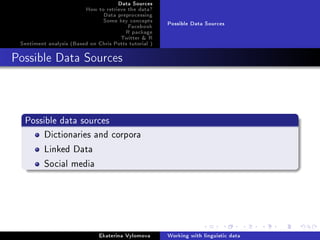
Possible data sources
Dictionaries and corpora
Linked Data
Social media
Ekaterina Vylomova Working with linguistic data
Data Sources
How to retrieve the data?
Data preprocessing
Some key concepts
Facebook
R package
Twitter & R
Sentiment analysis (Based on Chris Potts tutorial )
Possible Data Sources
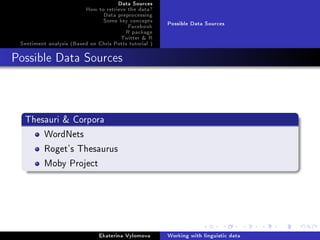
Thesauri & Corpora
WordNets
Roget's Thesaurus
Moby Project
Ekaterina Vylomova Working with linguistic data
Data Sources
How to retrieve the data?
Data preprocessing
Some key concepts
Facebook
R package
Twitter & R
Sentiment analysis (Based on Chris Potts tutorial )
Possible Data Sources
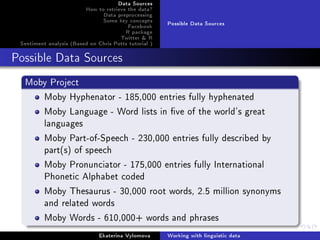
Moby Project
Moby Hyphenator - 185,000 entries fully hyphenated
Moby Language - Word lists in ve of the world's great
languages
Moby Part-of-Speech - 230,000 entries fully described by
part(s) of speech
Moby Pronunciator - 175,000 entries fully International
Phonetic Alphabet coded
Moby Thesaurus - 30,000 root words, 2.5 million synonyms
and related words
Moby Words - 610,000+ words and phrases
Ekaterina Vylomova Working with linguistic data
Data Sources
How to retrieve the data?
Data preprocessing
Some key concepts
Facebook
R package
Twitter  R
Sentiment analysis (Based on Chris Potts tutorial )
Possible Data Sources
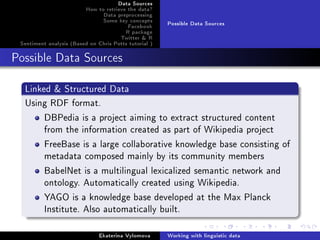
Linked  Structured Data
Using RDF format.
DBPedia is a project aiming to extract structured content
from the information created as part of Wikipedia project
FreeBase is a large collaborative knowledge base consisting of
metadata composed mainly by its community members
BabelNet is a multilingual lexicalized semantic network and
ontology. Automatically created using Wikipedia.
YAGO is a knowledge base developed at the Max Planck
Institute. Also automatically built.
Ekaterina Vylomova Working with linguistic data
Data Sources
How to retrieve the data?
Data preprocessing
Some key concepts
Facebook
R package
Twitter  R
Sentiment analysis (Based on Chris Potts tutorial )
Possible Data Sources
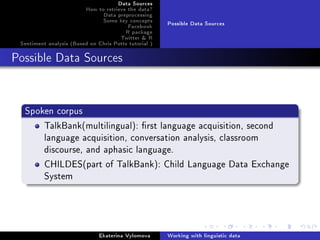
Spoken corpus
TalkBank(multilingual): rst language acquisition, second
language acquisition, conversation analysis, classroom
discourse, and aphasic language.
CHILDES(part of TalkBank): Child Language Data Exchange
System
Ekaterina Vylomova Working with linguistic data
Data Sources
How to retrieve the data?
Data preprocessing
Some key concepts
Facebook
R package
Twitter  R
Sentiment analysis (Based on Chris Potts tutorial )
Possible Data Sources
Sentiment data
SentiWordNet
Dictionary by Warriner et al.
Dictionary by Hu and Liu
Ekaterina Vylomova Working with linguistic data
Data Sources
How to retrieve the data?
Data preprocessing
Some key concepts
Facebook
R package
Twitter  R
Sentiment analysis (Based on Chris Potts tutorial )
Possible Data Sources
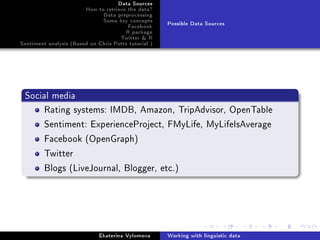
Social media
Rating systems: IMDB, Amazon, TripAdvisor, OpenTable
Sentiment: ExperienceProject, FMyLife, MyLifeIsAverage
Facebook (OpenGraph)
Twitter
Blogs (LiveJournal, Blogger, etc.)
Ekaterina Vylomova Working with linguistic data
Data Sources
How to retrieve the data?
Data preprocessing
Some key concepts
Facebook
R package
Twitter  R
Sentiment analysis (Based on Chris Potts tutorial )
Possible ways to get the data
Corpora: just download it!
Facebook, Twitter and other social media: use API
Blogs, Internet data: parse HTML or XML (download webpage
using wget/curl)
Linked data: parse RDF
Ekaterina Vylomova Working with linguistic data
Data Sources
How to retrieve the data?
Data preprocessing
Some key concepts
Facebook
R package
Twitter  R
Sentiment analysis (Based on Chris Potts tutorial )
Don'n forget this step!
Tokenization
Remove punctuation, may be number and stop words,
lower-case everything
Lemmatization or stemming(Porter, Snowball)
In case of bag-of-words you may
create term x document or term x term matrix(using TF,
TFIDF, RIDF for normalization)
Ekaterina Vylomova Working with linguistic data
Data Sources
How to retrieve the data?
Data preprocessing
Some key concepts
Facebook
R package
Twitter  R
Sentiment analysis (Based on Chris Potts tutorial )
Few key words from data mining
Compute set similarity: Jaccard, Dice, F-scores
Transform words to vectors: LSA, MDS
Get topics of documents: LDA
For classication you may use: SVM, neural networks,
discriminant analysis, bayesian networks, decision trees,
random forest,adaboost
For clustering you may use: k-means, knn, SOM, SVM
For regression you may use: SVM, neural networks, GLM, NLS
Ekaterina Vylomova Working with linguistic data
Data Sources
How to retrieve the data?
Data preprocessing
Some key concepts
Facebook
R package
Twitter  R
Sentiment analysis (Based on Chris Potts tutorial )
Connect to Facebook OpenGraph
Get access token
Go to
https:
//developers.facebook.com/tools/access_token/
Check it works:
https://developers.facebook.com/tools/explorer?
method=GETpath=me%3Ffields%3Did%2Cnameme?fields=
id,name,gender
Use tutorial:
https://developers.facebook.com/docs/graph-api/
common-scenarios/
Ekaterina Vylomova Working with linguistic data
Data Sources
How to retrieve the data?
Data preprocessing
Some key concepts
Facebook
R package
Twitter  R
Sentiment analysis (Based on Chris Potts tutorial )
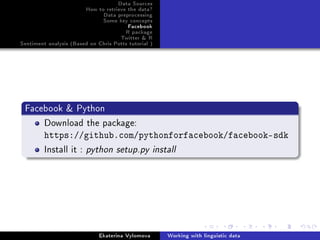
Facebook  Python
Download the package:
https://github.com/pythonforfacebook/facebook-sdk
Install it : python setup.py install
Ekaterina Vylomova Working with linguistic data
Data Sources
How to retrieve the data?
Data preprocessing
Some key concepts
Facebook
R package
Twitter  R
Sentiment analysis (Based on Chris Potts tutorial )
Facebook  Python
Get names and gender of your friends. Possible project: prediction
of gender according to the names
import facebook
token='your_token '
graph = facebook.GraphAPI(token)
profile = graph.get_object(me)
friends = graph.get_connections(me, friends)
friend_list = [friend['id'] for friend in friends['data']]
for friend_id in friend_list:
data=graph.get_object(friend_id)
if 'gender ' in data.keys():
print data['name'], data['gender ']
Ekaterina Vylomova Working with linguistic data
Data Sources
How to retrieve the data?
Data preprocessing
Some key concepts
Facebook
R package
Twitter  R
Sentiment analysis (Based on Chris Potts tutorial )
Using R
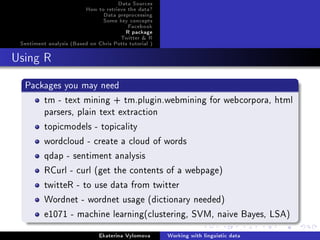
Packages you may need
tm - text mining + tm.plugin.webmining for webcorpora, html
parsers, plain text extraction
topicmodels - topicality
wordcloud - create a cloud of words
qdap - sentiment analysis
RCurl - curl (get the contents of a webpage)
twitteR - to use data from twitter
Wordnet - wordnet usage (dictionary needed)
e1071 - machine learning(clustering, SVM, naive Bayes, LSA)
Ekaterina Vylomova Working with linguistic data
Data Sources
How to retrieve the data?
Data preprocessing
Some key concepts
Facebook
R package
Twitter  R
Sentiment analysis (Based on Chris Potts tutorial )
Packages usage
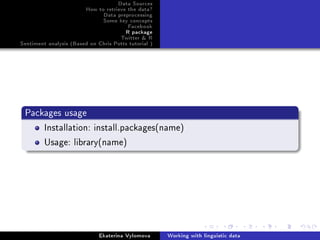
Installation: install.packages(name)
Usage: library(name)
Ekaterina Vylomova Working with linguistic data
Data Sources
How to retrieve the data?
Data preprocessing
Some key concepts
Facebook
R package
Twitter  R
Sentiment analysis (Based on Chris Potts tutorial )
Twitter with R
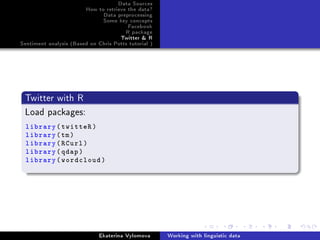
Load packages:
library(twitteR)
library(tm)
library(RCurl)
library(qdap)
library(wordcloud)
Ekaterina Vylomova Working with linguistic data
Data Sources
How to retrieve the data?
Data preprocessing
Some key concepts
Facebook
R package
Twitter  R
Sentiment analysis (Based on Chris Potts tutorial )
Twitter with R
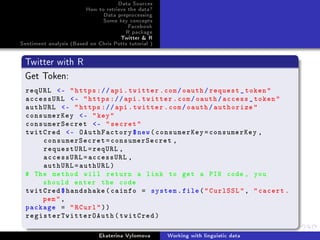
Get Token:
reqURL - https://api.twitter.com/oauth/request_token
accessURL - https://api.twitter.com/oauth/access_token
authURL - https://api.twitter.com/oauth/authorize
consumerKey - key
consumerSecret - secret
twitCred - OAuthFactory$new(consumerKey=consumerKey ,
consumerSecret=consumerSecret ,
requestURL=reqURL ,
accessURL=accessURL ,
authURL=authURL)
# The method will return a link to get a PIN code , you
should enter the code
twitCred$handshake(cainfo = system.file(CurlSSL, cacert.
pem,
package = RCurl))
registerTwitterOAuth(twitCred)
Ekaterina Vylomova Working with linguistic data
Data Sources
How to retrieve the data?
Data preprocessing
Some key concepts
Facebook
R package
Twitter  R
Sentiment analysis (Based on Chris Potts tutorial )
Twitter with R
Get the data and convert to corpus:
# search by hashtag , you may also search by plain words. Get
n=1000 entries
gglTweets - searchTwitter('#sochi2014 ', n=1000)
n - length(gglTweets)
# show first 3 entries
gglTweets [1:3]
# put it in a data frame
df - do.call(rbind,
lapply(gglTweets , as.data.frame))
# get dimenstionality
dim(df)
# create a corpus
myCorpus - Corpus(VectorSource(df$text))
Ekaterina Vylomova Working with linguistic data
Data Sources
How to retrieve the data?
Data preprocessing
Some key concepts
Facebook
R package
Twitter  R
Sentiment analysis (Based on Chris Potts tutorial )
Twitter with R
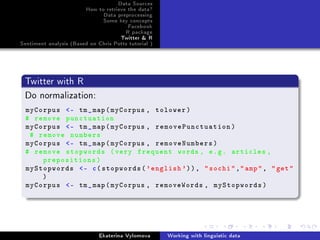
Do normalization:
myCorpus - tm_map(myCorpus , tolower)
# remove punctuation
myCorpus - tm_map(myCorpus , removePunctuation)
# remove numbers
myCorpus - tm_map(myCorpus , removeNumbers)
# remove stopwords (very frequent words , e.g. articles ,
prepositions)
myStopwords - c(stopwords('english ')), sochi,amp, get
)
myCorpus - tm_map(myCorpus , removeWords , myStopwords)
Ekaterina Vylomova Working with linguistic data
Data Sources
How to retrieve the data?
Data preprocessing
Some key concepts
Facebook
R package
Twitter  R
Sentiment analysis (Based on Chris Potts tutorial )
Twitter with R
Stem the documents:
dictCorpus - myCorpus
# apply stemming for normalization , you may use
lemmatization instead
myCorpus - tm_map(myCorpus , stemDocument)
inspect(myCorpus [1:3])
myCorpus - tm_map(myCorpus ,
stemCompletion , dictionary=dictCorpus)
inspect(myCorpus [1:3])
Ekaterina Vylomova Working with linguistic data
Data Sources
How to retrieve the data?
Data preprocessing
Some key concepts
Facebook
R package
Twitter  R
Sentiment analysis (Based on Chris Potts tutorial )
Twitter with R
Create TDM:
# create term -document matrix , you may use TF or TFIDF
metric
myDtm - TermDocumentMatrix(myCorpus , control =
list(minWordLength = 1,
weighting = weightTfIdf))
inspect(myDtm [66:70 ,11:20])
# frequent terms and associations
findFreqTerms(myDtm , lowfreq =10)
Ekaterina Vylomova Working with linguistic data
Data Sources
How to retrieve the data?
Data preprocessing
Some key concepts
Facebook
R package
Twitter  R
Sentiment analysis (Based on Chris Potts tutorial )
Twitter with R
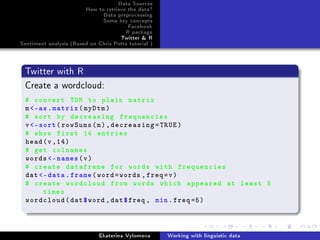
Create a wordcloud:
# convert TDM to plain matrix
m-as.matrix(myDtm)
# sort by decreasing frequencies
v-sort(rowSums(m),decreasing=TRUE)
# show first 14 entries
head(v,14)
# get colnames
words -names(v)
# create dataframe for words with frequencies
dat -data.frame(word=words ,freq=v)
# create wordcloud from words which appeared at least 5
times
wordcloud(dat$word ,dat$freq , min.freq =5)
Ekaterina Vylomova Working with linguistic data
Data Sources
How to retrieve the data?
Data preprocessing
Some key concepts
Facebook
R package
Twitter  R
Sentiment analysis (Based on Chris Potts tutorial )
Experience project
Experience project
IMDB: Vector space models
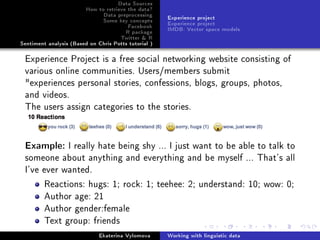
Experience Project is a free social networking website consisting of
various online communities. Users/members submit
experiences personal stories, confessions, blogs, groups, photos,
and videos.
The users assign categories to the stories.
Example: I really hate being shy ... I just want to be able to talk to
someone about anything and everything and be myself ... That's all
I've ever wanted.
Reactions: hugs: 1; rock: 1; teehee: 2; understand: 10; wow: 0;
Author age: 21
Author gender:female
Text group: friends
Ekaterina Vylomova Working with linguistic data
Data Sources
How to retrieve the data?
Data preprocessing
Some key concepts
Facebook
R package
Twitter  R
Sentiment analysis (Based on Chris Potts tutorial )
Experience project
Experience project
IMDB: Vector space models
Data
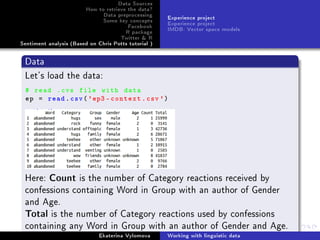
Let's load the data:
# read .cvs file with data
ep = read.csv('ep3 -context.csv')
Here: Count is the number of Category reactions received by
confessions containing Word in Group with an author of Gender
and Age.
Total is the number of Category reactions used by confessions
containing any Word in Group with an author of Gender and Age.
Ekaterina Vylomova Working with linguistic data
Data Sources
How to retrieve the data?
Data preprocessing
Some key concepts
Facebook
R package
Twitter  R
Sentiment analysis (Based on Chris Potts tutorial )
Experience project
Experience project
IMDB: Vector space models
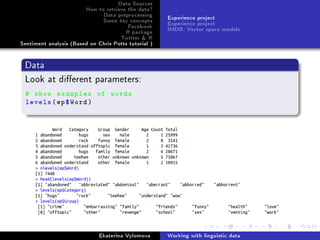
Data
Look at dierent parameters:
# show examples of words
levels(ep$Word)
Ekaterina Vylomova Working with linguistic data
Data Sources
How to retrieve the data?
Data preprocessing
Some key concepts
Facebook
R package
Twitter  R
Sentiment analysis (Based on Chris Potts tutorial )
Experience project
Experience project
IMDB: Vector space models
Words and categories
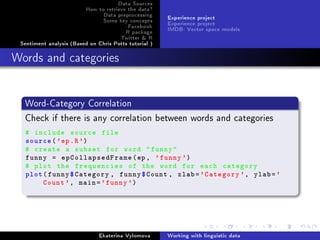
Word-Category Correlation
Check if there is any correlation between words and categories
# include source file
source('ep.R')
# create a subset for word funny
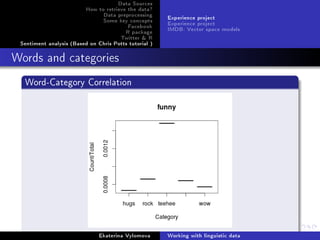
funny = epCollapsedFrame(ep, 'funny')
# plot the frequencies of the word for each category
plot(funny$Category , funny$Count , xlab='Category ', ylab='
Count', main='funny')
Ekaterina Vylomova Working with linguistic data
Data Sources
How to retrieve the data?
Data preprocessing
Some key concepts
Facebook
R package
Twitter  R
Sentiment analysis (Based on Chris Potts tutorial )
Experience project
Experience project
IMDB: Vector space models
Words and categories
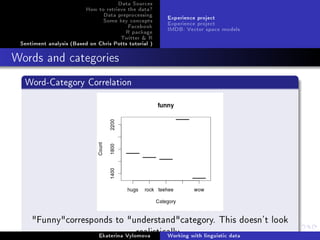
Word-Category Correlation
Funnycorresponds to understandcategory. This doesn't look
realistically..Ekaterina Vylomova Working with linguistic data
Data Sources
How to retrieve the data?
Data preprocessing
Some key concepts
Facebook
R package
Twitter  R
Sentiment analysis (Based on Chris Potts tutorial )
Experience project
Experience project
IMDB: Vector space models
Words and categories
Word-Category Correlation
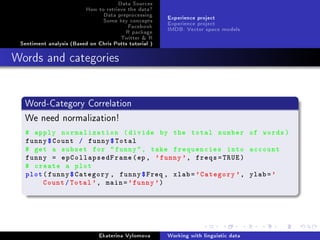
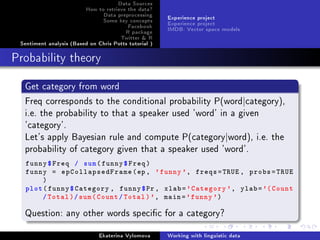
We need normalization!
# apply normalization (divide by the total number of words)
funny$Count / funny$Total
# get a subset for funny, take frequencies into account
funny = epCollapsedFrame(ep, 'funny', freqs=TRUE)
# create a plot
plot(funny$Category , funny$Freq , xlab='Category ', ylab='
Count/Total', main='funny')
Ekaterina Vylomova Working with linguistic data
Data Sources
How to retrieve the data?
Data preprocessing
Some key concepts
Facebook
R package
Twitter  R
Sentiment analysis (Based on Chris Potts tutorial )
Experience project
Experience project
IMDB: Vector space models
Words and categories
Word-Category Correlation
Much better!Ekaterina Vylomova Working with linguistic data
Data Sources
How to retrieve the data?
Data preprocessing
Some key concepts
Facebook
R package
Twitter  R
Sentiment analysis (Based on Chris Potts tutorial )
Experience project
Experience project
IMDB: Vector space models
Probability theory
Get category from word
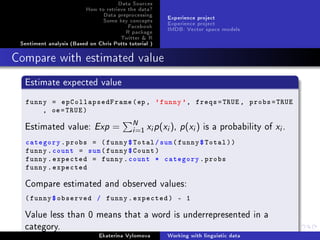
Freq corresponds to the conditional probability P(word|category),
i.e. the probability to that a speaker used 'word' in a given
'category'.
Let's apply Bayesian rule and compute P(category|word), i.e. the
probability of category given that a speaker used 'word'.
funny$Freq / sum(funny$Freq)
funny = epCollapsedFrame(ep, 'funny', freqs=TRUE , probs=TRUE
)
plot(funny$Category , funny$Pr , xlab='Category ', ylab='(Count
/Total)/sum(Count/Total)', main='funny')
Question: any other words specic for a category?
Ekaterina Vylomova Working with linguistic data
Data Sources
How to retrieve the data?
Data preprocessing
Some key concepts
Facebook
R package
Twitter  R
Sentiment analysis (Based on Chris Potts tutorial )
Experience project
Experience project
IMDB: Vector space models
Compare with estimated value
Estimate expected value
funny = epCollapsedFrame(ep, 'funny', freqs=TRUE , probs=TRUE
, oe=TRUE)
Estimated value: Exp = N
i=1 xip(xi), p(xi) is a probability of xi.
category.probs = (funny$Total/sum(funny$Total))
funny.count = sum(funny$Count)
funny.expected = funny.count * category.probs
funny.expected
Compare estimated and observed values:
(funny$observed / funny.expected) - 1
Value less than 0 means that a word is underrepresented in a
category.
Ekaterina Vylomova Working with linguistic data
Data Sources
How to retrieve the data?
Data preprocessing
Some key concepts
Facebook
R package
Twitter  R
Sentiment analysis (Based on Chris Potts tutorial )
Experience project
Experience project
IMDB: Vector space models
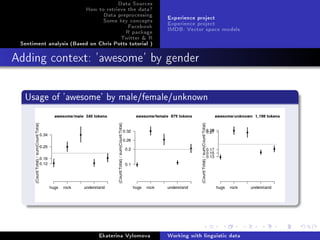
Adding context: 'awesome' by gender
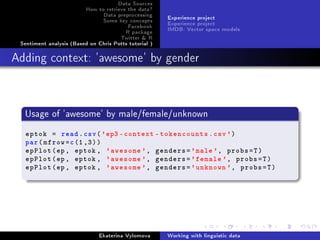
Usage of 'awesome' by male/female/unknown
eptok = read.csv('ep3 -context -tokencounts.csv')
par(mfrow=c(1,3))
epPlot(ep , eptok , 'awesome ', genders='male', probs=T)
epPlot(ep , eptok , 'awesome ', genders='female ', probs=T)
epPlot(ep , eptok , 'awesome ', genders='unknown ', probs=T)
Ekaterina Vylomova Working with linguistic data
Data Sources
How to retrieve the data?
Data preprocessing
Some key concepts
Facebook
R package
Twitter  R
Sentiment analysis (Based on Chris Potts tutorial )
Experience project
Experience project
IMDB: Vector space models
Adding context: 'awesome' by gender
Usage of 'awesome' by male/female/unknown
Ekaterina Vylomova Working with linguistic data
Data Sources
How to retrieve the data?
Data preprocessing
Some key concepts
Facebook
R package
Twitter  R
Sentiment analysis (Based on Chris Potts tutorial )
Experience project
Experience project
IMDB: Vector space models
Adding context: 'awesome' by age
Usage of 'awesome' by people of dierent ages
par(mfrow=c(2,3))
for (i in 1:5) { epPlot(ep, eptok , 'awesome ', ages=i, probs=
T) }
Ekaterina Vylomova Working with linguistic data
Data Sources
How to retrieve the data?
Data preprocessing
Some key concepts
Facebook
R package
Twitter  R
Sentiment analysis (Based on Chris Potts tutorial )
Experience project
Experience project
IMDB: Vector space models
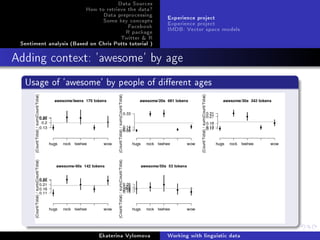
Adding context: 'awesome' by age
Usage of 'awesome' by people of dierent ages
Ekaterina Vylomova Working with linguistic data
Data Sources
How to retrieve the data?
Data preprocessing
Some key concepts
Facebook
R package
Twitter  R
Sentiment analysis (Based on Chris Potts tutorial )
Experience project
Experience project
IMDB: Vector space models
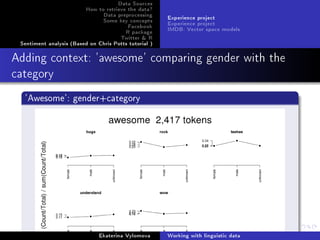
Adding context: 'awesome' comparing gender with the
category
'Awesome': gender+category
Changing the parameter for each category separately:
epCategoryByFactorPlot(ep, eptok , 'awesome ', 'Gender ', probs
=T, type='b')
Ekaterina Vylomova Working with linguistic data
Data Sources
How to retrieve the data?
Data preprocessing
Some key concepts
Facebook
R package
Twitter  R
Sentiment analysis (Based on Chris Potts tutorial )
Experience project
Experience project
IMDB: Vector space models
Adding context: 'awesome' comparing gender with the
category
'Awesome': gender+category
Ekaterina Vylomova Working with linguistic data
Data Sources
How to retrieve the data?
Data preprocessing
Some key concepts
Facebook
R package
Twitter  R
Sentiment analysis (Based on Chris Potts tutorial )
Experience project
Experience project
IMDB: Vector space models
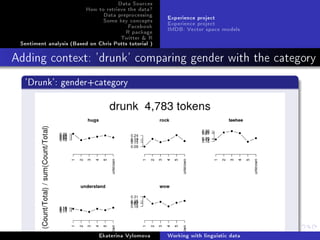
Adding context: 'drunk' comparing gender with the category
'Drunk': gender+category
Stories with drunkdepend on the age:
epCategoryByFactorPlot(ep, eptok , 'drunk', 'Age', probs=T,
type='b')
Ekaterina Vylomova Working with linguistic data
Data Sources
How to retrieve the data?
Data preprocessing
Some key concepts
Facebook
R package
Twitter  R
Sentiment analysis (Based on Chris Potts tutorial )
Experience project
Experience project
IMDB: Vector space models
Adding context: 'drunk' comparing gender with the category
'Drunk': gender+category
Ekaterina Vylomova Working with linguistic data
Data Sources
How to retrieve the data?
Data preprocessing
Some key concepts
Facebook
R package
Twitter  R
Sentiment analysis (Based on Chris Potts tutorial )
Experience project
Experience project
IMDB: Vector space models
Creating a logistic regression model
Regression modelling
Let's create a regression model: predict the frequency of 'drunk'
using age and category
drunk = epFullFrame(ep, 'drunk', age=c(1,2,3,4,5))
drunk$Age = as.numeric(drunk$Age)
fit.glm = glm(cbind(Count ,Total -Count) ~ Category - 1 + Age ,
data=drunk , family=binomial)
summary(fit.glm)
Ekaterina Vylomova Working with linguistic data
Data Sources
How to retrieve the data?
Data preprocessing
Some key concepts
Facebook
R package
Twitter  R
Sentiment analysis (Based on Chris Potts tutorial )
Experience project
Experience project
IMDB: Vector space models
Creating a logistic regression model
Regression modelling
Find a function that predicts a word according to the category and
age of person
FittedGlmFunc = function(fit , category , age) {
coefs = fit$coef
cat.coef = coefs[[ paste('Category ',category , sep='')]]
prediction = plogis(cat.coef + coefs [['Age']]*age)
return(prediction)
}
Calling the function:
FittedGlmFunc(fit.glm , 'wow', 1)
Ekaterina Vylomova Working with linguistic data
Data Sources
How to retrieve the data?
Data preprocessing
Some key concepts
Facebook
R package
Twitter  R
Sentiment analysis (Based on Chris Potts tutorial )
Experience project
Experience project
IMDB: Vector space models
Creating a logistic regression model
Regression modelling
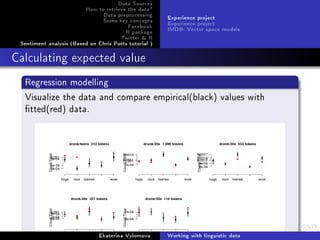
Visualize the data and compare empirical(black) values with
tted(red) data.
par(mfrow=c(2,3))
cats = levels(ep$Category)
for(i in 1:5) {
epPlot(ep , eptok , 'drunk', age=i)
for (j in 1:5) {
val = FittedGlmFunc(fit.glm , cats[j], i)
points(j, val , col='red', pch =19)
}
}
Ekaterina Vylomova Working with linguistic data
Data Sources
How to retrieve the data?
Data preprocessing
Some key concepts
Facebook
R package
Twitter  R
Sentiment analysis (Based on Chris Potts tutorial )
Experience project
Experience project
IMDB: Vector space models
Calculating expected value
Regression modelling
Visualize the data and compare empirical(black) values with
tted(red) data.
Ekaterina Vylomova Working with linguistic data
Data Sources
How to retrieve the data?
Data preprocessing
Some key concepts
Facebook
R package
Twitter  R
Sentiment analysis (Based on Chris Potts tutorial )
Experience project
Experience project
IMDB: Vector space models
IMDB data
Analysis of ADV-ADJcollocations
Ekaterina Vylomova Working with linguistic data
Data Sources
How to retrieve the data?
Data preprocessing
Some key concepts
Facebook
R package
Twitter  R
Sentiment analysis (Based on Chris Potts tutorial )
Experience project
Experience project
IMDB: Vector space models
Data from rating systems
Data
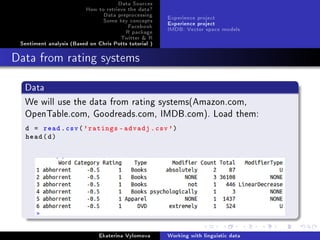
We will use the data from rating systems(Amazon.com,
OpenTable.com, Goodreads.com, IMDB.com). Load them:
d = read.csv('ratings -advadj.csv')
head(d)
Ekaterina Vylomova Working with linguistic data
Data Sources
How to retrieve the data?
Data preprocessing
Some key concepts
Facebook
R package
Twitter  R
Sentiment analysis (Based on Chris Potts tutorial )
Experience project
Experience project
IMDB: Vector space models
Extract subsets
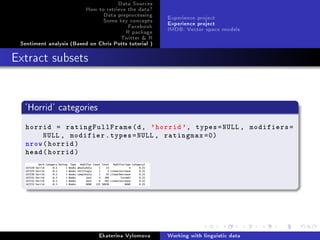
'Horrid' categories
horrid = ratingFullFrame(d, 'horrid ', types=NULL , modifiers=
NULL , modifier.types=NULL , ratingmax =0)
nrow(horrid)
head(horrid)
Ekaterina Vylomova Working with linguistic data
Data Sources
How to retrieve the data?
Data preprocessing
Some key concepts
Facebook
R package
Twitter  R
Sentiment analysis (Based on Chris Potts tutorial )
Experience project
Experience project
IMDB: Vector space models
Extract subsets
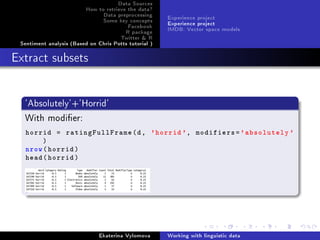
'Absolutely'+'Horrid'
With modier:
horrid = ratingFullFrame(d, 'horrid ', modifiers='absolutely '
)
nrow(horrid)
head(horrid)
Ekaterina Vylomova Working with linguistic data
Data Sources
How to retrieve the data?
Data preprocessing
Some key concepts
Facebook
R package
Twitter  R
Sentiment analysis (Based on Chris Potts tutorial )
Experience project
Experience project
IMDB: Vector space models
Tonality evaluation for adjectives
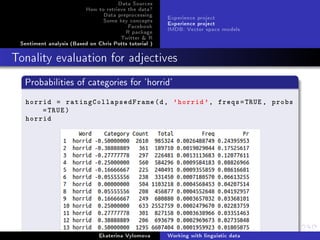
Probabilities of categories for 'horrid'
horrid = ratingCollapsedFrame(d, 'horrid ', freqs=TRUE , probs
=TRUE)
horrid
Ekaterina Vylomova Working with linguistic data
Data Sources
How to retrieve the data?
Data preprocessing
Some key concepts
Facebook
R package
Twitter  R
Sentiment analysis (Based on Chris Potts tutorial )
Experience project
Experience project
IMDB: Vector space models
Tonality
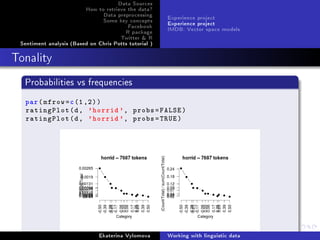
Probabilities vs frequencies
par(mfrow=c(1,2))
ratingPlot(d, 'horrid ', probs=FALSE)
ratingPlot(d, 'horrid ', probs=TRUE)
Ekaterina Vylomova Working with linguistic data
Data Sources
How to retrieve the data?
Data preprocessing
Some key concepts
Facebook
R package
Twitter  R
Sentiment analysis (Based on Chris Potts tutorial )
Experience project
Experience project
IMDB: Vector space models
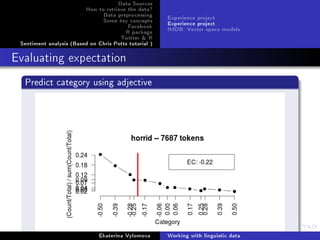
Evaluating expectation
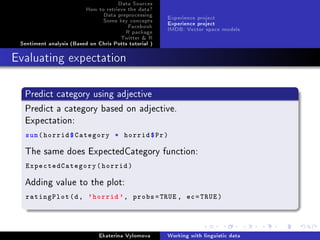
Predict category using adjective
Predict a category based on adjective.
Expectation:
sum(horrid$Category * horrid$Pr)
The same does ExpectedCategory function:
ExpectedCategory(horrid)
Adding value to the plot:
ratingPlot(d, 'horrid ', probs=TRUE , ec=TRUE)
Ekaterina Vylomova Working with linguistic data
Data Sources
How to retrieve the data?
Data preprocessing
Some key concepts
Facebook
R package
Twitter  R
Sentiment analysis (Based on Chris Potts tutorial )
Experience project
Experience project
IMDB: Vector space models
Evaluating expectation
Predict category using adjective
Ekaterina Vylomova Working with linguistic data
Data Sources
How to retrieve the data?
Data preprocessing
Some key concepts
Facebook
R package
Twitter  R
Sentiment analysis (Based on Chris Potts tutorial )
Experience project
Experience project
IMDB: Vector space models
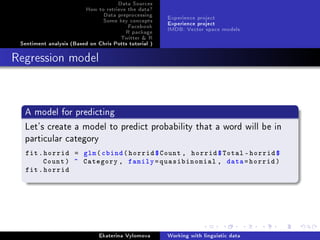
Regression model
A model for predicting
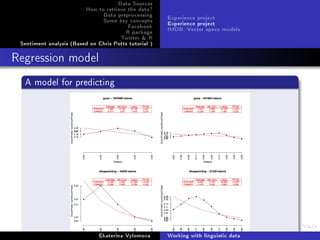
Let's create a model to predict probability that a word will be in
particular category
fit.horrid = glm(cbind(horrid$Count , horrid$Total -horrid$
Count) ~ Category , family=quasibinomial , data=horrid)
fit.horrid
Ekaterina Vylomova Working with linguistic data
Data Sources
How to retrieve the data?
Data preprocessing
Some key concepts
Facebook
R package
Twitter  R
Sentiment analysis (Based on Chris Potts tutorial )
Experience project
Experience project
IMDB: Vector space models
Regression model
A model for predicting
Ekaterina Vylomova Working with linguistic data
Data Sources
How to retrieve the data?
Data preprocessing
Some key concepts
Facebook
R package
Twitter  R
Sentiment analysis (Based on Chris Potts tutorial )
Experience project
Experience project
IMDB: Vector space models
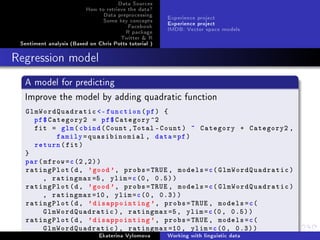
Regression model
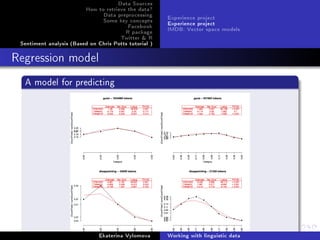
A model for predicting
Improve the model by adding quadratic function
GlmWordQuadratic -function(pf) {
pf$Category2 = pf$Category ^2
fit = glm(cbind(Count ,Total -Count) ~ Category + Category2 ,
family=quasibinomial , data=pf)
return(fit)
}
par(mfrow=c(2,2))
ratingPlot(d, 'good', probs=TRUE , models=c(GlmWordQuadratic)
, ratingmax=5, ylim=c(0, 0.5))
ratingPlot(d, 'good', probs=TRUE , models=c(GlmWordQuadratic)
, ratingmax =10, ylim=c(0, 0.3))
ratingPlot(d, 'disappointing ', probs=TRUE , models=c(
GlmWordQuadratic), ratingmax=5, ylim=c(0, 0.5))
ratingPlot(d, 'disappointing ', probs=TRUE , models=c(
GlmWordQuadratic), ratingmax =10, ylim=c(0, 0.3))
Ekaterina Vylomova Working with linguistic data
Data Sources
How to retrieve the data?
Data preprocessing
Some key concepts
Facebook
R package
Twitter  R
Sentiment analysis (Based on Chris Potts tutorial )
Experience project
Experience project
IMDB: Vector space models
Regression model
A model for predicting
Ekaterina Vylomova Working with linguistic data
Data Sources
How to retrieve the data?
Data preprocessing
Some key concepts
Facebook
R package
Twitter  R
Sentiment analysis (Based on Chris Potts tutorial )
Experience project
Experience project
IMDB: Vector space models
Vector space models
Vector space models
How to transform words to vectors:
LSA (latent semantic analysis)
MDS (multidimensional scaling)
Ekaterina Vylomova Working with linguistic data
Data Sources
How to retrieve the data?
Data preprocessing
Some key concepts
Facebook
R package
Twitter  R
Sentiment analysis (Based on Chris Potts tutorial )
Experience project
Experience project
IMDB: Vector space models
Basics about vectors
Euclidean distance:
EuclideanDist(x, y) =
n
i=1
(xi − yi)2
Vector length:
VectorLength(x) =
n
i=1
(xi)2
Vector normalization - component divided by its length.
Cosine between vectors:
CosineDist(x, y) = 1 −
n
i=1 (xi) ∗ n
i=1 (yi)
VectorLength(x) ∗ VectorLength(y)
Ekaterina Vylomova Working with linguistic data
Data Sources
How to retrieve the data?
Data preprocessing
Some key concepts
Facebook
R package
Twitter  R
Sentiment analysis (Based on Chris Potts tutorial )
Experience project
Experience project
IMDB: Vector space models
Vector space models
Data from IMDB
Initail data: term x term matrix, xij element of matrix is a
frequency of cooccurrence of termi and termj in context(document,
sentences, etc.)
source('vsm.R')
# co-occurrence matrix(words appearing in the same context(
phrase , sentence , paragraph))
imdb = Csv2Matrix('imdb -wordword.csv')
imdb [100:110 , 100:110]
Ekaterina Vylomova Working with linguistic data
Data Sources
How to retrieve the data?
Data preprocessing
Some key concepts
Facebook
R package
Twitter  R
Sentiment analysis (Based on Chris Potts tutorial )
Experience project
Experience project
IMDB: Vector space models
Semantically related words
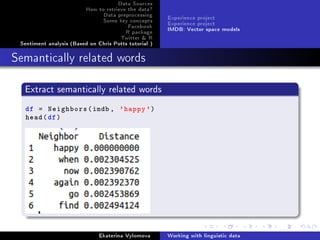
Extract semantically related words
df = Neighbors(imdb , 'happy')
head(df)
Ekaterina Vylomova Working with linguistic data
Data Sources
How to retrieve the data?
Data preprocessing
Some key concepts
Facebook
R package
Twitter  R
Sentiment analysis (Based on Chris Potts tutorial )
Experience project
Experience project
IMDB: Vector space models
Semantically related words
Problem
a = c(1000 , 2000, 3000)
b = c(1, 2, 3)
a/sum(a)
# 0.1666667 0.3333333 0.5000000
b/sum(b)
# 0.1666667 0.3333333 0.5000000
LengthNorm(a)
# 0.2672612 0.5345225 0.8017837
LengthNorm(b)
 [1] 0.2672612 0.5345225 0.801783
Ekaterina Vylomova Working with linguistic data
Data Sources
How to retrieve the data?
Data preprocessing
Some key concepts
Facebook
R package
Twitter  R
Sentiment analysis (Based on Chris Potts tutorial )
Experience project
Experience project
IMDB: Vector space models
PMI - Pointwise mutual information
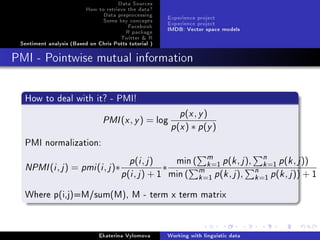
How to deal with it? - PMI!
PMI(x, y) = log
p(x, y)
p(x) ∗ p(y)
PMI normalization:
NPMI(i, j) = pmi(i, j)∗
p(i, j)
p(i, j) + 1
∗
min ( m
k=1 p(k, j), n
k=1 p(k, j))
min ( m
k=1 p(k, j), n
k=1 p(k, j)) + 1
Where p(i,j)=M/sum(M), M - term x term matrix
Ekaterina Vylomova Working with linguistic data
Data Sources
How to retrieve the data?
Data preprocessing
Some key concepts
Facebook
R package
Twitter  R
Sentiment analysis (Based on Chris Potts tutorial )
Experience project
Experience project
IMDB: Vector space models
PMI - Pointwise mutual information
PMI
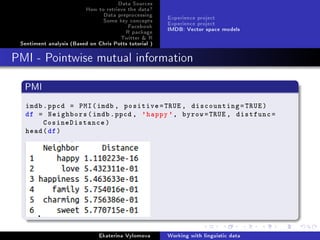
imdb.ppcd = PMI(imdb , positive=TRUE , discounting=TRUE)
df = Neighbors(imdb.ppcd , 'happy', byrow=TRUE , distfunc=
CosineDistance)
head(df)
Ekaterina Vylomova Working with linguistic data
Data Sources
How to retrieve the data?
Data preprocessing
Some key concepts
Facebook
R package
Twitter  R
Sentiment analysis (Based on Chris Potts tutorial )
Experience project
Experience project
IMDB: Vector space models
Semantic orientation method
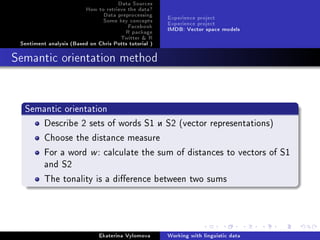
Semantic orientation
Describe 2 sets of words S1 è S2 (vector representations)
Choose the distance measure
For a word w: calculate the sum of distances to vectors of S1
and S2
The tonality is a dierence between two sums
Ekaterina Vylomova Working with linguistic data
Data Sources
How to retrieve the data?
Data preprocessing
Some key concepts
Facebook
R package
Twitter  R
Sentiment analysis (Based on Chris Potts tutorial )
Experience project
Experience project
IMDB: Vector space models
Semantic orientation method
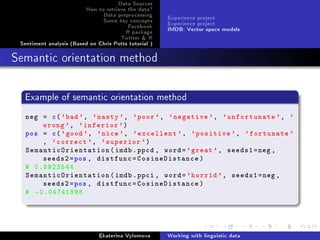
Example of semantic orientation method
neg = c('bad', 'nasty ', 'poor', 'negative ', 'unfortunate ', '
wrong', 'inferior ')
pos = c('good', 'nice', 'excellent ', 'positive ', 'fortunate '
, 'correct ', 'superior ')
SemanticOrientation(imdb.ppcd , word='great ', seeds1=neg ,
seeds2=pos , distfunc=CosineDistance)
# 0.8923544
SemanticOrientation(imdb.ppci , word='horrid ', seeds1=neg ,
seeds2=pos , distfunc=CosineDistance)
# -0.04741898
Ekaterina Vylomova Working with linguistic data
Data Sources
How to retrieve the data?
Data preprocessing
Some key concepts
Facebook
R package
Twitter  R
Sentiment analysis (Based on Chris Potts tutorial )
Experience project
Experience project
IMDB: Vector space models
More information
Data  examples
For more detailed examples and tutorials about sentiment analysis
go to Chris Potts tutorials.
http://nasslli2012.christopherpotts.net
http://sentiment.christopherpotts.net
Email me if you need any help!
Ekaterina Vylomova Working with linguistic data

Working with text data

  • 1.
    Data Sources How toretrieve the data? Data preprocessing Some key concepts Facebook R package Twitter & R Sentiment analysis (Based on Chris Potts tutorial ) Working with linguistic data Ekaterina Vylomova April 14, 2014 Ekaterina Vylomova Working with linguistic data
  • 2.
    Data Sources How toretrieve the data? Data preprocessing Some key concepts Facebook R package Twitter & R Sentiment analysis (Based on Chris Potts tutorial ) Possible Data Sources Possible Data Sources Possible data sources Dictionaries and corpora Linked Data Social media Ekaterina Vylomova Working with linguistic data
  • 3.
    Data Sources How toretrieve the data? Data preprocessing Some key concepts Facebook R package Twitter & R Sentiment analysis (Based on Chris Potts tutorial ) Possible Data Sources Possible Data Sources Thesauri & Corpora WordNets Roget's Thesaurus Moby Project Ekaterina Vylomova Working with linguistic data
  • 4.
    Data Sources How toretrieve the data? Data preprocessing Some key concepts Facebook R package Twitter & R Sentiment analysis (Based on Chris Potts tutorial ) Possible Data Sources Possible Data Sources Moby Project Moby Hyphenator - 185,000 entries fully hyphenated Moby Language - Word lists in ve of the world's great languages Moby Part-of-Speech - 230,000 entries fully described by part(s) of speech Moby Pronunciator - 175,000 entries fully International Phonetic Alphabet coded Moby Thesaurus - 30,000 root words, 2.5 million synonyms and related words Moby Words - 610,000+ words and phrases Ekaterina Vylomova Working with linguistic data
  • 5.
    Data Sources How toretrieve the data? Data preprocessing Some key concepts Facebook R package Twitter R Sentiment analysis (Based on Chris Potts tutorial ) Possible Data Sources Possible Data Sources Linked Structured Data Using RDF format. DBPedia is a project aiming to extract structured content from the information created as part of Wikipedia project FreeBase is a large collaborative knowledge base consisting of metadata composed mainly by its community members BabelNet is a multilingual lexicalized semantic network and ontology. Automatically created using Wikipedia. YAGO is a knowledge base developed at the Max Planck Institute. Also automatically built. Ekaterina Vylomova Working with linguistic data
  • 6.
    Data Sources How toretrieve the data? Data preprocessing Some key concepts Facebook R package Twitter R Sentiment analysis (Based on Chris Potts tutorial ) Possible Data Sources Possible Data Sources Spoken corpus TalkBank(multilingual): rst language acquisition, second language acquisition, conversation analysis, classroom discourse, and aphasic language. CHILDES(part of TalkBank): Child Language Data Exchange System Ekaterina Vylomova Working with linguistic data
  • 7.
    Data Sources How toretrieve the data? Data preprocessing Some key concepts Facebook R package Twitter R Sentiment analysis (Based on Chris Potts tutorial ) Possible Data Sources Possible Data Sources Sentiment data SentiWordNet Dictionary by Warriner et al. Dictionary by Hu and Liu Ekaterina Vylomova Working with linguistic data
  • 8.
    Data Sources How toretrieve the data? Data preprocessing Some key concepts Facebook R package Twitter R Sentiment analysis (Based on Chris Potts tutorial ) Possible Data Sources Social media Rating systems: IMDB, Amazon, TripAdvisor, OpenTable Sentiment: ExperienceProject, FMyLife, MyLifeIsAverage Facebook (OpenGraph) Twitter Blogs (LiveJournal, Blogger, etc.) Ekaterina Vylomova Working with linguistic data
  • 9.
    Data Sources How toretrieve the data? Data preprocessing Some key concepts Facebook R package Twitter R Sentiment analysis (Based on Chris Potts tutorial ) Possible ways to get the data Corpora: just download it! Facebook, Twitter and other social media: use API Blogs, Internet data: parse HTML or XML (download webpage using wget/curl) Linked data: parse RDF Ekaterina Vylomova Working with linguistic data
  • 10.
    Data Sources How toretrieve the data? Data preprocessing Some key concepts Facebook R package Twitter R Sentiment analysis (Based on Chris Potts tutorial ) Don'n forget this step! Tokenization Remove punctuation, may be number and stop words, lower-case everything Lemmatization or stemming(Porter, Snowball) In case of bag-of-words you may create term x document or term x term matrix(using TF, TFIDF, RIDF for normalization) Ekaterina Vylomova Working with linguistic data
  • 11.
    Data Sources How toretrieve the data? Data preprocessing Some key concepts Facebook R package Twitter R Sentiment analysis (Based on Chris Potts tutorial ) Few key words from data mining Compute set similarity: Jaccard, Dice, F-scores Transform words to vectors: LSA, MDS Get topics of documents: LDA For classication you may use: SVM, neural networks, discriminant analysis, bayesian networks, decision trees, random forest,adaboost For clustering you may use: k-means, knn, SOM, SVM For regression you may use: SVM, neural networks, GLM, NLS Ekaterina Vylomova Working with linguistic data
  • 12.
    Data Sources How toretrieve the data? Data preprocessing Some key concepts Facebook R package Twitter R Sentiment analysis (Based on Chris Potts tutorial ) Connect to Facebook OpenGraph Get access token Go to https: //developers.facebook.com/tools/access_token/ Check it works: https://developers.facebook.com/tools/explorer? method=GETpath=me%3Ffields%3Did%2Cnameme?fields= id,name,gender Use tutorial: https://developers.facebook.com/docs/graph-api/ common-scenarios/ Ekaterina Vylomova Working with linguistic data
  • 13.
    Data Sources How toretrieve the data? Data preprocessing Some key concepts Facebook R package Twitter R Sentiment analysis (Based on Chris Potts tutorial ) Facebook Python Download the package: https://github.com/pythonforfacebook/facebook-sdk Install it : python setup.py install Ekaterina Vylomova Working with linguistic data
  • 14.
    Data Sources How toretrieve the data? Data preprocessing Some key concepts Facebook R package Twitter R Sentiment analysis (Based on Chris Potts tutorial ) Facebook Python Get names and gender of your friends. Possible project: prediction of gender according to the names import facebook token='your_token ' graph = facebook.GraphAPI(token) profile = graph.get_object(me) friends = graph.get_connections(me, friends) friend_list = [friend['id'] for friend in friends['data']] for friend_id in friend_list: data=graph.get_object(friend_id) if 'gender ' in data.keys(): print data['name'], data['gender '] Ekaterina Vylomova Working with linguistic data
  • 15.
    Data Sources How toretrieve the data? Data preprocessing Some key concepts Facebook R package Twitter R Sentiment analysis (Based on Chris Potts tutorial ) Using R Packages you may need tm - text mining + tm.plugin.webmining for webcorpora, html parsers, plain text extraction topicmodels - topicality wordcloud - create a cloud of words qdap - sentiment analysis RCurl - curl (get the contents of a webpage) twitteR - to use data from twitter Wordnet - wordnet usage (dictionary needed) e1071 - machine learning(clustering, SVM, naive Bayes, LSA) Ekaterina Vylomova Working with linguistic data
  • 16.
    Data Sources How toretrieve the data? Data preprocessing Some key concepts Facebook R package Twitter R Sentiment analysis (Based on Chris Potts tutorial ) Packages usage Installation: install.packages(name) Usage: library(name) Ekaterina Vylomova Working with linguistic data
  • 17.
    Data Sources How toretrieve the data? Data preprocessing Some key concepts Facebook R package Twitter R Sentiment analysis (Based on Chris Potts tutorial ) Twitter with R Load packages: library(twitteR) library(tm) library(RCurl) library(qdap) library(wordcloud) Ekaterina Vylomova Working with linguistic data
  • 18.
    Data Sources How toretrieve the data? Data preprocessing Some key concepts Facebook R package Twitter R Sentiment analysis (Based on Chris Potts tutorial ) Twitter with R Get Token: reqURL - https://api.twitter.com/oauth/request_token accessURL - https://api.twitter.com/oauth/access_token authURL - https://api.twitter.com/oauth/authorize consumerKey - key consumerSecret - secret twitCred - OAuthFactory$new(consumerKey=consumerKey , consumerSecret=consumerSecret , requestURL=reqURL , accessURL=accessURL , authURL=authURL) # The method will return a link to get a PIN code , you should enter the code twitCred$handshake(cainfo = system.file(CurlSSL, cacert. pem, package = RCurl)) registerTwitterOAuth(twitCred) Ekaterina Vylomova Working with linguistic data
  • 19.
    Data Sources How toretrieve the data? Data preprocessing Some key concepts Facebook R package Twitter R Sentiment analysis (Based on Chris Potts tutorial ) Twitter with R Get the data and convert to corpus: # search by hashtag , you may also search by plain words. Get n=1000 entries gglTweets - searchTwitter('#sochi2014 ', n=1000) n - length(gglTweets) # show first 3 entries gglTweets [1:3] # put it in a data frame df - do.call(rbind, lapply(gglTweets , as.data.frame)) # get dimenstionality dim(df) # create a corpus myCorpus - Corpus(VectorSource(df$text)) Ekaterina Vylomova Working with linguistic data
  • 20.
    Data Sources How toretrieve the data? Data preprocessing Some key concepts Facebook R package Twitter R Sentiment analysis (Based on Chris Potts tutorial ) Twitter with R Do normalization: myCorpus - tm_map(myCorpus , tolower) # remove punctuation myCorpus - tm_map(myCorpus , removePunctuation) # remove numbers myCorpus - tm_map(myCorpus , removeNumbers) # remove stopwords (very frequent words , e.g. articles , prepositions) myStopwords - c(stopwords('english ')), sochi,amp, get ) myCorpus - tm_map(myCorpus , removeWords , myStopwords) Ekaterina Vylomova Working with linguistic data
  • 21.
    Data Sources How toretrieve the data? Data preprocessing Some key concepts Facebook R package Twitter R Sentiment analysis (Based on Chris Potts tutorial ) Twitter with R Stem the documents: dictCorpus - myCorpus # apply stemming for normalization , you may use lemmatization instead myCorpus - tm_map(myCorpus , stemDocument) inspect(myCorpus [1:3]) myCorpus - tm_map(myCorpus , stemCompletion , dictionary=dictCorpus) inspect(myCorpus [1:3]) Ekaterina Vylomova Working with linguistic data
  • 22.
    Data Sources How toretrieve the data? Data preprocessing Some key concepts Facebook R package Twitter R Sentiment analysis (Based on Chris Potts tutorial ) Twitter with R Create TDM: # create term -document matrix , you may use TF or TFIDF metric myDtm - TermDocumentMatrix(myCorpus , control = list(minWordLength = 1, weighting = weightTfIdf)) inspect(myDtm [66:70 ,11:20]) # frequent terms and associations findFreqTerms(myDtm , lowfreq =10) Ekaterina Vylomova Working with linguistic data
  • 23.
    Data Sources How toretrieve the data? Data preprocessing Some key concepts Facebook R package Twitter R Sentiment analysis (Based on Chris Potts tutorial ) Twitter with R Create a wordcloud: # convert TDM to plain matrix m-as.matrix(myDtm) # sort by decreasing frequencies v-sort(rowSums(m),decreasing=TRUE) # show first 14 entries head(v,14) # get colnames words -names(v) # create dataframe for words with frequencies dat -data.frame(word=words ,freq=v) # create wordcloud from words which appeared at least 5 times wordcloud(dat$word ,dat$freq , min.freq =5) Ekaterina Vylomova Working with linguistic data
  • 24.
    Data Sources How toretrieve the data? Data preprocessing Some key concepts Facebook R package Twitter R Sentiment analysis (Based on Chris Potts tutorial ) Experience project Experience project IMDB: Vector space models Experience Project is a free social networking website consisting of various online communities. Users/members submit experiences personal stories, confessions, blogs, groups, photos, and videos. The users assign categories to the stories. Example: I really hate being shy ... I just want to be able to talk to someone about anything and everything and be myself ... That's all I've ever wanted. Reactions: hugs: 1; rock: 1; teehee: 2; understand: 10; wow: 0; Author age: 21 Author gender:female Text group: friends Ekaterina Vylomova Working with linguistic data
  • 25.
    Data Sources How toretrieve the data? Data preprocessing Some key concepts Facebook R package Twitter R Sentiment analysis (Based on Chris Potts tutorial ) Experience project Experience project IMDB: Vector space models Data Let's load the data: # read .cvs file with data ep = read.csv('ep3 -context.csv') Here: Count is the number of Category reactions received by confessions containing Word in Group with an author of Gender and Age. Total is the number of Category reactions used by confessions containing any Word in Group with an author of Gender and Age. Ekaterina Vylomova Working with linguistic data
  • 26.
    Data Sources How toretrieve the data? Data preprocessing Some key concepts Facebook R package Twitter R Sentiment analysis (Based on Chris Potts tutorial ) Experience project Experience project IMDB: Vector space models Data Look at dierent parameters: # show examples of words levels(ep$Word) Ekaterina Vylomova Working with linguistic data
  • 27.
    Data Sources How toretrieve the data? Data preprocessing Some key concepts Facebook R package Twitter R Sentiment analysis (Based on Chris Potts tutorial ) Experience project Experience project IMDB: Vector space models Words and categories Word-Category Correlation Check if there is any correlation between words and categories # include source file source('ep.R') # create a subset for word funny funny = epCollapsedFrame(ep, 'funny') # plot the frequencies of the word for each category plot(funny$Category , funny$Count , xlab='Category ', ylab=' Count', main='funny') Ekaterina Vylomova Working with linguistic data
  • 28.
    Data Sources How toretrieve the data? Data preprocessing Some key concepts Facebook R package Twitter R Sentiment analysis (Based on Chris Potts tutorial ) Experience project Experience project IMDB: Vector space models Words and categories Word-Category Correlation Funnycorresponds to understandcategory. This doesn't look realistically..Ekaterina Vylomova Working with linguistic data
  • 29.
    Data Sources How toretrieve the data? Data preprocessing Some key concepts Facebook R package Twitter R Sentiment analysis (Based on Chris Potts tutorial ) Experience project Experience project IMDB: Vector space models Words and categories Word-Category Correlation We need normalization! # apply normalization (divide by the total number of words) funny$Count / funny$Total # get a subset for funny, take frequencies into account funny = epCollapsedFrame(ep, 'funny', freqs=TRUE) # create a plot plot(funny$Category , funny$Freq , xlab='Category ', ylab=' Count/Total', main='funny') Ekaterina Vylomova Working with linguistic data
  • 30.
    Data Sources How toretrieve the data? Data preprocessing Some key concepts Facebook R package Twitter R Sentiment analysis (Based on Chris Potts tutorial ) Experience project Experience project IMDB: Vector space models Words and categories Word-Category Correlation Much better!Ekaterina Vylomova Working with linguistic data
  • 31.
    Data Sources How toretrieve the data? Data preprocessing Some key concepts Facebook R package Twitter R Sentiment analysis (Based on Chris Potts tutorial ) Experience project Experience project IMDB: Vector space models Probability theory Get category from word Freq corresponds to the conditional probability P(word|category), i.e. the probability to that a speaker used 'word' in a given 'category'. Let's apply Bayesian rule and compute P(category|word), i.e. the probability of category given that a speaker used 'word'. funny$Freq / sum(funny$Freq) funny = epCollapsedFrame(ep, 'funny', freqs=TRUE , probs=TRUE ) plot(funny$Category , funny$Pr , xlab='Category ', ylab='(Count /Total)/sum(Count/Total)', main='funny') Question: any other words specic for a category? Ekaterina Vylomova Working with linguistic data
  • 32.
    Data Sources How toretrieve the data? Data preprocessing Some key concepts Facebook R package Twitter R Sentiment analysis (Based on Chris Potts tutorial ) Experience project Experience project IMDB: Vector space models Compare with estimated value Estimate expected value funny = epCollapsedFrame(ep, 'funny', freqs=TRUE , probs=TRUE , oe=TRUE) Estimated value: Exp = N i=1 xip(xi), p(xi) is a probability of xi. category.probs = (funny$Total/sum(funny$Total)) funny.count = sum(funny$Count) funny.expected = funny.count * category.probs funny.expected Compare estimated and observed values: (funny$observed / funny.expected) - 1 Value less than 0 means that a word is underrepresented in a category. Ekaterina Vylomova Working with linguistic data
  • 33.
    Data Sources How toretrieve the data? Data preprocessing Some key concepts Facebook R package Twitter R Sentiment analysis (Based on Chris Potts tutorial ) Experience project Experience project IMDB: Vector space models Adding context: 'awesome' by gender Usage of 'awesome' by male/female/unknown eptok = read.csv('ep3 -context -tokencounts.csv') par(mfrow=c(1,3)) epPlot(ep , eptok , 'awesome ', genders='male', probs=T) epPlot(ep , eptok , 'awesome ', genders='female ', probs=T) epPlot(ep , eptok , 'awesome ', genders='unknown ', probs=T) Ekaterina Vylomova Working with linguistic data
  • 34.
    Data Sources How toretrieve the data? Data preprocessing Some key concepts Facebook R package Twitter R Sentiment analysis (Based on Chris Potts tutorial ) Experience project Experience project IMDB: Vector space models Adding context: 'awesome' by gender Usage of 'awesome' by male/female/unknown Ekaterina Vylomova Working with linguistic data
  • 35.
    Data Sources How toretrieve the data? Data preprocessing Some key concepts Facebook R package Twitter R Sentiment analysis (Based on Chris Potts tutorial ) Experience project Experience project IMDB: Vector space models Adding context: 'awesome' by age Usage of 'awesome' by people of dierent ages par(mfrow=c(2,3)) for (i in 1:5) { epPlot(ep, eptok , 'awesome ', ages=i, probs= T) } Ekaterina Vylomova Working with linguistic data
  • 36.
    Data Sources How toretrieve the data? Data preprocessing Some key concepts Facebook R package Twitter R Sentiment analysis (Based on Chris Potts tutorial ) Experience project Experience project IMDB: Vector space models Adding context: 'awesome' by age Usage of 'awesome' by people of dierent ages Ekaterina Vylomova Working with linguistic data
  • 37.
    Data Sources How toretrieve the data? Data preprocessing Some key concepts Facebook R package Twitter R Sentiment analysis (Based on Chris Potts tutorial ) Experience project Experience project IMDB: Vector space models Adding context: 'awesome' comparing gender with the category 'Awesome': gender+category Changing the parameter for each category separately: epCategoryByFactorPlot(ep, eptok , 'awesome ', 'Gender ', probs =T, type='b') Ekaterina Vylomova Working with linguistic data
  • 38.
    Data Sources How toretrieve the data? Data preprocessing Some key concepts Facebook R package Twitter R Sentiment analysis (Based on Chris Potts tutorial ) Experience project Experience project IMDB: Vector space models Adding context: 'awesome' comparing gender with the category 'Awesome': gender+category Ekaterina Vylomova Working with linguistic data
  • 39.
    Data Sources How toretrieve the data? Data preprocessing Some key concepts Facebook R package Twitter R Sentiment analysis (Based on Chris Potts tutorial ) Experience project Experience project IMDB: Vector space models Adding context: 'drunk' comparing gender with the category 'Drunk': gender+category Stories with drunkdepend on the age: epCategoryByFactorPlot(ep, eptok , 'drunk', 'Age', probs=T, type='b') Ekaterina Vylomova Working with linguistic data
  • 40.
    Data Sources How toretrieve the data? Data preprocessing Some key concepts Facebook R package Twitter R Sentiment analysis (Based on Chris Potts tutorial ) Experience project Experience project IMDB: Vector space models Adding context: 'drunk' comparing gender with the category 'Drunk': gender+category Ekaterina Vylomova Working with linguistic data
  • 41.
    Data Sources How toretrieve the data? Data preprocessing Some key concepts Facebook R package Twitter R Sentiment analysis (Based on Chris Potts tutorial ) Experience project Experience project IMDB: Vector space models Creating a logistic regression model Regression modelling Let's create a regression model: predict the frequency of 'drunk' using age and category drunk = epFullFrame(ep, 'drunk', age=c(1,2,3,4,5)) drunk$Age = as.numeric(drunk$Age) fit.glm = glm(cbind(Count ,Total -Count) ~ Category - 1 + Age , data=drunk , family=binomial) summary(fit.glm) Ekaterina Vylomova Working with linguistic data
  • 42.
    Data Sources How toretrieve the data? Data preprocessing Some key concepts Facebook R package Twitter R Sentiment analysis (Based on Chris Potts tutorial ) Experience project Experience project IMDB: Vector space models Creating a logistic regression model Regression modelling Find a function that predicts a word according to the category and age of person FittedGlmFunc = function(fit , category , age) { coefs = fit$coef cat.coef = coefs[[ paste('Category ',category , sep='')]] prediction = plogis(cat.coef + coefs [['Age']]*age) return(prediction) } Calling the function: FittedGlmFunc(fit.glm , 'wow', 1) Ekaterina Vylomova Working with linguistic data
  • 43.
    Data Sources How toretrieve the data? Data preprocessing Some key concepts Facebook R package Twitter R Sentiment analysis (Based on Chris Potts tutorial ) Experience project Experience project IMDB: Vector space models Creating a logistic regression model Regression modelling Visualize the data and compare empirical(black) values with tted(red) data. par(mfrow=c(2,3)) cats = levels(ep$Category) for(i in 1:5) { epPlot(ep , eptok , 'drunk', age=i) for (j in 1:5) { val = FittedGlmFunc(fit.glm , cats[j], i) points(j, val , col='red', pch =19) } } Ekaterina Vylomova Working with linguistic data
  • 44.
    Data Sources How toretrieve the data? Data preprocessing Some key concepts Facebook R package Twitter R Sentiment analysis (Based on Chris Potts tutorial ) Experience project Experience project IMDB: Vector space models Calculating expected value Regression modelling Visualize the data and compare empirical(black) values with tted(red) data. Ekaterina Vylomova Working with linguistic data
  • 45.
    Data Sources How toretrieve the data? Data preprocessing Some key concepts Facebook R package Twitter R Sentiment analysis (Based on Chris Potts tutorial ) Experience project Experience project IMDB: Vector space models IMDB data Analysis of ADV-ADJcollocations Ekaterina Vylomova Working with linguistic data
  • 46.
    Data Sources How toretrieve the data? Data preprocessing Some key concepts Facebook R package Twitter R Sentiment analysis (Based on Chris Potts tutorial ) Experience project Experience project IMDB: Vector space models Data from rating systems Data We will use the data from rating systems(Amazon.com, OpenTable.com, Goodreads.com, IMDB.com). Load them: d = read.csv('ratings -advadj.csv') head(d) Ekaterina Vylomova Working with linguistic data
  • 47.
    Data Sources How toretrieve the data? Data preprocessing Some key concepts Facebook R package Twitter R Sentiment analysis (Based on Chris Potts tutorial ) Experience project Experience project IMDB: Vector space models Extract subsets 'Horrid' categories horrid = ratingFullFrame(d, 'horrid ', types=NULL , modifiers= NULL , modifier.types=NULL , ratingmax =0) nrow(horrid) head(horrid) Ekaterina Vylomova Working with linguistic data
  • 48.
    Data Sources How toretrieve the data? Data preprocessing Some key concepts Facebook R package Twitter R Sentiment analysis (Based on Chris Potts tutorial ) Experience project Experience project IMDB: Vector space models Extract subsets 'Absolutely'+'Horrid' With modier: horrid = ratingFullFrame(d, 'horrid ', modifiers='absolutely ' ) nrow(horrid) head(horrid) Ekaterina Vylomova Working with linguistic data
  • 49.
    Data Sources How toretrieve the data? Data preprocessing Some key concepts Facebook R package Twitter R Sentiment analysis (Based on Chris Potts tutorial ) Experience project Experience project IMDB: Vector space models Tonality evaluation for adjectives Probabilities of categories for 'horrid' horrid = ratingCollapsedFrame(d, 'horrid ', freqs=TRUE , probs =TRUE) horrid Ekaterina Vylomova Working with linguistic data
  • 50.
    Data Sources How toretrieve the data? Data preprocessing Some key concepts Facebook R package Twitter R Sentiment analysis (Based on Chris Potts tutorial ) Experience project Experience project IMDB: Vector space models Tonality Probabilities vs frequencies par(mfrow=c(1,2)) ratingPlot(d, 'horrid ', probs=FALSE) ratingPlot(d, 'horrid ', probs=TRUE) Ekaterina Vylomova Working with linguistic data
  • 51.
    Data Sources How toretrieve the data? Data preprocessing Some key concepts Facebook R package Twitter R Sentiment analysis (Based on Chris Potts tutorial ) Experience project Experience project IMDB: Vector space models Evaluating expectation Predict category using adjective Predict a category based on adjective. Expectation: sum(horrid$Category * horrid$Pr) The same does ExpectedCategory function: ExpectedCategory(horrid) Adding value to the plot: ratingPlot(d, 'horrid ', probs=TRUE , ec=TRUE) Ekaterina Vylomova Working with linguistic data
  • 52.
    Data Sources How toretrieve the data? Data preprocessing Some key concepts Facebook R package Twitter R Sentiment analysis (Based on Chris Potts tutorial ) Experience project Experience project IMDB: Vector space models Evaluating expectation Predict category using adjective Ekaterina Vylomova Working with linguistic data
  • 53.
    Data Sources How toretrieve the data? Data preprocessing Some key concepts Facebook R package Twitter R Sentiment analysis (Based on Chris Potts tutorial ) Experience project Experience project IMDB: Vector space models Regression model A model for predicting Let's create a model to predict probability that a word will be in particular category fit.horrid = glm(cbind(horrid$Count , horrid$Total -horrid$ Count) ~ Category , family=quasibinomial , data=horrid) fit.horrid Ekaterina Vylomova Working with linguistic data
  • 54.
    Data Sources How toretrieve the data? Data preprocessing Some key concepts Facebook R package Twitter R Sentiment analysis (Based on Chris Potts tutorial ) Experience project Experience project IMDB: Vector space models Regression model A model for predicting Ekaterina Vylomova Working with linguistic data
  • 55.
    Data Sources How toretrieve the data? Data preprocessing Some key concepts Facebook R package Twitter R Sentiment analysis (Based on Chris Potts tutorial ) Experience project Experience project IMDB: Vector space models Regression model A model for predicting Improve the model by adding quadratic function GlmWordQuadratic -function(pf) { pf$Category2 = pf$Category ^2 fit = glm(cbind(Count ,Total -Count) ~ Category + Category2 , family=quasibinomial , data=pf) return(fit) } par(mfrow=c(2,2)) ratingPlot(d, 'good', probs=TRUE , models=c(GlmWordQuadratic) , ratingmax=5, ylim=c(0, 0.5)) ratingPlot(d, 'good', probs=TRUE , models=c(GlmWordQuadratic) , ratingmax =10, ylim=c(0, 0.3)) ratingPlot(d, 'disappointing ', probs=TRUE , models=c( GlmWordQuadratic), ratingmax=5, ylim=c(0, 0.5)) ratingPlot(d, 'disappointing ', probs=TRUE , models=c( GlmWordQuadratic), ratingmax =10, ylim=c(0, 0.3)) Ekaterina Vylomova Working with linguistic data
  • 56.
    Data Sources How toretrieve the data? Data preprocessing Some key concepts Facebook R package Twitter R Sentiment analysis (Based on Chris Potts tutorial ) Experience project Experience project IMDB: Vector space models Regression model A model for predicting Ekaterina Vylomova Working with linguistic data
  • 57.
    Data Sources How toretrieve the data? Data preprocessing Some key concepts Facebook R package Twitter R Sentiment analysis (Based on Chris Potts tutorial ) Experience project Experience project IMDB: Vector space models Vector space models Vector space models How to transform words to vectors: LSA (latent semantic analysis) MDS (multidimensional scaling) Ekaterina Vylomova Working with linguistic data
  • 58.
    Data Sources How toretrieve the data? Data preprocessing Some key concepts Facebook R package Twitter R Sentiment analysis (Based on Chris Potts tutorial ) Experience project Experience project IMDB: Vector space models Basics about vectors Euclidean distance: EuclideanDist(x, y) = n i=1 (xi − yi)2 Vector length: VectorLength(x) = n i=1 (xi)2 Vector normalization - component divided by its length. Cosine between vectors: CosineDist(x, y) = 1 − n i=1 (xi) ∗ n i=1 (yi) VectorLength(x) ∗ VectorLength(y) Ekaterina Vylomova Working with linguistic data
  • 59.
    Data Sources How toretrieve the data? Data preprocessing Some key concepts Facebook R package Twitter R Sentiment analysis (Based on Chris Potts tutorial ) Experience project Experience project IMDB: Vector space models Vector space models Data from IMDB Initail data: term x term matrix, xij element of matrix is a frequency of cooccurrence of termi and termj in context(document, sentences, etc.) source('vsm.R') # co-occurrence matrix(words appearing in the same context( phrase , sentence , paragraph)) imdb = Csv2Matrix('imdb -wordword.csv') imdb [100:110 , 100:110] Ekaterina Vylomova Working with linguistic data
  • 60.
    Data Sources How toretrieve the data? Data preprocessing Some key concepts Facebook R package Twitter R Sentiment analysis (Based on Chris Potts tutorial ) Experience project Experience project IMDB: Vector space models Semantically related words Extract semantically related words df = Neighbors(imdb , 'happy') head(df) Ekaterina Vylomova Working with linguistic data
  • 61.
    Data Sources How toretrieve the data? Data preprocessing Some key concepts Facebook R package Twitter R Sentiment analysis (Based on Chris Potts tutorial ) Experience project Experience project IMDB: Vector space models Semantically related words Problem a = c(1000 , 2000, 3000) b = c(1, 2, 3) a/sum(a) # 0.1666667 0.3333333 0.5000000 b/sum(b) # 0.1666667 0.3333333 0.5000000 LengthNorm(a) # 0.2672612 0.5345225 0.8017837 LengthNorm(b) [1] 0.2672612 0.5345225 0.801783 Ekaterina Vylomova Working with linguistic data
  • 62.
    Data Sources How toretrieve the data? Data preprocessing Some key concepts Facebook R package Twitter R Sentiment analysis (Based on Chris Potts tutorial ) Experience project Experience project IMDB: Vector space models PMI - Pointwise mutual information How to deal with it? - PMI! PMI(x, y) = log p(x, y) p(x) ∗ p(y) PMI normalization: NPMI(i, j) = pmi(i, j)∗ p(i, j) p(i, j) + 1 ∗ min ( m k=1 p(k, j), n k=1 p(k, j)) min ( m k=1 p(k, j), n k=1 p(k, j)) + 1 Where p(i,j)=M/sum(M), M - term x term matrix Ekaterina Vylomova Working with linguistic data
  • 63.
    Data Sources How toretrieve the data? Data preprocessing Some key concepts Facebook R package Twitter R Sentiment analysis (Based on Chris Potts tutorial ) Experience project Experience project IMDB: Vector space models PMI - Pointwise mutual information PMI imdb.ppcd = PMI(imdb , positive=TRUE , discounting=TRUE) df = Neighbors(imdb.ppcd , 'happy', byrow=TRUE , distfunc= CosineDistance) head(df) Ekaterina Vylomova Working with linguistic data
  • 64.
    Data Sources How toretrieve the data? Data preprocessing Some key concepts Facebook R package Twitter R Sentiment analysis (Based on Chris Potts tutorial ) Experience project Experience project IMDB: Vector space models Semantic orientation method Semantic orientation Describe 2 sets of words S1 è S2 (vector representations) Choose the distance measure For a word w: calculate the sum of distances to vectors of S1 and S2 The tonality is a dierence between two sums Ekaterina Vylomova Working with linguistic data
  • 65.
    Data Sources How toretrieve the data? Data preprocessing Some key concepts Facebook R package Twitter R Sentiment analysis (Based on Chris Potts tutorial ) Experience project Experience project IMDB: Vector space models Semantic orientation method Example of semantic orientation method neg = c('bad', 'nasty ', 'poor', 'negative ', 'unfortunate ', ' wrong', 'inferior ') pos = c('good', 'nice', 'excellent ', 'positive ', 'fortunate ' , 'correct ', 'superior ') SemanticOrientation(imdb.ppcd , word='great ', seeds1=neg , seeds2=pos , distfunc=CosineDistance) # 0.8923544 SemanticOrientation(imdb.ppci , word='horrid ', seeds1=neg , seeds2=pos , distfunc=CosineDistance) # -0.04741898 Ekaterina Vylomova Working with linguistic data
  • 66.
    Data Sources How toretrieve the data? Data preprocessing Some key concepts Facebook R package Twitter R Sentiment analysis (Based on Chris Potts tutorial ) Experience project Experience project IMDB: Vector space models More information Data examples For more detailed examples and tutorials about sentiment analysis go to Chris Potts tutorials. http://nasslli2012.christopherpotts.net http://sentiment.christopherpotts.net Email me if you need any help! Ekaterina Vylomova Working with linguistic data