Dr. Terry Scarborough & Dr. Sherman Yu

                  Is weight-
                  loss surgery
                  the answer
                  for you?
What are you going to learn today?

•   What is obesity?
•   Your daily challenges
•   What is obesity costing you?
•   What are your surgical options?
•   Summary
•   What are your next steps?


                                                 September 26, 2008


Texas Laparoscopic Consultants, LLP April 2009
Welcome to TLC Surgery


• We    are an entire practice dedicated to helping
    you succeed with weight loss surgery and living
    a longer, happier, healthier life!

•   A multi-disciplinary Bariatric focused practice
•   Lead by 2 fellowship trained, board certified Surgeons
•   Nutritionists
•   Psychologist
•   Insurance Specialists

                                                 September 26, 2008


Texas Laparoscopic Consultants, LLP April 2009
How obesity
can affect
you
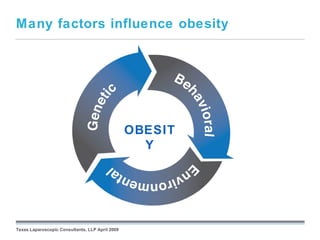
Many factors influence obesity


                                                 OBESIT
                                                   Y


                                                  September 26, 2008


Texas Laparoscopic Consultants, LLP April 2009
Obesity is…


  …a medical condition in which excess body fat
  has accumulated to the extent that it may have
      an adverse effect on health, leading to
    reduced life expectancy and/or increased
                health problems.

It is also…
• multi-factorial (many different factors can cause obesity)
• life-long
• progressive
• potentially life-threatening September 26, 2008
• costly
Texas Laparoscopic Consultants, LLP April 2009
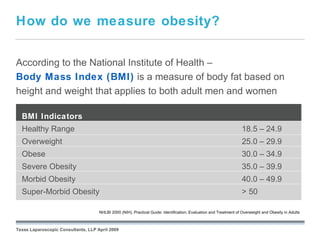
How do we measure obesity?


According to the National Institute of Health –
Body Mass Index (BMI) is a measure of body fat based on
height and weight that applies to both adult men and women

  BMI Indicators
  Healthy Range                                                                                                    18.5 – 24.9
  Overweight                                                                                                       25.0 – 29.9
  Obese                                                                                                            30.0 – 34.9
  Severe Obesity                                                                                                   35.0 – 39.9
  Morbid Obesity                                                                                                   40.0 – 49.9
  Super-Morbid Obesity                                                                                             > 50
                                                           September 26, 2008
                                     NHLBI 2000 (NIH), Practical Guide: Identification, Evaluation and Treatment of Overweight and Obesity in Adults


Texas Laparoscopic Consultants, LLP April 2009
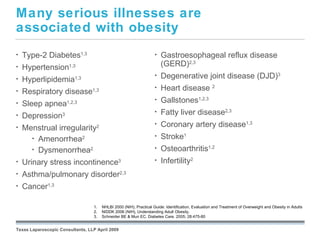
Many serious illnesses are
associated with obesity
•   Type-2 Diabetes1,3                                              •   Gastroesophageal reflux disease
•   Hypertension1,3                                                     (GERD)2,3
•   Hyperlipidemia        1,3                                       •   Degenerative joint disease (DJD)3
•   Respiratory disease1,3
                                                                    •   Heart disease 2
•   Sleep apnea1,2,3
                                                                    •   Gallstones1,2,3
•   Depression3
                                                                    •   Fatty liver disease2,3
•   Menstrual irregularity2
                                                                    •   Coronary artery disease1,3
      • Amenorrhea2                                                 •   Stroke1
      • Dysmenorrhea2                                               •   Osteoarthritis1,2
•   Urinary stress incontinence3                                    •   Infertility2
•   Asthma/pulmonary disorder2,3
•   Cancer1,3

                                                           September 26, 2008
                                  1.   NHLBI 2000 (NIH), Practical Guide: Identification, Evaluation and Treatment of Overweight and Obesity in Adults
                                  2.   NIDDK 2006 (NIH), Understanding Adult Obesity.
                                  3.   Schneider BE & Mun EC. Diabetes Care. 2005; 28:475-80


Texas Laparoscopic Consultants, LLP April 2009
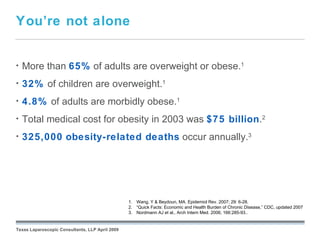
You’re not alone


•   More than 65% of adults are overweight or obese.1
•   32% of children are overweight.1
•   4.8% of adults are morbidly obese.1
•   Total medical cost for obesity in 2003 was $75 billion.2
•   325,000 obesity-related deaths occur annually.3


                                                 1. Wang, Y & Beydoun, MA. Epidemiol Rev. 2007; 29: 6-28.
                                                     September 26, 2008
                                                 2. “Quick Facts: Economic and Health Burden of Chronic Disease,” CDC, updated 2007
                                                 3. Nordmann AJ et al., Arch Intern Med. 2006; 166:285-93..


Texas Laparoscopic Consultants, LLP April 2009
Daily
Challenges
You face obstacles and prejudices every
day


                                                 September 26, 2008


Texas Laparoscopic Consultants, LLP April 2009
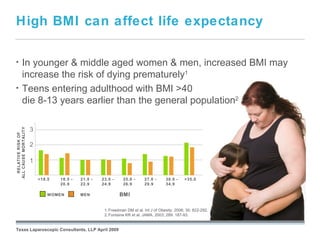
High BMI can affect life expectancy

•         In younger & middle aged women & men, increased BMI may
          increase the risk of dying prematurely1
•         Teens entering adulthood with BMI >40
          die 8-13 years earlier than the general population2

                      3
ALL CAUSE MORTALITY
  RELATIVE RISK OF


                      2

                      1

                          <18.5   18.5 -   21.0 -   23.0 -     25.0 -      27.0 -      30.0 -    >35.0
                                  20.9     22.9     24.9       26.9        29.9        34.9

                              WOMEN        MEN               BMI
                                                                        September 26, 2008
                                                     1. Freedman DM et al. Int J of Obesity. 2006; 30: 822-292.
                                                     2. Fontaine KR et al. JAMA. 2003; 289: 187-93.


Texas Laparoscopic Consultants, LLP April 2009
How much can
obesity
really cost?
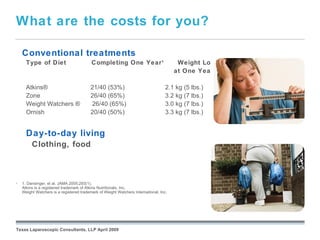
What are the costs for you?

    Conventional treatments
      Type of Diet                        Completing One Year 1                         Weight Loss
                                                                                       at One Year 1

      Atkins®                            21/40 (53%)                               2.1 kg (5 lbs.)
      Zone                               26/40 (65%)                               3.2 kg (7 lbs.)
      Weight Watchers ®                  26/40 (65%)                               3.0 kg (7 lbs.)
      Ornish                             20/40 (50%)                               3.3 kg (7 lbs.)


      Day-to-day living
         Clothing, food


•   1. Dansinger, et al. JAMA 2005;293(1).
    Atkins is a registered trademark of Atkins Nutritionals, Inc.
    Weight Watchers is a registered trademark of Weight Watchers International, Inc.


                                                                    September 26, 2008


Texas Laparoscopic Consultants, LLP April 2009
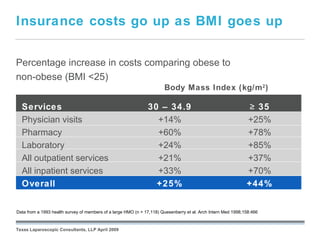
Insurance costs go up as BMI goes up


Percentage increase in costs comparing obese to
non-obese (BMI <25)
                                                                       Body Mass Index (kg/m 2 )

  Services                                                     30 – 34.9                                       ≥ 35
  Physician visits                                               +14%                                          +25%
  Pharmacy                                                       +60%                                          +78%
  Laboratory                                                     +24%                                          +85%
  All outpatient services                                        +21%                                          +37%
  All inpatient services                                         +33%                                          +70%
  Overall                                                        +25%                                          +44%

                                                           September 26, 2008
Data from a 1993 health survey of members of a large HMO (n = 17,118) Quesenberry et al. Arch Intern Med 1998;158:466


Texas Laparoscopic Consultants, LLP April 2009
What are your
surgical options?
Are you a candidate for weight-loss
surgery?

•   BMI >35 with co-morbidities or >40 without*
•   Healthy enough to undergo a major operation
•   Failed attempts at medical weight loss
•   Absence of drug and alcohol problems
•   No uncontrolled psychological conditions
•   Consensus by our multi-disciplinary team
•   Understands surgery and risks

    Must be dedicated to a lifestyle change
    and lifetime follow-ups
                                                 September 26, 2008

                                                                      *From the NIH consensus conference in 1991


Texas Laparoscopic Consultants, LLP April 2009
Not all weight loss surgeries are the
same

1.    Restrictive


3.    Malabsorptive


5.    Combination


                                                 September 26, 2008


Texas Laparoscopic Consultants, LLP April 2009
Restrictive Procedures

• The
    size of the stomach is reduced, which limits the
 amount of food patients can eat.
• The smaller stomach pouch fills quickly, helping patients
 feel satisfied with less food.
• Examples        of restrictive bariatric procedures:
        •     Gastric banding
        •     Sleeve gastrectomy


                                                 September 26, 2008


Texas Laparoscopic Consultants, LLP April 2009
Malabsorptive Procedures

• The  small intestine is rerouted so that food skips a portion
 of it.
• Some        calories and nutrients are not absorbed.
• Currently,
          surgeons rarely perform strictly malabsorptive
 procedures.
• Most procedures that involve malabsorption include
 restriction and are called combination procedures.


                                                 September 26, 2008


Texas Laparoscopic Consultants, LLP April 2009
Combination Procedures

•The surgeon creates a small pouch, limiting the amount of food a
patient can eat.
•A section of the small intestine is rerouted, causing food to bypass
a large portion of the small intestine.
•Bypassinga portion of the small intestine means the patient’s
body absorbs fewer calories.
•Examples         of combination bariatric procedures:
        •     Gastric bypass
        •     Biliopancreatic diversion with duodenal switch


                                                 September 26, 2008


Texas Laparoscopic Consultants, LLP April 2009
Risks of abdominal surgery

•   Bleeding
•   Pain
•   Shoulder pain
•   Infection
•   Pneumonia
•   Complications due to anesthesia & medications
•   Deep vein thrombosis (Blood clot)
•   Pulmonary embolism (Blood clot in lung)
•   Injury to stomach, esophagus, or surrounding organs
•   Death

                                                 September 26, 2008


Texas Laparoscopic Consultants, LLP April 2009
Risks of bariatric surgery

•   Abdominal hernia                                       •   Gastrointestinal inflammation or
•   Chest pain                                                 swelling
•   Collapsed lung                                         •   Stoma obstruction
•   Constipation or diarrhea                               •   Stretching of the stomach
•   Dehydration                                            •   Surgical procedure repeated
•   Enlarged heart                                         •   Vomiting and nausea
•   Gallstones, pain from passing a
    gallstone, inflammation of the
    gallbladder, or surgery to remove the
    gallbladder


                                                 September 26, 2008


Texas Laparoscopic Consultants, LLP April 2009
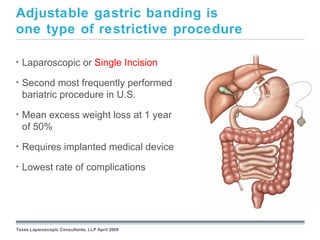
Adjustable gastric banding is
one type of restrictive procedure

•   Laparoscopic or Single Incision
•   Second most frequently performed
    bariatric procedure in U.S.
•   Mean excess weight loss at 1 year
    of 50%
•   Requires implanted medical device
•   Lowest rate of complications


                                                 September 26, 2008


Texas Laparoscopic Consultants, LLP April 2009
September 26, 2008


Texas Laparoscopic Consultants, LLP April 2009
What are risks and
complications of gastric banding?

•   Migration of implant (band erosion, band slippage, port displacement)
•   Tubing-related complications (port disconnection, tubing kinking)
•   Band leak
•   Port-site infection
•   Esophageal spasm
•   Gastroesophageal reflux disease (GERD)
•   Inflammation of the esophagus or stomach


                                                               September 26, 2008
Note: Your weight, age and medical history play a significant role in determining your specific risks.
Your surgeon can inform you about your specific risks for bariatric surgery.


Texas Laparoscopic Consultants, LLP April 2009
What can you expect after
gastric banding?

Recovery takes time and patience.
• The diet is strict.
• The capacity of the stomach has changed.
• You may experience discomfort and pain as your body heals.
• Length of time to return to normal activities can vary from patient to
  patient.
• Your healthcare team will advise you when to return to work and
  resume prior activities.
• Lifestyle changes are necessary to ensure success.


                                                         September 26, 2008
      Reference: From REALIZEband.com; life with REALIZE then recovery expectations.


Texas Laparoscopic Consultants, LLP April 2009
What can you expect after
gastric banding?

Recovery takes time and patience.
• Most patients are ready for their first adjustment after eating solid foods
  for the first week. The exact timing will depend on your progress.

•   If you are losing 1-2 lbs. per week you may not need an
    adjustment at that time.


                                                        September 26, 2008


                     Reference: From REALIZEband.com; life with REALIZE then recovery expectations.

Texas Laparoscopic Consultants, LLP April 2009
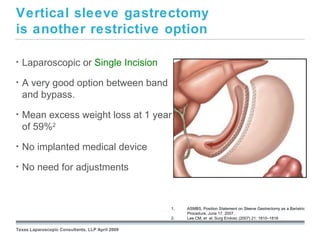
Vertical sleeve gastrectomy
is another restrictive option

•   Laparoscopic or Single Incision
•   A very good option between band
    and bypass.
•   Mean excess weight loss at 1 year
    of 59%2
•   No implanted medical device
•   No need for adjustments


                                                 September 26, 2008
                                                              1.      ASMBS, Position Statement on Sleeve Gastrectomy as a Bariatric
                                                                      Procedure. June 17, 2007.
                                                              2.      Lee CM, et al. Surg Endosc (2007) 21: 1810–1816

Texas Laparoscopic Consultants, LLP April 2009
September 26, 2008


Texas Laparoscopic Consultants, LLP April 2009
What are the risks and complications
of a vertical sleeve gastrectomy?

•   Bleeding or infection
•   Staple line leak
•   Abdominal hernia
•   Pulmonary Embolus
•   Nausea and vomitting


                                                                September 26, 2008
Note: Your weight, age and medical history play a significant role in determining your specific risks.
Your surgeon can inform you about your specific risks for bariatric surgery.

Texas Laparoscopic Consultants, LLP April 2009
G
A combination approach is most
common

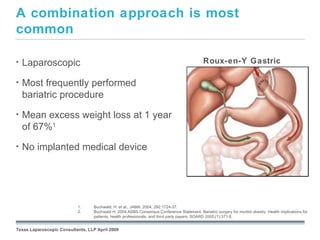
•   Laparoscopic                                                                            Roux-en-Y Gastric
                                                                                            Bypass
•   Most frequently performed
    bariatric procedure
•   Mean excess weight loss at 1 year
    of 67%1
•   No implanted medical device


                                                          September 26, 2008
                           1.     Buchwald, H. et al., JAMA. 2004; 292:1724-37.
                           2.     Buchwald H. 2004 ASBS Consensus Conference Statement, Bariatric surgery for morbid obesity: Health implications for
                                  patients, health professionals, and third party payers. SOARD 2005;(1):371-8.


Texas Laparoscopic Consultants, LLP April 2009
September 26, 2008


Texas Laparoscopic Consultants, LLP April 2009
What are the risks and complications
of the Roux-en-Y procedure?

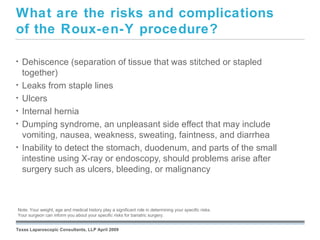
•   Dehiscence (separation of tissue that was stitched or stapled
    together)
•   Leaks from staple lines
•   Ulcers
•   Internal hernia
•   Dumping syndrome, an unpleasant side effect that may include
    vomiting, nausea, weakness, sweating, faintness, and diarrhea
•   Inability to detect the stomach, duodenum, and parts of the small
    intestine using X-ray or endoscopy, should problems arise after
    surgery such as ulcers, bleeding, or malignancy


                                                               September 26, 2008
Note: Your weight, age and medical history play a significant role in determining your specific risks.
Your surgeon can inform you about your specific risks for bariatric surgery.


Texas Laparoscopic Consultants, LLP April 2009
Duodenal Switch


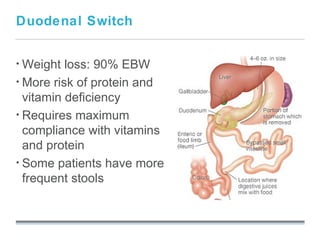
• Weight  loss: 90% EBW
• More risk of protein and
  vitamin deficiency
• Requires maximum
  compliance with vitamins
  and protein
• Some patients have more
  frequent stools
                     September 26, 2008
Gastric Plication


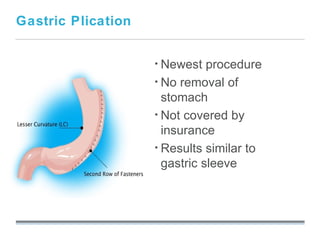
                          • Newest   procedure
                          • No removal of
                            stomach
                          • Not covered by
                            insurance
                          • Results similar to
                            gastric sleeve


                    September 26, 2008
Summary
Choosing the procedure that’s
right for you

Considerations
 • Age
 • Health Risk (depending on comorbidities)
 • Amount of weight to lose
 • Lifestyle
 • Eating behaviors


Mutual decision between patient and surgeon
• Discuss with surgeon during initial consultation
• Discuss with family and friends
                                                 September 26, 2008


Texas Laparoscopic Consultants, LLP April 2009
Surgery can help you change your life

•   Improves or resolves obesity-related illnesses
•   Decreases mortality risk
•   Reduces healthcare utilization and direct healthcare costs

    Remember…surgery is a tool that requires your strong
    commitment to a lifestyle change and lifetime of follow-
    up


                                                                 September 26, 2008
    * Christou NV, Sampalis JS, Liberman M, et al. Surgery Decreases Long-Term Mortality, Morbidity, and Health Care Use in Morbidly Obese
    Patients. Annals of Surgery 2004;240(3):416-424.


    Texas Laparoscopic Consultants, LLP April 2009
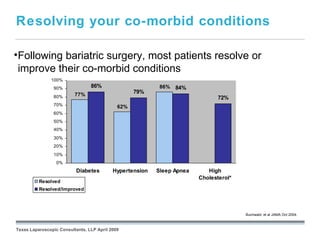
Resolving your co-morbid conditions

•Following bariatric surgery, most patients resolve or
 improve their co-morbid conditions
               100%
                90%              86%                        86%    84%
                          77%
                                                   79%
                80%                                                             72%
                70%                          62%
                60%
                50%
                40%
                30%
                20%
                10%
                  0%
                          Diabetes         Hypertension    Sleep Apnea      High
                                                                         Cholesterol*
          Resolved
          Resolved/Improved


                                                    September 26, 2008

                                                                                        Buchwald, et al JAMA Oct 2004.


Texas Laparoscopic Consultants, LLP April 2009
What are
your next steps?
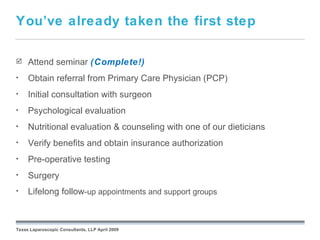
You’ve already taken the first step

    Attend seminar (Complete!)
•    Obtain referral from Primary Care Physician (PCP)
•    Initial consultation with surgeon
•    Psychological evaluation
•    Nutritional evaluation & counseling with one of our dieticians
•    Verify benefits and obtain insurance authorization
•    Pre-operative testing
•    Surgery
•    Lifelong follow-up appointments and support groups
                                                 September 26, 2008


Texas Laparoscopic Consultants, LLP April 2009
Questions?


                               1200 Binz Suite # 950
                                Houston, Tx 77004
          •   When (office hours): Mon-Thurs. 8:00-5:00, Fri. 8:00-4:30
                        • Phone numbers: (713) 493-7700
                          • Fax number: (281) 971-4065
                            • Email: tlc@tlcsurgery.com
                            • Web: www.tlcsurgery.com


Texas Laparoscopic Consultants, LLP April 2009

Seminar web presentation

  • 1.
    Dr. Terry Scarborough& Dr. Sherman Yu Is weight- loss surgery the answer for you?
  • 2.
    What are yougoing to learn today? • What is obesity? • Your daily challenges • What is obesity costing you? • What are your surgical options? • Summary • What are your next steps? September 26, 2008 Texas Laparoscopic Consultants, LLP April 2009
  • 3.
    Welcome to TLCSurgery • We are an entire practice dedicated to helping you succeed with weight loss surgery and living a longer, happier, healthier life! • A multi-disciplinary Bariatric focused practice • Lead by 2 fellowship trained, board certified Surgeons • Nutritionists • Psychologist • Insurance Specialists September 26, 2008 Texas Laparoscopic Consultants, LLP April 2009
  • 4.
  • 5.
    Many factors influenceobesity OBESIT Y September 26, 2008 Texas Laparoscopic Consultants, LLP April 2009
  • 6.
    Obesity is… …a medical condition in which excess body fat has accumulated to the extent that it may have an adverse effect on health, leading to reduced life expectancy and/or increased health problems. It is also… • multi-factorial (many different factors can cause obesity) • life-long • progressive • potentially life-threatening September 26, 2008 • costly Texas Laparoscopic Consultants, LLP April 2009
  • 7.
    How do wemeasure obesity? According to the National Institute of Health – Body Mass Index (BMI) is a measure of body fat based on height and weight that applies to both adult men and women BMI Indicators Healthy Range 18.5 – 24.9 Overweight 25.0 – 29.9 Obese 30.0 – 34.9 Severe Obesity 35.0 – 39.9 Morbid Obesity 40.0 – 49.9 Super-Morbid Obesity > 50 September 26, 2008 NHLBI 2000 (NIH), Practical Guide: Identification, Evaluation and Treatment of Overweight and Obesity in Adults Texas Laparoscopic Consultants, LLP April 2009
  • 8.
    Many serious illnessesare associated with obesity • Type-2 Diabetes1,3 • Gastroesophageal reflux disease • Hypertension1,3 (GERD)2,3 • Hyperlipidemia 1,3 • Degenerative joint disease (DJD)3 • Respiratory disease1,3 • Heart disease 2 • Sleep apnea1,2,3 • Gallstones1,2,3 • Depression3 • Fatty liver disease2,3 • Menstrual irregularity2 • Coronary artery disease1,3 • Amenorrhea2 • Stroke1 • Dysmenorrhea2 • Osteoarthritis1,2 • Urinary stress incontinence3 • Infertility2 • Asthma/pulmonary disorder2,3 • Cancer1,3 September 26, 2008 1. NHLBI 2000 (NIH), Practical Guide: Identification, Evaluation and Treatment of Overweight and Obesity in Adults 2. NIDDK 2006 (NIH), Understanding Adult Obesity. 3. Schneider BE & Mun EC. Diabetes Care. 2005; 28:475-80 Texas Laparoscopic Consultants, LLP April 2009
  • 9.
    You’re not alone • More than 65% of adults are overweight or obese.1 • 32% of children are overweight.1 • 4.8% of adults are morbidly obese.1 • Total medical cost for obesity in 2003 was $75 billion.2 • 325,000 obesity-related deaths occur annually.3 1. Wang, Y & Beydoun, MA. Epidemiol Rev. 2007; 29: 6-28. September 26, 2008 2. “Quick Facts: Economic and Health Burden of Chronic Disease,” CDC, updated 2007 3. Nordmann AJ et al., Arch Intern Med. 2006; 166:285-93.. Texas Laparoscopic Consultants, LLP April 2009
  • 10.
  • 11.
    You face obstaclesand prejudices every day September 26, 2008 Texas Laparoscopic Consultants, LLP April 2009
  • 12.
    High BMI canaffect life expectancy • In younger & middle aged women & men, increased BMI may increase the risk of dying prematurely1 • Teens entering adulthood with BMI >40 die 8-13 years earlier than the general population2 3 ALL CAUSE MORTALITY RELATIVE RISK OF 2 1 <18.5 18.5 - 21.0 - 23.0 - 25.0 - 27.0 - 30.0 - >35.0 20.9 22.9 24.9 26.9 29.9 34.9 WOMEN MEN BMI September 26, 2008 1. Freedman DM et al. Int J of Obesity. 2006; 30: 822-292. 2. Fontaine KR et al. JAMA. 2003; 289: 187-93. Texas Laparoscopic Consultants, LLP April 2009
  • 13.
  • 14.
    What are thecosts for you? Conventional treatments Type of Diet Completing One Year 1 Weight Loss at One Year 1 Atkins® 21/40 (53%) 2.1 kg (5 lbs.) Zone 26/40 (65%) 3.2 kg (7 lbs.) Weight Watchers ® 26/40 (65%) 3.0 kg (7 lbs.) Ornish 20/40 (50%) 3.3 kg (7 lbs.) Day-to-day living Clothing, food • 1. Dansinger, et al. JAMA 2005;293(1). Atkins is a registered trademark of Atkins Nutritionals, Inc. Weight Watchers is a registered trademark of Weight Watchers International, Inc. September 26, 2008 Texas Laparoscopic Consultants, LLP April 2009
  • 15.
    Insurance costs goup as BMI goes up Percentage increase in costs comparing obese to non-obese (BMI <25) Body Mass Index (kg/m 2 ) Services 30 – 34.9 ≥ 35 Physician visits +14% +25% Pharmacy +60% +78% Laboratory +24% +85% All outpatient services +21% +37% All inpatient services +33% +70% Overall +25% +44% September 26, 2008 Data from a 1993 health survey of members of a large HMO (n = 17,118) Quesenberry et al. Arch Intern Med 1998;158:466 Texas Laparoscopic Consultants, LLP April 2009
  • 16.
  • 17.
    Are you acandidate for weight-loss surgery? • BMI >35 with co-morbidities or >40 without* • Healthy enough to undergo a major operation • Failed attempts at medical weight loss • Absence of drug and alcohol problems • No uncontrolled psychological conditions • Consensus by our multi-disciplinary team • Understands surgery and risks Must be dedicated to a lifestyle change and lifetime follow-ups September 26, 2008 *From the NIH consensus conference in 1991 Texas Laparoscopic Consultants, LLP April 2009
  • 18.
    Not all weightloss surgeries are the same 1. Restrictive 3. Malabsorptive 5. Combination September 26, 2008 Texas Laparoscopic Consultants, LLP April 2009
  • 19.
    Restrictive Procedures • The size of the stomach is reduced, which limits the amount of food patients can eat. • The smaller stomach pouch fills quickly, helping patients feel satisfied with less food. • Examples of restrictive bariatric procedures: • Gastric banding • Sleeve gastrectomy September 26, 2008 Texas Laparoscopic Consultants, LLP April 2009
  • 20.
    Malabsorptive Procedures • The small intestine is rerouted so that food skips a portion of it. • Some calories and nutrients are not absorbed. • Currently, surgeons rarely perform strictly malabsorptive procedures. • Most procedures that involve malabsorption include restriction and are called combination procedures. September 26, 2008 Texas Laparoscopic Consultants, LLP April 2009
  • 21.
    Combination Procedures •The surgeoncreates a small pouch, limiting the amount of food a patient can eat. •A section of the small intestine is rerouted, causing food to bypass a large portion of the small intestine. •Bypassinga portion of the small intestine means the patient’s body absorbs fewer calories. •Examples of combination bariatric procedures: • Gastric bypass • Biliopancreatic diversion with duodenal switch September 26, 2008 Texas Laparoscopic Consultants, LLP April 2009
  • 22.
    Risks of abdominalsurgery • Bleeding • Pain • Shoulder pain • Infection • Pneumonia • Complications due to anesthesia & medications • Deep vein thrombosis (Blood clot) • Pulmonary embolism (Blood clot in lung) • Injury to stomach, esophagus, or surrounding organs • Death September 26, 2008 Texas Laparoscopic Consultants, LLP April 2009
  • 23.
    Risks of bariatricsurgery • Abdominal hernia • Gastrointestinal inflammation or • Chest pain swelling • Collapsed lung • Stoma obstruction • Constipation or diarrhea • Stretching of the stomach • Dehydration • Surgical procedure repeated • Enlarged heart • Vomiting and nausea • Gallstones, pain from passing a gallstone, inflammation of the gallbladder, or surgery to remove the gallbladder September 26, 2008 Texas Laparoscopic Consultants, LLP April 2009
  • 24.
    Adjustable gastric bandingis one type of restrictive procedure • Laparoscopic or Single Incision • Second most frequently performed bariatric procedure in U.S. • Mean excess weight loss at 1 year of 50% • Requires implanted medical device • Lowest rate of complications September 26, 2008 Texas Laparoscopic Consultants, LLP April 2009
  • 25.
    September 26, 2008 TexasLaparoscopic Consultants, LLP April 2009
  • 26.
    What are risksand complications of gastric banding? • Migration of implant (band erosion, band slippage, port displacement) • Tubing-related complications (port disconnection, tubing kinking) • Band leak • Port-site infection • Esophageal spasm • Gastroesophageal reflux disease (GERD) • Inflammation of the esophagus or stomach September 26, 2008 Note: Your weight, age and medical history play a significant role in determining your specific risks. Your surgeon can inform you about your specific risks for bariatric surgery. Texas Laparoscopic Consultants, LLP April 2009
  • 27.
    What can youexpect after gastric banding? Recovery takes time and patience. • The diet is strict. • The capacity of the stomach has changed. • You may experience discomfort and pain as your body heals. • Length of time to return to normal activities can vary from patient to patient. • Your healthcare team will advise you when to return to work and resume prior activities. • Lifestyle changes are necessary to ensure success. September 26, 2008 Reference: From REALIZEband.com; life with REALIZE then recovery expectations. Texas Laparoscopic Consultants, LLP April 2009
  • 28.
    What can youexpect after gastric banding? Recovery takes time and patience. • Most patients are ready for their first adjustment after eating solid foods for the first week. The exact timing will depend on your progress. • If you are losing 1-2 lbs. per week you may not need an adjustment at that time. September 26, 2008 Reference: From REALIZEband.com; life with REALIZE then recovery expectations. Texas Laparoscopic Consultants, LLP April 2009
  • 29.
    Vertical sleeve gastrectomy isanother restrictive option • Laparoscopic or Single Incision • A very good option between band and bypass. • Mean excess weight loss at 1 year of 59%2 • No implanted medical device • No need for adjustments September 26, 2008 1. ASMBS, Position Statement on Sleeve Gastrectomy as a Bariatric Procedure. June 17, 2007. 2. Lee CM, et al. Surg Endosc (2007) 21: 1810–1816 Texas Laparoscopic Consultants, LLP April 2009
  • 30.
    September 26, 2008 TexasLaparoscopic Consultants, LLP April 2009
  • 31.
    What are therisks and complications of a vertical sleeve gastrectomy? • Bleeding or infection • Staple line leak • Abdominal hernia • Pulmonary Embolus • Nausea and vomitting September 26, 2008 Note: Your weight, age and medical history play a significant role in determining your specific risks. Your surgeon can inform you about your specific risks for bariatric surgery. Texas Laparoscopic Consultants, LLP April 2009 G
  • 32.
    A combination approachis most common • Laparoscopic Roux-en-Y Gastric Bypass • Most frequently performed bariatric procedure • Mean excess weight loss at 1 year of 67%1 • No implanted medical device September 26, 2008 1. Buchwald, H. et al., JAMA. 2004; 292:1724-37. 2. Buchwald H. 2004 ASBS Consensus Conference Statement, Bariatric surgery for morbid obesity: Health implications for patients, health professionals, and third party payers. SOARD 2005;(1):371-8. Texas Laparoscopic Consultants, LLP April 2009
  • 33.
    September 26, 2008 TexasLaparoscopic Consultants, LLP April 2009
  • 34.
    What are therisks and complications of the Roux-en-Y procedure? • Dehiscence (separation of tissue that was stitched or stapled together) • Leaks from staple lines • Ulcers • Internal hernia • Dumping syndrome, an unpleasant side effect that may include vomiting, nausea, weakness, sweating, faintness, and diarrhea • Inability to detect the stomach, duodenum, and parts of the small intestine using X-ray or endoscopy, should problems arise after surgery such as ulcers, bleeding, or malignancy September 26, 2008 Note: Your weight, age and medical history play a significant role in determining your specific risks. Your surgeon can inform you about your specific risks for bariatric surgery. Texas Laparoscopic Consultants, LLP April 2009
  • 35.
    Duodenal Switch • Weight loss: 90% EBW • More risk of protein and vitamin deficiency • Requires maximum compliance with vitamins and protein • Some patients have more frequent stools September 26, 2008
  • 36.
    Gastric Plication • Newest procedure • No removal of stomach • Not covered by insurance • Results similar to gastric sleeve September 26, 2008
  • 37.
  • 38.
    Choosing the procedurethat’s right for you Considerations • Age • Health Risk (depending on comorbidities) • Amount of weight to lose • Lifestyle • Eating behaviors Mutual decision between patient and surgeon • Discuss with surgeon during initial consultation • Discuss with family and friends September 26, 2008 Texas Laparoscopic Consultants, LLP April 2009
  • 39.
    Surgery can helpyou change your life • Improves or resolves obesity-related illnesses • Decreases mortality risk • Reduces healthcare utilization and direct healthcare costs Remember…surgery is a tool that requires your strong commitment to a lifestyle change and lifetime of follow- up September 26, 2008 * Christou NV, Sampalis JS, Liberman M, et al. Surgery Decreases Long-Term Mortality, Morbidity, and Health Care Use in Morbidly Obese Patients. Annals of Surgery 2004;240(3):416-424. Texas Laparoscopic Consultants, LLP April 2009
  • 40.
    Resolving your co-morbidconditions •Following bariatric surgery, most patients resolve or improve their co-morbid conditions 100% 90% 86% 86% 84% 77% 79% 80% 72% 70% 62% 60% 50% 40% 30% 20% 10% 0% Diabetes Hypertension Sleep Apnea High Cholesterol* Resolved Resolved/Improved September 26, 2008 Buchwald, et al JAMA Oct 2004. Texas Laparoscopic Consultants, LLP April 2009
  • 41.
  • 42.
    You’ve already takenthe first step  Attend seminar (Complete!) • Obtain referral from Primary Care Physician (PCP) • Initial consultation with surgeon • Psychological evaluation • Nutritional evaluation & counseling with one of our dieticians • Verify benefits and obtain insurance authorization • Pre-operative testing • Surgery • Lifelong follow-up appointments and support groups September 26, 2008 Texas Laparoscopic Consultants, LLP April 2009
  • 43.
    Questions? 1200 Binz Suite # 950 Houston, Tx 77004 • When (office hours): Mon-Thurs. 8:00-5:00, Fri. 8:00-4:30 • Phone numbers: (713) 493-7700 • Fax number: (281) 971-4065 • Email: tlc@tlcsurgery.com • Web: www.tlcsurgery.com Texas Laparoscopic Consultants, LLP April 2009

Editor's Notes

  • #5 More tell-tale image / no sleeveless
  • #6 Continue to speak to the patient not being alone in this challenge
  • #8 An opportunity to speak to the formula BMI= Weight(kg) / Height (m) 2 . Great chance to get the participants involved - create an example using the BMI wheel that has been distributed.
  • #12 Speak to being able to do the simple things.
  • #30 See adjustable gastric banding NOT CORRECT PICTURE
  • #33 See adjustable gastric banding Need references
  • #35 From NJ presentation
  • #40 We could add a slide here showing the resolution of co-morbidities.
  • #44 Fill in information pertaining to your practice.