27th Annual Parsons Behle & Latimer EMPLOYMENT LAW SEMINAR
HUMAN RESOURCE
EMPLOYMENT
COMPLIANCE AUDITS
Christina M. Jepson
Salt Lake City, Utah
TUESDAY, APRIL 28, 2015 | THE LITTLE AMERICA HOTEL
parsonsbehle.com
2
 Who has done a financial audit in last 3 years?
 Who has done an HR audit in last 3 years?
 How do you know if you are compliant?
 How do you know if your HR department/person
is functioning to help your business?
 Just as important—Auditing people
management as important as financial
management
Why an HR Audit?
3
 When is the last time you did a top to
bottom audit of your employment policies
and procedures?
– EEOC Complaints are increasing
– Wage and hour lawsuits and investigations
are skyrocketing
– Laws are always changing and evolving
– Employers should do regular compliance
audits
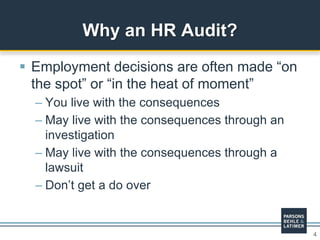
Why an HR Audit?
4
 Employment decisions are often made “on
the spot” or “in the heat of moment”
– You live with the consequences
– May live with the consequences through an
investigation
– May live with the consequences through a
lawsuit
– Don’t get a do over
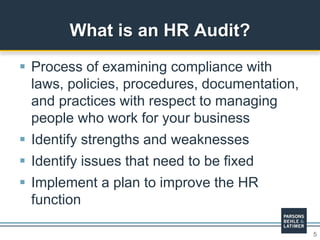
Why an HR Audit?
5
 Process of examining compliance with
laws, policies, procedures, documentation,
and practices with respect to managing
people who work for your business
 Identify strengths and weaknesses
 Identify issues that need to be fixed
 Implement a plan to improve the HR
function
What is an HR Audit?
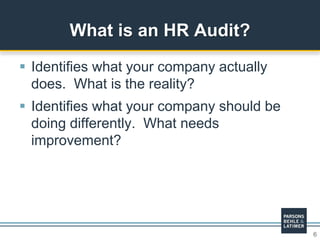
6
 Identifies what your company actually
does. What is the reality?
 Identifies what your company should be
doing differently. What needs
improvement?
What is an HR Audit?
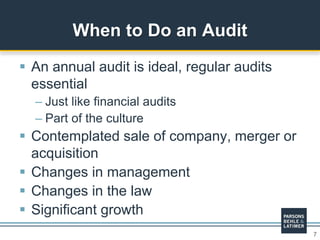
7
 An annual audit is ideal, regular audits
essential
– Just like financial audits
– Part of the culture
 Contemplated sale of company, merger or
acquisition
 Changes in management
 Changes in the law
 Significant growth
When to Do an Audit
8
 Create an audit questionnaire
 Collect information
 Have a team that reviews the information
– Is in house sufficient?
– Do you need an independent audit?
 Written report with recommendations
 Prioritize based on risk level
How Do You Do An Audit?
9
 Assess your workforce—Who works for
you and what do they do?
 Personnel Files—What are you
documenting? What are you not?
 Recruitment and Hiring—How does it
work? Is it lawful?
 Immigration—Are you ensuring I-9
compliance?
 Job Descriptions—Are they up-to-date?
Audit Topics
10
 Wage and Hour compliance—are you properly
classifying employees?
 Confidential Information and Non-Competes—Are you
protecting trade secrets and confidential information
 Compensation and Benefits—What is offered and to
whom?
 Handbooks—Is it up to date and being followed?
 Discrimination and Harassment—Are these addressed in
policies, training, and investigations?
 Practices—What are your actual practices? Are you
following your rules?
 Performance Evaluations
Audit Topics
11
 Complaints—how do you respond?
 Discipline & Internal Investigations—Are
you consistent? Do you document?
 Accommodations—Disability and religion
 Leave—FMLA, illness, pregnancy, military
service, and voluntary programs
 Paid Time Off and other Time Off
Audit Topics
12
 Performance Evaluations—Do you do
them regularly? Are they accurate?
 Health & Safety—Incident reports,
inspections, and policies
 Social Media—do you have a policy and
plan?
 Terminations—are you doing it correctly
and documenting
Audit Topics
13
 Who works for you and what do they do?
– How many
– How are they classified—regular, temporary,
full time, part time, exempt, non-exempt,
independent contractors
– Do your employees know how they are
classified?
– Who supervises whom—organization chart
Assess Your Workforce
14
 Who keeps them? Where are they kept? Who has
access? Secure?
 Job descriptions, exempt analysis
 I-9s (kept separate)
 Hiring, PTO, Training, discipline, assignments,
emergency contact, evaluations, termination
 Employment agreements, at will statements, non-
competes
 Performance evaluations
 Discipline
 Health information separate
 Does the file support your decisions?
Personnel Files
15
 Documents to review
– Offer letter
– Employment agreements
– At will statements
– Independent contractor agreements
– Personnel file policy
– Sample file and sample medical file
Personnel Files
16
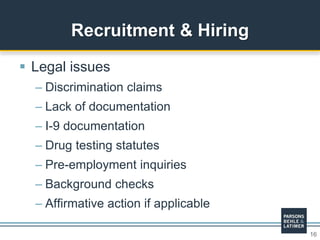
 Legal issues
– Discrimination claims
– Lack of documentation
– I-9 documentation
– Drug testing statutes
– Pre-employment inquiries
– Background checks
– Affirmative action if applicable
Recruitment & Hiring
17
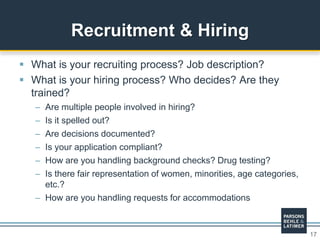
 What is your recruiting process? Job description?
 What is your hiring process? Who decides? Are they
trained?
– Are multiple people involved in hiring?
– Is it spelled out?
– Are decisions documented?
– Is your application compliant?
– How are you handling background checks? Drug testing?
– Is there fair representation of women, minorities, age categories,
etc.?
– How are you handling requests for accommodations
Recruitment & Hiring
18
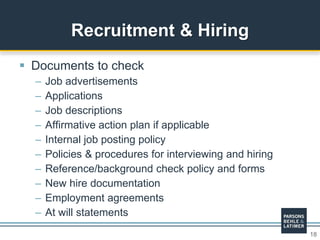
 Documents to check
– Job advertisements
– Applications
– Job descriptions
– Affirmative action plan if applicable
– Internal job posting policy
– Policies & procedures for interviewing and hiring
– Reference/background check policy and forms
– New hire documentation
– Employment agreements
– At will statements
Recruitment & Hiring
19
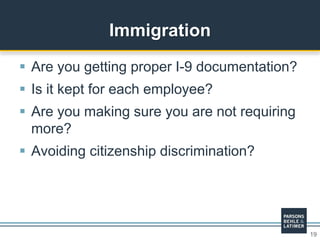
 Are you getting proper I-9 documentation?
 Is it kept for each employee?
 Are you making sure you are not requiring
more?
 Avoiding citizenship discrimination?
Immigration
20
 Job descriptions are critical for ADA issues
and determining exempt status
 They need to address essential job
functions
 They need to address exempt status
issues
 Make sure they are kept up-to-date as
positions change
Job Descriptions
21
 Do you have current and accurate job descriptions
 Classification of employees
– Have employees been properly classified as exempt or non-
exempt
– Do you have the paperwork to support exempt status
determinations for each position
 Is overtime being paid correctly
– Do timesheets or time records match time actually worked
– Off the clock work
 Are exempt employees treated as exempt—no docking
 Do you have any independent contractors and have they
been properly classified?
– Have issues about classification been raised?
Wage and Hour Law
22
 Are you ensuring that new hires don’t have
agreements with other companies?
 Who should sign non-competes?
Confidentiality agreements? Non-
solicitation?
 Who should not?
 Are your agreements legal?
Confidential Information and
Non-Competes
23
 Do you have a compensation program? Who
administers?
 How are wages determined? Salary surveys?
 How are jobs rated? Reevaluated? Updated?
 Are you competitive in wage, salary and
incentive levels
 Merit increases and bonuses
 Are employees being treated fairly
 Is there a lurking sex discrimination claim?
Race? Age?
Compensation and Benefits
24
 Is your health insurance compliant with
Health Care Reform act?
 Same sex spouses?
 Who is offered benefits? Who is not?
Why?
 Wellness program?
 COBRA administration?
Compensation and Benefits
25
 Up to date—include new developments in the law and
reflect actual practices
 At will statement and disclaimer of contract
 Procedure for updates and acknowledgement of updates
 Discrimination, harassment, retaliation, and reporting
procedure
 The policies have been disseminated
 Employees have signed acknowledgement of receipt
 Acknowledgements are maintained in employee files
 Managers have been trained and policies are uniformly
followed and enforced
Handbooks
26
 Make sure these topics are covered in
your handbook—does it cover all the
protected classes?
 Make sure your employees are trained
 Make sure your managers are trained
 Have regular training—new employees?
 Reporting process
Discrimination and Harassment
27
 Practices relating to recruiting and hiring
– Written policies and procedures
– Are they compliant
– Are the persons involved trained on the law
– Are they consistently followed?
Practices
28
 Do you have a process for performance
evaluations? Do you have a consistent form?
 Do your managers understand it? Are your
managers trained?
 Is it being done timely and consistently?
 Are managers being honest?
 Are problems being noted?
 Is good work being noted?
 Does HR review? Checks and balances?
Performance Evaluation
29
 Do you have a procedure for handling
complaints?
 Do you investigate complaints?
 Do you document?
Complaints
30
 Responding to complaints
– Do your managers know what a complaint is
– Do they know what to do with a complaint
– Do you have a process for internal
investigations
– Do you have a process for making decisions
after investigations
Complaints
31
 A fair and thorough investigation by a
neutral party
 A decision based on the known facts
 Multiple decision makers
 Document decision
Investigations & Discipline
32
 Do you have an ADA policy?
 Religious accommodation policy?
 Are your managers trained?
 Can they spot an issue?
Accommodations
33
 Are you required to provide FMLA leave?
– Do you have an FMLA policy?
– Who handles FMLA requests
– Are managers trained to spot FMLA issues?
 Do you provide other leave?
– Do you have a policy?
– Written absenteeism policy which is
consistently followed?
 Military leave, jury duty, witness
FMLA and Leave
34
 Do you have a single PTO system or
multiple systems?
– Who keeps track?
– Who qualifies? Why?
– Is it being applied consistently?
– Carry over? Caps?
– Use it or lose it?
Paid Time Off
35
 Required posters?
 Log of injuries and illnesses as required?
Procedure for reporting?
 Safety program?
 OSHA regulations?
 UOSH regulations?
 No retaliation
 Special industry?
 Worker’s Compensation policy
Health & Safety
36
 What is your company doing in social
media?
 What are your employees doing?
 Do you have policies regarding social
media, computers, and other electronic
devices?
 No privacy disclaimers
 Plan to prevent attack
Social Media & Electronic Data
37
 Is there a contract or at will?
 Progressive discipline?
 Approval for termination? Who decides?
 Formal checklist? Legal review?
 Review all documentation before termination
 Exit interviews?
 Does your file support the termination?
 Retaliation risk?
 Severance and release?
Terminations
38
 Christina M. Jepson
801.536.6820
cjepson@parsonsbehle.com
Thank You

Employment Compliance Audits

  • 1.
    27th Annual ParsonsBehle & Latimer EMPLOYMENT LAW SEMINAR HUMAN RESOURCE EMPLOYMENT COMPLIANCE AUDITS Christina M. Jepson Salt Lake City, Utah TUESDAY, APRIL 28, 2015 | THE LITTLE AMERICA HOTEL parsonsbehle.com
  • 2.
    2  Who hasdone a financial audit in last 3 years?  Who has done an HR audit in last 3 years?  How do you know if you are compliant?  How do you know if your HR department/person is functioning to help your business?  Just as important—Auditing people management as important as financial management Why an HR Audit?
  • 3.
    3  When isthe last time you did a top to bottom audit of your employment policies and procedures? – EEOC Complaints are increasing – Wage and hour lawsuits and investigations are skyrocketing – Laws are always changing and evolving – Employers should do regular compliance audits Why an HR Audit?
  • 4.
    4  Employment decisionsare often made “on the spot” or “in the heat of moment” – You live with the consequences – May live with the consequences through an investigation – May live with the consequences through a lawsuit – Don’t get a do over Why an HR Audit?
  • 5.
    5  Process ofexamining compliance with laws, policies, procedures, documentation, and practices with respect to managing people who work for your business  Identify strengths and weaknesses  Identify issues that need to be fixed  Implement a plan to improve the HR function What is an HR Audit?
  • 6.
    6  Identifies whatyour company actually does. What is the reality?  Identifies what your company should be doing differently. What needs improvement? What is an HR Audit?
  • 7.
    7  An annualaudit is ideal, regular audits essential – Just like financial audits – Part of the culture  Contemplated sale of company, merger or acquisition  Changes in management  Changes in the law  Significant growth When to Do an Audit
  • 8.
    8  Create anaudit questionnaire  Collect information  Have a team that reviews the information – Is in house sufficient? – Do you need an independent audit?  Written report with recommendations  Prioritize based on risk level How Do You Do An Audit?
  • 9.
    9  Assess yourworkforce—Who works for you and what do they do?  Personnel Files—What are you documenting? What are you not?  Recruitment and Hiring—How does it work? Is it lawful?  Immigration—Are you ensuring I-9 compliance?  Job Descriptions—Are they up-to-date? Audit Topics
  • 10.
    10  Wage andHour compliance—are you properly classifying employees?  Confidential Information and Non-Competes—Are you protecting trade secrets and confidential information  Compensation and Benefits—What is offered and to whom?  Handbooks—Is it up to date and being followed?  Discrimination and Harassment—Are these addressed in policies, training, and investigations?  Practices—What are your actual practices? Are you following your rules?  Performance Evaluations Audit Topics
  • 11.
    11  Complaints—how doyou respond?  Discipline & Internal Investigations—Are you consistent? Do you document?  Accommodations—Disability and religion  Leave—FMLA, illness, pregnancy, military service, and voluntary programs  Paid Time Off and other Time Off Audit Topics
  • 12.
    12  Performance Evaluations—Doyou do them regularly? Are they accurate?  Health & Safety—Incident reports, inspections, and policies  Social Media—do you have a policy and plan?  Terminations—are you doing it correctly and documenting Audit Topics
  • 13.
    13  Who worksfor you and what do they do? – How many – How are they classified—regular, temporary, full time, part time, exempt, non-exempt, independent contractors – Do your employees know how they are classified? – Who supervises whom—organization chart Assess Your Workforce
  • 14.
    14  Who keepsthem? Where are they kept? Who has access? Secure?  Job descriptions, exempt analysis  I-9s (kept separate)  Hiring, PTO, Training, discipline, assignments, emergency contact, evaluations, termination  Employment agreements, at will statements, non- competes  Performance evaluations  Discipline  Health information separate  Does the file support your decisions? Personnel Files
  • 15.
    15  Documents toreview – Offer letter – Employment agreements – At will statements – Independent contractor agreements – Personnel file policy – Sample file and sample medical file Personnel Files
  • 16.
    16  Legal issues –Discrimination claims – Lack of documentation – I-9 documentation – Drug testing statutes – Pre-employment inquiries – Background checks – Affirmative action if applicable Recruitment & Hiring
  • 17.
    17  What isyour recruiting process? Job description?  What is your hiring process? Who decides? Are they trained? – Are multiple people involved in hiring? – Is it spelled out? – Are decisions documented? – Is your application compliant? – How are you handling background checks? Drug testing? – Is there fair representation of women, minorities, age categories, etc.? – How are you handling requests for accommodations Recruitment & Hiring
  • 18.
    18  Documents tocheck – Job advertisements – Applications – Job descriptions – Affirmative action plan if applicable – Internal job posting policy – Policies & procedures for interviewing and hiring – Reference/background check policy and forms – New hire documentation – Employment agreements – At will statements Recruitment & Hiring
  • 19.
    19  Are yougetting proper I-9 documentation?  Is it kept for each employee?  Are you making sure you are not requiring more?  Avoiding citizenship discrimination? Immigration
  • 20.
    20  Job descriptionsare critical for ADA issues and determining exempt status  They need to address essential job functions  They need to address exempt status issues  Make sure they are kept up-to-date as positions change Job Descriptions
  • 21.
    21  Do youhave current and accurate job descriptions  Classification of employees – Have employees been properly classified as exempt or non- exempt – Do you have the paperwork to support exempt status determinations for each position  Is overtime being paid correctly – Do timesheets or time records match time actually worked – Off the clock work  Are exempt employees treated as exempt—no docking  Do you have any independent contractors and have they been properly classified? – Have issues about classification been raised? Wage and Hour Law
  • 22.
    22  Are youensuring that new hires don’t have agreements with other companies?  Who should sign non-competes? Confidentiality agreements? Non- solicitation?  Who should not?  Are your agreements legal? Confidential Information and Non-Competes
  • 23.
    23  Do youhave a compensation program? Who administers?  How are wages determined? Salary surveys?  How are jobs rated? Reevaluated? Updated?  Are you competitive in wage, salary and incentive levels  Merit increases and bonuses  Are employees being treated fairly  Is there a lurking sex discrimination claim? Race? Age? Compensation and Benefits
  • 24.
    24  Is yourhealth insurance compliant with Health Care Reform act?  Same sex spouses?  Who is offered benefits? Who is not? Why?  Wellness program?  COBRA administration? Compensation and Benefits
  • 25.
    25  Up todate—include new developments in the law and reflect actual practices  At will statement and disclaimer of contract  Procedure for updates and acknowledgement of updates  Discrimination, harassment, retaliation, and reporting procedure  The policies have been disseminated  Employees have signed acknowledgement of receipt  Acknowledgements are maintained in employee files  Managers have been trained and policies are uniformly followed and enforced Handbooks
  • 26.
    26  Make surethese topics are covered in your handbook—does it cover all the protected classes?  Make sure your employees are trained  Make sure your managers are trained  Have regular training—new employees?  Reporting process Discrimination and Harassment
  • 27.
    27  Practices relatingto recruiting and hiring – Written policies and procedures – Are they compliant – Are the persons involved trained on the law – Are they consistently followed? Practices
  • 28.
    28  Do youhave a process for performance evaluations? Do you have a consistent form?  Do your managers understand it? Are your managers trained?  Is it being done timely and consistently?  Are managers being honest?  Are problems being noted?  Is good work being noted?  Does HR review? Checks and balances? Performance Evaluation
  • 29.
    29  Do youhave a procedure for handling complaints?  Do you investigate complaints?  Do you document? Complaints
  • 30.
    30  Responding tocomplaints – Do your managers know what a complaint is – Do they know what to do with a complaint – Do you have a process for internal investigations – Do you have a process for making decisions after investigations Complaints
  • 31.
    31  A fairand thorough investigation by a neutral party  A decision based on the known facts  Multiple decision makers  Document decision Investigations & Discipline
  • 32.
    32  Do youhave an ADA policy?  Religious accommodation policy?  Are your managers trained?  Can they spot an issue? Accommodations
  • 33.
    33  Are yourequired to provide FMLA leave? – Do you have an FMLA policy? – Who handles FMLA requests – Are managers trained to spot FMLA issues?  Do you provide other leave? – Do you have a policy? – Written absenteeism policy which is consistently followed?  Military leave, jury duty, witness FMLA and Leave
  • 34.
    34  Do youhave a single PTO system or multiple systems? – Who keeps track? – Who qualifies? Why? – Is it being applied consistently? – Carry over? Caps? – Use it or lose it? Paid Time Off
  • 35.
    35  Required posters? Log of injuries and illnesses as required? Procedure for reporting?  Safety program?  OSHA regulations?  UOSH regulations?  No retaliation  Special industry?  Worker’s Compensation policy Health & Safety
  • 36.
    36  What isyour company doing in social media?  What are your employees doing?  Do you have policies regarding social media, computers, and other electronic devices?  No privacy disclaimers  Plan to prevent attack Social Media & Electronic Data
  • 37.
    37  Is therea contract or at will?  Progressive discipline?  Approval for termination? Who decides?  Formal checklist? Legal review?  Review all documentation before termination  Exit interviews?  Does your file support the termination?  Retaliation risk?  Severance and release? Terminations
  • 38.
    38  Christina M.Jepson 801.536.6820 cjepson@parsonsbehle.com Thank You