με τον ίδιοζήλο τη δρά-
ση της Ένωσής σας, να
είστε πάντα δημιουργι-
κοί και αισιόδοξοι στα
δύσκολα για την Παι-
δεία χρόνια που διανύ-
ουμε και τέλος, δε μου
μένει παρά να ευχηθώ
«Καλή κυκλοφορία και
μακροβιότητα» στο πε-
ριοδικό σας.
Με εκτίμηση
Ο ΔΙΕΥΘΥΝΤΗΣ
Δ/ΝΣΗΣ Δ/ΘΜΙΑΣ
ΕΚΠ/ΣΗΣ ΣΕΡΡΩΝ
ΚΩΝΣΤΑΝΤΙΝΟΣ Σ.
ΤΕΝΕΚΕΤΖΗΣ
Αγαπητοί συνάδελφοι,
Συγχαίρω την Ένωση
των Καθηγητών Αγγλι-
κής Γλώσσας για την
πολύπλευρη συμμετο-
χή της
στα
εκπαι-
δευτικά δρώμενα, τόσο
σε επίπεδο Διεύθυνσης
Δ.Ε. Σερρών όσο και
σε ευρωπαϊκό επίπεδο,
με πλούσια δράση και
αξιόλογες διακρίσεις.
Θεωρώ τιμή μου να
προλογίζω την παρού-
σα έκδοση του εξαμη-
νιαίου περιοδικού της
Ένωσής σας, που απο-
τελεί πηγή διάχυσης
γνώσεων, ιδεών, θεμά-
των επικαιρότητας αλ-
λά και γενικότερου εν-
διαφέροντος, επιστημο-
νικών και ψυχαγωγικού
περιεχομένου άρθρων,
στηρίζει την εκμάθηση
της Αγγλικής Γλώσσας
και φέρνει τους ανα-
γνώστες σε επαφή με
τον πολιτισμό της συ-
γκεκριμένης χώρας.
Η Διεύθυνση θα βρί-
σκεται στο πλευρό της
Ένωσής σας στηρίζο-
ντας οποιαδήποτε φι-
λότιμη προσπάθεια
προάγει την Παιδεία και
τον Πολιτισμό.
Εύχομαι να συνεχίσετε
I’d like to greet –
warmly - this new e-
bulletin for language
teachers in
Serres - and
language
teachers eve-
rywhere, who
will, thanks to
digital technol-
ogy, be shar-
ing this new
open space
for teacher
development.
The local and
the global are
increasingly hard to
separate nowadays and
this presents new op-
portunities for continued
and co-operative teach-
er development with
teachers in our own
neighbourhood and all
around the world.
So, welcome Open
Spaces: the choice of
name for this new initia-
tive in sharing insights
into and suggestions for
better teaching practice
is an appropriate one: it
signals the open space
that will henceforth be
occupied by motivated
teachers, keen to
work together to con-
tinue to become better
teachers.
But what is a good
teacher and what
does it mean to con-
tinue to be and be-
come a better teach-
er? The article that
follows is a small con-
tribution to this new
adventure in teacher
development.
Dr Luke Prodromou
12/11/2017Issue 2/ January —June 20172017
Open Spaces
5.
technology? Fryni Mar-
avelakiputs forward
the design and plan-
ning of webquests in
two different topics,
famous people in histo-
ry and tribes around
the world. (p. 18) More-
over she adds her con-
tribution in media en-
hanced learning by
sharing the short film
created at Irakleia High
School under the
theme of bullying and
human relations. (p.
20)
Two different Eras-
mus+ key action 1 pro-
jects on the topic of
“Project management
for cross-cultural ex-
change” are described
by our colleagues Su-
zana Drampa and
Christina Koutidou giv-
From the Editor
I hope you will enjoy
reading the second is-
sue of Open Spaces
which is rich in articles
and activities produced
by our members and
friends. Elpida Tsa-
kirdai writes (p. 7)
about comics and their
use as an educational
tool, a TEUM workshop
led by Mr Dalampiras
English teacher and
comic creator, who in-
troduced us to the
magical world of com-
ics.
Suzana Drampa gives
us ideas about how to
organize activities in-
spired by “green” is-
sues and aiming at pro-
moting environmental
awareness among our
students in her article
“Give the Green Light
to Save the Green
Planet” (p.10).
A memorable event
which gives promi-
nence to the integration
of poetry in English lan-
guage teaching is
shared by Ms Katerina
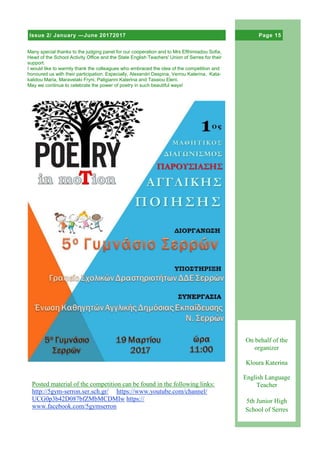
Kloura. The competi-
tion “Poetry in mo-
tion” (p. 13-14) has
been an innovative ef-
fort successfully orga-
nized by the 5th
High
School of Serres which
featured teenage crea-
tivity. The Happy
Prince was the award
winning project which
brought out the best of
the participating pupils.
How can we enrich our
school books using
ing insights into the
implementation of
teachers’ professional
development
schemes.(p. 22 and
24)
The hotly debated is-
sue of how extremism
can be prevented
through education is
also discussed by Ms
Koutidou who is show-
casing her students’
work, with a focus to
global citizenship edu-
cation. (p. 19)
Last but not least Dr.
Luke Prodromou won-
ders what a good teach-
er is and what it mean
to continue to be and
become a better teach-
er. Definitely a must
read (p.25).
Theodora Gkeniou
TEUM Chair
Open Spaces Editor
12/11/2017Issue 2/ January —June
Open Spaces
6.
Περιεχόμενα Τεύχους
Page 7Comics and their use as an educational tool
Page 10 “Give the Green Light to Save the Green Planet” TEUM goes “green”/environmental actions 2017
Page 13 “The Happy Prince” …turning a fairy tale into poetry in motion!
Page 14 “Poetry in motion…”
Page 18 The Web2Quest Way to Think Teen
Page 19 Η εκπαίδευση βασικό ανθρώπινο δικαίωμα και όπλο κατά των φαινομένων βίαιου εξτρεμισμού
Page 20 “Πάμε Σινεμά”….. o κινηματογράφος στη δευτεροβάθμια εκπαίδευση
Page 22 “Project management for cross-cultural exchange” project in Tenerife, Spain
Page 24 “Project Management for cross-cultural exchange projects in Europe”
Αn Erasmus+ Key Action 1 Programme
Page 25 Good language teachers:
What do they do? What do they know? What do they have?
OPEN SPACES
ISSN: 2585-2620
ΠΕΡΙΟΔΙΚΗ ΕΚΔΟΣΗ ΤΗΣ ΜΑΚΕΔΟΝΙΚΗ ΕΝΩΣΗ ΚΑΘΗ-
ΓΗΤΩΝ ΑΓΓΛΙΚΗΣ ΔΗΜΟΣΙΑΣ
Α/ΘΜΙΑΣ ΚΑΙ Β/ΒΑΘΜΙΑΣ ΕΚΠ/ΣΗΣ Ν.ΣΕΡΡΩΝ
ΕΚΔΟΤΗΣ: το Δ.Σ. της Ένωσης
ΥΠΕΥΘΥΝΟΣ ΕΚΔΟΣΗΣ: Θεοδώρα Γκένιου
ΤΕΧΝΙΚΗ ΕΠΙΜΕΛΕΙΑ ΕΚΔΟΣΗΣ: Σωφρονία Μαραβελάκη
ΔΙΕΥΘΥΝΣΗ: Κων. Καραμανλή 13-2ος όροφος -Σέρρες-TK
62125
ΕΠΙΚΟΙΝΩΝΙΑ: englishteachersinserres@gmail.com
7.
of all agesand to talk about
activities aiming at the intro-
duction of comics into the
learning process. Through a
series of tasks and using
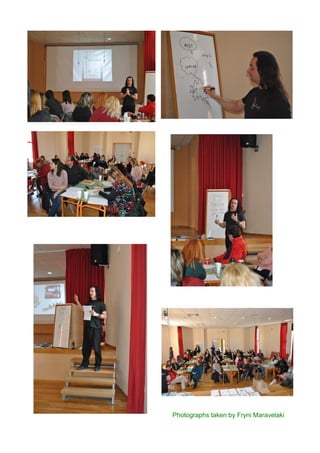
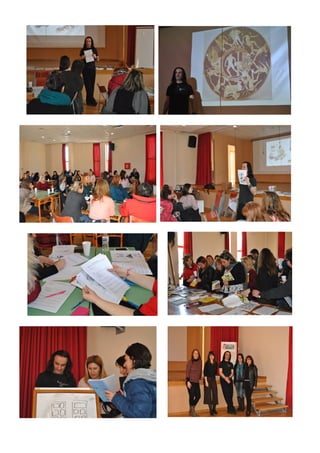
On Saturday, March the 4th
2017, in the 6th
Primary
School of Serres, the State
English Teachers’ Union of
Serres invited Mr. Nikolaos
Dalampiras, teacher of Eng-
lish and artist, to talk about
the art of comics. From
10:00 to 14:00, teachers of
Primary and Secondary
schools of Serres had the
chance to acquaint them-
selves with the magical
world of comics.
In the first part Mr. Dalam-
piras presented the history
of this medium from prehis-
torical to modern times,
showing its evolution and
referred to the most famous
comics creators around the
world. Widely known terms,
such as “Yellow
Press”,“tabloids”,“Pulitzer”,
“copy rights” and
“merchandising” were ex-
plained and connected to
the history of comics.
The definition of comics as
“an intentional narration with
picture sequence” derives
from the combination of sto-
ryboard with photography,
architecture (imaging of
place and object) and draw-
ing. Moreover, Mr. Dalam-
piras talked about the kinds
(comic strip, comic book and
graphic novel) and schools
(American, European and
Japanese) of comics, and
the changes that this art
went through because of the
two world wars.
We learned that there were
also stories which were not
comic and just appeared in
different kinds of picture and
word combination (bande
dessinée, fumetti and man-
ga). In the end, there was a
presentation of the tools
used for the creation comics
and the steps followed until
the final product. Nowadays
comics is considered to be
the 9th
art!
In the second part Mr Da-
lampiras moved on to practi-
cal instruction and the teach-
ers had the chance to see
comics produced by pupils
Comics and their use as an educational tool
by Elpida-Maria Tsakirdai
their imagination, they tried
to match pictures with
words, to draw and to write
stories with a beginning, a
middle and an end.
Finally, there was a presen-
tation of simple ways of
depicting human expres-
sions and feelings, as well
as words, sounds and land-
scapes based on specific
rules. After this creative
seminar it was clear that
comics is a tool accessible
to everyone, regardless of
age or artistic predisposi-
tion.
Thank you Mr. Dalampiras!
12/11/2017Issue 2/ January —June
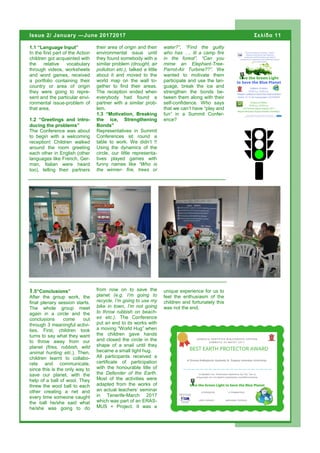
Under the thematicumbrella of environ-
mental issues and the importance of pro-
tecting the environment, TEUM organized
two “GREEN” events during 2017 in collab-
oration with the Central Public Library of
Serres and the Municipality of Serres.
“Give the Green Light to Save the Blue
Planet” was the message used to urge
young friends join us in both actions, with
the hope to familiarize them with environ-
mental issues and enhance their sensitivity,
to help them create a universal
“environmental” conscience and consider
their individual responsibility in protecting
our home, “The Blue Planet”.
“Give the Green Light to Save the Green Planet”, TEUM goes
“green”/environmental actions 2017, by Suzana Drampa
Environmental
Action in the
Children’s
Section of the
Public Library
of Serres
1. Environmental Action in the Children’s Section of the Public Library of Serres
self-esteem and social skills in order to
participate and collaborate in a team-
namely, express, share and accept opin-
ions / find and play their role in the team /
organizing their decision-making methods /
work in a team spirit to achieve a certain
goal and follow instructions to produce cer-
tain material in certain time limits.
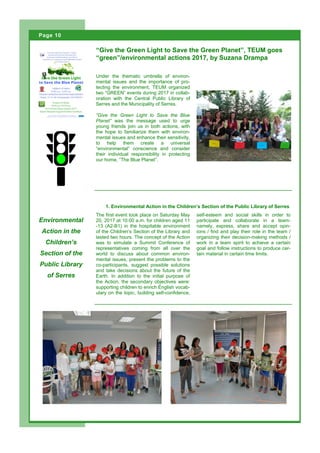
The first event took place on Saturday May
20, 2017 at 10:00 a.m. for children aged 11
-13 (A2-B1) in the hospitable environment
of the Children’s Section of the Library and
lasted two hours. The concept of the Action
was to simulate a Summit Conference of
representatives coming from all over the
world to discuss about common environ-
mental issues, present the problems to the
co-participants, suggest possible solutions
and take decisions about the future of the
Earth. In addition to the initial purpose of
the Action, the secondary objectives were:
supporting children to enrich English vocab-
ulary on the topic, building self-confidence,
Page 10 Open Spaces
Page 10
11.
1.1 “Language Input”
Inthe first part of the Action
children got acquainted with
the relative vocabulary
through videos, worksheets
and word games, received
a portfolio containing their
country or area of origin
they were going to repre-
sent and the particular envi-
ronmental issue-problem of
that area.
1.2 “Greetings and intro-
ducing the problems”
The Conference was about
to begin with a welcoming
reception! Children walked
around the room greeting
each other in English (other
languages like French, Ger-
man, Italian were heard
too), telling their partners
their area of origin and their
environmental issue until
they found somebody with a
similar problem (drought, air
pollution etc.), talked a little
about it and moved to the
world map on the wall to-
gether to find their areas.
The reception ended when
everybody had found a
partner with a similar prob-
lem.
1.3 “Motivation, Breaking
the ice, Strengthening
Bonds”
Representatives in Summit
Conferences sit round a
table to work. We didn’t !!
Using the dynamics of the
circle, our little representa-
tives played games with
funny names like “Who is
the winner- fire, trees or
water?”, “Find the guilty
who has …. lit a camp fire
in the forest”, “Can you
mime an Elephant-Tree-
Parrot-Air Turbine??”. We
wanted to motivate them
participate and use the lan-
guage, break the ice and
strengthen the bonds be-
tween them along with their
self-confidence. Who says
that we can’t have “play and
fun” in a Summit Confer-
ence?
from now on to save the
planet (e.g. I’m going to
recycle, I’m going to use my
bike in town, I’m not going
to throw rubbish on beach-
es etc.). The Conference
put an end to its works with
a moving “World Hug” when
the children gave hands
and closed the circle in the
shape of a snail until they
became a small tight hug.
All participants received a
certificate of participation
with the honourable title of
the Defender of the Earth.
Most of the activities were
adapted from the works of
an actual teachers’ seminar
in Tenerife-March 2017
which was part of an ERAS-
MUS + Project. It was a
1.5“Conclusions”
After the group work, the
final plenary session starts.
The whole group meet
again in a circle and the
conclusions come out
through 3 meaningful activi-
ties. First, children took
turns to say what they want
to throw away from our
planet (fires, rubbish, wild
animal hunting etc.). Then,
children learnt to collabo-
rate and communicate,
since this is the only way to
save our planet, with the
help of a ball of wool. They
threw the wool ball to each
other creating a net and
every time someone caught
the ball he/she said what
he/she was going to do
unique experience for us to
feel the enthusiasm of the
children and fortunately this
was not the end.
Σελίδα 11Issue 2/ January —June 20172017
Page 11
12.
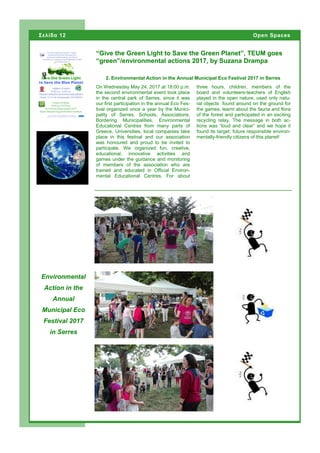
On Wednesday May24, 2017 at 18:00 p.m.
the second environmental event took place
in the central park of Serres, since it was
our first participation in the annual Eco Fes-
tival organized once a year by the Munici-
pality of Serres. Schools, Associations,
Bordering Municipalities, Environmental
Educational Centres from many parts of
Greece, Universities, local companies take
place in this festival and our association
was honoured and proud to be invited to
participate. We organized fun, creative,
educational, innovative activities and
games under the guidance and monitoring
of members of the association who are
trained and educated in Official Environ-
mental Educational Centres. For about
three hours, children, members of the
board and volunteers-teachers of English
played in the open nature, used only natu-
ral objects found around on the ground for
the games, learnt about the fauna and flora
of the forest and participated in an exciting
recycling relay. The message in both ac-
tions was “loud and clear” and we hope it
found its target: future responsible environ-
mentally-friendly citizens of this planet!
“Give the Green Light to Save the Green Planet”, TEUM goes
“green”/environmental actions 2017, by Suzana Drampa
Environmental
Action in the
Annual
Municipal Eco
Festival 2017
in Serres
2. Environmental Action in the Annual Municipal Eco Festival 2017 in Serres
Σελίδα 12 Open Spaces
Page 12
13.
“The Happy Prince”by Oscar Wilde is an
exceptionally tender, moving fairy tale
about love, solidarity and the power of
friendship. Although the story was written in
the Victorian era, it continues to touch read-
ers of all ages as the messages it conveys
appeal to children, making it a classic story.
The main objectives of the project were
educational and pedagogic:
-Develop students’ creativity, imagination
and cooperative skills.
-Encourage teach teamwork.
-Develop critical thinking skills and reflect
on social issues.
-Learn about different forms of art.
-Make students aware of art as a means of
expression.
-Expand students’ vocabulary.
-Improve writing and communicative skills.
-Help students express themselves in artis-
tic ways.
-Enrich lessons with the use of literature.
-Integrate media in our lesson.
The students who worked on the project,
from November 2016 to March 2017, were
1st grade students aged 12-13 years old.
bring back joy love and affection Love,
warmth and friendship matter more of all
the jewellery in the world bright hearts and
smiles matter more than precious stones
and silver coins
I would sacrifice my ruby eyes to offer back
the bright side of life
If I were the Happy Prince I would stand
high upon each country
I would look after and protect, lending a
helping hand…struggling.
Hope will finally return to people’s hearts if
we all start sharing.
Giving a little piece of our hearts is enough
to bring back hope,
love and caring.
If I were the Happy Prince I would stand
high upon your country
I would be dressed in gold and gems
I would see everything that’s happening.
I would see homeless on the streets, chil-
dren in tents and people starving
I would see men with broken dreams, wom-
en in need and lonesome elder
Children without toys to play, refugees cry-
ing for home and shelter.
Their eyes would be empty of hope, their
broken hearts filled with sorrow, darkness
and pain in their souls would make me cry
and feel the need to help them all.
What charity would ever bring the smile
back into their faces?
I would share all my gold and gems to
“The Happy Prince”…turning a fairy tale into poetry in motion!
By Katerina Kloura
THE HAPPY PRINCE (the poem)
put in order to make up the poem”)
7th Step: Make a “Happy Prince” handicraft
8th Step: Make a video of the poem
9th Step: Present the poem in the “Poetry
in motion…” competition.
Benefits of the project:
-Students became familiar with forms of art
like poetry
-They used language as a tool to express
their feelings
-It fostered student’s creativity and lan-
guage acquisition
-It enhanced student’s integration
-It promoted collaboration and respect for
their fellow-students
-Students HAD FUN!!!
Steps to turning the fairy tale into a po-
em:
1st Step: Read chapters from the book at
the end of each lesson
2nd Step: Watch a 25min animated film of
the fairy tale (https://www.youtube.com/
watch?v=8Aank8bDtcE)
3rd Step: Group discussion based on the
moral values of the story
4th Step: Analysis activities in class
(brainstorming, word trees, role-playing, T/F
questions, writing haiku poems)
5th Step: Worksheet
(KEY question: ’’If you were the Happy
Prince what would you do to help your
country?”
6th Step: Writing the poem
(children proposed “lines” which were then
Σελίδα 13Issue 2/ January —June 20172017
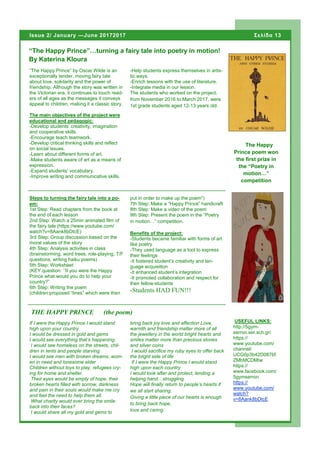
The Happy
Prince poem won
the first prize in
the “Poetry in
motion…”
competition
USEFUL LINKS:
http://5gym-
serron.ser.sch.gr/
https://
www.youtube.com/
channel/
UCG0p3b42D087bf
ZMbMCDMIw
https://
www.facebook.com/
5gymserron
https://
www.youtube.com/
watch?
v=8Aank8bDtcE
14.
The 5th JuniorHigh School of Serres
is delighted to have launched the first
“Poetry in motion…” competition. The
idea of the competition was to en-
courage students express the feelings
poetry evokes, through different forms
of art. Children were invited to partici-
pate, presenting their original work
with the help of their school teachers.
The competition was open to all Jun-
ior High School students in the pre-
fecture of Serres, while full criteria,
terms and conditions were early an-
nounced to schools and English
teachers with the help of the State
English Teachers' Union of Serres.
The panel of judges had carefully
reviewed each entry before the day of
the presentation, as children came up
with wonderful ideas turning poetry
into painting, animation, videos, hand-
icraft and what’s more, expressing
themselves through creative writing,
producing original poems.
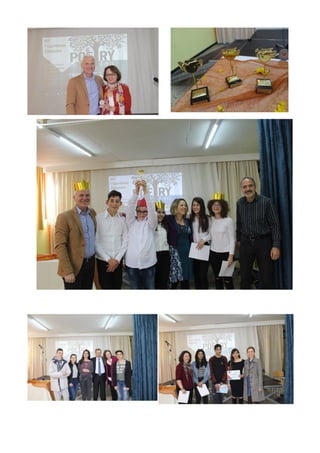
On Sunday, March 19th
, students
work was presented at a special cere-
mony, held in the 5th Junior High
School of Serres. It was an amazing
day! Volunteer students of the host-
school were there to welcome the
guests, serve them in a student-made
buffet, provide assistance in the
presentations and quality artistic time
during the break. The contestants’
vivid imagination astounded the audi-
ence. There was talent, passion and
inspiration in all 14 entries. Every
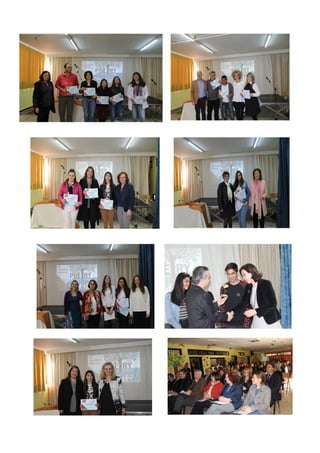
student and teacher who participated
received a Certificate of Participation.
The judging panel was composed of:
1.Amanatidou Konstantina, School
Advisor of English Language Teach-
ers
2.Eleftheria Panou, President of
ΕLΜΕ Serron, English Language
Teacher
3. Konstantinos Laskaris , Headmas-
ter of ΕΕΕΕΚ Serron, Art Teacher
4. Suzana Drampa, Vice President of
the State English Teachers' Union of
Serres
5. Marianthi Tsepeli , Member of the
State English Teachers' Union of
Serres
Prizes and awards were given as
follows:
1st
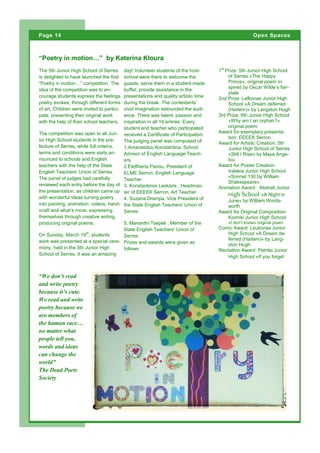
Prize: 5th Junior High School
of Serres «The Happy
Prince», original poem in-
spired by Oscar Wilde’s fair-
ytale
2nd Prize: Lefkonas Junior High
School «A Dream deferred
(Harlem)» by Langston Hugh
3rd Prize: 6th Junior High School
«Why am I an orphan?»
original poem
Award for exemplary presenta-
tion: ΕΕΕΕΚ Serron
Award for Artistic Creation: 5th
Junior High School of Serres
«Still I Rise» by Maya Ange-
lou
Award for Poster Creation:
Irakleia Junior High School
«Sonnet 130 by William
Shakespeare»
Animation Award : Alistrati Junior
High School «A Night in
June» by William Words-
worth
Award for Original Composition:
Koimisi Junior High School
«I don’t know» original poem
Comic Award: Leukonas Junior
High School «A Dream de-
ferred (Harlem)» by Lang-
ston Hugh
Recitation Award: Petritsi Junior
High School «If you forget
“Poetry in motion…” by Katerina Kloura
“We don’t read
and write poetry
because it’s cute.
We read and write
poetry because we
are members of
the human race…
no matter what
people tell you,
words and ideas
can change the
world”
The Dead Poets
Society
Page 14 Open Spaces
15.
Many special thanksto the judging panel for our cooperation and to Mrs Efthimiadou Sofia,
Head of the School Activity Office and the State English Teachers' Union of Serres for their
support.
I would like to warmly thank the colleagues who embraced the idea of the competition and
honoured us with their participation. Especially, Alexandri Despina, Verrou Katerina, Kata-
kalidou Maria, Maravelaki Fryni, Paligianni Katerina and Tassiou Eleni.
May we continue to celebrate the power of poetry in such beautiful ways!
On behalf of the
organizer
Kloura Katerina
English Language
Teacher
5th Junior High
School of Serres
Page 15Issue 2/ January —June 20172017
Posted material of the competition can be found in the following links:
http://5gym-serron.ser.sch.gr/ https://www.youtube.com/channel/
UCG0p3b42D087bfZMbMCDMIw https://
www.facebook.com/5gymserron
18.
The teaching ofEnglish as a for-
eign language (EFL) in the Greek second-
ary education is exercised under the speci-
fications of the Unified Curriculum for For-
eign Languages (Government Gazette,
2871/09-09-16). This novel curriculum ad-
vocates active and holistic learning through
cross-thematic and cross-curricular tasks,
promoted through the methodology of pro-
ject-based learning. The curricular goals for
the teaching of foreign languages are not
only the development of the receptive and
the productive skills but also the ability of
"learning how to learn", of critical and crea-
tive thinking, of collaboration, of communi-
cation in a foreign language and of the ex-
ploration of Information and Communication
Technologies (ICT). Moreover, it encour-
ages alternative forms of assessment like
self, peer or group evaluations through ru-
brics and portfolios.
Since the Unified curriculum for
foreign languages encourages technology
integration and use, the textbook's demerit
in this respect has provided the rationale for
this project and the implementation of
Web2Quests based on the textbook's top-
ics, grammar, vocabulary and skills. The
textbook is Think Teen Junior High School
2nd Grade Beginners (McGavigan, 2014).
Each Web2Quest was constructed around
the topic of the textbook's units, integrating
this way the WWW into the curriculum/
syllabus. The Web2Quests' aims match the
aims of the syllabus and provide a scaffold
for the students to prepare for and com-
plete the "Project Work" at the end of each
chapter.
The first Web2Quest, "I'm only
human", is based on the first unit of the
textbook with the same title. In this unit,
students are expected to acquire
knowledge about geography, natural fea-
tures, races and tribes around the world.
The aim of the Web2Quest and of the unit
is to introduce students to everyday scenes
in different places and cultures from around
the world with explicit focus on various
styles of tribal life. Students have the op-
portunity to practise the Present Simple and
the Present Continuous tenses along with
the State verbs and the vocabulary related
The Web2Quest Way to “Think Teen” by Maravelaki Fryni
Links:
Web2Quest 1:
http://thinkteen-
2ndgrade-
beginners-
unit1.weebly.com/
Web2Quest 2:
http://thinkteen-
2ndgrade-
beginners-
unit2.weebly.com/
Page 18 Open Spaces
Page 18
In the Evaluation pages students
are asked to evaluate themselves, their
team mates and the other teams. The eval-
uation takes the form of rubrics and check-
lists that evaluate the product and the group
performance. The aim of the evaluation is to
encourage reflection on how the task was
performed, to identify best practices and to
produce improvements in the future. As far
as the Conclusion pages are concerned,
their role is to bring a closure to the quest
and to serve as a review guide, reminding
the students what they have learnt, encour-
aging them to extend and refine the experi-
ence into other domains as well.
The second Web2Quest, "Making
a difference", is based on the second unit of
the textbook with the same title. In this unit
students are expected to acquire
knowledge about famous people in history
and learn how these people contributed to
society and culture. The aim of the
Web2Quest and of the unit is to make stu-
dents aware of the lives and works of peo-
ple who made a difference with their
work, actions and personality to the
world's cultural heritage. Students also
have the opportunity to practise the Past
Simple tense together with the vocabulary
related to personality adjectives.
The Web2Quests are structured
in the following way: The Introduction
pages introduce the topic, provide back-
ground information and gain students' at-
tention and interest. The Task pages ex-
plain clearly what the students have to do in
order to complete the task. In the Process
pages, the teacher guides students through
the tasks using a numbered step-by-step
guide. In the Resources pages, information
resources are listed to help students better
understand and broaden their knowledge.
Students are presented with hyperlinks
preselected by the teacher that can be ac-
cessed in order to find the relevant infor-
mation.
19.
Η εκπαίδευση αποτελείβασικό
ανθρώπινο δικαίωμα και όπλο κατά των
φαινομένων βίαιου εξτρεμισμού που τα
τελευταία χρόνια ταλανίζουν τις κοινωνίες
μας. Πώς το φαινόμενο αυτό μπορεί να
καταπολεμηθεί αν εκπαιδεύουμε τους νέους
στην υιοθέτηση ορθών στάσεων και συμπε-
ριφορών?
Οι μαθητές θα πρέπει αρχικά να
συνειδητοποιήσουν την αξία της εκπαίδευ-
σης που λαμβάνουν και πιο συγκεκριμένα
της δημόσιας εκπαίδευσης, πρωτοβάθμιας
και δευτεροβάθμιας, που στόχο έχει την
ισορροπημένη και ολόπλευρη ανάπτυξη
της προσωπικότητάς τους σε γνωστικό,
συναισθηματικό και ψυχοκινητικό επίπεδο.
Τα τελευταία χρόνια, δυστυχώς, ο χώρος
της δημόσιας εκπαίδευσης προσφέρεται
πολύ συχνά για άκοπη και αβάσιμη κριτική
και βάλλεται από παντού και απαξιώνεται
στα μάτια των μαθητών μας, ενώ, στην
πραγματικότητα, η δουλειά που γίνεται στα
σχολεία μας είναι πολύ σημαντική.
Πέρα από την κατάκτηση γνωστι-
κών στόχων με στόχο την εισαγωγή τους
στην τριτοβάθμια εκπαίδευση, οι μαθητές
μας στο σχολείο καλούνται να ανακαλύ-
ψουν και να μάθουν για τη ζωή εξίσου ση-
μαντικά πράγματα: να κατανοήσουν αξίες
όπως η αλληλεγγύη, ο σεβασμός στη δια-
φορετικότητα, αλλά και στην εθνική ταυτό-
τητα, τα ανθρώπινα δικαιώματα, που είναι
πάνω και ανεξάρτητα από χώρα, χρώμα
και θρησκεία, και παράλληλα να εκτιμήσουν
αυτά τα οποία θεωρούν δεδομένα στη ζωή
τους. Επιπρόσθετα, επιδιώκεται να καλλιερ-
γήσουν θετικές στάσεις και συμπεριφορές
και μέσα από εκπαιδευτικές δραστηριότητες
είναι σημαντικό να δίνεται έμφαση σε αυτό
το στόχο.
ρούμε να φέρνουμε τους μαθητές μας σε
επαφή με συνομιλήκους τους ανά τον κό-
σμο, ενθαρρύνοντάς τους σε ασφαλείς συ-
νεργατικές εκπαιδευτικές δραστηριότητες.
Επιπλέον, η διαθεματική προσέγγιση διδα-
σκαλίας μπορεί να βοηθήσει αποτελεσματι-
κά προς αυτήν την κατεύθυνση.
Η παρουσίαση που ακολουθεί
βασίζεται στην προσέγγιση του θέματος
υπό το πρίσμα της εκπαίδευσης και αποτε-
λεί εργασία τμήματος του 4ου Γενικού Λυ-
κείου Σερρών στο μάθημα της Ξένης Γλώσ-
σας.
Πηγές: Global Citizenship Educa-
tion, Preventing violent extremism through
education, Unesco
Στο πλαίσιο αυτό, είναι απαραίτη-
το οι εκπαιδευτικοί να είμαστε ευαισθητο-
ποιημένοι και να αφουγκραζόμαστε τις
ραγδαίες κοινωνικές αλλαγές, ενώ παράλ-
ληλα πρώτα εμείς πρέπει να φροντίζουμε
να αυτοβελτιωνόμαστε διαρκώς στην εργα-
σία μας, κινούμενοι σύμφωνα με τις αρχές
της διά βίου μάθησης.
Σύμφωνα με την παραπάνω οπτι-
κή, προτεραιότητα μπορούν να αποτελέ-
σουν δράσεις που υπηρετούν τον διαπολιτι-
σμικό διάλογο και τις συνεργασίες. Μέσα
από διασχολικές επαφές, αδελφοποιήσεις
σχολείων, ελληνικά και ευρωπαϊκά προ-
γράμματα, διεθνείς - παγκόσμιες εκπαιδευ-
τικές πλατφόρμες και περιβάλλοντα, μπο-
Η εκπαίδευση βασικό ανθρώπινο δικαίωμα και όπλο κατά των
φαινομένων βίαιου εξτρεμισμού, από την Κουτίδου Χριστίνα
Η διαρκής ενημέρωση της νεολαί-
ας μας σχετικά με έννοιες, όπως η διαφορε-
τικότητα και ο βίαιος εξτρεμισμός μπορούν
να προβληματίσουν τους νέους μας για τα
παγκόσμια τεκταινόμενα, αλλά και να τους
βοηθήσουν στην υιοθέτηση ορθών στάσε-
ων και στην καταπολέμηση εξτρεμιστικών
συμπεριφορών. Είναι σημαντικό να δίνεται
στους μαθητές η δυνατότητα να εμπλέκο-
νται σε σχετικές δράσεις και προγράμματα
στη σχολική ζωή. Η μετάδοση της γνώσης
θα πρέπει να καθίσταται διαδικασία κοινω-
νική και συνεργατική, ενώ παράλληλα θα
γίνεται προσέγγισή της μέσα από την
έννοια της ιδιότητας του πολίτη του κόσμου.
Οι μαθητές/-τριες θα πρέπει να ενθαρρύνο-
νται στο να αντιλαμβάνονται και να στο να
ερμηνεύουν τα κοινωνικά προβλήματα και
να αναζητούν και να υποστηρίζουν λύσεις.
Η Διακήρυξη του Παρισιού στις 17
Μαρτίου 2015, ως επακόλουθο των τρομο-
κρατικών επιθέσεων του Ιανουαρίου 2015,
αποφάσισε για την προώθηση της ιδιότητας
του ενεργού πολίτη και των κοινών αξιών
της ελευθερίας, της ανεκτικότητας και των
μη - διακρίσεων μέσα από την εκπαίδευση.
Σύμφωνα με αυτή, προτεραιότητα στην
εκπαίδευση αποτελεί η ενίσχυση της κριτι-
κής σκέψης, του ψηφιακού γραμματισμού,
ιδιαίτερα στη χρήση του Internet και των
μέσων κοινωνικής δικτύωσης, ώστε να ανα-
πτυχθεί αντοχή των νέων στις διακρίσεις
και στην κατήχηση ιδεών. Εξίσου σημαντική
είναι η πρόσβαση κοινωνικά ευάλωτων - μη
προνομιούχων παιδιών σε μια εκπαίδευση
που θα ανταποκρίνεται στις ανάγκες και τις
ιδιαιτερότητές τους. Οι νέοι άνθρωποι μόνο
μέσα από σωστή εκπαίδευση θα αποκτή-
σουν τις κοινωνικές και διαπολιτισμικές
δεξιότητες ανάλογες προς τις ανάγκες τους.
Οι μαθητές θα
πρέπει να
συνειδητοποιήσουν
την αξία της
δημόσιας
εκπαίδευσης που
λαμβάνουν που
στόχο έχει την
ισορροπημένη και
ολόπλευρη
ανάπτυξη της
προσωπικότητάς
τους σε γνωστικό,
συναισθηματικό
και ψυχοκινητικό
επίπεδο.
Page 19Issue 2/ January —June 20172017
POWER-
POINT
PRESENTATION
https://
Δwww.slideshare.ne
t/secret/
EE1BKXqytsyULs
Page 19
20.
Με αφορμή τηνεισαγωγή των
Βιωματικών Δράσεων στη Β΄ Γυμνασίου το
σχολικό έτος 2014-2015, στο διδακτικό
αντικείμενο "Πολιτισμός και δραστηριότητες
Τέχνης", αποφασίσαμε να ασχοληθούμε με
τον κινηματογράφο και να μυήσουμε τους
μαθητές της Β΄ Γυμνασίου στην τέχνη του.
Η ανταπόκριση των μαθητών ήταν άμεση
καθώς 50 από τους 80 μαθητές της Β΄ Γυ-
μνασίου επέλεξαν το Project για τον κινημα-
τογράφο. Έτσι λοιπόν δημιουργήθηκαν 2
τμήματα από 25 μαθητές το καθένα, με
κριτήριο τις ταινίες και τους δημιουργούς
που επιλέξαμε να αναλύσουμε.
Το πρώτο τμήμα ασχολήθηκε με
τον άγγλο θεατρικό συγγραφέα William
Shakespeare και το θεατρικό έργο "Romeo
and Juliet" και το δεύτερο τμήμα με το γερ-
μανό συγγραφέα Erich Kästner και το λογο-
τεχνικό έργο "Das fliegende Klassenzim-
mer". Μέσα από τα λογοτεχνικά κείμενα και
την μεταφορά τους στη μεγάλη οθόνη, οι
μαθητές γνώρισαν την τέχνη του κινηματο-
γράφου και εμπνεύστηκαν ώστε να δημι-
ουργήσουν τη δική τους ταινία. Το πρό-
γραμμα χωρίστηκε σε ενότητες με τα αντί-
στοιχα φύλλα εργασίας για κάθε μία και η
πορεία του καταγράφηκε στην ιστοσελίδα
που δημιουργήθηκε για το σκοπό αυτό:
www.pame-sinema.webnode.gr.
Βασιστήκαμε στο πρόγραμμα
σπουδών για την οπτικοακουστική έκφραση
του Υπουργείου Παιδείας το οποίο μας
χρησίμευσε ως χάρτης πλοήγησης για το τι
θα διδαχθούν τα παιδιά στο συγκεκριμένο
διδακτικό αντικείμενο καθώς και στα βιβλία
του προγράμματος "Πάμε σινεμά;". Επίσης
συμβουλευτήκαμε βιβλία σχετικά με τον
κινηματογράφο καθώς και υποστηρικτικό
υλικό από το διαδίκτυο. Το μάθημα ήταν
μονόωρο και ουσιαστικά διήρκησε 23 ώρες
όλη χρονιά, λόγω απώλειας ωρών από
αργίες, εκδρομές κ.α. Η περισσότερη δου-
λειά έγινε εκτός σχολείου, απογεύματα και
Σαββατοκύριακα, από τους μαθητές, όπως
επίσης και τα γυρίσματα της ταινίας. Το
project είχε ιδιαίτερη απήχηση στους μαθη-
τές και ολοκληρώθηκε με επιτυχία παρά τις
αντιξοότητες που παρουσιάστηκαν. Θέλου-
με να τονίσουμε ότι ο Διευθυντής, ο Σύλλο-
γος των Εκπαιδευτικών του Γυμνασίου Η-
ράκλειας, ο Σύλλογος Γονέων και Κηδεμό-
νων του Σχολείου και η οικονομική ενίσχυ-
ση από τη Σχολική Επιτροπή του Δήμου
Ηράκλειας μας βοήθησαν στο έργο μας με
τη στήριξη και ενθάρρυνσή τους.
«Πάμε Σινεμά. Ο κινηματογράφος στη δευτεροβάθμια
εκπαίδευση»
Μαραβελάκη
Φρύνη, Γυμνάσιο
Ηράκλειας,
Καθηγήτρια
Αγγλικών και
Ισπανικών, MEd
in TESOL,
frynimarvel@gma
il.com
Χατζηβασιλειάδ
ου Δέσποινα,
Γυμνάσιο
Ηράκλειας,
Καθηγήτρια
Γερμανικών, MEd
στη
Διαπολιτισμική
εκπαίδευση,
chatzivasiliadou
@yahoo.de
(Ελληνική Ραδιοφωνία Τηλεόραση) και η
Πρεσβεία της Κυπριακής Δημοκρατίας στην
Ελλάδα – Μορφωτικό Γραφείο – Σπίτι της
Κύπρου http://cinemadiavases.blogspot.gr/.
Βιβλιογραφία
ΚΕΕ. (χ.χ.) Πρόγραμμα Τί ακούμε; Τί βλέ-
πουμε; Ενότητα Φωτογραφία και Κινηματο-
γράφος. Αθήνα: ΥΠΕΠΘ, ΓΓΝΓ, ΙΔΕΚΕ.
Κιούκας, Α. (Επ. ) (2003). Η κινηματογραφι-
κή αφήγηση. Πάμε σινεμά; Εκπαιδευτικό
πρόγραμμα γνωριμίας με την τέχνη του
κινηματογράφου. Για την δευτεροβάθμια
εκπαίδευση. Αθήνα: Υπουργείο Πολιτισμού,
ΥΠΕΠΘ, Φεστιβάλ Κιν/φου Θεσ/νίκης.
Κιούκας, Α. (Επ.) (2002). Η κινηματογραφι-
κή αφήγηση. Πάμε σινεμά; Εκπαιδευτικό
πρόγραμμα γνωριμίας με την τέχνη του
κινηματογράφου. Για την πρωτοβάθμια
εκπαίδευση. Αθήνα: Υπουργείο Πολιτισμού,
ΥΠΕΠΘ, Φεστιβάλ Κιν/φου Θεσ/νίκης.
Οδηγός εκπαιδευτικού για την οπτικοακου-
στική έκφραση. (2011). Στο πλαίσιο των
δραστηριοτήτων αισθητικής αγωγής για
όλες τις βαθμίδες της υποχρεωτικής εκπαί-
δευσης. Αθήνα: Π. Ι., ΥΠΔΒΜ.
Πρόγραμμα σπουδών για την οπτικοακου-
στική έκφραση. (2011). Στο πλαίσιο των
δραστηριοτήτων αισθητικής αγωγής για
όλες τις βαθμίδες της υποχρεωτικής εκπαί-
δευσης. Αθήνα: Π. Ι., ΥΠΔΒΜ.
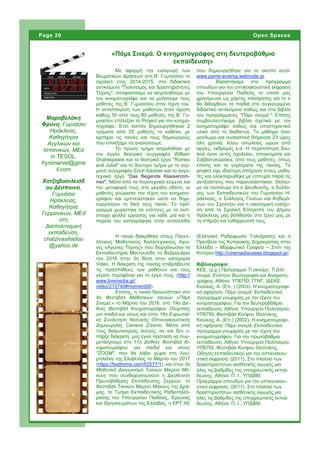
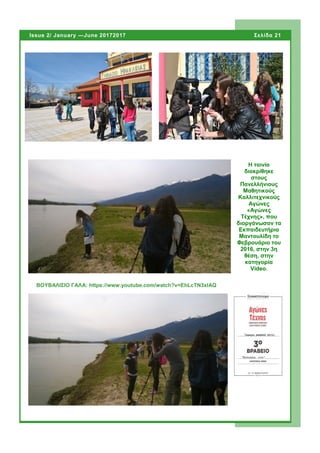
Η ταινία διακρίθηκε στους Πανελ-
λήνιους Μαθητικούς Καλλιτεχνικούς Αγώ-
νες «Αγώνες Τέχνης» που διοργάνωσαν τα
Εκπαιδευτήρια Μαντουλίδη το Φεβρουάριο
του 2016 στην 3η θέση στην κατηγορία
Video. Η διάκριση της ταινίας επιβράβευσε
τις προσπάθειες των μαθητών και τους
γέμισε περηφάνια για το έργο τους. (http://
www.livemedia.gr/
video/215740#moment58).
Επίσης, η ταινία διαγωνίστηκε στο
8ο Φεστιβάλ Μαθητικών ταινιών «Πάμε
Σινεμά;» το Μάρτιο του 2016, στο 19ο Διε-
θνές Φεστιβάλ Κινηματογράφου Ολυμπίας
για παιδιά και νέους και στην 16η Ευρωπαϊ-
κή Συνάντηση Νεανικής Οπτικοακουστικής
Δημιουργίας Camera Zizanio. Μέσα από
τους διαγωνισμούς αυτούς, αν και δεν υ-
πήρξε διάκριση, μας έγινε πρόταση να συμ-
μετάσχουμε στο 11ο Διεθνές Φεστιβάλ Κι-
νηματογράφου για παιδιά και νέους
"ZOOM", που θα λάβει χώρα στη Λου-
μπλιάνα της Σλοβενίας το Μάρτιο του 2017
(https://festhome.com/f/2577/1), και στον 3ο
Μαθητικό Διαγωνισμό Ταινιών Μικρού Μή-
κους που συνδιοργανώνουν η Διεύθυνση
Πρωτοβάθμιας Εκπαίδευσης Σερρών, το
Φεστιβάλ Ταινιών Μικρού Μήκους της Δρά-
μας, το Τμήμα Εκπαιδευτικής Ραδιοτηλεό-
ρασης του Υπουργείου Παιδείας, Έρευνας
και Θρησκευμάτων της Ελλάδας, η ΕΡΤ ΑΕ
Page 20 Open Spaces
Λεζάντα που περι-
γράφει την εικόνα ή
το γραφικό.
The 20th
Primary Schoolof Serres has implemented an ERASMUS + European Teachers’
Mobility and Education KA1 project in the school year 2016-2017. Two teachers, PE 70
(Primary School Teacher) and PE 06 (Teacher of English) participated in a training course
entitled “Project management for cross-cultural exchange projects in Europe” in Tenerife,
Spain, organised by the German Educational Institute Ifel (based in Hamburg) on March 5-
10, 2017 and co-funded by the European Union. The thematic fields of the training were:
Active citizenship, Education/School Project management, European citizenship & Europe-
an dimension in Education, Intercultural Education and School Autonomy in managing
European projects.
50 teachers of various specialties from 10 European countries ( Greece, Germany, Den-
mark, France, Austria, Belgium, Hungary, Poland, Croatia, Slovakia) teaching in 25
schools at all levels of education (pre-school up to vocational and adult education) were
trained in the implementation and management of cross-cultural European projects,
worked in groups, exchanged ideas, commented on study cases and collaborated in order
to create the foundations of future school partnerships and job-shadowing possibilities. It
was an intercultural experience of high standards that met the participants’ expectations
and needs, due to the great and long know-how expertise and the perfect organisation
skills of Ifel Institute trainers, all highly qualified and coming from different ethnical, cultural
and educational background.
“Project management for cross-cultural exchange”
Σελίδα 22 Open Spaces
Objectives and Course Description
Participants received basic information on project management and intercultural communi-
cation, pre-course materials and bibliography of study materials before the course. Individ-
ual counselling was provided before, during and after the course according to the
participant’s needs. The objective of the course was to expand the participants’ under-
standing for planning, developing, executing, and managing European projects and to in-
troduce contemporary innovative methodology.
The course consisted of 50 hours of theoretical sessions, as well as practical activities and
group workshops. The methodology was based on the integration of theory and practice as
well as sharing expertise and analysing case studies. The following methods were applied:
a)warming up and brainstorming, b) plenary sessions, c) discussions in pairs and small
groups, d) group workshops, e) role plays, f) innovative methods like interactive poster
sessions, g) case studies, h) presentations of the workshop materials and possible future
project schemes, i) intercultural events.
“Project
management for
cross-cultural
exchange”
project in
Tenerife, Spain
by Suzana
Drampa,
Teacher of
English,
member of
TEUM Board
23.
The theoretic partincluded: 1) an overview of the relevant European funded programs, 2)
sources of information and helpful indicators to analyse the information about project plan-
ning, development and management, 3) partner search strategies, 4) partner roles in pro-
ject management, 5) project financial management and tools, 6) monitoring of project, 7)
evaluation, dissemination and valorisation strategies, 8) common problems and how to
avoid them, 9) intercultural communication strategies and 10) practical implementation of
the intercultural methodology for the teaching/learning needs, as well as for project man-
agement and project implementation
Feedback and Evaluation
Quoting from the participants’ evaluation of the whole experience: “We understood better
the peculiarities of the various educational and cultural frameworks and standards in Eu-
rope and the views and methods underlining the Educational Systems of other European
countries. We also broadened our possibilities for European networking, that is, the ways
and means of finding partners to build a collaboration for good practices exchange (job
shadowing, KA2 projects, e-twinning).
It’s worth mentioning that the training used interactive methods, which help the cooperation
between the members of a group (elimination of tension, creation of safe atmosphere, ex-
pression of emotions and development of positive attitude). The teachers /trainees wit-
nessed innovative ideas for including cross-cultural activities in the school curriculum and
experienced ways of reinforcing creativity, variety and originality. They gained the oppor-
tunity of participating, life-long learning, increasing self-confidence, self-knowledge and
perspective, while having excitement and fun at the same time.
Dissemination and Long-term Benefits
As a follow-up activity the participants exchanged their project management experience on
the course platform, as well as questions and ideas about future partnerships. Dissemina-
tion of the experience and knowledge gained during the mobility in the schools of the par-
ticipants and the exchange of the ways each school chose to achieve that, were the final
steps of a successful , at all levels, in-service training course.
Many of the activities and innovative methods were incorporated in daily classroom prac-
tice. Students of the school communicated live on Skype with trainers and teachers/
trainees during the course in Tenerife in order to be part of the experience, greeting, asking
questions and presenting their school to the participants. Two months after the course the
students of 20th
Primary School of Serres and those of Grundschule Neerstedt, Neerstedt
in Northern Germany, Bremen collaborated in the organisation of a an intercultural telecon-
ference on May 24, 2017, greeting each other with a song in their own language. The two
schools hope to continue collaboration next year through job shadowing as a first step and
a school partnership project later on.
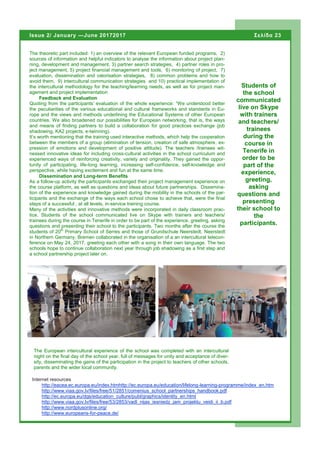
Internet resources
http://eacea.ec.europa.eu/index.htmhttp://ec.europa.eu/education/lifelong-learning-programme/index_en.htm
http://www.viaa.gov.lv/files/free/51/2851/comenius_school_partnerships_handbook.pdf
http://ec.europa.eu/dgs/education_culture/publ/graphics/identity_en.html
http://www.viaa.gov.lv/files/free/53/2853/vadl_nijas_iesniedz_jam_projektu_veidi_ii_b.pdf
http://www.nordplusonline.org/
http://www.europeans-for-peace.de/
Σελίδα 23Issue 2/ January —June 20172017
Students of
the school
communicated
live on Skype
with trainers
and teachers/
trainees
during the
course in
Tenerife in
order to be
part of the
experience,
greeting,
asking
questions and
presenting
their school to
the
participants.
The European intercultural experience of the school was completed with an intercultural
night on the final day of the school year, full of messages for unity and acceptance of diver-
sity, disseminating the gains of the participation in the project to teachers of other schools,
parents and the wider local community.
24.
Περίληψη Σχεδίου
H ανάγκηβελτίωσης των δεξιοτήτων των καθηγητών στη διαχείριση διαπολιτισμικών προ-
γραμμάτων είναι επιτακτική, καθώς αυτή υπαγορεύεται από τις ραγδαίες αλλαγές στην
αγορά εργασίας, η οποία από τοπικό αποκτά ευρωπαϊκό χαρακτήρα. Αντίστοιχα και οι
προτεραιότητες των σχολείων έχουν αλλάξει: είναι καλό το σχολείο να προετοιμάζει τους
μαθητές του για την Ευρωπαϊκή αγορά εργασίας, ωθώντας τους να αναπτύξουν ανάλογες
ικανότητες. Οι διαπολιτισμικές ικανότητες, ως ένα ουσιαστικό μέρος του ευρωπαϊκού ανοι-
χτού σχολείου, είναι αυτές που αποκτήθηκαν στο πλαίσιο του προγράμματος Erasmus+
(Δράση ΚΑ1: κινητικότητα εκπαιδευτικών) με τίτλο “Project Management for cross-cultural
exchange projects in Europe”. Οι συμμετέχοντες παρακολούθησαν πρόγραμμα κατάρτισης
μαζί με καθηγητές από άλλες χώρες, σε ένα πραγματικό διαπολιτισμικό εκπαιδευτικό πλαί-
σιο εργασίας, το οποίο, πέρα από τα μαθήματα, επεκτάθηκε και σε όλη τη διάρκεια του
σεμιναρίου. Ως αποτέλεσμα, οι καθηγητές είχαν την ευκαιρία και τη δυνατότητα να συνα-
ντήσουν πιθανούς εταίρους για μελλοντικά προγράμματα και να σχεδιάσουν μαζί τους
σχολικές ανταλλαγές, προγράμματα etwinning και επιτόπιας παρακολούθησης εργασίας
(job shadowing).
Το πρόγραμμα Erasmus+ είναι το πρόγραμμα της ΕΕ για τη στήριξη της εκπαίδευσης, της
κατάρτισης, της νεολαίας και του αθλητισμού στην Ευρώπη. Με προϋπολογισμό 14,7 δισ.
ευρώ, δίνει τη δυνατότητα σε πάνω από 4 εκατομμύρια Ευρωπαίους να σπουδάσουν, να
επιμορφωθούν, να αποκτήσουν εμπειρία και να προσφέρουν εθελοντική εργασία στο εξω-
τερικό (http://ec.europa.eu/programmes/erasmus-plus/about_el).
Βασικές προτεραιότητες και στόχους των προγραμμάτων Erasmus+ για τη σχολική εκπαί-
δευση αποτελούν η βελτίωση της επιτυχούς απόκτησης βασικών δεξιοτήτων και ποιότη-
τας στην εκπαίδευση, η επαγγελματική ανάπτυξη του εκπαιδευτικού προσωπικού με ανα-
γνώριση των γνώσεων και δεξιοτήτων που αποκτώνται, η μείωση της πρόωρης σχολικής
εγκατάλειψης, ο εκσυγχρονισμός και η διεθνοποίηση των σχολείων και των συστημάτων
της σχολικής εκπαίδευσης, η ανταλλαγή ιδεών, πληροφοριών, εμπειριών, μεθοδολογίας
και εκπαιδευτικού υλικού, η κατανόηση και συνεργασία μεταξύ των χωρών με διαφορετική
κουλτούρα.
Φορέας διαχείρισης των ευρωπαϊκών προγραμμάτων Erasmus+ για τη σχολική εκπαίδευ-
ση στη χώρα μας είναι το Ίδρυμα Κρατικών Υποτροφιών (ΙΚΥ), όπου μπορεί κάθε ενδια-
φερόμενος να αναζητήσει σχετικές πληροφορίες (https://www.iky.gr/el/erasmusplus).
“Project Management for cross-cultural exchange projects in
Europe” by Christina Koutidou
Page 24 Open Spaces
Αντικειμενικοί Στόχοι
Το εκπαιδευτικό πρόγραμμα «Βελτίωση Δεξιοτήτων στη Διαχείριση Ευρωπαϊκών Διαπολι-
τισμικών Προγραμμάτων» είχε ως στόχο να διευρύνει την κατανόηση του σχεδιασμού, της
ανάπτυξης, διαχείρισης και εκπόνησης ευρωπαϊκών προγραμμάτων από την πλευρά των
συμμετεχόντων. Περιλάμβανε γενική αναφορά στα χρηματοδοτούμενα ευρωπαϊκά προ-
γράμματα, πηγές πληροφοριών και χρήσιμους δείκτες ανάλυσης πληροφοριών σχετικά με
τα προγράμματα, στρατηγικές εξεύρεσης εταίρων και ανάλυση του ρόλου των εταίρων στα
πλαίσια ενός προγράμματος, οικονομική διαχείριση, παρακολούθηση - έλεγχο των προ-
γραμμάτων, στρατηγικές εκτίμησης και διάχυσης των αποτελεσμάτων, συνηθισμένα προ-
βλήματα που ανακύπτουν και τρόπους αποφυγής τους, στρατηγικές διαπολιτισμικής επι-
κοινωνίας.
Η εμπειρία του σεμιναρίου αποτέλεσε κίνητρο για τη διαπολιτισμική μάθηση και συνεργα-
σία. Η εκπαίδευση κατέστησε τους συμμετέχοντες ικανούς να εμπνεύσουν το εκπαιδευτικό
προσωπικό του σχολείου για τη συμμετοχή σε ευρωπαϊκά προγράμματα, καθώς και να
χρησιμοποιήσουν τις εργασίες του προγράμματος ως μέσο για να διευρύνουν τις διαπολιτι-
σμικές, γλωσσικές και κοινωνικές δεξιότητες των μαθητών. Με αυτόν τον τρόπο οι μαθητές
μας θα είναι καλύτερα προετοιμασμένοι για τις απαιτήσεις του μέλλοντος στην ευρωπαϊκή
και διεθνή αγορά εργασίας.
“Project Management
for cross-cultural
exchange projects in
Europe”
Αn Erasmus+ Key Action
1 Programme funded by
the European Commission
and organised by the 3rd
Junior High School of
Serres
by Christina Koutidou
ckoutidou@gmail.com
Διάρκεια Σχεδίου: 24
μήνες (Σχ. Έτη 2013
-2014 & 2014-2015)
Για περισσότερες
πληροφορίες σχετικά
με τη συγκεκριμένη
δράση, βλ. τον
υπερσύνδεσμο:
https://
www.slideshare.net/
ChristinaKoutidou/
project-management-
for-cross-cultural-
exchange-projects-in-
europe.
25.
Good language teaching’is a multi-dimensional process, shaped by both qualities and behaviours; effective teaching in-
volves knowledge, beliefs and attitudes which inform behaviour, decisions and choices. Good language teachers are com-
plex creatures. They are not only experienced practitioners, but they are aware of their experiences and practices and they
engage in reflection on them to enable them to make appropriate decisions in particular and concrete teaching contexts.
Teaching is situated practice. Good teaching involves a never ending process of ‘behave-reflect-decide’. An epigrammatic
statement of what I have learnt from observing teachers all my working life might go something like: ’good teachers are not
experts with answers; they are practitioners who ask questions’. Good language teachers do not stand still, do not reach a
point of rest, but are in a constant state of becoming. Successful classroom practitioners have not found a way of ‘being’
good at their job but a way of becoming better at their job.
Continued exploration of good language teaching is an inevitable consequence of the complexity of what it means to be a
good language teacher. So, just when we think we’ve mastered the qualities of teaching expertise (appropriate beliefs,
knowledge and attitudes) we are confronted with new challenges on the level of behaviour: which methods and techniques
will best meet the needs of new and unique combinations of students and their needs? The complexity is compounded by
the way these constituent levels of expertise interact with and inform each other.
Then there is the tip of the iceberg, that ‘baggy monster’ we refer to loosely as ‘classroom management’, We might have
achieved all the competence in the world in terms of formal teacher qualifications, qualities and practical methodological
skills only to discover, late in the autumn of our career, that we are not managing to get the students’ attention in the way to
which we have been accustomed. We need to revisit, redefine and even relearn the slippery, elusive, verbal and non-verbal
skills that will keep a group of students, adolescents or adults, paying attention and working together creatively towards a
common Second Language Acquisition (SLA) objective. This will involve an awareness of the importance of voice, body
language, eye contact and strategic use of classroom space. These skills involve levels of awareness and personal devel-
opment which are neglected on most teacher- training and even teacher development courses.
Our success or otherwise in making the most of group dynamics and our learners’ attention span will impact on the effec-
tiveness of our competence on the other levels that go into defining good language teaching: personal qualities, choice of
methods and techniques, approaches to teaching the four skills, grammar, vocabulary, pronunciation and pragmatics et al:
no skill is an island. Qualities, behaviours, methods and classroom management all interact in complex ways.
Just when veteran, expert teachers thought they had reached stasis, their reputation secure, respected by colleagues and
learners, the technological revolution came along to shake us from complacency,. Suddenly, all bets were off. Were the
traditional concepts of good language teaching still valid in the brave new world of digital devices, digital natives digital im-
migrants? A new generation of electronically-driven experts in education have asserted that effective teaching involves, of
necessity, the integration of digital learning into our classrooms; good teaching is blended teaching, successful classrooms
are flipped classrooms; indeed, the internet with its infinitive store of information and potential knowledge (if not wisdom)
has given student autonomy a new meaning, momentum and a dimension: how necessary are teachers, good or bad,
when students can find out and learn so much on their own at, the click of a button? How do we re-define the good lan-
guage teacher in the world of Google and Wikipedia, mass online courses and artificial intelligence? Is it back to the draw-
ing board for research into SLA and effective teaching in the wake of the technological revolution?
Other paradigm shifts which may shake us from our assumptions regarding the nature of good language teaching are the
rise of the English as a Lingua Franca movement: the ‘non-native speaker’ versus the ‘native-speaker’ – which is better? is
a debate which shows no signs of abating. Another old dichotomy which demands constant questioning and empirical re-
search is testing versus teaching: the washback effect ( the relationship between ways of testing and ways of teaching) is
more relevant than ever in a world of proliferating tests and exams. The complexity, gorgon-like, goes forth and multiplies.
One could add the focus in recent years on pragmatics, its importance in communicative competence and the development
of ways of reaching pragmatic competence to students – and testing it. How is the role of the prototypical ‘native-speaker’
changing in this ever-changing educational landscape? The voice of the non-native speaker is louder than in the past and
it is perhaps time to do away with the term altogether with its connotations of deficit and inferiority.
In sum, the task of becoming a good teacher is never done and has always been, by definition, a process of constant re-
search: as good language teachers we shall never tire or, as Tennyson might have put it, cease from exploration. ‘The
good language teacher’ is not singular but plural: this magazine for teachers will undoubtedly bring a variety of good lan-
guage teachers into focus, eager to share their experience and practical skills. May these open spaces be the site for dis-
covering new information, knowledge and wisdom and a site for rediscovering old information, knowledge and wisdom
Good luck.
Σελίδα 25Issue 2/ January —June 20172017
Good language teachers:
What do they do? What do they know? What do they have? By Luke Prodromou
26.
Η Μαραβελάκη Φρύνηείναι εκπαιδευτικός Δευτεροβάθμιας εκπαί-
δευσης στο Γυμνάσιο Ηράκλειας. Σπούδασε Αγγλική Γλώσσα και
Φιλολογία στο Α.Π.Θ. και Ισπανική Γλώσσα και Πολιτισμό στο Ε.Α.Π.
Έχει αποκτήσει Μεταπτυχιακό Δίπλωμα Ειδίκευσης Καθηγητών Αγ-
γλικής από το Ε.Α.Π. (MEd in TESOL). Ασχολείται ενεργά με τη χρή-
ση της εκπαιδευτικής τεχνολογίας για τη Διδασκαλία της Αγλικής
Γλώσσας και την παραγωγή ψηφιακού υλικού, τον οπτικοακουστικό
γραμματισμό, τα ευρωπαϊκά προγράμματα, τη βιβλιοθηκονομία και
την Ισπανική και Αγγλική λογοτεχνία. Είναι αξιολογήτρια προφορικού
λόγου στο ΚΠγ για την Αγγλική και Ισπανική γλώσσα.
Μαραβελάκη Φρύνη
Δράμπα Σουζάνα
My name is Suzana Drampa. I was born in 1968 in Serres. I live in
Serres and I have 3 children. I am a graduate of the Department of
English Language and Literature of AUThessaloniki (1990) and I
have been teaching English for 28 years in various levels of Private
and State Education, the last 25 in Primary Education. I have been a
member of the board of the local Union of Teachers of English in
Serres (TEUM) since its foundation in 2000, President from 2011 to
2016, and Vice-President at the moment.
Page 26 Open Spaces
Katerina Kloura was born in the city of Edessa and lives in Serres,
Greece. She studied in the School of English Language and Litera-
ture in the Aristotle University of Thessaloniki. She has been a state
school teacher since 2002 and has worked in all levels of primary
and secondary education. She is interested in promoting literature
and culture through English language teaching and has initiated the
organization of the “Poetry in motion” competition for secondary
schools in Serres. She presently works in the 5th
Junior High School
in Serres.
Κλούρα Κατερίνα
Σε αυτό το τεύχος έγραψαν...
27.
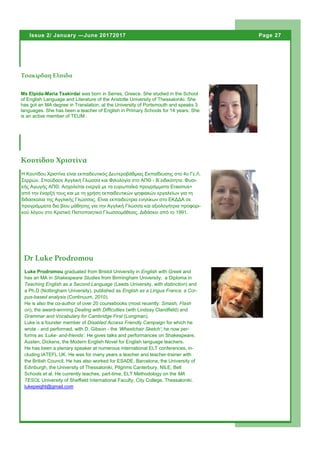
Ms Elpida-Maria Tsakirdaiwas born in Serres, Greece. She studied in the School
of English Language and Literature of the Aristotle University of Thessaloniki. She
has got an MA degree in Translation, at the University of Portsmouth and speaks 3
languages. She has been a teacher of English in Primary Schools for 14 years. She
is an active member of TEUM .
Τσακίρδαη Ελπίδα
Page 27Issue 2/ January —June 20172017
Η Κουτίδου Χριστίνα είναι εκπαιδευτικός Δευτεροβάθμιας Εκπαίδευσης στο 4ο Γε.Λ.
Σερρών. Σπούδασε Αγγλική Γλώσσα και Φιλολογία στο ΑΠΘ - Β΄ειδικότητα: Φυσι-
κής Αγωγής ΑΠΘ. Ασχολείται ενεργά με τα ευρωπαϊκά προγράμματα Erasmus+
από την έναρξή τους και με τη χρήση εκπαιδευτικών ψηφιακών εργαλείων για τη
διδασκαλία της Αγγλικής Γλώσσας. Είναι εκπαιδεύτρια ενηλίκων στο ΕΚΔΔΑ σε
προγράμματα δια βίου μάθησης για την Αγγλική Γλώσσα και αξιολογήτρια προφορι-
κού λόγου στο Κρατικό Πιστοποιητικό Γλωσσομάθειας. Διδάσκει από το 1991.
Κουτίδου Χριστίνα
Dr Luke Prodromou
Luke Prodromou graduated from Bristol University in English with Greek and
has an MA in Shakespeare Studies from Birmingham University; a Diploma in
Teaching English as a Second Language (Leeds University, with distinction) and
a Ph.D (Nottingham University), published as English as a Lingua Franca: a Cor-
pus-based analysis (Continuum, 2010).
He is also the co-author of over 20 coursebooks (most recently: Smash, Flash
on), the award-winning Dealing with Difficulties (with Lindsay Clandfield) and
Grammar and Vocabulary for Cambridge First (Longman).
Luke is a founder member of Disabled Access Friendly Campaign for which he
wrote - and performed, with D. Gibson - the ‘Wheelchair Sketch’; he now per-
forms as ‘Luke- and-friends’. He gives talks and performances on Shakespeare,
Austen, Dickens, the Modern English Novel for English language teachers.
He has been a plenary speaker at numerous international ELT conferences, in-
cluding IATEFL UK. He was for many years a teacher and teacher-trainer with
the British Council. He has also worked for ESADE, Barcelona, the University of
Edinburgh, the University of Thessaloniki, Pilgrims Canterbury, NILE, Bell
Schools et al. He currently teaches, part-time, ELT Methodology on the MA
TESOL University of Sheffield International Faculty, City College, Thessaloniki.
lukepeight@gmail.com