Your Name • Sept 20XX
SEAFOOD TOXICANTS
CONTENT
● Introduction
● Categories of seafood poisoning
● Finfish poisoning
● Shellfish poisoning
● Other factors associate with
seafood poisoning
● Detection methods of seafood
poisoning
● Hygienic errors for seafood
poisoning
● Prevention, control and
monitoring
● A group of acute illnesses due to ingestion of
contaminated finfish, bivalve mollusks and
snails may result allergy, toxemia from
foods, those inherently poisonous or those
contaminated by poisons.
● Seafood containing poisons formed by
bacteria or food borne infections. ( Source -
medical- dictionary)
● About 16% of all animal protein.
● Seafood products are important both
nutritionally and economically
INTRODUCTION
What is seafood poisoning?
CATEGORIES OF SEAFOOD POISONING
● There are three categories of seafood poisoning,
1. Finfish
poisoning
2. Shellfish
poisoning
3. Other
factors
FINFISH POISONING
1. Scombroid fish poisoning
2. Ciguatera fish poisoning
3. Puffer fish poisoning
4. Sardine poisoning
5. Hallucinogenic fish poisoning
6. Palytoxic fish poisoning
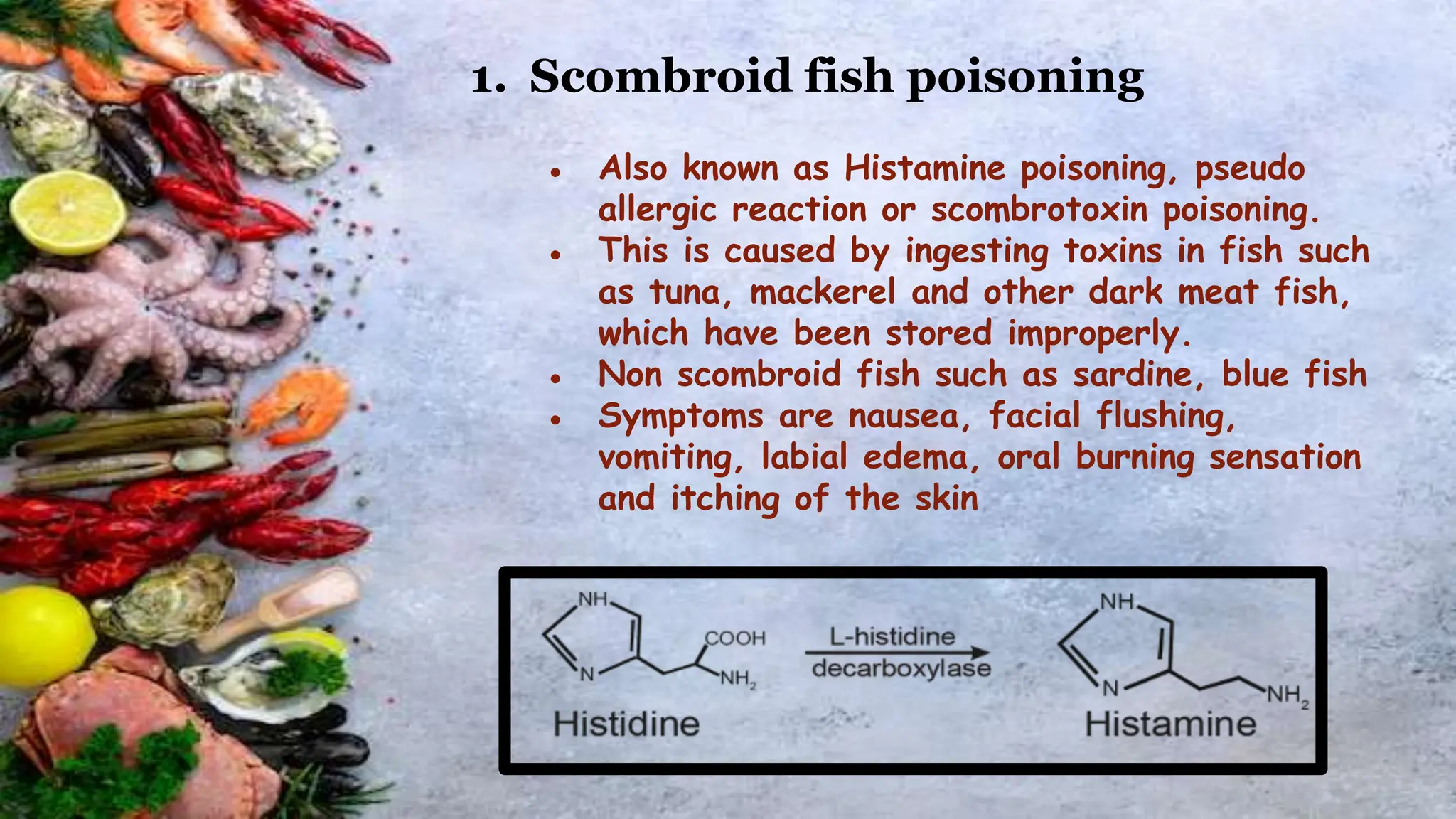
1. Scombroid fish poisoning
● Also known as Histamine poisoning, pseudo
allergic reaction or scombrotoxin poisoning.
● This is caused by ingesting toxins in fish such
as tuna, mackerel and other dark meat fish,
which have been stored improperly.
● Non scombroid fish such as sardine, blue fish
● Symptoms are nausea, facial flushing,
vomiting, labial edema, oral burning sensation
and itching of the skin
2. Ciguatera fish poisoning (CFP)
● Toxin - Ciguatoxin (CTX) and Maitotoxin (MTX)
● Agent - Gambierdisccus toxicus and benthic
dinoflagellates ( a unicellular plankton) associated
with coral reef.
Example: Barracuda, Amberjack, king mackerel,
groupers, snappers
● Symptoms usually start 1-6 hours after ingestion
with nausea, vomiting, watery diarrhoea and
abdominal pain.
3. Puffer fish poisoning
● Toxin - Tetrodotoxin ( present in fish
organmeat, gonads).
● Fishes include blowfish, globe fish, blue ringed
octopus, gobies, starfish, horseshoe crab eggs
● Symptoms are neurological and cardiovascular
symptoms like tingling, lack of coordination,
difficulty in breathing and death within 17
minutes.
Puffer fish poisoning
4. Sardine poisoning
● Toxin - unknown
● Rare and very poorly reported one.
● Fish species include sadines, herrings and
anchovies.
Sardine poisoning
5.Hallucinogenic fish poisoning
● Exact toxin - unknown
● Similarities with CFP.
● Rare
● Fish species include Siganus spinus
● Ichthyollayeinotaxism.
● Symptoms are dizziness, loss of equilibrium lack
of motor coordination , hall installation and
mental depression.
Hallucinogenic fish poisoning
6. Palytoxic fish poisoning
● Toxin - palytoxin
● Neurotoxic
● Similarities with CFP
● Grazing animals on Palythoa sp.
● Skin symptoms like rash, itching, dermatitis.
● Respiratory symptoms like wheezing, tight
chest, shortness of breath, runny nose, fluid
the lungs.
Palythoa sp
SHELLFISH POISONING
● Paralytic shellfish poisoning (PSP)
● Neurotoxic shellfish poisoning
● Diarrhetic shellfish poisoning (DSP)
● Amnestic shellfish poisoning
● Azapiracid poisoning
● Many shellfish become toxic to humans as a
result of feeding on toxic algae, particularly
the dinoflagellates, including Gonyaulax
catenalla and G.tamareusis.
● Symptoms include numbness of lips,
fingertips and tongue shortly after
consumption of the shellfish.
● Death can result within 2 to 12 hours as a
result of eventual respiratory paralysis.
1. Paralytic shellfish poisoning
● Toxin - Saxitoxin (STX)
● Agent - Alexandrium sp., Gymnodinium catenatum
and Pyrodinium spp.
● Most common and widespread shellfish poisoning.
● Symptoms may appear within 30 minutes of
consumption, headache, dizziness, tingling,
numbness in extremities, lack of muscular
coordination.
● May result in death due to paralysis of the
respiratory system.
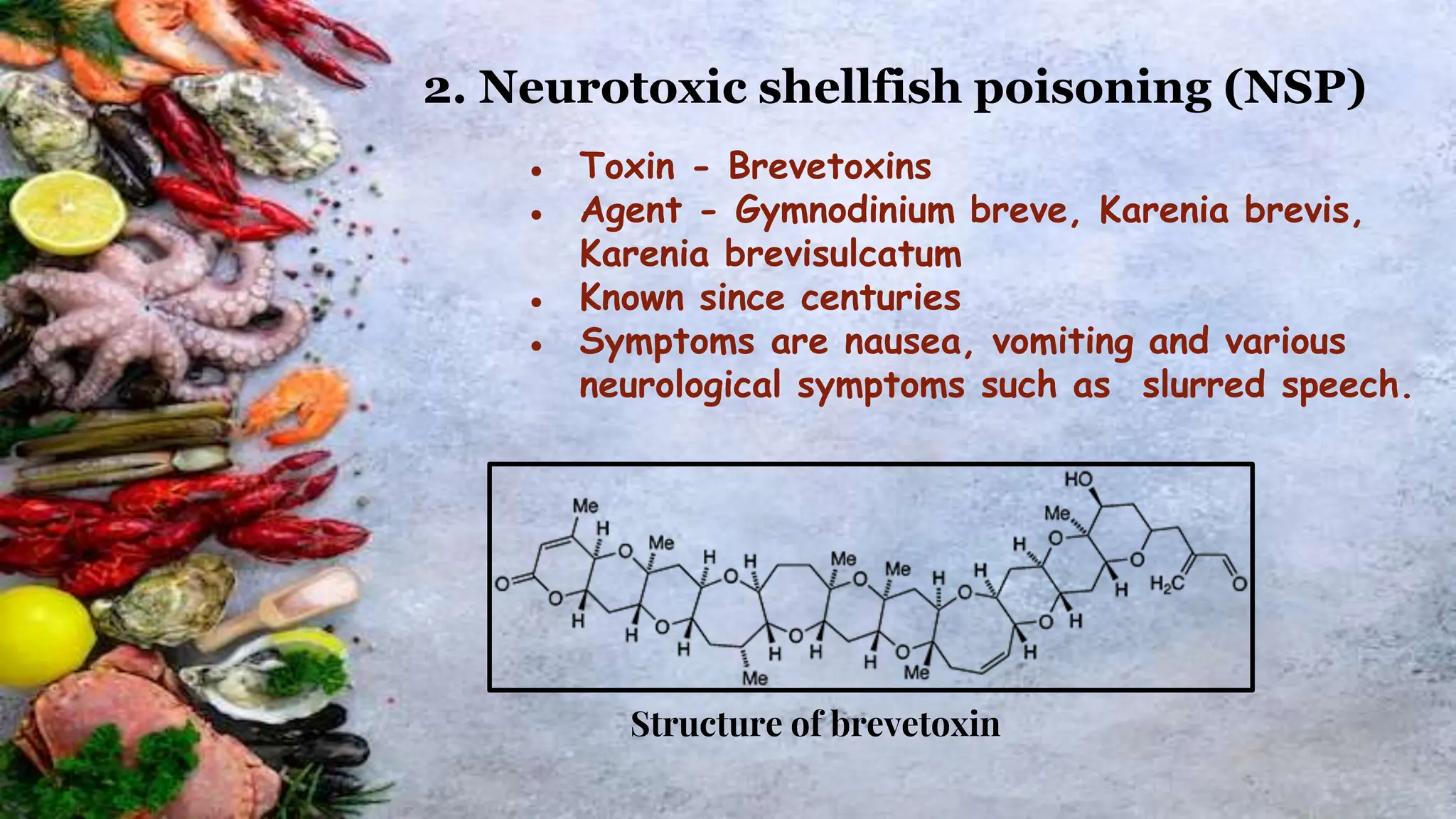
2. Neurotoxic shellfish poisoning (NSP)
● Toxin - Brevetoxins
● Agent - Gymnodinium breve, Karenia brevis,
Karenia brevisulcatum
● Known since centuries
● Symptoms are nausea, vomiting and various
neurological symptoms such as slurred speech.
Structure of brevetoxin
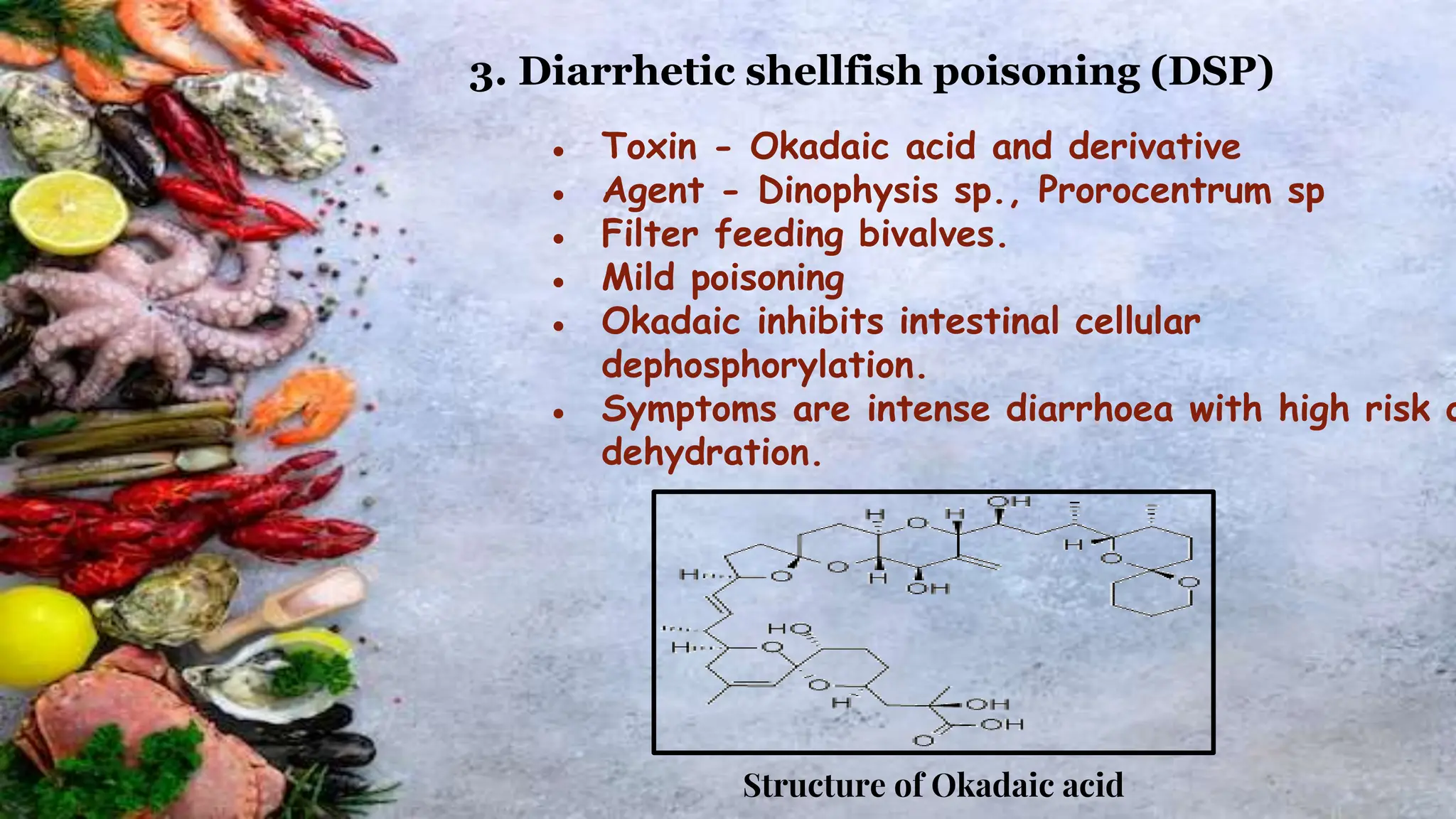
3. Diarrhetic shellfish poisoning (DSP)
● Toxin - Okadaic acid and derivative
● Agent - Dinophysis sp., Prorocentrum sp
● Filter feeding bivalves.
● Mild poisoning
● Okadaic inhibits intestinal cellular
dephosphorylation.
● Symptoms are intense diarrhoea with high risk o
dehydration.
Structure of Okadaic acid
4. Amnestic shellfish poisoning
● Toxin - Domoic acid
● Agent - Pseudonitzchia sp.
● One of the potentially serious poisoning.
● Symptoms are short term memory loss, brain
damage, death in severe case.
Structure of Domoic acid Amnestic shellfish poisoning
5. Azaspiracid poisoning
● Toxin - Azaspiracid 1
● Agent - Protoperidinium crassipes
● More recently discovered poisoning.
● Symptoms are nausea, vomiting and diarrhoea.
Structure of Azaspiracid 1
Other factors associate with seafood
poisoning
1. Parasites in seafood
● Anisakis simplex
● Diphyllobothrium sp.
● Paragonimus sp.
● Opisthocris sp.
2. Protozoans
● Cryptosporidium parvum
● Entamoeba histolytica
● Giardia lamblia
● Cyclospora sp.
3. Bacteria in seafood
● Staphylococcus aureus
● Salmonella sp.
● Vibrio cholerae
● Vibrio parahaemolyticus
● Listeria monocytogenes
● E.coli
4. Virusesvin seafood
● Hepatitis A virus
● Norovirus
5. Heavy matals in sea food
6. Red whelk poisoning
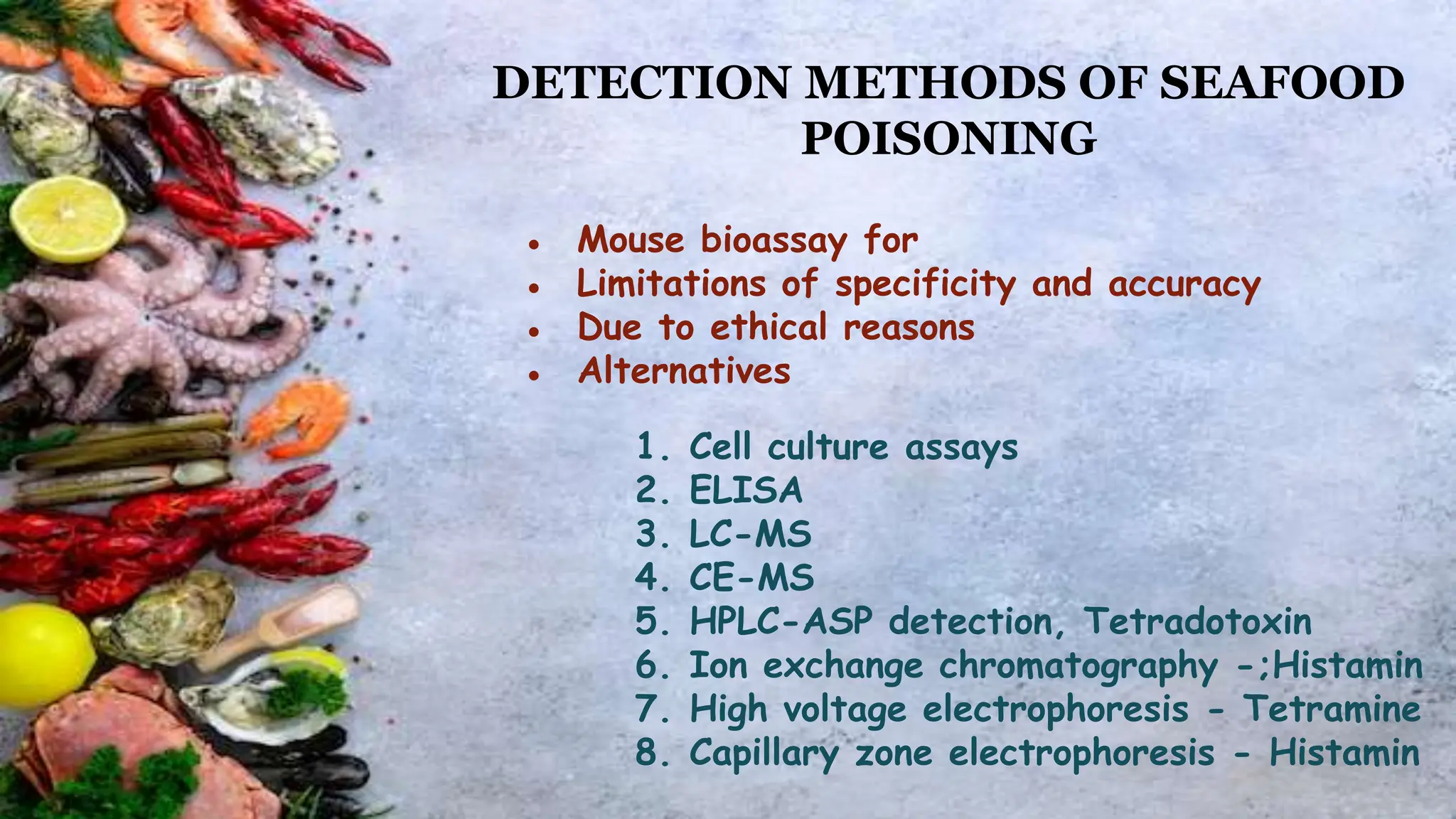
DETECTION METHODS OF SEAFOOD
POISONING
● Mouse bioassay for
● Limitations of specificity and accuracy
● Due to ethical reasons
● Alternatives
1. Cell culture assays
2. ELISA
3. LC-MS
4. CE-MS
5. HPLC-ASP detection, Tetradotoxin
6. Ion exchange chromatography -;Histamin
7. High voltage electrophoresis - Tetramine
8. Capillary zone electrophoresis - Histamin
● Fish hygiene relates to "All conditions and
measures necessary to ensure the safety and
suitability at all stages of the fish handling".
● These hygienic measures
● aim at preventing or reducing contamination and
microbial growth. fish
HYGIENIC ERRORS OF SEAFOOD
POISONING
● Aspects related to the hygienic design of
facilities during
● On-board,
● Transportation
● Processing and distribution
● Personnel hygiene
● Cleaning and sanitation
PREVENTION, CONTROL AND
MONITORING
● Freezing, drying, salting, canning and chilling
may reduced the spoilage.
● Do not use bulbs when selling fish.
● care should be taken when eating shellfish, and
special caution exercised with very large
predatory tropical fish.
● the seafood has been cooked should be
discarded, and the viscera of any fish should
not be consumed.
● No seafood should be collected or consumed
during or for several days after a bloom.
● When catch big fishesvdegurtvfirst and the
keep in ice.
● In the case of shrimp removing head
immediately
Sea Food Poisoning.pptx

Sea Food Poisoning.pptx

  • 2.
    Your Name •Sept 20XX SEAFOOD TOXICANTS
  • 3.
    CONTENT ● Introduction ● Categoriesof seafood poisoning ● Finfish poisoning ● Shellfish poisoning ● Other factors associate with seafood poisoning ● Detection methods of seafood poisoning ● Hygienic errors for seafood poisoning ● Prevention, control and monitoring
  • 4.
    ● A groupof acute illnesses due to ingestion of contaminated finfish, bivalve mollusks and snails may result allergy, toxemia from foods, those inherently poisonous or those contaminated by poisons. ● Seafood containing poisons formed by bacteria or food borne infections. ( Source - medical- dictionary) ● About 16% of all animal protein. ● Seafood products are important both nutritionally and economically INTRODUCTION What is seafood poisoning?
  • 5.
    CATEGORIES OF SEAFOODPOISONING ● There are three categories of seafood poisoning, 1. Finfish poisoning 2. Shellfish poisoning 3. Other factors
  • 6.
    FINFISH POISONING 1. Scombroidfish poisoning 2. Ciguatera fish poisoning 3. Puffer fish poisoning 4. Sardine poisoning 5. Hallucinogenic fish poisoning 6. Palytoxic fish poisoning
  • 7.
    1. Scombroid fishpoisoning ● Also known as Histamine poisoning, pseudo allergic reaction or scombrotoxin poisoning. ● This is caused by ingesting toxins in fish such as tuna, mackerel and other dark meat fish, which have been stored improperly. ● Non scombroid fish such as sardine, blue fish ● Symptoms are nausea, facial flushing, vomiting, labial edema, oral burning sensation and itching of the skin
  • 9.
    2. Ciguatera fishpoisoning (CFP) ● Toxin - Ciguatoxin (CTX) and Maitotoxin (MTX) ● Agent - Gambierdisccus toxicus and benthic dinoflagellates ( a unicellular plankton) associated with coral reef. Example: Barracuda, Amberjack, king mackerel, groupers, snappers ● Symptoms usually start 1-6 hours after ingestion with nausea, vomiting, watery diarrhoea and abdominal pain.
  • 10.
    3. Puffer fishpoisoning ● Toxin - Tetrodotoxin ( present in fish organmeat, gonads). ● Fishes include blowfish, globe fish, blue ringed octopus, gobies, starfish, horseshoe crab eggs ● Symptoms are neurological and cardiovascular symptoms like tingling, lack of coordination, difficulty in breathing and death within 17 minutes. Puffer fish poisoning
  • 11.
    4. Sardine poisoning ●Toxin - unknown ● Rare and very poorly reported one. ● Fish species include sadines, herrings and anchovies. Sardine poisoning
  • 12.
    5.Hallucinogenic fish poisoning ●Exact toxin - unknown ● Similarities with CFP. ● Rare ● Fish species include Siganus spinus ● Ichthyollayeinotaxism. ● Symptoms are dizziness, loss of equilibrium lack of motor coordination , hall installation and mental depression. Hallucinogenic fish poisoning
  • 13.
    6. Palytoxic fishpoisoning ● Toxin - palytoxin ● Neurotoxic ● Similarities with CFP ● Grazing animals on Palythoa sp. ● Skin symptoms like rash, itching, dermatitis. ● Respiratory symptoms like wheezing, tight chest, shortness of breath, runny nose, fluid the lungs. Palythoa sp
  • 14.
    SHELLFISH POISONING ● Paralyticshellfish poisoning (PSP) ● Neurotoxic shellfish poisoning ● Diarrhetic shellfish poisoning (DSP) ● Amnestic shellfish poisoning ● Azapiracid poisoning ● Many shellfish become toxic to humans as a result of feeding on toxic algae, particularly the dinoflagellates, including Gonyaulax catenalla and G.tamareusis. ● Symptoms include numbness of lips, fingertips and tongue shortly after consumption of the shellfish. ● Death can result within 2 to 12 hours as a result of eventual respiratory paralysis.
  • 15.
    1. Paralytic shellfishpoisoning ● Toxin - Saxitoxin (STX) ● Agent - Alexandrium sp., Gymnodinium catenatum and Pyrodinium spp. ● Most common and widespread shellfish poisoning. ● Symptoms may appear within 30 minutes of consumption, headache, dizziness, tingling, numbness in extremities, lack of muscular coordination. ● May result in death due to paralysis of the respiratory system.
  • 16.
    2. Neurotoxic shellfishpoisoning (NSP) ● Toxin - Brevetoxins ● Agent - Gymnodinium breve, Karenia brevis, Karenia brevisulcatum ● Known since centuries ● Symptoms are nausea, vomiting and various neurological symptoms such as slurred speech. Structure of brevetoxin
  • 17.
    3. Diarrhetic shellfishpoisoning (DSP) ● Toxin - Okadaic acid and derivative ● Agent - Dinophysis sp., Prorocentrum sp ● Filter feeding bivalves. ● Mild poisoning ● Okadaic inhibits intestinal cellular dephosphorylation. ● Symptoms are intense diarrhoea with high risk o dehydration. Structure of Okadaic acid
  • 18.
    4. Amnestic shellfishpoisoning ● Toxin - Domoic acid ● Agent - Pseudonitzchia sp. ● One of the potentially serious poisoning. ● Symptoms are short term memory loss, brain damage, death in severe case. Structure of Domoic acid Amnestic shellfish poisoning
  • 19.
    5. Azaspiracid poisoning ●Toxin - Azaspiracid 1 ● Agent - Protoperidinium crassipes ● More recently discovered poisoning. ● Symptoms are nausea, vomiting and diarrhoea. Structure of Azaspiracid 1
  • 20.
    Other factors associatewith seafood poisoning 1. Parasites in seafood ● Anisakis simplex ● Diphyllobothrium sp. ● Paragonimus sp. ● Opisthocris sp. 2. Protozoans ● Cryptosporidium parvum ● Entamoeba histolytica ● Giardia lamblia ● Cyclospora sp.
  • 21.
    3. Bacteria inseafood ● Staphylococcus aureus ● Salmonella sp. ● Vibrio cholerae ● Vibrio parahaemolyticus ● Listeria monocytogenes ● E.coli 4. Virusesvin seafood ● Hepatitis A virus ● Norovirus 5. Heavy matals in sea food 6. Red whelk poisoning
  • 22.
    DETECTION METHODS OFSEAFOOD POISONING ● Mouse bioassay for ● Limitations of specificity and accuracy ● Due to ethical reasons ● Alternatives 1. Cell culture assays 2. ELISA 3. LC-MS 4. CE-MS 5. HPLC-ASP detection, Tetradotoxin 6. Ion exchange chromatography -;Histamin 7. High voltage electrophoresis - Tetramine 8. Capillary zone electrophoresis - Histamin
  • 23.
    ● Fish hygienerelates to "All conditions and measures necessary to ensure the safety and suitability at all stages of the fish handling". ● These hygienic measures ● aim at preventing or reducing contamination and microbial growth. fish HYGIENIC ERRORS OF SEAFOOD POISONING ● Aspects related to the hygienic design of facilities during ● On-board, ● Transportation ● Processing and distribution ● Personnel hygiene ● Cleaning and sanitation
  • 24.
    PREVENTION, CONTROL AND MONITORING ●Freezing, drying, salting, canning and chilling may reduced the spoilage. ● Do not use bulbs when selling fish. ● care should be taken when eating shellfish, and special caution exercised with very large predatory tropical fish. ● the seafood has been cooked should be discarded, and the viscera of any fish should not be consumed. ● No seafood should be collected or consumed during or for several days after a bloom. ● When catch big fishesvdegurtvfirst and the keep in ice. ● In the case of shrimp removing head immediately